
Graphing Rational Functions
|
|
|
- Hilary Fitzgerald
- 9 years ago
- Views:
Transcription
1 Graphing Rational Functions A rational function is defined here as a function that is equal to a ratio of two polynomials p(x)/q(x) such that the degree of q(x) is at least 1. Examples: is a rational function since it is a ratio of two polynomials with degree in the denominator greater than or equal to 1. is not a rational function since the degree of the denominator is not greater than or equal to 1. is not a rational function since the numerator is not a polynomial. Reduced Rational Functions A reduced rational function is one where there are no factors common to the numerator and denominator. For example, y = (x 1)/(x 2 4) is in reduced form since there is no factor of (x-1) in the denominator. Example of Non-Reduced Form: y = (x 2 4)/(x 2) is in non-reduced form since it may be written as y =[(x + 2)(x-2)]/(x-2) which may be reduced to y = x + 2 after canceling common factors of (x-2). So the equation simplifies to a linear equation! However, since x=2 results in division by zero in the original function, we are missing the point at x=2. The graphs of both y=x+2 and our rational function are shown below. TIP: Always simplify a rational function first, if possible. And remember to exclude any values of x from the domain that result in division by zero.


2 The Simplest Rational Function: y = 1/x If you graph the simplest rational function y = 1/x, you get the solution points and graph shown (in blue) below: As pointed out, the graph takes off vertically for x-values near x=0 and gets closer and closer to the vertical line x=0. We call x=0 the Vertical Asymptote. Also, the graph levels out to the horizontal line y=0 for very large positive and negative values of x. We call y=0 the Horizontal Asymptote. Properties of Vertical and Horizontal Asymptotes Given a rational function is in reduced form, a vertical asymptote will always occur at a value of x that results in division by zero. This is due to the fact that as the denominator gets closer and closer to zero in value, the y-value of the positive or negative value of the function gets larger and larger. Note that for unreduced rational functions, this is not always the case. Assuming a rational function has a horizontal asymptote (not all do), the horizontal asymptote may always be approximated by inputting very large positive or negative values of x. If the y-values obtained get closer and closer to some fixed value, then the horizontal asymptote will be given by the horizontal line equal to that value. Rules For Finding Horizontal Asymptotes For rational functions where the degree of the denominator is greater than the degree of the numerator, y = 0 will be the horizontal asymptote.

3 For rational functions of the form where the degree of the numerator equals the degree of the denominator, the horizontal asymptote will consist of the horizontal line equal to the ratio of the leading coefficients. Slant Asymptotes: The slant asymptote of a rational function consists of a slanted line of the standard linear form y=mx + b, m 0, where the graph of f(x) approaches this linear function as x approaches positive or negative infinity. The slant asymptote only occurs if the numerator is of degree one more than the degree of the denominator. The slant asymptote may be found by dividing the numerator of the rational function by the denominator and rewriting the rational function as this result. The slant asymptote will be equal to the non-fractional part of this result. Method For Graphing Rational Functions 1. Make sure the rational function is reduced. 2. Find and plot all asymptotes. 3. Plot several points on each side of each vertical asymptote. 4. Use that fact that the graph takes off near each vertical asymptote and levels out to each horizontal or slant asymptote to complete the graph.
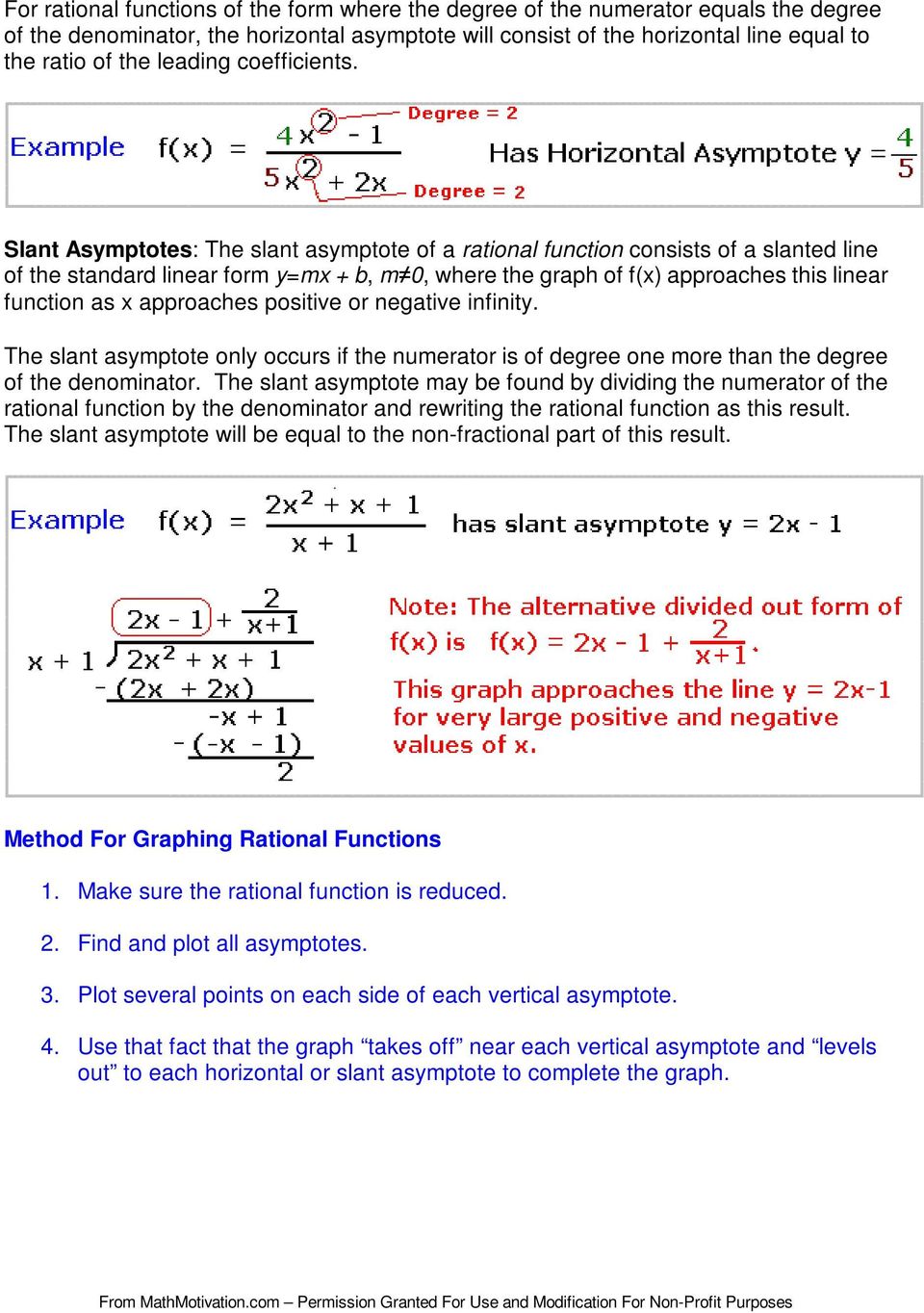
4 First, make sure this is reduced. The factored form is and no factors cancel, so this is the reduced form. Now, find and plot all asymptotes. The vertical asymptotes will be x=2 and x= -2 since these result in division by zero. Since the degree of the numerator is 1 and the degree of the denominator is 2, y=0 will be the horizontal asymptote. There is no slant asymptote. Plot these asymptotes, as shown below. Now, find and plot a few points on each side of x=2 and x= -2. We get the points as shown in the table below by simply inputting values of x into the function and finding the y-values. Then plot these to get

5 Now, think! The graph must take off near the vertical asymptotes x=2 and x=-2 and level out to the horizontal asymptote y=0. Using the points plotted, we can continue the trends to get the graph And here is the actual graph plotted with a computer program. The approximated graph was pretty close to the actual graph! First, find and plot all asymptotes. The vertical asymptote will be x=4 since this value results in division by zero. Note that this function is equivalent to From this, we see the degrees of the numerator and the denominator are both 1. Using the rule for horizontal asymptotes, we use the ratio of the leading coefficients, which results in y = 2/(-1) or y = -2.

6 Plot these asymptotes of x = 4 and y = -2, as shown below.

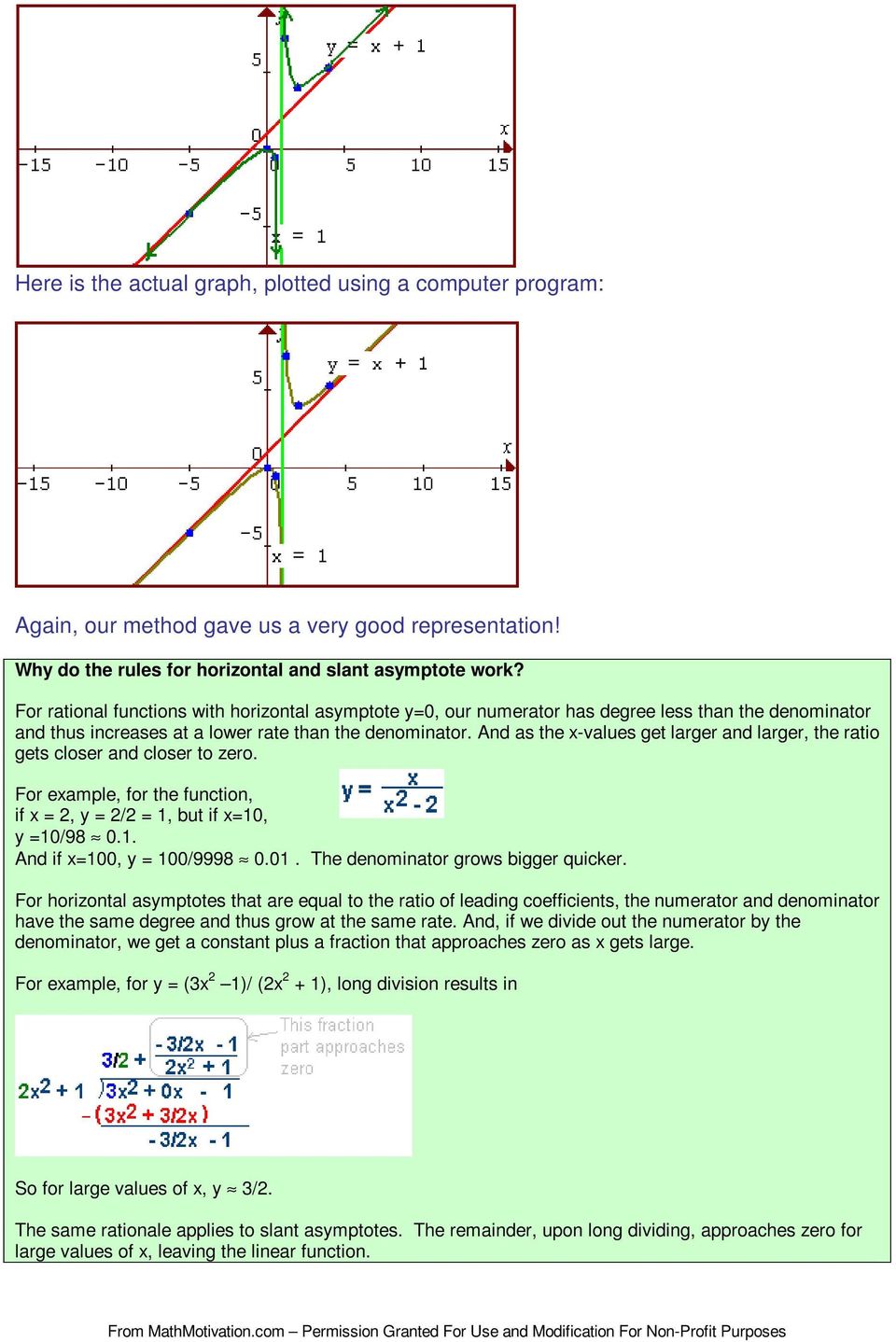
7 Slant Asymptote Example: Plot the graph of y = x 2 /(x-1) First, is this reduced? Answer: Yes, since nothing can be canceled. Now, find asymptotes. The vertical asymptote will be x=1 since x=1 results in division by zero. There is no horizontal asymptote since the degree of the numerator is neither equal to or less than the degree of the denominator. And, in this case, since the degree of the numerator is one more than the denominator, we know that there will be a slant asymptote. To find this slant asymptote, we long divide x 2 by (x-1) and using the quotient as our slant asymptote. Long division results in a slant asymptote of y = x + 1. We now plot both x = 1 and y = x + 1 to get Now, plot several points on each side of x=1 to get Complete the graph by leveling out the graph to the slant asymptotes and having the graph take off straight up or down near the vertical asymptote to get


8 Here is the actual graph, plotted using a computer program: Again, our method gave us a very good representation! Why do the rules for horizontal and slant asymptote work? For rational functions with horizontal asymptote y=0, our numerator has degree less than the denominator and thus increases at a lower rate than the denominator. And as the x-values get larger and larger, the ratio gets closer and closer to zero. For example, for the function, if x = 2, y = 2/2 = 1, but if x=10, y =10/ And if x=100, y = 100/ The denominator grows bigger quicker. For horizontal asymptotes that are equal to the ratio of leading coefficients, the numerator and denominator have the same degree and thus grow at the same rate. And, if we divide out the numerator by the denominator, we get a constant plus a fraction that approaches zero as x gets large. For example, for y = (3x 2 1)/ (2x 2 + 1), long division results in So for large values of x, y 3/2. The same rationale applies to slant asymptotes. The remainder, upon long dividing, approaches zero for large values of x, leaving the linear function.
MSLC Workshop Series Math 1148 1150 Workshop: Polynomial & Rational Functions
 MSLC Workshop Series Math 1148 1150 Workshop: Polynomial & Rational Functions The goal of this workshop is to familiarize you with similarities and differences in both the graphing and expression of polynomial
Linear Equations. Find the domain and the range of the following set. {(4,5), (7,8), (-1,3), (3,3), (2,-3)}
 Linear Equations Domain and Range Domain refers to the set of possible values of the x-component of a point in the form (x,y). Range refers to the set of possible values of the y-component of a point in
Chapter 4. Polynomial and Rational Functions. 4.1 Polynomial Functions and Their Graphs
 Chapter 4. Polynomial and Rational Functions 4.1 Polynomial Functions and Their Graphs A polynomial function of degree n is a function of the form P = a n n + a n 1 n 1 + + a 2 2 + a 1 + a 0 Where a s
Polynomial and Rational Functions
 Polynomial and Rational Functions Quadratic Functions Overview of Objectives, students should be able to: 1. Recognize the characteristics of parabolas. 2. Find the intercepts a. x intercepts by solving
is the degree of the polynomial and is the leading coefficient.
 Property: T. Hrubik-Vulanovic e-mail: [email protected] Content (in order sections were covered from the book): Chapter 6 Higher-Degree Polynomial Functions... 1 Section 6.1 Higher-Degree Polynomial Functions...
3.1. RATIONAL EXPRESSIONS
 3.1. RATIONAL EXPRESSIONS RATIONAL NUMBERS In previous courses you have learned how to operate (do addition, subtraction, multiplication, and division) on rational numbers (fractions). Rational numbers
Rational Functions, Limits, and Asymptotic Behavior
 Unit 2 Rational Functions, Limits, and Asymptotic Behavior Introduction An intuitive approach to the concept of a limit is often considered appropriate for students at the precalculus level. In this unit,
x x y y Then, my slope is =. Notice, if we use the slope formula, we ll get the same thing: m =
 Slope and Lines The slope of a line is a ratio that measures the incline of the line. As a result, the smaller the incline, the closer the slope is to zero and the steeper the incline, the farther the
Examples of Tasks from CCSS Edition Course 3, Unit 5
 Examples of Tasks from CCSS Edition Course 3, Unit 5 Getting Started The tasks below are selected with the intent of presenting key ideas and skills. Not every answer is complete, so that teachers can
Integrals of Rational Functions
 Integrals of Rational Functions Scott R. Fulton Overview A rational function has the form where p and q are polynomials. For example, r(x) = p(x) q(x) f(x) = x2 3 x 4 + 3, g(t) = t6 + 4t 2 3, 7t 5 + 3t
2.3. Finding polynomial functions. An Introduction:
 2.3. Finding polynomial functions. An Introduction: As is usually the case when learning a new concept in mathematics, the new concept is the reverse of the previous one. Remember how you first learned
2-5 Rational Functions
 -5 Rational Functions Find the domain of each function and the equations of the vertical or horizontal asymptotes, if any 1 f () = The function is undefined at the real zeros of the denominator b() = 4
Zero: If P is a polynomial and if c is a number such that P (c) = 0 then c is a zero of P.
 MATH 11011 FINDING REAL ZEROS KSU OF A POLYNOMIAL Definitions: Polynomial: is a function of the form P (x) = a n x n + a n 1 x n 1 + + a x + a 1 x + a 0. The numbers a n, a n 1,..., a 1, a 0 are called
Zeros of a Polynomial Function
 Zeros of a Polynomial Function An important consequence of the Factor Theorem is that finding the zeros of a polynomial is really the same thing as factoring it into linear factors. In this section we
Chapter 7 - Roots, Radicals, and Complex Numbers
 Math 233 - Spring 2009 Chapter 7 - Roots, Radicals, and Complex Numbers 7.1 Roots and Radicals 7.1.1 Notation and Terminology In the expression x the is called the radical sign. The expression under the
Vocabulary Words and Definitions for Algebra
 Name: Period: Vocabulary Words and s for Algebra Absolute Value Additive Inverse Algebraic Expression Ascending Order Associative Property Axis of Symmetry Base Binomial Coefficient Combine Like Terms
MA107 Precalculus Algebra Exam 2 Review Solutions
 MA107 Precalculus Algebra Exam 2 Review Solutions February 24, 2008 1. The following demand equation models the number of units sold, x, of a product as a function of price, p. x = 4p + 200 a. Please write
Coordinate Plane, Slope, and Lines Long-Term Memory Review Review 1
 Review. What does slope of a line mean?. How do you find the slope of a line? 4. Plot and label the points A (3, ) and B (, ). a. From point B to point A, by how much does the y-value change? b. From point
https://williamshartunionca.springboardonline.org/ebook/book/27e8f1b87a1c4555a1212b...
 of 19 9/2/2014 12:09 PM Answers Teacher Copy Plan Pacing: 1 class period Chunking the Lesson Example A #1 Example B Example C #2 Check Your Understanding Lesson Practice Teach Bell-Ringer Activity Students
Power functions: f(x) = x n, n is a natural number The graphs of some power functions are given below. n- even n- odd
 5.1 Polynomial Functions A polynomial unctions is a unction o the orm = a n n + a n-1 n-1 + + a 1 + a 0 Eample: = 3 3 + 5 - The domain o a polynomial unction is the set o all real numbers. The -intercepts
Limits. Graphical Limits Let be a function defined on the interval [-6,11] whose graph is given as:
![Limits. Graphical Limits Let be a function defined on the interval [-6,11] whose graph is given as:](/thumbs/27/11099194.jpg "Limits. Graphical Limits Let be a function defined on the interval [-6,11] whose graph is given as:") Limits Limits: Graphical Solutions Graphical Limits Let be a function defined on the interval [-6,11] whose graph is given as: The limits are defined as the value that the function approaches as it goes
Limits Limits: Graphical Solutions Graphical Limits Let be a function defined on the interval [-6,11] whose graph is given as: The limits are defined as the value that the function approaches as it goes
Zeros of Polynomial Functions
 Review: Synthetic Division Find (x 2-5x - 5x 3 + x 4 ) (5 + x). Factor Theorem Solve 2x 3-5x 2 + x + 2 =0 given that 2 is a zero of f(x) = 2x 3-5x 2 + x + 2. Zeros of Polynomial Functions Introduction
Unit 7: Radical Functions & Rational Exponents
 Date Period Unit 7: Radical Functions & Rational Exponents DAY 0 TOPIC Roots and Radical Expressions Multiplying and Dividing Radical Expressions Binomial Radical Expressions Rational Exponents 4 Solving
Algebra II End of Course Exam Answer Key Segment I. Scientific Calculator Only
 Algebra II End of Course Exam Answer Key Segment I Scientific Calculator Only Question 1 Reporting Category: Algebraic Concepts & Procedures Common Core Standard: A-APR.3: Identify zeros of polynomials
2.2 Derivative as a Function
 2.2 Derivative as a Function Recall that we defined the derivative as f (a) = lim h 0 f(a + h) f(a) h But since a is really just an arbitrary number that represents an x-value, why don t we just use x
0.8 Rational Expressions and Equations
 96 Prerequisites 0.8 Rational Expressions and Equations We now turn our attention to rational expressions - that is, algebraic fractions - and equations which contain them. The reader is encouraged to
Definition 8.1 Two inequalities are equivalent if they have the same solution set. Add or Subtract the same value on both sides of the inequality.
 8 Inequalities Concepts: Equivalent Inequalities Linear and Nonlinear Inequalities Absolute Value Inequalities (Sections 4.6 and 1.1) 8.1 Equivalent Inequalities Definition 8.1 Two inequalities are equivalent
Simplifying Algebraic Fractions
 5. Simplifying Algebraic Fractions 5. OBJECTIVES. Find the GCF for two monomials and simplify a fraction 2. Find the GCF for two polynomials and simplify a fraction Much of our work with algebraic fractions
Zeros of Polynomial Functions
 Zeros of Polynomial Functions The Rational Zero Theorem If f (x) = a n x n + a n-1 x n-1 + + a 1 x + a 0 has integer coefficients and p/q (where p/q is reduced) is a rational zero, then p is a factor of
Mathematics. Accelerated GSE Analytic Geometry B/Advanced Algebra Unit 7: Rational and Radical Relationships
 Georgia Standards of Excellence Frameworks Mathematics Accelerated GSE Analytic Geometry B/Advanced Algebra Unit 7: Rational and Radical Relationships These materials are for nonprofit educational purposes
PREPARATION FOR MATH TESTING at CityLab Academy
 PREPARATION FOR MATH TESTING at CityLab Academy compiled by Gloria Vachino, M.S. Refresh your math skills with a MATH REVIEW and find out if you are ready for the math entrance test by taking a PRE-TEST
ALGEBRA REVIEW LEARNING SKILLS CENTER. Exponents & Radicals
 ALGEBRA REVIEW LEARNING SKILLS CENTER The "Review Series in Algebra" is taught at the beginning of each quarter by the staff of the Learning Skills Center at UC Davis. This workshop is intended to be an
Graphing Linear Equations
 Graphing Linear Equations I. Graphing Linear Equations a. The graphs of first degree (linear) equations will always be straight lines. b. Graphs of lines can have Positive Slope Negative Slope Zero slope
Partial Fractions. p(x) q(x)
 Partial Fractions Introduction to Partial Fractions Given a rational function of the form p(x) q(x) where the degree of p(x) is less than the degree of q(x), the method of partial fractions seeks to break
6 EXTENDING ALGEBRA. 6.0 Introduction. 6.1 The cubic equation. Objectives
 6 EXTENDING ALGEBRA Chapter 6 Extending Algebra Objectives After studying this chapter you should understand techniques whereby equations of cubic degree and higher can be solved; be able to factorise
MATH-0910 Review Concepts (Haugen)
 Unit 1 Whole Numbers and Fractions MATH-0910 Review Concepts (Haugen) Exam 1 Sections 1.5, 1.6, 1.7, 1.8, 2.1, 2.2, 2.3, 2.4, and 2.5 Dividing Whole Numbers Equivalent ways of expressing division: a b,
Basic Properties of Rational Expressions
 Basic Properties of Rational Expressions A fraction is not defined when the denominator is zero! Examples: Simplify and use Mathematics Writing Style. a) x + 8 b) x 9 x 3 Solution: a) x + 8 (x + 4) x +
LIMITS AND CONTINUITY
 LIMITS AND CONTINUITY 1 The concept of it Eample 11 Let f() = 2 4 Eamine the behavior of f() as approaches 2 2 Solution Let us compute some values of f() for close to 2, as in the tables below We see from
Plot the following two points on a graph and draw the line that passes through those two points. Find the rise, run and slope of that line.
 Objective # 6 Finding the slope of a line Material: page 117 to 121 Homework: worksheet NOTE: When we say line... we mean straight line! Slope of a line: It is a number that represents the slant of a line
This is a square root. The number under the radical is 9. (An asterisk * means multiply.)
 Page of Review of Radical Expressions and Equations Skills involving radicals can be divided into the following groups: Evaluate square roots or higher order roots. Simplify radical expressions. Rationalize
List the elements of the given set that are natural numbers, integers, rational numbers, and irrational numbers. (Enter your answers as commaseparated
 MATH 142 Review #1 (4717995) Question 1 2 3 4 5 6 7 8 9 10 11 12 13 14 15 16 17 18 19 20 21 22 23 24 25 26 27 28 29 30 31 Description This is the review for Exam #1. Please work as many problems as possible
1.2 Linear Equations and Rational Equations
 Linear Equations and Rational Equations Section Notes Page In this section, you will learn how to solve various linear and rational equations A linear equation will have an variable raised to a power of
WARM UP EXERCSE. 2-1 Polynomials and Rational Functions
 WARM UP EXERCSE Roots, zeros, and x-intercepts. x 2! 25 x 2 + 25 x 3! 25x polynomial, f (a) = 0! (x - a)g(x) 1 2-1 Polynomials and Rational Functions Students will learn about: Polynomial functions Behavior
MATH 60 NOTEBOOK CERTIFICATIONS
 MATH 60 NOTEBOOK CERTIFICATIONS Chapter #1: Integers and Real Numbers 1.1a 1.1b 1.2 1.3 1.4 1.8 Chapter #2: Algebraic Expressions, Linear Equations, and Applications 2.1a 2.1b 2.1c 2.2 2.3a 2.3b 2.4 2.5
47 Numerator Denominator
 JH WEEKLIES ISSUE #22 2012-2013 Mathematics Fractions Mathematicians often have to deal with numbers that are not whole numbers (1, 2, 3 etc.). The preferred way to represent these partial numbers (rational
Negative Integer Exponents
 7.7 Negative Integer Exponents 7.7 OBJECTIVES. Define the zero exponent 2. Use the definition of a negative exponent to simplify an expression 3. Use the properties of exponents to simplify expressions
SIMPLIFYING ALGEBRAIC FRACTIONS
 Tallahassee Community College 5 SIMPLIFYING ALGEBRAIC FRACTIONS In arithmetic, you learned that a fraction is in simplest form if the Greatest Common Factor (GCF) of the numerator and the denominator is
Algebra 2 Chapter 1 Vocabulary. identity - A statement that equates two equivalent expressions.
 Chapter 1 Vocabulary identity - A statement that equates two equivalent expressions. verbal model- A word equation that represents a real-life problem. algebraic expression - An expression with variables.
7.7 Solving Rational Equations
 Section 7.7 Solving Rational Equations 7 7.7 Solving Rational Equations When simplifying comple fractions in the previous section, we saw that multiplying both numerator and denominator by the appropriate
Solving Rational Equations
 Lesson M Lesson : Student Outcomes Students solve rational equations, monitoring for the creation of extraneous solutions. Lesson Notes In the preceding lessons, students learned to add, subtract, multiply,
Partial Fractions. Combining fractions over a common denominator is a familiar operation from algebra:
 Partial Fractions Combining fractions over a common denominator is a familiar operation from algebra: From the standpoint of integration, the left side of Equation 1 would be much easier to work with than
POLYNOMIAL FUNCTIONS
 POLYNOMIAL FUNCTIONS Polynomial Division.. 314 The Rational Zero Test.....317 Descarte s Rule of Signs... 319 The Remainder Theorem.....31 Finding all Zeros of a Polynomial Function.......33 Writing a
Method To Solve Linear, Polynomial, or Absolute Value Inequalities:
 Solving Inequalities An inequality is the result of replacing the = sign in an equation with ,, or. For example, 3x 2 < 7 is a linear inequality. We call it linear because if the < were replaced with
a. all of the above b. none of the above c. B, C, D, and F d. C, D, F e. C only f. C and F
 FINAL REVIEW WORKSHEET COLLEGE ALGEBRA Chapter 1. 1. Given the following equations, which are functions? (A) y 2 = 1 x 2 (B) y = 9 (C) y = x 3 5x (D) 5x + 2y = 10 (E) y = ± 1 2x (F) y = 3 x + 5 a. all
ALGEBRA 2 CRA 2 REVIEW - Chapters 1-6 Answer Section
 ALGEBRA 2 CRA 2 REVIEW - Chapters 1-6 Answer Section MULTIPLE CHOICE 1. ANS: C 2. ANS: A 3. ANS: A OBJ: 5-3.1 Using Vertex Form SHORT ANSWER 4. ANS: (x + 6)(x 2 6x + 36) OBJ: 6-4.2 Solving Equations by
Polynomial and Synthetic Division. Long Division of Polynomials. Example 1. 6x 2 7x 2 x 2) 19x 2 16x 4 6x3 12x 2 7x 2 16x 7x 2 14x. 2x 4.
 _.qd /7/5 9: AM Page 5 Section.. Polynomial and Synthetic Division 5 Polynomial and Synthetic Division What you should learn Use long division to divide polynomials by other polynomials. Use synthetic
Determine If An Equation Represents a Function
 Question : What is a linear function? The term linear function consists of two parts: linear and function. To understand what these terms mean together, we must first understand what a function is. The
Algebra 2 Year-at-a-Glance Leander ISD 2007-08. 1st Six Weeks 2nd Six Weeks 3rd Six Weeks 4th Six Weeks 5th Six Weeks 6th Six Weeks
 Algebra 2 Year-at-a-Glance Leander ISD 2007-08 1st Six Weeks 2nd Six Weeks 3rd Six Weeks 4th Six Weeks 5th Six Weeks 6th Six Weeks Essential Unit of Study 6 weeks 3 weeks 3 weeks 6 weeks 3 weeks 3 weeks
PLOTTING DATA AND INTERPRETING GRAPHS
 PLOTTING DATA AND INTERPRETING GRAPHS Fundamentals of Graphing One of the most important sets of skills in science and mathematics is the ability to construct graphs and to interpret the information they
Mathematics Placement
 Mathematics Placement The ACT COMPASS math test is a self-adaptive test, which potentially tests students within four different levels of math including pre-algebra, algebra, college algebra, and trigonometry.
College Algebra - MAT 161 Page: 1 Copyright 2009 Killoran
 College Algebra - MAT 6 Page: Copyright 2009 Killoran Zeros and Roots of Polynomial Functions Finding a Root (zero or x-intercept) of a polynomial is identical to the process of factoring a polynomial.
Zeros of Polynomial Functions
 Zeros of Polynomial Functions Objectives: 1.Use the Fundamental Theorem of Algebra to determine the number of zeros of polynomial functions 2.Find rational zeros of polynomial functions 3.Find conjugate
The degree of a polynomial function is equal to the highest exponent found on the independent variables.
 DETAILED SOLUTIONS AND CONCEPTS - POLYNOMIAL FUNCTIONS Prepared by Ingrid Stewart, Ph.D., College of Southern Nevada Please Send Questions and Comments to [email protected]. Thank you! PLEASE NOTE
A synonym is a word that has the same or almost the same definition of
 Slope-Intercept Form Determining the Rate of Change and y-intercept Learning Goals In this lesson, you will: Graph lines using the slope and y-intercept. Calculate the y-intercept of a line when given
1.4. Arithmetic of Algebraic Fractions. Introduction. Prerequisites. Learning Outcomes
 Arithmetic of Algebraic Fractions 1.4 Introduction Just as one whole number divided by another is called a numerical fraction, so one algebraic expression divided by another is known as an algebraic fraction.
Part 1 Expressions, Equations, and Inequalities: Simplifying and Solving
 Section 7 Algebraic Manipulations and Solving Part 1 Expressions, Equations, and Inequalities: Simplifying and Solving Before launching into the mathematics, let s take a moment to talk about the words
2.4 Real Zeros of Polynomial Functions
 SECTION 2.4 Real Zeros of Polynomial Functions 197 What you ll learn about Long Division and the Division Algorithm Remainder and Factor Theorems Synthetic Division Rational Zeros Theorem Upper and Lower
Procedure for Graphing Polynomial Functions
 Procedure for Graphing Polynomial Functions P(x) = a n x n + a n-1 x n-1 + + a 1 x + a 0 To graph P(x): As an example, we will examine the following polynomial function: P(x) = 2x 3 3x 2 23x + 12 1. Determine
COLLEGE ALGEBRA. Paul Dawkins
 COLLEGE ALGEBRA Paul Dawkins Table of Contents Preface... iii Outline... iv Preliminaries... Introduction... Integer Exponents... Rational Exponents... 9 Real Exponents...5 Radicals...6 Polynomials...5
What does the number m in y = mx + b measure? To find out, suppose (x 1, y 1 ) and (x 2, y 2 ) are two points on the graph of y = mx + b.
 PRIMARY CONTENT MODULE Algebra - Linear Equations & Inequalities T-37/H-37 What does the number m in y = mx + b measure? To find out, suppose (x 1, y 1 ) and (x 2, y 2 ) are two points on the graph of
3 e) x f) 2. Precalculus Worksheet P.1. 1. Complete the following questions from your textbook: p11: #5 10. 2. Why would you never write 5 < x > 7?
 Precalculus Worksheet P.1 1. Complete the following questions from your tetbook: p11: #5 10. Why would you never write 5 < > 7? 3. Why would you never write 3 > > 8? 4. Describe the graphs below using
Algebra I Vocabulary Cards
 Algebra I Vocabulary Cards Table of Contents Expressions and Operations Natural Numbers Whole Numbers Integers Rational Numbers Irrational Numbers Real Numbers Absolute Value Order of Operations Expression
Section 1.1 Linear Equations: Slope and Equations of Lines
 Section. Linear Equations: Slope and Equations of Lines Slope The measure of the steepness of a line is called the slope of the line. It is the amount of change in y, the rise, divided by the amount of
In this chapter, you will learn to use cost-volume-profit analysis.
 2.0 Chapter Introduction In this chapter, you will learn to use cost-volume-profit analysis. Assumptions. When you acquire supplies or services, you normally expect to pay a smaller price per unit as the
7.1 Graphs of Quadratic Functions in Vertex Form
 7.1 Graphs of Quadratic Functions in Vertex Form Quadratic Function in Vertex Form A quadratic function in vertex form is a function that can be written in the form f (x) = a(x! h) 2 + k where a is called
1. Then f has a relative maximum at x = c if f(c) f(x) for all values of x in some
 Section 3.1: First Derivative Test Definition. Let f be a function with domain D. 1. Then f has a relative maximum at x = c if f(c) f(x) for all values of x in some open interval containing c. The number
Why should we learn this? One real-world connection is to find the rate of change in an airplane s altitude. The Slope of a Line VOCABULARY
 Wh should we learn this? The Slope of a Line Objectives: To find slope of a line given two points, and to graph a line using the slope and the -intercept. One real-world connection is to find the rate
Algebra and Geometry Review (61 topics, no due date)
 Course Name: Math 112 Credit Exam LA Tech University Course Code: ALEKS Course: Trigonometry Instructor: Course Dates: Course Content: 159 topics Algebra and Geometry Review (61 topics, no due date) Properties
3-17 15-25 5 15-10 25 3-2 5 0. 1b) since the remainder is 0 I need to factor the numerator. Synthetic division tells me this is true
 Section 5.2 solutions #1-10: a) Perform the division using synthetic division. b) if the remainder is 0 use the result to completely factor the dividend (this is the numerator or the polynomial to the
Chapter 3 Section 6 Lesson Polynomials
 Chapter Section 6 Lesson Polynomials Introduction This lesson introduces polynomials and like terms. As we learned earlier, a monomial is a constant, a variable, or the product of constants and variables.
The Point-Slope Form
 7. The Point-Slope Form 7. OBJECTIVES 1. Given a point and a slope, find the graph of a line. Given a point and the slope, find the equation of a line. Given two points, find the equation of a line y Slope
Slope-Intercept Equation. Example
 1.4 Equations of Lines and Modeling Find the slope and the y intercept of a line given the equation y = mx + b, or f(x) = mx + b. Graph a linear equation using the slope and the y-intercept. Determine
Partial Fractions Decomposition
 Partial Fractions Decomposition Dr. Philippe B. Laval Kennesaw State University August 6, 008 Abstract This handout describes partial fractions decomposition and how it can be used when integrating rational
Week 1: Functions and Equations
 Week 1: Functions and Equations Goals: Review functions Introduce modeling using linear and quadratic functions Solving equations and systems Suggested Textbook Readings: Chapter 2: 2.1-2.2, and Chapter
Solving Quadratic & Higher Degree Inequalities
 Ch. 8 Solving Quadratic & Higher Degree Inequalities We solve quadratic and higher degree inequalities very much like we solve quadratic and higher degree equations. One method we often use to solve quadratic
MATH 21. College Algebra 1 Lecture Notes
 MATH 21 College Algebra 1 Lecture Notes MATH 21 3.6 Factoring Review College Algebra 1 Factoring and Foiling 1. (a + b) 2 = a 2 + 2ab + b 2. 2. (a b) 2 = a 2 2ab + b 2. 3. (a + b)(a b) = a 2 b 2. 4. (a
Algebra II A Final Exam
 Algebra II A Final Exam Multiple Choice Identify the choice that best completes the statement or answers the question. Evaluate the expression for the given value of the variable(s). 1. ; x = 4 a. 34 b.
SECTION 2.5: FINDING ZEROS OF POLYNOMIAL FUNCTIONS
 SECTION 2.5: FINDING ZEROS OF POLYNOMIAL FUNCTIONS Assume f ( x) is a nonconstant polynomial with real coefficients written in standard form. PART A: TECHNIQUES WE HAVE ALREADY SEEN Refer to: Notes 1.31
Graphing Linear Equations in Two Variables
 Math 123 Section 3.2 - Graphing Linear Equations Using Intercepts - Page 1 Graphing Linear Equations in Two Variables I. Graphing Lines A. The graph of a line is just the set of solution points of the
EXPONENTIAL FUNCTIONS 8.1.1 8.1.6
 EXPONENTIAL FUNCTIONS 8.1.1 8.1.6 In these sections, students generalize what they have learned about geometric sequences to investigate exponential functions. Students study exponential functions of the
6.1 Add & Subtract Polynomial Expression & Functions
 6.1 Add & Subtract Polynomial Expression & Functions Objectives 1. Know the meaning of the words term, monomial, binomial, trinomial, polynomial, degree, coefficient, like terms, polynomial funciton, quardrtic
2312 test 2 Fall 2010 Form B
 2312 test 2 Fall 2010 Form B 1. Write the slope-intercept form of the equation of the line through the given point perpendicular to the given lin point: ( 7, 8) line: 9x 45y = 9 2. Evaluate the function
PRE-CALCULUS GRADE 12
 PRE-CALCULUS GRADE 12 [C] Communication Trigonometry General Outcome: Develop trigonometric reasoning. A1. Demonstrate an understanding of angles in standard position, expressed in degrees and radians.
1 Lecture: Integration of rational functions by decomposition
 Lecture: Integration of rational functions by decomposition into partial fractions Recognize and integrate basic rational functions, except when the denominator is a power of an irreducible quadratic.
For additional information, see the Math Notes boxes in Lesson B.1.3 and B.2.3.
 EXPONENTIAL FUNCTIONS B.1.1 B.1.6 In these sections, students generalize what they have learned about geometric sequences to investigate exponential functions. Students study exponential functions of the
Algebra II Unit Number 4
 Title Polynomial Functions, Expressions, and Equations Big Ideas/Enduring Understandings Applying the processes of solving equations and simplifying expressions to problems with variables of varying degrees.
Polynomial Expressions and Equations
 Polynomial Expressions and Equations This is a really close-up picture of rain. Really. The picture represents falling water broken down into molecules, each with two hydrogen atoms connected to one oxygen
Math Common Core Sampler Test
 High School Algebra Core Curriculum Math Test Math Common Core Sampler Test Our High School Algebra sampler covers the twenty most common questions that we see targeted for this level. For complete tests
Math 0980 Chapter Objectives. Chapter 1: Introduction to Algebra: The Integers.
 Math 0980 Chapter Objectives Chapter 1: Introduction to Algebra: The Integers. 1. Identify the place value of a digit. 2. Write a number in words or digits. 3. Write positive and negative numbers used