
Primes. Name Period Number Theory
|
|
|
- Harvey Owens
- 10 years ago
- Views:
Transcription
1 Primes Name Period A Prime Number is a whole number whose only factors are 1 and itself. To find all of the prime numbers between 1 and 100, complete the following exercise: 1. Cross out 1 by Shading in the box completely. 1 is neither prime nor composite. It has only 1 factor - itself.. Use a forward Slash \ to cross out all multiples of, starting with 4. is the first prime number. 3. Use a backward Slash / to cross out all multiples of 3 starting with Multiples of 4 have been crossed out already when we did #. 5. Draw a Square on all multiples of 5 starting with is prime. 6. Multiples of 6 should be X d already from # and #3. 7. Circle all multiples of 7 starting with is prime. 8. Multiples of 8 were crossed out already when we did #. 9. Multiples of 9 were crossed out already when we did # Multiples of 10 were crossed out when we did # and #5. All of the remaining numbers are prime. How many prime numbers are left between 1 and 100? Answer: Use your chart for help. Is 51 prime? If not, what are its factors? Is 59 prime? If not, what are its factors? Is 87 prime? If not, what are its factors? Is 91 prime? If not, what are its factors?

2 Divisibility Rules Name Period There are some easy tricks you can use to determine if a number is divisible by, 3, 4, 5, 6, 8, 9 and 10. A number is divisible by: - if it is even. 3 - if the sum of its digits is divisible by if the number formed by the last digits is divisible by 4. (ask me why this works) 5 - if the ones digit is 5 or if it is divisible by AND 3. (All even multiples of 3.) 7 - there is no good trick for if the number formed by the last 3 digits is divisible by 8. (ask me why this works) 9 - if the sum of the digits is divisible by if the last digit is a 0. 11: We will learn this trick next. It is more complicated. Practice: Write yes or no in each blank. Determine whether 1,408 is divisible by: Determine whether 1,345,866 is divisible by: Determine whether,,5 is divisible by:

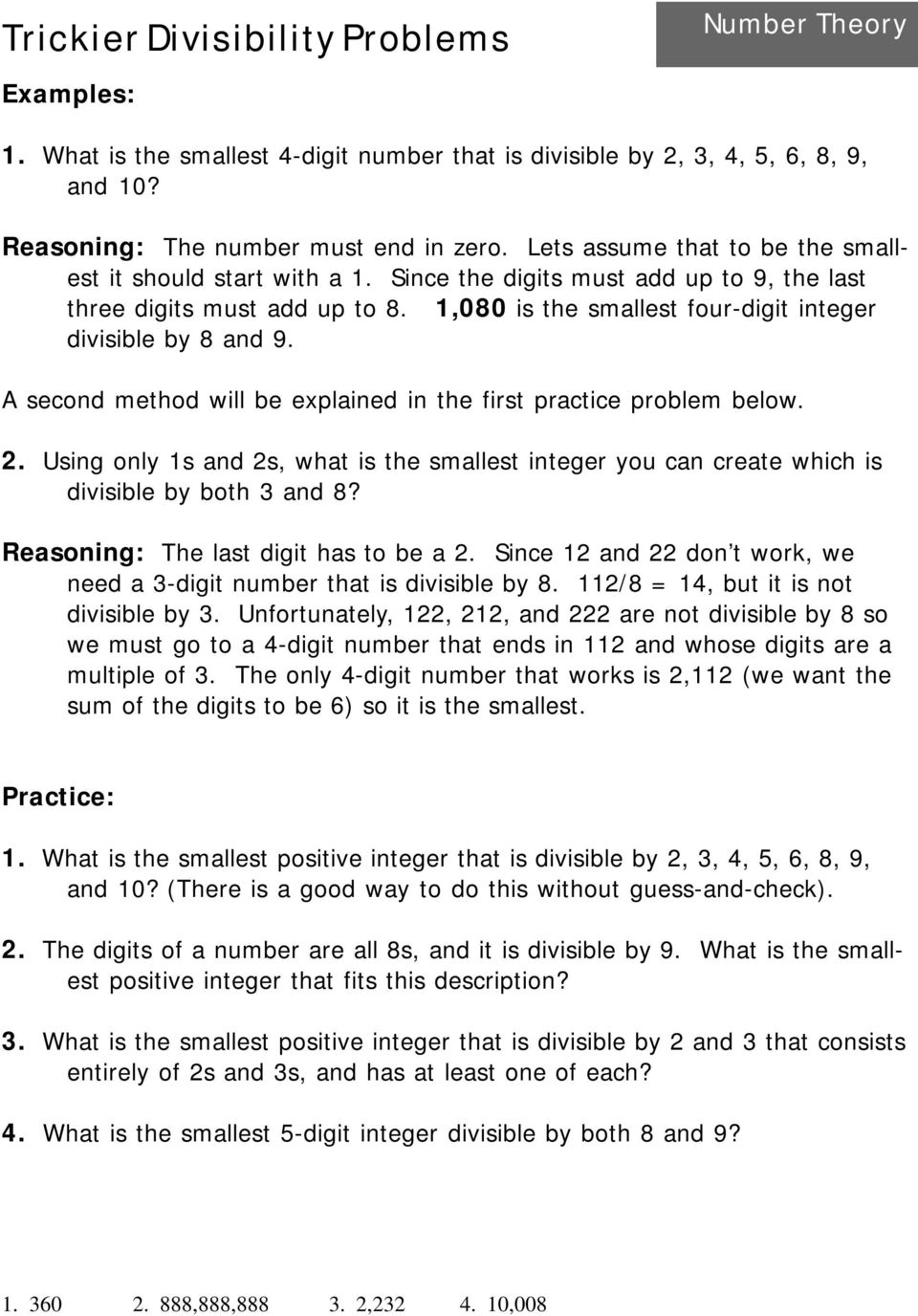
3 Trickier Divisibility Problems Examples: 1. What is the smallest 4-digit number that is divisible by, 3, 4, 5, 6, 8, 9, and 10? Reasoning: The number must end in zero. Lets assume that to be the smallest it should start with a 1. Since the digits must add up to 9, the last three digits must add up to 8. 1,080 is the smallest four-digit integer divisible by 8 and 9. A second method will be explained in the first practice problem below.. Using only 1s and s, what is the smallest integer you can create which is divisible by both 3 and 8? Reasoning: The last digit has to be a. Since 1 and don t work, we need a 3-digit number that is divisible by 8. 11/8 = 14, but it is not divisible by 3. Unfortunately, 1, 1, and are not divisible by 8 so we must go to a 4-digit number that ends in 11 and whose digits are a multiple of 3. The only 4-digit number that works is,11 (we want the sum of the digits to be 6) so it is the smallest. Practice: 1. What is the smallest positive integer that is divisible by, 3, 4, 5, 6, 8, 9, and 10? (There is a good way to do this without guess-and-check).. The digits of a number are all 8s, and it is divisible by 9. What is the smallest positive integer that fits this description? 3. What is the smallest positive integer that is divisible by and 3 that consists entirely of s and 3s, and has at least one of each? 4. What is the smallest 5-digit integer divisible by both 8 and 9? ,888,888 3., ,008
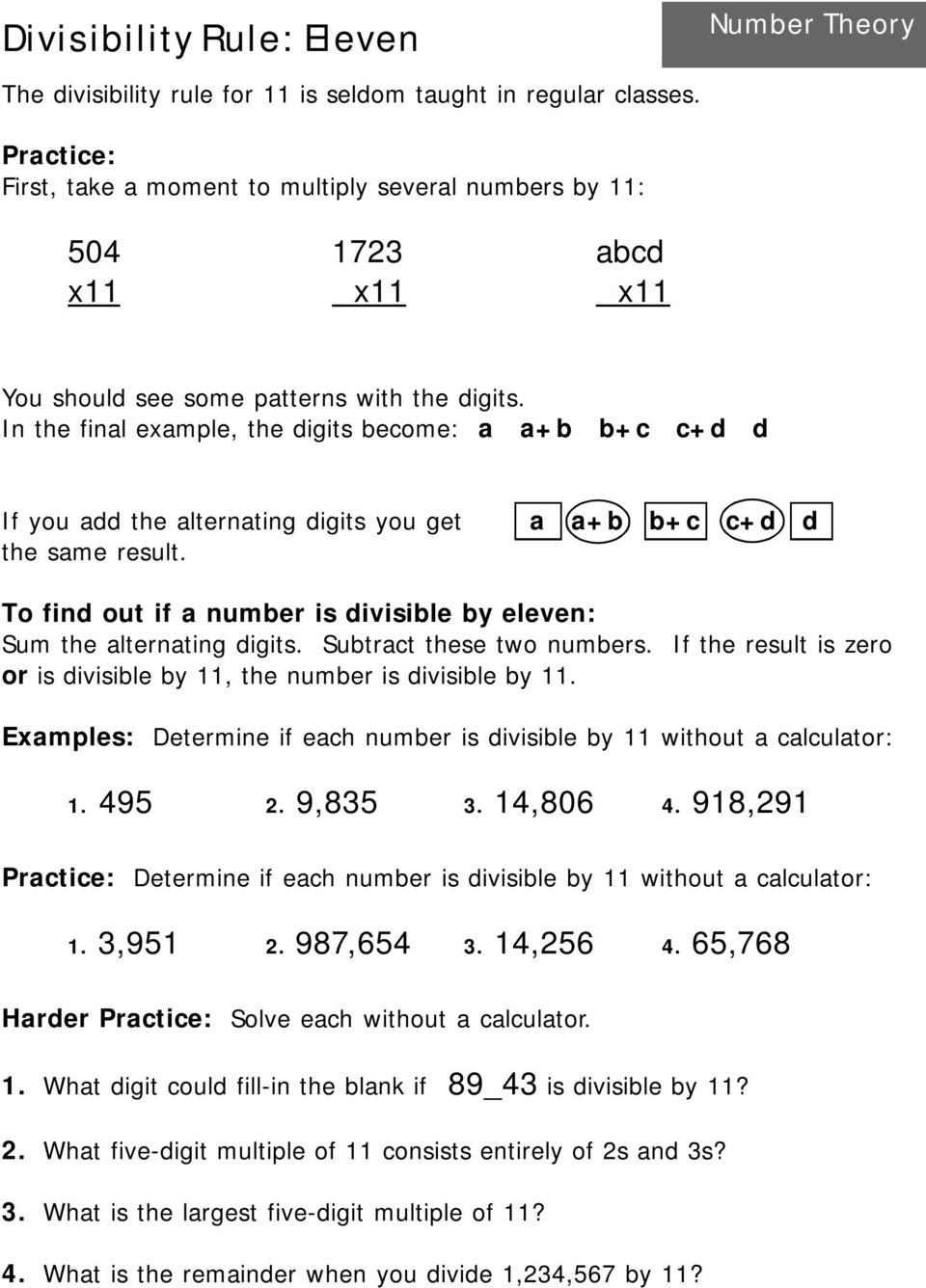
4 Divisibility Rule: Eleven The divisibility rule for 11 is seldom taught in regular classes. Practice: First, take a moment to multiply several numbers by 11: abcd x11 x11 x11 You should see some patterns with the digits. In the final example, the digits become: a a+b b+c c+d d If you add the alternating digits you get the same result. a a+b b+c c+d d To find out if a number is divisible by eleven: Sum the alternating digits. Subtract these two numbers. If the result is zero or is divisible by 11, the number is divisible by 11. Examples: Determine if each number is divisible by 11 without a calculator: , , ,91 Practice: Determine if each number is divisible by 11 without a calculator: 1. 3, , , ,768 Harder Practice: Solve each without a calculator. 1. What digit could fill-in the blank if 89_43 is divisible by 11?. What five-digit multiple of 11 consists entirely of s and 3s? 3. What is the largest five-digit multiple of 11? 4. What is the remainder when you divide 1,34,567 by 11?
5 Divisibility Practice Practice: Solve each using what you have learned about divisibility. Name Period 1. What digit could be used to fill in the blank and make the following number divisible by both 3 and 8? 45,_8. What is the smallest three-digit prime? 3. How many multiples of 3 less than 1,000 use only the digits and/or is divisible by both 8 and 9. How many integers less than 360 are also divisible by both 8 and 9? (hint: First find the smallest integer that is divisible by both 8 and 9.) 5. A three-digit integer is divisible by 9. If I subtract the tens digit from the hundreds digit, I get the ones digit. What is the largest number that meets these conditions? 6. There are two ways that the digits 1,, 3, and 4 be arranged to create a four-digit multiple of 8. Find them both. 7. Consecutive integers are placed in order to form a three-digit integer. The integer will ALWAYS be divisible by what prime number? 8. For the number ABC, each distinct letter represents a different digit. If ABC, CAB, and BCA are all divisible by 6 and 9, find the value of ABC + CAB + BCA. 9. What is the largest seven-digit number that contains each of the digits 1 through 7 and has the property that the sum of any two consecutive digits is a prime number? (source: MATHCOUNTS 000 National Team Round)

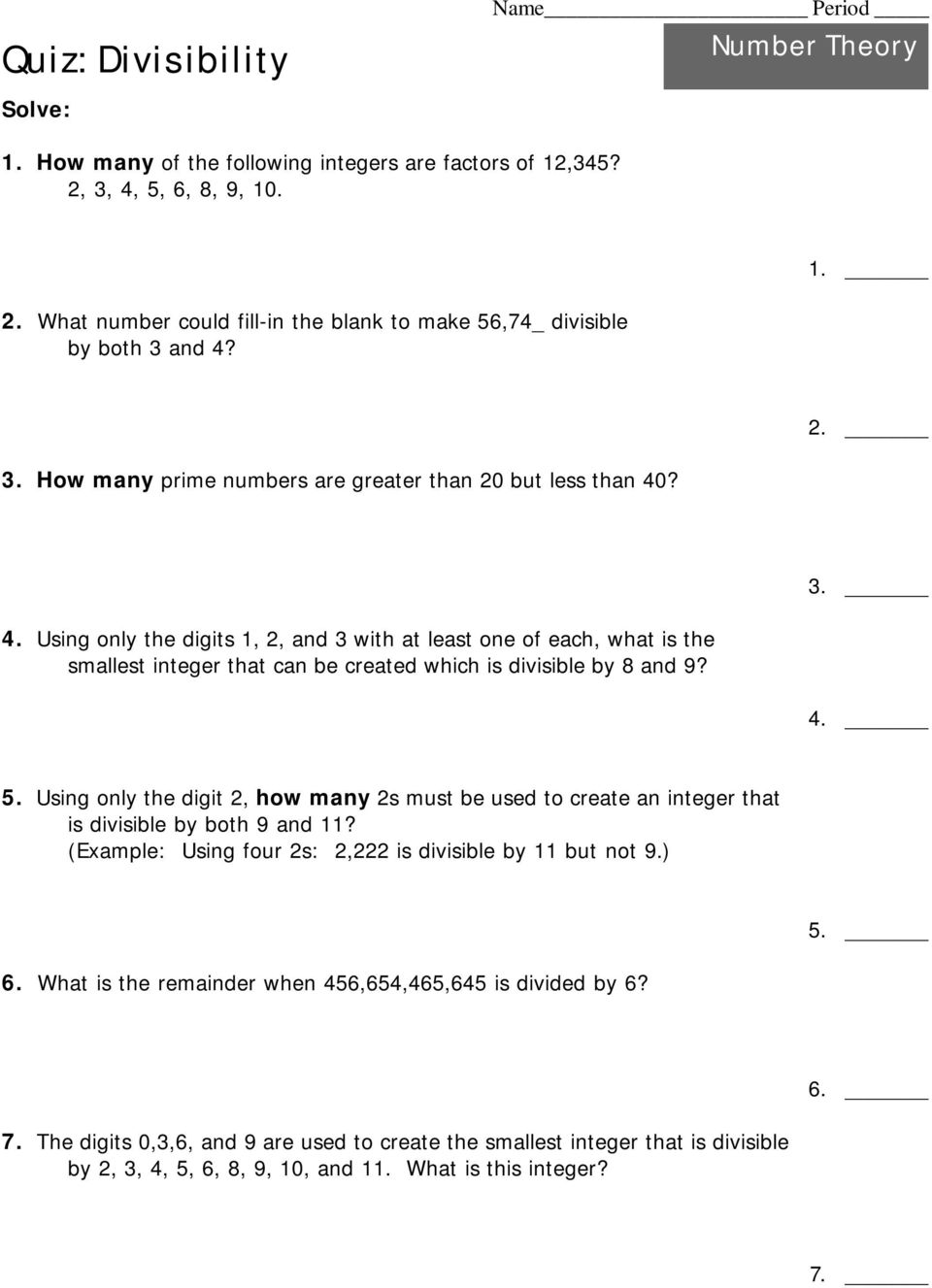
6 Quiz: Divisibility Solve: Name Period 1. How many of the following integers are factors of 1,345?, 3, 4, 5, 6, 8, 9, What number could fill-in the blank to make 56,74_ divisible by both 3 and 4?. 3. How many prime numbers are greater than 0 but less than 40? Using only the digits 1,, and 3 with at least one of each, what is the smallest integer that can be created which is divisible by 8 and 9? Using only the digit, how many s must be used to create an integer that is divisible by both 9 and 11? (Example: Using four s:, is divisible by 11 but not 9.) What is the remainder when 456,654,465,645 is divided by 6? The digits 0,3,6, and 9 are used to create the smallest integer that is divisible by, 3, 4, 5, 6, 8, 9, 10, and 11. What is this integer? 7.
7 Quiz: Divisibility Solve: Name Period 8. The digits 5, 6, and 7 are arranged to create a three-digit number. Which of the following cannot be a factor of the number formed? (There may be more than one answer, list all that apply.) Using two 5s and two 6s, it is possible to create four 4-digit numbers which are divisible by 11. What is the sum of these four numbers? Each of the digits 0-9 is used exactly once to create a ten-digit integer. Find one of the many ten-digit numbers which uses each digit once and is divisible by 8, 9, 10, and

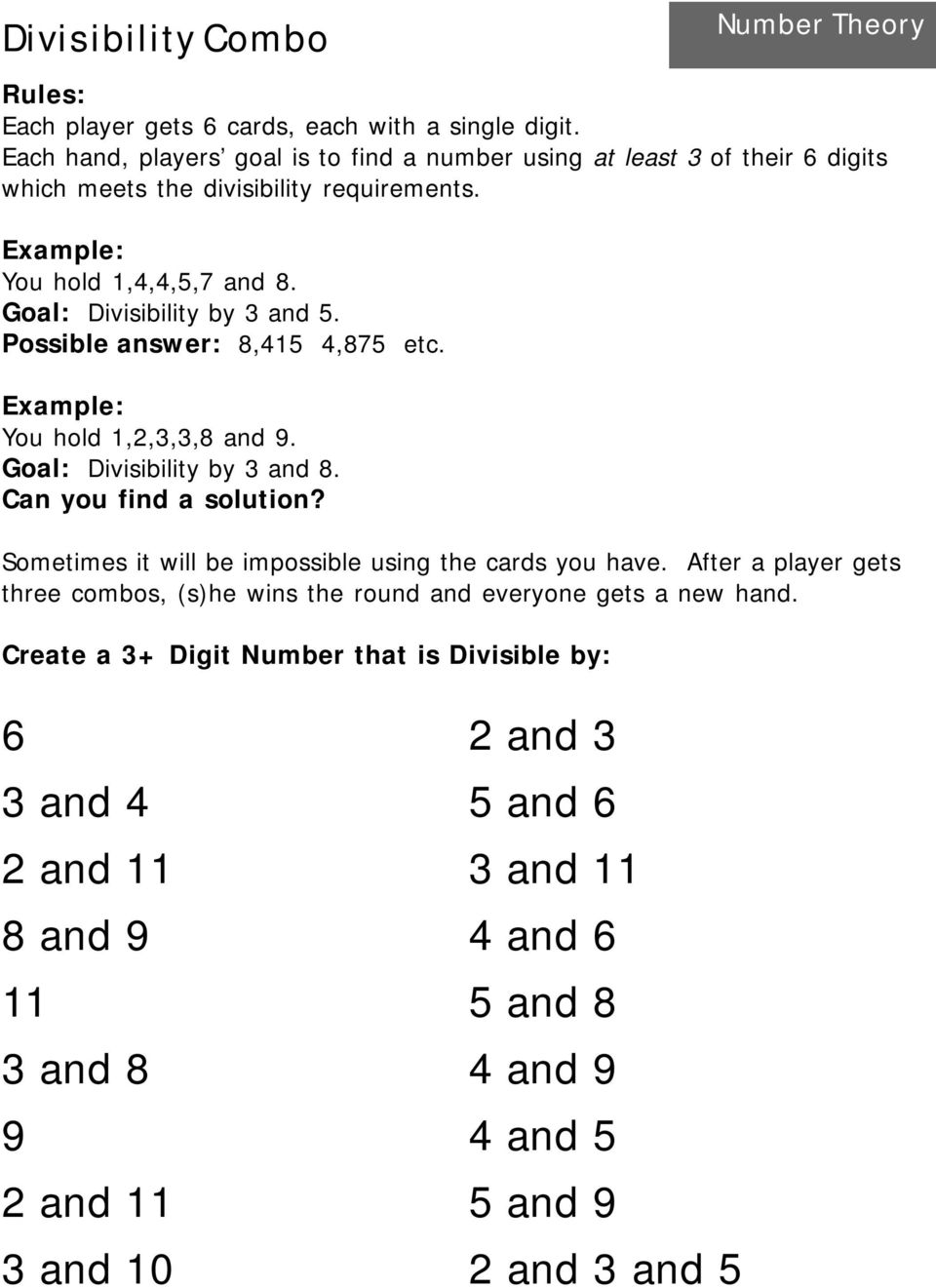
8 Divisibility Combo Rules: Each player gets 6 cards, each with a single digit. Each hand, players goal is to find a number using at least 3 of their 6 digits which meets the divisibility requirements. Example: You hold 1,4,4,5,7 and 8. Goal: Divisibility by 3 and 5. Possible answer: 8,415 4,875 etc. Example: You hold 1,,3,3,8 and 9. Goal: Divisibility by 3 and 8. Can you find a solution? Sometimes it will be impossible using the cards you have. After a player gets three combos, (s)he wins the round and everyone gets a new hand. Create a 3+ Digit Number that is Divisible by: 6 and 3 3 and 4 5 and 6 and 11 3 and 11 8 and 9 4 and and 8 3 and 8 4 and and 5 and 11 5 and 9 3 and 10 and 3 and 5
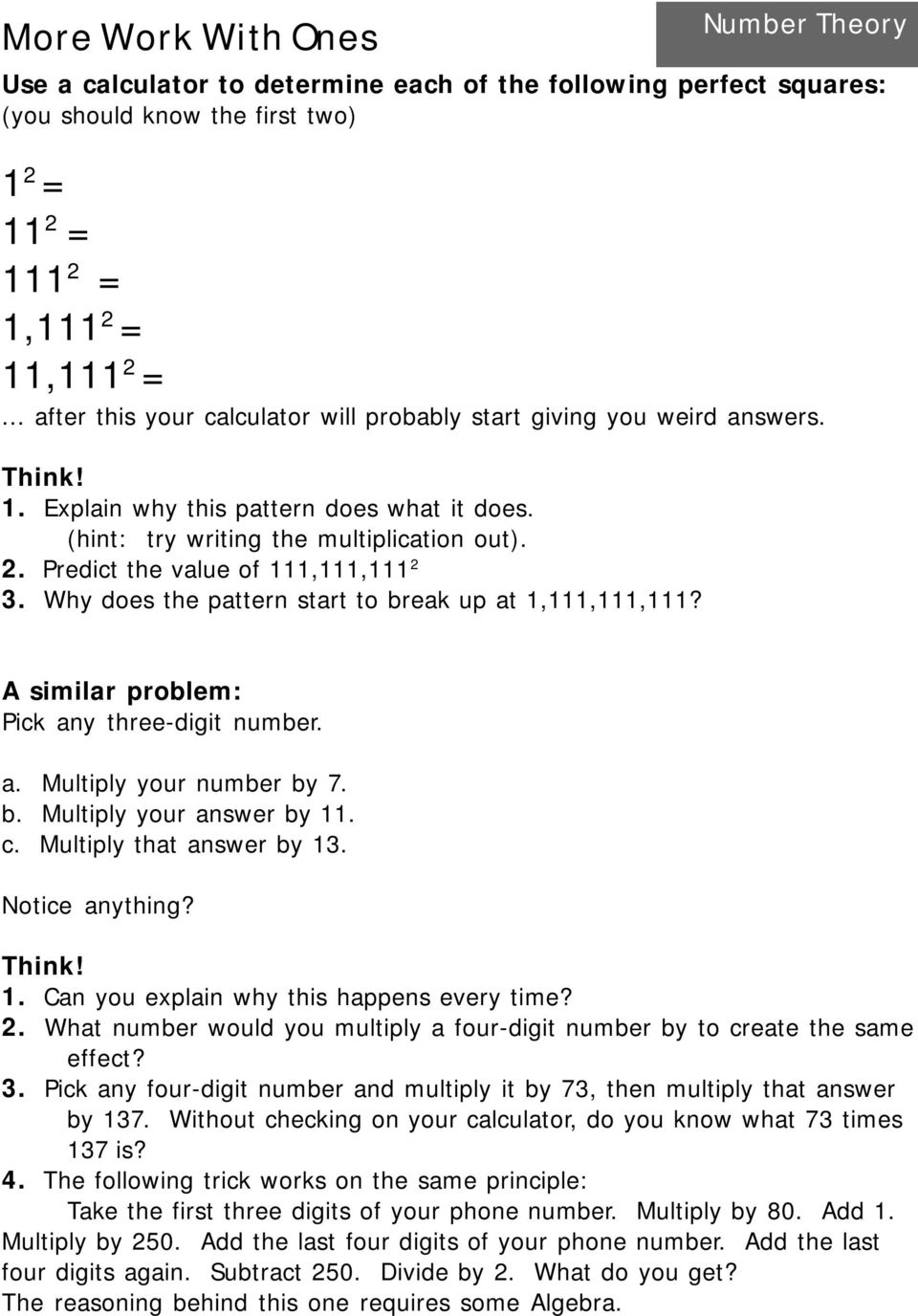
9 More Work With Ones Use a calculator to determine each of the following perfect squares: (you should know the first two) 1 = 11 = 111 = 1,111 = 11,111 =... after this your calculator will probably start giving you weird answers. Think! 1. Explain why this pattern does what it does. (hint: try writing the multiplication out).. Predict the value of 111,111, Why does the pattern start to break up at 1,111,111,111? A similar problem: Pick any three-digit number. a. Multiply your number by 7. b. Multiply your answer by 11. c. Multiply that answer by 13. Notice anything? Think! 1. Can you explain why this happens every time?. What number would you multiply a four-digit number by to create the same effect? 3. Pick any four-digit number and multiply it by 73, then multiply that answer by 137. Without checking on your calculator, do you know what 73 times 137 is? 4. The following trick works on the same principle: Take the first three digits of your phone number. Multiply by 80. Add 1. Multiply by 50. Add the last four digits of your phone number. Add the last four digits again. Subtract 50. Divide by. What do you get? The reasoning behind this one requires some Algebra.
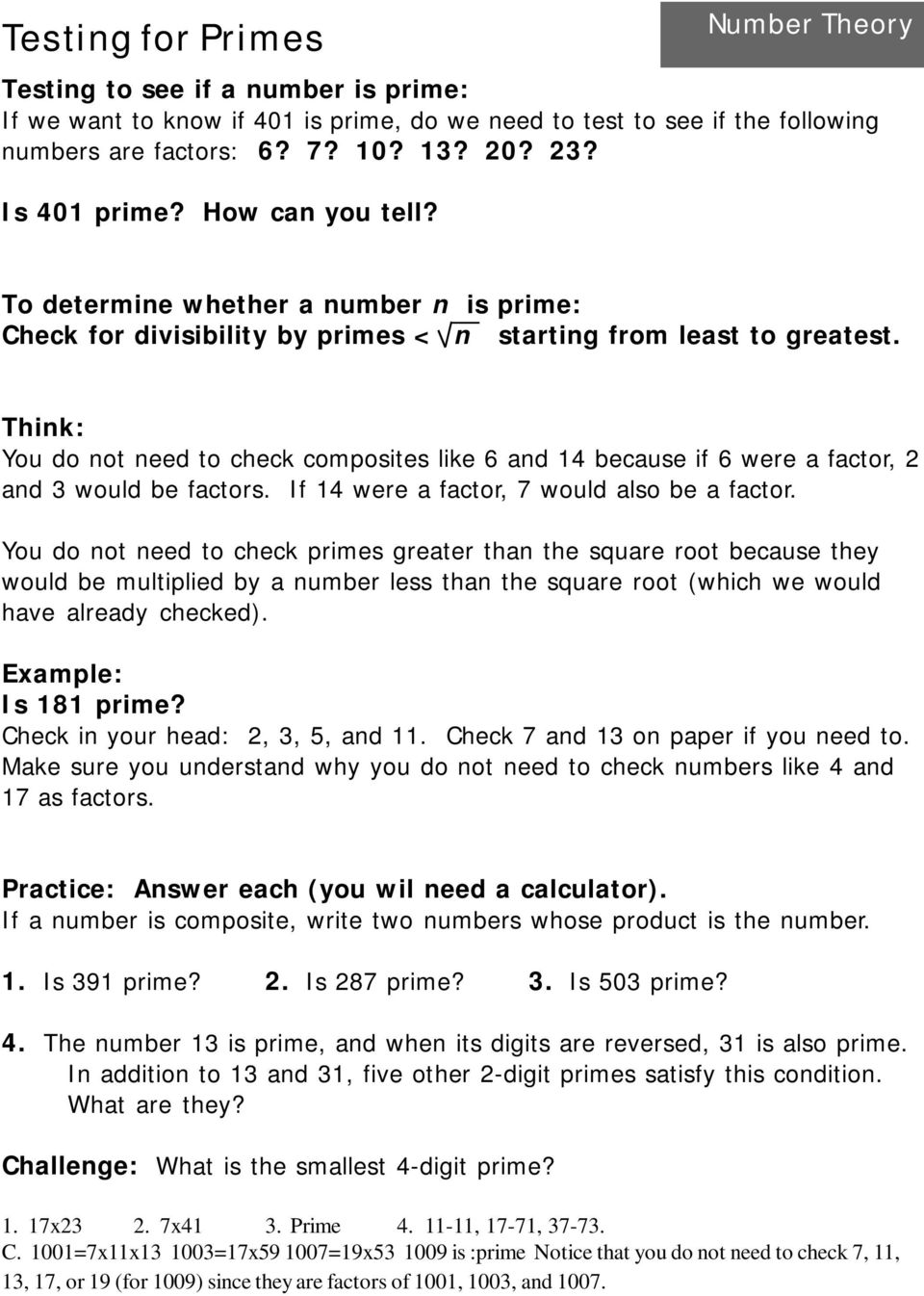
10 Testing for Primes Testing to see if a number is prime: If we want to know if 401 is prime, do we need to test to see if the following numbers are factors: 6? 7? 10? 13? 0? 3? Is 401 prime? How can you tell? To determine whether a number n is prime: Check for divisibility by primes < n starting from least to greatest. Think: You do not need to check composites like 6 and 14 because if 6 were a factor, and 3 would be factors. If 14 were a factor, 7 would also be a factor. You do not need to check primes greater than the square root because they would be multiplied by a number less than the square root (which we would have already checked). Example: Is 181 prime? Check in your head:, 3, 5, and 11. Check 7 and 13 on paper if you need to. Make sure you understand why you do not need to check numbers like 4 and 17 as factors. Practice: Answer each (you wil need a calculator). If a number is composite, write two numbers whose product is the number. 1. Is 391 prime?. Is 87 prime? 3. Is 503 prime? 4. The number 13 is prime, and when its digits are reversed, 31 is also prime. In addition to 13 and 31, five other -digit primes satisfy this condition. What are they? Challenge: What is the smallest 4-digit prime? 1. 17x3. 7x41 3. Prime , 17-71, C. 1001=7x11x =17x =19x is :prime Notice that you do not need to check 7, 11, 13, 17, or 19 (for 1009) since they are factors of 1001, 1003, and 1007.
11 A Brief Intro to Exponents One of the things that will come up frequently in this class which you all must be familiar with is the use of exponents. Base: The repeated factor in a power. In the expression n³, n is the base. Exponent: Represents the number of times a factor is being multiplied. In the expression n³, the ³ is the exponent. The expression The expression The expression 3 5 means that you multiply x means that you multiply x x x x x 4 (ab) means that you multiply ( ab)( ab)( ab)( ab) Practice: Write-out without using exponents: n 3. 5 ( 3n) a Practice: Write using exponents. Ex a a a a n n n 3. 5 Practice: Evaluate. (solve) Ex

12 Fundamental Theorem of Arithmetic Today we will learn something so crucial to number theory and mathematics that it is actually called the FUNDAMENTAL THEOREM OF ARITHMETIC! The theorem states that Every Positive Integer has a Unique Prime Factorization. Example: 5,544 = 3 x 3 x 7 x 11 and there is no other way to factor 5,544 into a product of primes. To find the prime factorization of a number, it is often easiest to create a factor tree. If you remember your divisibility rules this should be easy: Examples: Factor each (try without a calculator) ,518 Practice: Write the prime factorization of each number below using exponents and placing the prime factors in order from least to greatest Practice: Write the prime factorization of each number below. These three numbers all have something in common. Can you tell what it is? The numbers above are all perfect squares. If a number is a perfect square, each prime factor will have an even exponent. Example: (3 5) What perfect squares are represented below?

13 Fundamental Counting Principle Another important Fundamental in mathematics is The Fundamental Counting Principle: See Probability Unit for worksheet
14 Counting Factors One way to count the number of factors (divisors) that a number has is to list them. Examples: 40: 96: 196: When you list factors, list them in pairs and go from least to greatest. There is a nice relationship between the prime factorization of a number and the number of factors (divisors) that it has. Example: Look at the prime factorization of 40: Every factor of 40 is a combination of s and 5s If you are only asked HOW MANY factors a number has, there is an easy shortcut that involves the prime factorization (maybe you can recognize what this shortcut is by looking at the example above): Example: How many factors does 56 have? First find the prime factorization Each factor can have either 0, 1,, or 3 twos and 0 or 1 seven. This means that 56 has 4 choices for the number of twos and two choices for the number of sevens in each of its factors, for a total of 4x=8 factors. They are 1,, 4, 7, 8, 14, 8, and 56 This is a great trick and we will practice more with it.

15 Counting Factors Name Period Practice: How many factors (divisors) does each number have? (do not list them) How many factors does 600 have? Apply what you know: 6. What is the smallest positive integer that has exactly 6 factors? Think: What does the prime factorization of a number with 6 factors look like? 7. What is the smallest positive integer that has exactly 10 factors? 8. What is a characteristic of all numbers with exactly two positive factors? 9. What is a characteristic of all positive integers that have an odd number of factors? 10. What is the prime factorization of the smallest positive integer that has exactly 31 factors? Challenge. Five -digit positive integers have exactly 1 factors. List them.

16 Counting Factors Trickier factor counting: Examples: 1. How many odd factors does 40 have? Reasoning: First look at the prime factorization of 40: Any number times is even, so the odd factors are the ones that have no twos. I can only use the 3s and 5s for a total of x=4 factors: 1, 3, 5, and 15.. How many perfect squares are factors of 360? Reasoning: Look again at the number s prime factorization: We need to find factors that have two twos, two threes, or both. 5 1 cannot be a factor of a perfect square. Our perfect squares are 0 =1, =x=4, 3 =3x3=9, and x3 =xx3x3=36. Finding the prime factorization of a number quickly is the key to MANY number theory problems. Practice: 1. How many perfect squares are factors of 400?. How many even factors does 10 have? 3. If a number n has 7 factors, how many factors does n have? 4. The number n is a multiple of 7 and has five factors. How many factors does 3n have? Challenge: The number p is a multiple of 6 and has 9 factors. How many factors does 10p have? 1. 6: 1, 4, 16, 5, 100, :, 6, 10, 14, 30, 4, 70, (consider n 6 and n 1 ) 4. The original number must be 7 4 so the new number 3x7 4 has 10 factors C. 4 (p=xx3x3)

17 Counting Factors Name Period Basics: How many factors (divisors) does each number have? (do not list them) Basics: How many ODD factors (divisors) does each number have? (do not list them) , 600 Basics: How many EVEN factors (divisors) does each number have? (do not list them) , 00 Basics: How many Perfect Square factors (divisors) does each number have? List them , 96 Apply what you know: 9. How many two-digit numbers have EXACTLY three factors? 10. What is the smallest positive integer that has 18 factors?

18 Review: Divisibility 100. Find the smallest positive integer greater than 90,000 that is divisible by What positive integer could fill-in the blank to make the following divisible by six? 8,76_ 300. What positive integer could fill-in both blanks to make the following divisible by both 4 and 9? 8_,8_ What is the smallest 5-digit integer that is divisible by, 3, and 5? 500. What is the least positive integer that is divisible by 9 using only the digits 3 and 4, and having at least one of each? 600. What is the least positive integer that is divisible by 8, 9, 10, and 11? Primes and Prime Factorization (calculators o.k.) 100. What is the prime factorization of 43? 00. What is the prime factorization of 35? 300. List all of the primes less than 1000 that use only one digit. (Start with 11.) 400. What is the prime factorization of 33? is prime. What is the next prime integer after 911? 600. What is the prime factorization of 1,681? How many Factors does each have? , , 750

19 Practice Quiz: Factors & Divis. Solve: 1. How many of the following integers are factors of 888?, 3, 4, 5, 6, 8, 9, 10. Name Period. What number could fill-in the blank to make 8_,045 divisible by 11? What is the smallest prime number that is greater than 150?. 4. What is the Prime Factorization of 64 (written with exponents)? How many factors does 600 have? The digits of a 5-digit positive integer are 1s, s, and 3s with at least one of each. What is the smallest such integer that is divisible by both 8 and 9? What is the smallest positive integer that has exactly 10 factors? 6. 7.

20 Practice Quiz: Factors & Divis. Solve: 8. Distinct positive integers a and b have 5 and 6 factors respectively. What is the smallest possible product ab if a and b do not have any factors in common greater than 1? Name Period How many even factors does 990 have? How many 3-digit integers have exactly 3 factors? 10.
21 Quiz: Factors & Divisibility Solve: Name Period 1. How many of the following integers are factors of 9,16?, 3, 4, 5, 6, 8, 9, What number could fill-in the blank to make 13,_45 divisible by 11?. 3. What is largest -digit prime number? What is the Prime Factorization of 378 (written with exponents)? 5. How many factors does 350 have? A positive 6-digit integer has two different digits. What is the smallest such integer that is divisible by both 5 and 6? What is the smallest counting number (positive integer) that has exactly 8 factors? 6. 7.
22 Quiz: Factors & Divisibility Solve: Name Period 8. How many of the factors of 900 have exactly 18 factors? What is the smallest odd counting number that has exactly 1 factors? How many primes are there between 100 and 144? 10.
23 Practice: Challenge Questions Solve: 1. What is the smallest odd integer that has 8 factors? Name Period. How many perfect squares are factors of 1,31? Two four-digit primes use only the digits 3 and 5. Find them both.. 4. What is the smallest prime factor of 1,517? What is the maximum number of factors that any three-digit number has? 6. Which two three-digit multiples of 11 have exactly 10 factors? How many different rectangles of integer length and width have an area of 1,00cm? The year 1,849 was the last year with 3 factors. What is the next calendar year with 3 factors? 7. 8.
24 Product of the Factors (Divisors) Now that you can count the number of factors of any natural number (positive integer) quickly, lets find a quick way to find the product of those factors. Begin again by making a list of all factors of 10 and 144: 10: 144: Using the method we used before, it is easy to see that the factors come in pairs (except for perfect squares, we will discuss this in a moment). Fill in the blanks to complete the sentences below: 10 has factors, which can be divided into pairs, and the product of each pair is. Therefore, the product of all of the pairs is to the power. 144 has factors. Since each pair of factors has a product of, we can replace every factor with the number without changing the product. Therefore, the product of the factors of 144 is to the power. If you know a little about fractional exponents, the products of the factors can be written as: and Using the logical statements above may be more helpful to most of you. Examples: Find the product of the factors of each Practice: Find the product of the factors of each
25 Product of the Factors Practice Solve: 1. The product of the factors of 50 is. Place in order from least to greatest: a. The product of the factors of 15. b. The product of the factors of 5. c. The product of the factors of 1. x 50. What is x? is a prime number. What is the product of the factors of 199? Name Period A number x has n factors. What is the product of the factors of x in terms of x and n? Write the prime factorization for the product of the factors of The product of the factors of 30 is equal to x x x 3 5. What is x? The factors of the number one can be expressed as 1. The product of what number s factors can be expressed as3? 7. Challenge: The product of the factors of 36 is divided by the product of the factors of 54. Write the result as a fraction in simplest form. C.
26 Sum of the Factors Example: Consider the following problem: Find the sum of the factors of 7. This appears to be a very tedious task. We could list all of the factors (you should know now that there are 1 of them) and then add them up. Like most of what we have learned in, there is a shortcut. The shortcut requires that you know some Algebra, specifically how to distribute. We will learn to distribute with integers. This will be review if you have studied Algebra. Begin by finding the area of each rectangle below There are two ways to find the area: 1. Find the length of both sides, and multiply to get the entire area.. Find the area of the pieces and add them together. Distribution is the same as finding the pieces and adding them. 6(9 4) 6(9) 6(4) ( 5 4)(7 3) 5(7) 5(3) 4(7) 4(3) More Practice: Do these the long way! Check your work using the short way. ( 5 )(7 3) (8 3)(5 4 )
27 Sum of the Factors Now, apply this to finding the sum of the factors of a positive integer: Example: What is the sum of the factors of 0? (this one is easy to check) We can get all of the factors using the trick we just learned with distribution. Multiply the sum of the powers of by the sum of the powers of 5: ( )(5 5 ) First, lets make it easier to read. ( 1 4)(1 5) Distribute. This gives us every factor! is the sum of all the factors. Of course, we don t need to use the long way! ( 1 4)(1 5) (7)(6) 4 This is more important with bigger numbers! Examples: Find the sum of the factors of each Practice: What is the sum of the factors of each? Check this one by writing all the factors out
28 Sum of the Factors Solve: Name Period 1. What is the sum of the factors of: a. 50 b. 405 c. 10. Which single-digit integer has a greater factor sum: 6, 8, or 9? 3. Find the sum of the factors of each number below and look for a pattern to determine the sum of the factors of 30. a. 64 b. 18 c The prime factorization of a number is n 3. The sum its factors is 400. What is n? 5. What is the average of all the factors of 144? 6. 6 n has a factor sum that is greater than 1,000. What is the smallest integer value of n? 7. The sum of the factors of x 3 x 5 x 7 x 11 is divided by the number of factors in 11 x 3 7 x 5 5 x 7 3 x 11. What is the result?
29 Perfect/Abundant/Deficient Solve: 1. What is the sum of the factors of: a. 54 b. 300 c Name Period. The numbers 6 and 8 are the two smallest perfect numbers. Find the property that makes these numbers perfect. Is 496 perfect? A perfect number is a number in which the sum of its proper divisors (all of its factors, not including itself) is equal to the number itself (this is the same as saying the sum of the factors is twice the number) 3. There are very few perfect numbers. Most numbers are either abundant or deficient. If 30 is an abundant number, and 35 is considered deficient, do you think that 100 is abundant or deficient? Explain. 4. Are all prime numbers abundant or deficient? Explain why. 5. Are all multiples of 6 (greater than 6) abundant or deficient? Explain why. 6. Are all powers of abundant or deficient? Try to explain why.
30 GCF (also called GCD) and LCM GCF stands for Greatest Common Factor The Greatest Common Factor (also called Greatest Common Divisor) for a pair or set of integers is the largest number that is a factor of each. LCM stands for Least Common Multiple The Least Common Multiple for a pair or set of integers is the smallest integer for which each number is a factor. GCF and LCM should be taught extensively in your regular math class, so we will only have a short lesson on GCF and LCM (we will learn a technique or two that is different than what is taught in most classrooms). Sometimes The GCF and LCM are obvious: Practice: What is the GCF for the following pairs of numbers? and and and 54 (careful!) Practice: What is the LCM for the following pairs of numbers? 1. 4 and and and 40 (careful!) It is not always so easy. What if you were asked to find the GCF and LCM of 84 and you may not see the answer in your head. Venn Diagrams are a great way to solve GCF and LCM problems. Example: Use a Venn diagram to find the GCF and LCM between 84 and Example: Use a Venn diagram to find the GCF and LCM for 75 and 105: Practice: Use a Venn diagram to find the GCF and LCM for each and and , 4, and 105
31 GCF and LCM Review: Find the GCF and LCM for 45 and 105. Now, multiply the GCF by the LCM. Finally, multiply the original numbers. Can you explain why this works? (Try looking at the Venn diagram.) The product of a pair of numbers is equal to the product of their GCF and LCM. Before we move on, lets try using our technique with three numbers: Example: Find the GCF and LCM of 30, 45, and 50 using a Venn Diagram. Practice: Find the GCF and LCM of 56, 16, and 10 using a Venn Diagram. Note: There are slightly quicker methods that you may know already, or will learn which can be used for finding the GCF and LCM. I like this one because it illustrates very clearly the concepts of shared/common factors and helps bright students understand the other methods. Trickier LCM problems: 1. You are buying cups, plates, and napkins for a picnic. Cups come in packs of 4, plates come in packs of 30, and napkins come in packs of 100. How many packs of napkins will you need to buy if you want to buy the same number of cups, plates, and napkins?. Janice and Kiera begin jogging around a track, starting at the finish line and going the same direction. Janice completes a lap every 78 seconds, while Kiera takes 90 seconds. At the end of their workout, they cross the finish line together in a whole number of minutes. a. What is the minimum number of minutes that they could have run for? b. How many more laps did Janice run than Kiera? 3. Ken gets his hair cut every 0 days. Larry gets his cut every 6 days. Ken and Larry get their hair cut on the same Tuesday. What day of the week is it the next time they get their hair cut on the same day?
32 4! = 4 Factorials You may have seen an exclamation point in a math problem at some point and wondered, What is so exciting about that number? No, 4! does not mean FOUR!!! That exclamation point is actually not there to represent excitement or volume, it is factorial notation. n! is equal to the product of all integers less than or equal to n. Examples make this simple: 5! ! ,68,800 15! ,307,674,368,000 You can see that factorials can get big fast! You will not be asked to simply compute large factorials, but there are many interesting problems involving factorials that we will review. First, some simple arithmetic and Algebra: Examples: 5! 4! 1. 5! ! 5! 3. Harder Practice Problems: 1! 19! 1. 6!. 60 5! 4! 3! 3.
33 Factorials We will solve many factorial problems using the same techniques we have learned in this unit involving prime factorization. Examples: 1. Write the prime factorization of 5! using exponents.. How many factors does 5! have? 3. Find the sum of the factors of 5!. 4. Find the product of the factors of 5!. More Examples: 1. What is the GCF of 5! and 11!?. Find the largest prime factor of 15!. 3. What is the LCM of 5! and (3!)? 4. What is the GCF of 6! and 1 3? More Problems Involving Factorials: 1. Find the largest power of 3 that divides (is a factor of) 9!.. Find the smallest possible value of n if n! is divisible by When 100! is written as an integer, how many zeroes does it end with? 4. In the prime factorization of 1000!, what is the power of 11?
34 Factorials Practice Practice: 1. Write the prime factorization of 7! using exponents. Name Period. How many factors does 6! have? 3. What is the LCM of 6! and 600? 4. Find the largest prime factor of 100!. 5. Find the sum of the factors of 7! (hint: use #1) 6. Find the largest power of 6 that divides 18!. 7. Find the smallest possible value of n if n! is divisible by When 15! is written as an integer, how many zeroes does it end with?
35 Quiz Review Skills to know: Using 94 and 79: 100. Find each prime factorization. 00. Find the GCF of 94 and Find the LCM of 94 and Find the number of factors of Find the product of the factors of 94 (written as 94 raised to a power) Find the sum of the factors of 94. Factorials: 100. Find the prime factorization of 8!. 00. Solve: 8! divided by In the prime factorization of 56!, what is the power of 7? 400. Find the product of the factors of 6! Find the largest prime factor of 50! 600. When (5!) 5 is written as an integer, how many zeroes does it end with?
36 Practice Quiz: Factor Tricks Name Period Solve: 1. What is the product of all factors of 100? 1.. What is the sum of all factors of 84?. 3. Is 4 perfect, abundant, or deficient? What is the GCF of 16 and 16? What is the LCM of 16 and 16? Write-out the prime factorization of 8! with exponents How many factors does 8! have? 7.
37 Practice Quiz: Factor Tricks Solve: 8. Find the sum of the factors of 6!. Name Period If n! ends in exactly 10 zeroes, what is the smallest possible value of n? What is the LCM of 6!, 16, and 300? 10.
38 Quiz: Factor Tricks Solve: Name Period 1. What is the product of all factors of 60? 1.. What is the sum of all factors of 56?. 3. Is 3 perfect, abundant, or deficient? What is the GCF of 96 and 168? What is the LCM of 96 and 168? Write-out the prime factorization of 7! with exponents How many factors does 7! have? 7.
39 Quiz: Factor Tricks Solve: Name Period 8. Simplify: 1! 10! 11! 9! 8! 7! 6! 4! 5! 3!! 1! In the prime factorization of 343!, what is the power of 7? If n! is NOT divisible by 104, what is the largest possible value of n? 10.
40 Different Number Bases We have ten fingers and ten toes, which is probably why we have a number system which uses ten digits. With a ten-digit numbering system: The first digit is the ones place (10 0 ). The second digit is the tens place (10 1 ). The third digit is the hundreds place (10 ). etc. In our base ten system, 35 = 3(10 ) + 5(10 1 ) +(10 0 ) or Suppose we were born with 6 fingers and toes, and we based our numbering system on six digits. What would our numbers look like then? 1. How many digits would we use? What would the largest digit be?. What would the first three digits in a 3-digit number represent? 3. Try to write the number 1 in base 6. Try What normal (base 10) number is represented by 35 (base 6)? The easiest way to think about the conversion is to convert ones, tens, hundreds, thousands... into ones, sixes, thirty-sixes, etc. (for base 6). Examples: In base 8, what place values do the first four digits represent? In base, what is the place value of the 1 in 10,000? A note about notation. To represent a number in a different base, a subscript is used. Ex means 13 in base 4, or 1(4 )+(4 1 )+3(4 0 ) = = 7 10 If there is no subscript, it is assumed that you are using base 10 notation. Practice: Find the base 10 value of each:
41 Number Bases Practice Solve: Convert each number to base 10. Name Period 1. 1, , , Solve each. 4. What is the largest base 10 number that can be represented as a 3 digit number in base 6? How many digits would it take to represent 4 10 in base 3? Base is called binary and is used by computers. How many binary digits are needed to represent 999 (the largest 3-digit base 10 numeral)? How would you represent 5x8 6 + x8 as a base 8 numeral? Convert 8 to base Challenge. How would you represent 9 6 as a base 3 numeral? C.
42 Things that Work the Same Part of the reason why it is good to study other number bases is that it helps us to understand some of the simple things we have taken for granted in our own number system. Lets look for some patterns that translate across all number bases: 1. Find an easy way to multiply a base 5 numeral by 5. a. Convert 14 and 70 to base 5. b. Convert 1 and 105 to base 5. c. Find an easy way to multiply by 5 in base 5. d. Solve in base 5: 10 5 x 43 5 e. Will the same method work in any base? Try multiplying any base 8 number by 8. (10 8 x 43 8 = ). Find an easy way to add numerals in different bases. a. Convert 11 6 and 3 6 to base 10. b. Find the sum of the converted numerals in base 10. c. Convert the sum back to base 6. d. Add e. Add f. Now, try to add What makes this harder? g. Add Find an easy way to subtract numerals in different bases. a. Convert and 3 6 to base 10. b. Subtract the converted numerals in base 10. c. Convert the difference back to base 6. d. Subtract d. Subtract f. Now, try to subtract What makes this harder? g. Subtract
43 Base Number Arithmetic Solve: Complete each operation in the given number base. Try to complete each problem without converting back and forth into base 10. Multiplication: Name Period x x Addition: Subtraction: Challenge: C. 9
44 The Units Digit There is an easy way to answer each of the multiple choice questions below without ever touching a calculator. See if you can figure it out (hint: Look at the title of today s lesson.) Solve: What is 6437 x 7654? A. 49,68,796 B. 49,68,797 C. 49,68,798 Solve: What is 65,656? A. 4,310,710,334 B. 4,310,710,336 C. 4,310,710,338 Solve: Which of the following integers is a perfect square? A. 7,91 B. 7,9 C. 7,93 D. 7,97 There are several properties of the units digit which we will explore: Addition: Obviously, the units digit of the sum of two numbers is easy to figure out. Ex. What is the units digit of the sum when 1,03 is added to: ,098,569 Multiplication: The units digit of a product is also easy. Ex. What is the units digit of the product when 1,03 is multiplied by: ,098,569 Squares: The units digit of a perfect square is simple as well. Ex. What is the units digit each perfect square below? ,098,569 Here is a trickier example: Ex. How you can tell that 595,378,63,068,73,13 is NOT a perfect square. Now answer the following: Which of the ten digits can be the units digit of a perfect square? 0, 1,, 3, 4, 5, 6, 7, 8, 9.
45 Powers and The Units Digit At first, it seems impossible to know the units digits of a number like , but look for a pattern and the problem becomes trivial: 1,079 1 ends in a 9. 1,079 ends in a 1. 1,079 3 ends in a. 1,079 4 ends in a. 1, ends in a. Since all we care about is the units digit, we can quickly see that all odd powers of 9 end in a 9. There are similar patterns for every units digit. Find the units digit of each: 1 st set: These are the easiest ones: 1. 1, , , nd set: These are a little harder (but still easy): , , rd set: These actually require a little thought: , , , Here is a trickier example: Ex. How you can tell that 595,378,63,068,73,13 is NOT a perfect square. Now answer the following: Which of the ten digits can be the units digit of a perfect square? 0, 1,, 3, 4, 5, 6, 7, 8, 9.
46 Units Digit Practice Solve: Name Period 1. What is the units digit of the sum of ? 1.. What is the units digit of (893+98) 10?. 3. What is the units digit of the product of 39 1 x 956 5? What is the units digit of 557(89+675) 57? What is the units digit of 10,45 134? How many of the ten digits can be the units digit of a perfect cube (n 3 )? 0, 1,, 3, 4, 5, 6, 7, 8, How many of the ten digits can be the units digit of a number raised to the 4th power (n 4 )? 0, 1,, 3, 4, 5, 6, 7, 8, 9 7. Challenge. Carolyn randomly selects three-digit whole numbers a and b. List all the possible units digits of the sum of a 4 and b 4. C.
47 Decimals There is an easy way to determine whether a fraction represents a repeating or a terminating decimal. First, let s use our calculators to determine the decimal expansion of some common fractions: (Use bar notation for decimals that repeat) Converting by hand: The most common method used to convert a fraction into a decimal by hand is to divide the denominator into the numerator: Terminating/Repeating Decimals: The decimal expansion of a fraction in simplest form will terminate if the denominator contains no prime factors other than or 5. Otherwise, the decimal will repeat. Practice: Which of the following can be represented by terminating decimals? Ninths, Ninety-Ninths, etc. The repeating block of a fraction containing 9, 99, 999, etc. in the denominator is just the numerator (use leading zeroes if necessary) , Practice: Express as a decimal (without using a calculator):
48 Repeating Decimals Converting a repeating decimal into a fraction is more difficult and requires some Algebra. Here is an easy conversion of a decimal that you should already recognize: x x x x x 5 5 x 9 Examples: Convert the following to fractions using a similar method: x 0.5 x 0.15 x There is a nice shortcut for problems like the third example. If x 0.013, then 100x 1. 3 Since 100x 4 3, which means that, dividing by 100 gives us x x. You can use this method quickly for just about any repeating decimal. Practice: Convert each to a fraction in simplest terms
49 Intro to Modular Arithmetic Try this: In the decimal expansion of two-sevenths, what is the hundredth digit to the right of the decimal point? We have learned to solve similar problems involving the units digit. The trick is to recognize that the decimal repeats in blocks of six. The 6th, 1th, 18th, 4th, 30th,... 90th, and 96th digits are all the same (4). Since two-sevenths is just , we can see that if the 96th digit is a 4, the hundredth digit must be a 7 (four decimal places later). Modular Arithmetic What we have been doing in problems like these is called modular arithmetic, and revolves around remainders. 100 divided by 6 leaves a remainder of 4, so asking for the 100th digit is equivalent to asking for the 4th digit. Try this example: It is now 5 o clock. What time will it be 1,000 hours from now? The pattern repeats every 1 hours. You know that in 1 hours it will be 5 again. In 4, 36, 48, 60, , and 996 hours it will be 5 o clock again. Therefore, in 1,000 hours it will be 4 hours later or 9 o clock. All we needed was the remainder of 1,000 divided by 1. Asking for the time 1,000 hours from now is equivalent to asking for the time 4 hours from now. The modulus is the length of the repeating block. Two numbers are considered equal if they leave the same remainder when divided by the modulus. For example: 13 is congruent to 1 in modulus 1, or 131(mod 1) In modulo 1, only the numbers 0 through 11 are used. Practice: Find the value of each in mod ,800,005
50 Modular Arithmetic Solve each: Name Period 1 1. What is the 1,896,53 rd digit in the decimal expansion of. 0439? 41. During her history class, Priyanka writes her name over and over again on a sheet of paper. She completes 955 letters before the paper is taken away by her teacher and she is reminded to pay attention in class. What is the last letter she writes? The 350 sixth graders at Ligon Middle School stand in a big circle. They count off to form groups, starting with Katy and working to the left. They count off from 1 to 8 and then repeat until everyone has a number, and students who share the same number form a group. If Meera wants to be in the same group as Katy, what is the fewest number of places to Katy s right that she should stand? A soccer team has 11 players, each wearing a jersey numbered from 1 through 11. They stand in a circle, so that their numbers are in order, with numbers increasing to the players left. Marty begins with the ball, wearing #3. He passes it to the player four spaces to his left (#7), who in turn passes the ball to the fourth player to his left (#11) and they continue in this manner for 100 passes. What number is on the jersey of the player who receives the 100th pass? Your digital clock is broken. To set the minutes, when you push the > button the minute value jumps ahead by 7 minutes, and when you push <, the minutes value goes back by 7 minutes. The time says 6:56, and when you push >, the time says 6:03. From 6:03, what is the fewest number of times you can push either button to get the clock to read 6:04? 5.
51 Practice Quiz: Bases, Decimals, Modular Arith. Solve: 1. What is the base-10 value of 3? Name Period 1.. Convert 0. 8 to a fraction in simplest form. 3. Use bar notation to represent the decimal expansion of What is the base-10 value of the smallest five-digit number in base-4? Five-hundred people stand in a circle. Starting with Roy and working to his left, each person counts off a number from 1 through 6 and then starting over again (1,, 3, 4, 5, 6, 1,, 3,...) until everyone has counted a number. What number is counted off by the person standing to Roy s right? The number is raised to the nd power and then multiplied by 9. What is the units digit of the result? Convert 0.14 to a fraction in simplest form. 7.
52 Practice Quiz: Bases, Decimals, Modular Arith. Solve: Name Period 8. Add Express the result as a fraction in simplest form The minute hand of a clock points directly at the 11. What number will the minute hand point at after 5,555 minutes? For how many values of n where n 100 is represented by a terminating decimal? n 10.
If A is divided by B the result is 2/3. If B is divided by C the result is 4/7. What is the result if A is divided by C?
 Problem 3 If A is divided by B the result is 2/3. If B is divided by C the result is 4/7. What is the result if A is divided by C? Suggested Questions to ask students about Problem 3 The key to this question
Chapter 11 Number Theory
 Chapter 11 Number Theory Number theory is one of the oldest branches of mathematics. For many years people who studied number theory delighted in its pure nature because there were few practical applications
Grade 7/8 Math Circles Fall 2012 Factors and Primes
 1 University of Waterloo Faculty of Mathematics Centre for Education in Mathematics and Computing Grade 7/8 Math Circles Fall 2012 Factors and Primes Factors Definition: A factor of a number is a whole
Unit 1 Number Sense. In this unit, students will study repeating decimals, percents, fractions, decimals, and proportions.
 Unit 1 Number Sense In this unit, students will study repeating decimals, percents, fractions, decimals, and proportions. BLM Three Types of Percent Problems (p L-34) is a summary BLM for the material
Prime Factorization 0.1. Overcoming Math Anxiety
 0.1 Prime Factorization 0.1 OBJECTIVES 1. Find the factors of a natural number 2. Determine whether a number is prime, composite, or neither 3. Find the prime factorization for a number 4. Find the GCF
Math Review. for the Quantitative Reasoning Measure of the GRE revised General Test
 Math Review for the Quantitative Reasoning Measure of the GRE revised General Test www.ets.org Overview This Math Review will familiarize you with the mathematical skills and concepts that are important
Copy in your notebook: Add an example of each term with the symbols used in algebra 2 if there are any.
 Algebra 2 - Chapter Prerequisites Vocabulary Copy in your notebook: Add an example of each term with the symbols used in algebra 2 if there are any. P1 p. 1 1. counting(natural) numbers - {1,2,3,4,...}
An Introduction to Number Theory Prime Numbers and Their Applications.
 East Tennessee State University Digital Commons @ East Tennessee State University Electronic Theses and Dissertations 8-2006 An Introduction to Number Theory Prime Numbers and Their Applications. Crystal
SQUARE-SQUARE ROOT AND CUBE-CUBE ROOT
 UNIT 3 SQUAREQUARE AND CUBEUBE (A) Main Concepts and Results A natural number is called a perfect square if it is the square of some natural number. i.e., if m = n 2, then m is a perfect square where m
Possible Stage Two Mathematics Test Topics
 Possible Stage Two Mathematics Test Topics The Stage Two Mathematics Test questions are designed to be answerable by a good problem-solver with a strong mathematics background. It is based mainly on material
How do you compare numbers? On a number line, larger numbers are to the right and smaller numbers are to the left.
 The verbal answers to all of the following questions should be memorized before completion of pre-algebra. Answers that are not memorized will hinder your ability to succeed in algebra 1. Number Basics
Session 6 Number Theory
 Key Terms in This Session Session 6 Number Theory Previously Introduced counting numbers factor factor tree prime number New in This Session composite number greatest common factor least common multiple
POLYNOMIALS and FACTORING
 POLYNOMIALS and FACTORING Exponents ( days); 1. Evaluate exponential expressions. Use the product rule for exponents, 1. How do you remember the rules for exponents?. How do you decide which rule to use
We can express this in decimal notation (in contrast to the underline notation we have been using) as follows: 9081 + 900b + 90c = 9001 + 100c + 10b
 In this session, we ll learn how to solve problems related to place value. This is one of the fundamental concepts in arithmetic, something every elementary and middle school mathematics teacher should
NF5-12 Flexibility with Equivalent Fractions and Pages 110 112
 NF5- Flexibility with Equivalent Fractions and Pages 0 Lowest Terms STANDARDS preparation for 5.NF.A., 5.NF.A. Goals Students will equivalent fractions using division and reduce fractions to lowest terms.
Grade 6 Math Circles March 10/11, 2015 Prime Time Solutions
 Faculty of Mathematics Waterloo, Ontario N2L 3G1 Centre for Education in Mathematics and Computing Lights, Camera, Primes! Grade 6 Math Circles March 10/11, 2015 Prime Time Solutions Today, we re going
A Second Course in Mathematics Concepts for Elementary Teachers: Theory, Problems, and Solutions
 A Second Course in Mathematics Concepts for Elementary Teachers: Theory, Problems, and Solutions Marcel B. Finan Arkansas Tech University c All Rights Reserved First Draft February 8, 2006 1 Contents 25
Just the Factors, Ma am
 1 Introduction Just the Factors, Ma am The purpose of this note is to find and study a method for determining and counting all the positive integer divisors of a positive integer Let N be a given positive
CISC - Curriculum & Instruction Steering Committee. California County Superintendents Educational Services Association
 CISC - Curriculum & Instruction Steering Committee California County Superintendents Educational Services Association Primary Content Module IV The Winning EQUATION NUMBER SENSE: Factors of Whole Numbers
Prime Numbers A prime number is a whole number, greater than 1, that has only 1 an itself as factors.
 Prime Numbers A prime number is a whole number, greater than 1, that has only 1 an itself as factors. Composite Numbers A composite number is a whole number, greater than 1, that are not prime. Prime Factorization
Polynomials and Factoring. Unit Lesson Plan
 Polynomials and Factoring Unit Lesson Plan By: David Harris University of North Carolina Chapel Hill Math 410 Dr. Thomas, M D. 2 Abstract This paper will discuss, and give, lesson plans for all the topics
Factors and Products
 CHAPTER 3 Factors and Products What You ll Learn use different strategies to find factors and multiples of whole numbers identify prime factors and write the prime factorization of a number find square
Multiplying and Dividing Fractions
 Multiplying and Dividing Fractions 1 Overview Fractions and Mixed Numbers Factors and Prime Factorization Simplest Form of a Fraction Multiplying Fractions and Mixed Numbers Dividing Fractions and Mixed
FACTORING OUT COMMON FACTORS
 278 (6 2) Chapter 6 Factoring 6.1 FACTORING OUT COMMON FACTORS In this section Prime Factorization of Integers Greatest Common Factor Finding the Greatest Common Factor for Monomials Factoring Out the
Math Workshop October 2010 Fractions and Repeating Decimals
 Math Workshop October 2010 Fractions and Repeating Decimals This evening we will investigate the patterns that arise when converting fractions to decimals. As an example of what we will be looking at,
Contents. Sample worksheet from www.mathmammoth.com
 Contents Introduction... 4 Warmup: Mental Math 1... 8 Warmup: Mental Math 2... 10 Review: Addition and Subtraction... 12 Review: Multiplication and Division... 15 Balance Problems and Equations... 19 More
Category 3 Number Theory Meet #1, October, 2000
 Category 3 Meet #1, October, 2000 1. For how many positive integral values of n will 168 n be a whole number? 2. What is the greatest integer that will always divide the product of four consecutive integers?
Numeracy Preparation Guide. for the. VETASSESS Test for Certificate IV in Nursing (Enrolled / Division 2 Nursing) course
 Numeracy Preparation Guide for the VETASSESS Test for Certificate IV in Nursing (Enrolled / Division Nursing) course Introduction The Nursing course selection (or entrance) test used by various Registered
Math 0306 Final Exam Review
 Math 006 Final Exam Review Problem Section Answers Whole Numbers 1. According to the 1990 census, the population of Nebraska is 1,8,8, the population of Nevada is 1,01,8, the population of New Hampshire
Mental Math Tricks and More
 Mental Math Tricks and More Daryl Stephens, ETSU Students in grades 5 12 in Texas compete in a contest each spring known as Number Sense. It s governed by the University Interscholastic League (UIL) based
Math 0980 Chapter Objectives. Chapter 1: Introduction to Algebra: The Integers.
 Math 0980 Chapter Objectives Chapter 1: Introduction to Algebra: The Integers. 1. Identify the place value of a digit. 2. Write a number in words or digits. 3. Write positive and negative numbers used
Factoring Whole Numbers
 2.2 Factoring Whole Numbers 2.2 OBJECTIVES 1. Find the factors of a whole number 2. Find the prime factorization for any number 3. Find the greatest common factor (GCF) of two numbers 4. Find the GCF for
Numerator Denominator
 Fractions A fraction is any part of a group, number or whole. Fractions are always written as Numerator Denominator A unitary fraction is one where the numerator is always 1 e.g 1 1 1 1 1...etc... 2 3
Welcome to Math 19500 Video Lessons. Stanley Ocken. Department of Mathematics The City College of New York Fall 2013
 Welcome to Math 19500 Video Lessons Prof. Department of Mathematics The City College of New York Fall 2013 An important feature of the following Beamer slide presentations is that you, the reader, move
MATHS ACTIVITIES FOR REGISTRATION TIME
 MATHS ACTIVITIES FOR REGISTRATION TIME At the beginning of the year, pair children as partners. You could match different ability children for support. Target Number Write a target number on the board.
Lesson 4. Factors and Multiples. Objectives
 Student Name: Date: Contact Person Name: Phone Number: Lesson 4 Factors and Multiples Objectives Understand what factors and multiples are Write a number as a product of its prime factors Find the greatest
Adding and Subtracting Fractions. 1. The denominator of a fraction names the fraction. It tells you how many equal parts something is divided into.
 Tallahassee Community College Adding and Subtracting Fractions Important Ideas:. The denominator of a fraction names the fraction. It tells you how many equal parts something is divided into.. The numerator
Factoring Polynomials
 UNIT 11 Factoring Polynomials You can use polynomials to describe framing for art. 396 Unit 11 factoring polynomials A polynomial is an expression that has variables that represent numbers. A number can
SECTION 0.6: POLYNOMIAL, RATIONAL, AND ALGEBRAIC EXPRESSIONS
 (Section 0.6: Polynomial, Rational, and Algebraic Expressions) 0.6.1 SECTION 0.6: POLYNOMIAL, RATIONAL, AND ALGEBRAIC EXPRESSIONS LEARNING OBJECTIVES Be able to identify polynomial, rational, and algebraic
. 0 1 10 2 100 11 1000 3 20 1 2 3 4 5 6 7 8 9
 Introduction The purpose of this note is to find and study a method for determining and counting all the positive integer divisors of a positive integer Let N be a given positive integer We say d is a
SPECIAL PRODUCTS AND FACTORS
 CHAPTER 442 11 CHAPTER TABLE OF CONTENTS 11-1 Factors and Factoring 11-2 Common Monomial Factors 11-3 The Square of a Monomial 11-4 Multiplying the Sum and the Difference of Two Terms 11-5 Factoring the
A Concrete Introduction. to the Abstract Concepts. of Integers and Algebra using Algebra Tiles
 A Concrete Introduction to the Abstract Concepts of Integers and Algebra using Algebra Tiles Table of Contents Introduction... 1 page Integers 1: Introduction to Integers... 3 2: Working with Algebra Tiles...
MATHS LEVEL DESCRIPTORS
 MATHS LEVEL DESCRIPTORS Number Level 3 Understand the place value of numbers up to thousands. Order numbers up to 9999. Round numbers to the nearest 10 or 100. Understand the number line below zero, and
Sunny Hills Math Club Decimal Numbers Lesson 4
 Are you tired of finding common denominators to add fractions? Are you tired of converting mixed fractions into improper fractions, just to multiply and convert them back? Are you tired of reducing fractions
SAT Math Facts & Formulas Review Quiz
 Test your knowledge of SAT math facts, formulas, and vocabulary with the following quiz. Some questions are more challenging, just like a few of the questions that you ll encounter on the SAT; these questions
Sequential Skills. Strands and Major Topics
 Sequential Skills This set of charts lists, by strand, the skills that are assessed, taught, and practiced in the Skills Tutorial program. Each Strand ends with a Mastery Test. You can enter correlating
Transition To College Mathematics
 Transition To College Mathematics In Support of Kentucky s College and Career Readiness Program Northern Kentucky University Kentucky Online Testing (KYOTE) Group Steve Newman Mike Waters Janis Broering
MATH 90 CHAPTER 6 Name:.
 MATH 90 CHAPTER 6 Name:. 6.1 GCF and Factoring by Groups Need To Know Definitions How to factor by GCF How to factor by groups The Greatest Common Factor Factoring means to write a number as product. a
Solve addition and subtraction word problems, and add and subtract within 10, e.g., by using objects or drawings to represent the problem.
 Solve addition and subtraction word problems, and add and subtract within 10, e.g., by using objects or drawings to represent the problem. Solve word problems that call for addition of three whole numbers
1 ST GRADE COMMON CORE STANDARDS FOR SAXON MATH
 1 ST GRADE COMMON CORE STANDARDS FOR SAXON MATH Calendar The following tables show the CCSS focus of The Meeting activities, which appear at the beginning of each numbered lesson and are taught daily,
Factoring and Applications
 Factoring and Applications What is a factor? The Greatest Common Factor (GCF) To factor a number means to write it as a product (multiplication). Therefore, in the problem 48 3, 4 and 8 are called the
Charlesworth School Year Group Maths Targets
 Charlesworth School Year Group Maths Targets Year One Maths Target Sheet Key Statement KS1 Maths Targets (Expected) These skills must be secure to move beyond expected. I can compare, describe and solve
ACCUPLACER. Testing & Study Guide. Prepared by the Admissions Office Staff and General Education Faculty Draft: January 2011
 ACCUPLACER Testing & Study Guide Prepared by the Admissions Office Staff and General Education Faculty Draft: January 2011 Thank you to Johnston Community College staff for giving permission to revise
A Quick Algebra Review
 1. Simplifying Epressions. Solving Equations 3. Problem Solving 4. Inequalities 5. Absolute Values 6. Linear Equations 7. Systems of Equations 8. Laws of Eponents 9. Quadratics 10. Rationals 11. Radicals
Warm-Up 1. 1. What is the least common multiple of 6, 8 and 10?
 Warm-Up 1 1. What is the least common multiple of 6, 8 and 10? 2. A 16-page booklet is made from a stack of four sheets of paper that is folded in half and then joined along the common fold. The 16 pages
SAT Math Hard Practice Quiz. 5. How many integers between 10 and 500 begin and end in 3?
 SAT Math Hard Practice Quiz Numbers and Operations 5. How many integers between 10 and 500 begin and end in 3? 1. A bag contains tomatoes that are either green or red. The ratio of green tomatoes to red
Chapter 4 -- Decimals
 Chapter 4 -- Decimals $34.99 decimal notation ex. The cost of an object. ex. The balance of your bank account ex The amount owed ex. The tax on a purchase. Just like Whole Numbers Place Value - 1.23456789
NS6-50 Dividing Whole Numbers by Unit Fractions Pages 16 17
 NS6-0 Dividing Whole Numbers by Unit Fractions Pages 6 STANDARDS 6.NS.A. Goals Students will divide whole numbers by unit fractions. Vocabulary division fraction unit fraction whole number PRIOR KNOWLEDGE
3.3 Addition and Subtraction of Rational Numbers
 3.3 Addition and Subtraction of Rational Numbers In this section we consider addition and subtraction of both fractions and decimals. We start with addition and subtraction of fractions with the same denominator.
CAHSEE on Target UC Davis, School and University Partnerships
 UC Davis, School and University Partnerships CAHSEE on Target Mathematics Curriculum Published by The University of California, Davis, School/University Partnerships Program 006 Director Sarah R. Martinez,
Summary Of Mental Maths Targets EYFS Yr 6. Year 3. Count from 0 in multiples of 4 & 8, 50 & 100. Count back in 100s, 10s, 1s eg.
 Autumn 1 Say the number names in order to 10. Read and write from 1 to 20 in numerals and words. Count in steps of 2, 3, and 5 from 0, and in tens from any number, forward and backward. Count from 0 in
A Prime Investigation with 7, 11, and 13
 . Objective To investigate the divisibility of 7, 11, and 13, and discover the divisibility characteristics of certain six-digit numbers A c t i v i t y 3 Materials TI-73 calculator A Prime Investigation
Version 01 7540004661. Part 1 Addition
 Version 01 7540004661 Part 1 Addition Survive Math 5 Part 1 Addition Survive Math 5 Addition and Subtraction i This content is Copyright 2005 Open School BC, all rights reserved. Open School BC content
The majority of college students hold credit cards. According to the Nellie May
 CHAPTER 6 Factoring Polynomials 6.1 The Greatest Common Factor and Factoring by Grouping 6. Factoring Trinomials of the Form b c 6.3 Factoring Trinomials of the Form a b c and Perfect Square Trinomials
Expression. Variable Equation Polynomial Monomial Add. Area. Volume Surface Space Length Width. Probability. Chance Random Likely Possibility Odds
 Isosceles Triangle Congruent Leg Side Expression Equation Polynomial Monomial Radical Square Root Check Times Itself Function Relation One Domain Range Area Volume Surface Space Length Width Quantitative
PURSUITS IN MATHEMATICS often produce elementary functions as solutions that need to be
 Fast Approximation of the Tangent, Hyperbolic Tangent, Exponential and Logarithmic Functions 2007 Ron Doerfler http://www.myreckonings.com June 27, 2007 Abstract There are some of us who enjoy using our
Decimal Notations for Fractions Number and Operations Fractions /4.NF
 Decimal Notations for Fractions Number and Operations Fractions /4.NF Domain: Cluster: Standard: 4.NF Number and Operations Fractions Understand decimal notation for fractions, and compare decimal fractions.
Autumn - 12 Weeks. Spring 11 Weeks. Summer 12 Weeks. Not As We Know It Limited 2014
 A Year 5 Mathematician Planning of coverage and resources. Autumn - 12 Weeks Spring 11 Weeks Summer 12 Weeks TARGETS NHM YR 5 Collins 5 Abacus 5 Abacus 6 LA Prior Step NHM 4 CPM 4 Ginn 4 Number, place
6706_PM10SB_C4_CO_pp192-193.qxd 5/8/09 9:53 AM Page 192 192 NEL
 92 NEL Chapter 4 Factoring Algebraic Epressions GOALS You will be able to Determine the greatest common factor in an algebraic epression and use it to write the epression as a product Recognize different
5-1 NUMBER THEORY: DIVISIBILITY; PRIME & COMPOSITE NUMBERS 210 f8
 5-1 NUMBER THEORY: DIVISIBILITY; PRIME & COMPOSITE NUMBERS 210 f8 Note: Integers are the w hole numbers and their negatives (additive inverses). While our text discusses only whole numbers, all these ideas
Lesson 3.1 Factors and Multiples of Whole Numbers Exercises (pages 140 141)
 Lesson 3.1 Factors and Multiples of Whole Numbers Exercises (pages 140 141) A 3. Multiply each number by 1, 2, 3, 4, 5, and 6. a) 6 1 = 6 6 2 = 12 6 3 = 18 6 4 = 24 6 5 = 30 6 6 = 36 So, the first 6 multiples
WSMA Decimal Numbers Lesson 4
 Thousands Hundreds Tens Ones Decimal Tenths Hundredths Thousandths WSMA Decimal Numbers Lesson 4 Are you tired of finding common denominators to add fractions? Are you tired of converting mixed fractions
LESSON 4 Missing Numbers in Multiplication Missing Numbers in Division LESSON 5 Order of Operations, Part 1 LESSON 6 Fractional Parts LESSON 7 Lines,
 Saxon Math 7/6 Class Description: Saxon mathematics is based on the principle of developing math skills incrementally and reviewing past skills daily. It also incorporates regular and cumulative assessments.
The GMAT Guru. Prime Factorization: Theory and Practice
 . Prime Factorization: Theory and Practice The following is an ecerpt from The GMAT Guru Guide, available eclusively to clients of The GMAT Guru. If you would like more information about GMAT Guru services,
Pre-Algebra Lecture 6
 Pre-Algebra Lecture 6 Today we will discuss Decimals and Percentages. Outline: 1. Decimals 2. Ordering Decimals 3. Rounding Decimals 4. Adding and subtracting Decimals 5. Multiplying and Dividing Decimals
Factorizations: Searching for Factor Strings
 " 1 Factorizations: Searching for Factor Strings Some numbers can be written as the product of several different pairs of factors. For example, can be written as 1, 0,, 0, and. It is also possible to write
47 Numerator Denominator
 JH WEEKLIES ISSUE #22 2012-2013 Mathematics Fractions Mathematicians often have to deal with numbers that are not whole numbers (1, 2, 3 etc.). The preferred way to represent these partial numbers (rational
Big Bend Community College. Beginning Algebra MPC 095. Lab Notebook
 Big Bend Community College Beginning Algebra MPC 095 Lab Notebook Beginning Algebra Lab Notebook by Tyler Wallace is licensed under a Creative Commons Attribution 3.0 Unported License. Permissions beyond
The Crescent Primary School Calculation Policy
 The Crescent Primary School Calculation Policy Examples of calculation methods for each year group and the progression between each method. January 2015 Our Calculation Policy This calculation policy has
Grade 7 & 8 Math Circles October 19, 2011 Prime Numbers
 1 University of Waterloo Faculty of Mathematics Centre for Education in Mathematics and Computing Grade 7 & 8 Math Circles October 19, 2011 Prime Numbers Factors Definition: A factor of a number is a whole
REVIEW SHEETS BASIC MATHEMATICS MATH 010
 REVIEW SHEETS BASIC MATHEMATICS MATH 010 A Summary of Concepts Needed to be Successful in Mathematics The following sheets list the key concepts that are taught in the specified math course. The sheets
Homework until Test #2
 MATH31: Number Theory Homework until Test # Philipp BRAUN Section 3.1 page 43, 1. It has been conjectured that there are infinitely many primes of the form n. Exhibit five such primes. Solution. Five such
3 cups ¾ ½ ¼ 2 cups ¾ ½ ¼. 1 cup ¾ ½ ¼. 1 cup. 1 cup ¾ ½ ¼ ¾ ½ ¼. 1 cup. 1 cup ¾ ½ ¼ ¾ ½ ¼
 cups cups cup Fractions are a form of division. When I ask what is / I am asking How big will each part be if I break into equal parts? The answer is. This a fraction. A fraction is part of a whole. The
The Distributive Property
 The Distributive Property Objectives To recognize the general patterns used to write the distributive property; and to mentally compute products using distributive strategies. www.everydaymathonline.com
MATH 10034 Fundamental Mathematics IV
 MATH 0034 Fundamental Mathematics IV http://www.math.kent.edu/ebooks/0034/funmath4.pdf Department of Mathematical Sciences Kent State University January 2, 2009 ii Contents To the Instructor v Polynomials.
Factoring Quadratic Trinomials
 Factoring Quadratic Trinomials Student Probe Factor x x 3 10. Answer: x 5 x Lesson Description This lesson uses the area model of multiplication to factor quadratic trinomials. Part 1 of the lesson consists
Solution Guide Chapter 14 Mixing Fractions, Decimals, and Percents Together
 Solution Guide Chapter 4 Mixing Fractions, Decimals, and Percents Together Doing the Math from p. 80 2. 0.72 9 =? 0.08 To change it to decimal, we can tip it over and divide: 9 0.72 To make 0.72 into a
Introduction to Fractions, Equivalent and Simplifying (1-2 days)
 Introduction to Fractions, Equivalent and Simplifying (1-2 days) 1. Fraction 2. Numerator 3. Denominator 4. Equivalent 5. Simplest form Real World Examples: 1. Fractions in general, why and where we use
Exponents and Radicals
 Exponents and Radicals (a + b) 10 Exponents are a very important part of algebra. An exponent is just a convenient way of writing repeated multiplications of the same number. Radicals involve the use of
Florida Math for College Readiness
 Core Florida Math for College Readiness Florida Math for College Readiness provides a fourth-year math curriculum focused on developing the mastery of skills identified as critical to postsecondary readiness
MACM 101 Discrete Mathematics I
 MACM 101 Discrete Mathematics I Exercises on Combinatorics, Probability, Languages and Integers. Due: Tuesday, November 2th (at the beginning of the class) Reminder: the work you submit must be your own.
Notes on Factoring. MA 206 Kurt Bryan
 The General Approach Notes on Factoring MA 26 Kurt Bryan Suppose I hand you n, a 2 digit integer and tell you that n is composite, with smallest prime factor around 5 digits. Finding a nontrivial factor
Arithmetic Computation Test (ACT) Preparation Guide
 Arithmetic Computation Test (ACT) Preparation Guide CONFIDENTIAL A.C.T. PREPARATION GUIDE It is important that employees demonstrate that they have basic problem solving skills. The purpose of the Arithmetic
COLLEGE ALGEBRA. Paul Dawkins
 COLLEGE ALGEBRA Paul Dawkins Table of Contents Preface... iii Outline... iv Preliminaries... Introduction... Integer Exponents... Rational Exponents... 9 Real Exponents...5 Radicals...6 Polynomials...5
MATH 90 CHAPTER 1 Name:.
 MATH 90 CHAPTER 1 Name:. 1.1 Introduction to Algebra Need To Know What are Algebraic Expressions? Translating Expressions Equations What is Algebra? They say the only thing that stays the same is change.
CAHSEE on Target UC Davis, School and University Partnerships
 UC Davis, School and University Partnerships CAHSEE on Target Mathematics Curriculum Published by The University of California, Davis, School/University Partnerships Program 2006 Director Sarah R. Martinez,
Primary Curriculum 2014
 Primary Curriculum 2014 Suggested Key Objectives for Mathematics at Key Stages 1 and 2 Year 1 Maths Key Objectives Taken from the National Curriculum 1 Count to and across 100, forwards and backwards,
How To Factor Quadratic Trinomials
 Factoring Quadratic Trinomials Student Probe Factor Answer: Lesson Description This lesson uses the area model of multiplication to factor quadratic trinomials Part 1 of the lesson consists of circle puzzles
CONTENTS. Please note:
 CONTENTS Introduction...iv. Number Systems... 2. Algebraic Expressions.... Factorising...24 4. Solving Linear Equations...8. Solving Quadratic Equations...0 6. Simultaneous Equations.... Long Division
Playing with Numbers
 PLAYING WITH NUMBERS 249 Playing with Numbers CHAPTER 16 16.1 Introduction You have studied various types of numbers such as natural numbers, whole numbers, integers and rational numbers. You have also