
Maths class 11 Chapter 7. Permutations and Combinations
|
|
|
- Shauna Carson
- 9 years ago
- Views:
Transcription
1 1 P a g e Maths class 11 Chapter 7. Permutations and Combinations Fundamental Principles of Counting 1. Multiplication Principle If first operation can be performed in m ways and then a second operation can be performed in n ways. Then, the two operations taken together can be performed in mn ways. This can be extended to any finite number of operations. 2. Addition Principle If first operation can be performed in m ways and another operation, which is independent of the first, can be performed in n ways. Then, either of the two operations can be performed in m + n ways. This can be extended to any finite number of exclusive events. Factorial For any natural number n, we define factorial as n! or n = n(n 1)(n 2) 3 x 2 x 1 and 0!= 1!= 1 Permutation Each of the different arrangement which can be made by taking some or all of a number of things is called a permutation. Mathematically The number of ways of arranging n distinct objects in a row taking r (0 r n) at a time is denoted by P(n,r) or n p r Properties of Permutation

2 2 P a g e Important Results on Permutation 1. The number of permutations of n different things taken r at a time, allowing repetitions is n r. 2. The number of permutations of n different things taken all at a time is n P n = n!. 3. The number of permutations of n things taken all at a time, in which p are alike of one kind, q are alike of second kind and r are alike of third kind and rest are different is n!/(p!q!r!) 4. The number of permutations of n things of which p 1 are alike of one kind p 2 are alike of second kind, p 3 are alike of third kind,, P r are alike of rth kind such that p 1 + p 2 + p 3 + +p r = n is n!/p 1!P 2!P 3!.P r! 5. Number of permutations of n different things taken r at a time, when a particular thing is to be included in each arrangement is r. n 1 P r 1. when a particular thing is always excluded, then number of arrangements = n 1 P r 6. Number of permutations of n different things taken all at a time, when m specified things always come together is m!(n m + 1)!. 7. Number of permutations of n different things taken all at a time, when m specified things never come together is n! m! x (n m + 1)!. Division into Groups (i) The number of ways in which (m + n) different things can be divided into two groups which contain m and n things respectively [(m + n)!/m! n!]. This can be extended to (m + n + p) different things divided into three groups of m, n, p things respectively [(m + n + p)!/m!n! p!]. (ii) The number of ways of dividing 2n different elements into two groups of n objects each is [(2n)!/(n!) 2 ], when the distinction can be made between the groups, i.e., if the order of group is important. This can be extended to 3n different elements into 3 groups is [(3n)!/((n!) 3 ].

3 3 P a g e (iii) The number of ways of dividing 2n different elements into two groups of n object when no distinction can be made between the groups i.e., order of the group is not important is [(2n)!/2!(n!) 2 ]. This can be extended to 3n different elements into 3 groups is [(3n)!/3!(n!) 3 ]. The number of ways in which mn different things can be divided equally it into m groups, if order of the group is not important is [(mn)!/(n!) m m!]. (v) If the order of the group is important, then number of ways of dividing mn different things equally into m distinct groups is mn [(mn)!/(n!) m ] (vi) The number of ways of dividing n different things into r groups is [r n r C 1 (r 1) n + r C 2 (r 2) n r C 3 (r 3) n + ]. (vii) The number of ways of dividing n different things into r groups taking into account the order of the groups and also the order of things in each group is n+r-1 P n = r(r + l)(r + 2) (r + n 1). (viii) The number of ways of dividing n identical things among r persons such that each gets 1, 2, 3, or k things is the coefficient of x n r in the expansion of (1 + x + x X k-1 ) r. Circular Permutation In a circular permutation, firstly we fix the position of one of the objects and then arrange the other objects in all possible ways. (i) Number of circular permutations at a time is (n -1)!. If clockwise taken as different. of n and different things taken anti-clockwise orders all are (ii) Number of circular permutations of n different things taken all at a time, when clockwise or anti-clockwise order is not different 1/2(n 1)!. (iii) Number of circular permutations of n different things taken r at a time, when clockwise or anti-clockwise orders are take as different is n P r /r.
![The number of ways in which mn different things can be divided equally it into m groups, if order of the group is not important is [(mn)!/(n!) m m!].](/docs-images/46/21416621/images/page_3.jpg "(v) If the order of the group is important, then number of ways of dividing mn different things equally into m distinct groups is mn [(mn)!/(n!")
4 4 P a g e (iv) Number of circular permutations of n different things taken r at a time, when clockwise or anti-clockwise orders are not different is n P r /2r. (v) If we mark numbers 1 to n on chairs in a round table, then n persons sitting around table is n!. Combination Each of the different groups or selections which can be made by some or all of a number of given things without reference to the order of the things in each group is called a combination. Mathematically The number of combinations of n different things taken r at a time is Properties of Combination Important Results on Combination

5 5 P a g e The number of combinations of n different things taken r at a time allowing repetitions is n + r 1 C r The number of ways of dividing n identical things among r persons such that each one gets at least one is n 1 C r 1. The total number of combinations of n different objects taken r at a time in which (a) m particular objects are excluded = n m C r (b) m particular objects are included = n m C r 1 The total number of ways of dividing n identical items among r persons, each one of whom can receive 0, 1, 2 or more items ( n) is n + r 1 C r 1 The number of ways in which n identical items can be divided into r groups so that no group contains less than in items and more than k(m < k) is coefficient of x n in the expansion of (x m + x m x k ) r. The total number of ways of selection of some or all of n things at a time is n C 1 + n C n n 1 = 2 n 1. The number of selections of r objects out of n identical objects is 1. Total number of selections of zero or more objects from n identical objects is n + 1. Important Points to be Remembered 1. Function (i) If a set A has m elements and set B has n elements, then (a) number of functions from A to B is n m (b) number of one-one function from A to B is n P m, m n. (c) number of onto functions from A to B is n m n C 1 (n 1) m + n C 2 (n 2) m..; m n. (d) number of increasing (decreasing) functions from A to B is n C m, m n. (e) number of non-increasing (non-decreasing) functions from A to B is m + n 1 C m. (f) number of bijective (one-one onto) functions from A to B is n!, if m = n. (ii) Number of permutations of n different objects taken r at a time in which m particular objects are always (a) excluded = n m P r (b) included = n m P r m x r! 2. Geometry 1. Given, n distinct points in the plane, no three of which are collinear, then the number of line segments formed = n C Given. ii distinct paints in the p)ane. in which m are collinear (m 3), then the number of line segments is ( n C 2 m C 2 ) Given, n distinct points in the plane, no three of which are collinear, then the number of triangle formed = n C 3

6 6 P a g e 4. Given, n distinct points in a plane, in which m are collinear (m 3), then the number of triangle formed = n C 3 m C 3 5. The number of diagonals in a n-sided closed polygon = n C 2 n. 6. Given, n points on the circumference of a circle, then (a) number of straight lines = n C 2 (b) number of triangles = n C 3 (c) number of quadrilaterals = n C 4 7. Number of rectangles of any size in a square of n x n is and number of square of any size is. 8. In a rectangle of n x p (n < p), numbers of rectangles of any size is np/4 (n + 1) (p + 1) and number of squares of any size is 9. Suppose n straight lines are drawn in the plane such that no two lines are parallel and no three lines are concurrent, then number of parts which these divides the plane is equal to 1 + n. 3. Prime Factors Any natural number > 1, can be expressed as product of primes. Let n = p α1 1 p α2 2 p α3 3. p αr r, where p i, i = 1, 2, 3,, r, are prime numbers. α i, i = 1, 2, 3,, r, are positive integers. 1. Number of distinct positive integral divisors of n is (α 1 + 1)(α 2 + 1)(α 3 + 1) (α r + 1). 2. Sum of distinct positive integral divisors of n is 3. Total number of divisors of n (excluding 1 and n), is (α 1 + 1)(α 2 + 1)(α 3 + 1) (α r + 1) Total number of divisors of n (excluding 1 or n), is (α 1 + 1)(α 2 + 1)(α 3 + 1) (α r + 1) The number of ways in which n can be resolved as a product of two factors is (a) 1/2(α 1 + 1)(α 2 + 1)(α 3 + 1) (α r + 1) if n is not a perfect square. (b) 1/2[(α 1 + 1)(α 2 + 1)(α 3 + 1) (α r + 1) + 1], if n is a perfect square. 6. The number of ways in which n can be resolved into two factors which are prime to each other is 2 r 1, where r is the number of different factors in n.

7 7 P a g e 7. If p is prime and p r divides n!, then 4. Integral Solutions 1. The number of integral solutions of x 1 + x x r = n, where x 1, x 2, x r 0 is n + r 1 C r Number of integral solutions of x 1 + x x r = n, where x 1, x 2, x r 1 is n 1 C r 1 5. Sum of Digits 1. Sum of the numbers formed by taking all the given n digits = (Sum of all the n digits) x (n 1)! x (111 1)n times. 2. The sum of all digits in the unit place of all numbers formed with the help of ai, a2,, an all at a time is (n 1)!(a 1 + a a n ). 3. The sum of all digits of numbers that can be formed by using the digits a 1, a 2,, a n (repetition of digits is not allowed (n 1)! (a 1 + a a n )((10 n 1)/9) 6. Arrangements 1. The number of ways in which m (one type of different things) and n (another type of different things) can be arranged in a row so that all the second type of things come together is n!(m + 1)!. 2. The number of ways in which m (one type of different things) and n (another type of different things) can be arranged in row so that no two things of the same type come together is 2 x m! n! 3. The number of ways in which m (one type of different things) and n (another type of different things) (m n), can be arranged in a circle so that no two things of second type come together (m 1)! m P n and when things of second type come together = m! n! 4. The number of ways in which m things of one type and n things of another type (all different) can be arranged in the form of a garland so that all the second type of things come together, is m! n!/2 and if no things of second type come together is, [((m 1)! m P n )/2] 7. Dearrangements If n distinct objects are arranged in a row, then the number of ways in which they can be rearranged so that no one of them occupies the place assigned to it is 8. Selection

8 8 P a g e 1. The total number of ways in which it is possible to make a selection by taking some or all the given n different objects is n C 1 + n C n C n = 2 n 1 2. If there are m items of one kind, n items of another kind and so on. Then, the number of ways of choosing r items out of these items = coefficient of x r in (1 + x + x x m )(1 + x + x x n ) 3. If there are m items of one kind, n items of another kind and so on. Then, the number of ways of choosing r items out of these items such that at least one item of each kind is included in every selection = coefficient of x r in (x + x x m )(x + x x n ). 4. The number of ways of selecting r items from a group of n items in which p are identical, is n P C r + n P C r 1 + n P C r n P C 0, if r P and n P C r + n P C r 1 + n P C r n P C r p, if r > P 5. The number of ways in which n identical things can be distributed into r different groups is n + r l C r 1, or n 1 C r 1 according as blanks groups are or are not admissible. 6. The number of ways of answering one or more of n questions is 2 n The number of ways of answering one or more n questions when each question has an alternative = 2 n 8. n! + 1 is not divisible by any natural number between 2 and n. 9. If there are 1 objects of one kind, m objects of second kind, n objects of third kind and so on. Then, the number of possible arrangements of r objects out of these objects = Coefficient of x r in the expansion of

Advanced GMAT Math Questions
 Advanced GMAT Math Questions Version Quantitative Fractions and Ratios 1. The current ratio of boys to girls at a certain school is to 5. If 1 additional boys were added to the school, the new ratio of
Mathematical Induction. Mary Barnes Sue Gordon
 Mathematics Learning Centre Mathematical Induction Mary Barnes Sue Gordon c 1987 University of Sydney Contents 1 Mathematical Induction 1 1.1 Why do we need proof by induction?.... 1 1. What is proof by
MATHCOUNTS TOOLBOX Facts, Formulas and Tricks
 MATHCOUNTS TOOLBOX Facts, Formulas and Tricks MATHCOUNTS Coaching Kit 40 I. PRIME NUMBERS from 1 through 100 (1 is not prime!) 2 3 5 7 11 13 17 19 23 29 31 37 41 43 47 53 59 61 67 71 73 79 83 89 97 II.
Quick Reference ebook
 This file is distributed FREE OF CHARGE by the publisher Quick Reference Handbooks and the author. Quick Reference ebook Click on Contents or Index in the left panel to locate a topic. The math facts listed
MENSURATION. Definition
 MENSURATION Definition 1. Mensuration : It is a branch of mathematics which deals with the lengths of lines, areas of surfaces and volumes of solids. 2. Plane Mensuration : It deals with the sides, perimeters
4. How many integers between 2004 and 4002 are perfect squares?
 5 is 0% of what number? What is the value of + 3 4 + 99 00? (alternating signs) 3 A frog is at the bottom of a well 0 feet deep It climbs up 3 feet every day, but slides back feet each night If it started
SAT Math Hard Practice Quiz. 5. How many integers between 10 and 500 begin and end in 3?
 SAT Math Hard Practice Quiz Numbers and Operations 5. How many integers between 10 and 500 begin and end in 3? 1. A bag contains tomatoes that are either green or red. The ratio of green tomatoes to red
Permutations & Combinations
 Permutations & Combinations Extension 1 Mathematics HSC Revision Multiplication Rule If one event can occur in m ways, a second event in n ways and a third event in r, then the three events can occur in
Mathematics Notes for Class 12 chapter 10. Vector Algebra
 1 P a g e Mathematics Notes for Class 12 chapter 10. Vector Algebra A vector has direction and magnitude both but scalar has only magnitude. Magnitude of a vector a is denoted by a or a. It is non-negative
FACTORS AND MULTIPLES Answer Key
 I. Find prime factors by factor tree method FACTORS AND MULTIPLES Answer Key a. 768 2 384 2 192 2 96 2 48 2 24 2 12 2 6 2 3 768 = 2*2*2*2*2*2*2*2 *3 b. 1608 3 536 2 268 2 134 2 67 1608 = 3*2*2*2*67 c.
How do you compare numbers? On a number line, larger numbers are to the right and smaller numbers are to the left.
 The verbal answers to all of the following questions should be memorized before completion of pre-algebra. Answers that are not memorized will hinder your ability to succeed in algebra 1. Number Basics
Grade 8 Mathematics Geometry: Lesson 2
 Grade 8 Mathematics Geometry: Lesson 2 Read aloud to the students the material that is printed in boldface type inside the boxes. Information in regular type inside the boxes and all information outside
ALGEBRA. Find the nth term, justifying its form by referring to the context in which it was generated
 ALGEBRA Pupils should be taught to: Find the nth term, justifying its form by referring to the context in which it was generated As outcomes, Year 7 pupils should, for example: Generate sequences from
Grade 5 Mathematics Curriculum Guideline Scott Foresman - Addison Wesley 2008. Chapter 1: Place, Value, Adding, and Subtracting
 Grade 5 Math Pacing Guide Page 1 of 9 Grade 5 Mathematics Curriculum Guideline Scott Foresman - Addison Wesley 2008 Test Preparation Timeline Recommendation: September - November Chapters 1-5 December
BALTIC OLYMPIAD IN INFORMATICS Stockholm, April 18-22, 2009 Page 1 of?? ENG rectangle. Rectangle
 Page 1 of?? ENG rectangle Rectangle Spoiler Solution of SQUARE For start, let s solve a similar looking easier task: find the area of the largest square. All we have to do is pick two points A and B and
SQUARE-SQUARE ROOT AND CUBE-CUBE ROOT
 UNIT 3 SQUAREQUARE AND CUBEUBE (A) Main Concepts and Results A natural number is called a perfect square if it is the square of some natural number. i.e., if m = n 2, then m is a perfect square where m
Charlesworth School Year Group Maths Targets
 Charlesworth School Year Group Maths Targets Year One Maths Target Sheet Key Statement KS1 Maths Targets (Expected) These skills must be secure to move beyond expected. I can compare, describe and solve
Answer: The relationship cannot be determined.
 Question 1 Test 2, Second QR Section (version 3) In City X, the range of the daily low temperatures during... QA: The range of the daily low temperatures in City X... QB: 30 Fahrenheit Arithmetic: Ranges
Number Sense and Operations
 Number Sense and Operations representing as they: 6.N.1 6.N.2 6.N.3 6.N.4 6.N.5 6.N.6 6.N.7 6.N.8 6.N.9 6.N.10 6.N.11 6.N.12 6.N.13. 6.N.14 6.N.15 Demonstrate an understanding of positive integer exponents
Estimating Angle Measures
 1 Estimating Angle Measures Compare and estimate angle measures. You will need a protractor. 1. Estimate the size of each angle. a) c) You can estimate the size of an angle by comparing it to an angle
Common Core Unit Summary Grades 6 to 8
 Common Core Unit Summary Grades 6 to 8 Grade 8: Unit 1: Congruence and Similarity- 8G1-8G5 rotations reflections and translations,( RRT=congruence) understand congruence of 2 d figures after RRT Dilations
Mathematical Conventions. for the Quantitative Reasoning Measure of the GRE revised General Test
 Mathematical Conventions for the Quantitative Reasoning Measure of the GRE revised General Test www.ets.org Overview The mathematical symbols and terminology used in the Quantitative Reasoning measure
SECTION 10-5 Multiplication Principle, Permutations, and Combinations
 10-5 Multiplication Principle, Permutations, and Combinations 761 54. Can you guess what the next two rows in Pascal s triangle, shown at right, are? Compare the numbers in the triangle with the binomial
SECTION 10-2 Mathematical Induction
 73 0 Sequences and Series 6. Approximate e 0. using the first five terms of the series. Compare this approximation with your calculator evaluation of e 0.. 6. Approximate e 0.5 using the first five terms
SAT Subject Math Level 1 Facts & Formulas
 Numbers, Sequences, Factors Integers:..., -3, -2, -1, 0, 1, 2, 3,... Reals: integers plus fractions, decimals, and irrationals ( 2, 3, π, etc.) Order Of Operations: Aritmetic Sequences: PEMDAS (Parenteses
PERIMETER AND AREA. In this unit, we will develop and apply the formulas for the perimeter and area of various two-dimensional figures.
 PERIMETER AND AREA In this unit, we will develop and apply the formulas for the perimeter and area of various two-dimensional figures. Perimeter Perimeter The perimeter of a polygon, denoted by P, is the
1.3. DOT PRODUCT 19. 6. If θ is the angle (between 0 and π) between two non-zero vectors u and v,
 1.3. DOT PRODUCT 19 1.3 Dot Product 1.3.1 Definitions and Properties The dot product is the first way to multiply two vectors. The definition we will give below may appear arbitrary. But it is not. It
SAT Subject Math Level 2 Facts & Formulas
 Numbers, Sequences, Factors Integers:..., -3, -2, -1, 0, 1, 2, 3,... Reals: integers plus fractions, decimals, and irrationals ( 2, 3, π, etc.) Order Of Operations: Arithmetic Sequences: PEMDAS (Parentheses
MATHEMATICS Y6 Geometry 6750 Use co-ordinates and extend to 4 quadrants Equipment MathSphere www.mathsphere.co.uk
 MATHEMATICS Y6 Geometry 675 Use co-ordinates and etend to quadrants Paper, pencil, ruler Equipment MathSphere 675 Use co-ordinates and etend to quadrants. Page Concepts Children should be familiar with
ALGEBRA. sequence, term, nth term, consecutive, rule, relationship, generate, predict, continue increase, decrease finite, infinite
 ALGEBRA Pupils should be taught to: Generate and describe sequences As outcomes, Year 7 pupils should, for example: Use, read and write, spelling correctly: sequence, term, nth term, consecutive, rule,
Chapter 8 Geometry We will discuss following concepts in this chapter.
 Mat College Mathematics Updated on Nov 5, 009 Chapter 8 Geometry We will discuss following concepts in this chapter. Two Dimensional Geometry: Straight lines (parallel and perpendicular), Rays, Angles
Cubes and Cube Roots
 CUBES AND CUBE ROOTS 109 Cubes and Cube Roots CHAPTER 7 7.1 Introduction This is a story about one of India s great mathematical geniuses, S. Ramanujan. Once another famous mathematician Prof. G.H. Hardy
I. GROUPS: BASIC DEFINITIONS AND EXAMPLES
 I GROUPS: BASIC DEFINITIONS AND EXAMPLES Definition 1: An operation on a set G is a function : G G G Definition 2: A group is a set G which is equipped with an operation and a special element e G, called
POLYNOMIAL FUNCTIONS
 POLYNOMIAL FUNCTIONS Polynomial Division.. 314 The Rational Zero Test.....317 Descarte s Rule of Signs... 319 The Remainder Theorem.....31 Finding all Zeros of a Polynomial Function.......33 Writing a
Mathematical Conventions Large Print (18 point) Edition
 GRADUATE RECORD EXAMINATIONS Mathematical Conventions Large Print (18 point) Edition Copyright 2010 by Educational Testing Service. All rights reserved. ETS, the ETS logo, GRADUATE RECORD EXAMINATIONS,
UNIT H1 Angles and Symmetry Activities
 UNIT H1 Angles and Symmetry Activities Activities H1.1 Lines of Symmetry H1.2 Rotational and Line Symmetry H1.3 Symmetry of Regular Polygons H1.4 Interior Angles in Polygons Notes and Solutions (1 page)
Postulate 17 The area of a square is the square of the length of a. Postulate 18 If two figures are congruent, then they have the same.
 Chapter 11: Areas of Plane Figures (page 422) 11-1: Areas of Rectangles (page 423) Rectangle Rectangular Region Area is measured in units. Postulate 17 The area of a square is the square of the length
Algebra Geometry Glossary. 90 angle
 lgebra Geometry Glossary 1) acute angle an angle less than 90 acute angle 90 angle 2) acute triangle a triangle where all angles are less than 90 3) adjacent angles angles that share a common leg Example:
Geometry of 2D Shapes
 Name: Geometry of 2D Shapes Answer these questions in your class workbook: 1. Give the definitions of each of the following shapes and draw an example of each one: a) equilateral triangle b) isosceles
Math 319 Problem Set #3 Solution 21 February 2002
 Math 319 Problem Set #3 Solution 21 February 2002 1. ( 2.1, problem 15) Find integers a 1, a 2, a 3, a 4, a 5 such that every integer x satisfies at least one of the congruences x a 1 (mod 2), x a 2 (mod
Stanford Math Circle: Sunday, May 9, 2010 Square-Triangular Numbers, Pell s Equation, and Continued Fractions
 Stanford Math Circle: Sunday, May 9, 00 Square-Triangular Numbers, Pell s Equation, and Continued Fractions Recall that triangular numbers are numbers of the form T m = numbers that can be arranged in
WORK SCHEDULE: MATHEMATICS 2007
 , K WORK SCHEDULE: MATHEMATICS 00 GRADE MODULE TERM... LO NUMBERS, OPERATIONS AND RELATIONSHIPS able to recognise, represent numbers and their relationships, and to count, estimate, calculate and check
Chapter 18 Symmetry. Symmetry of Shapes in a Plane 18.1. then unfold
 Chapter 18 Symmetry Symmetry is of interest in many areas, for example, art, design in general, and even the study of molecules. This chapter begins with a look at two types of symmetry of two-dimensional
ACT Math Vocabulary. Altitude The height of a triangle that makes a 90-degree angle with the base of the triangle. Altitude
 ACT Math Vocabular Acute When referring to an angle acute means less than 90 degrees. When referring to a triangle, acute means that all angles are less than 90 degrees. For eample: Altitude The height
AMC 10 Solutions Pamphlet TUESDAY, FEBRUARY 13, 2001 Sponsored by Mathematical Association of America University of Nebraska
 OOOOOOOOOOOOOOOOOOOOOOOOOOOOOOOOOOOOOOOOOOOOOOOOOOO OOOOOOOOOOOOOOOOOOOOOOOOOOOOOOOO AMERICAN MATHEMATICS COMPETITIONS nd Annual Mathematics Contest 10 AMC 10 Solutions Pamphlet TUESDAY, FEBRUARY 1, 001
Math 0980 Chapter Objectives. Chapter 1: Introduction to Algebra: The Integers.
 Math 0980 Chapter Objectives Chapter 1: Introduction to Algebra: The Integers. 1. Identify the place value of a digit. 2. Write a number in words or digits. 3. Write positive and negative numbers used
Which two rectangles fit together, without overlapping, to make a square?
 SHAPE level 4 questions 1. Here are six rectangles on a grid. A B C D E F Which two rectangles fit together, without overlapping, to make a square?... and... International School of Madrid 1 2. Emily has
Perimeter is the length of the boundary of a two dimensional figure.
 Section 2.2: Perimeter and Area Perimeter is the length of the boundary of a two dimensional figure. The perimeter of a circle is called the circumference. The perimeter of any two dimensional figure whose
DATE PERIOD. Estimate the product of a decimal and a whole number by rounding the Estimation
 A Multiplying Decimals by Whole Numbers (pages 135 138) When you multiply a decimal by a whole number, you can estimate to find where to put the decimal point in the product. You can also place the decimal
International Indian School, Riyadh SA1 Worksheet 2015-2016 Class: VI Mathematics
 International Indian School, Riyadh SA1 Worksheet 2015-2016 Class: VI Mathematics CH KNOWING OUR NUMBERS I Fill In the blanks 1. 1km = mm 2. 1 gram = milligrams 3. The roman numeral M stands for the number
Section 1.1 Linear Equations: Slope and Equations of Lines
 Section. Linear Equations: Slope and Equations of Lines Slope The measure of the steepness of a line is called the slope of the line. It is the amount of change in y, the rise, divided by the amount of
Introduction to Matrices for Engineers
 Introduction to Matrices for Engineers C.T.J. Dodson, School of Mathematics, Manchester Universit 1 What is a Matrix? A matrix is a rectangular arra of elements, usuall numbers, e.g. 1 0-8 4 0-1 1 0 11
43 Perimeter and Area
 43 Perimeter and Area Perimeters of figures are encountered in real life situations. For example, one might want to know what length of fence will enclose a rectangular field. In this section we will study
11.3 Curves, Polygons and Symmetry
 11.3 Curves, Polygons and Symmetry Polygons Simple Definition A shape is simple if it doesn t cross itself, except maybe at the endpoints. Closed Definition A shape is closed if the endpoints meet. Polygon
Three-Dimensional Figures or Space Figures. Rectangular Prism Cylinder Cone Sphere. Two-Dimensional Figures or Plane Figures
 SHAPE NAMES Three-Dimensional Figures or Space Figures Rectangular Prism Cylinder Cone Sphere Two-Dimensional Figures or Plane Figures Square Rectangle Triangle Circle Name each shape. [triangle] [cone]
Chapter 3. Distribution Problems. 3.1 The idea of a distribution. 3.1.1 The twenty-fold way
 Chapter 3 Distribution Problems 3.1 The idea of a distribution Many of the problems we solved in Chapter 1 may be thought of as problems of distributing objects (such as pieces of fruit or ping-pong balls)
Math Review. for the Quantitative Reasoning Measure of the GRE revised General Test
 Math Review for the Quantitative Reasoning Measure of the GRE revised General Test www.ets.org Overview This Math Review will familiarize you with the mathematical skills and concepts that are important
CAMI Education linked to CAPS: Mathematics
 - 1 - TOPIC 1.1 Whole numbers _CAPS curriculum TERM 1 CONTENT Mental calculations Revise: Multiplication of whole numbers to at least 12 12 Ordering and comparing whole numbers Revise prime numbers to
Intermediate Math Circles October 10, 2012 Geometry I: Angles
 Intermediate Math Circles October 10, 2012 Geometry I: Angles Over the next four weeks, we will look at several geometry topics. Some of the topics may be familiar to you while others, for most of you,
Conjunction is true when both parts of the statement are true. (p is true, q is true. p^q is true)
 Mathematical Sentence - a sentence that states a fact or complete idea Open sentence contains a variable Closed sentence can be judged either true or false Truth value true/false Negation not (~) * Statement
Assessment Anchors and Eligible Content
 M07.A-N The Number System M07.A-N.1 M07.A-N.1.1 DESCRIPTOR Assessment Anchors and Eligible Content Aligned to the Grade 7 Pennsylvania Core Standards Reporting Category Apply and extend previous understandings
Geometry and Measurement
 The student will be able to: Geometry and Measurement 1. Demonstrate an understanding of the principles of geometry and measurement and operations using measurements Use the US system of measurement for
Black Problems - Prime Factorization, Greatest Common Factor and Simplifying Fractions
 Black Problems Prime Factorization, Greatest Common Factor and Simplifying Fractions A natural number n, such that n >, can t be written as the sum of two more consecutive odd numbers if and only if n
Grade 3 Core Standard III Assessment
 Grade 3 Core Standard III Assessment Geometry and Measurement Name: Date: 3.3.1 Identify right angles in two-dimensional shapes and determine if angles are greater than or less than a right angle (obtuse
Combinatorial Proofs
 Combinatorial Proofs Two Counting Principles Some proofs concerning finite sets involve counting the number of elements of the sets, so we will look at the basics of counting. Addition Principle: If A
QUADRATIC EQUATIONS EXPECTED BACKGROUND KNOWLEDGE
 MODULE - 1 Quadratic Equations 6 QUADRATIC EQUATIONS In this lesson, you will study aout quadratic equations. You will learn to identify quadratic equations from a collection of given equations and write
Common Core State Standards for Mathematics Accelerated 7th Grade
 A Correlation of 2013 To the to the Introduction This document demonstrates how Mathematics Accelerated Grade 7, 2013, meets the. Correlation references are to the pages within the Student Edition. Meeting
6.2 Permutations continued
 6.2 Permutations continued Theorem A permutation on a finite set A is either a cycle or can be expressed as a product (composition of disjoint cycles. Proof is by (strong induction on the number, r, of
Glencoe. correlated to SOUTH CAROLINA MATH CURRICULUM STANDARDS GRADE 6 3-3, 5-8 8-4, 8-7 1-6, 4-9
 Glencoe correlated to SOUTH CAROLINA MATH CURRICULUM STANDARDS GRADE 6 STANDARDS 6-8 Number and Operations (NO) Standard I. Understand numbers, ways of representing numbers, relationships among numbers,
MATH 21. College Algebra 1 Lecture Notes
 MATH 21 College Algebra 1 Lecture Notes MATH 21 3.6 Factoring Review College Algebra 1 Factoring and Foiling 1. (a + b) 2 = a 2 + 2ab + b 2. 2. (a b) 2 = a 2 2ab + b 2. 3. (a + b)(a b) = a 2 b 2. 4. (a
Health in Action Project. Fraction Action
 Pillar: Active Living Division: II Grade Level: 6 Core Curriculum Connections: Math I. Rationale: Health in Action Project Fraction Action In this activity, students will review what an improper fraction
Mental Math Tricks and More
 Mental Math Tricks and More Daryl Stephens, ETSU Students in grades 5 12 in Texas compete in a contest each spring known as Number Sense. It s governed by the University Interscholastic League (UIL) based
www.mathsbox.org.uk ab = c a If the coefficients a,b and c are real then either α and β are real or α and β are complex conjugates
 Further Pure Summary Notes. Roots of Quadratic Equations For a quadratic equation ax + bx + c = 0 with roots α and β Sum of the roots Product of roots a + b = b a ab = c a If the coefficients a,b and c
Circumference and Area of a Circle
 Overview Math Concepts Materials Students explore how to derive pi (π) as a ratio. Students also study the circumference and area of a circle using formulas. numbers and operations TI-30XS MultiView two-dimensional
Perimeter. 14ft. 5ft. 11ft.
 Perimeter The perimeter of a geometric figure is the distance around the figure. The perimeter could be thought of as walking around the figure while keeping track of the distance traveled. To determine
Geometry Progress Ladder
 Geometry Progress Ladder Maths Makes Sense Foundation End-of-year objectives page 2 Maths Makes Sense 1 2 End-of-block objectives page 3 Maths Makes Sense 3 4 End-of-block objectives page 4 Maths Makes
NEW MEXICO Grade 6 MATHEMATICS STANDARDS
 PROCESS STANDARDS To help New Mexico students achieve the Content Standards enumerated below, teachers are encouraged to base instruction on the following Process Standards: Problem Solving Build new mathematical
PUZZLES AND GAMES THE TOOTHPICK WAY
 PUZZLES AND GAMES THE TOOTHPICK WAY Many thinking skills go into solving math problems. The more advanced the mathematics, the more skills you need. You rely less on straight memorization and more on your
Math 202-0 Quizzes Winter 2009
 Quiz : Basic Probability Ten Scrabble tiles are placed in a bag Four of the tiles have the letter printed on them, and there are two tiles each with the letters B, C and D on them (a) Suppose one tile
2006 Geometry Form A Page 1
 2006 Geometry Form Page 1 1. he hypotenuse of a right triangle is 12" long, and one of the acute angles measures 30 degrees. he length of the shorter leg must be: () 4 3 inches () 6 3 inches () 5 inches
LESSON 4 Missing Numbers in Multiplication Missing Numbers in Division LESSON 5 Order of Operations, Part 1 LESSON 6 Fractional Parts LESSON 7 Lines,
 Saxon Math 7/6 Class Description: Saxon mathematics is based on the principle of developing math skills incrementally and reviewing past skills daily. It also incorporates regular and cumulative assessments.
Patterns in Pascal s Triangle
 Pascal s Triangle Pascal s Triangle is an infinite triangular array of numbers beginning with a at the top. Pascal s Triangle can be constructed starting with just the on the top by following one easy
a 1 x + a 0 =0. (3) ax 2 + bx + c =0. (4)
 ROOTS OF POLYNOMIAL EQUATIONS In this unit we discuss polynomial equations. A polynomial in x of degree n, where n 0 is an integer, is an expression of the form P n (x) =a n x n + a n 1 x n 1 + + a 1 x
DEFINITIONS. Perpendicular Two lines are called perpendicular if they form a right angle.
 DEFINITIONS Degree A degree is the 1 th part of a straight angle. 180 Right Angle A 90 angle is called a right angle. Perpendicular Two lines are called perpendicular if they form a right angle. Congruent
Grade 7/8 Math Circles Fall 2012 Factors and Primes
 1 University of Waterloo Faculty of Mathematics Centre for Education in Mathematics and Computing Grade 7/8 Math Circles Fall 2012 Factors and Primes Factors Definition: A factor of a number is a whole
THREE DIMENSIONAL GEOMETRY
 Chapter 8 THREE DIMENSIONAL GEOMETRY 8.1 Introduction In this chapter we present a vector algebra approach to three dimensional geometry. The aim is to present standard properties of lines and planes,
2. Length and distance in hyperbolic geometry
 2. Length and distance in hyperbolic geometry 2.1 The upper half-plane There are several different ways of constructing hyperbolic geometry. These different constructions are called models. In this lecture
Integrated Math Concepts Module 10. Properties of Polygons. Second Edition. Integrated Math Concepts. Solve Problems. Organize. Analyze. Model.
 Solve Problems Analyze Organize Reason Integrated Math Concepts Model Measure Compute Communicate Integrated Math Concepts Module 1 Properties of Polygons Second Edition National PASS Center 26 National
k, then n = p2α 1 1 pα k
 Powers of Integers An integer n is a perfect square if n = m for some integer m. Taking into account the prime factorization, if m = p α 1 1 pα k k, then n = pα 1 1 p α k k. That is, n is a perfect square
Mathematics 2540 Paper 5540H/3H
 Edexcel GCSE Mathematics 540 Paper 5540H/3H November 008 Mark Scheme 1 (a) 3bc 1 B1 for 3bc (accept 3cb or bc3 or cb3 or 3 b c oe, but 7bc 4bc gets no marks) (b) x + 5y B for x+5y (accept x+y5 or x + 5
Area of Parallelograms (pages 546 549)
 A Area of Parallelograms (pages 546 549) A parallelogram is a quadrilateral with two pairs of parallel sides. The base is any one of the sides and the height is the shortest distance (the length of a perpendicular
Suk-Geun Hwang and Jin-Woo Park
 Bull. Korean Math. Soc. 43 (2006), No. 3, pp. 471 478 A NOTE ON PARTIAL SIGN-SOLVABILITY Suk-Geun Hwang and Jin-Woo Park Abstract. In this paper we prove that if Ax = b is a partial signsolvable linear
Angles that are between parallel lines, but on opposite sides of a transversal.
 GLOSSARY Appendix A Appendix A: Glossary Acute Angle An angle that measures less than 90. Acute Triangle Alternate Angles A triangle that has three acute angles. Angles that are between parallel lines,
FOREWORD. Executive Secretary
 FOREWORD The Botswana Examinations Council is pleased to authorise the publication of the revised assessment procedures for the Junior Certificate Examination programme. According to the Revised National
CS 103X: Discrete Structures Homework Assignment 3 Solutions
 CS 103X: Discrete Structures Homework Assignment 3 s Exercise 1 (20 points). On well-ordering and induction: (a) Prove the induction principle from the well-ordering principle. (b) Prove the well-ordering
Selected practice exam solutions (part 5, item 2) (MAT 360)
 Selected practice exam solutions (part 5, item ) (MAT 360) Harder 8,91,9,94(smaller should be replaced by greater )95,103,109,140,160,(178,179,180,181 this is really one problem),188,193,194,195 8. On
numerical place value additional topics rounding off numbers power of numbers negative numbers addition with materials fundamentals
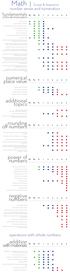 Math Scope & Sequence fundamentals number sense and numeration of the decimal system Count to 10 by units Associate number to numeral (1-10) KN 1 KN 1 KN 2 KN 2 Identify odd and even numbers/numerals and
Geometry Chapter 10 Study Guide Name
 eometry hapter 10 Study uide Name Terms and Vocabulary: ill in the blank and illustrate. 1. circle is defined as the set of all points in a plane that are equidistant from a fixed point called the center.
. 0 1 10 2 100 11 1000 3 20 1 2 3 4 5 6 7 8 9
 Introduction The purpose of this note is to find and study a method for determining and counting all the positive integer divisors of a positive integer Let N be a given positive integer We say d is a
Factoring and Applications
 Factoring and Applications What is a factor? The Greatest Common Factor (GCF) To factor a number means to write it as a product (multiplication). Therefore, in the problem 48 3, 4 and 8 are called the