
Breaking and protection devices
|
|
|
- Samson Bruce
- 10 years ago
- Views:
Transcription
1 Breaking and protection devices 05 POWER GUIDE 2009 / BOOK 05

2 INTRO The purpose of selecting a protection device is to perform two essential functions: to protect people and to protect trunking, while ensuring the best possible continuity of service. On the other hand, the role of a breaking device (isolation, functional breaking, emergency breaking) is to control the various circuits without providing protection on its own. The purpose of the protection of trunking is to limit the effects of overloads and short circuits (see the book 4 Sizing conductors and protection devices ). People are protected against indirect contact according to the neutral earthing system and the characteristics of the installation (see the book 6 Electrical hazards and protecting people ). Legrand equipment covers all requirements for breaking and LV protection: - DMX 3 air circuit breakers and switches for high-power LV main distribution boards (up to 4000 A) - DPX moulded case circuit breakers and switches (16 to 1600 A) - DPX-IS and Vistop load break switches - DX modular circuit breakers for protecting terminal circuits - Residual current circuit breakers and switches, and adaptable earth leakage modules for the protection of people - Voltage surge protectors to protect equipment against overvoltages A wide range of characteristics, technologies and accessories are available to meet all requirements. In accordance with its policy of continuous ous improvement, the Company reserves the right to change specifications and designs without notice. All illustrations, descriptions, s, dimensions and weights in this catalogue are for guidance and cannot be held binding on the Company.

3 Circuit breakers 04 Technologies used Characteristics of circuit breakers Tripping curves Limitation DMX 3 air circuit breakers 12 The DMX 3 range Technical characteristics Electronic protection units Communication and supervision Accessories Connecting DMX Supply inverters Performance data and limitation curves Dimensions DMX-E air circuit breakers 44 The DMX-E range Electronic trip units Technical characteristics Control accessories Signalling contacts Padlocking and mechanical accessories Supply inverters Connection Tripping curve Dimensions

4 DPX moulded case circuit breakers 54 The DPX range Characteristics Releases Mounting, accessories and connection of DPX Adaptable electronic earth leakage modules Special applications and derating Performance data Limitation curves Dimensions DRX moulded case circuit breakers 90 The DRX range Technical characteristics Lexic DX modular circuit breakers 94 The Lexic DX modular range Characteristics of DX circuit breakers Auxiliaries and motor-driven controls for DX Connecting DX Choice of protection devices according to the neutral earthing system Special applications and derating Performance data Thermal stress limitation curves Current limitation curves DX-E modular circuit breakers 110 LR modular circuit breakers 112 Legrand isolating switches 114 Isolating switches with positive contact indication Isolating switches with visible contact indication Trip-free isolating switches
5 Fuses 122 Fuse technology Fuse characteristics SPX fuse carriers and fused isolating switches 130 SPX range Technical characteristics Connection capacity Dimensions Back-up protection 138 Back-up between ACBs and MCCBs Back-up between MCCBs and MCBs Back-up between fuse cartridges and MCBs Back-up between circuit breakers and switches Selectivity between protection devices 144 Current sensing selectivity Time selectivity Dynamic selectivity Logical selectivity Selectivity Tables (3-phase network 400/415 V AC) Choice of products 160 DMX 3 ACBs and DMX 3 -I trip-free switches DMX-E air circuit breakers DPX circuit breakers and DPX-I trip-free switches DRX circuit breakers DX Lexic MCBs, RCDs and RCBOs DX-E MCBs LR MCBs and RCDs DPX-IS and VISTOP isolating switches SP fuse carriers and cylindrical cartridge fuses Base, SPX and blade type cartridge fuses

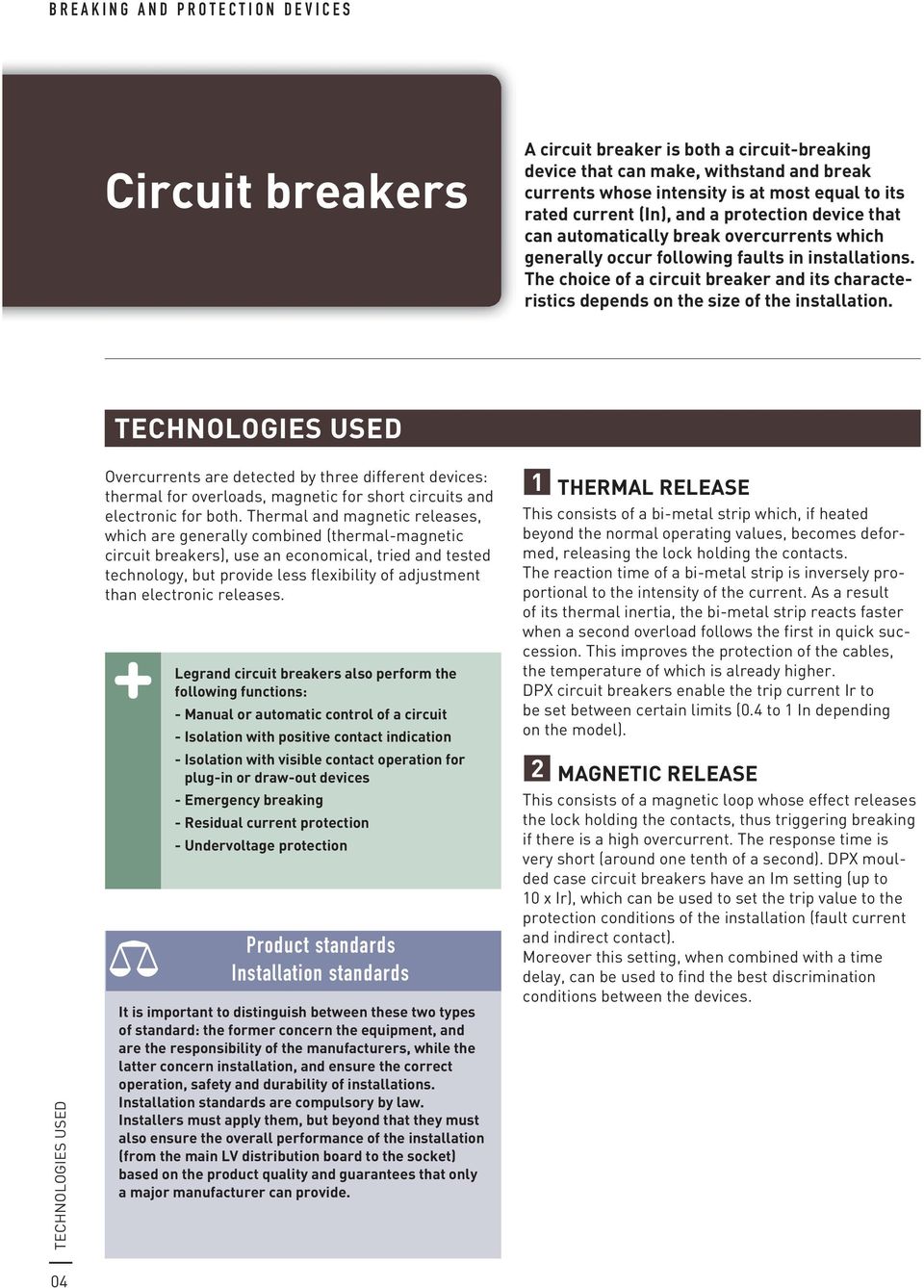
6 BREAKING AND PROTECTION DEVICES Circuit breakers A circuit breaker is both a circuit-breaking device that can make, withstand and break currents whose intensity is at most equal to its rated current (In), and a protection device that can automatically break overcurrents which generally occur following faults in installations. The choice of a circuit breaker and its characteristics depends on the size of the installation. TECHNOLOGIES USED TECHNOLOGIES USED Overcurrents are detected by three different devices: thermal for overloads, magnetic for short circuits and electronic for both. Thermal and magnetic releases, which are generally combined (thermal-magnetic circuit breakers), use an economical, tried and tested technology, but provide less flexibility of adjustment than electronic releases. Legrand circuit breakers also perform the following functions: - Manual or automatic control of a circuit - Isolation with positive contact indication - Isolation with visible contact operation for plug-in or draw-out devices - Emergency breaking - Residual current protection - Undervoltage protection Product standards Installation standards It is important to distinguish between these two types of standard: the former concern the equipment, and are the responsibility of the manufacturers, while the latter concern installation, and ensure the correct operation, safety and durability of installations. Installation standards are compulsory by law. Installers must apply them, but beyond that they must also ensure the overall performance of the installation (from the main LV distribution board to the socket) based on the product quality and guarantees that only a major manufacturer can provide. 1 THERMAL RELEASE This consists of a bi-metal strip which, if heated beyond the normal operating values, becomes deformed, releasing the lock holding the contacts. The reaction time of a bi-metal strip is inversely proportional to the intensity of the current. As a result of its thermal inertia, the bi-metal strip reacts faster when a second overload follows the first in quick succession. This improves the protection of the cables, the temperature of which is already higher. DPX circuit breakers enable the trip current Ir to be set between certain limits (0.4 to 1 In depending on the model). 2 MAGNETIC RELEASE This consists of a magnetic loop whose effect releases the lock holding the contacts, thus triggering breaking if there is a high overcurrent. The response time is very short (around one tenth of a second). DPX moulded case circuit breakers have an Im setting (up to 10 x Ir), which can be used to set the trip value to the protection conditions of the installation (fault current and indirect contact). Moreover this setting, when combined with a time delay, can be used to find the best discrimination conditions between the devices. 04
7 3 ELECTRONIC RELEASE A coil, placed on each conductor, continuously measures the current in each of them. This information is processed by an electronic module which controls the tripping of the circuit breaker when the values of the settings are exceeded. The curve of the release shows three operating zones. Instantaneous operating zone This provides protection against high intensity short circuits. It is either set by construction at a fixed value (5 to 20 ka), or adjustable according to the device. Short delay operating zone This provides protection against lower intensity short circuits, which generally occur at the end of the line. The trip threshold is generally adjustable. The period of the delay may be increased by thresholds up to one second, to ensure discrimination with devices placed downstream. Long delay operating zone This is similar to the characteristic of a thermal release. It protects conductors against overloads. The electronic releases available on DMX and DPX improve the discrimination and make the devices able to communicate. Thermal-magnetic release t Thermal release zone Electronic release t Typical tripping curves Magnetic release zone I Long delay operating zone Short delay operating zone Instantaneous operating zone I Electric arc The current is broken in the circuit breaker arc chamber, which is designed to control the electric arc produced when the contacts open (rather like electrodes). The arc energy can become considerable, up to kilojoules and C, and can cause the contacts to be eroded by vaporisation of the metal. It is therefore a good idea to extinguish the arc as quickly as possible, in order to limit its effects. The magnetic field produced by the arc (which is a conductor) is used to move it into an arc chamber and extend it until it has been extinguished. The circuit breaker mechanisms must combine very fast opening of the contacts (limiting erosion) and high contact pressure (opposition to the electrodynamic forces). I Prospective Isc Limited Isc Arc U Mains U U Energy limiting t Restored voltage t TECHNOLOGIES USED 05

8 BREAKING AND PROTECTION DEVICES Circuit breakers (continued) CHARACTERISTICS OF CIRCUIT BREAKERS 1 RATED OPERATING VOLTAGE Ue (in V) This is the voltage(s) at which the circuit breaker can be used. The value indicated is usually the maximum value. At lower voltages, certain characteristics may differ, or even be improved, such as the breaking capacity. 2 INSULATION VOLTAGE Ui (in V) This value acts as a reference for the insulation performance of the device. The insulation test voltages (impulse, industrial frequency, etc.) are determined based on this value. 3 IMPULSE VOLTAGE Uimp (in kv) This value characterises the ability of the device to withstand transient overvoltages such as lightning (standard impulse 1.2/50 μs). 6 ULTIMATE BREAKING CAPACITY Icu (in ka) This is the maximum short-circuit current value that a circuit breaker can break at a given voltage and phase angle (cos ϕ). The tests are executed according to the sequence O - t - CO. O represents an automatic break operation, t a time interval and CO a make operation followed by an automatic break operation. Following the test, the circuit breaker must continue to provide a minimum level of safety (isolation, dielectric strength). 7 NOMINAL BREAKING CAPACITY Icn (in A) In standard IEC , the breaking capacity of the device is tested in a similar way but is called Icn. After the test, the circuit breaker must retain its dielectric properties and be able to trip in accordance with the specifications in the standard. CHARACTERISTICS OF CIRCUIT BREAKERS 4 UTILIZATION CATEGORY IEC designates circuit breakers as belonging to one of two categories: - Category A for circuit breakers which do not have a time delay before tripping on a short circuit - Category B for circuit breakers which have a time delay. This can be adjusted in order to perform time discrimination for a short-circuit value less than Icw. The value of Icw must be at least equal to the larger of the two values, 12 In or 5 ka, for circuit breakers with a rated current of 2500 A at most, and 30 ka thereafter. 5 RATED CURRENT In (in A) This is the maximum current value the circuit breaker can withstand on a permanent basis. This value is always given for an ambient temperature around the device of 40 C in accordance with standard IEC , and 30 C in accordance with standard IEC If this temperature is higher, it may be necessary to reduce the operating current. Circuit breakers are often identified with two breaking capacities. This distinction is the result of standards using different test conditions : standard IEC for household or similar applications where unqualified people can re-close a circuit with a persistent fault several times. The breaking capacity (in Amps) appears in a box, with no mention of the unit. 10 ka: standard IEC for all applications where those who work on them are qualified. The breaking capacity then appears together with its unit. 06

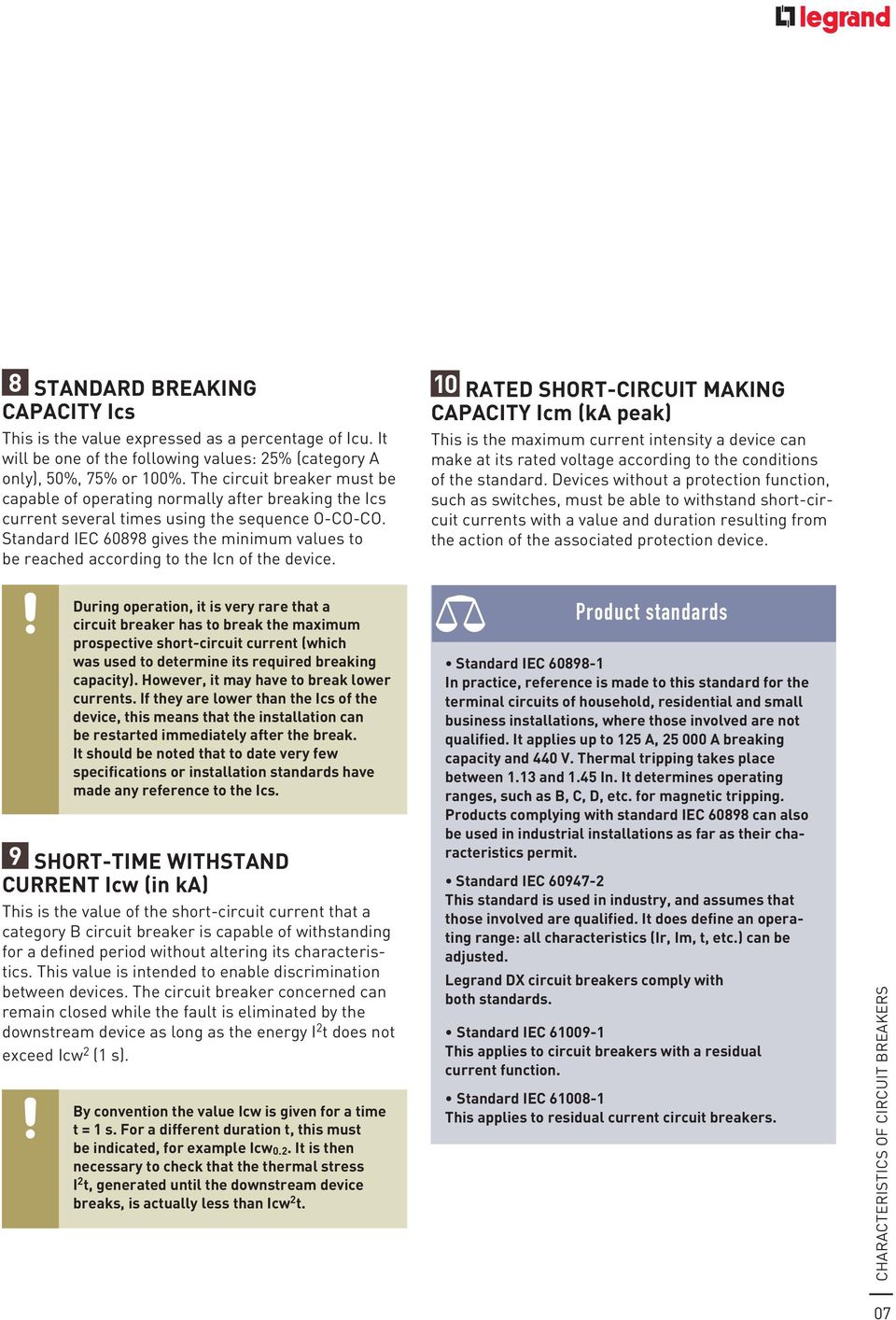
9 8 STANDARD BREAKING CAPACITY Ics This is the value expressed as a percentage of Icu. It will be one of the following values: 25% (category A only), 50%, 75% or %. The circuit breaker must be capable of operating normally after breaking the Ics current several times using the sequence O-CO-CO. Standard IEC gives the minimum values to be reached according to the Icn of the device. 10 RATED SHORT-CIRCUIT MAKING CAPACITY Icm (ka peak) This is the maximum current intensity a device can make at its rated voltage according to the conditions of the standard. Devices without a protection function, such as switches, must be able to withstand short-circuit currents with a value and duration resulting from the action of the associated protection device. During operation, it is very rare that a circuit breaker has to break the maximum prospective short-circuit current (which was used to determine its required breaking capacity). However, it may have to break lower currents. If they are lower than the Ics of the device, this means that the installation can be restarted immediately after the break. It should be noted that to date very few specifications or installation standards have made any reference to the Ics. 9 SHORT-TIME WITHSTAND CURRENT Icw (in ka) This is the value of the short-circuit current that a category B circuit breaker is capable of withstanding for a defined period without altering its characteristics. This value is intended to enable discrimination between devices. The circuit breaker concerned can remain closed while the fault is eliminated by the downstream device as long as the energy I 2 t does not exceed Icw 2 (1 s). By convention the value Icw is given for a time t = 1 s. For a different duration t, this must be indicated, for example Icw 0.2. It is then necessary to check that the thermal stress I 2 t, generated until the downstream device breaks, is actually less than Icw 2 t. Product standards Standard IEC In practice, reference is made to this standard for the terminal circuits of household, residential and small business installations, where those involved are not qualified. It applies up to 125 A, A breaking capacity and 440 V. Thermal tripping takes place between 1.13 and 1.45 In. It determines operating ranges, such as B, C, D, etc. for magnetic tripping. Products complying with standard IEC can also be used in industrial installations as far as their characteristics permit. Standard IEC This standard is used in industry, and assumes that those involved are qualified. It does define an operating range: all characteristics (Ir, Im, t, etc.) can be adjusted. Legrand DX circuit breakers comply with both standards. Standard IEC 69-1 This applies to circuit breakers with a residual current function. Standard IEC 68-1 This applies to residual current circuit breakers. CHARACTERISTICS OF CIRCUIT BREAKERS 07
10 BREAKING AND PROTECTION DEVICES Circuit breakers (continued) TRIPPING CURVES Examples of tripping curves DPX 250 circuit breaker with thermal-magnetic release DPX-H 1600 circuit breaker with electronic release 00 t (s) Thermal release zone when cold t (s) 0 Tr = 30 s 20 % Tr = 20 s 20 % Tr = 10 s 20 % Tr = 5 s 20 % 10 Thermal release zone when hot (in steady state) 10 1 Adjustable magnetic release zone 1 I 2 t = K Im In: A 0.1 Im 0.1 Tm In: A In: 630 A If I/Ir I/Ir I/In TRIPPING CURVES I: actual current Ir: thermal protection against overloads (Ir setting = x In) Im: magnetic protection against short circuits: (Im setting = x Ir) Since the abscissa of the curves expresses the I/Ir ratio, modifying the Ir setting does not change the graphic representation of thermal tripping. However, the magnetic setting Im can be read directly (3.5 to 10 in this example). I: actual current Ir: long delay protection against overloads (adjustable: Ir = x In, 0.4 to 1 x In) Tr: long delay protection operation time (adjustable: 5 to 30 s) up to 6 x Ir Im: short delay protection against short circuits (adjustable: Im = x Ir, 1.5 to 10 Ir) Tm: short delay protection operation time (adjustable: 0 to 0.3 s) I 2 t constant (adjustable via Tm) see p. 146 If: fixed threshold instantaneous protection (fixed: 5 to 20 ka depending on the model) 08
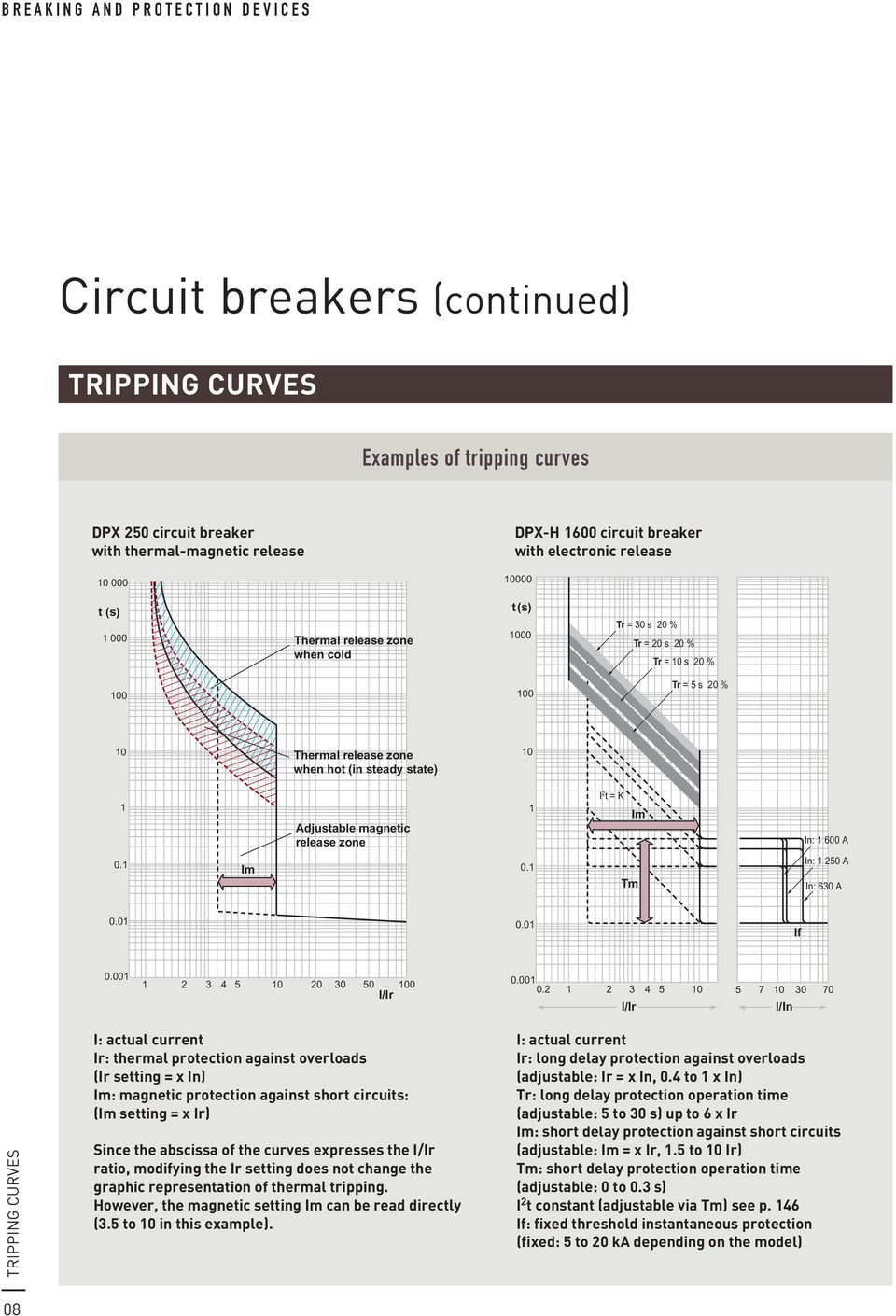
11 Example of setting a circuit breaker and reading the curves Here: I B = 500 A and Ik3 max = 25 ka at the installation point. Protection can then be provided by an electronic DPX 630, rating 630 A (Cat. No /07), long delay setting (overload) Ir = 0.8 x In, i.e. 504 A Scenario 1: High min. Isc Isc min. (at end of line) = 20 ka short delay setting (short circuit) Im = 10 x Ir, i.e A Reading the curves: If I < 504 A no tripping If 504 A < I < 5 ka tripping between 1 and 200 s (long delay protection) If I > 5 ka tripping in 0.01 s (fixed threshold instantaneous protection) 00 t (s) s 10 6 s Scenario 2: Low min. Isc Isc min. (at end of line) = 4 ka short delay setting (short circuit) Im = 5 x Ir, i.e A Reading the curves: If I < 504 A no tripping If 504 A < I < 2520 A tripping between 6 and 200 s (long delay protection) If 2520 A < I < 5 ka tripping < 0.1 s (short delay protection) If I > 5 ka tripping in 0.01 s (fixed threshold instantaneous protection) 1 s 3 s I/Ir In: 630 A In: 500 A In: 400 A I/In In: 320 A If Scenario 3: Cable thermal stress limited long delay short delay instantaneous Isc min. (at end of line) = 20 ka Conductor 10 mm 2, permissible thermal stress: 1.32 x 10⁶ A 2 s, i.e A for 0.1 s short delay setting (short circuit) Im = 7 x Ir, i.e A (< Ith of the cable) Reading the curves: If I < 504 A no tripping If 504 A < I < 3528 A tripping between 3 and 200 s (long delay protection) If 3528 A < I < 5 ka tripping < 0.1 s (short delay protection) If I > 5 ka tripping in 0.01 s (fixed threshold instantaneous protection) I = Ir = 504 A long delay long delay Im = 5 x Ir = 2520 A Im = 7 x Ir = 3528 A Im = 10 x Ir = 5040 A short delay I = If = 5 ka instantaneous instantaneous TRIPPING CURVES 09

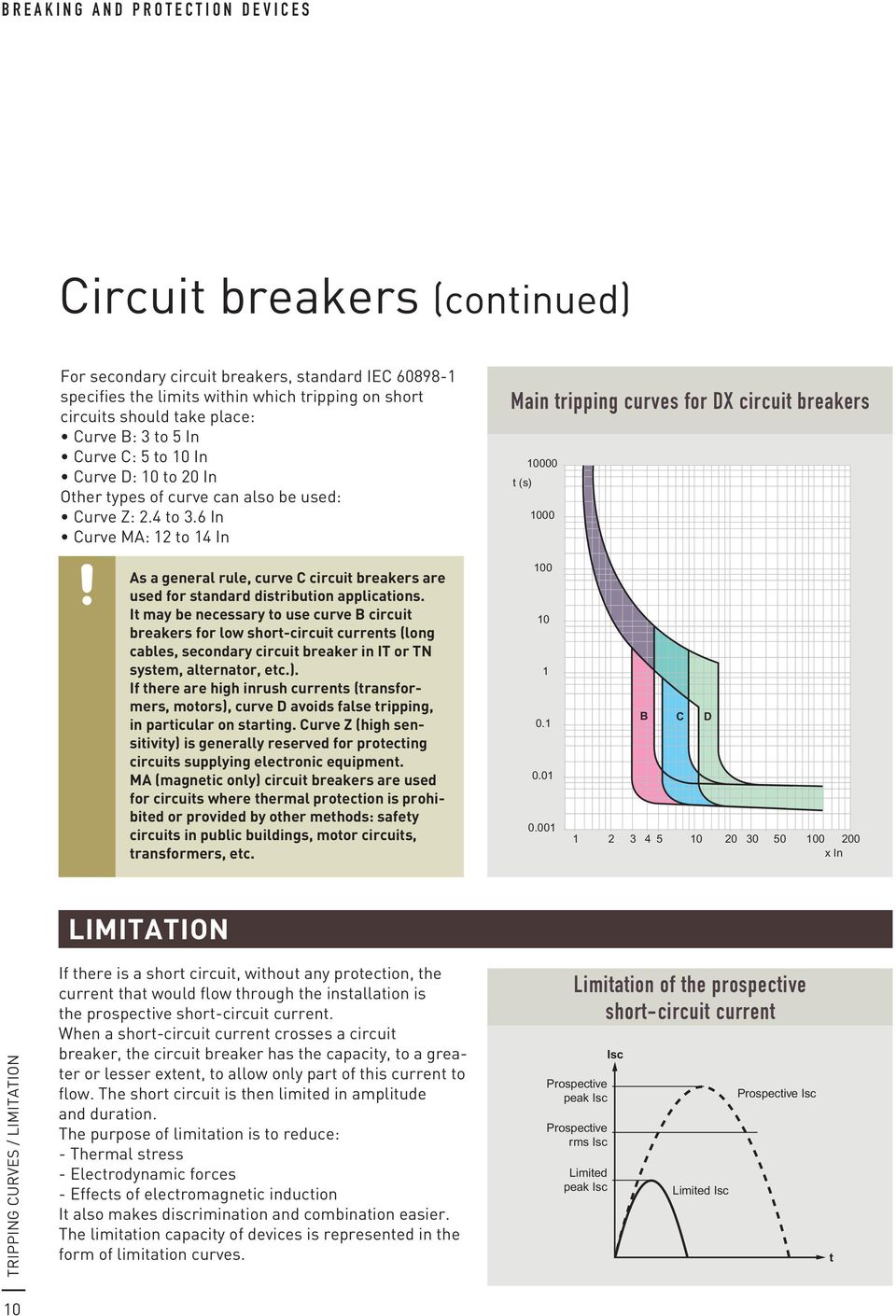
12 BREAKING AND PROTECTION DEVICES Circuit breakers (continued) For secondary circuit breakers, standard IEC specifies the limits within which tripping on short circuits should take place: Curve B: 3 to 5 In Curve C: 5 to 10 In Curve D: 10 to 20 In Other types of curve can also be used: Curve Z: 2.4 to 3.6 In Curve MA: 12 to 14 In Main tripping curves for DX circuit breakers 00 t (s) 0 As a general rule, curve C circuit breakers are used for standard distribution applications. It may be necessary to use curve B circuit breakers for low short-circuit currents (long cables, secondary circuit breaker in IT or TN system, alternator, etc.). If there are high inrush currents (transformers, motors), curve D avoids false tripping, in particular on starting. Curve Z (high sensitivity) is generally reserved for protecting circuits supplying electronic equipment. MA (magnetic only) circuit breakers are used for circuits where thermal protection is prohibited or provided by other methods: safety circuits in public buildings, motor circuits, transformers, etc B DC x In LIMITATION TRIPPING CURVES / LIMITATION If there is a short circuit, without any protection, the current that would flow through the installation is the prospective short-circuit current. When a short-circuit current crosses a circuit breaker, the circuit breaker has the capacity, to a greater or lesser extent, to allow only part of this current to flow. The short circuit is then limited in amplitude and duration. The purpose of limitation is to reduce: - Thermal stress - Electrodynamic forces - Effects of electromagnetic induction It also makes discrimination and combination easier. The limitation capacity of devices is represented in the form of limitation curves. Limitation of the prospective short-circuit current Prospective peak Isc Prospective rms Isc Limited peak Isc Isc Limited Isc Prospective Isc t 10
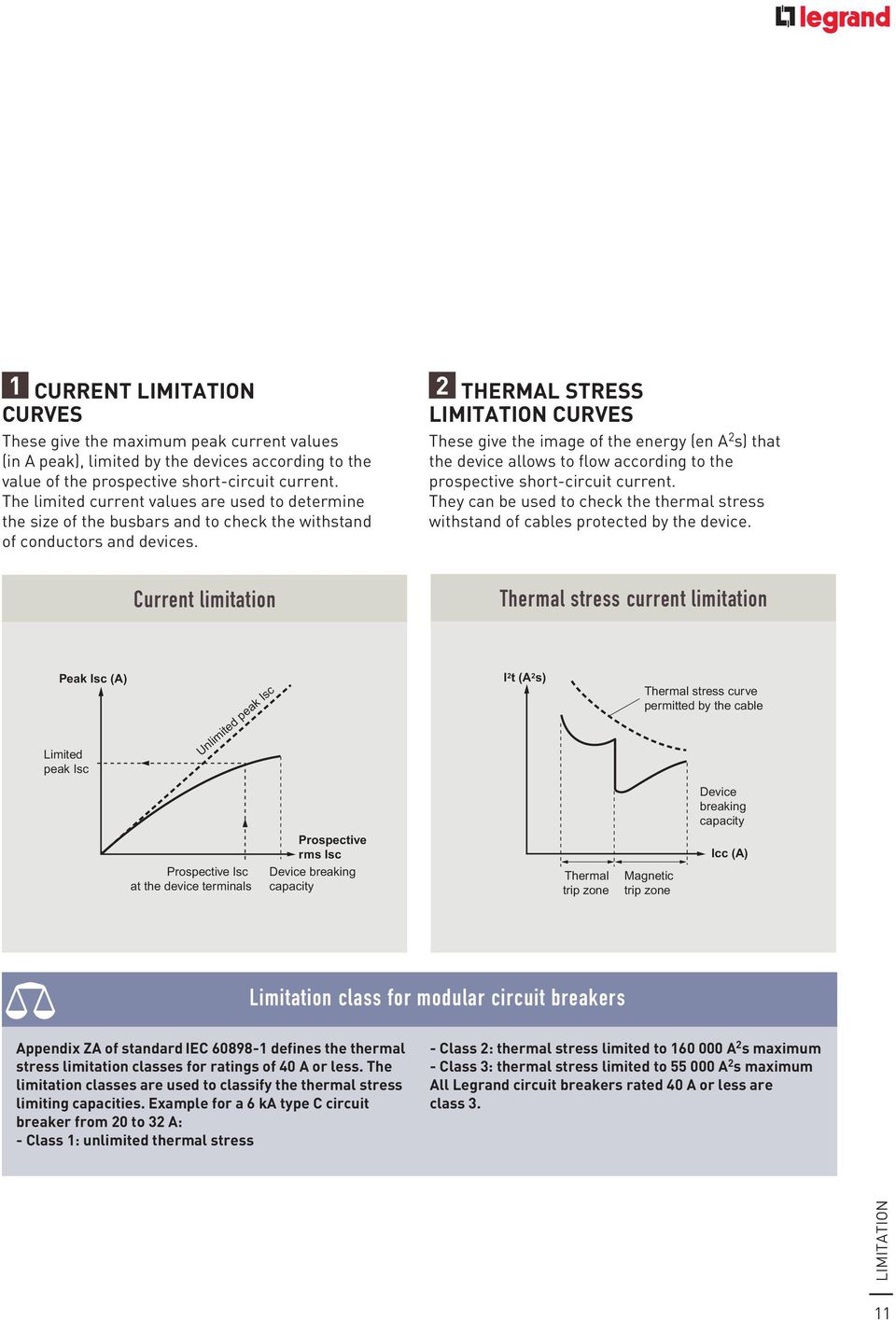
13 1 CURRENT LIMITATION CURVES These give the maximum peak current values (in A peak), limited by the devices according to the value of the prospective short-circuit current. The limited current values are used to determine the size of the busbars and to check the withstand of conductors and devices. 2 THERMAL STRESS LIMITATION CURVES These give the image of the energy (en A 2 s) that the device allows to flow according to the prospective short-circuit current. They can be used to check the thermal stress withstand of cables protected by the device. Current limitation Thermal stress current limitation Peak Isc (A) Limited peak Isc Unlimited peak Isc I 2 t (A 2 s) Thermal stress curve permitted by the cable Device breaking capacity Icc (A) Prospective Isc at the device terminals Prospective rms Isc Device breaking capacity Thermal trip zone Magnetic trip zone Limitation class for modular circuit breakers Appendix ZA of standard IEC defines the thermal stress limitation classes for ratings of 40 A or less. The limitation classes are used to classify the thermal stress limiting capacities. Example for a 6 ka type C circuit breaker from 20 to 32 A: - Class 1: unlimited thermal stress - Class 2: thermal stress limited to A 2 s maximum - Class 3: thermal stress limited to A 2 s maximum All Legrand circuit breakers rated 40 A or less are class 3. LIMITATION 11
14 BREAKING AND PROTECTION DEVICES DMX 3 air circuit breakers Air circuit breakers get their name from the fact that their breaking chambers are in the open air to allow better energy dissipation. Their electrical and mechanical strength, breaking capacity, maintainability and optional accessories make them ideal for protection and control at the supply end of low voltage installations. THE DMX 3 RANGE Legrand DMX 3 air circuit breakers are ideal for the requirements of low voltage installations up to 4000 A, providing clarity of installation, optimised dimensions, easy mounting and simple connection. All the devices in the DMX 3 range are mounted behind the same faceplate, as they have the same dimensions and an identical front panel. DMX 3 have very high performance, technologically advanced electronic control and protection units. They are available in 3 breaking capacities with just two sizes of device. The designation DMX 3 -N corresponds to a breaking capacity of 50 ka, DMX 3 -H to 65 ka, and DMX 3 -L to ka. All DMX 3 are available in both fixed and draw-out version. In comparison with the fixed version, the draw-out version has additional locking facilities (draw-out position), optimum safety when work is being carried out on them (padlocking and physical separation of the installation) and is easily interchangeable (no disconnection to be carried out). 3-poles DMX 3 -H 2500 fixed version Composition of a DMX 3 THE DMX 3 RANGE All the circuit breakers are supplied as standard with: - Manual control - Terminal blocks for connecting output auxiliaries - Connection plates - 4 auxiliary changeover contacts - Cover for access to lockable settings - Mechanical indication of activation And for draw-out versions: - Mobile contacts for connecting auxiliaries - IP 40 protection in draw-out position - Retractable handles - Padlock of the circuit breaker in inserted-draw-out position 4-poles DMX 3 -L 4000 draw-out version 2 sizes only for the entire range 800 A 0 A 1250 A 1600 A 2000 A 2500 A 3200 A 4000 A DMX 3 -N (50 ka) F1 F1 F1 F1 F1 F1 F2 F2 DMX 3 -H (65 ka) F1 F1 F1 F1 F1 F1 F2 F2 DMX 3 -L ( ka) F2 F2 F2 F2 F2 F2 F2 F2 12

15 Draw-out DMX 3 Isolator terminal blocks for auxiliary contacts Key lock in Open position Open control button MP4 LSIg tripping unit Reset button Indicator showing the position of the main contacts O / I Device position indicator : Plugged in - TEST - Draw-out Windows for displaying auxiliary equipment Close control button Colour marking for breaking capacity: grey for DMX 3 -N, yellow for DMX 3 -H, red for DMX 3 -L Spring loading lever Indicator showing the load status of springs: Charged / Discharged Key locking in drawn-out position Lockable aperture for insertion of the extraction handle Clear and easy mounting principle The overall dimensions of the breaker contribute considerably to efficient use of the space inside the electrical panel. The constant depth for all the rated currents facilitates connection of the busbars. In XL³, the DMX³ devices and the associated busbars are arranged using the sameprinciple for all power ratings, ie the possibility of mounting three busbars and two devices per enclosure. The correct size for the current, and thus the power to be dissipated, is obtained by adapting the depth of the assembly: mm min. up to 2500 A mm min. up to 4000 A The installation height of DMX 3 units is always 600 mm whatever the type and size of the device. When 2 DMX³ devices are installed in the same enclosure, this leaves at least a useful 600 mm for running the busbars. 200 mm 600 mm 200 mm 600 mm 200 mm THE DMX 3 RANGE 13

16 BREAKING AND PROTECTION DEVICES DMX 3 air circuit breakers (continued) TECHNICAL CHARACTERISTICS TECHNICAL CHARACTERISTICS Characteristics DMX DMX N H L N H L Frame F1 F1 F2 F2 F2 F2 Number of poles 3P - 4P 3P - 4P Nominal rating protection unit In (A) Nominal rating In (A) Rated insulation voltage Ui (V) 0 0 Rated impulse withstand voltage Uimp (kv) Rated operating voltage (50/60Hz) Ue (V) V AC V AC Ultimate breaking capacity Icu (ka) 500 V AC V AC V AC Service breaking capacity Ics (% Icu) % % Closing capacity on short circuits Icm (ka) Short-time withstand current Icw (ka) for t = 1 s 230 V AC V AC V AC V AC V AC V AC V AC V AC V AC V AC Neutral protection (% In) OFF-50- OFF-50- Category of use B B Isolation capability YES YES Opening time 15ms 15ms Closing time 30ms 30ms Endurance (o.c. cycles) mechanical Endurance (o.c. cycles) electrical Operating temperature -5 C to +70 C -5 C to +70 C Storage temperature -25 C to +85 C -25 C to +85 C Version Fixed Draw-out Power dissipated per pole (W) Frame DMX DMX A 0 A 1250 A 1600 A 2000 A 2500 A 3200 A 4000 A F F F F

17 Temperature derating Ambient temperature Up to 40 C 50 C 60 C 65 C 70 C Version Device Imax (A) Ir / In Imax (A) Ir / In Imax (A) Ir / In Imax (A) Ir / In Imax (A) Ir / In Fixed DMX , , , , , , ,86 DMX , , , , , , DMX Draw-out , , , , ,9 2 0, ,78 DMX , , , , , ,74 Altitude derating Altitude (m) < Ue (V) Ui (V) In (A) (T = 40 C) In 0.98 x In 0.94 x In 0.9 x In Dimensions and weight Frame 1 Frame 2 Fixed Draw-out 3P 4P 3P 4P width (mm) depth (mm) height (mm) volume (dm 3 ) weight (kg) DMX DMX 3 -I width (mm) depth (mm) height (mm) volume (dm 3 ) weight (kg) DMX DMX 3 -I TECHNICAL CHARACTERISTICS 15

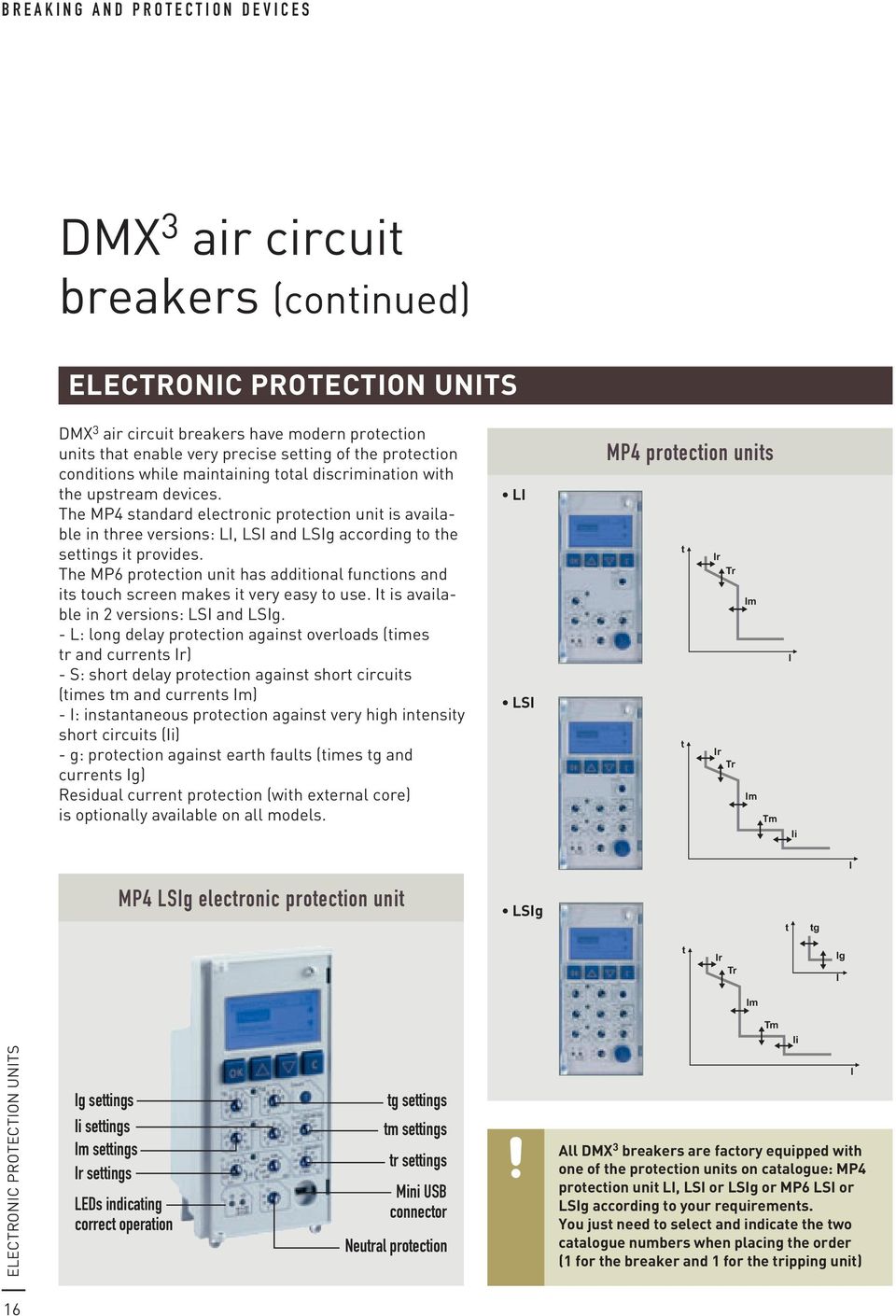
18 BREAKING AND PROTECTION DEVICES DMX 3 air circuit breakers (continued) ELECTRONIC PROTECTION UNITS DMX 3 air circuit breakers have modern protection units that enable very precise setting of the protection conditions while maintaining total discrimination with the upstream devices. The MP4 standard electronic protection unit is available in three versions: LI, LSI and LSIg according to the settings it provides. The MP6 protection unit has additional functions and its touch screen makes it very easy to use. It is available in 2 versions: LSI and LSIg. - L: long delay protection against overloads (times tr and currents Ir) - S: short delay protection against short circuits (times tm and currents Im) - I: instantaneous protection against very high intensity short circuits (Ii) - g: protection against earth faults (times tg and currents Ig) Residual current protection (with external core) is optionally available on all models. LI LSI MP4 protection units t Ir Tr Im t Ir Tr Im Tm I Ii I MP4 LSIg electronic protection unit LSIg t tg t Ir Tr Ig I Im Tm Ii ELECTRONIC PROTECTION UNITS Ig settings Ii settings Im settings Ir settings LEDs indicating correct operation tg settings tm settings tr settings Mini USB connector Neutral protection All DMX 3 breakers are factory equipped with one of the protection units on catalogue: MP4 protection unit LI, LSI or LSIg or MP6 LSI or LSIg according to your requirements. You just need to select and indicate the two catalogue numbers when placing the order (1 for the breaker and 1 for the tripping unit) I 16
19 MP6 protection units LSI t Ir Tr Im Tm Ii I Colour touch screen LSIg t tg Settings lock ON button USB port Leds indicating correct operation t Ir Tr Im Tm Ii Ig I I The touch screen and icon-based navigation on the MP6 unit make it very intuitive to use. The colour display provides a clear presentation of the parameters of the installation: voltages, currents, powers, frequency, harmonics. The MP6 unit can be used even when there is no power, without having to use an external power supply, as it has an integrated battery. Integrated measurement unit The MP6 protection unit has an advanced measurement unit which, in addition to monitoring currents, can also be used to display Ph/N and Ph/Ph voltages, active and reactive powers (total and per phase), frequency, power factor (total and per phase), active and reactive energy and also harmonic distortion. Alarms can be programmed on a number of these parameters: max. voltage, min. voltage, voltage imbalance, max. and min. frequencies, etc. ELECTRONIC PROTECTION UNITS 17

20 BREAKING AND PROTECTION DEVICES DMX 3 air circuit breakers (continued) Functions of electronic protection units ELECTRONIC PROTECTION UNITS Electronic protection unit Long delay protection against overloads Short delay protection against short circuits Instantaneous protection Protection against earth faults Residual current protection (with external core) Neutral protection Protection against overloads Measurements and display (instantaneous values, maximum and mean, adjustable time) Display Memorisation LI LSI LSIg LSI LSIg Ir adjustable: from 0.4 to 1.0 x In in 0.02 intervals tr adjustable: s (MEM ON) s (MEM OFF) Im adjustable: from 1.5 to 10 x Ir in 0.5 intervals tm adjustable: s (t constant) s (I 2 t constant) MP4 MP6 Ii adjustable: Icw x In Ig adjustable: OFF x In tg adjustable: s (t constant) s (I2t constant) Id adjustable: OFF A optional optional optional optional optional td adjustable: s optional optional optional optional optional 4P: OFF %Ir (no 200% up to 1250 A and % above 3P: OFF %Ir (4000 A max.) Tmax fixed: 95 C Current Ph/N and Ph/Ph voltage Power (P,Q,A): total and per phase Frequency Power factor: total and per phase Energy (active and reactive) Calculation of harmonic distortion Monochrome LCD display Colour touch screen Current Position: open/closed/fault Date, time and reason for last activation Required protection Date and time Activation counter Current not broken Date, time and reason for last 20 activations Voltage dip 18

21 Functions of electronic protection units (continued) Electronic protection unit MP4 MP6 LI LSI LSIg LSI LSIg USB port for diagnostic software External links Terminal block for auxiliaries ModBus on RS485 optional optional optional optional optional Overheating >75 C Logical discrimination Management of non-priority loads Power return: 0.1 to 20 s - 5 to % Ir Current imbalance: 1 to 3600 s - to 600 V Signalling and alarms Max. Ph/N voltage: 0.1 to 20 s - 60 to 400 V Min. Ph/N voltage: 0.1 to 20 s - 10 to 400 V Ph/N voltage imbalance: 0.1 to 20s - instantaneous Inversion of phase rotation Max. frequency: 45 to 500 Hz to 20 s Min. frequency: 45 to 400 Hz to 20 s Memory settings Maintenance of Air Circuit Breakers (ACB) If a device is changed, the electronic tripping unit retains the settings and all the data recorded during operation of the breaker which was previously installed (faults, operations, currents, etc). This function makes maintenance safe and reduces downtime to a minimum. The settings are thus no longer associated with the device, but with the circuit which is being protected. On standard, all protection units are equipped with batteries so you can monitor and adjust the parameters even when the breaker is not connected. For example, it s possible to set the protection unit before install the breaker or see the info inside during a trip. The requirements for functional security of the electrical systems are strategic in many domains of activity (norm IEC 61508). By conception, in the planning of preventive maintenance, the ACBs are designed to permit a series of interventions at different levels: cleaning of breaking chamber, verification and possible change of the worn out elements, etc. The specific Legrand documents give the detailed procedures of the operations to do. ELECTRONIC PROTECTION UNITS 19
22 BREAKING AND PROTECTION DEVICES DMX 3 air circuit breakers (continued) COMMUNICATION AND SUPERVISION The MP4 and MP6 electronic protection units can communicate with an RS-485 communication port. This port is used for remote monitoring and management of the devices in the installation, using the MODBUS protocol. It is therefore possible to control circuit breaker opening and closing, display the electrical parameters and detect all the alarms generated by the devices, from a PC. With the new DMX 3, the installation and protection devices can be managed in a simple, functional way, determining the state of the circuit breaker at any time and solving most problems via the network. Using the circuit breaker s supervision system, maintenance operations can be planned and the efficiency of the installation optimised. G Conversion interface (RS-485/RS232, RS-485/USB etc.) MODBUS protocol and RS-485 link COMMUNICATION AND SUPERVISION G Power RS-485 link Circuit breaker/module links Generator set Mechanical interlock Interface for electronic DPX Control and signalling module Interface for electronic DPX 20
23 ACCESSORIES 1 SHUNT TRIP Shunt trips are devices used for the remote instantaneous opening of the air circuit breaker. They are generally controlled trough an N/O type contact. The current range of shunt trips proposes five supply voltages from 24 V to 415 V). The shunt trips are already equipped with a special fast connector, to be directly inserted into auxiliary contact block. An auxiliary contact is connected in series with the coil, cutting off its power supply when the main poles are open - Nominal voltage Un: - 24, 48, 110, 230 V AC/DC V AC - Tolerance on nominal voltage: 70 to 110% Un - Maximum power consumption (for 180 ms): 500 VA AC/500 W DC - Continuous power: 5 VA AC/5 W DC - Maximum opening time: 30 ms - Insulation voltage: V 50 Hz for 1 min - Endurance on pulse: surge proof 4 kv 1.2/50 ms 2 UNDERVOLTAGE RELEASE Undervoltage releases are devices which are generally controlled by an N/C type contact. They trigger instantaneous opening of the circuit breaker if their supply voltage drops below a certain threshold and in particular if the control contact opens. These releases are equipped with a device for limiting their consumption after the circuit has been closed. - Nominal voltage Un: - 24, 48, 110, 230 V AC/DC V AC - Tolerance on nominal voltage: 70 to 110% Un - Maximum power consumption (for 180 ms): 500 VA AC/500 W DC - Continuous power: 5 VA AC/5 W DC - Opening time: 60 ms - Insulation voltage: V 50 Hz for 1 min - Endurance on pulse: surge proof 4 kv 1.2/50 ms 3 CLOSING COILS These coils are used for remotely controlling the closing of the power contacts of the circuit breaker. Electrical auxiliaries are connected on the front panel in no time, thanks to the fast connector supplied on all accessories. The output terminal block has automatic terminals for connection without screws U1 U2 OF11 OF12 OF13 TR UVR ST CC OF1 OF2 OF3 OF4 OF5 The springs of the circuit breaker are to be loaded prior to the action of the closing coils. They are controlled by an N/O type contact. - Nominal voltage Un: - 24, 48, 110, 230 V AC/DC V AC - Tolerance on nominal voltage: 70 to 110% Un - Maximum power consumption (for 180 ms): 500 VA AC/500 W DC - Continuous power: 5 VA AC/5 W DC - Maximum closing time: 50 ms - Insulation voltage: V 50 Hz for 1 min - Endurance on pulse: surge proof 4 kv 1.2/50 ms ACCESSORIES 21
24 BREAKING AND PROTECTION DEVICES DMX 3 air circuit breakers (continued) 4 MOTOR OPERATORS Motor operators, are used for remotely reloading the springs of the circuit breaker mechanism immediately after the device closes. The device can thus be reclosed almost immediately after an opening operation. To motorise a DMX 3 it is necessary to add a release coil (undervoltage release or shunt trip) and a closing coil. If the supply voltage of the controls fails, it is still possible to reload the springs manually. Motor-driven controls have limit swhich contacts which cut off the power supply of their motor after the springs have been reloaded. Motor operators are easy to mount, with only three screws. - Nominal voltage Un: 24 V AC/DC, 48 V V AC/DC, 110 V AC/DC, 230 V AC/DC, 415 V AC - Tolerance on nominal voltage: 85 to 110% Un - Spring reloading time: 5 s - Maximum power consumption: 140 VA AC/140 W DC - Starting current: 2 up to 3 In 0.1 s - Maximum cycle: 2/min 5 SIGNALLING CONTACTS All DMX 3 air circuit breakers are equipped as standard with 4 auxiliary contacts that can be used indipendently like NO or NC contact. It s also possible to more auxiliary contacts up to reach the number of 10. Mounting auxiliaries Auxiliaries are very easy to mount in the top part of the DMX 3, behind the front panel. The positions are marked to prevent mounting errors. It is possible to install up to 2 current shunt trips or 2 undervoltage releases and a closing coil. Auxiliaries are identified on the front panel. The front panel of the DMX 3 has windows so that users can check what auxiliaries are installed and their characteristics. Max number of auxiliaries shunt trip undervoltage release closing coil Shunt trip Closing coil Undervoltage release Motor operator ACCESSORIES 22
25 Connection diagram U2 MOT U1 164 RC SC OF OF OF OF OF OF OF OF OF ELECTRIC CHARGING DEVICE READY TO CLOSE SPRINGS CHARGED ADDITIONAL CONTACTS NO/NC 4 AUXILIARY CONTACTS (standard) 6 SAFETY AND PADLOCKING ACCESSORIES DMX 3 draw-out circuit breakers are provided as standard with safety padlocking shutters preventing access to live terminals. They have a number of other safety devices, such as: Key-operated locks: - Main contacts open - Circuit breaker in draw-out position Padlocks for: - Main contacts open - Contact shutters closed (for draw-out position) Door locking: in order to prevent the opening of the electrical swhichboard door when the contacts of the ACB are closed. 12 OF C4 C2 D CC ST UVR C3 C1 D1 TR 141 TR UVR ST CC CLOSING COIL SHUNT TRIP UNDER VOLTAGE RELEASE CLOSING COIL SIGNAL ^ Key locking in open position ^ Key locking accessory for draw-out devices OF 13 OF TRIPPED SIGNAL SHUNT TRIP SIGNAL Vdc L3 L2 L1 N OF UVR SIGNAL PROTECTION CONTROL UNIT MAIN CIRCUIT < Safety shutters provide protection against the risk of contact with live parts, as standard on every draw-out version DMX 3 ACCESSORIES 23
26 BREAKING AND PROTECTION DEVICES DMX 3 air circuit breakers (continued) CONNECTING DMX 3 Correct sizing and connection are crucial for the reliability of installations and in particular for high power and very high power equipment. DMX 3, both fixed and draw-out version, have generously sized connection plates and accessories enabling all connection configurations (flat, vertical, horizontal). Draw-out version Fixed version Draw-out version breakers are supplied with rear terminals for flat connection Fixed version breakers are supplied with rear terminals for horizontal connection Reversible connectors allow vertical or horizontal connection Spreaders Rear terminals on accessories allow flat or vertical connection For size 1, fixed version DMX 3, spreaders make it possible to use wider plates, in particular for connecting aluminium bars. For flat connection CONNECTING DMX 3 For vertical connection For horizontal connection 24
27 Derating (A) according to the type of connection and minimum recommended cross-sections of bars Installing circuit breakers in enclosures sometimes leads to the need to reduce the rated current. This derating is due to a risk of overheating according to the connection configuration on the busbar. The table opposite can be used to determine this derating according to the ambient temperature in the enclosure and the type of connection used. This table must however by considered as an example only. It refers to installation in an XL enclosure with the following dimensions: x 800 x 800 mm for a size 1 DMX x 1400 x 800 mm for a size 2 DMX 3 The values in the table are given for a plug-in circuit breaker in an IP 40 assembly with no internal separation and for a maximum terminal temperature of 120 C. Vertical connection Horizontal or flat connection Ambient temperature Copper bars In (A) 35 C 45 C 55 C (mm 2 ) x 60 x x 80 x x 80 x x 60 x x 80 x x 80 x x x x x x 60 x x 80 x x 60 x x 80 x x 80 x x 80 x x x x 60 x 10 Connection options Horizontal Vertical Vertical Horizontal Flat Dimensions of connection plates p CONNECTING DMX 3 25
28 BREAKING AND PROTECTION DEVICES DMX 3 air circuit breakers (continued) SUPPLY INVERTERS Supply inverter performs the following functions: - Swhiching between a main source and a secondary source in order to supply circuits requiring continuous service (for safety reasons) or for energy saving purposes (when the secondary source is different from the network). - Management of the operation of the secondary source supplying the safety circuits. DMX³ and DMX³-I devices can be fitted with an interlocking mechanism which ensures mechanical safety in the event of supply inversion. Interlocking is achieved using interlocking units mounted on the side of the devices and a cable system. This system allows devices of different sizes and types to be interlocked. The cable system provides the flexibility to install DMX 3 devices in a vertical configuration in the same enclosure or in a horizontal configuration in different columns. DMX 3 supply inverters used with XL enclosures enable very intuitive configuration of assemblies and busbars, as shown in the examples below. Stand-by power supply (without load shedding) D1 G D2 D1 D2 The two DMX 3 devices D1 and D2 are connected to a central common busbar. Since they are not simultaneously on-load, they can be in the same enclosure. SUPPLY INVERTERS ^ The interlocking mechanism with cables is easy to add to all DMX 3 versions and is not dependent on their position in the assembly It is possible to install two devices in the same enclosure if they are not both on-load simultaneously (supply inversion) or if the sum of their respective currents does not exceed the values recommended for correct thermal dissipation. Otherwise, a single device must be installed in each enclosure. 26
29 Stand-by power supply (with load shedding) G non priority circuits D1 D3 D1 D3 D2 priority circuits D2 Non priority circuits Priority circuits The two DMX 3 devices D1 and D2 are not on-load simultaneously and can therefore be installed in the same enclosure. D3 can be on-load at the same time as D1, and must be installed in another enclosure. Dual power supply (reduced power with priority loads) non priority circuits group 1 D1 D3 D1 D2 priority circuits Non priority circuits group 1 D3 Priority circuits D4 Non priority circuits group 2 D2 D4 non priority circuits group 2 The two DMX 3 devices D1 and D2 are on-load simultaneously. They can only be installed in the same enclosure if the sum of their currents does not exceed the permissible value for the recommended size. D3 and D4 are not simultaneously on-load, they can be in the same enclosure. The ambient temperature in the enclosure must be limited as far as possible to a value which does not exceed 40 C. Above this limit it becomes necessary to modify the permissible current value in the protection devices and the bars (see p. 15). SUPPLY INVERTERS 27
30 BREAKING AND PROTECTION DEVICES DMX 3 air circuit breakers (continued) Examples of mechanical interlocking The following example involves two circuit breakers. D1 is used for the main power supply of the installation (normal operation), D2 for emergency power supply via a power generator (in case of mains fault). For this configuration the two breakers can be simultaneously open, but can not be closed at the same time. D1 D2 D1 O I O D2 O O I The following example involves three circuit breakers connected to one common busbar. D1 and D2 breakers are supplying the energy from two different power transformers and D3 from a power generator (in case of emergency). For this configuration all three breakers can be simultaneously open. At any time, only one single circuit breaker can be on-load. The following table shows all possible combinations of mechanical interlocking of the 3 breakers. D1 D2 D3 G D1 D2 D3 O O O I O O O I O O O I D1 D2 D3 The following example involves three circuit breakers, with double mechanical interlock for D2 circuit breaker. D1 and D3 breakers are supplying the electricity form 2 power transformers. There are 6 possible interlocking combinations. D1 D2 D3 O O O I O O O O I O I O I I O O I I I O I SUPPLY INVERTERS The following example involves three circuit breakers, with double mechanical interlocking for D2 circuit breaker. It is a possible version of the previous layout, and has four combinations. D1 and D3 breakers supply energy for independent circuits. D2 breaker is used in case of emergency for priority circuits. D1 D2 D3 D1 D2 D3 O O O I O O O O I I O I O I O 28
31 Automation control unit Choice of interlocking cable The mechanical interlocking system can be supplemented by motorised operators and an electronic control unit, making the inverter fully automatic. Type of cable Length (m) H V V H ^ It is very easy to create the required configuration thanks to the different available sizes of XL enclosures and interlocking cables Distances between devices V (mm) H (mm) to 0 0 to Type 1 Type to 0 Type 1 Type 2 Type 5 0 to 2000 Type 3 Type 4 Type 6 SUPPLY INVERTERS 29
32 BREAKING AND PROTECTION DEVICES DMX 3 air circuit breakers (continued) PERFORMANCE DATA AND LIMITATION CURVES Tripping curve for DMX 3 -N (Icu = 50 ka) t(s) I 2 t = K Tr = 30s (±20%) Tr = 20s (±20%) Tr = 10s (±20%) Tr = 5s (±20%) 1 Im = 1.5lr (±20%) Im = 10lr (±20%) If = 0A PERFORMANCE DATA AND LIMITATION CURVES If = 1600A If = 630A If = 2500A If = 1250A If = 2000A If = 800A I/Ir I/In I/In 30
33 Tripping curve for DMX 3 -H (Icu = 65 ka) t(s) I 2 t = K Tr = 30s (±20%) Tr = 20s (±20%) Tr = 10s (±20%) Tr = 5s (±20%) 1 Im = 1.5lr (±20%) Im = 10lr (±20%) If = 2500A If = 0A If = 1600A If = 630A If = 1250A If = 2000A If = 800A I/Ir I/In I/In PERFORMANCE DATA AND LIMITATION CURVES 31
34 BREAKING AND PROTECTION DEVICES DMX 3 air circuit breakers (continued) Tripping curve for DMX 3 -L (Icu = ka) t(s) I 2 t = K Tr = 30s (±20%) Tr = 20s (±20%) Tr = 10s (±20%) Tr = 5s (±20%) 1 Im = 1.5lr (±20%) Im = 10lr (±20%) If = 3200A If = 1250A If = 630A 0.01 If = 2000A If = 800A PERFORMANCE DATA AND LIMITATION CURVES If = 4000A If = 1600A If = 2500A If = 0A I/Ir I/In I/In 32
35 Tripping curve on earth fault Thermal stress limitation t(s) In I 2 t(a 2 s) 10 9 DMX 3 -H DMX 3 -L 10 2 DMX 3 -N 10 1 t = Cost 10 8 l 2 t = Cost I s Ig/In Icc (ka) PERFORMANCE DATA AND LIMITATION CURVES 33
36 BREAKING AND PROTECTION DEVICES DMX 3 air circuit breakers (continued) DIMENSIONS 1 FIXED VERSION - FRAME 1 3P and 4P 3P: 273-4P: P: P: 246 3P: P: P=4P= P: 215-4P: Ø Rear terminals for flat connection with bars Rear terminals for vertical connection with bars Ø 11 x Ø 9 x Ø 9 x DIMENSIONS Ø 11 x
37 Spreaders for flat connection with bars Spreaders for vertical connection with bars Spreaders for horizontal connection with bars DIMENSIONS M M Ø 13 Ø Ø Ø 11 Ø
38 BREAKING AND PROTECTION DEVICES DMX 3 air circuit breakers (continued) 2 FIXED VERSION - FRAME 2 3P and 4P Rear terminals for flat connection with bars Ø Ø DIMENSIONS Ø Ø
39 3 DRAW-OUT VERSION - FRAME 1 3P and 4P 3P: 316-4P: 401 3P= 4P: Ø P: 327-4P: 412 3P: 220-4P: Rear terminals for vertical or horizontal connection with bars R 1 Ø 9 x 4 36 Ø 11 x 2 30 DIMENSIONS 37
40 OK C MAN AUT charged BREAKING AND PROTECTION DEVICES DMX 3 air circuit breakers (continued) 4 DRAW-OUT VERSION - FRAME 2 3P and 4P 3P=414 / 4P=544 3P=4P= M P=425 / 4P= M Rear terminals for vertical or horizontal connection with bars 70 Ø Ø 10.5 (4x) DIMENSIONS
41 5 CONNECTION OF FIXED VERSION Frame Frame DIMENSIONS Termination support 150 mm max 11mm 39
42 BREAKING AND PROTECTION DEVICES DMX3 air circuit breakers (continued) 6 CONNECTION OF DRAW-OUT VERSION FRAME 1 Flat connection M M8 Horizontal connection ø Vertical connection DIMENSIONS ø EX29009_ indd 40 11/05/09 15:03:33
43 7 CONNECTION OF DRAW-OUT VERSION FRAME 2 Flat connection M10 M Horizontal connection Ø Vertical connection Ø DIMENSIONS 41
44 BREAKING AND PROTECTION DEVICES DMX 3 air circuit breakers (continued) 8 INSTALLATION OF FIXED VERSION Frame 1 Frame 2 BUSBAR BUSBAR BUSBAR BUSBAR POLES POLES 3 POLES 4 POLES Door cut-out to 50 mm Panel door 337 Frame 1: 1.5 Frame 2: 66 DIMENSIONS Corner of the breaker 42
45 9 INSTALLATION OF DRAW-OUT VERSION Frame 1 Frame 2 BUSBAR BUSBAR BUSBAR BUSBAR POLES 4 POLES 3 POLES 4 POLES 118 Door cut-out ø4 (x10) Panel door Frame 1: Frame 2: Corner of the base DIMENSIONS 43
46 BREAKING AND PROTECTION DEVICES DMX-E air circuit breakers DMX-E circuit breakers and isolating switches provide protection or control at the head of low voltage distribution installations up to 4000 A. THE DMX-E RANGE DMX-E 4000 A 3P fixed version DMX-E 2500 A 4P draw-out version THE DMX-E RANGE The designation of the DMX-E corresponds to its breaking capacity at 415 V AC. So the DMX-E55 offers a breaking capacity (Icu at 415 V AC) of 55 ka, DMX-E 65, DMX-E 80 & DMX-E a breaking capacity of 65 ka, 80 ka & ka respectively. DMX circuit breakers and isolating swiches are available in three sizes of device: - DMX-E 55 & DMX-E 65 up to 1600 A with a breaking capacity of 55 ka & 65 ka - DMX-E 65 (2000 & 2500 A) & DMX-E 80 (All ratings) - DMX-E 65 (3200 & 4000 A) & DMX-E (All ratings). All DMX, both circuit breakers and switches, are available in 3P and 4P arrangement and in fixed and draw-out version. In comparison with the fixed version, the draw-out version has additional locking facilities, optimum safety when work is being carried out on them (padlocking and physical separation of the installation) or on the installation, and it is easily interchangeable for maintenance purposes (no disconnection to be carried out). One catalogue number = one complete product All breakers are delivered as standard with: - MP2G electronic trip unit - Auxiliary contacts 4NO+4NC - Rear connection - Auxiliary terminal block - Padlocking shroud for ON and OFF buttons - Lifting hooks - Panel door seal For the draw-out version, the following features are also provided as standard: - Safety shutters - Racking handle - Terminal adaptor 44
47 ELECTRONIC TRIP UNITS DMX-E circuit breakers are equipped with the MP 2G electronic protection unit as standard. Features of the MP 2G: - Overload, short-circuit and earth fault protection with adjustable current and time - Very high current protection - Switchable thermal reflexivity - Segregated fault signals - True RMS measurement On request, the DMX-E can be equipped with an MP 3 electronic protection unit provided with a high resolution LCD display, additional protection and measurement and communication functions. Overload MP 2G unit characteristics Parameters Ir Tr Ir = In x Time delay in s at 6 x Ir Settings MP 2G electronic protection unit % load indication Overload protection settings (current & time) Short-circuit protection settings (current & time) Instantaneous setting Earth fault protection settings (current & time) Manual Reset Power On indication Fault indications Thermal reflexivity & neutral protection setting Protection unit testing Neutral protection I N = Ir x 0 % - 50 % - % Is Is = In x t Short-circuit Ts Time delay in ms at 10 x In - I 2 t Off Time delay in ms at 10 x In - I 2 t On lr Tr Instantaneous Ip Ip = Ir x Earth fault Thermal memory Ig Tg Ig = Ir x Time delay in s I 2 t Off Time delay in s - I 2 t On Max Off On/Off lg Tg ls Ts lp I ELECTRONIC TRIP UNITS 45
48 BREAKING AND PROTECTION DEVICES DMX-E air circuit breakers (continued) TECHNICAL CHARACTERISTICS DMX-E breakers (According to IEC ) TECHNICAL CHARACTERISTICS Rated current at 40 C In (A) Characteristic DMX-E 55 DMX-E 65 DMX-E 80 DMX-E Neutral protection 0/50/% 0/50/% 0/50/% 0/50/% 0/50/% 0/50/% Rated insulation voltage Ui (V) Rated impulse withstand voltage Uimp (kv) Rated operational voltage Ue (V) Ultimate breaking capacity Icu (ka) Service breaking capacity Ics Short time withstand current Icw (ka) Short circuit making capacity Icm (ka) 400/415 VA 50/60 Hz /550 VA 50/60 Hz /690 VA 50/60 Hz /415 VA 50/60 Hz 500/550 VA 50/60 Hz 660/690 VA 50/60 Hz % Icu % Icu % Icu % Icu % Icu % Icu 0.5 s s s /415 VA 50/60 Hz /550 VA 50/60 Hz /690 VA 50/60 Hz Opening time (ms) 40 Closing time (ms) 60 Suitable for isolation yes yes yes yes yes yes Dimensions (mm) Fixed device Draw-out device Width 3P Width 4P Depth 335 Height 430 Width 3P Width 4P Depth 421 Height 433 Frame size I I II II III III 46
49 CONTROL ACCESSORIES 1 SHUNT RELEASES Shunt releases are devices used for remote instantaneous opening of the device. These devices are available in AC and DC versions, with various supply voltages. They are simply clipped on to the front panel of the device. No tool is required. Nominal voltage: 24, 30, 110, 220, 250 V DC, 110, 220, 240, 380, 415 V AC 50/60 Hz Maximum power consumption: 650 VA Operating voltage limit: 70% - 110% 2 UNDERVOLTAGE RELEASES Undervoltage releases are devices which are generally controlled by an NC type contact. They trigger instantaneous opening of the circuit breaker if their supply voltage drops below a certain threshold and in particular if the control contact opens. These releases are equipped with an energy saving device for limiting their consumption in spite of continuous supply. They are simply clipped on to the front panel of the device. No tool is required. Nominal voltage: 24, 30, 110, 220, 250 V DC, 110, 220, 240, 380, 415 V AC 50/60 Hz Maximum power consumption: 650 VA 0.5 s Operating voltage limit: 85% - 110% 3 TIME DELAYED UNDERVOLTAGE RELEASES These releases are equipped with an electronic device which delays their operation for 3 seconds. They are designed to be used in unstable supplies, where the supply voltage of the release may be subject to variations or micro-breaks, to avoid unwanted opening of the circuit breaker. They are also equipped with a power saving device for limiting their consumption. They are simply clipped on to the front panel of the device. No tool is required. Nominal voltage: 48, 110 V DC, 110, 220, 240, 380, 415 V AC 50/60 Hz Maximum power consumption: 650 VA 0.5 s Operating voltage limit: 85% - 110% 4 CLOSING RELEASES These coils are used to remotely control the closing of the circuit breaker (the circuit breaker being dependent on the prior loading of the springs). They are controlled by an N/O type contact. They are simply clipped on to the front panel of the device. No tool is required. Nominal voltage: 24, 30, 110, 220, 250 V DC, 110, 220, 240, 380, 415 V AC 50/60 Hz Maximum power consumption: 650 VA Operating voltage limit: 85% - 110% 5 MOTOR OPERATORS Motor operators, which are available in different voltages, are used for remotely charging the closing springs of the circuit breaker. Combined with an opening release (shunt trip or undervoltage release) and a closing release, they can thus be used for remotely controlling the circuit breaker. They are easy to mount, with three screws. Nominal voltage: 24, 30, 48, 60, 110, 125, 250 V DC, 110, 220, 240, 380, 415 V AC 50/60 Hz Maximum power consumption: 300 VA Operating voltage limit: 85% - 110% Number of control auxiliaries for DMX-E Shunt release 1 Undervoltage release or delayed undervoltage release Closing release 1 1 CONTROL ACCESSORIES 47
50 BREAKING AND PROTECTION DEVICES DMX-E air circuit breakers (continued) Control accessories Closing release Shunt release Operation counter Motor operator SIGNALLING CONTACTS CONTROL ACCESSORIES / SIGNALLING CONTACTS 1 FAULT SIGNAL CONTACTS All DMX-E are equipped as standard with 8 auxiliary contacts (4NO+4NC). A fault signal contact can be added to indicate a fault trip (Cat.No ). This contact remains closed Ready to Close contact This switch changes state when: - All arc chambers are secured - Undervoltage release is energised - Closing spring is charged - Racking shutter is closed - Shunt release is de-energised - Breaker or switch is in Off condition until the device is reset. They are simply clipped on to the front panel of the device. No tool is required. A shunt release action and undervoltage release action signal contact (Cat.Nos & ) can also be added to provide indication of tripping due to the shunt release or undervoltage release respectively. This contact remains closed until the device is reset. Finally, DMX-E devices can be equipped with a Ready to close contact (Cat.No ). 2 POSITION INDICATING CONTACTS An additional block of 8 changeover contacts (Cat.No ) can be fitted on the draw-out versions to indicate the position of the device in its base (connected / test / isolated). 48
51 PADLOCKING AND MECHANICAL ACCESSORIES DMX-E circuit breakers and switches draw-out types are delivered as standard with safety padlocking shutters preventing access to live terminals. They have a number of other safety devices. > Using padlocks - ON/OFF buttons - Racking shutter - Access to the protection unit settings > By key-operated lock - Main contacts open - Isolated position (2 different locks possible) > By cable interlocking, for supply inversion (see below) The DMX-E devices can be equipped with an operation counter (Cat.No 26324). Its counts the total number of operations (cycles). For draw-out breakers or switches, a mis-insertion device can be used to prevent the insertion of a drawout breaker into an incompatible base. SUPPLY INVERTERS The cable mechanical interlock is used to interlock breakers according to the desired control scheme. It can interlock 2 or 3 devices, which may not be of the same type (3P, 4P, fixed, draw-out, mixed) in a vertical or horizontal configuration. The interlock units are mounted on the right-hand side of the device. > Possible mounting arrangements (cable length: 2 meters) Vertical Horizontal Fixed to draw-out conversion A fixed breaker can easily be converted into a draw-out breaker. It just requires an empty base and a set of rear terminals. Type of Interlock Two Incomers Three Incomers Two Incomers One Standby Two Incomers One BusCoupler Base for draw-out device Typical circuit A B C A C B Interlocks possible AB BA OO I O O I CBA ABC OOO I O O O I O OO I ABC OOO I O O O I O I I O OO I ABC OOO I O O O I O I O I O I I I I O I O I O - Breaker Open I - Breaker Closed Schematic diagram Cable length : 2 meters, min. Radius at cable bend : 70 mm Cable length : 2 meters, min. Radius at cable bend : 70 mm Cable length : 2 meters, min. Radius at cable bend : 70 mm Cable length : 2 meters, min. Radius at cable bend : 70 mm PADLOCKING AND MECHANICAL ACCESSORIES / SUPPLY INVERTERS 49
52 BREAKING AND PROTECTION DEVICES DMX-E air circuit breakers (continued) CONNECTION Correctly sized connections are essential for the reliability of installations and in particular for high power equipment. DMX-E devices and switches have generously sized connection plates. Fixed devices are delivered with fixed rear horizontal connections while draw-out types are delivered with adjustable rear terminals (except 2000 and 2500 A). Terminals accept aluminium cables and bars. It is recommended that the first busbar support is placed a maximum of mm from the back of the breaker. Connection Fixed version 3 P/4 P Draw-out version rear terminals 3 P/4 P Ø 12.9 A B CD Ø Ø 12.9 A B CD Ø F E Holes (on both sides) for Earthing connections by M10 G F G E Up to 1600 A From 2000 to 2500 A From 3200 to 4000 A Fixed Draw-out Fixed Draw-out Fixed Draw-out 3P 4P 3P 4P 3P 4P 3P 4P 3P 4P 3P 4P A B C D E F G Connections: a few recommendations! CONNECTION Connections provide the electrical connection of equipment and are also responsible for a considerable proportion of their heat dissipation. Connections must never be under-sized. Plates or terminals must be used over a maximum area. Heat dissipation is encouraged by arranging the bars vertically. If an uneven number of bars is connected, place the higher number of bars on the upper part of the terminal. Avoid bars running side by side: this causes poor heat dissipation and vibrations. Place spacers between the bars to maintain a distance between them which is at least equivalent to their thickness. 50
53 TRIPPING CURVE s 30s 0.5s Trip Time (s) s Ir Tr Ig Is Ig Ip Current Multiples (x In) TRIPPING CURVE
54 BREAKING AND PROTECTION DEVICES DMX-E air circuit breakers (continued) DIMENSIONS DMX-E up to 1600 A Fixed version 3 P 4 P A A A A Panel Door Panel Door Draw-out version 3 P 4 P 7 Panel Door 7 Panel Door isolated A A test A isolated A A 250 test A Fixing holes suitable for M10 DMX-E from 2000 to 2500 A Fixed version 3 P 4 P A A A A DIMENSIONS Panel Door Panel Door 52
55 Draw-out version 3 P 4 P 7 Panel Door 7 Panel Door DMX-E from 3200 to 4000 A Fixed version 3 P 4 P A 16 isolated A A test A 16 isolated A A 250 test A A A A Panel Door Panel Door Draw-out version 3 P 4 P 7 Panel Door 7 Panel Door A A 16 isolated isolated A A A test A A A test DIMENSIONS 53
56 BREAKING AND PROTECTION DEVICES DPX moulded case circuit breakers DPX moulded case circuit breakers offer optimum solutions for the protection requirements of commercial and industrial installations. They can be installed: - On 2 rail or plate up to 250 A - On plate up to 1600 A THE DPX RANGE Mounting on 2 rail (or plate) with modular faceplate Mounting on plate with special faceplate DPX 125 DPX 160 DPX 250 ER DPX 250 DPX 630 DPX 1600 Thermal-magnetic releases Thermal-magnetic and electronic releases Ratings from 16 to 250 A Ratings from 63 to 1600 A Circuit breakers are available in thermal magnetic and electronic versions with nominal currents from 16 to 1600 A and breaking capacities from 16 to 70 ka. The main characteristics of DPX circuit breakers are their optimised dimensions, their ease of installation, use and accessorisation, and their undisputed reliability. DPX 125, 160 and 250 ER and their side-mounted earth leakage modules can be installed on a 2 rail and under a modular faceplate with window. Height spacer Cat. No can be used to combine modular circuit breakers and DPX on the same rail. THE DPX RANGE The DPX range also includes DPX-I trip-free circuit breakers (see p. 121) 54
57 1 THERMAL MAGNETIC DPX Circuit breakers equipped with thermal magnetic releases are used to set the thermal intervention thresholds for protection against overloads and the magnetic intervention thresholds for protection against short-circuits. The magnetic threshold setting option is available on all devices from the DPX 250 upwards. This threshold is fixed on equipment for DIN rail mounting (DPX 125, DPX 160 and DPX 250 ER). Thermal magnetic DPXs are available from 16 to 1250 A with breaking capacities from 16 to 70 ka. 2 ELECTRONIC DPX DPXs equipped with microprocessor-based electronic releases offer the option, depending on the version, of precise setting of both the time and current intervention thresholds for overloads, short-circuits and also for earth faults. Electronic DPXs are available from 40 to 1600 A with breaking capacities from 36 to ka. Electronic releases are available in 2 versions: - S1: adjustment of Ir and Im - S2: adjustment of Ir, Tr, Im and Tm DPX-H Electronic release Sg Identification of the type - Yellow DPX - H Electrical performance and standard references Characteristics - Cat No. - Breaking capacity - Nominal current (rating) - Standard Trip indicator lamps Marker holders Adjustment of the neutral ( ) Indicator lamps - Green: normal operation - Continuous red: I < 0,9 Ir - Flashing red: I > 1,05 Ir Test button Setting the releases (cf. p. 59) Test socket Dynamic selectivity - Low - High Sealing of settings THE DPX RANGE 55
58 BREAKING AND PROTECTION DEVICES DPX moulded case circuit breakers (continued) CHARACTERISTICS DPX-E 125 DPX 125 DPX 160 DPX 250 ER Number of poles 1P 3P - 4P - 3P+N/2 3P - 4P - 3P+N/2 3P - 4P - 3P+N/2 CHARACTERISTICS Type of MCCB 16 ka 16 ka 25 ka 36 ka 25 ka 36 ka 50 ka 25 ka 36 ka 50 ka Nominal rating In (A) Rated insulation voltage Ui (V) Rated impulse withstand voltage Uimp (kv) Rated operating voltage Ue (V) AC 50/60 Hz DC (1) /240 V AC Ultimate 400/415 V AC breaking 440 V AC capacity Icu 480/500 V AC (ka) 600 V AC 690 V AC 2 poles in series 250 V DC (1) Service breaking capacity Ics (% Icu) Rating closing capacity on short circuit Icm (ka) at 400 V AC Category of use A A A A A A A A A A Isolation capability thermal magnetic Release electronic S1 electronic S2 Earth leakage side by side modules (2) underneath Endurance (o.c. cycle) Dimensions L x H x D (mm) Weight (kg) mechanical electrical (at In) electrical (at 0.5 In) P 25 x 120 x 74 3P 75.6 x 120 x x 150 x x 176 x 74 4P 101 x 120 x x 150 x x 176 x 74 3P P (1) For voltages greater than 250 V DC: please contact us (2) Above 630 A, use of a relay with separate cores 56
59 DPX 250 DPX 250 electronic DPX 630 DPX 630 electronic DPX 1250 DPX 1600 electronic 3P - 4P - 3P+N/2 3P - 4P - 3P+N/2 3P - 4P - 3P+N/2 3P - 4P - 3P+N/2 3P - 4P - 3P+N/2 3P - 4P - 3P+N/2 36 ka 70 ka 36 ka 70 ka 36 ka 70 ka 36 ka 70 ka ka 50 ka 70 ka 50 ka 70 ka A A A A A A A( ) / B(630 A) A A A A x 200 x x 200 x x 260 x x 260 x x 320 x x 320 x x 200 x x 200 x x 260 x x 260 x x 320 x x 320 x from 4.5 to 5.8 from 5.3 to from 6.4 to 7.4 from 6.8 to CHARACTERISTICS 57
60 BREAKING AND PROTECTION DEVICES DPX moulded case circuit breakers (continued) RELEASES Thermal-magnetic DPX adjustment ranges t Ir 1 Im 1 Trip threshold for overloads: Ir (thermal) 2 Trip threshold for short circuits: Im (magnetic) 2 I DPX 125 DPX 160 DPX 250 ER DPX 250 DPX 630 DPX to 1 In 0.64 to 1 In 0.64 to 1 In 0.8 to 1 In 0.8 to 1 In Fixed: 10 In ( and 125 A) Fixed: 10 In 3.5 to 10 In 5 to 10 In 5 to 10 In Electronic DPX adjustment ranges Settings 1 Trip threshold for overloads: Ir (long delay) DPX 250, 630 and S1 electronic DPX 630 and S2 electronic t t Ir 1 Ir 1 2 tr 3 I 2 t = K Im 3 Im 4 If tm If I ( ) x In 2 Long delay operation time: Tr Fixed: 5 s (for I = 6 x Ir) s (for I = 6 x Ir) 3 Trip threshold for short circuits: Im (short delay) ( ) x Ir 4 Short delay operation time: Tm Fixed: 0.05 s s I 2 t constant No Yes (Tm: s) Fixed instantaneous protection: If Neutral protection DPX 250: 4 ka DPX 630: 5 ka DPX 1600: 10 ka ( A); 15 ka (1250 A); 20 ka (1600 A) ( ) x In RELEASES Thermal memory No Yes Dynamic discrimination Low/high Logical discrimination No Yes 58
61 1 Adjustment panels on releases Thermal-magnetic releases Electronic releases r FF S FF r E 0 05 lr 1 90 lr 1.05 Hi gh el o Neutral protection Dynamic discrimination Trip threshold for overloads (thermal) Trip threshold for short circuits (magnetic) Trip threshold for overloads (long delay) Trip threshold for short circuits (short delay) S r ln tr t FF s s E lr 1.05 Hi gh el o lr Neutral protection Dynamic discrimination Short delay operation time Long delay operation time Advanced functions The electronic releases of DPX have a number of innovative additional functions, depending on the model. Thermal memory: in the context of long delay protection, the release memorises the image of the temperature rise produced by an overload. This thermal memory is refreshed regularly if no other overload occurs. However, if there are successive overloads, the effects are cumulative and the operation time of the device will be proportionally reduced. Protection of the cable is thus maintained. Setting of the neutral current on the front panel (0%, 50%, % of the phase current). Dynamic selectivity: makes use of the performance of 2 devices in series. Logical selectivity: a special link between two devices can be used to assign an additional 50 ms delay to the device installed upstream in order to give the downstream device time to break the circuit (total selectivity). Load shedding function: when a device is crossed by a current greater than 105% of Ir it is possible, using the output contacts, to shed the non-priority circuits. The load shedding information is cancelled when the device s load returns to less than 85% of Ir. Signalling of the load on the device via LEDs on the front panel (green: normal; red continuous: I > 0.9 Ir. Red flashing: I > 1.05 Ir). Connector on front panel for connecting a PC. Self-protection if there is a microprocessor problem. RELEASES 59
62 BREAKING AND PROTECTION DEVICES DPX moulded case circuit breakers (suite) MOUNTING, ACCESSORIES AND CONNECTION OF DPX Main accessories for DPX Connection terminals and accessories Terminal shields Spreaders Rotary handle Base for plug-in version and debro-lift mechanism for draw-out version Remote control MOUNTING, ACCESSORIES AND CONNECTION OF DPX 60 Rear terminals DPX mounting versions Flat rear terminals Earth leakage modules Mounting DPX 125 DPX 160 DPX 250 ER DPX 250 DPX 630 DPX On its own + Side RCD + Downstr. RCD On its own + Side RCD On rail Front terminals Fixed Rear terminals Front terminals Plug-in Rear terminals Front terminals Draw-out Rear terminals On plate + Downstr. RCD On its own + Side RCD + Downstr. RCD On its own + Downstr. RCD On its own + Downstr. RCD On its own
63 1 PLUG-IN AND DRAW-OUT VERSIONS With the advantage of both plug-in and draw-out versions, DPXs - notwithstanding their ability to make safe installations and devices - represent a significant development in the actual functions of this type of device Plug-in versions Plug-in (or disconnectable) devices can be inserted or removed without powering down the relevant circuit. Connection and disconnection are only possible when the device is open; otherwise, disconnection causes mechanical breaking of the device. Plug-in devices can, in simple situations, be used for isolation and making safe, but they are primarily used for their interchangeability, which makes maintenance much easier. They are sometimes designated by the letter D as Disconnectable parts. Plug-in version Composition of plug-in and draw-out versions Base + DPX + tulip contacts Draw-out version < DPX 250 plug-in version, mounted on its base with rear terminals Base + Debro-lift mechanism + DPX + tulip contacts MOUNTING, ACCESSORIES AND CONNECTION OF DPX 61
64 BREAKING AND PROTECTION DEVICES DPX moulded case circuit breakers (suite) 1.2. Draw-out versions Draw-out devices, in addition to the advantages of plug-in devices (interchangeability and visible break isolation), can be used, due to the associated debro-lift mechanism, to control connection and disconnection, to enable tests and measurements on the auxiliairy circuits while isolating the main circuits, to display the status of these circuits, and finally by means of different systems (padlocks, locks, etc) to lock the device for padlocking operations. Draw-out devices can be designated by the letter W as Withdrawable parts. < DPX 1600 draw-out MOUNTING, ACCESSORIES AND CONNECTION OF DPX Debro-lift mechanism Very simple to install (two screws), the debro-lift mechanism is fixed on the support bases common to the devices. The connection/disconnection operation is then performed mechanically by a crank mechanism. The mechanism determines three positions identified by different coloured indicators: connected, main circuits and auxiliary circuits connected, red indicator test, main circuits isolated and auxiliary circuits connected, yellow indicator drawn-out, main circuits and auxiliary circuits isolated, green indicator Indicator signalling the different positions of the mechanism 2 ELECTRICAL ACCESSORIES 2.1. Current shunt trip Used to open the device remotely. It is always connected in series with an NO control type contact Undervoltage release With or without a time delay, this causes the device to open during a significant reduction in or absence of control voltage. Undervoltage releases can be equipped with a timelag module to avoid false tripping of the device when the release power supply voltage is not stable. The releases are mounted to the left of the control switch handle under the device cover. 62
65 Characteristics of releases Current Undervoltage Type of release shunt trip release Operating voltage (% Un) 70 to to 70 Recovery voltage (% Un) - 85 to 110 Operating time < 50 ms < 50 ms Inrush power consumption AC (VA) DC (W) Auxiliary contacts and fault signal contacts These are used for remote feedback of information on the state of the circuit breaker. Auxiliary contacts (AC) indicate whether the device is open or closed, whereas fault signal contacts (FS) indicate that the device is in the tripped position following operation of the protection unit, an auxiliary release, the residual current device, or following unplugging. The same product (Cat. No ) can be used to perform either the auxiliary contact or fault contact function, depending on where it is mounted in the DPX. These contacts are mounted on the right of the control switch handle under the device s cover. Characteristics of auxiliary or fault signal contacts Nominal voltage AC (V±) 24 to 230 DC (V=) 24 to 230 Permissible current (A) 110 V AC V AC 3 24 V DC 5 48 V DC 1.7 Mounting auxiliaries on DPX Electrical auxiliaries are mounted on the front panel of the device, in reserved insulated compartments, with no action necessary on the internal mechanism. The cables exit via the side or rear opening on the device. For plug-in and draw-out versions, the auxiliaries are connected on special connectors. Trips Maximum number of auxiliaries per DPX AC FS trip DPX 125, 160, 250 ER DPX DPX DPX Auxiliary contact or fault signal MOUNTING, ACCESSORIES AND CONNECTION OF DPX 63
66 BREAKING AND PROTECTION DEVICES DPX moulded case circuit breakers (suite) 2.4. Motor-driven controls These are used to control the opening and closing of circuit breakers remotely. They are mounted on the front panel of DPX. They can be fitted with locking devices. Adding a motor-driven control makes no difference whatsoever to the mounting or connection options or auxiliaries for the devices. Device Power supply Opening + reset time Characteristics of motor-driven controls 24 V DC 230 V AC 24, 48 V DC 230 V AC 24, 48 V DC 230 V AC 24, 48 V DC 230 V AC - 2 s 2 s 10 to 13 s 3 SUPPLY INVERTORS Supply invertors can be created with DPX 160, DPX 250, DPX 630 and DPX 1600 devices, using breakers or switches in fixed or draw-out versions, available in 3 different versions: - Manual: the mounting plate, equipped with a mechanical interlock device, prevents the simultaneous closing of the two devices it supports. A device can only close if the other device is open. - Remote control: the devices are equipped with motor-driven control and their operation can therefore be controlled remotely. - Automatic: an electronic control unit (230 V AC or 24 V DC) drives the invertor. Opening time < 90 ms < 50 ms < 50 ms < 50 ms Closing time < ms < ms < ms < ms MOUNTING, ACCESSORIES AND CONNECTION OF DPX Power consumption Number of operations 24 V DC 250 W 200 W 300 W 110 W 230 V AC 250 VA 200 VA 300 VA 500 VA < Control unit Cat. No , for controlling supply invertors < DPX 250 mounted as supply invertors with motor-driven controls 64
67 4 CONNECTION OF DPX Numerous accessories are available to meet all the various connection requirements. In addition to direct connection on a plate, they include terminals, distribution terminals, connection extensions, spreaders, rear screw terminals or rear flat terminals, etc. All DPX can be supplied by either the upper or lower terminals without any derating of their performance. Available connection accessories according to device and version Version Connection DPX 125 DPX 160 DPX 250 ER DPX 250 DPX 630 DPX 1600 Plates Fitted Fitted Fitted Fitted Fitted Cage terminals Fitted Front terminals High-capacity terminals Connection extension Fixed Spreaders Distribution terminals Plug-in Draw-out Rear terminals Threaded Flat Flat short Flat long Front terminals Plates Rear terminals Threaded Flat Front terminals Plates Rear terminals Threaded Flat Flat MOUNTING, ACCESSORIES AND CONNECTION OF DPX 65
68 BREAKING AND PROTECTION DEVICES DPX moulded case circuit breakers (suite) The following tables give the connection capacities for the various accessories selected. Connection: maximum capacities for each pole Busbars Conductors Copper terminals Aluminium terminals standard compact standard compact Device Connection method Width (mm) Cross-section (mm 2 ) rigid flexible S - Ø (mm 2 -mm) S - Ø (mm 2 -mm) S - Ø (mm 2 -mm) S - Ø (mm 2 -mm) DPX 125 fixed version DPX 125 plug-in version Cage terminals (included with DPX) Distribution terminals Cat. No Rear screw terminals Cat. Nos /01 Base with front terminals Cat. Nos /04 Base with rear terminals Cat. Nos / x 35 6 x MOUNTING, ACCESSORIES AND CONNECTION OF DPX DPX 160 fixed version DPX 160 plug-in version Direct on plate Cage terminals Cat. No Connection extensions Cat. No High-capacity terminals Cat. No Distribution terminals Cat. No Rear screw terminals Cat. Nos /11 Base with front terminals Cat. Nos /14/16 Base with rear terminals Cat. Nos /15/ x 35 6 x
69 Connection: maximum capacities for each pole Busbars Conductors Copper terminals Aluminium terminals standard compact standard compact Device DPX 250 ER fixed version DPX 250 ER plug-in version DPX 250 fixed version DPX 250 plug-in or draw-out version Connection method Width (mm) Cross-section (mm 2 ) rigid flexible S - Ø (mm 2 -mm) Direct on plate Cage terminals Cat. No Spreader Cat. Nos /91 Distribution terminals Cat. No Rear screw terminals Cat. Nos /11 Base with front terminals Cat. Nos /15/20 Base with rear terminals Cat. Nos /17/ S - Ø (mm 2 -mm) S - Ø (mm 2 -mm) S - Ø (mm 2 -mm) x x Direct on plate Cage terminals Cat. No Connection extensions Cat. No Spreaders Cat. Nos /34 Distribution terminals Cat. No Rear screw terminals Cat. Nos /32 Flat rear terminals Cat. Nos /28 Base with front terminals Cat. Nos /32/37 Base with rear screw terminals Cat. Nos /34/38 Base with flat rear terminals Cat. Nos /36/39 XL-Part 1600 base Cat. Nos /26/27/ x x x x x MOUNTING, ACCESSORIES AND CONNECTION OF DPX 67
70 BREAKING AND PROTECTION DEVICES DPX moulded case circuit breakers (suite) Connection: maximum capacities for each pole Busbars Conductors Copper terminals Aluminium terminals standard compact standard compact MOUNTING, ACCESSORIES AND CONNECTION OF DPX Device DPX 630 fixed version DPX 630 plug-in or draw-out version DPX 1600 fixed version DPX 1600 draw-out version Connection method Width (mm) Cross-section (mm 2 ) rigide souple S - Ø (mm 2 -mm) S - Ø (mm 2 -mm) S - Ø (mm 2 -mm) S - Ø (mm 2 -mm) Direct on plate Cage terminals Cat. Nos Terminals for 2 conductors Cat. No Connection extensions Cat. No Spreader Cat. Nos /49 Rear screw terminals Cat. Nos /51 Flat rear terminals Cat. Nos /53 Base with front terminals Cat. Nos /53/58 Base with rear terminals Cat. Nos /55/59 Base with flat rear terminals Cat. Nos /57/60 2 x x x x x x x x x x x x x x x x x x x x x x XL-Part 1600 base Cat. Nos. 098/71/72/73/ x x x Direct on plate Terminals for 2 conductors Cat. No Terminals for 4 conductors Cat. No Connection extensions Cat. Nos /68 Spreaders Cat. Nos /74 Short rear terminals Cat. Nos /32 Long rear terminals Cat. Nos /28 Base with front terminals Cat. Nos /32/37 Base with rear terminals Cat. Nos /34/38 2 x x x x x x x x x x x x x x x x x x x x x x x
71 ADAPTABLE ELECTRONIC EARTH LEAKAGE MODULES All DPX circuit-breakers up to 630 A can be fitted with earth leakage modules without modifying their technical characteristics and with the same options for accessories. There are two versions of the earth leakage module up to 250 ER with the same technical characteristics but a different method of mounting: - mounted side by side - mounted underneath For DPX 250 and 630, the electronic module is always mounted underneath. For DPX 1600, a residual current relay with separate core is used. Residual current devices: see book 06 Electrical hazards and protecting people. ^ DPX 250 ER with side-mounted earth leakage module Residual current relays with separate core These add a residual current function to DPX and DMX-E circuit breakers and switches equipped with trip coils. Characteristics of electronic earth leakage modules for DPX Device DPX 125 DPX 160 DPX 250 ER DPX 250 DPX 630 Mounting side underneath side underneath side underneath underneath underneath Nominal current In (A) / / /630 Number of poles Width Dimensions Depth (mm) Height Nominal voltage Ue V AC (50-60 Hz) Operating voltage V AC (50-60 Hz) Sensitivity IΔn (A) Time delay Δt(s) Detection of faults with DC components Mounting on rail fixed, front terminals Versions Connection terminals fixed, rear terminals Supplied with the DPX On request ADAPTABLE ELECTRONIC EARTH LEAKAGE MODULES 69
72 BREAKING AND PROTECTION DEVICES DPX moulded case circuit breakers (suite) SPECIAL APPLICATIONS AND DERATING SPECIAL APPLICATIONS AND DERATING 1 USE IN AN IT SYSTEM In an installation with an IT system, it is the breaking capacity on one pole which must be taken into account for the 2nd fault current. Breaking capacity of a single pole at 400 V in accordance with EN DPX 125 DPX 160 DPX 250 ER 9 ka 9 ka 9 ka DPX ka (1) DPX - H ka (1) DPX ka (1) DPX - H ka (1) DPX ka (1) DPX - H ka (1) (1) Breaking capacity value on one pole, taken as being equal to the breaking capacity at 690 V 3-phase. (art NF C 15-) 2 HIGH TEMPERATURES A circuit breaker is set to operate at In at an ambient temperature of 40 C for DPX circuit breakers (standard IEC ). When the ambient temperature inside the enclosure where the DPX units are installed is higher than this value, the rated current should be reduced in order to avoid false tripping Fixed version The minimum value of the rated current corresponds to the minimum setting of the Ir/In trip unit (0.7 for DPX for DPX for DPX for DPX for DPX 1600). Derating for fixed version DPX (in A) depending on the thermal setting (Ir) according to the temperature in the enclosure Thermal magnetic MCCB In (A) 40 C 50 C 60 C 70 C min max min max min max min max DPX DPX DPX 250 ER DPX DPX DPX Electronic MCCB In (A) 40 C 50 C 60 C DPX DPX 630 DPX
73 2.2. Plug-in and draw-out versions: Apply a reduction coefficient of 0.85 to the maximum found value of the rated current Version with earth leakage module: Apply a reduction coefficient of 0.9 to the maximum found value of the rated current Hz POWER SUPPLY The stated characteristics for the devices assume a frequency of 50/60 Hz. They should be corrected for use at 400 Hz. For DPXs, the correction factors given in the table opposite are to be applied when adjusting the thermal and the magnetic settings. Apply a coefficient of 0.7 if the two versions are simultaneous. 3 DC POWER SUPPLY Thermal-magnetic DPX can also be used up to an operating voltage of 250 V DC (three poles in series). Their magnetic thresholds are then increased by 50% (see table below). For voltages greater than 250 V DC, please contact us. Breaking capacities and protection thresholds of DPX with DC supply Appareil Breaking capacity Icu (ka) 2 poles in serie In (A) V DC 250 V DC thermal % Ir Protection thresholds magnetic % Im DPX ka % 150 % 25 ka % 150 % 36 ka % 150 % DPX ka % 150 % 50 ka % 150 % DPX 250 ER 25 ka % 150 % 50 ka % 150 % DPX ka % 150 % DPX-H ka % 150 % DPX ka % 150 % DPX-H ka % 150 % Device type DPX 125 DPX 160 DPX 250 ER DPX 250 DPX 630 DPX 1600 Correction factors to be applied when setting thermal-magnetic trip DPXs. for use at 400 Hz In (A) Thermal setting Correction factor Ir max at 400 Hz Réglage du magnétique Correction factor Im at 400 Hz to to to to to to to to to 7500 SPECIAL APPLICATIONS AND DERATING 71
74 BREAKING AND PROTECTION DEVICES DPX moulded case circuit breakers (suite) PERFORMANCE DATA 1 THERMAL-MAGNETIC DPX DPX.E / DPX 125 DPX ER DPX t (s) 0 00 t (s) 0 00 t (s) I/Ir I/Ir I/Ir DPX 630 DPX t (s) t (s) A 1 00 t (s) A 1 PERFORMANCE DATA I/Ir I/Ir 1: thermal tripping zone when cold - 2: thermal tripping zone when hot I/Ir 72
75 2 ELECTRONIC DPX DPX S1 electronic DPX 250 DPX 630 DPX t (s) 10 tr = 5 s (± 20%) 1 1,5 Ir ± 20% Ir ± 20% 250A 160A A 40A 630A 400A 250A 160A 1600A 630A 1250A 800A I/Ir I/In I/In I/In DPX S2 electronic DPX 630 DPX 1600 t (s) 0 tr = 30 s (± 20%) tr = 20 s (± 20%) tr = 10 s (± 20%) tr = 5 s (± 20%) Ir ± 20% 10 Ir ± 20% 1600A 1250A 800A 630A I 2 t = K I/Ir 250A 160A A 40A I/In I/In PERFORMANCE DATA 73
76 BREAKING AND PROTECTION DEVICES DPX moulded case circuit breakers (suite) LIMITATION CURVES 1 THERMAL STRESS LIMITATION DPX 125 DPX ER DPX I 2 t (A 2 s) I 2 t (A 2 s) I 2 t (A 2 s) DPX 36 ka DPX 25 ka DPX 16 ka DPX 50 ka DPX 25 ka DPX-H DPX Icc (A) Icc (A) Icc (A) 5 DPX 630 DPX 1600 DPX 250/630/1600 (electronic) 10 9 I 2 t (A 2 s) I 2 t (A 2 s) I 2 t (A 2 s) 10 8 DPX-H DPX DPX-H DPX 10 7 DPX 1600 DPX 10 6 DPX-H DPX 10 6 DPX-H DPX 10 6 DPX DPX 250 LIMITATION CURVES Icc (A) Icc (A) Icc (A) 5 74
77 2 CURRENT LIMITATION DPX 125 DPX ER DPX IP (k A) DPX 25 ka DPX 36 ka DPX 16 ka -125A 40-63A 16-25A 200 IP (ka ) DPX 50 ka 250 A 160 A DPX 25 ka A 200 IP (ka) DPX-H 250 A A DPX Icc (ka) Icc (ka) Icc (ka) DPX 630 DPX IP (ka) DPX-H DPX IP (ka) A DPX DPX-H A Icc (ka) Icc (ka) LIMITATION CURVES 75
78 BREAKING AND PROTECTION DEVICES DPX moulded case circuit breakers (continued) DIMENSIONS 1 DPX 125 Fixed version, front terminals Fixed version, front terminals with earth leakage module mounted side by side 12 75, , ,8 Fixed version, rear terminals Fixed version, rear terminals with earth leakage module mounted side by side DIMENSIONS ,4 25,4 M4 75, ,4 25,4 25,4 25,4 25,4 210 M8 10 M M , ,4 Ø 4,3 ou M ,25 25,4 25,4 25,4 M
79 Terminal shields Direct rotary handle on DPX A DPX DPX earth leakage module mounted side by side A ,4 75, , ,2 11, M4 Fixed version, front terminals with earth leakage module mounted underneath (1) ,8 25, Vari-depth handle on door 12,7 113,7 (1) Dimensions of 3-pole earth leakage modules are the same as 4-pole earth leakage modules DIMENSIONS max. 72 min. 35 2/ M4 8 77
80 BREAKING AND PROTECTION DEVICES DPX moulded case circuit breakers (continued) Fixed version, front terminals Fixed version, front terminals with earth leakage module mounted side by side Fixed version, rear terminals Fixed version, rear terminals with earth leakage module mounted side by side DIMENSIONS DPX max M M Y X , M10 M
81 Fixed version, front terminals with earth leakage module mounted underneath (1) Direct rotary handle on DPX X Y = DIMENSIONS M4 = 132 = ,5 80 M ,5 11, ,5 max Y Terminal shields Vari-depth handle on door 30 M maxi 72 mini 35 2/4 A ,5 11,25 DPX DPX earth leakage module mounted side by side 393 A 15 75,5 (1) Dimensions of 3-pole earth leakage modules are the same as 4-pole earth leakage modules 79
82 BREAKING AND PROTECTION DEVICES DPX moulded case circuit breakers (continued) 3 DPX 250 ER Fixed version, front terminals Fixed version, front terminals with earth leakage module mounted underneath 160 A M4 10 max 8 18 Ø max 18 Y = A DIMENSIONS 215,5 38, , , ,5 69 X max 1, , Y max
83 Fixed version with earth leakage module mounted side by side Direct rotary handle on DPX and vari-depth handle on door max Front terminals 8 18 Ø 18 max Rear terminals max. 72 min M / ,5 107, Terminal shields DPX 250 ER 296 DPX 250 ER + earth leakage module 418 A DIMENSIONS M 4 62, M 4 52,8 67,8 62, , max max max 18 1, , ,5 A ,5 M 4 81
84 BREAKING AND PROTECTION DEVICES DPX moulded case circuit breakers (continued) 4 DPX 250 Fixed version, front terminals Plug-in version, front terminals , mini min ,5 170 M Fixed version with earth leakage module mounted side by side (1) Front terminals Rear terminals Plug-in version, rear terminals DIMENSIONS , ,5 Ø , , , mini , mini ,5 173, ,5 281, , ,5 M
85 155 24,75 Draw-out version, front terminals 99, ,5 32,5 66,5 90 X 140 (4P) 105 (3P) 20 52, Draw-out version, rear terminals Rear terminal with threaded rod Flat rear terminals Terminal shields Direct rotary handle on DPX and vari-depth handle on door max min. 58 DPX DPX earth leakage module mounted side by side A 438 DIMENSIONS A max. 2/ Ø M12 M Ø ,5 144, , Y ,75 Ø 9 449,5 83
86 BREAKING AND PROTECTION DEVICES DPX moulded case circuit breakers (continued) 5 DPX 630 Fixed version, front terminals Plug-in version, front terminals mini Plug-in version, rear terminals DIMENSIONS maxi 15 maxi X 43,5 43,5 43,5 43, ,5 43,5 M min. Ø min min Fixed version with earth leakage module mounted side by side Front terminals Rear terminals X mini 87 Ø6 or M
87 Draw-out version, front terminals Terminal shields A A X DPX DPX earth leakage module mounted side by side Y 187 Draw-out version, rear terminals Rear terminal with threaded rod 45, ,5 43,5 43,5 Direct rotary handle on DPX and vari-depth handle on door max min. 58 M 16 DIMENSIONS ,7 2.5 max. 2/4 Flat rear terminal 45, ,5 43, ,7 85
88 BREAKING AND PROTECTION DEVICES DPX moulded case circuit breakers (continued) 6 DPX 1600 Fixed version, front terminals Y Y mini X Fixed version, rear terminals DIMENSIONS maxi X M Y M M Y 280 (4P) Vertical Horizontal 210 (3P) , , X , M , X Y ,5 max ,5 max 86
89 Draw-out version, rear terminals Terminal shields Direct rotary handle on DPX Vari-depth handle on door DIMENSIONS , , max. 93 min , ,5 maxi 2/4 87
90 BREAKING AND PROTECTION DEVICES DPX moulded case circuit breakers (continued) 7 MINIMUM MOUNTING DISTANCES F F F F A/B G C D D E DIMENSIONS 88
91 MCCB Nominal rating mass wall insulating wall Minimum distances mass wall metal side panel door distance between two MCCBs In (A) A (mm) B (mm) C (mm) D (mm) E (mm) F (mm) G (mm) DPX to DPX to DPX 250 ER to DPX to DPX to DPX to DIMENSIONS 89
92 BREAKING AND PROTECTION DEVICES DRX moulded case circuit breakers DRX moulded case devices provide an intermediate solution between the DPX and the LR, DX-E and DX range of modular circuit breakers, which makes it a universal circuit breaker. THE DRX RANGE DRX DRX 250 1P, 2P, 3P and 4P from 15 A up to A 3P and 4P from 125 A up to 250 A The simplicity of the DRX range makes these circuit breakers the natural choice for the least complex installations where there is no requirement for adaptability. DRX circuit breakers can be mounted on a DIN rail using an adaptor plate. They have an integrated thermal-magnetic release whose operating values (thermal and magnetic) are factory set and cannot be changed. These protection devices are for use in installations that do not require discrimination or combination of devices, or any additional protection (such as earth leakage module). They are certified as conforming to IEC and CCC standards, and are Nema, JIS and KS approved. DRX circuit breaker: safety and simplicity Electrical auxiliaries mounted by clipping on front panel THE DRX RANGE 50 mm 45 mm Exclusive system: with a single action, change from the 50 mm standard to the 45 mm DIN standard 90
93 Sealable terminal shields Accessories Cage terminals Shunt trip or undervoltage release Auxiliary contact blocks Plate for fixing DRX on rail 2 Padlocking system (up to 3 padlocks in off position) Direct and vari-depth rotary handle TECHNICAL CHARACTERISTICS 1 ELECTRICAL FEATURES DRX DRX 250 Rated operating voltage Ue 600 V AC - 50/60 Hz 600 V AC - 50/60 Hz Rated insulation voltage Ui 690 V AC - 50/60 Hz 690 V AC - 50/60 Hz Rated impulse withstand Voltage Uimp 6 kv 6 kv Category of use A A Nominal rating at 40 C In (A) Thermal current value Ir In (fixed) In (fixed) Magnetic current value Im 10 In (fixed) 10 In (fixed) Ultimate breaking capacities Icu at V AC 10 ka, 20 ka, 35 ka 18 ka, 25 ka, 36 ka TECHNICAL CHARACTERISTICS 91
94 BREAKING AND PROTECTION DEVICES DRX moulded case circuit breakers (continued) 2 CONNECTION Maximum capacities for each pole Busbars Conductors Copper terminals Aluminium terminals Standard Compacts Standard Compacts Device DRX DRX 250 Connection method Width (mm) Cross-section (mm 2 ) rigid Flexible S - Ø (mm 2 -mm) S - Ø (mm 2 -mm) S - Ø (mm 2 -mm) S - Ø (mm 2 -mm) Direct on plate Cage terminals Direct on plate Cage terminals DIMENSIONS DRX (45) (45) TECHNICAL CHARACTERISTICS DRX (45)
95 4 TRIPPING CURVES DRX DRX t(s) t(s) A 30A 25A 20A 15A 0 10 Cold thermal trip zone Hot thermal trip zone I/Ir I/Ir 5 CURRENT LIMITATION CURVES DRX DRX 250 Enerav let-through (ka 2s) B N Ue= V H 75 A A A 10 Prospective current (ka r.m.s.) Enerav let-through (ka 2s) A A B N Ue= V 10 Prospective current (ka r.m.s.) H TECHNICAL CHARACTERISTICS 93
96 BREAKING AND PROTECTION DEVICES Lexic DX modular circuit breakers Legrand Lexic modular circuit breakers offer an extensive range of characteristics and can be used to organise distribution in rows as required, up to 125 A. It is the ideal universal solution for all commercial and residential installations. THE LEXIC DX MODULAR RANGE THE LEXIC DX MODULAR RANGE The Legrand DX range of circuit breakers is comprehensive, versatile, flexible and suitable for all segments. It has been designed for the convenience of users and installers. DX circuit breakers are available with B, C and D curves and ratings ranging from 0.5 to 125 A, with breaking capacities from 10 ka to 50 ka. They can take signalling and control auxiliaries, which are common to the whole range, and also adaptable earth leakage modules. Most of the devices are fitted with a double clip that enables them to be dismantled independently of one another. Connecting them is totally safe, using IP 2x terminals with tightening on the front panel. The control switch handle has a red-green ON-OFF indicator. Their performance in combination with other devices is excellent (see p. 140). They undergo rigorous individual inspection and are certified by numerous certification bodies. The range comprises: DX: thermal-magnetic circuit breakers - 1P, 1P+N, 2P, 3P, 3P+N, 4P - Curves B and C - breaking capacity: ka - Curve D - breaking capacity : 10 to 25 ka. DX-H: thermal-magnetic circuit breakers with high breaking capacity - 1P, 1P+N, 2P, 3P, 3P+N, 4P - Curve C - breaking capacity: to 12.5 ka DX-L: thermal-magnetic circuit breakers with high breaking capacity - 2P, 3P, 4P - Curve C - breaking capacity : 50 ka. The breaking capacities are given in accordance with standards IEC and IEC (see p. 06) Air-conditioning DX circuit breakers: 1 module per pole up to 63 A 1.5 module per pole from 80 to 125 A Identification of the circuits using the integrated label holder provides convenience and safety for users 94
97 Front panel, marking and dimensions of modular circuit breakers 18 mm 18 mm 1 module per pole up to 63 A and 1.5 modules from 80 to 125 A Legrand Cat. No. 2 protected poles 1 3 Quality and approval marks Circuit identification Control handle I - ON / red O - OFF / green V C DX 2-pole MCB Limiting class 2 4 Characteristics 1 3 T Breaking capacity equal to that of associated MCB G D E A IΔm = Icn I ma IΔn = 0.3 A Mensuel TEST Monthly Rated sensitivity IΔn : Sensitivity DX add-on module B C F Thermal-magnetic MCBs LR, DX, DX-H up to 63 A Thermal-magnetic MCBs DX-L, DX D curve, DX-H from 80 to 125 A Earth leakage modules < 63 A Earth leakage modules from 80 to 125 A B A C D E F G 1P 1P+N 2P 3P 4P THE LEXIC DX MODULAR RANGE 95
98 BREAKING AND PROTECTION DEVICES Lexic DX modular circuit breakers (continued) CHARACTERISTICS OF DX CIRCUIT BREAKERS DX 10 ka DX ka Number of poles 1P 3P 1P 1P+N 2P/3P/4P 3P+N Rated current In (A) at 30 C 6/10/16 20 /25/32 40/50 /63 6/10/16 20 /25/32 40/50 /63 1/2/3/4/6 10/16/20 25/32/40 50/63 0.5/1/2/3/4 6/10/16/20 25/32/40 1/2/3/4/6 10/16/20 25/32/40 50/63 6/10/16 20/25/32 40/50/63 Type of curve B and C B and C B and C B and C B and C B and C Nominal voltage (with standard tolerance) 230/400 V 400 V 230/400 V 230 V 400 V 400 V Nominal frequency 50/60 Hz 50/60 Hz 50/60 Hz 50/60 Hz 50/60 Hz 50/60 Hz Operating voltage (50/60 Hz) ± 10% 240/415 V 415 V 415 V 240 V 415 V 415 V Breaking capacity Icn according to EN (50/60 Hz) Breaking capacity Icu according to EN (50/60 Hz) 127/230 V A A A A 230/400 V A A A A 127/230 V 10 ka 10 ka 10 ka 10 ka curve B: 25 ka curve C: In < 32 A: 25 ka In > 32 A: 20 ka curve B: 25 ka curve C: In < 32 A: 25 ka In > 32 A: 20 ka 230/400V 10 ka 10 ka 10 ka 10 ka 10 ka 10 ka CHARACTERISTICS OF DX CIRCUIT BREAKERS Standard breaking capacity Ics according to EN Rated insulation voltage Ui (degree of pollution 2) Rated impulse withstand current Uimp (kv) Endurance (operating cycles) % % % % % % 500 V 500 V 500 V 500 V 500 V 500 V 4 kv 4 kv 4 kv 4 kv 4 kv 4 kv mechanical electrical Dielectric strength between 0 and 2000 m 2500 V 2500 V 2500 V 2500 V 2500 V 2500 V Remote control Add-on module Operating temperature -25 C to +70 C -25 C to +70 C -25 C to +70 C -5 C to +40 C -25 C to +70 C -25 C to +70 C 96
99 DX-H ka DX ka curve D DX-L 50 ka 1P 1P+N 2P 3P/4P 3P+N 1P 2P/3P/4P 2P/4P 2/3/6/10 13/16/20 25/32/40 50/63/80 /125 2/3/6/10 13/16/20 25/32/40 50/63 2/3/6/10 13/16/20 25/32/40 50/63/80 /125 2/3/6/10 13/16/20 25/32/40 50/63/80 /125 6/10 13/16/20 25/32/40 50/63 1/2/3/6 10/16/20 25/32/40 50/63 1/2/3/6 10/16/20 25/32/40 50/63/80 /125 10/16/20 25/32/40 50/63 B and C B and C B and C B and C B and C D D C 230/400 V 230 V 400 V 400 V 400 V 230/400 V 400 V 400 V 50/60 Hz 50/60 Hz 50/60 Hz 50/60 Hz 50/60 Hz 50/60 Hz 50/60 Hz 50/60 Hz 415 V 240 V 415 V 415 V 415 V 415 V 415 V 415 V A A A A ka 25 ka In < 40 A: 50 ka In > 40 A: 25 ka In < 40 A: 50 ka In 50/63 A: 25 ka In > 63 A: 16 ka In < 40 A: 50 ka In 50/63 A: 25 ka In > 63 A: 16 ka In < 32 A: 25 ka In < 63 A: 20 ka In < 32 A: 25 ka In < 63 A: 20 ka In > 63 A: 16 ka 70 ka In < 20 A: 25 ka In 25 A: 20 ka In 32 A: 15 ka In > 32 A: 12.5 ka In < 20 A: 25 ka In 25 A: 20 ka In 32/40 A: 15 ka In > 40 A: 12.5 ka In < 20 A: 30 ka In 25 A: 25 ka In 32/40 A: 20 ka In > 40 A: 15 ka In > 63 A: 16 ka In < 20 A: 25 ka In 25 A: 20 ka In 32/40 A: 15 ka In > 40 A: 12.5 ka In < 20 A: 25 ka In 25 A: 20 ka In 32/40 A: 15 ka In > 40 A: 12.5 ka In < 32 A: 15 ka In > 32 A: 10 ka In < 32 A: 15 ka In > 32 A: 10 ka 75% 75% 75% 75% 75% 75% 75% 75% 500 V 500 V 500 V 500 V 500 V 500 V 500 V 500 V 4 kv 4 kv 4 kv 4 kv 4 kv 4 kv 4 kv 4 kv V 2500 V 2500 V 2500 V 2500 V 2500 V 2500 V 2500 V -25 C to +70 C -25 C to +70 C -25 C to +70 C -25 C to +70 C -25 C to +70 C -25 C to +70 C -25 C to +70 C -25 C to +70 C 50 ka CHARACTERISTICS OF DX CIRCUIT BREAKERS 97
100 BREAKING AND PROTECTION DEVICES Lexic DX modular circuit breakers (continued) AUXILIARIES AND MOTOR-DRIVEN CONTROLS FOR DX AUXILIARIES AND MOTOR-DRIVEN CONTROLS FOR DX Each device can take up to 3 auxiliaries: 2 signalling auxiliaries + 1 control auxiliary or a motor-driven control. 1 CURRENT SHUNT TRIPS These are common to DX, DX-H and DX-L circuit breakers, RCBOs, RCCBs and DX-IS isolating switches. They are used to trip the device remotely. They are always connected in series with an NO contact. Nominal voltage : V AC/DC V AC/ V DC Tolerance on nominal voltage: 0.7 to 1.1 Un 2 UNDERVOLTAGE RELEASES These are common to DX, DX-H and DX-L circuit breakers, RCBOs, RCCBs and DX-IS isolating switches. They trip the device when there is a significant reduction or total absence of control voltage, with a time delay adjustable from 0 to 300 ms. Nominal voltage : 230 V AC Minimum voltage: 0.55 Un ± 10% 3 AUXILIARY CONTACTS AND FAULT SIGNAL CONTACTS These are used for remote feedback of information on the state of the circuit breaker. Auxiliary contacts (AC) indicate whether the device is open or closed, whereas fault signal contacts (FS) indicate that the device is in the tripped position following operation of the protection unit, an auxiliary release or a residual current device. Permissible current: 6 A at 250 V AC, 3 A at 400 V AC, 4 A at 24 V DC, 1 A at 60 V DC and 0.5 A at 230 V DC 4 MOTOR-DRIVEN CONTROLS These can be used with Lexic DX and DX-H circuit breakers (except 1-Pole) and RCBOs < 63 A. They are used to open and close the circuit breakers remotely. They incorporate signalling and fault signalling functions. Nominal control and supply voltage Uc: 230 V AC Operating voltages: From 0.85 Uc to 1.10 Uc Nominal frequency: 50 Hz Does not operate at 60 Hz or with DC supply Minimum time between 2 successive commands: 1 s up to 10 consecutive commands, 10 s thereafter Power consumption in rest mode: 5 W Maximum power consumption: 30 VA for breaking or making Minimum control pulse duration: 20 ms Circuit breaker opening or closing time at Uc: < 1 s The module for use with the circuit breaker, Cat. No , meets requirements for continuity of service by giving the reset command automatically. Auxiliaries and motor-driven controls are mounted on the left-hand side of the devices 98
101 5 STOP&GO MOTOR-DRIVEN CONTROLS Can be used with Lexic DX and DX-H circuit breakers and RCBOs < 63 A with screw terminals. They automatically reset the devices with which they are used, in the event of false tripping after a transient fault, eg: lightning (applications: air cond., fridges, etc.) The status of the installation is checked before resetting. Any permanent fault (residual current fault or short circuit) is indicated by an audible alarm and an indicator light. Control voltage: 230 V AC < STOP&GO motor-driven controls Cat. Nos /82 restore the current totally safely in the event of false tripping CONNECTING DX All the devices are available with incoming and outgoing screw terminals, which take rigid or flexible cables as well as copper prong-type busbars. Connection cross-section of screw terminals Distribution via prong-type busbar may be implemented using the upper or the lower terminals on DX devices, according to local work practices. Copper cable rigid flexible DX, DX-H, DX curve D 15 ka, earth leakage modules < 63 A DX-H, 80,, 125 A earth leakage modules, DX-L, DX curve D 25 ka 35 mm 2 25 mm 2 70 mm 2 50 mm 2 Auxiliaries 2.5 mm mm 2 CONNECTING DX 99
102 BREAKING AND PROTECTION DEVICES Lexic DX modular circuit breakers (continued) CHOICE OF PROTECTION DEVICES ACCORDING TO THE NEUTRAL EARTHING SYSTEM As a general rule all live conductors (phase and neutral) must be protected against overloads and short-circuits. It is however possible to do away with this requirement for the neutral conductor in certain configurations. Main permitted layouts according to the neutral earthing system and the type of circuit N N N N N Neutral earthing system CHOICE OF PROTECTION DEVICES ACCORDING TO THE NEUTRAL EARTHING SYSTEM TT TN-S TN-C IT S N = S PH S N = S PH N not distributed S N = S PH S N < S PH S N = S PH S N < S PH S N = S PH S N < S PH (1) (1) Breaking of the neutral If the neutral breaks (maximum imbalance), the neutral point moves according to the load of each phase. The greater the load on a phase (phase 1 in this diagram), the lower its impedance. V 1 drops, V 2 and V 3 increase and may reach the value of the phase-to-phase voltage on the phases with the lowest loads, which generally supply the most sensitive devices. (1) (1) (2) (2) (1) In TT and TN systems, it is possible to use circuit breakers with unprotected neutral pole if the cross-section of the neutral conductor is the same as that of the phase conductors. However, the neutral conductor must be protected if there is a risk of it breaking upstream of the device and there is no residual current protection (TN system). (2) In IT systems with a distributed neutral conductor, it is possible to use circuit breakers with unprotected neutral pole if a residual current protection device, with a sensitivity of less than 15% of the current permissible in the neutral, is placed upstream. This device must break all the poles, including the neutral. This situation should be limited to the supply of devices which can withstand the full voltage (between phases) with no risk of fire. 0 V3 V2 V1
103 SPECIAL APPLICATIONS AND DERATING 1 USE IN AN IT SYSTEM In this case the breaking capacity of a single pole must be taken into account. Breaking capacity of one pole at 400 V according to EN DX 1P+N curves B and C 1.5 ka DX curves B and C < 63 A 3 ka DX-H curves B and C < 20A 6 ka 25 A 5 ka 32 and 40 A 4 ka 50 and 63 A 3 ka 80 and 125 A 4 ka DX-L curves B and C 10 to 63 A 6 ka DX curve D 15 ka < 32 A 4 ka 40 to 125 A 3 ka DX curve D 25 ka 10 to 40 A 6 ka 2 HIGH TEMPERATURES A standard circuit breaker is set to operate at In at an ambient temperature of 30 C. For Lexic circuit breakers the values in the following table are to be used. When several circuit breakers are installed side by side and operate simultaneously, the heat dissipation of one pole is limited. This leads to a rise in the operating temperature of the circuit breakers, causing false tripping. It is advisable to apply additional coefficients according to the operating currents: - 1 to 3 devices: 1-4 to 6 devices: to 9 devices: More than 10 devices: 0.6 To avoid using the coefficients, good ventilation must be provided and the devices kept away from one another. In Derating (A) of DX, DX-H, DX-L and DX-D according to the temperature Ambient temperature ( C) (A) HZ POWER SUPPLY The stated characteristics for the devices assume a frequency of 50/60 Hz. They should be corrected for use at 400 Hz. 1-module neutral + phase DX and DX 80 A, A and 125 A circuit breakers have their magnetic threshold increased by 35%. This increase is 45% for 1, 2, 3 and 4-pole DX and DX-H circuit breakers from 1 to 63 A. The other characteristics, such as the nominal rating for operation and the thermal thresholds, do not change. This is the case for all ratings. SPECIAL APPLICATIONS AND DERATING 101
104 BREAKING AND PROTECTION DEVICES Lexic DX modular circuit breakers (continued) 4 DC OPERATION DX and DX-H Lexic circuit breakers (1P/2P/3P/4P - In < 63 A) designed to be used with 230/400 V AC supplies, can also be used with DC supplies. In this case, the maximum value of the magnetic trip threshold must be multiplied by 1.4. For example: for a curve C circuit breaker whose trip threshold is between 5 and 10 In with an AC supply, the trip threshold will be between 7 and 14 In with a DC supply. The thermal tripping curve is the same as with an AC supply. The maximum operating voltage is 80 V per pole (60 V for single-pole + neutral). For voltages above this value, several poles must be wired in series. The breaking capacity is 4000 A for a single-pole circuit breaker at maximum voltage (80 V DC per pole) At other voltages, the breaking capacities are given in the table below according to the number of poles in series. Breaking capacity Icu according to EN SUPPLYING POWER TO FLUORESCENT TUBES The rating for the protection device should be determined on the basis of an actual rated current (I B ) increased by the K cœfficient. K = 1.8 for compensated tubes (cos ϕ 0.85) K = 3.4 for non-compensated tubes (cos ϕ 0.5) With 230 V three-phase distribution: I B = P x K 230 With 400 V three-phase distribution: I B = P x K 400 x 3 P: Sum of powers (in W) of fluorescent fittings depending on models (18 W, 36 W, 58 W, 2 36 W, 2 58 W, 2 80 W, 4 18 W, etc). 6 PROTECTION OF CAPACITOR BANKS The rating for the protection device should be determined on the basis of an actual rated current (I B ) increased by the K cœfficient. I B = Q x 0 x K U x 3 SPECIAL APPLICATIONS AND DERATING DX DX-H Voltage Single pole 2-pole 3-pole 4-pole < 48 V DC 6 ka 6 ka 110 V DC 6 ka 6 ka 230 V DC 10 ka < 48 V DC 10 ka 10 ka 110 V DC 10 ka 10 ka 230 V DC 15 ka - K = 2 for Q 25 kvar K = 1.8 for Q 50 kvar K = 1.7 for Q kvar K = 1.5 for Q > kvar Q: Capacitor bank reactive power (in kvar) U: Nominal voltage of 3-phase supply 102
105 PERFORMANCE DATA Curve B Curve C t (s) 0 t (s) I/Ir I/Ir Curve D 00 t (s) I/Ir Curve Z (1) B C Magnetic thresholds according to the type of curve Magnetic threshold 2.4 to 3.6 In 3 to 5 In 5 to 10 In D 10 to 14 In (2) (1) Please consult us (2) 10 to 20 according to the standards PERFORMANCE DATA 103
106 BREAKING AND PROTECTION DEVICES Lexic DX modular circuit breakers (continued) THERMAL STRESS LIMITATION CURVES 1 DX KA - CURVE B 2P (230 V - 50 Hz) 2P (400 V - 50 Hz) 1P (230 V) - 3P/4P (400 V) I 2 t (A 2 s) I 2 t (A 2 s) I 2 t (A 2 s) Ik (A) Ik (A) Ik (A) 4 2 DX KA - CURVE C 2P (230 V - 50 Hz) 2P (400 V - 50 Hz) 1P (230 V) - 3P/4P (400 V) THERMAL STRESS LIMITATION CURVES 10 6 I 2 t (A 2 s) Ik (A) I 2 t (A 2 s) Ik (A) I 2 t (A 2 s) Ik (A) 4 104
107 3 DX KA - CURVE B AND C 1P+N (230 V - 50 Hz) I 2 t (A 2 s) A 25/32 A 16/20 A 8-13 A 2-6 A A Ik (A) DX-H KA - CURVE C - In < 63 A 2P (230 V - 50 Hz) 2P (400 V - 50 Hz) 1P (230 V) - 3P/4P (400 V) I 2 t (A 2 s) Ik (A) I 2 t (A 2 s) Ik (A) I 2 t (A 2 s) Ik (A) THERMAL STRESS LIMITATION CURVES 105
108 BREAKING AND PROTECTION DEVICES Lexic DX modular circuit breakers (continued) 5 DX-H KA - CURVE C - In: A 2P (230 V - 50 Hz) 2P (400 V - 50 Hz) 1P (230 V) - 3P/4P (400 V) I 2 t (A 2 s) 10 6 I 2 t (A 2 s) 10 6 I 2 t (A 2 s) Ik (A) Ik (A) Ik (A) DX KA - CURVE D - In < 63 A 2P (230 V - 50 Hz) 2P (400 V - 50 Hz) 1P (230 V) - 3P/4P (400 V) THERMAL STRESS LIMITATION CURVES 10 6 I 2 t (A 2 s) Ik (A) I 2 t (A 2 s) Ik (A) I 2 t (A 2 s) Ik (A)
109 7 DX KA - CURVE D - In: A 2P (230 V - 50 Hz) 2P (400 V - 50 Hz) 1P (230 V) - 3P/4P (400 V) I 2 t (A 2 s) 10 6 I 2 t (A 2 s) 10 6 I 2 t (A 2 s) Ik (A) Ik (A) Ik (A) DX-L - 50 KA - CURVE C 2P (230 V - 50 Hz) 2P (400 V - 50 Hz) 1P (230 V) - 3P/4P (400 V) I 2 t (A 2 s) Ik (A) I 2 t (A 2 s) Ik (A) I 2 t (A 2 s) Ik (A) THERMAL STRESS LIMITATION CURVES 107
110 BREAKING AND PROTECTION DEVICES Lexic DX modular circuit breakers (continued) CURRENT LIMITATION CURVES 1 DX KA - CURVE B AND C 1P-2P-3P-4P 1P+N 200 Ip (ka) /50/63 A 20/25/30 A 10/16 A 6 A 200 Ip (ka) A 32 A 25 A 20 A 16 A 8-13 A 2-6 A A Ik (ka) Ik (ka) 2 DX-H KA - CURVE C In < 63 A In: A CURRENT LIMITATION CURVES 200 Ip (ka) /63 A 32 A 40 A 25 A 20 A 10/16 A 6 A Ik (ka) 200 Ip (ka) //125 A Ik (ka) 108
111 3 DX KA - CURVE D In < 63 A In: A 200 Ip (ka) /50/63 A 20/25/32 A 10/16 A 6 A 200 Ip (ka) //125 A Ik (ka) Ik (ka) 4 DX-L - 50 KA - CURVE C 2P-3P-4P 200 Ip (ka) A 32 A 25 A 16 A 10 A Ik (ka) CURRENT LIMITATION CURVES 109
112 BREAKING AND PROTECTION DEVICES DX-E modular circuit breakers The simplicity of the DX-E makes it the natural choice for the least complex commercial and residential installations, where there is little requirement for adaptability. The DX-E range of modular circuit breakers is suitable for most requirements in standard installations: - 1P, 2P, 3P, 4P - Curve B and C - Ratings from 6 to 63 A - Breaking capacity: (IEC ) - 6 ka (IEC ). They take auxiliaries from the DX range, apart from adaptable earth leakage modules. They are mounted on a DIN rail (a single clip) and have a label holder for identification of the circuits. 1 module per pole for the whole DX-E range Single pole 2-pole 3-pole 4-pole Number of poles 1P 2P 3P 4P Rated current (A) at 30 C Ratings Characteristics of DX-E circuit breakers Types of curve B and C B and C B and C B and C Nominal voltage Un (V) with standard tolerances 230/400 V 400 V 400 V 400 V Nominal frequency 50/60 Hz 50/60 Hz 50/60 Hz 50/60 Hz Maximum operating voltage (50/60Hz) + or 10% 240/415 V 415 V 415 V 415 V Breaking capacity Icn (ka) acc. to IEC V/230 V AC 10 ka/6 ka 15 ka/10 ka 10 ka/10 ka 10 ka/10 ka 400 V AC - 6 ka 6 ka 6 ka DX-E MODULAR CIRCUIT BREAKERS Breaking capacity Icu (ka) acc. to IEC Standard breaking capacity Ics (% Icu) 127 V/230 V AC 10 ka/6 ka 15 ka/10 ka 10 ka/10 ka 10 ka/10 ka 400 V AC - 6 ka 6 ka 6 ka 127 V/230 V AC % % % % 400 V AC - % % % Rated insulation voltage Ui (V) 500 V 500 V 500 V 500 V Rated impulse withstand voltage (kv) Degree of pollution Endurance (mechanical No-load and electrical With load operating cycles) DC Dielectric strength 2500 V 2500 V 2500 V 2500 V Operating temperature -25 C to +70 C -25 C to +70 C -25 C to +70 C -25 C to +70 C 110
113 Performance data Current limitation curves Curve B 00 t (s) Ip (ka) , 50, 63 A 20, 25, 32 A 10, 16 A 6 A DX-E B and C curves Icc (ka) I/Ir Marking and dimensions Curve C 00 t (s) 0 Legrand Cat. No. Voltage Curve/rated current Breaking capacity IEC Electrical diagram I/Ir X P 2P 3P 4P X (mm) DX-E MODULAR CIRCUIT BREAKERS 111
114 BREAKING AND PROTECTION DEVICES LR modular circuit breakers The characteristics of LR modular circuit breakers make them suitable for use in residential installations. The range includes ratings from 6 A to 63 A, with two tripping curves: C (for the entire range) and B (for single pole, 2-pole and 3-pole models only). The LR range provides minimum functional characteristics for residential installations: - B and C curves - Ratings: 6 to 63 A - 1P, 1P+N, 2P, 3P, 3P+N and 4P - Breaking capacities (IEC ): A on 127/220 V AC A on 230/400 V AC LR circuit breakers cannot take any accessories, such as control auxiliaries or motor-driven controls. By design, LR circuit breakers cannot be used in coordination or in combination with other circuit breakers 1 module per pole for the whole LR range Characteristics of LR circuit breakers LR MODULAR CIRCUIT BREAKERS Number of poles 1P 1P+N 2P 3P 3P+N 4P Rated current (A) at 30 C Ratings Types of curve B and C C B and C B and C C C Nominal voltage Un (V) with standard tolerances 230/400 V 230 V 400 V 400 V 400 V 400 V Nominal frequency 50/60 Hz 50/60 Hz 50/60 Hz 50/60 Hz 50/60 Hz 50/60 Hz Maximum operating voltage (50/60Hz) + or 10% 240/415 V 240 V 415 V 415 V 415 V 415 V Breaking capacity Icn (ka) 127 V/230 V AC 10 ka/6 ka 10 ka/6 ka 15 ka/10 ka 10 ka/10 ka 10 ka/10 ka 10 ka/10 ka acc. to IEC V AC 6 ka 6 ka 6 ka 6 ka Breaking capacity Icu (ka) acc. to IEC Standard breaking capacity Ics (% Icu) 127 V/230 V AC 10 ka/6 ka 10 ka/6 ka 15 ka/10 ka 10 ka/10 ka 10 ka/10 ka 10 ka/10 ka 400 V AC 6 ka 6 ka 6 ka 6 ka 127 V/230 V AC 75% 75% 75% 75% 75% 75% 400 V AC 75% 75% 75% 75% Rated insulation voltage Ui (V) 500 V 500 V 500 V 500 V 500 V 500 V Rated impulse withstand voltage (kv) Degree of pollution Endurance (mechanical No-load and electrical With load operating cycles) DC Dielectric strength 2500 V 2500 V 2500 V 2500 V 2500 V 2500 V Operating temperature -25 C to +70 C -25 C to +70 C -25 C to +70 C -25 C to +70 C -25 C to +70 C -25 C to +70 C 112
115 Performance data Current limitation curves Curve B Ip (ka) 00 t (s) , 50, 63 A 20, 25, 32 A 10, 13, 16 A 6 A Icc (ka) 0.01 Marking Curve C 00 t (s) I/Ir Curve/rated current Breaking capacity IEC Legrand Cat. No. Voltage I/Ir Dimensions of LR MCBs: see p. 121 Electrical diagram LR MODULAR CIRCUIT BREAKERS 113
116 BREAKING AND PROTECTION DEVICES Legrand isolating switches Legrand isolating switches are used for load breaking and isolation of LV circuits. Designed to separate an installation or part of an installation electrically, the purpose of isolation is to ensure the safety of people working on the installation. There are 3 categories of device, depending on their characteristics and where they are to be used: - Isolating switches with positive contact operation - Isolating switches with visible contact indication - Trip-free isolating switches Fused isolating switches: see p. 130 Isolation does not on its own ensure that the installation is made safe. Appropriate methods must be used to lock out the installation in order to prevent any unwanted re-energisation (see book 09: Operating functions ). ISOLATING SWITCHES WITH POSITIVE CONTACT INDICATION ISOLATING SWITCHES WITH POSITIVE CONTACT INDICATION Positive contact indication is checked by reliable linking between the position of the contacts and that of the control switch handle. The indication I or O (red or green) on the handle thus confirms the actual position of the contacts. Compliance with standard IEC is evidence of this. DX-IS modular isolating switches with positive contact operation are available in 1P, 2P, 3P and 4P versions, up to 125 A. DX-IS with trip option (2P and 4P, 40 to 125 A) can be used with a current shunt trip or an undervoltage release. All models can take auxiliary contacts Cat. Nos /54, which are the same as for circuit breakers. ^ DX-IS isolating switches: 1 module per pole up to 125 A ^ DX-IS with trip option (red handle) and current shunt trip Cat. No Ith A A A Capacity of cage terminals Insulation voltage (Ui) Impulse withstand voltage (Uimp) flexible rigid Utilization category Short-time withstand current (Icw) Short-circuit making capacity (Icm) Mechanical endurance (No. of operations) Characteristics of DX-IS 1.5 to 1.5 to 16 mm 2 25 mm 2 6 to 35 mm to 1.5 to 16 mm 2 35 mm 2 4 to 50 mm V AC V AC V AC 4 kv 4 kv 4 kv AC 22 A AC 22 A AC 22 A AC 23 A AC 23 A AC 23 A 750 A 1700 A 2500 A 1500 A 3000 A 3700 A > > > Protection index IP 2x wired IP 2x wired IP 2x (25 mm 2 ) Isolating switches are tested in accordance with standard IEC : - AC 22 A/DC 22 A = combined motor-resistor breaking - AC 23 A/DC 23 A = motor breaking (inductive loads) - AC = alternating current/dc = direct current - A = use with frequent operations 114
117 ISOLATING SWITCHES WITH VISIBLE CONTACT INDICATION The actual position of the contacts can be checked via a display window. Visible contact indication is required by the energy distribution company for subscriber stations with certain tariffs with LV metering (single transformer, power < 1250 kva. 1 VISTOP 63 TO 160 A Vistop devices are available with 3 or 4 poles. They are mounted on a 3 rail under a modular faceplate in all XL 3 enclosures. Vistop > A can also be attached using screws. They are available with right or left side-mounted handles (mounted externally on the side of the enclosure) or front handles (that can be mounted externally on the door using accessory Cat. No ). The handle can be black, or red/yellow for emergency control. It can be padlocked in open position. The integrated cage terminals take rigid or flexible conductors. They can also take distribution terminals Cat. No (six 35 mm 2 rigid or 25 mm 2 flexible outputs) or 12 mm wide copper bars. < Vistop with external sidemounted handle for emergency operations Vistop electrical characteristics Thermal rating (Ith) 63 A A 125 A 160 A 16 A (2) Connection Cu (flexible) 4 to 35 mm 2 4 to 50 mm 2 6 mm 2 Cu (rigid) 4 to 50 mm 2 4 to 70 mm 2 6 mm 2 Insulation voltage (Ui) 690 V AC 800 V AC 800 V AC 800 V AC 400 V AC Impulse withstand voltage (Uimp) 8 kv 8 kv 8 kv 8 kv - AC 22 A 400 V 63 A (35 kw) A (55 kw) 125 A (70 kw) 160 A (88 kw) 16 A 500 V 63 A (44 kw) A (69 kw) 125 A (87 kw) 160 A (110 kw) - AC 23 A 690 V 40 A (38 kw) A (96 kw) 125 A (120 kw) 125 A (120 kw) - DC 22 A/250 V (1) DC 23 A/250 V (1) Dynamic resistance (kâ peak) Short-time withstand current ka (Icw) Permissible Isc with fuses (ka rms) 80 Max. fuse rating (1) Number of poles involved in the breaking operation: 2 (2) Auxiliary isolating switch 63 A A (gg) 63 A (am) 125 A (gg) 125 A (am) 160 A (gg) 125 A (am) Short-circuit making capacity (prospective kâ peak) (Icm) Mechanical endurance (No. of operations) > > > > > Protection index IP 2xB (> 6 mm 2 ) IP 3xC under faceplates IP 2xB (> 10 mm 2 ) - IP 3xC under faceplates - ISOLATING SWITCHES WITH VISIBLE CONTACT INDICATION 115
118 BREAKING AND PROTECTION DEVICES Legrand isolating switches (continued) Front handle Direct C2 83 C Dimensions of Vistop C 78 External mini maxi DPX-IS 63 TO 1600 A DPX-IS isolating switches provide visible contact indication from 63 to 1600 A, with 3 poles and 4 poles. They are fixed on special plates or on a 3 rail (under a modular faceplate with window) up to 250 A. They are available with a front, or right or left side-mounted handle, which can be remotely mounted on the outside of the enclosure. The operating handle can be padlocked in open position. The standard handle (black) can be replaced by a handle for emergency operation (red/yellow). Lateral handle C , C C1 C1 C1 C DPX-IS 250 ISOLATING SWITCHES WITH VISIBLE CONTACT INDICATION Front handle External lateral handle 63 A à 160 A 63 A à 160 A 3P et 4P 3P 4P 3P et 4P 3P 4P C C 1 17,7 26,7 17,7 26,7 C Auxiliary isolating switch Cat. No , which fits onto Vistop to 160 A, enables simultaneous breaking of an associated 16 A max. 2-pole circuit DPX-IS 630 DPX-IS
119 Electrical characteristics of DPX-IS DPX-IS 250 DPX-IS 630 DPX-IS 1600 Current 63 A A 160 A 250 A 400 A 630 A 800 A 0 A 1250 A 1600 A Connection Cu (flexible) 150 mm 2 1 x 240 or 2 x 185 mm 2 2 x 185 mm 2 or 4 x 185 mm 2 Cu (rigid)/ Alumin. The versions with trip can be fitted with the same control auxiliaries as DPX circuit breakers (see p. 63). 185 mm 2 1 x 300 or 2 x 240 mm 2 2 x 240 mm 2 or 4 x 240 mm 2 Copper bar or lug Max. width 28 mm Max. width 32 mm Max. width 50 mm or 80 mm Nominal voltage (Ue) 690 V AC 690 V AC 690 V AC Insulation voltage (Ui) 800 V AC 800 V AC 690 V AC Impulse withstand voltage (Uimp) AC 23 A 8 kva 8 kva 8 kva 400 V AC 63 A A 160 A 250 A 400 A 630 A 800 A 0 A 1250 A 1600 A 500 V AC 400 A 630 A 800 A 0 A 1250 A 1600 A 690 V AC 63 A A 160 A 160 A 400 A 400 A 800 A 0 A 1250 A 1600 A AC 22 A 690 V AC 63 A A 160 A 250 A 400 A DC 23 A 250 V DC 800 A 0 A 1250 A 1600 A Short-time withstand current (Icw) Permissible current with fuse (Isc) 12 ka rms 20 ka rms 20 ka rms ka rms ka rms ka rms Max. rating, gg fuse 63 A A 160 A 250 A 400 A 630 A 800 A 0 A 1250 A 1600 A Max. rating, am fuse 63 A A 160 A 160 A 400 A 630 A 800 A 0 A 1250 A 1600 A Short-circuit making capacity (Icm) (prospective kâ peak) Endurance 40 ka 40 ka 40 ka mechanical operations operations operations electrical (AC V) 2500 operations 1500 operations 3000 operations 2000 operations Protection index IP 20 on front panel IP 20 on front panel IP 20 on front panel ISOLATING SWITCHES WITH VISIBLE CONTACT INDICATION 117
120 BREAKING AND PROTECTION DEVICES Legrand isolating switches (continued) Dimensions of DPX-IS 250 Front handle Mounted on rail , maxi 18 8 Ø 18 maxi M mini 300 maxi 11, , ,5 74 8, maxi M maxi ,5 40,4 1, , ,5 Right lateral handle With terminal shields M ,5 85,5 74 ISOLATING SWITCHES WITH VISIBLE CONTACT INDICATION Left lateral handle , , M ,5 11,
121 Dimensions of DPX-IS 630 Front handle With terminal shields 32 max. 48,1 43,5 43, ,2 130, ,5 108, max , ,3 330,6 Ø 25 max. 26,4 43,5 43,5 43,5 M ,7 Right lateral handle 183,2 81, , M ,5 43, , Left lateral handle 43,5 43, ,5 43,5 43, M5 43,5 43,5 43, ISOLATING SWITCHES WITH VISIBLE CONTACT INDICATION 119
122 BREAKING AND PROTECTION DEVICES Legrand isolating switches (continued) Dimensions of DPX-IS P Vari-depth handle IP ,5 max 194 min 0,8/1, Without handle extension With handle extension Vari-depth handle IP , ,3 238, max 162 min 0,8/1,5 62, ISOLATING SWITCHES WITH VISIBLE CONTACT INDICATION P Without handle extension , With handle extension ,3 238,
123 TRIP-FREE ISOLATING SWITCHES DMX 3 -I and DPX-I switches have the same mounting methods and the same locking and connection options as DMX 3 and DPX circuit breakers. (see p. 54 and 12). The motor-driven controls and electrical auxiliaries are also the same as those for the circuit breakers. Circuit opening, closing and monitoring can therefore be carried out remotely. DMX 3 -I dimensions: see p DPX-I dimensions: see p Electrical characteristics of DMX 3 -I DMX 3 -I DMX 3 -I A A A A A A Number of poles 3P - 4P 3P - 4P 3P - 4P 3P - 4P 3P - 4P 3P - 4P Rating In (A) Rated insulation voltage Ui (V) Rated impulse withstand voltage Uimp (kv) Rated operational voltage (50/60 Hz) (kv) V AC V AC Short-circuit making capacity Icm 500 V AC (ka) 600 V AC V AC V AC V AC Short time withstand current Icw 500 V AC (ka) for t = 1s 600 V AC V AC Endurance (cycles) mechanical electrical Electrical characteristics of DPX-I DPX-I 125 DPX-I 160 DPX-I 250 ER DPX-I 250 DPX-I 630 DPX-I Operating voltage (Ue) 50/60 Hz DC Insulation voltage Ui (V AC) Rated impulse withstand voltage Uimp (kv) Short-circuit making capacity at 400 V Icm (ka) Short-time withstand current Icw 1 s (ka) Endurance (cycles) mechanical electrical Conventional thermal current (A) Rated operating AC 23 A (690 V AC) 125 (500 V) 160 (500 V) 250 (500 V) current (A) DC 23 A (250 V DC) TRIP-FREE ISOLATING SWITCHES 121
124 BREAKING AND PROTECTION DEVICES Fuses Fuses were the first type of protection to be used, and they still have a place in numerous applications. Although they do not have the flexibility of adjustment and resetting capacity of a circuit breaker, they are nevertheless reliable, high performance devices in terms of their ability to break very high short-circuit currents. FUSE TECHNOLOGY The fuse cartridge is inserted in the circuit to be protected. If there is an overcurrent, the circuit is broken automatically by fusing of the conductive fuse element, which is specially rated, inside the cartridge. The silica in the body of the cartridge absorbs very high energies by fusing and vitrification. Unlike a circuit breaker, the fuse cartridge is destroyed by the fault and must be replaced. Fuse cartridges comply with standard IEC Conductive end piece Internal structure of a fuse cartridge Striker or indicator indicating fusing Cartridge Cylindrical Blade type Standard fuse cartridges Size Standard rating range 8 x A 10 x A 14 x A 22 x A A A A A A A Interior filled with silica Conductive end piece Fuse element solder Porcelain insulating body Fuse element Wire holding the indicator or striker ^ SPX-D isolating switch for blade type cartridges FUSE TECHNOLOGY 122 They come in various shapes and sizes. In low voltage electrical installations cylindrical cartridges and blade type cartridges are mainly used, with ratings ranging from 0.5 A to 1250 A. Fuse cartridges are fitted in isolating switches, fuse carriers or simply on bases. < SP fuse carrier for cylindrical cartridges Base for > blade type fuses
125 Fuses with indicators and striker fuses Fuse cartridges with indicator or striker make it possible to identify the cartridges to be replaced. Fuses with indicator: a disk on the end of the cartridge indicates the state of the fuse. Striker fuses: when fusing occurs, a striker activates a microswitch in the fuse carrier, and the state of the fuse is shown on an indicator light. The operating principle is more or less the same for both systems. The spring of the indicator or striker is held in the set position by a wire made of low conductivity material. When a fault triggers fusing of the cartridge, there is a recovery voltage between the two ends of the wire. It then melts and the indicator or striker, which is therefore released, is pushed in by the action of the spring. Current Voltage Transient recovery voltage Moment of break Voltage recovered Fuses in the standards General rules Uses Types of cartridge Specific applications IEC Systems for protecting semiconductors (may be above 0 V AC and 1500 V DC) IEC IEC Household applications IEC Systems for unqualified people IEC Neozed/Diazed, NF, BS 1361, type C, pin-type fuses, etc. Industrial applications IEC Systems for qualified people IEC NH system, BS 88, 10 x 38, 14 x 51, 22 x 58, etc. FUSE TECHNOLOGY 123
126 BREAKING AND PROTECTION DEVICES Fuses (continued) FUSE CHARACTERISTICS 1 TYPES OF FUSE Fuses are identified by 2 letters, according to their application category. In low voltage installations gg and am fuses are mainly used. gg cartridges (general use) protect the circuits against low and high overloads and, of course, against short circuits. gg cartridges are marked in black. am cartridges (for use with motors) protect against high overloads and short circuits. They are calculated to resist certain temporary overloads (starting a motor). These cartridges must therefore be used together with a thermal protection device to protect against low overloads. am cartridges are marked in green. 2 RATED CURRENTS AND VOLTAGES The rated current can cross a fuse indefinitely, without triggering either fusing or any excessive temperature rise. The rated voltage is the voltage at which this fuse can be used. Fuse markings Type of fuse Rated current Rated voltage Meanings of the letters used for the application categories The first letter indicates the main operation: a = associated The fuse must be associated with another protection device, because it cannot break faults below a specified level. It provides short-circuit protection only. g = general It breaks all faults between the lowest fusing current (even if it takes 1 hour to melt the fuse elements) and the breaking capacity. It provides short-circuit and overload protection. FUSE CHARACTERISTICS The second letter indicates the category of equipment to be protected: G = Protection of cables and conductors M = Protection of motor circuits R = Protection of semiconductors S = Protection of semiconductors Tr = Protection of transformers N = Protection of conductors according to North American standards D = Time-delay fuse for protecting motor circuits according to North American standards 124
127 3 CONVENTIONAL NON-FUSING AND FUSING CURRENTS Conventional non-fusing current (Inf) This is the current value that the fuse cartridge can withstand for a conventional time without melting. Conventional fusing current (If) This is the current value that causes the fuse cartridge to fuse before the conventional time has elapsed. 4 OPERATING ZONE The operating zone defined by the standards is used to determine the operating time of the fuse according to the current crossing it. It is important to know the operating characteristics of the fuse in order to calculate the discrimination of the various protective devices installed in series. Ratings (A) Inf Non-fusing current If Fusing current t Conventional time In < In 2.1 In 1 h 4 < In < In 1.9 In 1 h 10 < In < In 1.75 In 1 h 25 < In < In 1.6 In 1 h 63 < In < 1.3 In 1.6 In 2 h < In < In 1.6 In 2 h 160 < In < In 1.6 In 3 h 400 < In 1.2 In 1.6 In 4 h Fusing time t (s) A I eff. (A) For a A 22 x 58 gg cartridge, an overload of 300 A will melt the cartridge in 40 s Fault current Fusing time 2 h 1 h In the above example ( A gg cartridge): Conventional time = 2 h Inf = 1.3 If = 1.6 In Fault current x.in (A) 5 BREAKING CAPACITY The breaking capacity must be at least equal to the prospective short-circuit current that may occur at the point at which the fuse is installed. The higher the breaking capacity, the more capable the fuse of protecting the installation against high intensity short circuits. HBC (High Breaking Capacity) fuses limit short circuits that could reach more than 000 A rms. FUSE CHARACTERISTICS 125
128 BREAKING AND PROTECTION DEVICES Fuses (continued) 6 LIMITATION CURVE The limitation of the current can vary according to the conditions of the short circuit (intensity, cos ϕ, short-circuit starting angle ψ). The limitation curves of Legrand cartridges represent the maximum limited current values that can be achieved under the most unfavourable conditions. Example For a prospective short circuit of A rms (or 10 ka rms) in view of the maximum asymmetry of the current, the short circuit could reach a theoretical maximum value of 2.5 x I rms, i.e. 25 ka peak. Importance of the limitation capacity A short circuit is dangerous, both in terms of its electrodynamic effects and its thermal effects: - The destructive electrodynamic effects depend on the square of the peak current reached during the short circuit, and cause mechanical damage to the insulation of the conductors. - The destructive thermal effects depend on the thermal energy dissipated during the short circuit, and could burn the insulation of the conductors. Fuse cartridges limit both these effects as much as possible. Limited current Peak I (A) I eff. limitation curve Prospective short-circuit current 7 LIMITED THERMAL STRESS A short circuit triggers the release of a considerable amount of energy. The fuse cartridge limits this energy to a much lower value, conventionally known as the limited thermal stress, expressed in A 2 s. Why must the thermal stress be limited? FUSE CHARACTERISTICS I eff. (A) The A gg cylindrical fuse cartridge limits the first current wave to A peak, i.e. approximately 30% of the prospective maximum value. The destructive electrodynamic effects are therefore reduced by a factor of 10 ( (8 000/25 000) 2 ) of the maximum value. The higher the prospective short-circuit current, the higher the limitation ratio. For example for a 000 A rms short circuit, i.e A peak, the A gg cartridge limits this current to A peak, i.e. limitation to 6% of the prospective maximum current and limitation to 0.36% of the prospective maximum electrodynamic effects. If the energy released by the short circuit is not limited, it can quickly lead to total or partial destruction of the installation. Thermal stress is governed by two main parameters: - Cos ϕ: the lower this is, the greater the energy - Voltage: the higher the voltage, the greater the energy Fuse cartridges significantly limit this energy. For example, for a 10 ka rms asymmetrical short circuit at 230 V, cos ϕ = 0.1, would develop if there were no cartridge, on several current waves. For the first wave only, the thermal stress could reach A 2 s. Under the same fault conditions, a A gg Legrand cartridge would limit the thermal stress to A 2 s, i.e. 1.95% of the value on the first wave of the prospective current only. 126
129 Difference between pre-arcing and arcing thermal stresses A fuse breaks a short circuit in two stages: pre-arcing, then arcing. The pre-arcing thermal stress corresponds to the minimum energy necessary for the fuse element of the cartridge to start melting. It is important to know this thermal stress in order to determine the selectivity on a short circuit between several protection systems in series. The arcing thermal stress corresponds to the energy limited between the end of pre-arcing and total breaking. 8 SELECTIVITY A current generally crosses a number of protection devices in series. These devices are calculated and distributed according to the various circuits to be protected. There is selectivity when only the device protecting the faulty circuit operates (see p. 144). I Fault Example Peak I F1 400 A I Fault F2 F3 A I Fault 25 A t(s) pre-arcing time arcing time The sum of the arcing and pre-arcing thermal stresses gives the total thermal stress. Fault Only the 25 A cartridge has operated on a fault occurring on the line it is protecting. If the A cartridge, or even the 400 A cartridge, had also operated (incorrect selectivity), the whole installation would have gone down. arc 220 V cos ϕ = 0,1 arc 500 V cos ϕ = 0,1 pre-arcing FUSE CHARACTERISTICS 127
130 400 V BREAKING AND PROTECTION DEVICES Fuses (continued) Cylindrical cartridge fuses gg and am types Rupture capacity curves gg type am type Time in s Time in s Current in A Thermal stress ( i2 dt) gg type (for 500 V AC) Current in A am type (for 500 V AC except 1250 A for 400 V AC) Thermal stress in A 2 s Rating in A Limitation curves gg type Thermal stress in A 2 s Rating in A am type FUSE CHARACTERISTICS Limited currents at peak ka Ieff Prospective short-circuit at ka rms Limited currents at peak ka Prospective short-circuit at ka rms 2.5 Ieff 128
131 Blade cartridge fuses gg and am types Rupture capacity curves gg type Times in s am type Time in s Current in A Thermal stress ( i2 dt) gg type (for 500 V AC) Current in A am type (for 500 V AC except 1250 A for 400 V AC) Thermal stress in A 2 s Limited currents at peak ka Rating in A Limitation curves gg type Ieff Prospective short-circuit at ka rms Thermal stress in A 2 s Rating in A FUSE CHARACTERISTICS 129
132 BREAKING AND PROTECTION DEVICES SPX fuse carriers and fused isolating switches Devices that incorporate fuses (isolating switches, fuse carriers, etc.) are efficient protection methods which are used according to local work practices. However it is important to have a good knowledge of their functional limits: difficulty of selectivity, no accessories, etc. SPX RANGE All the devices in the SPX range comply with standard IEC They take blade type fuse cartridges to protect three-phase circuits against overloads and short circuits. In SPX devices, the fuse cartridges are placed side by side. In SPX-V devices, the fuse cartridges are placed one below the other. Common characteristics: - 3 protected poles Safe handling while energised - Protection against accidental contact Fuse can be checked through transparent window Voltage control via small opening in window Sealable cover Simultaneous switching on all poles mechanical operations Cover position indicated by auxiliary contact (accessory) Screw connection for lug Interchangeable connection accessories SPX-D devices are designed to break loaded circuits. They are available in a 3-pole version and a 3-pole + neutral (unprotected) version. They can be fitted with a direct or remotely mounted operating handle. - Double-break contacts with positive forced opening and closing - Category of use AC 23 A Interlocking: - Fuse cover in ON position - Door/panel in ON position Padlocking: - Handles in OFF position (up to 3 padlocks) SPX fuse carriers: 5 sizes from 125 to 630 A (blade fuse sizes: 000, 00, 1, 2, 3) SPX-V fuse carriers: 4 sizes from 160 to 630 A (blade fuse sizes: 00, 1, 2, 3) SPX RANGE SPX-D fused isolating switches: 4 sizes from 160 to 630 A (blade fuse sizes: 00, 1, 2, 3) 130
133 TECHNICAL CHARACTERISTICS SPX 000 SPX 00 SPX 1 SPX 2 SPX 3 Size Nominal current ln 125 A 160 A 250 A 400 A 630 A Type of current Nominal voltage Un AC (50-60 Hz) DC 690 V AC 250 V DC AC (50-60 Hz) DC 690 V AC 250 V DC AC (50-60 Hz) DC 690 V AC 440 V DC AC (50-60 Hz) DC 690 V AC 440 V DC AC (50-60 Hz) DC 690 V AC 440 V DC Rated insulating voltage Ue 800 V 800 V 800 V 800 V 800 V Rated impulse withstand voltage Uimp 6 kv 6 kv 6 kv 6 kv 6 kv 400 V AC AC 23 B AC 23 B AC 23 B AC 23 B AC 23 B 500 V AC AC 22 B AC 22 B, AC 23 B (125 A) AC 23 B AC 23 B AC 23 B Category of use 690 V AC AC 21 B AC 22 B AC 23 B AC 23 B AC 23 B EN DC 21 B; 220 V DC DC 22 B ( A) DC 22 B (160 A) DC 22B DC 22B DC 22B 440 V DC Conditional rated short-circuit current (with gg/gl fuses) DC 21 B (80 A); DC 22 B (63 A) 50 ka (peak 105 ka) DC 21 B (160 A); DC 22 B (125 A) 50 ka (peak 105 ka) DC 22B DC 22B DC 22B 50 ka (peak 105 ka) 50 ka (peak 105 ka) 50 ka (peak 105 ka) Power dissipated per pole, with blade type fuse carrier (1) 9 W 12 W 23 W 34 W 48 W SPX-V mm SPX-V 00 mm SPX-V 1 SPX-V 2 SPX-V 3 Size Nominal current ln 160 A 160 A 250 A 400 A 630 A Type of current AC (50-60 Hz) AC (50-60 Hz) AC (50-60 Hz) AC (50-60 Hz) AC (50-60 Hz) Nominal voltage Un 690 V AC 690 V AC 690 V AC 690 V AC 690 V AC Rated insulating voltage Ue 800 V 800 V 0 V 0 V 0 V Rated impulse withstand voltage Uimp 6 kv 6 kv 12 kv 12 kv 12 kv 400 V AC 23 B AC 23 B Category of use EN V AC 23 B (120 A) AC 23 B (125 A) AC 23 B AC 23 B AC 23 B 690 V AC 22 B AC 22 B AC 22 B AC 22 B AC 22 B Conditional rated short-circuit current (with gg/gl fuses) 50 ka (peak 105 ka) 50 ka (peak 105 ka) ka (peak 220 ka) ka (peak 220 ka) ka (peak 220 ka) Power dissipated per pole, with blade type fuse carrier (1) 12 W 12 W 23 W 34 W 48 W (1) Fuse carrier nominal current according to standard DIN TECHNICAL CHARACTERISTICS 131
134 BREAKING AND PROTECTION DEVICES SPX fuse carriers and fused isolating switches (continued) SPX-D 160 A 250 A 400 A 630 A Fuses NH Size 00 Size 1 Size 2 Size 3 Mounting on DIN Rail/Plate Plate Plate Plate Rated insulation voltage Ui (V) Rated dielectric strength 50 Hz 1 min (V) Rated impulse withstand voltage Uimp (kv) Rated thermal current Ith (40 C) (A) Rated thermal current in enclosure Ithe (A) Power dissipation with cartridge fuses (1) (W) V AC21A V AC22A V AC23A V AC21A AC rated operational 500 V AC22A current Ie (A) 500 V AC23A (Rated frequency 50/60 Hz) 690 V AC21A V AC22A V AC23A V AC20A V AC20A x 400 V AC23A AC rated operational power Pe (kw) 3 x 500 V AC23A x 690 V AC23A Rated capacitor power (kvar) 400 V Rated breaking capacity (A) 400 V; cos ϕ=0.35 to Rated making capacity (A) 400 V; cos ϕ= Short-circuit withstand current (rms value) (2) (ka rms) Short-circuit making current (rms value) (2) (ka rms) Maximum cut-off current (peak value) (ka) Maximum power dissipation l 2 t (A 2 s x 10) TECHNICAL CHARACTERISTICS Minimum number of mechanical operations (cycles) Minimum number of electrical operations 400 V-AC23 (cycles) Maximum weight (3/4 poles) (kg) 3.1/4 6.6/8 6.6/8 13/15 (1) Power dissipation values of cartridge fuses used in type test (2) With a protective device limiting the cut-off current and the joule integral to the indicated values 132
135 CONNECTION CAPACITY There are 3 possible connection methods for SPX and SPX-V: plate/lug flat connection terminals (accessory) prism connection terminals (accessory) Cage terminal Extension connector with 3 inputs Prism terminal Flat terminal for flat bars SPX 000 SPX 00 SPX 1 SPX 2 SPX 3 Lug mounting Flat fixing for flexible copper rail, for flexible or rigid copper and multi-core cables Prism fixing for flexible copper rail, for flexible or rigid multicore copper and aluminium cables Other fixings Connection - M 8 M 10 M 10 M 12 Tensile strength Nm Nm Nm Nm Connection mm mm mm mm 2 Tensile strength - 3 Nm 5 6 Nm 6 8 Nm 6 8 Nm Connection mm mm mm mm 2 Tensile strength Connection Tensile strength - 3 Nm 5 6 Nm 6 8 Nm 6 8 Nm Cage terminals mm 2 3 inputs connector Cat.No x mm 2 4 Nm 3 Nm Lug mounting Flat fixing for flexible copper rail, for flexible or rigid copper and multi-core cables Prism fixing for flexible copper rail, for flexible or rigid multicore copper and aluminium cables SPX-V mm SPX-V 00 mm SPX-V 1 SPX-V 2 SPX-V 3 Connection M 8 M 8 M 10 M 10 M 12 Tensile strength Nm Nm Nm Nm Nm Connection 1,5 70 mm 2 1,5 70 mm mm mm mm 2 Tensile strength 3 Nm 3 Nm 6 8 Nm 6 8 Nm 6 8 Nm Connection mm mm mm mm mm 2 Tensile strength 3 Nm 3 Nm 6 8 Nm 6 8 Nm 6 8 Nm SPX-D 160 A 250 A 400 A 630 A Rigid cable (Cu) max. (mm) x 185 Bar (Thickness/Width) max. (mm) 3/25 6/40 6/40 2 x 7/50 Tightening torque (Nm) CONNECTION CAPACITY 133
136 BREAKING AND PROTECTION DEVICES SPX fuse carriers and fused isolating switches (continued) DIMENSIONS SPX c g e m p h b l SPX 000 Installing on 60 mm collector rail Ø 6 s v 60 6 u y w SPX 00/1/2/3 Installing on 60 mm collector rail x a x r q d f t z a b c d e f g h l m p q r x SPX M8 33 SPX M10 57 SPX M10 65 SPX M12 81 s t u v w y z SPX SPX SPX SPX SPX 00 SPX 1 SPX 2 SPX 3 DIMENSIONS Ø 11 Ø
137 SPX-V SPX-V 00 on 60 mm collector rail 135 max. 254 SPX-V 00 on 185 mm collector rail using a collector rail adaptor max DIMENSIONS max Ø 13 M SPX-V 00 on mm collector rail SPX-V 1/2/3 on 185 mm collector rail
138 BREAKING AND PROTECTION DEVICES SPX fuse carriers and fused isolating switches (continued) SPX-D 160 A without handle SPX-D A 131 with direct handle with external handle Ø DIMENSIONS
139 SPX-D SPX-D 160 A and 400 A with direct handle B A Ø 30 E 15 ± C D Ø 7 max 75 / min Dimensions (mm) A B C D E Ø ØT 250 A 3P M10 3P + N M A 3P M10 3P + N M10 SPX-D 630 A with direct handle B A Ø 12, ± Ø 9 max 56 / min Dimensions (mm) A B ØT 3P M A 3P + N M DIMENSIONS 137
140 BREAKING AND PROTECTION DEVICES Back-up protection Back-up protection is the technique by which the breaking capacity of a circuit breaker is increased by coordinating it with another protection device, placed upstream. This coordination makes it possible to use a protection device with a breaking capacity which is lower than the maximum prospective short-circuit current at its installation point. The breaking capacity of a protection device must be at least equal to the maximum short circuit which may occur at the point at which this device is installed. The breaking capacity of a device can be lower than the maximum prospective short circuit (see IEC ), provided that: - It is combined with a device upstream that has the necessary breaking capacity at its own installation point, - The downstream device and the protected trunking can withstand the energy limited by the combination of the devices. Substantial savings can therefore be made by combining devices. The Back-up values given in the tables on the following pages are based on laboratory tests carried out in accordance with IEC For single phase circuits (protected by 1P+N or 2P circuit breakers) in a 380/415 supply, supplied upstream by a 3-phase circuit, it is advisable to use the combination tables for 230 V. Example of back-up protection Ik max = 30 ka DPX 250 ER 250 A Breaking capacity = 50 ka Ik max = 23 ka DX 40 A - C curve Breaking capacity alone = 10 ka Breaking capacity in association with DPX 250 ER = 25 ka 3-level back-up BACK-UP PROTECTION C B A A combination may be created on three levels if either of the following conditions is met: Combination with the main device Upstream device A must have an adequate breaking capacity at its point of installation. Devices B and C are combined with device A. Simply check that the B + A and C + A combination values have the necessary breaking capacities. In this case, there is no need to check the combination of devices B and C. Cascaded combination The combination is made between successive devices: upstream device A has an adequate breaking capacity at its point of installation. Device C is combined with device B, which is itself combined with device A. Simply check that the C + B and B + A combination values have the necessary breaking capacities. In this case, there is no need to check the combination of devices A and C. 138
141 Back-up between distribution boards Back-up in IT earthing systems Combination applies to devices installed in the same distribution board and also in different boards. It is therefore generally possible to benefit from the advantages of combining devices located, for example, in a main distribution board and in a secondary board. The upstream device must always have the necessary breaking capacity at its installation point. It is also possible to benefit from the combination of device B (for A Board n 1 example a DX with a breaking capacity of 10 ka) and the secondary devices C (1P+N DX with a breaking Board n 2 capacity of 6 ka) on distribution board no. 2. B Under these conditions the DX + DNX combination has a breaking C capacity of 25 ka. BACK-UP BETWEEN ACBs AND MCCBs Downstream MCCB 800 & 0 A In 3 phases networks The values given in the tables on the following pages are only for use in TN and TT earthing systems. Although this practice is not widely used, these values may also be used for installations with IT systems. It is therefore advisable to check that each individual protection device can break the maximum double fault current at the point in question on a single pole. Upstream ACB DMX 3 -N DMX 3 -H DMX 3 -L 1250 A 1600 to 4000 A 800 & 0 A 1250 A 1600 to 4000 A 800 & 0 A 1250 A DPX DPX DPX DPX to 4000 A BACK-UP PROTECTION / BACK-UP BETWEEN ACBs AND MCCBs 139
142 BREAKING AND PROTECTION DEVICES Back-up protection (continued) BACK-UP BETWEEN MCCBs AND MCBs In 3 phases networks with neutral - 400/415 V - according to IEC MCBs/MCBs upstream DX-H ka B and C curves DX-L DPX-E 125 DPX 125 DPX 160 DPX-H 160 MCBs downstream DX ka B and C curves DX-H ka B and C curves DX ka D curve 2 to 32 A 40 to 125 A 10 to 32 A 40 to 63 A 16 to 125 A 16 to 125 A 25 to 160 A 1 to 20 A 25 (1) A 25 (1) A A A A A A A 25 1 to 16 A A A A A A A DX-L - 50 ka - C curve 10 to 63 A In 3 phases networks with neutral - 230/240 V - according to IEC BACK-UP BETWEEN MCCBs AND MCBs 140 MCBs downstream DX ka B and C curves DX-H ka B and C curves DX ka D curve MCBs/MCCBs upstream DX-H ka B and C curves DX-L DPX-E 125 DPX 125 DPX 160 DPX-H to 32 A 40 to 63 A 80 to 125 A 10 to 32 A 40 to 63 A 16 to 125 A 16 to 125 A 25 to 160 A 1 to 20 A & 40 A A A A A A 25 1 to 40 A A A DX-L - 50 ka - C curve 10 to 63 A TT or TN earthing systems: for a 230/240 V supply, in order to determine the breaking capacity of a 2P MCB used as L+N (230 V) downstream a 2P or 4P circuit breaker use values indicated in the table for 230/240 V network
143 DPX 250 ER DPX/H/L A A 160 A 250 A 160 A 250 A DPX/H/L to 400 A DPX/H/L 630 electronic 160 & 400 A 630 A DPX/H/L to 1250 A DPX/H/L to 1600 A DPX 250 ER DPX/H/L A A 160 A 250 A 160 A 250 A 250 to 400 A DPX/H/L 630 electronic 160 & 400 A 630 A DPX/H/L to 1250 A DPX/H/L to 1600 A BACK-UP BETWEEN MCCBs AND MCBs 141
144 BREAKING AND PROTECTION DEVICES Back-up protection (continued) BACK-UP BETWEEN FUSE CARTRIDGES AND MCBs In 3 phases network with neutral 400/415 V according to IEC In 3 phases network with neutral 230/240 V according to IEC BACK-UP BETWEEN FUSE CARTRIDGES AND MCBs / BACK-UP BETWEEN CIRCUIT BREAKERS AND SWITCHES MCBs downstream DX ka C and D curves DX-H ka B and C curves DX-L 50 ka C curve Fuses upstream gg type 20 to 32 A 63 to 160 A 1 to 40 A 50 A to 125 A 2 A to 40 A 50 A to 63 A 10 A to 40 A 50 A to 63 A BACK-UP BETWEEN CIRCUIT BREAKERS AND SWITCHES > Overloads Switch I is considered to be protected against overloads if its rating is at least equal to that of the upstream circuit breaker D, or if the sum of the currents of the devices C is not greater than the rating of I. If this is not the case, the thermal stresses of the devices and the conductors must be checked. > Short circuits In principle, switches must be systematically protected by a circuit breaker placed upstream (see table below). However, it is possible for the protection to be provided by the devices placed downstream, by taking the necessary wiring precautions to prevent any risk of a short circuit between these devices and the switch, which must all be located in the same distribution board. MCBs downstream DX ka C and D curves DX-H ka B and C curves DX-L 50 ka C curve I D C1 C2 C3 C4 Fuses upstream gg type 20 to 32 A 63 to 160 A 1 to 40 A 50 A to 125 A 2 A to 40 A 50 A to 63 A 10 A to 40 A 50 A to 63 A 142
145 Back-up between DX circuit breakers and RCCBs (in ka) Upstream circuit breakers DX curve C Downstream RCCBs 1P + N < 40 A 50 and 63 A DX-H < 63 A DX-H DPX 125 A 16 A A pole 230 V 4-pole 400 V 40 A A A Back-up between DPX circuit breakers and DPX-I switches (in ka) Upstream circuit breaker DPX 125 DPX 160 DPX 250 ER DPX 250 DPX 630 DPX 1600 (MT) DPX 1600 (El) Downstream switch 16 ka 25 ka 36 ka 25 ka 50 ka 25 ka 50 ka 36 ka 70 ka 36 ka 70 ka 50 ka 70 ka 50 ka 70 ka DPX-I DPX-I DPX-I 250 ER DPX-I DPX-I 630 In=400 A DPX-I 630 In=630 A DPX-I 1600 In=800 A DPX-I 1600 In=1250 A DPX-I 1600 In=1600 A Downstream switch Back-up between DPX circuit breakers and Vistop or DPX-I switches (in ka) Upstream circuit breaker DPX 125 DPX 160 DPX 250 ER DPX 250 DPX 630 DPX 1600 (MT) DPX 1600 (El) 16 ka 25 ka 36 ka 25 ka 50 ka 25 ka 50 ka 36 ka 70 ka 36 ka 70 ka 50 ka 70 ka 50 ka 70 ka Vistop Vistop DPX-IS DPX-IS DPX-IS BACK-UP BETWEEN CIRCUIT BREAKERS AND SWITCHES 143
146 BREAKING AND PROTECTION DEVICES Selectivity between protection devices Selectivity is a technique which consists of coordinating the protection in such a way that a fault on one circuit only trips the protection placed nearest to the fault, thus avoiding the rest of the installation being put out of service. Selectivity improves continuity of service and safety of the installation A B C D E Since almost all faults occur during use, partial selectivity may be adequate if the selectivity limit is higher than the value of the maximum short circuit which may occur at the point of use (or at the end of the trunking). This is referred to as operating selectivity. This technique is very often adequate, more economical and less restricting in terms of implementation. SELECTIVITY BETWEEN PROTECTION DEVICES > Total Selectivity Selectivity between A and B is said to be total if it is provided up to the value of the maximum prospective short circuit at the point at which B is installed. In the selectivity tables, total selectivity T, indicates that there is selectivity up to the breaking capacity of device B. When the selectivity tables do not give T, the value given must be compared with the prospective short-circuit value at the installation point to check whether the selectivity is total. > Partial selectivity Selectivity between A and B is said to be partial when the short-circuit level is higher than the value given in the selectivity tables. This value defines the selectivity limit below which only circuit breaker B will open and above which circuit breaker A will open as well. There are a number of techniques for implementing selectivity: - Current sensing selectivity, used for terminal circuits which have low short-circuit levels - Time selectivity, provided by a delay on the tripping of the upstream circuit breaker - Dynamic selectivity, making optimum use of the characteristics of the Legrand devices - Logical selectivity, making use of the communication possibilities between devices DX 40 A DPX 250 ER 160 A M Ik : 8 ka Ik : 3 ka The selectivity limit of the combination of the DPX 250 ER 25 ka (160 A) and the DX 10 ka (40 A - curve C) is 6 ka. As the maximum short-circuit level (Ik max) at the installation point is 8 ka, the selectivity is not total. However, there is total selectivity at the point of use where the prospective short circuit is only 3 ka. 144
147 CURRENT SENSING SELECTIVITY This technique is based on the difference in the intensity of the tripping curves of the upstream and downstream circuit breakers. It is checked by comparing these curves and ensuring that they do not overlap. It applies for the overload zone and the shortcircuit zone, and the further apart the ratings of the devices, the better the selectivity. Overloads To have selectivity in the overload zone, the ratio of the setting currents (Ir) must be at least 2. Short circuits To have selectivity in the short-circuit zone, the ratio of the magnetic setting currents (Im) must be at least 1.5. The selectivity limit is then equal to the magnetic tripping current Im A of the upstream circuit breaker. The selectivity is then total as long as Ik B is lower than Im A. Current sensing selectivity is therefore very suitable for terminal circuits where the short circuits are relatively weak. Current sensing selectivity t B: downstream MCB A: upstream MCB I P (ka) Non-limited current Limitation curve of the MCB Only B opens A and B open Ir B Ir A Ik B I Im B Im A I kb : maximum short-circuit at the point at which MCB B is installed Ik B Ik B Ik (ka) Ik B : prospective short-circuit at the point at which the device is installed Ik B : short-circuit limited by device B The selectivity is total for Ik B When the downstream circuit breaker, B, is a limiting device, the short-circuit current is limited in terms of both time and amplitude. The Selectivity is therefore total if the limited current Ik B which device B allows to pass is lower than the tripping current of device A. CURRENT SENSING SELECTIVITY 145
148 BREAKING AND PROTECTION DEVICES Selectivity between protection devices (continued) TIME SELECTIVITY This technique is based on the difference in the times of the tripping curves of the circuit breakers in series. It is checked by comparing the curves and is used for selectivity in the short-circuit zone. It is used in addition to current sensing selectivity in order to obtain selectivity beyond the magnetic setting current of the upstream circuit breaker (Im A ). The following is therefore necessary: - It must be possible to set a time delay on the upstream circuit breaker - The upstream circuit breaker must be able to withstand the short-circuit current and its effects for the whole period of the time delay - The trunking through which the current passes must be able to withstand the thermal stresses (I 2 t). The non-tripping time of the upstream device must be longer than the breaking time (including any time delay) of the downstream device. DPX and DMX 3 circuit breakers have a number of time delay setting positions for creating selectivity with a number of stages. Electronic releases with constant I 2 t setting The use of circuit breakers with electronic releases on which a constant I 2 t setting is possible improves t he selectivity. t (s) B A t (s) B A Set at constant I 2 t Normal setting TIME SELECTIVITY / DYNAMIC SELECTIVITY 146 Im B Im A Tm DYNAMIC SELECTIVITY I (A) Dynamic selectivity is a particular type of selectivity developed by Legrand. It is based on making maximum use of the limitation characteristics of moulded case circuit breakers and extends the concept of time coordination to the highest short-circuit currents. Dynamic selectivity is implemented between two levels of circuit breakers by installing: - Upstream: electronic DPX circuit breakers with S1 or S2 type releases. - Downstream: electronic DPX circuit breakers with S1 I (A) Removal of the unwanted short delay section of the tripping curve on the upstream circuit breaker avoids overlapping of the tripping curves. This option is available on DMX 3 and S2 electronic DPX. or S2 type releases, or thermal-magnetic DPX or even DX circuit breakers. Each type S1 and S2 electronic release has a rotary selector switch SEL with two positions: - High: to obtain high levels of selectivity - Low: to obtain standard levels of selectivity. The electronic DPX circuit breaker set to SEL = High inserts a short activation delay which enables high levels of selectivity to be achieved even for high intensity short-circuit currents.
149 This solution is particularly advisable for installations characterised by high short-circuit current values, where the circuit breakers concerned by the two levels of dynamic selectivity are in the same consumer unit, and when the line to be protected has one of the following characteristics: - Length < 3 metres - Double insulation (if the line to be protected is a cable). Before studying the dynamic selectivity, the time selectivity in the medium intensity short-circuit intervention zone must be checked on the tripping curves. When this condition has been checked, the following rules must be applied: - The SEL selector switch on the electronic DPX installed upstream of the selectivity system must be set to High - The circuit breaker installed downstream of the selectivity system can be an electronic DPX with the SEL selector switch set to Low, a thermal-magnetic DPX or a DX. Advantages - Higher selectivity limits (for high intensity short-circuit currents) than the conventional current sensing selectivity limits - Better continuity of service and safer than with current sensing selectivity - Flexible, simple and economical solution Disadvantages - Two-level selectivity only - Introduction of a short activation delay with a consequence on the thermal stress limitation curves Examples of dynamic selectivity between two levels Upstream - A: electronic DPX with S2 release and the SEL selector switch set to High (tm = 0.2, considered to be result of the previous time selectivity study on medium intensity short circuit) Downstream - B: electronic DPX with S2 release and the SEL selector switch set to Low (tm = 0.1, considered to be result of the previous time selectivity study on medium intensity short circuit) - D: electronic DPX with S1 release and SEL selector switch set to Low. It is possible to install other circuit breakers downstream of the two dynamic selectivity levels: C (thermal-magnetic DPX) and E (DX). For high intensity short-circuit currents downstream of C or downstream of E, the selectivity with the upstream devices is no longer dynamic but current sensing. B Electronic DPX tm = 0.1 SEL = Low C Thermal magnetic DPX A Electronic DPX tm = 0.2 SEL = High D Electronic DPX SEL = Low E DX DYNAMIC SELECTIVITY 147
150 BREAKING AND PROTECTION DEVICES Selectivity between protection devices (continued) LOGICAL SELECTIVITY LOGICAL SELECTIVITY Logical selectivity is an intelligent type of selectivity performed by exchanging data between electronic DPX or DMX 3 linked by an external connection. Logical selectivity concentrates on the medium and high intensity short-circuit zone. Thus, if there is a short circuit, the part of the installation affected by the fault is immediately identified and isolated using the circuit breaker placed directly upstream. This acts immediately, without taking account of the various time delay settings, which therefore reduces to the absolute minimum, the time taken to eliminate the fault. This enables the following: - Selectivity on several levels, in addition to the various time delays - Considerable reduction of the thermal and electrodynamic stresses in the cables or bars, and thus optimisation of the dimensions of the installation. Logical selectivity can be implemented using: - Electronic DPX circuit breakers with S2 protection unit, with a 12 V DC external auxiliary power supply. - DMX 3 circuit breakers with MP4 or MP6 electronic protection unit. Application rules - To ensure logical selectivity on medium intensity short circuits, the constant time tripping curve (Tm) must be used. Using the constant I 2 t curve does not allow correct operation of the logical selectivity - All the circuit breakers on the logical selectivity system, apart from the last device on the system, must have the SEL selector switch set to High, with Tm equal to or greater than ms. - The time delay settings Tm of the circuit breakers installed at the same level in the logical selectivity system (apart from the last level) can be identical. - All the circuit breakers located at the last level of the logical selectivity system must have the SEL selector switch set to Low, with a Tm lower than that of the circuit breakers at higher levels. If there is a short circuit (medium or high intensity) in the installation, the logical selectivity operating principle is as follows: - The circuit breaker that detects the short-circuit current sends a signal, via the connecting cable, to the circuit breaker located immediately upstream, while checking that there is no signal from a device located downstream. - If the circuit breaker that detected the fault does not receive any command from a device downstream, it operates immediately without taking account of any programmed time delays (eg: Tm and/or SEL = High). - However, if the circuit breaker in question receives a signal from a downstream device, it will remain closed, keeping to the programmed time delays (eg: Tm and/or SEL = High). Connection to electronic DPX Each electronic DPX (version S2) has the following: On the front panel: - A two-position selector switch SEL, which can be set to High and Low On the side-mounted draw-out terminal block: - 2 logical selectivity inputs, intended for the link with the circuit breakers located downstream - 2 logical selectivity outputs, intended for the link with the circuit breakers located upstream 148
151 Examples of 3-level logical selectivity Fault 1: short circuit downstream of A Fault 2: short circuit downstream of B A A OUT IN OUT IN B C B C OUT IN OUT IN OUT IN OUT IN D D OUT IN OUT IN Only circuit breaker A detects the fault. Since it does not receive any signal from the circuit breakers downstream, it trips immediately, without taking account of the various programmed time delays. Circuit breakers A and B detect the fault. Circuit breaker A receives a signal from the downstream circuit breaker B. It therefore remains closed, keeping to the programmed time delays. However, since circuit breaker B does not receive any signal from the circuit breakers downstream, it trips immediately, without taking account of the various programmed time delays. In both the cases described above, to prevent a double connection to circuit breaker A, it is also possible to use the following wiring: A A A2 OUT IN OUT IN OUT IN B C B C OUT IN D OUT IN OUT IN OUT IN D OUT IN OUT IN LOGICAL SELECTIVITY 149
152 BREAKING AND PROTECTION DEVICES Selectivity between protection devices (continued) Maximum number of electronic DPX that can be connected Maximum total length of the wired link Maximum length of the wired link between two devices Type of cable and installation Technical data unlimited unlimited 30 metres CU cable 1.5 mm 2 or shielded cable Logical selectivity is particularly suitable for installations characterised by high short-circuit current values and with high continuity of service requirements. Advantages - Reduction of the thermal and electrodynamic stresses on the cables or bars, thus optimising the dimensions of the installation - Creation of selectivity on a number of levels, in addition to the various time delays provided by the time selectivity. Disadvantages - Need for an auxiliary power supply and a wired link between the circuit breakers - DPX must be fitted with type S2 electronic protection. What happens if there is a break in the wired link or the auxiliary power supply? In both cases, there is no longer selectivity between the circuit breakers. A A B C B no alim 12 Vcc C D D LOGICAL SELECTIVITY Situation 1: If there is a break in the logical selectivity wired link between D and B, in the event of a short circuit downstream of D, B will act immediately without taking account of any programmed time delays, thus ensuring the installation is protected. Situation 2: If there is a break in the 12 V DC auxiliary power supply of B, in the event of a short circuit downstream of B, A will act immediately, thus ensuring the installation is protected. 150
153 Legrand software XL Pro 2 Calculation offers several ways to check the selectivity. In the example below, with a 630 kva transformer, the selectivity is total between the upstream DPX 1600 breaker and the downstream DPX 630. Checking selectivity with XL Pro 2 Calculation < The selectivity can be checked directly in the resulting data of the concerned line < or drawing and comparing the tripping curves of the circuit breakers LOGICAL SELECTIVITY 151
154 BREAKING AND PROTECTION DEVICES Selectivity between protection devices (continued) SELECTIVITY TABLES (3-phase network 400/415 V AC) DMX 3 / DMX 3 Downstream Upstream ACB DMX DMX ACB 800 A 0 A 1250 A 1600 A 2000 A 2500 A 3200 A 4000 A 800 A T T T T T T T 0 A T T T T T T DMX A T T T T T 1600 A T T T T 2000 A T T T 2500 A T T DMX A T 4000 A DMX 3 / DX and DMX 3 / DPX SELECTIVITY TABLES (3-PHASE NETWORK 400/415 V AC) Downstream Upstream ACB DMX DMX MCCB 800 A 0 A 1250 A 1600 A 2000 A 2500 A 3200 A 4000 A DX/DX-H/DX-L T T T T T T T T DPX 125/160/250 ER (1) T T T T T T T T DPX 250 (1) T T T T T T T T DPX 630 (1) T T T T T T T T DPX 1250 (1) thermal magnetic DPX 1600 (1) electronic (1) All breaking capacity Downstream DMX-E 630 A T T T T T T T T 800 A T T T T T T T 0 A T T T T T T 1250 A T T T T T 630 & 800 A T T T T T T 0 A T T T T T 1250 & 1600 A T T T T T DMX-E / DMX-E Upstream DMX-E 1600 A 2000 A 2500 A 3200 A 4000 A 800 A T T T T T 0 A T T T T 1250 A T T T 1600 A T T 2000 A T DMX-E / DPX Upstream DMX-E Downstream 800 & 1600 to 3200 & MCCB 1250 A 0 A 2500 A 4000 A DPX 125/160/250 ER T T T T DPX to 400 A T T T T 630 A T T T DPX A T T 1250 to 1600 A T 152
155 Thermal-magnetic DPX / DPX Upstream MCCB DPX 125 (16, 25, 36 ka) (1) Standard factory setting of magnetic threshold Im (2) Selectivity low DPX 160/250 ER (25, 36, 50 ka) DPX 250 DPX-H 250 tableau en attente de mise à jour DPX 630 DPX-H 630 DPX 1250 DPX-H 1250 In (A) Ist (1) (ka) Downstream MCCB T T T T T T DPX T T T (16 ka) T T T T T T T T T DPX 125 (25, 36 ka) DPX 160 DPX 250 ER (25, 36 ka) DPX 160 DPX 250ER (50 ka) DPX 250 DPX-H 250 DPX-L 250 DPX 250 DPX-H 250 DPX-L 250 elec S1/S2 (2) DPX 630 DPX-H 630 DPX-L DPX 630 elec S1/S2 (2) DPX-H DPX-L 630 elec S1/S2 (2) DPX DPX-H SELECTIVITY TABLES (3-PHASE NETWORK 400/415 V AC) 153
156 BREAKING AND PROTECTION DEVICES Selectivity between protection devices (continued) Electronic DPX (SEL: LOW) / DPX SELECTIVITY TABLES (3-PHASE NETWORK 400/415 V AC) 154 Upstream MCCB electronic SEL: LOW DPX 250 S1/S2 DPX-H 250 S1/S2 DPX 630 DPX-H 630 S1/S2 DPX 1600 DPX-H 1600 S1 DPX 1600 DPX-H 1600 S2 DPX 1600 DPX-H 1600 S1/S2 In (A) Ist (1) (ka) Downstream MCCB T T T T T T T T DPX 125 (16 ka) T T T T T T T T T T T T T T T T T T T T T T T T DPX 125 (25 ka) T T T T T T T T T T T T T T T T T T T T T T DPX 125 (36 ka) T T T T T T T T T T T T T T T DPX T T T DPX 250ER T T T (25 ka) T T T DPX 160 DPX 250ER (36 ka) DPX 160 DPX 250ER (50 ka) DPX 250 (36 ka) DPX 250 S1/S2 (36 ka) T T T T T T T T T T T T T T T T T T T T T T T T T T T T T T T T T T T T T T T T T T T T T T T T T T T T T T (1) Standard factory setting of magnetic threshold Im
157 Electronic DPX (SEL: LOW) / DPX (continued) Upstream MCCB electronic SEL: LOW Downstream MCCB DPX-H 250 (70 ka) DPX-H 250 S1/S2 (70 ka) DPX 630 (36 ka) DPX-H 630 (70 ka) DPX 250 S1/S2 DPX-H 250 S1/S2 DPX 630 DPX-H 630 S1/S2 DPX 1600 DPX-H 1600 S1 DPX 1600 DPX-H 1600 S2 DPX 1600 DPX-H 1600 S1/S2 In (A) Ist (1) (ka) T T T T T DPX 630 S1/S2 (36 ka) (2) T T DPX-H 630 S1/S (70 ka) (2) DPX (50 ka) DPX-H 1250 (70 ka) DPX/DPX-H 1600 S (50/70 ka) (2) DPX/DPX-H 1600 S (50/70 ka) (2) DPX/DPX-H 1600 S1/S (50/70 ka) (2) 1600 (1) Standard factory setting of magnetic threshold Im (2) Selectivity low SELECTIVITY TABLES (3-PHASE NETWORK 400/415 V AC) 155
158 BREAKING AND PROTECTION DEVICES Selectivity between protection devices (continued) Electronic DPX (SEL: HIGH) / DPX SELECTIVITY TABLES (3-PHASE NETWORK 400/415 V AC) 156 Upstream MCCB electronic SEL: HIGH DPX 250 S1/S2 DPX-H 250 S1/S2 DPX 630 DPX-H 630 S1/S2 DPX 1600 DPX-H 1600 S1 DPX 1600 DPX-H 1600 S2 DPX 1600 DPX-H 1600 S1/S2 In (A) Ist (1) (ka) Downstream MCCB 16 T T T T T T T T T T T 25 T T T T T T T T T T T DPX 125 (16 ka) 40 T T T T T T T T T T 63 T T T T T T T T T T T T T T T T T T T 125 T T T T T T T T T 16 T T T T T T T T T T T 25 T T T T T T T T T T T DPX 125 (25 ka) 40 T T T T T T T T T T 63 T T T T T T T T T T T T T T T T T T T 125 T T T T T T T T T T T T T T T T T T T T T T T DPX 125 (36 ka) T T T T T T T T T T T T T T T T T T T T T T T T T T T T T T T T T T T DPX T T T T T T T DPX 250ER T T T T T T T (25 ka) 250 T T T T T T DPX 160 DPX 250ER (36 ka) DPX 160 DPX 250ER (50 ka) DPX 250 (36 ka) DPX 250 S1/S2 (36 ka) T T T T T T T T T T T T T T T T T T T T T 250 T T T T T T T T T T T T T T T T T T T T T T T T T T T T T T T T T T 250 T T T T T T 40 T T T T T T T T T T T T T T T T T T T 160 T T T T T T T T 250 T T T T T T (1) Standard factory setting of magnetic threshold Im
159 Electronic DPX (SEL: HIGH) / DPX (continued) Upstream MCCB electronic SEL: HIGH Downstream MCCB DPX-H 250 (70 ka) DPX-H 250 S1/S2 (70 ka) DPX 630 (36 ka) DPX-H 630 (70 ka) DPX 250 S1/S2 DPX-H 250 S1/S2 DPX 630 DPX-H 630 S1/S2 DPX 1600 DPX-H 1600 S1 DPX 1600 DPX-H 1600 S2 DPX 1600 DPX-H 1600 S1/S2 In (A) Ist (1) (ka) T T T T 400 T T T T 500 T T T T 630 T T T T T T(2) T(2) T(2) DPX-H 630 S1/S2 (36 ka) (2) 400 T T (2) T (2) T (2) 630 T T (2) T (2) T (2) DPX 630 S1/S (2) 36 (2) 36 (2) (70 ka) (2) (2) 36 (2) 36 (2) DPX (50 ka) DPX-H 1250 (70 ka) DPX/DPX-H 1600 S (50/70 ka) (2) DPX/DPX-H 1600 S (2) 36 (2) (50/70 ka) (2) DPX/DPX-H 1600 S1/S (2) (50/70 ka) (2) 1600 (1) Standard factory setting of magnetic threshold Im (2) Selectivity low SELECTIVITY TABLES (3-PHASE NETWORK 400/415 V AC) 157
160 BREAKING AND PROTECTION DEVICES Selectivity between protection devices (continued) MCCBs / MCBs Upstream MCCBs DPX 125 (16/25/36 ka) DPX 160 (25/36/50 ka) DPX 250 ER (25/36/50 ka) Downstream MCBs In 16 A 25 A 40 A 63 A A 125 A 63 A A 160 A A 160 A 250 A SELECTIVITY TABLES (3-PHASE NETWORK 400/415 V AC) LR 6000 DX ka DX ka DX-H ka (1) B and C curves DX 6000 D curve DX-L 50 ka C curve 1 A T T T T T T T T T T T T 2 A T T T T T T T T T T T T 3 A T T T T T T T T T T T T 4 A T T T T T T T T T T T T 6 A T T T T T T T T 10 A T T T T 16 A T T T T 20 A T 8000 T T 25 A T 32 A T 40 A T 50 A A A A A A T T T T T T T T T T 2 A T T T T T T T T T T 3 A T T T T T T T T T T 6 A T T T T T T T T 10 A T T T T 16 A T 6000 T T 20 A T 6000 T T 25 A T 32 A T 40 A T 50 A T 63 A A A A A T T T T T T 16 A T T T T T T 20 A T T T 25 A T T T 32 A T T 40 A A A (1) For breaking capacity of DX-H MCBs, according to IEC
161 Fuses / MCCBs DPX 250 (36 ka) DPX-H 250 (70 ka) DPX 630 (36 ka) DPX-H 630 (70 ka) DPX 1250/1600 (50 ka) DPX-H 1250/1600 (70 ka) 40 A 63 A A 160 A 250 A 250 A 400 A 630 A 800 A 0 A 1250 A T T T T T T T T T T T T T T T T T T T T T T T T T T T T T T T T T T T T T T T T T T T T T T T T T T T T T T T T T T T T T T T T T T T T T T T T T T T T T T T T T T T T T T T T T T T T T T T 5000 T T T T T T T T T T T T T T T T T T T T T T 8000 T T T T T T T 7500 T T T T T T T T T T T T T T T T T T T T T T T T T T T T T T T T T T T T T T T T T T T 6000 T T T T T T T T T 5000 T T T T T T T T T 4000 T T T T T T T T T T T T T T T T T T T T T T T T T T T T T T T T T T T T T T T T T T T T T T T T T T T T T T T 7000 T T T T T T T 6500 T T T T T T T T T T T T T T T T T T T T T T T T T T T T T T T T T T T T T T T T T T T T T T T T T T T T T T T T T T T T T T T T T T T T T T T T T T T T T Downstream MCCBs DPX Upstream fuses gg type 250 A 400 A 0 A DPX DPX 250 ER DPX DPX SELECTIVITY TABLES (3-PHASE NETWORK 400/415 V AC) 159
162 BREAKING AND PROTECTION DEVICES Choice of products DMX 3 ACBs and DMX 3 -I TRIP-FREE SWITCHES DMX 3 -N DMX 3 -H DMX 3 -L Icu (400 V AC) 50 ka 70 ka ka Version Fixed Draw-out Fixed Draw-out Fixed Draw-out Poles 3P 4P 3P 4P 3P 4P 3P 4P 3P 4P 3P 4P In (A) Electronic protection units Electronic protection units and accessories Communication module 12 V dc external power supply Earth leakage module External coil for earth leakage module Module programmable output MP4 LI MP4 LSI MP4 LSIg DMX 3 -I DMX 3 ACBs AND DMX 3 -I TRIP-FREE SWITCHES Version Fixed Draw-out Poles 3P 4P 3P 4P In (A) Conversion of a fixed device into a draw-out device Device DMX 3 /DMX 3 -I 2500 DMX 3 /DMX 3 -I 4000 Poles 3P 4P 3P 4P Base for draw-out device Transformation kit
163 Supply Shunt trips Undervoltage releases Control auxiliaries Delayed undervoltage releases Motor operators Closing coils 24 V AC/DC V AC/DC V AC/DC V AC/DC V AC V AC V AC Key locking in open position Locking options Key locking in draw-out position Ronis lock Profalux lock hole support frame for above locks Door locking Left-hand and right-hand side mounting Padlocking in open position Padlocking system for ACBs Padlocking system for safety shutters Equipment for supply invertors Interlocking mecanism DMX DMX Accessories Rear terminals Spreaders Connexion Interlocking cable Automation control unit Type 1 Type 2 Type 3 Type 4 Type 5 Type 6 Standard Communicating Accessories for connexion with bars DMX DMX Fixed version Draw-out version Fixed version Draw-out version 3P 4P 3P 4P 3P 4P 3P 4P Flat Vertical Horizontal Flat Vertical Horizontal DMX 3 ACBs AND DMX 3 -I TRIP-FREE SWITCHES 161
164 BREAKING AND PROTECTION DEVICES DMX-E AIR CIRCUIT BREAKERS DMX-E 55 DMX-E 65 Icu (415 V AC) 55 ka 65 ka Version Fixed Draw-out Fixed Draw-out Poles 3P 4P 3P 4P 3P 4P 3P 4P In (A) DMX-E 80 DMX-E Icu (415 V AC) 80 ka ka Version Fixed Draw-out Fixed Draw-out Poles 3P 4P 3P 4P 3P 4P 3P 4P In (A) Conversion of a fixed device into a draw-out device DMX-E AIR CIRCUIT BREAKERS Bases for draw-out device Rear terminals In DMX-E 55 DMX-E 65 DMX-E 80 DMX-E (supplied singly) 3P 4P 3P 4P 3P 4P 3P 4P Horizontal Vertical 800 to 1600 A and 2500 A and 4000 A standard power supply + 1 standby power supply Interlocking mecanism for supply invertors 3 power supplies 2 standard power supplies + 1 standby power supply 2 standard power supplies + 1 coupler
165 DC AC 50 Hz AC 60 Hz Supply Shunt trips Control auxiliaries Undervoltage releases Delayed undervoltage releases Motor operators Closing coils 24/30 V V V V V V V V V V V V 380 V V V V V /415 V Position signal contact Fault signal contact Signalling auxiliaries True ready to close contact Shunt release action signal contact Undervoltage release action signal contact Locking options For lock (not supplied) Key locking in open position Accessories Key locking in draw-out position Rating mis-insertion device Operation counter Test box Door locking Ronis Profalux Castell Kirk None DMX-E AIR CIRCUIT BREAKERS 163
166 BREAKING AND PROTECTION DEVICES DPX CIRCUIT BREAKERS AND DPX-I TRIP-FREE SWITCHES DPX-E 125 and DPX 125 Icu (400 V) * 16 ka 25 ka 36 ka Poles 1P 3P 3P + 5 N 4P 3P 4P 3P 3P + 5 N 4P In (A) * 230 V for 1P devices DPX 160 Icu (400 V) 25 ka 36 ka 50 ka DPX CIRCUIT BREAKERS AND DPX-I TRIP-FREE SWITCHES 164 Poles 3P 3P + 5 N 4P 3P 3P + 5 N 4P 3P 3P + 5 N 4P In (A) DPX 250 ER Icu (400 V) 25 ka 36 ka 50 ka Poles 3P 3P + 5 N 4P 3P 3P + 5 N 4P 3P 3P + 5 N 4P In (A) DPX 250 Release Thermal magnetic Electronic Icu (400 V) 36 ka 70 ka 36 ka 70 ka Poles 3P 3P + 5 N 4P 3P 3P + 5 N 4P 3P 4P 3P 4P In (A)
167 DPX 630 Release Thermal magnetic Electronic Icu (400 V) 36 ka 70 ka 36 ka 70 ka Poles 3P 3P + 5N 4P 3P 3P + 5 N 4P 3P 4P 3P 4P In (A) DPX Release Thermal magnetic Electronic S1 Electronic S2 Icu (400 V) 50 ka 70 ka 50 ka 70 ka 50 ka 70 ka Poles 3P 4P 3P 4P 3P 4P 3P 4P 3P 4P 3P 4P In (A) Electronic earth leakage modules for DPX (Adjustable sensitivity: A) Device In (A) 3-pole 4-pole mounted side by side mounted underneath mounted side by side mounted underneath DPX DPX DPX 250 ER DPX DPX (1) (1) DPX CIRCUIT BREAKERS AND DPX-I TRIP-FREE SWITCHES 165
168 BREAKING AND PROTECTION DEVICES DPX-I trip-free switches In (A) DPX-I 125 DPX-I 160 DPX-I 250 ER DPX-I 250 DPX-I 630 DPX-I P 4P 3P 4P 3P 4P 3P 4P 3P 4P 3P 4P Equipment and accessories for plug-in and draw-out version DPX 250 ER DPX 250 DPX 630 DPX 1600 Devices 3P 4P 3P 4P 4P + earth leakage module 3P 4P 4P + earth leakage module 3P 4P DPX CIRCUIT BREAKERS AND DPX-I TRIP-FREE SWITCHES Fixed version to plug-in version Tulip contacts Front terminal mounting base Rear terminal mounting base Flat rear terminal mounting base Fixed version to draw-out version Front terminal (mounting base + tulip contacts + Debro-lift Rear terminal mechanism) Plug-in version to draw-out version ( Debro-lift mechanism) Set of connectors (6 pins) Set of connectors (8 pins) Extractor handles (set of 2) Isolated handle for drawing-out Signalling contact plugged-in/drawn-out Key lock for Debrolift mechanism DPX only motorised DPX or rotary handle
169 Accessories, rotary and motor driven handles Sealable terminal shields Supply Auxiliary contact or fault signal Shunt releases DPX 125 DPX-I 125 Auxiliaries Undervoltage releases for DPX 125, DPX-IS 250/630 DPX 160 DPX-I 160 for DPX 160 to DPX 1600, DX-IS 1600, DPX-I DPX 250 ER DPX 250 DPX 630 DPX P /28 (1) P /29 (1) Insulated shield set of Padlocking accessory Cage terminal Supplied High capacity cage terminal Adaptator for lug Extended front terminals /68 (2) Spreaders 3P P Swivel rear 3P terminals 4P Flat rear terminals 3P /81(3) 4P /83 (3) Direct rotary handle Vari-depth handle Motor driven handle standard for emergency use (4) (4) Eurolocks locking accessory standard for emergency use (4) (4) Eurolocks locking accessory Profalux locking accessory Ronis locking accessory V V Ronis locking accessory Time lag undervoltage releases Time lag module Release for DPX-IS, DPX 125/630 Releases for DPX 250 ER to DPX V AC V DC V AC V DC V AC V DC V AC V DC V AC V DC (1) Long/short (2) In < 1250 A: Cat.No In = 1600 A: Cat.No (3) Short/long (4) To be fit on Cat.No DPX CIRCUIT BREAKERS AND DPX-I TRIP-FREE SWITCHES 167
170 BREAKING AND PROTECTION DEVICES DRX CIRCUIT BREAKERS DRX Icu (415 V) 10 ka 20 ka 25 ka 35 ka Poles 3P 4P 3P 4P 1P 2P 3P 4P In (A) DRX 250 Icu (415 V) 18 ka 25 ka 36 ka Poles 3P 4P 3P 4P 3P 4P In (A) Supply with 1 auxiliary Electrical accessories Auxiliariy contact bloc with 1 alarm with 1 auxiliary + 1 alarm Shunt trips Undervoltage releases Up to 250 V AC/DC V AC/DC V AC/DC V AC/DC /130 V AC /240 V AC V AC /415 V AC /480 V AC DRX CIRCUIT BREAKERS 168 Connection accessories, padlocking and rotary handles Device DRX DRX 250 Poles 2P 3P 4P 3P 4P Insulating shields Seasable terminal shields Up to 50 A Cage terminal* from 60 to A Up to 250 A Padlocking system (up to 3 padlocks) Rotary handle Direct on DRX Vari-depth handle * Available by set of 60 pieces: Cat.No (up to 50 A), Cat.No (60 to A), Cat.No (up to 250 A)
171 DX LEXIC MCBs, RCDs AND RCBOs MCBs DX 10 ka Nominal rating (A) B curve C curve 1P 3P 1P 3P MCBs DX kA Nominal rating (A) B curve C curve 1P 1P+N 2P 3P 3P+N 1P 1P+N 2P 3P 3P+N 4P DX LEXIC MCBs, RCDs AND RCBOs 169
172 BREAKING AND PROTECTION DEVICES MCBs DX-H ka - C curve Nominal rating (A) 1P 1P+N 2P 3P 3P+N 4P MCBs DX ka - D curve DX LEXIC MCBs, RCDs AND RCBOs Nominal rating (A) 1P 2P 3P 4P MCBs DX-L- 50 ka - C curve Nominal rating (A) 2P 3P 4P
173 Add-on modules for DX, DX-H, DX D AC type A type Hpi type Sensitivity 30 ma 300 ma 300 ma (s) 1 A In (A) 2-pole 230/400 V AC 3-pole 400 V AC 4-pole 400 V AC 2-pole 230/400 V AC 3-pole 400 V AC 4-pole 400 V AC 2-pole 230/400 V AC 3-pole 400 V AC pole 400 V AC Add-on modules for DX-L Sensitivity Hpi type 2-pole - 230/400 V AC 3-pole V AC 4-pole V AC 30 ma ma ma (s) A (s) Auxiliaries and accessories Auxiliary changeover switch Signalling auxiliaries Fault signalling changeover switch Fault signalling + auxiliary changeover switch Shunt releases 12 to 48 V AC/DC to 415 V AC to 125 V DC Undervoltage release Time delay adjustable from 0 to 300 ms V DC Motor driven control module For 2P RCDs, 1P+N and 2P RCBOs, 2P and 1 module 1P+N MCBs For MCBs equiped with add-on modules and 2P, 3P, 4P RCBOs up to 63 A Automatic resetting module To be connected to motor driven control Cat.No STOP&GO automatic resetting Compatible with : 2P RCDs, 2P RCBOs, 2P MCBs < 63 A Standard Autotest DX LEXIC MCBs, RCDs AND RCBOs 171
174 BREAKING AND PROTECTION DEVICES Sensitivity In (A) 2-pole 230 V AC RCDs DX AC type A type Hpi type 4-pole V AC Neutral on right-hand side Neutral on left-hand side 2-pole 230 V AC 4-pole V AC Neutral on right-hand side Neutral on left-hand side 2-pole 230 V AC 4-pole 400 V AC Neutral on right-hand side 10 ma ma ma 300 ma 300 ma (s) 500 ma DX LEXIC MCBs, RCDs AND RCBOs 172
175 RCBOs DX ka and DX AC type A type Sensitivity 10 ma 30 ma 300 ma (s) In (A) Single pole V AC Black neutral lead Blue neutral lead Single pole + Neutral on right-hand side 230 V AC 2-pole 230 V AC 4-pole 400 V AC Single pole + Neutral on right-hand side 230 V AC 4-pole 400 V AC DX LEXIC MCBs, RCDs AND RCBOs 173
176 BREAKING AND PROTECTION DEVICES DX-E MCBs Nominal rating (A) B curve LR MCBs and RCDs MCBs DX-E kA MCBs LR kA C curve 1P 2P 3P 4P 1P 2P 3P 4P Nominal B curve C curve rating (A) 1P 2P 3P 1P 1P+N 2P 3P 3P+N 4P MCBs DX-E / LR MCBs AND RCDs 174 Sensitivity 30 ma ma 300 ma In (A) 2-pole V AC RCDs LR AC type 4-pole V AC Neutral on right-hand side 2-pole V AC A type 4-pole V AC Neutral on right-hand side
177 DPX-IS AND VISTOP ISOLATING SWITCHES DPX-IS isolating switches Model DPX-IS 250 DPX-IS 630 DPX-IS 1600 With release Without release In (A) Front handle Right-hand side Left-hand side Right-hand side Left-hand side Front handle handle handle handle handle 3P 4P 3P 4P 3P 4P 3P 4P 3P 4P 3P 4P Mounting In (A) Vistop isolating switches Front handle Side handle Auxiliary contact 2 P 3 P 4 P 2 P 3 P 4 P for on/off signalling On faceplate On faceplate or rail Accessories DPX-IS 250 DPX-IS 630 DPX -IS 1600 Vistop 63 to 160 A front and right-hand Direct handle for side emergency use left-hand side Vari-depth handle for standard handle for emergency handle Front external handle Palock Ronis Euro locks Locking accessories for Profalux vari-depth handle Ronis Terminal shields 2P P Insulation shields DPX-IS AND VISTOP ISOLATING SWITCHES 175
178 BREAKING AND PROTECTION DEVICES SP FUSE CARRIERS AND CYLINDRICAL CARTRIDGE FUSES SP fuse carriers 1P 2P 3P 3P + equipped neutral 3P with changeover micro-switch SP 51 for HRC fuses 14 x SP 58 for HRC fuses 22 x Link handle (300 mm) HRC cylindrical cartridge fuses type gg Rating (A) Size 10 x x x 58 Without indicator With indicator Without indicator With indicator Without indicator With indicator SP FUSE CARRIERS AND CYLINDRICAL CARTRIDGE FUSES (1) (1) (1) Overrating described by standards
179 Cylindrical cartridges fuse type am Rating (A) 8.5 x x 38 HRC 14 x 51 HRC 22 x 58 HRC Size Without indicator Without indicator Without indicator With indicator Without indicator With indicator (2) (2) (1) (1) (1) Overrating described by standards (2) Overrating not described by standards SP FUSE CARRIERS AND CYLINDRICAL CARTRIDGE FUSES 177
180 BREAKING AND PROTECTION DEVICES BASE, SPX AND BLADE TYPE CARTRIDGE FUSES Bases for blade type cartridge fuses Size 00 - A A A A A A A Mounting 2 rail screw screw or 2 rail screw Single pole base Single pole with micro-switch Triple pole Separation dividers (1) Terminal shields Handle (1) for Cat.Nos and SPX, SPX-V and SPX-D Cartridge size Nominal current (A) BASE, SPX AND BLADE TYPE CARTRIDGE FUSES SPX fuse carriers SPX-V fuse carriers SPX-D isolating swiches SPX size Mounting on plate Mounting on collector rail Distance between collector rails 60 mm mm mm P P+N Cat.Nos SPX and SPX-V cage terminals Flat terminals Cross section Prism terminals Cross section Extension connector Cat.Nos with conductor Flexible rail conductor Flexible rail (mm 2 ) (mm) (mm 2 ) (mm) 3 inputs Terminals shields x x /49(1) x x x x x x
181 Prism terminals for longitudinal feed Cat.Nos Connection terminals to feed the bars for SPX and SPX-V Conductor (mm 2 ) Cross section bar (mm) x x x 5 Flat terminals for flat bars Cat.Nos Size (mm) Bar thickness (mm) In (A) x x x x x x x Universal terminals to feed the bars Cat.Nos Conductor (mm 2 ) Bar thickness (mm) In (A) Accessories for SPX and SPX-V Cat.Nos SPX SPX-V Signalling contact : 5 A V AC ; 4A - 30 V DC Lockable face plate for 4 to 7 mm padlock Kit for fixing SPX on TH35 for 1 isolator Isolating support for flat copper rail 60 mm phase offset mm phase offset Collector rail adaptator for installation or 1 x 160 A SPX 00 on a 185 mm collector rail system 2 x 160 A Accessories for SPX-D SPX-D 160 A 250 A 400 A 630 A Direct handle External handle Extended shafts for external handle Auxiliary contacts 2NO + 2NC Terminal shields BASE, SPX AND BLADE TYPE CARTRIDGE FUSES 179
182 BREAKING AND PROTECTION DEVICES Rating (A) Size Voyant With indicator With indicator With indicator With indicator With striker HRC blade type cartridge fuses type gg/gl (1) (1) HRC blade type cartridge fuses type am Size BASE, SPX AND BLADE TYPE CARTRIDGE FUSES Rating (A) Taille 00 Taille 0 Taille 1 Taille 2 Taille 3 Taille 4 With indicator With striker With striker With striker With striker With striker (1) (1) Overrating not described by standards 180
183 POWER GUIDE: A complete set of technical documentation 01 Sustainable development 08 Protection against external disturbances 02 Power balance and choice of power supply solutions 09 Operating functions 03 Electrical energy supply CERTIFIED 10 Enclosures and assembly certification 04 Sizing conductors and selecting protection devices 11 Cabling components and control auxiliaries 05 Breaking and protection devices 12 Busbars and distribution 06 Electrical hazards and protecting people 13 Transport and distribution inside an installation 07 Protection against lightning effects Annexes Glossary Lexicon EX29009 World Headquarters and International Department Limoges Cedex - France : + 33 (0) Fax : + 33 (0)
R.C.C.B. s two-pole LEXIC
 87045 LIMOGES Cedex Telephone : (+33) 05 55 06 87 87 Fax : (+ 33) 05 55 06 88 88 R.C.C.B. s two-pole LEXIC 089 06/09/10/11/12/15/16/17/18/ 27/28/29/30/35, CONTENTS PAGES 1. Electrical and mechanical characteristics...
Low voltage Direct Current Network. Compact NSX DC PV. Circuit breakers and switch disconnectors for solar application.
 Low voltage Direct Current Network Compact NSX DC PV Circuit breakers and switch disconnectors for solar application Catalogue 2012 Compact NSX DC PV A complete DC offer for solar application from 80
Tmax MCCBs. Molded case circuit breakers. Tmax
 Molded case circuit breakers Introduction ABB is once again demonstrating its commitment to new product development and its superiority in product performance. Never before has the industry seen such high
IEC 60439 >>> IEC 61439 GUIDE GLOBAL SPECIALIST IN ELECTRICAL AND DIGITAL BUILDING INFRASTRUCTURES
 xl 3 configurable assemblies IEC 60439 >>> IEC 61439 GUIDE GLOBAL SPECIALIST IN ELECTRICAL AND DIGITAL BUILDING INFRASTRUCTURES XL 3 configurable assemblies guide to migration from IEC 60439 to IEC 61439
LC1D65AM7 TeSys D contactor - 3P(3 NO) - AC-3 - <= 440 V 65 A - 220 V AC coil
 Product data sheet Characteristics LC1D65AM7 TeSys D contactor - 3P(3 NO) - AC-3 -
SENTRON Switching and Protection Devices Air Circuit Breakers
 Siemens AG 9 SENTRON Switching and rotection Devices Air Circuit reakers 5 5/ Introduction 3WL Air Circuit reakers 3WL Air Circuit reakers/ Non-Automatic Air Circuit reakers up to 63 A (AC) 5/6 General
MEDIUM VOLTAGE CE-BF SWITCHBOARDS. UP TO 40.5 kv. CE - BF - C - en - REV.00 2012.4
 CE - BF - C - en - REV.00 2012.4 APPLICATION CE-BF Switchbords up to 40.5 kv are designed for use in public and industrial distribution system up to 40,5KV for the operation and protection of lines, transformers,
Low Voltage Products. Switches Automatic Transfer Switches
 Low Voltage Products Switches Automatic Transfer Switches Growing importance of a secure power supply Standby power is an integral part of many industrial and domestic electrical systems. High energy prices,
3.1.1 Full Type Tests & Routine Tests according to Clause 8 2 & 8 3. 4.0 Instructions For Installation, Operation & Maintenance
 SPECIFICATION FOR LOW VOLTAGE SWITCHBOARD SEN I N D E X Description 10 STANDARD TECHNICAL REQUIREMENTS 11 Standards 12 General Operating Conditions 13 General Description Of Switchboard 131 Structure 132
Power Meter Series 700
 PowerLogic power-monitoring units Power Meter Series 700 Technical data sheet 2007 Functions and characteristics E90463 The PowerLogic Power Meter Series 700 offers all the measurement capabilities required
Quick Connect. quick - simple - efficient. www.g-mw.de
 Quick Connect quick - simple - efficient www.g-mw.de Phone: +49 9103 7129-0 Fax: +49 9103 7129-207 Innovative connection technology to plug three single-phase current transformers to multifunctional power
A project to optimise quality and energy efficiency must include metering
 EMDX 3 : Energy Metering A project to optimise quality and energy efficiency must include metering Metering upstream identifies the critical points and ensures optimum targeting of the actions to be taken,
SIRCOVER. Manual changeover switches from 125 to 3200 A. Changeover switches. Function. Advantages. The solution for.
 The solution for Changeover switches svr_099_b_1_cat > Manufacturing industry. > Power distribution. 3200 Strong points svr_059_a_1_cat > complete range. > Easy connections. > Stable positions. > mproved
NDQ5 Series. Automatic Transfer Switch. Shanghai Liangxin Electrical CO.,LTD
 Shanghai Liangxin Electrical CO.,LTD Address: No. 668 Heng An Road, Pu Dong New District, Shanghai Zip: 200137 Tel: 86-21-5012789 Fax: 86-21-58675966 E-mail: [email protected] LINE 1 LINE 3 LINE 5
AF09-30-22-.. / AF09Z-30-22-.. 2-stack 3-pole Contactors AC / DC Operated - with Screw Terminals
 Technical Datasheet 1SBC101403D0201 24/03/11 AF09-30-22-.. / AF09Z-30-22-.. 2-stack 3-pole Contactors AC / DC Operated - with Screw Terminals AF09(Z) contactors are used for controlling power circuits
Safety automation solutions
 Operating principle, characteristics Preventa safety s types XPS AV,, For and switch monitoring Operating principle Safety s XPS AV, and are used for monitoring circuits conforming to standards EN/ISO
E-STOP relays, safety gate monitors
 Unit features Safety features Gertebild ][Bildunterschrift_NOT_Sch.tuer_Licht Safety relay for monitoring E-STOP pushbuttons, safety gates and light beam devices Approvals Gertemerkmale Positive-guided
The complete range of consumer switchboards and switchgear
 Power Distribution The complete range of consumer switchboards and switchgear www.nhp.com.au/mod6 The MOD6 range of consumer switchboards and switchgear is specifically designed for domestic and commercial
Bulletin 150 Smart Motor Controllers SMC-3 Smart Motor Controller
 Overview/Modes of Operation Bulletin 150 Smart Motor Controller The SMC-3 is a compact, simple to use, solid-state motor controller designed to operate 3-phase motors. It features a built-in overload relay
Circuit Breakers. Next Generation of Protection Capabilities
 Circuit Breakers Next Generation of Protection Capabilities Circuit Breaker Offering Rockwell Automation offers a full line of Allen-Bradley circuit breakers and motor protection devices to help meet many
RISH EM 3490 DS Dual Source Energy Meter RISH EM 3490 DS. Application : Product Features:
 Application : RISH Master 3490 DS measures important electrical parameters of Utility (in normal mode) & Generators (in Power back up) in three phase and single phase Network & replaces the multiple analog
White paper. ABB solutions for switching and protection of low speed wind turbines
 White paper ABB solutions for switching and protection of low speed wind turbines ABB solutions for switching and protection of low speed wind turbines Index 1 Introduction...2 2 Full converter configuration...4
Safety technique. Emergency stop module BO 5988 safemaster
 Safety technique Emergency stop module BO 5988 safemaster 0221562 Function diagram Pushbutton on Mains or emergencystop () K1 According to EC Directive for machines 98/37/EG According to IEC/E 60204-1
Unified requirements for systems with voltages above 1 kv up to 15 kv
 (1991) (Rev.1 May 2001) (Rev.2 July 2003) (Rev.3 Feb 2015) Unified requirements for systems with voltages above 1 kv up to 15 kv 1. General 1.1 Field of application The following requirements apply to
RISH CON - Hz. Salient Features : Application : Product Features: FREQUENCY TRANSDUCER
 Application : The RISH CON - Hz transducer is used for frequency measurement. The output signal is proportional to measured frequency and is either load independent DC Current or load independent DC Voltage.
ADM1TE 5/30A DIN rail single phase two wire energy meter
 ADMTE 5/30A DIN rail single phase two wire energy meter. Safety instruction.2 Foreword.3 Performance criteria.4 Specifications.5 Basic errors.6 Description.7 Dimensions.8 Installation.9 Operating.0 Troubleshooting.
Bulletin 150 SMC Flex Smart Motor Controller Specifications
 Specifications Specifications Standard Features Optional Features Installation Setup Communications Power Wiring Control Wiring Keypad Software Starting and Stopping Modes Protection and Diagnostics Metering
Electronic timer CT-AHD.12 OFF-delayed with 1 c/o (SPDT) contact
 Data sheet Electronic timer CT-AHD.12 OFF-delayed with 1 c/o (SPDT) contact The CT-AHD.12 is an electronic time relay with OFF-delay. It is from the CT-D range. With their MDRC profile and a width of only
Medium Voltage Products. ZN1 12 kv arc-proof air-insulated switchgear for primary distribution
 Medium Voltage Products ZN1 12 kv arc-proof air-insulated switchgear for primary distribution ZN1 an innovative switchgear for power distribution requirements ABB ZN1 primary distribution switchgear is
Power-monitoring unit PowerLogic System. Technical data sheet. Power Meter Series 800
 Power-monitoring unit PowerLogic System Technical data sheet 2003 Power Meter Series 800 Function and characteristics PB100313 The PowerLogic Power Meter Series 800 offers all the high-performance measurement
Single-phase (220...240 V) voltage monitoring: Undervoltage Overvoltage Window mode (overvoltage + undervoltage) Voltage fault memory selectable
 Features 70.11 70.31 70.41 Electronic voltage monitoring relays for single and three-phase applications Multifunctional types, providing the flexibility of monitoring Undervoltage, Overvoltage, Window
Type: DILM115(RAC240) Article No.: 239548 Sales text Contactor,55kW/400V,AC operated. Ordering information
 Type: DILM115(RAC240) Article No.: 239548 Sales text Contactor,55kW/400V,AC operated Ordering information Connection technique Description Description Rated operational current Screw terminals 3 pole AC
Electrical Shore Connections / Cold Ironing
 STANDARD FOR CERTIFICATION No. 2.25 Electrical Shore Connections / Cold Ironing JULY 2014 The electronic pdf version of this document found through http://www.dnv.com is the officially binding version
Type: EASY719 DC RC Article No.: 274119. Ordering information Relay outputs Quantity 6 Power supply V DC 24 V DC. Description
 Type: EASY719 DC RC Article.: 274119 Ordering information Relay outputs Quantity 6 Power supply V DC 24 V DC Description 12 digital inputs (4 inputs available as analog inputs) 6 relay outputs LCD display
DRM75A 230V 20/100A DIN rail single phase two wire energy meter
 DRM75A 230V 20/100A DIN rail single phase two wire energy meter 1.1 Safety instruction 1.2 Foreword 1.3 Performance criteria 1.4 Specifications 1.5 Basic errors 1.6 Description 1.7 Dimensions 1.8 Installation
Thermal-Magnetic Circuit Breaker 3120-...-M1-..
 Thermal-Magnetic Circuit Breaker -...-M-.. Description Single or two pole rocker switch/thermal-magnetic circuit breaker with trip-free mechanism (S-type TM CBE to EN 34). The addition of a magnetic tripping
ABB i-bus KNX Switch Actuator, x-fold, 16/20 A, MDRC SA/S x.16.6.1, 2CDG 110 1xx R0011
 , 2CDG 110 1xx R0011 SA/S 8.16.6.1 2CDC 071 006 S0010 The 16/20 A Switch actuators are modular installation devices in Pro M Design for installation in the distribution board. The devices are especially
SURGE PROTECTIVE DEVICES
 SURGE PROTECTIVE DEVICES 1. INTRODUCTION In order to ensure safety of people, protection of equipment and, to a certain extent, continuity of supply, insulation co-ordination aims at reducing the likelihood
Circuit Breakers and Switchgear. Thomas Greer Director of Engineering TLG Services
 Circuit Breakers and Switchgear Thomas Greer Director of Engineering TLG Services Presentation Outline Switchgear Definition Overcurrent Protection Devices Circuit Breaker Trip Curves and Coordination
Electrical auxiliaries 0 For i DPN (DPN), C60 and C120
 Circuit protection For i DPN (DPN), C60 and C120 Function They remotely trip or indicate circuit-breakers, with or without Vigi module. Description b They are mounted to the left of the circuit-breaker
MasterINTERFACE 39 Series - Relay interface modules
 MasterINTERFACE 39 Series - Relay interface modules Common features Space saving 6.2 mm wide Connections for 16-way jumper link Integral coil indication and protection circuit Secure retention and easy
General information Circuit breakers for power distribution T1 T3
 Circuit breakers for power distribution T1 T3 T1 T2 T3 T1 1P T1 T2 T3 UL 489 CSA C22.2 Frame size A 100 100 100 225 Number of poles Nr 1 3, 4 3, 4 3, 4 Rated voltage AC (50-60 Hz) V 277 600Y / 347V 480
Positive-guided relay outputs: 3 safety contacts (N/O), instantaneous. 1 auxiliary contact (N/C), instantaneous
 Safety relay for monitoring E-STOP pushbuttons. Approvals Unit features Positive-guided relay outputs: 3 safety contacts (N/O), instantaneous 1 auxiliary contact (N/C), instantaneous Safe separation of
12 SOLAR PHOTOVOLTAIC POWER SUPPLY SYSTEMS by John Ware. PV modules are current-limiting
 12 SOLAR PHOTOVOLTAIC POWER by John Ware IT IS PLANNED for BS 7671:2008 to include a new Section 712 providing additional requirements for safety applicable to solar photovoltaic (pv) power supply systems.
0.8 U N /0.5 U N 0.8 U N /0.5 U N 0.8 U N /0.5 U N 0.2 U N /0.1 U N 0.2 U N /0.1 U N 0.2 U N /0.1 U N
 55 Series - General purpose relays 7-10 A Features 55.12 55.13 55.14 Printed circuit mount, general purpose 2, 3 & 4 Pole relays 55.12-2 Pole 10 A 55.13-3 Pole 10 A 55.14-4 Pole 7 A AC coils & DC coils
IZM ACB/Circuit-breakers. Robust safety. Extract from Main Catalogue HPL2010 IZM26 Circuit-breakers IN26 Switch-disconnectors
 IZM ACB/Circuit-breakers Robust safety Extract from Main Catalogue HPL2010 IZM26 Circuit-breakers IN26 Switch-disconnectors t [s] 0.1 0.05 0.04 0.03 0.02 0.01 20 1230DIA-125 (70C1043) 30 40 50 60 80 100
Data Bulletin. Choosing a Trip Unit for PowerPact H-, J-, and L-Frame Circuit Breakers. Introduction. Thermal-Magnetic or Electronic Trip Unit?
 Data Bulletin 011DB110 07/01 Choosing a Trip Unit for PowerPact H-, J-, and L-Frame Circuit Breakers ENGLISH Inoduction Thermal-Magnetic or Eleconic Trip Unit? Thermal-Magnetic Trip Units 01171 t 0119
RM4TG20 three-phase network control relay RM4-T - range 200..500 V
 Characteristics three-phase network control relay RM4-T - range 200..500 V Complementary [Us] rated supply voltage Output contacts Setting accuracy of time delay Delay at power up Measuring cycle Marking
Mini Circuit Breakers, Fuse Blocks, and Electronic Circuit Protection
 Technical Data Mini Circuit Breakers, Fuse Blocks, and Electronic Circuit Protection Topic Page 1489-M Miniature Circuit Breakers 2 1492-SP Supplementary Protectors 15 1492-D Circuit Breakers 27 188 Regional
Voltage Regulator SPAU 341 C. Product Guide
 Issued: July 1998 Status: Updated Version: D/25.04.2006 Data subject to change without notice Features Comprehensive voltage regulation for power transformers with on-load tapchangers in distribution substations
GE Power Controls. MiniFORM Switchboards
 GE Power Controls MiniFORM Switchboards MiniFORM MiniFORM MiniFORM switchboards Arrangement Modules Arrangement modules 1-6 6 Arrangement modules 7-12 7 Arrangement modules 12-14 8 Arrangement modules
Masterpact NW Circuit breakers and switch-disconnectors from 800 to 6300 A
 Low voltage electrical distribution Masterpact NW Circuit breakers and switch-disconnectors from 800 to 6300 A User manual 09/2009 User manual for circuit breakers and switch-disconnectors Masterpact
Fundamentals of Power
 Fundamentals of Power Fundamentals of Power 2008 American Power Conversion Corporation. All rights reserved. All trademarks provided are the property of their respective owners. Learning Objectives At
NEXT SOLUTION EXPERT SOLUTION EXCELLENT SOLUTION. Super Solution
 NEXT SOLUTION EXPERT SOLUTION EXCELLENT SOLUTION Super Solution Low voltage circuit breakers Susol LV circuit breakers Super Solution Contents Overview Electrical characteristics Trip units Accessories
NF71E-.. / NFZ71E-.. Contactor Relays AC / DC Operated - with Screw Terminals
 Technical Datasheet 1SBC101433D0201 28/03/11 NF71E-.. / NFZ71E-.. Contactor Relays AC / DC Operated - with Screw Terminals NF(Z) contactor relays are used for switching auxiliary and control circuits.
Technical Data. back-up time in minutes 100% load 6 7 0 5 6 0 5 0 50% load 15 18 0 15 16 0 15 0
 The protectoq is a On-Line double conversion UPS-system according to IEC / EN 62040-3 (VFI-SS-111) with sinus wave output voltage in each operation mode, LCDindication, RS232 interface, USB-connection,
38 Series - Relay interface modules 0.1-2 - 3-5 - 6-8 - 16 A
 38 Series - Relay interface modules 0.1-2 - 3-5 - 6-8 - 16 A 38 SERIES Common features Instant ejection of relay by plastic retaining clip Integral coil indication and protection circuit EMR Electromechanical
Three-phase monitoring relay CM-PFE
 Data sheet Three-phase monitoring relay CM-PFE The CM-PFE is a three-phase monitoring relay that monitors the phase parameter phase sequence and phase failure in three-phase mains. 2CDC 251 005 S0012 Characteristics
How To Build A Low Voltage Capacitor Lvcp
 Low Voltage Capacitor LVCP The new choice for Power Factor Correction LVCP : the new choice for Power Factor Correction The LVCP is a compact and powerful capacitor. It offers high modularity, unmatched
38 Series - Relay interface modules 0.1-2 - 3-5 - 6-8 A
 38 Series - Relay interface modules 0.1-2 - 3-5 - 6-8 A Common features Instant ejection of relay by plastic retaining clip Integral coil indication and protection circuit EMR Electromechanical Relays
33.6W Power over Ethernet Waterproof Adapter PoE Plus Single Port Injector for Outdoor Application
 33.6W Power over Ethernet Waterproof Adapter PoE Plus Single Port Injector for Outdoor Application Features Compliant with the IEEE802.3at Standard -40 to +60 C Temperature Range Diagnostic LEDs Full Protection
Power Supply Unit, Primary Switched, Narrow Design MINI-PS-12-24DC/24DC/1
 Power Supply Unit, Primary Switched, Narrow Design MINI POWER provides: Extra narrow design with widths of 22.5 mm, 45 mm, and 67.5 mm (0.886, 1.772, and 2.657 in.) Global use due to a wide-range input
NATUS NES / NES-H Draw-out Type Medium Voltage Switchgear Systems. Safe energy distribution that meets the highest industrial requirements
 NATUS NES / NES-H Draw-out Type Medium Voltage Switchgear Systems Safe energy distribution that meets the highest industrial requirements NATUS switchgear systems your advantages minimal use of insulant
Outdoor 33.6W Dual Port Passive Power-over-Ethernet Midspan For External Security Cameras and Wireless Access Points
 Outdoor 33.6W Dual Port Passive Power-over-Ethernet Midspan For External Security Cameras and Wireless Access Points Features SELV Compliant No Detection Passive Injector Gigabit Compatible Full Protection
Technical Manual Functional Description for S800-RSU-H / S800W-RSU 2CCC413022M0205. 8201 Schaffhausen 1 / 10
 ABB ABB Schweiz AG Technical Manual Functional Description for S800-RSU-H / S800W-RSU 2CCC413022M0205 09.04.2014 Page: 8201 Schaffhausen 1 / 10 Please use also the assembly instruction S800-RSU-H Remote
Permissible ambient temperature Operation Storage, transport
 The Sitras PRO combined DC protective unit and controller is used in the power supply for DC railways in mass transit and main-line systems up 3,000 V DC. It protects DC switch gear and contact line systems
Product Description Full Voltage Starting Electric Fire Pump Controllers FTA1000
 Product Description Full Voltage Starting Electric Fire Pump Controllers FTA1000 Description Firetrol FTA1000 Full Voltage Fire Pump Controllers are intended for use with electric motor driven fi re pumps
Technical catalogue - 2015.10. SACE Tmax XT New low voltage moulded-case circuit-breakers up to 250 A
 Technical catalogue - 2015.10 SACE Tmax XT New low voltage moulded-case circuit-breakers up to 250 A Construction Characteristics 1 The SACE Tmax XT Ranges 2 Accessories 3 Characteristic Curves and Technical
CAT ATC POWER BREAKER & POWER CASE SWITCH AUTOMATIC TRANSFER SWITCH
 CAT ATC POWER BREAKER & POWER CASE SWITCH AUTOMATIC TRANSFER SWITCH Cat transfer switches are designed for a variety of standby power applications. They provide flexibility, reliability and value in a
Features. Display. Measurements. Intelligent. Accuracy. Models. Installation DEIF A/S. Multi-instrument 4921210109D
 7000/7000C/7020 Multi-instrument 4921210109D Features Measurements All 3-phase AC measurements True RMS Replaces analogue meters Demand on each phase current Accuracy U, I and F class 0.5 Other values
HERZ-Thermal Actuators
 HERZ-Thermal Actuators Data Sheet 7708-7990, Issue 1011 Dimensions in mm 1 7710 00 1 7710 01 1 7711 18 1 7710 80 1 7710 81 1 7711 80 1 7711 81 1 7990 00 1 7980 00 1 7708 11 1 7708 10 1 7708 23 1 7709 01
MasterINTERFACE 39 Series - Relay interface modules
 MasterINTERFACE 39 Series - 39 Common features Space saving 6.2 mm wide Connections for 16-way jumper link Integral coil indication and protection circuit Secure retention and easy ejection by plastic
STEP-PS/1AC/12DC/1.5. Extract from the online catalog. Order No.: 2868567. DIN rail power supply unit 12 V DC/1.5 A, primary switched-mode, 1- phase
 Extract from the online catalog STEP-PS/1AC/12DC/1.5 Order No.: 2868567 DIN rail power supply unit 12 V DC/1.5 A, primary switched-mode, 1- phase Commercial data EAN 4046356292924 Pack 1 pcs. Customs tariff
Reyrolle Protection Devices. 7PG17 - XR Intertripping, Interposing, Supervision and Special Purpose Relays. Answers for energy
 Reyrolle Protection Devices 7PG17 - XR Intertripping, Interposing, Supervision and Special Purpose Relays. Answers for energy Siemens Protection Devices Limited 2 7PG17 XR101 & XR102 Intertripping Relay
Specification guide no. 9 Active harmonic conditioner from 20 to 480 A
 Active harmonic conditioner from 20 to 480 A Contents 1 - Installations concerned... 2 1.1 - New installations... 2 1.2 - Existing installations... 2 2 - General... 2 2.1 - Scope... 2 2.2 - Applicable
Your Advantages For safety application up to PL e / Cat. 4 e.g. SIL 3 Manual or automatic start 0225592. * see variants. Applications.
 Safety Technique SAFEMASTER Emergency Stop Module BG 5924, IP 5924 Your Advantages For safety application up to PL e / Cat. 4 e.g. SIL 3 Manual or automatic start 0225592 BG 5924 IP 5924 Product Description
Inductive Sensors Single or Dual Loop Detectors Type LD with teach-in
 Inductive Sensors Single or Dual Loop Detectors Type LD with teach-in Single or Dual loop detector Automatically adjustment of detection level Manual sensitivity for compensations of variations Easy installation
AUTOMATIC TRANSFER SWITCH. Changeover Type from 250A to 2500A
 AUTOMATIC TRANSFER SWITCH Changeover Type from 250A to 2500A Table of Contents Preamble 1.1 Theoretical base 1.2 Selection the size of automatic transfer switch 1.3 Automatic transfer switch components
ABB 1. Three-phase monitoring relay CM-PFS. Data sheet. Features. Approvals. Marks. Order data. Order data - Accessories. Application.
 1SR 430 824 F9300 Features Monitoring of three-phase mains for phase sequence and failure Powered by the measuring circuit 2 c/o (SPDT) contacts 1 LED for status indication Approvals R: yellow LED - relay
ST Series POWER SUPPLIES USER INSTRUCTIONS
 Introduction These instructions detail the installation and operation requirements for the ST20 & ST35 power supplies. These have been designed for operation in RV s providing a DC power system, with optional
Electronic timer CT-VBS.17+18 OFF-delayed without auxiliary voltage, for DC contactors Data sheet
 Characteristics Single-function OFF-delay timer for DC contactors, without auxiliary voltage Width.5 mm CDC 5 6 F3 Approvals A culus E CCC CT-VBS a Circuit diagram b Marker label Marks a CE b C-Tick Order
Low voltage electrical distribution. Electronic trip units. User manual 09/2009
 Low voltage electrical distribution Electronic trip units User manual 09/2009 Schneider Electric assumes no responsibility for any errors that may appear in this document. If you have any suggestions for
Catalog. Arc Guard System TM TVOC-2
 Catalog Arc Guard System TM TVOC-2 Introduction An even better Arc Guard System TVOC-2, ABB s latest Arc Monitor, builds on the well known TVOC design. Its new functions and features improve an already
Alternate Methods to Short Circuit Breaker Coordination
 Alternate Methods to Short Circuit Breaker Coordination Nguyen Perez, PE Senior Electrical Engineer 2600 Douglas Road, Suite 301 Coral Gables, Florida 305.529.1515 (p) www.brplusa.com Importance in Healthcare
Applications. diris_826_a_1_gb_cat
 Measurement units NEW diris_824_a_1_cat Energy monitoring and management of low voltage/ high voltage electrical installations Function are measurement units which can provide all the functions offered
PRODUCT GUIDE. SL Medium Voltage IEC Vacuum Contactors
 PRODUCT GUIDE SL Medium Voltage IEC Vacuum Contactors Table of Contents 1 Overview Introduction....................................................2 Features........................................................2
3K Load-Break Switches The Program for Safety and Performance. sentric
 3K Load-Break Switches The Program for Safety and Performance sentric Whether for reliable switching and isolation under load, or for protection against overload or short-circuits our 3K range of load-break
FL ballasts Electronic dimming. PCA T5 BASIC lp Y II, 14 80 W BASIC T5
 T5 TC-L PCA T5 BASIC lp Y II, 1 80 W BASIC T5 Product description Processor-controlled ballast with y II inside Highest possible energy class CELMA EEI = A1 BAT 1 Noise-free precise control via DSI signal,
TRACTION NETWORK MONITORING AND PROTECTION SYSTEM SMTN-3 CITY ELECTRIC TRANSPORT RAILWAYS METRO INDUSTRY
 TRACTION NETWORK MONITORING AND PROTECTION SYSTEM SMTN-3 CITY ELECTRIC TRANSPORT RAILWAYS METRO INDUSTRY 2 TRACTION NETWORK MONITORING AND PROTECTION SYSTEM Traction network monitoring and protection system,
Contact expansion modules
 Gertebild ][Bildunterschrift Kontakterweiterungen Contact for increasing the number of available contacts Approvals Zulassungen Unit features Gertemerkmale Positive-guided relay outputs: 4 safety contacts
New SACE Emax 2 for UL 1066 From Circuit Breaker to Power Manager
 New SACE Emax 2 for UL 1066 From Circuit Breaker to Power Manager 2 1SDC200039B0201 New SACE Emax 2 for UL 1066 Circuit breakers switch power SACE Emax 2 manages it. SACE Emax 2 is the new benchmark of
Bimetallic Overload Relay Specifications
 Technical Data Bimetallic Overload Relay Specifications Bulletin Number 193K, 193T1 Topic Page Product Overview 2 Standards compliance and Certifications 2 General Specifications 193K 3 Approximate Dimensions
Mini Motor Contactor J7KNA Main contactor Accessories Approved Standards Standard Guide No (US,C) Ordering Information tage Model Number Legend gear
 Mini Motor Contactor J7KNA ) Main contactor AC & DC operated Integrated auxiliary contacts Screw fixing and snap fitting (35 mm DIN-rail) Range from 4 to 5.5 (AC 3, 380/415V) 4 -main pole version (4 AC
Franco Vecchiato, SAM LPBS Regional Manager New SACE Emax 2 From Circuit-breaker to Power Manager
 Franco Vecchiato, SAM LPBS Regional Manager New SACE Emax 2 From Circuit-breaker to Power Manager SACE Emax 2 From Circuit-Breaker to Power Manager Our customers need more efficient solutions, to Increase
ABB PV + Storage REACT-3.6/4.6-TL 3.6 to 4.6 kw
 Solar inverters ABB PV + Storage REACT-3.6/4.6-TL 3.6 to 4.6 kw PV energy, combined with energy storage systems, can help increase self-consumption and energy selfsufficiency*. One of the biggest challenges
Current transformers (CT) & Shunts
 Current transformers (CT) & Shunts Genreal overview LV CURRENT TRANSFORMERS Product selection guide Standard industrial transformers?????? TCR - TCRO range NEW 9 9 9 Current summation JVM 0 9 TCR usbar
Daker DK 1, 2, 3 kva. Manuel d installation Installation manual. Part. LE05334AC-07/13-01 GF
 Daker DK 1, 2, 3 kva Manuel d installation Installation manual Part. LE05334AC-07/13-01 GF Daker DK 1, 2, 3 kva Index 1 Introduction 24 2 Conditions of use 24 3 LCD Panel 25 4 Installation 28 5 UPS communicator
3AH5 Vacuum Circuit-Breakers. Answers for energy. Medium-Voltage Equipment Selection and Ordering Data. Catalog HG 11.05 2010
 Medium-Voltage Equipment Selection and Ordering Data Catalog HG 11.05 2010 Answers for energy. R-HG11-172.tif 2 Siemens HG 11.05 2010 Contents Contents Page 3AH5 Vacuum Circuit-Breakers Medium-Voltage
Rack mounted telephone- and leased line modem for industrial applications
 Rack mounted telephone- and leased line modem for industrial applications TR-6 Rack modem for industrial PSTNand /-wire leased line applications The TR-6 is an analogue V. 9 -rack PSTN modem as well as
Fixed - Over/Under voltage limits, (0.75...1.2) U N respectivity Link selectable - 5 min or 10 min delay. Fixed limits
 Features 71.11.8.230.0010 71.11.8.230.1010 1 - Phase 230 V Over & Under voltage monitoring relays 71.11.8.230.0010 - Fixed Over & Under voltage detection - Link selectable 5 or 10 minute lock-out delay