
MSI Payroll Version 6.0
|
|
|
- Marvin Cross
- 10 years ago
- Views:
Transcription
1 MSI Payroll Version 6.0 User s Guide Municipal Software, Inc W. Winchester Road, Ste 209 Libertyville, IL Phone: (847) Fax: (847) Contents are the exclusive property of Municipal Software, Inc. Copyright All Rights Reserved. 1

2 TABLE OF CONTENTS NEW FEATURES IN VERSION 6.0 PAYROLL... 6 PAYROLL LOGIN SCREEN... 8 PAYROLL PASSWORD MAINTENANCE... 9 PAYROLL AT A GLANCE PAYROLL INSTALL SCREEN PAYROLL SYSTEM MAIN MENU CYCLE MENU CREATE HOURS WORK FILE TIME CARD ENTRY Time Card Entry tab: Excludes tab: Tax Override tab: Deduction Overrides tab: Other Overrides tab: PRINT HOURS WORK SHEET CALCULATE PAYCHECKS Previous Check Usage message Negative Paycheck (aka employee has more deductions than net pay ) message EMPLOYEES WITH NO TAXES OR NO PENSIONS Report PRINT DEDUCTIONS REGISTER What is the Auto Deposit Total Amount? CHECK PROCESSING MENU Print Paychecks How to reprint a group of checks? Print Direct Deposit Remittances Assign Checks to be Reprinted PRINT DISTRIBUTION REPORT DISTRIBUTE TO TWO ACCOUNTING PERIODS POST TO GENERAL LEDGER Why don t my Post Payroll to General Ledger totals match the Distribution Journal? A0 UPDATE PAYROLL FILES B0 UPLOAD PAYROLL ESP FILES AND PDFS MONTHLY MENU MONTHLY PROCESSING INQUIRY MENU EMPLOYEE INQUIRY EMPLOYEE PAY/DEDUCTION INQUIRY EMPLOYEE BENEFIT HOURS INQUIRY CHECK INQUIRY CHECK REGISTER INQUIRY REPORTS MENU EMPLOYEE LISTING YTD EARNINGS REPORT STATE RETIREMENT REPORT For Illinois users CONVERTING THE IMRF.CSV FILE TO SUBMIT ONLINE TO IMRF For Wisconsin users For Minnesota users STATE UNEMPLOYMENT REPORT For Illinois users

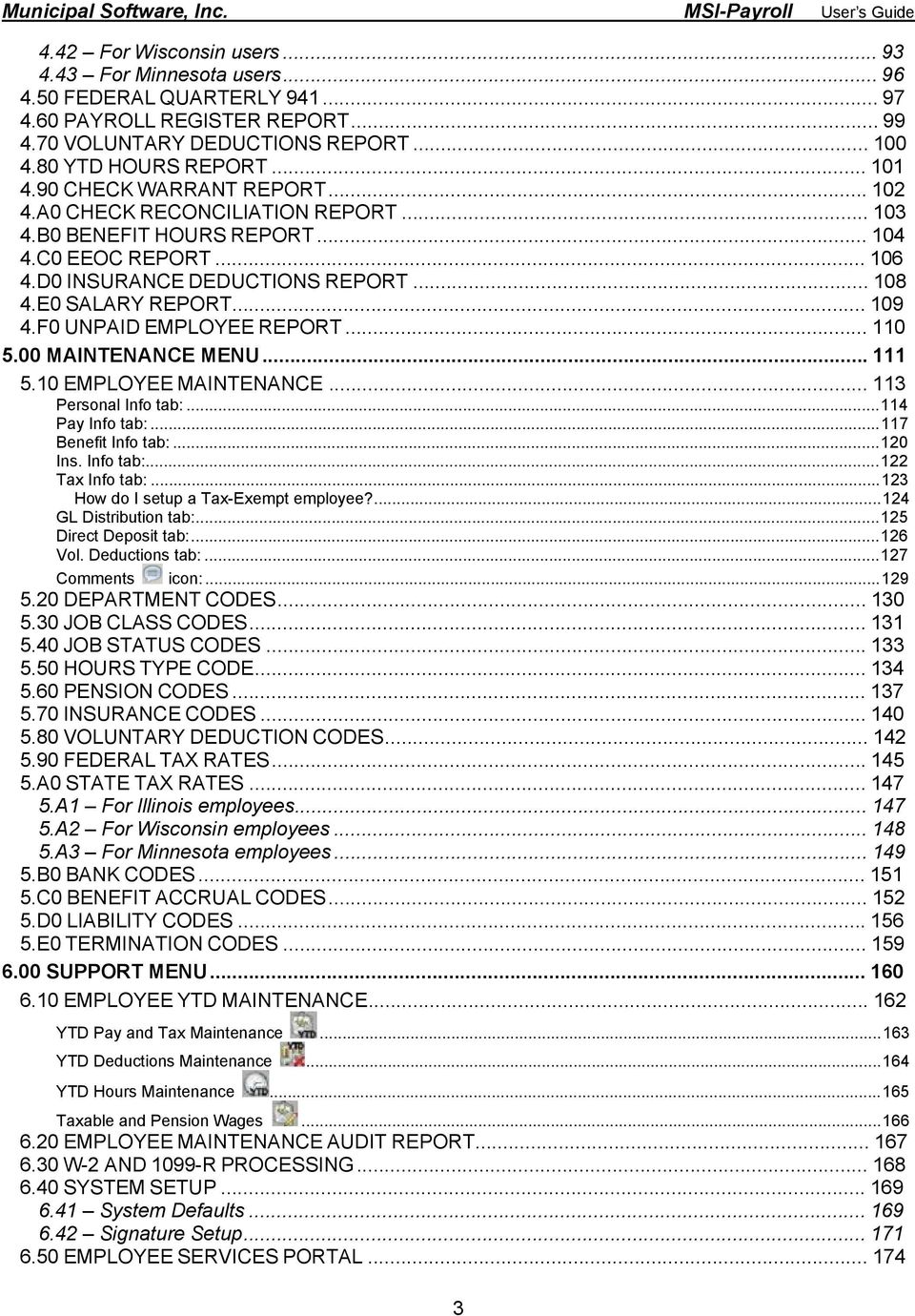
3 4.42 For Wisconsin users For Minnesota users FEDERAL QUARTERLY PAYROLL REGISTER REPORT VOLUNTARY DEDUCTIONS REPORT YTD HOURS REPORT CHECK WARRANT REPORT A0 CHECK RECONCILIATION REPORT B0 BENEFIT HOURS REPORT C0 EEOC REPORT D0 INSURANCE DEDUCTIONS REPORT E0 SALARY REPORT F0 UNPAID EMPLOYEE REPORT MAINTENANCE MENU EMPLOYEE MAINTENANCE Personal Info tab: Pay Info tab: Benefit Info tab: Ins. Info tab: Tax Info tab: How do I setup a Tax-Exempt employee? GL Distribution tab: Direct Deposit tab: Vol. Deductions tab: Comments icon: DEPARTMENT CODES JOB CLASS CODES JOB STATUS CODES HOURS TYPE CODE PENSION CODES INSURANCE CODES VOLUNTARY DEDUCTION CODES FEDERAL TAX RATES A0 STATE TAX RATES A1 For Illinois employees A2 For Wisconsin employees A3 For Minnesota employees B0 BANK CODES C0 BENEFIT ACCRUAL CODES D0 LIABILITY CODES E0 TERMINATION CODES SUPPORT MENU EMPLOYEE YTD MAINTENANCE YTD Pay and Tax Maintenance YTD Deductions Maintenance YTD Hours Maintenance Taxable and Pension Wages EMPLOYEE MAINTENANCE AUDIT REPORT W-2 AND 1099-R PROCESSING SYSTEM SETUP System Defaults Signature Setup EMPLOYEE SERVICES PORTAL
4 6.51 Portal Configuration Re-Generate Export Files ATTENDANCE ENTERPRISE INTERFACE Define AE Benefit Codes Export AE Employee Info CHECK RECONCILIATION Enter Cleared Checks Update Cleared Checks ARCHIVE Delete History Delete Check History Remove Invalid Accrual Codes from the Employee File FILE IMPORT/EXPORT ASCII Master Download A0 CREATE NACHA FILE B0 CHECK VOID MENU B1 CHECK VOID B2 VOID A RANGE OF CHECKS C0 TRANSFER EMPLOYEE NUMBER D0 NAME SORT E0 BACKUP DATA FILES APPENDIX A SAMPLE REPORTS CREATE HOURS WORK FILE REPORT HOURS WORKSHEET DIRECT DEPOSIT AUDIT REPORT DEDUCTIONS REGISTER SAMPLE CHECK PRINT (STUB-CHECK-STUB) SAMPLE CHECK PRINT (FULL-PAGE) SAMPLE CHECK PRINT (DIRECT DEPOSIT SUMMARY/FULL-PAGE) SAMPLE DIRECT DEPOSIT REMITTANCE (WITH BENEFITS, BORDERS, AND EMPLOYER INFO) SAMPLE DIRECT DEPOSIT REMITTANCE (WITHOUT BENEFITS, BORDERS, OR EMPLOYER INFO) PAYROLL DISTRIBUTION JOURNAL REDISTRIBUTE PAYROLL FOR G/L REPORT PAYROLL POSTED JOURNAL EMPLOYEE LISTING (DETAILED) EMPLOYEE LISTING (SUMMARIZED) YTD EARNINGS REPORT (ALL DETAIL FOR SPECIFIED DEPARTMENT AND JOB STATUS) STATE RETIREMENT REPORT (ILLINOIS) STATE RETIREMENT REPORT (WISCONSIN) STATE RETIREMENT REPORT (MINNESOTA) STATE UNEMPLOYMENT REPORT (ILLINOIS) STATE UNEMPLOYMENT REPORT (WISCONSIN) STATE UNEMPLOYMENT REPORT (MINNESOTA) FEDERAL QUARTERLY PAYROLL REGISTER REPORT VOLUNTARY DEDUCTIONS REPORT YTD HOURS REPORT (SUMMARY) YTD HOURS REPORT (DETAIL) CHECK WARRANT REPORT (SUMMARIZED) CHECK WARRANT REPORT (NOT SUMMARIZED) CHECK RECONCILIATION REPORT BENEFIT HOURS REPORT EEOC REPORT

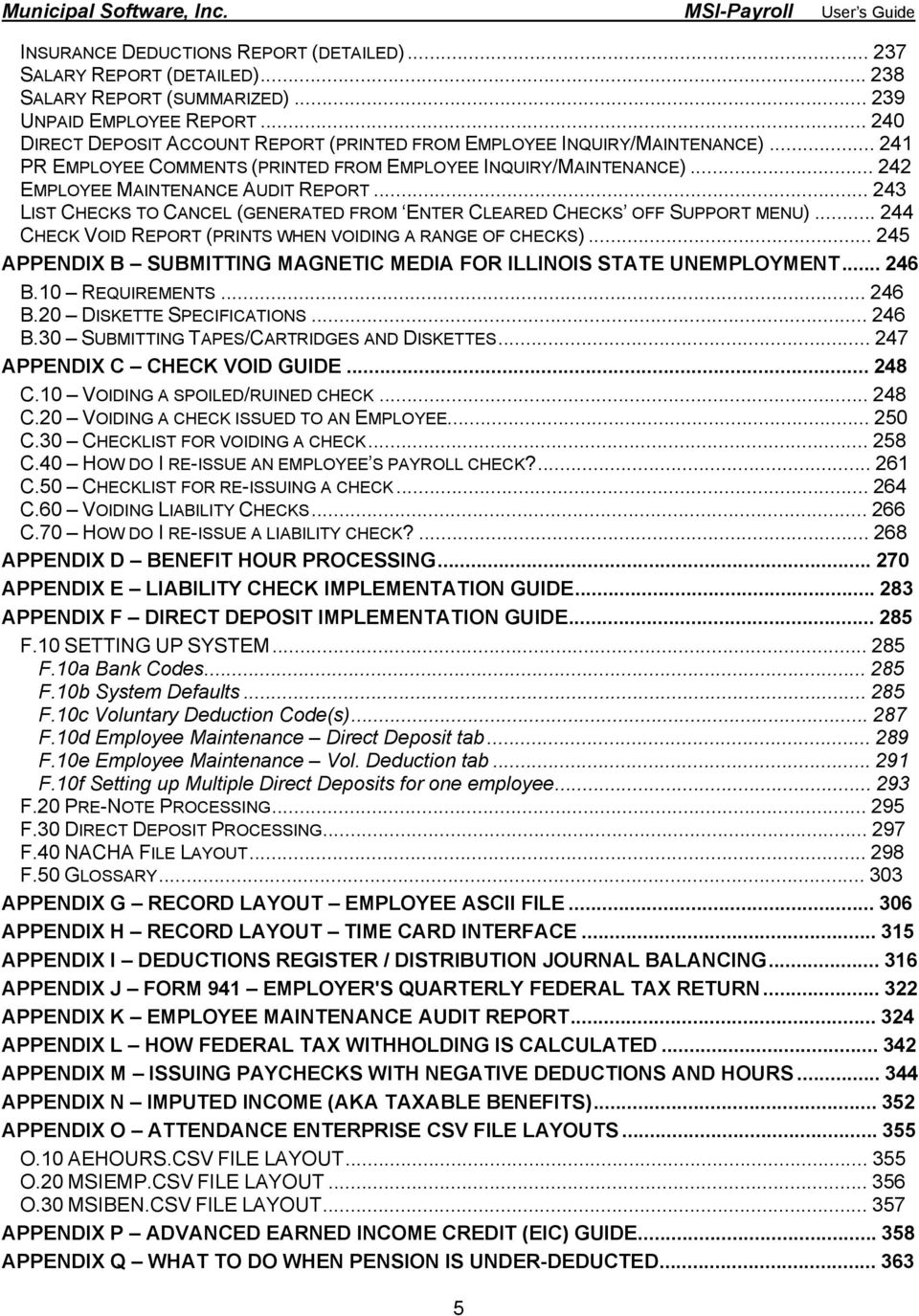
5 INSURANCE DEDUCTIONS REPORT (DETAILED) SALARY REPORT (DETAILED) SALARY REPORT (SUMMARIZED) UNPAID EMPLOYEE REPORT DIRECT DEPOSIT ACCOUNT REPORT (PRINTED FROM EMPLOYEE INQUIRY/MAINTENANCE) PR EMPLOYEE COMMENTS (PRINTED FROM EMPLOYEE INQUIRY/MAINTENANCE) EMPLOYEE MAINTENANCE AUDIT REPORT LIST CHECKS TO CANCEL (GENERATED FROM ENTER CLEARED CHECKS OFF SUPPORT MENU) CHECK VOID REPORT (PRINTS WHEN VOIDING A RANGE OF CHECKS) APPENDIX B SUBMITTING MAGNETIC MEDIA FOR ILLINOIS STATE UNEMPLOYMENT B.10 REQUIREMENTS B.20 DISKETTE SPECIFICATIONS B.30 SUBMITTING TAPES/CARTRIDGES AND DISKETTES APPENDIX C CHECK VOID GUIDE C.10 VOIDING A SPOILED/RUINED CHECK C.20 VOIDING A CHECK ISSUED TO AN EMPLOYEE C.30 CHECKLIST FOR VOIDING A CHECK C.40 HOW DO I RE-ISSUE AN EMPLOYEE S PAYROLL CHECK? C.50 CHECKLIST FOR RE-ISSUING A CHECK C.60 VOIDING LIABILITY CHECKS C.70 HOW DO I RE-ISSUE A LIABILITY CHECK? APPENDIX D BENEFIT HOUR PROCESSING APPENDIX E LIABILITY CHECK IMPLEMENTATION GUIDE APPENDIX F DIRECT DEPOSIT IMPLEMENTATION GUIDE F.10 SETTING UP SYSTEM F.10a Bank Codes F.10b System Defaults F.10c Voluntary Deduction Code(s) F.10d Employee Maintenance Direct Deposit tab F.10e Employee Maintenance Vol. Deduction tab F.10f Setting up Multiple Direct Deposits for one employee F.20 PRE-NOTE PROCESSING F.30 DIRECT DEPOSIT PROCESSING F.40 NACHA FILE LAYOUT F.50 GLOSSARY APPENDIX G RECORD LAYOUT EMPLOYEE ASCII FILE APPENDIX H RECORD LAYOUT TIME CARD INTERFACE APPENDIX I DEDUCTIONS REGISTER / DISTRIBUTION JOURNAL BALANCING APPENDIX J FORM 941 EMPLOYER'S QUARTERLY FEDERAL TAX RETURN APPENDIX K EMPLOYEE MAINTENANCE AUDIT REPORT APPENDIX L HOW FEDERAL TAX WITHHOLDING IS CALCULATED APPENDIX M ISSUING PAYCHECKS WITH NEGATIVE DEDUCTIONS AND HOURS APPENDIX N IMPUTED INCOME (AKA TAXABLE BENEFITS) APPENDIX O ATTENDANCE ENTERPRISE CSV FILE LAYOUTS O.10 AEHOURS.CSV FILE LAYOUT O.20 MSIEMP.CSV FILE LAYOUT O.30 MSIBEN.CSV FILE LAYOUT APPENDIX P ADVANCED EARNED INCOME CREDIT (EIC) GUIDE APPENDIX Q WHAT TO DO WHEN PENSION IS UNDER-DEDUCTED
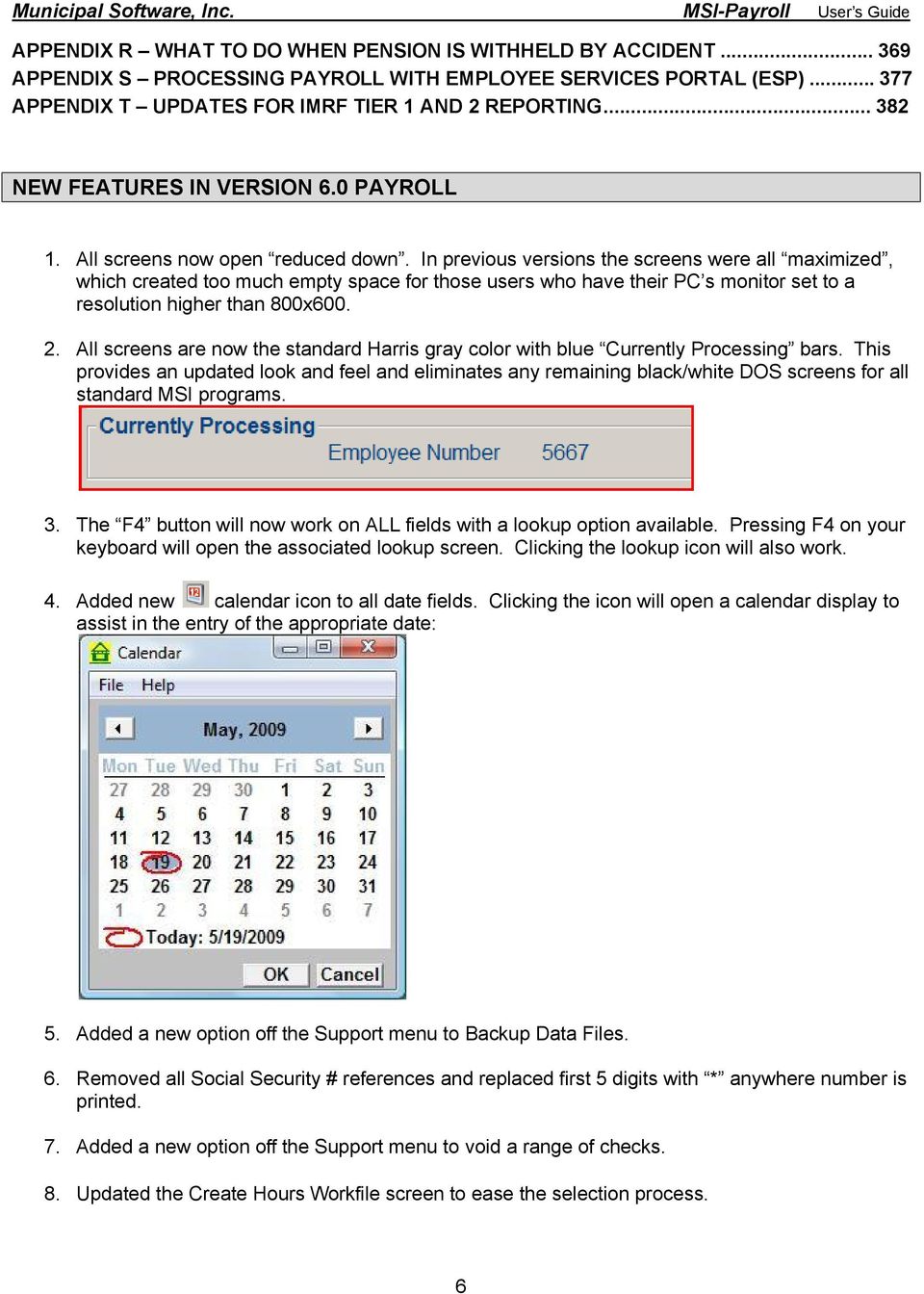
6 APPENDIX R WHAT TO DO WHEN PENSION IS WITHHELD BY ACCIDENT APPENDIX S PROCESSING PAYROLL WITH EMPLOYEE SERVICES PORTAL (ESP) APPENDIX T UPDATES FOR IMRF TIER 1 AND 2 REPORTING NEW FEATURES IN VERSION 6.0 PAYROLL 1. All screens now open reduced down. In previous versions the screens were all maximized, which created too much empty space for those users who have their PC s monitor set to a resolution higher than 800x All screens are now the standard Harris gray color with blue Currently Processing bars. This provides an updated look and feel and eliminates any remaining black/white DOS screens for all standard MSI programs. 3. The F4 button will now work on ALL fields with a lookup option available. Pressing F4 on your keyboard will open the associated lookup screen. Clicking the lookup icon will also work. 4. Added new calendar icon to all date fields. Clicking the icon will open a calendar display to assist in the entry of the appropriate date: 5. Added a new option off the Support menu to Backup Data Files. 6. Removed all Social Security # references and replaced first 5 digits with * anywhere number is printed. 7. Added a new option off the Support menu to void a range of checks. 8. Updated the Create Hours Workfile screen to ease the selection process. 6
7 9. In Time Card Entry s Deduction Override tab, increased the number of voluntary overrides from 8 to 99 and have added a message to display when that maximum is hit. 10. In Time Card Entry s Deduction Override tab, when the binoculars are selected to lookup a deduction, only the current employee s assigned pension, insurance, or voluntary deductions will display. 11. In Time Card Entry a new icon has been added to the toolbar. The icon looks like this: When it s selected, a listing of the current employee s additional pay types will display. 12. In Time Card Entry, if more benefit hours are being paid to an employee than they have available a message will display that there are not enough available hours and display what that employee actually has available for that benefit. 13. In Time Card Entry, when available benefit hours are added via the Hourglass icon on the toolbar the system will now store that information so that it can reported on both the Hours Work Sheet and the YTD Hours Report. 14. Added a new Employee Inquiry option off the Inquiry menu, which will bring up the Employee Maintenance screen with all of the fields grayed out so that the detail can be viewed but not modified 15. Added an option to the Employee Listing report to detail employees terminated within a specified date range. 16. In Employee Maintenance, new Termination Date and Reason for Termination fields have been added. 17. Now all reports (except the YTD Hours Report) run based on check date. Previously some reports asked for period end date and others asked for check date. The YTD Hours Report still runs using the period end date because the data it reads doesn t contain a check date to reference. 7

8 PAYROLL LOGIN SCREEN Enter your assigned password here and then press Enter or click OK. 8

9 PAYROLL PASSWORD MAINTENANCE Passwords are maintained by a manager within each office. When establishing a password/user name for the payroll (PR) program, the following options are available: Access Levels Select the checkbox next to each Access Level to grant access to the corresponding menu within the MSI-Payroll system that the user logging in with this password should have rights to access. Selecting Processing 1 will give rights to the Cycle menu and all its submenus within Payroll. Selecting Processing 2 will give rights to the Monthly menu within Payroll. Selecting Inquiry will give rights to the Inquiry menu within Payroll. Selecting Reports will give rights to the Reports menu within Payroll. Selecting Maintenance will give rights to the Maintenance menu and all its submenus within Payroll. Selecting Support will give rights to the Support menu and all its submenus within Payroll. NOTE: Both the File and Help menus within Payroll are available to all users who log into the Payroll system with a valid password. Relief when out of office This option is not used for the Payroll system. It is only used for the MSI-Purchase Order program. 9
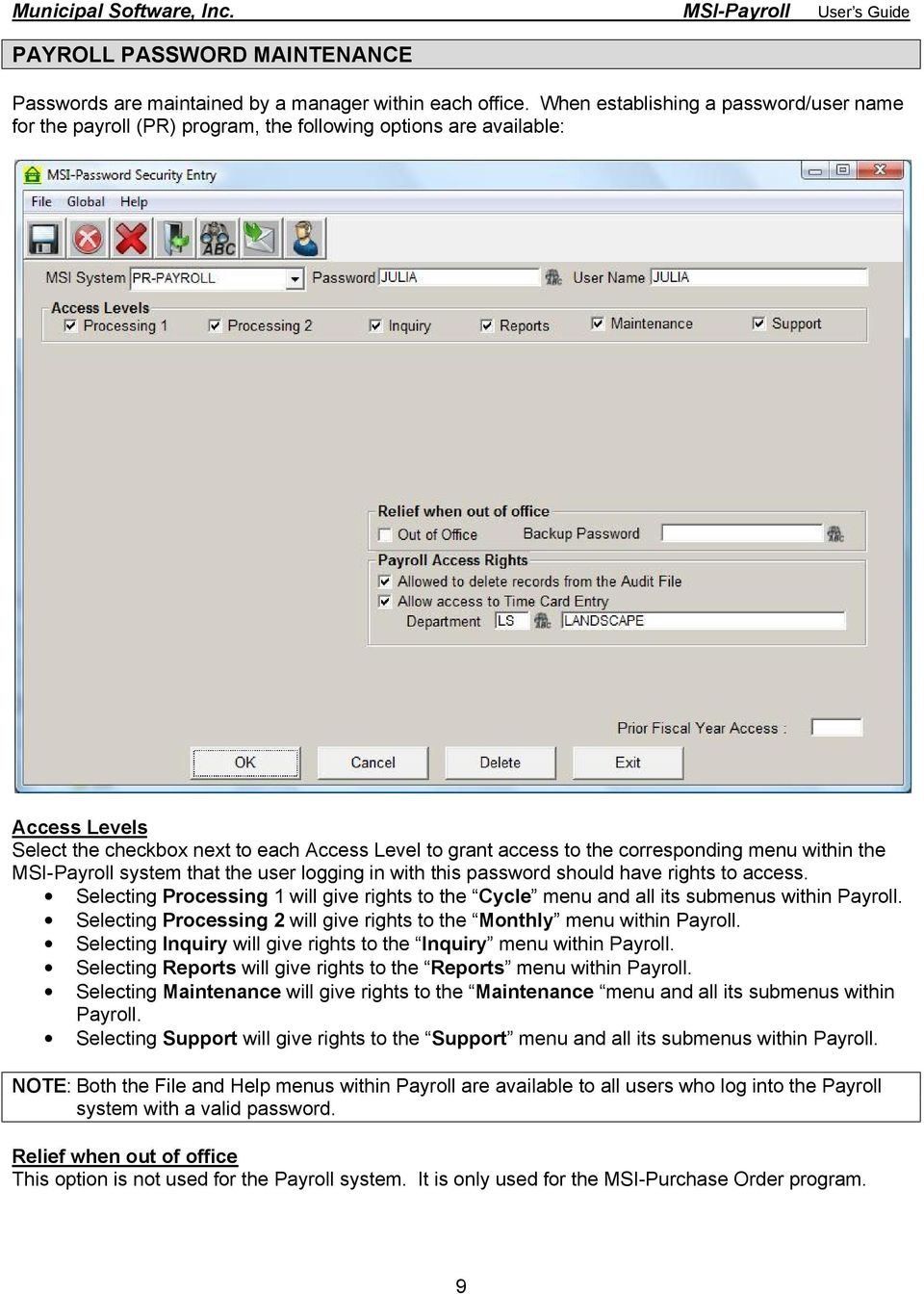
10 Payroll Access Rights Selecting Allowed to delete records from the Audit File will make the below option available to this user when they access the Employee Maintenance Audit Report off the Payroll Support menu: Note that in order for the Audit Report to work at all, the Audit Employee Maintenance option in Payroll System Defaults must be selected. Selecting Allow Access to Time Card Entry will give you the option to limit which department this employee can access via Time Card Entry. If this box is not selected the employee will have access to all employees via Time Card Entry (assuming the user has rights to the Cycle Menu). Prior Fiscal Year Access This option is not used for the Payroll system. It is only used for the MSI-General Ledger program. 10
11 PAYROLL AT A GLANCE 11

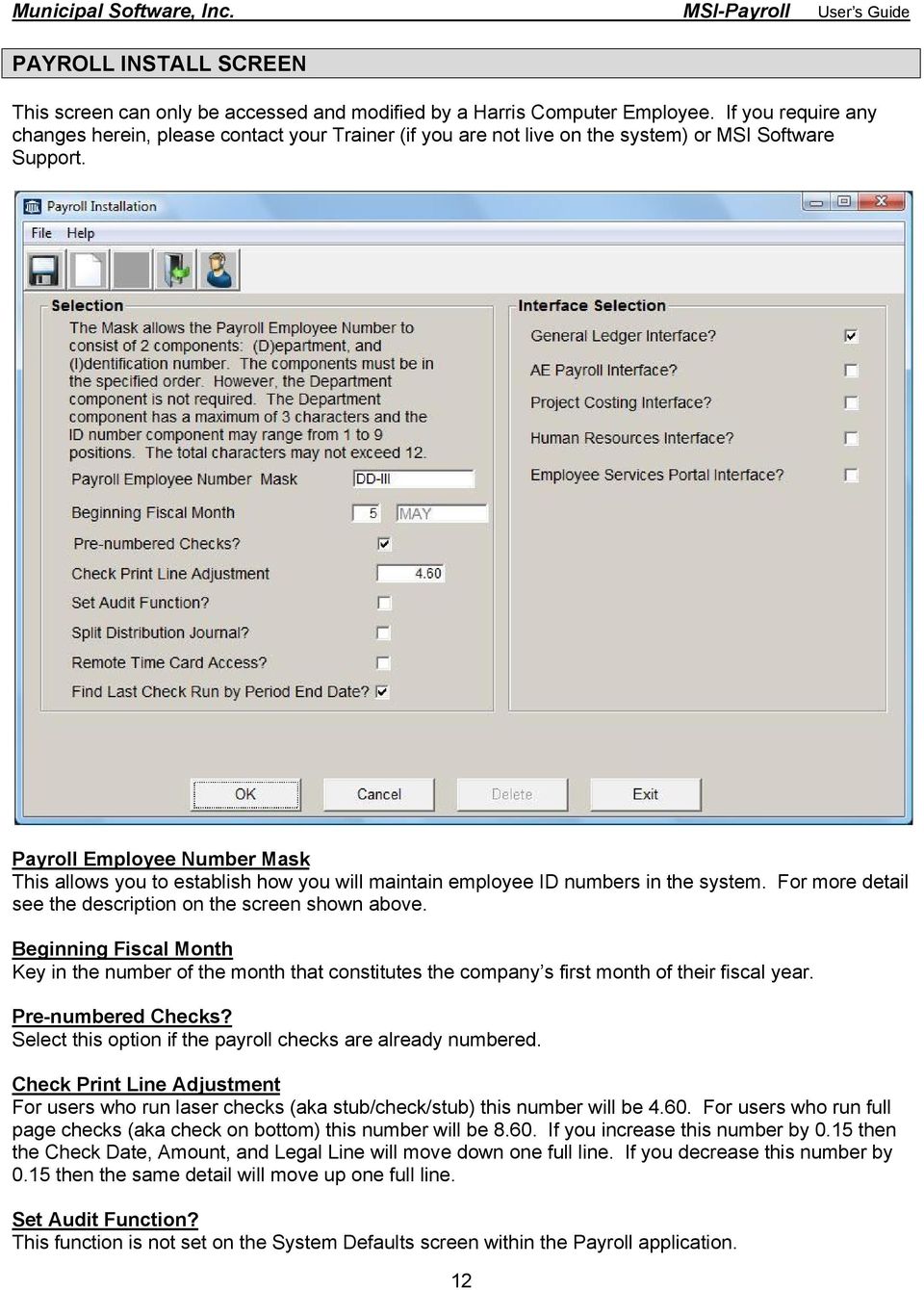
12 PAYROLL INSTALL SCREEN This screen can only be accessed and modified by a Harris Computer Employee. If you require any changes herein, please contact your Trainer (if you are not live on the system) or MSI Software Support. Payroll Employee Number Mask This allows you to establish how you will maintain employee ID numbers in the system. For more detail see the description on the screen shown above. Beginning Fiscal Month Key in the number of the month that constitutes the company s first month of their fiscal year. Pre-numbered Checks? Select this option if the payroll checks are already numbered. Check Print Line Adjustment For users who run laser checks (aka stub/check/stub) this number will be For users who run full page checks (aka check on bottom) this number will be If you increase this number by 0.15 then the Check Date, Amount, and Legal Line will move down one full line. If you decrease this number by 0.15 then the same detail will move up one full line. Set Audit Function? This function is not set on the System Defaults screen within the Payroll application. 12
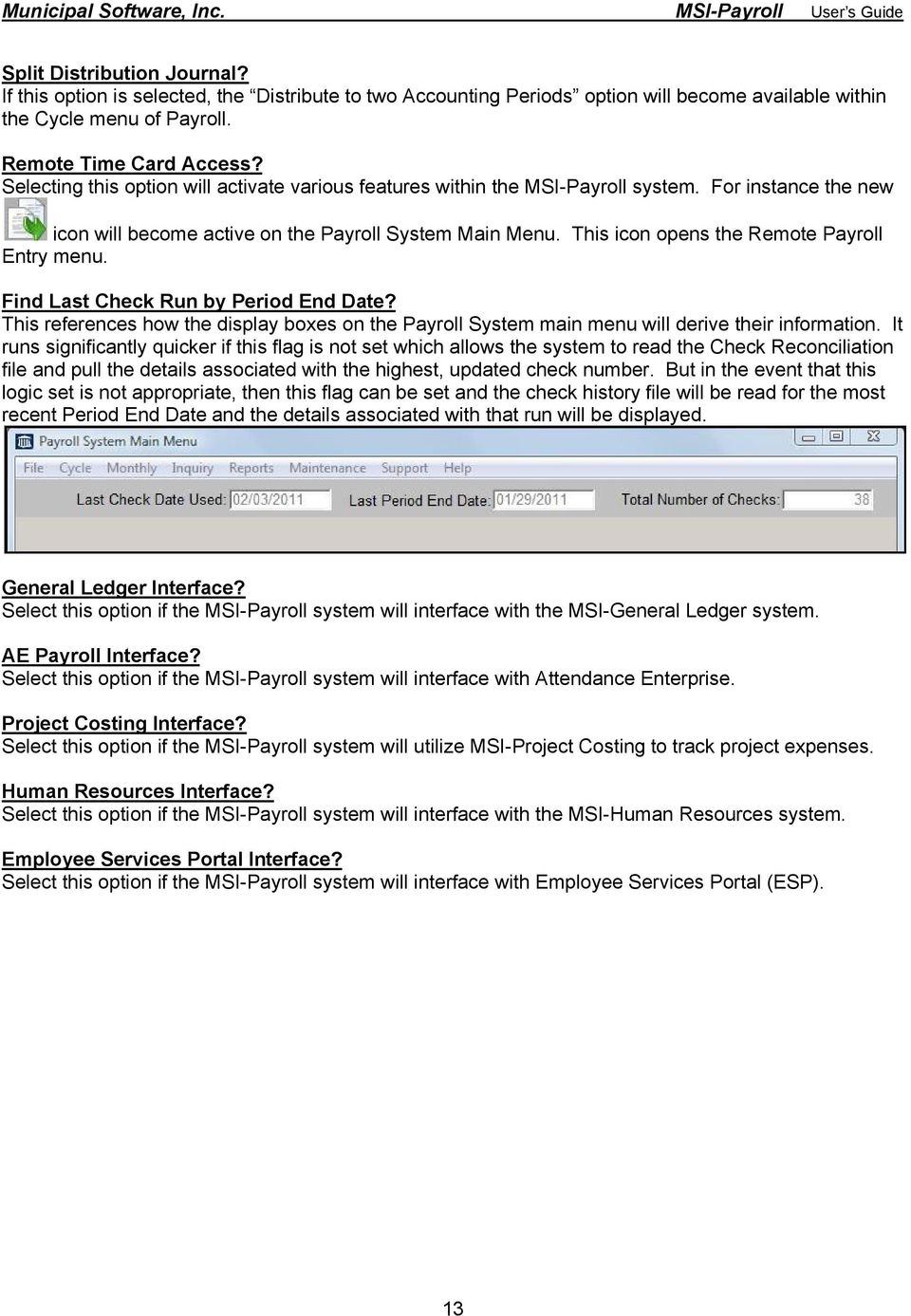
13 Split Distribution Journal? If this option is selected, the Distribute to two Accounting Periods option will become available within the Cycle menu of Payroll. Remote Time Card Access? Selecting this option will activate various features within the MSI-Payroll system. For instance the new icon will become active on the Payroll System Main Menu. This icon opens the Remote Payroll Entry menu. Find Last Check Run by Period End Date? This references how the display boxes on the Payroll System main menu will derive their information. It runs significantly quicker if this flag is not set which allows the system to read the Check Reconciliation file and pull the details associated with the highest, updated check number. But in the event that this logic set is not appropriate, then this flag can be set and the check history file will be read for the most recent Period End Date and the details associated with that run will be displayed. General Ledger Interface? Select this option if the MSI-Payroll system will interface with the MSI-General Ledger system. AE Payroll Interface? Select this option if the MSI-Payroll system will interface with Attendance Enterprise. Project Costing Interface? Select this option if the MSI-Payroll system will utilize MSI-Project Costing to track project expenses. Human Resources Interface? Select this option if the MSI-Payroll system will interface with the MSI-Human Resources system. Employee Services Portal Interface? Select this option if the MSI-Payroll system will interface with Employee Services Portal (ESP). 13
14 0.00 PAYROLL SYSTEM MAIN MENU This is the main menu for the Payroll System. You can access each option in the system here and all processing begins with this menu. The following options are available: TOOLBAR MENU File This option exits processing from the Payroll System and returns you to your desktop. Cycle This menu is used to generate the payroll for each pay period. It takes you through the entire cycle, from entering hours, to check printing and updating the check run to the payroll history file. Monthly This program is used monthly to control the amounts that are accumulated in the monthly, quarterly and year-to-date fields. It is used at the end of each month before a new payroll begins to clear the previous month s pay buckets. Inquiry This menu is used to make inquiries into the data in the system. It allows you to view the information only. No changes can be made to it with these programs. 14

15 Reports This menu contains the options that generate reports for the Payroll System. Maintenance This menu is used to maintain employee files for each person on the payroll, the codes used within those files, and codes used in other programs. Tax rate tables are also maintained here. Support This menu contains programs that are used less frequently than others, but are needed for proper functioning of the system. This includes W-2 forms printing and year-to-date maintenance. Help This selection offers different methods for contacting Municipal Software, Inc. and contains important program information. Last Check Date Used: This field will display the date of the checks from the last UPDATED pay run. ALWAYS check this field before starting a new payroll work file (Create Hours Work File) to make sure that the last run processed is the run displayed. If it is not, then call MSI for assistance. Last Period End Date: This field will display the period end date from the last UPDATED pay run. ALWAYS check this field before starting a new payroll work file (Create Hours Work File) to make sure that the last run processed is the run displayed. If it is not, then call MSI for assistance. Total Number of Checks: This field will display the number of checks that were printed during the last UPDATED pay run. ALWAYS check this field before starting a new payroll work file (Create Hours Work File) to make sure that the last run processed is the run displayed. If it is not, then call MSI for assistance. NOTE: The Last Check Date Used, Last Period End Date, and Total Number of Checks display is based upon the "newest" Period End Date's check run details. So if a check run was processed with a Period End Date of 12/10/08 and then a second check run was processed with a Period End Date of 12/01/08, it would display the details of the 12/10/08 check run on the main menu because that is the newest Period End date in the system even though it was not the last check run processed. 15

16 1.00 CYCLE MENU This menu is used every pay period to generate the payroll for your employees. It contains each step in the payroll cycle, beginning with Create Hours Work File and ending with either Update Payroll Files or Upload Payroll ESP Files and PDFs (for those who use the Employee Services Portal). Each option is listed below and must be taken sequentially for proper functioning. Create Hours Work file This program is the first step in the payroll cycle. It is used to indicate which employees are to be included in the payroll. It creates a work file for those employees and includes the base hours and rates of pay that they normally receive. Time Card Entry This option is used to modify the hours work file that was created for the payroll. Any changes to the regular hours which will be used to determine the gross pay are made here. This includes hours entry for part-time employees. Print Hours Worksheet This option is used to print a worksheet that lists the gross pretax earnings of all employees in this payroll. It serves as a worksheet to check that the correct employees will receive the proper amount of pay, before net pay is calculated in the next step. Calculate Paychecks This option takes the gross pay for all employees included in the payroll and calculates their net pay. This includes taxes, pensions, voluntary deductions, and other net pay calculations. Print Deductions Register This program prints a register of all deductions that were taken from the employees gross pay to determine their net pay. It also provides totals for the employers portion of payroll expenses. 16
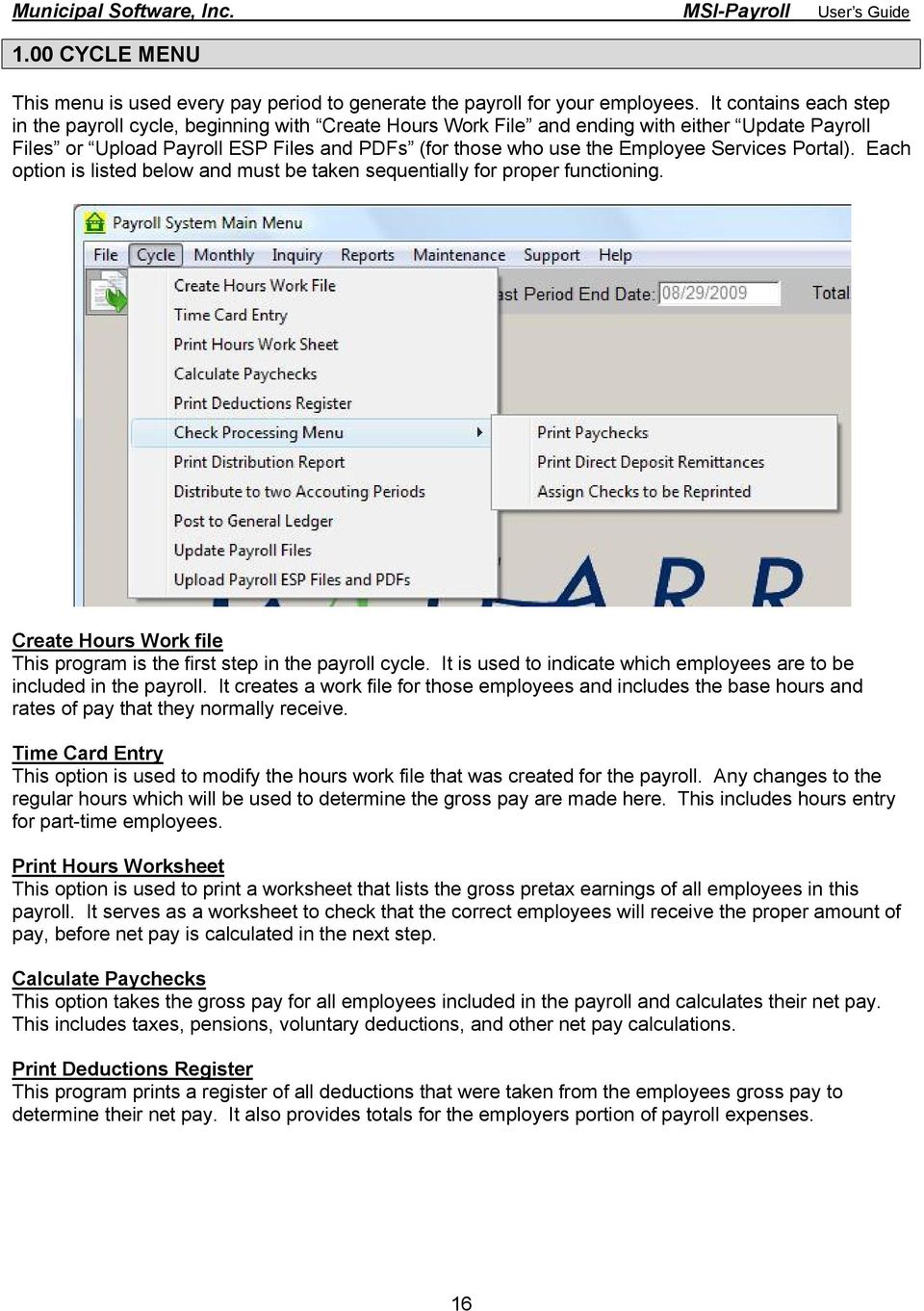
17 Check Processing Menu: Print Paychecks This option is used to print the employee paychecks that have been calculated using the previous steps. Print Direct Deposit Remittances This option will be grayed out unless the Direct Deposit Remittances flag in System Defaults is selected. Once activated via System Defaults, this option will be used to print out pay stubs to give to those employees who receive 100% of their net pay as direct deposit. Employees who receive part of their net pay as direct deposit and part via check will NOT receive a separate remittance; instead the direct deposit detail will print out on their paycheck s stub. Once this feature is activated, individual s direct deposits will no longer print out onto check stock (although one check will still be used to print out a total of all net pay issued via remittances during the run). These remittances are designed to be printed to blank paper. Assign Checks to be Reprinted This option will allow you to reprint a RANGE of checks. It is useful if say you are printing out 100 checks and one gets jammed in the printer so the last 15 checks come out on wrong number. You can use this feature to reprint the last 15 checks to a new set of check numbers so they will be properly tracked within the payroll system. Print Distribution Report This option is used to generate a report that shows the effects of this payroll in the general ledger. It is only used if the MSI General Ledger System has been installed at your installation and is interfaced with the Payroll System. Distribute to two Accounting Periods This option has to be activated by an MSI Representative. Once setup, you can use this feature to split a given payroll between two accounting periods. This is most commonly used at the start of a new fiscal year where part of the pay run is for work completed in the prior and part in the new fiscal year. Post to General Ledger This option posts the information from the current payroll to the general ledger. It is used only if the MSI General Ledger System has been activated at your location. Update Payroll Files This option is the final step in the payroll process (if you do not utilize the ESP online interface). It takes the information created by this payroll and updates the files within the Payroll System. Upload Payroll ESP Files and PDFs For those who use the ESP online interface, this will be the final step of the payroll process. It submits the payroll s information to be displayed online by those employees who ve setup their online accounts. The ESP interface is an additional purchase and so this option will be grayed out for those who do not utilize this service. 17

18 1.10 CREATE HOURS WORK FILE Running this program is the first step in the payroll creation cycle. It is used to define pay period information and which employees are to be included in the payroll. It creates a work file of standard hours for the employees and prints a worksheet of this data. This worksheet is used in the next step to make any modifications to the work file. The following fields are used to begin the payroll generation. Begin New Payroll Cycle? If you are starting a new payroll (after the last payroll has been successfully updated), then this field will default to Yes so that a new hours work file can be created. If an hours work file already exists (meaning one was created and not updated), then this field will default to No. Leave the selection at No in order to edit the work file s details (Pay Period, Check Date, etc) without overwriting the existing time card entries. If you want to begin a new payroll without updating the existing workfile, then simply click Cancel to change this option back to Yes. 18

19 CAUTION!!!! If you receive the below message when you select Yes to Begin New Payroll Cycle? : Then that means the last hours work file to be created has not been successfully updated. If you choose OK on this message then that work file will be wiped out and all time card entries will be lost. If you receive this message and you are unsure of how to answer then select Cancel and call MSI Software Support at for assistance. Pay Period This field is used to indicate the pay period being processed. A pay period will be numbered as (1), (2), (3), (4) or (5), where Period 1 is the first payroll of the month, Period 2 the second, etc. The number of the period determines calculations that will be made for deductions based on frequencies and standard liability check processing along with any benefits set to only accrue on a given pay period. When selecting Period 1, the program will prompt you with the following message: It is intended to remind you to make sure that monthly processing has been completed prior to beginning the first payroll of a new month. Select No if you ve not run Monthly Processing and you ll be taken back to the Payroll System Main Menu to run that procedure before proceeding. Period End Date Enter the date of the last calendar day in the pay period. Meaning, the day through which the employee s are being paid. The program has been designed to make sure that the date entered here is likely to be a valid end date. If you are prompted with the below warning, then verify that the date entered is accurate before proceeding: 19
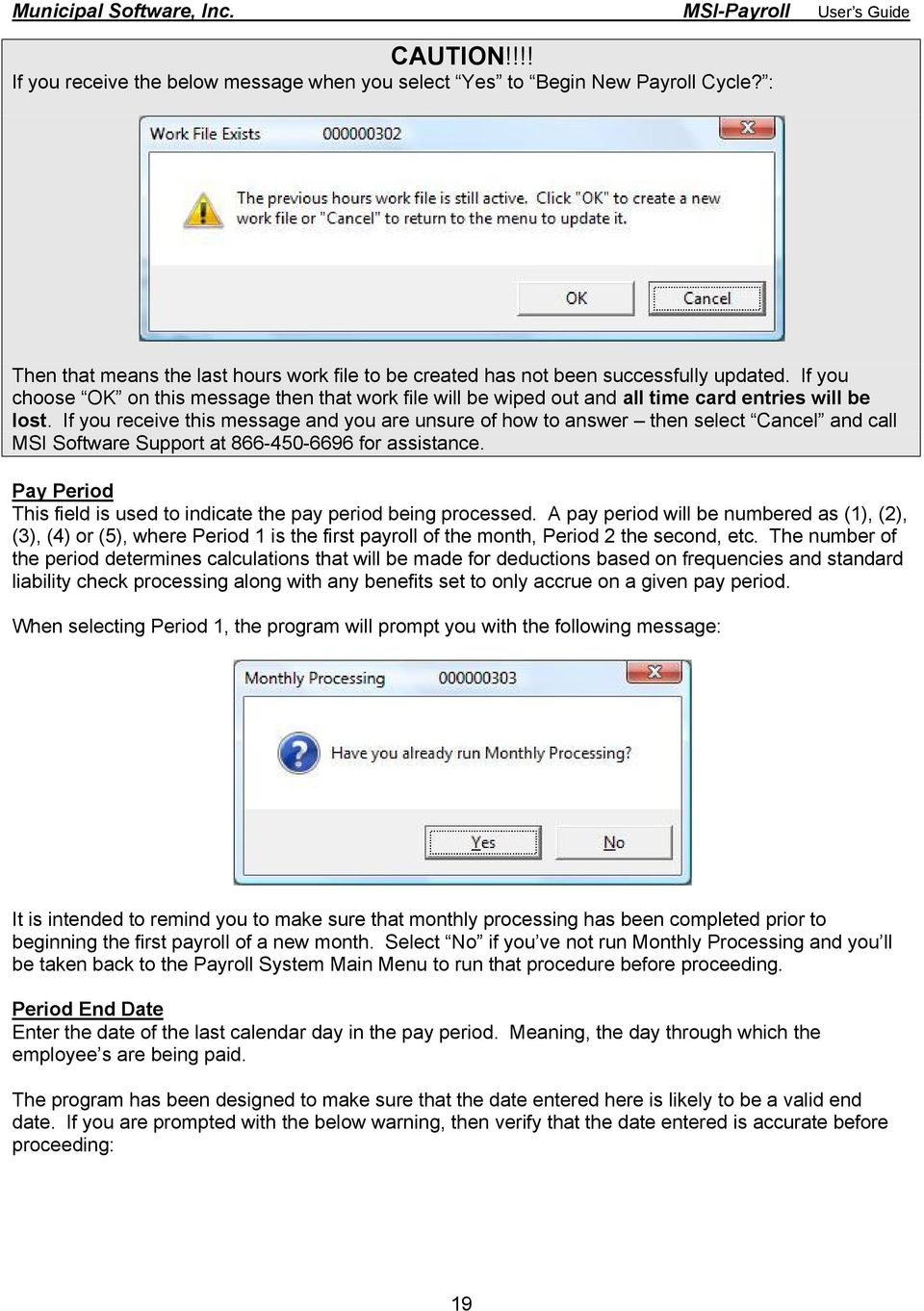
20 A NEW feature in version 5.0 payroll will generate the below warning if the period end date you entered has already been used in the system. THIS WARNING SHOULD NOT BE IGNORED!! If you are prompted with the below message, make sure that the employee(s) you are about to pay during this new pay run have not already received a check with this same period end date. If they have, then you will not be able to update this payroll to their history files. In fact, when the MSI-Payroll system tries to update this run and encounters an employee who already has this same period end date, the update process will halt and your data s integrity will be compromised. Recovery from this type of scenario is not always possible. It is HIGHLY recommended, if you get this error, to press Cancel and select a different period end date. Simply making the date one day earlier or later is usually all that s required. Accounting Period If the MSI-General Ledger application is installed, select the number of the accounting period to which data in this payroll will be posted to the general ledger. Check Date The issue date that will appear on the checks is entered in this field. The program is designed compare the Period End Date and Check Date in order to warn you that there might be a discrepancy between the two. If you are prompted with the below warning, simply verify both the Period End Date and Check Date for accuracy: 20
21 The program is also designed to look for possible invalid dates. If you are prompted with either of the below warnings, then verify the date entered for the Check Date is valid before proceeding: 21
22 Beginning Check Number The number that will be assigned to the first check printed is entered in this field to determine check order. This will default the value from the Next Check Number field in the System Defaults. Liability Control This field controls which liability checks will be printed during the payroll process. It is only used if Print Liability Checks in System Defaults is selected. If Print Liability Checks is not selected, you will receive the following warning: A. (S)tandard: Indicates that the liability codes with frequencies that correspond with the specified Pay Period will be printed. This is the default entry. B. (N)one: Indicates that no liability checks should be printed, regardless of the Pay Period. This is recommended for use with special check runs that may fall between standard pay periods, or whenever it is not necessary to distribute liability checks C. (A)ll: Indicates that a liability check should be printed for all codes with accumulated amounts, regardless of the specified Pay Period. NOTE: If (N)one is used, the liability amounts accumulated for this check run will still be held in the liability code table for payment at a future time. Please check the methods of pay to be included This next section is used to indicate which employees are to be included in the work file. Select the applicable employees by selecting the appropriate pay method. The program will include any employee with a corresponding pay method code in their maintenance files. The pay methods listed below are available. NOTE: Only employees with qualifying status codes in their master files will be included using any of the following methods: A. All Methods of Pay Use this option to include all active employees in the payroll check run. B. No Methods of Pay (Empty Hours Work File) This option creates an empty work file, meaning no employees are imported. It is useful when a single or small group of checks are being processed. All hours that are to be paid will need to be entered manually via Time Card Entry. C. Selected Method of Pay SALARY and HOURLY The remaining fields are used include only those employees who are setup with the selected Pay Method on their Master file. Indicate any combination of hourly and/or salary pay methods for weekly, bi-weekly, semi-monthly, monthly or quarterly pay periods. 22
23 D. Time Card Interface Selecting this option allow you to import an ASCII filed created from an outside vendor source into the payroll work file to track and process hours worked for your employees. This option eliminates manual entry of hours worked for the employees included in this file. (See Appendix H for the required file layout). Once all your selections are made, click OK to allow the system to create the work file. Click OK once you ve verified all selections made are accurate. Selecting OK will create the new hours work file or save any edits to the existing work file. Will clear your selections and allow you to start over. Exits you from this program without saving any changes specified. If, after clicking OK, you see the Apply Job/Wage Change to PR screen appear (see below), then changes have been made to an employee s Job/Wage setup in the MSI-Human Resources module and the MSI-Payroll module is asking for permission to import the updates. You can remove a given update by highlighting it and selecting the Remove button before clicking OK. Click OK on the Apply Job/Wage Changes to PR screen if you want to accept all the listed selections. 23
24 If you don t want to import any of the listed changes, then select Exit. Note: When selecting which records to list for import, the Payroll system first looks to see if the Payroll Updated field in Job/Wage Maintenance is flagged. As long as it s blank then the system will proceed to compare the Payroll s Period End Date (specified when processing Create Hours Work file ) to the Effective Date in HR s Job/Wage Maintenance screen. If the Period End Date is one day prior to the Effective date, then the changes will be available for import. Otherwise the Effective Date must be on or before the Payroll s Period End Date for the changes to be listed for import. So, for instance, if the Effective Date in HR is 12/01/08, then the changes will be available for import if the period end date in Payroll is 11/30/08, 12/01/08, or any day after. While the program is creating the payroll work file you will be prompted with the below message: After it is created, you will be prompted with the message below and the CREATE HOURS WORKFILE report will print that lists all employees (sorted by Employee ID) that were included in the pay run along with their pay rate, base hours and gross pay. It then gives totals for the number of employees and gross pay. This printout serves as your worksheet for any modifications that are to be made to the work file during editing in the next step. NOTE: The CREATE HOURS WORKFILE report will not print when an Empty Hours Workfile is generated. This is because the report lists the employees imported to the pay cycle, and an Empty Hours Workfile does not import any employees, it gives you the opportunity to input the specific employees to be paid out. 24
25 1.20 TIME CARD ENTRY This program is used to make any changes to the work file that was created for the current payroll being processed. These include adding in additional employees and/or making any changes to the standard base hours that are paid to the employee, such as for benefit hours or part-time employee hours. Net pay is calculated using the gross pay that is established in this program. If no changes are made in this program, net pay is calculated using the employees base hours. The following fields are used to modify the work file. NOTE: Only those employees that are to have changes made to their base hours or for which hours are to be initially entered need be accessed using this program. All other employees will be paid for their base amounts. Time Card Entry tab: Employee # The identification number of the employee to be modified is entered here. Binoculars are available, if you need to look up the number. Check Sequence # The field will default to 00. If the employee is to receive more than one check during this pay period then number up sequentially with 01 for the second check, 02 for the third, etc. 25
26 Dept, Job Class, and Job Class Pay Rate The employee s department code/description, job class, and default pay rate as defined in their employee maintenance screen are displayed here. Use the next section to maintain the specific types of hours for which the employee is being paid on the check sequence indicated at the top of the screen. Each separate Hours Type that is being paid will have a unique line # to distinguish it from other entries. The employee s base hours (displayed as REG hours code) and any additional pay types will automatically appear as separate line items (unless this is an Empty Hours Workfile). Click the additional pay type icon to see a listing of the current employee s additional pay types as defined in their Employee Maintenance setup. # This field is used to identify each individual line item of hours that is maintained. It will run sequentially from 01 through however many hours codes are paid. Action Date This is the date that the hours were earned. The period end date will default, but may be modified. Hours Type The code that represents the type of hours that this employee is being paid for is entered here (i.e. Vacation Hours, Regular Hours, Overtime Hours). Rate The rate of pay the employee receives for the indicated hours is entered here. Hours The number of hours being paid for this code is entered here. Default Override G/L Acct. # Use this field to specify an alternate G/L account number to which these wages should be posted. Modifying the default account will override both the employee and hours code G/L setups. 26
27 Click the icon to view the employee s disbursement account(s) as setup in Maintenance: Project Use this field to tie the wages to a project. Add line items detail to the Time Card Removes a highlighted line item s detail from the Time Card Regular Hours Displays the total amount of REG hours for which the employee is being paid. Other Hours Displays the total amount of hours, other than REG, for which the employee is being paid. Total Hours Displays the total amount of ALL hours for which the employee is being paid. Click the hourglass icon to open a Benefit Hours Entry. Use this to add available hours to an employee s benefit code. This can be especially useful for COMP time. 27
28 The options on the remaining tabs are used to temporarily override the standard calculation of an employee s paycheck; allowing you to process variations (such as one-time changes to voluntary deductions) without making changes to the employee s master file that would then need to be changed back once the pay run was finished. Excludes tab: The changes made here will effect only for the current check on the current payroll. If an employee receives any other checks during the same pay cycle, they will not be affected by these entries. Once updated, the system reverts to its original values. The entries made here will override all other variables defined in the system. It is important to understand how entries on this screen affect the payroll history files. This is especially true when selecting the Exclude Taxes option as doing so will not affect the employee s TAXABLE WAGES on which the deductions are based. For example, say an employee receives $ gross pay each pay period with a $ Federal Tax deduction. And because this employee has no deferred deductions or earnings, the FEDERAL TAXABLE WAGE is also $ for each pay period. Assuming the employee earns 26 paychecks a year, their annual Federal Wage would be $26, (as reported in Box 1 of the W-2). And their annual federal withholding would equal $ (as reported in Box 2 of the W-2). 28
29 If Exclude Taxes is selected for one of their checks, the FEDERAL TAXABLE WAGE will remain at $ for this paycheck. That amount will NOT be reduced due to this selection. Therefore (from the above example) the employee s W-2 would print with the full $26, wage to Box 1, but only $ in withholding reported in Box 2. So they may end up owing money come time to file their tax return. The following fields are available for modifications. The employee s Number and Name will appear at the top of the screen. Exclude Taxes Selecting this option will exclude Federal, State, FICA, Medicare, AND local taxes from the employee s paycheck. If you do not want ALL the taxes to be excluded, then use the Tax Override tab to exclude only certain tax deductions. Note: If the wages being paid out to the employee are not FICA/Medicare deferred and Exclude Taxes is selected, then it becomes the employer s responsibility to pay the full amount to be deducted from the wages. Therefore you will see the Employer Totals on the Deductions Register reflecting the full FICA/Medicare amount due for the wages paid. And the full amount due will print onto the liability check issued to the IRS. This amount will be charged to the employer s expense when the payroll distribution journal is posted to the general ledger. This ensures that the FICA/Medicare will be fully expensed regardless of the changes that are made here. Exclude Voluntary Deductions This option will exclude voluntary deductions that would normally be subtracted from this paycheck; this includes direct deposit. Meaning if the employee typically receives their pay by direct deposit, then these wages will be issued on a check rather than by direct deposit. And, if any of the voluntary deductions are tax deferred, then the employee will be taxed at the higher/non-deferred rate of pay which in turn affects the employee s taxable wages as reported on their W-2. Exclude Pension Will exclude both the employee s deduction and employer s contribution to the pension program in which the employee participates. This option will also prevent the employee s pay from increasing their PENSION WAGES. And, if the pension deduction is tax deferred, then the employee will be taxed at the higher/non-deferred rate of pay which in turn affects the employee s taxable wages as reported on their W-2. Exclude Benefits This option indicates to the system not to accrue benefit hours that would normally be earned. Note: If an employee is receiving more than one check in the same payroll, benefit hours should be EXCLUDED from all checks other than their standard check. If they are not, you are actually increasing the number of times benefits are accrued per year for the employee, which is the same as increasing the number of pay periods for that employee. This would overstate the accrued or available hours for the employee. This would also be true for special check runs outside the normal pay cycle. Exclude Insurance Will exclude both the employee s deduction and employer s contribution to the insurance plan(s) in which the employee participates. If the insurance deduction is tax deferred, then the employee will be taxed at the higher/non-deferred rate of pay which in turn affects the employee s taxable wages as reported on their W-2. 29
30 Tax Override tab: It is important to understand how entries on this screen affect the payroll history files. If the calculated values for taxes are either excluded or overridden: THESE OVERRIDES WILL NOT AFFECT THE "TAXABLE WAGES" ON WHICH THESE DEDUCTIONS ARE BASED! For example, say an employee receives $ gross pay each pay period with a $ Federal Tax deduction. And because this employee has no deferred deductions or earnings, the FEDERAL TAXABLE WAGE is also $ for each pay period. Assuming the employee earns 26 paychecks a year, their annual Federal Wage would be $26, (as reported in Box 1 of the W-2). And their annual federal withholding would equal $ (as reported in Box 2 of the W-2). If Federal is overridden with a reduced amount of $75.00, the FEDERAL TAXABLE WAGE will remain at $ for this paycheck. That amount will NOT be reduced due to this override. Therefore the employee s W-2 would print with the full $26, wage to Box 1, but only $ in withholding reported in Box 2. So they may end up owing money come time to file their tax return. 30
31 The following fields are available for modifications. The employee s Number and Name will appear at the top of the screen. Federal, FICA, State, Local 1, Local 2, or Medicare Modifying these fields allows you to override the normal, system-calculated tax deduction amounts. If an amount is entered, the system will deduct that amount from the employee s check INSTEAD OF the normal calculation for the tax. If ($0.00) should be deducted, enter 9999 in the field as prompted. This tells the system NOT to make a deduction for the tax. If no change is needed the field should remain blank. Note: If the wages being paid out to the employee are NOT FICA/Medicare deferred and the changes made to the FICA and/or Medicare fields are less than what the system would normally calculate, the difference becomes the employer s responsibility to pay. Therefore you will see the Employer Totals on the Deductions Register increase to make up for the portion not being deducted from the employee. And the full amount due will print onto the liability check issued to the IRS. This amount will be charged to the employer s expense when the payroll distribution journal is posted to the general ledger. This ensures that the FICA/Medicare will be fully expensed regardless of the changes that are made here. If the changes are greater than the normal calculation, the employer s expense will increase to match the higher deduction taken from the employee s check. To setup an employee so their wages ARE FICA and/or Medicare deferred, you ll need to setup a new pension code and apply it to the employee s master setup. The new pension code should be flagged to Include FICA and/or Medicare where applicable, for more details see Section 5.60 PENSION CODES. 31
32 Deduction Overrides tab: Use this tab to override the normal, system-calculated deductions for Pension, Insurance, and Voluntary Deduction codes. A deduction can be excluded from this check by entering the deduction code and $0.00 as the amount (or 9999 for Pension). The normal amount can also be overridden with any dollar amount (greater or smaller than the typical deduction). Whatever amount that s specified here is the amount that will be deducted from the employee s wage. Pension Code The code for the pension program in which the employee participates will default into this field. If you wish to key in an override, simply input the Amount to be deducted from their paycheck. Notes: This override will not affect the employer s contribution amount, only what is deducted from the employee s check. The employer s contribution will calculate as normal. If the pension contribution is tax deferred, then the employee s taxable wage and tax deduction will be altered based upon the override amount. The override amount does not alter the employee s PENSION Wages. So the pay amount that the pension would ve been calculated on is still what will be printed on the Retirement Report as the employee s earnings; along with the amount actually deducted from this paycheck. PENSION Wages are not reported on the W-2, only the total pension withheld. 32
33 Insurance Codes Enter in the Code for the insurance program(s) in which the employee participates and then input the Amount to deduct from their paycheck. Notes: This override will not affect the employer s contribution amount, only what is deducted from the employee s check. The employer s contribution will calculate as normal. If the insurance deduction is tax deferred, then the employee s taxable wage and tax deduction amounts will be altered based upon the override amount. Voluntary Deduction Codes You cannot process an overriding voluntary deduction without first having added it to the employee via Employee Maintenance. This option will override the amount, regardless of the deduction s frequency code. (Ex: If the voluntary deduction in Employee Maintenance has a frequency of 5, and this is the 1st pay period, the deduction will still be taken out). Enter in the Code for the voluntary deduction(s) and then input the Amount to deduct from the paycheck. Click Add to include the override and key any additional overrides as needed. Note: If the voluntary deduction being overridden is tax deferred, then the employee s taxable wage and tax deduction amounts will be altered based up on the override amount. 33
34 Other Overrides tab: This section allows you to alter the payroll information that was defined when creating the work file. If the data is altered, it will affect the individual check of this employee only. It is normally used for sequenced checks that effect future pay periods. A. Pay Period B. Check Date C. Accounting Period Will save your entry Will clear what you have entered and allow re-entry Will delete the employee s check from this pay cycle Will exits you from this program without saving your entries 34
35 1.30 PRINT HOURS WORK SHEET This option is used to print a worksheet which details what comprises the gross earnings of all employees in the current payroll. This worksheet reflects the changes made to the work file in Time Card Entry. The gross pay for the employees listed will be used in the calculations to determine net pay. The worksheet can be generated using one of three different selections: 1. All employees in the workfile will include all employees in the work file. 2. Employees in a specified department will only include employees in a certain department. 3. Employees in a specified Job Class will only include employees in a certain class. There are three additional (optional) selections that can be chosen: 1. Entries for a specified date includes entries for a given Action Date only 2. Print Employee Distribution by default, any REG hours will either be printed on this report as REGULAR HOURS, or if the REG hours code is setup with a G/L Account Number and/or Substitution Account #, then that account number will be listed. To see what G/L account(s) the expenses will post to, select this option and the account numbers will be listed next to the employee s name. 3. Print Benefit Time Entered via the Timecard Entry s Hourglass Icon this will include any available benefit time input via Time Card Entry. Review the worksheet after it s printed. If the information on the worksheet requires no further edits, you may continue with the Calculate Paychecks option. If some of the data is NOT correct, you must return to Time Card Entry to make the appropriate corrections before proceeding. This report should 35
36 be run after edits are made to that the work file so the detail can be verified before proceeding with further within the pay cycle CALCULATE PAYCHECKS This option takes the gross pay in the current work file and calculates the net pay for the employees. This includes taxes, pensions, voluntary deductions, insurance and any other net pay calculations. It also determines the benefit hours and year-to-date amounts for this payroll. This program will calculate paychecks in the below order: 1. Gross Pay less tax deferred Hours Codes 2. Tax Deferred Voluntary Deductions (processed alphabetically) 3. Tax Deferred Insurances (processed alphabetically) 4. Pension 5. Federal Tax 6. FICA Tax 7. Medicare Tax 8. State Tax 9. Local Tax Local Tax Non-Deferred Insurance (processed alphabetically) 12. Non-Deferred Voluntary Deductions (processed alphabetically) 13. Direct Deposit Deductions less than 100% (processed alphabetically) 14. Direct Deposit Deductions equal to 100% 15. Benefits 36
37 To calculate your paychecks, just click OK. If you do not want to calculate, then select Exit. The length of time it takes to complete this process will depend on the number of checks being calculated. After the calculations are made, you may continue with the payroll processing by printing and reviewing the Deductions Register. Previous Check Usage message You will receive the below message during the calculate process if the system encounters a check number that s to be included in this pay cycle, but is already processed in the system. The offending check number will display. To correct this, go back to Create Hours Workfile and specify a new starting check number. 37
38 Negative Paycheck (aka employee has more deductions than net pay ) message You will receive the below message during the Calculate Paychecks process if the system encounters a check where there are too many deductions being taken from their gross pay and thus resulting in a negative paycheck. The offending employee number will display. To correct this, simply review the employee s deductions (taxes, pension, insurance, and voluntary deductions) and compare them to the gross pay they are receiving for this pay cycle. If any deductions need to be overwritten, you may do so in Time Card Entry. EMPLOYEES WITH NO TAXES OR NO PENSIONS Report When Calculate Paychecks is run, if the program encounters one or more employees who are not having taxes and/or pension amounts deducted from their paychecks, a report similar to the one below will print. This gives you the opportunity to correct the situation in Time Card Entry before printing the checks. 38
39 1.50 PRINT DEDUCTIONS REGISTER This report serves two purposes: 1. To process direct deposits by printing a list of Direct Deposit employees and simultaneously creating the PPD.DAT file that contains all of those employees. The PPD.DAT file is used to generate the PRNACHA.DAT file (which conforms to your bank s file layout requirements) which is transmitted to the bank that processes the deposits. 2. To report all deductions (taxes, pension, etc.) that are withheld from paychecks in the work file. The deductions and net pay, along with corresponding totals, will be printed on this report. Note: Since the running the deductions register will generate two reports, you will be prompted two times to select a printer. The first time will specify where the Direct Deposit Audit will print; the second one will specify where the Deductions Register will print. The report will be generated based on your selection of one of the two following methods: 1. All employees in the work file. 2. Employees in a specified department. Note that if you run the report for a specified department, then the Liability Check detail will not print. You will be prompted with the below warning message as a reminder: If you ve activated Direct Deposit Remittances via System Defaults there are a couple of things to expect in regards to how the Deductions Register will print differently than if they aren t activated: 1. Rather than printing all employees together by department, it will now sort first by employees receiving a check and then it will list the employees receiving a remittance. 2. The last employee check listed is a check called DIRDEP which is a total of the net pay going to all employees who are receiving 100% of their income as direct deposit (employees receiving part of their pay as direct deposit and part in check form will not have the portion of their direct deposit included in this total). This is done because the system retains paid history by check number, meaning each employee must be assigned a check number for their paid detail to be stored in the database. So instead of 100 direct deposit employees being issued 100 checks, each payroll will lump those employees together onto one check number. This check can be used via Check Inquiry to see the details of all employees included on that check s total. 39
40 If the information on the Deduction Register IS correct, you may continue on with processing the payroll. If you find an error, you must make changes via the appropriate Maintenance screen and/or Time Card Entry; then re-run the Calculate Paychecks option. To verify the correction was successful, return to this option and print the deduction register again (doing so will also insure that the right direct deposit amount is paid to any edited employees). This process is followed until the report generated reflects the proper deductions and net pay for ALL employees and that all Liability check amounts are accurate. Once you re ready to proceed, you have two options (1) select the Print Paychecks option or (2) skip ahead to print the Distribution Journal. This will allow you to compare the Deductions register to the Distribution Journal for accuracy before wasting any check stock. See Appendix I for more details on tying out these reports. Note: For Illinois locations only, if you want the IMRF Wages to be listed on the Deductions Register, you ll need to setup your IMRF pension with the IMRF Plan Code" field defined with the appropriate info from IMRF (i.e. RG01, RG03, etc). 40
41 What is the Auto Deposit Total Amount? Occasionally on the Deductions Register, you may see a line under the Employer Totals section labeled Auto Deposit Total (see example): 41
42 This total appears when a direct debit employee only receives part of the net check via direct debit and the remainder in the form of a check. The amount on the check is what appears as the Auto Deposit Total. For instance (in the example below), the employee received $ of their check via Direct Deposit, the remaining balance of $ is paid via check. The $ is what appears on the Deductions Register as Auto Deposit Total. 42
43 1.60 CHECK PROCESSING MENU This menu provides you with the options needed for printing/re-printing checks and direct deposit remittances. 43
44 1.61 Print Paychecks This program is used to print the paychecks for the employees in the current work file. If you print stub/check/stub style checks, then your check print screen will appear as below: 44
45 If you print full page checks (where the check is on the bottom), then your check print screen will appear as below: In either case you will have two options available for printing checks: (1) print all employees in the work file or (2) print a range of check numbers. You are also given the option to print the available benefit hours on the employee paycheck. Additionally, you may include comments that will print on all employee checks. The Check Date field will allow you to easily alter the date of the check run if a mistake was made when specifying that date during the Create Hours Workfile step. Altering the Check Date on this screen DOES alter the date in the workfile itself. So not only will the checks print with this new date, but when this run is updated the Check Date input on this screen will override the date that was originally specified when the workfile was created to be the official Check Date for this pay run. For those that print full page checks, there s an additional option to Suppress Printing Hours Codes with No Pay. If this option is selected, then any hours codes on an employee s time card that either have no time or pay tied to the detail will be omitted from the check stub. This can be used to save space when an employee has several additional pay types that they aren t always paid for each cycle. 45
46 If you ve activated Direct Deposit Remittances via System Defaults and there are employee s receiving 100% of their net pay as direct deposit for this pay run, then you will be prompted with the following reminder to print the remittances: NOTE: There is no way to run remittances once the option to Update Payroll Files is processed unless you restore from a backup tape. Once checks have finished printing, you will receive the below message. At this time you may remove any unprinted checks from the printer tray. If the MSI General Ledger System has been installed, you should then continue with the Print Distribution Journal and Post to General Ledger options. If not, you will skip those steps and simply Update Payroll Files (always verify that the checks have printed properly before updating). How to reprint a group of checks? Well, that depends read the scenarios below to determine which best suites your situation: If the group of checks is in the middle of the run (i.e. out of checks numbered 1-100, checks 75, 76, and 77 need to be reprinted), then follow the steps outlined below. If the group of checks is at the end of the run (i.e. out of checks numbered you need to reprint checks ), then use the new feature off the Check Processing Menu called Assign Checks to be Reprinted (see Section 1.63 below). In the scenario where you are printing checks and checks 75, 76, and 77 get ruined in the printer 1. properly discard the bad/spoiled checks 2. put the first good check number (in this case it would be check 101) into the printer and select to print a range of checks (in this case 75-77) 3. finish the payroll processing for the whole group of checks (1-100) At this point, the whole payroll will be updated and everything will be good except those three checks will still be numbered 75, 76, &77 in the system, when in reality the checks issued were on numbers 101, 102, and 103. To correct the check numbers, follow the below steps: 46
47 4. After the check run is posted and updated, void re-issue (VR) the three bad checks (75-77), when you are given the option to post the voided detail to the G/L, select Yes so those checks are properly marked as voided when viewed via the GL. For more on how to void a check see Appendix C. 5. make note of the Outstanding Amounts for any liability codes that these 3 employees affect via the Liability Code Maintenance screen 6. create an empty hours work file using the same parameters used for the first check run 7. confirm the beginning check # in the Create Hours Work file is the first check that these few checks were reprinted onto (in this case check #101) and select N for Liability Control 8. Use the time card entry screen and enter information for the 3 employees, remember to select Exclude Benefits under the Excludes tab so as to not overstate benefits for the employee. For more information on this, see the Time Card Entry Section 1.20 above. 9. Calculate Pay Checks 10. print the Deductions Register Report 11. if the Deductions Register totals for the three checks match exactly to the actual checks that were already cut, then proceed to print and post the distribution journal and then take the option to Update Payroll Files 12. Finally, change outstanding liability amounts back to what they were in step 5 above. For more detail on altering the Outstanding Amount field, see Section 5.D0. 47
48 1.62 Print Direct Deposit Remittances If you ve activated Direct Deposit Remittances via System Defaults and there are employee s receiving 100% of their net pay as direct deposit, then you will need to print remittances to hand out to your employees as their pay stub. NOTE: If you have an employee who is to receive part of their pay via direct deposit and part cut on an actual check, then that employee will not receive a direct deposit remittance. All the details they need will be printed out on their paycheck. The direct deposit remittance screen is virtually identical to the full-page check print screen and operates in exactly the same way. You have two options available for printing remittances: (1) print all employees in the work file or (2) print a range. You are also given the option to print the available benefit hours, to suppress the hours codes with no pay, to include the Employer Info (name and address) on the remittances, and you may include comments that will print on all remittances. If the ESP interface has been activated then there will be two more options - Create PDF s Only and Create PDF s AND Print Remittances. NOTE: Remittances will always print in the same format no matter whether you print to stub/check/stub style or full page style checks. Remittances should just be printed to plain paper. NOTE: There is no way to run remittances once the option to Update Payroll Files is processed unless you restore from a backup. 48
49 1.63 Assign Checks to be Reprinted If you run into trouble during the check print process and find that you have a group of checks that need to be reprinted, then you have two options. A. If the group of checks is in the middle of the run (i.e. out of checks numbered 1-100, checks 75, 76, and 77 need to be reprinted), then follow the steps outlined above in under the area titled How to reprint a group of checks? found in the 1.60 Print Paychecks section. B. If the group of checks is at the end of the run (i.e. out of checks numbered you need to reprint checks ), then use the this Assign Checks to be Reprinted screen (detailed below). Note: This process CANNOT be used to renumber only liability checks. At least one employee check must be included in the reprint process for checks to be renumbered. Note: Once this process is run, DO NOT select to Calculate Paychecks. Re-calculating the run will reset the check numbers back to their original check numbers. In Scenario B above, where you are printing checks and checks get ruined in the printer, follow the steps below: 1. Select Cycle > Check Processing Menu > Assign Checks to be reprinted. 2. In the field labeled Starting Check Number to be Reprinted, this is where you d put in the check number of the first check ruined by the printer (in this example it would be check #91). 3. In the field labeled New Check Number for Starting Check, put in the first good check number from your available check stock. In other words, put in the check that you want to reprint check #91 onto in this example it would be check # After you click OK, you will receive a Void Spoiled Checks message asking if you want to void the ruined checks. BE VERY CAREFUL OF YOUR SELECTION. If you answer Yes, then the employee checks (not the liability checks) will immediately be given a status of VS. If you select No and later decide to mark the checks as spoiled in the system, you can use the Check Void process off the Support menu. Note: Selecting Yes to spoil the group of checks will only spoil the employee checks. Therefore, you will still need to use the Check Void option off of the Support menu in order to void-spoil the liability checks. Note: Selecting Yes to spoil the group of checks immediately alters the check s status from unprocessed to VS. So, if you select Yes and then later choose to Calculate Paychecks 49
50 (which resets all the checks back to their original check numbers) you will run into data errors when you try to update the payroll because some of the checks in the run will already have a processed status of VS. So, if you answer Yes to spoil the group of checks, and then you run Calculate Paychecks please call Harris Support for immediate assistance. Once the screen is properly filled out, simply click OK to renumber the checks. NOTE: This process does not print the renumbered checks; it simply changes their numbers in the MSI- Payroll system. To print the ruined checks onto their new numbers, you ll need to go back to the Print Paychecks option and select to print the range of checks beginning with your first good check number (in this example you d print checks # ). 50
51 1.70 PRINT DISTRIBUTION REPORT This program is used to print the distribution journal that shows the effect of the current payroll on the General Ledger. The system will prompt you to enter the fiscal year to which the payroll should be posted (the accounting period was specified during the Create Hours Workfile process). It is only used if the MSI General Ledger System has been installed at your installation. If it has not, you will skip the steps to print the distribution report and post to the General Ledger and simply move on to the option to Update Payroll Files. Review the report before proceeding with your processing. If the report is incorrect, the account number(s) must be changed in the appropriate program. The payroll must then be re-calculated to include those changes. The distribution report is then printed again using this option. When the report reflects the correct information that is to be posted to the General Ledger, continue with Post to the General Ledger option. NOTE: If the accounting period to which this journal is to be posted to is incorrect, you must return to Create Hours Work file and change the original period entered. DO NOT begin a new payroll cycle. Enter "N" for (NO) to the first prompt and change the period. Then recalculate the payroll and repeat this option. If you get the following warning message while printing your journal, you will not be able to proceed with posting to the General Ledger until the undefined accounts are rectified. The two most common reasons for getting this message are: 51
52 1. The account number doesn t exist in the General Ledger and needs to be added. 2. The account number exists but is not created correctly in the General Ledger. Pull up each maintenance screen and verify that the Account, Fund, Department, Class, and Sub-Class all have descriptions in the necessary fields for the numbers pertaining to this full account number. The postings pertaining to the employee checks will always appear at the top of the journal. If this pay cycle includes Liability checks, you will notice a second section at the bottom of the journal that details how those checks will post to the General Ledger. The Liability section will look something like the example below: 52
53 1.80 DISTRIBUTE TO TWO ACCOUNTING PERIODS By default this option will be grayed out on your system. You must contact an MSI Representative to have it activated. This option allows you to post part of your payroll to two different accounting periods. This comes in handy when part of the time being paid is for the prior fiscal year and part if for the current fiscal. Taking the option off the Cycle menu will give you a screen that looks like the one below. The only field to populate is the percentage you want to post back to the prior accounting period. Once that s entered, then simply specify Y at the bottom of the screen in order to print the new distribution journals that specify what will post to what fiscal and what period. Note: The earliest period is determined by subtracting 1 period from the Accounting Period that was specified when the Hours Workfile was created. For example, if the Hours Workfile was generated with Accounting Period 12, then the earliest period would be 11. If the Hours Workfile is generated with Accounting Period 01, then the system will actually post two journals to the prior fiscal, one to period 13 and one to period 12. Before you ll be able to split the payroll between accounting periods, you will have to make sure to define the Accrued Account in the Payroll System Defaults General Ledger Account Information section. The Accrued Account is the payroll offset used for the split payroll distribution. 53
54 Then when you start your payroll, specify the Accounting Period to be the highest period. For instance, if you want the journal to post to both periods 03 and 04, then specify 04 when you create the hours workfile in Payroll. If this is a split between two fiscals, then specify Accounting Period 01. When you get to the point where you print your Distribution Journal, input the highest Fiscal. If the journal is being split between two periods in the same fiscal then the selection here will likely be the defaulted entry, but if splitting between two periods that are in two fiscals, make sure to input the highest fiscal. For instance, if posting to period 01 of 2010 and period 12 of 2009:, then input 10. Then when you get to the screen for the payroll split, input what percentage you want to post to the earliest period. If posting to periods 03 and 04, then input the percentage to post to 03. If posting to periods 12 in one fiscal and 01 in the next fiscal, then input the percentage that should post to period 12. The process of splitting the payroll will generate a REDISTRIBUTE PAYROLL FOR G/L report that should be reviewed carefully to make sure that there aren t any undefined account numbers and that you are pleased with the way the system has split the posts. If you decide not to let the system split the posting then simply re-run the Distribution Journal for the system to clear the split so that the entire journal can be posted to one period (the period defined when the Hours Workfile was created). When ready to post the redistributed payroll, then go to the Post to General Ledger option off the Payroll s cycle menu. It will post to the General Ledger in the same sequence that the journals printed out on in the REDISTRIBUTE PAYROLL FOR G/L report so when you first go to the Post screen, make sure to input the desired Journal Number, Date, and Fiscal year for the first journal that printed on that report (this will be the posting to the highest period). Once that first journal is posted, you ll be prompted with a message like the one below to let you know that the Post to General Ledger option has to be run again. The next time you go to the Post to General Ledger screen, make sure to define the desired Journal Number, Date, and Fiscal year for the second journal that printed on the REDISTRIBUTE PAYROLL FOR G/L report (the earliest period). If there was a 3 rd journal on that report (to period 13) then you ll also get the same Information Message about having multiple accounting periods in the file. So you ll need to run the process a 3 rd time before you can update the payroll. 54
55 1.90 POST TO GENERAL LEDGER Once you ve reviewed your distribution journal and it s good to post, select the Post to General Ledger option off the Cycle menu. You will be taken to a screen as the one shown below. The fields will default in with detail based on your current PC clock date. You may overwrite this detail to specify a different Journal Number and/or Entry date if so desired. Your current fiscal year will also default in. This too can be overwritten if required. If you utilized the option to split the posting to two accounting periods, then the first time you enter this screen you should specify the Journal Number, Entry Date, and Fiscal Year to which you want the current period s posting to post. Once the posting is completed, you will be prompted with the below reminder that there are additional postings that need to take place. Click OK on the message and then re-access this screen to create another Journal that will post back to the prior accounting period. 55
56 Why don t my Post Payroll to General Ledger totals match the Distribution Journal? If the totals on your DISTRIBUTION JOURNAL report. 56
57 Don t match the totals on your POST PAYROLL TO GENERAL LEDGER report 57
58 Look for an account on your DISTRIBUTION JOURNAL that has both Debits and Credits being applied to it 58
59 You should see the difference of those amounts on your POST PAYROLL TO GENERAL LEDGER report, rather than the full Debit and Credit amounts. This will be the cause of the difference between these two reports. 59
60 1.A0 UPDATE PAYROLL FILES This program is used as the final step in the payroll cycle. A CAUTION ABOUT UPDATING As with any MSI Update process, this step should not be rushed into. Updating files in the MSI system is a permanent process; once completed there is no way to undo the update. If you update by mistake or if you find mistakes in the pay cycle after you ve updated, there s no way of going back to make corrections other than restoring data from a backup tape. That is why it s imperative that you review all your reports and checks carefully before taking the option to update. If you find any problems before you update your payroll that you need assistance with, MSI Support will be glad to help. If you find problems after updating there is little that can be done to correct the issue. Of course it should also be cautioned that this is an important step that should not be forgotten. Meaning, that if you forget to update a payroll and then start a new one by creating a new Hours Work File, then you would have to run the entire payroll again. This process will take the information within the current payroll work file and update the employee master and check history files within the Payroll System. Until this program is used, the system will not reflect the current payroll in employee master files, inquiries, reports, or in the display boxes at the top of the Payroll System Main Menu. 60
61 Once the process is completed, and you ve logged out of and back into MSI-Payroll, you will notice that the Last Check Date, Last Period End Date, and Total Number of Checks fields are updated to reflect the most recent payroll s details. Note: If your MSI-Payroll system is Independent of Accounts Payable (as established in the System Defaults), then the only check reconciliation files that will be affected are the payroll files (PR DAT). However if the systems are not independent (meaning they share a common checkbook), then the update will affect both the payroll and accounts payable check reconciliation data files (PR DAT and AP DAT). The process updates the employee master and check history files within the Payroll System in this sequence: (1) Department, (2) Employee number, (3) Check sequence number, (4) Entry number. So if you have two employees in the Hours Workfile: Employee ID Employee Name Department Check Sequence Entry Number A1001 Kevin Anderson PKS 0 1 B1001 Brad Brown ADM 0 1 The system would update Brad Brown first because his Department comes first sequentially. 61
62 1.B0 UPLOAD PAYROLL ESP FILES AND PDFs This program will upload the files and PDF s to the server that are associated with the pay end date entered on the screen. When the user clicks OK, the program will use the ESPUpload program to upload the files to the server, and once the processing is complete, the user must close the processing box. If the upload was successful on all files, the ESPUpload program will delete the files from the user s system. 62
63 2.00 MONTHLY MENU The Monthly menu gives you the option to run the Monthly Processing program. This process is used at the end of each month, quarter, and fiscal to move pay amounts to the proper buckets with in the MSI-Payroll system. This process will also make benefit hours available when applicable (unless specified not to) and can purge inactive voluntary deductions MONTHLY PROCESSING This program is used at the end of each month to prepare the system for the coming month. THE ONLY EXCEPTION TO THIS IS WHEN PREPARING FOR MONTH 01. USE THE OPTION ON THE W-2 AND 1099-R PROCESSING MENU TO CLEAR CALENDAR TOTALS, AS THIS IS THE ONLY PLACE WHERE YOU LL HAVE THE ADDITIONAL OPTION TO CLEAR CALENDAR PAY AMOUNTS. YOU CAN ALSO CLEAR MONTH, QUARTER, AND FISCAL PAY AMOUNTS FROM VIA THE CLEAR CALENDAR TOTALS OPTION. Monthly Processing should be used AFTER all payrolls and periodic reports (see list below of suggested reports) for the month ending have been processed but BEFORE any new payrolls in the coming month are updated. 63
64 Suggested Reports Prior to Monthly Processing Run the Benefit Hours Report selecting the option to Include only Employees whose benefits would be adjusted on a specified month. Input the month you will be preparing for via Monthly Processing so the report can generate a snapshot of the employees will have their benefit hours adjusted during Monthly Processing. Run the YTD Earnings Report, as the "Month", "Quarter", "Calendar", and/or "Fiscal" columns will be zeroed out by Monthly Processing's selections. Each of the below can only be run for the "Current Calendar Year" - so be sure to run these reports PRIOR to preparing for Month 01. When preparing for months other than January, the reports can be run either before or after monthly processing. The YTD Hours Report as the "Current Calendar" fields will be zeroed out when the option to clear Calendar pay amounts is selected. The State Retirement Report is run monthly for those municipalities that participate in a state pension program. The State Unemployment Report is run quarterly. This last report can be run up through December 31st for quarters 1 through 3 of that calendar year. It can be run through January 31st for the 4th quarter of the prior year. After that point if you try to run it for the 4th quarter, the system will assume you re trying to run it for the 4th quarter of the current calendar year, which has yet to have any checks issued, so the report will show all $0. Changing your computer s date back to the prior calendar year will allow you to run this report after Jan 31st of your current calendar year. The Federal Quarterly 941 Report is run quarterly. After Monthly Processing Run the Benefit Hours Report to monitor the effect Monthly Processing had on the benefit hours. Run the YTD Earnings Report, to verify the pay amounts were zeroed out by Monthly Processing. All other available reports can be run at any time as they are not affected by Monthly Processing. The other reports run off of the Payroll History or Employee Maintenance files rather the YTD fields that Monthly Processing effects. The first field you need to complete is the Enter the month (01 12) you are preparing for. The key thing to understand here is the preparing for part of the prompt. The system wants to know what month you are about to begin processing as opposed to the month that you just completed. For example, if the payrolls and reports for February have been completed and you are preparing to perform the first payroll in March, then input 03 (for March) at this prompt. Note: If you access this screen on or after the 15 th of the month, then the system will default the number of the upcoming calendar month. If you access the screen near the beginning of the month (the 1 st through the 14 th ) then the system will default in the number of the current month. 64
65 The default month should only be changed under rare circumstances. The system will not let you enter a month PRIOR to the current month; if you try you will be prompted with the following reminder: If you enter a month FOLLOWING the current or upcoming month, it will process benefits for the months skipped along with the month indicated. It does not skip processing for those months. NOTE: It is very important that this program is used at the appropriate times. Otherwise the inquiries, reports, and paychecks may not represent accurate information. Always run Monthly Processing after the last pay cycle and all reports are completed for one month and before updating the first payroll of the new month. There are two major processes that this program completes when you click OK : A. Clears the month, quarter, and/or fiscal year-to-date fields. B. Prepares the benefit hour information for the new month by performing the benefit hour analysis. That is, unless the option for DO NOT perform benefit analysis is selected (see cautionary note on this below) or if benefit codes aren t used in the system (see part C below on Tracking Benefit Hours Manually) A. CLEARING "TO-DATE" FIELDS The system accumulates payroll information for pay types, taxes, deductions and pensions. It tracks this information for month-to-date (MTD), quarter-to-date (QTD), calendar year-to-date (CTD) and fiscal year-to-date (FTD) values. This information then appears on reports, inquiries, paycheck stubs, W-2 forms and other payroll related documents. Each time a payroll check run is updated (Cycle > Update Payroll Files), the hour and dollar amount for the payroll information listed above is equally added to the MTD, QTD, CTD and FTD fields. At the end of each month, the appropriate fields must be cleared so that the first payroll for the following month is reflected in these fields correctly when it is updated. The selection that you make will be determined by which calendar month you are preparing to open. Each selection available is indicated below, along with the appropriate time that it should be used. Clear Month pay amounts This option is used after the last payroll in January, February, April, May, July, August, October, and November. Clear Month and Quarter pay amounts This option is used after the last payroll in March, June, and September. Clear Fiscal pay amounts This field is used once a year after the last payroll of the last month of the fiscal year. It is used in combination with one of the other above options (Clear Month or Clear Month and Quarter pay amounts). 65
66 Note that if you select Clear Fiscal pay amounts you will be given an option to Purge INACTIVE Voluntary Deductions. This selection is optional. By selecting it you are allowing the system to read through the employee master files to locate any codes entered under the Vol. Deductions tab that are labeled with a Freq. of I. When it finds a code marked with a frequency of I, it will remove it from that employee s master file. It will ALSO remove it from the employee s YTD details. So the information will no longer appear on the YTD Earnings Report, even if deductions were taken during the current month, quarter, calendar, or fiscal year. Note: Calendar YTD fields are not cleared via this screen. They are cleared from a screen accessed via the W-2 processing menu. B. PERFORM BENEFIT HOUR ANALYSIS At the end of each month, the system needs to perform a benefit hour analysis in order to properly maintain each employee s benefit time. This analysis performs the appropriate benefit updates and changes for the upcoming benefit month based on what it finds while performing the below calculations. NOTE: If you are processing benefit hours manually and are not using Benefit Accrual Codes, refer to C. TRACKING BENEFIT HOURS MANUALLY below which discusses what will occur to the manual benefit hours. 1. Calculates the Current Benefit Year To process benefits correctly, the system needs to determine the current benefit year to which each employee is assigned for each benefit hour type. This is necessary because it determines if benefit analysis should occur for the month being processed. The information that it uses to calculate the year is defined in the Benefit Accrual Codes. The calculation that occurs for each benefit code is listed below: a. Determine what year the accrual is based on. This will be either (C)alendar, (A)nniversary, or (F)iscal year. b. Determine what the first month is for each of the year. Calendar is always month 01, Anniversary depends on the hire date of each employee, and Fiscal is defined within the payroll install program. c. Compare the month that is being prepared for (as prompted for and discussed above) to the first month for each year. d. If the two do not match, no benefit analysis will occur for that benefit on that employee. e. If one or more of the months DO match, update the benefit year in the employee s master file and perform benefit analysis for those years. NOTE: Depending on the "year" that is defined for each benefit, the same employee could have different benefit years for each benefit hour type they have. Therefore, this process may occur for the same employee for different benefits at different times of the year. 2. Computes the Employee s Number of Years of Service For each benefit type with a year whose first month matches the month that is being prepared for, the system will calculate the number of years of service for the employee for that benefit. Once this is done, the program can determine how much of the benefit to accrue and what limit to set for the new benefit year. 66
67 3. Computes the Accrual Rate and Limit After the number of years of service is determined, the following is calculated: a. The ACCRUAL RATE and LIMIT for the year of service is determined by matching the benefit year to the correct line on the Benefit Accrual Code. b. The new ACCRUAL RATE is calculated by dividing the HOURS ACCRUED by the number of pay periods. c. The limit is updated for the new benefit year. d. Any changes to the Benefit Info tab in Employee Maintenance are updated. e. If either the ACCRUAL RATE and/or LIMIT have not changed from the prior year, there will be no visible changes to these fields. f. The program will then process the hours to rollover to available for the new benefit year. 4. Rollover Available Hours After the ACCRUAL RATE and LIMIT are calculated, the system will process hours to rollover: a. In the Benefit Accrual Code, the program will determine if it should ROLLOVER available benefits. b. If (Y)es, and the employee has available hours, these hours will rollover to the following benefit year. They will remain available for use by the employee. c. If there is a maximum number of hours to rollover set in the table, and the number of available hours is greater than this maximum, the program will only rollover hours up to the maximum amount. Any hours above the maximum will be lost. d. If (N)o hours should rollover, any available hours will be lost and not available for use in the following year. e. The system will then process accrued hours. 5. Process Accrued Hours The hours that were accrued during the previous year will now be made available for use: a. The number of hours that have been accrued during the previous year will be determined. b. ACCRUED HOURS will be moved to the AVAILABLE HOURS field. The ACCRUED HOURS field will then be reset to (000.00). If the table was defined to make the accrued hours immediately available, this step will not be performed because ACCRUED HOURS will always be (000.00). At this point, BENEFIT ANALYSIS has been completed. The following is an additional option that is available. Note: If you take the option for DO NOT perform benefit analysis, the program will not process the above outlined calculations for the month indicated. If this is chosen, the benefit hours will NOT be effected. HOWEVER, when Monthly Processing is performed the following month, the system will perform benefit analysis for the current month AND any months that were skipped. Selecting this option may corrupt your benefit data files and require manual modifications to the benefit hours! This option will only be used under rare circumstances and should be used with extreme caution! C. TRACKING BENEFIT HOURS MANUALLY If you are tracking benefit hours manually without using the Benefit Accrual Codes, nothing will happen to benefits during monthly processing EXCEPT at the end of the calendar year. When you 67
68 select to clear the CALENDAR PAY AMOUNTS (which is when you will normally be preparing for month 01) the following will occur: 1. USED benefit hours WILL be cleared 2. AVAILABLE benefit hours will NOT be cleared 3. ACCRUED benefit hours WILL be cleared If you would like NO changes to be automatically made to the benefit hours, select the option DO NOT PERFORM BENEFIT ANALYSIS (refer to note above). All benefit hours will remain the same and benefit hours will be maintained manually. If, after clicking OK, the system prompts you with the below warning message: This indicates that a Benefit Accrual Code tied to the employee displayed no longer exists in the Benefit Accrual data table. If the code should have been deleted, then the employee s Maintenance screen just needs to be updated to remove the old accrual code. The easiest way to do this is to take the option off Support > Archive > Remove Invalid Accrual Codes from the Employee File. That program will remove the accrual code off of all employees it s tied to. If the benefit accrual code should not have been deleted from the system, then simply re-enter it via Maintenance > Benefit Accrual Codes. Will perform Monthly Processing Will clear what you have entered and allow re-entry Exits you from this program option without processing. 68
69 3.00 INQUIRY MENU This menu is used to access various inquiry screens that allow you to view details without making any changes to the data. The following inquiries are available. Employee Inquiry This option allows you to view the Employee s Master record without the ability to alter it. All tabs and fields from the Employee Maintenance screen can be viewed with this option. Employee Pay/Deduction Inquiry This option allows you to inquire into the Employee YTD Maintenance screen available off the Support menu. You can pull up one employee at a time to see the month-, quarter-, year-to-date, and limit information for their pay and deductions. This includes all pay types, taxes, voluntary deductions, insurances and pensions. Employee Benefit Hours Inquiry This option is basically a look at the employee s benefit tab detail. You can pull up one employee at a time to view their benefit hours data for month-, quarter- and year-to-date amounts. It also includes the number of hours used and any limits for each benefit. Check Inquiry This option allows you to view the check reconciliation file. You can inquire on updated checks by date range or check number and for certain check statuses. Information displayed will include employee number, check number, check status, check date and check amount. Check Register Inquiry This option basically allows you to view the Deductions Register for a check date range. It includes a grand total of all the displayed detail. 69
70 3.10 EMPLOYEE INQUIRY This program allows the user to inquire into the employee s master record. As with all MSI inquiry screens, the information is only available for viewing; not editing. To make an inquiry, simply enter the desired employee # at the top of the screen. When you tab from the field the current information for that employee will appear. Click Cancel to clear the screen and enter a new employee number or select Exit when finished. 70
71 3.20 EMPLOYEE PAY/DEDUCTION INQUIRY This program allows the user to make inquiries on the month-, quarter-, year-to-date and limit information for the employee s income and deductions. This includes all pay types, taxes, voluntary deductions, insurance and pensions. To make an inquiry, simply enter the desired employee identification number at the top of the screen. When you tab from the field the current information for that employee will appear on separate lines beneath the columns. Click OK to clear the screen and enter a new employee number. NOTE: For the data that appears in the inquiry to be current, the Monthly Processing program must be used at the end of each month. Refer to that section for more details on monthly processing for additional information. 1. Pay/Deduction This column displays the title of the individual pay and deductions. They are grouped according to their type under one of the following headings. A. Pay (Pay) This group contains lines for the different pay types the employee has received. The first line will display gross pay. Beneath that will be a line for each individual type of hours for which the employee has been compensated. B. Tax (Tax) 71
72 This group displays taxes that have been deducted from the employee s checks for federal, state, and local taxes. It also includes FICA deductions. C. Deductions (Ded) All voluntary deductions that have been deducted from the employee s checks are displayed in this group. D. Insurance (Ins) This group contains all deductions made for insurance plans to which the employee has contributed. E. Pension (Pen) Any pension plan(s) that the employee has contributed to are displayed in this group. An additional line that shows all pension amounts that have been deferred from taxes will appear on a line titled Deferred Pension. MTD Amt. This column contains the current month-to-date amounts for each line item that is displayed in the first column. If the first pay period of the month has not been processed, this column will remain blank. QTD Amt. This column contains the current quarter-to-date amounts of the calendar year for each line item that is displayed in the first column. YTD Amt. This column contains the current year-to-date amounts of the calendar year for each line item that is displayed in the first column. Limit This column displays any limits that may apply to the displayed line items for the employee, such as benefit and deduction limits. The items will display consecutively in the order listed under column (1). If more than one screen of information is available for an employee, you may view the additional data by scrolling down. Otherwise you may make an inquiry for another employee or exit the program. Even though all employees will not have the same number of items displayed in their inquiry, they will appear in the order discussed above. 72
73 3.30 EMPLOYEE BENEFIT HOURS INQUIRY Use this option to inquire on the employee s benefit information. It will display the hours accrued, used, and available for each benefit s current benefit year; plus the rate at each which benefit will accrue and the limit at which benefits will cease to accrue. To make an inquiry, enter the desired employee s number at the top of the screen. Benefit Code Displays the designated Hours Type code associated with the benefit. Any wages paid out via this code will reduce the Available time and increase the Used time. Accrual Code Displays the Benefit Accrual Code which determines how the employee will earn hours for this benefit. The accrual rate, limit, and other important factors are all defined on the accrual code s setup under the Maintenance menu. Accrual Rate Displays the number of hours that this employee will accrue for this benefit for each eligible pay check they receive. This number is based on the Benefit Accrual Code selected and the Method of Pay established under the Pay Info tab in Employee Maintenance. Limit Displays the maximum number of hours an employee may earn for the benefit year. 73
74 Accrued Displays the number of hours this employee has accrued towards this benefit. These hours will become available for use at the start of the next benefit year. Used Displays the benefit year-to-date hours used. Available Displays the current benefit hours this employee has available for use. NOTE: The Accrued, Used and Available hours may be modified for a given employee under the Employee YTD Maintenance option found off the Support menu. NOTE: For the data that appears in the inquiry to be current, the Monthly Processing program must be used at the end of each month. Refer to that section for more details on monthly processing for additional information. 74
75 3.40 CHECK INQUIRY This program allows you to inquire into the status of a payroll check that has been updated in the system. It will only display the data and no changes can be made in this program. You can choose to have the checks selected by a range of check numbers or a range of check dates. There are four (4) different options in which to make check inquiries: Include All Check Statuses This option will display all selected checks regardless of check status. Outstanding Checks This option will display all selected checks with a status of OUT(standing). Cancelled Checks This option will display all selected checks with a status of CAN(celled). Voided Checks This option will display all selected checks with a voided status (VS, VR, VNR, and VAD). 75
76 If you print Direct Deposit Remittances, you can see the detail of the remittances for a given payroll by double-clicking on the DIRECT DEPOSIT TOTAL check (see screen shot on previous page). Doing so will bring up another inquiry screen similar to the one below. 76
77 3.50 CHECK REGISTER INQUIRY This option allows you to make inquiries on payrolls that have been updated in the past. The information displayed is very similar to what you d see on the Payroll Register Report. Begin by selecting the range of check dates to include in the display. Then choose to sort the selected details by department number or employee number. You can refine the display further by entering specific department(s) or employee(s). You can also limit the selection to display only employee totals or grand totals. 77
78 4.00 REPORTS MENU This menu contains the programs that print reports for the Payroll System. Each option allows you to generate the report in a variety of ways. A description of each report is given below. Employee Listing This option prints a listing of employees along with information from their Employee Master Files. YTD Earnings Report This option generates a report of employee earnings divided into month, quarter, calendar year, and fiscal year-to-date periods. This information is taken directly from the Employee YTD Maintenance screen off the Support menu. State Retirement Report This report is used to submit data to the proper authority concerning employee contributions to the state municipal retirement fund. State Unemployment Report This option creates the employer's unemployment report of wages paid to each worker to be submitted quarterly. Federal Quarterly 941 This option produces the information needed to complete your Federal Tax Return (Form 941) that is submitted to the Federal Government on a quarterly basis. Payroll Register Report This option is used to recreate payroll information for previous pay periods. This includes data that appears on checks and the deduction register. 78
79 Voluntary Deductions Report This option generates a report that lists voluntary deductions that have been taken from employee checks. This report is sometimes submitted with the liability checks. YTD Hours Report This option generates a report that lists the number of hours for the various hours type codes for which an employee has been compensated. Check Warrant Report This option creates a listing of payroll check numbers, who they were issued to, and for what amount. This report is sometimes submitted to the board. Check Reconciliation Report This report can be used to reconcile bank account statements. It reports the check s status. Benefit Hours Report This option generates a report with information for the benefit hours that are processed on the system. It includes information on accrued, used and available hours, along with the current benefit year for each benefit. This report can also be used to see how employee s benefits will be affected before running monthly processing. EEOC Report This option prints the report that is used to submit employment data to the Equal Employment Opportunity Commission. Insurance Deductions Report This report is similar to the Voluntary Deductions report, except it details information on withholdings from employee s checks via established Insurance Codes. Salary Report Generates a report of annual salary amounts for each employee. Unpaid Employee Report This report lists employees who are receiving pay for the first time after a 90 day (or more) absence. It compares the last date paid to the Pay End Date specified when running the report. This is used to generate a list of employees that are rehired, recalled, or return to work after an unpaid interval of more than 90 days. 79
80 4.10 EMPLOYEE LISTING This program is used to print a listing of employees with data from their master files. It does not include information on an employee s earnings or hours worked. First choose how the report should be sorted; Employee #, Name, Hire Date, or Birth Date. Then select to print a detailed listing or a summarized version (includes only the Employee #, Name, and masked Social Security #). You may also select to include only those employees from a particular department or those with specific job statuses (up to ten individual statuses may be included on each report generated). Lastly, there is an option to include only those employees terminated with in a designated date range. When the report has finished running, you will be prompted with the below message to make it easier for you to quickly print an additional report, if desired: 80
81 4.20 YTD EARNINGS REPORT This report details employee earnings for the current month, quarter, calendar, and fiscal year-to-date periods. It does not include the hours worked on which the pay was based. The report may be printed in employee number or name order. You have the option to total the report by department and to select for the report to only include employees from a specified department and/or with a specified job status. You will also choose which earnings and deductions to include on the report; pay amounts (lists gross pay and pay by hours code), tax deductions, voluntary deductions, insurance deductions, and employee pension contributions, or any combination of the five. NOTE: This report may be run at any time. However, it pulls from the Employee YTD Maintenance detail off the Support menu. So timing must be considered in regards to Monthly Processing. Run this report before clearing your totals to include data before it s zero d out. 81
82 4.30 STATE RETIREMENT REPORT This report is used to submit data to the proper agency concerning employee contributions to the state s municipal retirement fund. THIS REPORT DOES NOT CALCULATE THE AMOUNTS BASED ON THE PENSION CODE SETUP, but rather reads the history detail to accurately report the amounts contributed for all payrolls dated during the month specified. It has been formatted to meet the requirements of your specific state s retirement fund. Once approval has been received to use a computer-generated version of the report, this report can be sent directly to the agency. If this is not an option, then the data printed on the report can be transferred to the required form For Illinois users For the Illinois Municipal Retirement Fund the following fields are used to produce the report: Municipal Retirement pension code(s) The pension code or codes that you use to indicate employees that contribute to IMRF are entered here. Up to 20 pension codes can be entered. Additional Contribution Voluntary Deduction Code Since each employee can only participate in one Pension code, this option has been added in case an employee elects to participate in additional pension deductions. The additional deductions are entered to their master screen as Voluntary Deductions. If you have any employees who participate in additional deductions that are tracked as Voluntary Deductions, then include those deduction codes in the fields provided here. You may specify up to 5 voluntary deduction codes. 82
83 Report on earnings through: Designate the month and year for which you are submitting data in this section. The system will then compare your entries to the CHECK DATE in the history file to calculate the contribution amounts. NOTE: The information included in the report is calculated from the payroll detail history file. You can reprint the report, regardless of the date, for the current calendar year. You cannot run the report for a previous calendar year. Federal Employer ID Number This field will populate automatically with the Federal ID # that is entered into the Federal Tax Rates screen off the Maintenance Menu. If this number is incorrectly displayed, then correct the field in the Federal Tax Table prior to running this report. If you are running the retirement report for specific departments, then the FEIN Number will be overwritten with whatever Federal ID Number is designated for the given department code. You will see the Number change when certain departments are included on the report. IMRF ID Number This is needed when submitting the IMRF.CSV file electronically. It will self-populate with the last 4 digits of the SSA # input into the Federal Tax Rates screen off the Payroll Maintenance Menu. If IMRF has issued you a separate number, please input it here. The system will retain whatever number is entered here for ease of running future reports. (I)nclude or (E)xclude specific depts. In the box to the right of this field, either enter an I to include only certain departments or an E to exclude certain departments from the report. After entering and I or an E you will be given an additional field into which you may enter the department numbers. You can specify up to 10 departments. Summarize by Department? Most users should not check off this option. If the option is left unchecked, the report will print out in Social Security Number order. If the option is checked, the report will be sorted by the Department Code listed on the Personal Info tab of Employee Maintenance. To summarize by department, you must use 3-digit department codes. PLEASE NOTE: (Illinois users only) If Summarize by Department is checked, and your department codes are not 3 digits long, IMRF will not process your magnetic media. After the report has run a file called IMRF.CSV is generated, which can be edited and saved as an Excel spreadsheet for submission to the agency. Additionally the below message will display: Note: Once printed, the last page of the report is not to be submitted to IMRF. It contains data that is to be transferred to the first page of the form that you submit. The remaining pages are to be 83
84 submitted with that form. After the report has run, the file IMRF.CSV is created for electronic submission to the agency. Note: If, after running the report, you notice that an employee is missing from the listing, then simply pull up that employee in YTD Maintenance (off the Support menu) and check their gross pay. If the gross pay is zero dollars, then simply add a penny to it. The penny may be removed after the report is in hand. CONVERTING THE IMRF.CSV FILE TO SUBMIT ONLINE TO IMRF The MSI Software system is not capable of generating an EXCEL Worksheet for submission to IMRF; however you can use the IMRF.CSV file to create the worksheet that IMRF can import into Employer Access. Simply open the IMRF.CSV file into excel and format it per IMRF s requirements detailed on the below website: Step 1 locate and open the IMRF.CSV file. This file should be in your \MSI\CUSTOM directory. Once you locate the newly created file, simply double-click on it. The file should automatically open in Microsoft Excel. If it doesn t, then you can right-click on the file and select Open With, then choose Microsoft Excel: Step 2 format columns A, B and D as Text. You can do that by highlighting each of the columns and choosing to Format Cells. 84
85 When the Format Cells dialog box opens, select Text from the Category list: Once those columns are formatted as Text you will see the numbers are now left-justified. 85
86 Step 3 add the leading zeros. Columns A, B, and D need to have the leading zeros added in. They are in the CSV file that the MSI System generates, but Excel strips them out so they must be added back in before IMRF will accept the file. So simply modify cells A2 and B2 to include the leading zeros (note that Column A needs to be 5 characters long and column B needs to be two characters long, so Column B does not need to be modified for the months of October (10), November (11), or December (12)): 86
87 Step 4 copy cells A2 and B2 to the remainder of the rows in the file: Step 5 column D only needs to be altered with leading zeros if any of your employees have a SSN that has them. In the above example none of the employees have a social that starts with zeros, so this column doesn t require any editing. 87
88 Step 6 select to save the file as an Excel Workbook. When the Save As dialog box comes up, it s OK to leave the default file name of IMRF.XLSX (or XLS) and to save it in the \MSI\CUSTOM directory (which should also be the default), so basically all you need to do is select Save on this screen. At this point the file has been properly formatted and saved as the preferred file type. Locate the IMRF.XLSX file in your \MSI\CUSTOM directory and submit to IMRF online. 88
89 4.32 For Wisconsin users Note: These processes will exclude any employees with a Job Status code flagged to Exclude From Payroll. Additionally, the WRS Work File will exclude any wages paid via an Hours Type Code flagged as Exclude wages on pension report. The Hours of Service will not include any time paid via an Hours Type Code that s flagged as Exclude from Hours Report. The Gross Wages on the Retirement Report will include earnings even for Hours Type Codes flagged as Exclude wages on pension report. The Gross Wages will reflect total gross earnings for all paychecks where a pension contribution was made. Wisconsin Retirement Report This will generate a Pension Report that details the Gross and Pension Wages along with the Employee and Employer Contributions for the date range input. Create WRS Workfile This will generate the PR4320WI.DAT file used to process the remaining 4 options (Print WRS Work File Report through Create Annual WRS Magnetic Media File). Print WRS Workfile report This will print the WRS Edit Report that should be reviewed for accuracy before proceeding to create the Magnetic Media File(s). Edit WRS workfile Use this optional program to modify information seen on the WRS Edit Report as required. Create WRS Magnetic Media file This creates the PR-WRS.DAT file for electronic submission using the detail seen on the WRS Edit Report. Create WRS Annual Magnetic Media file This creates the PRWRSSB0.DAT file for electronic submission using the detail seen on the WRS Edit Report for all Pension Codes with Pension ID s established. 89
90 4.33 For Minnesota users Pay Period From/To Input the Period End Date range of the pay runs that should be included in the retirement report. Pay Date Input the appropriate pay date to be included in the retirement report. Clerk s Name and Title Enter the payroll clerk s full name and title here. This information will print on the retirement report. PERA Unit Number Use this field to enter the PERA unit number. Pay Period Select the appropriate pay period to be included in the retirement report. 90
91 4.40 STATE UNEMPLOYMENT REPORT This report is used to create the employer's unemployment report of wages paid to each worker. This report is submitted quarterly to the State Government. It has been formatted to meet the requirements of the government. Once approval has been received to use a computer-generated version of the report, this report can be sent directly to the authorities For Illinois users Quarter to report on ( 1-4) Enter the number of the quarter for which the report is being generated. The field will default to the current quarter. It will recognize the next quarter after quarter-to-date fields have been cleared via monthly processing. Included will be all checks with check dates that fall between the 1st day and last day of the quarter. Quarter From Date To Date 1 01/01/YY 03/31/YY 2 04/01/YY 06/30/YY 3 07/01/YY 09/30/YY 4 10/01/YY 12/31/YY 91
92 Year to Report On The current year should be entered in a CCYY format. State Account Number The account number assigned to the employer by the state is entered in this field. This field must have an R if you re a Reimbursable employer or a T if you re a Taxable employer in the first position and a dash - in the second. This is required per the IDES website. Contribution Rate (%) Your contribution rate, which can be found at the top of the form you submit, is entered here. Wage Limit The wage limit up to which contributions can be calculated on is entered here. This can also be found on the front of the form. Note: State Account Number, Contribution Rate (%) and Wage Limit will default to the value entered the last time the option was run. These values are stored in the System Defaults data table. FEIN Number This field will populate automatically with whatever Federal ID # is entered into the Federal Tax Rates screen off the Payroll Maintenance Menu. If this number is incorrectly displayed, then correct the field in the Federal Tax Table prior to running this report. If you are running the unemployment report for specific departments, then the FEIN Number may be overwritten with whatever Federal ID Number is designated for the given department code. You will see the Number change when certain departments are included on the report. (I)nclude or (E)xclude specific departments In the box to the right of this field, either enter an I to include only certain departments or an E to exclude certain departments from the report. After entering and I or an E you will be given an additional field into which you may enter the department numbers. You can specify up to 10 departments. Exclude Specific Hours Codes The Illinois State Unemployment Report will report on Gross Wages. If there are any wages paid out via specific hours code(s) that need to be omitted from this report per the IDES rules, then input those codes here to reduce the Total Wages included on the report. Exclude Specific Deduction Codes The Illinois State Unemployment Report will report on Gross Wages. If there are any voluntary deductions withheld that should be omitted from this report per the IDES rules, then input those codes here to reduce the Total Wages included on the report. Mask Social Security Number on Report By default this checkbox will be selected, if you d like to print the report without the social security numbers masked, then uncheck the box before printing the report. The system will remember your selection for the next time you run this report. Employer Contact Enter the name of the primary contact for this report. 92
93 Contact Phone Number Enter the phone number of the primary contact. Extension Enter the phone extension of the primary contact. Note: The last page printed is not to be submitted with the report. It contains data that is to be transferred to the first page of the form that you submit. The remaining pages are to be included with the submitted form. Note: The information is calculated from the payroll detail history file. You can re-print the report, regardless of the date for the current calendar year. You cannot run the report for a previous calendar year. Also, employees whose ELECTED - OFFICIAL - YN = Y, or whose CALENDAR - YTD - GROSS PAY = $0, will not be included on this report. So if you feel you are missing employees, then check their elected status and their Calendar YTD Gross Pay. Note: Upon completion of this report, two files are created: 1) An ASCII file called UNEMPLOY.DAT that can then be submitted to the IDES. Submission instructions are included in the Appendix B. 2) A comma separated file called UNEMPLOY.CSV that can be submitted to the IDES via their IL TaxNet website. The files can typically be found in the CUSTOM directory under the MSI folder on your server. Note: When you print this report you will notice that the first page is labeled as PAGE 2. This is not a bug nor is it on accident. PAGE 1 is the Employer s Contribution and Wage Report form from the State of Illinois Department of Employment Security. The pages that detail the employee s wages are to be submitted as continuation sheets and are numbered consecutively beginning with page number 2 as mandated by the IDES form For Wisconsin users Quarter # to report on ( 1 4 ) Enter the number of the quarter for which the report is being generated. Included will be all checks with check dates that fall between the 1st day and last day of the quarter. Quarter From Date To Date 1 01/01/YY 03/31/YY 2 04/01/YY 06/30/YY 3 07/01/YY 09/30/YY 4 10/01/YY 12/31/YY State Account Number The account number assigned to the employer by the state is entered in this field. Contribution Rate (%) Your contribution percentage rate is entered here. Wage Limit The wage limit up to which contributions can be calculated on is entered here. 93
94 Note: State Account Number, Contribution Rate (%) and Wage Limit will default to the value entered the last time the option was run. These values are stored in the System Defaults data table. (I)nclude or (E)xclude specific departments (Tab for All departments) If ALL departments should be included, simply press Tab to bypass this field. Otherwise, either enter an I to include only certain departments or an E to exclude certain departments from the report. After entering and I or an E you will be given an additional field into which you may enter the department numbers. You can specify up to 10 departments. Exclude Specific Hours Codes Leave this box unchecked if wages paid out through ALL Hours Codes should be included. Otherwise, check the box in order to be able to enter in specific codes to exclude. Selecting the checkbox will open additional fields into which you may enter up to 10 Hours Codes to be excluded from the report. Create Magnetic Media File Select this checkbox if you plan to submit the report via Magnetic Media. Leave it unmarked if you will be submitting on paper. If you check the box, then a file will be generated and saved in the CUSTOM 94
95 directory under the MSI installation on your server. Once the file is generated you ll be prompted with a message indicating the name of the file. In the below example the file generated is called which is the first 6 digits of the State Account Number. Mask Social Security Number on Report Select this checkbox if you want only the last 4 digits of the employee s social security number to appear on the printed report. Note: The last page printed will include a # of workers First, Second, and Third month. The monthly data is a count all full-time and part-time workers that were paid during or received pay for the payroll period which included the 12th of the month. Note: The information is calculated from the payroll detail history file. You can re-print the report, regardless of the date for the current calendar year. You cannot run the report for a previous calendar year. Also, employees whose ELECTED - OFFICIAL - YN = Y, or whose CALENDAR - YTD - GROSS PAY = $0, will not be included on this report. So if you feel you are missing employees, then check their elected status and their Calendar YTD Gross Pay. 95
96 4.43 For Minnesota users Quarter to report on ( 1-4) Enter the number of the quarter for which the report is being generated. The field will default to the current quarter. Included will be all checks with check dates that fall between the 1st day and last day of the quarter. Year to Report On The current year should be entered in a CCYY format. State Account Number The account number assigned to the employer by the state is entered in this field. Contribution Rate (%) Your contribution rate is entered here. Wage Limit The wage limit up to which contributions can be calculated on is entered here. (I)nclude or (E)xclude specific departments In the box to the right of this field, either enter an I to include only certain departments or an E to exclude certain departments from the report. After entering and I or an E you will be given an additional field into which you may enter the department numbers. 96
97 4.50 FEDERAL QUARTERLY 941 This report generates the data that is used to complete the Employer's Quarterly Federal Tax Return (Form 941). The data is transferred to the form that is submitted quarterly to the Federal Government. The following fields are used. Quarter to report on ( 1-4) Enter the number of the quarter for which the report is being generated. The system will default this field based upon today s date. When the current month is February, March, or April then you ll see quarter 1. When the current month is May, June, or July, then the quarter will default to 2. When the current month is August, September, or October then the default will say 3. When the current month is November, December, or January, then default will be Quarter 4. Included will be all checks with check dates that fall between the 1st day and last day of the quarter. Quarter From Date To Date 1 01/01/YY 03/31/YY 2 04/01/YY 06/30/YY 3 07/01/YY 09/30/YY 4 10/01/YY 12/31/YY Total deposits for quarter The total amount of deposits for Federal taxes made during the quarter being reported on is entered here. Include in this amount overpayments applied from previous quarter. This amount appears on line
98 COBRA premium assistance payments Input the employer paid amount to COBRA for the quarter. This amount appears on line 12a. Number of individuals provided COBRA premium assistance Enter the number of employees who received COBRA assistance for the quarter. This number appears on line 12b. (I)nclude or (E)xclude specific departments In the box to the right of this field, either enter an I to include only certain departments or an E to exclude certain departments from the report. After entering and I or an E you will be given an additional field into which you may enter the department numbers. You can specify up to 10 departments. Federal Employer ID Number This field will populate automatically with whatever Federal ID # is entered into the Federal Tax Rates screen off the Payroll Maintenance Menu. If this number is incorrectly displayed, then correct the field in the Federal Tax Table prior to running this report. If you are running the Federal Quarterly 941 for specific departments, then the FEIN Number may be overwritten with whatever Federal ID Number is designated for the given department code. You will see the Number change when certain departments are (I)ncluded on the report. Adjustment of Soc. Sec. and Med. Taxes The amount input here will print on line (7a) as Current Quarter s Fractions of Cents and on line 7d as Total Adjustments and is then added into line 8 on the report (Total Taxes after Adjustments): Note: The data printed on the report is then used to fill out the form (941). The form is what is then submitted to the federal government. This data may need adjustments made to it due to special circumstances at your installation. Note: The information is calculated from the payroll detail history file. You can reprint any 941, regardless of the date for the current calendar year. You can run the report for the 4 th quarter of the prior year through January 31 st of the new year. Otherwise, you cannot run a 941 for a previous calendar year. If your balance due does not equal $0, please refer to Appendix K. Note: Amounts showing on line 9 of the 941 Report as Advance EIC Payments Made to Employees comes from Voluntary Deduction Codes EIC and/or AIC. 98
99 4.60 PAYROLL REGISTER REPORT This report is similar to the deductions register that is printed during a check run. It prints employee paycheck information for all paychecks that fall within a user entered beginning and ending check date range. It will list all paycheck information including earnings, hours and deductions. The report may be sorted in department or employee number order. You may include employees from a specified department and/or specified employees. There are also options to print only the employee totals and/or the grand totals (for when a detailed report is not desired). When the report has finished running, you will be prompted with the below message to make it easier for you to quickly print an additional report, if desired: 99
100 4.70 VOLUNTARY DEDUCTIONS REPORT This report lists voluntary deductions that have been taken from employee paychecks. It does not include tax, pension or insurance deductions. The report may be printed in employee number, name, or social security number order. You may include employees from a specified department and/or a range of employees, and/or those with specified voluntary deduction codes. A detailed version can be printed which lists each deduction by pay period for the employees selected in the previous variables. The report will group employees by their voluntary deduction codes and page break for new codes. The code being reported on is listed at the top of the page in the header section. 100
101 4.80 YTD HOURS REPORT This report lists the number of hours an employee has worked for different Hours Type codes, along with the amount paid for those hours. It provides this information for the date range indicated and also on a calendar year-to-date basis. Totals are provided at the end of the report for all hours paid during the indicated date ranges. The program first prompts you to enter a range of dates for the report to cover. This report is run based on Period End dates, not check dates. It may be sorted in employee number or name order. It can include only employees from a specified department or a range of employees or only employees who ve been paid for specific hour codes. Selecting to include specific hour codes will automatically flag the Filter out non-labor hours codes to No, the assumption being that you want the detail of those hours even if they re flagged not to be included on the hours report. If you choose to Print report in detail, then you can also select if you want the date that appears for each entry to be the Period End Date from that pay run or the Entry Date (aka Action Date from Time Card Entry). The option to Print benefit time entered in via Time Card Entry s Hourglass icon will list any available benefit hours input via Time Card Entry s Hourglass Icon. When the option to Filter out non-labor hours codes is left as Yes, the report will omit any Hours Codes that are flagged in Maintenance as Exclude From Hours Report?. When the report has finished running, you will be prompted with a message asking Do you wish to print another report? to make it easier for you to quickly print an additional report, if desired. 101
102 4.90 CHECK WARRANT REPORT This program creates a listing of payroll check information. It includes check numbers, the employees to whom they were issued, and the amount of the checks. The warrant can be sorted by department number, and will include checks that were issued for the range of check dates indicated. If you ve activated Direct Deposit Remittances via System Defaults, then the checks that were issued will print first, followed by the remittances. 102
103 4.A0 CHECK RECONCILIATION REPORT This report lists checks that have been issued in the system (meaning it does not include direct deposit remittances, if you utilize those). The report will print in check number order. It can include a range of checks by check number or by check date. You also have the option to include all checks (despite their current status) or only outstanding (OUT), canceled (CAN), or voided (VAD, VS, VR, VNR) checks. Information printed includes check number, employee number and name, check status, check date, and check amount. 103
104 4.B0 BENEFIT HOURS REPORT This report lists employee benefit hours and balances. It is often printed before and after the Monthly Processing (section 2.00) option is run to monitor the effect on benefit hours. The report may be printed in employee number or name order. If selected, the report will group the employees by department; otherwise the report will simply sort the employees by your sequence choice. You may include employees within a specified department and/or a range of employees by employee number, and/or employees with specified hours codes (up to 10 specific codes). If you select to include only active employees then those with a status designated as inactive (i.e. retired, terminated) will not be included on the report. The option to Include only Employees whose benefits would be adjusted on a specified month, is useful to select prior to running Monthly Processing. The report generated will then include a snapshot of what employees will have their benefit hours adjusted during that process. One of the columns on the report lists the calculated cost of unused benefit hours to the employer. Normally this column takes the employee s AVAILABLE hours multiplied by their current rate of pay. If the option Compute Cost Using Accrued Hours Instead of Available Hours is selected, the system will use the employee s ACCRUED hours instead of available hours when computing this column s detail. After your selections have been made, the system will process the information and print the report. 104
105 When the report has finished printing, you will be prompted with the below message to make it easier for you to quickly print an additional report, if desired: 105
106 4.C0 EEOC REPORT This program prints the Federal EEOC report. It is not a required report unless you ve been specifically notified by the federal government. The survey year runs from July 1 of one year to June 30 th of the following year. This report can be run any time after June 30 th. The E.E.O.C. Survey Year should be the four digit year through which the report is being run. For instance, if you are submitting the report for the survey year of July 1, 2005 June 30, 2006 then the CCYY entered here will be The Control Number is provided to you by the EEOC and should be entered in the field provided. It will print on the report s header. Whatever is entered into the Clerk s Title field will also print on the report s header. If you run the report for less than 1000 employees, it will print in a summarized format. All employees with status codes defined in the Full time status code(s) fields will be grouped together on the first few pages of the report under the section of Full-Time Employees. Any employees with status codes defined in the Terminated status code(s) fields will be lumped together in a section called Other than Full-Time Employees. Employees within certain classes can be excluded by specifying those class codes in the fields called Class codes to exclude. For each of these status and class code fields, you can specify up to 20 codes. 106
107 If you receive the following message when running the report: It means that you have one or more Job Class Codes that do not have the EEOC Option completed: Once you complete the EEOC Option for all your Job Class Codes, then the Invalid Information message will go away and the report will print out for submission to the government. Note: This report omits all employees who are designated as elected officials. 107
108 4.D0 INSURANCE DEDUCTIONS REPORT This report lists insurance deductions that have been taken from employee paychecks. It does not include tax, pension or voluntary deductions. To print the report, begin with specifying the beginning and ending check dates to be included. Then select your sort order; employee number, employee name, or social security number order. You may choose to include only those employees from a specified department and/or a range of employees by employee number, and/or those employees with specific insurance codes. A detailed version can be printed which lists each deduction by pay period for the employees selected in the previous variables. The report will group employees by their insurance codes and page break for new codes. The code being reported on is listed at the top of the page in the header section. 108
109 4.E0 SALARY REPORT This report generates a listing of annual salary amounts for selected employees. When determining the annual salary, the system uses the detail from each employee s Pay Info tab as defined in Employee Maintenance. It will multiply the Base Hours by the Pay Rate and then take that total times the number of standard paychecks the employee will receive (as determined by the Method ). If the employee is setup without this detail, then the Annual Pay will calculate at zero. The Employee ID and Department selections are optional. If you do not specify a range of Employee ID s the screen will change to read: You can also designate how the report should sort (employee number, name or job status code). If you select to print detail the report will include the GL distribution and percentages and any additional pay types. Selecting to exclude non-active employees will omit any terminated and retired personnel. 109
110 4.F0 UNPAID EMPLOYEE REPORT This process creates a report that lists active employees who are receiving pay for the first time after a 90 day (or more) absence. It compares the last date paid to the Pay End Date specified when running the report. This will generate a list of employees that are rehired, recalled, or return to work after an unpaid interval of more than 90 days. 110
111 5.00 MAINTENANCE MENU This menu is used to maintain the employee files, codes used within those files, and all other codes used by the Payroll System. The following is a description of the programs on this menu. Employee Maintenance This is where you will maintain general employee information including the employee s name, address, department, pay rate, elected insurance programs, benefits, additional deductions, ect. Department Codes Enter and maintain the various departments in which your staff is employed to work (i.e. Finance, Public Works, etc) via this screen. Job Class Codes Job Classes are a subset of departments. They identify the type of job an employee holds within their designated department. Each Job Class has various pay levels. The Job Class Code and the level are added to the employee s maintenance detail in order to determine the rate of pay for each employee. This screen is also used to maintain the EEOC information utilized by the EEOC Report (for more details on the report see section 4.C0). Job Status Codes Enter and maintain various codes related to your staff s employment status (i.e. Full Time, Seasonal, Terminated, Retired, etc). Each employee will have a status code input to their maintenance screen which (in addition to informing of their job status) determines whether or not an employee will be included or excluded from future pay runs. Hours Type Codes Enter and maintain codes that identify the type of compensation for which an employee may be paid (i.e. Regular Pay, Overtime Pay, Vacation Pay, Clothing Allowance, etc). The only code required by the system is REG which is used to represent Regular Pay. 111
112 Pension Codes Enter and maintain codes for the various pension programs offered by your office. These codes are also used to determine whether or not employees who participate in them will pay FICA and Medicare. It is that reason that a code of NP for No Pension is also setup to be added to an employee s maintenance screen when they have opted out of a pension program. Such a code is setup to include FICA and Medicare so that both of those deductions are properly taken from such employee s paychecks. Insurance Codes Enter and maintain codes for the various insurance programs offered by your office. There is a limit of three insurance codes that can be added to each employee s maintenance screen. Additional codes may be setup as Voluntary Deduction Codes. The benefit of using Insurance Codes over using Voluntary Deduction codes is that the system will post the employer s expense to the MSI-General Ledger. Voluntary Deduction Codes only deduct the employee s contribution from their paycheck and posts it to the liability account in the MSI-General Ledger. Voluntary Deduction Codes Enter and maintain codes related to various deductions that you may withhold from an employee s check on their behalf (i.e. garnishments, dues, etc). If you plan to offer direct deposit to your employees then a voluntary deduction code must be setup to handle such an option (for more information on setting up direct deposits see Appendix F). Federal Tax Rates The annual Federal Tax tables are entered here. Federal tax deductions are calculated for each payroll based upon these tables and then withheld from each employee s paycheck. For a convenience, MSI will post the most recent tables on our website as soon as they become available at the end of each calendar year. Look for the link to be updated near the end of each December. State Tax Rates State and local government tax tables and rates are entered here. Such tax deductions are calculated for each payroll based upon these tables and then withheld from each employee s paycheck. Bank Codes When using direct deposit of paychecks, codes for each of your staff s banks are maintained here. Benefit Accrual Codes Accrual tables for employee benefits (i.e. Vacation, Personal, etc) are maintained here. Liability Codes Enter and maintain liability detail for checks to be paid out with funds withheld from employee s paychecks (such as Taxes, Pension Contributions, Insurance Premiums, Wage Garnishments, etc). Termination Codes Reasons for an employee s termination are maintained here. 112
113 5.10 EMPLOYEE MAINTENANCE WHAT IS EMPLOYEE MAINTENANCE? This is where you will maintain general employee information including the employee s name, address, department, pay rate, elected insurance programs, benefits, additional deductions, etc. Via this screen you may enter new employees or maintain current ones. When an employee is properly established within this screen, it will ensure correct payroll processing for said employee. HOW DO I SET UP MY EMPLOYEES? From the Payroll System Main Menu click Maintenance > Employee Maintenance, this will take you to the PR Employee Maintenance screen (see the example to follow). Input each of the fields (descriptions of each field are outlined below). After each field is input, press tab to accept the information and proceed to the next field of entry. Will save your entries once all required fields are completed. Will clear the screen and allow re-entry. Will delete the existing employee from the database. This option is not available if the employee has year to date information. Will exit the screen. Note that selecting this icon does not save your entries, it just closes the screen. Always click OK to save your entries prior to exiting in order to avoid data loss. When you are in a field with an available lookup box, this icon can be selected from the toolbar to open the lookup box. Will prints a listing of all employees who are signed up for Direct Deposit (see a sample of the Direct Deposit Account Report this generates in Appendix A). Will open the Employee Comments screen. For more detail see the Comments section below. Will open an esupport Request window. Select Connect and a web browser will open up to so that you may log a new support call. Will save your entries once all required fields are completed. Will clear the screen and allow re-entry. Will delete the existing employee from the database. This option is not available if the employee has year to date information. Will exit the screen. Note that selecting this icon does not save your entries, it just closes the screen. Always click OK to save your entries prior to exiting in order to avoid data loss. 113
114 Personal Info tab: Personal Information fields: Employee # (required field) Assign a unique code to identify each employee. Some options are run in Employee # order. The mask used here is setup in the Payroll Installation program (see section at beginning of manual). Note: By default only active employees who are eligible for pay will appear in the Employee Lookup box that appears when the binocular icon is selected next to any Employee # field. To see all employees regardless of whether or not they will be excluded from payroll, select the Load all Status Codes checkbox and click on the Refresh button. Name: First, Last (required fields) Enter the employee s first name and last name in the fields provided. Street, City, State (required field), Zip Code Enter the employee s home address in the fields provided. Note that the State field is required. 114
115 Telephone # Enter the employee s telephone number in this field. Social Security # (required field) Enter the employee s Social Security Number in this field. If the number you input already exists in the system on another Employee ID, the system will prompt you with a warning. Birth Date Enter the employee s date of birth in this field. Sex Enter the employee s gender in this field, which can be used for EEOC reporting purposes. Select M for male or F for female. Race Enter the employee s race in this field, which can be used for EEOC reporting purposes. W White, Non Hispanic B Black H Hispanic I Asian or Pacific Islander A American Indian Marital Status (required field) Enter the employee s marital status in this field. This is a required field and is used to calculate the employee s taxes. Select M for Married, D for Divorced, or S for Single. Elected Official Selecting Yes to identify this employee as an elected official will omit him/her from the State Unemployment Report and the EEOC Report. Hire Date (required field) Enter the employee s date of hire. This is a required field that affects the employee s benefit accrual for both service years and anniversary date. Level date Update this field whenever the employee s Job Class Level changes to make note of the date of the pay rate change. Status Date Update this field whenever the employee s Job Status changes to make note of the date the change took effect (i.e. date of termination). Termination Date Input the date the employee ceases employment. Reason for Termination Input the reason code to specify the cause of the ceased employment. Emergency Information fields: Contact Name Enter the name of the person who should be contacted in case this employee encounters an emergency. 115
116 Relationship Enter the emergency contact s relationship to your employee. Telephone Enter the phone number at which the emergency contact can be reached. Location Enter the location of the emergency contact. This can indicate such detail as the type of telephone number (i.e. home, cell, work, etc.), or their street address, or the city/state in which they reside. Employment Information fields: Department (required field) Indicate the code of the department where the employee works. Status (required field) Indicate the code of the current status of employment (i.e. FT for Full Time, T for Terminated). Pension (required field) Indicate the code of the pension program in which this employee participates. 116
117 Pay Info tab: The purpose of this screen is to define the employee s rate of pay. When a new Pay Cycle begins, this detail is imported for ease of Time Card Entry. Previously the only way to define an employee s pay rate was via Job Levels established in the Job Class codes. Now, you have the option to establish the Pay Rate directly on this screen by selecting the Do Not Use Job Levels flag found in System Defaults off the Support menu. Depending on how that flag is set will determine how this screen will appear. Either you ll see it where the Pay Rate is grayed out and the Job Level is active (when that flag is not set), or you ll see it (as shown below) where the Job Level is grayed out and the Pay Rate is active (when that flag is set). Job Class (required field) Job Classes are a subset of departments. They identify the type of job an employee holds within their designated department. The Job Class code is also related to the EEOC information utilized by the EEOC Report (for more details on the report see section 4.C0). Job Level (required field) If this field is grayed out, then skip it and proceed to the next field. If this field is not grayed out, then you must specify the number of the level within the Job Class that represents the employee s current earnings rate. In this case, the Job Class code and the Job level will establish the Pay Rate for the employee. 117
118 Method (required field) From the drop-down box, select the associated code that designates when (i.e. weekly, monthly, etc.) and how (hourly or salary) the employee will be paid. The system utilizes this detail when you go to start a new pay run (by creating the hours work file off the Cycle menu) by selecting the option of which employees to include in the run. This is also used to determine tax deductions and the accrual of benefit hours as it lets the system know how many checks the employee stands to receive during a given year. The available options are described in the below data table. BH Bi-weekly Hourly BS Bi-weekly Salary MH Monthly Hourly MS Monthly Salary QH Quarterly - Hourly QS Quarterly Salary SH Semi-monthly Hourly SS Semi-monthly Salary WH Weekly Hourly WS Weekly Salary Base Hours The number of regular hours for which an employee will typically be paid for each pay run is maintained here. This field combined with the Pay Rate will determine the employee s gross pay. Pay Rate If this field is grayed out, then skip it and proceed to the next field. In this case it is simply a display of the employee s hourly rate based on the Job Class and Job Level previously established. If this field is not grayed out, then specify the hourly rate to be paid to this employee. Gross Pay This is a display field and is determined by the employee s Pay Rate multiplied by their Base Hours. Additional Pay Types fields This section is used to define additional earnings other than the regular hours established above. If any additional pay types are entered, they will be added to this employee s check for each run where the Create Hours Work file includes this employee and can be edited (if needed) within Time Card Entry. Additional Pay Types are typically used for one of two reasons, either an employee performs more than one job and receives a different rate of pay for each type of work completed and/or the employee performs different jobs that need to be tracked under different G/L account numbers. Pay Code Specify the hour s type code for the additional pay this employee is to receive. Frequency Defines how often the employee is eligible to receive the additional pay. The available options are described in the below data table. 1 First pay period only 2 Second pay period only 3 Third pay period only 4 Fourth pay period only 5 Fifth pay period only A All pay periods 118
119 B Both first and second pay periods Rate Enter the hourly rate the employee will be paid for the additional pay. Hours Enter the number of hours for which the employee will be paid. G/L Account Number Enter the general ledger account number that the additional pay type should post to. If no account number is entered, the program will determine the general ledger account(s) to use from the payroll distribution accounts. 119
120 Benefit Info tab: Codes added to this screen will display in alphabetical order by the Benefit Hours Code, but when this detail is printed on the Benefit Hours Report, the codes will be listed in the order they are entered. You may enter up to 5 Benefit Hours Codes. Benefit Hours Code Designate the Hours Type code that defines the benefit that the employee is eligible for (such as sick or vacation time). Accrual Code Designate the Benefit Accrual Code that will determine the employee s accrual rate based on the specified table. Ben. Year This is a display field and is based on the employee s hire date. NOTE: If this field is blank, then check your Benefit Accrual Code. It will be missing the Accrual Based On detail. 120
121 Accrual Rate Displays the number of hours that this employee will accrue for this benefit for each pay check they receive. This number is based on the Benefit Accrual Code selected and the Method of Pay established under the Pay Info tab. Accrual Limit Displays the predefined limit for the benefit accrual as setup in the Benefit Accrual Code for the employee s benefit year Accrued When adding a new code (or modifying an existing code), this display will be zero since the employee has yet to accrue any hours towards this benefit. If you double-click on an existing code then it will display the hours this employee has accrued towards this benefit. Used When adding a new code (or modifying an existing code), this display will be zero since the employee has yet to use any time associated with this benefit. If you double-click on an existing code then it will display the benefit year-to-date hours used. Available When adding a new code (or modifying an existing code), this display will be zero since the employee has yet to earn any available time towards this benefit. If you double-click on an existing code then it will display the current benefit hours this employee has available to use. NOTE: The Accrued, Used and Available hours may be modified for a given employee under the Employee YTD Maintenance option found off the Support menu. 121
122 Ins. Info tab: You may enter up to 3 Insurance Codes for each employee. If more are required, then set them up as Voluntary Deductions. The benefit of using Insurance Codes over Voluntary Deduction Codes is that Insurance Codes will expense the employer s portion to the MSI-General Ledger. Voluntary Deduction codes only deduct the employee s portion from their check and posts that amount to the associated Liability account in the MSI-General Ledger. Insurance Code Enter the insurance plan code(s) that apply to this employee. Description This field will populate based on the insurance code entered in the previous field. Start Date Enter the date this employee becomes eligible to use the plan; the system will not make deductions from that plan until that date is reached. 122
123 Tax Info tab: Use this tab to establish the employee s State and Federal withholdings. The Medicare and FICA withholdings are determined by the Pension Code to which this employee is setup to contribute. State (required field) Enter the postal state code in which this employee resides (i.e. IL, WI, or MN ). NOTE: In order for the state taxes to be properly withheld you must have established the state tax table under Maintenance > State Tax Rates for each state in which your employees reside. If all your employees live in Illinois then you only need to establish the Illinois state tax table, but if you also have employees who live in Wisconsin then that tax table must be setup too. Exemptions Number of exemption(s) this employee is claiming. Enter the State exemptions in the designated row and the Federal exemptions in that row. Local Tax 1? Local taxes are not currently utilized in the MSI-Payroll system. Local Tax 2? Local taxes are not currently utilized in the MSI-Payroll system. Add/Override Standard Tables fields 123
124 Amount Entering an amount here will alter the standard tax calculations that are made for this employee. The figure you enter will be used in conjunction with the Add (Y/N) and ($/%) fields. Add (Y/N)? If you select Y, then the figure entered into the Amount field will be added to the standard tax calculation as an additional deduction. If you select N, then the figure entered into the Amount field will be used instead of the standard tax calculation. ($/%) If you enter a $, then the figure entered into the Amount field will be treated as a dollar amount. If you enter a % then the figure entered into the Amount field will be treated as a percentage. How do I setup a Tax-Exempt employee? If the employee is to have NO tax deducted (aka tax-exempt), enter 0 as the Amount, then set the Add (Y/N)? to N and the ($/%) to $. This will prevent state and federal tax from coming out of the employee s check. To prevent FICA and Medicare you will have to setup the employee with a pension code that is set to defer those taxes. 124
125 GL Distribution tab: G/L Account Number (required field) This set up determines how to distribute the employee s pay to the general ledger. Description The description of the MSI-G/L account number entered in the previous field. Percentage (required field) Enter what percentage of the salary expense is distributed to this account. The total of all values entered must equal 100%. 125
126 Direct Deposit tab: Primary Direct Deposit Information fields Bank Code Enter the code that identifies the employee s bank where the check will be directly deposited. Account Number Enter the employee s bank account number into which the check will be directly deposited. C/S Enter C for checking or S for savings. Deduction Code Enter the Voluntary deduction code that will be used to track this direct deposit. Additional Direct Deposit Information fields If the employee wants their paycheck directly deposited to more than one bank account (i.e. $50 to savings account and remainder to checking), then utilize these fields to specify the other banks and accounts to which earnings will be deposited. 126
127 Vol. Deductions tab: You may enter up to 99 Voluntary Deduction Codes for each employee. Code Enter the code that defines the deduction this employee wants withheld from their paycheck. Description This field will populate based on the voluntary deduction code entered in the previous field. Frequency Defines how often the deduction will be withheld from the employee s paycheck. 1 First pay period only 2 Second pay period only 3 Third pay period only 4 Fourth pay period only 5 Fifth pay period only A All pay periods B Both first and second pay periods I Inactive deduction, will no longer be withheld Amount Enter the amount to be deducted. 127
128 $ / % Enter $ to indicate that the Amount is a flat amount or % to indicate it s a percentage of net pay. Limit (C/T) Enter the limit or maximum amount (if applicable) to be deducted (use if this deduction has no limit). Once the amount is reached, no further deductions will occur. If there is a dollar amount in the Limit field and it has a C after it, then it is a calendar deduction. This means that during the calendar year (January to December) this employee will not be deducted for more than the limit amount and that the deductions will begin again when the next calendar year commences (even if the limit was reached during the prior calendar year). Total deductions are those Limit amounts with a T after them. This means that when the dollar limit is reached, that this deduction will cease to withdraw from the employee s pay checks even once the new calendar year begins. YTD Amt This is a display of the total amount deducted for the current calendar year. 128
129 Comments icon: Employee Comments are viewed and input via the Comment icon on the toolbar. Entry Date - This field will default to today s date. It may be overwritten. Initials - Enter your initials. Summary Description - Key in a brief description of the comments you ll enter in the Detail Comments area. Type Select EMP PR to input comments that will be visible in the Payroll module only, select EMP HR to input comments that should also be available via Human Resources Detail Manager. Detail Comments - This is a free form field where you may enter in detailed comments. Adds your comments to the display in the center of the screen. Removes a comment from the display. Note: To view a previously entered comment, simply highlight the summary line within the display in the screen s center to view the detail comments in the field at the bottom of the screen. Use the Printer icon to print a list of all comments entered for the displayed employee. 129
130 5.20 DEPARTMENT CODES This program is used to define the codes that describe the different departments in which the staff is employed. These descriptions are used to identify the departments on reports and within the system. The following fields are used. Department Code The code that identifies the department is entered in this field. It is highly recommended that you use 3 digit codes in order for all features within the system to run properly. PLEASE NOTE: (Illinois users only) If your department codes are not 3 digits long, then the State Retirement Report will not process your magnetic media when you check the Summarize by Department option. Description A description for the department is entered here. Federal ID Number Use this field only when employees who are part of this department will participate in pensions that require their own FEIN number. 130
131 5.30 JOB CLASS CODES If the flag in Payroll System Defaults is not set to Do Not Use Job Levels, then these codes are used to setup and maintain scaled pay rates by levels that will be assigned to employees. Otherwise the codes simply identify EEOC information that prints on the Federal EEOC report available in the Payroll module. Class Code 1-3 digit alpha-numeric code that will identify the job class Class Description Description of the 1-3 digit code Pay Level These fields are used to define up to 10 pay levels for each job class established. Rate (4) The associated pay rates for each level are entered here. Comments These fields can be used to enter comments for each of the pay levels defined, such as names, ranks, or positions. 131
132 EEOC Category This field is used to define the EEOC job category code under which the employees assigned to this job class are categorized. The EEOC categories are a broad job definition that defines the area of work that the employee is involved in. One of the following codes may be used. OA - Officials / Administration TE - Technicians PP - Para-Professionals SC - Skilled Craft PR - Professionals PS - Protective Services AS - Administrative Support SM - Service / Maintenance EEOC Function This field is used to define the EEOC job function code under which the employees assigned to this job class are categorized. The EEOC functions are more specific definitions of the employee s actual function within their assigned job category. One of the following codes may be used Financial Administration / General Control 02 - Streets and Highways 03 - Public Welfare 04 - Police Protection 05 - Fire Protection 06 - Natural Resources / Parks and Recreation 07 - Hospitals and Sanatoriums 08 - Health 09 - Housing 10 - Community Development 11 - Corrections 12 - Utilities and Transportation 13 - Sanitation and Sewage 14 - Employment Security 15 - Other 132
133 5.40 JOB STATUS CODES This program is used to define employment statuses that represent the current standing of your employees (i.e. Full Time, Part Time, Retired, etc). In addition to identifying the employee s status, these codes also determine whether employees are eligible to be included in payrolls (i.e. you would not want terminated employees to be included in upcoming pay runs). Job Status Code 1-3 digit alpha-numeric code that will identify the job status Note: To meet the requirements of the Social Security Administration, deceased employees must be indicated on their W-2 forms. A code should be created in this program and entered in the master files of the deceased employees when necessary. This code is then used during W-2 form printing. Description Description of the 1-3 digit code Exclude From Payroll? If employees with this status are not to be included in any future payroll runs, select this checkbox. If this code will indicate an active employee who is eligible for pay, then leave the box unselected. 133
134 5.50 HOURS TYPE CODE This program is used to define codes that represent the various kinds of work that an employee can be paid for (including regular hours paid as salary, overtime hours, all benefit hours, etc). Note: The only code that is required in the system is REG for regular hours. The system will default to this code during the creation of the payroll work file and it does not follow the same rules as other codes. For instance, any Rate/Amount entered under REG will not override the employee s default pay rate. Hours Type 1-3 digit alpha-numeric code that will identify the type of hours entered against this code. Hours Description Description of the 1-3 digit code that will appear on reports, checks, and programs in which the hours type is involved. Rate/Amount If there is a fixed rate or amount for which this hours type is paid, it can be entered in this field. Whenever this code is used during a payroll, this figure will be the applicable pay rate meaning it will override the employee s default pay rate for the line item. It is used in conjunction with the Multiplier? field discussed below. 134
135 G/L Account Number Wages paid via the REG code will distribute to the MSI-General Ledger based upon the employee s GL Distribution. For other wage codes, if the expense should hit one specific GL Account, then enter the number of the MSI-General Ledger account to which the expense for these earnings should be debited. This number is used ONLY when there is no override setup on the employee s Maintenance screen (as an Add l Pay Type) and no override entered through Time Card Entry. The system will default to this account when building the general ledger distribution unless indicated otherwise in another program (like Employee Maintenance or Time Card Entry). Substitution Account # Wages paid via the REG code will distribute to the MSI-General Ledger based upon the employee s GL Distribution. For other wage codes, if the expense should post based upon the employee s GL Distribution, with the exception of a component (fund, department, class, subclass, or object), then input that substitution here. Meaning, if is input as the Substitution Account #, then the wages paid out for this Hours Code will debit the 5150 account(s) related to the employee s GL Distribution setup. So if the employee is setup to have 20% of their wage post to and 80% of their wage posts to then earnings from this Hours Code will post 20% to and the 80% to NOTE: If the wages paid out for the Hours Type Code should post based upon the employee s GL Distribution, then do not input anything to the G/L Account Number or Substitution Account # fields. Then as long as the Hours Type Code isn t added to the employee as an Add l Pay Type with a specific GL Account AND the Hours Type is not input to Time Card Entry with a specific GL Account, the wage will post based upon the employee s GL Distribution. NOTE: If both a G/L Account Number AND a Substitution Account # are input to an Hours Type Code, the system will ignore the G/L Account Number and post based upon the Substitution Account #. Multiplier? When set to Yes the figure entered into the Rate/Amount field will be treated as a rate. When set to No the figure entered into the Rate/Amount field will be treated as an amount. The difference between rate and amount is that rates multiply by the employee s normal pay rate to determine the amount, whereas amounts are simply dollar amounts. An example of a rate would be overtime paid as double time. In this case, 2 would be entered into the Rate/Amount field and Yes" would be selected for this field. Any time this code is used as the hours type, the employee will receive two times their normal pay for the hours worked. Defer Federal Tax? If Yes is selected, the specific Hours Type code will defer Federal Taxes. Defer State Tax? If Yes is selected, the specific Hours Type code will defer State Taxes. Defer Local 1 Tax? If Yes is selected, the specific Hours Type code will defer Local 1 Taxes. Exclude From Hours Report? If Yes is selected, then the system will treat any wages earned under this Hours Type as non-labor hours. Therefore this Hours Code s detail will not be included on the YTD Hours Report when the option to Filter out non-labor hours codes is set to Yes. Nor will the hours and wages paid via this Hours Type code be included on Wisconsin s retirement reporting. It s also used when running the State Unemployment Report for Minnesota. 135
136 Defer Local 2 Tax? If Yes is selected, the specific Hours Type code will defer Local 2 Taxes. Defer FICA and Medicare? If Yes is selected, the specific Hours Type code will defer both FICA and Medicare. Benefit Type Hours Code This option is only available to MSI-Human Resources users. The field will be grayed out when this screen is accessed via the MSI-Payroll System. To un-gray the field, the screen must be accessed from within the MSI-Human Resources application (see below). Marking the Hours Code as a Benefit Type will track the hours paid out via this code in the HR system as benefit pay to allow the HR system to track when benefits are earned and used. It will also allow the time off to be entered into the HR system s Paid Time Off screen so that the hours can be imported into MSI-Payroll and paid out as a benefit. Any hours keyed into HR Paid Time Off Entry will be subtracted from REG hours when imported into the MSI-Payroll hours workfile. When pay rate is zeros, process as USED. This option is only available to MSI-Human Resources users. The field will be grayed out when this screen is accessed via the MSI-Payroll System. To un-gray the field, the screen must be accessed from within the MSI-Human Resources application and the option for Benefit Type Hours Code must be selected. By selecting the When pay rate is zeros option, that sets the system to track any hours input via Time Card Entry with $0 pay rate as USED in the HR module. If this option is not selected, then benefit time entered in Time Card Entry with $0 pay rate will be tracked in the HR module as EARNED. Add to Base Rate If this is selected, then the figure entered into the Rate/Amount field will be added to the employee s base pay rate. For this option to be selected then the Multiplier? field needs to be set to No. Subtract from Base Hours By selecting this flag the hours entered against this code in Time Card Entry will reduce the number of REG hours for which the employee is being paid. This is a useful to flag to set for benefit hours (i.e. Vacation or Sick hours) so that the payroll clerk does not need to manually reduce the regular hours. Note: If you do not see the options for Add to Base Rate or Subtract from Base Hours, then contact support and ask that they activate the Remote Time Card Access flag in the Payroll Installation program. Exclude wages on pension report This checkbox is only available for Wisconsin users. If selected, then the wages paid via this Hours Code will be excluded from the Pension Report. Also, when running the Create WRS Work File 136
137 program, if this flag is selected, then the WRS Work File will multiply the hours by the pay rate, and subtract that amount from the Calendar YTD Gross Pay. NOTE that this does not Exclude Pension from calculating on the wages paid via this Hours Code. It will simply effect the reporting of the wages on the Pension Report and in the WRS Work File. The Pension Code setup itself is what determines which wages will be included when calculating Pension contributions PENSION CODES This program is used to define codes for the pension programs that the employees may participate in. Pension calculations are made according to the fields maintained in this program. The codes are then entered in the records of applicable employees. Pension Code The code to identify the pension is entered here. Pension Description A description of the pension program is entered here for identification. It will appear on the reports, checks, and programs in which the pension is involved. Pension ID # The identification number assigned by the government to the employer for this pension program is entered here. This field MUST be completed in order for the information to be included in the WRS Annual Magnetic Media file. 137
138 Calculate on G/B/H? This field indicates which type of pay the employee s pension calculations are based on. This can be either their Gross pay (G), their Base hours (B) as entered in their master files, or specific Hour Types (H). If (H) is entered, the types of hours are entered in the Calculate on Hours field. Note: If you select B, be aware that the calculation will use the Base Hours entered into the employee s maintenance screen under the Pay Info tab. Where this can become relevant is when you may have an employee setup with 80 base hours, but pay them for only 50 hours of time. The calculation will still be based on the 80 hours, not the 50 they are being paid for. Employment Cat. This field is only available for Wisconsin users. Enter the Employment Category code for WRS. Valid numbers are Defer Federal Tax?, State Tax?, Local 1 Tax?, Local 2 Tax? If Yes is selected for any of these tax options then the Pension deduction will be tax deferred. Meaning that the employee s Gross Wages will be reduced by their pension contribution BEFORE the tax amounts are calculated on the difference. Include FICA?, Medicare? If Yes is selected, the employee will have FICA and/or Medicare deducted from their paychecks IN ADDITION TO their pension deduction. Setting this to No will make the employee FICA and/or Medicare exempt. Neither the employee nor the employer will contribute FICA and/or Medicare for the wages paid out to employees who are setup with this pension code. Liability Code Once this Pension deduction is associated with a Liability Code, that Code will display here. Use this display to verify that the deduction is tied to the appropriate liability so that the deductions taken will be paid out to the correct payee. Each deduction can only be tied to one Liability Code. IMRF Plan Code This field is only visible when the municipality is located in Illinois. It is not a required field, but needs to be filled out when the pension code is for IMRF. NOTE if you want the IMRF Wages to be listed on the Deductions Register, you ll need to setup your IMRF pensions with a valid Plan Code. Use this field to input the 4 digit IMRF Plan Code for which this pension will be utilized. Plan Codes for Tier 1 are: RG01, SL01, VA01, ECR1, ECS1, EPR1, and EPS1. Plan Codes for Tier 2 are: RG03, SL03, VA03, ECR2, ECS2, EPR2, and EPS2. If you are unsure which Plan Code to use, then contact IMRF for more information. IMRF Max Amt This field is only visible when the municipality is located in Illinois. When the pension code is for IMRF, enter in the Maximum Wage amount for the tiered plan. For employees who are in Tier 1 that started IMRF participation before 1995, this field can remain blank. Otherwise, the maximum amount for the plan is required in this field. Post Employer s FICA and Medicare Expenses based upon wages paid? This flag will only be available if the Calculate on G/B/H? is set to B or if the Employer $/% is set to $. What this flag does is allows the Employer s Expense for FICA and Medicare to post to the MSI- 138
139 General Ledger based upon the hours they re being paid rather than the GL Distribution setup in their maintenance screen. The bottom section is used to define deduction information for the pension program. A separate area is provided for both the EMPLOYEE and EMPLOYER to define the data for each. $/% These fields are used to indicate if the Amount of the employee and employers contributions is a dollar ($) or percentage (%) amount. Note: If the EMPLOYER Deduction is setup as a percentage, the FICA/Medicare posting will be based upon the Hours Code. If the Employer Deduction is setup as a dollar amount (and the dollar amount is greater than $0), then the FICA/Medicare posting will be based upon the Employee GL Distribution. For example, if an employee is setup with a GL Distribution posting 100% of their pay to Fund 80 and they are paid for an Hours Code that s set to post to Fund 70 the debit for FICA/Medicare will post to Fund 80 if the employer portion of the Pension Code is flagged as a dollar amount, but will post to Fund 70 if the Pension Code is flagged as a percentage. Amount These fields indicate what the dollar or percentage amount is for the employee and employers contribution. G/L Account Number The account numbers to which the pension deductions are posted to are entered in these fields. The employee s contribution is normally a liability, and the employer s is normally an expense. Calculate on Hours This section is used only if the field Calculate on G/B/H? is set to hours (H). Up to 99 hour types may be entered for each pension code. Once that limit is reached, you will be prompted with a message that you ve exceeded the limit of hours codes (Message 356). 139
140 5.70 INSURANCE CODES This program is used to define codes that represent insurance programs that are available to the employees. It defines data that is used in insurance cost calculations and reporting for those employees who participate in the programs. If a flat dollar deduction is needed, it may be input in the Voluntary Deduction Code Maintenance screen. YOU DO NOT HAVE TO USE INSURANCE DEDUCTIONS, but the benefit of doing so is that these codes will post the employer s portion to the GL whereas Voluntary Deduction codes only post the employee s liability amounts. Insurance Code The code that identifies the insurance program is entered here. Insurance Description A description of the program may be entered here. Frequency This field is used to indicate during which pay period(s) this insurance contribution is withheld. 1 First pay period only 2 Second pay period only 3 Third pay period only 4 Fourth pay period only 5 Fifth pay period only A All pay periods B Both first and second pay periods 140
141 Qualifying Period The number of months that an employee must work before they qualify for the insurance program is entered here for reference purposes. Cost/Thousand This field indicates the cost per thousand dollars for the coverage provided by the insurance program for the employee. It deals with life insurance policies. Coverage Amount This field indicates the total value of coverage for this program. It is entered per thousand dollars. Ex. $100,000 in coverage would be entered as (100). Liability Code Once this Insurance deduction is associated with a Liability Code, that Code will display here. Use this display to verify that the deduction is tied to the appropriate liability so that the deductions taken will be paid out to the correct payee. Each deduction can only be tied to one Liability Code. Total Coverage Cost The yearly coverage cost of this insurance program for each employee is displayed in this field. It is automatically calculated by multiplying the Cost/Thousand by the Coverage Amount. This amount is used to determine the cost of the program for each pay period. The Total Coverage Cost is the amount to be deducted for each pay period during which the contribution is withheld. For instance, if the Total Coverage Cost is $100 and the employee s percentage is 20% and the employer s is 80% and the Frequency is set to 1 then on the first pay check of each month the employee will be deducted $20 and the employer will contribute their $80. NOTE: The amount calculated for this field can be manually modified to represent an alternate cost. Defer Federal, State, Local 1, Local 2 Tax? If Yes is selected, the specific Insurance code will defer the designated Taxes. Defer FICA? If Yes is selected, the specific Insurance code will defer Social Security Taxes. Defer Medicare? If Yes is selected, the specific Insurance code will defer Medicare Taxes. Defer Pension? If Yes is selected, the specific Insurance code will defer Pension deductions. Employee Percent This field indicates the percentage of the cost of the program that the employee pays. Employee G/L Account Number The general ledger account number to which the expense of this program to the employee is posted to can be entered here. This is typically a Liability account. Employer Percent This field indicates the percentage of the cost of the program for which the employee pays. Employer G/L Account Number The general ledger account number to which the expense of this program to the employer is posted to can be entered here. This is typically an expense account. 141
142 5.80 VOLUNTARY DEDUCTION CODES This program is used to define codes for voluntary deductions that are withheld from your employee s net pay. Examples of these deductions would be charities and credit unions. They do NOT include pensions or taxes. An employee may have up to (99) deduction codes defined at any one time. Deduction Code The code of to identify the voluntary deduction is entered in this field. NOTE: Only use the codes EIC and AIC when setting up Earned Income Credit or Advanced Income Credit. Both the EIC and AIC codes are programmed into the Federal 941 Report to detail those deductions as income credits. Description A description of the deduction is entered in this field for identification. It will appear on reports, checks and programs that involve this deduction. Account Number The general ledger account number to which this deduction is posted is entered in this field. Based On Gross? If this deduction will be for a set dollar amount then it s OK to leave the default of No. This flag is only relevant if the deduction will be for a percentage of the employee s pay. If this deduction is for Direct Deposit of the employee s check (whether set dollar or percentage of pay) then it s also OK for this to be left at the default of No. 142
143 If you set this to Yes, then the percent deducted from the employee s check will be based on the gross wages. If this is set to No, then the system will calculate the percentage after the wages are reduced by Federal, State, and Pension withholdings. For instance, if this is flagged as Yes and an employee s gross wage is $1000 and the employee is setup to have 10% deducted from their check by this deduction code, then the employee s wage will be reduced by $100 for this voluntary deduction. If this is flagged as No and the same setup as described is used, but the employee s Federal Tax is $75 and the State Tax is $25 and the Pension withheld is $10 (giving a net pay of $890), then the 10% deduction would be $89.00 for this voluntary deduction. Direct Deposit? The majority of Voluntary Deduction Codes should be flagged as No. Only those that will be used to direct deposit a portion of the employee s net pay should be flagged as Yes. Setting this field to Yes triggers the system to handle this as a direct deposit type Voluntary Deduction code which causes it to be processed differently than other voluntary deductions within the MSI-Payroll system. For instance, running the Voluntary Deductions Report for this deduction code will include the employee s bank account number as found in Employee Maintenance. Also, any voluntary deduction codes flagged as Yes are the last to be deducted from the employee s gross wages. And, only Voluntary Deduction Codes flagged as Yes for Direct Deposit? can be set to 100% in Employee Maintenance without causing issues when the payroll is calculated. Calendar? When this option is set to Yes, then it is a Calendar deduction type code. This means that during the calendar year (January to December) an employee setup with this code will not be deducted for more than the limit amount specified on their maintenance screen and that the deductions will begin again when the next calendar year commences (even if the limit was reached during the prior calendar year). When this option is set to No, then it is a Total deduction type code. This means that when the dollar limit is reached (as established in Employee Maintenance, under the Vol. Deductions tab), that this deduction will cease to come out of the employee s pay checks even when the new calendar year begins. Print Employee on Check? This field indicates if the Payroll Check print should print the employee s name and address or the employee s bank s name and address on a direct deposit check. Enter (Y)es to print employee s name and address. Take deductions on check sequences greater than 00? Click Yes if you want this deduction to come off of all your employee s checks regardless of the check sequence. Selecting No will limit this deduction to come off of what is typically the employee s main paycheck so subsequent checks (i.e. bonus checks) in the same run will not include this deduction. Default Amount When the deduction will be the same dollar amount for each employee who utilizes the code, then enter that amount here. If this amount is ever changed, then you will be prompted with the below message asking if you want all the employees with this code to have their deduction amount updated. 143
144 Liability Code Once this Voluntary deduction is associated with a Liability Code, that Code will display here. Use this display to verify that the deduction is tied to the appropriate liability so that the deductions taken will be paid out to the correct payee. Each deduction can only be tied to one Liability Code. Defer Federal Tax? Click Yes if the deduction should be subtracted from gross pay before calculating federal tax. Defer State Tax? Click Yes if the deduction should be subtracted from gross pay before calculating state tax. Defer Local 1 Tax? Click Yes if the deduction should be subtracted from gross pay before calculating local 1 tax. Defer Local 2 Tax? Click Yes if the deduction should be subtracted from gross pay before calculating local 2 tax. Defer FICA? Click Yes if the deduction should be subtracted from gross pay before calculating FICA. Defer Medicare? Click Yes if the deduction should be subtracted from gross pay before calculating Medicare. Defer from Pension? Click Yes if the deduction should be subtracted from gross pay before calculating pension. 144
145 5.90 FEDERAL TAX RATES This program is used to define the federal tax tables and related data that are used to calculate federal tax deductions. This data can be found in Circular E, which is issued and updated annually by the federal government. It will need to be updated at the end of each calendar year as mandated by the federal government. Federal ID # This field indicates the identification number that is assigned to your employer by the federal government. This number will appear on reports and forms that are submitted to the federal government. SSA # This field indicates the identification number that is assigned to your employer by the Social Security Administration. This number will appear on reports and forms that are submitted to the SSA and begins with "69". Fed. Tax Acct. The general ledger account number to which the liability created by the federal tax deductions is posted to is entered in this field. 145
146 Exempt Allow. This field defines the amount of the exemption that is allowed for each dependent that the employee claims for their federal taxes. Assigned to Liability Code Once the Federal Tax deduction is associated with a Liability Code, that Code will display here. Use this display to verify that the deduction is tied to the appropriate liability so that the deductions taken will be paid out to the correct payee. Each deduction can only be tied to one Liability Code. The Liability Code to which FICA and Medicare are associated is displayed on the System Defaults screen available off the Support menu. FICA Employee % The percent of income that is deducted from gross pay for the employee s contribution to social security is maintained here. FICA Employee Account # The liability account to which the deductions of the employee s FICA contributions are post to is entered here. FICA Employer % The percentage of the employee s income on which the employer s contribution to FICA is based on is entered in this field. FICA Employer Account # The expense account to which the employer s contributions to FICA are posted to is entered here. FICA Max Wage The maximum yearly income per employee to which FICA can be applied to is entered here. Once the employee s gross income reaches this amount, FICA is no longer deducted from their checks. Medicare Employee % The percent of income that is deducted from gross pay for the employee s contribution to Medicare is maintained here. Medicare Employee Account # The liability account to which the deductions of the employee s Medicare contributions are post to is entered here. Medicare Employer % The percentage of the employee s income on which the employer s contribution to Medicare is based on is entered in this field. Medicare Employer Account # The expense account to which the employer s contributions to Medicare are posted to is entered here. Medicare Max Wage The maximum yearly income per employee to which Medicare can be applied to is entered here. Once the employee s gross income reaches this amount, Medicare is no longer deducted from their checks. Single Table The figures that are used to determine the employee s federal taxes for single individuals are entered in this table. The ANNUAL table used by the system appears in "Circular E", issued by the federal government, as a table for the percentage method of withholding for single employees. The table should be entered exactly as it appears in that publication. 146
147 Married Table The figures that are used to determine the employee s federal taxes for married individuals are entered in this table. The ANNUAL table used by the system appears in "Circular E", issued by the federal government, as a table for the percentage method of withholding for married employees. The table should be entered exactly as it appears in that publication. 5.A0 STATE TAX RATES This program is used to define the state tax rates and related data that are used to calculate these tax deductions. This data is generally only maintained at the end of the calendar year as mandated by the state government. A tax table may be defined for each taxing state needed. 5.A1 For Illinois employees State Code The postal abbreviation of the state for which the tax rate will be applied is displayed here. State ID Number Enter the identification number that is assigned to your employer by the state government. This number will appear on reports and forms that are submitted to the state government. Exemption Allowance This field defines the amount of the exemption for state taxes only. 147
148 G/L Account Number The general ledger account number to which the taxes deducted are posted to is entered here. Assigned to Liability Code Once the Illinois State Tax deduction is associated with a Liability Code, that Code will display here. Use this display to verify that the deduction is tied to the appropriate liability so that the deductions taken will be paid out to the correct payee. Each deduction can only be tied to one Liability Code. Tax Table The figures that are used to determine the state taxes for employees are entered in this table. 5.A2 For Wisconsin employees State Code The postal abbreviation of the state for which the tax rate will be applied is displayed here. State ID Number Enter the identification number that is assigned to your employer by the state government. This number will appear on reports and forms that are submitted to the state government. Exemption Allowance This field defines the amount of the exemption for state taxes only. 148
149 G/L Account Number The general ledger account number to which the taxes deducted are posted to is entered here. Zero Exemption % Assigned to Liability Code Once this Wisconsin State Tax deduction is associated with a Liability Code, that Code will display here. Use this display to verify that the deduction is tied to the appropriate liability so that the deductions taken will be paid out to the correct payee. Each deduction can only be tied to one Liability Code. Single/Married Table The figures that are used to determine the state taxes for employees are entered in this table. 5.A3 For Minnesota employees State Code The postal abbreviation of the state for which the tax rate will be applied is displayed here. State ID Number Enter the identification number that is assigned to your employer by the state government. This number will appear on reports and forms that are submitted to the state government. 149
150 Exemption Allowance This field defines the amount of the exemption for state taxes only. G/L Account Number The general ledger account number to which the taxes deducted are posted to is entered here. Zero Exemption % Assigned to Liability Code Once this Minnesota State Tax deduction is associated with a Liability Code, that Code will display here. Use this display to verify that the deduction is tied to the appropriate liability so that the deductions taken will be paid out to the correct payee. Each deduction can only be tied to one Liability Code. Single/Married Table The figures that are used to determine the state taxes for employees are entered in this table. 150
151 5.B0 BANK CODES This program is used to define the banks to which your employee s direct deposit will be submitted. So, for example, if your employees bank at 9 different banks, then 9 bank codes would need to be created here. Bank Code Enter the code for each individual bank utilized by your employees for direct deposit. Bank Name Enter the name of the bank. ABA Number Enter the first 8 digits of the bank s routing number. Transit Route Enter the 9 th digit of the bank s routing number. 151
152 5.C0 BENEFIT ACCRUAL CODES This is where you will define and control how various benefits (i.e. sick time, vacation time, personal time) are accumulated and made available for use. There are many factors that affect how benefit hours can be processed within the system. For detailed instructions on Benefit Hour Processing, please refer to the Appendix at the end of this guide. The first tab identifies how the benefit code will accumulate and rollover the earned time. The second tab controls how many hours will accrue each year, based on the benefit year of each employee. This detail is then used to process benefits during Monthly Processing (see Section 2.10 above). Each variation of any benefit that will be processed will need to have a separate table created here. For example, if some employees get 40 hours of vacation their first year, while others get 45 hours their first year, there will be at least two benefit accrual codes for vacation. Code Information tab: Accrual Enter in a code and description here 152
153 Accrual Based on: Whatever option is selected here will determine what month the benefit accrual table is based on, which, in turn, defines when the benefit table year begins. There are four available options: (A)nniversary - This selection indicates that the benefit accrual table is based on the employee s anniversary date. The employee s anniversary date is determined by the date entered as the Hire Date on the Personal Info tab of the Employee Maintenance screen. The table will be based on the month of the hire date. (C)alendar - This selection indicates that the benefit accrual table is based on January of each year. (F)iscal year- This selection indicates that the benefit table is based on the month in which the fiscal year begins. For example, if the fiscal year begins on May first, then the benefit accrual table will be based on the month of May. (M)onth- This selection indicates that the benefit table is based on a user entered month. When (M)onth is selected, the screen will prompt with an additional field labeled Accrual Begin Month (see below). If 08 is then entered, the table will be based on the month of August. Maximum # of hours allowed to rollover: If the benefit being established will allow for unused, available hours to rollover to the new benefit year, then use this field to define how many hours can rollover. If no hours can rollover, then specify 0. Note: This field is only used of the Rollover available benefits? flag is set to Yes. Rollover available benefits? If the benefit being established will allow for unused, available hours to rollover to the new benefit year, then select Yes so that those hours remain available for use by the employee (in addition to hours accrued during the prior year of employment). If you select No, then unused, available hours will be lost and cease to be available for use within the new benefit year. Are accrued hours immediately available? Answer Yes if hours can be used as soon as they are accrued. Answer No, if accrued hours cannot be immediately set to Available. When No is selected, the accrued hours will become available once the employee rolls into the new benefit year. At that time all accrued hours will become available for immediate use. Pay Period to Accrue on This drop-down menu allows you to select a number between 0 and 5. If you select 0, then benefits will accrue each pay period. If you select 1, then the benefits will accrue only during the first pay period of each month. Selecting 2 will accrue benefits during the second pay period, etc. For example, if an employee will accrue 40 hours of vacation during the current benefit year and during that year the employee will receive 26 regular paychecks and this field is set to 0, then the employee will accrue vacation hours for each paycheck. If this field is set to 1, however, then the employee will accrue time only when they are issued a paycheck during the first Pay Period of each month. Assuming they receive 12 such paychecks, then they will accrue hours of vacation time on the first check they are issued each month. Important Note: If you have a code setup to 0 and you want to change it to 1, 2, 3, 4, or 5, you will not see the new accrual rate on your employees until you remove and then 153
154 re-add this benefit to their Benefit Info tab in Employee Maintenance. By doing so, you will also have to re-input their Accrued, Used, and Available hours for that benefit via the YTD Maintenance screen off the Support menu. # of days from hire date before accrual begins Detail entered here will only affect those employees who are in Benefit Year 1. This is useful if your company employs a probationary period. Meaning, if new employees should not accrue benefit time for a certain number of days, then enter that number of days here. # of hours available when accrual begins Detail entered here will only affect those employees who are in Benefit Year 1. This field works in conjunction with the one prior. Meaning, if the employee makes it through the probationary period, then the number of hours entered here will automatically be added to their available hours. # of hours accrued when accrual begins Detail entered here will only affect those employees who are in Benefit Year 1. This field works in conjunction with # of days from hire date before accrual begins. Meaning, if the employee makes it through the probationary period, then the number of hours entered here will automatically be added to their accrued hours. # of days from the hire date that will qualify for an entire year/month Detail entered here will only affect those employees who are in Benefit Year 1. Depending on the Accrual based on field, this field will either display as for an entire year or for an entire month. Use this field to specify how many days after an employee s hire date will qualify them for having worked an entire benefit month or benefit year. This can be useful if you are hiring people towards the end of the month and don t want someone hired on January 27 th to receive an entire month s worth of benefits when they only worked the last week of the month. However, most MSI-Payroll users will leave this field set to zero. 154
155 Accrual Information tab: Accrual Code This field simply displays the accrual code and its definition from the Code Information tab. Accrual Year Specify the benefit year for which you will be defining the Hours Accrued and Limit. Each benefit hour table can be defined for up to 45 benefit years. Hours Accrued Determines how many benefit hours are accrued for the corresponding Accrual Year. It can be as high as ( ) for any single Accrual Year. Limit Use this to define the maximum number of hours that can be accrued by the employee. For example, if an employee accrues 40 hours of vacation time each year and any unused, available time is rolled over to the new benefit year, but your policy dictates that they cannot have more than 400 hours, than the limit would be entered as
156 5.D0 LIABILITY CODES This program provides for a method to automatically issue checks for amounts deducted from employee checks. For each check that will be issued a liability code must be defined. This code will determine when, how and for what deductions the checks will be written for. Liability Code This code identifies each separate check the system will write. Some checks may be written for more than one deduction. Therefore, you may have fewer liability codes than deductions. For example, if you issue one check for the Federal taxes, FICA and Medicare, only one liability code is necessary to create the check. Description This identifies what the code represents and is for your internal reference only. Frequency This field determines how often the system will create the liability check. It allows you to indicate during which pay period(s) the check should be generated. It functions much in the same manner as frequency code for voluntary deductions. The following frequencies are available: 1 First pay period only 2 Second pay period only 3 Third pay period only 4 Fourth pay period only 156
157 5 Fifth pay period only A All pay periods B Both first and second pay periods Name, Address, City, State, and Zip Code Enter the recipient s name and mailing address. There are two lines for name and two lines for address, which will each print on the check. Outstanding Amount For liability checks that are not printed each pay period, the system will accumulate amounts from runs where this check isn t cut and hold the amounts here until the next check is printed. Amounts will not appear until after the payroll has been updated. To modify the amount displayed in this field, you will need to modify the applicable Employee or Employer Liability amount in the Liability Detail section at the bottom of the screen. From Payroll Dated If an outstanding amount exists in the previous field, the date of the oldest payroll which contributed to the balance will appear. It provides a reference to which payroll the outstanding amount was generated. Magnetic Media? Feature not currently utilized by the system. Check Comment Detail entered here will print on the check stub. Use the below fields to indicate what deductions will be included on the liability check. Ded. Type Indicates what type of deduction will be included on the check. The following types are available: (D)eductions - Enter D if voluntary deductions are to be included on a liability check. These codes are defined under Voluntary Deduction Code Maintenance. (I)nsurance - Enter I if deductions made for insurance programs are included. These codes are defined under Insurance Code Maintenance. Note: Do not specify I if your insurance deductions have been setup as voluntary deductions. If you ve setup your insurance deductions as voluntary deductions, then specify D. (P)ensions - Enter P if pension code deductions are to be included on a liability check. These codes are defined under Pension Code Maintenance. (T)axes - Enter T if federal, state, FICA, Medicare and/or local taxes are to included on a liability check. 157
158 Ded. Code Valid entries in this field will depend on what was entered as the Ded. Type. Ded. Type (D)eductions (I)nsurance (P)ensions (T)axes Ded. Code Any valid voluntary deduction code Any valid insurance code Any valid pension code (FED) Federal; (FIC) FICA; (MED) Medicare; (ST) State; (T-1) Local Tax 1; (T-2) Local Tax 2 Employee Liability This field accumulates the Employee s portion of any deductions taken from their paycheck that has not yet been paid out via the liability check. This will happen if a liability code is setup to be printed during a specific pay period (instead of all periods). The amount will be stored there until the next time a check is printed for this liability code. After the check is printed and the payroll is completed, this column will return to $0.00. Employer Liability This field accumulates the Employer s portion of any deductions taken from employees paychecks that have not yet been paid out via the liability check. This will happen if a liability code is setup to be printed during a specific pay period (instead of all periods). The amount will be stored there until the next time a check is printed for this liability code. After the check is printed and the payroll is completed, this column will return to $0.00. Note: Both the employee and employer columns can be modified if the amounts reflected are incorrect. The following examples illustrate when this may be necessary: A. Check Void: If a check that contained contributions to a liability code is voided, the amount to submit on the next liability check may need to be decreased. This is done by decreasing amounts already present to offset the amounts from the next payroll. B. Initial Liability Check: Depending on when you implement the liability check processing, there may be outstanding amounts for liabilities generated on prior payrolls. Those amounts can be entered here and will be accumulated along with the next payroll amounts. Note: If any changes are made to a liability code during a payroll cycle, you MUST recalculate the payroll for the system to recognize the changes. If you do not, the checks may not print for the expected amounts. A message (see below) will display reminding you to recalculate. 158
159 5.E0 TERMINATION CODES Establish and maintain various termination codes within this program. These codes can be applied to an employee s master screen upon their departure from the company. Termination Code The code that identifies the reason for termination is entered here. Description A description of the termination code is entered here. The description will be visible on the Employee s Master screen after the Termination Code is input. The description will also print on the Employee Listing Report when it s run for employee s terminated within a specified date range. 159
160 6.00 SUPPORT MENU This menu contains programs that are used less frequently than others but are important for proper functioning of the Payroll System. The following options are available: Employee YTD Maintenance This program is used to alter the month-, quarter-, and year-to- date information for the employee s income, deductions, and benefits. It allows you to directly alter the data in the history file to reflect changes in the payroll. It is also used at the beginning of the year to enter accrued benefit hours. Employee Maintenance Audit Report If the auditing feature has been activated in System Defaults, then use this to print a report of entries made to the Employee Maintenance screen. W-2 and 1099-R Processing Use the processes off of this menu to prepare and print the annual W-2 and 1099-R forms. Note that a software update will be available each year to incorporate any changes made for that tax year s reporting requirements. The update will be available for download off of the municipalsoftware.net website on or around the 15 th of December. System Setup This submenu contains the System Defaults and Signature Setup features. System Defaults (formerly Payroll Information) allows you to setup default information utilized by the Payroll module and also defines requirements for processing direct deposit. Signature Setup is used to setup specifications related to automatic payroll check signing. Employee Services Portal This submenu will be activated if the user site has purchased the ESP interface to use with their MSI- Payroll System. 160
161 Attendance Enterprise Interface This submenu will be activated if the user site has purchased the Attendance Enterprise package that interfaces with MSI-Payroll. Check Reconciliation The options on this menu are used for reconciling checks to your bank statement. Enter Cleared Checks will allow you to select which checks have cleared your bank and Update Cleared Checks will allow you to alter the status on the checks to CAN. Archive This submenu contains three options. (1) Delete History will remove payroll history for a specified Period End Date. (2) Delete Check History will remove any checks that meet the requirements of the selections specified. The checks will be removed from the check reconciliation file and have their status reverted back to unprocessed. (3) Remove Invalid Accrual Codes from the Employee File will remove any Benefit Accrual Codes from the employee s Maintenance screen if the Benefit Accrual Code no longer exists in the system. File Import/Export This submenu contains the option to create an ASCII Master Download file of the employee master details. Create NACHA file This program is used to produce the PRNACHA.DAT file that is then transmitted to your bank for direct deposit processing. Check Void Menu This submenu contains two options. (1) Check Void which allows you to void checks processed through the Payroll System. (2) Void a Range of Checks which allows you to input a beginning and ending check number and assign one void status to all those checks and all that are in between them. Transfer Employee Number Use this option to change an employee s ID number. This is useful in cases of marriage or divorce, if the employee ID numbers contain the employee s last name as part of the structure. Name Sort If you ever encounter an issue where employee(s) are missing when you run reports by Employee Name or perform looks by Last Name, then use this option to recreate the Name Sort file. It will read through the employee master table and re-populate the pointer file the system uses when processing the request to sort by employee name. Backup Data Files Use this feature to backup ALL live MSI data to a user-defined subdirectory. 161
162 6.10 EMPLOYEE YTD MAINTENANCE This program is used to alter the month-, quarter-, and year-to- date information for the employee s income, taxable wages and deductions. It is also used at the beginning of the year to enter accrued benefit hours (when benefits are tracked manually). The details on these screens are viewable via the Employee Pay/Deduction Inquiry and the Employee Benefit Hours Inquiry (both found on the Payroll System s Inquiry menu) and they are printable via the YTD Earnings Report (found on the Reports menu). The figures under the Cal. Year column are what will be included on the W-2 form issued to the employee at the end of the year. Note: This program directly affects the data that will appear on checks, reports, inquiries, and W-2 forms. Therefore, only limited access should be allowed to protect the integrity of the data. The program is divided into four screens of information that may be maintained; each are accessed by the icon displayed and are described below. 1. YTD Pay and Tax Maintenance This screen is used to maintain the dollar values of Regular gross pay and other Hours Type codes for which the employee has received payment and taxes that have been deducted from that income. 2. YTD Deductions Maintenance This screen is used to maintain the dollar values of voluntary, pension, and insurance deductions taken from the employee s income. 3. YTD Hours Maintenance This screen is used to maintain the HOURS that the employee has earned and benefits that they have accrued, used, or have available. The benefit hours fields cannot be maintained in the Employee Maintenance program. 4. Taxable and Pension Wages This screen is used to maintain the Calendar YTD Gross pay, taxable income, and pension wages. An arrow icon will be available when the detail takes up more than one screen. Use it to scroll up and down between the screens to view all of the associated detail for the selected employee. 162
163 YTD Pay and Tax Maintenance This is the default screen that will appear when accessing Employee YTD Maintenance off of the Support menu. It can also be accessed by selecting the icon on the toolbar. This screen is used to maintain the dollar values of Regular gross pay and other Hours Type codes for which the employee has received payment and taxes that have been deducted from that income. 163
164 YTD Deductions Maintenance Access this screen by selecting the icon on the toolbar. This screen is used to maintain the dollar values of voluntary, pension, and insurance deductions taken from the employee s income. 164
165 YTD Hours Maintenance Access this screen by selecting the icon on the toolbar. This screen is used to maintain the HOURS that the employee has earned and benefits that they have accrued, used, or have available. The benefit hours fields cannot be maintained in the Employee Maintenance program. This program is normally only used when: 1. Benefit hours are being processed on the system for the first time and information must be entered to start the process. 2. Errors were made during payroll cycle(s) that need to be corrected. EXTREME CAUTION SHOULD BE TAKEN WHEN USING THIS PROGRAM!!!! Any changes made here are not reflected in the history file and an audit trail is not provided! The following fields can be maintained in this program. 1. YTD Hours Paid- displays the number of hours paid to the employee for each hours type. Note: This is the only field that can be maintained for non-benefit hours. It should RARELY be used. 165
166 2. Accrued - displays the accrued benefit hours. 3. Used - displays the used or "paid" benefit hours. 4. Available - displays the available benefit hours. All changes that are made to fields (2), (3) and (4) will immediately affect the employee master file and reports. Taxable and Pension Wages Access this screen by selecting the icon on the toolbar. This screen is used to maintain the Calendar YTD Gross pay, taxable income, and pension wages. 166
167 6.20 EMPLOYEE MAINTENANCE AUDIT REPORT If the Audit Employee Maintenance flag is selected in the System Defaults program (see below), then you can use this program to print a report that details all the new entries and modifications made to the Employee Maintenance detail screen. You can either run the report for a range of dates or to see what entries were maintained for a given employee. If the flag Allow to delete records from the Audit File is selected on the employee s PR password (see above), then there will be an option called Delete records after processing available on the Employee Maintenance Audit Report screen. IT IS SUGGESTED THAT YOU USE THE BACKUP DATA FILES OPTION OFF OF THE SUPPORT MENU PRIOR TO SELECTING THIS OPTION. EXTREME CAUTION SHOULD BE TAKEN WHEN USING THE OPTION TO DELETE!!!! By selecting Delete records after processing, you are wiping out the audit entries and eliminating the detail from ever re-printing! As the data file that holds this information is designed to grow at a slow pace, there really is never a need to select this entry. ONCE SELECTED, THERE IS NO WAY TO RECOVER THE DELETED RECORDS! 167
168 6.30 W-2 AND 1099-R PROCESSING Use the processes off of this menu to create, prepare and print the annual W-2 and 1099-R forms. Options to generate Magnetic Media files and the ability to Clear Calendar Totals are also processed from this menu. Note that a software update will be available each year to incorporate changes made for that tax year s reporting requirements. The update will be available for download off of the website on or around the 15th of December. Once the update is properly installed the YYYY Tax Year display should update to reflect the tax year for which the W-2 s and 1099-R s are being processed. Full details on these processes, including time tables, are available in a separate user guide that is also updated each tax year. You can always find the most recent W-2/1099-R processing information by going to: 1. and 2. clicking the Click here for Year End News & Notes link on the left-side of the screen 168
169 6.40 SYSTEM SETUP This submenu contains the System Defaults and Signature Setup features. System Defaults (formerly Payroll Information) allows you to setup default information utilized by the Payroll module and also defines requirements for processing direct deposit. Signature Setup is used to setup specifications related to automatic payroll check signing System Defaults This option allows you to set up default payroll information and also to define detail for creating your payroll NACHA direct deposit file. Note: Any changes made to this screen will only take effect once you exit the MSI-Payroll system and log back in. Employer Name, Address, City, State & Zip This is your municipality s mailing address. The State field is important because it will notify the MSI- Payroll system to load the appropriate State Tax Table, Pension Report, Unemployment Report and W- 2 versions. Use as Default? If this flag is set, the program will use the Due To/From Account defined in MSI-GL Fund Codes Maintenance as the payroll interfund offset. Otherwise, the program will use the Due To/From Interfund account from PR System Defaults as the payroll interfund offset 169
170 Audit Employee Maintenance Select this checkbox if you want to be able to audit changes and additions made to the Employee Maintenance file. It will also keep track of Universal Pay Increases done via MSI-Human Resources. The detail kept after this option is implemented can be printed onto a report accessible the Payroll Support Menu. Independent of Accounts Payable Select this checkbox if the payroll checks are on a separate bank account and/or numbering sequence than your MSI-Accounts Payable System. If this box is checked, then the "Cash Disbursement Account" field in the General Ledger Account Information section on this screen will need to be completed, otherwise the Payroll system will post the offset to the GL Account defined in the "Disbursement Account Number" field in the MSI-General Ledger system s Fund Code Maintenance screen. Limit Lookup Set the number of records to load whenever the lookup box is accessed. Keeping this number low will allow your lookup boxes to load quickly so that individual search options can be executed promptly. Next Check Number Enter the appropriate value of the next check number available to print on your check stock. This number will update automatically whenever a pay run is updated. If the option Independent of Accounts Payable IS selected, then the Payroll system simply takes the last check number in the pay run and updates this field in the PR data file. If the option Independent of Accounts Payable is NOT selected, the MSI-Payroll system gets the check numbers from the AP side. So when a payroll run is updated, the system looks at the last check number used in the pay run against the "last check number" in the Accounts Payable AP data file, and if the last check in the pay run is greater than that "last check number' from AP, then it updates this field and the AP with the new check info so both systems will be ready to go for the next check run processed. Print Liability Checks Select this checkbox to activate liability check processing. Print Checks in Alpha Order Select this option to print your 1) payroll checks, 2) Hours Worksheet, 3) Deductions Register, and 4) Direct Deposit Remittances alphabetically by employee last name. Payroll Check Layout (S/F) Select S if you print to Stub/Check/Stub style checks or F for Full Page (check on the bottom). Lock Out of Maintenance Select this checkbox just before processing a pay run and unselect it once the run is updated. This is a new feature added in v4.0. It is recommended to select this checkbox prior to creating the hours work file and then uncheck it after the run is updated. While this box is selected, users will not be able to access the maintenance screens in payroll. If anyone tries to select a maintenance screen while this box is selected, they ll get the below message: 170
171 Keeping people out of maintenance screens during a pay run will prevent file lock errors that can prevent payroll runs from processing smoothly. Do Not User Job Levels If this flag is set, then the program will make the Job Level field on the PAY INFO tab of Employee Maintenance inactive, and make the pay rate field active. Direct Deposit Information Please refer to Appendix F for information on these fields as they relate to Direct Deposit processing. General Ledger Account Information Enter the general ledger accounts, which the system will credit when posting to the general ledger. Accrued Account Is the payroll offset in the split payroll distribution Cash Disbursement Account Is the payroll offset account when posting to the GL normally (not a split) Due To/From Interfund Account Is the payroll interfund offset for the fund. If the Use Default flag is set in the system defaults, the program will use the Due To/From Account from the fund as the payroll interfund offset. Otherwise, the program will use the Due To/From Interfund account from system defaults as the payroll interfund offset. If the Cash Disbursement and Due To/From accounts are not defined, then the MSI-Payroll system would use the accounts that are setup in MSI-General Ledger s Fund Code Maintenance. The Accrued Account is required only if the MSI-Payroll system is flagged to have the Distribute to Two Accounting Periods option available off the Cycle menu. Liability Code Assignment Once this Social Security (aka FICA) and Medicare deductions are associated with a Liability Code, that Code will display here. Use this display to verify that the deduction is tied to the appropriate liability so that the deductions taken will be paid out to the correct payee. Each deduction can only be tied to one Liability Code. Federal Tax deductions will display that Liability Code on the Federal Tax Rates screen found off the Maintenance menu Signature Setup This feature allows you to take a digitally created signature and have the system print it directly onto your Payroll checks. HOW DO I IMPLEMENT THIS FEATURE? If you decide that you want to utilize the automatic check signatures, the first thing to do is gather the signature(s) required onto a blank piece of paper. The best way to achieve this is to take out a blank paycheck and lay a clean sheet of paper on top of it. Then have the person or people who sign the checks make their signatures directly onto the clean sheet of paper over top where they d be signing an 171
172 actual check. The purpose of placing the paper on top of a blank check is to give the people signing the paper an idea of how large to make their signature. Once you have your signatures then you can either scan them to create a bitmap image or, if you don t have access to a scanner, you can mail the page to Municipal Software, Inc., 1850 W Winchester Road, Suite 209, Libertyville, IL 60048, Attn: Signature Department. Once we receive the page, we ll create a scanned image file and log into your system remotely to install the file and setup the fields on this screen. It is recommended, for security s sake, that you burn the image file onto two blank CD-ROMs and then delete the image file off your network. This way the only person who can print out signed checks is the one who has the CD-ROM. One CD should be placed in secured storage as a back-up and the other should be kept under lock and key within the office. For Full-page checks, set the initial alignment settings as displayed below except use the Bitmap Path/File Name that s relevant to the specific installation: Dollar Limit Ask the user what they d like entered into this field. If a check is greater than the dollar limit, the system will not print the bitmap signature and it will have to be hand signed. If the user wants all checks with bitmap signatures, they set the value to $0. If they want all checks greater than $5000 hand signed, they set it to $
173 For Stub/Check/Stub style checks, set the initial alignment settings as displayed below except use the Bitmap Path/File Name that s relevant to the specific installation: Dollar Limit Ask the user what they d like entered into this field. If a check is greater than the dollar limit, the system will not print the bitmap signature and it will have to be hand signed. If the user wants all checks with bitmap signatures, they set the value to $0. If they want all checks greater than $5000 hand signed, they set it to $
174 6.50 EMPLOYEE SERVICES PORTAL 6.51 Portal Configuration Organization Number This is assigned by Harris Computer Systems. It s a unique number that will identify the municipality. Directory used to store data exported from MSI Software This is the directory where the data that will be pulled up to the server for the portal will be stored. Any part of the directory that has spaces in the name needs to be surrounded by quotation marks. Example: C:\ Program Files \PDFCreator. When the files are created, the payroll files will be placed in a subfolder within this main folder. The subfolder name will be the pay end date of the check run (YYMMDD). 174
175 Directory used to store PDF files created during a print job This is the directory where the PDF files will be stored. Any part of the directory that has spaces in the name needs to be surrounded by quotation marks. Example: C:\ Program Files \PDFCreator. When the PDF s are created, they will be placed into subfolders within this main folder. The Checks and Direct Deposits will be placed in a CHECKS\YYMMDD folder. (YYMMDD = Pay End Date of the check run.) The W-2 s will be placed in a W2\YYYY folder. (YYYY = Tax Year.) Directory where the ESPUPLOAD.exe program is located This is the directory where the ESPUPLOAD.exe program is stored. Any part of the directory that has spaces in the name needs to be surrounded by quotation marks. Example: C:\ Program Files \ESP. Upload Setup Button Clicking this button will open the ESPUpload program which is used setup the information to FTP the pdf files to the server. This button is password protected and can only be accessed by a Harris Computer employee. 175
176 6.52 Re-Generate Export Files If the program encounters an error when creating the export files, the user has an option to re-create the export files with this program. Simply enter the pay ending date for the payroll that needs to be regenerated and the program will read through the data to re-create the export files that are updated to the server. Once this is complete, the program will open the ESPUpload program that will copy the files to the ESP server. 176
177 6.60 ATTENDANCE ENTERPRISE INTERFACE 6.61 Define AE Benefit Codes This program allows the user to assign their benefit hours codes to the corresponding number in the Attendance Enterprise system. The AE software uses numbers 1-10 to represent the benefit codes. 177
178 6.62 Export AE Employee Info. Clicking OK will allow the program to generate a CSV file to be imported into the Attendance Enterprise software that holds the employee information (MSIEMP.CSV). And, if the checkbox on the screen has been checked, one that holds the benefit information (MSIBEN.CSV). The Create Benefit Info checkbox is only available if the Define AE Benefit Codes table has been built; otherwise the option will be grayed out. See Appendix O for file layouts of the CSV file. 178
179 6.70 CHECK RECONCILIATION This menu is used for reconciling checks to your bank statement for checks issued by the Payroll System. Enter Cleared Checks This option is the first step in check reconciliation. It is used to enter the checks to be canceled. Update Cleared Checks This option is where the checks are actually canceled by the system and the affected files are updated. 179
180 6.71 Enter Cleared Checks This program is where you select the checks you wish to cancel. It is the first step in the check reconciliation process. Reconciliation allows you to account for all checks produced by the Payroll System for administrative and historic purposes. This program allows you cancel "ranges" of checks at one time to speed the process. This is because most checks, when canceled, are given the same status. When first accessing this program the screen will appear as below: New Status for reconciled checks From this drop-down menu you will find two options CAN for Canceled and OUT for Outstanding. If you are reconciling checks to your bank statement then you should select CAN to mark those checks as canceled. If you accidentally marked a check as CAN and want to change the status back to OUT, then select OUT from the drop-down box. Control Total This is an optional field that will work as an assistant to make sure you are canceling the appropriate checks. Use this field to key in the total dollar amount of the checks that have cleared the bank and need to be marked as CAN within the MSI-Payroll system. Compare this amount to the Checks to Reconcile Total that displays at the bottom of the screen. Make sure they match before Exit ing. 180
181 Check Status checkboxes Select the box for which check status you would like displayed. Once the selection is made click OK to display all checks for the status you have selected. Typically you will just be canceling your OUT status checks, therefore that is the default selection and will be the most frequently used option. After you input your selections and click OK, the screen will appear with a list as shown below: Once displayed you may select the checks to reconcile by double-clicking the line within the Display check history file section; or, you could single click the line and select the Add button. Either way the check will move from the Display check history file section to the bottom Display checks to reconcile section. You may also select multiple line items at once if you have a group in sequential order. To do this highlight the first check and then while holding your shift key highlight the last check. This will select the first, last and all checks in between. Once selected, click the Add button and all checks will be moved to the bottom of the screen and marked for reconciliation. If you accidentally send a check to the Display checks to reconcile section, you may move it back to the top by highlighting the check from the bottom display and selecting Remove ; or, just double-click the line from the bottom display. Either way, the check will be moved back to the Display check history file section so that its status will not be modified during this reconciliation. 181
182 When all checks are selected and your Control Total matches your Checks to Reconcile Total you can either click Exit to leave the screen and proceed to the update process or you can select the printer icon on the toolbar for a report of the checks being reconciled (See Appendix A for sample report). The next step in the process is Update Cleared Checks. Until this option is taken the check statuses will not be updated to reflect reconciliation. Meaning, that you can make edits to the entered detail at any point prior to selecting to update the cleared checks. 182
183 6.72 Update Cleared Checks After entering cleared checks via the Enter Cleared Checks screen, you will use this step to update the check statuses within the MSI-Payroll system. It is the final step in the check reconciliation process. All checks will be reconciled and the status changed once the OK button is selected. Note: If a check is cancelled in error, this can be corrected by starting back at Enter Cleared Checks, but rather than assign it a (CAN)celled status, assign it a (OUT)standing status. Follow it through the process. 183
184 6.80 ARCHIVE This submenu contains three options. 1. Delete History will remove payroll history for a specified Period End Date. 2. Delete Check History will remove any checks that meet the requirements of the selections specified. The checks will be removed from the check reconciliation file and have their status reverted back to unprocessed. 3. Remove Invalid Accrual Codes from the Employee File will remove any Benefit Accrual Codes from the employee s Maintenance screen if the Benefit Accrual Code no longer exists in the system Delete History This option will remove payroll history that meets the Period End Date requirements input to the Beginning and Ending Date fields. It does NOT alter the employee s YTD amounts. It simply deletes the check history. Also, in versions older than 6.0, the program only deletes check history from the payroll system. So if the Payroll and AP systems are linked, the check numbers used for the deleted payroll will still show up in AP s Check Reconciliation process. IS RECOMMENDED THAT YOU USE THE BACKUP DATA FILES OPTION OFF OF THE SUPPORT MENU PRIOR TO RUNNING THIS FEATURE. Delete Employee Master File Info? This is asking if you want the program to delete employees from the database. IT IS STRONGLY RECOMMENDED THAT YOU DO NOT SELECT THIS CHECKBOX. If you do select the option, then you ll be prompted with another option to input certain Status Codes or 184
185 999 for all. If you input 999, then ALL employees (past and present) will be deleted from the system. If that option is taken in error, the ONLY way to recover from this is by restoring from a backup Delete Check History This program will remove any checks that meet the requirements of the selections specified. The checks will be removed from the check reconciliation file and have their status reverted back to unprocessed. IT IS RECOMMENDED THAT YOU USE THE BACKUP DATA FILES OPTION OFF OF THE SUPPORT MENU PRIOR TO RUNNING THIS FEATURE. Checks within a range of check numbers This option allows you to delete all checks in the system within a range of check numbers. Simply enter the beginning and ending check numbers to specify the range. Both the beginning and ending check number and all numbers in between will be deleted. Checks within a range of dates This option allows you to delete all checks in the system that were issued within a range of check dates. You enter the beginning and ending date to specify the range. Include all check statuses This option will delete all checks within the specified range, regardless of the status on the check. Outstanding checks This option will delete all checks within the specified range that are "OUT standing. 185
186 Canceled checks This option will delete all checks within the specified range that have been "CAN celed. Voided checks This option will delete all checks within the specified range that have been voided (VAD, VS, VR, or VNR) Remove Invalid Accrual Codes from the Employee File If Benefit Accrual Codes are deleted from the system via Benefit Accrual Code Maintenance, but those codes are still tied to employee(s) via Employee Maintenance, then you can use this process to quickly remove any and all Benefit Accrual Codes from Employee Maintenance when those codes no longer exist in the system. IT IS RECOMMENDED THAT YOU USE THE BACKUP DATA FILES OPTION OFF OF THE SUPPORT MENU PRIOR TO RUNNING THIS FEATURE. Simply click OK on the screen and the system will read through all of the employee s master files to see if any contain invalid Benefit Accrual Codes. When an invalid accrual code is located, the system will purge it from the employee s setup and include it on the detailed report that prints when the process has completed. 186
187 6.90 FILE IMPORT/EXPORT This submenu contains the option to create an ASCII Master Download file of the employee master details ASCII Master Download Use this option to create an ASCII file (PR DAT) of your employee master detail. You have various options to select which employees are included in the file. Note: Any option selected will create the Employee ASCII file (PR DAT). Your selected options will determine who is to be incorporated in the ASCII file. Every time this option is taken the previously created file is overwritten. (Refer to Appendix G for file layout.) Employees Ordered by Department Select either of the ordered by options to specify the order the employees will be sorted in the ASCII file. Selecting this option will sort your results by department number. Employees Ordered by Employee Number Select either of the ordered by options to specify the order the employees will be sorted in the ASCII file. Selecting this option will sort your results by employee number. 187
188 Process a Specified Department If you don t want all your employees within the file, you may choose this option to include only those employees who are a part of a specific department. Process Specified Employee(s) If you don t want all your employees within the file, you may choose this option to include one or more specific employees. Process Specified Job Status Codes If you don t want all your employees within the file, you may choose this option to include only those employees who are a part of one or more job status codes. Do NOT Include Social Security Number Select this option if you want to prevent each employee s social from loading into the PR dat file. Once the process is run successfully, you ll be prompted with the below message. 188
189 6.A0 CREATE NACHA FILE This program is used to generate the PRNACHA.DAT file that can then be transmitted to your bank for your direct deposit of employee pay checks. To generate this file, the MSI-Payroll system uses a file called PPD.DAT that is created each time the Payroll Deductions Register is printed from the Cycle menu. So, whatever direct deposit detail was printed when the last Deductions Register was run is what will be included in the PRNACHA.DAT file for transition to your bank. Pre-Notification? Do not select if you will be creating a regular file containing actual deposit detail. Select the checkbox if you are processing a pre-note for account verification with the bank. Transaction Description Date This is an optional field. Whatever date you enter here is what will appear on your employee s bank statement as the date of deposit Transaction Effective Date This field is required. Enter the date that you want the transfers to take place. 189
190 Once the file is created, you will see the details contained within that file display at the bottom of the screen under the section called Processing Statistics (see screen shot below): The displayed detail should match your anticipated direct deposit numbers. NOTE: Once the PRNACHA file is created and the Processing Statistics are displayed, the only button available will be the Exit button. This is because the process has completed and all that is left to do is make note of the totals and exit the screen. 190
191 6.B0 CHECK VOID MENU This submenu contains two options. (1) Check Void which allows you to void checks off the system. (2) Void a Range of Checks which allows you to input a beginning and ending check number and assign one void status to those checks and all that are in between them. When accessing either of the Void checks options, you may receive the below message about Invalid GL Numbers. Select Yes IF you do NOT want to post the voided check to your GL. Select No if you do plan on posting the void. By selecting No, you will receive a report detailing which GL numbers are bad and need to be addressed before the payroll check voids can be completed. Once the finance person addresses the GL accounts on the report, then you will be able to access the check void programs without the Invalid GL Numbers message. Sample of the report that prints out when you select No on the Invalid GL Numbers message: 191
192 6.B1 CHECK VOID This program is used when checks need to be voided off the system. This can be used to mark checks as spoiled (i.e. due to a printing error), reissued (when a new check is cut to the same employee), and non-reissued (when the check will not be redone or will be issued to someone other than the original employee). See Appendix C for a full walk through on what this program does and how it effects liabilities, benefits, and taxes. IT IS RECOMMENDED THAT YOU USE THE BACKUP DATA FILES OPTION OFF OF THE SUPPORT MENU PRIOR TO RUNNING THIS FEATURE. Check # Use this field to manually enter (or use the binoculars to select) the number of the check that you want the system to mark as voided. If you enter a check number for an outstanding check (OUT), the corresponding data for the Employee and Amount will appear. This data can be used as a reference to make sure you are voiding the correct check. Note: To void a direct deposit remittance, simply place a D at the beginning of the number. For instance, to void remittance number , you will input D Void Status Indicate the status that should appear on the check once it s voided. VS will indicate that the check was spoiled (meaning it was never issued, but is ruined and so cannot be issued). VR will indicate that the check was re-issued back to the employee under a different check number. VNR will indicate that the check was not re-issued; it was simply voided and therefore will not be cashed. 192
193 Note: If you select VS for an outstanding or canceled check, you will be prompted with the below warning message: In this case, you must select either VR or VNR as your void status. Note: If you select VR as your void status, you will be prompted with the below message: This is simply a courtesy to remind you that the system will not re-issue the check for you. In order to issue a new check you must run a new pay cycle ( Create Hours Work file through Update Payroll Files ) that includes only those checks to be re-issued. Once you re done entering the voids, select Exit. If you voided an employee s check, then you will be prompted with the below message (the below does not appear for liability checks): If you select No, you will be taken to the Payroll System Main Menu, and if you choose to post the detail to the General Ledger later, will need to do so via a GJ entry to the GL. If you select Yes, then the system will take you to a screen where you may fill in the journal detail (Number, Date, Accounting Period, and Fiscal) or accept the defaults and click OK to post the voided information to the MSI-General Ledger system. 193
194 6.B2 VOID A RANGE OF CHECKS Void a Range of Checks which allows you to input a beginning and ending check number and assign one void status to those checks and all that are in between them. IT IS RECOMMENDED THAT YOU USE THE BACKUP DATA FILES OPTION OFF OF THE SUPPORT MENU PRIOR TO RUNNING THIS FEATURE. Once the Beginning and Ending Check # s are entered and the Void Status selected, click OK to process. You ll be prompted to select a printer because this process prints a report of what Month, Quarter, Calendar, and Fiscal fields will be altered in YTD Maintenance due to the voiding of these checks. After the report prints you ll be given the option of whether or not to post the voided detail to the MSI-General Ledger. 194
195 6.C0 TRANSFER EMPLOYEE NUMBER Use this option to change an employee s ID number; useful in cases of marriage or divorce when the employee ID numbers contain the employee s last name as part of the structure. This feature changes the Employee Number and moves all details and history over to the new number. IT IS RECOMMENDED THAT YOU USE THE BACKUP DATA FILES OPTION OFF OF THE SUPPORT MENU PRIOR TO RUNNING THIS FEATURE. Simply input the employee s current ID Number and then specify the new ID Number for the employee. The New Employee Number input must not already exist in the system. If you accidentally input an existing employee number to that field, the system will prompt you with the below message: 195
196 6.D0 NAME SORT If you ever encounter an issue where employee(s) are missing from reports sorted by Employee Name or when performing lookups by Last Name, then use this option to recreate the Name Sort file. It will read through the employee master table and re-populate the pointer file that the system uses when processing the request to sort by employee name. Simply click OK to generate a new Name Sort Pointer File. 196
197 6.E0 BACKUP DATA FILES WHAT IS BACKUP DATA FILES? This program will take a copy of the current, live data for all of your MSI applications and save it to a specified location. HOW DO I BACKUP DATA FILES? From the Fixed Assets System Main Menu select Support and select Backup Data Files. Live Data Directory Specify the location of your MSI data. For most all user sites this will be \MSI\DATA. All that tends to vary is the drive letter. So for instance, your live data may be in M:\MSI\DATA or S:\MSI\DATA. Some user sites have additional data folders, like when they own more than one GL module or Payroll module. If you want the data of one of these other folders backed up, then specify the path to the folder where that data is kept. Click the location. icon to open a browse window that will help you locate the folder Backup Directory Specify where you d like the data to be copied to. When an MSI Software Support Analyst backs up your data it s always saved to a new subfolder of the DATA directory that s labeled with the day s date in YYMMDD format. Backing up the data to a subfolder of DATA will allow must user sites to include these files on their nightly backup tapes. 197
198 APPENDIX A SAMPLE REPORTS Create Hours Work file Report 198
199 Hours Worksheet 199
200 Direct Deposit Audit Report 200
201 Deductions Register Note: For Illinois locations only, if you want the TOTAL IMRF WAGES to be listed on the Deductions Register, you ll need to setup your applicable Pension Code(s) with a valid IMRF Plan Code so the system can recognize the Pension Code(s) as an IMRF type plan. 201
202 Sample Check Print (stub-check-stub) 202
203 Sample Check Print (full-page) 203
204 Sample Check Print (direct deposit summary/full-page) 204
205 Sample Direct Deposit Remittance (with benefits, borders, and Employer info) 205
206 Sample Direct Deposit Remittance (without benefits, borders, or Employer info) 206
207 Payroll Distribution Journal 207
208 Redistribute Payroll for G/L report 208
209 Payroll Posted Journal 209
210 Employee Listing (Detailed) 210
211 Employee Listing (Summarized) 211
212 YTD Earnings Report (all detail for Specified Department and Job Status) 212
213 State Retirement Report (Illinois) 213
214 214
215 State Retirement Report (Wisconsin) 215
216 State Retirement Report (Minnesota) 216
217 State Unemployment Report (Illinois) 217
218 218
219 State Unemployment Report (Wisconsin) 219
220 220
221 State Unemployment Report (Minnesota) 221
222 222
223 Federal Quarterly 941 A note about the Number of Employees paid for pay period. This is the count of employees paid during the payroll with the Period End Date of the 12 th of the month or after (for the last month of the quarter). But it will only include that figure if the Check Date for that payroll is also within the quarter. So, if the payroll with the Period End Date of the 12 th or after has a Check Date in the upcoming month, then this field will say 0. For example, if the last check dated in the month of September has a Check Date of 09/18/09 AND the Period End Date is 09/11/09 (which doesn t include the Sept 12th date), then this field will say zero because the next check run that includes the 12 th has a Check Date of 10/01/09 or after. 223
224 224
225 Payroll Register Report 225
226 Voluntary Deductions Report 226
227 YTD Hours Report (Summary) 227
228 YTD Hours Report (Detail) 228
229 Check Warrant Report (Summarized) 229
230 Check Warrant Report (not summarized) 230
231 231
232 Check Reconciliation Report 232
233 Benefit Hours Report 233
234 EEOC Report 234
235 235
236 236
237 Insurance Deductions Report (detailed) 237
238 Salary Report (detailed) 238
239 Salary Report (summarized) 239
240 Unpaid Employee Report 240
241 Direct Deposit Account Report (printed from Employee Inquiry/Maintenance) 241
242 PR Employee Comments (printed from Employee Inquiry/Maintenance) 242
243 Employee Maintenance Audit Report 243
244 List Checks to Cancel (generated from Enter Cleared Checks off Support menu) 244
245 Check Void Report (prints when voiding a range of checks) 245
246 APPENDIX B SUBMITTING MAGNETIC MEDIA FOR ILLINOIS STATE UNEMPLOYMENT Firstly, follow the instructions for running the State Unemployment Report as detailed in Section 4.40a For Illinois users. Once the report is generated a file called UNEMPLOY.DAT will also be produced. You can typically find the UNEMPLOY.DAT file in the CUSTOM directory under the MSI folder on your server. At the completion of the processing you can copy this data file to magnetic media (i.e. 3 ½ inch diskette) and send it to Illinois Department of Employment Security (IDES). Below are instructions from IDES for submitting the magnetic media. For up-to-date information or for more details, please visit their website at and select the Electronic Services link. Note: The file should be sent on a 3 1/2 inch diskette and the UNEMPLOY.DAT file should be named to the IDES naming convention. Per IDES instructions, the file does not contain any carriage return or line feed. B.10 Requirements In order to report magnetically to the state of Illinois, there are certain requirements you should meet before attempting to submit your report via diskette. Signature Because the entire report can be submitted to IDES magnetically, there will be no need for a paper form with a signature on it to be sent each quarter. In order to file magnetically, an employer must sign a Filing Agreement that IDES will have on file to serve as the legal signature for the Contribution and Wage Report. Test Tape Once an employer decides to report magnetically, a test tape/cartridge or diskette must be submitted to IDES. Once the test is completed, written approval will be forwarded to the employer. B.20 Diskette Specifications IDES can accept the Quarterly Contribution and Wage Report on 3 ½ diskette (preferred) or 5 ¼ diskette. Data must be recorded in ASCII character set. File Name The diskette file must be named: L(seven digit account number).yyq Where: YY = Year and Q = Quarter Example: First quarter report of 2006 report for account File name would be L The file on the diskette should not contain any control characters such as carriage returns, line feeds or page breaks. Instead it should be one continuous file. The UNEMPLOY.DAT file meets these requirements. For multi-volume diskette files, the external diskette must indicate the proper sequence (e.g. disk 2 of 3) for processing. A multi-volume diskette file is a file for which the data records exceed the capacity of a single diskette. Note: Diskettes submitted to IDES will not be returned 246
247 B.30 Submitting Tapes/Cartridges and Diskettes External Label Using an external stick-on label should properly identify all items sent to IDES. The label should contain the following information: Employer Name State Account Number Reporting Period Contact Person Telephone Number VOLSER # (cartridge and tape only) DSN (cartridge and tapes only) Internal Label Type (cartridge and tape only) Number of Records Note: IDES will not process files without labels. Shipping After labeling the magnetic media, it should be mailed or delivered to: Illinois Department of Employment Security ATTN: Magnetic Media Unit 401 S. State Street, 4W-4C Chicago, IL Reports are due at the end of the month following the end of a quarter. (January 31, April 30, July 31, October 31) 247
248 APPENDIX C CHECK VOID GUIDE The below guide will help you to confidently void checks within the MSI-Payroll system by explaining what effect the void will have on your Payroll data. IT IS RECOMMENDED THAT YOU USE THE BACKUP DATA FILES OPTION OFF OF THE SUPPORT MENU PRIOR TO RUNNING THIS FEATURE. Note: Check voiding should only be done AFTER a check run is updated! NEVER attempt to void a check during an active payroll cycle. Wait until the cycle has been updated. If you don t wait then your data integrity will be compromised and can only be corrected by restoring from a backup. C.10 Voiding a spoiled/ruined check If you have a check that has been damaged (printer ate it, spilled coffee on it, etc.) and therefore will never be issued, you may want to mark that check as VS for void-spoiled in the Payroll system to notate why it s not being used. This will assist with reconciling checks as you ll be able to account for checks that are out of sequence on your bank statement. It also prevents the MSI-Payroll system from using that check number in a future check run. To void-spoil a check, all you need to do is: 1. Select Support > Check Void Menu > Check Void 2. Enter the number of the check to be marked as spoiled into the Check # field 3. Enter VS into the Void Status field. Note: The VS status can only be used if the check number you entered is an unprocessed check. You ll know that the check is unprocessed because once you tab from the Check # field the Employee field will not populate with any details and the Amount field will say
249 4. Click OK once you ve verified the detail entered is correct. 5. Once the check is void-spoiled its status will change from * UNPROCESSED CHECK to VOIDED---SPOILED CHECK. Before void-spoiling the check: After void-spoiling the check: 249
250 C.20 Voiding a check issued to an Employee Before voiding a check, it s important to have an understanding of the ramifications that the process has on the system (i.e. how taxes and other liabilities, YTD totals, and benefit hours are affected). Please read the entire section before taking any of the steps. Call Harris for MSI support if you have any questions. When an employee s check needs to be voided from the system, the following steps are used: Note: It is highly recommended that you run the YTD Earnings Report for this employee s department and job status both before AND after voiding the employee s check. When running the report, select to Include ALL the various Amount options (i.e. Pay Amounts, Tax Amounts, etc.). Then compare the reports to insure that the figures are still on track after the void. It is also recommended to run the Payroll Register Report for this check s Date and for whom the employee it was issued in order to have record of the check s details. Once voided, the original information on the check is erased from the database. 1. Select Support > Check Void Menu > Check Void 2. Enter the number of the check to be voided into the Check # field. To void a Direct Deposit Remittance, simply place a D at the beginning of the number. For instance, to void remittance number , you will input D Checks (or remittances) can only be voided if they currently have an outstanding (OUT) or voidauto deposit (VAD) check status. If the check has already been reconciled and is not eligible to be voided you will be prompted with the below warning message: 250
251 4. When tabbing off the Check # field (if the check is eligible for voiding) the Employee and Amount fields will populate. Use this detail to verify that the correct check (remittance) number was entered before continuing with the void. Once a check is voided it cannot be un-voided. 5. Enter the voided status that you d like to assign to the check into the Void Status field. You have two options that can be entered into this field; VR or VNR.. -or- You ll want to use the VR status if the check you are voiding will be issued back to the same employee. One such circumstance in which you d use this status is if the employee has lost their check and needs a new one. After entering VR into the status field, you ll be prompted with the below reminder message to let you know that the check will not automatically be re-issued by the MSI-Payroll application. You will need to run a pay cycle in order to generate a replacement check. See the next section C.30 on how to re-issue the paycheck. You ll want to use the VNR status if the check you are voiding will not be issued back to the same employee or will not be reissued at all. You d use this status for situation where a check was accidentally issued to the wrong employee or to a terminated employee. 6. Click OK once you ve verified the detail entered is correct. NOTE there is no way to un-void a check. So be absolutely certain that the detail is correct before selecting OK. If you realize that you ve made a mistake, the only way to correct this is to restore your Payroll data files from a backup. 7. You will then be prompted with a message similar to the one below. Make note of what it says and click OK. This is an informational message to advise you which of the employee s year-to-date fields will be reversed due to the void. The X s indicate which YTD columns will be altered. The X s are not editable, they are informational. The system will decide which YTD fields will be altered based upon the timing of when you void the check. The check date is compared to the current system date. If the month of the check date matches the current month, the MTD will be reduced. The same process occurs for quarter and calendar YTD amounts. The fiscal YTD field is 251
252 based on your current fiscal year. If more fields than those indicated should be cleared, you will need to access Employee YTD Maintenance off the Support menu and manually reduce the appropriate columns. EXTREME CAUTION SHOULD BE USED WHEN MANUALLY ADJUSTING THE YTD DETAIL, AS IT DIRECTLY AFFECTS THE EMPLOYEE S W-2 DETAIL AT THE END OF THE YEAR. NOTE: Only those fields marked with the X s will be altered. Use the YTD Earning Reports run before and after this check void to verify that only the detail in the marked columns have been modified. 8. After you click OK on the PR Totals Message, the Check Void Screen will clear so that an additional check may be voided, if desired. 9. When you are finished entering your checks to void, then simply select Exit. 10. If the check/remittance(s) being voided were originally posted to the MSI-General Ledger, then you will be prompted with the below message. Selecting YES will allow you to post the voided detail to the MSI-General Ledger and thus reverse that check from the GL as well. If you select No, you will be taken back to the Payroll System Main Menu. If you decide to post the voided check detail to the General Ledger later, you will need to do so via a General Journal entry to the MSI-General Ledger. 252
253 If you select Yes, then the system will take you to a screen similar to the one below. All of the fields will default in information based upon the current date. If any field needs to be altered (especially the Accounting Period or Fiscal Year ), simply tab to that field and key in the appropriate information. Clicking OK will post the voided information to the MSI-General Ledger system and generate a report (see below). 253
254 Sample of original employee check posted to the General Ledger: 254
255 Sample of how that paycheck (once voided) posts to the General Ledger: 255
256 11. Once the above steps have been completed, the check status will have changed from outstanding (OUT) or void auto deposit (VAD) to either void re-issue (VR) or void no-reissue (VNR), depending on the void status you d specified in step #5. Before check 9028 is voided: After check 9028 is voided (notice the Check Date changes to reflect the date of the void): 12. Important Notes on Liability Checks Voiding an employee s check does NOT alter the Outstanding Amount of your liabilities. What this means is that any deductions taken from the employee s gross wages on the voided check will need to be manually handled in regards to what was or is set to be paid out on the associated Liability Check(s). Take extra care when considering how to proceed here in order to avoid over/under paying these vendors. The IRS in particular will issue fines for receiving incorrect tax payments. a. If the liability checks printed via the payroll system have NOT yet been mailed out, and the voiding of this employee s check will alter the amount due, then you can issue a new check immediately at the correct amount by processing a new check via the MSI-Accounts Payable system for the corrected amount and void the liability check from the MSI-Payroll System. Or if the employee s check will be re-issued via Payroll then you could issue a new Liability Check for the correct amount during the re-issued run for the employee. Just make sure that the Outstanding Amount on the Liability Code is correct before processing the reissued employee check run. b. If the liability checks printed via the payroll system HAVE been mailed out, and the amounts paid are incorrect due to the employee s check being voided, simply modify the Outstanding Amount of each affected liability code by going to Maintenance > Liability Codes. Pull up the applicable Liability Code(s) and alter the Employee Liability and/or the Employer Liability amounts under the Liability Detail section (see Section 5.D0 on how to modify these fields). To short pay the next Liability Check, input a negative amount; to increase what will be paid, input a positive amount. Then the next time a pay cycle is processed where the Liability Check is cut by the system, the amount paid will be modified by the figure in the code s outstanding amount field. c. If the Liability Checks for the deductions have NOT been printed and mailed, then the Outstanding Amount on the Liability Codes could be altered by the amount of the deductions on the voided check in order to assure that the proper amount is paid out the next time a pay cycle is processed where the Liability Check is cut by the system. 13. Important Notes on YTD Amounts a. It is highly recommended that you run the YTD Earnings Report for this employee s department and job status both before AND after voiding the employee s check. When running the report, select to Include ALL the various Amount options (i.e. Pay Amounts, Tax Amounts, etc.). b. Retain the report to compare with an identical report run after the void is processed. c. If any of the the YTD Amounts are altered incorrectly by the check, then you can use the Employee YTD Maintenance screen off the Support menu to correct the amounts. d. Be sure to pay close attention to the Calendar YTD Amounts as those are what will appear on your employee s W-2 s. 256
257 14. Important Notes on Benefit Accruals a. If the check you are voiding included pay for benefit time, the system will adjust the Used and Available time accordingly. Meaning, that if you paid an employee for 8 hours of personal time and then you void that check, the 8 hours will be subtracted from Used and added back into Available. b. If the check you are voiding increased your employee s Available benefit time (due to the fact that their benefit code is setup to make accrued hours immediately available), then voiding the check will NOT reduce the hours available. This can be done by hand, if applicable, via the Employee YTD Maintenance screen found off the Support menu. c. If the check you are voiding increased your employee s Accrued benefit time (due to the fact that the code is NOT setup to make such hours immediately available), then voiding the check WILL reduce the hours accrued. 257
258 C.30 Checklist for voiding a check Voiding a check issued to an Employee fill this out in its entirety before going into the Payroll System to void the check Today's Date (or date check will be voided from the system) / /20 Check Number to be voided Check Date of check being voided / /20 Will the check be re-issued back to the same employee? If yes, then void check status should be "VR", if no then "VNR" Have you run the YTD Earnings Report for this employee's department/status? Y/N Check Details (pull from the Payroll Register Report or Deductions Register): Gross Pay $ Federal Wages $ Fica Wages $ Medicare Wages $ State Wages $ Pension Wages $ Federal Deduction $ FICA Deduction $ Medicare Deduction $ State Deduction $ Pension Deduction $ Insurance Deduction $ Insurance Deduction $ Insurance Deduction $ Voluntary Deduction $ Voluntary Deduction $ Voluntary Deduction $ Voluntary Deduction $ Voluntary Deduction $ Voluntary Deduction $ Voluntary Deduction $ Voluntary Deduction $ Voluntary Deduction $ 258 Y / N Y / N
259 Voluntary Deduction $ Voluntary Deduction $ Net Pay $ Liability Code information, go into Maintenance > Liability Codes and pull up each code associated with a Deduction that was withheld from the check to be voided. Note the detail below: Liability Code Outstanding Amount _$ Liability Code Outstanding Amount _$ Liability Code Outstanding Amount _$ Liability Code Outstanding Amount _$ Liability Code Outstanding Amount _$ Liability Code Outstanding Amount _$ Liability Code Outstanding Amount _$ Liability Code Outstanding Amount _$ Liability Code Outstanding Amount _$ Liability Code Outstanding Amount _$ Benefit Accrual considerations a. If the check you are voiding included pay for benefit time, the system will adjust the Used and Available time accordingly. Meaning, that if you paid an employee for 8 hours of personal time and then you void that check, the 8 hours will be subtracted from Used and added back into Available. b. If the check you are voiding increased your employee s Available benefit time (due to the fact that their benefit code is setup to make accrued hours immediately available), then voiding the check will NOT reduce the hours available. This can be done by hand, if applicable, via the Employee YTD Maintenance screen found off the Support menu. c. If the check you are voiding increased your employee s Accrued benefit time (due to the fact that the code is NOT setup to make such hours immediately available), then voiding the check WILL reduce the hours accrued. d. If the check will be re-issued to the same employee and the benefits are setup to be earned on each pay period, then the re-issued check will accrue additional benefits, unless the checkbox under the "Excludes" tab in Time Card Entry is selected to Exclude Benefits After voiding the check Re-run the YTD Earnings Report for this employee's department/status and compare it with the report run prior to the void. Do any alterations need to be made to the employee's YTD Maintenance figures? Y/N The last thing to do is to check and modify the Outstanding Amount field for all Liability Codes related to the voided check, if applicable. Use the information gathered above and make sure that the amounts for each code are on track. For more information about modifying this field see section 5.D0. 259
260 Liability Code information, go into Maintenance > Liability Codes and pull up each code associated with a Deduction that was withheld from the check that was voided. Note the detail below: Liability Code Outstanding Amount _$ Liability Code Outstanding Amount _$ Liability Code Outstanding Amount _$ Liability Code Outstanding Amount _$ Liability Code Outstanding Amount _$ Liability Code Outstanding Amount _$ Liability Code Outstanding Amount _$ Liability Code Outstanding Amount _$ Liability Code Outstanding Amount _$ Liability Code Outstanding Amount _$ Liability Check(s) for the Deduction(s) detailed above, select the appropriate option below. If the liability checks printed via the payroll system have NOT yet been mailed out, and the voiding of this employee s check will alter the amount due, then you can issue a new check immediately at the correct amount by processing a new check via the MSI-Accounts Payable system for the corrected amount and void the liability check from the MSI-Payroll System. Or if the employee s check will be re-issued via Payroll then you could issue a new Liability Check for the correct amount during the re-issued run for the employee. Just make sure that the Outstanding Amount on the Liability Code is correct before processing the reissued employee check run. If the liability checks printed via the payroll system HAVE been mailed out, and the amounts paid are incorrect due to the employee s check being voided, simply modify the Outstanding Amount of each affected liability code by going to Maintenance > Liability Codes. Pull up the applicable Liability Code(s) and alter the Employee Liability and/or the Employer Liability amounts under the Liability Detail section (see Section 5.D0 on how to modify these fields). To short pay the next Liability Check, input a negative amount; to increase what will be paid, input a positive amount. Then the next time a pay cycle is processed where the Liability Check is cut by the system, the amount paid will be modified by the figure in the code s outstanding amount field. If the Liability Checks for the deductions have NOT been printed and mailed, then the Outstanding Amount on the Liability Codes could be altered by the amount of the deductions on the voided check in order to assure that the proper amount is paid out the next time a pay cycle is processed where the Liability Check is cut by the system. 260
261 C.40 How do I re-issue an employee s payroll check? Before reissuing an employee s check, it s important to have an understanding of the ramifications that the process has on the system (i.e. how taxes and other liabilities, YTD totals, monthly/quarterly reports, and benefit hours are affected). Please read the entire section before taking any of the steps. Call Support if you have any questions not addressed here. When an employee needs to have their voided check re-issued, the following steps are used: 1. Start by gathering some information to assist with the re-issue. a. Open the Liability Code Maintenance screen (Maintenance > Liability Codes) and pull up all codes associated with the deductions that will be coming out of this re-issued check. Make note of the Outstanding Amount fields. These amounts may need to be modified after the check run is updated; so, knowing what they are ahead of time will assist you later. A typical scenario where the amounts would need to be modified is when the deductions coming out of the re-issued check were already paid out on a previously issued Liability Check. When this re-issued run is done and updated the new deductions taken from the re-issued check may appear as a new Outstanding Amount s. Leaving those amounts on the Liability Code(s) will result in an overpayment to those vendors as they will be added to the Liability Checks the next time the system prints them. b. Go into Employee Benefit Hours Inquiry off the Inquiry menu and pull up the employee in Employee Maintenance. Check to see if their accrued and available benefits are on track with where they should be or if you should allow additional benefit time to accrue during this single check run. Meaning, if your employee is set to accrue 2 hours of vacation time for each paycheck they receive and they ve received 4 checks (3 cashed and 1 voided) so far this benefit year and their Accrued vacation time shows 8 hours, then you do not want this single check run to increase that to 10 hours. But if it says 6 hours, then it s OK to allow benefits to accrue during this re-issue run. c. Run the YTD Earnings Report for this employee s department and job status both before AND after re-issuing the employee s check. When running the report, select to Include ALL the various Amount options (i.e. Pay Amounts, Tax Amounts, etc.). Retain the report to compare with an identical report run after the re-issued check run is updated. The YTD Amounts will be altered to include this reissued check. If certain fields were updated that shouldn t have been (for instance when re-issuing a check from last month now has totals in this month s Month-to-Date field), then you can use the Employee YTD Maintenance screen off the Support menu to correct the amounts. 2. Select the Create Hours Work File option off the Cycle menu 3. Generate a new work file using the same parameters used as the original check run, except: a. When you input the original Period End Date, the system will prompt you with a warning that this date has already been used in the system. Simply click OK to continue with the original Period End Date. 261
262 b. By default your current Accounting Period will self-populate into that field. If you want the re-issued check to post to your current period, then leave the default. Otherwise, change this field to the appropriate posting period. c. Decide what date to give the check. THIS WILL AFFECT YOUR MONTHLY/QUARTERLY REPORTING SO SELECT YOUR DATE CAREFULLY. Most MSI Reports run based on Check Date, so if the check you voided is in one quarter and you re-issue it with a date in your new quarter, then you ll see these tax amounts appear on your new tax reports (and fall off your old tax report, if reprinted). So it is our suggestion that, if possible, this date be the same as the originally issued check. NOTE: The Check Date will not change which YTD Amount fields are updated when this check run is finalized. So dating the re-issued check last month will not prevent the Month- To-Date fields from updating to include this reissued run. d. If it did not already default, enter in the next blank check number from your payroll check stock as the Beginning Check Number. e. If you only want this employee s re-issued check to print, then set the Liability Control to N for none to prevent any Liability Checks from printing with this run. If you select N, then be sure to visit the Liability Code Maintenance screen once the re-issued run is updated. Make any necessary modifications to the Outstanding Amounts that will be increased by this reissued run. NOTE: If you want new liability checks to print, then you can leave this set at S for standard (which includes only those Liability Checks set to print for the specified Pay Period) or A for all. f. Select No Methods of Pay (Empty Hours Work File) as your method of pay. 4. When the appropriate selections have all been entered into the Create Hours Work File, simply click OK to create the blank work file. Note you will not receive a CREATE HOURS WORKFILE report when generating an Empty Hours Work File. 5. Select Time Card Entry option off the Cycle menu and enter the pay information for the employee. 6. If you found in step #2 above that you do NOT want this check run to affect the employee s benefit time, then remember to select Exclude Benefits under the Excludes tab in Time Card Entry so as 262
263 to not overstate benefits for the employee. Otherwise, you may leave this checkbox unselected and allow the system to accrue benefit time as normal. 7. If desired, print the Hours Work Sheet to review and retain for your records. 8. Select to Calculate Paychecks and click OK on that screen to run this process. 9. Print your deductions register by selecting Print Deductions Register off the Cycle menu and verify that the totals are accurate. If you find a flaw, then correct the detail via Time Card Entry and select to Calculate Paychecks again. Then re-run the deductions register to insure the figures are now accurate. NOTE: If you are re-issuing a check from a prior calendar year, be sure to pay close attention to the withholdings as they will be calculating off of the new year s tax table. You can manually override the amount deducted via the override tabs in Time Card Entry or you can temporarily modify your Maintenance setup back to the prior year s configurations. For more information on using the time card entry override tabs and any consequences associated with doing so, please read through the detail in section 1.20 of this user guide. 10. Insert your blank check to the printer and select the Print Paychecks option off the Check Processing Menu found under Cycle. 11. Verify the check printed out as expected before proceeding. 12. Print the Direct Deposit Remittance, if applicable. 13. Print the Distribution Report and review it for accuracy before proceeding. 14. Select to Post to General Ledger and make sure the posted report ties back to the Distribution Report before proceeding. 15. At this point you may select to Update Payroll Files in order to record this re-issued check onto the employee s history. 16. Run another copy of the YTD Earnings Report for this employee s department and job status. When running the report, select to Include ALL the various Amount options (i.e. Pay Amounts, Tax Amounts, etc.). Compare this with the one run in Step 3 above to determine if any YTD Amounts need to be modified via Employee YTD Maintenance off the Support menu. 17. The last thing to do is to check and modify the Outstanding Amount field for all Liability Codes related to the re-issue of this paycheck. Use the information gathered during step #1 above and make sure that the amounts for each code are on track. For more information about modifying this field see section 5.D0. 263
264 C.50 Checklist for re-issuing a check Today's Date Re-issuing a check to an Employee fill this section out before going into the Payroll System to run through the Cycle menu / /20 Liability Code information, go into Maintenance > Liability Codes and pull up each code associated with a Deduction that will be withheld from this re-issued check Liability Code Outstanding Amount _$ Liability Code Outstanding Amount _$ Liability Code Outstanding Amount _$ Liability Code Outstanding Amount _$ Liability Code Outstanding Amount _$ Benefit Accrual information, go into Inquiry > Employee Benefit Hours Inquiry and pull up the employee. Accrual Code Accrued Used Available Accrual Code Accrued Used Available Accrual Code Accrued Used Available Accrual Code Accrued Used Available Accrual Code Accrued Used Available Have you run the YTD Earnings Report for this employee's department/status including ALL the various Amount options (i.e. Pay Amounts, Tax Amounts, etc.).? Y/N fill this section out as you are processing through the Cycle menu Create Hours Workfile, generate the new workfile using the same parameters used as the original check run, except where noted: Begin New Payroll Cycle? Select "Y - Yes" as long as there is not a current payroll file in progress. Y / N Pay Period (note here what option you select) 1 / 2 / 3 / 4 / 5 Period End Date (note here what option you select) / /20 Accounting Period (note here what option you select) Check Date. It is suggested to use the original date whenever possible because the check date will affect monthly/quarterly reporting. / /20 Beginning Check Number. Obviously this won't be the same as that of the voided check, just make sure it is the number of next blank check in your stock. 264
265 Liability Control. If you only want this employee s re-issued check to print, then set the Liability Control to N for none to prevent any Liability Checks from printing with this run. If you select N, then be sure to visit the Liability Code Maintenance screen once the re-issued run is updated. Make any necessary modifications to the Outstanding Amounts that will be increased by this reissued run. NOTE: If you want new liability checks to print, then you can leave this set at S for standard (which includes only those Liability Checks set to print for the specified Pay Period) or A for all. N / S / A Method of Pay. Select Empty Hours Work File as your method of pay. Time Card Entry Input the wage information to the Time Card Entry tab. If this re-issued check should not earn the employee any additional Benefit Hours, then use the Excludes tab to check "Exclude Benefits". Input any other overrides or exclusions and click OK. Print the Hours Work Sheet to review and retain for your records. Select to Calculate Paychecks and click OK on that screen to run this process. Print the Deductions Register and verify that the totals are accurate. If you find a flaw, then correct the detail via Time Card Entry and select to Calculate Paychecks again. Then re-run the deductions register to insure the figures are now accurate. NOTE: If you are re-issuing a check from a prior calendar year, be sure to pay close attention to the withholdings as they will be calculating off of the new year s tax table. You can manually override the amount deducted via the override tabs in Time Card Entry or you can temporarily modify your Maintenance setup back to the prior year s configurations. For more information on using the time card entry override tabs and any consequences associated with doing so, please read through the detail in section 1.20 of this user guide. Insert your blank check to the printer and select the Print Paychecks option off the Check Processing Menu found under Cycle. Verify the check printed out as expected before proceeding. Print the Direct Deposit Remittance, if applicable. Print the Distribution Report and review it for accuracy before proceeding. Select to Post to General Ledger and make sure the posted report ties back to the Distribution Report before proceeding. At this point you may select to Update Payroll Files in order to record this re-issued check onto the employee s history. fill this section out after you've completed processing through the Cycle menu Run another YTD Earnings Report for this employee's department/status including ALL the various Amount options (i.e. Pay Amounts, Tax Amounts, etc.). Compare this with the one run before processing the re-issued check. Do any YTD Amounts need to be modified via Employee YTD Maintenance off the Support menu.? Y/N Y / N The last thing to do is to check and modify the Outstanding Amount field for all Liability Codes related to the reissue of this paycheck, if applicable. Use the information gathered above and make sure that the amounts for each code are on track. For more information about modifying this field see section 5.D0. Liability Code information, go into Maintenance > Liability Codes and pull up each code associated with a Deduction that was withheld from this re-issued check 265
266 Liability Code Outstanding Amount _$ Liability Code Outstanding Amount _$ Liability Code Outstanding Amount _$ Liability Code Outstanding Amount _$ Liability Code Outstanding Amount _$ C.60 Voiding Liability Checks When a liability check needs to be voided from the system, the following steps are used. 1. Select Support > Check Void Menu > Check Void 2. Enter the number of the check to be voided into the Check # field 3. Checks can only be voided if they currently have an outstanding (OUT) check status. If the check has already been reconciled and is not eligible to be voided you will be prompted with the below warning message: 266
267 4. When tabbing off the Check # field (if the check is eligible for voiding) the Employee and Amount fields will populate. Use this detail to verify that the correct check number was entered before continuing with the void. Once a check is voided it cannot be un-voided. 5. Enter the voided status that you d like to assign to the check into the Void Status field. You have two options that can be entered into this field; VR or VNR. -or- You ll want to use the VR status if the check you are voiding will be issued back to the same payee. One such circumstance in which you d use this status is if the payee has lost their check and needs a new one. After entering VR into the status field, you ll be prompted with the below reminder message to let you know that the check will not automatically be re-issued by the MSI- Payroll application. To re-issue the check you can either cut one from Accounts Payable or wait until you are processing your next payroll that generates this liability check. You ll want to use the VNR status if the check you are voiding will NOT be re-issued at all or will be issued to a different payee. One such circumstance in which you d use this status is if the amount is actually paid by ACH transfer. 6. Click OK once you ve verified the detail entered is correct. NOTE there is no way to un-void a check. So be absolutely certain that the detail is correct before selecting OK. If you realize that you ve made a mistake, the only way to correct this is to restore your Payroll data files back to the last good backup tape. Any work done in the MSI-Payroll system since the last good tape will have to be redone. 7. You will then be prompted with the below message. If you answer Yes, the system will add the amount of the check to the liability code as an outstanding amount. This amount will then be included on the liability check the next time it is generated. If you answer No, the system will not add the amount to the liability code. You ll want to select No if you plan to re-issue the check via Accounts Payable. 267
268 8. When you are finished with your voids, then simply select Exit. 9. Unlike voiding an employee check, you will not be given an option to post the voided detail to your MSI-General Ledger. If you would like void to reflect in your GL, you will need to key a General Journal entry. 10. Once the above steps have been completed, the check status will have changed from outstanding (OUT) to either void re-issue (VR) or void no-reissue (VNR), depending on the void status you d specified in step #5. BEFORE check 9038 is voided: AFTER check 9038 is voided (notice the Check Date changes to the date of the void): C.70 How do I re-issue a liability check? There isn t a way for the MSI-Payroll system to print a liability check without also issuing an employee s check. So typically if a liability check needs to be re-issued immediately the check is cut from the MSI- Accounts Payable system. However, the below steps could be taken to immediately re-issue the check from the MSI-Payroll system. If there s no urgency in re-issuing the liability check, then simply make sure the Liability Code has the appropriate Outstanding Amount on it so that the next payroll run that prints a liability check for this vendor is issued at the correct amount. Please read through all the below steps before processing to insure that this is the preferred method of re-issuing the check. 1. Click on Maintenance > Liability Codes and pull up the code for the check that s to be re-issued and make sure the amount of the liability check is displayed as the Outstanding Amount field. If the amount is not displayed then enter it via the Liability Detail section of the screen. Once the amount is confirmed, move on to step #2. 2. Select the Create Hours Work File option off the Cycle menu 3. Generate a new work file using the appropriate parameters: a. Make sure the Pay Period selected will generate the liability check needing to be cut. b. For the Period End Date, typically today s date will work, but it must be on or before the Check Date that will be specified and it is preferred that it s a date not previously used in the system. 268
269 c. By default your current Accounting Period will self-populate into that field. If you want the re-issued check to post to your current period, then leave the default. Otherwise, change this field to the appropriate period. d. Decide what date to give the check and key it to the Check Date field. e. Enter in the next blank check number from your payroll check stock. f. Set the Liability Control to S for Standard. By doing so, you will set the system to print all Liability checks for the specified Pay Period as reports are run, verify that only the checks you want printed are included in this workfile. g. Select No Methods of Pay (Empty Hours Work File) as your method of pay. h. When the appropriate selections have all been entered into the Create Hours Work File, simply click OK to create the blank work file. 4. Select the Time Card Entry option off the Cycle menu. 5. Use the Time Card Entry screen to enter pay information for one employee. This check will later be voided, so the pay amount doesn t really matter. It s recommended you simply enter in 1 hour at 1 penny. While still in Time Card Entry, select the Excludes tab. Select all checkboxes so that no new liability amounts will be generated by this paycheck. When the entries are complete, click OK. 6. Select the Calculate Paychecks option off the Cycle menu and click OK on that screen to run this process. 7. Print your Deductions Register and verify that only the one employee is listed to get a penny check and that only the Liability check(s) you re looking to re-issue are listed. If you find a flaw, then correct the detail via Time Card Entry and/or Liability Code Maintenance and select to Calculate Paychecks again. Then re-run the deductions register to insure the figures are now accurate. 8. Insert your blank checks to the printer and select the Print Paychecks option off the Check Processing Menu found under Cycle. 9. Verify the checks printed out as expected before proceeding. 10. Print the Distribution Report and review it for accuracy before proceeding 11. Select to Post to General Ledger and make sure the posted report ties back to the Distribution Report before proceeding. 12. At this point, select to Update Payroll Files to record the issued checks. 13. The last thing to do is to VNR the employee check that printed during this process. Make sure to post the voided employee check to wash out the posting done during this re-issued liability check process. 269
270 APPENDIX D BENEFIT HOUR PROCESSING This document will provide you with the steps needed to implement the Benefit Hours Processing features on your MSI Payroll System. Please read and study each section carefully prior to attempting to implement the features discussed. Many times the implementation of an electronic benefit tracking system will bring to light benefit policy questions. This guide is designed to show you HOW to implement the benefit hour features, not WHAT features to implement. The below sections are included: A. General Concepts B. Implementing Features C. Integrating with MSI-Human Resources D. Tracking Benefit Hours Manually E. Examples Note: As with any changes to items that affect the payroll, carefully monitor the first few payrolls cycles that incorporate the new benefit hour processing and verify the accuracy of the data. A. General Concepts The items listed below are general concepts that you will need to understand prior to reviewing the other documents related to the MSI benefit hour processing. The terms may be familiar, but their definitions are how they relate to MSI processing. 1. Benefits are processed for a specific benefit year. This year controls when certain functions of benefit processing will occur and is determined by the Benefit Accrual Code. Four possible years are available. a. ANNIVERSARY This uses the month in which the employee was hired as the beginning month of the benefit year. The HIRE DATE field is specified in Employee Maintenance. Setting up a benefit code to be based on Anniversary means that each employee will rollover to a new benefit year at a different point throughout the calendar year based upon their month of hire. NOTE that Anniversary does not refer to the exact hire date. Meaning that if an employee is hired Jan 10, their benefits won t roll forward on that date, but rather the system utilizes the hire month to determine when to roll the benefits forward. The system will utilize the date only if the # of days from Hire Date field is defined with something other than 0 on the benefit accrual code setup. More will be discussed on this field in the Examples section of this Appendix. b. CALENDAR This uses January as the beginning month of the year. Setting up a benefit code to be based on Calendar will mean that all employees will rollover to a new benefit year at the same time. c. FISCAL This uses the month in which your fiscal year starts as the beginning month of the benefit year. Setting up a benefit code to be based on Fiscal will mean that all employees will rollover to a new benefit year at the same time. d. MONTH This allows you to specify a month other than the three options above to start the benefit year. Setting up a benefit code to be based on a user-defined Month will mean that all employees will rollover to a new benefit year at the same time. 270
271 Note: It is important to remember that when a benefit year is referenced, it can be any of the above options. It will depend on the type of benefit being discussed. Note: The term benefit year does not refer to how many years an employee is with the company. Meaning that if someone is hired on 02/22/03 and today s date is 04/01/06, then they ve been with the company for 3 years. But, per the MSI-Payroll system, they could be in their 4 th benefit year. It works like this, for benefits based on Anniversary date the employee s first benefit year is from 02/01/03 01/31/04. Their second year is from 02/01/04 01/31/05. Benefit year 3 is from 02/01/05 01/31/06 and year 4 is from 02/01/06-01/31/ The system has the ability to track the number of benefit hours related to three fields of benefit information. The benefit codes that are defined will control which of these fields will be used and how. Remember these all make reference to the benefit year discussed above. a. ACCRUED These are hours that have been earned or accumulated for the benefit during the year, but are not available for use by the employee. They will become available once the new benefit year begins. b. AVAILABLE These are hours that are currently available for use by the employee. c. USED This indicates the number of hours that have been paid to the employee for this benefit during this benefit year. 3. There are two ways to process and accrue benefit hours. a. During EACH pay period (i.e. NOT on a monthly/semi-annual basis). The total hours to accrue for the year are divided by the number of pay periods in the year. This determines the per pay period accrual amount. The employees METHOD OF PAY will determine the number of pay periods. Method of Pay # of Pay Periods Per Year Weekly 52 Biweekly 26 Semi-Monthly 24 Monthly 12 Quarterly 4 With this option, if you have an employee setup to receive weekly checks and will earn 40 vacation hours each year, then the system will accumulate benefit hours for each paycheck issued to the employee (40 benefit hours divided by 52 paychecks = 0.769). Note: The number of pay periods for a specific method of pay is the same for all three types of years discussed in (A) above. b. During ONE specified pay period. If you d prefer to accumulate benefit hours only on a specific pay period (rather than all pay periods), then you may specify which pay period to accumulate benefit time. In this way, the system will not take the Method of Pay into account, but rather will simply divide the number of benefit hours by 12 months. In the 271
272 above example where an employee is setup to earn 40 vacation hours each year, then the system will accumulate benefit hours for each paycheck issued to the employee for the specified pay period (40 benefit hours divided by 12 pay period specific checks = 3.333). 4. Benefits are measured and processed in hours, not dollars. The dollar value of the benefit is an extension of the employee's current rate of pay times the number of benefit hours being processed. B. Implementing the Features Once the above information is understood, the following steps should be taken to implement the features: 1. Determine the total number of Benefit Accrual Codes you will need, and enter each code. Note: It s not a bad idea to enter in a FEW example benefit codes (before entering EACH one) and apply them to a FEW example employees to run through the system for testing purposes. That way you will see how the system handles the benefit time and you can make any needed adjustments without having to re-do all the codes and employee setups. 2. Determine the time schedule in which you will begin entering the information for the employees. Please consider the following: a. When entering information for small groups of employees, entering by department may be useful. b. Begin entry during the middle of a quarter when there are fewer payroll tasks required. c. Start each group at the BEGINNING of a month ONLY. 3. When the schedule has been determined, enter the Benefit Accrual Codes in the Employee Maintenance program for the group(s) selected above. Note: When adding benefit detail to an employee, the system will determine the Benefit Year, Accrual Rate, and Accrual Limit based upon the employee s setup and the accrual code s setup. The system will not populate in any Accrued, Used, or Available time. So, if you are in the middle of a given benefit year, that detail will need to be entered by hand (for each employee and each of their benefits) via Employee YTD Maintenance. ALSO, if an employee s benefit code(s) are modified in Employee Maintenance, the existing Accrued, Used, or Available time will be zeroed out and have to be re-keyed via Employee YTD Maintenance. 4. Enter the current benefit information (if needed) in the Employee YTD Maintenance. 5. Print the Benefit Hour Report to review the information entered. 6. Process your first pay period of the month. When printing paychecks, select Yes for Print Benefit Hours and review the paychecks carefully to verify that the AVAILABLE HOURS printed are accurate. 7. Before updating the payroll cycle, perform a backup of the payroll data (if you are not familiar with how to do this, please call MSI Customer Support for assistance). This will allow you to restore the data if the codes are not producing the desired results in regards to the benefit hours. 8. After the payroll is updated, print the Benefit Hours Report again to verify that the results of the current payroll appear accurately. 9. Continue with the time schedule as indicated above. 272
273 10. The first time the Monthly Processing is run after activating benefit hours, print the Benefit Hour Report before and after to verify the accuracy. We suggest also performing a backup prior to clearing the month in the event the results are not what were expected. C. Integrating with MSI-Human Resources If you also run the MSI-Human Resources module, then there are additional setup steps that need to be taken in that program in order for the benefit detail to flow easily from one system to the other. 1. If you want benefit time to flow back and forth between Payroll and Human Resources, then make sure to go into the HR System Defaults screen and check the box to Update Paid Time Off Information 2. Setup the Benefit Accrual Codes in the MSI-Payroll System 3. Add the Benefit codes to the employee s payroll setup via Employee Maintenance 4. Via the Human Resources module, go under Maintenance > PR Codes > Hours Type Codes and pull in each of the Hours Codes used when setting up the employee s information in Employee Maintenance. Flag the Hours Code as a Benefit Type Hours Code. This will allow the HR system to understand when benefits are being paid out and can therefore subtract the time as Used. MOST user sites will also want to select the When pay rate is zeros option as that allows you to reduce an employee s benefit time in both the Payroll and HR systems without having to pay them for that benefit. 273
274 5. Via the Inquiry menu in HR, select to view Paid Time Off. If the employee you pull in does not have any Beginning Hours records for the benefits, then use the Maintain Beginning Benefit Hours off the Human Resources Support menu to enter in the current Available hours for each of their Benefit Type Hours Codes. This should match the Available hours entered into the Payroll System s Employee YTD Maintenance screen. If the employee does have a Beginning Hours record, but no subsequent Detail, then you can use the Maintain Beginning Benefit Hours option to edit the Available hours, if applicable. Be sure to use the existing Beginning Hours date when editing the hours for this employee. 274
275 If the employee has benefit detail already populated into the HR system, then modifying the Beginning Balance will throw off the benefit time in the HR module. IT IS NOT RECOMMENDED that you edit any balances when benefit time is already applied. 6. While the MSI-Payroll system only utilizes Accrued, Used and Available time, the HR system has a 4 th column Earned. The "Earned" bucket represents the number of hours an employee earned as a benefit during the last payroll that was processed and updated (but only if the hours were made immediately available). If no benefits hours were made immediately available then the Earned bucket will show "0". The Earned bucket helps calculate the "Available" time in HR. The calculation is Beginning Balance - Used Hours + Earned hours = Available hours. 7. Once everything is setup in both the Payroll and HR systems, then any benefit time that will be paid out to an employee should be entered in via HR s Enter Paid Time Off screen, then when time cards are created in the Payroll module the benefit time will flow from HR to Payroll for inclusion on the employee s paycheck. For information on using the Enter Paid Time Off screen, reference the HR user guide. D. Tracking Benefit Hours Manually If you do not plan on using the benefit hours codes, you may still use the system to track benefits manually. Current benefit information is still entered in the Employee YTD Maintenance and updated during each payroll. However, all benefits are treated on a calendar year basis. Review point (C) of Section 2.10 Monthly Processing for further information. 275
276 E. Examples The following example screens are provided as reference to the features discussed: EXAMPLE 1: example of a common Vacation pay benefit plan 1. The benefit is based on Anniversary Date. Note: The last field indicates that the # of days from the hire date is 31. So, even though the benefit is based on Anniversary Date, when the system is calculating the benefit month, it will use the month AFTER the hire date month as the beginning of the benefit year, regardless of which day in the month the employee was hired. Meaning that if the employee s hire date is 02/22/03, then their benefit month really begins on March 1 (instead of February 1). To start their benefit year for the month of their hire, leave this last field as This benefit does NOT rollover available benefits at the end of the year. If the employee does not use the available time, they will lose hours at the start of the new benefit year. 3. Accrued hours are NOT immediately available. The hours accrued during year (01) will not be available for use until the beginning of year (02). Likewise, the hours accrued in year (02) will not be available until year (03), etc. Note: If this field was indicated as Yes, then the hours accrued during year (01) would be immediately available for use during year (01). The same would apply to all following years. 4. The Pay Period to accrue the benefit is set to 0, which means hours will accrue on each paycheck. 276
277 Employees setup to use this plan will earn two weeks ( hours) for benefit years 1-5, three weeks ( hours) for years 6-10, four weeks ( hours) for years 11-15, and five weeks ( hours) for years thereafter The limit for each year will be the same as the total hours accrued. To see how this will affect an employee we ll use an example where the employee s hire date is November 2004: And their Method of Pay is bi-weekly, meaning 26 pay periods per year. Since today s date is 10/01/2009, that puts the employee in their 5 th benefit year, which means they will accrue 80 hours this year. 80 hours split over 26 paychecks mean they accrue at a rate of hours per check. 277
278 The Benefit Info tab of Employee Maintenance would appear as follows It shows that the employee is in their 5 th benefit year and that hours of vacation time will accrue for each paycheck they are issued. Their accrual limit for this year is the 80 hours. Since they ve already received 22 paychecks this benefit year, they have accrued a total of hours. Since their last benefit year was 4 and they accrued the same 80 hours that year (which became available at the start of their 5 th year) you can see that they ve already used 72 of those available hours and have just 8 hours left. When monthly processing is run to prepare for the month of December, then this employee will roll into the new benefit year. Since it is their 6 th benefit year, their Accrual Rate will increase to allow for the 120 hours accrued during the 6 th benefit year. The 80 hours earned during their 5 th benefit year will become available and the accrued and used buckets will zero out: 278
279 EXAMPLE 2: example of a common Vacation pay benefit plan (varies from the first example because the accruals are deferred during the first benefit year) 1. In this variation, we have indicated that the employee does not begin accruing until 120 days after their hire date. This would be an example of a probationary period or related procedure. 2. Even though there is no accrual during the first 120 days (typically 8 pay periods for employees paid bi-weekly), the employee will immediately accrue hours, which is the amount that they would have accrued had there not been the 120 day deferment (80 benefit hours divided by 26 paychecks = accrual rate; times 8 pay periods = accrued hours). Note: If Are accrued hours immediately available? had been set as Yes, then the hours would have been placed in # of hours available when accrual begins field to correspond to benefits being immediately available. Note: for the purpose of this example, the detail on the Accrual Information tab remains the as in the first example. 279
280 EXAMPLE 3: example of a common Sick pay benefit plan 1. The benefit is based on Calendar Year. 2. This benefit DOES rollover available time at the start of the new benefit year. Any unused, available hours will still be available at the start of the new benefit year, as long as those hours don t exceed the maximum # to rollover. 3. Accrued hours ARE immediately available. So, the hours accrued during year (01) would be immediately available for use during year (01). The same would apply to all following years. Note: If this field was set as No, then the hours accrued during year (01) will not be available for use until the beginning of year (02). Likewise, the hours accrued in year (02) will not be available until year (03), etc. 4. The Pay Period to accrue the benefit is set to 0, which means hours will accrue on each paycheck. 280
281 Employees who are setup to use this plan will earn 1 week ( hours) for each benefit year, regardless of how many years they work for the company. The limit for each year equals the number of hours earned that year plus the limit from the prior year, until the maximum of 200 is reached and then that and each subsequent year s limit is
282 To see how this will affect an employee we ll use an example where the employee s hire date is December 2008: And their Method of Pay is bi-weekly, meaning 26 pay periods per year. Since today s date is 10/01/2009, that puts the employee in their 2 nd benefit year (Calendar 2005 is year 1 and Calendar 2006 is year 2), which means they will accrue 40 hours this year with a limit of hours split over 26 paychecks mean they accrue at a rate of hours per check. The Benefit Info tab of Employee Maintenance would appear as follows It shows that the employee is in their 2 nd benefit year (Calendar 2008 is year 1 and Calendar 2009 is year 2) and that hours of sick time will accrue for each paycheck they are issued. Their accrual limit for this year is the 80 hours. Since they ve already received 20 paychecks this benefit year, they have accrued a total of hours. Last year, they received 1 paycheck and therefore accrued sick hours. Since they did not call in sick at all, the hours earned in 2008 rolled over to That would ve given them a total of available sick hours, but they did take a few sick days this year (see the Used column) so that reduced the available hours as shown above. This employee doesn t have any Accrued hours because this code is setup to make accrued hours immediately available. 282
283 APPENDIX E LIABILITY CHECK IMPLEMENTATION GUIDE This document will provide you with the steps to take to implement the liability check-printing feature on your MSI Payroll System. Note: As with any changes to items that affect the payroll, monitor the first few payroll cycles, which incorporate liability check printing and verify that all new variables are accurate. A. Read the related pages from the manual 1. Section 1.10 CREATE HOURS WORK FILE, detail on the Liability Control field 2. Section 5.00 MAINTENANCE MENU, detail on the Liability Codes option 3. Section 5.D0 LIABILITY CODES, entire section B. Choose a payroll cycle to implement these features. We suggest using the first payroll of the month when there are usually no outstanding liabilities. C. Determine which Liability Codes you will be defining, and which deduction codes will be assigned to each one. 1. You will need one liability code for each check to be written. 2. Multiple deduction codes can be added to one liability code. 3. If you have one voluntary deduction code, which has to be distributed to more than one check recipient, you will need to create more Voluntary Deduction Codes. This will not affect the employee s check but will allow the correct liability checks to be written. For example, if a child support deduction is currently defined as (CS), and there are two employees with this deduction, but each deduction is distributed to a separate location, you will have to create two new codes. (CS1) and (CS2) might be appropriate choices. These would replace the (CS) code on the Voluntary Deduction tab of each employee s maintenance file. D. Determine how frequently each check will be written. 1. If a deduction is made for a liability code with a frequency that does not match the frequency of the payroll, the amounts will be accumulated in the liability code to be distributed the next time a check is printed for the liability. 2. If you run a bi-weekly payroll, you cannot define a liability code to print on the LAST payroll of those months that have three pay periods. You will either have to define the frequency as (A)ll, or set the Liability Control field to (A)ll when creating the hours work file for those pay periods when a check is to be printed. E. After you have determined the above information, take the following steps to define the codes: 1. Select the Support Menu and click on System Defaults. 2. Select the checkbox for Print Liability Checks to activate liability check processing. Note: Make no other changes to this screen. Any changes that are made may require custom programming by MSI to correct the variables that were altered! 3. Select the Maintenance menu and click on Liability Codes. Use the screen that appears to define your codes. F. The next time a payroll cycle is prepared, you will see the following changes: 283
284 1. When you create the hours work file, you will be asked to make an entry in the Liability Control field. 2. On the deduction register after the employer s totals, a new section listing all the liability checks will print. It will use the next available check number after the last employee on the register. Note: If any changes are made to the liability codes during a payroll cycle, you must recalculate the payroll to recognize these changes just as if you had made a change to any other file maintenance program. 3. When you print checks, the liability checks will be printed immediately following the last employee s check. No realignment is necessary. If you have to reprint a liability check, it is treated the same as if it was a payroll check. 4. On the distribution journal, a new section will immediately follow the current journal, which indicates how the General Ledger will be affected by the liability checks. 5. All other programs on the Cycle Menu will function as they did before. G. General Comments: 1. A liability check will not print for ($0.00). If there are no liabilities to be reimbursed for a specified liability code during a given payroll, a check will not be issued for that code even if the frequency matches that of the payroll. 2. A negative liability check will never be issued. 3. When an employee check is voided, the liability amounts are not affected. You will need to manually decrease any outstanding amounts for that liability. 4. Once the liability option is turned on, it should not be temporarily turned off. You should control the liability checks through Liability Code Maintenance or when creating the payroll cycle work file. 284
285 APPENDIX F DIRECT DEPOSIT IMPLEMENTATION GUIDE The MSI-Payroll System is capable of depositing payroll checks automatically into your employees bank accounts through an electronic data transfer. The system will create a NACHA file to be transmitted to your host bank. This document will cover five areas: A. Setting Up System B. Pre-note Processing C. Direct Deposit Processing D. NACHA File Layout E. Glossary F.10 SETTING UP SYSTEM There are five main areas in the MSI-Payroll application that need to be activated. These are: 1. F.10a Bank Codes 2. F.10b System Defaults 3. F.10c Voluntary Deduction Codes 4. F.10d Employee Maintenance - Direct Deposit tab 5. F.10e Employee Maintenance Vol. Deductions tab Additional information is in Section F.10f on how to setup one employee to receive multiple direct deposits (i.e. a portion of their check to a savings and the remainder to their checking accounts). F.10a Bank Codes These codes identify the various banks with which your employees hold their checking and/or savings accounts. One bank code needs to be created for each different bank to which an employee will make a deposit. HOW DO I DEFINE MY BANK CODES? Review Section 5.B0 BANK CODES for details on the Bank Code Maintenance screen. Note: Each bank must have its own entry in the Bank Code Master File. Both the employer s bank and each bank used by an employee must be entered. The minimum number of entries is one bank code, and that would only be valid if the employer and all employees used the same bank. F.10b System Defaults Use the System Defaults screen to setup direct deposit details. HOW DO I ACCESS SYSTEM DEFAULTS? From your Payroll System Main Menu select Support, then System Setup, and then System Defaults. 285
286 The following fields are required to activate direct deposit for payroll. Employer s Name, Address, City, State, and Zip define the employer s name and address details that will be submitting the NACHA file. Direct Deposit Remittances - Choose this option if you want employee pay stub details to print on blank paper (rather than on actual check stock). See an example Remittance under Appendix A (Sample Direct Deposit Remittance). Direct Deposit Offset Records Select if your bank requires offset records in the NACHA File (most banks do, so if you are unsure, then select this option for your initial test). Destination Bank Code - identifies the bank that will process the NACHA file (required). This is typically the municipality s bank. Originator Bank Code - identifies the bank that will send the NACHA file the to destination bank (only required by some banks). Note: If you specify a Destination Bank Code AND an Originator Bank Code then the Header in the NACHA file will be different than if you just specify a Destination Bank Code. See the section on NACHA File Layout and refer to "#1 RECORD - FILE HEADER" Field #4 and 5 for more information. 286
287 Direct Deposit Account- the employer s bank account Account Type (C/S) Specify C if the Direct Deposit Account is a checking account or S if it s a savings. NACHA CR-LF delimited Select this option to set your NACHA file format to a carriage return/line feed. If this option is NOT selected the format will be word wrap. Most banks prefer the carriage return to the word wrap format, so if you are unsure, then select this option for your initial test. NACHA Description whatever is entered here will appear on your employees bank statements to describe the deposit. F.10c Voluntary Deduction Code(s) They MSI-Payroll application will require at least one direct deposit voluntary deduction code to be established. Each employee who will receive their pay via Direct Deposit will need to have this code added to their employee maintenance details. The MSI-Payroll system will then use this deduction to know exactly how much to deposit to each employee. HOW DO I ENTER A DIRECT DEPOSIT TYPE VOLUNTARY DEDUCTION CODE? From your Payroll System Main Menu select Maintenance and then Voluntary Deduction Codes. The following fields are required to define your direct deposit type deduction codes. 287
288 Deduction Code/Description a code to identify the deduction and a description of the code. This description will appear on reports, checks and programs that involve this deduction. Account Number - Specify the MSI-General Ledger account number to which the deduction will post. Based On Gross - This field indicates if the deduction is based on the employee s gross or net pay (for percentage deductions). If it is based on gross pay, whether on a % basis or flat dollar amount, click Yes. Direct Deposit? Set this flag to Yes to trigger this as a direct deposit type code. It will be handled differently than other voluntary deductions within the MSI-Payroll system. For instance, running the Voluntary Deductions Report for this deduction code will include the employee s bank account number as found on Employee Maintenance. Calendar? When this option is set to Yes, then it is a Calendar deduction type code. This means that during the calendar year (January to December) an employee setup with this code will not be deducted for more than the limit amount specified on their maintenance screen and that the deductions will begin again when the next calendar year commences (even if the limit was reached during the prior calendar year). When this option is set to No, then it is a Total deduction type code. This means that when the dollar limit is reached (as established in Employee Maintenance, under the Vol. Deductions tab), that this deduction will cease to come out of the employee s pay checks even when the new calendar year begins. Print Employee on Check? - if this field contains a Yes, the employee s name and address will print on the paycheck stub. If it contains a No, the employee s bank name, as listed in the DESCRIPTION field of Bank Code Maintenance, will be printed. Take deductions on check sequences greater than 00? Click Yes if you want this deduction to come off of all your employee s checks regardless of the check sequence. Selecting No will limit this deduction to come off of what is typically the employee s main paycheck so subsequent checks (i.e. bonus checks) in the same run will not include this deduction. Default Amount - When the deduction will be the same dollar amount for each employee who utilizes the code, enter that amount here. Typically this will be left at zero when setting up the voluntary deduction code for direct deposit. Defer Federal Tax, State Tax, Local Tax 1, Local Tax 2, FICA, Medicare, Pension? Each of the above defer fields should be set to No when setting up the voluntary deduction code for direct deposit. 288
289 F.10d Employee Maintenance Direct Deposit tab Use this tab to identify what bank(s) the employee wants their deposit sent to, their account number at that bank, and whether or not the account is a checking or savings account. HOW DO I SETUP AN EMPLOYEE S DIRECT DEPOSIT TAB? From your Payroll System Main Menu select Maintenance and then Employee Maintenance. Input the employee number on the Personal Info tab to pull up that employee s information. Click on the Direct Deposit tab to proceed with entry for their direct deposit detail. The following fields are required to activate direct deposit for your employee. Primary Direct Deposit Information section: Bank Code select the bank code that identifies the employee s bank. Account Number input the employee s account number at the bank. C/S indicate whether the Account Number entered is a checking or savings account. Ded. Code input the Voluntary Deduction code that will link to this bank account. When the check/remittance is printed, a deduction will be taken from the employee s pay for the amount defined on the Vol. Deductions tab. This deduction code must match a code setup on the employee s the Vol. Deductions tab. 289
290 You will be prompted with the below message reminding you to add the voluntary deduction code to the appropriate screen. Additional Direct Deposit Information section: This section is used if the employee wants part of their check deposited to two or more different bank accounts. For more on this see Section F.10f below. 290
291 F.10e Employee Maintenance Vol. Deduction tab Use this tab to identify the direct deposit voluntary deduction code and how often the deduction will be taken and for what amount. HOW DO I SETUP AN EMPLOYEE S VOL. DEDUCTION TAB? From your Payroll System Main Menu select Maintenance and then Employee Maintenance. Input the employee number on the Personal Info tab to pull up that employee s information. Click on the Vol. Deduction tab to proceed with the entry. The following fields are required to activate direct deposit for your employee. Code & Description enter the same Ded. Code specified on the Direct Deposit tab for the employee s Primary Direct Deposit account. The description defined for that code will populate in the Description field. Frequency indicates which pay period(s) of the month the direct deposit will be issued to the employee in lieu of a check. For most direct deposit setups, this will be an A for all. Amount input to this field the flat dollar amount or percentage of their check that the employee wants deposited directly to their bank account. For most setups this will be entered as 100%. Since direct deposit deductions are the last to be taken from the employee s pay this would mean that 100% of their net will go into direct deposit. 291
292 $/% indicates whether the figure entered in the Amount field is a flat dollar or percentage amount. Limit represents the total dollar value that may be deducted in a calendar year. For most setups, just leave this as 0.00 to represent no limit. YTD Amount this is a system populated field that indicates the amount taken from the employee s checks this calendar year to date. Once the YTD Amount field equals the Limit field, the system will stop deductions for this deduction code. 292
293 F.10f Setting up Multiple Direct Deposits for one employee WHAT ARE MULTIPLE DIRECT DEPOSITS? This is when an employee receives their check as a direct deposit to more then one bank account. HOW DO I SET UP MULTIPLE DIRECT DEPOSITS? Note: In order for an employee to receive their pay into more than one bank account, you will need to establish an additional direct deposit type voluntary deduction code. If you have any employees who want their pay split to three different bank accounts, then you ll need a third direct deposit type voluntary deduction code, etc. To split an employee s pay between two different bank accounts, you must setup the employee as described in the above sections AND add their second bank account to the Additional Direct Deposit Information section of the Direct Deposit tab (see below), plus define a second voluntary deduction code under that tab. 293
294 Note: Once the additional deposit information has been defined, remember you must enter the deduction code and amount in Vol. Deductions of the employee master. In the example above a flat $50 will be deposited to the employee s savings account. The remainder of the net check will be deposited to the checking account. 294
295 F.20 Pre-Note Processing WHAT IS A PRE-NOTIFICATION? Pre-notification allows you to send a zero dollar NACHA file to your bank so that they may determine if the employees direct deposit information is accurate. It is suggested you run a pre-note each time you add a new direct deposit employee to your database. That way you can find any issues prior to running your payroll where that employee will be paid. HOW DO I PROCESS A PRE-NOTE? In order to generate a payroll direct deposit pre-notification file, you will need to create a mock payroll. 1. Create Hours Work File - If you want to just pre-note a small handful of employees, then select to create an Empty Hours Workfile. If you want to pre-note ALL active employees then select All Methods of Pay. Note: If you are prompted with the below message when you select Yes for Begin New Payroll Cycle? : Then that means that you are currently in the middle of an active payroll cycle. Select Cancel on the above message and finish processing your active payroll before generating this mock payroll for pre-note processing. 2. If you selected Empty Hours Workfile in step 1, then go into Time Card Entry to enter in time for each employee that you need to pre-note. Keep in mind that the time entered must calculate a greater value then the total deductions for the employee(s). 3. Calculate Paychecks 4. Print Deductions Register - This option MUST be run in order to produce a data file called PPD.DAT. The Create NACHA File program uses the PPD.DAT to produce the PRNACHA.DAT file, which is then transmitted to your bank. This option will generate two reports a Direct Deposit Audit Report and a Deductions Register. Please check each report to make sure that the employees you intend to pre-note are listed. 5. Skip the remaining steps of payroll Cycle processing. This mock run will get wiped out by the system when you begin your next active payroll. 6. Create NACHA File from your Payroll System Main Menu select Support and then Create NACHA file. The upper portion of the screen display is static. This is Default Information you have entered into Payroll System Defaults through the Support menu (see below screen shot). 295
296 When processing a pre-note file, make the following selections: Pre-Notification? Select this checkbox to include all employees in the PPD.DAT file generated when you printed your Deductions Register (the same employees that are listed on the Direct Deposit Audit report) into the NACHA file with a $0 deposit amount specified. This gives your bank the chance to make sure the detail for the employees is accurate. Transaction Description Date This field is optional. It is the date that your employees will see on their bank statement. If no date is input then the employees will see the Transaction Effective Date on their statements. Transaction Effective Date This field is mandatory. The date entered will be the date the prenotification is processed by your bank. The system will check to ensure a valid date has been entered. After the file has been created the number of direct deposits processed will display as well as a $0.00 amount for cash required. The zero amounts for cash required is due to the fact this is a pre-notification (aka test file) and no actual deposits will be made. Note: Once your PRNACHA.DAT file has been created you need to send this file to the bank. Discuss with your bank what submission options are available and come to an agreement for transmission. Also, discuss with your bank how acceptance will get back to you. Most banks will only notify you if the pre-note was not received successfully. These items must be discussed and agreed upon 296
297 before transmission should occur. Whichever method is used to send the pre-note should be followed when transmitting your actual direct deposit NACHA file. F.30 Direct Deposit Processing Once you ve gone through all your setup steps and sent out a valid pre-note to your bank, you are ready to process payroll cycles that include direct deposit employees. In order to generate a payroll that includes direct deposit employees, you ll need to be run through the normal process of: 1. Create Hours Work File 2. Time Card Entry (as applicable) 3. Print and review the Hours Work Sheet 4. Calculate Paychecks 5. Print Deductions Register- This option MUST be run in order to produce a data file called PPD.DAT. The Create NACHA File program uses the PPD.DAT to produce the PRNACHA.DAT file, which is then transmitted to your bank. This option will generate two reports a Direct Deposit Audit Report and a Deductions Register. After you have reviewed the reports for accuracy, continue on to the next steps to complete the payroll cycle. 6. Print Paychecks 7. Print Direct Deposit Remittances (if activated via System Defaults) 8. Print Distribution Report 9. Distribute to two accounting periods (if applicable) 10. Post to General Ledger 11. Update Payroll Files After the payroll has been successfully updated, the PRNACHA file must be created and submitted to your bank. This is can be completed by performing the following steps: 1. From your Payroll System Main Menu select Support and then Create NACHA file. The upper portion of the screen display is static. This is Default Information you have entered into Payroll System Defaults through the Support menu. 2. Input N for the Pre-notification Y/N field. 3. Input a Description Date, if desired 4. Input the Transaction Date (this is typically the check date from your pay run). It is the date the deposit will post to your employees bank accounts. After the file has been created the number of direct deposits processed will display as well as the amount of cash required for the direct deposit checks. Please compare this total to that found on the Direct Deposit Audit Report. They should be equal. 297
298 F.40 NACHA File Layout FILE FORMAT: 1. ASCII Sequential 2. MULTIPLE RECORDS a. #1 record = file header (bank) b. #5 record = batch header (company/organization) c. #6 record = detail (employee) d. #6 offset record - (optional detail record) e. #8 record = batch control (company/organization) f. #9 record = file control (bank) bytes long 4. Terminated by CR and LF, if flag is set to Y in General Payroll Information. FILE LOCATION: FILE NAME: \\MSI\CUSTOM or \\MSI\DATA PRNACHA.DAT #1 RECORD - FILE HEADER Field # MSI Field Name Length Position SOURCE 1 ACH-HEAD-RECORD-TYPE 1 01 ALWAYS = 1 2 ACH-HEAD-PRIORITY-CODE ALWAYS 01 3 ACH-HEADER-FILLER SPACE 4 ACH-HEAD-IMMED-DESTINATION ABA AND TRANSIT ROUTING DIGIT FOR DESTINATION BANK CODE ON PAYROLL GENERAL INFORMATION SCREEN. 5 ACH-HEAD-APPLICATION-CODE 1 14 IF ORIGINATING BANK CODE IN P/R GENERAL INFORMATION = SPACES SET TO A 1 ELSE SET TO A <SPACE> 6 ACH-HEAD-IMMED-ORIGIN IF ORIGINATING BANK CODE IN GENERAL PAYROLL INFORMATION = SPACES FEDERAL EMPLOYER ID NUMBER FROM FEDERAL TAX TABLE ELSE ABA AND TRANSIT ROUTING DIGIT FOR ORIG-BANK-CD 7 ACH-HEAD-FILE-CREATION-DATE YYMMDD SYSTEM DATE WHEN FILE CREATED 8 ACH-HEAD-FILE-CREATION-TIME HHMM - SYSTEM TIME WHEN FILE CREATED 9 ACH-HEAD-FILE-ID-MODIFIER 1 34 ALWAYS A 298
299 10 ACH-HEAD-RECORD-SIZE ALWAYS ACH-HEAD-BLOCKING-FACTOR ALWAYS ACH-HEAD-FORMAT-CODE 1 40 ALWAYS 1 13 ACH-HEAD-IMMED-DEST-NAME DESCRIPTION OF DESTINATION BANK CODE IN PAYROLL GENERAL INFORMATION 14 ACH-HEAD-IMMED-ORIGIN-NAME EMPLOYER NAME FROM PAYROLL GENERAL INFORMATION 15 ACH-HEAD-REFERENCE-CODE SPACES #5 RECORD - BATCH HEADER RECORD Field # Field Name Length Position SOURCE 1 ACH-BATCH-RECORD-TYPE 1 01 ALWAYS = 5 2 ACH-BATCH-RECORD-SERVICE ALWAYS 200 CLASS 3 ACH-BATCH-RECORD-COMPANY EMPLOYER NAME IN PR NAME 4 ACH-BATCH-COMP-DISCRET-DATA Always spaces 5 ACH-BATCH-APPLICATION-CODE 1 41 ALWAYS 1 6 ACH-BATCH-COMPANY-ID ID-NUMBER IN PR (FEIN) 7 ACH-BATCH-STAND-ENTRY-CLASS-CD ALWAYS PPD 8 ACH-BATCH-COMP-ENTRY-DESCRIP NACHA DESCRIPTION IN PR EX: SALARY 9 ACH-BATCH-COMP-DESCRIP-DATE MMDDYY DATE WHICH WILL PRINT ON THE BANK STATEMENT ACCEPTED IN NACHA FILE CREATION 10 ACH-BATCH-EFFEC-ENTRY-DATE YYMMDD DATE MONIES ARE TO BE DEPOSITED ACCEPTED IN PR NACHA FILE CREATION 11 ACH-BATCH-RESERVED SPACES 12 ACH-BATCH-ORIGINATOR-STATUS-CD 1 79 ALWAYS = 1 13 ACH-BATCH-ORIG-DFI-ID EMPLOYER BANK ABA NUMBER 14 ACH-BATCH-NUMBER ALWAYS =
300 #6 RECORD - ENTRY DETAIL RECORD Field # Field Name Length Position SOURCE 1 ACH-ENTRY-RECORD-TYPE-CODE 1 01 ALWAYS = 6 2 ACH-ENTRY-TRANSACTION-CODE IF CHECKING THIS IS 22 for a deposit 23 for a prenote ELSE, IF SAVINGS This is 32 for a deposit 33 for a prenote 3 ACH-ENTRY-RECEIVING-DFI-ID EMPLOYEES RECEIVING BANKS ABA # PR OR PR ACH-ENTRY-CHECK-DIGIT 1 12 EMPLOYEES RECEIVING BANKS CHECK DIGIT PR OR PR ACH-ENTRY-DFI-ACCOUNT-NUMBER EMPLOYEES ACCOUNT NUMBER PR OR PR ACH-ENTRY-AMOUNT THE AMOUNT TO BE CREDITED TO THE EMPLOYEES ACCOUNT 7 ACH-ENTRY-INDIVIDUAL-ID-NUM THIS IS A 1 FOLLOWED BY THE FEIN # AS ENTERED IN PAYROLL GENERAL INFORMATION 8 ACH-ENTRY-INDIVIDUAL-NAME THIS IS THE USER NAME ENTERED IN GENERAL PAYROLL INFORMATION 9 ACH-ENTRY-DISCRET-DATA SPACES 10 ACH-ENTRY-ADDENDA-RECORD-IND 1 79 ALWAYS ZERO TO INDICATE THERE ARE NO ADDENDA RECORDS 11 ACH-ENTRY-ODFI-NUMBER IF THE ORIGINATING NACHA UNIT IS NOT ZEROES THE ORIGINATING NACHA UNITS ABA # SET IN General Payroll Information ELSE THE DESTINATION NACHA UNITS ABA # SET IN General Payroll Information. 12 ACH-ENTRY-TRACE-NUMBER THIS # IS USED BY THE BANK TO SEPARATE THE DETAIL RECORDS. THE FIRST #6 RECORD WOULD HAVE AN , THE NEXT WOULD HAVE AND SO ON. 300
301 #7 OFFSET RECORD (OPTIONAL) Only if Direct Deposit Offset Records in System Defaults = Y Field # MSI Field Name Length Position SOURCE 1 ACH-ENTRY-RECORD-TYPE-CODE 1 01 ALWAYS = 6 2 ACH-ENTRY-TRANSACTION-CODE THIS IS 27 THIS DEFAULTS TO THE LAST #6 RECORDS CODE *THIS IS A KNOWN BUG. 3 ACH-ENTRY-RECEIVING-DFI-ID IF THE ORIGINATING NACHA UNIT IS NOT ZEROES THE ORIGINATING NACHA UNITS ABA # SET IN General Payroll Information ELSE THE DESTINATION NACHA UNITS ABA # SET IN General Payroll Information. 4 ACH-ENTRY-CHECK-DIGIT 1 12 IF THE ORIGINATING NACHA UNIT IS NOT ZEROES THE ORIGINATING NACHA UNITS ROUTING DIGIT SET IN General Payroll Information DEFAULTS ELSE THE DESTINATION NACHA UNITS ROUTING DIGIT SET IN General Payroll Information. 5 ACH-ENTRY-DFI-ACCOUNT-NUMBER THE ORGANIZATIONS NACHA BANKING ACCOUNT # 6 ACH-ENTRY-AMOUNT THE TOTAL AMOUNT OF THE EMPLOYEE CREDITS AS A DEBIT 7 ACH-ENTRY-INDIVIDUAL-ID-NUM THIS IS A 1 FOLLOWED BY THE FEIN # AS ENTERED IN Federal Tax Table 8 ACH-ENTRY-INDIVIDUAL-NAME THIS IS THE USER NAME ENTERED IN General Payroll Information 9 ACH-ENTRY-DISCRET-DATA SPACES 10 ACH-ENTRY-ADDENDA-RECORD-IND 1 79 ALWAYS ZERO TO INDICATE THERE ARE NO ADDENDA RECORDS 11 ACH-ENTRY-ODFI-NUMBER IF THE ORIGINATING NACHA UNIT IS NOT ZEROES THE ORIGINATING NACHA UNITS ABA # SET IN General Payroll Information ELSE THE DESTINATION NACHA UNITS ABA # SET IN General Payroll Information. 12 ACH-ENTRY-TRACE-NUMBER THIS # IS USED BY THE BANK TO SEPARATE THE DETAIL RECORDS. THE FIRST #6 RECORD WOULD HAVE AN , THE NEXT WOULD HAVE AND SO ON. 301
302 #8 NACHA BATCH CONTROL RECORD Field # MSI Field Name Length Position SOURCE 1 ACH-B-CONT-RECORD-TYPE 1 1 ALWAYS 8 2 ACH-B-CONT-SERVICE-CLASS-CD ALWAYS ACH-B-CONT-ADDENDA-COUNT TRACE # 4 ACH-B-CONT-ENTRY-HASH CALCULATED HASH # (SEE FORMULA #1 BELOW) 5 ACH-B-CONT-TTL-DEB-ENT-DOL-AMT TOTAL DEBITS FROM THE #6 DETAIL RECORDS 10 DIGITS WITH AN IMPLIED DECIMAL POINT FOLLOWED BY 2 DIGITS - Only if Direct Deposit Offset Records in System Defaults = Y, Otherwise ZEROS 6 ACH-B-CONT-TTL-CRT-ENT-DOL-AMT TOTAL CREDITS FROM THE #6 DETAIL RECORDS 10 DIGITS WITH AN IMPLIED DECIMAL POINT FOLLOWED BY 2 DIGITS 7 ACH-B-CONT-APPLICATION-CODE 1 45 THIS FIELD IS USED BY SOME NACHA UNITS TO DISTINGUISH BETWEEN A MUNICIPALITIES PAYROLL NACHA AND UTILITY BILLING NACHA FILES. For MSI Payroll this is always 1 8 ACH-B-CONT-COMPANY-ID THE MUNICIPALITIES FEIN # SET IN MSI PAYROLL FEDERAL TAX TABLE 9 ACH-B-CONT-MSG-AUTHEN-CD SPACES 10 ACH-B-CONT-RESERVED SPACES 11 ACH-B-CONT-ORIG-DFI-ID IF THE ORIGINATING NACHA UNIT IS SET TO ZEROES USE THE DESTINATION NACHA UNITS ABA # ELSE THE ORIGINATING NACHA UNITS ABA # 12 ACH-B-CONT-BATCH-NUMBER ALWAYS #9 NACHA FILE CONTROL RECORD Field # MSI Field Name Length Position SOURCE 1 ACH-FILE-CONT-RECORD-TYPE-CODE 1 1 ALWAYS 9 2 ACH-FILE-CONT-BATCH-COUNT ALWAYS ACH-FILE-CONT-BLOCK-COUNT TOTAL # OF BLOCKS 4 ACH-FILE-CONT-ENT-ADDENDA-CNT # OF #6 DETAIL RECORDS IN THE FILE 5 ACH-FILE-CONT-ENTRY-HASH CALCULATED HASH # (SEE FORMULA #1 FOR HOW THIS IS CALCULATED) 6 ACH-FILE-CONT-TTL-DEB-ENT-FILE TOTAL OF #6 DETAIL DEBITS FOR THE ENTIRE FILE 10 DIGITS WITH AN IMPLIED DECIMAL POINT FOLLOWED BY 2 DIGITS - Only if Direct Deposit Offset Records in System Defaults = Y, Otherwise ZEROS 7 ACH-FILE-CONT-TTL-CRT-ENT-FILE TOTAL OF #6 DETAIL CREDITS FOR THE ENTIRE FILE 10 DIGITS WITH AN IMPLIED DECIMAL POINT FOLLOWED BY 2 DIGITS 8 ACH-FILE-CONT-RESERVED SPACES RESERVED FOR FUTURE USE
303 F.50 Glossary ABA AMERICAN BANKING ASSOCIATION DFI Depository Financial Institutions ODFI Originating Depository Financial Institutions PPD PRE-ARRANGED PAYMENT AND DEPOSIT NOTES: 1. NACHA FILES ARE COMPOSED OF BLOCKS OF 10 RECORDS EACH. IF THE FINAL BLOCK DOES NOT CONTAIN A COUNT OF 10 RECORDS THE FINAL BLOCK IS PADDED WITH RECORDS WHICH CONTAIN ALL 9 S. 2. The originating Banks ABA # and Routing Digit fields were added in Release 10.0 Formula #1 (Hash # creation) As each #6 detail record is processed add the receiving bank id # to the hash#. The hash # is initialized to zero. ENTRY-HASH = ENTRY-HASH + ACH-ENTRY-RECEIVING-DFI-ID Formula #2 (block count) AS EACH NACHA RECORD IS CREATE THE RECORD COUNT IS INCREMENTED, STARTING FROM 1 INITIALLY. THE BLOCK-COUNT IS USED IN THE #9 FILE CONTROL RECORD. BLOCK-SIZE = 940(bytes) RECORD-SIZE = 94(bytes) RECORDS-PER-BLOCK = 10 BLOCK-COUNT = RECORD-COUNT * RECORD-SIZE / BLOCK-SIZE Example: If we had 65 written detail records and we are ready to write the FILE-CONTROL record the RECORD-COUNT would equal 69. That is 1 File-header record, 1 batch header record, the 65 detail records, 1 batch control record, and 1 file control record. 303
304 DATE: 04/04/01 Municipal Software Inc. Test Environment PAGE: 1 TIME: 15:07:54 DEDUCTIONS REGISTER PAY PERIOD: 2 PERIOD END DATE: 06/24/98 ACCOUNTING PERIOD: 02 EMPL. ID NAME SEQ. CHECK# DEF. PEN. GROSS PAY DEDUCTION(S) DED. AMT. FINANCE DEPARTMENT 1000 SMITH, MICHAEL , FEDERAL TAX AUTO DEPOSIT FICA MEDICARE STATE TAX CU CREDIT UNION DEF 457 PLAN PPD DIRECT DEPOSIT 1, DD2 DIRECT DEPOSIT DF DENTAL-FAMILY 5.00 HF HEALTH-FAMILY IMR IMRF SUSAN, HOWARD FICA 9.30 AUTO DEPOSIT MEDICARE 2.18 STATE TAX 3.35 PPD DIRECT DEPOSIT SWANSON, MARGARET , FEDERAL TAX FICA MEDICARE STATE TAX CU CREDIT UNION UW UNITED WAY DS DENTAL-SINGLE 2.50 HS HEALTH-SINGLE 7.50 IMR IMRF ADAMS, MARY FEDERAL TAX AUTO DEPOSIT FICA MEDICARE STATE TAX CU CREDIT UNION PPD DIRECT DEPOSIT DS DENTAL-SINGLE 2.50 HS HEALTH-SINGLE 7.50 IMR IMRF
305 1080 HUBBARD, JULIA , FEDERAL TAX FICA MEDICARE STATE TAX DEF 457 PLAN IMR IMRF DEPARTMENT TOTALS: GROSS PAY: 5, DEFERRED PAY: NET PAY: 1, FEDERAL TAX FICA MEDICARE STATE TAX CU CREDIT UNION DEF 457 PLAN PPD DIRECT DEPOSIT 1, DF DENTAL-FAMILY 5.00 DD2 DIRECT DEPOSIT HF HEALTH-FAMILY IMR IMRF UW UNITED WAY DS DENTAL-SINGLE 5.00 HS HEALTH-SINGLE DATE: 04/06/01 Municipal Software Inc. Test Environment Page 1 Time: 14:57:48 DIRECT DEPOSIT AUDIT REPORT LAST NAME FIRST NAME EMP NUM S S N LOAD AMOUNT BANK ACCOUNT # TYPE SMITH MICHAEL SAVINGS SMITH MICHAEL CHECKING HOWARD SUSAN CHECKING ADAMS MARY CHECKING TOTAL AMOUNT OF DIRECT DEPOSITS
306 APPENDIX G RECORD LAYOUT EMPLOYEE ASCII FILE FILE FORMAT: FILE LOCATION: FILE NAME: Created by: 1. ASCII Sequential bytes long 3. Terminated by CR and LF \\MSI\CUSTOM or \\MSI\DATA PR DAT PR Employee Master ASCII file download Field # Field Name Length Position Source 1 Employee Number Employee Master Personal Info tab 2 Employee First Name Employee Master Personal Info tab 3 Employee Last Name Employee Master Personal Info tab 4 Address Employee Master Personal Info tab 5 Address Employee Master Personal Info tab 6 City Employee Master Personal Info tab 7 Employee State Employee Master Personal Info tab 8 Social Security Number Employee Master Personal Info tab or- spaces (depending on selection) 9 Employee Sex Employee Master Personal Info tab 10 Employee Race Marital Status Employee Master Personal Info tab Employee Master Personal Info tab 12 Emergency Contact Name Employee Master Personal Info tab 13 Emergency Relation Employee Master Personal Info tab 14 Emergency Location Employee Master Personal Info tab 15 Dept Code Employee Master Personal Info tab 16 Job Class Code Employee Master Pay Info tab 17 Status Code Employee Master Personal Info tab 18 Pension Code Employee Master Personal Info tab 19 Elected Official yes/no Employee Master Personal Info tab 20 Method of Pay Employee Master Pay Info tab 21 Benefit Code Employee Master Benefit Info tab 22 Benefit code Employee Master Benefit Info tab 23 Benefit Code Employee Master Benefit Info tab 24 Benefit Code Employee Master Benefit Info tab 25 Benefit Code Employee Master Benefit Info tab 26 Insurance code Employee Master Ins. Info tab 27 Insurance code Employee Master Ins. Info tab 28 Insurance code Employee Master Ins. Info tab 29 State tax code Employee Master Tax Info tab 306
307 30 State Additional yes/no Employee Master Tax Info tab 31 State % or $ Employee Master Tax Info tab 32 Federal additional yes/no Employee Master Tax Info tab 33 Federal % or $ Employee Master Tax Info tab 34 Deduction Code Spaces, this field no longer used in system 35 Deduction Code Spaces, this field no longer used in system 36 Deduction Code Spaces, this field no longer used in system 37 Deduction Code Spaces, this field no longer used in system 38 Deduction Code Spaces, this field no longer used in system 39 Deduction Code Spaces, this field no longer used in system 40 Deduction Code Spaces, this field no longer used in system 41 Deduction Code Spaces, this field no longer used in system 42 G/L Acct # Employee Master GL Distribution tab 43 G/L Acct # Employee Master GL Distribution tab 44 G/L Acct # Employee Master GL Distribution tab 45 G/L Acct # Employee Master GL Distribution tab 46 G/L Acct # Employee Master GL Distribution tab 47 G/L Acct # Employee Master GL Distribution tab 48 Local Tax 1 Yes/No Employee Master Tax Info tab 49 Local Tax 2 Yes/No Employee Master Tax Info tab 50 Primary Bank Code Employee Master Direct Deposit tab 51 Termination Code Employee Master Personal Info tab 52 Employee Zip Code Employee Master Personal Info tab 53 Employee Zip Code Extension Employee Master Personal Info tab 54 Birth Date (YYMMDD) Employee Master Personal Info tab 55 Telephone # Employee Master Personal Info tab 56 Emergency Info Telephone # Employee Master Personal Info tab 57 Job Level Employee Master Pay Info tab 58 Hire Date (YYMMDD) Employee Master Personal Info tab 59 Level Date (YYMMDD) Employee Master Personal Info tab 60 Status Date (YYMMDD) Employee Master Personal Info tab 61 Base Hours Employee Master Pay Info tab 62 Ins. Start Date #1 (YYMMDD) Employee Master Ins. Info tab 63 Ins. Start Date #2 (YYMMDD) Employee Master Ins. Info tab 64 Ins. Start Date #3 (YYMMDD) Employee Master Ins. Info tab 65 # of State Tax Exemptions Employee Master Tax Info tab 66?State Amount Employee Master Tax Info tab 67 # of Federal Exemptions Employee Master Tax Info tab 68?Federal Amount Employee Master Tax Info tab 69 G/L Acct % # Employee Master GL Distribution tab 70 G/L Acct % # Employee Master GL Distribution tab 71 G/L Acct % # Employee Master GL Distribution tab 72 G/L Acct % # Employee Master GL Distribution tab 73 G/L Acct % # Employee Master GL Distribution tab 307
308 74 G/L Acct % # Employee Master GL Distribution tab 75 MTD Gross pay YTD Pay And Tax Maintenance YTD Pay screen 76 QTD Gross Pay YTD Pay And Tax Maintenance YTD Pay screen 77 CYTD Gross Pay YTD Pay And Tax Maintenance YTD Pay screen 78 FYTD Gross Pay YTD Pay And Tax Maintenance YTD Pay screen 79 Primary Bank Account # Employee Master Direct Deposit tab 80 Primary Bank C/S Employee Master Direct Deposit tab 81 Total Pension System maintained field, visible only in EmployeeMasterS1 table of Relativity 82 Primary Bank Ded. Code Employee Master Direct Deposit tab 83 Add l Pay Hours Code # Employee Master Pay Info tab 84 Add l Pay GL Account # Employee Master Pay Info tab 85 Add l Pay Rate # Employee Master Pay Info tab 86 Add l Pay Hours Code # Employee Master Pay Info tab 87 Add l Pay GL Account # Employee Master Pay Info tab 88 Add l Pay Rate # Employee Master Pay Info tab 89 Add l Pay Hours Code # Employee Master Pay Info tab 90 Add l Pay GL Account # Employee Master Pay Info tab 91 Add l Pay Rate # Employee Master Pay Info tab 92 Add l Pay Hours Code # Employee Master Pay Info tab 93 Add l Pay GL Account # Employee Master Pay Info tab 94 Add l Pay Rate # Employee Master Pay Info tab 95 Add l Pay Hours Code # Employee Master Pay Info tab 96 Add l Pay GL Account # Employee Master Pay Info tab 97 Add l Pay Rate # Employee Master Pay Info tab 98 Add l Pay Hours Code # Employee Master Pay Info tab 99 Add l Pay GL Account # Employee Master Pay Info tab 100 Add l Pay Rate # Employee Master Pay Info tab 101 Add l Pay Hours Code # Employee Master Pay Info tab 102 Add l Pay GL Account # Employee Master Pay Info tab 103 Add l Pay Rate # Employee Master Pay Info tab 104 Add l Pay Hours Code # Employee Master Pay Info tab 105 Add l Pay GL Account # Employee Master Pay Info tab 106 Add l Pay Rate # Employee Master Pay Info tab 107 Add l Pay Hours Code # Employee Master Pay Info tab 108 Add l Pay GL Account # Employee Master Pay Info tab 109 Add l Pay Rate # Employee Master Pay Info tab 110 Add l Pay Hours Code # Employee Master Pay Info tab 111 Add l Pay GL Account # Employee Master Pay Info tab 112 Add l Pay Rate # Employee Master Pay Info tab 113 Add l Pay Hours Code # Employee Master Pay Info tab 114 Add l Pay GL Account # Employee Master Pay Info tab 115 Add l Pay Rate # Employee Master Pay Info tab 116 Add l Pay Hours Code # Employee Master Pay Info tab 117 Add l Pay GL Account # Employee Master Pay Info tab 308
309 118 Add l Pay Rate # Employee Master Pay Info tab 119 Add l Pay Hours Code # Employee Master Pay Info tab 120 Add l Pay GL Account # Employee Master Pay Info tab 121 Add l Pay Rate # Employee Master Pay Info tab 122 Add l Pay Hours Code # Employee Master Pay Info tab 123 Add l Pay GL Account # Employee Master Pay Info tab 124 Add l Pay Rate # Employee Master Pay Info tab 125 Add l Pay Hours Code # Employee Master Pay Info tab 126 Add l Pay GL Account # Employee Master Pay Info tab 127 Add l Pay Rate # Employee Master Pay Info tab 128 Add l Pay Hours Code # Employee Master Pay Info tab 129 Add l Pay GL Account # Employee Master Pay Info tab 130 Add l Pay Rate # Employee Master Pay Info tab 131 Add l Pay Hours Code # Employee Master Pay Info tab 132 Add l Pay GL Account # Employee Master Pay Info tab 133 Add l Pay Rate # Employee Master Pay Info tab 134 Add l Pay Hours Code # Employee Master Pay Info tab 135 Add l Pay GL Account # Employee Master Pay Info tab 136 Add l Pay Rate # Employee Master Pay Info tab 137 Add l Pay Hours Code # Employee Master Pay Info tab 138 Add l Pay GL Account # Employee Master Pay Info tab 139 Add l Pay Rate # Employee Master Pay Info tab 140 Add l Pay Hours Code # Employee Master Pay Info tab 141 Add l Pay GL Account # Employee Master Pay Info tab 142 Add l Pay Rate # Employee Master Pay Info tab 143 Add l Pay Hours Code # Employee Master Pay Info tab 144 Add l Pay GL Account # Employee Master Pay Info tab 145 Add l Pay Rate # Employee Master Pay Info tab 146 Add l Pay Hours Code # Employee Master Pay Info tab 147 Add l Pay GL Account # Employee Master Pay Info tab 148 Add l Pay Rate # Employee Master Pay Info tab 149 Add l Pay Hours Code # Employee Master Pay Info tab 150 Add l Pay GL Account # Employee Master Pay Info tab 151 Add l Pay Rate # Employee Master Pay Info tab 152 Add l Pay Hours Code # Employee Master Pay Info tab 153 Add l Pay GL Account # Employee Master Pay Info tab 154 Add l Pay Rate # Employee Master Pay Info tab 155 Add l Pay Hours Code # Employee Master Pay Info tab 156 Add l Pay GL Account # Employee Master Pay Info tab 157 Add l Pay Rate # Employee Master Pay Info tab 158 Add l Pay Hours Code # Employee Master Pay Info tab 159 Add l Pay GL Account # Employee Master Pay Info tab 160 Add l Pay Rate # Employee Master Pay Info tab 161 Add l Pay Hours Code # Employee Master Pay Info tab 309
310 162 Add l Pay GL Account # Employee Master Pay Info tab 163 Add l Pay Rate # Employee Master Pay Info tab 164 Add l Pay Hours Code # Employee Master Pay Info tab 165 Add l Pay GL Account # Employee Master Pay Info tab 166 Add l Pay Rate # Employee Master Pay Info tab 167 Add l Pay Hours Code # Employee Master Pay Info tab 168 Add l Pay GL Account # Employee Master Pay Info tab 169 Add l Pay Rate # Employee Master Pay Info tab 170 Add l Pay Hours Code # Employee Master Pay Info tab 171 Add l Pay GL Account # Employee Master Pay Info tab 172 Add l Pay Rate # Employee Master Pay Info tab 173 Add l Pay Hours Code # Employee Master Pay Info tab 174 Add l Pay GL Account # Employee Master Pay Info tab 175 Add l Pay Rate # Employee Master Pay Info tab 176 Add l Pay Hours Code # Employee Master Pay Info tab 177 Add l Pay GL Account # Employee Master Pay Info tab 178 Add l Pay Rate # Employee Master Pay Info tab 179 Add l Pay Hours Code # Employee Master Pay Info tab 180 Add l Pay GL Account # Employee Master Pay Info tab 181 Add l Pay Rate # Employee Master Pay Info tab 182 Add l Pay Hours Code # Employee Master Pay Info tab 183 Add l Pay GL Account # Employee Master Pay Info tab 184 Add l Pay Rate # Employee Master Pay Info tab 185 Add l Pay Hours Code # Employee Master Pay Info tab 186 Add l Pay GL Account # Employee Master Pay Info tab 187 Add l Pay Rate # Employee Master Pay Info tab 188 Add l Pay Hours Code # Employee Master Pay Info tab 189 Add l Pay GL Account # Employee Master Pay Info tab 190 Add l Pay Rate # Employee Master Pay Info tab 191 Add l Pay Hours Code # Employee Master Pay Info tab 192 Add l Pay GL Account # Employee Master Pay Info tab 193 Add l Pay Rate # Employee Master Pay Info tab 194 Add l Pay Hours Code # Employee Master Pay Info tab 195 Add l Pay GL Account # Employee Master Pay Info tab 196 Add l Pay Rate # Employee Master Pay Info tab 197 Add l Pay Hours Code # Employee Master Pay Info tab 198 Add l Pay GL Account # Employee Master Pay Info tab 199 Add l Pay Rate # Employee Master Pay Info tab 200 Add l Pay Hours Code # Employee Master Pay Info tab 201 Add l Pay GL Account # Employee Master Pay Info tab 202 Add l Pay Rate # Employee Master Pay Info tab 203 Add l Pay Hours Code # Employee Master Pay Info tab 204 Add l Pay GL Account # Employee Master Pay Info tab 205 Add l Pay Rate # Employee Master Pay Info tab 310
311 206 Add l Pay Hours Code # Employee Master Pay Info tab 207 Add l Pay GL Account # Employee Master Pay Info tab 208 Add l Pay Rate # Employee Master Pay Info tab 209 Add l Pay Hours Code # Employee Master Pay Info tab 210 Add l Pay GL Account # Employee Master Pay Info tab 211 Add l Pay Rate # Employee Master Pay Info tab 212 Add l Pay Hours Code # Employee Master Pay Info tab 213 Add l Pay GL Account # Employee Master Pay Info tab 214 Add l Pay Rate # Employee Master Pay Info tab 215 Add l Pay Hours Code # Employee Master Pay Info tab 216 Add l Pay GL Account # Employee Master Pay Info tab 217 Add l Pay Rate # Employee Master Pay Info tab 218 Add l Pay Hours Code # Employee Master Pay Info tab 219 Add l Pay GL Account # Employee Master Pay Info tab 220 Add l Pay Rate # Employee Master Pay Info tab 221 Add l Pay Hours Code # Employee Master Pay Info tab 222 Add l Pay GL Account # Employee Master Pay Info tab 223 Add l Pay Rate # Employee Master Pay Info tab 224 Add l Pay Hours Code # Employee Master Pay Info tab 225 Add l Pay GL Account # Employee Master Pay Info tab 226 Add l Pay Rate # Employee Master Pay Info tab 227 Add l Pay Hours Code # Employee Master Pay Info tab 228 Add l Pay GL Account # Employee Master Pay Info tab 229 Add l Pay Rate # Employee Master Pay Info tab 230 Add l Pay Hours Code # Employee Master Pay Info tab 231 Add l Pay GL Account # Employee Master Pay Info tab 232 Add l Pay Rate # Employee Master Pay Info tab 233 Add l Pay Hours Code # Employee Master Pay Info tab 234 Add l Pay GL Account # Employee Master Pay Info tab 235 Add l Pay Rate # Employee Master Pay Info tab 236 Add l Pay Hours Code # Employee Master Pay Info tab 237 Add l Pay GL Account # Employee Master Pay Info tab 238 Add l Pay Rate # Employee Master Pay Info tab 239 Add l Pay Hours Code # Employee Master Pay Info tab 240 Add l Pay GL Account # Employee Master Pay Info tab 241 Add l Pay Rate # Employee Master Pay Info tab 242 Add l Pay Hours Code # Employee Master Pay Info tab 243 Add l Pay GL Account # Employee Master Pay Info tab 244 Add l Pay Rate # Employee Master Pay Info tab 245 Add l Pay Hours Code # Employee Master Pay Info tab 246 Add l Pay GL Account # Employee Master Pay Info tab 247 Add l Pay Rate # Employee Master Pay Info tab 248 Add l Pay Hours Code # Employee Master Pay Info tab 249 Add l Pay GL Account # Employee Master Pay Info tab 311
312 250 Add l Pay Rate # Employee Master Pay Info tab 251 Add l Pay Hours Code # Employee Master Pay Info tab 252 Add l Pay GL Account # Employee Master Pay Info tab 253 Add l Pay Rate # Employee Master Pay Info tab 254 Add l Pay Hours Code # Employee Master Pay Info tab 255 Add l Pay GL Account # Employee Master Pay Info tab 256 Add l Pay Rate # Employee Master Pay Info tab 257 Add l Pay Hours Code # Employee Master Pay Info tab 258 Add l Pay GL Account # Employee Master Pay Info tab 259 Add l Pay Rate # Employee Master Pay Info tab 260 Add l Pay Hours Code # Employee Master Pay Info tab 261 Add l Pay GL Account # Employee Master Pay Info tab 262 Add l Pay Rate # Employee Master Pay Info tab 263 Add l Pay Hours Code # Employee Master Pay Info tab 264 Add l Pay GL Account # Employee Master Pay Info tab 265 Add l Pay Rate # Employee Master Pay Info tab 266 Add l Pay Hours Code # Employee Master Pay Info tab 267 Add l Pay GL Account # Employee Master Pay Info tab 268 Add l Pay Rate # Employee Master Pay Info tab 269 Add l Pay Hours Code # Employee Master Pay Info tab 270 Add l Pay GL Account # Employee Master Pay Info tab 271 Add l Pay Rate # Employee Master Pay Info tab 272 Add l Pay Hours Code # Employee Master Pay Info tab 273 Add l Pay GL Account # Employee Master Pay Info tab 274 Add l Pay Rate # Employee Master Pay Info tab 275 Add l Pay Hours Code # Employee Master Pay Info tab 276 Add l Pay GL Account # Employee Master Pay Info tab 277 Add l Pay Rate # Employee Master Pay Info tab 278 Add l Pay Hours Code # Employee Master Pay Info tab 279 Add l Pay GL Account # Employee Master Pay Info tab 280 Add l Pay Rate # Employee Master Pay Info tab 281 Add l Pay Hours Code # Employee Master Pay Info tab 282 Add l Pay GL Account # Employee Master Pay Info tab 283 Add l Pay Rate # Employee Master Pay Info tab 284 Add l Pay Hours Code # Employee Master Pay Info tab 285 Add l Pay GL Account # Employee Master Pay Info tab 286 Add l Pay Rate # Employee Master Pay Info tab 287 Add l Pay Hours Code # Employee Master Pay Info tab 288 Add l Pay GL Account # Employee Master Pay Info tab 289 Add l Pay Rate # Employee Master Pay Info tab 290 Add l Pay Hours Code # Employee Master Pay Info tab 291 Add l Pay GL Account # Employee Master Pay Info tab 292 Add l Pay Rate # Employee Master Pay Info tab 293 Add l Pay Hours Code # Employee Master Pay Info tab 312
313 294 Add l Pay GL Account # Employee Master Pay Info tab 295 Add l Pay Rate # Employee Master Pay Info tab 296 Add l Pay Hours Code # Employee Master Pay Info tab 297 Add l Pay GL Account # Employee Master Pay Info tab 298 Add l Pay Rate # Employee Master Pay Info tab 299 Add l Pay Hours Code # Employee Master Pay Info tab 300 Add l Pay GL Account # Employee Master Pay Info tab 301 Add l Pay Rate # Employee Master Pay Info tab 302 Add l Pay Hours Code # Employee Master Pay Info tab 303 Add l Pay GL Account # Employee Master Pay Info tab 304 Add l Pay Rate # Employee Master Pay Info tab 305 Add l Pay Hours Code # Employee Master Pay Info tab 306 Add l Pay GL Account # Employee Master Pay Info tab 307 Add l Pay Rate # Employee Master Pay Info tab 308 Add l Pay Hours Code # Employee Master Pay Info tab 309 Add l Pay GL Account # Employee Master Pay Info tab 310 Add l Pay Rate # Employee Master Pay Info tab 311 Add l Pay Hours Code # Employee Master Pay Info tab 312 Add l Pay GL Account # Employee Master Pay Info tab 313 Add l Pay Rate # Employee Master Pay Info tab 314 Add l Pay Hours Code # Employee Master Pay Info tab 315 Add l Pay GL Account # Employee Master Pay Info tab 316 Add l Pay Rate # Employee Master Pay Info tab 317 Add l Pay Hours Code # Employee Master Pay Info tab 318 Add l Pay GL Account # Employee Master Pay Info tab 319 Add l Pay Rate # Employee Master Pay Info tab 320 Add l Pay Hours Code # Employee Master Pay Info tab 321 Add l Pay GL Account # Employee Master Pay Info tab 322 Add l Pay Rate # Employee Master Pay Info tab 323 Add l Pay Hours Code # Employee Master Pay Info tab 324 Add l Pay GL Account # Employee Master Pay Info tab 325 Add l Pay Rate # Employee Master Pay Info tab 326 Add l Pay Hours Code # Employee Master Pay Info tab 327 Add l Pay GL Account # Employee Master Pay Info tab 328 Add l Pay Rate # Employee Master Pay Info tab 329 Add l Pay Hours Code # Employee Master Pay Info tab 330 Add l Pay GL Account # Employee Master Pay Info tab 331 Add l Pay Rate # Employee Master Pay Info tab 332 Add l Pay Hours Code # Employee Master Pay Info tab 333 Add l Pay GL Account # Employee Master Pay Info tab 334 Add l Pay Rate # Employee Master Pay Info tab 335 Add l Pay Hours Code # Employee Master Pay Info tab 336 Add l Pay GL Account # Employee Master Pay Info tab 337 Add l Pay Rate # Employee Master Pay Info tab 313
314 338 Add l Pay Hours Code # Employee Master Pay Info tab 339 Add l Pay GL Account # Employee Master Pay Info tab 340 Add l Pay Rate # Employee Master Pay Info tab 341 Add l Pay Hours Code # Employee Master Pay Info tab 342 Add l Pay GL Account # Employee Master Pay Info tab 343 Add l Pay Rate # Employee Master Pay Info tab 344 Add l Pay Hours Code # Employee Master Pay Info tab 345 Add l Pay GL Account # Employee Master Pay Info tab 346 Add l Pay Rate # Employee Master Pay Info tab 347 Add l Pay Hours Code # Employee Master Pay Info tab 348 Add l Pay GL Account # Employee Master Pay Info tab 349 Add l Pay Rate # Employee Master Pay Info tab 350 Add l Pay Hours Code # Employee Master Pay Info tab 351 Add l Pay GL Account # Employee Master Pay Info tab 352 Add l Pay Rate # Employee Master Pay Info tab 353 Add l Pay Hours Code # Employee Master Pay Info tab 354 Add l Pay GL Account # Employee Master Pay Info tab 355 Add l Pay Rate # Employee Master Pay Info tab 356 Add l Pay Hours Code # Employee Master Pay Info tab 357 Add l Pay GL Account # Employee Master Pay Info tab 358 Add l Pay Rate # Employee Master Pay Info tab 359 Add l Pay Hours Code # Employee Master Pay Info tab 360 Add l Pay GL Account # Employee Master Pay Info tab 361 Add l Pay Rate # Employee Master Pay Info tab 362 Add l Pay Hours Code # Employee Master Pay Info tab 363 Add l Pay GL Account # Employee Master Pay Info tab 364 Add l Pay Rate # Employee Master Pay Info tab 365 Add l Pay Hours Code # Employee Master Pay Info tab 366 Add l Pay GL Account # Employee Master Pay Info tab 367 Add l Pay Rate # Employee Master Pay Info tab 368 Add l Pay Hours Code # Employee Master Pay Info tab 369 Add l Pay GL Account # Employee Master Pay Info tab 370 Add l Pay Rate # Employee Master Pay Info tab 371 Add l Pay Hours Code # Employee Master Pay Info tab 372 Add l Pay GL Account # Employee Master Pay Info tab 373 Add l Pay Rate # Employee Master Pay Info tab 374 Add l Pay Hours Code # Employee Master Pay Info tab 375 Add l Pay GL Account # Employee Master Pay Info tab 376 Add l Pay Rate # Employee Master Pay Info tab 377 Add l Pay Hours Code # Employee Master Pay Info tab 378 Add l Pay GL Account # Employee Master Pay Info tab 379 Add l Pay Rate # Employee Master Pay Info tab 380 Termination Date Employee Master Personal Info Tab 314
315 APPENDIX H RECORD LAYOUT TIME CARD INTERFACE MSI Payroll Time Card Interface Import Specifications. FILE FORMAT: FILE LOCATION: FILE NAME: Imported by: 1. ASCII Sequential bytes long 3. Terminated by CR and LF \\MSI\CUSTOM or \\MSI\DATA JCINTERF.DAT PR11TIME Field # Field Name Length Position Source 1 Employee Number The Employees number (left-justified, no leading or trailing zeros) 2 Filler 1 11 Space 3 Employee Last Name The Employees Last Name 4 Filler 1 42 Space 5 Hours Type User Defined Field Ex: VAC, SIC, REG, or OT 6 Filler Spaces 7 Hours Description User Defined Hours Description 8 Filler Spaces 9 Hours Filler Spaces 11 Rate Filler Spaces 13 Extended Filler Spaces 15 G/L Account Number The General Ledger Expense Account for this Employee s hours. 315
316 APPENDIX I Deductions Register / Distribution Journal Balancing Below are steps to take to tie out Cash between the Deductions Register Report and the Distribution Journal; add all credits to Cash and subtract any debits to Cash. 1. From the Deductions Register Report, add the Employer Totals, Cash for Net Pay A to the Payroll Liabilities Total Liabilities. B This provides the Deductions Register Total Cash Amount. See Exhibit 1 - DEDUCTIONS REGISTER. 2. From the Distribution Journal, add all entries affecting each fund s Cash Account C D + E to the Payroll Liability Offset. F The combined amount from this step should equal the Deductions Register Total Cash Amount. See Exhibit 2 - DISTRIBUTION JOURNAL. 316
317 317
318 318
319 319
320 320
321 321
322 APPENDIX J Form 941 Employer's Quarterly Federal Tax Return Topic Form 941 Employer's Quarterly Federal Tax Return The total social security and Medicare taxes on Form 941 may differ by a small amount from the total on your payroll records, due to fractions of cents that you gained or lost when computing separate amounts for individual employees. You may add or subtract this difference on the line for tax adjustments. Generally, this should not be more than a few cents. You may also use this adjustment line to correct the social security and Medicare taxes you were unable to collect on employees' tips, or for sick pay wages you report but for which social security and Medicare taxes were withheld by a third party, such as an insurance company. You may also use this line to make an adjustment for certain errors on your prior quarter Form 941. Show the adjustment on Form 941 for the quarter during which the error was discovered and attach Form 941c (PDF), Supporting Statement to Correct Information, or a written statement to explain the changes. Publication 15 - Main Contents 12. Filing Form Reconciling Forms W-2, W-3, and 941. When there are discrepancies between Forms 941 filed with the IRS and Forms W-2 and W-3 filed with the SSA, the IRS must contact you to resolve the discrepancies. This costs time and money for the Government and for you. To help reduce discrepancies: 1. Report bonuses as wages and as social security and Medicare wages on Forms W-2 and 941, 2. Report both social security and Medicare wages and taxes separately on Forms W-2, W-3, and 941, 3. Report employee share of social security taxes on Form W-2 in the box for social security tax withheld (box 4), not as social security wages, 4. Report employee share of Medicare taxes on Form W-2 in the box for Medicare tax withheld (box 6), not as Medicare wages, 5. Make sure the social security wage amount for each employee does not exceed the annual social security wage base limit (for example, $87,900 for 2004), 6. Do not report noncash wages that are not subject to social security or Medicare taxes as social security or Medicare wages, 7. If you used an EIN on any Form 941 for the year that is different from the EIN reported on Form W-3, enter the other EIN on Form W-3 in the box for Other EIN used this year, 8. Be sure that the amounts on Form W-3 are the total of amounts from Forms W-2, and 9. Reconcile Form W-3 with your four quarterly Forms 941 by comparing amounts reported for: a. Income tax withholding; b. Social security wages, social security tips, and Medicare wages and tips. Form W-3 should include Form 941 adjustments only for the current year (that is, if the Form 941 adjustments include amounts for a prior year, do not report those prior year adjustments on the current-year Forms W-2 and W-3); 322
323 c. Social security and Medicare taxes. The amounts shown on the four quarterly Forms 941, including current-year adjustments, should be approximately twice the amounts shown on Form W-3. This is because Form 941 includes both the employer and employee shares of social security and Medicare taxes; and d. Advance earned income credit (EIC). Do not report on Form 941 backup withholding or income tax withholding on nonpayroll payments such as pensions, annuities, and gambling winnings. Nonpayroll withholding must be reported on Form 945, Annual Return of Withheld Federal Income Tax. See the separate Instructions for Form 945 for details. Income tax withholding required to be reported on Forms 1099 or W-2G must be reported on Form 945. Only taxes and withholding properly reported on Form W-2 should be reported on Form 941. Amounts reported on Forms W-2, W-3, and 941 may not match for valid reasons. If they do not match, you should determine that the reasons are valid. Keep your reconciliation so that you will have a record of why amounts did not match in case there are inquiries from the IRS or the SSA. See the Instructions for Schedule D (Form 941) if you need to explain any discrepancies that were caused by an acquisition, statutory merger, or consolidation. 13. Reporting Adjustments on Form Fractions of cents adjustment. If there is a small difference between total taxes after adjustment for advance EIC (line 10) and total deposits (line 11), it may have been caused, all or in part, by rounding to the nearest cent each time you computed payroll. This rounding occurs when you figure the amount of social security and Medicare tax to be withheld and deposited from each employee's wages. IRS refers to rounding differences relating to employee withholding of social security and Medicare taxes as fractions-of-cents adjustments. (If you pay your taxes with Form 941 instead of making deposits because your total taxes for the quarter are less than $2,500, you also may report a fractions-of-cents adjustment.) To determine if you have a fractions-of-cents adjustment, multiply the total wages and tips for the quarter subject to: Social security tax (reported on lines 5a, column 1 and 5b, column 1) by 6.2% (.062) and Medicare tax (reported on line 5c column 1) by 1.45% (.0145). Compare these amounts (the employee share of social security and Medicare taxes) with the total social security and Medicare taxes actually withheld from employees for the quarter (from your payroll records). The difference, positive or negative, is your fractions-of-cents adjustment to be reported on line 7a. If the actual amount withheld is less, report a negative adjustment in parentheses (if possible) in the entry space. If the actual amount is more, report a positive adjustment. 323
324 APPENDIX K EMPLOYEE MAINTENANCE AUDIT REPORT A feature added in version 4.0 of MSI-Payroll is the ability to audit entries made to the Employee Maintenance screen. A report can then be run to list of all new entries and modifications. In order to audit additions and changes and then run the report, the Audit Employee Maintenance flag in the System Defaults program (see below) must be selected. Note: Any changes made in the System Defaults screen will not take effect until you log out and then log back into MSI-Payroll. To access the Employee Maintenance Audit Report, simply click on Support > Employee Maintenance Audit Report: 324
325 You will have the option to run the report for a selected date range or for a specific employee. Select which option you d prefer and fill in the available fields. Click OK to run your report. 325
326 The audit feature will monitor the Personal Info tab fields marked below in red: When the report prints, the descriptions sometimes differ from the field names, below is a simple chart to help in understanding which fields the report is detailing. Field Name Report Description Field Name Report Description Name: First FIRST NAME Elected Official ELECTED OFFICIAL Y/N Name: Last LAST NAME Hire Date EMPLOYEE HIRE DATE Street ADDRESS ONE Level Date EMPLOYEE LEVEL DATE no field name, but second ADDRESS TWO Status Date EMPLOYEE STATUS DATE Street line City CITY Termination Date EMPLOYEE TERMINATION State STATE Reason For Termination TERMINATION REASON Zip Code EMPLOYEE ZIP CODE Emergency Contact Name EMERGENCY CONTACT Telephone # PHONE NUMBER Emergency Contact Telephone # EMERGENCY CONTACT PHO Social Security # SOCIAL SECURITY Emergency Contact RELATION TO EMPLOYEE NUMBE Relationship Birth Date BIRTH DATE Emergency Contact LOCATION OF CONTACT Location Sex GENDER Department DEPARTMENT Race RACE Job Status STATUS Marital Status MARITAL STATUS Pension Code PENSION 326
327 Municipal Software, Inc. MSI-Payroll User s Guide Here is an example of how the report will print if Personal Info fields are modified by user Roberta. The USER name will populate in based on the password setup. This report will be the most useful if each user who accesses MSI-Payroll has a unique password established. Note too that when a new account is added that it will appear on the report as ADD instead of MOD type: 327
328 The audit feature will monitor the Pay Info tab fields marked below in red: When the report prints, the descriptions sometimes differ from the field names, below is a simple chart to help in understanding which fields the report is detailing. Field Name Report Description Field Name Report Description Job Class JOB CLASS Pay Code PAY CD: CODE Method METHOD OF PAY Hrs. PAY CD: CODE HOURS Base Hours BASE HOURS G/L Acct. PAY CD: CODE ACCOUNT Pay Rate PAY RATE 328
329 Municipal Software, Inc. Here is an example of how the report will print if the fields on the Pay Info tab are modified by user Roberta : MSI-Payroll User s Guide 329
330 The audit feature will monitor the Benefit Info tab fields marked below in red: When the report prints, the descriptions sometimes differ from the field names, below is a simple chart to help in understanding which fields the report is detailing. Field Name Benefit Hours Code Accrual Code Ben. Year Accrual Rate Accrual Limit Report Description BENEFIT CD: CODE BENEFIT CD: CODE ACCR BENEFIT CD: CODE YEAR BENEFIT CD: CODE RATE BENEFIT CD: CODE LIMIT 330
331 Municipal Software, Inc. Here is an example of how the report will print if the fields on the Benefit Info tab are modified by user Roberta : MSI-Payroll User s Guide 331
332 The audit feature will monitor the Ins. Info tab fields marked below in red: When the report prints, the descriptions sometimes differ from the field names, below is a simple chart to help in understanding which fields the report is detailing. Field Name Insurance Code Start Date Report Description INS CD: CODE INS CD: CODE DATE 332
333 Municipal Software, Inc. Here is an example of how the report will print if the fields on the Ins. Info tab are modified by Roberta : MSI-Payroll User s Guide 333
334 The audit feature will monitor the Tax Info tab fields marked below in red: When the report prints, the descriptions sometimes differ from the field names, below is a simple chart to help in understanding which fields the report is detailing. Field Name Report Description Field Name Report Description State STATE CODE Federal Exemptions NUM OF FED EXEMPTIONS State Exemptions NUM OF ST EXEMPTIONS Federal Amount FEDERAL TAX AMOUNT State Amount STATE TAX AMOUNT Federal Add (Y/N)? ADD FEDERAL YES/NO State Add (Y/N)? ADD STATE YES/NO Federal ($/%) FEDERAL PERCENT/DOLLA State ($/%) STATE PERCENT/DOLLAR 334
335 Municipal Software, Inc. Here is an example of how the report will print if the fields on the Tax Info tab are modified by Roberta : MSI-Payroll User s Guide 335
336 The audit feature will monitor the GL Distribution tab fields marked below in red: When the report prints, the descriptions sometimes differ from the field names, below is a simple chart to help in understanding which fields the report is detailing. Field Name Report Description Field Name Report Description G/L Account Number 1. GL ACCOUNT NUMBER 1 G/L Account Number 6. GL ACCOUNT NUMBER 6 % 1. GL PERCENT 1 % 6. GL PERCENT 6 G/L Account Number 2. GL ACCOUNT NUMBER 2 G/L Account Number 7. GL ACCOUNT NUMBER 7 % 2. GL PERCENT 2 % 7. GL PERCENT 7 G/L Account Number 3. GL ACCOUNT NUMBER 3 G/L Account Number 8. GL ACCOUNT NUMBER 8 % 3. GL PERCENT 3 % 8. GL PERCENT 8 G/L Account Number 4. GL ACCOUNT NUMBER 4 G/L Account Number 9. GL ACCOUNT NUMBER 9 % 4. GL PERCENT 4 % 9. GL PERCENT 9 G/L Account Number 5. GL ACCOUNT NUMBER 5 G/L Account Number 10. GL ACCOUNT NUMBER 10 % 5. GL PERCENT 5 % 10. GL PERCENT
337 Municipal Software, Inc. Here is an example of how the report will print if the fields on the GL Distribution tab are modified by Roberta : MSI-Payroll User s Guide 337
338 The audit feature will monitor the Direct Deposit tab fields marked below in red: When the report prints, the descriptions sometimes differ from the field names, below is a simple chart to help in understanding which fields the report is detailing. Field Name Report Description Field Name Report Description Primary Direct Deposit Bank PRIMARY BANK CODE Add l Direct Deposit Bank BANK CD: CODE code Code Primary Direct Deposit Account Number PRIMARY BANK ACCT NUM Add l Direct Deposit Account Number BANK CD: CODE ACCT NUM Primary Direct Deposit C/S PRIMARY CHECKING/SAVI Add l Direct Deposit C/S BANK CD: CODE TYPE Primary Direct Deposit Ded. Code PRIMARY BANK DED CD Add l Direct Deposit Ded. Code BANK CD: CODE DED CODE 338
339 Municipal Software, Inc. Here is an example of how the report will print if the fields on the Direct Deposit tab are modified by Roberta : MSI-Payroll User s Guide 339
340 The audit feature will monitor the Vol. Deductions tab fields marked below in red: When the report prints, the descriptions sometimes differ from the field names, below is a simple chart to help in understanding which fields the report is detailing. Field Name Report Description Code DED CD: CODE Freq. DED CD: CODE FREQUENCY Amount DED CD: CODE AMOUNT $ / % DED CD: CODE PERC/DOLLA Limit (C/T) DED CD: CODE LIMIT 340
341 Here is an example of how the report will print if the fields on the Vol. Deductions tab are modified by JULIA : 341
342 APPENDIX L HOW FEDERAL TAX WITHHOLDING IS CALCULATED To calculate Federal Withholding, the system will reference each employee s pay Method (defined under the Pay Info tab in Employee Maintenance) to determine how many paychecks the employee is due to receive over an annual basis. BH Bi-weekly Hourly = 26 paychecks BS Bi-weekly Salary = 26 paychecks MH Monthly Hourly = 12 paychecks MS Monthly Salary = 12 paychecks QH Quarterly - Hourly = 4 paychecks QS Quarterly Salary = 4 paychecks SH Semi-monthly Hourly = 24 paychecks SS Semi-monthly Salary = 24 paychecks WH Weekly Hourly = 52 paychecks WS Weekly Salary = 52 paychecks It also references the employee s Marital Status (defined under the Personal Info tab in Employee Maintenance) to determine which tax table to use. Single or Divorced status utilizes the Single table and Married status will utilize the Married table. The Tax Info tab in Employee Maintenance is also referenced to determine each employee s Federal Exemptions and the Add/Override Standard Tables setup. Then when the process to Calculate Paychecks is run, the system first determines each employee s estimated annual federal wage. To do this it computes the total Gross Wages and subtracts out any federal deferred income or deductions (any codes setup as Yes for Defer Federal Tax? ) to calculate the Federal Taxable Income for the paycheck. The Federal Taxable Income amount is then multiplied by the number of paychecks the employee is due to receive over an annual basis (based upon the employee s Method ) to determine the estimated annual federal wage. 342
343 For instance, an employee (shown below) is receiving $2, in Gross Pay. The Total Federal Wages are $1, because the CIP and IMR deductions are both federal tax deferred. So $2, less $50.00 less $87.75 is $1, The system will take the $1, and multiply that by 26 (as this employee s Method is BS ) to generate the estimated annual federal wage at $48, Then, the program calculates the annual federal wage less Federal Exemptions. For this example, the employee has 1 Federal Exemption. The formula looks like this: annual federal wage - (exempt allowance * employee s federal exemptions) $48, ($3, * 1) = $44, NOTE: The exempt allowance is setup on the Federal Tax Table itself (in the upper right-hand corner): Then, the program takes the $44, to determine which line of the Federal Tax Table to use. This sample employee is married and with an estimated annual wage less exemptions of $44,768.50, the employee falls within line 3 (earning more than $23,950.00, but less than line 4 s $75,650.00). Line 3 = Min Amt is $23,950.00, Tax Amt is $ , Tax Percent is The federal deduction amount is then calculated using this formula: (((estimated annual wage less exemptions - min amt) * (tax percent *.01)) + tax amt) / method ((($44, $23,950.00) * ( *.01)) + $1,595.00) / 26 = $ Lastly, since this employee has their Add/Override Standard Tables setup to add $25 to the calculated amount, the program takes the $ and increases that by the $25 to equal the $ that is then deducted from their wages for this pay run. 343
344 APPENDIX M ISSUING PAYCHECKS WITH NEGATIVE DEDUCTIONS AND HOURS Version 5 of the MSI-Payroll module now allows users to input negative deductions to Time Card Entry s override tabs in order to reimburse deductions withheld in error. It will also accept negative hours if wages were paid out via the wrong Hours Type code or to reduce gross pay when too much was paid out. WHICH FIELDS IN TIME CARD ENTRY ACCEPT NEGATIVES? 1) On the first tab labeled Time Card Entry, you may input negative Hours (not a negative Rate): 344
345 2) On the third tab labeled Tax Override, ALL fields will accept a negative dollar amount: 345
346 3) On the fourth tab labeled Deduction Overrides, each section (Pension, Insurance, and Voluntary Deduction) will accept a negative dollar amount. 346
347 NOTE: When an amount is keyed into the Override tabs (whether negative or positive) that prevents the system from calculating the typical deduction for that employee. So, for instance, if pension was withheld from a non-eligible employee and that money needs to be refunded, keying in a negative pension amount to the Pension Code Override will prevent the system from calculating a pension deduction on that paycheck s wages. So, when the Deductions Register is printed, all you ll see for the pension line is the negative input as the override. MUST CALCULATE GROSS WAGES OTHER THAN $0. The system cannot create a paycheck that doesn t include Gross Pay in an amount other than $0. When the Calculate Paychecks option is run off the Cycle menu, the first thing the program does is compute Gross Wages. If there are no gross wages the employee is skipped meaning you will not see that employee appear on any reports subsequent to the calculate step even though this employee is keyed to Time Card Entry. So, if you have an employee you simply want to reimburse deductions to, you will also have to input at least a penny of gross pay in order for the employee to be included in the check run. Also, it s not possible to do a straight up trade of wages paid to different Hours Types if the amounts will wash each other out causing gross pay of $0. For instance, if an employee was paid VACation time and should ve been paid PERsonal time, you can t go in to Time Card Entry and put -10 hours to one and 10 to the other (if the paid Rate is the same) because the two together will equate to $0 gross pay and the employee would be skipped when Calculate Paychecks is processed. HOW DO NEGATIVE DEDUCTIONS EFFECT EMPLOYER CONTRIBUTIONS? When keying in negative deductions for withholdings that also have an employer contribution (FICA, Medicare, Pension, and Insurance) you ll want to understand how the system handles the employer side of things. For FICA and Medicare taxes If the wages being paid out to the employee are not FICA/Medicare deferred, the employer will be charged the full tax contribution amount due for those wages. What you ll see for the Employer Totals on the Deductions Register is the amount increase to make up for the portion not being deducted from the employee and the portion being reimbursed to the employee. The total FICA and/or Medicare deductions taken from the employee plus the Employer s contribution amount will then be paid out onto the liability check issued to the IRS. See the sample Deductions Register on the next screen that illustrates how the system handles a negative FICA deduction. Total FICA Wages are $ , 6.2% of which is $ for employee and $ for employer. The employee s FICA deduction is overwritten with -$ So the employer total of $ comes from the $ $ The employer total of $ the total deduction of -$ = $ which is what s paid out on the liability check: 347
348 348
349 For Pension If the wages being paid out to the employee are not pension deferred, the employer will be charged their normal contribution amount for the pensionable wages. What you ll see for the Employer Totals on the Deductions Register is the pension contribution equal to the percentage owed based upon the pension wages. The total pension deductions taken from the employee plus the employer s contribution amount will then be paid out onto the liability check issued to the retirement agency. See sample Deductions Register below that illustrates how the system handles a negative pension deduction. IMRF Wages are $ , % of which is $ for employer. The employee s IMRF deduction is overwritten with -$ So the liability check is issued for the $ $85.00 for a total of $ NOTE: If an employer portion is being included and the employer doesn t owe a share, then correct the amount paid out on the Liability Check by keying a negative to the employer portion of the liability code. 349
350 For Insurance The employer will be charged their normal contribution amount for the insurance premium. What you ll see for the Employer Totals on the Deductions Register is the insurance contribution equal to the percentage owed based upon the insurance code s setup. The total insurance deductions taken from the employee plus the employer s contribution amount will then be paid out onto the liability check issued to the insurance provider. See sample Deductions Register below that illustrates how the system handles a negative insurance deduction. The Insurance Code is setup to split the $100 coverage amount; charging 15% to the employee (or $15) and 85% to the employer (or $85). The employee s deduction is overwritten with -$ So the liability check is issued for the $85 + -$50.00 for a total of $ NOTE: If an employer portion is being included and the employer doesn t owe a share, then correct the amount paid out on the Liability Check by keying a negative to the employer portion of the liability code. 350
351 WHAT REPORTS SHOULD I REVIEW AND WHAT SHOULD I LOOK FOR? When utilizing negative amounts in a pay cycle it is crucial to carefully and thoroughly review both the Deductions Register and the Distribution journal. Make sure that the wages are being properly accounted for and that the taxes are computed accurately. Check the Employer Totals and the Liability Amounts to make sure that what s owed is what s paid. NOTE: If an employer portion is being included and the employer doesn t owe a share, then correct the amount paid out on the Liability Check by keying a negative to the employer portion of the liability code. Review the posting detail to insure that the amounts are all hitting the expected GL account for the expected GL amounts. WHAT SHOULD I DO AFTER THE PAYROLL IS UPDATED? Verify all the details for the employee in Employee YTD Maintenance are accurate and modify anything that s not. Specifically you ll want to review the Taxable and Pension Wages screen to make sure that nothing s overstated there. If the need to use a negative deduction or issue negative hours was caused by a setup issue on the employee s Maintenance screen then make any necessary changes there to avoid continuous problems. Like changing their pension code or removing any additional pay types that are no longer applicable. 351
352 APPENDIX N IMPUTED INCOME (AKA TAXABLE BENEFITS) The below information covers the MSI-Payroll system setup for imputed income (typically related to life insurance over $50,000) where money is added to the employee s gross pay and then subtracted as a pre-tax deduction. To increase the employee s gross pay, you ll need to establish an Hours Type Code that will be added to the employee s maintenance setup (if this adjustment will occur on each of the employee s paychecks) or simply to Time Card Entry (if this is a onetime adjustment) to establish the addition to wages. To subtract the money added to the gross pay, you ll need to establish a Voluntary Deduction Code that is then added to the employee s maintenance setup in an equal amount to what was paid with the newly established Hours Type Code. When setting up the Hours Type Code and Voluntary Deduction Code it s important to first have in mind how you d like this detail to post to your MSI-General Ledger. Since the money is going onto the check and then coming right back out, some user sites like to see that activity all hit the same GL account as a wash. To insure that the employer s expenses calculated from the Hours Type Code (like Medicare and FICA deductions) post based upon the employee s GL Distribution rather than based upon the G/L account, either don t add the Hours Type to the Employee Maintenance Add l Pay Type tab OR if you want to add it to the employee s setup, then be sure to delete the GL account before you add the detail to their master screen. 352
353 If you add the Hours Code to the Employee Maintenance Add l Pay Type tab, it should look like this: Not like this: If you simply add the Hours detail to Time Card Entry, then be sure to DELETE the GL Account that defaults in before you Add the wage line to the screen. When the wage line is Add ed to the screen, the G/L account will display in the entries area, but by first removing the GL account, the system will post the employer s expenses based upon the employee s GL Distribution rather than based upon the G/L account setup on the Hours Type Code.. If the money paid via the Hours Type code is tax deferred, then only the Voluntary Deduction Code should be setup as deferred. If the money paid via the Hours Type code is taxable, then neither the Hours Type Code nor the Voluntary Deduction Code should be setup to defer tax. Deferring on both the Hours Type Code and Voluntary Deduction Code will result in the employee being under-taxed, as both the in and out will be reduced off the Gross Wage before tax is calculated. If the money is not pensionable AND your pension code calculates off of Gross pay, then make sure that the Voluntary Deduction code is setup to defer pension. 353
354 If the money is not pensionable AND your pension code is set to calculate on Base, then it doesn t matter if the Voluntary Deduction code set as either Yes or No for the Defer from Pension? option since the new Hours Type Code is not part of the employee s Base pay. If the money is not pensionable AND your pension code is setup to calculate on Hours, then it also doesn t matter what you select for the Voluntary Deduction code setup for the Defer from Pension? option, just be sure not to add the new Hours Type Code to the Pension as an hours type on which pension should be calculated. So basically you setup an hours code and a deduction code and then apply them both in the same payroll for the same amount. For example, if someone is to receive imputed income of $ you would pay them the $ dollars via the hours code and then take the same $ out in a deduction code. If neither code is setup to defer tax, then the employee will end up paying taxes on the $ hours code, but won t actually receive an increase in pay because the money is immediately deducted via the voluntary deduction code. If the deduction code is setup to defer tax, then the $300 deduction will be subtracted from Gross Pay before taxes are computed. When W-2 s are processed the imputed income may be included to Box 12 (marked with a C ), if the Hours Code used to increase the employee s pay is input as a Life Insurance over $50,000 Hours Code when the W-2 workfile is created. 354
355 APPENDIX O ATTENDANCE ENTERPRISE CSV FILE LAYOUTS Below are the file layouts for the AEHOURS, MSIEMP, and MSIBEN.CSV files utilized between Attendance Enterprise and MSI-Payroll. O.10 AEHOURS.CSV FILE LAYOUT Payroll File: ID Emp Name SSN Pay Des Start Date Rate Amount WG 1 WG 2 DOEJANE Doe, Jane E Reg 9/26/ High School Teacher DOEJANE Doe, Jane E Oth 9/26/ High School Teacher DOEJANE Doe, Jane E Sic 9/26/ High School Teacher FRANJOE Franklin, Joe K Reg 9/26/ Middle School Para GRAFKEIT Graff, Keith A Reg 9/26/ North Park Elementary Para GRAFKEIT Graff, Keith A Reg 9/26/ District Office Bus Driver GRAFKEIT Graff, Keith A Reg 9/26/ Custer Elementary Bus Driver GRAFKEIT Graff, Keith A Ovt 9/26/ North Park Elementary Para GRAFKEIT Graff, Keith A Ovt 9/26/ District Office Bus Driver GRAFKEIT Graff, Keith A Reg 9/26/ High School Bus Driver MILLSUSA Miller, Susan J Reg 9/26/ Custer Elementary Para SMITJOHN Smith, John K Reg 9/26/ North Park Elementary Para SMITJOHN Smith, John K Oth 9/26/ North Park Elementary Para SMITJOHN Smith, John K Per 9/26/ North Park Elementary Para ID: identifier field for the employee Emp Name: employee name SSN: SSN Not Importing Pay Des: This is set up in AE it is the type of pay or leave. Should match what is in MSI Start Date: Date of the pay cycle in AE Not Importing Rate: Rate of Pay for the Pay Des Amount: number of hours WG1 and WG2: Optional descriptors set up in AE that could be used for things such as building or department Not Importing 355
356 O.20 MSIEMP.CSV FILE LAYOUT Payroll File: Field Format Size Notes Name A 30 Name of Employee ID A/N 10 Employee ID SSN A/N 10 No Dashes Badge N 9 Leave Blank PayClass N 2 Leave Blank WG1 A/N or N depending on task 3 Leave Blank WG2 A/N or N depending on task 3 Leave Blank WG3 A/N or N depending on task 3 Leave Blank WG4 A/N or N depending on task 3 Leave Blank WG5 A/N or N depending on task 3 Leave Blank WG6 A/N or N depending on task 3 Leave Blank WG7 A/N or N depending on task 3 Leave Blank Custom1 A 30 Leave Blank Custom2 A 30 Leave Blank Custom3 A 30 Leave Blank Custom4 A 30 Leave Blank Custom5 A 30 Leave Blank Custom6 A 30 Leave Blank Schedule Pattern A/N or N 2 Leave Blank Active Status N 2 1 = Terminated 0 = All other Termination Date MM/DD/YY 8 Enter a date in this field if terminated, otherwise leave blank. Hire Date MM/DD/YY 8 Employee s Date of hire WG Date MM/DD/YY 8 Leave Blank Status N 2 Leave Blank Full Time Date MM/DD/YY 8 Leave Blank Pay Type N 2 Leave Blank Rate N.NN 9(07).99 Leave Blank Rate Date MM/DD/YY 8 Leave Blank Salary Hours HH.hh 9(06).99 Leave Blank 356
357 Address 1 A 30 Address 2 A 30 City A 30 State A 4 Zip A 10 Clock Group N 2 Leave Blank Phone1 A/N 11 Phone2 A/N 11 Union A 5 Leave Blank Birth Date MM/DD/YY 8 Employee s Birth Date SchPatt Date MM/DD/YY 8 Leave blank O.30 MSIBEN.CSV FILE LAYOUT Payroll File: Field Format Size Notes ID A/N 10 Employee ID Benefit 2 Numeric representation of Benefit Code Date MM/DD/YYYY 10 Date the file is being created Amount N -9(9).9999 If amount is negative, place a - in front of the amount. Action N 2 Aways 0 357
358 APPENDIX P ADVANCED EARNED INCOME CREDIT (EIC) GUIDE Establishing an EIC in the MSI-Payroll system can be achieved in 4 steps. 1. Setup a new Voluntary Deduction Code labeled either AIC or EIC. 2. Add the new AIC or EIC code to your Federal Liability Code 3. Add the new AIC or EIC code to the employee(s) as needed. 4. During each payroll, utilize the Deduction Override tab in Time Card Entry to input the amount of the credit as a negative deduction to the employee s AIC or EIC code. Once the above steps are taken, then the Advanced Earned Income Credit amount will appear on line 9 of your Federal Quarterly 941 report. Step 1 Set the new Voluntary Deduction Code. The Deduction Code needs to either be EIC or AIC in order for the funds paid out as a negative deduction to print on the Federal Quarterly 941 Report. See section 5.80 VOLUNTARY DEDUCTION CODES for information on how to setup a new deduction. 358
359 Step 2 Add the new deduction code to the Federal Liability Code. Under Maintenance > Liability Codes pull up the code established for federal taxes. In order for the credit to subtract from the liability check issued to the IRS, you ll need to add the deduction to the Liability Code established for payment to the IRS. See section 5.D0 LIABILITY CODES for more information on this Maintenance screen. 359
360 Step 3 Add the new deduction code to the associated employees. Pull up the employee(s) in Employee Maintenance and add the EIC or AIC deduction code to their Vol. Deductions tab. Set the Amount to $0. Issuing the credit to the employee(s) will be handled as a negative deduction. Since the Employee Maintenance Amount field doesn t accept negatives, the deduction will have to be manually input as a Deduction Override for each applicable paycheck this employee receives where they should be paid the income credit. See section 5.10 EMPLOYEE MAINTENANCE for more information on this Maintenance screen. 360
361 Step 4 Input the credit on the Deduction Override tab. While processing your payrolls, be sure to pull up the employee in Time Card Entry to input the amount of the earned income credit as a negative deduction via the Deduction Overrides tab. For more information on using the Deductions Override tab, see section 1.20 TIME CARD ENTRY. 361
362 You ll then see on the Deductions Register that the employee s Net Pay is increased by the amount of the EIC negative deduction. And the amount issued on the Federal tax check is reduced by the amount of the earned income credit. 362
363 APPENDIX Q WHAT TO DO WHEN PENSION IS UNDER-DEDUCTED For users who have their pension codes setup to calculate on specific Hours codes only, it sometimes happens that a new Hours code is created and not added to the pension setup. So employees end up not having the full pension deducted from their wages and the employer s contribution is also short. Not to mention the pension wages that are reported on the Retirement Report will also be reduced. In this example, the GRA Gratuity Hours code is not included on the pension s setup. 363
364 So when an employee is paid out as shown 364
365 The $150 paid out as Gratuity is not included in the employee s pension deduction, nor is it used to compute the employer s contribution. A GROSS WAGE OF $ SHOULD RESULT IN THE EMPLOYEE PAYING $96.75 (4.5%) AND THE EMPLOYER PAYING $ (10.72%) BUT THE SYSTEM UNDER-DEDUCTS AND TAKES OUT ONLY $90 FROM THE EMPLOYEE AND CALCULATES AN EMPLOYER CONTRIBUTION OF $
366 Both the Employee and Employer contributions (as well as the pensionable wage) can be corrected on the next payroll by simply paying out the missing wages via an Hours code that will calculate pension, then take that money out via an Hours code that won t calculate pension. In this example, the DIS hours code is setup on the pension to have pension calculated. So by paying the employee their regular 80 hours for this payroll and then fixing the pension by adding the $150 that their pension wages are short via the DIS hours code and then taking that back out via the GRA hours code, the system will only pay out the gross wages that the employee is due (the 80 hours), but will also calculate pension on what should ve been included on the prior check(s). 366
367 As you can see, that corrects the Employee / Employer s IMRF contribution while still issuing the correct gross wages of $2000 for this payroll. EMPLOYEE: WITH A COMBINED GROSS PAY FROM THE TWO PAYROLLS EQUALING $4150 ($2150 & $2000) AND THE COMBINED IMRF DEDUCTION FROM BOTH PAYROLLS EQUALING $ ($90 & $96.75). EMPLOYER: THE COMBINED IMRF EMPLOYER CONTRIBUTION FROM BOTH PAYROLLS EQUALING $ ($ & $230.48). THE TOTAL DUE IMRF FOR BOTH PAYROLLS ($631.63) IS WHAT S BEING ISSUED ON THAT LIABILITY CHECK. SO THIS CORRECTS THE EMPLOYEE S PENSION WAGES AND THE CONTRIBUTION TO IMRF. 367
368 EVEN THE RETIREMENT REPORT SHOWS THE FULL $4150 IN PENSION WAGES CORRECTLY. 368
369 APPENDIX R WHAT TO DO WHEN PENSION IS WITHHELD BY ACCIDENT Occasionally pension is withheld from an employee by mistake. This will result in an employee paying towards a pension plan in which they are not participating and the employer also contributing their share; therefore the Liability Check issued to the pension agency will have been for too much money. Additionally the employee s tax deduction was likely too low because of the deferred pension deduction; as to will be the Taxable Wages on the W-2. Plus the Pension Wages that computed for the check will appear on the monthly Retirement Report and the Pension deduction will appear on the employee s W-2. The only way to correct all of the reporting that s affected by this situation is to void/re-issue the employee s check that had the pension deducted. Even if the employee has cashed their paycheck (or if it was a direct deposit) you can still follow this process, in fact the below instructions are written with the assumption that the wages have already been issued to the employee. The main reason for the void/re-issue is because there is no way to run a correcting paycheck through that computes negative Pension Wages to offset the Pension Wages that are tied to the faulty check. So the only way to get this employee off of the month s Retirement Report is to void/re-issue the faulty check and then re-enter that historical pay into the system using a tax deferred Voluntary Deduction (rather than a pension deduction) to reduce the gross wages by the pension amount. This would keep the employee s pay detail in line with the wages they were issued and correct the Pension Wages/Deduction on the history files that feed the reports. If you don t mind that the employee appears on the month s Retirement Report because you plan to manually submit that to the pension agency, then you have the below options to consider. 1. Issue a correcting check on the next payroll run by refunding the amount back to the employee by using a negative pension deduction override in Time Card Entry. This will correct the employee s YTD Pension Deduction (setting it at $0) so that the W-2 is accurate. In addition, the taxable wages and total tax deductions will also be corrected when utilizing this method. But this won t fix the Pension Wages, which has two side-effects. Firstly since the system will see this correcting check as acquiring additional Pension Wages, both the faulty check and this correcting check will report Pension Wages on the Retirement Report. And because this correcting check is computing Pension Wages, the Employer s contribution will still compute a contribution for pay out on the liability check and post as such to the MSI-General Ledger. And this method does not automatically correct the overpayment already issued to the pension agency during the faulty run. To get the correct amount on the Liability Check, you will need to go into Maintenance > Liability Codes and pull up the code for the pension agency and input a negative employer s liability that equates to the amount already contributed by the employer during the faulty run and the amount calculating for payout during this correcting run. So if the faulty run has an employer contribution of $ and this correcting payroll shows the same Pension Wages for the employee (which would also then compute another $ employer contribution), then the combined total of the two runs ($413.30) needs to be input as a negative amount on the liability code s Employer Liability field so that the next check cut to the pension agency is shorted by that amount. The negative deduction override in time card entry will also reduce the liability check amount by the over-deducted employee contribution. Once this process is completed and the correcting check run is done and updated, then remember to change the employee s Pension Code to non-pensionable so that future check runs aren t over-deducted. 2. Issue a correcting check on the next payroll run to refund the amount by way of an Hours Type Code setup for this purpose. Instead of issuing a negative pension deduction (as discussed in point #1), you could setup an Hours Type Code with the tax deferred flags 369
370 setup opposite to your pension code s setup and then just issue wages towards that Hours Type Code. Before beginning the correcting run remember to set the employee s Pension Code flag as non-pensionable. Use this method if your payroll module is older than v5 (and so doesn t accept negative deduction overrides to Time Card Entry) or if you don t want to further increase pension wages and employer contributions. By going this route, you will not increase the Pension Wages or compute any additional employer contributions (like in option #1). This method does correct the taxable wages and tax deductions, but does not alter the employee s pension deduction which appears on the W-2 form. But the pension deduction and deferred pension amounts can be manually removed from Employee YTD Maintenance so that the W-2 is not affected. This method also doesn t do anything to short pay the pension agency, but that can be manually corrected via Maintenance > Liability Codes by inputting the employee and employer s contributions during the faulty run into the corresponding Employee Liability and Employer Liability fields as negative amounts so the next check cut will be shorted by the negatives. 3. Issue the employee an accounts payable check for the over-deduction. Then in the payroll system fix the employee s Pension Code and manually correct YTD Maintenance to zero out the Pension Deduction and Deferred Pension Deduction and the Pension Wages, so the pension detail on the W-2 is correct. This, however, does not correct the employee s Taxable Wages nor does it correct the under-deducted tax amounts, so their W-2 s will not accurately detail that information. And manual entries will need to be done to the Liability Code so that the overpayment by both the employee and employer can be deducted from the next check cut to the pension agency. If you prefer to correct all of the reporting that s affected by this situation, then below are step-bystep instructions on how to void/re-issue the faulty check and then run a corrected check on your next actual payroll run. 1. Review the Pension Code s setup so that it can be used when creating up the Voluntary Deduction that will be used on the reissued check for historical purposes. Make note of the Pension Code s deferrals for Federal and State and whether or not FICA and/or Medicare are included. Also note the GL Account where the employee s contribution posts. 2. Go into Maintenance > Voluntary Deduction Codes and establish the new code that will be used on the reissued check for historically purposes. Use the same GL Account as is setup 370
371 on the Pension Code and flag the tax deferrals the same. DO NOTE that on the Pension Code setup the FICA and Medicare flags are labeled Include, whereas on the Voluntary Deduction setup they are labeled as Defer. So these flags will have the opposite answer as what s flagged on the Pension Code. 3. Pull up the employee who was over-deducted in Employee Maintenance and change the Pension Code to non-pensionable and add the newly created Voluntary Deduction Code to their setup. Set the Amount to 0.00 and the S/% to $. 4. Before proceeding with the void, it is highly recommended that you run the YTD Earnings Report for this employee s department and job status. When running the report, select to Include ALL the various Amount options (i.e. Pay Amounts, Tax Amounts, etc.). Then run 371
372 the same report again after the void and compare to insure that the figures are still on track after the void. It is also recommended to run the Payroll Register Report for this check s Date including the employee to whom it was issued in order to have record of the check s original details. Once voided, the original information on the check is erased from the database. 5. Void the faulty check (NOTE more detailed information on voiding can be found in Appendix C s section labeled C.20 Voiding a check issued to an Employee): a. Select Support > Check Void Menu > Check Void b. Enter the number of the check to be voided into the Check # field and press tab. This will display the Employee and Amount fields. Use this detail to verify that the correct check or remittance number was entered before proceeding. Once a check is voided it cannot be un-voided. NOTE: to void a Direct Deposit Remittance, simply place a D at the beginning of the number. For instance, to void remittance number , you will input D c. Enter VR into the Void Status field and press tab. d. Click OK once you ve verified the detail entered is correct. e. You will then be prompted with the PR Totals Message which displays which YTD fields will be reduced by the amounts contained on this voided check. X will appear to the left of the column information being modified. Make note of what it says and click OK on the PR Totals Message. Use the YTD Earning Reports run before and after this check void to verify that only the detail in the marked columns have been modified. f. After you click OK on the PR Totals Message, the Check Void Screen will clear so that an additional check may be voided. When you are finished entering your checks to void, then simply select Exit. g. If the check/remittance(s) being voided were originally posted to the MSI-General Ledger, then you will be prompted with the below message. Selecting YES will allow you to post the voided detail to the MSI-General Ledger and thus reverse that check from the GL as well. 6. For v6 users, you have the option to Delete Check History (Support > Archive > Delete Check History) which will allow you to input the number of the check that was just voided and that will remove the void status from that check, set it back to unprocessed and allow for that exact same check number to be used during the reissued run. Otherwise the check reissued for historical purposes will need to be on its own check number and won t tie out to the check cashed by the employee. 7. Re-issue the faulty check for historical record using a Vol Ded rather than a Pension Code for the over-deduction. (NOTE more detailed information on voiding can be found in Appendix C s section labeled C.40 How do I re-issue an employee s payroll check?) a. Select the Create Hours Work File option off the Cycle menu b. Generate a new work file using the exact same parameters used as the original check run, except: i. Set the Beginning Check Number to either match the original check number (if step #5 was taken above), or you can set it to a fictional check number not in your current or future stock of checks. ii. Set the Liability Control to N for none to prevent any Liability Checks from printing with this run. iii. Select No Methods of Pay (Empty Hours Work File) as your method of pay. c. Go into Time Card Entry and re-input the employees Hours Codes that were paid out on the voided check. d. Then, while still in Time Card Entry, go under the Deductions Override tab and input the newly created Voluntary Deduction Code and the amount of the pension that was deducted in error. 372
373 e. Print the Hours Worksheet and Calculate paychecks. f. Then run the Deductions Register. Compare it to the original Deductions Register from the payroll where the pension was taken in error. The two should be identical, except the deduction is now a Voluntary Deduction as opposed to a pension. And any references to the pension (IMRF Wages, IMRF Deduction, Def. Pen, and Employer IMRF) should all be missing. See next pages for examples. 373
374 Deductions Register from payroll where pension was mistakenly deducted: 374
375 Deductions Register from re-issued run: 375
376 g. Follow the rest of the steps off the Payroll Cycle menu to continue through and verify this payroll before updating it onto the employee s pay history. 8. Once this re-issued payroll is updated, run another copy of the YTD Earnings Report for this employee s department and job status. When running the report, select to Include ALL the various Amount options (i.e. Pay Amounts, Tax Amounts, etc.). Compare this with the ones run in before and after the check void to determine if any YTD Amounts need to be modified via Employee YTD Maintenance off the Support menu. 9. Then you ll need to modify the Outstanding Amount fields on your Liability Codes. Any deductions taken during this re-issued run will now be on the associated Liability Codes pending payment next time those checks are cut. So to zero that out just go to Maintenance > Liability Codes and alter the necessary Employee and/or Employer Liability amount fields on the codes tied to the deductions withheld during this reissued run. 10. And, since the pension agency was overpaid, then input the employee and employer liability amounts to those fields as negatives to reduce the next check cut. At this point the employee s pay history should be just like it was before voiding and reissuing the faulty check except now the employee will show $0 Pension Wages and $0 Pension Deductions; meaning that they will no longer appear on the month s retirement report. Their gross pay, taxable wages, and net pay should all be as it was, though. And since the Liability Code for the pension agency is modified to include negative amounts related to the overpayment, the next check cut to them will be short the overpaid dollars. To refund the employee back the pension deduction, you can use the negative Voluntary Deduction Code Override in Time Card Entry during the next actual check run. This will return the overdeduction to them while correcting their tax deduction and Taxable wages so that their W-2 will not be back on track and they will have been paid the full amount of what they are owed. Once the refund is given during the next check run, then the Voluntary Deduction Code created to correct this situation can be inactivated on the employee s maintenance setup. 376
377 APPENDIX S PROCESSING PAYROLL WITH EMPLOYEE SERVICES PORTAL (ESP) Once the online ESP interface is purchased, installed and setup for use, there are a few changes to how you ll need to process your payrolls. Here are some key points to understand in regards to those processing changes: A. Both the Print Paychecks AND Print Direct Deposit Remittances processes (off the Cycle > Check Processing Menu) generate PDF s for every employee being paid. They also write detail to a file necessary to upload the pay information to the portal. BOTH of these steps MUST be run in order to have a successful upload to ESP. B. The Update Payroll Files process (located off the Cycle Menu) also generates files necessary to upload the pay and benefit information to the portal. This step MUST be run before you can run the Upload Payroll ESP Files and PDFs process off the Cycle menu. C. Since the Print Paychecks, Print Direct Deposit Remittances and Update Payroll Files processes all generate files and PDF s necessary for the ESP upload and the majority of the time the ESP interface will be setup to create and store those files on the local PC (rather than on the network) it is important that these steps all be run from one PC. Therefore, it is not recommended to process a single payroll on more than one computer. The entire pay run (from start to finish) should be completed on only one PC. D. ESP requires specific installation steps to be run on any workstation that will be processing payroll and uploading information. So payroll can only be processed on a computer that has had ESP installed. If your office has only 1 payroll clerk, then it s OK to simply install ESP on that one computer. But if that payroll clerk has a backup person who processes payroll in their absence, then ESP should also be installed on the other person s PC as well. But as mentioned in point C above, the payroll process should be run in its entirety on only one of the PC s where ESP is setup. E. When voiding a payroll check issued to an employee, the void MUST be processed from within the Payroll module (it can no longer be processed via Accounts Payable, for those sites that have the two modules linked). The voids will also have to be processed on a PC where ESP has been installed due to the fact that the void process will generate a file and upload the detail to ESP when the void is completed. What to expect once the upload to ESP is complete: Uploaded check information will not be available prior to the Check Date. If your checks are dated for Friday, August 6th and the upload is run on Wednesday August 4th, the check information (although uploaded and imported) will not be visible until the Check Date of August 6th. Uploads will import to the ESP server at midnight. Therefore nothing will appear immediately after uploading (even if uploading on the same date as the checks). The soonest detail will be visible is not until after the midnight import. There is not a setting that allows for only the Admin to see the checks prior to the check date. To verify if the upload was run successfully you can run the "Data Import" report (found on the ESP website). Understand that ESP does not import partial data. It's either all or none. So the existence of a record on the "Data Import" report will indicate what import files were loaded and when they were imported. You can look at that report to determine if the file was actually imported or not along with the date, it will not show the number of checks/direct deposits that were uploaded and imported. 377
378 Payroll Processing with Employee Services portal: 1) Once ESP has been installed, setup and configured on your computer, simply begin your payroll as you typically would with the Create Hours Work File process. There is nothing new with this step. Simply complete this task as you have in the past. 2) Move forward through the next several Payroll processes off the Cycle menu as normal. 3) As mentioned in point A above, the Print Paychecks process will generate files and PDF s necessary for upload to ESP. Even though this procedure is doing additional work, it is all in the background. So you will not see any changes to the Print Paychecks screen. However, you must be sure to run this step BEFORE you update the payroll and upload to ESP. 4) Since your employees who receive their wages via Direct Deposit will now likely be gathering their check stub detail off of the website, it may seem logical to skip the Print Direct Deposit Remittances step, but as mentioned in point A above, this process generates PDFs and files necessary for a successful upload to ESP. DO NOT SKIP THIS STEP! You will notice, however, some changes to this screen once ESP has been installed and setup. There are two new options: Create PDF s Only and Create PDF s AND Print Remittances. By leaving the default option selected to Create PDF s Only you will be creating the files necessary for a successful ESP upload without printing any remittances for distribution. However, if you still want to print out the Direct Deposit Remittances, then you can select the alternate option to Create PDF s AND Print Remittances. This way any employees who are not signed up for ESP can still obtain their printed pay stub. 5) Finish out the rest of your payroll steps as normal (post to the GL, create PRNACHA file, and update). Remember (as mentioned in point B above) that you will need to run the Update Payroll Files process before you can move forward with the Upload Payroll ESP Files and PDFs process. 6) Once you ve run through the whole payroll process on one PC that s been setup to communicate with ESP, then select the option to Upload Payroll ESP Files and PDFs off the Cycle menu. Simply input the Period End Date (not the Check Date) of the payroll that was just completed into the designated field and click OK. 378
379 7) When you click OK, the program will upload the files to the secure ESP server. Once the processing is complete, simply close the processing box. When all files are successfully uploaded, the system will delete the files and PDFs from the user s system. 379
380 Additional ESP processes and features: I. There s a new option off Support > Employee Services Portal called Re-Generate Export Files. Use this if the upload encounters an error. It will recreate the export files for a fresh upload to ESP. All you need to do is enter in the Period End Date of the payroll that you d like to re-generate. The program will then read through the data, and re-create those files necessary to upload that pay run to the server. Once this is complete, the program will automatically upload the payroll to the secure ESP Server no need to take the Upload process off the Cycle menu. II. III. The Check Void process has been modified so that any employee checks which are voided will create a file for upload to the server. Therefore check voids must only be run from a PC that has been setup to interface with ESP. And the void must be completed from within the Payroll module. There are no visible changes to the Check Void screen; all the modifications have been done behind the scenes. If your Payroll and Accounts Payable systems are linked and you were used to voiding checks from within the AP system, you must now remember to void the Payroll checks from within the Payroll module. Once the void is complete the program will automatically upload the file to the secure ESP server. And, just as with payroll check run uploads, will delete the files from the user s system when the upload is completed. There are just a few changes to understand when it comes time for W-2 Processing. The files and PDFs necessary to upload the W-2 detail to the ESP website will be generated via the Print W-2 Forms process. You will see an option on that screen to Generate PDFs. 380
381 Selecting this option will create the files necessary for the upload to ESP s secure server. You will also see a new option on the W-2 Processing menu labeled Upload PDF s. Once the PDF s have been generated via the Print W-2 Forms screen, then you can choose to upload the detail to the server for your employees to be able to access online. 381
382 APPENDIX T UPDATES FOR IMRF TIER 1 AND 2 REPORTING Beginning January 2011, some employees will be enrolled in IMRF Tier 2 Plans. During the enrollment process, Employer Access (a program on the IMRF website), determines if the employee should be placed in a Tier 2 plan. New Tier 2 Plan Codes: IMRF Plan Regular Tier 2 SLEP Tier 2 Revised ECO Regular Tier 2 Revised ECO SLEP Tier 2 Voluntary Additional Tier 2 Code RG03 SL03 EPR3 EPS3 VA03 Consult with IMRF for their full list of Codes for each of their available plans. Maximum wages for Tier 1 members: IMRF Tier 1 member wages do not include compensation in excess of $245,000 (for 2011). This is a federal law which limits the amount of wages that can be used for pension purposes, and applies to IMRF Tier 1 member who started IMRF participation after You do not withhold IMRF contributions nor report earnings for any wages that exceed this amount. If you do not have any employees who earn an excess of $245,000 in a year, then there really is no reason to setup two Tier 1 IMRF pension codes in the MSI-Payroll system. Maximum wages for Tier 2 members: Tier 2 member wages do not include compensation in excess of $106,800 (for 2011). This amount will be increased annually by the lesser of 3% or one-half of the increase in the Consumer Price Index (urban) for the preceding September. You do not withhold IMRF contributions, but you will continue to report earnings only for any wages that exceed this amount. IMRF will not accept contributions over this amount for Tier 2 members. Changes in the MSI Software to accommodate the IMRF updates mentioned above: 1. Pension Maintenance: If the employer is in Illinois, the program will show two new fields on the screen. IMRF Plan Code enter in the four digit code provided by IMRF that represents the plan for this Pension Code. You will now need one Pension Code for every IMRF Plan in which you have employees enrolled. The field is not required for non-imrf Pension Codes, but MUST be input for ALL IMRF plans. IMRF Max Amt This field is where the user will enter in the Maximum wage amount for the IMRF Plan code. For employees that are in Tier 1 that started IMRF participation before 382
383 1995, this field can remain blank. They do not have a cap. Otherwise, the maximum amount for Tier 1 employees should be entered here. If the plan code entered is a tier 2 plan, an amount is required in this field. 2. Payroll Calculation: In the payroll calculation program, if the employer s state is Illinois, the program looks for the IMRF Plan Code and an IMRF Maximum amount, if the program finds these, then the program will calculate the pension contributions against the IMRF Maximum amount, if the program doesn t find both of these items, it processes the pension like it as if it s not an IMRF code. When calculating the contributions when a pension has an IMRF Maximum amount, this is what happens: A) Calculate the employee and employer amounts like it would if there was no maximum amount. B) Compare the Pension Wage total for the year against the Maximum amount. If the Wage Total is equal to or greater than the Maximum amount, zeros are moved to the employer and employee contribution amounts. If the Wage Total is less than the Maximum amount, the program adds the current wage amount for this pay run to the Wage Total, and compares that amount to the Maximum Amount. If this new wage amount is greater than the Maximum amount, the program subtracts the Maximum amount from the new wage total, and then subtracts that amount from the current wage amount. It then takes this new amount and uses it to calculate the employee and employer contribution amounts. C) If the pension is being overridden via Time Card Entry, the program will override the contribution amounts with the user s entries. 3. State Retirement Report (Illinois): In the State Retirement Report for Illinois, the program compares the Maximum Amount stored in the Pension File against the calculated Pension Wages total that is read from the payroll history files. If the employee is Tier 1, and the calculated Pension Wages total is greater than the Maximum amount, the Maximum amount is printed on the report. If the employee is Tier 2, and the calculated Pension Wages total is greater than the maximum amount, the Maximum amount is subtracted from the Pension Wages total, and that amount is printed on the report. 383
How MSI Payroll posts to the General Ledger Version 6.0
 How MSI Payroll posts to the General Ledger Version 6.0 User s Guide Municipal Software, Inc. 1850 W. Winchester Road, Ste 209 Libertyville, IL 60048 Phone: (847) 362-2803 Fax: (847) 362-3347 Contents
for Sage 100 ERP Payroll Overview Document
 for Sage 100 ERP Payroll Document 2012 Sage Software, Inc. All rights reserved. Sage Software, Sage Software logos, and the Sage Software product and service names mentioned herein are registered trademarks
Microsoft Dynamics GP. U.S. Payroll
 Microsoft Dynamics GP U.S. Payroll Copyright Copyright 2010 Microsoft. All rights reserved. Limitation of liability This document is provided as-is. Information and views expressed in this document, including
Payco, Inc. Evolution and Employee Portal. Payco Services, Inc.., 2013. 1 Home
 Payco, Inc. Evolution and Employee Portal Payco Services, Inc.., 2013 1 Table of Contents Payco Services, Inc.., 2013 Table of Contents Installing Evolution... 4 Commonly Used Buttons... 5 Employee Information...
All rights reserved. Banyon Data Systems, Inc. 350 W Burnsville Parkway Burnsville, Minnesota 55337 (800) 229-1130. www.banyon.com
 Banyon Data Systems Payroll Software Version 10 All rights reserved by Banyon Data Systems, Inc. 350 W Burnsville Parkway Burnsville, Minnesota 55337 (800) 229-1130 www.banyon.com 1 2 TABLE OF CONTENTS
PayData A Vermont Company Working for You!
 PayData A Vermont Company Working for You! Introduction Welcome to the Evolution Employee Set Up and Payroll Processing Reference Manual! This manual is one part of an ongoing initiative to provide comprehensive
MSI Accounts Receivable Version 4.0
 MSI Accounts Receivable Version 4.0 User s Guide Municipal Software, Inc. 1850 W. Winchester Road, Ste 209 Libertyville, IL 60048 Phone: (847) 362-2803 Fax: (847) 362-3347 Contents are the exclusive property
Payroll Documentation
 Payroll Documentation Contents Payroll Introduction... 3 Direct Deposit Authorization Form... 9 Employee Lookups... 10 New Custom Report/Routine... 12 Custom Reports and Routines:... 13 PRCUSS92... 13
Sage Payroll Services
 SAGE ACCPAC Sage Accpac ERP Sage Payroll Services Integration Guide 2006 Sage Accpac International, Inc. All rights reserved. Sage Software, Sage Software logos, and all Sage Accpac product and service
CONVERSION GUIDE EasyACCT Write-Up to Accounting CS
 CONVERSION GUIDE Write-Up to Accounting CS Introduction... 1 Conversion program overview... 1 Processing steps required for each client prior to running the conversion program... 2 Converting the client
Payroll Helpful Hints
 Payroll Helpful Hints Important Facts to Remember The Payroll module is based on a calendar year. There is no future period in Payroll. You cannot post a payroll in process with a check date in a future
Sage DacEasy. Payroll User s Guide
 Sage DacEasy 2012 Payroll User s Guide Sage DacEasy Payroll Copyright Information in this document is subject to change without notice. Company names and data used in examples herein are fictitious unless
Year 2009: Sage BusinessWorks Year End Tips Guide
 Year 2009: Sage BusinessWorks Year End Tips Guide Table of Contents Topic Page Section 1: General Information...2 Web Site Assistance...2 Help!...2 Back Up Data...2 Adjusting Entries...3 Prior or Future
Sage HRMS 2014 Sage HRMS Payroll Getting Started Guide. October 2013
 Sage HRMS 2014 Sage HRMS Payroll Getting Started Guide October 2013 This is a publication of Sage Software, Inc. Document version: October 18, 2013 Copyright 2013. Sage Software, Inc. All rights reserved.
Setting up the Payroll Module 34 Setting Up Payroll Posting Options 34 Setting Up the Group Insurance Table 35 Setting Up Time Off Options 36 Setting
 Table of Contents ACS Payroll Overview 6 ACS Payroll Procedures Outline 6 Daily/Weekly procedures 7 Month-end Procedures 7 Quarter-end Procedures 7 Year-end Procedures 7 Getting Started with ACS Payroll
TheFinancialEdge. Converting to Payroll 7
 TheFinancialEdge Converting to Payroll 7 101811 2011 Blackbaud, Inc. This publication, or any part thereof, may not be reproduced or transmitted in any form or by any means, electronic, or mechanical,
Cyber Pay ONLINE Product Manual Payroll Administrator User Guide
 -1- Cyber Pay ONLINE Product Manual Payroll Administrator User Guide -2- Table of Contents 1. Overview 3 2. Logging In 4 a. The Log In Screen 4 b. Forgotten Password 5 3. Basic Interface 5 4. Payroll Entry
BPA Restaurant Professional Payroll System
 BPA Restaurant Professional Payroll System TABLE OF CONTENTS Summary... 4 Uploading Federal Tax Tables... 5 Defining Employees with Payroll Parameters... 6 Adding Employees To BPA... 7 Page 1... 7 Page
Hierarchy of a Standard PEO. Company
 Client Maintenance This section details the procedures necessary to create a PEO client and describes the fields and options that appear on the Client Maintenance window. For details on setting up an ASO
Year 2013: Sage BusinessWorks Year End Tips Guide
 Year 2013: Sage BusinessWorks Year End Tips Guide Table of Contents Topic Page Year 2013: Sage BusinessWorks Year End Tips Guide... 1 Table of Contents... 1 Year 2013: Year End Tips for Sage BusinessWorks...
Paychex Online Payroll
 Paychex Online Payroll Common Tasks Reference Guide ABOUT THIS GUIDE Use these resources in conjunction with the Paychex Online Payroll Training site, which is available when you log in to www.paychexonline.com.
W-2 Helpful Hints. Tax Table Maintenance
 W-2 Helpful Hints Make sure all W-2s, Governmental Reports, 941s, and other reports have been printed with the proper past year Tax Table installed before performing Year-end Processing. From the Payroll
ACS Version 10.6 - Accounts Payable
 ACS Version 10.6 - Accounts Payable Table Of Contents 1. Accounts Payable... 1 Accounts Payable Overview... 1 Accounts Payable Startup Outline... 2 Procedures Outline... 2 Customizing Program Defaults...
If you re reading this appendix, you ve probably decided to use Intuit s Basic or
 Running Payroll with an Intuit Payroll Service APPENDIX D If you re reading this appendix, you ve probably decided to use Intuit s Basic or Enhanced Payroll service. (Pages 416 417 of QuickBooks 2015:
INTUIT PROFESSIONAL EDUCATION. Payroll Done Right: An Advanced End-to-End Perspective
 INTUIT PROFESSIONAL EDUCATION Payroll Done Right: An Advanced End-to-End Perspective Copyright Copyright 2008 Intuit Inc. All rights reserved Intuit Inc. 5601 Headquarters Drive Plano, TX 75024 Trademarks
Doing payroll with QuickBooks
 LESSON 12 Doing payroll with QuickBooks 12 Lesson objectives, 318 Supporting materials, 318 Instructor preparation, 318 To start this lesson, 318 Overview of payroll tracking, 319 Calculating payroll with
If you re reading this appendix, you ve probably decided to use Intuit s Basic or
 Running Payroll with an Intuit Payroll Service APPENDIX D If you re reading this appendix, you ve probably decided to use Intuit s Basic or Enhanced Payroll service. (Page 419 of QuickBooks 2016: The Missing
Untangle Payroll Jargon
 401K - This type of plan was named for section 401(k) of the Internal Revenue Code, which permits employees of qualifying companies to set aside tax-deferred funds to be used after retirement. 401K deductions
General Accounting Applications (As featured in this pdf document) Licensing Applications. Additional Applications
 SOFTWARE PRODUCTS LIST General Accounting Applications (As featured in this pdf document) MSI-Accounts Payable...pg 2,3 MSI-Accounts Receivable...pg 4,5 MSI-Budget Planning...pg 6,7 MSI-Cash Register...pg
2009 W-2 Set-Up and Processing Instructions. Set-Up: (steps 1-7)
 The 8.0.1 Patch must be loaded prior to Printing W-2 s or Creating Magnetic Media to reflect the 2009 Regulatory Changes 2009 Year End Procedure Notes Payroll For Add-On Software Payroll W2 & Year-End
Sage HRMS Sage 100 ERP Payroll Link User Guide. February 2015
 Sage HRMS Sage 100 ERP Payroll Link User Guide February 2015 This is a publication of Sage Software, Inc. Document version: January 30, 2015 Copyright 2015. Sage Software, Inc. All rights reserved. Sage,
Payroll Processing Tips & Tricks
 Ascentis Macro-Enabled Workbooks Ascentis has a variety of customizable macro-enabled workbooks which can be used to mass import values into either the employee profiles or into Payroll Processing. Master
AFN-PayrollEndofYearGuide-080807
 080807 2007 Blackbaud, Inc. This publication, or any part thereof, may not be reproduced or transmitted in any form or by any means, electronic, or mechanical, including photocopying, recording, storage
Need help? The Accounts Payable Help Documentation is designed to make your Accounts Payable experience as efficient as possible.
 Need help? The Accounts Payable Help Documentation is designed to make your Accounts Payable experience as efficient as possible. All you have to do to navigate through this document is simply use the
CONFIGURING ASCENTIS HR 3 ASCENTIS HR SECURITY 27 CREATING & MAINTAINING BENEFIT PLANS 41 SETTING UP LEAVE & ATTENDANCE POLICIES 71
 Table of Contents CONFIGURING ASCENTIS HR 3 DATA DEPENDENCIES 4 COMPANY INFORMATION 5 KEY TABLES IN SETUP MANAGER 9 REVIEW QUESTIONS: 25 ASCENTIS HR SECURITY 27 DEFINING ROLES 28 CREATING USERS 33 MAINTAINING
ACCOUNTING CS PAYROLL. WalkThrough. version 2015.x.x
 ACCOUNTING CS PAYROLL WalkThrough version 2015.x.x TL 29048 (05/14/15) Copyright Information Text copyright 2009 2015 by Thomson Reuters. All rights reserved. Video display images copyright 2009 2015 by
Quick Guide: Payroll tips
 Quick Guide: Payroll tips QuickBooks Payroll lets you pay employees with just a few clicks and minimal data entry, usually just the hours employees worked. To make the most of the payroll features: When
What Payroll Coordinators Need to Know
 What Payroll Coordinators Need to Know What Payroll Coordinators Need to Know About Trust Advantage & QuickLink Trust Advantage allows employees to pay premiums for WEA Member Benefits (Member Benefits)
How To Setup & Use Insight Salon & Spa Software Payroll - Australia
 How To Setup & Use Insight Salon & Spa Software Payroll - Australia Introduction The Insight Salon & Spa Software Payroll system is one of the most powerful sections of Insight. It can save you a lot of
Instant Payroll Tutorial
 Instant Payroll Tutorial CORPORATE HEADQUARTERS Advantage Payroll Services, Inc. 126 Merrow Road PO Box 1330 Auburn, Maine 04211-1330 Tel: 1-800-876-0178 http: //www.advantagepayroll.com Edition 3.2 2013
Bank Reconciliation WalkThrough
 Bank Reconciliation WalkThrough Write-Up CS version 2008.x.x TL 18915 (04/25/08) Copyright Information Text copyright 1998-2008 by Thomson Tax & Accounting. All rights reserved. Video display images copyright
User Guide. Microsoft Dynamics GP 10 Upgrade. Understanding and using new features and functionality within Dynamics GP 10
 User Guide Microsoft Dynamics GP 10 Upgrade Understanding and using new features and functionality within Dynamics GP 10 Version 3.7 (Spring 2009) Microsoft Dynamics GP 10 Upgrade Copyright Copyright 1997-2009
Microsoft Dynamics GP. Cashbook Bank Management
 Microsoft Dynamics GP Cashbook Bank Management Copyright Copyright 2010 Microsoft. All rights reserved. Limitation of liability This document is provided as-is. Information and views expressed in this
DarwiNet Client Level
 DarwiNet Client Level Table Of Contents Welcome to the Help area for your online payroll system.... 1 Getting Started... 3 Welcome to the Help area for your online payroll system.... 3 Logging In... 4
MAS 90 MAS 200 Tips, Tricks and Frequently Asked Questions (FAQ s) Prepared by: The Fitzgerald Group August 11, 2004
 MAS 90 MAS 200 Tips, Tricks and Frequently Asked Questions (FAQ s) Prepared by: The Fitzgerald Group August 11, 2004 This is a compilation of ideas from The Fitzgerald Group staff, from clients and from
CLIENT BOOKKEEPING SOLUTION PAYCHECK. Getting Started. version 2007.x.x
 CLIENT BOOKKEEPING SOLUTION PAYCHECK Getting Started version 2007.x.x TL 20744 (06/08/09) Copyright Information Text copyright 1997 2009 by Thomson Reuters/Tax & Accounting. All rights reserved. Video
How To Use Connectnow Accounting
 Church Accounting USER GUIDE Payroll 2 ConnectNow Church Accounting: Payroll User Guide Pub 117, May 2012 825 Victors Way Suite 200 Ann Arbor, MI 48108-2830 Web: www.parishsoft.com Email: [email protected]
Accounts Payable System Administration Manual
 Accounts Payable System Administration Manual Confidential Information This document contains proprietary and valuable, confidential trade secret information of APPX Software, Inc., Richmond, Virginia
The End of Month Closing process cuts off all sub-journal postings for the month and should be performed at the conclusion of each month.
 End of Month Closing The End of Month Closing process cuts off all sub-journal postings for the month and should be performed at the conclusion of each month. Closing the month involves up to five steps:
Sentric, Inc. Web Pay User Guide
 Sentric, Inc. Web Pay User Guide Thank you for choosing Sentric, Inc as your payroll service provider! This User Guide, in combination with Web Pay training by one of our Implementation Specialists, will
Microsoft Great Plains Dynamics PAYROLL
 Microsoft Great Plains Dynamics PAYROLL Copyright Manual copyright 2001 Great Plains Software, Inc. All rights reserved. Great Plains Software, Inc. is a wholly-owned subsidiary of Microsoft Corporation.
Personal Training. Chapter 27. FrontDesk v4.1.25. PT Specific Program Options. Contract Templates. Set Member s Secure Check In Password
 Chapter 27 Personal Training FrontDesk v4.1.25 PT Specific Program Options Empl oyees Contract Templates Personal Training Window in Contract Wizard Contract Manager / Personal Training Information Clear
CALCASIEU PARISH SCHOOL BOARD SCHOOL ACTIVITY FUNDS EPES ACCOUNTING PROCEDURES MANUAL
 CALCASIEU PARISH SCHOOL BOARD SCHOOL ACTIVITY FUNDS EPES ACCOUNTING PROCEDURES MANUAL TABLE OF CONTENTS CPSB SAF EPES Procedures Manual START UP 4 Log in 4 Main Screen 5 Exit 5 UTILITIES 5 Preferences
efiling and Reporting for Sage ERP MAS 90 and 200
 Product: Sage ERP MAS 90 and MAS 200 Description This document contains a detailed overview of Sage ERP MAS 90 and 200's Tax efiling and Reporting feature in v4.3 and above. The state and federal payroll
2016 Payroll Tax Changes in BusinessWorks Page 1 of 11
 IMPORTANT NOTICE TO ALL BUSINESSWORKS USERS: Effective January 1, 2016, the income tax withholding rate is unchanged at 3.75%. Also the Illinois Department of Employment Security (IDES) states the taxable
Quarterly Wage Reporting System QWRS. User s Manual
 Quarterly Wage Reporting System QWRS Visual Basic Version 3.0.0 User s Manual STATE OF HAWAII DEPARTMENT OF LABOR & INDUSTRIAL RELATIONS UNEMPLOYMENT INSURANCE DIVISION September 2006 Table of Contents
Payroll Liabilities in O.S.A.S. From South Coast ESD Coos Bay Oregon
 Payroll Liabilities in O.S.A.S. From South Coast ESD Coos Bay Oregon Here s where we get started. The Payroll Liabilities Menu will allow the user to efficiently: 1. Maintain Payroll Vendors and the amounts
efunds User Guide For School Office Employees
 efunds User Guide For School Office Employees Table of Contents Introduction & Login Procedure... 1 Welcome to efunds: Main Screen... 3 General Ledger... 3 Receive Money... 3 Pay Bills... 3 Bank Reconciliation...
OPEN SYSTEMS Accounting Software
 OPEN SYSTEMS Accounting Software OSAS Payroll and the Affordable Care Act 2012 W-2 Update Date: To: Software Maintenance Plan Subscribers Products: Payroll for OSAS versions 7.61 and 7.52 Employers must
Quick Online & Paperless Overview
 Chapter 13 Quick Online & Paperless Overview This chapter will provide a quick overview of our online and paperless capabilities. Paperless Payroll The client does not necessarily need to be an Online
Web Payroll. User Guide. 2013 Payroll Solutions, Inc & www.payrollmadeeasy.com
 Web Payroll User Guide 2013 Payroll Solutions, Inc & www.payrollmadeeasy.com Overview Introduction This web-based system was designed to give our clients more access and control of their payroll operations
Microsoft Dynamics GP. Cashbook Bank Management
 Microsoft Dynamics GP Cashbook Bank Management Copyright Copyright 2007 Microsoft Corporation. All rights reserved. Complying with all applicable copyright laws is the responsibility of the user. Without
QBClips Payroll Setup Instructions
 BusinessWise Training, Inc. "Power up Your QuickBooks with QBClips 3580 Linden Ave St Paul MN 55110-5132 651-407-7040 651-779-6688, Fax [email protected] www.qbclips.com QBClips Payroll Setup Instructions
Year End Closing 2013 Procedures for Sage 100 ERP. Martin & Associates
 Year End Closing 2013 Procedures for Sage 100 ERP Martin & Associates MENU MAS 90 MAS 200 Order of Closing Order Own Closed Module 1 System Wide Backup 2 B/M Bill of materials 3 W/o Work order processing
The TxEIS How To Guide Series. Business. How to: PROCESS W-2S. Developed by the TEXAS COMPUTER COOPERATIVE
 The TxEIS How To Guide Series Business How to: PROCESS W-2S Developed by the TEXAS COMPUTER COOPERATIVE Copyright 201 by Texas Computer Cooperative All rights reserved 1314 Hines Avenue San Antonio, TX
We recommend that you create seven binders: one each for each SAGE PRO module you own:
 We recommend that you create seven binders: one each for each SAGE PRO module you own: General Ledger Inventory Control Accounts Receivable Accounts Payable Order Entry Purchase Orders Payroll If you have
Microsoft Dynamics GP. U.S. Payroll
 Microsoft Dynamics GP U.S. Payroll Copyright Copyright 2007 Microsoft Corporation. All rights reserved. Complying with all applicable copyright laws is the responsibility of the user. Without limiting
Microsoft Dynamics GP. Inventory Control
 Microsoft Dynamics GP Inventory Control Copyright Copyright 2010 Microsoft. All rights reserved. Limitation of liability This document is provided as-is. Information and views expressed in this document,
Alliance Payroll Services, Inc. Millennium Report Writer
 Alliance Payroll Services, Inc. Millennium Report Writer Introduction to Millennium Table of Contents Table of Contents Symbols Used in this Manual Chapter 1 - Overview of Report Writer Tool Accessing
Complete Payroll: COBRA Credit Implementation (PC Entry)
 Complete Payroll: COBRA Credit Implementation (PC Entry) Background: On February 17, 2009, President Obama signed, into law, a stimulus plan that had several provisions relating to payroll and taxes. One
CHAPTER 1: END-OF-CHAPTER QUESTIONS
 PLEASE NOTE: You do not have permission to share the following information with anyone who is not currently registered for BUS 93 at Chabot College. Such permission must be obtained from the publisher
Client Accounting Suite Conversion Guide. User Guide
 Client Accounting Suite Conversion Guide User Guide C O N V E R S I O N G U I D E User Guide 2013 CCH Small Firm Services. All rights reserved. 225 Chastain Meadows Court NW Suite 200 Kennesaw, GA 30144
for Sage 100 ERP Accounts Payable Overview Document
 for Sage 100 ERP Accounts Payable Document 2012 Sage Software, Inc. All rights reserved. Sage Software, Sage Software logos, and the Sage Software product and service names mentioned herein are registered
CLIENT BOOKKEEPING SOLUTION ACCOUNTS RECEIVABLE. Getting Started. version 2007.x.x
 CLIENT BOOKKEEPING SOLUTION ACCOUNTS RECEIVABLE Getting Started version 2007.x.x TL 20746 (06/09/09) Copyright Information Text copyright 1997 2009 by Thomson Reuters/Tax & Accounting. All rights reserved.
Client Start-up Checklist
 Client Start-up Checklist Adding clients to Intuit Online Payroll for Accounting Professionals is easy! Just gather some basic client information listed in step 1, set up your client s payroll account
SAP Campbell Time & Attendance. Version 6.1.6. User s Guide
 SAP Campbell Time & Attendance Version 6.1.6 User s Guide Copyright 2007 by SAP AG. All rights reserved. This is the SAP Campbell Time & Attendance User s Guide. SAP AG furnishes this document and the
The M3 Payroll Cycle. M3 Training Manual MPI Software
 The M3 Payroll Cycle M3 Training Manual MPI Software Starting The Payroll Cycle You can start the payroll cycle by going to the payroll entry area off of the main menu. Setting the check date The first
Munis Self Service. Employee Self Service User Guide Version 9.3. For more information, visit www.tylertech.com.
 Munis Self Service Employee Self Service User Guide Version 9.3 For more information, visit www.tylertech.com. TABLE OF CONTENTS Employee Self Service... 4 Employee Self Service Users... 4 ESS Navigation...
NEWSTAR Training Guide. Banking, Consolidations and Tax Systems
 NEWSTAR Training Guide Banking, Consolidations and Tax Systems Document A11 / A12 / A19-0.1 November 2005 NEWSTAR Training Guide: Banking, Consolidations and Tax Systems 2005 Constellation HomeBuilder
1. Employee Records. 1a. Identity Management Tool
 1. Employee Records Each employee, in order to be paid through the MyTime system, must have an active MyTime record. The employee record contains information about the employee, such as their name, ID
MUNIS PAYROLL INSTRUCTIONS
 To Start Payroll: MUNIS PAYROLL INSTRUCTIONS Click on Payroll Processing Function Click on Payroll Start/Status PAYROLL STATUS/START/CHANGE Payroll Setup & Run Status Screen Click Start Click Start Select
Munis Human Resources and Payroll
 Munis Human Resources and Payroll Major Enhancements Version 10.4 to 10.5 For more information, visit www.tylertech.com. TABLE OF CONTENTS Human Resources for Version 10.4... 4 Applicant Master... 4 Applicant
NEXTGEN BUDGETARY ACCOUNTING TRAINING
 NEXTGEN BUDGETARY ACCOUNTING TRAINING TRANSACTIONS I. Vendor Maintenance II. III. IV. Requisition Entry - Routing Purchase Order Entry Accounts Payable - Invoice Entry V. Accounts Payable - Cash Disbursements
To create your payroll, go to Payroll and make sure you are on the Payroll Tab at the top.
 Creating Payroll Prior to creating the payroll, it is important to understand the different parts of payroll and what information resides in each section. Payroll This section is where you verify items
Chapter 14 Employees, Payroll and Account Reconciliation. Copyright 2009 by The McGraw-Hill Companies, Inc. All Rights Reserved.
 Chapter 14 Employees, Payroll and Account Reconciliation McGraw-Hill/Irwin Copyright 2009 by The McGraw-Hill Companies, Inc. All Rights Reserved. Employees, Payroll, and Account Reconciliation Employees
TRACKING EMPLOYEE SICK LEAVE ACCRUED & USED
 TRACKING EMPLOYEE SICK LEAVE ACCRUED & USED First, plan your Sick Leave policy (or policies). Determine whether you want to have a single policy for all employees, or whether different types of employees
Set up State Unemployment Tax
 Contents: County Accounting Manual Special Fees 1 st Time Setup Employee data Paycheck Screen Set up State Unemployment Tax Report Configuration Correct Unreported / Overstated Unemployment tax Explanation
Please distribute to all Spectra users in your company.
 Release 7.1.1 2013 General Release January 2014 Please distribute to all Spectra users in your company. Support Email: [email protected] Visit us online at: www.spectra.ca Support Telephone: (866) 718-2345
Accounts Receivable Reference Guide
 Last Updated: March 7, 2009 About this Guide This Guide is for use by SedonaOffice customers only. This guide is not meant to serve as an operating or training manual, its purpose is to provide an overview
Dynamics GP Year End Closing Processes
 Dynamics GP Year End Closing Processes FOLLOWING ARE THE COMBINED STEPS FROM THE MICROSOFT DYNAMICS GP YEAR END CLOSING PROCEDURES. WHEN TO CLOSE AND THE ORDER FOR CLOSING MODULES (1) Inventory Fiscal
Quick Reference Guide: Accessing Business Intelligence Reports for Payroll Services
 Quick Reference Guide: Accessing Business Intelligence Reports for Payroll Services This document provides instructions for accessing and running the Payroll Services reports on the Business Intelligence
Alliance Payroll Services, Inc Payentry.com. Training manual
 Alliance Payroll Services, Inc Payentry.com Training manual 0 Table of Contents Employee Information Getting Started..1-2 Employee Selection..3 Demographics.4 Department/Positions 5 Labor Allocation..6
TIPS AND TRICKS for the CORE ACCOUNTING MODULES REMINDER:
 REMINDER: Please remember that this document is meant to be a guideline with some ideas of ways you can use MAS 90 / 200 core accounting modules more fully. However, your settings or process may not work
Chapter 2: Clients, charts of accounts, and bank accounts
 Chapter 2: Clients, charts of accounts, and bank accounts Most operations in BankLink Practice are client specific. These include all work on coding transactions, reporting, and maintaining chart of accounts
QuickBooks. Payroll. Getting Started Guide
 QuickBooks Payroll Getting Started Guide Copyright Copyright 2012 Intuit Inc. All rights reserved. STATEMENTS IN THIS DOCUMENT REGARDING THIRD-PARTY STANDARDS OR SOFTWARE ARE BASED ON INFORMATION MADE