
User's Manual. ATS Software PWM 20 (IK 215) Software Version 3.0.xx
|
|
|
- Preston Cook
- 10 years ago
- Views:
Transcription
1 User's Manual ATS Software PWM 20 (IK 215) Software Version 3.0.xx 11/2014

2 1 General information How to Use this Manual Safety precautions Information on the IK 215 adjusting and testing package IK 215 adjusting and testing package (ID xx); items supplied Information on the PWM 20 encoder diagnostic kit, ID xx PWM 20 basic kit, ID ; items supplied PWM 20 encoder diagnostic kit, ID ; items supplied Optional cables and pin layouts Optional cables and adapters Scope of functions of the ATS software Commissioning System requirements Description of the hardware Installing the ATS Software Uninstalling the ATS software Calibration Configuration Configure hardware Language selection Manage product keys Display of software and database versions Finding documentation (Help files) of the ATS software Updates of the ATS help files (PDF file) Identifying encoder output signals (encoder interfaces) Incremental interfaces Absolute interfaces Software description Operational design Setting up a connection to the encoder Feed-through mode Automatic encoder identification by entering the ID Manual encoder selection Basic functions Position display Incremental signal display Display encoder memory Comparing contents of encoder memories Voltage display Add-on info (EnDat 2.2): Temperature display Diagnostics Absolute/incremental deviation Online diagnostics Testing Functional Safety Test of forced dynamic sampling Test for consistency Test by comparison of position values 1 and Supported interfaces SSI, SSI programmable Fanuc Mitsubishi

3 5.7.4 Indramat (I 2 C) DRIVE-CLiQ Yaskawa serial interface Panasonic serial interface Checking incremental encoders General information Analog output signals Connecting the encoder Checking incremental signals Description of the incremental signal display Checking the reference signal (1 Vpp / 11 µapp) Zoom function for oscilloscope Recording function Counter function PWT test function Checking a commutation encoder with Zn and Z1 track (e.g. ERN 1387) Checking homing/limit signals Digital TTL/HTL square-wave output signals General information Explanation of the display Level function Bar of oscilloscope settings, TTL Level function Oscilloscope display, TTL Level function Bar graph display, TTL level Logic function, TTL Logic function, bar graphs Counter function Mounting wizards General information Interface description General information Analog interfaces Incremental signals11 µapp Incremental signals 1 Vpp Incremental signals1vpp with commutating signals Square-wave interfaces Incremental signals TTL square-wave interface Incremental signals HTL (HTLs) square-wave interface Absolute interface EnDat Synchronous serial interface; programming via connector SSI synchronous serial interface with programming interface (older rotary encoders) Company-specific interfaces Contacts Your HEIDENHAIN helpline The HEIDENHAIN technical helpline HEIDENHAIN Helpline for repairs, spare parts, exchange units, complaints and service contracts Technical training

4 1 General information 1.1 How to Use this Manual About this manual Update service This manual refers to the ATS Adjusting and Testing Software Version 3.0.xx, ID The ATS software is executable on the following hardware: PWM 20 ID and PC expansion board IK 215 ID xx This service manual is regularly updated. The current (printable) version is available on the Internet in PDF format: Printed copies are only distributed to the participants of our service training courses and are enclosed with new test units. Explanation of the symbols Symbols represent the type of information. E.g., reference to more detailed information in another chapter. Attention E.g., indication of error messages that may be displayed or repetition of program steps. DANGER E.g., information that incorrect operation may cause the danger of electrical shock or lead to the destruction of components. Other documentation Target group For more information please refer to the following documentation: HEIDENHAIN User's Manual Cable and Connection Technology Documentation of the machine tool builder Interfaces of HEIDENHAIN encoders Mounting instructions of the encoders Encoder brochures ( The activities described in this manual may only be performed by specialists for service, maintenance and commissioning who have profound knowledge of electronics, electrical engineering and NC machine-tool technology. Keep these instructions for later reference! Screen displays The screenshots and displays in these instructions depend on the encoder type connected and on the product key. Thus, they may differ from your testing situation. The images only serve as examples! November 2014 General information 5

5 1.2 Safety precautions Observe the safety precautions in the PWM 20 Operating Instructions (ID ). Observe the safety precautions below to avoid injury or damage to persons or products. To avert potential dangers, only use the product in the manner described! Before you integrate the test units into the position control loop of an NC controlled machine tool make sure that 1. the machine is switched off! 2. all connectors are disengaged! Observe the ESD precautions! Make sure that the connector contacts are clean! 3. Reestablish all required connections and secure them mechanically. Make the required settings on the PWM. Switch the machine and the control back on again. Attention Check whether the machine axis can be traversed in a controlled manner. During the start-up phase of the machine, the emergency stop button must be accessible in time. DANGER Do not operate defective units! No persons are permitted in the traverse range of the machine. Do not change any parameters or encoder voltages at the test units while the machine tool is moving and a test unit is connected to the position control loop! Changed parameters must be reset to their original values. Ensure that vertical axes cannot fall down! The ATS software offers the possibility of storing and editing machine-specific or equipment-specific information in the customer s memory area. The data may comprise safety-relevant information. When servicing, please take care to adjust this memory area. Noncompliance with this warning could result in damage to the machine or in personal injury. When troubleshooting always contact the machine tool builder for information (e.g. meaning of the data in the OEM memory). Support is provided by HEIDENHAIN Traunreut or by the HEIDENHAIN agencies, see "Contacts" on page HEIDENHAIN ATS Software User's Manual

6 1.3 Information on the IK 215 adjusting and testing package The IK 215 Adjusting and Testing Package serves to diagnose and adjust HEIDENHAIN encoders with absolute interfaces. The IK 215 adjusting and testing package comprises: IK 215 interface card for installation in a PCI expansion slot of a personal computer Adjusting and Testing Software (ATS) with integrated local encoder database for automatic encoder identification Standard adapter cables for common testing procedures Other adapters and adapter cables are available (see table). The PWM 20 with expanded scope of functions replaces the IK 215. As compared to the PWM 20, the IK 215 does not support the following functions: - Incremental interfaces (1 Vpp, 11 µapp, TTL, etc.) - DRIVE-CLiQ from SIEMENS - Measuring in feed-through mode November 2014 General information 7

7 1.4 IK 215 adjusting and testing package (ID xx); items supplied The packages 1 and 2 are included in delivery. Package 1: ID Package 2: ID Package 1 + package 2: ID xx Package 1 IK 215 ID Qty. Designation ID 1 IK 215 PCI board ATS CD ROM de/en software version 3.0.xx IK 215 Operating Instructions Package 2 PWM 20 / IK 215 accessories kit for absolute encoders ID Qty. Designation ID 1 Benutzer-Handbuch ATS-Software PWM 20/IK 215 de xx 1 User s Manual ATS Software PWM 20/IK 215 en xx 1 Adapter cable (with incremental signal) for IK input, 15/17-pin; D-sub/M23; 2 m Adapter cable for LC 18x scanning unit, 12/17-pin; 3 m Adapter cable for LC 48x scanning unit, 12/17-pin; 3 m Adapter cable for IK input, 15/8-pin; D-sub/M12; 2 m Adapter cable for LC xx3, LC xx5, LC 20x scanning unit, 14/17-pin; M12/M23; 3 m Adapter cable for RCN 82xx Ultra Lock, 12/17-pin; M12/M HEIDENHAIN ATS Software User's Manual

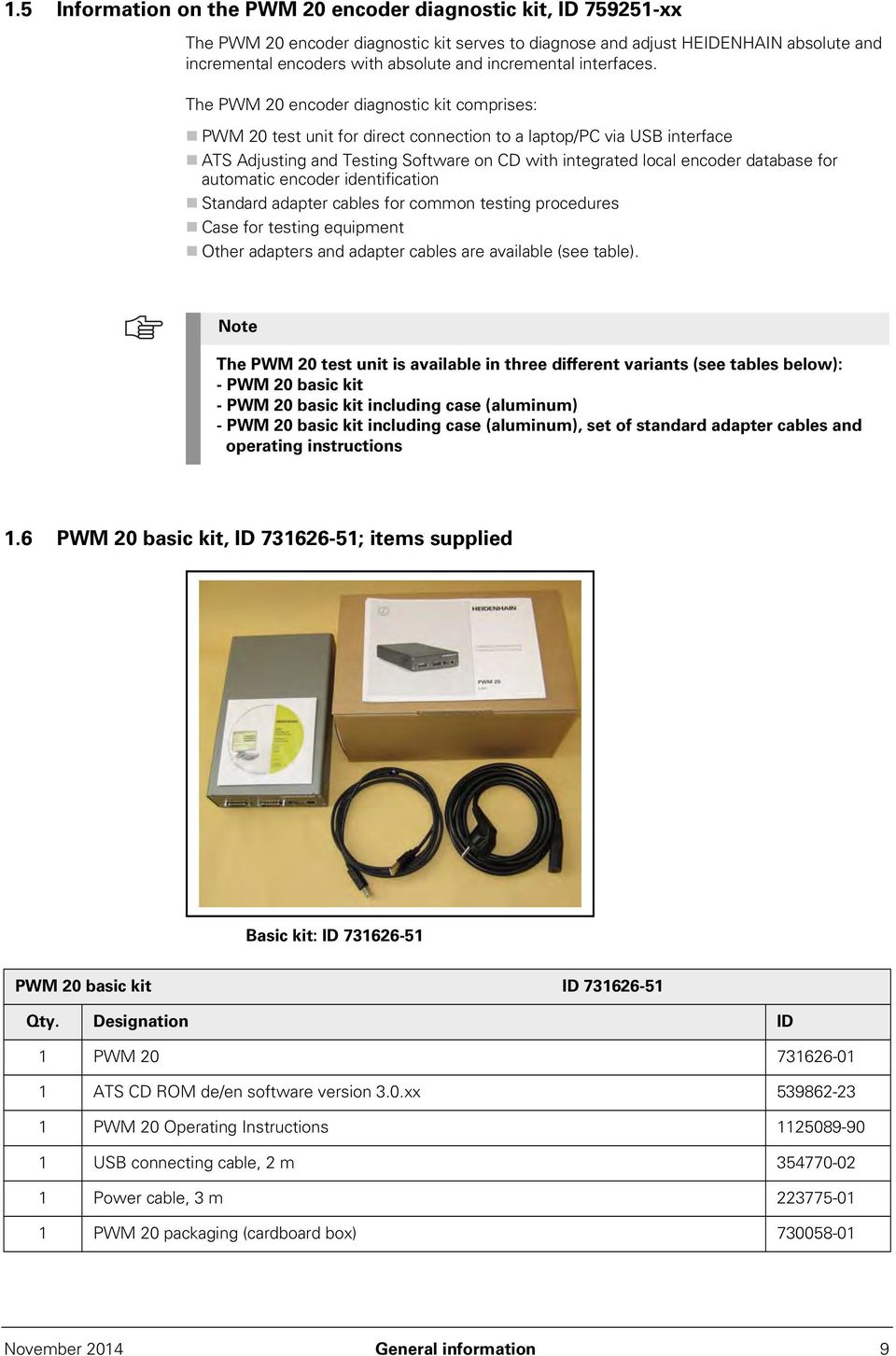
8 1.5 Information on the PWM 20 encoder diagnostic kit, ID xx The PWM 20 encoder diagnostic kit serves to diagnose and adjust HEIDENHAIN absolute and incremental encoders with absolute and incremental interfaces. The PWM 20 encoder diagnostic kit comprises: PWM 20 test unit for direct connection to a laptop/pc via USB interface ATS Adjusting and Testing Software on CD with integrated local encoder database for automatic encoder identification Standard adapter cables for common testing procedures Case for testing equipment Other adapters and adapter cables are available (see table). The PWM 20 test unit is available in three different variants (see tables below): - PWM 20 basic kit - PWM 20 basic kit including case (aluminum) - PWM 20 basic kit including case (aluminum), set of standard adapter cables and operating instructions 1.6 PWM 20 basic kit, ID ; items supplied Basic kit: ID PWM 20 basic kit ID Qty. Designation ID 1 PWM ATS CD ROM de/en software version 3.0.xx PWM 20 Operating Instructions USB connecting cable, 2 m Power cable, 3 m PWM 20 packaging (cardboard box) November 2014 General information 9
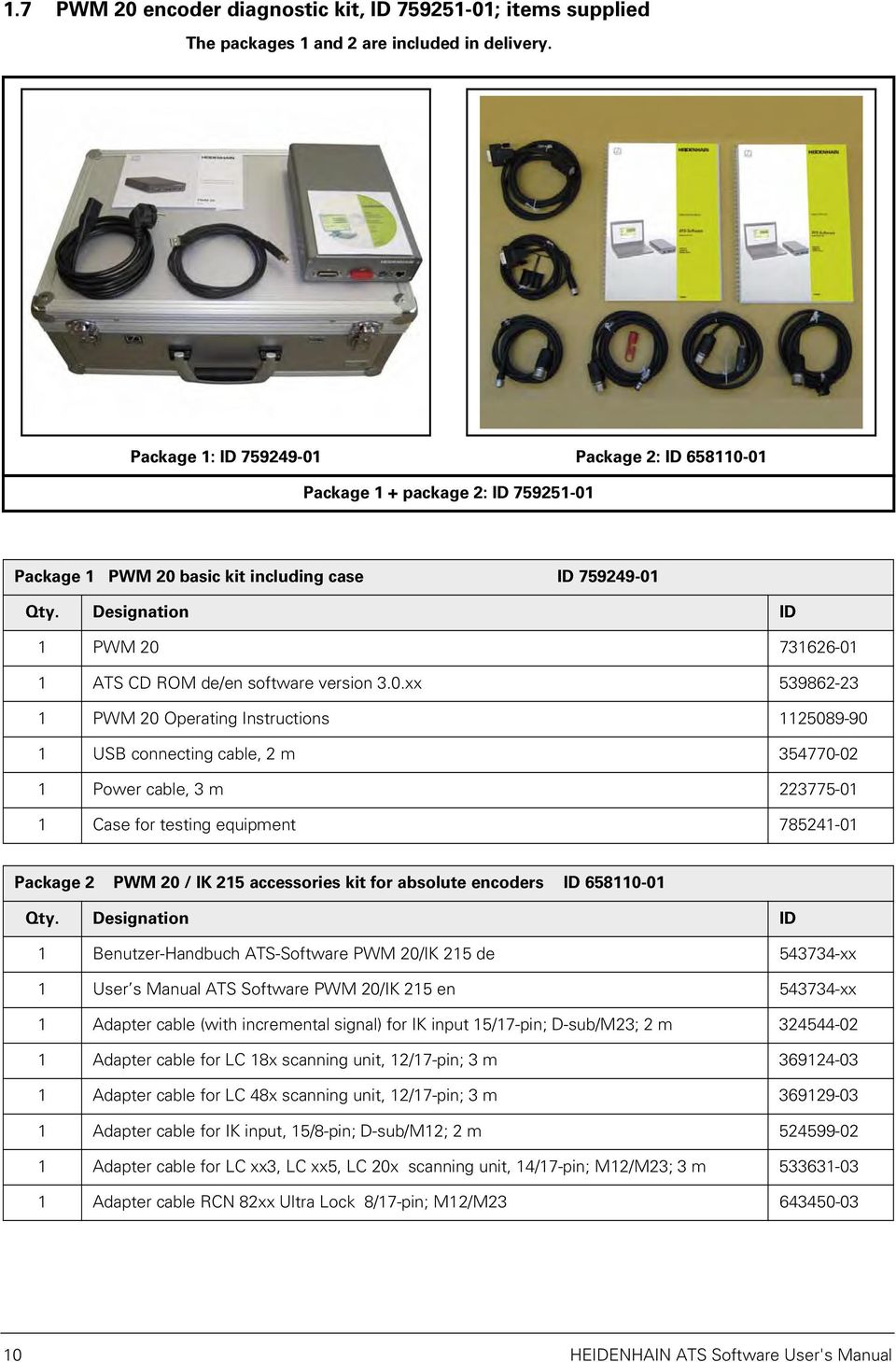
9 1.7 PWM 20 encoder diagnostic kit, ID ; items supplied The packages 1 and 2 are included in delivery. Package 1: ID Package 2: ID Package 1 + package 2: ID Package 1 PWM 20 basic kit including case ID Qty. Designation ID 1 PWM ATS CD ROM de/en software version 3.0.xx PWM 20 Operating Instructions USB connecting cable, 2 m Power cable, 3 m Case for testing equipment Package 2 PWM 20 / IK 215 accessories kit for absolute encoders ID Qty. Designation ID 1 Benutzer-Handbuch ATS-Software PWM 20/IK 215 de xx 1 User s Manual ATS Software PWM 20/IK 215 en xx 1 Adapter cable (with incremental signal) for IK input 15/17-pin; D-sub/M23; 2 m Adapter cable for LC 18x scanning unit, 12/17-pin; 3 m Adapter cable for LC 48x scanning unit, 12/17-pin; 3 m Adapter cable for IK input, 15/8-pin; D-sub/M12; 2 m Adapter cable for LC xx3, LC xx5, LC 20x scanning unit, 14/17-pin; M12/M23; 3 m Adapter cable RCN 82xx Ultra Lock 8/17-pin; M12/M HEIDENHAIN ATS Software User's Manual
10 2 Optional cables and pin layouts 2.1 For optional cables and adapters as well as all pin layouts refer to the User's Manual "Cable and Connection Technology" ID xx for PWM 20 (IK 215)! This User's Manual can be downloaded from the HEIDENHAIN website, see: and Information/Software/Download Area/Diagnostic Set/ PWM/Documentation. November 2014 Optional cables and pin layouts 11
11 2.2 Scope of functions of the ATS software HEIDENHAIN ATS Software User's Manual

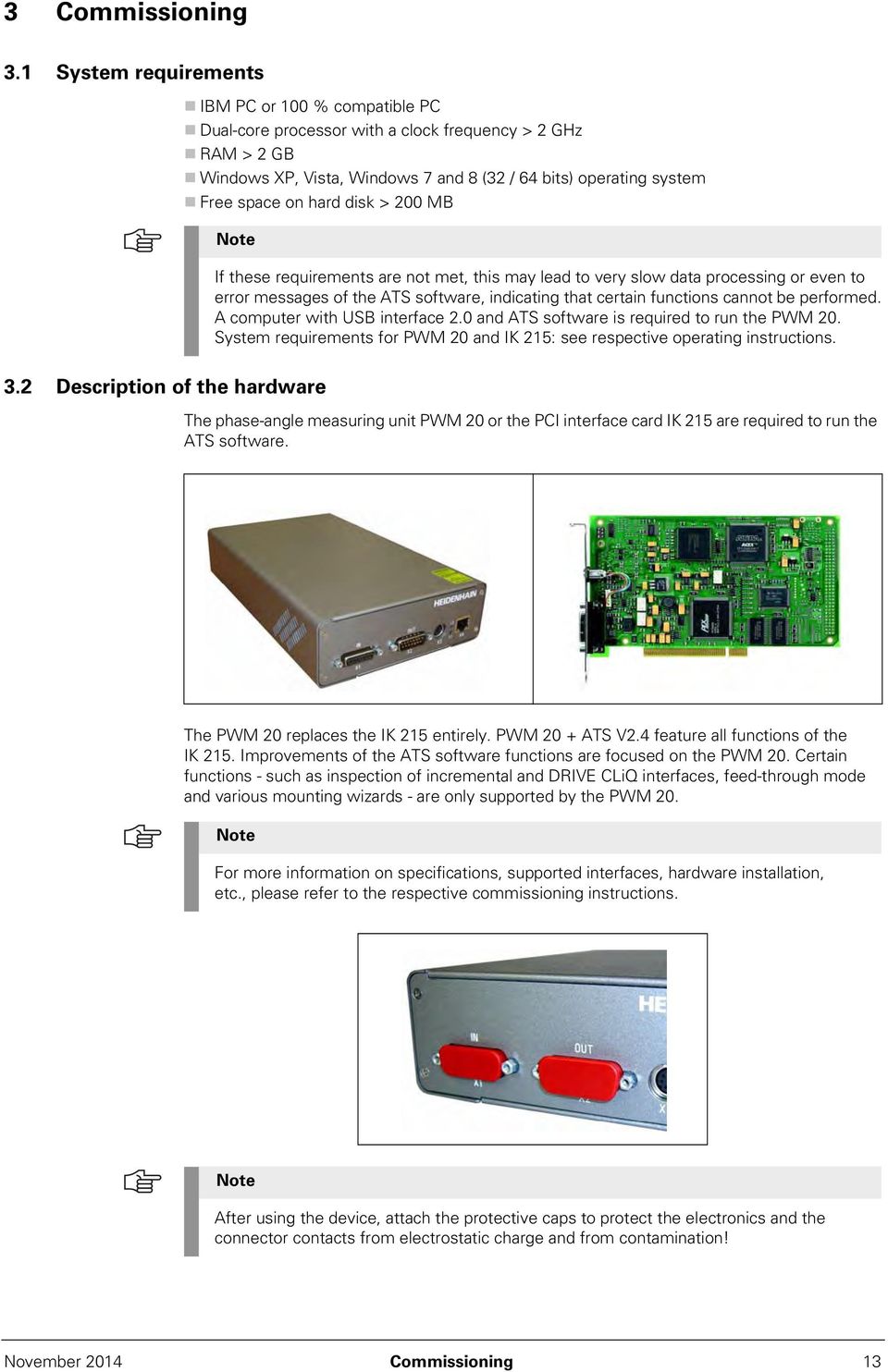
12 3 Commissioning 3.1 System requirements IBM PC or 100 % compatible PC Dual-core processor with a clock frequency > 2 GHz RAM > 2 GB Windows XP, Vista, Windows 7 and 8 (32 / 64 bits) operating system Free space on hard disk > 200 MB If these requirements are not met, this may lead to very slow data processing or even to error messages of the ATS software, indicating that certain functions cannot be performed. A computer with USB interface 2.0 and ATS software is required to run the PWM 20. System requirements for PWM 20 and IK 215: see respective operating instructions. 3.2 Description of the hardware The phase-angle measuring unit PWM 20 or the PCI interface card IK 215 are required to run the ATS software. The PWM 20 replaces the IK 215 entirely. PWM 20 + ATS V2.4 feature all functions of the IK 215. Improvements of the ATS software functions are focused on the PWM 20. Certain functions - such as inspection of incremental and DRIVE CLiQ interfaces, feed-through mode and various mounting wizards - are only supported by the PWM 20. For more information on specifications, supported interfaces, hardware installation, etc., please refer to the respective commissioning instructions. After using the device, attach the protective caps to protect the electronics and the connector contacts from electrostatic charge and from contamination! November 2014 Commissioning 13
13 3.3 Installing the ATS software A CD-ROM with the required software is among the items supplied. The current ATS software can also be downloaded from The software is updated regularly. To install the ATS software, insert the supplied CD into your CD-ROM drive or run the "setup.exe" file downloaded from the Internet. Follow the instructions of the installation wizard. If the setup wizard does not start automatically, please start "setup.exe" manually. Before you start the installation, please read the Release s. After successful completion of the installation, the icon of the ATS software appears on the desktop. Installation sequence: If you use the PWM 20, install the ATS software first. Connect the PWM 20 to the laptop/pc with a USB cable. Switch on the PWM 20. (You may be prompted to install the drivers.) Start the ATS software. The PCI card must be installed, if you use the IK 215. Switch on the computer (you may be prompted to install the drivers) and start the ATS software. If you have downloaded the software from the device drivers are not installed automatically. In this case, the testing device does not work, and the ATS software generates an error message. Follow the instructions of the Windows operating system to install the drivers by hand. You will find the required drivers in the folder xx/FILES/ Drivers of the ATS software package. 3.4 Uninstalling the ATS software The software can be uninstalled in different ways: Start the ATS Uninstall Routine via the corresponding Windows button. Via the "Control Panel" --> "Software" operating system function. Restart the "setup.exe" of the ATS software; follow the installation wizard and select the "Remove" option. 14 HEIDENHAIN ATS Software User's Manual
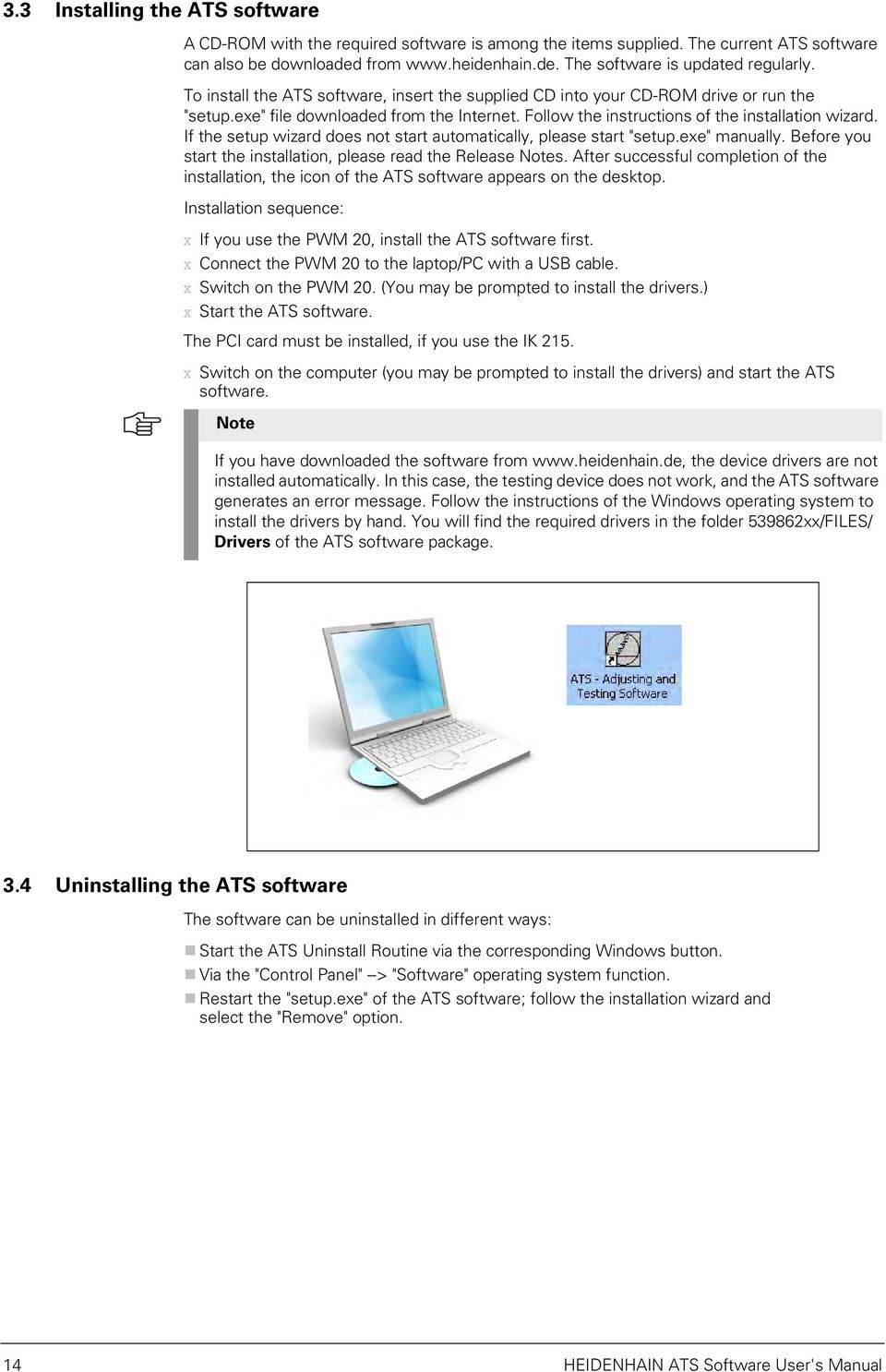
14 3.5 Calibration In general the PWM is maintenance-free, since it does not contain any components that are subject to wear. To ensure exact and correct operation we recommend that you send the PWM to the calibration service of HEIDENHAIN Traunreut every two years. Calibration label on PWM 20 Calibration date Next recommended calibration date November 2014 Commissioning 15
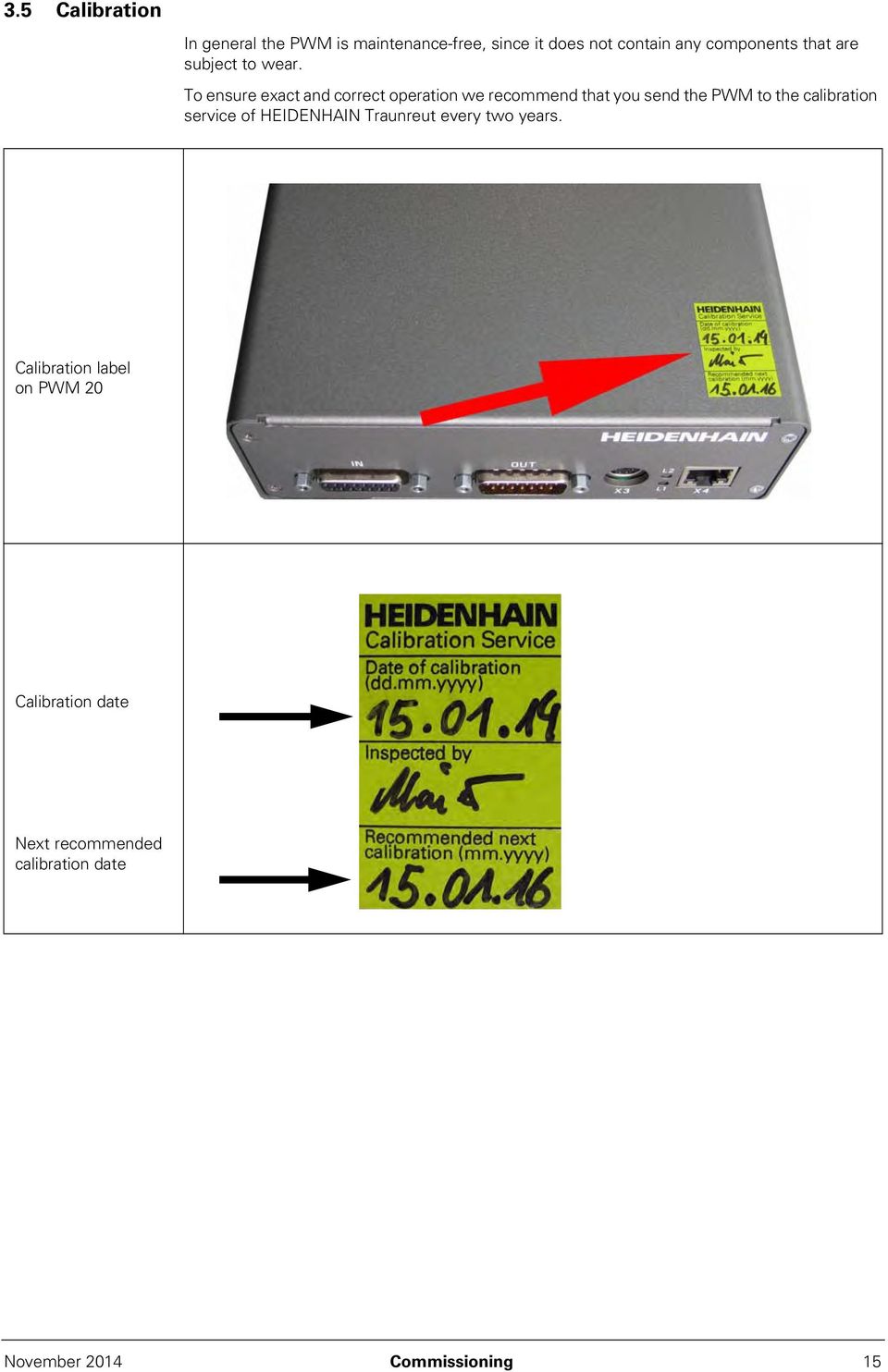
15 3.6 Configuration Start the ATS software. Select the "Configuration" group. In the "Configuration" group you can make the following settings: Configure hardware Language selection Manage product keys 16 HEIDENHAIN ATS Software User's Manual
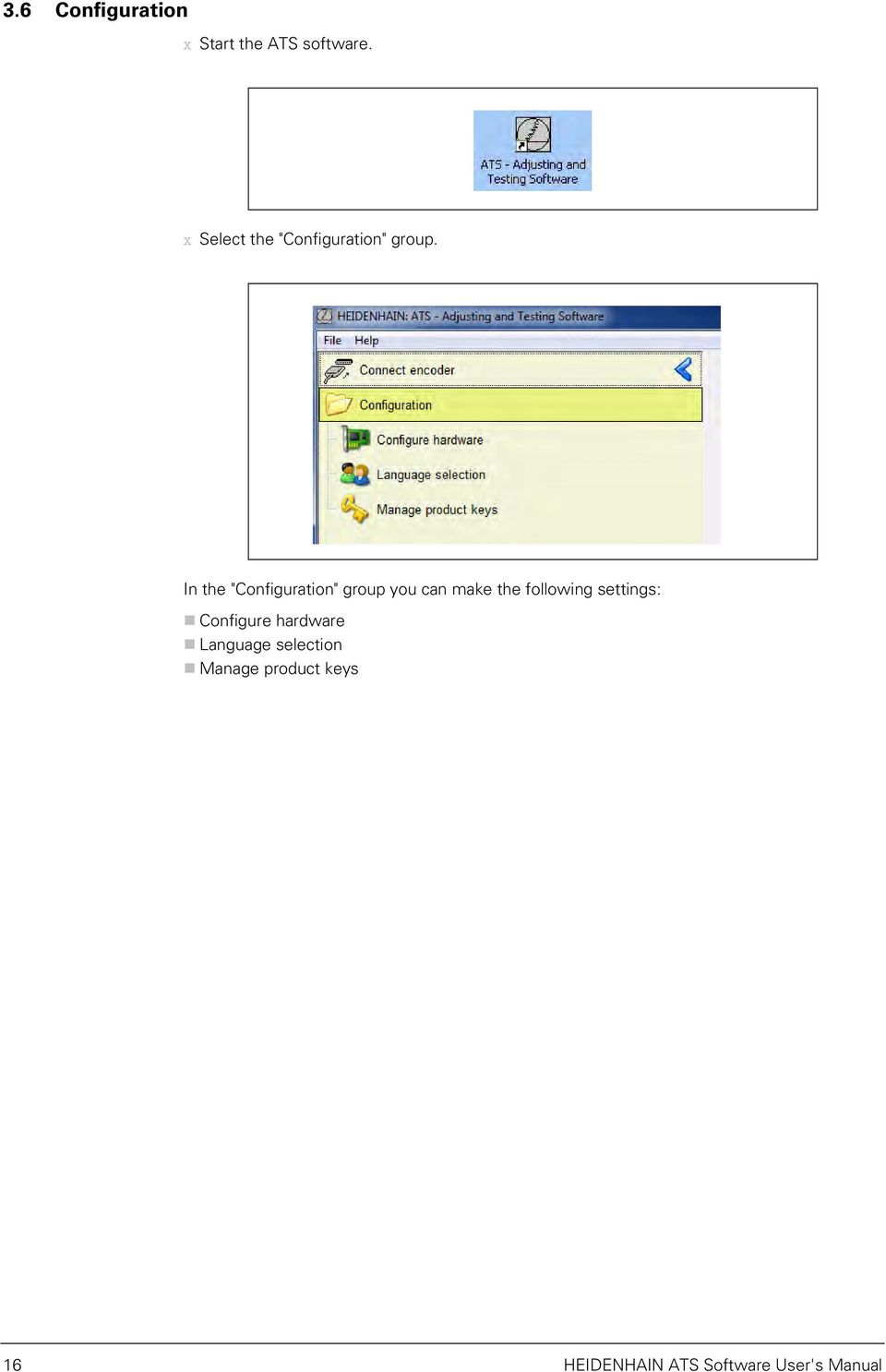
16 3.6.1 Configure hardware 1 PCI bus number and the PCI device number of the installed testing device 2 Serial number of the testing device This function scans the computer and lists the hardware that was found. Select the desired testing device from the list. Confirm with OK to return to the previous screen. The serial number is required to generate a product key. November 2014 Commissioning 17
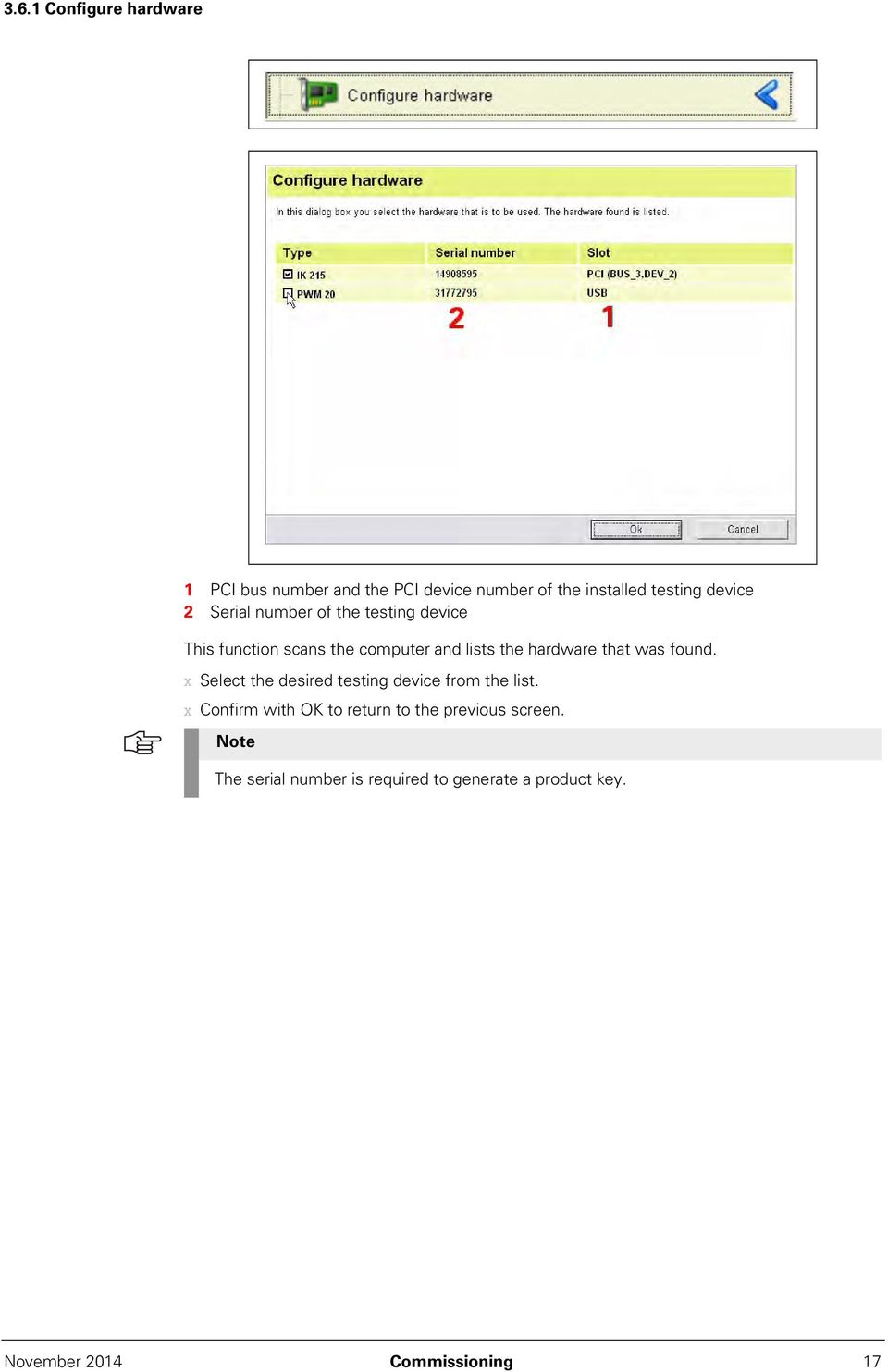
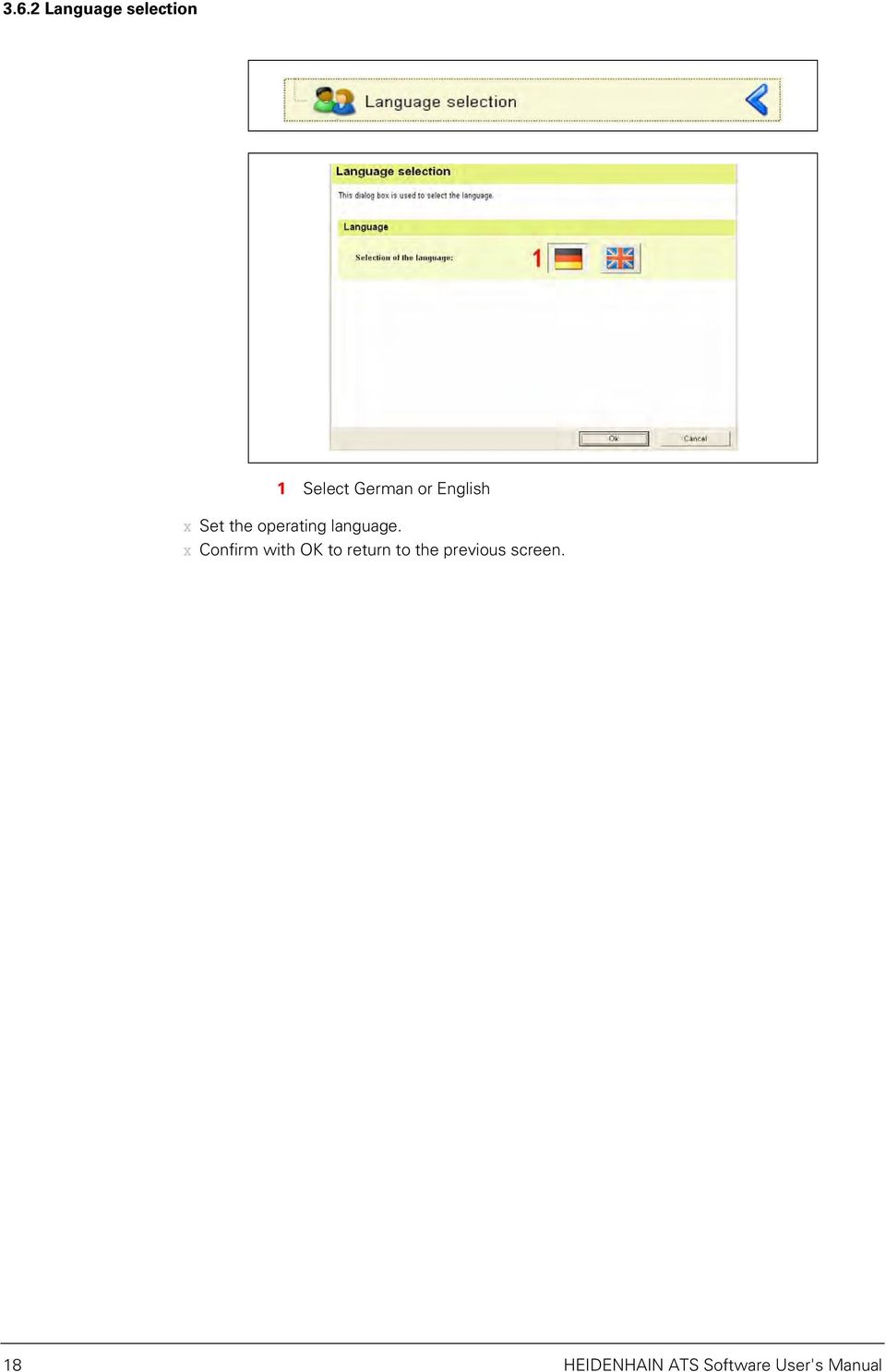
17 3.6.2 Language selection 1 Select German or English Set the operating language. Confirm with OK to return to the previous screen. 18 HEIDENHAIN ATS Software User's Manual
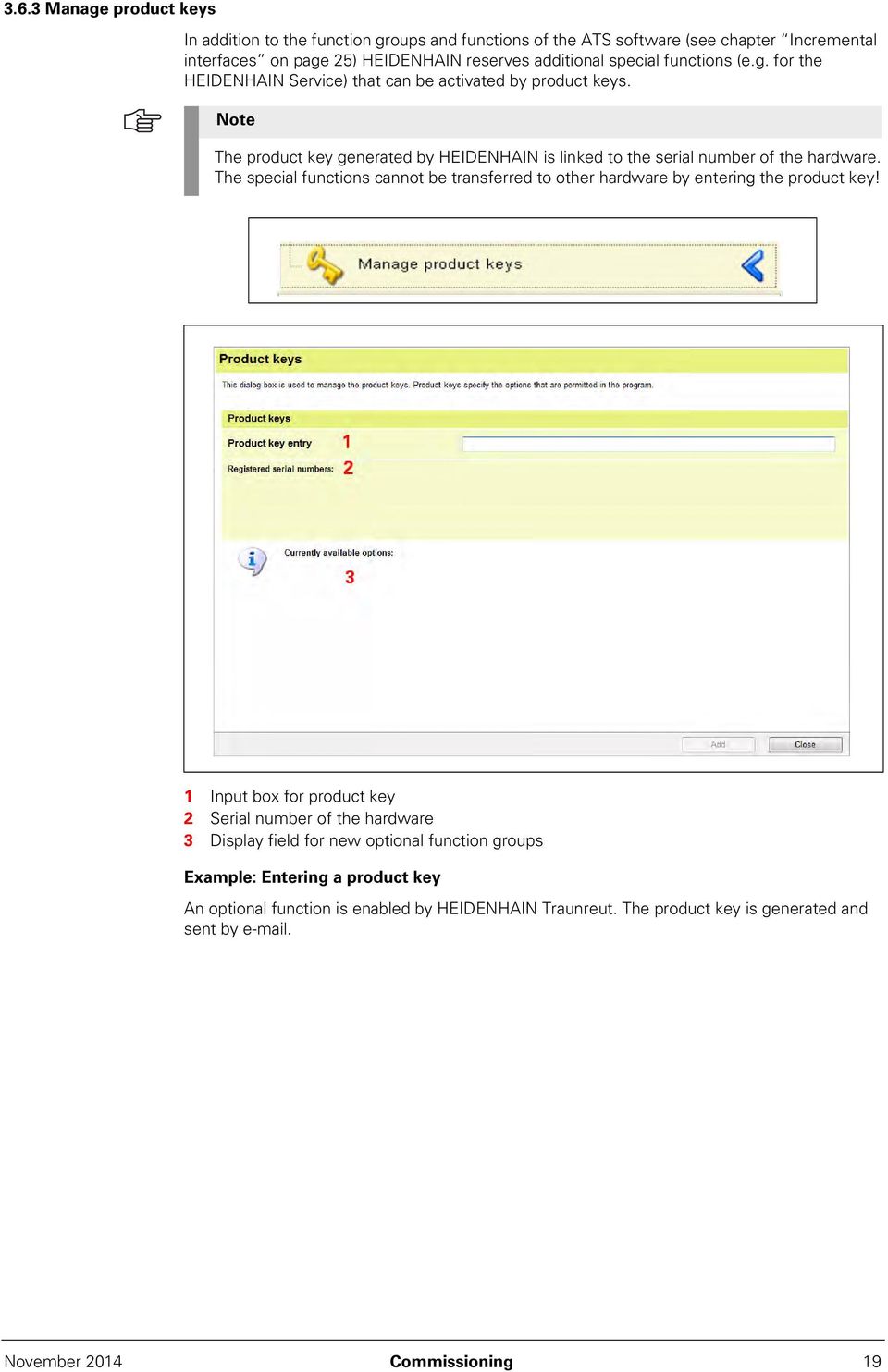
18 3.6.3 Manage product keys In addition to the function groups and functions of the ATS software (see chapter Incremental interfaces on page 25) HEIDENHAIN reserves additional special functions (e.g. for the HEIDENHAIN Service) that can be activated by product keys. The product key generated by HEIDENHAIN is linked to the serial number of the hardware. The special functions cannot be transferred to other hardware by entering the product key! 1 Input box for product key 2 Serial number of the hardware 3 Display field for new optional function groups Example: Entering a product key An optional function is enabled by HEIDENHAIN Traunreut. The product key is generated and sent by . November 2014 Commissioning 19
19 Click "Add" to activate the product key. The "Add" key becomes active, when the correct code is entered. Input errors are reported as error messages. 1 Serial number (SN) of installed PWM 20 2 <Delete> removes the product key. 3 Active product-key options 20 HEIDENHAIN ATS Software User's Manual

20 Click "Close" to terminate product-key entry. The product-key functions only appear in the ATS main menu after the connection to the encoder has been established. November 2014 Commissioning 21
21 3.6.4 Display of software and database versions To display the installed versions of the ATS software and the database proceed as follows: Finding the documentation (Help files) of the ATS software The documentation of the ATS software is available in the "Help" menu in PDF format. 22 HEIDENHAIN ATS Software User's Manual
22 3.6.6 Updates of the ATS help files (PDF file) The help files are updated for every software update (once a year) and are included in the software package. If changes or corrections are required in-between, we make the updated instructions available on our website (Documentation and information / Software) from where you can download them. If you want to update one of the four help files of the ATS software, you have to rename the "new" PDF file to the name of the previous file. (Example: If the name of the old document is um.pdf, the new document must be renamed to um.pdf.) In the program directory where there is the ATS software (example: hard disk C:/Programs(x86)/ HEIDENHAIN/ATS/doc/de or en), replace the existing PDF file by the file you have renamed. The old file will be overwritten. The names of the PDF help files (cct.pdf, i.pdf, oi.pdf and um.pdf) must always be the same in both languages (de and en). November 2014 Commissioning 23
23 24 HEIDENHAIN ATS Software User's Manual
24 4 Identifying encoder output signals (encoder interfaces) 4.1 Incremental interfaces Determine interface from encoder designation The identification of the interface type applies to standard HEIDENHAIN encoders. Deviations from the designation structure are possible (in particular with customer-specific encoders). Other identifiers A 9-pin M23 connector always means an 11 µapp interface. Encoders connected to the encoder inputs of EXE interpolation electronics are always 11 µapp encoders. Encoders connected to the encoder inputs of IBV interpolation electronics are always 1 Vpp encoders. For encoders with D-sub connectors no conclusions can be made about the interfaces. November 2014 Identifying encoder output signals (encoder interfaces) 25
25 4.2 Absolute interfaces Encoders that have a 'C' or a 'Q' in their names use an absolute interface (EnDat or SSI). There are EnDat encoders with and without incremental A/B sinusoidal signals. The order designation indicates whether an encoder outputs incremental signals: EnDat 21 EnDat 22 EnDat 01 EnDat 02 without incremental signals without incremental signals with incremental signals A/B 1 Vpp with incremental signals A/B 1 Vpp EnDat Hx with incremental signals HTL (as of 2014) EnDat Tx with incremental signals TTL (as of 2014) x designates: a = 2-fold interpolation b = without interpolation c = scanning signals x2 Also see "Interfaces of HEIDENHAIN Encoders brochure, ID xx. 26 HEIDENHAIN ATS Software User's Manual
26 5 Software description 5.1 Operational design The ATS software runs by a dynamic context menu. The function menu contains the function groups that are available for the connected encoder. Depending on the encoder, the supported function groups / functions are displayed. Example: LC 183 encoder connected and activated. Function group "Diagnostics" with two active functions ("Absolute-incremental deviation" and "Online diagnostics"). Explanation of the display 1 Selected function pointer (< ) 2 Function group 3 Function 4 Connected encoder 5 ID number 6 Power supply symbol: Encoder power supply OFF (green) Encoder power supply ON (red) November 2014 Software description 27
27 5.2 Setting up a connection to the encoder Connect the encoder to the test unit with an adapter cable. Adapter cables: See User's Manual "PWM 20 Cable and Connection Technology". This User's Manual can be downloaded from the HEIDENHAIN website, see: and Information/Software/Download Area/Diagnostic Set/PWM/Documentation. Double-click "Connect encoder" in the ATS main menu. The "Encoder selection" window offers two possibilities of powering the encoder and setting the encoder interface: 1 Automatic encoder identification by entering the ID of the encoder (mandatory for absolute encoders) 2 The manual settings are only used, if no encoder ID is available (ID plate missing or illegible; encoder not in the ATS encoder database). 28 HEIDENHAIN ATS Software User's Manual
28 3 Select "Use power supply from subsequent electronics", if the PWM 20 is in feed-through mode and supposed to be powered from the subsequent electronics. Exception: Do not set the checkmark for the feed-trough mode with SA 100 / SA 110! The subsequent electronics cannot supply power due to the potential segregation of the SA 100 / SA 110. The PWM is powered by the subsequent electronics. (PWM 20 in feed-through mode) "Use power supply from subsequent electronics" is only required for the feed-through mode of the PWM 20. This means that the checkmark may only be set, if the PWM 20 is connected to the control loop between the control and the encoder (closed loop; X2 OUT connected to subsequent electronics) without an SA 100 / SA 110. HEIDENHAIN recommends automatic connection by entering the ID number. Automatic connection through entering the encoder ID is mandatory for feed-through mode at axes with absolute encoders! The relevant encoder data is read from a database. This database is part of the ATS software. The encoder database contains all ID numbers and variants of the encoders that existed when the ATS software was released. The database is updated about every six months. You will find the most recent data at DANGER If the manual setting of the encoder parameters does not match the connected encoder, the encoder, the IK 215, the PWM 20 or the computer may be damaged. For the encoder data, please refer to the respective mounting instructions or machine documentation. Contact the machine manufacturer or the HEIDENHAIN Service. Encoder connection Please ensure that the correct supply voltage is selected to avoid damage to the encoder. The cable between the encoder and the PWM 20 must not be connected or disconnected while under power. Otherwise the encoder and the PWM 20 might be damaged. Check whether the cable between the encoder and the PWM 20 is correctly wired. The pin layout of the encoder is included in the specifications. The pin layouts of the connecting cables are described in the catalog. An incorrectly wired connecting cable might damage the encoder and the PWM 20. November 2014 Software description 29
29 5.2.1 Feed-through mode " Feed-through" mode means connecting the PWM 20 into the control loop of an NC-controlled machine. For diagnosing, the PWM 20 can be integrated into the control loop of an NC controlled machine tool via adapter cables at the encoder input X1 and the encoder output X2. For the feed-through mode the power supply must be switched to the subsequent electronics in the ATS software. Set the checkmark in feed-through mode only. If no subsequent electronics is connected, the encoder is not powered (error message). The feed-through mode is supported as of the software version 2.6. We recommend always using the most recent software version (see The feed-through mode cannot be used for all interfaces supported by the ATS. In principle, the following interfaces allow for feed-through mode: EnDat, Fanuc, Mitsubishi, 1 Vpp, TTL, 11 µapp EnDat/Fanuc/Mitsubishi Metallic isolation is possible with the service adapters SA 100 and SA 110. No metallic isolation, if the measurement is conducted with the PWM 20 only. For encoders that also support incremental signals, the incremental signals can now also be displayed and evaluated. EnDat 2.1 Normally, the only communication over the EnDat interface takes place during the start-up stage of the NC (interrogation and transfer of the absolute position data): "Listening in" on the EnDat communication is not possible. (The synchronization time is too short for the PWM 20.) The 1 Vpp signals A and B can be displayed. SIEMENS NC controls currently use EnDat 2.1 with A/B signals and do not support the monitor function! 30 HEIDENHAIN ATS Software User's Manual
30 EnDat 2.2 Communication takes place continuously. However, there is no prescribed communication pattern. Instead, every OEM determines the sequence of EnDat communication on his own. No universal listening in on the communication is possible. The monitor function is only possible, if the valuation numbers for online diagnosis are included in data transfer. (The following controls support the monitor function: TNC 620, TNC 640, itnc 530 [as of NC-SW 34049x-04], itnc 530 HSCI with diagnostic function and DRIVE-DIAG.) Synchronization with communication may take some time. 1 Vpp No metallic isolation, if the measurement is conducted with the PWM 20 only. Metallic isolation is possible with the SA 100. The PWM 20 picks off the signals; without 120-ohm signal termination. The limit frequency is influenced by the test setup (adapter cable, etc.) 11 µapp The line is interrupted in feed-through mode, i.e. the PWM 20 has an 11 µapp receiver and reproduces the (emulated) input signals at the 11 µapp output. The limit frequency is influenced by the test setup (adapter cable, etc.) Not yet approved for ATS V2.8. Signal errors may occur! TTL Without PWT switchover: The PWM 20 picks off the RS-485 signals, i.e. a standard RS-485 receiver without 120-ohm termination is connected to the lines. Automatic connection through entering the encoder ID is mandatory for feed-through mode at axes with absolute encoders! Incremental interfaces also permit manual connection by selecting the interface in feed-through mode. If the feed-through mode is not used, absolute and incremental encoders can be connected manually. However, automatic connection via the ID number is recommended! DANGER Testing cables for feed-through mode are not suitable for regular machine operation. Due to the great variety of machine designs and their grounding variants it is not possible to exhaustively test all testing cables. It is absolutely necessary that you check the safe and proper function of the testing cables for every test situation! Uncontrolled axis movements cannot be ruled out when working with testing devices and cables in feed-through mode. Example for machine axes with absolute encoders: Determine the encoder ID with the PWM 20 before feed-through operation (no axis movement required). Automatic connection through entering the encoder ID is mandatory for feed-through mode at axes with absolute encoders. However, the ID is not known and the encoders are not visible under their covers. The ATS software can read out and display the encoder ID. November 2014 Software description 31
31 Procedure: 1. The PWM 20 encoder output (OUT) must not be connected! 2. Connect the absolute encoder to the PWM input (IN) using a suitable adapter cable, connect the ATS software by hand and note down the encoder ID displayed at the lower right (see Setting up a connection to the encoder ). 3. Disconnect the ATS from the encoder. 4. Use the appropriate testing cable to connect the PWM 20 output (OUT) to the control (which is switched off) for feed-through mode. 5. Connect the ATS software automatically with the ID that was displayed before. Reason: The terminating resistors of the PWM 20 encoder output (OUT) block the measuring function of the ATS. If the PWM 20 output (OUT) is used for manual connection, the transfer function of absolute encoders is blocked. DANGER Integrating the PWM 20 into the control loop influences the supply voltage and grounding conditions (see Installation and commissioning instructions, ID ). The feed-through function must be handled with great care and caution! No persons are allowed within the working range of the machine! Ensure that vertical axes cannot fall down! Do not disengage any connecting elements during the measurement! Move the machine axis to the middle of the traverse range before you connect the PWM 20! When you have connected the PWM 20 into the control loop of the machine, check whether the axis concerned can be traversed in a controlled manner. One operator must be at the EMERGENCY STOP switch to make sure that the machine can be switched off at any stage of this "setup phase"! Possible axis behavior caused by grounding problems: - Uncontrolled machine movement - Machine switches off (EMERGENGY STOP) - Machine axis drifts - Machine axis traverses at rapid traverse Observe the safety precautions in the PWM 20 Operating Instructions (ID ). HEIDENHAIN recommends running the feed-through mode with floating supply with the service adapters SA 100 / SA HEIDENHAIN ATS Software User's Manual
32 Power-on sequence for feed-through mode Absolute interfaces (EnDat, Fanuc,...) 1. Switch on the PWM Start the ATS software. 3. Set the checkmark "Use power supply from subsequent electronics (= feed-through mode). 4. Connect the absolute encoder by entering its ID (the ID is mandatory!) 5. Switch on the subsequent electronics. Incremental interfaces (1 Vpp, 11 µapp,...) 1. Switch on the PWM Start the ATS software. 3. Set the checkmark "Use power supply from subsequent electronics (= feed-through mode). 4. Connect the incremental encoder by entering its ID or manually by selecting the interface. 5. Switch on the subsequent electronics. Encoder output The encoder input X1 of the PWM 20 is electrically connected with the encoder output X2. The signals and the pin layout at the output correspond to the respective signals at the input. DANGER There is no metallic isolation of the signals. The supply and sensor lines are switched via the ATS software (as of ATS V2.6) depending on the respective mode of operation and can be connected (see examples). It is always ensured that the supply voltage generated by the PWM 20 is not present at X2. Example 1: PWM 20 in feed-through mode (encoder powered by subsequent electronics) or ATS software not started Example 2: PWM 20 powers the encoder via X1 November 2014 Software description 33
33 5.2.2 Automatic encoder identification by entering the ID 1 Input field for ID 2 The encoder was identified. 3 Input field for the "feed-through mode" (measurement in control loop of machine axis) Use the ID of the scale housing for sealed linear encoders (e.g. LC), and the ID of the scanning head for exposed linear and angle encoders (e.g. LIC). The ID can also be entered without the hyphen (e.g ). If the encoder cannot be identified, the software enters three question marks "???". (See chapter Manual encoder selection on page 37.) 34 HEIDENHAIN ATS Software User's Manual
34 Switching on the power supply for the encoder When you click "Connect", the power supply for the connected encoder is switched on. Switching off the encoder power supply To switch off the power supply double-click "Disconnect encoder"; now the encoder cable may be disconnected. 6 Encoder type and ID 7 Power supply symbol: Encoder power supply OFF (green) Encoder power supply ON (red) Never disconnect any connectors while the encoder is under power. If the ATS software has found a difference between the ID number typed in and the ID number saved in the encoder memory, an error message is generated. Confirm this message with "Yes" (recommended). Now, the ATS software connects to the encoder parameters. November 2014 Software description 35
35 When you click the "Yes" button the encoder ID is used (ID of the scale housing). When you click "No" the ID that was entered is used. 8 ID check message This message is displayed when the ID of the LC is incorrect, for example. If the ATS software finds differences between the characteristics of the encoder and the data in the database, the following "Encoder selection" screen may be displayed. In this case, it is recommended to check the ID of the connected encoder and whether it was entered correctly. Attention If wrong data from the encoder memory ("Encoder" button) or the encoder database ("Database" button) is used for connecting, the encoder, the test unit or the computer may be destroyed. The tolerance ranges of the wizards may be influenced as well. Please contact HEIDENHAIN if it is impossible to determine the encoder parameters. 36 HEIDENHAIN ATS Software User's Manual
36 5.2.3 Manual encoder selection If it is impossible to identify the encoder type (ID label missing or illegible), or if the encoder is not in the ATS database, most EnDat interfaces offer the possibility of entering the encoder data by hand. The function below serves to read out the encoder ID from the encoder memory and display it on the screen (lower right). With this ID displayed, "automatic" encoder identification can be performed. The encoder interface must work properly for this purpose! Regarding the encoder data, please refer to the Encoder mounting instructions, HEIDENHAIN sales literature, or contact the HEIDENHAIN Service. Attention Observe the warnings! The "Connect encoder" button opens the "Encoder selection" box. November 2014 Software description 37
37 In the Encoder selection box, click "Manual Settings". This option is only recommended to advanced users! Incorrect entries may cause damage to the scanning unit, the test unit or the computer. The setting of the encoder power supply is of particular importance! Attention Observe the warnings! 38 HEIDENHAIN ATS Software User's Manual
38 Clicking the "Forward >" button opens the encoder data screen (power supply, encoder interface). 1 Input of encoder power supply 2 Input of voltage readjustment over sensor lines 3 Input of data interface supported by the ATS software Currently, the ATS software 3.0 supports the following encoder interfaces: EnDat 1 Vpp TTL HTL HTLs (without inverted signal) DRIVE-CLiQ SSI Fanuc Fanuc ALPHA i Mitsubishi Yaskawa Panasonic 11 µapp SSI+HTL 3 Vpp 25 µapp To compensate for voltage drops on the lines between test unit and encoder, HEIDENHAIN recommends activating "Adjust voltage over sensor lines" (no. 2). When you select the encoder through its ID number, voltage adjustment is automatically activated. November 2014 Software description 39
39 4 An ATS code only has to be entered if, for example, no mounting wizard is available for selection on the basic screen after automatic connection with encoder ID. Normally, the required functions are taken into account in the encoder database and are assigned to the encoders. In special cases (e.g. pre-series encoders) the database may not be up-to-date, and such encoders cannot be mounted as long as there is no "mounting wizard". For these exceptions, an ATS code can be entered by hand on the basic screen to display the "Mounting" function. Display after the "ATS Code" button was pressed: The ATS code can be requested from HEIDENHAIN for the encoder ID concerned. Prompt for entering the code: Clicking the "Forward >" button opens an overview of the data you have entered. 40 HEIDENHAIN ATS Software User's Manual
40 Attention Observe the warnings! If the selected supply voltage is too high (e.g. 24 V), the electronics of an encoder operating with 5 V will be destroyed. Check the displayed values. After you click the "Connect" button, the connected encoder is supplied with power. Typical error message of purely serial EnDat 2.2. encoders without incremental signals. Confirm this message with "Yes" to connect without incremental signals. The EnDat designation is printed on the ID label. November 2014 Software description 41
41 If this error message is generated, the voltage drop caused by the cable length (for LC approx. > 5 m) is probably too high. In this event voltage adjustment needs to be activated. The function group window is displayed. The encoder ID appears at the lower right. Display of encoder model and ID number The red symbol means that the encoder is under power. Write down the encoder ID! 42 HEIDENHAIN ATS Software User's Manual
42 In a next step perform "automatic" encoder identification by entering the displayed encoder ID. (See chapter Automatic encoder identification by entering the ID on page 34.) In general, the ATS software automatically loads the ID in the "ID number" field, i.e. it is not necessary to enter the ID by hand. Correct database connection with the proper parameters always requires the ID of the encoder (printed on the scale housing)! November 2014 Software description 43
43 5.3 Basic functions Display and functions may vary depending on the product key and the connected encoder model! 44 HEIDENHAIN ATS Software User's Manual
44 5.3.1 Position display 1 Absolute encoder position 2 Incremental current count 3 Binary display of the absolute position (1:1 display of the transferred position data without any conversion) 1 means bit 1 = LSB (least significant bit) 4 Yellow arrow = one step back For encoders with purely serial data interface (e.g. EnDat 2.2, Fanuc) the incremental position is not displayed. The number of absolute positions [bits] depends on the connected encoder. November 2014 Software description 45
45 Status display Each time position data is transferred, status information is included and evaluated. Depending on the encoder model, information on encoder alarms and warnings and on the quality of the incremental signal are available. 1 The encoder status is displayed in shortened form (group signal) in the lower area of the position display screen as colored LED symbols. 2 Use the magnifying glass symbol to display detailed information. The EnDat interface allows for extensive monitoring of the encoder. An alarm becomes active if there is a malfunction in the encoder that is presumably causing incorrect position values. Some examples of alarms: Failure of the light unit Encoder signal amplitude too small / too large Incorrect position value Supply voltage too high / too low Current consumption is excessive Warnings indicate that certain tolerances of the encoder were reached or exceeded (e.g. speed, control reserve of the light unit), but the position value is not incorrect. If a warning is displayed the encoder concerned should be inspected or exchanged as soon as possible in order to avoid downtimes. Some examples of warnings: Frequency exceeded Temperature exceeded Control reserve Illumination etc. 46 HEIDENHAIN ATS Software User's Manual
46 1 LED symbols for errors and warnings Green symbol = OK Red symbol = Error / warning Group signal; at least one "error" present! Display detailed status information November 2014 Software description 47
47 Details of encoder status: Reset errors / warnings Attention Please reset the errors and warnings before starting! After you connect the encoder by the ATS software, errors caused by encoder components may be displayed, although actually there is no malfunction. If the error messages cannot be reset and new error messages are generated, the encoder needs to be replaced or repaired. A given encoder does not necessarily support all monitoring functions. The information which errors and warnings an encoder supports can be read out and displayed with the following ATS software function. 48 HEIDENHAIN ATS Software User's Manual
48 Select "Display encoder memory" from the basic functions list. The encoder configuration window is activated. Press the "function-specific view" button (display in plain language). Press the "EnDat" button. The encoder data is transferred from the encoder memory to the test unit. November 2014 Software description 49
49 Open the directory tree "Parameters of encoder manufacturer". Scroll down in the directory and open the directory branches Support of error messages or Support of warnings Supported error messages and warnings are distinguished by "Yes". For detailed information on the encoder status please refer to the EnDat interface manual. 50 HEIDENHAIN ATS Software User's Manual
50 EnDat 2.2 status display A yellow "Busy" symbol indicates access to the memory of the encoder EEPROM (12 ms max.) Otherwise, the "Busy" LED is gray; it is used for forced dynamic sampling and for encoders with functional safety. The "Reference mark" LED shows whether the EIB has detected the reference mark signal. (This function is only used in connection with the EIB interface converters.) If an EIB electronics is connected and with incremental encoders, the LED is displayed in gray color and turns yellow as soon as the reference mark has been traversed. The "Reference mark" LED of absolute encoders is always yellow. For encoders without incremental signals the incremental status is masked out! This status display is required for synchronization with the reference mark when using HEIDENHAIN EIB interface electronics. Only after the reference mark was detected is the incremental encoder "quasi-absolute". November 2014 Software description 51
51 Detailed display of encoder status EnDat 2.2 Operating status error sources The function "operating status error sources" provides detailed information on errors and is an expansion of the EnDat 2.2 error register under operating conditions. It is accessed via the EnDat additional datum. Its advantages are fast access in a closed loop and the differentiation, whether the error was caused by the single-turn or the multi-turn component of position value formation. Operating status error sources are only supported by EnDat 2.2. A given encoder does not necessarily support this function. The error messages are encoder-specific! Whether this function is supported and which error sources it comprises is defined in the Encoder configuration [encoder data]/manufacturer parameters EnDat 2.2/Support of operating status error sources. Press the "Detailed status display" button to call the function. Press the "Read operating status error sources" button. 52 HEIDENHAIN ATS Software User's Manual
52 Display if the encoder does not support the "Operating status error sources" function: Display after "OK" was pressed: Display if the encoder supports the "Operating status error sources" function; details on errors: November 2014 Software description 53
53 Which status error sources the encoder supports is stored in the "Parameters of the encoder manufacturer for EnDat 2.2" in the encoder memory. Example: Connection to EIB interface electronics The EIB (Extended Interface Box) interpolates the sinusoidal output signals (1 Vpp) of incremental HEIDENHAIN encoders and transforms them into absolute position values. After the reference mark has been crossed, the position value is defined with respect to this unique (absolute) position. Permitted output signal interfaces: EnDat 2.2 Fanuc serial interface Mitsubishi high speed interface EIB HEIDENHAIN ATS Software User's Manual
54 EIB 392 To check the EIB, a suitable incremental encoder must be connected to the EIB input (follow the EIB operating instructions). Plug the EIB and the encoder to the PWM 20 or IK 215 and connect them by means of the ATS software. Use the ID of the EIB for connecting to the ATS software. In the "Basic functions" main menu click the "Position display" function. A warning (red LED) appears in the display field for the EnDat status. Click the "Detailed status information" button. November 2014 Software description 55
55 Position display if an EIB 192 with Fanuc interface is connected. The absolute position is invalid, as the reference mark was not traversed yet (LED gray) and the Alarm LED is red. The warning "Bit 4 Reference mark not traversed" is displayed. Display for Fanuc: "Error: Bit 2" -> This bit is set when an incremental encoder is switched on! The "Ref. mark" status is displayed in gray color. Traverse the reference mark(s) of the encoder. 56 HEIDENHAIN ATS Software User's Manual
56 Only after the reference mark has been traversed refer the absolute position values to this fixed reference point. As soon as the reference mark has been detected, the "Ref. mark" status display changes to yellow. The "Warnings" LED remains red and must be reset by hand. The reference mark must be traversed before the "Warnings" can be reset. Position display if an EIB 192 with Fanuc interface is connected. Same procedure as with EnDat; here, the "Alarm" LED needs to be reset by hand. November 2014 Software description 57
57 The warning in the Encoder status field can only be deleted by hand after the reference mark has been detected. For this purpose, press. This also applies for Fanuc EIB x92f. Warning deleted. 58 HEIDENHAIN ATS Software User's Manual
58 Measured values view The measured values are displayed as they are transferred from the encoder. Position view The measured values are converted into linear [µm] or angular [degrees] data according to the settings of the encoder parameters. November 2014 Software description 59
59 Display for a multiturn encoder: For encoders without incremental signals the incremental status is masked out! Clear incremental counter The incremental counter is set to zero (0.0). Equate function The incremental counter loads the absolute position (displays of absolute and incremental positions are the same). 60 HEIDENHAIN ATS Software User's Manual
60 Synchronization mode The absolute and the incremental positions are synchronized with each other at the counting limits (zero crossover of absolute and incremental tracks). Synchronization inactive: Synchronization mode active: Reversal of counting direction with incremental counting Example: 13-bit rotary encoder If the encoder is rotated into the "minus" range, i.e, beyond the zero position, the absolute code of the absolute track restarts with the highest position value (in the example: 8191), whereas the incremental counter starts to count backwards, i.e. -1, -2 When the synchronization mode is activated, the incremental counter also starts with the highest absolute value (in the example: 8191). Counting limit = Absolute value 'Zero' ( ) November 2014 Software description 61
61 Absolute position [bits] display The displayed value is the position value transferred from the encoder (1:1 display of the transferred data without any conversion). The absolute encoder position is displayed as binary value. Position 1 represents bit 1 which is the LSB (Least Significant Bit) of the position value. The bit length may vary and depends on the connected encoder. Example: Rotary encoder with 37 bits The counting direction for the incremental positions is reversed. For certain encoders (e.g. SSI rotary encoders) the counting direction of the incremental counters can be programmed; the ATS software can be adjusted for parallel measurement. Datum shift Customer-specific datum shift can be performed with EnDat encoders. This serves to adapt the encoder (e.g. to capture the rotor position of a synchronous motor) to the machine/motor individually for each axis. If you want to repeat (e.g. correct) the datum shift, the current datum shift must be canceled first! Attention The datum shift can only be performed correctly while the encoder is in standstill. DANGER An incorrectly set datum (with synchronous motors: field angle) can lead to undesirable reactions of the motor, including uncontrollability. It might even move in the wrong direction! Ensure that vertical or hanging axes cannot fall! Please contact the machine manufacturer or HEIDENHAIN, if you have any questions. 62 HEIDENHAIN ATS Software User's Manual
62 Set datum shift Click the symbol. There are two types of datum shift: 1. EnDat-compliant datum shift This type considers the relation of datum and signal period (incremental signal). After the datum shift the absolute datum will not always be exactly the current position. The ATS program calculates the new datum such that in relation to the incremental signals its position corresponds to the EnDat specification, i.e. is as close as possible to the desired position. Attention For encoder types "with incremental signals" (interface names EnDat 01 and EnDat 02) the setting "EnDat-compliant datum shift" must be active. If you want to repeat (e.g. correct) the datum shift, the current datum shift must be canceled first! The checkmark at "Datum shift EnDat-conform" may only be removed for purely serial data transmission. November 2014 Software description 63
63 2. Non EnDat-compliant datum shift An assignment of datum and signal period (incremental signal) is not considered! This setting is used for purely serial measuring systems (i.e. encoders that do not output any incremental signals; interface names EnDat 22 and EnDat 21). Set datum "to current position". Before the datum shift is performed, the measuring system must be positioned to the point at which the new datum should be set. Set datum "to absolute position". The desired datum shift can be entered as numerical value into the field highlighted in blue. The absolute value can be entered in [steps] or in [µm]. After you click the "Set" button the datum is saved in the encoder memory. 64 HEIDENHAIN ATS Software User's Manual
64 Cancel datum shift To reset the datum shift to the factory default setting click the button "Undo datum shift" and confirm the prompt with "Yes". Check datum shift in encoder memory In the "Operating parameters" section of the encoder memory you can check the specified datum shift. For this purpose the configuration of the encoder must be read out first. Select "Display encoder memory" from the basic functions list. November 2014 Software description 65
65 Press the "function-specific view" button (display in plain language). Press the "EnDat" button ("Load encoder configuration from encoder"). The encoder data is transferred from the encoder memory to the test unit. Open the tree structure of the "Operating parameters" directory. In the "Value" column of the table you find the datum shift in measuring steps. For measuring lengths up to 32 bits word 0 and word 1 are used, for measuring lengths up to 48 bits word 2 is used in addition. 66 HEIDENHAIN ATS Software User's Manual
66 Edit datum shift value Manual editing of the datum shift is only recommended to expert users. To shift the datum, always use the keys "Set datum shift" or "Cancel datum shift" on the "Position display" screen! EnDat-compliant datum shift is only taken into account here. 1. Editing in the datum shift line (word 0): Click the datum shift value. Enter a new value. If you intend to cancel the datum shift, enter the value 0. To activate the edited datum shift, the encoder configuration must be saved in the encoder. Click the "EnDat" button ("Save encoder configuration in encoder") to open the window for selecting the memory area. Select the "Operating parameters" memory area. Click the "Transfer" button to save the data in the encoder. November 2014 Software description 67
67 2. Editing in the datum shift window: Clicking the button right from "Datum shift value" opens the "Datum shift" window. Here the value (decimal/hexadecimal/binary) can be edited; click OK to confirm. Entering the value 0 cancels the datum shift. Attention If the datum shift is manually edited in the operating parameters area, the ATS software does not check, whether the entry value is EnDat-compliant. Click the "EnDat" button ("Save encoder configuration in encoder") to open the window for selecting the memory area. Select the "Operating parameters" memory area. Click the "Transfer" button to save the data in the encoder. 68 HEIDENHAIN ATS Software User's Manual
68 5.3.2 Incremental signal display In the basic function "Incremental signal display" the incremental signals A/B are displayed on the oscilloscope and the signal parameters as bar charts. The tolerances of the A/B signals can be checked here. A number of settings are available to adjust the display to the current testing situation. The oscilloscope function is sufficient for most standard tests. Fast signal changes (error spikes, noise, etc.) might not be detected! For this purpose additional testing equipment, such as a PWM 9 and a digital oscilloscope is required. To select the function, double-click "Incremental signal display". The "Incremental signal display" is a digital storage oscilloscope that can display the relevant incremental signals and standard tolerances. The sinusoidal signals A and B can be displayed as a circle function (x-y graph) or as sine-cosine diagram (y-t graph). The display type is selected in the setup menu. The diagrams can be saved and printed. November 2014 Software description 69
69 Circle diagram (X-Y) For detailed explanations of terms such as TV1[ ], PHA [ ], V A/B refer to the section Description of the incremental signal display on page 151. Signal amplitudes and tolerances are stated in the chapter Interface description on page 209. In the circle diagram, the inner green circle represents the minimum amplitude, the outer green circle the maximum amplitude (tolerance range of the amplitude). Time function (y-t) 70 HEIDENHAIN ATS Software User's Manual
70 Zoom function The oscilloscope display features a zoom function controlled via the left mouse button. Zooming a detail Press and hold the left mouse button and starting at the upper left draw a square over the desired area. This area will be magnified. The zoomed area can be shifted vertically with the mouse wheel and in x-y direction with the right mouse button. Unzooming Press and hold the left mouse button and diagonally move the cursor from the lower right to the upper left (a short distance is sufficient). November 2014 Software description 71
71 Save or print oscilloscope display To activate this function click the screen display with the right mouse button. In the context menu, select "Save diagram" or "Print diagram" and follow the instructions. Save diagram: Diagram software TeeChart = independent program integrated into the ATS software Examples of what is possible with the "Save" command: Picture: Change the graphics format (image format [.bmp or.wmf], diagram size and color, execution, etc.) Native: Data format binary, text or XML (software development tool for graphics programming) Data: Format for data storage (text, XML, HTML, Excel file, etc.; header, numerical format, tabulators, commas, etc.) Series: Which of the recorded data are to be used for the diagram? (Select all or certain data) Data can be copied [Copy], saved [Save], sent [Send] or displayed [Preview]. 72 HEIDENHAIN ATS Software User's Manual
72 In the example below, signal data were transferred in Excel format and an Excel sheet was created from a defined number of data points (Excel functionality). The number of data points and the area can be freely selected in Excel (e.g. to document signal failures or disturbances on the output signal). November 2014 Software description 73
73 Print diagram In the Setup column of the diagram software (TeeChart Print Preview = independent program integrated into the ATS software), you can scale the diagram for printing: Portrait/landscape (orientation), margins, proportionality, antialiasing and color (smooth) as well as the background color can be set. Press the Panel key to make further settings. 74 HEIDENHAIN ATS Software User's Manual
74 Characteristics of the incremental signals (bar diagram) If the signal tolerances are within the specifications (tolerances: see interface description, e.g. in the product catalog), the bars are displayed in green color; if the tolerances are exceeded the color changes to red. The position of the colored markers ("bars") indicates the measured value on the scale. The current values are also displayed as decimals (in the example: Signal B = 0.56 Vpp; signal is out of tolerance and therefore displayed in red). The image below shows the red bars indicating that a tolerance was exceeded. Red lines on the scale (see frames in the picture below) mark the tolerance range (standard values). Information on the scaling and the names of the bars are displayed in context boxes that open when you position the mouse pointer on a designation of a bar. Description of the buttons In the Service option, the following buttons are additionally active: This buttons opens the "Settings" window. You can make changes in 5 categories. Resetting to factory default is not possible! The next two screenshots of the "Settings" show the default condition (factory setting). Settings for X-Y display: November 2014 Software description 75
75 Settings for y-t display: Diagram view: Diagram axis ranges: Select X-Y view or y-t view Scaling of the axes Clear diagram: Sampling rate: Single shot measurement: When the value entered here is exceeded, the diagram data is deleted (minimum value = 100). Sampling rate of the oscilloscope (min. 10 µs, max µs) Number of measuring points for single-shot measurement Stop measurement Start measurement Activate single shot measurement (When the number of measured values entered in "Settings" is reached, the screen freezes.) 76 HEIDENHAIN ATS Software User's Manual
76 Tolerances of the incremental status display Error display = "Red LED", if Amplitude too small: typical 0.20 Vpp (possible as of 0.25 Vpp) Amplitude too large: typical 1.30 Vpp (possible as of 1.25 Vpp) Frequency exceeded: > 2.0 MHz possible The threshold of the incremental status display is not identical with the bar display (red bars). The red lines on the scaling of the bar display represent the tolerances of the general specifications of the output signals (sales literature); the incremental status display corresponds to the functional limit of the encoder! Display encoder memory Absolute HEIDENHAIN encoders with EnDat interface feature an internal encoder configuration memory. The layout of the configuration memory and the meaning of the individual data words are described in the interface specification entitled "EnDat Interface: Bidirectional synchronous serial interface for position encoders." This specification is available from HEIDENHAIN as a separate document. Therefore, this manual does not provide explanations of the individual memory areas and data words. Call encoder configuration Click the function "Display encoder memory". The encoder configuration window is activated. November 2014 Software description 77
77 Load encoder configuration from encoder Press the "EnDat" button ("Load encoder configuration from encoder"). The encoder configuration is transferred from the encoder memory to the computer. The encoder data are displayed in a tree structure. Display of the tree when an EnDat 2.2 encoder is connected: Display of the tree when an EnDat 2.1 encoder is connected: These tree views are examples. The display may vary depending on the encoder and interface specifications and on the product key used. Tool bar for encoder configuration 78 HEIDENHAIN ATS Software User's Manual
78 Load encoder configuration from a file When you click this button, the "Open file" box is displayed. Similar to the Windows Explorer you can, e.g. search for and open backup files. Only files with the extensions *.edf and *.ecf can be read. Save encoder configuration to a file This button serves to save the current encoder configuration on your computer. First, the data needs to be transferred from the encoder to the computer; see next step. When the "Save file" window is displayed you can create a new folder to save the encoder configuration data (backup) on your computer. The data are stored as x.ecf or x.edf files. November 2014 Software description 79
79 Load encoder configuration from encoder With the button "Load encoder configuration from encoder" the data stored in the encoder are transferred to the computer, and the tree view of the encoder configuration is displayed (see sections Display encoder memory on page 77 and Load encoder configuration from encoder on page 78). HEIDENHAIN recommends saving the loaded encoder data on a computer. (See section Save encoder configuration to a file on page 79.) 80 HEIDENHAIN ATS Software User's Manual
80 Save encoder configuration in encoder With the button "Save encoder configuration in encoder" an encoder configuration stored in the computer is transferred to the encoder where it is saved in selected memory areas. After clicking this button you can select the memory area to be transferred in the "Selection of memory area" window. Click the "Transfer" button to write the "new" data to the selected memory areas. Attention Data already saved in the encoder will be overwritten! We recommend that you back up the "old" encoder configuration. (See section Save encoder configuration to a file on page 79.) November 2014 Software description 81
81 Some memory areas may be write-protected (can be seen from Encoder configuration -> Operating status -> Write protection). Any attempt to write data to a write-protected memory area generates an error message. Encoder configuration This button reduces the display of the tree structure to the main directories (basic view). View of the encoder configuration The display of the configuration data consists of two columns. The left side (Entry) shows the available memory areas in a tree structure. On the right side (Value) the data words assigned to the selected memory area are displayed. The display may be function-related or data-related. 82 HEIDENHAIN ATS Software User's Manual
82 Function-related view of encoder configuration data Data-related view of encoder configuration data When you click this button the data words and values are interpreted according to the EnDat specification as far as possible, and displayed in plain language. The function-related view is best suited to check the memory entries. When you click this button the numerical values of the data words are displayed. Decimal value display November 2014 Software description 83
83 Binary value display This display mode is used in the EnDat interface description. Hexadecimal value display 84 HEIDENHAIN ATS Software User's Manual
84 Edit encoder configuration Use the left mouse button to mark the value to be edited (in the example: Datum shift). Value can be edited. Value cannot be edited. Value cannot be edited, since it is the result of a calculation or it consists of several words for easy-to-read display (e. g. ID ). The drop-down list opens. Open the editing window by clicking this button (to the right of the drop-down list). Second option: Click the arrow to open the list from which you can select predefined values. November 2014 Software description 85
85 Third option (no screenshot): Select Yes/No (check mark in check box = yes, check box empty = no) Attention When you have successfully edited the encoder configuration on your computer, press the EnDat button to transfer it to the encoder. Only then will the data in the encoder memory be active. (See Save encoder configuration in encoder on page 81.) The old data will be overwritten. We recommend that you back up the "old" encoder configuration! Set writeprotection for memory areas For EnDat encoders there is the possibility of assigning write-protection to memory areas so that the data are protected from unintended editing. This is necessary, particularly to ensure machine safety and system reliability. HEIDENHAIN therefore protects the parameters of encoder manufacturer memory area with a write-protection bit. Among other information the encoder adjustment data are stored here; editing these data would render the encoder inoperable. We recommend setting the appropriate write-protection bit after setting the machine-relevant parameters in the OEM memory areas and after "datum shift" (operating parameters)! Attention The write-protection cannot be reset after the encoder configuration was saved in the encoder. Only JH Traunreut or an authorized HEIDENHAIN representation can cancel writeprotection! Example: Setting write-protection means "YES" = Write-protection set. When you click this button the data is transferred to the encoder memory and write-protection is active. 86 HEIDENHAIN ATS Software User's Manual
86 5.3.4 Comparing contents of encoder memories With this function you can compare the configuration of the connected encoder to a reference file. This comparison function is only recommended to advanced users! The encoder to be compared must be connected and identified. Prerequisite for memory comparison: The encoder configuration (reference file) which is to be compared must be available on the computer! Click the function "Comparison of encoder memory". November 2014 Software description 87
87 The log window ("Protocol") appears, and you are prompted to load the configuration of the encoder currently connected. When you click this button, the current configuration of the connected encoder is loaded and saved in the comparison register 1 (= encoder configuration 1). The left button loads an encoder configuration (e.g. received by and saved in the computer) from a known storage location into the comparison register 1 (= encoder configuration 1). The right button loads the encoder configuration 2 (= reference configuration ) to be compared into the comparison register 2. The storage location of this configuration must be known. Clicking this button starts the comparison of the two memories. (This may take several seconds.) 88 HEIDENHAIN ATS Software User's Manual
88 The differences of the encoder configurations 1 and 2 are entered into the log file. Additional documentation is required to understand and evaluate the entries! (EnDat specifications are available on request.) Original encoders even with the same ID always differ from each other, since e.g. signal compensation values are individually determined and saved for every encoder! Example of an error message, if encoder configurations cannot be compared (different EnDat command sets): Click this button to terminate the function and return to the main menu. November 2014 Software description 89
89 5.3.5 Voltage display Voltage: Display of the voltage the test unit provided to power the encoder 90 HEIDENHAIN ATS Software User's Manual
90 Voltage [Remote Sense]: Operating voltage at the measuring system; voltage drops on the encoder supply lines are taken into account. Current: Display of the encoder current consumption Power [Remote Sense]: Power consumption of the encoder If the encoder does not draw any power, the display changes to red. "Terminating resistors" key The "Terminating resistors" key serves to (de)activate the terminating resistors Z0 = 120. (Also see chapter Interface description on page 209.) In general, the terminating resistor is inactive and cannot be switched on, if the PWM 20 is operated in feed-through mode (closed loop, "Use power supply from subsequent electronics" checkmark is set). When the menu is changed, the ATS software again uses its default setting: - Measurement without feed-through: Terminating resistor active - Feed-through operation: Terminating resistor inactive The terminating resistors are active. The terminating resistors are inactive. The display may be different, depending on the type of power supply selected and on the encoders connected. The displays Voltage [Remote Sense] and Power [Remote Sense] are active, if "Adjust voltage over sensor lines" was selected in the window for manual encoder selection. In "closed-loop operation" and when a Service Adapter (e.g. SA 100 or SA 110) is used, power supply and current consumption of the service adapter (not of the encoder) are displayed! November 2014 Software description 91
91 5.4 Add-on info (EnDat 2.2): Temperature display Display and scope of function may vary depending on the EnDat interface, the product key and the connected encoder! Not all encoders support temperature display. From the "Temperature display" icon you can see, whether the function is available. When you double-click the "Temperature display" button the current temperature values the of sensors 1 and 2 are displayed. 92 HEIDENHAIN ATS Software User's Manual
92 Temperature sensor 1: External sensor, e.g. in the drive (temperature switch or temperature-dependent resistor) Temperature sensor 2: Temperature sensor inside the encoder Not all encoders support the temperature data for the evaluation of the EnDat status (error message / warning). November 2014 Software description 93
93 5.5 Diagnostics Absolute/incremental deviation Display and functions may vary depending on the product key and the connected encoder! With the function "Comparison of absolute and incremental values" absolute encoders can be checked for the following defects: Code transition errors between absolute and incremental values Scale contamination and resulting signal and position errors Signal interferences (interference problems with resulting positioning errors) Internal propagation and calculation times, etc., may cause a difference between the absolute and the incremental position values. The absolute value is calculated at the scanning point (scanning unit or electronics of rotary encoder) and is serially transferred to the PWM 20 or IK 215 as an absolute data word. The incremental signals are transferred to the subsequent electronics via the analog interface and are processed there (interpolated, digitized). In the test unit, the absolute and the incremental position values are compared to each other, and the difference is displayed as deviation span. The different signal paths (propagation times caused by different cable lengths) result in a deviation between the absolute and the incremental position display; the deviations must not exceed the specified accuracy ranges. Deviation span and accuracy (displayed in LSB*) are defined for different velocity ranges. Attention The absolute value of the deviation span must not exceed the specified accuracy of the velocity range. If the tolerance is exceeded, the deviation span is displayed in red color. *) LSB = Least Significant Bit Example: On an LC with 10 nm resolution, 1 LSB is a traverse distance of 10 nm. 94 HEIDENHAIN ATS Software User's Manual
94 Double-click "Absolute/incremental deviation" to open the window "Comparison of absolute and incremental values": November 2014 Software description 95
95 Example: LC 1 Status display: Errors and warnings 2 Position displays absolute / incremental 3 Signal position; verification whether datum shift is in compliance with EnDat (yellow symbol = EnDat non-compliant) 4 Different velocity ranges 5 Permitted accuracy deviations [LSB] at defined velocity ranges [m/min] 6 Velocity at deviation 7 Determined deviation spans [LSB] of the different velocity ranges 8 Reset deviation spans Invert counting direction of incremental counter Display details on alarms and warnings If the signal position is "yellow" (datum is EnDat non-compliant), a TNC control generates an error message. Depending on the TNC's signal resolution an EnDat non-compliant datum shift may result in a dimensional error that is beyond the accuracy specifications of the machine. 96 HEIDENHAIN ATS Software User's Manual
96 Example: ECN rotary encoder 9 Warning "EnDat non-compliant datum shift" 10 Permitted accuracy deviations [LSB] at defined speed ranges [rpm] 11 Rotational speed at deviation; if green lines are shown, this range is not supported. 12 Adapt the counting direction of the incremental counter, if the counting direction of a programmable SSI rotary encoder was reprogrammed. If the deviation span is extremely high (red display), check the setting of the incremental counting direction. November 2014 Software description 97
97 5.5.2 Online diagnostics Encoders with purely digital serial interfaces (e.g. EnDat 21 and 22, Fanuc, Mitsubishi) do not provide incremental signals. Therefore, the encoders cyclically output the valuation numbers in order that the encoder functions can be evaluated. The ATS software displays these as bar diagrams. The valuation numbers provide the current state of the encoder and ascertain the encoder s function reserves. The scaling is the same for all HEIDENHAIN encoders; it is indicated as function reserve (0 100 %). The valuation numbers supported by the respective encoder (number of displayed bars) are saved in the encoder memory (with EnDat encoders: visible in "Manufacturer parameters EnDat2.2/Diagnostic status"). Display and functions may vary depending on the product key and the connected encoder! If the "Online diagnostics" is not displayed in the ATS menu, the encoder interface does not support this function. The following screenshots show the online diagnostics of an EnDat interface. Double-click "Online diagnostics" to open the window "Online diagnostics/diagnostic mode". 98 HEIDENHAIN ATS Software User's Manual
98 At the beginning of the diagnostics dialog you must select: Open Loop: The encoder is directly connected to the test unit (open loop). Closed Loop : The PWM 20 is looped into the absolute measuring circuit via the IN/OUT socket (observe the chapter "Feed-through mode"), or a Service Adapter (SA 1x0) is used for floating connection. Two diagnostic modes are available: Open Loop The control loop of the machine is open, and the encoder is directly connected to the test unit (without subsequent electronics). For the inspection the encoder must be traversed by hand. November 2014 Software description 99
99 Closed Loop Option 1: The control loop of the machine axis is closed, a T-coupler/signal splitter (SA 1x0 Service Adapter) is connected between the encoder and the subsequent electronics. The PWM 20 or the IK 215 are connected to the diagnostic output which is metallically isolated. Now, the ATS software can monitor the data stream between subsequent electronics and encoder. Option 2: The control loop of the machine axis is closed like for the option 1. The PWM 20 is connected into the control loop via the IN input and the OUT output. The data stream between subsequent electronics and encoder can be monitored. The connection is not metallically isolated! the chapter "Feed-through mode". The ATS software cannot request data actively; it can only passively monitor data communication between the subsequent electronics and the encoder. The closed-loop functionality only works for interfaces at which the subsequent electronics permanently requests diagnostic data. The diagnostic function of the subsequent electronics must be active! Otherwise, data communication cannot be monitored. This diagnostic function is available with EnDat 2.2, Fanuc and Mitsubishi. See also section Feed-through mode on page HEIDENHAIN ATS Software User's Manual
100 Flowchart for interrogation of diagnostics data: November 2014 Software description 101
101 Open Loop function Click the Open Loop function. The log window opens, containing the existing encoder data. You can add machine data and notes. The software automatically enters measuring range and recording period as soon as the recording stops. Click this button to open the "Function reserves" window. Click this button to start recording. Cover the entire traverse range! 102 HEIDENHAIN ATS Software User's Manual
102 The function reserves of absolute track, incremental track and position value formation are evaluated in bar diagrams; the result is displayed in %. A drag indicator (triangle below the bar display) marks the measured minimum. Green range: The output signal is within the specifications. Yellow range: The output signal is outside the specifications, but no counting or calculation errors are to be expected. No alarms are generated, warnings may occur. The yellow range indicates: Service or maintenance recommended! Click this button to stop the recording. When you click the "Encoder parameters" button, the log display appears. Measuring range and recording period are displayed now (in green color). November 2014 Software description 103
103 Example: Input of encoder and machine data Click this button to save the data in text file format. You can define the storage location in a context menu. The text file can be archived when the machine is shipped, and it can be of help to describe the faults, if the encoder needs to be repaired. Example: The text file (*.txt) is saved in the program directory of the ATS software. 104 HEIDENHAIN ATS Software User's Manual
104 Closed Loop function The encoder must be automatically connected to the ATS software through its ID number. Click the Closed Loop function. Data communication between control (TNC/NC) and encoder is picked up by a signal splitter (in the example: SA 100 Service Adapter, ID ). The encoder loop remains closed and the NC control can still traverse the machine axis. Prerequisite: "Listening in" is only possible with purely serial interfaces (EnDat 21 and 22, Fanuc, Mitsubishi). The subsequent electronics must support this diagnostic function! The diagnostic function of the subsequent electronics (TNC control) must be active! The next two screenshots are examples of the Closed Loop display. (Other screens may be displayed.) Figure 1: Functional reserve November 2014 Software description 105
105 Figure 2: A/B oscilloscope signal with bar graph display Message, if data communication fails: 106 HEIDENHAIN ATS Software User's Manual
106 Example of a message, if the PWM 20 (IK 215) cannot synchronize with the data stream between NC and encoder. Causes: - The synchronization time is too short. - There is no continuous data exchange between NC and encoder. HEIDENHAIN TNCs must support the "Drive Diag" function (also see function description in the section Online diagnostics on page 98). The further procedure is the same as for open-loop measurement; see section Open Loop function on page 102. November 2014 Software description 107
107 5.6 Testing Functional Safety Safety-relevant functions of HEIDENHAIN position encoders with the purely serial EnDat 2.2 interface with option "safety-related applications" (Functional Safety) are tested with the ATS software function "Functional safety encoder check" (belongs to the Diagnostics function group). The Functional safety encoder check features an "Assistant" (wizard) function. This wizard must run all tests without any error! If there is any error in the "Safety" tests, the defective position encoder has to be replaced! Attention After installation and exchange of "Functional Safety" components, an acceptance test according to the machine instructions must be performed. Encoders of this type are distinguished by the word "Safety" printed on the ID label. 108 HEIDENHAIN ATS Software User's Manual
108 The position encoder must be connected and identified through its ID number (database). Use manual identification (through "Manual Settings") only to determine the ID number. Double-click the function "Functional Safety encoder check" to start the application. Please read the messages on the screen! Button functionality Active buttons proposed by the wizard (in the example "Next >) are highlighted in blue. The "Functional Safety" check starts, when you click the active button with the mouse. Alternatively, you can also press "Enter" on the computer keyboard. The button "Next >" is active, "< Back" is inactive, and "Cancel" can be selected with the cursor. November 2014 Software description 109
109 The image below shows the diagnostic functions that are supported: Press the active "Next >" button to compare a part of the safety-relevant memory parameters in the encoder memory to the entry in the database. Some OEM-specific parameters are not taken into account (ASIC ranges). 110 HEIDENHAIN ATS Software User's Manual
110 5.6.1 Test of forced dynamic sampling Click the "Next >" button to prepare the test of forced dynamic sampling. Forced dynamic sampling means that error bits are intentionally triggered and their reactions evaluated. If there are error messages in the status display of the encoder (alarms or warnings), the message "Error messages are present" appears. At this time, the error bits can be deleted by pressing "Yes", and the wizard can continue. If you click "No", the wizard is aborted. Error bits that emerge later can be cleared from the screen, but are saved in the background. In this case, the error entry will appear at the end of the test in the EnDat status of the log display. The supported errors are listed in a table. Press the "Start" button to show the test result. Supported errors: November 2014 Software description 111
111 Inspection result: If the test result is free of error: If the test result is faulty: Abort the Functional Safety check, delete the errors and restart the process. The Functional Safety check must be terminated without error; otherwise the encoder to be inspected must be considered defective. 112 HEIDENHAIN ATS Software User's Manual
112 5.6.2 Test for consistency Click the "Next >" button to prepare the test for consistency. In this test, the course of the code of position value 1 (w/o interpolation) is checked. Traverse the largest possible measuring range, and do not exceed the maximum traversing speed (shaft speed) displayed in green color. Observe the screen display! Press the "Measurement" button to confirm. November 2014 Software description 113
113 This button serves to start the test for consistency. If possible, cover the entire range of traverse. The green bar display shows the traversed path in %. The measuring range of encoders mounted to a machine may be limited so that the traversed path cannot reach 100 %. Press this button to stop the test for consistency. Press this button to return to the wizard. 114 HEIDENHAIN ATS Software User's Manual
114 Press the "Next >" button to prepare the check "Comparison of position values 1 and 2". November 2014 Software description 115
115 5.6.3 Test by comparison of position values 1 and 2 For this test the position value 1 is compared to the position value 2. The values must not differ by more than 1 bit. Traverse the largest possible measuring range! Press the "Measurement" button to start the comparison. Traverse the largest possible range until all edges are deleted from the "Collected positions" diagram (line at 1). 116 HEIDENHAIN ATS Software User's Manual
116 Many edges in the diagram indicate that not all positions were captured yet. Continue to traverse the measuring range until no more edges are visible. All positions have been captured (straight line at level 1). The maximum deviation difference is within the tolerance (green symbol), and the monitoring function therefore does not display any error (green symbol). Press this key to exit the Comparison of position values 1 and 2. If an error message is generated or if the deviation difference is >1, the encoder is defective. Repeat the test in this case. You may reset the error message now; the wizard will remember it and add it to the result screen. November 2014 Software description 117
117 Click the Next > button to display the result screen. 118 HEIDENHAIN ATS Software User's Manual
118 Result screen, if not all tests were run: Result screen, if tests were faulty: Repeat the wizard. If errors occur again, the encoder must be considered defective. November 2014 Software description 119
119 Traverse range 100 % means that the entire measuring range (e.g. one encoder revolution) was covered. Test coverage 100 % means that every position of the traverse range was tested. Example Traverse range 85 %; test coverage 100 % means: Due to the mounting situation, only 85 % of this encoder's traverse range could be covered. Out of these 85 %, 100 % of the positions could be tested (test coverage). Press this button to save the log data. The data is saved under C:\Programs\HEIDENHAIN\ATS. (The memory location can be altered.) Pressing the "End" button closes the "Functional safety encoder check" wizard. 120 HEIDENHAIN ATS Software User's Manual
120 5.7 Supported interfaces SSI, SSI programmable The ATS software only supports HEIDENHAIN products! The stated tolerances and encoder specifications are only valid for encoders produced by HEIDENHAIN! The software functions are basically those of the EnDat interfaces. The interface is unidirectional. Therefore, no functions are supported that write data into the encoder. (Resetting error messages, online diagnostics, datum shift, display of memory contents, etc. is not possible!) Information in the status display: Incremental status "Frequency" indicates that the input frequency of the incremental signal was exceeded. Incremental status "Amplitudes" indicates that the amplitudes of the incremental signal were exceeded or underrun. SSI status "Transmission" indicates that data transfer is correct (CRC test). the encoder supply voltage, if the encoder was connected manually (Manual Settings). November 2014 Software description 121
121 Comparison of absolute and incremental values Unlike with EnDat, speed ranges or permissible tolerances are not displayed, since these are not available. The deviation span is displayed in red color, if the difference of absolute and incremental position exceeds the number of absolute measuring steps per revolution. (Example: For a 13-bit encoder the display color changes to red as of 8192 LSB.) The deviation span can be reset to zero. If the counting direction of a programmable SSI encoder was changed, it can be adjusted here. 122 HEIDENHAIN ATS Software User's Manual
122 5.7.2 Fanuc Absolute HEIDENHAIN encoders with the suffix F in the model designation (e.g. LC 193F) feature a Fanuc serial interface or a Fanuc i interface The ATS software supports the following Fanuc interfaces: - Fanuc Serial interface (ordering designation Fanuc 01 or 02) - Fanuc i Interface (ordering designation 05, comprises Fanuc 02) The software functions are basically those of the EnDat interfaces. Fanuc interfaces are purely serial interfaces; incremental signals are not transferred. The interfaces are unidirectional (except Fanuc 05). Therefore, no functions are supported that write data into the encoder. (Datum shift, display of memory contents, etc. is not possible!) Examples of displays in the status line "Transmission" indicates that data transfer is correct (CRC test). "Alarm" is a group signal to indicate that one or several error messages are set in the encoder. With the Fanuc interface the status display can only be reset by switching the encoder off and on. "Ref.mark" corresponds to the EnDat status function "Ref. mark" in combination with EIB interface electronics, e.g. EIB 392F. If HEIDENHAIN converters are used that convert incremental interfaces to Fanuc absolute interfaces, the reference mark must be traversed to achieve the absolute status. When the reference mark is traversed, the color of the "LED" changes from gray to yellow. The yellow color symbolizes the absolute encoder status. If a Fanuc absolute interface is connected, the LED is permanently yellow. See also section Connection to EIB interface electronics on page 54 The Fanuc i mode is only supported by the PWM 20! The Fanuc i mode becomes active when connecting via ID number or when connecting manually by selecting "FANUC ALPHAi interface". The integrated Fanuc 02 interface is activated through manual connection and "Fanuc" setting. For more information on the interface, please contact Fanuc! November 2014 Software description 123
123 Display when the Fanuc i interface is connected. Click the function "Fanuc ALPHA i ID data display" in the "Add-on info" menu to call the table "Internal information" (encoder data). 124 HEIDENHAIN ATS Software User's Manual
124 5.7.3 Mitsubishi HEIDENHAIN absolute encoders with the suffix M in the model designation (e.g. LC 193M) feature the Mitsubishi High Speed Serial Interface. The ATS software supports the following Mitsubishi interfaces: - Mitsu 01, 02 and 03 The software functions are basically those of the EnDat interfaces. Mitsubishi interfaces are purely serial interfaces; incremental signals are not transferred. The interfaces are unidirectional. Therefore, no functions are supported that write data to the encoder. (Resetting error messages, display of memory contents, etc. is not possible!) Examples of displays in the status line "Transmission" indicates that data transfer is correct (CRC test). "Status field SF is a group message for status information output by the encoder, e.g. DD0 - not referenced (= reference mark of an incremental encoder not yet traversed) DD4 - encoder error (ea0) "Alarm" is a group signal to indicate that one or several error messages are set in the encoder. Press this key to display detailed status information. November 2014 Software description 125
125 Press this key (or switch the encoder supply on and off) to reset the messages Indramat (I 2 C) Bosch Rexroth (Indramat) motor encoders with absolute I 2 C interface can be connected to the PWM 20 (IK 215) via a special adapter cable (see User's Manual "PWM 20 Testing Package Cable and Connection Technology"). They can be tested as of the ATS software version 2.6 (sine, cosine, incremental signals; supply voltage and current). The encoder must be connected "automatically", i.e. encoder identification is only possible through entering the ID number; Manual Settings does not work! Once the encoder is connected electrically, double-click "Connect encoder". 126 HEIDENHAIN ATS Software User's Manual
126 In the "Encoder selection" menu, enter the ID of the encoder to connect it. The following functions are available (see figure): Incremental signal display and Voltage display The function "Incremental signal display" serves to check the incremental signals. The sine and cosine signals are displayed as circle diagrams in the internal oscilloscope. The green annulus represents the amplitude limits; the signal amplitude (Vpp) is also available as numerical value at "Incremental signal properties". At "Incremental position", the current count can be displayed as signal periods or angle display including the number of revolutions (for multiturn encoders). Incremental signal errors are indicated through the green and red LED symbols below "Incremental status". November 2014 Software description 127
127 The incremental signal display and its functions are described in detail in the section Basic functions on page 44. With the "Voltage display" function you can measure the power supply and check the current consumption of a rotary encoder. 128 HEIDENHAIN ATS Software User's Manual
128 5.7.5 DRIVE-CLiQ DRIVE-CLiQ is the system interface of the SINAMICS drive system by SIEMENS AG. For more information on DRIVE-CLiQ, please contact SIEMENS. DRIVE-CLiQ is a registered trademark of SIEMENS AG. Encoders with DRIVE-CLiQ interface are dynamically configured during operation, e.g. as regards the transmission time. For such encoders, the PWM 20 uses a configuration that differs from that of the machine or installation on which the encoder is operated. Apart from the functional encoder check with PWM 20, the encoder also needs to be inspected while mounted to the machine or installation. This means that the configuration the PWM 20 uses for inspecting differs from the configuration in the machine / installation. Consequently, a DRIVE-CLiQ unit may function properly in combination with a PWM 20, but may not work at the machine! The software functions are basically those of the EnDat interfaces. In the following, only those software functions and control elements are described that differ essentially from already described functions and elements. The DRIVE-CLiQ interface is a purely serial interface; incremental signals are not transferred. The ATS software does not support DRIVE-CLiQ components that are not HEIDENHAIN products! Select the "Position display" function. November 2014 Software description 129
129 Switching between position display screen and add-on info screen: "Arrow up button = Position display screen "Arrow down button = Add-on info screen The information transferred via DRIVE-CLiQ is defined in the PROFIdrive profile (available through the Profibus organization.) Displayed position values: XACT1: Incremental value XACT2: Absolute value Position value 2: Redundant position value of encoders that support 'Functional safety', or incremental position value for conversion EnDat > DRIVE-CLiQ Status information: Error: Error message from connected encoder Transmission: Error in data transmission, e.g. CRC, packet loss,... Position: Position comparison of XACT1 with Pos2 of encoders supporting 'Functional safety' Commutation and Speed: The ATS software compares the values for the commutation angle or speed transferred from the encoder on the basis on XACT HEIDENHAIN ATS Software User's Manual
130 Add-on info screen: Commutation and Speed: The commutation (angle) refers to A pole-pair width of 25 mm with linear encoders; i.e. 0 to 360 are displayed within 25 mm. A pole-pair width of 1 with rotary or angle encoders; i.e. 0 to 360 are covered in one revolution. For linear encoders, the displayed speed is the traversing speed, for rotary encoders the spindle speed. Encoders with a DRIVE-CLiQ interface compute these values in the encoder and then transfer them to the interface. External temperature sensor Display of the temperature of an external temperature sensor, if supported by the encoder (e.g. the temperature of the winding). An extremely high or low value indicates that no temperature sensor is connected; see the temperature in the illustration. Display detailed status information November 2014 Software description 131
131 Errors: Several error groups are distinguished: Encoder errors Software errors Kernel errors Safety errors Fault value: Detailed information on the error; not available for all error numbers. Status information: The encoder status is included in each cyclic telegram. Information on internal calculations (position, commutation, speed, etc.) are saved here. Safety status: Safety-related error messages 132 HEIDENHAIN ATS Software User's Manual
132 Save encoder memory [DRIVE-CLiQ] The entire memory contents of the encoder is saved to a file. You should always do this, before you check a DRIVE-CLiQ encoder. This encoded file can be inspected by HEIDENHAIN (please contact the HEIDENHAIN hotline). Click the function "Save encoder memory". To read out the encoder memory, press the button. The read operation may take several seconds. November 2014 Software description 133
133 The reading process is finished, when the bytes counter stops counting. If necessary, you can make entries in the "s" box. Press the button to save the data. 134 HEIDENHAIN ATS Software User's Manual
134 Display of encoder parameters Select the function "Encoder parameter display". The most important characteristics of the encoder are displayed. The characteristics are grouped in Encoder information Logistic information Functional safety Further information You can scroll through the display groups. Encoder information Display of the most important properties of the connected encoder; this is an example of a linear encoder. The parameter p30 contains the information on the encoder that is also output to the control monitor. Therefore, it has been included here too. If an EnDat22/DRIVE-CLiQ converter is connected, the parameter p30 contains information on this converter (e.g. EIB 2391S) and is displayed in this table. The values for "Signal periods per revolution" and "Grid division" represent the parameter settings in DRIVE-CLiQ which are not necessarily identical with the physical properties of the encoder. November 2014 Software description 135
135 Logistic information: Node ID: Terminal identification within the DRIVE-CLiQ drive system; worldwide one-to-one number Device type: To specify the encoder type, e.g. modular encoder, sealed encoder, EnDat > DRIVE-CLiQ converter DSA ports: For HEIDENHAIN encoders, the entry value is "1" (single-ended module). Vendor: Manufacturer code Version: Version number of connected encoder Serial number: Serial number of connected encoder Index: Always assigned 0 MLFB: Ordering designation of connected encoder 136 HEIDENHAIN ATS Software User's Manual
136 Functional Safety : The consistency of the values is tested during the "Functional Safety" check. Thus, the values displayed here are for information only. For position comparison there are two relevant types, i.e. "binary" and "non-binary. This refers to the ratio of X_IST1 and Pos2. Linear encoders normally are "non-binary", rotary and angle encoders "binary". Relevant Pos2 bits: Number of bits of position 2 that are used in the safety comparison algorithm. Only when an encoder with binary position comparison is used, is the value not zero. Offset Pos1-Pos2: Offset between position 1 (X_IST1) and position 2 in the resolution of position 2 nsrpos1: Non-safety-relevant measuring steps of position 1 (X_IST1); usually not supported on encoders with binary position comparison. nsrpos2: Non-safety-relevant measuring steps of position 2; usually not supported on encoders with binary position comparison. srm: Safety-relevant measuring steps that are taken into account for position comparison; usually not supported on encoders with binary position comparison. Offset2: Offset between position 1 (X_IST1) and position 2 in the resolution of position 1 (X_IST1); usually not supported on encoders with binary position comparison. Further information Encoder datum shift: If a datum shift is programmed in the encoder, this value is displayed here. Size of OEM memory in bytes: Size of the memory range reserved for information by the OEM TIME2LINK_OK MAX in ms: Maximum time after which the encoder can communicate via DRIVE-CLiQ; if no value is displayed, the switch-on time tsot applies (stated in the catalog). T_MAX_ACT_VAL in µs: This value is the earliest transmission time of a DRIVE-CLiQ package after position latch. November 2014 Software description 137
137 Testing DRIVE-CLiQ Functional Safety The testing wizard "Functional Safety encoder check" is also available to examine not functionally safe DRIVE-CLiQ (DQ) encoders, as the interface side expects certain information and behavior also of encoders without Functional Safety. The Functional Safety encoder check features an "Assistant" (wizard) function. This wizard must run all tests without any error! If there is any error in the "Safety" tests, the defective position encoder has to be replaced! Encoders that have contributed to the failure of a safety function in the application must be returned to HEIDENHAIN Traunreut. Encoders may be repaired exclusively by trained HEIDENHAIN technicians. Attention After installation and exchange of "Functional Safety" components, an acceptance test according to the machine instructions must be performed. Encoders of this type are distinguished by the word "Safety" printed on the ID label. Double-click "Functional Safety encoder check" to start the wizard. List of diagnostic functions: 138 HEIDENHAIN ATS Software User's Manual
138 The result list shows whether all parameters relevant for the functional check are available and filled. The list depends on the connected encoder. Green tick = pass Red X = fail During forced dynamic sampling the error generators in the encoder and the consistency of the data stored in the encoder are checked. The error messages supported by the encoder are assigned to the test cases 1 to 16 ("T1"... "T16"). Depending on the encoder, different test cases - also for errors 1 and errors 2 - are supported. November 2014 Software description 139
139 Position values are compared in the test for consistency. Observe the screen display! Do not exceed the prescribed traversing speed or spindle speed! Owing to the sampling rate of the PWM 20, a certain traversing speed must not be exceeded in the next test step. This speed is determined for the specific encoder connected. Press "Continue >" to start the test for consistency. 140 HEIDENHAIN ATS Software User's Manual
140 Evaluation of the test for consistency: Display in green (numerical value and LED symbol) = pass Display in red (numerical value and LED symbol) = fail Positions XIST1 (scaled), XIST2 (scaled), position value 2 (scaled): The display values are converted according to the resolution required for the inspection (safetyrelevant resolution). Data monitoring: F1 / F2 Position error bits (encoder-internal) Software life sign Life sign generated by the encoder software Hardware life sign Life sign generated by the encoder hardware Position value 2 CRC16 The position 2 created by the scanning ASIC of the encoder is verified by means of an additional CRC in the encoder. Monitor dynamic sampling (Tfd bit) Monitoring bit (Tfd = "test failed") indicating that provoking at least one error during the dynamic sampling test has failed. Tracing of positions: Xist1 - position value 1 Comparison of incremental position and redundant absolute position Xist2 - position value 2 Comparison of absolute position and redundant absolute position Max or current Display of the maximum value or the current value Consistency: The consistency of the positions is monitored. The maximum permissible jump on position is "1". The maximum and the current values are displayed. November 2014 Software description 141
141 Traversing range: This display shows the percentage of the traversing range that was already inspected. The traversed range should be as large as possible. If the traverse range is not available in the internal database, you are prompted to enter the measuring length in a separate window. Previous measurements (wizard): Results of the inspections in earlier steps of the testing wizard. Available buttons: Restart measurement Save report Online diagnostics: DRIVE-CLiQ does not allow closed loop operation. Therefore, closed loop operation is not offered on the Online diagnostics screen. 142 HEIDENHAIN ATS Software User's Manual
142 5.7.6 Yaskawa serial interface The functions the ATS software provides (e.g., establish connection to the encoder, connect to EIB interface electronics, position display, display Yaskawa status, clear alarms, etc.) are basically those of the EnDat functionality. Please refer to the chapter "Software description" in this manual for further information. The ATS software features a mounting wizard required for encoder mounting. Its function is described in the mounting instructions of the encoder. The Yaskawa interface is supported as of the ATS software 2.8. Only HEIDENHAIN encoders can be mounted and inspected with the ATS software. The example shows the position display of a purely serial encoder without incremental signals. November 2014 Software description 143
143 5.7.7 Panasonic serial interface The functions the ATS software provides (e.g., establish connection to the encoder, position display, online diagnosis [open loop], status, display/clear errors, set/cancel datum shift, etc.) are basically those of the EnDat functionality. Please refer to the chapter "Software description" in this manual for further information. The ATS software features a mounting wizard required for encoder mounting. Its function is described in the mounting instructions of the encoder. The Panasonic interface is supported as of the ATS software 2.8. Only HEIDENHAIN encoders can be mounted and inspected with the ATS software. 144 HEIDENHAIN ATS Software User's Manual
144 6 Checking incremental encoders 6.1 General information 6.2 Analog output signals Connecting the encoder As of the ATS software version 2.06.xx functional checks can be performed on HEIDENHAIN incremental encoders with the following interfaces: Analog output signals 11 µapp, 1 Vpp Digital square-wave output signals TTL and HTL (with additional adapter) Only the PWM 20 supports the inspection of incremental encoders! Connect the encoder to the test unit with an adapter cable. Adapter cables: See User's Manual "PWM 20 Cable and Connection Technology". Double-click "Connect encoder" in the ATS main menu. The encoder selection window offers the possibility of connecting the encoder through its ID number (entry in database) or - if the ID is not in the database - through "Manual settings". In the latter case the interface must be selected by hand. See section Setting up a connection to the encoder on page 28 for further details. DANGER If the manual setting of the encoder parameters does not match the connected encoder, the encoder, the PWM 20 or the computer could be damaged. For the encoder data, please refer to the respective mounting instructions or machine documentation. Contact the machine manufacturer or the HEIDENHAIN Service. November 2014 Checking incremental encoders 147
145 6.2.2 Checking incremental signals After successful registration, the function "Incremental signal" appears in the "Basic functions" group of the ATS main menu. Double-click "Incremental signal" to start incremental signal measurement. Depending on the connected interface, the oscilloscope shows a sinusoidal signal (1Vpp/ 11µApp) or a square-wave signal (TTL, HTL). 148 HEIDENHAIN ATS Software User's Manual
146 Software connected to sinusoidal output signal; standard X-Y circular diagram of analog signals: Switch to sine/cosine display (Y-t) November 2014 Checking incremental encoders 149
147 Click the button "Reference trigger on/off" to show the bar display for the reference signal to the right below the bar display for the incremental signal. Software connected to TTL square-wave output signal (description see section Digital TTL/HTL square-wave output signals on page 196) 150 HEIDENHAIN ATS Software User's Manual
148 6.2.3 Description of the incremental signal display Check functions bar Analog: Recording: Counter: PWT: : Oscilloscope function Position and frequency display Signal monitoring Bar graphs for parameters of incremental and reference signals Recording of several signal periods for signal analysis Diagram view of the recorded signal data; comparison of signal amplitudes, on-to-off ratios and phase shifts Recorded signal data can be saved and exported; saved files can be opened. Test of counting function by counter start/stop with ref. mark Phase angle test function for simple testing of analog interfaces (e.g. 11 µapp and 1 Vpp); bar graphs are displayed to evaluate signal amplitudes, signal deviation and zero crossovers. The software reports problems such as: Excessive frequencies The displayed signal detail is too small to calculate the reference mark, etc. A yellow Attention symbol is displayed to the right of the button. Encoder characteristics Position: Frequency: Bidirectional counter (counting of signal periods) Current input frequency Signal monitoring: "Left" LED = Right LED = Concurrent signal monitoring (red color only as long as an error is present)" Signal monitoring is logged (display permanently red, if an error was detected within the measuring range) November 2014 Checking incremental encoders 151
149 Bar for oscilloscope settings Database information (see red markings) of the connected encoder and interface type. If the encoder was connected manually, only the interface is displayed. Start/stop button = Start recording or stop (freeze) the screen display. Button for X-Y or Y-t display = Display as circle function or as sine diagram The scale units of the coordinate axes depend on the display type and on the interface. X-Y display: Output signal in volts [V] or microamperes [µa] Y-t display: Y axis in volts [V] or microamperes [µa]; X axis in samples (number of samples) In the X-Y view (also referred to as Lissajous figure or circular diagram), the inner green circle represents the minimum amplitude, the outer green circle the maximum amplitude. Reset button = Resets signal monitoring (Sig Mon) and the notes Sampling rate and Number of samples The functionalities of the fields "Sampling rate" and "Number of samples" are the same as those of a digital oscilloscope. The sampling rate defines the rate at which the incremental signals are converted; in "Number of samples" is specified, how many values are displayed on the screen. When you restart the function, the values are reset to default. 152 HEIDENHAIN ATS Software User's Manual
150 Sampling rate It defines the interval for conversion of the incremental signals. The value is displayed in "ks/s" (kilo samples per second), i.e. Value 1000 signal samples per second Setting range for the sampling rate: ks/s The higher the input frequency of the encoder (displayed under "Frequency" in the "Encoder properties" field), the higher the sampling rate must be selected. Recommendation: Sampling rate = 10 max. input frequency If you select too low a scanning rate, the original signal cannot be displayed correctly (see figures). Falsification of the signal display caused by undersampling is also referred to as aliasing effect. Falsified signal shape caused by too low a sampling rate Suitable sampling rate Number of samples The number of samples defines, how many values are displayed on the screen. Setting range: samples Press the Plus or Minus key if you want to enter a new value. When you restart the function, the value is reset to default. Enter small values for high frequencies (i.e. high traversing speed or shaft speed). Enter high values for low frequencies (i.e. low traversing speed or shaft speed). High values can also be used for measuring over several signal periods (envelope curve, e.g. in X-Y or Y-t display) in order to find signal drops. When the function "Incremental signal" is restarted, the values for sampling rate and number of samples are reset to the default settings 100 ks/s and 2000 samples. November 2014 Checking incremental encoders 153
151 Display of several signal periods (examples) 154 HEIDENHAIN ATS Software User's Manual
152 Filter (100 khz) Filter button (100 khz) Press this button to damp the bandwidth of the input amplifier. Interfering signals over 100 khz are suppressed. This function is used for special adjustments where interferences have a negative effect on the adjustment procedure. In general, the filter function is inactive in order that the full bandwidth of the PWM 20 can be used. Filter inactive/off = Button is gray Filter active = Button is blue (Interfering) frequencies > 100 khz are suppressed. Help circle Help circle key Pressing this key freezes the x-y signal circle on the oscilloscope (help circle); it serves as a comparison for the current x-y signal. Signal fluctuations of linear and angle encoders can thus be seen more clearly. On the image, the outer circle is the active help circle (arrow). Help circle function inactive = Button is gray Display contains help circle = Active; button is blue November 2014 Checking incremental encoders 155
153 button If the ATS finds a problem with signal calculation, the yellow Attention symbol appears next to the button. Click the button to see a list of the problems that have occurred. Causes of problems may be: Excessive signal frequencies (high shaft speed of rotary encoder) Fluctuating speed (fluctuating frequency) Too small signal section to calculate the amplitude or the tolerance Examples of notes: Calculation of reference: Fluctuation of shaft speed - 3 times Calculation of circle: Signal error - 24 times Solution: Attempt to traverse the encoders such that no "" is generated (Attention symbol), i.e. turn the encoder shaft evenly and slowly. 156 HEIDENHAIN ATS Software User's Manual
154 Incremental signal bar graphs Display of the signal parameters and tolerances as bar graphs with tolerance markings. The bar graphs of the sinusoidal signals Sig A, Sig B and the on-to-off ratios TV A and TV B are also displayed at standstill, as these are calculated through circularity analysis. This function is suitable for mechanically aligning exposed linear encoders. By this means the air gap and the parallelism of the scanning heads to the graduation can be adjusted without mechanical movement. For an exact diagnosis always check (traverse) the entire measuring range! All signals within the tolerance Several signals out of tolerance November 2014 Checking incremental encoders 157
155 Display of signal tolerances The red markings indicate the signal tolerances. The stated tolerances are HEIDENHAIN standard values. The tolerances of high-accuracy measuring systems (e.g. angle encoders) or for encoders with large temperature ranges (e.g. motor encoders) are tighter! In this case the limits formed by the markings are invalid. A product key (available on request) is required to change the tolerances. Green lines Red lines Several arrows Signals within the specified tolerance Signals outside the specified tolerance Scaling exceeded Scalings and units of the bar graph The scalings and units are automatically adapted to the connected encoder. The meanings of the diagrams and their units can be seen from context menus; simply move the cursor to the desired position, and the menu will open. Example for 1 Vpp encoder Example for 11 µapp encoder 158 HEIDENHAIN ATS Software User's Manual
156 Standard signal amplitudes and tolerance ranges 1 Vpp 11 µapp (25 µapp) min. typical max. min. typical max. Sig A and Sig B 0.6 Vpp 1 Vpp 1.2 Vpp 7 µapp (15 µapp) 11 µapp (25 µapp) 16 µapp (35 µapp) A / B Pha TV A and TV B The stated tolerances are HEIDENHAIN standard values. High-accuracy encoders (e.g. angle encoders), encoders for large temperature ranges (e.g. motor encoders) or for high speeds may have different limit values. Please always refer to the original documentation of the encoders to be checked (mounting instructions). In case of doubt, contact the HEIDENHAIN helpline (see chapter Contacts on page 243). Designations of the bar graphs and calculations The following information and formulas refer to the interface description and the signal diagrams in there (see chapter Interface description on page 209). You can find the standard signal amplitudes and tolerances in the interface descriptions. Always observe the tolerances stated in the original documentation (mounting instructions, etc.) of the encoder to be checked! In case of doubt, contact the HEIDENHAIN helpline (see chapter Contacts on page 243). November 2014 Checking incremental encoders 159
157 Sig A; Sig B These are the amplitudes of the sinusoidal incremental signals A and B. In the ATS software the designations A and B are used for the sine and cosine signals of both interfaces. The up-to-date voltage interface is 1 Vpp; the 11 µapp current interface is "older" (I1 and I2 in the diagram). A / B Amplitude ratio of signals A and B Formula: A / B; Nominal value = 1 Pha Phase angle difference of signals A and B Formula: Pha = A + B / 2 TV A (I1); TV B (I2) The on-to-off ratio (TV) is a measure of the offset of the signals A (I1) and B (I2). It can alternatively also be indicated as asymmetry (SYM). Formula: Asymmetry = P - N / 2 M On-to-off ratio = 2 180/ sin (2 SYM) : SYM is indicated in radian measure; multiply the value with 180 to convert it into degrees. Definition of TV and Pha TV1/TV2 On-to-off ratio error of incremental signal 1 (A), incremental signal 2 (B) Analog incremental signals are triggered at zero crossover, i.e. they are converted into squarewave signals. A period (= high time plus low time of the square-wave signal) is subdivided into 360. If high time and low time of the square-wave signal are the same (ideal case), i.e. 180 each ( = 360 ), the on-to-off ratio is 0. If the high time of the square-wave signal is longer than its low time, one speaks of a positive on-to-off ratio. An on-to-off ratio error of e.g means that the high time of the square-wave signal is 190 ( ) and its low time 170 ( ). The on-to-off ratio error is also referred to as offset error. 160 HEIDENHAIN ATS Software User's Manual
158 Pha Phase-shift error of incremental signal 1 (A), incremental signal 2 (B) If the incremental signal 1 is by 90 ahead of the incremental signal 2, one speaks of a 0 phaseshift error (ideal case). Deviations from the optimum phase shift of 90 are indicated as phaseshift error (in degrees). TV1; TV2 Pha 0=ˆ 180 / 180 = 1 : 1 0=ˆ Pha = 90 If the signals are ideal, the green pointer is at 0 position. November 2014 Checking incremental encoders 161
159 6.2.4 Checking the reference signal (1 Vpp / 11 µapp) "Reference trigger on/off" button to activate the "Reference signal" bar graph Button for X-Y / Y-t display: Set the oscilloscope to Y-t mode. Start/Stop button: With this button the entire display including the bar graphs can be stopped for analysis. Select traversing speed (shaft speed), sampling rate and number of samples such that the screen of the oscilloscope shows one complete reference mark signal (peak and noise at beginning and end). Complete reference mark signal; correct calculation of the display values Reference mark signal incomplete; not suitable for calculation If a measuring accuracy (bar graph) of 1 degree is required, the following criteria must be met: 1. A complete reference mark signal curve must be visible on the screen of the oscilloscope, as the entire screen display is used to calculate the reference mark. For encoders with reference mark selection (magnet or selector plate), the quiescent value H must also be visible in the window. (See signal diagram in chapter Interface description on page 209.) 2. The sampling rate must be set 360 times higher than the value in the frequency display. If an accuracy of 10 degrees is sufficient, the sampling rate must be multiplied by 36 only. 162 HEIDENHAIN ATS Software User's Manual
160 Bar display of reference signal Display of the signal parameters and tolerances as bar graphs with tolerance markings. Recommendation: Traverse the reference mark(s) from both sides; on encoders with distance-coded reference marks make random samples and check "faulty" areas. Standard signal amplitudes and tolerance ranges of the reference signal 1 Vpp 11 µapp min. typical max. min. typical max. L R B R R R 0.04 V V 0.4 µapp - 25 µapp N R 0.2 V V 0.2 V V S R The stated tolerances are HEIDENHAIN standard values. High-accuracy encoders (e.g. angle encoders), encoders for large temperature ranges (e.g. motor encoders) or for high speeds may have different limit values. Please always refer to the original documentation of the encoders to be checked (mounting instructions). In case of doubt, contact the HEIDENHAIN helpline (see chapter Contacts on page 243). November 2014 Checking incremental encoders 163
161 Designations of the bar graphs and calculations of the reference signal The following information refers to the interface descriptions and the signal diagrams in there (see chapter Interface description on page 209). The color of the bar graphs changes to red, if the tolerances are exceeded. Also observe the red line markers in the scaling! The stated tolerances are HEIDENHAIN standard values. L R: Position of the reference pulse Formula: K - L / 2 B R: Width of the reference pulse Formula: K + L R R: Quiescent value H of the reference pulse N R: Usable component G of the reference pulse S R: Switching threshold of the reference pulse Formula: E / G Meaning of K, L, E and G: see following signal diagrams (1 Vpp, 11 µapp). 164 HEIDENHAIN ATS Software User's Manual
162 Signal diagram (1 Vpp / 11 µapp) November 2014 Checking incremental encoders 165
163 6.2.5 Zoom function for oscilloscope The oscilloscope display features a zoom function that can be controlled by the left mouse button and the cursor. Zooming a detail Press and hold the left mouse button and - starting at the left - draw a square over the desired area. This area will be magnified. You can further zoom the magnified part. All oscilloscope screens support zooming. Use the mouse wheel to scroll the screen detail. Select area to be zoomed Zoomed detail Unzooming Press the left mouse button and move the cursor diagonally from the lower right to the upper left (a short path is sufficient; the cursor position does not matter). The original screen is displayed. Move cursor diagonally from right to left Original display 166 HEIDENHAIN ATS Software User's Manual
164 6.2.6 Recording function With the "Recording" function, the output signal can be diagnosed over several signal periods (SP). The number of periods that determines the measuring range to be inspected must be entered by hand. The test data can be saved, loaded and exported. The measuring results are displayed in three diagrams for further analysis of the signals. The three diagrams fields show the differences of the sinusoidal and cosinusoidal signals. Recorded data: Amplitude Signal shape Differences in amplitude (A/B) On-off ratio TV 1 / TV 2, also referred to as offset Phase shift between sine and cosine signals Diagram 1 Partial display of the signal periods = Number of periods (X axis) As there are very many data, only a subset is displayed (10% of the raw data; 1000 signal periods maximum). Y = Amplitude height in [Vpp] or [µapp] Depending on the depicted area, no reference mark may be visible! Ideal signal: The amplitudes are symmetrical to Y = 0 and within the tolerance limits. Red = Sinusoidal signal 0 ; Blue = Sinusoidal signal 90 ; Green = Reference mark signal Diagram 2 Display of the amplitude heights over all signal periods (Y axis in [Vpp] or [µapp]; X axis = Number of signal periods Ideal signal: The two signal curves should almost coincide; they may diverge within the tolerance limits. Red = Signal amplitude 0 [V]; Blue = Signal amplitude 90 [V] November 2014 Checking incremental encoders 167
165 Diagram 3 Display of on-off ratio over all signal periods Y axis = On-off ratio TV 1, TV 2 and phase shift Pha X axis = Number of signal periods Ideal signal: The three signal curves should almost coincide; they may diverge within the tolerance limits. Red = TV 0 signal [ ]; Blue = TV 90 signal [ ]; Brown = PHA phase angle Explanation of the "Recording" bar File name of the save data Start Start recording The specified number of periods is recorded at the prescribe sampling rate. The number of periods is determined by the incremental counter in the PWM 20. One period corresponds to one increment (signal period or grating period). A pop-up window shows the recording progress. If the encoder is not moved after recording was started, recording will never end. It can be terminated by pressing "Abort" in the pop-up window. The recording does not end precisely at a point, but always a few periods after the specified number of periods. Recorded data are always saved to: C:\Users\ \AppData\Roaming\HEIDENHAIN\ats\SignalData.dat The record is automatically loaded and displayed ("Read dialog" window). The loading time depends on the file size (= number of periods and sampling rate). 100 khz filter Signal disturbances > 100 khz are suppressed. Reset Press this button to reset the zoom in all diagrams. The blue areas are shifted to the left edges of the diagram windows. Open file Opens saved records. Existing files can be archived or sent for later examination. Save file as The file "SignalData.dat" can be saved under another name. Export file The file "SignalData.dat" can be saved as text file (raw data), e.g. for further data collection, analysis and evaluation by software such as Matlab. Observe the file size! 168 HEIDENHAIN ATS Software User's Manual
166 Explanation of the "Sampling rate" and "Number of periods" bar Sampling rate [ks/s] For the description of the sampling rate also refer to the descriptions of "Sampling rate" and "Number of samples". Setting range: [ks/s] Minimum sampling rate = Signal frequency x 20 Example: Signal frequency 10 khz = Minimum value for the sampling rate is 200 The signal frequency can be determined with the function "Analog; Encoder properties; Freq". Number of periods Selectable between 1000 and 10,000,000 Attention: Large amount of data File size [bytes] = Sampling rate x Number of periods x 12 Example: Sampling rate = 1000; Number of periods = 100,000, File size = 1.2 GB Processing these large amounts of data may take quite long, depending on the processing power. Calculating the number of periods The measuring range of the encoder is determined by entering the number of periods. For rotary and angle encoders the line count of the encoder (e.g lines; indicated on the ID label) must be entered. This corresponds to one revolution (= total measuring range = 360 ). For linear encoders, the following formula can be used to calculate the number of periods from the measuring length: Refer to the sales literature for the value to be used for the signal period. Example: LS 487 linear encoder; measuring length ML = 320 mm; signal period 20 µm The calculated number of periods is used to check the entire measuring length. If you want to check the measuring range several times or to check only parts of it, larger or smaller values can be entered. November 2014 Checking incremental encoders 169
167 Start recording The dialog window waits for Start, the watch is running, the position is 0, as no movement has occurred yet. When the Start button is pressed, the linear or rotary encoder starts moving to provide signals. Recording has started and the position counter is counting. The bar graph shows the progress of the recording until the specified number of periods has been reached. When 100 % were recorded, the "Read file" window shows how many of the data were already processed. Depending on the settings of Sampling rate and Number of periods, the amount of data may be quite large, and the calculation therefore require some time. 170 HEIDENHAIN ATS Software User's Manual
168 The image below shows the record of a linear encoder without error. The diagrams can be zoomed and the blue areas shifted to view the results in detail. If the output signals are faultless, the curves in the middle and lower display fields (2 and 3) are almost congruent, and there are no fluctuations beyond the tolerance limits. In the display field 1, "neckings" should be visible. November 2014 Checking incremental encoders 171
169 The image below shows the record of a linear encoder with heavy contamination. Area in the red square: Signal drop and extreme on-off ratio and phase shift errors at the end of the measuring range. The blue rectangles show that the upper diagram only contains a section of the signal train. In the lower diagrams, this section is at the beginning of the measurement (about 1000 periods out of 8500). By means of the blue areas you can also display the right side of the diagram in detail (the zoom function can be used in addition). 172 HEIDENHAIN ATS Software User's Manual
170 Example of the zoom function: The diagrams 2 and 3 contain areas marked blue. These areas can be shifted and scaled up/down to find an interesting area of the signal periods. The blue areas may also be in a zoomed range. Reset Press this button to reset the zoom in all diagrams. The blue areas are shifted to the left edges of the diagram windows. November 2014 Checking incremental encoders 173
171 6.2.7 Counter function The "Counter" test function serves to check the counting and the reference function of incremental encoders. The counting function can be set to Incremental signal (lines), Rotatory (angle) and Linear. It can also be used as comparator. The interpolation, the grating period (of linear encoders), the line count (of rotary encoders), the counting direction, etc., can be adjusted for this purpose. Moreover, it is possible to check the function of the reference signal by counting the lines between the reference marks (Start/stop with ref. mark). Click the "Counter" tab to activate the "Counter" test function. In the example, the display shows an incremental 1Vpp rotary encoder with 1000 lines and one reference mark. 174 HEIDENHAIN ATS Software User's Manual
172 Explanation of the buttons and functions: Counter and Position The Counter display (large counting field) shows the measured value of the connected encoder. Changes in the interpolation, grating period, line count, etc., influence the display value. The smaller Position display always shows the grating periods (lines) that were counted irrespective of whether settings were changed. Reference The Reference display shows the value between two reference marks. (In the example, an ROD with 1000 lines is connected, and one revolution was made.) Direction and Trigger The arrow symbol shows the traversing direction of a linear encoder and the direction of rotation of a rotary encoder. The Trigger LED symbol turns green when a reference mark was detected (0.5 seconds hold time). Gray LED = no reference mark was detected. In the example: Arrow right = positive counting values No reference mark detected Arrow left = negative counting values Reference mark detected Clears the display values of Counter and Position Every reference mark clears Counter and Position Counter and Position are cleared and restart with the next reference mark. Change of counting direction Clear the table and the graphics Read the notes and repeat the measurement, if necessary. Display stop (freeze) Reset button = Resets signal monitoring (Signal Monitoring) and the notes November 2014 Checking incremental encoders 175
173 Filter (100 khz) button = The bandwidth of the input amplifier is damped. Interfering signal above 100 khz are suppressed. Incremental signal If the setting "Incremental signal" is active, the lines (grating periods) are counted and displayed in the Counter field and in the Position field. At the counter, for example the grating period of a linear encoder and the interpolation can be adapted. The interpolation and the line count of rotary and angle encoders can be selected. The display mode can be altered as well. Degrees Radian measure DMS Counts encoder revolutions in degrees 360 = 2 = 6.28 (display: 6.28/revolution) Degrees / minutes / seconds (see example) 176 HEIDENHAIN ATS Software User's Manual
174 Preset In the Preset field you can enter a preset value for the counter. The counter display can be used as comparator (for comparison with the control's display). November 2014 Checking incremental encoders 177
175 Working with the table and the graphics The table and the graphics are used to check the counting function over several reference marks (RM). For analog encoders, signal periods are displayed (values are not interpolated). The counter value is determined by traversing two reference marks. In the table, the direction is symbolized by double-headed arrows (>>; <<). In the Y axis the graphics shows the counted signal periods and in the X axis the number of traversed reference marks. With rotary encoders, the signal periods (= the line count) are counted when you turn the shaft continuously. With encoders with TTL signals and integrated interpolation electronics (e.g. TTL x 5), the line count is multiplied with the interpolation factor (e.g lines on the graduated disk, interpolation factor x 5 = display value 5000). With linear encoders with one reference mark, the counter starts when the RM is traversed and it must show the value zero (0) every time the RM is traversed again. In this case the entries in the table and the graphics are "0". For distance-coded RM the distance coding is displayed. Check both directions of rotation (traversing directions)! Observe the cutoff frequency of the encoder, and do not exceed the mechanically permissible speed (ball bearings could be destroyed)! Example: Checking a rotary encoder with 1000 lines in both directions (red square) Viewing the encoder shaft, make a few revolutions - clockwise and counter-clockwise (>> and <<). The value displayed for Reference must be the same as the line count of the encoder, even at high scanning frequencies. Otherwise, the encoder is faulty. (Even a difference of only 1 signal period is not tolerable!) 178 HEIDENHAIN ATS Software User's Manual
176 Example: Linear (or rotary) encoder with one reference mark Traverse the RM, invert the direction and traverse the RM again (oscillate about the RM; >> <<). The Reference display value must always be 0, even with high scanning frequencies. If the value deviates by as little as ±1 signal period, the encoder is faulty. Schematic representation of incremental linear and circular graduations with one reference mark: For more information on reference marks refer to the product brochures available at de. November 2014 Checking incremental encoders 179
177 Example: Inspection of a linear encoder with distance-coded reference marks (LS 187C) Schematic representation of an incremental graduation with distance-coded reference marks (For more information on reference marks, see product catalogs.) Signal period: 20 µm Nominal increment/base (G): 1000 signal periods (= 20 mm traverse path max.) First encoded distance = mm, i.e. 501 signal periods (10.02 / ) Second encoded distance = 9.98 mm, i.e. 499 signal periods (9.98 / ) Third encoded distance = mm,i.e. 502 signal periods (10.04 / ) Fourth encoded distance = 9.96 mm, i.e. 498 signal periods, etc. The distance-coded reference mark can be checked in the Counter table. In this table, the nominal increment is referred to as "base". In the next illustration, the counting function was started at the beginning of the measuring length of the LS (ID label). The Reference table shows the signal periods measured between two reference marks. Example: = 1000 The RM nominal increment of the LC 187C is 1000 signal periods. To calculate the nominal increment (base) the software requires 6 reference marks (singlecolumn table). As soon as the nominal increment has been determined, the table shows three columns (the table and the graphics were cleared before). Now you can move the scanning unit back to the beginning of measurement. If you move the scanning unit away from the ID label, the first line of the table contains the value 1: 501, the value 2: 499 and the base 1000, etc. (see figure). 180 HEIDENHAIN ATS Software User's Manual
178 Irregularities in the reference values and in the graphics indicate that the scale or the graduated disk is contaminated or damaged. November 2014 Checking incremental encoders 181
179 6.2.8 PWT test function The PWT test function is a mounting aid for various exposed encoders. It only supports analog incremental interfaces (e.g. 1 Vpp, 11 µapp). The different signal parameters (amplitude height, difference in amplitude, phase shift, on-to-off ratios, reference mark position, zero crossovers, etc.) are displayed as bar diagrams. The PWT function allows for a "rapid test" of analog incremental encoders. For a detailed signal analysis, you have to activate the ATS analysis functions such as the functions Analog, Recording and Counter. The HEIDENHAIN test unit PWM 9 (in the PWM measuring mode) is also suitable for this purpose. PWT screen display of a 1 Vpp output signal: Basic elements of the PWT function: Display through four bar diagrams Drag indicators (red arrows) for min. and max. values The tolerance ranges are displayed in three different colors: Green = good; narrow tolerance range Yellow = adequate; tolerance range within the specifications for the output signals Gray = signal outside the specifications The green range is important for encoder mounting (exposed encoders) and for highprecision applications. The yellow range represents the tolerances in the HEIDENHAIN interface specifications (see brochure "Interfaces of HEIDENHAIN Encoders" ID ID xx or the chapter "Interface description" in this manual). For standard applications, all bars need to be within the yellow range. 182 HEIDENHAIN ATS Software User's Manual
180 Description of the PWT screen Display 1: Amplitude of analog signal The position of the bar represents the signal amplitude (left = small signal, right = large signal). Display 2: Signal deviation The bar changes in width (narrow = optimum signal). Display 3: RI position Deviation of the reference signal from the analog signal Display 4: RI-zero-crossing (zero crossover) Two bars mark the positions of the RM signal edges at zero crossover (= width of the reference signal). Deviations of the bar positions are saved and made visible through drag indicators (lines) above the bars (see figure). The indicators can be reset with this button. Signal amplitude: Optimum Minimum Maximum Oscilloscope display min. max. max. min. Signal deviation: The bar width changes in this case! Ideal signal quality; the bar is narrow and in the center. Signal quality close to the tolerance limit Bad signal quality; the bar is wider than the yellow range. November 2014 Checking incremental encoders 183
181 RI position: The position of the reference pulse is good; the bar is within the green range, close to the center (+ sign in the illustration). RI zero crossover: The zero crossovers of the reference pulse are good; the bars are in the green range (* sign in the illustration). The illustrations are examples. Shapes and sizes may be different in practice. If the measurements are older than 15 seconds, the display becomes "translucent". For signal definitions, refer to the brochure "Interfaces of HEIDENHAIN Encoders" ID xx or to the chapter "Interface description" in this manual. 184 HEIDENHAIN ATS Software User's Manual
182 Examples: All parameters are within the green range. This PWT display indicates that the encoder must be considered defective - the reference signal function is faulty! The signal amplitude is noticeable, but still within the yellow range. Recommendation: Use the Analog function to analyze the output signals in detail. November 2014 Checking incremental encoders 185
183 6.2.9 Checking a commutation encoder with Zn and Z1 track (e.g. ERN 1387) Before start-up, permanent-magnet three-phase motors must have an absolute position value available for electrical commutation. Special incremental rotary encoders feature a second track, the Z1 track (CD track). The Z1 track provides one sine and one cosine signal (C and D) per motor shaft revolution in addition to the incremental signals. If such encoders are connected to the ATS software, a Z1 button appears in order that the second track can be checked. Designation of the output signals: Zn/Z1/R or AB/CD/R Zn or A/B designates the incremental track with a high line count "Zn", e.g. n = 2048 lines. R is the reference signal. Z1 or C/D is the commutation track providing one sine and one cosine signal per revolution (line count Z = 1). For signal levels and tolerances, refer to the chapter Interface description, Incremental signals 1Vpp with commutating signals on page 215. Attention Adapter cables: see User's Manual "PWM 20 Cable and Connection Technology". Signal converters may be required for the HEIDENHAIN layout. Adapter cables are in preparation. If you have any questions, please contact the HEIDENHAIN helpline. 186 HEIDENHAIN ATS Software User's Manual
184 Checking a commutation encoder: Connect the encoder through its ID. In the ATS main menu, select the function "Incremental signal" from the "Basic functions" group. The settings in the ATS software for checking the incremental track Zn (A/B) and the reference mark R are the same as for a standard rotary encoder (described in section Checking incremental signals on page 148). The Z1 track (CD) is only analyzed in the Analog function. The tolerances for the output signals of motor encoders are tighter due to the higher temperature range. Please note the interface descriptions and/or mounting instructions! November 2014 Checking incremental encoders 187
185 Press the Z1 button to start the inspection of the Z1 track (= CD track or commutation track). Analog display of the Z1 (CD) commutation track As the Z1 track only has one grating period, the scanning frequency is very low when you turn the encoder by hand. The shaft speed and the number of samples are decisive for the display accuracy of the bar graphs and of the signal in the oscilloscope display (full circle; no segments!) Example: Increase the number of samples to display a complete signal with "manual operation". The bar graphs are only updated when the scanning frequency is sufficiently high. An exception is amplitude measurement (Sig A/Sig B) which also works in standstill. 188 HEIDENHAIN ATS Software User's Manual
186 The image below shows an incomplete X-Y signal (segment): Signal calculation is faulty; a is output; the bar graphs are not refreshed or faulty. For an exact calculation of the signal amplitudes and tolerances, the graphics must show a full circle (360 sine/cosine curve). Usually, encoders can only be checked exactly, if they are driven steadily. (A cordless screwdriver may be helpful. Observe the notes!) November 2014 Checking incremental encoders 189
187 Analog display of Z1 and Zn/Z1 comparison Click the circle button in the Z1 menu. Two new graphics fields appear: Upper graphics: Sine/cosine display of the Z1 track (Y/t display) Scaling: x = sampling rate [KS/s] y = Amplitude [Vpp] Lower graphics: Deviation of Z1 and Zn signals in degrees Scaling: x = Number of lines in 360 y = Angular error in [ ] Rotate the encoder by at least one revolution. The display can be frozen with the stop button. With the Y/t display of Z1, you can analyze the curve shape, the amplitude, etc. (like with a standard 1 Vpp interface, but with only one sine/cosine curve). The lower graphics shows the difference between the position calculated for Z1 (coarse resolution, one 360 signal period is one revolution of the shaft) and Zn (fine resolution, e.g signal periods equal one revolution of the shaft). Ideally, the curve should be close to the zero line. The vertical axis in the lower graphics shows the maximum deviation for HEIDENHAIN rotary encoders. 190 HEIDENHAIN ATS Software User's Manual
188 Example: Irregularity (peak) in the sine diagram of the commutation signal Example: Irregularity in the circle diagram of the commutation signal The zooming function is available for any graphics. November 2014 Checking incremental encoders 191
189 Checking homing/limit signals In addition to the incremental graduation, encoders with position detection, such as the LIF 4x1, feature a homing track for position detection (left/right) and limit switches for detection of limit positions. Example: LIF 4x8R with limit plates L (optical limit switches) and homing track H. H is an additional scanning track dividing the scale into a left and a right half. The reference mark is at the middle of the measuring length (in the picture, it is covered by the scanning unit). The signals are transmitted in TTL level over separate lines. The trigger function can be tested with the homing/limit function. The homing/limit function is activated when the encoder is connected automatically via the ID of the scanning head. The homing/limit signals can only be tested, if the mechanical mounting is correct and if the encoder was electrically adjusted according to its mounting instructions. In the images below, an LIF 481R with homing/limit signals serves as an example. Encoders with limit switches (magnets) only are also possible. After automatic connection via ID select the Homing/limit function. Traverse the measuring range in both directions. Recording starts when the reference mark (ML/2) is traversed. The homing and limit position values are determined and displayed. 192 HEIDENHAIN ATS Software User's Manual
190 Limit plates mark the measuring range at the machine. Thus, they may only be "approached" until a switching point is detected. Traversing the plate falsifies the calculation of the limit. When the entire measuring range was traversed, the reference mark and the limit and homing switching points are displayed. For tolerances see mounting instructions of the encoder. November 2014 Checking incremental encoders 193
191 Description of the encoder properties Position: Direction: Current position of the scanning head Traverse direction of the scanning head (right/left) starting at the reference mark R Homing Status: Green LED = Homing high level Gray LED = Homing low level Position: The value corresponds to the distance [mm] of the switching point to the reference mark. The switching point is referred to as homing point Ho. The H switching point is the "switch for the homing track. For tolerances of switching point hysteresis see mounting instructions of the encoder. Limit Status: Green LED = Limit high level Gray LED = Limit low level Position 1: LI1 Distance of limit 1 to reference mark R [mm] Position 2: LI2 Distance of limit 2 to reference mark R [mm] Distance: Sum of limit 1 plus limit 2 (value without sign) The abbreviations in red color were taken from the mounting instructions (e.g. LIF 48). 194 HEIDENHAIN ATS Software User's Manual
192 The trigger edges (hysteresis) can be analyzed with the zoom function of the oscilloscope. The color assignments are are listed above the diagram. November 2014 Checking incremental encoders 195
193 6.3 Digital TTL/HTL square-wave output signals General information This description contains the differences to sinusoidal signal measurements. on testing HTL interfaces Basically, all functions that are relevant for encoders with TTL interfaces are also available for encoders with an HTL interface. The following limitations must be kept in mind: A PWM 20 HTL adapter connector ID is absolutely necessary! No feed-through mode is possible! PWT switchover for display of the incremental signals (for mounting exposed encoders with square-wave interfaces) is not supported. Extended tolerance range due to adapter connector Changes to tolerances: see PWM 20 Operating Instructions When the encoder is connected automatically via its ID, the operator is prompted by an error message to connect the adapter connector ID The HTL adapter connector ID is connected to the IN input of PWM 20. The testing cables are the same as for the TTL interface. After connecting the adapter, proceed as for TTL measurement. Different voltage levels are displayed for TTL interfaces (5 V level) and HTL interfaces ( V levels). 196 HEIDENHAIN ATS Software User's Manual
194 When a TTL/HTL encoder was successfully identified, the function group "Basic functions" contains the function "Incremental signal". Double-click this function to start the measurement of the TTL level (start screen). November 2014 Checking incremental encoders 197
195 6.3.2 Explanation of the display Check functions bar Level: Logic: Counter: Oscilloscope display of the TTL/HTL signals Position and frequency display Signal monitoring Bar graphs of the TTL/HTL signal parameters Evaluation of the levels TTL measured value recording at very high sampling rate (200 MS/s; cannot be changed) Logic analysis of the 0 and 1 levels (no level measurement!) Measurement of on-to-off ratios TV A / TV B and phase angle Measurement of REF signal position and width Measurement of minimum edge separation Test of counting function by counter start/stop with ref. mark. Function as with 1 Vpp and 11 µapp sinusoidal output signals. Description of the function: see section Counter function on page 174. The software indicates if there are calculation problems. If, for example, the frequencies are too high, or if the displayed signal section is too small to calculate the reference mark, etc. A yellow Attention symbol is displayed to the right of the button. For an exact diagnosis always check (traverse) the entire measuring range! 198 HEIDENHAIN ATS Software User's Manual
196 Encoder characteristics Position: Frequency: Failure signal (-UaS): The counter counts signal periods Current input frequency "Left" LED = Concurrent failure signal (red color only as long as an error is present)"right LED = Failure signal is logged (display permanently red, if an error was detected within the measuring range) The designations, scalings and units are automatically adapted to the connected encoder. The meanings of the diagrams, curves and units can be seen from context menus; simply move the cursor to the desired position, and the menu will open (see illustration below) Level function Bar of oscilloscope settings, TTL Those function keys are described that are new or differ from those of the analog output signals. Reference trigger on/off: The reference signal is shown through a trigger LED. The graphics display 3 shows the triggered, "frozen" reference pulse. This function has to be activated before ref. mark level measurement (bar display Ua0 H) is possible! To make the reference mark known, the encoder must traverse it first. TTL level measurement, positive/negative signals: Switch between inverted and non-inverted output signals November 2014 Checking incremental encoders 199
197 6.3.4 Level function Oscilloscope display, TTL The image shows the start screen with three display fields; the reference mark trigger is active. The coordinate axes show X = time in [ms] and Y = voltage in [V]. Display field 1 Display field 2 Display field 3 Ua1 Ua2 Ua0 200 HEIDENHAIN ATS Software User's Manual
198 The image shows the inverted TTL output signals (after and the fault-detection signal. was pressed) Display field 4 Display field 5 Display field 6 Display field 7 - Ua1 - Ua2 - Ua0 - UaS Select the sampling rate according to the input frequency (min samples, max samples). When you close and restart the Level function, the number of samples is reset to the minimum value November 2014 Checking incremental encoders 201
199 6.3.5 Level function Bar graph display, TTL level Display of the signal parameters and the level limits through bar graphs with tolerance markings. (See red arrows at "Ua1 H" in the next picture.) The stated values are HEIDENHAIN standard values! For standard values, refer to chapter Interface description on page 209. The limit values of high-accuracy measuring systems (e.g. angle encoders) for encoders with large temperature ranges (e.g. motor encoders), or for high shaft speeds may be different! In this case the limits formed by the markings are invalid. Changes to the tolerances of the bar graphs are impossible by default. (Product key required; only available to experienced users and on request only!) Please always refer to the original documentation of the encoders to be checked. In case of doubt, contact the HEIDENHAIN helpline (see chapter Contacts on page 243). Colors of the pointers in the bar graphs Green bars: Red bars: Multiple arrows: Signals within the specified tolerance Signals outside the specified tolerance Scaling exceeded The left picture shows the level display with active reference signal trigger. The LED briefly lights up green when the reference mark is detected. If the reference mark was not found yet, or if it is faulty, a red line and/or multiple arrows are displayed (Ua0 L in the picture to the right). The fault-detection signal (-UaS) is only displayed, when inverted level measurement is active. This signal level only changes to low level in the event of an error (low-active). For level evaluation, do not display more than ten signal periods. For level measurement not the absolute level is decisive, but the difference between high signal (H) and low signal (L). By means of the level limits set in the bar graphs, it is ensured that the difference between H and L is sufficient (green line). 202 HEIDENHAIN ATS Software User's Manual
200 6.3.6 Logic function, TTL In the Logic function, the measured values are recorded at a very high sampling rate (200 MS/s). However, no level measurement is conducted, but a logic analysis of the 1 and 0 signals instead. For encoders with an interpolation >1, only the encoder properties and the minimum edge separation are displayed after "automatic" connection. Other displays are suppressed, since the interpolation would strongly falsify the calculation of on-to-off ratio, phase angle and reference signal. If the connection is effected with "manual settings", all displays are shown, as the ATS software uses an interpolation of 1. However, if the encoder interpolation is >1 nevertheless, the display values are incorrect! The illustration shows the Logic screen with three display fields. The coordinate axes show X = Time in [ms], selectable through the number of periods Y = Logic level (logical 1 or 0) The logic function works up to a frequency <1 MHz and an edge separation > 20 ns. The frequency is limited by the USB connection (PC - PWM 20). November 2014 Checking incremental encoders 203
201 The image shows the Logic screen with an encoder with 10-fold interpolation connected through its ID number. No graphics are displayed as the calculations are faulty. The minimum edge separation is displayed in [µs]. 204 HEIDENHAIN ATS Software User's Manual
202 6.3.7 Logic function, bar graphs The bar graphs include Measurement of on-to-off ratios TV A / TV B and phase angle Measurement of REF signal position and width Measurement of minimum edge separation The displays "Incremental signal characteristics" and "Reference signal" are only useful for encoders that feature non-clocked interpolation (mostly TTLx1 or TTLx2). For higher interpolation factors, clocked interpolations (TTLx5, x50, x200...) are used in most cases. The edges of the square-wave signal are falsified and do no longer correspond to the original signal. Designations of the logic bar graphs: TV A, TV B On-to-off ratio (Tastverhältnis) = ratio of ON signal to OFF signal (180 / 180 = 1 : 1) in [ ] Pha Phase angle difference of signals A and B in [ ] LR Position error of the reference mark in [ ] BR Width of the reference mark in [ ] FA Minimum edge separation in [µs] Colors of the pointers in the bar graphs Green bars: Red bars: Multiple arrows: Signals within the specified tolerance Signals outside the specified tolerance Scaling exceeded The standard tolerance limits are marked by red lines in the bar graphs (see pointers). The higher the frequency of the output signal becomes, the smaller is the edge separation. November 2014 Checking incremental encoders 205
203 The display "Minimum edge separation FA" shows the distance between two neighboring edges of the output signal in [µs] ("a in the illustration below). You can find the standard signal amplitudes and tolerances in the interface descriptions. Always observe the tolerances stated in the original documentation (mounting instructions, etc.) of the encoder to be checked! In case of doubt, contact the HEIDENHAIN helpline (see chapter Contacts on page 243). 206 HEIDENHAIN ATS Software User's Manual
204 6.3.8 Counter function The "Counter" function serves to check the counting of encoders. Signal periods are counted and displayed. The function starts immediately after you select "Counter". The Counter characteristics field contains: Position = Display value in signal periods Reference =Determined distance between two reference marks Direction = Display of traverse direction or direction of rotation (in tabular view: *.) Trigger positive and negative, the current position is marked by an asterisk =When the reference mark is traversed, the LED color changes to "Green (pulse). The "Position" column contains the signal periods. Freeze the counter screen Reset Counter and Position to zero Every reference mark clears Counter and Position Clear Counter and Position and restart with the next reference mark Change of counting directions for Counter and Position Clear the table and the graphics Return to basic menu (Connect/disconnect encoder) November 2014 Checking incremental encoders 207
205 The Counter function is the same as for checking analog signals! For more information and examples, refer to chapter Counter function on page HEIDENHAIN ATS Software User's Manual
206 6.4 Mounting wizards General information For mounting certain encoders, special adjustment programs (mounting wizards) are required. In general, these encoders are exposed models where the scanning head must be precisely adjusted to the circular or linear scale. The ATS software automatically activates the mounting wizard (the encoder must be connected automatically through its ID), if it is required for mounting. The mounting wizards are self-explanatory to a large degree. The mounting wizards are described in the encoder mounting instructions. November 2014 Checking incremental encoders 209
207 210 HEIDENHAIN ATS Software User's Manual
208 7 Interface description 7.1 General information 7.2 Analog interfaces The specifications in the brochure "Interfaces of HEIDENHAIN encoders" ID xx apply. Supplementary information, e.g. on older interfaces and encoders, is part of the description below. Also see "Interfaces of HEIDENHAIN encoders" brochure, ID xx Incremental signals 11 µapp The stated tolerances are standard values! The tolerances of measuring systems for high resolutions (e.g. angle encoders) and large temperature ranges (e.g. motor encoders) are tighter! The supply voltage of 5 V 5% at the encoder has to be ensured! The sinusoidal incremental signals I 1 and I 2 are phase-shifted by 90 elec. and have a signal level of 11 µapp typ. The usable component of the reference mark signals I 0 is approx. 5.5 µa. The signal amplitudes refer to U P = 5 V 5 % at the encoder. The signal amplitude changes with increasing scanning frequency (see Cutoff frequency). The linear encoders with single reference marks have a reference mark every 50 mm of the glass scale, one or several of which can be activated by means of a selector magnet (on old encoders: optically using a selector plate). The quiescent level of the output signal is increased by approximately 22 µa; the usable component G of the reference mark signal to be evaluated is based on this level. Signal peaks with amplitude G also appear in the quiescent level for the inactive reference marks every 50 mm. Incremental signals Two sinusoidal current signals I 1 and I 2 Signal level M * 7 to 16 µapp (typ. 11 µapp) Asymmetry P - N /2M =ˆ TV 15 Signal ratio M (I 1 ) / M (I to 1.25 Phase angle / el. * Old LS series LS 50x; LS 80x (e. g. LS 503, LS 803) Ie1, Ie2: µapp November 2014 Interface description 209
209 Reference mark signal One or several signal peaks I 0 Output signals Usable component G* 2 to 8.5 µa Quiescent value H approx. 14 µa Quiescent value hidden approx. 25 µa Signal-to-noise ratio E, F min. 0.4 µa Zero crossovers K, L el. * Old LS series LS 50x; LS 80x (e. g. LS 503, LS 803) Ie µa Connecting cables Shielded HEIDENHAIN cable PUR [3(2 x 0.14 mm 2 ) + (2 x 1 mm 2 )] Cable length Max. 30 m with 90 pf/m distributed capacitance The ATS software does not support the high signal levels of the older series of linear encoders LS 50x (z.b. LS 503) and LS 80x (e.g. LS 803). These signal levels can be inspected with the PWM 9 test unit. Signal diagram: Incremental signals 11 µapp 210 HEIDENHAIN ATS Software User's Manual
210 Recommended input circuit of the subsequent electronics 11 µapp Dimensioning Operational amplifier e.g. RC 4157 R = 100 k 2 % C = 27 pf U B = 15 V U 1 = typ. 2.5 V 3 db cutoff frequency of the circuit Approx. 60 khz Circuit output signals U a = I x 2R pp U a = typ. 2.2 Vpp Signal monitoring Cut-off frequency A threshold of 2.5 µapp is to be provided for the monitoring of the output signals. The cutoff frequency indicates the scanning frequency at which a certain fraction of the original signal amplitude is maintained. 3 db cutoff frequency: 70 % of the signal amplitude 6 db cutoff frequency: 50 % of the signal amplitude November 2014 Interface description 211
211 7.2.2 Incremental signals 1 Vpp The stated tolerances are standard values! The tolerances of measuring systems for high resolutions (e.g. angle encoders) and large temperature ranges (e.g. motor encoders) are tighter! The supply voltage of 5 V 5% at the encoder has to be ensured! The sinusoidal incremental signals A and B are phase-shifted by 90 elec. and have a signal amplitude of 1 Vpp typ. The usable component of the reference mark signals R is approximately 0.5 V. The values for the signal amplitudes apply for Up = 5 V 5 % at the encoder (see Encoder specifications) and refer to a differential measurement at a 120 terminating resistor between the associated outputs. The signal amplitude changes with increasing scanning frequency. The linear encoders with single reference marks have a reference mark every 50 mm of the glass scale, one or several of which can be activated by means of a selector magnet. The quiescent level of the output signal is increased by approximately 1.5 V; the usable component G of the reference mark signal to be evaluated is based on this level. Signal peaks with amplitude G also appear in the quiescent level for the inactive reference marks every 50 mm. Incremental signals Two nearly sinusoidal signals A and B Signal amplitude M Recommended lower threshold sensitivity for signal monitoring Recommended upper threshold sensitivity for signal monitoring 0.6 to 1.2 Vpp Typ. 1 Vpp Min. 0.3 V Max V Asymmetry P - N /2M =ˆ TV 15 Signal ratio M A / M B 0.8 to 1.25 Phase angle / el. Reference mark signal One or several signal peaks R Usable component G Quiescent value H Signal-to-noise ratio E, F Zero crossovers K, L 0.2 to 0.85 V Max. 1.7 V Min. 40 mv, max. 680 mv el. Connecting cables Shielded HEIDENHAIN cable PUR [4(2 x 0.14 mm 2 ) + (4 x 0.5 mm 2 )] Cable length Propagation time Max. 150 m at 90 pf/m distributed capacitance 6 ns/m 212 HEIDENHAIN ATS Software User's Manual
212 Signal diagram: Incremental signals 1 Vpp Recommended input circuit of the subsequent electronics 1 Vpp Dimensioning Operational amplifier e.g. MC 34074; RC 4157 R 1 = 10 k and C 1 = 100 pf R 2 = 34.8 k and C 2 = 10 pf Z 0 = 120 U B = 15 V U 1 approx. U 0 3 db cutoff frequency of the circuit Approx. 450 khz Approx. 50 khz with C 1 = 1000 pf and C 2 = 82 pf (Recommended for electronics that are sensitive to electro-magnetic interference) This variant does reduce the bandwidth of the circuit, but in doing so it improves its noise immunity. Circuit output signals U a = 3.48 Vpp typ fold amplification November 2014 Interface description 213
213 Signal monitoring Signal amplitude Cut-off frequency A threshold of 250 mvpp is to be provided for the monitoring of the output signals. With measuring systems with sinusoidal output signals the signal amplitude depends on the supply voltage and therefore on the voltage drop U as well as on the cutoff frequency. The 3dB cutoff frequency specifies at which scanning frequency about 70% of the original signal amplitude are maintained. 214 HEIDENHAIN ATS Software User's Manual
214 7.2.3 Incremental signals 1Vpp with commutating signals Examples of encoders Commutating signals Incremental signals ERN 1085, ERN 1185, ERN 1387 The commutating signals C and D are derived from the Z1 track, and are equal to one sine or cosine period per revolution. Their typical signal amplitude is 1 Vpp (signal level: see incremental signals A and B). The recommended input circuit of the subsequent electronics is the same as for the 1 Vpp interface. Two nearly sinusoidal signals A and B Signal amplitude M 0.75 to 1.2 Vpp typ. 1 Vpp Asymmetry P - N /2M 0.05 =ˆ TV 11.5 Signal ratio M A / M B 0.9 to 1.1 Phase angle / el. Reference mark signal One or several signal peaks R Usable component G Signal-to-noise ratio E, F Zero crossovers K, L 0.2 to 1.1 V min. 100 mv el. Connecting cables Shielded HEIDENHAIN cable PUR [4(2 x 0.14 mm 2 ) + (4 x 0.5 mm 2 )] Cable length Propagation time Max. 150 m at 90 pf/m distributed capacitance 6 ns/m November 2014 Interface description 215
215 7.3 Square-wave interfaces Incremental signals TTL square-wave interface The stated tolerances are standard values! The tolerances of measuring systems for high resolutions (e.g. angle encoders) and large temperature ranges (e.g. motor encoders) are tighter! The supply voltage of 5 V 5% at the encoder has to be ensured! Encoders that output TTL square-wave signals feature electronics which digitize the sinusoidal scanning signals without or with 2-fold interpolation. They provide two 90 (elec.) phase-shifted square-wave pulses Ua1 and Ua2 and one or more reference pulses Ua0 which is gated with the incremental signals. The fault-detection signal UaS indicates fault conditions such as breakage of the power line or failure of the light source. It can be used for such purposes as machine shut-off during automated production. The integrated electronics also generate the inverted signals of all square-wave pulse trains. The measuring step results from the spacing between two edges of the signals Ua1 and Ua2 subsequent to 1-fold, 2-fold or 4-fold evaluation. The subsequent electronics must be designed to detect every edge of the square-wave pulses. The minimum edge separation a stated in the specifications applies for the specified input circuit with a cable length of 1 m and refers to a measurement at the output of the differential line receiver. Cable-dependent differences in the propagation times additionally reduce the edge separation by 0.2 ns per meter of cable. To prevent counting errors the subsequent electronics must be designed such that it can operate with 90% of the resulting edge separation. The maximum permissible shaft speed or traversing velocity must never be exceeded. Examples of encoders ERN 120, ERN 420, ERN 1020, ROD 42x, ROD 1020 LS 176, LS 177, LS 328, LS 476, LS 477, LS 323, LS 623, LS 628, LIM 571 Incremental signals Two TTL square-wave signals Ua1 and Ua2 and their inverted signals Ua1 and Ua2 Edge separation a > 0.45 µs at 300 khz scanning frequency a > a > 0.8 µs at 160 khz scanning frequency 1.3 µs at 100 khz scanning frequency Reference mark signal One or several square-wave pulses Ua0 and their inverted pulses Ua0 Pulse width 90 elec. (other widths available on request); LS 323: ungated (= 360 elec.) Delay time t d < 50 ns Fault-detection signal (LS 176, LS 47x) 1 square-wave pulse UaS Improper function: LOW (upon request: Ua1/Ua2 at high impedance) Proper function: HIGH ts > 20 ms 216 HEIDENHAIN ATS Software User's Manual
216 Signal data Differential line driver as per EIA standard RS-422 Signal level U H > 2.5 V with I H = 20 ma U L < 0.5 V with I L = 20 ma Permissible load R > 100 (between associated outputs) Max. load per output I L < 20 ma Capacitive load C load < 1000 pf with respect to 0 V Short-circuit stability Outputs protected against short circuit to 0 V Switching times (10 % to 90 %) Rise time with 1 m cable and recommended t + < 30 ns input circuit Fall time t < 30 ns Connecting cables Shielded HEIDENHAIN cable PUR [4(2 x 0.14 mm 2 ) + (4 x 0.5 mm 2 )] Cable length Propagation time Max. 100 m (UaS max. 50 m) with 90 pf/m distributive capacitance 6 ns/m November 2014 Interface description 217
217 Recommended input circuit of subsequent electronics TTL Dimensioning Recommended differential line receivers R 1 R 2 Z 0 C 1 DS 26 C 32 AT AM 26 LS 32 (only if a > 0.1 µs) MC 3486 SN 75 ALS k 1.8 k pf Cable lengths The permissible cable length for transmission of the TTL square-wave signals to the subsequent electronics depends on the edge separation a. It is 100 m max., or 50 m for the fault detection signal. The supply voltage at the encoder (see specifications) must be ensured. The sensor lines can be used to measure the voltage at the encoder and, if required, correct it with an automatic control system (remote sense voltage supply). 218 HEIDENHAIN ATS Software User's Manual
218 Possible specifications Incremental signals HTL (HTLs) square-wave interface HEIDENHAIN encoders with HTL interface incorporate electronics that digitize sinusoidal scanning signals with or without interpolation. The incremental signals are transmitted as the square-wave pulse trains Ua1 and Ua2, phaseshifted by 90 elec. The reference mark signal consists of one or more reference pulses Ua0, which are gated with the incremental signals. In addition, the integrated electronics produce their inverted signals Ua1, Ua2 and Ua0 for noise-proof transmission (does not apply to HTLs). The illustrated sequence of output signals with Ua2 lagging Ua1A applies for the direction of motion shown in the dimension drawing. The fault-detection signal UaS indicates fault conditions such as failure of the light source. It can be used for such purposes as machine shut-off during automated production. The measuring step results from the spacing between two edges of the signals Ua1 and Ua2 by 1-fold, 2-fold or 4-fold evaluation. The subsequent electronics must be designed to detect every edge of the square-wave pulses. The minimum edge separation a stated in the specifications refers to a measurement at the output of the given differential input circuit. To avoid counting errors, the subsequent electronics should be designed such that it can operate with 90% of the edge separation a. The maximum permissible shaft speed or traversing velocity must never be exceeded. Interface Square-wave signals HTL/HTLs Incremental signals Reference mark signal Pulse width Delay time Two HTL square-wave signals Ua1 and Ua2 and their inverted signals Ua1, Ua2 (HTLs without Ua1, Ua2) One or more HTL square-wave pulses Ua0 and their inverse pulses Ua0 (HTLs without Ua0) 90 el. (other widths available on request) t d < 50 ns Fault detection signal One HTL square-wave pulse UaS Improper function: LOW Proper function: HIGH Pulse width t S > 20 ms Signal level U H > 21 V with I H = 20 ma with power supply U L < 2.8 V with I L = 20 ma Up = 24 V, without cable Permissible load I L < 100 ma max. load per output, (except UaS) C load < 10 nf with respect to 0 V Outputs short-circuit proof max. 1 min. to 0 V and Up (except UaS) November 2014 Interface description 219
219 Switching times (10 % to 90 %) Connecting cable Cable length Propagation time t + /t < 200 ns except UaS) with 1 m cable and recommended input circuitry HEIDENHAIN cable with shielding e.g. PUR [4(2 x 0.14 mm 2 ) + (4 x 0.5 mm 2 ) max. 300 m (HTLs max. 100 m) with distributed capacitance 90 pf/m 6 ns/m The permissible cable length for incremental encoders with HTL signals depends on the scanning frequency, the effective supply voltage, and the operating temperature of the encoder. The current requirement of encoders with HTL output signals depends on the output frequency and the cable length to the subsequent electronics. zul_kabell_htl.eps 220 HEIDENHAIN ATS Software User's Manual
220 Recommended input circuit of subsequent electronics HTL HTLs November 2014 Interface description 221
221 7.4 Absolute interface EnDat For detailed information on EnDat, refer to the technical information "EnDat Bidirectional Interface for Position Encoders" (ID xx) and to our website The EnDat interface (Encoder Data) of the absolute encoders is a bidirectional interface and therefore able to output absolute position values as well as to request and update information stored in the encoder. Thanks to serial data transfer four signal lines are sufficient. The transfer mode (position values or parameters) is selected with MODE commands sent to the encoder by the subsequent electronics. The data are transferred in synchronism with the CLOCK signal prescribed by the subsequent electronics. History and compatibility The EnDat 2.1 interface available since the mid-90s has since been upgraded to the EnDat 2.2 version (recommended for new applications). EnDat 2.2 is compatible in its communication, command set and time conditions with version 2.1, but also offers significant advantages. It makes it possible, for example, to transfer additional data (e.g. sensor values, diagnostics, etc.) with the position value without sending a separate request for it. This permits support of additional encoder types (e.g. with battery buffer, incremental encoders, etc.). For this purpose the interface protocol was expanded and the time conditions (clock frequency, calculating time, recovery time) were optimized. Supported encoder types The following encoder types are currently supported by the EnDat 2.2 interface (this information can be read out from the encoder s memory area): Incremental linear encoder Absolute linear encoder Rotational incremental singleturn encoder Rotational absolute singleturn encoder Multiturn rotary encoder Multiturn rotary encoder with battery buffer In some cases, parameters must be interpreted differently for the various encoder models (see EnDat Specifications) or EnDat additional data must be processed (e.g. incremental or battery-buffered encoders). EnDat 2.2 and EnDat 2.1 versions The extended interface version EnDat 2.2 is compatible with the version 2.1 as regards communication, command set (i.e. the available MODE commands) and time conditions, but it offers significant advantages. For example, it is possible to transfer additional information together with the position value without having to send a separate request. For this purpose the interface protocol was expanded and the time conditions (clock frequency, calculating time, recovery time) were optimized. EnDat 2.1 and EnDat 2.2 are both available with or without incremental signals. The standard version of EnDat 2.2. units is without incremental signals, since these units feature a high internal resolution. To increase the resolution of EnDat 2.1 units, the incremental signals are evaluated in the subsequent electronics. 222 HEIDENHAIN ATS Software User's Manual
222 EnDat 2.2 (includes EnDat 2.1) Position values for incremental and absolute encoders Additional information on the position value - Diagnosis and test values - Absolute position values after referencing incremental encoders - Send and receive parameters - Commutation - Acceleration - Limit position signal - Temperature of encoder board - Temperature monitoring of an external temperature sensor (e.g. in motor coil) EnDat 2.1 Absolute position values Send and receive parameters Reset Test command and test values Interface Version Clock frequency Name on ID label * Voltage supply EnDat 2.1 With incremental signals < 2 MHz EnDat 01 See specifications Without incremental signals < 2 MHz EnDat 21 of the device EnDat 2.2 With incremental signals < 2 MHz EnDat 02 Extended range Without incremental signals < 16 MHz EnDat to 5.25 V or 14 V Bold: Standard version * = Ordering designation Examples of encoders Interface Data transfer LC / ROC / ECN / ROQ / EQN/ECI/EQI... EnDat (serial, bidirectional) Absolute position values, parameters and additional information Data input Data output Signal level Code LC traversing direction ROC direction of rotation Differential line receiver according to EIA standard RS 485 for the signals CLOCK, CLOCK, DATA and DATA Differential line driver according to EIA standard RS485 for DATA and DATA signals Differential voltage output > 1.7 V with 120 load * (EIA standard RS 485) * Terminating resistor and receiver input resistor Pure binary code Rising code values with traverse to the right (ID plate is on the left side!) Rising code values with CCW rotation (view onto shaft) November 2014 Interface description 223
223 Incremental signals 1 Vpp device-dependent ( Incremental signals 1 Vpp on page 212) Some encoders also provide incremental signals. These are usually used to increase the resolution of the position value, or to serve a second subsequent electronics unit. Current generations of encoders have a high internal resolution, and therefore no longer need to provide incremental signals. The order designation indicates whether an encoder outputs incremental signals: EnDat 01 with 1 V pp incremental signals EnDat Hx with HTL incremental signals EnDat Tx with TTL incremental signals EnDat 21 without incremental signals EnDat 02 with 1 V pp incremental signals EnDat 22 without incremental signals s on EnDat 01, 02: The signal period is stored in the encoder memory. s on EnDat Hx, Tx: The encoder-internal subdivision of the incremental signal is indicated by the ordering designation: Ha, Ta: 2-fold interpolation Hb, Tb: without interpolation Hc: scanning signals x 2 Power supply The typical voltage supply of the encoders depends on the interface: EnDat 01 EnDat 21 5 V 0.25 V EnDat 02 EnDat 22 EnDat Hx EnDat Tx 3.6 V to 5.25 V or 14 V 10 V to 30 V 4.75 V to 30 V Exceptions are documented in the Specifications. Connecting cables Shielded HEIDENHAIN cable with incremental signals without incremental signals Cable length Propagation time PUR [(4 x 0.14 mm 2 ) + 2(4 x 0.14 mm 2 ) + (4 x 0.5 mm 2 )] [(4 x 0.14 mm 2 ) + (4 x 0.34 mm 2 )] Max. 150 m at 90 pf/m distributed capacitance Max. 10 ns; typ. 6 ns/m 224 HEIDENHAIN ATS Software User's Manual
224 Recommended input circuit of the subsequent electronics EnDat interface November 2014 Interface description 225
225 Clock frequency / cable length The clock frequency is variable depending on the cable length (max. 150 m) between 100 khz and 2 MHz. With propagation-delay compensation in the subsequent electronics, either clock frequencies up to 16 MHz are possible or cable lengths up to 100 m. For EnDat encoders with order designation EnDat x2 the maximum clock frequency is stored in the encoder memory. For all other encoders the maximum clock frequency is 2 MHz. Propagation-delay compensation is provided only for order designations EnDat 21 and EnDat 22; for EnDat 02, see the notes below. EnDat 01 EnDat Tx EnDat Hx < 2 MHz (see without propagation-delay compensation in the diagram) EnDat 21 < 2 MHz EnDat 02 < 2 MHz or < 8 MHz or 16 MHz (see notes) EnDat 22 < 8 MHz or 16 MHz Transmission frequencies up to 16 MHz in combination with large cable lengths place high technological demands on the cable. Due to the data transfer technology, the adapter cable connected directly to the encoder must not be longer than 20 m. Greater cable lengths can be realized with an adapter cable no longer than 6 m and an extension cable. As a rule, the entire transmission path must be designed for the respective clock frequency. s on EnDat 02:EnDat 02 encoders typically have a pluggable cable assembly (e.g. LC 415). In choosing the version of the adapter cable, the customer also dec ides whether the encoder will be operated with incremental signals or without them. This also affects the maximum possible clock frequency. For adapter cables with incremental signals the clock frequency is limited to at most 2 MHz; see EnDat 01. For adapter cables without incremental signals the clock frequency can be up to 16 MHz. The exact values are stored in the encoder s memory. Benefits of the EnDat interface Automatic configuration All information required by the subsequent electronics is already stored in the encoder. High system security through alarms and messages for monitoring and diagnosis High transmission reliability through cyclic redundancy checks Datum shift for faster commissioning Other benefits of EnDat 2.2 Uniform interface for all absolute and incremental encoders Additional information (limit switches, temperature, acceleration) 226 HEIDENHAIN ATS Software User's Manual
226 Quality improvement: Cyclic sampling every 25 µs with full "read and write" mode possible; position values available in the subsequent electronics after only approx. 10 µs. Online diagnostics through valuation numbers that indicate the encoder s current functional reserves and make it easier to plan machine use Safety system: EnDat 2.2 was conceived for safety-related machine designs. Two independent position values for error detection. Two independent error messages. Checksums and acknowledgments. Forced dynamic sampling of error messages and CRC formation by subsequent electronics. Benefits of purely serial transmission specifically for EnDat 2.2 encoders Cost optimization through simple subsequent electronics with EnDat receiver component and simple connection technology: Standard connecting element (M12; 8-pin), singleshielded standard cables and less complex wiring. Minimized transmission timesthrough high clock frequencies up to 16 MHz. position values are available in the subsequent electronics after approx. 10 µs. Support for state-of-the-art machine designs, e.g. direct drive technology Versions Ordering designation Functions The extended EnDat interface version 2.2 is compatible in its communication, command set and time conditions with version 2.1, but also offers significant advantages. It makes it possible, for example, to transfer additional information with the position value without sending a separate request for it. For this purpose the interface protocol was expanded and the time conditions (clock frequency, calculating time, recovery time) were optimized. The order designations define the central specifications and give information about: Typical power supply range Command set Availability of incremental signals Maximum clock frequency The second character of the order designation identifies the interface generation. For encoders of the current generation the order designation can be read out from the encoder memory. Command set The command set is the sum of all available MODE commands (see "Selection of transmission type"). The EnDat 2.2 command set includes the EnDat 2.1 MODE commands. When a MODE command from the EnDat 2.2 command set is transmitted to EnDat-01 subsequent electronics, the encoder or the subsequent electronics may generate an error message. Incremental signals EnDat 2.1 and EnDat 2.2 are both available with or without incremental signals. EnDat 2.2 encoders feature a high internal resolution. Therefore, depending on the control technology being used, interrogation of the incremental signals is not necessary. To increase the resolution of EnDat 2.1 units, the incremental signals are interpolated and evaluated in the subsequent electronics. Power supply Encoders with ordering designations EnDat 02 and EnDat 22 have an extended power supply range. The EnDat interface transmits absolute position values or additional physical quantities (only EnDat 2.2) in an unambiguous time sequence and serves to read from and write to the encoder s internal memory. Some functions are available only with EnDat 2.2 MODE commands. Position values can be transmitted with or without additional information. The additional information types are selectable via the Memory Range Select (MRS) code. Other functions such as parameter reading and writing can also be called after the memory area and address have been selected. Through simultaneous transmission with the position value, additional data can also be requested of axes in the feedback loop, and functions executed with them. Parameter reading and writing is possible both as a separate function and in connection with the position value. Parameters can be read or written after the memory area and address are selected. November 2014 Interface description 227
227 Reset functions serve to reset the encoder in case of malfunction. Reset is possible instead of or during position value transmission. Servicing diagnosis makes it possible to inspect the position value even at standstill. A test command has the encoder send the required test values. Functional Safety Basic principle EnDat 2.2 strictly supports the use of encoders in safety-related applications. The DIN EN ISO (previously EN 954-1), EN and EN standards serve as the foundation for this. These standards describe the assessment of safety-oriented systems, for example based on the failure probabilities of integrated components and subsystems. The modular approach helps manufacturers of safety-related systems to implement their complete systems, because they can begin with prequalified subsystems. Encoders with functional safety do not permit feed-through mode with the PWM 20! Selecting the transmission type Transmitted data are identified as either position values, position values with additional information, or parameters. The type of information to be transmitted is selected by MODE commands. MODE commands define the content of the transmitted information. Every MODE command consists of three bits. To ensure reliable transmission, every bit is transmitted redundantly (inverted or double). The EnDat 2.2 interface can also transfer parameter values in the additional data together with the position value. This makes the current position values constantly available for the control loop, even during a parameter request. Control cycles for transfer of position values The transmission cycle begins with the first falling clock edge The measured values are saved and the position value is calculated. After two clock pulses (2T), to select the type of transmission, the subsequent electronics transmit the MODE command Encoder transmit position value (with/without additional information). The subsequent electronics continue to transmit clock pulses and observe the data line to detect the start bit. The start bit starts data transmission from the encoder to the subsequent electronics. Time tcal is the smallest time duration after which the position value can be read by the encoder. The subsequent error messages, error 1 and error 2 (only with EnDat 2.2 commands), are group signals for all monitored functions and serve as failure monitors. Beginning with the LSB, the encoder then transmits the absolute position value as a complete data word. Its length varies depending on which encoder is being used. The number of required clock pulses for transmission of a position value is saved in the parameters of the encoder manufacturer. The data transmission of the position value is completed with the Cyclic Redundancy Check (CRC). In EnDat 2.2, this is followed by additional information 1 and 2, each also concluded with a CRC. With the end of the data word, the clock must be set to HIGH. After 10 to 30 µs or 1.25 to 3.75 µs (with EnDat 2.2, the assignable recovery time tm) the data line falls back to low. Then a new data transmission can begin by starting the clock. 228 HEIDENHAIN ATS Software User's Manual
228 MODE commands MODE commands Encoder send position value Selection of memory area Encoder receive parameters Encoder send parameters Encoder receive reset 1) Encoder send test values Encoder receive test command EnDat 2.1 EnDat 2.2 Encoder send position value with additional data Encoder transmit position value and receive selection of memory area 2) Encoder send position value and receive parameter 2) Encoder send position value and send parameter 2) Encoder send position value and receive error reset 2) Encoder send position value and receive test command 2) Encoder receive communication command 3) 1) Same reaction as from switching the power supply off and on 2) Selected additional information is also transmitted 3) Reserved for encoders that do not support the safety system The time absolute linear encoders need for calculating the position values tcal differs depending on whether EnDat-2.1 or EnDat-2.2 MODE commands are transmitted (see catalog: Linear Encoders for Numerically Controlled Machine Tools Specifications). If the incremental signals are evaluated for axis control, then the EnDat 2.1 MODE commands should be used. Only in this manner can an active error message be transmitted synchronously with the currently requested position value. EnDat 2.1 MODE commands should not be used for pure serial position-value transfer for axis control. Without delay compensation With delay compensation Clock frequency f C 100 khz... 2 MHz 100 khz MHz Calculation time for Position value Parameter t cal t ac See Specifications Max. 12 ms Recovery time t m EnDat 2.1: 10 to 30 µs EnDat 2.2: 10 to 30 µs or 1.25 bis 3.75 µs (fc 1 MHz) (parameterizable) t R Max. 500 ns t ST - 2 µs to 10 µs Data delay time t D ( x cable length in m) µs Pulse width t HI t LO 0.2 to 10 µs 0.2 to 50 ms/30 µs (with LC) Pulse width fluctuation HIGH to LOW max. 10 % November 2014 Interface description 229
229 EnDat 2.2 transmission of position values EnDat 2.2 can transmit position values with or without additional information. Additional information With EnDat 2.2, one or two pieces of additional information can be appended to the position value. Each additional information is 30 bits long with LOW as first bit, and ends with a CRC check. The additional information supported by the respective encoder is saved in the encoder parameters. The content of the additional information is determined by the MRS code and is transmitted in the next sampling cycle for additional information. This information is then transmitted with every sample until a selection of a new memory area changes the content. 230 HEIDENHAIN ATS Software User's Manual
230 The additional information always begins with The additional information can contain the following data Status data Warning - WRN Reference mark - RM Parameter request - Busy Acknowledgment of additional information Additional information 1 Diagnosis (valuation numbers) Position value 2 Memory parameters MRS-code acknowledgment Test values Encoder temperature External temperature sensors Sensor data Additional information 2 Commutation Acceleration Limit position signals Operating status error sources EnDat 2.1 Transmission of position values EnDat 2.1 can transmit position values with interrupted clock pulse (as in EnDat 2.2) or continuous clock pulse. Interrupted clock The interrupted clock is intended particularly for time-clocked systems such as closed control loops. At the end of the data word the clock signal is set to HIGH level. After 10 to 30 µs (tm), the data line falls back to LOW. Then a new data transmission can begin by starting the clock. Encoder saves Position value Subsequent electronics sends Mode command Mode command Position value Cyclic redundancy check Interrupted clock November 2014 Interface description 231
231 Continuous clock For applications that require fast acquisition of the measured value, the EnDat interface can have the clock run continuously. Immediately after the last CRC bit has been sent, the DATA line is switched to HIGH for one clock cycle, and then to LOW. The new position value is saved with the very next falling edge of the clock and is output in synchronism with the clock signal immediately after the start bit and alarm bit. Because the MODE command "Encoder transmit position value" is needed only once before the first data transmission, the continuous-clock transfer mode reduces the length of the clock-pulse group by 10 periods per position value. Save new position value Save new position value CRC Position value CRC n = 0 bis 7; depending on system Continuous clock Synchronization of the serially transmitted code value with the incremental signal Absolute encoders with EnDat interface can exactly synchronize serially transmitted absolute position values with incremental values. With the first falling edge (latch signal 1) ) of the CLOCK signal from the subsequent electronics, the scanning signals of the individual tracks in the encoder and counter 2) are frozen, as are the A/D converters for subdividing the sinusoidal incremental signals in the subsequent electronics. The code value transmitted over the serial interface unambiguously identifies one incremental signal period. The position value is absolute within one sinusoidal period of the incremental signal. The subdivided incremental signal can therefore be appended in the subsequent electronics to the serially transmitted code value. After power on and initial transmission of position values, two redundant position values are available in the subsequent electronics. Since encoders with EnDat interface guarantee a precise synchronization regardless of cable length of the serially transmitted absolute value with the incremental signals, the two values can be compared in the subsequent electronics. This monitoring is possible even at high shaft speeds thanks to the EnDat interface s short transmission times of less than 50 µs. This capability is a prerequisite for modern machine design and safety systems. 232 HEIDENHAIN ATS Software User's Manual
232 Parameters and memory areas The encoder provides several memory areas for parameters. These can be read from by the subsequent electronics, and some can be written to by the encoder manufacturer, the OEM, or even the end user. Certain memory areas can be write-protected. The parameters, which in most cases are set by the OEM, largely define the function of the encoder and the EnDat interface. When the encoder is exchanged, it is therefore essential that its parameter settings are correct. Attempts to configure machines without including OEM data can result in malfunctions. If there is any doubt as to the correct parameter settings, the OEM should be consulted. Parameters of the encoder manufacturer This write-protected memory area contains all information specific to the encoder, such as encoder type (linear/angular, singleturn/multiturn, etc.), signal periods, position values per revolution, transmission format of position values, direction of rotation, maximum speed, accuracy dependent on shaft speeds, warnings and alarms, ID number and serial number. This information forms the basis for automatic configuration A separate memory area contains the parameters typical for EnDat 2.2, such as status of additional data, temperature, acceleration, support of diagnostic and error messages. OEM parameters In this freely definable memory area, the OEM can store his information, e.g. the electronic ID label of the motor in which the encoder is integrated, indicating the motor model, maximum current rating, etc. Operating parameters This area is available for a datum shift, the configuration of diagnostics and for instructions. It can be protected against overwriting. Operating status This memory area provides detailed alarms or warnings for diagnostic purposes. Here it is also possible to activate write protection for the OEM parameter and operating parameter memory areas, and to interrogate their status. Once activated, the write protection can be reversed only by HEIDENHAIN service personnel. November 2014 Interface description 233
233 Monitoring and diagnostic functions The EnDat interface enables comprehensive monitoring of the encoder without requiring an additional transmission line. The alarms and warnings supported by the respective encoder are saved in the "parameters of the encoder manufacturer" memory area. Error message An error message becomes active if a malfunction of the encoder might result in incorrect position values. The exact cause of the disturbance is saved in the encoder s operating status memory. It is also possible to interrogate over the additional information operating status error sources. For this purpose the EnDat interface transmits the error 1 and error 2 error bits (only with EnDat 2.2 commands). These are group signals for all monitored functions and serve for failure monitoring. The two error messages are generated independently from each other. Warning This collective bit is transmitted in the status data of the additional information. It indicates that certain tolerance limits of the encoder have been reached or exceeded such as shaft speed or the limit of light source intensity compensation through voltage regulation without implying that the measured position values are incorrect. This function makes it possible to issue preventive warnings in order to minimize idle time. Online diagnostics Encoders with purely serial interfaces do not provide incremental signals for evaluation of encoder function. EnDat 2.2 encoders can therefore cyclically transmit so-called valuation numbers from the encoder. The valuation numbers provide the current state of the encoder and ascertain the encoder s functional reserves. The identical scale for all HEIDENHAIN encoders allows uniform valuation. This makes it easier to plan machine use and servicing. Cyclic redundancy check To ensure reliability of data transfer, a cyclic redundancy check (CRC) is performed through the logical processing of the individual bit values of a data word. This 5-bit long CRC concludes every transmission. The CRC is decoded in the receiver electronics and compared with the data word. This largely eliminates errors caused by disturbances during data transfer. 234 HEIDENHAIN ATS Software User's Manual
234 7.4.2 Synchronous serial interface; programming via connector The absolute position value beginning with the Most Significant Bit (MSB first) is transferred on the DATA lines in synchronism with a CLOCK signal transmitted by the control. The SSI standard data word length for singleturn encoders is 13 bits, and for multiturn encoders 25 bits. In addition to the absolute position values, incremental signals can be transmitted. See Incremental signals for a description of the signals. For the ECN/EQN 4xx and ROC/ROQ 4xx rotary encoders, the following functions can be activated via the programming inputs of the interfaces by applying the supply voltage Up: Direction of rotation Continuous application of a HIGH level to pin 2 reverses the direction of rotation for ascending position values. Zeroing (datum setting) Applying a positive edge (t min > 1 ms) to pin 5 sets the current position to zero. : The programming inputs must always be terminated with a resistor (see input circuitry of the subsequent electronics). Interface Ordering designation Data transfer Data input Data output Code Ascending position values Incremental signals Programming inputs Inactive Active Switching time Connecting cable Cable length Propagation time SSI serial Singleturn: SSI 39r1 Multiturn: SSI 41r1 Absolute position values Differential line receiver according to EIA standard RS 485 for the CLOCK and CLOCK signals Differential line driver according to EIA standard RS485 for DATA and DATA signals Gray code With clockwise rotation viewed from flange side (can be switched via interface) Device-dependent 1 Vpp, TTL, HTL (see the respective Incremental signals) Direction of rotation and zero reset (for ECN/EQN 4xx, ROC/ ROQ 4xx) LOW < 0.25 x Up HIGH > 0.6 x Up t min > 1 ms Shielded HEIDENHAIN cable e.g. PUR [(4 x 0.14 mm 2 ) + 4 (2 x 0.14 mm 2 ) + (4 x 0.5 mm 2 )] max. 100 m with 90 pf/m distributed capacitance 6 ns/m Control cycle for complete data format In the quiescent state clock and data lines are at high-level. The internally and cyclically formed position value is stored on the first falling edge of the clock. The stored data is then clocked out on the first rising edge. After transmission of a complete data word, the data line remains low for a period of time (t 2 ) until the encoder is ready for interrogation of a new value. Encoders with the SSI 39r1 or SSI 41r1 interface additionally require a subsequent clock pause t R. If another data-output request November 2014 Interface description 235
235 (CLOCK) is received within this time (t 2 or t 2 +t R ), the same data will be output once again. If data output is interrupted (CLOCK = high for t > t 2 ) a new measured value is saved with the next falling edge. With the next rising clock edge the subsequent electronics adopts the data. Data transfer T = 1 to 10 µs t cal See Specifications t 1 < 0.4 µs (without cable ) t 2 = 17 to 20 µs t R > 5 µs n = Data word length 13 bits for ECN/ROC 25 bits for EQN/ROQ CLOCK and DATA are not shown. Permissible clock frequency with respect to cable lengths Incremental signals Some encoders also provide incremental signals. These are usually used to increase the resolution of the position value, or to serve a second subsequent electronics unit. In general these are 1 V PP incremental signals. Exceptions can be seen from the order designation: SSI41 Hx with HTL incremental signals SSI41 Tx with TTL incremental signals For these the encoder-internal subdivision of the incremental signal is indicated by the order designation: Ha, Ta: 2-fold interpolation Hb, Tb: without interpolation Hc: scanning signals x HEIDENHAIN ATS Software User's Manual
236 Input circuit of the subsequent electronics Dimensioning: IC 1 = differential line receiver and driver e.g. SN 65 LBC 176 LT 485 Z 0 = 120 C 3 = 330 pf (to improve noise immunity) November 2014 Interface description 237
237 7.4.3 SSI synchronous serial interface with programming interface (older rotary encoders) With the ATS software you can check programmed SSI encoders, however you cannot program them or alter the programming. The absolute position value, beginning with the most significant bit, is transferred over the data lines (DATA) in synchronism with a CLOCK signal from the control. A number of parameters and functions can be programmed with the enclosed programming software. In addition to the absolute position values the sinusoidal incremental signals with 1 Vpp level are output. (Signal description: Synchronous serial interface; programming via connector on page 235.) The fault detection signal indicates fault conditions such as an interruption in the supply lines, failure of the light source, etc. Programmable functions and parameters The encoders are programmed with HEIDENHAIN software on a personal computer. The software can also be used to check the parameter settings. Some functions that have no influence on the interface configuration can also be activated by hardware via the connector. Interface Position values Setting the scaling Offset/preset Output format of position values in Gray code or pure binary code Direction of rotation for increasing position values (also configurable via the connector) Data format synchronous-serial right-aligned or 25-bit fir tree format (SSI) Singleturn resolution up to 8192 absolute positions per revolution, e.g. for adaptation to any screw pitch Multiturn resolution up to 4096 distinguishable revolutions, e.g. for adaptation to the ballscrew length Factor for reducing the singleturn resolution Unit-distance integral reduction of singleturn or multiturn positions Offset and preset values for zeroing and compensation Setting the preset value defined by software through the connector For further information refer to on the Internet. 238 HEIDENHAIN ATS Software User's Manual
238 Examples of encoders ROQ 425 programmable Code signals Interfaces Data input Data output Signal level Code Direction of rotation Serial in the SSI (fir tree) or synchronous-serial rightaligned (programmable) data formats Differential line receiver according to EIA standard RS 485 for the signals CLOCK, CLOCK, DATA and DATA Differential line driver according to EIA standard RS485 for DATA and DATA signals Differential voltage output > 2 V (EIA standard RS-485) Gray code or binary code (programmable) Increasing code values with clockwise or counterclockwise rotation, viewed from flange side (programmable) Incremental signals 1 Vpp ( Incremental signals 1 Vpp on page 212) Fault detection signal UaS 1 square-wave pulse UaS (HTL) Improper function = LOW Proper function = HIGH Programming inputs Inactive Active Switching time Direction of rotation and reset LOW < 0.25 x Up or input open HIGH > 0.6 x Up t min > 1 ms November 2014 Interface description 239
239 Connecting cables Shielded HEIDENHAIN cable Cable length Propagation time PUR [(4 x 0.14 mm 2 ) + 2(4 x 0.14 mm 2 ) + (4 x 0.5 mm 2 )] Max. 150 m at 90 pf/m distributed capacitance 6 ns/m Recommended input circuit of subsequent electronics 240 HEIDENHAIN ATS Software User's Manual
240 Control cycle for complete data word In the quiescent state clock and data lines are on high level. The current position value is stored on the first falling edge of the clock. Data transfer begins with the first rising clock edge. When a complete data word was transferred the data output remains at low level, until the encoder is ready for a new measured value latch (t2). If another data-output request (CLOCK) is received within this time, the same data will be output once again. If data output is interrupted (CLOCK = high for t > t2) a new measured value is saved with the next falling edge. With the next rising clock edge the subsequent electronics adopts the data. Data word length n ROC 413 ECN 113 ECN 413 ROC 412 ROC 410 ROQ 424 ROQ 425 EQN bits 13 bits 13 bits 25 bits 25 bits Permissible clock frequency with respect to cable lengths November 2014 Interface description 241
241 7.4.4 Company-specific interfaces Siemens Fanuc Mitsubishi Yaskawa HEIDENHAIN encoders with the code letter S after the model designation are suited for connection to Siemens controls with DRIVE-CLiQ interface 1 Order designation DQ 01 HEIDENHAIN encoders with the code letter F after the model designation are suited for connection to Fanuc controls with Fanuc Serial Interface a interface Ordering designation: Fanuc 02 Normal and high speed, two-pair transmission Fanuc Serial Interface - ai interface Ordering designation: Fanuc 05 High speed, one-pair transmission includes the interface (normal and high speed, two-pair transmission) HEIDENHAIN encoders with the code letter M after the model designation are suited for connection to controls with Mitsubishi high-speed serial interface. Ordering designation Mitsu 01 two-pair transmission Ordering designation Mit 02-4 Generation 1, two-pair transmission Ordering designation Mit 02-2 Generation 1, one-pair transmission Ordering designation Mit 03-4 Generation 2, two-pair transmission HEIDENHAIN encoders with the code letter Y after the model designation are suited for connection to Yaskawa controls with Yaskawa Serial Interface Ordering designation YASK 01 Also see "Interfaces of HEIDENHAIN encoders" brochure, ID xx. 1. DRIVE-CLiQ is a registered trademark of Siemens Aktiengesellschaft 242 HEIDENHAIN ATS Software User's Manual
242 8 Contacts Your HEIDENHAIN helpline The HEIDENHAIN technical helpline The qualified, multilingual specialists of the HEIDENHAIN helpline in Traunreut support you in solving your problems. Especially if you need technical support the HEIDENHAIN helpline team can provide detailed advice and information on measuring systems, controls, and NC and PLC programming. Encoders/machine calibration NC programming NC support +49 (8669) PLC programming TNC +49 (8669) Lathe controls +49 (8669) HEIDENHAIN Helpline for repairs, spare parts, exchange units, complaints and service contracts Technical training Germany +49 (8669) Outside Germany +49 (8669) Complaint management, service contracts and calibration services +49 (8669) (8669) , Fax: +49 (8669) November 2014 Contacts 243
243 244 HEIDENHAIN ATS Software User's Manual
244 DR. JOHANNES HEIDENHAIN GmbH Dr.-Johannes-Heidenhain-Straße Traunreut, Germany { [email protected] Vollständige und weitere Adressen siehe For complete and further addresses see DE HEIDENHAIN Vertrieb Deutschland Traunreut, Deutschland [email protected] HEIDENHAIN Technisches Büro Nord Berlin, Deutschland HEIDENHAIN Technisches Büro Mitte Jena, Deutschland HEIDENHAIN Technisches Büro West Dortmund, Deutschland HEIDENHAIN Technisches Büro Südwest Leinfelden-Echterdingen, Deutschland HEIDENHAIN Technisches Büro Südost Traunreut, Deutschland ES FI FR GB GR HK HR FARRESA ELECTRONICA S.A Barcelona, Spain HEIDENHAIN Scandinavia AB Espoo, Finland HEIDENHAIN FRANCE sarl Sèvres, France HEIDENHAIN (G.B.) Limited Burgess Hill RH15 9RD, United Kingdom MB Milionis Vassilis Athens, Greece HEIDENHAIN LTD Kowloon, Hong Kong [email protected] Croatia SL PL PT RO RS RU SE SG APS Warszawa, Poland FARRESA ELECTRÓNICA, LDA Maia, Portugal HEIDENHAIN Reprezentanţă Romania Braşov, , Romania Serbia BG OOO HEIDENHAIN Moscow, Russia HEIDENHAIN Scandinavia AB Skärholmen, Sweden HEIDENHAIN PACIFIC PTE LTD. Singapore AR AT AU BE BG BR BY CA CH CN CZ DK NAKASE SRL. B1653AOX Villa Ballester, Argentina HEIDENHAIN Techn. Büro Österreich Traunreut, Germany FCR Motion Technology Pty. Ltd Laverton North 3026, Australia [email protected] HEIDENHAIN NV/SA 1760 Roosdaal, Belgium ESD Bulgaria Ltd. Sofia 1172, Bulgaria DIADUR Indústria e Comércio Ltda São Paulo SP, Brazil GERTNER Service GmbH Minsk, Belarus HEIDENHAIN CORPORATION Mississauga, OntarioL5T2N2, Canada HEIDENHAIN (SCHWEIZ) AG 8603 Schwerzenbach, Switzerland DR. JOHANNES HEIDENHAIN (CHINA) Co., Ltd. Beijing , China HEIDENHAIN s.r.o Praha 10, Czech Republic TP TEKNIK A/S 2670 Greve, Denmark HU ID IL IN IT JP KR MX MY NL NO PH HEIDENHAIN Kereskedelmi Képviselet 1239 Budapest, Hungary PT Servitama Era Toolsindo Jakarta 13930, Indonesia [email protected] NEUMO VARGUS MARKETING LTD. Tel Aviv 61570, Israel [email protected] HEIDENHAIN Optics & Electronics India Private Limited Chetpet, Chennai , India HEIDENHAIN ITALIANA S.r.l Milano, Italy HEIDENHAIN K.K. Tokyo , Japan HEIDENHAIN Korea LTD. Gasan-Dong, Seoul, Korea HEIDENHAIN CORPORATION MEXICO Aguascalientes, AGS., Mexico [email protected] ISOSERVE SDN. BHD Balakong, Selangor [email protected] HEIDENHAIN NEDERLAND B.V BM Ede, Netherlands HEIDENHAIN Scandinavia AB 7300 Orkanger, Norway Machinebanks` Corporation Quezon City, Philippines [email protected] SK SL TH TR TW UA US VE VN ZA KOPRETINA TN s.r.o Trencin, Slovakia NAVO d.o.o Maribor, Slovenia HEIDENHAIN (THAILAND) LTD Bangkok 10250, Thailand T&M Mühendislik San. ve Tic. LTD. ŞTI Ümraniye-Istanbul, Turkey HEIDENHAIN Co., Ltd. Taichung 40768, Taiwan R.O.C. Gertner Service GmbH Büro Kiev Kiev, Ukraine HEIDENHAIN CORPORATION Schaumburg, IL , USA Maquinaria Diekmann S.A. Caracas, 1040-A, Venezuela [email protected] AMS Co. Ltd HCM City, Vietnam [email protected] MAFEMA SALES SERVICES C.C. Midrand 1685, South Africa *I_ * Ver09 3 1/2015 S Printed in Germany
The HEIDENHAIN Service You may count on us!
 The HEIDENHAIN Service keeps you informed! The HEIDENHAIN Service You may count on us! The HEIDENHAIN Service Exchange Testing equipment for HEIDENHAIN encoders Calibration of your testing equipment Your
Product Information. Gateway For Connecting EnDat Encoders to PROFIBUS-DP
 Product Information Gateway For Connecting EnDat Encoders to PROFIBUS-DP April 2012 PROFIBUS Gateway For Connecting EnDat Encoders Encoders with EnDat interface for connection via gateway All absolute
EnDat 2.2 Bidirectional Interface for Position Encoders
 Technical Information EnDat 2.2 Bidirectional Interface for Position Encoders Digital drive systems and feedback loops with position s for measured value acquisition require fast data transfer with high
Table of Contents. 1. Overview... 3. 1.1 Materials Required. 3 1.2 System Requirements. 3 1.3 User Mode 3. 2. Installation Instructions..
 Table of Contents 1. Overview..... 3 1.1 Materials Required. 3 1.2 System Requirements. 3 1.3 User Mode 3 2. Installation Instructions.. 4 2.1 Installing the On Call Diabetes Management Software. 4 2.2
SIMATIC S7-300. Getting Started for First Time Users. Order No.: 6ZB5310-0NC02-0BA0 04/2007 A5E01094750-01
 SIMATIC S7-300 Getting Started for First Time Users Order No.: 6ZB5310-0NC02-0BA0 04/2007 A5E01094750-01 Safety Guidelines This manual contains notices you have to observe in order to ensure your personal
PRODUCTIVITY THROUGH INNOVATION 600 CONTROL DIRECT DRIVE TECHNICAL/OPERATION MANUAL
 Rev. D PRODUCTIVITY THROUGH INNOVATION 600 CONTROL DIRECT DRIVE TECHNICAL/OPERATION MANUAL 10 BORIGHT AVENUE, KENILWORTH NEW JERSEY 07033 TELEPHONE: 800-524-0273 FAX: 908-686-9317 TABLE OF CONTENTS Page
Chapter 1 Downloading Images to Your Computer (Windows)
 Software User Guide For the safe use of your camera, be sure to read the Safety Precautions thoroughly before use. Types of software installed on your computer varies depending on the method of installation
CashFlow Programming Module CPM
 CashFlow Programming Module CPM Installation & User Guide GB REV G4 08/08/2006 Table of Content Table of Content... 2 CashFlow Programming Module (CPM)... 4 What is a CPM?... 4 CPM Identification... 4
How to read this guide
 How to read this guide The following shows the symbols used in this Quick start guide with descriptions and examples. Symbol Description Example P oint Reference Caution [ ] This symbol explains information
Copley Camming User Guide
 Copley Camming User Guide P/N 95-00501-000 Revision 2 June 2008 Copley Camming User Guide. TABLE OF CONTENTS About This Manual... 5 1: Operational Overview... 7 1.1: Host System Requirements... 8 1.2:
PHD User Manual. Table of Contents
 Table of Contents Overview...2 Install PHD Software...3 Connect PHD Equipment...5 Connect Sensor to the PHD Programmer...6 Run PHD Application...7 Verify Parameters and Program Sensor...10 View Output
The following pages will help you to solve issues linked to the installation and first use of the Wintech Manager software and Wintech USB computer.
 WINTECH MANAGER FAQ The purpose of this document is not to replace the complete user guide delivered on the Wintech Manager s CD. Most of the common question you may have about the use of the Wintech Manager
Transmitter Interface Program
 Transmitter Interface Program Operational Manual Version 3.0.4 1 Overview The transmitter interface software allows you to adjust configuration settings of your Max solid state transmitters. The following
Interfaces of HEIDENHAIN Encoders
 Interfaces of HEIDENHAIN Encoders March 2015 Interfaces As well-defined transitions between encoders and subsequent electronics, interfaces ensure the reliable exchange of information. HEIDENHAIN offers
STIM202 Evaluation Kit
 Table of contents: 1 FEATURES... 2 2 GENERAL DESCRIPTIONS AND SYSTEM CONTENTS... 2 3 SYSTEM REQUIREMENTS... 2 4 GETTING STARTED... 3 4.1 INSTALLATION OF NI-SERIAL CABLE ASSEMBLY DRIVER... 3 4.2 INSTALLATION
ENLTV-FM3. PCI TV Tuner Adapter with FM Radio. User s Guide
 ENLTV-FM3 PCI TV Tuner Adapter with FM Radio User s Guide User s Notice No part of this manual, including the products and software described in it, may be reproduced, transmitted, transcribed, stored
StrikeRisk v6.0 IEC/EN 62305-2 Risk Management Software Getting Started
 StrikeRisk v6.0 IEC/EN 62305-2 Risk Management Software Getting Started Contents StrikeRisk v6.0 Introduction 1/1 1 Installing StrikeRisk System requirements Installing StrikeRisk Installation troubleshooting
User Manual Software for DSL Digital Speed Switch
 User Manual Software for DSL Digital Speed Switch Software version from 1.0.1 Baumer Hübner GmbH Max-Dohrn-Str. 2+4 D-10589 Berlin Phone +49 (0)30 690 03-0 Fax +49 (0)30 690 03-104 [email protected]
Guide to Installing BBL Crystal MIND on Windows 7
 Guide to Installing BBL Crystal MIND on Windows 7 Introduction The BBL Crystal MIND software can not be directly installed on the Microsoft Windows 7 platform, however it can be installed and run via XP
X8 Option 2 - Technology
 moog AC DC AC 4 to 450 A 4 to 210 A Compact MSD Servo Drive TTL in out Specification X8 Option 2 - Technology TTL Encoder Simulation / TTL Master Encoder moog Specification Option 2 - Technology TTL encoder
Automation System TROVIS 6400 TROVIS 6493 Compact Controller
 Automation System TROVIS 6400 TROVIS 6493 Compact Controller For panel mounting (front frame 48 x 96 mm/1.89 x 3.78 inch) Application Digital controller to automate industrial and process plants for general
Combi B PC software 8213X. Installation and operating instructions
 Combi B PC software 8213X Installation and operating instructions EN Table of Contents 1 Important notes... 3 2 Glossary of abbreviations and terms... 4 3 Symbols and special font types used... 5 4 Scope
JVC Monitor Calibration 2 User's Guide
 JVC Monitor Calibration 2 User's Guide Table of Contents 1. What is JVC Monitor Calibration 2? 2. System Requirement 3. Installation (JVC Monitor Calibration 2) 4. Uninstall 5. Installation (EyeOne Display
SA-9600 Surface Area Software Manual
 SA-9600 Surface Area Software Manual Version 4.0 Introduction The operation and data Presentation of the SA-9600 Surface Area analyzer is performed using a Microsoft Windows based software package. The
Operating Instructions for the Software Fingerprint Access System FP530
 GB Operating Instructions for the Software Fingerprint Access System FP530 Table of Contents GB Page 1. Introduction...3 2. Short description of the FP530-PC software...3 3. Explanation of Symbols...3
2013 CNS Geiger Kit Instructions read me Page 1 of 5
 2013 CNS Geiger Kit Instructions read me Page 1 of 5 We re pleased to inform you that Aware Electronics have provided the CNS with a custom version of their Aw-Radw software 8.4a. There are two new versions:
User s Guide for version 5 Page
 Network Management Interface Catalog VPi 32.15E For use with these ATS products: 7000 & 4000 Series (Group 5 Controller) Series 300 (Group 1 Controller), and 940, 962, 436, 434, 447, 448 (Group 6A/7A Control
Installing, upgrading and troubleshooting your CLIO system under the Windows environment.
 Installing, upgrading and troubleshooting your CLIO system under the Windows environment. Audiomatica Srl Rev. 1.1. June 2001. Contents 1 What does this document cover?... 1 2 Windows compatibility...
Networking. General networking. Networking overview. Common home network configurations. Wired network example. Wireless network examples
 Networking General networking Networking overview A network is a collection of devices such as computers, printers, Ethernet hubs, wireless access points, and routers connected together for communication
OPTAC Fleet Viewer. Instruction Manual
 OPTAC Fleet Viewer Instruction Manual Stoneridge Limited Claverhouse Industrial Park Dundee DD4 9UB Help-line Telephone Number: 0870 887 9256 E-Mail: [email protected] Document version 4.0 Part Number:
PNOZmulti Configurator V8.1.1
 General 1000 PNOZmulti 1.1 1100 General 1- ][Allgemein Configurator V8.1.1 This document contains important information, which must be noted. This document also contains details of the changes made in
Ultra Thin Client TC-401 TC-402. Users s Guide
 Ultra Thin Client TC-401 TC-402 Users s Guide CONTENT 1. OVERVIEW... 3 1.1 HARDWARE SPECIFICATION... 3 1.2 SOFTWARE OVERVIEW... 4 1.3 HARDWARE OVERVIEW...5 1.4 NETWORK CONNECTION... 7 2. INSTALLING THE
Daker DK 1, 2, 3 kva. Manuel d installation Installation manual. Part. LE05334AC-07/13-01 GF
 Daker DK 1, 2, 3 kva Manuel d installation Installation manual Part. LE05334AC-07/13-01 GF Daker DK 1, 2, 3 kva Index 1 Introduction 24 2 Conditions of use 24 3 LCD Panel 25 4 Installation 28 5 UPS communicator
VisionMate Flat Bed Scanner 2D Tube Barcode Reader
 VisionMate Flat Bed Scanner 2D Tube Barcode Reader User s Manual Page 1 Catalog #3111 MAN-21256 Rev G Contact Information North America: Tel: 800.345.0206 email: [email protected] Europe: Tel:
CNC-STEP. "LaserProbe4500" 3D laser scanning system Instruction manual
 LaserProbe4500 CNC-STEP "LaserProbe4500" 3D laser scanning system Instruction manual 2 Hylewicz CNC-Technik Siemensstrasse 13-15 D-47608 Geldern Fon.: +49 (0) 2831 133236 E-Mail: [email protected] Website:
Product Information. HMC 6 Hybrid Motor Cable
 Product Information HMC 6 Hybrid Motor Cable November 2014 HMC 6 Single-cable solution for servo drives Motors normally need two separate cables: One cable for the motor encoder One cable for the motor
ScanShell.Net Install Guide
 ScanShell.Net Install Guide Please install the software first - DO NOT PLUG IN THE SCANNER The scanner has been carefully packaged to avoid damage during transportation. Before operating the scanner, please
Monitoring Network DMN
 Monitoring Network DMN User Manual Table of contents Table of contents... 2 1. Product features and capabilities... 3 2. System requirements... 5 3. Getting started with the software... 5 3-1 Installation...
24/48 Channel T-1 / PRI Logger. Installation Guide
 24/48 Channel T-1 / PRI Logger Installation Guide Features Provides 48 channels of digital T-1 or ISDN PRI recording in loop mode when connected to a PBX. Digitally combines East and West audio for 24
Instruction manual. testo easyheat Configuration and Analysis software
 Instruction manual testo easyheat Configuration and Analysis software en 2 General Information General Information This documentation includes important information about the features and application of
ActiView. Visual Presenter Image Software User Manual - English
 ActiView Visual Presenter Image Software User Manual - English Date: 05/02/2013 Table of Contents 1. Introduction... 3 2. System Requirements... 3 3. Install ActiView - Windows OS... 4 4. Install ActiView
Page 1 S5.5 Monitoring Software Manual Rev 1.2 for Software Ver 1.0
 Trantec S5.5 Monitoring Software Manual Initial Setup Minimum PC Requirements 1.6 GHz CPU, 256 MB Memory, 1 available USB port, Windows XP Recommended PC >2.0 GHz CPU, 512 MB (XP) 1 GB (Vista) memory,
USB 2.0 VGA ADAPTER USER MANUAL
 USB 2.0 VGA ADAPTER USER MANUAL CONTENTS INTRODUCTION... 3 FEATURES... 3 SYSTEM REQUIREMENTS... 3 PACKAGE CONTENTS... 3 SUPPORTED COMMON DISPLAY RESOLUTION... 4 TECHNICAL SPECIFICATIONS... 4 INSTALLATION
OPTAC Fleet Viewer. Instruction Manual
 OPTAC Fleet Viewer Instruction Manual Stoneridge Limited Claverhouse Industrial Park Dundee DD4 9UB Help-line Telephone Number: 0870 887 9256 E-Mail: [email protected] Document version 3.0 Part Number:
VENTIsupport Version 1
 Description and Operating Instructions VENTIsupport Version 1 Compliance and titration software Content 1. Description.............................2 1.1 Purpose............................2 1.2 Labelling............................2
SOFTWARE INSTALLATION INSTRUCTIONS
 AUDITGARD LGA Electronic Combination Lock SOFTWARE INSTALLATION INSTRUCTIONS Implementation Package The AuditGard Software implementation package includes: 707013 AuditGard Software Install CD 42145 Programming/Audit
Korosi Monitoring System (KMS) Software Manual
 PT. KOROSI SPECINDO Corrosion Monitoring System Eng. Doc. No.: KS-MNL-KMS Korosi Monitoring System (KMS) Software Manual Revision Date Prepared Approved Description 0 23/05/2008 ES JH Issued for approval
Automation and Systems Technology. LABCONTROL TFM/TPM User Manual TroxMConnect Operating Software. 1. Introduction 1. 2. Software Installation 2
 1. Introduction 1 2. Software Installation 2 2.1 System Requirements 2 2.2 TroxMConnect Installation 2 2.3 Connection to the PC 3 3. TroxMConnect Description 4 3.1 Starting the Software 4 3.2 Layout 4
ServoOne. Specification. Option 2 - Technology. x 11. x 8 X 8. x 10. x 9. x 7. x 6 TTL Encoder / TTL Encoder simulation
 x - + - + x L L L AC SO 4-45 A DC SO 4- A ServoOne Specification x 9 - + - + x 7 x 8 X 8 Option - Technology x 6 TTL Encoder / TTL Encoder simulation Specification ServoOne Specification Option - Technology
13 Managing Devices. Your computer is an assembly of many components from different manufacturers. LESSON OBJECTIVES
 LESSON 13 Managing Devices OBJECTIVES After completing this lesson, you will be able to: 1. Open System Properties. 2. Use Device Manager. 3. Understand hardware profiles. 4. Set performance options. Estimated
Keysight N4877A Clock Data Recovery and Demultiplexer 1:2
 Keysight N4877A Clock Data Recovery and Demultiplexer 1:2 Getting Started Getting Started with the Keysight N4877A Clock Data Recovery and Demultiplexer 1:2 You only need a few minutes to get started
How To Use An Easymp Network Projector On A Computer Or Network Projection On A Network Or Network On A Pc Or Mac Or Ipnet On A Laptop Or Ipro Or Ipo On A Powerbook On A Microsoft Computer On A Mini
 EasyMP Network Projection Operation Guide Contents 2 Before Use Functions of EasyMP Network Projection....................... 5 Sharing the Projector....................................................
GX-2009 Data Logger Management Program Operator s Manual
 GX-2009 Data Logger Management Program Operator s Manual Part Number: 71-0163RK Revision: C Released: 3/19/12 www.rkiinstruments.com Warranty RKI Instruments, Inc. warrants gas alarm equipment sold by
Phone: 800.894.0412 - Fax: 888.723.4773 - Web: www.ctiautomation.net - Email: [email protected]
 Safety Precautions Read and understand this specifications, instruction manual, installation manual and catalog to make proper use of the product. WARNING If critical situations that could lead to user
Manual. Sealer Monitor Software. Version 0.10.7
 Manual Sealer Monitor Software Version 0.10.7 Contents 1 Introduction & symbols 1 2 Installation 2 2.1 Requirements 2 2.2 Installation process 2 3 Menu & Tooblar 5 3.1 File menu 5 3.2 Print menu 6 3.3
Device configurator DRC200
 Operating manual 42/49-27 EN Engineer IT Device configurator DRC200 R&C Process Data Management Software Impressum Device configurator DRC200 Operating manual Document No. 42/49-27 EN Date of issue: 11.02
BASLER ACE QUICK INSTALLATION GUIDE
 BASLER ACE QUICK INSTALLATION GUIDE Rev. 01 Quick installation Guide V1 1 Introduction The installation procedures in this guide assume that you want to get your camera operational and begin capturing
SIMATIC NET. CP 243-2 AS-Interface Master B C. Preface Contents. Technical Description and Installation Instructions Interface to the User Program
 Preface Contents SIMATIC NET CP 243-2 AS-Interface Master Manual Technical Description and Installation Instructions Interface to the User Program 2 in the S7-200 CPU Access to the Data of the AS-i Slaves
Software Installation Instructions IK 5000 QUADRA-CHEK. Software Version 3.0.x
 Software Installation Instructions IK 5000 QUADRA-CHEK Software Version 3.0.x English (en) 3/2013 Information contained in this manual This software installation instruction covers the software installation
DTAP3000 DTSX3000 Control Visualization Software LAS2.0 Data Conversion Guide
 User s Manual DTAP3000 DTSX3000 Control Visualization Software LAS2.0 Data Conversion Guide 1st Edition Blank Page < Introduction > i Introduction About this Manual Thank you for purchasing the DTSX3000
ABB Drives. User s Manual HTL Encoder Interface FEN-31
 ABB Drives User s Manual HTL Encoder Interface FEN-31 HTL Encoder Interface FEN-31 User s Manual 3AUA0000031044 Rev B EN EFFECTIVE: 2010-04-06 2010 ABB Oy. All Rights Reserved. 5 Safety instructions
XCal-View user manual
 XCal-View user manual XCal-View user manual M-9925-0107-04 1 Introduction to XCal-View About XCal-View Renishaw XCal-View software has been written as a direct replacement for the previous analysis package
N600 WiFi USB Adapter
 Model WNDA3100v3 User Manual December 2014 202-11470-01 350 East Plumeria Drive San Jose, CA 95134 USA Support Thank you for selecting NETGEAR products. After installing your device, locate the serial
Quick Operation Guide DAB, DAB + und DMB USB Digital Receiver Albrecht DR 403
 Quick Operation Guide DAB, DAB + und DMB USB Digital Receiver Albrecht DR 403. 1 Note Thank you for purchasing the DAB/ DMB receiver. This Quick Guide is to guide you to the software installation of the
LG External HDD Hard Disk Drive XG1
 LG External HDD Hard Disk Drive XG1 - Thank you for purchasing this product. - This user manual contains instructions on how to use the product properly. - Please read this manual carefully. - Be sure
Ash Capture Control User Guide
 Ash Capture Control User Guide Revision 1.4 Table of Contents Software Installation... 3 Hardware Installation... 6 System Block Diagram... 7 Using Ash Capture Control... 8 Launching the Application...
PCAN-MicroMod Universal I/O Module with CAN Interface. User Manual. Document version 2.1.0 (2014-01-16)
 PCAN-MicroMod Universal I/O Module with CAN Interface User Manual Document version 2.1.0 (2014-01-16) Products taken into account Product Name Part number Model PCAN-MicroMod IPEH-002080 with firmware
Model 288B Charge Plate Graphing Software Operators Guide
 Monroe Electronics, Inc. Model 288B Charge Plate Graphing Software Operators Guide P/N 0340175 288BGraph (80207) Software V2.01 100 Housel Ave PO Box 535 Lyndonville NY 14098 1-800-821-6001 585-765-2254
Instruction Manual Service Program ULTRA-PROG-IR
 Instruction Manual Service Program ULTRA-PROG-IR Parameterizing Software for Ultrasonic Sensors with Infrared Interface Contents 1 Installation of the Software ULTRA-PROG-IR... 4 1.1 System Requirements...
Using These Manuals. How to Use the. Software User Guide. Display examples: 1. Understanding How to Use Your Camera.
 Software User Guide For the safe use of your camera, be sure to read the Safety Precautions thoroughly before use. Types of software installed on your computer varies depending on the method of installation
Operation Manual AC servo driver MINAS series Set up support software PANATERM Ver. 5.0
 Operation Manual AC servo driver MINAS series Set up support software PANATERM Ver. 5.0 (For Windows XP/Windows Vista /Windows 7 ) We really appreciate that you have demand the Panasonic AC servodriver
Automation License Manager
 s Contents Product Overview 1 Installation 2 Working with the Automation License Manager 3 Glossary Manual Index 12/2008 A5E02389428-01 Legal information Warning notice system This manual contains notices
How To Operate Loader On A Microsoft Powerbook 2.5 (Powerbook) With A Powerbee 2.2 (Powerbee) And Powerbee 3.5 Powerbee (Powerbore) (Powerboard) (Operating
 Inverter Support Software FRENIC Loader 3.2 (FRENIC-Mini/Eco/Multi/MEGA/HF) Instruction Manual INR-SI47-1549b-E Copyright 2008-2012 Fuji Electric Co., Ltd. No part of this publication may be reproduced
NOTE: PLEASE DO NOT ATTEMPT TO INSTALL THE SOFTWARE BEFORE READING THIS DOCUMENT.
 INLINE 5 Software INSTALL BULLETIN Page 2: Installing INLINE 5 Page 6: Removing INLINE 5 NOTE: PLEASE DO NOT ATTEMPT TO INSTALL THE SOFTWARE BEFORE READING THIS DOCUMENT. IMPROPER INSTALLATION OR USE CAN
BIODEX. ATOMLAB 500/WIPE TEST COUNTER DATA MANAGER SOFTWARE Version 1.10 (and higher). OPERATION MANUAL 086-333
 ATOMLAB 500/WIPE TEST COUNTER DATA MANAGER SOFTWARE Version 1.10 (and higher). OPERATION MANUAL 086-333 BIODEX Biodex Medical Systems, Inc. 20 Ramsey Road, Shirley, New York, 11967-4704, Tel: 800-224-6339
COMBOGARDPRO. 39E Electronic Combination Lock SOFTWARE INSTALLATION INSTRUCTIONS
 COMBOGARDPRO 39E Electronic Combination Lock SOFTWARE INSTALLATION INSTRUCTIONS IMPLEMENTATION PACKAGE The ComboGard Pro Software implementation package includes: 707012 ComboGard Pro Software Install
INDEX. Trademarks All name and product s trademarks mentioned below are the property of their respective companies.
 USB2.0 EASY IDE ADAPTER INDEX Trademarks ---------------------------------------------------------------------------- Introduction ---------------------------------------------------------------------------
Getting Started. rp5800, rp5700 and rp3000 Models
 Getting Started rp5800, rp5700 and rp3000 Models Copyright 2011 Hewlett-Packard Development Company, L.P. The information contained herein is subject to change without notice. Microsoft, Windows, and Windows
PCI/PXI ETHERNET ADAPTERS
 INSTALLATION GUIDE PCI/PXI ETHERNET ADAPTERS Installing Your PCI Board National Instruments offers several Ethernet adapters based on the Intel 82559-compatible Ethernet controller. This document explains
Features Reference. About Unified Communication System. Before Using This Machine. Starting a Meeting. What You Can Do During the Meeting
 Features Reference About Unified Communication System Before Using This Machine Starting a Meeting What You Can Do During the Meeting Leaving a Meeting Managing Address Book Changing Network Configuration
Installing FileMaker Pro 11 in Windows
 Installing FileMaker Pro 11 in Windows Before you begin the installation process, please exit other open programs and save your work. Installation notes Before you install FileMaker Pro, review the following
Winlead Dialer Software Users Manual Addendum 3 Installing Winlead Dialer Software on the Windows 2000 System
 Winlead Dialer Software Users Manual Addendum 3 Installing Winlead Dialer Software on the Windows 2000 System Copyright 2002 by Winlead Dialer Software 1.0 - Install Guide for Winlead Dialer Software Software
Centran Version 4 Getting Started Guide KABA MAS. Table Of Contents
 Page 1 Centran Version 4 Getting Started Guide KABA MAS Kaba Mas Welcome Kaba Mas, part of the world-wide Kaba group, is the world's leading manufacturer and supplier of high security, electronic safe
Short Description Installation Starting Up Configuration. Generalized Postprocessor
 Short Description Installation Starting Up Configuration Generalized Postprocessor Index TesoPost Generalized Postprocessor Index... 2 Short Description...3 Concept...3 System Requirements... 4 Delivered
SOFTWARE GUIDE PM1405 DATA PROCESSING SOFTWARE
 SOFTWARE GUIDE PM1405 DATA PROCESSING SOFTWARE Equipment Software Manufacturer Survey meter РМ1405 "РМ1405 Software" Polimaster Copyright Polimaster 2015. All rights reserved. According Copyright protection
USER AND INSTALLATION MANUAL
 Revision 1 - October 2013 User and installation manual O-link The manufacturer OWANDY reserves the right to make modifications to its products or to their specifications in order to improve the performance,
Operating System Installation Guide
 Operating System Installation Guide This guide provides instructions on the following: Installing the Windows Server 2008 operating systems on page 1 Installing the Windows Small Business Server 2011 operating
WinLIN Setup and Operation:
 Frequently Asked Questions about the 07551-Series Masterflex L/S Computer-Compatible drives and about the Masterflex WinLIN Linkable Instrument Control Software (07551-70) WinLIN Setup and Operation: Will
A Division of Cisco Systems, Inc. GHz 2.4 802.11g. Wireless-G. USB Network Adapter with RangeBooster. User Guide WIRELESS WUSB54GR. Model No.
 A Division of Cisco Systems, Inc. GHz 2.4 802.11g WIRELESS Wireless-G USB Network Adapter with RangeBooster User Guide Model No. WUSB54GR Copyright and Trademarks Specifications are subject to change without
Contents. Hardware Configuration... 27 Uninstalling Shortcuts Black...29
 Contents Getting Started...1 Check your Computer meets the Minimum Requirements... 1 Ensure your Computer is Running in Normal Sized Fonts... 7 Ensure your Regional Settings are Correct... 9 Reboot your
How do I configure the wireless printer using a USB or Ethernet cable and install the printer driver in Windows?
 How do I configure the wireless printer using a USB or Ethernet cable and install the printer driver in Windows? STEP I: Gather the wireless network settings of your wireless access point or wireless router
Keep it Simple Timing
 Keep it Simple Timing Support... 1 Introduction... 2 Turn On and Go... 3 Start Clock for Orienteering... 3 Pre Start Clock for Orienteering... 3 Real Time / Finish Clock... 3 Timer Clock... 4 Configuring
Personal USB VoIP Gateway User s Guide
 Personal USB VoIP Gateway User s Guide Contents Contents... 2 Welcome... 3 Package Contents...4 Requirements... 5 USB Gateway Installation... 6 Enabling USB GATEWAY... 18 USB GATEWAY States... 20 USB Gateway
SDN INSTRUCTIONS 07/10, Ver 1.2. Somfy Digital Network (SDN) Installation and Programming
 Somfy Digital Network (SDN) Installation and Programming SSoomffyy SSyysst teemss IInncc.. 1 Table of Contents 1 General Information and Features... 3 1.1 ILT2 Motor... 3 1.2 SDN Switches... 4 1.3 ILT2
R ADVANCED MODEL-SETUP
 M0008487C TYPE S R ADVANCED MODEL-SETUP Setup Software Preface Thank you for selecting our AC Servo Amplifier R ADVANCED MODEL. This User s Manual is a support tool explaining the use and specifications
USB to RS-422/485 Serial Adapter
 USB to RS-422/485 Serial Adapter User Manual Ver. 2.00 All brand names and trademarks are properties of their respective owners. Contents: Chapter 1: Introduction... 3 1.1 Product Introduction... 3 1.2
Online UPS. PowerWalker VFI 1000R/1U
 Online UPS PowerWalker VFI 1000R/1U Manual Uninterruptible Power Supply System Table of Contents 1. Important Safety Warning... 1 1-1. Transportation... 1 1-2. Preparation... 1 1-3. Installation... 1 1-4.
Duplex ID Card & License Scanner. User Guide
 Duplex ID Card & License Scanner User Guide CE Conformity and FCC Statement This equipment has been tested and found to comply with the limits of the European Council Directive on the approximation of
Wireless USB Adapter Set
 Wireless USB Adapter Set User guide v2.2 www.olidata.com/wusb Table of contents 1 Introduction... 2 1.1 Package contents... 2 1.2 System requirements... 3 1.3 Installation steps in short... 3 2 Software
STATISTICA VERSION 9 STATISTICA ENTERPRISE INSTALLATION INSTRUCTIONS FOR USE WITH TERMINAL SERVER
 Notes: STATISTICA VERSION 9 STATISTICA ENTERPRISE INSTALLATION INSTRUCTIONS FOR USE WITH TERMINAL SERVER 1. These instructions focus on installation on Windows Terminal Server (WTS), but are applicable