
Interfaces of HEIDENHAIN Encoders
|
|
|
- Homer Osborne
- 10 years ago
- Views:
Transcription
1 Interfaces of HEIDENHAIN Encoders March 2015
2 Interfaces As well-defined transitions between encoders and subsequent electronics, interfaces ensure the reliable exchange of information. HEIDENHAIN offers encoders with interfaces for many common subsequent electronics. The interface possible in each respective case depends, among other things, on the measuring method used by the encoder. Measurement procedure In the incremental measuring method the position information is obtained by counting the individual increments (measuring steps) from some point of origin. Since an absolute reference is necessary in order to determine the positions, a reference-mark signal is output as well. As a general rule, encoders that operate with the incremental measuring method provide incremental signals. Some incremental encoders with integrated interface electronics have a counting function: Once the reference mark is traversed, an absolute position value is formed and transmitted via a serial interface. Note Specialized encoders can have other interface properties, such as regarding the shielding. With the absolute measuring method the absolute position information is gained directly from the graduation of the measuring standard. The position value is available from the encoder immediately upon switch-on and can be called at any time by the subsequent electronics. Encoders that operate with the absolute measuring method output position values. Some interfaces provide incremental signals as well. Absolute encoders do not require a reference run, which is advantageous particularly in concatenated manufacturing systems, transfer lines, or machines with numerous axes. Also, they are highly resistant to EMC interference. Interface electronics Interface electronics from HEIDENHAIN adapt the encoder signals to the interface of the subsequent electronics. They are used when the subsequent electronics cannot directly process the output signals from HEIDENHAIN encoders, or if additional interpolation of the signals is necessary. You can find more detailed information in the Interface Electronics Product Overview. This catalog supersedes all previous editions, which thereby become invalid. The basis for ordering from HEIDENHAIN is always the catalog edition valid when the contract is made. 2

3 Contents Incremental signals Sinusoidal signals 1 V PP Voltage signals, can be highly interpolated 4 11 µa PP Current signals, can be interpolated 6 Square-wave signals TTL RS 422, typically 5 V 7 HTL Typically 10 V to 0 V 10 HTLs Typically 10 V to 0 V, without inverted signals Position values Serial interfaces EnDat Bidirectional interface With incremental signals 12 Without incremental signals Siemens Company-specific information Without incremental signals 15 Fanuc Company-specific information Without incremental signals Mitsubishi Company-specific information Without incremental signals Panasonic Company-specific information Without incremental signals Yaskawa Company-specific information Without incremental signals PROFIBUS-DP Fieldbus Without incremental signals 16 PROFINET IO Ethernet-based fieldbus Without incremental signals 18 SSI Synchronous serial interface With incremental signals 20 Other signals Commutation signals Block commutation 22 Sinusoidal commutation 2 Limit/Homing Limit switches 24 Position detection 25 Further Information Interface electronics 26 Diagnostic and testing equipment 28 General electrical information 2
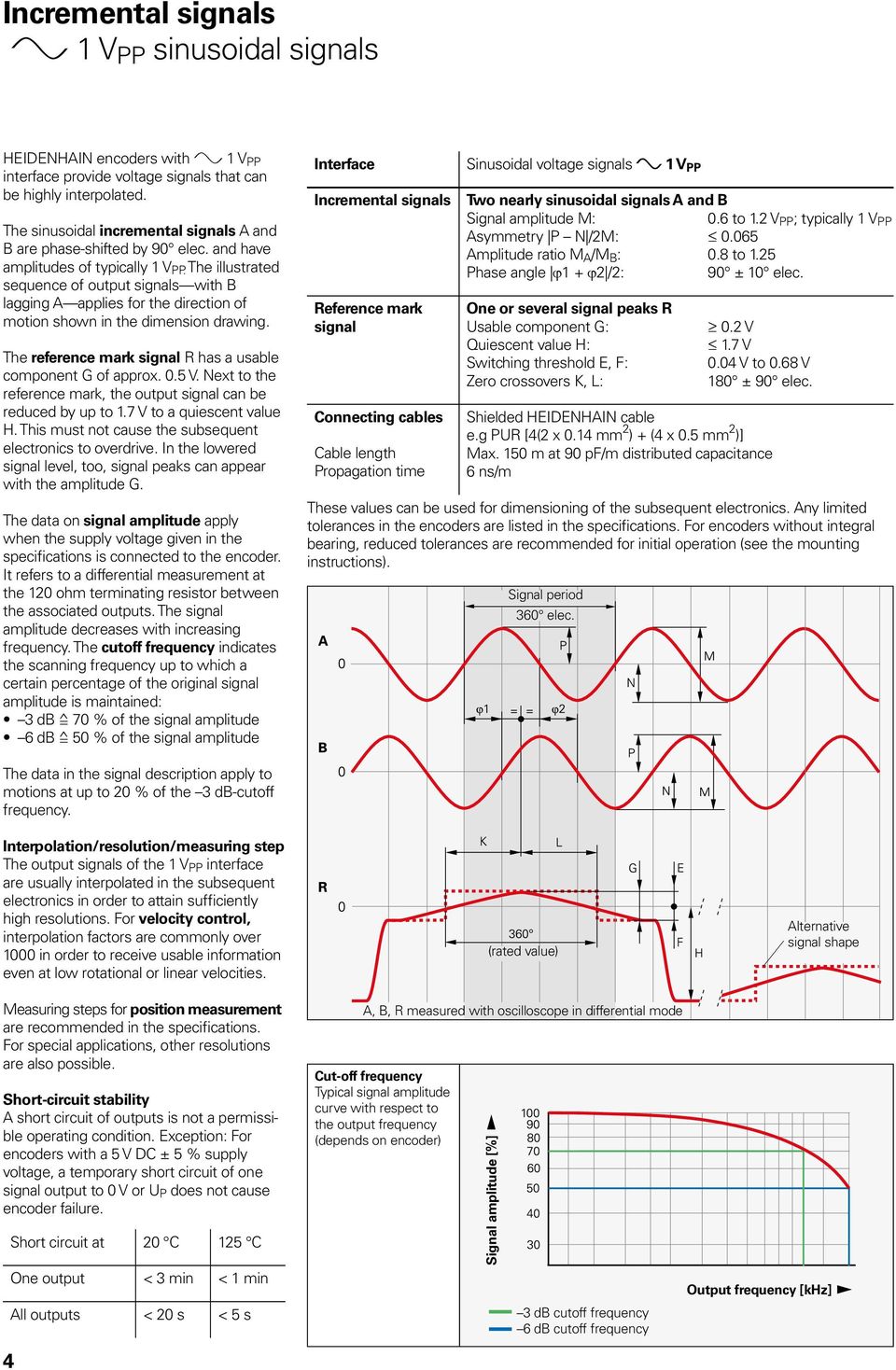
4 Incremental signals» 1 V PP sinusoidal signals HEIDENHAIN encoders with» 1 V PP interface provide voltage signals that can be highly interpolated. The sinusoidal incremental signals A and B are phase-shifted by 90 elec. and have amplitudes of typically 1 V PP. The illustrated sequence of output signals with B lagging A applies for the direction of motion shown in the dimension drawing. The reference mark signal R has a usable component G of approx. 0.5 V. Next to the reference mark, the output signal can be reduced by up to 1.7 V to a quiescent value H. This must not cause the subsequent electronics to overdrive. In the lowered signal level, too, signal peaks can appear with the amplitude G. The data on signal amplitude apply when the supply voltage given in the specifications is connected to the encoder. It refers to a differential measurement at the 120 ohm terminating resistor between the associated outputs. The signal amplitude decreases with increasing frequency. The cutoff frequency indicates the scanning frequency up to which a certain percentage of the original signal amplitude is maintained: db 70 % of the signal amplitude 6 db 50 % of the signal amplitude Interface Incremental signals Reference mark signal Connecting cables Cable length Propagation time Sinusoidal voltage signals» 1 V PP Two nearly sinusoidal signals A and B Signal amplitude M: 0.6 to 1.2 V PP ; typically 1 V PP Asymmetry P N /2M: Amplitude ratio M A /M B : 0.8 to 1.25 Phase angle j1 + j2 /2: 90 ± 10 elec. One or several signal peaks R Usable component G: Quiescent value H: Switching threshold E, F: Zero crossovers K, L: Signal period 60 elec. 0.2 V 1.7 V 0.04 V to 0.68 V 180 ± 90 elec. Shielded HEIDENHAIN cable e.g PUR [4(2 x 0.14 mm 2 ) + (4 x 0.5 mm 2 )] Max. 150 m at 90 pf/m distributed capacitance 6 ns/m These values can be used for dimensioning of the subsequent electronics. Any limited tolerances in the encoders are listed in the specifications. For encoders without integral bearing, reduced tolerances are recommended for initial operation (see the mounting instructions). The data in the signal description apply to motions at up to 20 % of the db-cutoff frequency. Interpolation/resolution/measuring step The output signals of the 1 V PP interface are usually interpolated in the subsequent electronics in order to attain sufficiently high resolutions. For velocity control, interpolation factors are commonly over 1000 in order to receive usable information even at low rotational or linear velocities. (rated value) Alternative signal shape Measuring steps for position measurement are recommended in the specifications. For special applications, other resolutions are also possible. Short-circuit stability A short circuit of outputs is not a permissible operating condition. Exception: For encoders with a 5 V DC ± 5 % supply voltage, a temporary short circuit of one signal output to 0 V or U P does not cause encoder failure. 4 Short circuit at 20 C 125 C One output < min < 1 min All outputs < 20 s < 5 s A, B, R measured with oscilloscope in differential mode Cut-off frequency Typical signal amplitude curve with respect to the output frequency (depends on encoder) Signal amplitude [%] db cutoff frequency 6 db cutoff frequency Output frequency [khz]
5 Monitoring of the incremental signals The following sensitivity levels are recommended for monitoring the signal amplitude M: Lower threshold: 0.0 V PP Upper threshold: 1.5 V PP Incremental signal A The height of the incremental signals can be monitored, for example by the length of the resulting position indicator: The oscilloscope shows the output signals A and B as a Lissajous figure in the XY graph. Ideal sinusoidal signals produce a circle with the diameter M. In this case the position indicator r shown corresponds to ½M. The formula is therefore r = (A 2 +B 2 ) with the condition 0. V < 2r < 1.5 V. Time [t] Time [t] Incremental signal B Input circuitry of subsequent electronics Dimensioning Operational amplifier, e.g. MC 4074 Z 0 = 120 R 1 = 10 k and C 1 = 100 pf R 2 = 4.8 k and C 2 = 10 pf U B = ±15 V U 1 approx. U 0 db cutoff frequency of circuitry 450 khz 50 khz with C 1 = 1000 pf and C 2 = 82 pf The circuit variant for 50 khz does reduce the bandwidth of the circuit, but in doing so it improves its noise immunity. Incremental signals Reference mark signal R a < 100, typically 24 C a < 50 pf SI a < 1 ma U 0 = 2.5 V ± 0.5 V (relative to 0 V of the voltage supply) Encoder Subsequent electronics Circuit output signals U a =.48 V PP typically Gain.48 Input circuitry of subsequent electronics for high signal frequencies For encoders with high signal frequencies (e.g. LIP 281), a special input circuitry is required. Dimensioning Operational amplifier, e.g. AD 818 Z 0 = 120 R 1 = 681 ; R 2 = 1 k ; R = 464 C 0 = 15 pf; C 1 = 10 pf +U B = 5 V; U B = 0 V or 5 V Incremental signals Reference mark signal R a < 100, typically 24 C a < 50 pf SI a < 1 ma U 0 = 2.5 V ± 0.5 V (relative to 0 V of the voltage supply) LIP 281 encoder Subsequent electronics db cutoff frequency of circuitry 10 MHz Circuit output signals U a = 1.47 V PP typically Gain

6 Incremental signals 11 µa PP sinusoidal signals HEIDENHAIN encoders with» 11 µa PP interface provide current signals. They are intended for connection to ND position display units or EXE pulse-shaping electronics from HEIDENHAIN. The sinusoidal incremental signals I 1 and I 2 are phase-shifted by 90 elec. and have signal levels of typically 11 µa PP. The illustrated sequence of output signals with I 2 lagging I 1 applies to the direction of motion shown in the dimension drawing, and for retracting plungers of length gauges. The reference mark signal I 0 has a usable component G of approx. 5.5 µa. The data on signal amplitude apply when the supply voltage given in the Specifications is connected at the encoder. They refer to a differential measurement between the associated outputs. The signal amplitude decreases with increasing frequency. The cutoff frequency indicates the scanning frequency up to which a certain percentage of the original signal amplitude is maintained: db cutoff frequency: 70 % of the signal amplitude 6 db-cutoff frequency: 50 % of the signal amplitude Interpolation/resolution/measuring step The output signals of the 11 µa PP interface are usually interpolated in the subsequent electronics ND position displays or EXE pulse-shaping electronics from HEIDEN- HAIN in order to attain sufficiently high resolutions. Interface Sinusoidal current signals» 11 µa PP Incremental signals Two nearly sinusoidal signals I 1 and I 2 Signal amplitude M: 7 to 16 µa PP /typically 11 µa PP Asymmetry IP NI/2M: Amplitude ratio M A /M B : 0.8 to 1.25 Phase angle Ij1 + j2i/2: 90 ± 10 elec. Reference mark signal Connecting cables Cable length Propagation time One or more signal peaks I 0 Usable component G: 2 µa to 8.5 µa Switching threshold E, F: 0.4 µa Zero crossovers K, L: 180 ± 90 elec. Shielded HEIDENHAIN cable PUR [( mm 2 ) + (2 1 mm 2 )] Max. 0 m with 90 pf/m distributed capacitance 6 ns/m Signal period 60 elec. (rated value) 6

7 TTL square-wave signals HEIDENHAIN encoders with «TTL interface incorporate electronics that digitize sinusoidal scanning signals with or without interpolation. Interface Incremental signals Square-wave signals «TTL Two TTL square-wave signals U a1, U a2 and their inverted signals, The incremental signals are transmitted as the square-wave pulse trains U a1 and U a2, phase-shifted by 90 elec. The reference mark signal consists of one or more reference pulses U a0, which are gated with the incremental signals. In addition, the integrated electronics produce their inverted signals, and for noise-proof transmission. The illustrated sequence of output signals with U a2 lagging U a1 applies to the direction of motion shown in the dimension drawing. The fault-detection signal indicates fault conditions such as breakage of the power line or failure of the light source. It can be used for such purposes as machine shut-off during automated production. The distance between two successive edges of the incremental signals U a1 and U a2 through 1-fold, 2-fold or 4-fold evaluation is one measuring step. The subsequent electronics must be designed to detect each edge of the square-wave pulse. The minimum edge separation a stated in the Specifications applies for the specified input circuit with a cable length of 1 m and refers to a measurement at the output of the differential line receiver. Reference mark signal Pulse width Delay time Fault-detection signal Pulse width Signal amplitude One or more TTL square-wave pulses U a0 and their inverted pulses 90 elec. (other widths available on request) t d 50 ns One TTL square-wave pulse Improper function: LOW (upon request: U a1 /U a2 high impedance) Proper function: HIGH t S 20 ms Differential line driver as per EIA standard RS-422 Permissible load Z Between associated outputs I L 20 ma Max. load per output (ERN 1x2: 10 ma) C load 1000 pf With respect to 0 V Outputs protected against short circuit to 0 V Switching times (10 % to 90 %) Connecting cables Cable length Propagation time t + / t 0 ns (10 ns typically) with 1 m cable and recommended input circuitry Shielded HEIDENHAIN cable e.g. PUR [4( mm 2 ) + (4 0.5 mm 2 )] Max. 100 m ( max. 50 m) at distributed capacitance 90 pf/m Typically 6 ns/m Signal period 60 elec. Fault Note Not all encoders output a reference mark signal, fault-detection signal, or their inverted signals. Please see the connector layout for this. Measuring step after 4-fold evaluation Inverse signals,, are not shown 7

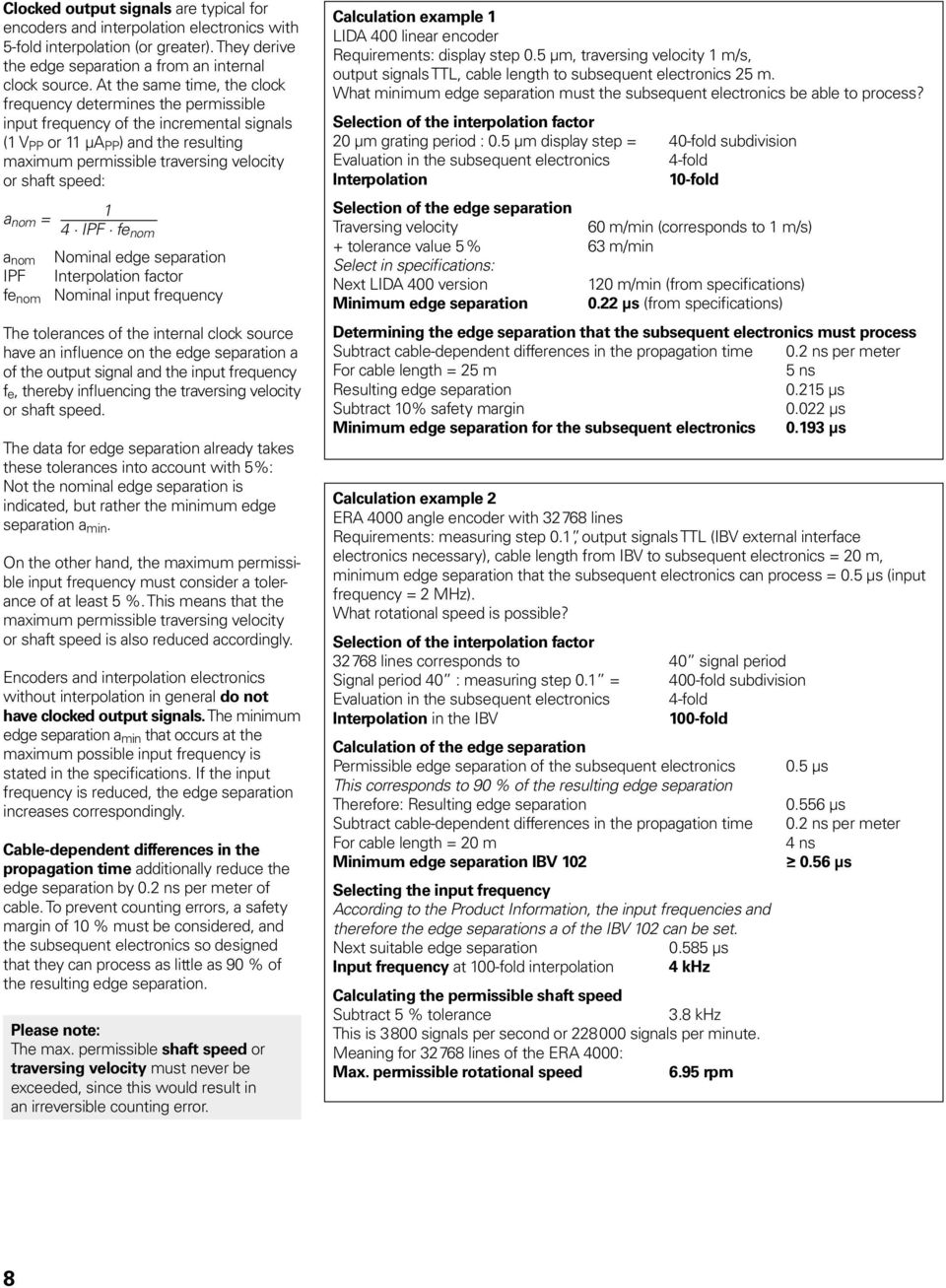
8 Clocked output signals are typical for encoders and interpolation electronics with 5-fold interpolation (or greater). They derive the edge separation a from an internal clock source. At the same time, the clock frequency determines the permissible input frequency of the incremental signals (1 V PP or 11 µa PP ) and the resulting maximum permissible traversing velocity or shaft speed: 1 a nom = 4 IPF fe nom a nom Nominal edge separation IPF Interpolation factor fe nom Nominal input frequency The tolerances of the internal clock source have an influence on the edge separation a of the output signal and the input frequency f e, thereby influencing the traversing velocity or shaft speed. The data for edge separation already takes these tolerances into account with 5%: Not the nominal edge separation is indicated, but rather the minimum edge separation a min. On the other hand, the maximum permissible input frequency must consider a tolerance of at least 5 %. This means that the maximum permissible traversing velocity or shaft speed is also reduced accordingly. Encoders and interpolation electronics without interpolation in general do not have clocked output signals. The minimum edge separation a min that occurs at the maximum possible input frequency is stated in the specifications. If the input frequency is reduced, the edge separation increases correspondingly. Cable-dependent differences in the propagation time additionally reduce the edge separation by 0.2 ns per meter of cable. To prevent counting errors, a safety margin of 10 % must be considered, and the subsequent electronics so designed that they can process as little as 90 % of the resulting edge separation. Please note: The max. permissible shaft speed or traversing velocity must never be exceeded, since this would result in an irreversible counting error. Calculation example 1 LIDA 400 linear encoder Requirements: display step 0.5 µm, traversing velocity 1 m/s, output signals TTL, cable length to subsequent electronics 25 m. What minimum edge separation must the subsequent electronics be able to process? Selection of the interpolation factor 20 µm grating period : 0.5 µm display step = 40-fold subdivision Evaluation in the subsequent electronics 4-fold Interpolation 10-fold Selection of the edge separation Traversing velocity 60 m/min (corresponds to 1 m/s) + tolerance value 5 % 6 m/min Select in specifications: Next LIDA 400 version 120 m/min (from specifications) Minimum edge separation 0.22 µs (from specifications) Determining the edge separation that the subsequent electronics must process Subtract cable-dependent differences in the propagation time 0.2 ns per meter For cable length = 25 m 5 ns Resulting edge separation µs Subtract 10% safety margin µs Minimum edge separation for the subsequent electronics 0.19 µs Calculation example 2 ERA 4000 angle encoder with 2768 lines Requirements: measuring step 0.1, output signals TTL (IBV external interface electronics necessary), cable length from IBV to subsequent electronics = 20 m, minimum edge separation that the subsequent electronics can process = 0.5 µs (input frequency = 2 MHz). What rotational speed is possible? Selection of the interpolation factor 2768 lines corresponds to 40 signal period Signal period 40 : measuring step 0.1 = 400-fold subdivision Evaluation in the subsequent electronics 4-fold Interpolation in the IBV 100-fold Calculation of the edge separation Permissible edge separation of the subsequent electronics 0.5 µs This corresponds to 90 % of the resulting edge separation Therefore: Resulting edge separation µs Subtract cable-dependent differences in the propagation time 0.2 ns per meter For cable length = 20 m 4 ns Minimum edge separation IBV µs Selecting the input frequency According to the Product Information, the input frequencies and therefore the edge separations a of the IBV 102 can be set. Next suitable edge separation µs Input frequency at 100-fold interpolation 4 khz Calculating the permissible shaft speed Subtract 5 % tolerance.8 khz This is 800 signals per second or signals per minute. Meaning for 2768 lines of the ERA 4000: Max. permissible rotational speed 6.95 rpm 8
9 The permissible cable length for transmission of the TTL square-wave signals to the subsequent electronics depends on the edge separation a. It is at most 100 m, or 50 m for the fault detection signal. This requires, however, that the voltage supply (see Specifications) be ensured at the encoder. The sensor lines can be used to measure the voltage at the encoder and, if required, correct it with an automatic control system (remote sense power supply). Permissible cable length with respect to the edge separation Cable length [m] Without With Greater cable lengths can be provided upon consultation with HEIDENHAIN. Edge separation [µs] Input circuitry of subsequent electronics Incremental signals Reference mark signal Encoder Subsequent electronics Dimensioning IC 1 = Recommended differential line receiver DS 26 C 2 AT Only for a > 0.1 µs: AM 26 LS 2 MC 486 SN 75 ALS 19 Fault-detection signal R 1 = 4.7 k R 2 = 1.8 k Z 0 = 120 C 1 = 220 pf (serves to improve noise immunity) 9

10 Incremental signals HTL square-wave signals HEIDENHAIN encoders with «HTL interface incorporate electronics that digitize sinusoidal scanning signals with or without interpolation. Interface Incremental signals «HTL, «HTLs square-wave signals Two HTL square-wave signals U a1, U a2 and their inverse signals, (HTLs without, ) The incremental signals are transmitted as the square-wave pulse trains U a1 and U a2, phase-shifted by 90 elec. The reference mark signal consists of one or more reference pulses U a0, which are gated with the incremental signals. In addition, the integrated electronics produce their inverse signals, and for noiseproof transmission (does not apply to HTLs). The illustrated sequence of output signals with U a2 lagging U a1 applies to the direction of motion shown in the dimension drawing. The fault-detection signal indicates fault conditions such as failure of the light source. It can be used for such purposes as machine shut-off during automated production. The distance between two successive edges of the incremental signals U a1 and U a2 through 1-fold, 2-fold or 4-fold evaluation is one measuring step. Reference mark signal Pulse width Delay time Fault-detection signal Pulse width One or more HTL square-wave pulses U a0 and their inverted pulses (HTLs without ) 90 elec. (other widths available on request) t d 50 ns One HTL square-wave pulse Improper function: LOW Proper function: HIGH t S 20 ms Signal level U H 21 V at I H = 20 ma With supply voltage U L 2.8 V at I L = 20 ma U P = 24 V, without cable Permissible load I L 100 ma Max. load per output, (except ) C load 10 nf With respect to 0 V Outputs short-circuit proof for max. 1 minute to 0 V and U P (except ) Switching times (10 % to 90 %) Connecting cables Cable length Propagation time t + /t 200 ns (except ) with 1 m cable and recommended input circuitry HEIDENHAIN cable with shielding e.g. PUR [4( mm 2 ) + (4 0.5 mm 2 )] Max. 00 m (HTLs max. 100 m) at 90 pf/m distributed capacitance 6 ns/m The subsequent electronics must be designed to detect each edge of the square-wave pulse. The minimum edge separation a stated in the specifications refers to a measurement at the output of the given differential input circuit. To prevent counting errors, the subsequent electronics should be designed so that they can process as little as 90 % of the edge separation a. The maximum permissible shaft speed or traversing velocity must never be exceeded. Signal period 60 elec. Measuring step after 4-fold evaluation Fault Inverse signals,, are not shown The permissible cable length for incremental encoders with HTL signals depends on the output frequency, the effective supply voltage, and the operating temperature of the encoder. The current requirement of encoders with HTL output signals depends on the output frequency and the cable length to the subsequent electronics. Cable length [m] HTL HTLs Output frequency [khz] 10

11 Input circuitry of subsequent electronics HTL Incremental signals Reference mark signal Encoder Subsequent electronics Fault-detection signal HTLs Incremental signals Reference mark signal Encoder Subsequent electronics Fault-detection signal 11

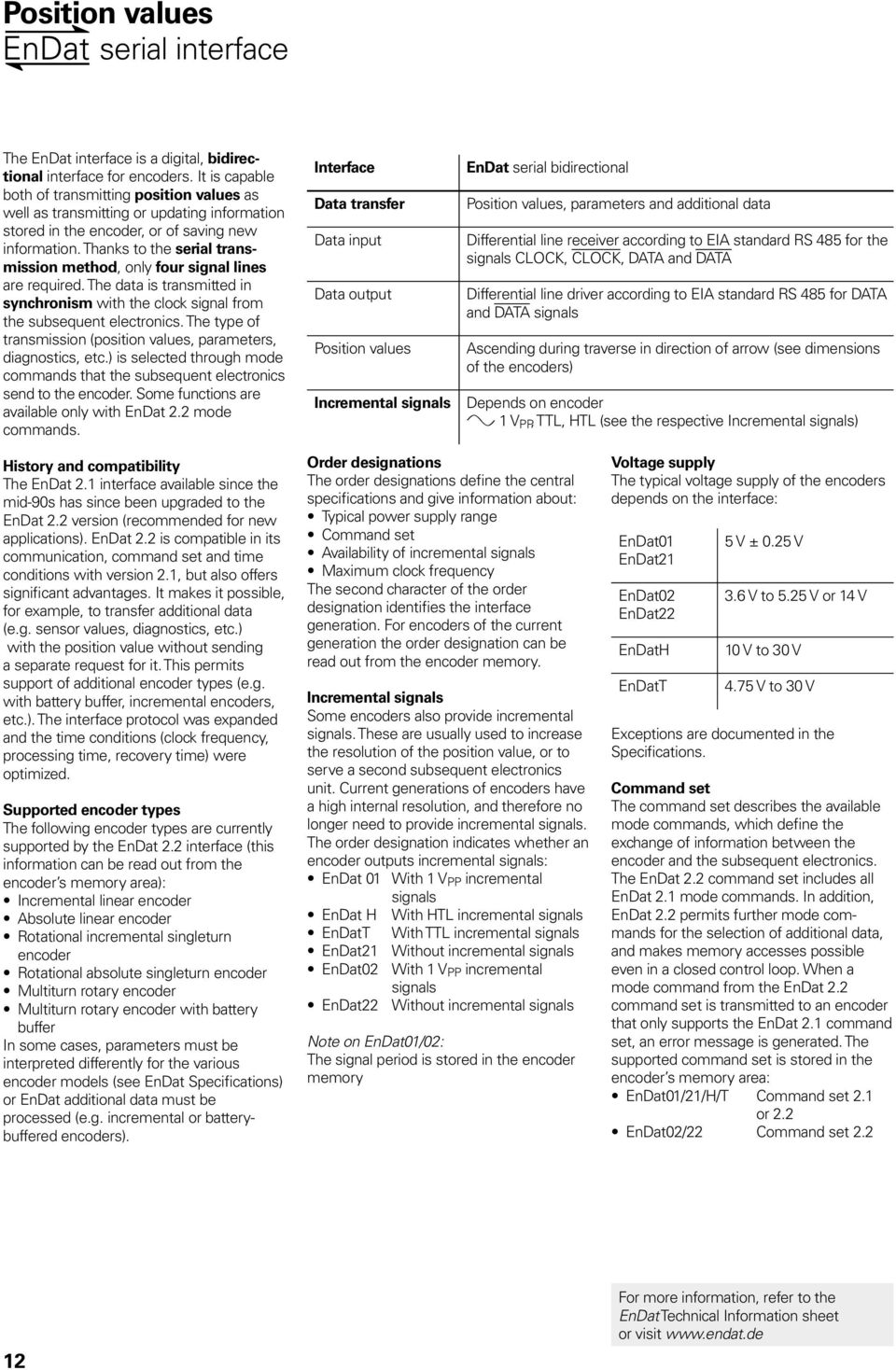
12 Position values serial interface The EnDat interface is a digital, bidirectional interface for encoders. It is capable both of transmitting position values as well as transmitting or updating information stored in the encoder, or of saving new information. Thanks to the serial transmission method, only four signal lines are required. The data is transmitted in synchronism with the clock signal from the subsequent electronics. The type of transmission (position values, parameters, diagnostics, etc.) is selected through mode commands that the subsequent elec tronics send to the encoder. Some functions are available only with EnDat 2.2 mode commands. Interface Data transfer Data input Data output Position values Incremental signals EnDat serial bidirectional Position values, parameters and additional data Differential line receiver according to EIA standard RS 485 for the signals CLOCK, CLOCK, DATA and DATA Differential line driver according to EIA standard RS 485 for DATA and DATA signals Ascending during traverse in direction of arrow (see dimensions of the encoders) Depends on encoder» 1 V PP, TTL, HTL (see the respective Incremental signals) History and compatibility The EnDat 2.1 interface available since the mid-90s has since been upgraded to the EnDat 2.2 version (recommended for new applications). EnDat 2.2 is compatible in its communication, command set and time conditions with version 2.1, but also offers significant advantages. It makes it possible, for example, to transfer additional data (e.g. sensor values, diagnostics, etc.) with the position value without sending a separate request for it. This permits support of additional encoder types (e.g. with battery buffer, incremental encoders, etc.). The interface protocol was expanded and the time conditions (clock frequency, processing time, recovery time) were optimized. Supported encoder types The following encoder types are currently supported by the EnDat 2.2 interface (this information can be read out from the encoder s memory area): Incremental linear encoder Absolute linear encoder Rotational incremental singleturn encoder Rotational absolute singleturn encoder Multiturn rotary encoder Multiturn rotary encoder with battery buffer In some cases, parameters must be interpreted differently for the various encoder models (see EnDat Specifications) or EnDat additional data must be processed (e.g. incremental or batterybuffered encoders). Order designations The order designations define the central specifications and give information about: Typical power supply range Command set Availability of incremental signals Maximum clock frequency The second character of the order designation identifies the interface generation. For encoders of the current generation the order designation can be read out from the encoder memory. Incremental signals Some encoders also provide incremental signals. These are usually used to increase the resolution of the position value, or to serve a second subsequent electronics unit. Current generations of encoders have a high internal resolution, and therefore no longer need to provide incremental signals. The order designation indicates whether an encoder outputs incremental signals: EnDat 01 With 1 V PP incremental signals EnDat H With HTL incremental signals EnDatT With TTL incremental signals EnDat21 Without incremental signals EnDat02 With 1 V PP incremental signals EnDat22 Without incremental signals Note on EnDat01/02: The signal period is stored in the encoder memory Voltage supply The typical voltage supply of the encoders depends on the interface: EnDat01 EnDat21 EnDat02 EnDat22 EnDatH EnDatT 5 V ± 0.25 V.6 V to 5.25 V or 14 V 10 V to 0 V 4.75 V to 0 V Exceptions are documented in the Specifications. Command set The command set describes the available mode commands, which define the exchange of information between the encoder and the subsequent electronics. The EnDat 2.2 command set includes all EnDat 2.1 mode commands. In addition, EnDat 2.2 permits further mode commands for the selection of additional data, and makes memory accesses possible even in a closed control loop. When a mode command from the EnDat 2.2 command set is transmitted to an encoder that only supports the EnDat 2.1 command set, an error message is generated. The supported command set is stored in the encoder s memory area: EnDat01/21/H/T Command set 2.1 or 2.2 EnDat02/22 Command set For more information, refer to the EnDat Technical Information sheet or visit
13 Clock frequency The clock frequency is variable depending on the cable length (max. 150 m) between 100 khz and 2 MHz. With propagation-delay compensation in the subsequent electronics, either clock frequencies up to 16 MHz are possible or cable lengths up to 100 m. For EnDat encoders with order designation EnDat x2 the maximum clock frequency is stored in the encoder memory. For all other encoders the maximum clock frequency is 2 MHz. Propagation-delay compensation is provided only for order designations EnDat 21 and EnDat 22; for EnDat 02, see the notes below. EnDat01 EnDatT EnDatH EnDat21 EnDat02 EnDat22 2 MHz (see without propagation-delay compensation in the diagram) 2 MHz 2 MHz or 8 MHz or 16 MHz (see note) 8 MHz or 16 MHz Transmission frequencies up to 16 MHz in combination with large cable lengths place high technological demands on the cable. Due to the data transfer technology, the adapter cable connected directly to the encoder must not be longer than 20 m. Greater cable lengths can be realized with an adapter cable no longer than 6 m and an extension cable. As a rule, the entire transmission path must be designed for the respective clock frequency. Note on EnDat02 EnDat02 encoders can feature a pluggable cable assembly. In choosing the version of the adapter cable, the customer also decides whether the encoder will be operated with incremental signals or without them. This also affects the maximum possible clock frequency. For adapter cables with incremental signals the clock frequency is limited to at most 2 MHz; see EnDat 01. For adapter cables without incremental signals the clock frequency can be up to 16 MHz. The exact values are stored in the encoder s memory. Cable length [m] Clock frequency [khz] EnDat 2.1; EnDat 2.2 without propagation-delay compensation EnDat 2.2 with propagation-delay compensation Under certain conditions, cable lengths up to 00 m are possible after consultation with HEIDENHAIN Position values The position value can be transmitted with or without additional data. It is not transmitted to the subsequent electronics until after the calculation time t cal has passed. The calculation time is ascertained at the highest clock frequency permissible for the encoder, but at no greater than 8 MHz Only the required number of bits is transferred for the position value. The bit number depends on the respective encoder and can be read out from the encoder for automatic parameterization. Typical operating modes Operating mode EnDat 2.1: This mode is for encoders that provide additional incremental signals. The absolute position is read out once simultaneously with the incremental position and both are used to calculate the position value. Otherwise, the position value in the control loop is formed on the basis of the incremental signals. Only EnDat 2.1 mode commands are used. Operating mode EnDat 2.2: This mode is for purely serial encoders. The position value is read out from the encoder in each control cycle. EnDat 2.2 mode commands are typically used to read out the position value. EnDat 2.1 mode commands are typically used to read and write parameters after switch-on. The EnDat 2.2 interface can interrogate the position and additional data, and also perform functions (e.g. read/write parameters, reset error messages, etc.), all within the closed loop. Additional data One or two items of additional data can be appended to the position value, depending on the type of transmission (selection via MRS code). The additional data supported by the respective encoder is saved in the encoder parameters. The additional data contains: Status information, addresses and data WRN warnings RM reference marks Busy parameter request Additional data 1 Diagnosis Position value 2 Memory parameters MRS-code acknowledgment Test values Temperature Additional sensors Additional data 2 Commutation Acceleration Limit position signals Asynchronous position value Operating status error sources Timestamp 1

14 Memory areas The encoder provides several memory areas for parameters. These can be read from by the subsequent electronics, and some can be written to by the encoder manufacturer, the OEM, or even the end user. The parameter data are stored in a permanent memory. This memory permits only a limited number of write access events and is not designed for cyclic data storage. Certain memory areas can be write-protected (this can only be reset by the encoder manufacturer). Parameters are saved in various memory areas, e.g.: Encoder-specific information Information of the OEM (e.g. electronic ID label of the motor) Operating parameters (datum shift, instruction, etc.) Operating status (alarm or warning messages) Monitoring and diagnostic functions of the EnDat interface make a detailed inspection of the encoder possible. Error messages Warnings Online diagnostics based on valuation numbers (EnDat 2.2) Mounting interface Operating parameters Operating status Absolute encoder Parameters of the OEM Functional safety basic principle EnDat 2.2 strictly supports the use of encoders in safety-related applications. The DIN EN ISO (previously EN 954-1), EN and EN standards serve as the foundation. These standards describe the assessment of safety-oriented systems, for example based on the failure probabilities of integrated components and subsystems. The modular approach helps manufacturers of safety-related systems to implement their complete systems, because they can begin with prequalified subsystems. Incremental signals *) Absolute position value EnDat interface Parameters of the encoder manufacturer for EnDat 2.1 EnDat 2.2 Subsequent electronics» 1 V PP A*)» 1 V PP B*) *) Depends on encoder, example representation for 1 V PP Input circuitry of subsequent electronics Data transfer Encoder Subsequent electronics Dimensioning IC 1 = RS 485 differential line receiver and driver Z 0 = 120 Incremental signals Depends on the encoder (e.g. 1 V PP 1 V PP 14

15 Company-specific serial interfaces Siemens HEIDENHAIN encoders with the code letter S after the model designation are suited for connection to Siemens controls with DRIVE-CLiQ interface Order designation DQ01 Fanuc HEIDENHAIN encoders with the code letter F after the model designation are suited for connection to Fanuc controls with Fanuc Serial Interface Interface Ordering designation: Fanuc02 Normal and high speed, two-pair transmission Fanuc Serial Interface i interface Ordering designation: Fanuc05 High speed, one-pair transmission Includes Þ interface (normal and high speed, two-pair transmission) Mitsubishi HEIDENHAIN encoders with the code letter M after the model designation are suited for connection to Mitsubishi controls with Mitsubishi high speed interface Ordering designation: Mitsu01 Two-pair transmission Ordering designation: Mit02-4 Generation 1, two-pair transmission Ordering designation: Mit02-2 Generation 1, one-pair transmission Ordering designation: Mit0-4 Generation 2, two-pair transmission Yaskawa HEIDENHAIN encoders with the code letter Y after the model designation are suited for connection to Yaskawa controls with Yaskawa Serial Interface Ordering designation YEC02 Panasonic HEIDENHAIN encoders with the code letter P after the model designation are suited for connection to Panasonic controls with Panasonic Serial Interface Ordering designation Pana01 DRIVE-CLiQ is a registered trademark of Siemens Aktiengesellschaft 15

16 Position values PROFIBUS-DP serial interface PROFIBUS-DP The PROFIBUS is a non-proprietary, open fieldbus according to the international standard EN The connecting of sensors through fieldbus systems minimizes the cost of cabling and reduces the number of lines between encoder and subsequent electronics. Topology and bus assignment The PROFIBUS-DP is designed as a linear structure. It permits transfer rates up to 12 Mbit/s. Both mono-master and multimaster systems are possible. Each master can serve only its own slaves (polling). The slaves are polled cyclically by the master. Slaves are, for example, sensors such as absolute rotary encoders, linear encoders, or also control devices such as motor frequency inverters. Physical characteristics The electrical features of the PROFIBUS-DP comply with the RS-485 standard. The bus connection is a shielded, twisted two-wire cable with active bus terminations at each end. E.g.: LC 115 absolute linear encoder E.g.: Frequency inverter with motor Bus structure of PROFIBUS-DP E.g.: ROQ 47 multiturn rotary encoder E.g.: ROC 425 singleturn rotary encoder E.g.: RCN 8000 absolute angle encoder Initial configuration The characteristics of HEIDENHAIN encoders required for system configuration are included as electronic data sheets also called device identification records (GSD) in the gateway. These device identification records (GSD) completely and clearly describe the characteristics of a unit in an exactly defined format. This makes it possible to integrate the encoders into the bus system in a simple and applicationfriendly way. Configuration PROFIBUS-DP devices can be configured and the parameters assigned to fit the requirements of the user. Once these settings are made in the configuration tool with the aid of the GSD file, they are saved in the master. It then configures the PROFIBUS devices every time the network starts up. This simplifies exchanging of the devices: There is no need to edit or reenter the configuration data. Two different GSD files are available for selection: GSD file for the DP-V0 profile GSD file for the DP-V1 and DP-V2 profiles * With EnDat interface 16

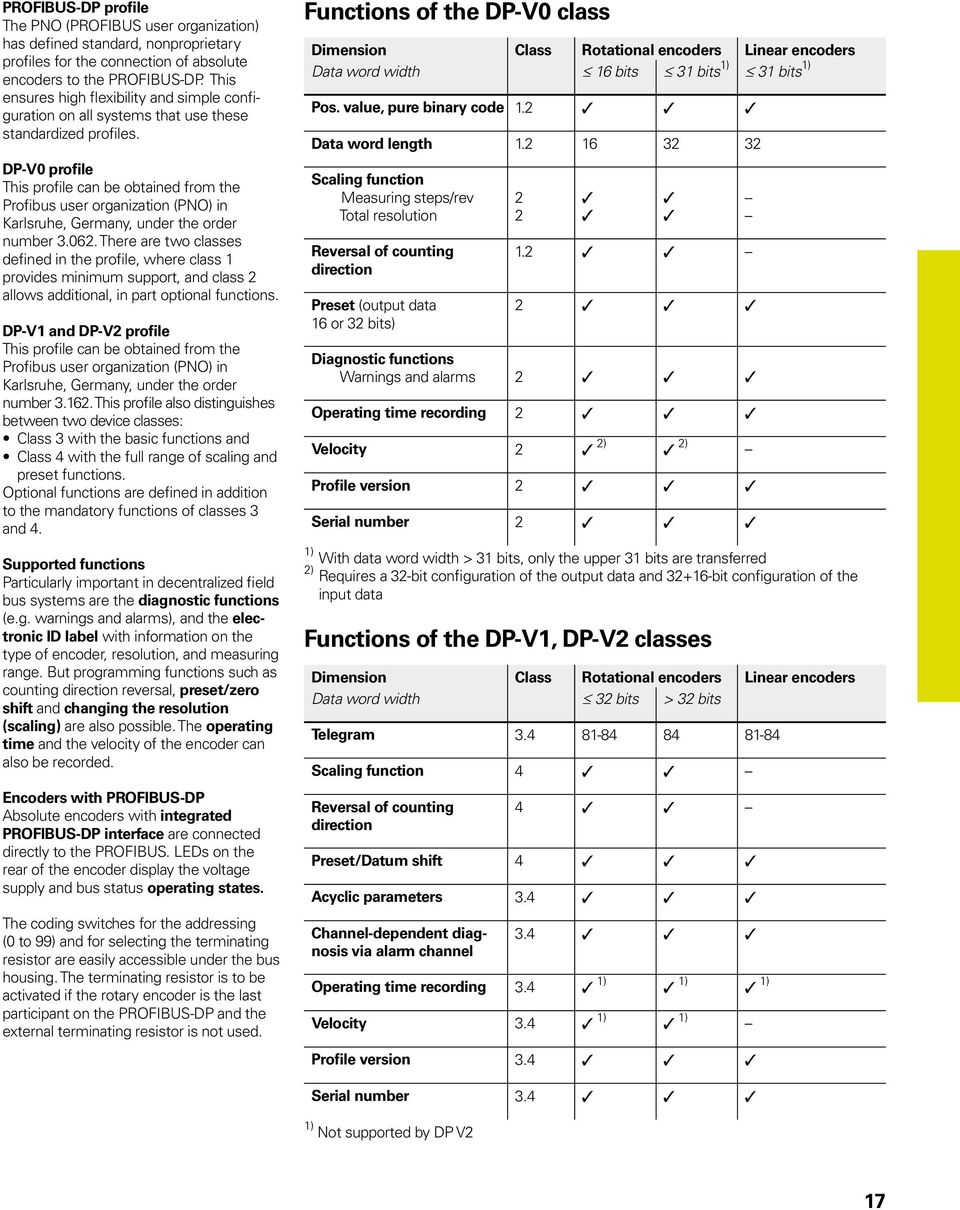
17 PROFIBUS-DP profile The PNO (PROFIBUS user organization) has defined standard, nonproprietary profiles for the connection of absolute encoders to the PROFIBUS-DP. This ensures high flexibility and simple configuration on all systems that use these standardized profiles. DP-V0 profile This profile can be obtained from the Profibus user organization (PNO) in Karlsruhe, Germany, under the order number.062. There are two classes defined in the profile, where class 1 provides minimum support, and class 2 allows additional, in part optional functions. DP-V1 and DP-V2 profile This profile can be obtained from the Profibus user organization (PNO) in Karlsruhe, Germany, under the order number.162. This profile also distinguishes between two device classes: Class with the basic functions and Class 4 with the full range of scaling and preset functions. Optional functions are defined in addition to the mandatory functions of classes and 4. Supported functions Particularly important in decentralized field bus systems are the diagnostic functions (e.g. warnings and alarms), and the electronic ID label with information on the type of encoder, resolution, and measuring range. But programming functions such as counting direction reversal, preset/zero shift and changing the resolution (scaling) are also possible. The operating time and the velocity of the encoder can also be recorded. Encoders with PROFIBUS-DP Absolute encoders with integrated PROFIBUS-DP interface are connected directly to the PROFIBUS. LEDs on the rear of the encoder display the voltage supply and bus status operating states. The coding switches for the addressing (0 to 99) and for selecting the terminating resistor are easily accessible under the bus housing. The terminating resistor is to be activated if the rotary encoder is the last participant on the PROFIBUS-DP and the external terminating resistor is not used. Functions of the DP-V0 class Dimension Class Rotational encoders Linear encoders Data word width 16 bits 1 bits 1) 1 bits 1) Pos. value, pure binary code 1.2 Data word length Scaling function Measuring steps/rev Total resolution Reversal of counting direction Preset (output data 16 or 2 bits) Diagnostic functions Warnings and alarms 2 Operating time recording 2 Velocity 2 2) 2) Profile version 2 Serial number 2 1) With data word width > 1 bits, only the upper 1 bits are transferred 2) Requires a 2-bit configuration of the output data and 2+16-bit configuration of the input data Functions of the DP-V1, DP-V2 classes Dimension Class Rotational encoders Linear encoders Data word width 2 bits > 2 bits Telegram Scaling function 4 Reversal of counting direction 4 Preset/Datum shift 4 Acyclic parameters.4 Channel-dependent diagnosis via alarm channel.4 Operating time recording.4 1) 1) 1) Velocity.4 1) 1) Profile version.4 Serial number.4 1) Not supported by DP V2 17
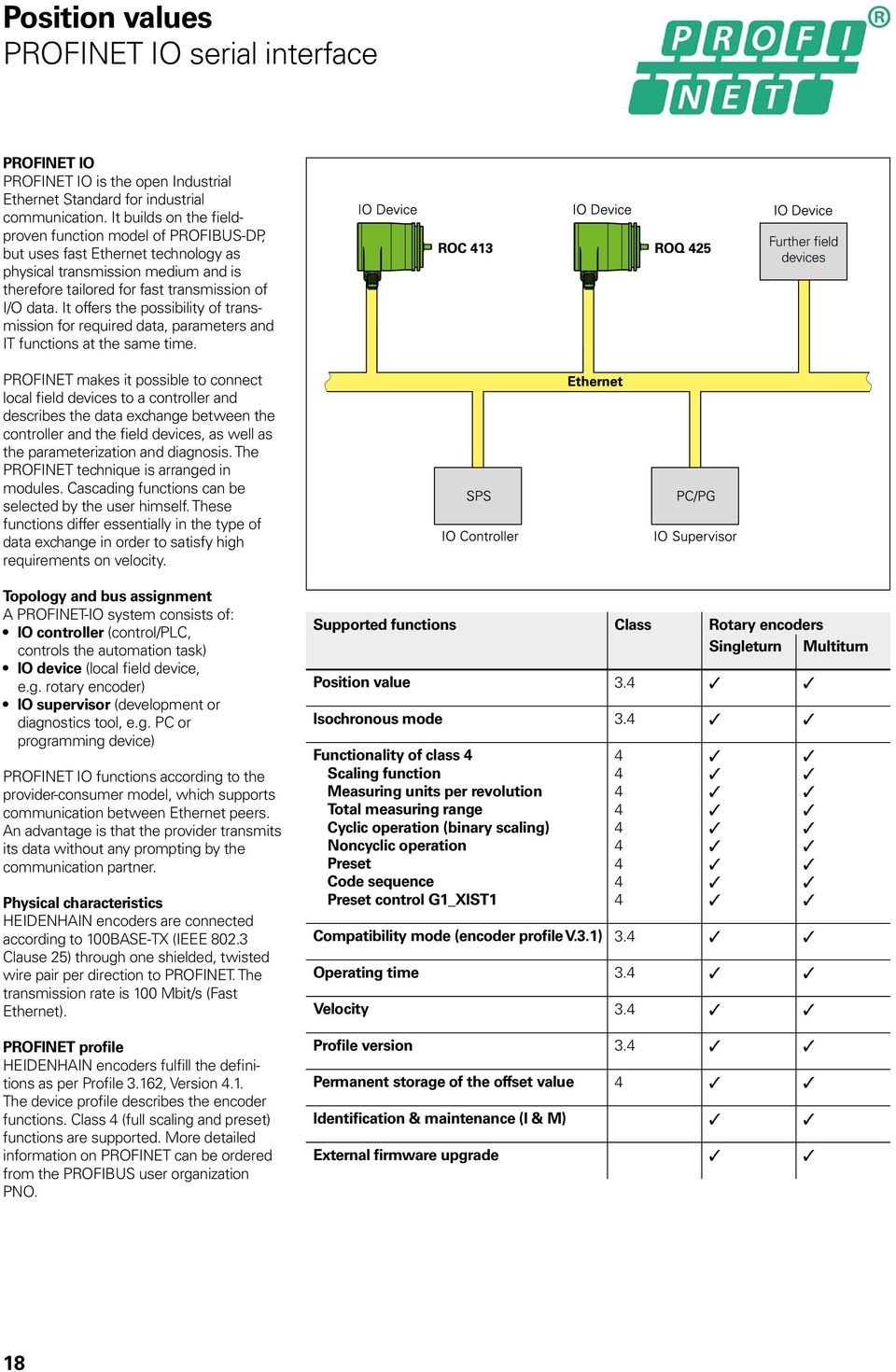
18 Position values PROFINET IO serial interface PROFINET IO PROFINET IO is the open Industrial Ethernet Standard for industrial communication. It builds on the fieldproven function model of PROFIBUS-DP, but uses fast Ethernet technology as physical transmission medium and is therefore tailored for fast transmission of I/O data. It offers the possibility of transmission for required data, parameters and IT functions at the same time. Further field devices PROFINET makes it possible to connect local field devices to a controller and describes the data exchange between the controller and the field devices, as well as the parameterization and diagnosis. The PROFINET technique is arranged in modules. Cascading functions can be selected by the user himself. These functions differ essentially in the type of data exchange in order to satisfy high requirements on velocity. Topology and bus assignment A PROFINET-IO system consists of: IO controller (control/plc, controls the automation task) IO device (local field device, e.g. rotary encoder) IO supervisor (development or diagnostics tool, e.g. PC or programming device) PROFINET IO functions according to the provider-consumer model, which supports communication between Ethernet peers. An advantage is that the provider transmits its data without any prompting by the communication partner. Physical characteristics HEIDENHAIN encoders are connected according to 100BASE-TX (IEEE 802. Clause 25) through one shielded, twisted wire pair per direction to PROFINET. The transmission rate is 100 Mbit/s (Fast Ethernet). PROFINET profile HEIDENHAIN encoders fulfill the definitions as per Profile.162, Version 4.1. The device profile describes the encoder functions. Class 4 (full scaling and preset) functions are supported. More detailed information on PROFINET can be ordered from the PROFIBUS user organization PNO. Supported functions Class Rotary encoders Singleturn Multiturn Position value.4 Isochronous mode.4 Functionality of class 4 Scaling function Measuring units per revolution Total measuring range Cyclic operation (binary scaling) Noncyclic operation Preset Code sequence Preset control G1_XIST1 Compatibility mode (encoder profile V..1).4 Operating time.4 Velocity.4 Profile version.4 Permanent storage of the offset value 4 Identification & maintenance (I & M) External firmware upgrade
19 Commissioning To put an encoder with a PROFINET interface into operation, a device identification record (GSD) must be downloaded and imported into the configuration software. The GSD contains the execution parameters required for a PROFINET-IO device. Configuration Profiles are predefined configurations of available functions and performance characteristics of PROFINET for use in certain devices or applications such as rotary encoders. They are defined and published by the workgroups of PROFIBUS & PROFINET International (PI). Profiles are important for openness, interoperability and exchangeability so that the end user can be sure that similar devices from different manufacturers function in a standardized manner. Encoders with PROFINET Absolute encoders with integrated PROFIBUS interface are connected directly to the network. Addresses are distributed automatically over a protocol integrated in PROFINET. A PROFINET-IO field device is addressed within a network through its physical device MAC address. On their rear faces, the encoders feature two double-color LEDs for diagnostics of the bus and the device. A terminating resistor for the last participant is not necessary. 19
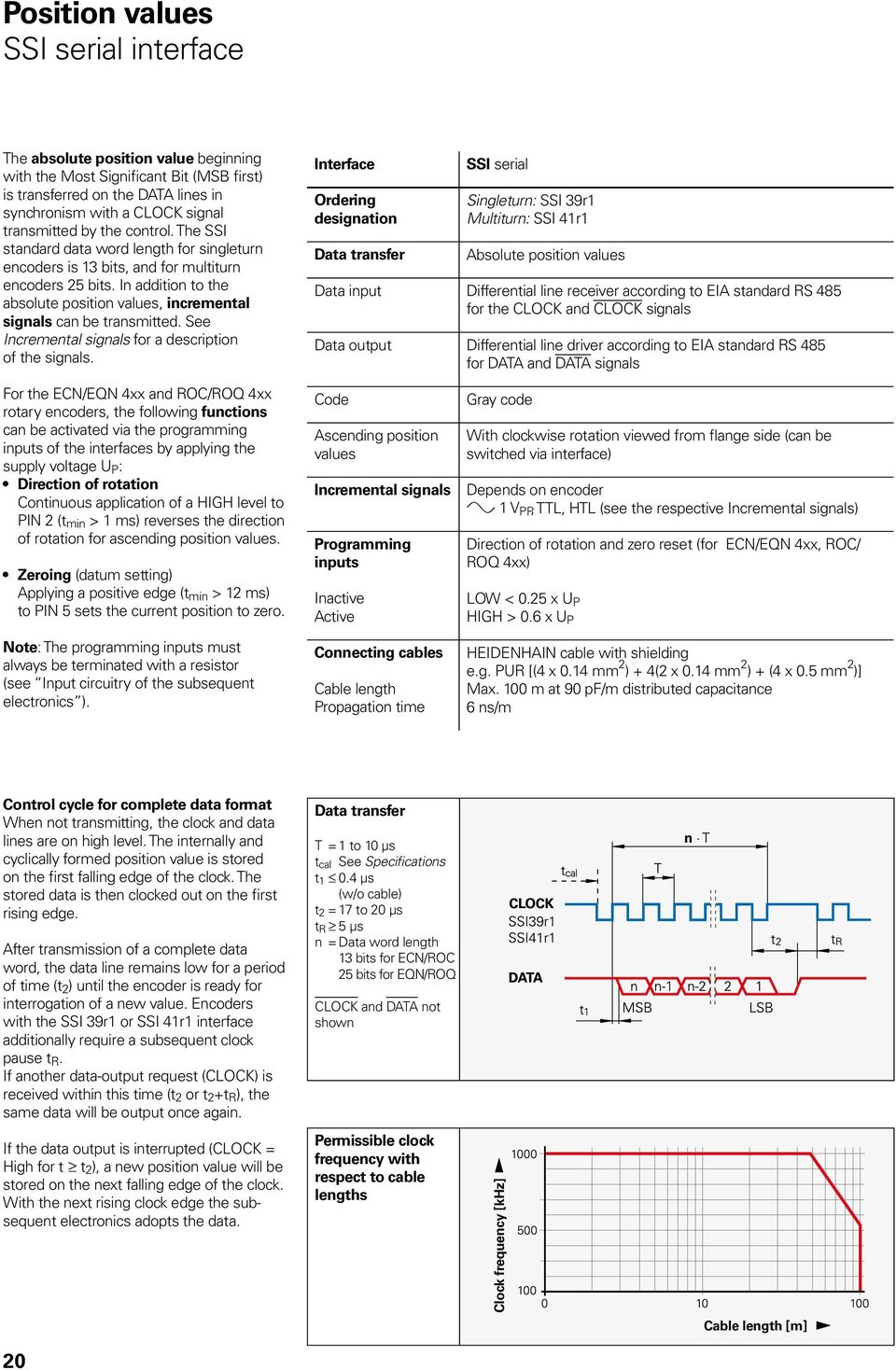
20 Position values SSI serial interface The absolute position value beginning with the Most Significant Bit (MSB first) is transferred on the DATA lines in synchronism with a CLOCK signal transmitted by the control. The SSI standard data word length for singleturn encoders is 1 bits, and for multiturn encoders 25 bits. In addition to the absolute position values, incremental signals can be transmitted. See Incremental signals for a description of the signals. Interface Ordering designation Data transfer SSI serial Singleturn: SSI 9r1 Multiturn: SSI 41r1 Absolute position values Data input Differential line receiver according to EIA standard RS 485 for the CLOCK and CLOCK signals Data output Differential line driver according to EIA standard RS 485 for DATA and DATA signals For the ECN/EQN 4xx and ROC/ROQ 4xx rotary encoders, the following functions can be activated via the programming inputs of the interfaces by applying the supply voltage U P : Direction of rotation Continuous application of a HIGH level to PIN 2 (t min > 1 ms) reverses the direction of rotation for ascending position values. Zeroing (datum setting) Applying a positive edge (t min > 12 ms) to PIN 5 sets the current position to zero. Note: The programming inputs must always be terminated with a resistor (see Input circuitry of the subsequent electronics ). Code Ascending position values Incremental signals Programming inputs Inactive Active Connecting cables Cable length Propagation time Gray code With clockwise rotation viewed from flange side (can be switched via interface) Depends on encoder» 1 V PP, TTL, HTL (see the respective Incremental signals) Direction of rotation and zero reset (for ECN/EQN 4xx, ROC/ ROQ 4xx) LOW < 0.25 x U P HIGH > 0.6 x U P HEIDENHAIN cable with shielding e.g. PUR [(4 x 0.14 mm 2 ) + 4(2 x 0.14 mm 2 ) + (4 x 0.5 mm 2 )] Max. 100 m at 90 pf/m distributed capacitance 6 ns/m Control cycle for complete data format When not transmitting, the clock and data lines are on high level. The internally and cyclically formed position value is stored on the first falling edge of the clock. The stored data is then clocked out on the first rising edge. After transmission of a complete data word, the data line remains low for a period of time (t 2 ) until the encoder is ready for interrogation of a new value. Encoders with the SSI 9r1 or SSI 41r1 interface additionally require a subsequent clock pause t R. If another data-output request (CLOCK) is received within this time (t 2 or t 2 +t R ), the same data will be output once again. If the data output is interrupted (CLOCK = High for t t 2 ), a new position value will be stored on the next falling edge of the clock. With the next rising clock edge the subsequent electronics adopts the data. 20 Data transfer T = 1 to 10 µs t cal See Specifications t µs (w/o cable) t 2 = 17 to 20 µs t R 5 µs n = Data word length 1 bits for ECN/ROC 25 bits for EQN/ROQ CLOCK and DATA not shown Permissible clock frequency with respect to cable lengths Clock frequency [khz] Cable length [m]
21 Incremental signals Some encoders also provide incremental signals. These are usually used to increase the resolution of the position value, or to serve a second subsequent electronics unit. In general these are 1 V PP incremental signals. Exceptions can be seen from the order designation: SSI41H With HTL incremental signals SSI41T With TTL incremental signals Input circuitry of subsequent electronics Data transfer Encoder Subsequent electronics Dimensioning IC 1 = Differential line receiver and driver E.g. SN 65 LBC 176 LT 485 Z 0 = 120 C = 0 pf (serves to improve noise immunity) Incremental signals e.g. 1 V PP Programming via connector For ECN/EQN 4xx ROC/ROQ 4xx Zero reset Direction of rotation 21
22 Other signals Commutation signals for block commutation The block commutation signals U, V and W are acquired from three separate tracks. They are transmitted as square-wave signals in TTL levels. Interface Commutation signals Width Signal level Incremental signals Connecting cables Cable length Propagation time Square-wave signals «TTL Three square-wave signals U, V, W and their inverse signals U, V, W 2x180 mech., x120 mech. or 4x90 mech. (other versions upon request) See Incremental signals «TTL See Incremental signals «TTL Shielded HEIDENHAIN cable e.g PUR [6(2 x 0.14 mm 2 ) + (4 x 0.5 mm 2 )] Max. 100 m (492 ft) 6 ns/m Commutation signals (Values in mechanical degrees) 22
23 Commutation signals for sinusoidal commutation The commutation signals C and D are taken from the Z1 track, and are equal to one sine or cosine period per revolution. They have a signal amplitude of typically 1 V PP at 1 k. The input circuitry of the subsequent electronics is the same as for the» 1 V PP interface. The required terminating resistance Z 0, however, is 1 k instead of 120. Interface Commutation signals Incremental signals Connecting cables Cable length Propagation time Sinusoidal voltage signals» 1 V PP Two nearly sinusoidal signals C and D For the signal level, see Incremental signals» 1 V PP See Incremental signals» 1 V PP Shielded HEIDENHAIN cable z.b. PUR [4(2 x 0.14 mm 2 ) + (4 x 0.14 mm 2 ) + (4 x 0.5 mm 2 )] Max. 150 m (492 ft) 6 ns/m Electronic commutation with Z1 track One revolution Analog switch A/D converter Output of position value Z1 track Absolute position value Coarse commutation EEPROM and counter Incremental signals Incremental signals Multiplexer Subdivision electronics Reference mark signal Absolute position reference Exact commutation 2
24 Other signals Limit switches Encoders with limit switches, such as LIDA 400, are equipped with two limit switches that make limit-position detection and the formation of homing tracks possible. The limit switches are activated by differing adhesive magnets to enable switching between the left or right limit. The magnets can be configured in series to form homing tracks. Output signals Signal amplitude LIDA 47x LIDA 48x One TTL square-wave pulse from each limit switch L1 and L2; active high TTL from push-pull stage (e.g. 74 HCT 1G 08) TTL from commoncollector circuit with load resistance of 10 k with respect to 5 V The signals from the limit switches are sent over separate lines and are therefore directly available. Permissible load I al 4 ma I ah 4 ma Switching times (10 % to 90 %) Rise time Fall time t + 50 ns t 50 ns Measured with m cable and recommended input circuitry t + 10 µs t µs Measured with m cable and recommended input circuitry Permissible cable length Max. 20 m L1/L2 = Output signals of the limit switches 1 and 2 Tolerance of the switching point: ± 2 mm s = Beginning of measuring length (ML) 1 = Magnet N for limit switch 1 2 = Magnet S for limit switch 2 Input circuitry of subsequent electronics Dimensioning IC e.g. 74AC14 R = 1.5 k LIDA 400 limit switches 24
25 Position detection In addition to the incremental graduation, encoders with position detection, such as the LIF 4x1, feature a homing track and limit switches for limit position detection. The signals are transmitted in TTL levels over the separate lines H and L and are therefore directly available. Output signals Signal amplitude Permissible load Permissible cable length LIF 4x1 One TTL pulse each for homing track H and limit switch L TTL U H.8 V with I H = 8 ma U L 0.45 V with I L = 8 ma R 680 II LI 8 ma Max. 10 m r = Reference mark position s = Beginning of measuring length (ML) LI = Limit mark, adjustable h = Switch for homing track Ho = Trigger point for homing Input circuitry of subsequent electronics Dimensioning IC e.g. 74AC14 R = 4.7 k Limit switches Homing track LIF
26 For more information Interface electronics Interface electronics from HEIDENHAIN adapt the encoder signals to the interface of the subsequent electronics. They are used when the subsequent electronics cannot directly process the output signals from HEIDENHAIN encoders, or if additional interpolation of the signals is necessary. Input signals of the interface electronics Interface electronics from HEIDENHAIN can be connected to encoders with sinusoidal signals of 1 V PP (voltage signals) or 11 µa PP (current signals). Encoders with the serial interfaces EnDat or SSI can also be connected to various interface electronics. Output signals of the interface electronics Interface electronics with the following interfaces to the subsequent electronics are available: TTL square-wave pulse trains EnDat 2.2 DRIVE-CLiQ Fanuc Serial Interface Mitsubishi high speed interface Yaskawa Serial Interface Profibus Interpolation of the sinusoidal input signals In addition to being converted, the sinusoidal encoder signals are also interpolated in the interface electronics. This permits finer measuring steps and, as a result, higher control quality and better positioning behavior. Formation of a position value Some interface electronics have an integrated counting function. Starting from the last reference point set, an absolute position value is formed when the reference mark is traversed, and is transferred to the subsequent electronics. Box design Plug design Version for integration Top-hat rail design 26
27 Outputs Inputs Design Protection class Interface Qty. Interface Qty. Interpolation 1) or subdivision Model «TTL 1» 1 V PP 1 Box design IP 65 5/10-fold IBV /25/50/100-fold IBV 102 Without interpolation IBV /50/100/200/400-fold IBV 660 B Plug design IP 40 5/10/20/25/50/100-fold APE 71 Version for integration IP 00 5/10-fold IDP /25/50/100-fold IDP 182» 11 µa PP 1 Box design IP 65 5/10-fold EXE /25/50/100-fold EXE 102 Without/5-fold 25/50/100/200/400-fold EXE 602 E EXE 660 B Version for integration IP 00 5-fold IDP 101 «TTL/» 1 V PP Adjustable 2» 1 V PP 1 Box design IP 65 2-fold IBV /10-fold IBV /10-fold and 20/25/50/100-fold IBV 6272 EnDat 2.2 1» 1 V PP 1 Box design IP fold subdivision EIB 192 Plug design IP fold subdivision EIB 92 2 Box design IP fold subdivision EIB 1512 DRIVE-CLiQ 1 EnDat Box design IP 65 EIB 291 S Fanuc Serial Interface 1» 1 V PP 1 Box design IP fold subdivision EIB 192 F Plug design IP fold subdivision EIB 92 F 2 Box design IP fold subdivision EIB 1592 F Mitsubishi high speed interface 1» 1 V PP 1 Box design IP fold subdivision EIB 192 M Plug design IP fold subdivision EIB 92 M 2 Box design IP fold subdivision EIB 1592 M Yaskawa Serial Interface 1 EnDat 2.2 2) 1 Plug design IP 40 EIB 91 Y PROFIBUS-DP 1 EnDat 2.1 ; EnDat Top-hat rail design PROFIBUS Gateway 1) Switchable 2) Only LIC 4100 with 5 nm measuring step, LIC 2100 with 50 nm and 100 nm measuring steps 27
28 Diagnostic and testing equipment HEIDENHAIN encoders are provided with all information necessary for commissioning, monitoring and diagnostics. The type of available information depends on whether the encoder is incremental or absolute and which interface is used. Incremental encoders mainly have 1 V PP, TTL or HTL interfaces. TTL and HTL encoders monitor their signal amplitudes internally and generate a simple fault detection signal. With 1 V PP signals, the analysis of output signals is possible only in external test devices or through computation in the subsequent electronics (analog diagnostics interface). Absolute encoders operate with serial data transfer. Depending on the interface, additional 1 V PP incremental signals can be output. The signals are monitored comprehensively within the encoder. The monitoring result (especially with valuation numbers) can be transferred along with the position value through the serial interface to the subsequent electronics (digital diagnostics interface). The following information is available: Error message: Position value not reliable Warning: An internal functional limit of the encoder has been reached Valuation numbers: Detailed information on the encoder s functional reserve Identical scaling for all HEIDENHAIN encoders Cyclic output is possible This enables the subsequent electronics to evaluate the current status of the encoder at little cost even in closed-loop mode. HEIDENHAIN offers the appropriate PWM inspection devices and PWT test devices for encoder analysis. There are two types of diagnostics, depending on how they are integrated: Encoder diagnostics: The encoder is connected directly to the test or inspection device. This makes a comprehensive analysis of encoder functions possible. Diagnostics in the control loop: The PWM phase meter is looped into the closed control loop (e.g. through a suitable testing adapter). This makes a real-time diagnosis of the machine or system possible during operation. The functions depend on the interface. Diagnostics in the control loop on HEIDENHAIN controls with display of the valuation number or the analog encoder signals Diagnostics using PWM 20 and ATS software 28 Commissioning using PWM 20 and ATS software
29 Overview HEIDENHAIN testing equipment Interface Output signals PWM 20 PWM 9 PWT 1x 1) EnDat Position value Incremental signals Yes Yes No Yes No No Fanuc Position value Yes No No Mitsubishi Position value Yes No No DRIVE-CLiQ Position value Yes No No Yaskawa Position value Yes No No SSI Position value Incremental signals Yes Yes No Yes No No 1 V PP Incremental signals Yes Yes PWT µa PP Incremental signals Yes Yes PWT 10 TTL Incremental signals Yes Yes PWT 17 HTL Incremental signals Yes 2) Yes No Commutation Block commutation Sinusoidal commutation Being planned Yes Yes Yes No No 1) The PWT is an aid for setting and adjustment 2) Over signal adapter The PWM 9 is a universal measuring device for checking and adjusting HEIDENHAIN incremental encoders. Expansion modules are available for checking the various types of encoder signals. The values can be read on an LCD monitor. Soft keys provide ease of operation. PWM 9 Inputs Expansion modules (interface boards) for 11 µa PP ; 1 V PP ; TTL; HTL; EnDat*/SSI*/commutation signals *No display of position values or parameters Functions Measures signal amplitudes, current consumption, operating voltage, output frequency Graphically displays incremental signals (amplitudes, phase angle and on-off ratio) and the reference-mark signal (width and position) Displays symbols for the reference mark, faultdetection signal, counting direction Universal counter, interpolation selectable from single to 1024-fold Adjustment support for exposed linear encoders Outputs Voltage supply Dimensions Inputs are connected through to the subsequent electronics BNC sockets for connection to an oscilloscope 10 V to 0 V DC, max. 15 W 150 mm 205 mm 96 mm 29
30 The PWT is a simple adjusting aid for HEIDENHAIN incremental encoders. In a small LCD window, the signals are shown as bar charts with reference to their tolerance limits. PWT 10 PWT 17 PWT 18 Encoder input» 11 µa PP «TTL» 1 V PP Functions Measurement of signal amplitude Wave-form tolerance Amplitude and position of the reference mark signal Voltage supply Dimensions Via power supply unit (included) 114 mm x 64 mm x 29 mm PWM 20 The PWM 20 phase angle measuring unit serves together with the provided ATS adjusting and testing software for diagnosis and adjustment of HEIDENHAIN encoders. Encoder input PWM 20 EnDat 2.1 or EnDat 2.2 (absolute value with/without incremental signals) DRIVE-CLiQ Fanuc Serial Interface Mitsubishi high speed interface Yaskawa Serial Interface SSI 1 V PP /TTL/11 µa PP Interface USB 2.0 Voltage supply Dimensions 100 V to 240 V AC or 24 V DC 258 mm x 154 mm x 55 mm ATS Languages Functions System requirements and recommendations Choice between English and German Position display Connection dialog Diagnostics Mounting wizard for EBI/ECI/EQI, LIP 200, LIC 4000 and others Additional functions (if supported by the encoder) Memory contents PC (dual-core processor, > 2 GHz) RAM > 2 GB Windows operating systems XP, Vista, 7 (2-bit/64-bit), MB free space on hard disk DRIVE-CLiQ is a registered trademark of Siemens Aktiengesellschaft 0
31 The APS 27 encoder diagnostic kit is necessary for assessing the mounting tolerances of the LIDA 27x with TTL interface. To examine them, the LIDA 27x is either connected to the subsequent electronics via the PS 27 test connector, or is operated directly on the PG 27 test unit. Green LEDs for the incremental signals and reference pulse, respectively, indicate correct mounting. If they shine red, then the mounting must be checked again. APS 27 Encoder LIDA 277/LIDA 279 Function Voltage supply Items supplied Good/bad detection of the TTL signals (incremental signals and reference pulse) Via subsequent electronics or power supply unit (included in delivery) PS 27 test connector PG 27 test unit Power supply unit for PG 27 (110 V to 240 V, including adapter plug) Shading films The SA 27 adapter connector serves for tapping the sinusoidal scanning signals of the LIP 72 off the APE. Exposed pins permit connection to an oscilloscope through standard measuring cables. SA 27 Encoder LIP 72 Function Measuring points for the connection of an oscilloscope Voltage supply Dimensions Via encoder 0 mm x 0 mm 1
32 General electrical information Scope The general electrical information applies to encoders from HEIDENHAIN. Deviations are indicated in the Specifications. Voltage supply Connect HEIDENHAIN encoders only to subsequent electronics whose power supply is generated from PELV systems (EN ). HEIDENHAIN encoders fulfill the requirements of standard IEC only if the power is supplied from a secondary circuit with current limitation as per IEC rd Ed., Section 9.4 or with power limitation as per IEC nd Ed., Section 2.5 or from a Class 2 secondary circuit as specified in UL110. 1) The encoders require a stabilized DC voltage U P as voltage supply. The required current consumption and power consumption are listed in the respective Specifications. The permissible ripple content of the DC voltage is: High frequency interference U PP < 250 mv with du/dt > 5 V/µs Low frequency fundamental ripple U PP < 100 mv However, the limits of the supply voltage must not be violated by the ripple content. The values apply as measured at the encoder. The voltage can be monitored and adjusted with the encoder s sensor lines, if available. If an adjustable power supply is not available, the voltage drop can be reduced by switching the sensor lines parallel to the corresponding supply wires. For encoders with an expanded supply voltage range, the calculation of the voltage drop U in the supply wires must consider the nonlinear current consumption (see below). For encoders without expanded supply voltage range (typical supply voltage 5 V) the voltage drop U in the supply wires is calculated as follows: U = L C I M A P Where: U Line drop in V L C Cable length in m A P Cross section of supply wires in mm 2 (see cable) I M Current consumption in ma 2 Outgoing and incoming lines 1.05 Length factor due to twisted wires 56 Electrical conductivity of copper If the value for the voltage drop is known, the parameters of voltage at the encoder, current consumption, as well as power consumption of the encoder and the power provided by the subsequent electronics can be calculated for the encoder and subsequent electronics. Switch-on/off behavior of the encoders After the switch-on time t SOT, valid output signals are available. During the time t SOT, the output signals reach the maximum voltage values given in the table. The switch-on time t SOT depends on the interface. Interface Switch-on time t SOT 1 V PP 1. s 5.5 V 11 µa PP TTL HTL EnDat SSI Maximum voltage U Pmax 5.5 V U Pmax PROFIBUS-DP 2 s 5.5 V PROFINET 10 s U Pmax If the power supply is switched off, or when the supply voltage falls below U Pmin, the output signals are also invalid. Furthermore, the interface-specific switchon/off characteristics must be considered. If interface electronics are inserted between the encoder and the subsequent electronics, the switch-on/off characteristics of the interface electronics must also be considered. During restart, the voltage must remain below 0.2 V for the time t SOT before power on. Other proprietary interfaces supported by HEIDENHAIN are not considered. The voltage U P actually applied to the encoder is to be considered when calculating the encoder s current and power consumption. This voltage consists of the supply voltage U E provided by the subsequent electronics minus the voltage drop U in the supply wires. Transient response of supply voltage and switch-on/switch-off behavior U Pmax U Pmin U PP 0 Output signals invalid Valid invalid 2 1) In place of IEC rded., Section 9.4, the corresponding sections of standards DIN EN , EN , UL and CAN/CSA-C22.2 No can be applied and in place of IEC nd Ed., Section 2.5 the corresponding sections of standards DIN EN , EN , UL , CAN/CSA-C22.2 No can be applied.
33 Encoders with expanded supply voltage range Influence of cable length on the power output of the subsequent electronics (example representation) For encoders with expanded supply voltage range, the current consumption has a nonlinear relationship with the supply voltage. On the other hand, the power consumption follows an approximately linear curve (see Current and power consumption diagram). The maximum power consumption at minimum and maximum supply voltage is listed in the Specifications. The maximum power consumption accounts for: Recommended receiver circuit Cable length: 1 m Aging and influences of temperature Proper use of the encoder with respect to clock frequency and cycle time Power output of subsequent electronics (normalized) Encoder cable/adapter cable Connecting cable Supply voltage [V] Total For comparative and inspection purposes, the typical current or power consumption is additionally listed in typical ambient and operating conditions without load (only voltage supply connected) for the typical supply voltage or rated voltage. This information only has informative character; it is subject to change without notice. The maximum power consumption is to be used for dimensioning the voltage supply. Current and power consumption with respect to the supply voltage (example representation) Power consumption and current requirement (normalized) Supply voltage [V] Power consumption of encoder (normalized to value at 5 V) Current consumption of encoder (normalized to value at 5 V)
34 The actual power consumption of the encoder and the required power output of the subsequent electronics are calculated, while taking the voltage drop on the supply wires into consideration, in four steps: Step 1: Resistance of the supply wires The resistance values of the supply wires (adapter cable and encoder cable) can be calculated with the following formula: R L = L C 56 A P Step 2: Coefficients for calculation of the drop in line voltage b = R L P Mmax P Mmin U E U Pmax U Pmin P c = P Mmin R L + Mmax P Mmin R L (U E U Pmin ) U Pmax U Pmin Step : Voltage drop based on the coefficients b and c ¹U = 0.5 (b + b 2 4 c) Step 4: Parameters for subsequent electronics and the encoder Voltage at encoder: U P = U E ¹U Current requirement of encoder: I M = ¹U R L Power consumption of encoder: P M = U P I M Power output of subsequent electronics: P E = U E I M Where: R L Resistance of supply wires (for both directions) in ohms L C Cable length in m A P Cross section of supply wires in mm 2 (see cable) 2 Outgoing and incoming lines 1.05 Length factor due to twisted wires 56 Electrical conductivity of copper P Mmin, P Mmax Maximum power consumption at minimum and maximum power supply voltage, respectively, in W U Pmin, U Pmax Minimum or maximum supply voltage of the encoder in V U E Supply voltage at the subsequent electronics in V U Voltage drop in the cable in V U P Voltage at encoder in V I M Current requirement of encoder in ma P M Power consumption of encoder in W P E Power output of subsequent electronics in W If an encoder operates with the subsequent electronics via interface electronics, the power consumption of the encoder and of the interface electronics must be added to calculate the resulting power consumption. Measuring device M to subsequent electronics E: Depending on the interface electronics, a compensation factor for the efficiency of the interface electronics switching power supply (see Product Information) may have to be considered. Encoders with DRIVE-CLiQ interface are designed for a rated voltage of 24 V DC. The subsequent electronics manufacturer specifies 20.4 V to 28.8 V DC as the tolerance of the voltage supply. Interface electronics between measuring device M and subsequent electronics E: HEIDENHAIN encoders with DRIVE-CLiQ interface permit a greater voltage range (see Specifications). Operation is briefly allowed up to 6.0 V DC. Higher power consumption is to be expected in the range of 28.8 V to 6.0 V DC. 4
35 Calculation example This specific example is used to determine the relevant parameters for operating an encoder: LC 415 Length m Length 15 m Subsequent electronics U E = 4.9 V Encoder used LC 415 Supply voltage is.6 V to 14 V DC (from Specifications) Power consumption at 14 V: 1.5 W; at.6 V: 1.1 W (from Specifications) Cables used Adapter cable (L1) Length L C1 = m Cable diameter 4.5 mm A P = 0.14 mm 2 (from Connecting elements and cables) Connecting cable (L2) Length L C2 = 15 m Cable diameter 4.5 mm A P = 0.4 mm 2 (from Connecting elements and cables) Constraints from subsequent electronics Sensor lines are used additionally for the power supply, doubling the crosssection Supply voltage of the subsequent electronics U E = 4.9 V Step 1: Resistance of the supply wires R = 2 x (1.05 x L K )/(56 x 2A P ) R L1 = R L2 = R L = Step 2: Coefficients for calculation of the voltage drop b = R L P Mmax P Mmin U E U Pmax U Pmin b = x ( )/(14.6) 4.9 b = c = P Mmin R L + P Mmax P Mmin R U Pmax U L (U E U Pmin ) Pmin c = 1.1 x ( )/(14.6) x (4.9.6)] c = 1.41 Step : Voltage drop based on the coefficients b and c ¹U = 0.5 (b + b 2 4 c) ¹U = 0.5 [ (( 4.947) 2 4 x 1.41)] ¹U = 0.04 V Step 4: Parameters for subsequent electronics and the encoder Voltage at encoder U P = U E ¹U U P = 4.9 V 0.04 V U P = V Voltage at encoder is greater than.6 V, and is therefore within the permissible range Current requirement of the encoder Power consumption of encoder I M = ¹U/ R L I M = 0.04 V/1.229 I M = 248 ma P M = U P x I M P M = V x 248 ma P M = 118 mw Power output of subsequent electronics P E = U E x I M P E = 4.9 V x 248 ma P E = 1214 mw 5
36 Electrically permissible speed/ traversing velocity Cables Rigid configuration The maximum permissible shaft speed or traversing velocity of an encoder is derived from the mechanically permissible shaft speed or traversing velocity and the electrically permissible shaft speed or traversing velocity. For incremental encoders with sinusoidal output signals, the electrically permissible shaft speed or traversing velocity is limited by the db/ 6dB cutoff frequency or the permissible input frequency of the subsequent electronics. For incremental encoders with squarewave signals, the electrically permissible shaft speed or traversing velocity is limited by the maximum permissible scanning frequency f max of the encoder and the minimum permissible edge separation a for the subsequent electronics. For angle or rotary encoders n max = f max z For linear encoders v max = f max SP Where: n max Electrically permissible speed in min 1 v max Electrically permissible traversing velocity in m/min f max Maximum scanning/output frequency of encoder or input frequency of subsequent electronics in khz z Signal periods of the angle or rotary encoder per 60 SP Signal period of the linear encoder in µm 6 Versions The cables of almost all HEIDENHAIN encoders as well as adapter and connecting cables are sheathed in polyurethane (PUR). In addition, special elastomer (EPG), special thermoplastic elastomer (TPE) and polyvinyl chloride (PVC) are used. These cables are identified in the catalog as PUR, EPG, TPE or PVC. Durability PUR cables are resistant to oil and hydrolysis and microbes in accordance with EN and resistant to microbes in accordance EN They are free of PVC and silicone and comply with UL safety directives. The UL certification AWM STYLE C 0 V E6216 is documented on the cable. EPG cables are suitable for high temperatures and are resistant to oil in accordance with EN , hydrolysis in accordance with EN , and are free of PVC, silicone and halogens. In comparison with PUR cables, they are only somewhat resistant to media, frequent flexing and continuous torsion. PVC cables are oil-resistant. The UL certification is documented on the cable with AWM E6468 STYLE C VW- 1SC NIKKO. TPE wires with braided sleeving are slightly oil resistant. Cable Material Bend radius R Frequent flexing Frequent flexing Rigid configuration Frequent flexing.7 mm PUR 8 mm 40 mm 4. mm 10 mm 50 mm 4.5 mm 4.5 mm EPG 18 mm 5.1 mm PUR 10 mm 50 mm 5.5 mm PVC Upon request Upon request 6 mm PUR 20 mm 75 mm 6.8 mm 8 mm 40 mm 100 mm 10 mm 1) 5 mm 75 mm 14 mm 1) 100 mm 100 mm TPE wires with braided sleeving 1) Metal armor Temperature range Rigid configuration TPE 10 mm Frequent flexing PUR 40 C to 80 C 10 C to 80 C EPG 40 C to 120 C TPE 40 C to 120 C PVC 20 C to 90 C 10 C to 90 C With limited hydrolytic and media exposure, some PUR cables can be used at temperatures up to 100 C. If needed, please ask for assistance from HEIDEN- HAIN.
37 Lengths The cable lengths listed in the Specifications apply only for HEIDENHAIN cables and the recommended input circuitry of subsequent electronics. Attainable cable lengths for absolute linear and angle encoders In practice, the interfaces for HEIDENHAIN linear encoders permit long cables, sometimes even up to 150 m. However, long cable lengths also result in a large voltage drop on the supply lines. The magnitude of this depends on the wire cross-section of the supply lines, along with the usual criteria of the cable length and the current required by the encoder. Particularly for long cables and encoders with a high current consumption (mainly absolute linear and angle encoders), the voltage drop can lead to the encoder s supply voltage falling below the minimum permissible level. Possible remedies: For long lengths, select cables with large wire cross-sections Keep thin cables, with small wire cross-sections, as short as possible For subsequent electronics without controllable power supply unit, connect the sensor lines parallel to the supply lines. This doubles the available crosssection. Select as high a supply voltage U P as possible, e.g V DC Notes Due to the data transfer technology, the adapter cable connected directly to the encoder (e.g. 4.5 mm) must not be longer than 20 m. Greater cable lengths can be realized with an adapter cable no longer than 6 m and an extension cable ( 6 mm). Along with the voltage drop over the line, other criteria (e.g. clock frequency) can limit the maximum permissible cable length. Transmission frequencies up to 16 MHz in combination with large cable lengths place high technological demands on the cable. HEIDENHAIN cables are equal to this task, not least because of a cable construction conceived specifically for this application. We recommend using original HEIDENHAIN cables. 7
38 Product Supply voltage U P of the subsequent electronics Adapter cable 4.5 mm Connecting cable 6 mm Total cable length RCN V DC 20 m/17 m 1) 20 m/17 m 6 m/6 m 68 m/26 m 74 m/2 m 1 m/1 m 80 m/9 m 81 m/40 m 5.25 V DC 20 m/20 m 20 m/20 m 6 m/6 m 8 m/4 m 89 m/40 m 1 m/1 m 95 m/46 m 96 m/47 m 12 V DC 6 m/6 m 94 m/94 m Max./Max. Product Supply voltage U P of the subsequent electronics Adapter cable within motor Connecting cable 6 mm Total cable length ECN 125 EQN 17 5 V DC 0. m Max./64 m Max./64 m 5.25 V DC 0. m Max./75 m Max./75 m Product Supply voltage U P of the subsequent electronics Encoder cable Connecting cable 6 mm Total cable length LIC V DC m Max./45 m Max./48 m 1 m Max./5 m Max./54 m 5.25 V DC m Max./55 m Max./58 m 1 m Max./6 m Max./64 m Italics: Sensor lines are not connected in parallel Max.: No need to reduce cable length due to the line voltage drop 1) Due to the line voltage drop, the theoretically possible cable length cannot be used DRIVE-CLiQ does permit a maximum cable length of 100 m, but this value is reduced by a number of influencing factors: Number of joints with DRIVE-CLiQ couplings Length factor of the adapter or connecting cable Pluggable adapter cable at the HEIDENHAIN encoder Length of the HEIDENHAIN adapter cable with compensation factor The maximum permissible cable length is calculated as follows: n MG 5 m + 4 L AC + Σ k i L i + n C 5 m 100 m i k i : Length compensation factor 1) of signal line i (4/ for cable from HEIDENHAIN) L i : Total length 1) of signal line i n C : Number of joints n MG : Influence of the encoder, e.g. by a pluggable adapter cable; n = 1 4/: Length compensation factor for HEIDENHAIN adapter cables L AC : Length of the HEIDENHAIN adapter cable 1) See technical documentation of the subsequent electronics manufacturer 8
39 Electrical safety and electromagnetic compatibility Electrical safety The housings of HEIDENHAIN encoders are isolated against internal circuits. The surge voltage of the isolation is 500 V as per EN Contamination level 2 is to be maintained in the micro-environment (see EN ). Electromagnetic compatibility (EMC) When properly installed, and when HEIDENHAIN cables are used, HEIDENHAIN encoders fulfill the requirements for electromagnetic compatibility according to EMC directive 2004/108/EC with respect to the generic standards for: Immunity (IEC ) Specifically the following basic standards: ESD EN Electromagnetic fields EN Burst EN Surge EN Conducted disturbances EN Power frequency magnetic fields EN Voltage dips, short interruptions EN Emission EN : Specifically the following product (family) standard: For information technology equipment EN Sources of electrical interference Electrical interference is caused mainly through capacitive or inductive transfer. Inductive transfer can be introduced into the system over signal lines and input or output terminals. Typical sources of electrical interference include: Strong magnetic fields from transformers, brakes and electric motors Relays, contactors and solenoid valves High-frequency equipment, pulse devices, and stray magnetic fields from switch-mode power supplies AC power lines and supply wires to the above devices Measures The following measures must be complied with for disturbance-free operation. If other actions are taken, specific measures regarding electrical safety and EMC are required. Use only original HEIDENHAIN cables. Consider the voltage drop in the supply wires. Use connecting elements (such as connectors or terminal boxes) with metal housings. Only the signals and voltage supply of the connected encoder may be routed through these elements (exception: hybrid motor cables from HEIDENHAIN). Connect the housings of the encoder, connecting elements and subsequent electronics through the shield of the cable. Ensure that the shield has complete contact over the entire surface (60 ). For encoders with more than one electrical connection, refer to the documentation for the respective product. Cables with inner and outer shielding are to be kept spatially apart. Connect the inner shield to 0 V of the subsequent electronics. Do not connect the inner shield with the outer shield, neither in the encoder nor in the cable. Connect the (outer) shield to functional earth as per the mounting instructions. Prevent contact of the shield (e.g. connector housing) with other metal surfaces. Pay attention to this when installing cables. Do not install signal cables in the direct vicinity of interference sources (inductive consumers such as contactors, motors, frequency inverters, solenoids, etc.). Sufficient decoupling from interference-signal-conducting cables can usually be achieved by an air clearance of 100 mm or, when cables are in metal ducts, by a grounded partition. A minimum spacing of 200 mm to inductors in switch-mode power supplies is required. If compensating currents are to be expected within the overall system, a separate equipotential bonding conductor must be provided. The shield does not have the function of an equipotential bonding conductor. Only provide power from PELV systems (see EN for an explanation of the term) to position encoders, and provide high-frequency grounding with low impedance (see EN Chapter EMC). For encoders with 11 µa PP interface: Use only HEIDENHAIN cable ID as extension cable. Overall length: max. 0 m. Minimum distance from sources of interference Shield clamp as substitute 0. m 9
40 DR. JOHANNES HEIDENHAIN GmbH Dr.-Johannes-Heidenhain-Straße Traunreut, Germany { [email protected] Vollständige und weitere Adressen siehe For complete and further addresses see DE AR AT AU BE BG BR BY CA CH CN CZ DK HEIDENHAIN Vertrieb Deutschland 801 Traunreut, Deutschland [email protected] HEIDENHAIN Technisches Büro Nord Berlin, Deutschland HEIDENHAIN Technisches Büro Mitte Jena, Deutschland HEIDENHAIN Technisches Büro West 4479 Dortmund, Deutschland HEIDENHAIN Technisches Büro Südwest Leinfelden-Echterdingen, Deutschland HEIDENHAIN Technisches Büro Südost 801 Traunreut, Deutschland NAKASE SRL. B165AOX Villa Ballester, Argentina HEIDENHAIN Techn. Büro Österreich 801 Traunreut, Germany FCR Motion Technology Pty. Ltd Laverton North 026, Australia [email protected] HEIDENHAIN NV/SA 1760 Roosdaal, Belgium ESD Bulgaria Ltd. Sofia 1172, Bulgaria DIADUR Indústria e Comércio Ltda São Paulo SP, Brazil GERTNER Service GmbH Minsk, Belarus HEIDENHAIN CORPORATION Mississauga, OntarioL5T2N2, Canada HEIDENHAIN (SCHWEIZ) AG 860 Schwerzenbach, Switzerland DR. JOHANNES HEIDENHAIN (CHINA) Co., Ltd. Beijing 10112, China HEIDENHAIN s.r.o Praha 10, Czech Republic TP TEKNIK A/S 2670 Greve, Denmark ES FI FR GB GR HK HR HU ID IL IN IT JP KR MX MY NL NO PH FARRESA ELECTRONICA S.A Barcelona, Spain HEIDENHAIN Scandinavia AB Espoo, Finland HEIDENHAIN FRANCE sarl 9210 Sèvres, France HEIDENHAIN (G.B.) Limited Burgess Hill RH15 9RD, United Kingdom MB Milionis Vassilis 1741 Athens, Greece HEIDENHAIN LTD Kowloon, Hong Kong [email protected] Croatia SL HEIDENHAIN Kereskedelmi Képviselet 129 Budapest, Hungary PT Servitama Era Toolsindo Jakarta 190, Indonesia [email protected] NEUMO VARGUS MARKETING LTD. Tel Aviv 61570, Israel [email protected] HEIDENHAIN Optics & Electronics India Private Limited Chetpet, Chennai , India HEIDENHAIN ITALIANA S.r.l Milano, Italy HEIDENHAIN K.K. Tokyo , Japan HEIDENHAIN Korea LTD. Gasan-Dong, Seoul, Korea HEIDENHAIN CORPORATION MEXICO Aguascalientes, AGS., Mexico [email protected] ISOSERVE SDN. BHD Balakong, Selangor [email protected] HEIDENHAIN NEDERLAND B.V BM Ede, Netherlands HEIDENHAIN Scandinavia AB 700 Orkanger, Norway Machinebanks` Corporation Quezon City, Philippines [email protected] PL PT RO RS RU SE SG SK SL TH TR TW UA US VE VN ZA APS Warszawa, Poland FARRESA ELECTRÓNICA, LDA Maia, Portugal HEIDENHAIN Reprezentanţă Romania Braşov, , Romania Serbia BG OOO HEIDENHAIN Moscow, Russia HEIDENHAIN Scandinavia AB 1279 Skärholmen, Sweden HEIDENHAIN PACIFIC PTE LTD. Singapore KOPRETINA TN s.r.o Trencin, Slovakia NAVO d.o.o Maribor, Slovenia HEIDENHAIN (THAILAND) LTD Bangkok 10250, Thailand T&M Mühendislik San. ve Tic. LTD. ŞTI Y. Dudullu Ümraniye-Istanbul, Turkey HEIDENHAIN Co., Ltd. Taichung 40768, Taiwan R.O.C. Gertner Service GmbH Büro Kiev 011 Kiev, Ukraine HEIDENHAIN CORPORATION Schaumburg, IL , USA Maquinaria Diekmann S.A. Caracas, 1040-A, Venezuela [email protected] AMS Co. Ltd HCM City, Vietnam [email protected] MAFEMA SALES SERVICES C.C. Midrand 1685, South Africa Zum Abheften hier falzen! / Fold here for filing! *I * /2015 F&W Printed in Germany
EnDat 2.2 Bidirectional Interface for Position Encoders
 Technical Information EnDat 2.2 Bidirectional Interface for Position Encoders Digital drive systems and feedback loops with position s for measured value acquisition require fast data transfer with high
Product Information. Gateway For Connecting EnDat Encoders to PROFIBUS-DP
 Product Information Gateway For Connecting EnDat Encoders to PROFIBUS-DP April 2012 PROFIBUS Gateway For Connecting EnDat Encoders Encoders with EnDat interface for connection via gateway All absolute
X8 Option 2 - Technology
 moog AC DC AC 4 to 450 A 4 to 210 A Compact MSD Servo Drive TTL in out Specification X8 Option 2 - Technology TTL Encoder Simulation / TTL Master Encoder moog Specification Option 2 - Technology TTL encoder
User's Manual. ATS Software PWM 20 (IK 215) Software 539862-23 Version 3.0.xx
 User's Manual ATS Software PWM 20 (IK 215) Software 539862-23 Version 3.0.xx 11/2014 1 General information... 5 1.1 How to Use this Manual... 5 1.2 Safety precautions... 6 1.3 Information on the IK 215
The HEIDENHAIN Service You may count on us!
 The HEIDENHAIN Service keeps you informed! The HEIDENHAIN Service You may count on us! The HEIDENHAIN Service Exchange Testing equipment for HEIDENHAIN encoders Calibration of your testing equipment Your
Encoders for Linear Motors in the Electronics Industry
 Technical Information Encoders for Linear Motors in the Electronics Industry The semiconductor industry and automation technology increasingly require more precise and faster machines in order to satisfy
NTE2053 Integrated Circuit 8 Bit MPU Compatible A/D Converter
 NTE2053 Integrated Circuit 8 Bit MPU Compatible A/D Converter Description: The NTE2053 is a CMOS 8 bit successive approximation Analog to Digital converter in a 20 Lead DIP type package which uses a differential
MP85 / MP85DP. Data sheet. Special features MP85 / MP85DP. B0875-2.1 en
 MP85 / MP85DP Data sheet MP85 MP85DP Special features - 100% quality control of the production process - Universal twin-channel amplifier for many of the usual market sensors - Powerful algorithms for
ServoOne. Specification. Option 2 - Technology. x 11. x 8 X 8. x 10. x 9. x 7. x 6 TTL Encoder / TTL Encoder simulation
 x - + - + x L L L AC SO 4-45 A DC SO 4- A ServoOne Specification x 9 - + - + x 7 x 8 X 8 Option - Technology x 6 TTL Encoder / TTL Encoder simulation Specification ServoOne Specification Option - Technology
ABB Drives. User s Manual HTL Encoder Interface FEN-31
 ABB Drives User s Manual HTL Encoder Interface FEN-31 HTL Encoder Interface FEN-31 User s Manual 3AUA0000031044 Rev B EN EFFECTIVE: 2010-04-06 2010 ABB Oy. All Rights Reserved. 5 Safety instructions
MPC 4. Machinery Protection Card Type MPC 4 FEATURES. Continuous on-line Machinery Protection Card
 Machinery Protection Card Type FEATURES Continuous on-line Machinery Protection Card Real-time measurement and monitoring using state-of-the-art DSP techniques Fully VME-compatible slave interface Fully
ABB Drives. User s Manual. Pulse Encoder Interface Module RTAC-01
 ABB Drives User s Manual Pulse Encoder Interface Module RTAC-0 Pulse Encoder Interface Module RTAC-0 User s Manual 3AFE 64486853 REV A EN EFFECTIVE:.5.00 00 ABB Oy. All Rights Reserved. Safety instructions
GE Power Controls FIELDBUS APPENDIX PROFIBUS DP. Doc. No.: ASTAT Plus PB_Appendix-v0
 GE Power Controls = FIELDBUS APPENDIX PROFIBUS DP = Doc. No.: ASTAT Plus PB_Appendix-v0 Fieldbus Appendix: PROFIBUS DP 1 Fieldbus Introduction...... 2 1.1 Introduction to Profibus-DP... 2 1.2 Network Overview...
Fiessler Programmable Safety Center. Flexible Hard- and Software concept. Available with a safe bus system or/and two counter inputs
 E L E K T R O N I K Appliance Description Programmable safety center FPSC Fiessler Programmable Safety Center Flexible Hard- and Software concept Available with a safe bus system or/and two counter inputs
Description. Dimensions. Features. www.pwb-encoders.com. precision works better
 Description The MEC22 is a high resolution optical hollow shaft encoder that can be fixed quickly and easily on different sizes of motor shafts. The encoder provides two square wave outputs in quadrature
Vibration analysis and monitoring Compact. Powerful. Modern technology.
 Vibration analysis and monitoring Compact. Powerful. Modern technology. Maximum performance Vibration measurement with state of the art processor technology Expert Vibro is Delphin Technology's new device
RS - SPM. Serial parallel translator module
 ReSatron GmbH Boisheimer Str. 162 D-41751 Viersen Telefon (+49) 02162-45 06 80 Telefax (+49) 02162-45 03 04 email: [email protected] RS - SPM Serial parallel translator module RSSPM000215SPM-021 - Subject
SV 210 Signal Splitter and Incremental Converter for Sine-Cosine Encoders
 control motion interface motrona GmbH Zwischen den Wegen 32 78239 Rielasingen - Germany Tel. +49 (0)7731-9332-0 Fax +49 (0)7731-9332-30 [email protected] www.motrona.com SV 210 Signal Splitter and Incremental
6ES7313-5BF03-0AB0. Supply voltages Rated value 24 V DC Yes permissible range, upper limit (DC) circuit breaker type B, min. 4 A
 6ES7313-5BF03-0AB0 Page 1 Product data sheet 6ES7313-5BF03-0AB0 SIMATIC S7-300, CPU 313C, COMPACT CPU WITH MPI, 24 DI/16 DO, 4AI, 2AO 1 PT100, 3 FAST COUNTERS (30 KHZ), INTEGRATED 24V DC POWER SUPPLY,
HEDS-9000/9100 Two Channel Optical Incremental Encoder Modules. Features. Applications
 HEDS-9000/9100 Two Channel Optical Incremental Encoder Modules Data Sheet Description The HEDS-9000 and the HEDS-9100 series are high performance, low cost, optical incremental encoder modules. When used
Power network telecommunication
 www.siemens.com Power network telecommunication Teleprotection Answers for infrastructure and cities. Binary I/O The best protection against high-voltage grid failures When it comes to managing power networks,
Technical definitions of A to Z
 Appendix 6 Absolute single-turn encoder Encoder which outputs a unique, coded item of information for each measuring step within a revolution. The information is retained even after a power failure. Baud
Contactless Encoder RI360P0-QR24M0-INCRX2-H1181
 Compact, rugged housing Many mounting possibilities Status displayed via LED Immune to electromagnetic interference 1024 pulses per revolution (default) 360, 512, 1000, 1024, 2048, 2500, 3600, 4096, parametr.
ABB i-bus EIB / KNX Analogue Input AE/S 4.2
 Product Manual ABB i-bus EIB / KNX Analogue Input AE/S 4.2 Intelligent Installation Systems This manual describes the functionality of Analogue Input AE/S 4.2. Subject to changes and errors excepted. Exclusion
RTM X42 Multi-Channel Radio Transmission Tension Monitoring and Control System
 RTM X42 Multi-Channel Radio Transmission Tension Monitoring and Control System RTM X42 is an innovative system that utilizes force measuring rollers to capture the tension of individual wires or strands,
Practical steps for a successful. PROFIBUS Project. Presented by Dr. Xiu Ji Manchester Metropolitan University
 Practical steps for a successful PROFIBUS Project Presented by Dr. Xiu Ji Manchester Metropolitan University Basics of PROFIBUS Content Practical steps in the design and installation stages Segmentation:
Product Information. HMC 6 Hybrid Motor Cable
 Product Information HMC 6 Hybrid Motor Cable November 2014 HMC 6 Single-cable solution for servo drives Motors normally need two separate cables: One cable for the motor encoder One cable for the motor
Small Optical Encoder Modules 480lpi Digital Output. Features. Applications VCC 3 CHANNEL A 2 CHANNEL B 4 GND 1
 HEDS-9730, HEDS-9731 Small Optical Encoder Modules 480lpi Digital Output Data Sheet Description The HEDS-973X is a high performance incremental encoder module. When operated in conjunction with either
Absolute Encoder GEL 235DP
 Absolute Encoder GEL 235DP PROFIBUS-DP Fieldbus Connection (Slave) PNO ID: 0B3Eh Reference D-02R-235dp (2.1) Right to technical changes and errors reserved. 2013-07 Device manufacturer and publisher: Lenord,
QR12 (1.22 ) Diameter Optical Encoder
 Improving the Quality of Life through the Power in Light QPhase QR12 (1.22 ) Diameter Optical Encoder Design Features: Low profile assembled height of Bearing design simplifies encoder attachment Resolutions
Cover. SEB SIMOTION Easy Basics. Collection of standardized SIMOTION basic functions. FAQ April 2011. Service & Support. Answers for industry.
 Cover SEB SIMOTION Easy Basics Collection of standardized SIMOTION basic functions FAQ April 2011 Service & Support Answers for industry. 1 Preface 1 Preface The SEB is a collection of simple, standardized
Technical data. General specifications. Signal voltage 15... 30 V DC Signal duration. 1 s Input 2. Signal voltage. 1 s Analog output.
 Model Number Features Very small housing High climatic resistance 4 Bit multiturn Analog output Surge and reverse polarity protection Description This absolute rotary encoder with internal magnetic sampling
Three Channel Optical Incremental Encoder Modules Technical Data
 Three Channel Optical Incremental Encoder Modules Technical Data HEDS-9040 HEDS-9140 Features Two Channel Quadrature Output with Index Pulse Resolution Up to 2000 CPR Counts Per Revolution Low Cost Easy
Programmable set for Ethernet Modbus/TCP in IP20 TI-BL20-PG-EN-8
 CoDeSys-programmable acc. to IEC 61131-3 Cable max. 50 m between interface and read/write head 10/100 Mbps LEDs for display of supply voltage, group and bus errors as well as status and diagnostics Connection
PACKAGE OUTLINE DALLAS DS2434 DS2434 GND. PR 35 PACKAGE See Mech. Drawings Section
 PRELIMINARY DS2434 Battery Identification Chip FEATURES Provides unique ID number to battery packs PACKAGE OUTLINE Eliminates thermistors by sensing battery temperature on chip DALLAS DS2434 1 2 3 256
GT Sensors Precision Gear Tooth and Encoder Sensors
 GT Sensors Precision Gear Tooth and Encoder Sensors NVE s GT Sensor products are based on a Low Hysteresis GMR sensor material and are designed for use in industrial speed applications where magnetic detection
DS1621 Digital Thermometer and Thermostat
 Digital Thermometer and Thermostat www.dalsemi.com FEATURES Temperature measurements require no external components Measures temperatures from 55 C to +125 C in 0.5 C increments. Fahrenheit equivalent
General Catalog. Linear Encoders Length Gauges Angle Encoders Rotary Encoders Contouring Controls Touch Probes Evaluation Electronics Digital Readouts
 General Catalog Linear Encoders Length Gauges Angle Encoders Rotary Encoders Contouring Controls Touch Probes Evaluation Electronics Digital Readouts September 2015 DR. JOHANNES HEIDENHAIN GmbH develops
TRACTION NETWORK MONITORING AND PROTECTION SYSTEM SMTN-3 CITY ELECTRIC TRANSPORT RAILWAYS METRO INDUSTRY
 TRACTION NETWORK MONITORING AND PROTECTION SYSTEM SMTN-3 CITY ELECTRIC TRANSPORT RAILWAYS METRO INDUSTRY 2 TRACTION NETWORK MONITORING AND PROTECTION SYSTEM Traction network monitoring and protection system,
Open vs. Closed Encoder Communication Protocols: How to Choose the Right Protocol For Your Application
 Open vs. Closed Encoder Communication Protocols: How to Choose the Right Protocol For Your Application Mr. Cory Mahn Applications Engineer Danaher Industrial Controls Group Gurnee, IL I. Introduction Imagine
SIMATIC S7-300, CPU 315-2DP CPU WITH MPI INTERFACE INTEGRATED 24 V DC POWER SUPPLY 128 KBYTE WORKING MEMORY 2
 6ES7315-2AG10-0AB0 Page 1 Product data sheet 6ES7315-2AG10-0AB0 SIMATIC S7-300, CPU 315-2DP CPU WITH MPI INTERFACE INTEGRATED 24 V DC POWER SUPPLY 128 KBYTE WORKING MEMORY 2. INTERFACE DP-MASTER/SLAVE
MicroMag3 3-Axis Magnetic Sensor Module
 1008121 R01 April 2005 MicroMag3 3-Axis Magnetic Sensor Module General Description The MicroMag3 is an integrated 3-axis magnetic field sensing module designed to aid in evaluation and prototyping of PNI
Automation System TROVIS 6400 TROVIS 6493 Compact Controller
 Automation System TROVIS 6400 TROVIS 6493 Compact Controller For panel mounting (front frame 48 x 96 mm/1.89 x 3.78 inch) Application Digital controller to automate industrial and process plants for general
Permissible ambient temperature Operation Storage, transport
 The Sitras PRO combined DC protective unit and controller is used in the power supply for DC railways in mass transit and main-line systems up 3,000 V DC. It protects DC switch gear and contact line systems
DVPPF02-H2. PROFIBUS DP Slave Communication Module Application Manual
 DVPPF02-H2 PROFIBUS DP Slave Communication Module Application Manual Warning Please read this instruction carefully before use and follow this instruction to operate the device in order to prevent damages
Modular I/O System Analog and Digital Interface Modules
 OPERATING INSTRUCTIONS Modular I/O System Analog and Digital Interface Modules Installation Operation Maintenance Document Information Document ID Title: Operating Instructions Modular I/O System Part
Siemens AG 2011 SINAMICS V60. The perfect solution for basic servo applications. Brochure May 2011 SINAMICS. Answers for industry.
 The perfect solution for basic servo applications Brochure May 2011 SINAMICS Answers for industry. with 1FL5 servomotors The solution for basic servo applications There is a requirement to automate motion
maxon sensor maxon sensor
 Sensor Spindle drive Gearhead E Motor (BLD Motor) D Motor X Drives (configurable) Motor control obust encoders, D tachometers, and resolvers with high accuracy and high signal resolution. Due to resonance,
PCS0100en 02.2008. Persy Control Services B.V. Netherlands
 P-Bus Gateway PBGW2.128 Universal gateway between the P-bus protocol and open standard protocols. The variety of available electrical interfaces on the gateway offers a wide range of possibilities for
Sense it! Connect it! Bus it! Solve it! EncoderS
 Sense it! Connect it! Bus it! Solve it! EncoderS Incremental encoders Incremental encoders use electrical pulses to measure rotation speed or position. The dual-channel incremental encoders of the Ri series,
6ES7 313-6BE01-0AB0 6ES7 313-5BE01-0AB0
 4 SIMATIC S7-300 Central processing units CPU 312C to CPU 317F-2 DP CPU 317F-2 DP The failsafe CPU with a large program memory and quantity framework for demanding applications For configuration of a failsaf
Instruction Manual Service Program ULTRA-PROG-IR
 Instruction Manual Service Program ULTRA-PROG-IR Parameterizing Software for Ultrasonic Sensors with Infrared Interface Contents 1 Installation of the Software ULTRA-PROG-IR... 4 1.1 System Requirements...
SIMATIC. ET 200S distributed I/O 2AO I ST analog electronic module (6ES7135-4GB01-0AB0) Preface. Properties 1. Parameters 2.
 SIMATIC ET 200S distributed I/O SIMATIC ET 200S distributed I/O 2AO I ST analog electronic module (6ES7135-4GB01-0AB0) Manual Preface Properties 1 Parameters 2 Diagnostics 3 Analog value representation
SICK AG WHITEPAPER. Information for cable manufacturers Note-2_03
 SICK AG WHITEPAPER Cable and connector for HIPERFACE DSL motor drive applications Information for cable manufacturers Note-2_03 Juergen Funkhaenel Application Engineer at SICK STEGMANN GmbH Donaueschingen
LENORD. +BAUER... automates motion. Fieldbus connection absolute encoders CANopen. Reference. Communication profile DS-301 Device profile DS-406
 Fieldbus connection absolute encoders CANopen Communication profile DS-30 Device profile DS-406 LENORD +BAUER... automates motion. Reference D-0R-xCO (.) Right to technical changes and errors reserved.
Process modules Digital input PMI for 24 V DC inputs for 120 V AC inputs
 E031026 000823 Process modules Digital input PMI for inputs for 120 V AC inputs PMI Input E4, E5, GND L- PMI 120 V AC Input E4, E5, Common C E6, E7, GND L- E6, E7, Common C LEDs for the inputs operation
Fieldbus slave modules with I/Os, DIO
 140 Fieldbus slave modules with I/Os, DIO 1534CF00 1534CH00 1534PF00 1534PH00 1536CH00 1536CL10 1536PH00 1536PL00 Order number 1534CF00 1534CH00 1534PF00 1534PH00 Figure Type SM 153, CANopen slave, DIO
CANtrol EC Modular Control System Powerful and versatile
 Controls CANtrol EC Modular Control System Powerful and versatile CANtrol EC The modular control system Components of CANtrol EC 1 EC1000 Ethernet Controller 2 E-I/O EtherCAT I/O family communicating controlling
Rack mounted telephone- and leased line modem for industrial applications
 Rack mounted telephone- and leased line modem for industrial applications TR-6 Rack modem for industrial PSTNand /-wire leased line applications The TR-6 is an analogue V. 9 -rack PSTN modem as well as
The quadrature signals and the index pulse are accessed through five 0.025 inch square pins located on 0.1 inch centers.
 Quick Assembly Two and Three Channel Optical Encoders Technical Data HEDM-550x/560x HEDS-550x/554x HEDS-560x/564x Features Two Channel Quadrature Output with Optional Index Pulse Quick and Easy Assembly
Multifunction devices
 devices devices devices, electronic Type Page LED multifunction displays pulse, frequency, time (DC) Codix 524 240 pulse, frequency, time (AC+DC) Codix 544 243 LCD multifunction preset counters 1 or 2
DeviceNet Communication Manual
 DeviceNet Communication Manual Soft-Starter Series: SSW-07/SSW-08 Language: English Document: 10000046963 / 00 03/2008 Summary ABOUT THIS MANUAL... 5 ABBREVIATIONS AND DEFINITIONS... 5 NUMERICAL REPRESENTATION...
DRM compatible RF Tuner Unit DRT1
 FEATURES DRM compatible RF Tuner Unit DRT1 High- Performance RF Tuner Frequency Range: 10 KHz to 30 MHz Input ICP3: +13,5dBm, typ. Noise Figure @ full gain: 14dB, typ. Receiver Factor: -0,5dB, typ. Input
TwinCAT NC Configuration
 TwinCAT NC Configuration NC Tasks The NC-System (Numeric Control) has 2 tasks 1 is the SVB task and the SAF task. The SVB task is the setpoint generator and generates the velocity and position control
4 non-safe digital I/O channels 2 IO-Link Master V1.1 slots. Figure 1. Figure 2. Type code. TBPN-L1-FDIO1-2IOL Ident no. 6814053.
 PROFINET slave Integrated Ethernet switch 100 Mbps supported 2 x M12, 4-pin, D-coded, Ethernet fieldbus connection Glass-fiber reinforced housing Shock and vibration tested Potted module electronics Protection
DS1307ZN. 64 x 8 Serial Real-Time Clock
 DS137 64 x 8 Serial Real-Time Clock www.maxim-ic.com FEATURES Real-time clock (RTC) counts seconds, minutes, hours, date of the month, month, day of the week, and year with leap-year compensation valid
APSYN420A/B Specification 1.24. 0.65-20.0 GHz Low Phase Noise Synthesizer
 APSYN420A/B Specification 1.24 0.65-20.0 GHz Low Phase Noise Synthesizer 1 Introduction The APSYN420 is a wideband low phase-noise synthesizer operating from 0.65 to 20 GHz. The nominal output power is
CPUs - CPU 315-2 PN/DP
 Overview The CPU with a medium program memory and quantity framework High processing performance in binary and floating-point arithmetic Used as a central controller on production lines with central and
Differential-Hall-Effect based Sensors Series A5S
 Speed and Frequency Seite 1 von 6 Differential-Hall-Effect based Sensors Series A5S Outstanding Characteristics Speed range covering most demands: from close to zero up to 25,000 pulses/second (response
Agilent AEDB-9140 Series Three Channel Optical Incremental Encoder Modules with Codewheel, 100 CPR to 500 CPR Data Sheet
 Agilent AEDB-9140 Series Three Channel Optical Incremental Encoder Modules with Codewheel, 100 CPR to 500 CPR Data Sheet Description The AEDB-9140 series are three channel optical incremental encoder modules
Rotary Encoders November 2014
 Rotary Encoders November 2014 Rotary encoders from HEIDENHAIN serve as measuring sensors for rotary motion, angular velocity, and when used in conjunction with mechanical measuring standards such as lead
MODULE BOUSSOLE ÉLECTRONIQUE CMPS03 Référence : 0660-3
 MODULE BOUSSOLE ÉLECTRONIQUE CMPS03 Référence : 0660-3 CMPS03 Magnetic Compass. Voltage : 5v only required Current : 20mA Typ. Resolution : 0.1 Degree Accuracy : 3-4 degrees approx. after calibration Output
Documentation. M-Bus 130-mbx
 Documentation M-Bus 130-mbx Introduction The mx M-Bus module is part of the mx Smart Slot communications family. With the integrated SmartSlot technology, mx systems ag offers automatic consumer data read-out
THERMAL ANEMOMETRY ELECTRONICS, SOFTWARE AND ACCESSORIES
 TSI and TSI logo are registered trademarks of TSI Incorporated. SmartTune is a trademark of TSI Incorporated. THERMAL ANEMOMETRY ELECTRONICS, SOFTWARE AND ACCESSORIES IFA 300 Constant Temperature Anemometry
PCAN-MicroMod Universal I/O Module with CAN Interface. User Manual. Document version 2.1.0 (2014-01-16)
 PCAN-MicroMod Universal I/O Module with CAN Interface User Manual Document version 2.1.0 (2014-01-16) Products taken into account Product Name Part number Model PCAN-MicroMod IPEH-002080 with firmware
MILE Encoder for EC 90 flat
 MILE Encoders Edition October 2014 MILE Encoder for EC 90 flat Encoders Document ID: 1 495 818-06 ag Brünigstrasse 220 P.O.Box 263 CH-6072 Sachseln Phone +41 41 666 15 00 Fax +41 41 666 16 50 www.maxonmotor.com
14.5GHZ 2.2KW CW GENERATOR. GKP 22KP 14.5GHz WR62 3x400V
 14.5GHZ 2.2KW CW GENERATOR GKP 22KP 14.5GHz WR62 3x400V UTILIZATION OF GKP 22KP GENERATOR With its characteristics of power stability whatever the load, very fast response time at a pulse, low ripple,
Technical Datasheet Interface ACURO SSI / BiSS
 General... 2 Electrical Data... 2 General Design... 2 Supply Voltage (SELV)... 2 Intrinsic current consumption (w/o output current)... 2 Resolution and Accuracy... 2 Incremental Signals A, B... 3 SSI...
Technical Information POWER PLANT CONTROLLER
 Technical Information POWER PLANT CONTROLLER Content The Power Plant Controller offers intelligent and flexible solutions for the control of all PV power plants in the megawatt range. It is suitable for
Technical data. General specifications. Indicators/operating means. 30 Hz Multiplex operation 30 Hz / n, n = number of sensors, n 5
 Model Number Single head system Features Parameterization interface for the application-specific adjustment of the sensor setting via the service program ULTRA 000 programmable switch outputs Hysteresis
Allen-Bradley/Rockwell
 MANUFACTURER DATA SHEET High Speed Counter Manufacturer: Allen-radley/Rockwell Model Number: 1746-HSCE See www.geomartin.com for additional PDF datasheets Martin Part Number: E-014901-03 VendorPartNumber:
Preset Counter signo 721
 Most simple handling Impressive, clearly readable display in 48x48 mm Input frequency up to 60 khz Easy installation due to pluggable terminals TECHNICAL DATA GENERAL Display Height of digits Supply voltage
SFP-TX 1000BASE-T SFP Transceiver 10/100/1000M SFP Transceiver
 Product Features Up to 1.25Gb/s bi-directional data links SFP form with compact RJ-45 connector +3.3V single power supply 0 to 70 o C operating case temperature Intelligent Auto-Negotiation support for
Installation Manual (English) Adjustable Active DP Terminator T1-Pepper Active RS485 segment termination for non-compliant cable
 Installation Manual (English) Adjustable Active DP Terminator T1-Pepper Active RS485 segment termination for non-compliant cable Designed for use with the COMbricks SALT repeater All baudrates Redundant
MDM192 MULTI-DROPS DIGITAL MODEM FOR PRIVATE LINE. USER GUIDE Document reference : 9010709-03
 MDM192 MULTI-DROPS DIGITAL MODEM FOR PRIVATE LINE USER GUIDE Document reference : 9010709-03 If you have questions about the MDM192 or desire assistance, contact ETIC TELECOMMUNICATIONS at the following
DRTS 33. The new generation of advanced test equipments for Relays, Energy meters, Transducers and Power quality meters
 The new generation of advanced test equipments for Relays, Energy meters, Transducers and Power quality meters Testing all relay technologies: electromechanical, solid state, numerical and IEC61850 Manual
SIMATIC NET. CP 243-2 AS-Interface Master B C. Preface Contents. Technical Description and Installation Instructions Interface to the User Program
 Preface Contents SIMATIC NET CP 243-2 AS-Interface Master Manual Technical Description and Installation Instructions Interface to the User Program 2 in the S7-200 CPU Access to the Data of the AS-i Slaves
EMOSAFE EN-100. Network Isolators for PCB assembly 1 GENERAL DESCRIPTION. Product Data Sheet ENGLISH
 ENGLISH EMOSAFE EN-100 Product Data Sheet Network Isolators for PCB assembly November 2013 1 GENERAL DESCRIPTION The EMOSAFE EN-100 Network Isolator interrupts all galvanically conducting connections (conductors
Material: Weight: Bearing Life: Shaft Speed: Starting Torque: Mass Moment of Inertia: Shaft Loads:
 Automation / Mini Type SCH32F Hollow Shaft Encoder - Ø 32 mm Hollow Bore: Ø 6 mm to Ø 3/8 inch Resolution up to 5000 ppr IP 65 (IP 50 for IDC connector option) Electrical Specifications Code: Resolution:
Angle Encoders with Integral Bearing
 Angle Encoders with Integral Bearing June 2006 Angle encoders with integral bearing and integrated stator coupling Angle encoders with integral bearing for separate shaft coupling Information on Angle
SINAMICS S120. Encoder system connection M 3 ~ Encoder system connection. 2/178 Siemens D 21.1 2006
 SINAMICS S10 Motors with DRIVE-CLiQ interface for motors with DRIVE-CLiQ interface Max. current requirement at 4 V DC (via Motor Module and DRIVE-CLiQ cable) Max. DRIVE-CLiQ cable length Motors with DRIVE-CLiQ
DS1721 2-Wire Digital Thermometer and Thermostat
 www.dalsemi.com FEATURES Temperature measurements require no external components with ±1 C accuracy Measures temperatures from -55 C to +125 C; Fahrenheit equivalent is -67 F to +257 F Temperature resolution
is then retained absolutely without interruption.
 Page 1 of 11 DC UPS uninterruptible power supplies - DC UPS module 15 A Compact design, only 50 mm wide Absolutely interruption-free buffering of power failures through immediate electronic connection
LENORD. +BAUER... automates motion. PowerDRIVE-Positioning GEL 6109 Compact positioning drive for installation situations with limited space
 PowerDRIVE-Positioning GEL 6109 Compact positioning drive for installation situations with limited space LENORD +BAUER... automates motion. Technical information Version 2014-09 General The PowerDRIVE-Positioning
Programmable Single-/Dual-/Triple- Tone Gong SAE 800
 Programmable Single-/Dual-/Triple- Tone Gong Preliminary Data SAE 800 Bipolar IC Features Supply voltage range 2.8 V to 18 V Few external components (no electrolytic capacitor) 1 tone, 2 tones, 3 tones
JNIOR. Overview. Get Connected. Get Results. JNIOR Model 310. JNIOR Model 312. JNIOR Model 314. JNIOR Model 410
 The INTEG is an Ethernet I/O (digital, analog) device that monitors and controls a small set of process signals. functions as both basic I/O for integration with another application or system AND as a
DS1104 R&D Controller Board
 DS1104 R&D Controller Board Cost-effective system for controller development Highlights Single-board system with real-time hardware and comprehensive I/O Cost-effective PCI hardware for use in PCs Application
Computer Controlled Generating Stations Control and Regulation Simulator, with SCADA SCE
 Technical Teaching Equipment Computer Controlled Generating Stations Control and Regulation Simulator, with SCADA SCE EDIBON SCADA System Teaching Technique used 4 5 2 Data Acquisition Board Cables and
TIMING SIGNALS, IRIG-B AND PULSES
 TIMING SIGNALS, IRIG-B AND PULSES Document No. PD0043200B July 2013 Arbiter Systems, Inc. 1324 Vendels Circle, Suite 121 Paso Robles, CA 93446 U.S.A. (805) 237-3831, (800) 321-3831 http://www.arbiter.com
Machine Tool Control. Besides these TNCs, HEIDENHAIN also supplies controls for other areas of application, such as lathes.
 Machine Tool Control Contouring controls for milling, drilling, boring machines and machining centers TNC contouring controls from HEIDENHAIN for milling, drilling, boring machines and machining centers