
Lab # 19: Photosynthesis
|
|
|
- Colin Ross
- 9 years ago
- Views:
Transcription
1 10 185
2 186
3 Concepts to be explored Photosynthesis Light dependent and light independent reactions Chloroplasts Thylakoid Grana Lamella Stroma Calvin Cycle Introduction Photosynthesis is how plants, even some algae and bacteria, produce energy and manufacture food. In this process, solar energy (light) is harvested and used to produce chemical energy (carbohydrates). Nearly all life on earth relies on this reaction in one way or another. Photosynthesis consumes carbon dioxide (a greenhouse gas) and releases oxygen. Photosynthesis takes carbon dioxide (CO ), water (H O) and light energy and produces glucose (C 6 H 1 O 6 ) and oxygen (O ). (Figure 19.1) 6CO + 6H O + light energy = C H O + 6O C6 PHOTOSYNTHESIS Light Energy CO H O O O H O O O O O H O CO CO O O CO H O H O CO Photosynthesis Carbohydrate CH O Figure 19.1: Photosynthesis Many photosynthetic steps contribute to this equation, but all are either light dependent or light independent reactions. Both occur in the specialized organelles (chloroplasts) in plants and some algae.
4 A chloroplast has four principal structures that play a role in photosynthesis (Figure 19.): Thylakoids are small disk shaped structures that contain a pigment called chlorophyll. This pigment is responsible for capturing light energy. Grana are stacks of connected thylakoids. Lamella are structures that link the grana together. Stroma is the fluid surrounding the grana and occupies the remainder of the chlororplast. Figure 19.: Chloroplast Light dependent reactions depend on chlorophylls A & B and carotenoid pigments. Operating in tandem with other pigments, the energy collected by the chlorophyll break the chemical bonds of water (H O) and releases hydrogen (H) and oxygen (O ). These products, along with carbon dioxide (CO ) undergo additional modifications in the stroma. Ultimately this results in the production of glucose, a carbohydrate used for energy. They are not dependent on the presence of light directly, hence the name light independent. Chlorophyll gives plants their green color. Wheat grass juice, common in health food stores, has a high chlorophyll content, which gives it a pronounced dark green color.
5 Photosynthesis: White light and green light White light is a form of solar energy that contains all the wavelengths in the spectrum (i.e. colors : blue, green, yellow, etc.). This is the light you see when the with the rising of the sun. Each pigment in a plant absorbs specific wavelengths of light, with most plants being unable to absorb green wavelengths. These are reflected back, which is why plants typically appear green. The color observed is the reflection and not the absorption color. All of the other wavelengths (colors) are absorbed by the plant and its various pigments and initiate the formation of chemical energy. Remember, color corresponds with the following wavelengths: Violet 400 nm Blue 475 nm Green 515 nm Yellow 570 nm Orange 60 nm Red 675 nm Though there are many factors that can affect the rate of photosynthesis, without the presence of carbon dioxide, photosynthesis cannot take place. In this experiment we will test this claim and see if a source of carbon dioxide (sodium bicarbonate) is needed for plants to photosynthesize. Figure 19.3: Wavelength absorption Figure 19.3 illustrates how each pigment absorbs specific wavelengths, pigments have unique absorption wavelength patterns.
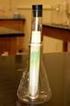
6 Experimental Protocol Materials Needed: *^Elodea () Glass test tubes () 50 ml beakers 10% Sodium bicarbonate solution *Tap water *Sunshine or bright light *Watch Permanent marker *You Must Provide ^Elodea is a common water plant that can be found at pet stores that sell aquatic supplies Procedure: 1. From your fresh elodea, cut two 5cm length pieces and place one into each test tube.. Using the permanent marker, label the test tubes 1 and. 3. Pour water into test tube 1 until it is completely full. Take a 50 ml beaker and turn it upside down so that the filled test tube is placed against the bottom of the beaker (Figure 19.4). Figure Carefully turn the test tube and beaker over without spilling any water or allowing any air to penetrate the test tube. 5. While you are still holding the test tube, quickly add 150 ml of water to the beaker containing the test tube.
7 6. As soon as the water is poured into the beaker you can let go of the test tube (Figure 19.5). Take note of the size of the bubble on the top of the test tube and carefully mark it on the test tube using a permanent marker. Note: your goal is to have the smallest bubble possible Figure Fill test tube to the top with the sodium bicarbonate solution. 5. Again take a 50 ml beaker, turn it over and place it on top of the test tube. As soon as that is stable, turn the test tube and beaker over. 6. Pour the remaining sodium bicarbonate solution into the beaker and then let go of the test tube. Take note of the size of the bubble on the top of the test tube and carefully mark it on the test tube with a permanent marker. Note: your goal is to have the smallest bubble possible 4. Using the utmost care, gently grasp a hold of one of the beaker and test tube combinations at a time and place them in the window sill or in front of a bright light. 5. Set your timer for hours. 6. After hours have passed, return to observe each test tube. Measure the distance from the previous mark made on the test tube to the current water level and record your results in Table Table 19.1 Elodea Lab (measured results) Test Tube 1 Test Tube Distance Traveled (mm)
8 Questions 1. Which test tube had a bigger bubble on the top before the experiment? After the experiment?. What do you hypothesize is causing the bubble at the top? 3. What role do you hypothesize the sodium bicarbonate played? 4. From what you know about plants, if we were to place one of the test tube and beaker combinations in front of a green light, what would happen? Light Independent Reaction After the light dependent reaction, the light independent reaction takes the products of hydrogen and oxygen, along with carbon dioxide, and converts them to carbohydrates and oxygen in a process known as the Calvin Cycle. The Calvin Cycle is composed of multiple reactions that link carbohydrates to ultimately form sucrose. Though we won t go into detail on this rather complex reaction, it is important to note that carbon fixation is the first step, which is then followed by the light independent reaction which yields sucrose. Though we ve seen in exercise 1 that a gas is produced while photosynthesis take place, it is not clear what type of gas it is. As you ve learned, plants take in carbon dioxide and release oxygen. To detect carbon fixation, or the depletion of CO, we will be use a ph indicator, phenol red, to detect CO levels. As CO is reduced and oxygen is produced, ph will rise and the solution will become more basic. As CO is produced and oxygen is depleted, ph drops and the solution becomes more acidic. Phenol red turns yellow if the solution is acidic (below ph 7) and red if it is basic (above ph 7).
9 Photosynthesis: Depletion of carbon dioxide Experimental Protocol Materials Needed: *Elodea Glass test tube 0 ml of Phenol red Straw Test tube rack Pipette *Water * You must provide Procedure: Carbon dioxide depletion by photosynthesis 1. Place a glass test tube in the test tube rack.. Using a pipette, add 0 ml of the phenol red solution to the test tube. 3. With your straw, blow bubbles over the top of the solution until it turns yellow (Figure 19.6). DO NOT insert the straw into the solution (keep it above the surface). Blowing on the surface adds CO to the solution. You should observe this as a color change (when the water in the phenol red solution and CO are combined, an acid is formed) DO NOT INHALE! This process is not quick. If you become light headed, take a break! Figure Cut 5 cm of fresh elodea and gently place it into the test tube. DO NOT touch the phenol red solution. 5. Place the test tube rack back into the sunshine or bright light and set your timer for one hour. Every 15 minutes record the color of the solution in Table 19. for one hour. Table 19. Time 0 min 15 min 30 min 45 min 60 min Color
10 Questions 1. What happened to the color of the solution over one hour?. What is the process that is occurring to make the phenol red solution change colors? 3. If we placed a green light in front of the test tube, do you think the results would be different? Why or why not? Additional Questions: 1. Some plants (grasses) tend to contain a greater concentration of chlorophyll than others (pines). Develop a hypothesis to explain this observation? Would it be testable?. Given what you now know about chloroplasts, pigments and wavelengths, consider trees whose leaves turn yellow in the fall. What is happening in the leaves at the cellular and molecular levels? 3. We have seen that chloroplasts are the organelles in plant cells that provide energy to the cell. The equivalent organelle in eukaryotic (animal) cells is the mitochondria. Both are unusual in that they have double membranes and contain their own set of DNA. Can you think of any explanations for this observation?
Metabolism: Cellular Respiration, Fermentation and Photosynthesis
 Metabolism: Cellular Respiration, Fermentation and Photosynthesis Introduction: All organisms require a supply of energy and matter to build themselves and to continue to function. To get that supply of
Unit 5 Photosynthesis and Cellular Respiration
 Unit 5 Photosynthesis and Cellular Respiration Advanced Concepts What is the abbreviated name of this molecule? What is its purpose? What are the three parts of this molecule? Label each part with the
Chloroplasts and Mitochondria
 Name: KEY Period: Chloroplasts and Mitochondria Plant cells and some Algae contain an organelle called the chloroplast. The chloroplast allows plants to harvest energy from sunlight to carry on a process
Teacher Demo: Photosynthesis and Respiration: Complementary Processes
 SNC1D/1P Sustainable Ecosystems/ Sustainable Ecosystems and Human Activity Teacher Demo: Photosynthesis and Respiration: Complementary Processes Topics photosynthesis and respiration gas tests for oxygen
Photosynthesis and Cellular Respiration. Stored Energy
 Photosynthesis and Cellular Respiration Stored Energy What is Photosynthesis? plants convert the energy of sunlight into the energy in the chemical bonds of carbohydrates sugars and starches. SUMMARY EQUATION:
Equation for Photosynthesis
 Photosynthesis Definition The process by which cells harvest light energy to make sugars (glucose). -Sugar is used to power the process of cellular respiration, which produces the ATP that cells utilize
1. f. Students know usable energy is captured from sunlight by chloroplasts and is stored through the synthesis of sugar from carbon dioxide.
 1. The fundamental life processes of plants and animals depend on a variety of chemical reactions that occur in specialized areas of the organism s cells. As a basis for understanding this concept: 1.
4.1 Chemical Energy and ATP. KEY CONCEPT All cells need chemical energy.
 4.1 Chemical Energy and ATP KEY CONCEPT All cells need chemical energy. 4.1 Chemical Energy and ATP Molecules in food store chemical energy in their bonds. Starch molecule Glucose molecule The chemical
Name Section Lab 5 Photosynthesis, Respiration and Fermentation
 Name Section Lab 5 Photosynthesis, Respiration and Fermentation Plants are photosynthetic, which means that they produce their own food from atmospheric CO 2 using light energy from the sun. This process
Name Class Date. Figure 8-1
 Chapter 8 Photosynthesis Chapter Test A Multiple Choice Write the letter that best answers the question or completes the statement on the line provided. 1. Which of the following is an autotroph? a. mushroom
8.2 Cells and Energy. What is photosynthesis? Photosynthesis takes place in the chloroplasts. CHAPTER 8. Solar cells and chloroplasts
 CHAPTER 8 CELL PROCESSES 8.2 Cells and Energy To stay alive, you need a constant supply of energy. You need energy to move, think, grow, and even sleep. Where does that energy come from? It all starts
Photosynthesis-Review. Pigments. Chloroplasts. Chloroplasts 5. Pigments are located in the thylakoid membranes. An Overview of Photosynthesis
 An Overview of Photosynthesis Photosynthesis-Review 1. Photosynthesis uses the energy of sunlight to convert water and carbon dioxide into high-energy sugars and oxygen. 6 CO 2 + 6 H 2 O C 6 H 12 O 6 +
Photosynthesis P P P. Autotrophs and Heterotrophs (page 201) Chemical Energy and ATP (pages 202 203) Chapter 8. Name Class Date
 Chapter 8 Photosynthesis Section 8 1 Energy and Life (pages 201 203) This section explains where plants get the energy they need to produce food. It also describes the role of the chemical compound ATP
A B C D. Name Class Date
 Chapter 8 Photosynthesis Chapter Test A Multiple Choice Write the letter that best answers the question or completes the statement on the line provided. 1. Which of the following is an autotroph? a. mushroom
Biology 20 Cellular Respiration Review NG Know the process of Cellular Respiration (use this picture if it helps):
 Biology 20 Cellular Respiration Review NG Know the process of Cellular Respiration (use this picture if it helps): 1) How many ATP molecules are produced for each glucose molecule used in fermentation?
Photosynthesis (Life from Light)
 Photosynthesis Photosynthesis (Life from Light) Energy needs of life All life needs a constant input of energy o Heterotrophs (consumers) Animals, fungi, most bacteria Get their energy from other organisms
2. 1. What are the three parts of an ATP molecule? (100 points)
 Photosynthesis Date Created: 12/8/14, 11:22:50 AM Questions: 34 Date Modified: 12/17/14, 8:27:08 AM 1. ATP & Photosynthesis Review Game 30 Multiple Choice Questions Final Question Correct Answers = +$100
Bioenergetics Module A Anchor 3
 Bioenergetics Module A Anchor 3 Key Concepts: - ATP can easily release and store energy by breaking and re-forming the bonds between its phosphate groups. This characteristic of ATP makes it exceptionally
Photosynthesis January 23 Feb 1, 2013 WARM-UP JAN 23/24. Mr. Stephens, IB Biology III 1
 WARM-UP JAN 23/24 Mr. Stephens, IB Biology III 1 Photosynthesis & Cellular Respiration What is the connection between Photosynthesis and Cellular Respiration? Energy Production Inorganic Molecules Specialized
CELL/ PHOTOSYNTHESIS/ CELLULAR RESPIRATION Test 2011 ANSWER 250 POINTS ANY WAY IN WHICH YOU WANT
 CELL/ PHOTOSYNTHESIS/ CELLULAR RESPIRATION Test 2011 ANSWER 250 POINTS ANY WAY IN WHICH YOU WANT Completion: complete each statement. (1 point each) 1. All cells arise from. 2. The basic unit of structure
Review Questions Photosynthesis
 Review Questions Photosynthesis 1. Describe a metabolic pathway. In a factory, labor is divided into small individual jobs. A carmaker, for example, will have one worker install the front windshield, another
8-3 The Reactions of Photosynthesis Slide 1 of 51
 8-3 The of Photosynthesis 1 of 51 Inside a Chloroplast Inside a Chloroplast In plants, photosynthesis takes place inside chloroplasts. Plant Chloroplast Plant cells 2 of 51 Inside a Chloroplast Chloroplasts
Photosynthesis 6CO 2 + 6H 2 O C 6 H 12 O 6 + 6O 2. An anabolic, endergonic, carbon dioxide (CO 2
 PHOTOSYNTHESIS Photosynthesis An anabolic, endergonic, carbon dioxide (CO 2 ) requiring process that uses light energy (photons) and water (H 2 O) to produce organic macromolecules (glucose). photons SUN
Ch. 4 ATP & Photosynthesis
 Name: Biology G Vocabulary Section 4.1 Ch. 4 ATP & Photosynthesis Period: ADP Adenosine Diphosphate ATP Adenosine Triphosphate Chemosynthesis Vocabulary Section 4.2 Photosynthesis Chlorophyll Thylakoid
Photosynthesis Practice. 2. Chlorophyll a and b absorb _B -_V and _R wavelengths of light best.
 Photosynthesis Practice Fill in the blanks. Name Date Period 1. Molecules that collect light energy are called _P. 2. Chlorophyll a and b absorb _B -_V and _R wavelengths of light best. 3. _C is the main
LAB #6 Photosynthesis and Cellular Respiration
 LAB #6 Photosynthesis and Cellular Respiration Introduction In order to survive, organisms require a source of energy and molecular building blocks to construct all of their biological molecules. The ultimate
PHOTOSYNTHESIS AND CELLULAR RESPIRATION
 reflect Wind turbines shown in the photo on the right are large structures with blades that move in response to air movement. When the wind blows, the blades rotate. This motion generates energy that is
Photosynthesis: Harvesting Light Energy
 Photosynthesis: Harvesting Light Energy Importance of Photosynthesis A. Ultimate source of energy for all life on Earth 1. All producers are photosynthesizers 2. All consumers and decomposers are dependent
Photosynthesis. Monday March 30. Announcements. Agenda
 Announcements Monday March 30 By the end of class today, I should be able to 1) Summarize Unit 6 learning targets 2) Identify the key structures involved in photosynthesis 3) Describe the process of photosynthesis
Name Date Class. energy phosphate adenine charged ATP chemical bonds work ribose
 Energy in a Cell Reinforcement and Study Guide Section.1 The Need for Energy In your textbook, read about cell energy. Use each of the terms below just once to complete the passage. energy phosphate adenine
Question. Which of the following are necessary in order for photosynthesis to occur? A. water B. light energy C. carbon dioxide D.
 Photosynthesis is the process through which plants convert light energy to chemical energy in order to produce food The energy involved in photosynthesis is eventually stored in the chemical bonds of molecules
Biology for Science Majors
 Biology for Science Majors Lab 10 AP BIOLOGY Concepts covered Respirometers Metabolism Glycolysis Respiration Anaerobic vs. aerobic respiration Fermentation Lab 5: Cellular Respiration ATP is the energy
Topic 3: Nutrition, Photosynthesis, and Respiration
 1. Base your answer to the following question on the chemical reaction represented below and on your knowledge of biology. If this reaction takes place in an organism that requires sunlight to produce
VII. NARRATION FOR PHOTOSYNTHESIS: TRANSFORMING LIGHT TO LIFE
 7. Why do leaves turn color in the fall? 8. How are photosystems I and II different? How are they related? 9. What is the source of energy for dark reactions? 10. Describe the C3 cycle. 11. What is the
Cellular Energy. 1. Photosynthesis is carried out by which of the following?
 Cellular Energy 1. Photosynthesis is carried out by which of the following? A. plants, but not animals B. animals, but not plants C. bacteria, but neither animals nor plants D. all living organisms 2.
Photosynthesis and Light in the Ocean Adapted from The Fluid Earth / Living Ocean Heather Spalding, UH GK-12 program
 Photosynthesis and Light in the Ocean Adapted from The Fluid Earth / Living Ocean Heather Spalding, UH GK-12 program Algae, like your Halimeda, and plants live in very different environments, but they
2. Which type of macromolecule contains high-energy bonds and is used for long-term energy storage?
 Energy Transport Study Island 1. During the process of photosynthesis, plants use energy from the Sun to convert carbon dioxide and water into glucose and oxygen. These products are, in turn, used by the
What is Photosynthesis? Measuring Air Pressure Inside an Active Photosynthetic System (Teacher s Guide)
 What is Photosynthesis? Measuring Air Pressure Inside an Active Photosynthetic System (Teacher s Guide) OVERVIEW After placing a photosynthetic organism inside a syringe, students will measure the air
Photosynthesis Chapter 8 E N E R G Y T O M A K E F O O D?
 Photosynthesis Chapter 8 H O W D O E S T H E P L A N T U S E T H E S U N S E N E R G Y T O M A K E F O O D? http://www.youtube.com/watch?v=pe82qtkssh4 Autotroph vs. Heterotroph Autotrophs/Producers-organisms
Jan Baptisa van Helmont (1648)
 Instructions To help you navigate these slides, you should set your viewer to display thumbnails of these slides. On many viewers, this can be done by pressing the F4 key. The slides should be viewed in
ATP & Photosynthesis Honors Biology
 ATP & Photosynthesis Honors Biology ATP All cells need for life. Some things we use energy for are: Moving Thinking Sleeping Breathing Growing Reproducing ENERGY Labeled Sketch: The principal chemical
Photosynthesis. Photosynthesis: Converting light energy into chemical energy. Photoautotrophs capture sunlight and convert it to chemical energy
 Photosynthesis: Converting light energy into chemical energy Photosynthesis 6 + 12H 2 O + light energy Summary Formula: C 6 H 12 O 6 + 6O 2 + 6H 2 O 6 + 6H 2 O C 6 H 12 O 6 + 6O 2 Photosythesis provides
Green pigment that absorbs solar energy and is important in photosynthesis
 PHOTOSYNTHESIS REVIEW SHEET FOR TEST Part A: Match the terms below with the correct description Chlorophyll Chloroplast Electromagnetic spectrum Electron transport chain Grana Light-dependant reactions
Photosynthesis Reactions. Photosynthesis Reactions
 Photosynthesis Reactions Photosynthesis occurs in two stages linked by ATP and NADPH NADPH is similar to NADH seen in mitochondria; it is an electron/hydrogen carrier The complete process of photosynthesis
* Is chemical energy potential or kinetic energy? The position of what is storing energy?
 Biology 1406 Exam 2 - Metabolism Chs. 5, 6 and 7 energy - capacity to do work 5.10 kinetic energy - energy of motion : light, electrical, thermal, mechanical potential energy - energy of position or stored
3. In what part of the chloroplast do the light-dependent reactions of photosynthesis take place? Chloroplast. Name Class Date
 The Chloroplast In plants, photosynthesis takes place in chloroplasts. Inside chloroplasts are saclike membranes called thylakoids. These thylakoids are arranged in stacks. A stack of thylakoids is called
A. Incorrect! No, while this statement is correct, it is not the best answer to the question.
 Biochemistry - Problem Drill 18: Photosynthesis No. 1 of 10 1. What is photosynthesis? Select the best answer. (A) Photosynthesis happens in the chloroplasts. (B) Light absorption by chlorophyll induces
MAIN SOURCE OF ENERGY FOR LIFE ON EARTH? THE SUN!!
 MAIN SOURCE OF ENERGY FOR LIFE ON EARTH? THE SUN!! THE BASICS OF PHOTOSYNTHESIS Almost all plants are photosynthetic autotrophs, as are some bacteria and protists Autotrophs generate their own organic
Biology Slide 1 of 51
 Biology 1 of 51 8-3 The Reactions of Photosynthesis 2 of 51 Inside a Chloroplast 1. In plants, photosynthesis takes place inside chloroplasts. Plant Chloroplast Plant cells 3 of 51 Inside a Chloroplast
2. PHOTOSYNTHESIS. The general equation describing photosynthesis is light + 6 H 2 O + 6 CO 2 C 6 H 12 O 6 + 6 O 2
 2. PHOTOSYNTHESIS Photosynthesis is the process by which light energy is converted to chemical energy whereby carbon dioxide and water are converted into organic molecules. The process occurs in most algae,
Biology I. Chapter 8/9
 Biology I Chapter 8/9 NOTEBOOK #1 Interest Grabber Suppose you earned extra money by having a part-time job. At first, you might be tempted to spend all of the money, but then you decide to open a bank
reflect look out! organisms: living things
 reflect Imagine that a student in your school fell down and is having difficulty breathing. Sirens wail as an ambulance pulls into the school parking lot. The emergency workers rush over to help the student.
Today you need: your notebook, pen or pencil, textbook,worksheet
 Cellular Energy Objectives Students will review plant/ animal cells and prokaryote/eukaryote Students will draw and label a diagram of the cell energy cycles. Students will compare and contrast autotrophs
2. What kind of energy is stored in food? A. chemical energy B. heat energy C. kinetic energy D. light energy
 Assessment Bank Matter and Energy in Living Things SC.8.L.18.4 1. What is energy? A. anything that takes up space B. anything that has mass C. the ability to conduct current D. the ability to do work 2.
Cell. (1) This is the most basic unit of life inside of our bodies.
 Cytology Overview Cell (1) This is the most basic unit of life inside of our bodies. ATP (2) Each of our cell s requires energy in order to carry out its day to day func>ons. This is the energy all cells
pathway that involves taking in heat from the environment at each step. C.
 Study Island Cell Energy Keystone Review 1. Cells obtain energy by either capturing light energy through photosynthesis or by breaking down carbohydrates through cellular respiration. In both photosynthesis
Biology. Slide 1of 51. End Show. Copyright Pearson Prentice Hall
 Biology 1of 51 8-3 The Reactions of Photosynthesis 2of 51 Inside a Chloroplast Inside a Chloroplast In plants, photosynthesis takes place inside chloroplasts. Plant Chloroplast Plant cells 3of 51 Inside
Chapter 9 Review Worksheet Cellular Respiration
 1 of 5 11/9/2011 8:11 PM Name: Hour: Chapter 9 Review Worksheet Cellular Respiration Energy in General 1. Differentiate an autotroph from a hetertroph as it relates to obtaining energy and the processes
-Loss of energy -Loss of hydrogen from carbons. -Gain of energy -Gain of hydrogen to carbons
 Cellular Respiration- Equation C6H12O6 + 6O2 6CO2 +6H20 and energy -The energy is released from the chemical bonds in the complex organic molecules -The catabolic process of releasing energy from food
PLANT PHYSIOLOGY. Az Agrármérnöki MSc szak tananyagfejlesztése TÁMOP-4.1.2-08/1/A-2009-0010
 PLANT PHYSIOLOGY Az Agrármérnöki MSc szak tananyagfejlesztése TÁMOP-4.1.2-08/1/A-2009-0010 The light reactions of the photosynthesis Photosynthesis inhibiting herbicides Overview 1. Photosynthesis, general
Lecture 7 Outline (Ch. 10)
 Lecture 7 Outline (Ch. 10) I. Photosynthesis overview A. Purpose B. Location II. The light vs. the dark reaction III. Chloroplasts pigments A. Light absorption B. Types IV. Light reactions A. Photosystems
Chapter 4. Photosynthesis and Cellular Respiration Worksheets. 63 www.ck12.org
 Chapter 4 Photosynthesis and Cellular Respiration Worksheets (Opening image copyright by Derek Ramsey, http://en.wikipedia.org/wiki/file:monarch_butterfly_ Danaus_plexippus_Feeding_Down_3008px.jpg, and
Photosynthesis. Chemical Energy (e.g. glucose) - They are the ultimate source of chemical energy for all living organisms: directly or indirectly.
 Photosynthesis Light Energy transduction Chemical Energy (e.g. glucose) - Only photosynthetic organisms can do this (e.g. plants) - They are the ultimate source of chemical energy for all living organisms:
While reading these chapters, constantly ask yourself, How is this information helping me to understand how cells get energy from food?
 Biology 160 Reading Guide 07: Photosynthesis NAME: This is DUE: Come prepared to share your findings with your group. ** Fill this reading guide out as you are reading the chapters. This will help you
Photosynthesis. Name. Light reactions Calvin cycle Oxidation Reduction Electronegativity Photosystem Electron carrier NADP+ Concentration gradient
 Vocabulary Terms Photoautotroph Chemoautotroph Electromagnetic spectrum Wavelength Chloroplast Thylakoid Stroma Chlorophyll Absorption spectrum Photosynthesis Light reactions Calvin cycle Oxidation Reduction
Using Spectrophotometers to Examine Photosynthetic Rates Under Various Qualities of Light
 Purdue GK-12 Lesson Plan 2006-07 Using Spectrophotometers to Examine Photosynthetic Rates Under Various Qualities of Light Purdue University GK-12 2006-2007 Lead developer and contact: Amanda Deering Purdue
AP Bio Photosynthesis & Respiration
 AP Bio Photosynthesis & Respiration Multiple Choice Identify the letter of the choice that best completes the statement or answers the question. 1. What is the term used for the metabolic pathway in which
Name Date Period PHOTOSYNTHESIS HW REVIEW ENERGY AND LIFE
 1 Name Date Period PHOTOSYNTHESIS HW REVIEW ENERGY AND LIFE MULTIPLE CHOICE: CIRCLE ALL THE ANSWERS THAT ARE TRUE. THERE MAY BE MORE THAN ONE CORRECT ANSWER! 1. Which molecule stores more than 90 times
4.2 Overview of Photosynthesis
 KEY CONCEPT The overall process of photosynthesis produces sugars that store chemical energy. Radiant Energy Chemical Energy A. Organisms are classified according to how they obtain energy. 1. Autotroph/Producers
CHAPTER 6: PHOTOSYNTHESIS CAPTURING & CONVERTING ENERGY
 CHAPTER 6: PHOTOSYNTHESIS CAPTURING & CONVERTING ENERGY 2 PROCESSES OF PHOTOSYNTHESIS Photosynthesis is actually 2 processes: light reactions - convert solar energy (sunlight) to chemical energy (ATP &
Photo Cell Resp Practice. A. ATP B. oxygen C. DNA D. water. The following equation represents the process of photosynthesis in green plants.
 Name: ate: 1. Which molecule supplies the energy for cellular functions?. TP. oxygen. N. water 2. Photosynthesis The following equation represents the process of photosynthesis in green plants. What happens
Evolution of Metabolism. Introduction. Introduction. Introduction. How Cells Harvest Energy. Chapter 7 & 8
 How ells Harvest Energy hapter 7 & 8 Evolution of Metabolism A hypothetical timeline for the evolution of metabolism - all in prokaryotic cells!: 1. ability to store chemical energy in ATP 2. evolution
Photosynthesis Part I: Overview & The Light-Dependent Reactions
 Photosynthesis Part I: Overview & The Light-Dependent Reactions Photosynthesis: The BIG Picture Photosynthesis is the process by which PHOTOAUTOTROPHS convert the energy in SUNLIGHT into the energy stored
EFFECT OF ALCOHOL ON CELL MEMBRANES
 EFFECT OF ALCOHOL ON CELL MEMBRANES LAB CELL 1 INTRODUCTION A eukaryotic cell, a cell with a nucleus, not only has a plasma membrane as its external boundary, but it also has a variety of membranes that
> C 6 H 12 O 6 + 6O 2
 Photosynthesis- is the process that converts light energy into chemical energy. This chemical energy is usually a carbohydrate. Only photoautrotrops can do photosynthesis. Heterotrophs must obtain their
Like The Guy From Krypton Photosynthesis: Energy from Sunlight What Is Photosynthesis?
 Like The Guy From Krypton Photosynthesis: Energy from Sunlight What Is Photosynthesis? Photosynthesis: synthesis from light The broad outline: Plants take in CO 2 and release water and O 2 Light is required
Enzyme Pre-Lab. Using the Enzyme worksheet and Enzyme lab handout answer the Pre-Lab questions the pre-lab must be complete before beginning the lab.
 Enzyme Pre-Lab Using the Enzyme worksheet and Enzyme lab handout answer the Pre-Lab questions the pre-lab must be complete before beginning the lab. Background: In this investigation, you will study several
Lab 2 Biochemistry. Learning Objectives. Introduction. Lipid Structure and Role in Food. The lab has the following learning objectives.
 1 Lab 2 Biochemistry Learning Objectives The lab has the following learning objectives. Investigate the role of double bonding in fatty acids, through models. Developing a calibration curve for a Benedict
Keystone Review Practice Test Module A Cells and Cell Processes. 1. Which characteristic is shared by all prokaryotes and eukaryotes?
 Keystone Review Practice Test Module A Cells and Cell Processes 1. Which characteristic is shared by all prokaryotes and eukaryotes? a. Ability to store hereditary information b. Use of organelles to control
Cell Biology Prokaryotic and eukaryotic cells
 Cell Biology Prokaryotic and eukaryotic cells Observation of cells and organelles In this lab you will be looking at an example of a Prokaryotic cell (Bacillus cereus) and a some examples of Eukaryotic
CELERY LAB - Structure and Function of a Plant
 CELERY LAB - Structure and Function of a Plant READ ALL INSTRUCTIONS BEFORE BEGINNING! YOU MAY WORK WITH A PARTNER ON THIS ACTIVITY, BUT YOU MUST COMPLETE YOUR OWN LAB SHEET! Plants are incredible organisms!
CHEMICAL DETERMINATION OF EVERYDAY HOUSEHOLD CHEMICALS
 CHEMICAL DETERMINATION OF EVERYDAY HOUSEHOLD CHEMICALS Purpose: It is important for chemists to be able to determine the composition of unknown chemicals. This can often be done by way of chemical tests.
OBJECTIVES PROCEDURE. Lab 2- Bio 160. Name:
 Lab 2- Bio 160 Name: Prokaryotic and Eukaryotic Cells OBJECTIVES To explore cell structure and morphology in prokaryotes and eukaryotes. To gain more experience using the microscope. To obtain a better
AP Biology 2013 Free-Response Questions
 AP Biology 2013 Free-Response Questions About the College Board The College Board is a mission-driven not-for-profit organization that connects students to college success and opportunity. Founded in 1900,
Sugar Makers. Real-world Connection: Energy harnessed by photosynthesis powers ecosystems, machines, and even our own bodies.
 Sugar Makers Principle of Plant Biology #1 Plants contain the same biological processes and biochemistry as microbes and animals. However, plants are unique in that they have the ability to use energy
DISCOVERING PHOTOSYNTHESIS BY EXPERIMENTS
 DISCOVERING PHOTOSYNTHESIS BY EXPERIMENTS Cristina IANCU, Claudia G. CHILOM Faculty of Physics, University of Bucharest e-mail:[email protected] The receipt date: March, 26, 2015 Abstract. By photosynthesis,
LAB TOPIC 4: ENZYMES. Enzyme catalyzed reactions can be expressed in the following way:
 LAB TOPIC 4: ENZYMES Objectives Define enzyme and describe the activity of enzymes in cells. Discuss the effects of varying enzyme concentrations on the rate of enzyme activity. Discuss the effects of
Diffusion, Osmosis, and Membrane Transport
 Diffusion, Osmosis, and Membrane Transport Introduction... 2 Diffusion and osmosis as related to cellular processes... 2 The hotter the medium, the faster the molecules diffuse... 2 TASK 1: TEMPERATURE
Photosynthesis/Respiration in Leaf Disks
 347 Volume 25: Mini Workshops Photosynthesis/Respiration in Leaf Disks Ruthanne B. Pitkin Biology Department Shippensburg University Shippensburg, PA 17257 717-477-1752 Fax: 717-477-4064 [email protected]
Separation and Identification of Plant Pigments Dr. Gergens - SD Mesa College
 Separation and Identification of Plant Pigments Dr. Gergens - SD Mesa College PURPOSE In this experiment, the photosynthetic pigments common to all flowering plants will be extracted by liquidliquid extraction.
BACKGROUND (continued)
 BACKGROUND (continued) A cell must exchange materials with its surroundings, a process controlled by the plasma membrane. Plasma membranes are selectively permeable, regulating the cell s molecular traffic:
ANALYSIS OF PLANT PIGMENTS USING PAPER CHROMATOGRAPHY AND VISIBLE AND/OR UV SPECTROSCOPY (1-31-96)
 ANALYSIS OF PLANT PIGMENTS USING PAPER CHROMATOGRAPHY AND VISIBLE AND/OR UV SPECTROSCOPY (1-31-96) INTRODUCTION We have seen that all cells must constantly consume fuel molecules to maintain themselves,
8.3 The Process of Photosynthesis
 8.3 The Process of Photosynthesis Lesson Objectives Describe what happens during the light-dependent reactions. Describe what happens during the light-independent reactions. Identify factors that affect
CELERY LAB - Structure and Function of a Plant
 CELERY LAB - Structure and Function of a Plant READ ALL INSTRUCTIONS BEFORE BEGINNING! YOU MAY WORK WITH A PARTNER ON THIS ACTIVITY, BUT YOU MUST COMPLETE YOUR OWN LAB SHEET! Look at the back of this paper
SOME Important Points About Cellular Energetics by Dr. Ty C.M. Hoffman
 SOME Important Points About Cellular Energetics by Dr. Ty C.M. Hoffman An Introduction to Metabolism Most biochemical processes occur as biochemical pathways, each individual reaction of which is catalyzed
EFFECT OF SALT ON CELL MEMBRANES
 EFFECT OF SALT ON CELL MEMBRANES LAB CELL 2 INTRODUCTION A eukaryotic cell, a cell with a nucleus, not only has a plasma membrane as its external boundary, but it also has a variety of membranes that divide
Respiration and Photosynthesis
 Respiration and Photosynthesis Topic Plants and animals carry out cellular respiration, but only plants conduct photosynthesis. Introduction Cellular respiration is the process in which a cell uses oxygen
THE ACTIVITY OF LACTASE
 THE ACTIVITY OF LACTASE Lab VIS-8 From Juniata College Science in Motion Enzymes are protein molecules which act to catalyze the chemical reactions in living things. These chemical reactions make up the
TEACHER ACTIVITY GUIDE
 Page 1/5 TEACHER ACTIVITY GUIDE EFFECT OF HEAT & ph ON COLOR & TEXTURE OF GREEN VEGETABLES Taken from IFT Experiments in Food Science Series Color plays a key role in establishing consumer acceptability
Chapter 10: Photosynthesis
 Name Period Chapter 10: Photosynthesis This chapter is as challenging as the one you just finished on cellular respiration. However, conceptually it will be a little easier because the concepts learned