
DIFFRACTION GRATINGS AND SPECTROSCOPY
|
|
|
- Hester Warner
- 9 years ago
- Views:
Transcription
1 Experiment 8 Name: S.N.: SECTION: PARTNER: DATE: DIFFRACTION GRATINGS AND SPECTROSCOPY Objectives To introduce and calibrate a diffraction grating, and use it to examine several types of spectra. To learn how to use a Vernier scale. To learn to use a grating spectrometer. To measure the wavelength of spectral lines of Na and H. Diffraction Gratings: In the previous lab you found that light shining through a double slit produced a central bright spot with alternating dark and bright spots on either side. The angle! between the central bright spot and the center of the bright spots of light on either side of the central spot is given by dsin! = m". d is the distance between slits, m is an integer that identifies the m th intensity maximum on either side of the central maximum, and " is the wavelength of the light. If you have more slits, all spaced d apart, the angles to principal maxima will remain the same regardless of the number of slits as long as d remains the same. What will change is the shape of the intensity pattern; see figure at right. With more slits, the bright spots get narrower and secondary maxima in between the bright spots get more numerous and fainter. Eventually only the bright, sharp principal maxima can be seen. A diffraction grating has a large number of slits, often 10,000 or more, that are very close together. Each intensity maximum or order is very narrow and intense. Diffraction gratings rely on both interference and diffraction: diffraction to bend the light away from the straight-line path, and interference to make very bright spots where the path length from each neighboring slit differs by exactly m wavelengths, so the individual wave disturbances add constructively. IN WHAT FOLLOWS, MAKE SURE LASERS ARE TURNED OFF EXCEPT WHEN IN USE. NEVER POINT LASERS AT ANYONE, AND NEVER LOOK DIRECTLY INTO LASER BEAMS. Fig. 8.1 He-Ne Laser with diffraction grating. 119LAB8-GRATINGS.DOC
2 Set up the optical bench, laser, diffraction grating and large white board as shown in Fig The component carrier with the diffraction grating should be located so that the locating edge is 25.0cm from the end of the bench. Tape a piece of paper to the wood screen, and then place the base of the screen in contact with the end of the optical bench. The surface of the screen should be perpendicular to the bench. Note: If the laser, grating, and screen are not oriented correctly, there can be a significant error in your measurement of the angle from the central maximum to the higher order maxima. You can eliminate almost all of this error by taking the average of the distances from the central maximum to the maxima on the left and on the right. 1. Measure the distance D from the diffraction rulings to the screen surface and record it below. D = ± mm 2. Mark on the paper the location of the central maximum and the location of the first two maxima (orders m = 1 and 2) to the right and left of the central one. Measure the distance between the two first-order maxima 2x 1 and the distance between the two second-order maxima 2x 2. Use these measurements, the measurement of D and the wavelength of the laser, nm, to calculate the sine of the diffraction angles for the two maxima and the slit separation d for the diffraction grating. Compare your values to the one derived from the nominal slit linear density of 300 lines/mm. Show your work. 2x 1 = ± mm 2x 2 = ± mm sin! 1 = ± sin! 2 = ± d = ± mm d = ± mm Average d = ± mm 119LAB8-GRATINGS.DOC
3 Figure 8-2. White light source with diffraction grating. Remove the laser. Set the white light source on the end of the optical bench as shown in Fig Center the light source in the opening at the end of the source enclosure and place the SLIT PLATE directly on the end of the light source. Center the SLIT PLATE so that a beam of light travels down the center of the optical bench. Remove the diffraction grating and center the PARALLEL RAY LENS on the bench. Move the PARALLEL RAY LENS along the bench until the central beam is focused on the screen. Reposition the diffraction grating 25.0 cm from the end of the bench as you had it in Describe the pattern you see on the screen. Include the order of the colors in your description. 4. Measure the distance 2x 1 (red) between the extreme outer edges of the spectrum in first order. Measure the distance 2x 1 (violet) between the extreme inner edge of the spectrum in first order. Use your value of d from 2 to calculate the wavelength " red of the extreme red edge of the spectrum and the wavelength " violet of the extreme violet edge of the spectrum. Show your work. Comment on the consistency of these wavelengths with the usually quoted extent of the visible spectrum, 400nm to 750nm. distance from the grating to the screen D = ± mm 2x 1 (red) = ± mm 2x 1 (violet) = ± mm " 1 (red) = ± nm " 1 (violet) = ± nm TA initials AT THIS POINT TURN ON THE SODIUM LAMP. IT WILL TAKE 10 MINUTES OR LONGER TO REACH A BRIGHT YELLOW COLOR. 119LAB8-GRATINGS.DOC
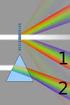
4 Spectroscopy: In part 3 you saw that, since diffraction gratings bend light of different wavelengths at different angles, they can be used to separate white light into a spectrum of different colors. So far you have looked at laser light, which contains just one wavelength, and visible white light, which contains a range of wavelengths. The pattern produced by shining a beam of white light through a diffraction grating is called a continuous spectrum. You can see other kinds of spectra by looking at the light emitted or absorbed by atoms. If you look at the spectrum of light emitted by a heated gas of atoms, you will see an emission spectrum. This often consists of a few bright lines at specific wavelengths and no light at other wavelengths. These bright lines are produced by electrons in the atoms radiating quanta with energies that correspond to the lines. Isolated atoms cannot store internal energy in arbitrary amounts, but only in discrete, quantized amounts. An absorption spectrum is a continuous spectrum with a few dark lines where quanta corresponding to the dark lines have been absorbed by the same atoms responsible for the bright lines. 5. Use your diffraction grating to look at the emission spectra produced by the sodium lamp and the hydrogen lamp. Then look at the fluorescent light inside a box with a slit, which should contain some combination of the three kinds of spectra discussed above, i.e. emission line, emission continuum, and absorption line. Which kinds do you see? Optical Spectrometer We will use the Model P67000 Intermediate Spectrometer to measure the yellow wavelengths emitted by a sodium (Na) lamp and three wavelengths emitted by a hydrogen (H) lamp. Please put away the optical benches and all the components before using the spectrometer. The principal parts of the spectrometer are: 1) an adjustable-width slit that is illuminated with the light for which a spectrum is to be measured, 2) a collimator that focuses the light from the slit so that it becomes parallel (the slit is at the focal point of the collimator), 3) a diffraction grating, 4) a viewing telescope that focuses the parallel light from the grating onto a reticle (a glass disk on which a pattern of lines has been inscribed) and 5) an eyepiece with which to view the image of the slit focused on the reticle. Please do not turn the slit screw with any force! It is very easy to break! Be gentle with it! ALIGNING THE SPECTROMETER The major part of the alignment of the spectrometer should have been done before you came to the lab. If something seems out of alignment, consult your TA. The spectrometer is provided with a large number of adjustments. Leave these as you find them or risk a lengthy alignment procedure. Four of the adjustments you will need to use are color-coded and the two others are easily described. Locate the red, yellow, green and blue color-coded screws first. Setting the divided circle, the vernier and the telescope. A. Loosen the four color-coded screws. Rotate the telescope until it is approximately at zero degrees on the outer divided circle, and then tighten the green screw. This will lock the telescope to the divided circle. B. Rotate the inner platform with the vernier scales until one of the vernier scales is at about 50. Tighten the blue screw. This locks the position of the verniers relative to the divided circle. This position is chosen to facilitate reading the diffraction angles. It can be changed if you like, but do not change it once measurements are started. You should now be able to rotate the telescope by hand to any desired angle and read the angle with the outer divided circle and the vernier scale. 119LAB8-GRATINGS.DOC
5 C. Later, when you have the telescope in a position such that a line is near the vertical crosshair, tighten the red screw and use the yellow screw to make fine angle adjustments. Setting the light source, slit width and eyepiece focus D. With no grating in place, set the spectrometer close to the edge of the table with the slit end away from the edge. Cover the round opening in the Na lamp with a diffuser glass and a vertical rectangular metal slit. Move the Na lamp and/or the spectrometer so it is close to and aligned with the slit of the spectrometer and axis of the collimator tube. E. Adjust the slit width with the knurled knob near the slit until the slit is several times its smallest width. Turn the large knurled knob at the end of the telescope until the slit image is in sharp focus. The crosshairs should also be in sharp focus. If not, consult your TA. Installing the diffraction grating and reading the telescope angle. F. Put the 300 line/mm grating in the slotted base and place base and grating on the grating table. Adjust the grating to be as perpendicular to the incoming collimated light as you can. The grating assembly is free to move on the table. Take care not to disturb it during the course of measurements on a spectrum or you will have to start over! 6. Read the telescope angle with the slit image centered in the eyepiece and record it in the Table below. Move the telescope until the line is nearly in the center of the field of view, and then tighten the red screw. Use the fine adjustment yellow screw to center the crosshairs on the line. How to read a Vernier Scale. Your spectrometer is capable of very precise angle readings. It includes a clever method for making it easier to read the angle setting precisely, called the Vernier scale. a. The divided-circle scale is calibrated in degrees, with numbers every 10 degrees. The smallest marked interval is half a degree. b. There are 60 minutes of arc in a degree, so half a degree is 30 minutes. (Astronomers even subdivide the minute into 60 seconds of arc ). c. The movable Vernier scale is placed alongside the circle scale, but its markings are slightly closer together than the circle scale. 31 marks on the Vernier scale fit in the same space as 30 marks on the circle scale. This trick provides a way to subdivide, or interpolate, the circle scale marks to an accuracy of 1/30 of the smallest circle scale interval! So, each mark on the Vernier scale is 1 minute. (If you don t quite see how it works, it is ok just to learn the rule for reading it.) d. Make a rough reading of the angle setting, using the index marked 0 on the Vernier scale. In the figure it rests between 120 o 30 and 121 o. If you have a good eye, you can see it is actually about halfway between those marks, so you would add another 30/2 = 15 to the reading and estimate 120 o 45. e. Now look at the Vernier scale. The eleventh or perhaps twelfth mark lines up with a mark on the circle scale. That tells us the exact number of extra minutes to add to the 30 we got from the rough reading, and gives us the final answer, 120 o 41. This is more accurate than the estimate from the index mark alone. f. To do calculations, you need to convert to decimal fractions of degrees: 120 o 41 = 120 o + 41/60 = degrees. 119LAB8-GRATINGS.DOC
6 Figure 8.3 How to read the Vernier Scale Measuring the Sodium Line 8. Adjust the slits until a narrow line is obtained and move the telescope to the right and center the first order yellow line in the field of view. You may be able to see that the line is actually two lines very close together (this will be easier to see in 2 nd order). The longer wavelength ["(D 1 ) = nm] line (it has the larger diffraction angle) is commonly called the D 1 line of the Na doublet. The other line is called D 2 ["(D 2 ) = nm]. Record the angle for the D 1 member of the doublet in the row labeled 1 st order, D 1 right in the Table below. 9. Move the telescope to the left and record the angle for the D 1 -left line in first order. 10. Repeat the right and left measurements for 2 nd and 3 rd orders for D 1 and record them in the table. You may need to refocus the eyepiece in the higher orders if the slit image is not sharp. 11. Complete the table by first calculating 1/2 the angular separation of D 1 in three orders. Use these values in the expression dsin! = n" to calculate 1/d, the number of lines per millimeter in the grating. Estimate the uncertainty in 1/d from the uncertainty #(1/2 angular separation). 1 st order 1/d = ± lines/mm 2 nd order 1/d = ± lines/mm 3 rd order 1/d = ± lines/mm 119LAB8-GRATINGS.DOC
7 Order Line Angle #(Angle) 1/2 Angular Separation #(1/2 Angular Separation) (1/d) lines/mm 0 th order yellow 1 st order D 1 - right D 1 - left 2 nd order D 1 - right D 1 - left 3 rd order D 1 -right D 1 - left TA initials 12. Calculate the mean of the three values of 1/d and the uncertainty in the mean. Comment on the consistency of your values. Are they as equal as you might expect them to be? If not, what experimental problems may have led to the inconsistency? (1/d) mean = ± lines/mm Comment: 13. Compare (1/d) mean to the value you obtain from 2. TA initials 119LAB8-GRATINGS.DOC
8 14. Devise a method for measuring the wavelength separation $" of the two D lines. Record your data below and use it to determine $" and its uncertainty. Compare your value to the accepted value. $" = ± nm 15. Replace the Na lamp with a hydrogen lamp (H-lamp, black vertical narrow box). Take care not to move the spectrometer or the grating. Use blocks of wood to raise the lamp, if necessary. Turn on the lamp and measure the zero angle (alignment angle) and the angles at which the three easiest-to-see spectral lines are found in first order. You will have to adjust the position of the hydrogen lamp very carefully and you may have to open the slit a bit to see the lines.!(0 ) = 1 st order red line! = blue-green line! = violet line! = 16. How many orders can you see for each color? Is there a case where you see the short wavelengths of a higher order before you see the long wavelengths of a lower order? Describe your observations. 17. By the same technique you used to measure the Na lines, measure the positions of the three H lines in first or second order (say which you use) and calculate their wavelengths using your measured value of (1/d) mean. Order line Left/Right! " red blue-green violet L R L R L R 119LAB8-GRATINGS.DOC
9 18. Find the best values for the wavelengths of the three lines and record them below with their uncertainties. Compare (7.1) them to the values listed below. "(red) = nm "( blue-green) = nm "(violet) = nm red " = ± nm blue-green " = ± nm violet " = ± nm These spectral lines belong to the famous Balmer series, in which electrons decay to the first excited electronic level of the H-atom from higher excited states. Decays to the lowest level (ground state) give the Lyman series. All the Lyman series wavelengths are in the ultraviolet range of wavelengths (the longest wavelength in the series is called Lyman % and has a wavelength of " = nm). Radiation of such short wavelengths does not penetrate the glass envelope of the lamp. Decays to the third excited state give rise to the Paschen series. All the wavelengths in this series are in the infrared (the shortest wavelength is " = nm) and are not visible. 119LAB8-GRATINGS.DOC
ATOMIC SPECTRA. Apparatus: Optical spectrometer, spectral tubes, power supply, incandescent lamp, bottles of dyed water, elevating jack or block.
 1 ATOMIC SPECTRA Objective: To measure the wavelengths of visible light emitted by atomic hydrogen and verify the measured wavelengths against those predicted by quantum theory. To identify an unknown
WAVELENGTH OF LIGHT - DIFFRACTION GRATING
 PURPOSE In this experiment we will use the diffraction grating and the spectrometer to measure wavelengths in the mercury spectrum. THEORY A diffraction grating is essentially a series of parallel equidistant
THE BOHR QUANTUM MODEL
 THE BOHR QUANTUM MODEL INTRODUCTION When light from a low-pressure gas is subject to an electric discharge, a discrete line spectrum is emitted. When light from such a low-pressure gas is examined with
O6: The Diffraction Grating Spectrometer
 2B30: PRACTICAL ASTROPHYSICS FORMAL REPORT: O6: The Diffraction Grating Spectrometer Adam Hill Lab partner: G. Evans Tutor: Dr. Peter Storey 1 Abstract The calibration of a diffraction grating spectrometer
Experiment #12: The Bohr Atom. Equipment: Spectroscope Hydrogen and Helium Gas Discharge Tubes, Holder, and Variac Flashlight
 Experiment #12: The Bohr Atom Purpose: To observe the visible spectrum of hydrogen and helium and verify the Bohr model of the hydrogen atom. Equipment: Spectroscope Hydrogen and Helium Gas Discharge Tubes,
GRID AND PRISM SPECTROMETERS
 FYSA230/2 GRID AND PRISM SPECTROMETERS 1. Introduction Electromagnetic radiation (e.g. visible light) experiences reflection, refraction, interference and diffraction phenomena when entering and passing
Interference. Physics 102 Workshop #3. General Instructions
 Interference Physics 102 Workshop #3 Name: Lab Partner(s): Instructor: Time of Workshop: General Instructions Workshop exercises are to be carried out in groups of three. One report per group is due by
6) How wide must a narrow slit be if the first diffraction minimum occurs at ±12 with laser light of 633 nm?
 Test IV Name 1) In a single slit diffraction experiment, the width of the slit is 3.1 10-5 m and the distance from the slit to the screen is 2.2 m. If the beam of light of wavelength 600 nm passes through
AP Physics B Ch. 23 and Ch. 24 Geometric Optics and Wave Nature of Light
 AP Physics B Ch. 23 and Ch. 24 Geometric Optics and Wave Nature of Light Name: Period: Date: MULTIPLE CHOICE. Choose the one alternative that best completes the statement or answers the question. 1) Reflection,
From lowest energy to highest energy, which of the following correctly orders the different categories of electromagnetic radiation?
 From lowest energy to highest energy, which of the following correctly orders the different categories of electromagnetic radiation? From lowest energy to highest energy, which of the following correctly
Theremino System Theremino Spectrometer Technology
 Theremino System Theremino Spectrometer Technology theremino System - Theremino Spectrometer Technology - August 15, 2014 - Page 1 Operation principles By placing a digital camera with a diffraction grating
Atoms Absorb & Emit Light
 Atoms Absorb & Emit Light Spectra The wavelength of the light that an element emits or absorbs is its fingerprint. Atoms emit and absorb light First Test is Thurs, Feb 1 st About 30 multiple choice questions
How To Understand Light And Color
 PRACTICE EXAM IV P202 SPRING 2004 1. In two separate double slit experiments, an interference pattern is observed on a screen. In the first experiment, violet light (λ = 754 nm) is used and a second-order
EXPERIMENT O-6. Michelson Interferometer. Abstract. References. Pre-Lab
 EXPERIMENT O-6 Michelson Interferometer Abstract A Michelson interferometer, constructed by the student, is used to measure the wavelength of He-Ne laser light and the index of refraction of a flat transparent
Building your own Spectroscope
 Building your own Spectroscope 0-0.341-0.445-0.606-0.872-1.36 Lyman Balmer Paschen n=4 n=8 n=7 n=6 n=5 n=4 ENERGY/10-19 J -2.42-5.45 E 5 2 E 4 2 E 3 2 E E 5 3 4 3 n=3 n=2 (Many other transitions beyond
1 Laboratory #5: Grating Spectrometer
 SIMG-215-20061: LABORATORY #5 1 Laboratory #5: Grating Spectrometer 1.1 Objective: To observe and measure the spectra of different light sources. 1.2 Materials: 1. OSA optics kit. 2. Nikon digital camera
Experiment #5: Qualitative Absorption Spectroscopy
 Experiment #5: Qualitative Absorption Spectroscopy One of the most important areas in the field of analytical chemistry is that of spectroscopy. In general terms, spectroscopy deals with the interactions
P R E A M B L E. Facilitated workshop problems for class discussion (1.5 hours)
 INSURANCE SCAM OPTICS - LABORATORY INVESTIGATION P R E A M B L E The original form of the problem is an Experimental Group Research Project, undertaken by students organised into small groups working as
Diffraction of Laser Light
 Diffraction of Laser Light No Prelab Introduction The laser is a unique light source because its light is coherent and monochromatic. Coherent light is made up of waves, which are all in phase. Monochromatic
Study Guide for Exam on Light
 Name: Class: Date: Study Guide for Exam on Light Multiple Choice Identify the choice that best completes the statement or answers the question. 1. Which portion of the electromagnetic spectrum is used
PHYS 222 Spring 2012 Final Exam. Closed books, notes, etc. No electronic device except a calculator.
 PHYS 222 Spring 2012 Final Exam Closed books, notes, etc. No electronic device except a calculator. NAME: (all questions with equal weight) 1. If the distance between two point charges is tripled, the
Austin Peay State University Department of Chemistry Chem 1111. The Use of the Spectrophotometer and Beer's Law
 Purpose To become familiar with using a spectrophotometer and gain an understanding of Beer s law and it s relationship to solution concentration. Introduction Scientists use many methods to determine
What s in the Mix? Liquid Color Spectroscopy Lab (Randy Landsberg & Bill Fisher)
 What s in the Mix? Liquid Color Spectroscopy Lab (Randy Landsberg & Bill Fisher) Introduction: There is more to a color than a name. Color can tell us lots of information. In this lab you will use a spectrophotometer
Name Date Class ELECTRONS IN ATOMS. Standard Curriculum Core content Extension topics
 13 ELECTRONS IN ATOMS Conceptual Curriculum Concrete concepts More abstract concepts or math/problem-solving Standard Curriculum Core content Extension topics Honors Curriculum Core honors content Options
1051-232 Imaging Systems Laboratory II. Laboratory 4: Basic Lens Design in OSLO April 2 & 4, 2002
 05-232 Imaging Systems Laboratory II Laboratory 4: Basic Lens Design in OSLO April 2 & 4, 2002 Abstract: For designing the optics of an imaging system, one of the main types of tools used today is optical
Experiment IV: Atomic Spectra and the Bohr model
 P19: INTRODUCTORY PHYSICS III Experiment IV: Atomic Spectra and the Bohr model Department of Physics and Astronomy Dartmouth College 6127 Wilder Laboratory Hanover, NH 03755 USA Overview In this lab, we
Science In Action 8 Unit C - Light and Optical Systems. 1.1 The Challenge of light
 1.1 The Challenge of light 1. Pythagoras' thoughts about light were proven wrong because it was impossible to see A. the light beams B. dark objects C. in the dark D. shiny objects 2. Sir Isaac Newton
After a wave passes through a medium, how does the position of that medium compare to its original position?
 Light Waves Test Question Bank Standard/Advanced Name: Question 1 (1 point) The electromagnetic waves with the highest frequencies are called A. radio waves. B. gamma rays. C. X-rays. D. visible light.
Flame Tests & Electron Configuration
 Flame Tests & Electron Configuration INTRODUCTION Many elements produce colors in the flame when heated. The origin of this phenomenon lies in the arrangement, or configuration of the electrons in the
Solution Derivations for Capa #14
 Solution Derivations for Capa #4 ) An image of the moon is focused onto a screen using a converging lens of focal length (f = 34.8 cm). The diameter of the moon is 3.48 0 6 m, and its mean distance from
Alpy guiding User Guide. Olivier Thizy ([email protected]) François Cochard ([email protected])
 Alpy guiding User Guide Olivier Thizy ([email protected]) François Cochard ([email protected]) DC0017A : april 2013 Alpy guiding module User Guide Olivier Thizy ([email protected])
ILLUSTRATIVE EXAMPLE: Given: A = 3 and B = 4 if we now want the value of C=? C = 3 + 4 = 9 + 16 = 25 or 2
 Forensic Spectral Anaylysis: Warm up! The study of triangles has been done since ancient times. Many of the early discoveries about triangles are still used today. We will only be concerned with the "right
Photons. ConcepTest 27.1. 1) red light 2) yellow light 3) green light 4) blue light 5) all have the same energy. Which has more energy, a photon of:
 ConcepTest 27.1 Photons Which has more energy, a photon of: 1) red light 2) yellow light 3) green light 4) blue light 5) all have the same energy 400 nm 500 nm 600 nm 700 nm ConcepTest 27.1 Photons Which
Interferometers. OBJECTIVES To examine the operation of several kinds of interferometers. d sin = n (1)
 Interferometers The true worth of an experimenter consists in his pursuing not only what he seeks in his experiment, but also what he did not seek. Claude Bernard (1813-1878) OBJECTIVES To examine the
DIFFRACTION AND INTERFERENCE
 DIFFRACTION AND INTERFERENCE In this experiment you will emonstrate the wave nature of light by investigating how it bens aroun eges an how it interferes constructively an estructively. You will observe
Chapter 17: Light and Image Formation
 Chapter 17: Light and Image Formation 1. When light enters a medium with a higher index of refraction it is A. absorbed. B. bent away from the normal. C. bent towards from the normal. D. continues in the
Physics 41 Chapter 38 HW Key
 Physics 41 Chapter 38 HW Key 1. Helium neon laser light (63..8 nm) is sent through a 0.300-mm-wide single slit. What is the width of the central imum on a screen 1.00 m from the slit? 7 6.38 10 sin θ.11
Using the Spectrophotometer
 Using the Spectrophotometer Introduction In this exercise, you will learn the basic principals of spectrophotometry and and serial dilution and their practical application. You will need these skills to
RL HW / RL HW+ / RL HGW / RL HV / RL HVPW/RL HVPW-G
 Auto-Levelling Rotary Laser Level RL HW / RL HW+ / RL HGW / RL HV / RL HVPW/RL HVPW-G 77-496 / 77-429 / 77-439 / 77-497 / 77-427/ 77-441 Please read these instructions before operating the product Auto-Levelling
Light as a Wave. The Nature of Light. EM Radiation Spectrum. EM Radiation Spectrum. Electromagnetic Radiation
 The Nature of Light Light and other forms of radiation carry information to us from distance astronomical objects Visible light is a subset of a huge spectrum of electromagnetic radiation Maxwell pioneered
- the. or may. scales on. Butterfly wing. magnified about 75 times.
 Lecture Notes (Applications of Diffraction) Intro: - the iridescent colors seen in many beetles is due to diffraction of light rays hitting the small groovess of its exoskeleton - these ridges are only
MICROSCOPY. To demonstrate skill in the proper utilization of a light microscope.
 MICROSCOPY I. OBJECTIVES To demonstrate skill in the proper utilization of a light microscope. To demonstrate skill in the use of ocular and stage micrometers for measurements of cell size. To recognize
Alignement of a ring cavity laser
 Alignement of a ring cavity laser 1 Introduction This manual describes a procedure to align the cavity of our Ti:Sapphire ring laser and its injection with an Argon-Ion pump laser beam. The setup is shown
Physics 30 Worksheet # 14: Michelson Experiment
 Physics 30 Worksheet # 14: Michelson Experiment 1. The speed of light found by a Michelson experiment was found to be 2.90 x 10 8 m/s. If the two hills were 20.0 km apart, what was the frequency of the
Care and Use of the Compound Microscope
 Revised Fall 2011 Care and Use of the Compound Microscope Objectives After completing this lab students should be able to 1. properly clean and carry a compound and dissecting microscope. 2. focus a specimen
Experiment 3 Lenses and Images
 Experiment 3 Lenses and Images Who shall teach thee, unless it be thine own eyes? Euripides (480?-406? BC) OBJECTIVES To examine the nature and location of images formed by es. THEORY Lenses are frequently
TIME OF COMPLETION NAME SOLUTION DEPARTMENT OF NATURAL SCIENCES. PHYS 3650, Exam 2 Section 1 Version 1 October 31, 2005 Total Weight: 100 points
 TIME OF COMPLETION NAME SOLUTION DEPARTMENT OF NATURAL SCIENCES PHYS 3650, Exam 2 Section 1 Version 1 October 31, 2005 Total Weight: 100 points 1. Check your examination for completeness prior to starting.
THE COMPOUND MICROSCOPE
 THE COMPOUND MICROSCOPE In microbiology, the microscope plays an important role in allowing us to see tiny objects that are normally invisible to the naked eye. It is essential for students to learn how
Diffraction and Young s Single Slit Experiment
 Diffraction and Young s Single Slit Experiment Developers AB Overby Objectives Preparation Background The objectives of this experiment are to observe Fraunhofer, or far-field, diffraction through a single
Polarization of Light
 Polarization of Light References Halliday/Resnick/Walker Fundamentals of Physics, Chapter 33, 7 th ed. Wiley 005 PASCO EX997A and EX999 guide sheets (written by Ann Hanks) weight Exercises and weights
STAAR Science Tutorial 30 TEK 8.8C: Electromagnetic Waves
 Name: Teacher: Pd. Date: STAAR Science Tutorial 30 TEK 8.8C: Electromagnetic Waves TEK 8.8C: Explore how different wavelengths of the electromagnetic spectrum such as light and radio waves are used to
Name Class Date. spectrum. White is not a color, but is a combination of all colors. Black is not a color; it is the absence of all light.
 Exercises 28.1 The Spectrum (pages 555 556) 1. Isaac Newton was the first person to do a systematic study of color. 2. Circle the letter of each statement that is true about Newton s study of color. a.
FTIR Instrumentation
 FTIR Instrumentation Adopted from the FTIR lab instruction by H.-N. Hsieh, New Jersey Institute of Technology: http://www-ec.njit.edu/~hsieh/ene669/ftir.html 1. IR Instrumentation Two types of instrumentation
PlaneWave CDK Telescope Instructions CDK12.5, 17, 20 and 24
 PlaneWave CDK Telescope Instructions CDK12.5, 17, 20 and 24 V112712 1 Collimation and Secondary Spacing Procedure The CDK optical design has four optical elements shown in Figure 1. The primary mirror
Procedure: Geometrical Optics. Theory Refer to your Lab Manual, pages 291 294. Equipment Needed
 Theory Refer to your Lab Manual, pages 291 294. Geometrical Optics Equipment Needed Light Source Ray Table and Base Three-surface Mirror Convex Lens Ruler Optics Bench Cylindrical Lens Concave Lens Rhombus
Chapter 1 Parts C. Robert Bagnell, Jr., Ph.D., 2012
 Chapter 1 Parts C. Robert Bagnell, Jr., Ph.D., 2012 Figure 1.1 illustrates the parts of an upright compound microscope and indicates the terminology that I use in these notes. Figure 1.1. Parts of a Compound
Helium-Neon Laser. Figure 1: Diagram of optical and electrical components used in the HeNe laser experiment.
 Helium-Neon Laser Experiment objectives: assemble and align a 3-mW HeNe laser from readily available optical components, record photographically the transverse mode structure of the laser output beam,
FirstView 3 Reflector Telescope Owner s Manual
 FirstView 3 Reflector Telescope Owner s Manual 1. Horizontal Locking Auxiliary Screw 2. Main Mount 3. Pitching Auxiliary Knob 4. Pitching Shaft Screw 5. Rack and Pinion Focusing Knob 6. Thumb Nut for Finder
E/M Experiment: Electrons in a Magnetic Field.
 E/M Experiment: Electrons in a Magnetic Field. PRE-LAB You will be doing this experiment before we cover the relevant material in class. But there are only two fundamental concepts that you need to understand.
Crystal Optics of Visible Light
 Crystal Optics of Visible Light This can be a very helpful aspect of minerals in understanding the petrographic history of a rock. The manner by which light is transferred through a mineral is a means
DOING PHYSICS WITH MATLAB COMPUTATIONAL OPTICS RAYLEIGH-SOMMERFELD DIFFRACTION INTEGRAL OF THE FIRST KIND
 DOING PHYSICS WITH MATLAB COMPUTATIONAL OPTICS RAYLEIGH-SOMMERFELD DIFFRACTION INTEGRAL OF THE FIRST KIND THE THREE-DIMENSIONAL DISTRIBUTION OF THE RADIANT FLUX DENSITY AT THE FOCUS OF A CONVERGENCE BEAM
PHYSICS PAPER 1 (THEORY)
 PHYSICS PAPER 1 (THEORY) (Three hours) (Candidates are allowed additional 15 minutes for only reading the paper. They must NOT start writing during this time.) ---------------------------------------------------------------------------------------------------------------------
Physics 41, Winter 1998 Lab 1 - The Current Balance. Theory
 Physics 41, Winter 1998 Lab 1 - The Current Balance Theory Consider a point at a perpendicular distance d from a long straight wire carrying a current I as shown in figure 1. If the wire is very long compared
Preview of Period 3: Electromagnetic Waves Radiant Energy II
 Preview of Period 3: Electromagnetic Waves Radiant Energy II 3.1 Radiant Energy from the Sun How is light reflected and transmitted? What is polarized light? 3.2 Energy Transfer with Radiant Energy How
Basic Optics System OS-8515C
 40 50 30 60 20 70 10 80 0 90 80 10 20 70 T 30 60 40 50 50 40 60 30 C 70 20 80 10 90 90 0 80 10 70 20 60 50 40 30 Instruction Manual with Experiment Guide and Teachers Notes 012-09900B Basic Optics System
Physics 10. Lecture 29A. "There are two ways of spreading light: to be the candle or the mirror that reflects it." --Edith Wharton
 Physics 10 Lecture 29A "There are two ways of spreading light: to be the candle or the mirror that reflects it." --Edith Wharton Converging Lenses What if we wanted to use refraction to converge parallel
Physical Science Study Guide Unit 7 Wave properties and behaviors, electromagnetic spectrum, Doppler Effect
 Objectives: PS-7.1 Physical Science Study Guide Unit 7 Wave properties and behaviors, electromagnetic spectrum, Doppler Effect Illustrate ways that the energy of waves is transferred by interaction with
3 - Atomic Absorption Spectroscopy
 3 - Atomic Absorption Spectroscopy Introduction Atomic-absorption (AA) spectroscopy uses the absorption of light to measure the concentration of gas-phase atoms. Since samples are usually liquids or solids,
Geometric Optics Converging Lenses and Mirrors Physics Lab IV
 Objective Geometric Optics Converging Lenses and Mirrors Physics Lab IV In this set of lab exercises, the basic properties geometric optics concerning converging lenses and mirrors will be explored. The
Reflection and Refraction
 Equipment Reflection and Refraction Acrylic block set, plane-concave-convex universal mirror, cork board, cork board stand, pins, flashlight, protractor, ruler, mirror worksheet, rectangular block worksheet,
WAVES AND ELECTROMAGNETIC RADIATION
 WAVES AND ELECTROMAGNETIC RADIATION All waves are characterized by their wavelength, frequency and speed. Wavelength (lambda, ): the distance between any 2 successive crests or troughs. Frequency (nu,):
Fraunhofer Diffraction
 Physics 334 Spring 1 Purpose Fraunhofer Diffraction The experiment will test the theory of Fraunhofer diffraction at a single slit by comparing a careful measurement of the angular dependence of intensity
Synthetic Sensing: Proximity / Distance Sensors
 Synthetic Sensing: Proximity / Distance Sensors MediaRobotics Lab, February 2010 Proximity detection is dependent on the object of interest. One size does not fit all For non-contact distance measurement,
Welcome to Physics 40!
 Welcome to Physics 40! Physics for Scientists and Engineers Lab 1: Introduction to Measurement SI Quantities & Units In mechanics, three basic quantities are used Length, Mass, Time Will also use derived
Spectrophotometry and the Beer-Lambert Law: An Important Analytical Technique in Chemistry
 Spectrophotometry and the Beer-Lambert Law: An Important Analytical Technique in Chemistry Jon H. Hardesty, PhD and Bassam Attili, PhD Collin College Department of Chemistry Introduction: In the last lab
5. The Nature of Light. Does Light Travel Infinitely Fast? EMR Travels At Finite Speed. EMR: Electric & Magnetic Waves
 5. The Nature of Light Light travels in vacuum at 3.0. 10 8 m/s Light is one form of electromagnetic radiation Continuous radiation: Based on temperature Wien s Law & the Stefan-Boltzmann Law Light has
Chemistry 111 Lab: Intro to Spectrophotometry Page E-1
 Chemistry 111 Lab: Intro to Spectrophotometry Page E-1 SPECTROPHOTOMETRY Absorption Measurements & their Application to Quantitative Analysis study of the interaction of light (or other electromagnetic
Review Vocabulary spectrum: a range of values or properties
 Standards 7.3.19: Explain that human eyes respond to a narrow range of wavelengths of the electromagnetic spectrum. 7.3.20: Describe that something can be seen when light waves emitted or reflected by
Atomic Structure: Chapter Problems
 Atomic Structure: Chapter Problems Bohr Model Class Work 1. Describe the nuclear model of the atom. 2. Explain the problems with the nuclear model of the atom. 3. According to Niels Bohr, what does n stand
VISM Evolution Scope Series
 1 VISM Evolution Scope Series Congratulations on the purchase of your New VISM Evolution (EVO) Series Scope! The EVO Series of Scopes give you many great high end features and various magnification ranges
Modeling the Expanding Universe
 H9 Modeling the Expanding Universe Activity H9 Grade Level: 8 12 Source: This activity is produced by the Universe Forum at NASA s Office of Space Science, along with their Structure and Evolution of the
EXPERIMENT 11 UV/VIS Spectroscopy and Spectrophotometry: Spectrophotometric Analysis of Potassium Permanganate Solutions.
 EXPERIMENT 11 UV/VIS Spectroscopy and Spectrophotometry: Spectrophotometric Analysis of Potassium Permanganate Solutions. Outcomes After completing this experiment, the student should be able to: 1. Prepare
The Electromagnetic Spectrum
 INTRODUCTION The Electromagnetic Spectrum I. What is electromagnetic radiation and the electromagnetic spectrum? What do light, X-rays, heat radiation, microwaves, radio waves, and gamma radiation have
Spectroscopy Using the Tracker Video Analysis Program
 Spectroscopy Using the Tracker Video Analysis Program Douglas Brown Cabrillo College Aptos CA 95003 [email protected] Spectroscopy has important applications in many fields and deserves more attention
Automatic and Objective Measurement of Residual Stress and Cord in Glass
 Automatic and Objective Measurement of Residual Stress and Cord in Glass GlassTrend - ICG TC15/21 Seminar SENSORS AND PROCESS CONTROL 13-14 October 2015, Eindhoven Henning Katte, ilis gmbh copyright ilis
Review of the isotope effect in the hydrogen spectrum
 Review of the isotope effect in the hydrogen spectrum 1 Balmer and Rydberg Formulas By the middle of the 19th century it was well established that atoms emitted light at discrete wavelengths. This is in
Physics 441/2: Transmission Electron Microscope
 Physics 441/2: Transmission Electron Microscope Introduction In this experiment we will explore the use of transmission electron microscopy (TEM) to take us into the world of ultrasmall structures. This
C) D) As object AB is moved from its present position toward the left, the size of the image produced A) decreases B) increases C) remains the same
 1. For a plane mirror, compared to the object distance, the image distance is always A) less B) greater C) the same 2. Which graph best represents the relationship between image distance (di) and object
Blackbody Radiation References INTRODUCTION
 Blackbody Radiation References 1) R.A. Serway, R.J. Beichner: Physics for Scientists and Engineers with Modern Physics, 5 th Edition, Vol. 2, Ch.40, Saunders College Publishing (A Division of Harcourt
Flame Direct Attach UV-VIS Integrated Sampling System Installation and Operation Instructions
 Flame Direct Attach UV-VIS Integrated Sampling System Installation and Operation Instructions Description The Flame Integrated Sampling System (FLAME-DA-CUV-UV-VIS) is a snap-on, direct-attach 1 cm cuvette
Which month has larger and smaller day time?
 ACTIVITY-1 Which month has larger and smaller day time? Problem: Which month has larger and smaller day time? Aim: Finding out which month has larger and smaller duration of day in the Year 2006. Format
Introduction to Fourier Transform Infrared Spectrometry
 Introduction to Fourier Transform Infrared Spectrometry What is FT-IR? I N T R O D U C T I O N FT-IR stands for Fourier Transform InfraRed, the preferred method of infrared spectroscopy. In infrared spectroscopy,
Mirror, mirror - Teacher Guide
 Introduction Mirror, mirror - Teacher Guide In this activity, test the Law of Reflection based on experimental evidence. However, the back-silvered glass mirrors present a twist. As light travels from
Experiment 5. Lasers and laser mode structure
 Northeastern University, PHYS5318 Spring 2014, 1 1. Introduction Experiment 5. Lasers and laser mode structure The laser is a very important optical tool that has found widespread use in science and industry,
What s so special about the laser?
 What s so special about the laser? A guide for taking LaserFest into the classroom. Developed by 2010 SPS SOCK interns Patrick Haddox & Jasdeep Maggo. www.spsnational.org Activity 1: Exploring laser light
ELECTRIC FIELD LINES AND EQUIPOTENTIAL SURFACES
 ELECTRIC FIELD LINES AND EQUIPOTENTIAL SURFACES The purpose of this lab session is to experimentally investigate the relation between electric field lines of force and equipotential surfaces in two dimensions.
The Phenomenon of Photoelectric Emission:
 The Photoelectric Effect. The Wave particle duality of light Light, like any other E.M.R (electromagnetic radiation) has got a dual nature. That is there are experiments that prove that it is made up of
Laboratory #3 Guide: Optical and Electrical Properties of Transparent Conductors -- September 23, 2014
 Laboratory #3 Guide: Optical and Electrical Properties of Transparent Conductors -- September 23, 2014 Introduction Following our previous lab exercises, you now have the skills and understanding to control
Optical laser beam scanner lens relay system
 1. Introduction Optical laser beam scanner lens relay system Laser beam scanning is used most often by far in confocal microscopes. There are many ways by which a laser beam can be scanned across the back