
Section 5 3 The Mean and Standard Deviation of a Binomial Distribution
|
|
|
- Harold Lawson
- 9 years ago
- Views:
Transcription
1 Section 5 3 The Mean and Standard Deviation of a Binomial Distribution Previous sections required that you to find the Mean and Standard Deviation of a Binomial Distribution by using the values from a table. This section will use a formula to find the Mean and Standard Deviation of a Binomial Distribution without creating the table. The Population Mean and Population Standard Deviation Formulas for a Binomial Distribution if the sample size n is given and the probability of success p is known The Population Mean µ x = n p The Population Standard Deviation σ x = n p q Example 1 Assume each of the following problems yield a binomial distribution with n trials and the probability of success for one trial is p. Find the Mean and the Standard Deviation. Round to 2 decimal places. n = 40 p =.30 Find q: q = 1.30 =.70 n = 40 p =.30 q =.70 µ x = n p = =12 µ x = n p q = The formula for the mean makes sense. P(x) =.30 says that you have a 30% chance of picking something with 1 pick. If you make 40 picks you would expect to get 30% of 40 or 12 as an average outcome. The formula for the Standard Deviation is less straight forward and the algebraic proof will be omitted. Example 2: Ten percent of all students are left handed. Find the mean and standard deviation for the number of left handed students in a class of 30 students. Round to 2 decimal places. n = 30 p =.10 Find q: q = 1.10 =.90 n = 30 p =.10 q =.90 µ x = n p = = 3.00 µ x = n p q = Stat Lecture Page 1 of Eitel

2 Is the Binomial Probability Distribution a Bell Shaped Distribution? In general, a Binomial Probability Distribution IS NOT a Bell Shaped Distribution. As the number of trials (n) becomes larger or if the value of p becomes closer to.5 then the distribution becomes more bell shaped If p >.5 then the distribution is Skewed Left (Long Tail to the Left) x P(x) If the probability of a success is more than.5 ( p >.5) the distribution is skewed left. A distribution that is skewed has the smallest probabilities and lowest rectangles on the left side of a probability histogram. It has the smaller values for P(X) at the top of the probability distribution table. If p <.5 then the distribution is Skewed Right (Long Tail to the Right) x P(x) If the probability of a success is less than.5 ( p <.5) the distribution is skewed right. A distribution that is skewed has the smallest probabilities and lowest rectangles on the right side of a probability histogram. It has the smaller values for P(X) at the bottom of the probability distribution table. Stat Lecture Page 2 of Eitel

3 Binomial Distributions with a fixed value for p For any given p as n gets larger the Binomial Distribution gets more bell shaped n = 7 n = 16 n = 25 Stat Lecture Page 3 of Eitel

4 When Is the Binomial Probability Distribution a Bell Shaped Distribution? If the probability of a success is.5 (p =.5) then the distribution is exactly bell shaped or normal. x P(x) If both n p 5 AND n q 5 are true then the Binomial Distribution is not bell shaped but the distribution can be considered close enough to bell shaped to be considered bell shaped. x P(x) If both n p 5 AND n q 5 are true than the distribution can be considered close enough to bell shaped to be considered bell shaped. Stat Lecture Page 4 of Eitel

5 When Is the Binomial Probability Distribution a Bell Shaped Distribution? The Binomial Probability Distribution can be considered approximately bell shaped if p =.5 or if n p 5 AND n q 5 are both true The requirement that n p 5 AND n q 5 for the distribution to be bell shaped (normal) while very common is not standard. Some textbooks require that np 10 and nq 10. Others chose different tests. The Michael Sullivan Statistics book uses the test n p q 10 for the Binomial Probability Distribution to be considered approximately bell shaped and quotes P. H. Ramsey: Journal Of Educational Statistics 1998 V-13 Since the Binomial Probability Distribution is not Bell Shaped unless p =.5 any test is based on how close to Bell Shaped you are satisfied with. Example 1 n = 60 p =.60 q =.40 n p = 36 n q = 24 Is the Binomial Distribution Bell Shaped? Yes n p 5 AND n q 5 are both true Example 2 n = 4 p =.5 q =.5 Is the Binomial Distribution Bell Shaped? Yes ( p = 5) Example 3 n = 24 p =.8 q =.2 n p = 19.2 n q = 4.8 Is the Binomial Distribution Bell Shaped? No n p 5 AND n q 5 are not both true Stat Lecture Page 5 of Eitel

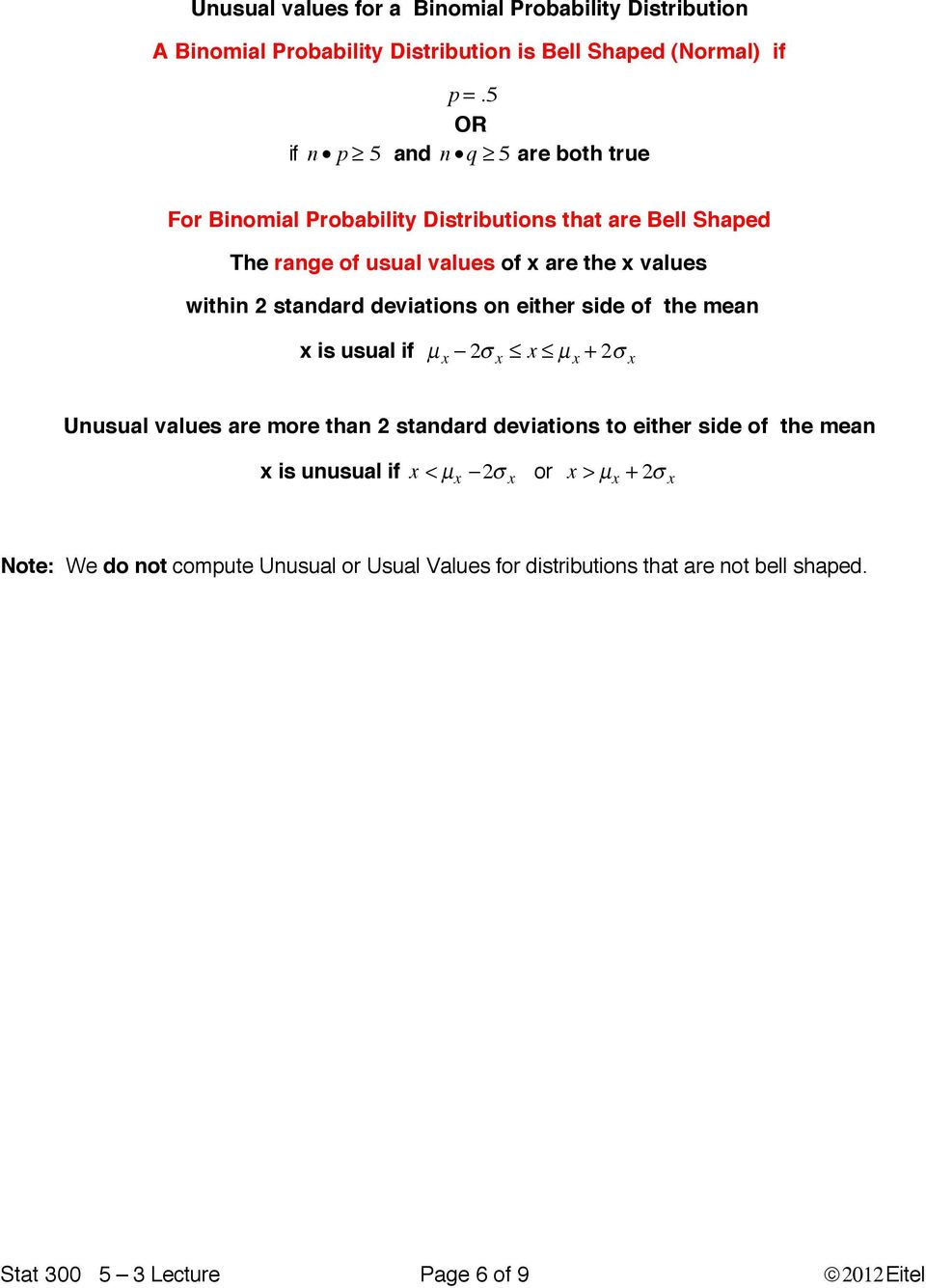
6 Unusual values for a Binomial Probability Distribution A Binomial Probability Distribution is Bell Shaped (Normal) if p =.5 OR if n p 5 and n q 5 are both true For Binomial Probability Distributions that are Bell Shaped The range of usual values of x are the x values within 2 standard deviations on either side of the mean x is usual if µ x 2σ x x µ x + 2σ x Unusual values are more than 2 standard deviations to either side of the mean x is unusual if x < µ x 2σ x or x > µ x + 2σ x Note: We do not compute Unusual or Usual Values for distributions that are not bell shaped. Stat Lecture Page 6 of Eitel
7 Example 1 30 percent of all students at FLC live north of the river. Find the mean and standard deviation for the number of students who live north of the river in a class of 60 students. Round to 2 decimal places. n = 60 p =.30 Find µ x = Find σ x = n p = n q = Is the Binomial Distribution Bell Shaped? If the Binomial Distribution is Bell Shaped what is the range of usual values? Would it be unusual to have a class of 60 students have 17 students that live north of the river? Would it be unusual to have a class of 60 students have 2 students that live north of the river? Solution: Find q: q = 1.30 =.70 n = 60 p =.30 q =.70 Mean: µ x = n p = =18 SD: µ x = n p q = n p =18 n q = 42 Is the Binomial Distribution Bell Shaped? Yes ( np 5 AND nq 5) x is usual if µ x 2σ x x µ x + 2σ x 10 2(3.55) x (3.55) 2.9 x 17.1 Would it be unusual in a class of 60 students to have 17 students that live north of the river? NO Would it be unusual in a class of 60 students to have 2 students that live north of the river? Yes Stat Lecture Page 7 of Eitel

8 Example 2 A basketball player makes 60% of her free throws. Find the mean and standard deviation for the number of free throws made if she shoots 150 free throws. Round to 2 decimal places. n = 150 p =.60 Find µ x = Find σ x = n p = n q = Is the Binomial Distribution Bell Shaped? If the Binomial Distribution is Bell Shaped what is the ranges of usual values? Would it be unusual for the player to make 115 out of 150 free throws? Would it be unusual for the player to make 80 out of 150 free throws? Solution: Find q: q = 1.60 =.40 n = 150 p =.60 q =.40 Mean: µ x = n p = = 90 SD: µ x = n p q = = 6 n p = 90 n q = 60 Is the Binomial Distribution Bell Shaped? Yes ( np 5 AND nq 5) x is usual if µ x 2σ x x µ x + 2σ x 90 2(6) x (6) 78 x 102 Would it be unusual for the player to make 115 out of 150 free throws? Yes Would it be unusual for the player to make 80 out of 150 free throws? No Stat Lecture Page 8 of Eitel

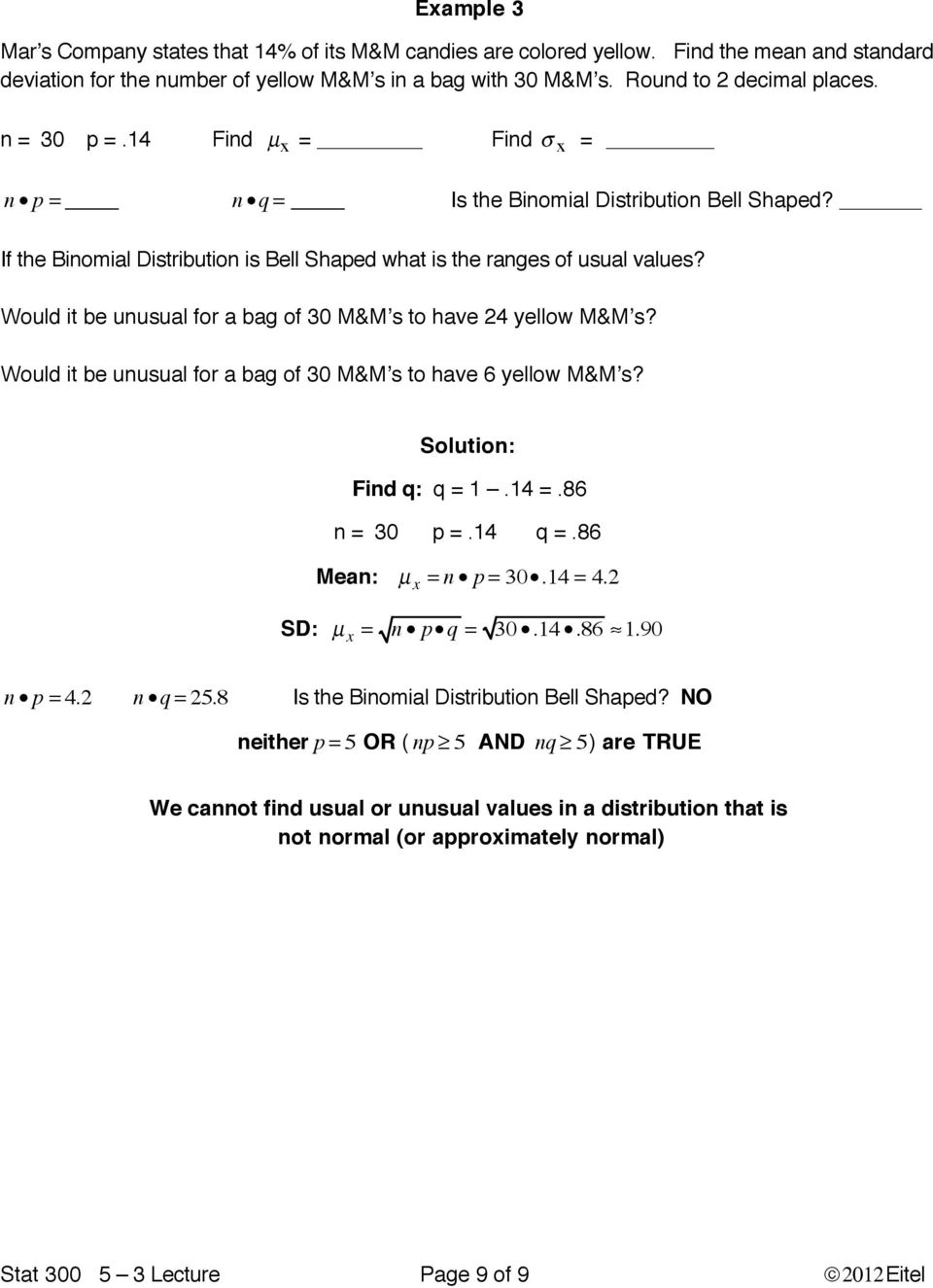
9 Example 3 Marʼs Company states that 14% of its M&M candies are colored yellow. Find the mean and standard deviation for the number of yellow M&Mʼs in a bag with 30 M&Mʼs. Round to 2 decimal places. n = 30 p =.14 Find µ x = Find σ x = n p = n q = Is the Binomial Distribution Bell Shaped? If the Binomial Distribution is Bell Shaped what is the ranges of usual values? Would it be unusual for a bag of 30 M&Mʼs to have 24 yellow M&Mʼs? Would it be unusual for a bag of 30 M&Mʼs to have 6 yellow M&Mʼs? Solution: Find q: q = 1.14 =.86 n = 30 p =.14 q =.86 Mean: µ x = n p = = 4.2 SD: µ x = n p q = n p = 4.2 n q = 25.8 Is the Binomial Distribution Bell Shaped? NO neither p = 5 OR ( np 5 AND nq 5) are TRUE We cannot find usual or unusual values in a distribution that is not normal (or approximately normal) Stat Lecture Page 9 of Eitel
Example 1. so the Binomial Distrubtion can be considered normal
 Chapter 6 8B: Examples of Using a Normal Distribution to Approximate a Binomial Probability Distribution Example 1 The probability of having a boy in any single birth is 50%. Use a normal distribution
Binomial Probability Distribution
 Binomial Probability Distribution In a binomial setting, we can compute probabilities of certain outcomes. This used to be done with tables, but with graphing calculator technology, these problems are
Construct and Interpret Binomial Distributions
 CH 6.2 Distribution.notebook A random variable is a variable whose values are determined by the outcome of the experiment. 1 CH 6.2 Distribution.notebook A probability distribution is a function which
The Binomial Probability Distribution
 The Binomial Probability Distribution MATH 130, Elements of Statistics I J. Robert Buchanan Department of Mathematics Fall 2015 Objectives After this lesson we will be able to: determine whether a probability
Normal Distribution as an Approximation to the Binomial Distribution
 Chapter 1 Student Lecture Notes 1-1 Normal Distribution as an Approximation to the Binomial Distribution : Goals ONE TWO THREE 2 Review Binomial Probability Distribution applies to a discrete random variable
DETERMINE whether the conditions for a binomial setting are met. COMPUTE and INTERPRET probabilities involving binomial random variables
 1 Section 7.B Learning Objectives After this section, you should be able to DETERMINE whether the conditions for a binomial setting are met COMPUTE and INTERPRET probabilities involving binomial random
Density Curve. A density curve is the graph of a continuous probability distribution. It must satisfy the following properties:
 Density Curve A density curve is the graph of a continuous probability distribution. It must satisfy the following properties: 1. The total area under the curve must equal 1. 2. Every point on the curve
The Math. P (x) = 5! = 1 2 3 4 5 = 120.
 The Math Suppose there are n experiments, and the probability that someone gets the right answer on any given experiment is p. So in the first example above, n = 5 and p = 0.2. Let X be the number of correct
5/31/2013. 6.1 Normal Distributions. Normal Distributions. Chapter 6. Distribution. The Normal Distribution. Outline. Objectives.
 The Normal Distribution C H 6A P T E R The Normal Distribution Outline 6 1 6 2 Applications of the Normal Distribution 6 3 The Central Limit Theorem 6 4 The Normal Approximation to the Binomial Distribution
Chapter 5. Discrete Probability Distributions
 Chapter 5. Discrete Probability Distributions Chapter Problem: Did Mendel s result from plant hybridization experiments contradicts his theory? 1. Mendel s theory says that when there are two inheritable
Chapter 4. iclicker Question 4.4 Pre-lecture. Part 2. Binomial Distribution. J.C. Wang. iclicker Question 4.4 Pre-lecture
 Chapter 4 Part 2. Binomial Distribution J.C. Wang iclicker Question 4.4 Pre-lecture iclicker Question 4.4 Pre-lecture Outline Computing Binomial Probabilities Properties of a Binomial Distribution Computing
Chapter 3: DISCRETE RANDOM VARIABLES AND PROBABILITY DISTRIBUTIONS. Part 3: Discrete Uniform Distribution Binomial Distribution
 Chapter 3: DISCRETE RANDOM VARIABLES AND PROBABILITY DISTRIBUTIONS Part 3: Discrete Uniform Distribution Binomial Distribution Sections 3-5, 3-6 Special discrete random variable distributions we will cover
AP Stats - Probability Review
 AP Stats - Probability Review Multiple Choice Identify the choice that best completes the statement or answers the question. 1. I toss a penny and observe whether it lands heads up or tails up. Suppose
SOLUTIONS: 4.1 Probability Distributions and 4.2 Binomial Distributions
 SOLUTIONS: 4.1 Probability Distributions and 4.2 Binomial Distributions 1. The following table contains a probability distribution for a random variable X. a. Find the expected value (mean) of X. x 1 2
A Percentile is a number in a SORTED LIST that has a given percentage of the data below it.
 Section 3 3B: Percentiles A Percentile is a number in a SORTED LIST that has a given percentage of the data below it. If n represents the 70 th percentile then 70% of the data is less than n We use the
Characteristics of Binomial Distributions
 Lesson2 Characteristics of Binomial Distributions In the last lesson, you constructed several binomial distributions, observed their shapes, and estimated their means and standard deviations. In Investigation
Tom wants to find two real numbers, a and b, that have a sum of 10 and have a product of 10. He makes this table.
 Sum and Product This problem gives you the chance to: use arithmetic and algebra to represent and analyze a mathematical situation solve a quadratic equation by trial and improvement Tom wants to find
4. Continuous Random Variables, the Pareto and Normal Distributions
 4. Continuous Random Variables, the Pareto and Normal Distributions A continuous random variable X can take any value in a given range (e.g. height, weight, age). The distribution of a continuous random
Review for Test 2. Chapters 4, 5 and 6
 Review for Test 2 Chapters 4, 5 and 6 1. You roll a fair six-sided die. Find the probability of each event: a. Event A: rolling a 3 1/6 b. Event B: rolling a 7 0 c. Event C: rolling a number less than
Section 6.1 Discrete Random variables Probability Distribution
 Section 6.1 Discrete Random variables Probability Distribution Definitions a) Random variable is a variable whose values are determined by chance. b) Discrete Probability distribution consists of the values
Normal Approximation. Contents. 1 Normal Approximation. 1.1 Introduction. Anthony Tanbakuchi Department of Mathematics Pima Community College
 Introductory Statistics Lectures Normal Approimation To the binomial distribution Department of Mathematics Pima Community College Redistribution of this material is prohibited without written permission
Assessment For The California Mathematics Standards Grade 6
 Introduction: Summary of Goals GRADE SIX By the end of grade six, students have mastered the four arithmetic operations with whole numbers, positive fractions, positive decimals, and positive and negative
WEEK #23: Statistics for Spread; Binomial Distribution
 WEEK #23: Statistics for Spread; Binomial Distribution Goals: Study measures of central spread, such interquartile range, variance, and standard deviation. Introduce standard distributions, including the
Lecture 19: Chapter 8, Section 1 Sampling Distributions: Proportions
 Lecture 19: Chapter 8, Section 1 Sampling Distributions: Proportions Typical Inference Problem Definition of Sampling Distribution 3 Approaches to Understanding Sampling Dist. Applying 68-95-99.7 Rule
The Normal Approximation to Probability Histograms. Dice: Throw a single die twice. The Probability Histogram: Area = Probability. Where are we going?
 The Normal Approximation to Probability Histograms Where are we going? Probability histograms The normal approximation to binomial histograms The normal approximation to probability histograms of sums
Chapter 5: Discrete Probability Distributions
 Chapter 5: Discrete Probability Distributions Section 5.1: Basics of Probability Distributions As a reminder, a variable or what will be called the random variable from now on, is represented by the letter
The Normal Distribution
 The Normal Distribution Continuous Distributions A continuous random variable is a variable whose possible values form some interval of numbers. Typically, a continuous variable involves a measurement
Paper 1. Calculator not allowed. Mathematics test. First name. Last name. School. Remember KEY STAGE 3 TIER 5 7
 Ma KEY STAGE 3 Mathematics test TIER 5 7 Paper 1 Calculator not allowed First name Last name School 2009 Remember The test is 1 hour long. You must not use a calculator for any question in this test. You
You flip a fair coin four times, what is the probability that you obtain three heads.
 Handout 4: Binomial Distribution Reading Assignment: Chapter 5 In the previous handout, we looked at continuous random variables and calculating probabilities and percentiles for those type of variables.
EXAM #1 (Example) Instructor: Ela Jackiewicz. Relax and good luck!
 STP 231 EXAM #1 (Example) Instructor: Ela Jackiewicz Honor Statement: I have neither given nor received information regarding this exam, and I will not do so until all exams have been graded and returned.
The normal approximation to the binomial
 The normal approximation to the binomial The binomial probability function is not useful for calculating probabilities when the number of trials n is large, as it involves multiplying a potentially very
Ch5: Discrete Probability Distributions Section 5-1: Probability Distribution
 Recall: Ch5: Discrete Probability Distributions Section 5-1: Probability Distribution A variable is a characteristic or attribute that can assume different values. o Various letters of the alphabet (e.g.
MULTIPLE CHOICE. Choose the one alternative that best completes the statement or answers the question. A) 0.4987 B) 0.9987 C) 0.0010 D) 0.
 Ch. 5 Normal Probability Distributions 5.1 Introduction to Normal Distributions and the Standard Normal Distribution 1 Find Areas Under the Standard Normal Curve 1) Find the area under the standard normal
MULTIPLE CHOICE. Choose the one alternative that best completes the statement or answers the question. C) (a) 2. (b) 1.5. (c) 0.5-2.
 Stats: Test 1 Review Name MULTIPLE CHOICE. Choose the one alternative that best completes the statement or answers the question. Use the given frequency distribution to find the (a) class width. (b) class
MAT 155. Key Concept. September 27, 2010. 155S5.5_3 Poisson Probability Distributions. Chapter 5 Probability Distributions
 MAT 155 Dr. Claude Moore Cape Fear Community College Chapter 5 Probability Distributions 5 1 Review and Preview 5 2 Random Variables 5 3 Binomial Probability Distributions 5 4 Mean, Variance and Standard
3.2 Measures of Spread
 3.2 Measures of Spread In some data sets the observations are close together, while in others they are more spread out. In addition to measures of the center, it's often important to measure the spread
Thursday, November 13: 6.1 Discrete Random Variables
 Thursday, November 13: 6.1 Discrete Random Variables Read 347 350 What is a random variable? Give some examples. What is a probability distribution? What is a discrete random variable? Give some examples.
Sample Questions for Mastery #5
 Name: Class: Date: Sample Questions for Mastery #5 Multiple Choice Identify the choice that best completes the statement or answers the question.. For which of the following binomial experiments could
Chapter 5 - Practice Problems 1
 Chapter 5 - Practice Problems 1 Identify the given random variable as being discrete or continuous. 1) The number of oil spills occurring off the Alaskan coast 1) A) Continuous B) Discrete 2) The ph level
6.4 Normal Distribution
 Contents 6.4 Normal Distribution....................... 381 6.4.1 Characteristics of the Normal Distribution....... 381 6.4.2 The Standardized Normal Distribution......... 385 6.4.3 Meaning of Areas under
Probability Distributions
 Learning Objectives Probability Distributions Section 1: How Can We Summarize Possible Outcomes and Their Probabilities? 1. Random variable 2. Probability distributions for discrete random variables 3.
TEACHER NOTES MATH NSPIRED
 Math Objectives Students will understand that normal distributions can be used to approximate binomial distributions whenever both np and n(1 p) are sufficiently large. Students will understand that when
Normal distribution. ) 2 /2σ. 2π σ
 Normal distribution The normal distribution is the most widely known and used of all distributions. Because the normal distribution approximates many natural phenomena so well, it has developed into a
Lecture 5 : The Poisson Distribution
 Lecture 5 : The Poisson Distribution Jonathan Marchini November 10, 2008 1 Introduction Many experimental situations occur in which we observe the counts of events within a set unit of time, area, volume,
AP STATISTICS 2010 SCORING GUIDELINES
 2010 SCORING GUIDELINES Question 4 Intent of Question The primary goals of this question were to (1) assess students ability to calculate an expected value and a standard deviation; (2) recognize the applicability
MULTIPLE CHOICE. Choose the one alternative that best completes the statement or answers the question.
 Ch. 4 Discrete Probability Distributions 4.1 Probability Distributions 1 Decide if a Random Variable is Discrete or Continuous 1) State whether the variable is discrete or continuous. The number of cups
Measures of Central Tendency and Variability: Summarizing your Data for Others
 Measures of Central Tendency and Variability: Summarizing your Data for Others 1 I. Measures of Central Tendency: -Allow us to summarize an entire data set with a single value (the midpoint). 1. Mode :
MULTIPLE CHOICE. Choose the one alternative that best completes the statement or answers the question.
 STATISTICS/GRACEY PRACTICE TEST/EXAM 2 MULTIPLE CHOICE. Choose the one alternative that best completes the statement or answers the question. Identify the given random variable as being discrete or continuous.
Lecture 10: Depicting Sampling Distributions of a Sample Proportion
 Lecture 10: Depicting Sampling Distributions of a Sample Proportion Chapter 5: Probability and Sampling Distributions 2/10/12 Lecture 10 1 Sample Proportion 1 is assigned to population members having a
STAT 200 QUIZ 2 Solutions Section 6380 Fall 2013
 STAT 200 QUIZ 2 Solutions Section 6380 Fall 2013 The quiz covers Chapters 4, 5 and 6. 1. (8 points) If the IQ scores are normally distributed with a mean of 100 and a standard deviation of 15. (a) (3 pts)
Stats on the TI 83 and TI 84 Calculator
 Stats on the TI 83 and TI 84 Calculator Entering the sample values STAT button Left bracket { Right bracket } Store (STO) List L1 Comma Enter Example: Sample data are {5, 10, 15, 20} 1. Press 2 ND and
1. The volume of the object below is 186 cm 3. Calculate the Length of x. (a) 3.1 cm (b) 2.5 cm (c) 1.75 cm (d) 1.25 cm
 Volume and Surface Area On the provincial exam students will need to use the formulas for volume and surface area of geometric solids to solve problems. These problems will not simply ask, Find the volume
sample median Sample quartiles sample deciles sample quantiles sample percentiles Exercise 1 five number summary # Create and view a sorted
 Sample uartiles We have seen that the sample median of a data set {x 1, x, x,, x n }, sorted in increasing order, is a value that divides it in such a way, that exactly half (i.e., 50%) of the sample observations
Name: Date: Use the following to answer questions 2-4:
 Name: Date: 1. A phenomenon is observed many, many times under identical conditions. The proportion of times a particular event A occurs is recorded. What does this proportion represent? A) The probability
Review. March 21, 2011. 155S7.1 2_3 Estimating a Population Proportion. Chapter 7 Estimates and Sample Sizes. Test 2 (Chapters 4, 5, & 6) Results
 MAT 155 Statistical Analysis Dr. Claude Moore Cape Fear Community College Chapter 7 Estimates and Sample Sizes 7 1 Review and Preview 7 2 Estimating a Population Proportion 7 3 Estimating a Population
Math 202-0 Quizzes Winter 2009
 Quiz : Basic Probability Ten Scrabble tiles are placed in a bag Four of the tiles have the letter printed on them, and there are two tiles each with the letters B, C and D on them (a) Suppose one tile
How To Write A Data Analysis
 Mathematics Probability and Statistics Curriculum Guide Revised 2010 This page is intentionally left blank. Introduction The Mathematics Curriculum Guide serves as a guide for teachers when planning instruction
Section 5 Part 2. Probability Distributions for Discrete Random Variables
 Section 5 Part 2 Probability Distributions for Discrete Random Variables Review and Overview So far we ve covered the following probability and probability distribution topics Probability rules Probability
3.4. The Binomial Probability Distribution. Copyright Cengage Learning. All rights reserved.
 3.4 The Binomial Probability Distribution Copyright Cengage Learning. All rights reserved. The Binomial Probability Distribution There are many experiments that conform either exactly or approximately
Question: What is the probability that a five-card poker hand contains a flush, that is, five cards of the same suit?
 ECS20 Discrete Mathematics Quarter: Spring 2007 Instructor: John Steinberger Assistant: Sophie Engle (prepared by Sophie Engle) Homework 8 Hints Due Wednesday June 6 th 2007 Section 6.1 #16 What is the
Simple Regression Theory II 2010 Samuel L. Baker
 SIMPLE REGRESSION THEORY II 1 Simple Regression Theory II 2010 Samuel L. Baker Assessing how good the regression equation is likely to be Assignment 1A gets into drawing inferences about how close the
X: 0 1 2 3 4 5 6 7 8 9 Probability: 0.061 0.154 0.228 0.229 0.173 0.094 0.041 0.015 0.004 0.001
 Tuesday, January 17: 6.1 Discrete Random Variables Read 341 344 What is a random variable? Give some examples. What is a probability distribution? What is a discrete random variable? Give some examples.
Basics of Counting. The product rule. Product rule example. 22C:19, Chapter 6 Hantao Zhang. Sample question. Total is 18 * 325 = 5850
 Basics of Counting 22C:19, Chapter 6 Hantao Zhang 1 The product rule Also called the multiplication rule If there are n 1 ways to do task 1, and n 2 ways to do task 2 Then there are n 1 n 2 ways to do
How do you compare numbers? On a number line, larger numbers are to the right and smaller numbers are to the left.
 The verbal answers to all of the following questions should be memorized before completion of pre-algebra. Answers that are not memorized will hinder your ability to succeed in algebra 1. Number Basics
General Aim: Investigate the effects of sensory deprivation on performance
 Sports, Exercise and Health Science Sensory on Performance: Full Investigation DESIGN General Aim: Investigate the effects of sensory deprivation on performance D 1 Research Question: What type of shortterm
The Binomial Distribution
 The Binomial Distribution James H. Steiger November 10, 00 1 Topics for this Module 1. The Binomial Process. The Binomial Random Variable. The Binomial Distribution (a) Computing the Binomial pdf (b) Computing
HYPOTHESIS TESTING (ONE SAMPLE) - CHAPTER 7 1. used confidence intervals to answer questions such as...
 HYPOTHESIS TESTING (ONE SAMPLE) - CHAPTER 7 1 PREVIOUSLY used confidence intervals to answer questions such as... You know that 0.25% of women have red/green color blindness. You conduct a study of men
0.75 75% ! 3 40% 0.65 65% Percent Cards. This problem gives you the chance to: relate fractions, decimals and percents
 Percent Cards This problem gives you the chance to: relate fractions, decimals and percents Mrs. Lopez makes sets of cards for her math class. All the cards in a set have the same value. Set A 3 4 0.75
Week 3&4: Z tables and the Sampling Distribution of X
 Week 3&4: Z tables and the Sampling Distribution of X 2 / 36 The Standard Normal Distribution, or Z Distribution, is the distribution of a random variable, Z N(0, 1 2 ). The distribution of any other normal
Introduction to the Practice of Statistics Fifth Edition Moore, McCabe
 Introduction to the Practice of Statistics Fifth Edition Moore, McCabe Section 5.1 Homework Answers 5.7 In the proofreading setting if Exercise 5.3, what is the smallest number of misses m with P(X m)
Ready, Set, Go! Math Games for Serious Minds
 Math Games with Cards and Dice presented at NAGC November, 2013 Ready, Set, Go! Math Games for Serious Minds Rande McCreight Lincoln Public Schools Lincoln, Nebraska Math Games with Cards Close to 20 -
16. THE NORMAL APPROXIMATION TO THE BINOMIAL DISTRIBUTION
 6. THE NORMAL APPROXIMATION TO THE BINOMIAL DISTRIBUTION It is sometimes difficult to directly compute probabilities for a binomial (n, p) random variable, X. We need a different table for each value of
Paper 1. Calculator not allowed. Mathematics test. First name. Last name. School. Remember KEY STAGE 3 TIER 6 8
 Ma KEY STAGE 3 Mathematics test TIER 6 8 Paper 1 Calculator not allowed First name Last name School 2009 Remember The test is 1 hour long. You must not use a calculator for any question in this test. You
Psychology 60 Fall 2013 Practice Exam Actual Exam: Next Monday. Good luck!
 Psychology 60 Fall 2013 Practice Exam Actual Exam: Next Monday. Good luck! Name: 1. The basic idea behind hypothesis testing: A. is important only if you want to compare two populations. B. depends on
Chapter 4 & 5 practice set. The actual exam is not multiple choice nor does it contain like questions.
 Chapter 4 & 5 practice set. The actual exam is not multiple choice nor does it contain like questions. MULTIPLE CHOICE. Choose the one alternative that best completes the statement or answers the question.
6. Let X be a binomial random variable with distribution B(10, 0.6). What is the probability that X equals 8? A) (0.6) (0.4) B) 8! C) 45(0.6) (0.
 Name: Date:. For each of the following scenarios, determine the appropriate distribution for the random variable X. A) A fair die is rolled seven times. Let X = the number of times we see an even number.
Chapter 4. Probability Distributions
 Chapter 4 Probability Distributions Lesson 4-1/4-2 Random Variable Probability Distributions This chapter will deal the construction of probability distribution. By combining the methods of descriptive
Probability Distributions
 CHAPTER 5 Probability Distributions CHAPTER OUTLINE 5.1 Probability Distribution of a Discrete Random Variable 5.2 Mean and Standard Deviation of a Probability Distribution 5.3 The Binomial Distribution
MULTIPLE CHOICE. Choose the one alternative that best completes the statement or answers the question.
 STT315 Practice Ch 5-7 MULTIPLE CHOICE. Choose the one alternative that best completes the statement or answers the question. Solve the problem. 1) The length of time a traffic signal stays green (nicknamed
Example 1: Dear Abby. Stat Camp for the Full-time MBA Program
 Stat Camp for the Full-time MBA Program Daniel Solow Lecture 4 The Normal Distribution and the Central Limit Theorem 188 Example 1: Dear Abby You wrote that a woman is pregnant for 266 days. Who said so?
5.1 Identifying the Target Parameter
 University of California, Davis Department of Statistics Summer Session II Statistics 13 August 20, 2012 Date of latest update: August 20 Lecture 5: Estimation with Confidence intervals 5.1 Identifying
Chapter 5: Normal Probability Distributions - Solutions
 Chapter 5: Normal Probability Distributions - Solutions Note: All areas and z-scores are approximate. Your answers may vary slightly. 5.2 Normal Distributions: Finding Probabilities If you are given that
PROBABILITY AND STATISTICS
 PROBABILITY AND STATISTICS Grade Level: Written by: Length of Unit: Middle School, Science and Math Monica Edwins, Twin Peaks Charter Academy, Longmont, Colorado Four Lessons, plus a Culminating Activity
The Binomial Distribution. Summer 2003
 The Binomial Distribution Summer 2003 Internet Bubble Several industry experts believe that 30% of internet companies will run out of cash in 6 months and that these companies will find it very hard to
The normal approximation to the binomial
 The normal approximation to the binomial In order for a continuous distribution (like the normal) to be used to approximate a discrete one (like the binomial), a continuity correction should be used. There
Experimental Design. Power and Sample Size Determination. Proportions. Proportions. Confidence Interval for p. The Binomial Test
 Experimental Design Power and Sample Size Determination Bret Hanlon and Bret Larget Department of Statistics University of Wisconsin Madison November 3 8, 2011 To this point in the semester, we have largely
WHERE DOES THE 10% CONDITION COME FROM?
 1 WHERE DOES THE 10% CONDITION COME FROM? The text has mentioned The 10% Condition (at least) twice so far: p. 407 Bernoulli trials must be independent. If that assumption is violated, it is still okay
THE BINOMIAL DISTRIBUTION & PROBABILITY
 REVISION SHEET STATISTICS 1 (MEI) THE BINOMIAL DISTRIBUTION & PROBABILITY The main ideas in this chapter are Probabilities based on selecting or arranging objects Probabilities based on the binomial distribution
How To Calculate Confidence Intervals In A Population Mean
 Chapter 8 Confidence Intervals 8.1 Confidence Intervals 1 8.1.1 Student Learning Objectives By the end of this chapter, the student should be able to: Calculate and interpret confidence intervals for one
CALCULATIONS & STATISTICS
 CALCULATIONS & STATISTICS CALCULATION OF SCORES Conversion of 1-5 scale to 0-100 scores When you look at your report, you will notice that the scores are reported on a 0-100 scale, even though respondents
Number of observations is fixed. Independent observations --- knowledge of the outcomes of earlier trials does not affect the
 Binomial Probability Frequently used in analyzing and setting up surveys Our interest is in a binomial random variable X, which is the count of successes in n trials. The probability distribution of X
1. The Fly In The Ointment
 Arithmetic Revisited Lesson 5: Decimal Fractions or Place Value Extended Part 5: Dividing Decimal Fractions, Part 2. The Fly In The Ointment The meaning of, say, ƒ 2 doesn't depend on whether we represent
Chapter 3 Falling Objects and Projectile Motion
 Chapter 3 Falling Objects and Projectile Motion Gravity influences motion in a particular way. How does a dropped object behave?!does the object accelerate, or is the speed constant?!do two objects behave
Common Tools for Displaying and Communicating Data for Process Improvement
 Common Tools for Displaying and Communicating Data for Process Improvement Packet includes: Tool Use Page # Box and Whisker Plot Check Sheet Control Chart Histogram Pareto Diagram Run Chart Scatter Plot
STT315 Chapter 4 Random Variables & Probability Distributions KM. Chapter 4.5, 6, 8 Probability Distributions for Continuous Random Variables
 Chapter 4.5, 6, 8 Probability Distributions for Continuous Random Variables Discrete vs. continuous random variables Examples of continuous distributions o Uniform o Exponential o Normal Recall: A random
Stat 20: Intro to Probability and Statistics
 Stat 20: Intro to Probability and Statistics Lecture 16: More Box Models Tessa L. Childers-Day UC Berkeley 22 July 2014 By the end of this lecture... You will be able to: Determine what we expect the sum
HYPOTHESIS TESTING: CONFIDENCE INTERVALS, T-TESTS, ANOVAS, AND REGRESSION
 HYPOTHESIS TESTING: CONFIDENCE INTERVALS, T-TESTS, ANOVAS, AND REGRESSION HOD 2990 10 November 2010 Lecture Background This is a lightning speed summary of introductory statistical methods for senior undergraduate
CHAPTER 7 INTRODUCTION TO SAMPLING DISTRIBUTIONS
 CHAPTER 7 INTRODUCTION TO SAMPLING DISTRIBUTIONS CENTRAL LIMIT THEOREM (SECTION 7.2 OF UNDERSTANDABLE STATISTICS) The Central Limit Theorem says that if x is a random variable with any distribution having