
be positioned at regular intervals-every 10 or so bases-along
|
|
|
- Paula Malone
- 5 years ago
- Views:
Transcription
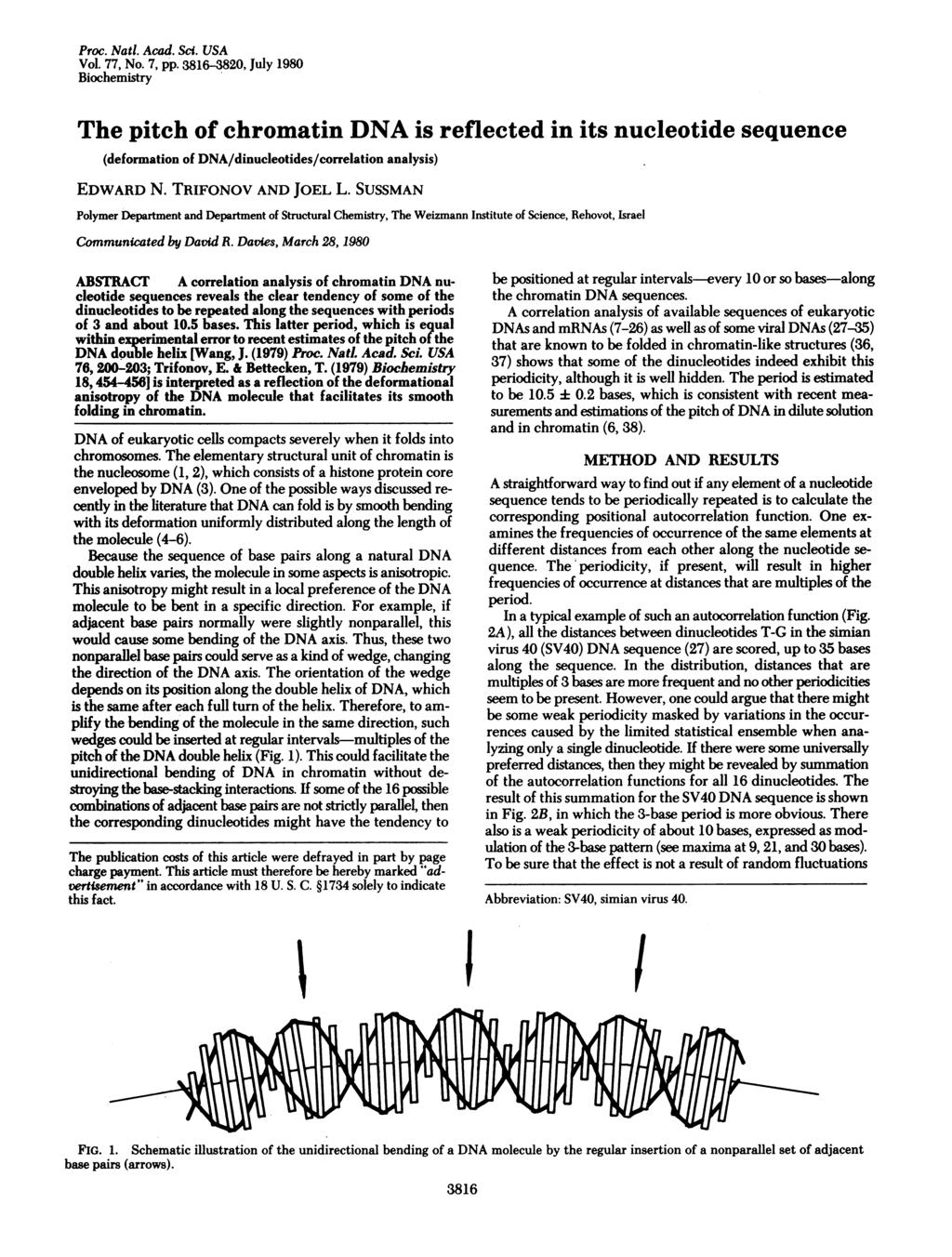
1 Proc. Nati. Acad. Sci. USA Vol. 77, No. 7, pp , July 198 Biochemistry The pitch of chromatin DNA is reflected in its nucleotide sequence (deformation of DNA/dinucleotides/correlation analysis) EDWARD N. TRFONOV AND JOEL L. SUSSMAN Polymer Department and Department of Structural Chemistry, The Weizmann nstitute of Science, Rehovot, srael Communicated by David R. Davies, March 28,198 ABSTRACT A correlation analysis of chromatin DNA nucleotide sequences reveals the clear tendency of some of the dinucleotides to be repeated along the sequences with periods of 3 and about 1.5 bases. This latter period, which is equal within experimental error to recent estimates of the pitch of the DNA double helix [Wang, J. (1979) Proc. Natl. Acad. Sci. USA 76, 2-23; Trifonov, E. & Bettecken, T. (1979) Biochemistry 18, ] is interpreted as a reflection of the deformational anisotropy of the DNA molecule that facilitates its smooth folding in chromatin. DNA of eukaryotic cells compacts severely when it folds into chromosomes. The elementary structural unit of chromatin is the nucleosome (1, 2), which consists of a histone protein core enveloped by DNA (3). One of the possible ways discussed recently in the literature that DNA can fold is by smooth bending with its deformation uniformly distributed along the length of the molecule (4-6). Because the sequence of base pairs along a natural DNA double helix varies, the molecule in some aspects is anisotropic. This anisotropy might result in a local preference of the DNA molecule to be bent in a specific direction. For example, if adjacent base pairs normally were slightly nonparallel, this would cause some bending of the DNA axis. Thus, these two nonparallel base pairs could serve as a kind of wedge, changing the direction of the DNA axis. The orientation of the wedge depends on its position along the double helix of DNA, which is the same after each full turn of the helix. Therefore, to amplify the bending of the molecule in the same direction, such wedges could be inserted at regular intervals-multiples of the pitch of the DNA double helix (Fig. 1). This could facilitate the unidirectional bending of DNA in chromatin without destroying the base-stacking interactions. f some of the 16 possible combinations of adjacent base pairs are not strictly parallel, then the corresponding dinucleotides might have the tendency to The publication costs of this article were defrayed in part by page charge payment. This article must therefore be hereby marked "advertisement" in accordance with 18 U. S. C solely to indicate this fact. be positioned at regular intervals-every 1 or so bases-along the chromatin DNA sequences. A correlation analysis of available sequences of eukaryotic DNAs and mrnas (7-26) as well as of some viral DNAs (27-35) that are known to be folded in chromatin-like structures (36, 37) shows that some of the dinucleotides indeed exhibit this periodicity, although it is well hidden. The period is estimated to be bases, which is consistent with recent measurements and estimations of the pitch of DNA in dilute solution and in chromatin (6, 38). METHOD AND RESULTS A straightforward way to find out if any element of a nucleotide sequence tends to be periodically repeated is to calculate the corresponding positional autocorrelation function. One examines the frequencies of occurrence of the same elements at different distances from each other along the nucleotide sequence. The periodicity, if present, will result in higher frequencies of occurrence at distances that are multiples of the period. n a typical example of such an autocorrelation function (Fig. 2A), all the distances between dinucleotides T-G in the simian virus 4 (SV4) DNA sequence (27) are scored, up to 35 bases along the sequence. n the distribution, distances that are multiples of 3 bases are more frequent and no other periodicities seem to be present. However, one could argue that there might be some weak periodicity masked by variations in the occurrences caused by the limited statistical ensemble when analyzing only a single dinucleotide. f there were some universally preferred distances, then they might be revealed by summation of the autocorrelation functions for all 16 dinucleotides. The result of this summation for the SV4 DNA sequence is shown in Fig. 2B, in which the 3-base period is more obvious. There also is a weak periodicity of about 1 bases, expressed as modulation of the 3-base pattern (see maxima at 9, 21, and 3 bases). To be sure that the effect is not a result of random fluctuations Abbreviation: SV4, simian virus 4. ( FG. 1. Schematic illustration of the unidirectional bending of a DNA molecule by the regular insertion of a nonparallel set of adjacent base pairs (arrows). 3816

2 Biochemistry: Trifonov and Sussman Proc. Natl. Acad. Sci. USA 77 (198) ' crz J FG. 2. Autocorrelation functions for dinucleotides of the SV4 DNA sequence. Points, corresponding to distances that are multiples of 3 bases, are connected by envelope curves. (A) Dinucleotide T-G; (B) sum of autocorrelation functions for all 16 dinucleotides. Heavy vertical bar corresponds to standard deviation estimated as the square root of the average frequency of occurrence. The Y axis origin is omitted for clarity. of the frequencies, we calculated similar autocorrelation functions for 32 known contiguous pieces of nucleotide sequences, with a total length of about 36, bases (7-5), and summed the functions to enhance any regular component, if present. The result of the summation is shown in Fig. 3A. The sequences used for the calculation are listed in Table 1 (and can be provided in computer-readable form, if requested). We considered all these DNA sequences as chromatin-bound, although some of them-e.g., the region near the origin of replication in SV4 DNA-might not be involved in the regular chromatin structure (ref. 39; G. Kaufmann, personal communication). To avoid duplication, only nonoverlapping portions of related sequences were used. Some of the sequences published by different groups are nearly identical (e.g., histone genes, refs. 9 and 1). n such cases our choice was somewhat arbitrary, with preference to longer sequences. All the sequences analyzed corresponded to the coding strands except for the SV4 DNA sequence, in which the noncoding strand of the late region was used for the sake of physical continuity with the coding strand of the early region. The choice of the strand, however, does not matter, because the periodicity present in one strand is complementarily reflected in the other one. The pattern in Fig. 3A looks essentially the same as that in Fig. 2B, both having a clear periodicity of about 1 bases. The periodicity can be improved in terms of relative amplitude of the variation if one considers that not all of the 16 dinucleotides l B A Table 1. Chromatin nucleotide sequences used for the correlation analysis Length, Sequence bases Ref. Eukaryotes Ovalbumin gene Ovalbumin mrna (portion not overlapping with above sequence) Histone (H2B and H3) genes of S. purpuratus Histone 2A gene of P. miliaris Noncoding portion of histone 2A gene of S. purpuratus (portion not overlapping with above sequence) Histone 4 gene of P. miliaris Histone 1 gene of P. miliaris Mouse gk chain mrna (J cluster) Mouse gk light chain mrna (constant and 3'- noncoding region) Variable region of mouse gx light chain gene Mouse gx light chain gene (clone 33) Mouse gxj light chain gene (clone 99; portion not overlapping with above sequence) Mouse ggyl heavy chain mrna Mouse f-globin major gene Rabbit fl-globin mrna Rabbit a-globin mrna Bovine corticotropin/f,-lipotropin precursor mrna so-1-cytochrome c gene of Saccharomyces cerevisiae Rat growth hormone mrna Human growth hormone mrna Human chorionic somatomammotropin mrna Yeast rdna spacer Rat preproinsulin mrna 5S DNA of Xenopus laevis Viruses SV4 genome Polyoma virus genome, early region Polyoma virus genome, late region Adenovirus 5 genome, transforming fragment Adenovirus 5 genome, right-hand terminus Adenovirus 2, EcoR F fragment of DNA Adenovirus 2, fiber mrna Adenovirus, 2, hexon mrna , are contributing equally to the period. We estimated which of them display the strongest variations of occurrences at multiples of 3-base distances, as compared with expected variations for random sequences. Dinucleotides G-G, T-A, T-G, and T-T were found to be the "strongest" contributors to-the variations. Summing the autocorrelation functions for only these dinucleotides for 32 sequences, we obtained a distribution (Fig. 4) in which the distances scored extend up to 1 bases and some additional small peaks are seen-for example, at about 54, 72, 84, and bases. The cosine wave, which fits best to the envelope curve in Fig. 4, has a period of 1.5 b.2 bases. DSCUSSON This analysis demonstrates that at least some of the 16 dinucleotides tend to be periodically distributed along the DNA that is associated with chromatin. The period, about 1.5 bases, appears to be equal, within experimental error, to the pitch of DNA in chromatin-1.33 to 1.4 base pairs (6)-estimated from data on the variation of the sensitivity to nuclease digestion
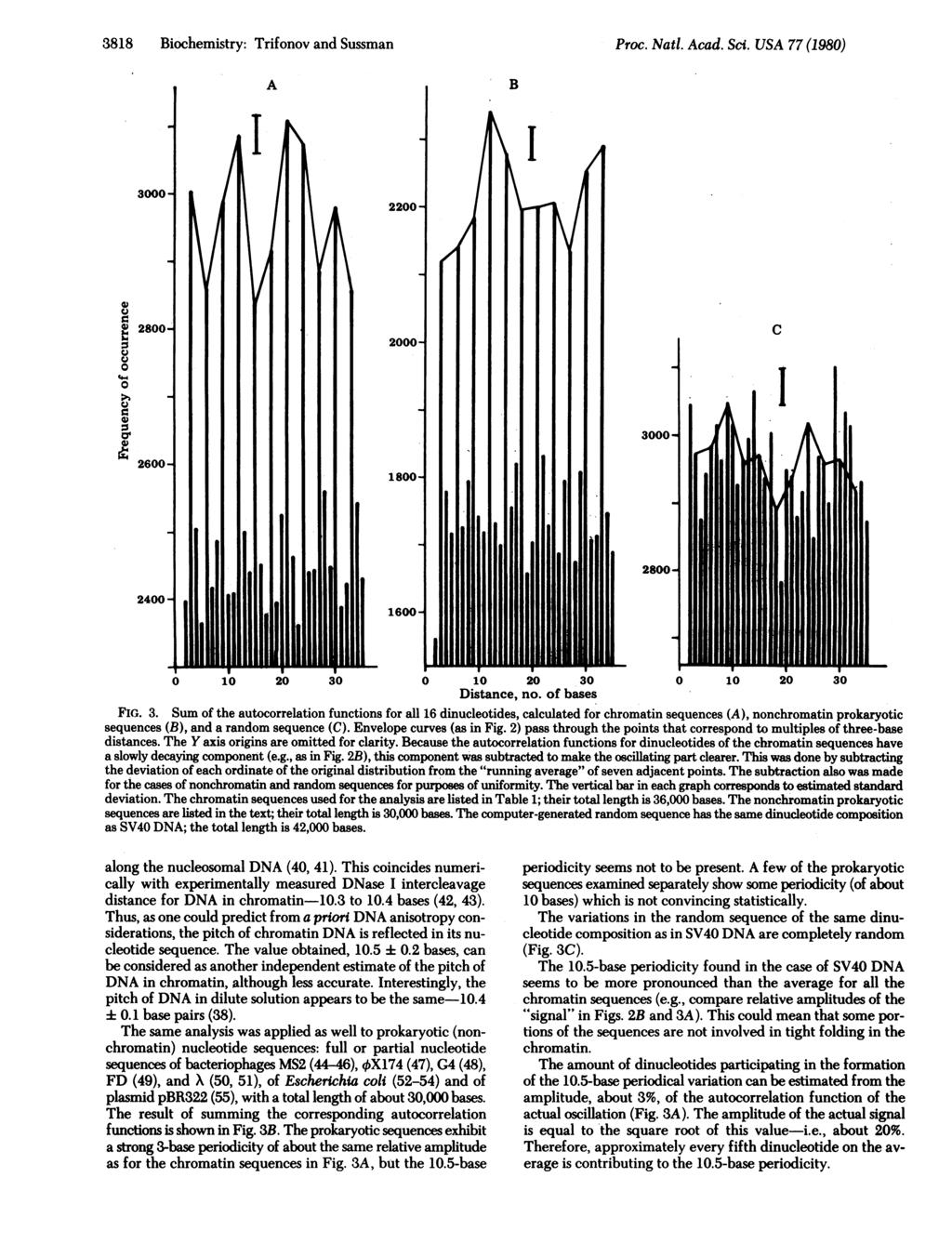
3 3818 Biochemistry: Trifonov and Sussman Proc. Natl. Acad. Sci. USA 77 (198) A B Q D 28- C.) t :s 414 to C 18-9,dA, FG. 3. Sum of the autocorrelation functions for all 16 dinucleotides, calculated for chromatin sequences (A), nonchromatin prokaryotic sequences (B), and a random sequence (C). Envelope curves (as in Fig. 2) pass through the points that correspond to multiples of three-base distances. The Y axis origins are omitted for clarity. Because the autocorrelation functions for dinucleotides of the chromatin sequences have a slowly decaying component (e.g., as in Fig. 2B), this component was subtracted to make the oscillating part clearer. This was done by subtracting the deviation of each ordinate of the original distribution from the "running average" of seven adjacent points. The subtraction also was made for the cases of nonchromatin and random sequences for purposes of uniformity. The vertical bar in each graph corresponds to estimated standard deviation. The chromatin sequences used for the analysis are listed in Table 1; their total length is 36, bases. The nonchromatin prokaryotic sequences are listed in the text; their total length is 3, bases. The computer-generated random sequence has the same dinucleotide composition as SV4 DNA; the total length is 42, bases. 1=_ along the nucleosomal DNA (4, 41). This coincides numerically with experimentally measured DNase intercleavage distance for DNA in chromatin-1.3 to 1.4 bases (42, 43). Thus, as one could predict from a priori DNA anisotropy considerations, the pitch of chromatin DNA is reflected in its nucleotide sequence. The value obtained, bases, can be considered as another independent estimate of the pitch of DNA in chromatin, although less accurate. nterestingly, the pitch of DNA in dilute solution appears to be the same base pairs (38). The same analysis was applied as well to prokaryotic (nonchromatin) nucleotide sequences: full or partial nucleotide sequences of bacteriophages MS2 (44 46), 4X174 (47), G4 (48), FD (49), and X (5, 51), of Escherichia coli (52-54) and of plasmid pbr322 (55), with a total length of about 3, bases. The result of summing the corresponding autocorrelation functions is shown in Fig. 3B. The prokaryotic sequences exhibit a strong 3-base periodicity of about the same relative amplitude as for the chromatin sequences in Fig. 3A, but the 1.5-base periodicity seems not to be present. A few of the prokaryotic sequences examined separately show some periodicity (of about 1 bases) which is not convincing statistically. The variations in the random sequence of the same dinucleotide composition as in SV4 DNA are completely random (Fig. 3C). The 1.5-base periodicity found in the case of SV4 DNA seems to be more pronounced than the average for all the chromatin sequences (e.g., compare relative amplitudes of the "signal" in Figs. 2B and 3A). This could mean that some portions of the sequences are not involved in tight folding in the chromatin. The amount of dinucleotides participating in the formation of the 1.5-base periodical variation can be estimated from the amplitude, about 3%, of the autocorrelation function of the actual oscillation (Fig. SA). The amplitude of the actual signal is equal to the square root of this value-i.e., about 2%. Therefore, approximately every fifth dinucleotide on the average is contributing to the 1.5-base periodicity.

4 Biochemistry: Trifonov and Sussman Proc. Natl. Acad. Sci. USA 77 (198) ) Q 4) t 8- c5 Q Q 4'. c; 7 7- ' crz / / ' o ' FG. 4. Sum of the autocorrelation functions for the "strongest" dinucleotides G-G, T-A, T-G, and T-T. The "strength" of each dinucleotide was estimated as the mean dispersion for the corresponding frequencies of its occurrence (at distances of multiples of 3 bases), related to the square root of its average frequency. One strand of the DNA molecule with pitch 1.5 base pairs is shown schematically for comparison. Y axis origin is omitted. f one does a similar correlation analysis of chromatin DNA, We express our gratitude to Dr. J. Klein for discussions and to the using mononucleotides instead of dinucleotides, their autocorrelation functions display as well the weak periqdicity of about 1 bases, but the relative amplitude of the variation is about half of that for dinucleotides. This weak periodicity of the mononucleotides seems to be a reflection of the stronger variations for dinucleotides. The 1.5-base oscillation found for dinucleotides of chromatin DNA reflects just the tendency of some dinucleotides to be repeated with this period along the sequences rather than a perfect repeating pattern, which could seriously disturb the genetic message. A way to lessen the interference is to use only each degenerate (third) nucleotide of the triplet coding frame to form the most acceptable dinucleotides in terms of the preferred unidirectional deformation of the DNA molecules. Probably, this is the reason why the 1.5-base periodicity is expressed as the modulation of occurrences at multiples of 3- base distances. The 3-base oscillation seen in the autocorrelation functions for dinucleotides could be related to the frequently observed preferences of some mononucleotides to be in the third positions of the triplets (18, 27). Another contribution to the 3-base periodicity could be due to some amino acids being used more frequently in proteins coded by the sequences analyzed. f this were the case, then the first and second positions of the codons should contribute to the 3-base periodicity also. (We are grateful to one of the referees for this alternative interpretation.) Do noncoding regions contribute to the 1.5-base periodicity as well as coding ones? This intriguing question can be answered by analyzing these two subsets of chromatin sequences separately. Although the signal-to-noise ratio for each subset is lower than for the total ensemble, preliminary results of the analysis indicate that both coding and noncoding chromatin sequences contribute to the 1.5-base periodicity. The correlations found decay with distance (Fig. 2B). This could mean that the 3- and 1.5-base periodicities are interrupted by phase shifts occurring once per 5-7 bases, possibly caused by erroneous deletions or insertions during sequencing procedures (16), or by splicings for mrna and cdna sequences. f the 1.5-base periodicity found is a reflection of the specific deformational anisotropy of chromatin DNA, then further analysis of intercorrelations between dinucleotides might reveal which portions of the DNA sequences are facing into the histone core and which are pointing outside. Weizmann nstitute Computer Center. The investigation was supported in part by the srael Ministry of mmigrant Absorption. 1. Kornberg, R. D. (1977) Annu. Rev. Biochem. 46, Felsenfeld, G. (1978) Nature (London) 271, Pardon, J. F., Worcester, D. L., Wooley, J. C., Tatchell, K., Van Holde, K. E. & Richards, B. M. (1975) Nucleic Acids Res. 2, Sussman, J. L. & Trifonov, E. N. (1978) Proc. Natl. Acad. Sci. USA 75, Levitt, M. (1978) Proc. Nati. Acad. Sci. USA 75, Trifonov, E. N. & Bettecken, T. (1979) Biochemistry 18, Robertson, M. A., Staden, R., Tanaka, Y., Catterall, J. F., O'Malley, B. W. & Brownlee, G. G. (1979) Nature (London) 278, McReynolds, L., O'Malley, B. W., Nisbet, A. D., Fothergill, J. E., Givol, D., Fields, S., Robertson, M. & Brownlee, G. G. (1978) Nature (London) 273, Sures,., Lowry, J. & Kedes, L. H. (1978) Cell 15, Schaffner, W., Kunz, G., Daetwyler, H., Telford, J., Smith, H.. & Birnstiel, M. L. (1978) Cell 14, Sakano, H., Hfippi, K., Heinrich, G. & Tonegawa, S. (1979) Nature (London) 28, Hamlyn, P. H., Brownlee, G. G., Cheng, C.-C., Gait, M. J. & Milstein, C. (1978) Cell 15, Tonegawa, S., Maxam, A. M., Tizard, R., Bernard, O. & Gilbert, W. (1978) Proc. Natl. Acad. Sci. USA 75, Bernard, O., Hozumi, N. & Tonegawa, S. (1978) Cell 15, Rogers, J., Clarke, P. & Salser, W. (1979) Nucleic Acids Res. 6, Konkel, D. A., Tilghman, S. M. & Leder, P. (1978) Cell 15, Efstratiadis, A., Kafatos, F. C. & Maniatis, T. (1977) Cell 1, Heindell, H. C., Liu, A., Paddock, G. V., Studnicka, G. M. & Salser, W. A. (1978) Cell 15, Nakanishi, S., noue, A., Kita, T., Nakamura, M., Chang, A. C. Y., Cohen, S. N. & Numa, S. (1979) Nature (London) 278, Smith, M., Leung, D. W., Gillam, S., Astell, C. R., Montgomery, D. L. & Hall, B. D. (1979) Cell 16, Seeburg, P. H., Shine, J., Martial, J. A., Baxter, J. D. & Goodman, H. M. (1977) Nature (London) 27, Martial, J. A., Hallewell, R. A., Baxter, J. D. & Goodman, H. M. (1979) Science 25, Shine, J., Seeburg, P. H., Martial, J. A., Baxter, J. D. & Goodman, H. M. (1977) Nature (London) 27,
5 382 Biochemistry: Trifonov and Sussman 24. Skryabin, K. G., Zakhar'ev, V. M. & Baev, A. A. (1978) Dokl. Biochem. 241, Ullrich, A., Shine, J., Chirgwin, J., Pictet, R., Tischer, E., Rutter, W. J. & Goodman, H. M. (1977) Science 196, Miller, J. R., Cartwright, E. M., Brownlee, G. G., Fedoroff, N. V. & Brown, D. D. (1978) Cell 13, Reddy, V. B., Thimmappaya, B., Dhar, R., Subramanian, K. N., Zain, B. S., Pan, J., Ghosh, P. K., Celma, M. L. & Weissman, S. M. (1978) Science 2, Friedmann, T., Esty, A., LaPorte, P. & Deininger, P. (1979) Cell 17, Soeda, E., Arrand, J. R., Smolar, N., Walsh, J. E. & Griffin, B. E. (198) Nature (London) 283, Van Ormondt, H., Maat, J., De Waard, A. & Van der Eb, A. J. (1978) Gene 4, Maat, J. & Van Ormondt, H. (1979) Gene 6, Steenbergh, P. & Sussenbach, J. S. (1979) Gene 6, Galibert, F., Herisse, J. & Courtois, G. (1979) Gene 6, Zain, S., Sambrook, J., Roberts, R. J., Keller, W., Fried, M. & Dunn, A. R. (1979) Cell 16, Akusjirvi, G. & Pettersson, U. (1979) Cell 16, Germond, J. E., Hirt, B., Oudet, P., Gross-Bellard, M. & Chambon, P. (1975) Proc. Natl. Acad. Sci. USA 72, Sergeant, A., Tigges, M. A. & Raskas, H. J. (1979) J. Virol. 29, Wang, J. (1979) Proc. Natl. Acad. Sci. USA 76, Varshavsky, A., Sundin,. & Bohn, M. (1979) Cell 16, Simpson, R. & Whitlock, J. (1976) Cell 9, Noll, M. (1977) J. Mol. Biol. 116, Prunell, A., Kornberg, R. D., Lutter, L., Klug, A., Levitt, M. & Crick, F. H. C. (1979) Science 24, Lutter, L. (1979) Nucleic Acids Res. 6, Proc. Nati. Acad. Sci. USA 77 (198) 44. Min Jou, W., Haegeman, G., Ysebaert, M. & Fiers, W. (1972) Nature (London) 237, Fiers, W., Contreras, R., Duerinck, F., Haegeman, G., Merregaert, J., Min Jou, W., Raeymaekers, A., Volckaert, G., Ysebaert, M., Van de Kerckhove, J., Nolf, F. & Van Montagu, M. (1975) Nature (London) 256, Fiers, W., Contreras, R., Duerinck, F., Haegeman, G., serentant, D., Merregaert, J., Min Jou, W., Molemans, F., Raeymaekers, A., Van den Berghe, A., Volckaert, G. & Ysebaert, M. (1976) Nature (London) 26, Sanger, F., Coulson, A. R., Friedmann, R., Air, G. M., Barrell, B. G., Brown, N. L., Fiddes, J. C., Hutchison, C. A.,, Slocombe, P. M. & Smith, M. (1978) J. Mol. Biol. 125, Godson, G. N., Barrell, B. G., Staden, R. & Fiddes, J. C. (1978) Nature (London) 276, Beck, E., Sommer, R., Auerswald, E. A., Kurz, C., Zink, B., Osterburg, G. & Schaller, H. (1978) Nucleic Acids Res. 5, Schwarz, E., Scherer, G., Hobom, G. & Kossel, H. (1978) Nature (London) 272, Scherer, G. (1978) Nucleic Acids Res. 5, Brosius, J., Palmer, M. L., Kennedy, P. J. & Noller, H. F. (1978) Proc. Natl. Acad. Sci. USA 75, Post, L. E., Strycharz, G. D., Nomura, M., Lewis, H. & Dennis, P. P. (1979) Proc. Natl. Acad. Sci. USA 76, Sugimoto, K., Oka, A., Sugisaki, H., Takanami, M., Nishimura, A., Yasuda, Y. & Hirota, Y. (1979) Proc. Natl. Acad. Sci. USA 76, Sutcliffe, J. G. (1978) Proc. Natl. Acad. Sci. USA 75,
European Medicines Agency
 European Medicines Agency July 1996 CPMP/ICH/139/95 ICH Topic Q 5 B Quality of Biotechnological Products: Analysis of the Expression Construct in Cell Lines Used for Production of r-dna Derived Protein
INTERNATIONAL CONFERENCE ON HARMONISATION OF TECHNICAL REQUIREMENTS FOR REGISTRATION OF PHARMACEUTICALS FOR HUMAN USE Q5B
 INTERNATIONAL CONFERENCE ON HARMONISATION OF TECHNICAL REQUIREMENTS FOR REGISTRATION OF PHARMACEUTICALS FOR HUMAN USE ICH HARMONISED TRIPARTITE GUIDELINE QUALITY OF BIOTECHNOLOGICAL PRODUCTS: ANALYSIS
Genetic information (DNA) determines structure of proteins DNA RNA proteins cell structure 3.11 3.15 enzymes control cell chemistry ( metabolism )
 Biology 1406 Exam 3 Notes Structure of DNA Ch. 10 Genetic information (DNA) determines structure of proteins DNA RNA proteins cell structure 3.11 3.15 enzymes control cell chemistry ( metabolism ) Proteins
Structure and Function of DNA
 Structure and Function of DNA DNA and RNA Structure DNA and RNA are nucleic acids. They consist of chemical units called nucleotides. The nucleotides are joined by a sugar-phosphate backbone. The four
CCR Biology - Chapter 9 Practice Test - Summer 2012
 Name: Class: Date: CCR Biology - Chapter 9 Practice Test - Summer 2012 Multiple Choice Identify the choice that best completes the statement or answers the question. 1. Genetic engineering is possible
CHAPTER 6: RECOMBINANT DNA TECHNOLOGY YEAR III PHARM.D DR. V. CHITRA
 CHAPTER 6: RECOMBINANT DNA TECHNOLOGY YEAR III PHARM.D DR. V. CHITRA INTRODUCTION DNA : DNA is deoxyribose nucleic acid. It is made up of a base consisting of sugar, phosphate and one nitrogen base.the
Name Class Date. Figure 13 1. 2. Which nucleotide in Figure 13 1 indicates the nucleic acid above is RNA? a. uracil c. cytosine b. guanine d.
 13 Multiple Choice RNA and Protein Synthesis Chapter Test A Write the letter that best answers the question or completes the statement on the line provided. 1. Which of the following are found in both
MATCH Commun. Math. Comput. Chem. 61 (2009) 781-788
 MATCH Communications in Mathematical and in Computer Chemistry MATCH Commun. Math. Comput. Chem. 61 (2009) 781-788 ISSN 0340-6253 Three distances for rapid similarity analysis of DNA sequences Wei Chen,
Basic Concepts of DNA, Proteins, Genes and Genomes
 Basic Concepts of DNA, Proteins, Genes and Genomes Kun-Mao Chao 1,2,3 1 Graduate Institute of Biomedical Electronics and Bioinformatics 2 Department of Computer Science and Information Engineering 3 Graduate
DNA Replication & Protein Synthesis. This isn t a baaaaaaaddd chapter!!!
 DNA Replication & Protein Synthesis This isn t a baaaaaaaddd chapter!!! The Discovery of DNA s Structure Watson and Crick s discovery of DNA s structure was based on almost fifty years of research by other
2. The number of different kinds of nucleotides present in any DNA molecule is A) four B) six C) two D) three
 Chem 121 Chapter 22. Nucleic Acids 1. Any given nucleotide in a nucleic acid contains A) two bases and a sugar. B) one sugar, two bases and one phosphate. C) two sugars and one phosphate. D) one sugar,
Searching Nucleotide Databases
 Searching Nucleotide Databases 1 When we search a nucleic acid databases, Mascot always performs a 6 frame translation on the fly. That is, 3 reading frames from the forward strand and 3 reading frames
From DNA to Protein. Proteins. Chapter 13. Prokaryotes and Eukaryotes. The Path From Genes to Proteins. All proteins consist of polypeptide chains
 Proteins From DNA to Protein Chapter 13 All proteins consist of polypeptide chains A linear sequence of amino acids Each chain corresponds to the nucleotide base sequence of a gene The Path From Genes
Translation Study Guide
 Translation Study Guide This study guide is a written version of the material you have seen presented in the replication unit. In translation, the cell uses the genetic information contained in mrna to
The Structure, Replication, and Chromosomal Organization of DNA
 Michael Cummings Chapter 8 The Structure, Replication, and Chromosomal Organization of DNA David Reisman University of South Carolina History of DNA Discoveries Friedrich Miescher Isolated nuclein from
Chapter 11: Molecular Structure of DNA and RNA
 Chapter 11: Molecular Structure of DNA and RNA Student Learning Objectives Upon completion of this chapter you should be able to: 1. Understand the major experiments that led to the discovery of DNA as
Nucleotides and Nucleic Acids
 Nucleotides and Nucleic Acids Brief History 1 1869 - Miescher Isolated nuclein from soiled bandages 1902 - Garrod Studied rare genetic disorder: Alkaptonuria; concluded that specific gene is associated
1.5 page 3 DNA Replication S. Preston 1
 AS Unit 1: Basic Biochemistry and Cell Organisation Name: Date: Topic 1.5 Nucleic Acids and their functions Page 3 l. DNA Replication 1. Go through PowerPoint 2. Read notes p2 and then watch the animation
DNA Scissors: Introduction to Restriction Enzymes
 DNA Scissors: Introduction to Restriction Enzymes Objectives At the end of this activity, students should be able to 1. Describe a typical restriction site as a 4- or 6-base- pair palindrome; 2. Describe
1 Mutation and Genetic Change
 CHAPTER 14 1 Mutation and Genetic Change SECTION Genes in Action KEY IDEAS As you read this section, keep these questions in mind: What is the origin of genetic differences among organisms? What kinds
Sample Questions for Exam 3
 Sample Questions for Exam 3 1. All of the following occur during prometaphase of mitosis in animal cells except a. the centrioles move toward opposite poles. b. the nucleolus can no longer be seen. c.
Genetics Lecture Notes 7.03 2005. Lectures 1 2
 Genetics Lecture Notes 7.03 2005 Lectures 1 2 Lecture 1 We will begin this course with the question: What is a gene? This question will take us four lectures to answer because there are actually several
The Steps. 1. Transcription. 2. Transferal. 3. Translation
 Protein Synthesis Protein synthesis is simply the "making of proteins." Although the term itself is easy to understand, the multiple steps that a cell in a plant or animal must go through are not. In order
1865 Discovery: Heredity Transmitted in Units
 1859 Discovery: Natural Selection Genetic Timeline Charles Darwin wrote On the Origin of Species by Means of Natural Selection, or the Preservation of Favored Races in the Struggle for Life. 1865 Discovery:
Replication Study Guide
 Replication Study Guide This study guide is a written version of the material you have seen presented in the replication unit. Self-reproduction is a function of life that human-engineered systems have
Transcription and Translation of DNA
 Transcription and Translation of DNA Genotype our genetic constitution ( makeup) is determined (controlled) by the sequence of bases in its genes Phenotype determined by the proteins synthesised when genes
Lecture 26: Overview of deoxyribonucleic acid (DNA) and ribonucleic acid (RNA) structure
 Lecture 26: Overview of deoxyribonucleic acid (DNA) and ribonucleic acid (RNA) structure Nucleic acids play an important role in the storage and expression of genetic information. They are divided into
Just the Facts: A Basic Introduction to the Science Underlying NCBI Resources
 1 of 8 11/7/2004 11:00 AM National Center for Biotechnology Information About NCBI NCBI at a Glance A Science Primer Human Genome Resources Model Organisms Guide Outreach and Education Databases and Tools
RNA & Protein Synthesis
 RNA & Protein Synthesis Genes send messages to cellular machinery RNA Plays a major role in process Process has three phases (Genetic) Transcription (Genetic) Translation Protein Synthesis RNA Synthesis
Recombinant DNA and Biotechnology
 Recombinant DNA and Biotechnology Chapter 18 Lecture Objectives What Is Recombinant DNA? How Are New Genes Inserted into Cells? What Sources of DNA Are Used in Cloning? What Other Tools Are Used to Study
13.4 Gene Regulation and Expression
 13.4 Gene Regulation and Expression Lesson Objectives Describe gene regulation in prokaryotes. Explain how most eukaryotic genes are regulated. Relate gene regulation to development in multicellular organisms.
Control of Gene Expression
 Home Gene Regulation Is Necessary? Control of Gene Expression By switching genes off when they are not needed, cells can prevent resources from being wasted. There should be natural selection favoring
Chapter 18 Regulation of Gene Expression
 Chapter 18 Regulation of Gene Expression 18.1. Gene Regulation Is Necessary By switching genes off when they are not needed, cells can prevent resources from being wasted. There should be natural selection
Forensic DNA Testing Terminology
 Forensic DNA Testing Terminology ABI 310 Genetic Analyzer a capillary electrophoresis instrument used by forensic DNA laboratories to separate short tandem repeat (STR) loci on the basis of their size.
NOVEL GENOME-SCALE CORRELATION BETWEEN DNA REPLICATION AND RNA TRANSCRIPTION DURING THE CELL CYCLE IN YEAST IS PREDICTED BY DATA-DRIVEN MODELS
 NOVEL GENOME-SCALE CORRELATION BETWEEN DNA REPLICATION AND RNA TRANSCRIPTION DURING THE CELL CYCLE IN YEAST IS PREDICTED BY DATA-DRIVEN MODELS Orly Alter (a) *, Gene H. Golub (b), Patrick O. Brown (c)
Recombinant DNA & Genetic Engineering. Tools for Genetic Manipulation
 Recombinant DNA & Genetic Engineering g Genetic Manipulation: Tools Kathleen Hill Associate Professor Department of Biology The University of Western Ontario Tools for Genetic Manipulation DNA, RNA, cdna
2. True or False? The sequence of nucleotides in the human genome is 90.9% identical from one person to the next. False (it s 99.
 1. True or False? A typical chromosome can contain several hundred to several thousand genes, arranged in linear order along the DNA molecule present in the chromosome. True 2. True or False? The sequence
GENE REGULATION. Teacher Packet
 AP * BIOLOGY GENE REGULATION Teacher Packet AP* is a trademark of the College Entrance Examination Board. The College Entrance Examination Board was not involved in the production of this material. Pictures
Complex multicellular organisms are produced by cells that switch genes on and off during development.
 Home Control of Gene Expression Gene Regulation Is Necessary? By switching genes off when they are not needed, cells can prevent resources from being wasted. There should be natural selection favoring
Bob Jesberg. Boston, MA April 3, 2014
 DNA, Replication and Transcription Bob Jesberg NSTA Conference Boston, MA April 3, 2014 1 Workshop Agenda Looking at DNA and Forensics The DNA, Replication i and Transcription i Set DNA Ladder The Double
Introduction To Real Time Quantitative PCR (qpcr)
 Introduction To Real Time Quantitative PCR (qpcr) SABiosciences, A QIAGEN Company www.sabiosciences.com The Seminar Topics The advantages of qpcr versus conventional PCR Work flow & applications Factors
MiSeq: Imaging and Base Calling
 MiSeq: Imaging and Page Welcome Navigation Presenter Introduction MiSeq Sequencing Workflow Narration Welcome to MiSeq: Imaging and. This course takes 35 minutes to complete. Click Next to continue. Please
Overview of Eukaryotic Gene Prediction
 Overview of Eukaryotic Gene Prediction CBB 231 / COMPSCI 261 W.H. Majoros What is DNA? Nucleus Chromosome Telomere Centromere Cell Telomere base pairs histones DNA (double helix) DNA is a Double Helix
Interaktionen von Nukleinsäuren und Proteinen
 Sonja Prohaska Computational EvoDevo Universitaet Leipzig June 9, 2015 DNA is never naked in a cell DNA is usually in association with proteins. In all domains of life there are small, basic chromosomal
Lecture 1 MODULE 3 GENE EXPRESSION AND REGULATION OF GENE EXPRESSION. Professor Bharat Patel Office: Science 2, 2.36 Email: [email protected].
 Lecture 1 MODULE 3 GENE EXPRESSION AND REGULATION OF GENE EXPRESSION Professor Bharat Patel Office: Science 2, 2.36 Email: [email protected] What is Gene Expression & Gene Regulation? 1. Gene Expression
Lab # 12: DNA and RNA
 115 116 Concepts to be explored: Structure of DNA Nucleotides Amino Acids Proteins Genetic Code Mutation RNA Transcription to RNA Translation to a Protein Figure 12. 1: DNA double helix Introduction Long
Genetic Technology. Name: Class: Date: Multiple Choice Identify the choice that best completes the statement or answers the question.
 Name: Class: Date: Genetic Technology Multiple Choice Identify the choice that best completes the statement or answers the question. 1. An application of using DNA technology to help environmental scientists
The sequence of bases on the mrna is a code that determines the sequence of amino acids in the polypeptide being synthesized:
 Module 3F Protein Synthesis So far in this unit, we have examined: How genes are transmitted from one generation to the next Where genes are located What genes are made of How genes are replicated How
a. Ribosomal RNA rrna a type ofrna that combines with proteins to form Ribosomes on which polypeptide chains of proteins are assembled
 Biology 101 Chapter 14 Name: Fill-in-the-Blanks Which base follows the next in a strand of DNA is referred to. as the base (1) Sequence. The region of DNA that calls for the assembly of specific amino
Every time a cell divides the genome must be duplicated and passed on to the offspring. That is:
 DNA Every time a cell divides the genome must be duplicated and passed on to the offspring. That is: Original molecule yields 2 molecules following DNA replication. Our topic in this section is how is
HCS604.03 Exercise 1 Dr. Jones Spring 2005. Recombinant DNA (Molecular Cloning) exercise:
 HCS604.03 Exercise 1 Dr. Jones Spring 2005 Recombinant DNA (Molecular Cloning) exercise: The purpose of this exercise is to learn techniques used to create recombinant DNA or clone genes. You will clone
Systematic discovery of regulatory motifs in human promoters and 30 UTRs by comparison of several mammals
 Systematic discovery of regulatory motifs in human promoters and 30 UTRs by comparison of several mammals Xiaohui Xie 1, Jun Lu 1, E. J. Kulbokas 1, Todd R. Golub 1, Vamsi Mootha 1, Kerstin Lindblad-Toh
Ms. Campbell Protein Synthesis Practice Questions Regents L.E.
 Name Student # Ms. Campbell Protein Synthesis Practice Questions Regents L.E. 1. A sequence of three nitrogenous bases in a messenger-rna molecule is known as a 1) codon 2) gene 3) polypeptide 4) nucleotide
CCR Biology - Chapter 8 Practice Test - Summer 2012
 Name: Class: Date: CCR Biology - Chapter 8 Practice Test - Summer 2012 Multiple Choice Identify the choice that best completes the statement or answers the question. 1. What did Hershey and Chase know
How many of you have checked out the web site on protein-dna interactions?
 How many of you have checked out the web site on protein-dna interactions? Example of an approximately 40,000 probe spotted oligo microarray with enlarged inset to show detail. Find and be ready to discuss
RNA Structure and folding
 RNA Structure and folding Overview: The main functional biomolecules in cells are polymers DNA, RNA and proteins For RNA and Proteins, the specific sequence of the polymer dictates its final structure
Name Date Period. 2. When a molecule of double-stranded DNA undergoes replication, it results in
 DNA, RNA, Protein Synthesis Keystone 1. During the process shown above, the two strands of one DNA molecule are unwound. Then, DNA polymerases add complementary nucleotides to each strand which results
Control of Gene Expression
 Control of Gene Expression (Learning Objectives) Explain the role of gene expression is differentiation of function of cells which leads to the emergence of different tissues, organs, and organ systems
Module 3 Questions. 7. Chemotaxis is an example of signal transduction. Explain, with the use of diagrams.
 Module 3 Questions Section 1. Essay and Short Answers. Use diagrams wherever possible 1. With the use of a diagram, provide an overview of the general regulation strategies available to a bacterial cell.
Gene Expression Assays
 APPLICATION NOTE TaqMan Gene Expression Assays A mpl i fic ationef ficienc yof TaqMan Gene Expression Assays Assays tested extensively for qpcr efficiency Key factors that affect efficiency Efficiency
NO CALCULATORS OR CELL PHONES ALLOWED
 Biol 205 Exam 1 TEST FORM A Spring 2008 NAME Fill out both sides of the Scantron Sheet. On Side 2 be sure to indicate that you have TEST FORM A The answers to Part I should be placed on the SCANTRON SHEET.
GenBank, Entrez, & FASTA
 GenBank, Entrez, & FASTA Nucleotide Sequence Databases First generation GenBank is a representative example started as sort of a museum to preserve knowledge of a sequence from first discovery great repositories,
Algorithms in Computational Biology (236522) spring 2007 Lecture #1
 Algorithms in Computational Biology (236522) spring 2007 Lecture #1 Lecturer: Shlomo Moran, Taub 639, tel 4363 Office hours: Tuesday 11:00-12:00/by appointment TA: Ilan Gronau, Taub 700, tel 4894 Office
Viral Infection: Receptors
 Viral Infection: Receptors Receptors: Identification of receptors has come from expressing the gene for the receptor in a cell to which a virus does not normally bind -OR- By blocking virus attachment
DNA, RNA, Protein synthesis, and Mutations. Chapters 12-13.3
 DNA, RNA, Protein synthesis, and Mutations Chapters 12-13.3 1A)Identify the components of DNA and explain its role in heredity. DNA s Role in heredity: Contains the genetic information of a cell that can
AS Biology Unit 2 Key Terms and Definitions. Make sure you use these terms when answering exam questions!
 AS Biology Unit 2 Key Terms and Definitions Make sure you use these terms when answering exam questions! Chapter 7 Variation 7.1 Random Sampling Sampling a population to eliminate bias e.g. grid square
4. DNA replication Pages: 979-984 Difficulty: 2 Ans: C Which one of the following statements about enzymes that interact with DNA is true?
 Chapter 25 DNA Metabolism Multiple Choice Questions 1. DNA replication Page: 977 Difficulty: 2 Ans: C The Meselson-Stahl experiment established that: A) DNA polymerase has a crucial role in DNA synthesis.
Human Genome and Human Genome Project. Louxin Zhang
 Human Genome and Human Genome Project Louxin Zhang A Primer to Genomics Cells are the fundamental working units of every living systems. DNA is made of 4 nucleotide bases. The DNA sequence is the particular
One-Way ANOVA using SPSS 11.0. SPSS ANOVA procedures found in the Compare Means analyses. Specifically, we demonstrate
 1 One-Way ANOVA using SPSS 11.0 This section covers steps for testing the difference between three or more group means using the SPSS ANOVA procedures found in the Compare Means analyses. Specifically,
SICKLE CELL ANEMIA & THE HEMOGLOBIN GENE TEACHER S GUIDE
 AP Biology Date SICKLE CELL ANEMIA & THE HEMOGLOBIN GENE TEACHER S GUIDE LEARNING OBJECTIVES Students will gain an appreciation of the physical effects of sickle cell anemia, its prevalence in the population,
Transfection-Transfer of non-viral genetic material into eukaryotic cells. Infection/ Transduction- Transfer of viral genetic material into cells.
 Transfection Key words: Transient transfection, Stable transfection, transfection methods, vector, plasmid, origin of replication, reporter gene/ protein, cloning site, promoter and enhancer, signal peptide,
Real-time PCR: Understanding C t
 APPLICATION NOTE Real-Time PCR Real-time PCR: Understanding C t Real-time PCR, also called quantitative PCR or qpcr, can provide a simple and elegant method for determining the amount of a target sequence
Thymine = orange Adenine = dark green Guanine = purple Cytosine = yellow Uracil = brown
 1 DNA Coloring - Transcription & Translation Transcription RNA, Ribonucleic Acid is very similar to DNA. RNA normally exists as a single strand (and not the double stranded double helix of DNA). It contains
Genetics Module B, Anchor 3
 Genetics Module B, Anchor 3 Key Concepts: - An individual s characteristics are determines by factors that are passed from one parental generation to the next. - During gamete formation, the alleles for
Control of Gene Expression
 Control of Gene Expression What is Gene Expression? Gene expression is the process by which informa9on from a gene is used in the synthesis of a func9onal gene product. What is Gene Expression? Figure
Calculating Nucleic Acid or Protein Concentration Using the GloMax Multi+ Microplate Instrument
 Calculating Nucleic Acid or Protein Concentration Using the GloMax Multi+ Microplate Instrument Technical Note INTRODUCTION Direct measurements of nucleic acid samples at OD 260 or protein samples at OD
Answer: 2. Uracil. Answer: 2. hydrogen bonds. Adenine, Cytosine and Guanine are found in both RNA and DNA.
 Answer: 2. Uracil Adenine, Cytosine and Guanine are found in both RNA and DNA. Thymine is found only in DNA; Uracil takes its (Thymine) place in RNA molecules. Answer: 2. hydrogen bonds The complementary
Graph theoretic approach to analyze amino acid network
 Int. J. Adv. Appl. Math. and Mech. 2(3) (2015) 31-37 (ISSN: 2347-2529) Journal homepage: www.ijaamm.com International Journal of Advances in Applied Mathematics and Mechanics Graph theoretic approach to
MUTATION, DNA REPAIR AND CANCER
 MUTATION, DNA REPAIR AND CANCER 1 Mutation A heritable change in the genetic material Essential to the continuity of life Source of variation for natural selection New mutations are more likely to be harmful
Molecular Genetics. RNA, Transcription, & Protein Synthesis
 Molecular Genetics RNA, Transcription, & Protein Synthesis Section 1 RNA AND TRANSCRIPTION Objectives Describe the primary functions of RNA Identify how RNA differs from DNA Describe the structure and
Genetomic Promototypes
 Genetomic Promototypes Mirkó Palla and Dana Pe er Department of Mechanical Engineering Clarkson University Potsdam, New York and Department of Genetics Harvard Medical School 77 Avenue Louis Pasteur Boston,
Molecular Cell Biology WS2011
 Molecular Cell Biology WS2011 Lecturer: Dr. Andreas Prokesch, Inst. for Genomics and Bioinformatics, TUG Purpose of this series of lectures: to offer you the basic knowledge required to know and understand
Bio 102 Practice Problems Recombinant DNA and Biotechnology
 Bio 102 Practice Problems Recombinant DNA and Biotechnology Multiple choice: Unless otherwise directed, circle the one best answer: 1. Which of the following DNA sequences could be the recognition site
EPIGENETICS DNA and Histone Model
 EPIGENETICS ABSTRACT A 3-D cut-and-paste model depicting how histone, acetyl and methyl molecules control access to DNA and affect gene expression. LOGISTICS TIME REQUIRED LEARNING OBJECTIVES DNA is coiled
Biotechnology and Recombinant DNA (Chapter 9) Lecture Materials for Amy Warenda Czura, Ph.D. Suffolk County Community College
 Biotechnology and Recombinant DNA (Chapter 9) Lecture Materials for Amy Warenda Czura, Ph.D. Suffolk County Community College Primary Source for figures and content: Eastern Campus Tortora, G.J. Microbiology
REMOTE CONTROL by DNA as a Bio-sensor -antenna.
 REMOTE CONTROL by DNA as a Bio-sensor -antenna. "Piezoelectric quantum transduction is a fundamental property of at- distance induction of genetic control " Paolo Manzelli: [email protected] ; www.edscuola.it/lre.html;www.egocreanet.it
BioBoot Camp Genetics
 BioBoot Camp Genetics BIO.B.1.2.1 Describe how the process of DNA replication results in the transmission and/or conservation of genetic information DNA Replication is the process of DNA being copied before
FlipFlop: Fast Lasso-based Isoform Prediction as a Flow Problem
 FlipFlop: Fast Lasso-based Isoform Prediction as a Flow Problem Elsa Bernard Laurent Jacob Julien Mairal Jean-Philippe Vert September 24, 2013 Abstract FlipFlop implements a fast method for de novo transcript
Given these characteristics of life, which of the following objects is considered a living organism? W. X. Y. Z.
 Cell Structure and Organization 1. All living things must possess certain characteristics. They are all composed of one or more cells. They can grow, reproduce, and pass their genes on to their offspring.
Lecture 6: Single nucleotide polymorphisms (SNPs) and Restriction Fragment Length Polymorphisms (RFLPs)
 Lecture 6: Single nucleotide polymorphisms (SNPs) and Restriction Fragment Length Polymorphisms (RFLPs) Single nucleotide polymorphisms or SNPs (pronounced "snips") are DNA sequence variations that occur
Protein Synthesis How Genes Become Constituent Molecules
 Protein Synthesis Protein Synthesis How Genes Become Constituent Molecules Mendel and The Idea of Gene What is a Chromosome? A chromosome is a molecule of DNA 50% 50% 1. True 2. False True False Protein
Chapter 6 DNA Replication
 Chapter 6 DNA Replication Each strand of the DNA double helix contains a sequence of nucleotides that is exactly complementary to the nucleotide sequence of its partner strand. Each strand can therefore
Lecture Series 7. From DNA to Protein. Genotype to Phenotype. Reading Assignments. A. Genes and the Synthesis of Polypeptides
 Lecture Series 7 From DNA to Protein: Genotype to Phenotype Reading Assignments Read Chapter 7 From DNA to Protein A. Genes and the Synthesis of Polypeptides Genes are made up of DNA and are expressed
BCOR101 Midterm II Wednesday, October 26, 2005
 BCOR101 Midterm II Wednesday, October 26, 2005 Name Key Please show all of your work. 1. A donor strain is trp+, pro+, met+ and a recipient strain is trp-, pro-, met-. The donor strain is infected with
Lectures 1 and 8 15. February 7, 2013. Genomics 2012: Repetitorium. Peter N Robinson. VL1: Next- Generation Sequencing. VL8 9: Variant Calling
 Lectures 1 and 8 15 February 7, 2013 This is a review of the material from lectures 1 and 8 14. Note that the material from lecture 15 is not relevant for the final exam. Today we will go over the material