
Transport Phenomena I
|
|
|
- Edwina Horton
- 10 years ago
- Views:
Transcription
1 Transport Phenomena I Andrew Rosen December 14, 013 Contents 1 Dimensional Analysis and Scale-Up Procedure Example Introduction to Fluid Mechanics 5.1 Definitions and Fundamental Equations Hydrostatics Pressure Changes with Elevation U-Tube Example Force on a Dam Archimedes Law Buoyancy Example Shear Stress and the Shell Momentum Balance Types of Stress Shell Momentum Balance Procedure Boundary Conditions Flow of a Falling Film Flow Through a Circular Tube Flow Through an Annulus Mass, Energy, and Momentum Balances Mass and Energy Balance Bernoulli Equation Momentum Balance Differential Equations of Fluid Mechanics Vectors and Operators Dot Product Cross Product Gradient Divergence Curl Laplacian Solution of the Equations of Motion Procedure for Using Navier-Stokes Equation Flow Through a Circular Tube Using Navier-Stokes Flow Through a Heat-Exchanger

2 6 Velocity Distributions with More Than One Variable Time-Dependent Flow of Newtonian Fluids Definitions Flow near a Wall Suddenly Set in Motion The Potential Flow and Streamfunction Solving Flow Problems Using Streamfunctions Overview Creeping Flow Around a Sphere Solving Flow Problems with Potential Flow Overview Steady Potential Flow Around a Stationary Sphere Boundary Layer Theory Derivation of Prandtl Boundary Layer Conditions Derivation of the von Karman Momentum Balance Flow in Chemical Engineering Equipment Laminar Flow Friction Factors for Flow in Tubes Friction Factors for Flow Around Submerged Objects Thermal Conductivity and the Mechanisms of Energy Transport Fourier s Law of Heat Conduction The Microscopic Energy Balance Equation Boundary Conditions Conduction through a Block Shell Energy Balance Heat Conduction with an Electrical Heat Source Shell Energy Balance Microscopic Energy Balance Heat Conduction with a Nuclear Heat Source Thermal Resistance Rectangular R th Defining a General Q Using R th Cylindrical Shell R th Spherical Shell R th Heat Conduction through Composite Walls Series and Parallel Resistances Series Rectangular Composite Cylindrical Composite Parallel Rectangular Composite Series and Parallel Cylindrical Composite Newton s Law of Cooling Definitions Liquid Bound on One Side Solid Bound by Two Different Temperature Fluids - Rectangular General Equation The Equations of Change for Nonisothermal Systems The Energy Equation

3 10 Appendix Newton s Law of Viscosity Cartesian Cylindrical Spherical Gradient Divergence Curl Laplacian Continuity Equation Navier-Stokes Equation Stream Functions and Velocity Potentials Velocity Components Differential Equations

4 1 Dimensional Analysis and Scale-Up 1.1 Procedure 1. To solve a problem using dimensional analysis, write down all relevant variables, their corresponding units, and the fundamental dimensions e.g. length, time, mass, etc. a Some important reminders: a newton N is equivalent to kg m s, a joule J is equivalent to kg m s, and a pascal Pa is equivalent to kg m 1 s b µ = [ ML 1 t 1], P = [ ML 1 t ], F = [ MLt ], Power = [ ML t 3]. The number of dimensionless groups that will be obtained is equal to the number of variables minus the number of unique fundamental dimensions 3. For each fundamental dimension, choose the simplest reference variable a No two reference variables can have the same fundamental dimensions 4. Solve for each fundamental dimension using the assigned reference variables 5. Solve for the remaining variables using the previously defined dimensions 6. The dimensionless groups can then be computed by manipulating the algebraic equation created in Step 5 7. If scaling is desired, one can manipulate the constant dimensionless equations 1. Example Consider a fan with a diameter D, rotational speed ω, fluid density ρ, power P, and volumetric flow rate of Q. To solve for the dimensionless groups that can be used for multiplicative scaling, we implement the steps from Section 1.1: 1. Create a table of the variables, as shown above Variable Unit Fundamental Dimension D m L ω rad/s t 1 ρ kg/m 3 m L 3 Q m 3 /s L 3 t 1 P W m L t 3. The number of dimensionless groups can be found by: 5 variables - 3 fundamental dimensions = dimensionless groups 3. The reference variables will be chosen as D, ω, and ρ for length, time, and mass, respectively 4. Each fundamental dimension can be represented by L = [D], m = [ ρd 3], and t = [ ω 1] 5. The remaining variables can be solved by [Q] = [ D 3 ω ] = L 3 t 1 and [P ] = [ ρp 3 D 5 ω 3] = m L t 3 6. The two dimensionless groups can therefore be found as N 1 = QD 3 ω 1 Q 1 D 3 ω and N = P ρ 1 D 5 ω 3 P 1 ρd 5 ω 3 4
![ML t 3]. The number of dimensionless groups that will be obtained is equal to the number of variables minus the number of unique fundamental dimensions 3.](/docs-images/43/14642926/images/page_4.jpg "For each fundamental dimension, choose the simplest reference variable a No two reference variables can have the same fundamental dimensions 4.")
5 Introduction to Fluid Mechanics.1 Definitions and Fundamental Equations Newtonian fluids exhibit constant viscosity but virtually no elasticity whereas a non-newtonian fluid does not have a constant viscosity and/or has significant elasticity Pressure is equal to a force per unit area but is involved with the compression of a fluid, as is typically seen in hydrostatic situations Pressure is independent of the orientation of the area associated with it Additionally, F = P da For a velocity, v, the volumetric flow, Q, through a plane must be, ˆ Q = v da va A mass flow rate can be defined as ˆ ṁ = ρv da ρva = ρq Similarly, a mass of a vertical column of liquid with height z can be found as m = ρv = ρaz Specific gravity with a water reference is defined as s = The Reynolds Number is defined as the following where L is the traveled length of fluid or diameter for a pipe system Re = ρvl µ. Hydrostatics..1 Pressure Changes with Elevation ρ i ρ HO For a hydrostatic situation, it is important to note that F = ma = 0 Since pressure changes with elevation, dp dz = ρg At constant ρ and g, the above equation becomes the following when integrated from 0 to z The potential, Φ, of a fluid is defined as P = ρgz + P surface Φ = P + ρgz = constant This is only true for static liquids with free motion no barriers and where z is in the opposite direction of g For a multiple fluid U-tube system, the force on the magnitude of the force on the left side must equal the magnitude of the force on the right side 5

6 Therefore, for U-tube with the same area on both sides, the pressure on the left column must equal the pressure on the right column Another way to solve this problem is to realize that Φ at the top of a liquid is the same as Φ at the bottom of the same liquid The density of air is very small, so ρ air can be assumed to be approximately zero if needed.. U-Tube Example Find ρ oil in the diagram below if z 1 =.5 ft, z 1 3 = 3 ft, z 1 bottom = 4 ft, and z 4 bottom = 3 ft: 1. Since F = 0 for this system and the area is the same on both sides of the U-tube, P 1 = P 4. Equating the two sides yields P 1 + ρ oil g.5 ft + ρ air g 3 ft.5 ft + ρ water g 4 ft 3 ft = ρ water g 3 ft + P 4 a Note that the depths here are not depths from the surface but, rather, the vertical height of each individual fluid 3. Since P 1 = P 4 and s = ρ species ρ water, s oil g.5 ft + s air g 0.5 ft + s water g 1 ft = s water g 3 ft 4. Canceling the g terms, substituting s water 1, and assuming s air 0,..3 Force on a Dam s oil = 3 ft 1 ft.5 ft = 0.8 The force on a dam can be given by the following equation where the c subscript indicates the centroid F = ρgh c A = P c A For a rectangle of depth D, h c = 1 D For a vertical circle of diameter D or radius r, h c = 1 D = r For a vertical triangle with one edge coincident with the surface of the liquid and a depth D, h c = 1 3 D The centroid height can be used on any shaped surface. What matters is the shape of the projection of the surface. For instance, a curved dam will have a rectangular projection, and h c for a rectangle can be used 6

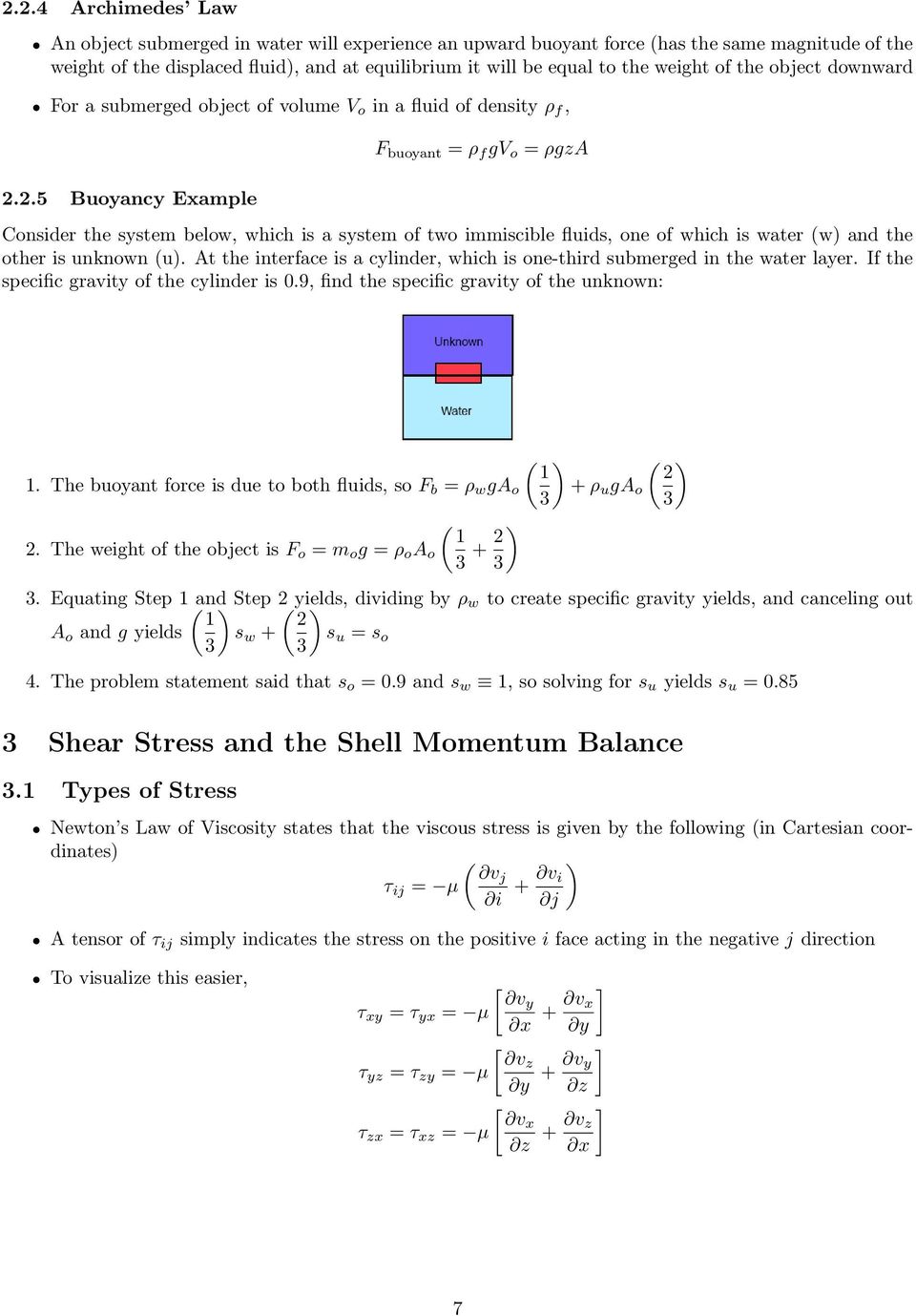
7 ..4 Archimedes Law An object submerged in water will experience an upward buoyant force has the same magnitude of the weight of the displaced fluid, and at equilibrium it will be equal to the weight of the object downward For a submerged object of volume V o in a fluid of density ρ f,..5 Buoyancy Example F buoyant = ρ f gv o = ρgza Consider the system below, which is a system of two immiscible fluids, one of which is water w and the other is unknown u. At the interface is a cylinder, which is one-third submerged in the water layer. If the specific gravity of the cylinder is 0.9, find the specific gravity of the unknown: 1 1. The buoyant force is due to both fluids, so F b = ρ w ga o + ρ u ga o The weight of the object is F o = m o g = ρ o A o Equating Step 1 and Step yields, dividing by ρ w to create specific gravity yields, and canceling out 1 A o and g yields s w + s u = s o The problem statement said that s o = 0.9 and s w 1, so solving for s u yields s u = Shear Stress and the Shell Momentum Balance 3.1 Types of Stress Newton s Law of Viscosity states that the viscous stress is given by the following in Cartesian coordinates vj τ ij = µ i + v i j A tensor of τ ij simply indicates the stress on the positive i face acting in the negative j direction To visualize this easier, [ vy τ xy = τ yx = µ x + v ] x y [ vz τ yz = τ zy = µ y + v ] y z [ vx τ zx = τ xz = µ z + v ] z x 7
8 3. Shell Momentum Balance 3..1 Procedure 1. Choose a coordinate system. Find the direction of fluid flow. This will be the direction that the momentum balance will be performed on as well as j in τ ij. The velocity in the j direction will be a function of i. This i direction will be the dimension of the shell that will approach zero 3. Find what the pressure in the j direction is a function of the direction in which ρgh plays a role 4. A momentum balance can be written as ṁv ṁv + F = 0 out sys Frequently, this is simplified to a force balance of F = 0 in The relevant forces are usually F gravity = ρgv, F stress = Aτ ij, and F pressure = P A sys F gravity is positive if in the same direction of the fluid flow and negative otherwise 5. Divide out constants and let the thickness of the fluid shell approach zero 6. Use the definition of the derivative f x 0 lim h 0 fx 0 + h fx 0 h 7. Integrate the equation to get an expression for τ ij a Find the constant of integration by using the boundary condition 8. Insert Newton s law of viscosity and obtain a differential equation for the velocity 9. Integrate this equation to get the velocity distribution and find the constant of integration by using the boundary condition a To find the average value of the velocity, D v i = v ida D da 3.. Boundary Conditions The following boundary conditions are used when finding the constants of integration. Note that at this point, we are no longer dealing with an infinitesimal shell but, rather, the system as a whole At solid-liquid interfaces, the fluid velocity equals the velocity with which the solid surface is moving At a liquid-liquid interfacial plane of constant i assuming a coordinate system of i, j, and k, v j and v k are constant across the i direction as well as any stress along this plane At a liquid-gas interfacial plane of constant i assuming a coordinate system of i, j, and k, τ ij and τ ik and subsequently τ ji and τ ki are zero if the gas-side velocity gradient is not large 8
9 If there is creeping flow around an object, analyze the conditions infinitely far out e.g. r for creeping flow around a sphere It is also important to check for any unphysical terms. For instance, if it is possible for x to equal zero, and the equation has a C ln x term in it, then C = 0 since ln 0 is not possible and thus the term should not even exist 3.3 Flow of a Falling Film Consider the following system where the z axis will be aligned with the downward sloping plane and its corresponding shell shown on the right graphic from BSL: 1. Cartesian coordinates will be chosen. The direction of the flow is in the z direction, so this will be the direction of the momentum balance. v z x, so the relevant stress tensor is τ xz, and x will be the differential element. P x, so it is not included in the z momentum balance 3. Set up the shell balance as LW τ xz x τ xz x+ x + ρ xlw g cos β = 0 4. Dividing by LW x and then letting the limit of x approach zero yields 1 τxz x+ x τ x xz lim = ρg cos β x 0 x 5. Note that the first term is the definition of the derivative of τ xz, so dτ xz dx = ρg cos β 6. Integrating this equation yields τ xz = ρgx cos β + C 1, and C 1 = 0 since τ xz = 0 at x = 0 liquid-gas interface τ xz = ρgx cos β 7. Inserting Newton s law of viscosity of τ xz = µ dv z dx yields dv z dx distribution ρg cos β 8. Integrating the velocity profile yields v z = µ at x = δ if δ is the depth in the x direction of the fluid film x ] δ v z = ρgδ cos β µ ρg cos β = µ x + C, and C = [ 1 ρg cos β µ x for the velocity δ since v z = 0 1 Note the rearrangement of terms required so that the definition of the derivative has τ xz x+ x τ xz x and not τ xz x τ xz x+ x 9

10 3.4 Flow Through a Circular Tube Consider the following system graphic from BSL 1. This problem is best done using cylindrical coordinates. The fluid is moving in the z direction, v z = v z r, and thus the j tensor subscript is equal to z and i is r. Therefore, the only relevant stress is τ rz. Also, P z. A z momentum balance will be performed with a differential in the r direction. The force of gravity is in the same direction of fluid flow, so it will be positive. Setting up the shell balance yields πrlτ rz r πrlτ rz r+ r + πr r P 0 P L + πr rlρg = 0 3. Dividing by πl r, letting the thickness of the shell approach zero, and utilizing the definition of the derivative yields d rτ rz P0 P L = + ρg r dr L 4. While it s algebraically equal to the above equation, a substitution of modified pressure 3 can generalize the equation as d rτ rz P0 P L = r dr L 5. Integrating the above equation yields τ rz = r P 0 P L + C 1 L r, and C 1 = 0 since τ rz = at r = 0, which is impossible, so P0 P L τ rz = r L dvz 6. Using Newton s law of viscosity of τ rz = µ yields dr dv z dr = P0 P L r µl Note that you cannot do πrl τ r rz τ r+ r rz 3 The modified pressure, P, is defined as P = P + ρgh where h is the distance in the direction opposite of gravity. In this problem, P = P ρgz since height z is in the same direction as gravity 10

11 P0 P L 7. Integrating the above equations yields v z = r + C, and C = P 0 P L R 4µL 4µL the solid-liquid boundary condition states that v z = 0 at r = R, so v z = P 0 P L R [ r ] 1 4µL R since 3.5 Flow Through an Annulus Consider the following system where the fluid is moving upward in an annulus of height L graphic from BSL 1. This problem is best done using cylindrical coordinates. The fluid is moving in the z direction, so the momentum balance is in the z direction with a differential in the r direction. v z r, so the only relevant stress is τ rz. Also, P z, and the force of gravity is negative since it s in the opposite direction of fluid flow. The shell balance can be written as πr rp 0 πr rp L + πrτ rz r πrlτ rz r+ r ρπrl rg = 0 3. Dividing by πl r yields r τ r+ r rz τ r rz r + r P 0 P L L ρgr = 0 4. Letting the limit of r approach zero, and applying the definition of the derivative yields d rτ rz dr 5. Substituting the modified pressure yields 4 d rτ rz dr = r P 0 P L ρg L P0 P L = L 4 Note here that P = P + ρgz since the z height is in the opposite direction of gravity r 11

12 6. Integrating the above equation yields P0 P L τ rz = r + C 1 L r 7. The constant of integration cannot be determined yet since we don t know the boundary momentum flux conditions. We know that the velocity only changes in the r direction, so there must be a maximum velocity at some arbitrary width r = λr, and at this point there will be no stress. This is because τ ij is a function of the rate of change of velocity, and since the derivative is zero at a maximum, the stress term will go to zero. Therefore, P0 P L 0 = λr + C 1 L λr 8. Solving the above equation for C 1 and substituting it in yields τ rz = P 0 P L R L [ r R λ R r ] 9. Using τ rz = µ dv z dr and integrating dv z dr yields v z = P 0 P L R 4µL [ r r ] λ ln + C R R 10. The boundary conditions state that v z = 0 at r = κr and v z = 0 at r = R solid-liquid interfaces, which yields a system of equations that can be solved to yield C = 1 and λ = 1 κ 1 ln κ 11. Substituting the results from above yields the general equations of τ rz = P 0 P L R L v z = P 0 P L R 4µL r R 1 r R 1 κ 1 ln κ R r 1 κ r ln 1 R ln κ 1

13 4 Mass, Energy, and Momentum Balances 4.1 Mass and Energy Balance For mass balances, ṁin ṁ out = d dt m system = d dt ρv system For energy balances with heat q and work 5 w, q w + E in E out = d dt E sys Therefore, a general equation can be written as the following where ê is the internal energy per unit mass, min ê + P ρ + gz + 1 v m out ê + P ρ + gz + 1 [m v sys ê + gz + 1 ] v in out+q w = d dt sys Power can be written as Power = ṁŵ = F v = Q P 4. Bernoulli Equation At steady state conditions, the general equation for the mass-energy balance of an inlet-outlet system can be written as the following ê 1 + v 1 + gz 1 + P 1 ρ 1 + q = ê + v + gz + P ρ + ŵ The energy balance simplifies to the mechanical energy balance with constant g and at steady-state with ˆF representing frictional losses: v ˆ dp + g z + 1 ρ + ŵ + ˆF = 0 ˆF is always positive, ŵ is positive if the fluid performs work on the environment, and ŵ is negative if the system has work done on it Note that ˆF is a frictional energy per unit mass. Recall that energy is kg m s. Also, ŵ is energy Therefore, if one solves for ˆF, this value can be divided by g to get the friction head, which has SI units of m If the fluid is incompressible, ρ is constant, so it becomes v + g z + P ρ + ŵ + ˆF = 0 For steady-state, no work, no frictional losses, constant g, and constant density incompressible, the Bernoulli Equation is obtained: v + g z + P ρ = 0 For a problem that involves draining, if the cross sectional area of the tank is significantly larger than the siphon or draining hole, v 1 can be approximated as zero 5 A positive work value indicates work done by the system while a negative work indicates work done on the system 13
![be written as the following where ê is the internal energy per unit mass, min ê + P ρ + gz + 1 v m out ê + P ρ + gz + 1 [m v sys ê + gz + 1 ] v in out+q w = d dt sys Power can be written as Power =](/docs-images/43/14642926/images/page_13.jpg "ṁŵ = F v = Q P 4.")
14 4.3 Momentum Balance Of course, the momentum balance was already seen in the shell momentum balance section, but for clarity it is included here as well without assuming steady state conditions: Recall that momentum is: M mv Therefore, ṁv ṁv + out sys in F = d dt mv sys dm sys dt While it may seem impossible to add a force and momentum together, realize that is not what is being done. Instead, it s a mass flow rate times velocity, which happens to have the same units of force, so addition can be performed Some forces that are relevant to fluid dynamics are F = F + sys gravity pressure F + visc. F + other 5 Differential Equations of Fluid Mechanics Vectors and Operators Dot Product If u = u 1, u, u 3 and v = v 1, v, v 3, then the dot product is u v = u1 v 1 + u v + u 3 v 3 F 5.1. Cross Product The cross product is the following where θ is between 0 and π radians u v = u v 3 u 3 v î u 1 v 3 u 3 v 1 ĵ + u 1 v u v 1 ˆk Gradient The operator is defined as = î x + ĵ y + ˆk z The gradient of an arbitrary scalar function fx, y, z is Divergence For an arbitrary 3-D vector v, the divergence is gradf = f = f x î + f y ĵ + f z ˆk div v = v = v x x + v y y + v z z 6 See Section 10 for equations written out for the various coordinate systems 14

15 5.1.5 Curl The curl of an arbitrary 3-D vector v is curl v = vz v = y v y vx î + z z v z vy ĵ + x x v x ˆk y Laplacian The Laplacian operator,, acting on an arbitrary scalar fx, y, z is 5. Solution of the Equations of Motion f = f x + f y + f z A differential mass balance known as the continuity equation can be set up as If ρ is constant, then ρ t ρ t + ρ v = 0 = 0, and the ρ values can be factored out of the above equation to make v = 0 For constant ρ and µ, the Navier-Stokes Equation states that v ρ t + v v = P + µ v + ρ g 5.3 Procedure for Using Navier-Stokes Equation 1. Choose a coordinate system and find the direction of the flow. Use the continuity equation making simplifications if ρ is constant to find out more information 3. Use the Navier-Stokes equation in the direction of the fluid flow and eliminate terms that are zero based on the direction of the flow and the results of the continuity equation a Be careful to make sure that g is in the correct direction 4. Integrate the resulting equation and solve for the boundary conditions 5.4 Flow Through a Circular Tube Using Navier-Stokes The problem in Section 3.4 can be revisited, as the Navier-Stokes equation can be used on problems where the shell momentum balance method was originally used. For this problem, refer to the earlier diagram, and assume the pressure drops linearly with length. Also assume that ρ and µ are constant: 1. The best coordinate system to use is cylindrical, and the continuity equation can be written as v = 1 r r rv r + 1 v θ r dθ + v z z = 0. The continuity equation turns into the following since velocity is only in the z direction: v z z = 0 15
16 3. Now the Navier-Stokes equation can be written in the z direction as vz ρ t + v v z r r + v θ v z r θ + v v z z = P 1 z z + µ r v z + 1 v z r r r r dθ + v z z + ρg z 4. The Navier-Stokes equation simplifies to the following since v z r, v r = v θ = 0, and the linear change in pressure means P z = P L P 0 : L 0 = P L P 0 + µ r v z + ρg z L r r r 5. Rearranging the above equation yields [ ] 1 PL P 0 ρg z = 1 [ d r v ] z µ L r dr r 6. For simplicity s sake, let the left-hand side equal some arbitrary constant α to make integration easier α = 1 [ d r v ] z r dr r 7. Integrating the above equation yields 8. Integrating the above equation again yields αr αr = r v z r + C 1 4 C 1 ln r + C = v z 9. At r = 0, the log term becomes unphysical, so C 1 = 0. The equation is now αr 4 + C = v z 10. There is a solid-liquid boundary at r = R, and v z = 0 here, so C = αr 4. Therefore, v z = αr 4 αr = α r R = 1 [ ] PL P 0 r ρg z R 4 4µ L 11. Substituting P = P ρgz into this problem yields the same result as in Section Flow Through a Heat-Exchanger Consider a heat-exchanger as shown below with an inner radius of R 1 and outer radius of R with z pointing to the right. Fluid is moving to the right +z in the outer tube, and the fluid is moving to the left in the inner tube -z. Assume that the pressure gradient is linear and that R 1 < r < R : 16
![Rearranging the above equation yields [ ] 1 PL P 0 ρg z = 1 [ d r v ] z µ L r dr r 6.](/docs-images/43/14642926/images/page_16.jpg "For simplicity s sake, let the left-hand side equal some arbitrary constant α to make integration easier α = 1 [ d r v ] z r dr r 7. Integrating the above equation yields 8.")
17 1. Cylindrical coordinates are best to use here, and velocity is only in the z direction. The continuity equation is equivalent to the following, assuming constant ρ and µ v = 0 v z z = 0. Setting up the Navier-Stokes equation in the z direction simplifies to the following recall that ρg isn t necessary since gravity isn t playing a role [ P 1 z = µ r v ] z r r r 3. Since the pressure gradient is linear, P L P 0 µl r = d r dv z dr dr 4. Integrating the above equation yields P L P 0 µl r = r dv z dr + C 1 5. Integrating the above equation yields v z = P L P 0 4µL r C 1 ln r + C 6. Letting the constant term in front of the r become α for simplicity yields v z = αr C 1 ln r + C 7. At r = R 1, v z = 0 since it s a solid-liquid boundary 7, so C = αr 1 + C 1 ln R 1 8. At r = R, v z = 0 since it s a solid-liquid boundary, so C 1 = α R R1 R1 ln 9. Substituting back into the equation for v z yields v z = α R r + R1 ln r R1 ln R 1 R R1 R1 R1 ln ln 10. Substituting back in for α and simplifying yields r v z = P L P 0 ln R 4µL R R + R 1 r R ln R R 1 7 Note that C 1 0 because r is never actually zero. The outer tube cannot be smaller than the inner tube, so zero volume in the outer tube is actually r = R 1 R R 17

18 6 Velocity Distributions with More Than One Variable 6.1 Time-Dependent Flow of Newtonian Fluids Definitions To solve these problems, a few mathematical substitutions will be made and should be employed when relevant to make the final solution simpler The kinematic viscosity is ν = µ ρ For a wall-bounded flow, the dimensionless velocity is defined as the following where v i is the local velocity and v 0 is the friction velocity at the wall 6.1. Flow near a Wall Suddenly Set in Motion φ = v i v 0 A semi-infinite body of liquid with constant density and viscosity is bounded below by a horizontal surface the xz-plane. Initially, the fluid and the solid are at rest. Then at t = 0, the solid surface is set in motion in the +x direction with velocity v 0. Find v x, assuming there is no pressure gradient in the x direction and that the flow is laminar. 1. Cartesian coordinates should be used. Also, v y = v z = 0, and v x = v x y, t since it will change with height and over time. Using the continuity equation yields v x x = 0 at constant ρ, which we already know because v x is not a function of x 3. Using the Navier-Stokes equation in the x direction yields ρ v x y. This can be simplified to v x t = ν v x y 4. Boundary and initial conditions must be set up: vx = µ t a There is a solid-liquid boundary in the x direction, and the wall is specified in the problem stating as moving at v 0. Therefore, at y = 0 and t > 0, v x = v 0 b At infinitely high up, the velocity should equal zero, so at y =, v x = 0 for all t > 0 c Finally, time is starting at t = 0, so v x = 0 at t 0 for all y 5. It is helpful to have the initial conditions cause solutions to be values of 1 or 0, so the dimensionless velocity of φy, t = v x will be introduced such that φ v 0 t = ν φ y a It is now possible to say φy, 0 = 0, φ0, t = 1, and φ, t = 0 6. Since φ is dimensionless, it must be related to y νt since this or multiplicative scale factors of it is the only possible dimensionless group from the given variables. Therefore, φ = φη where η = y 4νt. The 4 term is included in the denominator for mathematical simplicity later on but is not necessary 7. With this new dimensionless quantity, the equation in Step 5 can be broken down from a PDE to an ODE 18

19 a First, φ t = φ η η. The value for can be found from taking the derivative with respect to t η t t of η defined in Step 6. This yields φ t = dφ 1 η dη t b Next, φ y = φ η η. The value for can be found from taking the derivative with respect to y η y y of η defined in Step 6. This yields φ y = dφ 1 dη 4νt i. We want φ y though, so perform φ y = φ φ dφ = y y dη 1 dφ 4νt dη 1 = 4νt d φ 1 dη 4νt c Therefore, d φ dφ + η dη dη = 0 8. New sets of boundary conditions are needed for η a At η = 0, φ = 1 since this is when y = 0, and it was stated earlier that φ0, t = 1 b At η =, φ = 0 since this is when y =, and it was stated earlier that φ, t = 0 9. To solve this differential equation, introduce ψ = dφ dη to make the equation d φ + ηψ = 0, which will dη yield ψ = c 1 exp η 10. Integrating ψ yields φ = c 1 η 0 exp η d η + c a η is used here since it is a dummy variable of integration and should not be confused with the upper bound of η 11. The boundary conditions of φ = 0 and φ = 1 can be used here to find c 1 and c, which produces the equation φη = 1 erf η a The error function is defined for an arbitrary z and ξ as erf z = π z 0 e ξ dξ 6. The Potential Flow and Streamfunction The vorticity of a fluid is defined as w = v If the vorticity of a fluid is zero, then it is said to be irrotational The velocity potential, φ, can be defined as the following, which satisfies irrotationality 8 v = φ The stream function, ψ, can be defined as the following, which satisfies continuity 9 v = ẑ ψ The Laplace equation is φ = 0 To obtain the Laplace equation from φ, substitute it into the continuity equation To obtain the Laplace equation from ψ, substitute it into the irrotationality condition A stagnation point is defined as the point where the velocity in all dimensions is zero 8 A table of velocity potentials can be found in the Appendix. 9 A table of stream functions can be found in the Appendix. 19

20 6.3 Solving Flow Problems Using Streamfunctions Overview To solve two-dimensional flow problems, the streamfunction can be used, and the equations listed in the Appendix for the differential equations of ψ that are equivalent to the Naiver-Stokes equation should be used For steady, creeping flow, the only term not equal to zero is the term associated with the kinematic viscosity, ν This is also true at Re 1 When dealing with spherical coordinates, r and θ will still be used, but z will be used in place of φ for the third dimension 6.3. Creeping Flow Around a Sphere 10 Problem Statement: Obtain the velocity distributions when the fluid approaches a sphere in the positive z direction if z is to the right. Assume that the sphere has radius R and Re 1. Solution: First, realize that this is two-dimensional flow, so a stream function should be used in place of the Navier- Stokes equation for relative mathematical simplicity. The ψ equivalent for the Navier-Stokes equation in spherical coordinates can be found in the Appendix. Since Re 1, the stream function differential equation becomes 0 = νe 4 ψ, which is simplified to 0 = E 4 ψ. Substituting in E into this equation yields [ r + sin θ r 1 θ sin θ ] ψ = 0 1 θ The next step is to find the boundary conditions. Note that it is best to find all boundary conditions regardless of how many variables are actually needed. The first two boundary conditions are for the no-slip solid-liquid boundary condition where r = R. Here, v r = 1 ψ r = 0 r = R sin θ θ and v θ = 1 ψ = 0 r = R 3 r sin θ r which are the definitions of the stream function in spherical coordinates. The velocity components at r = R equal zero since the sphere itself is not moving. For the last boundary condition, analyze the system at a point far away from the sphere: r. To do this, first note that v θ is tangential to the streamlines around the sphere. Due to mathematical convention quadrants are numbered counterclockwise, this is graphically shown as 10 This problem has not been explained in full detail with regards to both concepts and the math in all the textbooks and websites I could find, so effort has gone into a thorough explanation here. 0
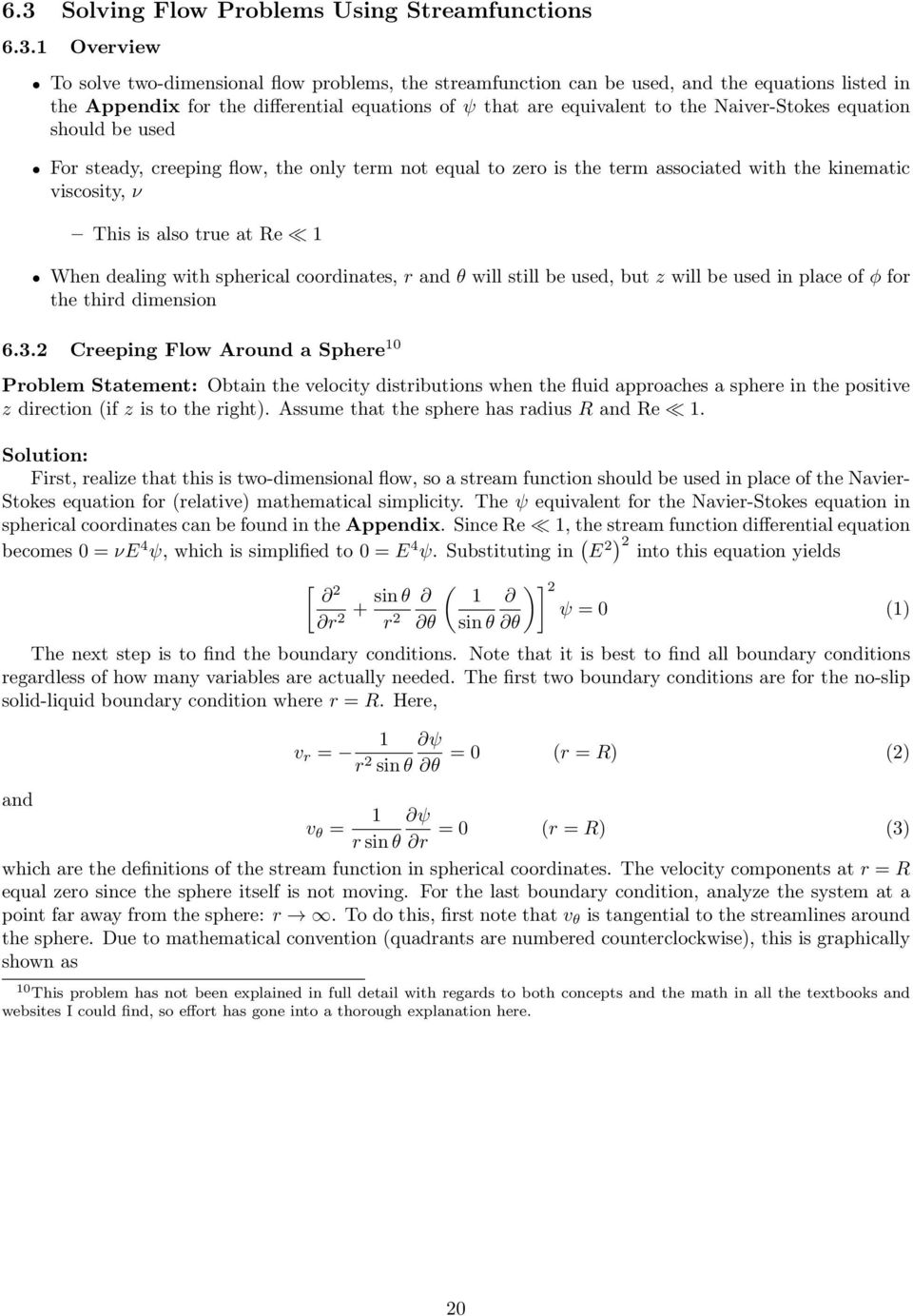
21 The diagram shown above indicates the following. The projection of the sphere a circle is drawn such that it is similar to a unit circle with the angles θ drawn in at the appropriate quadrants. The cyan lines represent the streamlines. v represents some velocity at a point infinitely far out to the right. The yellow vectors represent the direction of v θ, which is always tangential to the sphere and goes counterclockwise. Note how the yellow v θ vector goes in the same direction of v at θ = 3π and against the direction of v at θ = π. Also notice that v θ is completely perpendicular to v at θ = 0, π. With this diagram available, one should find v θ at each quadrant when r. At θ = 0, v θ = 0 since the flow of the fluid is perpendicular to v θ and thus none of the fluid is actually flowing in the v θ direction. At θ = π, v θ = v since the flow is parallel but in the opposite direction to v θ, assuming that v is the velocity of the fluid infinitely far to the right of the sphere. At θ = π, v θ = 0 since the flow is perpendicular to v θ. At θ = 3π, v θ = v since the flow is parallel and in the same direction to v θ. The next step is to come up with a function for v θ given the values we previously defined. The most reasonable function that has the values of v θ shown earlier at each axis is v θ = v sin θ 4 This can be seen by analyzing the sine function. Sine goes from 0 to 1 to 0 to 1 in intervals of π around the unit circle. Multiplying sine by a factor of v simply changes the magnitude of the function and ensures the correct value at each point. As a quick aside, one might care to know what v r is equal to at r since we have just found v θ at r Eq. 4. To do this, analyze the vector triangle shown below. Note that v is horizontal since it is defined as the velocity infinitely far out to the right of the sphere, and v r is at some arbitrary angle θ since it represents a radial value, which can be oriented at infinitely many angles. The triangle is therefore Using trigonometry, one can state the following note the location of the right angle and thus the hypotenuse: v r = v cos θ With Eq. 4, we can equate v θ to the corresponding definition of the stream function. Recall that v θ = 1 ψ r sin θ r in spherical coordinates. This can be rearranged to dψ = v r sin θdr by cross-multiplication 1
22 and substitution of Eq. 4 for v θ. This can then be integrated to yield the third and final boundary condition of ψ = 1 v r sin θ r 5 A solution must now be postulated for ψ. To do this, look at Eq. 5. It is clear that ψ has an angular component that is solely a function of sin θ. There is also a radial component, which can be assigned some arbitrary fr. Therefore, a postulated solution is of the form ψr, θ = fr sin θ 6 Now, substitute Eq. 6 into Eq. 1 and solve. This is a mathematically tedious process, but the bulk of the work has been shown below. Recognize that it is probably easiest to find E ψ and then do E E ψ instead of trying to do E 4 ψ all in one shot. Therefore, E ψ = [ r + sin θ r θ 1 sin θ ] fr sin θ = 0 θ Multiply fr sin θ through and be careful of terms that are and are not influenced by the partial derivatives. Also recall that differential operators are performed from right to left. This yields E ψ = sin θ d fr fr sin θ 1 dr + r cos θ sin θ = 0 θ sin θ After applying the right-most derivative, Factoring sin θ out of the equation yields E ψ = sin θ d fr dr E ψ = d fr dr fr sin θ r = 0 fr r = 0 7 This is close to the final solution of E 4 ψ = 0, but recall that this was just E ψ that was evaluated. We must now evaluate E E ψ, or, equivalently, E of Eq. 7. This is equivalent to saying This simplifies to E 4 ψ = [ r + sin θ r 1 θ sin θ ] [ d fr θ dr fr ] r = 0 d E 4 ψ = dr d r dr r f = 0 8 The above differential equation is referred to as an equidimensional equation, and equidimensional equations should be tested with trial solutions of the form Cr n. An equidimensional equation has the same units d throughout. For instance, dr has units of m and so does. Therefore, since all terms have the same r units, this is an equidimensional equation. By substituting Cr n into Eq. 8, n may have values of -1, 1,, and 4. This can be seen by the following: d dr d r dr r Cr n = 0 Applying the right-hand parenthesis yields d dr r n n 1 Cr n Cr n = 0
23 This simplifies to d dr r Applying the left-hand parentheses yields Simplifying this yields Cr n [n n 1 ] = 0 n n 3 Cr n 4 [n n 1 ] Cr n 4 [n n 1 ] Finally, one more algebraic simplification yields [n n 3 ] [n n 1 ] Cr n 4 = 0 n 4 n n 1 n + 1 Cr n 4 = 0 The solutions to the above equation are n = 1, 1,, 4. This makes fr the following general equation with four terms: fr = C 1 r 1 + C r + C 3 r + C 4 r 4 9 The constant C 4 must equal zero. This is because C 4 is multiplied by r 4, and ψ Eq. 5/6 does not have an r 4 term in it. C 3 must equal 1 v because C 3 is multiplied by an r term, and the equation for ψ Eq. 5/6 has a 1 v r in it. The reason that C 4 = 0 and C 1 and C do not is that we know that the highest term in the equation for ψ is an r term. Any term that converges faster than the maximum order r must be zero. Therefore, the C 1 term and C term do not have to go to zero, but the C 4 term does. This makes the equation for ψ the following by plugging Eq. 9 into Eq. 6: ψr, θ = C 1 r 1 + C r 1 v r sin θ 10 Using the definition of v r in relation to the stream function, one can rewrite this equation as the following by plugging the equation for ψ Eq. 10 into ψ θ in the equation for v r: Similarly for v θ, v r = 1 ψ r sin θ θ = v C r C 1 r 3 cos θ 11 v θ = 1 ψ r sin θ r = v + C r C 1 r 3 sin θ 1 By setting v r = 0 and v θ = 0 at the r = R no-slip boundary conditions and solving for C 1 and C, we get a system of linear equations with C 1 = 1 4 v R 3 and C = 3 4 v R. One somewhat easy way to do this is to add Eq. 11 and Eq. 1, which cancels a lot of terms in the system of equations. However, any method to solve the system is sufficient. With these constants, one can rewrite the equation for ψ Eq. 10 as ψ r, θ = 1 4 v R 3 r + 3 v Rr 1 v r sin θ 13 Therefore, rewriting Eq. 11 and Eq. 1 with the values for the constants substituted in yields the following v r = v 1 3 R R cos θ r r v θ = v 1 3 R 1 3 R sin θ 4 r 4 r 3
24 6.4 Solving Flow Problems with Potential Flow Overview To solve two-dimensional problems with fluids that have very low viscosities, are irrotational, are incompressible, and are at steady-state, the potential flow method can be used 6.4. Steady Potential Flow Around a Stationary Sphere Problem Statement: Consider the flow of an incompressible, inviscid fluid in irrotational flow around a sphere. Solve for the velocity components. Solution: This problem is best done using spherical coordinates. The boundary conditions should then be found. There is a no-slip boundary condition at r = R. Here, v r = φ r = 0 r = R 14 and v θ = 1 φ = 0 r = R 15 r θ Now, infinitely far away should be analyzed. At this point, and v r = v cos θ r 16 v θ = v sin θ 17 For explanation of how to obtain Eq. 16/17, see the previous example problem with the stream function. Now, analyze φ in order to come up with a trial expression. This is done by substituting Eq. 16 or Eq. 17 into Eq. 14 or Eq. 15 and solving for φ via integration. Whether you choose to substitute v r or v θ, the reasonable trial solution is of the form Next, substitute Eq. 18 into the Laplace equation such that φr, θ = fr cos θ 18 fr cos θ = 0 This expression becomes the following in spherical coordinates 1 r r φ 1 + r r r sin θ φ sin θ θ θ Doing some of the derivatives yields 1 r d dr r dfr cos θ dr + 1 r sin θ = 0 fr sin θ = 0 θ Performing the right-most derivative and factoring out the cosine yields the following. Note that the left-most derivative is retained since doing a product rule is just extra work. 1 d r r dfr fr dr dr r = 0 19 Note that Eq. 19 is an equidimensional equation see previous example problem with the stream function for more detail. Therefore, a test solution of Cr n should be inputted for fr in Eq. 19. Doing this yields 1 d r r d Crn Crn dr dr r = 0 4
25 This should be some fairly simple calculus, which will result in the algebraic expression n + n 1 = 0 This has roots of n = and n = 1, so the trial expression fr can be written as Substituting fr into Eq. 18 yields fr = C 1 r + C r φr, θ = C 1 r + C r cos θ 0 Apply the boundary conditions to solve for the constants. For instance, at r = R, we know that v r = φ = 0, so substituting Eq. 0 into this expression yields r Evaluating this at r = R and rearranging yields C 1 C r 3 = 0 C = 1 C 1R 3 1 At r, we know that v r = v cos θ = φ, so substituting Eq. 0 into this expression yields r Evaluating this at r and rearranging yields C 1 C r 3 cos θ = v cos θ C 1 = v Plugging the above expression into Eq. 1 will yield C = 1 v R Plugging the newly found expressions for C 1 and C into fr yields fr = v 1 + R r and substituting this fr into Eq. 0 yields φr, θ = v 1 + R r cos θ Now that an expression for φ is found, we can find the velocity components using v = φ or the equivalent definitions in the Appendix. For instance, we know that v r = φ r, v θ = 1 r Therefore, plugging Eq. into the above expressions will yield v r and v θ after simplification. They will come to 3 R v r = v 1 cos θ r and v θ = v φ θ 3 R sin θ r 5
26 6.5 Boundary Layer Theory Derivation of Prandtl Boundary Layer Conditions Boundary layer theory involves the analysis of a very thin region the boundary layer, which, due to its thinness, can be modeled in Cartesian coordinates despite any apparent curvature. For consistency, x will indicate downstream and y will indicate a direction perpendicular to a solid surface To be clear, a boundary layer is the following. Consider a solid object in a fluid. The area we are investigating is near this solid - not on the edge of the solid yet not very far away from the solid. Therefore, we will consider a hypothetical thin boundary layer that surrounds the solid Let v be the approach velocity on the surface arbitrary dimension, I 0 be the length of the object, and δ 0 be the thickness of the thin boundary layer Since we define this as a very thin boundary layer, we know that δ 0 I 0 The scenario described above is depicted below for reference. The dashed line is the boundary layer graphic from BSL: The continuity equation for this system is v x x + v y y directions can be written as v x v x x + v y = 0, and the N-S equation in the x and y v x = 1 P y ρ x + ν v x x + v x y 3 and v y v x x + v v y y = 1 P y ρ y + ν v y x + v y y 4 To solve a boundary layer problem, approximations need to be made that will simplify the N-S equations We know that v x = 0 at the solid-liquid boundary no-slip condition. Therefore, v x varies from 0 to v from the solid s edge to the edge of the hypothetical boundary layer. Also, δ 0 is the thickness, which is in the y direction. As such 11, v x y = O In the length direction, I 0, the fluid can only slow down once it hits the solid. Therefore, v x has a maximum of v such that v x x = O v 6 11 The O operator indicates order of magnitude of. v δ 0 I 0 5 6
27 Integrating Eq. 6 yields v x = O ˆ v I0 dx = O v I 0 0 The continuity equation can be performed to find out that v y y = O v I 0 7 Integrating Eq. 7 yields ˆ v δ0 v δ 0 v y = O dy = O I 0 0 I 0 This means that v y v x since we stated earlier that δ 0 is a very small quantity Looking at the N-S equations listed earlier, the terms can be replaced with their order of magnitude equivalents. First, the x direction N-S equation will be analyzed Eq. 3: First, the following relationship holds due to Eq. 6 and the fact that v x = O v v x v v x x = O v δ 0 Second, the following relationship holds due to Eq. 5 and the fact that v y = O found earlier I 0 v x v v y y = O Next, the following relationship holds due to Eq. 6: v x x = O v Note that the it is not v in the numerator because a second-derivative indicates two instances of dx and not two instances of v x This also means that the following relationship holds due to Eq. 5: v x y = O v I 0 I 0 δ 0 I Additionally, v x x v x y 3 This is because we already stated I 0 δ 0, and δ 0 is in the denominator of Eq. 31 while I 0 is in the denominator of Eq. 30 Now all portions of the x direction N-S equation have been replaced piece-by-piece According to boundary layer theory, the left velocity components of N-S equations should have the same order of magnitude as the velocity components on the right side of the N-S equations at the boundary layer 7
28 Therefore, rewriting Eq. 3 with the previously defined order of magnitude analogues and the fact that v x v y as well as the relationship in Eq. 3 yields v = O ν v I 0 δ0 Rearranging the above equation and substituting in the Reynolds number yields the more frequently used relationship of δ 0 1 = O I 0 Re All information from the x direction N-S equation has now been extracted. To be completely mathematically rigorous, the y direction N-S equation should be analyzed, but this will simply yield that the N-S equation in the y direction is much less significant than the x direction N-S equation see Eq in Bird for a mathematical justification. This does not really come as a surprise since we stated v y v x earlier. This also means that P y P such that the modified pressure is only a function x of x. Collectively, this information leads us to the Prandtl boundary layer equations, which are and v x x + v y y = 0 33 v x v x x + v v x y y = 1 dp ρ dx + ν v x y 34 The first Prandtl boundary layer equation is simply the continuity equation stated at the beginning of this section, and the second equation is the simplified N-S equation in the x direction taking into account Eq Derivation of the von Karman Momentum Balance 1 With these assumptions in place, the Prandtl boundary layer equations can be solved for and will yield the Karman momentum balance Taking the derivative with respect to x of the Bernoulli Equation at the edge of the boundary will yield a useful relationship. Note that v x x, y v e x at the outer edge of the boundary layer [ d Px + v ex ] = d dx ρ dx [constant] This simplifies to the following note the use of product rule 1 dpx + 1 [ v e x dv ex + dv ] ex ρ dx dx dx v ex = 0 Further simplification yields v e x dv ex dx = 1 dpx ρ dx 35 Now, Eq. 33 will be analyzed. It can integrated and rearranged to yield 13 ˆ y v y = 0 1 Not required for ChBE 1 at Tufts University. 13 The function of x e.g. v ex will be dropped for simplicity. v x dȳ 36 x 8
29 Plugging Eq. 35 and Eq. 36 into Eq. 34 yields ˆ v y x v x x v x x dȳ vx y = v dv e e dx + ν v x y 37 Integrating E. 37 from y = 0 to y = yields ˆ [ v x v x x v ˆ y x v x y x dȳ ] dv e v e dy = dx ˆ 0 [ ] ν v x y dy 38 The RHS of the above equation is ˆ ν v x 0 y dy = ν v x y 0 Evaluating at y = yields zero since the top of the boundary layer should have inviscid outer flow viscosity only matters in a region close to the boundary layer. This yields RHS = µ ρ The second term on the LHS can now be evaluated. It can be rewritten as ˆ [ˆ v y ] x v x Second Term on LHS = y x dȳ dy Integration by parts yields Second Term on LHS = 0 [ v x 0 v x y ˆ 0 39 y=0 0 v x x dy ˆ 0 ] v x v x x dy Recall that v x x, y and v x x, v e x such that the above equation can be rewritten as Second Term on LHS = ˆ Substituting Eq. 39 and Eq. 40 into Eq. 38 yields ˆ 0 v x v x x dy ˆ 0 0 v e v x x dy ˆ 0 v e v x x dy + ˆ 0 v e dv e dx dy = µ ρ v x v x x v x y dy y=0 After some manipulation and multiplication by ρ, the above equation becomes the von Karman momentum balance of µ v x y = d ˆ ρv x v e v x dy + dv ˆ e ρ v e v x dy y=0 dx dx 7 Flow in Chemical Engineering Equipment 7.1 Laminar Flow 0 For a horizontal pipe of length L and radius R, the velocity profile can be written as the following at any radial point r v = P r R 4µL The total flow rate can be written as Q = ˆ π ˆ R 0 0 v rdrdθ = The mean velocity is given as v = Q πr = R P 8µL and the maximum velocity is simply twice the mean velocity P πr4 8µL 0 9
30 7. Friction Factors for Flow in Tubes The Fanning friction factor is defined as the following with the usual definitions and τ w as the wall shear stress f F = τ w ρ v = D P Lρ v For Laminar flow, f F = 16 Re 7.3 Friction Factors for Flow Around Submerged Objects The coefficient of drag is given as C D = F D/A P ρv A P is the project area and is πd 4 for flow around a submerged sphere and F D is the drag force and is given as F D = P v The settling of a spherical particle under the influence of gravity is given as πd 3 6 ρ s ρ f g F D = πd3 ρ s 6 dv dt At terminal velocity or any other steady-state condition, plugging into the definition of C D yields dv dt = 0. Therefore, solving for F D and C D = 4gD ρ s ρ f 3v ρ f All subscripts of s indicate the spherical object and f for the fluid. For terminal velocity, v = v t The above equation for C D can be rewritten as or as C D Re = 4gρ f D 3 3µ ρ s ρ f C D Re = 4gµ ρ s ρ f 3ρ f v3 8 Thermal Conductivity and the Mechanisms of Energy Transport 8.1 Fourier s Law of Heat Conduction The heat flux q is defined as Fourier s Law of Cooling q = k T The heat flux is related to the heat flow Q by Q = q A = Ak T 30
31 The thermal diffusivity is defined as the following where Ĉp is heat capacity at constant pressure with per-mass units, α = k ρĉp The units of α are length-squared per unit time The Prandtl number unitless is defined as 8. The Microscopic Energy Balance 8..1 Equation Pr = ν α = Ĉpµ k The microscopic energy balance states that [ T ρĉp t + ] v T = q + S Using Fourier s Law of cooling yields the equivalent 14 ρĉp Note that k T = k T when k is constant [ T t + ] v T = k T + S The T t is the accumulation term, the v T term is convective, the k T is the conductive term, and S is the source term Dividing by ρĉp and assuming k is constant yields T t + v T = α T + S ρĉp where α k ρĉp Recall the following thermodynamic definition as well: H Ĉ p = T 8.. Boundary Conditions The temperature may be specified at a surface The heat flux normal to a surface may be given this is the same as saying the normal component of the temperature gradient There must be continuity of temperature and heat flux normal to the surface at the interfaces At a solid-liquid interface, q = h T 0 T b where T b is the bulk temperature and T 0 is the solid surface temperature 14 Since boundary conditions are more frequently based on temperature quantities, this form of the equation is typically more useful. P 31
32 8.3 Conduction through a Block Prompt: There is a rectangular prism with heat flow solely in the +x direction. The left face of the object is at a temperature T 1, and the right face of the object is at a temperature T. The length of the box is x = B. Assume that k = a + bt, where a and b are constants. Solve for the heat flux through the object. Solution: 1. The Cartesian coordinate system should be used. Also, there is only conduction, and it is in the x direction such that T x. Using the microscopic energy balance, realizing it is steady state so T t = 0, that v = 0, and that S = 0 yields 0 = k T 3. Substituting in for k and rewriting the equivalents for yields 0 = d a + bt dt dx dx 4. Integrating once yields 5. Integrating again yields C 1 = a + bt dt dx C 1 x + C = at + bt 6. At the interfaces, there must be continuity of temperature, so at x = 0, T = T 1, and at x = B, T = T C = at 1 + bt 1 C 1 = a T T 1 B + b T T1 B 7. From this, the temperature profile can be fully described. However, since the heat flux is desired, Fourier s Law will be used. Note that step 4 indicated that C 1 = k dt dx. Therefore, [ q x = k dt dx = C a T T 1 1 = B + b T T ] 1 B 8.4 Shell Energy Balance As with fluids, the shell balance can be used in place of the microscopic balance for heat flow. The equation is: Convection In - Convection Out + Conduction In - Conduction Out + Work On System - Work By System + Rate of Energy Production = 0 Conduction is given as Aq where A is the projected area analogous to the stress term in the shell momentum balance The rate of energy production is given as SV where S is the rate of heat production per unit volume and V is volume 3
33 8.5 Heat Conduction with an Electrical Heat Source Shell Energy Balance Problem: Find the temperature profile of a cylindrical wire with radius R, length L, an outside temperature of T 0, and a constant rate of heat production per unit volume of S e. Solution: 1. This problem is best done with cylindrical coordinates. Temperature is only a function of r, and the shell will become infinitesimally small in the radial direction. Setting up the shell energy balance with only conduction and a source yields Aq in Aq out + V S e = 0 3. The conduction areas are the projection, which is the circumference times the length. The volume is simply the volume of the cylindrical shell 4. Factoring out constants yields πrlq r r πrlq r r+ r + πrl rs e = 0 πl [rq r r rq r r+ r ] + πrl rs e = 0 5. Rearranging terms to make use of the definition of the derivative yields πl [rq r r+ r rq r ] r πrl rs e = 0 6. Dividing by πl r and using the definition of the derivative yields 7. Integrating once yields d rq r dr = rs e q r = rs e + C 1 r 8. There must be a value at r = 0, but at r = 0, the C 1 term blows up to infinity. Since this is non-physical, C 1 = 0 and the expression becomes q r = rs e 9. Fourier s Law can now be used to introduce temperature such that 10. Integrating once yields k dt dr = rs e T = r S e 4k + C 11. Since temperature must be continuous at the interface, at r = R, T = T 0. Therefore, C = T 0 + R S e 4k 1. Rewriting the expression for temperature and simplifying yields T T 0 = S er [ r ] 1 4k R 33
34 8.5. Microscopic Energy Balance Problem: Repeat the previous example using the microscopic energy balance. Solution: 1. Cylindrical coordinates are best used for this problem. Temperature is only a function of r, the system is at steady-state, the system is not moving, and k is assumed constant such that the microscopic energy balance becomes 0 = k T + S e. Substituting in for in cylindrical coordinates yields k 1 d r dt = S e r dr dr 3. Integrating once yields 4. Integrating a second time yields r dt dr = S er k + C 1 T = S er 4k + C 1 ln r + C 5. Since the C 1 term becomes unphysical at r = 0, it must be true that C 1 = 0 such that T = S er 4k + C 6. The temperature must be continuous at the interface, so at r = R, T = T 0 such that C = T 0 + S er 7. This makes the final expression for the temperature T T 0 = SR 4k 4k [ r ] 1 R 8. To get the heat flux, use Fourier s Law at Step 3 such that a This is because q r = k dt dr 9. Since C 1 was found to be zero in Step 5, q rr k = S er k + C 1 q rr k = S er k 10. Simplifying yields q r = S er 34
35 8.6 Heat Conduction with a Nuclear Heat Source Problem: Consider a double-layer spherical nuclear fuel element. There is a core spherical nuclear material surrounded by a spherical coating. The radius of the nuclear material is given as R f, and the radius from the center to the outer edge of the coating is given as R c. Find the heat flux and temperature profile, assuming that the source energy is not constant and is given as ] r S n = S n0 [1 + b R f where S n0 and b are constants. The outer temperature of the system is also at T 0. Solution: 1. Spherical coordinates are best used here. The temperature and heat flux are only functions of r, and the spherical shell will have a thickness that approaches zero in the radial direction. The only terms are conduction and source for the heat flux from the nuclear fission. However, there is also another expression for the heat flux through the coating part. The two expressions will be identical, but the heat flux through the coating will not have a source.. Writing the shell energy balance for the fission heat flux yields with A = 4πr the surface area of a sphere and V = 4πr r, [ r 4π qr f r r qr f ] r+ r + 4πr rs n = 0 3. Dividing by 4π r and rearranging the terms to make use of the definition of the derivative yields d r qr f = r S n dr a Since S n is a function of r, the expression will need to be substituted in for proper integration. This yields d r qr f ] r = r S n0 [1 + b dr R f 4. As stated before, the heat flux through the coating will be identical but without a source, so it is d r qr c = 0 dr 5. Integrating the equations in Step 3a and Step 4 independently yields qr f r = S n0 3 + br3 5Rf + Cf 1 r q c r = Cc 1 r 6. The value of r = 0 is only applicable for the inner fissionable material since the radial values of the coating are r = R f to r = R c instead of r = 0 to r = R f. It is clear that r = 0, the C f 1 terms becomes unphysical, so C f 1 = 0 and thus qr f r = S n0 3 + br3 5Rf 7. At the interfaces, the heat flux must be continuous, so at r = R f, qr c = qr f such that R 3 C1 c = qr f Rf f = S n0 3 + br3 f 5 35
36 8. Substituting the expression for C c 1 yields q c r = R3 f r S n b 5 9. Now that both components of the heat flux are obtained, the temperatures can be found by using Fourier s Law: k f dt f dr = S r n0 3 + br3 5Rf and 10. Integrating the above equations yields k c dt c dr T f = S n0 k f = R3 f 1 r S n0 3 + b 5 r 6 + br4 0R f + C f and T c = S n0 k c b R 3 f 5 r + Cc 11. At the interfaces, the temperature must be continuous, so at r = R f, T f = T c, and at r = R c, T c = T 0. Therefore, applying these boundary conditions and solving for the constants yields T f = S [[ n0rf ] [ r 6k f ]] 4 r R b 1 + S n0r f f R f 3k c 1 + 3b 1 R f + T 0 5 R c and 8.7 Thermal Resistance Rectangular R th T c = S n0r f 3k c 1 + 3b Rf 5 r R f + T 0 R c It turns out that many physical phenomena can be described by Flow Rate = Driving Force/Resistance Consider heat flowing in the x direction through a rectangular object with length B and area A. If the temperature change is linear, q x = k T B Q = kat 1 T B Since the change in temperature is the driving force, and Q is the flow rate, the thermal resistance in a rectangular system can be defined as R th = B ka 8.7. Defining a General Q Using R th Using the above expression for R th, Q can be rewritten as Q = T 1 T R th = T R th The above expression holds true for systems in any coordinate system as long as R th is appropriately redefined Here, T is not final minus initial. It is always a positive quantity, and it it is frequently T hot T cold 36
37 8.7.3 Cylindrical Shell R th Problem: Consider a cylindrical tube with a hollowed out center with inner radius R 1 and outer radius R. The temperature of the innermost surface is T 1 and outermost surface is T. Assume heat flows radially and the cylinder has length L. Derive R th. Solution: 1. Using cylindrical coordinates, the microscopic energy balance can be rewritten as 1 d kr dt = 0 r dr dr. Integrating once yields 3. Integrating again yields dt dr = C 1 r T = C 1 ln r + C 4. The temperatures were defined at the interfaces, so at r = R 1, T = T 1, and at r = R, T = T such that T 1 = C 1 ln R 1 + C and T = C 1 ln R + C 5. Solving for C 1 yields C 1 = T 1 T ln R /R 1 a Note that C is not needed but can easily be solved for since we are looking for heat flux, and that simply requires C 1 in Step to be found 6. Substituting C 1 in Step and using Fourier s Law yields 7. The heat flow can then be found as q r = k T 1 T r ln R /R 1 Q = q r A r = πlk T 1 T ln R /R 1 8. Since the temperature is the driving force, the thermal resistance can be defined as Spherical Shell R th R th = ln R /R 1 πkl For radial conduction in a spherical system, a similar procedure can be used to find that R th = R R 1 4πkR 1 R 37
38 8.8 Heat Conduction through Composite Walls Series and Parallel Resistances The total resistance of resistances in series is R tot = i R i The total resistance of resistances in parallel is 8.8. Series Rectangular Composite R tot = Problem: Consider a rectangular wall composed of three distinct materials. The left third x = x 0 to x = x 1 is some arbitrary material 1, the middle x = x 1 to x = x is some arbitrary material, and the right third x = x to x = x 3 is some arbitrary material 3. Each has a unique k value. Find the effective thermal conductivity if b 1 = x 1 x 0, b = x x 1, and b 3 = x 3 x. 1. The heat flux must be continuous. For instance, at x = x 0, q x = q 0. At the x 1 interface, q 0 = q 1. At the x interface, q 1 = q. At the x 3 interface, q = q 3. Therefore, q x = q 1 = q = q 3 = q 0. The heat flux is a constant at each interface. i R 1 i 1. Since this is true, at region 1,, and 3, 3. Integrating yields at region 1,, and 3, q 0 = k 01 dt dx q 0 = k 1 dt dx q 0 = k 3 dt dx T = q 0 k 01 x + C 1 T = q 0 k 1 x + C T = q 0 k 3 x + C 3 4. At x = x 0, T = T 0, and at x = x 1, T = T 1 such that 5. Repeating this for the other regions yields T 0 T 1 = q 0 k 01 x 1 x 0 T 1 T = q 0 k 1 x x 1 T T 3 = q 0 k 3 x 3 x 6. Adding the temperature from each region yields b1 T 0 T 3 = q 0 + b + b 3 k 01 k 1 k 3 38
39 7. The heat flow can then be written as Q = q 0 A = T 0 T 3 b1 + b + b = T 3 R eff Ak 01 Ak 1 Ak 3 where R eff = b 1 k 01 A + b k 1 A + b 3 k 3 A = R 1 + R + R 3 8. It is clear that the above system can be modeled with a circuit analog where there are three resistances in series! 9. Bringing the area term to the numerator, Q = A T 0 T 3 b 1 + b + b 3 k 01 k 1 k If we introduce k eff as the effective heat transfer coefficient, Q = k eff A T 0 T 3 b 1 + b + b Therefore, [ 1 k eff = b 1 + b + b 3 b1 + b + b ] 1 3 k 01 k 1 k 3 Note that the previous procedure was mostly a formalism. If you recognize that the composite can be modeled as series resistances, one can jump directly to that step using the previously defined thermal resistances for that coordinate system Cylindrical Composite Problem: There are three cylindrical shells surrounding one another. The inner temperature of the first surface from the center is T 1 and is at r 1. The inner temperature of the second surface outer temperature of the first surface is T and is at r. The inner temperature of the third surface outer temperature of the second surface is T 3 and is at r 3. The cylinder has a length L. The heat flux is solely radial. Model the effective thermal resistance. A rough sketch is shown below to help visualize the scenario: Solution: Using the definition of R th from earlier in cylindrical coordinates and realizing that this is a system in series, R eff = R 1 + R + R 3 = ln r 1/r 0 πk 01 L + ln r /r 1 πk 1 L + ln r 3/r πk 3 L + 39
40 8.8.4 Parallel Rectangular Composite Problem: Consider the following system. Find R eff in terms of k eff. Solution: Since there are now three components in parallel, R eff = R1 1 + R 1 + R = b k 01 A 1 k 1 A k 3 A 3 Introducing a k eff yields R eff = b k eff A 1 + A + A 3 To figure out what k eff is equal to, substitute back in for R eff : k eff A 1 + A + A 3 b = k 01A 1 b + k A b + k 3A 3 b Therefore, k eff = k 01A 1 + k 1 A + k 3 A 3 A 1 + A + A Series and Parallel Cylindrical Composite Problem: Consider the following system. Find R eff in terms of k eff. The system below is a rectangular cross-section of a cylinder. Therefore, r 0 is the innermost radius, and r 3 is the outermost radius. Solution: Elements 1 and are in series. Elements 3 and 4 are in parallel. The equivalent of elements 3 and 4 are in series with elements 1 and. Therefore, R eq 34 = R3 1 + R4 1 1 and R eff = R 1 + R + R eq 34 40
41 Using the cylindrical definitions defined earlier, Introducing k eff yields Using the general definition of Q = T R eff, R eff = ln r 1/r 0 πk 1 L 3 + ln r /r 1 πk L 3 + ln r 3/r πk eq 34 L 3 R eff = ln r 3/r 0 πk eff L 3 T Q = ln r3 /r 0 πk eff L 3 To find out what k eff is in this equation, substitute back in for R eff This simplifies to ln r 3 /r 0 = ln r 3/r + ln r /r 1 + ln r 1/r 0 πk eff L 3 πk 1 L 3 πk L 3 πk eq 34 L 3 k eff = ln r 3 /r 0 ln r 3 /r + ln r /r 1 + ln r 1/r 0 k 1 k k eq 34 However, we have not yet defined k eq 34 yet. To find k eq 34, substitute back in for R eq 34. As such, πk eq 34 L 3 ln r 1 /r 0 = πk 3L 1 ln r 1 /r 0 + πk 4L ln r 1 /r Newton s Law of Cooling Definitions k eq 34 = k 3L 1 + k 4 L L 1 + L = k 3L 1 + k 4 L L 3 Newton s law of cooling states the following where T s is solid surface temperature and T is the bulk liquid temperature q = h T s T The constant h is the heat transfer coefficient The biot number dimensionless is defined as 8.9. Liquid Bound on One Side Bi = bh k = heat transfer by fluid heat transfer by solid Problem: Consider a bulk liquid at temperature T bounded on one side by a solid wall at temperature T s. Derive R th. 1. We know that Q = T R th. Using Newton s law of cooling Q = qa = h T s T A 3. Therefore, R th = 1 Ah to make Q = T R th 41
42 8.9.3 Solid Bound by Two Different Temperature Fluids - Rectangular Problem: Solve the Series Rectangular Composite problem except for now there is a fluid bounding both sides of the rectangular composite depicted below: 1. Using the same procedure as in the Series Rectangular Composite question, the following is true T 0 T 1 = q 0 k 01 b 1 T 1 T = q 0 k 1 b T T 3 = q 0 k 3 b 3. Now, we must consider the heat transfer at the solid-liquid interfaces as well. As such, q 0 = h a T a T 0 q 0 = h b T 3 T b 3. The sum of these equations yields b1 T a T b = q 0 + b + b k 01 k 1 k 3 h a h b 4. Therefore, T a T b Q = q 0 A = 1 b1 + b + b A k 01 k 1 k 3 h a h b 5. Since Q = T, for the solid region, R th = b R eff ka as before, and the fluid region is 1 ha General Equation To generalize the previous examples, a solid rectangular system bounded by fluid can be described by Q = n j=1 A h 0 T hot T cold x j x j 1 k j 1,j + 1 h n A solid cylindrical system bounded by fluid can be described by Q = n j=1 πl r 0 h 0 T hot T cold ln r j /r j 1 k j 1,j + 1 r n h n If there is no surrounding fluid to be considered, the terms with h can be dropped 4
43 9 The Equations of Change for Nonisothermal Systems 9.1 The Energy Equation The general form of the energy equation states that [ ] 1 1 t ρv + ρû = ρv + ρû v q P v τ : v + ρ v g The equation of change of temperature states that T ρĉp t + v T = ln ρ q ln T The following relationships also hold 10 Appendix 10.1 Newton s Law of Viscosity Cartesian Ĥ = Û + P ρ dĥ = ĈpdT [ vy τ xy = τ yx = µ x + v ] x y [ vz τ yz = τ zy = µ y + v ] y z [ vx τ zx = τ xz = µ z + v ] z x p T t + v T τ : v Cylindrical Spherical [ τ rθ = τ θr = µ r r [ 1 τ θz = τ zθ = µ r vθ + 1 r r v z θ + v θ z ] [ vr τ zr = τ rz = µ z + v z r [ τ rθ = τ θr = µ r r [ sin θ τ θφ = τ φθ = µ r [ τ φr = τ rφ = µ vθ + 1 r r vφ θ sin θ 1 r sin θ ] v r θ ] ] v r θ ] v θ r sin θ φ vφ ] r + 1 v r φ + r r 43
44 10. Gradient f = f f ˆx + x y ŷ + f z ẑ Cartesian f = f r ˆr + 1 f r θ ˆθ + f z ẑ Cylindrical f = f r ˆr + 1 f r θ ˆθ + 1 f r sin θ φ ˆφ Spherical 10.3 Divergence 10.4 Curl v = 1 r v = v = v x x + v y y + v z z Cartesian v = 1 r r rv r + 1 v θ r θ + v z z Cylindrical r 1 v r + r r sin θ θ v θ sin θ + 1 v φ r sin θ φ Spherical vz y v y z 1 v z v = r θ v θ z v = 1 vφ sin θ v θ r sin θ θ φ 10.5 Laplacian f = 1 r vx ˆx + ˆr + ˆr + z v z x vr z v z ˆθ + 1 r r 1 v r r sin θ φ 1 r vy ŷ + ẑ Cartesian x v x y rvθ v r r θ ˆθ + 1 rvθ r r rv θ r f = f x + f y + f z Cartesian r f + 1 f r r θ + f z Cylindrical f = 1 r r r f + r r 1 r sin θ θ sin θ f θ + ẑ Cylindrical 1 f r sin θ φ Spherical v r ˆφ Spherical θ 44
45 10.6 Continuity Equation Note that at constant ρ, the above equations simply become v = 0 45
46 10.7 Navier-Stokes Equation 10.8 Stream Functions and Velocity Potentials Velocity Components v x = ψ y = φ x, v y = ψ x = φ y Cartesian v r = 1 ψ r θ = φ r, v θ = ψ r = 1 φ r θ Cylindrical with v z = 0 v r = 1 ψ r z = φ r, v z = 1 ψ r r = φ z Cylindrical with v θ = 0 v r = 1 ψ r sin θ θ = φ r, v θ = 1 ψ r sin θ r = 1 φ r θ Spherical 46
47 10.8. Differential Equations 1. Planar Flow a For Cartesian with v z = 0 and no z-dependence: ψ + ψ ψ ψ ψ = ν 4 ψ t y x x y x + y 4 4 ψ x x y + 4 y 4 ψ b For cylindrical coordinate with v z = 0 and no z-dependence: ψ [ + 1 ψ ψ ψ ψ ] = ν 4 ψ t r r θ θ r. Axisymmetrical r + 1 r r + 1 r θ a For cylindrical with v z = 0 and no z-dependence: E ψ [ 1 ψ E ψ ψ E ψ t r r z z r ] E r 1 r r + z b For spherical with v φ = 0 and no φ-dependence: E ψ [ + 1 ψ E ψ t r ψ E ψ ] sin θ r θ θ r E r + sin θ r E ψ r sin θ 1 θ sin θ r ψ z E ψ = νe E ψ ψ r cos θ 1 ψ r θ sin θ = νe E ψ θ 47
Differential Relations for Fluid Flow. Acceleration field of a fluid. The differential equation of mass conservation
 Differential Relations for Fluid Flow In this approach, we apply our four basic conservation laws to an infinitesimally small control volume. The differential approach provides point by point details of
Chapter 28 Fluid Dynamics
 Chapter 28 Fluid Dynamics 28.1 Ideal Fluids... 1 28.2 Velocity Vector Field... 1 28.3 Mass Continuity Equation... 3 28.4 Bernoulli s Principle... 4 28.5 Worked Examples: Bernoulli s Equation... 7 Example
CBE 6333, R. Levicky 1 Differential Balance Equations
 CBE 6333, R. Levicky 1 Differential Balance Equations We have previously derived integral balances for mass, momentum, and energy for a control volume. The control volume was assumed to be some large object,
1 The basic equations of fluid dynamics
 1 The basic equations of fluid dynamics The main task in fluid dynamics is to find the velocity field describing the flow in a given domain. To do this, one uses the basic equations of fluid flow, which
Scalars, Vectors and Tensors
 Scalars, Vectors and Tensors A scalar is a physical quantity that it represented by a dimensional number at a particular point in space and time. Examples are hydrostatic pressure and temperature. A vector
Fluids and Solids: Fundamentals
 Fluids and Solids: Fundamentals We normally recognize three states of matter: solid; liquid and gas. However, liquid and gas are both fluids: in contrast to solids they lack the ability to resist deformation.
1. Fluids Mechanics and Fluid Properties. 1.1 Objectives of this section. 1.2 Fluids
 1. Fluids Mechanics and Fluid Properties What is fluid mechanics? As its name suggests it is the branch of applied mechanics concerned with the statics and dynamics of fluids - both liquids and gases.
When the fluid velocity is zero, called the hydrostatic condition, the pressure variation is due only to the weight of the fluid.
 Fluid Statics When the fluid velocity is zero, called the hydrostatic condition, the pressure variation is due only to the weight of the fluid. Consider a small wedge of fluid at rest of size Δx, Δz, Δs
EXAMPLE: Water Flow in a Pipe
 EXAMPLE: Water Flow in a Pipe P 1 > P 2 Velocity profile is parabolic (we will learn why it is parabolic later, but since friction comes from walls the shape is intuitive) The pressure drops linearly along
Electromagnetism Laws and Equations
 Electromagnetism Laws and Equations Andrew McHutchon Michaelmas 203 Contents Electrostatics. Electric E- and D-fields............................................. Electrostatic Force............................................2
INTRODUCTION TO FLUID MECHANICS
 INTRODUCTION TO FLUID MECHANICS SIXTH EDITION ROBERT W. FOX Purdue University ALAN T. MCDONALD Purdue University PHILIP J. PRITCHARD Manhattan College JOHN WILEY & SONS, INC. CONTENTS CHAPTER 1 INTRODUCTION
Chapter 2. Derivation of the Equations of Open Channel Flow. 2.1 General Considerations
 Chapter 2. Derivation of the Equations of Open Channel Flow 2.1 General Considerations Of interest is water flowing in a channel with a free surface, which is usually referred to as open channel flow.
Review of Vector Analysis in Cartesian Coordinates
 R. evicky, CBE 6333 Review of Vector Analysis in Cartesian Coordinates Scalar: A quantity that has magnitude, but no direction. Examples are mass, temperature, pressure, time, distance, and real numbers.
Introduction to COMSOL. The Navier-Stokes Equations
 Flow Between Parallel Plates Modified from the COMSOL ChE Library module rev 10/13/08 Modified by Robert P. Hesketh, Chemical Engineering, Rowan University Fall 2008 Introduction to COMSOL The following
Lecture 5 Hemodynamics. Description of fluid flow. The equation of continuity
 1 Lecture 5 Hemodynamics Description of fluid flow Hydrodynamics is the part of physics, which studies the motion of fluids. It is based on the laws of mechanics. Hemodynamics studies the motion of blood
Solutions for Review Problems
 olutions for Review Problems 1. Let be the triangle with vertices A (,, ), B (4,, 1) and C (,, 1). (a) Find the cosine of the angle BAC at vertex A. (b) Find the area of the triangle ABC. (c) Find a vector
11. Rotation Translational Motion: Rotational Motion:
 11. Rotation Translational Motion: Motion of the center of mass of an object from one position to another. All the motion discussed so far belongs to this category, except uniform circular motion. Rotational
XI / PHYSICS FLUIDS IN MOTION 11/PA
 Viscosity It is the property of a liquid due to which it flows in the form of layers and each layer opposes the motion of its adjacent layer. Cause of viscosity Consider two neighboring liquid layers A
Physics of the Atmosphere I
 Physics of the Atmosphere I WS 2008/09 Ulrich Platt Institut f. Umweltphysik R. 424 [email protected] heidelberg.de Last week The conservation of mass implies the continuity equation:
p atmospheric Statics : Pressure Hydrostatic Pressure: linear change in pressure with depth Measure depth, h, from free surface Pressure Head p gh
 IVE1400: n Introduction to Fluid Mechanics Statics : Pressure : Statics r P Sleigh: [email protected] r J Noakes:[email protected] January 008 Module web site: www.efm.leeds.ac.uk/ive/fluidslevel1
Chapter 22: Electric Flux and Gauss s Law
 22.1 ntroduction We have seen in chapter 21 that determining the electric field of a continuous charge distribution can become very complicated for some charge distributions. t would be desirable if we
Chapter 5 MASS, BERNOULLI AND ENERGY EQUATIONS
 Fluid Mechanics: Fundamentals and Applications, 2nd Edition Yunus A. Cengel, John M. Cimbala McGraw-Hill, 2010 Chapter 5 MASS, BERNOULLI AND ENERGY EQUATIONS Lecture slides by Hasan Hacışevki Copyright
Basic Principles in Microfluidics
 Basic Principles in Microfluidics 1 Newton s Second Law for Fluidics Newton s 2 nd Law (F= ma) : Time rate of change of momentum of a system equal to net force acting on system!f = dp dt Sum of forces
CE 3500 Fluid Mechanics / Fall 2014 / City College of New York
 1 Drag Coefficient The force ( F ) of the wind blowing against a building is given by F=C D ρu 2 A/2, where U is the wind speed, ρ is density of the air, A the cross-sectional area of the building, and
Electromagnetism - Lecture 2. Electric Fields
 Electromagnetism - Lecture 2 Electric Fields Review of Vector Calculus Differential form of Gauss s Law Poisson s and Laplace s Equations Solutions of Poisson s Equation Methods of Calculating Electric
NUMERICAL ANALYSIS OF THE EFFECTS OF WIND ON BUILDING STRUCTURES
 Vol. XX 2012 No. 4 28 34 J. ŠIMIČEK O. HUBOVÁ NUMERICAL ANALYSIS OF THE EFFECTS OF WIND ON BUILDING STRUCTURES Jozef ŠIMIČEK email: [email protected] Research field: Statics and Dynamics Fluids mechanics
For Water to Move a driving force is needed
 RECALL FIRST CLASS: Q K Head Difference Area Distance between Heads Q 0.01 cm 0.19 m 6cm 0.75cm 1 liter 86400sec 1.17 liter ~ 1 liter sec 0.63 m 1000cm 3 day day day constant head 0.4 m 0.1 m FINE SAND
Lecture L5 - Other Coordinate Systems
 S. Widnall, J. Peraire 16.07 Dynamics Fall 008 Version.0 Lecture L5 - Other Coordinate Systems In this lecture, we will look at some other common systems of coordinates. We will present polar coordinates
The Viscosity of Fluids
 Experiment #11 The Viscosity of Fluids References: 1. Your first year physics textbook. 2. D. Tabor, Gases, Liquids and Solids: and Other States of Matter (Cambridge Press, 1991). 3. J.R. Van Wazer et
Chapter 27 Static Fluids
 Chapter 27 Static Fluids 27.1 Introduction... 1 27.2 Density... 1 27.3 Pressure in a Fluid... 2 27.4 Pascal s Law: Pressure as a Function of Depth in a Fluid of Uniform Density in a Uniform Gravitational
www.mathsbox.org.uk Displacement (x) Velocity (v) Acceleration (a) x = f(t) differentiate v = dx Acceleration Velocity (v) Displacement x
 Mechanics 2 : Revision Notes 1. Kinematics and variable acceleration Displacement (x) Velocity (v) Acceleration (a) x = f(t) differentiate v = dx differentiate a = dv = d2 x dt dt dt 2 Acceleration Velocity
du u U 0 U dy y b 0 b
 BASIC CONCEPTS/DEFINITIONS OF FLUID MECHANICS (by Marios M. Fyrillas) 1. Density (πυκνότητα) Symbol: 3 Units of measure: kg / m Equation: m ( m mass, V volume) V. Pressure (πίεση) Alternative definition:
Open channel flow Basic principle
 Open channel flow Basic principle INTRODUCTION Flow in rivers, irrigation canals, drainage ditches and aqueducts are some examples for open channel flow. These flows occur with a free surface and the pressure
Basic Equations, Boundary Conditions and Dimensionless Parameters
 Chapter 2 Basic Equations, Boundary Conditions and Dimensionless Parameters In the foregoing chapter, many basic concepts related to the present investigation and the associated literature survey were
Lecture 24 - Surface tension, viscous flow, thermodynamics
 Lecture 24 - Surface tension, viscous flow, thermodynamics Surface tension, surface energy The atoms at the surface of a solid or liquid are not happy. Their bonding is less ideal than the bonding of atoms
Practice Problems on the Navier-Stokes Equations
 ns_0 A viscous, incompressible, Newtonian liquid flows in stead, laminar, planar flow down a vertical wall. The thickness,, of the liquid film remains constant. Since the liquid free surface is eposed
FLUID MECHANICS FOR CIVIL ENGINEERS
 FLUID MECHANICS FOR CIVIL ENGINEERS Bruce Hunt Department of Civil Engineering University Of Canterbury Christchurch, New Zealand? Bruce Hunt, 1995 Table of Contents Chapter 1 Introduction... 1.1 Fluid
Midterm Solutions. mvr = ω f (I wheel + I bullet ) = ω f 2 MR2 + mr 2 ) ω f = v R. 1 + M 2m
 Midterm Solutions I) A bullet of mass m moving at horizontal velocity v strikes and sticks to the rim of a wheel a solid disc) of mass M, radius R, anchored at its center but free to rotate i) Which of
ENV5056 Numerical Modeling of Flow and Contaminant Transport in Rivers. Equations. Asst. Prof. Dr. Orhan GÜNDÜZ
 ENV5056 Numerical Modeling of Flow and Contaminant Transport in Rivers Derivation of Flow Equations Asst. Prof. Dr. Orhan GÜNDÜZ General 3-D equations of incompressible fluid flow Navier-Stokes Equations
Mercury is poured into a U-tube as in Figure (14.18a). The left arm of the tube has crosssectional
 Chapter 14 Fluid Mechanics. Solutions of Selected Problems 14.1 Problem 14.18 (In the text book) Mercury is poured into a U-tube as in Figure (14.18a). The left arm of the tube has crosssectional area
Vector surface area Differentials in an OCS
 Calculus and Coordinate systems EE 311 - Lecture 17 1. Calculus and coordinate systems 2. Cartesian system 3. Cylindrical system 4. Spherical system In electromagnetics, we will often need to perform integrals
Solutions to Homework 10
 Solutions to Homework 1 Section 7., exercise # 1 (b,d): (b) Compute the value of R f dv, where f(x, y) = y/x and R = [1, 3] [, 4]. Solution: Since f is continuous over R, f is integrable over R. Let x
FLUID DYNAMICS. Intrinsic properties of fluids. Fluids behavior under various conditions
 FLUID DYNAMICS Intrinsic properties of fluids Fluids behavior under various conditions Methods by which we can manipulate and utilize the fluids to produce desired results TYPES OF FLUID FLOW Laminar or
Heat Transfer Prof. Dr. Ale Kumar Ghosal Department of Chemical Engineering Indian Institute of Technology, Guwahati
 Heat Transfer Prof. Dr. Ale Kumar Ghosal Department of Chemical Engineering Indian Institute of Technology, Guwahati Module No. # 04 Convective Heat Transfer Lecture No. # 03 Heat Transfer Correlation
State of Stress at Point
 State of Stress at Point Einstein Notation The basic idea of Einstein notation is that a covector and a vector can form a scalar: This is typically written as an explicit sum: According to this convention,
Chapter 6 Circular Motion
 Chapter 6 Circular Motion 6.1 Introduction... 1 6.2 Cylindrical Coordinate System... 2 6.2.1 Unit Vectors... 3 6.2.2 Infinitesimal Line, Area, and Volume Elements in Cylindrical Coordinates... 4 Example
13.4 THE CROSS PRODUCT
 710 Chapter Thirteen A FUNDAMENTAL TOOL: VECTORS 62. Use the following steps and the results of Problems 59 60 to show (without trigonometry) that the geometric and algebraic definitions of the dot product
4 Microscopic dynamics
 4 Microscopic dynamics In this section we will look at the first model that people came up with when they started to model polymers from the microscopic level. It s called the Oldroyd B model. We will
Distinguished Professor George Washington University. Graw Hill
 Mechanics of Fluids Fourth Edition Irving H. Shames Distinguished Professor George Washington University Graw Hill Boston Burr Ridge, IL Dubuque, IA Madison, Wl New York San Francisco St. Louis Bangkok
SURFACE TENSION. Definition
 SURFACE TENSION Definition In the fall a fisherman s boat is often surrounded by fallen leaves that are lying on the water. The boat floats, because it is partially immersed in the water and the resulting
Fluid Mechanics: Static s Kinematics Dynamics Fluid
 Fluid Mechanics: Fluid mechanics may be defined as that branch of engineering science that deals with the behavior of fluid under the condition of rest and motion Fluid mechanics may be divided into three
Some Comments on the Derivative of a Vector with applications to angular momentum and curvature. E. L. Lady (October 18, 2000)
 Some Comments on the Derivative of a Vector with applications to angular momentum and curvature E. L. Lady (October 18, 2000) Finding the formula in polar coordinates for the angular momentum of a moving
Viscous flow in pipe
 Viscous flow in pipe Henryk Kudela Contents 1 Laminar or turbulent flow 1 2 Balance of Momentum - Navier-Stokes Equation 2 3 Laminar flow in pipe 2 3.1 Friction factor for laminar flow...........................
Dimensionless form of equations
 Dimensionless form of equations Motivation: sometimes equations are normalized in order to facilitate the scale-up of obtained results to real flow conditions avoid round-off due to manipulations with
Ch 2 Properties of Fluids - II. Ideal Fluids. Real Fluids. Viscosity (1) Viscosity (3) Viscosity (2)
 Ch 2 Properties of Fluids - II Ideal Fluids 1 Prepared for CEE 3500 CEE Fluid Mechanics by Gilberto E. Urroz, August 2005 2 Ideal fluid: a fluid with no friction Also referred to as an inviscid (zero viscosity)
OUTCOME 3 TUTORIAL 5 DIMENSIONAL ANALYSIS
 Unit 41: Fluid Mechanics Unit code: T/601/1445 QCF Level: 4 Credit value: 15 OUTCOME 3 TUTORIAL 5 DIMENSIONAL ANALYSIS 3 Be able to determine the behavioural characteristics and parameters of real fluid
Natural Convection. Buoyancy force
 Natural Convection In natural convection, the fluid motion occurs by natural means such as buoyancy. Since the fluid velocity associated with natural convection is relatively low, the heat transfer coefficient
Worked Examples from Introductory Physics Vol. I: Basic Mechanics. David Murdock Tenn. Tech. Univ.
 Worked Examples from Introductory Physics Vol. I: Basic Mechanics David Murdock Tenn. Tech. Univ. February 24, 2005 2 Contents To the Student. Yeah, You. i 1 Units and Vectors: Tools for Physics 1 1.1
Contents. Microfluidics - Jens Ducrée Physics: Navier-Stokes Equation 1
 Contents 1. Introduction 2. Fluids 3. Physics of Microfluidic Systems 4. Microfabrication Technologies 5. Flow Control 6. Micropumps 7. Sensors 8. Ink-Jet Technology 9. Liquid Handling 10.Microarrays 11.Microreactors
The Electric Field. Electric Charge, Electric Field and a Goofy Analogy
 . The Electric Field Concepts and Principles Electric Charge, Electric Field and a Goofy Analogy We all know that electrons and protons have electric charge. But what is electric charge and what does it
Figure 1.1 Vector A and Vector F
 CHAPTER I VECTOR QUANTITIES Quantities are anything which can be measured, and stated with number. Quantities in physics are divided into two types; scalar and vector quantities. Scalar quantities have
ATM 316: Dynamic Meteorology I Final Review, December 2014
 ATM 316: Dynamic Meteorology I Final Review, December 2014 Scalars and Vectors Scalar: magnitude, without reference to coordinate system Vector: magnitude + direction, with reference to coordinate system
AB2.5: Surfaces and Surface Integrals. Divergence Theorem of Gauss
 AB2.5: urfaces and urface Integrals. Divergence heorem of Gauss epresentations of surfaces or epresentation of a surface as projections on the xy- and xz-planes, etc. are For example, z = f(x, y), x =
Lecture L6 - Intrinsic Coordinates
 S. Widnall, J. Peraire 16.07 Dynamics Fall 2009 Version 2.0 Lecture L6 - Intrinsic Coordinates In lecture L4, we introduced the position, velocity and acceleration vectors and referred them to a fixed
Lecture 11 Boundary Layers and Separation. Applied Computational Fluid Dynamics
 Lecture 11 Boundary Layers and Separation Applied Computational Fluid Dynamics Instructor: André Bakker http://www.bakker.org André Bakker (2002-2006) Fluent Inc. (2002) 1 Overview Drag. The boundary-layer
FLUID FORCES ON CURVED SURFACES; BUOYANCY
 FLUID FORCES ON CURVED SURFCES; BUOYNCY The principles applicable to analysis of pressure-induced forces on planar surfaces are directly applicable to curved surfaces. s before, the total force on the
Stokes flow. Chapter 7
 Chapter 7 Stokes flow We have seen in section 6.3 that the dimensionless form of the Navier-Stokes equations for a Newtonian viscous fluid of constant density and constant viscosity is, now dropping the
oil liquid water water liquid Answer, Key Homework 2 David McIntyre 1
 Answer, Key Homework 2 David McIntyre 1 This print-out should have 14 questions, check that it is complete. Multiple-choice questions may continue on the next column or page: find all choices before making
Abaqus/CFD Sample Problems. Abaqus 6.10
 Abaqus/CFD Sample Problems Abaqus 6.10 Contents 1. Oscillatory Laminar Plane Poiseuille Flow 2. Flow in Shear Driven Cavities 3. Buoyancy Driven Flow in Cavities 4. Turbulent Flow in a Rectangular Channel
A LAMINAR FLOW ELEMENT WITH A LINEAR PRESSURE DROP VERSUS VOLUMETRIC FLOW. 1998 ASME Fluids Engineering Division Summer Meeting
 TELEDYNE HASTINGS TECHNICAL PAPERS INSTRUMENTS A LAMINAR FLOW ELEMENT WITH A LINEAR PRESSURE DROP VERSUS VOLUMETRIC FLOW Proceedings of FEDSM 98: June -5, 998, Washington, DC FEDSM98 49 ABSTRACT The pressure
Differentiation of vectors
 Chapter 4 Differentiation of vectors 4.1 Vector-valued functions In the previous chapters we have considered real functions of several (usually two) variables f : D R, where D is a subset of R n, where
Mechanics 1: Conservation of Energy and Momentum
 Mechanics : Conservation of Energy and Momentum If a certain quantity associated with a system does not change in time. We say that it is conserved, and the system possesses a conservation law. Conservation
11.1. Objectives. Component Form of a Vector. Component Form of a Vector. Component Form of a Vector. Vectors and the Geometry of Space
 11 Vectors and the Geometry of Space 11.1 Vectors in the Plane Copyright Cengage Learning. All rights reserved. Copyright Cengage Learning. All rights reserved. 2 Objectives! Write the component form of
Chapter 10. Flow Rate. Flow Rate. Flow Measurements. The velocity of the flow is described at any
 Chapter 10 Flow Measurements Material from Theory and Design for Mechanical Measurements; Figliola, Third Edition Flow Rate Flow rate can be expressed in terms of volume flow rate (volume/time) or mass
CE 6303 MECHANICS OF FLUIDS L T P C QUESTION BANK PART - A
 CE 6303 MECHANICS OF FLUIDS L T P C QUESTION BANK 3 0 0 3 UNIT I FLUID PROPERTIES AND FLUID STATICS PART - A 1. Define fluid and fluid mechanics. 2. Define real and ideal fluids. 3. Define mass density
Notes on Polymer Rheology Outline
 1 Why is rheology important? Examples of its importance Summary of important variables Description of the flow equations Flow regimes - laminar vs. turbulent - Reynolds number - definition of viscosity
discuss how to describe points, lines and planes in 3 space.
 Chapter 2 3 Space: lines and planes In this chapter we discuss how to describe points, lines and planes in 3 space. introduce the language of vectors. discuss various matters concerning the relative position
Solutions to Homework 5
 Solutions to Homework 5 1. Let z = f(x, y) be a twice continously differentiable function of x and y. Let x = r cos θ and y = r sin θ be the equations which transform polar coordinates into rectangular
Chapter 7. Potential flow theory. 7.1 Basic concepts. 7.1.1 Velocity potential
 Chapter 7 Potential flow theory Flows past immersed bodies generate boundary layers within which the presence of the body is felt through viscous effects. Outside these boundary layers, the flow is typically
Fluid Dynamics and the Navier-Stokes Equation
 Fluid Dynamics and the Navier-Stokes Equation CMSC498A: Spring 12 Semester By: Steven Dobek 5/17/2012 Introduction I began this project through a desire to simulate smoke and fire through the use of programming
8.2 Elastic Strain Energy
 Section 8. 8. Elastic Strain Energy The strain energy stored in an elastic material upon deformation is calculated below for a number of different geometries and loading conditions. These expressions for
FINAL EXAM SOLUTIONS Math 21a, Spring 03
 INAL EXAM SOLUIONS Math 21a, Spring 3 Name: Start by printing your name in the above box and check your section in the box to the left. MW1 Ken Chung MW1 Weiyang Qiu MW11 Oliver Knill h1 Mark Lucianovic
The Viscosity of Fluids
 Experiment #11 The Viscosity of Fluids References: 1. Your first year physics textbook. 2. D. Tabor, Gases, Liquids and Solids: and Other States of Matter (Cambridge Press, 1991). 3. J.R. Van Wazer et
Solving Simultaneous Equations and Matrices
 Solving Simultaneous Equations and Matrices The following represents a systematic investigation for the steps used to solve two simultaneous linear equations in two unknowns. The motivation for considering
Physics 201 Homework 8
 Physics 201 Homework 8 Feb 27, 2013 1. A ceiling fan is turned on and a net torque of 1.8 N-m is applied to the blades. 8.2 rad/s 2 The blades have a total moment of inertia of 0.22 kg-m 2. What is the
Steady Heat Conduction
 Steady Heat Conduction In thermodynamics, we considered the amount of heat transfer as a system undergoes a process from one equilibrium state to another. hermodynamics gives no indication of how long
3 Vorticity, Circulation and Potential Vorticity.
 3 Vorticity, Circulation and Potential Vorticity. 3.1 Definitions Vorticity is a measure of the local spin of a fluid element given by ω = v (1) So, if the flow is two dimensional the vorticity will be
Chapter 13 - Solutions
 = Chapter 13 - Solutions Description: Find the weight of a cylindrical iron rod given its area and length and the density of iron. Part A On a part-time job you are asked to bring a cylindrical iron rod
VISCOSITY OF A LIQUID. To determine the viscosity of a lubricating oil. Time permitting, the temperature variation of viscosity can also be studied.
 VISCOSITY OF A LIQUID August 19, 004 OBJECTIVE: EQUIPMENT: To determine the viscosity of a lubricating oil. Time permitting, the temperature variation of viscosity can also be studied. Viscosity apparatus
PHY121 #8 Midterm I 3.06.2013
 PHY11 #8 Midterm I 3.06.013 AP Physics- Newton s Laws AP Exam Multiple Choice Questions #1 #4 1. When the frictionless system shown above is accelerated by an applied force of magnitude F, the tension
Physics 235 Chapter 1. Chapter 1 Matrices, Vectors, and Vector Calculus
 Chapter 1 Matrices, Vectors, and Vector Calculus In this chapter, we will focus on the mathematical tools required for the course. The main concepts that will be covered are: Coordinate transformations
01 The Nature of Fluids
 01 The Nature of Fluids WRI 1/17 01 The Nature of Fluids (Water Resources I) Dave Morgan Prepared using Lyx, and the Beamer class in L A TEX 2ε, on September 12, 2007 Recommended Text 01 The Nature of
Faraday s Law of Induction
 Chapter 10 Faraday s Law of Induction 10.1 Faraday s Law of Induction...10-10.1.1 Magnetic Flux...10-3 10.1. Lenz s Law...10-5 10. Motional EMF...10-7 10.3 Induced Electric Field...10-10 10.4 Generators...10-1
Chapter 4. Electrostatic Fields in Matter
 Chapter 4. Electrostatic Fields in Matter 4.1. Polarization A neutral atom, placed in an external electric field, will experience no net force. However, even though the atom as a whole is neutral, the
Fundamentals of Fluid Mechanics
 Sixth Edition. Fundamentals of Fluid Mechanics International Student Version BRUCE R. MUNSON DONALD F. YOUNG Department of Aerospace Engineering and Engineering Mechanics THEODORE H. OKIISHI Department
Columbia University Department of Physics QUALIFYING EXAMINATION
 Columbia University Department of Physics QUALIFYING EXAMINATION Monday, January 13, 2014 1:00PM to 3:00PM Classical Physics Section 1. Classical Mechanics Two hours are permitted for the completion of
Lecture 4 Classification of Flows. Applied Computational Fluid Dynamics
 Lecture 4 Classification of Flows Applied Computational Fluid Dynamics Instructor: André Bakker http://www.bakker.org André Bakker (00-006) Fluent Inc. (00) 1 Classification: fluid flow vs. granular flow
Solutions to old Exam 1 problems
 Solutions to old Exam 1 problems Hi students! I am putting this old version of my review for the first midterm review, place and time to be announced. Check for updates on the web site as to which sections