
Notes from February 11
|
|
|
- Cleopatra Pauline Floyd
- 10 years ago
- Views:
Transcription
1 Notes from February 11 Math 130 Course web site: Two lemmas Before proving the theorem which was stated at the end of class on February 8, we begin with two lemmas. The first lemma contains most of the work. It expresses the fact that two line whose direction vectors are not proportional will always meet in exactly one point. We continue to suppose that is an arbitrary field or skew field. ecall also that a vector w in 2 is proportional to a non-zero vector v if w = tv for some t in. Lemma 1. Let l = P + [v] and m = Q + [w] be lines. Suppose that v and w are not proportional. Then l and m meet in a single point. Proof. The points of l and m are the points of the form P + tv, Q + sw, t s respectively. To find a point of intersection of l and m (if any) we must solve for s and t the equation P + tv = Q + sw. Since both sides are vectors, this equation becomes two equations: we write P = (p 1, p 2 ) etcetera, and the two equations can be written p 1 + tv 1 = q 1 + sw 1 p 2 + tv 2 = q 2 + sw 2,

2 or equivalently tv 1 sw 1 = q 1 p 1 tv 2 sw 2 = q 2 p 2. The vector v, being a direction vector for the line l, is supposed to be non-zero. So at least one of v 1 and v 2 is non-zero. Let us suppose that v 1 is non-zero and proceed. We can multiply the first equation on the right by v1 1, and the two equations become t sw 1 v1 1 = q 1 v1 1 p 1 v1 1 tv 2 sw 2 = q 2 p 2. Subtract (first equation) v 2 from the second equation, and you arrive at the equivalent pair of equations t sw 1 v1 1 = (q 1 p 1 )v1 1 s(w 2 w 1 v1 1 v 2 ) = q 2 p 2 (q 1 p 1 )v1 1 v 2. There are now two cases to consider, according to whether the coefficient of s on the left in the second equation is zero or non-zero. Case 1: w 2 w 1 v 1 1 v 2 is non-zero. In this case, the second equation has the form sa = b, where a is non-zero. This equation has a unique solution for s, namely s = ba 1. Substituting this into the first equation gives also a unique solution for t. So in Case 1, the equations for s and t have a unique solution; which tells us that l and m intersect in exactly one point, as the lemma states. Case 2: w 2 w 1 v 1 1 v 2 is zero. In this case, we have w = (w 1, w 2 ) = (w 1, w 1 v 1 1 v 2 ) = (w 1 1, w 1 v 1 1 v 2 ) = (w 1 v 1 1 v 1, w 1 v 1 1 v 2 ) = (λv 1, λv 2 ), (λ = w 1 v 1 1 ) = λv, which tells us that w is proportional to v. The hypothesis of the lemma, however, is that v and w are not proportional. So Case 2 does not occur.

3 In conclusion, only Case 1 occurs; and l and m meet in a single point. emark. All we are doing in the proof above is examining two inhomogeneous linear equations in two unknowns s and t. Understanding the solutions of such linear equations is familiar linear algebra, at least when the field is. It is only because the might be a skew field that we need to take a little care. This accounts for the length and verbosity of the proof. While Lemma 1 deals with the case that v and w are not proportional, the next lemma deals with the opposite case: Lemma 2. Let l = P + [v] and m = Q + [w] be two lines again, but suppose now that v and w are proportional. Then there are two possibilities: (i) if Q lies on l, then the two lines l and m are the same; and (ii) if Q does not lie on l, then the lines l and m do not meet. Proof. We will prove (i) here. You will prove (ii) on the homework. So suppose v and w are proportional, and Q lies on l. Since the points of l have the form P + tv, this means that, for some t 1 in, we have Now we can describe the line m as m = Q + [w] Q = P + t 1 v. = Q + [v], (because v and w are proportional) = {Q + tv t } = { (P + t 1 v) + tv t } = { P + (t 1 + t)v t }. Now, as t runs through all the elements of, so t 1 + t also runs through all elements of. So, writing s = t 1 + t, we have So l = m as desired. m = { P + (t 1 + t)v t } = { P + sv s } = P + [v] = l.

4 emember that two lines are said to be parallel if they are either one and the same line or if they do not intersect. The second lemma can be summarized by saying that lines with the proportional direction vectors are parallel. Meanwhile, the first lemma says that lines with non-proportional direction vectors are not parallel and meet at exactly one point. Putting it all together, we have: Corollary 3. Lines l and m in 2 are parallel if and only if their direction vectors are proportional. Lines that are not parallel meet in exactly one point. Checking that the axioms hold We can now verify that three axioms (A1), (A2) and (A3) for an affine plane do hold in the coordinate plane 2. (These axioms appear on the first handout, the Notes from January 30.) Axiom (A1) holds. We must show that, if P and Q are two distinct point, there exists a unique line passing through P and Q. To verify the existence of such a line, consider the line l = P + [v], where v = Q P. This line l does indeed contain P and Q (the latter because Q = P + v). Could there be a different line m, also passing throughp and Q? No, because by Corollary 3, we know that two different lines can only intersect in either zero points (if they are parallel) or exactly one point (if they are not parallel). This completes the verification of Axiom (A1). Axiom (A2) holds. Given a line m = Q + [w] and a point P, we must show that there exists exactly one line l through P that is parallel to m. According to Corollary 3, a line l is paralllel to m if and only if its direction vector is proportional to w. So the one and only line through P parallel to m is the line l = P + [w]. Axiom (A3) holds. We must show that there are three non-collinear points in 2. The points (0, 0), (1, 0) and (0, 1) are three such points (as you will be asked to confirm in the next homework).

5 Desargues Theorems in the coordinate plane Desargues Theorem II We will show that Desargues Theorem II holds in the affine coordinate plane 2. We still allow to be an arbitrary field or skew field here. The set-up for Desargues Theorem II is that we have three distinct concurrent lines l, m and n, meeting at a point P. (Previously, this point was called O; but now we will use P because P may not be the origin (0, 0) in the coordinate plane.) We have points A, A on l, points B, B on m and C,C on n. None of these six points should coincide with P. The assumptions of Desargues Theorem are that AB and BC are parallel to A B and B C respectively. We must prove that AC is parallel to A C. The vector u = A P is a direction vector for the line l, so we can write l = P + [u] m = P + [v] n = P + [w] where A = P + u B = P + v C = P + w.

6 Because A lies on l, it has the form P + t 1 u for some t 1 in. So we have A = P + t 1 u B = P + t 2 v C = P + t 3 w. No two of the vectors u, v and w can be proportional, because if u and v were proportional (for example) then the lines l and m would be the same line. A direction vector for the line AB is the vector B A, which is equal to v u. Similarly, the line A B has direction vector t 2 v t 1 u. We are given that these two lines are parallel, so t 2 v t 1 u is proportional to v u. In other words, for some s in, we have (t 2 v t 1 u) = s(v u), or in other words (t 2 s)v = (t 1 s)u. However, the vectors u and v are not proportional; so the last equation can hold only if both the coefficients t 2 w and t 1 s are zero. It follows that t 2 and t 1 are equal. We have just seen that t 2 = t 1 follows from our assumption that AB and A B are parallel. Similarly, because BC and B C are parallel, it follows in the same way that t 2 = t 3. Putting these together, we conclude that t 1 = t 3. Now w u is a direction vector for the line AC, and t 3 w t 1 u is a direction vector for A C. Because t 3 and t 1 are equal, the direction vectors w u and t 3 w t 1 u are proportional. So AC and A C are parallel also. Desargues Theorem I We now turn to the first version of Desargues Theorem. In this version, we have three distinct parallel lines l, m and n and points A, A, B, B and C,C as shown. The hypothesis is that AB is parallel to A B and BC to B C. We must show that AC is parallel to A C.

7 Since the lines are parallel, we can take the same direction vector for all three: call it v. Further, since A, B and C lie on l, m and n, we can write l = A + [v] m = B + [v] n = C + [v] In particular, this means that for some t 1, t 2 and t 3 in. A = A + t 1 v B = B + t 2 v C = C + t 3 v Now let us see what the hypothesis that AB is parallel to A B amounts to. It tells us that B A is proportional to B A, so B A = s(b A) for some s in. Substituting from the formulae above, we see that this means t 2 v t 1 v + (B A) = s(b A) or in other words (t 2 t 1 )v = (s 1)(B A). The vector B A cannot be proportional to v (for otherwise we would have B = A + tv for some t, which would tell us that B lies on l, which is not the case). So s must equal 1, for if s 1 then we would have (B A) = (s 1) 1 (t 2 t 1 )v i.e. B A would be proportional to v. Knowing that s = 1, we now see that from the displayed equation above that t 2 t 1 must also be zero. So t 1 = t 2.

8 As in the proof of Desargues II previously, we have now seen: Similarly, AB A B = t 1 = t 2. BC B C = t 2 = t 3. Putting these together, we conclude that t 1 = t 3. This tells us that C A = C A ; so the lines AC and A C are also parallel, as claimed.

Lecture 14: Section 3.3
 Lecture 14: Section 3.3 Shuanglin Shao October 23, 2013 Definition. Two nonzero vectors u and v in R n are said to be orthogonal (or perpendicular) if u v = 0. We will also agree that the zero vector in
THREE DIMENSIONAL GEOMETRY
 Chapter 8 THREE DIMENSIONAL GEOMETRY 8.1 Introduction In this chapter we present a vector algebra approach to three dimensional geometry. The aim is to present standard properties of lines and planes,
December 4, 2013 MATH 171 BASIC LINEAR ALGEBRA B. KITCHENS
 December 4, 2013 MATH 171 BASIC LINEAR ALGEBRA B KITCHENS The equation 1 Lines in two-dimensional space (1) 2x y = 3 describes a line in two-dimensional space The coefficients of x and y in the equation
Section 8.8. 1. The given line has equations. x = 3 + t(13 3) = 3 + 10t, y = 2 + t(3 + 2) = 2 + 5t, z = 7 + t( 8 7) = 7 15t.
 . The given line has equations Section 8.8 x + t( ) + 0t, y + t( + ) + t, z 7 + t( 8 7) 7 t. The line meets the plane y 0 in the point (x, 0, z), where 0 + t, or t /. The corresponding values for x and
Section 1.4. Lines, Planes, and Hyperplanes. The Calculus of Functions of Several Variables
 The Calculus of Functions of Several Variables Section 1.4 Lines, Planes, Hyperplanes In this section we will add to our basic geometric understing of R n by studying lines planes. If we do this carefully,
THE DIMENSION OF A VECTOR SPACE
 THE DIMENSION OF A VECTOR SPACE KEITH CONRAD This handout is a supplementary discussion leading up to the definition of dimension and some of its basic properties. Let V be a vector space over a field
Linear Algebra Notes
 Linear Algebra Notes Chapter 19 KERNEL AND IMAGE OF A MATRIX Take an n m matrix a 11 a 12 a 1m a 21 a 22 a 2m a n1 a n2 a nm and think of it as a function A : R m R n The kernel of A is defined as Note
Mathematics Course 111: Algebra I Part IV: Vector Spaces
 Mathematics Course 111: Algebra I Part IV: Vector Spaces D. R. Wilkins Academic Year 1996-7 9 Vector Spaces A vector space over some field K is an algebraic structure consisting of a set V on which are
DESARGUES THEOREM DONALD ROBERTSON
 DESARGUES THEOREM DONALD ROBERTSON Two triangles ABC and A B C are said to be in perspective axially when no two vertices are equal and when the three intersection points AC A C, AB A B and BC B C are
MATH10212 Linear Algebra. Systems of Linear Equations. Definition. An n-dimensional vector is a row or a column of n numbers (or letters): a 1.
 MATH10212 Linear Algebra Textbook: D. Poole, Linear Algebra: A Modern Introduction. Thompson, 2006. ISBN 0-534-40596-7. Systems of Linear Equations Definition. An n-dimensional vector is a row or a column
Section 1.1. Introduction to R n
 The Calculus of Functions of Several Variables Section. Introduction to R n Calculus is the study of functional relationships and how related quantities change with each other. In your first exposure to
9 Multiplication of Vectors: The Scalar or Dot Product
 Arkansas Tech University MATH 934: Calculus III Dr. Marcel B Finan 9 Multiplication of Vectors: The Scalar or Dot Product Up to this point we have defined what vectors are and discussed basic notation
JUST THE MATHS UNIT NUMBER 8.5. VECTORS 5 (Vector equations of straight lines) A.J.Hobson
 JUST THE MATHS UNIT NUMBER 8.5 VECTORS 5 (Vector equations of straight lines) by A.J.Hobson 8.5.1 Introduction 8.5. The straight line passing through a given point and parallel to a given vector 8.5.3
Chapter 4.1 Parallel Lines and Planes
 Chapter 4.1 Parallel Lines and Planes Expand on our definition of parallel lines Introduce the idea of parallel planes. What do we recall about parallel lines? In geometry, we have to be concerned about
α = u v. In other words, Orthogonal Projection
 Orthogonal Projection Given any nonzero vector v, it is possible to decompose an arbitrary vector u into a component that points in the direction of v and one that points in a direction orthogonal to v
Equations Involving Lines and Planes Standard equations for lines in space
 Equations Involving Lines and Planes In this section we will collect various important formulas regarding equations of lines and planes in three dimensional space Reminder regarding notation: any quantity
Continued Fractions and the Euclidean Algorithm
 Continued Fractions and the Euclidean Algorithm Lecture notes prepared for MATH 326, Spring 997 Department of Mathematics and Statistics University at Albany William F Hammond Table of Contents Introduction
Linear Equations in One Variable
 Linear Equations in One Variable MATH 101 College Algebra J. Robert Buchanan Department of Mathematics Summer 2012 Objectives In this section we will learn how to: Recognize and combine like terms. Solve
Algebraic expressions are a combination of numbers and variables. Here are examples of some basic algebraic expressions.
 Page 1 of 13 Review of Linear Expressions and Equations Skills involving linear equations can be divided into the following groups: Simplifying algebraic expressions. Linear expressions. Solving linear
ISOMETRIES OF R n KEITH CONRAD
 ISOMETRIES OF R n KEITH CONRAD 1. Introduction An isometry of R n is a function h: R n R n that preserves the distance between vectors: h(v) h(w) = v w for all v and w in R n, where (x 1,..., x n ) = x
Section 2.4: Equations of Lines and Planes
 Section.4: Equations of Lines and Planes An equation of three variable F (x, y, z) 0 is called an equation of a surface S if For instance, (x 1, y 1, z 1 ) S if and only if F (x 1, y 1, z 1 ) 0. x + y
Jim Lambers MAT 169 Fall Semester 2009-10 Lecture 25 Notes
 Jim Lambers MAT 169 Fall Semester 009-10 Lecture 5 Notes These notes correspond to Section 10.5 in the text. Equations of Lines A line can be viewed, conceptually, as the set of all points in space that
Properties of Real Numbers
 16 Chapter P Prerequisites P.2 Properties of Real Numbers What you should learn: Identify and use the basic properties of real numbers Develop and use additional properties of real numbers Why you should
LEARNING OBJECTIVES FOR THIS CHAPTER
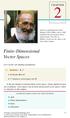 CHAPTER 2 American mathematician Paul Halmos (1916 2006), who in 1942 published the first modern linear algebra book. The title of Halmos s book was the same as the title of this chapter. Finite-Dimensional
12.5 Equations of Lines and Planes
 Instructor: Longfei Li Math 43 Lecture Notes.5 Equations of Lines and Planes What do we need to determine a line? D: a point on the line: P 0 (x 0, y 0 ) direction (slope): k 3D: a point on the line: P
A vector is a directed line segment used to represent a vector quantity.
 Chapters and 6 Introduction to Vectors A vector quantity has direction and magnitude. There are many examples of vector quantities in the natural world, such as force, velocity, and acceleration. A vector
5 Systems of Equations
 Systems of Equations Concepts: Solutions to Systems of Equations-Graphically and Algebraically Solving Systems - Substitution Method Solving Systems - Elimination Method Using -Dimensional Graphs to Approximate
Solving Systems of Linear Equations
 LECTURE 5 Solving Systems of Linear Equations Recall that we introduced the notion of matrices as a way of standardizing the expression of systems of linear equations In today s lecture I shall show how
Notes on Determinant
 ENGG2012B Advanced Engineering Mathematics Notes on Determinant Lecturer: Kenneth Shum Lecture 9-18/02/2013 The determinant of a system of linear equations determines whether the solution is unique, without
1 Determinants and the Solvability of Linear Systems
 1 Determinants and the Solvability of Linear Systems In the last section we learned how to use Gaussian elimination to solve linear systems of n equations in n unknowns The section completely side-stepped
2x + y = 3. Since the second equation is precisely the same as the first equation, it is enough to find x and y satisfying the system
 1. Systems of linear equations We are interested in the solutions to systems of linear equations. A linear equation is of the form 3x 5y + 2z + w = 3. The key thing is that we don t multiply the variables
PRIMARY CONTENT MODULE Algebra I -Linear Equations & Inequalities T-71. Applications. F = mc + b.
 PRIMARY CONTENT MODULE Algebra I -Linear Equations & Inequalities T-71 Applications The formula y = mx + b sometimes appears with different symbols. For example, instead of x, we could use the letter C.
PYTHAGOREAN TRIPLES KEITH CONRAD
 PYTHAGOREAN TRIPLES KEITH CONRAD 1. Introduction A Pythagorean triple is a triple of positive integers (a, b, c) where a + b = c. Examples include (3, 4, 5), (5, 1, 13), and (8, 15, 17). Below is an ancient
Section 11.4: Equations of Lines and Planes
 Section 11.4: Equations of Lines and Planes Definition: The line containing the point ( 0, 0, 0 ) and parallel to the vector v = A, B, C has parametric equations = 0 + At, = 0 + Bt, = 0 + Ct, where t R
University of Lille I PC first year list of exercises n 7. Review
 University of Lille I PC first year list of exercises n 7 Review Exercise Solve the following systems in 4 different ways (by substitution, by the Gauss method, by inverting the matrix of coefficients
Geometry 1. Unit 3: Perpendicular and Parallel Lines
 Geometry 1 Unit 3: Perpendicular and Parallel Lines Geometry 1 Unit 3 3.1 Lines and Angles Lines and Angles Parallel Lines Parallel lines are lines that are coplanar and do not intersect. Some examples
Linear Equations in Linear Algebra
 1 Linear Equations in Linear Algebra 1.5 SOLUTION SETS OF LINEAR SYSTEMS HOMOGENEOUS LINEAR SYSTEMS A system of linear equations is said to be homogeneous if it can be written in the form A 0, where A
Math 115A HW4 Solutions University of California, Los Angeles. 5 2i 6 + 4i. (5 2i)7i (6 + 4i)( 3 + i) = 35i + 14 ( 22 6i) = 36 + 41i.
 Math 5A HW4 Solutions September 5, 202 University of California, Los Angeles Problem 4..3b Calculate the determinant, 5 2i 6 + 4i 3 + i 7i Solution: The textbook s instructions give us, (5 2i)7i (6 + 4i)(
Numerical Analysis Lecture Notes
 Numerical Analysis Lecture Notes Peter J. Olver 5. Inner Products and Norms The norm of a vector is a measure of its size. Besides the familiar Euclidean norm based on the dot product, there are a number
COMMUTATIVE RINGS. Definition: A domain is a commutative ring R that satisfies the cancellation law for multiplication:
 COMMUTATIVE RINGS Definition: A commutative ring R is a set with two operations, addition and multiplication, such that: (i) R is an abelian group under addition; (ii) ab = ba for all a, b R (commutative
Indiana State Core Curriculum Standards updated 2009 Algebra I
 Indiana State Core Curriculum Standards updated 2009 Algebra I Strand Description Boardworks High School Algebra presentations Operations With Real Numbers Linear Equations and A1.1 Students simplify and
If n is odd, then 3n + 7 is even.
 Proof: Proof: We suppose... that 3n + 7 is even. that 3n + 7 is even. Since n is odd, there exists an integer k so that n = 2k + 1. that 3n + 7 is even. Since n is odd, there exists an integer k so that
MAT 1341: REVIEW II SANGHOON BAEK
 MAT 1341: REVIEW II SANGHOON BAEK 1. Projections and Cross Product 1.1. Projections. Definition 1.1. Given a vector u, the rectangular (or perpendicular or orthogonal) components are two vectors u 1 and
Math 241, Exam 1 Information.
 Math 241, Exam 1 Information. 9/24/12, LC 310, 11:15-12:05. Exam 1 will be based on: Sections 12.1-12.5, 14.1-14.3. The corresponding assigned homework problems (see http://www.math.sc.edu/ boylan/sccourses/241fa12/241.html)
1 Sets and Set Notation.
 LINEAR ALGEBRA MATH 27.6 SPRING 23 (COHEN) LECTURE NOTES Sets and Set Notation. Definition (Naive Definition of a Set). A set is any collection of objects, called the elements of that set. We will most
CHAPTER FIVE. 5. Equations of Lines in R 3
 118 CHAPTER FIVE 5. Equations of Lines in R 3 In this chapter it is going to be very important to distinguish clearly between points and vectors. Frequently in the past the distinction has only been a
Chapter 4, Arithmetic in F [x] Polynomial arithmetic and the division algorithm.
![Chapter 4, Arithmetic in F [x] Polynomial arithmetic and the division algorithm.](/thumbs/26/8276997.jpg "Chapter 4, Arithmetic in F [x] Polynomial arithmetic and the division algorithm.") Chapter 4, Arithmetic in F [x] Polynomial arithmetic and the division algorithm. We begin by defining the ring of polynomials with coefficients in a ring R. After some preliminary results, we specialize
Chapter 4, Arithmetic in F [x] Polynomial arithmetic and the division algorithm. We begin by defining the ring of polynomials with coefficients in a ring R. After some preliminary results, we specialize
FURTHER VECTORS (MEI)
 Mathematics Revision Guides Further Vectors (MEI) (column notation) Page of MK HOME TUITION Mathematics Revision Guides Level: AS / A Level - MEI OCR MEI: C FURTHER VECTORS (MEI) Version : Date: -9-7 Mathematics
How To Know If A Domain Is Unique In An Octempo (Euclidean) Or Not (Ecl)
 Subsets of Euclidean domains possessing a unique division algorithm Andrew D. Lewis 2009/03/16 Abstract Subsets of a Euclidean domain are characterised with the following objectives: (1) ensuring uniqueness
Linear Algebra Notes for Marsden and Tromba Vector Calculus
 Linear Algebra Notes for Marsden and Tromba Vector Calculus n-dimensional Euclidean Space and Matrices Definition of n space As was learned in Math b, a point in Euclidean three space can be thought of
a 11 x 1 + a 12 x 2 + + a 1n x n = b 1 a 21 x 1 + a 22 x 2 + + a 2n x n = b 2.
 Chapter 1 LINEAR EQUATIONS 1.1 Introduction to linear equations A linear equation in n unknowns x 1, x,, x n is an equation of the form a 1 x 1 + a x + + a n x n = b, where a 1, a,..., a n, b are given
Section 13.5 Equations of Lines and Planes
 Section 13.5 Equations of Lines and Planes Generalizing Linear Equations One of the main aspects of single variable calculus was approximating graphs of functions by lines - specifically, tangent lines.
5.3 The Cross Product in R 3
 53 The Cross Product in R 3 Definition 531 Let u = [u 1, u 2, u 3 ] and v = [v 1, v 2, v 3 ] Then the vector given by [u 2 v 3 u 3 v 2, u 3 v 1 u 1 v 3, u 1 v 2 u 2 v 1 ] is called the cross product (or
MATH 304 Linear Algebra Lecture 18: Rank and nullity of a matrix.
 MATH 304 Linear Algebra Lecture 18: Rank and nullity of a matrix. Nullspace Let A = (a ij ) be an m n matrix. Definition. The nullspace of the matrix A, denoted N(A), is the set of all n-dimensional column
GEOMETRY. Chapter 1: Foundations for Geometry. Name: Teacher: Pd:
 GEOMETRY Chapter 1: Foundations for Geometry Name: Teacher: Pd: Table of Contents Lesson 1.1: SWBAT: Identify, name, and draw points, lines, segments, rays, and planes. Pgs: 1-4 Lesson 1.2: SWBAT: Use
Chapter 20. Vector Spaces and Bases
 Chapter 20. Vector Spaces and Bases In this course, we have proceeded step-by-step through low-dimensional Linear Algebra. We have looked at lines, planes, hyperplanes, and have seen that there is no limit
Orthogonal Projections and Orthonormal Bases
 CS 3, HANDOUT -A, 3 November 04 (adjusted on 7 November 04) Orthogonal Projections and Orthonormal Bases (continuation of Handout 07 of 6 September 04) Definition (Orthogonality, length, unit vectors).
5 VECTOR GEOMETRY. 5.0 Introduction. Objectives. Activity 1
 5 VECTOR GEOMETRY Chapter 5 Vector Geometry Objectives After studying this chapter you should be able to find and use the vector equation of a straight line; be able to find the equation of a plane in
LAKE ELSINORE UNIFIED SCHOOL DISTRICT
 LAKE ELSINORE UNIFIED SCHOOL DISTRICT Title: PLATO Algebra 1-Semester 2 Grade Level: 10-12 Department: Mathematics Credit: 5 Prerequisite: Letter grade of F and/or N/C in Algebra 1, Semester 2 Course Description:
GREATEST COMMON DIVISOR
 DEFINITION: GREATEST COMMON DIVISOR The greatest common divisor (gcd) of a and b, denoted by (a, b), is the largest common divisor of integers a and b. THEOREM: If a and b are nonzero integers, then their
Zeros of Polynomial Functions
 Zeros of Polynomial Functions The Rational Zero Theorem If f (x) = a n x n + a n-1 x n-1 + + a 1 x + a 0 has integer coefficients and p/q (where p/q is reduced) is a rational zero, then p is a factor of
INCIDENCE-BETWEENNESS GEOMETRY
 INCIDENCE-BETWEENNESS GEOMETRY MATH 410, CSUSM. SPRING 2008. PROFESSOR AITKEN This document covers the geometry that can be developed with just the axioms related to incidence and betweenness. The full
3.3. Solving Polynomial Equations. Introduction. Prerequisites. Learning Outcomes
 Solving Polynomial Equations 3.3 Introduction Linear and quadratic equations, dealt within Sections 3.1 and 3.2, are members of a class of equations, called polynomial equations. These have the general
Adding vectors We can do arithmetic with vectors. We ll start with vector addition and related operations. Suppose you have two vectors
 1 Chapter 13. VECTORS IN THREE DIMENSIONAL SPACE Let s begin with some names and notation for things: R is the set (collection) of real numbers. We write x R to mean that x is a real number. A real number
OPRE 6201 : 2. Simplex Method
 OPRE 6201 : 2. Simplex Method 1 The Graphical Method: An Example Consider the following linear program: Max 4x 1 +3x 2 Subject to: 2x 1 +3x 2 6 (1) 3x 1 +2x 2 3 (2) 2x 2 5 (3) 2x 1 +x 2 4 (4) x 1, x 2
Some Polynomial Theorems. John Kennedy Mathematics Department Santa Monica College 1900 Pico Blvd. Santa Monica, CA 90405 [email protected].
 Some Polynomial Theorems by John Kennedy Mathematics Department Santa Monica College 1900 Pico Blvd. Santa Monica, CA 90405 [email protected] This paper contains a collection of 31 theorems, lemmas,
How To Prove The Dirichlet Unit Theorem
 Chapter 6 The Dirichlet Unit Theorem As usual, we will be working in the ring B of algebraic integers of a number field L. Two factorizations of an element of B are regarded as essentially the same if
3.2 The Factor Theorem and The Remainder Theorem
 3. The Factor Theorem and The Remainder Theorem 57 3. The Factor Theorem and The Remainder Theorem Suppose we wish to find the zeros of f(x) = x 3 + 4x 5x 4. Setting f(x) = 0 results in the polynomial
a 1 x + a 0 =0. (3) ax 2 + bx + c =0. (4)
 ROOTS OF POLYNOMIAL EQUATIONS In this unit we discuss polynomial equations. A polynomial in x of degree n, where n 0 is an integer, is an expression of the form P n (x) =a n x n + a n 1 x n 1 + + a 1 x
MATH 304 Linear Algebra Lecture 9: Subspaces of vector spaces (continued). Span. Spanning set.
 MATH 304 Linear Algebra Lecture 9: Subspaces of vector spaces (continued). Span. Spanning set. Vector space A vector space is a set V equipped with two operations, addition V V (x,y) x + y V and scalar
These axioms must hold for all vectors ū, v, and w in V and all scalars c and d.
 DEFINITION: A vector space is a nonempty set V of objects, called vectors, on which are defined two operations, called addition and multiplication by scalars (real numbers), subject to the following axioms
MATRIX ALGEBRA AND SYSTEMS OF EQUATIONS. + + x 2. x n. a 11 a 12 a 1n b 1 a 21 a 22 a 2n b 2 a 31 a 32 a 3n b 3. a m1 a m2 a mn b m
 MATRIX ALGEBRA AND SYSTEMS OF EQUATIONS 1. SYSTEMS OF EQUATIONS AND MATRICES 1.1. Representation of a linear system. The general system of m equations in n unknowns can be written a 11 x 1 + a 12 x 2 +
MOP 2007 Black Group Integer Polynomials Yufei Zhao. Integer Polynomials. June 29, 2007 Yufei Zhao [email protected]
 Integer Polynomials June 9, 007 Yufei Zhao [email protected] We will use Z[x] to denote the ring of polynomials with integer coefficients. We begin by summarizing some of the common approaches used in dealing
Linear Algebra I. Ronald van Luijk, 2012
 Linear Algebra I Ronald van Luijk, 2012 With many parts from Linear Algebra I by Michael Stoll, 2007 Contents 1. Vector spaces 3 1.1. Examples 3 1.2. Fields 4 1.3. The field of complex numbers. 6 1.4.
Factoring Polynomials
 Factoring Polynomials Sue Geller June 19, 2006 Factoring polynomials over the rational numbers, real numbers, and complex numbers has long been a standard topic of high school algebra. With the advent
z 0 and y even had the form
 Gaussian Integers The concepts of divisibility, primality and factoring are actually more general than the discussion so far. For the moment, we have been working in the integers, which we denote by Z
1. Equations for lines on the plane and planes in the space.
 1. Equations for lines on the plane and planes in the space. 1.1. General implicit vector equation. (1) a r=α This equation defines a line in the plane and a plane in the 3-space. Here r is the radius-vector
PROJECTIVE GEOMETRY. b3 course 2003. Nigel Hitchin
 PROJECTIVE GEOMETRY b3 course 2003 Nigel Hitchin [email protected] 1 1 Introduction This is a course on projective geometry. Probably your idea of geometry in the past has been based on triangles
POTENTIAL REASONS: Definition of Congruence:
 Sec 6 CC Geometry Triangle Pros Name: POTENTIAL REASONS: Definition Congruence: Having the exact same size and shape and there by having the exact same measures. Definition Midpoint: The point that divides
Introduction to Algebraic Geometry. Bézout s Theorem and Inflection Points
 Introduction to Algebraic Geometry Bézout s Theorem and Inflection Points 1. The resultant. Let K be a field. Then the polynomial ring K[x] is a unique factorisation domain (UFD). Another example of a
3. Let A and B be two n n orthogonal matrices. Then prove that AB and BA are both orthogonal matrices. Prove a similar result for unitary matrices.
 Exercise 1 1. Let A be an n n orthogonal matrix. Then prove that (a) the rows of A form an orthonormal basis of R n. (b) the columns of A form an orthonormal basis of R n. (c) for any two vectors x,y R
6-3 Solving Systems by Elimination
 Warm Up Simplify each expression. 1. 2y 4x 2(4y 2x) 2. 5(x y) + 2x + 5y Write the least common multiple. 3. 3 and 6 4. 4 and 10 5. 6 and 8 Objectives Solve systems of linear equations in two variables
COLLEGE ALGEBRA 10 TH EDITION LIAL HORNSBY SCHNEIDER 1.1-1
 10 TH EDITION COLLEGE ALGEBRA LIAL HORNSBY SCHNEIDER 1.1-1 1.1 Linear Equations Basic Terminology of Equations Solving Linear Equations Identities 1.1-2 Equations An equation is a statement that two expressions
Solving Linear Systems, Continued and The Inverse of a Matrix
 , Continued and The of a Matrix Calculus III Summer 2013, Session II Monday, July 15, 2013 Agenda 1. The rank of a matrix 2. The inverse of a square matrix Gaussian Gaussian solves a linear system by reducing
The Factor Theorem and a corollary of the Fundamental Theorem of Algebra
 Math 421 Fall 2010 The Factor Theorem and a corollary of the Fundamental Theorem of Algebra 27 August 2010 Copyright 2006 2010 by Murray Eisenberg. All rights reserved. Prerequisites Mathematica Aside
1 VECTOR SPACES AND SUBSPACES
 1 VECTOR SPACES AND SUBSPACES What is a vector? Many are familiar with the concept of a vector as: Something which has magnitude and direction. an ordered pair or triple. a description for quantities such
Recall that two vectors in are perpendicular or orthogonal provided that their dot
 Orthogonal Complements and Projections Recall that two vectors in are perpendicular or orthogonal provided that their dot product vanishes That is, if and only if Example 1 The vectors in are orthogonal
Linear Equations ! 25 30 35$ & " 350 150% & " 11,750 12,750 13,750% MATHEMATICS LEARNING SERVICE Centre for Learning and Professional Development
 MathsTrack (NOTE Feb 2013: This is the old version of MathsTrack. New books will be created during 2013 and 2014) Topic 4 Module 9 Introduction Systems of to Matrices Linear Equations Income = Tickets!
1.5 SOLUTION SETS OF LINEAR SYSTEMS
 1-2 CHAPTER 1 Linear Equations in Linear Algebra 1.5 SOLUTION SETS OF LINEAR SYSTEMS Many of the concepts and computations in linear algebra involve sets of vectors which are visualized geometrically as
Synthetic Projective Treatment of Cevian Nests and Graves Triangles
 Synthetic Projective Treatment of Cevian Nests and Graves Triangles Igor Minevich 1 Introduction Several proofs of the cevian nest theorem (given below) are known, including one using ratios along sides
Algebra 2 PreAP. Name Period
 Algebra 2 PreAP Name Period IMPORTANT INSTRUCTIONS FOR STUDENTS!!! We understand that students come to Algebra II with different strengths and needs. For this reason, students have options for completing
Equations, Inequalities & Partial Fractions
 Contents Equations, Inequalities & Partial Fractions.1 Solving Linear Equations 2.2 Solving Quadratic Equations 1. Solving Polynomial Equations 1.4 Solving Simultaneous Linear Equations 42.5 Solving Inequalities
4: SINGLE-PERIOD MARKET MODELS
 4: SINGLE-PERIOD MARKET MODELS Ben Goldys and Marek Rutkowski School of Mathematics and Statistics University of Sydney Semester 2, 2015 B. Goldys and M. Rutkowski (USydney) Slides 4: Single-Period Market
Inversion. Chapter 7. 7.1 Constructing The Inverse of a Point: If P is inside the circle of inversion: (See Figure 7.1)
 Chapter 7 Inversion Goal: In this chapter we define inversion, give constructions for inverses of points both inside and outside the circle of inversion, and show how inversion could be done using Geometer
Common Core Unit Summary Grades 6 to 8
 Common Core Unit Summary Grades 6 to 8 Grade 8: Unit 1: Congruence and Similarity- 8G1-8G5 rotations reflections and translations,( RRT=congruence) understand congruence of 2 d figures after RRT Dilations
3. Solve the equation containing only one variable for that variable.
 Question : How do you solve a system of linear equations? There are two basic strategies for solving a system of two linear equations and two variables. In each strategy, one of the variables is eliminated
13.4 THE CROSS PRODUCT
 710 Chapter Thirteen A FUNDAMENTAL TOOL: VECTORS 62. Use the following steps and the results of Problems 59 60 to show (without trigonometry) that the geometric and algebraic definitions of the dot product
Algebra I. In this technological age, mathematics is more important than ever. When students
 In this technological age, mathematics is more important than ever. When students leave school, they are more and more likely to use mathematics in their work and everyday lives operating computer equipment,
v w is orthogonal to both v and w. the three vectors v, w and v w form a right-handed set of vectors.
 3. Cross product Definition 3.1. Let v and w be two vectors in R 3. The cross product of v and w, denoted v w, is the vector defined as follows: the length of v w is the area of the parallelogram with
Lines and Planes 1. x(t) = at + b y(t) = ct + d
 1 Lines in the Plane Lines and Planes 1 Ever line of points L in R 2 can be epressed as the solution set for an equation of the form A + B = C. The equation is not unique for if we multipl both sides b