
Section 13.5 Equations of Lines and Planes
|
|
|
- Avice Hall
- 10 years ago
- Views:
Transcription
1 Section 13.5 Equations of Lines and Planes Generalizing Linear Equations One of the main aspects of single variable calculus was approximating graphs of functions by lines - specifically, tangent lines. In multivariable calculus, we generalize this idea to the graphs of multivariable functions. In order to do this, first we need to be able to write down the equations for lines in 3-space, and then we shall examine how to write down equations for planes. 1. Equations of Lines In 2-space, the equation for a line is simply a linear equation involving two variables. In 3-space however, this is no longer the case as illustrated by the following example. Example 1.1. Suppose y = x. (i) Draw the graph of this equation in 2-space. (ii) Draw the graph of this equation in 3-space x y Note that this is a plane, not a line! 1

2 2 Instead of just using algebraic equations as we did in 2-space, we need a new way to represent lines in 3-space. There are three different ways we shall use to describe a line, each of which have advantages Vector Equations for Lines. Recall that a line is completely determined by two things - the direction it is pointing and some point on the line. Once these two things are given, the line is completely determined. Since vectors describe a direction, we can use a vector and a point in space to determine a line. We do it as follows: Suppose L is a line passing through the two points P(a, b, c) and Q(x, y, z). Let v be the displacement vector from P to Q. Define the vector equation r(t) = P + vt where P denotes the position vector with head at the point (a, b, c). We claim that r(t) describes the line L completely as t varies over the real numbers. To see this, observe that when r(0) = P, so the equation r(t) passes through the point P. Then as t increases or decreases, the equation r(t) passes through points which lie in the direction determined by v from the point P, and these are exactly the points on L. We summarize: Result 1.2. Suppose L is a line passing through P and Q. If v is the displacement vector from P to Q, then a vector equation for the line L is r(t) = P + vt (notice that this equation is linear in t). Example 1.3. Write down a vector equation for the line with direction vector 2 i + 2 j k passing through (2, 2, 2). Use it to write down two other points it passes through. We have r(t) = (2 + 2t) i + (2 + 2t) j + (2 t) k To find points on L, we simply plug in values for t. Putting in t = 1 and t = 2, we get the point (3, 3, 1) and (4, 4, 0) Parametric Equations for a Line. Another way to represent a line in 3-space is through the use of parametric equations for the coordinates x, y and z. Specifically, if r(t) = P + vt is a vector equation for our line where P = x 0 i + y 0 j + z 0 k and v = a i + b j + c k, we can combine these vectors to get r(t) = (at + x 0 ) i + (bt + y 0 ) j + (ct + z 0 ) k. Since the component of i is the x-coordinate on the line, the component
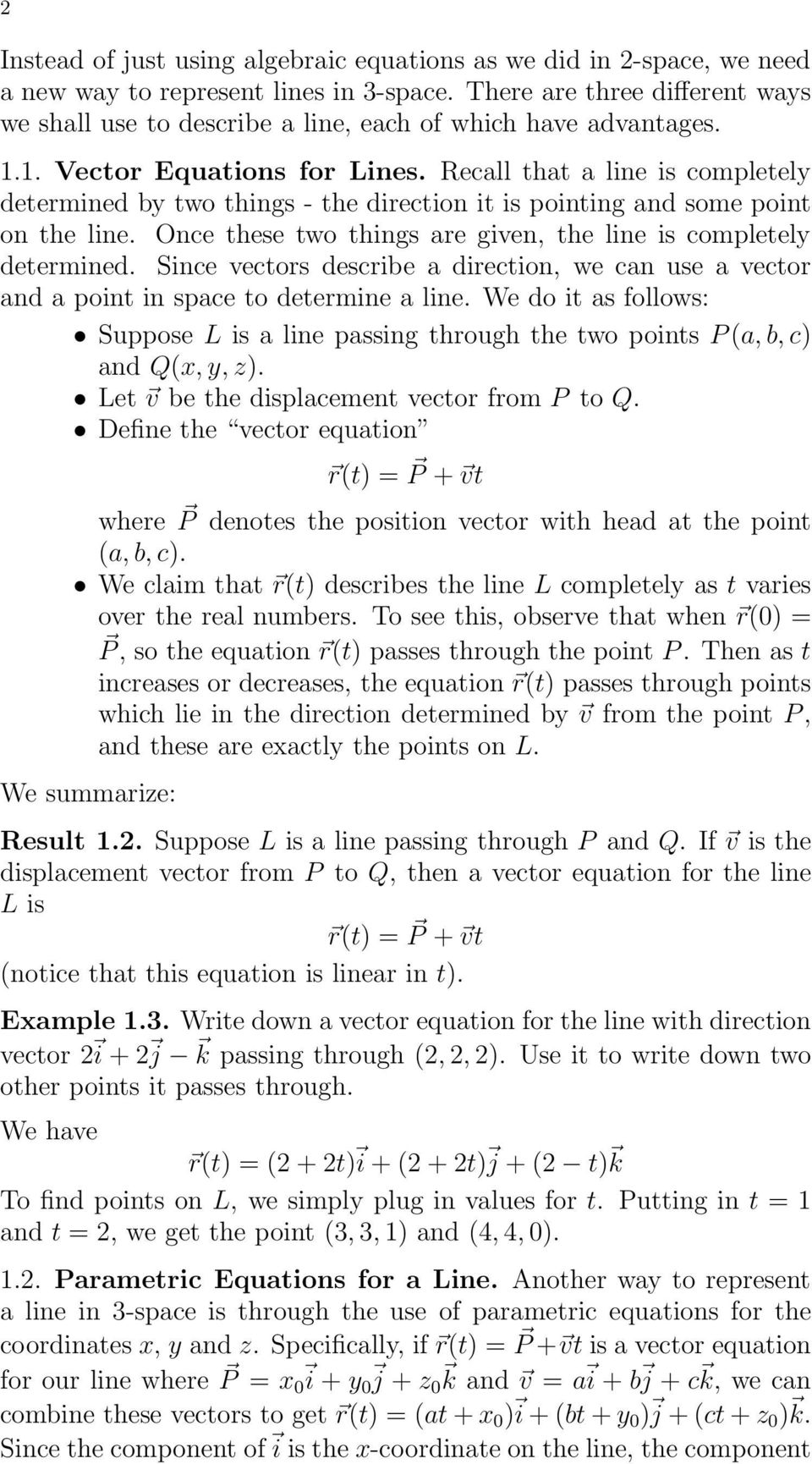
3 of j is the y-coordinate on the line, and the component of k is the z- coordinate on the line, we can read off equations for x, y and x in terms of t. Specifically, we get: Result 1.4. Suppose L is a line passing through P(x 0, y 0, z 0 ) with direction vector v = a i + b j + c k. Then the three scalar equations x = x 0 + at y = y 0 + bt z = z 0 + ct determine the line L where t is a parameter varying over all real numbers. They are called parametric equations for the line L. Example 1.5. Find a vector equation and parametric equations for the line through the points P(1, 2, 3) and Q(3, 2, 1). Use it to determine whether this line passes through the origin. Displacement vector is v = 2 i + 2 k, and we can take P = i + 2 j + 3 k as our point on the line. Then we have as the vector equation and r(t) = (1 2t) i + 2 j + (3 + 2t) k x = 1 2t y = 2 z = 3 + 2t as parametric equations. Clearly the line does not pass through the origin because the y coordinate can never be 0. If the vector v = a i + b j + c k is the direction vector for a line, we sometimes refer to a, b, and c as direction numbers. Note that if a, b, and c are direction numbers for a line and k is a constant, then ka, kb, and kc are also direction numbers for the line (WHY?) Symmetric Equations for Lines. One last way to represent a line is through a system of equalities. Specifically, provided a, b, and c are not 0, we can solve each of the parametric equations for a line L for t, and then all resulting equations must be equal. Specifically, we have: Result 1.6. The symmetric equations for a line L with parametric equations x = x 0 + at y = y 0 + bt z = z 0 + ct are x x 0 = y y 0 = z z 0. a b c Example 1.7. Find symmetric equations for the line through the points P(1, 2, 3) and Q(3, 0, 1) and use it to determine where this line passes through the xy-plane. The parametric equations for this line are x = 1 2t y = 2 + 2t z = 3 + 2t 3
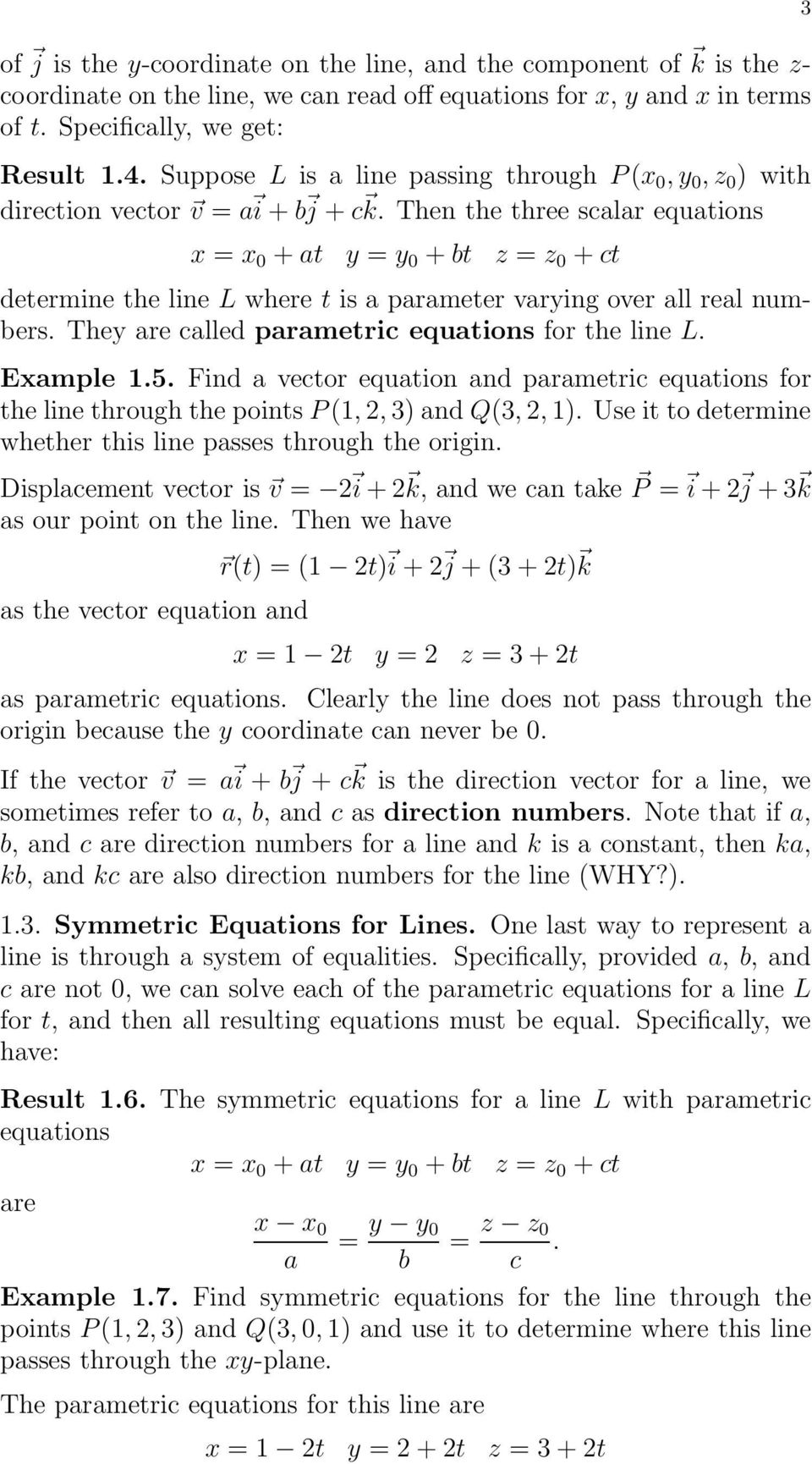
4 4 so the symmetric equations will be x 1 = y 2 = z It travels through the xy-plane when z = 0, so x 1 = and y 2 = giving, x = 4 and y = 1. or (4, 1, 0) Line Segments. Sometimes we may only be interested in a small portion of a line - a line segment. If we want to write down the equation for the line segment between two points P and Q starting at P, we note that the direction vector between P and Q can be written as Q P, so then the vector equation can be written as r(t) = P + t( Q P) or r(t) = (1 t) P + tq. Observe that when t = 0, this is at P and when t = 1, it is at Q. Thus we have: Result 1.8. The line segment between two points P and Q starting at P is given by the vector equation where 0 t 1. r(t) = (1 t) P + t Q We finish with another slightly more general example. Example 1.9. Show that the lines L 1 and L 2 with parametric equations x = 1 2t y = 2 + 2t z = 3 + 2t and r(t) = (2 + 2t) i + (2 + 2t) j + (2 t) k respectively never intersect. First we note that to say they intersect means they pass through the same point, though not necessarily at the same time. Thus we are asking if there is a value s and t such that 1 2t = 2+2s, 2+2t = 2+2s and 3 + 2t = 2 s. Solving these equations, we get t = s from the second equation, and then 1 2s = 2 + 2s and 3 + 2s = 2 s from the remaining two. Since these remaining equations have no solutions, there can be no value of s and t satisfying these conditions and thus no point of intersection.

5 Example Do non-parallel lines have to intersect? In 2-space, we know that two non-parallel lines have to intersect. However, in 3-space, this is not the case. Take for example L 1 with vector equation r 0 (t) = t i+ k and L 2 with vector equation r 2 (t) = (t) j. As before, they will intersect if they pass through the same point. However, the k component of r 2 (t) and the k component of r 1 (t) will always be 1. In particular, they can never have the same k component and hence will never cross through the same z-value, so can never cross through the same point. 2. Equations of Planes The 2-dimensional equivalent of a line is a plane. As with the line, we shall now determine different ways to write down the equation for a plane Vector Equation for a Plane. To determine a vector equation for a plane, we cannot simply take a vector and a point in the plane as we did with the line because there are many vectors in a plane pointing in lots of different directions. However, instead of taking a vector in the plane, we can take a vector perpendicular (called a normal vector) to the plane - in 3-space, there is only one direction (up to scalar multiplication) in which a vector perpendicular to a plane can point (either up or down from the plane). Therefore we can construct the vector equation for a plane as follows: Let P(x 0, y 0, z 0 ) be a point in the plane K and let n = a i + b j + c k be a normal vector to P. If Q(x, y, z) is any other point in the plane, let PQ = P Q be the displacement vector from P to Q. Note that P Q lies entirely in the plane, so will be perpendicular to n. In particular, we shall have n ( P Q) = 0 or n P = n Q. Thus any arbitrary point Q(x, y, z) in K must satisfy the equation n P = n Q. Thus we have proved the following: Result 2.1. If K is a plane with normal vector n and P is a point in K then any arbitrary point Q in K must satisfy the equation n P = n Q. We call this equation the vector equation for the plane K. Example 2.2. Find a vector equation for the plane which contains the points P(1, 2, 3), Q(2, 4, 1) and R( 1, 2, 3). 5
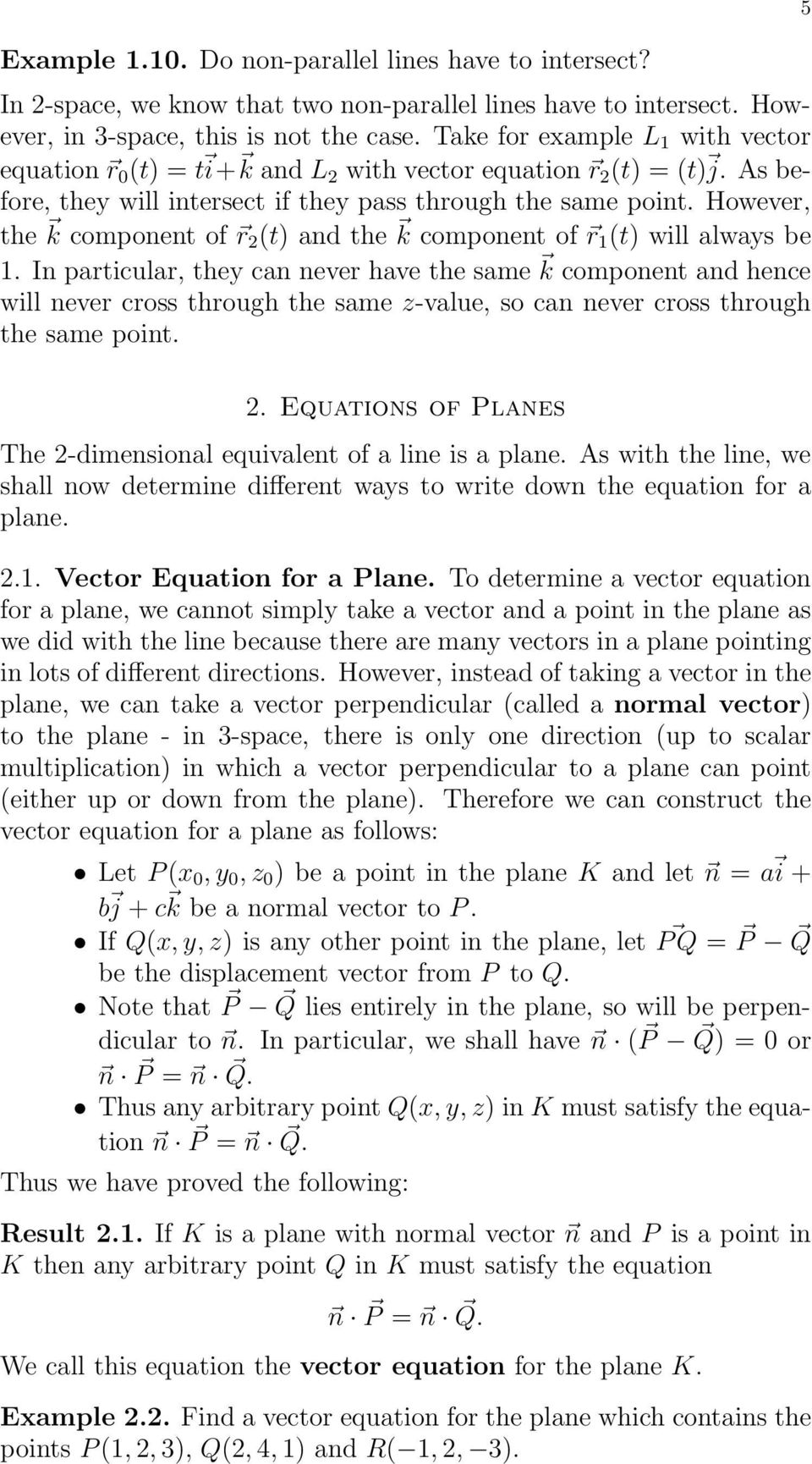
6 6 In order to find a vector equation, we need a point and a normal vector. We already have a point (we can choose any of the three). In order to find a normal vector, we can use the cross-product on the displacement vectors on the points in the plane. PQ PR = ( i + 2 j 2 k) ( 2 i 6 k) = 12 i + 10 j + 4 k Taking the point P(1, 2, 3), the vector equation for the plane will be (12 i + 10 j + 4 k) ( i + 2 j + 3 k) = (12 i + 10 j + 4 k) (x i + y j + z k) where x i + y j + z k is any point in the plane Scalar Equation for a Plane. The vector equation for a plane is rarely used - in fact scalar equations for planes are fairly easy to determine and easy to write down (unlike scalar equations for lines). We can use the vector equation to write down the scalar equation. Result 2.3. If n = a i + b j + c k is a normal vector to a plane K and P(x 0, y 0, z 0 ) is a point in K, then an arbitrary point Q(x, y, z) in K satisfies the equation a(x x 0 ) + b(y y 0 ) + c(x z 0 ) = 0 called the scalar equation for the plane K. This equation can also be written as ax + by + cx + d = 0 by combining constant terms and this equation is called the linear equation for K. It is easy to determine this equation. We know the each point Q on the plane satisfies Calculating, we get and so or n P = n Q. ax 0 + by 0 + cz 0 = (a i + b j + c k) (x 0 i + y 0 j + z 0 k) (a i + b j + c k) (x i + y j + z k) = ax + by + cz ax 0 + by 0 + cz 0 = ax + by + cz a(x x 0 ) + b(y y 0 ) + c(x z 0 ) = 0. If we let d = ax 0 by 0 cz 0, then we get the linear equation ax + by + cz + d = 0. We illustrate with some examples.

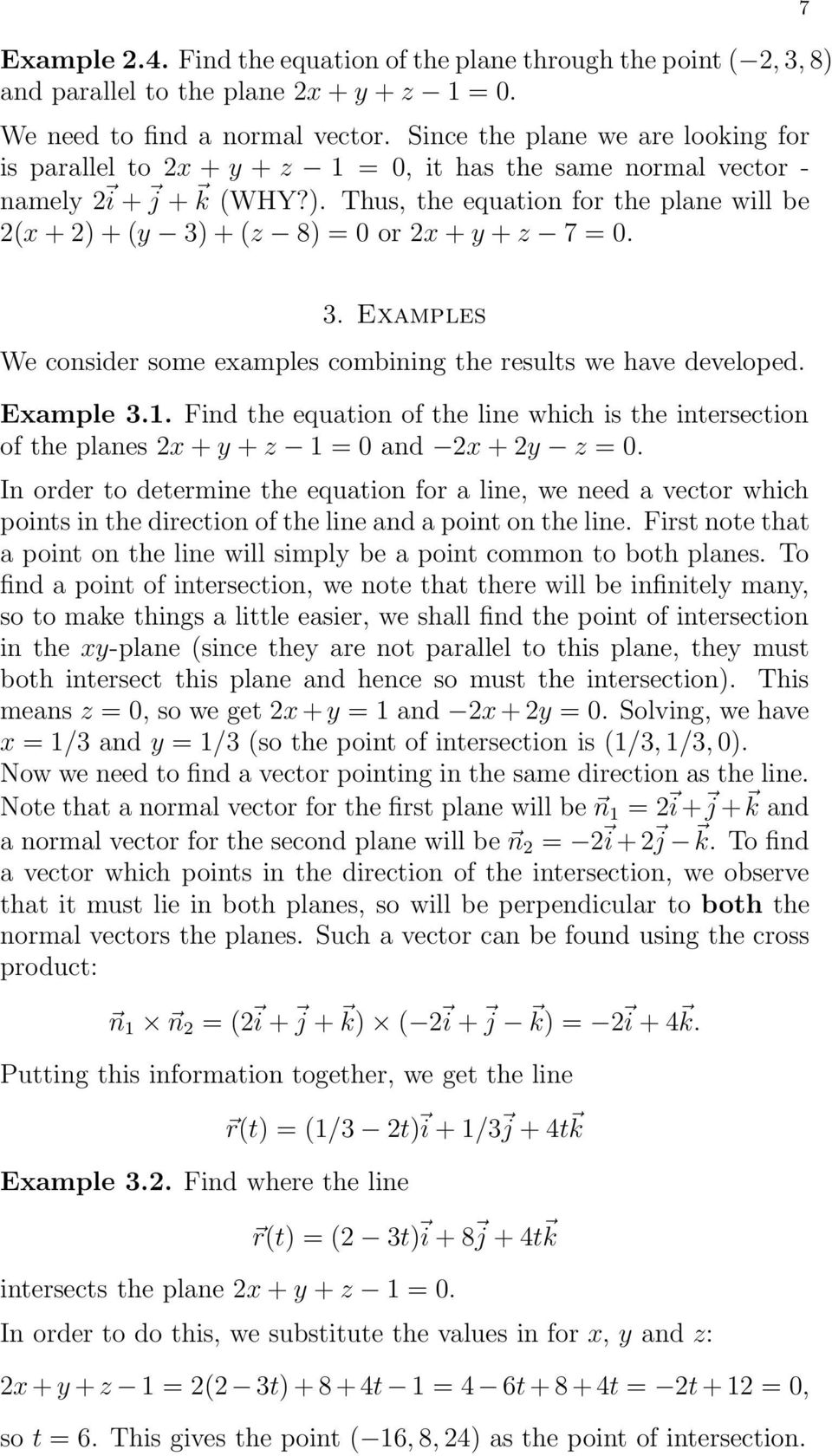
7 Example 2.4. Find the equation of the plane through the point ( 2, 3, 8) and parallel to the plane 2x + y + z 1 = 0. We need to find a normal vector. Since the plane we are looking for is parallel to 2x + y + z 1 = 0, it has the same normal vector - namely 2 i + j + k (WHY?). Thus, the equation for the plane will be 2(x + 2) + (y 3) + (z 8) = 0 or 2x + y + z 7 = Examples We consider some examples combining the results we have developed. Example 3.1. Find the equation of the line which is the intersection of the planes 2x + y + z 1 = 0 and 2x + 2y z = 0. In order to determine the equation for a line, we need a vector which points in the direction of the line and a point on the line. First note that a point on the line will simply be a point common to both planes. To find a point of intersection, we note that there will be infinitely many, so to make things a little easier, we shall find the point of intersection in the xy-plane (since they are not parallel to this plane, they must both intersect this plane and hence so must the intersection). This means z = 0, so we get 2x+y = 1 and 2x+2y = 0. Solving, we have x = 1/3 and y = 1/3 (so the point of intersection is (1/3, 1/3, 0). Now we need to find a vector pointing in the same direction as the line. Note that a normal vector for the first plane will be n 1 = 2 i+ j + k and a normal vector for the second plane will be n 2 = 2 i+2 j k. To find a vector which points in the direction of the intersection, we observe that it must lie in both planes, so will be perpendicular to both the normal vectors the planes. Such a vector can be found using the cross product: n 1 n 2 = (2 i + j + k) ( 2 i + j k) = 2 i + 4 k. Putting this information together, we get the line r(t) = (1/3 2t) i + 1/3 j + 4t k Example 3.2. Find where the line r(t) = (2 3t) i + 8 j + 4t k intersects the plane 2x + y + z 1 = 0. In order to do this, we substitute the values in for x, y and z: 2x+y +z 1 = 2(2 3t)+8+4t 1 = 4 6t+8+4t = 2t+12 = 0, so t = 6. This gives the point ( 16, 8, 24) as the point of intersection.
8 8 4. Application: Distance from a Point to a Plane One important application is finding the distance between a point and a plane or between two parallel planes. We note that the shortest path between a point and a plane will be along the normal vector n of a plane. Thus if n = a i + b j + c k is the normal vector to a plane and (x 0, y 0, z 0 ) is an arbitrary point in a plane, the shortest path will be along the line through (x 0, y 0, z 0 ) in the direction of n. This can be calculated fairly easily, and in general, we get the following: Result 4.1. The distance D from a point (x 0, y 0, z 0 ) to the plane ax+ by + cz + d = 0 is given by the formula D = ax 0 + by 0 + cz 0 + d a2 + b 2 + c 2 Example 4.2. Find the distance between the parallel planes x + y + 2z 1 = 0 and 5x 5y 10z = 0. Observe that the point ( 1, 0, 0) is in the first plane. Since the shortest distance will the same between all points, we just need to find the distance between this point and the plane. Applying the formula, we have: D = 5( 1) = 5 150
Section 9.5: Equations of Lines and Planes
 Lines in 3D Space Section 9.5: Equations of Lines and Planes Practice HW from Stewart Textbook (not to hand in) p. 673 # 3-5 odd, 2-37 odd, 4, 47 Consider the line L through the point P = ( x, y, ) that
12.5 Equations of Lines and Planes
 Instructor: Longfei Li Math 43 Lecture Notes.5 Equations of Lines and Planes What do we need to determine a line? D: a point on the line: P 0 (x 0, y 0 ) direction (slope): k 3D: a point on the line: P
Equations of Lines and Planes
 Calculus 3 Lia Vas Equations of Lines and Planes Planes. A plane is uniquely determined by a point in it and a vector perpendicular to it. An equation of the plane passing the point (x 0, y 0, z 0 ) perpendicular
Equations Involving Lines and Planes Standard equations for lines in space
 Equations Involving Lines and Planes In this section we will collect various important formulas regarding equations of lines and planes in three dimensional space Reminder regarding notation: any quantity
1.5 Equations of Lines and Planes in 3-D
 40 CHAPTER 1. VECTORS AND THE GEOMETRY OF SPACE Figure 1.16: Line through P 0 parallel to v 1.5 Equations of Lines and Planes in 3-D Recall that given a point P = (a, b, c), one can draw a vector from
LINES AND PLANES CHRIS JOHNSON
 LINES AND PLANES CHRIS JOHNSON Abstract. In this lecture we derive the equations for lines and planes living in 3-space, as well as define the angle between two non-parallel planes, and determine the distance
Math 241, Exam 1 Information.
 Math 241, Exam 1 Information. 9/24/12, LC 310, 11:15-12:05. Exam 1 will be based on: Sections 12.1-12.5, 14.1-14.3. The corresponding assigned homework problems (see http://www.math.sc.edu/ boylan/sccourses/241fa12/241.html)
Jim Lambers MAT 169 Fall Semester 2009-10 Lecture 25 Notes
 Jim Lambers MAT 169 Fall Semester 009-10 Lecture 5 Notes These notes correspond to Section 10.5 in the text. Equations of Lines A line can be viewed, conceptually, as the set of all points in space that
L 2 : x = s + 1, y = s, z = 4s + 4. 3. Suppose that C has coordinates (x, y, z). Then from the vector equality AC = BD, one has
 The line L through the points A and B is parallel to the vector AB = 3, 2, and has parametric equations x = 3t + 2, y = 2t +, z = t Therefore, the intersection point of the line with the plane should satisfy:
Solutions to old Exam 1 problems
 Solutions to old Exam 1 problems Hi students! I am putting this old version of my review for the first midterm review, place and time to be announced. Check for updates on the web site as to which sections
Section 1.4. Lines, Planes, and Hyperplanes. The Calculus of Functions of Several Variables
 The Calculus of Functions of Several Variables Section 1.4 Lines, Planes, Hyperplanes In this section we will add to our basic geometric understing of R n by studying lines planes. If we do this carefully,
Example SECTION 13-1. X-AXIS - the horizontal number line. Y-AXIS - the vertical number line ORIGIN - the point where the x-axis and y-axis cross
 CHAPTER 13 SECTION 13-1 Geometry and Algebra The Distance Formula COORDINATE PLANE consists of two perpendicular number lines, dividing the plane into four regions called quadrants X-AXIS - the horizontal
10.5. Click here for answers. Click here for solutions. EQUATIONS OF LINES AND PLANES. 3x 4y 6z 9 4, 2, 5. x y z. z 2. x 2. y 1.
 SECTION EQUATIONS OF LINES AND PLANES 1 EQUATIONS OF LINES AND PLANES A Click here for answers. S Click here for solutions. 1 Find a vector equation and parametric equations for the line passing through
Section 2.4: Equations of Lines and Planes
 Section.4: Equations of Lines and Planes An equation of three variable F (x, y, z) 0 is called an equation of a surface S if For instance, (x 1, y 1, z 1 ) S if and only if F (x 1, y 1, z 1 ) 0. x + y
(a) We have x = 3 + 2t, y = 2 t, z = 6 so solving for t we get the symmetric equations. x 3 2. = 2 y, z = 6. t 2 2t + 1 = 0,
 Name: Solutions to Practice Final. Consider the line r(t) = 3 + t, t, 6. (a) Find symmetric equations for this line. (b) Find the point where the first line r(t) intersects the surface z = x + y. (a) We
Math 241 Lines and Planes (Solutions) x = 3 3t. z = 1 t. x = 5 + t. z = 7 + 3t
 Math 241 Lines and Planes (Solutions) The equations for planes P 1, P 2 and P are P 1 : x 2y + z = 7 P 2 : x 4y + 5z = 6 P : (x 5) 2(y 6) + (z 7) = 0 The equations for lines L 1, L 2, L, L 4 and L 5 are
CHAPTER FIVE. 5. Equations of Lines in R 3
 118 CHAPTER FIVE 5. Equations of Lines in R 3 In this chapter it is going to be very important to distinguish clearly between points and vectors. Frequently in the past the distinction has only been a
1 Functions, Graphs and Limits
 1 Functions, Graphs and Limits 1.1 The Cartesian Plane In this course we will be dealing a lot with the Cartesian plane (also called the xy-plane), so this section should serve as a review of it and its
Geometric description of the cross product of the vectors u and v. The cross product of two vectors is a vector! u x v is perpendicular to u and v
 12.4 Cross Product Geometric description of the cross product of the vectors u and v The cross product of two vectors is a vector! u x v is perpendicular to u and v The length of u x v is uv u v sin The
Section 11.4: Equations of Lines and Planes
 Section 11.4: Equations of Lines and Planes Definition: The line containing the point ( 0, 0, 0 ) and parallel to the vector v = A, B, C has parametric equations = 0 + At, = 0 + Bt, = 0 + Ct, where t R
Plotting Lines in Mathematica
 Lines.nb 1 Plotting Lines in Mathematica Copright 199, 1997, 1 b James F. Hurle, Universit of Connecticut, Department of Mathematics, 196 Auditorium Road Unit 39, Storrs CT 669-39. All rights reserved.
FURTHER VECTORS (MEI)
 Mathematics Revision Guides Further Vectors (MEI) (column notation) Page of MK HOME TUITION Mathematics Revision Guides Level: AS / A Level - MEI OCR MEI: C FURTHER VECTORS (MEI) Version : Date: -9-7 Mathematics
Section 8.8. 1. The given line has equations. x = 3 + t(13 3) = 3 + 10t, y = 2 + t(3 + 2) = 2 + 5t, z = 7 + t( 8 7) = 7 15t.
 . The given line has equations Section 8.8 x + t( ) + 0t, y + t( + ) + t, z 7 + t( 8 7) 7 t. The line meets the plane y 0 in the point (x, 0, z), where 0 + t, or t /. The corresponding values for x and
Two vectors are equal if they have the same length and direction. They do not
 Vectors define vectors Some physical quantities, such as temperature, length, and mass, can be specified by a single number called a scalar. Other physical quantities, such as force and velocity, must
= y y 0. = z z 0. (a) Find a parametric vector equation for L. (b) Find parametric (scalar) equations for L.
 Math 21a Lines and lanes Spring, 2009 Lines in Space How can we express the equation(s) of a line through a point (x 0 ; y 0 ; z 0 ) and parallel to the vector u ha; b; ci? Many ways: as parametric (scalar)
Adding vectors We can do arithmetic with vectors. We ll start with vector addition and related operations. Suppose you have two vectors
 1 Chapter 13. VECTORS IN THREE DIMENSIONAL SPACE Let s begin with some names and notation for things: R is the set (collection) of real numbers. We write x R to mean that x is a real number. A real number
Review Sheet for Test 1
 Review Sheet for Test 1 Math 261-00 2 6 2004 These problems are provided to help you study. The presence of a problem on this handout does not imply that there will be a similar problem on the test. And
JUST THE MATHS UNIT NUMBER 8.5. VECTORS 5 (Vector equations of straight lines) A.J.Hobson
 JUST THE MATHS UNIT NUMBER 8.5 VECTORS 5 (Vector equations of straight lines) by A.J.Hobson 8.5.1 Introduction 8.5. The straight line passing through a given point and parallel to a given vector 8.5.3
THREE DIMENSIONAL GEOMETRY
 Chapter 8 THREE DIMENSIONAL GEOMETRY 8.1 Introduction In this chapter we present a vector algebra approach to three dimensional geometry. The aim is to present standard properties of lines and planes,
13.4 THE CROSS PRODUCT
 710 Chapter Thirteen A FUNDAMENTAL TOOL: VECTORS 62. Use the following steps and the results of Problems 59 60 to show (without trigonometry) that the geometric and algebraic definitions of the dot product
Lecture 14: Section 3.3
 Lecture 14: Section 3.3 Shuanglin Shao October 23, 2013 Definition. Two nonzero vectors u and v in R n are said to be orthogonal (or perpendicular) if u v = 0. We will also agree that the zero vector in
Lines and Planes in R 3
 .3 Lines and Planes in R 3 P. Daniger Lines in R 3 We wish to represent lines in R 3. Note that a line may be described in two different ways: By specifying two points on the line. By specifying one point
Recall that two vectors in are perpendicular or orthogonal provided that their dot
 Orthogonal Complements and Projections Recall that two vectors in are perpendicular or orthogonal provided that their dot product vanishes That is, if and only if Example 1 The vectors in are orthogonal
9 Multiplication of Vectors: The Scalar or Dot Product
 Arkansas Tech University MATH 934: Calculus III Dr. Marcel B Finan 9 Multiplication of Vectors: The Scalar or Dot Product Up to this point we have defined what vectors are and discussed basic notation
Section 1.1 Linear Equations: Slope and Equations of Lines
 Section. Linear Equations: Slope and Equations of Lines Slope The measure of the steepness of a line is called the slope of the line. It is the amount of change in y, the rise, divided by the amount of
5 Systems of Equations
 Systems of Equations Concepts: Solutions to Systems of Equations-Graphically and Algebraically Solving Systems - Substitution Method Solving Systems - Elimination Method Using -Dimensional Graphs to Approximate
Solutions to Math 51 First Exam January 29, 2015
 Solutions to Math 5 First Exam January 29, 25. ( points) (a) Complete the following sentence: A set of vectors {v,..., v k } is defined to be linearly dependent if (2 points) there exist c,... c k R, not
December 4, 2013 MATH 171 BASIC LINEAR ALGEBRA B. KITCHENS
 December 4, 2013 MATH 171 BASIC LINEAR ALGEBRA B KITCHENS The equation 1 Lines in two-dimensional space (1) 2x y = 3 describes a line in two-dimensional space The coefficients of x and y in the equation
Lecture 8 : Coordinate Geometry. The coordinate plane The points on a line can be referenced if we choose an origin and a unit of 20
 Lecture 8 : Coordinate Geometry The coordinate plane The points on a line can be referenced if we choose an origin and a unit of 0 distance on the axis and give each point an identity on the corresponding
11.1. Objectives. Component Form of a Vector. Component Form of a Vector. Component Form of a Vector. Vectors and the Geometry of Space
 11 Vectors and the Geometry of Space 11.1 Vectors in the Plane Copyright Cengage Learning. All rights reserved. Copyright Cengage Learning. All rights reserved. 2 Objectives! Write the component form of
The Point-Slope Form
 7. The Point-Slope Form 7. OBJECTIVES 1. Given a point and a slope, find the graph of a line. Given a point and the slope, find the equation of a line. Given two points, find the equation of a line y Slope
Exam 1 Sample Question SOLUTIONS. y = 2x
 Exam Sample Question SOLUTIONS. Eliminate the parameter to find a Cartesian equation for the curve: x e t, y e t. SOLUTION: You might look at the coordinates and notice that If you don t see it, we can
Section 11.1: Vectors in the Plane. Suggested Problems: 1, 5, 9, 17, 23, 25-37, 40, 42, 44, 45, 47, 50
 Section 11.1: Vectors in the Plane Page 779 Suggested Problems: 1, 5, 9, 17, 3, 5-37, 40, 4, 44, 45, 47, 50 Determine whether the following vectors a and b are perpendicular. 5) a = 6, 0, b = 0, 7 Recall
Lecture 2: Homogeneous Coordinates, Lines and Conics
 Lecture 2: Homogeneous Coordinates, Lines and Conics 1 Homogeneous Coordinates In Lecture 1 we derived the camera equations λx = P X, (1) where x = (x 1, x 2, 1), X = (X 1, X 2, X 3, 1) and P is a 3 4
Copyrighted Material. Chapter 1 DEGREE OF A CURVE
 Chapter 1 DEGREE OF A CURVE Road Map The idea of degree is a fundamental concept, which will take us several chapters to explore in depth. We begin by explaining what an algebraic curve is, and offer two
Section 12.6: Directional Derivatives and the Gradient Vector
 Section 26: Directional Derivatives and the Gradient Vector Recall that if f is a differentiable function of x and y and z = f(x, y), then the partial derivatives f x (x, y) and f y (x, y) give the rate
CIRCLE COORDINATE GEOMETRY
 CIRCLE COORDINATE GEOMETRY (EXAM QUESTIONS) Question 1 (**) A circle has equation x + y = 2x + 8 Determine the radius and the coordinates of the centre of the circle. r = 3, ( 1,0 ) Question 2 (**) A circle
Vector Notation: AB represents the vector from point A to point B on a graph. The vector can be computed by B A.
 1 Linear Transformations Prepared by: Robin Michelle King A transformation of an object is a change in position or dimension (or both) of the object. The resulting object after the transformation is called
Determine whether the following lines intersect, are parallel, or skew. L 1 : x = 6t y = 1 + 9t z = 3t. x = 1 + 2s y = 4 3s z = s
 Homework Solutions 5/20 10.5.17 Determine whether the following lines intersect, are parallel, or skew. L 1 : L 2 : x = 6t y = 1 + 9t z = 3t x = 1 + 2s y = 4 3s z = s A vector parallel to L 1 is 6, 9,
Lines & Planes. Packages: linalg, plots. Commands: evalm, spacecurve, plot3d, display, solve, implicitplot, dotprod, seq, implicitplot3d.
 Lines & Planes Introduction and Goals: This lab is simply to give you some practice with plotting straight lines and planes and how to do some basic problem solving with them. So the exercises will be
2.1 Three Dimensional Curves and Surfaces
 . Three Dimensional Curves and Surfaces.. Parametric Equation of a Line An line in two- or three-dimensional space can be uniquel specified b a point on the line and a vector parallel to the line. The
Section 1.1. Introduction to R n
 The Calculus of Functions of Several Variables Section. Introduction to R n Calculus is the study of functional relationships and how related quantities change with each other. In your first exposure to
discuss how to describe points, lines and planes in 3 space.
 Chapter 2 3 Space: lines and planes In this chapter we discuss how to describe points, lines and planes in 3 space. introduce the language of vectors. discuss various matters concerning the relative position
EQUATIONS and INEQUALITIES
 EQUATIONS and INEQUALITIES Linear Equations and Slope 1. Slope a. Calculate the slope of a line given two points b. Calculate the slope of a line parallel to a given line. c. Calculate the slope of a line
Parametric Equations and the Parabola (Extension 1)
 Parametric Equations and the Parabola (Extension 1) Parametric Equations Parametric equations are a set of equations in terms of a parameter that represent a relation. Each value of the parameter, when
LINES AND PLANES IN R 3
 LINES AND PLANES IN R 3 In this handout we will summarize the properties of the dot product and cross product and use them to present arious descriptions of lines and planes in three dimensional space.
Parametric Curves. (Com S 477/577 Notes) Yan-Bin Jia. Oct 8, 2015
 Parametric Curves (Com S 477/577 Notes) Yan-Bin Jia Oct 8, 2015 1 Introduction A curve in R 2 (or R 3 ) is a differentiable function α : [a,b] R 2 (or R 3 ). The initial point is α[a] and the final point
MAT 1341: REVIEW II SANGHOON BAEK
 MAT 1341: REVIEW II SANGHOON BAEK 1. Projections and Cross Product 1.1. Projections. Definition 1.1. Given a vector u, the rectangular (or perpendicular or orthogonal) components are two vectors u 1 and
1.3. DOT PRODUCT 19. 6. If θ is the angle (between 0 and π) between two non-zero vectors u and v,
 1.3. DOT PRODUCT 19 1.3 Dot Product 1.3.1 Definitions and Properties The dot product is the first way to multiply two vectors. The definition we will give below may appear arbitrary. But it is not. It
Linear algebra and the geometry of quadratic equations. Similarity transformations and orthogonal matrices
 MATH 30 Differential Equations Spring 006 Linear algebra and the geometry of quadratic equations Similarity transformations and orthogonal matrices First, some things to recall from linear algebra Two
( 1)2 + 2 2 + 2 2 = 9 = 3 We would like to make the length 6. The only vectors in the same direction as v are those
 1.(6pts) Which of the following vectors has the same direction as v 1,, but has length 6? (a), 4, 4 (b),, (c) 4,, 4 (d), 4, 4 (e) 0, 6, 0 The length of v is given by ( 1) + + 9 3 We would like to make
A vector is a directed line segment used to represent a vector quantity.
 Chapters and 6 Introduction to Vectors A vector quantity has direction and magnitude. There are many examples of vector quantities in the natural world, such as force, velocity, and acceleration. A vector
Definition: A vector is a directed line segment that has and. Each vector has an initial point and a terminal point.
 6.1 Vectors in the Plane PreCalculus 6.1 VECTORS IN THE PLANE Learning Targets: 1. Find the component form and the magnitude of a vector.. Perform addition and scalar multiplication of two vectors. 3.
JUST THE MATHS UNIT NUMBER 1.8. ALGEBRA 8 (Polynomials) A.J.Hobson
 JUST THE MATHS UNIT NUMBER 1.8 ALGEBRA 8 (Polynomials) by A.J.Hobson 1.8.1 The factor theorem 1.8.2 Application to quadratic and cubic expressions 1.8.3 Cubic equations 1.8.4 Long division of polynomials
A QUICK GUIDE TO THE FORMULAS OF MULTIVARIABLE CALCULUS
 A QUIK GUIDE TO THE FOMULAS OF MULTIVAIABLE ALULUS ontents 1. Analytic Geometry 2 1.1. Definition of a Vector 2 1.2. Scalar Product 2 1.3. Properties of the Scalar Product 2 1.4. Length and Unit Vectors
1.2 GRAPHS OF EQUATIONS. Copyright Cengage Learning. All rights reserved.
 1.2 GRAPHS OF EQUATIONS Copyright Cengage Learning. All rights reserved. What You Should Learn Sketch graphs of equations. Find x- and y-intercepts of graphs of equations. Use symmetry to sketch graphs
Understanding Basic Calculus
 Understanding Basic Calculus S.K. Chung Dedicated to all the people who have helped me in my life. i Preface This book is a revised and expanded version of the lecture notes for Basic Calculus and other
9.4. The Scalar Product. Introduction. Prerequisites. Learning Style. Learning Outcomes
 The Scalar Product 9.4 Introduction There are two kinds of multiplication involving vectors. The first is known as the scalar product or dot product. This is so-called because when the scalar product of
Systems of Linear Equations and Inequalities
 Systems of Linear Equations and Inequalities Recall that every linear equation in two variables can be identified with a line. When we group two such equations together, we know from geometry what can
1.(6pts) Find symmetric equations of the line L passing through the point (2, 5, 1) and perpendicular to the plane x + 3y z = 9.
 .(6pts Find symmetric equations of the line L passing through the point (, 5, and perpendicular to the plane x + 3y z = 9. (a x = y + 5 3 = z (b x (c (x = ( 5(y 3 = z + (d x (e (x + 3(y 3 (z = 9 = y 3
LINEAR ALGEBRA W W L CHEN
 LINEAR ALGEBRA W W L CHEN c W W L Chen, 1982, 2008. This chapter originates from material used by author at Imperial College, University of London, between 1981 and 1990. It is available free to all individuals,
MATH 275: Calculus III. Lecture Notes by Angel V. Kumchev
 MATH 275: Calculus III Lecture Notes by Angel V. Kumchev Contents Preface.............................................. iii Lecture 1. Three-Dimensional Coordinate Systems..................... 1 Lecture
5.3 The Cross Product in R 3
 53 The Cross Product in R 3 Definition 531 Let u = [u 1, u 2, u 3 ] and v = [v 1, v 2, v 3 ] Then the vector given by [u 2 v 3 u 3 v 2, u 3 v 1 u 1 v 3, u 1 v 2 u 2 v 1 ] is called the cross product (or
BALTIC OLYMPIAD IN INFORMATICS Stockholm, April 18-22, 2009 Page 1 of?? ENG rectangle. Rectangle
 Page 1 of?? ENG rectangle Rectangle Spoiler Solution of SQUARE For start, let s solve a similar looking easier task: find the area of the largest square. All we have to do is pick two points A and B and
Elements of a graph. Click on the links below to jump directly to the relevant section
 Click on the links below to jump directly to the relevant section Elements of a graph Linear equations and their graphs What is slope? Slope and y-intercept in the equation of a line Comparing lines on
α = u v. In other words, Orthogonal Projection
 Orthogonal Projection Given any nonzero vector v, it is possible to decompose an arbitrary vector u into a component that points in the direction of v and one that points in a direction orthogonal to v
a.) Write the line 2x - 4y = 9 into slope intercept form b.) Find the slope of the line parallel to part a
 Bellwork a.) Write the line 2x - 4y = 9 into slope intercept form b.) Find the slope of the line parallel to part a c.) Find the slope of the line perpendicular to part b or a May 8 7:30 AM 1 Day 1 I.
Some Comments on the Derivative of a Vector with applications to angular momentum and curvature. E. L. Lady (October 18, 2000)
 Some Comments on the Derivative of a Vector with applications to angular momentum and curvature E. L. Lady (October 18, 2000) Finding the formula in polar coordinates for the angular momentum of a moving
Vectors. Objectives. Assessment. Assessment. Equations. Physics terms 5/15/14. State the definition and give examples of vector and scalar variables.
 Vectors Objectives State the definition and give examples of vector and scalar variables. Analyze and describe position and movement in two dimensions using graphs and Cartesian coordinates. Organize and
3.3. Solving Polynomial Equations. Introduction. Prerequisites. Learning Outcomes
 Solving Polynomial Equations 3.3 Introduction Linear and quadratic equations, dealt within Sections 3.1 and 3.2, are members of a class of equations, called polynomial equations. These have the general
Module1. x 1000. y 800.
 Module1 1 Welcome to the first module of the course. It is indeed an exciting event to share with you the subject that has lot to offer both from theoretical side and practical aspects. To begin with,
MATH 304 Linear Algebra Lecture 9: Subspaces of vector spaces (continued). Span. Spanning set.
 MATH 304 Linear Algebra Lecture 9: Subspaces of vector spaces (continued). Span. Spanning set. Vector space A vector space is a set V equipped with two operations, addition V V (x,y) x + y V and scalar
Solving Simultaneous Equations and Matrices
 Solving Simultaneous Equations and Matrices The following represents a systematic investigation for the steps used to solve two simultaneous linear equations in two unknowns. The motivation for considering
MATH2210 Notebook 1 Fall Semester 2016/2017. 1 MATH2210 Notebook 1 3. 1.1 Solving Systems of Linear Equations... 3
 MATH0 Notebook Fall Semester 06/07 prepared by Professor Jenny Baglivo c Copyright 009 07 by Jenny A. Baglivo. All Rights Reserved. Contents MATH0 Notebook 3. Solving Systems of Linear Equations........................
3. INNER PRODUCT SPACES
 . INNER PRODUCT SPACES.. Definition So far we have studied abstract vector spaces. These are a generalisation of the geometric spaces R and R. But these have more structure than just that of a vector space.
Mathematics 205 HWK 6 Solutions Section 13.3 p627. Note: Remember that boldface is being used here, rather than overhead arrows, to indicate vectors.
 Mathematics 205 HWK 6 Solutions Section 13.3 p627 Note: Remember that boldface is being used here, rather than overhead arrows, to indicate vectors. Problem 5, 13.3, p627. Given a = 2j + k or a = (0,2,
Vector Algebra CHAPTER 13. Ü13.1. Basic Concepts
 CHAPTER 13 ector Algebra Ü13.1. Basic Concepts A vector in the plane or in space is an arrow: it is determined by its length, denoted and its direction. Two arrows represent the same vector if they have
Vector Algebra and Calculus
 Vector Algebra and Calculus 1. Revision of vector algebra, scalar product, vector product 2. Triple products, multiple products, applications to geometry 3. Differentiation of vector functions, applications
Differentiation of vectors
 Chapter 4 Differentiation of vectors 4.1 Vector-valued functions In the previous chapters we have considered real functions of several (usually two) variables f : D R, where D is a subset of R n, where
Graphing Linear Equations
 Graphing Linear Equations I. Graphing Linear Equations a. The graphs of first degree (linear) equations will always be straight lines. b. Graphs of lines can have Positive Slope Negative Slope Zero slope
Chapter 9. Systems of Linear Equations
 Chapter 9. Systems of Linear Equations 9.1. Solve Systems of Linear Equations by Graphing KYOTE Standards: CR 21; CA 13 In this section we discuss how to solve systems of two linear equations in two variables
Geometry of Vectors. 1 Cartesian Coordinates. Carlo Tomasi
 Geometry of Vectors Carlo Tomasi This note explores the geometric meaning of norm, inner product, orthogonality, and projection for vectors. For vectors in three-dimensional space, we also examine the
1 VECTOR SPACES AND SUBSPACES
 1 VECTOR SPACES AND SUBSPACES What is a vector? Many are familiar with the concept of a vector as: Something which has magnitude and direction. an ordered pair or triple. a description for quantities such
Questions. Strategies August/September Number Theory. What is meant by a number being evenly divisible by another number?
 Content Skills Essential August/September Number Theory Identify factors List multiples of whole numbers Classify prime and composite numbers Analyze the rules of divisibility What is meant by a number
Problem Set 5 Due: In class Thursday, Oct. 18 Late papers will be accepted until 1:00 PM Friday.
 Math 312, Fall 2012 Jerry L. Kazdan Problem Set 5 Due: In class Thursday, Oct. 18 Late papers will be accepted until 1:00 PM Friday. In addition to the problems below, you should also know how to solve
Mathematics Course 111: Algebra I Part IV: Vector Spaces
 Mathematics Course 111: Algebra I Part IV: Vector Spaces D. R. Wilkins Academic Year 1996-7 9 Vector Spaces A vector space over some field K is an algebraic structure consisting of a set V on which are
Eðlisfræði 2, vor 2007
 [ Assignment View ] [ Pri Eðlisfræði 2, vor 2007 28. Sources of Magnetic Field Assignment is due at 2:00am on Wednesday, March 7, 2007 Credit for problems submitted late will decrease to 0% after the deadline
LINEAR FUNCTIONS OF 2 VARIABLES
 CHAPTER 4: LINEAR FUNCTIONS OF 2 VARIABLES 4.1 RATES OF CHANGES IN DIFFERENT DIRECTIONS From Precalculus, we know that is a linear function if the rate of change of the function is constant. I.e., for
Algebra 2 Chapter 1 Vocabulary. identity - A statement that equates two equivalent expressions.
 Chapter 1 Vocabulary identity - A statement that equates two equivalent expressions. verbal model- A word equation that represents a real-life problem. algebraic expression - An expression with variables.