
Solving Linear Systems, Continued and The Inverse of a Matrix
|
|
|
- Aileen Patrick
- 9 years ago
- Views:
Transcription
1 , Continued and The of a Matrix Calculus III Summer 2013, Session II Monday, July 15, 2013
2 Agenda 1. The rank of a matrix 2. The inverse of a square matrix
3 Gaussian Gaussian solves a linear system by reducing to REF via elementary row ops and then using back substitution. Example 3x 1 2x 2 + 2x 3 = x 1 2x 2 + x 3 = x 1 x 2 2x 3 = x 1 2x 2 + x 3 = x 2 + 3x 3 = x 3 = 2 Steps 1. P A 13 ( 2) 5. A 23 ( 3) ( 2. A 12 ( 3) 4. A 32 ( 1) 6. M 1 ) 3 13 Back substitution gives the solution (1, 1, 2).

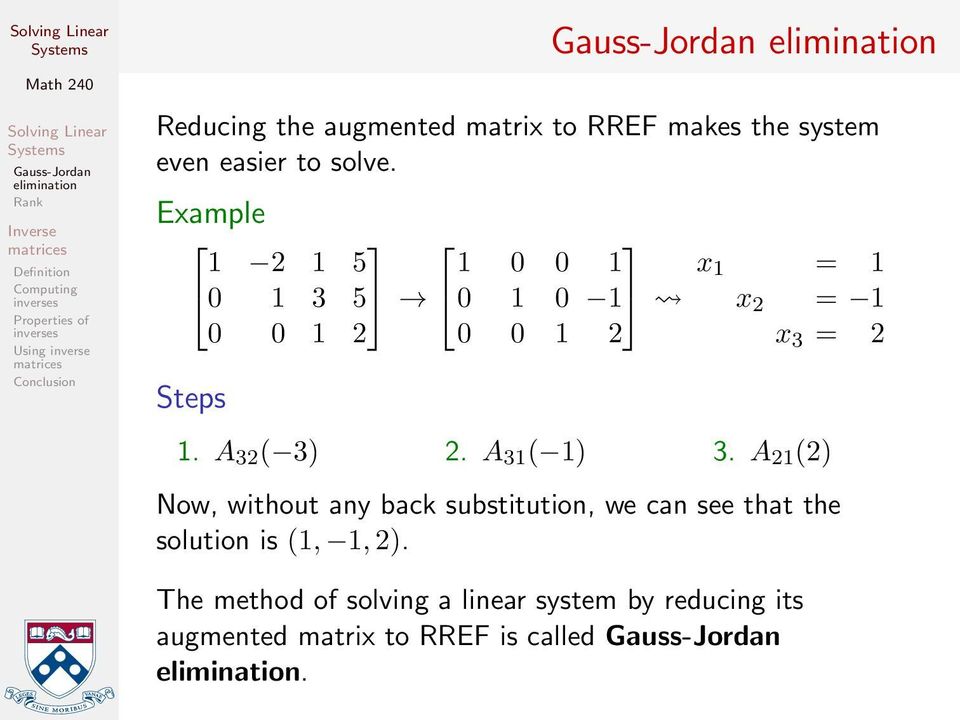
4 Reducing the augmented matrix to RREF makes the system even easier to solve. Example x 1 = x 2 = x 3 = 2 Steps 1. A 32 ( 3) 2. A 31 ( 1) 3. A 21 (2) Now, without any back substitution, we can see that the solution is (1, 1, 2). The method of solving a linear system by reducing its augmented matrix to RREF is called.
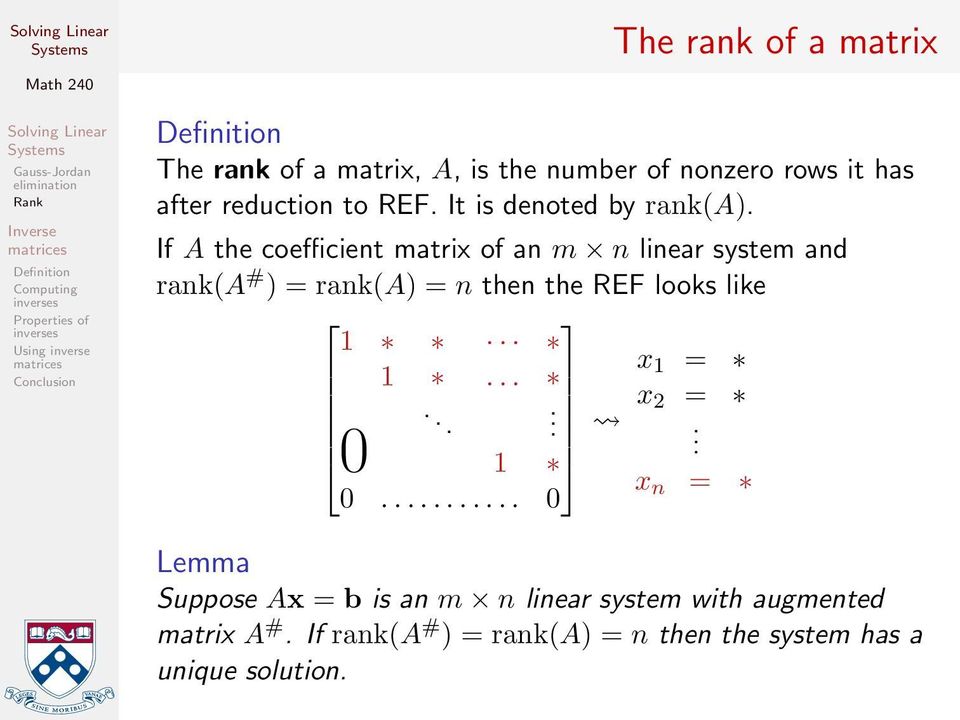
5 The rank of a matrix The rank of a matrix, A, is the number of nonzero rows it has after reduction to REF. It is denoted by rank(a). If A the coefficient matrix of an m n linear system and rank(a # ) = rank(a) = n then the REF looks like x 1 =... x 2 = x n = Lemma Suppose Ax = b is an m n linear system with augmented matrix A #. If rank(a # ) = rank(a) = n then the system has a unique solution.
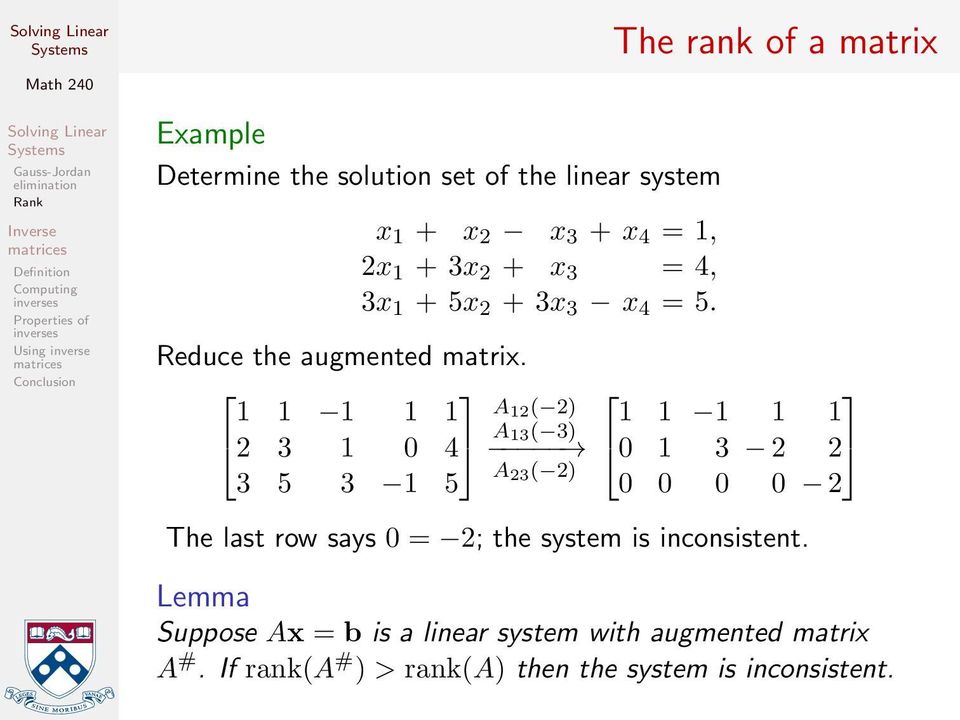
6 Example Determine the solution set of the linear system x 1 + x 2 x 3 + x 4 = 1, 2x 1 + 3x 2 + x 3 = 4, 3x 1 + 5x 2 + 3x 3 x 4 = 5. The rank of a matrix Reduce the augmented matrix A 12 ( 2) A ( 3) A ( 2) The last row says 0 = 2; the system is inconsistent. Lemma Suppose Ax = b is a linear system with augmented matrix A #. If rank(a # ) > rank(a) then the system is inconsistent.
7 Example Determine the solution set of the linear system 5x 1 6x 2 + x 3 = 4, 2x 1 3x 2 + x 3 = 1, 4x 1 3x 2 x 3 = 5. The rank of a matrix Reduce the augmented matrix x 1 x 3 = 2 x x 3 = 1 The unknown x 3 can assume any value. Let x 3 = t. Then by back substitution we get x 2 = t + 1 and x 1 = t + 2. Thus, the solution set is the line {(t + 2, t + 1, t) : t R}.

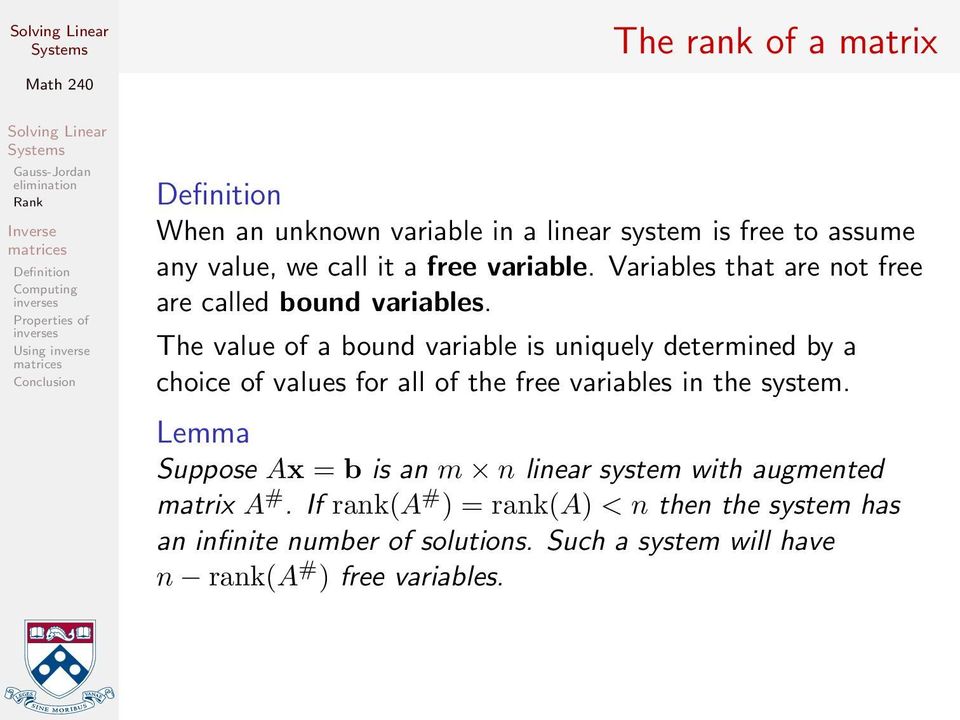
8 The rank of a matrix When an unknown variable in a linear system is free to assume any value, we call it a free variable. Variables that are not free are called bound variables. The value of a bound variable is uniquely determined by a choice of values for all of the free variables in the system. Lemma Suppose Ax = b is an m n linear system with augmented matrix A #. If rank(a # ) = rank(a) < n then the system has an infinite number of solutions. Such a system will have n rank(a # ) free variables.
9 Solving linear systems with free variables Example Use Gaussian to solve x 1 + 2x 2 2x 3 x 4 = 3, 3x 1 + 6x 2 + x x 4 = 16, 2x 1 + 4x 2 x 3 + 4x 4 = 9. Reducing to row-echelon form yields x 1 + 2x 2 2x 3 x 4 = 3, x 3 + 2x 4 = 1. Choose as free variables those variables that do not have a pivot in their column. In this case, our free variables will be x 2 and x 4. The solution set is the plane {(5 2s 3t, s, 1 2t, t) : s, t R}.

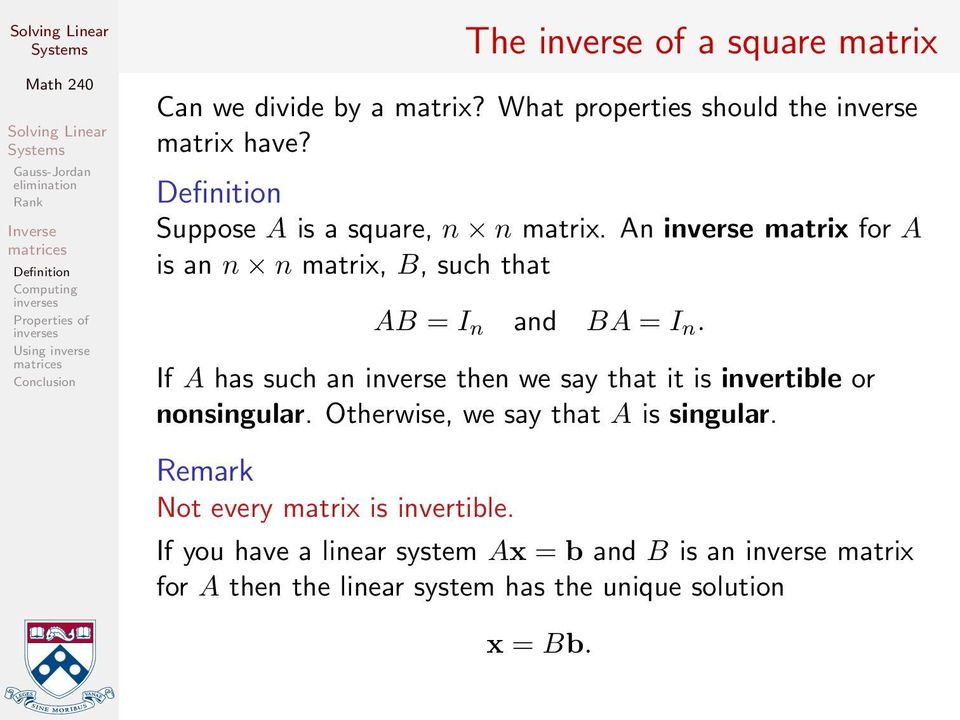
10 The inverse of a square matrix Can we divide by a matrix? What properties should the inverse matrix have? Suppose A is a square, n n matrix. An inverse matrix for A is an n n matrix, B, such that AB = I n and BA = I n. If A has such an inverse then we say that it is invertible or nonsingular. Otherwise, we say that A is singular. Remark Not every matrix is invertible. If you have a linear system Ax = b and B is an inverse matrix for A then the linear system has the unique solution x = Bb.
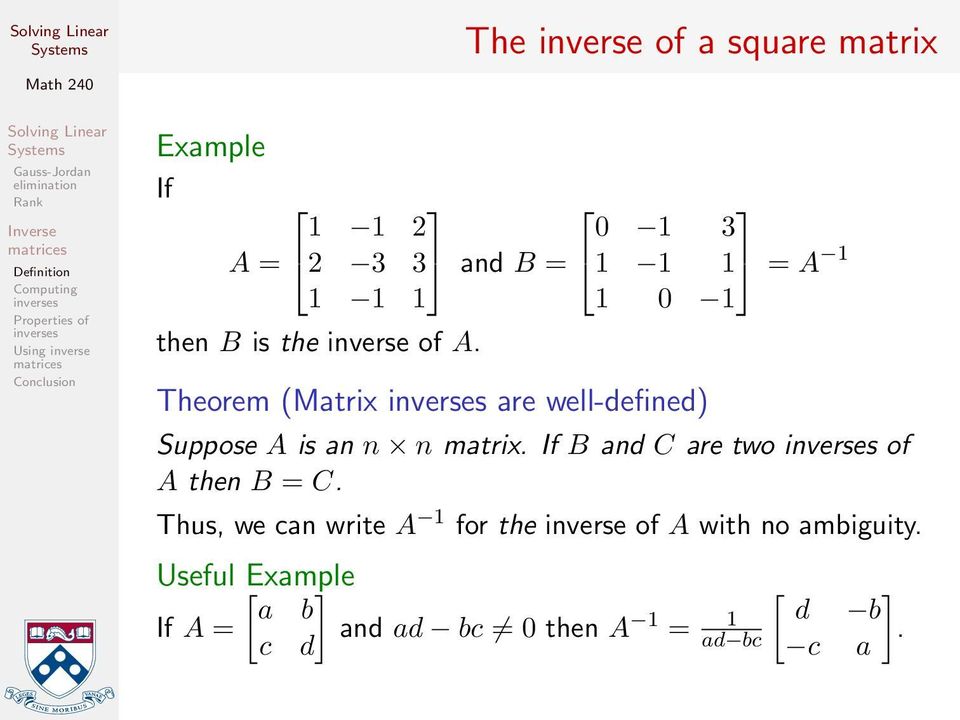
11 The inverse of a square matrix Example If A = and B = = A then B is the inverse of A. Theorem (Matrix are well-defined) Suppose A is an n n matrix. If B and C are two of A then B = C. Thus, we can write A 1 for the inverse of A with no ambiguity. Useful [ Example ] [ ] a b If A = and ad bc 0 then A c d 1 = 1 d b ad bc. c a
12 Finding the inverse of a matrix sound great! How do I find one? Suppose A is a 3 3 invertible matrix. If A 1 = [ x 1 x 2 ] x 3 then Ax 1 = 0, Ax 2 = 1, and Ax 3 = We can find A 1 by solving 3 linear systems at once! In general, form the augmented matrix and reduce to RREF. You end up with A 1 on the right. [ A In ] [ In A 1]
![If A 1 = [ x 1 x 2 ] x 3 then 1 0 0 Ax 1 = 0, Ax 2 = 1, and Ax 3 = 0.](/docs-images/46/21303663/images/page_12.jpg "0 0 1 We can find A 1 by solving 3 linear systems at once!")
13 Example Let s find the inverse of A = Finding the inverse of a matrix Take the augmented matrix and row reduce } 0 {{ 1 } A 1 Steps 1. A 12 ( 2) 2. A 13 ( 1) 3. M 2 ( 1) 4. M 3 ( 1) 5. A 32 ( 1) 6. A 31 ( 2) 7. A 21 (1)

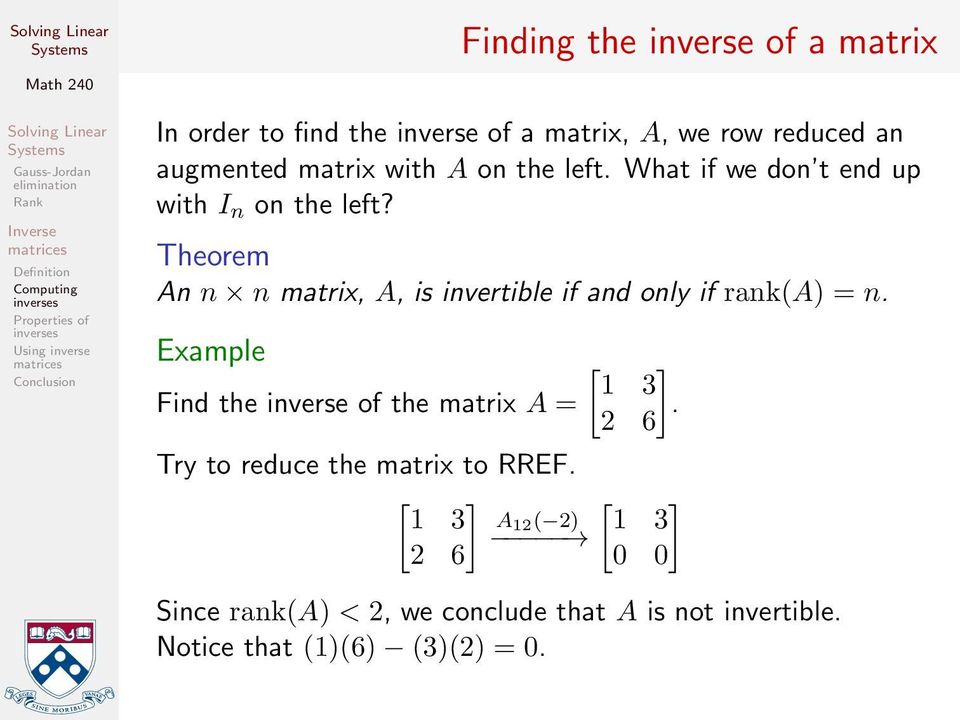
14 Finding the inverse of a matrix In order to find the inverse of a matrix, A, we row reduced an augmented matrix with A on the left. What if we don t end up with I n on the left? Theorem An n n matrix, A, is invertible if and only if rank(a) = n. Example Find the inverse of the matrix A = [ ] Try to reduce the matrix to RREF. [ ] [ ] 1 3 A 12 ( 2) Since rank(a) < 2, we conclude that A is not invertible. Notice that (1)(6) (3)(2) = 0.
15 Diagonal have simple. Finding the inverse of a matrix Proposition The inverse of a diagonal matrix is the diagonal matrix with reciprocal entries. 1 a 11 a = ann 0 a 1 nn Upper and lower triangular have of the same form. Proposition The inverse of an upper triangular matrix is upper triangular. The inverse of a lower triangular matrix is lower triangular.

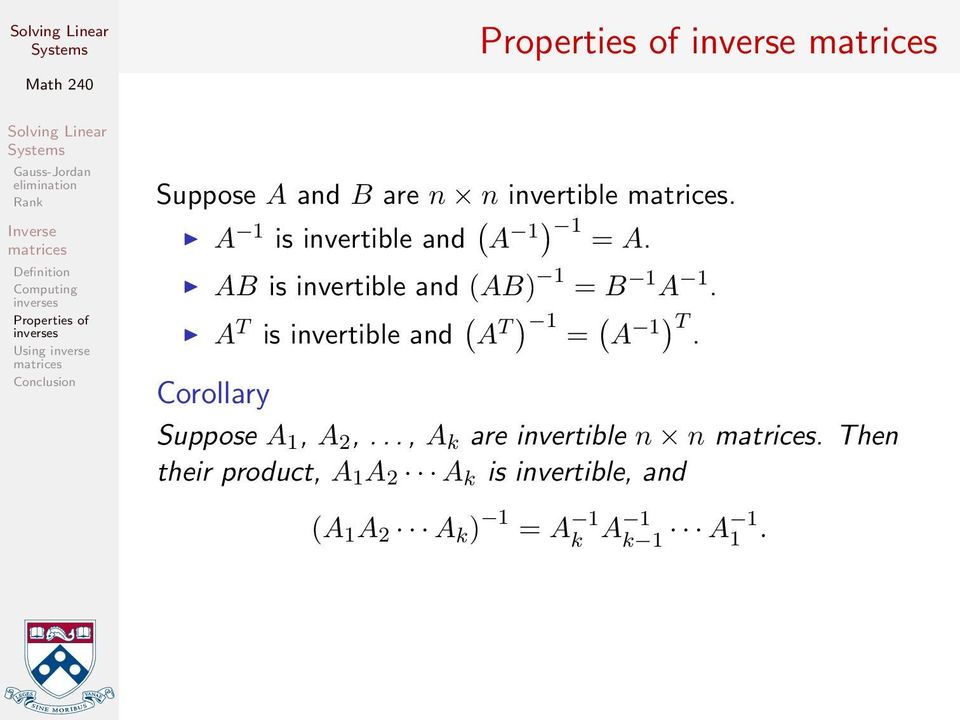
16 inverse Suppose A and B are n n invertible. A 1 is invertible and ( A 1) 1 = A. AB is invertible and (AB) 1 = B 1 A 1. A T is invertible and ( A T ) 1 = ( A 1 ) T. Corollary Suppose A 1, A 2,..., A k are invertible n n. Then their product, A 1 A 2 A k is invertible, and (A 1 A 2 A k ) 1 = A 1 k A 1 k 1 A 1 1.
17 Recall that if A is an invertible matrix then the linear system Ax = b has the unique solution x = A 1 b. Example Solve the linear system x 1 + 3x 2 = 1, 2x 1 + 5x 2 = 3. [ ] 1 3 The coefficient matrix is A =, so A 2 5 = [ ] The inverse of a 2 2 matrix is [ ] 1 [ ] a b 1 d b = when ad bc 0. c d ad bc c a Hence, [ x1 x 2 ] = [ ][ ] 1 = 3 [ ] 4. 1
![[ ] 1 3 The coefficient matrix is A =, so A 2 5 = [ ] 5 3.](/docs-images/46/21303663/images/page_17.jpg "2 1 The inverse of a 2 2 matrix is [ ] 1 [ ] a b 1 d b = when ad bc 0.")
18 are an elegant way of solving linear systems. They do have some drawbacks: They are only applicable when the coefficient matrix is square. Even in the case of a square matrix, an inverse may not exist. They are hard to compute, at least as complicated as doing. However, they can be useful if the coefficient matrix has an obvious inverse, you need to solve multiple linear systems with the same coefficients.

MATH10212 Linear Algebra. Systems of Linear Equations. Definition. An n-dimensional vector is a row or a column of n numbers (or letters): a 1.
 MATH10212 Linear Algebra Textbook: D. Poole, Linear Algebra: A Modern Introduction. Thompson, 2006. ISBN 0-534-40596-7. Systems of Linear Equations Definition. An n-dimensional vector is a row or a column
MATRIX ALGEBRA AND SYSTEMS OF EQUATIONS
 MATRIX ALGEBRA AND SYSTEMS OF EQUATIONS Systems of Equations and Matrices Representation of a linear system The general system of m equations in n unknowns can be written a x + a 2 x 2 + + a n x n b a
Solving Systems of Linear Equations
 LECTURE 5 Solving Systems of Linear Equations Recall that we introduced the notion of matrices as a way of standardizing the expression of systems of linear equations In today s lecture I shall show how
MATRIX ALGEBRA AND SYSTEMS OF EQUATIONS. + + x 2. x n. a 11 a 12 a 1n b 1 a 21 a 22 a 2n b 2 a 31 a 32 a 3n b 3. a m1 a m2 a mn b m
 MATRIX ALGEBRA AND SYSTEMS OF EQUATIONS 1. SYSTEMS OF EQUATIONS AND MATRICES 1.1. Representation of a linear system. The general system of m equations in n unknowns can be written a 11 x 1 + a 12 x 2 +
MAT 200, Midterm Exam Solution. a. (5 points) Compute the determinant of the matrix A =
 MAT 200, Midterm Exam Solution. (0 points total) a. (5 points) Compute the determinant of the matrix 2 2 0 A = 0 3 0 3 0 Answer: det A = 3. The most efficient way is to develop the determinant along the
Methods for Finding Bases
 Methods for Finding Bases Bases for the subspaces of a matrix Row-reduction methods can be used to find bases. Let us now look at an example illustrating how to obtain bases for the row space, null space,
Abstract: We describe the beautiful LU factorization of a square matrix (or how to write Gaussian elimination in terms of matrix multiplication).
 MAT 2 (Badger, Spring 202) LU Factorization Selected Notes September 2, 202 Abstract: We describe the beautiful LU factorization of a square matrix (or how to write Gaussian elimination in terms of matrix
Using row reduction to calculate the inverse and the determinant of a square matrix
 Using row reduction to calculate the inverse and the determinant of a square matrix Notes for MATH 0290 Honors by Prof. Anna Vainchtein 1 Inverse of a square matrix An n n square matrix A is called invertible
160 CHAPTER 4. VECTOR SPACES
 160 CHAPTER 4. VECTOR SPACES 4. Rank and Nullity In this section, we look at relationships between the row space, column space, null space of a matrix and its transpose. We will derive fundamental results
Row Echelon Form and Reduced Row Echelon Form
 These notes closely follow the presentation of the material given in David C Lay s textbook Linear Algebra and its Applications (3rd edition) These notes are intended primarily for in-class presentation
Lecture Notes 2: Matrices as Systems of Linear Equations
 2: Matrices as Systems of Linear Equations 33A Linear Algebra, Puck Rombach Last updated: April 13, 2016 Systems of Linear Equations Systems of linear equations can represent many things You have probably
Systems of Linear Equations
 Systems of Linear Equations Beifang Chen Systems of linear equations Linear systems A linear equation in variables x, x,, x n is an equation of the form a x + a x + + a n x n = b, where a, a,, a n and
December 4, 2013 MATH 171 BASIC LINEAR ALGEBRA B. KITCHENS
 December 4, 2013 MATH 171 BASIC LINEAR ALGEBRA B KITCHENS The equation 1 Lines in two-dimensional space (1) 2x y = 3 describes a line in two-dimensional space The coefficients of x and y in the equation
Math 115A HW4 Solutions University of California, Los Angeles. 5 2i 6 + 4i. (5 2i)7i (6 + 4i)( 3 + i) = 35i + 14 ( 22 6i) = 36 + 41i.
 Math 5A HW4 Solutions September 5, 202 University of California, Los Angeles Problem 4..3b Calculate the determinant, 5 2i 6 + 4i 3 + i 7i Solution: The textbook s instructions give us, (5 2i)7i (6 + 4i)(
SYSTEMS OF EQUATIONS AND MATRICES WITH THE TI-89. by Joseph Collison
 SYSTEMS OF EQUATIONS AND MATRICES WITH THE TI-89 by Joseph Collison Copyright 2000 by Joseph Collison All rights reserved Reproduction or translation of any part of this work beyond that permitted by Sections
Notes on Determinant
 ENGG2012B Advanced Engineering Mathematics Notes on Determinant Lecturer: Kenneth Shum Lecture 9-18/02/2013 The determinant of a system of linear equations determines whether the solution is unique, without
Solving Systems of Linear Equations
 LECTURE 5 Solving Systems of Linear Equations Recall that we introduced the notion of matrices as a way of standardizing the expression of systems of linear equations In today s lecture I shall show how
Reduced echelon form: Add the following conditions to conditions 1, 2, and 3 above:
 Section 1.2: Row Reduction and Echelon Forms Echelon form (or row echelon form): 1. All nonzero rows are above any rows of all zeros. 2. Each leading entry (i.e. left most nonzero entry) of a row is in
Solving Systems of Linear Equations Using Matrices
 Solving Systems of Linear Equations Using Matrices What is a Matrix? A matrix is a compact grid or array of numbers. It can be created from a system of equations and used to solve the system of equations.
1.2 Solving a System of Linear Equations
 1.. SOLVING A SYSTEM OF LINEAR EQUATIONS 1. Solving a System of Linear Equations 1..1 Simple Systems - Basic De nitions As noticed above, the general form of a linear system of m equations in n variables
6. Cholesky factorization
 6. Cholesky factorization EE103 (Fall 2011-12) triangular matrices forward and backward substitution the Cholesky factorization solving Ax = b with A positive definite inverse of a positive definite matrix
Direct Methods for Solving Linear Systems. Matrix Factorization
 Direct Methods for Solving Linear Systems Matrix Factorization Numerical Analysis (9th Edition) R L Burden & J D Faires Beamer Presentation Slides prepared by John Carroll Dublin City University c 2011
Solutions to Math 51 First Exam January 29, 2015
 Solutions to Math 5 First Exam January 29, 25. ( points) (a) Complete the following sentence: A set of vectors {v,..., v k } is defined to be linearly dependent if (2 points) there exist c,... c k R, not
Math 312 Homework 1 Solutions
 Math 31 Homework 1 Solutions Last modified: July 15, 01 This homework is due on Thursday, July 1th, 01 at 1:10pm Please turn it in during class, or in my mailbox in the main math office (next to 4W1) Please
7 Gaussian Elimination and LU Factorization
 7 Gaussian Elimination and LU Factorization In this final section on matrix factorization methods for solving Ax = b we want to take a closer look at Gaussian elimination (probably the best known method
4.5 Linear Dependence and Linear Independence
 4.5 Linear Dependence and Linear Independence 267 32. {v 1, v 2 }, where v 1, v 2 are collinear vectors in R 3. 33. Prove that if S and S are subsets of a vector space V such that S is a subset of S, then
1 Introduction to Matrices
 1 Introduction to Matrices In this section, important definitions and results from matrix algebra that are useful in regression analysis are introduced. While all statements below regarding the columns
a 11 x 1 + a 12 x 2 + + a 1n x n = b 1 a 21 x 1 + a 22 x 2 + + a 2n x n = b 2.
 Chapter 1 LINEAR EQUATIONS 1.1 Introduction to linear equations A linear equation in n unknowns x 1, x,, x n is an equation of the form a 1 x 1 + a x + + a n x n = b, where a 1, a,..., a n, b are given
8 Square matrices continued: Determinants
 8 Square matrices continued: Determinants 8. Introduction Determinants give us important information about square matrices, and, as we ll soon see, are essential for the computation of eigenvalues. You
I. GROUPS: BASIC DEFINITIONS AND EXAMPLES
 I GROUPS: BASIC DEFINITIONS AND EXAMPLES Definition 1: An operation on a set G is a function : G G G Definition 2: A group is a set G which is equipped with an operation and a special element e G, called
by the matrix A results in a vector which is a reflection of the given
 Eigenvalues & Eigenvectors Example Suppose Then So, geometrically, multiplying a vector in by the matrix A results in a vector which is a reflection of the given vector about the y-axis We observe that
1 VECTOR SPACES AND SUBSPACES
 1 VECTOR SPACES AND SUBSPACES What is a vector? Many are familiar with the concept of a vector as: Something which has magnitude and direction. an ordered pair or triple. a description for quantities such
Factorization Theorems
 Chapter 7 Factorization Theorems This chapter highlights a few of the many factorization theorems for matrices While some factorization results are relatively direct, others are iterative While some factorization
Linear Equations ! 25 30 35$ & " 350 150% & " 11,750 12,750 13,750% MATHEMATICS LEARNING SERVICE Centre for Learning and Professional Development
 MathsTrack (NOTE Feb 2013: This is the old version of MathsTrack. New books will be created during 2013 and 2014) Topic 4 Module 9 Introduction Systems of to Matrices Linear Equations Income = Tickets!
Subspaces of R n LECTURE 7. 1. Subspaces
 LECTURE 7 Subspaces of R n Subspaces Definition 7 A subset W of R n is said to be closed under vector addition if for all u, v W, u + v is also in W If rv is in W for all vectors v W and all scalars r
Linearly Independent Sets and Linearly Dependent Sets
 These notes closely follow the presentation of the material given in David C. Lay s textbook Linear Algebra and its Applications (3rd edition). These notes are intended primarily for in-class presentation
Continued Fractions and the Euclidean Algorithm
 Continued Fractions and the Euclidean Algorithm Lecture notes prepared for MATH 326, Spring 997 Department of Mathematics and Statistics University at Albany William F Hammond Table of Contents Introduction
NOTES ON LINEAR TRANSFORMATIONS
 NOTES ON LINEAR TRANSFORMATIONS Definition 1. Let V and W be vector spaces. A function T : V W is a linear transformation from V to W if the following two properties hold. i T v + v = T v + T v for all
Solution of Linear Systems
 Chapter 3 Solution of Linear Systems In this chapter we study algorithms for possibly the most commonly occurring problem in scientific computing, the solution of linear systems of equations. We start
Au = = = 3u. Aw = = = 2w. so the action of A on u and w is very easy to picture: it simply amounts to a stretching by 3 and 2, respectively.
 Chapter 7 Eigenvalues and Eigenvectors In this last chapter of our exploration of Linear Algebra we will revisit eigenvalues and eigenvectors of matrices, concepts that were already introduced in Geometry
LINEAR ALGEBRA. September 23, 2010
 LINEAR ALGEBRA September 3, 00 Contents 0. LU-decomposition.................................... 0. Inverses and Transposes................................. 0.3 Column Spaces and NullSpaces.............................
Systems of Linear Equations
 Chapter 1 Systems of Linear Equations 1.1 Intro. to systems of linear equations Homework: [Textbook, Ex. 13, 15, 41, 47, 49, 51, 65, 73; page 11-]. Main points in this section: 1. Definition of Linear
1 Determinants and the Solvability of Linear Systems
 1 Determinants and the Solvability of Linear Systems In the last section we learned how to use Gaussian elimination to solve linear systems of n equations in n unknowns The section completely side-stepped
1 0 5 3 3 A = 0 0 0 1 3 0 0 0 0 0 0 0 0 0 0
 Solutions: Assignment 4.. Find the redundant column vectors of the given matrix A by inspection. Then find a basis of the image of A and a basis of the kernel of A. 5 A The second and third columns are
DETERMINANTS TERRY A. LORING
 DETERMINANTS TERRY A. LORING 1. Determinants: a Row Operation By-Product The determinant is best understood in terms of row operations, in my opinion. Most books start by defining the determinant via formulas
Vector and Matrix Norms
 Chapter 1 Vector and Matrix Norms 11 Vector Spaces Let F be a field (such as the real numbers, R, or complex numbers, C) with elements called scalars A Vector Space, V, over the field F is a non-empty
T ( a i x i ) = a i T (x i ).
 Chapter 2 Defn 1. (p. 65) Let V and W be vector spaces (over F ). We call a function T : V W a linear transformation form V to W if, for all x, y V and c F, we have (a) T (x + y) = T (x) + T (y) and (b)
7.4. The Inverse of a Matrix. Introduction. Prerequisites. Learning Style. Learning Outcomes
 The Inverse of a Matrix 7.4 Introduction In number arithmetic every number a 0 has a reciprocal b written as a or such that a ba = ab =. Similarly a square matrix A may have an inverse B = A where AB =
MATH2210 Notebook 1 Fall Semester 2016/2017. 1 MATH2210 Notebook 1 3. 1.1 Solving Systems of Linear Equations... 3
 MATH0 Notebook Fall Semester 06/07 prepared by Professor Jenny Baglivo c Copyright 009 07 by Jenny A. Baglivo. All Rights Reserved. Contents MATH0 Notebook 3. Solving Systems of Linear Equations........................
Linear Codes. Chapter 3. 3.1 Basics
 Chapter 3 Linear Codes In order to define codes that we can encode and decode efficiently, we add more structure to the codespace. We shall be mainly interested in linear codes. A linear code of length
LS.6 Solution Matrices
 LS.6 Solution Matrices In the literature, solutions to linear systems often are expressed using square matrices rather than vectors. You need to get used to the terminology. As before, we state the definitions
Solution to Homework 2
 Solution to Homework 2 Olena Bormashenko September 23, 2011 Section 1.4: 1(a)(b)(i)(k), 4, 5, 14; Section 1.5: 1(a)(b)(c)(d)(e)(n), 2(a)(c), 13, 16, 17, 18, 27 Section 1.4 1. Compute the following, if
7. LU factorization. factor-solve method. LU factorization. solving Ax = b with A nonsingular. the inverse of a nonsingular matrix
 7. LU factorization EE103 (Fall 2011-12) factor-solve method LU factorization solving Ax = b with A nonsingular the inverse of a nonsingular matrix LU factorization algorithm effect of rounding error sparse
The Determinant: a Means to Calculate Volume
 The Determinant: a Means to Calculate Volume Bo Peng August 20, 2007 Abstract This paper gives a definition of the determinant and lists many of its well-known properties Volumes of parallelepipeds are
Applied Linear Algebra I Review page 1
 Applied Linear Algebra Review 1 I. Determinants A. Definition of a determinant 1. Using sum a. Permutations i. Sign of a permutation ii. Cycle 2. Uniqueness of the determinant function in terms of properties
13 MATH FACTS 101. 2 a = 1. 7. The elements of a vector have a graphical interpretation, which is particularly easy to see in two or three dimensions.
 3 MATH FACTS 0 3 MATH FACTS 3. Vectors 3.. Definition We use the overhead arrow to denote a column vector, i.e., a linear segment with a direction. For example, in three-space, we write a vector in terms
Lecture 3: Finding integer solutions to systems of linear equations
 Lecture 3: Finding integer solutions to systems of linear equations Algorithmic Number Theory (Fall 2014) Rutgers University Swastik Kopparty Scribe: Abhishek Bhrushundi 1 Overview The goal of this lecture
MAT188H1S Lec0101 Burbulla
 Winter 206 Linear Transformations A linear transformation T : R m R n is a function that takes vectors in R m to vectors in R n such that and T (u + v) T (u) + T (v) T (k v) k T (v), for all vectors u
Recall that two vectors in are perpendicular or orthogonal provided that their dot
 Orthogonal Complements and Projections Recall that two vectors in are perpendicular or orthogonal provided that their dot product vanishes That is, if and only if Example 1 The vectors in are orthogonal
Solving simultaneous equations using the inverse matrix
 Solving simultaneous equations using the inverse matrix 8.2 Introduction The power of matrix algebra is seen in the representation of a system of simultaneous linear equations as a matrix equation. Matrix
Matrix Differentiation
 1 Introduction Matrix Differentiation ( and some other stuff ) Randal J. Barnes Department of Civil Engineering, University of Minnesota Minneapolis, Minnesota, USA Throughout this presentation I have
2x + y = 3. Since the second equation is precisely the same as the first equation, it is enough to find x and y satisfying the system
 1. Systems of linear equations We are interested in the solutions to systems of linear equations. A linear equation is of the form 3x 5y + 2z + w = 3. The key thing is that we don t multiply the variables
Matrix Algebra. Some Basic Matrix Laws. Before reading the text or the following notes glance at the following list of basic matrix algebra laws.
 Matrix Algebra A. Doerr Before reading the text or the following notes glance at the following list of basic matrix algebra laws. Some Basic Matrix Laws Assume the orders of the matrices are such that
PYTHAGOREAN TRIPLES KEITH CONRAD
 PYTHAGOREAN TRIPLES KEITH CONRAD 1. Introduction A Pythagorean triple is a triple of positive integers (a, b, c) where a + b = c. Examples include (3, 4, 5), (5, 1, 13), and (8, 15, 17). Below is an ancient
Vector Spaces 4.4 Spanning and Independence
 Vector Spaces 4.4 and Independence October 18 Goals Discuss two important basic concepts: Define linear combination of vectors. Define Span(S) of a set S of vectors. Define linear Independence of a set
Similar matrices and Jordan form
 Similar matrices and Jordan form We ve nearly covered the entire heart of linear algebra once we ve finished singular value decompositions we ll have seen all the most central topics. A T A is positive
Some Lecture Notes and In-Class Examples for Pre-Calculus:
 Some Lecture Notes and In-Class Examples for Pre-Calculus: Section.7 Definition of a Quadratic Inequality A quadratic inequality is any inequality that can be put in one of the forms ax + bx + c < 0 ax
CURVE FITTING LEAST SQUARES APPROXIMATION
 CURVE FITTING LEAST SQUARES APPROXIMATION Data analysis and curve fitting: Imagine that we are studying a physical system involving two quantities: x and y Also suppose that we expect a linear relationship
3. Let A and B be two n n orthogonal matrices. Then prove that AB and BA are both orthogonal matrices. Prove a similar result for unitary matrices.
 Exercise 1 1. Let A be an n n orthogonal matrix. Then prove that (a) the rows of A form an orthonormal basis of R n. (b) the columns of A form an orthonormal basis of R n. (c) for any two vectors x,y R
Section 8.2 Solving a System of Equations Using Matrices (Guassian Elimination)
 Section 8. Solving a System of Equations Using Matrices (Guassian Elimination) x + y + z = x y + 4z = x 4y + z = System of Equations x 4 y = 4 z A System in matrix form x A x = b b 4 4 Augmented Matrix
10.2 ITERATIVE METHODS FOR SOLVING LINEAR SYSTEMS. The Jacobi Method
 578 CHAPTER 1 NUMERICAL METHODS 1. ITERATIVE METHODS FOR SOLVING LINEAR SYSTEMS As a numerical technique, Gaussian elimination is rather unusual because it is direct. That is, a solution is obtained after
A note on companion matrices
 Linear Algebra and its Applications 372 (2003) 325 33 www.elsevier.com/locate/laa A note on companion matrices Miroslav Fiedler Academy of Sciences of the Czech Republic Institute of Computer Science Pod
MATH 304 Linear Algebra Lecture 9: Subspaces of vector spaces (continued). Span. Spanning set.
 MATH 304 Linear Algebra Lecture 9: Subspaces of vector spaces (continued). Span. Spanning set. Vector space A vector space is a set V equipped with two operations, addition V V (x,y) x + y V and scalar
MATH 304 Linear Algebra Lecture 18: Rank and nullity of a matrix.
 MATH 304 Linear Algebra Lecture 18: Rank and nullity of a matrix. Nullspace Let A = (a ij ) be an m n matrix. Definition. The nullspace of the matrix A, denoted N(A), is the set of all n-dimensional column
1 Review of Least Squares Solutions to Overdetermined Systems
 cs4: introduction to numerical analysis /9/0 Lecture 7: Rectangular Systems and Numerical Integration Instructor: Professor Amos Ron Scribes: Mark Cowlishaw, Nathanael Fillmore Review of Least Squares
Lecture 2 Matrix Operations
 Lecture 2 Matrix Operations transpose, sum & difference, scalar multiplication matrix multiplication, matrix-vector product matrix inverse 2 1 Matrix transpose transpose of m n matrix A, denoted A T or
LAB 11: MATRICES, SYSTEMS OF EQUATIONS and POLYNOMIAL MODELING
 LAB 11: MATRICS, SYSTMS OF QUATIONS and POLYNOMIAL MODLING Objectives: 1. Solve systems of linear equations using augmented matrices. 2. Solve systems of linear equations using matrix equations and inverse
1 2 3 1 1 2 x = + x 2 + x 4 1 0 1
 (d) If the vector b is the sum of the four columns of A, write down the complete solution to Ax = b. 1 2 3 1 1 2 x = + x 2 + x 4 1 0 0 1 0 1 2. (11 points) This problem finds the curve y = C + D 2 t which
MAT 242 Test 2 SOLUTIONS, FORM T
 MAT 242 Test 2 SOLUTIONS, FORM T 5 3 5 3 3 3 3. Let v =, v 5 2 =, v 3 =, and v 5 4 =. 3 3 7 3 a. [ points] The set { v, v 2, v 3, v 4 } is linearly dependent. Find a nontrivial linear combination of these
University of Lille I PC first year list of exercises n 7. Review
 University of Lille I PC first year list of exercises n 7 Review Exercise Solve the following systems in 4 different ways (by substitution, by the Gauss method, by inverting the matrix of coefficients
Chapter 17. Orthogonal Matrices and Symmetries of Space
 Chapter 17. Orthogonal Matrices and Symmetries of Space Take a random matrix, say 1 3 A = 4 5 6, 7 8 9 and compare the lengths of e 1 and Ae 1. The vector e 1 has length 1, while Ae 1 = (1, 4, 7) has length
MATHEMATICS FOR ENGINEERS BASIC MATRIX THEORY TUTORIAL 2
 MATHEMATICS FO ENGINEES BASIC MATIX THEOY TUTOIAL This is the second of two tutorials on matrix theory. On completion you should be able to do the following. Explain the general method for solving simultaneous
Linear Algebra Notes for Marsden and Tromba Vector Calculus
 Linear Algebra Notes for Marsden and Tromba Vector Calculus n-dimensional Euclidean Space and Matrices Definition of n space As was learned in Math b, a point in Euclidean three space can be thought of
MATH10040 Chapter 2: Prime and relatively prime numbers
 MATH10040 Chapter 2: Prime and relatively prime numbers Recall the basic definition: 1. Prime numbers Definition 1.1. Recall that a positive integer is said to be prime if it has precisely two positive
Inner products on R n, and more
 Inner products on R n, and more Peyam Ryan Tabrizian Friday, April 12th, 2013 1 Introduction You might be wondering: Are there inner products on R n that are not the usual dot product x y = x 1 y 1 + +
2.2/2.3 - Solving Systems of Linear Equations
 c Kathryn Bollinger, August 28, 2011 1 2.2/2.3 - Solving Systems of Linear Equations A Brief Introduction to Matrices Matrices are used to organize data efficiently and will help us to solve systems of
Kevin James. MTHSC 412 Section 2.4 Prime Factors and Greatest Comm
 MTHSC 412 Section 2.4 Prime Factors and Greatest Common Divisor Greatest Common Divisor Definition Suppose that a, b Z. Then we say that d Z is a greatest common divisor (gcd) of a and b if the following
Matrix Representations of Linear Transformations and Changes of Coordinates
 Matrix Representations of Linear Transformations and Changes of Coordinates 01 Subspaces and Bases 011 Definitions A subspace V of R n is a subset of R n that contains the zero element and is closed under
( ) which must be a vector
 MATH 37 Linear Transformations from Rn to Rm Dr. Neal, WKU Let T : R n R m be a function which maps vectors from R n to R m. Then T is called a linear transformation if the following two properties are
8.2. Solution by Inverse Matrix Method. Introduction. Prerequisites. Learning Outcomes
 Solution by Inverse Matrix Method 8.2 Introduction The power of matrix algebra is seen in the representation of a system of simultaneous linear equations as a matrix equation. Matrix algebra allows us
Linear Algebra Review. Vectors
 Linear Algebra Review By Tim K. Marks UCSD Borrows heavily from: Jana Kosecka [email protected] http://cs.gmu.edu/~kosecka/cs682.html Virginia de Sa Cogsci 8F Linear Algebra review UCSD Vectors The length
x y The matrix form, the vector form, and the augmented matrix form, respectively, for the system of equations are
 Solving Sstems of Linear Equations in Matri Form with rref Learning Goals Determine the solution of a sstem of equations from the augmented matri Determine the reduced row echelon form of the augmented
Chapter 6. Linear Transformation. 6.1 Intro. to Linear Transformation
 Chapter 6 Linear Transformation 6 Intro to Linear Transformation Homework: Textbook, 6 Ex, 5, 9,, 5,, 7, 9,5, 55, 57, 6(a,b), 6; page 7- In this section, we discuss linear transformations 89 9 CHAPTER
Section 6.1 - Inner Products and Norms
 Section 6.1 - Inner Products and Norms Definition. Let V be a vector space over F {R, C}. An inner product on V is a function that assigns, to every ordered pair of vectors x and y in V, a scalar in F,
Unit 18 Determinants
 Unit 18 Determinants Every square matrix has a number associated with it, called its determinant. In this section, we determine how to calculate this number, and also look at some of the properties of
5 Homogeneous systems
 5 Homogeneous systems Definition: A homogeneous (ho-mo-jeen -i-us) system of linear algebraic equations is one in which all the numbers on the right hand side are equal to : a x +... + a n x n =.. a m
SOLVING LINEAR SYSTEMS
 SOLVING LINEAR SYSTEMS Linear systems Ax = b occur widely in applied mathematics They occur as direct formulations of real world problems; but more often, they occur as a part of the numerical analysis
Linear Algebra and TI 89
 Linear Algebra and TI 89 Abdul Hassen and Jay Schiffman This short manual is a quick guide to the use of TI89 for Linear Algebra. We do this in two sections. In the first section, we will go over the editing
Typical Linear Equation Set and Corresponding Matrices
 EWE: Engineering With Excel Larsen Page 1 4. Matrix Operations in Excel. Matrix Manipulations: Vectors, Matrices, and Arrays. How Excel Handles Matrix Math. Basic Matrix Operations. Solving Systems of
Name: Section Registered In:
 Name: Section Registered In: Math 125 Exam 3 Version 1 April 24, 2006 60 total points possible 1. (5pts) Use Cramer s Rule to solve 3x + 4y = 30 x 2y = 8. Be sure to show enough detail that shows you are