
Validation of a vapour compression refrigeration system design model
|
|
|
- Clementine Farmer
- 10 years ago
- Views:
Transcription
1 AMERICAN JOURNAL OF SCIENTIFIC AND INDUSTRIAL RESEARCH 2011, Science Huβ, ISSN: X doi: /ajsir Validation of a vapour compression refrigeration system design model M. A. Akintunde Federal University of Technology, Department of Mechanical Engineering, PMB. 704, Akure, Ondo State, Nigeria, , [email protected] ABSTRACT This paper presents the validation of a design model for vapour compression refrigeration systems developed by Akintunde (2004a). This model was used to design a vapour compression refrigeration system. The experimental set-up is made up of: a compressor- reciprocating type, kw capacity, using R134a as working fluid, with cylinder stoke volume of 32.7 cm 2 ; evaporator and condenser, bare coil tube-in-tube serpentine copper coil. The cycle performance was evaluated through the following parameters; Cooling load (Qe); Condensing load (Qc); Coefficient of performance (COP) and mass flow rate. The R values (calculating using excel) of the COPs under subcooling and superheating with the degree of subcooling and superheating conditions were 80.7% and 88% respectively. While the correlations between the COPs under the same conditions were 88% and 99.9%. The present analysis showed that the model results are comparable to the actual system from both quantitative and qualitative points of view. Under the same operational conditions, maximum absolute deviations of the variable parameters mass flow rate, COP and circulating water temperature, are within the range of 16%. Keywords: validation, evaluation, COP, alternative, refrigerant, INTRODUCTION The application of vapour compression system cycles, using R-12 and R-22 and other halocarbon compounds, had gone deep in the field of refrigeration and air-conditioning before the advent of ozone depletion. It is a known fact that the working fluids used in refrigeration and air-conditioning systems are to be phased out (Mahmoud et al., 2002; Hafez and Rahman, 1992; Ko et al., 1993). Resulting from the ozone depletion potentials of these working fluids and the consequences effects of the phasing out of these fluids, researchers are focused on identifying alternative working fluids. Statt (1990) studied potential substitute refrigerants for centrifugal chillers that use R-12. The alternatives were required to have normal boiling points close to that of R-12. He found thirteen (13) compounds that satisfied this criterion. These are: R-115; 500, 502, 505, 506, which are already banned R-161 which is highly toxic; R-143a, 152a which are slightly flammable and R-22, 124, 125, 134 and 134a which are nonflammable. There are many other works published on the alternatives to R-12 and other ozone depletion refrigerants, some of these are: Kutter (1988); Clark, (1999); Eckels and Tesene (2003); Eckels and Tesene (2004); Sand et al., (1990); Crow et al., (1992). It has been concluded by many researchers that from thermodynamic point of view R-134a is closely related to R-12 in most important thermodynamic properties of refrigerants (Bolaji, 2008; Akintunde, 2007; Calm, 2002; Kim et al., 2002). Although, R-134a is presently been used as one of the best alternatives to R-12, there are still some notable problems. Statt (1990), reported that R-22 and R-134a will decrease both the capacity and efficiency by 5 to 10%. Al-Rabghi (1996), compared the theoretical performance of three candidate substitutes, R-22; R-717 and R-134a, in a one ton refrigeration system R-12 based unit with an evaporating temperature of 10 o C and 55 o C condensing temperature. The result showed that R- 134a decreases both the coefficient of performance (COP) and the capacity by 6.0% and 15.9% respectively. Veneyard et al., (1989), reported that R- 134a had higher energy consumption than R-12 by 7.8%. Due to these discrepancies it was believed that the systems using R-12 should be redesigned to accommodate R-134a. Kamei et al., (1990); Pannock et al., (1994) and Linton et al., (1992), studied the performance of R- 134a, R-152a and R-12. They concluded that new R- 134a systems could be designed to outperform the corresponding R-12 systems by the proper addition of subcooling. Linton et al., (1989), tested the performance of R-134a in a residential exhaust air heat pump designed for R-12. The results showed both refrigerants to have about the same heating (i.e.

2 output) capacity, evaporating pressure and evaporating and condensing temperatures. R-134a had higher condensing pressure by about 140 kpa and lower COP by about 15%. The expansion valve required much larger orifice to perform satisfactorily in the case of R-134a. Other proofs can be found in the works of Crown et al., (1992); Abu-Madi et al., (1992) and Hel-Haggar et al., (1996). Akintunde (2004a) and Akintunde (2004b) observed that, the performance of R-134a may be enhanced if the refrigeration systems are redesigned based on thermodynamic properties of the working fluids. He further observed that if balanced points (as suggested by Stoecker and Jones, 1982) between the refrigeration systems components (viz: compressor, condenser, evaporator and expander) are identified and these components can work together at these balanced points then the performance will be improved. He therefore developed a model based on both the balanced points between the system components and the thermodynamic properties of the working fluid. This model was tested by Akintunde et al., (2006) using R- 12 as working fluid. The test rig used for the experiment consists of a reciprocating type compressor, kw with, 32.7 cm 2 cylinder; bear coil evaporator made of copper mm inner diameter and 6.35 mm outer diameter with tube length of m, the condenser was of the same specifications as that of evaporator except that the length was m. The developed model (Akintunde, 2004a and b) was used to generate the design data presented above, using condensing temperature of 40 o C sub cooled by 5 o C and evaporating temperature of -5 o C. The generated capillary tube length was 2.0 m which is very much closed to 2.03 m found in ASHRAE (2002) under the same conditions. This system was used to compare the model with an actual system using R-12 as working fluid. Under the same operational conditions, maximum absolute deviations of variable parameters mass flow rate; condensing and evaporating temperatures and compressor speed are within the range of to 18.50%, though most of the simulated results are within the range of 4.50 to 6.54% from an ideal cycle. In this study, the model developed by Akintunde (2004a) was used to design a refrigeration system using thermodynamic properties of R-134a (Appendix I and II). The system was constructed out of the data generated by this model. The system was used to validate the developed model by comparing experimental results with model results under various conditions. The experimental method follows those of Jabardo et al., (2002), Akintunde et al (2006) and Khan and Zubair (1999). The objectives are to: test and check system and components performance and obtain support data for validation of computer simulation model of the refrigeration system. MATERIALS AND METHODS The experimental set-up is made up of: a compressor- reciprocating type, kw capacity, using R134a as working fluid, with cylinder stoke volume of 32.7 cm 2 ; evaporator and condenser, bare coil tube-in-tube serpentine copper coil. The specifications of both condenser and evaporator are shown in Table 1. Tube-in-tube arrangement was used, to permit circulation of water to vary evaporator and condenser loads. The test sections (Condenser and Evaporator) were counter flow tube-in-tube heat exchangers with refrigerant flowing in tube and water flowing countercurrently in the annulus. The active heat transfer length for condenser is about 10% longer than that of evaporator. This will allow the removal of heat addition from compressor and some degree of subcooling. The degree of sub-cooling will still be enhanced by the flow rate of circulating water. Table 1. Evaporator and condenser specifications. parameters Outer diameter (mm) Inner diameter (mm) Length (m) Evaporator Inner tube Outer tube Condenser Inner tube Outer tube

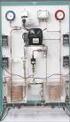
3 The pressure taps of the test sections are formed by drilling small holes through the tube wall. A fitting is then placed over the holes and connected to the pressure line. A 0 MPa to 3.5 MPa capacitance sensing gauge accurate to ± 4.0 kpa measures the pressure at he test sections. T-type thermocouples calibrated to ± 0.15 o C measure the fluid temperatures at the inlets and outlets of the test section. Ambient temperature was measured by a digital temperature meter with uncertainty of ± 0.05 o C. A schematic representation of the test rig is shown in Fig. 1. Fig. 1 A schematic representation of the test rig. The cycle performance was evaluated through the following parameters; Cooling load (Qe); Condensing load (Qc); Coefficient of performance (COP) and mass flow rate ( m& ). These parameters were calculated using equations (1) to (4) from Jabardo et al., (2002) and steam table from Stoecker and Jones (1982). ( ) Qe = m& h ee h ei (1) ( ) Qc = m& h ce h ci (2) ( ) P = m& h cpe h cpi (3) Qe COP = (4) P Where: h is the enthalpy; and the subscripts: ee = evaporator exit; ce = condenser exit; cpe = compressor exit; ei = evaporator inlet; ci = condenser inlet; cpi = compressor inlet. RESULTS AND DISCUSSIONS Since the overall system performance is strongly influenced by operational parameters such as the evaporating and condensing temperatures, flow rates of refrigerant and the circulating water and ambient temperature, tests with the experimental rig was planned in such a way as to allow for the evaluations of their effects on COP and various operational conditions. The rig was designed using the developed model with the following inputs: evaporating temperature -5 o C, condensing temperature 40 o C, sub-cooled to 5 o C and an average ambient temperature of 35 o C. Data obtained from the test rig was used to assess the quality of the model relative to the experimental tests. As reported by Lee et al., (2000), the expected charging for the capacity considered in this study should range between 800 (g) and 900 (g) of refrigerant. This is justified experimentally as shown in Fig.2. The refrigerant capacity (or the COP) increases as the charging. This trend continue till 750 (g) was charged into the system. Between 750 g and 900 g there was a partial constant after which there 506

4 was a decrease in COP or refrigeration capacity. A charge ranged between 800 g and 900 g was used during this study. It can be observed also in Fig. 2 that the model and the experimental data followed the same trend. The different may be associated with heat leakage. As for the effect on the mass flow rate, it has been shown in an earlier study that the refrigerant flow rate within the expected refrigerant charge is constant (Akintunde et al., 2006). It is interesting to note that the model predicted almost a linear relationship for both refrigeration capacity (Qe) and the COP with evaporator circulating water while the experimental data Fig. 3, justified the same assertion The variation between the model and the experimental data is due to heat loss, which at present it is almost impossible to prevent since there is no perfect insulation of heat. Considering the results in Fig. 3, the deviation between the model and the experimental results are a maximum of 16 %, for mass flow rate and 18 % for COP. This shows that the model predicts the system performance to a reasonable accuracy for the indicated circulating water temperature. Correlation between circulating water temperature and the COPs gives a coefficient of 88.4% for R-134a and 89% for the model, the corresponding value between the two COPs is 80.7%. A similar water circulation experiment was performed on condenser. The results showed that, the evaporator pressure was relative constant while the condensing pressure increases slightly. As shown in 507

5 Fig. 4, the refrigerating capacity (or COP) is slightly affected; it decreases as the water temperature increases. This shows that environmental effect may not have significant effect on the performance of the system especially when a balanced point is reached between the major components. The closeness of both model and experimental data showed that the model is justified. The reduction in COP occur as a result of increase in condensing pressure and hence compression work and mass flow rate. Correlation between circulating water temperature and the COPs gives a coefficient of 88.5% for R-134a and 89% for the model; the corresponding value between the two COPs is 81%. This shows that there no significant effects. As shown in Fig. 5, a linear relationship occurs between the COPs and the degree of subcooling. Also the COPs increase with the degree of subcooling. Correlation between the degree of subcooling and the COPs gives a coefficient of 99.5% for both R-134a and the model, the corresponding value between the two COPs is 99.7%. The same figures were obtained for degrees of superheat. This shows that the model is a prediction of the actual system. The comparison of this model with others found in the literature is shown in Fig. 6. In Fig. 6, m1 is ASHRAE design equation (1988), m2 is the present model (Akintunde, 2004a) and m3 is the Chen et al s equation (2000). 508

6 CONCLUSION: The overall refrigeration system performance is strongly influenced by the agreement between the major components, viz: condenser, compressor, evaporator and expansion device, and the operational parameters, such as ambientcondensing- evaporating- temperatures and mass flow rate. These parameters were used in this study to validate a design model developed in a previous work by the same author. Tests results were used to assess the quality of the model by comparing the experimental results with the model predicted results. The variation of COPs, of the model and the experimental rig, with the performance parameters shows the same general trend under various investigation conditions. The R values (calculating using excel) of the COPs under subcooling and superheating with the degree of subcooling and superheating conditions were 80.7% and 88% respectively. While the correlations between the COPs under the same conditions were 88% and 99.9%. The present analysis showed that the model results are comparable to the actual system from both quantitative and qualitative points of view. Under the same operational conditions, maximum absolute deviations of the variable parameters mass flow rate, COP and circulating water temperature, are within the range of 16%. The experimental value always fall below that of model, this is as a result of experimental error such as heat leakages. ACKNOWLEDGEMENT: The author wish to acknowledge the Federal University of Technology, Akure (FUTA) for providing the grant for this study. The efforts of the URGC, FUTA are also acknowledged for considering the research fit for funding. REFERENCES Abu-Madi, M; Johns, RA and Heikal, MR (192). The Performance of Air Conditioning in Hot Humid Environments with Non-Ozone Depleting Refrigerants. Proceedings of First UAE Conference on Air- Conditioning in the Gulf, pp Akintunde, MA (2004a). Development of a Vapour Compression Refrigeration System Model Based on Balanced Points between Operating Units. PhD Thesis, Department of Mechanical Engineering, Federal university of Technology, Akure. Nigeria. Akintunde, MA (2004b). Theoretical Design Model for Vapour Compression Refrigeration Systems. ASME Journal. Vol. 73, No: 5, pp1 14. Akintunde, MA; Adegoke, CO and Fapetu, OP (2006). Experimental Investigation of the Performance of a Design Model for Vapour Compression Refrigeration Systems. West Indian Journal of Engineering. Vol. 28 No:2, pp Akintunde, MA (2007). Effects of Coiled Capillary Tube Pitch on Vapour Compression Refrigeration System Performance. AU Journal. Vol. 11 No. 1, pp AHRAE Handbook (2002). Refrigeration, Chapter 45.26, Adiabatic Capillary Selection Procedure. Al-Rabgah, OM (1996). Review and Performance Comparison among some R-12 Candidate 509

7 Substitutes. Proceedings of First UAE Conference on Air-Conditioning in the Gulf, pp Bolaji, BO (2008). Evaluation of Environmental Friendly Refrigerants. A PhD Thesis in the Department of Mechanical Engineering, Federal University f Technology, Akure, Nigeria. Chem, SD; Cheng, YR; Liu, CH and Jwo, (2000), Simulation of Refrigeration Flowing Through Adiabatic Capillary Tubes. HVAC$R Research. Vol. 6 No: 2, pp Clark, EM (1999). Private Communication of Refrigerants Replacement Data for Chillers in Process Use. International journal of Refrigeration. Vol. 25 No: 1, pp Calm, JM (2002). Emission and Environmental Impacts from Air-Conditioning and refrigeration Systems. International journal of Refrigeration. Vol. 25 No 2, pp Crown, SW; Shapiro, HN and Pate, MB (1992). A Comparison Study of the Thermal Performance of R- 12 and R-134a. Proceedings of the International Refrigeration Conference-Energy Efficiency and New Refrigerants. Vol.1 pp Eckels, SJ and Tesene, BA (2003). A Comparison of R-22, R-134a, R-410a and R-407c Condensation Performance in Smooth and Enhanced Tubes; Part I: Heat Transfer. ASHRAE Transaction, pp Eckels, SJ and Tesene, BA (2004). A Comparison of R-22, R-134a, R-410a and R-407c Condensation Performance in Smooth and Enhanced Tubes; Part II: Pressure drop. ASHRAE Transaction, pp El-Haggar, SM; Mahmoud, NA and ElSherbini, AI (1996). Effect of Using R-134a in a Domestic Refrigerator Originally Design for R-12. Proceedings of First UAE Conference on Air-Conditioning in the Gulf, pp Hafez, MA and Rahman, F. (1999), Environmental Effects of Ozone Depletion due to Release of Chlorofluorocarbons. Proceedings of the Symposium on the Phsing Out of CFCs, pp Jabardo, JMS; Mamani, WG and Ianalla, MR (2002). Modelling and Experimental Evaluation of an Automotive Air-Conditioning System with Variable Capacity Compressor. International Journal of Refrigeration. Vol. 25 No: 8, pp Kamei, A; Piao, CC; Sato, H and Watanabe, K (1990). Thermodynamic Charts and Cycle Performance of FC-134a and FC-152a. ASHRAE Transaction. Vol. 96 part I, pp Khan, JR and Zubair, SM (1999). Design and Performance Evaluation of Reciprocating System. International Journal of Refrigeration. Vol. 22 No: 1, pp Kim, SG; Kim, MS and Ro, ST (2002). Experimental Investigations of the Performance of R22, R407 and R410A in Several Capillary tubes for Air-Conditioning. International journal of Refrigeration. Vol. 25 No 3, pp Ko, MKW; Sze, ND; Molnar, GJ and Prather, MJ (1993). Global Warming from Chlorofluorocarbons and their Alternatives: Time Scale of Chemistry and Climate. Journal of Atmospheric Environment. Vol. 17, No: 4, pp Kutter, W (1988). Status and Future of Alternative Refrigerants to Chlorofluoro-carbons. Journal of Refrigeration Science and Technology. Commissions C2, D1, D2/3, E1. International Institute of Refrigeration, Paris, pp Linton, JW; Snelson, WK and Hearty, PF (1989). Performance Comparison of Refrigerants R-134a and R-12 in a Residential Exhaust Air Heat Pump. ASHRAE Transaction. Vol. 98 part I, pp Linton, JW; Snelson, WK and Hearty, PF (19892). Effect of Condenser Liquid Subcooling on System Performance for refrigerants CFC-12, FC-134a and HFC-152a. ASHRAE Transactions. Vol. 95 art 2, p Mahmoud, NA; El-Haggar, SM and Elsherbini, AI. (2002). Performance Evaluation of an Air-Conditioning System Using R-134a as a Refrigerant. Proceedings of Arab-African Conference of Refrigeration and Air- Conditioning, Cairo, pp Statt, TG; (1990). Potential Ozone-safe Refrigerants for Centrifugal Chillers. ASHRAE journal, Vol. 32 No: 9, pp Sand, JR; Vineyard, EA and Nowak, RJ (1990). Experimental Performance of Ozone-safe Alternative Refrigerants. ASHRAE Transaction Vol. 96 part 2, pp Tolba, M. K., O. A. El-Kholy, E. El-Hinnawi, M. W. Holdgate, D. F. McMichael, and R. E. Munn, eds Ozone depletion. Chapter 2 in The world environment New York: Chapman and Hall. Veneyard, EA; Sand, JR and Miller, WA (1989). Refrigerator-Freezer Energy Testing with Alternative Refrigerants. CFCs Time of Transition Atlanta, ASHREA, pp Pannock, J; radermacher, R; Liu, Z and Yu, K (1994). Evaluation of R-134a and R-152a as Working Fluids in a Domestic Refrigerator/Freezer. ASHRAE Transactions. Vol. 100 part I, pp

Mohan Chandrasekharan #1
 International Journal of Students Research in Technology & Management Exergy Analysis of Vapor Compression Refrigeration System Using R12 and R134a as Refrigerants Mohan Chandrasekharan #1 # Department
THEORETICAL AND EXPERIMENTAL EVALUATION OF AUTOMOBILE AIR-CONDITIONING SYSTEM USING R134A
 THEORETICAL AND EXPERIMENTAL EVALUATION OF AUTOMOBILE AIR-CONDITIONING SYSTEM USING R134A Jignesh K. Vaghela Assistant Professor, Mechanical Engineering Department, SVMIT, Bharuch-392001, (India) ABSTRACT
PG Student (Heat Power Engg.), Mechanical Engineering Department Jabalpur Engineering College, India. Jabalpur Engineering College, India.
 International Journal of Emerging Trends in Engineering and Development Issue 3, Vol. (January 23) EFFECT OF SUB COOLING AND SUPERHEATING ON VAPOUR COMPRESSION REFRIGERATION SYSTEMS USING 22 ALTERNATIVE
PERFORMANCE ANALYSIS OF VAPOUR COMPRESSION REFRIGERATION SYSTEM WITH R404A, R407C AND R410A
 Int. J. Mech. Eng. & Rob. Res. 213 Jyoti Soni and R C Gupta, 213 Research Paper ISSN 2278 149 www.ijmerr.com Vol. 2, No. 1, January 213 213 IJMERR. All Rights Reserved PERFORMANCE ANALYSIS OF VAPOUR COMPRESSION
How To Calculate The Performance Of A Refrigerator And Heat Pump
 THERMODYNAMICS TUTORIAL 5 HEAT PUMPS AND REFRIGERATION On completion of this tutorial you should be able to do the following. Discuss the merits of different refrigerants. Use thermodynamic tables for
A car air-conditioning system based on an absorption refrigeration cycle using energy from exhaust gas of an internal combustion engine
 A car air-conditioning system based on an absorption refrigeration cycle using energy from exhaust gas of an internal combustion engine G Vicatos J Gryzagoridis S Wang Department of Mechanical Engineering,
Environmental and Safety Impacts of HFC Emission Reduction Options for Air Conditioning and Heat Pump Systems
 Environmental and Safety Impacts of HFC Emission Reduction Options for Air Conditioning and Heat Pump Systems William M. Corcoran, George Rusch, Mark W. Spatz, and Tim Vink AlliedSignal, Inc. ABSTRACT
Chapter 3.4: HVAC & Refrigeration System
 Chapter 3.4: HVAC & Refrigeration System Part I: Objective type questions and answers 1. One ton of refrigeration (TR) is equal to. a) Kcal/h b) 3.51 kw c) 120oo BTU/h d) all 2. The driving force for refrigeration
Analytical Study of Vapour Compression Refrigeration System Using Diffuser and Subcooling
 IOSR Journal of Mechanical and Civil Engineering (IOSR-JMCE) e-issn: 2278-1684,p-ISSN: 2320-334X, Volume 11, Issue 3 Ver. VII (May- Jun. 2014), PP 92-97 Analytical Study of Vapour Compression Refrigeration
MODELLING AND OPTIMIZATION OF DIRECT EXPANSION AIR CONDITIONING SYSTEM FOR COMMERCIAL BUILDING ENERGY SAVING
 MODELLING AND OPTIMIZATION OF DIRECT EXPANSION AIR CONDITIONING SYSTEM FOR COMMERCIAL BUILDING ENERGY SAVING V. Vakiloroaya*, J.G. Zhu, and Q.P. Ha School of Electrical, Mechanical and Mechatronic Systems,
Testing methods applicable to refrigeration components and systems
 Testing methods applicable to refrigeration components and systems Sylvain Quoilin (1)*, Cristian Cuevas (2), Vladut Teodorese (1), Vincent Lemort (1), Jules Hannay (1) and Jean Lebrun (1) (1) University
A Performance Comparison of Vapour Compression Refrigeration System Using Eco Friendly Refrigerants of Low Global Warming Potential
 International Journal of Scientific and Research Publications, Volume 2, Issue 9, September 2012 1 A Performance Comparison of Vapour Compression Refrigeration System Using Eco Friendly Refrigerants of
Waste Heat Recovery through Air Conditioning System
 International Journal of Engineering Research and Development e-issn: 2278-067X, p-issn : 2278-800X, www.ijerd.com Volume 5, Issue 3 (December 2012), PP. 87-92 Waste Heat Recovery through Air Conditioning
Lesson. 11 Vapour Compression Refrigeration Systems: Performance Aspects And Cycle Modifications. Version 1 ME, IIT Kharagpur 1
 Lesson Vapour Compression Refrigeration Systems: Performance Aspects And Cycle Modifications Version ME, IIT Kharagpur The objectives of this lecture are to discuss. Performance aspects of SSS cycle and
Experimental Analysis of an Automotive Air Conditioning System With Two-Phase Flow Measurements
 Purdue University Purdue e-pubs International Refrigeration and Air Conditioning Conference School of Mechanical Engineering Experimental Analysis of an Automotive Air Conditioning System With Two-Phase
Theoretical Study on Separate Sensible and Latent Cooling Air-Conditioning System
 Purdue University Purdue e-pubs International Refrigeration and Air Conditioning Conference School of Mechanical Engineering 2008 Theoretical Study on Separate Sensible and Latent Cooling Air-Conditioning
A Comparison of an R22 and an R410A Air Conditioner Operating at High Ambient Temperatures
 R2-1 A Comparison of an R22 and an R410A Air Conditioner Operating at High Ambient Temperatures W. Vance Payne and Piotr A. Domanski National Institute of Standards and Technology Building Environment
Impacts of Refrigerant Charge on Air Conditioner and Heat Pump Performance
 Purdue University Purdue e-pubs International Refrigeration and Air Conditioning Conference School of Mechanical Engineering 2010 Impacts of Refrigerant Charge on Air Conditioner and Heat Pump Performance
jill II IlllIllllllllllll1 l11 "30000001866792'
 jill II IlllIllllllllllll1 l11 "30000001866792' SCHOOL OF ENGINEERING MSc THESIS Academic Year 2003-2004 AZMAHANI SADIKIN MODELLING OF THE FLOW OF REFRIGERANT 134a IN CAPILLARY TUBES Supervisor: Dr. Ossama
How To Design A Refrigeration System
 AIRAH Refrigeration (in HVAC) Back to Basics For the First Time Terms of Reference What this session is NOT about Detailed Refrigeration Design Detailed analysis of various Refrigants properties Comparison
Energy Analysis and Comparison of Advanced Vapour Compression Heat Pump Arrangements
 Energy Analysis and Comparison of Advanced Vapour Compression Heat Pump Arrangements Stuart Self 1, Marc Rosen 1, and Bale Reddy 1 1 University of Ontario Institute of Technology, Oshawa, Ontario Abstract
Low GWP Replacements for R404A in Commercial Refrigeration Applications
 Low GWP Replacements for R404A in Commercial Refrigeration Applications Samuel YANA MOTTA, Mark SPATZ Honeywell International, 20 Peabody Street, Buffalo, NY 14210, [email protected] Abstract
Research on the Air Conditioning Water Heater System
 Purdue University Purdue e-pubs International Refrigeration and Air Conditioning Conference School of Mechanical Engineering 28 Research on the Air Conditioning Water Heater System Fei Liu Gree Electric
Performance Improvement of an Air Conditioning System Using Matrix Heat Exchanger
 International Journal of Engineering Research and Development e-issn: 2278-067X, p-issn: 2278-800X, www.ijerd.com Volume 2, Issue 11 (August 2012), PP. 66-70 Performance Improvement of an Air Conditioning
Measurement And Application of Performance Characteristics Of A Free Piston Stirling Cooler
 Purdue University Purdue e-pubs International Refrigeration and Air Conditioning Conference School of Mechanical Engineering 00 Measurement And Application of Performance Characteristics Of A Free Piston
UNIT 2 REFRIGERATION CYCLE
 UNIT 2 REFRIGERATION CYCLE Refrigeration Cycle Structure 2. Introduction Objectives 2.2 Vapour Compression Cycle 2.2. Simple Vapour Compression Refrigeration Cycle 2.2.2 Theoretical Vapour Compression
Increasing the evaporation temperature with the help of an internal heat exchanger
 Increasing the evaporation temperature with the help of an internal heat exchanger A. TAMBOVTSEV (a), H. QUACK (b) (a,b) Technische Universität Dresden, D-01062, Dresden, Germany (a) Fax: (+49351) 463-37247,
Refrigeration Basics 101. By: Eric Nelson
 Refrigeration Basics 101 By: Eric Nelson Basics Refrigeration is the removal of heat from a material or space, so that it s temperature is lower than that of it s surroundings. When refrigerant absorbs
REFRIGERATION (& HEAT PUMPS)
 REFRIGERATION (& HEAT PUMPS) Refrigeration is the 'artificial' extraction of heat from a substance in order to lower its temperature to below that of its surroundings Primarily, heat is extracted from
HEAT TRANSFER ENHANCEMENT ON DOUBLE PIPE HEAT EXCHANGER BY WIRE COILED AND TAPER WIRE COILED TURBULATOR INSERTS
 HEAT TRANSFER ENHANCEMENT ON DOUBLE PIPE HEAT EXCHANGER BY WIRE COILED AND TAPER WIRE COILED TURBULATOR INSERTS J.Kalil basha 1,G.Karthikeyan 2, S.Karuppusamy 3 1,2 Assistant Professor, Dhanalakshmi Srinivasan
Rusty Walker, Corporate Trainer Hill PHOENIX
 Refrigeration 101 Rusty Walker, Corporate Trainer Hill PHOENIX Compressor Basic Refrigeration Cycle Evaporator Condenser / Receiver Expansion Device Vapor Compression Cycle Cooling by the removal of heat
Characteristics of Evaporators
 Characteristics of Evaporators Roger D. Holder, CM, MSME 10-28-2003 Heat or Energy In this paper, we will discuss the characteristics of an evaporator coil. The variance of the operational condenses of
9. ENERGY PERFORMANCE ASSESSMENT OF HVAC SYSTEMS
 9. ENERGY PERFORMANCE ASSESSMENT OF HVAC SYSTEMS 9.1 Introduction Air conditioning and refrigeration consume significant amount of energy in buildings and in process industries. The energy consumed in
Condensers & Evaporator Chapter 5
 Condensers & Evaporator Chapter 5 This raises the condenser temperature and the corresponding pressure thereby reducing the COP. Page 134 of 263 Condensers & Evaporator Chapter 5 OBJECTIVE QUESTIONS (GATE,
Automobile Air Conditioning Primer
 Automobile Air Conditioning Primer An air conditioner is basically a refrigerator without the insulated box. It uses the evaporation of a refrigerant, like Freon, to provide cooling. The mechanics of the
THE POSSIBILITY OF USING LIQUIFIED PETROLEUM GAS IN DOMESTIC REFRIGERATION SYSTEMS
 www.arpapress.com/volumes/vol9issue3/ijrras_9_3_02.pdf THE POSSIBILITY OF USING LIQUIFIED PETROLEUM GAS IN DOMESTIC REFRIGERATION SYSTEMS Zainal Zakaria 1 & Zulaikha Shahrum 2 Department of Gas Engineering,
HIGH-EFFICIENCY CO 2 HEAT PUMP WATER HEATER SYSTEMS FOR RESIDENTIAL AND NON-RESIDENTIAL BUILDINGS
 1 HIGH-EFFICIENCY CO 2 HEAT PUMP WATER HEATER SYSTEMS FOR RESIDENTIAL AND NON-RESIDENTIAL BUILDINGS Jørn Stene SINTEF Energy Research, 7465 Trondheim, Norway [email protected] In hotels, hospitals,
Experimental Analysis of a Variable Capacity Heat Pump System Focusing on the Compressor and Inverter Loss Behavior
 Purdue University Purdue e-pubs International Refrigeration and Air Conditioning Conference School of Mechanical Engineering 21 Experimental Analysis of a Variable Capacity Heat Pump System Focusing on
FEASIBILITY OF A BRAYTON CYCLE AUTOMOTIVE AIR CONDITIONING SYSTEM
 FEASIBILITY OF A BRAYTON CYCLE AUTOMOTIVE AIR CONDITIONING SYSTEM L. H. M. Beatrice a, and F. A. S. Fiorelli a a Universidade de São Paulo Escola Politécnica Departamento de Engenharia Mecânica Av. Prof.
Troubleshooting HVAC/R systems using refrigerant superheat and subcooling
 Troubleshooting HVAC/R systems using refrigerant superheat and subcooling Application Note Troubleshooting and servicing refrigeration and air conditioning systems can be a challenging process for both
MAXIMUM HEAT LOAD TEMPERATURE TESTING ( Differential Temperature Testing )
 MAXIMUM HEAT LOAD TEMPERATURE TESTING ( Differential Temperature Testing ) The Concept Maximum Heat Load Temperature Testing is a powerful air-conditioning diagnostic and evaluation technique. It is also
Optimal operation of simple refrigeration cycles Part I: Degrees of freedom and optimality of sub-cooling
 Computers and Chemical Engineering 31 (2007) 712 721 Optimal operation of simple refrigeration cycles Part I: Degrees of freedom and optimality of sub-cooling Jørgen Bauck Jensen, Sigurd Skogestad Department
Energy Procedia Energy 00 Procedia (2011) 000 000 14 (2012) 56 65
 Available online at www.sciencedirect.com Available online at www.sciencedirect.com Energy Procedia Energy 00 Procedia (2011) 000 000 14 (2012) 56 65 Energy Procedia www.elsevier.com/locate/procedia ICAEE
ME 315 - Heat Transfer Laboratory. Experiment No. 7 ANALYSIS OF ENHANCED CONCENTRIC TUBE AND SHELL AND TUBE HEAT EXCHANGERS
 ME 315 - Heat Transfer Laboratory Nomenclature Experiment No. 7 ANALYSIS OF ENHANCED CONCENTRIC TUBE AND SHELL AND TUBE HEAT EXCHANGERS A heat exchange area, m 2 C max maximum specific heat rate, J/(s
Scroll Compressor Development for Air-Source Heat Pump Water Heater Applications
 Purdue University Purdue e-pubs International Refrigeration and Air Conditioning Conference School of Mechanical Engineering 2008 Scroll Compressor Development for Air-Source Heat Pump Water Heater Applications
2004 Standard For Performance Rating Of Positive Displacement Refrigerant Compressors And Compressor Units
 2004 Standard For Performance Rating Of Positive Displacement Refrigerant Compressors And Compressor Units ANSI/AHRI Standard 540 (formerly ARI Standard 540) IMPORTANT SAFETY RECOMMENDATIONS ARI does not
Refrigeration and Airconditioning Prof. M. Ramgopal Department of Mechanical Engineering Indian Institute of Technology, Kharagpur
 Refrigeration and Airconditioning Prof. M. Ramgopal Department of Mechanical Engineering Indian Institute of Technology, Kharagpur Lecture No. # 22 Refrigeration System Components: Compressor (Continued)
COURSE TITLE : REFRIGERATION AND AIR CONDITIONING COURSE CODE : 4029 COURSECATEGORY : A PERIODS/WEEK : 5 PERIODS/SEMESTER : 90 CREDITS : 4 OBJECTIVES
 COURSE TITLE : REFRIGERATION AND AIR CONDITIONING COURSE CODE : 4029 COURSECATEGORY : A PERIODS/WEEK : 5 PERIODS/SEMESTER : 90 CREDITS : 4 TIME SCHEDULE MODULE TOPICS PERIODS 1 Introduction 22 Principles
APPLIED THERMODYNAMICS TUTORIAL 1 REVISION OF ISENTROPIC EFFICIENCY ADVANCED STEAM CYCLES
 APPLIED THERMODYNAMICS TUTORIAL 1 REVISION OF ISENTROPIC EFFICIENCY ADVANCED STEAM CYCLES INTRODUCTION This tutorial is designed for students wishing to extend their knowledge of thermodynamics to a more
New Trends in the Field of Automobile Air Conditioning
 New Trends in the Field of Automobile Air Conditioning E. Janotkova and M. Pavelek Department of Thermomechanics and Environmental Engineering Brno University of Technology, 61669 Brno, Czech Republic
An analysis of a thermal power plant working on a Rankine cycle: A theoretical investigation
 An analysis of a thermal power plant working on a Rankine cycle: A theoretical investigation R K Kapooria Department of Mechanical Engineering, BRCM College of Engineering & Technology, Bahal (Haryana)
2B.1 Chilled-Water Return (and Supply) Temperature...119. 2B.3 Cooling-Water Supply Temperature / Flow... 124
 Appendix 2B: Chiller Test Results...119 2B.1 Chilled-Water Return (and Supply) Temperature...119 2B.2 Chilled-Water Flow... 122 2B.3 Cooling-Water Supply Temperature / Flow... 124 2B.4 Pressure/Temperature...
How To Know If A Refrigeration System Is Efficient
 Universitatea de Ştiinţe Agricole şi Medicină Veterinară Iaşi ASSESSMENT OF E SUBCOOLING CAPABILITIES OF A ERMOELECTRIC DEVICE IN A VAPOR COMPRESSION REFRIGERATION SYSTEM R. ROŞCA 1, I. ŢENU 1, P. CÂRLESCU
UNDERSTANDING REFRIGERANT TABLES
 Refrigeration Service Engineers Society 1666 Rand Road Des Plaines, Illinois 60016 UNDERSTANDING REFRIGERANT TABLES INTRODUCTION A Mollier diagram is a graphical representation of the properties of a refrigerant,
Refrigeration and Air Conditioning with Reduced Environmental Impact
 Purdue University Purdue e-pubs International Refrigeration and Air Conditioning Conference School of Mechanical Engineering 2000 Refrigeration and Air Conditioning with Reduced Environmental Impact D.
THE REPLACEMENT OF R-22
 ENGLISH TRANSLATION OF ARTICLE IN FRIO-CALOR AIRE ACONDICIONDAO BY GAS-SERVEI, S.A JUNE 2010 THE REPLACEMENT OF R-22 Courtesy of D. Lluis Giralt Lopez (Chemical Engineering Industrial) Gas Technical Department
DESIGN OF AIR CONDITIONING SYSTEM IN AUTOMOBILE
 DESIGN OF AIR CONDITIONING SYSTEM IN AUTOMOBILE Md Shahid Imam, Dr.M.Shameer Basha, Dr.Md.Azizuddin, Dr. K.Vijaya Kumar Reddy 4 M.Tech HVAC II Yr, Royal Institute of Technology & Science Chevella R.R Dist
REFRIGERANT REFERENCE GUIDE
 REFRIGERANT REFERENCE GUIDE WORLWIDE REFRIGERANT SUPPLIER 2004 FOURTH EDITION 2004 DISCLAIMER This publication is designed to provide accurate and authoritative information. It is not to be construed as
Part A: Fluid properties
 UNEP Ozone Secretariat UNEP Ozone Secretariat Background Workshop Material on HFC for management: HFC Workshop, technical 2015 issues Bangkok, 20 and 21 April 2015 FACT SHEET 15 Glossary of terms and technical
Air-sourced 90 Hot Water Supplying Heat Pump "HEM-90A"
 Air-sourced 90 Hot Water Supplying Heat Pump "HEM-90A" Takahiro OUE *1, Kazuto OKADA *1 *1 Refrigeration System & Energy Dept., Compressor Div., Machinery Business Kobe Steel has developed an air-sourced
The Second Law of Thermodynamics
 Objectives MAE 320 - Chapter 6 The Second Law of Thermodynamics The content and the pictures are from the text book: Çengel, Y. A. and Boles, M. A., Thermodynamics: An Engineering Approach, McGraw-Hill,
Comparison of Heat Transfer between a Helical and Straight Tube Heat Exchanger
 International Journal of Engineering Research and Technology. ISSN 0974-3154 Volume 6, Number 1 (2013), pp. 33-40 International Research Publication House http://www.irphouse.com Comparison of Heat Transfer
ASHRAE Boston Chapter Meeting Designing AC Refrigeration Systems Lessons Learned February 11, 2014
 ASHRAE Boston Chapter Meeting Designing AC Refrigeration Systems Lessons Learned February 11, 2014 Explanation of the refrigeration cycle. Compressors. Benefits and operating characteristics. -Reciprocating
Energy Efficiency Best Practice Guide Industrial Refrigeration
 3 Energy Efficiency Best Practice Guide Contents 1 Introduction 4 2 The business benefits of efficient refrigeration 5 3 What is your opportunity? 6 4 Solution 1 Improve the efficiency of your existing
Performance Evaluation of a Heat Pump System for Simultaneous Heating and Cooling
 for Simultaneous Heating and Cooling F. Sustainable Energy Centre, University of South Australia Mawson Lakes Boulevard, Mawson Lakes 5095 AUSTRALIA E-mail: [email protected] Abstract The high efficiency
Development and testing of a multi-type air conditioner without using AC inverters
 Energy Conversion and Management 46 (2005) 373 383 www.elsevier.com/locate/enconman Development and testing of a multi-type air conditioner without using AC inverters Shih-Cheng Hu *, Rong-Hwa Yang Department
DEVELOPMENT OF A TWIN SCREW EXPRESSOR AS A THROTTLE VALVE REPLACEMENT FOR WATER-COOLED CHILLERS
 DEVELOPMENT OF A TWIN SCREW EXPRESSOR AS A THROTTLE VALVE REPLACEMENT FOR WATER-COOLED CHILLERS J J Brasz, Carrier Corporation, Syracuse, NY, 13221, USA [email protected] I K Smith and N Stosic
Variable Capacity Compressors, a new dimension for refrigeration engineers to explore
 Variable Capacity Compressors, a new dimension for refrigeration engineers to explore By: Marcos G. Schwarz, VCC Group Leader Corporate Research & Development, EMBRACO SA Abstract: This paper presents
The Development of a Frost-Less Heat Pump
 The Development of a Frost-Less Heat Pump V. C. Mei, R. E. Domitrovic, and F. C. Chen, Oak Ridge National Laboratory J. K. Kilpatrick, Tennessee Valley Authority ABSTRACT There are two major concerns associated
Optimization of Water - Cooled Chiller Cooling Tower Combinations
 Optimization of Water - Cooled Chiller Cooling Tower Combinations by: James W. Furlong & Frank T. Morrison Baltimore Aircoil Company The warm water leaving the chilled water coils is pumped to the evaporator
Technical Note: Comparing R407C and R410A as Alternatives for R22. A Technical Note from the Experts in Business-Critical Continuity
 Technical Note: Comparing R407C and R410A as Alternatives for R22 A Technical Note from the Experts in Business-Critical Continuity Purpose The purpose of this document is to provide a brief overview of
P. A. Hilton Ltd REFRIGERATION & AIR CONDITIONING VAPOUR COMPRESSION HEAT PUMPS VENTILATION VOCATIONAL
 REFRIGERATION & AIR CONDITIONING Refrigeration and air conditioning is an aspect of modern life that is accepted almost without thought. Food storage, the long distance transport of foodstuffs, stockpiling
Comparison of fin-and-tube interlaced and face split evaporators with flow maldistribution
 Downloaded from orbit.dtu.dk on: Nov 06, 2015 Comparison of fin-and-tube interlaced and face split evaporators with flow maldistribution and compensation Kærn, Martin Ryhl; Elmegaard, Brian; Larsen, L.F.S.
Purpose of Refrigeration
 Refrigeration Outline Purpose of refrigeration Examples and applications Choice of coolant and refrigerants Phase diagram of water and CO 2 Vapor compression refrigeration system Pressure enthalpy diagram
Model-Based Approach for Optimizing a Data Center Centralized Cooling System
 Model-Based Approach for Optimizing a Data Center Centralized Cooling System Monem H. Beitelmal, Chandrakant D. Patel Enterprise Software and Systems Laboratory HP Laboratories Palo Alto HPL-6-67 April
AIR REVERSING R744 AIR CONDITIONING SYSTEM
 AIR REVERSING R744 AIR CONDITIONING SYSTEM A.HAFNER 1 ; D.J. GARSKI 2 ; J. MANZIONE 3 1 SINTEF Energy Research, 7465 Trondheim, Norway, [email protected] 2 MODINE, Racine, USA, [email protected]
Thermostatic expansion valves type TR6 REFRIGERATION AND AIR CONDITIONING. Technical leaflet
 Thermostatic expansion valves type REFRIGERATION AND AIR CONDITIONING Technical leaflet Thermostatic expansion valves, type Contents Page Introduction........................................................................................3
Optimal operation of an Ammonia refrigeration cycle
 Optimal operation of an Ammonia refrigeration cycle Jørgen Bauck Jensen & Sigurd Skogestad October 6, 2005 1 PSfrag replacements 1 Introduction Cyclic processes for heating and cooling are widely used
Analysis of Ammonia Water (NH3-H2O) Vapor Absorption Refrigeration System based on First Law of Thermodynamics
 International Journal of Scientific & Engineering Research Volume 2, Issue 8, August-2011 1 Analysis of Ammonia Water (NH3-H2O) Vapor Absorption Refrigeration System based on First Law of Thermodynamics
SECTION 5 COMMERCIAL REFRIGERATION UNIT 22 CONDENSERS
 SECTION 5 COMMERCIAL REFRIGERATION UNIT 22 CONDENSERS UNIT OBJECTIVES After studying this unit, the reader should be able to explain the purpose of the condenser in a refrigeration system. describe differences
International Journal of Latest Research in Science and Technology Volume 4, Issue 2: Page No.161-166, March-April 2015
 International Journal of Latest Research in Science and Technology Volume 4, Issue 2: Page No.161-166, March-April 2015 http://www.mnkjournals.com/ijlrst.htm ISSN (Online):2278-5299 EXPERIMENTAL STUDY
The Development of Heat Pump Water Heaters Using CO 2 Refrigerant
 The Development of Heat Pump Heaters Using CO 2 Refrigerant Shigeharu TAIRA* * DAIKIN Industries, Ltd., 1000-2 Aza-Ohtani, Okamoto-cho, Kusatsu, Shiga 525-8526 Abstract heating consumes about one-third
Thermal Coupling Of Cooling and Heating Systems
 This article was published in ASHRAE Journal, February 2011. Copyright 2011 American Society of Heating, Refrigerating and Air-Conditioning Engineers, Inc. Posted at www.ashrae.org. This article may not
LG Electronics AE Company, Commercial Air Conditioning
 www.lgeaircon.com New concept Ecofriendly Highefficiency Heating solution Total heating & Hot water Solution for MULTI V LG Electronics AE Company, Commercial Air Conditioning 2 Yeouidodong, Yeongdeungpogu,
Rating Water-Source Heat Pumps Using ARI Standard 320 and ISO Standard 13256-1
 Rating Water-Source Heat Pumps Using ARI Standard 320 and ISO Standard 13256-1 W. Vance Payne and Piotr A. Domanski National Institute of Standards and Technology Building and Fire Research Laboratory
TEST REPORT #44. System Drop-in Tests of Refrigerant R-32 in Single Packaged Vertical Heat Pump (SPVH)
 Air-Conditioning, Heating, and Refrigeration Institute (AHRI) Low-GWP Alternative Refrigerants Evaluation Program (Low-GWP AREP) TEST REPORT #44 System Drop-in Tests of Refrigerant R-32 in Single Packaged
Performance Test of Solar Assisted Solid Desiccant Dryer
 Performance Test of Solar Assisted Solid Desiccant Dryer S. MISHA 1,2,*, S. MAT 1, M. H. RUSLAN 1, K. SOPIAN 1, E. SALLEH 1, M. A. M. ROSLI 1 1 Solar Energy Research Institute, Universiti Kebangsaan Malaysia,
An Energy Efficient Air Conditioner System without Compressor: Application of Embedded System
 An Energy Efficient Air Conditioner System without Compressor: Application of Embedded System Poonam Shelke 1, Gajanan Malwatkar 2 Department of Electronics and Telecommunication Engineering, Dnyanganga
Saving energy by solar collector and heat pump combination in hot water production in residential and hotel sectors
 Saving energy by solar collector and heat pump combination in hot water production in residential and hotel sectors Dr. Nguyen Nguyen An, HUST CONTENTS Energy consumption to produce hot water in residential
Heat Recovery In Retail Refrigeration
 This article was published in ASHRAE Journal, February 2010. Copyright 2010 American Society of Heating, Refrigerating and Air-Conditioning Engineers, Inc. Posted at www.ashrae.org. This article may not
TEST REPORT #31. System Drop-in Test of Refrigerant R-32 in Split Air-conditioning System
 Air-Conditioning, Heating, and Refrigeration Institute (AHRI) Low-GWP Alternative Refrigerants Evaluation Program (Low-GWP AREP) TEST REPORT #31 System Drop-in Test of Refrigerant R-32 in Split Air-conditioning
Todd M. Rossi, Ph.D. President
 Residential Air Conditioning Fault Detection and Diagnostics (FDD) and Protocols to Support Efficient Operation DOE - Building America Program Residential Buildings Integration Meeting - July 20-22, 2010
JJMIE Jordan Journal of Mechanical and Industrial Engineering
 JJMIE Jordan Journal of Mechanical and Industrial Engineering Volume 6, Number 1, Feb. 2012 ISSN 1995-6665 Pages 63-70 Experimental Study of Solar Powered Air Conditioning Unit Using Drop In Hydro Carbon
Commercial Hot Water. Make a difference...
 Commercial Hot Water Make a difference... heat S O L A R pumps The Company Quantum Energy Technologies The Quantum story is based on innovation and the quest to harness renewable energy to produce sustainable
P08 Köldmedier med låg växthuseffekter
 P08 Köldmedier med låg växthuseffekter Pavel Makhnatch Tranås, 17-18 May Reference: IPCC, 2013 3 4 5 Growth of climate change commitments from HFC banks and emissions Reference: Velders et al. 2014 6
Any Service Technician Can Fix It A Good Service Technician Can Figure Out What s Wrong With It.
 I Dave s Statement If the thermostat calls for cooling, and the furnace fan is running properly, and the coil airflow is adequate, and the condenser fan is running properly, and the condenser airflow is
Sheet 5:Chapter 5 5 1C Name four physical quantities that are conserved and two quantities that are not conserved during a process.
 Thermo 1 (MEP 261) Thermodynamics An Engineering Approach Yunus A. Cengel & Michael A. Boles 7 th Edition, McGraw-Hill Companies, ISBN-978-0-07-352932-5, 2008 Sheet 5:Chapter 5 5 1C Name four physical
The Second Law of Thermodynamics
 The Second aw of Thermodynamics The second law of thermodynamics asserts that processes occur in a certain direction and that the energy has quality as well as quantity. The first law places no restriction