
Condensers & Evaporator Chapter 5
|
|
|
- Dortha Gallagher
- 10 years ago
- Views:
Transcription
1 Condensers & Evaporator Chapter 5 This raises the condenser temperature and the corresponding pressure thereby reducing the COP. Page 134 of 263

2 Condensers & Evaporator Chapter 5 OBJECTIVE QUESTIONS (GATE, IES, IAS) Previous 20-Years GATE Questions Types of Condensers GATE-1 A condenser of a refrigeration system rejects heat at a rate of 120 kw, while its compressor consumes a power of 30 kw. The coefficient of performance of the system would be: [GATE-1992; IES-1995, 2011] (a) 1/4 (b) 1/3 (c) 3 (d) 4 GATE-1 Ans. (c) Heat rejected in condenser = 120 kw: Compressor work = 30 kw; Net refrigeration effect = = 90 kw. Therefore, COP = 90/30 = 3 Previous 20-Years IES Questions Types of Condensers IES-1. or small installations of refrigeration systems (up to 35 kw), which type of condenser is used? [IES-2006] (a) Shell and tube type (b) Shell and coil type (c) Double tube type (d) Air cooled type IES-1. Ans. (c) 1 TR = 3.5 KW Double Pipe or tube-in-tube type: Double pipe condensers are normally used up to 10 TR capacity. Shell-and-coil type: These condensers are used in systems up to 50 TR capacity. Shell-and-tube type: This is the most common type of condenser used in systems from 2 TR upto thousands of TR capacity. IES-2. A condenser of a refrigeration system rejects heat at a rate of 120 kw, while its compressor consumes a power of 30 kw. The coefficient of performance of the system would be: [GATE-1992; IES-1995, 2011] (a) 1/4 (b) 1/3 (c) 3 (d) 4 IES-2. Ans. (c) Heat rejected in condenser = 120 kw: Compressor work = 30 kw; Net refrigeration effect = = 90 kw. Therefore, COP = 90/30 = 3 IES-3. A pressure gauge on the discharge side of a refrigerant compressor reads too high. The reasons could be: [IES-1995] 1. Lack of cooling water 2. Water temperature being high 3. Dirty condenser surfaces 4. Refrigerant temperature being too high Of these reasons: (a) 1, 2 and 4 are valid (b) 1, 2 and 3 are valid (c) 2, 3 and 4 are valid (d) 1, 3 and 4 are valid IES-3. Ans. (b) Page 135 of 263
3 Heat Rejection Ratio Condensers & Evaporator Chapter 5 IES-4. In a vapour compressor refrigeration system, the compressor capacity is 420 kj/min and refrigerating effect is 2100 kj/minute and heat rejection factor is 1.2. What will, respectively be the heat rejected from the condenser and C OP? [IES-2004] (a) 5040 kj/minute and 5 (b) 2520 kj/minute and 5 (c) 2520 kj/minute and 4 (d) 5040 kj/minute and 4 IES-4. Ans. (b) Heat rejection ratio (G) = The loading on the condenser per unit of refrigeration Qo + W W 1 = = 1+ = 1+ Qo Qo COP or 1 1 G = 1 + or 1.2 = 1 + COP COP or COP = 5 Given W = 420 kj/min Q = 2100 kj/min or Q + W = 1.2. Q = 2520 kj/min o o o IES-5. A refrigeration plant uses a condenser with heat rejection ratio of 1.2. If the capacity of the plant is 210kJ/min, then what is the value of the COP of the refrigeration plant? [IES-2005] (a) 3 (b) 5 (c) 7 (d) 9 Q1 Q2 1 IES-5. Ans. (b) = 1.2 or = = 5 = COP Q Q Q IES-6. Experimental measurements on a refrigeration system indicate that rate of heat extraction by the evaporator, rate of heat rejection in the condenser and rate of heat rejection by the compressor body to environment are 70 kw, 90 kw and 5 kw respectively. The power input (in kw) required to operate the system is: [IES-2002] (a) 15 (b) 20 (c) 25 (d) 75 IES-6. Ans. (c) IES-7. In vapour compression refrigeration system, at entrance to which component the working fluid is superheated vapour? [IES-2009] (a) Evaporator (b) Condenser (c) Compressor (d) Expansion valve IES-7. Ans. (b) Evaporators IES-8. The deposition of frost on evaporator tubes of an air conditioner will result in [IES-1992] (a) Decrease in heat transfer (b) Increase in heat transfer (c) No change in heat transfer (d) Increase in capacity of evaporator IES-8. Ans. (a) Previous 20-Years IAS Questions Types of Condensers IAS-1. Assertion (A): Condensers of large refrigerating plants including central airconditioning systems are invariably water-cooled. [IAS-1996] Reason (R): Water is available at a temperature lower than that of the surrounding air and has a higher specific heat. Page 136 of 263
![[IES-2004] (a) 5040 kj/minute and 5 (b) 2520 kj/minute and 5 (c) 2520 kj/minute and 4 (d) 5040 kj/minute and 4 IES-4. Ans.](/docs-images/41/7902515/images/page_3.jpg "(b) Heat rejection ratio (G) = The loading on the condenser per unit of refrigeration Qo + W W 1 = = 1+ = 1+ Qo Qo COP or 1 1 G = 1 + or 1.")
4 Condensers & Evaporator Chapter 5 (a) Both A and R are individually true and R is the correct explanation of A (b) Both A and R are individually true but R is not the correct explanation of A (c) A is true but R is false (d) A is false but R is true IAS-1. Ans. (a) But most important cause is high heat transfer coefficient. Evaporators IAS-2. When a refrigeration plant is started, the evaporator temperature decreases from room temperature to the required value. During this period, how does the compressor power requirement vary? [IAS-2004] (a) It increases continuously (b) It decreases and then becomes constant (c) It increases, reaches a peak and then decreases (d) It remains constant IAS-2. Ans. (a) Page 137 of 263
5 6. Expansion Devices Theory at a Glance (For IES, GATE, PSU) Types of Expansion Devices An expansion device is a basic component of a refrigeration system. The basic functions of an expansion device used in refrigeration systems are to: 1. Reduce pressure from condenser pressure to evaporator pressure. 2. Regulate the refrigerant flow from the high-pressure liquid line into the evaporator at a rate equal to the evaporation rate in the evaporator. Under ideal conditions, the mass flow rate of refrigerant in the system should be proportional to the cooling load. Sometimes, the product to be cooled is such that a constant evaporator temperature has to be maintained. In other cases, it is desirable that liquid refrigerant should not enter the compressor. In such a case, the mass flow rate has to be controlled in such a manner that only superheated vapour leaves the evaporator. Again, an ideal refrigeration system should have the facility to control it in such a way that the energy requirement is minimum and the required criterion of temperature and cooling load are satisfied. The expansion devices used in refrigeration systems can be divided into Fixed opening type Variable opening type In fixed opening type the flow area remains fixed, while in variable opening type the flow area changes with changing mass flow rates. There are basically seven types of refrigerant expansion devices. Fixed opening type 1. Capillary Tubes 2. Orifice Variable opening type 3. Hand (manual) expansion valves 4. Constant pressure or Automatic Expansion Valve (AEV) 5. Thermostatic Expansion Valve (TEV) 6. Float type Expansion Valve (a) High Side Float Valve (b) Low Side Float Valve 7. Electronic Expansion Valve Automatic or Constant-Pressure Expansion Valve An Automatic Expansion Valve (AEV) also known as a constant pressure expansion valve acts in such a manner so as to maintain a constant pressure and thereby a constant temperature in the evaporator. Page 138 of 263
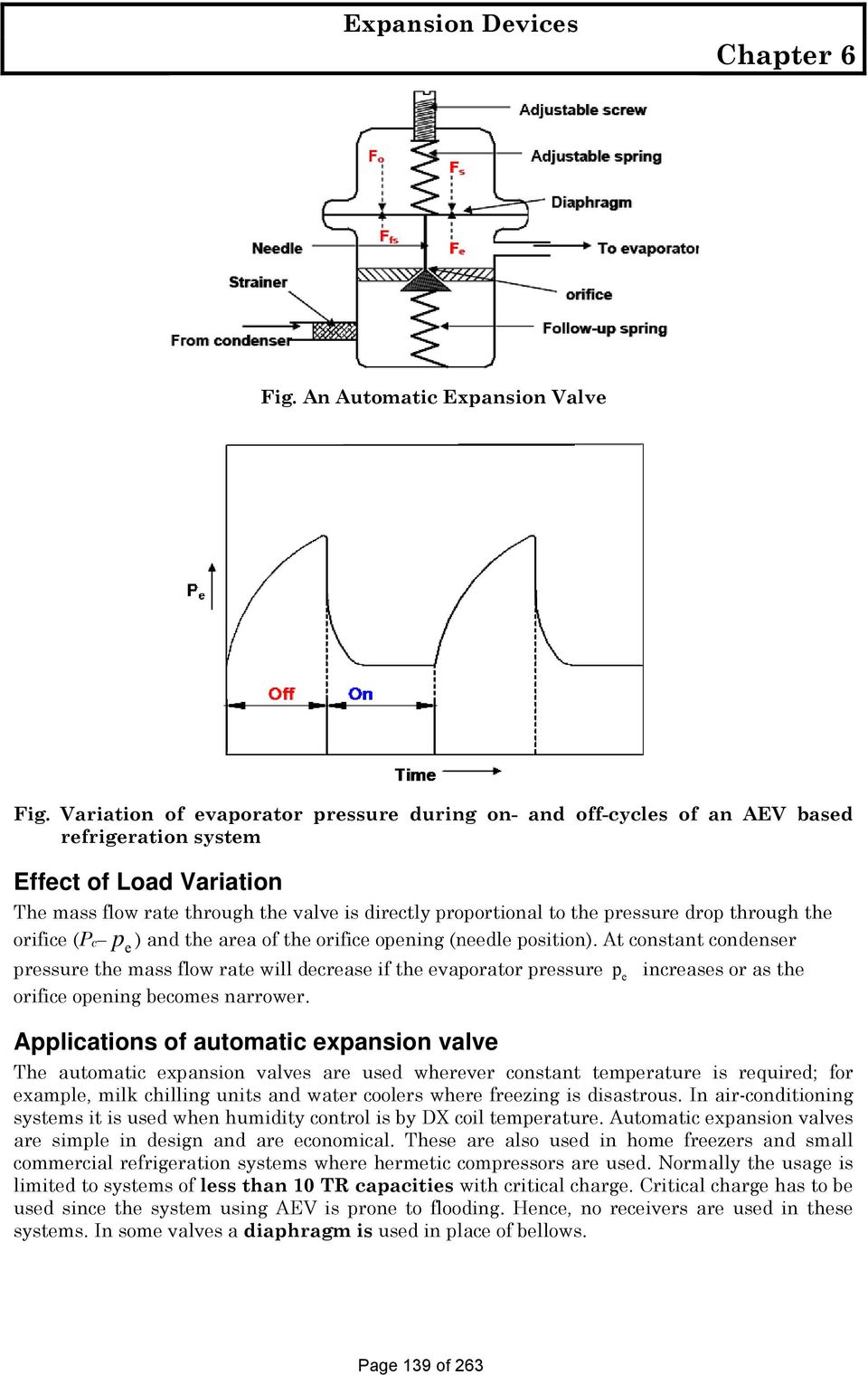
6 Expansionn Devices Chapter 6 Fig. An Automatic Expansion Valve Fig. Variation of evaporator pressure during on- and off-cycles of an refrigeration system AEV based Effect of Load Variation The masss flow rate through the valve is directly proportional to the pressure drop through the orifice (Pc p e ) and the area of the orifice opening (needle position). At constant condenser pressure the mass flow rate will decreasee if the evaporator pressure p e increases or as the orifice opening becomes narrower. Applications of automatic expansion valve The automatic expansion valves are used wherever constant temperature is required; for example, milk chilling units and water coolers where freezing is disastrous. In air-conditioning systems it is used when humidity control is by DX coil temperature. Automatic expansion valves are simple in design and are economical. These are also used in home freezers and small commercial refrigeration systems where hermetic compressor s are used. Normally the usage is limited to systems of less than 10 TR capacities with critical charge. Critical charge has to be used since the system using AEV is prone to flooding. Hence, no receivers are used in these systems. In some valves a diaphragm is used in place of bellows. Page 139 of 263
7 Expansion Devices Thermostatic-Expansion Valve Chapter 6 Thermostatic expansion valve is the most versatile expansion valve and is most commonly used in refrigeration systems. A thermostatic expansion valve maintains a constant degree of superheat at the exit of evaporator; hence it is most effective for dry evaporators in preventing the slugging of the compressors since it does not allow the liquid refrigerant to enter the compressor. Fig. A Thermostatic Expansion Valve (TEV) The advantages of TEV compared to other types of expansion devices are: 1. It provides excellent control of refrigeration capacity as the supply of refrigerant to the evaporator matches the demand. 2. It ensures that the evaporator operates efficiently by preventing starving under high load conditions. 3. It protects the compressor from slugging by ensuring a minimum degree of superheat under all conditions of load, if properly selected. The disadvantages of TEV compared to other types of expansion devices are: 1. Compared to capillary tubes and AEVs, a TEV is more expensive and proper precautions should be taken at the installation. 2. The use of TEV depends upon degree of superheat. Hence, in applications where a close approach between the fluid to be cooled and evaporator temperature is desired, TEV cannot be used since very small extent of superheating is available for operation. Capillary Tube and Its Sizing 1. A capillary tube is a long, narrow tube of constant diameter. 2. The word capillary is a misnomer since surface tension is not important in refrigeration application of capillary tubes. 3. Typical tube diameters of refrigerant capillary tubes range from 0.5 mm to 3 mm and the length ranges from 1.0 m to 6 m. Page 140 of 263

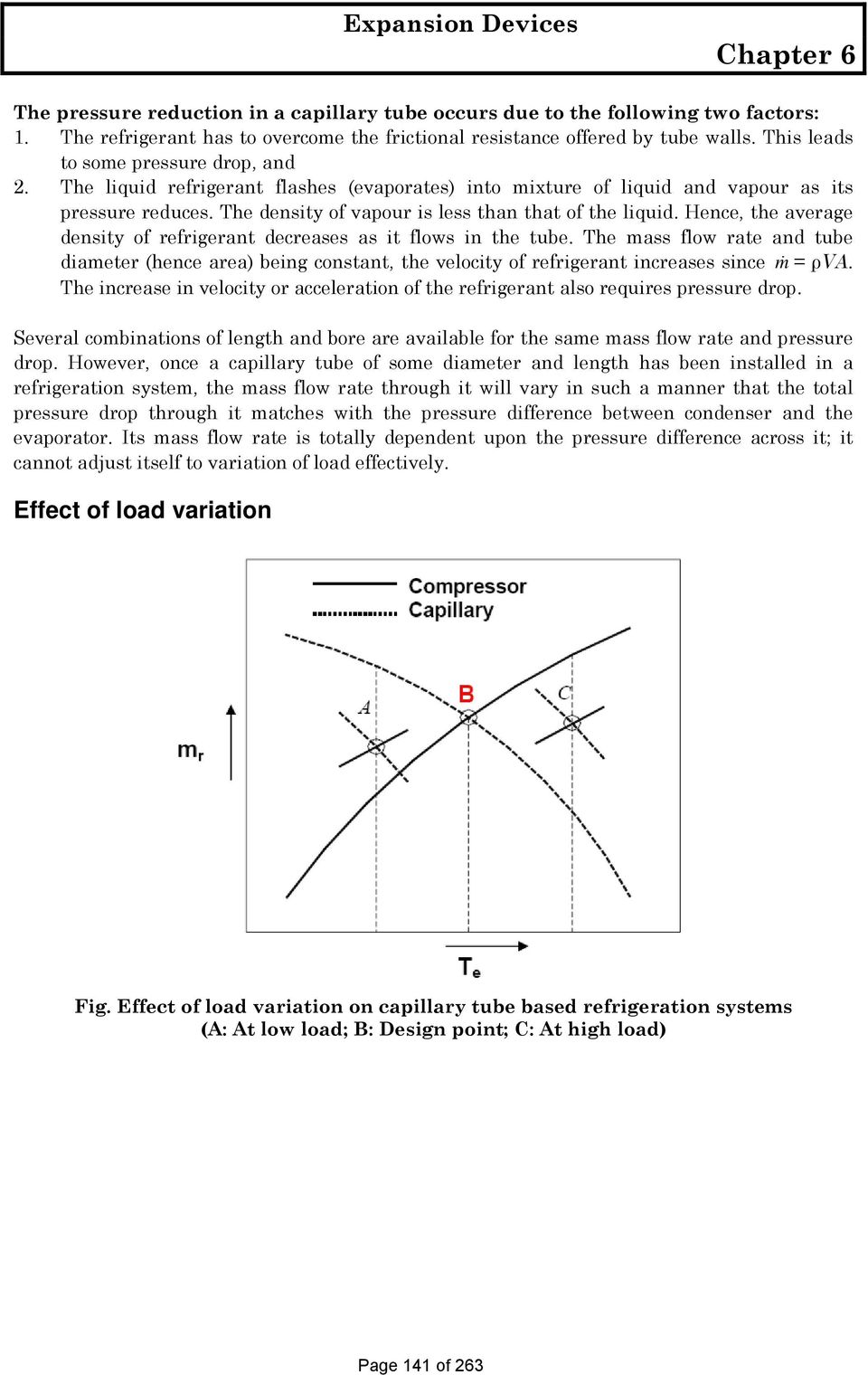
8 Expansion Devices Chapter 6 The pressure reduction in a capillary tube occurs due to the following two factors: 1. The refrigerant has to overcome the frictional resistance offered by tube walls. This leads to some pressure drop, and 2. The liquid refrigerant flashes (evaporates) into mixture of liquid and vapour as its pressure reduces. The density of vapour is less than that of the liquid. Hence, the average density of refrigerant decreases as it flows in the tube. The mass flow rate and tube diameter (hence area) being constant, the velocity of refrigerant increases since m = ρva. The increase in velocity or acceleration of the refrigerant also requires pressure drop. Several combinations of length and bore are available for the same mass flow rate and pressure drop. However, once a capillary tube of some diameter and length has been installed in a refrigeration system, the mass flow rate through it will vary in such a manner that the total pressure drop through it matches with the pressure difference between condenser and the evaporator. Its mass flow rate is totally dependent upon the pressure difference across it; it cannot adjust itself to variation of load effectively. Effect of load variation Fig. Effect of load variation on capillary tube based refrigeration systems (A: At low load; B: Design point; C: At high load) Page 141 of 263
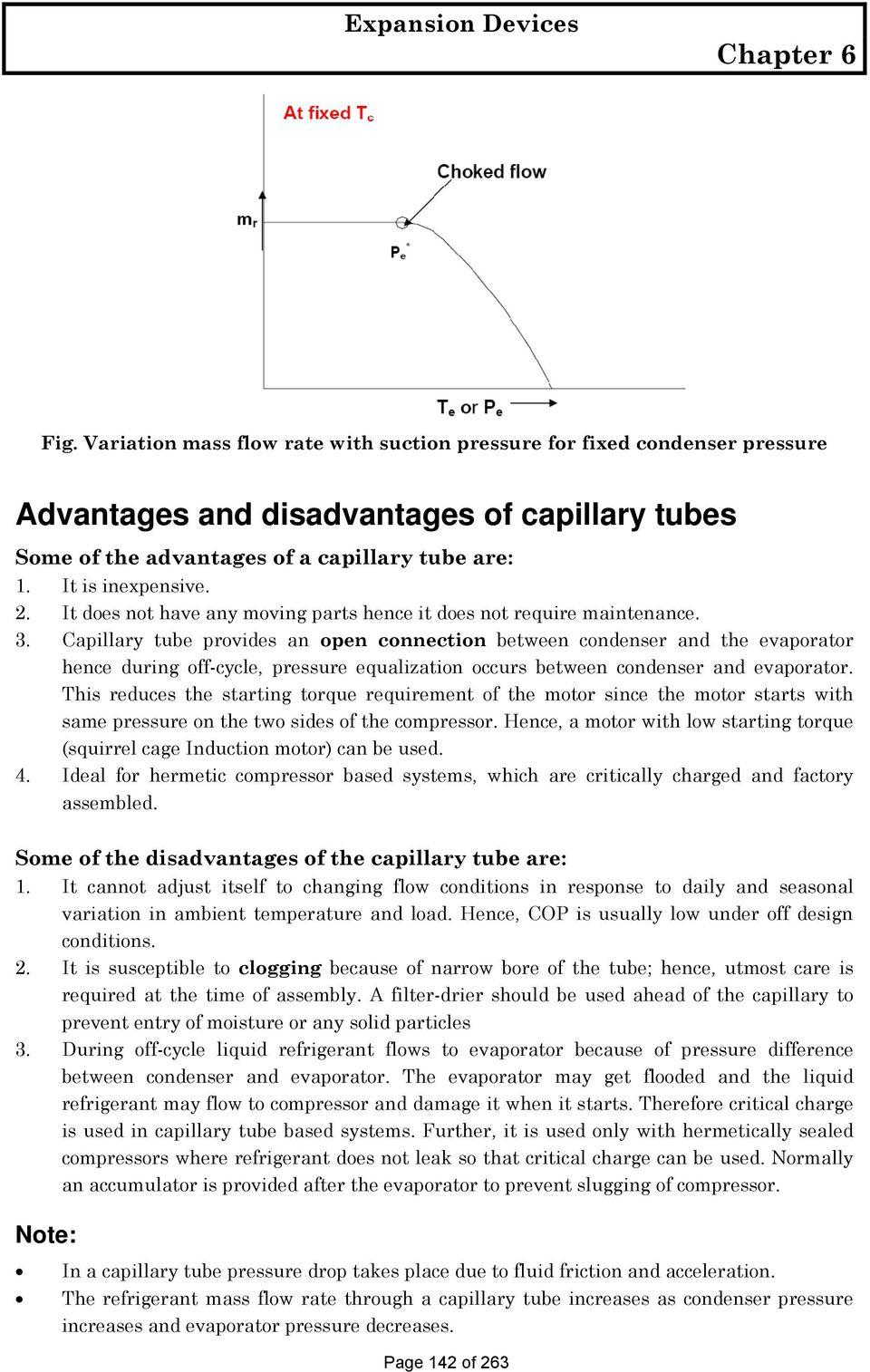
9 Expansion Devices Chapter 6 Fig. Variation mass flow rate with suction pressure for fixed condenser pressure Advantages and disadvantages of capillary tubes Some of the advantages of a capillary tube are: 1. It is inexpensive. 2. It does not have any moving parts hence it does not require maintenance. 3. Capillary tube provides an open connection between condenser and the evaporator hence during off-cycle, pressure equalization occurs between condenser and evaporator. This reduces the starting torque requirement of the motor since the motor starts with same pressure on the two sides of the compressor. Hence, a motor with low starting torque (squirrel cage Induction motor) can be used. 4. Ideal for hermetic compressor based systems, which are critically charged and factory assembled. Some of the disadvantages of the capillary tube are: 1. It cannot adjust itself to changing flow conditions in response to daily and seasonal variation in ambient temperature and load. Hence, COP is usually low under off design conditions. 2. It is susceptible to clogging because of narrow bore of the tube; hence, utmost care is required at the time of assembly. A filter-drier should be used ahead of the capillary to prevent entry of moisture or any solid particles 3. During off-cycle liquid refrigerant flows to evaporator because of pressure difference between condenser and evaporator. The evaporator may get flooded and the liquid refrigerant may flow to compressor and damage it when it starts. Therefore critical charge is used in capillary tube based systems. Further, it is used only with hermetically sealed compressors where refrigerant does not leak so that critical charge can be used. Normally an accumulator is provided after the evaporator to prevent slugging of compressor. Note: In a capillary tube pressure drop takes place due to fluid friction and acceleration. The refrigerant mass flow rate through a capillary tube increases as condenser pressure increases and evaporator pressure decreases. Page 142 of 263
10 Expansion Devices Chapter 6 A capillary tube tends to supply more mass flow rate as refrigeration load decreases A capillary tube based refrigeration system is a critically charged system A capillary tube based refrigeration system does not use a receiver In capillary tube based systems, pressure equalization takes place when compressor is off. The mass flow rate through a capillary is maximum under choked flow conditions The enthalpy of refrigerant in a capillary tube decreases in the flow direction For a given refrigerant mass flow rate, the required length of a capillary tube increases as: (i) The diameter of the capillary tube increases. (ii) Inlet pressure increases. Page 143 of 263

11 Expansion Devices Chapter 6 OBJECTIVE QUESTIONS (GATE, IES, IAS) Previous 20-Years GATE Questions Capillary Tube and Its Sizing GATE-1 In the window air conditioner, the expansion device used is [GATE-2004] (a) capillary tube (b) thermostatic expansion valve (c) automatic expansion valve (d) float valve GATE-1 Ans. (a) Previous 20-Years IES Questions Types of Expansion Devices IES-1. Match List-I (Expansion device) with List-II (Operation) and select the correct answer using the codes given below the lists: [IES-2001] List-l A. Float valve List-II 1. Constant degree of superheat at B. Automatic expansion valve evaporator exit pressure C. Internally equalized 2. Constant degree of superheat at thermostatic expansion valve evaporator inlet pressure D. Externally equalized 3. Constant level of refrigerant in the thermostatic expansion valve evaporator 4. Constant pressure in the evaporator Codes: A B C D A B C D (a) (b) (c) (d) IES-1. Ans. (c) Thermostatic-Expansion Valve IES-2. The sensing bulb of the thermostatic expansion valve is located at the (a) Exit of the evaporator (b) Inlet of the evaporator [IES-2002] (c) Exit of the condenser (d) Inlet of the condenser IES-2. Ans. (a) IES-3. A valve which maintains a constant degree of superheat at the end of the evaporator coil, is called [IES-1993] (a) Automatic expansion valve (b) High side float valve (c) Thermostatic expansion valve (d) Low side float valve IES-3. Ans. (c) IES-4. Which one of the following is responsible for the operation of a thermostatic expansion valve? [IES-2005] (a) Pressure changes in evaporator (b) Temperature changes in evaporator (c) Degree of superheat in evaporator (d) Degree of subcooling in evaporator IES-4. Ans. (c) IES-5. A thermostatic expansion value in refrigeration system [IES-1992] (a) Ensures the evaporator completely filled with refrigerant of the load (b) Is suitable only for constant load system Page 144 of 263
![Match List-I (Expansion device) with List-II (Operation) and select the correct answer using the codes given below the lists: [IES-2001] List-l A. Float valve List-II 1.](/docs-images/41/7902515/images/page_11.jpg "Constant degree of superheat at B. Automatic expansion valve evaporator exit pressure C. Internally equalized 2.")
12 Expansion Devices (c) Maintains different temperatures in evaporator in proportion to load (d) None of the above IES-5. Ans. (a) Chapter 6 IES-6. What is hunting of thermostatic expansion valve? [IES-2008] (a) A variation of evaporator load with degree of Super heat (b) A variation in pressure of the evaporator with variation of load (c) Alternate overfeeding and starving of refrigerant flow in the evaporator (d) This is not used in connection with expansion valve IES-6. Ans. (c) Capillary Tube and Its Sizing IES-7. Consider the following statements: [IES-2000; IAS-1999] The pressure in a capillary tube of a refrigerator decreases because 1. Tube wall offers frictional resistance 2. Refrigerant accelerates in the tube 3. Tube transfer the heat 4. Potential energy decreases Of these statements: (a) 1 and 2 are correct (b) 1, 2 and 3 are correct (c) 2 and 4 are correct (d) 3 and 4 are correct IES-7. Ans. (a) IES-8. In a domestic refrigerator, a capillary tube controls the flow of refrigerant from the [IES-1994] (a) Expansion valve to the evaporator (b) Evaporator to the thermostat (c) Condenser to the expansion valve (d) Condenser to the evaporator IES-8. Ans. (d) In domestic refrigerator, a capillary tube controls the flow of refrigerant from condenser to evaporator Previous 20-Years IAS Questions Types of Expansion Devices IAS-1. An expansion valve is NOT used for reducing pressure in the [IAS-2000] (a) Vapour compression refrigeration (b) Vapour absorption refrigeration cycle (c) Steam-jet refrigeration cycle (d) Gas refrigeration cycle IAS-1. Ans. (d) Steam-jet refrigeration cycle is similar to vapour compression refrigeration cycle where mechanical compressor is substituted by steam ejector or booster. Automatic or Constant-Pressure Expansion Valve IAS-2. Which one of the following types of expansion valves is suitable for a refrigeration plant operating at constant load? [IAS-2007] (a) Thermostatic expansion valve (b) Automatic expansion valve (c) Capillary tube (d) None of the above IAS-2. Ans. (b) IAS-3. An automatic expansion value is required to maintain constant [IAS-1998] (a) Pressure in the evaporator (b) Temperature in the freezer (c) Pressure in the liquid line (d) Temperature in the condenser IAS-3. Ans. (a) Page 145 of 263

13 Expansion Devices Thermostatic-Expansion Valve Chapter 6 IAS-4. Which one of the following is the most important function of thermostatic expansion valve? [IAS-2003] (a) To control the degree of superheat (b) To control the evaporator temperature (c) To control the pressure drop (d) To control the evaporator pressure IAS-4. Ans. (a) IAS-5. Consider the following statements: [IAS-1999] Dry compression in reciprocating compressor is preferred because it 1. Prevent valve damage 2. Enables use of thermostatic expansion valve. 3. Minimizes irreversibility in the compressor. 4. Prevents washing out of the lubricating oil from cylinder walls. Of these statements: (a) 1 and 2 are correct (b) 2 and 3 are correct (c) 1 and 4 are correct (d) 3 and 4 are correct IAS-5. Ans. (c) Capillary Tube and Its Sizing IAS-6. Consider the following statements: [IAS-1999; IES-2000] The pressure in a capillary tube of a refrigerator decreases because 1. Tube wall offers frictional resistance 2. Refrigerant accelerates in the tube 3. Tube transfer the heat 4. Potential energy decreases Of these statements: (a) 1 and 2 are correct (b) 1, 2 and 3 are correct (c) 2 and 4 are correct (d) 3 and 4 are correct IAS-6. Ans. (a) IAS-7. In on-off control refrigeration system, which one of the following expansion devices is used? [IAS-2004] (a) Capillary tube (b) Thermostat (c) Automatic expansion valve (d) Float valve IAS-7. Ans. (a) IAS-8. Which of the features of expansion valves in the following lists are correctly matched? [IAS-2004] Expansion Device Feature 1. Capillary tube : Choking 2. Thermostatic expansion valve : Constant temperature 3. Automatic Expansion valve : Constant degree of superheat 4. Float valve : Mass flow rate of refrigerant is proportional to Select the correct answer using the codes given below: (a) 1 and 2 (b) 1 and 3 (c) 1 and 4 (d) 3 and 4 IAS-8. Ans. (c) IAS-9. The throttling device used in the domestic refrigerator is: [IAS-2002] (a) Internally equalized thermostatic expansion valve (b) Externally equalized thermostatic expansion valve (c) Automatic expansion valve Page 146 of 263
![Consider the following statements: [IAS-1999] Dry compression in reciprocating compressor is preferred because it 1. Prevent valve damage 2. Enables use of thermostatic expansion valve. 3.](/docs-images/41/7902515/images/page_13.jpg "Minimizes irreversibility in the compressor. 4. Prevents washing out of the lubricating oil from cylinder walls.")
14 (d) Capillary tube IAS-9. Ans. (d) Expansion Devices Chapter 6 Page 147 of 263

15 7. Gas Cycle Refrigeration Theory at a Glance (For IES, GATE, PSU) Introduction Air cycle refrigeration systems belong to the general class of gas cycle refrigeration systems, in which a gas is used as the working fluid. The gas does not undergo any phase change during the cycle; consequently, all the internal heat transfer processes are sensible heat transfer processes. Gas cycle refrigeration systems find applications in air craft cabin cooling and also in the liquefaction of various gases. In the present chapter gas cycle refrigeration systems based on air are discussed. Air Standard Cycle analysis Air cycle refrigeration system analysis is considerably simplified if one makes the following assumptions: 1. The working fluid is a fixed mass of air that behaves as an ideal gas. 2. The cycle is assumed to be a closed loop cycle with all inlets and exhaust processes of open loop cycles being replaced by heat transfer processes to or from the environment. 3. All the processes within the cycle are reversible, i.e., the cycle is internally reversible 4. The specific heat of air remains constant throughout the cycle. An analysis with the above assumptions is called as cold Air Standard Cycle (ASC) analysis. This analysis yields reasonably accurate results for most of the cycles and processes encountered in air cycle refrigeration systems. However, the analysis fails when one considers a cycle consisting of a throttling process, as the temperature drop during throttling is zero for an ideal gas, whereas the actual cycles depend exclusively on the real gas behavior to produce refrigeration during throttling. Basic concepts The temperature of an ideal gas can be reduced either by making the gas to do work in an isentropic process or by sensible heat exchange with a cooler environment. When the gas does adiabatic work in a closed system by say, expanding against a piston, its internal energy drops. Since the internal energy of the ideal gas depends only on its temperature, the temperature of the gas also drops during the process, i.e., i i W = m u u = mc T T ( ) ( ) 1 2 v 1 2 Where m is the mass of the gas, u1 and u 2 is the initial and final internal energies of the gas. T1 and T2 are the initial and final temperatures and C v is the specific heat at constant volume. If the expansion is reversible and adiabatic, by using the ideal gas equation Pv = RT and the γ γ equation for isentropic process P1v 1 = P2v 2 the final temperature (T2) is related to the initial temperature (T1) and initial and final pressures ( P 1 and P 2 ) by the equation: T 2 = P2 T1 P 1 γ 1 γ Where γ is the coefficient of isentropic expansion given by: Page 148 of 263

16 γ c = c p v Gas Cycle Refrigeration Chapter 7 Isentropic expansion of the gas can also be carried out in a steady flow in a turbine which gives a net work output. Neglecting potential and kinetic energy changes, the work output of the turbine is given by: i i W = m h h = mc T T ( ) ( ) 1 2 p 1 2 The final temperature is related to the initial temperature and initial and final pressures. Reversed Carnot Cycle Employing a Gas Reversed Carnot cycle is an ideal refrigeration cycle for constant temperature external heat source and heat sinks. Figure below shows the schematic of a reversed Carnot refrigeration system using a gas as the working fluid along with the cycle diagram on T s and P v coordinates. As shown, the cycle consists of the following four processes: Fig. Schematic of a reverse Carnot refrigeration system Process 1 2: Reversible, adiabatic compression in a compressor Process 2 3: Reversible, isothermal heat rejection in a compressor Process 3 4: Reversible, adiabatic expansion in a turbine Process 4 1: Reversible, isothermal heat absorption in a turbine. Page 149 of 263
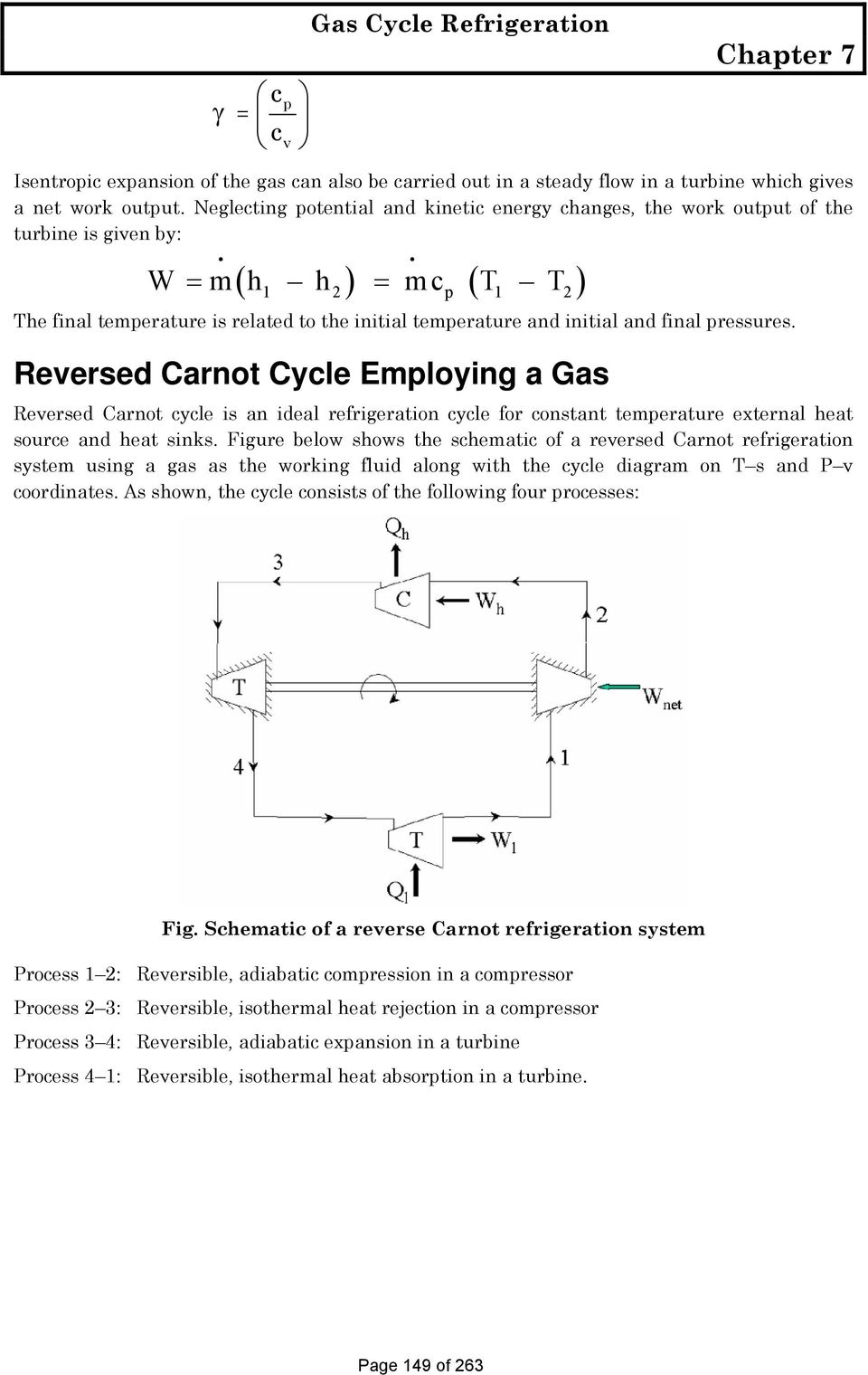
17 Gas Cycle Refrigeration Chapter 7 Fig. Reverse Carnot refrigeration system in P-v and T-s coordinates The heat transferred during isothermal processes 2 3 and 4 1 is given by: 3 q 2 3 = T.ds = Th( s 3 s 2) q = 1 T.ds= T ( s s ) 4 h 1 4 s 1 = s 2 and s 3 = s 4, hence s 2 s 3 = s 1 s4 Applying first law of thermodynamics to the closed cycle, δ q + q = δ w + w = wnet q = ( ) w = ( ) The work of isentropic expansion, w3 4 exactly matches the work of isentropic compression w 1 2. The COP of the Carnot system is given by: COPCarnot = q 4 1 W = 1 net Th T1 T Thus the COP of the Carnot system depends only on the refrigeration (T1) and heat rejection (Th) temperatures only. Limitations of Carnot Cycle with Gas as a Refrigerant Fig. Reverse Carnot refrigeration system in P v and T s coordinates Carnot cycle is an idealization and it suffers from several practical limitations. One of the main difficulties with Carnot employing a gas is the difficulty of achieving isothermal heat transfer during processes 2 3 and 4 1. For a gas to have heat transfer isothermally, it is essential to carry out work transfer from or to the system when heat is transferred to the system (process 4 1) or from the system (process 2 3). This is difficult to achieve in practice. In addition, the Page 150 of 263
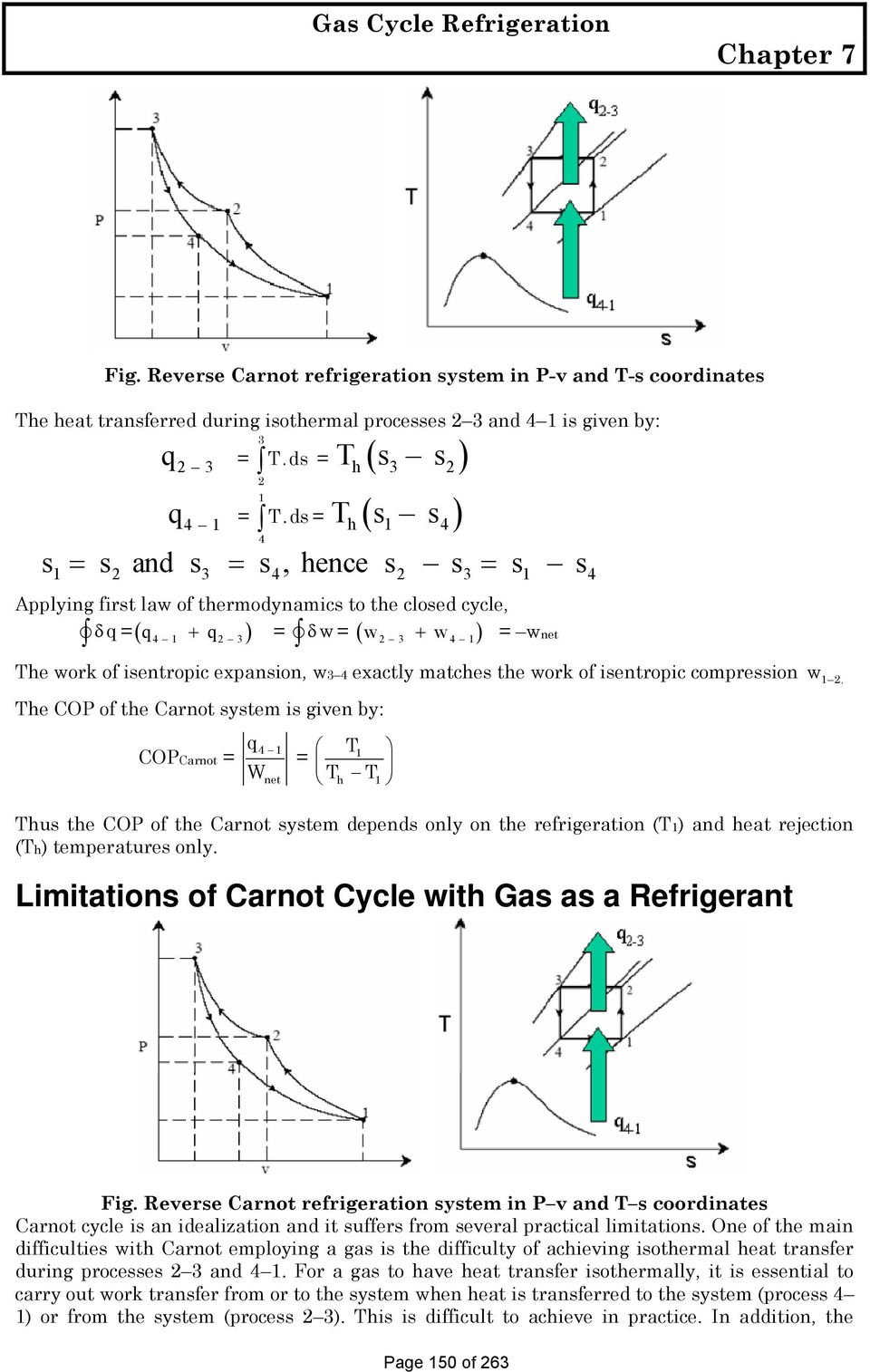
18 Gas Cycle Refrigeration Chapter 7 volumetric refrigeration capacity of the Carnot system is very small leading to large compressor displacement, which gives rise to large frictional effects. All actual processes are irreversible; hence completely reversible cycles are idealizations only. Reversed Brayton or Joule or Bell Coleman Cycle Ideal reverse Brayton cycle Fig. Schematic of a closed reverse Brayton cycle This is an important cycle frequently employed in gas cycle refrigeration systems. This may be thought of as a modification of reversed Carnot cycle, as the two isothermal processes of Carnot cycle are replaced by two isobaric heat transfer processes. This cycle is also called as Joule or Bell-Coleman cycle. Figure shows the schematic of a closed, reverse Brayton cycle and also the cycle on T s diagram. As shown in the figure, the ideal cycle consists of the following four processes: Process 1 2: Reversible, adiabatic compression in a compressor Process 2 3: Reversible, isobaric heat Fig. Reverse Brayton cycle in T s plane rejection in a heat exchanger Process 3 4: Reversible, adiabatic expansion in a turbine Process 4 1: Reversible, isobaric heat absorption in a heat exchanger. Process 1 2: Gas at low pressure is compressed isentropically from state 1 to state 2. Applying steady flow energy equation and neglecting changes in kinetic and potential energy. We can write: i W1 2 = m( h 2 h 1) And T 2 = Where s = s 2 1 i = mc p (T 2 T) 1 γ 1 γ γ 1 γ 1 p P2 T1 = Tr P 1 r p = P 2 P 1 = pressure ratio Page 151 of 263
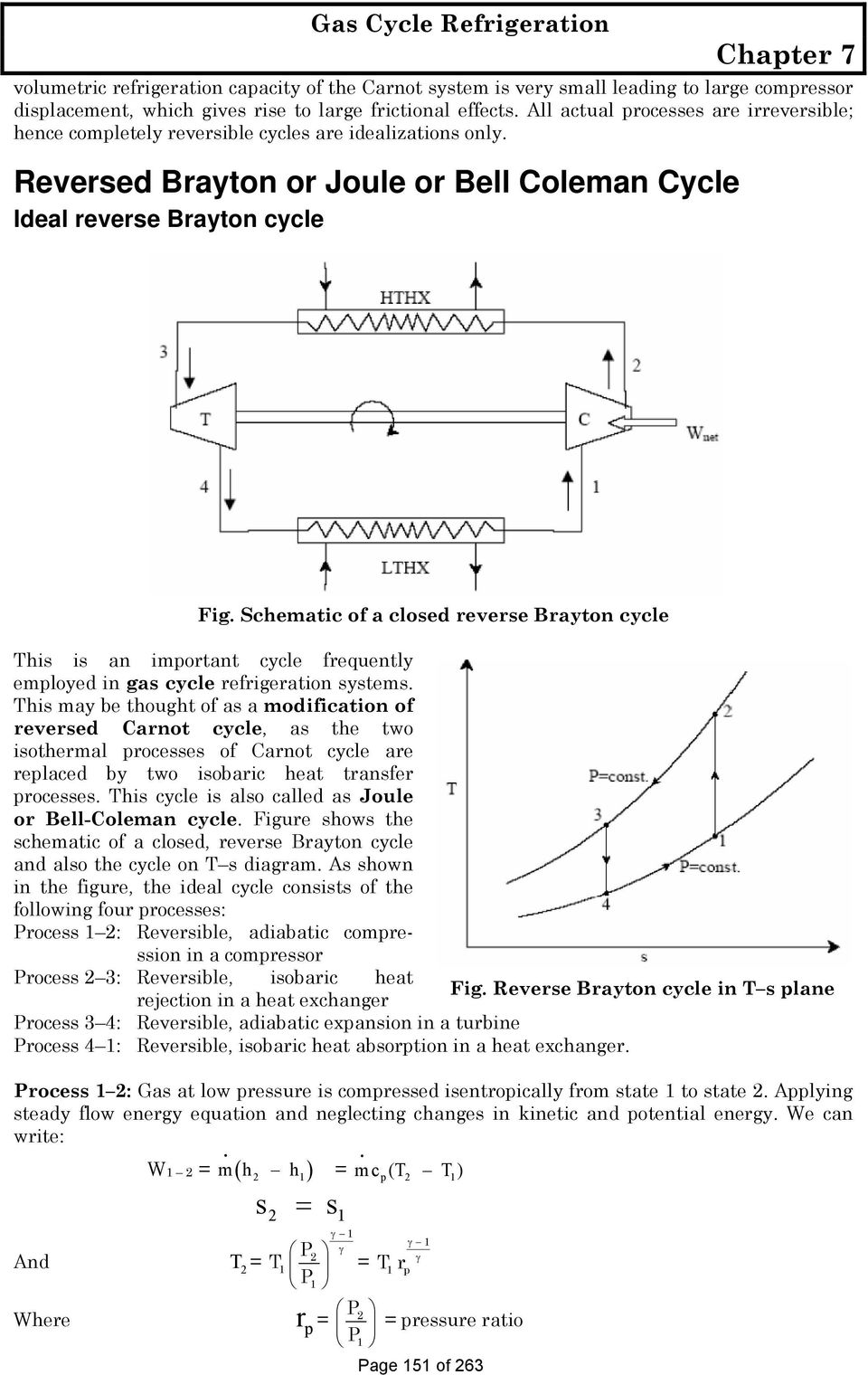
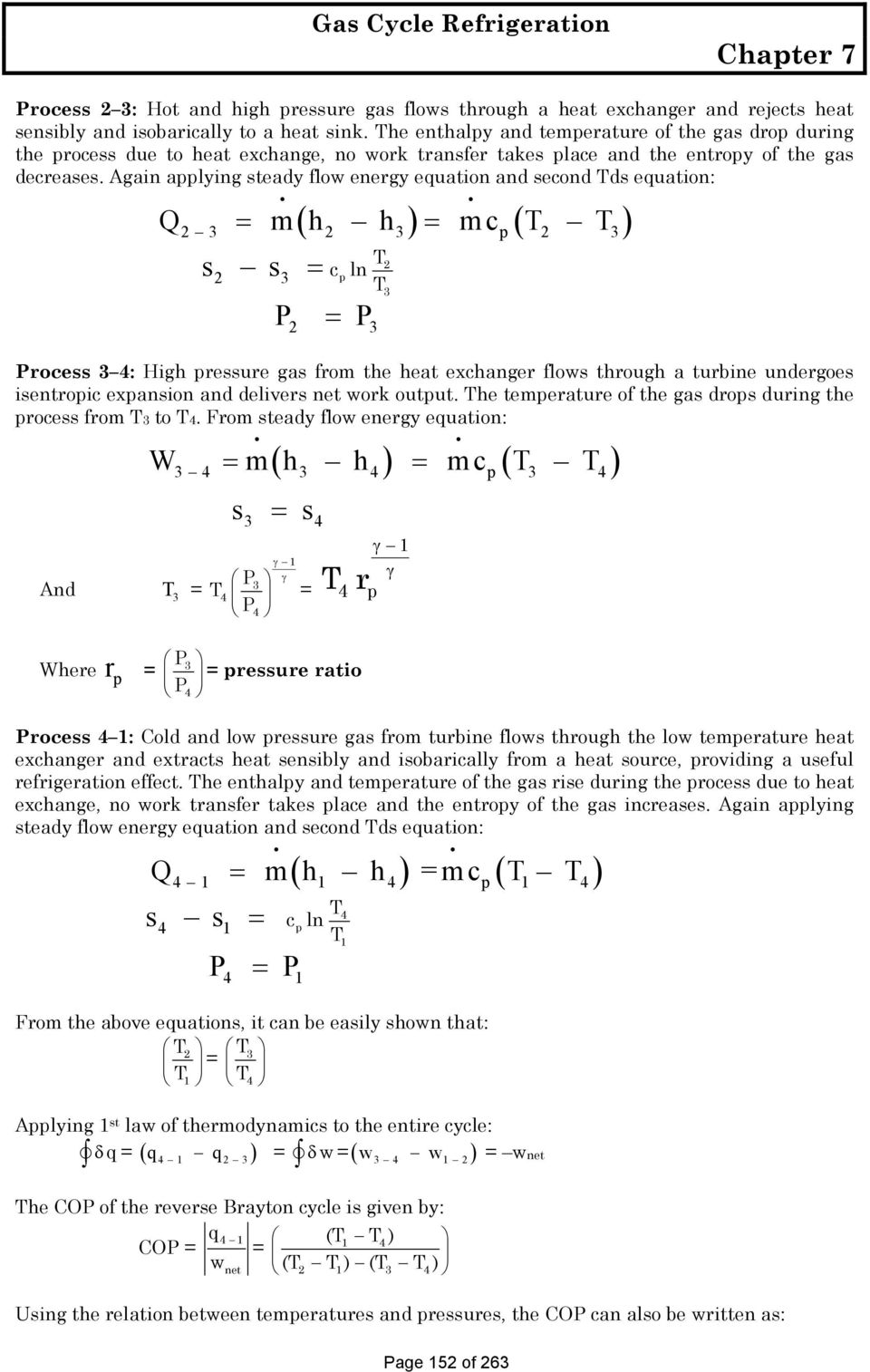
19 Gas Cycle Refrigeration Chapter 7 Process 2 3: Hot and high pressure gas flows through a heat exchanger and rejects heat sensibly and isobarically to a heat sink. The enthalpy and temperature of the gas drop during the process due to heat exchange, no work transfer takes place and the entropy of the gas decreases. Again applying steady flow energy equation and second Tds equation: i i ( ) ( ) Q = m h h = mc T T p 2 3 T2 s 2 s 3 = cp ln T P = P Process 3 4: High pressure gas from the heat exchanger flows through a turbine undergoes isentropic expansion and delivers net work output. The temperature of the gas drops during the process from T3 to T4. From steady flow energy equation: i i And T 3 = ( ) ( ) W = m h h = mc T T p 3 4 s = s 3 4 γ 1 γ P3 T4 = P 4 γ 1 γ 4 p Tr Where r p = P 3 = pressure ratio P 4 Process 4 1: Cold and low pressure gas from turbine flows through the low temperature heat exchanger and extracts heat sensibly and isobarically from a heat source, providing a useful refrigeration effect. The enthalpy and temperature of the gas rise during the process due to heat exchange, no work transfer takes place and the entropy of the gas increases. Again applying steady flow energy equation and second Tds equation: Q 4 1 = m i ( h 1 h 4 ) =mc i p ( T 1 T4 ) T4 s 4 s 1 = cp ln T P = P 4 1 From the above equations, it can be easily shown that: T2 T = T 3 1 T4 Applying 1 st law of thermodynamics to the entire cycle: δ q q = δ w w = wnet q = ( ) w = ( ) The COP of the reverse Brayton cycle is given by: q4 1 COP = w = (T1 T 4) net (T2 T 1) (T3 T 4) Using the relation between temperatures and pressures, the COP can also be written as: Page 152 of 263
20 Gas Cycle Refrigeration (T1 T 4) COP = = T 4 (T2 T 1) (T3 T 4) T3 T = (T1 T 4) γ = 1 4 γ (T1 T 4) (rp 1) From the above expression for COP, the following observations can be made: Chapter 7 γ 1 γ p (r 1) 1 (a) For fixed heat rejection temperature (T3) and fixed refrigeration temperature (T1), the COP of reverse Brayton cycle is always lower than the COP of reverse Carnot cycle (Figure that is COPBrayton = T 4 < COPCarnot = T 1 T3 T 4 T3 T T : Reversed Brayton cycle : Reversed Carnot cycle s Fig. Comparison of reverse Carnot and reverse Brayton cycle in T s plane (b) (c) COP of Brayton cycle approaches COP of Carnot cycle as T1 approaches T4 (thin cycle), however, the specific refrigeration effect [cp(t1 T4)] also reduces simultaneously. COP of reverse Brayton cycle decreases as the pressure ratio rp increases. Actual reverse Brayton cycle The actual reverse Brayton cycle differs from the ideal cycle due to: (i) Non-isentropic compression and expansion processes. (ii) Pressure drops in cold and hot heat exchangers. Fig. Comparison of ideal and actual Brayton cycles T s plane Page 153 of 263
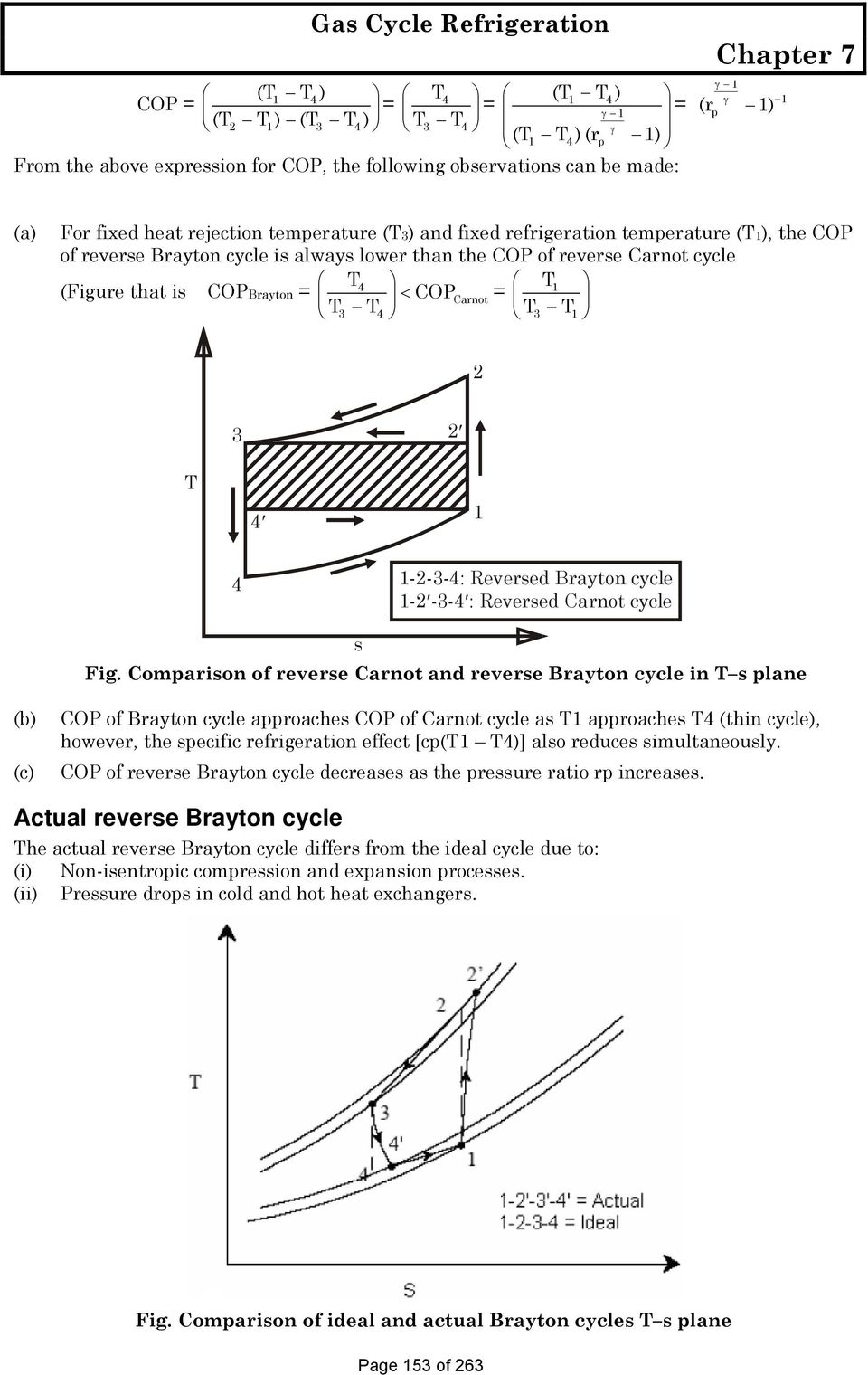
21 Gas Cycle Refrigeration Chapter 7 Figure above shows the ideal and actual cycles on T s diagram. Due to this irreversibility, the compressor work input increases and turbine work output reduces. The actual work transfer rates of compressor and turbine are then given by: W1 2, act = W 1 2,isen η c,isen W = η W 3 4, act t, isen 3 4, isen η and η are the isentropic efficiencies of compressor and turbine, Where c,isen t,isen respectively. In the absence of pressure drops, these are defined as: η c,isen = η t,isen = (h2 h 1) (T (h h ) = 2 T 1) (T T ) 2' 1 ' 2 (h ' h ') (T 3 4 (h h ) = ' T ') 3 4 (T T ) 3 4 The actual net work input, wnet,act is given by : Wnet,act = W1 2,act W3 4,act Thus the net work input increases due to increase in compressor work input and reduction in turbine work output. The refrigeration effect also reduces due to the irreversibility. As a result, the COP of actual reverse Brayton cycles will be considerably lower than the ideal cycles. Design of efficient compressors and turbines plays a major role in improving the COP of the system. In practice, reverse Brayton cycles can be open or closed. In open systems, cold air at the exit of the turbine flows into a room or cabin (cold space), and air to the compressor is taken from the cold space. In such a case, the low side pressure will be atmospheric. In closed, systems, the same gas (air) flows through the cycle in a closed manner. In such cases it is possible to have low side pressures greater than atmospheric. These systems are known as dense air systems. Dense air systems are advantageous as it is possible to reduce the volume of air handled by the compressor and turbine at high pressures. Efficiency will also be high due to smaller pressure ratios. It is also possible to use gases other than air (e.g. helium) in closed systems. Application to Aircraft Refrigeration Aircraft cooling systems In an aircraft, cooling systems are required to keep the cabin temperatures at a comfortable level. Even though the outside temperatures are very low at high altitudes, still cooling of cabin is required due to: (i) Large internal heat generation due to occupants, equipment etc. (ii) Heat generation due to skin friction caused by the fast moving aircraft. (iii) At high altitudes, the outside pressure will be sub-atmospheric. When air at this low pressure is compressed and supplied to the cabin at pressures close to atmospheric, the temperature increases significantly. For example, when outside air at a pressure of 0.2 bar and temperature of 223 K (at m altitude) is compressed to 1 bar, its temperature increases to about 353 K. If the cabin is maintained at 0.8 bar, the temperature will be Page 154 of 263
22 Gas Cycle Refrigeration Chapter 7 about 332 K. This effect is called as ram effect. This effect adds heat to the cabin, which needs to be taken out by the cooling system. (iv) Solar radiation. For low speed aircraft flying at low altitudes, cooling system may not be required, however, for high speed aircraft flying at high altitudes, a cooling system is a must. Even though the COP of air cycle refrigeration is very low compared to vapour compression refrigeration systems, it is still found to be most suitable for aircraft refrigeration systems as: (i) Air is cheap, safe, non-toxic and non-flammable. Leakage of air is not a problem. (ii) Cold air can directly be used for cooling thus eliminating the low temperature heat exchanger (open systems) leading to lower weight. (iii) The aircraft engine already consists of a high speed turbo-compressor; hence separate compressor for cooling system is not required. This reduces the weight per kw cooling considerably. Typically, less than 50% of an equivalent vapours compression system. (iv) Design of the complete system is much simpler due to low pressures. Maintenance required is also less. Simple aircraft refrigeration cycle C Fan 3 3 MC 3 AC 4 T T 4 5 i To cabin s Fig. A simple aircraft refrigeration cycle Figure above shows the schematic of a simple aircraft refrigeration system and the operating cycle on T s diagram. This is an open system. As shown in the T s diagram, the outside low pressure and low temperature air (state 1) is compressed due to ram effect to ram pressure (state 2). During this process its temperature increases from 1 to 2. This air is compressed in the main compressor to state 3, and is cooled to state 4 in the air cooler. Its pressure is reduced to cabin pressure in the turbine (state 5); as a result its temperature drops from 4 to 5. The cold air at state 5 is supplied to the cabin. It picks up heat as it flows through the cabin providing useful cooling effect. The power output of the turbine is used to drive the fan, which maintains the required air flow over the air cooler. This simple system is good for ground cooling (when the aircraft is not moving) as fan can continue to maintain airflow over the air cooler. By an applying steady flow energy equation to the ramming process, the temperature rise at the end of the ram effect can be shown to be: Page 155 of 263
23 Gas Cycle Refrigeration ' T2 γ 1 T = 1+ M Chapter 7 Where M is the Mach number, which is the ratio of velocity of the aircraft (C) to the sonic velocity an (a = γrt 1 ),i.e. M = C a = C γ RT1 Due to irreversibility, the actual pressure at the end of ramming will be less than the pressure resulting from isentropic compression. The ratio of actual pressure rise to the isentropic pressure rise is called as ram efficiency, η, Ram i.e. η Ram = (p - p ) (p - p ) 2 1 ' 2 1 The refrigeration capacity of the simple aircraft cycle discussed, Q is given by: ( ) q = c T T 0 p i 5 Where m is the mass flow rate of air through the turbine. Boot-strap Figure below shows the schematic of a bootstrap system, which is a modification of the simple system. As shown in the figure, this system consists of two heat exchangers (air cooler and after cooler), in stead of one air cooler of the simple system. It also incorporates a secondary compressor, which is driven by the turbine of the cooling system. This system is suitable for high speed aircraft, where in the velocity of aircraft provides the necessary airflow for the heat exchangers, as a result a separate fan is not required. As shown in the cycle diagram, ambient air state 1 is pressurized to state 2 due to the ram effect. This air is further compressed to state 3 in the main compressor. This air is then cooled to state 4 in the air cooler. The heat rejected in the air cooler is absorbed by the ram air at state 2. The air from the air cooler is further compressed from state 4 to state 5 in the secondary compressor. It is then cooled to state 6 in the after cooler, expanded to cabin pressure in the cooling turbine and is supplied to the cabin at a low temperature T7. Since the system does not consist of a separate fan for driving the air through the heat exchangers, it is not suitable for ground cooling. However, in general ground cooling is normally done by an external air conditioning system as it is not efficient to run the aircraft engine just to provide cooling when it is grounded. Other modifications over the simple system are: Regenerative system and reduced ambient system. In a regenerative system, a part of the cold air from the cooling turbine is used for precooling the air entering the turbine. As a result much lower temperatures are obtained at the exit of the cooling turbine; however, this is at the expense of additional weight and design complexity. The cooling turbine drives a fan similar to the simple system. The regenerative system is good for both ground cooling as well as high speed aircrafts. The reduced ambient system is well-suited for supersonic aircrafts and rockets. Page 156 of 263
24 Gas Cycle Refrigeration Chapter 7 Fig. A bootstrap system Dry Air Rated Temperature (DART): The concept of Dry Air Rated Temperature is used to compare different aircraft refrigeration cycles. Dry Air Rated Temperature is defined as the temperature of the air at the exit of the cooling turbine in the absence of moisture condensation. For condensation not to occur during expansion in turbine, the dew point temperature and hence moisture content of the air should be very low, i.e., the air should be very dry. The aircraft refrigeration systems are rated based on the mass flow rate of air at the design DART. The cooling capacity is then given by: i i p ( ) Q = mc T T Where m i is the mass flow rate of air. DART i cabin temperature, respectively. T i DART and T are the dry air rated temperature and A comparison between different aircraft refrigeration systems based on DART at different Mach numbers shows that: (i) DART increases monotonically with Mach number for all the systems except the reduced ambient system. (ii) The simple system is adequate at low Mach numbers. (iii) At high Mach numbers either bootstrap system or regenerative system should be used. (iv) Reduced ambient temperature system is best suited for very high Mach number, supersonic aircrafts. Page 157 of 263
25 Regenerative Gas Cycle Refrigeration Chapter 7 Fig. Regenerative system Fig. Thermodynamic cycle for regenerative cycle Page 158 of 263
26 Gas Cycle Refrigeration Chapter 7 OBJECTIVE QUESTIONS (GATE, IES, IAS) Previous 20-Years IES Questions Limitations of Carnot Cycle with Gas as a Refrigerant IES-1. Where is an air refrigeration cycle generally employed? [IES-1998; 2006] (a) Domestic refrigerators (b) Commercial refrigerators (c) Air-conditioning (d) Gas liquefaction IES-1. Ans. (d) IES-2. In aircraft, air refrigeration cycle is used because of [IES-1995] (a) Low unit weight per tonne of refrigeration (b) High heat transfer rate (c) Lower temperature at high-altitudes (d) Higher coefficient of performance IES-2. Ans. (a) IES-2a IES-2a In an aircraft refrigeration system, the pressure at the cooling turbine outlet is equal to [IES-2011] (a) Ambient pressure (b) Cabin pressure (c) Compressor inlet pressure (d) Evaporator pressure Ans. (b) Reversed Brayton or Joule or Bell Coleman Cycle IES-3. Which one of the following is the p-v diagram for air refrigeration cycle? IES-3. Ans. (a) IES-4. Match List-I (Process) with List-II (Type) for Bell Coleman or Joule or Reverse Brayton cycle for gas cycle refrigeration and select the correct answer using the codes given below the lists: [IES-2003] List-I List-II A. Compression 1. Isobaric B. Heat rejection 2. Isothermal C. Expansion 3. Isentropic D. Heat absorption 4. Isenthalpic Page 159 of 263
27 Gas Cycle Refrigeration Codes: A B C D A B C D (a) (b) (c) (d) IES-4. Ans. (b) Chapter 7 IES-5. IES-5. Ans. (c) When the Brayton cycle working in the pressure limits of p1 and p2 is reversed and operated as a refrigerator, what is the ideal value of COP for such a cycle? [IES-2007] γ 1 p 2 1 (a) 1 (b) γ 1 p1 p 2 1 p1 1 (c) (d) None of the above ( γ 1) γ p 2 p1 η H. E 1 1 = 1 ( 1)/ r γ p γ ; (COP)H.P= 1 (COP)R = (COP)H.P 1 = γ 1 γ 1 r p 1 η HE. 1 = γ 1 p γ 2 p1 = γ 1 γ rp γ 1 γ p r 1 Application to Aircraft Refrigeration IES-6. While designing the refrigeration system of an aircraft prime consideration is that the [IES-1993] (a) System has high C.O.P. (b) H.P./ton is low (c) Weight of refrigerant circulated in the system is low (d) Weight of the refrigeration equipment is low IES-6. Ans. (d) Simple Evaporative IES-7. The performance of an evaporator condenser largely depends on [IES-1999] (a) Dry bulb temperature of air (b) Wet bulb temperature of air (c) Hot water temperature (d) Air-conditioned room temperature IES-7. Ans. (a) Boot-strap Evaporative IES-8. Which is the most suitable type of air refrigeration system for supersonic planes with Mach Number 3 or above? [IES-2005] (a) Boot-strap (b) Simple evaporative (c) Regenerative (d) Boot-strap evaporative IES-8. Ans. (d) Actually for this use Reduced Ambient system of refrigeration. 1 Page 160 of 263
28 Gas Cycle Refrigeration Previous 20-Years IAS Questions Reversed Brayton or Joule or Bell Coleman Cycle Chapter 7 IAS-1. Match List I with List II and select the correct answer using the codes given below lists: [IAS-1994] List-I List-II A. 1. Vapour compression cycle using expansion valve B. 2. Bell-Coleman cycle (gas compression cycle) C. 3. Vapour compression cycle using expansion engine Codes: A B C A B C (a) (b) (c) (d) IAS-1. Ans. (d) Page 161 of 263
29 8. Vapour Absorption System Theory at a Glance (For IES, GATE, PSU) Introduction SIMPLE VAPOUR ABSORPTION SYSTEM Vapour Absorption Refrigeration Systems (VARS) belong to the class of vapour cycles similar to vapour compression refrigeration systems. However, unlike vapour compression refrigeration systems, the required input to absorption systems is in the form of heat. Hence these systems are also called as heat operated or thermal energy driven systems. Since conventional absorption systems use liquids for absorption of refrigerant, these are also sometimes called as wet absorption systems. Similar to vapour compression refrigeration systems, vapour absorption refrigeration systems have also been commercialized and are widely used in various refrigeration and air conditioning applications. Since these systems run on low-grade thermal energy, they are preferred when low-grade energy such as waste heat or solar energy is available. Since conventional absorption systems use natural refrigerants such as water or ammonia they are environment friendly. Basic Principle When a solute such as lithium bromide salt is dissolved in a solvent such as water, the boiling point of the solvent (water) is elevated. On the other hand, if the temperature of the solution (solvent + solute) is held constant, then the effect of dissolving the solute is to reduce the vapour pressure of the solvent below that of the saturation pressure of pure solvent at that temperature. If the solute itself has some vapour pressure (i.e., volatile solute) then the total pressure exerted over the solution is the sum total of the partial pressures of solute and solvent. If the solute is nonvolatile (e.g. lithium bromide salt) or if the boiling point difference between the solution and solvent is large ( 300 C), then the total pressure exerted over the solution will be almost equal to the vapour pressure of the solvent only. In the simplest absorption refrigeration system, refrigeration is obtained by connecting two vessels, with one vessel containing pure solvent and the other containing a solution. Since the pressure is almost equal in both the vessels at equilibrium, the temperature of the solution will be higher than that of the pure solvent. This means that if the solution is at ambient temperature, then the pure solvent will be at a temperature lower than the ambient. Hence refrigeration effect is produced at the vessel containing pure solvent due to this temperature difference. The solvent evaporates due to heat transfer from the surroundings, flows to the vessel containing solution and is absorbed by the solution. This process is continued as long as the composition and temperature of the solution are maintained and liquid solvent is available in the container. Example: Figure below shows an arrangement, which consists of two vessels A and B connected to each other through a connecting pipe and a valve. Vessel A is filled with pure water, while vessel B is filled with a solution containing on mass basis 50 percent of water and 50 percent lithium bromide (LiBr salt). Initially the valve connecting these two vessels is closed, and both vessels are at thermal equilibrium with the surroundings, which is at 30 C. At 30 C, the saturation pressure of water is 4.24 kpa, and the equilibrium vapour pressure of waterlithium bromide solution (50: 50 by mass) at 30 C is 1.22 kpa. Page 162 of 263
30 Vapour Absorption System Chapter 8 Fig. Basic principle of vapour absorption system Comparison between VCRS with VARS Vapour compression refrigeration system (VCRS) Vapour Absorption Refrigeration System (VARS) Page 163 of 263
31 Vapour Absorption System Chapter 8 Figs. (a) Vapour compression refrigeration system (VCRS); (b) Vapour Absorption Refrigeration System (VARS) The COP for compression and absorption systems are given by: COP = e VCRS COP VARS = Q W c Qe Q Q + W Q e g p g Thus absorption systems are advantageous where a large quantity of low-grade thermal energy is available freely at required temperature. However, it will be seen that for the refrigeration and heat rejection temperatures, the COP of vapour compression refrigeration system will be much higher than the COP of an absorption system as a high grade mechanical energy is used in the former, while a low-grade thermal energy is used in the latter. However, comparing these systems based on COP is not fully justified, as mechanical energy is more expensive than thermal energy. Hence, sometimes the second law (or exergetic) efficiency is used to compare different refrigeration systems. It is seen that the second law (or exergetic) efficiency of absorption system is of the same order as that of a compression system. Page 164 of 263
32 Vapour Absorption System Chapter 8 Maximum Coefficient of Performance of a Heat Operated Refrigerating Machine Fig. Vapour absorption refrigeration system as a combination of a heat engine and a refrigerator COP idealvars = Q T T T e Q = e g o g To Te Tg = COPCarnot. η Carnot Derivation In case of a single stage compression refrigeration system operating between constant evaporator and condenser temperatures, the maximum possible COP is given by Carnot COP: COP Carnot = Te T T If we assume that heat rejection at the absorber and condenser takes place at same external heat sink temperature To, then a vapour absorption refrigeration system operates between three temperature levels. Tg, Tc and Te. The maximum possible COP of a refrigeration system operating between three c e Fig. Various energy transfers in a vapour absorption refrigeration system temperature levels can be obtained by applying first and second laws of thermodynamics to the system. Figure below shows the various energy transfers and the corresponding temperatures in an absorption refrigeration system. From first law of thermodynamics, Page 165 of 263
33 Vapour Absorption System Qe + Qg Qc + a + Wp = 0 Chapter 8 Where Qe is the heat transferred to the absorption system at evaporator temperature Te, Qg is the heat transferred to the generator of the absorption system at temperature Tg. Qa + c is the heat transferred from the absorber and condenser of the absorption system at temperature To and Wp is the work input to the solution pump. From second law of thermodynamics, ΔStotal = ΔSsys + ΔSsurr 0 Where ΔStotal is the total entropy change which is equal to the sum of entropy change of the system ΔSsys and entropy change of the surroundings ΔSsurr. Since the refrigeration system operates in a closed cycle, the entropy change of the working fluid of the system undergoing the cycle is zero, i.e., ΔSsys = 0. The entropy change of the surroundings is given by: Q Q Q e g a + c ΔSsurr = + 0 T T T e g o Substituting the expression for first law of thermodynamics in the above equation Tg To To Te Q Q W Tg Te g e p Neglecting solution pump work, Wp: the COP of VARS is given by: COP VARS = Qe Te Tg To Q g To T e T g An ideal vapour absorption refrigeration system is totally reversible (i.e., both internally and externally reversible). For a completely reversible system the total entropy change (system + surroundings) is zero according to second law, hence for an ideal VARS ΔStotal, rev = 0 ΔSsurr, rev = 0. Hence: Q Qg Q e a + c ΔSsurr, rev = + = 0 T T T e g o Hence combining first and second laws and neglecting pump work, the maximum possible COP of an ideal VARS system is given by: Qe COPideal VARS = Q = Te Tg To g To T e T g Thus the ideal COP is only a function of operating temperatures similar to Carnot system. It can be seen from the above expression that the ideal COP of VARS system is equal to the product of efficiency of a Carnot heat engine operating between Tg and To and COP of a Carnot refrigeration system operating between To and Te, i.e., COPideal,VARS = Q T T T e Q = e g o g To Te Tg = COPCarnot. η Carnot Refrigerant-absorbent combinations for VARS The desirable properties of refrigerant-absorbent mixtures for VARS are: Page 166 of 263
34 Vapour Absorption System Chapter 8 (i) The refrigerant should exhibit high solubility with solution in the absorber. This is to say that it should exhibit negative deviation from Raoult s law at absorber. (ii) There should be large difference in the boiling points of refrigerant and absorbent (greater than 200ºC), so that only refrigerant is boiled-off in the generator. This ensures that only pure refrigerant circulates through refrigerant circuit (condenser-expansion valveevaporator) leading to isothermal heat transfer in evaporator and condenser. (iii) It should exhibit small heat of mixing so that a high COP can be achieved. However, this requirement contradicts the first requirement. Hence, in practice a trade-off is required between solubility and heat of mixing. (iv) The refrigerant-absorbent mixture should have high thermal conductivity and low viscosity for high performance. (v) It should not undergo crystallization or solidification inside the system. (vi) The mixture should be safe, chemically stable, non-corrosive, and inexpensive and should be available easily. The most commonly used refrigerant-absorbent pairs in commercial systems are: 1. Water-Lithium Bromide (H2O LiBr) system for above 0ºC applications such as air conditioning. Here water is the refrigerant and lithium bromide is the absorbent. 2. Ammonia-Water (NH3 H2O) system for refrigeration applications with ammonia as refrigerant and water as absorbent. Of late efforts are being made to develop other refrigerant-absorbent systems using both natural and synthetic refrigerants to overcome some of the limitations of (H2O LiBr) and (NH3 H2O) systems. Currently, large water-lithium bromide (H2O LiBr) systems are extensively used in air conditioning applications, where as large ammonia-water (NH3 H2O) systems are used in refrigeration applications, while small ammonia-water systems with a third inert gas are used in a pump less form in small domestic refrigerators (triple fluid vapour absorption systems). Note: Compared to compression systems, absorption systems offer the benefits of possibility of using low-grade energy sources. Absorption of the refrigerant by the absorbent in a vapour absorption refrigeration system is accompanied by Release of heat An absorption system consisting of only two closed vessels provides refrigeration intermittently and Can work on solar energy alone The conventional, continuously operating single stage vapours absorption refrigeration system uses a thermal compressor in place of a mechanical compressor and consists of two expansion valves For an ideal refrigerant-absorbent mixture there is neither expansion nor contraction upon mixing and obeys Raoult s law in liquid phase and Dalton s law in vapour phase For a refrigerant-absorbent mixture with a negative deviation from Raoult s law then the mixing process is exothermic and the actual equilibrium temperature will be less more that predicted by Raoult s law Page 167 of 263
35 Vapour Absorption System Chapter 8 Refrigerant-absorbent pairs used in vapour absorption refrigeration systems should exhibit negative deviation from Raoult s law at absorber but have large boiling point difference between refrigerant and absorbent Water-lithium bromide systems are used for refrigeration applications above 0 o C only Small ammonia-water systems are used in domestic refrigerators Use of analyser and dephlegmator is not necessary in the case of systems such as lithium bromide-water in which case the absorbent does not exert any significant vapour pressure At all. Electrolux Refrigerator The domestic refrigerator based on absorption principle as proposed by Platen and Munters, was first made by Electrolux Company in 1931 in Sweden. Electrolux principle works on 3-fluid system. There is no solution circulation pump. Total pressure is the same throughout the system. The third fluid remains mainly in the evaporator thus reducing partial pressure of refrigerant to enable it to evaporate at low pressure and hence low temperature. Example: An electrolux refrigerator working on NH3 H2O system with H2 as the third fluid. Liquid NH3, evaporates in the evaporator in the presence of H2. Hydrogen is chosen as it is non-corrosive and insoluble in water. A thennosyphon bubble pump is used to lift the weak aqua from the generator to the separator. The discharge tube from the generator is extended down below the liquid level in the generator. The bubbles rise and carry slugs of weak NH3 H2O solution into the separator. Page 168 of 263
36 Vapour Absorption System Chapter 8 Fig. Electrolux refrigerator The COP of an Electrolux refrigerator is: ) ele (COP = Hea t absorbed by evaporator Hea t supplied by the gas burner Steam Jet Refrigeration Steam jet refrigeration cycle and vapour compression refrigeration cycle are quite similar in as much with an evaporator, a condenser, and a compression device and refrigerant as the basic system components. Instead of mechanical compression device, the system characteristically employs a steam ejector or booster to compress the refrigerant to the condenser pressure level. The volume rates of flow of refrigerant per ton of refrigeration in steam jet refrigeration cycle as compared to thatt for R12 vapour compressor system is very high. The load control in steam jet refrigeration cycle is obtained by using multiple parallel ejectors. The motive steam nozzle for steam ejector in case of steam jet refrigeration system is convergent-divergent. The velocity of steam at the exist from nozzles using motive steam for ejector is supersonic. The COP of steam refrigeration cycle is the order of 0.5 to 0.8. Page 169 of 263
37 Vapour Absorption System Chapter 8 The pressure maintained in the evaporator of steam jet refrigeration system depending upon application is approximately kgf/cm 2 to kgf/cm 2 i.e kpa to kpa. The refrigerant used in steam jet refrigeration is water. In steam jet refrigeration system chilled water with the application of principle of flash cooling is obtain. Page 170 of 263
38 Vapour Absorption System Chapter 8 OBJECTIVE QUESTIONS (GATE, IES, IAS) Previous 20-Years GATE Questions Simple Vapour Absorption System GATE-1. List-I List II [GATE-1997] A. Liquid to suction heat exchanger 1. Vapour absorption refrigeration B. Constant volume heat addition 2. Vapour compression refrigeration C. Normal shock 3. Diesel cycle D. Ammonia water 4. Otto cycle 5. Converging nozzle 6. Converging-diverging nozzle GATE-1. Ans. (A) 2, (B) 4, (C) 6, (D) 1 ATE-2. A vapour absorption refrigeration system is a heat pump with three thermal reservoirs as shown in the figure. A refrigeration effect of 100 W is required at 250 K when the heat source available is at 400 K. Heat rejection occurs at 300 K. The minimum value of heat required (in W) is: (a) 167 (b) 100 (c) 80 (d) 20 ATE-2. Ans. (c) From question, since refrigeration effect of 100 W is required [GATE-2005] So, = Work obtained Work obtained = = 20 W 250 Now for this amount of work, heat is absorbed from reservoir 3 and rejected to sink 2. W η = = 1 = Q3 = 4W = 4 20W = 80W Q GATE-3. A heat engine having an efficiency of 70% is used to drive a refrigerator having a co-efficient of performance of 5. The energy absorbed from low temperature reservoir by the refrigerator for each kj of energy absorbed from high temperature source by the engine is: [GATE-2004] (a) 0.14 kj (b) 0.71 kj (c) 3.5 kj (d) 7.1 kj Page 171 of 263
39 ATE-3. Ans. (c) Given, η reserv voir = 0.7, (COP) R = 5 Vapour Absorption System Chapter 8 η reservoir W = Q Q2 Now, (COP) R = W Q2 5 = W Q2 W = 5 Q2 1 Again, 0.7 = 5 Q ( i)...( ii) Q 2 = Q Energy absorbed from low temperature reservoir by the refrigerator for each kj of energy absorbed from high temperature source by the engine 3.5 kj. Previous 20-Years IES Questions Simple Vapour Absorption System IES-1. In a vapour absorption refrigerator, heat is rejected in: (a) Condenser only (b) Generator only (c) Absorberr only (d) Condenser and absorber IES-1. Ans. (d) [IES-2006] IES-2. Assertion (A): In remote places, the use of absorption refrigeration system plant is more advantageous when compared to vapour compression plant.[ies-1993] Reason (R): The absorption system can use relatively low temperature heat as energy source. (a) Both A and R are individually true and R is the correct explanation of A (b) Both A and R are individually true but R is not the correct explanation of A (c) A is true but R is false (d) A is false but R is true IES-2. Ans. (c) Assertion A is correct but reason is not true. The correct reason should have been that no electricity is required for operation of absorption refrigeration system plant. IES-3. The most common type of absorption system in use in industrial applications is based on the refrigerant-absorbent combination of: (a) Air-water (b) Lithium bromide-air [IES-1999] (c) Carbon dioxide-water (d) Ammonia-w water IES-3. Ans. (d) IES-4. Solar energy can be directly used in (a) Vapour compression refrigeration system (b) Vapour absorption refrigeration system (c) Air refrigeration system (d) Jet refrigeration system IES-4. Ans. (b) IES-5. Vapour absorption refrigeration system works using the (a) Ability of a substance to get easily condensed or evaporated (b) Ability of a vapour to get compressed or expanded Page 172 of 263 [IES-1999] [IES-1997]
40 Vapour Absorption System Chapter 8 (c) Affinity of a substance for another substance (d) Absorptivity of a substance IES-5. Ans. (c) Vapour absorption refrigeration system works using the affinity of a substance for another substance. IES-6. Which one of the following statements regarding ammonia absorption system is correct? [IES-1997] The solubility of ammonia in water is: (a) A function of the temperature and pressure of the solution (b) A function of the pressure of the solution irrespective of the temperature (c) A function of the temperature of the solution alone (d) Independent of the temperature and pressure of the solution IES-6. Ans. (c) IES-7. The refrigerant used for absorption refrigerators working heat from solar collectors is a mixture of water and [IES-1996] (a) Carbon dioxide (b) Sulphur dioxide (c) Lithium bromide (d) Freon 12 IES-7. Ans. (c) The refrigerant used for absorption refrigerators working on heat from solar collectors is a mixture of water and lithium bromide. IES-8. Waste heat can be effectively used in which one of the following refrigeration systems? [IES-1995] (a) Vapour compression cycle (b) Vapour absorption cycle (c) Air refrigeration cycle (d) Vortex refrigeration system IES-8. Ans. (b) Waste heat can be utilized in vapour absorption cycle. IES-9. Match List-I (Basic components of Aqua-ammonia refrigeration system) with List-II (Functions of the components in the system) and select the correct answer using the codes given below the lists: [IES-1995] List-I List-II A. Generator 1. Dehydration B. Analyzer 2. Removal of vapour from strong aquaammonia solution C. Rectifier 3. Producing dry ammonia vapour by removing traces of water particles completely D. Receiver 4. Storage of high pressure liquid ammonia 5. Formation of liquid ammonia from high pressure vapours. Codes: A B C D A B C D (a) (b) (c) (d) IES-9. Ans. (d) IES-9a IES-9a Which of the following is not an essential component of any refrigeration system, where refrigeration effect is produced by vaporization of refrigerant? [IES-2011] (a) Compressor (b) condenser (c) Evaporator (d) Expansion device Ans. (a) Coefficient of Performance of a Heat Operated Refrigerating Machine Page 173 of 263
41 Vapour Absorption System Chapter 8 IES-10. In vapour absorption refrigeration system heating in generator is done at 177 C, refrigeration in evaporator at 3 C and cooling in condenser at 27 C. Then what will be the maximum COP of the system? [IES-2009] (a) 1.5 (b) 2. 3 (c) 3.0 (d) 4..0 IES-10. Ans. (c) COP of Refrigeratorr T C T E = η HE. COP R = 1 = 1 TG TC T E 450 = IES-11. Maximum possible COP of a solar absorption refrigeration system with generator temperature of 360 K, absorber temperature of 300 K, condenser temperature of 300 K and evaporator temperature of 270 K is: (a) 9 (b) 6 (c) 3 (d) 1..5 [IES-2001; 2002] IES-11. Ans. (d) IES-12. Theoretical maximum COP of a vapour absorption system (where, TG = generator temp, TE = evaporator temp, To = environmental temp) is: [IES-1998; 2003] T E TG T O T (a) (b) E TO T E T G TG T O (c) (d) T G TO T E TG TO TE TG TG TO T E TO TE TE TG TO IES-12. Ans. (a) IES-12a. Lowest COP is of vapour (a) Compression cycle with superheated vapour (b) Compression cycle with dry compression (c) Compression cycle with wet compression (d) Absorption cycle IES-12a. Ans. (d) [IES-2011] Electrolux Refrigerator IES-13. In an Electrolux refrigerator: (a) Ammonia is absorbed in water (c) Hydrogen is evaporated in ammonia IES-13. Ans. (d) [IES-2005] (b) Ammonia is a absorbed in hydrogen (d) Ammonia evaporated in hydrogen Page 174 of 263
42 Vapour Absorption System Chapter 8 IES-14. Hydrogen is essential in an Electrolux refrigeration system, because (a) It acts as a catalyst in the evaporator [IES-1997] (b) The reaction between hydrogen and ammonia is endothermic in evaporator and exothermic in absorber (c) The cooled hydrogen leaving the heat exchanger cools the refrigerant entering the evaporator (d) It helps in maintaining a low partial pressure for the evaporating ammonia IES-14. Ans. (d) Hydrogen gas in Electrolux refrigerator helps in maintaining a low partial pressure for the evaporating ammonia. Previous 20-Years IAS Questions Simple Vapour Absorption System IAS-1. Absorbent in a vapour absorption refrigeration system separates from the refrigerant only when it [IAS-2007] (a) Is sufficiently heated (b) Is sprayed on cooling water (c) Is cooled (d) Reacts with refrigerant IAS-1. Ans. (a) IAS-2. In the absorption refrigeration cycle, the compressor of the vapour compression refrigeration cycle is replaced by: [IAS-1994; 2000] (a) Liquid pump (b) Generator (c) Absorber and generator (d) Absorber, liquid pump and generator IAS-2. Ans. (d) The compressor of vapour compression refrigeration cycle is replaced by absorber, liquid pump and generator in the absorption refrigeration cycle. Coefficient of Performance of a Heat Operated Refrigerating Machine IAS-3. A reversible heat engine runs between high temperature T1 and low temperature T2. The work output of this heat engine is used to run reversible refrigeration cycle absorbing heat at temperature T3 and rejecting at temperature T2. What is the COP of the combined system? T1 T 2 T 3 T 2 T2 T 3 (a) (b) [IAS-2004] T1 T2 T3 T1 T2 T3 T 1 T 3 T 3 T 1 (c) (d) T1 T2 T2 T3 T1 T3 T2 T1 Page 175 of 263
43 Vapour Absorption System Q Q Q Q W Q T T T T T T T IAS-3. Ans. (a) 1 = 2 = 1 2 = orw = 1 ( T T ) Q 1 Q3 ( T 1 T 2) = ( T 1 T 3) T1 T Q3 Q2 Q2 Q3 W Q3 = = = orw = T T T T T T T T T or Q 3 T 3 T1 T 2 or COP = = Q 1 T 2 T 3 T 1 ( ) 2 3 Chapter 8 IAS-4. For the same condenser and evaporator temperatures, the COP of absorption refrigeration system is less than that of mechanical vapour compression refrigeration system, since in the absorption refrigeration system [IAS-1997] (a) A liquid pump is used for compression (b) A refrigerant as well as a solvent is used (c) Absorber requires heat rejection (d) Low grade energy is used to run the system IAS-4. Ans. (d) Page 176 of 263
44 9. Psychrometry Theory at a Glance (For IES, GATE, PSU) Psychrometric Properties Atmospheric air makes up the environment in almost every type of air conditioning system. Hence a thorough understanding of the properties of atmospheric air and the ability to analyze various processes involving air is fundamental to air conditioning design. Psychrometry is the study of the properties of mixtures of air and water vapour. Atmospheric air is a mixture of many gases plus water vapour and a number of pollutants. The amount of water vapour and pollutants vary from place to place. The concentration of water vapour and pollutants decrease with altitude, and above an altitude of about 10 km, atmospheric air consists of only dry air. The pollutants have to be filtered out before processing the air. Hence, what we process is essentially a mixture of various gases that Fig. Atmospheric air constitute air and water vapour. This mixture is known as moist air. The molecular weight of dry air is found to be and the gas constant R is J/kgK. The molecular weight of water vapour is taken as and its gas constant R is J/kgK. Specific Humidity or Humidity Ratio The humidity ratio (or specific humidity) W is the mass of water associated with each kilogram of dry air. Assuming both water vapour and dry air to be perfect gases, the humidity ratio is given by: W = kg of water vapour kg of dry air = pvv/rvt pv/rt = a a p V/RV (p p ) / R b V a Page 177 of 263
45 Psychrometry Chapter 9 Substituting the values of gas constants of water vapour and air RV and Ra in the above equation; the humidity ratio is given by: Specific humidity or absolute humidity or humidity ratio (w) = p v p b p If Pa and Pv denote respectively the partial pressure of dry air and that of water vapour in moist air, the specific humidity of air is given by Relative Humidity p v p a v [We know p = p p ] a b v Relative humidity (φ) is defined as the ratio of the mole fraction of water vapour in moist air to mole fraction of water vapour in saturated air at the same temperature and pressure. Using perfect gas equation we can show that: φ = partial pressure of water vapour saturation pressure of pure water vapour at same temperature = Relative humidity is normally expressed as a percentage. When Φ is 100 percent, the air is saturated. pv mv nv xv Relative humidity,( φ ) = = = = p m n x In case the relative humidity of air is 100% (saturated air) then Dry bulb temperature Wet bulb temperature Dew point temperature Saturation temperature will be equal p p s s s s V sat Dew Point Temperature Dew-point temperature: If unsaturated moist air is cooled at constant pressure, then the temperature at which the moisture in the air begins to condense is known as dew-point temperature (DPT) of air. An approximate equation for dew-point temperature is given by: DPT = 4030(DBT + 235) (DBT + 235)lnφ Page 178 of 263
46 Psychrometry Chapter 9 Where Φ is the relative humidity (in fraction). DBT and DPT are in ºC. Of course, since from its definition, the dew point temperature is the saturation temperaturee corresponding to the vapour pressure of water vapour. Degree of Saturation Figure below shows the superheated thermodynamic state 1 of water vapour in unsaturated moist air representing the control volume V. The water vapour exists at the dry bulb temperature T of the mixture and partial pressure pv. Fig. An-imaginary isothermal process representing change of state of water vapour in unsaturated air to that of saturated air at the same temperature Consider now that more water vapour is added in this control volume V at temperature T itself. The partial pressuree pv will go on increasing with the addition of water vapour until it reaches a value ps corresponding to state 2 in Figure above, after which it cannot increase further as ps is the saturation pressure or maximum possible pressure of water at temperature T. The thermodynamic state of water vapour is now saturated at point 2. The air containing moisture in such a state is called saturated air. In this state the air is holding the maximum amount of water vapour (the specific humidity being ωs, corresponding to the partial pressure ps) at temperature T of the mixture. The maximum possible specificc humidity, ωs at temperature T is thus ωs = The ratio of the actual specific humidity ω to the specific humidity ωs of saturated air at temperature T is termed as the degree of saturation denoted by the symbol μ. Thus μ = ω ω s ps = p p = 1 pv ps 1 We thus see that the degree of saturation is a measure of the capacity of air to absorb moisture. s ps p pv p Page 179 of 263
47 Inter Relationship It can be shown that ω = 0.62 ω φ = μ = φ = pa 2 p s ps 1 p φ pv 1 p 1 p 22 φ p s a μ (1 μ) Psychrometry p s p Chapter 9 Dry Bulb Temperature (DBT) Dry bulb temperature (DBT) is the temperature of the moist air as measured by a standard thermometerr or other temperature measuring instruments. Wet Bulb Temperature (WBT) A thermometer with a wetted wick is used to measure the wet bulb temperature as shown in Fig. below. It can be observed that since the area of the wet bulbb is finite, the state of air at the exit of the wet bulb will not be saturated, in stead it will be point 2 on the straight line joining 1 and i, provided the temperature of water on the wet bulb is i. It has been shown by Carrier, that this is a valid assumption for air-watemeasured by the wet-bulb thermometer is equal to the thermodynamic wet-bulb temperature. For other gas-vapor mixtures, there can be appreciable difference mixtures. Hence for air-water mixtures, one can assume that the temperature between the thermodynamic and actual wet-bulb temperatures. Fig. Schematic of a wet-bulbb thermometer and the process on psychrometric chart Lewis number is defined as Page 180 of 263
48 Le = Sc Pr = α D Psychrometry = Thermal diffusivity Mass diffusivity Chapter 9 hc For air-water mixtures, the ratio kwc = Lewis number is 1, hence, the wick temperature pm is approximately equal to the thermodynamic wet-bulb temperature. It should be noted that, unlike thermodynamic WBT, the WBT of wet bulb thermometer is not a thermodynamic property as it depends upon the rates of heat and mass transfer between the wick and air. If the measured wet-bulb temperature and the thermodynamic wet-bulb temperature are equal then the non-dimensional number with a value of unity is the Lewis number. In case the relative humidity of air is 100% (saturated air) then Dry bulb temperature wet bulb temperature dew point temperature Saturation temperature will be equal Adiabatic Saturation of Air and Adiabatic Saturation Temperature Adiabatic saturation temperature is defined as that temperature at which water, by evaporating into air, can bring the air to saturation at the same temperature adiabatically. An adiabatic saturator is a device using which one can measure theoretically the adiabatic saturation temperature of air. After the adiabatic saturator has achieved a steady-state condition, the temperature indicated by the thermometer immersed in the water is the thermodynamic wet-bulb temperature. The thermodynamic wet bulb temperature will be less than the entering air DBT but greater than the dew point temperature. Fig. The process of adiabatic saturation of air Page 181 of 263
49 Psychrometry Chapter 9 Certain combinations of air conditions will result in a given sump temperature, and this can be defined by writing the energy balance equation for the adiabatic saturator. Based on a unit mass flow rate of dry air, this is given by: h1 = h2 (W2 W1) hf Where hf is the enthalpy of saturated liquid at the sump or thermodynamic wet-bulb temperature, h1 and h2 are the enthalpies of air at the inlet and exit of the adiabatic saturator, and W1 and W2 are the humidity ratio of air at the inlet and exit of the adiabatic saturator, respectively. It is to be observed that the thermodynamic wet-bulb temperature is a thermodynamic property, and is independent of the path taken by air. Assuming the humid specific heat to be constant, from the enthalpy balance, the thermodynamic wet-bulb temperature can be written as: Where hfg.2 is the latent heat of vaporization at the saturated condition 2. Thus measuring the dry bulb ( t 1 ) and wet bulb temperature ( t 2 ) one can find the inlet humidity ratio (W1) from the above expression as the outlet saturated humidity ratio (W2) and latent heat of vaporization are functions of t2 alone (at fixed barometric pressure). Psychrometer Fig. Adiabatic saturation process 1 2 on psychrometric chart t 2 = t 1 h c fg. 2 pm (w w) 2 1 Any instrument capable of measuring the psychrometric state of air is called a psychrometer. In order to measure the psychrometric state of air, it is required to measure three independent parameters. Generally two of these are the barometric pressure and air dry-bulb temperature as they can be measured easily and with good accuracy. The sling psychrometer is widely used for measurements involving room air or other applications where the air velocity inside the room is small. Page 182 of 263
50 Psychrometry Chapter In the aspirated psychrometer, the thermometers remain stationary, and a small fan, blower or syringe moves the air across the thermometer bulbs. 9 Other types of psychrometric instruments: 1. Dunmore Electric Hygrometer 2. DPT meter 3. Hygrometer (Using horses or human hair) Psychometric Chart A Psychrometric chart graphically represents the thermodynamic properties of moist air. Standard psychrometric charts are bounded by the dry-bulb temperaturee line (abscissa) and the vapour pressure or humidity ratio (ordinate). The chart is plotted for one barometric pressure(atmospheric Pressure), 760 mm-hg Skeleton and Carrier both prepared psychrometric chart. The constant WBT lone; adiabatic saturation process; and constant enthalpy line coincides For low temperature (i.e. extreme winter-heating calculation) For high temperature (i.e. calculation of drying process) For high altitudes separate individual chart is available Another representation Page 183 of 263
51 Psychrometry Chapter 9 Saturation Line The saturation line represents the states of saturated air at different temperatures. Relativee Humidity Lines (Li ike saturation curve 10% to 100% %) Relative humidity is the ratio of the actual vapour pressure to the vapour pressure which would exist in a saturated mixture at the temperature of the air. Page 184 of 263
52 Constant Specific Psychrometry Volume Line nclined straight line, non-uniformly Chapter s (Inclined, uniformly spaced) 9 Dry Bulb Temperature Lines parallell to ordinate) (Vertical line, uniformly spaced, Wet Bulb Temperature Lines (In spaced) Page 185 of 263
53 Constant Enthalpy spaced) Lines Psychrometry Chapter 9 (Inclined straight line, non-uniformly Dew point line e (Horizontal line, uniformly spaced) Basic Processes in Conditioning of Air The processes which affect the psychrometirc properties of air are called psychrometric processes. Page 186 of 263
54 Psychrometry Chapter 9 Cooling and humidifying Cooling Humidifying Dehumidifying Cooling and dehumidifying Heating and humidifying Heating Heating and dehumidifying Humidity ratio (w) DBT Sensible Heating Sensible heating (Process O-B) During the process, the moisture content of air remains constant and its temperature increases as it flows over a heating coil. The heat transfer rate during this process is given by: ( ) ( ) Q = m h h = m c T T h a B O a pm B O where cpm is the humid specific heat (» kj/kg dry air) and ma is the mass flow rate of dry air (kg/s). Figure below shows the sensible heating process on a psychrometric chart. Sensible cooling Fig. Sensible heating process on psychrometric chart During this process, the moisture content of air remains constant but its temperature decreases as it flows over a cooling coil. For moisture content to remain constant the surface of the cooling coil should be dry and its surface temperature should be greater than the dew point temperature of air. If the cooling coil is 100% effective, then the exit temperature of air will be equal to the coil temperature. However, in practice, the exit air temperature will be higher than the cooling coil temperature. Figure below shows the sensible cooling process O A on a psychrometric chart. The heat transfer rate during this process is given by: Page 187 of 263
55 Q = m C a ( h O h A Psychrometry ) = mc a pm ( T O T A ) Chapter 9 Humidification Fig. Sensible cooling process O A on psychrometric chart It is often necessary to increasee the moisture conten of the air circulated throughh occupied spaces. One way to accomplish this is to inject steam. Alternative ely, liquid water can be sprayed into the air. Both cases are shown schematically in Figure below, the temperature of the most air as it exits the humidifier depends on the conditionn of the water introduced. When relatively high-temperature steam is injected, both the humidity ratio and the dry-bulb temperature would be increased. This is illustrated by the accompanying psychrometric chart of Figure below. If liquid water was injected instead of steam, the moist air may exit the humidifier with a lower temperature than at the inlet. This is illustrated in Figure below The examplee to follow illustrates the case of steam injection. The case of liquid water injection is considered. Fig. Humidification (a) Control volume, (b) Steam injected, (c) Liquid injected Page 188 of 263
56 Dehumidification Dehumidification of air-water vapour mixture can be achieved by cooling the mixture below its dew point temperaturee (path i A B) allowing some water to condense, and then heating the mixture (path B f) to the desired temperature. Psychrometry Chapter 9 Chemical Dehumidification Heating and de-humidification ( Processs O F) This process can be achieved by using a hygroscopic material, which absorbs or adsorbs the water vapor from the moisture. If this process is thermally isolated, then the enthalpy of air remains constant, as a result the temperature of air increasess as its moisture content decreases as shown in Figure below This hygroscopic material can be a solid or a liquid. In general, the absorption of water by the hygroscopic material is an exothermic reaction, as a result heat is released during this process, which is transferred to air and the enthalpy of air increases. Heating and humidificati Fig. Chemical de-humidification process on (Process O D) During winter it is essential to heat and humidify the room air for comfort. As shown in Figure, this is normally done by first sensibly heating the air and then adding water vapour to the air stream through steam nozzles as shown in the figure. Page 189 of 263
57 Psychrometry Chapter 9 Fig. Heating and humidification process Mass balance of water vapor for the control volume yields the rate, at which steam added, i.e., mw: mw = ma m = m w a ( w w ) D O has to be Where ma is the mass flow rate of dry air. From energy balance: Q = m h h h a ( D O ) m h w w Where Qh is the heat supplied through the heating coil and hw is the enthalpy of steam. Since this process also involves simultaneous heat and mass transfer, we can define a sensible heat factor for the process in a way similar to that of a coolind and dehumidification process. Cooling and Dehumidification (Pr rocess O C) When moist air is cooled below its dew-point by bringing it in contact with a cold surface as shown in Figure shown in below, some of the water vapor in the air condenses and leaves the air stream as liquid, as a result both the temperature and humidity ratio of air decreases as shown. This is the process air undergoes in a typical air conditioning system. Although the actual process path will vary depending upon the type of cold surface, the surface temperature, and flow conditions, for simplicity the process line is assumed to be a straightt line. The heat and mass transfer rates can be expressed in terms of the initial and final conditions by applying the conservationn of mass and conservation of energy equations as given below: Page 190 of 263
58 Psychrometry Chapter 9 By applying mass balance for the water: Fig. Cooling and dehumidification process (O C) m a.w O = m a. w C + m w By applying energy balance: m a. h O = Q t + m w. h w + m a.h c From the above two equations, the load on the cooling coil, Qt is given by: ( ) ( ) Q = m h h m w w h t a O C a O C w The 2 nd term of the RHS of the above equation is normally small compared to the other terms, so it can be neglected. Hence, ( ) Q = m h h t a O C It can be observed that the cooling and de-humidification process involves both latent and sensible heat transfer processes, hence, the total, latent and sensible heat transfer rates (Qt, Q1 and QS) can be written as: Q = Q + Q t l S Where Q l = ma( h O h W) = m a. hfg( w O w C) Q = m( h h ) = m. c ( T T) S a W C a pm O C By separating the total heat transfer rate from the cooling coil into sensible and latent heat transfer rates, a useful parameter called Sensible Heat Factor (SHF) is defined. SHF is defined as the ratio of sensible to total heat transfer rate, i.e., SHF = QS Q = QS (Q + Q ) t S l From the above equation, one can deduce that a SHF of 1.0 corresponds to no latent heat transfer and a SHF of 0 corresponds to no sensible heat transfer. A SHF of 0.75 to 0.80 is quite common in air conditioning systems in a normal dry-climate. A lower value of SHF, say 0.6, implies a high latent heat load such as that occurs in a humid climate. From Figure, it can be seen that the slope of the process line O C is given by: Δ W tan c = Δ T From the definition of SHF, Page 191 of 263
59 1 SHF SHF = Q Q l S = a pm Psychrometry mh a fg Δ W mc Δ T = 2501 Δ W = Δ T Δ W 2451 Δ T Chapter 9 From the above equations, we can write the slope as: tan c = 1 1 SHF 2451 SHF Thus we can see that the slope of the cooling and de-humidification line is purely a function of the sensible heat factor, SHF, Hence, we can draw the cooling and dehumidification line on psychrometric chart if the initial state and the SHF are known. In some standard psychrometric charts, a protractor with different values of SHF is provided. The process line is drawn through the initial state point and in parallel to the given SHF line from the protractor as shown in Figure below: S H F ho hc hw hc Wo Wc o To Tc Fig. A psychrometric chart with protractor for SHF lines Temperature variation along the fins etc. Hence, we can define a by-pass factor (BPF) as: BPF = T T C O T T S S It can be easily seen that, higher the by-pass factor larger will be the difference between air outlet temperature and the cooling coil temperature. When BPF is 1.0, all the air by-passes the coil and there will not be any cooling or de-humidification. In practice, the by-pass factor can be increased by increasing the number of rows in a cooling coil or by decreasing the air velocity or by reducing the pitch. Alternatively, a contact factor (CF) can be defined which is given by: CF = 1 BPF Cooling and humidification (Process O E) As the name implies, during the process, the air temperatures drops and its humidity increases. This process is shown in Figure show in below. As shown in the figure, this can be achieved by spraying cool water in the air stream. The temperature of water should be lower than the dry- Page 192 of 263
60 bulb temperature of air but ( DPT T < T W < TO) ). Psychrometry higher than its dew-point temperature Chapter 9 to avoid condensati ion Fig. Cooling and humidification process It can be seen that during this process there is sensible heat transfer from air to water and latent heat transferr from water to air. Hence, the total heat transfer depends upon the water temperature. If the temperature of the water sprayed is equal to the wet-bulb temperature of air, then the net transfer rate will be zero as the sensible heat transfer from air to water will be equal to latent heat transfer from water to air. If the water temperature is greater than WBT, then there will be a net heat transfer from water to air. If the water temperaturee is less than WBT, then the net heat transfer will be from air to water. Under a special case when the spray water is entirely recirculated and is neither heated nor cooled, the system is perfectly insulated and the make-up water is supplied at WBT, then at steady-state, the air undergoes an adiabatic saturation process, during which its WBT remains constant. This is the process of adiabatic saturation discussed. The process of cooling and humidification is encountered in a wide variety of devices such as evaporative coolers, cooling towers etc. Psychometric Processess in Air Conditioning Equipment Bypasss factor In the transfer of heat and water vapour, in any conditioning process, the particles of air stream come in contact with a surface. The state of the contacted air is that of saturated air at the temperature of the surface. There is thus the equivalent of perfect contact of a definite portion of the air particles with the surface or no contactt or an equivalent bypass of the remaining particles. The uncontacted air remains at the entering state. The end state of the air is the same as that produced by the complex mixing of contacted and uncontacted particles. Page 193 of 263
61 Psychrometry Fig. Bypass factor and leaving air state Chapter 9 Thus one can define a bypass factor (BPF) of the apparatus representing the fraction of uncontacted air in terms of the states 1, 2 and S, as Conversely, one can define a contact factor (1 X) representing a fraction of the contacted air. Thus the bypass factor can be defined in terms of temperature or specific humidity or enthalpy of air. In the absence of any specific data, values from all the three may be consideredd to be the same. It may be seen in Fig. above that the resulting state 2 divides the line joining 1 to S in the ratio of X and 1 X. Heating Coil Sensible or simple heating of air takes place when it flows over a heating coil. The surface temperaturee ts are higher than the dry bulb temperaturee of air. There is no critical limit to the coil temperature for sensible heating. The heating medium flowing through the coil is usually steam, or hot gases from a furnace. In general, three methods are commonly employed for winter heating of air. (i) Hot water or steam coils (ii) Direct-fired Finned electric strip heaters. furnace gases coils (iii) Mixing of air streams Mixing of air streams at different states is commonly encountere ed in many processes, including in air conditioning. Depending upon the state of the individual streams, the mixing process can take place with or without condensation of moisture. (i) Withoutt condensation: Figure shows in below an adiabatic mixing of two moist air streams during which no condensation of moisture takes place. As shown in the figure, when two air streams at state points 1 and 2 mix, the resulting mixture condition 3 can be obtained from mass and energy balance. From the mass balance of dry air and water vapour: m w + m a,1 1 From energy balance: X = t t w a,2 2 t t t 2 S 1 S = m w a,3 3 = ω2 ωs ω ω = h2 From the above equations, it can be observed that the final enthalpy and humidity ratio of mixture are weighted averages of inlet enthalpies and humidity ratios. A generally valid approximation is that the final temperaturee of the mixture is the weighted average of the inlet temperatures. With this approximation, the point on the psychometrics chart representing the mixture lies on a straight line connecting the two inlet states. Hence, the ratio of distances on (1 3) m a,2 the line, i.e.., is equal to the ratio of flow rates. the resulting error (due to the (2 3) ma,1 assumption that the humid specific heats being constant) is usually less than 1 percent. 1 ( m a,1 ma,1h 1 + ma,2h 2 = ma,3h 3 = ( m a,1 + S = + m m ) h w 1 a,2 3 ) h a,2 3 h h S S Page 194 of 263
62 Psychrometry Chapter 9 Fig. Mixing of two air streamss without condensation (ii) Mixing with condensation: As shown in Figure below when very cold and dry air mixes with warm air at high relative humidity, the resulting mixture conditionn may lie in the two-phase region, as a result there will be condensation of water vapour and some amount of water will leave the system as liquid water. Due to this, the humidity ratio of the resulting mixture (point 3) will be lesss than that at point 4. Corresponding to this will be an increase in temperature of air due to the release of latent heat of condensation. This process rarely occurs in an air conditioning system, but this is the phenomenon which results in the formation of fog or frost (if the mixture temperature is below 0º C). This happens in winter when the cold air near the earth mixes with the humid and warm air, which develops towards the evening or after rains Fig. Mixing of two air streams with condensation 3 Air Washer An air washer is a device for conditioning air. In an air washer air comes in direct contact with a spray of water and there will be an exchange of heat and mass (water vapour) between air and water. The outlet condition of air depends upon the temperaturee of water sprayed in the air washer. By controlling the water temperature externally, it is possible to control the outlet conditions of air, which then can be used for air conditioning purposes. Page 195 of 263
63 Psychrometry Chapter 9 Fig. Air washer In the air washer, the mean temperature of water droplets in contact with air decides the direction of heat and mass transfer. As a consequencee of the 2 nd law, the heat transfer between air and water droplets will be in the direction of decreasing temperature gradient. Similarly, the mass transfer will be in the direction of decreasing vapor pressure gradient. Various psychrometric processess that can take place in an air washer (a) Cooling and dehumidification: w (b) Adiabatic saturation: t = w t WBT (c) Cooling and humidification: (d) Cooling and humidification t < t < t t < t : DPT w : WBT w t. DPT < t WBT. < t. DBT Page 196 of 263
64 (e) Heating and humidification: w t < t. Psychrometry DBT Chapter 9 An air washer can works as a year-round air conditioning system. Though air washer is a and extremely useful simple device, it is not commonly used for comfort air conditioning applications due to concerns about health resulting from bacterial or fungal growth on the wetted surfaces. However, it can be used in industrial applications. Air Conditioning Refrigeration deals with cooling of bodies or fluids to temperatures lower than those of surroundings. This involves absorption of heat at a lower temperature and rejection to higher temperature of the surroundings. Refrigeration and air conditioning are generally treated in a single subject due to the fact that one of the most important applications of refrigeration is in cooling and dehumidification as required for summer air conditioning. Figure: Relation between refrigeration and air conditioning Air conditioning applications can be divided into two categories, namely, industrial and comfort air-conditioning. Q. What is the relation between refrigeration and air conditioning? Ans. Air conditioning involves control of temperature and moisture content. One of the most common requirements of air conditioning systems is cooling and dehumidification of air. Refrigeration systems are required for cooling and dehumidification. Refrigeration systems can also be used for heating of air by utilizing the heat rejected at the condenser, i.e., by running them as heat pumps. Summer air conditioning systems (a) Simple system with 100 % re-circulated air: In this simple system, there is no outside air and the same air is recirculated as shown in Figure below it also shows the process on a psychrometric chart. Page 197 of 263
65 Psychrometry Chapter 9 Figure: A simple, 100% re-circulation type air conditioning system Assuming no heat gains in the supply and return ducts and no energy addition due to fans, and applying energy balance across the room; Room Sensible Cooling load (Qs,r), Room Latent Cooling Load ( Q ) and Room Total Cooling load ( Q t,r l,r ) are given by: ( ) ( ) ( ) Q S,r = mscpm t i ts Q l,r = ms h fg W i WS Q = Q + Q = m h h t,r S,r l,r S i S From cooling load calculations, the sensible, latent and total cooling loads on the room are obtained. Hence one can find the Room Sensible Heat Factor (RSHF) from the equation: RSHF = Q QS,r + Q S,r l,r = Q Q S,r t,r From the RSHF value one can calculate the slope of the process undergone by the air as it flows through the conditioned space (process s-i) as: Slope of process line s i, tan θ = 1 1 RSHF 2451 RSHF Since the condition i is known say, from thermal comfort criteria, knowing the slope, one can draw the process line s-i through i. The intersection of this line with the saturation curve gives the ADP of the cooling coil as shown in Figure above. It should be noted that for the given room sensible and latent cooling loads, the supply condition must always lie on this line so that the it can extract the sensible and latent loads on the conditioned space in the required proportions. Page 198 of 263
66 Psychrometry Chapter 9 Since the case being considered is one of 100 % re-circulation, the process that the air undergoes as it flows through the cooling coil (i.e. process i-s) will be exactly opposite to the process undergone by air as it flows through the room (process s-i). Thus, the temperature and humidity ratio of air decrease as it flows through the cooling coil and temperature and humidity ratio increase as air flows through the conditioned space. Assuming no heat transfer due to the ducts and fans, the sensible and latent heat transfer rates at the cooling coil are exactly equal to the sensible and latent heat transfer rates to the conditioned space; i.e., Q S,r = Q S,C and Q l,r = Q l,c Fixing of supply condition: If the by-pass factor (X) of the cooling coil is known, then, from room conditions, coil ADP and by-pass factor, the supply air temperature ts is obtained using the definition of by-pass factor as: X = t t S ADP ti t ADP t S = t ADP + X( t i tadp) Once the supply temperature ts are known, then the mass flow rate of supply air is obtained from equation below as: m S = QS,r C (t t ) pm i S = Q S,r C (t t )(1 X) pm i ADP From the mass flow rate of air and condition i, the supply air humidity ratio and Enthalpies are obtained as: Ql,r WS = Wi m S h fg Qt,r h S = hi m S It is clear that the required mass flow rate of supply air decreases as the by-pass factor X decreases. In the limiting case when the by-pass factor is zero, the minimum amount of supply air flow rate required is: m S,min = QS,r C (t t ) pm i ADP Thus with 100 % re-circulated air, the room ADP is equal to coil ADP and the load on the coil is equal to the load on the room (b) System with outdoor air for ventilation: In actual air conditioning systems, some amount of outdoor (fresh) air is added to take care of the ventilation requirements. Normally, the required outdoor air for ventilation purposes is known from the occupancy data and the type of the building (e.g. operation theatres require 100% outdoor air). Normally either the quantity of outdoor air required is specified in absolute values or it is specified as a fraction of the re-circulated air. Page 199 of 263
67 Psychrometry Chapter 9 Fixing of supply condition: Case i) By-pass factor of the cooling coil is zero: Figure: A summer air conditioning system with outdoor air for ventilation and a zero by-pass factor When the by-pass factor X is zero. Since the sensible and latent cooling loads on the conditioned space are assumed to be known from cooling load calculations one can draw the process line s-i, from the RSHF and state i. The intersection of this line with the saturation curve gives the room ADP. As shown on the psychrometric chart, when the by-pass factor is zero, the room ADP is equal to coil ADP, which in turn is equal to the temperature of the supply air. Hence from the supply temperature one can calculate the required supply air mass flow rate (which is the minimum required as X is zero) using the equation: m S = QS,r C (t t ) pm i S = Q S,r C (t t ) pm i ADP From the supply mass flow rate, one can find the supply air humidity ratio and enthalpy: From mass balance of air; ms = m rc + m o Where mrc is the re-circulated air flow rate and mo is the outdoor air flow rate. Calculation of coil loads: From energy balance across the cooling coil; the sensible, latent and total heat transfer rates, ( ) Q S,C = Cpm t m ts Q l,c = ms h fg(w m W S) Q = Q + Q = m h h ( ) t,c S,C l,c S m S Where m refers to the mixing condition which is a result of mixing of the recirculated air with outdoor air. Applying mass and energy balance to the mixing process one can obtain the state of the mixed air from the equation: Page 200 of 263
68 Psychrometry Chapter 9 Since m m o > S m W o m = m i S W W o W i = h h m o hi h i t t m o ti t i 0, from the above equation it is clear that Wm < Wi, hm > hi and tm < ti. This implies m h h m h h, that ( ) ( ) S m S S i S > or the load on the cooling coil is greater than the load on the conditioned space. This is of course due to the fact that during mixing, some amount of hot and humid air is added and the same amount of relative cool and dry air is m m. exhausted ( = ) o e The difference between the cooling load on the coil and cooling load on the conditioned space can be shown to be equal to: QS,C QS,r = mo Cp,m(to ti) Ql,C Ql,r = mo hfg (Wo Wi) Qt,C Qt,r = mo (ho hi) From the above equation it is clear that the difference between cooling coil and conditioned space increases as the amount of outdoor air (mo) increases and/or the outdoor air becomes hotter and more humid. The line joining the mixed condition m with the coil ADP is the process line undergone by the air as it flows through the cooling coil. The slope of this line depends on the Coil Sensible Heat Factor (CSHF) given by: CSHF = Q S,C Q S,C + Q l,c = Q Q S,C t,c Case ii: Coil by-pass factor, X > 0: For actual cooling coils, the by-pass factor will be greater than zero; as a result the air temperature at the exit of the cooling coil will be higher than the coil ADP. This is shown in Figure below along with the process on psychrometric chart. It can be seen from the figure that when X > 0, the room ADP will be different from the coil ADP. The system shown in Figure below is adequate when the RSHF is high (> 0.75). Page 201 of 263
69 Psychrometry Chapter 9 Figure: A summer air conditioning system with outdoor air for ventilation and a nonzero By-pass factor Normally in actual systems, either the supply temperature (ts) or the temperature rise of air as it flows through the conditioned space (ti-ts) will be specified. Then the step-wise procedure for finding the supply air conditions and the coil loads are as follows: i. Since the supply temperature is specified one can calculate the required supply air flow rate and supply conditions using equations below: QS,r QS,r m S = = C (t t ) C (t t )(1 X) pm i S pm i ADP W S = h S = W h i i Ql,r mh Q m S t,r S fg ii. Since conditions i, supply air temperature ts and RSHF are known, one can draw the line i-s. The intersection of this line with the saturation curve gives the room ADP. iii. Condition of air after mixing (point m ) is obtained from known values of ms and mo using m o m = Wm Wi W W S o i h h = m i o h h i t t m o t t i i iv. Now joining points m and s gives the process line of air as it flows through the cooling coil. The intersection of this line with the saturation curve gives the coil ADP. It can be seen that the coil ADP is lower than the room ADP. v. The capacity of the cooling coil is obtained as ( ) Q = m C t t S,C S pm m S Page 202 of 263
70 Q = m h W W ( ) ( ) l,c S fg m S Q = Q + Q = m h h t,c S,C l,c S m S Psychrometry Chapter 9 vi. From points m, s and coil ADP, the by-pass factor of the cooling coil can be Calculated. If the coil ADP and coil by-pass factor are given instead of the supply air temperature, then a trial-and-error method has to be employed to obtain the supply air condition. (c) High latent cooling load applications (low RSHF) When the latent load on the building is high due either to high outside humidity or due to large ventilation requirements (e.g. hospitals) or due to high internal latent loads (e.g. presence of kitchen or laundry), then the simple system discussed above leads to very low coil ADP. A low coil ADP indicates operation of the refrigeration system at low evaporator temperatures. Operating the system at low evaporator temperatures decreases the COP of the refrigeration system leading to higher costs. Hence a reheat coil is sometimes used so that the cooling coil can be operated at relatively high ADP, and at the same time the high latent load can also be taken care of. Figure: A summer air conditioning system with reheat coil for high latent cooling Load applications Note: The purpose of psychrometric calculations is to fix the supply air conditions In a 100% re-circulation system, the coil ADP is equal to room ADP In a 100% re-circulation system, the load on coil is equal to the load on building In a system with outdoor air for ventilation, the load on building is less than the load on coil. In a system with outdoor air for ventilation, the Coil ADP is less than room ADP Systems with reheat are used when the Room Sensible Heat Factor is low. When reheat coils are used, the required coil ADP can be increased. When reheat coils are used, the required supply airflow rate increases. Evaporative Air Conditioning Systems Introduction to evaporative air conditioning systems: Summer air conditioning systems capable of maintaining exactly the required conditions in the conditioned space are expensive to own and operate. Sometimes, partially effective systems may Page 203 of 263
71 Psychrometry Chapter 9 yield the best results in terms of comfort and cost. Evaporative air conditioning systems are inexpensive and offer an attractive alternative to the conventional summer air conditioning systems in places, which are hot and dry. Evaporative air conditioning systems also find applications in hot industrial environments where the use of conventional air conditioning systems becomes prohibitively expensive. Evaporative cooling has been in use for many centuries in countries such as India for cooling water and for providing thermal comfort in hot and dry regions. This system is based on the principle that when moist but unsaturated air comes in contact with a wetted surface whose temperature is higher than the dew point temperature of air, some water from the wetted surface evaporates into air. The latent heat of evaporation is taken from water, air or both of them. In this process, the air loses sensible heat but gains latent heat due to transfer of water vapour. Thus the air gets cooled and humidified. The cooled and humidified air can be used for providing thermal comfort. Classification of evaporative cooling systems: The principle of evaporative cooling can be used in several ways. Cooling can be provided by: 1. Direct evaporation process 2. Indirect evaporation process, or 3. A combination or multi-stage systems Winter Air Conditioning Systems In winter the outside conditions are cold and dry. As a result, there will be a continuous transfer of sensible heat as well as moisture (latent heat) from the buildings to the outside. Hence, in order to maintain required comfort conditions in the occupied space an air conditioning system is required which can offset the sensible and latent heat losses from the building. Air supplied to the conditioned space is heated and humidified in the winter air conditioning system to the required level of temperature and moisture content depending upon the sensible and latent heat losses from the building. In winter the heat losses from the conditioned space are partially offset by solar and internal heat gains. Thus in a conservative design of winter A/C systems, the effects of solar radiation and internal heat gain are not considered. Heating and humidification of air can be achieved by different schemes. Figure below shows one such scheme along with the cycle on psychrometric chart. As shown in the figure, the mixed air (mixture of return and outdoor air) is first pre-heated (m-1) in the pre-heater, then humidified using a humidifier or an air washer (1-2) and then finally reheated in the reheater (2-s). The reheated air at state s is supplied to the conditioned space. Page 204 of 263
72 Psychrometry Chapter 9 Figure: A winter air conditioning system with a pre-heater The flow rate of supply air should be such that when released into the conditioned space at state s, it should be able to maintain the conditioned space at state ate I and offset the sensible and latent heat losses (Qs and Ql). Pre-heating of air is advantageous as it ensures that water in the humidifier/air washer does not freeze. In addition, by controlling the heat supplied in the preheater one can control the moisture content in the conditioned space. The humidification of air can be achieved in several ways, e.g. by bringing the air in contact with a wetted surface, or with droplets of water as in an air washer, by adding aerosol sized water droplets directly to air or by direct addition of dry saturated or superheated steam. When air is humidified by directly adding dry, saturated steam, then the humidification proceeds close to the constant dry bulb temperature line. By applying energy balance across the conditioned space, at steady state, the sensible and latent heat losses from the building can be written as: Page 205 of 263
73 Psychrometry Chapter 9 Q = ms c S 1 pm Q = ms h fg ( t S ti) ( S w w ) i m s is the mass flow rate of supply air, cpm is the specific heat of air, hfg is the latent where heat of vaporization of water, w S and ti are the supply and return temperatures of air. w i are the supply and return air humidity ratios and t S, Figure: A winter air conditioning system without a pre-heater All year (complete) air conditioning systems: Figure below shows a complete air conditioning system that can be used for providing air conditioning throughout the year, i.e., during summer as well as winter. As shown in the figure, the system consists of a filter, a heating coil, a cooling & dehumidifying coil, a re-heating coil, a humidifier and a blower. In addition to these, actual systems consist of several other accessories such as dampers for controlling flow rates of re-circulated and outdoor (OD) air, control systems for controlling the space conditions, safety devices etc. Large air conditioning systems use blowers in the return air stream also. Generally, during summer the heating and humidifying coils remain inactive, while during winter the cooling and dehumidifying coil remains inactive. However, in some applications for precise control of conditions in the conditioned space all the coils may have to be made active. The blowers will remain active throughout the year, as air has to be circulated during summer as well as during winter. When the outdoor conditions are favorable, it is possible to maintain comfort conditions by using filtered outdoor air alone, in which case only the blowers will be running and all the coils will be inactive leading to significant savings in energy consumption. A control system is required which changes-over the system from winter operation to summer operation or vice versa depending upon the outdoor conditions. Page 206 of 263
74 Psychrometry Chapter 9 Figure: An all year air conditioning system Note: Evaporative cooling systems are attractive for hot and dry climates. Evaporative cooling systems are ideal for several industrial applications In a direct evaporative cooling system, the lowest possible temperature is the wet bulb temperature corresponding to the outdoor air. In a direct evaporative cooling system, cooled and humidified air is supplied to the conditioned space. In an indirect evaporative cooling system, the air supplied to the conditioned space is at a lower temperature and at a humidity ratio corresponding to the outdoor air In multi-stage evaporative cooling systems, it is possible to cool the air to a temperature lower than the entering air WBT. Evaporative cooling systems are environment friendly Evaporative cooling systems offer lower initial and lower running costs. Evaporative cooling systems are easier to maintain and fabricate. Direct evaporative cooling systems are attractive in places where the summer design WBT is less than 24 o C Indirect evaporative cooling systems can be used over an extended range of climatic conditions A combination of evaporative cooling system with conventional air conditioning system can offer better overall performance In winter air conditioning systems, heated and humidified air is supplied to the conditioned space A pre-heater is recommended in winter air conditioning systems to prevent freezing of water in the humidifier and for better control. When humidification is done using an air washer, the temperature of air drops during humidification When humidification is carried out by adding dry steam, the temperature of air remains close to the DBT of entering air An all year air conditioning system can be used either as a summer air conditioning system or as a winter air conditioning system. When an all year air conditioning system is used during winter, the cooling and dehumidification coils are switched-off. In an all year air conditioning systems, the blowers are always on. Page 207 of 263
75 Psychrometry Chapter 9 Page 208 of 263
76 Psychrometry Chapter 9 OBJECTIVE QUESTIONS (GATE, IES, IAS) Previous 20-Years GATE Questions Specific humidity or Humidity ratio GATE-1. Dew point temperature of air at one atmospheric pressure (1.013 bar) is 18 o C. The air dry bulb temperature, is 30 o C. The saturation pressure of water at 18 o C and 30 o C are bar and bar respectively. The specific heat of air and water vapour respectively are and 1.88 kj/kg K and the latent heat of vaporization of water at 0 o C is 2500 kj/kg. The specific humidity and enthalpy (kj/kg of dry air) of this moist air respectively, are (a) , (b) , [GATE-2004] (c) , (d) , GATE-1Ans. (B)Given, P = bar PV = (at dew point) We know that 0.622Pv Specific humidity = P Pv = = kg / kg of dry air enthalpy (h) = td+ W (hfgdp tdp) = ( ) = = kj / kg of dry air Relative humidity GATE-2. A moist air sample has dry bulb temperature of 30ºC and specific humidity of 11.5 g water vapour per kg dry air. Assume molecular weight of air as If the saturation vapour pressure of water at 30ºC is 4.24 kpa and the total pressure is 90 kpa, then the relative humidity (in %) of air sample is (a) 50.5 (b) 38.5 (c) 56.5 (d) 68.5 [GATE-2010] GATE-2Ans. (b) Given, 3 w = kg of water vapour / kg of dry air Pv w = ; after substituting P Pv Pv = 1.62KPa Pv 1.62 Relativehumidity(in%) = = 100% = 38% Pvs 4.24 GATE-2A. A room contains 35 kg of dry air and 0.5 kg of water vapor. The total pressure and temperature of air in the room are 100 kpa and 25 C respectively. Given that the saturation pressure for water at 25 C is 3.17 kpa, the relative humidity of the air in the room is (a) 67% (b) 55% (c) 83% (d) 71% [GATE-2012] GATE-2A Ans. (d) Page 209 of 263
77 Psychrometry 0.5kg of water vapour Specific humidity(w) = 35kg of dry air Pv and weknowthat(w) = P P 0.5 Pv = P or P v = 2.245KPa v Pv Relativehumidity(in%) = = 100% = 70.83% 71% P 3.17 vs v Chapter 9 GATE-3. For a typical sample of ambient air (at 35 C, 75% relative humidity and standard atmospheric pressure), the amount of moisture in kg per kg of dry air will be approximately [GATE-2005] (a) (b) (c) 0.25 (d) 0.75 GATE-3Ans. (b)here, Pv φ= Ps P v =φ.ps ( P s ) 33 0 c = bar ω= 0.622P v GATE-4. For air at a given temperature, as the relative humidity is increased isothermally, [GATE-2001] (a) the wet bulb temperature and specific enthalpy increase (b) the wet bulb temperature and specific enthalpy decrease (c) the wet bulb temperature increases and specific enthalpy decreases (d) the wet bulb temperature decreases and specific enthalpy increases GATE-4Ans. (a, c) Dew point temperature GATE-5. Dew point temperature is the temperature at which condensation begins when the air is cooled at constant [GATE-2006] (a) volume (b) entropy (c) pressure (d) enthalpy GATE-5Ans. (c) Air is cooled at constant pressure to make unsaturated air to saturated one. GATE-6. For air with a relative humidity of 80% (a) the dry bulb temperature is less than the wet bulb temperature (b) the dew point temperature is less than wet bulb temperature (c) the dew point and wet bulb temperatures are equal (d) the dry bulb and dew point temperatures are equal GATE-6Ans. (b) Page 210 of 263 [GATE-2003]
78 Psychrometry Chapter 9 Psychrometric Chart GATE-7. The statements concern Psychrometric chart. [GATE-2006] 1. Constant relative humidity lines are uphill straight lines to the right 2. Constant wet bulb temperature lines are downhill straight lines to the right 3. Constant specific volume lines are downhill straight lines to the right 4. Constant enthalpy lines are coincident with constant wet bulb temperature lines Which of the statements are correct? (a) 2 and 3 (b) 1 and 2 (c) 1 and 3 (d) 2 and 4 GATE-7Ans. (a) GATE-8. Various Psychrometric processes are shown in the figure below. Process in Figure Name of the process P Chemical dehumidification Q Sensible heating R Cooling and dehumidification S Humidification with steam injection T Humidification with water injection The matching pairs are (a) P-1, Q-2, R-3, S-4, T-5 (b) P-2, Q-1, R-3, S-5, T-4 (c) P-2, Q-1, R-3, S-4, T-5 (d) P-3, Q-4, R-5, S-1, T-2 GATE-8Ans. (b) [GATE-2005] GATE-9. When atmospheric air is heated at constant pressure, then which one is not correct. [GATE-2000] (a) humidity ratio does not change (b) relative humidity increases (c) dew point temperature does not change (d) wet bulb temperature increases GATE-9Ans. (b) GATE-10. During chemical dehumidification process of air (a) dry bulb temperature and specific humidity decrease (b) dry bulb temperature increases and specific humidity decreases (c) dry bulb temperature decreases and specific humidity increases (d) dry bulb temperature and specific humidity increase GATE-10Ans. (b) [GATE-2004] Page 211 of 263
79 Psychrometry Chapter 9 GATE-11. Water at 42 C is sprayed into a stream of air at atmospheric pressure, dry bulb temperature of 40 o C and a wet bulb temperature of 20 o C. The air leaving the spray humidifier is not saturated. Which of the following statements is true? [GATE-2005] (a) Air gets cooled and humidified (b) air gets heated and humidified (c) Air gets heated and dehumidified (d) Air gets cooled and dehumidified GATE-11Ans. (b)here, tdbt = 40 o C twbt = 20 o C Water sprayed at temperature = 42 o C Since, t water spray > tdbt so heating and humidification. GATE-11a. If a mass of moist air in an airtight vessel is heated to a higher temperature, then (a) Specific humidity of the air increases [GATE-2011] (b) Specific humidity of the air decreases (c) Relative humidity of the air increases (d) Relative humidity of the air decreases GATE-11a. Ans. (d) Mass of moist air is φ = 90% heated in airtight vessel that means it is sensible heating i.e. without adding or removing moisture. So from Psychrometric chart specific humidity remains same but relative humidity of air decreases. φ = 100% 1 DBT 2 Specific humidity Cooling and dehumidification GATE-12.For the following "Matching" exercise, choose the correct one from among the alternatives [GATE-2000] A, B, C and D Group 1 Group 2 1. Marine Diesel Engine (A) Two stroke engine 2. Air conditioning (B) Four stroke engine 3. Steam Power Plant (C) Rotary engine 4. Gas Turbine Power Plant (D) Cooling and dehumidification (E) Cooling tower (F) Brayton cycle (G) Rankine cycle (H) D - slide valve (a) (b) (c) (d) 1-B 1-C 1-C 1-A Page 212 of 263
80 Psychrometry 2-E 2-F 2-F 2-D 3-F 3-E 3-G 3-G 4-H 4-G 4-E 4-F GATE-12Ans. (d) Chapter 9 Air Washer GATE-13.Air (at atmospheric pressure) at a dry bulb temperature of 40 C and wet bulb temperature of 20 C is humidified in an air washer operating with continuous water recirculation. The wet bulb depression (i.e. the difference between the dry and wet bulb temperatures) at the exit is 25% of that at the inlet. The dry bulb temperature at the exit of the air washer is closest to (A) 10 0 C (B) 20 0 C (C) 25 0 C (D) 30 0 C [GATE-2008] GATE-13Ans. (C) Air Conditioning GATE-14. Moist air at a pressure of 100 kpa is compressed to 500 kpa and then cooled to 35 0 C in an after cooler. The air at the entry to the after cooler is unsaturated and becomes just saturated at the exit of the after cooler. The saturation pressure of water at 35 C is kpa. The partial pressure of water vapour (in kpa) in the moist air entering the compressor is closest to [GATE-2008] (A) 0.57 (B) 1.13 (C) 2.26 (D) 4.5 GATE-14Ans. (B) Volume change is one fifth and water vapour just compressed to one fifth volume so unsaturated vapour pressure= = ~ 1.13kPa 5 Psychrometric Chart GATE-15.The statements concern Psychrometric chart. [GATE-2006] 1. Constant relative humidity lines are uphill straight lines to the right 2. Constant wet bulb temperature lines are downhill straight lines to the right 3. Constant specific volume lines are downhill straight lines to the right 4. Constant enthalpy lines are coincident with constant wet bulb temperature lines Which of the statements are correct? (a) 2 and 3 (b) 1 and 2 (c) 1 and 3 (d) 2 and 4 GATE-15Ans. (a) Previous 20-Yrs IES Questions Psychrometric Properties IES-1. Consider the following statements: [IES-1997] A psychrometer measures 1. wet bulb temperature 2. dew point temperature 3. dry bulb temperature. On these statements (a) 1 alone is correct (b) 2 and 3 are correct (c) 1 and 3 are correct (d) 1, 2 and 3 are correct IES-1Ans. (c) A psychrometer measures wet bulb temperature and dry bulb temperature. It directly not measure dew point temperature. Page 213 of 263
81 Psychrometry Chapter 9 IES-1a State of a wet vapour cannot be specified only by [IES-2011] (a) Pressure and temperature (b) Pressure and dryness fraction (c) Temperature and dryness fraction (d) Pressure and volume IES-1a Ans. (a) IES-2. If the specific heats of dry air and water vapour are 1.00 kj/kg-k and 1.88 kj/kg-k respectively and the humidity ratio is 0.011, then the specific heat of moist air at 25 C and 50% relative humidity will be [IES-1994] (a) kj/kg-k (b) kj/kg-k (c) kj/kg-k (d) kj/kg-k IES-2. Ans. (a) Specific heat of moist air = specific heat of dry air + humidity ratio x specific head of water vapour = x 1.88 = = kj/kgk. Specific humidity or Humidity ratio IES-3. If Pa and Pv denote respectively the partial pressure of dry air and that of water vapour in moist air, the specific humidity of air is given by pv pv (a) (b) (c) pv (d) pv [IES-;2001] pa + pv pa pa pa + pv IES-3Ans. (c) We know pa = pb p v IES-4. The humidity ratio of atmospheric air at 28 C dbt and 760 mm of Hg is kgv/kg-da. What is the partial pressure of water vapour? [IES-2009] (a) 2.242kN/m 2 (b) 2.535kN/m 2 (c) 3.535kN/m 2 (d) 4.242kN/m 2 IES-4Ans. (b) P V Humidity ratio = P P V P V = PV P 2 = 2.5 kn/m V IES-4a A certain air has DBT of 35º C and DPT of 20º C, the corresponding saturation pressure of water being kpa and 2.33 kpa respectively. When the atmospheric pressure is assumed as bar, the specific humidity of air will be [IES-2010] (a) (b) (c) (d) IES-4a Ans. (c) Specific humidity of air is the ratio of the mass of water vapour to the mass of dry air. m v w = m = v a M v ρv = a v v M a ρ = v ρ a ρ = ρv a ρatm ρv 2.33 = = Relative humidity IES-5. In a sample of moist air at standard atmospheric pressure of kpa and 26 C the partial pressure of water vapour is kpa. If the saturation pressure of water vapour is 3.36 kpa at 26 C, then what are the humidity ratio and relative humidity of moist air sample? [IES-2009] Page 214 of 263
82 Psychrometry (a) and 1.32% (b) and 40% (c) and 1.32% (d) and 40% IES-5Ans. (b) Humidity ratio of Air P V = P P V = = = kgv / kg da Relative humidity of Moist Air Sample PV = = = 0.4 = 40% P 3.36 VS Chapter 9 pv IES-6. The equation φ = is used to calculate the (pv = partial pressure of water ps vapour in moist air at a given temperature, Ps = saturation pressure of water vapour at the same temperature) [IES-1999] (a) relative humidity (b) degree of saturation (c) specific humidity (d) absolute humidity IES-6Ans. (a) IES-7. If the volume of moist air with 50% relative humidity is isothermally reduced to half its original volume, then relative humidity of moist air becomes [IES-2003] (a) 25 % (b) 60 % (c) 75 % (d) 100 % IES-7Ans. (d) pv 1 Relative humidity(rh) 1 = = 0.5 ps or pv 1 = 0.5 ps Wheresubscript 'v'refers to vapour state. Where subscript ' s' refers to saturation state. V 2 2V 1 pv2 = pv 1 = ( 0.5ps) = ps V1 V1 pv2 ps Relative humidity(rh) 2 = = = 100% p p s s IES-8. The wet bulb depression is zero, when relative humidity is equal to (a) 100% (b) 60% (c) 40% (d) Zero: [IES-2006] IES-8Ans. (a) IES-9. Evaporative air-cooler is used effectively when [IES-1995] (a) dry bulb temperature is very close to the wet bulb temperature (b) dry bulb temperature is high and relative humidity is high (c) dry-bulb temperature is low and relative humidity is high (d) dry bulb temperature is high and the relative humidity is low. IES-9Ans. (d) Dew point temperature Page 215 of 263
83 Psychrometry Chapter 9 IES-10. What is the saturation temperature at the partial pressure of water vapour in the air-water vapour mixture called? [IES-2009, 2010] (a) Dry bulb temperature (b) Web bulb temperature (c) Dew point temperature (d) Saturation temperature IES-10Ans. (c) IES-11. In a cooling tower, the minimum temperature to which water can be cooled is equal to the [IES-1995; 2001] (a) dew point temperature of the air at the inlet (b) dry bulb temperature of the air at the inlet (c) thermodynamic wet bulb temperature of the air at the inlet (d) mean of the dew point and dry bulb temperature of the air at the inlet IES-11Ans. (c) IES-12. In a chilled-water spray pond, the temperature of water is lower than dew point temperature of entering air. The air passing through the spray undergoes [IES-1999] (a) cooling and humidification (b) cooling and dehumidification (c) sensible cooling (d) dehumidification IES-12Ans. (b) In this case condensation of moisture takes place which results in fall in specific humidity ratio. Cooling and dehumidification take place. IES-13. IES-13 When a stream of moist air is passed over a cold and dry cooling coil such that no condensation takes place, then the air stream will get cooled along the line of [IES-1996] (a) constant web bulb temperature (b) constant dew point temperature (c) constant relative humidity (d) constant enthalpy. Ans. (b) When a stream of moist air is passed over a cold and dry cooling coil such that no condensation takes place, then air stream is cooled along constant dew point temperature IES-13a If the specific humidity of moist air remains the same but its dry bulb temperature increases, its dew point temperature [IES-2011] (a) Remains the same (b) Increases (c) Decreases (d) May increase or decrease depending on its relative humidity IES-13a Ans. (a) Degree of saturation IES-14. If Pv is the partial pressure of vapour, Ps is the partial pressure of vapour for saturated air and Pb is the barometric pressure, the relationship between relative humidity ' φ ' and degree of saturation ' μ' is given by IES-14Ans. (a) b s (a) p p = φ pb pv (b) pv (c) μ = φ p (d) b μ φ p b p v = pb ps pv μ = φ [IES-2001] p s IES-15. Air at state 1 (dpt 10 C, W = kg/kgair) mixes with air at state 2 (dpt 18 C, W = kg/kgair) in the ratio 1 to 3 by weight. The degree of saturation (%) of the mixture is (the specific humidity of saturated air at 13.6 C, W = 0.01 kg/kgair) [IES-1999] Page 216 of 263
84 Psychrometry (a) 25 (b) 30 (c) 48 (d) 62 IES-15Ans. (c) kg of moisture actually contained in mixture = = kg of moisture in saturated air of mixture = 0.01 kg/kg of air So, Degree of saturation = 100% = 48% 0.01 Chapter 9 IES-16. Match List I with List II and select the correct answer using the code given below the Lists: [IES-2005] List I List II A Degree of saturation 1. Measure of latent enthalpy of moist air B. Dry bulb temperature 2. Measure of total enthalpy of moist air C. Wet bulb temperature 3. Measure of the capacity of air to absorb moisture D. Dew point temperature 4. Measure of sensible enthalpy of moist air A B C D A B C D (a) (b) (c) (d) IES-16Ans. (b) IES-17. Consider the following statements: [IES-2004] 1.The specific humidity is the ratio of the mass of water vapour to the mass of dry air in a given volume of the mixture 2.The relative humidity of the atmospheric air is the ratio of the actual mass of the water vapour in a given volume to that which it would have if it were saturated at the same temperature 3.The degree of saturation is defined as the ratio of the specific humidity of a mixture to the specific humidity of the mixture when saturated at the same temperature Which of the statements given above are correct? (a) 1 and 2 (b) 2 and 3 (c) 1 and 3 (d) 1, 2 and 3 IES-17Ans. (d) Wet Bulb Temperature (WBT) IES-18. In a cooling tower the sum of range and approach is equal to twice the wet bulb depression. Then [IES-2003] (a) Dry bulb temperature is mean of water inlet temperature and wet bulb temperature (b) Dry bulb temperature is mean of water outlet temperature and wet bulb temperature (c) Water inlet temperature is mean of dry bulb temperature and wet bulb temperature (d) Water inlet temperature is mean of water outlet temperature and wet bulb temperature IES-18Ans. (a) Page 217 of 263
85 i o o wb db wb Psychrometry T = inlet temperature of water in cooling tower T = outlet temperature of water in cooling tower Approach = T - T Wet bulb depression = T - T From the given statement, (T i - T o) + (T o - T wb) = 2 db wb T i + T or T db = 2 wb (T - T ) Chapter 9 IES-19. In case A, moist air is adiabatically saturated and in case B, moist air is isobarically saturated. The saturation temperatures in cases A and B are respectively [IES-2002] (a) dry bulb temperature and wet bulb temperature (b) dew point temperature and wet bulb temperature (c) wet bulb temperature and dew point temperature (d) wet bulb temperature and dry bulb temperature IES-19Ans. (c) IES-20. When the wet bulb and dry bulb temperatures are equal, which of the following statements is/are correct? [IES-2005] 1. Air is fully saturated. 2. Dew point temperature is reached. 3. Partial pressure of vapour equals to the total pressure. 4. Humidity ratio is 100%. (a) 1 and 2 (b) 1 only (c) 1, 2 and 4 (d) 2 and 3 IES-20Ans. (a) In case the relative humidity of air is 100% (saturated air) then Dry bulb temperature wet bulb temperature dew point temperature Saturation temperature will be equal IES-21. When the wet and dry bulb temperatures are identical, which of the following statements is/are true? [IES-2001; 2003] 1. Air is fully saturated 2. Dew point temperature is reached 3. Humidity ratio is unity 4. A Partial pressure of vapour equals total pressure Select the correct answer from the codes given below: (a) 1 only (b) 1 and 2 (c) 3 and 4 (d) 1, 2, 3 and 4 IES-21Ans. (b) IES-22. When dry-bulb and wet-bulb temperatures are identical, it means that the (a) air is fully saturated and dew-point temperature has reached [IES-2000] (b) air is fully saturated (c) dew-point temperature has reached and humidity is 100% (d) partial pressure of water vapour is equal to total pressure IES-22Ans. (a) IES-23. At 100% relative humidity, the wet bulb temperature is [IES-1995] (a) more than dew point temperature (b) same as dew point temperature (c) less than dew point temperature (d) equal to ambient temperature. IES-23Ans. (b) Page 218 of 263
86 Psychrometry Chapter 9 IES-24. In a saturated air-water vapour mixture, the [IES-1993] (a) dry bulb temperature is higher than the wet bulb temperature (b) dew point temperature is lower than the wet bulb temperature (c) dry bulb, wet bulb and dew point temperatures are the same (d) dry bulb temperature is higher than the dew point temperature IES-24 Ans. (c) In a saturated air-water vapour mixture, the dry bulb, wet bulb and dew point temperatures are the same. IES-24a For a given dry bulb temperature, as the relative humidity decreases, the wet bulb temperature will [IES-2011] (a) Increase (b) Decrease (c) Be the same (d) Depend on other factors IES-24a Ans. (b) Adiabatic saturation of air and adiabatic saturation temperature IES-25. IES-25 During adiabatic saturation process of air, wet bulb temperature [IES-1999] (a) increases and dry bulb temperature remains constant (b) remains constant and dry bulb temperature increases (c) remains constant and dry bulb temperature decreases (d) decreases and dry bulb temperature remains constant Ans. (c) IES-26. During the adiabatic cooling of moist air [IES-1996] (a) DBT remains constant (b) specific humidity remains constant. (c) relative humidity remains constant (d) WBT remains constant. IES-26 Ans. (d) During the adiabatic cooling of moist air, wet bulb temperature remains constant IES-26a In a adiabatic saturation process of air [IES-2011] (a) The enthalpy remains constant (b) The temperature remains constant (c) The absolute humidity remains constant (d) The relative humidity remains constant IES-26a Ans. (a) IES-26b IES-26b When air is adiabatically saturated, the temperature attained is the (a) Dew point temperature (b) Dry bulb temperature [IES-2011] (c) Wet bulb temperature (d) Apparatus Dew-point temperature Ans. (c) Psychrometric Chart IES-27. Consider the following statements: [IES-2008] In a Psychrometric chart 1. vertical lines indicate wet bulb temperature. 2. horizontal lines indicate specific humidity. 3. sensible heating or cooling is represented by an inclined line. Which of the statements given above is/are correct? (a) 1 only (b) 2 only (c) 3 only (d) 1, 2 and 3 IES-27Ans. (b) Page 219 of 263
87 Psychrometry Chapter 9 IES-28. On a Psychrometric chart, what does a vertical downward line represent? (a) Adiabatic saturation (b) Sensible cooling [IES-2008] (c) Dehumidification (d) Humidification IES-28Ans. (c) IES-29. Which of the following properties decrease(s) with sensible heating of airwater vapour mixture? [IES-2008] 1. Relative humidity 2. Humidity ratio 3. Specific enthalpy of air-vapour mixture 4. Wet bulb temperature Select the correct answer using the code given below: (a) 1 only (b) 1 and 3 (c) 2 and 3 (d) 2 and 4 IES-29Ans. (a) Sensible heating process on psychrometric chart IES-30. Moist air is a mixture of dry air and water vapour. Hence three independent intrinsic thermodynamic properties are required to fix its thermodynamic state. While using Psychrometric chart, however, only two thermodynamic properties are needed since, Psychrometric chart [IES-1993] (a) is an approximation to actual properties (b) assumes that both water vapour and dry air behave like perfect gases (c) is drawn for actual properties of water vapour and dry air (d) is drawn for a fixed pressure IES-30Ans. (d) The Psychrometric chart is drawn for a fixed pressure (standard atmospheric pressure) and thus only two thermodynamic properties are needed to fix thermodynamic state. IES-31. To fix the state point in respect of air-vapour mixtures, three intrinsic properties are needed. Yet, the Psychrometric chart requires only two because [IES-1998] Page 220 of 263
88 Psychrometry Chapter 9 (a) water vapour is in the superheated state (b) the chart is for a given pressure (c) the chart is an approximation to true values (d) the mixtures can be treated as a perfect gas IES-31Ans. (b) Psychrometric chart is plotted for standard atmospheric pressure and as such only 2 coordinates are used to fix the state point. For pressures other than standard atmospheric, some correction is required. IES-32. Which one of the following is correct? [IES-2008] On Psychrometric chart, the constant wet bulb temperature lines coincide with. (a) constant relative humidity lines (b) constant enthalpy lines (c) constant dew point temperature lines (d) constant volume lines IES-32ans. (b) Page 221 of 263
89 IES-33. Which one of the following is correct for the process 1-2 shown above? (a) The partial pressure of water vapour in air remains constant (b) Specific humidity of air remains constant (c) Enthalpy of air remains constant (d) Dry bulb temperature of air remains constant IES-33Ans. (c) IES-34. Psychrometry [IES-2006] Chapter 9 Which one of the following statements is correct for a cooling and humidification process 1-2 as shown on the psychrometric chart above? (a) Wbt decreases in the process [IES-2009] (b) The total enthalpy increases in the process (c) The total enthalpy remains constant in the process (d) It is an adiabatic saturation process IES-34Ans. (b) We know that during cooling and humidification process, the enthalpy of air may increase, decrease or remain constant depending upon the temperature of the wet surface. Here the line diverges from wet bulb temperature line due to total enthalpy increases in the process. IES-35. Which of the following properties increasers) during sensible heating of airwater vapour-mixture? [IES-2003] 1. Relative humidity 2. Humidity ratio 3. Wet bulb temperature 4. Specific enthalpy of air-vapour mixture Select the correct answer from the codes given below: (a) 1 and 2 (b) 3 only (c) 2 and 3 (d) 3 and 4 Page 222 of 263
90 IES-35Ans. (d) Psychrometry Chapter 9 IES-36. Atmospheric air at 35 C and 60% RH can be brought to 20 C and 60% RH by: (a) Cooling and dehumidification process (b) Cooling and humidification process (c) Adiabatic saturation process (d) Sensible cooling process IES-36Ans. (a)1-2 = 1-2` + 2`-2 cooling + de-humidification [IES-2006] IES-37. Consider the following statements: [IES-1995] In psychrometry, wet-bulb temperature is a measure of enthalpy of moist air, so that in the Psychrometric chart, 1. the constant enthalpy lines are also constant wet bulb temperature lines 2. the wet bulb and dry bulb temperature are same at any condition 3. the wet - bulb and dry-bulb temperature are equal at saturation condition. Of these statements. (a) 1 alone is correct (b) 1 and 2 are correct (c) 1 and 3 are correct (d) 2 and 3 are correct. IES-37Ans. (c) IES-38. Which one of the following statements is correct? [IES-1994] (a) Pressure and temperature are independent during phase change. (b) An isothermal line is also a constant pressure line in the wet vapour region. (c) Entropy decreases during evaporation. (d) The term dryness fraction is used to specify the fraction by mass of liquid in a mixture of liquid and vapour. IES-38Ans. (b) IES-39. In a psychrometric chart, what does a vertical downward line represent? (a) Sensible cooling process (b) Adiabatic saturation process (c) Humidification process (d) Dehumidification process [IES-2009] IES-39Ans. (d) Page 223 of 263
91 Psychrometry Basic Processes in Conditioning of Air Sensible heating Chapter 9 IES-40. Consider the following statements: [IES-1994] During sensible heating 1. moisture content increases 2. dry bulb temperature and wet bulb temperature increase 3. dew point remains constant 4. relative humidity increases Select the correct answer using the codes given below: (a) 1, 2 and 3 (b) 2,3 and 4 (c) 2 and 3 (d) 1 and 2 IES-40Ans. (c) During sensible heating, dry bulb temperature and wet bulb temperature increase, dew point remains unchanged. Moisture content remains same and relative humidity decreases. This statements 2 and 3 are correct IES-41. Consider the following statements regarding Psychrometric processes: 1. Sensible heating is a process in which moisture content remains unchanged. 2. In the dehumidification process the dew point temperature remains same. 3. The process of adding moisture at constant dry bulb temperature is known as pure humidification process. Which of the statements given above is/are correct? [IES-2008] (a) 1 and 2 (b) 1 and 3 (c) 2 and 3 (d) 1 only IES-41Ans. (b) In the dehumidification process the dew point temperature decreases. IES-42. Which one of the following is correct? [IES-2008] In a sensible heating or cooling process (a) dry bulb temperature remains constant (b) wet bulb temperature remains constant (c) the humidity ratio remains constant (d) the relative humidity remains constant IES-42Ans. (c) Sensible Heat Process-Heating or Cooling IES-43. Match List-I with List-II and select the correct answer using the code given below the lists: [IES-2008] List I (Devices) List II (Process undergone by air) A. Cooling tower 1. Heating B. Air coolers 2. Cooling and dehumidification C. Evaporator coil 3. Cooling and humidification D. Air cooled condenser 4. Heating and humidification Code: A B C D (a) (b) Page 224 of 263
92 Psychrometry (c) (d) IES-43Ans. (b)cooling tower Heating and humidification Air coolers Cooling and humidification Evaporator coil Cooling and dehumidification Air cooled condenser Heating Chapter 9 Sensible cooling IES-44. During sensible cooling of air, [IES-1998] (a) its wet bulb temperature increases and dew point remains constant (b) its wet bulb temperature decreases and the dew point remains constant (c) its wet bulb temperature increases and the dew point decreases (d) its wet bulb temperature decreases and dew point increases IES-44Ans. (b) During sensible cooling of air, its wet bulb temperature decreases but dew point remains unchanged. IES-45. During sensible cooling [IES-1992] (a) Relative humidity remains constant (b) Wet bulb temperature increases (c) Specific humidity increases (d) Partial pressure of vapour remains constant. IES-45Ans. (d) IES-46. Which one of the following is correct? [IES-2008] During sensible cooling of moist air, its relative humidity (a) increases (b) does not change (c) decreases (d) affects specific humidity IES-46Ans. (a) Humidification Dehumidification IES-47. When warm saturated air is cooled [IES-2000] (a) excess moisture condenses (b) excess moisture condenses but relative humidity remains unchanged Page 225 of 263
93 Psychrometry Chapter 9 (c) excess moisture condenses and specific humidity increases but relative humidity remains unchanged. (d) specific humidity increases and relative humidity decreases IES-47.Ans. (b) RH 100% constant remains. IES-47a If air flows over a cooling coil, dehumidification of air will take place if the coil surface temperature is below the following of the entering air (a) Wet bulb temperature (b) Dry bulb temperature [IES-2011] (c) Dew point temperature (d) Adiabatic saturation temperature IES-47a Ans. (c) IES-48. A classroom is to be air-conditioned by obtaining the comfort conditions of 22 C dbt and 55% RH from outdoor conditions of 32 C dbt and 22 C wbt. The weight of outside air supplied is 30 kg/min. The comfort conditions required are achieved first by chemical dehumidification and then by cooling with a cooling coil as shown in the psychrometric chart above. What is the capacity of the dehumidification in kg/hr? [IES-2009] (a) 3.2 (b) 5.4 (c) 6.8 (d) 9.5 IES-48Ans. (b)capacity of dehumidification in kg hour = m ( ω1 ω2) 3 = = 5.4 kg / hour ( )( ) Chemical Dehumidification IES-49. Consider the following statements: [IES-1993] In chemical dehumidification process 1. dew point temperature decreases. 2. wet bulb temperature decreases 3. dry bulb temperature increases. Of these statements (a) 1, 2 and 3 are correct (c) 2 and 3 are correct (b) 1 and 2 are correct (d) 1 and 3 are correct Page 226 of 263
94 IES-49Ans. (d) The absorption of water by the hygroscopic material is an exothermic reaction, as a result heat is released during this process, which is transferred to air and the enthalpy of air increases. Psychrometry Chapter 9 IES-50. If air is passed through a solid chemical absorbent, the Psychrometric process followed is [IES-1992] (a) heating and dehumidification with the wet bulb temperature remaining fairly constant (b) cooling and dehumidification (c) dehumidification with sharp rise in wet bulb temperature (d) dehumidification at constant dry bulb temperature. IES-50.Ans. (a) IES-50a When moist air passes through a bed of silica gel, the [IES-2010] (a) Dry bulb temperature of air decreases (b) Dry bulb temperature of air increases (c) Specific humidity of air increases (d) It undergoes adiabatic saturation IES-50a Ans. (b) When moist air passes through a bed of silica get chemical dehumidification process occurs. It increases dry bulb temperature of air due to latent heat of vapour. Cooling and dehumidification IES-51. IES-51 Air at 35 C DBT and 25 C dew point temperature passes through the water shower whose temperature is maintained at 20 C. What is the process involved? [IES-2004] (a) Cooling and humidification (b) Sensible cooling (c) Cooling and dehumidification (d) Heating and humidification Ans. (c)as temp of shower (20 0 C) is below DBT (35 0 C) sensible cooling will occur. As temp of the shower (20 0 C) is below Dew point temp (25 0 C) some moisture of will condensed and form water droplets i.e. dehumidification. IES-52. IES-52 For cooling and dehumidifying of unsaturated moist air, it must be passed over a coil at a temperature [IES-2002] (a) of adiabatic saturation of incoming stream (b) which is lower than the dew point of incoming stream (c) which lies between dry bulb and wet bulb temperature (d) which lies between wet bulb and dew point temperature of incoming stream Ans. (b) IES-52a In summer, air may be cooled and dehumidified by spraying chilled water to air in the form of mist. The minimum temperature to which air may be cooled is the [IES-2011] (a) Wet bulb temperature (b) Adiabatic saturation temperature (c) Apparatus dew point (D) Dry bulb temperature IES-52 Ans. (c) Page 227 of 263
95 Psychrometry Chapter 9 Cooling and humidification IES-53. Assertion (A): During cooling with humidification dew point decreases. Reason (R): The process results in increased specific humidity. [IES-1992] (a) Both A and R are individually true and R is the correct explanation of A (b) Both A and R are individually true but R is not the correct explanation of A (c) A is true but R is false (d) A is false but R is true IES-53Ans. (d) IES-54. When the air is passed through an insulated chamber having sprays of water maintained at a temperature higher than the dew point temperature of entering air but lower than its dry bulb temperature, then the air is said to be [IES-1994] (a) cooled and humidified (b) cooled and dehumidified (c) heated and humidified (d) heated and dehumidified IES-54.Ans. (a) When air is passed through spray of water at temperature higher than dew point temperature of entering air and lower than its dry bulb temperature, then air is cooled and humidified. Heating and dehumidification Sensible heat factor (SHF) IES-55. The sensible heat factor of a room is given by (S.H.L = Sensible heat load and L.H.L. = Latent heat load) [IES-1999] SHL.. LHL.. SHL.. SHL.. + LHL.. SHL.. SHL.. SHL.. LHL.. SHL.. SHL.. + LHL.. ( a ) ( b ) ( c ) ( d ) IES-55Ans. (d) SHF = SHL.. SHL.. + LHL.. IES-56. What is the sensible heat factor during the heating and humidification process equal to? [IES-2006] H1+ H 2 H 2 H1 H1+ H 2 (a) (b) (c) H3 H1 H3 H1 H1 H 2 Where, H1= Total heat of air entering the heating coil H2 = Total heat of air leaving the heating coil H3 = Total heat of air at the end of the humidification IES-56.Ans. (d) (d) H H + H H IES-57. The latent heat load in an auditorium is 25% of the sensible heat load. The value of sensible heat factor (S H F) is equal to [IES-2002] (a) 0.25 (b) 0.5 (c) 0.8 (d) 1.0 IES-57Ans. (c) Page 228 of 263
96 Psychrometry Chapter 9 IES-58. In a Psychrometric process, the sensible heat added is 30 kj/sec and the latent heat added is 20 kj/sec. The sensible heat factor for the process will be [IES-1993] (a) 0.3 (b) 0.6 (c) 0.67 (d) 1.5 sensible heat 30 IES-58.Ans. (b) Sensible heat factor = = = 0.6 sensible heat + latent heat Psychrometric Processes in Air Conditioning Equipment Bypass factor IES-59. Atmospheric air at dry bulb temperature of 15 C enters a heating coil whose surface temperature is maintained at 40 o C. The air leaves the heating coil at 25 C. What will be the by-pass factor of the heating coil? [IES-2004] (a) (b) 0.4 (c) 0.6 (d) 0.67 IES-59.Ans. (c) IES-60. In order to have a low bypass factor of a cooling coil, the fin spacing and the number of tube rows should be: [IES-1998; 2005] (a) Wide apart and high, respectively (b) Wide apart and low, respectively (c) Close and high, respectively (d) Close and low, respectively IES-60Ans. (c) IES-61. Air is 20 C dry bulb temperature and 40% relative humidity is heated upon 40 C using an electric heater, whose surface temperature is maintained uniformly at 45 C. The bypass factor of the heater is [IES-1999] (a) 0.20 (b) 0.25 (c) 0.88 (d) 1 t3 t IES-61Ans. (a) Bypass factor = = =0.2 t t IES-62. The atmosphere air at dry bulb temperature of 15 C enters a heating coil maintained at 40 C. The air leaves the heating coil at 25 C. The bypass factor of the heating coil is [IES-1994] (a) (b) 0.4 (c) 0.6 (d) IES-62.Ans. (c) Bypass factor of heating coil = = IES-63. In the case of sensible cooling of air, the coil efficiency is given by (BPF = Bypass factor) [IES-1993] (a) BPF-1 (b) 1-BPF (c) BPF (d) 1 + BPF IES-63Ans. (b) Coil efficiency in the sensible cooling is = 1 - BPF IES-64. The by-pass factor of single cooling coil in an air-conditioner is 0.7. The bypass factor, if three such cooling coils with the same apparatus dew point are kept one behind the other will be (a) (b) (c) (d) [IES-2001] IES-65Ans. (c) Let us take an example t 3 t 1 = 100 o C First coil will reduce 30 o C Then only 70 o C left for next two coil Second coil will reduce 30% of 70 o C i.e. 21 o C. Then only 49 o C left for third coil Third coil will reduce 30% of 49 o C i.e. equal to 14.7 o C Therefore total by pass = ( ) = 34.3 o C Page 229 of 263
97 So 34.3 BPF = = Psychrometry Chapter 9 IES-66. By pass factor for a cooling coil [IES-1992] (a) increases with increase in velocity of air passing through it (b) decrease with increase in velocity of air passing through it (c) remains unchanged with increase in velocity of air passing through it (d) may increase or decrease with increase in velocity of air passing through it depending upon the condition of air entering. IES-66Ans. (a) Heating Coil IES-67. The atmospheric air at 760 mm of Hg, dry bulb temperature 15 C and wet bulb temperature 11 C enters a heating coil whose temperature is 41 C. If the by-pass factor of the heating coil is 0.5, then what will be the dry bulb temperature of the air leaving the coil? [IES-2009] (a) 28 C (b) 29 C (c) 30 C (d) 26 C IES-67Ans. (a)let the D.B.T of leaving coil = T C Temperature = 41 C 41 T = Τ =13 T=28C Air Washer IES-68. Consider the following statements: [IES-2006] Air washer can work as 1. Humidifier only 2. Dehumidifier only 3. Filter only Which of the statements given above is/are correct? (a) Only 1 (b) Only 2 and 3 (c) Only 1 and 3 (d) 1, 2 and 3 IES-68Ans. (d) IES-69. Air at dry bulb temperature of 35 C and dew point temperature of 25 C passes through an air washer whose temperature is maintained at 20 C. What is the nature of the process involved? [IES-2005] (a) Cooling and humidification (b) Sensible cooling (c) Heating and dehumidification (d) Cooling and dehumidification IES-69Ans. (d) IES-70. In a spray washing system, if the temperature of water is higher than the dry bulb temperature of entering air, then the air is [IES-1993] (a) heated and dehumidified (b) heated and humidified (c) cooled and humidified (d) cooled and. dehumidified IES-70Ans. (b) Page 230 of 263
98 Psychrometry Chapter 9 Air Conditioning IES-71. For an air-conditioned space, RTH = 100 kw, RSHF = 0.75, volume flow rate = 100m 3 /min, and indoor design specific humidity is 0.01 kg/kg of dry air. What is the specific humidity of the supply air? [IES-2001; 2005] (a) (b) (c) (d) RLH 25 Cmm = or 100 or ( ωi 0.01) s,min 50 ω ω = 50 ω 0.01 = IES-71.Ans.(c) ( ) RSH RSH RSHF = = RTH RSH + RLH ( ) ( ) i ADP i IES-72. Fresh air intake (air change per hour) recommended for ventilation purposes in the air-conditioning system of an office building is [IES-1997] (a) 1/2 (b) 3/2 (c) 9/2 (d) 25/2 IES-72Ans. (d) IES-73. Air-conditioning has to be done for a hall whose RSH = 50 kw and RLH = 50 kw. There are no other sources of heat addition or leakages. What is the value of the RSHF? [IES-2005] (a) 0.25 (b) 0.5 (c) 0.75 (d) 1.00 RSH 50 IES-73Ans. (b) RSHF = = = 0.5 RSH + RLH IES-74. Assertion (A): Dehumidification and humidification respectively are needed in winter and summer air-conditioning. [IES-1994] Reason (R): In winter, the air is to be heated and in summer, the air is to be cooled and moisture control is necessary to maintain the relative humidity within limits. (a) Both A and R are individually true and R is the correct explanation of A (b) Both A and R are individually true but R is not the correct explanation of A (c) A is true but R is false (d) A is false but R is true IES-74.Ans. (a) Both A and R are true and R provides correct explanation for A. IES-75 In winter air-conditioning, the process is [IES-2011] (a) Heating, humidification and cooling (b) Heating, humidification and heating (c) Heating, dehumidification and heating (d) Cooling, dehumidification and heating IES-75 Ans. (b) Previous 20-Years IAS Answer Specific humidity or Humidity ratio IAS-1. The expression pv, where Pv = partial pressure of water vapour; p p b v Pb= atmospheric barometric pressure, is used for calculating [IAS-2001] (a) relative humidity (b) degree of saturation (c) humidity ratio (d) pressure of air pv IAS-1Ans. (c) Specific humidity or absolute humidity or humidity ratio (w) = p p Page 231 of 263 b v
99 Psychrometry Chapter 9 IAS-2. Moist air exists at a pressure of 1.01 bar. The partial pressure and saturation pressure of water vapour are 0.01 bar and 0.02 bar respectively. What are the relative humidity and humidity ratio of the moist air, respectively? [IAS-2004] (a) 50% and (b) 100% and (c) 50% and (d) 100%and IAS-2.Ans. (a) PV 0.01 relative humidity( Q) = 100% = 100% = 50% PS Specific humidity( ) PV P P = b v Relative humidity IAS-3. If a sample of moist air of 50% relative humidity at atmospheric pressure is isothermally compressed to a pressure of two atmospheres, then [IAS-1999] (a) its relative humidity will reduce to 25% (b) its relative humidity will remain unchanged (c) the sample of air will become saturated (d) saturation pressure will increase to twice the value IAS-3.Ans. (c) IAS-4. For which one of the following DBT, WBT and DPT has the same value? (a) 0 per cent relative humidity line (b) 100 per cent relative humidity line (c) 50 per cent relative humidity line (d) None of the above [IAS-2007] IAS-4Ans. (b) IAS-5. Match List I (Quantity) with List II (Measuring Device) and select the correct answer using the codes given below the Lists: [IAS-2002] List I List II (Quantity) (Measuring Device) A. Engine speed 1. Manometer B. Fuel heating value 2. Tachometer C. Air velocity 3. Hydrometer D. Relative humidity of air 4. Calorimeter 5. Hygrometer Codes: A B C D A B C D (a) (b) (c) (d) IAS-5Ans. (c) IAS-6. A sample of moist air is at a temperature T and relative humidity 50%.Apart of the moisture is removed adiabatically by using an adsorbent. If the heat of adsorption is negligible, the resulting air will have the same [IAS-1998] (a) dry bulb temperature but a lower wet bulb temperature (b) wet bulb temperature but a higher dry bulb temperature (c) dry bulb temperature but a higher wet bulb temperature (d) wet bulb temperature but a lower dry bulb temperature IAS-6.Ans. (b) Page 232 of 263
100 Dew point temperature IAS-7. Psychrometry Chapter 9 Evaporative regulation of body temperature fails when the body temperature is (a) more than wet bulb temperature but less than dry bulb temperature (b) more than dew point but less than wet bulb temperature (c) more than dew point but less than dry bulb temperature (d) less than dew point IAS-7Ans. (d) [IAS-1999] IAS-8. Consider the following statements: [IAS-1995] 1. Dew point is reached by cooling air at constant moisture content. 2. Wet bulb temperature changes by addition of moisture at constant enthalpy. 3. For saturated air, the dry bulb temperature, wet bulb temperature and dew point are the same. 4. Dehumidification of air is achieved by heating. Of these statements: (a) 1 and 3 are correct (b) 1 and 2 are correct (c) 3 and 4 are correct (d) 1 alone is correct IAS-8.Ans. (a) Degree of saturation IAS-9. The ratio of weight of water vapour associated with unit weight of dry air to the weight of water vapour associated with unit weight of dry air saturated at the same dry-bulb temperature and pressure is known as [IAS-2000] (a) specific humidity (b) relative humidity (c) absolute humidity (d) degree of saturation IAS-9Ans. (d) Wet Bulb Temperature (WBT) IAS-10. If wet bulb depression is equal to the sum of range and approach of a cooling tower, then the water [IAS-1999] (a) inlet temperature is equal to the wet bulb temperature of ambient air. (b) outlet temperature is equal to the wet bulb temperature of ambient air. (c) inlet temperature is equal to dry bulb temperature of ambient air. (d) outlet temperature is equal to dry bulb temperature of ambient air. IAS-10Ans. (c) IAS-11. Consider the following statements: [IAS-2003] If moist air is adiabatically saturated in an air washer than 1.wet bulb temperature remains constant 2.relative humidity increases 3.dry bulb temperature decreases 4.humidity ratio decreases Which of these statements is/are correct? (a) 1, 2 and 3 (b) 1, 2 and 4 (c) 2, 3 and 4 (d) 1, 3 and 4 IAS-11Ans. (a) IAS-12. If the measured wet-bulb temperature and the thermodynamic wet-bulb temperature are equal then the non-dimensional number with a value of unity is the [IAS-2000] (a) Lewis number (b) Prandtl number (c) Schmidt number (d) Sherwood number IAS-12 Ans. (a) Le = Page 233 of 263
101 Psychrometry Chapter 9 Adiabatic saturation of air and adiabatic saturation temperature IAS-13. Water in an insulated evaporative cooler evaporates at the rate of kg/s. Air flow rate is 1kg/s. What is the air temperature decrease if the specific heat of humid air is 1kJ/kg K and latent heat of water is 2500 kj/kg? (a) C (b) C (c) C (d)10 0 C [IAS-2004] IAS-13Ans. (c) Heat balance gives us mc Δ T= m L a p w m L Δ = = = 7.5 m c 1 1 w 0 or T C a p IAS-14. Total heat transfer from a wetted surface depends upon [IAS-2003] (a) difference in temperature between surface and air (b) difference in humidity ratio of air and air saturated at wet surface temperature (c) difference in enthalpy between saturated air at surface temperature and that of air (d) difference in entropy between saturated air at surface temperature and that of air IAS-14Ans. (d) spontaneous process. IAS-15. The main process which takes place in a desert-cooler is [IAS-2001] (a) sensible cooling (b) dehumidification (c) adiabatic saturation (d) cooling and dehumidification IAS-15Ans. (c) In a desert-cooler water vaporize and latent heat of vaporization is cools the air. i.e. cooling and humidification. IAS-16. Desert coolers are suitable for hot very dry outside conditions because (a) water is recirculated in the spray [IAS 1994] (b) heat is neither added nor removed from the water (c) wet bulb depression (t-t) is very large (d) large quantity of air can be conditioned IAS-16Ans. (c) Psychrometric Chart IAS-17. With respect to the following figure which shows four processes on the Psychrometric chart, match List I with List II and select the correct answer using the codes given below the lists: [IAS-1996] List I List II A. Process RS 1. Cooling and humidifying B. Process RT 2. Sensible heating C. Process RU 3. Cooling and dehumidifying D. Process RW 4. Humidifying Codes: A B C D A B C D (a) (b) (c) (d) IAS-17Ans. (c) Page 234 of 263
102 Psychrometry Chapter 9 IAS-18. Assertion (A): On the Psychrometric chart, constant enthalpy lines and constant wet bulb lines are the same. [IAS-1995] Reason (R): For the same wet bulb temperature, the moisture content remains constant. (a) Both A and R are individually true and R is the correct explanation of A (b) Both A and R are individually true but R is not the correct explanation of A (c) A is true but R is false (d) A is false but R is true IAS-18Ans. (c) Basic Processes in Conditioning of Air Sensible heating IAS-19. Match List I with List II and select the correct answer using the codes given below the lists: [IAS-1996] List I List II A. Steam spray into air 1. Sensible cooling B. Air passing over a coil 2. Cooling and dehumidification carrying steam C. Air passing over coil having 3. Heating and humidification temperature less than dew point 4. Sensible heating D. Air passing over a coil having Temperature above the dew point but below the wbt Codes: A B C D A B C D (a) (b) (c) (d) IAS-19Ans. (c) IAS-20. When moist air comes into contact with a wetted surface whose temperature is less than the dry-bulb temperature but more than the wetbulb temperature? [IAS-2000] (a) sensible, latent and net heat transfers are from air to surface (b)both sensible and net heat transfers are from air to surface but latent heat transfer is from surface to air (c)sensible heat transfer is from air to surface but both latent and net heat transfers are from surface to air (d) sensible heat transfer is from surface to air but both latent and net heat transfers are from air to surface. IAS-20Ans. (b) Sensible cooling IAS-21. If moist air is sensibly cooled above its dew point, which of the following statements are correct? [IAS-2004] 1. Relative humidity decreases. 2. Wet bulb temperature decreases. 3. Wet bulb temperature increases.4. Humidity ratio remains constant. Select the correct answer using the codes given below: Codes: (a) 1 and 2 (b) 1and 3 (c) 3 and 4 (d) 2 and 4 IAS-21Ans. (d) IAS-22. During chemical dehumidification [IAS-1996] Page 235 of 263
103 Psychrometry (a) wet bulb temperature constant but enthalpy changes (b) dry bulb temperature remains constant (c) both dew point and we bulb temperature remain constant (d) enthalpy and web bulb temperature remain constant IAS-22Ans. (d) But WBT will increases. Chapter 9 IAS-23. Which one of the following statement is correct? [IAS-2003] (a) Dehumidifier coil surface temperature is above both the dew point temperature but below the freezing point temperature (b) Dehumidifier coil surface temperature is below the dew point temperature but above the freezing point temperature (c) Dehumidifier coil surface temperature is below the dew point temperature and the freezing point temperature (d) Dehumidifier coil surface temperature is above the dew point temperature and the freezing point temperature IAS-23Ans. (b) Heating and humidification IAS-24. In summer air-conditioning, the conditioned air passing through the space undergoes a process of [IAS-1998] (a) sensible cooling (b) sensible heating (c) cooling and dehumidification (d) heating and humidification IAS-24Ans. (d) IAS-25. The process in a hot water spray washer maintained at a temperature of 40 0 C, through which unsaturated air at 10 C dry bulb temperature and 50% relative humidity passes, is [IAS-1997] (a) sensible heating (b) humidification (c) heating and humidification (d) heating and dehumidification IAS-25Ans. (c) Cooling and dehumidification IAS-26. It is desired to condition the outside air from 70% RH and 45 C dry bulb to 50% RH and 25 C dry bulb room condition. The practical arrangement would be [IAS 1994] (a) cooling and dehumidification (b) dehumidification and pure sensible cooling, (c) cooling and humidification (d) dehumidification IAS-26Ans. (a) IAS-27. To cool and dehumidify a stream of moist air, it must be passed over the coil at a temperature [IAS-1995] (a) which lies between the dry bulb and wet bulb temperatures of the incoming stream (b) which lies between the wet bulb and dew point temperature of the incoming stream (c) which is lower than the dew point temperature of the incoming stream (d) of adiabatic saturation of incoming steam IAS-27Ans. (c) Cooling and humidification IAS-28. A cooling coil with a bypass factor of 0.1 and apparatus dew point (adp) of 12 C comes in contact with air having a dry-bulb temperature of 38 C and dew point of 9 C. Over the cooling coil, the air would undergo [IAS-2001] Page 236 of 263
104 Psychrometry (a) sensible cooling (b) cooling and humidification (c) cooling and dehumidification (d) adiabatic saturation IAS-28Ans. (b) Apparatus due point = 12 0 C 0 minimum temperatureexpected = 12 ( 1 0.1) = 10.8 C So the process is cooling and humidification as 9 0 C is lower than C Chapter 9 IAS-29. If air at dry-bulb temperature of 35 C and dew point temperature of 20 C passes through a cooling coil which is maintained at 25 C, then the process would be [IAS-1997] (a) sensible cooling (b) cooling and dehumidification (c) cooling and humidification (d)cooling at constant wet bulb temperature IAS-29Ans. (c) IAS-30. In order to cool and dehumidify a stream of moist air, it must be passed over a coil at a temperature [IAS-2004] (a) which lies between the dry bulb and wet bulb temperatures of the incoming stream (b) which lies between the wet bulb and dew point temperatures of the incoming stream (c) which is lower than the dew point temperature of the incoming stream (d) of adiabatic saturation of incoming stream IAS-30.Ans. (c) Heating and dehumidification Sensible heat factor (SHF) IAS-31. In an air-conditioning process, 5kJ/min heat is extracted from a room. If the sensible heat factor is 0.8, then the latent heat extracted will be [IAS-1997] (a) 4 kj/min (b) 2 kj/min (c) 1 kj/min (d) 0.25 kj/min SH SH IAS-31Ans. (c) SHF = or 0.8 = or SH = 4 kj / min, LH = 1 kj / min SH + LH 5 IAS-32. In an auditorium, the heat generated due to the occupants and the electric lights and other equipments is 100 kw. The rate of generation of excess moisture is 60kg/hr. If an air-conditioner is supplying conditioned air to the auditorium at the rate of 500 m 3 /min, then the sensible heat factor (SHF) for the auditorium is [IAS 1994] (a) 0.27 (b) 0.40 (c) 0.73 (d) 0.95 IAS-32Ans. (c) Psychrometric Processes in Air Conditioning Equipment Bypass factor IAS-33. Assertion (A): Bypass factor of a cooling coil decreases with decrease in face velocity. Reason (R): Air gets more time to contact the cooling coil at lower face velocity. (a) Both A and R are individually true and R is the correct explanation of A (b) Both A and R are individually true but R is not the correct explanation of A (c) A is true but R is false (d) A is false but R is true [IAS-2003] IAS-33Ans. (b) Page 237 of 263
105 Psychrometry Chapter 9 IAS-34. The condition of air for a cooling and dehumidification system is given by th point A at intake, B at discharge as marked on a Psychrometric chart. It C is the apparatus dew point, the bypass factor is given by CA CA BC BC ( a) ( b) ( c) ( d) AB BC AB CA [IAS-1996] IAS-34Ans. (d) IAS-35. Consider the following statements [IAS 1994] 1. Low value of the bypass factor for an air-conditioning equipment signifies higher performance of the equipment 2. Bypass factor for an air-conditioning equipment signifies the fraction of ambient air mixed with the air to be conditioned. 3. Bypass factor for an air-conditioning equipment signifies the fraction of the air to be conditioned coming in contact with the conditioning surface. Of these statements: (a) I and III are correct (b) I and II are correct (c) III alone is correct (d) II alone is correct IAS-35Ans. (b) Air Washer IAS-36. Two steams moist air 1 and 2 mix together stream of unsaturated air 3, Let m denote the rate of total mass flow of moist air, mω denote the rate of mass flow of associated water vapour, ω denote the specific humidity and t the temperature of a stream. Then t3 the temperature of stream 3 will be ( [IAS-1995] m ) ( ) 1 mω 2 ω1t1+ m2 mw2 ω2t ( 2 m ) ( ) 1 mω 2 t1+ m2 mw2 t2 (a) (b) ( m3 mω 3) ω3 ( m3 mω1) ω11 t + ω2t2 m1ω 1t1+ m2ω2t2 (c) (d) ω2 m2ω3 IAS-36Ans. (b) Air Conditioning IAS-37. Consider the following statements: [IAS-2000] 1. If air is heated in a closed chamber, its dew point will increase 2 As relative humidity decreases, the difference between the wet-bulb temperature and dew point will increase 3. In spray humidification process, the enthalpy of air will decrease 4. The dew-point temperature is always an indication of moisture content of the air Which of these statements are correct? (a) 1 and 2 (b) 2 and 4 (c)1 and 3 (d) 3 and 4 IAS-37 Ans. (b) 1. As no moisture is added so no change in dew point. 2. (tw1 td1) < (tw2 td2) Page 238 of 263
106 Psychrometry Chapter 9 3. By energy balance it increases not decreases because it added water s enthalpy h2 ω ω h = h1 + ( ) 2 1 f 4. See above graph So 2 & 4 are correct IAS-38. Consider the following statements: [IAS-2007] When a GSHF line is extended, it may strike the saturation curve at a point. This point is called 1. effective surface temperature. 2. air saturation temperature. 3. water boiling temperature. 4. apparatus dew point. Which of the statements given above are correct? (a) 1 and 2 (b) 1 and 4 (c) 2 and 3 (d) 3 and 4 IAS-38Ans. (b) IAS-39. In the case of a cooling coil with non-zero bypass factor, the apparatus, dew point temperature lies at the intersection point of [IAS-1997] (a) room DB line with the saturation curve (b) RSHF and GSHF lines (c) RSHF and ESHF lines (d) GSHF line with the saturation curve IAS-39Ans. (d) IAS-40. The state of air supplied by a cooling coil with a by-pass factor X lies on the Psychrometric chart at the [IAS-1998] (a) intersection of RSHF line with saturation curve (b) intersection of GSHF line with saturation curve (c) point which divides RSHF line in proportion to X and (1 - X) (d) point which divides ESHF line in proportion to X and (I-X) IAS-40Ans. (d) IAS-41. Consider the following statements related to all-air air-conditioning system: 1.All air system uses air as heating or cooling fluid. [IAS-2007] 2.When hot air is circulated through rooms, dehumidification is necessary to control relative humidity. 3.Return air ducts are required for recirculation. Which of the statements given above are correct? (a) 1, 2 and 3 (b) 1 and 2 only (c) 1 and 3 only (d) 2 and 3 only IAS-41Ans. (c) Page 239 of 263
107 10. Miscellaneous Comfort Theory at a Glance (For IES, GATE, PSU) A human body is very sensitive to temperature. The body temperature must be maintained within a narrow range to avoid discomfort, and within a somewhat wider range, to avoid danger from heat or cold stress. Studies show that at neutral condition, the temperatures should be: Skin temperature, tskin 33.7º C Core temperature, tcore 36.8º C Figure: Affect of the variation of core temperature on a human being Air conditioning involves: Control of temperature Control of humidity Control of air motion Control of air purity. Human beings need air conditioning as: They continuously dissipate heat due to metabolic activity Body regulatory mechanisms need stable internal temperatures Efficiency improves under controlled conditions In a system: Metabolic rate = M, work done by man = W, rate of convective, radiative and evaporative heat losses = Q and rate of heat storage = S. Then heat exchange between man and his environment is given by M - W = Q + S Page 240 of 263
108 Miscellaneous Chapter 10 A human body feels comfortable when the heat produced due to metabolism of human body is equal to the sum of heat dissipated to the surroundings and heat stored in human body. A passive method to keep the house comfortably warm by solar conditioning in cold climatic condition is to paint the eastern wall of the house by back paints on its inner side The required inside design conditions depend on the intended use of the building. Air conditioning is required either for providing suitable comfort conditions for the occupants (e.g. comfort air conditioning), or for providing suitable conditions for storage of perishable products (e.g. in cold storages) or conditions for a process to take place or for products to be manufactured (e.g. industrial air conditioning). The required inside conditions for cold storage and industrial air conditioning applications vary widely depending on the specific requirement. However, the required inside conditions for comfort air conditioning systems remain practically same irrespective of the size, type, location, use of the air conditioning building etc., as this is related to the thermal comfort of the human beings. ASHARE makes the following recommendations: Inside design conditions for winter: T optimum between 20.0 to 23.5 o C at a RH of 60% T optimum between 20.5 to 24.5 o C at a DPT of 2 o C Inside design conditions for summer: T optimum between 22.5 to 26.0 o C at a RH of 60% T optimum between 23.5 to 27.0 o C at a DPT of 2 o C Figure: ASHRAE comfort chart for a sedentary person (activity 1.2 met) Table below shows the recommended comfort conditions for different seasons and clothing suitable at 50 % RH, air velocity of 0.15 m/s and an activity level of 1.2 met. Page 241 of 263
109 Miscellaneous Chapter 10 Season Clothing lcl Top,opt Top range for 90% acceptance Winter Heavy slacks, long sleeve 0.9 clo 22º C 20 to 23.5º C shirt and sweater Summer Light slacks and short 0.5 clo 24.5º C 23 to 26º C sleeve shirt Minimal (shorts) 0.05 clo 27º C 26 to 29º C Indices to measure comfort: 1) Effective temperature, 2) Operative temperature, 3) Heat stress index, 4) Predicted Mean Vote (PMV), 5) Percent of People Dissatisfied (PPD) etc. Note The metabolic rate depends mainly on the activity level of the human being. To maintain thermal comfort, the DBT of air should be increased as the temperature of the surrounding surfaces decrease. Surrounding air velocity affects both convective and evaporative heat transfers from the body. As the amount of clothing increases, the surrounding DBT should be decreased to maintain thermal comfort. As the activity level increases, DBT of air should be decreased to maintain thermal comfort. Lower dry bulb temperatures and lower moisture content are recommended for winter. Higher dry bulb temperatures and higher moisture content are recommended for summer. The air conditioning load on a building increases, if 0.4% design value is used for outside conditions instead of 1.0% value for summer. For winter air conditioning, a conservative approach is to select 99.6% value for the outside design conditions instead of 99% value. Effective temperature Effective temperature is that temperature (21.7 C) of saturated air which gives the same degree of comfort as the air at given DBT, WBT and air flow rate. Effective temperature (ET): This factor combines the effects of dry bulb temperature and air humidity into a single factor. It is defined as the temperature of the environment at 50% RH which results in the same total loss from the skin as in the actual environment. Since this value depends on other factors such as activity, clothing, air velocity and Tmrt, a Standard Effective Temperature (SET) is defined for the following conditions: Clothing = 0.6 clo Activity = 1.0 met Air velocity = 0.1 m/s Tmrt = DBT (in K) Operative temperature (Top): This factor is a weighted average of air DBT and Tmrt into a single factor. It is given by: Page 242 of 263
110 h T Top = r mrt c amb h r + h T + h c T mrt + 2 T amb Miscellaneous Chapter 10 Where hr and hc are the radiative and convective heat transfer coefficients and Tamb is the DBT of air. Predicted Mean Vote (PMV) PMV = [0.303 exp ( M) ] L Where M is the metabolic rate and L is the thermal load on the body that is the difference between the internal heat generation and heat loss to the actual environment of a person experiencing thermal comfort. Percent People Dissatisfied (PPD) PPD = exp [ ( PMV PMV ] Where dissatisfied refers to anybody not voting for 1, 0 or +1. It can be seen from the above equation that even when the PMV is zero (i.e. no thermal load on body) 5 % of the people are dissatisfied! When PMV is within ± 0.5, then PPD is less than 10 %. Any activity which increases human comfort will reduce effective temperature. The effective temperature for human comfort depends on the factors is the dry bulb temperature, relative humidity, air motion and surrounding surface temperature. Of these the dry bulb temperature affects heat transfer by convection and evaporation, the relative humidity affects heat loss by evaporation, air velocity influences both convective and evaporative heat transfer and the surrounding surface temperature affects the radiative heat transfer. To define the difference Δt in effective temperature for comfort, Rydberg and Nor back equation gives us difference Δt = (t 24.4) (C 9.1) t = local temperature, o C; C = local velocity Note Effective temperature combines the affects of dry bulb temperature and wet bulb temperature into a single index. Operative temperature combines the affects of dry bulb temperature and mean radiant temperature into a single index. For the same metabolic rate, as the thermal load on human body increases, the PMV value increases. As the absolute value of PMV increases, the percent of people dissatisfied (PPD) increases. When a human body is at neutral equilibrium, the PMV value is 0.0. Page 243 of 263
111 Miscellaneous When a human body is at neutral equilibrium, the PPD value is 5.0. Chapter 10 Load calculation ( cmm ) d = RSH (t t ) i s ( cmm ) d = TSH (t t ) 1 2 Typical outdoor (OD) air requirement for the purpose of ventilation: Function Occupancy per 100 m 2 floor area OD air requirement per person (L/s) Smoking Non-smoking Offices Operation theatres Lobbies Class rooms Meeting places Solar refrigeration Page 244 of 263
112 Miscellaneous Chapter 10 Indoor air at T i h(t T) i w,i i α DD l α dd l h(t T ) o o w,o Outdoor air at T o R X Figure: Unsteady heat transfer through a building wall The sol-air temperature is an equivalent or an effective outdoor temperature that combines the effects of convection and radiation. The sol-air temperature is given by α DlD+αdld R Tsol air = To + ho The sol-air temperature depends on outdoor temperature, incident solar radiation, surface properties of the wall and the external heat transfer coefficient Another way to represent: α I The sol-air temperature, (t e ) = t o + h o Rate of heat transfer from outside to wall is (q o ) q = h ( t t ) + α I = h ( t t ) o o o s o e s For heat transfer through building structure the sol-air temperature is used instead of conduction and solar radiation separately. Where f0 is the outside film-coefficient of heat transfer, ts0 is the temperature of the outside surface, a absorptive of the surface and I the total radiation intensity. Example: Calculate the instantaneous sol-air temperature for a wall with the following conditions. Total of direct and diffuse solar radiation 260 W/m 2 Absorptive of surface 0.9 Outside surface heat-transfer coefficient 23 W/m 2 K Outside air temperature 35 C Solution: Sol-air temperature ai te = t 0 + = 35 + = 45.2 C f 23 0 Page 245 of 263
113 Miscellaneous Chapter 10 Duct Design Introduction The chief requirements of an air conditioning duct system are: 1. It should convey specified rates of air flow to prescribed locations. 2. It should be economical in combined initial cost, fan operating cost and cost of building space. 3. It should not transmit or generate objectionable noise. General rules for duct design 1. Air should be conveyed as directly as possible to save space, power and material 2. Sudden changes in directions should be avoided. When not possible to avoid sudden.changes, turning vanes should be used to reduce pressure loss 3. Diverging sections should be gradual. Angle of divergence 20 o 4. Aspect ratio should be as close to 1.0 as possible. Normally, it should not exceed 4 5. Air velocities should be within permissible limits to reduce noise and vibration 6. Duct material should be as smooth as possible to reduce frictional losses. Commonly used duct design methods 1. Velocity method 2. Equal Friction Method 3. Static Regain method 1. Velocity method The various steps involved in this method are: (i) Select suitable velocities in the main and branch ducts. (ii) Find the diameters of main and branch ducts from airflow rates and velocities for circular ducts. For rectangular ducts, find the cross-sectional area from flow rate and velocity, and then by fixing the aspect ratio, find the two sides of the rectangular duct. (iii) From the velocities and duct dimensions obtained in the previous step, find the frictional pressure drop for main and branch ducts using friction chart or equation. (iv) From the duct layout, dimensions and airflow rates, find the dynamic pressure losses for all the bends and fittings. (v) Select a fan that can provide sufficient FTP for the index run. (vi) Balancing dampers have to be installed in each run. The damper in the index run is left completely open, while the other dampers are throttled to reduce the flow rate to the required design values. The velocity method is one of the simplest ways of designing the duct system for both supply and return air. However, the application of this method requires selection of suitable velocities in different duct runs, which requires experience. Wrong selection of velocities can lead to a very large duct, which occupy large building space and increases the cost, or very small ducts which lead to large pressure drop and hence necessitates the selection of a large fan leading to higher fan cost and running cost. In addition, the method is not very efficient as it requires partial Page 246 of 263
114 Miscellaneous Chapter 10 closing of all the dampers except the one in the index run, so that the total pressure drop in each run will be same. Equal friction method In this method the frictional pressure drop per unit length in the main and branch ducts Δpf are kept same, i.e, L A Δpf L A Δp L = f B Δp L = f C Δp L = f D = Then the stepwise procedure for designing the duct system is as follows: Δpf (i) Select a suitable frictional pressure drop per unit length L so that the combined initial and running costs are minimized. (ii) Then the equivalent diameter of the main duct (A) is obtained from the selected value of Δp f L and the airflow rate. As shown in Figure below airflow rate in the main duct Q i A is equal to the sum total of airflow rates to all the conditioned zones, i.e. Q + Q + Q + Q + Q = Q A = N i = 1 Δpf From the airflow rate and L the equivalent diameter of the main duct (Deq, A) can be obtained either from the friction chart or using the frictional pressure drop equation. i.e, i Q i Deq.A = QA Δpf L A (iii) Since the frictional pressure drop per unit is same for all the duct runs, the equivalent diameters of the other duct runs, B to l are obtained from the equation. Q D eq A = Q D eq B = Q D eq C (iv) If the ducts are rectangular, then the two sides of the rectangular duct of each run are obtained from the equivalent diameter of that run and by fixing aspect ratio as explained. Thus the dimensions of the all the duct runs can be obtained. The velocity of air through each duct is obtained from the volumetric flow rate and the cross-sectional area. (v) Next from the dimensions of the ducts in each run, the total frictional pressure drop of that run is obtained by multiplying the frictional pressure drop per unit length and the length i.e., Page 247 of 263
115 ΔPf, A = Δp L f A.L ; A ΔPf, B = Miscellaneous Δpf L B.L B. Chapter 10 (vi) Next the dynamic pressure losses in each duct run are obtained on the type of bends or fittings used in that run. (vii) Next the total pressure drop in each duct run is obtained by summing up the frictional and dynamic losses of that run, i.e. ΔPA = Δ p f, B + Δ p d, A ; Δ P B = Δ p f, B + Δ p d, B (viii) Next the fan is selected to suit the index run with the highest pressure loss. Dampers are installed all the duct runs to balanced the total pressure loss. Equal friction method is simple and is widely used conventional method. This method usually yields a better than the velocity method as most of the available pressure drop is dissipated as friction in the duct runs, rather than in the balancing dampers. This method is generally suitable when the ducts are not too long, and it can be used for both supply and return ducts. However, similar to velocity method the equal friction method also requires partial closure of dampers in all but the index run, which may generate noise. If the ducts are too long then The total pressure drop will be high and due to dampering, ducts near the fan get overpressurized. Figure: Principle of equal friction method Static Regain Method This method is commonly used for high velocity systems with long duct runs, especially in large systems. In this method the static pressure is maintained same before each terminal or branch. The procedure followed is as given below: Page 248 of 263
116 Miscellaneous Chapter 10 (i) Velocity in the main duct leaving the fan is selected first. (ii) Velocities in each successive runs are reduced such that the gain in static pressure due to reduction in velocity pressure equals the frictional pressure drop in the next duct section. Thus the static pressure before each terminal or branch is maintained constant. For example, Fig. below shows a part of the duct run with two sections 1 and 2 before two branch take-offs. The velocity at 1 is greater than that at 2, such that the static pressure is same at 1 and 2. Then using the static regain factor, one can write: Δ p f, 2 + Δ p d, 2= R (p v, 1 p v, 2 ) Where Δ p f, 2 and Δ p d, 2 are frictional and dynamic losses between 1 and 2 and pv, 1 and p v, 2 are the velocity pressures at 1 and 2 respectively. Figure: Principle of static regains method (iii) If section 1 is the outlet of the fan, then its dimensions are known from the flow rate and velocity (initially selected), however, since both the dimensions and velocity at section 2 are not know, a trial-and-error method has to be followed to solve the above equation, which gives required dimension of the section at 2. (iv) The procedure is followed in the direction of airflow, and the dimensions of the downstream ducts are obtained. (v) As before, the total pressure drop is obtained from the pressure drop in the longest run and a fan is accordingly selected. Static Regain method yields a more balanced system and does not call for unnecessary dampering. However, as velocity reduces in the direction of airflow, the duct size may increase in the airflow direction. Also the velocity at the exit of the longer duct runs may become to small for proper air distribution in the conditioned space. Note: Page 249 of 263
117 Miscellaneous Chapter 10 If the air conditioning duct is diverging, then the angle of divergence should be as small as possible to reduce pressure loss To minimize noise and vibration, air should flow with a low velocity High air velocity in ducts results in lower initial costs but higher operating costs Higher air velocities may result in acoustic problems Low air velocities are recommended for recording studios In a duct layout, the total pressure drop is maximum in the index run At balanced condition, the total pressure drop is equal for all duct runs Dampers are required for balancing the flow in each duct run In static regain method, dampering is required In a given duct system, the total pressure drop varies in a parabolic manner with flow rate For a given flow rate, the total pressure drop of a duct is less when the air filters are new Compared to forward curved blades, backward curved blades are more efficient Fan laws are applicable to fans that are geometrically and dynamically similar For a given fan operating at a constant temperature, the power input to fan increases by 8 times when the fan speed becomes double For a backward curved blade, the fan total pressure (FTP) reaches a maximum at a particular flow rate When the air filter in the air conditioning duct becomes dirty, the speed has to be increased to maintain the balance between fan and duct systems If body is not circular, the equivalent diameter Dh is given by Dh = 4 Area Perimeter Fan laws Law 1: Density of air ρ remains constant and the speed ω varies. Q ω; Δps ω 2 and W ω 3 Law 2: Airflow rate Q remains constant and the density ρ varies: Q = constant; Δps ρ and W ρ Law 3: Static pressure rise Δps remains constant and density ρ varies: 1 Q ; Δps = constant, ρ ω 1 and ρ 1 W ρ Page 250 of 263
118 Miscellaneous Chapter 10 OBJECTIVE QUESTIONS (GATE, IES, IAS) Previous 20-Years GATE Questions Load calculation GATE-1. Atmospheric air at a flow rate of 3 kg/s (on dry basis) enters a cooling and dehumidifying coil with an enthalpy of 85 kj/kg of dry air and a humidity ratio of 19 grams/kg of dry air. The air leaves the coil with an enthalpy of 43 kj/kg of dry air and a humidity ratio 8 grams/kg of dry air. If the condensate water leaves the coil with an enthalpy of 67 kj/kg, the required cooling capacity of the coil in kw is [GATE-2007] (a) 75.0 (b) (c) (d) GATE-1Ans. (c) W1 = 19 gram /kg of dry air = kg / kg of dry air W2 = 8 gram / kg of dry air Hence at inlet mass of water vapour = mv1 = (3kg / sec) = kg / sec. At out let mass of water vapour Mv1 = (3 kf / sec) = kg / sec. Hence mass of water condensed = (57 24) kg/sec. Reqd.cooling capacity = change in enthalpy of condensed water +change in enthalpy of dry air = (67 KJ / kg) kg / sec + (85 KJ/ kg) 43 KJ/kg) 3 kg /sec = KW Solar refrigeration GATE-2. A solar collector receiving solar radiation at the rate of 0.6 kw/m 2 transforms it to the internal energy of a fluid at an overall efficiency of 50%. The fluid heated to 350 K is used to run a heat engine which rejects heat at 313 K. If the heat engine is to deliver 2.5 kw power, then minimum area of the solar collector required would be [GATE-2004] (a) 8.33 m 2 (b) m 2 (c) m 2 (d) m 2 GATE-2Ans. (d) Let area be A heat received(g) = 0.6A kw and power given to the fluid(q) = G ε = 0.6A 0.5 = 0.3A kw 313 Maximum efficiency is Carnot Efficiency ( η ) = 1 = Power deliver (W) = Q η Or 2.5 = 0.3A or A = 79.36m Duct Design Statement for Linked Answer Questions 64 and 65: An un-insulated air conditioning duct of rectangular cross section 1m x 0.5 m, carrying air at 20 C with a velocity of 10 m/s, is exposed to an ambient of 30 C. Neglect the effect of duct construction material. For air n the range of Page 251 of 263
119 Miscellaneous Chapter C, data are as follows: thermal conductivity = 0.025W/mK: velocity = 18 µpas; Prandtl number = 0.73; density = 1.2 kg/m 3. The laminar flow Nusselt number is 3.4 for constant wall temperature conditions and, for turbulent flow, Nu = Re 0.8 Pr 0.8 GATE-3. The Reynolds number for the flow is [GATE-2005] (a) 444 (b) 890 (c) 4.44 x 10 5 (d) 5.33 x 10 5 GATE-3Ans. (c) ρvd 4Ac R e =, D = = = μ P 2( ) Or Re = = GATE-4. The heat transfer per metre length of the duct, in watts, is [GATE-2005] (a) 3.8 (b) 5.3 (c) 89 (d) 769 GATE-4Ans. (d) ( ) ( ) e Nu = R 0.73 = hd Nu = or h = = k Q = ha t t = = 769 W / m ( ) ( ) ( ) h c Comfort Previous 20-Yrs IES Questions IES-1. In a system: Metabolic rate = M, work done by man = W, rate of convective, radiative and evaporative heat losses = Q and rate of heat storage = S. Then heat exchange between man and his environment is given by [IES-2002] (a) M + W = Q + S (b) M - W = Q - S (c) M + W = Q S (d) M - W = Q + S IES-1Ans. (d) IES-2. A human body feels comfortable when the heat produced by the metabolism of human body is equal to [IES-1993; 2006] (a) Heat dissipated to the surroundings (b) Heat stored in the human body (c) Sum of (a) and (b) (d) Difference of (a) and (b) IES-3Ans. (c) IES-4. A human body feels comfortable when the heat produced due to metabolism of human body is equal to the [IES-1999] (a) heat dissipated to the surroundings (b) heat stored in human body (c) difference between heat dissipated to the surroundings and heat stored in human body (d) sum of heat dissipated to the surroundings and heat stored in human body IES-4Ans. (d) IES-5. A passive method to keep the house comfortably warm by solar conditioning in cold climatic condition is to paint the: [IES-2005] (a) Eastern wall of the house by black paint on its outer side (b) Eastern wall of the house by back paints on its inner side (c) Southern wall of the house by black paint on its outer side Page 252 of 263
120 Miscellaneous (d) Southern wall of the house by black paint on its inner side IES-5Ans. (b) Chapter 10 IES-6. On which factor(s), does the heat lost by the human body in the process of radiation depend? [IES-2005] (a) Temperature only (b) Temperature and air motion (c) Temperature and relative humidity (d) Relative humidity and air motion IES-6Ans. (a) IES-7. Which of the following are normally desired comfort conditions in an airconditioning system? [IES-2004] (a) 25 C DBT and 50% RH (b) 22 C DBT and 90% RH (c) 15 C DBT and 75% RH (d) 15 C DBT and 40% RH IES-7Ans. (a) IES-8. The desirable air velocity in the occupied zone for comfort for summer airconditioners is in the range of [IES-2000] (a) 6-7 m/minute (b) 4-5 m/minute (c) 2-3 m/minute (d) m/minute IES-8Ans. (a) The recommended comfort conditions for different seasons and clothing suitable at 50% RNH, air velocity of 0.15 m /s and an activity level of 1.2 met. Season Clothing Icl Top,opt Top range for 90% acceptance Winter Heavy slacks, long sleeve 0.9 clo 22 0 C 20 to C shirt and sweater Summer Light slacks and short 0.5 clo C 23 to 26 0 C sleeve shirt Minimal (shorts) 0.05 clo C 26 to 29 0 C 0.15 m/s = 9 m/minute IES-9. The reason for a person feeling more comfortable on a warm day if seated in front of an electric fan is that the [IES-1999] (a) metabolic heat production is reduced (b) body loses more heat by convection and evaporation (c) body loses more heat by radiation (d) body loses more heat by evaporation and radiation IES-9Ans. (b) IES-10. On a summer day, a scooter rider feels more comfortable while on the move than while at a stop light because [IES-1998] (a) an object in motion captures less solar radiation. (b) air is transparent to radiation and hence it is cooler than the body. (c) more heat is lost by convection and radiation while in motion (d) Air has a low specific heat and hence it is cooler. IES-10Ans. (c) IES-11. What are the general comfort conditions in an air-conditioning system? (a) 20 o C DBT, 80% RH (b) 24 o C DBT, 60% RH [IES-2006] (c) 25 o C DBT, 40% RH (d) 25 o C DBT, 100% RH IES-11Ans. (b) ASHARE makes the following recommendations: Inside design conditions for Winter: Toptimum between 20.0 to 23.5 o C at a RH of 60% Toptimum between 20.5 to 24.5 o C at a DPT of 2 o C Inside design conditions for Summer: Toptimum between 22.5 to 26.0 o C at a RH of 60% Toptimum between 23.5 to 27.0 o C at a DPT of 2 o C Page 253 of 263
121 Miscellaneous Chapter 10 IES-12. Which of the following statements are correct? [IES-1994] 1. The human body can lose heat even if its temperature is less than the atmospheric temperature. 2. Relative humidity can be increased by cooling and dehumidification. 3. Warm air increases the rate of radiation of heat from the human body. 4. Increase in air movement increases the evaporation from the human body. Codes: (a) 1 and 4 (b) 2 and 4 (c) 1 and 3 (d) 2 and 3 IES-12Ans. (a) Effective temperature IES-12a As an index of comfort, the temperature of saturated air at which a person would experience the same feeling of comfort as experienced in the actual unsaturated environment is called the [IES-2010] (a) Comfort temperature (b) Effective temperature (c) Wet bulb temperature (d) Soothing temperature IES-12a Ans. (b) It is the definition of Effective temperature (ET). IES-13. The effective temperature is a measure of the combined effects of [IES-1998] (a) Dry bulb temperature and relative humidity (b) Dry bulb temperature and air motion (c) Wet bulb temperature and air motion (d) Dry bulb temperature, relative humidity and air motion IES-13Ans. (d) The effective temperature is the combined effect of dry bulb temperature, relative humidity and air motion. IES-14. Effective temperature is that temperature of saturated air which gives the same degree of comfort as the air at given [IES-1993] (a) DBT, WBT and incidental solar radiation (b) WBT, incidential solar radiation and air flow rate (c) DBT, sol-air temperature and air flow rate (d) DBT, WBT and air flow rate IES-14Ans. (d) IES-15. Effective temperature depends on dry bulb temperature, and [IES-2006] (a) Wet bulb temperature only (b) Relative humidity (c) Specific humidity (d) Wet bulb temperature and air motion IES-15Ans. (d) IES-16. Dry bulb temperature and wet bulb temperature is 25 C each, and velocity of air passing over human body is 6 m/min. If velocity increases to 20 m/min, then which one of the following is correct? [IES-2006] (a) The effective temperature decreases (b) The effective temperature remains the same (c) The effective temperature increases (d) The change in effective temperature cannot be estimated with the given information IES-16Ans. (a) Any activity which increase human comfort will reduce effective temperature. Alternatively: Rydberg and Norback equation gives us difference Δt = (t 24.4) (C 9.1) t = local temperature, o C; C = local velocity m.p.m if t is constant and C increases from 6 to 20 m/min Page 254 of 263
122 Δt = (6 20) = o C Miscellaneous Chapter 10 IES-17. Which one of the following statements is correct? [IES-2005] The optimum effective temperature for human comfort is: (a) higher in winter than that in summer (b) lower in winter than that in summer (c) same in winter and summer (d) not dependent on season IES-17Ans. (b) IES-18. Which one of the following statements is correct? [IES-2004] (a) Effective temperature is the index which the correlates combined effects of air dry bulb temperature, air humidity and air movement upon human comfort (b) The value of effective temperature in winter and summer should be same for human comfort (c) Effective temperature and wet bulb temperature are one and the same (d) The value of effective temperature should be higher in winter than In summer for comfort IES-18Ans. (a) IES-19. Upon which of the following factors does the effective temperature for human comfort depend? [IES-2003] 1. Dry bulb temperature 2. Humidity ratio 3. Air velocity 4. Mean radiation temperature Select the correct answer from the codes given below: (a) 1 and 2 (b) 1, 3 and 4 (c) 2, 3 and 4 (d) 1, 2, 3 and 4 IES-19Ans. (d) Important factors are the dry bulb temperature, relative humidity, air motion and surrounding surface temperature. Of these the dry bulb temperature affects heat transfer by convection and evaporation, the relative humidity affects heat loss by evaporation, air velocity influences both convective and evaporative heat transfer and the surrounding surface temperature affects the radiative heat transfer. IES-20. Consider the following parameters: [IES-2000] 1. Dry-bulb temperature 2. Humidity ratio 3. Air velocity 4. Solar radiation intensity Which of these parameters are taken into account for determining effective temperature for human comfort? (a) 1 and 2 (b) 1 and 4 (c) 2, 3 and 4 (d) 1, 2 and 3 IES-20Ans. (d) IES-21. Assertion (A): Effective temperature, an index of comfort, is defined as that temperature of saturated air at which one would experience the same feeling of comfort as experienced in the actual environment. [IES-2001] Reason (R): Comfort does not depend on humidity and air velocity. (a) Both A and R are individually true and R is the correct explanation of A (b) Both A and R are individually true but R is not the correct explanation of A (c) A is true but R is false (d) A is false but R is true IES-21Ans. (c) Comfort depends on dry bulb temp, humidity and air velocity. Load calculation IES-22. The heat load from the occupants in air-conditioning load calculation is a source of: [IES-2006] (a) Sensible heat only (b) Latent heat only (c) Both sensible and latent heat (d) None of the above Page 255 of 263
123 IES-22Ans. (c) Miscellaneous Chapter 10 IES-23. An air-conditioned room of volume 10 m 3 has infiltration of air equivalent to 3 air changes per hour. Density of air is 1.2 kg/m 3, specific heat Cp is 1 kj/kg K and temperature difference between room and ambient air is 20 K. What is the sensible heat load due to infiltrated air? [IES-2005] (a) 60 kj/hour (b) 12 kj/hour (c) 0.45 kw (d) 0.2 kw 10 3 IES-23Ans. (d) Q = mcpδ t = = 0.2kW 3600 IES-24. An air-conditioned room has length, width and height of 20 m, 30 m and 4 m respectively. The infiltration is assumed to be one air change. The outdoor and indoor dry bulb temperatures are 40 o C and 25 o C respectively. The sensible heat load due to infiltration is [IES-2001; 2003] (a) 734 kw (b) kw (c) kw (d) 10 kw IES-24Ans (b) Infiltration 1 air change per hour, i.e., (cmm) = m /min 60 [(cmm) = volumetric flow rate cubic meter per minute] ( ) ( 40 25) 1.2 ( cmm) C p Δt 60 Qs = = kw = 12.24kW IES-25. An air-conditioned room of volume 10 m 3 has infiltration of air equivalent to 3 air changes. Density of air is 1.2 kg/m 3, specific heat Cp is 1 kj/kg-k and temperature difference between room and ambient air is 20 K. The sensible heat load due to infiltrated air is [IES-2000] (a) 60 kj/hr (b) 12 kj/hr (c) 6 kw (d) 0.2 kw IES-25Ans. (d) IES-26. Moist air enters the cooling coil with mass flow rate of 10 kgda/s at dry bulb temperature of 30 o C and humidity ratio of kgw/kgda. It leaves the cooling coil at dry bulb temperature of16 o C and humidity ratio of kgw/kgda. If specific heat of humid air is 1.02 kj/kgda-k and latent heat of water vapour is 2500 kj/kgw. The sensible and latent heat transfer of cooling coil are, respectively [IES-2003] (a) 140 kw and kw (b) kw and 2.25 kw (c) kw and 225 kw (d) 225 kw and kw IES-26Ans. (c) We know that humid specific heat, Cp = Cpa+ωCpv = 1.02 KJ/kgda.K Therefore, Sensible heat load (SHL) = mc ( Δ T ) = (30 16) = 142.8kW a p db m h = = 225kW and Latent heat load (LHL) = ( ω ω )( ) ( ) a i o fg IES-27. In an air-conditioning plant the refrigeration load on the coil is 100 TR The mass and enthalpy of air leaving the coil are 420 kg/minute and 40 kj/kg respectively. What will be the enthalpy of the air at the Inlet to the coil under these conditions? [IES-2004] (a) 80 kj/kg (b) 90 kj/kg (c) 100 kj/kg (d) kj/kg Page 256 of 263
124 Miscellaneous IES-27Ans. (b) Q = m ( h h ) Chapter 10 Q kJ / min or h1 = h2 + = 40 + = 90 kj / kg m 420 kg / min IES-28. For an office building the outdoor design conditions are 45 C dbt and humidity ratio of The indoor design conditions are 25 C dbt and 0.01 humidity ratio. The supply air state is 15 C dbt and humidity ratio. If the supply air flow rate is 1000 m 3 / min and fresh air flow rate is m 3 / min, room sensible and room latent heat loads are, respectively, [IES-2002] (a) 408 kw and 400 kw (b) 408 kw and 150 kw (c) 204 kw and 400 kw (d) 204 kw and 150 kw IES-28Ans. (d) IES-29. Consider the following statements: [IES-2000] 1.The recommended outside air required per person for an auditorium is approximately 0.25 m 3 /min. 2.Outside air for ventilation purposes causes sensible heat load and also latent heat load. 3.The sensible heat factor for an auditorium is generally kept as 0.7 Which of these statements are correct? (a) 1 and 2 (b) 2 and 3 (c) 1 and 3 (d) 1, 2 and 3 IES-29Ans. (d) In order to find the required cooling capacity of the system, one has to take into account the sensible and latent loads due to ventilation, leakage losses in the return air ducts and heat added due to return air fan. Typical outdoor (OD) air requirement for the purpose of ventilation: Function Occupancy per 100m floor area OD air requirement per person (L /s) Smoking Non - sm oki ng Offices Operation theatres Lobbies Class rooms Meeting places IES-30. In air-conditioning design for summer months, the condition inside a factory where heavy work in performed as compared to a factory in which light work is performed should have [IES-1998] (a) lower dry bulb temperature and lower relative humidity (b) lower dry bulb temperature and higher relative humidity (c) lower dry bulb temperature and same relative humidity (d) same dry bulb temperature and same relative humidity IES-30Ans. (a) IES-31. Two summer air-conditioning systems with non-zero by pass factor are proposed for a room with a known sensible and latent heat load. System A Page 257 of 263
125 Miscellaneous Chapter 10 operates with ventilation but system B operates without ventilation. Then the [IES-1995] a) bypass factor of system A must be less than the bypass factor of system B (b) bypass factor of system A must be more than the bypass factor of system B (c) apparatus dew point for system A must be lower than the apparatus dew point for system B (d) apparatus dew point for system A must be higher than the apparatus dew point for system B. IES-31Ans. (b) IES-32. Consider the following factors: [IES-1994] 1. Wind velocity 2. Type of activity 3. Indoor design conditions 4. Door openings Occupancy load in cooling load calculations depends upon (a) 1 and 2 (b) 1 and 3 (c) 1 and 4 (d) 2 and 3. IES-32Ans. (d) Occupancy load in cooling load calculation depend upon type of activity and indoor design conditions. Solar refrigeration IES-33. What is Sol-air temperature? [IES-2006] (a) It is equal to the sum of outdoor air temperature, and absorbed total radiation divided by outer surface convective heat transfer coefficient (b) It is equal to the absorbed total radiation divided by convective heat transfer coefficient at outer surface (c) It is equal to the total incident radiation divided by convective heat transfer coefficient at outer surface (d) It is equal to the sum of indoor air temperature and absorbed total radiation divided by convective heat transfer coefficient at outer surface α I IES-33Ans. (a) sol-air temperature te = to + ho Rate of heat transfer from outside to wall is qo qo = ho( to ts) + α I = ho( te ts) For heat transfer through building structure the sol-air temperature is used instead of conduction and solar radiation separately. IES-34. On which of the following factors does sol-air temperature depend? 1. Outdoor air temperature [IES-2003] 2. Intensity of solar radiation 3. Absorptivity of wall 4. Convective heat transfer coefficient at outer surface of wall 5. Indoor design temperature Choose the correct answer from the codes given below: (a) 1, 2 and 5 (b) 1, 2 and 3 (c) 3 and 4 (d) 1, 2, 3 and 4 IES-34Ans. (d) IES-35. A thin flat plate 2 m x 2 m is hanging freely in air. The temperature of the surroundings is 25 C. Solar radiation is falling on one side of the plate at the rate of 500 W/m 2. What should be the convective heat transfer coefficient in W/m 2o C if the temperature of the plate is to remain constant at 30 o C? (a) 25 (b) 50 (c) 100 (d) 200 [IES-2005] G.A = h 2A Δ t or 500 = h 2 (30 25) or h = = 50 W / m.k 2 5 IES-35Ans. (b) Heat absorbed = heat dissipated or ( ) Page 258 of 263
126 Miscellaneous Chapter 10 IES-36. Assertion (A): In an air-conditioned room, the reflective coating should be on the inside of the window. Reason (R): plane Window glass is transparent to solar radiation. [IES-1996] (a) Both A and R are individually true and R is the correct explanation of A (b) Both A and R are individually true but R is not the correct explanation of A (c) A is true but R is false (d) A is false but R is true IES-36Ans. (d) A is false but R is true Duct Design IES-37. Which one of the following is correct? [IES-2008] Equal friction method of designing ducts is preferred (a) when system is balanced (b) when system is not balanced (c) only for return ducts (d) for any system IES-37Ans. (a) In the equal friction method, the frictional pressure drop per unit length of the duct is maintained constant throughout the duct system. The method is generally recommended because of its simplicity. If an equal friction design has a mixture of short and long runs of duct, the shortest duct will need a considerable amount of dampering. This is a drawback of the equal friction design. Equal friction method of designing ducts is preferred when system is balanced. IES-37a For designing air-conditioning ducts, equal friction method [IES-2010] (a) Ensures same velocity in the duct all through in all branches (b) Ensures constant static pressure at all terminals in the duct (c) Automatically reduces the air-velocity in the duct in the direction of flow (d) Does all the above IES-37a Ans. (c) IES-38. Which of the following method (s) is/are adopted in the design of air duct system? [IES-1998] 1. Velocity reduction method 2. Equal friction method 3. Static regain method. Select the correct answer using the codes given below: Codes: (a) 1 alone (b) 1 and 2 (c) 2 and 3 (d) 1, 2 and 3 IES-38Ans. (c) IES-39. The most commonly used method for the design of duct size is the (a) velocity reduction method (b) equal friction method. [IES-1996] (c) static region method (d) dual or double duct method. IES-39Ans. (b) Equal friction method is simple and is most widely used conventional method. This method usually yields a better design than the velocity method as most of the available pressure drop is dissipated as friction in the duct runs, rather than in the balancing dampers. This method is generally suitable when the ducts are not too long, and it can be used for both supply and return ducts. IES-40. Consider the following statements pertaining to duct design: [IES-2006] Page 259 of 263
127 Miscellaneous Chapter Aspect ratio of ducts should be high. 2. In the equal friction, method of design, use of dampers cannot be eliminated by any means. 3. The static regain method is not suitable for long ducts. 4. The velocity reduction method is employed only in simple systems. Which of the statements given above are correct? (a) 1 and 2 (b) 3 and 4 (c) 1 and 3 (d) 2 and 4 IES-40Ans. (b) IES-41. Which one of the following statements is true for air conditioning duct design? [IES-2001] (a) Static regain method is used, when the duct work is extensive, total pressure drop is low and flow is balanced (b) Static regain method is used, when the duct work is extensive, total pressure drop is high and flow is unbalanced (c) Equal friction method is used, when the duct work is extensive, total pressure drop is low and flow is balanced (d) Equal friction method is used, when duct work is extensive, total pressure drop is low and flow is unbalanced IES-41Ans. (c) IES-42. If coefficient of contraction at the vena contracta is equal to 062, then what will be the dynamic loss coefficient in sudden contraction in airconditioning duct? [IES-2004] (a) 0.25 (b) (c) 0.55 (d) IES-42Ans. (b) K = 1 = 1 = C c 0.62 IES-43. Consider the following statements in respect of the contraction and expansion in air conditioning ducts: [IES-2003] 1. Pressure drop is more in contraction than in expansion. 2. Pressure drop is more in expansion than in contraction. 3. Static pressure increases (regain) in expansion. 4. Static pressure increases (regain) in contraction. Which of these statements are correct? (a) 1 and 2 (b) 1, 2 and 3 (c) 1 and 3 (d) 2 and 4 IES-43Ans. (d) IES-44. Consider the following statements: [IES-2000] The typical air velocities in the ducts of air-conditioning systems are 1. lower in residential buildings as compared to those of public buildings 2. higher in residential buildings as compared to those of public buildings 3. higher in industrial buildings as compared to those of public buildings 4. equal in all types of buildings Which of these statements is/are correct? (a) 1 alone (b) 1 and 3 (c) 2 and 3 (d) 4 alone IES-44Ans. (b) IES-45. The equivalent diameter (D) of a circular duct corresponding to a rectangular duct having longer side 'a' and shorter side b', for the same velocity and pressure drop is given by [IES-1994] Page 260 of 263
128 a+ b (a) D = (b) ab IES-45Ans. (d) Miscellaneous ab D = (c) a+ b a+ b D = (d) 2ab Chapter 10 2ab D = a+ b IES-46. Air enters a rectangular duct measuring 30 x 40 cm with a velocity of 8.5 m/s and a temperature of 40 C. Kinematic viscosity of the air is x 10-6 m 2 /s. What will be the Reynolds number? [IES-2009] (a) 1.72 x 10 5 (b) 2.58 x 10 5 (c) 0.86 x 10 5 (d) 0.72 x 10 5 IES-46Ans. (a) 2ab LC = a+ b = = R ( ) VL = = ν = = C e 6 5 IES-47. Instantaneous cooling loads are NOT equal to instantaneous heat gains because [IES-2003] (a) Heat gains are offset by cooling provided by the AC system (b) Indoor temperatures are lower (c) Comfort conditions are maintained in the space (d) Of the storage effect in the construction material of walls and roof IES-47Ans. (d) Comfort Previous 20-Years IAS Answer IAS-1. Assertion (A): The actual inside design temperatures selected in comfort airconditioning are not necessarily those conditions of optimum comfort. [IAS-2001] Reason (R): The length and type of occupancy, the outside design conditions and economic factors affect the choice. (a) Both A and R are individually true and R is the correct explanation of A (b) Both A and R are individually true but R is not the correct explanation of A (c) A is true but R is false (d) A is false but R is true IAS-1Ans. (d) A is false but R is true The required inside design conditions depend on the intended use of the building. Air conditioning is required either for providing suitable comfort conditions for the occupants (e.g. comfort air conditioning), or for providing suitable conditions for storage of perishable products (e.g. in cold storages) or conditions for a process to take place or for products to be manufactured (e.g. industrial air conditioning). The required inside conditions for cold storage and industrial air conditioning applications vary widely depending on the specific requirement. However, the required inside conditions for comfort air conditioning systems remain practically same irrespective of the size, type, location, use of the air conditioning building etc., as this is related to the thermal comfort of the human beings. IAS-2. In room air-conditioning for comfort, the supply air in summer should be at (a) the same temperature as that of the room (b) 5 to 10 C below the room temperature [IAS-1997] (c) 2 to 3 0 C above the room temperature Page 261 of 263
129 (d) at 0 C IAS-2Ans. (b) Miscellaneous Chapter 10 IAS-3. The difference between the comfort airconditioning and industrial airconditioning lies in the [IAS-1998] (a) equipment used (b) process adopted (c) indoor requirements (d) ambient conditions IAS-3.Ans. (c) Effective temperature IAS-4. Which one of the following statements is true for effective temperature, ET? (a) ET increases with increase in level of activity and it decreases with increase in air velocity (b) ET decreases with increase in level of activity and it increases with increase in air velocity. (c) ET increases with increase in level of activity and it increases with increase in air velocity (d) ET decreases with increase in level of activity and decreases with increase in air velocity. [IAS-2004] IAS-4.Ans. (c) Rule: Any activity which reduces comfort will increase ET. IAS-5. Consider the following statements: [IAS-1999] Effective temperature is NOT a true comfort index because L discomfort may be experienced at extremely high or low humilities. 2, the radiation effect of surrounding surfaces has not been taken into account. 3. it presumes the absence of drafts. Of these statements: (a) 1, 2 and 3 are correct (b) 1 and 2 are correct (c) 1 and 3 are correct (d) 2 and 3 are correct IAS-5.Ans. (b) IAS-6. Consider the following statements: [IAS-1996] Effective temperature 1. Is a measure of the sensation of warmth or coldness. 2. Is the uniform temperature of an imaginary enclosure with which man will exchange the same dry heat by radiation and connection as in the actual environment. 3. Combines the effects of dry bulb temperature, wet bulb temperature and air movement. Of these statements: (a) 1 and 2 are correct (b) 1 and 2 are correct (c) 2 and 3 are correct (d)1 and 3 are correct IAS-6Ans. (a) IAS-7. A room air is at a DBT of Tr and relative humidityφ r. The effective temperature of the room is [IAS 1994] (a) the temperature at which the room air is saturated but gives the same feeling of comfort as the actual state of the room air (b) the temperature at which the room air is at 50% relative humidity but gives the same feeling of comfort as the actual state of the room air (c) the temperature at which the room air is completely dry but gives the same feeling of comfort as the actual state of the room air. (d) none of the above IAS-7Ans. (a) Page 262 of 263
130 Duct Design Miscellaneous Chapter 10 IAS-8. Which of the following items related to infiltration of outdoor air in an airconditioning system, are correctly matched? [IAS-2007] 1. Stack effect : Height of building 2. Crack length method : Wind velocity 3. Air change method : Floor area 4. Door opening : Occupancy in kitchen Select the correct answer using the code given below: (a) 1 and 2 (b) 1 and 3 (c) 1 and 4 (d) 2 and 4 IAS-8Ans. (a) IAS-9. Match List I with List II and select the correct answer using the codes given below the lists: List I (Material) List II (Purpose/application) A. Glass wool 1. Cold storage B. Ammonia 2. Domestic refrigerators C G.I. Sheet 3. Insulation D. Polyurethane 4. Ducting [IAS-1995] Codes: A B C D A B C D (a) (b) (c) (d) IAS-9Ans. (a) IAS-10. Which one of the following statements is correct? [IAS-1995] (a) The sensible heat gain is due to the difference in humidity (b) The latent heat gain is due to the temperature difference between the fresh air through unconditioned space in the building adds to the sensible heat gain (c) The heat gain through the walls of ducts carrying conditioned air through unconditioned space in the building adds to the sensible heat gain (d) Maximum heat gain to a building occurs through walls IAS-11Ans. (c) IAS-12. For air-conditioning the operation theatre in a hospital, the percentage of outside air in the air supplied is [IAS-1995] (a) zero (b) 20 (c) 50 (d) 100 IAS-12Ans. (d)it is advisable to recalculate infected air of operation theatre and accordingly % age of outside air is 100%. Page 263 of 263
UNIT 2 REFRIGERATION CYCLE
 UNIT 2 REFRIGERATION CYCLE Refrigeration Cycle Structure 2. Introduction Objectives 2.2 Vapour Compression Cycle 2.2. Simple Vapour Compression Refrigeration Cycle 2.2.2 Theoretical Vapour Compression
COURSE TITLE : REFRIGERATION AND AIR CONDITIONING COURSE CODE : 4029 COURSECATEGORY : A PERIODS/WEEK : 5 PERIODS/SEMESTER : 90 CREDITS : 4 OBJECTIVES
 COURSE TITLE : REFRIGERATION AND AIR CONDITIONING COURSE CODE : 4029 COURSECATEGORY : A PERIODS/WEEK : 5 PERIODS/SEMESTER : 90 CREDITS : 4 TIME SCHEDULE MODULE TOPICS PERIODS 1 Introduction 22 Principles
Lesson. 11 Vapour Compression Refrigeration Systems: Performance Aspects And Cycle Modifications. Version 1 ME, IIT Kharagpur 1
 Lesson Vapour Compression Refrigeration Systems: Performance Aspects And Cycle Modifications Version ME, IIT Kharagpur The objectives of this lecture are to discuss. Performance aspects of SSS cycle and
Refrigeration and Airconditioning Prof. M. Ramgopal Department of Mechanical Engineering Indian Institute of Technology, Kharagpur
 Refrigeration and Airconditioning Prof. M. Ramgopal Department of Mechanical Engineering Indian Institute of Technology, Kharagpur Lecture No. # 22 Refrigeration System Components: Compressor (Continued)
How To Calculate The Performance Of A Refrigerator And Heat Pump
 THERMODYNAMICS TUTORIAL 5 HEAT PUMPS AND REFRIGERATION On completion of this tutorial you should be able to do the following. Discuss the merits of different refrigerants. Use thermodynamic tables for
Chapter 3.4: HVAC & Refrigeration System
 Chapter 3.4: HVAC & Refrigeration System Part I: Objective type questions and answers 1. One ton of refrigeration (TR) is equal to. a) Kcal/h b) 3.51 kw c) 120oo BTU/h d) all 2. The driving force for refrigeration
FUNDAMENTALS OF ENGINEERING THERMODYNAMICS
 FUNDAMENTALS OF ENGINEERING THERMODYNAMICS System: Quantity of matter (constant mass) or region in space (constant volume) chosen for study. Closed system: Can exchange energy but not mass; mass is constant
REFRIGERATION (& HEAT PUMPS)
 REFRIGERATION (& HEAT PUMPS) Refrigeration is the 'artificial' extraction of heat from a substance in order to lower its temperature to below that of its surroundings Primarily, heat is extracted from
Mohan Chandrasekharan #1
 International Journal of Students Research in Technology & Management Exergy Analysis of Vapor Compression Refrigeration System Using R12 and R134a as Refrigerants Mohan Chandrasekharan #1 # Department
Refrigeration Basics 101. By: Eric Nelson
 Refrigeration Basics 101 By: Eric Nelson Basics Refrigeration is the removal of heat from a material or space, so that it s temperature is lower than that of it s surroundings. When refrigerant absorbs
The Second Law of Thermodynamics
 Objectives MAE 320 - Chapter 6 The Second Law of Thermodynamics The content and the pictures are from the text book: Çengel, Y. A. and Boles, M. A., Thermodynamics: An Engineering Approach, McGraw-Hill,
APPLIED THERMODYNAMICS TUTORIAL 1 REVISION OF ISENTROPIC EFFICIENCY ADVANCED STEAM CYCLES
 APPLIED THERMODYNAMICS TUTORIAL 1 REVISION OF ISENTROPIC EFFICIENCY ADVANCED STEAM CYCLES INTRODUCTION This tutorial is designed for students wishing to extend their knowledge of thermodynamics to a more
Characteristics of Evaporators
 Characteristics of Evaporators Roger D. Holder, CM, MSME 10-28-2003 Heat or Energy In this paper, we will discuss the characteristics of an evaporator coil. The variance of the operational condenses of
The Second Law of Thermodynamics
 The Second aw of Thermodynamics The second law of thermodynamics asserts that processes occur in a certain direction and that the energy has quality as well as quantity. The first law places no restriction
PERFORMANCE ANALYSIS OF VAPOUR COMPRESSION REFRIGERATION SYSTEM WITH R404A, R407C AND R410A
 Int. J. Mech. Eng. & Rob. Res. 213 Jyoti Soni and R C Gupta, 213 Research Paper ISSN 2278 149 www.ijmerr.com Vol. 2, No. 1, January 213 213 IJMERR. All Rights Reserved PERFORMANCE ANALYSIS OF VAPOUR COMPRESSION
DEVELOPMENT OF A TWIN SCREW EXPRESSOR AS A THROTTLE VALVE REPLACEMENT FOR WATER-COOLED CHILLERS
 DEVELOPMENT OF A TWIN SCREW EXPRESSOR AS A THROTTLE VALVE REPLACEMENT FOR WATER-COOLED CHILLERS J J Brasz, Carrier Corporation, Syracuse, NY, 13221, USA [email protected] I K Smith and N Stosic
An analysis of a thermal power plant working on a Rankine cycle: A theoretical investigation
 An analysis of a thermal power plant working on a Rankine cycle: A theoretical investigation R K Kapooria Department of Mechanical Engineering, BRCM College of Engineering & Technology, Bahal (Haryana)
CO 2 41.2 MPa (abs) 20 C
 comp_02 A CO 2 cartridge is used to propel a small rocket cart. Compressed CO 2, stored at a pressure of 41.2 MPa (abs) and a temperature of 20 C, is expanded through a smoothly contoured converging nozzle
Lesson 36 Selection Of Air Conditioning Systems
 Lesson 36 Selection Of Air Conditioning Systems Version 1 ME, IIT Kharagpur 1 The specific objectives of this chapter are to: 1. Introduction to thermal distribution systems and their functions (Section
Testing methods applicable to refrigeration components and systems
 Testing methods applicable to refrigeration components and systems Sylvain Quoilin (1)*, Cristian Cuevas (2), Vladut Teodorese (1), Vincent Lemort (1), Jules Hannay (1) and Jean Lebrun (1) (1) University
Why and How we Use Capacity Control
 Why and How we Use Capacity Control On refrigeration and air conditioning applications where the load may vary over a wide range, due to lighting, occupancy, product loading, ambient weather variations,
Troubleshooting HVAC/R systems using refrigerant superheat and subcooling
 Troubleshooting HVAC/R systems using refrigerant superheat and subcooling Application Note Troubleshooting and servicing refrigeration and air conditioning systems can be a challenging process for both
ASHRAE Boston Chapter Meeting Designing AC Refrigeration Systems Lessons Learned February 11, 2014
 ASHRAE Boston Chapter Meeting Designing AC Refrigeration Systems Lessons Learned February 11, 2014 Explanation of the refrigeration cycle. Compressors. Benefits and operating characteristics. -Reciprocating
Chapter 2 P-H Diagram Refrigeration Cycle Analysis & Refrigerant Flow Diagram
 Chapter 2 P-H Diagram Refrigeration Cycle Analysis & Refrigerant Flow Diagram Copy Right By: Thomas T.S. Wan 温 到 祥 著 Sept. 3, 2008 All rights reserved Industrial refrigeration system design starts from
New Trends in the Field of Automobile Air Conditioning
 New Trends in the Field of Automobile Air Conditioning E. Janotkova and M. Pavelek Department of Thermomechanics and Environmental Engineering Brno University of Technology, 61669 Brno, Czech Republic
SECTION 5 COMMERCIAL REFRIGERATION UNIT 22 CONDENSERS
 SECTION 5 COMMERCIAL REFRIGERATION UNIT 22 CONDENSERS UNIT OBJECTIVES After studying this unit, the reader should be able to explain the purpose of the condenser in a refrigeration system. describe differences
Automobile Air Conditioning Primer
 Automobile Air Conditioning Primer An air conditioner is basically a refrigerator without the insulated box. It uses the evaporation of a refrigerant, like Freon, to provide cooling. The mechanics of the
DRAFT. Appendix C.2 - Air Conditioning Thermodynamics 1
 Appendix C.2 - Air Conditioning Thermodynamics 1 To aid in discussing the alternative technologies, it is helpful to have a basic description of how air conditioning systems work. Heat normally flows from
4. HVAC AND REFRIGERATION SYSTEM
 4. HVAC AND REFRIGERATION SYSTEM Syllabus HVAC and Refrigeration System: Vapor compression refrigeration cycle, Refrigerants, Coefficient of performance, Capacity, Factors affecting Refrigeration and Air
Analysis of Ammonia Water (NH3-H2O) Vapor Absorption Refrigeration System based on First Law of Thermodynamics
 International Journal of Scientific & Engineering Research Volume 2, Issue 8, August-2011 1 Analysis of Ammonia Water (NH3-H2O) Vapor Absorption Refrigeration System based on First Law of Thermodynamics
C H A P T E R T W O. Fundamentals of Steam Power
 35 C H A P T E R T W O Fundamentals of Steam Power 2.1 Introduction Much of the electricity used in the United States is produced in steam power plants. Despite efforts to develop alternative energy converters,
REFRIGERATION & AIR CONDITIONING SYSTEM
 REFRIGERATION & AIR CONDITIONING SYSTEM 1. INTRODUCTION...1 2. TYPES OF REFRIGERATION AND AIR CONDITIONING...3 3. ASSESSMENT OF REFRIGERATION AND AIR CONDITIONING...9 4. ENERGY EFFICIENCY OPPORTUNITIES...12
DET: Mechanical Engineering Thermofluids (Higher)
 DET: Mechanical Engineering Thermofluids (Higher) 6485 Spring 000 HIGHER STILL DET: Mechanical Engineering Thermofluids Higher Support Materials *+,-./ CONTENTS Section : Thermofluids (Higher) Student
Waste Heat Recovery through Air Conditioning System
 International Journal of Engineering Research and Development e-issn: 2278-067X, p-issn : 2278-800X, www.ijerd.com Volume 5, Issue 3 (December 2012), PP. 87-92 Waste Heat Recovery through Air Conditioning
CHAPTER 7 THE SECOND LAW OF THERMODYNAMICS. Blank
 CHAPTER 7 THE SECOND LAW OF THERMODYNAMICS Blank SONNTAG/BORGNAKKE STUDY PROBLEM 7-1 7.1 A car engine and its fuel consumption A car engine produces 136 hp on the output shaft with a thermal efficiency
Refrigeration and Air Conditioning with Psychrometry
 Refrigeration and Air Conditioning with Psychrometry Refrigeration is a process of maintaining low temperature in comparison to surrounding temperature. Refrigeration is the process of removing heat from
AIR CONDITION & REFRIGERATION INSTALLATION & REPAIR
 AIR CONDITION & REFRIGERATION INSTALLATION & REPAIR SERVICE CAPACITY (Value) : Rs. 15,40,000/- MONTH AND YEAR : July, 2014 OF PREPARATION PREPARED BY : Sh. Sunil Arora Investigator (Mechanical) 1. INTRODUCTION
Optimal operation of simple refrigeration cycles Part I: Degrees of freedom and optimality of sub-cooling
 Computers and Chemical Engineering 31 (2007) 712 721 Optimal operation of simple refrigeration cycles Part I: Degrees of freedom and optimality of sub-cooling Jørgen Bauck Jensen, Sigurd Skogestad Department
How To Design A Refrigeration System
 AIRAH Refrigeration (in HVAC) Back to Basics For the First Time Terms of Reference What this session is NOT about Detailed Refrigeration Design Detailed analysis of various Refrigants properties Comparison
Sheet 5:Chapter 5 5 1C Name four physical quantities that are conserved and two quantities that are not conserved during a process.
 Thermo 1 (MEP 261) Thermodynamics An Engineering Approach Yunus A. Cengel & Michael A. Boles 7 th Edition, McGraw-Hill Companies, ISBN-978-0-07-352932-5, 2008 Sheet 5:Chapter 5 5 1C Name four physical
PG Student (Heat Power Engg.), Mechanical Engineering Department Jabalpur Engineering College, India. Jabalpur Engineering College, India.
 International Journal of Emerging Trends in Engineering and Development Issue 3, Vol. (January 23) EFFECT OF SUB COOLING AND SUPERHEATING ON VAPOUR COMPRESSION REFRIGERATION SYSTEMS USING 22 ALTERNATIVE
Any Service Technician Can Fix It A Good Service Technician Can Figure Out What s Wrong With It.
 I Dave s Statement If the thermostat calls for cooling, and the furnace fan is running properly, and the coil airflow is adequate, and the condenser fan is running properly, and the condenser airflow is
We will try to get familiar with a heat pump, and try to determine its performance coefficient under different circumstances.
 C4. Heat Pump I. OBJECTIVE OF THE EXPERIMENT We will try to get familiar with a heat pump, and try to determine its performance coefficient under different circumstances. II. INTRODUCTION II.1. Thermodynamic
Fundamentals of Mechanical Refrigeration Systems
 PDHonline Course M244 (4 PDH) Fundamentals of Mechanical Refrigeration Systems Instructor: A. Bhatia, B.E. 2012 PDH Online PDH Center 5272 Meadow Estates Drive Fairfax, VA 22030-6658 Phone & Fax: 703-988-0088
Environmental and Safety Impacts of HFC Emission Reduction Options for Air Conditioning and Heat Pump Systems
 Environmental and Safety Impacts of HFC Emission Reduction Options for Air Conditioning and Heat Pump Systems William M. Corcoran, George Rusch, Mark W. Spatz, and Tim Vink AlliedSignal, Inc. ABSTRACT
Glossary of Heating, Ventilation and Air Conditioning Terms
 Glossary of Heating, Ventilation and Air Conditioning Terms Air Change: Unlike re-circulated air, this is the total air required to completely replace the air in a room or building. Air Conditioner: Equipment
Analytical Study of Vapour Compression Refrigeration System Using Diffuser and Subcooling
 IOSR Journal of Mechanical and Civil Engineering (IOSR-JMCE) e-issn: 2278-1684,p-ISSN: 2320-334X, Volume 11, Issue 3 Ver. VII (May- Jun. 2014), PP 92-97 Analytical Study of Vapour Compression Refrigeration
P. A. Hilton Ltd REFRIGERATION & AIR CONDITIONING VAPOUR COMPRESSION HEAT PUMPS VENTILATION VOCATIONAL
 REFRIGERATION & AIR CONDITIONING Refrigeration and air conditioning is an aspect of modern life that is accepted almost without thought. Food storage, the long distance transport of foodstuffs, stockpiling
Air-sourced 90 Hot Water Supplying Heat Pump "HEM-90A"
 Air-sourced 90 Hot Water Supplying Heat Pump "HEM-90A" Takahiro OUE *1, Kazuto OKADA *1 *1 Refrigeration System & Energy Dept., Compressor Div., Machinery Business Kobe Steel has developed an air-sourced
2004 Standard For Performance Rating Of Positive Displacement Refrigerant Compressors And Compressor Units
 2004 Standard For Performance Rating Of Positive Displacement Refrigerant Compressors And Compressor Units ANSI/AHRI Standard 540 (formerly ARI Standard 540) IMPORTANT SAFETY RECOMMENDATIONS ARI does not
Troubleshooting an Air Conditioning system. R D Holder Eng. Roger D Holder MSME
 Troubleshooting an Air Conditioning system R D Holder Eng. Roger D Holder MSME Troubleshooting of an air conditioning system is a step by step procedure. I have found that a 4 step procedure is the best
جامعة البلقاء التطبيقية
 AlBalqa Applied University تا سست عام 997 The curriculum of associate degree in Air Conditioning, Refrigeration and Heating Systems consists of (7 credit hours) as follows: Serial No. Requirements First
AIR CONDITIONING TECHNOLOGY
 AIR CONDITIONING TECHNOLOGY PART 9 Water Cooled Condensers & Cooling Towers IN LAST month s article we looked at how Air Cooled Condensers are used to transfer the total heat of rejection from the air
MODELLING AND OPTIMIZATION OF DIRECT EXPANSION AIR CONDITIONING SYSTEM FOR COMMERCIAL BUILDING ENERGY SAVING
 MODELLING AND OPTIMIZATION OF DIRECT EXPANSION AIR CONDITIONING SYSTEM FOR COMMERCIAL BUILDING ENERGY SAVING V. Vakiloroaya*, J.G. Zhu, and Q.P. Ha School of Electrical, Mechanical and Mechatronic Systems,
Increasing the evaporation temperature with the help of an internal heat exchanger
 Increasing the evaporation temperature with the help of an internal heat exchanger A. TAMBOVTSEV (a), H. QUACK (b) (a,b) Technische Universität Dresden, D-01062, Dresden, Germany (a) Fax: (+49351) 463-37247,
FEASIBILITY OF A BRAYTON CYCLE AUTOMOTIVE AIR CONDITIONING SYSTEM
 FEASIBILITY OF A BRAYTON CYCLE AUTOMOTIVE AIR CONDITIONING SYSTEM L. H. M. Beatrice a, and F. A. S. Fiorelli a a Universidade de São Paulo Escola Politécnica Departamento de Engenharia Mecânica Av. Prof.
Thermodynamics - Example Problems Problems and Solutions
 Thermodynamics - Example Problems Problems and Solutions 1 Examining a Power Plant Consider a power plant. At point 1 the working gas has a temperature of T = 25 C. The pressure is 1bar and the mass flow
Evaluation Of Hybrid Air- Cooled Flash/Binary Power Cycle
 INL/CON-05-00740 PREPRINT Evaluation Of Hybrid Air- Cooled Flash/Binary Power Cycle Geothermal Resources Council Annual Meeting Greg Mines October 2005 This is a preprint of a paper intended for publication
Energy savings in commercial refrigeration. Low pressure control
 Energy savings in commercial refrigeration equipment : Low pressure control August 2011/White paper by Christophe Borlein AFF and l IIF-IIR member Make the most of your energy Summary Executive summary
Central Air Conditioning Plants
 Central Air Conditioning Plants In our department, these plants (Air cooled or water cooled) are commonly available above 10 TR up to 100 TR. These types of plants are more suitable for large installations
Table V. Troubleshooting Checklist for Refrigeration Systems. Air or non-condensable gas in system. Inlet water warm.
 Table V Troubleshooting Checklist for Refrigeration Systems TROUBLE POSSIBLE CAUSE CORRECTIVE MEASURE High condensing pressure. Low condensing pressure. Air or non-condensable gas in system. Inlet water
HVAC Systems: Overview
 HVAC Systems: Overview Michael J. Brandemuehl, Ph.D, P.E. University of Colorado Boulder, CO, USA Overview System Description Secondary HVAC Systems Air distribution Room diffusers and air terminals Duct
ME 201 Thermodynamics
 ME 0 Thermodynamics Second Law Practice Problems. Ideally, which fluid can do more work: air at 600 psia and 600 F or steam at 600 psia and 600 F The maximum work a substance can do is given by its availablity.
Table Z. Troubleshooting Chart for Air Conditioners. Cause
 Troubleshooting Chart for Air Conditioners Type of Unit Complaint Cause With open-type compressor Electric motor will not start Power failure Check circuit for power source Compressor stuck Locate cause
COMMERCIAL HVAC CHILLER EQUIPMENT. Air-Cooled Chillers
 COMMERCIAL HVAC CHILLER EQUIPMENT Air-Cooled Chillers Technical Development Programs (TDP) are modules of technical training on HVAC theory, system design, equipment selection and application topics. They
3/29/2012 INTRODUCTION HVAC BASICS
 INTRODUCTION HVAC BASICS AND HVAC SYSTEM EFFICIENCY IMPROVEMENT SECTION O HVAC systems or Heating, Ventilating and Air-Conditioning systems control the environment for people and equipment in our facilities.
A Comparison of an R22 and an R410A Air Conditioner Operating at High Ambient Temperatures
 R2-1 A Comparison of an R22 and an R410A Air Conditioner Operating at High Ambient Temperatures W. Vance Payne and Piotr A. Domanski National Institute of Standards and Technology Building Environment
Basics of Low-temperature Refrigeration
 Basics of Low-temperature Refrigeration A. Alekseev Linde AG, Munich, Germany Abstract This chapter gives an overview of the principles of low temperature refrigeration and the thermodynamics behind it.
THEORETICAL AND EXPERIMENTAL EVALUATION OF AUTOMOBILE AIR-CONDITIONING SYSTEM USING R134A
 THEORETICAL AND EXPERIMENTAL EVALUATION OF AUTOMOBILE AIR-CONDITIONING SYSTEM USING R134A Jignesh K. Vaghela Assistant Professor, Mechanical Engineering Department, SVMIT, Bharuch-392001, (India) ABSTRACT
C H A P T E R 8 REFRIGERATION AND AIR CONDITIONING
 282 C H A P T E R 8 REFRIGERATION AND AIR CONDITIONING 8.1 Introduction Up to this point we have considered fossil-fueled heat engines that are currently in use. These devices have provided society's answers
APPLIED THERMODYNAMICS. TUTORIAL No.3 GAS TURBINE POWER CYCLES. Revise gas expansions in turbines. Study the Joule cycle with friction.
 APPLIED HERMODYNAMICS UORIAL No. GAS URBINE POWER CYCLES In this tutorial you will do the following. Revise gas expansions in turbines. Revise the Joule cycle. Study the Joule cycle with friction. Extend
Research on the Air Conditioning Water Heater System
 Purdue University Purdue e-pubs International Refrigeration and Air Conditioning Conference School of Mechanical Engineering 28 Research on the Air Conditioning Water Heater System Fei Liu Gree Electric
It will be available soon as an 8.5 X 11 paperback. For easier navigation through the e book, use the table of contents.
 The System Evaluation Manual and Chiller Evaluation Manual have been revised and combined into this new book; the Air Conditioning and Refrigeration System Evaluation Guide. It will be available soon as
Design of Cold Storage Structure For Thousand Tonne Potatoes
 International Journal of Agriculture and Food Science Technology. ISSN 2249-3050 Volume 5, Number 3 (2014), pp. 171-178 Research India Publications http://www.ripublication.com Design of Cold Storage Structure
HOW HVAC WORKS. How HVAC. Works PAGE 1
 How HVAC Works PAGE 1 Heat - What is it? Heat is more than a physical concept - it is a feeling. Heat is taught to us at a very young age as a danger to be avoided. Yet, have you ever stopped and thought
Measurement And Application of Performance Characteristics Of A Free Piston Stirling Cooler
 Purdue University Purdue e-pubs International Refrigeration and Air Conditioning Conference School of Mechanical Engineering 00 Measurement And Application of Performance Characteristics Of A Free Piston
Part A: Fluid properties
 UNEP Ozone Secretariat UNEP Ozone Secretariat Background Workshop Material on HFC for management: HFC Workshop, technical 2015 issues Bangkok, 20 and 21 April 2015 FACT SHEET 15 Glossary of terms and technical
ALONE. small scale solar cooling device Project No TREN FP7EN 218952. Project No TREN/FP7EN/218952 ALONE. small scale solar cooling device
 Project No TREN/FP7EN/218952 ALONE small scale solar cooling device Collaborative Project Small or Medium-scale Focused Research Project DELIVERABLE D5.2 Start date of the project: October 2008, Duration:
A car air-conditioning system based on an absorption refrigeration cycle using energy from exhaust gas of an internal combustion engine
 A car air-conditioning system based on an absorption refrigeration cycle using energy from exhaust gas of an internal combustion engine G Vicatos J Gryzagoridis S Wang Department of Mechanical Engineering,
Theoretical Study on Separate Sensible and Latent Cooling Air-Conditioning System
 Purdue University Purdue e-pubs International Refrigeration and Air Conditioning Conference School of Mechanical Engineering 2008 Theoretical Study on Separate Sensible and Latent Cooling Air-Conditioning
Chapter 10: Refrigeration Cycles
 Capter 10: efrigeration Cycles Te vapor compression refrigeration cycle is a common metod for transferring eat from a low temperature to a ig temperature. Te above figure sows te objectives of refrigerators
The final numerical answer given is correct but the math shown does not give that answer.
 Note added to Homework set 7: The solution to Problem 16 has an error in it. The specific heat of water is listed as c 1 J/g K but should be c 4.186 J/g K The final numerical answer given is correct but
Chapter 10 Temperature and Heat
 Chapter 10 Temperature and Heat What are temperature and heat? Are they the same? What causes heat? What Is Temperature? How do we measure temperature? What are we actually measuring? Temperature and Its
LECTURE 28 to 29 ACCUMULATORS FREQUENTLY ASKED QUESTIONS
 LECTURE 28 to 29 ACCUMULATORS FREQUENTLY ASKED QUESTIONS 1. Define an accumulator and explain its function A hydraulic accumulator is a device that stores the potential energy of an incompressible fluid
Fluid Mechanics Prof. S. K. Som Department of Mechanical Engineering Indian Institute of Technology, Kharagpur
 Fluid Mechanics Prof. S. K. Som Department of Mechanical Engineering Indian Institute of Technology, Kharagpur Lecture - 20 Conservation Equations in Fluid Flow Part VIII Good morning. I welcome you all
Stirling heat engine Internal combustion engine (Otto cycle) Diesel engine Steam engine (Rankine cycle) Kitchen Refrigerator
 Lecture. Real eat Engines and refrigerators (Ch. ) Stirling heat engine Internal combustion engine (Otto cycle) Diesel engine Steam engine (Rankine cycle) Kitchen Refrigerator Carnot Cycle - is not very
System Trouble Shooting Fault Location REFRIGERATION AND AIR CONDITIONING. Fitters notes
 System Trouble Shooting Fault Location REFRIGERATION AND AIR CONDITIONING Fitters notes Contents Page Faults on refrigeration systems, general...3 Fault location without the use of instruments...3 Categorisation...3
Total Heat Versus Sensible Heat Evaporator Selection Methods & Application
 Total Heat Versus Sensible Heat Evaporator Selection Methods & Application Scope The purpose of this paper is to provide specifying engineers, purchasers and users of evaporators in industrial refrigeration
How does solar air conditioning work?
 How does solar air conditioning work? In a conventional air conditioning system; The working fluid arrives at the compressor as a cool, low-pressure gas. The compressor is powered by electricity to squeeze
How much do you know about HVAC? Try testing yourself with the following questions and then take a look at the answers on the following page.
 Demystifying HVAC Test Your HVAC Knowledge By Ron Prager How much do you know about HVAC? Try testing yourself with the following questions and then take a look at the answers on the following page. 1)
How To Clean Water From An Ammonia Refrigeration System
 Water Contamination and Water Removal in Industrial Ammonia Refrigeration Systems By Ray Ficker, PE Effects of Water Contamination Water contamination in an industrial ammonia refrigeration system can
Optimization of Water - Cooled Chiller Cooling Tower Combinations
 Optimization of Water - Cooled Chiller Cooling Tower Combinations by: James W. Furlong & Frank T. Morrison Baltimore Aircoil Company The warm water leaving the chilled water coils is pumped to the evaporator
9. ENERGY PERFORMANCE ASSESSMENT OF HVAC SYSTEMS
 9. ENERGY PERFORMANCE ASSESSMENT OF HVAC SYSTEMS 9.1 Introduction Air conditioning and refrigeration consume significant amount of energy in buildings and in process industries. The energy consumed in
Exergy: the quality of energy N. Woudstra
 Exergy: the quality of energy N. Woudstra Introduction Characteristic for our society is a massive consumption of goods and energy. Continuation of this way of life in the long term is only possible if
How To Know If A Refrigeration System Is Efficient
 Universitatea de Ştiinţe Agricole şi Medicină Veterinară Iaşi ASSESSMENT OF E SUBCOOLING CAPABILITIES OF A ERMOELECTRIC DEVICE IN A VAPOR COMPRESSION REFRIGERATION SYSTEM R. ROŞCA 1, I. ŢENU 1, P. CÂRLESCU
MAXIMUM HEAT LOAD TEMPERATURE TESTING ( Differential Temperature Testing )
 MAXIMUM HEAT LOAD TEMPERATURE TESTING ( Differential Temperature Testing ) The Concept Maximum Heat Load Temperature Testing is a powerful air-conditioning diagnostic and evaluation technique. It is also
How Ground/Water Source Heat Pumps Work
 How Ground/Water Source s Work Steve Kavanaugh, Professor Emeritus of Mechanical Engineering, University of Alabama Ground Source s (a.k.a. Geothermal s) are becoming more common as the costs of energy
CONTAMINANT REMOVAL FROM CENTRIFUGAL SYSTEMS
 CONTAMINANT REMOVAL FROM CENTRIFUGAL SYSTEMS BULLETIN 240-10-3 June 2004 Supersedes June 1983 Many centrifugal systems get little maintenance. As a result they operate with the refrigerant highly contaminated
OUTCOME 2 INTERNAL COMBUSTION ENGINE PERFORMANCE. TUTORIAL No. 5 PERFORMANCE CHARACTERISTICS
 UNIT 61: ENGINEERING THERMODYNAMICS Unit code: D/601/1410 QCF level: 5 Credit value: 15 OUTCOME 2 INTERNAL COMBUSTION ENGINE PERFORMANCE TUTORIAL No. 5 PERFORMANCE CHARACTERISTICS 2 Be able to evaluate