
Measurement And Application of Performance Characteristics Of A Free Piston Stirling Cooler
|
|
|
- Daisy Daniel
- 9 years ago
- Views:
Transcription
1 Purdue University Purdue e-pubs International Refrigeration and Air Conditioning Conference School of Mechanical Engineering 00 Measurement And Application of Performance Characteristics Of A Free Piston Stirling Cooler M. Janssen Re/genT P. Beks Re/genT Follow this and additional works at: Janssen, M. and Beks, P., "Measurement And Application of Performance Characteristics Of A Free Piston Stirling Cooler" (00). International Refrigeration and Air Conditioning Conference. Paper This document has been made available through Purdue e-pubs, a service of the Purdue University Libraries. Please contact [email protected] for additional information. Complete proceedings may be acquired in print and on CD-ROM directly from the Ray W. Herrick Laboratories at Herrick/Events/orderlit.html

2 R3-3 MEASUREMENT AND APPLICATION OF PERFORMANCE CHARACTERISTICS OF A FREE PISTON STIRLING COOLER *Martien Janssen and Patrick Beks, Re/genT, Lage Dijk, 5705 BZ, Helmond, the Netherlands; Tel.: ; Fax: [email protected] *Author for Correspondence ABSTRACT Measurements were performed to characterize the performance of a Free Piston Stirling Cooler over a wide range of temperatures and heat lifts. The temperature range investigated was from 10 C to +5 C on the cold head side and from 30 to 60 C at the warm head, while heat lifts from 10 to 100W were evaluated. The publication discusses aspects of the experimental part of the investigation, including a description of a method to quantify thermal losses at the cold end side. Characteristic maps of measured system efficiency (COP) and input power were drawn as a function of the operating parameters. A regression model was applied to the experimental results, allowing calculation of the Stirling Cooler performance at any operating condition. Subsequently, the regression model has been used for a comparison study between Rankine and Stirling based refrigeration systems. By means of a case study on an upright domestic freezer, it is shown that the obtained Stirling performance characteristics are useful to predict the energy consumption of the final product. The case study also includes those aspects, which have to be taken into account in order to make a proper comparison between a Stirling and a vapor compression based refrigeration system, such as cold/warm side heat exchanger efficiencies. It is concluded that competing efficiency levels on products can be obtained with the Stirling Cooler. NOMENCLATURE Q Heat [W] T Temperature [ C] P Power [W] V Voltage [V] COP Coefficient of Performance [-] I Current [A] m& Massflow [kg/s] R Resistance [Ω] h Enthalpy [J/kg] L Coefficient of induction [H] UA Heat transfer coefficient [W/K] INTRODUCTION To properly compare the characteristics of a Stirling based refrigeration system with a Rankine based system (usually applied), first some practical differences between both systems are discussed. Hereafter the measurement system used to characterize the Stirling cooler is explained followed by some of the test results. These test results enable a theoretical comparison of Stirling and Rankine where an example is given for a domestic freezer. Finally the main findings are summarized. COMPARISON BETWEEN RANKINE AND STIRLING In the Rankine system refrigerant is transported by a compressor, which pumps the refrigerant from a low to a relatively high pressure. Heat is absorbed in the evaporator and rejected in the condenser. The expansion device reduces the relatively high pressure from the condenser to the relatively low evaporation pressure. Within the Stirling cooler heat is absorbed at the cold head due to an expansion process and rejected at the warm end due to a compression process. Within an application of this cooling system often additional heat exchangers are necessary to absorb or reject the heat as the surface areas of the heads are limited.
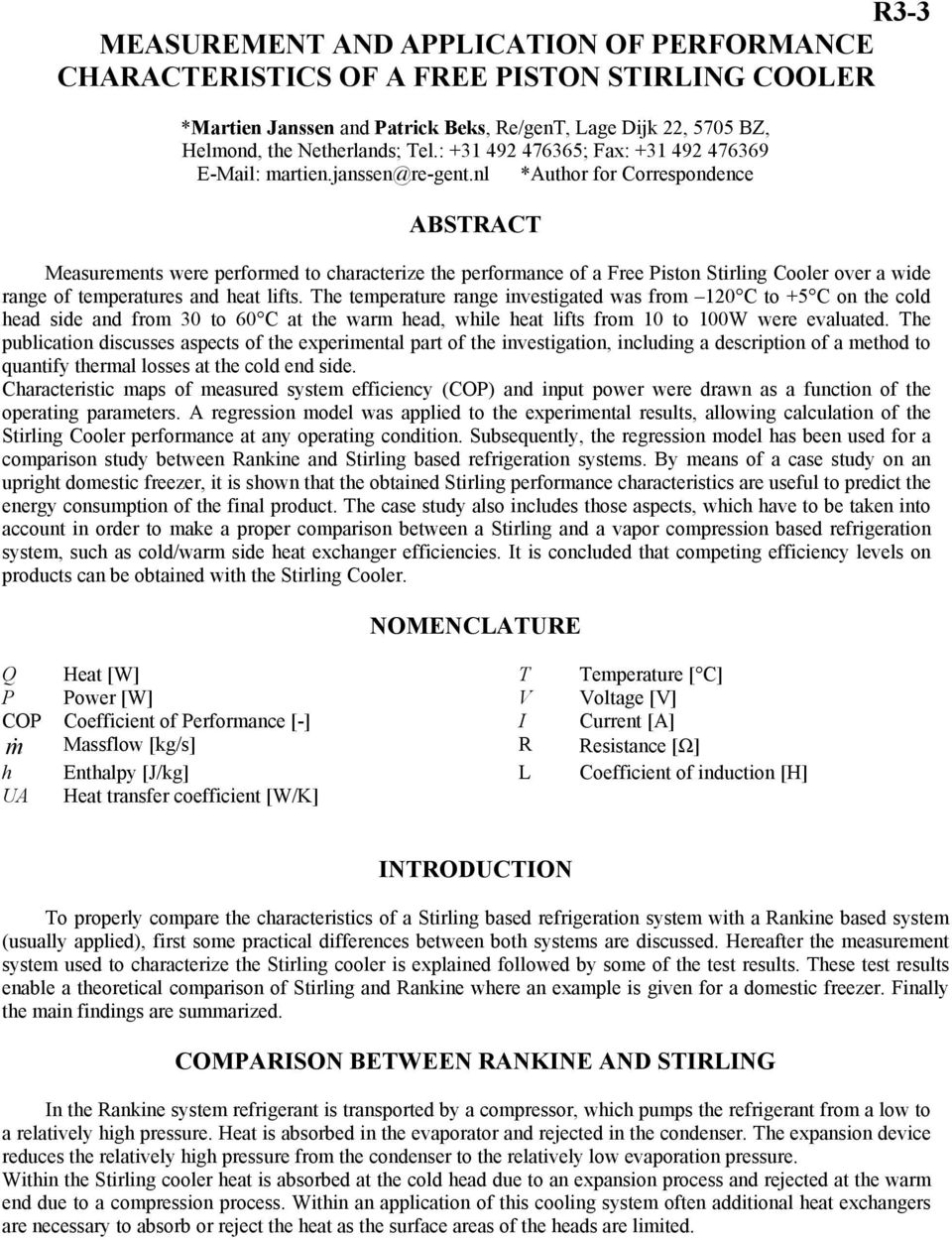
3 For the compressor applied in a Rankine system the efficiency of the compressor is typically expressed by its coefficient of performance, which is calculated according to the following formula: Qcool (1) COP rankine = Pinput The COP of the compressor corresponds with the performance of the compressor at a specific operating point i.e. a specific condensation and evaporation temperature. Globally, different standards apply, e.g. ASHRAE and CECOMAF. These standards only represent the COP at exactly prescribed conditions. In the practical Rankine cycle the COP can be completely different. Therefore, the COP from the catalogue data cannot directly be related to the practical cooling system. For comparison with the Stirling COP it is recommended to calculate the actual cooling capacity on a Rankine system with the following formula (for stationary conditions): () Q = m& h h ) cool ( evaporator exit evaporator inlet It needs mentioning that the massflow of the compressor can be derived from catalogue data for a certain condition (evaporation, condensation temperature). However, the enthalpy values, representing the inlet and exit conditions of the evaporator), are different for each application. For the Stirling cycle the efficiency of the cooler is also expressed with its COP. This COP is calculated according to the following formula: Q (3) COP Stirling = Pinput The COP of the Stirling cooler depends on the cold head temperature, warm head temperature and heat lift. In principle, one can compare the COP of the Rankine compressor with the COP of the Stirling cycle applying formula and 3. However, one should take into account that generally Rankine refrigeration systems are controlled with a thermostat. This thermostat switches the compressor on or off, which differs from the free piston Stirling cooler, which operates in a continuously running mode. The on/off behavior in the Rankine system results in extra losses caused by the following effects: Thermodynamic losses; the average condensation temperature is higher and the average evaporation temperature is lower with respect to a continuously running compressor with adjusted capacity. Start/Stop losses; at the moment the compressor switches off, vapor from the condenser enters the evaporator. This vapor condenses in the evaporator yielding an extra heat load into the appliance. At the start of the compressor the current of the compressor is relatively high with respect to a continuously running compressor. It needs mentioning that for variable speed compressors these losses are avoided. However, in some cases also these kind of compressors have to operate in an on/off mode, when low cooling capacities are demanded. For the Stirling cooler the amount of heat from the cold and warm head has to be transported through adequate heat exchangers. This transport yields the following losses: Temperature losses at the cold and warm heads caused by the extra heat exchangers. In case of secondary fluids temperature losses of the fluids exist, while for a fin construction with a large surface, the fin efficiency will be lower than unity. Pump losses if secondary fluids are used. It has to be noted that generally the complete construction of a refrigeration system changes, if a Stirling cooler is used instead of a normal Rankine compressor. This makes comparison of both cooling systems not a straightforward task. THE MEASUREMENT SYSTEM With respect to the measurements of the Stirling cooler the following details are mentioned (See figure 1). The Stirling motor evaluated was of the type M100B, serial number 11. The maximum voltage supply of the cooler was 1V (AC), at a frequency of 60 Hz. The Stirling cooler was supplied without a (feed back) control unit (for normal use this unit is implemented). The warm head of the motor was cooled with water of a controlled temperature, supplied by a pump. An electrical heating element was placed on the cold head. The heater was operated by means of a DC Voltage supply allowing to set different heat lifts.

4 In order to minimize the heat flow from the ambient to the cold head, the cold head was insulated with Armaflex material. The Stirling cooler was put in a climate chamber. Measurements were taken at 5 C ambient temperature. Data from the tests was taken after a stable operating period of at least 0.5 hours. Water exit Thermocouple soldered on the warm head Motor supply Insulation Armaflex Electrical heater Cold head regenerator Water cooling Warm head Motor shell M100B, serial number 11 Water inlet spring Heat lift supply Thermocouple mounted with Aluminium tape Figure 1; The Stirling cooler MEASUREMENT PROCEDURE Before the actual tests were started, the quality of the insulation material (Armaflex) around the cold head and regenerator was measured (See figure ). 4 thermocouples to determine the insulation surface temperature Insulation Armaflex Electrical heater Cold head regenerator Aluminium tape shield with heater Heat lift supply Thermocouple mounted with Aluminium tape Figure ; Cold head insulation covered with Aluminium tape The insulation was covered with an aluminium shield. Through this shield an electrical heater was lead, which was only used to determine the insulation quality. On the aluminium shield 4 thermocouples were mounted. With these thermocouples the representative insulation surface temperature can be calculated. To obtain the heat transfer coefficient of the insulation, two measurements were performed at the same cold and warm head temperature: Test 1: Without using the heating wire on top of the insulation a heat supply Q DC heater1 was applied. This test yielded an insulation surface temperature T 1. For this test the following equation is valid: (4) Q 1 = Q DC heater1 + UA insulation ( T 1 T cold head ) Test : Using the heating wire and applying a heat Q DC heater such that T cold head is the same as in test 1. This test yielded an insulation surface temperature T. For this test the following equation is valid:
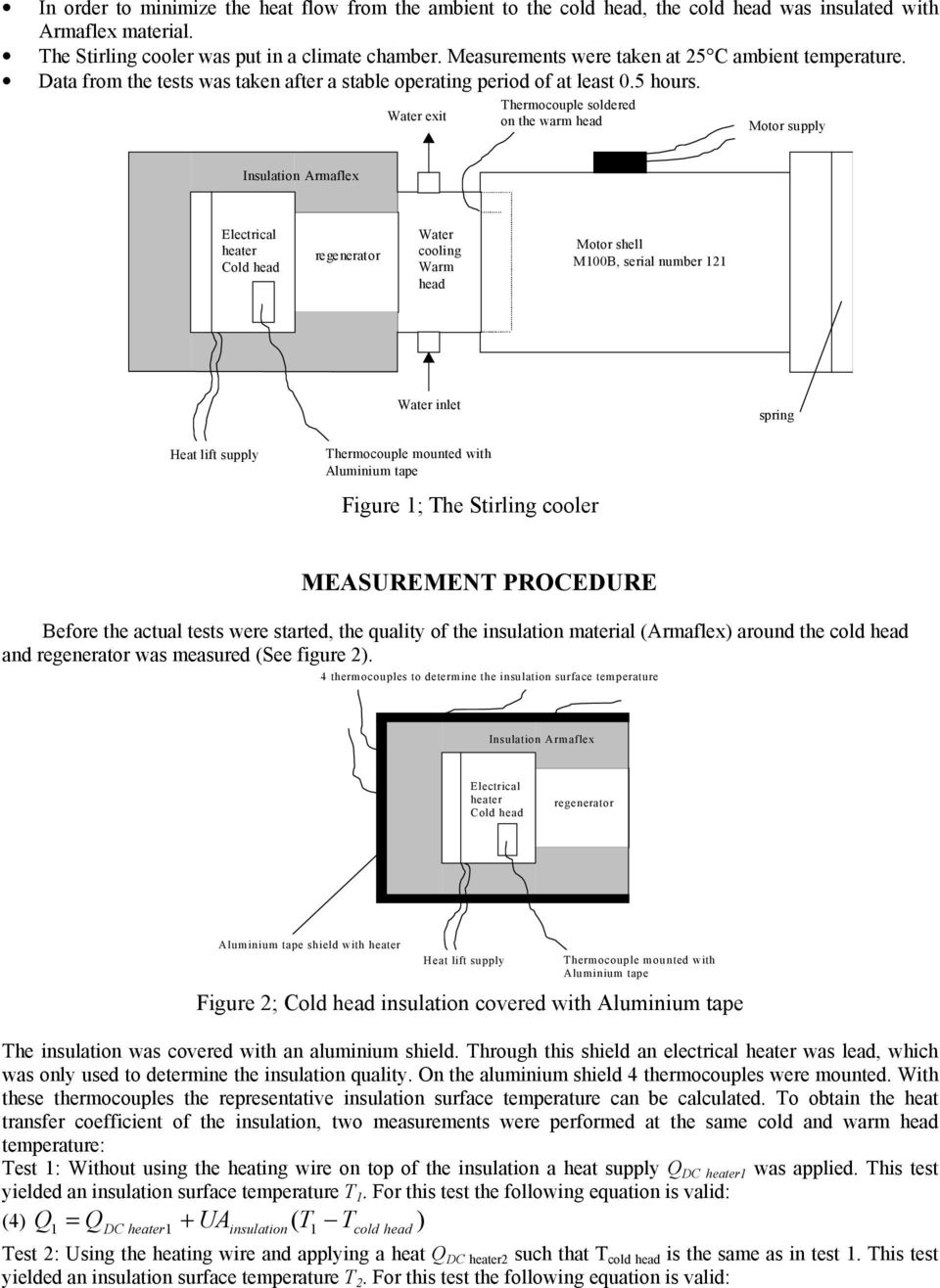
5 (5) Q = Q DC heater + UA insulation ( T T cold head ) Since the same cold head temperature (as well as the same warm head temperature and AC cooler supply) was applied in both tests, Q is equal to Q 1. Now the heat transfer coefficient of the insulation can be calculated according the following formula: QDCheater 1 QDCheater (6) UAinsulation = T T1 The total heat lift measured can be calculated with the following formula: (7) Q = Q + UA ( T T ) heat lift resis tan ce insulation outside insulation Tests were performed at the conditions described in table 1. cold head Condition Normal tests Low temperature tests Warm head temperature [ C] Cold head temperature [ C] Between 60 and +5 Between -10 and -60 Nominal heat lift [W] Ambient temperature [ C] 5 5 Cooler position Horizontal Horizontal Table 1; Test conditions TEST RESULTS For each test point the motor efficiency of the cooler can be calculated according to the following formula: Pinput Ploss Vrms ( ωl) (8) η = in which: Ploss = + I rms Rdc and Rs = P R ( R R ) input s The heat transfer coefficient of the insulation around the cold head and the regenerator is 0.05 W/K (based on the cold head temperature and the outer insulation surface temperature). This coefficient is measured with an accuracy of +/ W/K. In order to predict the performance of the Stirling cooler a regression model was applied on the test results. The following regression function, which calculates the input power of the cooler, was used: P = a T + a T + a T + a T + a T + a T + a Q + a Q + a Q + a ( T T ) Q (9) input 0 c 1 c c 3 w 4 w 5 + a10 ( Tw Tc ) Q + a11( Tw Tc ) Q + a1 Note that the heat lift is an input parameter of this equation. With this equation and optimized coefficients an average error (with respect to the measured points) on the input power of.3% is found between 60 and +10 C cold head temperature. With equation 3, one can obtain the COP of the Stirling cooler now. In the following table the performance of the Stirling cooler is given for two standard operating points. Cold head temperature [ C] 0 0 Warm head temperature [ C] Heat lift [W] COP [-].7.90 Table ; Performance at standard operation points In figure 3 the COP values measured are drawn combined with the regression lines. The lines of 100W heat lift do not cover the complete cold head temperature field because of cooler restrictions. Namely, at 30 C warm head temperature the maximum input voltage (1V) is reached at approx. -5 C cold head temperature. w 6 7 ac dc 8 9 w c

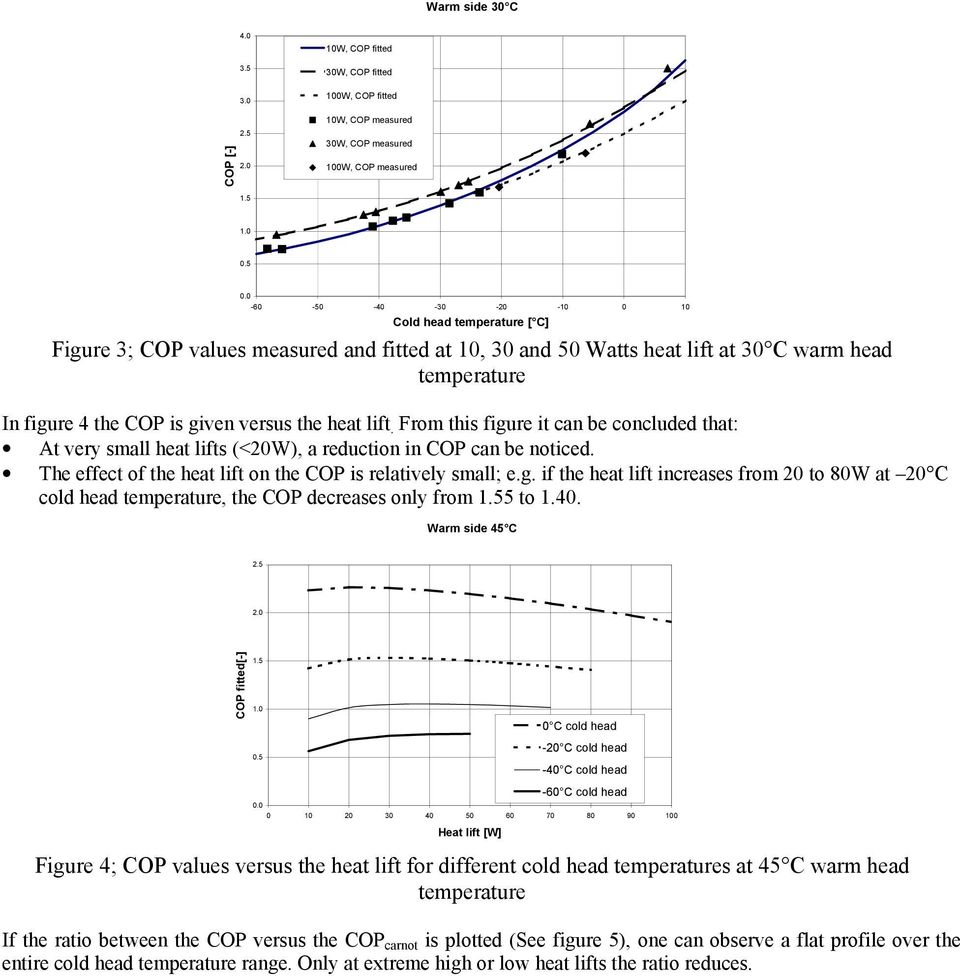
6 Warm side 30 C W, COP fitted 30W, COP fitted W, COP fitted 10W, COP measured COP [-] W, COP measured 100W, COP measured Cold head temperature [ C] Figure 3; COP values measured and fitted at 10, 30 and 50 Watts heat lift at 30 C warm head temperature In figure 4 the COP is given versus the heat lift. From this figure it can be concluded that: At very small heat lifts (<0W), a reduction in COP can be noticed. The effect of the heat lift on the COP is relatively small; e.g. if the heat lift increases from 0 to 80W at 0 C cold head temperature, the COP decreases only from 1.55 to Warm side 45 C.5.0 COP fitted[-] C cold head -0 C cold head -40 C cold head Heat lift [W] -60 C cold head Figure 4; COP values versus the heat lift for different cold head temperatures at 45 C warm head temperature If the ratio between the COP versus the COP carnot is plotted (See figure 5), one can observe a flat profile over the entire cold head temperature range. Only at extreme high or low heat lifts the ratio reduces.
7 warm head 45 C 0.50 COPfitted / COPcarnot [-] W, heat lift 30W heat lift 50W heat lift 100W heat lift Cold head temperature [ C] Figure 5; COP divided by COP carnot versus cold head temperature In figure 6 the motor efficiency is given versus the input power of the cooler a various cold and warm head temperatures. Generally efficiencies between 0.80 and 0.85 are calculated for the specific cooler Motor efficiency [%] Input power [W] Figure 6; Motor efficiency versus the input power With the same cooler also very low temperatures can be achieved as can be seen in figure 7. At 40 W heat lift a temperature of 9 C can be obtained at a COP value of 0.44, while at 0W heat lift this temperature can be 115 C. For this condition the COP of the cooler drops to 0.0. COP, 30 C warm side temperature W 0.8 COP [-] W Cold head temperature [ C] Figure 7: Low temperature runs
![a various cold and warm head temperatures. Generally efficiencies between 0.80 and 0.85 are calculated for the specific cooler. 1.00 0.95 0.90 Motor efficiency [%] 0.85 0.80 0.75 0.70 0.65 0.60 0.](/docs-images/46/21626506/images/page_7.jpg "55 0.50 0 10 0 30 40 50 60 70 80 Input power [W] Figure 6; Motor efficiency versus the input power With the same cooler also very low temperatures can be achieved as can be seen in figure 7.")
8 CALCULATION OF THE ENERGY CONSUMPTION In this chapter an example is given how to determine theoretically the efficiency of a Stirling based system using the experimentally obtained data map. Suppose a domestic upright freezer (360 Litres) with a heat load factor of the insulation of 1.30 W/K and an average freezer temperature of 0 C. The maximum ambient temperature for this product is 43 C (tropical category). For the Rankine system the following specifications are assumed: Compressor to be applied: Variable speed compressor, which has a cooling capacity of 187 W and a COP of 1.69 at 300 RPM at ASHRAE conditions. Note that this compressor has an efficiency, which is very high compared to average compressors applied in domestic appliances. The cooling capacity increase due to the capillary suction tube heat exchanger is 15%. The condensation takes place in the complete condenser (no superheating and subcooling). The evaporation takes place in the complete evaporator (no superheating). The refrigerant applied is R600a (isobutane). For the Stirling system the following specifications are assumed: The Stirling cooler to be applied is the M100B cooler. The energy consumption of the electronic control is not taken into account. To evaluate the difference between both systems the electrical energy consumption of each system is calculated at various ambient temperatures. For the Rankine process it is assumed that the evaporator thermal conductance is 7 W/K and for the condenser 10 W/K. Based on the heat load of the appliance, the evaporation and condensation temperatures can be calculated (using a simple linear model). From a compressor map the operating speed is determined, which matches the desired heat load. The required compressor input power is obtained from the same compressor map. The result is shown in figure 8 over the ambient temperatures Rankine Stirling, HE = 0% Input power [W] Stirling, HE = 0% Stirling, HE = 40% Ambient [ C] Figure 8: Estimated input power of the Rankine system with a high efficient variable speed compressor and the Stirling system (with the same heat exchanger conductance as for the Rankine, 0% lower and 40% lower respectively) The variable speed compressor can not be operated under a certain minimum speed (due to minimum lubrication levels). In this example the compressor had to be operated in on/off mode an ambient temperature of 8 C or lower. For these conditions it is assumed that the compressor operates at the minimum speed here. During this mode the temperature differences at the condenser/evaporator are increased proportionally with the running time percentage. Note that at 43 C ambient temperature the compressor is running at a speed of 3850 RPM, which is near its maximum of 4000 RPM. This indicates that the variable speed compressor is properly selected for a tropical climate class appliance. For the Stirling based system, a similar procedure is applied where instead of the compressor map, the Stirling performance map described earlier is applied. There is no minimum capacity to the Stirling system so it also

9 operates in continuous mode at low ambient temperature. For the thermal conductances it is assumed that these are equal, 0 % and 40 %, respectively lower than those of the Rankine based system. The thermal conductance on both the warm and cold side of the Stirling based system, is likely to be lower than those for the Rankine since an additional heat transfer mechanism (e.g. secondary fluids) may be required. It can be seen that at the same conductance the Stirling system has an equal or lower energy consumption than the Rankine based system over the ambient temperature range. Obviously at reduced conductances the energy consumption of the Stirling based system increases. It is of interest to see that the Stirling performs relatively better at the high ambient temperatures. This is due to the fact that the process outperforms the Rankine process at large temperature lifts. Also at low ambient temperatures the Stirling performs relatively better. This is due to the linear motor concept allowing the possibility to operate at very low capacities, whereas the variable speed reciprocating compressor obtains a reduced efficiency due to friction losses and due to the fact that on/off cycling is required here. CONCLUSIONS By means of a characteristic map of the performance of a Stirling cooler, a comparison with the Rankine system can be made. To obtain such a map experimental tests on the Stirling cooler were performed in combination with a regression analysis. From these tests it is concluded that: At very small heat lifts a relatively small reduction in COP is noticed. Motor efficiencies between 0.80 and 0.85 were found for the cooler. At cold head temperatures of -9 C, COP values of 0.44 can still be obtained with a heat lift of 40 W. A comparison between a Stirling system and a Rankine system is not a straightforward task. Heat exchangers efficiency differences between both systems have to be taken into account to determine the actual temperature of the cold en warm head of the Stirling cooler or the evaporation and condensation temperatures of the Rankine system. In addition on/off losses of the Rankine sytems deteriorates this system substantially. A comparison was made between a high efficient variable speed compresser and the Stirling cooler evaluated on a domestic freezer. It was concluded that at high ambient temperatures the performance of the Stirling cooler can be better at high heat lifts. Also a low ambients the Stirling can perform better. This is due to the linear motor concept allowing the possibility to operate at very low capacities, whereas the variable speed reciprocating compressor obtains a reduced efficiency due to friction losses and due to the fact that cycling is required for the Rankine system. ACKNOWLEDGEMENTS The authors are grateful to Global Cooling, Ohio, USA, for their support of and approval for this publication. REFERENCES /1/ REFPROP 6.0 : Refrigerant property data, NIST, 000.

Research on the Air Conditioning Water Heater System
 Purdue University Purdue e-pubs International Refrigeration and Air Conditioning Conference School of Mechanical Engineering 28 Research on the Air Conditioning Water Heater System Fei Liu Gree Electric
UNIT 2 REFRIGERATION CYCLE
 UNIT 2 REFRIGERATION CYCLE Refrigeration Cycle Structure 2. Introduction Objectives 2.2 Vapour Compression Cycle 2.2. Simple Vapour Compression Refrigeration Cycle 2.2.2 Theoretical Vapour Compression
A Comparison of an R22 and an R410A Air Conditioner Operating at High Ambient Temperatures
 R2-1 A Comparison of an R22 and an R410A Air Conditioner Operating at High Ambient Temperatures W. Vance Payne and Piotr A. Domanski National Institute of Standards and Technology Building Environment
Experimental Analysis of a Variable Capacity Heat Pump System Focusing on the Compressor and Inverter Loss Behavior
 Purdue University Purdue e-pubs International Refrigeration and Air Conditioning Conference School of Mechanical Engineering 21 Experimental Analysis of a Variable Capacity Heat Pump System Focusing on
Refrigerant Charge and Ambient Temperature Effects on the Refrigeration Cycle of a Small Capacity Food Freezer
 Purdue University Purdue e-pubs International Refrigeration and Air Conditioning Conference School of Mechanical Engineering 24 Refrigerant Charge and Ambient Temperature Effects on the Refrigeration Cycle
Refrigeration and Airconditioning Prof. M. Ramgopal Department of Mechanical Engineering Indian Institute of Technology, Kharagpur
 Refrigeration and Airconditioning Prof. M. Ramgopal Department of Mechanical Engineering Indian Institute of Technology, Kharagpur Lecture No. # 22 Refrigeration System Components: Compressor (Continued)
Mohan Chandrasekharan #1
 International Journal of Students Research in Technology & Management Exergy Analysis of Vapor Compression Refrigeration System Using R12 and R134a as Refrigerants Mohan Chandrasekharan #1 # Department
Low GWP Replacements for R404A in Commercial Refrigeration Applications
 Low GWP Replacements for R404A in Commercial Refrigeration Applications Samuel YANA MOTTA, Mark SPATZ Honeywell International, 20 Peabody Street, Buffalo, NY 14210, [email protected] Abstract
Variable Capacity Compressors, a new dimension for refrigeration engineers to explore
 Variable Capacity Compressors, a new dimension for refrigeration engineers to explore By: Marcos G. Schwarz, VCC Group Leader Corporate Research & Development, EMBRACO SA Abstract: This paper presents
Experimental Analysis of an Automotive Air Conditioning System With Two-Phase Flow Measurements
 Purdue University Purdue e-pubs International Refrigeration and Air Conditioning Conference School of Mechanical Engineering Experimental Analysis of an Automotive Air Conditioning System With Two-Phase
How To Know If A Refrigeration System Is Efficient
 Universitatea de Ştiinţe Agricole şi Medicină Veterinară Iaşi ASSESSMENT OF E SUBCOOLING CAPABILITIES OF A ERMOELECTRIC DEVICE IN A VAPOR COMPRESSION REFRIGERATION SYSTEM R. ROŞCA 1, I. ŢENU 1, P. CÂRLESCU
Scroll Compressor Development for Air-Source Heat Pump Water Heater Applications
 Purdue University Purdue e-pubs International Refrigeration and Air Conditioning Conference School of Mechanical Engineering 2008 Scroll Compressor Development for Air-Source Heat Pump Water Heater Applications
Aspects of Household Cooling Technology
 Purdue University Purdue e-pubs International Refrigeration and Air Conditioning Conference School of Mechanical Engineering 2014 Aspects of Household Cooling Technology Matthias Mrzyglod BSH Bosch und
Testing methods applicable to refrigeration components and systems
 Testing methods applicable to refrigeration components and systems Sylvain Quoilin (1)*, Cristian Cuevas (2), Vladut Teodorese (1), Vincent Lemort (1), Jules Hannay (1) and Jean Lebrun (1) (1) University
Theoretical Study on Separate Sensible and Latent Cooling Air-Conditioning System
 Purdue University Purdue e-pubs International Refrigeration and Air Conditioning Conference School of Mechanical Engineering 2008 Theoretical Study on Separate Sensible and Latent Cooling Air-Conditioning
Impacts of Refrigerant Charge on Air Conditioner and Heat Pump Performance
 Purdue University Purdue e-pubs International Refrigeration and Air Conditioning Conference School of Mechanical Engineering 2010 Impacts of Refrigerant Charge on Air Conditioner and Heat Pump Performance
Experimental Evaluation Of The Frost Formation
 Purdue University Purdue e-pubs International Refrigeration and Air Conditioning Conference School of Mechanical Engineering 2014 Experimental Evaluation Of The Frost Formation Yusuke Tashiro Mitsubishi
A Stirling-Rankine Fuel-Fired Heat Pump
 Purdue University Purdue e-pubs International Compressor Engineering Conference School of Mechanical Engineering 2000 A Stirling-Rankine Fuel-Fired Heat Pump J. G. Wood Sunpower R. Unger Sunpower N. W.
Lesson. 11 Vapour Compression Refrigeration Systems: Performance Aspects And Cycle Modifications. Version 1 ME, IIT Kharagpur 1
 Lesson Vapour Compression Refrigeration Systems: Performance Aspects And Cycle Modifications Version ME, IIT Kharagpur The objectives of this lecture are to discuss. Performance aspects of SSS cycle and
New Trends in the Field of Automobile Air Conditioning
 New Trends in the Field of Automobile Air Conditioning E. Janotkova and M. Pavelek Department of Thermomechanics and Environmental Engineering Brno University of Technology, 61669 Brno, Czech Republic
Characteristics of Evaporators
 Characteristics of Evaporators Roger D. Holder, CM, MSME 10-28-2003 Heat or Energy In this paper, we will discuss the characteristics of an evaporator coil. The variance of the operational condenses of
Split units TH with hermetic compressors
 Split units TH with compressors Refrigeration units in split variant. Available with screw or solder terminal. Condensing unit with sound insulated weatherproof housing for outdoor installation. Split
The Second Law of Thermodynamics
 The Second aw of Thermodynamics The second law of thermodynamics asserts that processes occur in a certain direction and that the energy has quality as well as quantity. The first law places no restriction
Increasing the evaporation temperature with the help of an internal heat exchanger
 Increasing the evaporation temperature with the help of an internal heat exchanger A. TAMBOVTSEV (a), H. QUACK (b) (a,b) Technische Universität Dresden, D-01062, Dresden, Germany (a) Fax: (+49351) 463-37247,
THEORETICAL AND EXPERIMENTAL EVALUATION OF AUTOMOBILE AIR-CONDITIONING SYSTEM USING R134A
 THEORETICAL AND EXPERIMENTAL EVALUATION OF AUTOMOBILE AIR-CONDITIONING SYSTEM USING R134A Jignesh K. Vaghela Assistant Professor, Mechanical Engineering Department, SVMIT, Bharuch-392001, (India) ABSTRACT
High Pressure Ammonia Systems New Opportunities
 Purdue University Purdue e-pubs International Refrigeration and Air Conditioning Conference School of Mechanical Engineering 2010 High Pressure Ammonia Systems New Opportunities Andy Pearson Star Refrigeration
Why and How we Use Capacity Control
 Why and How we Use Capacity Control On refrigeration and air conditioning applications where the load may vary over a wide range, due to lighting, occupancy, product loading, ambient weather variations,
Troubleshooting HVAC/R systems using refrigerant superheat and subcooling
 Troubleshooting HVAC/R systems using refrigerant superheat and subcooling Application Note Troubleshooting and servicing refrigeration and air conditioning systems can be a challenging process for both
SECTION 5 COMMERCIAL REFRIGERATION UNIT 22 CONDENSERS
 SECTION 5 COMMERCIAL REFRIGERATION UNIT 22 CONDENSERS UNIT OBJECTIVES After studying this unit, the reader should be able to explain the purpose of the condenser in a refrigeration system. describe differences
We will try to get familiar with a heat pump, and try to determine its performance coefficient under different circumstances.
 C4. Heat Pump I. OBJECTIVE OF THE EXPERIMENT We will try to get familiar with a heat pump, and try to determine its performance coefficient under different circumstances. II. INTRODUCTION II.1. Thermodynamic
The Second Law of Thermodynamics
 Objectives MAE 320 - Chapter 6 The Second Law of Thermodynamics The content and the pictures are from the text book: Çengel, Y. A. and Boles, M. A., Thermodynamics: An Engineering Approach, McGraw-Hill,
HIGH-EFFICIENCY CO 2 HEAT PUMP WATER HEATER SYSTEMS FOR RESIDENTIAL AND NON-RESIDENTIAL BUILDINGS
 1 HIGH-EFFICIENCY CO 2 HEAT PUMP WATER HEATER SYSTEMS FOR RESIDENTIAL AND NON-RESIDENTIAL BUILDINGS Jørn Stene SINTEF Energy Research, 7465 Trondheim, Norway [email protected] In hotels, hospitals,
2004 Standard For Performance Rating Of Positive Displacement Refrigerant Compressors And Compressor Units
 2004 Standard For Performance Rating Of Positive Displacement Refrigerant Compressors And Compressor Units ANSI/AHRI Standard 540 (formerly ARI Standard 540) IMPORTANT SAFETY RECOMMENDATIONS ARI does not
Commercial refrigeration has been in the environmental. Refrigerant. as a. Basics Considerations PART 1:
 PART 1: CO 2 Commercial refrigeration has been in the environmental spotlight for more than a decade, especially as leakage studies have revealed the true effects of hydrofluorocarbon (HFC) emissions.
Design of a Heat Pump Assisted Solar Thermal System
 Purdue University Purdue e-pubs International High Performance Buildings Conference School of Mechanical Engineering 2014 Design of a Heat Pump Assisted Solar Thermal System Kyle G. Krockenberger Purdue
Solenoid valves Type EVU
 Data sheet Solenoid valves EVU EVU solenoid valves are designed to fit into compact refrigeration systems. Available in direct and pilot operated versions, they can be applied in liquid, suction, and hot
Chapter 3.4: HVAC & Refrigeration System
 Chapter 3.4: HVAC & Refrigeration System Part I: Objective type questions and answers 1. One ton of refrigeration (TR) is equal to. a) Kcal/h b) 3.51 kw c) 120oo BTU/h d) all 2. The driving force for refrigeration
How Ground/Water Source Heat Pumps Work
 How Ground/Water Source s Work Steve Kavanaugh, Professor Emeritus of Mechanical Engineering, University of Alabama Ground Source s (a.k.a. Geothermal s) are becoming more common as the costs of energy
POSSIBILITY FOR MECHANICAL VAPOR RE-COMPRESSRION FOR STEAM BASED DRYING PROCESSES
 POSSIBILITY FOR MECHANICAL VAPOR RE-COMPRESSRION FOR STEAM BASED DRYING PROCESSES M. Bantle 1, I. Tolstorebrov, T. M. Eikevik 2 1 Department of Energy Efficiency, SINTEF Energy Research, Trondheim, Norway,
Heat Recovery In Retail Refrigeration
 This article was published in ASHRAE Journal, February 2010. Copyright 2010 American Society of Heating, Refrigerating and Air-Conditioning Engineers, Inc. Posted at www.ashrae.org. This article may not
Thermodynamics - Example Problems Problems and Solutions
 Thermodynamics - Example Problems Problems and Solutions 1 Examining a Power Plant Consider a power plant. At point 1 the working gas has a temperature of T = 25 C. The pressure is 1bar and the mass flow
Silicagel-water adsorption cooling prototype system for mobile air conditioning
 Silicagel-water adsorption cooling prototype system for mobile air conditioning R. de Boer S.F. Smeding S. Mola Paper to be presented at the Heat Powered Cycles Conference 09 Berlin, 7 to 9 September 2009
Environmental and Safety Impacts of HFC Emission Reduction Options for Air Conditioning and Heat Pump Systems
 Environmental and Safety Impacts of HFC Emission Reduction Options for Air Conditioning and Heat Pump Systems William M. Corcoran, George Rusch, Mark W. Spatz, and Tim Vink AlliedSignal, Inc. ABSTRACT
CHAPTER 7 THE SECOND LAW OF THERMODYNAMICS. Blank
 CHAPTER 7 THE SECOND LAW OF THERMODYNAMICS Blank SONNTAG/BORGNAKKE STUDY PROBLEM 7-1 7.1 A car engine and its fuel consumption A car engine produces 136 hp on the output shaft with a thermal efficiency
HVAC Efficiency Definitions
 HVAC Efficiency Definitions Term page EER - 2 SEER - 3 COP - 4 HSPF - 5 IPLV - 6 John Mix May 2006 Carrier Corporation 1 Energy Efficiency Ratio (EER) The energy efficiency ratio is used to evaluate the
TEST REPORT #31. System Drop-in Test of Refrigerant R-32 in Split Air-conditioning System
 Air-Conditioning, Heating, and Refrigeration Institute (AHRI) Low-GWP Alternative Refrigerants Evaluation Program (Low-GWP AREP) TEST REPORT #31 System Drop-in Test of Refrigerant R-32 in Split Air-conditioning
P. A. Hilton Ltd REFRIGERATION & AIR CONDITIONING VAPOUR COMPRESSION HEAT PUMPS VENTILATION VOCATIONAL
 REFRIGERATION & AIR CONDITIONING Refrigeration and air conditioning is an aspect of modern life that is accepted almost without thought. Food storage, the long distance transport of foodstuffs, stockpiling
Optimal operation of an Ammonia refrigeration cycle
 Optimal operation of an Ammonia refrigeration cycle Jørgen Bauck Jensen & Sigurd Skogestad October 6, 2005 1 PSfrag replacements 1 Introduction Cyclic processes for heating and cooling are widely used
How does solar air conditioning work?
 How does solar air conditioning work? In a conventional air conditioning system; The working fluid arrives at the compressor as a cool, low-pressure gas. The compressor is powered by electricity to squeeze
HERMETIC ENGINE DRIVEN COMPRESSOR USING R-744 AS REFRIGERANT AND NATURAL GAS AS FUEL
 HERMETIC ENGINE DRIVEN COMPRESSOR USING R-744 AS REFRIGERANT AND NATURAL GAS AS FUEL Marcel van Beek (a), Martien Janssen (a) and David Berchowitz (b) (a) Re/genT BV Helmond, NL 5705 BZ 22, The Netherlands,
Thermal Coupling Of Cooling and Heating Systems
 This article was published in ASHRAE Journal, February 2011. Copyright 2011 American Society of Heating, Refrigerating and Air-Conditioning Engineers, Inc. Posted at www.ashrae.org. This article may not
Combination Ductless Heat Pump & Heat Pump Water Heater Lab and Field Tests
 August 26, 2015 REPORT #E15-294 Combination Ductless Heat Pump & Heat Pump Water Heater Lab and Field Tests Prepared by: Energy 350 107 SE Washington St., Suite 145 Portland, OR 97214 Northwest Energy
ECOCIAT. Domestic hot water heat recovery unit
 Heat recovery unit Domestic hot water High energy efficiency with R410A Compact and quiet Scroll compressors Brazed-plate heat exchangers Heating Heat recovery ENVIRONMENTALLY HFC R410A PROTECTION DE FRIENDLY
PERFORMANCE ANALYSIS OF VAPOUR COMPRESSION REFRIGERATION SYSTEM WITH R404A, R407C AND R410A
 Int. J. Mech. Eng. & Rob. Res. 213 Jyoti Soni and R C Gupta, 213 Research Paper ISSN 2278 149 www.ijmerr.com Vol. 2, No. 1, January 213 213 IJMERR. All Rights Reserved PERFORMANCE ANALYSIS OF VAPOUR COMPRESSION
How To Calculate The Performance Of A Refrigerator And Heat Pump
 THERMODYNAMICS TUTORIAL 5 HEAT PUMPS AND REFRIGERATION On completion of this tutorial you should be able to do the following. Discuss the merits of different refrigerants. Use thermodynamic tables for
How To Design A Refrigeration System
 AIRAH Refrigeration (in HVAC) Back to Basics For the First Time Terms of Reference What this session is NOT about Detailed Refrigeration Design Detailed analysis of various Refrigants properties Comparison
AIR CONDITION & REFRIGERATION INSTALLATION & REPAIR
 AIR CONDITION & REFRIGERATION INSTALLATION & REPAIR SERVICE CAPACITY (Value) : Rs. 15,40,000/- MONTH AND YEAR : July, 2014 OF PREPARATION PREPARED BY : Sh. Sunil Arora Investigator (Mechanical) 1. INTRODUCTION
PG Student (Heat Power Engg.), Mechanical Engineering Department Jabalpur Engineering College, India. Jabalpur Engineering College, India.
 International Journal of Emerging Trends in Engineering and Development Issue 3, Vol. (January 23) EFFECT OF SUB COOLING AND SUPERHEATING ON VAPOUR COMPRESSION REFRIGERATION SYSTEMS USING 22 ALTERNATIVE
FEASIBILITY OF A BRAYTON CYCLE AUTOMOTIVE AIR CONDITIONING SYSTEM
 FEASIBILITY OF A BRAYTON CYCLE AUTOMOTIVE AIR CONDITIONING SYSTEM L. H. M. Beatrice a, and F. A. S. Fiorelli a a Universidade de São Paulo Escola Politécnica Departamento de Engenharia Mecânica Av. Prof.
A/C refrigerant system, overview
 Page 1 of 19 87-18 A/C refrigerant system, overview A/C refrigerant system, identification Typical A/C refrigerant system with expansion valve and receiver drier 1 - Evaporator 2 - Expansion valve 3 -
SWIMMING POOL AIR-HANDLING UNITS KU-DB Series
 SWIMMING POOL AIR-HANDLING UNITS KU-DB Series ME20 proklima 2 SWIMMING POOL AIR-HANDLING UNITS - KU-DB Series proklima 3 TABLE OF CONTENTS 1 Introduction page 3 2 Features page 4 SWIMMING POOL AREA t =
Analytical Study on the Performance Characteristics of a Liquid Injection Refrigeration Cycle.
 urdue University urdue e-ubs International Refrigeration and Air Conditioning Conference School of Mechanical Engineering 2014 Analytical Study on the erformance Characteristics of a Liquid Injection Refrigeration
Distributed Solar-Thermal-Electric Generation and Storage Seth R. Sanders, Artin Der Minassians, Mike He EECS Department, UC Berkeley
 Distributed Solar-Thermal-Electric Generation and Storage Seth R. Sanders, Artin Der Minassians, Mike He EECS Department, UC Berkeley Technology: rooftop solar thermal collector + thermal energy storage
Purpose of Refrigeration
 Refrigeration Outline Purpose of refrigeration Examples and applications Choice of coolant and refrigerants Phase diagram of water and CO 2 Vapor compression refrigeration system Pressure enthalpy diagram
COMMERCIAL HVAC EQUIPMENT. Condensers and Cooling Towers
 COMMERCIAL HVAC EQUIPMENT Condensers and Cooling Towers Technical Development Programs (TDP) are modules of technical training on HVAC theory, system design, equipment selection and application topics.
جامعة البلقاء التطبيقية
 AlBalqa Applied University تا سست عام 997 The curriculum of associate degree in Air Conditioning, Refrigeration and Heating Systems consists of (7 credit hours) as follows: Serial No. Requirements First
ROOFTOP - HEAT PUMP UNIT. This document applies when installing into an air handler or as part of an air handling system.
 ROOFTOP - HEAT PUMP UNIT Technical data Applies to Model YNRA R410A This document applies when installing into an air handler or as part of an air handling system. CONTENTS 1. General description... 2
FUNDAMENTALS OF ENGINEERING THERMODYNAMICS
 FUNDAMENTALS OF ENGINEERING THERMODYNAMICS System: Quantity of matter (constant mass) or region in space (constant volume) chosen for study. Closed system: Can exchange energy but not mass; mass is constant
COMMERCIAL HVAC CHILLER EQUIPMENT. Air-Cooled Chillers
 COMMERCIAL HVAC CHILLER EQUIPMENT Air-Cooled Chillers Technical Development Programs (TDP) are modules of technical training on HVAC theory, system design, equipment selection and application topics. They
Any Service Technician Can Fix It A Good Service Technician Can Figure Out What s Wrong With It.
 I Dave s Statement If the thermostat calls for cooling, and the furnace fan is running properly, and the coil airflow is adequate, and the condenser fan is running properly, and the condenser airflow is
Development and testing of a multi-type air conditioner without using AC inverters
 Energy Conversion and Management 46 (2005) 373 383 www.elsevier.com/locate/enconman Development and testing of a multi-type air conditioner without using AC inverters Shih-Cheng Hu *, Rong-Hwa Yang Department
Performance Evaluation of a Heat Pump System for Simultaneous Heating and Cooling
 for Simultaneous Heating and Cooling F. Sustainable Energy Centre, University of South Australia Mawson Lakes Boulevard, Mawson Lakes 5095 AUSTRALIA E-mail: [email protected] Abstract The high efficiency
Heat and Mass Transfer Calculation of the Intercooler With Spraying Water for Air Compressor
 Purdue University Purdue e-pubs International Compressor Engineering Conference School of Mechanical Engineering 1996 Heat and Mass Transfer Calculation of the Intercooler With Spraying Water for Air Compressor
Schedule 3(A) Room Air Conditioners
 Schedule 3(A) Room Air Conditioners Revision : 1 Date : 21/08/15 1. Scope 1.1 This Standard specifies the energy labeling requirements for single-phase split air conditioners of the vapour compression
AIR CONDITIONING TECHNOLOGY
 AIR CONDITIONING TECHNOLOGY PART 9 Water Cooled Condensers & Cooling Towers IN LAST month s article we looked at how Air Cooled Condensers are used to transfer the total heat of rejection from the air
UNDERSTANDING REFRIGERANT TABLES
 Refrigeration Service Engineers Society 1666 Rand Road Des Plaines, Illinois 60016 UNDERSTANDING REFRIGERANT TABLES INTRODUCTION A Mollier diagram is a graphical representation of the properties of a refrigerant,
Isentropic and Volumetric Efficiencies for Compressors with Economizer Port
 Purdue University Purdue e-pubs International Compressor Engineering Conference School of Mechanical Engineering 2008 Isentropic and Volumetric Efficiencies for Compressors with Economizer Port Klaus Jurgen
DRAFT. Appendix C.2 - Air Conditioning Thermodynamics 1
 Appendix C.2 - Air Conditioning Thermodynamics 1 To aid in discussing the alternative technologies, it is helpful to have a basic description of how air conditioning systems work. Heat normally flows from
Refrigeration Basics 101. By: Eric Nelson
 Refrigeration Basics 101 By: Eric Nelson Basics Refrigeration is the removal of heat from a material or space, so that it s temperature is lower than that of it s surroundings. When refrigerant absorbs
SEERS International. Hybrid Hot Water Systems. Innovation Technology
 SEERS International Hybrid Hot Water Systems Innovation Technology EFFECTS OF GLOBAL WARMING Invented & Manufactured By : Seers International Patent Number: PI-20082195 5 th Generation Hybrid Hot Water
Creating Efficient HVAC Systems
 Creating Efficient HVAC Systems Heating and Cooling Fundamentals for Commercial Buildings Heating, ventilating, and air conditioning (HVAC) systems account for nearly half of the energy used in a typical
SERVICE MANUAL REFRIGERATION
 SERVICE MANUAL REFRIGERATION ELECTROLUX HOME PRODUCTS S.p.A. Publication no. Spares Operations Italy 599 36 16-90 Corso Lino Zanussi, 30 031117 I - 33080 PORCIA / PN (ITALY) ITZ/SERVICE/AA Fax +39 0434
COURSE TITLE : REFRIGERATION AND AIR CONDITIONING COURSE CODE : 4029 COURSECATEGORY : A PERIODS/WEEK : 5 PERIODS/SEMESTER : 90 CREDITS : 4 OBJECTIVES
 COURSE TITLE : REFRIGERATION AND AIR CONDITIONING COURSE CODE : 4029 COURSECATEGORY : A PERIODS/WEEK : 5 PERIODS/SEMESTER : 90 CREDITS : 4 TIME SCHEDULE MODULE TOPICS PERIODS 1 Introduction 22 Principles
Air Conditioning 101. STN Presentation AC101
 Air Conditioning 101 What is Refrigeration? Refrigeration is Cooling by the Removal of Heat Heat is Measured In BTU s A BTU is a British Thermal Unit It is the Amount of Heat to Raise One Pound of Water,
Analytical Study of Vapour Compression Refrigeration System Using Diffuser and Subcooling
 IOSR Journal of Mechanical and Civil Engineering (IOSR-JMCE) e-issn: 2278-1684,p-ISSN: 2320-334X, Volume 11, Issue 3 Ver. VII (May- Jun. 2014), PP 92-97 Analytical Study of Vapour Compression Refrigeration
MAXIMUM HEAT LOAD TEMPERATURE TESTING ( Differential Temperature Testing )
 MAXIMUM HEAT LOAD TEMPERATURE TESTING ( Differential Temperature Testing ) The Concept Maximum Heat Load Temperature Testing is a powerful air-conditioning diagnostic and evaluation technique. It is also
Application Engineering
 Application Engineering February 2012 Digital Capacity Control for Copeland Scroll Refrigeration Compressors INDEX Page 1. Introduction... 1 2. Theory of Operation... 1 3. Nomenclature... 1 4. Digital
Miniature BLDC Refrigeration Compressor Yes, it is a game changer!
 Miniature BLDC Refrigeration Compressor Yes, it is a game changer! Compact refrigeration compressors with the size of small child s fist and the weight of 1.2 lbs are available that efficiently produce
marine/bespoke split applications
 split applications marine/bespoke evaporators, condensers and split air conditioning systems suitable for a multitude of applications such as coastal, extreme high and low ambients, harsh dusty environments
AE21-1319 R6 December 2013. Digital Capacity Control for Copeland Scroll Refrigeration Compressors AE21-1319 R6
 AE21-1319 R6 December 2013 Digital Capacity Control for Copeland Scroll Refrigeration Compressors TABLE OF CONTENTS Section Page Section Page Safety Safety Instructions...2 Safety Icon Explanation...2
ASHRAE Boston Chapter Meeting Designing AC Refrigeration Systems Lessons Learned February 11, 2014
 ASHRAE Boston Chapter Meeting Designing AC Refrigeration Systems Lessons Learned February 11, 2014 Explanation of the refrigeration cycle. Compressors. Benefits and operating characteristics. -Reciprocating
Air Conditioning Sign-Off Sheet
 Air Conditioning Sign-Off Sheet Printed Technician Name Address Social Security Number Telephone Number City State Zip Code Install Or Verify The Accuracy Of An Air Conditioner s Installation The candidate
Total Heat Versus Sensible Heat Evaporator Selection Methods & Application
 Total Heat Versus Sensible Heat Evaporator Selection Methods & Application Scope The purpose of this paper is to provide specifying engineers, purchasers and users of evaporators in industrial refrigeration
Table Z. Troubleshooting Chart for Air Conditioners. Cause
 Troubleshooting Chart for Air Conditioners Type of Unit Complaint Cause With open-type compressor Electric motor will not start Power failure Check circuit for power source Compressor stuck Locate cause
APPLIED THERMODYNAMICS TUTORIAL 1 REVISION OF ISENTROPIC EFFICIENCY ADVANCED STEAM CYCLES
 APPLIED THERMODYNAMICS TUTORIAL 1 REVISION OF ISENTROPIC EFFICIENCY ADVANCED STEAM CYCLES INTRODUCTION This tutorial is designed for students wishing to extend their knowledge of thermodynamics to a more
The final numerical answer given is correct but the math shown does not give that answer.
 Note added to Homework set 7: The solution to Problem 16 has an error in it. The specific heat of water is listed as c 1 J/g K but should be c 4.186 J/g K The final numerical answer given is correct but
BB-18 Black Body High Vacuum System Technical Description
 BB-18 Black Body High Vacuum System Technical Description The BB-18 Black Body is versatile and is programmed for use as a fixed cold target at 80 K or variable target, at 80 K- 350 K no extra cost. The
Technical data. Danfoss DHP-A
 Technical data Danfoss DHP-A An air heat pump which produces both heat and hot water Can operate efficiently down to -0 C Danfoss TWS tank gives plenty of hot water quickly and with low operating costs
MODELLING AND OPTIMIZATION OF DIRECT EXPANSION AIR CONDITIONING SYSTEM FOR COMMERCIAL BUILDING ENERGY SAVING
 MODELLING AND OPTIMIZATION OF DIRECT EXPANSION AIR CONDITIONING SYSTEM FOR COMMERCIAL BUILDING ENERGY SAVING V. Vakiloroaya*, J.G. Zhu, and Q.P. Ha School of Electrical, Mechanical and Mechatronic Systems,
OPTIMIZATION OF DIAMETER RATIO FOR ALPHA-TYPE STIRLING ENGINES
 OPTIMIZATION OF DIAMETER RATIO FOR ALPHA-TYPE STIRLING ENGINES VLAD MARIO HOMUTESCU* DAN-TEODOR BĂLĂNESCU* * Gheorghe Asachi Technical University of Iassy Department of of ermotechnics ermal Engines and