
REFRIGERANT REFERENCE GUIDE
|
|
|
- Walter Norton
- 10 years ago
- Views:
Transcription
1 REFRIGERANT REFERENCE GUIDE WORLWIDE REFRIGERANT SUPPLIER 2004 FOURTH EDITION 2004

2 DISCLAIMER This publication is designed to provide accurate and authoritative information. It is not to be construed as the rendering of any professional advice, counsel or services. The information contained herein is based on technical data and tests provided and/or conducted by others believed to be reliable and is intended for use by persons having the necessary technical skill and equipment, at their own discretion and risk. National Refrigerants programs and publications are designed solely to help customers maintain their professional competence. In dealing with specific technical matters, customers using National Refrigerants publications or orally conveyed information should also refer to the original sources of authority. THE MANUFACTURER S RECOMMENDATIONS SHOULD ALWAYS BE FOLLOWED TO ASSURE OPTIMUM PERFORMANCE AND SAFETY. Since conditions of use are outside of National Refrigerant s control, we can assume no liability for results obtained or any damages incurred through the use or application of the data presented. The language contained herein is not contractual in nature. By a separate document, National Refrigerants, Inc. will enter into a written contract with interested parties, which contract will be specifically limited to its own terms and conditions. National Refrigerants, Inc. Refrigerant Reference Guide Fourth Edition (4.01) Copyright 2004 by NRI Refrigerant Reference Guide 2 4th Edition 2004

3 Table of Contents Section 1 Refrigerants Technical Page Part Numbers 5 8 Refrigerant Property Summary 9 Application Summary 10 Product Data Summary and Thermodynamic Tables R-11 and R R R R R-123 and R R-134a R-401A and R-401B R-402A and R-402B R-403B R-404A R-407C R-408A R-409A R-410A R-414B R-416A R-417A R-500 and R R R R-508B ARI Chemical Names and Color Codes 58 Section 2 Retrofits and Conversions 59 Blend Behavior and Technical Issues Retrofit Checklist and System Data Sheet General Retrofit and Procedures Refrigerant Reference Guide 3 4th Edition 2004

4 I. Refrigerants: Technical Data NRI Part Numbers 5-8 Properties Summary Table 9-10 Thermodynamic Data ARI Cylinder Color Codes 58 Refrigerant Reference Guide 4 4th Edition 2004

5 NRI Product Part Numbers REFRIGERANTS PART NO. DESCRIPTION 100R LB. DRUM OF REFRIGERANT R LB. DRUM OF REFRIGERANT R LB. DRUM OF REFRIGERANT R LB. CYLINDER OF REFRIGERANT 11 RETURNABLE/DEPOSIT 2200R LB. CYLINDER OF REFRIGERANT 11 RETURNABLE/DEPOSIT 012R12 12 OZ CAN OF REFRIGERANT 12 30R12 30 LB. CYLINDER OF REFRIGERANT 12 30R12RT 30 LB. CYLINDER OF REFRIGERANT 12 RETURNABLE/DEPOSIT 50R12 50 LB. CYLINDER OF REFRIGERANT RR12 30 LB. CYLINDER OF REFRIGERANT 12 RETURNABLE/DEPOSIT 1000R12 30 LB. CYLINDER OF REFRIGERANT 12 RETURNABLE/DEPOSIT 2000R12 30 LB. CYLINDER OF REFRIGERANT 12 RETURNABLE/DEPOSIT 5R13 5 LB. CYLINDER OF REFRIGERANT 13 9R13 9 LB. CYLINDER OF REFRIGERANT 13 RETURNABLE/DEPOSIT 23R13 23 LB. CYLINDER OF REFRIGERANT 13 RETURNABLE/DEPOSIT 80R13 80 LB. CYLINDER OF REFRIGERANT 13 RETURNABLE/DEPOSIT 5R13B1 10R13B1 28R13B1 90R13B1 5 LB. CYLINDER OF REFRIGERANT 13B1 10 LB. CYLINDER OF REFRIGERANT 13B1 RETURNABLE/DEPOSIT 28 LB. CYLINDER OF REFRIGERANT 13B1 RETURNABLE/DEPOSIT 90 LB. CYLINDER OF REFRIGERANT 13B1 RETURNABLE/DEPOSIT 15R22 15 LB. CYLINDER OF REFRIGERANT 22 30R22 30 LB. CYLINDER OF REFRIGERANT 22 30R22RT 30 LB. CYLINDER OF REFRIGERANT 22 RETURNABLE/DEPOSIT 50R22 50 LB. CYLINDER OF REFRIGERANT R LB. CYLINDER OF REFRIGERANT 22 RETURNABLE/DEPOSIT 1000R LB. CYLINDER OF REFRIGERANT 22 RETURNABLE/DEPOSIT 1750R LB. CYLINDER OF REFRIGERANT 22 RETURNABLE/DEPOSIT 5R23 5 LB. CYLINDER OF REFRIGERANT 23 9R23 9 LB. CYLINDER OF REFRIGERANT 23 RETURNABLE/DEPOSIT 20R23 20 LB. CYLINDER OF REFRIGERANT 23 RETURNABLE/DEPOSIT 70R23 70 LB. CYLINDER OF REFRIGERANT 23 RETURNABLE/DEPOSIT 100R LB. DRUM OF REFRIGERANT R LB. DRUM OF REFRIGERANT R LB. DRUM OF REFRIGERANT R LB. CYLINDER OF REFRIGERANT R LB. CYLINDER OF REFRIGERANT 114 RETURNABLE/DEPOSIT 90R LB. CYLINDER OF REFRIGERANT 116 RETURNABLE/DEPOSIT 100CR LB. CYLINDER OF REFRIGERANT 123 RETURNABLE/DEPOSIT 200CR LB. CYLINDER OF REFRIGERANT 123 RETURNABLE/DEPOSIT 100R LB. DRUM OF REFRIGERANT R LB. DRUM OF REFRIGERANT R LB. DRUM OF REFRIGERANT 123 Refrigerant Reference Guide 5 4th Edition 2004

6 NRI Product Part Numbers REFRIGERANTS PART NO. DESCRIPTION 30R LB. CYLINDER OF REFRIGERANT R124RT 30 LB. CYLINDER OF REFRIGERANT 124 RETURNABLE/DEPOSIT 125R LB. CYLINDER OF REFRIGERANT 124 RETURNABLE/DEPOSIT 2000R LB. CYLINDER OF REFRIGERANT 124 RETURNABLE/DEPOSIT 012R134a 30R134a 30R134aRT A30R134a 125R134a 875R134a 1750R134a 30R401A 125R401A 1700R401A 27R402A 110R402A 13R402B 30R403B 100R403B 875R403B 1750R403B 24R404A 100R404A 1300R404A 25R407C 115R407C 24R408A 1000R408A 30R409A 125R409A 25R410A 100R410A 1450R410A 25R414B 30R416A 125R416A 25R417A 125R417A 12 OZ CAN OF REFRIGERANT 134a 30 LB. CYLINDER OF REFRIGERANT 134a 30 LB. CYLINDER OF REFRIGERANT 134a RETURNABLE/DEPOSIT 30 LB. CYLINDER OF REFRIGERANT 134a AUTOMOTIVE VALVE 125 LB. CYLINDER OF REFRIGERANT 134a RETURNABLE/DEPOSIT 850 LB. CYLINDER OF REFRIGERANT 134a RETURNABLE/DEPOSIT 1750 LB. CYLINDER OF REFRIGERANT 134a RETURNABLE/DEPOSIT 30 LB. CYLINDER OF REFRIGERANT 401A 125 LB. CYLINDER OF REFRIGERANT 401A RETURNABLE/DEPOSIT 1700 LB. CYLINDER OF REFRIGERANT 401A RETURNABLE/DEPOSIT 30 LB. CYLINDER OF REFRIGERANT 402A 150 LB. CYLINDER OF REFRIGERANT 402A RETURNABLE/DEPOSIT 30 LB. CYLINDER OF REFRIGERANT 402B 30 LB. CYLINDER OF REFRIGERANT 403B 100 LB. CYLINDER OF REFRIGERANT 403B RETURNABLE/DEPOSIT 875 LB. CYLINDER OF REFRIGERANT 403B RETURNABLE/DEPOSIT 1750 LB. CYLINDER OF REFRIGERANT 403B RETURNABLE/DEPOSIT 24 LB. CYLINDER OF REFRIGERANT 404A 100 LB. CYLINDER OF REFRIGERANT 404A RETURNABLE/DEPOSIT 1300 LB. CYLINDER OF REFRIGERANT 404A RETURNABLE/DEPOSIT 25 LB. CYLINDER OF REFRIGERANT 407C 115 LB. CYLINDER OF REFRIGERANT 407C RETURNABLE/DEPOSIT 24 LB. CYLINDER OF REFRIGERANT 408A 1000 LB. CYLINDER OF REFRIGERANT 408A RETURNABLE/DEPOSIT 30 LB. CYLINDER OF REFRIGERANT 409A 125 LB. CYLINDER OF REFRIGERANT 409A RETURNABLE/DEPOSIT 25 LB. CYLINDER OF REFRIGERANT 410A 100 LB. CYLINDER OF REFRIGERANT 410A RETURNABLE/DEPOSIT 1450 LB. CYLINDER OF REFRIGERANT 410A RETURNABLE/DEPOSIT 25 LB. CYLINDER OF REFRIGERANT 414B 30 LB. CYLINDER OF REFRIGERANT 416A 125 LB. CYLINDER OF REFRIGERANT 416A RETURNABLE/DEPOSIT 25 LB. CYLINDER OF REFRIGERANT 417A 125 LB. CYLINDER OF REFRIGERANT 417A RETURNABLE/DEPOSIT Refrigerant Reference Guide 6 4th Edition 2004

7 NRI Product Part Numbers REFRIGERANTS PART NO. DESCRIPTION 30R LB. CYLINDER OF REFRIGERANT R LB. CYLINDER OF REFRIGERANT R LB. CYLINDER OF REFRIGERANT 500 RETURNABLE/DEPOSIT 875R LB. CYLINDER OF REFRIGERANT 500 RETURNABLE/DEPOSIT 1750R LB. CYLINDER OF REFRIGERANT 500 RETURNABLE/DEPOSIT 30R LB. CYLINDER OF REFRIGERANT R502RT 30 LB. CYLINDER OF REFRIGERANT 502 RETURNABLE/DEPOSIT 50R LB. CYLINDER OF REFRIGERANT R LB. CYLINDER OF REFRIGERANT 502 RETURNABLE/DEPOSIT 875R LB. CYLINDER OF REFRIGERANT 502 RETURNABLE/DEPOSIT 1750R LB. CYLINDER OF REFRIGERANT 502 RETURNABLE/DEPOSIT 5R503 5 LB. CYLINDER OF REFRIGERANT 503 9R503 9 LB. CYLINDER OF REFRIGERANT 503 RETURNABLE/DEPOSIT 20R LB. CYLINDER OF REFRIGERANT 503 RETURNABLE/DEPOSIT 80R LB. CYLINDER OF REFRIGERANT 503 RETURNABLE/DEPOSIT 25R LB. CYLINDER OF REFRIGERANT R LB. CYLINDER OF REFRIGERANT 507 RETURNABLE/DEPOSIT 1400R LB. CYLINDER OF REFRIGERANT 507 RETURNABLE/DEPOSIT 5R508B 10R508B 20R508B 70R508B PART NO. 75RC30 75RC40 75RC50 100RC50F 125RC125 RC1000 RC RC9 150RC23 200RC80 5 LB. CYLINDER OF REFRIGERANT 508B 10 LB. CYLINDER OF REFRIGERANT 508B RETURNABLE/DEPOSIT 20 LB. CYLINDER OF REFRIGERANT 508B RETURNABLE/DEPOSIT 70 LB. CYLINDER OF REFRIGERANT 508B RETURNABLE/DEPOSIT RECOVERY CONTAINERS DESCRIPTION 30 LB. RECOVERY CYLINDER ($75.00 DEPOSIT) 40 LB. RECOVERY CYLINDER ($75.00 DEPOSIT) 50 LB. RECOVERY CYLINDER ($75.00 DEPOSIT) 50 LB. RECOVERY CYLINDER W/FLOAT ($ DEPOSIT) 1250 LB. RECOVERY CYLINDER ($ DEPOSIT) ½ TON RECOVERY CYLINDER ($ DEPOSIT) 1 TON RECOVERY CYLINDER ($ DEPOSIT) 9 LB. HIGH PRESSURE RECOVERY CYLINDER ($ DEPOSIT) 23 LB. HIGH PRESSURE RECOVERY CYLINDER ($ DEPOSIT) 80 LB. HIGH PRESSURE RECOVERY CYLINDER ($ DEPOSIT) ANALYTICAL TESTING PART NO. NRIHP NRILP NRINC NRIOA NRIHALON DESCRIPTION HIGH PRESSURE LIQUID REFRIGERANT TEST KIT LOW PRESSURE LIQUID REFRIGERANT TEST KIT NON-CONDENSABLE VAPOR REFRIGERANT TEST KIT OIL ANALYSIS TEST KIT HALON ANALYSIS TEST KIT Refrigerant Reference Guide 7 4th Edition 2004

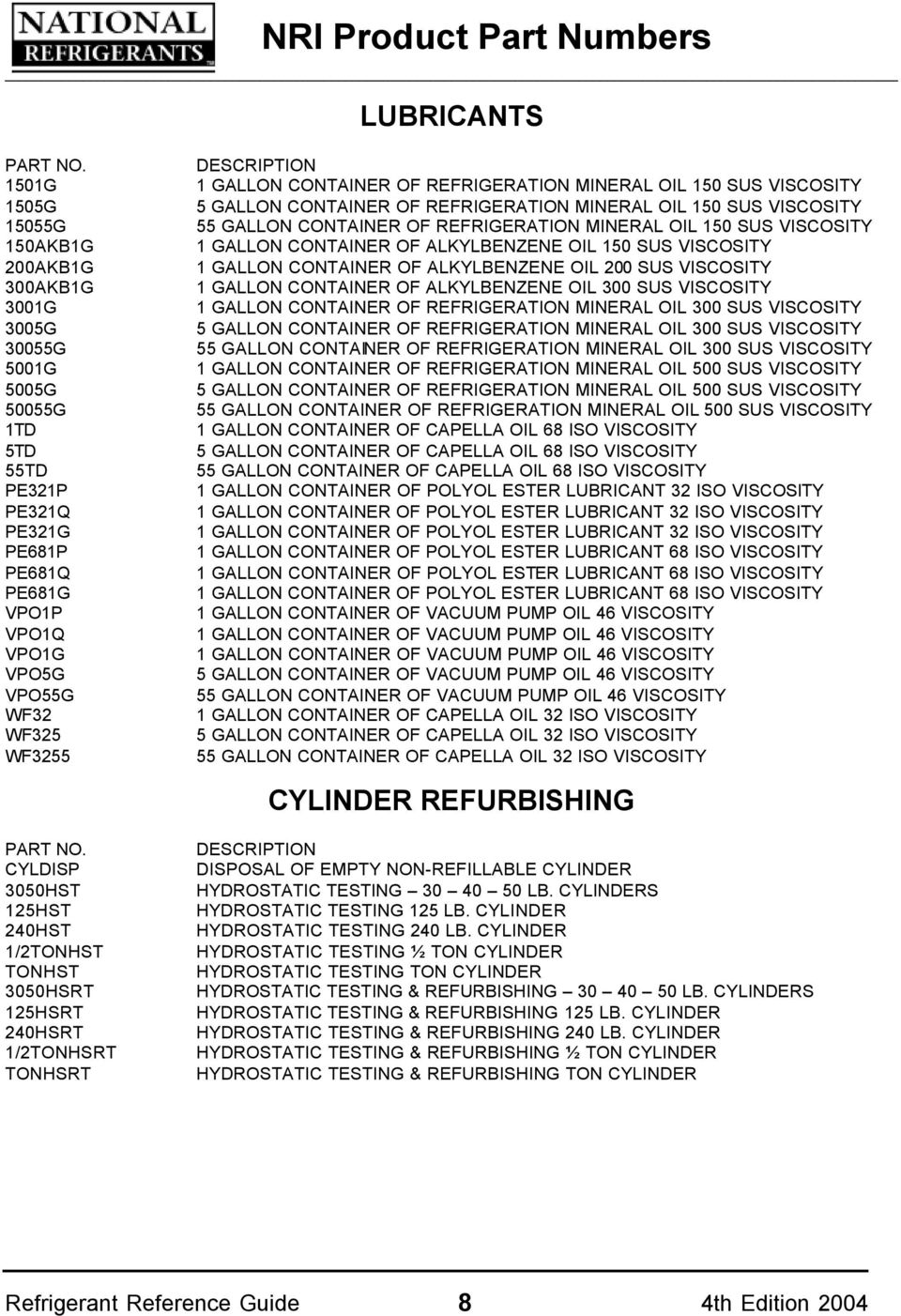
8 NRI Product Part Numbers LUBRICANTS PART NO. 1501G 1505G 15055G 150AKB1G 200AKB1G 300AKB1G 3001G 3005G 30055G 5001G 5005G 50055G 1TD 5TD 55TD PE321P PE321Q PE321G PE681P PE681Q PE681G VPO1P VPO1Q VPO1G VPO5G VPO55G WF32 WF325 WF3255 PART NO. CYLDISP 3050HST 125HST 240HST 1/2TONHST TONHST 3050HSRT 125HSRT 240HSRT 1/2TONHSRT TONHSRT DESCRIPTION 1 GALLON CONTAINER OF REFRIGERATION MINERAL OIL 150 SUS VISCOSITY 5 GALLON CONTAINER OF REFRIGERATION MINERAL OIL 150 SUS VISCOSITY 55 GALLON CONTAINER OF REFRIGERATION MINERAL OIL 150 SUS VISCOSITY 1 GALLON CONTAINER OF ALKYLBENZENE OIL 150 SUS VISCOSITY 1 GALLON CONTAINER OF ALKYLBENZENE OIL 200 SUS VISCOSITY 1 GALLON CONTAINER OF ALKYLBENZENE OIL 300 SUS VISCOSITY 1 GALLON CONTAINER OF REFRIGERATION MINERAL OIL 300 SUS VISCOSITY 5 GALLON CONTAINER OF REFRIGERATION MINERAL OIL 300 SUS VISCOSITY 55 GALLON CONTAINER OF REFRIGERATION MINERAL OIL 300 SUS VISCOSITY 1 GALLON CONTAINER OF REFRIGERATION MINERAL OIL 500 SUS VISCOSITY 5 GALLON CONTAINER OF REFRIGERATION MINERAL OIL 500 SUS VISCOSITY 55 GALLON CONTAINER OF REFRIGERATION MINERAL OIL 500 SUS VISCOSITY 1 GALLON CONTAINER OF CAPELLA OIL 68 ISO VISCOSITY 5 GALLON CONTAINER OF CAPELLA OIL 68 ISO VISCOSITY 55 GALLON CONTAINER OF CAPELLA OIL 68 ISO VISCOSITY 1 GALLON CONTAINER OF POLYOL ESTER LUBRICANT 32 ISO VISCOSITY 1 GALLON CONTAINER OF POLYOL ESTER LUBRICANT 32 ISO VISCOSITY 1 GALLON CONTAINER OF POLYOL ESTER LUBRICANT 32 ISO VISCOSITY 1 GALLON CONTAINER OF POLYOL ESTER LUBRICANT 68 ISO VISCOSITY 1 GALLON CONTAINER OF POLYOL ESTER LUBRICANT 68 ISO VISCOSITY 1 GALLON CONTAINER OF POLYOL ESTER LUBRICANT 68 ISO VISCOSITY 1 GALLON CONTAINER OF VACUUM PUMP OIL 46 VISCOSITY 1 GALLON CONTAINER OF VACUUM PUMP OIL 46 VISCOSITY 1 GALLON CONTAINER OF VACUUM PUMP OIL 46 VISCOSITY 5 GALLON CONTAINER OF VACUUM PUMP OIL 46 VISCOSITY 55 GALLON CONTAINER OF VACUUM PUMP OIL 46 VISCOSITY 1 GALLON CONTAINER OF CAPELLA OIL 32 ISO VISCOSITY 5 GALLON CONTAINER OF CAPELLA OIL 32 ISO VISCOSITY 55 GALLON CONTAINER OF CAPELLA OIL 32 ISO VISCOSITY CYLINDER REFURBISHING DESCRIPTION DISPOSAL OF EMPTY NON-REFILLABLE CYLINDER HYDROSTATIC TESTING LB. CYLINDERS HYDROSTATIC TESTING 125 LB. CYLINDER HYDROSTATIC TESTING 240 LB. CYLINDER HYDROSTATIC TESTING ½ TON CYLINDER HYDROSTATIC TESTING TON CYLINDER HYDROSTATIC TESTING & REFURBISHING LB. CYLINDERS HYDROSTATIC TESTING & REFURBISHING 125 LB. CYLINDER HYDROSTATIC TESTING & REFURBISHING 240 LB. CYLINDER HYDROSTATIC TESTING & REFURBISHING ½ TON CYLINDER HYDROSTATIC TESTING & REFURBISHING TON CYLINDER Refrigerant Reference Guide 8 4th Edition 2004
9 Property Summary Technical ASHRAE # (TRADE NAME) COMPONENTS (WEIGHT %) TYPE R-123 pure HCFC 0 R-124 pure HCFC 0 TEMP. GLIDE (F) LUBRICANTS COMMENTS MINERAL OIL or ALKYL BENZENE MINERAL OIL or ALKYL BENZENE R-134a pure HFC 0 POLYOLESTER R-22 pure HCFC 0 MINERAL OIL or ALKYL BENZENE R-23 pure HFC 0 POLYOLESTER Similar to R-11 - low pressure centrifugal chillers. Similar to R high ambient air conditioning. HFC - new systems, med temp refrig, auto AC. Retrofit involves oil flushing. New refrigeration systems, retrofit R-12 systems involves equipment changes. Standard for AC. Properties similar to R-13; runs hotter on discharge side. Very low temperature refrigeration. R-401A (MP 39) 22/152a/124 (53/13/34) HCFC BLEND 8 ALKYL BENZENE OR MO/AB MIX Retrofit blend for R-12; higher glide and discharge pressure/temp. R-401B (MP 66) 22/152a/124 (61/11/28) HCFC BLEND 8 ALKYL BENZENE OR MO/AB MIX Retrofit blend for R-12 at lower temperatures (boost to capacity <-20F), also similar to R-500 R-402A (HP 80) 125/290/22 (60/2/38) HCFC BLEND 2.5 ALKYL BENZENE OR MO/AB MIX Retrofit blend for R-502; higher discharge pressure than 502. R-402B (HP 81) 125/290/22 (38/2/60) HCFC BLEND 2.5 ALKYL BENZENE OR MO/AB MIX Retrofit blend for R-502 in ice machines; higher discharge temp. R-403B ISCEON 69L 290/22/218 (5/56/39) HCFC BLEND 2.5 MINERAL OIL or ALKYL BENZENE Has been used successfully in 13B1 type equipment. (Lower evaporator pressures - in vacuum) R-404A (HP62,FX70) 125/143a/134a (44/52/4) HFC BLEND 1.5 POLYOLESTER HFC blend - long term new or retrofit for R-502 (oil flush required). R-407C (SUVA9000) 32/125/134a (23/25/52) HFC BLEND 10 POLYOLESTER HFC blend; similar properties to R-22, higher glide. Potential new equipment or retrofit for AC. R-408A (FX 10) 125/143a/22 (7/46/47) HCFC BLEND 1 MINERAL OIL or ALKYL BENZENE Retrofit blend for R-502. Very close property match, slightly higher discharge temp. R-409A (FX 56) 22/124/142b (60/25/15) HCFC BLEND 12 MINERAL OIL or ALKYL BENZENE Retrofit blend for R-12; higher glide and discharge pressure/temp. Similar to R-500 at AC temps. R-410A (AZ 20) 32/125 (50/50) HFC BLEND 0.2 POLYOLESTER HFC blend for new AC systems; higher pressures, new equipment only. R-414B (HOT SHOT) 22/600a/124/142b (50/1.5/39/9.5) HCFC BLEND 12 MINERAL OIL or ALKYL BENZENE Retrofit blend for R-12; lower R-22 content blend, lower head pressure. Approved for auto AC. R-416A (FRIGC FR12) 134a/124/600 (59/39/2) HCFC BLEND 2.5 POLYOLESTER Retrofit blend for R-12; lower R-22 content blend, lower head pressure. Approved for auto AC. R417A (NU-22) 125/134a/600a (46.6/50/3.4) HFC BLEND 6 MINERAL OIL, AB, OR POE HFC blend; similar properties to R-22, higher glide. Potential new equipment or retrofit for AC, refrig, R-507 (AZ 50) 125/143a (50/50) HFC BLEND 0 POLYOLESTER HFC blend - long term new or retrofit for R-502 (oil flush required). R-508B SUVA 95 23/116 HFC BLEND 0 POLYOLESTER Properties similar to R-503; can be used for R-503 or R-13 very low temp systems. Refrigerant Reference Guide 9 4th Edition 2004

10 Application Summary Technical ASHRAE # COMPONENTS CHARGING (TRADE APPLICATION COMMENTS (WEIGHT %) (%ORIGINAL) NAME) Very Low Temperature and Cascade Refrigeration (R-13 and R-503 type) R-23 pure 95% R-508B 13: % R-13 systems can retrofit to R-23 (but suffer higher heat at discharge) or R-508B (but the 23/116 SUVA : 90-95% pressures are different). R-503 systems should use R-508B. R-13B1 systems can operate with R-403B 290/22/218 R-403B, but often in vacuum conditions. N/A ISCEON 69L (5/56/39) Low-Medium Temperature Refrigeration (R-502 type) R-22 pure % R-402A (HP 80) R-402B (HP 81) R-404A (HP62,FX70) R-408A (FX 10) R-507 (AZ 50) 125/290/22 (60/2/38) 125/290/22 (38/2/60) 125/143a/134a (44/52/4) 125/143a/22 (7/46/47) 125/143a (50/50) % % 85-90% 85-90% 85-90% Low-Medium Temperature Refrigeration (R-12 type) R-22 pure N/A R-134a pure 90% R-401A (MP 39) R-401B (MP 66) 22/152a/124 (53/13/34) 22/152a/124 (61/11/28) 80-85% 80-85% R-409A 22/124/142b 80-85% (FX 56) (60/25/15) Medium-High Temperature Refrigeration (R-12 type) R-414B (HOT SHOT) R-416A (FRIGC FR12) 22/600a/124/142b (50/1.5/39/9.5) 134a/124/600 (59/39/2) Air Conditioning (R-22 type) 80-85% 90-95% R-407C 32/125/134a (SUVA9000) (23/25/52) % R-410A 32/125 (AZ 20) (50/50) N/A R417A 125/134a/600a (NU-22) (46.6/50/3.4) % High Ambient and Centrifugal Chillers R-124 pure N/A R-123 pure N/A Overall Concerns: Discharge temperature is important - can't tolerate large increase. Higher discharge pressure can affect controls. Oil return is traditionally a problem in 502 low temp. Most blends are very low glide (no problems). Retrofit Recommendations (in order of preference based on performance/ease of use): R-408A Closest match to R-502 properties and performance. Slightly higher dis. Temp. R-402A Higher discharge pressure, lower discharge temperature than 408A. R-402B Similar discharge pressure, higher discharge pressure. Good for ice machines. All retrofit blends should consider oil change to AB in order to improve oil circulation. R-404A or R-507 can be used to retrofit, however mineral oil must be flushed, POE used. R-22 Refrigeration Options R-404A or R-507 can be used to retrofit, however mineral oil must be flushed, POE used, and system components (valves, etc.) may need to be changed. R-417A Warmer temps with existing oils. Loses performance and needs POE at low temp. Long Term HFC Options R-404A and R-507 Off the shelf equipment, interchangeable with each other. Overall Concerns: Match R-12 evaporator conditions (slightly higher discharge pressures OK). Oil return must be addressed. Temperature glide not a problem in most applications. Retrofit Recommendations (in order of preference based on performance/ease of use): R-409A Better at lower temperatures, maintains performance, higher discharge T and P. R-414B Better at warmer temperatures, lower discharge temp than 409A. R-401A Good overall performance, need AB oil below 30F coil temps. R-416A Biggest change in properties, poor low temp performance NRI does not carry: R-406A Very similar to R-414B. Freeze 12, Freezone, RB 276: Similar to 416A (134a based, not good in low temp) Overall Concerns: Higher application temps will drive up head pressure and discharge temp. These blends will lessen the abuse on the system but cost some capacity. Retrofit Recommendations (in order of NRI preference based on performance/ease of use): R-414B, 416A Lower, or no, R-22 cuts down on discharge temperature/pressure. R-401A, R-401B, R-409A for R-12 or R-500 air conditioning (direct expansion systems) Overall Concerns: R-22 availability and price make retrofitting a less attractive option, however it is possible to use R-407C (POE flush) or R-417A for retrofitting. New Equipment is being designed around R-410A (higher efficiency models), although it is possible that the R-22 "look alike" blends may be used also. Decision time frame depends on the new Energy Efficiency guidelines from DOE. (Residential, 2006) R-114 high ambient AC can use R-124 or very large R-134a systems. Centrifugal chillers require major equipment upgrades to retrofit to another refrigerant. Chiller manufacturers will need to be consulted for such jobs. Refrigerant Reference Guide 10 4th Edition 2004

11 R-11 and R-12 Technical Physical Properties of Refrigerants R-11 R-12 Environmental Classification CFC CFC Molecular Weight Boiling Point (1 atm, F) Critical Pressure (psia) Critical Temperature (F) Critical Density (lb./ft^3) Liquid Density (70 F, lb./ft^3) Vapor Density (bp, lb./ft^3) Heat of Vaporization (bp, BTU/lb.) Specific Heat Liquid (70 F, BTU/lb. F) Specific Heat Vapor (1 atm, 70 F, BTU/lb. F) (sat) Ozone Depletion Potential (CFC 11 = 1.0) Global Warming Potential (CO2 = 1.0) ASHRAE Standard 34 Safety Rating A1 A1 Available in the following sizes: R R lb drum 200R lb drum 650R lb drum 1100R11 ½ ton cylinder* 2200R11 1 ton cylinder* R R12 12 oz cans 30R12 30 lb cylinder 50R12 50 lb cylinder 145R lb cylinder* 1000R12 ½ ton cylinder* 2000R12 ton cylinder* * Deposit required National Refrigerants still has significant quantities of CFC refrigerants for sale. As an EPA Certified Reclaimer we are able to consistently return used R-11, R-12, and other CFCs to ARI-700 specifications for purity. R-11 Applications: Large, low-pressure centrifugal chillers. This type of chiller provides a very large amount of chilled water for air conditioning purposes (office buildings, hotels, etc). The equipment and charge size are usually quite large. Retrofitting: R-123 is being successfully used to retrofit R-11 chillers. Hardware modifications are needed, however, and retrofit jobs are typically done with the help of OEMS. R-12 Applications: Large centrifugal chillers, reciprocating chillers, open drive AC, process cooling, high-medium-low temp refrigeration (large and small systems). Retrofitting To: R-134a page 87 R-401A, R-401B page 88 R-409A page 88 R-414B page 88 R-416A page 89 Pressure-Temperature Chart R-11 Temp (F) R-12 psig psig Refrigerant Reference Guide 11 4th Edition 2004

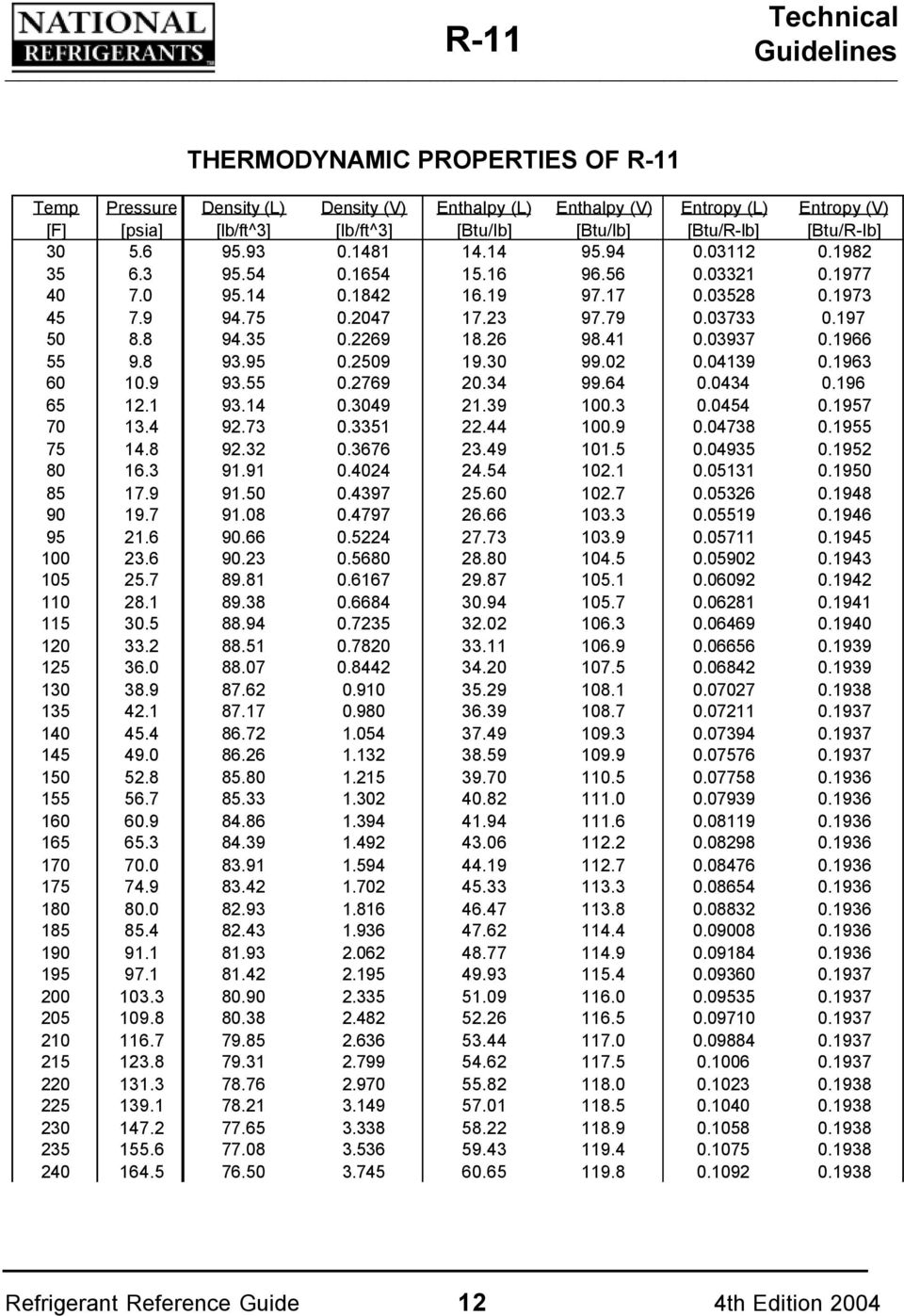
12 R-11 Technical THERMODYNAMIC PROPERTIES OF R-11 Temp Pressure Density (L) Density (V) Enthalpy (L) Enthalpy (V) Entropy (L) Entropy (V) [F] [psia] [lb/ft^3] [lb/ft^3] [Btu/lb] [Btu/lb] [Btu/R-lb] [Btu/R-lb] Refrigerant Reference Guide 12 4th Edition 2004
13 THERMODYNAMIC PROPERTIES OF R-12 Technical Temp Pressure Density (L) Density (V) Enthalpy (L) Enthalpy (V) Entropy (L) Entropy (V) [F] [psia] [lb/ft^3] [lb/ft^3] [Btu/lb] [Btu/lb] [Btu/R-lb] [Btu/R-lb] Refrigerant Reference Guide 13 4th Edition 2004

14 R-13 Technical Physical Properties of Refrigerants R-13 Environmental Classification CFC Molecular Weight Boiling Point (1 atm, F) Critical Pressure (psia) Critical Temperature (F) 84.6 Critical Density (lb./ft^3) 35.9 Liquid Density (70 F, lb./ft^3) 72.7 Vapor Density (bp, lb./ft^3) Heat of Vaporization (bp, BTU/lb.) Specific Heat Liquid (70 F, BTU/lb. F) Specific Heat Vapor (1 atm, 70 F, BTU/lb. F) Ozone Depletion Potential (CFC 11 = 1.0) 1.0 Global Warming Potential (CO2 = 1.0) ASHRAE Standard 34 Safety Rating A1 Available in the following sizes: R-13 5R13 9R13 5 lb cylinder 9 lb cylinder* 23R13 23 lb cylinder* 80R13 80 lb cylinder* *Deposit Required Very low temperature refrigeration systems typically operate in two or more stages (cascade type systems). It would be nearly impossible to achieve low temperatures in a single stage with an inexpensive comrpessor. The traditional cascade system has a low temperature stage that uses the lower boiling point gas, such as R-13 or R-503, and a high stage that typically uses R-12, R-22 or R-502. The high stage evaporator provides the correct condensation temperature for the low stage so that compressors in both stages can run at normal pressures. R-13 Applications: Very low temperature refrigeration (low stage of a cascade system) Retrofitting: R-23 or R-508B page (to be added) Pressure-Temp Chart Temp (F) R-13 psig Refrigerant Reference Guide 14 4th Edition 2004

15 Technical THERMODYNAMIC PROPERTIES OF R-13 Temp Pressure Density (L) Density (V) Enthalpy (L) Enthalpy (V) Entropy (L) Entropy (V) [F] [psia] [lb/ft^3] [lb/ft^3] [Btu/lb] [Btu/lb] [Btu/R-lb] [Btu/R-lb] Refrigerant Reference Guide 15 4th Edition 2004

16 R-22 Technical Physical Properties of Refrigerants R-22 Environmental Classification HCFC Molecular Weight 86.5 Boiling Point (1 atm, F) Critical Pressure (psia) Critical Temperature (F) Critical Density (lb./ft^3) 32.7 Liquid Density (70 F, lb./ft^3) 75.3 Vapor Density (bp, lb./ft^3) Heat of Vaporization (bp, BTU/lb.) Specific Heat Liquid (70 F, BTU/lb. F) Specific Heat Vapor (1 atm, 70 F, BTU/lb. F) Ozone Depletion Potential (CFC 11 = 1.0) 0.05 Global Warming Potential (CO2 = 1.0) 1780 ASHRAE Standard 34 Safety Rating A1 Available in the following sizes: R-22 15R22 15 lb cylinder 30R22 30 lb cylinder 50R22 50 lb cylinder 125R lb cylinder* 1000R22 ½ ton cylinder* 1750R22 ton cylinder* *Deposit Required The dominant refrigerant in residential and commercial air conditioning applications, also used in refrigeration and as a blend component since the phaseout of CFCs. R-22 is subject to production restrictions and eventual phaseout in (It cannot be used in new equipment after 2010.) R-22 Applications: Refrigeration - low and medium temperature commercial and stand-alone systems, industrial process cooling, glycol and water chillers, commercial and residential air conditioning and heat pumps. Retrofitting: R-407C page 90 R-417A page 90 R-404A or R-507 page (to be added) Pressure-Temp Chart Temp R-22 (F) (psig) Refrigerant Reference Guide 16 4th Edition 2004

17 THERMODYNAMIC PROPERTIES OF R-22 Technical Temp Pressure Density (L) Density (V) Enthalpy (L) Enthalpy (V) Entropy (L) Entropy (V) [F] [psia] [lb/ft^3] [lb/ft^3] [Btu/lb] [Btu/lb] [Btu/R-lb] [Btu/R-lb] Refrigerant Reference Guide 17 4th Edition 2004

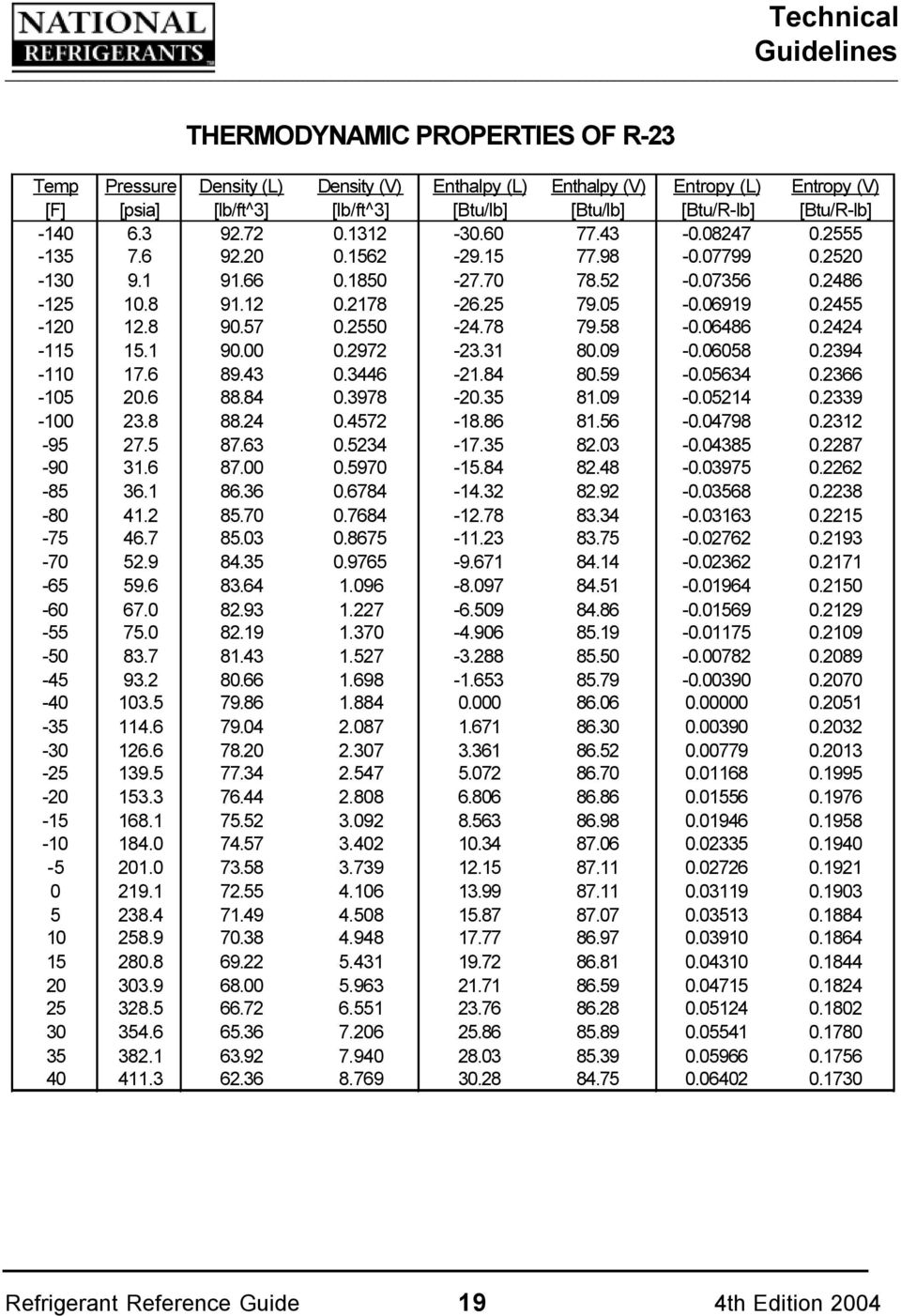
18 R-23 Technical Physical Properties of Refrigerants R-23 Environmental Classification HFC Molecular Weight 70 Boiling Point (1 atm, F) Critical Pressure (psia) Critical Temperature (F) 78.7 Critical Density (lb./ft^3) 32.8 Liquid Density (20 F, lb./ft^3) Vapor Density (bp, lb./ft^3) 0.29 Heat of Vaporization (bp, BTU/lb.) Specific Heat Liquid (20 F, BTU/lb. F) Specific Heat Vapor (1 atm, 20 F, BTU/lb. F) Ozone Depletion Potential (CFC 11 = 1.0) 0 Global Warming Potential (CO2 = 1.0) ASHRAE Standard 34 Safety Rating A1 Available in the following sizes: R-23 5R13 9R13 5 lb cylinder 9 lb cylinder* 20R13 20 lb cylinder* 70R13 70 lb cylinder* *Deposit Required Very low temperature refrigeration systems typically operate in two or more stages (cascade type systems). It would be nearly impossible to achieve low temperatures in a single stage with an inexpensive comrpessor. The traditional cascade system has a low temperature stage that uses the lower boiling point gas, such as R- 13 or R-503, and a high stage that typically uses R-12, R-22 or R (R-23 has very similar properties to R-13, although it will generate higher discharge temperatures.) The high stage evaporator provides the correct condensation temperature for the low stage so that compressors in both stages can run at normal pressures. R-23 Applications: Very low temperature refrigeration (low stage of a cascade system) Retrofitting: to replace R-13 page (to be added) Pressure-Temp Chart Temp R-23 (F) (psig) " " Refrigerant Reference Guide 18 4th Edition 2004
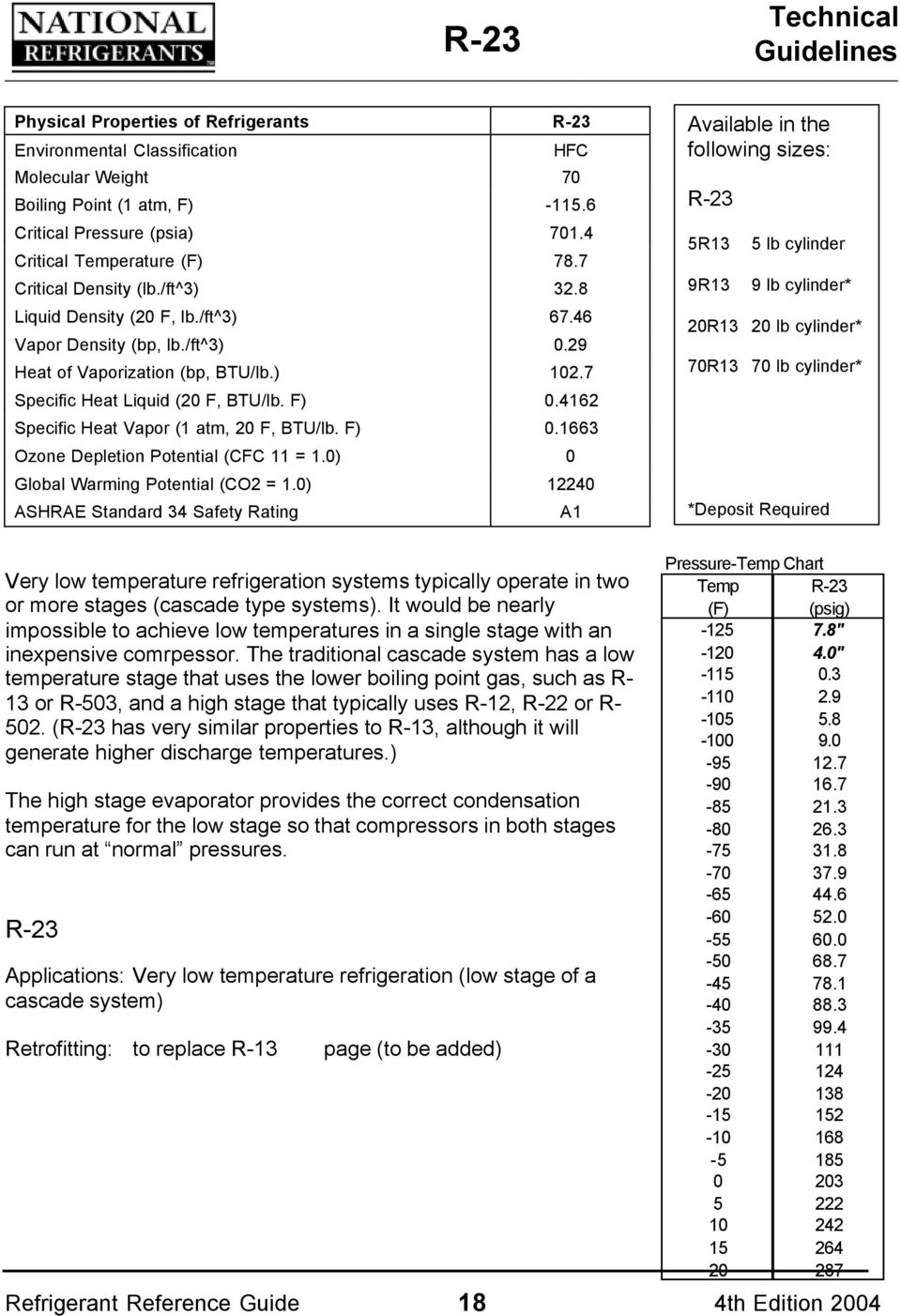
19 Technical THERMODYNAMIC PROPERTIES OF R-23 Temp Pressure Density (L) Density (V) Enthalpy (L) Enthalpy (V) Entropy (L) Entropy (V) [F] [psia] [lb/ft^3] [lb/ft^3] [Btu/lb] [Btu/lb] [Btu/R-lb] [Btu/R-lb] Refrigerant Reference Guide 19 4th Edition 2004
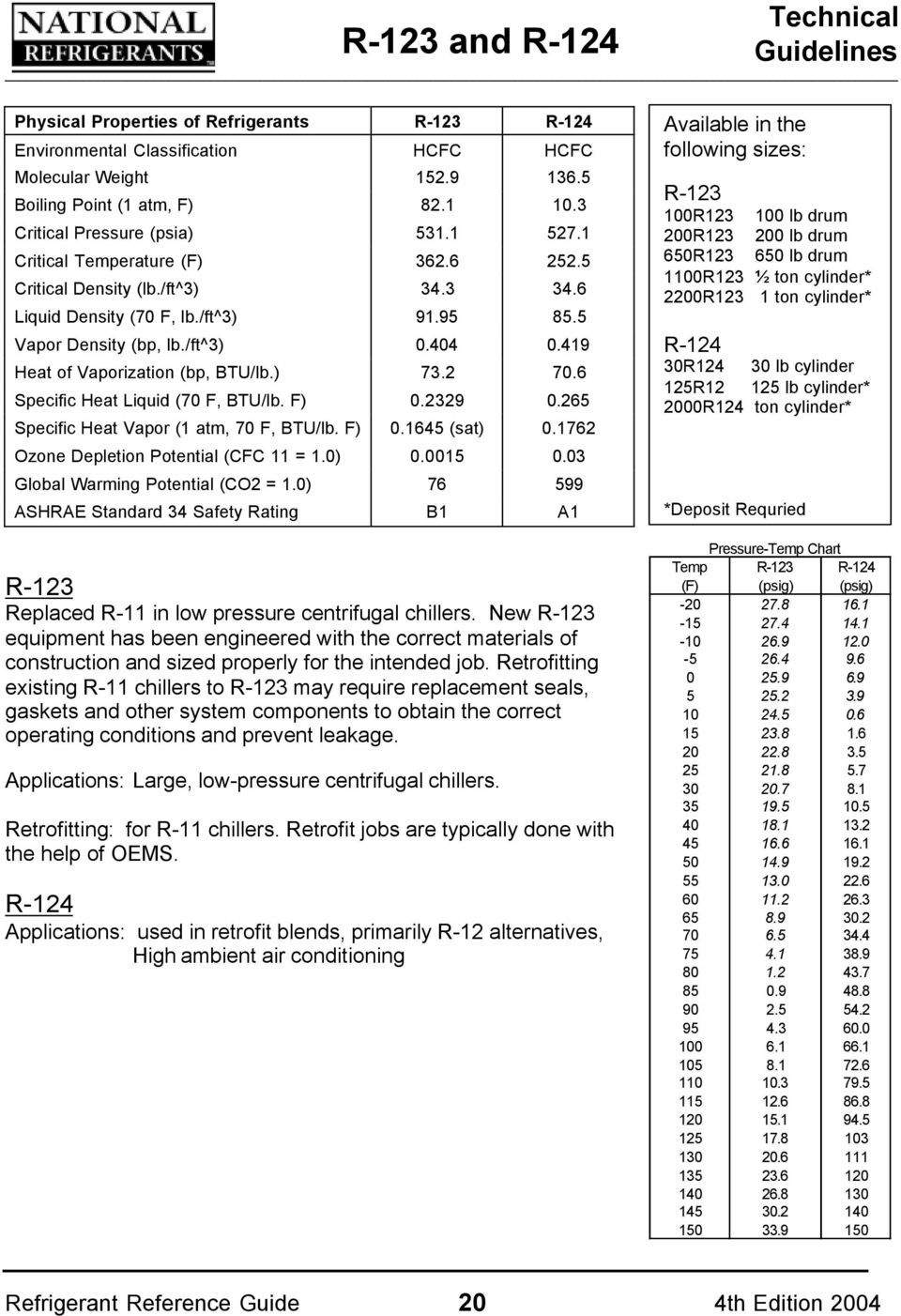
20 R-123 and R-124 Technical Physical Properties of Refrigerants R-123 R-124 Environmental Classification HCFC HCFC Molecular Weight Boiling Point (1 atm, F) Critical Pressure (psia) Critical Temperature (F) Critical Density (lb./ft^3) Liquid Density (70 F, lb./ft^3) Vapor Density (bp, lb./ft^3) Heat of Vaporization (bp, BTU/lb.) Specific Heat Liquid (70 F, BTU/lb. F) Specific Heat Vapor (1 atm, 70 F, BTU/lb. F) (sat) Ozone Depletion Potential (CFC 11 = 1.0) Global Warming Potential (CO2 = 1.0) ASHRAE Standard 34 Safety Rating B1 A1 R-123 Replaced R-11 in low pressure centrifugal chillers. New R-123 equipment has been engineered with the correct materials of construction and sized properly for the intended job. Retrofitting existing R-11 chillers to R-123 may require replacement seals, gaskets and other system components to obtain the correct operating conditions and prevent leakage. Applications: Large, low-pressure centrifugal chillers. Retrofitting: for R-11 chillers. Retrofit jobs are typically done with the help of OEMS. R-124 Applications: used in retrofit blends, primarily R-12 alternatives, High ambient air conditioning Available in the following sizes: R R lb drum 200R lb drum 650R lb drum 1100R123 ½ ton cylinder* 2200R123 1 ton cylinder* R R lb cylinder 125R lb cylinder* 2000R124 ton cylinder* *Deposit Requried Pressure-Temp Chart Temp R-123 R-124 (F) (psig) (psig) Refrigerant Reference Guide 20 4th Edition 2004
21 THERMODYNAMIC PROPERTIES OF R-123 Technical Temp Pressure Density (L) Density (V) Enthalpy (L) Enthalpy (V) Entropy (L) Entropy (V) [F] [psia] [lb/ft^3] [lb/ft^3] [Btu/lb] [Btu/lb] [Btu/R-lb] [Btu/R-lb] Refrigerant Reference Guide 21 4th Edition 2004
22 THERMODYNAMIC PROPERTIES OF R-124 Technical Temp Pressure Density (L) Density (V) Enthalpy (L) Enthalpy (V) Entropy (L) Entropy (V) [F] [psia] [lb/ft^3] [lb/ft^3] [Btu/lb] [Btu/lb] [Btu/R-lb] [Btu/R-lb] Refrigerant Reference Guide 22 4th Edition 2004
23 R-134a Technical Physical Properties of Refrigerants R-134a Environmental Classification HFC Molecular Weight Boiling Point (1 atm, F) Critical Pressure (psia) Critical Temperature (F) Critical Density (lb./ft^3) 32.0 Liquid Density (70 F, lb./ft^3) 76.2 Vapor Density (bp, lb./ft^3) Heat of Vaporization (bp, BTU/lb.) 93.3 Specific Heat Liquid (70 F, BTU/lb. F) Specific Heat Vapor (1 atm, 70 F, BTU/lb. F) Ozone Depletion Potential (CFC 11 = 1.0) 0 Global Warming Potential (CO2 = 1.0) 1320 ASHRAE Standard 34 Safety Rating A1 Available in the following sizes: R-134a 012R134a 12 oz cans 30R134a 30 lb cylinder A30R134a 30 lb auto AC 50R134a 50 lb cylinder 125R134a 125 lb cylinder* 1000R134a ½ ton cylinder* 2000R134a ton cylinder* *Deposit Required A long-term, HFC alternative with similar properties to R-12. It has become the new industry standard refrigerant for automotive air conditioning and refrigerator/freezer appliances. R-134a refrigerating performance will suffer at lower temperatures (below 10 F). Some traditional R-12 applications have used alternatives other than 134a for lower temperatures. R-134a requires polyol ester (POE) lubrincants. Traditional mineral oils and alkylbenzenes do not mix with HFC refrigerants and their use with 134a may cause operation problems or compressor failures. In addition, automotive AC systems may use polyalkaline glycols (PAGs), which are typically not seen in stationary equipment. Both POEs and PAGs will absorb moisture, and hold onto it, to a much greater extent than traditional lubricants. The moisture will promote reactions in the lubricant as well as the usual problems associated with water (corrosion, acid formation). The best way to dry a wet HFC system is to rely on the filter drier. Deep vaccuum will remove free water, but not the water that has absorbed into the lubricant. R-134a Applications: Appliances, refrigeration (commercial and self contained equipment), centrifugal chillers and automotive air conditioning. Retrofitting: for R-12 page 87 Pressure-Temp Chart Temp R-134a (F) (psig) Refrigerant Reference Guide 23 4th Edition 2004
24 THERMODYNAMIC PROPERTIES OF R-134a Temp Pressure Density (L) Density (V) Enthalpy (L) Enthalpy (V) Entropy (L) Entropy (V) [F] [psia] [lb/ft^3] [lb/ft^3] [Btu/lb] [Btu/lb] [Btu/R-lb] [Btu/R-lb] Refrigerant Reference Guide 24 4th Edition 2004
25 R-401A and R-401B Technical Physical Properties of Refrigerants R-401A R-401B Environmental Classification HCFC HCFC Molecular Weight Boiling Point (1 atm, F) Critical Pressure (psia) Critical Temperature (F) Critical Density (lb./ft^3) Liquid Density (70 F, lb./ft^3) Vapor Density (bp, lb./ft^3) Heat of Vaporization (bp, BTU/lb.) Specific Heat Liquid (70 F, BTU/lb. F) Specific Heat Vapor (1 atm, 70 F, BTU/lb. F) Ozone Depletion Potential (CFC 11 = 1.0) Global Warming Potential (CO2 = 1.0) ASHRAE Standard 34 Safety Rating A1 A1 Available in the following sizes: R-401A 30R401A 30 lb cylinder 125R401A 125 lb cylinder* 1700R401A 1 ton cylinder* R-401B 30R401B 30 lb cylinder 125R401B 125 lb cylinder* *Deposit Required Temperature Glide (F) (see section II) R-401A (R-22/152a/124) (53 / 13 / 34 wt%) A blend of R-22, R-152a and R-124 intended for retrofitting R-12 systems. The pressure and system capacity match R-12 when the blend is running an average evaporator temperature of 10F to 20F. Applications: direct expansion refrigeration, R-12 air conditioning, R-500 systems. Retrofitting: for R-12 page 88 for R-500 page 91 R-401B (R-22/152a/124) (61 / 11 / 28 wt%) Similar tto R-401A except higher in R-22 content. This blend has higher capacity at lower temperatures (matches R-12 at 20F), and also provides a closer match to R-500 at air conditioning temperatures. Applications: Lower temperature R-12 refrigeration, transport refrigeration, R-12 and R-500 direct expansion air conditioning. Retrofitting: for R-12 page 88 for R-500 page Pressure-Temp Chart R-401A R-401B Temp Liquid Vapor Liquid Vapor (F) (psig) (psig) (psig) (psig) Refrigerant Reference Guide 25 4th Edition 2004
26 THERMODYNAMIC PROPERTIES OF R-401A Technical Temp Pressure Pressure Density Density Enthalpy Enthalpy Entropy Entropy Liquid Vapor Liquid Vapor Liquid Vapor Liquid Vapor [F] [psia] [psia] [lb/ft^3] [lb/ft^3] [Btu/lb] [Btu/lb] [Btu/R-lb] [Btu/R-lb] Refrigerant Reference Guide 26 4th Edition 2004
27 THERMODYNAMIC PROPERTIES OF R-401B Technical Temp Pressure Pressure Density Density Enthalpy Enthalpy Entropy Entropy Liquid Vapor Liquid Vapor Liquid Vapor Liquid Vapor [F] [psia] [psia] [lb/ft^3] [lb/ft^3] [Btu/lb] [Btu/lb] [Btu/R-lb] [Btu/R-lb] Refrigerant Reference Guide 27 4th Edition 2004
28 R-402A and R-402B Technical Physical Properties of Refrigerants R-402A R-402B Environmental Classification HCFC HCFC Molecular Weight Boiling Point (1 atm, F) Critical Pressure (psia) Critical Temperature (F) Critical Density (lb./ft^3) Liquid Density (70 F, lb./ft^3) Vapor Density (bp, lb./ft^3) Heat of Vaporization (bp, BTU/lb.) Specific Heat Liquid (70 F, BTU/lb. F) Specific Heat Vapor (1 atm, 70 F, BTU/lb. F) Ozone Depletion Potential (CFC 11 = 1.0) Global Warming Potential (CO2 = 1.0) ASHRAE Standard 34 Safety Rating A1 A1 Temperature Glide (see section II) R-402A (R-125/290/22) (60 / 2 /38 wt%) A blend of R-22 and R-125 with hydrocarbon R-290 (propane) added to improve mineral oil circulation. This blend is formulated to match R-502 evaporator pressures, yet it has higher discharge pressure than 502. Although the propane helps with oil return, it is still recommended that some mineral oil be replaced with alkylbenzene. 2.5 Applications: Low temperature (R-502) refrigeration Retrofitting: for R-502 page 92 R-402B (R-125/290/22) (38 / 2 / 60 wt%) Similar to R-402A, but with less R-125 and more R-22. This blend will generate higher discharge temperatures, which makes it work particularly well in ice machines. Applications: Ice machines (R-502) Retrofitting: for R-502 page Available in the following sizes: R-402A 27R402A 27 lb cylinder 110R402A 110 lb cylinder* R-402B 13R402B *Deposit Required 13 lb cylinder Pressure-Temp Chart Temp R402A R402B (F) (psig) (psig) Refrigerant Reference Guide 28 4th Edition 2004
29 THERMODYNAMIC PROPERTIES OF R-402A Technical Temp Pressure Pressure Density Density Enthalpy Enthalpy Entropy Entropy Liquid Vapor Liquid Vapor Liquid Vapor Liquid Vapor [F] [psia] [psia] [lb/ft^3] [lb/ft^3] [Btu/lb] [Btu/lb] [Btu/R-lb] [Btu/R-lb] Refrigerant Reference Guide 29 4th Edition 2004
30 THERMODYNAMIC PROPERTIES OF R-402B Technical Temp Pressure Pressure Density Density Enthalpy Enthalpy Entropy Entropy Liquid Vapor Liquid Vapor Liquid Vapor Liquid Vapor [F] [psia] [psia] [lb/ft^3] [lb/ft^3] [Btu/lb] [Btu/lb] [Btu/R-lb] [Btu/R-lb] Refrigerant Reference Guide 30 4th Edition 2004
31 R-403B Technical Physical Properties of Refrigerants R-403B Environmental Classification HCFC Molecular Weight Boiling Point (1 atm, F) Critical Pressure (psia) Critical Temperature (F) Critical Density (lb./ft^3) 32.9 Liquid Density (70 F, lb./ft^3) 72.8 Vapor Density (bp, lb./ft^3) 0.35 Heat of Vaporization (bp, BTU/lb.) 82.1 Specific Heat Liquid (70 F, BTU/lb. F) Specific Heat Vapor (1 atm, 70 F, BTU/lb. F) Ozone Depletion Potential (CFC 11 = 1.0) Global Warming Potential (CO2 = 1.0) 4386 ASHRAE Standard 34 Safety Rating A1 Available in the following sizes: R-403B 30R403B 30 lb cylinder 125R403B 125 lb cylinder* 875R403B ½ ton cylinder* 1750R403B ton cylinder* *Deposit Required Temperature Glide (F) (see section II) R-403B (R-22/290/218) (56 / 5 / 39 wt%) A blend of R-22 and R-218 with hydrocarbon R-290 (propane) added to improve oil circulation. This product was orginally developed as a replacement for R-502, however it has come to be used as an alternative for R-13B1 in single stage, low-temperature systems. The evaporator will operate in a vacuum when the low side temperature is below 55F. When existing 13B1 systems are retrofitted to R-403B the capillary tube must be replaced with a longer/more restrictive size. Applications: Very low temperature refrigeration (single stage, 13B1) Retrofitting: for 13B1 page (to be added) 2 Pressure-Temp Chart Temp R403B (F) (psig) " " " " Refrigerant Reference Guide 31 4th Edition 2004
32 Technical THERMODYNAMIC PROPERTIES OF R-403B Temp Pressure Pressure Density Density Enthalpy Enthalpy Entropy Entropy Liquid Vapor Liquid Vapor Liquid Vapor Liquid Vapor [F] [psia] [psia] [lb/ft^3] [lb/ft^3] [Btu/lb] [Btu/lb] [Btu/R-lb] [Btu/R-lb] Refrigerant Reference Guide 32 4th Edition 2004
33 R-404A Technical Physical Properties of Refrigerants R-404A Environmental Classification HFC Molecular Weight 97.6 Boiling Point (1 atm, F) Critical Pressure (psia) Critical Temperature (F) Critical Density (lb./ft^3) Liquid Density (70 F, lb./ft^3) Vapor Density (bp, lb./ft^3) Heat of Vaporization (bp, BTU/lb.) 86.1 Specific Heat Liquid (70 F, BTU/lb. F) Specific Heat Vapor (1 atm, 70 F, BTU/lb. F) Ozone Depletion Potential (CFC 11 = 1.0) 0 Global Warming Potential (CO2 = 1.0) 3859 ASHRAE Standard 34 Safety Rating A1 Available in the following sizes: R-404A 24R404A 24 lb cylinder 100R404A 100 lb cylinder* 1300R404A ton cylinder* *Deposit Required Temperature Glide (F) (see section II) R-404A (R-125/143a/134a) (44 / 52 / 4 wt%) A blend of R-125, R-143a and R-134a intended for low and medium temperature refrigeration. Most new equipment has been built for R- 404A (and R-507 interchangably). It is also possible to retrofit R-502 and R-22 systems with R-404A, although the oil will need to be flushed and replaced with Polyol Ester (POE). POE oils will be found in all new equipment intended for R-404A. Applications: Low temperature refrigeration, medium temperature refrigeration, ice machines Retrofitting: for R-502 for R-22 page (to be added) page (to be added) 1.5 Pressure-Temp Chart Temp R404A (F) (psig) Refrigerant Reference Guide 33 4th Edition 2004
34 THERMODYNAMIC PROPERTIES OF R-404A Technical Temp Pressure Pressure Density Density Enthalpy Enthalpy Entropy Entropy Liquid Vapor Liquid Vapor Liquid Vapor Liquid Vapor [F] [psia] [psia] [lb/ft^3] [lb/ft^3] [Btu/lb] [Btu/lb] [Btu/R-lb] [Btu/R-lb] Refrigerant Reference Guide 34 4th Edition 2004
35 R-407C Technical Physical Properties of Refrigerants Environmental Classification R-407C HFC Molecular Weight 86.2 Boiling Point (1 atm, F) Critical Pressure (psia) Critical Temperature (F) 187 Critical Density (lb./ft^3) 32 Liquid Density (70 F, lb./ft^3) Vapor Density (bp, lb./ft^3) Heat of Vaporization (bp, BTU/lb.) Specific Heat Liquid (70 F, BTU/lb. F) Specific Heat Vapor (1 atm, 70 F, BTU/lb. F) Ozone Depletion Potential (CFC 11 = 1.0) 0 Global Warming Potential (CO2 = 1.0) 1674 ASHRAE Standard 34 Safety Rating A1 Temperature Glide (F) (see section II) R-407C (R-32/125/134a) (23 / 25 / 52 wt%) A blend of R-32, R-125 and R-134a that has very similar properties to R-22 in air conditioning equipment. There is a slight decrease in capacity and efficiency, however R-407C can be used in essentially the same equipment to perform the same job with only minor engineering modifications. New systems built with R-407C must have POE lubricants, and retrofitted R-22 systems would need the resiual oil flushed with POE. R-407C has a 10F temperature glide, which should not pose any operation-related problems for a typical system. Applications: Air conditioning, higher temperature refrigeration Retrofitting: for R-22 page Available in the following sizes: R-407C 25R407C 25 lb cylinder 115R407C 115 lb cylinder* *Deposit Required Pressure-Temp Chart R-407C Temp Liquid Vapor (F) (psig) (psig) Refrigerant Reference Guide 35 4th Edition 2004
36 THERMODYNAMIC PROPERTIES OF R-407C Technical Temp Pressure Pressure Density Density Enthalpy Enthalpy Entropy Entropy Liquid Vapor Liquid Vapor Liquid Vapor Liquid Vapor [F] [psia] [psia] [lb/ft^3] [lb/ft^3] [Btu/lb] [Btu/lb] [Btu/R-lb] [Btu/R-lb] Refrigerant Reference Guide 36 4th Edition 2004
37 R-408A Technical Physical Properties of Refrigerants R-408A Environmental Classification HCFC Molecular Weight 87 Boiling Point (1 atm, F) Critical Pressure (psia) Critical Temperature (F) 182 Critical Density (lb./ft^3) 30 Liquid Density (70 F, lb./ft^3) 66.9 Vapor Density (bp, lb./ft^3) Heat of Vaporization (bp, BTU/lb.) Specific Heat Liquid (70 F, BTU/lb. F) Specific Heat Vapor (1 atm, 70 F, BTU/lb. F) Ozone Depletion Potential (CFC 11 = 1.0) Global Warming Potential (CO2 = 1.0) 3102 ASHRAE Standard 34 Safety Rating A1 Available in the following sizes: R-408A 24R408A 24 lb cylinder 100R408A 100 lb cylinder* *Deposit Required Temperature Glide (F) (see section II) R-408A (R-125/143a/22) (7 / 46 / 47 wt%) A blend of R-22, R-143a and R-125, intended for retrofitting R-502 refrigeration systems. This blend has the closest pressure/temperature match to R-502 across the whole operating range of temperatures. Discharge temperature will increase compared to R-502, however in most applications this will not impact system performance or long term reliability. In severe duty applications, such as transport refrigeration into hot climates, the OEM may not recommend this blend. Applications: Low temperature and medium temperature refrigeration Retrofitting: for R-502 page Pressure-Temp Chart Temp R408A (F) (psig) Refrigerant Reference Guide 37 4th Edition 2004
38 THERMODYNAMIC PROPERTIES OF R-408A Technical Temp Pressure Pressure Density Density Enthalpy Enthalpy Entropy Entropy Liquid Vapor Liquid Vapor Liquid Vapor Liquid Vapor [F] [psia] [psia] [lb/ft^3] [lb/ft^3] [Btu/lb] [Btu/lb] [Btu/R-lb] [Btu/R-lb] Refrigerant Reference Guide 38 4th Edition 2004
39 R-409A Technical Physical Properties of Refrigerants Environmental Classification R-409A HCFC Molecular Weight 97.4 Boiling Point (1 atm, F) Critical Pressure (psia) Critical Temperature (F) Critical Density (lb./ft^3) 31.7 Liquid Density (70 F, lb./ft^3) 76.1 Vapor Density (bp, lb./ft^3) Heat of Vaporization (bp, BTU/lb.) Specific Heat Liquid (70 F, BTU/lb. F) Specific Heat Vapor (1 atm, 70 F, BTU/lb. F) Ozone Depletion Potential (CFC 11 = 1.0) Global Warming Potential (CO2 = 1.0) 1558 ASHRAE Standard 34 Safety Rating A1 Temperature Glide (F) (see section II) R-409A (R-22/124/142b) (60 / 25 / 15 wt%) A blend of R-22, R-142b and R-124 intended for retrofitting R-12 and R-500 systems. The pressure and system capacity match R-12 when the blend is running in an average evaporator temperature at 10F to 20F. The temperature glide of this blend is around 13F. The discharge pressure and temperature are higher than with R-12, however this should not be a problem in most applications. In hotter environments where compressor failures have been a problem it would be recommended to use R-414B instead (similar blend, less R-22). R-409A also comes close to matching the properties of R- 500 at air conditioning temperatures. Applications: Low temperature and medium temperature refrigeration, non-centrifugal air conditioning (R-12 or R-500) Retrofitting: for R-12 page 88 for R-500 page Available in the following sizes: R-409A 30R409A 30 lb cylinder 125R409A 125 lb cylinder* *Deposit Required Pressure-Temp Chart R-409A Temp Liquid Vapor (F) (psig) (psig) Refrigerant Reference Guide 39 4th Edition 2004
40 THERMODYNAMIC PROPERTIES OF R-409A Technical Temp Pressure Pressure Density Density Enthalpy Enthalpy Entropy Entropy Liquid Vapor Liquid Vapor Liquid Vapor Liquid Vapor [F] [psia] [psia] [lb/ft^3] [lb/ft^3] [Btu/lb] [Btu/lb] [Btu/R-lb] [Btu/R-lb] Refrigerant Reference Guide 40 4th Edition 2004
41 R-410A Technical Physical Properties of Refrigerants R-410A Environmental Classification HFC Molecular Weight 72.6 Boiling Point (1 atm, F) -61 Critical Pressure (psia) Critical Temperature (F) Critical Density (lb./ft^3) 34.5 Liquid Density (70 F, lb./ft^3) Vapor Density (bp, lb./ft^3) Heat of Vaporization (bp, BTU/lb.) Specific Heat Liquid (70 F, BTU/lb. F) Specific Heat Vapor (1 atm, 70 F, BTU/lb. F) Ozone Depletion Potential (CFC 11 = 1.0) 0 Global Warming Potential (CO2 = 1.0) 1997 ASHRAE Standard 34 Safety Rating A1 Available in the following sizes: R-410A 25R410A 25 lb cylinder 100R410A 100 lb cylinder* 1450R410A ton cylinder* *Deposit Required Temperature Glide (F) (see section II) R-410A (R-32/125) (50 / 50 wt%) A blend of R-32 and R-125 that nearly forms an azeotrope, and therefore has extremely low temperature glide and almost no fractionation potential. This blend has about 60% higher pressure than R-22 in air conditioning applications, and should be used only in new equipment that has been designed for the increased pressure (cannot be used to retrofit R-22 systems). R-410A will require the use of POE lubricants. Applications: Air conditioning and heat pumps (new equipment only) Retrofitting: not recommended 0.2 Pressure-Temp Chart Temp R410A (F) (psig) Refrigerant Reference Guide 41 4th Edition 2004
42 THERMODYNAMIC PROPERTIES OF R-410A Technical Temp Pressure Pressure Density Density Enthalpy Enthalpy Entropy Entropy Liquid Vapor Liquid Vapor Liquid Vapor Liquid Vapor [F] [psia] [psia] [lb/ft^3] [lb/ft^3] [Btu/lb] [Btu/lb] [Btu/R-lb] [Btu/R-lb] Refrigerant Reference Guide 42 4th Edition 2004
43 R-414B Technical Physical Properties of Refrigerants R-414B Environmental Classification HCFC Molecular Weight Boiling Point (1 atm, F) Critical Pressure (psia) Critical Temperature (F) Critical Density (lb./ft^3) 31.6 Liquid Density (70 F, lb./ft^3) Vapor Density (bp, lb./ft^3) Heat of Vaporization (bp, BTU/lb.) 91.5 Specific Heat Liquid (70 F, BTU/lb. F) Specific Heat Vapor (1 atm, 70 F, BTU/lb. F) Ozone Depletion Potential (CFC 11 = 1.0) Global Warming Potential (CO2 = 1.0) 1339 ASHRAE Standard 34 Safety Rating A1 Available in the following sizes: R-410A 25R414B 25 lb cylinder Temperature Glide (F) (see section II) R-414B (R-22/600a/124/142b) (50 / 1.5 / 39 / 9.5 wt%) A blend of R-22, R-124, R-142b and hydrocarbon R-600a (isobutane), which is added to improve mineral oil circulation. This is a multi-purpose retrofit blend that can be used in R-12 refrigeration systems as well as automotive air conditioning. The pressure and system capacity match R-12 in 30F to 40F evaporators, and the discharge pressure in hot condensers is only 5 to 10 psi higher than R-12 (a benefit in high ambient temperatures compared to other R- 12 retrofit blends). The addition of hydrocarbon to this blend significantly improves mineral oil circulation for high viscosity oils used in auto AC. Applications: Low temperature and medium temperature refrigeration, direct expansion air conditioning, automotive air conditioning Retrofitting: for R-12 page Pressure-Temp Chart R-414B Temp Liquid Vapor (F) (psig) (psig) Refrigerant Reference Guide 43 4th Edition 2004
44 THERMODYNAMIC PROPERTIES OF R-414B Technical Temp Pressure Pressure Density Density Enthalpy Enthalpy Entropy Entropy Liquid Vapor Liquid Vapor Liquid Vapor Liquid Vapor [F] [psia] [psia] [lb/ft^3] [lb/ft^3] [Btu/lb] [Btu/lb] [Btu/R-lb] [Btu/R-lb] Refrigerant Reference Guide 44 4th Edition 2004
45 R-416A Technical Physical Properties of Refrigerants R-416A Environmental Classification HCFC Molecular Weight Boiling Point (1 atm, F) -10 Critical Pressure (psia) 582 Critical Temperature (F) 227 Critical Density (lb./ft^3) 32.3 Liquid Density (70 F, lb./ft^3) Vapor Density (bp, lb./ft^3) Heat of Vaporization (bp, BTU/lb.) Specific Heat Liquid (70 F, BTU/lb. F) Specific Heat Vapor (1 atm, 70 F, BTU/lb. F) Ozone Depletion Potential (CFC 11 = 1.0) Global Warming Potential (CO2 = 1.0) 1015 ASHRAE Standard 34 Safety Rating A1 Available in the following sizes: R-416A 25R416A 25 lb cylinder 125R416A 125 lb cylinder* *Deposit Required Temperature Glide (F) (see section II) R-416A (R-134a/600/124) (59 / 1.5 / 39.5 wt%) This blend is based on R-134a. Intended for automotive retrofitting, in order to cut down on the high pressures generated after a retrofit, R-124 is added to the 134a. Hydrocarbon R-600 (butane) is added to improve mineral oil circulation. This blend matches R-12 at condenser temperatures, and pressures in the evaporator will need to be a few psi lower than R-12 to maintain proper temperature. Although the blend does not mix with mineral oils the addition of hydrocarbon thins the oil for satisfactory oil return. Systems will experience a loss of capacity, especially at lower evaporator temperatures. Applications: automotive air conditioning, higher temperature refrigeration Retrofitting: for R-12 page 89 3 Pressure-Temp Chart R-416A Temp Liquid Vapor (F) (psig) (psig) Refrigerant Reference Guide 45 4th Edition 2004
46 THERMODYNAMIC PROPERTIES OF R-416A Technical Temp Pressure Pressure Density Density Enthalpy Enthalpy Entropy Entropy Liquid Vapor Liquid Vapor Liquid Vapor Liquid Vapor [F] [psia] [psia] [lb/ft^3] [lb/ft^3] [Btu/lb] [Btu/lb] [Btu/R-lb] [Btu/R-lb] Refrigerant Reference Guide 46 4th Edition 2004
47 R-417A Technical Physical Properties of Refrigerants Environmental Classification R-417A HFC Molecular Weight Boiling Point (1 atm, F) Critical Pressure (psia) 559 Critical Temperature (F) 194 Critical Density (lb./ft^3) Liquid Density (70 F, lb./ft^3) Vapor Density (bp, lb./ft^3) Heat of Vaporization (bp, BTU/lb.) 89.5 Specific Heat Liquid (70 F, BTU/lb. F) Specific Heat Vapor (1 atm, 70 F, BTU/lb. F) Ozone Depletion Potential (CFC 11 = 1.0) 0 Global Warming Potential (CO2 = 1.0) 2268 ASHRAE Standard 34 Safety Rating A1 Temperature Glide (F) (see section II) R-417A (R-125/134a/600) (46.6 / 50 / 3.4 wt%) A blend of R-125, R-134a and hydrocarbon R-600 (butane) intended for use in air conditioning and refrigeration equipment (R- 22 alternative). Both suction and discharge pressures will run lower than R-22, which may affect valve operation or orifice tube selection. Loss of capacity may be significant at lower evaporator temperatures. Addition of the hydrocarbon will help with mineral oil circulation, however the HFC refrigerant components will still not mix with the oil, causing possible problems in larger systems (POE may be required). Applications: air conditioning, higher temperature refrigeration Retrofitting: for R-22 page Available in the following sizes: R-417A 25R417A 25 cylinder Pressure-Temp Chart R-417A Temp Liquid Vapor (F) (psig) (psig) Refrigerant Reference Guide 47 4th Edition 2004
48 THERMODYNAMIC PROPERTIES OF R-417A Technical Temp Pressure Pressure Density Density Enthalpy Enthalpy Entropy Entropy Liquid Vapor Liquid Vapor Liquid Vapor Liquid Vapor [F] [psia] [psia] [lb/ft^3] [lb/ft^3] [Btu/lb] [Btu/lb] [Btu/R-lb] [Btu/R-lb] Refrigerant Reference Guide 48 4th Edition 2004
49 R-500 and R-502 Technical Physical Properties of Refrigerants R-500 R-502 Environmental Classification CFC CFC Molecular Weight Boiling Point (1 atm, F) Critical Pressure (psia) Critical Temperature (F) Critical Density (lb./ft^3) Liquid Density (70 F, lb./ft^3) Vapor Density (bp, lb./ft^3) Heat of Vaporization (bp, BTU/lb.) Specific Heat Liquid (70 F, BTU/lb. F) Specific Heat Vapor (1 atm, 70 F, BTU/lb. F) Ozone Depletion Potential (CFC 11 = 1.0) Global Warming Potential (CO2 = 1.0) ASHRAE Standard 34 Safety Rating A1 A1 National Refrigerants still has significant quantities of CFC refrigerants for sale. As an EPA Certified Reclaimer we are able to consistently return used R-500, R-502, and other CFCs to ARI-700 specifications for purity. AZEOTROPE: A mixture of tow or more refrigerants in which the liquid and vapor have the same composition at equilibrium. In addition, the resulting pressure of the mixture is either higher or lower than the pressure of any of its components. Azeotropes behave like pure component refrigerants because there is no change in boiling temperature or shift in composition during phase change, equipment operation or leakage. R-500 (R-12/152a, 73.8/26.2 wt%) Applications: air conditioning, dehumidifiers, centrifugal chillers Retrofitting To: R-134a page (to be added) R-401A, R-401B page 91 R-409A page 91 R-502 (R-22/115, 48.8/51.2 wt%) Applications: low temperature refrigeration, ice machines Retrofitting To: R-402A, R-402B page 92 R-404A, R-507 page (to be added) R-408A page 92 Available in the following sizes: R R lb cylinder 50R lb cylinder 125R lb cylinder* 875R500 ½ ton cylinder* 1750R500 1 ton cylinder* R R lb cylinder 50R lb cylinder 125R lb cylinder* 875R502 ½ ton cylinder* 1750R502 1 ton cylinder* *Deposit Required Pressure-Temp Chart Temp R500 R502 (F) (psig) (psig) " " " Refrigerant Reference Guide 49 4th Edition 2004
50 THERMODYNAMIC PROPERTIES OF R-500 Technical Temp Pressure Pressure Density Density Enthalpy Enthalpy Entropy Entropy Liquid Vapor Liquid Vapor Liquid Vapor Liquid Vapor [F] [psia] [psia] [lb/ft^3] [lb/ft^3] [Btu/lb] [Btu/lb] [Btu/R-lb] [Btu/R-lb] Refrigerant Reference Guide 50 4th Edition 2004
51 THERMODYNAMIC PROPERTIES OF R-502 Technical Temp Pressure Pressure Density Density Enthalpy Enthalpy Entropy Entropy Liquid Vapor Liquid Vapor Liquid Vapor Liquid Vapor [F] [psia] [psia] [lb/ft^3] [lb/ft^3] [Btu/lb] [Btu/lb] [Btu/R-lb] [Btu/R-lb] Refrigerant Reference Guide 51 4th Edition 2004
52 R-503 Technical Physical Properties of Refrigerants R-503 Environmental Classification CFC Molecular Weight 82.3 Boiling Point (1 atm, F) Critical Pressure (psia) Critical Temperature (F) 65.2 Critical Density (lb./ft^3) 34.4 Liquid Density (70 F, lb./ft^3) 66.3 Vapor Density (bp, lb./ft^3) Heat of Vaporization (bp, BTU/lb.) 77.1 Specific Heat Liquid (70 F, BTU/lb. F) Specific Heat Vapor (1 atm, 70 F, BTU/lb. F) Ozone Depletion Potential (CFC 11 = 1.0) 0.06 Global Warming Potential (CO2 = 1.0) ASHRAE Standard 34 Safety Rating Very low temperature refrigeration systems typically operate in two or more stages (cascade type systems). It would be nearly impossible to achieve low temperatures in a single stage with an inexpensive comrpessor. The traditional cascade system has a low temperature stage that uses the lower boiling point gas, such as R-13 or R-503, and a high stage that typically uses R-12, R-22 or R-502. The high stage evaporator provides the correct condensation temperature for the low stage so that compressors in both stages can run at normal pressures. R-503 (R-23/13) (40.1/59.9 wt%) Applications: Very low temperature refrigeration (low stage of a cascade system) Retrofitting: R-508B page (to be added) A1 Available in the following sizes: R-503 5R503 5 lb cylinder 9R503 9 lb cylinder* 20R lb cylinder* 80R lb cylinder* *Deposit Required Pressure-Temp Chart Temp R503 (F) (psig) Refrigerant Reference Guide 52 4th Edition 2004
53 Technical THERMODYNAMIC PROPERTIES OF R-503 Temp Pressure Pressure Density Density Enthalpy Enthalpy Entropy Entropy Liquid Vapor Liquid Vapor Liquid Vapor Liquid Vapor [F] [psia] [psia] [lb/ft^3] [lb/ft^3] [Btu/lb] [Btu/lb] [Btu/R-lb] [Btu/R-lb] Refrigerant Reference Guide 53 4th Edition 2004
54 R-507 Technical Physical Properties of Refrigerants R-503 Environmental Classification HFC Molecular Weight 98.9 Boiling Point (1 atm, F) Critical Pressure (psia) 539 Critical Temperature (F) 159 Critical Density (lb./ft^3) 30.7 Liquid Density (70 F, lb./ft^3) Vapor Density (bp, lb./ft^3) Heat of Vaporization (bp, BTU/lb.) Specific Heat Liquid (70 F, BTU/lb. F) Specific Heat Vapor (1 atm, 70 F, BTU/lb. F) Ozone Depletion Potential (CFC 11 = 1.0) 0 Global Warming Potential (CO2 = 1.0) 3925 ASHRAE Standard 34 Safety Rating A1 Available in the following sizes: R R lb cylinder 100R lb cylinder* 1400R507 1 ton cylinder* *Deposit Required R-507 (R-125/143a) (50 / 50 wt%) An azeotropic blend of R-125 and R-143a intended for low temperature and medium temperature refrigeration. Similar to R-404A in operation, most new equipment has been built to use either blend interchangably. The pressure and capacity of R-507 are slightly higher than R-404A, and both are higher than R-502. R-507 requires POE lubricant. If retrofitting R-502 equipment, oil flushing will be required. Applications: low temperature and medium temperature refrigeration Retrofitting: for R-502 for R-22 page (to be added) page (to be added) Pressure-Temp Chart Temp R507 (F) (psig) Refrigerant Reference Guide 54 4th Edition 2004
55 THERMODYNAMIC PROPERTIES OF R-507 Technical Temp Pressure Pressure Density Density Enthalpy Enthalpy Entropy Entropy Liquid Vapor Liquid Vapor Liquid Vapor Liquid Vapor [F] [psia] [psia] [lb/ft^3] [lb/ft^3] [Btu/lb] [Btu/lb] [Btu/R-lb] [Btu/R-lb] Refrigerant Reference Guide 55 4th Edition 2004
56 R-508B Technical Physical Properties of Refrigerants Environmental Classification R-508B HFC Molecular Weight 95.4 Boiling Point (1 atm, F) Critical Pressure (psia) Critical Temperature (F) 53.7 Critical Density (lb./ft^3) 35.6 Liquid Density (70 F, lb./ft^3) Vapor Density (bp, lb./ft^3) Heat of Vaporization (bp, BTU/lb.) 71.4 Specific Heat Liquid (70 F, BTU/lb. F) Specific Heat Vapor (1 atm, 70 F, BTU/lb. F) Ozone Depletion Potential (CFC 11 = 1.0) 0 Global Warming Potential (CO2 = 1.0) ASHRAE Standard 34 Safety Rating A blend of R-23 and R-116 intended for very low temperature refrigeration systems. R-508B has properties very similar to R-503 and can be used to replace R-13 or R-503 in an existing system. New equipment is mostly being manufactured with R-508B in the low stage. POE lubricants should be used and it may still be necessary to use hydrocarbon additives to help with oil circulation. Check with OEM for specific oil and charging recommendations. R-508B (R-23/116) (46 / 54 wt%) Applications: Very low temperature refrigeration (low stage of a cascade system) Retrofitting: for R-503 page (to be added) A1 Available in the following sizes: R-508B 5R508B 5 lb cylinder 10R508B 10 lb cylinder* 20R508B 20 lb cylinder* 70R508B 70 lb cylinder* *Deposit Required Pressure-Temp Chart Temp R508B (F) (psig) Refrigerant Reference Guide 56 4th Edition 2004
57 Technical THERMODYNAMIC PROPERTIES OF R-508B Temp Pressure Pressure Density Density Enthalpy Enthalpy Entropy Entropy Liquid Vapor Liquid Vapor Liquid Vapor Liquid Vapor [F] [psia] [psia] [lb/ft^3] [lb/ft^3] [Btu/lb] [Btu/lb] [Btu/R-lb] [Btu/R-lb] Refrigerant Reference Guide 57 4th Edition 2004
58 ARI Guideline K: Color Codes Refrigerant R11 R12 R13 R113 R114 R12/114 R13B1 R22 R23 R123 R a R401A R401B R402A R402B R403B R404A R407C R408A R409A R410A R414B R416A R417A R500 R502 R503 R507 R508B Refrigerant Color Codes (ARI Guideline K) Chemical Name Trichlorofluoromethane Dichlorodifluoromethane Chlorotrifluoromethane Trichlorotrifluoroethane Dichlorotetrafluoroethane Dichlorodifluoromethane, Dichlorotetrafluoroethane Bromotrifluoromethane Chlorodifluoromethane Trifluoromethane Dichlorotrifluoroethane Chlorotetrafluoroethane Tetrafluoroethane Chlorodifluoromethane, Difluoroethane, Chlorotetrafluoroethane Chlorodifluoromethane, Difluoroethane, Chlorotetrafluoroethane Chlorodifluoromethane, Pentafluoroethane, Propane Chlorodifluoromethane, Pentafluoroethane, Propane Chlorodifluoromethane, Octafluoropropane, Propane Pentafluoroethane, Trifluoroethane, Tetrafluoroethane Difluoromethane, Pentafluoroethane, Tetrafluoroethane Chlorodifluoromethane, Trifluoroethane, Pentafluoroethane Chlorodifluoromethane, Chlorotetrafluoroethane, Chlorodifluoroethane Difluoromethane, Pentafluoroethane Chlorodifluoromethane, Chlorotetrafluoroethane, Chlorodifluoroethane, Isobutane Tetrafluoroethane, Chlorotetrafluorethane, Butane Pentaflouorethane, Tetrafluoroethane, Isobutane Dichlorodifluoromethane, Difluoroethane Chlorodifluoromethane, Chloropentafluoroethane Chlorotrifluoromethane, Trifluoromethane Pentafluoroethane, Trifluoroethane Trifluoromethane, Hexafluoroethane Color Orange White Light Blue Dark Purple Navy Blue Light Gray Pinkish-Red Light Green Light Blue Gray Light Blue Gray DOT Green Light Blue Pinkish-Red Yellow-Brown Light Brown Green-Brown Light Gray Orange Brown Medium Purple Medium Brown Rose Medium Blue Yellow-Green Green Yellow Light Purple Blue-Green Aqua Blue Dark Blue PMS # 021 N/A Refrigerant Reference Guide 58 4th Edition 2004
59 II. Retrofits and Conversions Blend Terminology and Issues Fractionation - Temperature Glide - Application Property Match - Lubricants General Retrofit - Checklist and Data Sheet Retrofit Procedures by Product Refrigerant Reference Guide 59 4th Edition 2004
60 Blends Tutorial Single Components vs. Blends P=P* A P=P* B A A+ B B By Convention, Higher Pressure Component is First (P* A > P* B ) Blends are made up of two or more single component refrigerants. One of two situations will occur, depending on how strong the different molecules are attracted to each other: Azeotrope: a blend that behaves like a single component refrigerant. When a blend forms an azeotrope it displays unique and unexpected properties. Zeotrope: a blend that behaves like a mixture of the individual components. Zeotropes have predictable properties based on combinations of the pure components properties. In addition, it is sometimes helpful to classify some blends as Near-Azeotropes. These blends have predictable blend properties, however the difference between these properties and what is observed for single component refrigerants is not that significant. Many of the problems associated with system operation using a blend will not be noticeable with near-azeotropes. Two new properties (to be explained soon) are Fractionation and Temperature Glide. We can split the zeotropic blends into Low Fractionation Potential, which also show Low Temperature Glide, and High Fractionation Potential, which also show High Temperature Glide. (Generally speaking blends with less than 5ºF glide are considered near-azeotropes). Refrigerant Reference Guide 60 4th Edition 2004
61 Blends Tutorial Pressure Temperature Curves for Refrigerant Blends Azeotropic Behavior Zeotropic Behavior BP A BP A Max Liq. OR Min Vap. BP B BP B A (A+B) B A (A+B) B Azeotrope : a special case where the refrigerants combine in a unique way. At the azeotropic composition the blend behaves like a single refrigerant with its own P-T relationship. The pressure after mixing is either higher than the pressures of the individual components, or it is lower than either component. Because the refrigerants are attracted in a special way the vapor in equilibrium with the liquid is at the same composition during phase change. Note: the azeotropic composition depends on temperature. The same combination of refrigerants may form an azeotrope at a different composition, or not at all, at some other temperature. Zeotrope : the pressure-temperature relationship is a natural combination of the components properties. The pressure for the blend falls between the pressures of its components, and can be calculated according to established formulas. Given the P-T relationship for each refrigerant we can calculate the resulting pressure and the vapor composition above the liquid for any given liquid composition. Refrigerant Reference Guide 61 4th Edition 2004
62 Blends Tutorial Introduction to Fractionation: Behavior of Individual Refrigerant Molecules In zeotropic mixtures A refrigerant molecules move independently from B refrigerant molecules. A A+ B B P A is Higher (more movement) Combined P A more active than B P B is Lower (less movement) There are two basic behaviors of refrigerant molecules which will help explain why fractionation occurs: 1. Pure refrigerants, A or B, exert pressure on the cylinder (or a system) because the molecules are moving around. At higher temperatures they move around faster, which means more pressure. At lower temperatures there is less movement, so lower pressure. Different refrigerants have different energies at the same temperature, andtherefore generate higher or lower pressures. 2. Molecules of refrigerant are constantly moving from liquid to vapor and vapor to liquid at the surface of the liquid. Vapor and liquid at equilibrium transfer the same number of molecules back and forth; boiling liquid transfers more from liquid to vapor; and condensing vapor transfers more from vapor to liquid. Different refrigerants transfer back and forth to the vapor at different rates. When you mix A and B together, and they form a zeotrope, the individual refrigerant molecules behave as if the other type is not there. The As bounce harder than the Bs, contributing more pressure to the blend, but more importantly - the As transfer back and forth to the vapor faster than the Bs. This means there are more As in the vapor than there are Bs (we predicted this from our formulas). Refrigerant Reference Guide 62 4th Edition 2004
63 Blends Tutorial Fractionation of Blends Low Fractionation Potential (Low glide) High Fractionation Potential (High glide) 55% A, 45% B 80% A, 20% B 55/45 80/20 50% A 50% B 50% A 50% B P A > P B ~ P A >>>>P B When vapor is removed from a cylinder or system containing a zeotropic blend two things are going to happen: 1) the vapor being removed is at the wrong composition, it will have more of the higher pressure/higher capacity refrigerant component; and 2) the liquid that is left behind boils more of the higher pressure component out of the liquid to replace the vapor. Eventually the liquid composition changes because more of the A component leaves compared to the bulk liquid composition. FRACTIONATION is the change in composition of a blend because one (or more) of the components is lost or removed faster than the other(s). The greater the difference between the pressures of the starting components will cause a greater difference in the vapor composition compared to liquid. This will worsen the effect of fractionation on that blend. The High Fractionation Potential blend shown above will produce a vapor composition of 80% A and 20% B above the liquid composition of 50/50. The closer the individual component pressure become then the more similar the transfer of molecules to the vapor becomes. The Low Fractionation Potential blend shown above will not have that different a vapor composition compared to the liquid. In this case it will take a long time to noticeably change the liquid composition away from 50/50. Temperature Glide (discussed soon) will be higher for High Fractionation blends, and lower for Low Fractionation blends. Refrigerant Reference Guide 63 4th Edition 2004
64 Blends Tutorial Effects of Fractionation in a Cylinder Charge wrong composition - poor system behavior Leave behind wrong composition - rest of cylinder no good 50/50 80% A, 20% B Invert Cylinder 80% A, 20% B Dip Tube 50% A 50% B 50% A 50% B 50/50 In order to avoid charging the wrong composition and fractionating the remaining blend, zeotropic blends must be removed from the cylinder as a liquid. This can be done by turning the cylinder over so the valve is on the bottom, or forcing the product through a dip tube to the valve. * All of the major manufacturers have removed dip tubes from their 30 lb. packages as of There may be some older cylinders, or products from third party packaging companies, that still contain dip tubes. Check the box or cylinder labels for instructions on which side should be up for liquid removal. Liquid charging does not mean that liquid refrigerant should be pushed into the suction line of the system and it be allowed to slug the compressor. After the initial charge into the high side of a system, the compressor can be started and charging can be completed by flashing the refrigerant from liquid to vapor in the charging hose or across specially designed valves. Any method which allows the refrigerant to go to vapor before it hits the compressor should work. Generally the refrigerant needs to be added slowly at this point. Refrigerant Reference Guide 64 4th Edition 2004
65 Blends Tutorial Fractionation Effects on System Charge At Rest Running V (frac) V (frac) L (circ) L + V (turbulence) V (circ) L V L V (circ) V L L + V (turbulence) A system at rest will allow the refrigerant to pool and the vapor to come to an equilibrium concentration. Leaks which occur in vapor areas of the equipment will allow fractionation of the blend. The worst case will occur when about half of the refrigerant charge has leaked. (Small amounts leaked from a system will not change the remaining blend by much. Large leaks will shift the composition, but the majority of the pounds after recharge will be from fresh product at the right composition.) Recharging the system after repair will result in a blend with slightly reduced capacity and operating pressures. In smaller systems, where charge size is critical, it will be best to pull any remaining refrigerant and charge with fresh blend. In larger systems you will need to make a decision whether the remaining charge should be pulled or not. Note: for Low Fractionation Potential blends you will not see much shift in composition anyway, and therefore the charge can be topped off after repair without loss of properties. In running systems it has been found that the circulating composition is the bulk blend composition. In liquid and suction lines there is no second phase, and in the heat exchangers there is much turbulence so leaks will lose both vapor and liquid. Testing has shown that leaks from a running system do not cause fractionation, and a normally cycling system will not fractionate much on the off cycle. In other words, in most cases servicing blends does not require full recovery of the charge. Refrigerant Reference Guide 65 4th Edition 2004
66 Blends Tutorial Fractionation Effects on Some System Components Flooded Evaporator Suction Accumulator Liq. V: 80 / 20 L: 50 / 50 Vap. Vap. (Liq. Slug) V: 50 / 50 V: 80 / 20 L: 50 / 50 Vap. Continuous Periodic Flooded Evaporators are designed to keep a pool of boiling liquid refrigerant surrounding a bundle of tubes. The water, brine, or product to be cooled flows through the tubes. The vapor which boils off this pool is returned to the compressor, condensed, then poured back into the pool. In the case of zeotropic blends, the vapor which boils off this pool of refrigerant will be at the fractionated composition. If the properties at this composition differ significantly from what the compressor expects, then the system could develop high head pressures, high amperage draw at the compressor, reduced cooling effectiveness (capacity) in the evaporator, etc. Normally it is not recommended to use blends in this type of system. Suction Accumulators are placed in the suction line before the compressor to keep liquid from flowing into the compressor. The liquid slug is trapped in the accumulator where it can boil off to vapor, combining with other suction gas. Zeotropic blends will fractionate in the accumulator, giving a short-lived spike of higher pressure vapor back to the compressor. Systems with suction accumulators should not be overcharged with the expectation that the accumulator will protect the compressor. (This may lead to frequent pressure spikes.) Also, this type of system should never be charged by dumping liquid refrigerant into the suction line and allowing it to vaporize in the accumulator. (High pressure trips may occur.) Refrigerant Reference Guide 66 4th Edition 2004
67 Blends Tutorial Refrigerant Glide in the Evaporator Relationship between blend fractionation and temperature glide through evaporator tube: 1 2 Equal vapor and liquid L = 37 / 63 V = 65 / 35 Temp = 5 F Liquid with a few bubbles L = 50 / 50 V=80 / 20 Temp = 0 F 3 Vapor and last few drops liquid L = 25 / 75 V = 50 / 50 Temp = 10 F Let s assume that a blend of 50% A and 50% B flows across a valve into an evaporator coil. If we follow a small piece of the blend as it flows along the tube we can see the effect of fractionation: 1. At the beginning of the tube the blend is mostly liquid with a few bubbles in it. The liquid composition is 50/50 and the boiling point is (for purposes of discussion) 0ºF. 2. As the piece of refrigerant marches along the tube more liquid is boiled to vapor. Since A transfers to vapor faster than B, a larger proportion of A (than B) is transferred to vapor. This makes the composition of the liquid change along the length of the tube. In this example the piece of blend, which started at 50/50, now has a liquid composition at 37% A and 63% B. (Of course the vapor has the extra A - at 65%.) The important point is that the boiling temperature of the current liquid composition is now about 5ºF. 3. When our piece of the blend gets to the end of the evaporator it is now almost all vapor. This vapor contains almost all of the refrigerant that we started with at the beginning of the tube, so the composition is almost back to 50/50. The last few remaining drops are now concentrated in the B component (about 75% in this example). The boiling point of this liquid composition is now about 10ºF. Overall Temperature Glide : The difference in temperature between the Saturated Vapor blend at the end of the evaporator and the liquid entering the evaporator is 10ºF-0ºF = 10ºF. Refrigerant Reference Guide 67 4th Edition 2004
68 Blends Tutorial Effects of Temperature Glide Frost formation? Colder Region Avg. Temp Warmer Region Superheat setting? Thermostat placement in air stream Ice machine: ice formation and harvest control setting For pure refrigerants the evaporator coil is at a constant temperature throughout. For blends the temperature glide causes the tubing to be at different temperatures. If you stand back a blow a fan across the evaporator coil, the air which blows out the other side looks like it saw an average evaporator temperature. Part of the evaporator is colder, and part is warmer, but the air mixes and generally gives the equivalent box temperature as if it passes over a constant temperature coil at this average. There are some potential problems which can occur: The colder part of the coil may form frost faster than the equivalent one constant temp. The warmer part of the coil may cause hot spots in the case, affecting product quality? Temperature control sensors located in hot or cold spots may affect cycle times. Ice machines will product thicker ice on the bottom coils and thinner ice at the top. TXV sensor bulbs are located at the outlet of the evaporator, which now sees warmer gas. Generally the temperature glide does not affect the system s ability to remove heat from product, but the glide will probably affect some of the system s controls. Superheat settings and pressure controls will be discussed further. Frost formation, hot or cold spots must be addressed outside the refrigeration loop (defrost strategies, product placement, etc.). Refrigerant Reference Guide 68 4th Edition 2004
69 Blends Tutorial Bubble Point / Dew Point Single Component Blends TEMPERATURE TEMPERATURE Superheated Superheated Subcooled Boiling glide Boiling Subcooled Evaporating > < Condensing (Constant Pressure) Bubble Point (Liquid with a bubble in it) Dew Point (Vapor with a dew drop in it) The process of phase change (boiling or condensing) is the same for blends as it is for pure refrigerants: Boiling: liquid reaches a temperature where bubbles form, then the liquid boils to vapor. When the last drops of liquid disappear, any additional heat input causes the vapor to superheat. Condensing: vapor cools to a temperature where liquid drops start to form, then the vapor condenses to liquid. When the last of the vapor disappears, any additional removal of heat causes the liquid to subcool. When these phase changes occur to a pure refrigerant, at constant pressure, the temperature stays constant at what we normally call the boiling point. For blends the process is the same, but the shift in composition during phase change causes the temperature glide to occur. The vapor will still superheat, and the liquid will still subcool, however the Saturated Vapor temperature and the Saturated Liquid temperature are not the same like they were for pure refrigerants. We now must know the particular saturated temperatures at the ends of the temperature glide for a given pressure. Saturated Liquid = Bubble Point (Liquid with bubbles starting to form) Saturated Vapor = Dew Point (Vapor with dew drops starting to form) Refrigerant Reference Guide 69 4th Edition 2004
70 Blends Tutorial Two-Column PT Charts Traditional PT Charts Temperature on left side, pressure in columns Saturated pressure listed - same for boiling or condensing / saturated liquid or vapor. New Blends Need Two Columns Zeotropic blends have different temperatures for saturated liquid and saturated vapor at constant pressure. Bubble Point (or Liquid) gives pressure for saturated liquid. Used as the reference point for subcooling calculations, for example. Dew Point (or Vapor) gives pressure for saturated vapor. Used as the reference point for superheat calculations, for example. NATIONAL REFRIGERANTS T P V L Pressure-Temperature charts traditionally have listed the temperature in the left column and pressures for various refrigerants in the rest of the columns. For blends we now need two columns, one for Vapor and one for Liquid pressures. Note: you should not read a PT chart across - heat exchangers run at constant pressure, not constant temperature. Superheat Setting: the process for obtaining superheat is the same as it has always been - measure the temperature on the suction line, for example at the TXV bulb. To find the saturated vapor temperature you measure the suction pressure, then go to the PT chart for the corresponding temperature. For blends you must use the Vapor (Dew Point) column. Subtract the saturated temperature from the measured temperature to get amt. of superheat. Subcooling: again the process is the same - measure the temperature of the line at the point of interest. To find the saturated temperature of the liquid you measure the pressure on the condenser, then go to the PT chart for the corresponding temperature. For blends you must use the Liquid (Bubble Point) column. Subtract the measured value from the saturated value to get degrees of subcooling. Keep in mind the state of the refrigerant where you are measuring - liquid or vapor - to determine which column you need to use. Refrigerant Reference Guide 70 4th Edition 2004
71 Blends Tutorial Average Evaporator Temperature and Superheat Single Component Blend after Retrofit TEMPERATURE Bulb Setting Superheat = 10ºF Superheat = 6ºF Boiling Point Avg. Evap. Temp. Evaporator Length Suction Line Evaporator Length Suction Line Let s assume we have a blend with a temperature glide of about 8ºF. After a retrofit job we have the blend running at a pressure so the average evaporator temperature matches the constant evaporator temperature of the product we replaced. About half of the glide is making the front of the evaporator colder, and the other half of the glide is making the back of the evaporator warmer. The outlet is about 4ºF warmer than it used to be. The TXV bulb has not been adjusted, and it used to be set for 10ºF superheat above the saturated temperature of our pure refrigerant. Now, with the blend, it is maintaining the same temperature - but now this only provides 6ºF of superheat above the blend s vapor temperature. If the safety margin provided by the superheat setting is reduced too far it is possible that the refrigerant may flood back to the compressor. In many cases reducing the superheat by 4ºF or 5ºF may not be a problem, but it is always a good idea to check the superheat to make sure. Refrigerant Reference Guide 71 4th Edition 2004
72 Blends Tutorial Cut In / Cut Out Pressure Control Using Blends R-12: Running System Blend: Running System Cut Out pressure=15 psig Corresponds to 10ºF boiling temp R-12: System is Off Cut Out pressure=15 psig Corresponds to 10ºFavg. evap. temp Blend: System is Off Cut In pressure=35 psig Corresponds to 38ºF Liquid Pool temp Cut In pressure=45 psig Corresponds to 38ºF Liquid Pool temp With a R-12 a Cut In/Cut Out Pressure Controls work as follows: The R-12 coil gets down to about 10ºF and the pressure is about 15 psig. This means the box temperature is somewhere in the 20 s ºF. The pressure switch knows the box is cold enough and it turns off the compressor. Liquid R-12 pools in the evaporator coil and warms up to box temperature. As the box warms to about 38ºF the R-12 in the coil generates 35 psig, and the pressure switch turns the system on again. With the R-12 Retrofit Blends the control works about the same: The average blend coil temperature gets down to about 10ºF at about 15 to 16 psig (depending on the blend). The box temperature is about the same as it was with R-12, and the pressure switch shuts off the system. LIQUID blend settles in the coil and warms to box temperature. The blends have higher liquid pressures than R-12 - if no adjustment is made the pressure switch will kick the system back on at 35 psig. For 401A this happens at 29ºF; for 406A it is 32ºF; for 409A it is 27ºF; for 414B it is 30ºF; and for 416A it is 43ºF. Most of the blends will turn the system on too cold, and short cycling will cause the system to freeze up. You will need to check the liquid pressure at 38ºF and reset the cut in pressure accordingly. Refrigerant Reference Guide 72 4th Edition 2004
73 Blends Tutorial New Variable: Composition C1 A C2 A C3 A B B B CFC Pressure (evap.) (cyl.) (cond.) Temperature Once you mix a blend at a given composition, the pressure-temperature relationships follow the same general rules as for pure components, for example the pressure goes up when the temperature goes up. For three blends containing different amounts of A and B, the pressure curve is similarly shaped, but in the resulting pressure will be higher for the blend which contains more of the A (higher pressure) component. Refrigerant blends that are intended to match some other product (R-12, for example) will rarely match the pressure at all points in the desired temperature range. What is more common is the blend will match in one region and the pressures will be different elsewhere. In the above example the blend with concentration C1 matches the CFC at cold evaporator temperatures, but the pressures run higher at condenser conditions. The blend with composition C2 matches closer to room temperature, and might show the same pressure in a cylinder being stored, for example. The operation pressures at evaporator and condenser temperatures, however, will be somewhat different. Finally, the blend at C3 will generate the same pressures at hot condenser conditions, but the evaporator must run at lower pressures to get the same temperature. We will see later that the choice of where the blend matches the pressure relationship can solve (or cause) certain retrofit-related problems. Refrigerant Reference Guide 73 4th Edition 2004
74 Blends Tutorial Retrofit Blends for R-12 Systems Refrigeration Blend - Matches 12 in cold evaporator condition R-12 Pressure Automotive Blend - Matches 12 in warm condenser condition (evaporator) Temperature (condenser) Generally speaking, the R-12 retrofit blends have higher temperature glide and they do not match the pressure/temperature/capacity of R-12 across the wide temperature application range which R-12 was used in the past. In other words, one blend does not fit all. Blends which match R-12 at colder evaporator temperatures may generate higher pressures and discharge temperatures when used in warmer applications or in high ambient temperatures. (These are called Refrigeration Blends.) In refrigeration it is often an easier (and cheaper) retrofit job if you can match evaporator pressures to R-12 (and split the glide) because you can get similar box temperatures in similar run times, and probably not need to change controls or TXVs (which are sensitive to pressure). Blends which match R-12 properties in hot conditions, like automotive AC condensers, may lose capacity or require lower suction pressures when applied at colder evaporator temperatures. (These are called Automotive Blends.) For automotive air conditioning many of the controls and safety switches are related to the high side pressure. If the blend generates higher discharge pressures you could short cycle more often and lose capacity in general. It is better to pick the high side to match R-12 and let the low side run a little lower pressure. Refrigerant Reference Guide 74 4th Edition 2004
75 Blends Tutorial R-12 Refrigerants: Property Comparison Refrigerant Components Composition Glide Lube Pressure Match F R-12 (pure) M R-134a (pure) P 4 v R-401A 22 / 152a / / 13 / 34 8 MAP R-401B 22 / 152a / / 11 / 28 8 AP R-409A 22 / 124 / 142b 60 / 25 / MAP R-414B 22/600a/124/142b 50 / 1.5 / 39 / MAP R-416A 134a / 600 / / 2 / 39 3 P 7.5 v Freezone 134a / 142b 80 / 20 4 P 6 v M: Mineral Oil A: Alkyl benzene P: Polyol ester R-134a: At first look R-134a pressures match R-12 pretty well, but other properties show that 134a needs larger equipment to perform the same job (higher compressor displacement and more surface area in the condenser). In effect R-134a in an R-12 system has lower capacity and higher discharge pressures than expected. In addition it requires POE flushing to remove mineral oil during a retrofit. R-401A and R-401B: R-22 based blends, which tend to have higher temperature glide. The presence of R-152a, an HFC, hurts oil miscibility with mineral oil. It is recommended to change some of the mineral oil to alkylbenzene unless it is a hermetic system running at warmer temperatures. R-401A matches R-12 capacity at around 20ºF evaporator; warmer conditions will begin to show effects from being over-capacity (higher amperage draw, shorter cycle times). The B version offers a boost in capacity at lower temperatures (-30ºF). R-409A: Also R-22 based, with higher temperature glide. It has moderate miscibility with mineral oil, and generally offers good oil return in systems down to 0ºF evaporator. R-12 capacity match is about 10ºF, and the one composition works well down to lower temperatures. Higher discharge temperatures and pressures can develop, especially in warmer applications. R-414B: R-22 based (higher temperature glide) but has been blended to keep the head pressure down. It is approved for automotive applications, although nylon barrier hoses and special fittings are required. In refrigeration equipment there may drop in capacity at colder temperatures. R-416A and Freezone : R-134a based blends, however an HCFC has been added to keep the head pressure lower upon retrofit. There will be a drop in capacity compared to R-12, which could be significant in colder applications. Lower suction pressures must also be taken into account. These blends also have lower temperature glide. The manufacturers claim it is OK to use with mineral oil, however the blends do not actually mix with the oil (return is helped by hydrocarbon components.) POE change is recommended for more complicated piping arrangements. Refrigerant Reference Guide 75 4th Edition 2004
76 Blends Tutorial Retrofit Blends for R-502 Systems R-402A R-502 Pressure R-408A (evaporator) Temperature (condenser) R-502 retrofit blends have much lower temperature glide than the R-12 blends (the components are much closer in their pressure-temperature relationship). Fractionation and glide do not affect the operation of a low temperature refrigeration system using these blends. The operation of low temperature refrigeration systems depends on a good property match in the evaporator. As a result, all R-502 retrofit blends match evaporator conditions. Some blends develop higher discharge pressures (R-408A matches R-502 very well across the entire pressure-temperature range). Control settings, valves, etc. generally do not need to be changed or adjusted on the low side of the system. In cases where the discharge pressure is higher, it may be necessary to adjust fan control switches, cooling water controls for water-cooled condensers, and in extreme cases it may be necessary to install pressure relief valves. Refrigerant Reference Guide 76 4th Edition 2004
77 Blends Tutorial R-502 Refrigerants: Property Comparison Refrigerant Components Composition Glide Lube Pressure Match F R / / 51 0 MA Retrofit Blends R-402A 125 / 290 / / 2/ M+AP R-402B 125 / 290 / / 2 / M+AP R-408A 125 / 143a / 22 7 / 46 / 47 1 M+AP HFC Blends R-404A 125 / 143a / 134a 44 / 52 / P R / 143a 50 / 50 0 P M: Mineral Oil A: Alkyl benzene P: Polyol ester R-402A and R-402B: R-402A shows higher discharge pressures than 502, however the discharge temperature is lower. The B version is a closer match in pressure, but the discharge temperature runs higher (this is good for ice machines, which is where 402B is primarily used). Although propane is added to improve oil circulation, it is still recommended to change some mineral oil over to alkylbenzene. R-408A: Has the closest PT match to 502 across the whole application range. It also has very low temperature glide. R-408A does generate higher discharge temperatures than 502, and this could be a problem in extreme application conditions, such as transport refrigeration in hot climates. For the most part it can be used in most refrigeration systems. R-404A and R-507: These two blends are virtually the same in terms of operation and equipment. In a retrofit situation they will require POE flushing to be performed. They will also generate higher discharge pressures. Generally speaking, retrofitting with these HFC blends will add more complexity and cost to a retrofit job, especially comparing them to using one of the other available HCFC based blends. Refrigerant Reference Guide 77 4th Edition 2004
78 Blends Tutorial Retrofitting with HFCs Lubricant Compatibility Existing systems with mineral oil or AB must be flushed and filled with POE Concern over POE reactivity with residual contaminants Material Compatibility Hoses, gaskets, seals, etc. may show leakage, swelling, degradation Performance Capacity or heat transfer differences may affect systems ability to do the job Lubricant Compatibility: HFC refrigerants will not mix with mineral oil or alkylbenzene. When retrofitting an existing system to an HFC it will be necessary to flush the old oil out of the system and replace it with polyol ester. If the residual level of non-poe is above 5%, then pockets of oil may drop out of the refrigerant and coat tubing, take up space, or clog openings inside the system. In addition to the question of mixing, there are concerns over the chemical reactivity of POEs in the presence of residual oils and contaminants left in the system. POEs are also better solvents than previous lubricants, and systems with residue on the inside of piping or components may be cleaned by the POE, which will now circulate the impurities to the valve and/or compressor. Material Compatibility: Rubber seals or gaskets which worked well with CFCs or HCFCs may have a problem with HFCs and ester oils. If the chemical makeup of the rubber is similar to the HFC or POE, these new fluids may soak into the rubber (or leach out material from the rubber) and cause the seal to swell (or shrink) out of the gap to be sealed. It is possible that leakage will not show up until several weeks after the retrofit job is over. Performance: HFC refrigerants do not match the products they replace as well as some retrofit blends will. The pressure, amperage draw, capacity, etc. should be considered when starting up the system after retrofit. Refrigerant Reference Guide 78 4th Edition 2004
79 Blends Tutorial Lubricant Types Mineral Oil (MO): Refined petroleum product, straight or branched chain hydrocarbons. Non-polar chemistry means they mix well with CFCs, OK with HCFCs, not with HFCs. Alkyl Benzene (AB): Synthetic lubricant made to act like mineral oil, long chain hydrocarbons with closed rings. Somewhat polar - better HCFC miscibility. PAG: Poly Alkaline Glycol, long chain hydrocarbons with alcohol functions. OK for HFC, used by auto AC manufacturers (available earlier than POE). Polyol Esters (POE): Synthetic lubricants with ester functions in the middle of long chain hydrocarbons. More polar so they mix better with HFCs. Mineral Oil: Byproduct of petroleum processing - so it is cheap. It has been used a long time and the industry has gained a lot of experience, and solved a lot of problems associated with using it. Unfortunately the chemical makeup causes mineral oil to mix very little with the new HFCs. Alkyl Benzene : Special process in a different part of the petroleum plant - so it is relatively cheap. It has been used either in colder applications, where it mixes better with HCFCs than mineral oil, or in high abuse areas, since it is somewhat more stable at high temperatures compared to mineral oil. It also will not mix with the new HFCs. Poly Alkaline Glycols: Created chemical which is slippery like oil but has chemical functions which make it polar - so it will mix with HFCs. PAGs were adopted by the automotive AC industry because they were available and worked OK in those systems. Stationary AC and refrigeration manufacturers had more problems applying PAGs so they waited for development of the POEs instead. Polyol Esters : Created chemicals which have a different type of chemical function which makes them polar - so they can mix with HFCs better at colder temperatures. The lighter grades have better properties than PAGs, so they have been adopted by most stationary refrigeration and AC equipment manufacturers. Refrigerant Reference Guide 79 4th Edition 2004
80 Blends Tutorial Lubricant Recommendations for Blends Properties to Consider Viscosity: What is the resistance to flow? Is it the right thickness for the equipment? Lubricity: How well is the compressor protected? (Resistance to wear) Chemical Compatibility: Are there any reactions going on? Miscibility: At a given temperature, will the lubricant mix with the refrigerant, or form a separate oil-rich layer? (sticks to piping, does not return to compressor) Solubility: How much refrigerant can be absorbed and held in the oil during normal operation? (can affect lubricant properties if thinned by refrigerant) Lubricant properties can be evaluated to determine if the product is right for the job. Three basic properties, Viscosity, Lubricity, and Chemical Stability, must be satisfactory to protect the compressor. The correct viscosity is needed to fill the gaps between parts and flow correctly where it is supposed to go. Generally speaking, smaller equipment with smaller gaps between moving parts requires a lighter viscosity, and larger equipment with bigger parts needs heavier viscosity oils. Lubricity refers to the lubricant s ability to protect the metal surfaces from wear. Good Chemical Stability means the lubricant will not react to form harmful chemicals (acids, etc.), sludges which might block tubing, or carbon deposits. The interaction of lubricant and refrigerant can cause potential problems as well. Miscibility defines the temperature region where refrigerant and oil will mix or separate. If there is separation of the oil from the refrigerant in the compressor it is possible that the oil is not getting to metal parts which need it. If there is separation in the evaporator or other parts of the system it is possible that the oil does not return to the compressor and eventually there is not enough oil to protect it. Solubility determines if the refrigerant will thin the oil out too much, losing its ability to protect the compressor. The thinning effect also influences oil return. Refrigerant Reference Guide 80 4th Edition 2004
81 Blends Tutorial Water Absorption into Lubricants Exposure of Lubricant to Moist Air (PPM Water Absorbed over time) POE: continues to absorb water, stays in with lube PPM Water Mineral Oil: Max. uptake of water, excess separates Time POE lubricants are hygroscopic, which means they like to absorb water. Mineral oils will typically absorb water until they become saturated, then you can t get any more water to mix. Excess water will form a separate layer and potentially freeze in colder parts of the system, perhaps blocking the valve, etc. With POE systems, however, much more water can be absorbed into solution. Tens of thousands of parts per million can be absorbed and still not separate from the refrigerant/oil. This absorbed water can cause breakdown of the POE and other water/acid related problems. Drying wet POE systems is extremely difficult. The typical vacuum dry method will not necessarily work if the water has been absorbed into the POE. Though it will dry up free water, even the best vacuum will take a very long time to pull the water molecules away from the lubricant molecules. In this case it is best to close up the system and charge with the proper refrigerant. The refrigerant should pull the water out of the POE and circulate it through the filter/dryer. Most commercially available driers today have increased amounts of desiccant to protect HFC/POE systems. Refrigerant Reference Guide 81 4th Edition 2004
82 Blends Tutorial Retrofitting: Concern for Oil Return Decision to Change Type of Oil 2. Oil mixes with hot refrigerant liquid and goes where it goes. Expansion Valve Condenser Compressor 1. Oil leaves compressor in small amts with refrigerant vapor. Evaporator 3. Hopefully, oil mixes with cold refrigerant and goes out of evap. 4. Piping practices and physical layout of system take over oil return in suction line. Most refrigeration and air conditioning systems are designed to depend on mixing of the oil and refrigerant: In the compressor the oil must lubricate parts throughout, and separation of oil and refrigerant would keep the oil away from parts located where liquid refrigerant might pool. Some of the oil, which is lubricating the piston or rotor seal, will be blown out of the compressor with the refrigerant, and the question of whether this oil gets back to the compressor often depends on how well it mixes with the circulating refrigerant. Oil that separates from the refrigerant could stick to piping and reduce heat transfer (in addition to not getting back to the compressor). The question of whether to change oil when retrofitting is tied directly to oil return within the system. The main properties to look at are oil miscibility and solubility. Miscibility relationships show whether the oil and refrigerant will mix at the expected system temperatures. Solubility will indicate if refrigeant will thin the oil enough to move it back to the compressor through the suction tubing. Refrigerant Reference Guide 82 4th Edition 2004
83 Blends Tutorial HFC Retrofitting: POE Oil Flushes Example of Residual Mineral Oil in POE after Flushing Percent Mineral Oil Short Flush Time (~1 hour) Longer Flush Time (~24 hrs) # Flushes Retrofitting a mineral oil or alkylbenzene system to an HFC refrigerant will require changing as much of the oil to POE as possible. The procedure is generally referred to as flushing, and the most common method is to change the compressor oil, run the system, and repeat until the residual mineral oil percentage is sufficiently low. Accepted industry guidelines suggest the mineral oil or alkylbenzene content in POE be lower than 5%. (Test kits or refractometers are used.) Higher levels can cause small pockets of oil to form, which may interfere with heat transfer or clog tubing or valves, etc. Flushing is generally more effective if the system runs longer between oil changes. This allows more residual oil to be picked up by the circulating POE and brought back to the compressor. Flushing is also generally more effective if done before the refrigerant is changed, rather than after. The original refrigerant promotes better circulation of the original oil. (In many cases the retrofit is not performed until the system breaks down, and therefore the new refrigerant is used after the repair is complete. Planning an HFC retrofit ahead of time makes for easier oil flushing.) Finally, the POE lubricants used for HFCs are much better solvents than the other oils. Residue on the inside of the system tubing and components can be loosened by the POE and circulated through the valve, cap tube, or compressor causing blockage or damage. A final oil change and filter replacement at the end of the job can reduce this problem. Refrigerant Reference Guide 83 4th Edition 2004
84 Refrigerant Retrofit Checklist System or Circuit Designation: Existing System Conditions Retrofit System Conditions Retrofit System Conditions Retrofit System Conditions DATE/TIME AMBIENT TEMP./RH REFRIGERANT LUBRICANT CHARGE/TYPE COMPRESSOR - MODEL SUCTION TEMP. SUCTION PRESS. DISCHARGE TEMP. DISCHARGE PRESS. MOTOR AMPS/VOLTS CONDENSER - MODEL COIL AIR/H2O INLET TEMP. COIL AIR/H2O OUTLET TEMP. REFRIGERANT INLET TEMP. REFRIGERANT OUTLET TEMP. EVAPORATOR - MODEL COOL AIR/H2O INLET TEMP. COOL AIR/H2O OUTLET TEMP. REFRIGERANT INLET TEMP. REFRIGERANT OUTLET TEMP. SUPERHEAT SETTING EXP. DEVICE # TURNS FIXTURE TEMPERATURE SIGHT GLASS APPEARANCE NOTES Refrigerant Reference Guide 84 4th Edition 2004
85 System Conversion Data Sheet SYSTEM/CIRCUIT NAME SUCTION TEMPERATURE CONDENSING TEMPERATURE FIXTURE TEMPERATURE SYSTEM/CIRC CAPACITY COMPRESSOR OR (Btu/H) Manufacterer CONDENSING UNIT Model # Serial # Manufacterer CONDENSER Model # Design TD Manufacterer RECEIVER Model # PRV Model# HEAD PRESSURE CONTROL EVAPORATOR PRESSURE REGULATING VALVE DISCHARGE BYPASS VALVE HOT GAS SOLONOID VALVE CRANKCASE PRESSURE REGULATING VALVE LIQUID LINE SOLONOID VALVE HIGH/LOW PRESSURE CONTROL FILTER/DRIER EXPANSION VALVE Rating Manufacterer Model # & Size Manufacterer Model # & Size Manufacterer Model # & Size Manufacterer Model # & Size Manufacterer Model # & Size Manufacterer Model # & Size Manufacterer Model # & Size Manufacterer Model # & Size Manufacterer Model # & Size Manufacterer EVAPORATOR Model # LINE SIZING Circuits Distributor/nozzle (Size & Length) Suction Line (horiz) Suction Line (riser) Liquid Line EXISTING REFRIGERANT NEW REFRIGERANT NOTES Refrigerant Reference Guide 85 4th Edition 2004
86 R-12 Systems General Considerations R-12 Retrofitting R-12 and R-500 Air Conditioning 1. For centrifugal compressors it is recommended that the maufacturer s engineering staff become involved in the project special parts or procedures may be required. This will ensure proper capacity and reliable operation after the retrofit. 2. Most older, direct expansion systems can be retrofit to R-401A, R-409A, R-414B or R-416A (R-500 to R-401B or R-409A), so long as there are no components that will cause fractionation within the system to occur. 3. Filter driers should be changed at the time of conversion. 4. System should be properly labelled with refrigerant and lubricant type. R-12 Medium / High Temperature Refrigeration (>0F evap) 1. See Recommendation Table for blends that work better in high ambient heat conditions. 2. Review the properties of the new refrigerant you will use, and compare them to R-12. Prepare for any adjustments to system components based on pressure difference or temperature glide. 3. Filter driers should be changed at the time of conversion. 4. System should be properly labelled with refrigerant and lubricant type. R-12 Low Temperature Refrigeration (<20F evap) 1. See Recommendation Table for blends that have better low temperature capacity. 2. Review the properties of the new refrigerant you will use, and compare them to R-12. Prepare for any adjustments to system components based on pressure difference or temperature glide. 3. Filter driers should be changed at the time of conversion. 4. System should be properly labelled with refrigerant and lubricant type. Recommendations for R-12 Retrofit Products Closest Match/Easiest R-12 small equipment R-12 larger equipment R-12 AC R-500 AC Higher T Lower T Higher T Lower T R-414B R-409A R-414B R-409A R-414B R-409A R-416A R-401B R-416A R-401A R-409A R-401A R-401A R-401A R-401A R-414B R-401A R-414B R-409A R-414B R-409A R-416A R-416A R-416A R-134a R-134a R-134a R-134a R-134a R-134a R-416A Poorest Match/Most Difficult Refrigerant Reference Guide 86 4th Edition 2004
87 General Retrofit Procedure: Centrifugal, Reciprocating AC and Refrigeration Systems 1. If the system is able to run collect system data and operating conditions prior to retrofit. 2. Isolate the compressor and recover the R-12. Change the lubricant in the compressor to polyol ester (POE). For hermetic compressors this may require removal of the compressor. 3. Replace any oil in auxilliary components such as oil separators or oil feed systems. 4. Close the system and run with R-12 for 24 hours to circulate the POE and flush the mineral oil back to the compressor. 5. Repeat steps 1-4 until residual mineral oil level is below 5%. (If the unit is not operational then perform the oil flushing procedure immediately after startup with R-134a.) 6. Recover the R-12 from the entire system. 7. Perform any maintenance, repair or component replacements, and change filter/driers. 8. Evacuate the system to manufacturer s specifications. R-12 to R-134a 9. Charge the system with the proper amount of R-134a (usually 85% to 90% of the original R-12 charge by weight). 10. Operate the system and record new system operation data. Make adjustments to controls as needed to ensure proper operation. 11. Label the system with the new refrigerant and lubricant type. Most Common Areas that Require Adjustment or Attention: Changing the lubricant to POE TXV valve adjustment / superheat setting Refrigerant Reference Guide 87 4th Edition 2004
88 General Retrofit Procedure: Reciprocating AC and Refrigeration Systems 1. If the system is able to run collect system data and operating conditions prior to retrofit. 2. Recover the R-12 from the entire system. R-12 to R-401A/B, R-409A, R-414B 3. Perform any maintenance, repair or component replacements, and change filter/driers. If needed (for low temperatures) remove mineral oil from the system and replace with an equivalent amount of alkylbenzene oil. 4. Evacuate the system to manufacturer s specifications. 5. Charge the system with the proper amount of the blend (usually 80% to 85% of the original R-12 charge by weight). Be sure to remove liquid refrigerant from the cylinder to get the proper composition (but flash the refrigerant before feeding into a running system). 6. Operate the system and record new system operation data. Make adjustments to controls as needed to ensure proper operation. 7. Label the system with the new refrigerant and lubricant type. Most Common Areas that Require Adjustment or Attention: TXV valve adjustment / superheat setting (use Vapor side of PT chart) Pressure controls (cut in / cut out) Pressure related switches or controls difference from R-12 pressures Irregular frost formation with high glide blends High discharge pressure or temperature, high amps in high ambient temperature conditions (abuse of compressor) Refrigerant Reference Guide 88 4th Edition 2004
89 General Retrofit Procedure: Reciprocating AC and Refrigeration Systems 1. If the system is able to run collect system data and operating conditions prior to retrofit. 2. Recover the R-12 from the entire system. 3. Perform any maintenance, repair or component replacements, and change filter/driers. If needed (for complicated piping, large hold-up volumes) remove mineral oil from the system and replace with an equivalent amount of polyol ester lubricant. 4. Evacuate the system to manufacturer s specifications. R-12 to R-416A 5. Charge the system with the proper amount of the blend (usually 80% to 85% of the original R-12 charge by weight). Be sure to remove liquid refrigerant from the cylinder to get the proper composition (but flash the refrigerant before feeding into a running system). 6. Operate the system and record new system operation data. Make adjustments to controls as needed to ensure proper operation. 7. Label the system with the new refrigerant and lubricant type. Most Common Areas that Require Adjustment or Attention: TXV valve adjustment / superheat setting (use Vapor side of PT chart) Pressure controls (cut in / cut out) Pressure related switches or controls lower than R-12 pressures Loss of capacity at lower evaporator temperatures / longer run times Refrigerant Reference Guide 89 4th Edition 2004
90 General Retrofit Procedure: AC and Refrigeration Systems 1. If the system is able to run collect system data and operating conditions prior to retrofit. 2. If an oil change is indicated (R-407C, possible R-417A), isolate the compressor and recover the R-22. Change the lubricant in the compressor to polyol ester (POE). For hermetic compressors this may require removal of the compressor. 3. Replace any oil in auxilliary components such as oil separators or oil feed systems. 4. Close the system and run with R-22 for 24 hours to circulate the POE and flush the mineral oil back to the compressor. 5. Repeat steps 1-4 until residual mineral oil level is below 5%. (If the unit is not operational then perform the oil flushing procedure immediately after startup. 6. Recover the R-22 from the entire system. 7. Perform any maintenance, repair or component replacements, and change filter/driers. 8. Evacuate the system to manufacturer s specifications. R-22 to R-407C, R-417A 9. Charge the system with the proper amount of the blend (usually 85% to 95% of the original R-22 charge by weight). Be sure to remove liquid refrigerant from the cylinder to get the proper composition (but flash the refrigerant before feeding into a running system). 10. Operate the system and record new system operation data. Make adjustments to controls as needed to ensure proper operation. 11. Label the system with the new refrigerant and lubricant type. Most Common Areas that Require Adjustment or Attention: TXV valve adjustment / superheat setting (use Vapor side of PT chart) Pressure controls (cut in / cut out) Pressure related switches or controls difference from R-22 pressures Irregular frost formation with high glide blends Changing the lubricant to POE Refrigerant Reference Guide 90 4th Edition 2004
91 General Retrofit Procedure: Reciprocating AC and Transport Refrigeration Systems 1. If the system is able to run collect system data and operating conditions prior to retrofit. 2. Recover the R-500 from the entire system. R-500 to R-401A/B, R-409A, R-414B 3. Perform any maintenance, repair or component replacements, and change filter/driers. If needed (for low temperatures) remove mineral oil from the system and replace with an equivalent amount of alkylbenzene oil. 4. Evacuate the system to manufacturer s specifications. 5. Charge the system with the proper amount of the blend (usually 85% to 90% of the original R-500 charge by weight). Be sure to remove liquid refrigerant from the cylinder to get the proper composition (but flash the refrigerant before feeding into a running system). 6. Operate the system and record new system operation data. Make adjustments to controls as needed to ensure proper operation. 7. Label the system with the new refrigerant and lubricant type. Most Common Areas that Require Adjustment or Attention: TXV valve adjustment / superheat setting (use Vapor side of PT chart) Pressure related switches or controls most have lower pressure than R-500 Refrigerant Reference Guide 91 4th Edition 2004
92 General Retrofit Procedure: Refrigeration Systems and Ice Machines 1. If the system is able to run collect system data and operating conditions prior to retrofit. 2. Recover the R-502 from the entire system. 3. Perform any maintenance, repair or component replacements, and change filter/driers. If oil return has been a problem with R-502, remove mineral oil from the system and replace with an equivalent amount of alkylbenzene oil. 4. Evacuate the system to manufacturer s specifications. R-502 to R-402A/B, R-408A 5. Charge the system with the proper amount of the blend (usually 80% to 85% of the original R-502 charge by weight). Be sure to remove liquid refrigerant from the cylinder to get the proper composition (but flash the refrigerant before feeding into a running system). 6. Operate the system and record new system operation data. Make adjustments to controls as needed to ensure proper operation. 7. Label the system with the new refrigerant and lubricant type. Most Common Areas that Require Adjustment or Attention: TXV valve adjustment / superheat setting (use Vapor side of PT chart) Pressure controls (cut in / cut out) Pressure related switches or controls difference from R-502 pressures Refrigerant Reference Guide 92 4th Edition 2004
SERVICE GUIDELINES HCFC R22 TO HFC REFRIGERANT BLENDS
 SERVICE GUIDELINES HCFC R22 TO HFC REFRIGERANT BLENDS 2009 Tecumseh Products Company. All rights reserved. Page 1 of 8 Refrigerant R22 is widely used for residential and commercial air conditioning, as
R407C GUIDELINES FOR UTILIZATION OF. DATE: August 2009 REFERENCE DOCUMENT NO. RD-0005-E GUIDELINES FOR UTILIZATION OF R407C
 GUIDELINES FOR UTILIZATION OF R407C 2009 Tecumseh Products Company. All rights reserved. Page 1 of 6 After many years of testing and investigation, R407C is recognized as a suitable alternative refrigerant
RS-52 (R428A) RS-52: PHYSICAL PROPERTIES RS-52 R502 Molecular weight 107.5 111.6 Temperature glide o C 0.5 0.2 Boiling point (1 atm)
 RS-52 (R428A) COMPOSITION % HFC 125 77.5 HFC 143a 20.0 R600a 1.9 R290 0.6 HCFC replacement Temperature glide R22, 502 & interim blends Approximately 0.8 o C Drop-in or long term Both Lubricant MO/AB/POE
RS-24 (R426A): Q & A
 RS-24 (R426A): Q & A 1 Q: What is RS-24? A: RS-24 is a non ozone depleting Drop-in replacement for R12 in all applications including mobile air conditioning. 2 Q: Yes, but what does RS-24 contain? A: RS-24
Refrigerant Changeover Guidelines R-22 to R-407C. Leading the Industry with Environmentally Responsible Refrigerant Solutions
 Refrigerant Changeover Guidelines R-22 to R-407C Leading the Industry with Environmentally Responsible Refrigerant Solutions Copeland does not CFC advocate the wholesale changeover of HCFC HCFC refrigerants
Refrigerant Changeover Guidelines R-22 to R-407C. Leading the Industry with Environmentally Responsible Refrigerant Solutions
 Refrigerant Changeover Guidelines R-22 to R-407C Leading the Industry with Environmentally Responsible Refrigerant Solutions Emerson Climate CFC Technologies, Inc. does not advocate the HCFC wholesale
RS-44 (R424A) : Q & A
 RS-44 (R424A) : Q & A 1 Q: What is RS-44? A: RS-44 is a non ozone depleting Drop-in replacement for R22 in most applications. 2 Q: Yes, but what does RS-44 contain? A: RS-44 is a blend of HFC134a, HFC125,
UNDERSTANDING REFRIGERANT TABLES
 Refrigeration Service Engineers Society 1666 Rand Road Des Plaines, Illinois 60016 UNDERSTANDING REFRIGERANT TABLES INTRODUCTION A Mollier diagram is a graphical representation of the properties of a refrigerant,
Refrigerant Changeover Guidelines HCFC R-22 to HFC R-404A/R-507. Leading the Industry with Environmentally Responsible Refrigerant Solutions
 Refrigerant Changeover Guidelines HCFC R-22 to HFC R-404A/R-507 Leading the Industry with Environmentally Responsible Refrigerant Solutions Copeland does not advocate the wholesale changeover of HCFCs
Rusty Walker, Corporate Trainer Hill PHOENIX
 Refrigeration 101 Rusty Walker, Corporate Trainer Hill PHOENIX Compressor Basic Refrigeration Cycle Evaporator Condenser / Receiver Expansion Device Vapor Compression Cycle Cooling by the removal of heat
Refrigerant Changeover Guidelines R-502 to R-402A/R-408A. Leading the Industry with Environmentally Responsible Refrigerant Solutions
 Refrigerant Changeover Guidelines R-502 to R-402A/R-408A Leading the Industry with Environmentally Responsible Refrigerant Solutions Copeland does not advocate the wholesale CFC changeover of CFC HCFC
Performance of R-438A in R-22 Refrigeration and Air Conditioning Systems
 Performance of R-438A in R-22 Refrigeration and Air Conditioning Systems Dr. Charles C. Allgood 1, C. Curtis Lawson 2 1 DuPont Fluorochemicals, Wilmington, DE, USA E-mail: [email protected]
Chapter 3.4: HVAC & Refrigeration System
 Chapter 3.4: HVAC & Refrigeration System Part I: Objective type questions and answers 1. One ton of refrigeration (TR) is equal to. a) Kcal/h b) 3.51 kw c) 120oo BTU/h d) all 2. The driving force for refrigeration
REFRIGERANT 410A. Refrigeration Service Engineers Society 1666 Rand Road Des Plaines, Illinois 60016. Information compiled by Frank Prah, CMS
 Refrigeration Service Engineers Society 1666 Rand Road Des Plaines, Illinois 60016 REFRIGERANT 410A Information compiled by Frank Prah, CMS INTRODUCTION Recently a new refrigerant, R-410A, has been formulated
Commercial refrigeration has been in the environmental. Refrigerant. as a. Basics Considerations PART 1:
 PART 1: CO 2 Commercial refrigeration has been in the environmental spotlight for more than a decade, especially as leakage studies have revealed the true effects of hydrofluorocarbon (HFC) emissions.
Repair, Retrofit, or Replace Choices for Servicing R-22 Equipment
 Repair, Retrofit, or Replace Choices for Servicing R-22 Equipment Brett Van Horn Market Manager HVAC Arkema Inc. 900 First Ave King of Prussia, PA 19406 Topics Covered Today R-22 Phase-out EPA Allowances
THE REPLACEMENT OF R-22
 ENGLISH TRANSLATION OF ARTICLE IN FRIO-CALOR AIRE ACONDICIONDAO BY GAS-SERVEI, S.A JUNE 2010 THE REPLACEMENT OF R-22 Courtesy of D. Lluis Giralt Lopez (Chemical Engineering Industrial) Gas Technical Department
CONTAMINANT REMOVAL FROM CENTRIFUGAL SYSTEMS
 CONTAMINANT REMOVAL FROM CENTRIFUGAL SYSTEMS BULLETIN 240-10-3 June 2004 Supersedes June 1983 Many centrifugal systems get little maintenance. As a result they operate with the refrigerant highly contaminated
Technical Note: Comparing R407C and R410A as Alternatives for R22. A Technical Note from the Experts in Business-Critical Continuity
 Technical Note: Comparing R407C and R410A as Alternatives for R22 A Technical Note from the Experts in Business-Critical Continuity Purpose The purpose of this document is to provide a brief overview of
Characteristics of Evaporators
 Characteristics of Evaporators Roger D. Holder, CM, MSME 10-28-2003 Heat or Energy In this paper, we will discuss the characteristics of an evaporator coil. The variance of the operational condenses of
Refrigeration Basics 101. By: Eric Nelson
 Refrigeration Basics 101 By: Eric Nelson Basics Refrigeration is the removal of heat from a material or space, so that it s temperature is lower than that of it s surroundings. When refrigerant absorbs
Automobile Air Conditioning Primer
 Automobile Air Conditioning Primer An air conditioner is basically a refrigerator without the insulated box. It uses the evaporation of a refrigerant, like Freon, to provide cooling. The mechanics of the
USC CFC Leak Repair and Recordkeeping Procedures
 USC CFC Leak Repair and Recordkeeping Procedures I. Introduction Chlorofluorocarbons (CFCs) released into the atmosphere can damage the ozone layer that protects the earth from the penetration of harmful
Environmental and Safety Impacts of HFC Emission Reduction Options for Air Conditioning and Heat Pump Systems
 Environmental and Safety Impacts of HFC Emission Reduction Options for Air Conditioning and Heat Pump Systems William M. Corcoran, George Rusch, Mark W. Spatz, and Tim Vink AlliedSignal, Inc. ABSTRACT
It will be available soon as an 8.5 X 11 paperback. For easier navigation through the e book, use the table of contents.
 The System Evaluation Manual and Chiller Evaluation Manual have been revised and combined into this new book; the Air Conditioning and Refrigeration System Evaluation Guide. It will be available soon as
Troubleshooting HVAC/R systems using refrigerant superheat and subcooling
 Troubleshooting HVAC/R systems using refrigerant superheat and subcooling Application Note Troubleshooting and servicing refrigeration and air conditioning systems can be a challenging process for both
Low GWP Replacements for R404A in Commercial Refrigeration Applications
 Low GWP Replacements for R404A in Commercial Refrigeration Applications Samuel YANA MOTTA, Mark SPATZ Honeywell International, 20 Peabody Street, Buffalo, NY 14210, [email protected] Abstract
How To Understand Evaporator
 SECTION 5 COMMERCIAL REFRIGERATION UNIT 21 EVAPORATORS AND THE REFRIGERATION SYSTEM UNIT OBJECTIVES After studying this unit, the reader should be able to Define high-, medium-, and low-temperature refrigeration.
Recommended Compressor Installation Practices
 ASPEN COMPRESSOR, LLC Phone: 508.481.5058 Fax: 508.480.0328 Email:[email protected] Website: www.aspencompressor.com Recommended Compressor Installation Practices 1. COMPRESSOR SELECTION AND USE
SECTION 5 COMMERCIAL REFRIGERATION UNIT 22 CONDENSERS
 SECTION 5 COMMERCIAL REFRIGERATION UNIT 22 CONDENSERS UNIT OBJECTIVES After studying this unit, the reader should be able to explain the purpose of the condenser in a refrigeration system. describe differences
Performance of R-438A in R-22 Refrigeration and Air Conditioning Systems
 Purdue University Purdue e-pubs International Refrigeration and Air Conditioning Conference School of Mechanical Engineering 21 Performance of R-438A in R-22 Refrigeration and Air Conditioning Systems
SYLLABUS FOR SIX MONTHS - FULL TIME CERTIFICATE COURSE IN REFRIGERATION AND AIR-CONDITIONING. Effective From :- UNDER DEVELOPMENT.
 SYLLABUS FOR SIX MONTHS - FULL TIME CERTIFICATE COURSE IN REFRIGERATION AND AIR-CONDITIONING Effective From :- UNDER DEVELOPMENT Prepared by: Curriculum development cell Institute of Research Development
Part A: Fluid properties
 UNEP Ozone Secretariat UNEP Ozone Secretariat Background Workshop Material on HFC for management: HFC Workshop, technical 2015 issues Bangkok, 20 and 21 April 2015 FACT SHEET 15 Glossary of terms and technical
Subject: 2005 Air Conditioning Service Guidelines
 Date: June 27, 2005 Bulletin Number: 05D-J-114 To: DDG Headquarters and Branches and Jobbers Category: Service From: Steve Sigg, Product Service and Training Line(s): 10 and 15 Subject: 2005 Air Conditioning
Commercial CO2 Refrigeration Systems. Guide for Subcritical and Transcritical CO2 Applications
 Commercial CO2 Refrigeration Systems Guide for Subcritical and Transcritical CO2 Applications 2 Contents Chapter 1. Introduction 4 Chapter 2. CO 2 Basics and Considerations as a Refrigerant 5 Section 1.
How To Clean Water From An Ammonia Refrigeration System
 Water Contamination and Water Removal in Industrial Ammonia Refrigeration Systems By Ray Ficker, PE Effects of Water Contamination Water contamination in an industrial ammonia refrigeration system can
Federal Clean Air Act Section 609 Training Manual & Exam
 Federal Clean Air Act Section 609 Training Manual & Exam Table of Contents INTRODUCTION... Who Must Be Certified... Training and Certification... Test Format... Test Administration and Grading... i STRATOSPERIC
EPA 608 Certification. Study Guide. 1 P a g e
 EPA 608 Certification Study Guide 1 P a g e Foreword All HVACR technicians must become certified for the equipment they work on, under the Environmental Protection Agency s (EPA), refrigerant recovery
Flushing and Cleaning the A/C System
 Flushing and Cleaning the A/C System Once an AC system has been contaminated or has suffered a failure, the most important part of the AC service to restore the cooling performance to the system = FLUSHING
Patech. Our Conviction. Quality Service Innovation PATECH FINE CHEMICALS CO., LTD
 Our Conviction Quality Service Innovation Product Categories Refrigeration Lubricants POE for HFC Refrigerants POE for HCFC Refrigerants POE for HFO Refrigerants Special Plasticizers Nontoxic Plasticizer
How To Design A Refrigeration System
 AIRAH Refrigeration (in HVAC) Back to Basics For the First Time Terms of Reference What this session is NOT about Detailed Refrigeration Design Detailed analysis of various Refrigants properties Comparison
HCFC-22 Retrofits. There has been increased emphasis on retrofitting R-22
 HCFC-22 Retrofits A c l o s e l o o k a t t h e r e f r i g e r a n t / l u b r i c a n t i n t e r a c t i o n s. B y S a m u e l F. Y a n a M o t t a, E l i z a b e t D. V e r a B e c e r r a, R o n
Troubleshooting an Air Conditioning system. R D Holder Eng. Roger D Holder MSME
 Troubleshooting an Air Conditioning system R D Holder Eng. Roger D Holder MSME Troubleshooting of an air conditioning system is a step by step procedure. I have found that a 4 step procedure is the best
Planning for the ban on R22 in building air conditioning
 - ACHPI 32 Planning for the ban on R22 in building air conditioning Those responsible for cooling and heating commercial properties are under increased pressure to improve energy efficiency and negotiate
In the compression-refrigeration loop (air conditioning), which is likely to be warmer? 1. Condenser coil 2. Evaporator coil
 In the compression-refrigeration loop (air conditioning), which is likely to be warmer? 1. Condenser coil 2. Evaporator coil Answer: (1) Condenser coil See the video. A.R.E. Building Systems Study Guide
PERFORMANCE ANALYSIS OF VAPOUR COMPRESSION REFRIGERATION SYSTEM WITH R404A, R407C AND R410A
 Int. J. Mech. Eng. & Rob. Res. 213 Jyoti Soni and R C Gupta, 213 Research Paper ISSN 2278 149 www.ijmerr.com Vol. 2, No. 1, January 213 213 IJMERR. All Rights Reserved PERFORMANCE ANALYSIS OF VAPOUR COMPRESSION
High Pressure Ammonia Systems New Opportunities
 Purdue University Purdue e-pubs International Refrigeration and Air Conditioning Conference School of Mechanical Engineering 2010 High Pressure Ammonia Systems New Opportunities Andy Pearson Star Refrigeration
Chapter 2 P-H Diagram Refrigeration Cycle Analysis & Refrigerant Flow Diagram
 Chapter 2 P-H Diagram Refrigeration Cycle Analysis & Refrigerant Flow Diagram Copy Right By: Thomas T.S. Wan 温 到 祥 著 Sept. 3, 2008 All rights reserved Industrial refrigeration system design starts from
THEORETICAL AND EXPERIMENTAL EVALUATION OF AUTOMOBILE AIR-CONDITIONING SYSTEM USING R134A
 THEORETICAL AND EXPERIMENTAL EVALUATION OF AUTOMOBILE AIR-CONDITIONING SYSTEM USING R134A Jignesh K. Vaghela Assistant Professor, Mechanical Engineering Department, SVMIT, Bharuch-392001, (India) ABSTRACT
STATE UNIVERSITY OF NEW YORK COLLEGE OF TECHNOLOGY CANTON, NEW YORK COURSE OUTLINE. ACHP 104 Refrigeration & Air Conditioning Service II
 STATE UNIVERSITY OF NEW YORK COLLEGE OF TECHNOLOGY CANTON, NEW YORK COURSE OUTLINE ACHP 104 Refrigeration & Air Conditioning Service II Prepared By: Stan Skowronek CANINO SCHOOL OF ENGINEERING TECHNOLOGY
A discussion of condensate removal systems for clarifier and thickener drives for water and wastewater facilities.
 A discussion of condensate removal systems for clarifier and thickener drives for water and wastewater facilities. Richard L. Dornfeld, BSME, P.E. Staff Engineer September 25, 2014 Moisture can be a problem
How does solar air conditioning work?
 How does solar air conditioning work? In a conventional air conditioning system; The working fluid arrives at the compressor as a cool, low-pressure gas. The compressor is powered by electricity to squeeze
AIR CONDITION & REFRIGERATION INSTALLATION & REPAIR
 AIR CONDITION & REFRIGERATION INSTALLATION & REPAIR SERVICE CAPACITY (Value) : Rs. 15,40,000/- MONTH AND YEAR : July, 2014 OF PREPARATION PREPARED BY : Sh. Sunil Arora Investigator (Mechanical) 1. INTRODUCTION
Training Manual SUPER SEAL. Simplifying AC/R Repair. Inside Your Guide PROFESSIONAL FORMULA. www.cliplight.com/hvacr/ Page 2 3 4 4 5 6 8 9
 SUPER SEAL PROFESSIONAL FORMULA Training Manual a. b. c. d. e. f. g. h. i. j. k. l. m. Inside Your Guide Frequently Asked Questions... How does Super Seal work?... Can you use Super Seal on 410a systems
HOT & COLD. Basic Thermodynamics and Large Building Heating and Cooling
 HOT & COLD Basic Thermodynamics and Large Building Heating and Cooling What is Thermodynamics? It s the study of energy conversion using heat and other forms of energy based on temperature, volume, and
Vacuum. How It Relates to Refrigeration And Air Conditioning Service
 Vacuum How It Relates to Refrigeration And Air Conditioning Service Moisture In A Refrigeration System Visible Moisture Water Droplets Uncommon, but it can occur Invisible Moisture Water Vapor Found in
ASHRAE Boston Chapter Meeting Designing AC Refrigeration Systems Lessons Learned February 11, 2014
 ASHRAE Boston Chapter Meeting Designing AC Refrigeration Systems Lessons Learned February 11, 2014 Explanation of the refrigeration cycle. Compressors. Benefits and operating characteristics. -Reciprocating
refrigerants DuPont Suva 134a (HFC-134a) for Mobile Air Conditioning Technical Information Introduction Transition to HFC-134a
 Technical Information DuPont Suva refrigerants Note: This publication supersedes Bulletin ART-12. ART-27 DuPont Suva 134a (HFC-134a) for Mobile Air Conditioning Introduction In the past almost all mobile
TECHNICAL INFORMATION
 1- INTRODUCTION The destruction of the ozone layer by the chlorofluorcarbons (CFC s), among which are CFC 11, CFC 12, and CFC 13 and its vital effect on the earth's ecosystem, were the principal reasons
Energy Efficiency Best Practice Guide Industrial Refrigeration
 3 Energy Efficiency Best Practice Guide Contents 1 Introduction 4 2 The business benefits of efficient refrigeration 5 3 What is your opportunity? 6 4 Solution 1 Improve the efficiency of your existing
CPX/HT Series. REFRIGERATED AND HIGH TEMPERATURE DRYER 12 to 2400 CFM. High-performance products. Designed for you!
 CPX/HT Series REFRIGERATED AND HIGH TEMPERATURE DRYER 12 to 2400 CFM High-performance products. Designed for you! COMPRESSED AIR WATER CONTAMINATION Atmospheric air contains water in vapor form in different
HCFC phase-out has started.
 HCFC phase-out has started. 02 HCFC phase-out has started. HCFC phase-out has started. Are you prepared? Global phase-out of HCFCs is already underway. This will impact the availability and pricing of
Defining Quality. Building Comfort. Heating and Cooling Coils
 Defining Quality. Building Comfort. Heating and Cooling Coils Heating and Cooling Coils Heating and Cooling Coils For over 20 years, AAON has supplied the coil needs of industrial and commercial HVAC customers.
Mohan Chandrasekharan #1
 International Journal of Students Research in Technology & Management Exergy Analysis of Vapor Compression Refrigeration System Using R12 and R134a as Refrigerants Mohan Chandrasekharan #1 # Department
4. HVAC AND REFRIGERATION SYSTEM
 4. HVAC AND REFRIGERATION SYSTEM Syllabus HVAC and Refrigeration System: Vapor compression refrigeration cycle, Refrigerants, Coefficient of performance, Capacity, Factors affecting Refrigeration and Air
Refrigeration and Air Conditioning with Reduced Environmental Impact
 Purdue University Purdue e-pubs International Refrigeration and Air Conditioning Conference School of Mechanical Engineering 2000 Refrigeration and Air Conditioning with Reduced Environmental Impact D.
SERVICE BULLETIN AIR CONDITIONER COMPRESSOR FAILURES ALSO SEE BULLETIN #SB3-304AS (SYSTEM CONTAMINATION)
 Form #SB4-304AS AirSourceR SERVICE BULLETIN AIR CONDITIONER COMPRESSOR FAILURES ALSO SEE BULLETIN #SB3-304AS (SYSTEM CONTAMINATION) Second only to refrigerant hose leaks, compressors have the highest rate
Engineers Newsletter. HVAC Refrigerants: A Balanced Approach. providing insights for today s hvac system designer. volume 40 2. Refrigerant History
 providing insights for today s hvac system designer Engineers Newsletter volume 40 2 HVAC Refrigerants: A Balanced Approach One of the constant themes throughout the history of the HVAC industry is the
Guidance for Stationary Refrigeration & Air-Conditioning
 Information Sheet RAC 3 Key Obligations Guidance for Stationary Refrigeration & Air-Conditioning This Information Sheet provides a description of the key obligations under the EC F gas and Ozone Regulations
A car air-conditioning system based on an absorption refrigeration cycle using energy from exhaust gas of an internal combustion engine
 A car air-conditioning system based on an absorption refrigeration cycle using energy from exhaust gas of an internal combustion engine G Vicatos J Gryzagoridis S Wang Department of Mechanical Engineering,
EU F-Gas Regulation Guidance Information Sheet 5: Stationary Air-conditioning and Heat Pumps
 Information Sheet 5: Stationary Air-conditioning and Heat Pumps Target audience for this Information Sheet This Information Sheet is aimed at organisations that are operators (usually the owner) of stationary
Filter and sight glass REFRIGERATION AND AIR CONDITIONING. Fitters notes
 REFRIGERATION AND AIR CONDITIONING Fitters notes Contents Page Function...3 Filter drier selection...4 Location in refrigeration system...4 Installation...6 Soldering...7 Operation...8 Replace the filter
Total Heat Versus Sensible Heat Evaporator Selection Methods & Application
 Total Heat Versus Sensible Heat Evaporator Selection Methods & Application Scope The purpose of this paper is to provide specifying engineers, purchasers and users of evaporators in industrial refrigeration
Refrigerants for Residential and Commercial Air Conditioning Applications
 Refrigerants for Residential and Commercial Air Conditioning Applications October 2008 Table of contents Executive summary 2 Introduction and background 3 Environmental drivers 4 Regulatory update 8 Criteria
The EC Ozone Regulation. Legislative Update and Strategies for HCFC Phase-out
 Information Sheet RAC 8 R22 Phase-out The EC Ozone Regulation Legislative Update and Strategies for HCFC Phase-out 1. Background to HCFC Phase Out The EC Ozone Regulation (EC/2037/2000) provides the legislative
8. Refrigeration. 4. Liquid. Refrigerant. 4. Liquid Refrigerant. Figure 8.1 Refrigeration system layout (single stage)
 2. Vapor 8. Refrigeration 4. Liquid 3. Condenser 5. Receiver 4. Liquid 1. Compressor 6. Throttling Device 12. Electricity 2. Vapor 8. Recirculator 4. Liquid 7. Liquid/Vapor 7. Liquid/Vapor 10. Warm Air
Commercial CO 2 Refrigeration Systems
 Commercial CO 2 Refrigeration Systems Guide for Subcritical and Transcritical CO 2 Applications 2 Contents Chapter 1. Introduction 4 Chapter 2. CO 2 Basics and Considerations as a Refrigerant 5 Section
Danfoss compressors - Repair of hermetic refrigeration systems
 Contents Page 1.0 General... 97 1.1 Fault location... 97 1.2 Replacement of thermostat... 98 1.3 Replacement of electrical equipment... 99 1.4 Replacement of compressor... 99 1.5 Replacement of refrigerant...
HVAC Made Easy - Selection Tips for Chiller Compressors
 PDHonline Course M119 (2 PDH) HVAC Made Easy - Selection Tips for Chiller Compressors Instructor: A. Bhatia, B.E. 2012 PDH Online PDH Center 5272 Meadow Estates Drive Fairfax, VA 22030-6658 Phone & Fax:
Low-GWP Refrigerants for Air Conditioning and Refrigeration Applications. Samuel F Yana Motta
 Low-GWP Refrigerants for Air Conditioning and Refrigeration Applications Samuel F Yana Motta Refrigerants for Stationary Applications HONEYWELL CONFIDENTIAL N Series L Series Current Product Reduced GWP
Any Service Technician Can Fix It A Good Service Technician Can Figure Out What s Wrong With It.
 I Dave s Statement If the thermostat calls for cooling, and the furnace fan is running properly, and the coil airflow is adequate, and the condenser fan is running properly, and the condenser airflow is
VACUUM REFRIGERATION SYSTEMS
 VACUUM REFRIGERATION SYSTEMS CHILL VACTOR The Croll-Reynolds CHILL-VACTOR is a chiller that uses a vapor flashing process. Water has a pressure-temperature relationship which is its boiling point. If its
COURSE TITLE : REFRIGERATION AND AIR CONDITIONING COURSE CODE : 4029 COURSECATEGORY : A PERIODS/WEEK : 5 PERIODS/SEMESTER : 90 CREDITS : 4 OBJECTIVES
 COURSE TITLE : REFRIGERATION AND AIR CONDITIONING COURSE CODE : 4029 COURSECATEGORY : A PERIODS/WEEK : 5 PERIODS/SEMESTER : 90 CREDITS : 4 TIME SCHEDULE MODULE TOPICS PERIODS 1 Introduction 22 Principles
Ground Source Heat Pumps The Fundamentals. Southington, Connecticut 860 628 4622 John F. Sima III P.E.
 Ground Source Heat Pumps The Fundamentals Southington, Connecticut 860 628 4622 John F. Sima III P.E. Winter/Spring 2010 Ground Source Heat Pumps The Fundamentals TOPICS: Heat Pump Terminology Basic Physics
Air Conditioning Service Tools & Equipment
 27/04/12 G2 R-410A Service Manifold & Gauges (BlackMax ) Exclusive TripleSeal valve system Valve stems retract fully for maximum flow Back seating o-ring seals valve nut when fully open Aluminum block
PG Student (Heat Power Engg.), Mechanical Engineering Department Jabalpur Engineering College, India. Jabalpur Engineering College, India.
 International Journal of Emerging Trends in Engineering and Development Issue 3, Vol. (January 23) EFFECT OF SUB COOLING AND SUPERHEATING ON VAPOUR COMPRESSION REFRIGERATION SYSTEMS USING 22 ALTERNATIVE
MAC-120HE-01 Air-Cooled Chiller
 MAC-120HE-01 Air-Cooled Chiller 10 Ton / 120,000 BTUH Air-Cooled Chiller 208/230-1-50/60 1 HVAC Guide Specifications Air-Cooled Liquid Chiller Nominal Size: 10 Tons Multiaqua Model Number: MAC-120HE-01
Information on New Refrigerant (R-1234yf) for A/C Service
 Information on New Refrigerant (R-1234yf) for A/C Service 2013 Cadillac ATS, XTS This bulletin is being revised to include procurement and labeling information for recovery cylinders to be used with GE-50957-Contaminated
KEEPING COOL: AIR CONDITIONING
 TECH NOTE KEEPING COOL: AIR CONDITIONING Words: Dougie Photos: Steve McCann As the weather gets warmer, we take an in-depth look at all the gas and gubbins that keeps you feeling cool when you re out cruising
2004 Standard For Performance Rating Of Positive Displacement Refrigerant Compressors And Compressor Units
 2004 Standard For Performance Rating Of Positive Displacement Refrigerant Compressors And Compressor Units ANSI/AHRI Standard 540 (formerly ARI Standard 540) IMPORTANT SAFETY RECOMMENDATIONS ARI does not
Guidance for Stationary Refrigeration & Air- Conditioning
 Department for Environment, Food and Rural Affairs Guidance for Stationary Refrigeration & Air- Conditioning The EU Ozone Regulation: Legislative update and strategies for HCFC Phase-out Information Sheet
Refrigeration and Air Conditioning Mechanic On-the-Job Training Guide
 Refrigeration and Air Conditioning Mechanic On-the-Job Training Guide Refrigeration and Air Conditioning Mechanics install, maintain and repair primary and secondary refrigeration and cooling systems,
It s Your Choice Retrofitting Your Car s A/C System 1EPA. 2 Printed on paper that contains at least 20 percent postconsumer fiber.
 United States EPA430-F-97-052 Environmental Protection June 1997 Agency 1EPA Air and Radiation (6205J) It s Your Choice Retrofitting Your Car s A/C System 2 Printed on paper that contains at least 20 percent
Presented By: WALTER E. JOHNSTON, PE CEM, CEA, CLEP, CDSM, CPE <[email protected]
 Presented By: WALTER E. JOHNSTON, PE CEM, CEA, CLEP, CDSM, CPE
TRAINING, EXAMINATION AND CERTIFICATION
 TECHNICAL STANDARDS & SAFETY AUTHORITY TRAINING, EXAMINATION AND CERTIFICATION REFRIGERATION OPERATOR CLASS B CERTIFICATION & EXAMINATION GUIDE REVISED EDITION 2 CERTIFICATIONS PERSUANT TO THE OPERATING
PALO VERDE NUCLEAR GENERATING STATION
 PALO VERDE NUCLEAR GENERATING STATION HVAC Classroom Lesson HVAC Training Date: 01/13/2005 LP Number: NMH10X000102 Rev Author: Paula Stapleton Title: CO2 Units Technical Review: Duration : 1.5 Hours Teaching
AUTOMOTIVE AIR CONDITIONING
 3rd Edition 3rd Edition Resources available For the instructor Register online at: www.cengagebrain.com for the study tools that come with your textbook! Companion website: includes weblinks and downloadable
Central Air Conditioning Plants
 Central Air Conditioning Plants In our department, these plants (Air cooled or water cooled) are commonly available above 10 TR up to 100 TR. These types of plants are more suitable for large installations
Pressure sensors for automotive HVAC systems
 Pressure sensors for automotive HVAC systems Tom Kwa, PhD CTO DunAn Sensing LLC Automotive Sensor and Electronics Expo 20-21 May 2015 Detroit, Michigan 1 Outline The need for automotive A/C and the need
COMMERCIAL HVAC CHILLER EQUIPMENT. Air-Cooled Chillers
 COMMERCIAL HVAC CHILLER EQUIPMENT Air-Cooled Chillers Technical Development Programs (TDP) are modules of technical training on HVAC theory, system design, equipment selection and application topics. They