
Matter Waves. In the previous chapter we discussed some important discoveries and theoretical. Chapter Outline
|
|
|
- Joleen Wade
- 10 years ago
- Views:
Transcription
1 5 Matter Waves Chapter Outline 5.1 The Pilot Waves of de Broglie De Broglie s Explanation of Quantization in the Bohr Model 5.2 The Davisson Germer Experiment The Electron Microscope 5.3 Wave Groups and Dispersion Matter Wave Packets 5.4 Fourier Integrals (Optional) Constructing Moving Wave Packets 5.5 The Heisenberg Uncertainty Principle A Different View of the Uncertainty Principle 5.6 If Electrons Are Waves, What s Waving? 5.7 The Wave Particle Duality The Description of Electron Diffraction in Terms of A Thought Experiment: Measuring Through Which Slit the Electron Passes 5.8 A Final Note Summary In the previous chapter we discussed some important discoveries and theoretical concepts concerning the particle nature of matter. We now point out some of the shortcomings of these theories and introduce the fascinating and bizarre wave properties of particles. Especially notable are Count Louis de Broglie s remarkable ideas about how to represent electrons (and other particles) as waves and the experimental confirmation of de Broglie s hypothesis by the electron diffraction experiments of Davisson and Germer. We shall also see how the notion of representing a particle as a localized wave or wave group leads naturally to limitations on simultaneously measuring position and momentum of the particle. Finally, we discuss the passage of electrons through a double slit as a way of understanding the wave particle duality of matter. 151

2 152 CHAPTER 5 MATTER WAVES Figure 5.1 Louis de Broglie was a member of an aristocratic French family that produced marshals, ambassadors, foreign ministers, and at least one duke, his older brother Maurice de Broglie. Louis de Broglie came rather late to theoretical physics, as he first studied history. Only after serving as a radio operator in World War I did he follow the lead of his older brother and begin his studies of physics. Maurice de Broglie was an outstanding experimental physicist in his own right and conducted experiments in the palatial family mansion in Paris. (AIP Meggers Gallery of Nobel Laureates) 5.1 THE PILOT WAVES OF DE BROGLIE By the early 1920s scientists recognized that the Bohr theory contained many inadequacies: It failed to predict the observed intensities of spectral lines. It had only limited success in predicting emission and absorption wavelengths for multielectron atoms. It failed to provide an equation of motion governing the time development of atomic systems starting from some initial state. It overemphasized the particle nature of matter and could not explain the newly discovered wave particle duality of light. It did not supply a general scheme for quantizing other systems, especially those without periodic motion. The first bold step toward a new mechanics of atomic systems was taken by Louis Victor de Broglie in 1923 (Fig. 5.1). In his doctoral dissertation he postulated that because photons have wave and particle characteristics, perhaps all forms of matter have wave as well as particle properties. This was a radical idea with no experimental confirmation at that time. According to de Broglie, electrons had a dual particle wave nature. Accompanying every electron was a wave (not an electromagnetic wave!), which guided, or piloted, the electron through space. He explained the source of this assertion in his 1929 Nobel prize acceptance speech: On the one hand the quantum theory of light cannot be considered satisfactory since it defines the energy of a light corpuscle by the equation E hf containing the frequency f. Now a purely corpuscular theory contains nothing that enables us to define a frequency; for this reason alone, therefore, we are compelled, in the case of light, to introduce the idea of a corpuscle and that of periodicity simultaneously. On the other hand, determination of the stable motion of electrons in the atom introduces integers, and up to this point the only phenomena involving integers in physics were those of interference and of normal modes of vibration. This fact suggested to me the idea that electrons too could not be considered simply as corpuscles, but that periodicity must be assigned to them also. Let us look at de Broglie s ideas in more detail. He concluded that the wavelength and frequency of a matter wave associated with any moving object were given by De Broglie wavelength h p (5.1) and f E h (5.2) where h is Planck s constant, p is the relativistic momentum, and E is the total relativistic energy of the object. Recall from Chapter 2 that p and E can be written as and p mv E 2 p 2 c 2 m 2 c 4 2 m 2 c 4 (5.3) (5.4)

3 5.1 THE PILOT WAVES OF DE BROGLIE 153 where (1 v 2 /c 2 ) 1/2 and v is the object s speed. Equations 5.1 and 5.2 immediately suggest that it should be easy to calculate the speed of a de Broglie wave from the product f. However, as we will show later, this is not the speed of the particle. Since the correct calculation is a bit complicated, we postpone it to Section 5.3. Before taking up the question of the speed of matter waves, we prefer first to give some introductory examples of the use of h/p and a brief description of how de Broglie waves provide a physical picture of the Bohr theory of atoms. De Broglie s Explanation of Quantization in the Bohr Model Bohr s model of the atom had many shortcomings and problems. For example, as the electrons revolve around the nucleus, how can one understand the fact that only certain electronic energies are allowed? Why do all atoms of a given element have precisely the same physical properties regardless of the infinite variety of starting velocities and positions of the electrons in each atom? De Broglie s great insight was to recognize that although these are deep problems for particle theories, wave theories of matter handle these problems neatly by means of interference. For example, a plucked guitar string, although initially subjected to a wide range of wavelengths, supports only standing wave patterns that have nodes at each end. Thus only a discrete set of wavelengths is allowed for standing waves, while other wavelengths not included in this discrete set rapidly vanish by destructive interference. This same reasoning can be applied to electron matter waves bent into a circle around the nucleus. Although initially a continuous distribution of wavelengths may be present, corresponding to a distribution of initial electron velocities, most wavelengths and velocities rapidly die off. The residual standing wave patterns thus account for the identical nature of all atoms of a given element and show that atoms are more like vibrating drum heads with discrete modes of vibration than like miniature solar systems. This point of view is emphasized in Figure 5.2, which shows the standing wave pattern of the electron in the hydrogen atom corresponding to the n 3 state of the Bohr theory. Another aspect of the Bohr theory that is also easier to visualize physically by using de Broglie s hypothesis is the quantization of angular momentum. One simply assumes that the allowed Bohr orbits arise because the electron matter waves interfere constructively when an integral number of wavelengths exactly fits into the circumference of a circular orbit. Thus n 2r (5.5) where r is the radius of the orbit. From Equation 5.1, we see that h/m e v. Substituting this into Equation 5.5, and solving for m e vr, the angular momentum of the electron, gives Figure 5.2 Standing waves fit to a circular Bohr orbit. In this particular diagram, three wavelengths are fit to the orbit, corresponding to the n 3 energy state of the Bohr theory. r λ m e vr n (5.6) Note that this is precisely the Bohr condition for the quantization of angular momentum.

4 154 CHAPTER 5 MATTER WAVES EXAMPLE 5.1 Why Don t We See the Wave Properties of a Baseball? An object will appear wavelike if it exhibits interference or diffraction, both of which require scattering objects or apertures of about the same size as the wavelength. A baseball of mass 140 g traveling at a speed of 60 mi/h (27 m/s) has a de Broglie wavelength given by h p Js Even a nucleus (whose size is m) is much too large to diffract this incredibly small wavelength! This explains why all macroscopic objects appear particle-like. EXAMPLE 5.2 What Size Particles Do Exhibit Diffraction? A particle of charge q and mass m is accelerated from rest through a small potential difference V. (a) Find its de Broglie wavelength, assuming that the particle is nonrelativistic. Solution When a charge is accelerated from rest through 1 a potential difference V, its gain in kinetic energy, 2mv 2, must equal the loss in potential energy qv. That is, Because p mv, we can express this in the form p 2 2m (0.14 kg)(27 m/s) m 1 2 mv2 qv qv or p 2mqV Substituting this expression for p into the de Broglie relation h/p gives 2mqV (b) Calculate if the particle is an electron and V 50 V. Solution The de Broglie wavelength of an electron accelerated through 50 V is h 2m e qv Js 2( kg)( C)(50 V) m 1.7 Å This wavelength is of the order of atomic dimensions and the spacing between atoms in a solid. Such low-energy electrons are routinely used in electron diffraction experiments to determine atomic positions on a surface. Exercise 1 (a) Show that the de Broglie wavelength for an electron accelerated from rest through a large potential difference, V, is (5.7) where is in angstroms (Å) and V is in volts. (b) Calculate the percent error introduced when 12.27/V 1/2 is used instead of the correct relativistic expression for 10 MeV electrons. Answer (b) 230%. h p h V 1/2 Ve 2m e c 2 1 1/2 5.2 THE DAVISSON GERMER EXPERIMENT Direct experimental proof that electrons possess a wavelength h/p was furnished by the diffraction experiments of American physicists Clinton J. Davisson ( ) and Lester H. Germer ( ) at the Bell Laboratories in New York City in 1927 (Fig. 5.3). 1 In fact, de Broglie had already suggested in 1924 that a stream of electrons traversing a small aperture should exhibit diffraction phenomena. In 1925, Einstein was led to the necessity of postulating matter waves from an analysis of fluctuations of a molecular gas. In addition, he noted that a molecular beam should show small but measurable diffraction effects. In the same year, Walter Elsasser pointed out that the slow 1 C. J. Davisson and L. H. Germer, Phys. Rev. 30:705, 1927.

5 5.2 THE DAVISSON GERMER EXPERIMENT 155 Figure 5.3 Clinton J. Davisson (left) and Lester H. Germer (center) at Bell Laboratories in New York City. (Bell Laboratories, courtesy AIP Emilio Segrè Visual Archives) electron scattering experiments of C. J. Davisson and C. H. Kunsman at the Bell Labs could be explained by electron diffraction. Clear-cut proof of the wave nature of electrons was obtained in 1927 by the work of Davisson and Germer in the United States and George P. Thomson (British physicist, , the son of J. J. Thomson) in England. Both cases are intriguing not only for their physics but also for their human interest. The first case was an accidental discovery, and the second involved the discovery of the particle properties of the electron by the father and the wave properties by the son. The crucial experiment of Davisson and Germer was an offshoot of an attempt to understand the arrangement of atoms on the surface of a nickel sample by elastically scattering a beam of low-speed electrons from a polycrystalline nickel target. A schematic drawing of their apparatus is shown in Figure 5.4. Their device allowed for the variation of three experimental parameters electron energy; nickel target orientation, ; and scattering angle,. Before a fortunate accident occurred, the results seemed quite pedestrian. For constant electron energies of about 100 ev, the scattered intensity rapidly decreased as increased. But then someone dropped a flask of liquid air on the glass vacuum system, rupturing the vacuum and oxidizing the nickel target, which had been at high temperature. To remove the oxide, the sample was reduced by heating it cautiously 2 in a flowing stream of hydrogen. When the apparatus was reassembled, quite different results were found: Strong variations in the intensity of scattered electrons with angle were observed, as shown in Figure 5.5. The prolonged heating had evidently annealed the nickel target, causing large single-crystal regions to develop in the polycrystalline sample. These crystalline regions furnished the extended regular lattice needed to observe electron diffraction. Once Davisson and Germer realized that it was the elastic scattering from single crystals that produced such unusual results (1925), they initiated a thorough investigation of elastic scattering from large single crystals 2 At present this can be done without the slightest fear of stinks or bangs, because 5% hydrogen 95% argon safety mixtures are commercially available.

6 156 CHAPTER 5 MATTER WAVES Glass-vacuum vessel Accelerating voltage V Filament + Plate Moveable electron detector α φ Nickel target Figure 5.4 A schematic diagram of the Davisson Germer apparatus. with predetermined crystallographic orientation. Even these experiments were not conducted at first as a test of de Broglie s wave theory, however. Following discussions with Richardson, Born, and Franck, the experiments and their analysis finally culminated in 1927 in the proof that electrons experience diffraction with an electron wavelength that is given by h/p. 0 φ Scattered intensity (arbitrary units) φ max = Figure 5.5 A polar plot of scattered intensity versus scattering angle for 54-eV electrons, based on the original work of Davisson and Germer. The scattered intensity is proportional to the distance of the point from the origin in this plot. 90

7 The idea that electrons behave like waves when interacting with the atoms of a crystal is so striking that Davisson and Germer s proof deserves closer scrutiny. In effect, they calculated the wavelength of electrons from a simple diffraction formula and compared this result with de Broglie s formula h/p. Although they tested this result over a wide range of target orientations and electron energies, we consider in detail only the simple case shown in Figures 5.4 and 5.5 with 90.0, V 54.0 V, and 50.0, corresponding to the n 1 diffraction maximum. In order to calculate the de Broglie wavelength for this case, we first obtain the velocity of a nonrelativistic electron accelerated through a potential difference V from the energy relation Substituting v 2Ve/m e into the de Broglie relation gives m e v h 2Vem e Thus the wavelength of 54.0-V electrons is h 1 2 m ev 2 ev Js 2(54.0 V)( C)( kg) m 1.67 Å (5.8) The experimental wavelength may be obtained by considering the nickel atoms to be a reflection diffraction grating, as shown in Figure 5.6. Only the surface layer of atoms is considered because low-energy electrons, unlike x-rays, do not penetrate deeply into the crystal. Constructive interference occurs when the path length difference between two adjacent rays is an integral number of wavelengths or d sin n (5.9) As d was known to be 2.15 Å from x-ray diffraction measurements, Davisson and Germer calculated to be (2.15 Å)(sin 50.0) 1.65 Å in excellent agreement with the de Broglie formula. 5.2 THE DAVISSON GERMER EXPERIMENT 157 A φ φ B d AB = d sin φ = nλ Figure 5.6 Constructive interference of electron matter waves scattered from a single layer of atoms at an angle. Figure 5.7 Diffraction of 50-kV electrons from a film of Cu 3 Au. The alloy film was 400 Å thick. (Courtesy of the late Dr. L. H. Germer)

8 158 CHAPTER 5 MATTER WAVES It is interesting to note that while the diffraction lines from low-energy reflected electrons are quite broad (see Fig. 5.5), the lines from highenergy electrons transmitted through metal foils are quite sharp (see Fig. 5.7). This effect occurs because hundreds of atomic planes are penetrated by high-energy electrons, and consequently Equation 5.9, which treats diffraction from a surface layer, no longer holds. Instead, the Bragg law, 2d sin n, applies to high-energy electron diffraction. The maxima are extremely sharp in this case because if 2d sin is not exactly equal to n, there will be no diffracted wave. This occurs because there are scattering contributions from so many atomic planes that eventually the path length difference between the wave from the first plane and some deeply buried plane will be an odd multiple of /2, resulting in complete cancellation of these waves (see Problem 13). Image not available due to copyright restrictions If de Broglie s postulate is true for all matter, then any object of mass m has wavelike properties and a wavelength h/p. In the years following Davisson and Germer s discovery, experimentalists tested the universal character of de Broglie s postulate by searching for diffraction of other particle beams. In subsequent experiments, diffraction was observed for helium atoms (Estermann and Stern in Germany) and hydrogen atoms ( Johnson in the United States). Following the discovery of the neutron in 1932, it was shown that neutron beams of the appropriate energy also exhibit diffraction when incident on a crystalline target (Fig. 5.8). EXAMPLE 5.3 Thermal Neutrons What kinetic energy (in electron volts) should neutrons have if they are to be diffracted from crystals? Solution Appreciable diffraction will occur if the de Broglie wavelength of the neutron is of the same order of magnitude as the interatomic distance. Taking 1.00 Å, we find p h Js m kgm/s The kinetic energy is given by K p 2 ( Js) 2 2m n 2( kg) J ev Note that these neutrons are nonrelativistic because K is much less than the neutron rest energy of 940 MeV, and so our use of the classical expression K p 2 /2m n is justified. Because the average thermal energy of a par- ticle in thermal equilibrium is 2 k BT for each independent direction of motion, neutrons at room temperature (300 K) possess a kinetic energy of K 3 2 k BT (1.50)( ev/k)(300 K) ev Thus thermal neutrons, or neutrons in thermal equilibrium with matter at room temperature, possess energies of the right order of magnitude to diffract appreciably from single crystals. Neutrons produced in a nuclear reactor are far too energetic to produce diffraction from crystals and must be slowed down in a graphite column as they leave the reactor. In the graphite moderator, repeated collisions with carbon atoms ultimately reduce the average neutron energies to the average thermal energy of the carbon atoms. When this occurs, these so-called thermalized neutrons possess a distribution of velocities and a corresponding distribution of de Broglie wavelengths with average wavelengths comparable to crystal spacings. 1

9 5.2 THE DAVISSON GERMER EXPERIMENT 159 Exercise 2 Monochromatic Neutrons. A beam of neutrons with a single wavelength may be produced by means of a mechanical velocity selector of the type shown in Figure 5.9. (a) Calculate the speed of neutrons with a wavelength of 1.00 Å. (b) What rotational speed (in rpm) should the shaft have in order to pass neutrons with wavelength of 1.00 Å? Answers (a) m/s. (b) 13,300 rev/min. Neutrons with a range of velocities Disk A Figure 5.9 A neutron velocity selector. The slot in disk B lags the slot in disk A by m Disk B ω The Electron Microscope The idea that electrons have a controllable wavelength that can be made much shorter than visible light wavelengths and, accordingly, possess a much better ability to resolve fine details was only one of the factors that led to the development of the electron microscope. In fact, ideas of such a device were tossed about in the cafés and bars of Paris and Berlin as early as What really made the difference was the coming together of several lines of development electron tubes and circuits, vacuum technology, and electron beam control all pioneered in the development of the cathode ray tube (CRT). These factors led to the construction of the first transmission electron microscope (TEM) with magnetic lenses by electrical engineers Max Knoll and Ernst Ruska in Berlin in The testament to the fortitude and brilliance of Knoll and Ruska in overcoming the cussedness of objects and building and getting such a complicated experimental device to work for the first time is shown in Figure It is remarkable that although the overall performance of the TEM has been improved thousands of times since its invention, it is basically the same in principle as that first designed by Knoll and Ruska: a device that focuses electron beams with magnetic lenses and creates a flat-looking two-dimensional shadow pattern on its screen, the result of varying degrees of electron transmission through the object. Figure 5.11a is a diagram showing this basic design and Figure 5.11b shows, for comparison, an optical projection microscope. The best optical microscopes using ultraviolet light have a magnification of about 2000 and can resolve two objects separated by 100 nm, but a TEM using electrons accelerated through 100 kv has a magnification of as much as 1,000,000 and a maximum resolution of 0.2 nm. In practice, magnifications of 10,000 to 100,000 are easier to use. Figure 5.12 shows typical TEM micrographs of microbes, Figure 5.12b showing a microbe and its DNA strands magnified 40,000 times. Although it would seem that increasing electron energy should lead to shorter electron wavelength and increased resolution, imperfections or aberrations in the magnetic lenses actually set the limit of resolution at about 0.2 nm. Increasing electron energy above 100 kev does not Ernst Ruska played a major role in the invention of the TEM. He was awarded the Nobel prize in physics for this work in (AIP Emilio Segre Visual Archives, W. F. Meggers Gallery of Nobel Laureates)

10 160 CHAPTER 5 MATTER WAVES Image not available due to copyright restrictions Electron Source Light Source Condenser lens Object on fine grid Objective lens Condenser lens Object Objective lens Intermediate image Projector lens Projector lens Photographic plate or Fluorescent Screen (a) (b) Screen Figure 5.11 (a) Schematic drawing of a transmission electron microscope with magnetic lenses. (b) Schematic of a light-projection microscope.

11 5.2 THE DAVISSON GERMER EXPERIMENT 161 (a) (b) Figure 5.12 (a) A false-color TEM micrograph of tuberculosis bacteria. (b) A TEM micrograph of a microbe leaking DNA (40,000). (CNRI/Photo Researchers, Inc., Dr. Gopal Murti/Photo Researchers, Inc.) improve resolution it only permits electrons to sample regions deeper inside an object. Figures 5.13a and 5.13b show, respectively, a diagram of a modern TEM and a photo of the same instrument. A second type of electron microscope with less resolution and magnification than the TEM, but capable of producing striking three-dimensional images, is the scanning electron microscope (SEM). Figure 5.14 shows dramatic three-dimensional SEM micrographs made possible by the large range of focus (depth of field) of the SEM, which is several hundred times better than that of a light microscope. The SEM was the brainchild of the same Max Knoll who helped invent the TEM. Knoll had recently moved to the television department at Telefunken when he conceived of the idea in The SEM produces a sort of giant television image by collecting electrons scattered from an object, rather than light. The first operating scanning microscope was built by M. von Ardenne in 1937, and it was extensively developed and perfected by Vladimir Zworykin and collaborators at RCA Camden in the early 1940s. Figure 5.15 shows how a typical SEM works. Such a device might be operated with 20-keV electrons and have a resolution of about 10 nm and a magnification ranging from 10 to 100,000. As shown in Figure 5.15, an electron beam is sharply focused on a specimen by magnetic lenses and then scanned (rastered) across a tiny region on the surface of the specimen. The highenergy primary beam scatters lower-energy secondary electrons out of the object depending on specimen composition and surface topography. These secondary electrons are detected by a plastic scintillator coupled to a photomultiplier, amplified, and used to modulate the brightness of a simultaneously

12 162 CHAPTER 5 MATTER WAVES Electron gun Cathode Vacuum Anode Electromagnetic lens Electromagnetic condenser lens Screen Visual transmission Core Coil Electron beam Specimen goes here Specimen chamber door Projector lens (a) Photo chamber (b) Figure 5.13 (a) Diagram of a transmission electron microscope. (b) A photo of the same TEM. (W. Ormerod/Visuals Unlimited) rastered display CRT. The ratio of the display raster size to the microscope electron beam raster size determines the magnification. Modern SEM s can also collect x-rays and high-energy electrons from the specimen to detect chemical elements at certain locations on the specimen s surface, thus answering the bonus question, Is the bitty bump on the bilayer boron or bismuth? (a) (b) Figure 5.14 (a) A SEM micrograph showing blood cells in a tiny artery. (b) A SEM micrograph of a single neuron (4000). (P. Motta & S. Correr/Photo Researchers, Inc., David McCarthy/Photo Researchers, Inc.)

13 5.2 THE DAVISSON GERMER EXPERIMENT 163 Electron gun Electron beam Magnetic lenses Current varied to change focal length Beam scanning coils Scan generator CRT display Fine e-beam scans specimen Collector & amplifier Specimen Secondary electrons Figure 5.15 The working parts of a scanning electron microscope. The newer, higher-resolution scanning tunneling microscope (STM) and atomic force microscope (AFM), which can image individual atoms and molecules, are discussed in Chapter 7. These instruments are exciting not only for their superb pictures of surface topography and individual atoms (see Figure 5.16 for an AFM picture) but also for their potential as microscopic machines capable of detecting and moving a few atoms at a time in proposed microchip terabit memories and mass spectrometers. Figure 5.16 World s smallest electrical wire. An AFM image of a carbon nanotube wire on platinum electrodes. The wire is 1.5 nm wide, a mere 10 atoms. The magnification is 120,000. (Delft University of Technology/Photo Researchers, Inc.)

14 164 CHAPTER 5 MATTER WAVES 5.3 WAVE GROUPS AND DISPERSION The matter wave representing a moving particle must reflect the fact that the particle has a large probability of being found in a small region of space only at a specific time. This means that a traveling sinusoidal matter wave of infinite extent and constant amplitude cannot properly represent a localized moving particle. What is needed is a pulse, or wave group, of limited spatial extent. Such a pulse can be formed by adding sinusoidal waves with different wavelengths. The resulting wave group can then be shown to move with a speed v g (the group speed) identical to the classical particle speed. This argument is shown schematically in Figure 5.17 and will be treated in detail after the introduction of some general ideas about wave groups. Actually, all observed waves are limited to definite regions of space and are called pulses, wave groups, or wave packets in the case of matter waves. The plane wave with an exact wavelength and infinite extension is an abstraction. Water waves from a stone dropped into a pond, light waves emerging from a briefly opened shutter, a wave generated on a taut rope by a single flip of one end, and a sound wave emitted by a discharging capacitor must all be modeled by wave groups. A wave group consists of a superposition of waves with different wavelengths, with the amplitude and phase of each component wave adjusted so that the waves interfere constructively over a small region of space. Outside of this region the combination of waves produces a net amplitude that approaches zero rapidly as a result of destructive interference. Perhaps the most familiar physical example in which wave groups arise is the phenomenon of beats. Beats occur when two sound waves of slightly different wavelength (and hence different frequency) are combined. The resultant sound wave has a frequency equal to the average of the two combining waves and an amplitude that fluctuates, or beats, at a rate (a) m v 0 x v g = v o (b) Figure 5.17 Representing a particle with matter waves: (a) particle of mass m and speed v 0 ; (b) superposition of many matter waves with a spread of wavelengths centered on 0 h/mv 0 correctly represents a particle.

15 5.3 WAVE GROUPS AND DISPERSION 165 y Individual waves 180 out of phase In phase (a) t y (b) t Figure 5.18 Beats are formed by the combination of two waves of slightly different frequency traveling in the same direction. (a) The individual waves. (b) The combined wave has an amplitude (broken line) that oscillates in time. given by the difference of the two original frequencies. This case is illustrated in Figure Let us examine this situation mathematically. Consider a one-dimensional wave propagating in the positive x direction with a phase speed v p. Note that v p is the speed of a point of constant phase on the wave, such as a wave crest or trough. This traveling wave with wavelength, frequency f, and amplitude A may be described by where and f are related by (5.10) v p f (5.11) A more compact form for Equation 5.10 results if we take 2f (where is the angular frequency) and k 2/ (where k is the wavenumber). With these substitutions the infinite wave becomes with y A cos 2x 2ft y A cos(kx t) (5.12) v p k (5.13) Phase velocity Let us now form the superposition of two waves of equal amplitude both traveling in the positive x direction but with slightly different wavelengths, frequencies, and phase velocities. The resultant amplitude y is given by y y 1 y 2 A cos(k 1 x 1 t) A cos(k 2 x 2 t) Using the trigonometric identity cos a cos b 2 cos 2 1 (a b) cos 2 1 (a b)

16 166 CHAPTER 5 MATTER WAVES we find y 2A cos 1 2 {(k 2 k 1 )x (2 1)t} cos 2 1 {(k 1 k 2 )x (1 2)t} (5.14) For the case of two waves with slightly different values of k and, we see that k k 2 k 1 and 2 1 are small, but (k 1 k 2 ) and ( 1 2 ) are large. Thus, Equation 5.14 may be interpreted as a broad sinusoidal envelope 2A cos k 2 x 2 t limiting or modulating a high-frequency wave within the envelope cos[ 1 2 (k 1 k 2 )x 1 2 (1 2)t] This superposition of two waves is shown in Figure Although our model is primitive and does not represent a pulse limited to a small region of space, it shows several interesting features common to more complicated models. For example, the envelope and the wave within the envelope move at different speeds. The speed of either the high-frequency wave or the envelope is given by dividing the coefficient of the t term by the coefficient of the x term as was done in Equations 5.12 and For the wave within the envelope, v p (1 2)/2 (k 1 k 2 )/2 1 k 1 v 1 Thus, the high-frequency wave moves at the phase velocity v 1 of one of the waves or at v 2 because v 1 v 2. The envelope or group described by 2A cos[(k/2)x (/2)t] moves with a different velocity however, the group velocity given by v g (2 1)/2 (k 2 k 1 )/2 k (5.15) y High-frequency wave Broad envelope ( ) ( ) k cos 1 + k 2 k x 2A cos x 2 2 x x Figure 5.19 Superposition of two waves of slightly different wavelengths resulting in primitive wave groups; t has been set equal to zero in Equation 5.14.
![14 may be interpreted as a broad sinusoidal envelope 2A cos k 2 x 2 t limiting or modulating a high-frequency wave within the envelope cos[ 1 2 (k 1 k 2 )x 1 2 (1 2)t] This superposition of two waves](/docs-images/40/633831/images/page_16.jpg "is shown in Figure 5.19. Although our model is primitive and does not represent a pulse limited to a small region of space, it shows several interesting features common to more complicated models.")
17 Another general characteristic of wave groups for waves of any type is both a limited duration in time, t, and a limited extent in space, x. It is found that the smaller the spatial width of the pulse, x, the larger the range of wavelengths or wavenumbers, k, needed to form the pulse. This may be stated mathematically as (5.16) Likewise, if the time duration, t, of the pulse is small, we require a wide spread of frequencies,, to form the group. That is, (5.17) In pulse electronics, this condition is known as the response time bandwidth formula. 3 In this situation Equation 5.17 shows that in order to amplify a voltage pulse of time width t without distortion, a pulse amplifier must equally amplify all frequencies in a frequency band of width. Equations 5.16 and 5.17 are important because they constitute uncertainty relations, or reciprocity relations, for pulses of any kind electromagnetic, sound, or even matter waves. In particular, Equation 5.16 shows that x, the uncertainty in spatial extent of a pulse, is inversely proportional to k, the range of wavenumbers making up the pulse: both x and k cannot become arbitrarily small, but as one decreases the other must increase. It is interesting that our simple two-wave model also shows the general principles given by Equations 5.16 and If we call (rather artificially) the spatial extent of our group the distance between adjacent minima (labeled x in Figure 5.12), we find from the envelope term 2A cos( 1 the condition 1 2 k x 2 kx) or (5.18) Here, k k 2 k 1 is the range of wavenumbers present. Likewise, if x is held constant and t is allowed to vary in the envelope portion of Equation , the result is ( 2 1 ) t, or 2 x k 1 t 1 k x 2 t 2 (5.19) Therefore, Equations 5.18 and 5.19 agree with the general principles, respectively, of k x 1 and t 1. The addition of only two waves with discrete frequencies is instructive but produces an infinite wave instead of a true pulse. In the general case, many waves having a continuous distribution of wavelengths must be added to form a packet that is finite over a limited range and really zero everywhere else. In this case Equation 5.15 for the group velocity, v g becomes 5.3 WAVE GROUPS AND DISPERSION 167 v g d dk k 0 (5.20) Group velocity 3 It should be emphasized that Equations 5.16 and 5.17 are true in general and that the quantities x, k, t, and represent the spread in values present in an arbitrary pulse formed from the superposition of two or more waves.

18 168 CHAPTER 5 MATTER WAVES Pulse amplitude t (ns) Figure 5.20 Dispersion in a 1-ns laser pulse. A pulse that starts with the width shown by the vertical lines has a time width of approximately 30 ns after traveling 1 km along an optical fiber. where the derivative is to be evaluated at k 0, the central wavenumber of the many waves present. The connection between the group velocity and the phase velocity of the composite waves is easily obtained. Because kv p, we find v g d dk k0 v p k0 k dv p dk (5.21) where v p is the phase velocity and is, in general, a function of k or. Materials in which the phase velocity varies with wavelength are said to exhibit dispersion. An example of a dispersive medium is glass, in which the index of refraction varies with wavelength and different colors of light travel at different speeds. Media in which the phase velocity does not vary with wavelength (such as vacuum for electromagnetic waves) are termed nondispersive. The term dispersion arises from the fact that the individual harmonic waves that form a pulse travel at different phase velocities and cause an originally sharp pulse to change shape and become spread out, or dispersed. As an example, dispersion of a laser pulse after traveling 1 km along an optical fiber is shown in Figure In a nondispersive medium where all waves have the same velocity, the group velocity is equal to the phase velocity. In a dispersive medium the group velocity can be less than or greater than the phase velocity, depending on the sign of dv p /dk, as shown by Equation k0 EXAMPLE 5.4 Group Velocity in a Dispersive Medium In a particular substance the phase velocity of waves doubles when the wavelength is halved. Show that wave groups in this system move at twice the central phase velocity. Solution From the given information, the dependence of phase velocity on wavelength must be for some constants A and A. From Equation 5.21 we obtain Thus, EXAMPLE 5.5 v p A v g v p k0 k dv p dk k0 Ak v g 2v p k0 Ak 0 Ak 0 2Ak 0 Group Velocity in Deep Water Waves Newton showed that the phase velocity of deep water waves having wavelength is given by where g is the acceleration of gravity and where the minor contribution of surface tension has been ignored. Show that in this case the velocity of a group of these waves is one-half of the phase velocity of the central wavelength. Solution Therefore, we find Because k 2/, we can write v p as v g v p k 0 k dv p dk v p g v p g k 1/2 1 2 g k 0 1/2 1 2 v p k 0 2 k 0 g k 0 1/2 1 2 g k 0 1/2

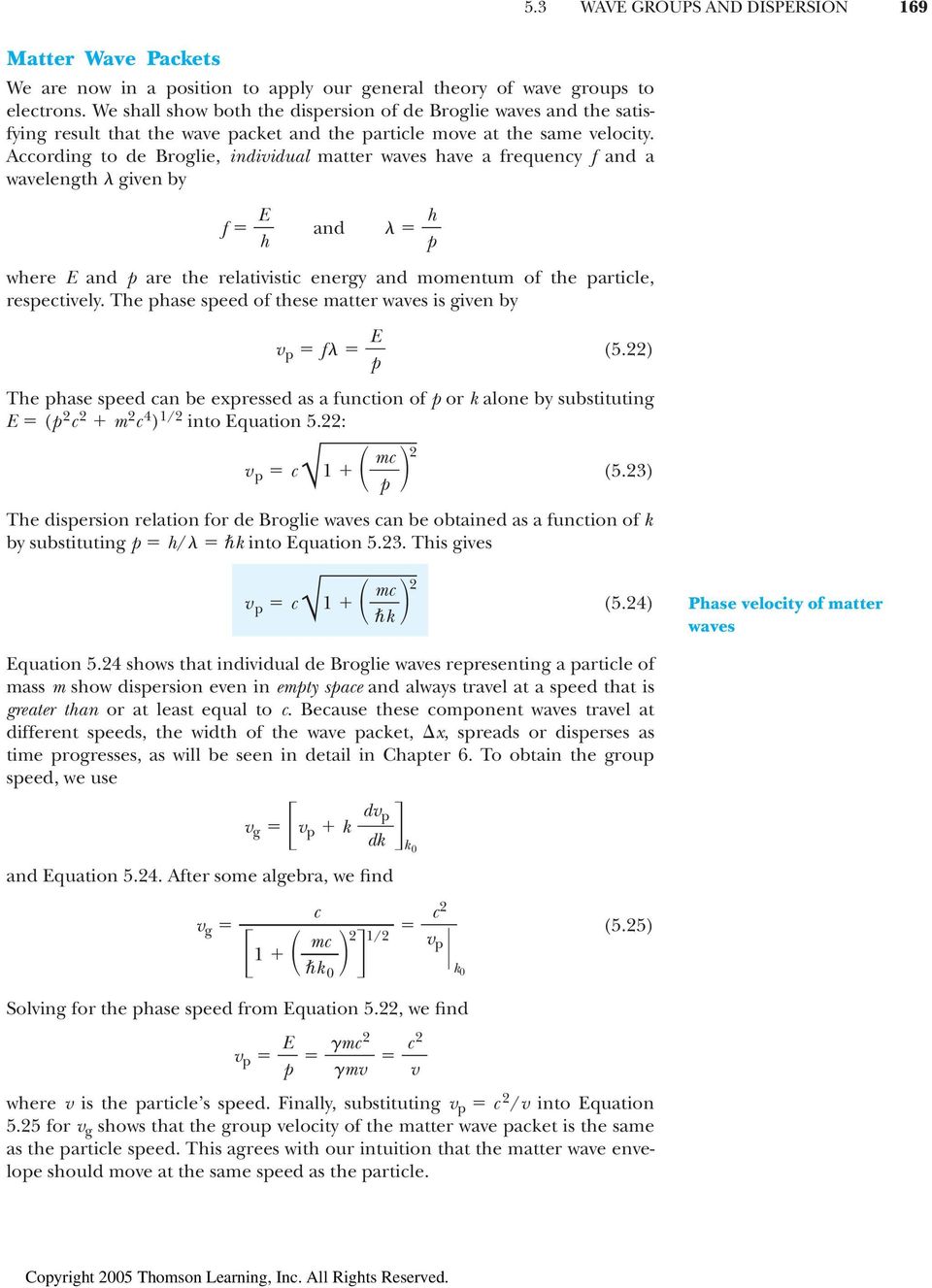
19 5.3 WAVE GROUPS AND DISPERSION 169 Matter Wave Packets We are now in a position to apply our general theory of wave groups to electrons. We shall show both the dispersion of de Broglie waves and the satisfying result that the wave packet and the particle move at the same velocity. According to de Broglie, individual matter waves have a frequency f and a wavelength given by f E h and h p where E and p are the relativistic energy and momentum of the particle, respectively. The phase speed of these matter waves is given by v p f E p (5.22) The phase speed can be expressed as a function of p or k alone by substituting E (p 2 c 2 m 2 c 4 ) 1/2 into Equation 5.22: v p c 1 mc p 2 (5.23) The dispersion relation for de Broglie waves can be obtained as a function of k by substituting p h/ k into Equation This gives v p c 1 mc k 2 (5.24) Phase velocity of matter waves Equation 5.24 shows that individual de Broglie waves representing a particle of mass m show dispersion even in empty space and always travel at a speed that is greater than or at least equal to c. Because these component waves travel at different speeds, the width of the wave packet, x, spreads or disperses as time progresses, as will be seen in detail in Chapter 6. To obtain the group speed, we use and Equation After some algebra, we find v g v g v p k dv p dk k0 c 1 mc k 0 2 1/2 c2 v p k0 (5.25) Solving for the phase speed from Equation 5.22, we find v p E p mc 2 mv c 2 v where v is the particle s speed. Finally, substituting v p c 2 /v into Equation 5.25 for v g shows that the group velocity of the matter wave packet is the same as the particle speed. This agrees with our intuition that the matter wave envelope should move at the same speed as the particle.
20 170 CHAPTER 5 MATTER WAVES O P T I O N A L 5.4 FOURIER INTEGRALS In this section we show in detail how to construct wave groups, or pulses, that are truly localized in space or time and also show that very general reciprocity relations of the type kx 1 and t 1 hold for these pulses. To form a true pulse that is zero everywhere outside of a finite spatial range x requires adding together an infinite number of harmonic waves with continuously varying wavelengths and amplitudes. This addition can be done with a Fourier integral, which is defined as follows: f(x) 1 a(k)e ikx dk (5.26) 2 Here f(x) is a spatially localized wave group, a(k) gives the amount or amplitude of the wave with wavenumber k (2/) to be added, and e ikx cos kx i sin kx is Euler s compact expression for a harmonic wave. The amplitude distribution function a(k) can be obtained if f (x) is known by using the symmetric formula a(k) 1 2 (5.27) Equations 5.26 and 5.27 apply to the case of a spatial pulse at fixed time, but it is important to note that they are mathematically identical to the case of a time pulse passing a fixed position. This case is common in electrical engineering and involves adding together a continuously varying set of frequencies: V(t) 1 2 g() 1 2 f(x)e ikx dk g()e it d V(t)e it dt (5.28) (5.29) where V(t) is the strength of a signal as a function of time, and g() is the spectral content of the signal and gives the amount of the harmonic wave with frequency that is present. Let us now consider several examples of how to use Equations 5.26 through 5.29 and how they lead to uncertainty relationships of the type t 1 and k x 1. EXAMPLE 5.6 This example compares the spectral contents of infinite and truncated sinusoidal waves. A truncated sinusoidal wave is a wave cut off or truncated by a shutter, as shown in Figure (a) What is the spectral content of an infinite sinusoidal wave e i0t? (b) Find and sketch the spectral content of a truncated sinusoidal wave given by V(t) e i0t T t T V(t) 0 otherwise (c) Show that for this truncated sinusoid t, where t and are the halfwidths of v(t) and g(), respectively. Solution (a) The spectral content consists of a single strong contribution at the frequency 0.

21 5.4 FOURIER INTEGRALS 171 V (t) T O +T t Figure 5.21 (Example 5.6) The real part of a truncated sinusoidal wave. (b) Because the sine term is an odd function and the cosine is even, the integral reduces to g() 2 2 g() T 2 cos(0 )t dt 0 V(t)e it dt 1 T [cos(0 )t i sin(0 )t] dt T A sketch of g() (Figure 5.22) shows a typical sin Z/Z profile centered on 0. Note that both positive and negative amounts of different frequencies must be added to produce the truncated sinusoid. Furthermore, the strongest frequency contribution comes from the frequency region near 0, as expected. (c) t clearly equals T and may be taken to be half the width of the main lobe of g(), /T. Thus, we get t 2 sin(0 )T (0 ) T T T T e i(0)t dt 2 (T ) sin(0 )T (0 )T g( ω) 2 π T + O 2 ω π ω π 0 ω 0 ω T 0+ T ω Figure 5.22 (Example 5.6) The Fourier transform of a truncated sinusoidal wave. The curve shows the amount of a given frequency that must be added to produce the truncated wave.
22 172 CHAPTER 5 MATTER WAVES We see that the product of the spread in frequency,, and the spread in time, t, is a constant independent of T. EXAMPLE 5.7 A Matter Wave Packet (a) Show that the matter wave packet whose amplitude distribution a(k) is a rectangular pulse of height unity, width k, and centered at k 0 (Fig. 5.23) has the form Solution f (x) 2 1 a(k)e ikx dk 1 k 2 sin(k x/2) (k x/2) f (x) e ik 0x k 2 2 sin(k x/2) (k x/2) k 0(k/2) k 0 (k/2) eikx dk 1 (b) Observe that this wave packet is a complex function. Later in this chapter we shall see how the definition of probability density results in a real function, but for the time being consider only the real part of f (x) and make a sketch of its behavior, showing its envelope and the cosine function within. Determine x, and show that an uncertainty relation of the form x k 1 holds. Solution The real part of the wave packet is shown in Figure 5.24 where the full width of the main lobe is x 4/k. This immediately gives the uncertainty relation x k 4. Note that the constant on the right-hand side of the uncertainty relation depends on the shape chosen for a(k) and the precise definition of x and k. Exercise 3 Assume that a narrow triangular voltage pulse V(t ) arises in some type of radar system (see Fig. 5.25). (a) Find and sketch the spectral content g(). (b) Show that a relation of the type t 1 holds. (c) If the width of the pulse is e ik 0x 2 e ik 0x x 2 sin(k x/2) a(k) 1 O k k 0 k 0 k k k Figure 5.23 (Example 5.7) A simple amplitude distribution specifying a uniform contribution of all wavenumbers from k 0 k/2 to k 0 k/2. Although we have used only positive k s here, both positive and negative k values are allowed, in general corresponding to waves traveling to the right (k 0) or left (k 0).
23 5.5 THE HEISENBERG UNCERTAINTY PRINCIPLE 173 f (x) k 2π sin ( k x ) 2 k x 2 x 2 π k 2 π k cos (k 0 x) Figure 5.24 (Example 5.7) The real part of the wave packet formed by the uniform amplitude distribution shown in Figure V(t) s, what range of frequencies must this system pass if the pulse is to be undistorted? Take t and define similarly. Answer (a) g() ( 2/)(1/2)(1 cos ). (b) t 2. (c) 2f Hz. τ 0 + τ t Figure 5.25 (Exercise 3). Constructing Moving Wave Packets Figure 5.24 represents a snapshot of the wave packet at t 0. To construct a moving wave packet representing a moving particle, we replace kx in Equation 5.26 with (kx t). Thus, the representation of the moving wave packet becomes f(x, t) 1 a(k)e i(kxt) dk (5.30) 2 It is important to realize that here (k), that is, is a function of k and therefore depends on the type of wave and the medium traversed. In general, it is difficult to solve this integral analytically. For matter waves, the QMTools software available from our companion Web site ( produces the same result by solving numerically a certain differential equation that governs the behavior of such waves. This approach will be explored further in the next chapter. 5.5 THE HEISENBERG UNCERTAINTY PRINCIPLE In the period , Werner Heisenberg, the son of a professor of Greek and Latin at the University of Munich, invented a complete theory of quantum mechanics called matrix mechanics. This theory overcame some of the problems with the Bohr theory of the atom, such as the postulate of unobservable electron orbits. Heisenberg s formulation was based primarily on measurable quantities such as the transition probabilities for electronic jumps between quantum states. Because transition probabilities depend on the initial and final states, Heisenberg s mechanics used variables labeled by two subscripts. Although at first Heisenberg presented his theory in the form of noncommuting algebra, Max Born quickly realized that this theory could be more
24 174 CHAPTER 5 MATTER WAVES elegantly described by matrices. Consequently, Born, Heisenberg, and Pascual Jordan soon worked out a comprehensive theory of matrix mechanics. Although the matrix formulation was quite elegant, it attracted little attention outside of a small group of gifted physicists because it was difficult to apply in specific cases, involved mathematics unfamiliar to most physicists, and was based on rather vague physical concepts. Although we will investigate this remarkable form of quantum mechanics no further, we shall discuss another of Heisenberg s discoveries, the uncertainty principle, elucidated in a famous paper in In this paper Heisenberg introduced the notion that it is impossible to determine simultaneously with unlimited precision the position and momentum of a particle. In words we may state the uncertainty principle as follows: Momentum position uncertainty principle If a measurement of position is made with precision x and a simultaneous measurement of momentum in the x direction is made with precision p x, then the product of the two uncertainties can never be smaller than 2. That is, p x x 2 (5.31) In his paper of 1927, Heisenberg was careful to point out that the inescapable uncertainties p x and x do not arise from imperfections in practical measuring instruments. Rather, they arise from the need to use a large range of wavenumbers, k, to represent a matter wave packet localized in a small region, x. The uncertainty principle represents a sharp break with the ideas of classical physics, in which it is assumed that, with enough skill and ingenuity, it is possible to simultaneously measure a particle s position and momentum to any desired degree of precision. As shown in Example 5.8, however, there is no contradiction between the uncertainty principle and classical laws for macroscopic systems because of the small value of. One can show that p x x /2 comes from the uncertainty relation governing any type of wave pulse formed by the superposition of waves with different wavelengths. In Section 5.3 we found that to construct a wave group localized in a small region x, we had to add up a large range of wavenumbers k, where k x 1 (Eq. 5.16). The precise value of the number on the righthand side of Equation 5.16 depends on the functional form f (x) of the wave group as well as on the specific definition of x and k. A different choice of f(x) or a different rule for defining x and k (or both) will give a slightly different number. With x and k defined as standard deviations, it can be 1 shown that the smallest number,, is obtained for a Gaussian wavefunction. 4 2 In this minimum uncertainty case we have xk See Section 6.7 for a definition of the standard deviation and Problem 6.34 for a complete mathematical proof of this statement.
25 5.5 THE HEISENBERG UNCERTAINTY PRINCIPLE 175 Image not available due to copyright restrictions WERNER HEISENBERG ( ) This photograph of Werner Heisenberg was taken around Heisenberg obtained his Ph.D. in 1923 at the University of Munich where he studied under Arnold Sommerfeld and became an enthusiastic mountain climber and skier. Later, he worked as an assistant to Max Born at Göttingen and Niels Bohr in Copenhagen. While physicists such as de Broglie and Schrödinger tried to develop visualizable models of the atom, Heisenberg, with the help of Born and Pascual Jordan, developed an abstract mathematical model called matrix mechanics to explain the wavelengths of spectral lines. The more successful wave mechanics of Schrödinger announced a few months later was shown to be equivalent to Heisenberg s approach. Heisenberg made many other significant contributions to physics, including his famous uncertainty principle, for which he received the Nobel prize in 1932, the prediction of two forms of molecular hydrogen, and theoretical models of the nucleus. During World War II he was director of the Max Planck Institute at Berlin where he was in charge of German research on atomic weapons. Following the war, he moved to West Germany and became director of the Max Planck Institute for Physics at Göttingen. For any other choice of f (x), x k 1 2 and using p x k, x k 1 2 immediately becomes p x x 2 (5.32) (5.33) The basic meaning of p x /2 is that as one uncertainty increases the other decreases. In the extreme case as one uncertainty approaches, the other must approach zero. This extreme case is illustrated by a plane wave e ik 0x that has a precise momentum k 0 and an infinite extent that is, the wavefunction is not concentrated in any segment of the x axis. Another important uncertainty relation involves the uncertainty in energy of a wave packet, E, and the time, t, taken to measure that energy. Starting with as the minimum form of the time frequency uncertainty principle, and using the de Broglie relation for the connection between the matter wave energy and frequency, E, we immediately find the energy time uncertainty principle t 1 2 E t 2 (5.34) Energy time uncertainty principle Equation 5.34 states that the precision with which we can know the energy of some system is limited by the time available for measuring the energy. A common application of the energy time uncertainty is in calculating the lifetimes of very short-lived subatomic particles whose lifetimes cannot be measured directly, but whose uncertainty in energy or mass can be measured. (See Problem 26.) A Different View of the Uncertainty Principle Although we have indicated that p x x /2 arises from the theory of forming pulses or wave groups, there is a more physical way to view the origin of the un-
26 176 CHAPTER 5 MATTER WAVES Incident photon Scattered photon Before collision Electron Recoiling electron (a) After collision certainty principle. We consider certain idealized experiments (called thought experiments) and show that it is impossible to carry out an experiment that allows the position and momentum of a particle to be simultaneously measured with an accuracy that violates the uncertainty principle. The most famous thought experiment along these lines was introduced by Heisenberg himself and involves the measurement of an electron s position by means of a microscope (Fig. 5.26), which forms an image of the electron on a screen or the retina of the eye. Because light can scatter from and perturb the electron, let us minimize this effect by considering the scattering of only a single light quantum from an electron initially at rest (Fig. 5.27). To be collected by the lens, the photon must be scattered through an angle ranging from to, which consequently imparts to the electron an x momentum value ranging from (h sin )/ to (h sin)/. Thus the uncertainty in the electron s momentum is p x (2h sin)/. After passing through the lens, the photon lands somewhere on the screen, but the image and consequently the position of the electron is fuzzy because the photon is diffracted on passing through the lens aperture. According to physical optics, the resolution of a microscope or the uncertainty in the image of the electron, x, is given by x /(2 sin ). Here 2 is the angle subtended by the objective lens, as shown in Figure Multiplying the expressions for p x and x, we find for the electron (b) Figure 5.26 A thought experiment for viewing an electron with a powerful microscope. (a) The electron is shown before colliding with the photon. (b) The electron recoils (is disturbed) as a result of the collision with the photon. Screen x Lens Scattered photon p = h/λ α θ e initially at rest y x Incident photon p 0 = h/ λ 0 x Figure 5.27 The Heisenberg microscope. 5 The resolving power of the microscope is treated clearly in F. A. Jenkins and H. E. White, Fundamentals of Optics, 4th ed., New York, McGraw-Hill Book Co., 1976, pp
27 p x x 2h sin in agreement with the uncertainty relation. Note also that this principle is inescapable and relentless! If x is reduced by increasing or the lens size, there is an equivalent increase in the uncertainty of the electron s momentum. Examination of this simple experiment shows several key physical properties that lead to the uncertainty principle: The indivisible nature of light particles or quanta (nothing less than a single photon can be used!). The wave property of light as shown in diffraction. The impossibility of predicting or measuring the precise classical path of a single scattered photon and hence of knowing the precise momentum transferred to the electron. 6 We conclude this section with some examples of the types of calculations that can be done with the uncertainty principle. In the spirit of Fermi or Heisenberg, these back-of-the-envelope calculations are surprising for their simplicity and essential description of quantum systems of which the details are unknown. 2 sin h 5.5 THE HEISENBERG UNCERTAINTY PRINCIPLE 177 EXAMPLE 5.8 The Uncertainty Principle Changes Nothing for Macroscopic Objects (a) Show that the spread of velocities caused by the uncertainty principle does not have measurable consequences for macroscopic objects (objects that are large compared with atoms) by considering a 100-g racquetball confined to a room 15 m on a side. Assume the ball is moving at 2.0 m/s along the x axis. Solution p x Thus the minimum spread in velocity is given by v x p x m 2 x Js 2 15 m kgm/s kg This gives a relative uncertainty of v x v x which is certainly not measurable kgm/s m/s (b) If the ball were to suddenly move along the y axis perpendicular to its well-defined classical trajectory along x, how far would it move in 1 s? Assume that the ball moves in the y direction with the top speed in the spread v y produced by the uncertainty principle. Solution It is important to realize that uncertainty relations hold in the y and z directions as well as in the x direction. This means that p x x /2, p y y /2, and p z z /2 and because all the position uncertainties are equal, all of the velocity spreads are equal. Consequently, we have v y m/s and the ball moves m in the y direction in 1 s. This distance is again an immeasurably small quantity, being times the size of a nucleus! Exercise 4 How long would it take the ball to move 50 cm in the y direction? (The age of the universe is thought to be 15 billion years, give or take a few billion). 6 Attempts to measure the photon s position by scattering electrons from it in a Compton process only serve to make its path to the lens more uncertain.
28 178 CHAPTER 5 MATTER WAVES EXAMPLE 5.9 Do Electrons Exist Within the Nucleus? Estimate the kinetic energy of an electron confined within a nucleus of size m by using the uncertainty principle. Solution Taking x to be the half-width of the confinement length in the equation p x, we have 2 x or This means that measurements of the component of momentum of electrons trapped inside a nucleus would range from less than 20 MeV/c to greater than 20 MeV/c and that some electrons would have momentum at least as large as 20 MeV/c. Because this appears to be a large momentum, to be safe we calculate the electron s energy relativistically. or p x evs m m/s c E 2 p 2 c 2 (m e c 2 ) 2 (20 MeV/c) 2 c 2 (0.511 MeV) 2 400(MeV) 2 E 20 MeV Finally, the kinetic energy of an intranuclear electron is K E m e c MeV Since electrons emitted in radioactive decay of the nucleus (beta decay) have energies much less than 19.5 MeV (about 1 MeV or less) and it is known that no other mechanism could carry off an intranuclear electron s energy during the decay process, we conclude that electrons observed in beta decay do not come from within the nucleus but are actually created at the instant of decay. EXAMPLE 5.10 p x ev c The Width of Spectral Lines Although an excited atom can radiate at any time from t 0 to t, the average time after excitation at which a group of atoms radiates is called the lifetime,, of a particular excited state. (a) If s (a typical value), use the uncertainty principle to compute the line width f of light emitted by the decay of this excited state. Solution We use E t /2, where E is the uncertainty in energy of the excited state, and t s is the average time available to measure the excited state. Thus, E 2 t ( s) Since E is also the uncertainty in energy of a photon emitted when the excited state decays, and E hf for a photon, or h f ( s) (b) If the wavelength of the spectral line involved in this process is 500 nm, find the fractional broadening f/f. Solution First, we find the center frequency of this line as follows: Hence, f f 0 c f f m/s m Hz Hz Hz This narrow natural line width can be seen with a sensitive interferometer. Usually, however, temperature and pressure effects overshadow the natural line width and broaden the line through mechanisms associated with the Doppler effect and atomic collisions. Exercise 5 Using the nonrelativistic Doppler formula, calculate the Doppler broadening of a 500-nm line emitted by a hydrogen atom at 1000 K. Do this by considering the atom to be moving either directly toward or away from an observer with an energy of k B T. Answer nm, or Å s Hz IF ELECTRONS ARE WAVES, WHAT S WAVING? Although we have discussed in some detail the notion of de Broglie matter waves, we have not discussed the precise nature of the field (x, y, z, t) or wavefunction that represents the matter waves. We have delayed this discussion because
29 5.7 THE WAVE PARTICLE DUALITY 179 (Greek letter psi) is rather abstract. is definitely not a measurable disturbance requiring a medium for propagation like a water wave or a sound wave. Instead, the stuff that is waving requires no medium. Furthermore, is in general represented by a complex number and is used to calculate the probability of finding the particle at a given time in a small volume of space. If any of this seems confusing, you should not lose heart, as the nature of the wavefunction has been confusing people since its invention. It even confused its inventor, Erwin Schrödinger, who incorrectly interpreted * as the electric charge density. 7 The great philosopher of the quantum theory, Bohr, immediately objected to this interpretation. Subsequently, Max Born offered the currently accepted statistical view of * in late The confused state of affairs surrounding at that time was nicely described in a poem by Walter Huckel: Erwin with his psi can do Calculations quite a few. But one thing has not been seen Just what does psi really mean? (English translation by Felix Bloch) The currently held view is that a particle is described by a function (x, y, z, t) called the wavefunction. The quantity * 2 represents the probability per unit volume of finding the particle at a time t in a small volume of space centered on (x, y, z). We will treat methods of finding in much more detail in Chapter 6, but for now all we require is the idea that the probability of finding a particle is directly proportional to THE WAVE PARTICLE DUALITY The Description of Electron Diffraction in Terms of In this chapter and previous chapters we have seen evidence for both the wave properties and the particle properties of electrons. Historically, the particle properties were first known and connected with a definite mass, a discrete charge, and detection or localization of the electron in a small region of space. Following these discoveries came the confirmation of the wave nature of electrons in scattering at low energy from metal crystals. In view of these results and because of the everyday experience of seeing the world in terms of either grains of sand or diffuse water waves, it is no wonder that we are tempted to simplify the issue and ask, Well, is the electron a wave or a particle? The answer is that electrons are very delicate and rather plastic they behave like either particles or waves, depending on the kind of experiment performed on them. In any case, it is impossible to measure both the wave and particle properties simultaneously. 8 The view of Bohr was expressed in an idea known as complementarity. As different as they are, both wave and particle views are needed and they complement each other to fully describe the electron. The view of Complementarity 7 * represents the complex conjugate of. Thus, if a ib, then * a ib. In exponential form, if Ae i, then * Ae i. Note that * 2 ; a, b, A, and are all real quantities. 8 Many feel that the elder Bragg s remark, originally made about light, is a more satisfying answer: Electrons behave like waves on Mondays, Wednesdays, and Fridays, like particles on Tuesdays, Thursdays, and Saturdays, and like nothing at all on Sundays.
30 180 CHAPTER 5 MATTER WAVES Feynman 9 was that both electrons and photons behave in their own inimitable way. This is like nothing we have seen before, because we do not live at the very tiny scale of atoms, electrons, and photons. Perhaps the best way to crystallize our ideas about the wave particle duality is to consider a simple double-slit electron diffraction experiment. This experiment highlights much of the mystery of the wave particle paradox, shows the impossibility of measuring simultaneously both wave and particle properties, and illustrates the use of the wavefunction,, in determining interference effects. A schematic of the experiment with monoenergetic (single-wavelength) electrons is shown in Figure A parallel beam of electrons falls on a double slit, which has individual openings much smaller than D so that single-slit diffraction effects are negligible. At a distance from the slits much greater than D is an electron detector capable of detecting individual electrons. It is important to note that the detector always registers discrete particles localized in space and time. In a real experiment this can be achieved if the electron source is weak enough (see Fig. 5.29): In all cases if the detector collects electrons at different positions for a long enough time, a typical wave interference pattern for the counts per minute or probability of arrival of electrons is found (see Fig. 5.28). If one imagines a single electron to produce in-phase wavelets at the slits, standard wave theory can be used to find the angular separation,, of the y x Electrons A D θ B θ Electron detector counts min Figure 5.28 Electron diffraction. D is much greater than the individual slit widths and much less than the distance between the slits and the detector. 9 R. Feynman, The Character of Physical Law, Cambridge, MA, MIT Press, 1982.
31 5.7 THE WAVE PARTICLE DUALITY 181 Images not available due to copyright restrictions central probability maximum from its neighboring minimum. The minimum occurs when the path length difference between A and B in Figure 5.28 is half a wavelength, or D sin /2 As the electron s wavelength is given by h/p x, we see that sin h 2p x D (5.35) for small. Thus we can see that the dual nature of the electron is clearly shown in this experiment: although the electrons are detected as particles at a localized spot at some instant of time, the probability of arrival at that spot is determined by finding the intensity of two interfering matter waves. But there is more. What happens if one slit is covered during the experiment? In this case one obtains a symmetric curve peaked around the center of the open slit, much like the pattern formed by bullets shot through a hole in armor plate. Plots of the counts per minute or probability of arrival of electrons with the lower or upper slit closed are shown in Figure These are expressed as the appropriate square of the absolute value of some wavefunction, * 1 or * 2, where 1 and 2 represent the cases of the electron passing through slit 1 and slit 2, respectively. If an experiment is now performed with slit 1 open and slit 2 blocked for time T and then slit 1 blocked and slit 2 open for time T, the accumulated pattern of counts per minute is completely different from the case with
32 182 CHAPTER 5 MATTER WAVES Ψ counts/min 2 1 Ψ 1 2 Figure 5.30 The probability of finding electrons at the screen with either the lower or upper slit closed. both slits open. Note in Figure 5.31 that there is no longer a maximum probability of arrival of an electron at 0. In fact, the interference pattern has been lost and the accumulated result is simply the sum of the individual results. The results shown by the black curves in Figure 5.31 are easier to understand and more reasonable than the interference effects seen with both slits open (blue curve). When only one slit is open at a time, we know the electron has the same localizability and indivisibility at the slits as we measure at the detector, because the electron clearly goes through slit 1 or slit 2. Thus, the total must be analyzed as the sum of those electrons that come through slit 1, 1 2, and those that come through slit 2, 2 2. When both slits are open, it is tempting to assume that the electron goes through either slit 1 or slit 2 and that the counts per minute are again given by We know, however, that the experimental results contradict this. Thus, our assumption that the electron is localized and goes through only one slit when both slits are open must be wrong (a painful conclusion!). Somehow the electron must be simultaneously present at both slits in order to exhibit interference. To find the probability of detecting the electron at a particular point on the screen with both slits open, we may say that the electron is in a superposition state given by 1 2
33 5.7 THE WAVE PARTICLE DUALITY 183 Ψ D 1 Ψ 1 2 Ψ Ψ 2 2 Individual counts/min Accumulated counts/min Figure 5.31 Accumulated results from the two-slit electron diffraction experiment with each slit closed half the time. For comparison, the results with both slits open are shown in color. Thus, the probability of detecting the electron at the screen is equal to the quantity and not Because matter waves that start out in phase at the slits in general travel different distances to the screen (see Fig. 5.28), 1 and 2 will possess a relative phase difference at the screen. Using a phasor diagram (Fig. 5.32) to find immediately yields cos Note that the term cos is an interference term that predicts the interference pattern actually observed in this case. For ease of comparison, a summary of the results found in both cases is given in Table 5.1. Ψ 1 + Ψ 2 Ψ 2 φ Ψ 1 Figure 5.32 Phasor diagram to represent the addition of two complex wavefunctions, 1 and 2, differing in phase by.
34 184 CHAPTER 5 MATTER WAVES Table 5.1 Case Wavefunction Counts/Minute at Screen Electron is measured to pass 1 or through slit 1 or slit 2 No measurements made on cos electron at slits A Thought Experiment: Measuring Through Which Slit the Electron Passes Another way to view the electron double-slit experiment is to say that the electron passes through the upper or lower slit only when one measures the electron to do so. Once one measures unambiguously which slit the electron passes through (yes, you guessed it... here comes the uncertainty principle again...), the act of measurement disturbs the electron s path enough to destroy the delicate interference pattern. Let us look again at our two-slit experiment to see in detail how the interference pattern is destroyed. 10 To determine which slit the electron goes through, imagine that a group of particles is placed right behind the slits, as shown in Figure If we use the recoil of a small particle to determine Detecting particles Unscattered electron θ p y p y D p y p x Scattered electron Screen Figure 5.33 A thought experiment to determine through which slit the electron passes. 10 Although we shall use the uncertainty principle in its standard form, it is worth noting that an alternative statement of the uncertainty principle involves this pivotal double-slit experiment: It is impossible to design any device to determine through which slit the electron passes that will not at the same time disturb the electron and destroy the interference pattern.
35 which slit the electron goes through, we must have the uncertainty in the detecting particle s position, y D. Also, during the collision the detecting particle suffers a change in momentum, p y, equal and opposite to the change in momentum experienced by the electron, as shown in Figure An undeviated electron landing at the first minimum and producing an interference pattern has 5.7 THE WAVE PARTICLE DUALITY 185 tan p y p x h 2p x D from Equation Thus, we require that an electron scattered by a detecting particle have p y p x h 2p x D or if the interference pattern is not to be distorted. Because the change in momentum of the scattered electron is equal to the change in momentum of the detecting particle, p y h/ 2D also applies to the detecting particle. Thus, we have for the detecting particle or p y p y y h 2D h 2D D p y y h 2 This is a clear violation of the uncertainty principle. Hence we see that the small uncertainties needed, both to observe interference and to know which slit the electron goes through, are impossible, because they violate the uncertainty principle. If y is small enough to determine which slit the electron goes through, p y is so large that electrons heading for the first minimum are scattered into adjacent maxima and the interference pattern is destroyed. Exercise 6 In a real experiment it is likely that some electrons would miss the detecting particles. Thus, we would really have two categories of electrons arriving at the detector: those measured to pass through a definite slit and those not observed, or just missed, at the slits. In this case what kind of pattern of counts per minute would be accumulated by the detector? Answer A mixture of an interference pattern (those not measured) and (those measured) would result.
36 186 CHAPTER 5 MATTER WAVES 5.8 A FINAL NOTE Scientists once viewed the world as being made up of distinct and unchanging parts that interact according to strictly deterministic laws of cause and effect. In the classical limit this is fundamentally correct because classical processes involve so many quanta that deviations from the average are imperceptible. At the atomic level, however, we have seen that a given piece of matter (an electron, say) is not a distinct and unchanging part of the universe obeying completely deterministic laws. Such a particle exhibits wave properties when it interacts with a metal crystal and particle properties a short while later when it registers on a Geiger counter. Thus, rather than viewing the electron as a distinct and separate part of the universe with an intrinsic particle nature, we are led to the view that the electron and indeed all particles are amorphous entities possessing the potential to cycle endlessly between wave and particle behavior. We also find that it is much more difficult to separate the object measured from the measuring instrument at the atomic level, because the type of measuring instrument determines whether wave properties or particle properties are observed. SUMMARY Every lump of matter of mass m and momentum p has wavelike properties with wavelength given by the de Broglie relation h p (5.1) By applying this wave theory of matter to electrons in atoms, de Broglie was able to explain the appearance of integers in certain Bohr orbits as a natural consequence of electron wave interference. In 1927, Davisson and Germer demonstrated directly the wave nature of electrons by showing that low-energy electrons were diffracted by single crystals of nickel. In addition, they confirmed Equation 5.1. Although the wavelength of matter waves can be experimentally determined, it is important to understand that they are not just like other waves because their frequency and phase velocity cannot be directly measured. In particular, the phase velocity of an individual matter wave is greater than the velocity of light and varies with wavelength or wavenumber as v p f E h h p c 1 mc k 2 1/2 (5.24) To represent a particle properly, a superposition of matter waves with different wavelengths, amplitudes, and phases must be chosen to interfere constructively over a limited region of space. The resulting wave packet or group can then be shown to travel with the same speed as the classical particle. In addition, a wave packet localized in a region x contains a range of wavenumbers 1 k, where x k 2. Because p x k, this implies that there is an uncertainty principle for position and momentum: p x x 2 (5.31)
37 QUESTIONS 187 In a similar fashion one can show that an energy time uncertainty relation exists, given by Et 2 (5.34) In quantum mechanics matter waves are represented by a wavefunction (x, y, z, t). The probability of finding a particle represented by in a small volume centered at (x, y, z) at time t is proportional to&& 2. The wave particle duality of electrons may be seen by considering the passage of electrons through two narrow slits and their arrival at a viewing screen. We find that although the electrons are detected as particles at a localized spot on the screen, the probability of arrival at that spot is determined by finding the intensity of two interfering matter waves. Although we have seen the importance of matter waves or wavefunctions in this chapter, we have provided no method of finding for a given physical system. In the next chapter we introduce the Schrödinger wave equation. The solutions to this important differential equation will provide us with the wavefunctions for a given system. SUGGESTIONS FOR FURTHER READING 1. D. Bohm, Quantum Theory, Englewood Cliffs, NJ, Prentice-Hall, Chapters 3 and 6 in this book give an excellent account of wave packets and the wave particle duality of matter at a more advanced level. 2. R. Feynman, The Character of Physical Law, Cambridge, MA, The MIT Press, 1982, Chapter 6. This monograph is an incredibly lively and readable treatment of the double-slit experiment presented in Feynman s inimitable fashion. 3. B. Hoffman, The Strange Story of the Quantum, New York, Dover Publications, This short book presents a beautifully written nonmathematical discussion of the history of quantum mechanics. QUESTIONS 1. Is light a wave or a particle? Support your answer by citing specific experimental evidence. 2. Is an electron a particle or a wave? Support your answer by citing some experimental results. 3. An electron and a proton are accelerated from rest through the same potential difference. Which particle has the longer wavelength? 4. If matter has a wave nature, why is this wavelike character not observable in our daily experiences? 5. In what ways does Bohr s model of the hydrogen atom violate the uncertainty principle? 6. Why is it impossible to measure the position and speed of a particle simultaneously with infinite precision? 7. Suppose that a beam of electrons is incident on three or more slits. How would this influence the interference pattern? Would the state of an electron depend on the number of slits? Explain. 8. In describing the passage of electrons through a slit and arriving at a screen, Feynman said that electrons arrive in lumps, like particles, but the probability of arrival of these lumps is determined as the intensity of the waves would be. It is in this sense that the electron behaves sometimes like a particle and sometimes like a wave. Elaborate on this point in your own words. (For a further discussion of this point, see R. Feynman, The Character of Physical Law, Cambridge, MA, MIT Press, 1982, Chapter 6.) 9. Do you think that most major experimental discoveries are made by careful planning or by accident? Cite examples. 10. In the case of accidental discoveries, what traits must the experimenter possess to capitalize on the discovery? 11. Are particles even things? An extreme view of the plasticity of electrons and other particles is expressed in this fa-
38 188 CHAPTER 5 MATTER WAVES mous quote of Heisenberg: The invisible elementary particle of modern physics does not have the property of occupying space any more than it has properties like color or solidity. Fundamentally, it is not a material structure in space and time but only a symbol that allows the laws of nature to be expressed in especially simple form. Are you satisfied with viewing science as a set of predictive rules or do you prefer to see science as a description of an objective world of things in the case of particle physics, tiny, scaled-down things? What problems are associated with each point of view? PROBLEMS 5.1 The Pilot Waves of de Broglie 1. Calculate the de Broglie wavelength for a proton moving with a speed of 10 6 m/s. 2. Calculate the de Broglie wavelength for an electron with kinetic energy (a) 50 ev and (b) 50 kev. 3. Calculate the de Broglie wavelength of a 74-kg person who is running at a speed of 5.0 m/s. 4. The seeing ability, or resolution, of radiation is determined by its wavelength. If the size of an atom is of the order of 0.1 nm, how fast must an electron travel to have a wavelength small enough to see an atom? 5. To observe small objects, one measures the diffraction of particles whose de Broglie wavelength is approximately equal to the object s size. Find the kinetic energy (in electron volts) required for electrons to resolve (a) a large organic molecule of size 10 nm, (b) atomic features of size 0.10 nm, and (c) a nucleus of size 10 fm. Repeat these calculations using alpha particles in place of electrons. 6. An electron and a photon each have kinetic energy equal to 50 kev. What are their de Broglie wavelengths? 7. Calculate the de Broglie wavelength of a proton that is accelerated through a potential difference of 10 MV. 8. Show that the de Broglie wavelength of an electron accelerated from rest through a small potential difference V is given by, where is in nanometers and V is in volts. 9. Find the de Broglie wavelength of a ball of mass 0.20 kg just before it strikes the Earth after being dropped from a building 50 m tall. 10. An electron has a de Broglie wavelength equal to the diameter of the hydrogen atom. What is the kinetic energy of the electron? How does this energy compare with the ground-state energy of the hydrogen atom? 11. For an electron to be confined to a nucleus, its de Broglie wavelength would have to be less than m. (a) What would be the kinetic energy of an electron confined to this region? (b) On the basis of this result, would you expect to find an electron in a nucleus? Explain. 12. Through what potential difference would an electron have to be accelerated to give it a de Broglie wavelength of m? 1.226/ V 5.2 The Davisson Germer Experiment 13. Figure P5.13 shows the top three planes of a crystal with planar spacing d. If 2d sin 1.01 for the two waves shown, and high-energy electrons of wavelength penetrate many planes deep into the crystal, which atomic plane produces a wave that cancels the surface reflection? This is an example of how extremely narrow maxima in high-energy electron diffraction are formed that is, there are no diffracted beams unless 2d sin is equal to an integral number of wavelengths. d d θ 0.505λ Figure P (a) Show that the formula for low-energy electron diffraction (LEED), when electrons are incident perpendicular to a crystal surface, may be written as sin where n is the order of the maximum, d is the atomic spacing, m e is the electron mass, K is the electron s kinetic energy, and is the angle between the incident and diffracted beams. (b) Calculate the atomic spacing θ nhc d(2m e c 2 K) 1/2
39 PROBLEMS 189 in a crystal that has consecutive diffraction maxima at 24.1 and 54.9 for 100-eV electrons. 5.3 Wave Groups and Dispersion 15. Show that the group velocity for a nonrelativistic free electron is also given by v g p/m e v 0, where v 0 is the electron s velocity. 16. When a pebble is tossed into a pond, a circular wave pulse propagates outward from the disturbance. If you are alert (and it s not a sleepy afternoon in late August), you will see a fine structure in the pulse consisting of surface ripples moving inward through the circular disturbance. Explain this effect in terms of group and phase velocity if the phase velocity of ripples is given by v p 2S/, where S is the surface tension and is the density of the liquid. 17. The dispersion relation for free relativistic electron waves is (k) c 2 k 2 (m e c 2 /) 2 Obtain expressions for the phase velocity v p and group velocity v g of these waves and show that their product is a constant, independent of k. From your result, what can you conclude about v g if v p c? 5.5 The Heisenberg Uncertainty Principle 18. A ball of mass 50 g moves with a speed of 30 m/s. If its speed is measured to an accuracy of 0.1%, what is the minimum uncertainty in its position? 19. A proton has a kinetic energy of 1.0 MeV. If its momentum is measured with an uncertainty of 5.0%, what is the minimum uncertainty in its position? 20. We wish to measure simultaneously the wavelength and position of a photon. Assume that the wavelength measurement gives 6000 Å with an accuracy of one part in a million, that is, / What is the minimum uncertainty in the position of the photon? 21. A woman on a ladder drops small pellets toward a spot on the floor. (a) Show that, according to the uncertainty principle, the miss distance must be at least x 2m 1/2 2g H 1/4 where H is the initial height of each pellet above the floor and m is the mass of each pellet. (b) If H 2.0 m and m 0.50 g, what is x? 22. A beam of electrons is incident on a slit of variable width. If it is possible to resolve a 1% difference in momentum, what slit width would be necessary to resolve the interference pattern of the electrons if their kinetic energy is (a) MeV, (b) 1.0 MeV, and (c) 100 MeV? 23. Suppose Fuzzy, a quantum-mechanical duck, lives in a world in which h 2 J s. Fuzzy has a mass of 2.0 kg and is initially known to be within a region 1.0 m wide. (a) What is the minimum uncertainty in his speed? (b) Assuming this uncertainty in speed to prevail for 5.0 s, determine the uncertainty in position after this time. 24. An electron of momentum p is at a distance r from a stationary proton. The system has a kinetic energy K p 2 /2m e and potential energy U ke 2 /r. Its total energy is E K U. If the electron is bound to the proton to form a hydrogen atom, its average position is at the proton but the uncertainty in its position is approximately equal to the radius, r, of its orbit. The electron s average momentum will be zero, but the uncertainty in its momentum will be given by the uncertainty principle. Treat the atom as a one-dimensional system in the following: (a) Estimate the uncertainty in the electron s momentum in terms of r. (b) Estimate the electron s kinetic, potential, and total energies in terms of r. (c) The actual value of r is the one that minimizes the total energy, resulting in a stable atom. Find that value of r and the resulting total energy. Compare your answer with the predictions of the Bohr theory. 25. An excited nucleus with a lifetime of ns emits a ray of energy 2.00 MeV. Can the energy width (uncertainty in energy, E ) of this 2.00-MeV emission line be directly measured if the best gamma detectors can measure energies to 5 ev? 26. Typical measurements of the mass of a subatomic delta particle (m 1230 MeV/c 2 ) are shown in Figure P5.26. Although the lifetime of the delta is much too short to measure directly, it can be calculated from the energy time uncertainty principle. Estimate the lifetime from the full width at half-maximum of the mass measurement distribution shown. Number of mass measurements in each bin Figure P5.26 delta particle Mass of the delta particle (MeV/c 2 ) 5.7 The Wave Particle Duality Each bin has a width of 25 MeV/c 2 Histogram of mass measurements of the 27. A monoenergetic beam of electrons is incident on a single slit of width 0.50 nm. A diffraction pattern is
40 190 CHAPTER 5 MATTER WAVES formed on a screen 20 cm from the slit. If the distance between successive minima of the diffraction pattern is 2.1 cm, what is the energy of the incident electrons? 28. A neutron beam with a selected speed of 0.40 m/s is directed through a double slit with a 1.0-mm separation. An array of detectors is placed 10 m from the slit. (a) What is the de Broglie wavelength of the neutrons? (b) How far off axis is the first zero-intensity point on the detector array? (c) Can we say which slit any particular neutron passed through? Explain. 29. A two-slit electron diffraction experiment is done with slits of unequal widths. When only slit 1 is open, the number of electrons reaching the screen per second is 25 times the number of electrons reaching the screen per second when only slit 2 is open. When both slits are open, an interference pattern results in which the destructive interference is not complete. Find the ratio of the probability of an electron arriving at an interference maximum to the probability of an electron arriving at an adjacent interference minimum. (Hint: Use the superposition principle). Additional Problems 30. Robert Hofstadter won the 1961 Nobel prize in physics for his pioneering work in scattering 20-GeV electrons from nuclei. (a) What is the factor for a 20-GeV electron, where (1 v 2 /c 2 ) 1/2? What is the momentum of the electron in kg m/s? (b) What is the wavelength of a 20-GeV electron and how does it compare with the size of a nucleus? 31. An air rifle is used to shoot 1.0-g particles at 100 m/s through a hole of diameter 2.0 mm. How far from the rifle must an observer be to see the beam spread by 1.0 cm because of the uncertainty principle? Compare this answer with the diameter of the Universe ( m). 32. An atom in an excited state 1.8 ev above the ground state remains in that excited state 2.0 s before moving to the ground state. Find (a) the frequency of the emitted photon, (b) its wavelength, and (c) its approximate uncertainty in energy. 33. A 0 meson is an unstable particle produced in highenergy particle collisions. It has a mass energy equivalent of about 135 MeV, and it exists for an average lifetime of only s before decaying into two rays. Using the uncertainty principle, estimate the fractional uncertainty m/m in its mass determination. 34. (a) Find and sketch the spectral content of the rectangular pulse of width 2 shown in Figure P5.34. (b) Show that a reciprocity relation t holds V(t ) τ + τ Figure P5.34 in this case. Take t and define similarly. (c) What range of frequencies is required to compose a pulse of width 2 1 s? A pulse of width 2 1 ns? 35. A matter wave packet. (a) Find and sketch the real part of the matter wave pulse shape f (x) for a Gaussian amplitude distribution a(k), where Note that a(k) is peaked at k 0 and has a width that decreases with increasing. (Hint: In order to put f(x) (2) 1/2 a(k)e ikx dk into the standard form a(k) Ae 2 (k--k 0 ) 2 e az2 dz, complete the square in k.) (b) By comparing the result for the real part of f (x) to the standard form of a Gaussian function with width x, f(x) Ae (x/2x)2, show that the width of the matter wave pulse is x. (c) Find the width k of a(k) by writing a(k) in standard Gaussian form and show that 1 x k 2, independent of. 36. Consider a freely moving quantum particle with mass m 1 and speed v. Its energy is E K U 2mv 2 0. Determine the phase speed of the quantum wave representing the particle and show that it is different from the speed at which the particle transports mass and energy. 37. In a vacuum tube, electrons are boiled out of a hot cathode at a slow, steady rate and accelerated from rest through a potential difference of 45.0 V. Then they travel altogether 28.0 cm as they go through an array of slits and fall on a screen to produce an interference pattern. Only one electron at a time will be in flight in the tube, provided the beam current is below what value? In this situation the interference pattern still appears, showing that each individual electron can interfere with itself. V 0 t
Does Quantum Mechanics Make Sense? Size
 Does Quantum Mechanics Make Sense? Some relatively simple concepts show why the answer is yes. Size Classical Mechanics Quantum Mechanics Relative Absolute What does relative vs. absolute size mean? Why
PHOTOELECTRIC EFFECT AND DUAL NATURE OF MATTER AND RADIATIONS
 PHOTOELECTRIC EFFECT AND DUAL NATURE OF MATTER AND RADIATIONS 1. Photons 2. Photoelectric Effect 3. Experimental Set-up to study Photoelectric Effect 4. Effect of Intensity, Frequency, Potential on P.E.
DO PHYSICS ONLINE FROM QUANTA TO QUARKS QUANTUM (WAVE) MECHANICS
 DO PHYSICS ONLINE FROM QUANTA TO QUARKS QUANTUM (WAVE) MECHANICS Quantum Mechanics or wave mechanics is the best mathematical theory used today to describe and predict the behaviour of particles and waves.
How To Understand Light And Color
 PRACTICE EXAM IV P202 SPRING 2004 1. In two separate double slit experiments, an interference pattern is observed on a screen. In the first experiment, violet light (λ = 754 nm) is used and a second-order
Physics 30 Worksheet # 14: Michelson Experiment
 Physics 30 Worksheet # 14: Michelson Experiment 1. The speed of light found by a Michelson experiment was found to be 2.90 x 10 8 m/s. If the two hills were 20.0 km apart, what was the frequency of the
Light as a Wave. The Nature of Light. EM Radiation Spectrum. EM Radiation Spectrum. Electromagnetic Radiation
 The Nature of Light Light and other forms of radiation carry information to us from distance astronomical objects Visible light is a subset of a huge spectrum of electromagnetic radiation Maxwell pioneered
The Phenomenon of Photoelectric Emission:
 The Photoelectric Effect. The Wave particle duality of light Light, like any other E.M.R (electromagnetic radiation) has got a dual nature. That is there are experiments that prove that it is made up of
Wave Function, ψ. Chapter 28 Atomic Physics. The Heisenberg Uncertainty Principle. Line Spectrum
 Wave Function, ψ Chapter 28 Atomic Physics The Hydrogen Atom The Bohr Model Electron Waves in the Atom The value of Ψ 2 for a particular object at a certain place and time is proportional to the probability
Chapter 18: The Structure of the Atom
 Chapter 18: The Structure of the Atom 1. For most elements, an atom has A. no neutrons in the nucleus. B. more protons than electrons. C. less neutrons than electrons. D. just as many electrons as protons.
- particle with kinetic energy E strikes a barrier with height U 0 > E and width L. - classically the particle cannot overcome the barrier
 Tunnel Effect: - particle with kinetic energy E strikes a barrier with height U 0 > E and width L - classically the particle cannot overcome the barrier - quantum mechanically the particle can penetrated
Cathode Ray Tube. Introduction. Functional principle
 Introduction The Cathode Ray Tube or Braun s Tube was invented by the German physicist Karl Ferdinand Braun in 897 and is today used in computer monitors, TV sets and oscilloscope tubes. The path of the
Physics 441/2: Transmission Electron Microscope
 Physics 441/2: Transmission Electron Microscope Introduction In this experiment we will explore the use of transmission electron microscopy (TEM) to take us into the world of ultrasmall structures. This
Physics 9e/Cutnell. correlated to the. College Board AP Physics 1 Course Objectives
 Physics 9e/Cutnell correlated to the College Board AP Physics 1 Course Objectives Big Idea 1: Objects and systems have properties such as mass and charge. Systems may have internal structure. Enduring
E/M Experiment: Electrons in a Magnetic Field.
 E/M Experiment: Electrons in a Magnetic Field. PRE-LAB You will be doing this experiment before we cover the relevant material in class. But there are only two fundamental concepts that you need to understand.
Indiana's Academic Standards 2010 ICP Indiana's Academic Standards 2016 ICP. map) that describe the relationship acceleration, velocity and distance.
 .1.1 Measure the motion of objects to understand.1.1 Develop graphical, the relationships among distance, velocity and mathematical, and pictorial acceleration. Develop deeper understanding through representations
Assessment Plan for Learning Outcomes for BA/BS in Physics
 Department of Physics and Astronomy Goals and Learning Outcomes 1. Students know basic physics principles [BS, BA, MS] 1.1 Students can demonstrate an understanding of Newton s laws 1.2 Students can demonstrate
Atomic Structure: Chapter Problems
 Atomic Structure: Chapter Problems Bohr Model Class Work 1. Describe the nuclear model of the atom. 2. Explain the problems with the nuclear model of the atom. 3. According to Niels Bohr, what does n stand
PHYSICS PAPER 1 (THEORY)
 PHYSICS PAPER 1 (THEORY) (Three hours) (Candidates are allowed additional 15 minutes for only reading the paper. They must NOT start writing during this time.) ---------------------------------------------------------------------------------------------------------------------
5. The Nature of Light. Does Light Travel Infinitely Fast? EMR Travels At Finite Speed. EMR: Electric & Magnetic Waves
 5. The Nature of Light Light travels in vacuum at 3.0. 10 8 m/s Light is one form of electromagnetic radiation Continuous radiation: Based on temperature Wien s Law & the Stefan-Boltzmann Law Light has
Quantum Phenomena and the Theory of Quantum Mechanics
 Quantum Phenomena and the Theory of The Mechanics of the Very Small Waseda University, SILS, Introduction to History and Philosophy of Science . Two Dark Clouds In 1900 at a Friday Evening lecture at the
Experiment #5: Qualitative Absorption Spectroscopy
 Experiment #5: Qualitative Absorption Spectroscopy One of the most important areas in the field of analytical chemistry is that of spectroscopy. In general terms, spectroscopy deals with the interactions
PHYS 222 Spring 2012 Final Exam. Closed books, notes, etc. No electronic device except a calculator.
 PHYS 222 Spring 2012 Final Exam Closed books, notes, etc. No electronic device except a calculator. NAME: (all questions with equal weight) 1. If the distance between two point charges is tripled, the
AP Physics B Ch. 23 and Ch. 24 Geometric Optics and Wave Nature of Light
 AP Physics B Ch. 23 and Ch. 24 Geometric Optics and Wave Nature of Light Name: Period: Date: MULTIPLE CHOICE. Choose the one alternative that best completes the statement or answers the question. 1) Reflection,
Matter Waves. Home Work Solutions
 Chapter 5 Matter Waves. Home Work s 5.1 Problem 5.10 (In the text book) An electron has a de Broglie wavelength equal to the diameter of the hydrogen atom. What is the kinetic energy of the electron? How
ILLUSTRATIVE EXAMPLE: Given: A = 3 and B = 4 if we now want the value of C=? C = 3 + 4 = 9 + 16 = 25 or 2
 Forensic Spectral Anaylysis: Warm up! The study of triangles has been done since ancient times. Many of the early discoveries about triangles are still used today. We will only be concerned with the "right
ATOMIC SPECTRA. Apparatus: Optical spectrometer, spectral tubes, power supply, incandescent lamp, bottles of dyed water, elevating jack or block.
 1 ATOMIC SPECTRA Objective: To measure the wavelengths of visible light emitted by atomic hydrogen and verify the measured wavelengths against those predicted by quantum theory. To identify an unknown
AS COMPETITION PAPER 2008
 AS COMPETITION PAPER 28 Name School Town & County Total Mark/5 Time Allowed: One hour Attempt as many questions as you can. Write your answers on this question paper. Marks allocated for each question
Lesson 11. Luis Anchordoqui. Physics 168. Tuesday, December 8, 15
 Lesson 11 Physics 168 1 Oscillations and Waves 2 Simple harmonic motion If an object vibrates or oscillates back and forth over same path each cycle taking same amount of time motion is called periodic
Near-field scanning optical microscopy (SNOM)
 Adviser: dr. Maja Remškar Institut Jožef Stefan January 2010 1 2 3 4 5 6 Fluorescence Raman and surface enhanced Raman 7 Conventional optical microscopy-limited resolution Two broad classes of techniques
Physics 111 Homework Solutions Week #9 - Tuesday
 Physics 111 Homework Solutions Week #9 - Tuesday Friday, February 25, 2011 Chapter 22 Questions - None Multiple-Choice 223 A 224 C 225 B 226 B 227 B 229 D Problems 227 In this double slit experiment we
History of the Atom & Atomic Theory
 Chapter 5 History of the Atom & Atomic Theory You re invited to a Thinking Inside the Box Conference Each group should nominate a: o Leader o Writer o Presenter You have 5 minutes to come up with observations
Vacuum Evaporation Recap
 Sputtering Vacuum Evaporation Recap Use high temperatures at high vacuum to evaporate (eject) atoms or molecules off a material surface. Use ballistic flow to transport them to a substrate and deposit.
Energy. Mechanical Energy
 Principles of Imaging Science I (RAD119) Electromagnetic Radiation Energy Definition of energy Ability to do work Physicist s definition of work Work = force x distance Force acting upon object over distance
Atomic Structure Ron Robertson
 Atomic Structure Ron Robertson r2 n:\files\courses\1110-20\2010 possible slides for web\atomicstructuretrans.doc I. What is Light? Debate in 1600's: Since waves or particles can transfer energy, what is
Name Date Class ELECTRONS IN ATOMS. Standard Curriculum Core content Extension topics
 13 ELECTRONS IN ATOMS Conceptual Curriculum Concrete concepts More abstract concepts or math/problem-solving Standard Curriculum Core content Extension topics Honors Curriculum Core honors content Options
Quantum Mechanics and Atomic Structure 1
 Quantum Mechanics and Atomic Structure 1 INTRODUCTION The word atom is derived from the Greek word, atomos, which means uncut or indivisible. It was Dalton (1808) who established that elementary constituents
GRID AND PRISM SPECTROMETERS
 FYSA230/2 GRID AND PRISM SPECTROMETERS 1. Introduction Electromagnetic radiation (e.g. visible light) experiences reflection, refraction, interference and diffraction phenomena when entering and passing
ATOMS: ATOMIC STRUCTURE QUESTIONS AND ANSWERS
 ATOMS: ATOMIC STRUCTURE QUESTIONS AND ANSWERS QUESTION ONE: MODELS OF THE ATOM (2011;1) At different times scientists have proposed various descriptions or models of the atom to match experimental evidence
Measurement of Charge-to-Mass (e/m) Ratio for the Electron
 Measurement of Charge-to-Mass (e/m) Ratio for the Electron Experiment objectives: measure the ratio of the electron charge-to-mass ratio e/m by studying the electron trajectories in a uniform magnetic
Lenses and Apertures of A TEM
 Instructor: Dr. C.Wang EMA 6518 Course Presentation Lenses and Apertures of A TEM Group Member: Anup Kr. Keshri Srikanth Korla Sushma Amruthaluri Venkata Pasumarthi Xudong Chen Outline Electron Optics
v = fλ PROGRESSIVE WAVES 1 Candidates should be able to :
 PROGRESSIVE WAVES 1 Candidates should be able to : Describe and distinguish between progressive longitudinal and transverse waves. With the exception of electromagnetic waves, which do not need a material
- thus, the total number of atoms per second that absorb a photon is
 Stimulated Emission of Radiation - stimulated emission is referring to the emission of radiation (a photon) from one quantum system at its transition frequency induced by the presence of other photons
Nanoelectronics. Chapter 2 Classical Particles, Classical Waves, and Quantum Particles. [email protected]@2015.3
 Nanoelectronics Chapter 2 Classical Particles, Classical Waves, and Quantum Particles [email protected]@2015.3 1 Electron Double-Slit Experiment [email protected]@2015.3 2 2.1 Comparison of Classical and
UNIVERSITY OF SASKATCHEWAN Department of Physics and Engineering Physics
 UNIVERSITY OF SASKATCHEWAN Department of Physics and Engineering Physics Physics 111.6 MIDTERM TEST #4 March 15, 2007 Time: 90 minutes NAME: (Last) Please Print (Given) STUDENT NO.: LECTURE SECTION (please
Calculating particle properties of a wave
 Calculating particle properties of a wave A light wave consists of particles (photons): The energy E of the particle is calculated from the frequency f of the wave via Planck: E = h f (1) A particle can
"in recognition of the services he rendered to the advancement of Physics by his discovery of energy quanta". h is the Planck constant he called it
 1 2 "in recognition of the services he rendered to the advancement of Physics by his discovery of energy quanta". h is the Planck constant he called it the quantum of action 3 Newton believed in the corpuscular
Three-dimensional figure showing the operation of the CRT. The dotted line shows the path traversed by an example electron.
 Physics 241 Lab: Cathode Ray Tube http://bohr.physics.arizona.edu/~leone/ua/ua_spring_2010/phys241lab.html NAME: Section 1: 1.1. A cathode ray tube works by boiling electrons off a cathode heating element
Heisenberg Uncertainty
 Heisenberg Uncertainty Outline - Heisenberg Microscope - Measurement Uncertainty - Example: Hydrogen Atom - Example: Single Slit Diffraction - Example: Quantum Dots 1 TRUE / FALSE A photon (quantum of
Physics 214 Waves and Quantum Physics. Lecture 1, p 1
 Physics 214 Waves and Quantum Physics Lecture 1, p 1 Welcome to Physics 214 Faculty: Lectures A&B: Paul Kwiat Discussion: Nadya Mason Labs: Karin Dahmen All course information is on the web site. Read
View of ΣIGMA TM (Ref. 1)
 Overview of the FESEM system 1. Electron optical column 2. Specimen chamber 3. EDS detector [Electron Dispersive Spectroscopy] 4. Monitors 5. BSD (Back scatter detector) 6. Personal Computer 7. ON/STANDBY/OFF
Lecture 6 Scanning Tunneling Microscopy (STM) General components of STM; Tunneling current; Feedback system; Tip --- the probe.
 Lecture 6 Scanning Tunneling Microscopy (STM) General components of STM; Tunneling current; Feedback system; Tip --- the probe. Brief Overview of STM Inventors of STM The Nobel Prize in Physics 1986 Nobel
Review of the isotope effect in the hydrogen spectrum
 Review of the isotope effect in the hydrogen spectrum 1 Balmer and Rydberg Formulas By the middle of the 19th century it was well established that atoms emitted light at discrete wavelengths. This is in
Boardworks AS Physics
 Boardworks AS Physics Vectors 24 slides 11 Flash activities Prefixes, scalars and vectors Guide to the SI unit prefixes of orders of magnitude Matching powers of ten to their SI unit prefixes Guide to
DOING PHYSICS WITH MATLAB COMPUTATIONAL OPTICS RAYLEIGH-SOMMERFELD DIFFRACTION INTEGRAL OF THE FIRST KIND
 DOING PHYSICS WITH MATLAB COMPUTATIONAL OPTICS RAYLEIGH-SOMMERFELD DIFFRACTION INTEGRAL OF THE FIRST KIND THE THREE-DIMENSIONAL DISTRIBUTION OF THE RADIANT FLUX DENSITY AT THE FOCUS OF A CONVERGENCE BEAM
Interference. Physics 102 Workshop #3. General Instructions
 Interference Physics 102 Workshop #3 Name: Lab Partner(s): Instructor: Time of Workshop: General Instructions Workshop exercises are to be carried out in groups of three. One report per group is due by
UNIT I: INTRFERENCE & DIFFRACTION Div. B Div. D Div. F INTRFERENCE
 107002: EngineeringPhysics Teaching Scheme: Lectures: 4 Hrs/week Practicals-2 Hrs./week T.W.-25 marks Examination Scheme: Paper-50 marks (2 hrs) Online -50marks Prerequisite: Basics till 12 th Standard
Waves - Transverse and Longitudinal Waves
 Waves - Transverse and Longitudinal Waves wave may be defined as a periodic disturbance in a medium that carries energy from one point to another. ll waves require a source and a medium of propagation.
CHAPTER - 1. Chapter ONE: WAVES CHAPTER - 2. Chapter TWO: RAY OPTICS AND OPTICAL INSTRUMENTS. CHAPTER - 3 Chapter THREE: WAVE OPTICS PERIODS PERIODS
 BOARD OF INTERMEDIATE EDUCATION, A.P., HYDERABAD REVISION OF SYLLABUS Subject PHYSICS-II (w.e.f 2013-14) Chapter ONE: WAVES CHAPTER - 1 1.1 INTRODUCTION 1.2 Transverse and longitudinal waves 1.3 Displacement
A-level PHYSICS (7408/1)
 SPECIMEN MATERIAL A-level PHYSICS (7408/1) Paper 1 Specimen 2014 Morning Time allowed: 2 hours Materials For this paper you must have: a pencil a ruler a calculator a data and formulae booklet. Instructions
Physical Science Study Guide Unit 7 Wave properties and behaviors, electromagnetic spectrum, Doppler Effect
 Objectives: PS-7.1 Physical Science Study Guide Unit 7 Wave properties and behaviors, electromagnetic spectrum, Doppler Effect Illustrate ways that the energy of waves is transferred by interaction with
G482 Electrons, Waves and Photons; Revision Notes Module 1: Electric Current
 G482 Electrons, Waves and Photons; Revision Notes Module 1: Electric Current Electric Current A net flow of charged particles. Electrons in a metal Ions in an electrolyte Conventional Current A model used
AP1 Waves. (A) frequency (B) wavelength (C) speed (D) intensity. Answer: (A) and (D) frequency and intensity.
 1. A fire truck is moving at a fairly high speed, with its siren emitting sound at a specific pitch. As the fire truck recedes from you which of the following characteristics of the sound wave from the
TIME OF COMPLETION NAME SOLUTION DEPARTMENT OF NATURAL SCIENCES. PHYS 3650, Exam 2 Section 1 Version 1 October 31, 2005 Total Weight: 100 points
 TIME OF COMPLETION NAME SOLUTION DEPARTMENT OF NATURAL SCIENCES PHYS 3650, Exam 2 Section 1 Version 1 October 31, 2005 Total Weight: 100 points 1. Check your examination for completeness prior to starting.
Tutorial 4.6 Gamma Spectrum Analysis
 Tutorial 4.6 Gamma Spectrum Analysis Slide 1. Gamma Spectrum Analysis In this module, we will apply the concepts that were discussed in Tutorial 4.1, Interactions of Radiation with Matter. Slide 2. Learning
E190Q Lecture 5 Autonomous Robot Navigation
 E190Q Lecture 5 Autonomous Robot Navigation Instructor: Chris Clark Semester: Spring 2014 1 Figures courtesy of Siegwart & Nourbakhsh Control Structures Planning Based Control Prior Knowledge Operator
FIZIKA ANGOL NYELVEN
 ÉRETTSÉGI VIZSGA 2011. május 17. FIZIKA ANGOL NYELVEN KÖZÉPSZINTŰ ÍRÁSBELI VIZSGA 2011. május 17. 8:00 Az írásbeli vizsga időtartama: 120 perc Pótlapok száma Tisztázati Piszkozati NEMZETI ERŐFORRÁS MINISZTÉRIUM
Solar Energy. Outline. Solar radiation. What is light?-- Electromagnetic Radiation. Light - Electromagnetic wave spectrum. Electromagnetic Radiation
 Outline MAE 493R/593V- Renewable Energy Devices Solar Energy Electromagnetic wave Solar spectrum Solar global radiation Solar thermal energy Solar thermal collectors Solar thermal power plants Photovoltaics
Physics 10. Lecture 29A. "There are two ways of spreading light: to be the candle or the mirror that reflects it." --Edith Wharton
 Physics 10 Lecture 29A "There are two ways of spreading light: to be the candle or the mirror that reflects it." --Edith Wharton Converging Lenses What if we wanted to use refraction to converge parallel
PHYSICAL QUANTITIES AND UNITS
 1 PHYSICAL QUANTITIES AND UNITS Introduction Physics is the study of matter, its motion and the interaction between matter. Physics involves analysis of physical quantities, the interaction between them
Blackbody Radiation References INTRODUCTION
 Blackbody Radiation References 1) R.A. Serway, R.J. Beichner: Physics for Scientists and Engineers with Modern Physics, 5 th Edition, Vol. 2, Ch.40, Saunders College Publishing (A Division of Harcourt
Production of X-rays. Radiation Safety Training for Analytical X-Ray Devices Module 9
 Module 9 This module presents information on what X-rays are and how they are produced. Introduction Module 9, Page 2 X-rays are a type of electromagnetic radiation. Other types of electromagnetic radiation
The Basics of Scanning Electron Microscopy
 The Basics of Scanning Electron Microscopy The small scanning electron microscope is easy to use because almost every variable is pre-set: the acceleration voltage is always 15kV, it has only a single
The Role of Electric Polarization in Nonlinear optics
 The Role of Electric Polarization in Nonlinear optics Sumith Doluweera Department of Physics University of Cincinnati Cincinnati, Ohio 45221 Abstract Nonlinear optics became a very active field of research
The Models of the Atom
 The Models of the Atom All life, whether in the form of trees, whales, mushrooms, bacteria or amoebas, consists of cells. Similarly, all matter, whether in the form of aspirin, gold, vitamins, air or minerals,
A Guide to Acousto-Optic Modulators
 A Guide to Acousto-Optic Modulators D. J. McCarron December 7, 2007 1 Introduction Acousto-optic modulators (AOMs) are useful devices which allow the frequency, intensity and direction of a laser beam
Unamended Quantum Mechanics Rigorously Implies Awareness Is Not Based in the Physical Brain
 Unamended Quantum Mechanics Rigorously Implies Awareness Is Not Based in the Physical Brain Casey Blood, PhD Professor Emeritus of Physics, Rutgers University www.quantummechanicsandreality.com [email protected]
Experiment #12: The Bohr Atom. Equipment: Spectroscope Hydrogen and Helium Gas Discharge Tubes, Holder, and Variac Flashlight
 Experiment #12: The Bohr Atom Purpose: To observe the visible spectrum of hydrogen and helium and verify the Bohr model of the hydrogen atom. Equipment: Spectroscope Hydrogen and Helium Gas Discharge Tubes,
Science Standard Articulated by Grade Level Strand 5: Physical Science
 Concept 1: Properties of Objects and Materials Classify objects and materials by their observable properties. Kindergarten Grade 1 Grade 2 Grade 3 Grade 4 PO 1. Identify the following observable properties
AP1 Oscillations. 1. Which of the following statements about a spring-block oscillator in simple harmonic motion about its equilibrium point is false?
 1. Which of the following statements about a spring-block oscillator in simple harmonic motion about its equilibrium point is false? (A) The displacement is directly related to the acceleration. (B) The
Fundamentals of modern UV-visible spectroscopy. Presentation Materials
 Fundamentals of modern UV-visible spectroscopy Presentation Materials The Electromagnetic Spectrum E = hν ν = c / λ 1 Electronic Transitions in Formaldehyde 2 Electronic Transitions and Spectra of Atoms
Acousto-optic modulator
 1 of 3 Acousto-optic modulator F An acousto-optic modulator (AOM), also called a Bragg cell, uses the acousto-optic effect to diffract and shift the frequency of light using sound waves (usually at radio-frequency).
Symmetric Stretch: allows molecule to move through space
 BACKGROUND INFORMATION Infrared Spectroscopy Before introducing the subject of IR spectroscopy, we must first review some aspects of the electromagnetic spectrum. The electromagnetic spectrum is composed
Periodic wave in spatial domain - length scale is wavelength Given symbol l y
 1.4 Periodic Waves Often have situations where wave repeats at regular intervals Electromagnetic wave in optical fibre Sound from a guitar string. These regularly repeating waves are known as periodic
The photoionization detector (PID) utilizes ultraviolet
 Chapter 6 Photoionization Detectors The photoionization detector (PID) utilizes ultraviolet light to ionize gas molecules, and is commonly employed in the detection of volatile organic compounds (VOCs).
The accurate calibration of all detectors is crucial for the subsequent data
 Chapter 4 Calibration The accurate calibration of all detectors is crucial for the subsequent data analysis. The stability of the gain and offset for energy and time calibration of all detectors involved
Chapter 40. Quantum Mechanics
 Chapter 40 Quantum Mechanics CHAPTER 40 QUANTUM MECHANICS That light had both a particle and a wave nature became apparent with Einstein s explanation of the photoelectric effect in 1905. One might expect
Chapter 4. Microscopy, Staining, and Classification. Lecture prepared by Mindy Miller-Kittrell North Carolina State University
 Chapter 4 Microscopy, Staining, and Classification 2012 Pearson Education Inc. Lecture prepared by Mindy Miller-Kittrell North Carolina State University Microscopy and Staining 2012 Pearson Education Inc.
Copyright 2008 Pearson Education, Inc., publishing as Pearson Addison-Wesley.
 Chapter 20. Traveling Waves You may not realize it, but you are surrounded by waves. The waviness of a water wave is readily apparent, from the ripples on a pond to ocean waves large enough to surf. It
Heating & Cooling in Molecular Clouds
 Lecture 8: Cloud Stability Heating & Cooling in Molecular Clouds Balance of heating and cooling processes helps to set the temperature in the gas. This then sets the minimum internal pressure in a core
The rate of change of velocity with respect to time. The average rate of change of distance/displacement with respect to time.
 H2 PHYSICS DEFINITIONS LIST Scalar Vector Term Displacement, s Speed Velocity, v Acceleration, a Average speed/velocity Instantaneous Velocity Newton s First Law Newton s Second Law Newton s Third Law
Code number given on the right hand side of the question paper should be written on the title page of the answerbook by the candidate.
 Series ONS SET-1 Roll No. Candiates must write code on the title page of the answer book Please check that this question paper contains 16 printed pages. Code number given on the right hand side of the
British Physics Olympiad
 1 British Physics Olympiad Paper 3. 2005 Monday 28 February 2005. Time allowed 3hrs plus 15 minutes reading time. All questions should be attempted. Question 1 carries 40 marks, the other questions 20
A wave lab inside a coaxial cable
 INSTITUTE OF PHYSICS PUBLISHING Eur. J. Phys. 25 (2004) 581 591 EUROPEAN JOURNAL OF PHYSICS PII: S0143-0807(04)76273-X A wave lab inside a coaxial cable JoãoMSerra,MiguelCBrito,JMaiaAlves and A M Vallera
White Dwarf Properties and the Degenerate Electron Gas
 White Dwarf Properties and the Degenerate Electron Gas Nicholas Rowell April 10, 2008 Contents 1 Introduction 2 1.1 Discovery....................................... 2 1.2 Survey Techniques..................................
Infrared Spectroscopy: Theory
 u Chapter 15 Infrared Spectroscopy: Theory An important tool of the organic chemist is Infrared Spectroscopy, or IR. IR spectra are acquired on a special instrument, called an IR spectrometer. IR is used
COLLATED QUESTIONS: ELECTROMAGNETIC RADIATION
 COLLATED QUESTIONS: ELECTROMAGNETIC RADIATION 2011(2): WAVES Doppler radar can determine the speed and direction of a moving car. Pulses of extremely high frequency radio waves are sent out in a narrow
Use the BET (after Brunauer, Emmett and Teller) equation is used to give specific surface area from the adsorption
 Number of moles of N 2 in 0.129dm 3 = 0.129/22.4 = 5.76 X 10⁻³ moles of N 2 gas Module 8 : Surface Chemistry Objectives Lecture 37 : Surface Characterization Techniques After studying this lecture, you
Development of Optical Wave Microphone Measuring Sound Waves with No Diaphragm
 Progress In Electromagnetics Research Symposium Proceedings, Taipei, March 5 8, 3 359 Development of Optical Wave Microphone Measuring Sound Waves with No Diaphragm Yoshito Sonoda, Takashi Samatsu, and
Specific Intensity. I ν =
 Specific Intensity Initial question: A number of active galactic nuclei display jets, that is, long, nearly linear, structures that can extend for hundreds of kiloparsecs. Many have two oppositely-directed
Overview. What is EMR? Electromagnetic Radiation (EMR) LA502 Special Studies Remote Sensing
 LA502 Special Studies Remote Sensing Electromagnetic Radiation (EMR) Dr. Ragab Khalil Department of Landscape Architecture Faculty of Environmental Design King AbdulAziz University Room 103 Overview What