
PHOTOELECTRIC EFFECT AND DUAL NATURE OF MATTER AND RADIATIONS
|
|
|
- May Merritt
- 9 years ago
- Views:
Transcription
1 PHOTOELECTRIC EFFECT AND DUAL NATURE OF MATTER AND RADIATIONS 1. Photons 2. Photoelectric Effect 3. Experimental Set-up to study Photoelectric Effect 4. Effect of Intensity, Frequency, Potential on P.E. Current 5. Graphical representation of variation of P.E. Current 6. Laws of Photoelectric Effect 7. Einstein s Photoelectric Equation 8. Verification of Laws of Photoelectric Effect based on Einstein s Photoelectric Equation 9. Application of Photoelectric Effect 10. Matter Waves and de Broglie wavelength 11. Davission & Germer Experiment

2 Photon: A packet or bundle of energy is called a photon. Energy of a photon is hc E = hν = λ Properties of photons: where h is the Planck s constant, ν is the frequency of the radiation or photon, c is the speed of light (e.m. wave) and λ is the wavelength. i) A photon travels at a speed of light c in vacuum. (i.e. 3 x 10⁻⁸ m/s) ii) It has zero rest mass. i.e. the photon can not exist at rest. iii) The kinetic mass of a photon is, m = iv) The momentum of a photon is, p = v) Photons travel in a straight line. E c 2 = vi) Energy of a photon depends upon frequency of the photon; so the energy of the photon does not change when photon travels from one medium to another. E c = h cλ h λ

3 vii) Wavelength of the photon changes in different media; so, velocity of a photon is different in different media. viii) Photons are electrically neutral. ix) Photons may show diffraction under given conditions. x) Photons are not deviated by magnetic and electric fields. Photoelectric Effect: The phenomenon of emission of electrons from mainly metal surfaces exposed to light energy (X rays, γ rays, UV rays, Visible light and even Infra Red rays) of suitable frequency is known as photoelectric effect. The electrons emitted by this effect are called photoelectrons. The current constituted by photoelectrons is known as photoelectric current. Note: Non metals also show photoelectric effect. Liquids and gases also show this effect but to limited extent. UV Photoelectrons Visible light Visible light No photoelectrons Photoelectrons Metals Metals other than Alkali Metals Alkali Metals

4 Experimental Set-up to study Photoelectric Effect: W UV light C A K V + µa + C Metallic cathod A Metallic Anode W Quartz Window - Photoelectron Glass transmits only visible and infra-red lights but not UV light. Quartz transmits UV light. When light of suitable frequency falls on the metallic cathode, photoelectrons are emitted. These photoelectrons are attracted towards the +ve anode and hence photoelectric current is constituted.

5 1) Effect of Intensity of Incident Light on Photoelectric Current: For a fixed frequency, the photoelectric current increases linearly with increase in intensity of incident light. 2) Effect of Potential on Photoelectric Current: For a fixed frequency and intensity of incident light, the photoelectric current increases with increase in +ve potential applied to the anode. When all the photoelectrons reach the plate A, current becomes maximum and is known as saturation current. I µa 0 Intensity (L) Saturation Current L 2 L 1 L 2 > L 1 When the potential is decreased, the current decreases but does not become zero at zero potential. V S 0 Potential of A (V) This shows that even in the absence of accelerating potential, a few photoelectrons manage to reach the plate on their own due to their K.E. When ve potential is applied to the plate A w.r.t. C, photoelectric current becomes zero at a particular value of ve potential called stopping potential or cut-off potential. I µa Intensity of incident light does not affect the stopping potential. +

6 3) Effect of Frequency of Incident Light on Photoelectric Current: For a fixed intensity of incident light, the photoelectric current does not depend on the frequency of the incident light. Because, the photoelectric current simply depends on the number of photoelectrons emitted and in turn on the number of photons incident and not on the energy of photons. 4) Effect of Frequency of Incident Light on Stopping Potential: For a fixed intensity of incident light, the photoelectric current increases and is saturated with increase in +ve potential applied to the anode. However, the saturation current is same for different frequencies of the incident lights. When potential is decreased and taken below zero, photoelectric current decreases to zero but at different stopping potentials for different frequencies. V S 2 I µa ν 2 ν 1 V S 1 0 Saturation Current ν 2 > ν 1 Potential of A (V) Higher the frequency, higher the stopping potential. i.e. V S αν +

7 5) Threshold Frequency: The graph between stopping potential and frequency does not pass through the origin. It shows that there is a minimum value of frequency called threshold frequency below which photoelectric emission is not possible however high the intensity of incident light may be. It depends on the nature of the metal emitting photoelectrons. Laws of Photoelectric Emission: V S (V) 0 ν i) For a given substance, there is a minimum value of frequency of incident light called threshold frequency below which no photoelectric emission is possible, howsoever, the intensity of incident light may be. ii) The number of photoelectrons emitted per second (i.e. photoelectric current) is directly proportional to the intensity of incident light provided the frequency is above the threshold frequency. iii) The maximum kinetic energy of the photoelectrons is directly proportional to the frequency provided the frequency is above the threshold frequency. iv) The maximum kinetic energy of the photoelectrons is independent of the intensity of the incident light. v) The process of photoelectric emission is instantaneous. i.e. as soon as the photon of suitable frequency falls on the substance, it emits photoelectrons. vi) The photoelectric emission is one-to-one. i.e. for every photon of suitable frequency one electron is emitted. 0 ν

8 Einstein s Photoelectric Equation: When a photon of energy hν falls on a metal surface, the energy of the photon is absorbed by the electron and is used in two ways: i) A part of energy is used to overcome the surface barrier and come out of the metal surface. This part of the energy is called work function (Ф = hν 0 ). ii) The remaining part of the energy is used in giving a velocity v to the emitted photoelectron. This is equal to the maximum kinetic energy of the photoelectrons ( ½ mv 2 max ) where m is mass of the photoelectron. According to law of conservation of energy, hν = Ф + ½ mv 2 max = hν 0 + ½ mv 2 max ½ mv 2 max = h ( ν -ν 0 ) Photon hν ½ mv 2 max Ф = hν 0 Metal Photoelectron

9 Verification of Laws of Photoelectric Emission based on Einstein s Photoelectric Equation: ½ mv 2 max = h ( ν -ν 0 ) i) If ν < ν 0, then ½ mv 2 max is negative, which is not possible. Therefore, for photoelectric emission to take place ν > ν 0. ii) Since one photon emits one electron, so the number photoelectrons emitted per second is directly proportional to the intensity of incident light. iii) It is clear that ½ mv 2 max αν as h and ν 0 are constant. This shows that K.E. of the photoelectrons is directly proportional to the frequency of the incident light. iv) Photoelectric emission is due to collision between a photon and an electron. As such there can not be any significant time lag between the incidence of photon and emission of photoelectron. i.e. the process is instantaneous. It is found that delay is only 10-8 seconds.

10 Application of Photoelectric Effect: 1. Automatic fire alarm 2. Automatic burglar alarm 3. Scanners in Television transmission 4. Reproduction of sound in cinema film 5. In paper industry to measure the thickness of paper 6. To locate flaws or holes in the finished goods 7. In astronomy 8. To determine opacity of solids and liquids 9. Automatic switching of street lights 10. To control the temperature of furnace 11. Photometry 12.Beauty meter To measure the fair complexion of skin 13.Light meters used in cinema industry to check the light 14. Photoelectric sorting 15. Photo counting 16. Meteorology

11 Dual Nature of Radiation and Matter: Wave theory of electromagnetic radiations explained the phenomenon of interference, diffraction and polarization. On the other hand, quantum theory of e.m. radiations successfully explained the photoelectric effect, Compton effect, black body radiations, X- ray spectra, etc. Thus, radiations have dual nature. i.e. wave and particle nature. Louis de Broglie suggested that the particles like electrons, protons, neutrons, etc have also dual nature. i.e. they also can have particle as well as wave nature. Note: In no experiment, matter exists both as a particle and as a wave simultaneously. It is either the one or the other aspect. i.e. The two aspects are complementary to each other. His suggestion was based on: i) The nature loves symmetry. ii) The universe is made of particles and radiations and both entities must be symmetrical.

12 de Broglie wave: According to de Broglie, a moving material particle can be associated with a wave. i.e. a wave can guide the motion of the particle. The waves associated with the moving material particles are known as de Broglie waves or matter waves. λ Expression for de Broglie wave: According to quantum theory, the energy of the photon is E = hν = hc According to Einstein s theory, the energy of the photon is E = mc 2 So, λ = h mc or λ = h p where p = mc is momentum of a photon If instead of a photon, we have a material particle of mass m moving with velocity v, then the equation becomes h λ = mv which is the expression for de Broglie wavelength. λ
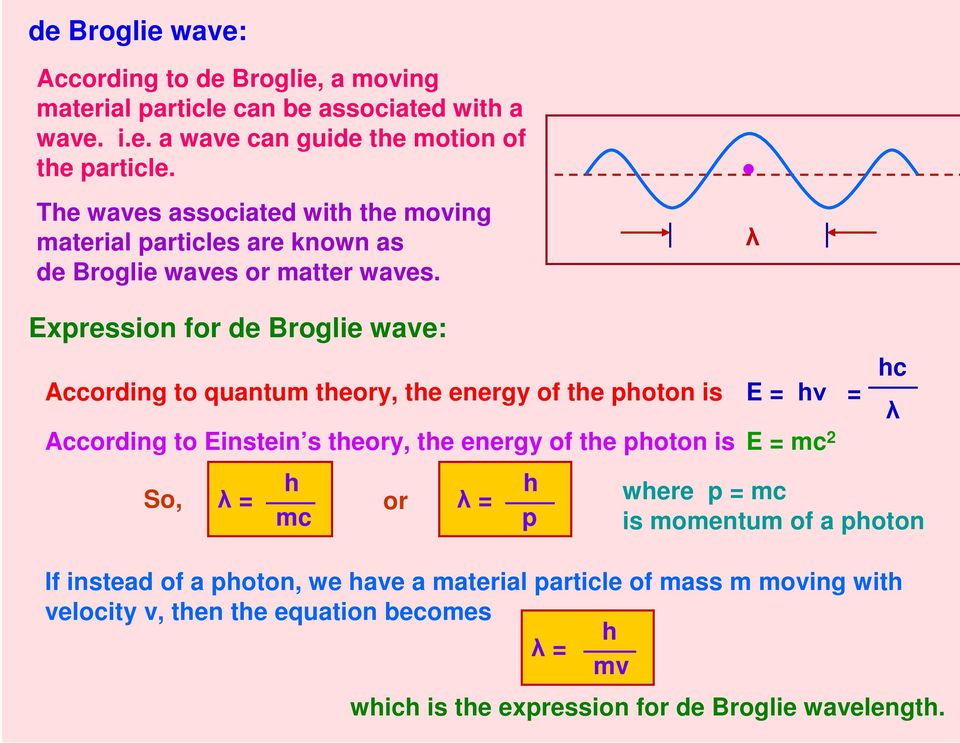
13 Conclusion: λ = h mv i) de Broglie wavelength is inversely proportional to the velocity of the particle. If the particle moves faster, then the wavelength will be smaller and vice versa. ii) If the particle is at rest, then the de Broglie wavelength is infinite. Such a wave can not be visualized. iii) de Broglie wavelength is inversely proportional to the mass of the particle. The wavelength associated with a heavier particle is smaller than that with a lighter particle. iv) de Broglie wavelength is independent of the charge of the particle. Matter waves, like electromagnetic waves, can travel in vacuum and hence they are not mechanical waves. Matter waves are not electromagnetic waves because they are not produced by accelerated charges. Matter waves are probability waves, amplitude of which gives the probability of existence of the particle at the point.

14 Davisson and Germer Experiment: A beam of electrons emitted by the electron gun is made to fall on Nickel crystal cut along cubical axis at a particular angle. The scattered beam of electrons is received by the detector which can be rotated at any angle. The energy of the incident beam of electrons can be varied by changing the applied voltage to the electron gun. Intensity of scattered beam of electrons is found to be maximum when angle of scattering is 50 and the accelerating potential is 54 V. V F C A θ Ф θ Nickel Crystal Electron Gun Crystal Lattice Detector θ θ = 180 i.e. θ = 65 For Ni crystal, lattice spacing d = 0.91 Å For first principal maximum, n = 1 Electron diffraction is similar to X-ray diffraction. Bragg s equation 2dsinθ = nλ gives λ = 1.65 Å

15 Incident Beam Incident Beam Intensity of scattered beam at 44 V Intensity of scattered beam at 48 V Incident Beam Ф = 50 Scattered beam Incident Beam Intensity of scattered beam at 54 V Intensity of scattered beam at 64 V According to de Broglie s hypothesis, h λ = 2meV or λ = Å V de Broglie wavelength of moving electron at V = 54 Volt is 1.67 Å which is in close agreement with 1.65 Å.

16 Intensity vs Anode Potential: Intensity Diffraction pattern after 100 electrons V ( 54) V Diffraction pattern after 3000 electrons Diffraction pattern after electrons

How To Understand Light And Color
 PRACTICE EXAM IV P202 SPRING 2004 1. In two separate double slit experiments, an interference pattern is observed on a screen. In the first experiment, violet light (λ = 754 nm) is used and a second-order
The Phenomenon of Photoelectric Emission:
 The Photoelectric Effect. The Wave particle duality of light Light, like any other E.M.R (electromagnetic radiation) has got a dual nature. That is there are experiments that prove that it is made up of
Calculating particle properties of a wave
 Calculating particle properties of a wave A light wave consists of particles (photons): The energy E of the particle is calculated from the frequency f of the wave via Planck: E = h f (1) A particle can
Physics 30 Worksheet # 14: Michelson Experiment
 Physics 30 Worksheet # 14: Michelson Experiment 1. The speed of light found by a Michelson experiment was found to be 2.90 x 10 8 m/s. If the two hills were 20.0 km apart, what was the frequency of the
Atomic Structure Ron Robertson
 Atomic Structure Ron Robertson r2 n:\files\courses\1110-20\2010 possible slides for web\atomicstructuretrans.doc I. What is Light? Debate in 1600's: Since waves or particles can transfer energy, what is
Photons. ConcepTest 27.1. 1) red light 2) yellow light 3) green light 4) blue light 5) all have the same energy. Which has more energy, a photon of:
 ConcepTest 27.1 Photons Which has more energy, a photon of: 1) red light 2) yellow light 3) green light 4) blue light 5) all have the same energy 400 nm 500 nm 600 nm 700 nm ConcepTest 27.1 Photons Which
Energy. Mechanical Energy
 Principles of Imaging Science I (RAD119) Electromagnetic Radiation Energy Definition of energy Ability to do work Physicist s definition of work Work = force x distance Force acting upon object over distance
Physical Science Study Guide Unit 7 Wave properties and behaviors, electromagnetic spectrum, Doppler Effect
 Objectives: PS-7.1 Physical Science Study Guide Unit 7 Wave properties and behaviors, electromagnetic spectrum, Doppler Effect Illustrate ways that the energy of waves is transferred by interaction with
Physics 111 Homework Solutions Week #9 - Tuesday
 Physics 111 Homework Solutions Week #9 - Tuesday Friday, February 25, 2011 Chapter 22 Questions - None Multiple-Choice 223 A 224 C 225 B 226 B 227 B 229 D Problems 227 In this double slit experiment we
Waves Sound and Light
 Waves Sound and Light r2 c:\files\courses\1710\spr12\wavetrans.doc Ron Robertson The Nature of Waves Waves are a type of energy transmission that results from a periodic disturbance (vibration). They are
MAKING SENSE OF ENERGY Electromagnetic Waves
 Adapted from State of Delaware TOE Unit MAKING SENSE OF ENERGY Electromagnetic Waves GOALS: In this Part of the unit you will Learn about electromagnetic waves, how they are grouped, and how each group
TIME OF COMPLETION NAME SOLUTION DEPARTMENT OF NATURAL SCIENCES. PHYS 3650, Exam 2 Section 1 Version 1 October 31, 2005 Total Weight: 100 points
 TIME OF COMPLETION NAME SOLUTION DEPARTMENT OF NATURAL SCIENCES PHYS 3650, Exam 2 Section 1 Version 1 October 31, 2005 Total Weight: 100 points 1. Check your examination for completeness prior to starting.
Atomic and Nuclear Physics Laboratory (Physics 4780)
 Gamma Ray Spectroscopy Week of September 27, 2010 Atomic and Nuclear Physics Laboratory (Physics 4780) The University of Toledo Instructor: Randy Ellingson Gamma Ray Production: Co 60 60 60 27Co28Ni *
Chapter 18: The Structure of the Atom
 Chapter 18: The Structure of the Atom 1. For most elements, an atom has A. no neutrons in the nucleus. B. more protons than electrons. C. less neutrons than electrons. D. just as many electrons as protons.
Name Date Class ELECTRONS IN ATOMS. Standard Curriculum Core content Extension topics
 13 ELECTRONS IN ATOMS Conceptual Curriculum Concrete concepts More abstract concepts or math/problem-solving Standard Curriculum Core content Extension topics Honors Curriculum Core honors content Options
Does Quantum Mechanics Make Sense? Size
 Does Quantum Mechanics Make Sense? Some relatively simple concepts show why the answer is yes. Size Classical Mechanics Quantum Mechanics Relative Absolute What does relative vs. absolute size mean? Why
Wave Function, ψ. Chapter 28 Atomic Physics. The Heisenberg Uncertainty Principle. Line Spectrum
 Wave Function, ψ Chapter 28 Atomic Physics The Hydrogen Atom The Bohr Model Electron Waves in the Atom The value of Ψ 2 for a particular object at a certain place and time is proportional to the probability
A-level PHYSICS (7408/1)
 SPECIMEN MATERIAL A-level PHYSICS (7408/1) Paper 1 Specimen 2014 Morning Time allowed: 2 hours Materials For this paper you must have: a pencil a ruler a calculator a data and formulae booklet. Instructions
Experiment: Crystal Structure Analysis in Engineering Materials
 Experiment: Crystal Structure Analysis in Engineering Materials Objective The purpose of this experiment is to introduce students to the use of X-ray diffraction techniques for investigating various types
PHYSICS PAPER 1 (THEORY)
 PHYSICS PAPER 1 (THEORY) (Three hours) (Candidates are allowed additional 15 minutes for only reading the paper. They must NOT start writing during this time.) ---------------------------------------------------------------------------------------------------------------------
Vacuum Evaporation Recap
 Sputtering Vacuum Evaporation Recap Use high temperatures at high vacuum to evaporate (eject) atoms or molecules off a material surface. Use ballistic flow to transport them to a substrate and deposit.
Review for Test 3. Polarized light. Action of a Polarizer. Polarized light. Light Intensity after a Polarizer. Review for Test 3.
 Review for Test 3 Polarized light No equation provided! Polarized light In linearly polarized light, the electric field vectors all lie in one single direction. Action of a Polarizer Transmission axis
5. The Nature of Light. Does Light Travel Infinitely Fast? EMR Travels At Finite Speed. EMR: Electric & Magnetic Waves
 5. The Nature of Light Light travels in vacuum at 3.0. 10 8 m/s Light is one form of electromagnetic radiation Continuous radiation: Based on temperature Wien s Law & the Stefan-Boltzmann Law Light has
Indiana's Academic Standards 2010 ICP Indiana's Academic Standards 2016 ICP. map) that describe the relationship acceleration, velocity and distance.
 .1.1 Measure the motion of objects to understand.1.1 Develop graphical, the relationships among distance, velocity and mathematical, and pictorial acceleration. Develop deeper understanding through representations
Lesson 33: Photoelectric Effect
 Lesson 33: Photoelectric Effect Hertz Experiment Heinrich Hertz was doing experiments in 1887 to test some of Maxwell's theories of EMR. One of the experiments involved using a coil of wire as a receiver
Boardworks AS Physics
 Boardworks AS Physics Vectors 24 slides 11 Flash activities Prefixes, scalars and vectors Guide to the SI unit prefixes of orders of magnitude Matching powers of ten to their SI unit prefixes Guide to
Solar Energy. Outline. Solar radiation. What is light?-- Electromagnetic Radiation. Light - Electromagnetic wave spectrum. Electromagnetic Radiation
 Outline MAE 493R/593V- Renewable Energy Devices Solar Energy Electromagnetic wave Solar spectrum Solar global radiation Solar thermal energy Solar thermal collectors Solar thermal power plants Photovoltaics
Experiment #5: Qualitative Absorption Spectroscopy
 Experiment #5: Qualitative Absorption Spectroscopy One of the most important areas in the field of analytical chemistry is that of spectroscopy. In general terms, spectroscopy deals with the interactions
CHAPTER - 1. Chapter ONE: WAVES CHAPTER - 2. Chapter TWO: RAY OPTICS AND OPTICAL INSTRUMENTS. CHAPTER - 3 Chapter THREE: WAVE OPTICS PERIODS PERIODS
 BOARD OF INTERMEDIATE EDUCATION, A.P., HYDERABAD REVISION OF SYLLABUS Subject PHYSICS-II (w.e.f 2013-14) Chapter ONE: WAVES CHAPTER - 1 1.1 INTRODUCTION 1.2 Transverse and longitudinal waves 1.3 Displacement
Measurement of Charge-to-Mass (e/m) Ratio for the Electron
 Measurement of Charge-to-Mass (e/m) Ratio for the Electron Experiment objectives: measure the ratio of the electron charge-to-mass ratio e/m by studying the electron trajectories in a uniform magnetic
Quantum Mechanics and Atomic Structure 1
 Quantum Mechanics and Atomic Structure 1 INTRODUCTION The word atom is derived from the Greek word, atomos, which means uncut or indivisible. It was Dalton (1808) who established that elementary constituents
Solutions to Problems in Goldstein, Classical Mechanics, Second Edition. Chapter 7
 Solutions to Problems in Goldstein, Classical Mechanics, Second Edition Homer Reid April 21, 2002 Chapter 7 Problem 7.2 Obtain the Lorentz transformation in which the velocity is at an infinitesimal angle
Atomic Structure: Chapter Problems
 Atomic Structure: Chapter Problems Bohr Model Class Work 1. Describe the nuclear model of the atom. 2. Explain the problems with the nuclear model of the atom. 3. According to Niels Bohr, what does n stand
Light as a Wave. The Nature of Light. EM Radiation Spectrum. EM Radiation Spectrum. Electromagnetic Radiation
 The Nature of Light Light and other forms of radiation carry information to us from distance astronomical objects Visible light is a subset of a huge spectrum of electromagnetic radiation Maxwell pioneered
Heisenberg Uncertainty
 Heisenberg Uncertainty Outline - Heisenberg Microscope - Measurement Uncertainty - Example: Hydrogen Atom - Example: Single Slit Diffraction - Example: Quantum Dots 1 TRUE / FALSE A photon (quantum of
Radiation Transfer in Environmental Science
 Radiation Transfer in Environmental Science with emphasis on aquatic and vegetation canopy media Autumn 2008 Prof. Emmanuel Boss, Dr. Eyal Rotenberg Introduction Radiation in Environmental sciences Most
where h = 6.62 10-34 J s
 Electromagnetic Spectrum: Refer to Figure 12.1 Molecular Spectroscopy: Absorption of electromagnetic radiation: The absorptions and emissions of electromagnetic radiation are related molecular-level phenomena
After a wave passes through a medium, how does the position of that medium compare to its original position?
 Light Waves Test Question Bank Standard/Advanced Name: Question 1 (1 point) The electromagnetic waves with the highest frequencies are called A. radio waves. B. gamma rays. C. X-rays. D. visible light.
Light. What is light?
 Light What is light? 1. How does light behave? 2. What produces light? 3. What type of light is emitted? 4. What information do you get from that light? Methods in Astronomy Photometry Measure total amount
A Guide to Acousto-Optic Modulators
 A Guide to Acousto-Optic Modulators D. J. McCarron December 7, 2007 1 Introduction Acousto-optic modulators (AOMs) are useful devices which allow the frequency, intensity and direction of a laser beam
G482 Electrons, Waves and Photons; Revision Notes Module 1: Electric Current
 G482 Electrons, Waves and Photons; Revision Notes Module 1: Electric Current Electric Current A net flow of charged particles. Electrons in a metal Ions in an electrolyte Conventional Current A model used
CHEM 1411 Chapter 5 Homework Answers
 1 CHEM 1411 Chapter 5 Homework Answers 1. Which statement regarding the gold foil experiment is false? (a) It was performed by Rutherford and his research group early in the 20 th century. (b) Most of
The photoionization detector (PID) utilizes ultraviolet
 Chapter 6 Photoionization Detectors The photoionization detector (PID) utilizes ultraviolet light to ionize gas molecules, and is commonly employed in the detection of volatile organic compounds (VOCs).
Current Staff Course Unit/ Length. Basic Outline/ Structure. Unit Objectives/ Big Ideas. Properties of Waves A simple wave has a PH: Sound and Light
 Current Staff Course Unit/ Length August August September September October Unit Objectives/ Big Ideas Basic Outline/ Structure PS4- Types of Waves Because light can travel through space, it cannot be
Crystal Optics of Visible Light
 Crystal Optics of Visible Light This can be a very helpful aspect of minerals in understanding the petrographic history of a rock. The manner by which light is transferred through a mineral is a means
ACCELERATORS AND MEDICAL PHYSICS 2
 ACCELERATORS AND MEDICAL PHYSICS 2 Ugo Amaldi University of Milano Bicocca and TERA Foundation EPFL 2-28.10.10 - U. Amaldi 1 The icone of radiation therapy Radiation beam in matter EPFL 2-28.10.10 - U.
Basic Nuclear Concepts
 Section 7: In this section, we present a basic description of atomic nuclei, the stored energy contained within them, their occurrence and stability Basic Nuclear Concepts EARLY DISCOVERIES [see also Section
Theory of electrons and positrons
 P AUL A. M. DIRAC Theory of electrons and positrons Nobel Lecture, December 12, 1933 Matter has been found by experimental physicists to be made up of small particles of various kinds, the particles of
Astronomy 110 Homework #04 Assigned: 02/06/2007 Due: 02/13/2007. Name:
 Astronomy 110 Homework #04 Assigned: 02/06/2007 Due: 02/13/2007 Name: Directions: Listed below are twenty (20) multiple-choice questions based on the material covered by the lectures this past week. Choose
Infrared Spectroscopy: Theory
 u Chapter 15 Infrared Spectroscopy: Theory An important tool of the organic chemist is Infrared Spectroscopy, or IR. IR spectra are acquired on a special instrument, called an IR spectrometer. IR is used
Production of X-rays. Radiation Safety Training for Analytical X-Ray Devices Module 9
 Module 9 This module presents information on what X-rays are and how they are produced. Introduction Module 9, Page 2 X-rays are a type of electromagnetic radiation. Other types of electromagnetic radiation
1. Basics of LASER Physics
 1. Basics of LASER Physics Dr. Sebastian Domsch (Dipl.-Phys.) Computer Assisted Clinical Medicine Medical Faculty Mannheim Heidelberg University Theodor-Kutzer-Ufer 1-3 D-68167 Mannheim, Germany [email protected]
Sample Exercise 6.1 Concepts of Wavelength and Frequency
 Sample Exercise 6.1 Concepts of Wavelength and Frequency Two electromagnetic waves are represented in the margin. (a) Which wave has the higher frequency? (b) If one wave represents visible light and the
PHYS 222 Spring 2012 Final Exam. Closed books, notes, etc. No electronic device except a calculator.
 PHYS 222 Spring 2012 Final Exam Closed books, notes, etc. No electronic device except a calculator. NAME: (all questions with equal weight) 1. If the distance between two point charges is tripled, the
THE CURRENT-VOLTAGE CHARACTERISTICS OF AN LED AND A MEASUREMENT OF PLANCK S CONSTANT Physics 258/259
 DSH 2004 THE CURRENT-VOLTAGE CHARACTERISTICS OF AN LED AND A MEASUREMENT OF PLANCK S CONSTANT Physics 258/259 I. INTRODUCTION Max Planck (1858-1947) was an early pioneer in the field of quantum physics.
Main properties of atoms and nucleus
 Main properties of atoms and nucleus. Atom Structure.... Structure of Nuclei... 3. Definition of Isotopes... 4. Energy Characteristics of Nuclei... 5. Laws of Radioactive Nuclei Transformation... 3. Atom
Overview. What is EMR? Electromagnetic Radiation (EMR) LA502 Special Studies Remote Sensing
 LA502 Special Studies Remote Sensing Electromagnetic Radiation (EMR) Dr. Ragab Khalil Department of Landscape Architecture Faculty of Environmental Design King AbdulAziz University Room 103 Overview What
v = fλ PROGRESSIVE WAVES 1 Candidates should be able to :
 PROGRESSIVE WAVES 1 Candidates should be able to : Describe and distinguish between progressive longitudinal and transverse waves. With the exception of electromagnetic waves, which do not need a material
GAMMA-RAY SPECTRA REFERENCES
 GAMMA-RAY SPECTRA REFERENCES 1. K. Siegbahn, Alpha, Beta and Gamma-Ray Spectroscopy, Vol. I, particularly Chapts. 5, 8A. 2. Nucleonics Data Sheets, Nos. 1-45 (available from the Resource Centre) 3. H.E.
- thus, the total number of atoms per second that absorb a photon is
 Stimulated Emission of Radiation - stimulated emission is referring to the emission of radiation (a photon) from one quantum system at its transition frequency induced by the presence of other photons
Cathode Ray Tube. Introduction. Functional principle
 Introduction The Cathode Ray Tube or Braun s Tube was invented by the German physicist Karl Ferdinand Braun in 897 and is today used in computer monitors, TV sets and oscilloscope tubes. The path of the
13- What is the maximum number of electrons that can occupy the subshell 3d? a) 1 b) 3 c) 5 d) 2
 Assignment 06 A 1- What is the energy in joules of an electron undergoing a transition from n = 3 to n = 5 in a Bohr hydrogen atom? a) -3.48 x 10⁻¹⁷ J b) 2.18 x 10⁻¹⁹ J c) 1.55 x 10⁻¹⁹ J d) -2.56 x 10⁻¹⁹
The University of the State of New York REGENTS HIGH SCHOOL EXAMINATION PHYSICAL SETTING PHYSICS. Friday, June 20, 2014 1:15 to 4:15 p.m.
 P.S./PHYSICS The University of the State of New York REGENTS HIGH SCHOOL EXAMINATION PHYSICAL SETTING PHYSICS Friday, June 20, 2014 1:15 to 4:15 p.m., only The possession or use of any communications device
Chem 1A Exam 2 Review Problems
 Chem 1A Exam 2 Review Problems 1. At 0.967 atm, the height of mercury in a barometer is 0.735 m. If the mercury were replaced with water, what height of water (in meters) would be supported at this pressure?
- particle with kinetic energy E strikes a barrier with height U 0 > E and width L. - classically the particle cannot overcome the barrier
 Tunnel Effect: - particle with kinetic energy E strikes a barrier with height U 0 > E and width L - classically the particle cannot overcome the barrier - quantum mechanically the particle can penetrated
The rate of change of velocity with respect to time. The average rate of change of distance/displacement with respect to time.
 H2 PHYSICS DEFINITIONS LIST Scalar Vector Term Displacement, s Speed Velocity, v Acceleration, a Average speed/velocity Instantaneous Velocity Newton s First Law Newton s Second Law Newton s Third Law
CHAPTER 2 Energy and Earth
 CHAPTER 2 Energy and Earth This chapter is concerned with the nature of energy and how it interacts with Earth. At this stage we are looking at energy in an abstract form though relate it to how it affect
E/M Experiment: Electrons in a Magnetic Field.
 E/M Experiment: Electrons in a Magnetic Field. PRE-LAB You will be doing this experiment before we cover the relevant material in class. But there are only two fundamental concepts that you need to understand.
Interference. Physics 102 Workshop #3. General Instructions
 Interference Physics 102 Workshop #3 Name: Lab Partner(s): Instructor: Time of Workshop: General Instructions Workshop exercises are to be carried out in groups of three. One report per group is due by
Blackbody Radiation References INTRODUCTION
 Blackbody Radiation References 1) R.A. Serway, R.J. Beichner: Physics for Scientists and Engineers with Modern Physics, 5 th Edition, Vol. 2, Ch.40, Saunders College Publishing (A Division of Harcourt
AZ State Standards. Concept 3: Conservation of Energy and Increase in Disorder Understand ways that energy is conserved, stored, and transferred.
 Forms of Energy AZ State Standards Concept 3: Conservation of Energy and Increase in Disorder Understand ways that energy is conserved, stored, and transferred. PO 1. Describe the following ways in which
Code number given on the right hand side of the question paper should be written on the title page of the answerbook by the candidate.
 Series ONS SET-1 Roll No. Candiates must write code on the title page of the answer book Please check that this question paper contains 16 printed pages. Code number given on the right hand side of the
Acousto-optic modulator
 1 of 3 Acousto-optic modulator F An acousto-optic modulator (AOM), also called a Bragg cell, uses the acousto-optic effect to diffract and shift the frequency of light using sound waves (usually at radio-frequency).
Laboratory #3 Guide: Optical and Electrical Properties of Transparent Conductors -- September 23, 2014
 Laboratory #3 Guide: Optical and Electrical Properties of Transparent Conductors -- September 23, 2014 Introduction Following our previous lab exercises, you now have the skills and understanding to control
Basics of Nuclear Physics and Fission
 Basics of Nuclear Physics and Fission A basic background in nuclear physics for those who want to start at the beginning. Some of the terms used in this factsheet can be found in IEER s on-line glossary.
Chapters 21-29. Magnetic Force. for a moving charge. F=BQvsinΘ. F=BIlsinΘ. for a current
 Chapters 21-29 Chapter 21:45,63 Chapter 22:25,49 Chapter 23:35,38,53,55,58,59 Chapter 24:17,18,20,42,43,44,50,52,53.59,63 Chapter 26:27,33,34,39,54 Chapter 27:17,18,34,43,50,51,53,56 Chapter 28: 10,11,28,47,52
Forms of Energy. Freshman Seminar
 Forms of Energy Freshman Seminar Energy Energy The ability & capacity to do work Energy can take many different forms Energy can be quantified Law of Conservation of energy In any change from one form
AP Physics B Ch. 23 and Ch. 24 Geometric Optics and Wave Nature of Light
 AP Physics B Ch. 23 and Ch. 24 Geometric Optics and Wave Nature of Light Name: Period: Date: MULTIPLE CHOICE. Choose the one alternative that best completes the statement or answers the question. 1) Reflection,
Practice final for Basic Physics spring 2005 answers on the last page Name: Date:
 Practice final for Basic Physics spring 2005 answers on the last page Name: Date: 1. A 12 ohm resistor and a 24 ohm resistor are connected in series in a circuit with a 6.0 volt battery. Assuming negligible
8.1 Radio Emission from Solar System objects
 8.1 Radio Emission from Solar System objects 8.1.1 Moon and Terrestrial planets At visible wavelengths all the emission seen from these objects is due to light reflected from the sun. However at radio
The Electromagnetic Spectrum
 INTRODUCTION The Electromagnetic Spectrum I. What is electromagnetic radiation and the electromagnetic spectrum? What do light, X-rays, heat radiation, microwaves, radio waves, and gamma radiation have
Electromagnetic (EM) waves. Electric and Magnetic Fields. L 30 Electricity and Magnetism [7] James Clerk Maxwell (1831-1879)
![Electromagnetic (EM) waves. Electric and Magnetic Fields. L 30 Electricity and Magnetism [7] James Clerk Maxwell (1831-1879)](/thumbs/40/20813653.jpg "Electromagnetic (EM) waves. Electric and Magnetic Fields. L 30 Electricity and Magnetism [7] James Clerk Maxwell (1831-1879)") L 30 Electricity and Magnetism [7] ELECTROMAGNETIC WAVES Faraday laid the groundwork with his discovery of electromagnetic induction Maxwell added the last piece of the puzzle Heinrich Hertz made the experimental
L 30 Electricity and Magnetism [7] ELECTROMAGNETIC WAVES Faraday laid the groundwork with his discovery of electromagnetic induction Maxwell added the last piece of the puzzle Heinrich Hertz made the experimental
AP1 Waves. (A) frequency (B) wavelength (C) speed (D) intensity. Answer: (A) and (D) frequency and intensity.
 1. A fire truck is moving at a fairly high speed, with its siren emitting sound at a specific pitch. As the fire truck recedes from you which of the following characteristics of the sound wave from the
Polarization Dependence in X-ray Spectroscopy and Scattering. S P Collins et al Diamond Light Source UK
 Polarization Dependence in X-ray Spectroscopy and Scattering S P Collins et al Diamond Light Source UK Overview of talk 1. Experimental techniques at Diamond: why we care about x-ray polarization 2. How
Upon completion of this lab, the student will be able to:
 1 Learning Outcomes EXPERIMENT B4: CHEMICAL EQUILIBRIUM Upon completion of this lab, the student will be able to: 1) Analyze the absorbance spectrum of a sample. 2) Calculate the equilibrium constant for
Review of the isotope effect in the hydrogen spectrum
 Review of the isotope effect in the hydrogen spectrum 1 Balmer and Rydberg Formulas By the middle of the 19th century it was well established that atoms emitted light at discrete wavelengths. This is in
AP* Atomic Structure & Periodicity Free Response Questions KEY page 1
 AP* Atomic Structure & Periodicity ree Response Questions KEY page 1 1980 a) points 1s s p 6 3s 3p 6 4s 3d 10 4p 3 b) points for the two electrons in the 4s: 4, 0, 0, +1/ and 4, 0, 0, - 1/ for the three
Efficiency of a Light Emitting Diode
 PHYSICS THROUGH TEACHING LABORATORY VII Efficiency of a Light Emitting Diode RAJESH B. KHAPARDE AND SMITHA PUTHIYADAN Homi Bhabha Centre for Science Education Tata Institute of Fundamental Research V.
Spectroscopy and Regions of the Spectrum
 Basics 9 Spectroscopy and Regions of the Spectrum Different regions of the spectrum probe different types of energy levels of an atomic or molecular system. It is not uncommon to refer to a spectroscopic
Curriculum for Excellence. Higher Physics. Success Guide
 Curriculum for Excellence Higher Physics Success Guide Electricity Our Dynamic Universe Particles and Waves Electricity Key Area Monitoring and Measuring A.C. Monitoring alternating current signals with
Charges, voltage and current
 Charges, voltage and current Lecture 2 1 Atoms and electrons Atoms are built up from Positively charged nucleus Negatively charged electrons orbiting in shells (or more accurately clouds or orbitals) -
Take away concepts. What is Energy? Solar Energy. EM Radiation. Properties of waves. Solar Radiation Emission and Absorption
 Take away concepts Solar Radiation Emission and Absorption 1. 2. 3. 4. 5. 6. Conservation of energy. Black body radiation principle Emission wavelength and temperature (Wein s Law). Radiation vs. distance
6/2016 E&M forces-1/8 ELECTRIC AND MAGNETIC FORCES. PURPOSE: To study the deflection of a beam of electrons by electric and magnetic fields.
 6/016 E&M forces-1/8 ELECTRIC AND MAGNETIC FORCES PURPOSE: To study the deflection of a beam of electrons by electric and magnetic fields. APPARATUS: Electron beam tube, stand with coils, power supply,
GCE Physics A. Mark Scheme for June 2014. Unit G485: Fields, Particles and Frontiers of Physics. Advanced GCE. Oxford Cambridge and RSA Examinations
 GCE Physics A Unit G485: Fields, Particles and Frontiers of Physics Advanced GCE Mark Scheme for June 014 Oxford Cambridge and RSA Examinations OCR (Oxford Cambridge and RSA) is a leading UK awarding body,
(1) The size of a gas particle is negligible as compared to the volume of the container in which the gas is placed.
 Gas Laws and Kinetic Molecular Theory The Gas Laws are based on experiments, and they describe how a gas behaves under certain conditions. However, Gas Laws do not attempt to explain the behavior of gases.
1. The diagram below represents magnetic lines of force within a region of space.
 1. The diagram below represents magnetic lines of force within a region of space. 4. In which diagram below is the magnetic flux density at point P greatest? (1) (3) (2) (4) The magnetic field is strongest
Nuclear Physics and Radioactivity
 Nuclear Physics and Radioactivity 1. The number of electrons in an atom of atomic number Z and mass number A is 1) A 2) Z 3) A+Z 4) A-Z 2. The repulsive force between the positively charged protons does
Principle of Thermal Imaging
 Section 8 All materials, which are above 0 degrees Kelvin (-273 degrees C), emit infrared energy. The infrared energy emitted from the measured object is converted into an electrical signal by the imaging
Energy Transport. Focus on heat transfer. Heat Transfer Mechanisms: Conduction Radiation Convection (mass movement of fluids)
 Energy Transport Focus on heat transfer Heat Transfer Mechanisms: Conduction Radiation Convection (mass movement of fluids) Conduction Conduction heat transfer occurs only when there is physical contact