
Physics 30 Worksheet # 14: Michelson Experiment
|
|
|
- Mavis Copeland
- 10 years ago
- Views:
Transcription
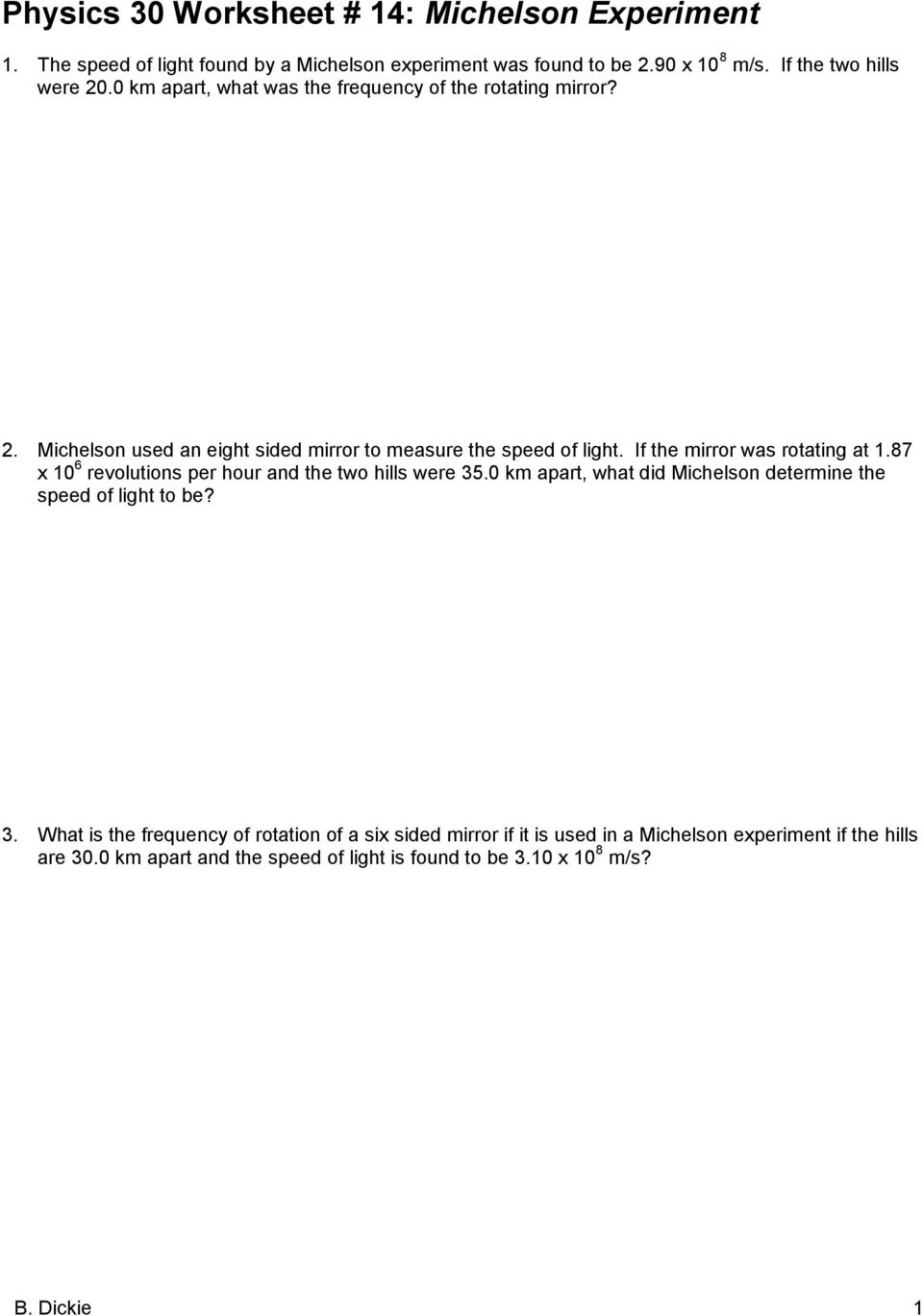
1 Physics 30 Worksheet # 14: Michelson Experiment 1. The speed of light found by a Michelson experiment was found to be 2.90 x 10 8 m/s. If the two hills were 20.0 km apart, what was the frequency of the rotating mirror? 2. Michelson used an eight sided mirror to measure the speed of light. If the mirror was rotating at 1.87 x 10 6 revolutions per hour and the two hills were 35.0 km apart, what did Michelson determine the speed of light to be? 3. What is the frequency of rotation of a six sided mirror if it is used in a Michelson experiment if the hills are 30.0 km apart and the speed of light is found to be 3.10 x 10 8 m/s? B. Dickie 1
2 Physics 30 Worksheet # 15: EMR Speed 1. A radio wave travels across the city of Calgary, a distance of 40.0 km. How long does this take? 2. How far does a flashlight beam travel in seconds? 3. The frequency of red light is 6.00 x Hz. What is the wavelength of red light? 4. A beam of light reflects off of a mirror 25.0 m away. How long does it take, from the time the flashlight is turned on, for the light to return to its source? 5. A radio wave of frequency 3.00 x 10 8 Hz travels from ground level a distance of 50.0 m, reflects off of the metal roof of a building at an angle of , then returns to ground level. How long does this take? What is the wavelength of the radio wave? B. Dickie 2

3 Physics 30 Worksheet #16: Curved Mirrors 1. A 5.00 cm tall object is placed 10.0 cm in front of a converging mirror that has a focal length of 8.00 cm. Calculate the image distance, the image height, and the magnification. Determine the attributes (characteristics) of the image. 2. A 7.00 cm tall object is placed 4.00 cm in front of a diverging mirror that has a focal length of 8.00 cm. Calculate the image distance, the image height, and the magnification of the image. Determine the attributes (characteristics) of the image. 3. An object is placed 8.0 cm in front of a diverging mirror that has a radius of curvature of 8.0 cm. Calculate the magnification of the object. 4. A store owner uses a diverging mirror with a radius of curvature of 1.00 m to keep an eye on shoplifters. How tall would the image of the 1.80 m tall man be if he were standing 5.00 m in front of the mirror. B. Dickie 3

4 5. The inverted, real image of a 6.00 cm tall candle object is found to twice as tall as the actual candle. The candle is 15.0 cm from the mirror of focal length 10.0 cm. Calculate the image height and the image distance. Determine the attributes (characteristics) of the image. 6. A 5.00 cm tall object produces an image that is 7.00 cm behind the mirror. The radius of curvature of the mirror is 10.0 cm. Calculate the magnification of the mirror. Determine the type of mirror that is used. 7. A 3.0 cm tall object produces a virtual image that is 2.0 cm tall. The distance from the mirror to the image is 2.50 cm. Calculate the focal length of the mirror. Determine the type of mirror used. B. Dickie 4

5 Physics 30 Worksheet #17: Refraction Use the following table to answer the questions on this worksheet. 1. Calculate the speed of light in crown glass. (Pearson Physics, Ackroyd et al, 2009) 2. Calculate the speed of light in diamond. 3. A ray of light passes from air into water. Determine the speed of the light in the water. 4. When light passes from crown glass into air, it refracts at an angle of Calculate the angle at which the light struck the crown glass-air boundary. B. Dickie 5

6 5. Light passes from air into diamond at an angle of Calculate the angle at which the leaves the air-diamond boundary. 6. When light passes from water into quartz glass, it refracts at an angle of Calculate the angle of incidence. 7. Determine the ratio of the speed of light in a vacuum to the speed of light in ruby. 8. Determine the ratio of the speed of light in crown glass to the speed of light in quartz glass. 9. Determine the critical angle for crown glass. 10. Determine the critical angle for zircon. 11. Determine the critical angle for diamond. B. Dickie 6

7 Physics 30 Worksheet #18: Curved Lenses 1. A 12.0 cm tall object is places 15.0 cm in front of a converging lens that has a focal length of 10.0 cm. Determine the image distance, the image height, the magnification, and the attributes of the image. 2. A 12.0 cm tall object is places 15.0 cm in front of a diverging lens that has a focal length of 10.0 cm. Determine the image distance, the image height, the magnification, and the attributes of the image. 3. The image created from a 10.0 cm tall upright object placed 5.00 cm from a lens is 4.00 cm tall and upright. Determine the magnification, the image distance, the focal length of the lens, the attributes of the image, and the type of lens used. 4. A 20.0 cm tall inverted real image is formed 10.0 cm from a lens. The object is 8.00 cm tall and upright. Determine the object distance, the magnification, the focal length, the attributes of the image, and the type of lens used. B. Dickie 7

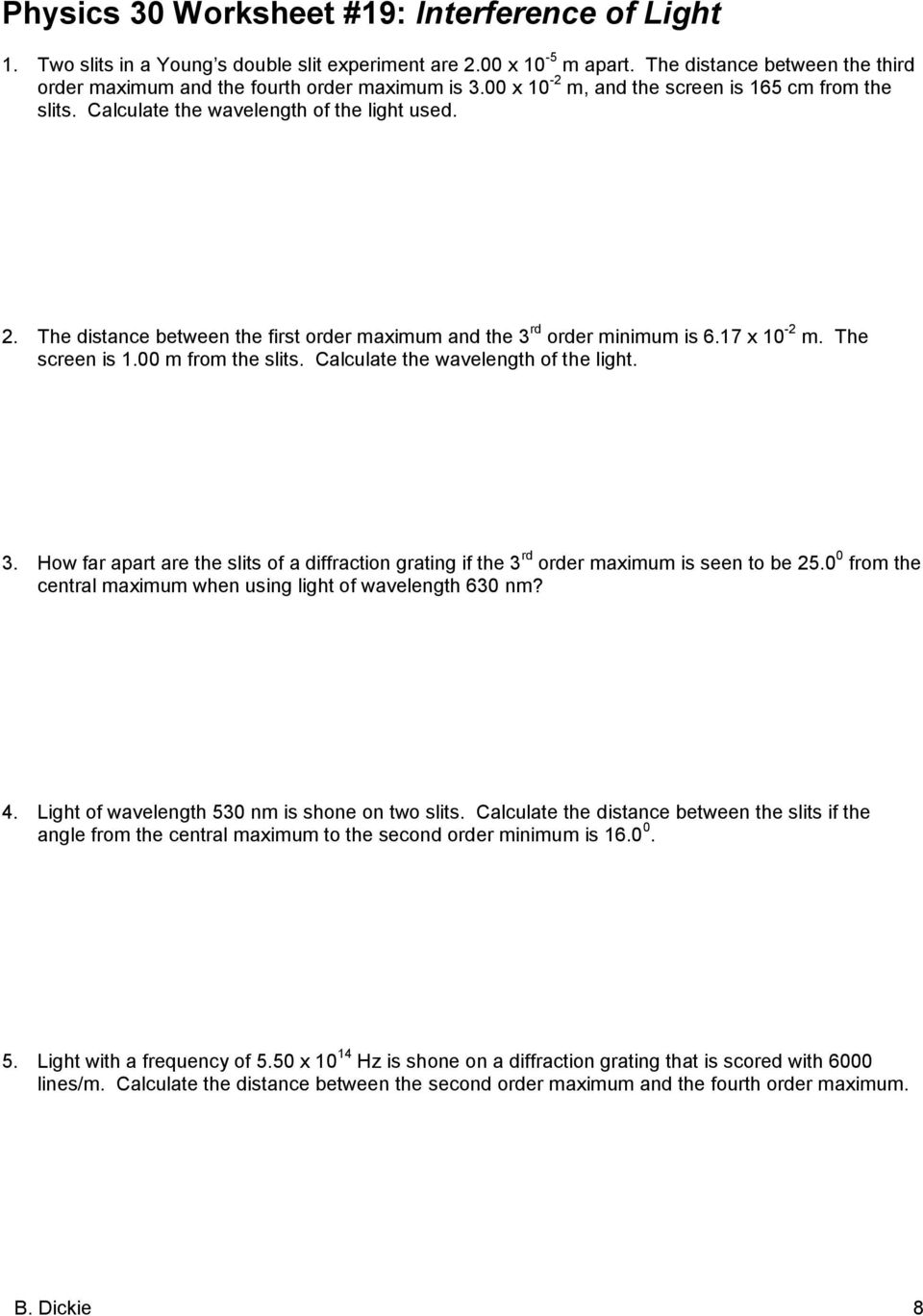
8 Physics 30 Worksheet #19: Interference of Light 1. Two slits in a Young s double slit experiment are 2.00 x 10⁻⁵ m apart. The distance between the third order maximum and the fourth order maximum is 3.00 x 10⁻² m, and the screen is 165 cm from the slits. Calculate the wavelength of the light used. 2. The distance between the first order maximum and the 3 rd order minimum is 6.17 x 10⁻² m. The screen is 1.00 m from the slits. Calculate the wavelength of the light. 3. How far apart are the slits of a diffraction grating if the 3 rd order maximum is seen to be from the central maximum when using light of wavelength 630 nm? 4. Light of wavelength 530 nm is shone on two slits. Calculate the distance between the slits if the angle from the central maximum to the second order minimum is Light with a frequency of 5.50 x Hz is shone on a diffraction grating that is scored with 6000 lines/m. Calculate the distance between the second order maximum and the fourth order maximum. B. Dickie 8
9 6. Light with a frequency of 6.00 x Hz is shone on a diffraction grating that is scored with 5000 lines/m. Calculate the distance between the second order maximum and the fourth order minimum. 7. Light with a frequency of 5.00 x Hz is shone on a diffraction grating that is scored with 60 lines/cm. Calculate the distance between the second order maximum and the fifth order minimum. 8. Calculate the number of lines/m that a diffraction grating possesses if the second order minimum occurs at an angle of when light of 525 nm is used. Calculate the number of lines/cm used. 9. White light is directed on a diffraction grating ruled with 5.00 x 10 4 lines/m How wide is the first order spectrum on a screen that is 1.20 m away from the grating? B. Dickie 9

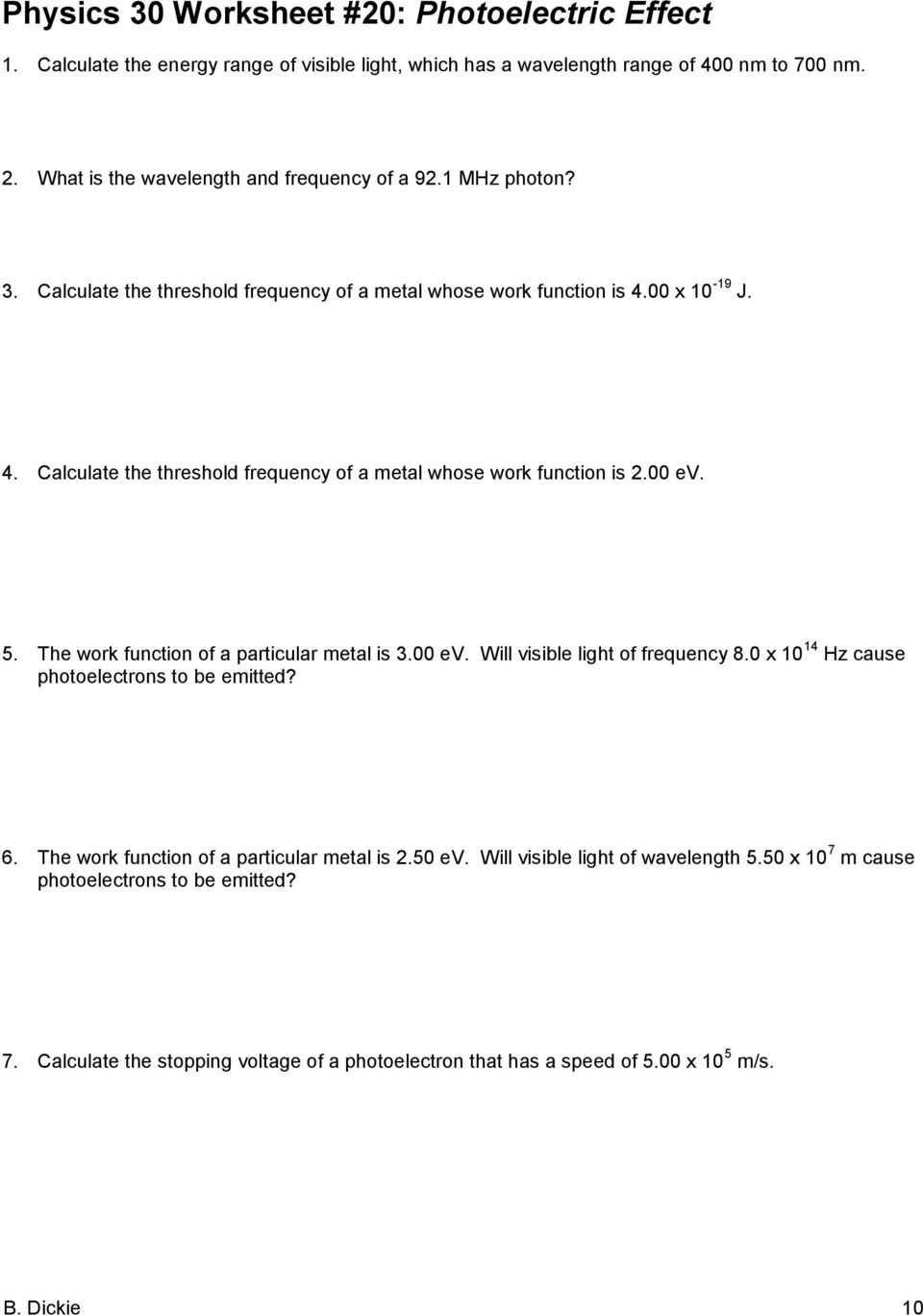
10 Physics 30 Worksheet #20: Photoelectric Effect 1. Calculate the energy range of visible light, which has a wavelength range of 400 nm to 700 nm. 2. What is the wavelength and frequency of a 92.1 MHz photon? 3. Calculate the threshold frequency of a metal whose work function is 4.00 x J. 4. Calculate the threshold frequency of a metal whose work function is 2.00 ev. 5. The work function of a particular metal is 3.00 ev. Will visible light of frequency 8.0 x Hz cause photoelectrons to be emitted? 6. The work function of a particular metal is 2.50 ev. Will visible light of wavelength 5.50 x 10 7 m cause photoelectrons to be emitted? 7. Calculate the stopping voltage of a photoelectron that has a speed of 5.00 x 10 5 m/s. B. Dickie 10
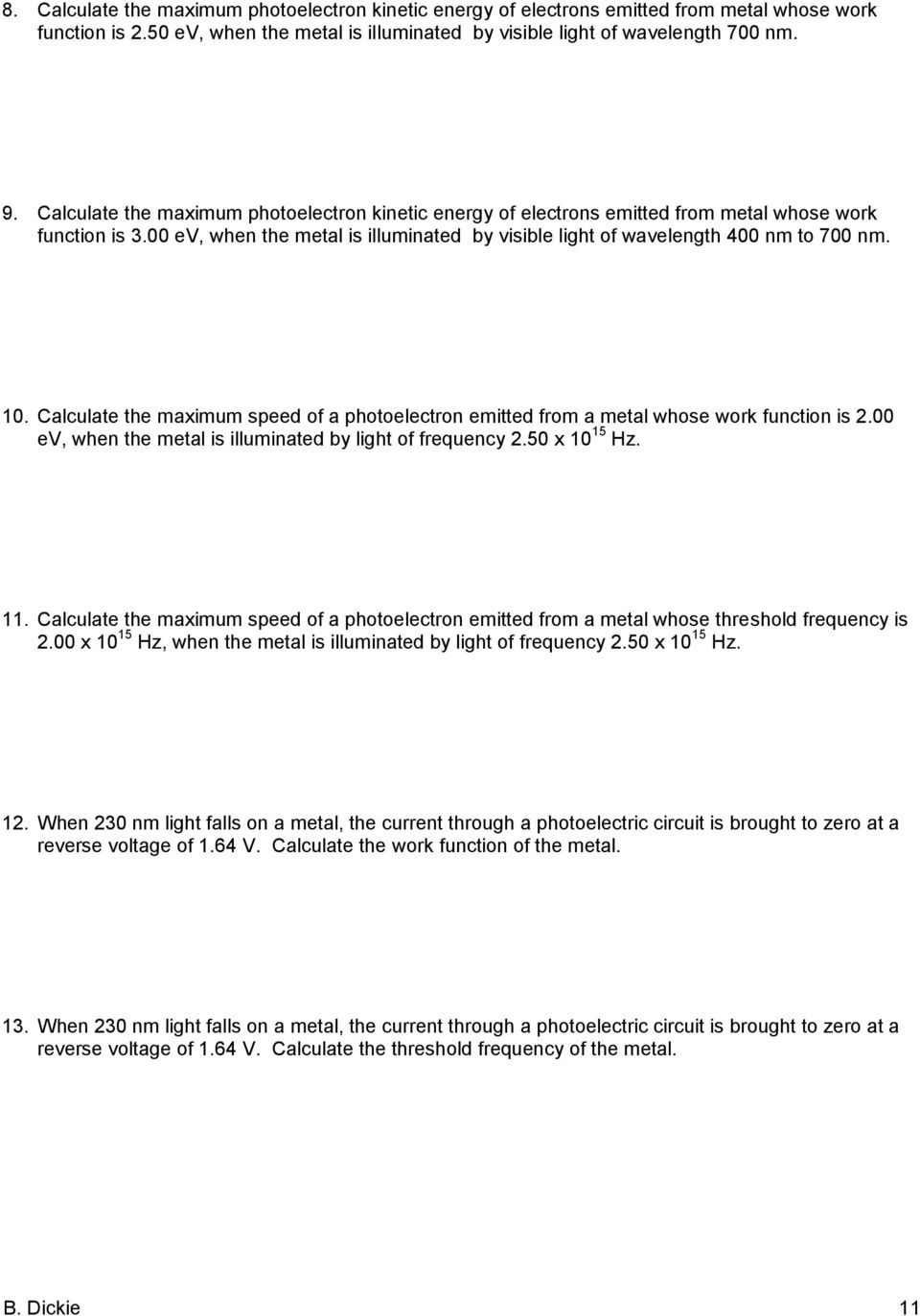
11 8. Calculate the maximum photoelectron kinetic energy of electrons emitted from metal whose work function is 2.50 ev, when the metal is illuminated by visible light of wavelength 700 nm. 9. Calculate the maximum photoelectron kinetic energy of electrons emitted from metal whose work function is 3.00 ev, when the metal is illuminated by visible light of wavelength 400 nm to 700 nm. 10. Calculate the maximum speed of a photoelectron emitted from a metal whose work function is 2.00 ev, when the metal is illuminated by light of frequency 2.50 x Hz. 11. Calculate the maximum speed of a photoelectron emitted from a metal whose threshold frequency is 2.00 x Hz, when the metal is illuminated by light of frequency 2.50 x Hz. 12. When 230 nm light falls on a metal, the current through a photoelectric circuit is brought to zero at a reverse voltage of 1.64 V. Calculate the work function of the metal. 13. When 230 nm light falls on a metal, the current through a photoelectric circuit is brought to zero at a reverse voltage of 1.64 V. Calculate the threshold frequency of the metal. B. Dickie 11
12 14. In a photoelectric experiment it is observed that no current flows unless the wavelength is less than 570 nm. Calculate the work function of the metal. 15. In a photoelectric experiment it is observed that no current flows unless the wavelength is less than 570 nm. Calculate the threshold frequency of the metal. B. Dickie 12

13 Physics 30 Worksheet #21: Compton Effect 1. Calculate the momentum of a photon whose wavelength is 2.50 x 20-7 m. 2. Calculate the momentum of a photon whose frequency is 5.00 x Hz. 3. Calculate the wavelength of a photon whose momentum is 5.00 x kg.m/s. 4. Calculate the frequency of a photon whose momentum is 2.50 x kg.m/s. 5. Calculate the energy of a photon whose momentum is 2.50 x kg.m/s. 6. What is the wavelength of a photon whose energy is 6.00 x kg.m/s? 7. What is the frequency of a photon whose energy is 5.00 MeV? 8. What is the speed of a photon whose energy is 3.00 MeV? 9. Calculate the momentum of an alpha particle whose energy is 3.00 MeV. B. Dickie 13

14 10. An x-ray of wavelength strikes a surface and is scattered at an angle of Calculate the change in wavelength of the scattered s-ray. 11. An x-ray of wavelength strikes a surface and is scattered at an angle of Calculate the final wavelength of the scattered s-ray. 12. An x-ray of frequency 5.0 x Hz strikes a surface and is scattered at an angle of Calculate the final wavelength of the scattered x-ray. 13. An x-ray of frequency 5.0 x Hz strikes a surface and is scattered at an angle of Calculate the final frequency of the scattered x-ray. B. Dickie 14

15 Diploma Exam Review Questions (EMR) 97. Electromagnetic radiation is produced by charged particles that are moving A. at the speed of light B. with zero acceleration C. with a changing velocity D. parallel to a fixed magnetic field 98. Gamma radiation can be produced by A. radioactive decay B. incandescent solids C. moving charges in a conductor D. the acceleration of electrons in a television picture tube 99. Regions of the electromagnetic spectrum listed in order from largest to smallest wavelength are A. X-ray, ultraviolet, visible, infrared, radio B. X-ray, infrared, visible, ultraviolet, radio C. radio, ultraviolet, visible, infrared, X-ray D. radio, infrared, visible, ultraviolet, X-ray Use the following information to answer the next question When the regions of the electromagnetic spectrum listed above are arranged order of increasing wavelength, this order is A. III, I, V, II, IV B. II, I, V, IV, III C. III, IV, V, I, II D. IV, V, III, I, II 101. X-rays are produced by A. an alternating current of about Hz B. firing gamma rays at a tungsten electrode C. varying the speed of electrons in a magnetic field D. collisions between high-speed electrons and a metal target B. Dickie 15

16 Use the following information to answer the next question Match each of the sources of electromagnetic radiation with the type of electromagnetic radiation it produces given below. Use each number only once. (Record all four digits of your answer in the numerical-response section on the answer sheet.) 103. Which of the following types of radiation has the longest period? A. Radio waves B. Infrared light C. Ultraviolet light D. Gamma radiation Use the following information to answer the next question The wire mesh layer is necessary because the A. cable needs a rigid reinforcing layer B. electric force inside a conductor is not zero C. electrical signals need to be shielded from strong magnetic and electric fields D. electrical signals will travel better if they have two different transmitting wires 105. Maxwell s work contained the new idea that A. an electric current in a wire produces a magnetic field that circles the wire B. a current is induced in a conductor that moves across a magnetic field C. an electric field that changes with time generates a magnetic field D. two parallel, current-carrying wires exert a force on each other B. Dickie 16

17 Photon Theory 106. The Advanced Composition Explorer (ACE) telescope began operation in August It detects electromagnetic radiation in the range of 1.0 x 10 2 ev to 5.0 x 10 2 MeV. The wavelength range measured by this telescope is A. 2.0 x m to 4.0 x m B. 8.0 x m to 1.6 x m C. 1.2 x 10 8 m to 2.5 x m D. 1.2 x m to 2.4 x m Use the following information to answer the next two questions The energy difference between a laser photon and an emitted photon is A J B J C J D J 108. Visible light has frequencies that range between Hz (red) and Hz (violet). Which of the following statements best describes the absorbed laser photon and the emitted photon in the optical cooling experiment? A. Both photons are in the infrared range. B. Both photons are in the ultraviolet range. C. Both photons are in the visible light range. D. One photon is in the visible light range, and one is not in the visible light range. B. Dickie 17

18 Use the following information to answer the next question Green light with a wavelength of 545 nm reaches the observer s eyes. The energy of a photon of this green light is ev. (Record your three-digit answer in the numerical-response section on the answer sheet.) Use the following information to answer the next question The mercury atoms emit electromagnetic radiation with a wavelength of 254 nm. The minimum amount of energy that must be transferred to a mercury atom during excitation to enable this emission, expressed in scientific notation, is b 10 w J. The value of b is. (Record your three-digit answer in the numerical-response section on the answer sheet.) Use the following information to answer the next question A photon of gamma radiation emitted by the radioactive decay of technetium-99 has an energy of 3.85 MeV. This radiation has a wavelength of A m B m C m D m B. Dickie 18

19 Use the following information to answer the next question The difference in energy associated with the photons from the two lines of the helium spectrum is A J B J C J D J 113. The Compton Gamma Ray Observatory is a satellite that is able to detect electromagnetic radiation from throughout the universe. The Compton Observatory can detect photons ranging from ev to ev. The highest frequency that can be detected, expressed in scientific notation, is b 10 w Hz. The value of b is. (Record your three-digit answer in the numerical-response section on the answer sheet.) Photoelectric Effect 114. A light source with a wavelength of 548 nm shines on a photocell with a 1.60 ev work function. In order to have an output voltage of 12.0 V DC, the number of photocells that must be linked in series is A. 5 photocells B. 8 photocells C. 10 photocells D. 18 photocells Use the following information to answer the next question. B. Dickie 19

20 115. What is the maximum kinetic energy of the emitted photoelectrons? A x J B x J C x J D x J 116. The work function of a metal with a threshold frequency of Hz, expressed in scientific notation, is a.b 10 cd J. The values of a, b, c, and d are,,, and. (Record your four-digit answer in the numerical-response section on the answer sheet.) Use the following information to answer the next two questions When light falls on the device at position 1 in the diagram, A. the Compton effect occurs B. the photoelectric effect occurs C. light refraction and diffraction occurs D. light diffraction and interference occurs 118. Night vision devices have a built-in brightness protection circuit to protect both the device and the viewer from unexpected bright light. The circuit is activated when the A. photoelectric current increases B. photoelectric current decreases C. kinetic energy of photoelectrons increases D. kinetic energy of photoelectrons decreases 119. The threshold frequency of light for the emission of photoelectrons from a metal is Hz. If light of frequency Hz shines on the metal, then the maximum kinetic energy of the emitted photoelectrons is A J B J C J D J B. Dickie 20

21 Use the following information to answer the next three questions The region of the sound track that will allow the most electrical current to be produced in the phototube is labeled A. I B. II C. III D. IV 121. The energy that is required to remove the electron from the photoelectric surface in the phototube is called the A. work function B. threshold frequency C. electric potential energy D. maximum kinetic energy 122. In one second, photons are incident on the phototube. If each of the photons has a frequency greater than the threshold frequency, then the maximum current to the amplifier, expressed in scientific notation, is a.bc 10 d A. The values of a, b, c, and d are,,, and. (Record your four-digit answer in the numerical-response section on the answer sheet.) 123. In the photoelectric equation, the symbol W represents the A. energy gain of the target metal B. wavelength of the incident radiation C. maximum wavelength of an emitted electron D. minimum energy required to release an electron from a metal B. Dickie 21
22 124. Violet light striking the negative electrode in a phototube causes a current to flow in the tube. Under the same conditions, another form of light that will always cause a current to flow is A. blue B. green C. infrared D. ultraviolet Compton Effect Use the following information to answer the next two questions The name given to interaction I is A. Lenz s Law B. X-ray production C. the Compton effect D. the de Broglie hypothesis 126. The reason that pair production occurs, rather than the production of a single electron, is that the production of a single electron would violate the Law of Conservation of A. Mass B. Charge C. Energy D. Momentum 127. A photon exhibits properties of a particle because it has A. mass B. momentum C. a constant speed D. a fixed frequency B. Dickie 22
23 Use the following information to answer the next question A photon has a momentum of N.s. The frequency of the photon, expressed in scientific notation, is a.b 10 cd Hz. The values of a, b, c, and d are,,, and. (Record your four-digit answer in the numerical-response section on the answer sheet.) 129. A result that emerged from Einstein s work is the expression E = pc, where p is the magnitude of the momentum of a photon. The magnitude of the momentum of a ev photon is A kg.m/s B kg.m/s C kg.m/s D kg.m/s 130. The particle nature of X-ray radiation is best demonstrated by the observation that X-rays A. exhibit the Compton effect B. have great penetrating ability C. are diffracted by pure crystals D. are not deflected by magnetic fields de Broglie Waves Use the following information to answer the next question In order for a virus to be detected by an electron microscope, the minimum speed that the electrons must have in the electron microscope, expressed in scientific notation, is b 10 w m/s. The value of b is. (Record your three-digit answer in the numerical-response section on the answer sheet.) B. Dickie 23
24 Electromagnetic Radiation Review Questions Use the following information to answer the next two questions The amount of time, in days, that it takes the radio waves detected by the telescope to reach Earth is A days B days C days D days 133. DRAO is located in a basin surrounded by mountains, which shield it from manmade radio waves that interfere with astronomical signals. Manmade radio waves are produced by A. radioactive decay B. electron transitions in atoms C. oscillating charges in a linear antenna D. high speed electrons stopped suddenly by a metal surface Use the following information to answer the next two questions Given the information above, the element that emits the lowest energy photon of visible light is A. strontium B. barium C. copper D. sodium 135. The colours are emitted by electrons that are A. undergoing transitions to higher energy levels B. undergoing transitions to lower energy levels C. oscillating between energy levels D. emitted by the nucleus B. Dickie 24
25 136. A metal has a work function of J. Light with a frequency of Hz is incident on the metal. The stopping voltage is V. (Record your three-digit answer in the numerical-response section on the answer sheet.) 137. If a light with a wavelength of m illuminates a metal surface with work function of J, the maximum kinetic energy of the emitted photoelectrons is A J B J C J D J Use the following information to answer the next three questions The type of light indicated by point P is A. visible B. infrared C. microwave D. ultraviolet 139. The energy of a photon of light indicated by point P is A. 4.1 ev B. 2.3 ev C. 1.7 ev D. 0.0 ev 140. Photons of light, as indicated by point P, bombard the cesium plate. The maximum kinetic energy of an emitted electron is A. 4.1 ev B. 2.3 ev C. 1.7 ev D. 0.0 ev B. Dickie 25
26 141. The Compton experiment was significant in that it demonstrated that photons have A. mass B. momentum C. wave properties D. a speed of m/s Use the following information to answer the next question The concept that explains the collapse of the rabbit fur is A. induction B. grounding C. conduction D. the photoelectric effect B. Dickie 26
27 Use the following information to answer the next question The concept that explains the collapse of the rabbit fur is A. induction B. grounding C. conduction D. the photoelectric effect Use the following information to answer the next question Based on the graph above, Planck s constant has a value of A J.s B J.s C J.s D J.s B. Dickie 27
28 Use the following information to answer the next question The work function of the material emitting the photoelectrons is A J B J C J D. 0.0 J EMR MC Answers 97 C 98 A 99 D 100 C 101 D 111 B 121 A B B A 142 D 103 A D 133 C 143 D 104 C 114 D 124 D 134 A 144 B 105 C 115 C 125 C 135 B 145 B 106 C B C 117 B 127 B 137 B 108 A 118 A D D 129 A 139 A C 130 A 140 B B. Dickie 28
29 B. Dickie 29
How To Understand Light And Color
 PRACTICE EXAM IV P202 SPRING 2004 1. In two separate double slit experiments, an interference pattern is observed on a screen. In the first experiment, violet light (λ = 754 nm) is used and a second-order
PHYS 222 Spring 2012 Final Exam. Closed books, notes, etc. No electronic device except a calculator.
 PHYS 222 Spring 2012 Final Exam Closed books, notes, etc. No electronic device except a calculator. NAME: (all questions with equal weight) 1. If the distance between two point charges is tripled, the
UNIVERSITY OF SASKATCHEWAN Department of Physics and Engineering Physics
 UNIVERSITY OF SASKATCHEWAN Department of Physics and Engineering Physics Physics 111.6 MIDTERM TEST #4 March 15, 2007 Time: 90 minutes NAME: (Last) Please Print (Given) STUDENT NO.: LECTURE SECTION (please
Physics 25 Exam 3 November 3, 2009
 1. A long, straight wire carries a current I. If the magnetic field at a distance d from the wire has magnitude B, what would be the the magnitude of the magnetic field at a distance d/3 from the wire,
PHOTOELECTRIC EFFECT AND DUAL NATURE OF MATTER AND RADIATIONS
 PHOTOELECTRIC EFFECT AND DUAL NATURE OF MATTER AND RADIATIONS 1. Photons 2. Photoelectric Effect 3. Experimental Set-up to study Photoelectric Effect 4. Effect of Intensity, Frequency, Potential on P.E.
Physics 30 Worksheet #10 : Magnetism From Electricity
 Physics 30 Worksheet #10 : Magnetism From Electricity 1. Draw the magnetic field surrounding the wire showing electron current below. x 2. Draw the magnetic field surrounding the wire showing electron
AP Physics B Ch. 23 and Ch. 24 Geometric Optics and Wave Nature of Light
 AP Physics B Ch. 23 and Ch. 24 Geometric Optics and Wave Nature of Light Name: Period: Date: MULTIPLE CHOICE. Choose the one alternative that best completes the statement or answers the question. 1) Reflection,
The Phenomenon of Photoelectric Emission:
 The Photoelectric Effect. The Wave particle duality of light Light, like any other E.M.R (electromagnetic radiation) has got a dual nature. That is there are experiments that prove that it is made up of
Study Guide for Exam on Light
 Name: Class: Date: Study Guide for Exam on Light Multiple Choice Identify the choice that best completes the statement or answers the question. 1. Which portion of the electromagnetic spectrum is used
Physical Science Study Guide Unit 7 Wave properties and behaviors, electromagnetic spectrum, Doppler Effect
 Objectives: PS-7.1 Physical Science Study Guide Unit 7 Wave properties and behaviors, electromagnetic spectrum, Doppler Effect Illustrate ways that the energy of waves is transferred by interaction with
PHYSICS PAPER 1 (THEORY)
 PHYSICS PAPER 1 (THEORY) (Three hours) (Candidates are allowed additional 15 minutes for only reading the paper. They must NOT start writing during this time.) ---------------------------------------------------------------------------------------------------------------------
Experiment #5: Qualitative Absorption Spectroscopy
 Experiment #5: Qualitative Absorption Spectroscopy One of the most important areas in the field of analytical chemistry is that of spectroscopy. In general terms, spectroscopy deals with the interactions
Name Date Class ELECTRONS IN ATOMS. Standard Curriculum Core content Extension topics
 13 ELECTRONS IN ATOMS Conceptual Curriculum Concrete concepts More abstract concepts or math/problem-solving Standard Curriculum Core content Extension topics Honors Curriculum Core honors content Options
Light as a Wave. The Nature of Light. EM Radiation Spectrum. EM Radiation Spectrum. Electromagnetic Radiation
 The Nature of Light Light and other forms of radiation carry information to us from distance astronomical objects Visible light is a subset of a huge spectrum of electromagnetic radiation Maxwell pioneered
Use the following image to answer the next question. 1. Which of the following rows identifies the electrical charge on A and B shown above?
 Old Science 30 Physics Practice Test A on Fields and EMR Test Solutions on the Portal Site Use the following image to answer the next question 1. Which of the following rows identifies the electrical charge
Science In Action 8 Unit C - Light and Optical Systems. 1.1 The Challenge of light
 1.1 The Challenge of light 1. Pythagoras' thoughts about light were proven wrong because it was impossible to see A. the light beams B. dark objects C. in the dark D. shiny objects 2. Sir Isaac Newton
After a wave passes through a medium, how does the position of that medium compare to its original position?
 Light Waves Test Question Bank Standard/Advanced Name: Question 1 (1 point) The electromagnetic waves with the highest frequencies are called A. radio waves. B. gamma rays. C. X-rays. D. visible light.
AS COMPETITION PAPER 2008
 AS COMPETITION PAPER 28 Name School Town & County Total Mark/5 Time Allowed: One hour Attempt as many questions as you can. Write your answers on this question paper. Marks allocated for each question
COLLATED QUESTIONS: ELECTROMAGNETIC RADIATION
 COLLATED QUESTIONS: ELECTROMAGNETIC RADIATION 2011(2): WAVES Doppler radar can determine the speed and direction of a moving car. Pulses of extremely high frequency radio waves are sent out in a narrow
5. The Nature of Light. Does Light Travel Infinitely Fast? EMR Travels At Finite Speed. EMR: Electric & Magnetic Waves
 5. The Nature of Light Light travels in vacuum at 3.0. 10 8 m/s Light is one form of electromagnetic radiation Continuous radiation: Based on temperature Wien s Law & the Stefan-Boltzmann Law Light has
Physics 111 Homework Solutions Week #9 - Tuesday
 Physics 111 Homework Solutions Week #9 - Tuesday Friday, February 25, 2011 Chapter 22 Questions - None Multiple-Choice 223 A 224 C 225 B 226 B 227 B 229 D Problems 227 In this double slit experiment we
Photons. ConcepTest 27.1. 1) red light 2) yellow light 3) green light 4) blue light 5) all have the same energy. Which has more energy, a photon of:
 ConcepTest 27.1 Photons Which has more energy, a photon of: 1) red light 2) yellow light 3) green light 4) blue light 5) all have the same energy 400 nm 500 nm 600 nm 700 nm ConcepTest 27.1 Photons Which
G482 Electrons, Waves and Photons; Revision Notes Module 1: Electric Current
 G482 Electrons, Waves and Photons; Revision Notes Module 1: Electric Current Electric Current A net flow of charged particles. Electrons in a metal Ions in an electrolyte Conventional Current A model used
STAAR Science Tutorial 30 TEK 8.8C: Electromagnetic Waves
 Name: Teacher: Pd. Date: STAAR Science Tutorial 30 TEK 8.8C: Electromagnetic Waves TEK 8.8C: Explore how different wavelengths of the electromagnetic spectrum such as light and radio waves are used to
Code number given on the right hand side of the question paper should be written on the title page of the answerbook by the candidate.
 Series ONS SET-1 Roll No. Candiates must write code on the title page of the answer book Please check that this question paper contains 16 printed pages. Code number given on the right hand side of the
Does Quantum Mechanics Make Sense? Size
 Does Quantum Mechanics Make Sense? Some relatively simple concepts show why the answer is yes. Size Classical Mechanics Quantum Mechanics Relative Absolute What does relative vs. absolute size mean? Why
PHY114 S11 Term Exam 3
 PHY4 S Term Exam S. G. Rajeev Mar 2 20 2:0 pm to :45 pm PLEASE write your workshop number and your workshop leader s name at the top of your book, so that you can collect your graded exams at the workshop.
C) D) As object AB is moved from its present position toward the left, the size of the image produced A) decreases B) increases C) remains the same
 1. For a plane mirror, compared to the object distance, the image distance is always A) less B) greater C) the same 2. Which graph best represents the relationship between image distance (di) and object
A-level PHYSICS (7408/1)
 SPECIMEN MATERIAL A-level PHYSICS (7408/1) Paper 1 Specimen 2014 Morning Time allowed: 2 hours Materials For this paper you must have: a pencil a ruler a calculator a data and formulae booklet. Instructions
Physics 202 Problems - Week 8 Worked Problems Chapter 25: 7, 23, 36, 62, 72
 Physics 202 Problems - Week 8 Worked Problems Chapter 25: 7, 23, 36, 62, 72 Problem 25.7) A light beam traveling in the negative z direction has a magnetic field B = (2.32 10 9 T )ˆx + ( 4.02 10 9 T )ŷ
Practice final for Basic Physics spring 2005 answers on the last page Name: Date:
 Practice final for Basic Physics spring 2005 answers on the last page Name: Date: 1. A 12 ohm resistor and a 24 ohm resistor are connected in series in a circuit with a 6.0 volt battery. Assuming negligible
Q1. The diagram below shows the range of wavelengths and frequencies for all the types of radiation in the electromagnetic spectrum.
 Q. The diagram below shows the range of wavelengths and frequencies for all the types of radiation in the electromagnetic spectrum. X rays, which have frequencies in the range 0 8 0 2 Hz are already marked
TIME OF COMPLETION NAME SOLUTION DEPARTMENT OF NATURAL SCIENCES. PHYS 3650, Exam 2 Section 1 Version 1 October 31, 2005 Total Weight: 100 points
 TIME OF COMPLETION NAME SOLUTION DEPARTMENT OF NATURAL SCIENCES PHYS 3650, Exam 2 Section 1 Version 1 October 31, 2005 Total Weight: 100 points 1. Check your examination for completeness prior to starting.
Homework #10 (749508)
 Homework #10 (749508) Current Score: 0 out of 100 Description Homework on quantum physics and radioactivity Instructions Answer all the questions as best you can. 1. Hewitt10 32.E.001. [481697] 0/5 points
Energy. Mechanical Energy
 Principles of Imaging Science I (RAD119) Electromagnetic Radiation Energy Definition of energy Ability to do work Physicist s definition of work Work = force x distance Force acting upon object over distance
Introduction. In Physics light is referred to as electromagnetic radiation which is a natural phenomenon that can
 Introduction In Physics light is referred to as electromagnetic radiation which is a natural phenomenon that can also be produced and detected through technological means. It has proven invaluable for
Review Vocabulary spectrum: a range of values or properties
 Standards 7.3.19: Explain that human eyes respond to a narrow range of wavelengths of the electromagnetic spectrum. 7.3.20: Describe that something can be seen when light waves emitted or reflected by
Physics 116. Nov 4, 2011. Session 22 Review: ray optics. R. J. Wilkes Email: [email protected]
 Physics 116 Session 22 Review: ray optics Nov 4, 2011 R. J. Wilkes Email: [email protected] ! Exam 2 is Monday!! All multiple choice, similar to HW problems, same format as Exam 1!!! Announcements
Lesson 33: Photoelectric Effect
 Lesson 33: Photoelectric Effect Hertz Experiment Heinrich Hertz was doing experiments in 1887 to test some of Maxwell's theories of EMR. One of the experiments involved using a coil of wire as a receiver
FIFTH GRADE TECHNOLOGY
 FIFTH GRADE TECHNOLOGY 3 WEEKS LESSON PLANS AND ACTIVITIES SCIENCE AND MATH OVERVIEW OF FIFTH GRADE SCIENCE AND MATH WEEK 1. PRE: Interpreting data from a graph. LAB: Estimating data and comparing results
INTRODUCTION FIGURE 1 1. Cosmic Rays. Gamma Rays. X-Rays. Ultraviolet Violet Blue Green Yellow Orange Red Infrared. Ultraviolet.
 INTRODUCTION Fibre optics behave quite different to metal cables. The concept of information transmission is the same though. We need to take a "carrier" signal, identify a signal parameter we can modulate,
ATOMIC SPECTRA. Apparatus: Optical spectrometer, spectral tubes, power supply, incandescent lamp, bottles of dyed water, elevating jack or block.
 1 ATOMIC SPECTRA Objective: To measure the wavelengths of visible light emitted by atomic hydrogen and verify the measured wavelengths against those predicted by quantum theory. To identify an unknown
Solution Derivations for Capa #14
 Solution Derivations for Capa #4 ) An image of the moon is focused onto a screen using a converging lens of focal length (f = 34.8 cm). The diameter of the moon is 3.48 0 6 m, and its mean distance from
Online Courses for High School Students 1-888-972-6237
 Online Courses for High School Students 1-888-972-6237 PHYSICS Course Description: This course provides a comprehensive survey of all key areas: physical systems, measurement, kinematics, dynamics, momentum,
Chapter 17: Light and Image Formation
 Chapter 17: Light and Image Formation 1. When light enters a medium with a higher index of refraction it is A. absorbed. B. bent away from the normal. C. bent towards from the normal. D. continues in the
Preview of Period 3: Electromagnetic Waves Radiant Energy II
 Preview of Period 3: Electromagnetic Waves Radiant Energy II 3.1 Radiant Energy from the Sun How is light reflected and transmitted? What is polarized light? 3.2 Energy Transfer with Radiant Energy How
Chapter 18: The Structure of the Atom
 Chapter 18: The Structure of the Atom 1. For most elements, an atom has A. no neutrons in the nucleus. B. more protons than electrons. C. less neutrons than electrons. D. just as many electrons as protons.
Arrangement of Electrons in Atoms
 CHAPTER 4 PRE-TEST Arrangement of Electrons in Atoms In the space provided, write the letter of the term that best completes each sentence or best answers each question. 1. Which of the following orbital
Electromagnetic Radiation (EMR) and Remote Sensing
 Electromagnetic Radiation (EMR) and Remote Sensing 1 Atmosphere Anything missing in between? Electromagnetic Radiation (EMR) is radiated by atomic particles at the source (the Sun), propagates through
Semester 2. Final Exam Review
 Semester 2 Final Exam Review Motion and Force Vocab Motion object changes position relative to a reference point. Speed distance traveled in a period of time. Velocity speed in a direction. Acceleration
v = fλ PROGRESSIVE WAVES 1 Candidates should be able to :
 PROGRESSIVE WAVES 1 Candidates should be able to : Describe and distinguish between progressive longitudinal and transverse waves. With the exception of electromagnetic waves, which do not need a material
Sample Exercise 6.1 Concepts of Wavelength and Frequency
 Sample Exercise 6.1 Concepts of Wavelength and Frequency Two electromagnetic waves are represented in the margin. (a) Which wave has the higher frequency? (b) If one wave represents visible light and the
1 of 9 2/9/2010 3:38 PM
 1 of 9 2/9/2010 3:38 PM Chapter 23 Homework Due: 8:00am on Monday, February 8, 2010 Note: To understand how points are awarded, read your instructor's Grading Policy. [Return to Standard Assignment View]
ILLUSTRATIVE EXAMPLE: Given: A = 3 and B = 4 if we now want the value of C=? C = 3 + 4 = 9 + 16 = 25 or 2
 Forensic Spectral Anaylysis: Warm up! The study of triangles has been done since ancient times. Many of the early discoveries about triangles are still used today. We will only be concerned with the "right
XX. Introductory Physics, High School
 XX. Introductory Physics, High School High School Introductory Physics Test The spring 2013 high school Introductory Physics test was based on learning standards in the Physics content strand of the Massachusetts
Physics 30. Released Items. 2013 Released Diploma Examination Items
 Physics 30 Released Items 013 Released Diploma Examination Items For further information, contact Laura Pankratz, Assessment Standards Team Leader, at [email protected], Pina Chiarello, Examiner,
Indiana's Academic Standards 2010 ICP Indiana's Academic Standards 2016 ICP. map) that describe the relationship acceleration, velocity and distance.
 .1.1 Measure the motion of objects to understand.1.1 Develop graphical, the relationships among distance, velocity and mathematical, and pictorial acceleration. Develop deeper understanding through representations
Boardworks AS Physics
 Boardworks AS Physics Vectors 24 slides 11 Flash activities Prefixes, scalars and vectors Guide to the SI unit prefixes of orders of magnitude Matching powers of ten to their SI unit prefixes Guide to
Atomic Structure: Chapter Problems
 Atomic Structure: Chapter Problems Bohr Model Class Work 1. Describe the nuclear model of the atom. 2. Explain the problems with the nuclear model of the atom. 3. According to Niels Bohr, what does n stand
13- What is the maximum number of electrons that can occupy the subshell 3d? a) 1 b) 3 c) 5 d) 2
 Assignment 06 A 1- What is the energy in joules of an electron undergoing a transition from n = 3 to n = 5 in a Bohr hydrogen atom? a) -3.48 x 10⁻¹⁷ J b) 2.18 x 10⁻¹⁹ J c) 1.55 x 10⁻¹⁹ J d) -2.56 x 10⁻¹⁹
Review for Test 3. Polarized light. Action of a Polarizer. Polarized light. Light Intensity after a Polarizer. Review for Test 3.
 Review for Test 3 Polarized light No equation provided! Polarized light In linearly polarized light, the electric field vectors all lie in one single direction. Action of a Polarizer Transmission axis
Chemistry 102 Summary June 24 th. Properties of Light
 Chemistry 102 Summary June 24 th Properties of Light - Energy travels through space in the form of electromagnetic radiation (EMR). - Examples of types of EMR: radio waves, x-rays, microwaves, visible
Cathode Ray Tube. Introduction. Functional principle
 Introduction The Cathode Ray Tube or Braun s Tube was invented by the German physicist Karl Ferdinand Braun in 897 and is today used in computer monitors, TV sets and oscilloscope tubes. The path of the
Physics PH1FP. (Jun15PH1FP01) General Certificate of Secondary Education Foundation Tier June 2015. Unit Physics P1. Unit Physics P1 TOTAL
 Centre Number Surname Candidate Number For Examiner s Use Other Names Candidate Signature Examiner s Initials Question Mark Science A Unit Physics P1 Physics Unit Physics P1 Friday 12 June 2015 General
MAKING SENSE OF ENERGY Electromagnetic Waves
 Adapted from State of Delaware TOE Unit MAKING SENSE OF ENERGY Electromagnetic Waves GOALS: In this Part of the unit you will Learn about electromagnetic waves, how they are grouped, and how each group
104 Practice Exam 2-3/21/02
 104 Practice Exam 2-3/21/02 1. Two electrons are located in a region of space where the magnetic field is zero. Electron A is at rest; and electron B is moving westward with a constant velocity. A non-zero
Physics 6C, Summer 2006 Homework 2 Solutions
 Physics 6C, Summer 006 Homework Solutions All problems are from the nd edition of Walker. Numerical values are different for each student. Chapter 3 Problems. Figure 3-30 below shows a circuit containing
A Guide to Acousto-Optic Modulators
 A Guide to Acousto-Optic Modulators D. J. McCarron December 7, 2007 1 Introduction Acousto-optic modulators (AOMs) are useful devices which allow the frequency, intensity and direction of a laser beam
Production of X-rays. Radiation Safety Training for Analytical X-Ray Devices Module 9
 Module 9 This module presents information on what X-rays are and how they are produced. Introduction Module 9, Page 2 X-rays are a type of electromagnetic radiation. Other types of electromagnetic radiation
- particle with kinetic energy E strikes a barrier with height U 0 > E and width L. - classically the particle cannot overcome the barrier
 Tunnel Effect: - particle with kinetic energy E strikes a barrier with height U 0 > E and width L - classically the particle cannot overcome the barrier - quantum mechanically the particle can penetrated
waves rays Consider rays of light from an object being reflected by a plane mirror (the rays are diverging): mirror object
 PHYS1000 Optics 1 Optics Light and its interaction with lenses and mirrors. We assume that we can ignore the wave properties of light. waves rays We represent the light as rays, and ignore diffraction.
Care should be taken to give an appropriate number of significant figures in the final answers to calculations.
 X069/3/0 NATIONAL QUALIFICATIONS 05 TUESDAY, 5 MAY PHYSICS.00 PM 3.30 PM ADVANCED HIGHER Reference may be made to the Physics Data Booklet. Answer all questions. Any necessary data may be found in the
WAVES AND ELECTROMAGNETIC RADIATION
 WAVES AND ELECTROMAGNETIC RADIATION All waves are characterized by their wavelength, frequency and speed. Wavelength (lambda, ): the distance between any 2 successive crests or troughs. Frequency (nu,):
Tutorial 4.6 Gamma Spectrum Analysis
 Tutorial 4.6 Gamma Spectrum Analysis Slide 1. Gamma Spectrum Analysis In this module, we will apply the concepts that were discussed in Tutorial 4.1, Interactions of Radiation with Matter. Slide 2. Learning
The University of the State of New York REGENTS HIGH SCHOOL EXAMINATION PHYSICAL SETTING PHYSICS. Wednesday, June 17, 2015 1:15 to 4:15 p.m.
 P.S./PHYSICS The University of the State of New York REGENTS HIGH SCHOOL EXAMINATION PHYSICAL SETTING PHYSICS Wednesday, June 17, 2015 1:15 to 4:15 p.m., only The possession or use of any communications
From lowest energy to highest energy, which of the following correctly orders the different categories of electromagnetic radiation?
 From lowest energy to highest energy, which of the following correctly orders the different categories of electromagnetic radiation? From lowest energy to highest energy, which of the following correctly
1) Define the term 'Mobility' of charge carriers in a conductor. Write its S.I. unit.
 1 1) Define the term 'Mobility' of charge carriers in a conductor. Write its S.I. unit. SOL: Mobility: Mobility of a charge carrier is defined as the drift velocity of the charge carrier per unit electric
How To Understand The Physics Of A Single Particle
 Learning Objectives for AP Physics These course objectives are intended to elaborate on the content outline for Physics B and Physics C found in the AP Physics Course Description. In addition to the five
Light and its effects
 Light and its effects Light and the speed of light Shadows Shadow films Pinhole camera (1) Pinhole camera (2) Reflection of light Image in a plane mirror An image in a plane mirror is: (i) the same size
Blackbody Radiation References INTRODUCTION
 Blackbody Radiation References 1) R.A. Serway, R.J. Beichner: Physics for Scientists and Engineers with Modern Physics, 5 th Edition, Vol. 2, Ch.40, Saunders College Publishing (A Division of Harcourt
Spectra of Lights: An Interactive Demonstration with Diffraction Gratings
 Grades: 4 th 12 th grade Purpose: Students will explore the properties of different types of light bulbs using diffraction grating glasses to reveal the light s unique spectra or fingerprint. The goal
Rutgers Analytical Physics 750:228, Spring 2016 ( RUPHY228S16 )
 1 of 13 2/17/2016 5:28 PM Signed in as Weida Wu, Instructor Help Sign Out Rutgers Analytical Physics 750:228, Spring 2016 ( RUPHY228S16 ) My Courses Course Settings University Physics with Modern Physics,
GRID AND PRISM SPECTROMETERS
 FYSA230/2 GRID AND PRISM SPECTROMETERS 1. Introduction Electromagnetic radiation (e.g. visible light) experiences reflection, refraction, interference and diffraction phenomena when entering and passing
Physics 9e/Cutnell. correlated to the. College Board AP Physics 1 Course Objectives
 Physics 9e/Cutnell correlated to the College Board AP Physics 1 Course Objectives Big Idea 1: Objects and systems have properties such as mass and charge. Systems may have internal structure. Enduring
To explain the basics of how lasers work and let visitors experiment with laser properties.
 Laser Lights Activity Goal To explain the basics of how lasers work and let visitors experiment with laser properties. NGSS Domain(s) PS1.A Structure of Matter PS3.B Definitions of Energy PS4.A Wave Properties
Wave Function, ψ. Chapter 28 Atomic Physics. The Heisenberg Uncertainty Principle. Line Spectrum
 Wave Function, ψ Chapter 28 Atomic Physics The Hydrogen Atom The Bohr Model Electron Waves in the Atom The value of Ψ 2 for a particular object at a certain place and time is proportional to the probability
1. Basics of LASER Physics
 1. Basics of LASER Physics Dr. Sebastian Domsch (Dipl.-Phys.) Computer Assisted Clinical Medicine Medical Faculty Mannheim Heidelberg University Theodor-Kutzer-Ufer 1-3 D-68167 Mannheim, Germany [email protected]
PHYSICS 202 Practice Exam Waves, Sound, Reflection and Refraction. Name. Constants and Conversion Factors
 PHYSICS 202 Practice Exam Waves, Sound, Reflection and Refraction Name Constants and Conversion Factors Speed of sound in Air œ $%!7Î= "'!*7/>/
potential in the centre of the sphere with respect to infinity.
 Umeå Universitet, Fysik 1 Vitaly Bychkov Prov i fysik, Electricity and Waves, 2006-09-27, kl 16.00-22.00 Hjälpmedel: Students can use any book. Define the notations you are using properly. Present your
MCQ - ENERGY and CLIMATE
 1 MCQ - ENERGY and CLIMATE 1. The volume of a given mass of water at a temperature of T 1 is V 1. The volume increases to V 2 at temperature T 2. The coefficient of volume expansion of water may be calculated
CRT Science Review #1 Physical Science: Matter
 CRT Science Review #1 Physical Science: Matter Standard: Matter Matter has various states with unique properties that can be used as the basis for organization. The relationship between the properties
The University of the State of New York REGENTS HIGH SCHOOL EXAMINATION PHYSICAL SETTING PHYSICS. Friday, June 20, 2014 1:15 to 4:15 p.m.
 P.S./PHYSICS The University of the State of New York REGENTS HIGH SCHOOL EXAMINATION PHYSICAL SETTING PHYSICS Friday, June 20, 2014 1:15 to 4:15 p.m., only The possession or use of any communications device
Waves and Light Extra Study Questions
 Waves and Light Extra Study Questions Short Answer 1. Determine the frequency for each of the following. (a) A bouncing spring completes 10 vibrations in 7.6 s. (b) An atom vibrates 2.5 10 10 times in
Calculating particle properties of a wave
 Calculating particle properties of a wave A light wave consists of particles (photons): The energy E of the particle is calculated from the frequency f of the wave via Planck: E = h f (1) A particle can
Astronomy 110 Homework #04 Assigned: 02/06/2007 Due: 02/13/2007. Name:
 Astronomy 110 Homework #04 Assigned: 02/06/2007 Due: 02/13/2007 Name: Directions: Listed below are twenty (20) multiple-choice questions based on the material covered by the lectures this past week. Choose
Chapter 6 Telescopes: Portals of Discovery. How does your eye form an image? Refraction. Example: Refraction at Sunset.
 Chapter 6 Telescopes: Portals of Discovery 6.1 Eyes and Cameras: Everyday Light Sensors Our goals for learning:! How does your eye form an image?! How do we record images? How does your eye form an image?
CHAPTER - 1. Chapter ONE: WAVES CHAPTER - 2. Chapter TWO: RAY OPTICS AND OPTICAL INSTRUMENTS. CHAPTER - 3 Chapter THREE: WAVE OPTICS PERIODS PERIODS
 BOARD OF INTERMEDIATE EDUCATION, A.P., HYDERABAD REVISION OF SYLLABUS Subject PHYSICS-II (w.e.f 2013-14) Chapter ONE: WAVES CHAPTER - 1 1.1 INTRODUCTION 1.2 Transverse and longitudinal waves 1.3 Displacement
Overview. What is EMR? Electromagnetic Radiation (EMR) LA502 Special Studies Remote Sensing
 LA502 Special Studies Remote Sensing Electromagnetic Radiation (EMR) Dr. Ragab Khalil Department of Landscape Architecture Faculty of Environmental Design King AbdulAziz University Room 103 Overview What
Laboratory #3 Guide: Optical and Electrical Properties of Transparent Conductors -- September 23, 2014
 Laboratory #3 Guide: Optical and Electrical Properties of Transparent Conductors -- September 23, 2014 Introduction Following our previous lab exercises, you now have the skills and understanding to control