
Magnitude and Intensity
|
|
|
- Piers Robbins
- 10 years ago
- Views:
Transcription
1 Exercise 2 EXERCISE 2 EARTHQUAKE MAGNITUDE AND INTENSITY Supplies Needed calculator metric ruler PURPOSE Exercise 1 introduced many of the fundamental concepts of earthquakes, and this exercise will add two more important concepts: earthquake magnitude and intensity. Both magnitude and intensity are expressions of the amount of energy released when a fault ruptures. Scientists are interested in measuring seismic energy in order to categorize earthquakes and to better understand tectonic processes. Society is interested in the strength of past and future earthquakes in order to assess and predict damage and loss of life. The following exercise will use data from the 1994 Northridge earthquake to illustrate the method for calculating Richter magnitude and for mapping seismic-shaking intensity. MAGNITUDE Magnitude is a measurement of the energy released by an earthquake. The first earthquake-magnitude scale was the Richter scale, devised by Charles F. Richter, a seismologist at the California Institute of Technology. The Richter scale is based on the amplitude of seismic waves the stronger the earthquake, the stronger the seismic vibrations it causes. The Richter magnitude of an earthquake is expressed as a decimal number, such as 6.7. The most important thing to remember about Richter magnitude is that it is a logarithmic scale, meaning that an increase of one in magnitude corresponds to a factor of ten increase in the amplitude of ground motion. For example, a magnitude 6.7 earthquake causes shaking 10 times greater in amplitude than a magnitude.7 earthquake and 100 times greater than a magnitude 4.7 earthquake. Mathematically, an earthquake of magnitude x results in seismic waves with amplitudes proportional to 10 x.the actual seismic-wave amplitude at a particular site depends on the distance of the site from the earthquake epicenter, the depth of the earthquake, and local near-surface conditions. Example 2.1 shows you how to compare the shaking that results from earthquakes with different magnitudes

2 Magnitude and Intensity Example 2.1. Compare the seismic shaking produced by a magnitude 8.2 earthquake with the shaking from a magnitude 6.7 earthquake? When we say that the amplitude of seismic waves (A) from an earthquake of magnitude x are proportional to 10 x, that is equivalent to saying: A (M=x) = k * 10 x where k is an arbitrary constant. Thus: A (M=8.2) = k * and: A (M=6.7) = k * When asked to compare the shaking produced by two earthquakes, you are being asked to solve for the ratio of the two earthquake amplitudes, in this case A (M=8.2) A (M=6.7) : A (M=8.2) A (M=6.7) = k * k * k * k * = = 10 ( ) = thus: A (M=8.2) A (M=6.7) = = 31.6 Answer: A magnitude 8.2 earthquake creates shaking 31.6 times more greater in amplitude than a magnitude 6.7 earthquake. 1) The 1906 San Francisco earthquake had a magnitude of about 8.3. The 1989 Loma Prieta earthquake that struck San Francisco had a magnitude of 7.1. How much greater was the shaking in 1906 earthquake compared with the shaking in 1989? 2) How much greater was the shaking during the 1906 San Francisco earthquake than the shaking during a magnitude 4.0 tremor?

3 Exercise 2 The method for determining the magnitude of an earthquake is illustrated in Figure 2.1 below. Richter magnitude (M) is a function of the amplitude of the largest wave on a seismogram and the distance from the recording station to the epicenter (measured either directly in kilometers or indirectly as the S P lag time; see Exercise 1). On Figure 2.1, the magnitude is determined by connecting the maximum wave amplitude (8 mm with proper scaling of the seismogram) with the epicentral distance (300 km, or 34 sec S P lag). The magnitude of the earthquake shown is the intersection of that line with the magnitude axis of the diagram at M= mm amplitude S P 3 sec Magnitude Amplitude (mm) 0 Distance (km) S P lag time (sec) Figure 2.1. Method for determining the Richter magnitude of an earthquake from a seismogram. The maximum wave amplitude on the seismogram is connected with the epicentral distance. The intersection of that line with the magnitude axis gives the earthquake magnitude. (After Bolt, 1978)

4 Magnitude and Intensity 3) Using Figure 2.1, determine the Richter magnitudes for the earthquake data given in the table below. Amplitude (mm) Distance (km) Richter Mag ) Looking at the first three earthquakes in the table above, what is the effect on Richter magnitude of a ten-fold increase in maximum seismic-wave amplitude? Why does this occur? ) Looking at the last three earthquakes in the table above, what is the effect on Richter magnitude of a ten-fold increase in the distance between the recording station and the epicenter? Why does this occur? It s important to note that Richter magnitude is not the only system for measuring earthquake energy. You may have noted that the list of earthquakes at the end of Exercise 1 included magnitudes with a variety of subscripts: M s, M b, M w, and M D. All of these magnitude scales are logarithmic scales, but different systems have advantages in different situations. For example, whereas Richter magnitude is based on the amplitude of the largest wave associated with a given earthquake, magnitude also can be determined using the largest body wave (M b ) or the largest surface wave (M s ). If surface waves cause a particular seismograph to go off scale (the amplitude is greater than the seismograph s range of motion), then the smaller body waves may still be used to calculate magnitude

5 One particularly useful alternative to Richter magnitude is the Moment magnitude scale (M w ). Moment magnitude is based on the seismic moment of an earthquake, which is a direct measurement or estimate of the energy released by the earthquake. Seismic moment (M o ) can be calculated as follows: M o = µ * D av * A (2.1) where µ is the modulus of rigidity of the crust (about 3.3 * dynes/cm 2 ; Brune, 1968), D av is the average displacement on the fault during the earthquake, and A is the total area of rupture on the fault. Seismologists often favor using seismic moment because it is the most physically-based estimate of earthquake energy. Seismic moment can be converted into a magnitude scale using the following equation (Hanks and Kanomori, 1979): M w = 2/3 * log M o (2.2) Example 2.2. Find the seismic moment (M o ) of a M w =7. earthquake. The answer to this question is a straightforward solution of Equation 2.2: 7. = 2/3 * log M o 10.7 simplifying: 3/2 * ( ) = log M o log M o = 27.3 The inverse of the logarithm function is the exponent function (10 x ). The way to simplify a logarithm term is with the rule that 10 (log x) = x, so that: 10 (log Mo) = 10 (27.3) M o = M o = 2.00 * and the units of seismic moment are dyne. cm. If the M w =7. earthquake discussed above ruptures the surface with an average displacement (D av ) of 2. m, find the fault area (A) that ruptured during the earthquake. This question uses the result from the last question (M o = 2.00 * ) and Equation 2.1: M o = µ * D av * A 2.00 * dyne. cm = dynes/cm 2 * 2. m * A Converting the meters term into cm and simplifying: 2.00 * dyne. cm = 3.3 * dynes/cm 2 * 20 cm * A 2.4 * cm 2 = A A = 2.4 * 10 9 m 2 A = 2.4 * 10 3 km 2 = 2400 km 2 Exercise

6 Magnitude and Intensity MAGNITUDE OF THE 1994 NORTHRIDGE EARTHQUAKE Exercise 1 introduced the Northridge earthquake just northwest of Los Angeles. This exercise will expand upon that example. It s important to note that, although it was the most damaging earthquake in U.S. history, the Northridge earthquake was definitely not the Big One that California fears. In fact it was over six times less powerful than the 1992 Landers earthquake that did relatively little damage. The major problem was that the Northridge earthquake struck in the middle of a densely-populated urban area. 6) Determine the Richter magnitude of the Northridge earthquake. Use the following steps: A) Measure the S-P lag time for each seismogram. B) Measure the maximum seismic-wave amplitude for each seismogram. C) Convert your amplitude measurements into mm using the scaling information provided with each seismogram. D) Plot lag time and amplitude on Figure 2.1 to determine magnitude. GSC: 1 cm = 76 mm amplitude SVD: 1 cm = 1262 mm amplitude MLAC: 1 cm = 96 mm amplitude Time scale (seconds) Figure 2.2. Three seismograms that record the 1994 Northridge earthquake

7 A Exercise 2 7) Assume that the Moment magnitude (M w ) for the Northridge earthquake equals the Richter magnitude (M). What was the seismic moment (M o ) of that earthquake? 8) Aftershocks that followed the Northridge earthquake defined a fault plane about 1 km long, dipping about 40 to the south-southwest, with rupture from the focal depth (about 19 km) up to a depth of 8 km. Using this information (summarized in the diagram below), calculate the surface area (A) of the fault that caused the Northridge earthquake. 8 km 1 km 19 km 40 9) Using Equation 2.1 and your results from Questions 7 and 8, find the average fault displacement that occurred during the Northridge earthquake

8 Magnitude and Intensity 10) 1.0 dyne. cm is the energy necessary to lift a 1.0 g mass a distance of cm. Assume that the Northridge earthquake uplifted an area of 00 km 2 by an average of 3 cm, that uplift occurred from 8 km depth to the surface, and that the average density of the uplifted crust is 3000 kg/m 3. What percentage of the earthquake s total energy (seismic moment) went into uplifting that area? Where does the rest of the energy go? EARTHQUAKE INTENSITY Earthquake intensity is defined as the strength of seismic shaking at a given location. Whereas an earthquake has just a single magnitude, it will have many different intensities at different locations. In general, areas closest to the epicenter experience the highest intensities, and shaking diminishes in strength farther away. This phenomenon is the result of seismic-wave attenuation, which is the reduction in wave amplitude and wave energy as they travel away from their source. In order to study the patterns of earthquake intensity during different earthquakes, a system has been devised to assign specific numbers to different levels of shaking. The Mercalli scale was developed in 1902 and modified in the 1930s. The Mercalli scale assigns a numerical value, from Roman numeral I to XII, to the intensity of seismic shaking at any one particular location. The criteria for each Mercalli intensity are listed in Table 2.1. Figure 2.3 illustrates the distribution of intensities during an earthquake that struck southern Michigan in Note that the lines of equal intensity (called isoseismal lines) on Figure 2.3 are not perfect circles. The intensity of ground shaking can be influenced

9 strongly by local and regional geology, by focusing of seismic waves, and by near-surface sediments. For example, material amplification (amplification of shaking by near-surface material) can cause some of the worst damage during earthquakes. During both the 1906 and the 1989 earthquakes that struck San Francisco, the worst shaking damage occurred in the city s Marina District, which is built on artificial fill added to San Francisco Bay. Jets of fluidized sediment during the 1989 earthquake unearthed debris from buildings destroyed in WISCONSIN III ILLINOIS ;;;;;; ;;;;;; ;;;;;; MICHIGAN II-III ;;;;;; IV ;;; ;;; V VI ;;; ;;; Chicago LAKE MICHIGAN Cadillac Kalamazoo II-III INDIANA Muncie Detroit LAKE HURON OHIO Columbus LAKE ERIE Cleveland III Exercise 2 PENNSYLVANIA kilometers KENTUCKY WEST VIRGINIA Figure 2.3. An earthquake that hit Michigan on Aug. 10, 1947 was felt across much of the Midwest. (After Stover and Coffman, 1993) The descriptions of earthquake shaking used in the following exercise are summaries of the responses to 664 questionnaires mailed to post offices, police stations, and fire stations in the area affected by the 1994 Northridge earthquake (Dewey et al, 199). You will use these summaries to assign a Mercalli intensity to each location (see Example 2.3)

10 Magnitude and Intensity Table 2.1. Modified Mercalli scale (Abridged; After Wood and Neumann, 1931) I. Not felt, except by a very few, under especially favorable circumstances. II. Felt only by a few persons at rest, especially on upper floors of buildings. Delicately suspended objects may swing. III. Felt quite noticeably indoors, especially on upper floors of buildings, but many people do not recognize it as an earthquake. Standing automobiles may rock slightly. Vibrations like a passing truck. IV. During the day, felt indoors by many, outdoors by few. At night, some awakened. Dishes, windows, doors disturbed; cracking sounds from walls. Sensation like heavy truck striking building. Standing automobiles rock noticeably. V. Felt by nearly everyone; many awakened. Some dishes, windows, etc. broken; a few instances of cracked plaster; unstable objects overturned. Disturbance of trees, poles, and other tall objects sometimes noticed. Pendulum clocks may stop. VI. Felt by all; many frightened and run outdoors. Some heavy furniture moved; a few instances of fallen plaster or damaged chimneys. Structural damage slight. VII. Everybody runs outdoors. Damage negligible in buildings of good design and construction; slight to moderate in well-built ordinary structures; considerable in poorly-built or badlydesigned structures; some chimneys broken. Noticed by people driving. VIII. Damage slight in specially-engineered structures; considerable in ordinary structures. Many buildings with partial collapse. Panel walls thrown out of some frame structures. Fall of chimneys, factory stacks, columns, monuments, masonry walls. Heavy furniture overturned. Sand and mud ejected in small amounts. Changes in well water. IX. Damage considerable in all structures. Well-designed frame structures thrown out of plumb; partial collapse in many substantial buildings. Buildings shifted off foundations. Ground conspicuously cracked. Underground pipes broken. X. Some well-built wooden structures destroyed; most masonry and frame structures destroyed, including foundations. Ground badly cracked. Rails bent. Landslides considerable on river banks and other steep slopes. Shifted sand and mud. XI. Few, if any, masonry structures remain standing. Bridges destroyed. Broad fissures in ground. Underground pipe lines completely out of service. Earth slumps and land slips in soft ground. Rails bent greatly. XII. Damage total. Waves seen on ground surface. Lines of sight distorted. Objects thrown upward into the air. Example 2.3. Assign a Mercalli intensity for the earthquake effects summarized below: On the UCLA campus, Royce Hall was closed because of damage to its two masonry towers. A 1 by 7 ft section of heavy ceiling fell in a campus auditorium. About onethird of the books in the University Research Library fell, piling up three feet deep in places. Elsewhere in the vicinity, masonry fences were destroyed; underground pipes were put out of service, plaster walls sustained large cracks; and some chimneys were damaged or fell. As you compare this description with Table 2.1, you ll see that some of the details in the description are directly pertinent to the criteria in the table, and others are not. For example, damage to chimneys is a criterion for Mercalli intensities VI, VII, and VIII. The description of the UCLA campus shows that some buildings were partially damaged and implies that most others sustained little or no structural damage. Mercalli intensity VII is closest, with its criterion, Damage negligible in buildings of good design; slight to moderate in well-built ordinary structures. Other details are consistent with shaking that was greater than intensity VI but less than intensity VIII

11 INTENSITY OF THE 1994 NORTHRIDGE EARTHQUAKE The Northridge earthquake was felt over an area in excess of 214,000 km 2 (82,000 mi 2 ), from Ensenada, Mexico to Turlock in California s Central Valley to Richfield, Utah. As mentioned in Exercise 1, the earthquake killed 33 people and caused an estimated $20 billion in damage, making it at the time the costliest earthquake ever. In this exercise you will read a series of descriptions of seismic shaking and damage associated with the Northridge earthquake (from Dewey et al, 199), assign Mercalli intensities to those descriptions, and map the isoseismal lines. A) For each description listed on the following pages, assign a Mercalli intensity for that location. B) When you have completed the list, plot the different intensities on Figure 2.4. C) Assigning Mercalli intensities is not a purely objective process; you may wish to go back to some of those descriptions and reassess them after looking at the regional pattern. D) The final step is to contour the intensities on Figure 2.4. Note that this is not a connect-the-dots puzzle. Isoseismal lines enclose all intensities equal to, or greater than, a given value. E) Answer the questions that follow. Exercise 2 Acton : Many objects fell from store shelves; many homes sustained minor damage; pictures fell; a few windows cracked; small appliances moved. Anaheim : A scoreboard structure at Anaheim stadium collapsed and damaged over 1000 seats. A few windows cracked; a few small objects overturned; a few people ran out of buildings. Felt by almost all people; many awakened. Hanging pictures swayed. Trees and bushes shook slightly to moderately. Burbank : Police reported that the southwest section of town suffered the worst damage, including damage to the airport and the power plant. Masonry walls were destroyed and underground pipes broken. Many windows were broken out; light and heavy furniture was overturned. Many chimneys fell. Chatsworth : Masonry fences were destroyed; underground pipes were put out of service; sidewalks and roadways sustained large cracks; many chimneys were broken at the roofline or fell. A beverage-can plant sustained extensive damage to manufacturing equipment and had to cease operations for an estimated ten weeks. One person was killed by falling objects in his house. Compton : Plaster walls sustained hairline cracks and separated from ceiling or floor; a few chimneys were cracked; several small items were overturned; several items fell from store shelves; water splashed onto sides of swimming pools. Downtown Los Angeles : The roof partially collapsed in the City Hall parking structure, and water lines broke in City Hall and in Parker Center. Interior and exterior walls sustained large cracks; some windows were broken out; a few small objects overturned and fell. Fillmore : The picturesque old part of town, which contained many brick buildings built early this century, suffered extensive damage; some wood-frame houses were shifted off their foundations. Natural gas from a damaged pipeline ignited, and the fire spread to a nearby mobile home park

12 Magnitude and Intensity Glendale : In the Glendale Galleria shopping mall, storefront windows were broken, ceilings and walls were cracked, and shops sustained water damage. A six-story, unreinforced masonry building near the city hall sustained cracks in bearing walls. Questionnaire respondents reported that many glassware items and dishes broke, furniture and appliances were displaced, and shaking was felt in moving vehicles. Hollywood : Unreinforced masonry buildings were substantially damaged, including cracks in walls and collapse of upper walls and corners. Some wood-frame apartments shifted on their foundations. A few tombstones shifted; some roads were cracked; and many chimneys were broken at the roof line. Long Beach : A few small objects overturned; felt by almost all people; many people awakened. Hanging pictures swayed or fell. Trees and bushes shook slightly to moderately. Malibu : At the J. Paul Getty Museum, equipment designed to protect against earthquake damage worked effectively, although several artifacts in transit from storage to display were damaged. Cracks reported in walls, chimneys, and windows; a few items shaken off store shelves. Monrovia : Several chimneys were cracked or twisted; cracks in plaster walls, masonry fences, and windows; several small objects such as dishes fell and were broken; cars rocked moderately. Northridge : Severe damage at the Northridge Fashion Mall, including partial collapse at Bullocks department store and partial to near-complete collapse of three parking structures. Many wood-frame apartment complexes were destroyed, including the Northridge Meadows complex in which 16 people died. The California State University at Northridge sustained $30 million in damage, including the collapse of a new concrete parking structure and structural damage to the steel-frame Oviatt Library. A Southern Pacific freight train derailed in Northridge, spilling 8000 gallons of sulfuric acid and 2000 gallons of diesel fuel. Oxnard : Interior walls sustained a few large cracks; a few chimneys and windows cracked; several small objects overturned; light and heavy furniture and appliances were displaced; a few people ran out of buildings; moving vehicles rocked moderately. Palmdale : Masonry fences, sidewalks, a few chimneys, a few windows, and stucco and plaster walls cracked. A few items were shaken off store shelves; a few people ran outdoors. The Vincent electric power substation was significantly damaged. Piru : At the historic Piru mansion, chimneys fell, a porch pillar was jarred loose, and several statues fell and were broken. Elsewhere, masonry fences were partially damaged; streets and interior walls were cracked; light furniture and small appliances were overturned; and heavy furniture and appliances were displaced. Redondo Beach : The Kings Harbor Marina sustained damage due to subsidence of fill. Plaster walls sustained hairline cracks; a few small objects overturned and fell; water splashed onto sides of pools. Rosemead : A few tombstones fell; several small objects overturned and fell. Santa Clarita : The Santa Clarita City Hall suffered an estimated $2 million in damage; the California Institute of the Arts sustained an estimated $0 million in damage; severe damage to some steel-frame buildings. Sand boils were observed at several locations. San Fernando : According to preliminary estimates, 2% of concrete tilt-up buildings had serious structural damage, including partial collapse. Minor ground cracking occurred. A reinforced-masonry building under construction sustained significant damage

13 Santa Monica : Masonry fences were destroyed; undergrounds pipes were put out of service; sidewalks and roads sustained large cracks; many chimneys had bricks fall or were broken at the roof line. Santa Paula : Thirteen commercial buildings were damaged to the extent that they were yellowtagged (access limited until repairs could be made). Shaking was felt by and/or awakened most to all people; people had difficulty walking or standing. Sherman Oaks : 16 buildings were seriously damaged, including bad cracking of reinforced concrete columns in the Radisson Hotel, shear failures at the Four Seasons building, and severe damage and partial collapse of six concrete parking structures. There also was extensive damage to wood-frame structures, including collapse of 14 structures on stilts. Some ground cracking was reported. Simi Valley : In some residential areas, reinforced chimneys and floor slabs were damaged, interiors and building contents were severely damaged, and some people were thrown from their beds. Sidewalks and roads sustained large displacements or buckled, and masonry fences and underground pipes were destroyed. Sand boils were reported, and ground spreading was widespread. Tarzana : Businesses along Ventura Boulevard sustained an estimated $2.1 million in damage, mostly due to broken windows and damaged inventory. In the residential district, chimneys were damaged or destroyed in some areas, although houses in other areas sustained no damage visible from the outside. Masonry fences were destroyed; underground pipes were put out of service; sidewalks and roads cracked or buckled. Thousand Oaks : Several homes sustained damage, most of which consisted of cracks in interior walls, although there were isolated locations of stronger damage. Masonry fences and walls partially fell; some windows were broken out; many small objects overturned and fell; light furniture and small appliances were displaced; standing vehicles rocked moderately; moving vehicles slightly. Topanga : Masonry fences partially fell; underground pipes cracked; cracks in walls, chimneys, and windows. Several dishes and knickknacks were broken. Light furniture and small appliances were displaced. A few people ran out of buildings. Tujunga : Masonry fences partially fell; underground pipes were cracked; walls sustained hairline cracks; several small objects overturned; several dishes and knickknacks were broken; light furniture was displaced; felt strongly in standing and moving vehicles. Whittier : Many objects fell from shelves; many homes sustained minor damage. Exercise 2 Other sites : A number of sites in the area covered by Figure 2.4 reported Mercalli intensity V shaking. Some of these sites are indicated on the figure

14 Palmdale Fillmore Piru Sta. Clarita Acton 34. Santa Paula Oxnard Simi Valley Thousand Oaks Malibu San Fernando Chatsworth Northridge Tujunga Tarzana Burbank Sherman Glendale Topanga Oaks Hollywood Sta. Monica Downtown Los Angeles Rosemead Monrovia Whittier 34 Redondo Beach Compton Anaheim Intensity location Felt at Intensity V Long Beach 0 20 km Figure 2.4. Location map for the greater Los Angeles metropolitan area. 11) Are the isoseismic lines on the map perfect circles? If not, why not? 12) The maximum intensity reported for the Northridge earthquake by the U.S. Geological survey was IX. Intensity summaries like the ones in this exercise (as well as television and newspaper reports) focus on destruction and deemphasize buildings or areas that were not damaged. In what way would this lead you to overestimate Mercalli intensities?

15 BIBLIOGRAPHY Bolt, B.A., Earthquakes. W.H. Freeman: San Francisco. Bolt, B.A., Earthquakes (3rd Edition). W.H. Freeman: San Francisco. Bruhn, J.N., Seismic moment, seismicity, and rate of slip along major fault zones. Journal of Geophysical Research, 73: Dewey, J.W., B.G. Reagor, L. Dengler, and K. Moley, 199. Intensity distribution and isoseismal maps for the Northridge, California earthquake of January 17, U.S. Geological Survey Open-File Report Hanks, T.C., and H. Kanamori, A moment magnitude scale. Journal of Geophysical Research, 84: Pinter, N., 199. Faulting on the Volcanic Tableland, Owens Valley, California. Journal of Geology, 103: Stover, C.W., and J.L. Coffman, Seismicity of the United States, (Revised): U.S. Geological Survey Professional Paper 127. Wood, H.O., and F. Neumann, Modified Mercalli Intensity scale of Seismological Society of America Bulletin, 21: Exercise 2 Acknowledgements: The author would like to acknowledge the assistance of James Dewey of the U.S. Geological Survey in Denver. Most of the intensity data for the Northridge earthquake came from Dewey et al, 199. Seismograms for magnitude determination were assembled and prepared by Paul Roberts of the California Institute of Technology. My thanks to these scientists for letting me utilize their results

The Severity of an Earthquake - ---- U.S. Department of the Interior/Geological Survey
 The Severity of an Earthquake - ---- U.S. Department of the Interior/Geological Survey ----~ Earthquakes can be measured in terms of either the effect of the earthquake (intensity) or of the energy released
Evaluating an Illinois Earthquake
 Evaluating an Illinois Earthquake Grade Level: 7-8 Adapted from an activity by Robert A. Bauer, GeoActivity HAZD-1, ISGS GeoActivities Series, Activities and Other Resources for Teaching Geology, Illinois
89.325 Geology for Engineers Earthquakes
 89.325 Geology for Engineers Earthquakes Name I. Introduction The crust of the earth behaves in a brittle manner. Stress is the force applied to a brittle substance and strain represents the build-up of
EARTHQUAKE MAGNITUDE
 EARTHQUAKE MAGNITUDE Earliest measure of earthquake size Dimensionless number measured various ways, including M L local magnitude m b body wave magnitude M s surface wave magnitude M w moment magnitude
How do scientists measure earthquakes?
 Name: Source: http://www.scholastic.com/browse/article.jsp?id=4892 http://gizmodo.com/5833688/what-do-earthquake-magnitudes-mean http://www.kids-fun-science.com/moment-magnitude-scale.html http://tremor.nmt.edu/faq/how.html
KCC Event Brief: 2014 La Habra Earthquake
 KAREN CLARK & COMPANY KCC Event Brief: 2014 La Habra Earthquake June 2014 2 COPLEY PLACE BOSTON, MA 02116 T: 617.423.2800 F: 617.423.2808 Overview On Friday, March 28, 2014 at 9:09pm, a magnitude 5.1 earthquake
EARTHQUAKE. Definition of Hazard. History of Hazard as it Affects the City of Kent. Hazard Identification
 EARTHQUAKE Definition of Hazard Earthquakes are defined as the sudden release of energy occurring from the collision or shifting of crustal plates on the earth s surface or from the fracture of stressed
Plotting Earthquakes LESSON
 13 LESSON Plotting Earthquakes INTRODUCTION On September 19, 1985, a strong earthquake occurred in Mexico City. The quake killed more than 9000 people and destroyed thousands of buildings. Two months later,
Earthquakes: Risk & Insurance Issues
 Earthquakes: Risk & Insurance Issues An earthquake is a sudden and rapid shaking of the earth caused by the breaking and shifting of rock beneath the earth s surface. This shaking can sometimes trigger
Economic Benefit Cost Analysis: CoreFirst vs. Standard Retrofit
 Economic Benefit Cost Analysis: CoreFirst vs. Standard Retrofit Kleinhenz & Associates 2602 Berkshire Road Cleveland, Ohio 44106 www.kleinhenzassociates.com June 2014 Introduction CoreFirst, llc. (CoreFirst)
Unit 4 Lesson 6 Measuring Earthquake Waves. Copyright Houghton Mifflin Harcourt Publishing Company
 Shake, Rattle, and Roll What happens during an earthquake? As plates of the lithosphere move, the stress on rocks at or near the edges of the plates increases. This stress causes faults to form. A fault
EARTH SCIENCE ACTIVITY #5 The Mercalli Scale
 EARTH SCIENCE ACTIVITY #5 The Mercalli Scale All Grades 4 and Up This activity is one of several in a basic curriculum designed to increase student knowledge about earthquake science and preparedness.
Earthquakes Natural and Induced. Rick Aster Professor of Geophysics and Department Head Geosciences Department Colorado State University
 Earthquakes Natural and Induced Rick Aster Professor of Geophysics and Department Head Geosciences Department Colorado State University Overview What causes earthquakes? How do we detect, locate, and measure
Chapter 3 DESIGN AND CONSTRUCTION FEATURES IMPORTANT TO SEISMIC PERFORMANCE
 Chapter 3 DESIGN AND CONSTRUCTION FEATURES IMPORTANT TO SEISMIC PERFORMANCE To satisfy the performance goals of the NEHRP Recommended Seismic Provisions, a number of characteristics are important to the
Chapter 5: Earthquakes
 Chapter 5: Earthquakes 1. Experiencing an Earthquake firsthand 2. The Science of Ghost Forests and Megaearthquakes 3. Faults, Earthquakes, and Plate Tectonics 4. Seismic Waves and Earthquake Detection
Earthquakes in Hawaii:
 Earthquakes in Hawaii: What you need to know U.S. Department of the Interior U.S. Geological Survey Prepared by: Janet L. Babb Hawaiian Volcano Observatory Hawaii Standard Time The State of Hawaii experiences
Locating the Epicenter and Determining the Magnitude of an Earthquake
 Locating the and Determining the Magnitude of an Earthquake Locating the Measuring the S-P time interval There are hundreds of seismic data recording stations throughout the United States and the rest
Project Report. Structural Investigations Hotel del Sol Yuma, Arizona
 Project Report Structural Investigations Yuma, Arizona Prepared by: 2619 Spruce Street Boulder, CO 80302 303-444-3620 Prepared for: Principle Engineering Group, Inc. 833 East Plaza Circle, Suite 100 Yuma,
The earthquake source
 Global seismology: The earthquake source Reading: Fowler p111-140 and Bolt Appendix G Earthquake location Earthquake focus: Latitude, longitude, depth Earthquake epicenter: Latitude, longitude Earthquakes
February 28 Earthquake: We got off easy
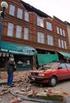 February 28 Earthquake: We got off easy State Geologist John Beaulieu Lucky may not be the first word that comes to mind after an earthquake that injured more than 200 and caused more than $1 billion damage,
EARTHQUAKE SAFETY IN THE WORK PLACE
 EARTHQUAKE SAFETY IN THE WORK PLACE COMPANY PLANS All companies have an obligation to their employees to maintain a disaster plan. An emergency evacuation area must be designed, a nearby safe area, preferably
Lecture 12 Earthquake Magnitude
 Lecture 12 Earthquake Magnitude Locating Earthquakes Last time, we learned that we could obtain a rough estimate of the distance in miles to an earthquake epicenter by multiplying the S - P time interval
Name: Date: Class: Finding Epicenters and Measuring Magnitudes Worksheet
 Example Answers Name: Date: Class: Finding Epicenters and Measuring Magnitudes Worksheet Objective: To use seismic data and an interactive simulation to triangulate the location and measure the magnitude
EARTHQUAKE PROBLEM: Do's and Don'ts for Protection
 EARTHQUAKE PROBLEM: Do's and Don'ts for Protection Sponsored by Rajiv Gandhi Foundation, New Delhi and Prepared by Department of Earthquake Engineering, University of Roorkee, Roorkee PREFACE A large number
NATURAL DISASTERS Vol. I - Earthquake Parameters Including Strong Earthquakes- S.L.Yunga EARTHQUAKE PARAMETERS INCLUDING STRONG EARTHQUAKES
 EARTHQUAKE PARAMETERS INCLUDING STRONG EARTHQUAKES S.L.Yunga United Institute of physics of the Earth, Russian academy of sciences. B. Gruzinskaya,10, Moscow, 123810, Russia Keywords earthquake, epicenter,
Chapter 7 Earthquake Hazards Practice Exam and Study Guide
 Chapter 7 Earthquake Hazards Practice Exam and Study Guide 1. Select from the following list, all of the factors that affect the intensity of ground shaking. a. The magnitude of the earthquake b. Rather
Earthquake Preparedness Tips & Strategies
 Earthquake Preparedness Tips & Strategies What to Do BEFORE an Earthquake What to Do DURING an Earthquake BE PREPARED! For more information, log onto: www.gema.ga.gov www.ready.ga.gov www.geophysics.eas.gatech.edu
FOURTH GRADE EARTHQUAKES 1 WEEK LESSON PLANS AND ACTIVITIES
 FOURTH GRADE EARTHQUAKES 1 WEEK LESSON PLANS AND ACTIVITIES PLATE TECTONIC CYCLE OVERVIEW OF FOURTH GRADE VOLCANOES WEEK 1. PRE: Comparing different structures of volcanoes. DURING: Modeling three types
Presentations. Session 1. Slide 1. Earthquake Risk Reduction. 1- Concepts & Terminology
 Earthquake Risk Reduction Presentations Session 1 Slide 1 Earthquake Risk Reduction 1- Concepts & Terminology Welcome to the World Bank Institute s (WBI) Distance Learning (DL) course on Earthquake Risk
Magnitude 7.2 GUERRERO, MEXICO
 A powerful magnitude-7.2 earthquake shook central and southern Mexico on Friday. The earthquake occurred at a depth of 24 km (15 miles). Its epicenter was in the western state of Guerrero, near the seaside
RAILROAD DAMAGE FROM THE OCTOBER 16, 1999 HECTOR MINE EARTHQUAKE
 RAILROAD DAMAGE FROM THE OCTOBER 16, 1999 HECTOR MINE EARTHQUAKE By: William G. Byers, P.E. Burlington Northern and Santa Fe Railway 4515 Kansas Avenue Kansas City, Kansas 66106 Phone (913) 551-4070 Fax
Chapter. Earthquake Damage: Types, Process, Categories
 3 Chapter Earthquake Damage: Types, Process, Categories Earthquakes leave behind a trail of damage and destruction. People s lives are affected by the loss of loved ones, destruction of property, economic
Earthquakes. Earthquakes: Big Ideas. Earthquakes
 Earthquakes Earthquakes: Big Ideas Humans cannot eliminate natural hazards but can engage in activities that reduce their impacts by identifying high-risk locations, improving construction methods, and
Critical Facility Round Table
 Critical Facility Round Table October 16, 2003 San Francisco Seismic Risk for Data Centers David Bonneville Senior Principal Degenkolb Engineers San Francisco, California Presentation Outline Seismic Risk
Earthquake Magnitude
 Earthquake Magnitude Earthquake magnitude scales: Logarithmic measure of earthquake size amplitude of biggest wave: Magnitude 6 quake 10 * Magnitude 5 energy: Magnitude 6 quake is about 32 * Magnitude
Seismic Waves Practice
 1. Base your answer to the following question on the diagram below, which shows models of two types of earthquake waves. Model A best represents the motion of earthquake waves called 1) P-waves (compressional
Five reasons buildings fail in an earthquake and how to avoid them
 Five reasons buildings fail in an earthquake and how to avoid them by Jeff White, AIA Published in Healthcare Design magazine There s a saying among seismologists: Earthquakes don t kill people. Buildings
Shake, Rattle, and Roll. Tina Moore, Denise Robinette, & Matt Utz
 Shake, Rattle, and Roll Tina Moore, Denise Robinette, & Matt Utz Shake, Rattle, and Roll - Earthquakes Lesson Plan - Day One I. Objective: A. Student will be able to read and label a two axis graph. B.
Name Date Class. By studying the Vocabulary and Notes listed for each section below, you can gain a better understanding of this chapter.
 CHAPTER 7 VOCABULARY & NOTES WORKSHEET Earthquakes By studying the Vocabulary and Notes listed for each section below, you can gain a better understanding of this chapter. SECTION 1 Vocabulary In your
Earthquakes: Risk and Insurance Issues
 Page 1 of 8 HOT TOPICS & INSURANCE ISSUES Earthquakes: Risk and Insurance Issues THE TOPIC JULY 2003 An earthquake is a sudden and rapid shaking of the earth caused by the breaking and shifting of rock
Earthquakes: Interesting Facts and F.A.Q.
 Earthquakes: Interesting Facts and F.A.Q. Earthquakes kill approximately 8,000 people each year and have caused an estimated 13 million deaths in the past 4,000 years. The moment magnitude scale (MMS)
DISASTER RESISTANCE EARTHQUAKES AND STRUCTURES
 DISASTER RESISTANCE EARTHQUAKES AND STRUCTURES EARTHQUAKES Origin of earthquakes The earth was a single land about two hundred million years ago. This land split progressively over a long period of time
Chincha and Cañete, Peru, Based
 Reconstruction of Ica, Pisco, Chincha and Cañete, Peru, Based on Updated Hazard Maps Julio Kuroiwa Professor emeritus National University of Engineering and UNDP Reconstruction Program/Sustainable Cities.
4 EFFECTS OF SURFACE FAULT RUPTURE ON INFRASTRUCTURE
 4 EFFECTS OF SURFACE FAULT RUPTURE ON INFRASTRUCTURE 4.1 Introduction The preliminary reconnaissance efforts performed by GEER on August 24, 2014 (the day of the M6 South Napa earthquake) noted significant
GEOTECHNICAL ISSUES OF LANDSLIDES CHARACTERISTICS MECHANISMS PREPARDNESS: BEFORE, DURING AND AFTER A LANDSLIDE QUESTIONS FOR DISCUSSIONS
 GEOTECHNICAL ISSUES OF LANDSLIDES CHARACTERISTICS MECHANISMS PREPARDNESS: BEFORE, DURING AND AFTER A LANDSLIDE QUESTIONS FOR DISCUSSIONS Huge landslide Leyte, Phillipines, 1998 2000 casulties Small debris
HOMEOWNER S GUIDE. to LANDSLIDES. and MITIGATION RECOGNITION, PREVENTION, CONTROL, Compiled by Dr. Scott F. Burns Tessa M. Harden Carin J.
 HOMEOWNER S GUIDE to LANDSLIDES RECOGNITION, PREVENTION, CONTROL, and MITIGATION Compiled by Dr. Scott F. Burns Tessa M. Harden Carin J. Andrew Federal Emergency Management Agency Region 10 If you are
EARTHQUAKES. Compressional Tensional Slip-strike
 Earthquakes-page 1 EARTHQUAKES Earthquakes occur along faults, planes of weakness in the crustal rocks. Although earthquakes can occur anywhere, they are most likely along crustal plate boundaries, such
Architectural Condition Survey
 Architectural Condition Survey Santa Fe Railroad / AMTRAK Depot, Lawrence. Kansas for the City of Lawrence, 2002 Survey: (student) PI: William Carswell, Associate Dean, School of Architecture, University
Earthquake Hazards and Risks
 Page 1 of 7 EENS 3050 Tulane University Natural Disasters Prof. Stephen A. Nelson Earthquake Hazards and Risks This page last updated on 28-Aug-2013 Earthquake Risk Many seismologists have said that "earthquakes
DYNAMIC CRUST: Unit 4 Exam Plate Tectonics and Earthquakes
 DYNAMIC CRUST: Unit 4 Exam Plate Tectonics and Earthquakes NAME: BLOCK: DATE: 1. Base your answer to the following question on The block diagram below shows the boundary between two tectonic plates. Which
City of Mission Viejo. Public Safety Element
 City of Mission Viejo Public Safety Element TABLE OF CONTENTS Section Page INTRODUCTION TO THE 1 Purpose of the Public Safety Element 1 Related Plans and Programs 1 Public Safety Element Scope and Content
Landslides & Mudslides
 Landslides & Mudslides Landslides, also known as mudslides and debris flow, occur in all U.S. states and territories. In snowy mountainous areas winter snow landslides are called avalanches. Landslides
Earthquakes and Data Centers
 7x24 Exchange Fall Symposium September 11, 2013 Hilton Bellevue Andrew W. Taylor, Ph.D., S.E., FACI Earthquake Hazards 2 September 11, 2013 1 Cascadia Earthquake Sources Figure Credit: Craig Weaver, Pacific
4.11 Geologic and Soil Resources
 4.11 Geologic and Soil Resources Geology and soils are evaluated as part of an environmental document because conditions in the project area can influence the type and size of a project s structure, the
Earthquakes. www.earthquakes.bgs.ac.uk
 Earthquakes www.earthquakes.bgs.ac.uk Introduction Earthquakes are among the most deadly natural hazards. There are around 100 earthquakes each year of a size that could cause serious damage. They strike
Rapid Changes in Earth s Surface
 TEKS investigate rapid changes in Earth s surface such as volcanic eruptions, earthquakes, and landslides Rapid Changes in Earth s Surface Constant Changes Earth s surface is constantly changing. Wind,
STRUCTURAL ASSESSMENT REPORT BOLINAS MARINE STATION - BOLINAS, CALIFORNIA
 STRUCTURAL ASSESSMENT REPORT BOLINAS MARINE STATION - BOLINAS, CALIFORNIA College of Marin c/o Swinerton Management & Consulting P.O. Box 144003 835 College Avenue, Building MS-3 Kentfield, California
TECTONICS ASSESSMENT
 Tectonics Assessment / 1 TECTONICS ASSESSMENT 1. Movement along plate boundaries produces A. tides. B. fronts. C. hurricanes. D. earthquakes. 2. Which of the following is TRUE about the movement of continents?
Fire Following Earthquake:
 Fire Following Earthquake: Planning, Strategic, and Tactical Considerations Los Angeles County Fire Department Chief Deputy (Acting) David R. Richardson Jr. Fire Following Earthquake: An Overlooked Dilemma
SECTION 8 Industrial Facilities Field Investigation
 SECTION 8 Industrial Facilities Field Investigation Types of Data to Be Collected and Recorded Warehouses, manufacturing facilities, energy-producing facilities, and factories should be inspected for performance
Expected Performance Rating System
 Expected Performance Rating System In researching seismic rating systems to determine how to best classify the facilities within the Portland Public School system, we searched out what was used by other
AN ANALYSIS OF FIRE SPRINKLER SYSTEM FAILURES DURING THE NORTHRIDGE EARTHQUAKE AND COMPARISON WITH THE SEISMIC DESIGN STANDARD FOR THESE SYSTEMS
 13 th World Conference on Earthquake Engineering Vancouver, B.C., Canada August 1-6, 2004 Paper No. 2136 AN ANALYSIS OF FIRE SPRINKLER SYSTEM FAILURES DURING THE NORTHRIDGE EARTHQUAKE AND COMPARISON WITH
Seismographs. Lesson 7. Seismographs recording activity on Kilauea
 Seismographs Lesson 7 E arthquakes generate seismic waves that travel all around the world and can be detected by sensitive instruments called seismographs. The earliest instrument to detect earthquakes
SMIP2000 Seminar Proceedings COSMOS VIRTUAL STRONG MOTION DATA CENTER. Ralph Archuleta
 COSMOS VIRTUAL STRONG MOTION DATA CENTER Ralph Archuleta Institute for Crustal Studies & Department of Geological Sciences University of California, Santa Barbara ABSTRACT The COSMOS virtual data center
FOURTH GRADE PLATE TECTONICS 1 WEEK LESSON PLANS AND ACTIVITIES
 FOURTH GRADE PLATE TECTONICS 1 WEEK LESSON PLANS AND ACTIVITIES PLATE TECTONIC CYCLE OVERVIEW OF FOURTH GRADE VOLCANOES WEEK 1. PRE: Comparing different structures of volcanoes. LAB: Modeling three types
Earthquakes. www.earthquakes.bgs.ac.uk. Seismograph stations operated by the British Geological Survey
 Seismograph stations operated by the British Geological Survey Earthquakes Photograph supplied by Andy Thompson, Arup Advanced Technology, EEFIT Mission www.earthquakes.bgs.ac.uk Introduction Earthquakes
Glossary. continental crust: the sections of crust, the outermost layer of the earth, that include the continents
 aftershock: an earthquake that follows a larger earthquake or main shock and originates in or near the rupture zone of the larger earthquake. Generally, major earthquakes are followed by a number of aftershocks
What is Seismic Retrofitting?
 What is Seismic Retrofitting? SEISMIC RETROFITTING A Seismic Retrofit provides existing structures with more resistance to seismic activity due to earthquakes. In buildings, this process typically includes
THE 2004 SUMATRA EARTHQUAKE AND INDIAN OCEAN TSUNAMI: WHAT HAPPENED AND WHY
 Page 6 The Earth Scientist THE 2004 SUMATRA EARTHQUAKE AND INDIAN OCEAN TSUNAMI: WHAT HAPPENED AND WHY Seth Stein and Emile A. Okal Dept of Geological Sciences, Northwestern University, Evanston Illinois
DESIGN CRITERIA. Determination of earthquake demand. Building importance level. Component categories SEISMICALLY RESILIENT NON-STRUCTURAL ELEMENTS
 FACT SHEET 2 NZS 4219:2009 Seismic performance of engineering systems in buildings requires the arrangement and layout of engineering systems within a building to allow for earthquake actions. NZS 4219:2009
The Dynamic Crust 2) EVIDENCE FOR CRUSTAL MOVEMENT
 The Dynamic Crust 1) Virtually everything you need to know about the interior of the earth can be found on page 10 of your reference tables. Take the time to become familiar with page 10 and everything
Seismic Retrofitting for School Buildings in Japan Nonstructual Seismic Retrofitting
 Seismic Retrofitting for School Buildings in Japan Nonstructual Seismic Retrofitting for School Buildings in Japan 8 January 2009 Koichi Shinpo Director, Educational Facilities Research Center National
Magnitude 8.8 OFFSHORE MAULE, CHILE
 A great 8.8-magnitude struck central Chile early Saturday. The quake hit 200 miles (325 kilometers) southwest of the capital Santiago. The epicenter was just 70 miles (115 kilometers) from Concepcion,
American Society of Civil Engineers
 American Society of Civil Engineers Technical Council on Lifeline Earthquake Engineering Earthquake Investigation Committee Lifelines Water and Wastewater Electric Power and Communication Gas and Liquid
A Report on Post-Earthquake Rapid Visual Damage Assessment of Buildings Of Tribhuvan International Airport
 A Report on Post-Earthquake Rapid Visual Damage Assessment of Buildings Of Tribhuvan International Airport Prepared By: Civil Engineering Division Tribhuvan International Airport Civil Aviation Office
Determination of source parameters from seismic spectra
 Topic Determination of source parameters from seismic spectra Authors Michael Baumbach, and Peter Bormann (formerly GeoForschungsZentrum Potsdam, Telegrafenberg, D-14473 Potsdam, Germany); E-mail: [email protected]
Nevada s Earthquake History
 Nevada s Earthquake History Tens of thousands of microearthquakes occur in Nevada every year and from time-to-time, larger mountain-forming earthquakes occur. These larger events have damaged Nevada buildings,
2. What building projects are exempted? (permit not required)
 BUILDING AND SAFETY DEPARTMENT 1. What building projects require a permit? Following is a list of projects that require building permits based on Appendix chapter 1 of the California Building Code and
Development of Guidance Information for the Repair and Rebuilding of Houses Following the Canterbury Earthquake Series
 Development of Guidance Information for the Repair and Rebuilding of Houses Following the Canterbury Earthquake Series Graeme J Beattie (1) 1. Principal Structural Engineer, BRANZ Ltd, Private Bag 50908,
SISTER ISLANDS DRAFT
 SISTER ISLANDS DRAFT PRELIMINARY DAMAGE ASSESSMENT REPORT HURRICANE GUSTAV Daft Report Revision 1 September 3, 2008 1 INTRODUCTION: Hurricane Gustav affected Cayman Brac and Little Cayman on the 29 th
Unit 6 Earthquakes and Volcanoes
 Unit 6 Earthquakes and Volcanoes Earthquakes and Volcanoes: Essential Questions What evidence can students observe that the Earth is changing? How do scientists know what s inside the Earth? What processes
Workplace Incident Fatalities Accepted by the Workers Compensation Board in 2014
 Workplace Incident Fatalities Accepted by the Workers Compensation Board in 2014 Workplace Incident Fatalities Year to date, numbers as of December 31, 2014 Workplace Incident fatalities are cases where
A Preliminary Report The May 19, 2011 Simav, Turkey Earthquake
 A Preliminary Report The May 19, 2011 Simav, Turkey Earthquake Ömer AYDAN Tokai University, Shizuoka, Japan Visiting Professor, İstanbul Technical University Halil KUMSAR Pamukkale University May 24, 2011
4.6 GEOLOGIC AND SEISMIC HAZARDS
 4.6 GEOLOGIC AND SEISMIC HAZARDS This Section describes the current conditions relating to the geologic and seismic characteristics of the City of Cypress. This Section concludes with an analysis of geologic
Part III-B Earthquake
 Part III-B Earthquake A. OVERVIEW... 3 B. CALIFORNIA EARTHQUAKE VULNERABILITY... 3 Figure 1 - California Population/Social Vulnerability to Earthquakes...3 Figure 2 - California Areas Damaged by Earthquake
Page & Turnbull imagining change in historic environments through design, research, and technology
 DCI+SDE STRUCTURAL EVALUATIONS OFFICE BUILDING, TOOL SHED & WATER TANK, AND BLACKSMITH & MACHINE SHOP BUILDINGS SAN FRANCISCO, CALIFORNIA [14290] PRIMARY PROJECT CONTACT: H. Ruth Todd, FAIA, AICP, LEED
Activities Earthquake Hazard Maps & Liquefaction
 Activities Earthquake Hazard Maps & Liquefaction Geology and Earth Resources Division geologists actively identify, assess, and map geologic hazards for land-use and emergency-management planning, disaster
Reading GPS Time Series Plots Worksheet
 Reading GPS Time Series Plots Worksheet By: Roger Groom and Cate Fox-Lent, UNAVCO Master Teachers in-residence, Shelley Olds, UNAVCO The Global Positioning System, GPS, is used to study the Earth, how
Gas Explosion at a Subway Construction Site
 Gas Explosion at a Subway Construction Site Apr. 8th, 1970, Osaka city KOBAYASHI, Hideo (Tokyo Institute of Technology) (Summary) On April 8th, 1970, a huge gas explosion occurred at the site of construction
EARTHQUAKE PREPAREDNESS
 EARTHQUAKE PREPAREDNESS STEP 1. IDENTIFY POTENTIAL HAZARDS IN YOUR HOME AND BEGIN TO FIX THEM. Earthquake safety is more than minimizing damage to buildings. We must also secure the contents of our buildings
May 5, 2010. Client Client Address. Re: Inspection Address, Chicago, Illinois. Dear Mr. Client,
 PROPERTY INSPECTION PROFESSIONALS May 5, 2010 Client Client Address Re: Inspection Address, Chicago, Illinois Dear Mr. Client, On May 4, 2010, Tomacor completed a property inspection of the above referenced
March 19, 2014. Ms. Jean McDonald CAP Management 910 16th Street, Suite 1010 Denver, Colorado 80202
 Ms. Jean McDonald CAP Management 910 16th Street, Suite 1010 Denver, Colorado 80202 Re: Prospector s Point Walkway/Façade Repairs Martin/Martin, Inc Project No.: 13.0358.S.02 Ms. McDonald: Per your request
Factors to Consider When Developing an Evacuation Plan
 The following should be viewed only as suggestions: Factors to Consider When Developing an Evacuation Plan 1. You must identify your document with a specific title and explanation. Example: Evacuation
General Earthquake Damage Inspection Checklist
 A. GENERAL INFORMATION 1. Street Address of Property: City: State: Zip: 2. Property Owner s Name: 3. Date of inspection: 4. Inspector s Name: B. BUILDING SITE INSPECTION 5. Utility Service Safety: IMPORTANT
Elevating Your House. Introduction CHAPTER 5
 CHAPTER 5 Elevating Your House Introduction One of the most common retrofitting methods is elevating a house to a required or desired Flood Protection Elevation (FPE). When a house is properly elevated,