
Part III-B Earthquake
|
|
|
- Shon Garrett
- 10 years ago
- Views:
Transcription
1 Part III-B Earthquake A. OVERVIEW... 3 B. CALIFORNIA EARTHQUAKE VULNERABILITY... 3 Figure 1 - California Population/Social Vulnerability to Earthquakes...3 Figure 2 - California Areas Damaged by Earthquake from AREAS DAMAGED BY EARTHQUAKES... 5 Figure 3 - Areas Damaged by Earthquakes ( )...5 Table 1 - Recent Earthquake Scenario Losses for Southern California...5 CALIFORNIA AND EARTHQUAKE MITIGATION EXPENDITURES... 6 Table 2 - California Estimated Expenditures on Earthquake Mitigation...6 EARTHQUAKE IMPACTS... 7 CAUSES AND CHARACTERISTICS OF EARTHQUAKES... 8 C. ORANGE COUNTY EARTHQUAKE THREAT... 9 Figure 4 - Orange County Fault Zones...9 EARTHQUAKES THAT THREATEN ORANGE COUNTY D. EARTHQUAKE FAULTS THAT IMPACT CCCD Table 3 - List of Earthquake Faults that Impact CCCD...12 Table 4 - Modified Mercalli Intensity (MMI) Scale (Richter, 1958)...13 NEWPORT-INGLEWOOD FAULT ZONE Figure Long Beach Earthquake Photo...15 Figure 6 - ShakeMap M6.9 Newport-Inglewood (USGS, 2001)...16 Table 5 - HAZUS Regional Impacts M6.9 Newport-Inglewood...17 Figure 7 - Total Direct Economic Loss OC M6.9 Newport-Inglewood...18 Table 6 - Essential OC Facility Losses M6.9 Newport-Inglewood...20 Table 7 - School Districts for which ASCIP provided Site-Specific Data...22 Table 8 - Estimated Impacts OC School Districts M6.9 Newport-Inglewood...22 Figure 8 - Potential Damage to Community Colleges M6.9 Newport-Inglewood...23 SAN JOAQUIN HILLS FAULT Figure 9 - ShakeMap M6.6 San Joaquin Hills (USGS)...24 Table 9 - Summary of HAZUS M6.6 San Joaquin Hills...25 Figure 10 - Direct Economic Loss in OC M6.6 San Joaquin Hills...26 Table 10 -OC Essential Facility Loss Estimates M6.6 San Joaquin Hills...28 Table 11 - Estimated Impacts OC School Districts M6.6 San Joaquin Hills...29 Figure 11 - OC School Functionality M6.6 San Joaquin Hills...30 Figure 12 - ShakeMap M6.6 San Joaquin Hills...31 SAN ANDREAS FAULT ZONE Figure 13 M7.8 San Andreas Repeat of the 1857 Fort Tejon...33

2 Figure 14 - ShakeMap M7.4 Southern San Andreas (USGS, 2001)...34 PALOS VERDES FAULT Figure 15 Orange County Off-Shore Faults including Palos Verde Fault...35 Figure 16 - ShakeMap M7.1 Palos Verde s (USGS, 2001)...36 PUENTE HILLS THRUST FAULT Figure 17 - ShakeMap M7.1 Puente Hills (USGS, 2003)...38 EARTHQUAKE RELATED HAZARDS Figure 18 - Orange County Liquefaction Zones...40 COMMUNITY EARTHQUAKE ISSUES Table 12 - Earthquake Safety Laws...47 E. HAZUS PROJECT OVERVIEW EARTHQUAKE SCENARIOS Figure 19- HAZUS Earthquake Loss Estimation Model...51 F. COAST COMMUNITY COLLEGE DISTRICT DAMAGE ESTIMATES Table 13 - List of CCCD Sites Earthquake Fault Rankings in MMI...52 Table 14 - CCCD Earthquake Damage Estimates by site...53 G. EARTHQUAKE AND CCCD DEVELOPMENT TRENDS H. CCCD EARTHQUAKE MITIGATION STRATEGIES SHORT TERM MITIGATION STRATEGIES LONG TERM MITIGATION STRATEGIES... 58

3 Part A. OVERVIEW Earthquakes are considered a major threat to Orange County due to the proximity of several fault zones, including the San Andreas Fault Zone and the Newport-Inglewood Fault Zone. A 1995 Southern California Earthquake Center report indicated that the probability of an earthquake of Magnitude 7 or larger in Southern California before the year 2024 is 80 to 90%. A significant earthquake along one of the major faults could cause substantial casualties, extensive damage to buildings, roads and bridges, fires, and other threats to life and property. The effects could be aggravated by aftershocks and by secondary effects such as fire, landslides and dam failure. A major earthquake could be catastrophic in its effect on the population, and could exceed the response capability of the district, the local communities and even the State of California. Japan s 2011 earthquake demonstrates how damaging earthquakes can be to a population in a built out environment. It also graphically demonstrates the catastrophic hazards caused by earthquakes such as tsunamis, landslides, fires and nuclear power plant failures. The State of California, Orange County public agencies and the CCCD have made earthquake mitigation efforts a district priority. B. CALIFORNIA EARTHQUAKE VULNERABILITY The following risk assessment map identifies which areas within California s 58 counties are particularly vulnerable to earthquakes, whether due to high population density or because of higher numbers of socially vulnerable residents. In addition to completion of the population/social vulnerability mapping, this GIS risk assessment addresses where people live in relation to earthquakes. Areas of the state with low population density have relatively low risk compared to areas with high population density or areas with medium density and high percentages of vulnerable population. This map uses combined social vulnerability factors, such as age, income, disability, education, ethnicity, gender and other variables which may reduce individual disaster resiliency. High population and high earthquake threat are shown in dark red High population and medium threat or vice versa are shown in light red Orange County Low population and high threat, medium population and Figure 1 - California Population/Social threat, and low population and high threat are orange Vulnerability to Earthquakes Low population and medium threat or vice versa are light orange Low population and low threat are shown in yellow The CCCD service area is in an area that is dark red or highest population/social vulnerability Page 3 of 58

4 As can be noted from the map above, north west Orange County (the CCCD s service area) is in the high population and high earthquake threat zone. This indicates that higher numbers of socially vulnerable residents live, work and attend college in an area that has a high earthquake threat. The following map shows the Historic Earthquakes in and Near California by Magnitude. Note the Newport-Inglewood fault in 1933 (name added to the map in blue). This 6.4 magnitude earthquake epicenter was in Huntington Beach/Huntington Harbour area. This quake devastated the closest built-out area, which at the time was Long Beach, where 120 deaths occurred and hundreds of buildings collapsed, mostly buildings made of unreinforced masonry. Newport-Inglewood, 1933 Figure 2 - California Areas Damaged by Earthquake from Page 4 of 58


5 AREAS DAMAGED BY EARTHQUAKES Below is the map depicting the areas damaged by earthquakes from 1800 to 2007 Figure 3 - Areas Damaged by Earthquakes ( ) Orange County has proclaimed Local Emergencies and been part of two State and Federally Declared Earthquake Disasters since These were for the: 1987 Whittier Earthquake o 6.0 magnitude o 9 deaths o 200+ injuries o $522 million total damage 1994 Northridge Earthquake o 6.7 magnitude o 57 deaths o 11,846 injuries o $46 billion total damage Below in Table 1 is a list of the Southern California earthquakes from 1971 to It includes the earthquake magnitude, direct dollar losses in millions, deaths and injuries as the result of these earthquakes. TABLE 1 - RECENT EARTHQUAKE SCENARIO LOSSES FOR SOUTHERN CALIFORNIA Page 5 of 58


6 CALIFORNIA AND EARTHQUAKE MITIGATION EXPENDITURES The State of California has made earthquake hazard mitigation a priority. The following table summarizes the dollar amount spent on selected earthquake mitigation projects in Californa from Unfortunately, there has been little state dollars dedicated to community colleges. To date, $9 million has been spent on Community College Seismic Evaluation Surveys. Most of the progress of Community Colleges has been due to locally passed bond measures. TABLE 2 - CALIFORNIA ESTIMATED EXPENDITURES ON EARTHQUAKE MITIGATION Page 6 of 58

7 EARTHQUAKE IMPACTS Following major earthquakes, extensive search and rescue operations may be required to assist trapped or injured persons. Emergency medical care, food and temporary shelter would be required for injured or displaced persons. Fires may rage out of control. In the event of a truly catastrophic earthquake, identification and burial of the dead would pose difficult problems. Mass evacuation may be essential to save lives, particularly in areas below dams. Many families could be separated, particularly if the earthquake should occur during working hours, and a personal inquiry or locator system would be essential. Emergency operations could be seriously hampered by the loss of communications and damage to transportation routes within, to and out of the disaster area and by the disruption of public utilities and public safety services. Extensive state and federal assistance could be required and could continue for an extended period. Efforts would be required to remove debris and clear roadways; demolish unsafe structures; assist in reestablishing public services and utilities; and provide continuing care and welfare for the affected population including temporary housing for displaced persons. In general, the population is less at risk during non-work hours (if at home) as wood-frame structures are relatively less vulnerable to major structural damage than are typical commercial and industrial buildings. Transportation problems are intensified if an earthquake occurs during work hours, as significant numbers of Orange County residents commute to work in Los Angeles County. Similarly, a somewhat smaller number of Los Angeles residents commute to work in Orange County. Thousands also commute to and from Riverside County. An earthquake occurring during work hours would clearly create major transportation problems for those displaced workers. Hazardous materials could present a major problem in the event of an earthquake. Orange County, one of the largest industrial and manufacturing areas in the state, has several thousand firms that handle hazardous materials, and are estimated to produce more than 100 million gallons of hazardous waste per year. The County s highways serve as hazardous materials transportation corridors, and Interstate 5 is the third busiest highway corridor in the country. Much of the industrial base of Southern California, and Orange County in particular, consists of high-technology companies essential to the Nation's commerce, economy, and defense effort. A catastrophic earthquake could not only have a severe impact on the local industrial base; but also a major impact on the security of our nation. For example, Census and Department of Defense data indicate that over 50 percent of the U.S. Missile and Space Vehicle business, about 75 percent of the domestic micro-chip industry, 40 percent of the U.S. semiconductor business, and more than 20% of the U.S. optical instrument business is located in California. Much of that capacity, including prime contractors, subcontractors or supply vendors, is located in Orange County. Approximately 5,000 defense contractors are located within 50 miles of the San Andreas Fault -- including virtually all of Orange and Los Angeles Counties. In some cases, local defense contractors are the only source for some of the most critical defense systems used by our military departments. In addition to the loss of production capabilities, the economic impact on the County from a major earthquake would be considerable in terms of loss of employment and loss of tax base. Also, a major earthquake could cause serious damage and/or outage to computer facilities. The loss of such facilities could curtail or seriously disrupt the operations of banks, insurance Page 7 of 58

8 companies, and other elements of the financial community. In turn, this could affect the ability of local government, business and the population to make payments and purchases. CAUSES AND CHARACTERISTICS OF EARTHQUAKES EARTHQUAKE FAULTS A fault is a fracture along between blocks of the earth s crust where either side moves relative to the other along a parallel plane to the fracture. Strike Slip Fault STRIKE-SLIP Strike-slip faults are vertical or almost vertical rifts where the earth s plates move mostly horizontally. From the observer s perspective, if the opposite block looking across the fault moves to the right, the slip style is called a right lateral fault; if the block moves left, the shift is called a left lateral fault. DIP-SLIP Dip-slip faults are slanted fractures where the blocks mostly shift vertically. If the earth above an inclined fault moves down, the fault is called a normal fault, but when the rock above the fault moves up, the fault is called a reverse fault. Thrust faults have a reverse fault with a dip of 45 or less. Normal Fault Dr. Kerry Sieh of Cal Tech has investigated the San Andreas Fault Thrust Fault at Pallett Creek. The record at Pallett Creek shows that rupture has recurred about every 130 years, on average, over the past 1500 years. But actual intervals have varied greatly, from less than 50 years to more than 300. The physical cause of such irregular recurrence remains unknown, as found on the web site Damage from a great quake on the San Andreas would be widespread throughout Southern California. Page 8 of 58


9 C. ORANGE COUNTY EARTHQUAKE THREAT Large faults as shown below (Figure 4) could affect Orange County include the: San Andreas Fault Newport-Inglewood Fault Palos Verdes (off-shore) Whittier Fault Elsinore Fault San Jacinto Fault San Joaquin Hills Fault Puente Hills Fault Figure 4 - Orange County Fault Zones The CCCD Hazard Mitigation Project Manager and Contractor studied each of these faults to determine which most heavily impacted the CCCD. They reviewed each ShakeMap from the HAZUS study on Orange County and ranked each on the Modified Mercalli Intensity (MMI) Scale. This plan concentrated its efforts on faults that could cause a MMI of a VII or greater to the CCCD. Page 9 of 58

10 EARTHQUAKES THAT THREATEN ORANGE COUNTY The most recent significant earthquake event affecting Southern California was the 1994 Northridge Earthquake. At 4:31 A.M. on Monday, January 17, a moderate, but very damaging earthquake with a magnitude of 6.7 struck the San Fernando Valley. In the following days and weeks, thousands of aftershocks occurred, causing additional damage to affected structures. Fifty-seven people were killed and more than 1,500 people seriously injured. For days afterward, thousands of homes and businesses were without electricity, tens of thousands had no gas, and nearly 50,000 had little or no water. Approximately 15,000 structures were moderately to severely damaged, which left thousands of people temporarily homeless. Over sixty-six thousand buildings were inspected. Nearly 4,000 were severely damaged and over 11,000 were moderately damaged. Several collapsed bridges and overpasses created commuter havoc on the freeway system. Extensive damage was caused by ground shaking, but earthquake triggered liquefaction and dozens of fires also caused additional severe damage. This extremely strong ground motion felt in large portions of Los Angeles County resulted in record economic losses. However, the earthquake occurred early in the morning on a holiday. This circumstance considerably reduced the potential effects. Many collapsed buildings were unoccupied, and most businesses were not yet open. The direct and indirect economic losses ran into tens of billions of dollars. Historical and geological records show that California has a long history of seismic events. Southern California is probably best known for the San Andreas Fault, a 400 mile long fault running from the Mexican border to a point offshore, west of San Francisco. Geologic studies show that over the past 1,400 to 1,500 years, large earthquakes have occurred at about 130 year intervals on the southern San Andreas Fault. As the last large earthquake on the southern San Andreas occurred in 1857, that section of the fault is considered a likely location for an earthquake within the next few decades according to the Southern California Earthquake Center. But the San Andreas is only one of dozens of known earthquake faults that criss-cross Southern California. Some of the better known faults include the Newport-Inglewood, Whittier, Chatsworth, Elsinore, Hollywood, Los Alamitos, and Palos Verdes faults. Beyond the known faults, there are a potentially large number of blind faults that underlie the surface of Southern California. One such blind fault was involved in the Whittier Narrows earthquake in October Although the most famous of the faults, the San Andreas is capable of producing an earthquake with a magnitude of 8+ on the Richter scale, some of the lesser faults have the potential to inflict greater damage on the urban core of the Los Angeles Basin. Seismologists believe that a 6.0 earthquake on the Newport-Inglewood would result in far more death and destruction than a great quake on the San Andreas, because the San Andreas is relatively remote from the urban centers of Southern California. Page 10 of 58

11 For decades, partnerships have flourished between the USGS, Cal Tech, the California Geological Survey and universities to share research and educational efforts with Californians. Tremendous earthquake mapping and mitigation efforts have been made in California in the past two decades, and public awareness has risen remarkably during this time. Major federal, state, and local government agencies and private organizations support earthquake risk reduction. These partners have made significant contributions in reducing the adverse impacts of earthquakes. Despite the progress, the majority of California communities remain unprepared because there is a general lack of understanding regarding earthquake hazards among Californians. To better understand the earthquake hazard, the scientific community has looked at historical records and accelerated research on those faults that are the sources of the earthquakes occurring in the Southern California region. Historical earthquake records can generally be divided into records of the pre-instrumental period and the instrumental period. In the absence of instrumentation, the detection of earthquakes is based on observations and felt reports, and is dependent upon population density and distribution. Since California was sparsely populated in the 1800s, the detection of pre-instrumental earthquakes is relatively difficult. However, two very large earthquakes, the Fort Tejon in 1857 (7.9M) and the Owens Valley in 1872 (7.6M) are evidence of the tremendously damaging potential of earthquakes in Southern California. In more recent times two M7.3 earthquakes struck Southern California, in Kern County (1952) and Landers (1992). The damage from these four large earthquakes was limited because they occurred in areas which were sparsely populated at the time they happened. The seismic risk is much more severe today than in the past because the population at risk is in the millions, rather than a few hundred or a few thousand persons. Page 11 of 58

12 D. EARTHQUAKE FAULTS THAT IMPACT CCCD After extensive research from dozens of websites, documents, California and Orange County Hazard Mitigation Plans, and HAZUS studies, the following faults were considered the greatest threat to the CCCD service area. The research was summarized for the CCCD Hazard Mitigation Committee and they concurred that these five faults should be studied for this plan. TABLE 3 - LIST OF EARTHQUAKE FAULTS THAT IMPACT CCCD Ranking Map # 1 III-B III-B 6.6 Magnitude Fault Name Newport- Inglewood San Joaquin Hills III-B 7.4 San Andreas VIII III-B 7.1 Palos Verde 5 III-B 7.1 Puente Hills VII Modified Mercalli X X VII Threat Issues Major threat to entire district; liquefaction threat district-wide Major threat to most of the district; particularly in southern and coastal district sites Major threat to all of Southern California due to (1) massive impact area (2) extensive population impact (3) catastrophic fires and (4) major transportation disruption. VII Threat to north Orange County and coastal. IX Threat to Sailing Center in Newport Beach VII Threat to north Orange County Other faults that may impact the CCCD service area but to a lesser extent include: Elsinore Fault, Whittier Fault and San Jacinto Fault. These faults are ranked a VI on the Modified Mercalli Intensity Scale. Page 12 of 58

13 TABLE 4 - MODIFIED MERCALLI INTENSITY (MMI) SCALE (RICHTER, 1958) Study concentration Value Description I Not felt. Marginal and long period effects of large earthquakes. II Felt by persons at rest, on upper floors, or favorably placed. Felt indoors. Hanging objects swing. Vibration like passing of light trucks. Duration estimated. III May not be recognized as an earthquake. Hanging objects swing. Vibration like passing of heavy trucks; or sensation of a jolt like a IV heavy ball striking the walls. Standing motorcars rock. Windows, dishes, doors rattle. Glasses clink. Crockery clashes. In the upper range of IV, wooden walls and frame creak. Felt outdoors; direction estimated. Sleepers wakened. Liquids disturbed, some spilled. Small V unstable objects displaced or upset. Doors swing, close, open. Shutters, pictures move. Pendulum clocks stop, start, change rate. Felt by all. Many frightened and run outdoors. Persons walk unsteadily. Windows, dishes, glassware broken. Knickknacks, books, etc., off shelves. Pictures off walls. Furniture moved VI or overturned. Weak plaster and masonry D cracked. Small bells ring (church, school). Trees, bushes shaken (visibly, or heard to rustle) Difficult to stand. Noticed by drivers of motor cars. Hanging objects quiver. Furniture broken. Damage to masonry D, including cracks. Weak chimneys broken at roof line. Fall of plaster, VII loose bricks, stones, tiles, cornices (also unbraced parapets and architectural ornaments). Some cracks in masonry C. Waves on ponds; water turbid with mud. Small slides and caving in along sand or gravel banks. Large bells ring. Concrete irrigation ditches damaged. Steering of motor cars affected. Damage to masonry C; partial collapse. Some damage to masonry B; none to masonry A. Fall of stucco and some masonry walls. Twisting, fall of chimneys, factory stacks, monuments, towers, elevated tanks. Frame houses moved on VIII foundations if not bolted down; loose panel walls thrown out. Decayed piling broken off. Branches broken from trees. Changes in flow or temperature of springs and wells. Cracks in wet ground and on steep slopes. General panic. Masonry D destroyed; masonry C heavily damaged, sometimes with complete collapse; masonry B seriously damaged. (General damage to foundations.) Frame structures, IX if not bolted, shifted off foundations. Frames racked. Serious damage to reservoirs. Underground pipes broken. Conspicuous cracks in ground. In alluvial areas sand and mud ejected, earthquake fountains, sand craters. Most masonry and frame structures destroyed with their foundations. Some well-built wooden structures and bridges destroyed. Serious damage to dams, dikes, embankments. Large X landslides. Water thrown on banks of canals, rivers, lakes, etc. Sand and mud shifted horizontally on beaches and flat land. Rails bent slightly. XI Rails bent greatly. Underground pipelines completely out of service. Damage nearly total. Large rock masses displaced. Lines of sight and level distorted. Objects XII thrown into the air. Masonry A: Good workmanship, mortar, and design; reinforced, especially laterally, and bound together by using steel, concrete, etc.; designed to resist lateral forces. Masonry B: Good workmanship and mortar; reinforced, but not designed in detail to resist lateral forces. Masonry C: Ordinary workmanship and mortar; no extreme weaknesses like failing to tie in at corners, but neither reinforced nor designed against horizontal forces. Masonry D: Weak materials, such as adobe; poor mortar; low standards of workmanship; weak horizontally. Page 13 of 58

14 NEWPORT-INGLEWOOD FAULT ZONE This fault extends from the Santa Monica Mountains southeastward through the western part of Orange County, through Huntington Beach and to the offshore area near Newport Beach. It was the source of the destructive 1933 Long Beach earthquake (magnitude 6.4), which caused 120 deaths and considerable property damage. During the past 60 years, numerous other shocks ranging from magnitude 3.0 to 5+ have been recorded. Southern California Earthquake Center reports probable earthquake Magnitudes for the Newport-Inglewood fault to be in the range of 6.0 to 7.4. The epicenter of the 1933 Long Beach earthquake was in Huntington Harbour. Huntington Beach and Orange County had extremely low populations and few structures in Because of this, most of the deaths and damage was in the built out Long Beach area. However, Huntington Beach s Central School and downtown area were heavily damaged and the Central School (located where Dwyer School sits today) had to be torn down. NEWPORT-INGLEWOOD FAULT FACTS Nearest Communities: Orange County cities potentially affected by the fault are Seal Beach, Huntington Beach, Newport Beach, and Costa Mesa Most Recent Major Rupture: March 10, 1933, M6.4 (but no surface rupture) Interval Between Major Ruptures: unknown Probable Magnitudes: M This represents a worst-case earthquake that could affect the urban areas of the coast of Orange County including all of the CCCD service area. In California, each earthquake is followed by revisions and improvements in the Building Codes. The 1933 Long Beach resulted in the Field Act, affecting school construction. The 1971 Sylmar earthquake brought another set of increased structural standards. Similar re-evaluations occurred after the 1989 Loma Prieta and 1994 Northridge earthquakes. These code changes have resulted in stronger and more earthquake resistant structures. The Alquist-Priolo Earthquake Fault Zoning Act was passed in 1972 to mitigate the hazard of surface faulting to structures for human occupancy. This state law was a direct result of the 1971 San Fernando Earthquake, which was associated with extensive surface fault ruptures that damaged numerous homes, commercial buildings, and other structures. Surface rupture is the most easily avoided seismic hazard. The Seismic Hazards Mapping Act, passed in 1990, addresses non-surface fault rupture earthquake hazards, including liquefaction and seismically induced landslides. The State Department of Conservation operates the Seismic Mapping Program for California. Extensive information is available at their website: The Newport-Inglewood Fault Zone is a right-lateral fault, running from Newport Beach and Costa Mesa at its southern end, to Culver City and Inglewood at its northern end. The most recent significant earthquake on the Newport-Inglewood Fault was the 1933 M6.4 Long Beach Page 14 of 58

15 earthquake, in which 120 people were killed, and causing $50 million in damage (SCEC). An event of this size has a recurrence interval on the order of 1000 years. Many schools were destroyed (top right photo is Compton Middle School). Because of this parents lobbied legislators to enact the world s first building codes. Excerpt from - Figure Long Beach Earthquake Photo On March 10, 1933 at 5:54 in the evening, a severe earthquake shook Southern California. Four deaths occurred in Orange County. In Santa Ana, a man and his wife raced out of the Rossmore Hotel and were crushed under an avalanche of bricks and mortar. Another man, while walking in front of the Richelieu Hotel, was struck by a piece of falling cornice and instantly killed. In Garden Grove, a 13-year old girl was planning a freshman party with her friends when the earthquake hit. She was sitting on the steps of a local high school and was crushed by a falling wall. Two of her friends were injured. In Newport Beach, 800 chimneys were broken off at the roofline and several hundred buildings were destroyed. In Huntington Beach, steel oil derricks were "squashed" several inches out of the ground. In Santa Ana, Anaheim and Garden Grove, business centers were badly damaged and debris covered downtown streets. A heavy fog enveloped the Southland, making rescue work difficult. The 1933 Long Beach earthquake affected 75,000 square miles, and resulted in the formation of more stringent building codes for Orange County structures. Page 15 of 58

16 Figure 6 - ShakeMap M6.9 Newport-Inglewood (USGS, 2001) Page 16 of 58

17 NEWPORT-INGLEWOOD EARTHQUAKE SCENARIO REGIONAL IMPACTS The M6.9 Newport-Inglewood scenario earthquake will impact the western and northwestern communities and infrastructure of Orange County which covers the entire CCCD service area. A summary of regional impacts is provided in the table below. These impacts are described below, and are tabulated in more detail in the HAZUS Global Summary Report for this scenario earthquake. This report can be found in the Appendices of this document. TABLE 5 - HAZUS REGIONAL IMPACTS M6.9 NEWPORT-INGLEWOOD Impact Category HAZUS-Estimated Impact Economic Loss due to Building Damage Total Building-related Direct Economic Loss $5.5 B $8.3 B # Buildings in Complete Damage State 655 Debris Generated (million tons) 1.94 Displaced Households People Needing Short-term Shelter 3,300 Households 2,050 People Fatalities (2 am, 2 pm, 5 pm) Total Injuries (2 am, 2 pm, 5 pm) 13, 44, , 2209, 1950 % of Households without Water 20% # Highway Bridges w/ at least Moderate 18 Damage (potentially closed) Fire Following Earthquake* Ignitions, area 128,054 sq miles, $311M burned, $ loss In a M6.9 earthquake on the Newport-Inglewood Fault, dollar losses related to shaking-induced building damage are estimated to reach $5.5 billion, while total direct economic losses are expected to reach $8.3 billion. Within HAZUS, total direct economic losses include building and content losses, as well as inventory loss and income losses (which includes relocation costs, income losses, wage losses and rental income losses). The geographic distribution of total direct economic loss is mapped in Figure 6. Page 17 of 58

18 Figure 7 - Total Direct Economic Loss OC M6.9 Newport-Inglewood Of the approximately 738,000 buildings modeled within the general building stock for Orange County, less than 1% (655) are expected to suffer Complete damage in the Newport- Inglewood scenario earthquake. These building would be considered red-tagged or unsafe for continued occupancy. A small percentage of these buildings (15% or less) have the potential for collapse, suggesting the need for Urban Search & Rescue (USAR). Approximately 7,500 buildings (1%) are expected to suffer Extensive damage, and would be considered yellowtagged, with restrictions on continued use. While the remainder of buildings would be considered green-tagged (safe for occupancy, although some damage may have occurred), as many as 7% (53,320) would be expected to suffer Moderate damage, and an additional 29% (215,733) would suffer Slight damage. As much as 1.94 million tons of debris may result from these damaged buildings 62% is expected to be heavy debris (concrete and steel), requiring heavy equipment to break down and remove, while 38% is expected to be light debris (wood, brick and other debris). Damage to single family and multi-family dwellings is expected to result in the displacement of more than 3,300 households. As much as 20% of the County s households may also be without water. While many of the displaced may find shelter with friends and family, or in available hotels, as many as 2,000 people are expected to seek public shelter. Depending on the time of day when the earthquake occurs, the number of people killed as a result of shaking-induced Page 18 of 58

19 building and transportation system damage may range from 13 (at 2 am, when most of the population are located in relatively safe residential structures) to as many as 49 (at 5 pm, when many people are either in commercial or industrial buildings, or commuting). Total injuries, including the range of injuries from minor injuries treated with basic medical care to mortal injuries (deaths), ranges from approximately 1,400 at 2 am to 2,200 at 2 pm. Transportation of the injured for treatment could be impacted by transportation system damage, with as many as 18 bridges in the northwest part of the County suffering at least Moderate damage. Additional economic damage may result from post-earthquake fire. The current HAZUS FFE model estimates as many as 128 fire ignitions, most of which will be contained. However, a total of approximately ½ square mile is expected to burn, resulting in losses of approximately $311 million. It should be noted that the HAZUS FFE model is currently undergoing significant improvements; future analyses will likely yield different FFE results, so these results should be used with caution. Page 19 of 58

20 NEWPORT-INGLEWOOD ESSENTIAL FACILITY IMPACTS The table below provides an overview of essential facility performance in the Newport- Inglewood Scenario earthquake. The table lists the number of essential facility sites and buildings (these numbers will differ for multi-building campuses, such as schools and hospitals). The table also provided the total building replacement value, and the number of buildings for which value data was available. As can be seen in the table, replacement cost data for hospitals was generally not available, unlike most other essential facility types. Expected building performance in this earthquake event ranges from as little as 2-3% damage overall for schools, to as much as 15% for large hospitals. Total economic loss for essential facilities has been estimated to exceed $280 million, the bulk of which ($218 million) will occur in schools. It should be noted that although cost data is only available for 19 hospital buildings (out of 157), these 19 buildings suffer more than $45 million in loss. (The full economic impact on hospitals can t be estimated at this time because of the lack of comprehensive replacement value data.) TABLE 6 - ESSENTIAL OC FACILITY LOSSES M6.9 NEWPORT-INGLEWOOD Essential Facility Category No. of Facilities / Sites No. of Buildings No. of Beds Replacement Cost ($1,000) # Buildings w/ replacement cost data Function -ality Day 1 (%) Mean Damage Economic Loss ($1,000) Hospital Schools Small $ % $0 Medium ,018 $50, % $2,462 Large ,221 $677, % $43,229 K-12 (default data) $335, % $7,553 K-12 (providing data) 346 4,952 $2,983,628 4, % $218,017 CC Dists. (providing data) $461, % $15,742 EOCs $368, % $12 Police Stations $770, % $39 Fire Stations $316, % $11 TOTALS 1,204 6,134 6,317 $5,963,776 5,875 $287,065 SCHOOLS The default schools database in HAZUS MR3 for Orange County includes 809 school sites, including both public schools and some private schools and pre-schools. Community colleges and Universities are not included in the default school database. It should be noted that HAZUS represents each school campus as a single record in the default database, regardless of the number of buildings on site. (This essentially assumes uniform performance of all structures at a given school site, when in reality, buildings of different construction types are expected to perform differently.) Page 20 of 58

21 Detailed school building insurance appraisal data was received from the Alliance of Schools for Cooperative Insurance Programs (ASCIP) for fifteen (15) member districts in Orange County, including two community college districts. These school districts, listed in Table 7, include 50% of the public grade schools in Orange County, and 51% of the County s public school enrollment. Data includes site-specific information on 6,371 insured structures (including a number of non-building structures that were omitted from the final database), accounting for almost 25 million square feet, and a replacement value of over $3.6 billion dollars. Detailed construction data was provided for 5,164 individual school buildings, allowing a more detailed HAZUS risk assessment (e.g., building level rather than site level) for these facilities. The data received is sufficiently detailed to allow the Project Team to categorize each school building for which data was received according to the required HAZUS parameters (e.g., structure type, design level, configuration, etc.) and develop an enhanced (Level 2+) input database for HAZUS. The 569 schools in the remaining K-12 school districts have been analyzed using default HAZUS data. Page 21 of 58
22 K-12 (providing data) Number of Facilities/ Sites* No. of Buildings Replacement Cost ($1,000) # Buildings w/ replacement cost data Functionality Day 1 (%) Mean Damage Economic Loss ($1,000) TABLE 7 - SCHOOL DISTRICTS FOR WHICH ASCIP PROVIDED SITE-SPECIFIC DATA District Type District Name K-12 School Districts Brea Olinda Unified School District Capistrano Unified School District Fullerton Joint Union High School District Fullerton School District Huntington Beach City School District Huntington Beach Union High School District Laguna Beach Unified School District Newport-Mesa Unified School District Ocean View School District Orange County Dept. Of Education Placentia-Yorba Linda Unified School District Santa Ana Unified School District Community College Districts Tustin Unified School District North Orange County Community College District Rancho Santiago Community College District TABLE 8 - ESTIMATED IMPACTS OC SCHOOL DISTRICTS M6.9 NEWPORT-INGLEWOOD Category District Name K-12 (default data) $335, % $7,553 CCD (providing data) Brea Olinda USD $83, % $933 Capistrano USD 60 1,035 $387,399 1, % $1,598 Fullerton Joint UHSD $219, % $5,180 Fullerton SD $121, % $1,534 Huntington Bch SD $115, % $32,573 Huntington Bch UHSD $237, % $36,350 Laguna Beach USD 7 54 $60, % $2,908 Newport-Mesa USD $402, % $75,649 Ocean View SD $149, % $26,499 Orange Co DOE $54, % $2,479 Placentia-Yorba Linda USD $292, % $1,676 Santa Ana USD 57 1,046 $623,817 1, % $27,540 Tustin USD $234, % $3,096 North Orange Co CCD 7 90 $304, % $10,405 Rancho Santiago CCD $157, % $5,336 TOTALS 928 5,733 $3,781,014 5, % $241,311 * includes District offices and other facilities (e.g., maintenance, transportation, etc.) CCCD was not part of the study. However the contractor estimated the mean damage based on the average of the highlighted school districts located in the CCCD service area 10.9% Page 22 of 58
23 Figure 8 - Potential Damage to Community Colleges M6.9 Newport-Inglewood Page 23 of 58
24 SAN JOAQUIN HILLS FAULT A recently discovered southwest-dipping blind thrust fault originating near the southern end of the Newport-Inglewood Fault close to Huntington Beach, at the western margins of the San Joaquin Hills. Rupture of the entire area of this blind thrust fault could generate an earthquake as large as M7.3. In addition, a minimum average recurrence interval of between about 1650 and 3100 years has been estimated for moderate-sized earthquakes on this fault (Grant and others, 1999). Figure 9 - ShakeMap M6.6 San Joaquin Hills (USGS) Page 24 of 58
25 TABLE 9 - SUMMARY OF HAZUS M6.6 SAN JOAQUIN HILLS Impact Category Economic Loss due to Building Damage Total Building-related Direct Economic Loss # Buildings in Complete Damage State 663 $9.5 B $14.2 B Debris Generated (million tons) 3.33 Displaced Households People Needing Short-term Shelter Fatalities (2 am, 2 pm, 5 pm) Total Injuries (2 am, 2 pm, 5 pm) % of Households without Water 35% # Highway Bridges w/ at least Moderate Damage (potentially closed) Fire Following Earthquake* Ignitions, area burned, $ loss HAZUS-Estimated Impact 4,800 Households 3,200 People 17, 87, , 4006, , 0.56 sq mi, $240M In a M6.6 earthquake on the San Joaquin Hills Fault, dollar losses related to shaking-induced building damage are estimated to reach $9.5 billion, while total direct economic losses are expected to exceed $14 billion. The geographic distribution of total direct economic loss is mapped below. Page 25 of 58
26 Figure 10 - Direct Economic Loss in OC M6.6 San Joaquin Hills Of the approximately 738,000 buildings modeled within the general building stock for Orange County, less than 1% (663) would be expected to suffer Complete damage in the San Joaquin Hills scenario earthquake. These buildings would be considered red-tagged or unsafe for continued occupancy. A small percentage of these buildings (15% or less) have the potential for collapse, suggesting the need for Urban Search & Rescue (USAR). More than 10,000 buildings (1.4%) are expected to suffer Extensive damage in this scenario earthquake, and would be considered yellow-tagged, with restrictions on continued use. While the remainder of buildings would be considered green-tagged (safe for occupancy, although some damage may have occurred), approximately 13% (94,926) would be expected to suffer Moderate damage, and an additional 43% (318,293) would suffer Slight damage. More than 3.3 million tons of debris may result from these damaged buildings 63% is expected to be heavy debris (concrete and steel), requiring heavy equipment to break down and remove, while 37% is expected to be light debris (wood, brick and other debris). Damage to single family and multi-family dwellings is expected to result in the displacement of approximately 4,800 households. As much as 35% of the County s households may also be without water. While many of the displaced may find shelter with friends and family, or in available hotels, more than 3,200 people are expected to seek public shelter. Depending on the time of day when the earthquake occurs, the number of people killed as a result of shakinginduced building and transportation system damage may range from 17 (at 2 am, when most of Page 26 of 58
27 the population are located in relatively safe residential structures) to as many as 95 (at 5 pm, when many people are either in commercial or industrial buildings, or commuting). Total injuries, including the range of injuries from minor injuries treated with basic medical care to mortal injuries (deaths), ranges from approximately 2200 at 2 am to 4000 at 2 pm. Transportation of the injured for treatment could be impacted by transportation system damage, with as many as 8 bridges in the western part of the County suffering at least Moderate damage. Additional economic damage may result from post-earthquake fire. The current HAZUS FFE model estimates as many as 78 fire ignitions, most of which will be contained. However, a total of approximately ½ square mile is expected to burn, resulting in losses of approximately $240 million. It should be noted that the HAZUS FFE model is currently undergoing significant improvements; future analyses will likely yield different FFE results, so these results should be used with caution. ESSENTIAL FACILITY IMPACTS The table below provides an overview of essential facility performance in the San Joaquin Hills Scenario earthquake. The table lists the number of essential facility sites and buildings (these numbers will differ for multi-building campuses, such as schools and hospitals). The table also provides the total building replacement value, and the number of buildings for which value data was available. As can be seen in the table, replacement cost data for hospitals was generally not available, unlike most other essential facility types. Expected building performance in this earthquake event is on the order of 6% damage or less for EOCs, fire stations, police stations, and schools, but as much as 19% damage for large hospitals. Total economic loss for essential facilities has been estimated to exceed $426 million, with 74% of the total loss occurring in schools. It should be noted that although cost data is only available for 19 hospital buildings (out of 157), these 19 buildings suffer more than $112 million in loss, indicating that the actual total economic loss for hospitals would be significant, but can t be estimated at this time because of the lack of replacement value data. Figures 4-10 through 4-14 provide maps of Fire Station, EOC, Police Facility and School functionality, overlain onto maps of earthquake ground motion. Page 27 of 58
28 TABLE 10 -OC ESSENTIAL FACILITY LOSS ESTIMATES M6.6 SAN JOAQUIN HILLS Essential Facility Category No. of Facilities/ Sites No. of Buildings No. of Beds Replacement Cost ($1,000) # Buildings w/ replacement cost data Functionality Day 1 (%) Mean Damage Economic Loss ($1,000) Hospital Schools Small $ % $0 Medium ,018 $50, % $5,845 Large ,221 $677, % $106,291 K-12 (default data) $335, % $12,470 K-12 (providing data) 346 4,952 $2,983,62 8 4, % $281,544 CCD (providing data) $461, % $20,228 EOCs $368, % $18 Police Stations $770, % $49 Fire Stations $316, % $14 $5,963,77 TOTALS 1,204 6,134 6, ,875 $426,459 Page 28 of 58
29 K-12 (providing data) Number of Facilities/ Sites* No. of Buildings Replacement Cost ($1,000) # Buildings w/ replacement cost data Functionality Day 1 (%) Mean Damage Economic Loss ($1,000) TABLE 11 - ESTIMATED IMPACTS OC SCHOOL DISTRICTS M6.6 SAN JOAQUIN HILLS Category District Name K-12 (default data) $335, % $12,470 Brea Olinda USD $83, % $1,194 Capistrano USD 60 1,035 $387,399 1, % $26,236 Fullerton Joint UHSD $219, % $4,869 Fullerton SD $121, % $1,368 Huntington Bch City SD $115, % $22,345 Huntington Bch Union High School District $237, % $17,716 CCD (providing data) Laguna Beach USD 7 54 $60, % $15,604 Newport-Mesa USD $402, % $88,316 Ocean View SD $149, % $12,479 Orange Co DOE $54, % $6,323 Plac-Yorba Linda USD $292, % $2,708 Santa Ana USD 57 1,046 $623,817 1, % $66,990 Tustin USD $234, % $15,397 North Orange Co CCD 7 90 $304, % $4,564 Rancho Santiago CCD $157, % $15,664 TOTALS 928 5,733 $3,781,014 5, % $314,242 * includes District offices and other facilities (e.g., maintenance, transportation, etc.) CCCD was not part of the study. However the contractor estimated the mean damage based on the average of the highlighted school districts located in the CCCD service area 8.4%. Because the percents vary so greatly, the contractor made the following adjustments. Used Newport Mesa School District % for the following sites: o District Office Costa Mesa o Transportation Facility Costa Mesa o Orange Coast College Costa Mesa o Newport Beach Sailing Center Newport Beach All other sites used the average of the highlighted school districts above 8.4%. Page 29 of 58
30 Figure 11 - OC School Functionality M6.6 San Joaquin Hills The San Joaquin Hills Fault, a large blind thrust fault identified in the late 1990 s, could generate an earthquake as large as M7.1 in the vicinity of Newport Beach. This large earthquake would create strong ground motion and damage across a significant portion of the County, but is a rare event with a recurrence interval on the order of 2,500 years (UCI, 1999). Page 30 of 58
31 Figure 12 - ShakeMap M6.6 San Joaquin Hills Page 31 of 58
32 SAN ANDREAS FAULT ZONE The dominant active fault in California, it is the main element of the boundary between the Pacific and North American tectonic plates. The longest and most publicized fault in California, it extends approximately 650 miles from Cape Mendocino in northern California to east of San Bernardino in southern California, and is approximately 35 miles northeast of Orange County. This fault was the source of the 1906 San Francisco earthquake, which resulted in some 700 deaths and millions of dollars in damage. It is the southern section of this fault that is currently of greatest concern to the scientific community. Geologists can demonstrate that at least eight major earthquakes (Richter magnitude 7.0 and larger) have occurred along the Southern San Andreas Fault in the past 1200 years with an average spacing in time of 140 years, plus or minus 30 years. The last such event occurred in 1857 (the Fort Tejon earthquake). Based on that evidence and other geophysical observations, the Working Group on California Earthquake Probabilities (SCEC, 1995) has estimated the probability of a similar rupture (M7.8) in the next 30 years (1994 through 2024) to be about 50%. The range of probable Magnitudes on the San Andreas Fault Zone is reported to be In Orange County, large urban fires and some wildland fires have been predicted. Major breaks in water lines are expected to seriously impede firefighting operations. Fire stations, police stations, City and School District Emergency Operations Centers may be damaged and unusable slowing coordination of response resources. The 2008 ShakeOut Report by Scawthorn states: The spread of fire within the built environment could be limited to several city blocks. However, of concern are fires in Orange County and the central Los Angeles basin, where a large plain of relatively uniform dense low-rise buildings provides a fuel bed such that dozens to hundreds of large fires are likely to merge into dozens of conflagrations. These fires could destroy tens of city blocks, and several of these large fires could merge into one or several super conflagrations that could destroy hundreds of city blocks. Page 32 of 58
33 Figure 13 M7.8 San Andreas Repeat of the 1857 Fort Tejon Page 33 of 58
34 Figure 14 - ShakeMap M7.4 Southern San Andreas (USGS, 2001) Page 34 of 58
35 PALOS VERDES FAULT There are three faults offshore Orange County and southern Los Angeles County, the Newport- Inglewood, Thums-Huntington Beach and the Palos Verdes. The Palos Verdes Fault is a rightreverse fault roughly 80 km in length. It is off San Pedro and the Palos Verdes Estates and continues south to become the Coronado Bank Fault Zone off shore in the San Diego area. The Palos Verdes Fault Zone has an unknown interval between major ruptures is but USGS listed its probable magnitude at between a M6 and M7.1. No large earthquakes have occurred along this fault. Figure 15 Orange County Off-Shore Faults including Palos Verde Fault Page 35 of 58
36 Figure 16 - ShakeMap M7.1 Palos Verde s (USGS, 2001) Page 36 of 58
37 PUENTE HILLS THRUST FAULT This is another recently discovered blind thrust fault that runs from northern Orange County to downtown Los Angeles. This fault is now known to be the source of the 1987 Whittier Narrows earthquake. Recent studies indicate that this fault has experienced four major earthquakes ranging in Magnitude from 7.2 to 7.5 in the past 11,000 years, but that the recurrence interval for these large events is on the order of several thousand years. In addition to the major faults described above, rupture of a number of smaller faults could potentially impact Orange County, including the Norwalk Fault (located in the north of the county in the Fullerton area), the El Modena Fault (located in the Orange area), and the Peralta Hills Fault in the Anaheim Hills area. As indicated, there are a large variety of earthquake events that could affect Orange County. (The earliest recorded earthquake in California occurred in Orange County in 1769.) Predicted ground shaking patterns throughout Southern California for hypothetical scenario earthquakes are available from the United States Geological Survey as part of their on-going ShakeMap program. These maps are provided in terms of Instrumental Intensity, which is essentially a Modified Mercalli Intensity (see Figure 11 for the Modified Mercalli Intensity Scale) estimated from instrumental ground motion recordings. Page 37 of 58
38 Figure 17 - ShakeMap M7.1 Puente Hills (USGS, 2003) Page 38 of 58
39 EARTHQUAKE RELATED HAZARDS Ground shaking, landslides, amplification and liquefaction are the specific hazards associated with earthquakes. The severity of these hazards depends on several factors, including soil and slope conditions, proximity to the fault, earthquake magnitude, and the type of earthquake. GROUND SHAKING Ground shaking is the motion felt on the earth's surface caused by seismic waves generated by the earthquake. It is the primary cause of earthquake damage. The strength of ground shaking depends on the magnitude of the earthquake, the type of fault, and distance from the epicenter (where the earthquake originates). Buildings on poorly consolidated and thick soils will typically see more damage than buildings on consolidated soils and bedrock. EARTHQUAKE INDUCED LANDSLIDES Earthquake induced landslides are secondary earthquake hazards that occur from ground shaking. They can destroy the roads, buildings, utilities, and other critical facilities necessary to respond and recover from an earthquake. Many communities in Southern California have a high likelihood of encountering such risks, especially in areas with steep slopes. AMPLIFICATION Soils and soft sedimentary rocks near the earth's surface can modify ground shaking caused by earthquakes. One of these modifications is amplification. Amplification increases the magnitude of the seismic waves generated by the earthquake. The amount of amplification is influenced by the thickness of geologic materials and their physical properties. Buildings and structures built on soft and unconsolidated soils can face greater risk. Orange County coastal communities are built on alluvial soils which can increase ground shaking and damage. Amplification can also occur in areas with deep sediment filled basins and on ridge tops. Page 39 of 58

40 LIQUEFACTION Liquefaction occurs when ground shaking causes wet granular soils to change from a solid state to a liquid state. This results in the loss of soil strength and the soil's ability to support weight. Buildings and their occupants are at risk when the ground can no longer support these buildings and structures. Many communities in Southern California are built on ancient river bottoms and have sandy soil like the Santa Ana River. In some cases this ground may be subject to liquefaction, depending on the depth of the water table. The Newport Beach Sailing Center is the only site in the red zone with all other sites in the orange or yellow liquefaction zones. Figure 18 - Orange County Liquefaction Zones Page 40 of 58
41 EARTHQUAKE HAZARD ASSESSMENT In California, many agencies are focused on seismic safety issues: the State s Seismic Safety Commission, the Applied Technology Council, Governor s Office of Emergency Services, United States Geological Survey, Cal Tech, the California Geological Survey, as well as a number of universities and private foundations. These organizations, in partnership with other state and federal agencies, have undertaken a rigorous program in California to identify seismic hazards and risks including active fault identification, bedrock shaking, tsunami inundation zones, ground motion amplification, liquefaction, and earthquake induced landslides. Seismic hazard maps have been published and are available for many communities in California through the State Division of Mines and Geology. VULNERABILITY ASSESSMENT The effects of earthquakes span a large area, and large earthquakes occurring in many parts of the Southern California region would probably be felt throughout the region. However, the degree to which the earthquakes are felt, and the damages associated with them may vary. At risk from earthquake damage are large stocks of old buildings and bridges; many high tech and hazardous materials facilities; extensive sewer, water, and natural gas pipelines; earth dams; petroleum pipelines; and other critical facilities and private property located in and around the district service area. The relative or secondary earthquake hazards, which are liquefaction, ground shaking, amplification, and earthquake-induced landslides can be just as devastating as the earthquake. The California Geological Survey has identified areas most vulnerable to liquefaction. Liquefaction occurs when ground shaking causes wet granular soils to change from a solid state to a liquid state. This results in the loss of soil strength and the soil's ability to support weight. Buildings and their occupants are at risk when the ground can no longer support these buildings and structures. RISK ANALYSIS Risk analysis is the third phase of a hazard assessment. Risk analysis involves estimating the damage and costs likely to be experienced in a geographic area over a period of time. Factors in assessing earthquake risk include population and property distribution in the hazard area, the frequency of earthquake events, landslide susceptibility, buildings, infrastructure, and disaster preparedness of the region. This type of analysis can generate estimates of the damages to the region due to an earthquake event in a specific location. FEMA's software program, HAZUS, uses mathematical formulas and information about building stock, local geology and the location and size of potential earthquakes, economic data, and other information to estimate losses from a potential earthquake. For greater Southern California there are multiple worst case scenarios, depending on which fault might rupture, and which communities are in proximity to the fault. But damage will not necessarily be limited to immediately adjoining communities. Depending on the hypocenter of the earthquake, seismic waves may be transmitted through the ground to unsuspecting communities. In the Northridge 1994 earthquake, Santa Monica suffered extensive damage, even though there was a range of mountains between it and the origin of the earthquake. Page 41 of 58
42 Damages for a large earthquake almost anywhere in Southern California are likely to run into the billions of dollars. Although building codes are some of the most stringent in the world, tens of thousands of older existing buildings were built under much less rigid codes. California has laws affecting unreinforced masonry buildings and although many building owners have retrofitted their buildings, hundreds of pre-1933 buildings still have not been brought up to current standards. The County of Orange has no unreinforced masonry buildings. Non-structural bracing of equipment and contents is often the most cost-effective type of seismic mitigation. Inexpensive bracing and anchoring may be the most effective way to protect expensive equipment and furnishings and will also reduce the chance of injury for the occupants of a building. COMMUNITY EARTHQUAKE ISSUES SUSCEPTIBILITY TO EARTHQUAKES Earthquake damage occurs because humans have built structures that cannot withstand severe shaking. Buildings, airports, schools, and lifelines (highways and utility lines) suffer damage in earthquakes and can cause death or injury to humans. The welfare of homes, major businesses, and public infrastructure is very important. Addressing the reliability of buildings, critical facilities, and infrastructure, and understanding the potential costs to government, businesses, and individuals as a result of an earthquake, are challenges faced by Californians. DAMS There are a total of 32 dams in Orange County. The ownership ranges from the Federal government to Home Owners Associations. These dams hold billions of gallons of water in reservoirs. The major reservoirs are designed to protect Southern California from flood waters and to store domestic water. Seismic activity can compromise the dam structures resulting in catastrophic flooding. The major dam that could impact the coastal Orange County is the Prado Dam. Following a major earthquake in Southern California, all public safety and school districts should be aware that earthquakes can cause dam failures. The Prado Dam is managed by the Army Corps of Engineers. Following an earthquake, the Army Corps of Engineers will assess the dam for damage and if damaged, issue evacuation orders. On February 9, 1971 at 6:02 AM, the Los Angeles basin shook for over one minute from what was called the San Fernando Earthquake. There were 65 deaths and a financial cost of over $500 million. The earthquake resulted in a crack in the Van Norman Dam where an 80-square mile area had to be evacuated due to fear the dam would break. Scores of people were trapped in buildings and fires were started from natural gas line breaks. Two hospitals collapsed killing nine persons. Page 42 of 58
43 BUILDINGS The built environment is susceptible to damage from earthquakes. Buildings that collapse can trap and bury people. Lives are at risk and the cost to clean up the damage is great. In most California communities, including the County of Orange and the CCCD service area, many buildings were built before 1993 when building codes were not as strict. In addition, retrofitting is not required except under certain conditions and can be expensive. Therefore, the number of buildings at risk remains high. The California Seismic Safety Commission makes annual reports on the progress of the retrofitting of unreinforced masonry buildings. INFRASTRUCTURE AND COMMUNICATION Residents in Orange County commute frequently by automobiles and public transportation such as buses and light rail. An earthquake can greatly damage bridges and roads, hampering emergency response efforts and the normal movement of people and goods. Damaged infrastructure strongly affects the economy of the community because it disconnects people from work, school, food, and leisure, and separates businesses from their customers and suppliers. BRIDGE DAMAGE Even modern bridges can sustain damage during earthquakes, leaving them unsafe for use. Some bridges have failed completely due to strong ground motion. Bridges are a vital transportation link - with even minor damages making some areas inaccessible. Because bridges vary in size, materials, location and design, any given earthquake will affect them differently. Bridges built before the mid-1970's have a significantly higher risk of suffering structural damage during a moderate to large earthquake compared with those built after 1980 when design improvements were made. Much of the interstate highway system was built in the mid to late 1960's. The bridges in northwest Orange County are state, county or privately owned (including railroad bridges). Cal Trans has retrofitted most bridges on the freeway systems; however, there are still some county maintained bridges that are not retrofitted. The FHWA requires that bridges on the National Bridge Inventory be inspected every 2 years. CalTrans checks when the bridges are inspected because they administer the Federal funds for bridge projects. DAMAGE TO LIFELINES Lifelines are the connections between communities and outside services. They include water and gas lines, transportation systems, electricity and communication networks. Ground shaking and amplification can cause pipes to break open, power lines to fall, roads and railways to crack or move, and radio and telephone communication to cease. Disruption to transportation makes it especially difficult to bring in supplies or services. Lifelines need to be usable after earthquakes to allow for rescue, recovery, and rebuilding efforts and to relay important information to the public. DISRUPTION OF CRITICAL SERVICES Critical facilities include police stations, fire stations, hospitals, shelters, schools and colleges, and other facilities that provide important services to the community. These facilities and their services need to be functional after an earthquake event. Page 43 of 58
44 NUCLEAR POWER PLANT ACCIDENTS The March 11, 2011 Japan M9.0 earthquake resulted in three nuclear power plant meltdowns. Following this earthquake, many Californians began asking how a major earthquake would impact their community. Because of this, the Nuclear Regulatory Commission is now reviewing nuclear power plants near earthquake faults and their emergency plans. More information will become available in the future. The only nuclear power plant that could impact the CCCD is the San Onofre Nuclear Generating Station located south of Orange County in San Diego County. Three cities in Orange County would be impacted initially: San Clemente, Dana Point and San Juan Capistrano. The district has no sites in these three cities. The main concern of the CCCD is an extended evacuation. The following are the distances (note these are driving miles) between the CCCD sites and the San Onofre Nuclear Generating Station: Sailing Center in Newport Beach 32 miles District Office and Orange Coast College in Costa Mesa 34 miles Coastline Administrative Center in Fountain Valley 37 miles Golden West College in Huntington Beach 40 miles Coastline Garden Grove Center in Garden Grove 42 miles BUSINESSES Seismic activity can cause great loss to businesses, both large-scale corporations and small retail shops. When a company is forced to stop production for just a day, the economic loss can be tremendous, especially when its market is at a national or global level. Seismic activity can create economic loss that presents a burden to large and small shop owners who may have difficulty recovering from their losses. Forty percent of businesses do not reopen after a disaster and another twenty-five percent fail within one year according to the Federal Emergency Management Agency (FEMA). Similar statistics from the United States Small Business Administration indicate that over ninety percent of businesses fail within two years after being struck by a disaster. INDIVIDUAL PREPAREDNESS Because the potential for earthquake occurrence and earthquake related property damage will be relatively high in northwest Orange County, making individual preparedness a significant need. The CCCD Emergency Management Program teaches disaster preparedness and Community/Business Emergency Response Team (BERT/CERT) response classes. DEATH AND INJURY Death and injury can occur both inside and outside of buildings due to collapsed buildings, falling equipment, furniture, debris, and structural materials. Downed power lines and broken water and gas lines can also endanger human life. FIRE Downed power lines or broken gas mains can trigger fires. When fire stations suffer building or lifeline damage, firefighters may not be able to respond. Furthermore, major incidents will demand a larger share of resources, and initially smaller fires and problems will receive little or insufficient resources in the initial hours after a major earthquake event. Loss of electricity may Page 44 of 58
45 cause a loss of water pressure in some communities, further hampering fire fighting ability. Water main breaks also increases the threat of fire. DEBRIS After damage to a variety of structures, much time is spent cleaning up brick, glass, wood, steel or concrete building elements, office and home contents, and other materials. Developing a strong debris management strategy is essential in post-disaster recovery. Occurrence of a disaster does not exempt the Orange County from compliance with AB 939 regulations covering recycling debris. EXISTING MITIGATION ACTIVITIES Existing mitigation activities include current mitigation programs and activities that are being implemented by district, city, county, regional, state, or federal agencies or organizations. BUILDING CODES Since the CCCD does not have its own building codes, they must follow the county and/or city codes as well as state codes. The CCCD service area includes seven cities and two unincorporated county areas, however, all facilities, owned and leased, are located within the cities of Costa Mesa, Fountain Valley, Garden Grove, Huntington Beach, Irvine, Newport Beach, Westminster and La Habra Heights. Implementation of earthquake mitigation policies most often takes place at the local government level. The County of Orange Department of Building and Safety enforces building codes pertaining to earthquake hazards in unincorporated areas. The County of Orange Planning Department enforces the zoning and land use regulations relating to earthquake hazards. Generally, city and county building codes seek to discourage development in areas that could be prone to flooding, landslide, wildfire and/or seismic hazards. Where development is permitted, the applicable construction standards are met. Developers in hazard-prone areas may be required to retain a qualified professional engineer to evaluate level of risk on the site and recommend appropriate mitigation measures. HOSPITALS The Alfred E. Alquist Hospital Seismic Safety Act ( Hospital Act ) was enacted in 1973 in response to the moderate but damaging Magnitude 6.6 Sylmar Earthquake in 1971 when four major hospital campuses were severely damaged and evacuated. Two hospital buildings collapsed killing forty seven people. Three others were killed in another hospital that nearly collapsed. In approving the Act, the Legislature noted that: Hospitals, that house patients who have less than the capacity of normally healthy persons to protect themselves, and that must be reasonably capable of providing services to the public after a disaster, shall be designed and constructed to resist, insofar as practical, the forces generated by earthquakes, gravity and winds. (Health and Safety Code Section ) When the Hospital Act was passed in 1973, the State anticipated that, based on the regular and timely replacement of aging hospital facilities, the majority of hospital buildings would be in compliance with the Act s standards within 25 years. However, hospital buildings are not being replaced at that anticipated rate. In fact, the great majority of the State s urgent care facilities Page 45 of 58
46 are now more than 40 years old. The moderate Magnitude 6.7 Northridge Earthquake in 1994 caused $3 billion in hospitalrelated damage and evacuations. Twelve hospital buildings constructed before the Act were cited (red tagged) as unsafe for occupancy after the earthquake. Those hospitals built in accordance with the 1973 Hospital Act were very successful in resisting structural damage. However, nonstructural damage (for example, plumbing and ceiling systems) was still extensive in those post-1973 buildings. Senate Bill 1953 ( SB 1953 ), enacted in 1994 after the Northridge Earthquake, expanded the scope of the 1973 Hospital Act. Under SB 1953, all hospitals are required, as of January 1, 2008, to survive earthquakes without collapsing or posing the threat of significant loss of life. The 1994 Act further mandates that all existing hospitals be seismically evaluated and retrofitted, if needed, by SB 1953 applies to all urgent care facilities (including those built prior to the 1973 Hospital Act) and affects approximately 2,500 buildings on 475 campuses. SB 1953 directed the Office of Statewide Health Planning and Development ( OSHPD ), in consultation with the Hospital Building Safety Board, to develop emergency regulations including earthquake performance categories with sub gradations for risk to life, structural soundness, building contents, and nonstructural systems that are critical to providing basic services to hospital inpatients and the public after a disaster. (Health and Safety Code Section ) The Seismic Safety Commission Evaluation of the State s Hospital Seismic Safety Policies. In 2001, recognizing the continuing need to assess the adequacy of policies, and the application of advances in technical knowledge and understanding, the California Seismic Safety Commission created an Ad Hoc Committee to re-examine the compliance with the Alquist Hospital Seismic Safety Act. The formation of the Committee was also prompted by the recent evaluations of hospital buildings reported to OSHPD revealing that a large percentage (40%) of California s operating hospitals are in the highest category of collapse risk. CALIFORNIA EARTHQUAKE MITIGATION LEGISLATION California is painfully aware of the threats it faces from earthquakes. Dating back to the 19th century, Californians have been killed, injured, and lost property as a result of earthquakes. As the State s population continues to grow, and urban areas become even more densely built up, the risk will continue to increase. For decades, the Legislature has passed laws to strengthen the built environment and protect the residents. Table 12 provides a sample of State Codes related to earthquakes. Page 46 of 58
47 TABLE 12 - EARTHQUAKE SAFETY LAWS Partial List of the Over 200 California Laws on Earthquake Safety Government Code Section Creates Seismic Safety Commission Government Code Section Established the California Center for Earthquake Engineering Research. Public Resources Code Section Authorized a prototype earthquake prediction system along the central San Andreas fault near the City of Parkfield. Public Resources Code Section Continued the Southern California Earthquake Preparedness Project and the Bay Area Regional Earthquake Preparedness Project. Health and Safety Code Section The Seismic Safety Commission and State Architect will develop a state policy on acceptable levels of earthquake risk for new and existing state-owned buildings. Government Code Section Established the California Earthquake Hazards Reduction Act of Health and Safety Code Section Defined earthquake performance standards for hospitals Public Resources Code Section Established the California Earthquake Education Project Government Code Section Established the Earthquake Research Evaluation Conference Public Resources Code Section Established the Alquist-Priolo Earthquake Fault Zoning Act Government Code Section Created the Earthquake Safety and Public Buildings Rehabilitation Bond Act of Education Code Section Established emergency procedure systems in kindergarten through grade 12 in all the public or private schools. Health and Safety Code Section Established standards for seismic retrofitting of unreinforced masonry buildings. Health and Safety Code Section Required all child day care facilities to include an Earthquake Preparedness Checklist as an attachment to their disaster plan. Source: Page 47 of 58
48 EARTHQUAKE EDUCATION Earthquake research and education activities are conducted at several major universities in the Southern California region, including Cal Tech, USC, UCLA, UCSB, UCI, and UCSD. The local clearinghouse for earthquake information is the Southern California Earthquake Center located at the University of Southern California, Los Angeles, CA 90089, Website: The Southern California Earthquake Center (SCEC) is a community of scientists and specialists who actively coordinate research on earthquake hazards at nine core institutions, and communicate earthquake information to the public. SCEC is a National Science Foundation (NSF) Science and Technology Center and is co-funded by the United States Geological Survey (USGS). Orange County, along with other Southern California counties, sponsor the Emergency Survival Program (ESP), an educational program for learning how to prepare for earthquakes and other disasters. Many school districts have very active emergency preparedness programs that include earthquake drills and periodic disaster response team exercises. The CCCD works closely with the county and the seven cities where their facilities are located to coordinate earthquake education and exercises. Examples include: Orange County ShakeOut Earthquake Exercises, the Huntington Beach Disaster Expo, Golden West College Earthquake Exercise where Huntington Beach Fire Department participated, Orange Coast College where City of Costa Mesa participated, etc. E. HAZUS PROJECT OVERVIEW In 2007, Orange County had an estimated population of 2,997,033 people, or about 8% of the total population of California (U.S. Census Bureau, 2007 estimate). The HAZUS study is based on that number. The 2010 Orange County population has increased to 3,010,232. The County includes 34 incorporated cities, as well as various unincorporated areas. Within Orange County, several emergency services providers manage a significant portion of service delivery; the Orange County Fire Authority (OCFA) provides fire-fighting and other services to 22 cities and the unincorporated areas, while the Orange County Sheriff s Department (OCSD) provides law enforcement services to 12 cities and the unincorporated areas. Remaining cities handle law enforcement and fire-fighting with their own city personnel. Seismic hazards are a significant issue for California in general, and for Orange County, in particular. In 2000, the California Division of Mines and Geology (now the California Geological Survey) used HAZUS to develop statewide annualized earthquake loss estimates (CDMG, 2000). In 2001, FEMA similarly used HAZUS to estimate national annualized earthquake losses (FEMA, 2001). This study was later updated using HAZUS (FEMA, 2008). Both FEMA studies indicated that California suffered the bulk of the country s average annual losses (74% in 2001, and 66% in 2008), with Orange County suffering about 6.5% of the California loss and about 5% of the total national annualized earthquake loss in (Similar estimates for Orange County cannot be extracted from the 2008 results, because Orange County is grouped with Los Angeles County in the Los Angeles Long Beach Santa Ana metropolitan statistical area). California is also subject to frequent and often destructive flooding. As noted in the State of California s Multi-Hazard Mitigation Plan (2004): While ShakeMap earthquakes tend to cause more extensive and costly damage, floods are noted for their persistence and effect on Page 48 of 58
49 numerous communities during a single event. Of the 72 federally declared disasters in the state occurring between 1950 and 2000, 50 percent have been flood related Between 1992 and 2002, every county in California was declared a federal disaster area at least once due to a flooding event. The counties of Los Angeles, Orange, and San Bernardino were declared federal flood disaster areas five times and sixteen other counties were declared disaster areas four times. Thus, understanding the potential impacts of earthquakes and floods on the county s essential facilities and the populace is an essential element of good hazard mitigation planning. To support this understanding, the Federal Emergency Management Agency (FEMA) sponsored this pilot project to perform a risk assessment of essential facilities using its HAZUS (Hazards U.S., Multi-Hazard) software. The pilot project demonstrates the synergy between HAZUS and FEMA s Map Modernization program to update Digital Flood Insurance Rate Maps (DFIRMs) for Orange County and illustrates the types of information HAZUS can generate for hazard mitigation planning. In this pilot, HAZUS has been used to estimate the impact of two different earthquakes and three different floods on Orange County s infrastructure, including both regional building inventories (referred to within HAZUS as the general building stock ) and essential facilities. Within HAZUS, essential facilities are facilities that provide services to the community after a natural disaster event. Essential facilities include hospitals, fire stations, police stations, emergency operations centers, and schools. HAZUS, developed for the Federal Emergency Management Agency (FEMA) by the National Institute of Building Sciences (NIBS), is a standardized, nationally applicable natural hazard loss estimation methodology implemented through PC-based geographic information system (GIS) software. First released as an earthquake loss estimation tool in 1997, the latest release of HAZUS (currently released as Maintenance Release 3, or MR3) includes flood and hurricane wind modeling capability. HAZUS MR3 also includes a new Comprehensive Data Management System (CDMS) for incorporating more accurate local data into the HAZUS databases which will be used in the study. Its flood model also includes a streamlined process for incorporating DFIRM data, which will be exercised as part of this pilot study. Default data provided with the HAZUS software allows a user to run a simplified or Level 1 analysis without collecting additional data. In many cases, however, the quality of default national data delivered with the software is less than optimal; it may originate from agencies other than FEMA, or was collected for applications other than loss estimation. Accordingly, the accuracy of HAZUS results can be greatly improved with the input of various user supplied data on either the hazard or the affected assets or both. Such an enhanced analysis is usually referred to as a Level 2 analysis. The current Orange County pilot study is considered a Level 2+ analysis, as it involves both developing improved inventory databases and refinement of available hazard data for incorporation into HAZUS. For the purposes of this CCCD Hazard Mitigation Plan it utilized the HAZUS information from the Orange County Hazard Mitigation Plan. A special appreciation is given to the Orange County Sheriff Department Emergency Management Bureau for sharing this valuable HAZUS study with the CCCD. HAZUS produces estimates of damage to regional building stocks, lifelines and essential facilities, economic loss, and social impacts. Local, state and federal government officials use HAZUS for mitigation, emergency response, and recovery planning. Default data built into Page 49 of 58
50 HAZUS MR3 includes regional building inventory databases representing building stock conditions in the year 2006, proxied from 2000 census data (e.g., square footage of residential structures is estimated from census data on housing unit counts) and commercially-available data on employment and businesses. These data are aggregated data, i.e., the database tabulates attributes such as the total building square footage and dollar exposure by census block (flood) or tract (earthquake), rather than on a building-by-building basis. For the Orange County pilot study, available parcel data was used to update this aggregate inventory data for selected residential occupancy types. In contrast to the general building stock, HAZUS estimates damage and functionality of essential facilities as well as transportation and utility lifelines, on a building or facility specific basis. In addition to developing enhanced regional building inventory data, the Orange County pilot study also generated significantly improved data sets for essential facilities, required for emergency response, community resilience and rapid recovery. Within HAZUS, Essential Facilities include hospitals, fire stations, police stations, emergency operations centers (EOCs), and schools, including both grade schools and colleges and universities. These improved HAZUS-compatible inventory databases have been provided to the OCSD (on behalf of the CEC) for future use in additional HAZUS risk assessments, on-going maintenance, and further enhancement. The HAZUS Earthquake Module estimates damage state probabilities (i.e., the probability that a facility will be in each of five damage states; None, Slight, Moderate, Extensive, or Complete) and functionality (i.e., estimates of facility functionality, in percent, at Day 1, 3, 7, 10, 14, 30 and 90). Economic losses are not explicitly generated for essential facilities, but mean damage estimates were computed outside the HAZUS program for this pilot study. In the HAZUS Flood Module, essential facilities functionality and mean damage (in terms of percent of replacement cost) are computed directly. As noted above, HAZUS was used to generate general building stock and essential facility loss estimates for six different natural hazard scenarios. Two of the scenarios were large scenario earthquakes selected by the Orange County Community Executive Committee that was established as part of the project in preparation for the Orange County Hazard Mitigation Plan. The earthquakes chosen for analysis were a M6.9 Newport-Inglewood Scenario Earthquake and a M6.6 San Joaquin Hills Scenario Earthquake. Three scenarios involved major riverine flooding: a 1% annual chance flood event (100-year flood), a 1% annual chance flood event (100-year flood) with the assumed failure of the entire levee system, and a 0.2% annual chance flood event (500-year flood). In addition, a tsunami scenario was also examined. Results from the six scenario analyses will help government officers and administrators better understand where and how significant natural hazard risks exist throughout the county. This risk information should prove quite useful for developing effective disaster mitigation plans and designing emergency response exercises. The results can also be used in developing justifications for hazard mitigation grant funding requests to FEMA. And with a more updated county database and the HAZUS tool, county officials will be able to model other natural disasters, obtaining much more accurate estimates of the potential effects for disaster mitigation planning. Page 50 of 58
51 EARTHQUAKE SCENARIOS EARTHQUAKE SCENARIO SELECTION PROCESS Two earthquake scenarios were selected for the risk assessment by the Orange County Community Executive Committee (CEC). At the second CEC meeting, the CEC received a detailed presentation on earthquake hazards from CEC member Professor Lisa Grant Ludwig, from the University of California at Irvine. The Project Team provided the CEC with color copies of 12 ShakeMap s for hypothetical earthquakes that could impact Orange County (generated by the USGS and available on the USGS ShakeMap website: /list.php?x=1&n=sc&s=1), along with relevant fault information available from the Southern California Earthquake Center ( ). After discussion, the CEC selected the M6.9 scenario earthquake on the Newport-Inglewood Fault, and the M6.6 scenario earthquake on the San Joaquin Hills Fault. Both of these earthquake significantly impact the CCCD service area. Epicenter Location and Magnitude GIS Based Attenuation Model + Soil M 8.0 EARTHQUAKE LOSS ESTIMATION USING HAZUS (Courtesy S. McAfee, CA OES) Model Direct and Indirect Losses x Ground Shaking Maps Maps+ Building Inventory Maps + Demographic Maps Model Casualties/ Shelter Needs Estimation 30 Figure 19- HAZUS Earthquake Loss Estimation Model Page 51 of 58
52 F. COAST COMMUNITY COLLEGE DISTRICT DAMAGE ESTIMATES TABLE 13 - LIST OF CCCD SITES EARTHQUAKE FAULT RANKINGS IN MMI Identifier Site Name 6.6M Owned 6.9M 7.8M 7.1M 7.1M San or Newport- San Palos Puente Joaquin Leased Inglewood Andreas Verdes Hills Hills A1* College District Office Owned X X VIII VII VII Costa Mesa A2 KOCE Transmitter Owned II I IX VIII VIII La Habra Heights Transportation A3* Facility Owned X X VIII VII VII Costa Mesa, Orange Coast B1* College Owned X X VIII VII VII Costa Mesa Orange Coast B2 Sailing Center Owned X X VIII IX VI Newport Beach C1* Golden West Owned X IX VIII VIII VII College, HB D1* Coastline Administrative Owned X X VIII VII VII Center, FV D2 Coastline Art Gallery, HB Owned X IX VIII VIII VII D3 Coastline Costa Mesa Center Leased X X VIII VII VII Costa Mesa Coastline D4* Garden Grove Owned X VI VIII VIII VIII Center, GG D5 Coastline Le-Jao Center Owned X VI VIII VIII VII Westminster D6 Coastline Newport Beach Owned X X VIII IX VI Center NB D7 Coastline OC Regional One Leased III IX VI VI VI Stop-Irvine D8 Coastline OC Regional One Leased X VI VIII VIII VII Stop Center-Wm D9 Coastline Tech Center Fountain Valley Leased X IX VIII VIII VII Page 52 of 58
53 Identifier Site Name Coast Community College District Office TABLE 14 - CCCD EARTHQUAKE DAMAGE ESTIMATES BY SITE Asset Count Total Square Footage Total Replacement Cost Newport- Inglewood Damage San Joaquin Hills Damage A1 4 73,892 29,762,830 3,244,148 3,809,642 A2 KOCE Transmitter 2 1,749 1,332, , ,888 A3 Transportation Facility 1 7,712 2,439, , ,218 B1 Orange Coast College , ,736,020 35,396,226 41,566,211 Orange Coast College Sailing Center B2 2 11,569 3,751, , ,133 C1 Golden West College , ,811,780 25,376,484 19,556,190 D1 D2 D3 D4 D5 D6 D7 D8 D9 Coastline Community College Administrative Center, FV Coastline Community College Art Gallery Coastline Costa Mesa Center, CM Coastline Community College GG Center, GG Coastline Community College Le-Jao Center Coastline Community College NB Center, NB Coastline Regional One Stop Center Irvine Coastline Regional One Stop Center, Wm Coastline Community College Tech Center, FV 2 61,505 21,437,100 2,336,644 1,264, , ,300 14,312 11, , ,400 80,268 94, ,000 22,829,000 2,488,361 1,917, ,067 10,598,900 1,155, , , ,700 70,490 54, , ,000 75,537 58,212 1 TOTALS 651,905,270 71,057,674 70,126,837 HOW THESE DAMAGE ESTIMATES WERE CALCULATED Newport-Inglewood Fault Zone Calculations CCCD was not part of the HAZUS studies. However, the contractor used the estimated mean damage based on school districts located in the CCCD service area. For the Newport- Inglewood Fault damage, the contractor combined the Newport-Mesa, Huntington Beach City, Huntington Beach Union High and Ocean View School Districts percentages to reach 10.9%. San Joaquin Hills Fault Zone Calculations Because the percents of the districts listed above varied so greatly, the contractor made the following adjustments: Used Newport Mesa School District % for the following sites: District Office, Transportation Center, Orange Coast College, Newport Beach Sailing Center and Coastline Costa Mesa Center Used the average of Huntington Beach City, Huntington Beach Union High, Ocean View and Newport-Beach School District 8.4% for all other CCCD sites Page 53 of 58
54 G. EARTHQUAKE AND CCCD DEVELOPMENT TRENDS The only facility in the planning/building process in the CCCD is the future Newport Beach Center. It will be located at 1515 Monrovia Avenue in Newport Beach and completed in June The Project Manager and contractor met with the Newport Beach Emergency Services Coordinator in March 2011 to determine all the hazards that could impact the Newport Beach sites. It helps to understand the threats by contrasting the two Newport Beach sites. As a result of the meeting and the earthquake research, the following information has been learned: The two Newport Beach sites have entirely different threats of liquefaction o The Sailing Center in Newport Beach is coastal and is in the red (most serious) liquefaction zone (See Figure 18) o The new Newport Beach Center is not coastal and not in a liquefaction zone The two Newport Beach sites have completely different threats related to tsunami o The Sailing Center in Newport Beach is on Pacific Coast Highway, directly across the street from the Pacific Ocean and has a serious threat of tsunami o The new Newport Beach Center is not coastal, is located up on a hillside and does not have a tsunami threat following earthquake The new Newport Beach Center was rated as follows for earthquake threats on the MMI Scale (See Table 13) o X on the Newport-Inglewood Fault o X on the San Joaquin Hills Fault o VII on the San Andreas Fault o IX on the Palos Verdes Fault (off-shore fault) o VI on the Puente Hills Fault Page 54 of 58
55 H. CCCD EARTHQUAKE MITIGATION STRATEGIES SHORT TERM MITIGATION STRATEGIES Hazard: Earthquake Short Term Activity #1 Action Item: Develop a Non-Structural Hazard Mitigation Program for the CCCD Coordinating EHS/Emergency Management Coordinator and Facility Director Organization: Ideas for Implementation: Write a FEMA Hazard Mitigation project grant to develop a complete Non-Structural Hazard Mitigation Program for the CCCD - EHS/Emergency Management Coordinator As part of the grant, research what steps have already been taken by the district; determine steps still needed to prepare all sites for their sites worst case scenario and prepare a Non-Structural Hazard Mitigation Plan; provide cost estimates including labor and parts Grant Coordinator Implement the Non-Structural Hazard Mitigation Plan Facility Director Develop a long-term maintenance plan for the program Grant Coordinator and Facility Director Time Line: 4 years Constraints: Grant approval by Cal EMA and FEMA Plan Goals Addressed Promote Public Awareness X Create Partnerships and Implementation X Protect Life and Property Protect Natural Systems X Strengthen Emergency Services Hazard: Earthquake Short Term Activity #2 Action Item: Conduct a structural assessment of CCCD facilities to determine if they meet today s building codes or need structural retrofits Coordinating Facility Director Organization: Ideas for Implementation: Time Line: Constraints: Plan Goals Addressed Promote Public Awareness X Determine if a seismic survey has ever been conducted Research and document what has been accomplished and what still needs to be done Decide if a formal assessment of facilities is needed Prepare a priority list, plans and timelines 5 years Time (shortage of facility personnel); budget (cost of the assessment) Create Partnerships and Implementation Protect Life and Property Protect Natural Systems Strengthen Emergency Services Page 55 of 58
56 Hazard: Earthquake Short Term Activity #3 Action Item: Identify funding sources for structural and non-structural retrofitting for facilities identified as seismically vulnerable Coordinating Vice Chancellor of Administrative Services Organization: Ideas for Implementation: Explore options for including seismic retrofitting in existing programs such as annual budget and pre and post disaster repairs Explore ballot measures to fund seismic retrofitting projects Explore applying for FEMA Hazard Mitigation Project grants Time Line: Ongoing Constraints: Recession Plan Goals Addressed X Promote Public Awareness X Create Partnerships and Implementation X Protect Life and Property Protect Natural Systems X Strengthen Emergency Services Hazard: Earthquake Short Term Activity #4 Action Item: Conduct earthquake mitigation education to staff, faculty, students and the public. Request their input into future projects. Coordinating EHS/Emergency Management Coordinator Organization: Ideas for Implementation: Time Line: Constraints: Plan Goals Addressed X Promote Public Awareness X As part of the planning process for this plan, present the CCCD Hazard Mitigation Plan to as many CCCD staff, faculty, students and the public as possible Every opportunity that the EHS/Emergency Management Coordinator presents the districts emergency preparedness program, include information on the CCCD Hazard Mitigation Plan and ask for input into future projects Include an overview of the plan and goals into the BERT/CERT program Ongoing The EHS/Emergency Management Coordinator can only offer the training; attendance is voluntary Create Partnerships and Implementation Protect Life and Property Protect Natural Systems Strengthen Emergency Services Page 56 of 58
57 Hazard: Earthquake Short Term Activity #5 Action Item: Incorporate the Regional Earthquake Transportation Evacuation Routes for key CCCD sites developed by the Orange County Regional Emergency Managers Group into site planning documents and the 5-year update of this plan Coordinating EHS/Emergency Management Coordinator and Site Public Safety Directors Organization: Ideas for Implementation: Provide this data to Site Emergency Coordinators who will integrate the evacuation routes data into the CCCD Site Plans Train site and district EOC personnel on the study/routes When the 5-year update of this plan is due, add transportation route maps with the evacuation routes data to the plan Time Line: 5 years Constraints: This data must be provided to CCCD by the Orange County Operational Area Plan Goals Addressed X Promote Public Awareness Create Partnerships and Implementation Protect Life and Property Protect Natural Systems X Strengthen Emergency Services Hazard: Earthquake Short Term Activity #6 Action Item: Conduct Damage Assessment Training Coordinating Organization: Ideas for Implementation: Time Line: 3 years Constraints: Staff Time Plan Goals Addressed Promote Public Awareness X X EHS/Emergency Management Coordinator and Maintenance & Operations Directors Train building inspectors on how to conduct building inspections following disasters utilizing ATC 20 and other State forms Work with Cal EMA to bring the Safety Assessment Program to CCCD Create Partnerships and Implementation Protect Life and Property Protect Natural Systems Strengthen Emergency Services Page 57 of 58
58 Hazard: Earthquake Short Term Activity #7 Action Item: Participate in the Orange County HAZUS Project Coordinating Organization: Ideas for Implementation: EHS/Emergency Management Coordinator and Vice Chancellor of Administrative Services Research how CCCD can participate in the Orange County HAZUS Project Provide CCCD building inventory and cost estimates to Orange County HAZUS Project In 5 years, when the Hazard Mitigation Plan is revised, improve the risk analysis by incorporating CCCD HAZUS data; use revised HAZUS hazard maps and cost estimates in the plan update; use this information to further assist in prioritizing mitigation activities and assessment. Time Line: 5 years Constraints: This strategy must be approved by the Orange County Hazard Mitigation Plan Task Force. Plan Goals Addressed Promote Public Awareness X Create Partnerships and Implementation Protect Life and Property Protect Natural Systems Strengthen Emergency Services LONG TERM MITIGATION STRATEGIES Hazard: Earthquake Long Term Activity #1 Action Item: Seismically strengthen CCCD facilities to meet current seismic standards. Coordinating Vice Chancellor of Administrative Services and Facility Director Organization: Ideas for Seismically retrofit critical facilities Implementation: Seismically retrofit all other CCCD facilities Time Line: 10 years Constraints: Time, Expertise and Budget Plan Goals Addressed Promote Public Awareness Create Partnerships and Implementation X Protect Life and Property Protect Natural Systems X Strengthen Emergency Services Page 58 of 58
KCC Event Brief: 2014 La Habra Earthquake
 KAREN CLARK & COMPANY KCC Event Brief: 2014 La Habra Earthquake June 2014 2 COPLEY PLACE BOSTON, MA 02116 T: 617.423.2800 F: 617.423.2808 Overview On Friday, March 28, 2014 at 9:09pm, a magnitude 5.1 earthquake
February 28 Earthquake: We got off easy
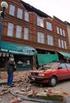 February 28 Earthquake: We got off easy State Geologist John Beaulieu Lucky may not be the first word that comes to mind after an earthquake that injured more than 200 and caused more than $1 billion damage,
4.6 GEOLOGIC AND SEISMIC HAZARDS
 4.6 GEOLOGIC AND SEISMIC HAZARDS This Section describes the current conditions relating to the geologic and seismic characteristics of the City of Cypress. This Section concludes with an analysis of geologic
The Severity of an Earthquake - ---- U.S. Department of the Interior/Geological Survey
 The Severity of an Earthquake - ---- U.S. Department of the Interior/Geological Survey ----~ Earthquakes can be measured in terms of either the effect of the earthquake (intensity) or of the energy released
Fire Following Earthquake:
 Fire Following Earthquake: Planning, Strategic, and Tactical Considerations Los Angeles County Fire Department Chief Deputy (Acting) David R. Richardson Jr. Fire Following Earthquake: An Overlooked Dilemma
EARTHQUAKE MAGNITUDE
 EARTHQUAKE MAGNITUDE Earliest measure of earthquake size Dimensionless number measured various ways, including M L local magnitude m b body wave magnitude M s surface wave magnitude M w moment magnitude
Earthquakes: Risk & Insurance Issues
 Earthquakes: Risk & Insurance Issues An earthquake is a sudden and rapid shaking of the earth caused by the breaking and shifting of rock beneath the earth s surface. This shaking can sometimes trigger
Economic Benefit Cost Analysis: CoreFirst vs. Standard Retrofit
 Economic Benefit Cost Analysis: CoreFirst vs. Standard Retrofit Kleinhenz & Associates 2602 Berkshire Road Cleveland, Ohio 44106 www.kleinhenzassociates.com June 2014 Introduction CoreFirst, llc. (CoreFirst)
Evaluating an Illinois Earthquake
 Evaluating an Illinois Earthquake Grade Level: 7-8 Adapted from an activity by Robert A. Bauer, GeoActivity HAZD-1, ISGS GeoActivities Series, Activities and Other Resources for Teaching Geology, Illinois
EARTHQUAKE. Definition of Hazard. History of Hazard as it Affects the City of Kent. Hazard Identification
 EARTHQUAKE Definition of Hazard Earthquakes are defined as the sudden release of energy occurring from the collision or shifting of crustal plates on the earth s surface or from the fracture of stressed
Earthquake Preparedness Tips & Strategies
 Earthquake Preparedness Tips & Strategies What to Do BEFORE an Earthquake What to Do DURING an Earthquake BE PREPARED! For more information, log onto: www.gema.ga.gov www.ready.ga.gov www.geophysics.eas.gatech.edu
American Society of Civil Engineers
 American Society of Civil Engineers Technical Council on Lifeline Earthquake Engineering Earthquake Investigation Committee Lifelines Water and Wastewater Electric Power and Communication Gas and Liquid
Earthquakes in Hawaii:
 Earthquakes in Hawaii: What you need to know U.S. Department of the Interior U.S. Geological Survey Prepared by: Janet L. Babb Hawaiian Volcano Observatory Hawaii Standard Time The State of Hawaii experiences
Chincha and Cañete, Peru, Based
 Reconstruction of Ica, Pisco, Chincha and Cañete, Peru, Based on Updated Hazard Maps Julio Kuroiwa Professor emeritus National University of Engineering and UNDP Reconstruction Program/Sustainable Cities.
How do scientists measure earthquakes?
 Name: Source: http://www.scholastic.com/browse/article.jsp?id=4892 http://gizmodo.com/5833688/what-do-earthquake-magnitudes-mean http://www.kids-fun-science.com/moment-magnitude-scale.html http://tremor.nmt.edu/faq/how.html
NATURAL DISASTERS Vol. I - Earthquake Parameters Including Strong Earthquakes- S.L.Yunga EARTHQUAKE PARAMETERS INCLUDING STRONG EARTHQUAKES
 EARTHQUAKE PARAMETERS INCLUDING STRONG EARTHQUAKES S.L.Yunga United Institute of physics of the Earth, Russian academy of sciences. B. Gruzinskaya,10, Moscow, 123810, Russia Keywords earthquake, epicenter,
Earthquakes: Interesting Facts and F.A.Q.
 Earthquakes: Interesting Facts and F.A.Q. Earthquakes kill approximately 8,000 people each year and have caused an estimated 13 million deaths in the past 4,000 years. The moment magnitude scale (MMS)
Presentations. Session 1. Slide 1. Earthquake Risk Reduction. 1- Concepts & Terminology
 Earthquake Risk Reduction Presentations Session 1 Slide 1 Earthquake Risk Reduction 1- Concepts & Terminology Welcome to the World Bank Institute s (WBI) Distance Learning (DL) course on Earthquake Risk
Chapter 7 Earthquake Hazards Practice Exam and Study Guide
 Chapter 7 Earthquake Hazards Practice Exam and Study Guide 1. Select from the following list, all of the factors that affect the intensity of ground shaking. a. The magnitude of the earthquake b. Rather
Chapter 3 DESIGN AND CONSTRUCTION FEATURES IMPORTANT TO SEISMIC PERFORMANCE
 Chapter 3 DESIGN AND CONSTRUCTION FEATURES IMPORTANT TO SEISMIC PERFORMANCE To satisfy the performance goals of the NEHRP Recommended Seismic Provisions, a number of characteristics are important to the
89.325 Geology for Engineers Earthquakes
 89.325 Geology for Engineers Earthquakes Name I. Introduction The crust of the earth behaves in a brittle manner. Stress is the force applied to a brittle substance and strain represents the build-up of
HOMEOWNER S GUIDE. to LANDSLIDES. and MITIGATION RECOGNITION, PREVENTION, CONTROL, Compiled by Dr. Scott F. Burns Tessa M. Harden Carin J.
 HOMEOWNER S GUIDE to LANDSLIDES RECOGNITION, PREVENTION, CONTROL, and MITIGATION Compiled by Dr. Scott F. Burns Tessa M. Harden Carin J. Andrew Federal Emergency Management Agency Region 10 If you are
Project Report. Structural Investigations Hotel del Sol Yuma, Arizona
 Project Report Structural Investigations Yuma, Arizona Prepared by: 2619 Spruce Street Boulder, CO 80302 303-444-3620 Prepared for: Principle Engineering Group, Inc. 833 East Plaza Circle, Suite 100 Yuma,
Earthquakes: Risk and Insurance Issues
 Page 1 of 8 HOT TOPICS & INSURANCE ISSUES Earthquakes: Risk and Insurance Issues THE TOPIC JULY 2003 An earthquake is a sudden and rapid shaking of the earth caused by the breaking and shifting of rock
City of Mission Viejo. Public Safety Element
 City of Mission Viejo Public Safety Element TABLE OF CONTENTS Section Page INTRODUCTION TO THE 1 Purpose of the Public Safety Element 1 Related Plans and Programs 1 Public Safety Element Scope and Content
Plotting Earthquakes LESSON
 13 LESSON Plotting Earthquakes INTRODUCTION On September 19, 1985, a strong earthquake occurred in Mexico City. The quake killed more than 9000 people and destroyed thousands of buildings. Two months later,
Earthquakes. Earthquakes: Big Ideas. Earthquakes
 Earthquakes Earthquakes: Big Ideas Humans cannot eliminate natural hazards but can engage in activities that reduce their impacts by identifying high-risk locations, improving construction methods, and
Earthquake Hazards and Risks
 Page 1 of 7 EENS 3050 Tulane University Natural Disasters Prof. Stephen A. Nelson Earthquake Hazards and Risks This page last updated on 28-Aug-2013 Earthquake Risk Many seismologists have said that "earthquakes
Metropolitan Setting l
 Metropolitan Setting l GENERAL CHARACTERISTICS Los Angeles lies at the heart of one of the most complex metropolitan regions in the United States. As a major center of commerce, finance, and industry in
After the Shaking Stops: A Communitywide Approach to Managing Post-Quake Fires
 After the Shaking Stops: A Communitywide Approach to Managing Post-Quake Fires By Rem Brown, P.E., IBHS Senior Engineering Manager, and Brent Henzi, IBHS Communications Associate Earthquakes are a destructive
CEDIM Forensic Disaster Analysis Group & CATDAT and Earthquake-Report.com. Philippines (Bohol) Earthquake Report #2
 CEDIM Forensic Disaster Analysis Group & CATDAT and Earthquake-Report.com Philippines (Bohol) Earthquake Report #2 Report Contributors: James Daniell (Earthquake Report & KIT); Armand Vervaeck, Carlos
Part 1 - How Much Danger is Your Home or Business In? Where do you live?
 Earthquake Insurance and San Diego County Residents Part 1 - How much danger is your home in? Where do you live? Part 2 - What do San Diego County residents have to know about Earthquake Insurance Policies,
Five reasons buildings fail in an earthquake and how to avoid them
 Five reasons buildings fail in an earthquake and how to avoid them by Jeff White, AIA Published in Healthcare Design magazine There s a saying among seismologists: Earthquakes don t kill people. Buildings
 Testimony of Mr. Robert J. Fenton, Jr. Assistant Administrator for Response, Office of Response and Recovery Federal Emergency Management Agency U.S. Department of Homeland Security Before House Committee
Magnitude 7.2 GUERRERO, MEXICO
 A powerful magnitude-7.2 earthquake shook central and southern Mexico on Friday. The earthquake occurred at a depth of 24 km (15 miles). Its epicenter was in the western state of Guerrero, near the seaside
PACIFIC CATASTROPHE RISK ASSESSMENT AND FINANCING INITIATIVE
 PACIFIC CATASTROPHE RISK ASSESSMENT AND FINANCING INITIATIVE NIUE SEPTEMBER 11 COUNTRY RISK PROFILE: NIUE Niue is expected to incur, on average,.9 million USD per year in losses due to earthquakes and
Landslides & Mudslides
 Landslides & Mudslides Landslides, also known as mudslides and debris flow, occur in all U.S. states and territories. In snowy mountainous areas winter snow landslides are called avalanches. Landslides
6 RETROFITTING POST & PIER HOUSES
 Retrofitting Post & Pier Houses 71 6 RETROFITTING POST & PIER HOUSES by James E. Russell, P.E. 72 Retrofitting Post & Pier Houses Retrofitting Post & Pier Houses 73 RETROFITTING POST AND PIER HOUSES This
Using GIS for Assessing Earthquake Hazards of San Francisco Bay, California, USA
 Using GIS for Assessing Earthquake Hazards of San Francisco Bay, California, USA Marzieh Zeinali Department of Resource Analysis, Saint Mary s University of Minnesota, Minneapolis, MN 55404 Keywords: San
APPLICATION OF EARTHQUAKE ENGINEERING INFORMATION IN HOSPITAL EMERGENCY RESPONSE AND RECOVERY
 Workshop on Seismic Design and Retrofitting of Hospitals in Seismic Areas, October 21-22, 1999. APPLICATION OF EARTHQUAKE ENGINEERING INFORMATION IN HOSPITAL EMERGENCY RESPONSE AND RECOVERY Robert Reitherman
Santa Ana College. EMERGENCY OPERATIONS PLAN TRAINING Table Top Exercise EARTHQUAKE SCENARIO August 16, 2013
 Santa Ana College EMERGENCY OPERATIONS PLAN TRAINING Table Top Exercise EARTHQUAKE SCENARIO August 16, 2013 Objectives Simulate Activation of SAC EOC Set up and Identify EOC Operational Sections Utilize
AN ANALYSIS OF FIRE SPRINKLER SYSTEM FAILURES DURING THE NORTHRIDGE EARTHQUAKE AND COMPARISON WITH THE SEISMIC DESIGN STANDARD FOR THESE SYSTEMS
 13 th World Conference on Earthquake Engineering Vancouver, B.C., Canada August 1-6, 2004 Paper No. 2136 AN ANALYSIS OF FIRE SPRINKLER SYSTEM FAILURES DURING THE NORTHRIDGE EARTHQUAKE AND COMPARISON WITH
Factors to Consider When Developing an Evacuation Plan
 The following should be viewed only as suggestions: Factors to Consider When Developing an Evacuation Plan 1. You must identify your document with a specific title and explanation. Example: Evacuation
ENGINEERING-BASED EARTHQUAKE RISK MANAGEMENT
 ENGINEERING-BASED EARTHQUAKE RISK MANAGEMENT MRP Engineering Newsletter February 2012 The world recently experienced several major earthquakes, which caused severe local impacts and major worldwide repercussions.
Landslides. Landslides-1. March 2007
 Landslides Learn if landslides, including debris flows, could occur in your area by contacting local officials, your state geological survey or department of natural resources, or the geology department
Chapter 5: Earthquakes
 Chapter 5: Earthquakes 1. Experiencing an Earthquake firsthand 2. The Science of Ghost Forests and Megaearthquakes 3. Faults, Earthquakes, and Plate Tectonics 4. Seismic Waves and Earthquake Detection
Prepared For San Francisco Community College District 33 Gough Street San Francisco, California 94103. Prepared By
 Project Structural Conditions Survey and Seismic Vulnerability Assessment For SFCC Civic Center Campus 750 Eddy Street San Francisco, California 94109 Prepared For San Francisco Community College District
3.0 Project Description
 3.0 Project Description City of Long Beach 2810 East 1st Street Project Environmental Impact Report 3.0 PROJECT DESCRIPTION 3.1 PROJECT LOCATION AND SETTING The City of Long Beach (City) is located in
APPLICATION OF EARTHQUAKE ENGINEERING INFORMATION IN HOSPITAL EMERGENCY RESPONSE AND RECOVERY
 APPLICATION OF EARTHQUAKE ENGINEERING INFORMATION IN HOSPITAL EMERGENCY RESPONSE AND RECOVERY Robert Reitherman 1 1. Consortium of Universities for Research in Earthquake Engineering 1301 South 46 th Street,
RAILROAD DAMAGE FROM THE OCTOBER 16, 1999 HECTOR MINE EARTHQUAKE
 RAILROAD DAMAGE FROM THE OCTOBER 16, 1999 HECTOR MINE EARTHQUAKE By: William G. Byers, P.E. Burlington Northern and Santa Fe Railway 4515 Kansas Avenue Kansas City, Kansas 66106 Phone (913) 551-4070 Fax
Magnitude and Intensity
 Exercise 2 EXERCISE 2 EARTHQUAKE MAGNITUDE AND INTENSITY Supplies Needed calculator metric ruler PURPOSE Exercise 1 introduced many of the fundamental concepts of earthquakes, and this exercise will add
Jackson Gulch Outlet Canal Rehabilitation Project
 Jackson Gulch Outlet Canal Rehabilitation Project Preliminary Budgetary Estimate for Rehabilitation February 2004 Prepared for the Mancos Water Conservancy District Jackson Gulch Reservoir 42888 County
Chapter. Earthquake Damage: Types, Process, Categories
 3 Chapter Earthquake Damage: Types, Process, Categories Earthquakes leave behind a trail of damage and destruction. People s lives are affected by the loss of loved ones, destruction of property, economic
DISASTER RESISTANCE EARTHQUAKES AND STRUCTURES
 DISASTER RESISTANCE EARTHQUAKES AND STRUCTURES EARTHQUAKES Origin of earthquakes The earth was a single land about two hundred million years ago. This land split progressively over a long period of time
Post Earthquake Quick Damage Inspection of Buildings in Nepal
 Post Earthquake Quick Damage Inspection of Buildings in Nepal Collaborative Research and Development (R&D) Project for Disaster Mitigation in Earthquake Prone Areas in Asia (Sep 27, 2007) Presented By
El Nino in the OC. Orange County Sheriff s Department Emergency Management Division
 El Nino in the OC Orange County Sheriff s Department Emergency Management Division The mission of the Orange County Sheriff s Department s Emergency Management Division is to promote, facilitate, and support
A Report on Post-Earthquake Rapid Visual Damage Assessment of Buildings Of Tribhuvan International Airport
 A Report on Post-Earthquake Rapid Visual Damage Assessment of Buildings Of Tribhuvan International Airport Prepared By: Civil Engineering Division Tribhuvan International Airport Civil Aviation Office
GEOTECHNICAL ISSUES OF LANDSLIDES CHARACTERISTICS MECHANISMS PREPARDNESS: BEFORE, DURING AND AFTER A LANDSLIDE QUESTIONS FOR DISCUSSIONS
 GEOTECHNICAL ISSUES OF LANDSLIDES CHARACTERISTICS MECHANISMS PREPARDNESS: BEFORE, DURING AND AFTER A LANDSLIDE QUESTIONS FOR DISCUSSIONS Huge landslide Leyte, Phillipines, 1998 2000 casulties Small debris
TECTONICS ASSESSMENT
 Tectonics Assessment / 1 TECTONICS ASSESSMENT 1. Movement along plate boundaries produces A. tides. B. fronts. C. hurricanes. D. earthquakes. 2. Which of the following is TRUE about the movement of continents?
Available for Lease or Sale
 Available for Lease or Sale 74,718 SF HIGH IMAGE OFFICE BUILDING SUITES RANGING FROM 9,649 25,000 SF CHRIS MIGLIORI 714-385-1801 [email protected] CA License #00972843 KARA GUARIENTI 949-724-1900
Improved Warnings for Natural Hazards: A Prototype System for Southern California
 Improved Warnings for Natural Hazards: A Prototype System for Southern California Yehuda Bock Research Geodesist Scripps Institution of Oceanography University of California San Diego, La Jolla, Calif.
FOURTH GRADE EARTHQUAKES 1 WEEK LESSON PLANS AND ACTIVITIES
 FOURTH GRADE EARTHQUAKES 1 WEEK LESSON PLANS AND ACTIVITIES PLATE TECTONIC CYCLE OVERVIEW OF FOURTH GRADE VOLCANOES WEEK 1. PRE: Comparing different structures of volcanoes. DURING: Modeling three types
Chapter Overview. Bathymetry. Measuring Bathymetry. Echo Sounding Record. Measuring Bathymetry. CHAPTER 3 Marine Provinces
 Chapter Overview CHAPTER 3 Marine Provinces The study of bathymetry charts ocean depths and ocean floor topography. Echo sounding and satellites are efficient bathymetric tools. Most ocean floor features
EARTHQUAKES. Compressional Tensional Slip-strike
 Earthquakes-page 1 EARTHQUAKES Earthquakes occur along faults, planes of weakness in the crustal rocks. Although earthquakes can occur anywhere, they are most likely along crustal plate boundaries, such
Earthquakes. What to Do Before an Earthquake
 EARTHQUAKES Earthquakes What to Do Before an Earthquake Earthquakes strike suddenly, violently and without warning. Identifying potential hazards ahead of time and advance planning can reduce the dangers
Magnitude 8.8 OFFSHORE MAULE, CHILE
 A great 8.8-magnitude struck central Chile early Saturday. The quake hit 200 miles (325 kilometers) southwest of the capital Santiago. The epicenter was just 70 miles (115 kilometers) from Concepcion,
Critical Facility Round Table
 Critical Facility Round Table October 16, 2003 San Francisco Seismic Risk for Data Centers David Bonneville Senior Principal Degenkolb Engineers San Francisco, California Presentation Outline Seismic Risk
ICOLD POSITION PAPER ON DAM SAFETY AND EARTHQUAKES
 ICOLD POSITION PAPER ON DAM SAFETY AND EARTHQUAKES August 2012 Dam Safety and Earthquakes Position Paper of International Commission on Large Dams (ICOLD) Prepared by ICOLD Committee on Seismic Aspects
AFTER THE BIG ONE, WILL CRITICAL COUNTY SERVICES SURVIVE?
 AFTER THE BIG ONE, WILL CRITICAL COUNTY SERVICES SURVIVE? SUMMARY There is a 67% probability that Southern California will be hit by a magnitude 6.7 or larger earthquake in the next 30 years according
EARTH SCIENCE ACTIVITY #5 The Mercalli Scale
 EARTH SCIENCE ACTIVITY #5 The Mercalli Scale All Grades 4 and Up This activity is one of several in a basic curriculum designed to increase student knowledge about earthquake science and preparedness.
Motor Vehicle Fatalities Accepted by the Workers Compensation Board
 Motor Vehicle Fatalities Accepted by the Workers Compensation Board Year to date, numbers as of January 1, 2008 to December 31, 2008 The fatalities listed represent motor vehicle fatalities that have been
Mitigation Works. 0 Earthquakes move mountains. But so do imagination and ingenuity when matched with implementation.
 0 Earthquakes move mountains. But so do imagination and ingenuity when matched with implementation. 0 Earthquakes have long been feared as one of nature s most damaging hazards. Earthquakes continue to
SECTION 8 Industrial Facilities Field Investigation
 SECTION 8 Industrial Facilities Field Investigation Types of Data to Be Collected and Recorded Warehouses, manufacturing facilities, energy-producing facilities, and factories should be inspected for performance
Recent Earthquakes: Implications for U.S. Water Utilities [Project #4408]
![Recent Earthquakes: Implications for U.S. Water Utilities [Project #4408]](/thumbs/25/5582528.jpg "Recent Earthquakes: Implications for U.S. Water Utilities [Project #4408]") Recent Earthquakes: Implications for U.S. Water Utilities [Project #4408] ORDER NUMBER: 4408 DATE AVAILABLE: July 2012 PRINCIPAL INVESTIGATORS: John Eidinger and Craig A. Davis PROJECT PURPOSE: The purpose
Recent Earthquakes: Implications for U.S. Water Utilities [Project #4408] ORDER NUMBER: 4408 DATE AVAILABLE: July 2012 PRINCIPAL INVESTIGATORS: John Eidinger and Craig A. Davis PROJECT PURPOSE: The purpose
Rapid Changes in Earth s Surface
 TEKS investigate rapid changes in Earth s surface such as volcanic eruptions, earthquakes, and landslides Rapid Changes in Earth s Surface Constant Changes Earth s surface is constantly changing. Wind,
AT&T Internet Data Center Site Specification Chicago Area (Lisle, IL)
 AT&T Internet Data Center Site Specification Chicago Area (Lisle, IL) Site Biography Market Area: Chicago, IL Location: Lisle, IL 60532 Address: 4513 Western Avenue CLLI,POP, NPA/NXX Code: LSLEILAA, EQLAILAA
Death in the line of duty...
 F-33 Fire Fighter Fatality Investigation A Summary of a NIOSH fire fighter fatality investigation Death in the line of duty... May 25, 2000 Motor-Vehicle Incident Claims the Life of a Volunteer Fire Fighter
EARTHQUAKE SAFETY IN THE WORK PLACE
 EARTHQUAKE SAFETY IN THE WORK PLACE COMPANY PLANS All companies have an obligation to their employees to maintain a disaster plan. An emergency evacuation area must be designed, a nearby safe area, preferably
EARTHQUAKE PREDICTION
 Lecture 15 Earthquake Prediction EARTHQUAKE PREDICTION To successfully predict an earthquake we would like to know:- PLACE TIME MAGNITUDE (rather like a weather forecast) 1 Evidence must be integrated
Lecture 12 Earthquake Magnitude
 Lecture 12 Earthquake Magnitude Locating Earthquakes Last time, we learned that we could obtain a rough estimate of the distance in miles to an earthquake epicenter by multiplying the S - P time interval
Preparedness in the Southwest
 Preparedness in the Southwest Risk Assessment and Hazard Vulnerability Developed by The Arizona Center for Public Health Preparedness Cover Art www.azcphp.publichealth.arizona.edu Chapter 1 Importance
Trinomial NRHP Status Code 3CS Other Listings Review Code Reviewer Date Page 1 of 6 *Resource Name or #: (Assigned by recorder) 1101 Sutter Street
 HRI # PRIMARY RECORD Trinomial NRHP Status Code 3CS Other Listings Review Code Reviewer Date Page 1 of 6 *Resource Name or #: (Assigned by recorder) 1101 Sutter Street P1. Historic name of building (if
EARTHQUAKE PROBLEM: Do's and Don'ts for Protection
 EARTHQUAKE PROBLEM: Do's and Don'ts for Protection Sponsored by Rajiv Gandhi Foundation, New Delhi and Prepared by Department of Earthquake Engineering, University of Roorkee, Roorkee PREFACE A large number
EL Civics Objective 16 (Emergencies) Level: Beginning Low & Beginning High Task #1: Identify Emergencies & Disasters
 EL Civics Objective 16 (Emergencies) Level: Beginning Low & Beginning High Task #1: Identify Emergencies & Disasters Language & Literacy Objectives: 1. Identify what constitutes an emergency or disaster,
Transportation. Alzheimer's Orange County 2515 McCabe Way, Suite 200 Irvine, CA 92614 844.373.4400 www.alzoc.org Transportation Services Referral List
 Services Referral List Age Accepted Residences Hours Cost Orange County ACCESS Orange County Transit Authority (OCTA) 714.560.5888 Based on individual's abilities Orange County (not new areas in Irvine)
Risks in School Safety Assessment
 CHAPTER 2 RISK ASSESSMENT IN SCHOOLS IN FRANCE Jean-Marie Schléret National Observatory for Safety in Schools and Universities, France Lessons in danger Abstract: Since 1995, the National Observatory for
ORANGE COUNTY, CALIFORNIA
 ORANGE COUNTY, CALIFORNIA County Community Data Profile Vantage Point 2015: 12 th District Community Indicators Project Federal Reserve Bank of San Francisco Project Contact: Gabriella Chiarenza [email protected]
Glossary. continental crust: the sections of crust, the outermost layer of the earth, that include the continents
 aftershock: an earthquake that follows a larger earthquake or main shock and originates in or near the rupture zone of the larger earthquake. Generally, major earthquakes are followed by a number of aftershocks
KHATRI STRUCTURAL AND CIVIL ENGINEERS
 TABLE OF CONTENTS SECTION TITLE 1.0 INTRODUCTION AND EXECUTIVE SUMMARY 2.0 PROJECT TEAM 3.0 EXPERIENCE AND PROJECTS 4.0 PHOTO CREDITS 2 Page 1.0 INTRODUCTION AND EXECUTIVE SUMMARY We are pleased to introduce