
Earthquakes: Interesting Facts and F.A.Q.
|
|
|
- Eleanor Carpenter
- 9 years ago
- Views:
Transcription
1 Earthquakes: Interesting Facts and F.A.Q. Earthquakes kill approximately 8,000 people each year and have caused an estimated 13 million deaths in the past 4,000 years. The moment magnitude scale (MMS) replaced the 1930s-era Richter scale in the 1970s as the method of measuring the size of earthquakes in terms of energy released. In Japan mythology, a giant catfish called Namazu is responsible for earthquakes. The Indian Ocean earthquake in 2004 generated enough energy to power all the homes and businesses in the United States for three days. An average earthquake lasts around a minute. Parkfield, California, is known as The Earthquake Capital of the World and has a bridge that spans two tectonic plates. Earthquakes are mostly caused by geological faults, but they can also be caused by landslides, nuclear testing, mine tests, and volcanic activity. In ancient Greece, people believed that the god of the sea, Poseidon, caused earthquakes. When he was angry, Poseidon would strike the ground with his trident and set off an earthquake. His unpredictable, violent behavior earned him the nickname Earth-Shaker. More earthquakes happen in the Northern Hemisphere than in the Southern Hemisphere. In Hindu mythology, Earth is held in place by eight gigantic elephants, all balanced on the back of turtle, which itself stands on the coils of a snake. If any of these animals shift or move, an earthquake occurs. The worst avalanche triggered by an earthquake occurred in Peru in A 250-foot (850-meter) wave of ice, mud, and rock fell down the mountain in Huascaran at 250 miles (400 km) per hour. It carried away entire villages and killed more than 18,000 people. The world s worst landslide started by an earthquake occurred in 1920 in the Kansu province in China. The landslide killed about 200,000 people. The highest tsunami caused by an earthquake happened in Japan in A tsunami 278 feet (85 meters) high struck Ishigaki Island. The shape of a pagoda is known for resisting damage from earthquakes. The term tectonic is related to the word texture and is from the Greek tektonikos which means pertaining to building, from the Proto-Indo-European base *tek, to make.

2 Q. I am thinking of buying a house at X address is it near a fault? We receive this inquiry often and are glad that these inquiries have been on the rise, as they reflect increased awareness of the earthquake threat in Utah. Many people associate main earthquake damage with nearness to a fault. Although fault proximity is a major concern, strong ground shaking and other earthquake hazards are more widespread and can cause damage over large areas many miles from the fault. In addition, fault rupture at the ground surface is expected only in large (magnitude 6.5 and greater) earthquakes, which are less frequent than moderate earthquakes that may still cause extensive damage from ground shaking. Therefore, we often surprise the inquirer with more information than they probably expected. Earthquake risk to any particular home depends on what and where the earthquake hazards are, as well as when and how the house was constructed. Q. What are the main earthquake hazards? Ground shaking: is the most damaging and widespread earthquake hazard, can occur almost anywhere and is difficult to avoid (but house retro-fits can minimize damage), induces most of the other earthquake hazards, and can cause damage to houses in earthquakes as small as magnitude 5.0, which on average occur once every four years somewhere in Utah and once every 10 years in the Wasatch Front region (most recent event was the 1992 magnitude 5.8 St. George earthquake). Soil liquefaction: is caused by ground shaking in areas with sandy soil and shallow ground water, means that the soil liquefies and acts more like a fluid than a solid, can cause a house to settle, crack, or tip, is most likely to occur near streams and other bodies of water, and can occur in earthquakes of about magnitude 5.0 and greater. Slope failure (landslides and rock falls): can occur on unstable slopes within a few miles of a magnitude 4.0 earthquake, which on average occur once every year in Utah, can occur more than 100 miles from a magnitude 7.5 earthquake, and is expected in mountain and canyon areas and valley slopes having susceptible rock/soil types. Surface fault rupture: occurs during large earthquakes of about magnitude 6.5 and greater, which on average occur once every years somewhere in Utah and once every years on the Wasatch fault in the urban Wasatch Front area (last large earthquake in Utah was in 1934, magnitude 6.6, at the north end of Great Salt Lake; last large earthquake on the Wasatch fault in the urban area was approximately 500 years ago), typically offsets the ground surface vertically on each side of the fault, forming fault scarps (steep breaks in slope) that can be over 10 feet high, causes the mountain side of the fault to rise and the valley side to drop, may deform the ground surface for hundreds of feet from the fault, chiefly on the valley side of the fault, and causes tectonic subsidence, which is the broad, permanent tilting of the valley floor down toward the fault scarp. Flooding: from dam failure would cause the greatest damage, from stream or canal blockage or diversion could cause major damage, and from tectonic subsidence could happen in several ways. A large earthquake on the Wasatch fault could cause subsidence as far as 10 miles from the fault, and Great Salt Lake or Utah Lake may flood eastern shoreline areas. Subsidence could

3 also cause the ponding of water in areas with a shallow ground-water table. In addition, tilting of the ground surface could compromise gravity-flow structures such as canals or sewer lines. Q. What should I consider before buying a house? What earthquake hazards are present (hazard maps are available for inspection at most Wasatch Front county planning departments and at the UGS). How frequently each type of hazard occurs. What effects each hazard may have on a house. House construction for example, year built and type of material. Houses constructed before 1975 are not built to today s earthquake building codes, but they can be retrofitted to make them more resistant to ground shaking. In general, unreinforced brick or masonry houses are more susceptible to damage than wood-frame houses. What options are available for minimizing damage. Many retrofit procedures are relatively inexpensive and often can be performed by the experienced do-it-yourself homeowner (see the Utah Division of State History Web page listed below). Q. When and where do large earthquakes occur in Utah? Large earthquakes (magnitude 6.5 to 7.5) can occur on any of several active segments of the Wasatch fault between Brigham City and Levan. Such earthquakes can also occur on many other recognized active faults in Utah. During the past 6,000 years, large earthquakes have occurred on the Wasatch fault on the average of once every 400 years, somewhere along the fault's central active portion between Brigham City and Levan. The chance of a large earthquake in the Wasatch Front region during the next 50 years is about 1 in 4. "It is useless to ask when this [earthquake] disaster will occur. Our occupation of the country has been too brief for us to learn how fast the Wasatch grows; and, indeed, it is only by such disasters that we can learn. By the time experience has taught us this, Salt Lake City will have been shaken down..." - G. K. Gilbert, 1883 Q. What would happen if a magnitude 7.5 earthquake occurs along the Wasatch fault? Future large earthquakes will break segments of the fault about miles long and produce displacements at the surface of up to feet. Strong ground shaking could produce considerable damage up to nearly 50 miles from the earthquake. The strong ground shaking may be amplified by factors up to 10 or more on valley fill compared to hard rock. Also possible are soil liquefaction, landslides, rock slides, and broad permanent tilting of valley floors possibly causing the Great Salt Lake or Utah Lake to inundate parts of Salt Lake City or Provo. How much damage would be caused by a large earthquake on the Wasatch Front? If the earthquake were to occur on a central part of the Wasatch fault, Utah should expect damage to buildings to exceed $4.5 billion in Davis, Salt Lake, Utah and Weber counties. This may only represent 20% of the total economic loss.

4 Unreinforced masonry buildings (for example, brick homes built before 1960) are particularly vulnerable to ground shaking and are expected to account for 75% of the building losses. Surface faulting and ground failures due to shaking during a large earthquake will cause major disruption of lifelines (utilities, water, sewer), transportation systems (highways, bridges, airports, railways), and communication systems. Q. Do we need to worry only about large earthquakes causing damage? No. A moderate-sized earthquake that occurs under an urbanized area can cause major damage. Magnitude earthquakes occur somewhere in Utah on the average of once every 7 years. Estimates of damage from a "direct hit" to one of the Wasatch Front's major metropolitan areas reach $2.3 billion for a magnitude 6.5 earthquake, and more than $830 million for a magnitude 5.5 earthquake. Since 1850, at least 15 independent earthquakes of magnitude 5.5 and larger have occurred in the Utah region. Q. When were the largest historical earthquakes in Utah? Since settlement in 1847, Utah's largest earthquakes were the 1934 Hansel Valley earthquake, north of the Great Salt Lake, magnitude 6.6, and the 1901 earthquake near the town of Richfield, estimated magnitude 6.5. Q. How often do earthquakes occur in Utah? About 700 earthquakes (including aftershocks) are located in the Utah region each year. Approximately 2% of the earthquakes are felt. An average of about 13 earthquakes of magnitude 3.0 or larger occur in the region every year. Earthquakes can occur anywhere in the state of Utah. Q. How many earthquakes occur in the Wasatch Front region? About 500 earthquakes are located in the Wasatch Front region each year. About 60% of the earthquakes of magnitude 3.0 and larger in Utah occur in the Wasatch Front region. Q. When was the last earthquake? Worldwide: In the last minute, somewhere in the world. Utah: Within the past 24 hours, somewhere in the state. (The last large earthquake in Utah occurred on the Wasatch fault north of Nephi about 400 years ago.) Q. When were seismographs first installed in Utah? In 1907, by James Talmage at the University of Utah. A skeletal statewide network began in Modern seismographic surveillance in the Wasatch Front began in Computerized recording of earthquake data began in Q. Do earthquakes occur only on visible faults? No. Many of the active faults in Utah are deep below the earth's surface, and are not visible to us.

5 Q. Is the Wasatch fault the same type of fault as the San Andreas fault in California? No. The San Andreas fault slips horizontally with little vertical movement. This is called a strikeslip fault The Wasatch fault slips in a primarily vertical direction, with the mountains rising relative to the valley floor. The Wasatch fault is a so-called normal fault. All earthquakes produce both vertical and horizontal ground shaking. Usually the horizontal shaking is more energetic and more damaging because structures generally resist vertical loads, like gravity, more easily.

Chapter 7 Earthquake Hazards Practice Exam and Study Guide
 Chapter 7 Earthquake Hazards Practice Exam and Study Guide 1. Select from the following list, all of the factors that affect the intensity of ground shaking. a. The magnitude of the earthquake b. Rather
Earthquakes. Earthquakes: Big Ideas. Earthquakes
 Earthquakes Earthquakes: Big Ideas Humans cannot eliminate natural hazards but can engage in activities that reduce their impacts by identifying high-risk locations, improving construction methods, and
Earthquake Preparedness Tips & Strategies
 Earthquake Preparedness Tips & Strategies What to Do BEFORE an Earthquake What to Do DURING an Earthquake BE PREPARED! For more information, log onto: www.gema.ga.gov www.ready.ga.gov www.geophysics.eas.gatech.edu
Earthquake Hazards and Risks
 Page 1 of 7 EENS 3050 Tulane University Natural Disasters Prof. Stephen A. Nelson Earthquake Hazards and Risks This page last updated on 28-Aug-2013 Earthquake Risk Many seismologists have said that "earthquakes
ICOLD POSITION PAPER ON DAM SAFETY AND EARTHQUAKES
 ICOLD POSITION PAPER ON DAM SAFETY AND EARTHQUAKES August 2012 Dam Safety and Earthquakes Position Paper of International Commission on Large Dams (ICOLD) Prepared by ICOLD Committee on Seismic Aspects
EARTHQUAKE PREDICTION
 Lecture 15 Earthquake Prediction EARTHQUAKE PREDICTION To successfully predict an earthquake we would like to know:- PLACE TIME MAGNITUDE (rather like a weather forecast) 1 Evidence must be integrated
Rapid Changes in Earth s Surface
 TEKS investigate rapid changes in Earth s surface such as volcanic eruptions, earthquakes, and landslides Rapid Changes in Earth s Surface Constant Changes Earth s surface is constantly changing. Wind,
Chapter 5: Earthquakes
 Chapter 5: Earthquakes 1. Experiencing an Earthquake firsthand 2. The Science of Ghost Forests and Megaearthquakes 3. Faults, Earthquakes, and Plate Tectonics 4. Seismic Waves and Earthquake Detection
EARTHQUAKE. Definition of Hazard. History of Hazard as it Affects the City of Kent. Hazard Identification
 EARTHQUAKE Definition of Hazard Earthquakes are defined as the sudden release of energy occurring from the collision or shifting of crustal plates on the earth s surface or from the fracture of stressed
Earthquakes: Risk & Insurance Issues
 Earthquakes: Risk & Insurance Issues An earthquake is a sudden and rapid shaking of the earth caused by the breaking and shifting of rock beneath the earth s surface. This shaking can sometimes trigger
Earthquakes and Plate Boundaries Deborah Jordan and Samuel Spiegel
 Earthquakes and Plate Boundaries Deborah Jordan and Samuel Spiegel Jordan, Deborah and Spiegel, Samuel: Learning Research Development Center, University of Pittsburgh. Earthquakes and Plate Boundaries.
4.6 GEOLOGIC AND SEISMIC HAZARDS
 4.6 GEOLOGIC AND SEISMIC HAZARDS This Section describes the current conditions relating to the geologic and seismic characteristics of the City of Cypress. This Section concludes with an analysis of geologic
Presentations. Session 1. Slide 1. Earthquake Risk Reduction. 1- Concepts & Terminology
 Earthquake Risk Reduction Presentations Session 1 Slide 1 Earthquake Risk Reduction 1- Concepts & Terminology Welcome to the World Bank Institute s (WBI) Distance Learning (DL) course on Earthquake Risk
FOURTH GRADE EARTHQUAKES 1 WEEK LESSON PLANS AND ACTIVITIES
 FOURTH GRADE EARTHQUAKES 1 WEEK LESSON PLANS AND ACTIVITIES PLATE TECTONIC CYCLE OVERVIEW OF FOURTH GRADE VOLCANOES WEEK 1. PRE: Comparing different structures of volcanoes. DURING: Modeling three types
Plate Tectonics. Hi, I am Zed and I am going to take you on a trip learning about Plate Tectonics. And I am Buddy Zed s mascot
 Plate Tectonics Hi, I am Zed and I am going to take you on a trip learning about Plate Tectonics And I am Buddy Zed s mascot Continental Drift Alfred Wegener proposed that continents were not always where
Part 1 - How Much Danger is Your Home or Business In? Where do you live?
 Earthquake Insurance and San Diego County Residents Part 1 - How much danger is your home in? Where do you live? Part 2 - What do San Diego County residents have to know about Earthquake Insurance Policies,
Interactive Plate Tectonics
 Interactive Plate Tectonics Directions: Go to the following website and complete the questions below. http://www.learner.org/interactives/dynamicearth/index.html How do scientists learn about the interior
Earthquakes: Risk and Insurance Issues
 Page 1 of 8 HOT TOPICS & INSURANCE ISSUES Earthquakes: Risk and Insurance Issues THE TOPIC JULY 2003 An earthquake is a sudden and rapid shaking of the earth caused by the breaking and shifting of rock
Chincha and Cañete, Peru, Based
 Reconstruction of Ica, Pisco, Chincha and Cañete, Peru, Based on Updated Hazard Maps Julio Kuroiwa Professor emeritus National University of Engineering and UNDP Reconstruction Program/Sustainable Cities.
TECTONICS ASSESSMENT
 Tectonics Assessment / 1 TECTONICS ASSESSMENT 1. Movement along plate boundaries produces A. tides. B. fronts. C. hurricanes. D. earthquakes. 2. Which of the following is TRUE about the movement of continents?
How do scientists measure earthquakes?
 Name: Source: http://www.scholastic.com/browse/article.jsp?id=4892 http://gizmodo.com/5833688/what-do-earthquake-magnitudes-mean http://www.kids-fun-science.com/moment-magnitude-scale.html http://tremor.nmt.edu/faq/how.html
Unit 4 Lesson 6 Measuring Earthquake Waves. Copyright Houghton Mifflin Harcourt Publishing Company
 Shake, Rattle, and Roll What happens during an earthquake? As plates of the lithosphere move, the stress on rocks at or near the edges of the plates increases. This stress causes faults to form. A fault
February 28 Earthquake: We got off easy
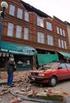 February 28 Earthquake: We got off easy State Geologist John Beaulieu Lucky may not be the first word that comes to mind after an earthquake that injured more than 200 and caused more than $1 billion damage,
When Things Go Wrong
 When Things Go Wrong When Things Go Wrong Our planet has many wondrous things. We plant a tiny sapling and it becomes a mighty tree. Water runs in rivers. Rainbows appear in the sky. But it is not always
Lecture 12 Earthquake Magnitude
 Lecture 12 Earthquake Magnitude Locating Earthquakes Last time, we learned that we could obtain a rough estimate of the distance in miles to an earthquake epicenter by multiplying the S - P time interval
Earth Science Landforms, Weathering, and Erosion Reading Comprehension. Landforms, Weathering, and Erosion
 Reading Comprehension Name 1 How many people have been to the Rocky Mountains or the Grand Canyon? When people go to visit these natural wonders, they may not realize that it took millions of years for
How Did These Ocean Features and Continental Margins Form?
 298 10.14 INVESTIGATION How Did These Ocean Features and Continental Margins Form? The terrain below contains various features on the seafloor, as well as parts of three continents. Some general observations
EARTHQUAKES. Compressional Tensional Slip-strike
 Earthquakes-page 1 EARTHQUAKES Earthquakes occur along faults, planes of weakness in the crustal rocks. Although earthquakes can occur anywhere, they are most likely along crustal plate boundaries, such
Mitigation Works. 0 Earthquakes move mountains. But so do imagination and ingenuity when matched with implementation.
 0 Earthquakes move mountains. But so do imagination and ingenuity when matched with implementation. 0 Earthquakes have long been feared as one of nature s most damaging hazards. Earthquakes continue to
Locating the Epicenter and Determining the Magnitude of an Earthquake
 Locating the and Determining the Magnitude of an Earthquake Locating the Measuring the S-P time interval There are hundreds of seismic data recording stations throughout the United States and the rest
The correct answers are given below. Some talking points have been added for the teachers use.
 Natural Resources Canada 2011: Lesson Plan Grades 11 and 12 Landslide activity 5b: Landslides in Canada quiz Description: This is an independent study activity for grades 11 and 12. Students will read
Plate Tectonics Web-Quest
 Plate Tectonics Web-Quest Part I: Earth s Structure. Use the following link to find these answers: http://www.learner.org/interactives/dynamicearth/structure.html 1. Label the layers of Earth in the diagram
Tectonic plates push together at convergent boundaries.
 KEY CONCEPT Plates converge or scrape past each other. BEFORE, you learned Plates move apart at divergent boundaries In the oceans, divergent boundaries mark where the sea floor spreads apart On land,
KCC Event Brief: 2014 La Habra Earthquake
 KAREN CLARK & COMPANY KCC Event Brief: 2014 La Habra Earthquake June 2014 2 COPLEY PLACE BOSTON, MA 02116 T: 617.423.2800 F: 617.423.2808 Overview On Friday, March 28, 2014 at 9:09pm, a magnitude 5.1 earthquake
Landslides. Landslides-1. March 2007
 Landslides Learn if landslides, including debris flows, could occur in your area by contacting local officials, your state geological survey or department of natural resources, or the geology department
EL Civics Objective 16 (Emergencies) Level: Beginning Low & Beginning High Task #1: Identify Emergencies & Disasters
 EL Civics Objective 16 (Emergencies) Level: Beginning Low & Beginning High Task #1: Identify Emergencies & Disasters Language & Literacy Objectives: 1. Identify what constitutes an emergency or disaster,
Tsunami Practice Questions and Answers Revised November 2008
 Tsunami Practice Questions and Answers Revised November 2008 1. What happened on 26 December 2004 off the west coast of Sumatra? 2. What is the final estimate of the magnitude of the Sumatra 26 December
Glossary. continental crust: the sections of crust, the outermost layer of the earth, that include the continents
 aftershock: an earthquake that follows a larger earthquake or main shock and originates in or near the rupture zone of the larger earthquake. Generally, major earthquakes are followed by a number of aftershocks
HOMEOWNER S GUIDE. to LANDSLIDES. and MITIGATION RECOGNITION, PREVENTION, CONTROL, Compiled by Dr. Scott F. Burns Tessa M. Harden Carin J.
 HOMEOWNER S GUIDE to LANDSLIDES RECOGNITION, PREVENTION, CONTROL, and MITIGATION Compiled by Dr. Scott F. Burns Tessa M. Harden Carin J. Andrew Federal Emergency Management Agency Region 10 If you are
Landslides & Mudflows
 1 2 - What is a Landslide? - Geologic hazard Common to almost all 50 states Annual global Billions in losses Thousands of deaths and injuries 3 1 - What is a Landslide? - Gravity is driving force Some
Storms Assessment LESSON
 LESSON 8 Storms Assessment What will happen to the helix above a hot lamp? TERRY G. McCREA/SMITHSONIAN INSTITUTION INTRODUCTION You have now completed Storms, the first part of Catastrophic Events. After
Santa Ana College. EMERGENCY OPERATIONS PLAN TRAINING Table Top Exercise EARTHQUAKE SCENARIO August 16, 2013
 Santa Ana College EMERGENCY OPERATIONS PLAN TRAINING Table Top Exercise EARTHQUAKE SCENARIO August 16, 2013 Objectives Simulate Activation of SAC EOC Set up and Identify EOC Operational Sections Utilize
The Severity of an Earthquake - ---- U.S. Department of the Interior/Geological Survey
 The Severity of an Earthquake - ---- U.S. Department of the Interior/Geological Survey ----~ Earthquakes can be measured in terms of either the effect of the earthquake (intensity) or of the energy released
Natural Disasters & Assessing Hazards and Risk. Natural Hazards and Natural Disasters
 Page 1 of 9 EENS 3050 Tulane University Natural Disasters Prof. Stephen A. Nelson Natural Disasters & Assessing Hazards and Risk This page last updated on 19-Aug-2014 Natural Hazards and Natural Disasters
EARTHQUAKE MAGNITUDE
 EARTHQUAKE MAGNITUDE Earliest measure of earthquake size Dimensionless number measured various ways, including M L local magnitude m b body wave magnitude M s surface wave magnitude M w moment magnitude
Preliminary damage survey report on 2015 Nepal Gorkha Earthquake
 Tokyo, 13 May 2015 Preliminary damage survey report on 2015 Nepal Gorkha Earthquake Pokhrel R.M., Chiaro G., Kiyota T., Katagiri T. Institute of Industrial Science, University of Tokyo, Japan Goda K. Bristol
4.11 Geologic and Soil Resources
 4.11 Geologic and Soil Resources Geology and soils are evaluated as part of an environmental document because conditions in the project area can influence the type and size of a project s structure, the
Chapter Overview. Bathymetry. Measuring Bathymetry. Echo Sounding Record. Measuring Bathymetry. CHAPTER 3 Marine Provinces
 Chapter Overview CHAPTER 3 Marine Provinces The study of bathymetry charts ocean depths and ocean floor topography. Echo sounding and satellites are efficient bathymetric tools. Most ocean floor features
Landslides: The Poor Stepchild of GeoHazards; What We and Other Countries Can Do to Solve It! Scott Burns Portland State University Dept.
 Landslides: The Poor Stepchild of GeoHazards; What We and Other Countries Can Do to Solve It! Scott Burns Portland State University Dept. of Geology Afghanistan: 2014: 2700 dead West Salt Creek Landslide,
Georgia Performance Standards Framework for Natural Disasters 6 th Grade
 The following instructional plan is part of a GaDOE collection of Unit Frameworks, Performance Tasks, examples of Student Work, and Teacher Commentary. Many more GaDOE approved instructional plans are
FOURTH GRADE PLATE TECTONICS 1 WEEK LESSON PLANS AND ACTIVITIES
 FOURTH GRADE PLATE TECTONICS 1 WEEK LESSON PLANS AND ACTIVITIES PLATE TECTONIC CYCLE OVERVIEW OF FOURTH GRADE VOLCANOES WEEK 1. PRE: Comparing different structures of volcanoes. LAB: Modeling three types
ENGINEERING-BASED EARTHQUAKE RISK MANAGEMENT
 ENGINEERING-BASED EARTHQUAKE RISK MANAGEMENT MRP Engineering Newsletter February 2012 The world recently experienced several major earthquakes, which caused severe local impacts and major worldwide repercussions.
Fire Following Earthquake:
 Fire Following Earthquake: Planning, Strategic, and Tactical Considerations Los Angeles County Fire Department Chief Deputy (Acting) David R. Richardson Jr. Fire Following Earthquake: An Overlooked Dilemma
The Dynamic Crust 2) EVIDENCE FOR CRUSTAL MOVEMENT
 The Dynamic Crust 1) Virtually everything you need to know about the interior of the earth can be found on page 10 of your reference tables. Take the time to become familiar with page 10 and everything
How can we defend ourselves from the hazard of Nature in the modern society?
 How can we defend ourselves from the hazard of Nature in the modern society?, University of Bologna President of the EGU Division of Natural Hazards Email: [email protected] [email protected] GIFT 2013 Natural
Tool 2.3.1: General information on the causes of rainfall-induced landslides
 Impacts of Climate Change on Urban Infrastructure & the Built Environment A Toolbox Tool 2.3.1: General information on the causes of rainfall-induced landslides Author G. Dellow Affiliation GNS Science,
Five reasons buildings fail in an earthquake and how to avoid them
 Five reasons buildings fail in an earthquake and how to avoid them by Jeff White, AIA Published in Healthcare Design magazine There s a saying among seismologists: Earthquakes don t kill people. Buildings
Georgia Performance Standards Framework for Shaky Ground 6 th Grade
 The following instructional plan is part of a GaDOE collection of Unit Frameworks, Performance Tasks, examples of Student Work, and Teacher Commentary. Many more GaDOE approved instructional plans are
Chapter 3 DESIGN AND CONSTRUCTION FEATURES IMPORTANT TO SEISMIC PERFORMANCE
 Chapter 3 DESIGN AND CONSTRUCTION FEATURES IMPORTANT TO SEISMIC PERFORMANCE To satisfy the performance goals of the NEHRP Recommended Seismic Provisions, a number of characteristics are important to the
Chapter 8: Plate Tectonics -- Multi-format Test
 Name: Class: Date: ID: A Chapter 8: Plate Tectonics -- Multi-format Test Modified True/False Indicate whether the statement is true or false. If false, change the identified word or phrase to make the
Plate tectonics states that the Earth's crust and upper mantle are broken into sections, called plates.
 Notes on Plate Tectonics Plate tectonics states that the Earth's crust and upper mantle are broken into sections, called plates. These plates move around the mantle. Plates are composed of the crust and
ES Chapter 10 Review. Name: Class: Date: Multiple Choice Identify the choice that best completes the statement or answers the question.
 Name: Class: Date: ES Chapter 10 Review Multiple Choice Identify the choice that best completes the statement or answers the question. 1. Scientists used the pattern of alternating normal and reversed
THE 2004 SUMATRA EARTHQUAKE AND INDIAN OCEAN TSUNAMI: WHAT HAPPENED AND WHY
 Page 6 The Earth Scientist THE 2004 SUMATRA EARTHQUAKE AND INDIAN OCEAN TSUNAMI: WHAT HAPPENED AND WHY Seth Stein and Emile A. Okal Dept of Geological Sciences, Northwestern University, Evanston Illinois
Name Date Class. By studying the Vocabulary and Notes listed for each section below, you can gain a better understanding of this chapter.
 CHAPTER 7 VOCABULARY & NOTES WORKSHEET Earthquakes By studying the Vocabulary and Notes listed for each section below, you can gain a better understanding of this chapter. SECTION 1 Vocabulary In your
PROPOSAL FOR CONTRACTORS ALL RISKS
 PROPOSAL FOR CONTRACTORS ALL RISKS 1. Title of contract (If project consist of several sections, specify section(s) to be insured) 2. Location of site Country/Province/district City/town/village 3. Name
Regents Questions: Plate Tectonics
 Earth Science Regents Questions: Plate Tectonics Name: Date: Period: August 2013 Due Date: 17 Compared to the oceanic crust, the continental crust is (1) less dense and more basaltic (3) more dense and
Landslides & Mudslides
 Landslides & Mudslides Landslides, also known as mudslides and debris flow, occur in all U.S. states and territories. In snowy mountainous areas winter snow landslides are called avalanches. Landslides
Risks of future Earthquake- and extreme hydrological Disasters in Southeast Asia with a Focus on Thailand
 Risks of future Earthquake- and extreme hydrological Disasters in Southeast Asia with a Focus on Thailand Manfred Koch Department of Geohydraulics and Engineering Hydrology University of Kassel Germany
EARTHQUAKE PROBLEM: Do's and Don'ts for Protection
 EARTHQUAKE PROBLEM: Do's and Don'ts for Protection Sponsored by Rajiv Gandhi Foundation, New Delhi and Prepared by Department of Earthquake Engineering, University of Roorkee, Roorkee PREFACE A large number
Magnitude 7.2 GUERRERO, MEXICO
 A powerful magnitude-7.2 earthquake shook central and southern Mexico on Friday. The earthquake occurred at a depth of 24 km (15 miles). Its epicenter was in the western state of Guerrero, near the seaside
Name: Date: Class: Finding Epicenters and Measuring Magnitudes Worksheet
 Example Answers Name: Date: Class: Finding Epicenters and Measuring Magnitudes Worksheet Objective: To use seismic data and an interactive simulation to triangulate the location and measure the magnitude
Earth Egg Model Teacher Notes
 Ancient Greeks tried to explain earthquakes and volcanic activity by saying that a massive bull lay underground and the land shook when it became angry. Modern theories rely on an understanding of what
Fourth Grade Geology: The Earth and Its Changes Assessment
 Fourth Grade Geology: The Earth and Its Changes Assessment 1a. What is the center layer of the Earth called? a. crust b. core c. mantle d. middle 1b. Label each layer of the Earth. 1c. What are the Earth
Using Remotely Sensed Data From ASTER to Look Impact of Recent Earth Quakes in Gujarat, India.
 Using Remotely Sensed Data From ASTER to Look Impact of Recent Earth Quakes in Gujarat, India. A major earth quake occurred in Gujarat, India on January 26,2000. (Origin time 03:16 GMT, Location 23.399N
A disaster occurs at the point of contact between social activities and a natural phenomenon of unusual scale.
 Hazard Mapping and Vulnerability Assessment Mr. Toshiaki Udono Senior Project Manager, Kansai Division, PASCO Corporation, Japan Mr. Awadh Kishor Sah Project Manager, Project Implementation Department,
Chapter 2. Plate Tectonics. Plate Tectonics: Learning Goals
 Plate Tectonics Chapter 2 Interactions at depend on the direction of relative plate motion and the type of crust. Which kind of plate boundary is associated with Earthquake activity? A. Divergent Boundary
A Preliminary Report The May 19, 2011 Simav, Turkey Earthquake
 A Preliminary Report The May 19, 2011 Simav, Turkey Earthquake Ömer AYDAN Tokai University, Shizuoka, Japan Visiting Professor, İstanbul Technical University Halil KUMSAR Pamukkale University May 24, 2011
Unit 6 Earthquakes and Volcanoes
 Unit 6 Earthquakes and Volcanoes Earthquakes and Volcanoes: Essential Questions What evidence can students observe that the Earth is changing? How do scientists know what s inside the Earth? What processes
EARTH SCIENCE ACTIVITY #1 Tsunami in a Bottle
 EARTH SCIENCE ACTIVITY #1 Tsunami in a Bottle Grades 3 and Up This activity is one of several in a basic curriculum designed to increase student knowledge about earthquake science and preparedness. The
RAILROAD LIFELINE DAMAGE IN EARTHQUAKES
 13 th World Conference on Earthquake Engineering Vancouver, B.C., Canada August 1-6, 2004 Paper No. 324 RAILROAD LIFELINE DAMAGE IN EARTHQUAKES William G. Byers, P.E. 1 SUMMARY A number of earthquakes
Property Inspection. 83A Ascot Avenue North New Brighton Christchurch STRUCTURAL REPORT
 Property Inspection 83A Ascot Avenue North New Brighton Christchurch STRUCTURAL REPORT March 2013 This document has been prepared for the benefit of Clint Marston. No liability is accepted by this company
Tectonic plates have different boundaries.
 KEY CONCEPT Plates move apart. BEFORE, you learned The continents join and break apart The sea floor provides evidence that tectonic plates move The theory of plate tectonics helps explain how the plates
California Standards Grades 9 12 Boardworks 2009 Science Contents Standards Mapping
 California Standards Grades 912 Boardworks 2009 Science Contents Standards Mapping Earth Sciences Earth s Place in the Universe 1. Astronomy and planetary exploration reveal the solar system s structure,
6.E.2.2 Plate Tectonics, Earthquakes and Volcanoes
 Name: Date: 1. The road shown below was suddenly broken by a natural event. 3. The convergence of two continental plates would produce Which natural event most likely caused the crack in the road? island
NATURAL AND HUMAN INDUCED HAZARDS Vol. I - Geological Hazards: Earthquakes, Landslides and Tsunamis - Li Juan and Chen Yong
 GEOLOGICAL HAZARDS: EARTHQUAKES, LANDSLIDES, AND TSUNAMIS China Seismological Bureau, Beijing, China Keywords: Earthquake, Earthquake hazards, Intensity scale, Seismic hazard, Landslides, Slope stability,
The Next Generation Science Standards (NGSS) Correlation to. EarthComm, Second Edition. Project-Based Space and Earth System Science
 The Next Generation Science Standards (NGSS) Achieve, Inc. on behalf of the twenty-six states and partners that collaborated on the NGSS Copyright 2013 Achieve, Inc. All rights reserved. Correlation to,
II. Earth Science (Geology) Section (9/18/2013)
 EAPS 100 Planet Earth Lecture Topics Brief Outlines II. Earth Science (Geology) Section (9/18/2013) 1. Interior of the Earth Learning objectives: Understand the structure of the Earth s interior crust,
6 RETROFITTING POST & PIER HOUSES
 Retrofitting Post & Pier Houses 71 6 RETROFITTING POST & PIER HOUSES by James E. Russell, P.E. 72 Retrofitting Post & Pier Houses Retrofitting Post & Pier Houses 73 RETROFITTING POST AND PIER HOUSES This
1. You are about to begin a unit on geology. Can anyone tell me what geology is? The study of the physical earth I.
 PLATE TECTONICS ACTIVITY The purpose of this lab is to introduce the concept of plate tectonics and the formation of mountains. Students will discuss the properties of the earth s crust and plate tectonics.
Structural Damage Due to Floods
 Structural Damage Due to Floods By Craig D. Rogers, P.E. The Federal Emergency Management Agency (FEMA) reports that each year approximately 90 percent of all disaster-related property damage results from
Plate Tectonics. Introduction. Boundaries between crustal plates
 Plate Tectonics KEY WORDS: continental drift, seafloor spreading, plate tectonics, mid ocean ridge (MOR) system, spreading center, rise, divergent plate boundary, subduction zone, convergent plate boundary,
HISTORICAL FLOODS: 1861 1862
 USGS Mission The USGS serves the Nation by providing reliable scientific information to describe and understand the Earth; minimize loss of life and property from natural disasters; manage water, biological,
GUIDE TO SETTLEMENT OF CANTERBURY FLAT LAND CLAIMS
 GUIDE TO SETTLEMENT OF CANTERBURY FLAT LAND CLAIMS April 2013 i Introduction This guide focuses on repair methods for some of the types of land damage that occurred on flat residential land as a result