
Rapid Changes in Earth s Surface
|
|
|
- Ashlyn Benson
- 9 years ago
- Views:
Transcription
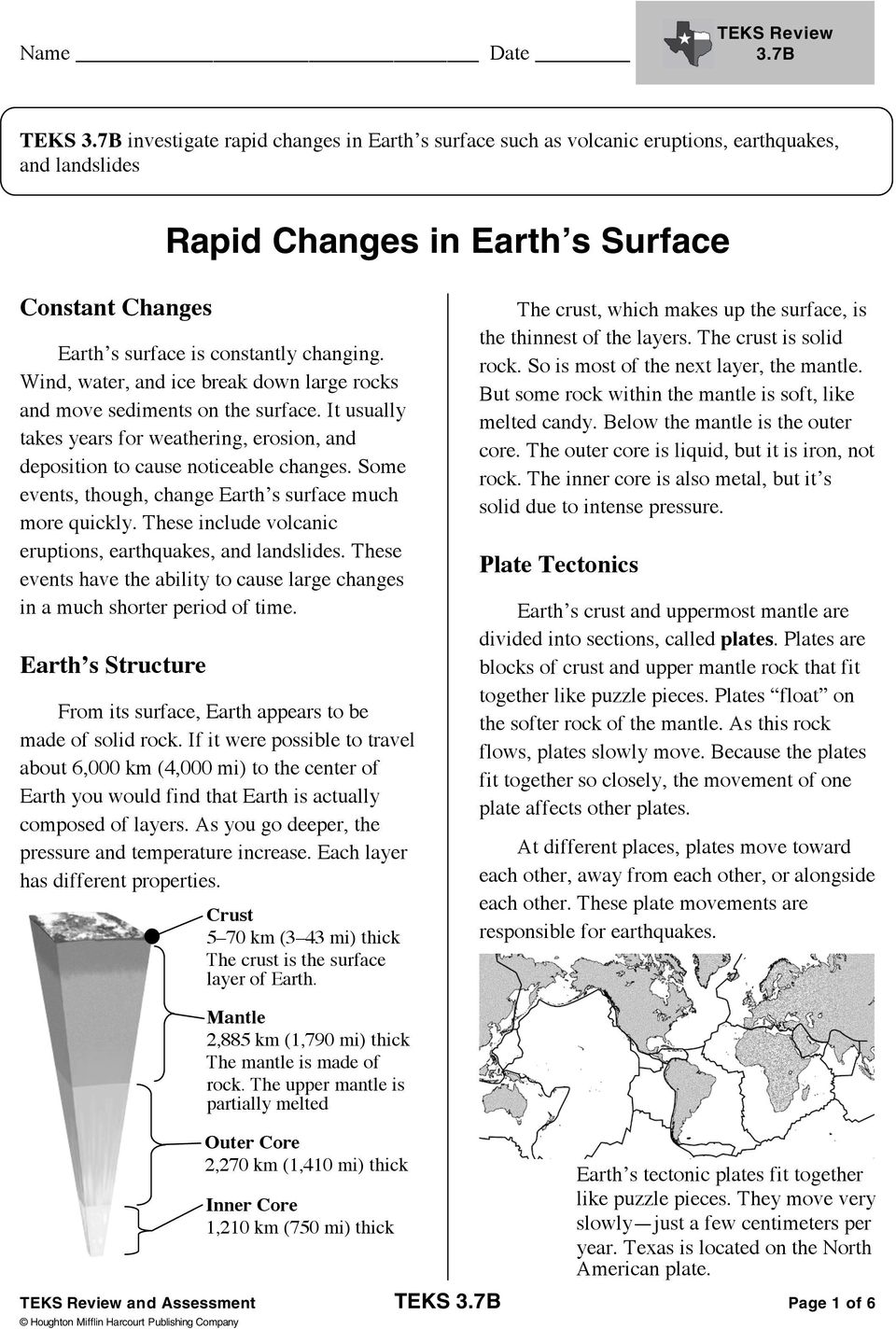
1 TEKS investigate rapid changes in Earth s surface such as volcanic eruptions, earthquakes, and landslides Rapid Changes in Earth s Surface Constant Changes Earth s surface is constantly changing. Wind, water, and ice break down large rocks and move sediments on the surface. It usually takes years for weathering, erosion, and deposition to cause noticeable changes. Some events, though, change Earth s surface much more quickly. These include volcanic eruptions, earthquakes, and landslides. These events have the ability to cause large changes in a much shorter period of time. Earth s Structure From its surface, Earth appears to be made of solid rock. If it were possible to travel about 6,000 km (4,000 mi) to the center of Earth you would find that Earth is actually composed of layers. As you go deeper, the pressure and temperature increase. Each layer has different properties. Crust 5 70 km (3 43 mi) thick The crust is the surface layer of Earth. The crust, which makes up the surface, is the thinnest of the layers. The crust is solid rock. So is most of the next layer, the mantle. But some rock within the mantle is soft, like melted candy. Below the mantle is the outer core. The outer core is liquid, but it is iron, not rock. The inner core is also metal, but it s solid due to intense pressure. Plate Tectonics Earth s crust and uppermost mantle are divided into sections, called plates. Plates are blocks of crust and upper mantle rock that fit together like puzzle pieces. Plates float on the softer rock of the mantle. As this rock flows, plates slowly move. Because the plates fit together so closely, the movement of one plate affects other plates. At different places, plates move toward each other, away from each other, or alongside each other. These plate movements are responsible for earthquakes. Mantle 2,885 km (1,790 mi) thick The mantle is made of rock. The upper mantle is partially melted Outer Core 2,270 km (1,410 mi) thick Inner Core 1,210 km (750 mi) thick Earth s tectonic plates fit together like puzzle pieces. They move very slowly just a few centimeters per year. Texas is located on the North American plate. and Assessment TEKS Page 1 of 6
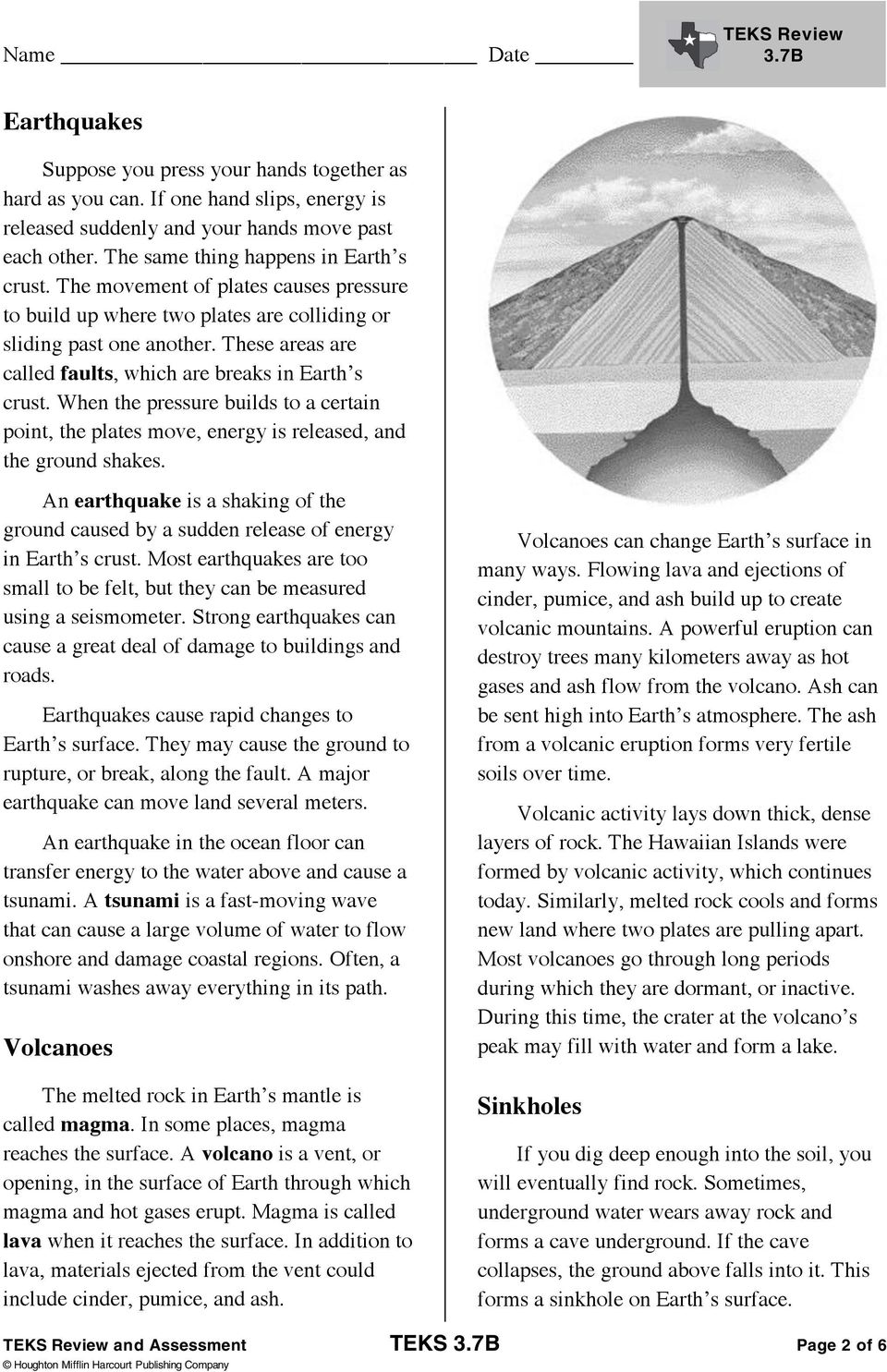
2 Earthquakes Suppose you press your hands together as hard as you can. If one hand slips, energy is released suddenly and your hands move past each other. The same thing happens in Earth s crust. The movement of plates causes pressure to build up where two plates are colliding or sliding past one another. These areas are called faults, which are breaks in Earth s crust. When the pressure builds to a certain point, the plates move, energy is released, and the ground shakes. An earthquake is a shaking of the ground caused by a sudden release of energy in Earth s crust. Most earthquakes are too small to be felt, but they can be measured using a seismometer. Strong earthquakes can cause a great deal of damage to buildings and roads. Earthquakes cause rapid changes to Earth s surface. They may cause the ground to rupture, or break, along the fault. A major earthquake can move land several meters. An earthquake in the ocean floor can transfer energy to the water above and cause a tsunami. A tsunami is a fast-moving wave that can cause a large volume of water to flow onshore and damage coastal regions. Often, a tsunami washes away everything in its path. Volcanoes The melted rock in Earth s mantle is called magma. In some places, magma reaches the surface. A volcano is a vent, or opening, in the surface of Earth through which magma and hot gases erupt. Magma is called lava when it reaches the surface. In addition to lava, materials ejected from the vent could include cinder, pumice, and ash. Volcanoes can change Earth s surface in many ways. Flowing lava and ejections of cinder, pumice, and ash build up to create volcanic mountains. A powerful eruption can destroy trees many kilometers away as hot gases and ash flow from the volcano. Ash can be sent high into Earth s atmosphere. The ash from a volcanic eruption forms very fertile soils over time. Volcanic activity lays down thick, dense layers of rock. The Hawaiian Islands were formed by volcanic activity, which continues today. Similarly, melted rock cools and forms new land where two plates are pulling apart. Most volcanoes go through long periods during which they are dormant, or inactive. During this time, the crater at the volcano s peak may fill with water and form a lake. Sinkholes If you dig deep enough into the soil, you will eventually find rock. Sometimes, underground water wears away rock and forms a cave underground. If the cave collapses, the ground above falls into it. This forms a sinkhole on Earth s surface. and Assessment TEKS Page 2 of 6
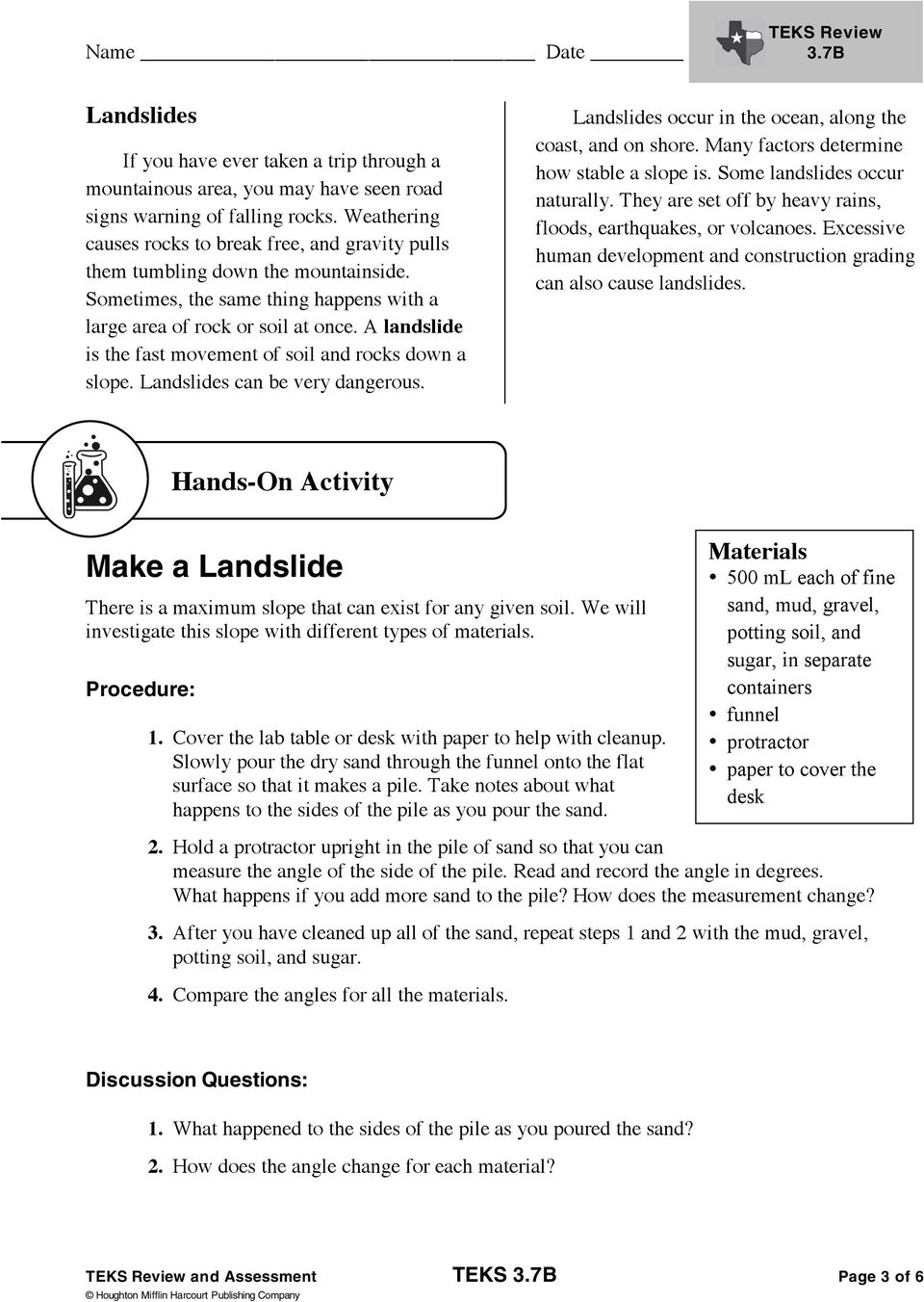
3 Landslides If you have ever taken a trip through a mountainous area, you may have seen road signs warning of falling rocks. Weathering causes rocks to break free, and gravity pulls them tumbling down the mountainside. Sometimes, the same thing happens with a large area of rock or soil at once. A landslide is the fast movement of soil and rocks down a slope. Landslides can be very dangerous. Landslides occur in the ocean, along the coast, and on shore. Many factors determine how stable a slope is. Some landslides occur naturally. They are set off by heavy rains, floods, earthquakes, or volcanoes. Excessive human development and construction grading can also cause landslides. Hands-On Activity Make a Landslide There is a maximum slope that can exist for any given soil. We will investigate this slope with different types of materials. Procedure: 1. Cover the lab table or desk with paper to help with cleanup. Slowly pour the dry sand through the funnel onto the flat surface so that it makes a pile. Take notes about what happens to the sides of the pile as you pour the sand. Materials 500 ml each of fine sand, mud, gravel, potting soil, and sugar, in separate containers funnel protractor paper to cover the desk 2. Hold a protractor upright in the pile of sand so that you can measure the angle of the side of the pile. Read and record the angle in degrees. What happens if you add more sand to the pile? How does the measurement change? 3. After you have cleaned up all of the sand, repeat steps 1 and 2 with the mud, gravel, potting soil, and sugar. 4. Compare the angles for all the materials. Discussion Questions: 1. What happened to the sides of the pile as you poured the sand? 2. How does the angle change for each material? and Assessment TEKS Page 3 of 6
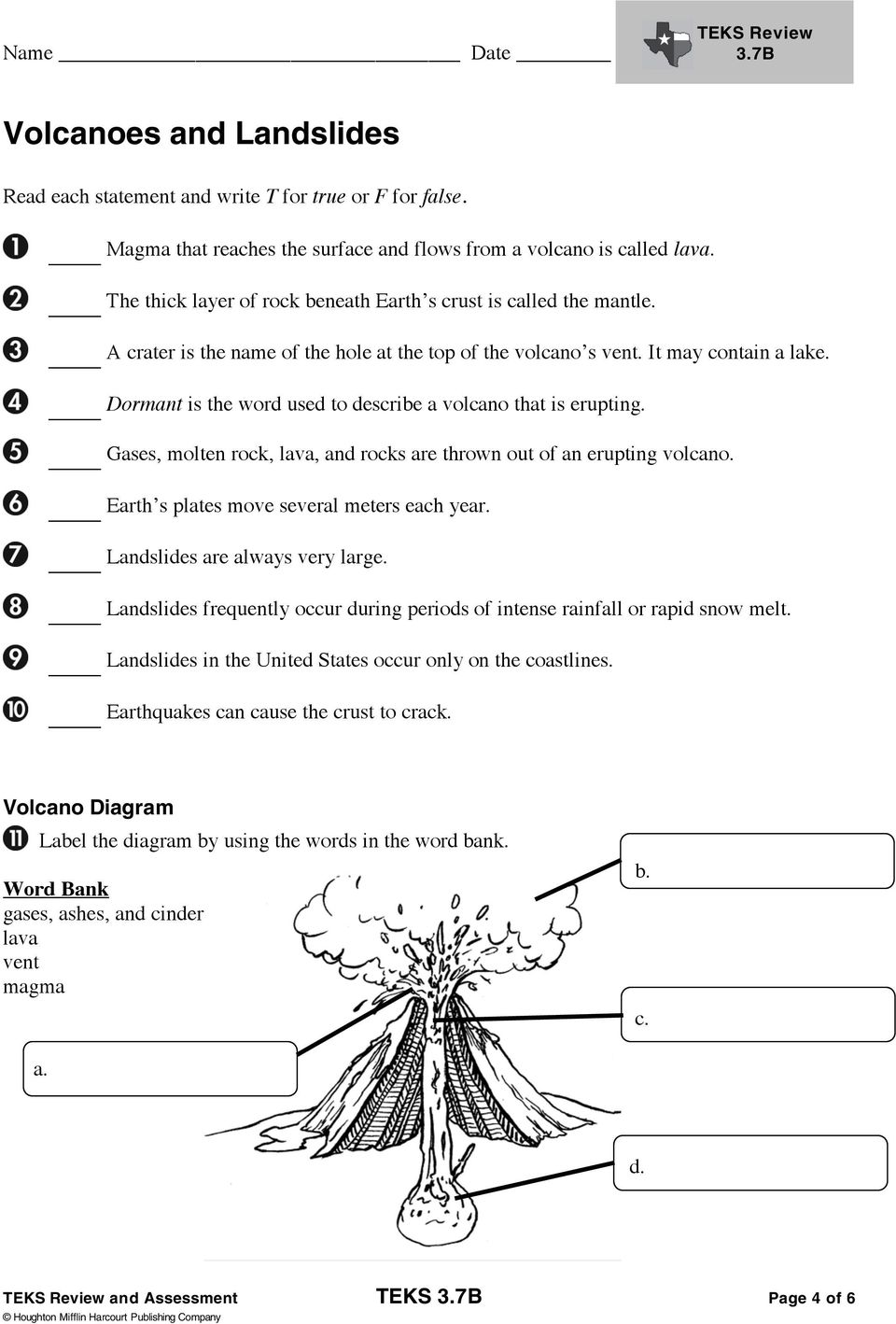
4 Volcanoes and Landslides Read each statement and write T for true or F for false. Magma that reaches the surface and flows from a volcano is called lava. The thick layer of rock beneath Earth s crust is called the mantle. A crater is the name of the hole at the top of the volcano s vent. It may contain a lake. Dormant is the word used to describe a volcano that is erupting. Gases, molten rock, lava, and rocks are thrown out of an erupting volcano. Earth s plates move several meters each year. Landslides are always very large. Landslides frequently occur during periods of intense rainfall or rapid snow melt. Landslides in the United States occur only on the coastlines. Earthquakes can cause the crust to crack. Volcano Diagram Label the diagram by using the words in the word bank. Word Bank gases, ashes, and cinders lava vent magma b. c. a. d. and Assessment TEKS Page 4 of 6
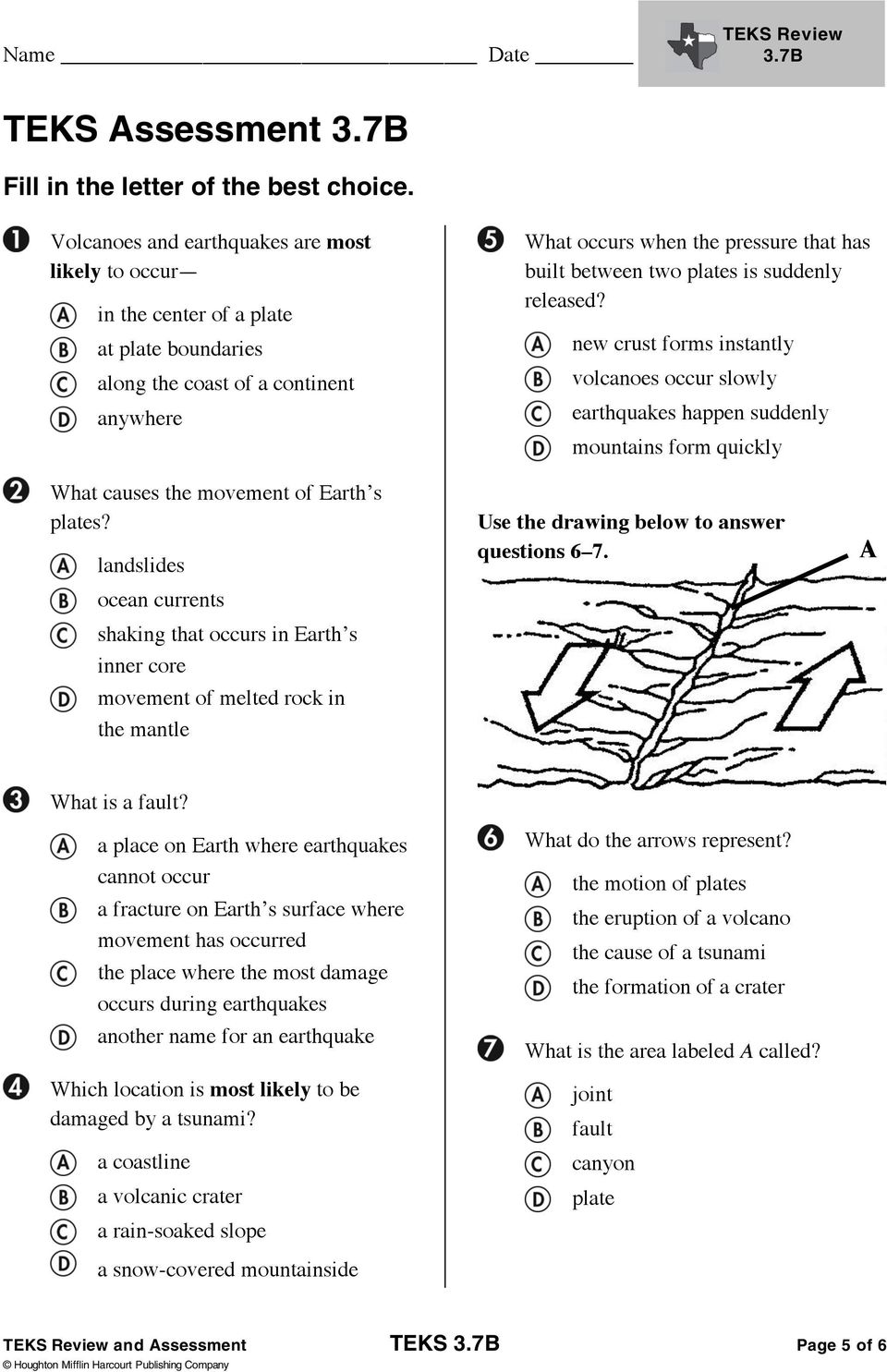
5 TEKS Assessment Fill in the letter of the best choice. Volcanoes and earthquakes are most likely to occur in the center of a plate at plate boundaries along the coast of a continent anywhere What occurs when the pressure that has built between two plates is suddenly released? new crust forms instantly volcanoes occur slowly earthquakes happen suddenly mountains form quickly What causes the movement of Earth s plates? landslides ocean currents shaking that occurs in Earth s inner core movement of melted rock in the mantle Use the drawing below to answer questions 6 7. A What is a fault? a place on Earth where earthquakes cannot occur a fracture on Earth s surface where movement has occurred the place where the most damage occurs during earthquakes another name for an earthquake Which location is most likely to be damaged by a tsunami? a coastline a volcanic crater a rain-soaked slope a snow-covered mountainside What do the arrows represent? the motion of plates the eruption of a volcano the cause of a tsunami the formation of a crater What is the area labeled A called? joint fault canyon plate and Assessment TEKS Page 5 of 6
6 Hands-On Activity (p. 3) 1. At first, the pile will grow higher. Once it reaches a certain height, particles that land near the top of the pile will be pulled down the sides of the pile by gravity. The particles will not form a structure that is steeper than a certain angle. 2. Answers will vary, but should be based on the measurements taken with the protractor. Student Response Activity (p. 4) 1. T 6. F 11. a. lava 2. T 7. F b. gases, ashes, and cinder 3. T 8. T c. vent 4. F 9. F d. magma 5. T 10. T TEKS Assessment (p. 5) 1. B 2. D 3. B 4. A 5. C 6. A 7. B and Assessment TEKS Page 6 of 6

Earth Science Landforms, Weathering, and Erosion Reading Comprehension. Landforms, Weathering, and Erosion
 Reading Comprehension Name 1 How many people have been to the Rocky Mountains or the Grand Canyon? When people go to visit these natural wonders, they may not realize that it took millions of years for
Georgia Performance Standards Framework for Shaky Ground 6 th Grade
 The following instructional plan is part of a GaDOE collection of Unit Frameworks, Performance Tasks, examples of Student Work, and Teacher Commentary. Many more GaDOE approved instructional plans are
Interactive Plate Tectonics
 Interactive Plate Tectonics Directions: Go to the following website and complete the questions below. http://www.learner.org/interactives/dynamicearth/index.html How do scientists learn about the interior
TECTONICS ASSESSMENT
 Tectonics Assessment / 1 TECTONICS ASSESSMENT 1. Movement along plate boundaries produces A. tides. B. fronts. C. hurricanes. D. earthquakes. 2. Which of the following is TRUE about the movement of continents?
FOURTH GRADE PLATE TECTONICS 1 WEEK LESSON PLANS AND ACTIVITIES
 FOURTH GRADE PLATE TECTONICS 1 WEEK LESSON PLANS AND ACTIVITIES PLATE TECTONIC CYCLE OVERVIEW OF FOURTH GRADE VOLCANOES WEEK 1. PRE: Comparing different structures of volcanoes. LAB: Modeling three types
When Things Go Wrong
 When Things Go Wrong When Things Go Wrong Our planet has many wondrous things. We plant a tiny sapling and it becomes a mighty tree. Water runs in rivers. Rainbows appear in the sky. But it is not always
Plate Tectonics Web-Quest
 Plate Tectonics Web-Quest Part I: Earth s Structure. Use the following link to find these answers: http://www.learner.org/interactives/dynamicearth/structure.html 1. Label the layers of Earth in the diagram
Some Processes that Change the Earth s Surface
 PART ONE Some Processes that Change the Earth s Surface Science standards To prepare students to understand the Essential Academic Learning Requirements (EALRs) introduced at middle school, this series
Layers of the Earth and Plate Tectonics
 Layers of the Earth and Plate Tectonics Objectives: explain various ways the earth can be changed by natural forces define the term Geology define the terms Crust, Mantle, Outer Core and Inner Core classify
Georgia Performance Standards Framework for Science Grade 6. Unit Organizer: Geology: Inside the Earth (Approximate Time: 7 Weeks)
 The following instructional plan is part of a GaDOE collection of Unit Frameworks, Performance Tasks, examples of Student Work, and Teacher Commentary. Many more GaDOE approved instructional plans are
Lesson 13: Plate Tectonics I
 Standards Addressed Lesson 13: Plate Tectonics I Overview Lesson 13 introduces students to geological oceanography by presenting the basic structure of the Earth and the properties of Earth s primary layers.
4. Plate Tectonics II (p. 46-67)
 4. Plate Tectonics II (p. 46-67) Seafloor Spreading In the early 1960s, samples of basaltic ocean crust were dredged up from various locations across the ocean basins. The samples were then analyzed to
Name: Period: # Plate Tectonics. Journey to the center of the Earth
 Plate Tectonics Journey to the center of the Earth Use pages 124 129 to answer the following questions. Exploring Inside Earth (p. 125-126) 1. What are the two main types of evidence that Geologist use
6.E.2.2 Plate Tectonics, Earthquakes and Volcanoes
 Name: Date: 1. The road shown below was suddenly broken by a natural event. 3. The convergence of two continental plates would produce Which natural event most likely caused the crack in the road? island
Glossary. continental crust: the sections of crust, the outermost layer of the earth, that include the continents
 aftershock: an earthquake that follows a larger earthquake or main shock and originates in or near the rupture zone of the larger earthquake. Generally, major earthquakes are followed by a number of aftershocks
[Geology Layers of the Earth] [Basic: Grade 2-3] [Advanced: Grade 5: Introduction to Plate Tectonics}
![[Geology Layers of the Earth] [Basic: Grade 2-3] [Advanced: Grade 5: Introduction to Plate Tectonics}](/thumbs/40/21755359.jpg "[Geology Layers of the Earth] [Basic: Grade 2-3] [Advanced: Grade 5: Introduction to Plate Tectonics}") [Geology Layers of the Earth] [Basic: Grade 2-3] [Advanced: Grade 5: Introduction to Plate Tectonics} BACKGROUND Scientists and geologists have been able to do some drilling on Earth. They are also able
[Geology Layers of the Earth] [Basic: Grade 2-3] [Advanced: Grade 5: Introduction to Plate Tectonics} BACKGROUND Scientists and geologists have been able to do some drilling on Earth. They are also able
1. You are about to begin a unit on geology. Can anyone tell me what geology is? The study of the physical earth I.
 PLATE TECTONICS ACTIVITY The purpose of this lab is to introduce the concept of plate tectonics and the formation of mountains. Students will discuss the properties of the earth s crust and plate tectonics.
Rocks and Minerals What is right under your feet?
 Rocks and Minerals What is right under your feet? Name: 1 Before you start What do you already know? What is the difference between a rock and a mineral? What are the three categories of rocks? 1. 2. 3.
KINDERGARTEN PLATE TECTONICS 1 WEEK LESSON PLANS AND ACTIVITIES
 KINDERGARTEN PLATE TECTONICS 1 WEEK LESSON PLANS AND ACTIVITIES PLATE TECTONIC CYCLE OVERVIEW OF KINDERGARTEN VOLCANOES WEEK 1. PRE: Learning that all mountains are not volcanoes. LAB: Investigating rocks
Volcanoes Erupt Grade 6
 TEACHING LEARNING COLLABORATIVE (TLC) EARTH SCIENCE Volcanoes Erupt Grade 6 Created by: Debra McKey (Mountain Vista Middle School); Valerie Duncan (Upper Lake Middle School); and Lynn Chick (Coyote Valley
Earth Science Grade 4 Minerals
 Earth Science Grade 4 Minerals Standards: Identifies the physical properties of minerals Teacher Background Minerals are pure substances and mix together to make rocks. Rocks have a cycle and different
SECOND GRADE PLATE TECTONICS 1 WEEK LESSON PLANS AND ACTIVITIES
 SECOND GRADE PLATE TECTONICS 1 WEEK LESSON PLANS AND ACTIVITIES PLATE TECTONIC CYCLE OVERVIEW OF SECOND GRADE VOLCANOES WEEK 1. PRE: Investigating the parts of a volcano. LAB: Comparing the parts of a
The Dynamic Crust 2) EVIDENCE FOR CRUSTAL MOVEMENT
 The Dynamic Crust 1) Virtually everything you need to know about the interior of the earth can be found on page 10 of your reference tables. Take the time to become familiar with page 10 and everything
Earth Egg Model Teacher Notes
 Ancient Greeks tried to explain earthquakes and volcanic activity by saying that a massive bull lay underground and the land shook when it became angry. Modern theories rely on an understanding of what
Layers of the Earth s Interior
 Layers of the Earth s Interior 1 Focus Question How is the Earth like an ogre? 2 Objectives Explain how geologists have learned about the interior of the Earth. Describe the layers of the Earth s interior.
2 Wind Erosion and Deposition
 CHAPTER 3 2 Wind Erosion and Deposition SECTION Agents of Erosion and Deposition BEFORE YOU READ After you read this section, you should be able to answer these questions: How can wind erosion shape the
FOURTH GRADE VOLCANOES 1 WEEK LESSON PLANS AND ACTIVITIES
 FOURTH GRADE VOLCANOES 1 WEEK LESSON PLANS AND ACTIVITIES PLATE TECTONIC CYCLE OVERVIEW OF FOURTH GRADE VOLCANOES WEEK 1. PRE: Comparing different structures of volcanoes. LAB: Modeling three types of
FIRST GRADE VOLCANOES 1 WEEK LESSON PLANS AND ACTIVITIES
 FIRST GRADE VOLCANOES 1 WEEK LESSON PLANS AND ACTIVITIES PLATE TECTONIC CYCLE OVERVIEW OF FIRST GRADE VOLCANOES WEEK 1. PRE: Learning the shapes of volcanoes. LAB: Experimenting with "lava." POST: Comparing
Student Exploration: Plate Tectonics
 Name: Date: Student Exploration: Plate Tectonics Vocabulary: collisional boundary, convergent boundary, crust, divergent boundary, earthquake, lithosphere, mantle, plate, plate tectonics, transform boundary,
Unit 6 Earthquakes and Volcanoes
 Unit 6 Earthquakes and Volcanoes Earthquakes and Volcanoes: Essential Questions What evidence can students observe that the Earth is changing? How do scientists know what s inside the Earth? What processes
Ride the Rock Cycle. Suggested Goals: Students will gain an understanding of how a rock can move through the different stages of the rock cycle.
 Illinois State Museum Geology Online http://geologyonline.museum.state.il.us Ride the Rock Cycle Grade Level: 5 6 Purpose: To teach students that the rock cycle, like the water cycle, has various stages
Viscosity and Volcano Types
 20 LESSON Viscosity and Volcano Types This photo, taken in 1943 in Paricutin, Mexico, shows an eruption of the Paricutin volcano at night. Glowing hot, broken rocks outline the shape of the volcano, called
Plate tectonics states that the Earth's crust and upper mantle are broken into sections, called plates.
 Notes on Plate Tectonics Plate tectonics states that the Earth's crust and upper mantle are broken into sections, called plates. These plates move around the mantle. Plates are composed of the crust and
FIRST GRADE PLATE TECTONICS 1 WEEK LESSON PLANS AND ACTIVITIES
 FIRST GRADE PLATE TECTONICS 1 WEEK LESSON PLANS AND ACTIVITIES PLATE TECTONIC CYCLE OVERVIEW OF FIRST GRADE VOLCANOES WEEK 1. PRE: Learning the shapes of volcanoes. LAB: Experimenting with "lava." POST:
THE STRUCTURE OF THE EARTH
 THE STRUCTURE OF THE EARTH Contents 1. Main Objectives 2. Useful Websites 3. Pupil Vocabulary Cards 4. Word Wall Cards 5. Glossary 6. Key Question Cards 7. Prior Learning Diagram 8. Hands-on Activities
Learn more at www.pbs.org/nature
 Lesson Title: Vibrant Volcanoes Grade level: 2 4 Topic/Subject Matter: Earth Science Time Allotment:1-2 class periods Overview This lesson will introduce elementary students to the fiery and explosive
Fourth Grade Geology: The Earth and Its Changes Assessment
 Fourth Grade Geology: The Earth and Its Changes Assessment 1a. What is the center layer of the Earth called? a. crust b. core c. mantle d. middle 1b. Label each layer of the Earth. 1c. What are the Earth
Third Grade Science Vocabulary Investigation Design & Safety
 recycle dispose reuse goggles data conclusion predict describe observe record identify investigate evidence analyze mass matter float sink attract force magnet magnetic magnetism pole pull push repel Third
Tectonic plates have different boundaries.
 KEY CONCEPT Plates move apart. BEFORE, you learned The continents join and break apart The sea floor provides evidence that tectonic plates move The theory of plate tectonics helps explain how the plates
The rock cycle. Introduction. What are rocks?
 The rock cycle This Revision looks at the three types of rock: sedimentary, igneous and metamorphic. It looks at how they are formed, the weathering of rocks and the way one form of rock turns into another,
Exploring Our World with GIS Lesson Plans Engage
 Exploring Our World with GIS Lesson Plans Engage Title: Exploring Our Nation 20 minutes *Have students complete group work prior to going to the computer lab. 2.List of themes 3. Computer lab 4. Student
Essential Question: How did the theory of Plate Tectonics evolve?
 Essential Question: How did the theory of Plate Tectonics evolve? 1. Look at a globe or a map of the Earth. Name the continents. (7 points) 2. How many continents are there? (3 points) 3. On a sheet of
Earth Science Chapter 14 Section 2 Review
 Name: Class: Date: Earth Science Chapter 14 Section Review Multiple Choice Identify the choice that best completes the statement or answers the question. 1. Which of the following is NOT one of the three
Inside Earth Chapter 3
 Name Hour Due Date Inside Earth Chapter Page 1 Volcanoes and Plate Tectonics Page 2 Volcanic Activity Page - Mapping Earthquakes and Volcanoes Page 4 Mapping Earthquakes and Volcanoes table Page 5 - Mapping
Lecture 23: Terrestrial Worlds in Comparison. This lecture compares and contrasts the properties and evolution of the 5 main terrestrial bodies.
 Lecture 23: Terrestrial Worlds in Comparison Astronomy 141 Winter 2012 This lecture compares and contrasts the properties and evolution of the 5 main terrestrial bodies. The small terrestrial planets have
DYNAMIC CRUST: Unit 4 Exam Plate Tectonics and Earthquakes
 DYNAMIC CRUST: Unit 4 Exam Plate Tectonics and Earthquakes NAME: BLOCK: DATE: 1. Base your answer to the following question on The block diagram below shows the boundary between two tectonic plates. Which
Geol 101: Physical Geology PAST EXAM QUESTIONS LECTURE 4: PLATE TECTONICS II
 Geol 101: Physical Geology PAST EXAM QUESTIONS LECTURE 4: PLATE TECTONICS II 4. Which of the following statements about paleomagnetism at spreading ridges is FALSE? A. there is a clear pattern of paleomagnetic
5-Minute Refresher: WEATHERING AND EROSION
 5-Minute Refresher: WEATHERING AND EROSION Weathering and Erosion Key Ideas Weathering is the wearing away of the surface of rock, soil, and minerals into smaller pieces. Example of weathering: Wind and
BASIC LESSON Objective(s)
 [Geology - Landforms] [K-1: Basic] [Grades 2-3: Advanced] BACKGROUND Landforms are natural features of the Earth's surface. They are created by the movement of ice or water, earthquakes, lava flows, volcanoes,
Earthquakes and Plate Boundaries Deborah Jordan and Samuel Spiegel
 Earthquakes and Plate Boundaries Deborah Jordan and Samuel Spiegel Jordan, Deborah and Spiegel, Samuel: Learning Research Development Center, University of Pittsburgh. Earthquakes and Plate Boundaries.
Regents Questions: Plate Tectonics
 Earth Science Regents Questions: Plate Tectonics Name: Date: Period: August 2013 Due Date: 17 Compared to the oceanic crust, the continental crust is (1) less dense and more basaltic (3) more dense and
The Earth System. The geosphere is the solid Earth that includes the continental and oceanic crust as well as the various layers of Earth s interior.
 The Earth System The atmosphere is the gaseous envelope that surrounds Earth. It consists of a mixture of gases composed primarily of nitrogen, oxygen, carbon dioxide, and water vapor. The atmosphere and
FIFTH GRADE PLATE TECTONICS 1 WEEK LESSON PLANS AND ACTIVITIES
 FIFTH GRADE PLATE TECTONICS 1 WEEK LESSON PLANS AND ACTIVITIES PLATE TECTONIC CYCLE OVERVIEW OF FIFTH GRADE VOLCANOES WEEK 1. PRE: Exploring the rocks produced by volcanoes. LAB: Comparing igneous rocks.
Chapter 8: Plate Tectonics -- Multi-format Test
 Name: Class: Date: ID: A Chapter 8: Plate Tectonics -- Multi-format Test Modified True/False Indicate whether the statement is true or false. If false, change the identified word or phrase to make the
WEATHERING, EROSION, AND DEPOSITION PRACTICE TEST. Which graph best shows the relative stream velocities across the stream from A to B?
 NAME DATE WEATHERING, EROSION, AND DEPOSITION PRACTICE TEST 1. The diagram below shows a meandering stream. Measurements of stream velocity were taken along straight line AB. Which graph best shows the
ES Chapter 10 Review. Name: Class: Date: Multiple Choice Identify the choice that best completes the statement or answers the question.
 Name: Class: Date: ES Chapter 10 Review Multiple Choice Identify the choice that best completes the statement or answers the question. 1. Scientists used the pattern of alternating normal and reversed
1. The diagram below shows a cross section of sedimentary rock layers.
 1. The diagram below shows a cross section of sedimentary rock layers. Which statement about the deposition of the sediments best explains why these layers have the curved shape shown? 1) Sediments were
Lesson 3: The formation of mountains Factsheet for teachers
 Lesson 3: The formation of mountains Factsheet for teachers Vocabulary This lesson uses the following geographical terms. These should be used and explained to pupils as the lesson is taught. Core, mantle,
Plate Tectonics. Hi, I am Zed and I am going to take you on a trip learning about Plate Tectonics. And I am Buddy Zed s mascot
 Plate Tectonics Hi, I am Zed and I am going to take you on a trip learning about Plate Tectonics And I am Buddy Zed s mascot Continental Drift Alfred Wegener proposed that continents were not always where
SIXTH GRADE PLATE TECTONICS 1 WEEK LESSON PLANS AND ACTIVITIES
 SIXTH GRADE PLATE TECTONICS 1 WEEK LESSON PLANS AND ACTIVITIES PLATE TECTONIC CYCLE OVERVIEW OF SIXTH GRADE VOLCANOES WEEK 1. PRE: Comparing the structure of different types of volcanoes. LAB: Plotting
Hot Spots & Plate Tectonics
 Hot Spots & Plate Tectonics Activity I: Hawaiian Islands Procedures: Use the map and the following information to determine the rate of motion of the Pacific Plate over the Hawaiian hot spot. The volcano
SECOND GRADE VOLCANOES 1 WEEK LESSON PLANS AND ACTIVITIES
 SECOND GRADE VOLCANOES 1 WEEK LESSON PLANS AND ACTIVITIES PLATE TECTONIC CYCLE OVERVIEW OF SECOND GRADE VOLCANOES WEEK 1. PRE: Investigating the parts of a volcano. LAB: Comparing the parts of a volcano
Continents join together and split apart.
 KEY CONCEPT Continents change position over time. BEFORE, you learned Earth s main layers are the core, the mantle, and the crust The lithosphere and asthenosphere are the topmost layers of Earth The lithosphere
Plate Tectonics Practice Questions and Answers Revised August 2007
 Plate Tectonics Practice Questions and Answers Revised August 2007 1. Please fill in the missing labels. 2. Please fill in the missing labels. 3. How many large plates form the outer shell of the earth?
Unit 4 Lesson 2 Plate Tectonics. Copyright Houghton Mifflin Harcourt Publishing Company
 Puzzling Evidence What evidence suggests that continents move? In the late 1800s, Alfred Wegener proposed his hypothesis of continental drift. According to this hypothesis, the continents once formed a
Georgia Performance Standards Framework for Science Grade 6. Unit Organizer: Water in Earth s Processes. (Approximate Time: 5-6 Weeks)
 The following instructional plan is part of a GaDOE collection of Unit Frameworks, Performance Tasks, examples of Student Work, and Teacher Commentary. Many more GaDOE approved instructional plans are
Plate Tectonics Short Study Guide
 Name: Class: Date: Plate Tectonics Short Study Guide Multiple Choice Identify the letter of the choice that best completes the statement or answers the question. 1. The existence of coal beds in Antarctica
Georgia Performance Standards Framework for Natural Disasters 6 th Grade
 The following instructional plan is part of a GaDOE collection of Unit Frameworks, Performance Tasks, examples of Student Work, and Teacher Commentary. Many more GaDOE approved instructional plans are
Section 1 The Earth System
 Section 1 The Earth System Key Concept Earth is a complex system made up of many smaller systems through which matter and energy are continuously cycled. What You Will Learn Energy and matter flow through
How Did These Ocean Features and Continental Margins Form?
 298 10.14 INVESTIGATION How Did These Ocean Features and Continental Margins Form? The terrain below contains various features on the seafloor, as well as parts of three continents. Some general observations
Plate Tectonics. Learning Guide. Pacific Plate. Pacific Ocean. Divergent boundaries
 Plate Tectonics Learning Guide North American Plate Eurasian Plate Arabian Plate Pacific Plate Atlantic Ocean Pacific Ocean Cocos Plate Nazca Plate South American Plate African Plate Convergent boundary
The interior of the Earth is divided into layers based on chemical and physical properties.
 Plate Tectonics Lecture Notes: Slide 1. Title Slide Slide 2. The interior of the Earth is divided into layers based on chemical and physical properties. The Earth has an outer silica-rich, solid crust,
Chapter Overview. Bathymetry. Measuring Bathymetry. Echo Sounding Record. Measuring Bathymetry. CHAPTER 3 Marine Provinces
 Chapter Overview CHAPTER 3 Marine Provinces The study of bathymetry charts ocean depths and ocean floor topography. Echo sounding and satellites are efficient bathymetric tools. Most ocean floor features
Tectonic plates push together at convergent boundaries.
 KEY CONCEPT Plates converge or scrape past each other. BEFORE, you learned Plates move apart at divergent boundaries In the oceans, divergent boundaries mark where the sea floor spreads apart On land,
EARTH SCIENCE ACTIVITY #1 Tsunami in a Bottle
 EARTH SCIENCE ACTIVITY #1 Tsunami in a Bottle Grades 3 and Up This activity is one of several in a basic curriculum designed to increase student knowledge about earthquake science and preparedness. The
Introduction and Origin of the Earth
 Page 1 of 5 EENS 1110 Tulane University Physical Geology Prof. Stephen A. Nelson Introduction and Origin of the Earth This page last updated on 30-Jul-2015 Geology, What is it? Geology is the study of
Plate Tectonics. Plate Tectonics LEVELED READER Y. www.readinga-z.com. Visit www.readinga-z.com for thousands of books and materials.
 Plate Tectonics A Reading A Z Level Y Leveled Reader Word Count: 1,933 LEVELED READER Y Plate Tectonics Written by William Harryman Illustrated by Signe Nordin Visit www.readinga-z.com for thousands of
What are Rocks??? Rocks are the most common material on Earth. They are a naturally occurring collection of one or more minerals.
 The Rock Cycle What are Rocks??? Rocks are the most common material on Earth. They are a naturally occurring collection of one or more minerals. The Rock Cycle a cycle that continuously forms and changes
Rocks and Plate Tectonics
 Name: Class: _ Date: _ Rocks and Plate Tectonics Multiple Choice Identify the choice that best completes the statement or answers the question. 1. What is a naturally occurring, solid mass of mineral or
CHAPTER 6 THE TERRESTRIAL PLANETS
 CHAPTER 6 THE TERRESTRIAL PLANETS MULTIPLE CHOICE 1. Which of the following is NOT one of the four stages in the development of a terrestrial planet? 2. That Earth, evidence that Earth differentiated.
XVII. Science and Technology/Engineering, Grade 8
 VII. Science and Technology/Engineering, Grade 8 Grade 8 Science and Technology/Engineering Test The spring 2014 grade 8 Science and Technology/Engineering test was based on learning standards in the four
Plate Tectonics Chapter 2
 Plate Tectonics Chapter 2 Does not include complete lecture notes. Continental drift: An idea before its time Alfred Wegener First proposed his continental drift hypothesis in 1915 Published The Origin
The Water Cycle. 4 th Grade Pre-Visit Activity #1
 th Grade Pre-Visit Activity # The Water Cycle Overview Objectives Subjects Earth s water molecules circulate among air, plants, animals, and soil by way of the water cycle. This activity uses a game to
Unit 4: The Rock Cycle
 Unit 4: The Rock Cycle Objective: E 3.1A Discriminate between igneous, metamorphic, and sedimentary rocks and describe the processes that change one kind of rock into another. E 3.1B Explain the relationship
Plate Tectonics. Introduction. Boundaries between crustal plates
 Plate Tectonics KEY WORDS: continental drift, seafloor spreading, plate tectonics, mid ocean ridge (MOR) system, spreading center, rise, divergent plate boundary, subduction zone, convergent plate boundary,
ORANGE PUBLIC SCHOOLS OFFICE OF CURRICULUM AND INSTRUCTION OFFICE OF SCIENCE. GRADE 6 SCIENCE Post - Assessment
 ORANGE PUBLIC SCHOOLS OFFICE OF CURRICULUM AND INSTRUCTION OFFICE OF SCIENCE GRADE 6 SCIENCE Post - Assessment School Year 2013-2014 Directions for Grade 6 Post-Assessment The Grade 6 Post-Assessment is
INTRODUCTION. This project is about volcanoes and how they form and how they function. It will also show you the different aspects of a volcano.
 BY RYAN O MAHONY INTRODUCTION This project is about volcanoes and how they form and how they function. It will also show you the different aspects of a volcano. MAP OF VOLCANOES AROUND THE WORLD DIAGRAM
6. Base your answer to the following question on the graph below, which shows the average monthly temperature of two cities A and B.
 1. Which single factor generally has the greatest effect on the climate of an area on the Earth's surface? 1) the distance from the Equator 2) the extent of vegetative cover 3) the degrees of longitude
Earth Science Module 21. Plate Tectonics: The Earth in Motion. Plate Tectonics Module Study Notes and Outline. Creationist Model
 Earth Science Module 21 Plate Tectonics: The Earth in Motion Plate Tectonics Module Study Notes and Outline Creationist Model I. Scientists shift their paradigm A. When the data supporting plate tectonics
1. Michigan Geological History Presentation (Michigan Natural Resources)
 1. Michigan Geological History Presentation (Michigan Natural Resources) The Michigan Geological History Presentation provides an overview of the approximately 3 billion years of Earth Processes that the
8/18/2014. Chapter 9: Erosion and Deposition. Section 1 (Changing Earth s Surface) 8 th Grade. Weathering
 Section 1 (Changing Earth s Surface) Weathering the chemical and physical processes that break down rock at Earth s surface Chapter 9: Erosion and Deposition 8 th Grade Mechanical weathering when rock
Study Guide Questions Earth Structure and Plate Tectonics
 Study Guide Questions Earth Structure and Plate Tectonics What evidence did Alfred Wegener present in 1912 to support the idea of continental drift? Why did most geologists at the time dismiss Wegener
Plate Tectonics. Earth, 9 th edition Chapter 2
 1 Plate Tectonics Earth, 9 th edition Chapter 2 2 3 4 5 6 7 8 9 10 11 12 13 14 15 16 Plate Tectonics: summary in haiku form Alfred Wegener gave us Continental Drift. Fifty years later... Continental Drift
Volcano in the lab: a wax volcano in action: teacher s notes
 Volcano in the lab: a wax volcano in action: teacher s notes Level This activity is designed for students aged 11-14, as a simple demonstration of igneous activity. English National Curriculum reference
Part Two Our Ever Changing Earth
 Part Two Our Ever Changing Earth Grade Level: 1 *Part Two is actually a unit plan and contains more than one lesson. You can pick and choose those that best fit your goals and the ability level of your
The Earth, Sun, and Moon
 reflect The Sun and Moon are Earth s constant companions. We bask in the Sun s heat and light. It provides Earth s energy, and life could not exist without it. We rely on the Moon to light dark nights.
Igneous rocks formed when hot molten material (magma) cools and hardens (crystallizes).
 Objectives You will learn about how the land of North Dakota was formed. Introduction North Dakota is a wonderful place to live. Have you ever though about how it was formed? To answer that question, you