
How To Power A Power Supply On A Powerline From A Power Source To A Power Box
|
|
|
- Doris Wilkins
- 5 years ago
- Views:
Transcription
1 Power Base AI Power Base AI Application Guide

2 Table of Contents Product Overview Our Philosophy On Electrical... 4 System Overview... 5 Power Base AI Statement of Line Power Base AI Components... 8 Product Application Idea Starters Electrical Basics Circuit Service Module Applications Circuit Furniture Infeed Applications Circuit Service Module Applications Circuit Furniture Infeed Applications Planning Guide Planning for Power Base AI in Ten Steps Technical Specifications Power Base AI Three Part Specification Guide Power Base AI Application Guide Table of Contents Power Base AI Application Guide 3

3 Our Philosophy On Electrical Product Overview Our Philosophy on Electrical Haworth has a unique approach when it comes to Electrical Distribution and its ever changing layout. Our philosophy is to design and install for tomorrow rather than conventionally wiring for today. How do we do that? By running everything right beneath your feet using plug-and-play technology and a zone distribution methodology that delivers power to where the customer needs it. This ensures that your electrical infrastructure will be able to respond to today's fast pace and fast rate of change. Being flexible today is critical to tomorrow s survival. Reconfiguring should be fast, growing should be easy, and with Haworth Power Base AI, it is. Our quick-connect systems power you up...fast! Haworth offers Power Base AI, a modular power system for raised floor applications, which helps to ensure quick installation and future flexibility. Quick installation reduces construction schedule risk and controls jobsite labor over runs. Future flexibility helps increase tenant satisfaction and lowers operating and renovation costs. Haworth has developed two power distribution systems to accommodate the electrical needs of all major North American office furniture manufacturers: The 3-Circuit and the 4-Circuit systems. Each has been specifically designed for use in Haworth Access Flooring and is based on plug-and-play connectivity. The 3-Circuit separate neutral system provides individual branch circuits for power quality and multiple power source flexibility not available in 4-Circuit applications. The 4-Circuit shared neutral version helps to maximize the number of circuits while staying within the common 1 2" trade conduits. This modular power system is UL Listed, CSA Certified, and complies with NEC Article 604. The Power Base AI system consists of six main elements to distribute power. They include the following: Zone Distribution Box Jumper Splitter Service Module Modular Receptacle Haworth Plug-and-Play Furniture Base Feed Above Ceiling Application Power Input from Electrical Closet Power Base AI Equipped Poke Through Infeed Harness Column Feed Power Base AI Equipped Moveable Wall Splitter (2-Port) Splitter (4-Port) System Furniture Top Feed Infeed Jumpers Infeed Harness 1-Port Zone Distribution Box Power Base AI Equipped Service Pole 4 Power Base AI Application Guide

4 System Overview Power is typically routed from the electrical closet through pre-wired flexible conduit to separate zones of the floor plate. Power is then distributed within each zone using modular wiring. Modular wiring puts flexibility out in the area where most day-to-day reconfigurations occur. Power can be routed from the electrical closet with the pre-wired Zone Distribution Box or an Infeed Harness. The Zone Distribution Box is available with factory installed pre-wired conduits with three sets up to 125', and two sets of circuits up to 200', or the field wired Zone Distribution Box can be used with locally supplied MC cable or conduit. The in-feed harness routes a single set of circuits and is available in lengths up to 100'. Power is routed within the zone by 8-Wire modular flex conduit Jumpers. The Jumpers are fully populated with all eight wires so all circuits are available for future moves. The Flush Service Module provides Modular Receptacles under a hinged lid. The Modular Receptacles allow fast change of circuits as users' needs change. Flush Service Modules can be moved to other floor tile locations by re-routing the flex conduit Jumpers. The Service Modules allow for multiple Jumpers to connect (two Dual Service Modules/four Quad Service Modules) for branching within a zone. The Splitter is used to join up to four Jumpers. By using Splitters, the zone can be expanded to meet future needs. For more extensive renovations, the Zone Distribution Box can be moved by re-routing the flex conduit feed. Under Floor Application Product Overview System Overview Service Module Splitter Jumpers Power Input from Electrical Closet Haworth Furniture Base Feed Zone Distribution Box 1-Port Zone Distribution Box Note MC Cable = Metal Clad Cable in this document. Power Base AI Application Guide 5

5 Power Base AI Statement of Line Product Overview Power Base AI Statement of Line 3- and 4-Circuit Field-Wired 1-Port Zone Distribution Box Infeed Harness 15", 10', 25', 50', 75', or 100' Long Pre-Wired 2-Port Zone Distribution Box Jumper 5', 10', 15', 20', 35', or 50' Long Pre-Wired 3-Port Zone Distribution Box 4-Port Splitter Field-Wired 3-Port Zone Distribution Box 2-Port Splitter Quad Service Module Dual Service Module Modular Receptacle (15 Amp Duplex) Modular Receptacle (20 Amp Duplex) Hardwire Quad Service Module (Field-Wired) Dual Service Module (Field-Wired) 6 Power Base AI Application Guide

6 Power Base AI Statement of Line Accessories Service Module Lid Service Module Lid and Trim Ring Cord Manager Loop PREMISE, Moxie, and Compose Floor Infeed PLACES, UniGroup, and Tactics Floor Infeed Floor Infeed Product Overview Power Base AI Statement of Line RACE Single Harness Connector Power Base AI Application Guide 7

7 Power Base AI Components Product Overview Power Base AI Components Infeed Harness The Infeed Harnesses are used to convert between "hardwiring" and "modular wiring". Supports plug-andplay power distribution within each power zone. Longer lengths can be used from the electrical closet to start a power zone. Shorter lengths can be used to transition to products without a modular connector. Quick connect male modular power connector allows fast install. Can be connected directly to a Service Module. Use a circuit distributor to connect to Jumpers or systems furniture base feed. Available in lengths up to 100' with either 3- or 4-Circuit configurations. Infeed Harness Infeed Harness Furniture Top Feed Infeed Harness Furniture Base Feed Infeed Harness 8 Power Base AI Application Guide

8 Power Base AI Components 1-Port Zone Distribution Boxes The 1-Port Zone Distribution Box is used to convert between "hardwiring" and "modular wiring". Supports plugand-play power distribution within each power zone. Can be used with MC cable or conduit from the electrical closet to begin a power zone. Can be used to connect furniture or wall feed conduit to modular power connection. Quick connect female modular power connector allows fast install. Can be connected directly to a Jumper or Infeed Harness. Available in either 3- or 4-Circuit configurations. 1-Port Zone Distribution Box 1-Port Zone Distribution Box Jumper Product Overview Power Base AI Components Zone Distribution Boxes The Zone Distribution Box is used to convert between "hardwiring" and "modular wiring". Supports plug-andplay power distribution within each power zone. The pre-wired 3-Port Zone Distribution Box routes three sets of circuits through 11/4" flex conduit. Each set of circuits is connected to one female connector mounted to the box. The pre-wired 2-Port Zone Distribution Box routes two sets of circuits through 11/4" flex conduit. The field wired Zone Distribution Box has three sets of female connectors which can be hardwired to field installed wiring. Can be connected directly to a Jumper or a furniture base feed. Available pre-wired with 10 AWG wire in lengths up to 125' or 8 AWG wire up to 200' with sets of either 3- or 4-Circuits. Pre-Wired 3-Port Zone Distribution Box Pre-Wired 2-Port Zone Distribution Box Field Wired 3-Port Distribution Box Power Base AI Application Guide 9

9 Power Base AI Components Product Overview Power Base AI Components Jumpers Jumpers are used to interconnect modular power components within each power zone. Supports plug-and-play power distribution within each power zone. Flexible conduit construction with quick connect modular power connector heads allows quick installation and easy reconfiguration. Available in either 3- or 4-Circuit configurations. Note Jumper 5', 10', 15', 20', 35', or 50' Long Splitter Infeed Jumpers Service Module The Jumper has male connectors. A circuit distributor (female connectors) is required to connect Jumpers to another Jumper. A circuit distributor can join up to four Jumpers. Splitters Splitters allow interconnection of up to four Jumpers within each power zone. Supports plug-and-play power distribution within each power zone. Quick connect modular power connection allows quick installation and easy reconfiguration. The Splitter has four female connectors. One port in intended for the supply connection with the ability to distribute out to the other port(s). Available in either 2-Port or 4-Port configuration with 3-Circuit or 4-Circuit 8-Wire configurations. Jumpers Splitter 4-Port Splitter 2-Port Splitter Jumpers Note A Jumper (female connectors) is required to connect another Splitter or Zone Distribution Box. 10 Power Base AI Application Guide

10 Power Base AI Components Service Modules Service Modules are used to provide power and/or data outlets at floor level. Modular Receptacles are located under a hinged lid which is flush with the finished floor. Supports plug-and-play power distribution within each power zone. Quick connect modular power connector allows fast install and easy reconfiguration of Jumpers and Receptacles. The Service Modules have Modular Receptacles to allow fast change of circuit access. The Quad Service Module has connector ports for four Jumpers and four Receptacles for use on 4.5" or higher finished floor heights. The Dual Service Module has female connector ports for two Jumpers and two Receptacles for use on 2.5" or higher finished floor heights. Quad Service Module provided with two data openings (2.71" x 1.38") for furniture info plates; Dual Service Module has four furniture info plate openings. Data opening has knockout for mounting single gang data plates. Service Modules are available in either 3- or 4-Circuit configurations. Quad Service Module (Field Wired) Quad Service Module Modular Dual Service Module (Field Wired) Service Module Dual Service Module Modular Product Overview Power Base AI Components Splitter Infeed Jumpers Modular Receptacles The Modular Duplex Receptacles are used to access specific circuits of the Service Module. Supports plug-andplay power distribution within each power zone. Quick connect modular power connector allows fast install into Service Modules for easy reconfiguration. Available in 15 amp or 20 amp outlet reconfiguration, common ground, or isolated ground access; all with either 3- or 4-Circuit configurations. Modular Receptacle (15 Amp Duplex) Modular Receptacle (20 Amp Duplex) Power Base AI Application Guide 11

11 Power Base AI Components Product Overview Power Base AI Components Furniture Base Feeds Haworth exclusive base feeds integrate Power Base AI in the floor with modular power for Haworth systems furniture. Base feed has modular power connector which mates to underfloor components. Powering up Haworth furniture is a click away. Male connector head must be fed by female connector of Splitter, Service Module, or Zone Distribution Box. Male connector will not connect directly to male connector of the Jumper or Infeed Harness. Base feeds are available for Haworth furniture. Please refer to appropriate Price List for current specification information. PREMISE/Compose Floor Infeed PREMISE Price List Compose Price List PLACES Floor Infeed UniGroup Too and Tables Price List RACE RACE Price List PREMISE, Moxie, and Compose Floor Infeed PLACES, UniGroup, and Tactics Floor Infeed RACE Single Harness Connector Floor Infeed Infeed Harness Furniture Base Feed 12 Power Base AI Application Guide

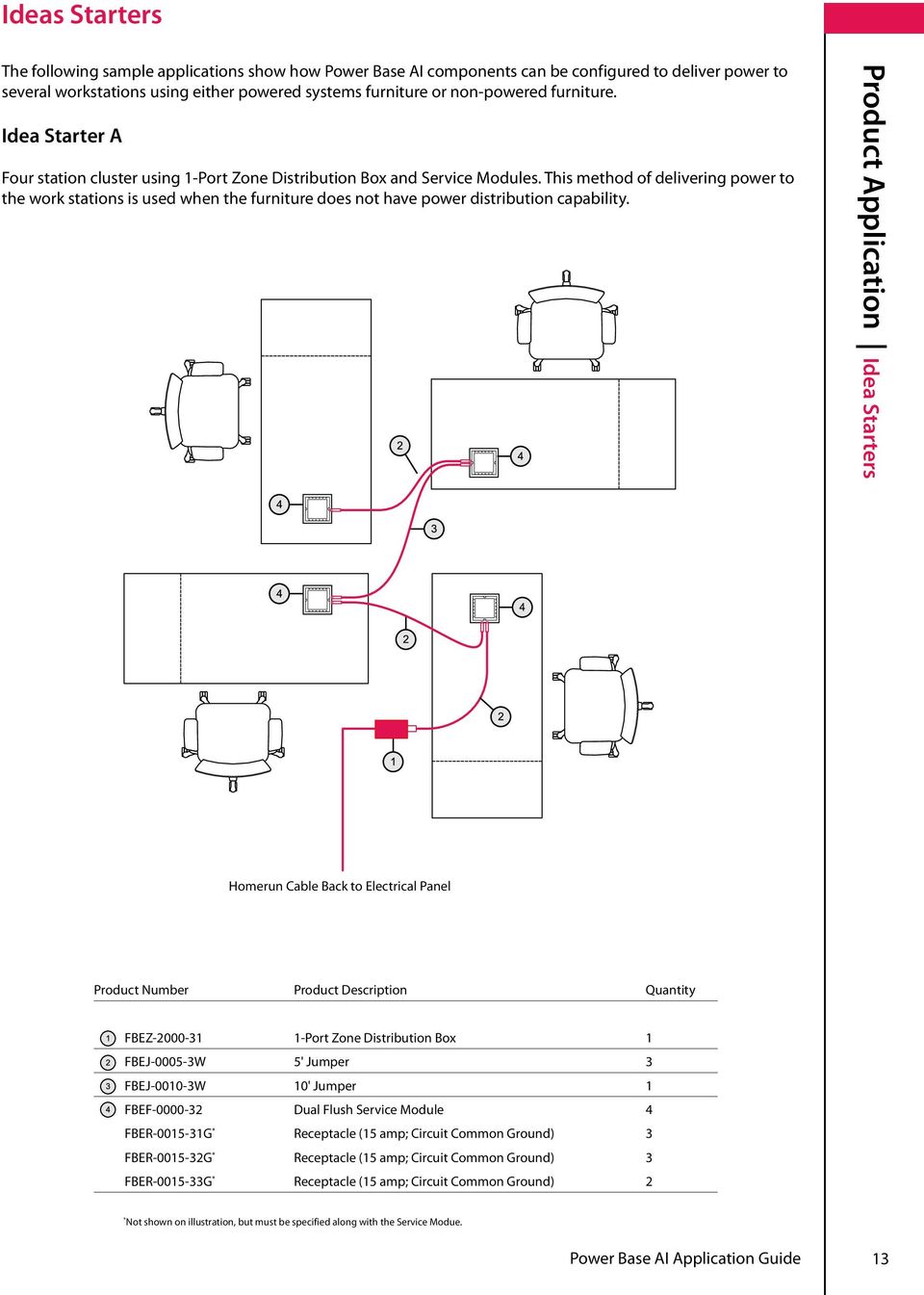
12 Ideas Starters The following sample applications show how Power Base AI components can be configured to deliver power to several workstations using either powered systems furniture or non-powered furniture. Idea Starter A Four station cluster using 1-Port Zone Distribution Box and Service Modules. This method of delivering power to the work stations is used when the furniture does not have power distribution capability. Product Application Idea Starters Homerun Cable Back to Electrical Panel Product Number Product Description Quantity FBEZ Port Zone Distribution Box 1 FBEJ W 5' Jumper 3 FBEJ W 10' Jumper 1 FBEF Dual Flush Service Module 4 FBER G * Receptacle (15 amp; Circuit Common Ground) 3 FBER G * Receptacle (15 amp; Circuit Common Ground) 3 FBER G * Receptacle (15 amp; Circuit Common Ground) 2 * Not shown on illustration, but must be specified along with the Service Modue. Power Base AI Application Guide 13
13 Ideas Starters Product Application Idea Starters Idea Starter B Four station cluster with powered systems furniture. Two four station clusters may be supplied by an Infeed Harness and 4-Port Splitter depending on amperage load per station. Infeed Harness from Electrical Panel Product Number Product Description Quantity FBEH W Infeed Harness: 50' 1 FBED Port Splitter 1 FBEJ W 10' Jumper 2 FBED Port Splitter 2 ENEJ WF PREMISE System Floor Infeed 2 14 Power Base AI Application Guide

14 Ideas Starters Idea Starter C Six station cluster with 3-Port Zone Distribution Box and floor-mounted Service Modules. Use when the furniture does not have power distribution capability. Product Application Idea Starters Pre-Wired Conduit Back to Electrical Panel Product Number Product Description Quantity FBEZ Port Zone Distribution Box (50' pre-wired Conduit) 1 FBEJ W 5' Jumper 6 FBED Port Splitter 1 FBEJ W 10' Jumper 1 FBEF Dual Flush Service Module 6 FBER G * Receptacle (15 amp; Circuit Common Ground) 4 FBER G * Receptacle (15 amp; Circuit Common Ground) 4 FBER G * Receptacle (15 amp; Circuit Common Ground) 4 * Not shown on illustration, but must be specified along with the Service Modue. Power Base AI Application Guide 15

15 Ideas Starters Product Application Idea Starters Idea Starter D Splitters can be used in mixed applications. This example shows a 4-Port Splitter feeding a Furniture Base Feed and two Flush Service Modules. Infeed Harness from Electrical Panel Product Number Product Description Quantity FBEH W Infeed Harness (50') 1 FBED Port Splitter 1 FBEJ W 15' Jumper 2 FBEJ W 10' Jumper 1 FBED Port Splitter 1 ENEJ WF PREMISE System Floor Infeed 1 FBEF Dual Flush Service Module 2 FBER G * Receptacle (15 amp; Circuit Common Ground) 2 FBER G * Receptacle (15 amp; Circuit Common Ground) 1 FBER G * Receptacle (15 amp; Circuit Common Ground) 1 * Not shown on illustration, but must be specified along with the Service Modue. 16 Power Base AI Application Guide

16 Ideas Starters Idea Starter E LifeSPACE panel with Level 4 quick connect electrical or Enclose panel with Level 4 power. Using Power Base AI with LifeSPACE allows for maximum flexibility in reconfiguration of office space. For reconfiguration requiring minimal displacement of the LifeSPACE panel, simply move the panel to the new location, if the Jumper length allows. Or when reconfiguration requires a new layout, simply disconnect the Jumper from the LifeSPACE panel and the Zone Distribution Box. Move the LifeSPACE panel to the new location and reconnect Jumper to the LifeSPACE panel and the Zone Distribution Box. Quick and easy with little or no mess. If using LifeSPACE electrical panels and Power Base AI, the systems must be coordinated. Product Application Idea Starters Infeed Splitter Note All GFI Outlets must be hardwired. Power Base AI Application Guide 17

17 Ideas Starters Product Application Idea Starters Idea Starter F When providing power to non-haworth furniture or LifeSPACE walls with Level 2 or Level 3 electrical, use a 1-Port Zone Distribution Box for a hardwire transition. Duplex Outlet 1-Port Zone Distribution Box Jumper 18 Power Base AI Application Guide

18 Electrical Basics There are two electrical systems prevalent in North America 3-Circuit or 4-Circuit. The choice to specify 3- or 4- Circuit power is determined both by the system furniture requirements and the power provided by the building. Check with the project electrical engineer on what system is most suitable prior to specifying the electrical system for a project. Idea Starter A An 8-Wire 3-Circuit system consists of three line conductors, three neutral conductors, and two ground conductors. Haworth Systems Furniture usually uses the 3-Circuit configuration. This configuration utilizes independent neutral conductors for each line conductors, creating individual branch circuits. These individual branch circuits provide the most flexibility in support of building wiring configurations and the highest level of power quality. Product Application Electrical Basics Benefits of Using a 3-Circuit System 1. Individual branch circuits allow electrician to adapt wiring configuration as users needs change. 2. Can be connected to multiple power sources. 3. Common and Isolated ground available on all 3-Circuits. 4. Independent neutrals confine power quality issues to an individual branch circuit. 5. Haworth Systems Furniture Base Feed plugs directly into 3-Circuit Power Base AI eliminates labor to wire base feed via a junction box. 6. May be more cost effective depending on client s needs. Disadvantages of Using a 3-Circuit System 1. Less circuit capability per zone. 2. More Power Base AI components and homerun cables may be required. 3. May require more on site installation labor required from Electrical Contractor. 4. May not match configuration used by most System Furniture Manufacturers. Power Base AI Application Guide 19

19 Electrical Basics Product Application Electrical Basics 4-Circuit System An 8-Wire 4-Circuit system consists of four line conductors, two neutral conductors, and two ground conductors. Within this system, two wiring configurations are available: 2+2 and 3+1. In a 2+2 configuration, two line conductors share one neutral conductor and one ground wire and the other two line conductors share a neutral conductor and ground wire. In a 3+1 configuration, three line conductors share one neutral conductor and one ground wire and the other line conductor uses the other neutral conductor and ground wire. These systems utilize a shared, oversized neutral conductor to minimize adverse effects caused by harmonic currents. 2+2 The 2+2 configuration includes two lines on one oversized neutral and two lines on another oversized neutral. Specify this configuration where multiple dedicated or isolated ground circuits are required in a zone or more than one source of power, such as UPS power, is required. 3+1 The 3+1 configuration comes with three lines on one oversized neutral and one line on a separate oversized neutral. Specify this configuration where either no dedicated or isolated ground is required or only one circuit will be used as a dedicated or isolated ground. Benefits of Using a 4-Circuit System 1. More circuit capability per zone. 2. Fewer Power Base AI components and homerun cables may be required. 3. Usually less on site installation labor required from Electrical Contractor. 4. May match configurations used by most System Furniture Manufacturers. Disadvantages of Using a 4-Circuit System 1. Harder to adapt to changes in building wiring needs. 2. Limited capacity of isolated ground circuits. 3. Shared neutral may cause sharing of power quality problems. 4. GFCI (Ground Fault Circuit Interrupter) may not be available. 20 Power Base AI Application Guide

20 Electrical Basics Electrical Code and Performance Factors National and local electrical codes may restrict what you can do with these products. These codes are primarily designed for safety. To achieve the desired level of flexibility and performance for a facility, additional factors may need to be considered. Below is a brief description of safety and performance topics. To ensure safety and code compliance, be sure that your plans are reviewed by an expert in local code requirements such as an electrical engineer or electrical contractor. The person or group planning and supervising installation of electrical components is responsible for complying with all applicable national and local electrical codes. Within local code guidelines, limit the receptacle installation to the maximum necessary to power the equipment in the current work station plan. Avoid providing receptacles for projected needs, because surplus receptacle availability may encourage use of unauthorized equipment and lead to electrical overloads. Circuit Capabilities and Code Restrictions Each circuit in the Power Base AI modular electrical system carries a maximum load of 20 amps (15 amps in Canada) of electrical service. However, applicable national and local codes may further restrict the current usage of the power distribution system. For example, the National Electrical Code (NEC) dictates a load requirement of no more than 80% (16 amps) capacity for continuous load situations (constant use of a circuit for three or more hours). Examples of continuous use loading include circuits that supply lighting, computers, and printers with power throughout the day. In practice, most circuits are subjected to continuous load. Planning for the Future Based on the circuit load capacity of 16 usable amps (U.S.) per continuous-use circuit, Haworth recommends that the initial loading on each circuit be approximately 12 amps. This initial planning limitation permits the user to add or change electrical equipment within the guidelines of local amperage limits. If you immediately allow maximum amperage loading of 16 amps (U.S.) on each circuit, you will restrict the future addition of equipment and may force a redesign of the electrical layout. Product Application Electrical Basics Voltage Drop The natural resistance of the wires causes voltage to fall away from the ideal voltage (120V in North America). The farther your circuit travels from the electrical closet, the more voltage drop will occur. The NEC requires that voltage drop be no more than 5% from the ideal voltage. To limit how far the systems falls below the ideal voltage, limit the length of the circuits to less than 80' from a Zone Distribution Box. Number of Receptacles The NEC also restricts the number of receptacles on a 20 amp rated circuit to 13 (10 in Canada). These are maximum limits only and not recommendations. Local codes may restrict number of receptacles. Within local code guidelines, limit the receptacle installation to the maximum necessary to power the equipment in the current work station plan. Avoid providing receptacles for projected needs, because surplus receptacle availability may encourage use of unauthorized equipment and lead to electrical overloads. REGARD LOCAL CODES CAREFULLY Local codes supercede national codes. Local codes may restrict electrical plans more than national codes. For example, a local code may not allow any modular underfloor power system. Local codes may also limit the number of jumper cables and receptacles that may be used. Power Base AI Application Guide 21

21 3-Circuit Service Module Applications Product Application 3-Circuit Service Module Applications Note Examples are based on planning for an initial load of 12 amps per circuit. Check local electrical codes for maximum allowed electrical devices per circuit. 3-Circuit Service Module: Application 1 Electrical Load: 2 floor boxes per feed 18 amps per office (leaves 6 amps per office for future growth) Requires: 1 Infeed Harness 1 Jumper 2 Service Modules 3-Circuit Service Module: Application 2 Electrical Load: 6 floor boxes per feed 6 amps per office (leaves 2 amps per office for future growth) Requires: 1 Infeed Harness 6 Jumpers 1 Splitter 6 Service Modules 3-Circuit Service Module: Application 3 Electrical Load: 18 floor boxes per feed 2 amps per office (leaves 0.6 amps per office for future growth; maximize size of floor box zone even if a lower amps per office is desired) Requires: 1 Infeed Harness 18 Jumpers 1 Splitter 18 Service Modules 22 Power Base AI Application Guide
22 3-Circuit Furniture Infeed Applications Note Examples are based on planning for an initial load of 12 amps per circuit. Check local electrical codes for maximum allowed electrical devices per circuit. 3-Circuit Furniture Infeed: Application 1 Electrical Load: 3 offices per feed 12 amps per office (leaves 4 amps per office for future growth) Requires: 1 Zone Distribution Box 2 Jumpers 2 Splitters 2 Furniture Infeeds 3-Circuit Furniture Infeed: Application 2 Electrical Load: 6 offices per feed 6 amps per office (leaves 2 amps per office for future growth) Requires: 1 Infeed Harness 1 Splitter 1 Furniture Infeed Product Application 3-Circuit Furniture Infeed Applications 3-Circuit Furniture Infeed: Application 3 Electrical Load: 18 offices per feed 2 amps per office (leaves 0.6 amps per office for future growth) Requires: 1 Infeed Harness 3 Jumpers 4 Splitters 3 Furniture Base Feeds Power Base AI Application Guide 23
23 4-Circuit Service Module Applications Product Application 4-Circuit Service Module Applications Note A Jumper (male connectors) is required to connect to another Splitter or Zone Distribution Box. 4-Circuit Service Module: Application 1 Electrical Load: 3 floor boxes per feed 16 amps per office (leaves 5.3 amps per office for future growth) Requires: 1 Infeed Harness 2 Jumpers 3 Service Modules 4-Circuit Service Module: Application 2 Electrical Load: 6 floor boxes per feed 8 amps per office (leaves 2.6 amps per office for future growth) Requires: 1 Infeed Harness 6 Jumpers 1 Splitter 6 Service Modules 4-Circuit Service Module: Application 3 Electrical Load: 24 floor boxes per feed 2 amps per office (leaves 0.6 amps per office for future growth; maximize size of floor box zone even if a lower amps per office is desired) Requires: 1 Infeed Harness 26 Jumpers 3 Splitters 24 Service Modules 24 Power Base AI Application Guide
24 4-Circuit Furniture Infeed Applications Note Examples are based on planning for an initial load of 12 amps per circuit. Check local electrical codes for maximum allowed electrical devices per circuit. 4-Circuit Furniture Infeed: Application 1 Electrical Load: 3 offices per feed 16 amps per office (leaves 5.3 amps per office for future growth) Requires: 1 Zone Distribution Box 2 Jumpers 2 Splitters 2 Furniture Base Feeds 4-Circuit Furniture Infeed: Application 2 Electrical Load: 6 offices per feed 8 amps per office (leaves 2.6 amps per office for future growth) Requires: 1 Infeed Harness 1 Splitter 1 Furniture Base Feed Product Application 4-Circuit Furniture Infeed Applications 4-Circuit Furniture Infeed: Application 3 Electrical Load: 24 offices per feed 2 amps per office (leaves 0.6 amps per office for future growth; maximize size of floor box zone even if a lower amps per office is desired) Requires: 1 Infeed Harness 2 Jumpers 3 Splitters 4 Furniture Base Feeds Power Base AI Application Guide 25
25 Planning Guide Product Application Planning Guide Planning For The Future The best time to plan for the future is while planning the installation of a new office space today. Future needs can be accommodated by planning for some extra capacity in the original project. All Power Base AI components are fully populated with all eight wires to support future reconfigurations. One way to plan in extra capacity is to use 12 amps per circuit instead of the 16 amps per circuit allowed by the Electrical Code (U.S.). The 4 amps of extra capacity allow for future unseen additional electrical requirements, like a printer being added to a work area. If a zone needs a large increase in power capacity, you can add another Infeed Harness and circuit distributor and reroute half the existing zone to this new Infeed Harness. Planning A Project The ten easy steps below and detailed on the following pages help determine the layout of the Power Base AI modular components. These ten steps will lead to a detailed layout and a detailed bill of materials. From the detailed bill of materials, final pricing can be determined and the Power Base AI product can be ordered through Haworth Orderline. Typically, as projects progress, more information is developed and more detail is required. During early stages of a project it may be more appropriate to use simplified tools such as the Power Base AI Budget Calculator tool to estimate pricing or materials that may be required for a project. All power components are populated with all eight wires to support future reconfigurations (except for Hardwire power applications). Planning for Power Base AI in Ten Steps: 1. Identify the User s Needs 2. Identify the Building Power Location 3. Identify Access Devices 4. Electrical Code and Performance Factors 5. Determine Size of Zones 6. Specify Access Points 7. Specify Zone Distribution Boxes and Homeruns 8. Specify Jumpers and Splitters 9. Assign Circuit Breakers 10. Obtain Approvals 26 Power Base AI Application Guide
26 Planning for Power Base AI in Ten Steps Step 1: Identify the User s Needs Start by gathering basic information from written specifications, engineering drawings, or a questionnaire such as the Request for Technology form. In what country is the project located? How many square feet is the project? How many offices and workstations are there? What size are the offices and workstations? How much power is required per user? What is required: 3-Circuit or 4-Circuit power? If 4-Circuit power is required, is it a 3+1 or a 2+2 configuration? Is the systems furniture non-powered or powered with a 3-Circuit or 4-Circuit (3+1 or 2+2) configuration? How many outlets are required per office and workstation? Are there any pieces of equipment requiring special power requirements? Is there any equipment requiring more than 20 amps? Is there a need for a secondary power source(s) such as Uninterruptible Power Supply (UPS), generator, or other source? What access floor are you using and what is its height? Product Application Planning for Power Base AI in Ten Steps Notes 1. For large machines, a separate power feed direct from electrical panel to that machine may be the best solution. Planning for these large machines is better handled separate from the zone planning approach. 2. Secondary source(s) may be used to power mission critical equipment to keep business operations running despite power outages. This enhanced level of power supply performance requires more specific planning steps in routing power and circuit designations. The principles of the zone planning methodology still apply, but some additional components may be required to deliver the secondary power source to required locations. Power Base AI Application Guide 27
27 Planning for Power Base AI in Ten Steps Product Application Planning for Power Base AI in Ten Steps Step 2: Identify the Building Power Locations Power is typically delivered from an electrical closet where the service panel is located. Identify where this is on the floor plan to help plan from where power will be routed. Confirm that there is enough capacity available in the electrical closet to supply the power required by the user. For example, if there are 119 workstations using 4 amps each, that requires 476 available amps (119 x 4). If the building provides a panel with a 400 amp service there is not enough capacity to supply the user s power requirements. In this case the incoming service will require upgrading or less power can be supplied per station. Refer to Planning Guide Drawing A. Planning Guide Drawing A: Power Locations Tip When laying out the power homeruns and Power Base AI components be aware of the data cable runs to minimize crossover points 28 Power Base AI Application Guide
28 Planning for Power Base AI in Ten Steps Step 3: Identify Access Devices Determine what method(s) of power delivery may be required for the project. To power Haworth systems furniture, specify Haworth power infeeds. Non-powered systems furniture require delivery of power with the use of Service Modules. LifeSPACE panels with Level 4 power will require Jumpers to the Zone Distribution Box. LifeSPACE panels with Level 3 Power or powered non-haworth systems furniture may be fed from a 1-Port Zone Distribution Box. Place power access devices (Service Modules, furniture feeds and/or wall feeds) where required on floor plan. In Planning Guide Drawing B, we use Flush Service Modules to supply power to the workstations. Haworth wall feeds connect to Jumpers by using a Splitter or connect directly to a Service Module or Zone Distribution Box. Systems furniture feeds may use the power of an Infeed Harness with just one feed, depending on loading per cluster size. Identify quantity of devices required per office. Planning Guide Drawing B: Access Devices Product Application Planning for Power Base AI in Ten Steps Power Base AI Application Guide 29
29 Planning for Power Base AI in Ten Steps Product Application Planning for Power Base AI in Ten Steps Step 4: Electrical Code and Performance Factors National and local building and electrical codes exist to ensure occupant safety. These codes create guidelines that govern product application. Below is a summary of common code guidelines that may affect Power Base AI applications. Circuit Capabilities and Code Restrictions Each circuit in the Power Base AI modular electrical system carries a maximum load of 20 amps (15 amps in Canada) of electrical service. However, applicable national and local codes may further restrict the current usage of the power distribution system. For example, the National Electrical Code (NEC) dictates a load requirement of no more than 80% (16 amps U.S.) capacity for continuous load situations (constant use of a circuit for three or more hours). Examples of continuous use loading include circuits that supply lighting, computers, and printers with power throughout the day. In practice, most circuits are subjected to continuous load. Planning for Future Growth Based on the circuit load capacity of 16 usable amps per continuous-use circuit (U.S.), Haworth recommends that the initial loading on each circuit be approximately 12 amps. This initial planning limitation permits the user to add or change electrical equipment within the guidelines of local amperage limits. If you allow maximum amperage loading of 16 amps on each circuit, now you will restrict the future addition of equipment and may force a redesign of the electrical layout. Voltage Drop The natural resistance of the wires causes voltage to fall away from the ideal voltage (120V in North America). The farther your circuit travels from the electrical closet the more voltage drop will occur. The NEC requires that voltage drop be no more than 5% from the ideal voltage. To limit how far the systems falls below the ideal voltage, limit the length of the circuits to less than 80' from a Zone Distribution Box or Infeed Harness. Number of Receptacles The NEC also restricts the number of receptacles on a 20-amp rated circuit to thirteen (ten in Canada). These are maximum limits only and not recommendations. Local codes may also further restrict current location, number of circuits, or number of receptacles. REGARD LOCAL CODES CAREFULLY Local codes supercede national codes. Local codes may restrict electrical plans more than national codes. A local code may reduce the number of receptacles and/or jumper cables allowed on each circuit. Within local code guidelines, limit the receptacle installation to the maximum necessary to power the equipment in the current work station plan. Avoid providing receptacles for projected needs, because surplus receptacle availability may encourage use of unauthorized equipment and lead to electrical overloads. 30 Power Base AI Application Guide
30 Planning for Power Base AI in Ten Steps Step 5: Determine the Size of the Zone In most applications you will have to subdivide the floorplate into smaller sections, called "zones", that can be supplied by one set of 3- or 4-Circuits. An Infeed Harness can route from the electrical closet to each zone. The Zone Distribution Box routes two or three sets of circuits to an area of the building. Jumpers can be used to route a single set of circuits from the Zone Distribution Box to each zone. A 3-Circuit infeed provides 36 amps and a 4-Circuit infeed provides a total of 48 amps for distribution to the users (if using 12 amps per circuit for initial planning). Dividing the floorplate into zones determines the number and locations of the Infeed Harnesses or Zone Distribution Boxes needed to provide the required power requirements to each area (refer to Planning Guide Drawing C). There are two methods of determining the number and location of the Zone Distribution Boxes. 1. Furniture Layout Available Using the information from Step 1, calculate how many offices can be supplied by a set of circuits. Multiply number of circuits times amps/circuit then divide by amps/person to determine offices/zone. In our example we used 3 circuits x 12 amp/circuit 4 amps/person = 9 offices/zone. Divide the floor up into zones based on the number of office/zones. Sometimes physical constraints within the layout make it inconvenient to reach the maximum office/zone number calculated above. Using less than the maximum offices/zone is okay but more zones may be required to cover the floor plan. Try to keep the zones closer to a square shape rather than a long rectangle to keep Jumper lengths to a uniform size to more easily facilitate future reconfiguration requirements. Power access within a zone may be accomplished by floor, furniture, or wall based receptacles. 2. Furniture Layout Not Available An alternate approach to determine the zone uses the work station size and the number of amps required per station from Step 1. Determine how many offices can be supplied by a Zone Distribution Box and then multiply by the area each office covers to find total area supplied by one Zone Distribution Box. Divide the floorplate into zones of this area. Don't forget to include aisle space around each workstation when calculating the total area of a zone. For example if the workstations are 6' x 8', add 2' along one side for aisle way allowance. That makes the work station area 8' x 8', or 64 square feet. Using the information from Step 1, calculate how many offices can be supplied by a Zone Distribution Box. Multiply number of circuits times amps/circuit then divide by amps/person to determine offices/zone. In our example we used 3 circuits x 12 amp/circuit 4 amps/person = 9 offices/zone. Multiply the number of square feet per station by the number of stations to determine the zone. Therefore, 9 workstations at 64 square feet each is a 576 square foot zone (approximately 24' x 24'). Subdivide the floor plan into zones which are 576 square feet. Try to keep the zones closer to a square shape rather than a long rectangle to keep the Jumpers shorter and of more similar length for future reconfiguration requirements. If you have to develop a plan without information on where the furniture will be, use longer Jumpers in Step 8 to give you more flexibility to adapt as furniture is added. Product Application Planning for Power Base AI in Ten Steps Tip See Planning Guide Drawing C: Zones. Note Due to the large size private offices and conference rooms can cover, it may be better to limit the number of these rooms fed by a set of circuits to a maximum of four rooms. This will limit the likelihood of having a voltage drop issue. Large training rooms or auditoriums may require more than one zone. Rooms with lots of equipment, such as a document center, may use enough power to warrant a zone for just that room. Power Base AI Application Guide 31
31 Planning for Power Base AI in Ten Steps Product Application Planning for Power Base AI in Ten Steps Planning Guide Drawing C: Zones 32 Power Base AI Application Guide
32 Planning for Power Base AI in Ten Steps Step 6: Specify Access Points Flush Service Modules When Service Modules are specified, specify location of module on floor plan. Order pre-cut floor tiles to receive the Service Module. Modular Receptacle should be ordered for the Service Modules. When specific circuits have been requested by the customer, order receptacles per the specifications provided. If circuit assignments have not been specified, start by assigning circuit one receptacles to the first Service Module in a zone and then circuit two for the second Service Module, and so on. Repeat assignment of all receptacles 1-3 for a 3-Circuit system or 1-4 for a 4-Circuit system. Powered Systems Furniture If furniture Infeeds are specified, a similar planning process will be required for the systems furniture power outlets starting at the furniture feed. Receptacle locations and receptacle circuit assignments are required for the systems layout also. The receptacles in the systems furniture should also have a repeating pattern of 1-3 for a 3-Circuit application or 1-4 for a 4-Circuit application. Isolated Ground Receptacles Additional information may be required if isolated ground receptacles are required for a project to allow for proper circuit planning. When computers or printers require an isolated ground circuit it may constitute a major portion of the power used by a workstation. When specific circuits have been specified by the customer, order circuits as per the specifications provided. For a 4-Circuit electrical system, if circuits have not been specified by the customer, it may be necessary to assign circuits three and four for use of the isolated ground receptacles leaving circuits one and two for utility power receptacles. The first workstation in this case may be assigned a circuit one for utility power and a circuit three for isolated ground power. The second workstation would be assigned a circuit two for utility power and a circuit four for isolated ground power. Repeat this pattern of circuit assignment for the remaining workstations. Planning Guide Drawing D: Access Points Product Application Planning for Power Base AI in Ten Steps Power Base AI Application Guide 33
33 Planning for Power Base AI in Ten Steps Product Application Planning for Power Base AI in Ten Steps Step 7: Specify Infeed Harnesses or Zone Distribution Boxes Route an Infeed Harness from the electrical closet to each zone. For longer distances you may need to use a Zone Distribution Box to bring power form the electrical closet and Jumpers to reach into each zone. A Zone Distribution Box also may be more economical than an Infeed Harness where three zones are close together. Check for space restrictions when routing conduit to the electrical closet. Avoid excessive cross over of conduits. The pre-wired Zone Distribution Box conduit requires 21/4" height under the floor tile. For low profile floor applications, the use of MC cable and 1-Port Zone Distribution Boxes may be required. Also leave room for routing data cables. Try to keep parallel runs of power and data 4' apart to minimize cross talk. Planning Guide Drawing E: Infeed Harnesses and Zone Distribution Boxes 34 Power Base AI Application Guide
34 Planning for Power Base AI in Ten Steps Step 8: Specify Jumpers and Splitters Determine what Jumpers and Splitters are needed to power up Service Modules or Haworth base feeds (Refer to Planning Drawing F). Jumpers are used to connect Service Modules. The Quad Service Module has four ports for connecting Jumpers and the Dual Service Module has two ports. The Infeed Harness may connect to a Service Module. A Jumper is needed to route power from a Zone Distribution Box to the Service Module. The Splitter is available in 2- or 4-Port models. The 4-Port model allows branching of the three Jumpers from a Jumper or Infeed Harness. The 2-Port model allows for connection of two Jumpers or between Jumper and Infeed Harness or furniture base feed. Determine Jumper lengths required. Excess Jumper length may be coiled and left under the raised access floor for future use. Show Jumpers and circuit distributors on the floor plan. Indicate Jumper lengths on the drawing. Planning Guide Drawing F: Jumpers and Splitters Product Application Planning for Power Base AI in Ten Steps Power Base AI Application Guide 35
35 Planning for Power Base AI in Ten Steps Product Application Planning for Power Base AI in Ten Steps Step 9: Assign Circuit Breakers Designate on the floor plan which circuit breakers feed the conduit for each zone (Refer to Planning Drawing G). Use the circuit numbering provided on the engineering drawing. If no information is available from the engineering drawings, an electrician assigns the circuits. Add legend and electrical connection diagrams to layout drawings to assist with installation. Large pieces of equipment such as photocopiers should be assigned a separate breaker. The assignment of circuits and circuit breakers in a multiple power sourcing application is critical to assure safety, code compliance, and proper performance. When alternate power sources are specified, detailed information may be required regarding the circuit breakers assigned to these power sources. Planning Guide Drawing G: Circuit Breakers Step 10: Obtain Approvals The underfloor power is typically seen as part of the building s infrastructure. It is better to communicate your plan back to several parties involved with the construction. These may include the Customer, Architect, Specifying Electrical Engineer, Electrical Subcontractor and Others. Obtain signature approvals from appropriate participants to verify proper communication has been made on this construction project. 36 Power Base AI Application Guide
36 Technical Specifications Infeed Harness Infeed Harness is constructed of 1/2" flexible metal conduit 12 AWG wire (10 AWG for shared neutral) up to 50 feet. For 50 feet or beyond, harness is constructed of 3/4" flexible metal conduit 10 AWG wire. Provided with male modular connector at one end and conduit fitting on the other end. Infeed Harnesses are available in lengths of 15", 10', 25', 50', 75', and 100' in either 8-Wire 3-Circuit (3-3-2 separate neutral) wiring configurations or 4-Circuit (4-2-2 shared neutral) wiring configurations to support a 3+1 or 2+2 wiring configuration. The 3- and 4-Circuit versions are keyed to prevent mixing of configurations. UL Listed Manufacturing Wiring System rated for 20 amp 120V/208V or 120V/240V 60 Hz and for use in other air handling spaces per National Electrical Code Article 604. Supports plug-and-play power within each power zone. Flexible conduit construction with quick connect modular power connectors allows for quick install and easy reconfiguration. Infeed Harnesses are used to connect from building Circuit Breaker Box to Service Modules or Splitters or from Zone Distribution Boxes to a hardwire junction box connection. May be connected to Jumpers, base feeds, and modular wall connectors by using a Splitter. Zone Distribution Box Box is constructed of 0.575" " (16 gauge) thick black zinc-plated steel box with cover. The 3-Port Zone Distribution Box is provided with one 11/4" conduit containing twenty-one 10 AWG wires with conduit in lengths up to 125'. This is intended to be connected to the building Circuit Breaker Box. Three modular female ports are factory wired, ready for modular Jumpers. The 2-Port Zone Distribution Box is provided with one 11/4" conduit containing fourteen 8 AWG wires in lengths 150' 200'. This is intended to be connected to the building Circuit Breaker Box. Two modular female ports are factory wired, ready for modular Jumpers. The 1-Port Low Profile Zone Distribution Box in intended to be connected to the building Circuit Breaker Box by a licensed electrician using 1/2" or 3/4" conduit and appropriately sized wire. Wire leads inside the box are connected to a modular port, ready for a modular Jumper. The 3-Port Zone Distribution Box is also available in field wired configuration. This is intended to be connected to the building Circuit Breaker Box by a licensed electrician using 11/4" conduit and appropriately sized wire. Terminal strips inside the box are connected to three modular ports, which are factory wired, ready for modular Jumpers. All Zone Distribution Boxes are available 8-Wire 3-Circuit (3-3-2 separate neutral) wiring configurations or in 4-Circuit (4-2-2 shared neutral) wiring configurations to support 3+1 or 2+2 wiring configurations. The 3- and 4-Circuit versions are keyed to prevent mixing of configurations. UL Listed Manufacturing Wiring System rated for 20 amp 120V/208V or 120V/240V 60 Hz and for use in other air handling spaces per National Electrical Code Article and 3-Port Zone Distribution Box is 2.125" H x 11.06" W x 11.06" L. Box height of 2.125" allows for 4" or higher finished TecCrete Raised Access floor height. The 1-Port Zone Distribution Box is 1.75" H x 3" W x 7" L. Box height of 1.75" allows for a 3" or higher TecCrete Raised Access Floor finished floor height. The Zone Distribution Box does not replace access floor pedestal supports. Technical Specifications Power Base AI Jumpers Jumpers are constructed of flexible conduit with quick connect modular male power connector heads at both ends. Available with either 12 AWG (10 AWG shared neutral) or all 10 AWG wires, the 12/10 AWG is 5 8" oval flexible metal conduit and all 10 gage is in a 3/4" oval flexible metal conduit. Modular connectors are provided with integral latching system and include snap-in safety covers per NEC Article 604. Cables are available in length of 5', 10', 15', 20', 25', 35' and 50' in either 8-Wire 3-Circuit (3-3-2 separate neutral) wiring configurations or in 4-Circuit (4-2-2 shared neutral) wiring configurations to support 3+1 or 2+2 wiring configurations. The 3- and 4-Circuit versions are keyed to prevent mixing of configurations. Jumpers interconnect modular power components within each power zone. Supports plug-and-play power within each power zone. Flexible conduit construction with quick connect modular power connectors allow quick install and easy reconfiguration. Use to connect between Zone Distribution Boxes and Service Modules. Jumpers cannot be connected together directly, use a Splitter to interface between adjoining female connector heads. Use a Splitter to connect to Haworth furniture plug-and-play base feeds or infeeds. UL Listed Manufacturing Wiring System rated for 20 amp 120/208V or 120/ Hz and for use in other air handling spaces per National Electrical Code Article 604. Power Base AI Application Guide 37
37 Technical Specifications Technical Specifications Power Base AI Splitters Splitter have a female connection configuration and are constructed of eight tin plated copper busbars within polymeric enclosure with integral latching system. Available in either 8-Wire 3-Circuit (3-3-2 separate neutral) wiring configuration or in 4-Circuit (4-2-2 shared neutral) wiring configurations to support 3+1 or 2+2 wiring configurations. The 3- and 4-Circuit versions are keyed to prevent mixing configurations. 4-Port Splitters have four female ports allowing it to interconnect up to four Jumpers within each power zone. One port is intended for the power supply connection with the ability to distribute out to the other three ports. 2-Port Splitters have two female ports connecting up to two Jumpers within a power zone. One port is intended for the power supply connection with the ability to connect to the other port. Supports plug-and-play power distribution with each power zone. Quick connect modular power connection allows quick install and easy reconfiguration. Typically one acts as the inlet and the others are outbound branches. UL Listed Manufacturing Wiring Systems rated for 20 amp 120V/208V or 120V/240V 60 Hz and for use in other air handling spaces per National Electrical Code Article 604. Splitters come with snap in safety covers per NEC Article 604. Splitters connect to male connectors of Jumpers and Haworth furniture plug-and-play base feeds. Splitters cannot connect directly to female connections of Zone Distribution Box or Service Modules. Service Module Flush Service Module constructed of " " (16 gauge) thick black zinc-plated steel box. 2.5" high Dual Service Module is constructed with two integral females connectors for connection to Jumpers or Infeed Harnesses. 4.5" high Quad Service Module is constructed with four integral female connectors for connection to Jumpers or Infeed Harnesses. Receptacle/Data plates are concealed under hinged lid. Powdercoat painted lid and trim ring with twelve small ports in lid for cords and cables to exit the box. Lid accepts carpet insert. Unit fits 101/2" square opening in raised access floor tile. Unit is secured to floor tile using four mounting screws. Available in either 8-Wire 3-Circuit (separate neutral) wiring configurations or in 4-Circuit (shared neutral) wiring configurations to support 3+1 or 2+2 wiring configurations. The 3- and 4-Circuit versions are keyed to prevent mixing of configurations. Dual Service Module accepts two Modular Receptacles, which are available separately, with common or isolated ground receptacles and four furniture info plates. Each opening has a knockout to accept a single gang data plate. Data plates or furniture info plates are provided by Others. The Dual Service Module is designed for use in 3" or higher TecCrete access floor finished floor height. 4.5" high Quad Service Module accepts four Modular Receptacles, which are available separately, with common or isolated ground receptacles and two furniture info plates. Each opening has a knockout to accept a single gang data plate. Data plates or furniture info plates are provided by Others. The Quad Service Module is designed for use in 4.5" or higher TecCrete access floor finished floor height. Flush Service Modules are used to provide power and data at floor level. Outlets are located under hinged lid which is flush with finished floor. Supports plug-and-play power distribution with each power zone. Quick connect modular power connection allows quick install and easy reconfiguration. Typically one acts as the inlet and the others are outbound branches. UL Listed Manufacturing Wiring System rated for 20 amps 120V/208V or 120V/240V 60 Hz and for use in other air handling spaces per National Electrical Code Article 604. Female connector head must be fed by male connector of Jumper or Infeed Harness. Female connector will not connect directly to female connector of Zone Distribution Box or Splitter. Modular Receptacles Modular Receptacles are constructed with plastic body and copper alloy terminals for quick connection to ports of the Service Modules. Available in NEMA 5-15R or 5-20R duplex configurations. When ordering specify which circuit is accessed and common or isolated ground configuration. UL Listed rated for 120V 60 Hz. Systems Furniture Feed Haworth Base feeds are constructed with male connector head for quick connect attachment to Zone Distribution Box or Service Module. Base feed may be connected to Jumper or infeed using a Splitter. Available in 3- or 4-Circuit configuration, depending on type of power available in the Haworth Furniture. Base feeds are UL/ CSA listed for direct connection of systems furniture modular wiring directly to under floor power distribution. Connection to non-haworth furniture systems may be made via the 1-Port Distribution Box with a female connector on the box and an electrician hardwiring to the wires. The box is made of " " (16 gauge) thick black zinc-plated steel. Junction box provides 46 cubic inches interior space. Conduit from systems furniture base feed may be connected to junction box via 1/2" and 3/4" knockouts. Conductors may be joined to 8" leads of connector at the job site. Available with one 3- or 4-Circuit female connector. 38 Power Base AI Application Guide
38 Power Base AI Power Base AI Three Part Specification Guide 39
39 PART 1 - GENERAL Power Base AI Modular Electrical System Section Summary A. This section includes the following: The Haworth Power Base AI modular power system provides you with factory assembled UL Listed components which allow you to create a modular zone power distribution system for your facility. These "plug and play" components allow for a quick installation. This quick install reduces project schedule risk during the critical end phases of a construction project. The fully populated connectors provide flexibility for future moves, adds, and changes. The Zone Distribution Box supports more extensive changes in power demands. The system is available in three or four 20 A branch circuit wiring configurations to match wiring configurations of most systems furniture products. The system consists of the following components: Zone Distribution Boxes Jumpers Splitters Flush Service Modules Systems Furniture feed B. Related Work Specified Elsewhere: 1. Section : Access Flooring 2. Section : Systems Furniture 3. Section : Mechanical air distribution 1.02 Environmental Conditions for Storage and Installation A. The General Contractor must provide a dry accessible area to receive and unload material with a free path to elevators, hoists, and/or the area receiving the modular power components. B. Prior to and during installation, a secure and dry storage space closed to the weather must be made available for the modular power components, with recommended environment at 40 F to 90 F and approximately 35% to 70% relative humidity, 24 hours a day during and after installation. C. The subfloor surface must be free of moisture, dust, dirt and other debris. Once installed, the access floor must be maintained in the same manner Design Performance and Certification of Product A. Design components to provide for quick-connect field assembly in a manner conducive to visual site inspection. Full wiring configuration shall be maintained throughout system to allow for future reconfigurations. B. Products are designed to comply with NFPA 70, NEC Article 604 Manufactured Wiring Systems. Systems shall meet installation requirements for other air handling spaces in accordance with NEC C. Products are designed to comply with Canadian Electrical Code, CEC. C. Products shall be tested and listed per Underwriter's Laboratories Manufactured Wiring Systems (UL183) Standard for Safety Country of Origin Product shall be assembled in United States. 40 Power Base AI Application Guide
40 1.05 Submittals A. Product Information: Technical Specification Sheets (Tech Sheets) of each system component type. Tech Sheets are to include product illustration, brief functional description, electrical ratings, construction details, conductor sizes, Agency Listings and dimensional drawings. B. Manufacturer's Installation Instructions for each component. C. Installation Drawings: Drawing of floor plan shall show all modular wiring system components and all connected receptacles configured in a zone distribution configuration. Drawings shall also include detail on connections to building wiring, legend of components, and a one-line diagram. D. Agency Listing verification certificate for each component of the system Quality Assurance A. Installer: A company which installs this product in compliance with license and permit requirements of the local Authority Having Jurisdiction. B. Manufacturing: Product to be assembled and tested per Agency (UL/CSA) listing requirements. Factory shall be inspected by listing agency representative on quarterly basis to assure compliance Project Conditions A. The General Contractor and/or Owner shall provide a clean, level, dry subfloor, temperature controlled, and protected from the weather. B. Power product and installation areas shall be maintained at a temperature between 40 F to 90 F and between 35% and 70% relative humidity for 24 hours the day before, during, and after installation. C. Overhead construction work must be completed before installing modular electrical system to avoid damage to product Regulatory Requirements A. Conform to all applicable municipal codes. Power Base AI Modular Electrical System Section B. NEC (National Electrical Code) or CEC (Canadian Electrical Code) 1.09 Warranty A. Provide manufacturer's standard 3 year warranty on defects in materials or workmanship. B. ISO 9001 certification Power Base AI Application Guide 41
41 PART 2 - PRODUCTS Power Base AI Modular Electrical System Section Manufacturer A. The modular power system shall be Haworth Power Base AI and manufactured by Haworth Inc., or approved equal. Product shall be assembled in United States. B. Substitutions will be considered, providing design criteria is met or exceeded General System Requirements A. The system shall provide a modular wiring system which provides quick connection of components to provide a zone distribution of 3- or 4-branch circuits to raised access floor boxes, systems furniture feeds, and or moveable wall receptacles. Component's wiring shall not be de-populated to impede future configurations. System shall fit within a 1.75" tall cavity under a raised floor. B. System Wiring Configuration: The system shall be available in the following configurations: 1. 4-Circuit: Eight wires with four #12 AWG line conductors, one #10 AWG neutral conductor, one #12 AWG neutral, and two #12 AWG grounding conductors. Receptacle assemblies shall be compatible with 3+1 or 2+2 configurations described below: a. 3+1 Configuration: three line conductors with shared neutral conductor; one line conductor with paired neutral; two grounding conductors. b. 2+2 Configuration: two line conductors with shared neutral conductor, two line conductors with shared neutral, two grounding conductors Circuit: Eight wires with three #12AWG line conductors paired with three #12AWG neutral conductors; two #12AWG grounding conductors. C. System Ratings: The system shall be rated as 3- or 4-Circuit (20 Amp 120V/208Y 60 Hz). The system shall be UL 183 listed and certified to CSA 22.2 No. 203-M. Line conductors shall be #12AWG, neutral conductors shall be #10AWG (#12AWG if non-shared), grounding conductor shall be #12AWG. D. Connectors will be polarity keyed to prevent interconnection of 3- and 4-Circuit components. E. Components shall have a permanent label listing manufacturer, catalog number, CSA/UL listing. The component used to start the modular wiring zone shall have a means to indicate which electrical panel and circuit is used to feed to device. Receptacles are to indicate which circuit (1-4) within the modular wiring zone to which they are connected Components A. Zone Distribution Box: Used as transition point to convert from bulk power distribution into easily reconfigurable modular power distribution components. Supports "plug and play" power distribution within each power zone Port Distribution Box is constructed of " " (16 gage) thick black zinc-plated steel box with cover. Provided with one 11/4" conduit containing twenty-one 10 AWG wires in lengths up to 125". This is intended to be connected to the building Circuit Breaker Box. Three modular ports are factory wired, ready for modular jumpers. Available in 8-Wire 3- or 4-Circuit wiring configuration Port Distribution Box is constructed of " " (16 gage) thick black zinc-plated steel box with cover. Provided with one 11/4" conduit containing fourteen 8 AWG wires in lengths of 150" to 200". This is intended to be connected to the building Circuit Breaker Box. Two modular ports are factory wired, ready for modular jumpers. Available in 8-Wire 3- or 4-Circuit wiring configuration. 42 Power Base AI Application Guide
42 3. Field Wired Distribution Box is constructed of " " (16 gage) thick black zinc-plated steel box with cover. This is intended to be connected to the building Circuit Breaker Box by a licensed electrician using 11/4" conduit and appropriately sized wire. Terminal strips inside the box are connected to three modular ports, which are factory wired, ready for modular jumpers. Available in 8-Wire 3- or 4-Circuit wiring configuration. 4. Low Profile 1-Port Distribution Box is constructed of " " (16 gage) thick black zinc plated steel box with cover. This is intended to be connected to the building Circuit Breaker Box by a licensed electrician using 1/2" conduit and appropriately sized wire. Wire leads inside the box are connected to a modular port, ready for a modular jumper. Available in 8-Wire 3- or 4-Circuit wiring configuration. B. Jumpers: Used to interconnect modular power components within each power zone. 1. Flexible conduit construction with quick connect modular male power connector heads. Available in 8-Wire 3-or 4-Circuit wiring configuration. Connector populated with all eight wires to support future reconfigurations of the power distribution system. Available in 5', 10' 15' and 20' lengths. Available with either all 10 gage or 10/12 gage wires, all 10 gage is a 3/4" oval flexible metal conduit (MC) and the 10/12 gage is 5/8" oval flexible metal conduit. C. Splitters: Act as 'splitter' to interconnect up to four Jumpers within each power zone. Constructed with eight tin plated copper busbars within polymeric enclosure with integral latching system. Available in 3- or 4-Circuit configurations. Typically one acts as the inlet and the others are outbound branches. D. Service Modules: Used to provide power and/or data outlets at floor level " Dual Flush Service Module constructed of " " (16 gage) thick black zinc-plated steel box with two integral female connectors. Receptacle/Data plates are concealed under hinged lid. Powdercoat painted (gray) lid and trim ring with hinged cord exit port. Lid accepts carpet insert. Unit fits in 101/2" square opening in raised access floor tile. Unit is secured to floor tile using four mounting screws. Available in 8-Wire 3- or 4-Circuit configurations. Unit accepts two modular receptacles, which are specified separately, with common or isolated ground receptacles. Available in 2.5" 2-gang configuration. The box cover is capable of supporting a 1,000 lbf (4,448-N) concentrated load and remaining functional " Quad Flush Service Module constructed of " " (16 gage) thick black zinc-plated steel box with four integral female connectors. Receptacle/Data plates are concealed under hinged lid. Powdercoat painted (gray) lid and trim ring with hinged cord exit port. Lid accepts carpet insert. Unit fits in 101/2" square opening in raised access floor tile. Unit is secured to floor tile using four mounting screws. Available in 8-Wire 3- or 4-Circuit configurations. Unit accepts four modular receptacles, which are specified separately, with common or isolated ground receptacles. Available in 4.5" 4-gang configuration. The box cover is capable of supporting a 1,000 lbf (4,448-N) concentrated load and remaining functional. Power Base AI Modular Electrical System Section E. Systems Furniture Feed: Used to connect systems furniture modular wiring directly to zone power distribution. 1. Haworth Base Feeds are constructed with male connector head for quick connect attachment to Jumpers of zone power system. Available in 3- or 4-Circuit configuration, depending on type of power available in the Haworth Furniture. Base feeds are UL/CSA listed for direct connection to the Jumpers. 2. Connection to non-haworth furniture systems may be made via the Low Profile 1-Port Zone Distribution Box with a female connector on the box and an electrician hardwiring to the wires. That box is made of " " (16 gage) thick black zinc-plated steel. Junction box provides 46 cubic inches interior space. Conduit from systems furniture base feed may be connected to junction box via 1 2" and 3/4" knockouts. Conductors may be joined to 12" leads of connector at the job site. Available with one 3- or 4-Circuit connector cable. Power Base AI Application Guide 43
43 PART 3 - EXECUTION Power Base AI Modular Electrical System Section Inspection A. Division 1 Coordination and Meetings: Verification of existing conditions before starting work. B. Verify that field measurements are coordinated with shop drawings. C. Verify that required utilities are available, in proper location, and ready for use Installation A. Division 1 Quality Control: Manufacturer's instructions. B. Install components in strict compliance with manufacturer's current published installation instructions. C. Install components in strict compliance of all municipal codes and governances Field Quality Control Site Tests: Test completed installation in accordance with license and permit requirements of the local Authority Having Jurisdiction Acceptance Certification: Client to receive certification from Installer that the installation meets the design specifications for this facility. 44 Power Base AI Application Guide
44 For more information call or Cover is printed on 100% chlorine-free paper. Internal pages are manufactured with 10% post-consumer fiber. Haworth is a registered trademark of Haworth, Inc. Printed in USA Haworth, Inc Item #1238 haworth.com haworth-europe.com haworth-asia.com
Power. When and where you need it.
 Power Base Power. When and where you need it. Power Base is the only modular electrical system that delivers seamless plug-and-play power from the closet to the desktop. It s also the only system backed
POWER DISTRIBUTION. Power and Undercarpet Products POWER AND UNDERCARPET PRODUCTS. Chapter Summary
 Power and Undercarpet Products POWER AND UNDERCARPET PRODUCTS AMPINNERGY Modular Power Distribution System................... 270 Raised Access Floor/Zone Wiring Distribution System................ 270
electrics P OW E R E N T RY B A S I C S P OW E R & C O M M U N I C AT I O N S B A S I C S P OW E R D I S T R I B U T I O N B A S I C S
 P RO D U C T M A P / TA B L E O F C O N T E N T S..................6 8 6 E L E C T R I C S & C O M M U N I C AT I O N S O V E RV I E W.............6 8 9 P OW E R E N T RY B A S I C S PA N E L - M O U N
B. Related Sections: 1. Section 26 05 33 - Raceway and Boxes for Electrical Systems.
 SECTION 262726 - WIRING DEVICES PART 1 - GENERAL 1.1 SUMMARY A. Section includes wall switches; wall dimmers; receptacles; multioutlet assembly; and device plates and decorative box covers. B. Related
All work must conform to the National Electric Code, latest edition, and all other applicable codes and regulations.
 DIVISION 16 ELECTRICAL SECTION 16100 - ELECTRICAL PART 1 - GENERAL SCOPE All electrical work as shown on the drawings and as necessary to provide a complete electrical system. Include primary service,
Understanding Electrical Terms
 Understanding Electrical Terms Understanding Electrical Terms In today s computer-intensive work environments, a critical issue is clean, reliable power. Haworth is the industry leader in furniture-based
Movable Wall 8-Wire Base Electrical System - Product Notes
 Movable Wall 8-Wire Base Electrical System - Product Notes V2250 Base Power Entry This power entry connects a building s electrical supply from a wall, floor or column to the base electrical system. It
LIEBERT VNSA Installation Sheet
 LIEBERT VNSA Installation Sheet Description The Liebert vnsa network switch is designed for connecting multiple Ethernet-ready devices and comes in various models. The unit may have: A Liebert icom display
ELECTRICAL INSPECTION BULLETIN (Effective 2000-03-01)
 ELECTRICAL INSPECTION BULLETIN (Effective 2000-03-01) Rule 28-900 Standby Generator Installations Due to the increasing number of standby generator installations being established to maintain continuity
ELECTRICAL GUIDELINES FOR SINGLE-FAMILY HOME OWNERS:
 ELECTRICAL GUIDELINES FOR SINGLE-FAMILY HOME OWNERS: Chapter 12 of the Burlington Code of ordinances allows owner occupants of single family homes to do their own wiring if they choose. If you choose to
Electrical Grounding. Appendix C
 Appendix C Electrical Grounding Low-Voltage Equipment Grounding The most frequently cited Office of Safety and Health Administration (OSHA) electrical violation is improper occupational grounding of equipment
GROWTH MANAGEMENT DEPARTMENT 201 SE 3 rd ST, (Second Floor), Ocala, FL 34471 (352) 629-8421; FAX: (352) 629-8264
 BUILDING CODE GUIDELINES FOR ELECTRICAL INSPECTIONS Building Code compliance is the obligation of design professionals and/or contractors. Plan Review and Inspection Guidelines are intended to be used
Model Number Electrical Compatibility Module Connector Type. M250-60-2LL-S22 60 cell PV module MC-4 Type 2 Locking
 TECHNICAL BRIEF M250 Microinverter System Installation Planning The M250 Microinverter The Enphase M250 Microinverter is a powerful and efficient grid-tied microinverter. It is compatible with most 60-cell
LOW-VOLTAGE TRANSFORMER QUICK START GUIDE PLANNING GUIDE INSTALLATION GUIDE
 LOW-VOLTAGE TRANSFORMER QUICK START GUIDE PLANNING GUIDE INSTALLATION GUIDE Applies to Models: 75W, 150W, 300W, 600W, 900W, 1200W ATTENTION: Please read this guide carefully to ensure safe and efficient
Electrical for Detached Garages: Updated Feb 19, 2016 for 2015 CE Code in force Jan. 1, 2016. Underground branch circuit feeding a detached garage:
 Electrical for Detached Garages: Updated Feb 19, 2016 for 2015 CE Code in force Jan. 1, 2016 * Garage construction requires permits (electrical, building) * Permits must be applied for at the time. * Dial
INSIDE TELEPHONE WIRING FOR Business
 Do It Yourself Guide INSIDE TELEPHONE WIRING FOR Business As of March 1, 2015 all single line business customers that have a demarcation point such as but not limited to a Network Interface Device (NID),
Three-Phase Electric Power Distribution for Computer Data Centers
 Three-hase Electric ower Distribution for Computer Data Centers WHITE AER E901 Geist January 008 Summary This paper will describe the characteristics of three-phase power and outline the advantages of
Generator DoCKInG StatIonS
 Generator DOCKING STATIONS TRYSTAR Portable Power Cable Cam to cam cable extensions 2000V, 100A-400A rated to NEC table 400.5 (B) All portable power cable sold is highly flexible and UL & C-UL or CSA Listed
PS4-24 OWNERS MANUAL 24 VAC 90 WATT WALL MOUNTED CCTV POWER SUPPLY
 PS4-24 OWNERS MANUAL 24 VAC 90 WATT WALL MOUNTED CCTV POWER SUPPLY 7320 Ashcroft, Suite 104 Houston, Texas 77081 p: 713-772-1404 f: 713-772-7360 e: [email protected] www.juicegoose.com 06-06 CONGRATULATIONS
Transfer Switch 30 Amps STS-30. Manual. Please read this manual before operating your transfer switch
 Transfer Switch 30 Amps STS-30 Owner's Manual Please read this manual before operating your transfer switch Section 1 Introduction Function of a Transfer Switch In case of failure of the main AC power
SECTION 16720 - FIRE AND SMOKE ALARM SYSTEM. City of San Diego, CWP Guidelines
 PART 1 -- GENERAL 1.1 WORK OF THIS SECTION SECTION 16720 - City of San Diego, CWP Guidelines A. The WORK of this Section includes providing manual and automatic fire alarm and smoke detection systems meeting
Electrical/ Communications. Panel Based Systems
 P L A N N I N G G U I D E Electrical/ Communications Panel Based Systems Kimball Office Furniture Electrical and Communications Planning Guide Electrical and Communications Overview Introduction.............................................................
2014 NEC Guide Lines for Home Owner Doing Electrical Work on their Property
 2014 NEC Guide Lines for Home Owner Doing Electrical Work on their Property A brief summary of the most used code references for residential wiring State of Idaho Division of Building Safety Electrical
Electrical Connection. Provide Proper Electrical Supply. Electrical Requirements. Connecting using the supplied cord and plug
 Electrical Connection When installed the range must be electrically grounded in accordance with local codes or; in the absence of local codes with the National Electrical Code ANSI/NFPA 70, latest edition.
Utility Distribution Systems
 Utility Distribution Systems 6/2012 A0011037 1 WARRANTY This equipment is warranted to be free from defects in materials and workmanship, under normal use and service, for a period of 12 months from date
D-13. temporary / mobile power. for harsh & hazardous (classfied) locations. Construction Demolition Maintenance Turnarounds Shutdowns
 for harsh & hazardous (classfied) locations Construction Demolition Maintenance Turnarounds Shutdowns D-13 temporary / mobile power Temporary power products are used on industrial and construction sites
READ THIS MANUAL BEFORE PROCEEDING WITH THE INSTALLATION. FAILURE TO FOLLOW THE INSTALLATION INSTRUCTIONS MAY VOID YOUR WARRANTY!
 READ THIS MANUAL BEFORE PROCEEDING WITH THE INSTALLATION. FAILURE TO FOLLOW THE INSTALLATION INSTRUCTIONS MAY VOID YOUR WARRANTY! The main power to any existing system must be disconnected prior to the
PT-6000 Power Tower INSTALLATION MANUAL SPECIFICATIONS
 PT-6000 Power Tower INSTALLATION MANUAL 10.5 9.75 12 22.75 10.75 MAXIMUM SOIL HEIGHT: DO NOT ALLOW FILL TO EXCEED THIS LEVEL! 11.5 4 4 13 Optional PT-BASE for new installations or when previous 2000/6000
SECTION 26 09 26 LOW VOLTAGE LIGHTING CONTROLS
 SECTION 26 09 26 LOW VOLTAGE LIGHTING CONTROLS PART 1 - GENERAL 1.01 RELATED DOCUMENTS: A. The Conditions of the Contract and applicable requirements of Division 1, "General Requirements", and Section
Tate s Wire & Cable Solution
 Access Floors Tate s Wire & Cable Solution A Flexible & Sustainable Management System Access Flooring to the Power of Your company will discover complete flexibility and reconfiguration capability 2 Creating
The National Armored Cable Manufacturers Association Presents. Installation Standard for Types AC and MC Cables
 The National Armored Cable Manufacturers Association Presents Installation Standard for Types AC and MC Cables An ANSI Standard Original document jointly produced by NECA and NACMA as Standard for Installing
ELECTRICAL CONTRACTORS THE UNIVERSITY OF TENNESSEE KNOXVILLE, TENNESSEE SECTION 16050 PAGE 1
 KNOXVILLE, TENNESSEE SECTION 16050 PAGE 1 PART 1 - GENERAL 1.01 RELATED DOCUMENTS: SECTION 16050 A. Drawings and general provisions of Contract, including General and Supplementary Conditions and Division-1
Stand Alone POTS Fiber Optic System. P31372 Station (Subscriber) Unit P31379 Remote (Exchanger) Unit. Description & Installation
 Stand Alone POTS Fiber Optic System P31372 Station (Subscriber) Unit P31379 Remote (Exchanger) Unit Description & Installation Printed in USA 09/11 TO466 Rev. A Table of Contents Page 1.0 SCOPE 2 2.0 PRODUCT
Directory chapter 04
 M Directory chapter 04 D-Sub Mixed subminiature D connectors New Page D-Sub mixed connector system general information................... 04.02 Contact arrangements............................................
City of San Diego Residential Photovoltaic Systems Inspection Guidelines
 City of San Diego Residential Photovoltaic Systems Inspection Guidelines The purpose of inspections by DSD staff is to ensure compliance with the California Electrical Code (CEC), other applicable codes
INSTALLATION & SERVICE MANUAL. Display Panel
 INSTALLATION & SERVICE MANUAL Display Panel The PowerLine EMS TM is a specialized power distribution and energy management system intended to be used in recreational vehicles. The Control Module is housed
How to Estimate the Cost of a Clean Room and Data Center Equipment Electrical Work. Section 2 Types of Methods of Measurements page 4
 How to Estimate the Cost of a Clean Room and Data Center Equipment Electrical Work Table of Contents Section 1 Introduction page 3 Section 2 Types of Methods of Measurements page 4 Section 3 Project Specific
A Scalable, Reconfigurable, and Efficient Data Center Power Distribution Architecture
 A Scalable, Reconfigurable, and Efficient Data Center Power Distribution Architecture By Neil Rasmussen White Paper #129 Executive Summary Significant improvements in efficiency, power density, power monitoring,
HM-W536 Install Guide
 HM-W536 Install Guide 9/13/2013 IMPORTANT SAFETY INSTRUCTIONS Warning - When using electrical devices, basic safety precautions should be followed to reduce the risk of fire, electrical shock or injury.
RESIDENTIAL ELECTRICAL REQUIREMENTS (REVISED 3/28/2008) PERMIT REQUIREMENTS:
 RESIDENTIAL ELECTRICAL REQUIREMENTS (REVISED 3/28/2008) PERMIT REQUIREMENTS: Signed completed Electrical Permit application form. Minnesota law requires all electrical work is to be performed by licensed,
A Scalable, Reconfigurable, and Efficient Data Center Power Distribution Architecture
 A Scalable, Reconfigurable, and Efficient Data Center Power Distribution Architecture White Paper 129 Revision 1 by Neil Rasmussen > Executive summary Significant improvements in efficiency, power density,
For Models #6-5001, #6-7501, #10-7501 & #10-12K1
 EmerGen Switch Manual Transfer Switch Manufactured by CONNECTICUT ELECTRIC SWITCH MFG. CO. 1-800-730-2557 OWNER S MANUAL & INSTALLATION INSTRUCTIONS For Models #6-5001, #6-7501, #10-7501 & #10-12K1 PLEASE
AT&T. PARTNER Plus Door Phone. Installation and Operation Manual
 AT&T PARTNER Plus Door Phone Installation and Operation Manual Copyright 1990 AT&T All Rights Reserved Printed in U.S.A. CIC# 999-500-317 OII722050-051 Issue 1 October 1990 PARTNER Plus Door Phone is a
How To Plan Out An Array Of Solar Panels
 CITY OF DOWNEY COMMUNITY DEVELOPMENT, BUILDING AND SAFETY 11111 Brookshire Avenue Downey, CA 90241 562.904.7142 (www.downeyca.org) B SECTION 01/01/2011 EFFECTIVE DATE PHOTOVOLTAIC 032 FORM NUMBER 2013
GeekDesk Max Instructions for Assembly & Use
 GeekDesk Max Instructions for Assembly & Use Work Sitting OR Standing! With the touch of a button... Elevate Your Work Instructions release 1.5, 2012-08-09 WELCOME! Thank you for purchasing a GeekDesk!
Understanding Emergency Power Off (EPO)
 Understanding Emergency Power Off (EPO) White Paper #22 Executive Summary Emergency Power Off (EPO) is the capability to power down a piece of electronic equipment or an entire installation from a single
Chapter 9. Bonding and Grounding
 Chapter 9 Bonding and Grounding Objectives Describe why the cable should be bonded Describe bonding and grounding procedures Define Bonding and Grounding Explain Safety Benefits and intent of bonding and
Element D Services Electrical
 Service and PART 1 - GENERAL 1.01 OVERVIEW A. This Section includes design standards and requirements for electrical service and distribution. This is a design standard and is not intended to be used as
BERTHOLD ELECTRIC GENERATOR CONNECTION CABINET
 BERTHOLD ELECTRIC GENERATOR CONNECTION CABINET Berthold Electric Company s Generator Connection Cabinet provides a quick and convenient station to connect a portable generator to a facility s main service
SPACE TYPE: AUTOMATED DATA PROCESSING CENTER (ADP) (MAINFRAME)
 SPACE TYPE: AUTOMATED DATA PROCESSING CENTER (ADP) (MAINFRAME) Construction Criteria The unit costs for ADP Mainframe space types are based on the construction quality and design features in the following
White Paper SolarEdge Three Phase Inverter System Design and the National Electrical Code. June 2015 Revision 1.5
 White Paper SolarEdge Three Phase Inverter System Design and the National Electrical Code June 2015 Revision 1.5 Shalhevet Bar-Asher; SolarEdge Technologies, Inc. Bill Brooks, PE; Brooks Engineering LLC
8146/5 Series Breaker Panelboards
 8146/5 Series Breaker Panelboards DISTRIBUTION BREAKER PANELBOARDS FOR HAZARDOUS & CORROSIVE ENVIRONMENTS Breaker Panels Features: Wide variety of Flameproof branch circuit breakers for Zone 1 & Division
High-Efficiency AC Power Distribution for Data Centers
 High-Efficiency AC Power Distribution for Data Centers White Paper 128 Revision 2 by Neil Rasmussen > Executive summary The use of 240 volt power distribution for data centers saves floor space, simplifies
The Different Types of AC Power Connectors in North America
 The Different Types of AC Power Connectors in North America White Paper 20 Revision 1 by James Spitaels > Executive summary A confusing array of AC power plugs and receptacles exist to deliver power to
Distributing Power to Blade Servers
 Distributing Power to Blade Servers Ten steps to selecting the optimal power distribution design With the growth in blade servers with dual or triple power supplies, a single rack of equipment can easily
Description. Lesson Outcomes. Assumptions. Terminology. Electrician
 Description Successfully performing electrical work requires the ability to read and interpret many different types of drawings and diagrams. Understanding circuit symbols and components is another one
METER REQUIREMENTS GENERAL REQUIREMENTS SECTION D
 12 - ELECTRIC SERVICE HANDBOOK SECTION D METER REQUIREMENTS This chapter gives you information on Central Lincoln s metering requirements. It's divided into three sections: General requirements This section
SECTION 17400 ACCESS CONTROL SYSTEM. CONDITIONS OF THE CONTRACT AND DIVISION 1, as applicable, apply to this Section.
 SECTION 17400 ACCESS CONTROL SYSTEM CONDITIONS OF THE CONTRACT AND DIVISION 1, as applicable, apply to this Section. PART 1 - GENERAL 1.1 RELATED WORK A. 16060 Grounding and Bonding B. 16070 Electrical
HPS Universal. Single and Three Phase Potted. Buck-Boost Transformers. Buck-Boost Applications & Standard Specification... 80
 Buck-Boost Transformers Single and Three Phase Potted Buck-Boost Transformers Buck-Boost Applications & Standard Specification... 80 Selecting Buck-Boost Transformers... 81 Single Phase Selection Tables...
Metallic and Non-Metallic Air Conditioning Disconnects. A Complete Family of. Disconnects with Exclusive Time Saving Features
 Metallic and Non-Metallic Air Conditioning Disconnects A Complete Family of Disconnects with Exclusive Time Saving Features Enclosed Molded Case Disconnect Switch Not-Fusible The preferred molded case
BASIC NEC CODE RULES AND DESIGN PRACTICE
 BASIC NEC CODE RULES AND DESIGN PRACTICE Wire Ampacity and Size Circuit Breaker Size 1. Maximum loading for any branch circuit is 80% of rating of circuit for ampacity of wire for any load. NEC 220-2,
HMI display Installation Guide
 HMI display Installation Guide Product Description Specifications Important Information o Package Contents o Related Documents o Accessories Cautions and Warnings Mounting and Dimensions o BAC-DIS-ENC
GENERAL WIRING RULES FOR HOUSES
 GENERAL WIRING RULES FOR HOUSES 1. Romex has to be installed in drilled holes in joists or studs even above suspended ceilings - No stapling to bottom edges of joists or studs. You may staple wire to flat
INSTALLATION GUIDELINES for SOLAR PHOTOVOLTAIC SYSTEMS 1
 City of Cotati Building Division 201 W. Sierra Ave. Cotati, CA 94931 707 665-3637 Fax 792-4604 INSTALLATION GUIDELINES for SOLAR PHOTOVOLTAIC SYSTEMS 1 Any PV system on a new structures should be included
FIRE ALARM AND DETECTION SYSTEMS SECTION 16721
 PART 1 - GENERAL 1.01 WORK INCLUDED FIRE ALARM AND DETECTION SYSTEMS SECTION 16721 A. Provide a complete fully addressable, power limited, fire detection and evacuation system. The system shall be connected
How To Get A Power Line Extension
 GUIDELINES FOR COMMERCIAL ELECTRIC SERVICE HOOKUP 1 Steps to Commercial Service Pay the Design Deposit Commercial Buildings: Up to 1, sq ft = $1,. 1, 5, sq ft = $2,. Over 5, sq ft = $3,. Commercial jobs
GUIDELINES FOR WIRING SINGLE FAMILY DWELLING UNITS
 GUIDELINES FOR WIRING SINGLE FAMILY DWELLING UNITS This guideline has been prepared to assist the owner/occupant of a single family dwelling with compliance to the requirements of the National Electrical
Security Systems Intrusion Alarm
 Dufferin-Peel Catholic District School Board STANDARD TEXT GUIDELINE FOR Security Systems for SECONDARY AND ELEMENTARY SCHOOLS Prepared by the Plant Department With Assistance from Vision Dynamics Formatted
CHAPTER 4 UTILITY SYSTEMS ELECTRICAL. Utility Systems Electrical. Main Panel
 CHAPTER 4 UTILITY SYSTEMS ELECTRICAL Utility Systems Electrical The electrical supply to your home begins outside, where you will see either an overhead feed and piping down the side of your home or (if
Errata NFPA 70. Proposed 2014 Edition
 Errata NFPA 70 National Electrical Code (Report on Proposals) Reference: 12-109 (Log #1618) Panel Meeting Action Proposed 2014 Edition The National Electrical Code Technical Correlating Committee notes
Protect your home and family with Advanced Technology from Cutler-Hammer
 Protect your home and family with Advanced Technology from Cutler-Hammer Residential Home Fire Statistics Annually - over 415,000 Residential Fires Annually - over 40,000 electrical fires over 350 deaths
WIRELESS STATUS MONITOR
 INSTALLATION INSTRUCTIONS WIRELESS STATUS MONITOR (WSM or AUWSM) The most current version of this document is available for download at: http://www.ir-swa.com P/N: M053-032-D Schlage 245 W. Roosevelt Road,
Beware; the Multiwire Branch Circuit
 eware; the Multiwire ranch ircuit The electrical industry has a formal ode, and it has unwritten rules-of-thumb, just as any other discipline involving construction. The ode changes every three years,
An Electrical Lab Exercise on Voltage Drop
 An Electrical Lab Exercise on Voltage Drop Mark C. Tatum, P.E. Auburn University Auburn, AL Lab exercises are an excellent way to give students hands on experiences. Practice by doing has been demonstrated
C. Conform to requirements of Americans with Disabilities Act (ADA).
 SECTION 28 31 00 - FIRE ALARM AND DETECTION SYSTEMS PART 1 - GENERAL 1.1 SECTION INCLUDES A. Fire alarm and detection systems 1.2 REFERENCES A. NFPA 70 - National Electrical Code B. NFPA 72 - National
SECTION 16721 FIRE ALARM AND SMOKE DETECTION SYSTEMS
 SECTION 16721 PART 1 - GENERAL 1.1 SECTION INCLUDES A. Fire Alarm Control Panels B. Manual Fire Alarm Stations C. Automatic Smoke D. Fire Alarm Notification Appliances E. Auxiliary Fire Alarm Equipment
Temporary Power Outlet Panels
 Power Outlet Panel Types Available ATTENTION PLEASE Siemens is proud to present our new line of temporary power products. This section describes our new product line that that will be available to order
Exhibit C Design Review Guidelines
 Exhibit C Design Review Guidelines January 2015 Included in this Exhibit for Design Guidelines includes: Electrical Design Guidelines Electrical and Mechanical /Plumbing Construction Requirements Temporary
Cable Installation Project
 Cable Installation Project 1. Intent. It is the intent of the U.S. Court of Appeals to install Category 6 (CAT6) data cabling in the Robert F. Peckham Federal Building and United States Courthouse, 280
Trade of Electrician. Three-phase Distribution Boards And Socket Circuits
 Trade of Electrician Standards Based Apprenticeship Three-phase Distribution Boards And Socket Circuits Phase 2 Module No. 2.3 Unit No. 2.3.2 COURSE NOTES Created by Charlie Walsh - Athlone TC Revision
Trial Exams C. Standards and Regulations. Examination No: GH-08-C- 1 hour and 5 minutes plus 10 minutes reading time
 Trial Exams C Standards and Regulations Examination No: GH-08-C- This test is intended to gauge your knowledge of essential information contained within AS/CA S009:2013. To qualify for an allpication to
Installation Instructions
 H5HK Series Installation Instructions 3 Phase Electric Heater Kits 7.5 and 0 TON Package A/C Systems Description Installation of 08/40V and 480V H5HK 3 Phase Heater Kits in 7.5 and 0 TON Packaged Air Conditioners.
Cable/Conduit Conversion
 Cable/Conduit Conversion Busway can be used in many applications where cable and conduit are more commonly used. The question arises, Why use busway instead of conventional cable and conduit? Benefits
FREEMAN ELECTRICAL SERVICES FAQ s
 FREEMAN ELECTRICAL SERVICES FAQ s From under carpet wiring to overhead lighting, Freeman has the power to simplify your electrical needs and installation. We ve answered your most common questions below
DC disconnects for solar photovoltaic installations. Connecting the. power of the sun
 DC disconnects for solar photovoltaic installations Connecting the power of the sun Solar energy is heating up Interest in renewable energy sources has never been greater, and the fastest growing of these
Installation Guide Content for P250xV-240 microinverters
 A C M o d u l e Installation Guide Content for P250xV-240 microinverters May 15, 2012 2011-2012 SolarBridge Technologies, Inc. All Rights Reserved. No part of this publication may be reused in any manner
ADC s Data Center Optical Distribution Frame: The Data Center s Main Cross-Connect WHITE PAPER
 ADC s Data Center Optical Distribution Frame: The Data Center s Main Cross-Connect WHITE PAPER ADC s Data Center Optical Distribution Frame: The Data Center s Main Cross-Connect Introduction The primary
Unarmored Variable Frequency Drive (VFD) Cable Termination Guide
 Authorized Distributor Unarmored Variable Frequency Drive (VFD) Cable Termination Guide Be Certain with Belden A Step-by-Step Look at the Connection/Termination of Unarmored VFD Cables Terminating Unarmored
The Different Types of AC Power Connectors in North America
 The Different Types of AC Power Connectors in North America White Paper #20 Executive Summary A confusing array of AC power plugs and receptacles exist to deliver power to various electronic loads. This
INSTALLATION INSTRUCTION SPEC. SHEET 7/00. City of New York Calendar #40747 ETL LISTED UNDER U.L. STD. 2108 LOW VOLTAGE TRACK LIGHTING SYSTEM
 7/00 INSTALLATION INSTRUCTION SPEC. SHEET 99052 99063 City of New York Calendar #40747 Copyright c 2000 ALFA Lighting, Inc. All rights reserved. Call:1-415-975-8080 QUICK JACK QJS R LISTED 9901483 ETL
EVlink Electric Vehicle Charging Solutions Powering the Future of Sustainable Mobility
 EVlink Electric Vehicle Charging Solutions Powering the Future of Sustainable Mobility Catalog 2800CT1001 2014 Class 2800 CONTENTS Description............................................ Page 2 Outdoor
Data Bulletin. Communications Wiring for POWERLINK G3 Systems Class 1210 ABOUT THIS BULLETIN APPLICATION INTRODUCTION.
 Data Bulletin 1210DB0002R3/05 03/2005 LaVergne, TN, USA Communications Wiring for POWERLINK G3 Systems Class 1210 Retain for future use. ABOUT THIS BULLETIN This data bulletin describes the proper wiring
Application Bulletin 103 - NEC Reference Guide for SolarBridge-Enabled AC Module Installers
 9229 Waterford Centre Dr. Bldg C, Suite 110 Austin, Tx 78758 Application Bulletin 103 - NEC Reference Guide for SolarBridge-Enabled AC Module Installers Current Version: 13 AC Modules are a new product
Resolve System. Z Resolve System Price Book (9/15) 1. Prices effective February 2, 2015. Published September 2015. Price Book
 Y Price Book Prices effective February 2, 2015 Resolve System Published September 2015 Introduction page 2 Resolve System 3 Infrastructure 5 Work Surfaces 51 Storage 66 Display Components 93 Lighting 103
USE &CARE GUIDE. Remote Faucet Pump System. See Important Safeguards on page 2
 Remote Faucet Pump System USE &CARE GUIDE See Important Safeguards on page 2 An exclamation point within an equilateral triangle is intended to alert user to the presence of important operating and maintenance