
THE KRUSKAL WALLLIS TEST
|
|
|
- Harvey Floyd
- 9 years ago
- Views:
Transcription
1 THE KRUSKAL WALLLIS TEST TEODORA H. MEHOTCHEVA Wednesday, 23 rd April 08
2 THE KRUSKAL-WALLIS TEST: The non-parametric alternative to ANOVA: testing for difference between several independent groups 2
3 NON PARAMETRIC TESTS: CHARACTERISTICS Distribution-free tests? Not exactly, they just less restrictive than parametric tests Based on ranked data By ranking the data we lose some information about the magnitude of difference between scores the non-parametric tests are less powerful than their parametric counterparts, i.e. a parametric test is more likely to detect a genuine effect in the data, if there is one, than a non-parametric test. 3
4 WHEN TO USE KRUSKAL-WALLIS We want to compare several independent groups but we don t meet some of the assumptions made in ANOVA: Data should come from a normal distribution Variances should be fairly similar (Levene s test) 4
5 EXAMPLE: EFFECT OF WEED ON CROP 4 groups: 0 weeds/meter 4 samples x group (N16) 1 weed/meter 3 weeds/meter 9 weeds/meter Weeds Corn Weeds Corn Weeds Corn Weeds Corn Corn crop by weeds (Ex , Moore & McCabe, 2005) 5

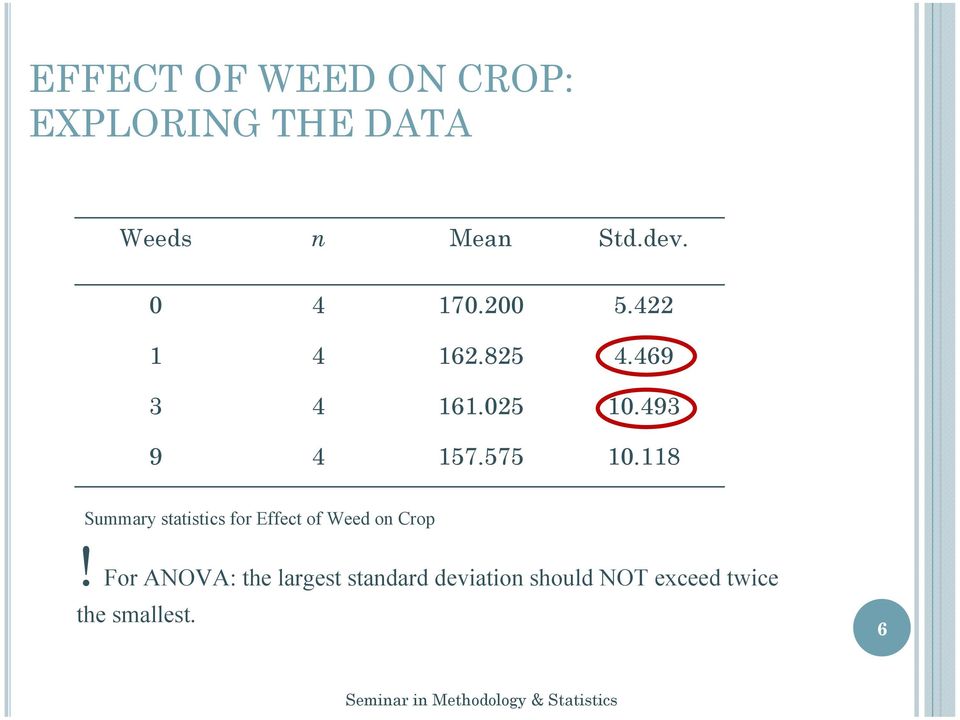
6 EFFECT OF WEED ON CROP: EXPLORING THE DATA Weeds n Mean Std.dev Summary statistics for Effect of Weed on Crop! For ANOVA: the largest standard deviation should NOT exceed twice the smallest. 6
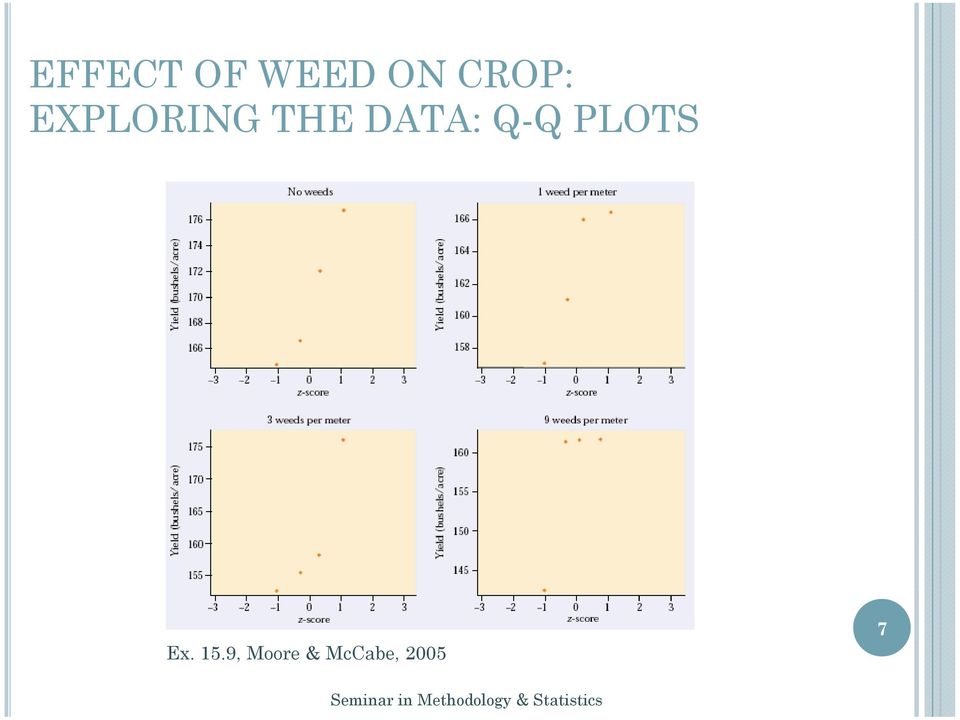
7 EFFECT OF WEED ON CROP: EXPLORING THE DATA: Q-Q PLOTS Ex. 15.9, Moore & McCabe,
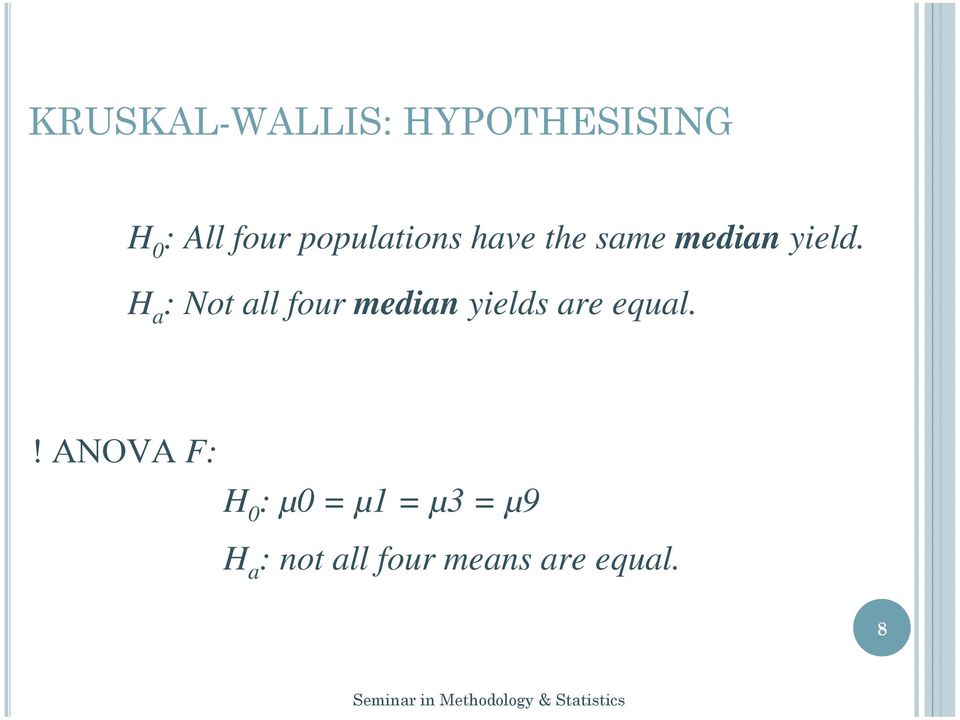
8 KRUSKAL-WALLIS: HYPOTHESISING H 0 : All four populations have the same median yield. H a : Not all four median yields are equal.! ANOVA F: H 0 : µ0 = µ1 = µ3 = µ9 H a : not all four means are equal. 8
9 KRUSKAL-WALLIS: HYPOTHESISING Non-parametric tests hypothesize about the median instead of the mean (as parametric tests do). mean a hypothetical value not necessarily present in the data (µ= Σ x i / n) median the middle score of a set of ordered observations. In the case of even number of observations, the median is the average of the two scores on each side of what should be in the middle The mean is more sensitive to outliers than the median. Ex: 1, 5, 2, 8, 38 µ= 10,7 [( )/5] median = 5 (1, 2, 5, 8, 38)! Median when the observations are even: Ex: 5, 2, 8, 38 = 6,5 (2, 5, 8, 38) (5+8)/2 = 6,5 9

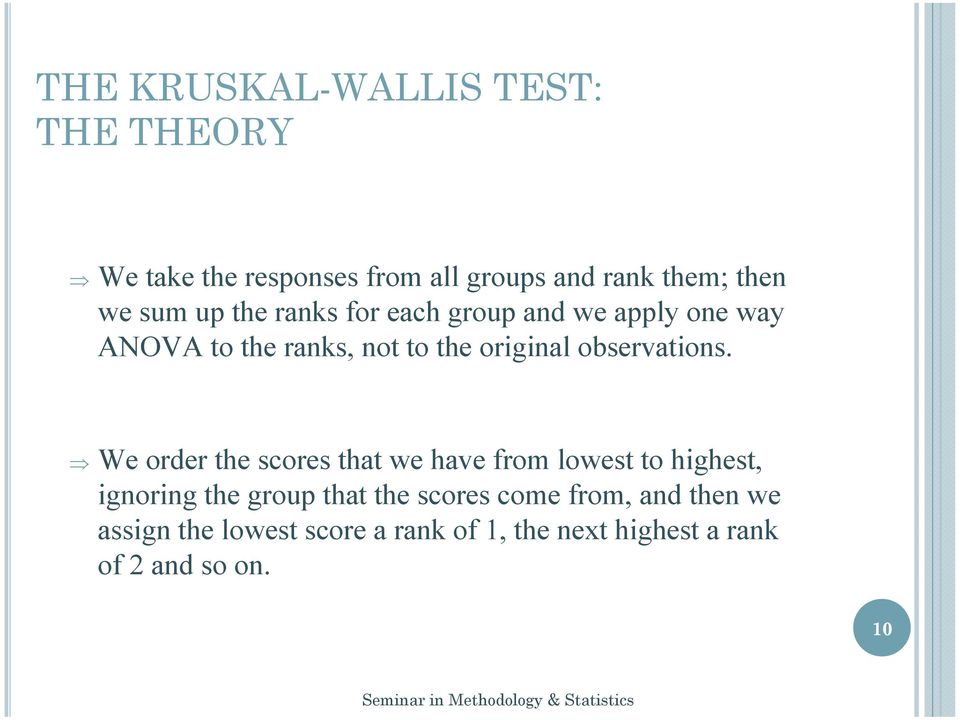
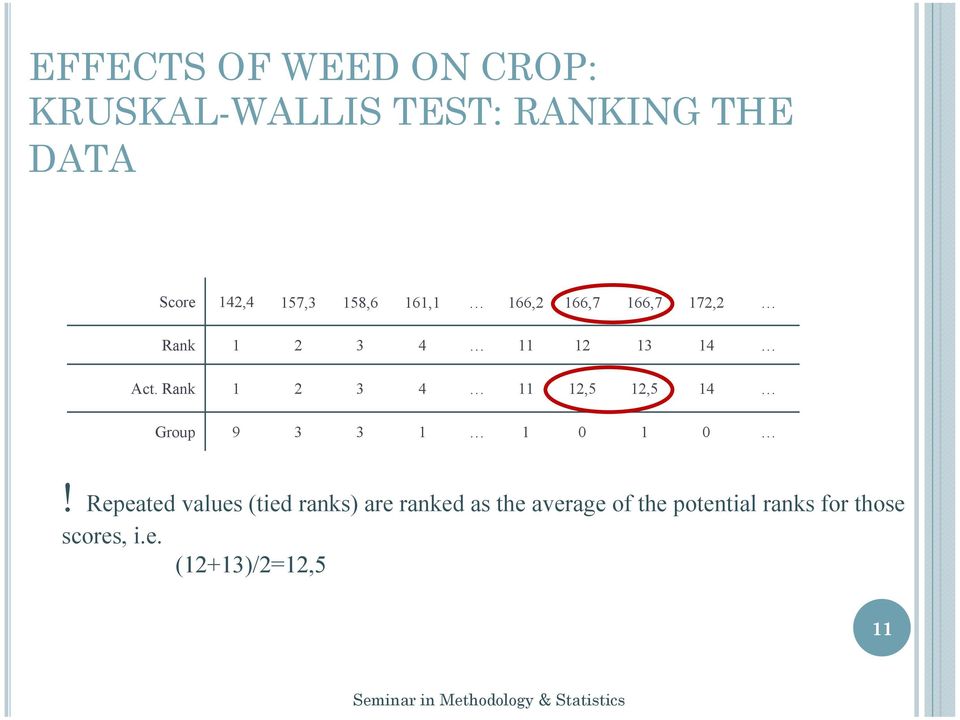
10 THE KRUSKAL-WALLIS TEST: THE THEORY We take the responses from all groups and rank them; then we sum up the ranks for each group and we apply one way ANOVA to the ranks, not to the original observations. We order the scores that we have from lowest to highest, ignoring the group that the scores come from, and then we assign the lowest score a rank of 1, the next highest a rank of 2 and so on. 10
11 EFFECTS OF WEED ON CROP: KRUSKAL-WALLIS TEST: RANKING THE DATA Score 142,4 157,3 158,6 161,1 166,2 166,7 166,7 172,2 Rank Act. Rank ,5 12,5 14 Group ! Repeated values (tied ranks) are ranked as the average of the potential ranks for those scores, i.e. (12+13)/2=12,5 11
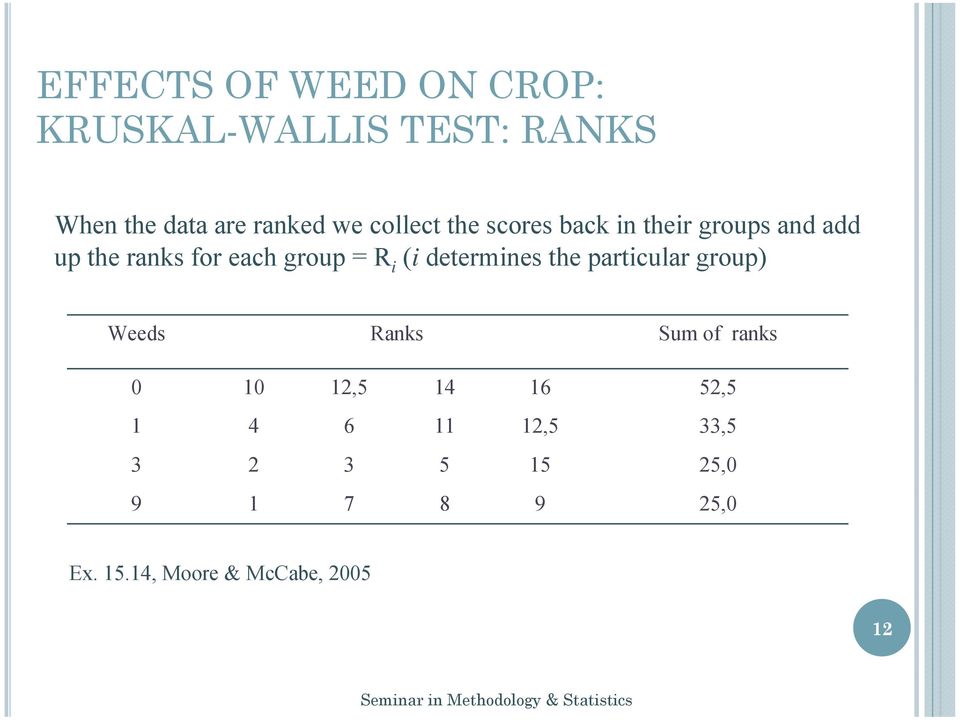
12 EFFECTS OF WEED ON CROP: KRUSKAL-WALLIS TEST: RANKS When the data are ranked we collect the scores back in their groups and add up the ranks for each group = R i (i determines the particular group) Weeds Ranks Sum of ranks , , ,5 33, , ,0 Ex , Moore & McCabe,
13 THE KRUSKAL-WALLIS TEST: THE THEORY! In ANOVA, we calculate the total variation (total sum of squares, SST) by adding up the variation among the groups (sum of squares for groups, SSG) with the variation within group (sum of squares for error, SSE): SST=SSG+SSE In Kruskal-Wallis: one way ANOVA to the ranks, not the original scores. If there are N observations in all, the ranks are always the whole numbers from 1 to N. The total sum of squares for the ranks is therefore a fixed number no matter what the data are no need to look at both SSG and SSE Kruskal-Wallis = SSG for the ranks 13

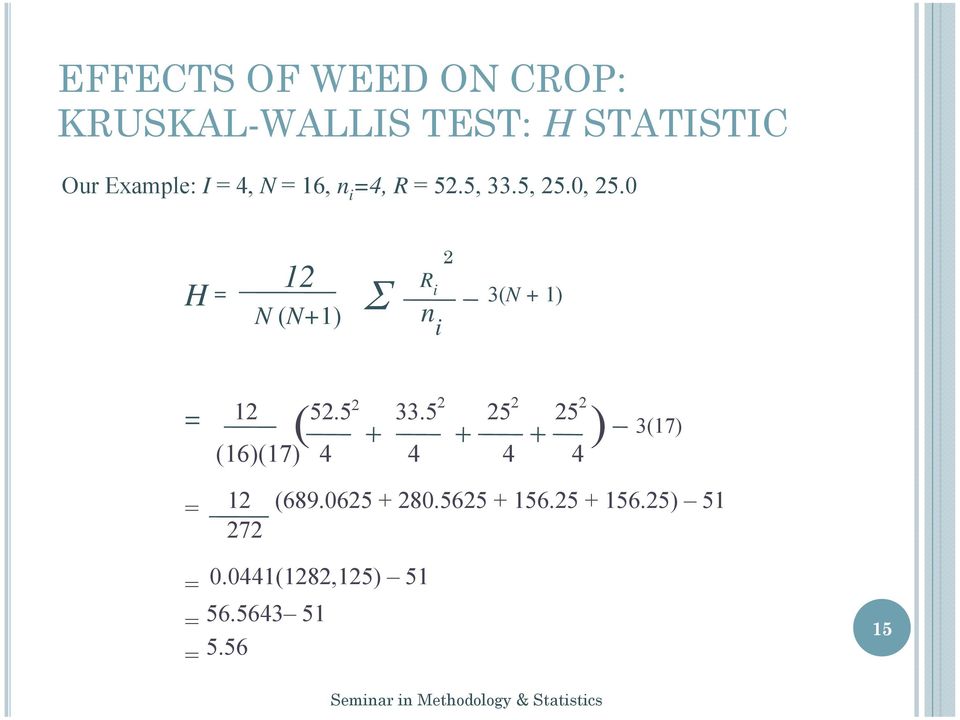
14 KRUSKAL-WALLIS TEST: H STATISTIC The test statistic H is calculated: H = 12 Σ R i 3(N + 1) N (N+1) n i 2 The Kruskal-Wallis test rejects the H o when H is large. 14

15 EFFECTS OF WEED ON CROP: KRUSKAL-WALLIS TEST: H STATISTIC Our Example: I = 4, N = 16, n i =4, R = 52.5, 33.5, 25.0, 25.0 H = 12 Σ R i 3(N + 1) N (N+1) n i 2 = 12 ( ) 3(17) (16)(17) = 12 ( ) = (1282,125) 51 = =
16 EFFECTS OF WEED ON CROP: KRUSKAL-WALLIS TEST: P VALUE H has approximately the chi-square distribution with k 1 degrees of freedom df = 3 (4-1) & H = < P >

17 THE STUDY: THE EFFECT OF SOYA ON CONCENTRATION 4 groups: O Soya Meals per week 1 Soya Meal per week 4 Soya Meals per week 9 Soya Meals per week 20 participants per group N=80 Tested after one year: RT when naming words 17

18 THE EFFECT OF SOYA ON CONCENTRATION: EXPLORATORY STATISTICS Soya n Mean Std.dev Summary Statistics for Soya on Concentration! Violation of the rule of thumb for using ANOVA: the largest standard deviation should NOT exceed twice the smallest. 18

19 THE EFFECT OF SOYA ON CONCENTRATION: TEST OF NORMALITY Tests of Normality RT (Ms) Number of Soya Meals Per Week No Soya Meals 1 Soya Meal Per Week 4 Soyal Meals Per Week 7 Soya Meals Per Week a. Lilliefors Significance Correction Kolmogorov-Smirnov a Shapiro-Wilk Statistic df Sig. Statistic df Sig.,181 20,085,805 20,001,207 20,024,826 20,002,267 20,001,743 20,000,204 20,028,912 20,071 Significance of data the distribution is significantly different from a normal distribution, i.e. it is non-normal. 19

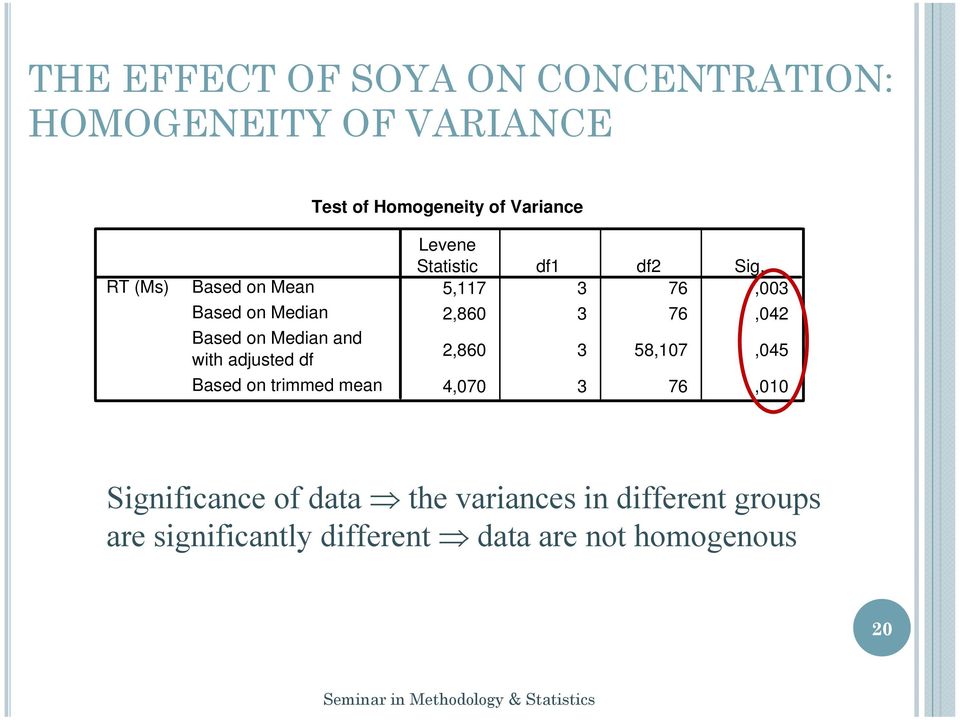
20 THE EFFECT OF SOYA ON CONCENTRATION: HOMOGENEITY OF VARIANCE Test of Homogeneity of Variance RT (Ms) Based on Mean Based on Median Based on Median and with adjusted df Based on trimmed mean Levene Statistic df1 df2 Sig. 5, ,003 2, ,042 2, ,107,045 4, ,010 Significance of data the variances in different groups are significantly different data are not homogenous 20
21 21 KRUSKAL-WALLIS: SPSS
22 22 KRUSKAL-WALLIS: SPSS
23 THE EFFECT OF SOYA ON CONCENTRATION: SPSS: RANKS Ranks RT (Ms) Number of Soya Meals No Soya Meals 1 Soya Meal Per Week 4 Soyal Meals Per Week 7 Soya Meals Per Week Total N Mean Rank 20 46, , , ,
24 THE EFFECT OF SOYA ON CONCENTRATION: SPSS: TEST STATISTICS Test Statistics b,c Chi-Square df Asymp. Sig. Monte Carlo Sig. a. b. c. Sig. 99% Confidence Interval Lower Bound Upper Bound Based on sampled tables with starting seed Kruskal Wallis Test Grouping Variable: Number of Soya Meals Per Week RT (Ms) 8,659 3,034,031 a,027,036 Test significance p <.034 Confidence Interval does not cross the boundary of.05 a lot of confidence that the significant effect is genuine 24
25 THE EFFECT OF SOYA ON CONCENTRATION: THE CONCLUSION We know that there is difference but we don t know exactly where! 25
26 KRUSKAL-WALLIS: FINDING THE DIFFERENCE 25, , ,00 s) (M T R 10, ,00 0,00 No Soya Meals 1 Soya Meal Per Week 4 Soyal Meals Per Week Number of Soya Meals Per Week 7 Soya Meals Per Week 26
27 KRUSKAL-WALLIS: POST HOC TESTS: MANN-WHITNEY TEST Mann-Whitney tests = Wilcoxon Rank Sum Test a non-parametric test for comparing two independent groups based on ranking! Lots of Wilcoxon Rank Sum Tests inflation of the Type I error (the probability of falsely rejecting the H 0 ) Bonferroni correction -.05/ the number of test to be conducted The value of significance becomes too small, i.e.: 0 soya meals, 1 soya meal, 4 soya meals, 7 soya meals = 6 tests.05/6=
28 KRUSKAL-WALLIS: POST HOC TESTS: MANN-WHITNEY TEST Select a number of comparisons to make, i.e.: Test 1: 1 soya meal per week compared to 0 soya meals Test 2: 4 soya meals per week compared to 0 soya meals Test 3: 7 soya meals per week compared to 0 soya meals α level =.05/3=
29 KRUSKAL-WALLIS: POST HOC TESTS: MANN-WHITNEY TEST 1. 0 soya vs. 1 meal per week 2. 0 soya vs. 4 meals per week Test Statistics b Test Statistics b Mann-Whitney U Wilcoxon W Z Asymp. Sig. (2-tailed) Exact Sig. [2*(1-tailed Sig.)] a. Not corrected for ties. RT (Ms) 191, ,000 -,243,808,820 a b. Grouping Variable: Number of Soya Meals Per Week 3. 0 soya vs. 7 meals per week Mann-Whitney U Wilcoxon W Z Test Statistics b Asymp. Sig. (2-tailed) Exact Sig. [2*(1-tailed Sig.)] a. Not corrected for ties. RT (Ms) 104, ,000-2,597,009,009 a b. Grouping Variable: Number of Soya Meals Per Week Mann-Whitney U Wilcoxon W Z Asymp. Sig. (2-tailed) Exact Sig. [2*(1-tailed Sig.)] a. Not corrected for ties. RT (Ms) 188, ,000 -,325,745,758 a b. Grouping Variable: Number of Soya Meals Per Week! α level =.0167 not.05 29
30 KRUSKAL-WALLIS: TESTING FOR TRENDS: JONCKHEERE-TERPSTRA TEST If we expect that the groups we compare are ordered in a certain way. I.e. the more soya a person eats the more concentrated and faster they become (shorter RTs) 30
31 KRUSKAL-WALLIS: TESTING FOR TRENDS: JONCKHEERE- TERPSTRA TEST Jonckheere-Terpstra Test b Number of Levels in Number of Soya Meals Per Week N Observed J-T Statistic Mean J-T Statistic Std. Deviation of J-T Statistic Std. J-T Statistic Asymp. Sig. (2-tailed) Monte Carlo Sig. (2-tailed) Monte Carlo Sig. (1-tailed) Sig. 99% Confidence Interval Sig. 99% Confidence Interval Lower Bound Upper Bound Lower Bound Upper Bound a. Based on sampled tables with starting seed b. Grouping Variable: Number of Soya Meals Per Week RT (Ms) , , ,333-2,476,013,012 a,009,015,006 a,004,008 normal distribution z score calculated: -2,476 If > 1.65 significant result. - descending medians scores get smaller + ascending medians scores get bigger Medians get smaller the more soya meals we eat : RTs become faster more soya better concentration and 31 more speed!
32 CALCULATING AN EFFECT SIZE A standardized measure of the magnitude of the observed effect the measured effect is meaningful or important Cohen s d or Pearson s correlation coefficient r: 1 > r < 0 r =.10 small effect 1% of the total variance r =.30 medium effect 9 %of total variance r =.50 large effect 25 %of total varince Converting z score into the effect size estimate r = Z N 32
33 CALCULATING AN EFFECT SIZE 33
INTERPRETING THE ONE-WAY ANALYSIS OF VARIANCE (ANOVA)
 INTERPRETING THE ONE-WAY ANALYSIS OF VARIANCE (ANOVA) As with other parametric statistics, we begin the one-way ANOVA with a test of the underlying assumptions. Our first assumption is the assumption of
EPS 625 INTERMEDIATE STATISTICS FRIEDMAN TEST
 EPS 625 INTERMEDIATE STATISTICS The Friedman test is an extension of the Wilcoxon test. The Wilcoxon test can be applied to repeated-measures data if participants are assessed on two occasions or conditions
UNDERSTANDING THE INDEPENDENT-SAMPLES t TEST
 UNDERSTANDING The independent-samples t test evaluates the difference between the means of two independent or unrelated groups. That is, we evaluate whether the means for two independent groups are significantly
1 Nonparametric Statistics
 1 Nonparametric Statistics When finding confidence intervals or conducting tests so far, we always described the population with a model, which includes a set of parameters. Then we could make decisions
SCHOOL OF HEALTH AND HUMAN SCIENCES DON T FORGET TO RECODE YOUR MISSING VALUES
 SCHOOL OF HEALTH AND HUMAN SCIENCES Using SPSS Topics addressed today: 1. Differences between groups 2. Graphing Use the s4data.sav file for the first part of this session. DON T FORGET TO RECODE YOUR
Non-Parametric Tests (I)
 Lecture 5: Non-Parametric Tests (I) KimHuat LIM [email protected] http://www.stats.ox.ac.uk/~lim/teaching.html Slide 1 5.1 Outline (i) Overview of Distribution-Free Tests (ii) Median Test for Two Independent
SPSS Tests for Versions 9 to 13
 SPSS Tests for Versions 9 to 13 Chapter 2 Descriptive Statistic (including median) Choose Analyze Descriptive statistics Frequencies... Click on variable(s) then press to move to into Variable(s): list
Rank-Based Non-Parametric Tests
 Rank-Based Non-Parametric Tests Reminder: Student Instructional Rating Surveys You have until May 8 th to fill out the student instructional rating surveys at https://sakai.rutgers.edu/portal/site/sirs
13: Additional ANOVA Topics. Post hoc Comparisons
 13: Additional ANOVA Topics Post hoc Comparisons ANOVA Assumptions Assessing Group Variances When Distributional Assumptions are Severely Violated Kruskal-Wallis Test Post hoc Comparisons In the prior
Statistiek II. John Nerbonne. October 1, 2010. Dept of Information Science [email protected]
 Dept of Information Science [email protected] October 1, 2010 Course outline 1 One-way ANOVA. 2 Factorial ANOVA. 3 Repeated measures ANOVA. 4 Correlation and regression. 5 Multiple regression. 6 Logistic
Parametric and non-parametric statistical methods for the life sciences - Session I
 Why nonparametric methods What test to use? Rank Tests Parametric and non-parametric statistical methods for the life sciences - Session I Liesbeth Bruckers Geert Molenberghs Interuniversity Institute
NCSS Statistical Software
 Chapter 06 Introduction This procedure provides several reports for the comparison of two distributions, including confidence intervals for the difference in means, two-sample t-tests, the z-test, the
The Dummy s Guide to Data Analysis Using SPSS
 The Dummy s Guide to Data Analysis Using SPSS Mathematics 57 Scripps College Amy Gamble April, 2001 Amy Gamble 4/30/01 All Rights Rerserved TABLE OF CONTENTS PAGE Helpful Hints for All Tests...1 Tests
Independent t- Test (Comparing Two Means)
 Independent t- Test (Comparing Two Means) The objectives of this lesson are to learn: the definition/purpose of independent t-test when to use the independent t-test the use of SPSS to complete an independent
Overview of Non-Parametric Statistics PRESENTER: ELAINE EISENBEISZ OWNER AND PRINCIPAL, OMEGA STATISTICS
 Overview of Non-Parametric Statistics PRESENTER: ELAINE EISENBEISZ OWNER AND PRINCIPAL, OMEGA STATISTICS About Omega Statistics Private practice consultancy based in Southern California, Medical and Clinical
Chapter 5 Analysis of variance SPSS Analysis of variance
 Chapter 5 Analysis of variance SPSS Analysis of variance Data file used: gss.sav How to get there: Analyze Compare Means One-way ANOVA To test the null hypothesis that several population means are equal,
Introduction to Analysis of Variance (ANOVA) Limitations of the t-test
 Introduction to Analysis of Variance (ANOVA) The Structural Model, The Summary Table, and the One- Way ANOVA Limitations of the t-test Although the t-test is commonly used, it has limitations Can only
Testing for differences I exercises with SPSS
 Testing for differences I exercises with SPSS Introduction The exercises presented here are all about the t-test and its non-parametric equivalents in their various forms. In SPSS, all these tests can
UNDERSTANDING THE DEPENDENT-SAMPLES t TEST
 UNDERSTANDING THE DEPENDENT-SAMPLES t TEST A dependent-samples t test (a.k.a. matched or paired-samples, matched-pairs, samples, or subjects, simple repeated-measures or within-groups, or correlated groups)
Analysis of Data. Organizing Data Files in SPSS. Descriptive Statistics
 Analysis of Data Claudia J. Stanny PSY 67 Research Design Organizing Data Files in SPSS All data for one subject entered on the same line Identification data Between-subjects manipulations: variable to
Comparing Means in Two Populations
 Comparing Means in Two Populations Overview The previous section discussed hypothesis testing when sampling from a single population (either a single mean or two means from the same population). Now we
CHAPTER 14 NONPARAMETRIC TESTS
 CHAPTER 14 NONPARAMETRIC TESTS Everything that we have done up until now in statistics has relied heavily on one major fact: that our data is normally distributed. We have been able to make inferences
SPSS Explore procedure
 SPSS Explore procedure One useful function in SPSS is the Explore procedure, which will produce histograms, boxplots, stem-and-leaf plots and extensive descriptive statistics. To run the Explore procedure,
Projects Involving Statistics (& SPSS)
 Projects Involving Statistics (& SPSS) Academic Skills Advice Starting a project which involves using statistics can feel confusing as there seems to be many different things you can do (charts, graphs,
Research Methodology: Tools
 MSc Business Administration Research Methodology: Tools Applied Data Analysis (with SPSS) Lecture 11: Nonparametric Methods May 2014 Prof. Dr. Jürg Schwarz Lic. phil. Heidi Bruderer Enzler Contents Slide
SPSS ADVANCED ANALYSIS WENDIANN SETHI SPRING 2011
 SPSS ADVANCED ANALYSIS WENDIANN SETHI SPRING 2011 Statistical techniques to be covered Explore relationships among variables Correlation Regression/Multiple regression Logistic regression Factor analysis
Nonparametric tests these test hypotheses that are not statements about population parameters (e.g.,
 CHAPTER 13 Nonparametric and Distribution-Free Statistics Nonparametric tests these test hypotheses that are not statements about population parameters (e.g., 2 tests for goodness of fit and independence).
Recall this chart that showed how most of our course would be organized:
 Chapter 4 One-Way ANOVA Recall this chart that showed how most of our course would be organized: Explanatory Variable(s) Response Variable Methods Categorical Categorical Contingency Tables Categorical
SPSS Guide How-to, Tips, Tricks & Statistical Techniques
 SPSS Guide How-to, Tips, Tricks & Statistical Techniques Support for the course Research Methodology for IB Also useful for your BSc or MSc thesis March 2014 Dr. Marijke Leliveld Jacob Wiebenga, MSc CONTENT
Two Related Samples t Test
 Two Related Samples t Test In this example 1 students saw five pictures of attractive people and five pictures of unattractive people. For each picture, the students rated the friendliness of the person
SPSS 3: COMPARING MEANS
 SPSS 3: COMPARING MEANS UNIVERSITY OF GUELPH LUCIA COSTANZO [email protected] REVISED SEPTEMBER 2012 CONTENTS SPSS availability... 2 Goals of the workshop... 2 Data for SPSS Sessions... 3 Statistical
Nonparametric Statistics
 Nonparametric Statistics J. Lozano University of Goettingen Department of Genetic Epidemiology Interdisciplinary PhD Program in Applied Statistics & Empirical Methods Graduate Seminar in Applied Statistics
Normality Testing in Excel
 Normality Testing in Excel By Mark Harmon Copyright 2011 Mark Harmon No part of this publication may be reproduced or distributed without the express permission of the author. [email protected]
Nonparametric Statistics
 Nonparametric Statistics References Some good references for the topics in this course are 1. Higgins, James (2004), Introduction to Nonparametric Statistics 2. Hollander and Wolfe, (1999), Nonparametric
Biostatistics: DESCRIPTIVE STATISTICS: 2, VARIABILITY
 Biostatistics: DESCRIPTIVE STATISTICS: 2, VARIABILITY 1. Introduction Besides arriving at an appropriate expression of an average or consensus value for observations of a population, it is important to
The Kruskal-Wallis test:
 Graham Hole Research Skills Kruskal-Wallis handout, version 1.0, page 1 The Kruskal-Wallis test: This test is appropriate for use under the following circumstances: (a) you have three or more conditions
Nonparametric Two-Sample Tests. Nonparametric Tests. Sign Test
 Nonparametric Two-Sample Tests Sign test Mann-Whitney U-test (a.k.a. Wilcoxon two-sample test) Kolmogorov-Smirnov Test Wilcoxon Signed-Rank Test Tukey-Duckworth Test 1 Nonparametric Tests Recall, nonparametric
Study Guide for the Final Exam
 Study Guide for the Final Exam When studying, remember that the computational portion of the exam will only involve new material (covered after the second midterm), that material from Exam 1 will make
1.5 Oneway Analysis of Variance
 Statistics: Rosie Cornish. 200. 1.5 Oneway Analysis of Variance 1 Introduction Oneway analysis of variance (ANOVA) is used to compare several means. This method is often used in scientific or medical experiments
Analysis of Variance ANOVA
 Analysis of Variance ANOVA Overview We ve used the t -test to compare the means from two independent groups. Now we ve come to the final topic of the course: how to compare means from more than two populations.
Chapter 7 Section 7.1: Inference for the Mean of a Population
 Chapter 7 Section 7.1: Inference for the Mean of a Population Now let s look at a similar situation Take an SRS of size n Normal Population : N(, ). Both and are unknown parameters. Unlike what we used
Statistics. One-two sided test, Parametric and non-parametric test statistics: one group, two groups, and more than two groups samples
 Statistics One-two sided test, Parametric and non-parametric test statistics: one group, two groups, and more than two groups samples February 3, 00 Jobayer Hossain, Ph.D. & Tim Bunnell, Ph.D. Nemours
Additional sources Compilation of sources: http://lrs.ed.uiuc.edu/tseportal/datacollectionmethodologies/jin-tselink/tselink.htm
 Mgt 540 Research Methods Data Analysis 1 Additional sources Compilation of sources: http://lrs.ed.uiuc.edu/tseportal/datacollectionmethodologies/jin-tselink/tselink.htm http://web.utk.edu/~dap/random/order/start.htm
UNDERSTANDING THE TWO-WAY ANOVA
 UNDERSTANDING THE e have seen how the one-way ANOVA can be used to compare two or more sample means in studies involving a single independent variable. This can be extended to two independent variables
The Statistics Tutor s Quick Guide to
 statstutor community project encouraging academics to share statistics support resources All stcp resources are released under a Creative Commons licence The Statistics Tutor s Quick Guide to Stcp-marshallowen-7
COMPARISONS OF CUSTOMER LOYALTY: PUBLIC & PRIVATE INSURANCE COMPANIES.
 277 CHAPTER VI COMPARISONS OF CUSTOMER LOYALTY: PUBLIC & PRIVATE INSURANCE COMPANIES. This chapter contains a full discussion of customer loyalty comparisons between private and public insurance companies
Analysing Questionnaires using Minitab (for SPSS queries contact -) [email protected]
 Analysing Questionnaires using Minitab (for SPSS queries contact -) [email protected] Structure As a starting point it is useful to consider a basic questionnaire as containing three main sections:
Descriptive Statistics
 Descriptive Statistics Primer Descriptive statistics Central tendency Variation Relative position Relationships Calculating descriptive statistics Descriptive Statistics Purpose to describe or summarize
One-Way Analysis of Variance (ANOVA) Example Problem
 One-Way Analysis of Variance (ANOVA) Example Problem Introduction Analysis of Variance (ANOVA) is a hypothesis-testing technique used to test the equality of two or more population (or treatment) means
Chapter 2 Probability Topics SPSS T tests
 Chapter 2 Probability Topics SPSS T tests Data file used: gss.sav In the lecture about chapter 2, only the One-Sample T test has been explained. In this handout, we also give the SPSS methods to perform
Difference tests (2): nonparametric
 NST 1B Experimental Psychology Statistics practical 3 Difference tests (): nonparametric Rudolf Cardinal & Mike Aitken 10 / 11 February 005; Department of Experimental Psychology University of Cambridge
Tutorial 5: Hypothesis Testing
 Tutorial 5: Hypothesis Testing Rob Nicholls [email protected] MRC LMB Statistics Course 2014 Contents 1 Introduction................................ 1 2 Testing distributional assumptions....................
Statistics for Sports Medicine
 Statistics for Sports Medicine Suzanne Hecht, MD University of Minnesota ([email protected]) Fellow s Research Conference July 2012: Philadelphia GOALS Try not to bore you to death!! Try to teach
Skewed Data and Non-parametric Methods
 0 2 4 6 8 10 12 14 Skewed Data and Non-parametric Methods Comparing two groups: t-test assumes data are: 1. Normally distributed, and 2. both samples have the same SD (i.e. one sample is simply shifted
NCSS Statistical Software
 Chapter 06 Introduction This procedure provides several reports for the comparison of two distributions, including confidence intervals for the difference in means, two-sample t-tests, the z-test, the
Examining Differences (Comparing Groups) using SPSS Inferential statistics (Part I) Dwayne Devonish
 Examining Differences (Comparing Groups) using SPSS Inferential statistics (Part I) Dwayne Devonish Statistics Statistics are quantitative methods of describing, analysing, and drawing inferences (conclusions)
1. What is the critical value for this 95% confidence interval? CV = z.025 = invnorm(0.025) = 1.96
 1 Final Review 2 Review 2.1 CI 1-propZint Scenario 1 A TV manufacturer claims in its warranty brochure that in the past not more than 10 percent of its TV sets needed any repair during the first two years
Section 13, Part 1 ANOVA. Analysis Of Variance
 Section 13, Part 1 ANOVA Analysis Of Variance Course Overview So far in this course we ve covered: Descriptive statistics Summary statistics Tables and Graphs Probability Probability Rules Probability
II. DISTRIBUTIONS distribution normal distribution. standard scores
 Appendix D Basic Measurement And Statistics The following information was developed by Steven Rothke, PhD, Department of Psychology, Rehabilitation Institute of Chicago (RIC) and expanded by Mary F. Schmidt,
Two-Sample T-Tests Allowing Unequal Variance (Enter Difference)
 Chapter 45 Two-Sample T-Tests Allowing Unequal Variance (Enter Difference) Introduction This procedure provides sample size and power calculations for one- or two-sided two-sample t-tests when no assumption
Research Methods & Experimental Design
 Research Methods & Experimental Design 16.422 Human Supervisory Control April 2004 Research Methods Qualitative vs. quantitative Understanding the relationship between objectives (research question) and
Come scegliere un test statistico
 Come scegliere un test statistico Estratto dal Capitolo 37 of Intuitive Biostatistics (ISBN 0-19-508607-4) by Harvey Motulsky. Copyright 1995 by Oxfd University Press Inc. (disponibile in Iinternet) Table
Outline. Topic 4 - Analysis of Variance Approach to Regression. Partitioning Sums of Squares. Total Sum of Squares. Partitioning sums of squares
 Topic 4 - Analysis of Variance Approach to Regression Outline Partitioning sums of squares Degrees of freedom Expected mean squares General linear test - Fall 2013 R 2 and the coefficient of correlation
NONPARAMETRIC STATISTICS 1. depend on assumptions about the underlying distribution of the data (or on the Central Limit Theorem)
 NONPARAMETRIC STATISTICS 1 PREVIOUSLY parametric statistics in estimation and hypothesis testing... construction of confidence intervals computing of p-values classical significance testing depend on assumptions
How To Test For Significance On A Data Set
 Non-Parametric Univariate Tests: 1 Sample Sign Test 1 1 SAMPLE SIGN TEST A non-parametric equivalent of the 1 SAMPLE T-TEST. ASSUMPTIONS: Data is non-normally distributed, even after log transforming.
Friedman's Two-way Analysis of Variance by Ranks -- Analysis of k-within-group Data with a Quantitative Response Variable
 Friedman's Two-way Analysis of Variance by Ranks -- Analysis of k-within-group Data with a Quantitative Response Variable Application: This statistic has two applications that can appear very different,
Two-Sample T-Tests Assuming Equal Variance (Enter Means)
 Chapter 4 Two-Sample T-Tests Assuming Equal Variance (Enter Means) Introduction This procedure provides sample size and power calculations for one- or two-sided two-sample t-tests when the variances of
SIMPLE LINEAR CORRELATION. r can range from -1 to 1, and is independent of units of measurement. Correlation can be done on two dependent variables.
 SIMPLE LINEAR CORRELATION Simple linear correlation is a measure of the degree to which two variables vary together, or a measure of the intensity of the association between two variables. Correlation
Statistical tests for SPSS
 Statistical tests for SPSS Paolo Coletti A.Y. 2010/11 Free University of Bolzano Bozen Premise This book is a very quick, rough and fast description of statistical tests and their usage. It is explicitly
Chapter 7. One-way ANOVA
 Chapter 7 One-way ANOVA One-way ANOVA examines equality of population means for a quantitative outcome and a single categorical explanatory variable with any number of levels. The t-test of Chapter 6 looks
T-test & factor analysis
 Parametric tests T-test & factor analysis Better than non parametric tests Stringent assumptions More strings attached Assumes population distribution of sample is normal Major problem Alternatives Continue
Introduction. Hypothesis Testing. Hypothesis Testing. Significance Testing
 Introduction Hypothesis Testing Mark Lunt Arthritis Research UK Centre for Ecellence in Epidemiology University of Manchester 13/10/2015 We saw last week that we can never know the population parameters
Outline. Definitions Descriptive vs. Inferential Statistics The t-test - One-sample t-test
 The t-test Outline Definitions Descriptive vs. Inferential Statistics The t-test - One-sample t-test - Dependent (related) groups t-test - Independent (unrelated) groups t-test Comparing means Correlation
Final Exam Practice Problem Answers
 Final Exam Practice Problem Answers The following data set consists of data gathered from 77 popular breakfast cereals. The variables in the data set are as follows: Brand: The brand name of the cereal
The Wilcoxon Rank-Sum Test
 1 The Wilcoxon Rank-Sum Test The Wilcoxon rank-sum test is a nonparametric alternative to the twosample t-test which is based solely on the order in which the observations from the two samples fall. We
Data analysis process
 Data analysis process Data collection and preparation Collect data Prepare codebook Set up structure of data Enter data Screen data for errors Exploration of data Descriptive Statistics Graphs Analysis
Likert Scales. are the meaning of life: Dane Bertram
 are the meaning of life: Note: A glossary is included near the end of this handout defining many of the terms used throughout this report. Likert Scale \lick urt\, n. Definition: Variations: A psychometric
Reporting Statistics in Psychology
 This document contains general guidelines for the reporting of statistics in psychology research. The details of statistical reporting vary slightly among different areas of science and also among different
Chapter 12 Nonparametric Tests. Chapter Table of Contents
 Chapter 12 Nonparametric Tests Chapter Table of Contents OVERVIEW...171 Testing for Normality...... 171 Comparing Distributions....171 ONE-SAMPLE TESTS...172 TWO-SAMPLE TESTS...172 ComparingTwoIndependentSamples...172
An Empirical Examination of the Relationship between Financial Trader s Decision-making and Financial Software Applications
 Empirical Examination of Financial decision-making & software apps. An Empirical Examination of the Relationship between Financial Trader s Decision-making and Financial Software Applications Research-in-Progress
" Y. Notation and Equations for Regression Lecture 11/4. Notation:
 Notation: Notation and Equations for Regression Lecture 11/4 m: The number of predictor variables in a regression Xi: One of multiple predictor variables. The subscript i represents any number from 1 through
Intro to Parametric & Nonparametric Statistics
 Intro to Parametric & Nonparametric Statistics Kinds & definitions of nonparametric statistics Where parametric stats come from Consequences of parametric assumptions Organizing the models we will cover
Introduction to Hypothesis Testing. Hypothesis Testing. Step 1: State the Hypotheses
 Introduction to Hypothesis Testing 1 Hypothesis Testing A hypothesis test is a statistical procedure that uses sample data to evaluate a hypothesis about a population Hypothesis is stated in terms of the
TABLE OF CONTENTS. About Chi Squares... 1. What is a CHI SQUARE?... 1. Chi Squares... 1. Hypothesis Testing with Chi Squares... 2
 About Chi Squares TABLE OF CONTENTS About Chi Squares... 1 What is a CHI SQUARE?... 1 Chi Squares... 1 Goodness of fit test (One-way χ 2 )... 1 Test of Independence (Two-way χ 2 )... 2 Hypothesis Testing
individualdifferences
 1 Simple ANalysis Of Variance (ANOVA) Oftentimes we have more than two groups that we want to compare. The purpose of ANOVA is to allow us to compare group means from several independent samples. In general,
NCSS Statistical Software. One-Sample T-Test
 Chapter 205 Introduction This procedure provides several reports for making inference about a population mean based on a single sample. These reports include confidence intervals of the mean or median,
QUANTITATIVE METHODS BIOLOGY FINAL HONOUR SCHOOL NON-PARAMETRIC TESTS
 QUANTITATIVE METHODS BIOLOGY FINAL HONOUR SCHOOL NON-PARAMETRIC TESTS This booklet contains lecture notes for the nonparametric work in the QM course. This booklet may be online at http://users.ox.ac.uk/~grafen/qmnotes/index.html.
UNDERSTANDING ANALYSIS OF COVARIANCE (ANCOVA)
 UNDERSTANDING ANALYSIS OF COVARIANCE () In general, research is conducted for the purpose of explaining the effects of the independent variable on the dependent variable, and the purpose of research design
Using Excel for inferential statistics
 FACT SHEET Using Excel for inferential statistics Introduction When you collect data, you expect a certain amount of variation, just caused by chance. A wide variety of statistical tests can be applied
How Far is too Far? Statistical Outlier Detection
 How Far is too Far? Statistical Outlier Detection Steven Walfish President, Statistical Outsourcing Services [email protected] 30-325-329 Outline What is an Outlier, and Why are
MASTER COURSE SYLLABUS-PROTOTYPE PSYCHOLOGY 2317 STATISTICAL METHODS FOR THE BEHAVIORAL SCIENCES
 MASTER COURSE SYLLABUS-PROTOTYPE THE PSYCHOLOGY DEPARTMENT VALUES ACADEMIC FREEDOM AND THUS OFFERS THIS MASTER SYLLABUS-PROTOTYPE ONLY AS A GUIDE. THE INSTRUCTORS ARE FREE TO ADAPT THEIR COURSE SYLLABI
HYPOTHESIS TESTING WITH SPSS:
 HYPOTHESIS TESTING WITH SPSS: A NON-STATISTICIAN S GUIDE & TUTORIAL by Dr. Jim Mirabella SPSS 14.0 screenshots reprinted with permission from SPSS Inc. Published June 2006 Copyright Dr. Jim Mirabella CHAPTER
Testing Group Differences using T-tests, ANOVA, and Nonparametric Measures
 Testing Group Differences using T-tests, ANOVA, and Nonparametric Measures Jamie DeCoster Department of Psychology University of Alabama 348 Gordon Palmer Hall Box 870348 Tuscaloosa, AL 35487-0348 Phone:
(and sex and drugs and rock 'n' roll) ANDY FIELD
 DISCOVERING USING SPSS STATISTICS THIRD EDITION (and sex and drugs and rock 'n' roll) ANDY FIELD CONTENTS Preface How to use this book Acknowledgements Dedication Symbols used in this book Some maths revision
Standard Deviation Estimator
 CSS.com Chapter 905 Standard Deviation Estimator Introduction Even though it is not of primary interest, an estimate of the standard deviation (SD) is needed when calculating the power or sample size of
One-Way Analysis of Variance
 One-Way Analysis of Variance Note: Much of the math here is tedious but straightforward. We ll skim over it in class but you should be sure to ask questions if you don t understand it. I. Overview A. We
January 26, 2009 The Faculty Center for Teaching and Learning
 THE BASICS OF DATA MANAGEMENT AND ANALYSIS A USER GUIDE January 26, 2009 The Faculty Center for Teaching and Learning THE BASICS OF DATA MANAGEMENT AND ANALYSIS Table of Contents Table of Contents... i
PSYCHOLOGY 320L Problem Set #3: One-Way ANOVA and Analytical Comparisons
 PSYCHOLOGY 30L Problem Set #3: One-Way ANOVA and Analytical Comparisons Name: Score:. You and Dr. Exercise have decided to conduct a study on exercise and its effects on mood ratings. Many studies (Babyak
CALCULATIONS & STATISTICS
 CALCULATIONS & STATISTICS CALCULATION OF SCORES Conversion of 1-5 scale to 0-100 scores When you look at your report, you will notice that the scores are reported on a 0-100 scale, even though respondents