
Examining Differences (Comparing Groups) using SPSS Inferential statistics (Part I) Dwayne Devonish
|
|
|
- Iris Thornton
- 9 years ago
- Views:
Transcription
1 Examining Differences (Comparing Groups) using SPSS Inferential statistics (Part I) Dwayne Devonish

2 Statistics Statistics are quantitative methods of describing, analysing, and drawing inferences (conclusions) from data. Practitioners need to understand statistics: To know how to properly present and describe information, To know how to draw conclusions about large populations based only on information obtained from samples, To know how to solve key industry-related problems and make sensible, valid, and reliable decisions on the basis of the statistical analysis conducted.

3 Quantitative Data-Analysis: Statistics In quantitative research, there are two (2) general categories of statistics: Descriptive Statistics statistical procedures used for summarising, organising, graphing and describing data. Inferential Statistics statistical procedures that allow one to draw inferences to the population on the basis of sample data. Represented as tests of significance (test relationships and differences).

4 Descriptive Statistics (2) Descriptive statistics include: Frequencies/percentages Means, standard deviations, medians, modes, ranges Crosstabulations Although relevant, descriptive statistics give limited and inconclusive information which can aid policy and practice. The focus of this session is on the use of inferential statistical tests to better understand how these procedures can inform and enhance policy and practice in the tourism industry.

5 Quantitative Data Analysis Inferential Statistics In quantitative data analysis, there are several statistical tests that can be used to examine relationships between two or more variables, or differences between two or more groups. Inferential statistics represent a category of statistics that are used to make inferences from sample data to the population. In particular, these statistics test for statistical significance of results i.e. statistically significant relationships between variables, or statistically significant differences between two or more groups.

6 Statistical Significance Statisticians often choose a cut-off point under which a p-value must fall for a finding to be considered statistically significant. If the p-value is less than or equal 0.05 (5%),the result is deemed statistically significant, i.e., there is a significant relationship between the variables. Use the p-value as an indicator of statistical significance. Two forms of inferential statistics exist: tests that examine associations, and tests that examine differences.

7 Two Categories of Inferential Statistics Associational Inferential Statistics Comparative Inferential Statistics

8 REMEMBER At the heart, all inferential statistics examine underlying relationships between variables: whether they seek to examine differences between groups, or direct relationships between variables.

9 Variables A variable is any characteristic that is measured or captured in a dataset any factor/issue under investigation: e.g. tourist arrivals per year, expenditure, tourist satisfaction, nationality, gender, number of nights in destination, perceived quality, likelihood to return to the destination, etc. The variables can be measured in one of two general ways: As a categorical variable or, As a quantitative/numerical variable

10 Variables (2) Quantitative/numerical variables A quantitative/numerical variable has numeric values such as 1, 5,-9, 17.43, etc. Values can range between the lowest and highest points on the measurement scale. They are usually referred to as quantitative or numerical variables. Recall that quantitative/numerical variables can be either discrete (expressed as whole numbers only e.g. number of arrivals) or continuous (expressed as any value within a continuum e.g., expenditure). Examples of quantitative/numerical variables: height, weight, number of absences, income and age. In SPSS, these variables are referred to as scale variables.

11 Categorical Variable Variables (3) A categorical variable has a limited number of values. Each value usually represents a distinct label or category: Gender is categorical = Male and Female; Marital status is categorical = Married and Not Married; Educational level = Primary, Secondary, Undergraduate, Post Graduate. Categorical (or qualitative) variables identify categorical properties they differ in kind or type, whereas quantitative/numerical variables differ in quantity or distance; they highlight that participants or objects differ in amount or degree.

12 Independent and Dependent Variables Variables can be classified as independent or dependent variables. Independent variables are also called explanatory variables and are examined to see how they explain, predict, or influence other variables called dependent variables. Dependent variables are the variables that are believed to be influenced by independent variables. Example the effect of crime rates on tourist arrivals. Crime rates represent the independent variable, and tourist arrivals represent the dependent variable.

13 Summary of Variable Types Categorical Variables Gender, Ethnicity, religious affiliation, occupation. Age measured as categories: What is your age: years, years, Over 35 years. Quantitative/numeric al (numerical) variables Based on data in the form of numbers Age in years (What is your age?) Tourism expenditure data ($)

14 Choosing Inferential Statistics When deciding which inferential statistics to use: Please consider how many variables are being examined. If possible, the independent and dependent variable(s). Consider the type of variables (categorical vs quantitative/numerical).

15 Independent samples t-test and ANOVA Two popular tests that can be used to examine differences between various groups of participants are: Independent samples t-tests One-way Analyses of Variance (ANOVA)

16 Inferential statistics: Examining Differences These tests can answer questions that are comparative in nature such as: Is there a difference between British tourists and U.S tourists in relation to tourist expenditure? Are there significant differences among tourists from different income levels in relation to their satisfaction levels with various aspects of a destination?

17 1. Independent samples t-test: Test of Difference between 2 groups

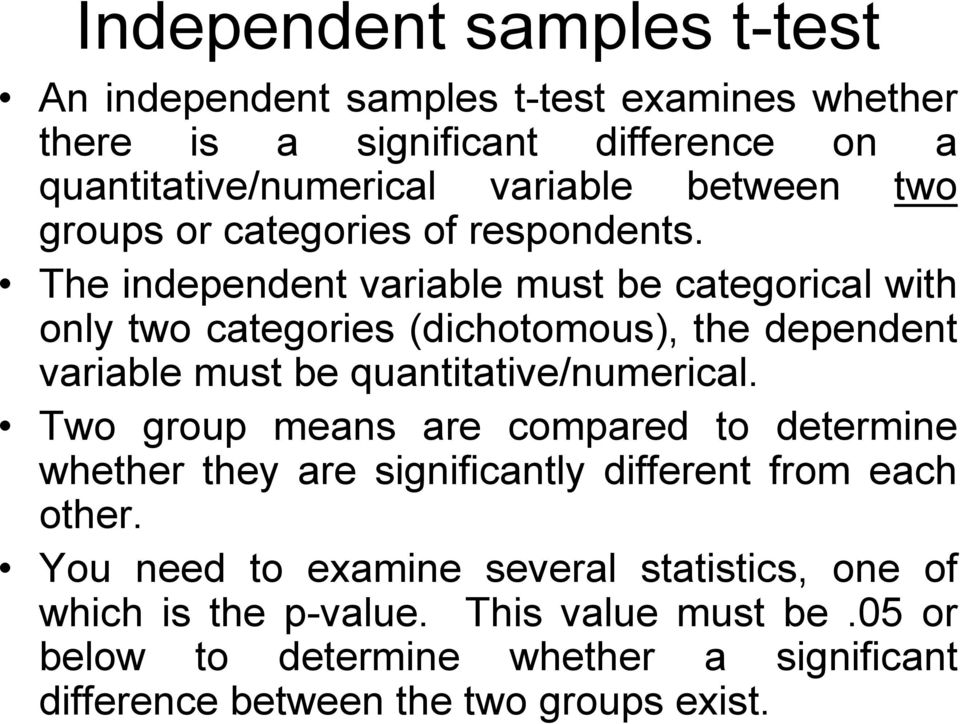
18 Independent samples t-test An independent samples t-test examines whether there is a significant difference on a quantitative/numerical variable between two groups or categories of respondents. The independent variable must be categorical with only two categories (dichotomous), the dependent variable must be quantitative/numerical. Two group means are compared to determine whether they are significantly different from each other. You need to examine several statistics, one of which is the p-value. This value must be.05 or below to determine whether a significant difference between the two groups exist.
19 NOTE One assumption of the t-test is that the variances (variability) of groups are equal. Independent samples t-test produce two different results, based on whether the equal variances are assumed between the groups. The Levene s test seeks to examine this assumption. If the Levene s test is not significant (p >.05), assume equal variances and read the top row of the table If Levene s test is significant (p <.05), equal variances cannot be assumed (it is violated) and read the bottom row of the table (this information makes adjustments to the violation of equal variances).

20 T-TEST Question ASK THESE QUESTIONS: How many variables? Which one is the independent variable, and which one is the dependent variable? What types of variables are they (categorical vs quantitative/numerical)? T-test appropriate?

21 Let s examine data in SPSS Using data from tourism data1: Are European tourists more satisfied with the overall destination experience than U.S tourists? Two variables: nationality and satisfaction Independent variable = Nationality Dependent variable = Satisfaction with overall destination. Nationality is categorical with only 2 groups (European and U.S) Satisfaction is numerical on a five-point scale ranging from 1(very dissatisfied) to 5 (very satisfied).
22 Group Statistics Overall satisfaction with the destination Nationality of Tourist European U.S Std. Error N Mean Std. Deviation Mean This table describes the means and standard deviations of each group: U.S and European visitors. The means represent the average satisfaction with the overall destination scores for the groups on a five-point scale. One can see clearly that the average satisfaction score for European visitors is 3.42, whereas for U.S visitors it is We cannot arrive at any conclusions that one category is more significantly more satisfied than another category without examining the statistical significance of the result (t-test information).
23 Independent Samples Test Overall satisfaction with the destination Equal variances assumed Equal variances not assumed Levene's Test for Equality of Variances F Sig. t df Sig. (2-tailed) t-test for Equality of Means Mean Difference 95% Confidence Interval of the Std. Error Difference Difference Lower Upper This table describes independent samples t-test information to ascertain whether there is a significant difference between the nationality groups in relation to satisfaction with the destination. Before examining the t-test information, you must decide whether you can assume equal variances or not. Look at the p-value (sig.) for the Levene s test (.025), it is below.05, hence you cannot assume equal variances, read the bottom row of the table.
24 Independent Samples Test Overall satisfaction with the destination Equal variances assumed Equal variances not assumed Levene's Test for Equality of Variances F Sig. t df Sig. (2-tailed) t-test for Equality of Means Mean Difference 95% Confidence Interval of the Std. Error Difference Difference Lower Upper Below the section of t-test for equality of means, you need to focus on the sig (2-tailed) column this is the p-value. It is.000 or is reported as p <.001. This is below our cut-off point. This p-value is related to independent samples t-test and shows that there is a significant difference between the two nationality groups in terms of their satisfaction with the overall destination. Go back to the first table and interpret the nature of this difference
25 Group Statistics Overall satisfaction with the destination Nationality of Tourist European U.S Std. Error N Mean Std. Deviation Mean Given the significant result found, you can now conclusively argue that U.S tourists reported significantly higher levels of satisfaction with the destination than European tourists.
26 Writing the Results of T-test
27 Independent samples t-test Info You report the following information when reporting the results of the independent samples t-test: The means and standard deviations for each group. The t-value (-4.99), degrees of freedom (df) (139.4), and p-value (.000) Remember that the Levene s test when significant, you report the bottom row for t-test information; if non-significant, report the top row.
28 Independent Samples T-test Writeup Here is a sample write-up: An independent samples t-test was conducted to examine whether there was a significant difference between European and U.S visitors in relation to their satisfaction with the overall destination. The test revealed a statistically significant difference between males and females (t = -4.99, df = 139.4, p <.001). U.S tourists (M = 4.04, SD =.89) reported significantly higher levels of satisfaction with the overall destination experience than did UK tourists (M = 3.42, SD=.93).
29 More Analyses using Independent Samples-T-Test Open spss file with tourism data2: Answer the following questions: Is there a difference in the likelihood to return to the destination between male and female visitors? Is there a difference in total expenditure between Repeat and First time visitors?
30 ANOVA: ANALYSIS OF VARIANCE
31 Analysis of Variance: ANOVA One-way ANOVA is a generalised version of the independent samples t-test: it examines differences among three or more groups on a quantitative/numerical (numerical/interval/ratio) variable. ANOVA stands for analysis of variance. After ANOVA is conducted, one must determine which groups differ significantly using post-hoc or multiple comparisons tests.
32 ANOVA: NOTE You have to select a test of homogeneity of variance to examine equal variances. You have then to choose a post-hoc based on whether equal variances are assumed (Scheffe), and one based on whether equal variances are not assumed (Games-Howell). Based on results of test of homogeneity of variance, you will select the more suitable posthoc test, if a significant ANOVA result is found.
33 ANOVA Question ASK THESE QUESTIONS: How many variables? Which one is the independent variable, and which one is the dependent variable? What types of variables are they? ANOVA appropriate?
34 Post-hoc Tests Post-hoc tests allow you to determine where significant differences lie. When the ANOVA is found to be significant, one must examine which two groups differ significantly from the total number of groups: so post-hoc tests look at mean differences between different pairs: e.g. given three groups: Jamaican, Barbadian, Grenadian, you will examine differences such as Jamaican versus Grenadian, Grenadian versus Barbadian, and Barbadian versus Jamaican.
35 Post hoc tests There are many post-hoc tests to choose from when doing an ANOVA. Post-hoc tests are done based on whether equal variances are assumed, or not. This assumption is also for ANOVA (like the t-test). The Scheffe post-hoc test should be selected when equal variances assumed but the Games- Howell post-hoc test should be selected if not.
36 Doing ANOVA Using tourism data1: Does overall satisfaction with the destination experience vary by age of tourist? 2 variables: satisfaction with destination and age. Independent variable = age Dependent variable = overall satisfaction with destination Age is categorical with more than 2 categories, and satisfaction is quantitative/numerical.
37 Overall satisfaction with the destination Over 60 Total Descriptives 95% Confidence Interval for Mean N Mean Std. Deviation Std. Error Lower Bound Upper Bound Minimum Maximum The first table in the ANOVA output is similar to that of the descriptive stats table from the t-test. It shows the means and standard deviations for each age group. Mean satisfaction scores based on a fivepoint scale ranging from 1(very dissatisfied) to 5 (very satisfied).
38 Test of Homogeneity of Variances Overall satisfaction with the destination Levene Statistic df1 df2 Sig This table (Levene s test) tests the assumption of equal variances for the ANOVA this is the same assumption found in the t-test but in another table. Look at the sig. or p-value - the value is.175 which is above.05. The result indicates that equal variances assumption is met.
39 Multiple Comparisons Dependent Variable: Overall satisfaction with the destination Scheffe Games-Howell (I) Age Over Over 60 (J) Age Over Over Over Over Over Over *. The mean difference is significant at the.05 level. Mean Difference 95% Confidence Interval (I-J) Std. Error Sig. Lower Bound Upper Bound * * * * * * * * This is the post-hoc tests to see where the differences lie. You have to focus on the Scheffe post hoc test as the Levene s test revealed equal variances (p =.175). You can see that those over 60 differed significantly from those 26-40, and they (60+) had significantly lower satisfaction scores.
40 ANOVA: Details Include the following information in your writeup: Means and standard deviations of both groups (needed when significant difference found) F-statistic, Between groups df and Within groups df, and p-value. Interpretation from the post-hoc tests used; remember the post-hoc test used is dependent on the Levene s test being significant or not.
41 ANOVA Write-up Sample write-up below: A one-way ANOVA was conducted to examine whether there were statistically significant differences among tourists in different age groups relation to their satisfaction with the destination. The results revealed statistically significant differences among the age groups, F (3, 258) = 5.34, p =.001. Post-hoc Scheffe tests revealed statistically significant differences between tourists over 60 years (M =3.11, SD = 1.05), and those (M = 3.84, SD =.95) and those (M = 4.03, SD=.82). Tourists yrs and yrs reported significantly higher satisfaction with the destination compared with tourists over 60 years. There were no other significant differences between the other groups.
42 More ANOVA Using tourism data1: Answer the following questions: Does satisfaction with prices at the destination vary across tourists in different income categories. Does total expenditure per person per night vary across tourists in different income categories.
INTERPRETING THE ONE-WAY ANALYSIS OF VARIANCE (ANOVA)
 INTERPRETING THE ONE-WAY ANALYSIS OF VARIANCE (ANOVA) As with other parametric statistics, we begin the one-way ANOVA with a test of the underlying assumptions. Our first assumption is the assumption of
Chapter 2 Probability Topics SPSS T tests
 Chapter 2 Probability Topics SPSS T tests Data file used: gss.sav In the lecture about chapter 2, only the One-Sample T test has been explained. In this handout, we also give the SPSS methods to perform
SCHOOL OF HEALTH AND HUMAN SCIENCES DON T FORGET TO RECODE YOUR MISSING VALUES
 SCHOOL OF HEALTH AND HUMAN SCIENCES Using SPSS Topics addressed today: 1. Differences between groups 2. Graphing Use the s4data.sav file for the first part of this session. DON T FORGET TO RECODE YOUR
Chapter 5 Analysis of variance SPSS Analysis of variance
 Chapter 5 Analysis of variance SPSS Analysis of variance Data file used: gss.sav How to get there: Analyze Compare Means One-way ANOVA To test the null hypothesis that several population means are equal,
Independent t- Test (Comparing Two Means)
 Independent t- Test (Comparing Two Means) The objectives of this lesson are to learn: the definition/purpose of independent t-test when to use the independent t-test the use of SPSS to complete an independent
Introduction to Analysis of Variance (ANOVA) Limitations of the t-test
 Introduction to Analysis of Variance (ANOVA) The Structural Model, The Summary Table, and the One- Way ANOVA Limitations of the t-test Although the t-test is commonly used, it has limitations Can only
HYPOTHESIS TESTING: CONFIDENCE INTERVALS, T-TESTS, ANOVAS, AND REGRESSION
 HYPOTHESIS TESTING: CONFIDENCE INTERVALS, T-TESTS, ANOVAS, AND REGRESSION HOD 2990 10 November 2010 Lecture Background This is a lightning speed summary of introductory statistical methods for senior undergraduate
UNDERSTANDING THE TWO-WAY ANOVA
 UNDERSTANDING THE e have seen how the one-way ANOVA can be used to compare two or more sample means in studies involving a single independent variable. This can be extended to two independent variables
COMPARISONS OF CUSTOMER LOYALTY: PUBLIC & PRIVATE INSURANCE COMPANIES.
 277 CHAPTER VI COMPARISONS OF CUSTOMER LOYALTY: PUBLIC & PRIVATE INSURANCE COMPANIES. This chapter contains a full discussion of customer loyalty comparisons between private and public insurance companies
One-Way ANOVA using SPSS 11.0. SPSS ANOVA procedures found in the Compare Means analyses. Specifically, we demonstrate
 1 One-Way ANOVA using SPSS 11.0 This section covers steps for testing the difference between three or more group means using the SPSS ANOVA procedures found in the Compare Means analyses. Specifically,
UNDERSTANDING THE INDEPENDENT-SAMPLES t TEST
 UNDERSTANDING The independent-samples t test evaluates the difference between the means of two independent or unrelated groups. That is, we evaluate whether the means for two independent groups are significantly
Two Related Samples t Test
 Two Related Samples t Test In this example 1 students saw five pictures of attractive people and five pictures of unattractive people. For each picture, the students rated the friendliness of the person
II. DISTRIBUTIONS distribution normal distribution. standard scores
 Appendix D Basic Measurement And Statistics The following information was developed by Steven Rothke, PhD, Department of Psychology, Rehabilitation Institute of Chicago (RIC) and expanded by Mary F. Schmidt,
13: Additional ANOVA Topics. Post hoc Comparisons
 13: Additional ANOVA Topics Post hoc Comparisons ANOVA Assumptions Assessing Group Variances When Distributional Assumptions are Severely Violated Kruskal-Wallis Test Post hoc Comparisons In the prior
SPSS Tests for Versions 9 to 13
 SPSS Tests for Versions 9 to 13 Chapter 2 Descriptive Statistic (including median) Choose Analyze Descriptive statistics Frequencies... Click on variable(s) then press to move to into Variable(s): list
Chapter 7 Section 7.1: Inference for the Mean of a Population
 Chapter 7 Section 7.1: Inference for the Mean of a Population Now let s look at a similar situation Take an SRS of size n Normal Population : N(, ). Both and are unknown parameters. Unlike what we used
UNDERSTANDING THE DEPENDENT-SAMPLES t TEST
 UNDERSTANDING THE DEPENDENT-SAMPLES t TEST A dependent-samples t test (a.k.a. matched or paired-samples, matched-pairs, samples, or subjects, simple repeated-measures or within-groups, or correlated groups)
Descriptive Statistics
 Descriptive Statistics Primer Descriptive statistics Central tendency Variation Relative position Relationships Calculating descriptive statistics Descriptive Statistics Purpose to describe or summarize
Outline. Definitions Descriptive vs. Inferential Statistics The t-test - One-sample t-test
 The t-test Outline Definitions Descriptive vs. Inferential Statistics The t-test - One-sample t-test - Dependent (related) groups t-test - Independent (unrelated) groups t-test Comparing means Correlation
January 26, 2009 The Faculty Center for Teaching and Learning
 THE BASICS OF DATA MANAGEMENT AND ANALYSIS A USER GUIDE January 26, 2009 The Faculty Center for Teaching and Learning THE BASICS OF DATA MANAGEMENT AND ANALYSIS Table of Contents Table of Contents... i
Binary Logistic Regression
 Binary Logistic Regression Main Effects Model Logistic regression will accept quantitative, binary or categorical predictors and will code the latter two in various ways. Here s a simple model including
SPSS 3: COMPARING MEANS
 SPSS 3: COMPARING MEANS UNIVERSITY OF GUELPH LUCIA COSTANZO [email protected] REVISED SEPTEMBER 2012 CONTENTS SPSS availability... 2 Goals of the workshop... 2 Data for SPSS Sessions... 3 Statistical
An introduction to IBM SPSS Statistics
 An introduction to IBM SPSS Statistics Contents 1 Introduction... 1 2 Entering your data... 2 3 Preparing your data for analysis... 10 4 Exploring your data: univariate analysis... 14 5 Generating descriptive
One-Way Analysis of Variance
 One-Way Analysis of Variance Note: Much of the math here is tedious but straightforward. We ll skim over it in class but you should be sure to ask questions if you don t understand it. I. Overview A. We
Chapter 7. One-way ANOVA
 Chapter 7 One-way ANOVA One-way ANOVA examines equality of population means for a quantitative outcome and a single categorical explanatory variable with any number of levels. The t-test of Chapter 6 looks
SPSS Guide How-to, Tips, Tricks & Statistical Techniques
 SPSS Guide How-to, Tips, Tricks & Statistical Techniques Support for the course Research Methodology for IB Also useful for your BSc or MSc thesis March 2014 Dr. Marijke Leliveld Jacob Wiebenga, MSc CONTENT
Statistiek II. John Nerbonne. October 1, 2010. Dept of Information Science [email protected]
 Dept of Information Science [email protected] October 1, 2010 Course outline 1 One-way ANOVA. 2 Factorial ANOVA. 3 Repeated measures ANOVA. 4 Correlation and regression. 5 Multiple regression. 6 Logistic
ABSORBENCY OF PAPER TOWELS
 ABSORBENCY OF PAPER TOWELS 15. Brief Version of the Case Study 15.1 Problem Formulation 15.2 Selection of Factors 15.3 Obtaining Random Samples of Paper Towels 15.4 How will the Absorbency be measured?
Additional sources Compilation of sources: http://lrs.ed.uiuc.edu/tseportal/datacollectionmethodologies/jin-tselink/tselink.htm
 Mgt 540 Research Methods Data Analysis 1 Additional sources Compilation of sources: http://lrs.ed.uiuc.edu/tseportal/datacollectionmethodologies/jin-tselink/tselink.htm http://web.utk.edu/~dap/random/order/start.htm
A Basic Guide to Analyzing Individual Scores Data with SPSS
 A Basic Guide to Analyzing Individual Scores Data with SPSS Step 1. Clean the data file Open the Excel file with your data. You may get the following message: If you get this message, click yes. Delete
1. What is the critical value for this 95% confidence interval? CV = z.025 = invnorm(0.025) = 1.96
 1 Final Review 2 Review 2.1 CI 1-propZint Scenario 1 A TV manufacturer claims in its warranty brochure that in the past not more than 10 percent of its TV sets needed any repair during the first two years
Chapter Seven. Multiple regression An introduction to multiple regression Performing a multiple regression on SPSS
 Chapter Seven Multiple regression An introduction to multiple regression Performing a multiple regression on SPSS Section : An introduction to multiple regression WHAT IS MULTIPLE REGRESSION? Multiple
Mixed 2 x 3 ANOVA. Notes
 Mixed 2 x 3 ANOVA This section explains how to perform an ANOVA when one of the variables takes the form of repeated measures and the other variable is between-subjects that is, independent groups of participants
Mind on Statistics. Chapter 13
 Mind on Statistics Chapter 13 Sections 13.1-13.2 1. Which statement is not true about hypothesis tests? A. Hypothesis tests are only valid when the sample is representative of the population for the question
Chapter 7. Comparing Means in SPSS (t-tests) Compare Means analyses. Specifically, we demonstrate procedures for running Dependent-Sample (or
 1 Chapter 7 Comparing Means in SPSS (t-tests) This section covers procedures for testing the differences between two means using the SPSS Compare Means analyses. Specifically, we demonstrate procedures
THE KRUSKAL WALLLIS TEST
 THE KRUSKAL WALLLIS TEST TEODORA H. MEHOTCHEVA Wednesday, 23 rd April 08 THE KRUSKAL-WALLIS TEST: The non-parametric alternative to ANOVA: testing for difference between several independent groups 2 NON
Statistics Review PSY379
 Statistics Review PSY379 Basic concepts Measurement scales Populations vs. samples Continuous vs. discrete variable Independent vs. dependent variable Descriptive vs. inferential stats Common analyses
Section 13, Part 1 ANOVA. Analysis Of Variance
 Section 13, Part 1 ANOVA Analysis Of Variance Course Overview So far in this course we ve covered: Descriptive statistics Summary statistics Tables and Graphs Probability Probability Rules Probability
7. Comparing Means Using t-tests.
 7. Comparing Means Using t-tests. Objectives Calculate one sample t-tests Calculate paired samples t-tests Calculate independent samples t-tests Graphically represent mean differences In this chapter,
Introduction to Quantitative Methods
 Introduction to Quantitative Methods October 15, 2009 Contents 1 Definition of Key Terms 2 2 Descriptive Statistics 3 2.1 Frequency Tables......................... 4 2.2 Measures of Central Tendencies.................
DDBA 8438: The t Test for Independent Samples Video Podcast Transcript
 DDBA 8438: The t Test for Independent Samples Video Podcast Transcript JENNIFER ANN MORROW: Welcome to The t Test for Independent Samples. My name is Dr. Jennifer Ann Morrow. In today's demonstration,
Linear Models in STATA and ANOVA
 Session 4 Linear Models in STATA and ANOVA Page Strengths of Linear Relationships 4-2 A Note on Non-Linear Relationships 4-4 Multiple Linear Regression 4-5 Removal of Variables 4-8 Independent Samples
Analysing Questionnaires using Minitab (for SPSS queries contact -) [email protected]
 Analysing Questionnaires using Minitab (for SPSS queries contact -) [email protected] Structure As a starting point it is useful to consider a basic questionnaire as containing three main sections:
Chapter 13 Introduction to Linear Regression and Correlation Analysis
 Chapter 3 Student Lecture Notes 3- Chapter 3 Introduction to Linear Regression and Correlation Analsis Fall 2006 Fundamentals of Business Statistics Chapter Goals To understand the methods for displaing
Biostatistics: DESCRIPTIVE STATISTICS: 2, VARIABILITY
 Biostatistics: DESCRIPTIVE STATISTICS: 2, VARIABILITY 1. Introduction Besides arriving at an appropriate expression of an average or consensus value for observations of a population, it is important to
The Chi-Square Test. STAT E-50 Introduction to Statistics
 STAT -50 Introduction to Statistics The Chi-Square Test The Chi-square test is a nonparametric test that is used to compare experimental results with theoretical models. That is, we will be comparing observed
Customer Preferences of Hotel Information on Online Travel Websites in Thailand
 Customer Preferences of Hotel Information on Online Travel Websites in Thailand Napaporn Rianthong 1,2, Pattarporn Ak-udom 2, Pim Chatnarongchai 2 and Aussadavut Dumrongsiri 2 Abstract Online hoteling
An analysis method for a quantitative outcome and two categorical explanatory variables.
 Chapter 11 Two-Way ANOVA An analysis method for a quantitative outcome and two categorical explanatory variables. If an experiment has a quantitative outcome and two categorical explanatory variables that
Multinomial and Ordinal Logistic Regression
 Multinomial and Ordinal Logistic Regression ME104: Linear Regression Analysis Kenneth Benoit August 22, 2012 Regression with categorical dependent variables When the dependent variable is categorical,
Simple Predictive Analytics Curtis Seare
 Using Excel to Solve Business Problems: Simple Predictive Analytics Curtis Seare Copyright: Vault Analytics July 2010 Contents Section I: Background Information Why use Predictive Analytics? How to use
EPS 625 INTERMEDIATE STATISTICS FRIEDMAN TEST
 EPS 625 INTERMEDIATE STATISTICS The Friedman test is an extension of the Wilcoxon test. The Wilcoxon test can be applied to repeated-measures data if participants are assessed on two occasions or conditions
Is it statistically significant? The chi-square test
 UAS Conference Series 2013/14 Is it statistically significant? The chi-square test Dr Gosia Turner Student Data Management and Analysis 14 September 2010 Page 1 Why chi-square? Tests whether two categorical
Statistics. Measurement. Scales of Measurement 7/18/2012
 Statistics Measurement Measurement is defined as a set of rules for assigning numbers to represent objects, traits, attributes, or behaviors A variableis something that varies (eye color), a constant does
1 Nonparametric Statistics
 1 Nonparametric Statistics When finding confidence intervals or conducting tests so far, we always described the population with a model, which includes a set of parameters. Then we could make decisions
Class 19: Two Way Tables, Conditional Distributions, Chi-Square (Text: Sections 2.5; 9.1)
 Spring 204 Class 9: Two Way Tables, Conditional Distributions, Chi-Square (Text: Sections 2.5; 9.) Big Picture: More than Two Samples In Chapter 7: We looked at quantitative variables and compared the
Multivariate Analysis of Variance. The general purpose of multivariate analysis of variance (MANOVA) is to determine
 2 - Manova 4.3.05 25 Multivariate Analysis of Variance What Multivariate Analysis of Variance is The general purpose of multivariate analysis of variance (MANOVA) is to determine whether multiple levels
Reporting Statistics in Psychology
 This document contains general guidelines for the reporting of statistics in psychology research. The details of statistical reporting vary slightly among different areas of science and also among different
Introduction to Statistics with SPSS (15.0) Version 2.3 (public)
 Babraham Bioinformatics Introduction to Statistics with SPSS (15.0) Version 2.3 (public) Introduction to Statistics with SPSS 2 Table of contents Introduction... 3 Chapter 1: Opening SPSS for the first
An introduction to using Microsoft Excel for quantitative data analysis
 Contents An introduction to using Microsoft Excel for quantitative data analysis 1 Introduction... 1 2 Why use Excel?... 2 3 Quantitative data analysis tools in Excel... 3 4 Entering your data... 6 5 Preparing
Analysis of Data. Organizing Data Files in SPSS. Descriptive Statistics
 Analysis of Data Claudia J. Stanny PSY 67 Research Design Organizing Data Files in SPSS All data for one subject entered on the same line Identification data Between-subjects manipulations: variable to
Chapter 15. Mixed Models. 15.1 Overview. A flexible approach to correlated data.
 Chapter 15 Mixed Models A flexible approach to correlated data. 15.1 Overview Correlated data arise frequently in statistical analyses. This may be due to grouping of subjects, e.g., students within classrooms,
Human Resource Development Practices in Telecom Sector in Saudi Arabia: An Empirical Presentation
 World Applied Sciences Journal 28 (11): 1567-1578, 2013 ISSN 1818-4952 IDOSI Publications, 2013 DOI: 10.5829/idosi.wasj.2013.28.11.2035 Human Resource Development Practices in Telecom Sector in Saudi Arabia:
Projects Involving Statistics (& SPSS)
 Projects Involving Statistics (& SPSS) Academic Skills Advice Starting a project which involves using statistics can feel confusing as there seems to be many different things you can do (charts, graphs,
Comparing Means in Two Populations
 Comparing Means in Two Populations Overview The previous section discussed hypothesis testing when sampling from a single population (either a single mean or two means from the same population). Now we
The Dummy s Guide to Data Analysis Using SPSS
 The Dummy s Guide to Data Analysis Using SPSS Mathematics 57 Scripps College Amy Gamble April, 2001 Amy Gamble 4/30/01 All Rights Rerserved TABLE OF CONTENTS PAGE Helpful Hints for All Tests...1 Tests
DATA COLLECTION AND ANALYSIS
 DATA COLLECTION AND ANALYSIS Quality Education for Minorities (QEM) Network HBCU-UP Fundamentals of Education Research Workshop Gerunda B. Hughes, Ph.D. August 23, 2013 Objectives of the Discussion 2 Discuss
Difference of Means and ANOVA Problems
 Difference of Means and Problems Dr. Tom Ilvento FREC 408 Accounting Firm Study An accounting firm specializes in auditing the financial records of large firm It is interested in evaluating its fee structure,particularly
Data Analysis in SPSS. February 21, 2004. If you wish to cite the contents of this document, the APA reference for them would be
 Data Analysis in SPSS Jamie DeCoster Department of Psychology University of Alabama 348 Gordon Palmer Hall Box 870348 Tuscaloosa, AL 35487-0348 Heather Claypool Department of Psychology Miami University
When to use Excel. When NOT to use Excel 9/24/2014
 Analyzing Quantitative Assessment Data with Excel October 2, 2014 Jeremy Penn, Ph.D. Director When to use Excel You want to quickly summarize or analyze your assessment data You want to create basic visual
MBA 611 STATISTICS AND QUANTITATIVE METHODS
 MBA 611 STATISTICS AND QUANTITATIVE METHODS Part I. Review of Basic Statistics (Chapters 1-11) A. Introduction (Chapter 1) Uncertainty: Decisions are often based on incomplete information from uncertain
Data Analysis for Marketing Research - Using SPSS
 North South University, School of Business MKT 63 Marketing Research Instructor: Mahmood Hussain, PhD Data Analysis for Marketing Research - Using SPSS Introduction In this part of the class, we will learn
Module 5: Multiple Regression Analysis
 Using Statistical Data Using to Make Statistical Decisions: Data Multiple to Make Regression Decisions Analysis Page 1 Module 5: Multiple Regression Analysis Tom Ilvento, University of Delaware, College
4.1 Exploratory Analysis: Once the data is collected and entered, the first question is: "What do the data look like?"
 Data Analysis Plan The appropriate methods of data analysis are determined by your data types and variables of interest, the actual distribution of the variables, and the number of cases. Different analyses
CALCULATIONS & STATISTICS
 CALCULATIONS & STATISTICS CALCULATION OF SCORES Conversion of 1-5 scale to 0-100 scores When you look at your report, you will notice that the scores are reported on a 0-100 scale, even though respondents
DATA ANALYSIS. QEM Network HBCU-UP Fundamentals of Education Research Workshop Gerunda B. Hughes, Ph.D. Howard University
 DATA ANALYSIS QEM Network HBCU-UP Fundamentals of Education Research Workshop Gerunda B. Hughes, Ph.D. Howard University Quantitative Research What is Statistics? Statistics (as a subject) is the science
S P S S Statistical Package for the Social Sciences
 S P S S Statistical Package for the Social Sciences Data Entry Data Management Basic Descriptive Statistics Jamie Lynn Marincic Leanne Hicks Survey, Statistics, and Psychometrics Core Facility (SSP) July
Analysis of the perceptions of accounting students and practitioners regarding the ethnicity of earnings management post Sarbanes-Oxley
 Analysis of the perceptions of accounting students and practitioners regarding the ethnicity of earnings management post Sarbanes-Oxley ABSTRACT Deborah M. Pendarvis University of Tampa David E. Morris,
DEPARTMENT OF PSYCHOLOGY UNIVERSITY OF LANCASTER MSC IN PSYCHOLOGICAL RESEARCH METHODS ANALYSING AND INTERPRETING DATA 2 PART 1 WEEK 9
 DEPARTMENT OF PSYCHOLOGY UNIVERSITY OF LANCASTER MSC IN PSYCHOLOGICAL RESEARCH METHODS ANALYSING AND INTERPRETING DATA 2 PART 1 WEEK 9 Analysis of covariance and multiple regression So far in this course,
Lecture Notes Module 1
 Lecture Notes Module 1 Study Populations A study population is a clearly defined collection of people, animals, plants, or objects. In psychological research, a study population usually consists of a specific
Unit 31 A Hypothesis Test about Correlation and Slope in a Simple Linear Regression
 Unit 31 A Hypothesis Test about Correlation and Slope in a Simple Linear Regression Objectives: To perform a hypothesis test concerning the slope of a least squares line To recognize that testing for a
MEASURES OF VARIATION
 NORMAL DISTRIBTIONS MEASURES OF VARIATION In statistics, it is important to measure the spread of data. A simple way to measure spread is to find the range. But statisticians want to know if the data are
Data Mining Techniques Chapter 5: The Lure of Statistics: Data Mining Using Familiar Tools
 Data Mining Techniques Chapter 5: The Lure of Statistics: Data Mining Using Familiar Tools Occam s razor.......................................................... 2 A look at data I.........................................................
How to Make APA Format Tables Using Microsoft Word
 How to Make APA Format Tables Using Microsoft Word 1 I. Tables vs. Figures - See APA Publication Manual p. 147-175 for additional details - Tables consist of words and numbers where spatial relationships
Lesson 1: Comparison of Population Means Part c: Comparison of Two- Means
 Lesson : Comparison of Population Means Part c: Comparison of Two- Means Welcome to lesson c. This third lesson of lesson will discuss hypothesis testing for two independent means. Steps in Hypothesis
Comparing Multiple Proportions, Test of Independence and Goodness of Fit
 Comparing Multiple Proportions, Test of Independence and Goodness of Fit Content Testing the Equality of Population Proportions for Three or More Populations Test of Independence Goodness of Fit Test 2
The Effect of Flexible Learning Schedule on Online Learners Learning, Application, and Instructional Perception
 1060 The Effect of Flexible Learning Schedule on Online Learners Learning, Application, and Instructional Perception Doo H. Lim University of Tennessee Learning style has been an important area of study
CHAPTER 5: CONSUMERS ATTITUDE TOWARDS ONLINE MARKETING OF INDIAN RAILWAYS
 CHAPTER 5: CONSUMERS ATTITUDE TOWARDS ONLINE MARKETING OF INDIAN RAILWAYS 5.1 Introduction This chapter presents the findings of research objectives dealing, with consumers attitude towards online marketing
PSYCHOLOGY 320L Problem Set #3: One-Way ANOVA and Analytical Comparisons
 PSYCHOLOGY 30L Problem Set #3: One-Way ANOVA and Analytical Comparisons Name: Score:. You and Dr. Exercise have decided to conduct a study on exercise and its effects on mood ratings. Many studies (Babyak
The Kruskal-Wallis test:
 Graham Hole Research Skills Kruskal-Wallis handout, version 1.0, page 1 The Kruskal-Wallis test: This test is appropriate for use under the following circumstances: (a) you have three or more conditions
Introduction to Statistics with GraphPad Prism (5.01) Version 1.1
 Babraham Bioinformatics Introduction to Statistics with GraphPad Prism (5.01) Version 1.1 Introduction to Statistics with GraphPad Prism 2 Licence This manual is 2010-11, Anne Segonds-Pichon. This manual
individualdifferences
 1 Simple ANalysis Of Variance (ANOVA) Oftentimes we have more than two groups that we want to compare. The purpose of ANOVA is to allow us to compare group means from several independent samples. In general,
Chapter 7: Simple linear regression Learning Objectives
 Chapter 7: Simple linear regression Learning Objectives Reading: Section 7.1 of OpenIntro Statistics Video: Correlation vs. causation, YouTube (2:19) Video: Intro to Linear Regression, YouTube (5:18) -
Opgaven Onderzoeksmethoden, Onderdeel Statistiek
 Opgaven Onderzoeksmethoden, Onderdeel Statistiek 1. What is the measurement scale of the following variables? a Shoe size b Religion c Car brand d Score in a tennis game e Number of work hours per week
HOW TO WRITE A LABORATORY REPORT
 HOW TO WRITE A LABORATORY REPORT Pete Bibby Dept of Psychology 1 About Laboratory Reports The writing of laboratory reports is an essential part of the practical course One function of this course is to
Main Effects and Interactions
 Main Effects & Interactions page 1 Main Effects and Interactions So far, we ve talked about studies in which there is just one independent variable, such as violence of television program. You might randomly
Chapter 8 Hypothesis Testing Chapter 8 Hypothesis Testing 8-1 Overview 8-2 Basics of Hypothesis Testing
 Chapter 8 Hypothesis Testing 1 Chapter 8 Hypothesis Testing 8-1 Overview 8-2 Basics of Hypothesis Testing 8-3 Testing a Claim About a Proportion 8-5 Testing a Claim About a Mean: s Not Known 8-6 Testing
Nonparametric Statistics
 Nonparametric Statistics J. Lozano University of Goettingen Department of Genetic Epidemiology Interdisciplinary PhD Program in Applied Statistics & Empirical Methods Graduate Seminar in Applied Statistics