
CODE: BIOL 101 TITLE: General Biology I
|
|
|
- Chester Lane
- 9 years ago
- Views:
Transcription
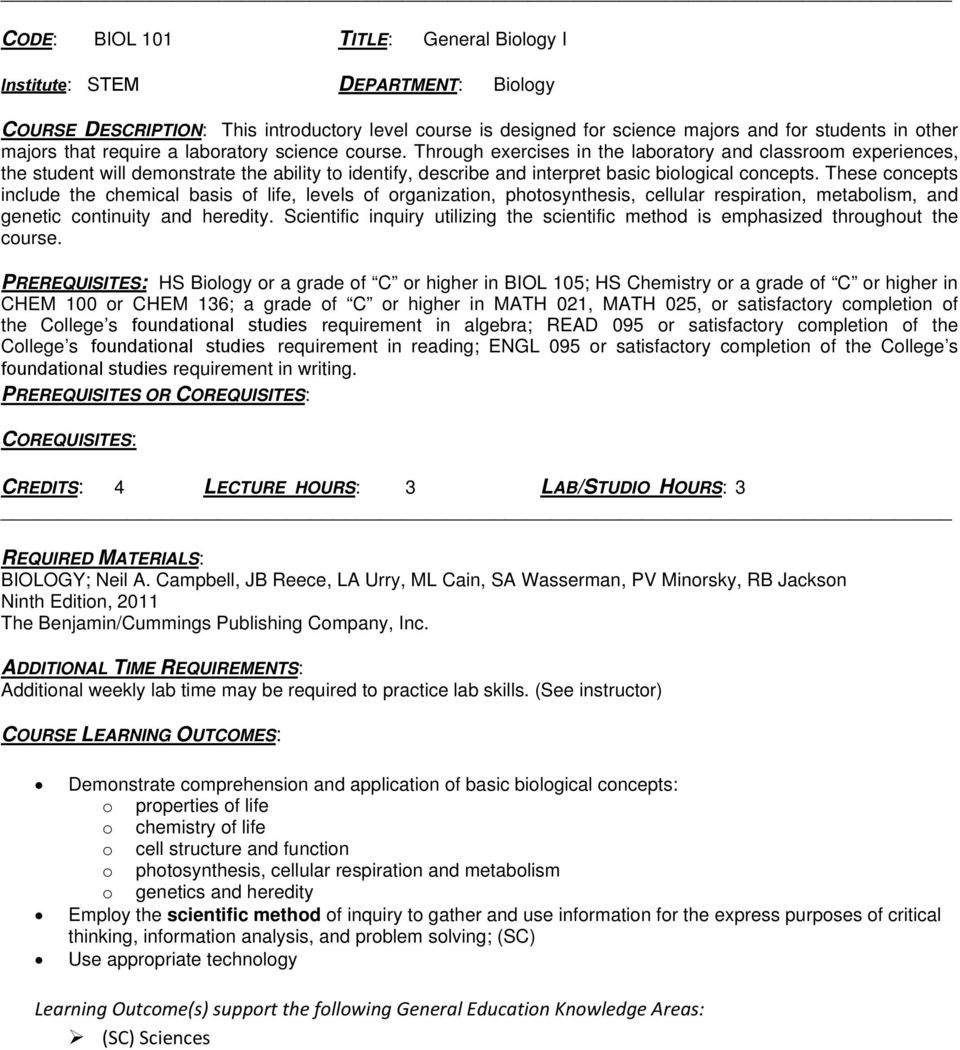
1 CODE: BIOL 101 TITLE: General Biology I Institute: STEM DEPARTMENT: Biology COURSE DESCRIPTION: This introductory level course is designed for science majors and for students in other majors that require a laboratory science course. Through exercises in the laboratory and classroom experiences, the student will demonstrate the ability to identify, describe and interpret basic biological concepts. These concepts include the chemical basis of life, levels of organization, photosynthesis, cellular respiration, metabolism, and genetic continuity and heredity. Scientific inquiry utilizing the scientific method is emphasized throughout the course. PREREQUISITES: HS Biology or a grade of C or higher in BIOL 105; HS Chemistry or a grade of C or higher in CHEM 100 or CHEM 136; a grade of C or higher in MATH 021, MATH 025, or satisfactory completion of the College s foundational studies requirement in algebra; READ 095 or satisfactory completion of the College s foundational studies requirement in reading; ENGL 095 or satisfactory completion of the College s foundational studies requirement in writing. PREREQUISITES OR COREQUISITES: COREQUISITES: CREDITS: 4 LECTURE HOURS: 3 LAB/STUDIO HOURS: 3 REQUIRED MATERIALS: BIOLOGY; Neil A. Campbell, JB Reece, LA Urry, ML Cain, SA Wasserman, PV Minorsky, RB Jackson Ninth Edition, 2011 The Benjamin/Cummings Publishing Company, Inc. ADDITIONAL TIME REQUIREMENTS: Additional weekly lab time may be required to practice lab skills. (See instructor) COURSE LEARNING OUTCOMES: Demonstrate comprehension and application of basic biological concepts: o properties of life o chemistry of life o cell structure and function o photosynthesis, cellular respiration and metabolism o genetics and heredity Employ the scientific method of inquiry to gather and use information for the express purposes of critical thinking, information analysis, and problem solving; (SC) Use appropriate technology Learning Outcome(s) support the following General Education Knowledge Areas: (SC) Sciences
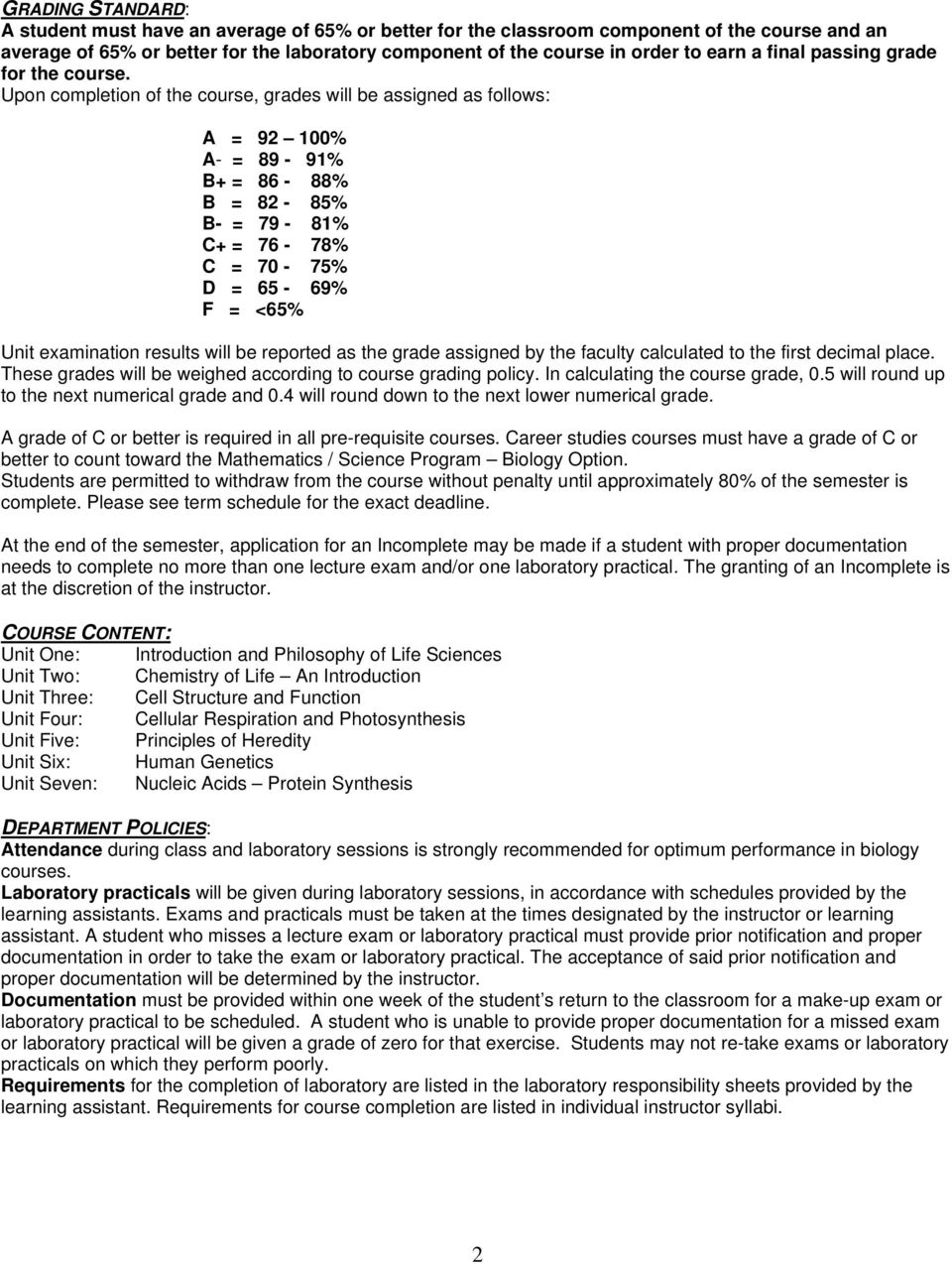
2 GRADING STANDARD: A student must have an average of 65% or better for the classroom component of the course and an average of 65% or better for the laboratory component of the course in order to earn a final passing grade for the course. Upon completion of the course, grades will be assigned as follows: A = % A- = 89-91% B+ = 86-88% B = 82-85% B- = 79-81% C+ = 76-78% C = 70-75% D = 65-69% F = <65% Unit examination results will be reported as the grade assigned by the faculty calculated to the first decimal place. These grades will be weighed according to course grading policy. In calculating the course grade, 0.5 will round up to the next numerical grade and 0.4 will round down to the next lower numerical grade. A grade of C or better is required in all pre-requisite courses. Career studies courses must have a grade of C or better to count toward the Mathematics / Science Program Biology Option. Students are permitted to withdraw from the course without penalty until approximately 80% of the semester is complete. Please see term schedule for the exact deadline. At the end of the semester, application for an Incomplete may be made if a student with proper documentation needs to complete no more than one lecture exam and/or one laboratory practical. The granting of an Incomplete is at the discretion of the instructor. COURSE CONTENT: Unit One: Introduction and Philosophy of Life Sciences Unit Two: Chemistry of Life An Introduction Unit Three: Cell Structure and Function Unit Four: Cellular Respiration and Photosynthesis Unit Five: Principles of Heredity Unit Six: Human Genetics Unit Seven: Nucleic Acids Protein Synthesis DEPARTMENT POLICIES: Attendance during class and laboratory sessions is strongly recommended for optimum performance in biology courses. Laboratory practicals will be given during laboratory sessions, in accordance with schedules provided by the learning assistants. Exams and practicals must be taken at the times designated by the instructor or learning assistant. A student who misses a lecture exam or laboratory practical must provide prior notification and proper documentation in order to take the exam or laboratory practical. The acceptance of said prior notification and proper documentation will be determined by the instructor. Documentation must be provided within one week of the student s return to the classroom for a make-up exam or laboratory practical to be scheduled. A student who is unable to provide proper documentation for a missed exam or laboratory practical will be given a grade of zero for that exercise. Students may not re-take exams or laboratory practicals on which they perform poorly. Requirements for the completion of laboratory are listed in the laboratory responsibility sheets provided by the learning assistant. Requirements for course completion are listed in individual instructor syllabi. 2
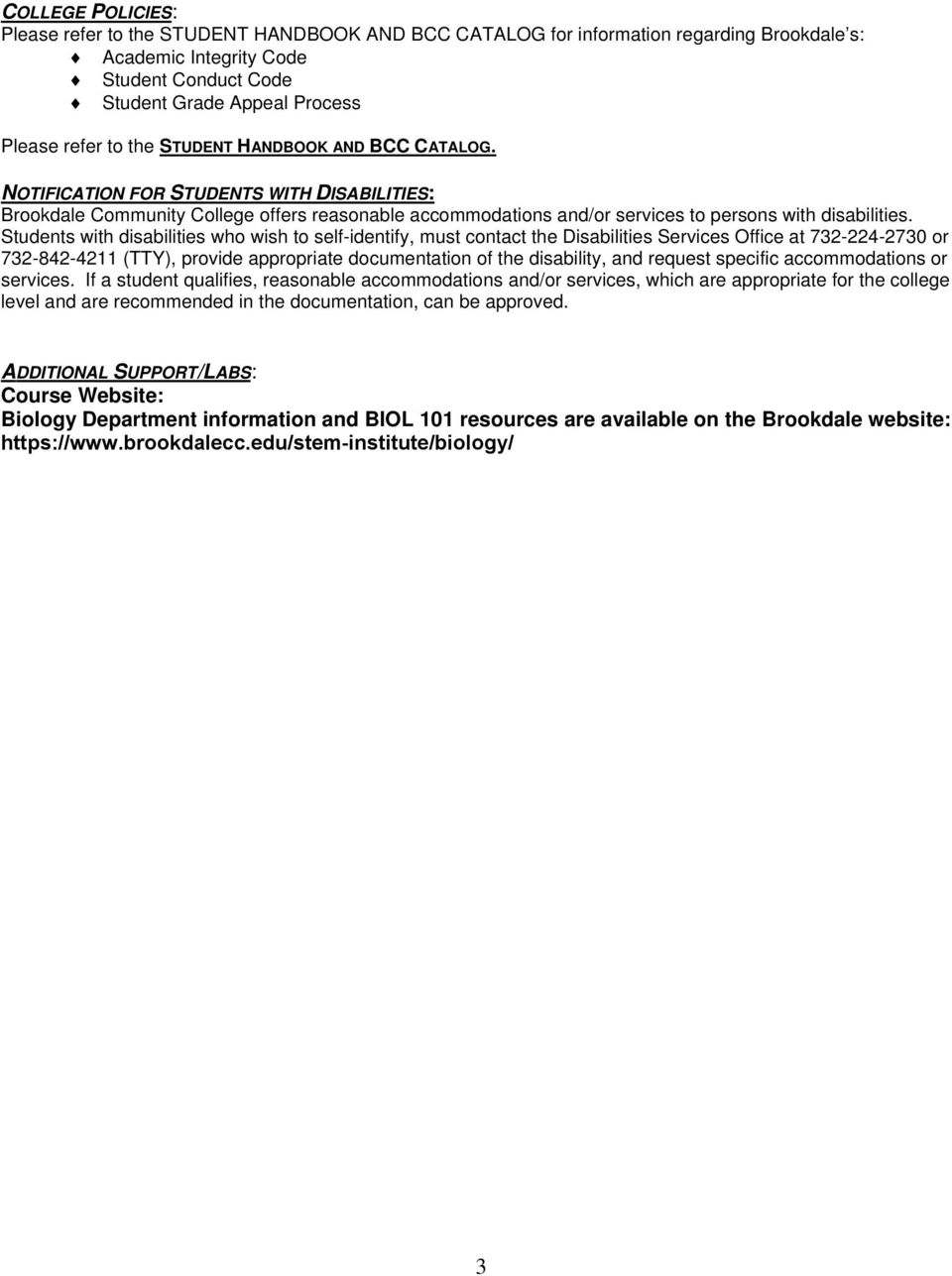
3 COLLEGE POLICIES: Please refer to the STUDENT HANDBOOK AND BCC CATALOG for information regarding Brookdale s: Academic Integrity Code Student Conduct Code Student Grade Appeal Process Please refer to the STUDENT HANDBOOK AND BCC CATALOG. NOTIFICATION FOR STUDENTS WITH DISABILITIES: Brookdale Community College offers reasonable accommodations and/or services to persons with disabilities. Students with disabilities who wish to self-identify, must contact the Disabilities Services Office at or (TTY), provide appropriate documentation of the disability, and request specific accommodations or services. If a student qualifies, reasonable accommodations and/or services, which are appropriate for the college level and are recommended in the documentation, can be approved. ADDITIONAL SUPPORT/LABS: Course Website: Biology Department information and BIOL 101 resources are available on the Brookdale website: 3
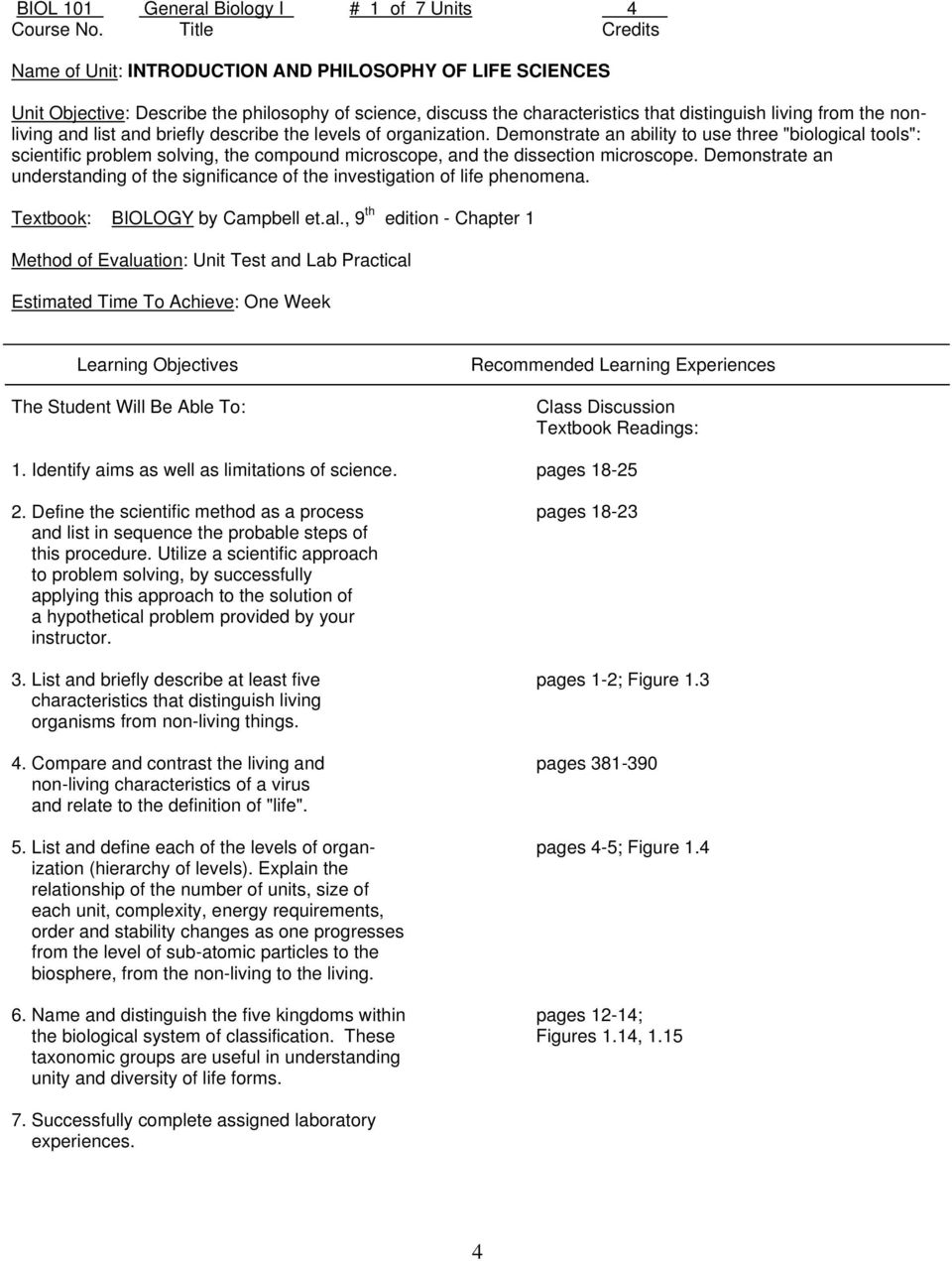
4 BIOL 101 General Biology I # 1 of 7 Units 4 Course No. Title Credits Name of Unit: INTRODUCTION AND PHILOSOPHY OF LIFE SCIENCES Unit Objective: Describe the philosophy of science, discuss the characteristics that distinguish living from the nonliving and list and briefly describe the levels of organization. Demonstrate an ability to use three "biological tools": scientific problem solving, the compound microscope, and the dissection microscope. Demonstrate an understanding of the significance of the investigation of life phenomena. Textbook: BIOLOGY by Campbell et.al., 9 th edition - Chapter 1 Method of Evaluation: Unit Test and Lab Practical Estimated Time To Achieve: One Week 1. Identify aims as well as limitations of science. pages Define the scientific method as a process pages and list in sequence the probable steps of this procedure. Utilize a scientific approach to problem solving, by successfully applying this approach to the solution of a hypothetical problem provided by your instructor. 3. List and briefly describe at least five pages 1-2; Figure 1.3 characteristics that distinguish living organisms from non-living things. 4. Compare and contrast the living and pages non-living characteristics of a virus and relate to the definition of "life". 5. List and define each of the levels of organ- pages 4-5; Figure 1.4 ization (hierarchy of levels). Explain the relationship of the number of units, size of each unit, complexity, energy requirements, order and stability changes as one progresses from the level of sub-atomic particles to the biosphere, from the non-living to the living. 6. Name and distinguish the five kingdoms within pages 12-14; the biological system of classification. These Figures 1.14, 1.15 taxonomic groups are useful in understanding unity and diversity of life forms. 7. Successfully complete assigned laboratory experiences. 4
5 BIOL 101 General Biology I # 2 of 7 Units 4 Course No. Title Credits Name of Unit: CHEMISTRY OF LIFE - AN INTRODUCTION Unit Objective: Understand the basic concepts of chemistry that are related directly to the function of the cell as a living system. Identify the structure and function of macromolecules common to all organisms and the chemical processes of synthesis and dehydration utilized to synthesize and decompose these complex molecules. Textbook: BIOLOGY by Campbell et.al., 9 th edition - Chapters 2-5 Method of Evaluation: Unit Test and Lab Practical Estimated Time To Achieve: Two Weeks 1. Define matter. Discuss the role of protons, neutrons and electrons in the atom, the pages 31-37; Figure 2.5 fundamental unit of all matter. Include a comparison of the mass, charge and location of each subatomic particle. 2. Differentiate between weight and mass. page Define and differentiate the terms: pages 35-37; Figure electron shell, energy level & orbital. 4. Define valence electrons and calculate the pages 35-36; Figure 2.9 number of electrons in the valence shells of the biologically significant atoms. 5. Compare and contrast an atom with an ion, pages & 40 element, and isotope. 6. Using the periodic table, determine atomic pages 33-36; Appendix B; number, atomic mass, and numbers of sub- Figure 2.9 atomic particles in one atom of a given element. 7. Compare and contrast ionic, covalent, polar pages 38-41; covalent, and hydrogen bonding in molecules Figures , 3.2 using examples and stating the biological significance of each type of bond. 8. Describe and provide examples of properties of pages 42-43, 68-69; Figure 5.2 and different types of chemical reactions. 9. Describe the characteristics of water and pages 46-52; Figures state the significance of water to living organisms. 10. Define ph; describe how it is measured and pages 52-56; Figures cite examples of substances which act as acids and others which act as bases. Identify and discuss the role of buffers. 5
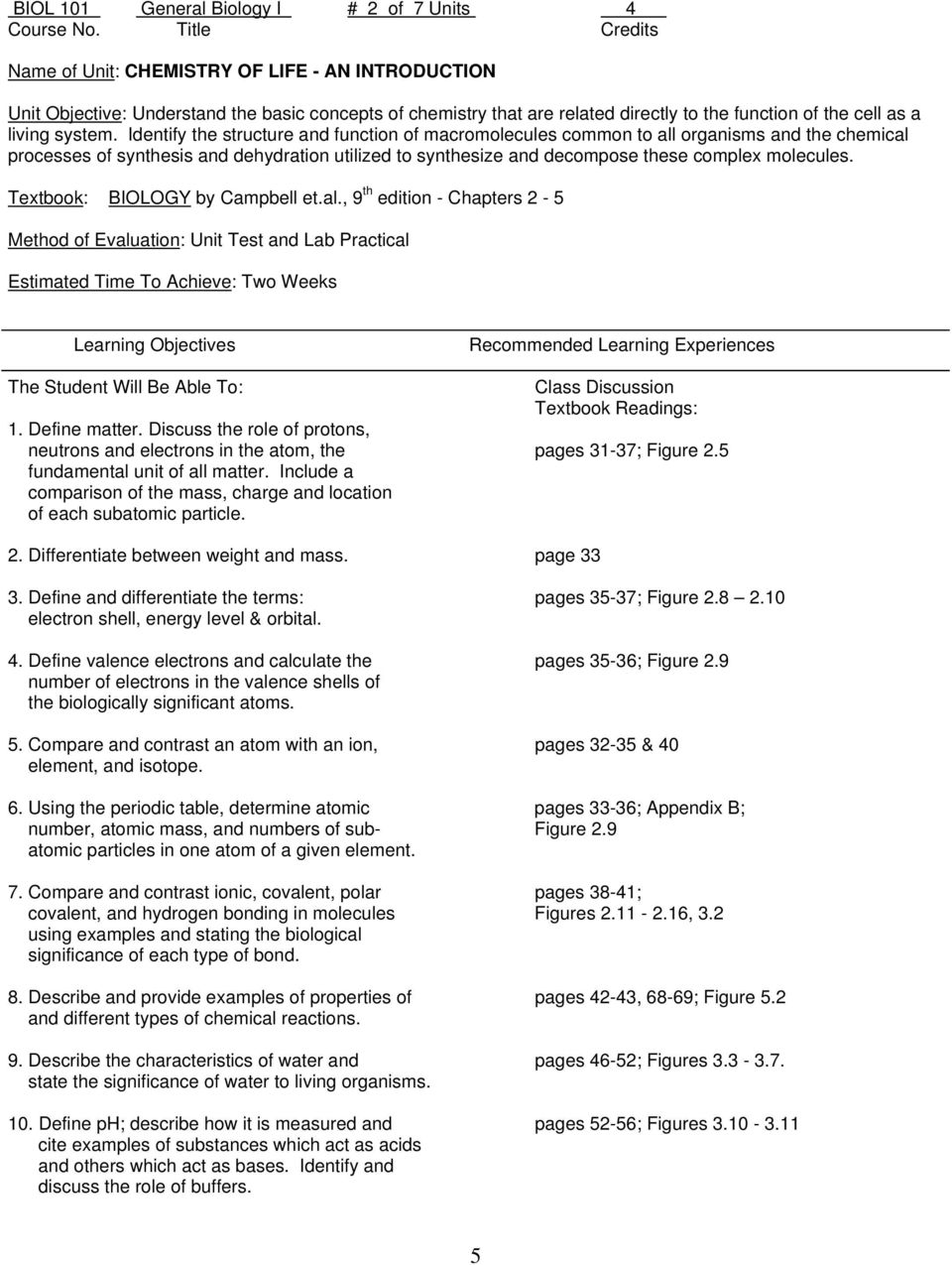
6 11. Define the following terms and state how pages 60-63; Figures they are related: chemical formula, structural formula and isomer. 12. Identify and describe the structure, functional pages 63-65; Figure 4.9 groups (identifying subunits) and chemical pages bonds found in the four basic types of biological macromolecules. 13. Distinguish between dehydration (condensation) pages 68-69; Figure 5.2 and hydrolysis reactions and state their roles in altering the structure of organic molecules. 14. Describe the structure and function of simple pages 69-74; Figures and complex carbohydrates, giving examples of biologically important molecules. 15. Describe the structure and function of pages 74-77; Figures various types of biologically important lipids. 16. Describe the structure and function of biologically pages 77-86; Figures important proteins. 17. Describe the primary, secondary, tertiary, pages 81-86; Figures and quaternary structure of proteins. Cite examples of each, state cellular functions and discuss their relative levels of stability. 18. Describe the role of enzymes as catalysts for pages 77-78; Figure 5.15 chemical reactions in the cell. 19. Describe structures and functions of nucleic pages 86-89; Figures acids. 20. Describe the structure of ATP and discuss its role page 66 as a source of chemical energy in the cell. 21. Successfully complete assigned laboratory experiences. 6
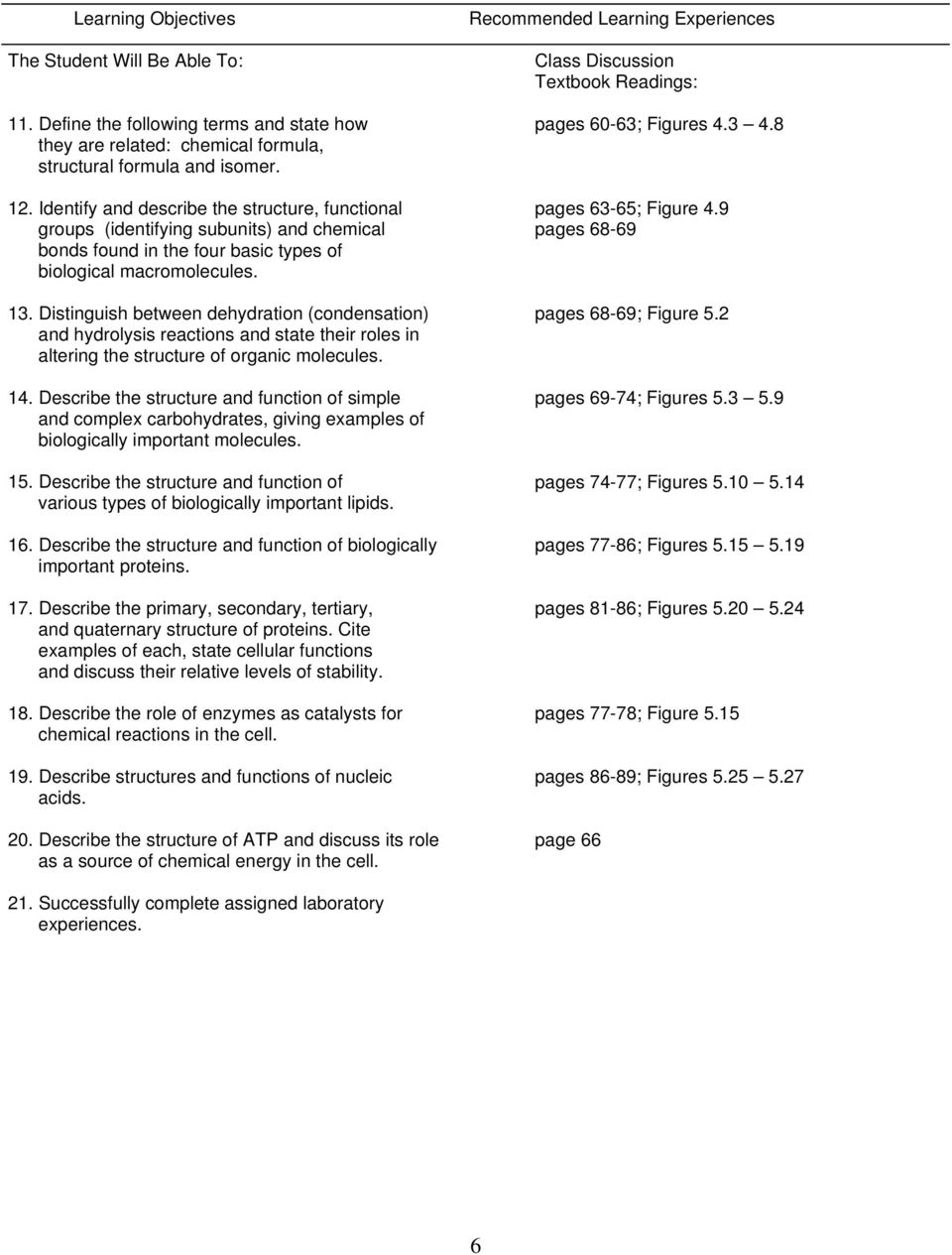
7 BIOL 101 General Biology I # 3 of 7 Units 4 Course No. Title Credits Name of Unit: CELL STRUCTURE AND FUNCTION Unit Objective: Identify and describe the structures and functions of the parts of a typical animal cell and a typical plant cell. Identify specific types of plant and animal cells and relate their functions and/or behaviors to their structural variations. Discuss the process of cell division. Describe the role of cell division in asexual reproduction and organismic growth and repair. Textbook: BIOLOGY by Campbell et.al.,9 th edition - Chapters 1, 6, 7 & 12 Method of Evaluation: Unit Test and Lab Practical Estimated Time To Achieve: Two Weeks 1. Describe the cell theory. Discuss the pages 8, 94-97, 228; importance of the microscope in the study Figures of cell structure and cell fractionation in the study of cell function. 2. Distinguish between prokaryotic and pages 8, 98 99; Figures 1.8, 6.5 eukaryotic cells. 3. Describe the various proposed models of pages 98, 99, ; cellular membranes, their locations, probable Figures 6.6, origin and functions. 4. Define and explain the roles of diffusion, pages ; osmosis, facilitated diffusion, and active Figures transport in the movement of materials through cell membranes using the terms: hypotonic, hypertonic, isotonic and plasmolysis. 5. Locate the following structures on a cell model, pages ; diagram or electron micrograph: Observe electron photomicrographs and basal body gap junction drawings of cell structures - pages plasma membrane Golgi complex cell wall grana Compare plant and animal cell models centriole lysosome on display in the lab (and Figure 6.8). centrosome mitochondria centromere nuclear envelope chloroplast nucleolus chromatin nucleoplasm chromosome nucleus chromatid peroxisome cristae plasmodesmata cilia & flagella pseudopodia cytoplasm ribosomes cytoskeleton stroma desmosomes tight junction endoplasmic reticulum vacuoles 7
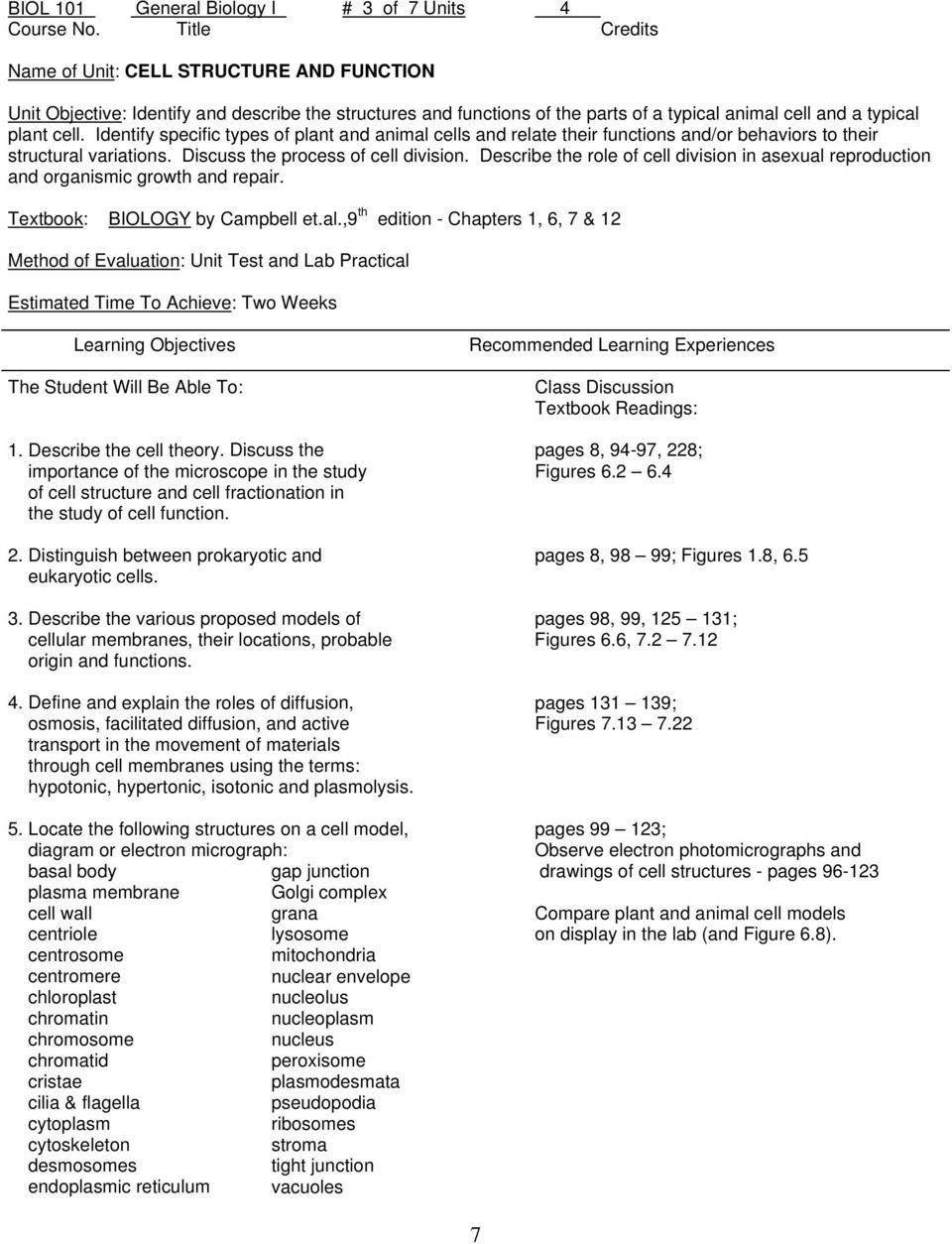
8 6. State the functions of the preceding pages cell structures or organelles. 7. Compare and contrast the structures of a pages ; Figure 6.8 "typical" plant and animal cell as to their component parts. 8. Compare endocytosis and exocytosis. Define and pages ; Figure 7.22 explain the role of pinocytosis, phagocytosis, and receptor mediated endocytosis in terms of vesicle formation. 9. State the significance of the cell cycle as it page 228; Figure 12.2 applies to asexual reproduction, growth and repair. 10. Identify the role of cellular structures involved pages ; in mitosis: chromosomes, Figures , , 2.11 chromatids, centromeres, centrioles, asters, kinetochores and spindle fibers. 11. Describe the significant steps in the process of pages ; cell division: interphase (G 1, S, and G 2 phases), Figures mitosis (prophase, metaphase, anaphase,telophase) and cytokinesis, ( cleavage furrow, cell plate) in both plant and animal cells. 12. Briefly describe regulation of the cell cycle. pages ; Figures Successfully complete assigned laboratory experiences. 8

9 BIOL 101 General Biology I # 4 of 7 Units 4 Course No. Title Credits Name of Unit: CELLULAR RESPIRATION AND PHOTOSYNTHESIS Unit Objective: Discuss and diagram the events that occur during aerobic and anaerobic cellular respiration as means of producing usable energy in the form of ATP. Describe and/or diagram aerobic and anaerobic respiration and photosynthetic processes (photophosphorylation and the Calvin Cycle). Include required conditions, site of activity, raw materials, products formed, relative efficiency and overall importance in producer organisms where applicable. Textbook: BIOLOGY by Campbell et.al., 9 th edition - Chapters 8, 9 & 10 Method of Evaluation: Unit Test and Lab Practical Estimated Time To Achieve: Two Weeks 1. Define reaction, catalyst, enzyme, substrate, active site, and energy of activation. Relate pages ; these terms to the theory of enzyme action. Figures Define competitive, non-competitive and pages ; irreversible inhibition; state methods of Figures action and biological significances of chemical reactions. 3. Explain the inter-relationships of the energy pages ; of activation, free energy, pressure, tempera- Figures 8.12, 8.13, 8.16, 9.3 ture and concentration on the rate of cellular chemical reactions which involve oxidation and reduction. 4. State the relationship of free energy change pages ; (endergonic and exergonic reactions) and the Figures laws of thermodynamics to synthesis and decomposition of glucose and ATP. 5. Discuss the importance of phosphorylation pages ; reactions as the key to understanding the role Figures of ATP as a universal energy source. 6. State the significance of cellular respiration pages , ; and cite examples of organisms using aerobic Figures 9.17, 9.18 and anaerobic respiration. 7. Summarize the process of glycolysis and state pages ; its relationship to fermentation, lactic acid Figures 9.6, 9.8, 9.9, 9.19 synthesis and aerobic respiration. 8. Compare and contrast alcohol fermentation page ; and lactic acid synthesis to include the products Figures 9.17, 9.18 formed, site of activity, and the conditions under 9

10 which each will occur. 9. Diagram and indicate the inter-relationships pages ; between the major reactions of glycolysis, Figure the bridge reaction, the Kreb Cycle, electron transport system, and oxidative phosphorylation to include the sites of activity and final end products. 10. Identify the sources and respective numbers of pages ; ATP molecules produced during the complete Figures 9.15, 9.16 aerobic oxidation of glucose to carbon dioxide and water and the possible uses of these ATP molecules. 11. Briefly describe the chemiosmotic theory as a pages ; process which enables mitochondria to produce ATP. Figures Describe various mechanisms of control of cellular page 181; Figure 9.20 respiration. 13. Identify how and where lipids and proteins pages ; Figure 9.19 may enter the overall process of cellular respiration. 14. Compare and contrast the overall summary pages 165, 187 equations for photosynthesis and respiration. 15. Describe the internal structure of the page ; chloroplast. Figures 10.3, Compare reflected, transmitted and absorbed pages ; Figure 10.8 light with regard to its influence on photosynthesis and the coloration of leaves. 17. State the relationship of light wavelength and pages ; energy to the absorption spectrum of chlorophyll Figures 10.07, and to the action spectrum of photosynthesis. 18. Diagram and explain the steps and products pages ; formed as a result of photosystems I & II. Figures Explain the mechanism and significance of page 195; Figure cyclic electron flow. 20. Diagram and discuss the Calvin Cycle to include pages ; Figure the raw materials and end products. 21. Describe the main function of photosynthesis pages ; using the following terms: light energy, Review Figure chlorophyll, accessory pigments, photophosphorylation, coenzyme, ATP and G3P. 10

11 22. Describe the alternate mechanism of carbon pages ; Figures 10.20, fixation in C 4 plants. 23. Successfully complete assigned laboratory experiences. 11

12 BIOL 101 General Biology I # 5 of 7 Units 4 Course No. Title Credits Name of Unit: PRINCIPLES OF HEREDITY Unit Objective: Demonstrate an understanding of the transmission and expression of hereditary information from generation to generation based on the conclusions of Gregor Mendel's experiments. Discuss the processes involved in sexual and asexual reproduction, and the advantages and disadvantages of both. Textbook: BIOLOGY by Campbell et.al., 9th edition - Chapters 12, 13, 14 & 15 Method of Evaluation: Unit Test and Lab Practical Estimated Time To Achieve: Two Weeks 1. State the advantages and disadvantages of both sexual and asexual reproduction. Pages 249, , Review the stages of the cell cycle and pages significant events occurring in each stage. 3. Compare and contrast the outcome of mitosis pages ; to that of meiosis. Figure Describe the process of meiosis (gametogenesis). pages ; Figures Define the following terms: Glossary and Chapters 13 & 14 hermaphroditism gene self-pollination allele parthenogenesis dominance genetics recessiveness heredity homozygous somatic cells heterozygous gametes phenotype parental generation (P) genotype first filial generation (F 1 ) second filial generation (F 2 ) autosomes and sex chromosomes 6. Explain the results of Mendel's experiments pages ; involving pea plants and discuss his laws of Figures ; segregation and independent assortment Table 14.1 using crosses to illustrate these concepts. 7. Cite examples and genetic crosses involving pages , ; complete dominance, incomplete dominance, Figures 14.3, , 15.7 sex-linkage, multiple alleles, epistasis, polygenic inheritance and test crosses. 8. Briefly describe techniques and applications pages 250 & ; of karyotyping, amniocentesis, and chorionic Figures 13.3, 14.18, villi sampling in fetal testing for genetic abnormalities. 12

13 9. Define chromosome mapping, know how maps pages ; are developed, and state the significance of gene Figures linkage and crossing over to mapping. 10. Describe the difference in the expression of Chapters 14 & 15 visible traits according to the particular pattern of inheritance and the effects that genes have on each other and cell metabolism. 11. Successfully complete the assigned laboratory experiences. 13
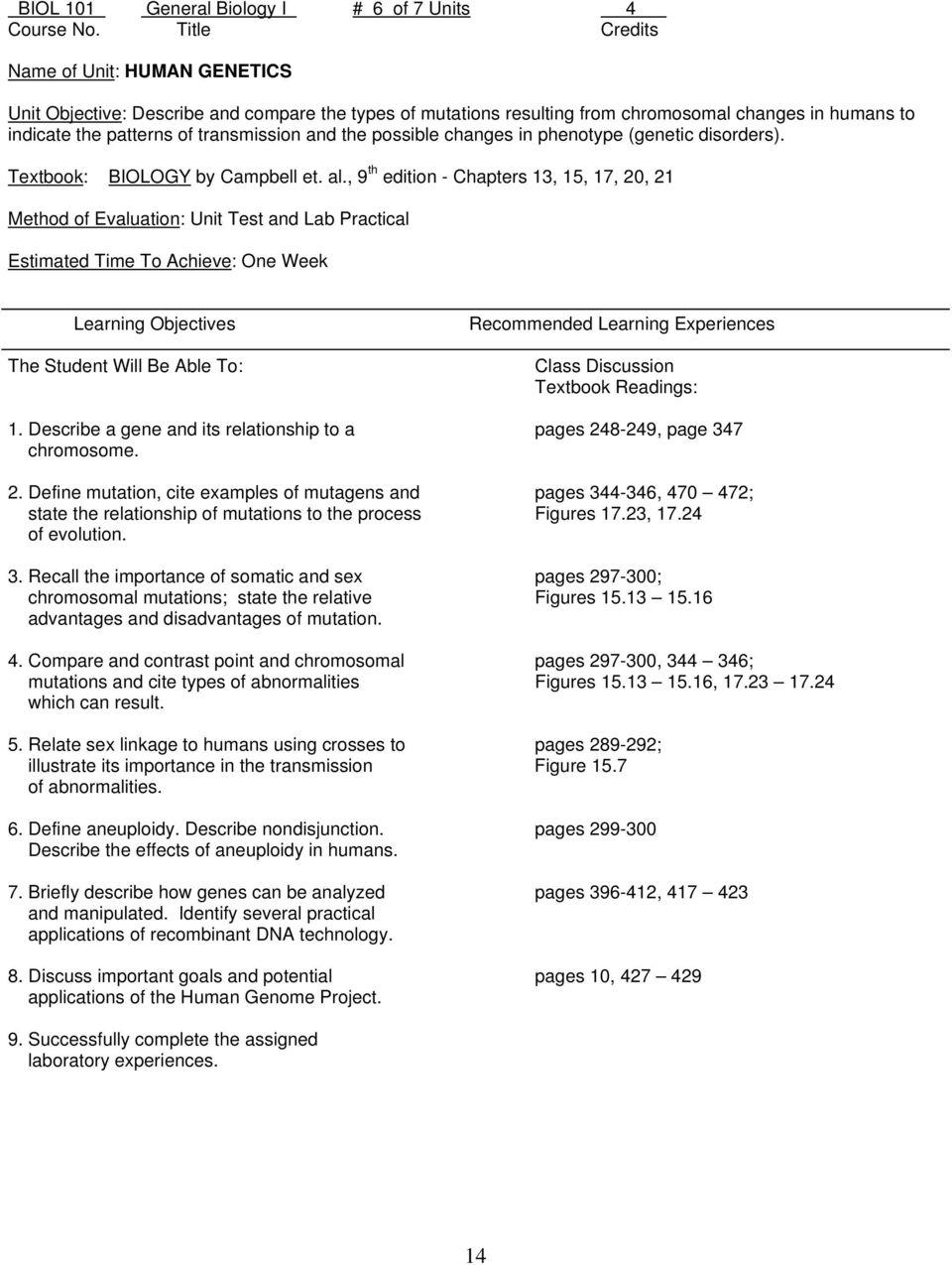
14 BIOL 101 General Biology I # 6 of 7 Units 4 Course No. Title Credits Name of Unit: HUMAN GENETICS Unit Objective: Describe and compare the types of mutations resulting from chromosomal changes in humans to indicate the patterns of transmission and the possible changes in phenotype (genetic disorders). Textbook: BIOLOGY by Campbell et. al., 9 th edition - Chapters 13, 15, 17, 20, 21 Method of Evaluation: Unit Test and Lab Practical Estimated Time To Achieve: One Week 1. Describe a gene and its relationship to a pages , page 347 chromosome. 2. Define mutation, cite examples of mutagens and pages , ; state the relationship of mutations to the process Figures 17.23, of evolution. 3. Recall the importance of somatic and sex pages ; chromosomal mutations; state the relative Figures advantages and disadvantages of mutation. 4. Compare and contrast point and chromosomal pages , ; mutations and cite types of abnormalities Figures , which can result. 5. Relate sex linkage to humans using crosses to pages ; illustrate its importance in the transmission Figure 15.7 of abnormalities. 6. Define aneuploidy. Describe nondisjunction. pages Describe the effects of aneuploidy in humans. 7. Briefly describe how genes can be analyzed pages , and manipulated. Identify several practical applications of recombinant DNA technology. 8. Discuss important goals and potential pages 10, applications of the Human Genome Project. 9. Successfully complete the assigned laboratory experiences. 14
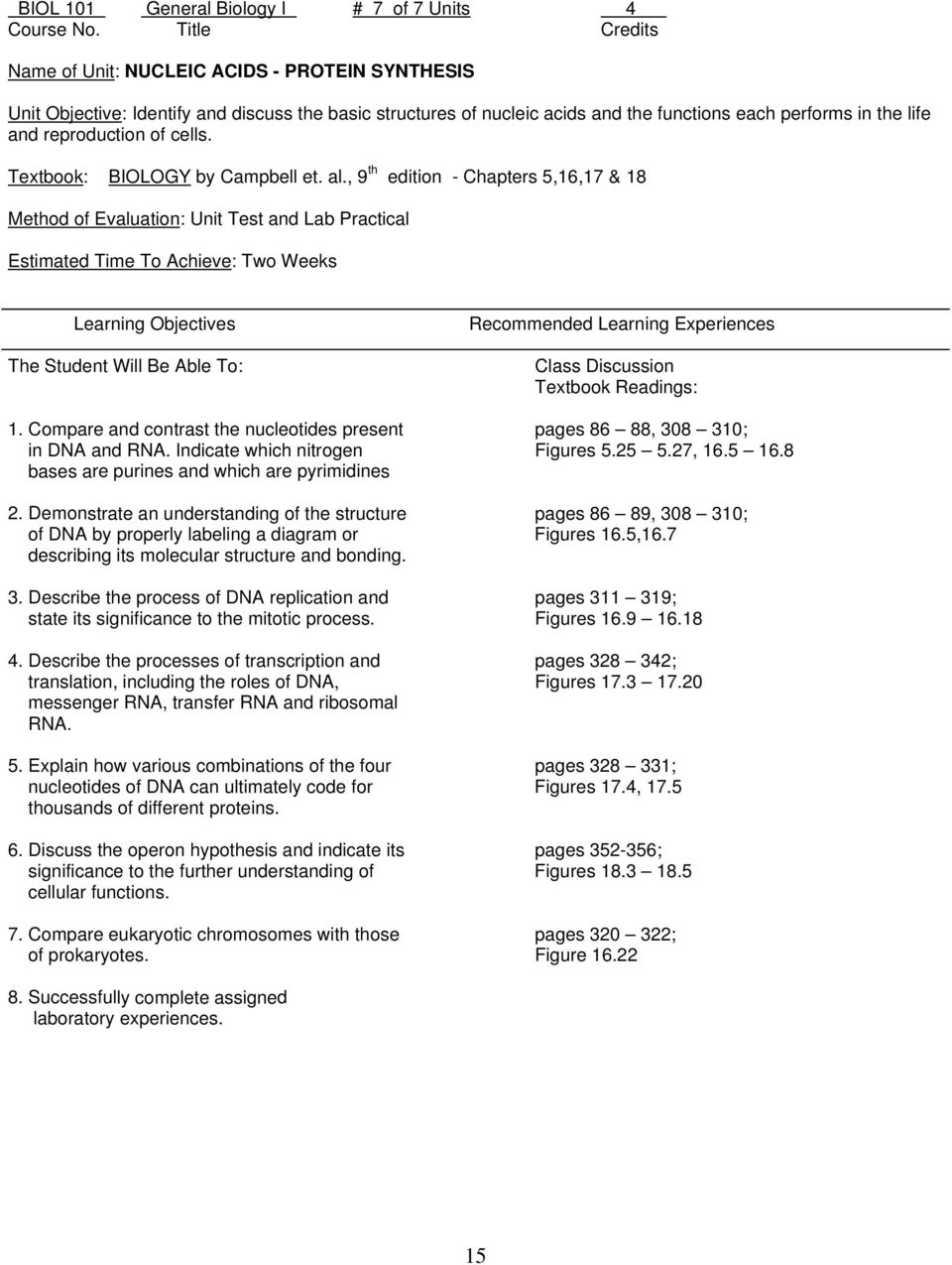
15 BIOL 101 General Biology I # 7 of 7 Units 4 Course No. Title Credits Name of Unit: NUCLEIC ACIDS - PROTEIN SYNTHESIS Unit Objective: Identify and discuss the basic structures of nucleic acids and the functions each performs in the life and reproduction of cells. Textbook: BIOLOGY by Campbell et. al., 9 th edition - Chapters 5,16,17 & 18 Method of Evaluation: Unit Test and Lab Practical Estimated Time To Achieve: Two Weeks 1. Compare and contrast the nucleotides present pages 86 88, ; in DNA and RNA. Indicate which nitrogen Figures , bases are purines and which are pyrimidines 2. Demonstrate an understanding of the structure pages 86 89, ; of DNA by properly labeling a diagram or Figures 16.5,16.7 describing its molecular structure and bonding. 3. Describe the process of DNA replication and pages ; state its significance to the mitotic process. Figures Describe the processes of transcription and pages ; translation, including the roles of DNA, Figures messenger RNA, transfer RNA and ribosomal RNA. 5. Explain how various combinations of the four pages ; nucleotides of DNA can ultimately code for Figures 17.4, 17.5 thousands of different proteins. 6. Discuss the operon hypothesis and indicate its pages ; significance to the further understanding of Figures cellular functions. 7. Compare eukaryotic chromosomes with those pages ; of prokaryotes. Figure Successfully complete assigned laboratory experiences. 15
MCAS Biology. Review Packet
 MCAS Biology Review Packet 1 Name Class Date 1. Define organic. THE CHEMISTRY OF LIFE 2. All living things are made up of 6 essential elements: SPONCH. Name the six elements of life. S N P C O H 3. Elements
Anatomy and Physiology Placement Exam 2 Practice with Answers at End!
 Anatomy and Physiology Placement Exam 2 Practice with Answers at End! General Chemical Principles 1. bonds are characterized by the sharing of electrons between the participating atoms. a. hydrogen b.
STATE UNIVERSITY OF NEW YORK COLLEGE OF TECHNOLOGY CANTON, NEW YORK COURSE OUTLINE. BIOL 101 Introduction to Biology
 STATE UNIVERSITY OF NEW YORK COLLEGE OF TECHNOLOGY CANTON, NEW YORK COURSE OUTLINE BIOL 101 Introduction to Biology Prepared By: W. David Barnes SCHOOL OF SCIENCE, HEALTH & PROFESSIONAL STUDIES SCIENCE
BIOLOGY 101 COURSE SYLLABUS FOR FALL 2015
 BIOLOGY 101 COURSE SYLLABUS FOR FALL 2015 Course Description Instructor Biology 101 is the first of a two-semester introductory course sequence designed primarily for science majors. It covers some central
Bio 101 Section 001: Practice Questions for First Exam
 Do the Practice Exam under exam conditions. Time yourself! MULTIPLE CHOICE: 1. The substrate fits in the of an enzyme: (A) allosteric site (B) active site (C) reaction groove (D) Golgi body (E) inhibitor
Cytology. Living organisms are made up of cells. Either PROKARYOTIC or EUKARYOTIC cells.
 CYTOLOGY Cytology Living organisms are made up of cells. Either PROKARYOTIC or EUKARYOTIC cells. A. two major cell types B. distinguished by structural organization See table on handout for differences.
Cell Unit Practice Test #1
 ell Unit Practice Test #1 Name: ate: 1. Which organelle is primarily concerned with the conversion of potential energy of organic compounds into suitable form for immediate use by the cell?. mitochondria.
Keystone Review Practice Test Module A Cells and Cell Processes. 1. Which characteristic is shared by all prokaryotes and eukaryotes?
 Keystone Review Practice Test Module A Cells and Cell Processes 1. Which characteristic is shared by all prokaryotes and eukaryotes? a. Ability to store hereditary information b. Use of organelles to control
From DNA to Protein
 Nucleus Control center of the cell contains the genetic library encoded in the sequences of nucleotides in molecules of DNA code for the amino acid sequences of all proteins determines which specific proteins
PRESTWICK ACADEMY NATIONAL 5 BIOLOGY CELL BIOLOGY SUMMARY
 Name PRESTWICK ACADEMY NATIONAL 5 BIOLOGY CELL BIOLOGY SUMMARY Cell Structure Identify animal, plant, fungal and bacterial cell ultrastructure and know the structures functions. Plant cell Animal cell
Honors Biology Course Summary Department: Science
 Honors Biology Course Summary Department: Science Semester 1 Learning Objective #1 - Ecology Students will understand how organisms interact with each other and the environment. Target(s) to Meet Learning
Cell Structure and Function
 CHAPTER 3 CELL STRUCTURE AND FUNCTION Vocabulary Practice cell theory vacuole concentration gradient cytoplasm lysosome osmosis organelle centriole isotonic prokaryotic cell cell wall hypertonic eukaryotic
CELL/ PHOTOSYNTHESIS/ CELLULAR RESPIRATION Test 2011 ANSWER 250 POINTS ANY WAY IN WHICH YOU WANT
 CELL/ PHOTOSYNTHESIS/ CELLULAR RESPIRATION Test 2011 ANSWER 250 POINTS ANY WAY IN WHICH YOU WANT Completion: complete each statement. (1 point each) 1. All cells arise from. 2. The basic unit of structure
Chapter 2: Cell Structure and Function pg. 70-107
 UNIT 1: Biochemistry Chapter 2: Cell Structure and Function pg. 70-107 Organelles are internal structures that carry out specialized functions, interacting and complementing each other. Animal and plant
Name Date Period. 2. When a molecule of double-stranded DNA undergoes replication, it results in
 DNA, RNA, Protein Synthesis Keystone 1. During the process shown above, the two strands of one DNA molecule are unwound. Then, DNA polymerases add complementary nucleotides to each strand which results
Cells & Cell Organelles
 Cells & Cell Organelles The Building Blocks of Life H Biology Types of cells bacteria cells Prokaryote - no organelles Eukaryotes - organelles animal cells plant cells Cell size comparison Animal cell
Cell Structure & Function!
 Cell Structure & Function! Chapter 3! The most exciting phrase to hear in science, the one that heralds new discoveries, is not 'Eureka!' but 'That's funny.! -- Isaac Asimov Animal Cell Plant Cell Cell
Visualizing Cell Processes
 Visualizing Cell Processes A Series of Five Programs produced by BioMEDIA ASSOCIATES Content Guide for Program 3 Photosynthesis and Cellular Respiration Copyright 2001, BioMEDIA ASSOCIATES www.ebiomedia.com
ISTEP+: Biology I End-of-Course Assessment Released Items and Scoring Notes
 ISTEP+: Biology I End-of-Course Assessment Released Items and Scoring Notes Page 1 of 22 Introduction Indiana students enrolled in Biology I participated in the ISTEP+: Biology I Graduation Examination
7.2 Cell Structure. Lesson Objectives. Lesson Summary. Cell Organization Eukaryotic cells contain a nucleus and many specialized structures.
 7.2 Cell Structure Lesson Objectives Describe the structure and function of the cell nucleus. Describe the role of vacuoles, lysosomes, and the cytoskeleton. Identify the role of ribosomes, endoplasmic
Basic Scientific Principles that All Students Should Know Upon Entering Medical and Dental School at McGill
 Fundamentals of Medicine and Dentistry Basic Scientific Principles that All Students Should Know Upon Entering Medical and Dental School at McGill Students entering medical and dental training come from
3.1 AS Unit: Cells, Exchange and Transport
 3.1 AS Unit: Cells, Exchange and Transport Module 1: Cells 1.1.1 Cell Structure Candidates should be able to: (a) state the resolution and magnification that can be achieved by a light microscope, a transmission
CHROMOSOME STRUCTURE CHROMOSOME NUMBERS
 CHROMOSOME STRUCTURE 1. During nuclear division, the DNA (as chromatin) in a Eukaryotic cell's nucleus is coiled into very tight compact structures called chromosomes. These are rod-shaped structures made
Biology 101 Chapter 4 Cells as the Basic Unit of Life. The Cell Theory Major Contributors: Galileo = first observations made with a microscope
 Biology 101 Chapter 4 Cells as the Basic Unit of Life The Cell Theory Major Contributors: Galileo = first observations made with a microscope Robert Hooke = first to observe small compartments in dead
Microscopes. Eukaryotes Eukaryotic cells are characterized by having: DNA in a nucleus that is bounded by a membranous nuclear envelope
 CH 6 The Cell Microscopy Scientists use microscopes to visualize cells too small to see with the naked eye. In a light microscope (LM), visible light is passed through a specimen and then through glass
Biology I New Summit School High School Diploma Program
 Course Description: Biology I Syllabus Biology I is a two semester course. Students completing this course will earn 1.0 unit upon completion. Required Materials: 1. Student Text: Biology-Principles and
* Is chemical energy potential or kinetic energy? The position of what is storing energy?
 Biology 1406 Exam 2 - Metabolism Chs. 5, 6 and 7 energy - capacity to do work 5.10 kinetic energy - energy of motion : light, electrical, thermal, mechanical potential energy - energy of position or stored
Examination One. Biology 101. Dr. Jaeson T. Fournier
 Examination One Biology 101 Dr. Jaeson T. Fournier Examination Instructions: Answers are to be indicated on a scantron. Keep your work protected! This helps prevent dishonesty. The instructor will not
Chapter 4: A Tour of the Cell. 1. Cell Basics. Limits to Cell Size. 1. Cell Basics. 2. Prokaryotic Cells. 3. Eukaryotic Cells
 Chapter 4: A Tour of the Cell 1. Cell Basics 2. Prokaryotic Cells 3. Eukaryotic Cells 1. Cell Basics Limits to Cell Size There are 2 main reasons why cells are so small: If cells get too large: 1) there
Use of the Microscope and Cytology
 Use of the Microscope and Cytology Introduction: A true study of anatomy not only considers the large, visible structures of an organism, but also the small structures that provide the organism its form
3120-1 - Page 1. Name:
 Name: 1) Which series is arranged in correct order according to decreasing size of structures? A) DNA, nucleus, chromosome, nucleotide, nitrogenous base B) chromosome, nucleus, nitrogenous base, nucleotide,
SOME Important Points About Cellular Energetics by Dr. Ty C.M. Hoffman
 SOME Important Points About Cellular Energetics by Dr. Ty C.M. Hoffman An Introduction to Metabolism Most biochemical processes occur as biochemical pathways, each individual reaction of which is catalyzed
Genetics Module B, Anchor 3
 Genetics Module B, Anchor 3 Key Concepts: - An individual s characteristics are determines by factors that are passed from one parental generation to the next. - During gamete formation, the alleles for
Objective: On a team of no more than (2). Build to illustrate a 3D model of a PLANT or ANIMAL cell. 10 pts.
 THE CELL model: Activity 4.1 Science / Biology Objective: On a team of no more than (2). Build to illustrate a 3D model of a PLANT or ANIMAL cell. - Your models should clearly demonstrate the following
Mississippi SATP Biology I Student Review Guide
 Mississippi Student Review Guide Author: Cecilia L. Boles Published by Enrichment Plus, LLC PO Box 2755 Acworth, GA 30102 Toll Free: 1-800-745-4706 Fax 678-445-6702 Web site: www.enrichmentplus.com Mississippi
Cellular Respiration: Practice Questions #1
 Cellular Respiration: Practice Questions #1 1. Which statement best describes one of the events taking place in the chemical reaction? A. Energy is being stored as a result of aerobic respiration. B. Fermentation
Study Guide for Final Exam All Chapters
 Study Guide for Final Exam All Chapters * NOTE: This is just a guide. It is not a comprehensive list of what may be on the test. * Studying tips: For every test, including lab tests and the final exam,
Carbon Hydrogen Oxygen Nitrogen
 Concept 1 - Thinking Practice 1. If the following molecules were to undergo a dehydration synthesis reaction, what molecules would result? Circle the parts of each amino acid that will interact and draw
Cellular Energy. 1. Photosynthesis is carried out by which of the following?
 Cellular Energy 1. Photosynthesis is carried out by which of the following? A. plants, but not animals B. animals, but not plants C. bacteria, but neither animals nor plants D. all living organisms 2.
Evolution of Metabolism. Introduction. Introduction. Introduction. How Cells Harvest Energy. Chapter 7 & 8
 How ells Harvest Energy hapter 7 & 8 Evolution of Metabolism A hypothetical timeline for the evolution of metabolism - all in prokaryotic cells!: 1. ability to store chemical energy in ATP 2. evolution
Unit I: Introduction To Scientific Processes
 Unit I: Introduction To Scientific Processes This unit is an introduction to the scientific process. This unit consists of a laboratory exercise where students go through the QPOE2 process step by step
South Texas College Biology Department Section Outline
 Essential minimum information required by STC South Texas College Biology Department Section Outline Biology 1406.P15 (majors) (Face-to-face Web-enhanced class) General Biology I Spring 2015 Instructor
Organelles and Their Functions
 Organelles and Their Functions The study of cell organelles and their functions is a fascinating part of biology. The current article provides a brief description of the structure of organelles and their
1. The diagram below represents a biological process
 1. The diagram below represents a biological process 5. The chart below indicates the elements contained in four different molecules and the number of atoms of each element in those molecules. Which set
Plasma Membrane hydrophilic polar heads
 The Parts of the Cell 3 main parts in ALL cells: plasma membrane, cytoplasm, genetic material this is about the parts of a generic eukaryotic cell Plasma Membrane -is a fluid mosaic model membrane is fluid
2. Which type of macromolecule contains high-energy bonds and is used for long-term energy storage?
 Energy Transport Study Island 1. During the process of photosynthesis, plants use energy from the Sun to convert carbon dioxide and water into glucose and oxygen. These products are, in turn, used by the
THE HISTORY OF CELL BIOLOGY
 SECTION 4-1 REVIEW THE HISTORY OF CELL BIOLOGY Define the following terms. 1. cell 2. cell theory Write the correct letter in the blank. 1. One early piece of evidence supporting the cell theory was the
Cell Growth and Reproduction Module B, Anchor 1
 Cell Growth and Reproduction Module B, Anchor 1 Key Concepts: - The larger a cell becomes, the more demands the cell places on its DNA. In addition, a larger cell is less efficient in moving nutrients
Essentials of Human Anatomy & Physiology 11 th Edition, 2015 Marieb
 A Correlation of Essentials of Human Anatomy Marieb To the Next Generation Science Standards Life A Correlation of, HS-LS1 From Molecules to Organisms: Structures and Processes HS-LS1-1. Construct an explanation
Bio EOC Topics for Cell Reproduction: Bio EOC Questions for Cell Reproduction:
 Bio EOC Topics for Cell Reproduction: Asexual vs. sexual reproduction Mitosis steps, diagrams, purpose o Interphase, Prophase, Metaphase, Anaphase, Telophase, Cytokinesis Meiosis steps, diagrams, purpose
AP Bio Photosynthesis & Respiration
 AP Bio Photosynthesis & Respiration Multiple Choice Identify the letter of the choice that best completes the statement or answers the question. 1. What is the term used for the metabolic pathway in which
Lecture 7 Mitosis & Meiosis
 Lecture 7 Mitosis & Meiosis Cell Division Essential for body growth and tissue repair Interphase G 1 phase Primary cell growth phase S phase DNA replication G 2 phase Microtubule synthesis Mitosis Nuclear
Topic 3: Nutrition, Photosynthesis, and Respiration
 1. Base your answer to the following question on the chemical reaction represented below and on your knowledge of biology. If this reaction takes place in an organism that requires sunlight to produce
Prentice Hall Biology (Miller/Levine) 2008 Correlated to: Colorado Science Standards and Benchmarks (Grades 9-12)
 1. ask questions and state hypotheses using prior scientific knowledge to help design and guide their development and implementation of a scientific investigation STANDARD 1: Students apply the processes
Quick Hit Activity Using UIL Science Contests For Formative and Summative Assessments of Pre-AP and AP Biology Students
 Quick Hit Activity Using UIL Science Contests For Formative and Summative Assessments of Pre-AP and AP Biology Students Activity Title: Quick Hit Goal of Activity: To perform formative and summative assessments
Todays Outline. Metabolism. Why do cells need energy? How do cells acquire energy? Metabolism. Concepts & Processes. The cells capacity to:
 and Work Metabolic Pathways Enzymes Features Factors Affecting Enzyme Activity Membrane Transport Diffusion Osmosis Passive Transport Active Transport Bulk Transport Todays Outline -Releasing Pathways
Lecture 4 Cell Membranes & Organelles
 Lecture 4 Cell Membranes & Organelles Structure of Animal Cells The Phospholipid Structure Phospholipid structure Encases all living cells Its basic structure is represented by the fluidmosaic model Phospholipid
Eukaryotes. www.njctl.org PSI Biology Eukaryotes & Gene Expression
 Eukaryotes The Eukaryotic Cell Classwork 1. Identify two characteristics that are shared by all cells. 2. Suppose you are investigating a cell that contains a nucleus. Would you categorize this cell as
1. When applying the process of science, which of these is tested? a. an observation b. a result c. a hypothesis d. a question e.
 BCOR 11 Exam 1, 2004 MULTIPLE CHOICE. Choose the one alternative that best completes the statement or answers the question. 1. When applying the process of science, which of these is tested? a. an observation
Phone: (318) 670-6423 Phone: (318) 670-6251. Classroom: (218) Classroom: (222) Office: Rm. 11/239 Office: Rm. 9/236 MISSION STATEMENT
 SOUTHERN UNIVERSITY SHREVEPORT, LA Fall 2010 Course Syllabus BIOLOGY 104 - Lecture: Louis Collier Hall Lecture: 3 Credit Hours Separate Laboratory: 1 Credit Hour Biology Department Office Hours (posted
Multiple Choice Questions
 Chapter 5 THE FUNDAMENTAL UNIT OF LIFE Multiple Choice Questions 1. Which of the following can be made into crystal? (a) A Bacterium (b) An Amoeba (c) A Virus (d) A Sperm 2. A cell will swell up if (a)
Compartmentalization of the Cell. Objectives. Recommended Reading. Professor Alfred Cuschieri. Department of Anatomy University of Malta
 Compartmentalization of the Cell Professor Alfred Cuschieri Department of Anatomy University of Malta Objectives By the end of this session the student should be able to: 1. Identify the different organelles
Modern Biology. Chapter Tests with Answer Key General and Advanced
 Modern Biology Chapter Tests with Answer Key General and Advanced Assessment Chapter Test B The Science of Life In the space provided, write the letter of the description that best matches the term or
Biology Chapter 7 Practice Test
 Biology Chapter 7 Practice Test Multiple Choice Write the letter that best answers the question or completes the statement on the line provided. 1. The work of Schleiden and Schwann can be summarized by
Unit 5 Photosynthesis and Cellular Respiration
 Unit 5 Photosynthesis and Cellular Respiration Advanced Concepts What is the abbreviated name of this molecule? What is its purpose? What are the three parts of this molecule? Label each part with the
pathway that involves taking in heat from the environment at each step. C.
 Study Island Cell Energy Keystone Review 1. Cells obtain energy by either capturing light energy through photosynthesis or by breaking down carbohydrates through cellular respiration. In both photosynthesis
Biology 20 Cellular Respiration Review NG Know the process of Cellular Respiration (use this picture if it helps):
 Biology 20 Cellular Respiration Review NG Know the process of Cellular Respiration (use this picture if it helps): 1) How many ATP molecules are produced for each glucose molecule used in fermentation?
H.W. 1 Bio 101 Prof. Fournier
 H.W. 1 Bio 101 Prof. Fournier 1. What is a similarity between all bacteria and plants? A) They both have a nucleus B) They are both composed of cells C) They both have chloroplasts D) They both lack a
XII. Biology, Grade 10
 XII. Biology, Grade 10 Grade 10 Biology Pilot Test The spring 2004 Grade 10 MCAS Biology Test was based on learning standards in the Biology content strand of the Massachusetts Science and Technology/Engineering
Bacterial (Prokaryotic) Cell. Common features of all cells. Tour of the Cell. Eukaryotic Cell. Plasma Membrane defines inside from outside
 www.denniskunkel.com Tour of the Cell www.denniskunkel.com Today s Topics Properties of all cells Prokaryotes and Eukaryotes Functions of Major Cellular Organelles Information, Synthesis&Transport,, Vesicles
www.njctl.org PSI Biology Mitosis & Meiosis
 Mitosis and Meiosis Mitosis Classwork 1. Identify two differences between meiosis and mitosis. 2. Provide an example of a type of cell in the human body that would undergo mitosis. 3. Does cell division
List, describe, diagram, and identify the stages of meiosis.
 Meiosis and Sexual Life Cycles In this topic we will examine a second type of cell division used by eukaryotic cells: meiosis. In addition, we will see how the 2 types of eukaryotic cell division, mitosis
Date: Student Name: Teacher Name: Jared George. Score: 1) A cell with 1% solute concentration is placed in a beaker with a 5% solute concentration.
 Biology Keystone (PA Core) Quiz Homeostasis and Transport - (BIO.A.4.1.1 ) Plasma Membrane, (BIO.A.4.1.2 ) Transport Mechanisms, (BIO.A.4.1.3 ) Transport Facilitation Student Name: Teacher Name: Jared
Chapter 12: The Cell Cycle
 Name Period Chapter 12: The Cell Cycle Overview: 1. What are the three key roles of cell division? State each role, and give an example. Key Role Reproduction Growth and development Tissue removal Example
Chapter 12: The Cell Cycle
 Name Period Chapter 12: The Cell Cycle Overview: 1. What are the three key roles of cell division? State each role, and give an example. Key Role Example 2. What is meant by the cell cycle? Concept 12.1
AP Biology. The four big ideas are:
 AP Biology Course Overview: This course is an intensive study in biological concepts that emphasizes inquiry based learning. It is structured around the four Big Ideas and the Enduring Understandings that
Review of the Cell and Its Organelles
 Biology Learning Centre Review of the Cell and Its Organelles Tips for most effective learning of this material: Memorize the names and structures over several days. This will help you retain what you
BIO 130.001 Principles of Cell & Molecular Biology Fall 2014 TR 11:00-12:15
 BIO 130.001 Principles of Cell & Molecular Biology Fall 2014 TR 11:00-12:15 S233 Dr. Sarah Canterberry Office Hours: S202 SI Leader: Assistant Professor, Biology MWF 1:00 3:00 Ramiro Espericueta *E-mail:
General Biology. Course Description and Philosophy
 General Biology Course Description and Philosophy Biology is the study of life on the planet Earth. This is a standard college preparatory life science course. Among the concepts covered in the course
Cell Division CELL DIVISION. Mitosis. Designation of Number of Chromosomes. Homologous Chromosomes. Meiosis
 Cell Division CELL DIVISION Anatomy and Physiology Text and Laboratory Workbook, Stephen G. Davenport, Copyright 2006, All Rights Reserved, no part of this publication can be used for any commercial purpose.
Given these characteristics of life, which of the following objects is considered a living organism? W. X. Y. Z.
 Cell Structure and Organization 1. All living things must possess certain characteristics. They are all composed of one or more cells. They can grow, reproduce, and pass their genes on to their offspring.
CONCEPTS OF BIOLOGY - BIOL115 Dr. SG Saupe; Fall 2006 Exam #2
 CONCEPTS OF BIOLOGY - BIOL115 Dr. SG Saupe; Fall 2006 Exam #2 name And he gave it for his opinion, that whoever could make two ears of corn or two blades of grass to grow upon a spot where only one grew
Cell and Membrane Practice. A. chromosome B. gene C. mitochondrion D. vacuole
 Name: ate: 1. Which structure is outside the nucleus of a cell and contains N?. chromosome. gene. mitochondrion. vacuole 2. potato core was placed in a beaker of water as shown in the figure below. Which
Cell Structure and Function. Eukaryotic Cell: Neuron
 Cell Structure and Function Eukaryotic Cell: Neuron Cell Structure and Function Eukaryotic Cells: Blood Cells Cell Structure and Function Prokaryotic Cells: Bacteria Cell Structure and Function All living
Biology 1406 Exam 4 Notes Cell Division and Genetics Ch. 8, 9
 Biology 1406 Exam 4 Notes Cell Division and Genetics Ch. 8, 9 Ch. 8 Cell Division Cells divide to produce new cells must pass genetic information to new cells - What process of DNA allows this? Two types
BCOR 011 Exam 2, 2004
 BCOR 011 Exam 2, 2004 Name: Section: MULTIPLE CHOICE. Choose the one alternative that best completes the statement or answers the question. 1. According to the first law of thermodynamics, A. the universe
CELLS: PLANT CELLS 20 FEBRUARY 2013
 CELLS: PLANT CELLS 20 FEBRUARY 2013 Lesson Description In this lesson we will discuss the following: The Cell Theory Terminology Parts of Plant Cells: Organelles Difference between plant and animal cells
AP BIOLOGY 2006 SCORING GUIDELINES. Question 1
 AP BIOLOGY 2006 SCORING GUIDELINES Question 1 A major distinction between prokaryotes and eukaryotes is the presence of membrane-bound organelles in eukaryotes. (a) Describe the structure and function
Cell Biology Questions and Learning Objectives
 Cell Biology Questions and Learning Objectives (with hypothetical learning materials that might populate the objective) The topics and central questions listed here are typical for an introductory undergraduate
Biology 3A Laboratory MITOSIS Asexual Reproduction
 Biology 3A Laboratory MITOSIS Asexual Reproduction OBJECTIVE To study the cell cycle and understand how, when and why cells divide. To study and identify the major stages of cell division. To relate the
the!sun!to!sugars.!this!is!called!! photosynthesis.!the!byproduct!of!those! Nucleus! sugars!is!our!oxygen.!
 Cytoplasm ANIMAL CELL Vacuoles Mitochondria Chromosomes GolgiApparatus Chloroplast+ TheChloroplastiswhatmakesthefood inthecell.they reonlyfoundinplant cellsandsomeprotists.everygreen plantyouseeisconvertingenergyfrom
A Correlation of Pearson Miller & Levine Biology 2014 To the Utah Core State Standards for Biology Grades 9-12
 A Correlation of Pearson To the Utah Core State Standards Resource Title: Publisher: Pearson Education publishing as Prentice Hall ISBN (10 or 13 digit unique identifier is required): SE: 9780133242003
BME 42-620 Engineering Molecular Cell Biology. Lecture 02: Structural and Functional Organization of
 BME 42-620 Engineering Molecular Cell Biology Lecture 02: Structural and Functional Organization of Eukaryotic Cells BME42-620 Lecture 02, September 01, 2011 1 Outline A brief review of the previous lecture
1. When new cells are formed through the process of mitosis, the number of chromosomes in the new cells
 Cell Growth and Reproduction 1. When new cells are formed through the process of mitosis, the number of chromosomes in the new cells A. is half of that of the parent cell. B. remains the same as in the
Membrane Structure and Function
 Membrane Structure and Function Part A Multiple Choice 1. The fluid mosaic model describes membranes as having A. a set of protein channels separated by phospholipids. B. a bilayer of phospholipids in
Syllabus for MCB 3010/5001: Biochemistry Fall Semester 2011
 Syllabus for MCB 3010/5001: Biochemistry Fall Semester 2011 Instructor: Dr. Wolf-Dieter Reiter Office: TLS 406 Phone: 486-5733 E-mail: [email protected] Office hours: Wednesday, 11:00 12:00 a.m., Thursday,
Cell Structure and Function
 Bio 100 - Cells 1 Cell Structure and Function Tenets of Cell Theory 1. All living things are made up of one or more cells 2. Cells are the basic living units within organisms, and the chemical reactions
AP Biology Syllabus 2012-2013
 n AP Biology, an emphasis is on students making connections between the big ideas within the AP Biology Curriculum Framework. he two main goals of AP Biology are to help students develop a conceptual framework
Photosynthesis January 23 Feb 1, 2013 WARM-UP JAN 23/24. Mr. Stephens, IB Biology III 1
 WARM-UP JAN 23/24 Mr. Stephens, IB Biology III 1 Photosynthesis & Cellular Respiration What is the connection between Photosynthesis and Cellular Respiration? Energy Production Inorganic Molecules Specialized
Chapter 13: Meiosis and Sexual Life Cycles
 Name Period Chapter 13: Meiosis and Sexual Life Cycles Concept 13.1 Offspring acquire genes from parents by inheriting chromosomes 1. Let s begin with a review of several terms that you may already know.