
Membrane Structure and Function
|
|
|
- Felicity Morgan
- 9 years ago
- Views:
Transcription
1 Membrane Structure and Function Part A Multiple Choice 1. The fluid mosaic model describes membranes as having A. a set of protein channels separated by phospholipids. B. a bilayer of phospholipids in which specialized proteins are embedded. C. a sugar-phosphate backbone that interconnects specific transport molecules. D. two sheets of protein with a layer of phospholipids sandwiched between them. 2. Which of the following transportation mechanisms does NOT obey the laws of diffusion? A. Osmosis. B. Diffusion. C. Active transport. D. Facilitated transport. 3. Which of the following shapes of cells would have the LOWEST SA/V ratio? A. Flat. B. Square. C. Irregular. D. Spherical. 4. Which of the following is absolutely necessary for diffusion to occur? A. A living cell. B. A true solution. C. A concentration difference. D. A selectively permeable membrane. 5. A cell in a hypotonic solution A. loses water. B. gains water. C. neither loses or gains water. D. gains and loses water equally. 6. A wilted plant tissue placed in cold water for several hours becomes stiffer and harder because A. plasmolysis has occurred. B. water has passed into the cells. C. the cells have gained cellulose. D. the cells' salt concentration has increased. 7. Pinocytosis and phagocytosis are accomplished by the A. nucleus. B. mitochondria. C. cell membrane. D. endoplasmic reticulum. 8. If a 0.9% NaCl solution is isotonic to an animal cell, then a hypertonic solution would be A. 0.7% NaCl. B. 0.8% NaCl. C. 0.9% NaCl. D. 1.0% NaCl. 9. When a substance is moved from an area of low concentration to an area of high concentration, A. energy is needed. B. cells begin to rupture. C. diffusion has occurred. D. the SA/V ratio changes.
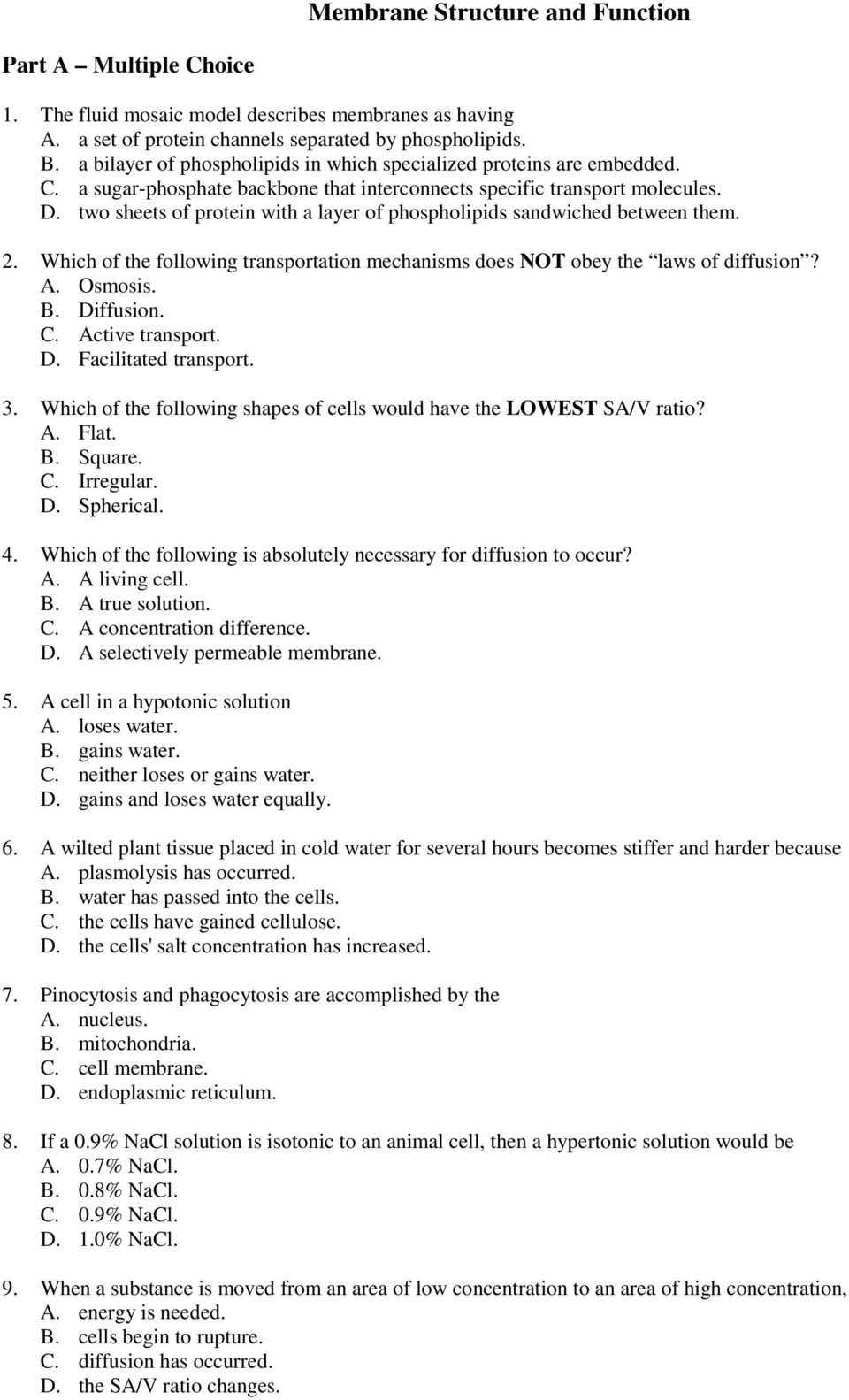
2 10. The fact that lipids move relatively easily through cell membranes is due to A. osmosis. B. their size. C. active transport. D. their chemical composition. 11. Which of the following requires the expenditure of energy? A. Osmosis. B. Diffusion. C. Active transport. D. Facilitated transport. 12. Proteins do not pass freely through membranes because A. they contain nitrogen. B. they would get denatured. C. they are very large molecules. D. membranes, themselves, are made of protein. 13. Which of the following substances does NOT move through a membrane without the use of a vesicle? A. Starch. B. Glycerol. C. Amino acids. D. Monosaccharides. Use the following diagram to answer the next question. 14. Which series of cellular activities is depicted in the illustration? A. Cell eating, then cell drinking. A. Phagocytosis, digestion, then exocytosis. B. Endocytosis, translation, then exocytosis. C. Active transport, digestion, then exocytosis. 15. What component of a cell membrane functions as a carrier molecule? A. Protein. B. Glycolipid. C. Glycoprotein. D. Phospholipid. 16. The name of a process expelling particles from a cell is A. exocytosis. B. endocytosis. C. phagocytosis. D. reverse osmosis. 17. Which of the following crosses a cell membrane by active transport? A. Water. B. Oxygen. C. Sodium ions. D. Carbon dioxide. 18. When glucose crosses a membrane, it A. uses a carrier molecule. B. enters through a vesicle. C. passes between phospholipids. D. goes through protein channels.
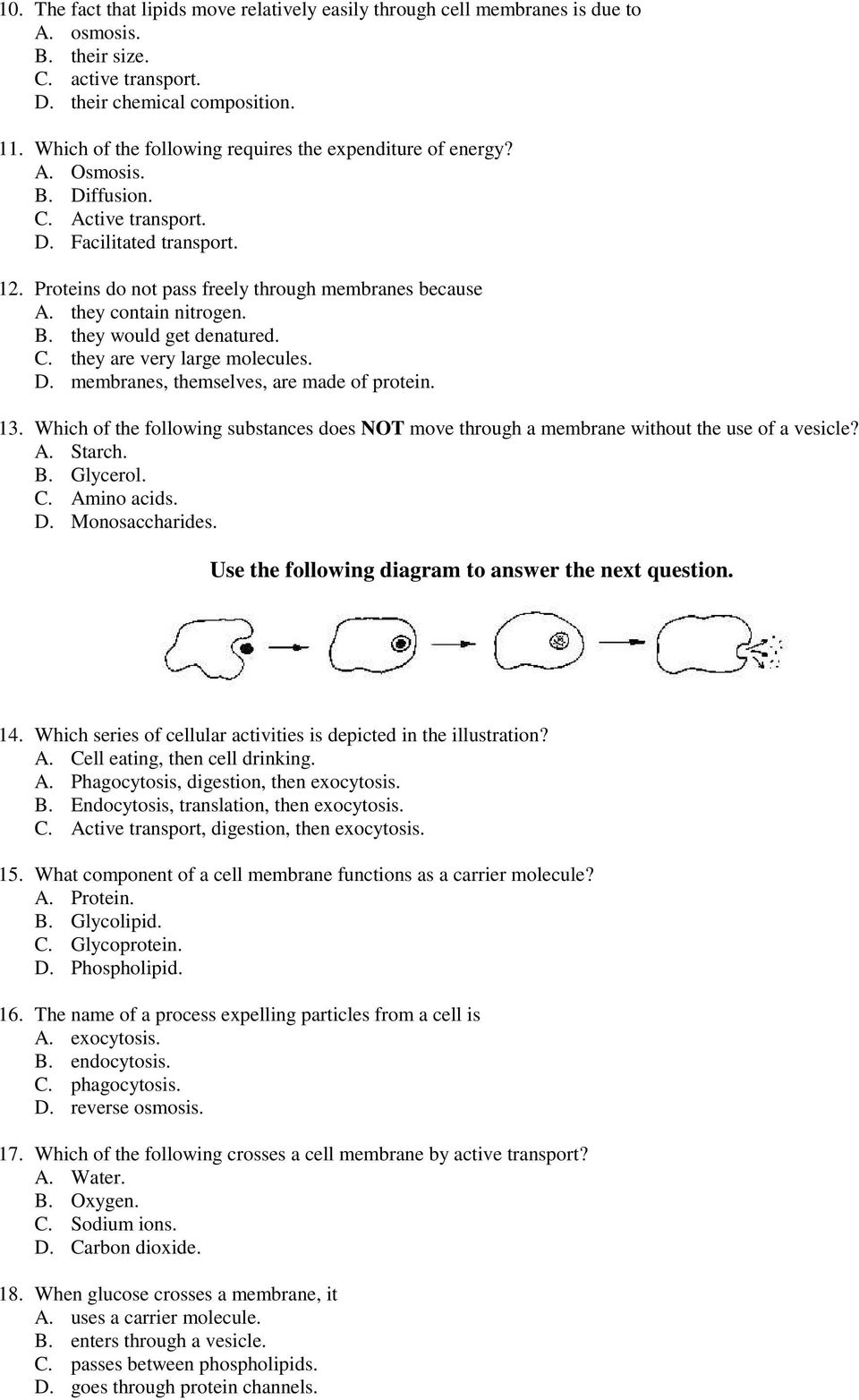
3 19. The difference in solute concentration between two areas/regions is called A. hypotonic. B. hypertonic. C. absolute difference. D. concentration gradient. 20. Some small lipid molecules pass easily through cell membranes because A. of the availability of ATP energy. B. they are assisted by protein carriers. C. membranes are partially made of lipids. D. phagocytosis encloses lipids in membranes. 21. Which term BEST refers to the bursting of an animal cell? A. Lysis. B. Turgor. C. Crenation. D. Plasmolysis. 22. If the solute concentration of solution A is greater than the solute concentration in solution B, it can be said that soluton A is A. isotonic to solution B. B. osmotic to solution B. C. hypotonic to solution B. D. hypertonic to solution B. 23. Which of the following is an example of endocytosis? A. The effect of diffusion. B. The activity of transport proteins. C. The activity of secretory vesicles. D. The formation of vesicles by cell membranes. 24. A transport (or carrier) molecule in a cell membrane is a molecule that A. moves in and out of a membrane through a pore. B. dissolves part of the membrane so that substances can get through. C. moves substances through the membrane by interacting with them. D. reacts with substances and propels the products through a membrane. 25. According to the Laws of Diffusion, substances will move A. up a concentration gradient with the use of ATP. B. up a concentration gradient without the use of ATP. C. down a concentration gradient with the use of ATP. D. down a concentration gradient without the use of ATP. Use the following diagram to answer the next question. 26. During this experiment, the water level on side A will A. lower due to the loss of water causing a decrease in its protein concentration. B. lower due to the loss of water causing an increase in its protein concentration. C. rise due to water moving to that side thus increasing its protein concentration. D. rise due to water moving to that side thus decreasing its protein concentration.

4 27. Which of the following would be MOST directly affected if the mitochondria in a cell were NOT functioning properly? A. Absorption of fatty acids by the cell. B. The accumulation of sugar by the cell. C. Movement of water into and out of the cell. D. Movement of oxygen across the cell membrane. 28. Osmotic pressure is BEST described as the measure of the A. force of water against a membrane. B. amount of water crossing a membrane. C. size of water compared to solute particles. D. movement of water to higher solute concentrations. 29. Visible changes would be LEAST obvious in which of the following? A. A plant cell in a hypotonic solution. B. A plant cell in a hypertonic solution. C. An animal cell in a hypotonic solution. D. An animal cell in a hypertonic solution. 30. The thyroid gland has a high concentration of iodine (relative to plasma). This is an example of A. pinocytosis. B. active transport. C. passive transport. D. facilitated transport. Use the following diagram to answer the next question. 31. The structure indicated by the sketch represents a model of A. a plant cell s cell wall. B. RER in an animal cell. C. an animal cell s nuclear envelope. D. an animal cell s plasma membrane. 32. Red blood cells are put into an isotonic solution. When salt is added to the solution A. the cells burst. B. the cells crenate. C. water enters the cells. D. proteins pump salt into the cells. 33. An animal cell will always take in water when placed in a solution that is A. osmotic. B. isotonic. C. hypotonic. D. hypertonic.

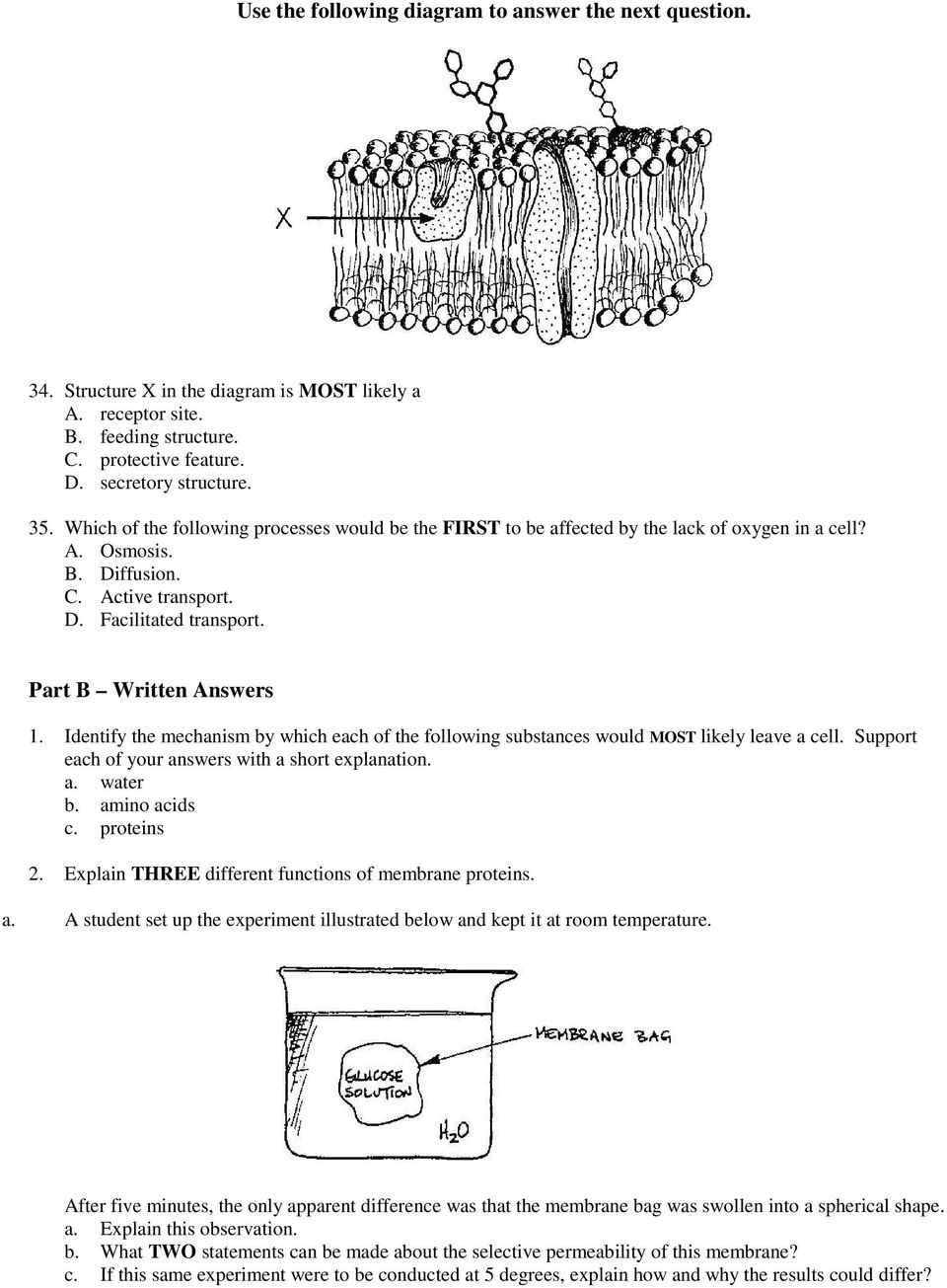
5 Use the following diagram to answer the next question. 34. Structure X in the diagram is MOST likely a A. receptor site. B. feeding structure. C. protective feature. D. secretory structure. 35. Which of the following processes would be the FIRST to be affected by the lack of oxygen in a cell? A. Osmosis. B. Diffusion. C. Active transport. D. Facilitated transport. Part B Written Answers 1. Identify the mechanism by which each of the following substances would MOST likely leave a cell. Support each of your answers with a short explanation. a. water b. amino acids c. proteins 2. Explain THREE different functions of membrane proteins. a. A student set up the experiment illustrated below and kept it at room temperature. After five minutes, the only apparent difference was that the membrane bag was swollen into a spherical shape. a. Explain this observation. b. What TWO statements can be made about the selective permeability of this membrane? c. If this same experiment were to be conducted at 5 degrees, explain how and why the results could differ?
6 4. a. Describe the effect of increasing the solute concentration in a cell s environment. b. Describe the effect of decreasing the solution concentration in a cell s environment. c. Explain why both of these changes could have an impact on the cell s ability to function normally. 5. List THREE factors that will affect the rate of diffusion of sodium ions through a solution. 6. Does osmosis obey the Laws of Diffusion? Explain. 7. Explain how the following apparatus can be used to determine osmotic pressure. 8. The following experiment was conducted to determine the concentration of sugar in potato. Four identical sized and shaped discs of a given potato were prepared and weighed. Each had a mass of 2.0 g. The discs were each put into sugar solutions and left for 24 hours. They were weighed again and changes in mass were noted as follows: Disc A in a 0.8% sugar solution now had a mass of 1.5 g Disc B in a 1.5% sugar solution now had a mass of 1.9 g Disc C in a 2.5% sugar solution now had a mass of 2.2 g Disc D in a 3.0% sugar solution now had a mass of 2.3 g Plot this data and determine the concentration of sugar in the potato.

Cell Membrane & Tonicity Worksheet
 NAME ANSWER KEY DATE PERIOD Cell Membrane & Tonicity Worksheet Composition of the Cell Membrane & Functions The cell membrane is also called the PLASMA membrane and is made of a phospholipid BI-LAYER.
Osmosis, Diffusion and Cell Transport
 Osmosis, Diffusion and Cell Transport Types of Transport There are 3 types of transport in cells: 1. Passive Transport: does not use the cell s energy in bringing materials in & out of the cell 2. Active
Date: Student Name: Teacher Name: Jared George. Score: 1) A cell with 1% solute concentration is placed in a beaker with a 5% solute concentration.
 Biology Keystone (PA Core) Quiz Homeostasis and Transport - (BIO.A.4.1.1 ) Plasma Membrane, (BIO.A.4.1.2 ) Transport Mechanisms, (BIO.A.4.1.3 ) Transport Facilitation Student Name: Teacher Name: Jared
Cell Membrane Coloring Worksheet
 Cell Membrane Coloring Worksheet Composition of the Cell Membrane & Functions The cell membrane is also called the plasma membrane and is made of a phospholipid bilayer. The phospholipids have a hydrophilic
4. Biology of the Cell
 4. Biology of the Cell Our primary focus in this chapter will be the plasma membrane and movement of materials across the plasma membrane. You should already be familiar with the basic structures and roles
FIGURE 2.18. A. The phosphate end of the molecule is polar (charged) and hydrophilic (attracted to water).
 PLASMA MEMBRANE 1. The plasma membrane is the outermost part of a cell. 2. The main component of the plasma membrane is phospholipids. FIGURE 2.18 A. The phosphate end of the molecule is polar (charged)
7. A selectively permeable membrane only allows certain molecules to pass through.
 CHAPTER 2 GETTING IN & OUT OF CELLS PASSIVE TRANSPORT Cell membranes help organisms maintain homeostasis by controlling what substances may enter or leave cells. Some substances can cross the cell membrane
Six major functions of membrane proteins: Transport Enzymatic activity
 CH 7 Membranes Cellular Membranes Phospholipids are the most abundant lipid in the plasma membrane. Phospholipids are amphipathic molecules, containing hydrophobic and hydrophilic regions. The fluid mosaic
CHAPTER 5.1 5.2: Plasma Membrane Structure
 CHAPTER 5.1 5.2: Plasma Membrane Structure 1. Describe the structure of a phospholipid molecule. Be sure to describe their behavior in relationship to water. 2. What happens when a collection of phospholipids
Modes of Membrane Transport
 Modes of Membrane Transport Transmembrane Transport movement of small substances through a cellular membrane (plasma, ER, mitochondrial..) ions, fatty acids, H 2 O, monosaccharides, steroids, amino acids
Homeostasis and Transport Module A Anchor 4
 Homeostasis and Transport Module A Anchor 4 Key Concepts: - Buffers play an important role in maintaining homeostasis in organisms. - To maintain homeostasis, unicellular organisms grow, respond to the
Chapter 8. Movement across the Cell Membrane. AP Biology
 Chapter 8. Movement across the Cell Membrane More than just a barrier Expanding our view of cell membrane beyond just a phospholipid bilayer barrier phospholipids plus Fluid Mosaic Model In 1972, S.J.
Section 7-3 Cell Boundaries
 Note: For the past several years, I ve been puzzling how to integrate new discoveries on the nature of water movement through cell membranes into Chapter 7. The Section below is a draft of my first efforts
Chapter 7: Membrane Structure and Function
 Name Period Concept 7.1 Cellular membranes are fluid mosaics of lipids and proteins 1. The large molecules of all living things fall into just four main classes. Name them. 2. Explain what is meant when
Membrane Structure and Function
 Membrane Structure and Function -plasma membrane acts as a barrier between cells and the surrounding. -plasma membrane is selective permeable -consist of lipids, proteins and carbohydrates -major lipids
1.1.2. thebiotutor. AS Biology OCR. Unit F211: Cells, Exchange & Transport. Module 1.2 Cell Membranes. Notes & Questions.
 thebiotutor AS Biology OCR Unit F211: Cells, Exchange & Transport Module 1.2 Cell Membranes Notes & Questions Andy Todd 1 Outline the roles of membranes within cells and at the surface of cells. The main
CELL MEMBRANE & CELL TRANSPORT (PASSIVE and ACTIVE) Webquest
 Name: Period: CELL MEMBRANE & CELL TRANSPORT (PASSIVE and ACTIVE) Webquest PART I: CELL MEMBRANES WEBSITE #1: http://www.wisc-online.com/objects/index_tj.asp?objid=ap1101 1. What is the BASIC UNIT of LIFE?
Cell Biology - Part 2 Membranes
 Cell Biology - Part 2 Membranes The organization of cells is made possible by membranes. Membranes isolate, partition, and compartmentalize cells. 1 Membranes isolate the inside of the cell from the outside
Membrane Transport. Extracellular Concentration of X
 Use the following graph to answer questions 1 and 2. Rate of diffusion of X into the cell 1. Which of the following processes is represented by the above graph? c. Active transport 2. Molecule X is most
Biological cell membranes
 Unit 14: Cell biology. 14 2 Biological cell membranes The cell surface membrane surrounds the cell and acts as a barrier between the cell s contents and the environment. The cell membrane has multiple
BIOL 305L Laboratory Two
 Please print Full name clearly: Introduction BIOL 305L Laboratory Two Osmosis, because it is different in plants! Osmosis is the movement of solvent molecules through a selectively permeable membrane into
Chapter 3. Cellular Structure and Function Worksheets. 39 www.ck12.org
 Chapter 3 Cellular Structure and Function Worksheets (Opening image copyright by Sebastian Kaulitzki, 2010. Used under license from Shutterstock.com.) Lesson 3.1: Introduction to Cells Lesson 3.2: Cell
Ch. 8 - The Cell Membrane
 Ch. 8 - The Cell Membrane 2007-2008 Phospholipids Phosphate head hydrophilic Fatty acid tails hydrophobic Arranged as a bilayer Phosphate attracted to water Fatty acid repelled by water Aaaah, one of those
CELL MEMBRANES, TRANSPORT, and COMMUNICATION. Teacher Packet
 AP * BIOLOGY CELL MEMBRANES, TRANSPORT, and COMMUNICATION Teacher Packet AP* is a trademark of the College Entrance Examination Board. The College Entrance Examination Board was not involved in the production
Lab 4: Osmosis and Diffusion
 Lab 4: Osmosis and Diffusion The plasma membrane enclosing every cell is the boundary that separates the cell from its external environment. It is not an impermeable barrier, but like all biological membranes,
Multiple Choice Questions
 Chapter 5 THE FUNDAMENTAL UNIT OF LIFE Multiple Choice Questions 1. Which of the following can be made into crystal? (a) A Bacterium (b) An Amoeba (c) A Virus (d) A Sperm 2. A cell will swell up if (a)
Anatomy and Physiology Placement Exam 2 Practice with Answers at End!
 Anatomy and Physiology Placement Exam 2 Practice with Answers at End! General Chemical Principles 1. bonds are characterized by the sharing of electrons between the participating atoms. a. hydrogen b.
Keystone Review Practice Test Module A Cells and Cell Processes. 1. Which characteristic is shared by all prokaryotes and eukaryotes?
 Keystone Review Practice Test Module A Cells and Cell Processes 1. Which characteristic is shared by all prokaryotes and eukaryotes? a. Ability to store hereditary information b. Use of organelles to control
Cell Transport and Plasma Membrane Structure
 Cell Transport and Plasma Membrane Structure POGIL Guided Inquiry Learning Targets Explain the importance of the plasma membrane. Compare and contrast different types of passive transport. Explain how
Cell Unit Practice Test #1
 ell Unit Practice Test #1 Name: ate: 1. Which organelle is primarily concerned with the conversion of potential energy of organic compounds into suitable form for immediate use by the cell?. mitochondria.
Cell and Membrane Practice. A. chromosome B. gene C. mitochondrion D. vacuole
 Name: ate: 1. Which structure is outside the nucleus of a cell and contains N?. chromosome. gene. mitochondrion. vacuole 2. potato core was placed in a beaker of water as shown in the figure below. Which
PART I: Neurons and the Nerve Impulse
 PART I: Neurons and the Nerve Impulse Identify each of the labeled structures of the neuron below. A. B. C. D. E. F. G. Identify each of the labeled structures of the neuron below. A. dendrites B. nucleus
Chapter 4: A Tour of the Cell. 1. Cell Basics. Limits to Cell Size. 1. Cell Basics. 2. Prokaryotic Cells. 3. Eukaryotic Cells
 Chapter 4: A Tour of the Cell 1. Cell Basics 2. Prokaryotic Cells 3. Eukaryotic Cells 1. Cell Basics Limits to Cell Size There are 2 main reasons why cells are so small: If cells get too large: 1) there
Unit 2: Cells, Membranes and Signaling CELL MEMBRANE. Chapter 5 Hillis Textbook
 Unit 2: Cells, Membranes and Signaling CELL MEMBRANE Chapter 5 Hillis Textbook HOW DOES THE LAB RELATE TO THE NEXT CHAPTER? SURFACE AREA: the entire outer covering of a cell that enables materials pass.
Human Anatomy & Physiology I with Dr. Hubley. Practice Exam 1
 Human Anatomy & Physiology I with Dr. Hubley Practice Exam 1 1. Which definition is the best definition of the term gross anatomy? a. The study of cells. b. The study of tissues. c. The study of structures
Lesson Aim To explain the human body at a microscopic level, including the structure and function of cells, tissues and membranes.
 LESSON 1. CELLS & TISSUES Lesson Aim To explain the human body at a microscopic level, including the structure and function of cells, tissues and membranes. THE CELL All living matter is composed of functional
AP Biology-Chapter #6 & 7 Review
 DO NOT WRITE ON THIS TEST- USE ANSWER DOCUMENT AP Biology-Chapter #6 & 7 Review Multiple Choice Identify the choice that best completes the statement or answers the question. 1. All of the following are
Cell Membrane Structure (and How to Get Through One)
 Cell Membrane Structure (and How to Get Through One) A cell s membrane is a wall of sorts that defines the boundaries of a cell. The membrane provides protection and structure for the cell and acts as
Cellular Structure and Function
 Chapter Test A CHAPTER 7 Cellular Structure and Function Part A: Multiple Choice In the space at the left, write the letter of the term or phrase that best answers each question. 1. Which defines a cell?
Diffusion, Osmosis, and Membrane Transport
 Diffusion, Osmosis, and Membrane Transport Introduction... 2 Diffusion and osmosis as related to cellular processes... 2 The hotter the medium, the faster the molecules diffuse... 2 TASK 1: TEMPERATURE
Cells and Their Housekeeping Functions Cell Membrane & Membrane Potential
 Cells and Their Housekeeping Functions Cell Membrane & Membrane Potential Shu-Ping Lin, Ph.D. Institute of Biomedical Engineering E-mail: [email protected] Website: http://web.nchu.edu.tw/pweb/users/splin/
Cell membranes and transport. Learning Objective:
 Cell membranes and transport Content Fluid mosaic model of membrane structure Movement of substances into and out of cells Learning Objective: a. Describe and explain the fluid mosaic model of membrane
PRESTWICK ACADEMY NATIONAL 5 BIOLOGY CELL BIOLOGY SUMMARY
 Name PRESTWICK ACADEMY NATIONAL 5 BIOLOGY CELL BIOLOGY SUMMARY Cell Structure Identify animal, plant, fungal and bacterial cell ultrastructure and know the structures functions. Plant cell Animal cell
Cells & Cell Organelles
 Cells & Cell Organelles The Building Blocks of Life H Biology Types of cells bacteria cells Prokaryote - no organelles Eukaryotes - organelles animal cells plant cells Cell size comparison Animal cell
BIOLOGICAL MEMBRANES: FUNCTIONS, STRUCTURES & TRANSPORT
 BIOLOGICAL MEMBRANES: FUNCTIONS, STRUCTURES & TRANSPORT UNIVERSITY OF PNG SCHOOL OF MEDICINE AND HEALTH SCIENCES DISCIPLINE OF BIOCHEMISTRY AND MOLECULAR BIOLOGY BMLS II / B Pharm II / BDS II VJ Temple
Review of the Cell and Its Organelles
 Biology Learning Centre Review of the Cell and Its Organelles Tips for most effective learning of this material: Memorize the names and structures over several days. This will help you retain what you
tissues are made of cells that work together, organs are )
 Study Guide Cells Unit Test Matching. Write the letter of the correct response on the line. You may use the responses more than once. A. proteins B. simple carbohydrates C. complex carbohydrates D. lipids
Cell Structure and Function
 Bio 100 - Cells 1 Cell Structure and Function Tenets of Cell Theory 1. All living things are made up of one or more cells 2. Cells are the basic living units within organisms, and the chemical reactions
Biology Chapter 7 Practice Test
 Biology Chapter 7 Practice Test Multiple Choice Write the letter that best answers the question or completes the statement on the line provided. 1. The work of Schleiden and Schwann can be summarized by
BSC 2010 - Exam I Lectures and Text Pages. The Plasma Membrane Structure and Function. Phospholipids. I. Intro to Biology (2-29) II.
 BSC 2010 - Exam I Lectures and Text Pages I. Intro to Biology (2-29) II. Chemistry of Life Chemistry review (30-46) Water (47-57) Carbon (58-67) Macromolecules (68-91) III. Cells and Membranes Cell structure
Total body water ~(60% of body mass): Intracellular fluid ~2/3 or ~65% Extracellular fluid ~1/3 or ~35% fluid. Interstitial.
 http://www.bristol.ac.uk/phys-pharm/teaching/staffteaching/sergeykasparov.htmlpharm/teaching/staffteaching/sergeykasparov.html Physiology of the Cell Membrane Membrane proteins and their roles (channels,
IB104 - Lecture 9 - Membranes
 There have been many magnificent boats built to try to reach 50 knots. This was the creation of an Australian team that held the record for more than a decade, from 1993 till 2005, at 46.5 knots with their
Week 1 EOC Review Cell Theory, Cell Structure, Cell Transport
 Week 1 EOC Review Cell Theory, Cell Structure, Cell Transport Benchmarks: SC.912.L.14.1 Describe the scientific theory of cells (cell theory) and relate the history of its discovery to the processes of
THE HISTORY OF CELL BIOLOGY
 SECTION 4-1 REVIEW THE HISTORY OF CELL BIOLOGY Define the following terms. 1. cell 2. cell theory Write the correct letter in the blank. 1. One early piece of evidence supporting the cell theory was the
Chapter 2: Cell Structure and Function pg. 70-107
 UNIT 1: Biochemistry Chapter 2: Cell Structure and Function pg. 70-107 Organelles are internal structures that carry out specialized functions, interacting and complementing each other. Animal and plant
7.2 Cell Structure. Lesson Objectives. Lesson Summary. Cell Organization Eukaryotic cells contain a nucleus and many specialized structures.
 7.2 Cell Structure Lesson Objectives Describe the structure and function of the cell nucleus. Describe the role of vacuoles, lysosomes, and the cytoskeleton. Identify the role of ribosomes, endoplasmic
CELLS: PLANT CELLS 20 FEBRUARY 2013
 CELLS: PLANT CELLS 20 FEBRUARY 2013 Lesson Description In this lesson we will discuss the following: The Cell Theory Terminology Parts of Plant Cells: Organelles Difference between plant and animal cells
MEMBRANE FUNCTION CELLS AND OSMOSIS
 CELLS AND OSMOSIS MEMBRANE FUNCTION Consider placing a cell in a beaker of pure water (Fig. 1). The cell contains a water solution with many different kinds of dissolved molecules and ions so that it is
DIFFUSION (HYPERTONIC, HYPOTONIC, & ISOTONIC SOLUTIONS) THE GUMMY BEAR LAB PASS
 DIFFUSION (HYPERTONIC, HYPOTONIC, & ISOTONIC SOLUTIONS) THE GUMMY BEAR LAB PASS Have you ever wondered why your fingers have wrinkles after soaking in a bath tub? Your students have probably wondered the
Lab 4: Diffusion and Osmosis
 Lab 4: Diffusion and Osmosis Introduction The cell membrane encloses the contents of all cells, organelles and many cytoplasmic inclusions, and regulates what gets in and out. This is called selective
CELLS An Introduction to Cell Structure & Function
 CELLS An Introduction to Cell Structure & Function Introduction: In this lab exercise we will be studying three general aspects of cellular structure and function. First, we will observe the anatomical
1. The diagram below represents a biological process
 1. The diagram below represents a biological process 5. The chart below indicates the elements contained in four different molecules and the number of atoms of each element in those molecules. Which set
Introduction to the Cell: Plant and Animal Cells
 Introduction to the Cell: Plant and Animal Cells Tissues, Organs, and Systems of Living Things Cells, Cell Division, and Animal Systems and Plant Systems Cell Specialization Human Systems All organisms
10.1 The function of Digestion pg. 402
 10.1 The function of Digestion pg. 402 Macromolecules and Living Systems The body is made up of more than 60 % water. The water is found in the cells cytoplasm, the interstitial fluid and the blood (5
Cells. Structure, Function and Homeostasis
 Cells Structure, Function and Homeostasis Characteristics of Cells Basic unit of life anything alive is made of cells Plasma membrane (skin) that separates them from the environment. Skeletonsfor protection
Chapter 5: The Structure and Function of Large Biological Molecules
 Name Period Concept 5.1 Macromolecules are polymers, built from monomers 1. The large molecules of all living things fall into just four main classes. Name them. 2. Circle the three classes that are called
MCAS Biology. Review Packet
 MCAS Biology Review Packet 1 Name Class Date 1. Define organic. THE CHEMISTRY OF LIFE 2. All living things are made up of 6 essential elements: SPONCH. Name the six elements of life. S N P C O H 3. Elements
Plant and Animal Cells
 Plant and Animal Cells a. Explain that cells take in nutrients in order to grow, divide and to make needed materials. S7L2a b. Relate cell structures (cell membrane, nucleus, cytoplasm, chloroplasts, and
Organelles and Their Functions
 Organelles and Their Functions The study of cell organelles and their functions is a fascinating part of biology. The current article provides a brief description of the structure of organelles and their
Todays Outline. Metabolism. Why do cells need energy? How do cells acquire energy? Metabolism. Concepts & Processes. The cells capacity to:
 and Work Metabolic Pathways Enzymes Features Factors Affecting Enzyme Activity Membrane Transport Diffusion Osmosis Passive Transport Active Transport Bulk Transport Todays Outline -Releasing Pathways
Investigating cells. Cells are the basic units of living things (this means that all living things are made up of one or more cells).
 SG Biology Summary notes Investigating cells Sub-topic a: Investigating living cells Cells are the basic units of living things (this means that all living things are made up of one or more cells). Cells
Cell Structure & Function!
 Cell Structure & Function! Chapter 3! The most exciting phrase to hear in science, the one that heralds new discoveries, is not 'Eureka!' but 'That's funny.! -- Isaac Asimov Animal Cell Plant Cell Cell
Lecture Overview. Hydrogen Bonds. Special Properties of Water Molecules. Universal Solvent. ph Scale Illustrated. special properties of water
 Lecture Overview special properties of water > water as a solvent > ph molecules of the cell > properties of carbon > carbohydrates > lipids > proteins > nucleic acids Hydrogen Bonds polarity of water
The Lipid Bilayer Is a Two-Dimensional Fluid
 The Lipid Bilayer Is a Two-Dimensional Fluid The aqueous environment inside and outside a cell prevents membrane lipids from escaping from bilayer, but nothing stops these molecules from moving about and
Cellular Energy. 1. Photosynthesis is carried out by which of the following?
 Cellular Energy 1. Photosynthesis is carried out by which of the following? A. plants, but not animals B. animals, but not plants C. bacteria, but neither animals nor plants D. all living organisms 2.
Eukaryotes. www.njctl.org PSI Biology Eukaryotes & Gene Expression
 Eukaryotes The Eukaryotic Cell Classwork 1. Identify two characteristics that are shared by all cells. 2. Suppose you are investigating a cell that contains a nucleus. Would you categorize this cell as
THE LIVING CELL. Cells also have variety of shapes. Plant cells are often rectangular or polygonal, while egg cells are usually spherical.
 THE LIVING CELL A Tour of the cell The cell is the smallest and the basic unit of structure of all organisms. There are two main types or categories of cells: prokaryotic cells and eukaryotic cells. Prokaryotic
Mammalian Physiology. Cellular Membranes Membrane Transport UNLV. PHYSIOLOGY, Chapter 1 Berne, Levy, Koeppen, Stanton UNIVERSITY OF NEVADA LAS VEGAS
 Mammalian Physiology Cellular Membranes Membrane Transport UNLV 1 UNIVERSITY OF NEVADA LAS VEGAS PHYSIOLOGY, Chapter 1 Berne, Levy, Koeppen, Stanton Objectives Describe the structure of the cell membrane
Comparing Plant And Animal Cells
 Comparing Plant And Animal Cells http://khanacademy.org/video?v=hmwvj9x4gny Plant Cells shape - most plant cells are squarish or rectangular in shape. amyloplast (starch storage organelle)- an organelle
Cell Transport across the cell membrane. Kathy Jardine and Brian Evans. July 17, 2014
 Cell Transport across the cell membrane Kathy Jardine and Brian Evans July 17, 2014 INFORMATION ABOUT THE LESSON Grade Level and Subject Area 10 (9-11): Biology Time Frame 4-45 min class periods Objectives:
BACKGROUND (continued)
 BACKGROUND (continued) A cell must exchange materials with its surroundings, a process controlled by the plasma membrane. Plasma membranes are selectively permeable, regulating the cell s molecular traffic:
2. Which type of macromolecule contains high-energy bonds and is used for long-term energy storage?
 Energy Transport Study Island 1. During the process of photosynthesis, plants use energy from the Sun to convert carbon dioxide and water into glucose and oxygen. These products are, in turn, used by the
Ions cannot cross membranes. Ions move through pores
 Ions cannot cross membranes Membranes are lipid bilayers Nonpolar tails Polar head Fig 3-1 Because of the charged nature of ions, they cannot cross a lipid bilayer. The ion and its cloud of polarized water
Elements & Macromolecules in Organisms
 Name: Date: Per: Table # Elements & Macromolecules in rganisms Most common elements in living things are carbon, hydrogen, nitrogen, and oxygen. These four elements constitute about 95% of your body weight.
COMPARISON OF PLANT AND ANIMAL CELLS SIMILARITIES IN PLANT & ANIMAL CELLS
 COMPARISON OF PLANT AND ANIMAL CELLS Cells vary widely in structure and function, even within the same organism. The human body, for example, has more than 200 different types of cells, each with a specialized
6023-1 - Page 1. Name: 4) The diagram below represents a beaker containing a solution of various molecules involved in digestion.
 Name: 6023-1 - Page 1 1) Which one of the following situations indicates a serious organ system malfunction? A) Mitochondria stop functioning in a unicellular organism exposed to pollutants. B) White blood
Diffusion and Osmosis
 Diffusion and Osmosis OBJECTIVES: 1. To explore how different molecules move by diffusion and osmosis through semi-permeable membranes. 2. To understand how different concentration gradients affect the
Plasma Membrane hydrophilic polar heads
 The Parts of the Cell 3 main parts in ALL cells: plasma membrane, cytoplasm, genetic material this is about the parts of a generic eukaryotic cell Plasma Membrane -is a fluid mosaic model membrane is fluid
pathway that involves taking in heat from the environment at each step. C.
 Study Island Cell Energy Keystone Review 1. Cells obtain energy by either capturing light energy through photosynthesis or by breaking down carbohydrates through cellular respiration. In both photosynthesis
7 Answers to end-of-chapter questions
 7 Answers to end-of-chapter questions Multiple choice questions 1 B 2 B 3 A 4 B 5 A 6 D 7 C 8 C 9 B 10 B Structured questions 11 a i Maintenance of a constant internal environment within set limits i Concentration
Photosynthesis. Chemical Energy (e.g. glucose) - They are the ultimate source of chemical energy for all living organisms: directly or indirectly.
 Photosynthesis Light Energy transduction Chemical Energy (e.g. glucose) - Only photosynthetic organisms can do this (e.g. plants) - They are the ultimate source of chemical energy for all living organisms:
3.1 AS Unit: Cells, Exchange and Transport
 3.1 AS Unit: Cells, Exchange and Transport Module 1: Cells 1.1.1 Cell Structure Candidates should be able to: (a) state the resolution and magnification that can be achieved by a light microscope, a transmission
Organic Compounds. Essential Questions: What is Organic? What are the 4 major Organic Compounds? How are they made? What are they used for?
 Organic Compounds Essential Questions: What is Organic? What are the 4 major Organic Compounds? How are they made? What are they used for? Aristotle: Francesco Redi: What do we already know? Spontaneous
1. The leaf is the main photosynthetic factory (Fig. 36.1, p. 702)
 TRANSPORT IN PLANTS A. Introduction 1. The leaf is the main photosynthetic factory (Fig. 36.1, p. 702) a. This requires a transport system to move water and minerals from the roots to the leaf. This is
Quick Hit Activity Using UIL Science Contests For Formative and Summative Assessments of Pre-AP and AP Biology Students
 Quick Hit Activity Using UIL Science Contests For Formative and Summative Assessments of Pre-AP and AP Biology Students Activity Title: Quick Hit Goal of Activity: To perform formative and summative assessments
Name: Hour: Elements & Macromolecules in Organisms
 Name: Hour: Elements & Macromolecules in Organisms Most common elements in living things are carbon, hydrogen, nitrogen, and oxygen. These four elements constitute about 95% of your body weight. All compounds
Connexions module: m46021 1. The Cell Membrane. OpenStax College. Abstract. By the end of this section, you will be able to:
 Connexions module: m46021 1 The Cell Membrane OpenStax College This work is produced by The Connexions Project and licensed under the Creative Commons Attribution License 3.0 By the end of this section,
Cell Structure and Function
 CHAPTER 3 CELL STRUCTURE AND FUNCTION Vocabulary Practice cell theory vacuole concentration gradient cytoplasm lysosome osmosis organelle centriole isotonic prokaryotic cell cell wall hypertonic eukaryotic
Proteins and Nucleic Acids
 Proteins and Nucleic Acids Chapter 5 Macromolecules: Proteins Proteins Most structurally & functionally diverse group of biomolecules. : o Involved in almost everything o Enzymes o Structure (keratin,
IIn our high tech world, one of the hottest areas of development
 Topic 1.1 Why are cells important? Key Concepts Studying cells helps us understand how organisms function. Cellular organelles work together to carry out life functions. Cellular processes enable organisms