
Unit I: Introduction To Scientific Processes
|
|
|
- Andrea Nicholson
- 10 years ago
- Views:
Transcription
1 Unit I: Introduction To Scientific Processes This unit is an introduction to the scientific process. This unit consists of a laboratory exercise where students go through the QPOE2 process step by step to become familiar with process vocabulary and format. The objectives listed below will also be addressed in each of the subsequent units for the entire class. B1.1A Generate new questions that can be investigated in the laboratory or field. B1.1B Evaluate the uncertainties or validity of scientific conclusions using an understanding of sources of measurement error, the challenges of controlling variables, accuracy of data analysis, logic of argument, logic of experimental design, and/or the dependence on underlying assumptions. B1.1C Conduct scientific investigations using appropriate tools and techniques (e.g., selecting an instrument that measures the desired quantity length, volume, weight, time interval, temperature with the appropriate level of precision). B1.1D Identify patterns in data and relate them to theoretical models. B1.1E Describe a reason for a given conclusion using evidence from an investigation. B1.1f Predict what would happen if the variables, methods, or timing of an investigation were changed. B1.1g Use empirical evidence to explain and critique the reasoning used to draw a scientific conclusion or explanation. B1.1h Design and conduct a systematic scientific investigation that tests a hypothesis. Draw conclusions from data presented in charts or tables. B1.1i Distinguish between scientific explanations that are regarded as current scientific consensus and the emerging questions that active researchers investigate. Time: 1 week Section 1.3 Reaction Time Lab o Lab Notebook o Graphing interpretation and construction Assessment: Laboratory Notebook (common grading rubric for each component of the QPO2 2 model will be used for this and all laboratory activities).

2 Unit II: Biological Molecules B2.2 Organic Molecules There are four major categories of organic molecules that make up living systems: carbohydrates, fats, proteins, and nucleic acids. B2.2A Explain how carbon can join to other carbon atoms in chains and rings to form large and complex molecules. B2.2B Recognize the six most common elements in organic molecules. B2.2C Describe the composition of the four major categories of organic molecules (carbohydrates, lipids, proteins, and nucleic acids). B2.2D Explain the general structure and primary functions of the major complex organic molecules that compose living organisms. B2.2E Describe how dehydration and hydrolysis relate to organic molecules. B2.2x Proteins Protein molecules are long, usually folded chains composed mostly of amino acids and are made of C, H, O, and N. Protein molecules assemble fats and carbohydrates; they function as enzymes, structural components, and hormones. The function of each protein molecule depends on its specific sequence of amino acids and the shape of the molecule. B2.2f Explain the role of enzymes and other proteins in biochemical functions (e.g., the protein hemoglobin carries oxygen in some organisms, digestive enzymes and hormones). B2.4 Cell Specialization In multicellular organisms, specialized cells perform specialized functions. Organs and organ systems are composed of cells and function to serve the needs of cells for food, air, and waste removal. The way in which cells function is similar in all living organisms. B2.4f Recognize and describe that both living and nonliving things are composed of compounds, which are themselves made up of elements joined by energy containing bonds, such as those in ATP. B2.5 Living Organism Composition All living or once-living organisms are composed of carbohydrates, lipids, proteins, and nucleic acids. Carbohydrates and lipids contain many carbonhydrogen bonds that also store energy B2.5A Recognize and explain that macromolecules such as lipids contain high energy bonds. Chapter/Sections: 2.1, 2.3 and 2.4 Time: 2 weeks Paper models of molecules Lab: Tests for various molecules Lab Inquiry: pick food and use tests to identify molecule content. Lab Inquiry: investigating enzyme activity Common unit assessments Lab Notebook (QPOE2 grading rubric)
3 Unit III: Cells B2.4 Cell Specialization In multicellular organisms, specialized cells perform specialized functions. Organs and organ systems are composed of cells and function to serve the needs of cells for food, air, and waste removal. The way in which cells function is similar in all living organisms. B2.4g Explain that some structures in the modern eukaryotic cell developed from early prokaryotes, such as mitochondria, and in plants, chloroplasts. B2.4h Describe the structures of viruses and bacteria. B2.4i Recognize that while viruses lack cellular structure, they have the genetic material to invade living cells. B2.5 Living Organism Composition All living or once-living organisms are composed of carbohydrates, lipids, proteins, and nucleic acids. Carbohydrates and lipids contain many carbonhydrogen bonds that also store energy. B2.5g Compare and contrast plant and animal cells. B2.5h Explain the role of cell membranes as a highly selective barrier (diffusion, osmosis, and active transport). B2.5i Relate cell parts/organelles to their functions. Chapters/Sections: Chapter 7 and 20.1 Time: 2 weeks Reading guides for each chapter section Laboratory comparison of plant and animal cells Written comparison of prokaryotic and eukaryotic cells Laboratory: cell volume/surface area inquiry Laboratory: diffusion/osmosis in potato cubes inquiry Section quizzes Common Unit assessment Laboratory Notebook (common QPOE2 rubrics)
4 Unit IV: Cell Energetics (Respiration/Photosynthesis) B2.4 Cell Specialization In multicellular organisms, specialized cells perform specialized functions. Organs and organ systems are composed of cells and function to serve the needs of cells for food, air, and waste removal. The way in which cells function is similar in all living organisms. B2.4e Explain how cellular respiration is important for the production of ATP (build on aerobic vs. anaerobic). B2.5 Living Organism Composition All living or once-living organisms are composed of carbohydrates, lipids, proteins, and nucleic acids. Carbohydrates and lipids contain many carbonhydrogen bonds that also store energy. B2.5D Describe how individual cells break down energy-rich molecules to provide energy for cell functions. B2.5x Energy Transfer: All living or once-living organisms are composed of carbohydrates, lipids, proteins, and nucleic acids. Carbohydrates and lipids contain many carbon-hydrogen bonds that also store energy. However, that energy must be transferred to ATP (adenosine triphosphate) to be usable by the cell. B2.5e Explain the interrelated nature of photosynthesis and cellular respiration in terms of ATP synthesis and degradation. B2.5f Relate plant structures and functions to the process of photosynthesis and respiration. B3.1 Photosynthesis and Respiration Organisms acquire their energy directly or indirectly from sunlight. Plants capture the Sun s energy and use it to convert carbon dioxide and water to sugar and oxygen through the process of photosynthesis. Through the process of cellular respiration, animals are able to release the energy stored in the molecules produced by plants and use it for cellular processes, producing carbon dioxide and water. B3.1B Illustrate and describe the energy conversions that occur during photosynthesis and respiration. (also repeated in Ecology) B3.1C Recognize the equations for photosynthesis and respiration and identify the reactants and products for both. (also repeated in Ecology) B3.1f Summarize the process of photosynthesis. Chapters/Sections: 8.1, 8.2, 9.1 Time: 1.5 Weeks Section reading guides Photosynthesis/Respiration lab with CO2 sensors MSP activities (to be determined) Common Unit Test Laboratory Notebooks
5 Unit V: Cell Division and Differentiation B2.1C Explain cell division, growth, and development as a consequence of an increase in cell number, cell size, and/or cell products. B2.1x Cell Differentiation Following fertilization, cell division produces a small cluster of cells that then differentiate by appearance and function to form the basic tissues of an embryo B2.1e Predict what would happen if the cells from one part of a developing embryo were transplanted to another part of the embryo. B2.1d Describe how, through cell division, cells can become specialized for specific functionb4.3 Cell Division- Mitosis and Meiosis Sorting and recombination of genes in sexual reproduction results in a great variety of possible gene combinations from the offspring of any two parents. B4.3g Explain that cellular differentiation results from gene expression and/ or environmental influence (e.g., metamorphosis, nutrition). B4.4b Explain that gene mutation in a cell can result in uncontrolled cell division called cancer. Also know that exposure of cells to certain chemicals and radiation increases mutations and thus increases the chance of cancer. Chapters: Chapter 10 Time: 1 Week Section Reading Guides Microscope analysis of phases of mitosis o Which phases of mitosis are the longest? Shortest? Assessment: Quiz Laboratory Notebooks Common Unit Test
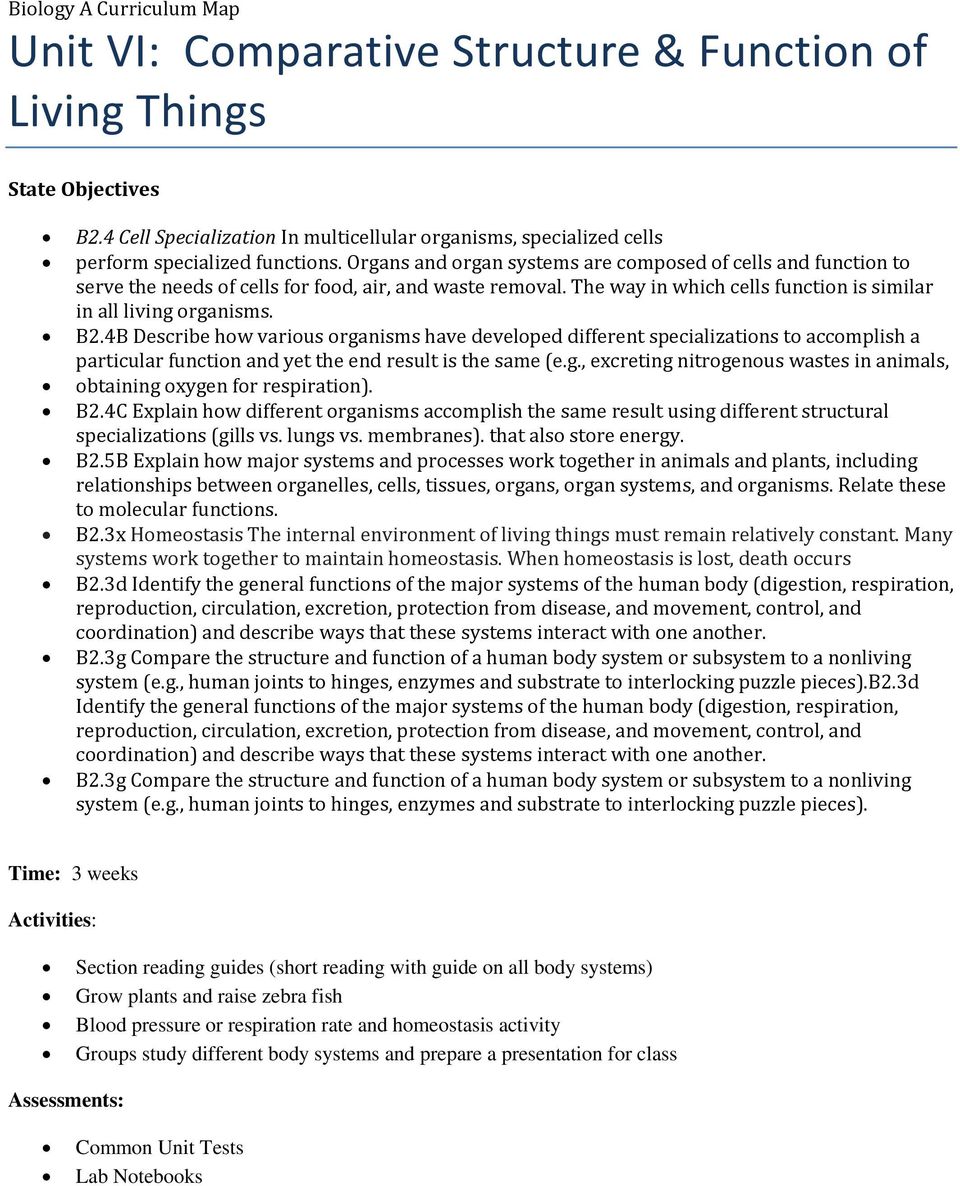
6 Unit VI: Comparative Structure & Function of Living Things State Objectives B2.4 Cell Specialization In multicellular organisms, specialized cells perform specialized functions. Organs and organ systems are composed of cells and function to serve the needs of cells for food, air, and waste removal. The way in which cells function is similar in all living organisms. B2.4B Describe how various organisms have developed different specializations to accomplish a particular function and yet the end result is the same (e.g., excreting nitrogenous wastes in animals, obtaining oxygen for respiration). B2.4C Explain how different organisms accomplish the same result using different structural specializations (gills vs. lungs vs. membranes). that also store energy. B2.5B Explain how major systems and processes work together in animals and plants, including relationships between organelles, cells, tissues, organs, organ systems, and organisms. Relate these to molecular functions. B2.3x Homeostasis The internal environment of living things must remain relatively constant. Many systems work together to maintain homeostasis. When homeostasis is lost, death occurs B2.3d Identify the general functions of the major systems of the human body (digestion, respiration, reproduction, circulation, excretion, protection from disease, and movement, control, and coordination) and describe ways that these systems interact with one another. B2.3g Compare the structure and function of a human body system or subsystem to a nonliving system (e.g., human joints to hinges, enzymes and substrate to interlocking puzzle pieces).b2.3d Identify the general functions of the major systems of the human body (digestion, respiration, reproduction, circulation, excretion, protection from disease, and movement, control, and coordination) and describe ways that these systems interact with one another. B2.3g Compare the structure and function of a human body system or subsystem to a nonliving system (e.g., human joints to hinges, enzymes and substrate to interlocking puzzle pieces). Time: 3 weeks Section reading guides (short reading with guide on all body systems) Grow plants and raise zebra fish Blood pressure or respiration rate and homeostasis activity Groups study different body systems and prepare a presentation for class Common Unit Tests Lab Notebooks
Keystone Review Practice Test Module A Cells and Cell Processes. 1. Which characteristic is shared by all prokaryotes and eukaryotes?
 Keystone Review Practice Test Module A Cells and Cell Processes 1. Which characteristic is shared by all prokaryotes and eukaryotes? a. Ability to store hereditary information b. Use of organelles to control
pathway that involves taking in heat from the environment at each step. C.
 Study Island Cell Energy Keystone Review 1. Cells obtain energy by either capturing light energy through photosynthesis or by breaking down carbohydrates through cellular respiration. In both photosynthesis
1. The diagram below represents a biological process
 1. The diagram below represents a biological process 5. The chart below indicates the elements contained in four different molecules and the number of atoms of each element in those molecules. Which set
Cellular Respiration: Practice Questions #1
 Cellular Respiration: Practice Questions #1 1. Which statement best describes one of the events taking place in the chemical reaction? A. Energy is being stored as a result of aerobic respiration. B. Fermentation
Essentials of Human Anatomy & Physiology 11 th Edition, 2015 Marieb
 A Correlation of Essentials of Human Anatomy Marieb To the Next Generation Science Standards Life A Correlation of, HS-LS1 From Molecules to Organisms: Structures and Processes HS-LS1-1. Construct an explanation
Cellular Energy. 1. Photosynthesis is carried out by which of the following?
 Cellular Energy 1. Photosynthesis is carried out by which of the following? A. plants, but not animals B. animals, but not plants C. bacteria, but neither animals nor plants D. all living organisms 2.
2. Which type of macromolecule contains high-energy bonds and is used for long-term energy storage?
 Energy Transport Study Island 1. During the process of photosynthesis, plants use energy from the Sun to convert carbon dioxide and water into glucose and oxygen. These products are, in turn, used by the
MCAS Biology. Review Packet
 MCAS Biology Review Packet 1 Name Class Date 1. Define organic. THE CHEMISTRY OF LIFE 2. All living things are made up of 6 essential elements: SPONCH. Name the six elements of life. S N P C O H 3. Elements
Cells & Cell Organelles
 Cells & Cell Organelles The Building Blocks of Life H Biology Types of cells bacteria cells Prokaryote - no organelles Eukaryotes - organelles animal cells plant cells Cell size comparison Animal cell
Topic 3: Nutrition, Photosynthesis, and Respiration
 1. Base your answer to the following question on the chemical reaction represented below and on your knowledge of biology. If this reaction takes place in an organism that requires sunlight to produce
Photo Cell Resp Practice. A. ATP B. oxygen C. DNA D. water. The following equation represents the process of photosynthesis in green plants.
 Name: ate: 1. Which molecule supplies the energy for cellular functions?. TP. oxygen. N. water 2. Photosynthesis The following equation represents the process of photosynthesis in green plants. What happens
PRESTWICK ACADEMY NATIONAL 5 BIOLOGY CELL BIOLOGY SUMMARY
 Name PRESTWICK ACADEMY NATIONAL 5 BIOLOGY CELL BIOLOGY SUMMARY Cell Structure Identify animal, plant, fungal and bacterial cell ultrastructure and know the structures functions. Plant cell Animal cell
Cell and Membrane Practice. A. chromosome B. gene C. mitochondrion D. vacuole
 Name: ate: 1. Which structure is outside the nucleus of a cell and contains N?. chromosome. gene. mitochondrion. vacuole 2. potato core was placed in a beaker of water as shown in the figure below. Which
Chemical Basis of Life Module A Anchor 2
 Chemical Basis of Life Module A Anchor 2 Key Concepts: - Water is a polar molecule. Therefore, it is able to form multiple hydrogen bonds, which account for many of its special properties. - Water s polarity
Bioenergetics Module A Anchor 3
 Bioenergetics Module A Anchor 3 Key Concepts: - ATP can easily release and store energy by breaking and re-forming the bonds between its phosphate groups. This characteristic of ATP makes it exceptionally
Which of the following can be determined based on this model? The atmosphere is the only reservoir on Earth that can store carbon in any form. A.
 Earth s Cycles 1. Models are often used to explain scientific knowledge or experimental results. A model of the carbon cycle is shown below. Which of the following can be determined based on this model?
Introduction to the Cell: Plant and Animal Cells
 Introduction to the Cell: Plant and Animal Cells Tissues, Organs, and Systems of Living Things Cells, Cell Division, and Animal Systems and Plant Systems Cell Specialization Human Systems All organisms
How To Understand The Human Body
 Introduction to Biology and Chemistry Outline I. Introduction to biology A. Definition of biology - Biology is the study of life. B. Characteristics of Life 1. Form and size are characteristic. e.g. A
The Cell Teaching Notes and Answer Keys
 The Cell Teaching Notes and Answer Keys Subject area: Science / Biology Topic focus: The Cell: components, types of cells, organelles, levels of organization Learning Aims: describe similarities and differences
Ch. 4 ATP & Photosynthesis
 Name: Biology G Vocabulary Section 4.1 Ch. 4 ATP & Photosynthesis Period: ADP Adenosine Diphosphate ATP Adenosine Triphosphate Chemosynthesis Vocabulary Section 4.2 Photosynthesis Chlorophyll Thylakoid
Given these characteristics of life, which of the following objects is considered a living organism? W. X. Y. Z.
 Cell Structure and Organization 1. All living things must possess certain characteristics. They are all composed of one or more cells. They can grow, reproduce, and pass their genes on to their offspring.
* Is chemical energy potential or kinetic energy? The position of what is storing energy?
 Biology 1406 Exam 2 - Metabolism Chs. 5, 6 and 7 energy - capacity to do work 5.10 kinetic energy - energy of motion : light, electrical, thermal, mechanical potential energy - energy of position or stored
Enzymes: Practice Questions #1
 Enzymes: Practice Questions #1 1. Compound X increases the rate of the reaction below. Compound X is most likely A. an enzyme B. a lipid molecule C. an indicator D. an ADP molecule 2. The equation below
tissues are made of cells that work together, organs are )
 Study Guide Cells Unit Test Matching. Write the letter of the correct response on the line. You may use the responses more than once. A. proteins B. simple carbohydrates C. complex carbohydrates D. lipids
STATE UNIVERSITY OF NEW YORK COLLEGE OF TECHNOLOGY CANTON, NEW YORK COURSE OUTLINE. BIOL 101 Introduction to Biology
 STATE UNIVERSITY OF NEW YORK COLLEGE OF TECHNOLOGY CANTON, NEW YORK COURSE OUTLINE BIOL 101 Introduction to Biology Prepared By: W. David Barnes SCHOOL OF SCIENCE, HEALTH & PROFESSIONAL STUDIES SCIENCE
Unit 5 Photosynthesis and Cellular Respiration
 Unit 5 Photosynthesis and Cellular Respiration Advanced Concepts What is the abbreviated name of this molecule? What is its purpose? What are the three parts of this molecule? Label each part with the
B2 1 Cells, Tissues and Organs
 B2 Cells, Tissues and Organs 5 minutes 5 marks Page of 7 Q. The diagram shows a bacterium. On the drawing, name the structures labelled A, B, C and D. (Total 4 marks) Q2. (a) The diagrams show cells containing
THE LIVING CELL. Cells also have variety of shapes. Plant cells are often rectangular or polygonal, while egg cells are usually spherical.
 THE LIVING CELL A Tour of the cell The cell is the smallest and the basic unit of structure of all organisms. There are two main types or categories of cells: prokaryotic cells and eukaryotic cells. Prokaryotic
Visualizing Cell Processes
 Visualizing Cell Processes A Series of Five Programs produced by BioMEDIA ASSOCIATES Content Guide for Program 3 Photosynthesis and Cellular Respiration Copyright 2001, BioMEDIA ASSOCIATES www.ebiomedia.com
Endocrine System: Practice Questions #1
 Endocrine System: Practice Questions #1 1. Removing part of gland D would most likely result in A. a decrease in the secretions of other glands B. a decrease in the blood calcium level C. an increase in
Name Date Period. 2. When a molecule of double-stranded DNA undergoes replication, it results in
 DNA, RNA, Protein Synthesis Keystone 1. During the process shown above, the two strands of one DNA molecule are unwound. Then, DNA polymerases add complementary nucleotides to each strand which results
The chemical reactions inside cells are controlled by enzymes. Cells may be specialised to carry out a particular function.
 12.1 What are animals and plants built from? All living things are made up of cells. The structures of different types of cells are related to their functions. to relate the structure of different types
Respiration occurs in the mitochondria in cells.
 B3 Question Which process occurs in the mitochondria in cells? Why do the liver and muscle cells have large number of mitochondria? What is the function of the ribosomes? Answer Respiration occurs in the
H.W. 1 Bio 101 Prof. Fournier
 H.W. 1 Bio 101 Prof. Fournier 1. What is a similarity between all bacteria and plants? A) They both have a nucleus B) They are both composed of cells C) They both have chloroplasts D) They both lack a
Anatomy and Physiology Placement Exam 2 Practice with Answers at End!
 Anatomy and Physiology Placement Exam 2 Practice with Answers at End! General Chemical Principles 1. bonds are characterized by the sharing of electrons between the participating atoms. a. hydrogen b.
Cell Unit Practice Test #1
 ell Unit Practice Test #1 Name: ate: 1. Which organelle is primarily concerned with the conversion of potential energy of organic compounds into suitable form for immediate use by the cell?. mitochondria.
AP Biology. The four big ideas are:
 AP Biology Course Overview: This course is an intensive study in biological concepts that emphasizes inquiry based learning. It is structured around the four Big Ideas and the Enduring Understandings that
3120-1 - Page 1. Name:
 Name: 1) Which series is arranged in correct order according to decreasing size of structures? A) DNA, nucleus, chromosome, nucleotide, nitrogenous base B) chromosome, nucleus, nitrogenous base, nucleotide,
PHOTOSYNTHESIS AND CELLULAR RESPIRATION
 reflect Wind turbines shown in the photo on the right are large structures with blades that move in response to air movement. When the wind blows, the blades rotate. This motion generates energy that is
Biochemistry of Cells
 Biochemistry of Cells 1 Carbon-based Molecules Although a cell is mostly water, the rest of the cell consists mostly of carbon-based molecules Organic chemistry is the study of carbon compounds Carbon
Prentice Hall Biology (Miller/Levine) 2008 Correlated to: Colorado Science Standards and Benchmarks (Grades 9-12)
 1. ask questions and state hypotheses using prior scientific knowledge to help design and guide their development and implementation of a scientific investigation STANDARD 1: Students apply the processes
Get It Right. Answers. Chapter 1: The Science of Life. A biologist studies all living things.
 Discover Biology 'N' Level Science Chapter 1 Chapter 1: The Science of Life A biologist studies all living things. In order to carry out the scientific method, we need to ask questions. Discover Biology
1. Enzymes. Biochemical Reactions. Chapter 5: Microbial Metabolism. 1. Enzymes. 2. ATP Production. 3. Autotrophic Processes
 Chapter 5: Microbial Metabolism 1. Enzymes 2. ATP Production 3. Autotrophic Processes 1. Enzymes Biochemical Reactions All living cells depend on biochemical reactions to maintain homeostasis. All of the
Organic Compounds. Essential Questions: What is Organic? What are the 4 major Organic Compounds? How are they made? What are they used for?
 Organic Compounds Essential Questions: What is Organic? What are the 4 major Organic Compounds? How are they made? What are they used for? Aristotle: Francesco Redi: What do we already know? Spontaneous
Todays Outline. Metabolism. Why do cells need energy? How do cells acquire energy? Metabolism. Concepts & Processes. The cells capacity to:
 and Work Metabolic Pathways Enzymes Features Factors Affecting Enzyme Activity Membrane Transport Diffusion Osmosis Passive Transport Active Transport Bulk Transport Todays Outline -Releasing Pathways
Chapter 5: The Structure and Function of Large Biological Molecules
 Name Period Concept 5.1 Macromolecules are polymers, built from monomers 1. The large molecules of all living things fall into just four main classes. Name them. 2. Circle the three classes that are called
Biological molecules:
 Biological molecules: All are organic (based on carbon). Monomers vs. polymers: Monomers refer to the subunits that, when polymerized, make up a larger polymer. Monomers may function on their own in some
CURRICULUM MAP (Revised 6.15.07)
 (Revised 6.15.07) Below is an outline of the Living Environment course that uses the Glencoe NY State Living Environment textbook. Please note that there is more depth in the book than is needed for the
Mississippi SATP Biology I Student Review Guide
 Mississippi Student Review Guide Author: Cecilia L. Boles Published by Enrichment Plus, LLC PO Box 2755 Acworth, GA 30102 Toll Free: 1-800-745-4706 Fax 678-445-6702 Web site: www.enrichmentplus.com Mississippi
Cellular Respiration
 Cellular Respiration Cellular Respiration Text, Diagrams, Assessments, and Link to Standards Focus Questions 1) What is cellular respiration? 2) How is cellular respiration connected to breathing? 3) If
Biology. Slide 1of 51. End Show. Copyright Pearson Prentice Hall
 Biology 1of 51 8-3 The Reactions of Photosynthesis 2of 51 Inside a Chloroplast Inside a Chloroplast In plants, photosynthesis takes place inside chloroplasts. Plant Chloroplast Plant cells 3of 51 Inside
Cellular Respiration Worksheet 1. 1. What are the 3 phases of the cellular respiration process? Glycolysis, Krebs Cycle, Electron Transport Chain.
 Cellular Respiration Worksheet 1 1. What are the 3 phases of the cellular respiration process? Glycolysis, Krebs Cycle, Electron Transport Chain. 2. Where in the cell does the glycolysis part of cellular
Photosynthesis and Cellular Respiration. Stored Energy
 Photosynthesis and Cellular Respiration Stored Energy What is Photosynthesis? plants convert the energy of sunlight into the energy in the chemical bonds of carbohydrates sugars and starches. SUMMARY EQUATION:
8.3 The Process of Photosynthesis
 8.3 The Process of Photosynthesis Lesson Objectives Describe what happens during the light-dependent reactions. Describe what happens during the light-independent reactions. Identify factors that affect
A CONTENT STANDARD IS NOT MET UNLESS APPLICABLE CHARACTERISTICS OF SCIENCE ARE ALSO ADDRESSED AT THE SAME TIME.
 Biology Curriculum The Georgia Performance Standards are designed to provide students with the knowledge and skills for proficiency in science. The Project 2061 s Benchmarks for Science Literacy is used
Name Date Class. energy phosphate adenine charged ATP chemical bonds work ribose
 Energy in a Cell Reinforcement and Study Guide Section.1 The Need for Energy In your textbook, read about cell energy. Use each of the terms below just once to complete the passage. energy phosphate adenine
The correct answer is d C. Answer c is incorrect. Reliance on the energy produced by others is a characteristic of heterotrophs.
 1. An autotroph is an organism that a. extracts energy from organic sources b. converts energy from sunlight into chemical energy c. relies on the energy produced by other organisms as an energy source
Chapter 8: An Introduction to Metabolism
 Chapter 8: An Introduction to Metabolism Name Period Concept 8.1 An organism s metabolism transforms matter and energy, subject to the laws of thermodynamics 1. Define metabolism. The totality of an organism
The Living Cell from the Biology: The Science of Life Series. Pre-Test
 1 Pre-Test Directions: Answer each question TRUE OR FALSE. 1. The instructions for making proteins are stored in molecules of DNA. 2. Proteins are made in the nucleus. 3. All cells are surrounded by a
Plant and Animal Cells
 Plant and Animal Cells a. Explain that cells take in nutrients in order to grow, divide and to make needed materials. S7L2a b. Relate cell structures (cell membrane, nucleus, cytoplasm, chloroplasts, and
Investigating cells. Cells are the basic units of living things (this means that all living things are made up of one or more cells).
 SG Biology Summary notes Investigating cells Sub-topic a: Investigating living cells Cells are the basic units of living things (this means that all living things are made up of one or more cells). Cells
8-3 The Reactions of Photosynthesis Slide 1 of 51
 8-3 The of Photosynthesis 1 of 51 Inside a Chloroplast Inside a Chloroplast In plants, photosynthesis takes place inside chloroplasts. Plant Chloroplast Plant cells 2 of 51 Inside a Chloroplast Chloroplasts
Chapter 3. Cellular Structure and Function Worksheets. 39 www.ck12.org
 Chapter 3 Cellular Structure and Function Worksheets (Opening image copyright by Sebastian Kaulitzki, 2010. Used under license from Shutterstock.com.) Lesson 3.1: Introduction to Cells Lesson 3.2: Cell
Proteins and Nucleic Acids
 Proteins and Nucleic Acids Chapter 5 Macromolecules: Proteins Proteins Most structurally & functionally diverse group of biomolecules. : o Involved in almost everything o Enzymes o Structure (keratin,
008 Chapter 8. Student:
 008 Chapter 8 Student: 1. Some bacteria are strict aerobes and others are strict anaerobes. Some bacteria, however, are facultative anaerobes and can live with or without oxygen. If given the choice of
1 Mutation and Genetic Change
 CHAPTER 14 1 Mutation and Genetic Change SECTION Genes in Action KEY IDEAS As you read this section, keep these questions in mind: What is the origin of genetic differences among organisms? What kinds
6023-1 - Page 1. Name: 4) The diagram below represents a beaker containing a solution of various molecules involved in digestion.
 Name: 6023-1 - Page 1 1) Which one of the following situations indicates a serious organ system malfunction? A) Mitochondria stop functioning in a unicellular organism exposed to pollutants. B) White blood
HACIENDA LA PUENTE UNIFIED SCHOOL DISTRICT Division of Adult Education Associate of Arts/Associate of Science Program
 HACIENDA LA PUENTE UNIFIED SCHOOL DISTRICT Division of Adult Education Associate of Arts/Associate of Science Program Biology 105 (3 Units) - Spring 2015 Instructor: Harry Gunther Class Location: Room
Phone: (318) 670-6423 Phone: (318) 670-6251. Classroom: (218) Classroom: (222) Office: Rm. 11/239 Office: Rm. 9/236 MISSION STATEMENT
 SOUTHERN UNIVERSITY SHREVEPORT, LA Fall 2010 Course Syllabus BIOLOGY 104 - Lecture: Louis Collier Hall Lecture: 3 Credit Hours Separate Laboratory: 1 Credit Hour Biology Department Office Hours (posted
A Correlation of Pearson Miller & Levine Biology 2014 To the Utah Core State Standards for Biology Grades 9-12
 A Correlation of Pearson To the Utah Core State Standards Resource Title: Publisher: Pearson Education publishing as Prentice Hall ISBN (10 or 13 digit unique identifier is required): SE: 9780133242003
AP Biology Syllabus 2012-2013
 n AP Biology, an emphasis is on students making connections between the big ideas within the AP Biology Curriculum Framework. he two main goals of AP Biology are to help students develop a conceptual framework
Biology Chapter 7 Practice Test
 Biology Chapter 7 Practice Test Multiple Choice Write the letter that best answers the question or completes the statement on the line provided. 1. The work of Schleiden and Schwann can be summarized by
Carbon Hydrogen Oxygen Nitrogen
 Concept 1 - Thinking Practice 1. If the following molecules were to undergo a dehydration synthesis reaction, what molecules would result? Circle the parts of each amino acid that will interact and draw
Eukaryotic Cell Structure: Organelles in Animal & Plant Cells Why are organelles important and how are plants and animals different?
 Why? Eukaryotic Cell Structure: Organelles in Animal & Plant Cells Why are organelles important and how are plants and animals different? The cell is the basic unit and building block of all living things.
4. Which carbohydrate would you find as part of a molecule of RNA? a. Galactose b. Deoxyribose c. Ribose d. Glucose
 1. How is a polymer formed from multiple monomers? a. From the growth of the chain of carbon atoms b. By the removal of an OH group and a hydrogen atom c. By the addition of an OH group and a hydrogen
Energy Flow in the Pond Teacher s Guide February 2011
 Energy Flow in the Pond Teacher s Guide February 2011 Grades: 6, 7 & 8 Time: 3 hours With the pond as a model, students explore how energy that originates from the sun keeps changing shape and form as
Photosynthesis takes place in three stages:
 Photosynthesis takes place in three stages: Light-dependent reactions Light-independent reactions The Calvin cycle 1. Capturing energy from sunlight 2. Using energy to make ATP and NADPH 3. Using ATP and
7.2 Cells: A Look Inside
 CHAPTER 7 CELL STRUCTURE AND FUNCTION 7.2 Cells: A Look Inside Imagine a factory that makes thousands of cookies a day. Ingredients come into the factory, get mixed and baked, then the cookies are packaged.
Animal & Plant Cell Slides
 Animal & Plant Cell Slides Category: Biology Type: Class Experiment, 60 min class Materials: 2 Glass Slides 2 Cover Slips 1 Bottle of methylene blue (optional) 1 Plastic tray 1 Bottle of iodine 1 Plastic
A disaccharide is formed when a dehydration reaction joins two monosaccharides. This covalent bond is called a glycosidic linkage.
 CH 5 Structure & Function of Large Molecules: Macromolecules Molecules of Life All living things are made up of four classes of large biological molecules: carbohydrates, lipids, proteins, and nucleic
ATP & Photosynthesis Honors Biology
 ATP & Photosynthesis Honors Biology ATP All cells need for life. Some things we use energy for are: Moving Thinking Sleeping Breathing Growing Reproducing ENERGY Labeled Sketch: The principal chemical
(K-5) A scientist keeps a notebook to record his/her process (experiences, observations, and thinking).
 FIFTH GRADE Science Curriculum Framework 1 Investigations will be integrated with social studies and mathematics where appropriate. 2 Investigations will be integrated with language arts non-fiction reading,
How To Understand The Science Of Inquiry
 7th Grade Science Curriculum Overview Philosophy and Common Beliefs Science Curriculum Philosophy Statement Northbrook/Glenview District 30 utilizes a rigorous science curriculum built on essential questions,
Chapter 4: A Tour of the Cell. 1. Cell Basics. Limits to Cell Size. 1. Cell Basics. 2. Prokaryotic Cells. 3. Eukaryotic Cells
 Chapter 4: A Tour of the Cell 1. Cell Basics 2. Prokaryotic Cells 3. Eukaryotic Cells 1. Cell Basics Limits to Cell Size There are 2 main reasons why cells are so small: If cells get too large: 1) there
Energy Production In A Cell (Chapter 25 Metabolism)
 Energy Production In A Cell (Chapter 25 Metabolism) Large food molecules contain a lot of potential energy in the form of chemical bonds but it requires a lot of work to liberate the energy. Cells need
How To Understand The Chemistry Of Organic Molecules
 CHAPTER 3 THE CHEMISTRY OF ORGANIC MOLECULES 3.1 Organic Molecules The chemistry of carbon accounts for the diversity of organic molecules found in living things. Carbon has six electrons, four of which
Chapter 7 Active Reading Guide Cellular Respiration and Fermentation
 Name: AP Biology Mr. Croft Chapter 7 Active Reading Guide Cellular Respiration and Fermentation Overview: Before getting involved with the details of cellular respiration and photosynthesis, take a second
10.1 The function of Digestion pg. 402
 10.1 The function of Digestion pg. 402 Macromolecules and Living Systems The body is made up of more than 60 % water. The water is found in the cells cytoplasm, the interstitial fluid and the blood (5
Chapter 9 Review Worksheet Cellular Respiration
 1 of 5 11/9/2011 8:11 PM Name: Hour: Chapter 9 Review Worksheet Cellular Respiration Energy in General 1. Differentiate an autotroph from a hetertroph as it relates to obtaining energy and the processes
Chapter 9 Cellular Respiration
 Chapter 9 Cellular Respiration Electrons carried in NADH Mitochondrion Glucose Glycolysis Pyruvic acid Krebs Cycle Electrons carried in NADH and FADH 2 Electron Transport Chain Cytoplasm Mitochondrion
B2 Revision. Subject Module Date Biology B2 13 TH May (am)
 B2 Revision Subject Module Date Biology B2 13 TH May (am) Useful websites www.aqa.org.uk This website contains the specifications that we follow and also has a large number of past papers and mark schemes
Student Text and E-Book ISBN: 0-8053-6624-5
 Course Syllabus Advanced Biology A Syllabus Required Student Text: Campbell Biology (6 th edition) Student Text and E-Book ISBN: 0-8053-6624-5 Developer: Judith S. Nuno Email: [email protected] Course
AP BIOLOGY CHAPTER 7 Cellular Respiration Outline
 AP BIOLOGY CHAPTER 7 Cellular Respiration Outline I. How cells get energy. A. Cellular Respiration 1. Cellular respiration includes the various metabolic pathways that break down carbohydrates and other
Cell Structure & Function!
 Cell Structure & Function! Chapter 3! The most exciting phrase to hear in science, the one that heralds new discoveries, is not 'Eureka!' but 'That's funny.! -- Isaac Asimov Animal Cell Plant Cell Cell
Respiration Worksheet. Respiration is the controlled release of energy from food. Types of Respiration. Aerobic Respiration
 Respiration Worksheet Respiration is the controlled release of energy from food The food involved in respiration is usually Internal respiration is controlled by which allow energy to be released in The
INSTRUCTIONAL MATERIALS ADOPTION Score Sheet I. Generic Evaluation Criteria II. Instructional Content Analysis III. Specific Science Criteria
 GRADE: 9-12 VENDOR: Prentice Hall COURSE: Advanced Biology TITLE: Biology (Miller/Levine) COPYRIGHT DATE: 2006 SE ISBN: 0-13-166255-4 (SE) TE ISBN: 0-13-166288-0 (TE) INSTRUCTIONAL MATERIALS ADOPTION Score
Carbohydrates, proteins and lipids
 Carbohydrates, proteins and lipids Chapter 3 MACROMOLECULES Macromolecules: polymers with molecular weights >1,000 Functional groups THE FOUR MACROMOLECULES IN LIFE Molecules in living organisms: proteins,
Master Curriculum Topic Study: Human Body Systems
 Master Curriculum Topic Study: Human Body Systems Session C Section I: Culminating Ideas for Adult Literacy 1. The fundamental building block of organisms is cells. a. Cells combine to form tissues, which
CELL/ PHOTOSYNTHESIS/ CELLULAR RESPIRATION Test 2011 ANSWER 250 POINTS ANY WAY IN WHICH YOU WANT
 CELL/ PHOTOSYNTHESIS/ CELLULAR RESPIRATION Test 2011 ANSWER 250 POINTS ANY WAY IN WHICH YOU WANT Completion: complete each statement. (1 point each) 1. All cells arise from. 2. The basic unit of structure
High School Science Course Correlations between Ohio s 2010 Course Syllabi and the First Draft of the High School NGSS
 High School Science Course Correlations between Ohio s 2010 Course Syllabi and the First Draft of the High School NGSS This document correlates the content in Ohio s course syllabi with the performance