
From DNA to Protein
|
|
|
- Eleanor Lyons
- 9 years ago
- Views:
Transcription
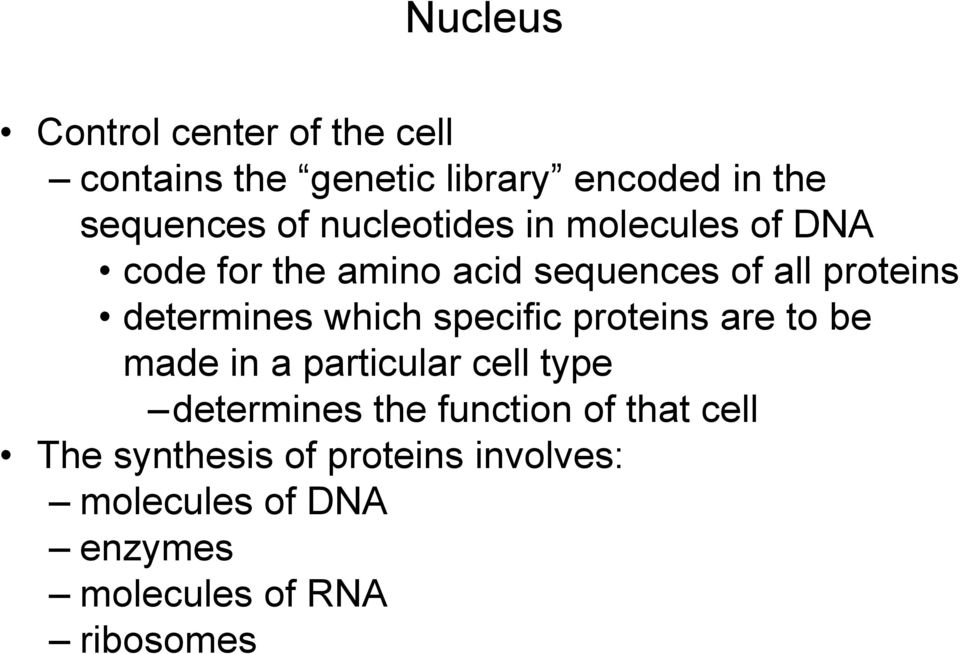
1 Nucleus Control center of the cell contains the genetic library encoded in the sequences of nucleotides in molecules of DNA code for the amino acid sequences of all proteins determines which specific proteins are to be made in a particular cell type determines the function of that cell The synthesis of proteins involves: molecules of DNA enzymes molecules of RNA ribosomes
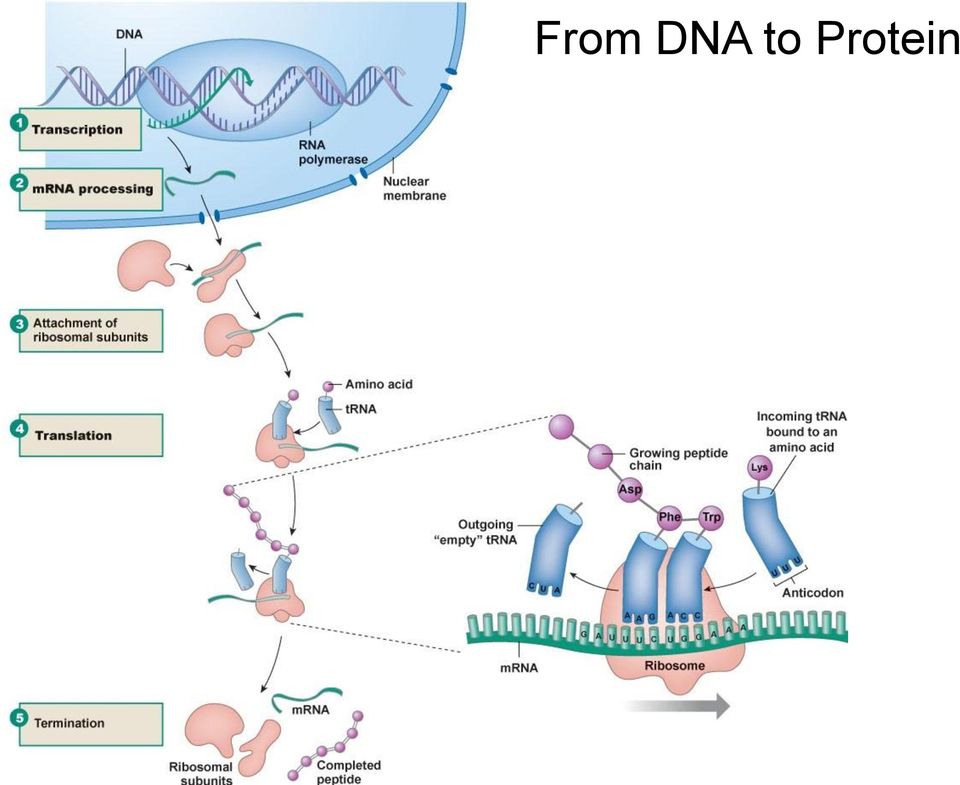
2 From DNA to Protein
3 DNA and the Genetic Code 23 pairs of DNA molecules (46 total) are located in the nucleus of all cells except sperm and oocytes 23 molecules are inherited from each parent Recall that DNA is a double stranded molecule of nucleotides that are held together by hydrogen bonds between complimentary bases across the 2 strands the coding strand and the template strand T A and G C Each molecule of DNA is subdivided into thousands of segments containing a specific sequence (code) of nucleotides called genes instruction manual for building proteins the sequence of nucleotides in the gene s coding strand codes for the amino acid sequence of a protein only the template strand is used for the synthesis of proteins

4 DNA

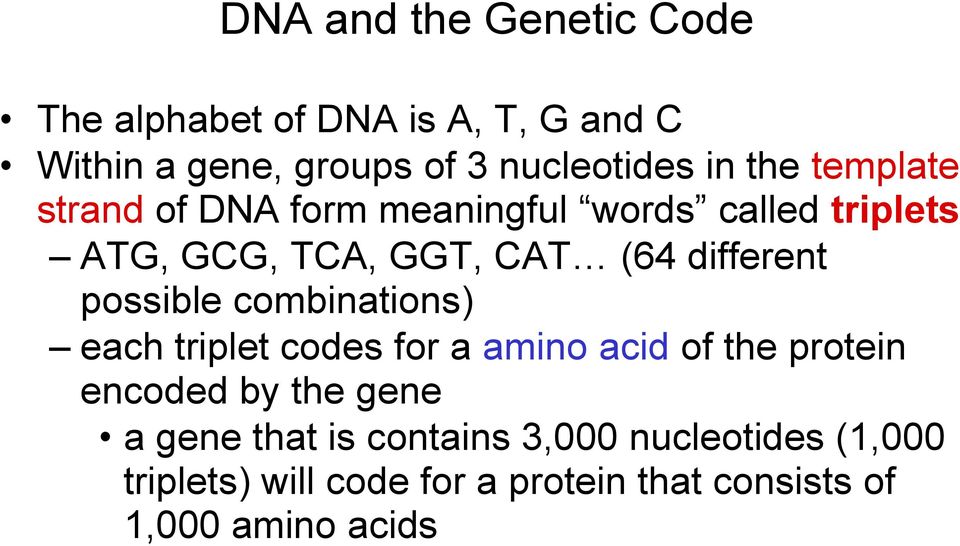
5 DNA and the Genetic Code The alphabet of DNA is A, T, G and C Within a gene, groups of 3 nucleotides in the template strand of DNA form meaningful words called triplets ATG, GCG, TCA, GGT, CAT (64 different possible combinations) each triplet codes for a amino acid of the protein encoded by the gene a gene that is contains 3,000 nucleotides (1,000 triplets) will code for a protein that consists of 1,000 amino acids
6 DNA and messenger RNA Ribosomes, which synthesize all proteins, translate the nucleotide sequence of the DNA strand into the amino acid sequence of a protein Problem: the very large molecules of DNA are unable to fit through the nuclear pores to bring the nucleotide code to a ribosome in the cytoplasm Solution: an enzyme located in the nucleus called RNA polymerase synthesizes a molecule of single stranded messenger RNA (mrna) using the template strand of DNA in the nucleus in a process called transcription mrna is capable of leaving the nucleus to bring the nucleotide code to a ribosome

7 Transcription by RNA Polymerase RNA polymerase breaks the H-bonds between complimentary nucleotides of DNA strands to separate the coding from the template strand synthesizes a molecule of mrna complementary to the template strand of DNA This synthesizes a molecule of mrna contains the exact sequence of nucleotides as the coding strand of DNA except for a U for T substitution

8 mrna The alphabet of RNA is A, U, G and C Within a molecule of mrna, groups of 3 sequential nucleotides form meaningful words called codons complementary to triplets in the template strand of the gene that was transcribed by RNA polymerase each codon is a code for an amino acid of the protein coded by the gene mrna carries instruction for protein synthesis to a ribosome where it is translated into the primary structure (amino acid sequence) of a protein

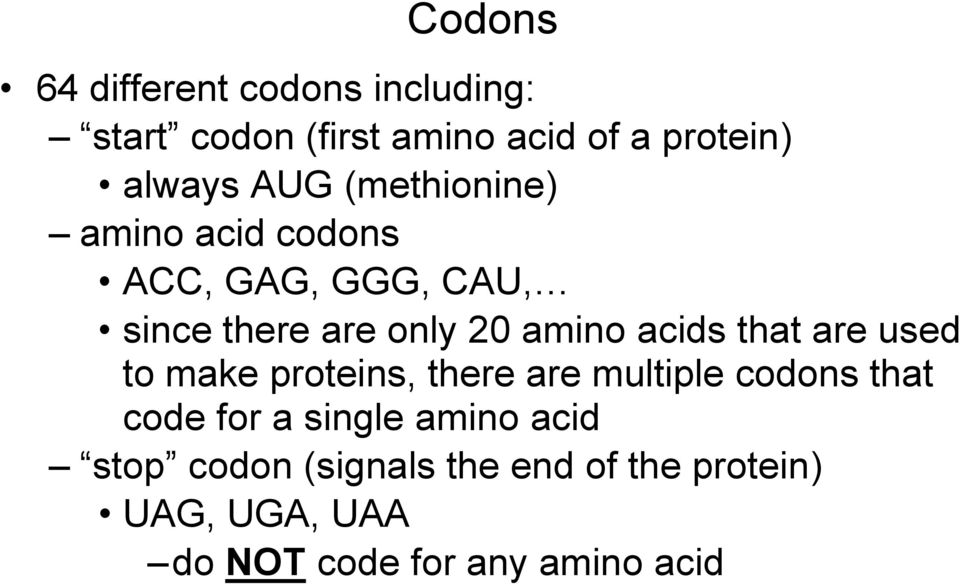
9 Codons 64 different codons including: start codon (first amino acid of a protein) always AUG (methionine) amino acid codons ACC, GAG, GGG, CAU, since there are only 20 amino acids that are used to make proteins, there are multiple codons that code for a single amino acid stop codon (signals the end of the protein) UAG, UGA, UAA do NOT code for any amino acid
10 Overview of Transcription

11 Translation Synthesis of a protein molecule by a ribosome A ribosome reads the codons of mrna from the start codon to the stop codon assembles the primary structure of a protein as determined by sequence of codons in mrna beginning with the start codon and ending with the stop codon amino acids are brought to the ribosome in the correct order by molecules of transfer RNA (trna)

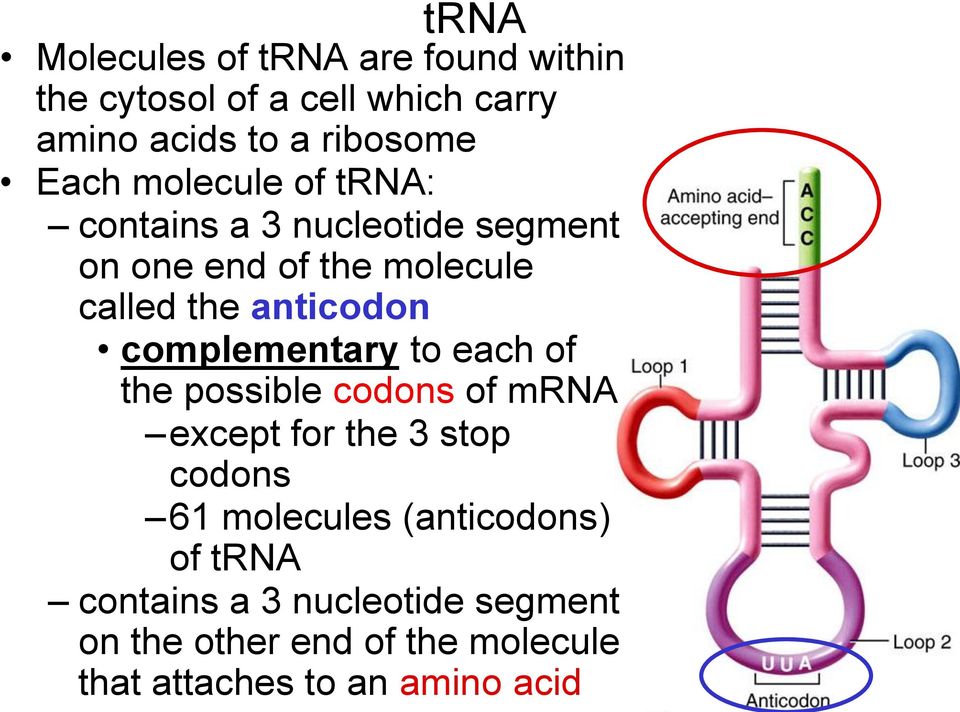
12 trna Molecules of trna are found within the cytosol of a cell which carry amino acids to a ribosome Each molecule of trna: contains a 3 nucleotide segment on one end of the molecule called the anticodon complementary to each of the possible codons of mrna except for the 3 stop codons 61 molecules (anticodons) of trna contains a 3 nucleotide segment on the other end of the molecule that attaches to an amino acid
13 Translation The codons of mrna are read by a ribosome When the ribosome reads the start codon, the first amino acid is carried to the ribosome by the trna with the complimentary anticodon the ribosome removes the amino acid from the trna When the ribosome reads the second codon, the second amino acid is carried to the ribosome by the trna with the complimentary anticodon The ribosome removes the amino acid from the trna and creates a bond (peptide) between the first and second amino acid This process continues until the ribosome reads a stop codon no corresponding anticodon finished protein is released from the ribosome
14

15 Overview of Translation

16 Cell Cycle The sequence of events in the life of a cell is referred to as the cell cycle Cell cycles can be long (decades) nerve cells, muscle cells, fat cells Cell cycles can be short (few days) skin cells, stem cells, gastric (stomach) cells Cells with short cycles can renew themselves through a process called mitosis (cell division)
17 Cell Cycle Interphase the cell is active and provides function in the body most of the cell cycle is spent in this stage Mitotic phase one old cell divides in half to make 2 new cells short stage compared to interphase

18 Cell Cycle

19 Interphase First gap phase (G 1 ) growth cell size increases cell contributes structurally and functionally to the organism Synthesis (S) preparation for mitosis DNA replication occurs each molecule DNA is copied by the enzyme DNA polymerase before the cell divides so that each new cell contains the 46 molecules of DNA necessary for normal cellular functioning Second gap phase (G 2 ) growth cell size increases in preparation for cell division synthesis of enzymes required for mitosis
20 DNA Replication 2 DNA Polymerase enzymes are required to replicate a single molecule of DNA Each DNA Polymerase unwinds the helical DNA molecule breaks the H-bonds between the complimentary strands of DNA creating a replication fork reads the sequence of nucleotides along one of the original strands of DNA synthesizes a new complementary strand of DNA for each of the original strands from free nucleotides in the nucleus After replication is completed, the cell contains 46 pairs of DNA molecules 92 total

21 Semiconservative DNA Replication The replication of DNA in this manner is considered to be semiconservative because the resulting 2 molecules of double stranded DNA contain one original strand and one new strand
22 Mitosis Process by which one cell divides into 2 identical daughter cells Functions of mitosis growth replacement of old and dead cells repair of injured cells Phases of mitosis Prophase Metaphase Anaphase Telophase
23 Mitosis
24 Prophase Replicated DNA molecules begin to condense into structures that are visible using a compound light microscope called chromatids 2 genetically identical chromatid pairs are joined together at the centromere by proteins called kinetochores Nuclear envelope disintegrates releasing the chromosomes into the cytoplasm Organelles called centrioles move towards opposite sides (poles) of the cell and synthesize mitotic spindle fibers the mitotic spindle is a web of fibrous proteins called microtubules which are responsible for the equal division of all cellular material between the 2 daughter cells
25 Chromatid Pairs
26 Prophase
27 Metaphase Metaphase = middle Spindle fibers from each centriole attach to the kinetochores of the chromatid pairs allign chromatid pairs to the middle (equator) of the cell Spindle fibers called asters from each centriole attach to the plasma membrane to anchor centrioles in place
28 Metaphase
29 Anaphase Each centriole retracts the microtubules which pull the sister chromatids away from each other and toward opposite poles of cells the centromeres split and the 2 chromatids separate This stage ensures that when the cell divides down the equator, each daughter cell will have 46 molecules of DNA
30 Anaphase
31 Telophase Chromatids extend (loosen) 2 nuclear envelopes are created around the chromatin Mitotic spindle breaks down
32 Telophase
33 Cytokinesis Cytokinesis = cytoplasm movement Cytokinesis is the division of the cytoplasm (organelles and intracellular fluid) between 2 newly forming cells Follows telophase Creates a crease around cell equator called cleavage furrow pinches the cell in two
Molecular Genetics. RNA, Transcription, & Protein Synthesis
 Molecular Genetics RNA, Transcription, & Protein Synthesis Section 1 RNA AND TRANSCRIPTION Objectives Describe the primary functions of RNA Identify how RNA differs from DNA Describe the structure and
Transcription and Translation of DNA
 Transcription and Translation of DNA Genotype our genetic constitution ( makeup) is determined (controlled) by the sequence of bases in its genes Phenotype determined by the proteins synthesised when genes
Cell Division CELL DIVISION. Mitosis. Designation of Number of Chromosomes. Homologous Chromosomes. Meiosis
 Cell Division CELL DIVISION Anatomy and Physiology Text and Laboratory Workbook, Stephen G. Davenport, Copyright 2006, All Rights Reserved, no part of this publication can be used for any commercial purpose.
DNA Replication & Protein Synthesis. This isn t a baaaaaaaddd chapter!!!
 DNA Replication & Protein Synthesis This isn t a baaaaaaaddd chapter!!! The Discovery of DNA s Structure Watson and Crick s discovery of DNA s structure was based on almost fifty years of research by other
CHAPTER 9 CELLULAR REPRODUCTION P. 243-257
 CHAPTER 9 CELLULAR REPRODUCTION P. 243-257 SECTION 9-1 CELLULAR GROWTH Page 244 ESSENTIAL QUESTION Why is it beneficial for cells to remain small? MAIN IDEA Cells grow until they reach their size limit,
Appendix C DNA Replication & Mitosis
 K.Muma Bio 6 Appendix C DNA Replication & Mitosis Study Objectives: Appendix C: DNA replication and Mitosis 1. Describe the structure of DNA and where it is found. 2. Explain complimentary base pairing:
Protein Synthesis How Genes Become Constituent Molecules
 Protein Synthesis Protein Synthesis How Genes Become Constituent Molecules Mendel and The Idea of Gene What is a Chromosome? A chromosome is a molecule of DNA 50% 50% 1. True 2. False True False Protein
Sample Questions for Exam 3
 Sample Questions for Exam 3 1. All of the following occur during prometaphase of mitosis in animal cells except a. the centrioles move toward opposite poles. b. the nucleolus can no longer be seen. c.
List, describe, diagram, and identify the stages of meiosis.
 Meiosis and Sexual Life Cycles In this topic we will examine a second type of cell division used by eukaryotic cells: meiosis. In addition, we will see how the 2 types of eukaryotic cell division, mitosis
RNA & Protein Synthesis
 RNA & Protein Synthesis Genes send messages to cellular machinery RNA Plays a major role in process Process has three phases (Genetic) Transcription (Genetic) Translation Protein Synthesis RNA Synthesis
Cell Growth and Reproduction Module B, Anchor 1
 Cell Growth and Reproduction Module B, Anchor 1 Key Concepts: - The larger a cell becomes, the more demands the cell places on its DNA. In addition, a larger cell is less efficient in moving nutrients
Translation Study Guide
 Translation Study Guide This study guide is a written version of the material you have seen presented in the replication unit. In translation, the cell uses the genetic information contained in mrna to
From DNA to Protein. Proteins. Chapter 13. Prokaryotes and Eukaryotes. The Path From Genes to Proteins. All proteins consist of polypeptide chains
 Proteins From DNA to Protein Chapter 13 All proteins consist of polypeptide chains A linear sequence of amino acids Each chain corresponds to the nucleotide base sequence of a gene The Path From Genes
The Somatic Cell Cycle
 The Somatic Cell Cycle Maternal chromosome Diploid Zygote Diploid Zygote Paternal chromosome MITOSIS MITOSIS Maternal chromosome Diploid organism Diploid organism Paternal chromosome Int terpha ase The
Cellular Reproduction
 9 Cellular Reproduction section 1 Cellular Growth Before You Read Think about the life cycle of a human. On the lines below, write some of the stages that occur in the life cycle of a human. In this section,
Name Date Period. 2. When a molecule of double-stranded DNA undergoes replication, it results in
 DNA, RNA, Protein Synthesis Keystone 1. During the process shown above, the two strands of one DNA molecule are unwound. Then, DNA polymerases add complementary nucleotides to each strand which results
Biology 3A Laboratory MITOSIS Asexual Reproduction
 Biology 3A Laboratory MITOSIS Asexual Reproduction OBJECTIVE To study the cell cycle and understand how, when and why cells divide. To study and identify the major stages of cell division. To relate the
The Steps. 1. Transcription. 2. Transferal. 3. Translation
 Protein Synthesis Protein synthesis is simply the "making of proteins." Although the term itself is easy to understand, the multiple steps that a cell in a plant or animal must go through are not. In order
1. When new cells are formed through the process of mitosis, the number of chromosomes in the new cells
 Cell Growth and Reproduction 1. When new cells are formed through the process of mitosis, the number of chromosomes in the new cells A. is half of that of the parent cell. B. remains the same as in the
Lecture 7 Mitosis & Meiosis
 Lecture 7 Mitosis & Meiosis Cell Division Essential for body growth and tissue repair Interphase G 1 phase Primary cell growth phase S phase DNA replication G 2 phase Microtubule synthesis Mitosis Nuclear
13.2 Ribosomes & Protein Synthesis
 13.2 Ribosomes & Protein Synthesis Introduction: *A specific sequence of bases in DNA carries the directions for forming a polypeptide, a chain of amino acids (there are 20 different types of amino acid).
Cell Division Mitosis and the Cell Cycle
 Cell Division Mitosis and the Cell Cycle A Chromosome and Sister Chromatids Key Points About Chromosome Structure A chromosome consists of DNA that is wrapped around proteins (histones) and condensed Each
Chapter 3. Cell Division. Laboratory Activities Activity 3.1: Mock Mitosis Activity 3.2: Mitosis in Onion Cells Activity 3.
 Chapter 3 Cell Division Laboratory Activities Activity 3.1: Mock Mitosis Activity 3.2: Mitosis in Onion Cells Activity 3.3: Mock Meiosis Goals Following this exercise students should be able to Recognize
Provincial Exam Questions. 9. Give one role of each of the following nucleic acids in the production of an enzyme.
 Provincial Exam Questions Unit: Cell Biology: Protein Synthesis (B7 & B8) 2010 Jan 3. Describe the process of translation. (4 marks) 2009 Sample 8. What is the role of ribosomes in protein synthesis? A.
Genetic information (DNA) determines structure of proteins DNA RNA proteins cell structure 3.11 3.15 enzymes control cell chemistry ( metabolism )
 Biology 1406 Exam 3 Notes Structure of DNA Ch. 10 Genetic information (DNA) determines structure of proteins DNA RNA proteins cell structure 3.11 3.15 enzymes control cell chemistry ( metabolism ) Proteins
The cell cycle, mitosis and meiosis
 The cell cycle, mitosis and meiosis Learning objective This learning material is about the life cycle of a cell and the series of stages by which genetic materials are duplicated and partitioned to produce
a. Ribosomal RNA rrna a type ofrna that combines with proteins to form Ribosomes on which polypeptide chains of proteins are assembled
 Biology 101 Chapter 14 Name: Fill-in-the-Blanks Which base follows the next in a strand of DNA is referred to. as the base (1) Sequence. The region of DNA that calls for the assembly of specific amino
DNA. Discovery of the DNA double helix
 DNA Replication DNA Discovery of the DNA double helix A. 1950 s B. Rosalind Franklin - X-ray photo of DNA. C. Watson and Crick - described the DNA molecule from Franklin s X-ray. What is DNA? Question:
PRACTICE TEST QUESTIONS
 PART A: MULTIPLE CHOICE QUESTIONS PRACTICE TEST QUESTIONS DNA & PROTEIN SYNTHESIS B 1. One of the functions of DNA is to A. secrete vacuoles. B. make copies of itself. C. join amino acids to each other.
Structure and Function of DNA
 Structure and Function of DNA DNA and RNA Structure DNA and RNA are nucleic acids. They consist of chemical units called nucleotides. The nucleotides are joined by a sugar-phosphate backbone. The four
CHROMOSOME STRUCTURE CHROMOSOME NUMBERS
 CHROMOSOME STRUCTURE 1. During nuclear division, the DNA (as chromatin) in a Eukaryotic cell's nucleus is coiled into very tight compact structures called chromosomes. These are rod-shaped structures made
CHAPTER 10 CELL CYCLE AND CELL DIVISION
 CHAPTER 10 CELL CYCLE AND CELL DIVISION Cell division is an inherent property of living organisms. It is a process in which cells reproduce their own kind. The growth, differentiation, reproduction and
If and when cancer cells stop dividing, they do so at random points, not at the normal checkpoints in the cell cycle.
 Cancer cells have escaped from cell cycle controls Cancer cells divide excessively and invade other tissues because they are free of the body s control mechanisms. Cancer cells do not stop dividing when
DNA, RNA, Protein synthesis, and Mutations. Chapters 12-13.3
 DNA, RNA, Protein synthesis, and Mutations Chapters 12-13.3 1A)Identify the components of DNA and explain its role in heredity. DNA s Role in heredity: Contains the genetic information of a cell that can
The Huntington Library, Art Collections, and Botanical Gardens
 The Huntington Library, Art Collections, and Botanical Gardens Rooting for Mitosis Overview Students will fix, stain, and make slides of onion root tips. These slides will be examined for the presence
Thymine = orange Adenine = dark green Guanine = purple Cytosine = yellow Uracil = brown
 1 DNA Coloring - Transcription & Translation Transcription RNA, Ribonucleic Acid is very similar to DNA. RNA normally exists as a single strand (and not the double stranded double helix of DNA). It contains
Ms. Campbell Protein Synthesis Practice Questions Regents L.E.
 Name Student # Ms. Campbell Protein Synthesis Practice Questions Regents L.E. 1. A sequence of three nitrogenous bases in a messenger-rna molecule is known as a 1) codon 2) gene 3) polypeptide 4) nucleotide
Specific problems. The genetic code. The genetic code. Adaptor molecules match amino acids to mrna codons
 Tutorial II Gene expression: mrna translation and protein synthesis Piergiorgio Percipalle, PhD Program Control of gene transcription and RNA processing mrna translation and protein synthesis KAROLINSKA
www.njctl.org PSI Biology Mitosis & Meiosis
 Mitosis and Meiosis Mitosis Classwork 1. Identify two differences between meiosis and mitosis. 2. Provide an example of a type of cell in the human body that would undergo mitosis. 3. Does cell division
2. The number of different kinds of nucleotides present in any DNA molecule is A) four B) six C) two D) three
 Chem 121 Chapter 22. Nucleic Acids 1. Any given nucleotide in a nucleic acid contains A) two bases and a sugar. B) one sugar, two bases and one phosphate. C) two sugars and one phosphate. D) one sugar,
LAB 8 EUKARYOTIC CELL DIVISION: MITOSIS AND MEIOSIS
 LAB 8 EUKARYOTIC CELL DIVISION: MITOSIS AND MEIOSIS Los Angeles Mission College Biology 3 Name: Date: INTRODUCTION BINARY FISSION: Prokaryotic cells (bacteria) reproduce asexually by binary fission. Bacterial
The Nucleus: DNA, Chromatin And Chromosomes
 The Nucleus: DNA, Chromatin And Chromosomes Professor Alfred Cuschieri Department of Anatomy, University of Malta. Objectives By the end of this unit the student should be able to: 1. List the major structural
Lecture 11 The Cell Cycle and Mitosis
 Lecture 11 The Cell Cycle and Mitosis In this lecture Cell division Chromosomes The cell cycle Mitosis PPMAT Apoptosis What is cell division? Cells divide in order to reproduce themselves The cell cycle
Chapter 12: The Cell Cycle
 Name Period Chapter 12: The Cell Cycle Overview: 1. What are the three key roles of cell division? State each role, and give an example. Key Role Reproduction Growth and development Tissue removal Example
Coding sequence the sequence of nucleotide bases on the DNA that are transcribed into RNA which are in turn translated into protein
 Assignment 3 Michele Owens Vocabulary Gene: A sequence of DNA that instructs a cell to produce a particular protein Promoter a control sequence near the start of a gene Coding sequence the sequence of
1. Why is mitosis alone insufficient for the life cycle of sexually reproducing eukaryotes?
 Chapter 13: Meiosis and Sexual Life Cycles 1. Why is mitosis alone insufficient for the life cycle of sexually reproducing eukaryotes? 2. Define: gamete zygote meiosis homologous chromosomes diploid haploid
Use of the Microscope and Cytology
 Use of the Microscope and Cytology Introduction: A true study of anatomy not only considers the large, visible structures of an organism, but also the small structures that provide the organism its form
AS Biology Unit 2 Key Terms and Definitions. Make sure you use these terms when answering exam questions!
 AS Biology Unit 2 Key Terms and Definitions Make sure you use these terms when answering exam questions! Chapter 7 Variation 7.1 Random Sampling Sampling a population to eliminate bias e.g. grid square
Meiosis is a special form of cell division.
 Page 1 of 6 KEY CONCEPT Meiosis is a special form of cell division. BEFORE, you learned Mitosis produces two genetically identical cells In sexual reproduction, offspring inherit traits from both parents
Name Class Date. Figure 13 1. 2. Which nucleotide in Figure 13 1 indicates the nucleic acid above is RNA? a. uracil c. cytosine b. guanine d.
 13 Multiple Choice RNA and Protein Synthesis Chapter Test A Write the letter that best answers the question or completes the statement on the line provided. 1. Which of the following are found in both
The illustrations below reflect other scientists results in identifying and counting the stages of the onion root tip and the whitefish blastula.
 Abstract: The purpose of this laboratory experiment was to identify in what stage of mitosis viewed cells were in. The stages of mitosis include prophase, metaphase, anaphase and telophase. Although the
Mitosis in Onion Root Tip Cells
 Mitosis in Onion Root Tip Cells A quick overview of cell division The genetic information of plants, animals and other eukaryotic organisms resides in several (or many) individual DNA molecules, or chromosomes.
Given these characteristics of life, which of the following objects is considered a living organism? W. X. Y. Z.
 Cell Structure and Organization 1. All living things must possess certain characteristics. They are all composed of one or more cells. They can grow, reproduce, and pass their genes on to their offspring.
Chapter 12: The Cell Cycle
 Name Period Chapter 12: The Cell Cycle Overview: 1. What are the three key roles of cell division? State each role, and give an example. Key Role Example 2. What is meant by the cell cycle? Concept 12.1
ISTEP+: Biology I End-of-Course Assessment Released Items and Scoring Notes
 ISTEP+: Biology I End-of-Course Assessment Released Items and Scoring Notes Page 1 of 22 Introduction Indiana students enrolled in Biology I participated in the ISTEP+: Biology I Graduation Examination
How Well Do You Know Your Cells?
 How Well Do You Know Your Cells? Complete each sentence below with words from the box. One word will not be used. cells cell membrane cell walls chloroplasts cytoplasm Hooke Leeuwenhoek mitochondria nucleus
Guided Notes: Chapter 9 Cellular Reproduction
 Guided Notes: Cellular Reproduction When do cells divide? Cells grow and function normally until they become too. Cell size is because increases faster than This means that there is not enough area on
Test Two Study Guide
 Test Two Study Guide 1. Describe what is happening inside a cell during the following phases (pictures may help but try to use words): Interphase: : Consists of G1 / S / G2. Growing stage, cell doubles
MITOSIS IN ONION ROOT TIP CELLS: AN INTRODUCTION TO LIGHT MICROSCOPY
 MITOSIS IN ONION ROOT TIP CELLS: AN INTRODUCTION TO LIGHT MICROSCOPY Adapted from Foundations of Biology I; Lab 6 Introduction to Microscopy Dr. John Robertson, Westminster College Biology Department,
Replication Study Guide
 Replication Study Guide This study guide is a written version of the material you have seen presented in the replication unit. Self-reproduction is a function of life that human-engineered systems have
Protein Synthesis. Page 41 Page 44 Page 47 Page 42 Page 45 Page 48 Page 43 Page 46 Page 49. Page 41. DNA RNA Protein. Vocabulary
 Protein Synthesis Vocabulary Transcription Translation Translocation Chromosomal mutation Deoxyribonucleic acid Frame shift mutation Gene expression Mutation Point mutation Page 41 Page 41 Page 44 Page
* The cell is the basic structural and functional unit of life. * Organismal activity depends on individual and collective activity of cells.
 Define Cell * The cell is the basic structural and functional unit of life. * Organismal activity depends on individual and collective activity of cells. * Biochemical activities of cells are dictated
Cell Cycle in Onion Root Tip Cells (IB)
 Cell Cycle in Onion Root Tip Cells (IB) A quick overview of cell division The genetic information of plants, animals and other eukaryotic organisms resides in several (or many) individual DNA molecules,
CELL DIVISION. STAGES OF MITOTIC DIVISION (Diag. C1)
 1 CELL DIVISION Cell division is the process by which cells replicate in order to replace cell loss, repair tissue damage and reproduce the organism. Two types of cell division are encountered in the Eukaryotic
Lecture Series 7. From DNA to Protein. Genotype to Phenotype. Reading Assignments. A. Genes and the Synthesis of Polypeptides
 Lecture Series 7 From DNA to Protein: Genotype to Phenotype Reading Assignments Read Chapter 7 From DNA to Protein A. Genes and the Synthesis of Polypeptides Genes are made up of DNA and are expressed
Chapter 13: Meiosis and Sexual Life Cycles
 Name Period Chapter 13: Meiosis and Sexual Life Cycles Concept 13.1 Offspring acquire genes from parents by inheriting chromosomes 1. Let s begin with a review of several terms that you may already know.
Biology Behind the Crime Scene Week 4: Lab #4 Genetics Exercise (Meiosis) and RFLP Analysis of DNA
 Page 1 of 5 Biology Behind the Crime Scene Week 4: Lab #4 Genetics Exercise (Meiosis) and RFLP Analysis of DNA Genetics Exercise: Understanding how meiosis affects genetic inheritance and DNA patterns
MARK SCHEME for the May/June 2012 question paper for the guidance of teachers 9700 BIOLOGY
 www.xtremepapers.com UNIVERSITY OF CAMBRIDGE INTERNATIONAL EXAMINATIONS GCE Advanced Subsidiary Level and GCE Advanced Level MARK SCHEME for the May/June 2012 question paper for the guidance of teachers
4.2 Meiosis. Meiosis is a reduction division. Assessment statements. The process of meiosis
 4.2 Meiosis Assessment statements State that meiosis is a reduction division of a diploid nucleus to form haploid nuclei. Define homologous chromosomes. Outline the process of meiosis, including pairing
2006 7.012 Problem Set 3 KEY
 2006 7.012 Problem Set 3 KEY Due before 5 PM on FRIDAY, October 13, 2006. Turn answers in to the box outside of 68-120. PLEASE WRITE YOUR ANSWERS ON THIS PRINTOUT. 1. Which reaction is catalyzed by each
Cellular Respiration Worksheet 1. 1. What are the 3 phases of the cellular respiration process? Glycolysis, Krebs Cycle, Electron Transport Chain.
 Cellular Respiration Worksheet 1 1. What are the 3 phases of the cellular respiration process? Glycolysis, Krebs Cycle, Electron Transport Chain. 2. Where in the cell does the glycolysis part of cellular
1.5 page 3 DNA Replication S. Preston 1
 AS Unit 1: Basic Biochemistry and Cell Organisation Name: Date: Topic 1.5 Nucleic Acids and their functions Page 3 l. DNA Replication 1. Go through PowerPoint 2. Read notes p2 and then watch the animation
Answer: 2. Uracil. Answer: 2. hydrogen bonds. Adenine, Cytosine and Guanine are found in both RNA and DNA.
 Answer: 2. Uracil Adenine, Cytosine and Guanine are found in both RNA and DNA. Thymine is found only in DNA; Uracil takes its (Thymine) place in RNA molecules. Answer: 2. hydrogen bonds The complementary
Sexual Reproduction. The specialized cells that are required for sexual reproduction are known as. And come from the process of: GAMETES
 Sexual Reproduction Sexual Reproduction We know all about asexual reproduction 1. Only one parent required. 2. Offspring are identical to parents. 3. The cells that produce the offspring are not usually
Central Dogma. Lecture 10. Discussing DNA replication. DNA Replication. DNA mutation and repair. Transcription
 Central Dogma transcription translation DNA RNA Protein replication Discussing DNA replication (Nucleus of eukaryote, cytoplasm of prokaryote) Recall Replication is semi-conservative and bidirectional
Cell Division and Mitosis DNA. Sexual Reproduction and Meiosis. 2. Meiosis occurs in the reproductive organs, producing four haploid sex cells.
 ell Division and Mitosis 1. he life cycle of a cell has two parts growth and development, and cell division. 2. In mitosis, the nucleus divides to form two identical nuclei. Mitosis occurs in four continuous
Q: How are proteins (amino acid chains) made from the information in mrna? A: Translation Ribosomes translate mrna into protein
 ranslation (written lesson) Q: How are proteins (amino acid chains) made from the information in mrn? : ranslation Ribosomes translate mrn into protein ranslation has 3 steps also! 1. ranslation Initiation:
CCR Biology - Chapter 5 Practice Test - Summer 2012
 Name: Class: Date: CCR Biology - Chapter 5 Practice Test - Summer 2012 Multiple Choice Identify the choice that best completes the statement or answers the question. 1. If a cell cannot move enough material
1. Identify each phase of mitosis on the onion root tip and the whitefish blastula. 3. Explain differences in mitosis between plant and animal cells.
 Mitosis Objectives Having completed the lab on mitosis, you should be able to: 1. Identify each phase of mitosis on the onion root tip and the whitefish blastula. 2. Describe the events during each phase
12.1 The Role of DNA in Heredity
 12.1 The Role of DNA in Heredity Only in the last 50 years have scientists understood the role of DNA in heredity. That understanding began with the discovery of DNA s structure. In 1952, Rosalind Franklin
June examination memorandum G12 ~ Life Sciences LIFE SCIENCES GRADE 12 JUNE EXAMINATION 2014 MEMORANDUM
 LIFE SCIENCES GRADE 12 JUNE EXAMINATION 2014 MEMORANDUM LIFE SCIENCES GRADE 12 JUNE EXAMINATION 2014 MEMORANDUM TOTAL: 150 SECTION A QUESTION 1 1.1 1.1.1 A 1.1.2 C 1.1.3 C 1.1.4 D 1.1.5 D 1.1.6 B 1.1.7
3120-1 - Page 1. Name:
 Name: 1) Which series is arranged in correct order according to decreasing size of structures? A) DNA, nucleus, chromosome, nucleotide, nitrogenous base B) chromosome, nucleus, nitrogenous base, nucleotide,
LAB 09 Cell Division
 LAB 09 Cell Division Introduction: One of the characteristics of living things is the ability to replicate and pass on genetic information to the next generation. Cell division in individual bacteria and
The chromosomes are structures in living cells that contain
 Brooker Widmaier Graham Stiling: III. Nucleic Acid Structure and DNA Replication 15. Eukaryotic Chromosomes, Mitosis, 47 EUKARYOTIC CHROMOSOMES, MITOSIS, AND MEIOSIS C HAPTER O UTLINE 15.1 Molecular Structure
The Cell Cycle: A series of modeling activities
 The Cell Cycle: A series of modeling activities Cancer Education Project University of Rochester Premise: Students learn best when exposed to a variety of activities Overview 1. Information Gathering:
Control of Gene Expression
 Home Gene Regulation Is Necessary? Control of Gene Expression By switching genes off when they are not needed, cells can prevent resources from being wasted. There should be natural selection favoring
CCR Biology - Chapter 8 Practice Test - Summer 2012
 Name: Class: Date: CCR Biology - Chapter 8 Practice Test - Summer 2012 Multiple Choice Identify the choice that best completes the statement or answers the question. 1. What did Hershey and Chase know
Cell Division Simulation: Bacteria Activity One
 Cell Division Simulation: Bacteria Activity One Introduction All living things are made of cells. Some living things, like plants and animals, are made of millions of cells. But some living things are
Academic Nucleic Acids and Protein Synthesis Test
 Academic Nucleic Acids and Protein Synthesis Test Multiple Choice Identify the letter of the choice that best completes the statement or answers the question. 1. Each organism has a unique combination
PRESTWICK ACADEMY NATIONAL 5 BIOLOGY CELL BIOLOGY SUMMARY
 Name PRESTWICK ACADEMY NATIONAL 5 BIOLOGY CELL BIOLOGY SUMMARY Cell Structure Identify animal, plant, fungal and bacterial cell ultrastructure and know the structures functions. Plant cell Animal cell
The sequence of bases on the mrna is a code that determines the sequence of amino acids in the polypeptide being synthesized:
 Module 3F Protein Synthesis So far in this unit, we have examined: How genes are transmitted from one generation to the next Where genes are located What genes are made of How genes are replicated How
5. The cells of a multicellular organism, other than gametes and the germ cells from which it develops, are known as
 1. True or false? The chi square statistical test is used to determine how well the observed genetic data agree with the expectations derived from a hypothesis. True 2. True or false? Chromosomes in prokaryotic
1.1 Introduction. 1.2 Cells CHAPTER. 1.2.1 Prokaryotic Cells. 1.2.2 Eukaryotic Cells
 C HAPTER 1CELLS AND CELL DIVISION CHAPTER 1.1 Introduction In genetics, we view cells as vessels for the genetic material. Our main interest is in the chromosomes and their environment. This being said,
BioSci 2200 General Genetics Problem Set 1 Answer Key Introduction and Mitosis/ Meiosis
 BioSci 2200 General Genetics Problem Set 1 Answer Key Introduction and Mitosis/ Meiosis Introduction - Fields of Genetics To answer the following question, review the three traditional subdivisions of
Genetics Module B, Anchor 3
 Genetics Module B, Anchor 3 Key Concepts: - An individual s characteristics are determines by factors that are passed from one parental generation to the next. - During gamete formation, the alleles for
To be able to describe polypeptide synthesis including transcription and splicing
 Thursday 8th March COPY LO: To be able to describe polypeptide synthesis including transcription and splicing Starter Explain the difference between transcription and translation BATS Describe and explain
Regents Biology REGENTS REVIEW: PROTEIN SYNTHESIS
 Period Date REGENTS REVIEW: PROTEIN SYNTHESIS 1. The diagram at the right represents a portion of a type of organic molecule present in the cells of organisms. What will most likely happen if there is
Bob Jesberg. Boston, MA April 3, 2014
 DNA, Replication and Transcription Bob Jesberg NSTA Conference Boston, MA April 3, 2014 1 Workshop Agenda Looking at DNA and Forensics The DNA, Replication i and Transcription i Set DNA Ladder The Double
Chapter 13: Meiosis and Sexual Life Cycles
 Name Period Concept 13.1 Offspring acquire genes from parents by inheriting chromosomes 1. Let s begin with a review of several terms that you may already know. Define: gene locus gamete male gamete female