
GPUs for Scientific Computing
|
|
|
- Agnes Hoover
- 9 years ago
- Views:
Transcription
1 GPUs for Scientific Computing p. 1/16 GPUs for Scientific Computing Mike Giles Oxford-Man Institute of Quantitative Finance Oxford University Mathematical Institute Oxford e-research Centre NAG AGM, Sept 25th, 2009

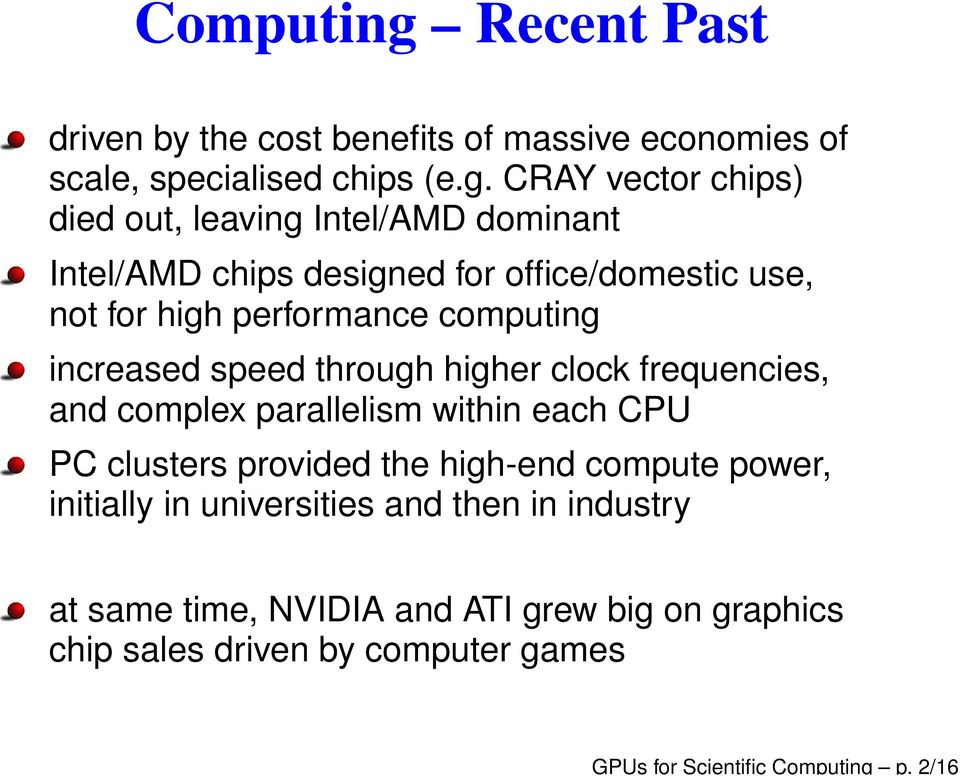
2 GPUs for Scientific Computing p. 2/16 Computing Recent Past driven by the cost benefits of massive economies of scale, specialised chips (e.g. CRAY vector chips) died out, leaving Intel/AMD dominant Intel/AMD chips designed for office/domestic use, not for high performance computing increased speed through higher clock frequencies, and complex parallelism within each CPU PC clusters provided the high-end compute power, initially in universities and then in industry at same time, NVIDIA and ATI grew big on graphics chip sales driven by computer games
3 GPUs for Scientific Computing p. 3/16 Computing Present/Future move to faster clock frequencies stopped due to high power consumption big push now is to multicore at (slightly) reduced clock frequencies graphics chips have even more cores (up to 240) big new development here is a more general purpose programming environment Why? Initially, because computer games do increasing amounts of physics simulation on the GPU, but branching out into other areas.

4 GPUs for Scientific Computing p. 4/16 CPUs vs GPUs CPUs have up to 6 cores on a single chip, and GB/s bandwidth to main system memory NVIDIA GPUs have up to 240 cores on a single chip, and 100+ GB/s bandwidth to graphics memory offer speedup relative to a single CPU core roughly 10 speedup relative to two quad-core Xeons (if not using SSE instructions) also 10 improvement in price/performance and energy efficiency How is this possible? Logically simpler cores (SIMD, no out-of-order execution, minimal caching) suitable for vector computing, not for general purpose computing

5 GPUs for Scientific Computing p. 5/16 GPUs Is this sustainable? Yes! IBM, AMD and Intel all producing GPUs NVIDIA has good headstart on software side with CUDA environment new OpenCL software standard (based on CUDA and pushed by Apple) will probably run on all platforms driving applications are: computer games physics video (e.g. HD video decoding) computational science computational finance oil and gas

6 GPUs for Scientific Computing p. 6/16 GPUs NVIDIA: GTX graphics cards for consumers C1060 for scientific computing no graphics output but 4GB of graphics memory and costs about 800 next-generation chip due soon IBM: Cell processor is expensive and hard to program future development may have been cancelled AMD: has good hardware, but poor software will support the new OpenCL standard Intel: developing its own GPU code-named Larrabee 2nd-gen in 2011 will have compute capability

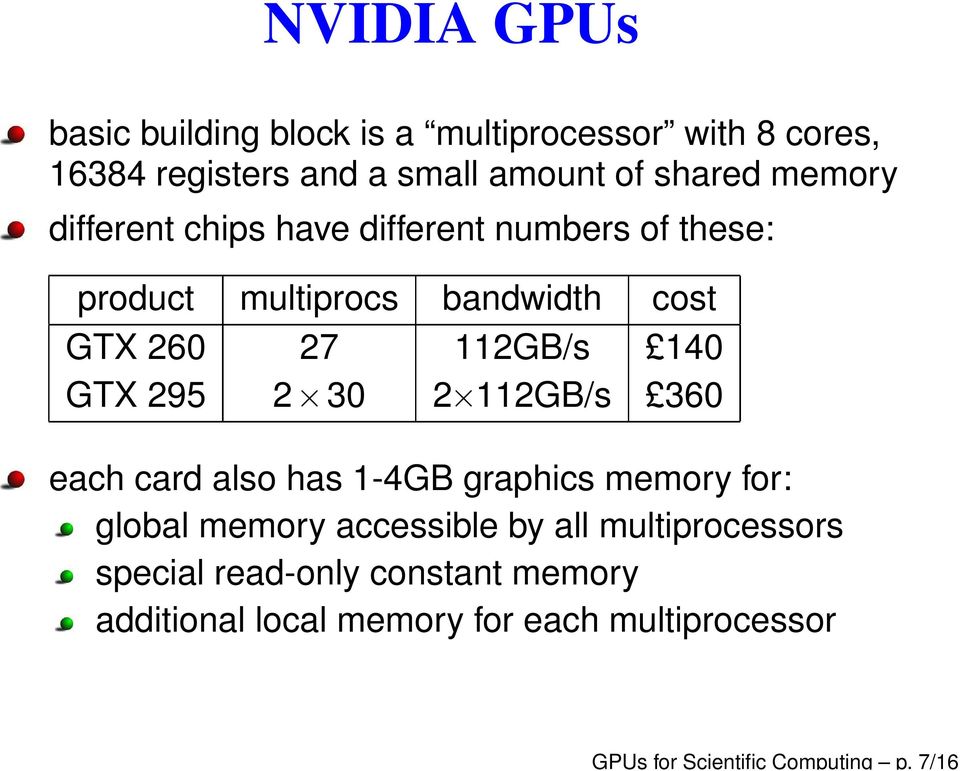
7 GPUs for Scientific Computing p. 7/16 NVIDIA GPUs basic building block is a multiprocessor with 8 cores, registers and a small amount of shared memory different chips have different numbers of these: product multiprocs bandwidth cost GTX GB/s 140 GTX GB/s 360 each card also has 1-4GB graphics memory for: global memory accessible by all multiprocessors special read-only constant memory additional local memory for each multiprocessor
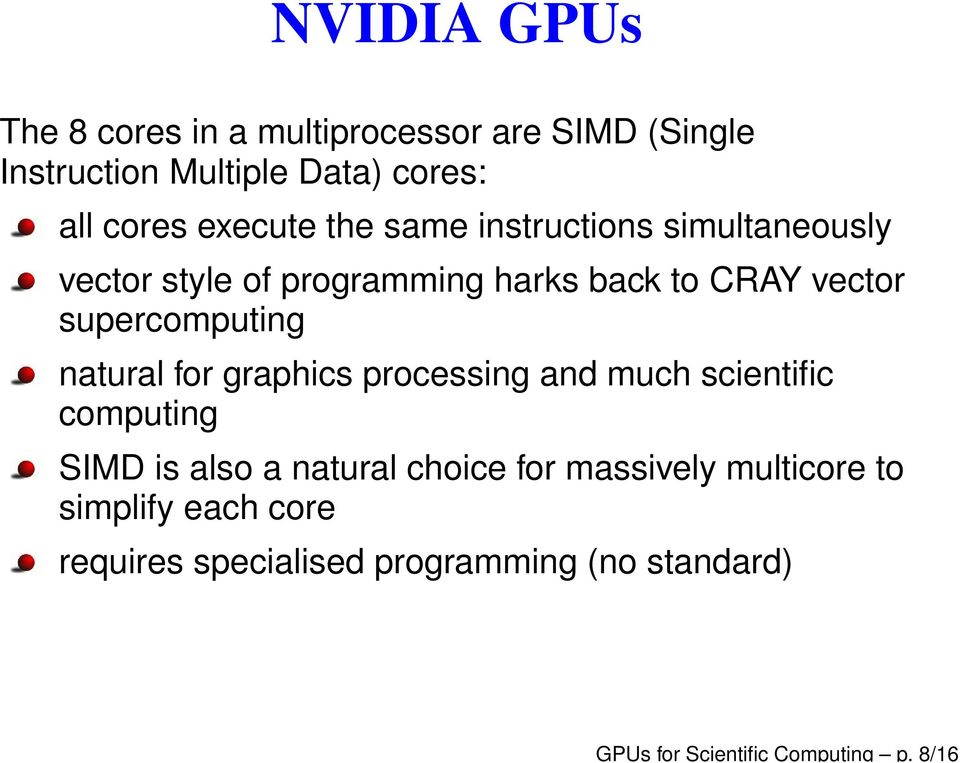
8 GPUs for Scientific Computing p. 8/16 NVIDIA GPUs The 8 cores in a multiprocessor are SIMD (Single Instruction Multiple Data) cores: all cores execute the same instructions simultaneously vector style of programming harks back to CRAY vector supercomputing natural for graphics processing and much scientific computing SIMD is also a natural choice for massively multicore to simplify each core requires specialised programming (no standard)
9 GPUs for Scientific Computing p. 9/16 CUDA programming CUDA is NVIDIA s program development environment: based on C with some extensions lots of example code and good documentation 2-4 week learning curve for those with experience of OpenMP and MPI programming growing user community active on NVIDIA forum main process runs on host system (Intel/AMD CPU) and launches multiple copies of kernel process on graphics card communication is through data transfers to/from graphics memory minimum of 4 threads per core, but more is better

10 GPUs for Scientific Computing p. 10/16 CUDA programming How hard is it to program? Needs combination of skills: splitting the application between the multiple multiprocessors is similar to MPI programming, but no need to split data it all resides in main graphics memory SIMD CUDA programming within each multiprocessor is a bit like OpenMP programming needs a good understanding of memory operation (but that s becoming less critical over time) difficulty also depends a lot on application

11 GPUs for Scientific Computing p. 11/16 NVIDIA multithreading Lots of active threads is the key to high performance: no context switching ; each thread has its own registers, which limits the number of active threads threads execute in warps of 32 threads per multiprocessor (4 per core) execution alternates between active warps, with warps becoming temporarily inactive when waiting for data

12 GPUs for Scientific Computing p. 12/16 NVIDIA multithreading for each thread, one operation completes long before the next starts avoids the complexity of pipeline overlaps which can limit the performance of modern processors time memory access from device memory has a delay of cycles; with 40 threads this is equivalent to operations and can be managed by the compiler

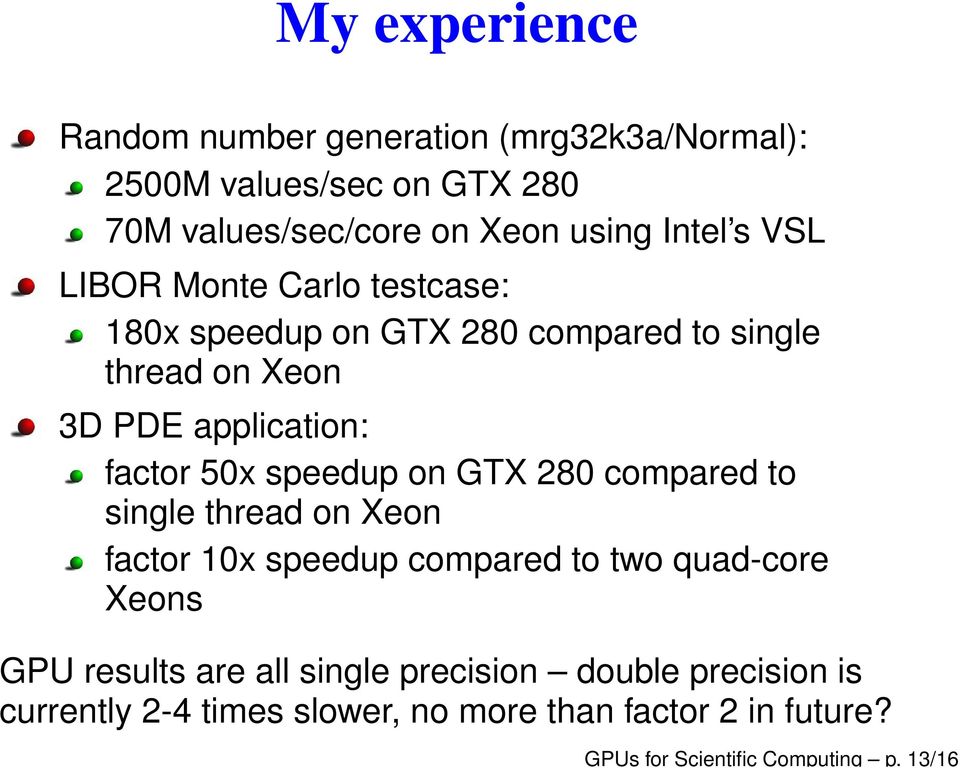
13 GPUs for Scientific Computing p. 13/16 My experience Random number generation (mrg32k3a/normal): 2500M values/sec on GTX M values/sec/core on Xeon using Intel s VSL LIBOR Monte Carlo testcase: 180x speedup on GTX 280 compared to single thread on Xeon 3D PDE application: factor 50x speedup on GTX 280 compared to single thread on Xeon factor 10x speedup compared to two quad-core Xeons GPU results are all single precision double precision is currently 2-4 times slower, no more than factor 2 in future?
14 GPUs for Scientific Computing p. 14/16 NAG Numerical Routines for GPUs Random number generation: Pseudo-random (L Ecuyer s mrg32k3a) and quasi-random (sobol) generation uniform, exponential, Normal and gamma output distributions available free to academics under a development license being assessed by a number of banks lots of interest at conferences and industry events Other capabilities will be added in the future.

15 GPUs for Scientific Computing p. 15/16 What is needed now? Skilled manpower, training: 50+ on Oxford CUDA mailing list: students and post-docs in almost all science departments 1-week CUDA course this summer in 3 years time, many PhDs in computational science will have these skills More development of libraries, high-level packages: Monte Carlo simulation PDE solvers...

16 GPUs for Scientific Computing p. 16/16 Further information LIBOR and finite difference test codes gilesm/hpc/ NAG Numerical Routines for GPUs NVIDIA s CUDA homepage home.html

CUDA programming on NVIDIA GPUs
 p. 1/21 on NVIDIA GPUs Mike Giles [email protected] Oxford University Mathematical Institute Oxford-Man Institute for Quantitative Finance Oxford eresearch Centre p. 2/21 Overview hardware view
Overview. Lecture 1: an introduction to CUDA. Hardware view. Hardware view. hardware view software view CUDA programming
 Overview Lecture 1: an introduction to CUDA Mike Giles [email protected] hardware view software view Oxford University Mathematical Institute Oxford e-research Centre Lecture 1 p. 1 Lecture 1 p.
GPU System Architecture. Alan Gray EPCC The University of Edinburgh
 GPU System Architecture EPCC The University of Edinburgh Outline Why do we want/need accelerators such as GPUs? GPU-CPU comparison Architectural reasons for GPU performance advantages GPU accelerated systems
Graphics Cards and Graphics Processing Units. Ben Johnstone Russ Martin November 15, 2011
 Graphics Cards and Graphics Processing Units Ben Johnstone Russ Martin November 15, 2011 Contents Graphics Processing Units (GPUs) Graphics Pipeline Architectures 8800-GTX200 Fermi Cayman Performance Analysis
Lecture 1: an introduction to CUDA
 Lecture 1: an introduction to CUDA Mike Giles [email protected] Oxford University Mathematical Institute Oxford e-research Centre Lecture 1 p. 1 Overview hardware view software view CUDA programming
Introduction to GP-GPUs. Advanced Computer Architectures, Cristina Silvano, Politecnico di Milano 1
 Introduction to GP-GPUs Advanced Computer Architectures, Cristina Silvano, Politecnico di Milano 1 GPU Architectures: How do we reach here? NVIDIA Fermi, 512 Processing Elements (PEs) 2 What Can It Do?
Introduction to GPU hardware and to CUDA
 Introduction to GPU hardware and to CUDA Philip Blakely Laboratory for Scientific Computing, University of Cambridge Philip Blakely (LSC) GPU introduction 1 / 37 Course outline Introduction to GPU hardware
Introduction to GPU Programming Languages
 CSC 391/691: GPU Programming Fall 2011 Introduction to GPU Programming Languages Copyright 2011 Samuel S. Cho http://www.umiacs.umd.edu/ research/gpu/facilities.html Maryland CPU/GPU Cluster Infrastructure
NVIDIA CUDA Software and GPU Parallel Computing Architecture. David B. Kirk, Chief Scientist
 NVIDIA CUDA Software and GPU Parallel Computing Architecture David B. Kirk, Chief Scientist Outline Applications of GPU Computing CUDA Programming Model Overview Programming in CUDA The Basics How to Get
22S:295 Seminar in Applied Statistics High Performance Computing in Statistics
 22S:295 Seminar in Applied Statistics High Performance Computing in Statistics Luke Tierney Department of Statistics & Actuarial Science University of Iowa August 30, 2007 Luke Tierney (U. of Iowa) HPC
Turbomachinery CFD on many-core platforms experiences and strategies
 Turbomachinery CFD on many-core platforms experiences and strategies Graham Pullan Whittle Laboratory, Department of Engineering, University of Cambridge MUSAF Colloquium, CERFACS, Toulouse September 27-29
Parallel Programming Survey
 Christian Terboven 02.09.2014 / Aachen, Germany Stand: 26.08.2014 Version 2.3 IT Center der RWTH Aachen University Agenda Overview: Processor Microarchitecture Shared-Memory
Introduction to GPU Architecture
 Introduction to GPU Architecture Ofer Rosenberg, PMTS SW, OpenCL Dev. Team AMD Based on From Shader Code to a Teraflop: How GPU Shader Cores Work, By Kayvon Fatahalian, Stanford University Content 1. Three
Lecture 11: Multi-Core and GPU. Multithreading. Integration of multiple processor cores on a single chip.
 Lecture 11: Multi-Core and GPU Multi-core computers Multithreading GPUs General Purpose GPUs Zebo Peng, IDA, LiTH 1 Multi-Core System Integration of multiple processor cores on a single chip. To provide
Optimizing a 3D-FWT code in a cluster of CPUs+GPUs
 Optimizing a 3D-FWT code in a cluster of CPUs+GPUs Gregorio Bernabé Javier Cuenca Domingo Giménez Universidad de Murcia Scientific Computing and Parallel Programming Group XXIX Simposium Nacional de la
Lecture 3: Modern GPUs A Hardware Perspective Mohamed Zahran (aka Z) [email protected] http://www.mzahran.com
 CSCI-GA.3033-012 Graphics Processing Units (GPUs): Architecture and Programming Lecture 3: Modern GPUs A Hardware Perspective Mohamed Zahran (aka Z) [email protected] http://www.mzahran.com Modern GPU
Programming models for heterogeneous computing. Manuel Ujaldón Nvidia CUDA Fellow and A/Prof. Computer Architecture Department University of Malaga
 Programming models for heterogeneous computing Manuel Ujaldón Nvidia CUDA Fellow and A/Prof. Computer Architecture Department University of Malaga Talk outline [30 slides] 1. Introduction [5 slides] 2.
Next Generation GPU Architecture Code-named Fermi
 Next Generation GPU Architecture Code-named Fermi The Soul of a Supercomputer in the Body of a GPU Why is NVIDIA at Super Computing? Graphics is a throughput problem paint every pixel within frame time
Overview on Modern Accelerators and Programming Paradigms Ivan Giro7o [email protected]
 Overview on Modern Accelerators and Programming Paradigms Ivan Giro7o [email protected] Informa(on & Communica(on Technology Sec(on (ICTS) Interna(onal Centre for Theore(cal Physics (ICTP) Mul(ple Socket
GPU Architectures. A CPU Perspective. Data Parallelism: What is it, and how to exploit it? Workload characteristics
 GPU Architectures A CPU Perspective Derek Hower AMD Research 5/21/2013 Goals Data Parallelism: What is it, and how to exploit it? Workload characteristics Execution Models / GPU Architectures MIMD (SPMD),
Overview of HPC Resources at Vanderbilt
 Overview of HPC Resources at Vanderbilt Will French Senior Application Developer and Research Computing Liaison Advanced Computing Center for Research and Education June 10, 2015 2 Computing Resources
~ Greetings from WSU CAPPLab ~
 ~ Greetings from WSU CAPPLab ~ Multicore with SMT/GPGPU provides the ultimate performance; at WSU CAPPLab, we can help! Dr. Abu Asaduzzaman, Assistant Professor and Director Wichita State University (WSU)
Multicore Parallel Computing with OpenMP
 Multicore Parallel Computing with OpenMP Tan Chee Chiang (SVU/Academic Computing, Computer Centre) 1. OpenMP Programming The death of OpenMP was anticipated when cluster systems rapidly replaced large
Introducing PgOpenCL A New PostgreSQL Procedural Language Unlocking the Power of the GPU! By Tim Child
 Introducing A New PostgreSQL Procedural Language Unlocking the Power of the GPU! By Tim Child Bio Tim Child 35 years experience of software development Formerly VP Oracle Corporation VP BEA Systems Inc.
HPC with Multicore and GPUs
 HPC with Multicore and GPUs Stan Tomov Electrical Engineering and Computer Science Department University of Tennessee, Knoxville CS 594 Lecture Notes March 4, 2015 1/18 Outline! Introduction - Hardware
Multi-core architectures. Jernej Barbic 15-213, Spring 2007 May 3, 2007
 Multi-core architectures Jernej Barbic 15-213, Spring 2007 May 3, 2007 1 Single-core computer 2 Single-core CPU chip the single core 3 Multi-core architectures This lecture is about a new trend in computer
Introduction GPU Hardware GPU Computing Today GPU Computing Example Outlook Summary. GPU Computing. Numerical Simulation - from Models to Software
 GPU Computing Numerical Simulation - from Models to Software Andreas Barthels JASS 2009, Course 2, St. Petersburg, Russia Prof. Dr. Sergey Y. Slavyanov St. Petersburg State University Prof. Dr. Thomas
High Performance. CAEA elearning Series. Jonathan G. Dudley, Ph.D. 06/09/2015. 2015 CAE Associates
 High Performance Computing (HPC) CAEA elearning Series Jonathan G. Dudley, Ph.D. 06/09/2015 2015 CAE Associates Agenda Introduction HPC Background Why HPC SMP vs. DMP Licensing HPC Terminology Types of
GPGPU Computing. Yong Cao
 GPGPU Computing Yong Cao Why Graphics Card? It s powerful! A quiet trend Copyright 2009 by Yong Cao Why Graphics Card? It s powerful! Processor Processing Units FLOPs per Unit Clock Speed Processing Power
Introduction to GPGPU. Tiziano Diamanti [email protected]
 [email protected] Agenda From GPUs to GPGPUs GPGPU architecture CUDA programming model Perspective projection Vectors that connect the vanishing point to every point of the 3D model will intersecate
Parallel Computing with MATLAB
 Parallel Computing with MATLAB Scott Benway Senior Account Manager Jiro Doke, Ph.D. Senior Application Engineer 2013 The MathWorks, Inc. 1 Acceleration Strategies Applied in MATLAB Approach Options Best
Introduction to Cloud Computing
 Introduction to Cloud Computing Parallel Processing I 15 319, spring 2010 7 th Lecture, Feb 2 nd Majd F. Sakr Lecture Motivation Concurrency and why? Different flavors of parallel computing Get the basic
This Unit: Putting It All Together. CIS 501 Computer Architecture. Sources. What is Computer Architecture?
 This Unit: Putting It All Together CIS 501 Computer Architecture Unit 11: Putting It All Together: Anatomy of the XBox 360 Game Console Slides originally developed by Amir Roth with contributions by Milo
GPU Hardware and Programming Models. Jeremy Appleyard, September 2015
 GPU Hardware and Programming Models Jeremy Appleyard, September 2015 A brief history of GPUs In this talk Hardware Overview Programming Models Ask questions at any point! 2 A Brief History of GPUs 3 Once
Performance Evaluation of NAS Parallel Benchmarks on Intel Xeon Phi
 Performance Evaluation of NAS Parallel Benchmarks on Intel Xeon Phi ICPP 6 th International Workshop on Parallel Programming Models and Systems Software for High-End Computing October 1, 2013 Lyon, France
Generations of the computer. processors.
 . Piotr Gwizdała 1 Contents 1 st Generation 2 nd Generation 3 rd Generation 4 th Generation 5 th Generation 6 th Generation 7 th Generation 8 th Generation Dual Core generation Improves and actualizations
10- High Performance Compu5ng
 10- High Performance Compu5ng (Herramientas Computacionales Avanzadas para la Inves6gación Aplicada) Rafael Palacios, Fernando de Cuadra MRE Contents Implemen8ng computa8onal tools 1. High Performance
Parallel Algorithm Engineering
 Parallel Algorithm Engineering Kenneth S. Bøgh PhD Fellow Based on slides by Darius Sidlauskas Outline Background Current multicore architectures UMA vs NUMA The openmp framework Examples Software crisis
E6895 Advanced Big Data Analytics Lecture 14:! NVIDIA GPU Examples and GPU on ios devices
 E6895 Advanced Big Data Analytics Lecture 14: NVIDIA GPU Examples and GPU on ios devices Ching-Yung Lin, Ph.D. Adjunct Professor, Dept. of Electrical Engineering and Computer Science IBM Chief Scientist,
Radeon GPU Architecture and the Radeon 4800 series. Michael Doggett Graphics Architecture Group June 27, 2008
 Radeon GPU Architecture and the series Michael Doggett Graphics Architecture Group June 27, 2008 Graphics Processing Units Introduction GPU research 2 GPU Evolution GPU started as a triangle rasterizer
ultra fast SOM using CUDA
 ultra fast SOM using CUDA SOM (Self-Organizing Map) is one of the most popular artificial neural network algorithms in the unsupervised learning category. Sijo Mathew Preetha Joy Sibi Rajendra Manoj A
BLM 413E - Parallel Programming Lecture 3
 BLM 413E - Parallel Programming Lecture 3 FSMVU Bilgisayar Mühendisliği Öğr. Gör. Musa AYDIN 14.10.2015 2015-2016 M.A. 1 Parallel Programming Models Parallel Programming Models Overview There are several
Unit A451: Computer systems and programming. Section 2: Computing Hardware 1/5: Central Processing Unit
 Unit A451: Computer systems and programming Section 2: Computing Hardware 1/5: Central Processing Unit Section Objectives Candidates should be able to: (a) State the purpose of the CPU (b) Understand the
ST810 Advanced Computing
 ST810 Advanced Computing Lecture 17: Parallel computing part I Eric B. Laber Hua Zhou Department of Statistics North Carolina State University Mar 13, 2013 Outline computing Hardware computing overview
Accelerating CFD using OpenFOAM with GPUs
 Accelerating CFD using OpenFOAM with GPUs Authors: Saeed Iqbal and Kevin Tubbs The OpenFOAM CFD Toolbox is a free, open source CFD software package produced by OpenCFD Ltd. Its user base represents a wide
The Uintah Framework: A Unified Heterogeneous Task Scheduling and Runtime System
 The Uintah Framework: A Unified Heterogeneous Task Scheduling and Runtime System Qingyu Meng, Alan Humphrey, Martin Berzins Thanks to: John Schmidt and J. Davison de St. Germain, SCI Institute Justin Luitjens
NVIDIA GeForce GTX 580 GPU Datasheet
 NVIDIA GeForce GTX 580 GPU Datasheet NVIDIA GeForce GTX 580 GPU Datasheet 3D Graphics Full Microsoft DirectX 11 Shader Model 5.0 support: o NVIDIA PolyMorph Engine with distributed HW tessellation engines
L20: GPU Architecture and Models
 L20: GPU Architecture and Models scribe(s): Abdul Khalifa 20.1 Overview GPUs (Graphics Processing Units) are large parallel structure of processing cores capable of rendering graphics efficiently on displays.
LBM BASED FLOW SIMULATION USING GPU COMPUTING PROCESSOR
 LBM BASED FLOW SIMULATION USING GPU COMPUTING PROCESSOR Frédéric Kuznik, frederic.kuznik@insa lyon.fr 1 Framework Introduction Hardware architecture CUDA overview Implementation details A simple case:
GPU Computing with CUDA Lecture 2 - CUDA Memories. Christopher Cooper Boston University August, 2011 UTFSM, Valparaíso, Chile
 GPU Computing with CUDA Lecture 2 - CUDA Memories Christopher Cooper Boston University August, 2011 UTFSM, Valparaíso, Chile 1 Outline of lecture Recap of Lecture 1 Warp scheduling CUDA Memory hierarchy
OpenCL Optimization. San Jose 10/2/2009 Peng Wang, NVIDIA
 OpenCL Optimization San Jose 10/2/2009 Peng Wang, NVIDIA Outline Overview The CUDA architecture Memory optimization Execution configuration optimization Instruction optimization Summary Overall Optimization
Maximize Performance and Scalability of RADIOSS* Structural Analysis Software on Intel Xeon Processor E7 v2 Family-Based Platforms
 Maximize Performance and Scalability of RADIOSS* Structural Analysis Software on Family-Based Platforms Executive Summary Complex simulations of structural and systems performance, such as car crash simulations,
A GPU COMPUTING PLATFORM (SAGA) AND A CFD CODE ON GPU FOR AEROSPACE APPLICATIONS
 A GPU COMPUTING PLATFORM (SAGA) AND A CFD CODE ON GPU FOR AEROSPACE APPLICATIONS SUDHAKARAN.G APCF, AERO, VSSC, ISRO 914712564742 [email protected] THOMAS.C.BABU APCF, AERO, VSSC, ISRO 914712565833
Intro to GPU computing. Spring 2015 Mark Silberstein, 048661, Technion 1
 Intro to GPU computing Spring 2015 Mark Silberstein, 048661, Technion 1 Serial vs. parallel program One instruction at a time Multiple instructions in parallel Spring 2015 Mark Silberstein, 048661, Technion
IP Video Rendering Basics
 CohuHD offers a broad line of High Definition network based cameras, positioning systems and VMS solutions designed for the performance requirements associated with critical infrastructure applications.
Choosing a Computer for Running SLX, P3D, and P5
 Choosing a Computer for Running SLX, P3D, and P5 This paper is based on my experience purchasing a new laptop in January, 2010. I ll lead you through my selection criteria and point you to some on-line
David Rioja Redondo Telecommunication Engineer Englobe Technologies and Systems
 David Rioja Redondo Telecommunication Engineer Englobe Technologies and Systems About me David Rioja Redondo Telecommunication Engineer - Universidad de Alcalá >2 years building and managing clusters UPM
HPC Wales Skills Academy Course Catalogue 2015
 HPC Wales Skills Academy Course Catalogue 2015 Overview The HPC Wales Skills Academy provides a variety of courses and workshops aimed at building skills in High Performance Computing (HPC). Our courses
LSN 2 Computer Processors
 LSN 2 Computer Processors Department of Engineering Technology LSN 2 Computer Processors Microprocessors Design Instruction set Processor organization Processor performance Bandwidth Clock speed LSN 2
High Performance GPGPU Computer for Embedded Systems
 High Performance GPGPU Computer for Embedded Systems Author: Dan Mor, Aitech Product Manager September 2015 Contents 1. Introduction... 3 2. Existing Challenges in Modern Embedded Systems... 3 2.1. Not
GPGPU for Real-Time Data Analytics: Introduction. Nanyang Technological University, Singapore 2
 GPGPU for Real-Time Data Analytics: Introduction Bingsheng He 1, Huynh Phung Huynh 2, Rick Siow Mong Goh 2 1 Nanyang Technological University, Singapore 2 A*STAR Institute of High Performance Computing,
BIG CPU, BIG DATA. Solving the World s Toughest Computational Problems with Parallel Computing. Alan Kaminsky
 Solving the World s Toughest Computational Problems with Parallel Computing Alan Kaminsky Solving the World s Toughest Computational Problems with Parallel Computing Alan Kaminsky Department of Computer
Making the Monte Carlo Approach Even Easier and Faster. By Sergey A. Maidanov and Andrey Naraikin
 Making the Monte Carlo Approach Even Easier and Faster By Sergey A. Maidanov and Andrey Naraikin Libraries of random-number generators for general probability distributions can make implementing Monte
Clustering Billions of Data Points Using GPUs
 Clustering Billions of Data Points Using GPUs Ren Wu [email protected] Bin Zhang [email protected] Meichun Hsu [email protected] ABSTRACT In this paper, we report our research on using GPUs to accelerate
QCD as a Video Game?
 QCD as a Video Game? Sándor D. Katz Eötvös University Budapest in collaboration with Győző Egri, Zoltán Fodor, Christian Hoelbling Dániel Nógrádi, Kálmán Szabó Outline 1. Introduction 2. GPU architecture
15-418 Final Project Report. Trading Platform Server
 15-418 Final Project Report Yinghao Wang [email protected] May 8, 214 Trading Platform Server Executive Summary The final project will implement a trading platform server that provides back-end support
Multi-Threading Performance on Commodity Multi-Core Processors
 Multi-Threading Performance on Commodity Multi-Core Processors Jie Chen and William Watson III Scientific Computing Group Jefferson Lab 12000 Jefferson Ave. Newport News, VA 23606 Organization Introduction
Guided Performance Analysis with the NVIDIA Visual Profiler
 Guided Performance Analysis with the NVIDIA Visual Profiler Identifying Performance Opportunities NVIDIA Nsight Eclipse Edition (nsight) NVIDIA Visual Profiler (nvvp) nvprof command-line profiler Guided
Applications to Computational Financial and GPU Computing. May 16th. Dr. Daniel Egloff +41 44 520 01 17 +41 79 430 03 61
 F# Applications to Computational Financial and GPU Computing May 16th Dr. Daniel Egloff +41 44 520 01 17 +41 79 430 03 61 Today! Why care about F#? Just another fashion?! Three success stories! How Alea.cuBase
Chapter 1 Computer System Overview
 Operating Systems: Internals and Design Principles Chapter 1 Computer System Overview Eighth Edition By William Stallings Operating System Exploits the hardware resources of one or more processors Provides
Logical Operations. Control Unit. Contents. Arithmetic Operations. Objectives. The Central Processing Unit: Arithmetic / Logic Unit.
 Objectives The Central Processing Unit: What Goes on Inside the Computer Chapter 4 Identify the components of the central processing unit and how they work together and interact with memory Describe how
Achieving Nanosecond Latency Between Applications with IPC Shared Memory Messaging
 Achieving Nanosecond Latency Between Applications with IPC Shared Memory Messaging In some markets and scenarios where competitive advantage is all about speed, speed is measured in micro- and even nano-seconds.
GeoImaging Accelerator Pansharp Test Results
 GeoImaging Accelerator Pansharp Test Results Executive Summary After demonstrating the exceptional performance improvement in the orthorectification module (approximately fourteen-fold see GXL Ortho Performance
ADVANCED COMPUTER ARCHITECTURE
 ADVANCED COMPUTER ARCHITECTURE Marco Ferretti Tel. Ufficio: 0382 985365 E-mail: [email protected] Web: www.unipv.it/mferretti, eecs.unipv.it 1 Course syllabus and motivations This course covers the
Chapter 2 Parallel Architecture, Software And Performance
 Chapter 2 Parallel Architecture, Software And Performance UCSB CS140, T. Yang, 2014 Modified from texbook slides Roadmap Parallel hardware Parallel software Input and output Performance Parallel program
Data-parallel Acceleration of PARSEC Black-Scholes Benchmark
 Data-parallel Acceleration of PARSEC Black-Scholes Benchmark AUGUST ANDRÉN and PATRIK HAGERNÄS KTH Information and Communication Technology Bachelor of Science Thesis Stockholm, Sweden 2013 TRITA-ICT-EX-2013:158
Case Study on Productivity and Performance of GPGPUs
 Case Study on Productivity and Performance of GPGPUs Sandra Wienke [email protected] ZKI Arbeitskreis Supercomputing April 2012 Rechen- und Kommunikationszentrum (RZ) RWTH GPU-Cluster 56 Nvidia
BIG CPU, BIG DATA. Solving the World s Toughest Computational Problems with Parallel Computing. Alan Kaminsky
 Solving the World s Toughest Computational Problems with Parallel Computing Solving the World s Toughest Computational Problems with Parallel Computing Department of Computer Science B. Thomas Golisano
Evaluation of CUDA Fortran for the CFD code Strukti
 Evaluation of CUDA Fortran for the CFD code Strukti Practical term report from Stephan Soller High performance computing center Stuttgart 1 Stuttgart Media University 2 High performance computing center
GPGPU accelerated Computational Fluid Dynamics
 t e c h n i s c h e u n i v e r s i t ä t b r a u n s c h w e i g Carl-Friedrich Gauß Faculty GPGPU accelerated Computational Fluid Dynamics 5th GACM Colloquium on Computational Mechanics Hamburg Institute
Introduction to Numerical General Purpose GPU Computing with NVIDIA CUDA. Part 1: Hardware design and programming model
 Introduction to Numerical General Purpose GPU Computing with NVIDIA CUDA Part 1: Hardware design and programming model Amin Safi Faculty of Mathematics, TU dortmund January 22, 2016 Table of Contents Set
Hardware-Aware Analysis and. Presentation Date: Sep 15 th 2009 Chrissie C. Cui
 Hardware-Aware Analysis and Optimization of Stable Fluids Presentation Date: Sep 15 th 2009 Chrissie C. Cui Outline Introduction Highlights Flop and Bandwidth Analysis Mehrstellen Schemes Advection Caching
Stream Processing on GPUs Using Distributed Multimedia Middleware
 Stream Processing on GPUs Using Distributed Multimedia Middleware Michael Repplinger 1,2, and Philipp Slusallek 1,2 1 Computer Graphics Lab, Saarland University, Saarbrücken, Germany 2 German Research
Performance monitoring of the software frameworks for LHC experiments
 Performance monitoring of the software frameworks for LHC experiments William A. Romero R. [email protected] J.M. Dana [email protected] First EELA-2 Conference Bogotá, COL OUTLINE Introduction
The Future Of Animation Is Games
 The Future Of Animation Is Games 王 銓 彰 Next Media Animation, Media Lab, Director [email protected] The Graphics Hardware Revolution ( 繪 圖 硬 體 革 命 ) : GPU-based Graphics Hardware Multi-core (20 Cores
Speeding up GPU-based password cracking
 Speeding up GPU-based password cracking SHARCS 2012 Martijn Sprengers 1,2 Lejla Batina 2,3 [email protected] KPMG IT Advisory 1 Radboud University Nijmegen 2 K.U. Leuven 3 March 17-18, 2012 Who
Computer Graphics Hardware An Overview
 Computer Graphics Hardware An Overview Graphics System Monitor Input devices CPU/Memory GPU Raster Graphics System Raster: An array of picture elements Based on raster-scan TV technology The screen (and
Experiences on using GPU accelerators for data analysis in ROOT/RooFit
 Experiences on using GPU accelerators for data analysis in ROOT/RooFit Sverre Jarp, Alfio Lazzaro, Julien Leduc, Yngve Sneen Lindal, Andrzej Nowak European Organization for Nuclear Research (CERN), Geneva,
ATI Radeon 4800 series Graphics. Michael Doggett Graphics Architecture Group Graphics Product Group
 ATI Radeon 4800 series Graphics Michael Doggett Graphics Architecture Group Graphics Product Group Graphics Processing Units ATI Radeon HD 4870 AMD Stream Computing Next Generation GPUs 2 Radeon 4800 series
AMD PhenomII. Architecture for Multimedia System -2010. Prof. Cristina Silvano. Group Member: Nazanin Vahabi 750234 Kosar Tayebani 734923
 AMD PhenomII Architecture for Multimedia System -2010 Prof. Cristina Silvano Group Member: Nazanin Vahabi 750234 Kosar Tayebani 734923 Outline Introduction Features Key architectures References AMD Phenom
Accelerating Simulation & Analysis with Hybrid GPU Parallelization and Cloud Computing
 Accelerating Simulation & Analysis with Hybrid GPU Parallelization and Cloud Computing Innovation Intelligence Devin Jensen August 2012 Altair Knows HPC Altair is the only company that: makes HPC tools
GPGPU acceleration in OpenFOAM
 Carl-Friedrich Gauß Faculty GPGPU acceleration in OpenFOAM Northern germany OpenFoam User meeting Braunschweig Institute of Technology Thorsten Grahs Institute of Scientific Computing/move-csc 2nd October
Assessing the Performance of OpenMP Programs on the Intel Xeon Phi
 Assessing the Performance of OpenMP Programs on the Intel Xeon Phi Dirk Schmidl, Tim Cramer, Sandra Wienke, Christian Terboven, and Matthias S. Müller [email protected] Rechen- und Kommunikationszentrum
benchmarking Amazon EC2 for high-performance scientific computing
 Edward Walker benchmarking Amazon EC2 for high-performance scientific computing Edward Walker is a Research Scientist with the Texas Advanced Computing Center at the University of Texas at Austin. He received
Rethinking SIMD Vectorization for In-Memory Databases
 SIGMOD 215, Melbourne, Victoria, Australia Rethinking SIMD Vectorization for In-Memory Databases Orestis Polychroniou Columbia University Arun Raghavan Oracle Labs Kenneth A. Ross Columbia University Latest
CISC, RISC, and DSP Microprocessors
 CISC, RISC, and DSP Microprocessors Douglas L. Jones ECE 497 Spring 2000 4/6/00 CISC, RISC, and DSP D.L. Jones 1 Outline Microprocessors circa 1984 RISC vs. CISC Microprocessors circa 1999 Perspective: