
QCD as a Video Game?
|
|
|
- Alfred Ryan
- 10 years ago
- Views:
Transcription
1 QCD as a Video Game? Sándor D. Katz Eötvös University Budapest in collaboration with Győző Egri, Zoltán Fodor, Christian Hoelbling Dániel Nógrádi, Kálmán Szabó

2 Outline 1. Introduction 2. GPU architecture 3. Software 4. Staggered and Wilson matrix implementation 5. Summary

3 Why use Graphical Processing Units? Ian Buck, Stanford Gamerz market is big $$$: top model costs $500

4 How much power can be utilized for the lattice? Performance for Wilson multiplication 12 GPU 7900 GTX GPU 7800 GTX CPU P4 SSE 10 Gflops Volume Conjugate gradient: 90% of Wilson 10 GFlops

5 How is this possible? CPU: lot of transistors do non-computational tasks GPU: transistors (almost) only calculate GPU architecture Native data: 2D arrays, textures (for games its content ends up on the screen). Each pixel (or fragment): 4 floating point numbers: RGBA color channels. Each pixel computation: incoming textures outgoing textures: same operation on each pixel massively parallel. Like a stream: pipeline should be full performance is better for large textures (lattices).

6 GPU hardware architecture Textures Vertex processor Rasterizer Fragment processor Screen Elements of the pipeline: Vertex processor: basic transformations (e.g. rotations) Rasterizer: generate texture coordinates Fragment processor: shade a region using texture inputs

7 Main specifications (Nvidia 7900GTX): Computation: 24 fragment processing units 800MHz clock 8 floating point operations/clock 154 GFlops peak performance! Memory: 512 MB (today s cards have up to 1GB) 256 bit wide bus 1600 MHz DDR3 memory 51.2 GB/s peak bandwidth 5 top CPUs

8 Native data types: textures (2D data streams) Texture elements: fragments/pixels different number of fields/fragment (R, RGB, RGBA) different data types: fixed, half (16 bit float), float General purpose computations typically RGBA float is used similar to SSE

9 Fragment programs input textures output (screen/textures) x, y coordinates Fragment program y x One fragment per output texture is processed at a time The 24 fragment processor units work simultaneously on different fragments

10 Input textures: maximum number is 32 read only can have different size can be addressed indirectly e.g. (2x+1,3y+2) Output textures: maximum number is 4 write only fixed size (for all 4) direct addressing, x, y location is written

11 Software environment Bad news: GPU hardware is undocumented Only possibility to program it is through graphics drivers Direct3D or OpenGL environments OpenGL also under Linux Main steps: - allocate textures - upload textures to video memory - upload fragment program - set target texture(s) - run fragment program - download output texture to main memory Upload/download is slow many runs without download needed e.g. full Conjugate Gradient on GPU, not only Dirac operator

12 Programming languages: Assembler: not well documented code can be uploaded from a string with an OpenGL call Cg (C for graphics): similar to C, very low level almost one-to-one compilation into assembler either pre-compilation or runtime compilation powerful instruction set multiple-add instructions on the assembler level component shuffling is trivial: e.g. a.rgba=b.rrgb+c.grab compiles to one assembler instruction

13 Real life example x i = y i + z i i = 1...4nm Fragment program in Cg: struct FragmentOut { float4 color0:color0; } FragmentOut example(in float2 mytexcoord:wpos, uniform samplerrect y, uniform samplerrect z) { FragmentOut c; c.color0 = texrect( y, mytexcoord ) + texrect( z, mytexcoord ); return c; }

14 Create texture in OpenGL (like malloc) GLuint X; glgentextures(1, &X); glbindtexture(..., X); gltexparameteri(...); glteximage2d(..., n,m,...,0); /* Texture parameters, e.g. boundary conditions */... /* do the same for Y, Z as well */ Transfer data CPU GPU in OpenGL glbindtexture(...,y); glframebuffertexture2dext(...,y,...); gltexsubimage2d(...,n,m,...,y);... /* do the same for Z */

15 Do the actual computation, run the fragment program cgglsettextureparameter(...,y); glframebuffertexture2dext(..., X, 0 ); /* set X as target * gldrawbuffer(...); /* tell opengl which targets to write */ cgglbindprogram(...); /* choose program */ glbegin(...); /* send vertices to the vertex processor */ { glvertex2f(0,0); glvertex2f(n,0); glvertex2f(n,m); glvertex2f(0,m); } glend();

16 Transfer data GPU CPU glframebuffertexture2dext(...,x,...); glreadbuffer(...); /* read from texture X */ glreadpixels(, n, m,..., x ); Same in C: for( i = 0; i < 4 * n * m; i++ ) x[i] = y[i] + z[i]; GPU version is much longer but much faster (not counting up- and downloads)
![.., x ); Same in C: for( i = 0; i < 4 * n * m; i++ ) x[i] = y[i] +](/docs-images/51/13432608/images/page_16.jpg "z[i]; GPU version is much longer but much faster (not counting up-")
17 Even more real life example: QCD Staggered QCD on the GPU 4 components of a fragment (RGBA) are not optimal for SU(3) two possibilities: 1. Use only RGB fields 2. store 2 lattice sites per fragment (2 complex numbers) F0 F1 F5

18 texture size for a N x N y N z N t lattice is (N x N y /2) (N z N t ) Vectors: color components to different textures 3 texture per staggered vector Gauge fields: Keep only first two rows of an SU(3) matrix third row can be reconstructed 6 complex numbers 6 textures for one direction altogether 24 textures for gauge fields Index texture: store the coordinates of a neighbor for a given direction

19 Further ingredients for a (multishift) Conjugate Gradient solver: linear combination of vectors trivial scalar product: - multiplication is trivial - no native support for summation Reduction step: for a 2n 2m input texture take an n m output texture for an (x;y output coordinate add the elements (2x;2y),(2x+1;2y),(2x;2y+1),(2x+1;2y+1) of the input texture repeat as many times as possible (can also use 3x3 reduction instead of 2x2) download the remaining small texture and finish on the CPU

20 Wilson QCD on the GPU Due to Dirac indices Wilson vectors perfectly fit to the RGBA structure of the fragments texture size for a N x N y N z N t lattice is (N x N y ) (N z N t ) Vectors: half Wilson vectors are needed two Dirac components fit into the RGBA fields 3 color components to 3 textures altogether 3 textures are needed for a half Wilson vector Gauge fields: third row reconstruction not implemented yet 18 real components for a given direction Need 5 textures and there is room for 2 = more real numbers. Store 2D texture location of neighbor there. Altogether 20 textures for the gauge fields

21 Performance of the staggered Dirac operator performance on large lattices is about 5-6 faster than on a 3 GHz p4 CPU contrary to CPU large lattices are faster multishift CG performance depends on the number of shifts 10% lower (9 GFlops on a 7900GTX card for large lattices)
22 Performance of the Wilson Dirac operator Performance for Wilson multiplication Performance of GPU 7900 GTX 12 GPU 7900 GTX GPU 7800 GTX CPU P4 SSE 12 Wilson CG Gflops Volume Volume Similar to the staggered case
23 The precision problem: the GPU has 32 bit float precision no proper rounding, but truncation error propagation is worse not a serious problem for two reasons 1. Conjugate gradient solver can be run in two steps each time with lower precision and obtain high precision result 2. Most of the computations are along the trajectories where lower precision is satisfactory High precision is only needed for the accept/reject step
24 Summary GPUs are massively parallel stream based processors General purpose applications are possible Staggered and Wilson Dirac operator and CG solver implemented factor 3-6 speedup compared to CPUs Only single precision with truncation, no problem for CG Future prospects Communication between the cards (in one PC or different PC s) Software side: unknown and unpredictable progress made by vendors resulting in new OpenGL extensions and improved drivers. Hardware side: faster, larger, more!
Graphics Cards and Graphics Processing Units. Ben Johnstone Russ Martin November 15, 2011
 Graphics Cards and Graphics Processing Units Ben Johnstone Russ Martin November 15, 2011 Contents Graphics Processing Units (GPUs) Graphics Pipeline Architectures 8800-GTX200 Fermi Cayman Performance Analysis
Computer Graphics Hardware An Overview
 Computer Graphics Hardware An Overview Graphics System Monitor Input devices CPU/Memory GPU Raster Graphics System Raster: An array of picture elements Based on raster-scan TV technology The screen (and
Introduction to GPGPU. Tiziano Diamanti [email protected]
 [email protected] Agenda From GPUs to GPGPUs GPGPU architecture CUDA programming model Perspective projection Vectors that connect the vanishing point to every point of the 3D model will intersecate
GPGPU Computing. Yong Cao
 GPGPU Computing Yong Cao Why Graphics Card? It s powerful! A quiet trend Copyright 2009 by Yong Cao Why Graphics Card? It s powerful! Processor Processing Units FLOPs per Unit Clock Speed Processing Power
L20: GPU Architecture and Models
 L20: GPU Architecture and Models scribe(s): Abdul Khalifa 20.1 Overview GPUs (Graphics Processing Units) are large parallel structure of processing cores capable of rendering graphics efficiently on displays.
Introduction GPU Hardware GPU Computing Today GPU Computing Example Outlook Summary. GPU Computing. Numerical Simulation - from Models to Software
 GPU Computing Numerical Simulation - from Models to Software Andreas Barthels JASS 2009, Course 2, St. Petersburg, Russia Prof. Dr. Sergey Y. Slavyanov St. Petersburg State University Prof. Dr. Thomas
LBM BASED FLOW SIMULATION USING GPU COMPUTING PROCESSOR
 LBM BASED FLOW SIMULATION USING GPU COMPUTING PROCESSOR Frédéric Kuznik, frederic.kuznik@insa lyon.fr 1 Framework Introduction Hardware architecture CUDA overview Implementation details A simple case:
CSE 564: Visualization. GPU Programming (First Steps) GPU Generations. Klaus Mueller. Computer Science Department Stony Brook University
 GPU Generations CSE 564: Visualization GPU Programming (First Steps) Klaus Mueller Computer Science Department Stony Brook University For the labs, 4th generation is desirable Graphics Hardware Pipeline
The Evolution of Computer Graphics. SVP, Content & Technology, NVIDIA
 The Evolution of Computer Graphics Tony Tamasi SVP, Content & Technology, NVIDIA Graphics Make great images intricate shapes complex optical effects seamless motion Make them fast invent clever techniques
GPU Architecture. Michael Doggett ATI
 GPU Architecture Michael Doggett ATI GPU Architecture RADEON X1800/X1900 Microsoft s XBOX360 Xenos GPU GPU research areas ATI - Driving the Visual Experience Everywhere Products from cell phones to super
Radeon GPU Architecture and the Radeon 4800 series. Michael Doggett Graphics Architecture Group June 27, 2008
 Radeon GPU Architecture and the series Michael Doggett Graphics Architecture Group June 27, 2008 Graphics Processing Units Introduction GPU research 2 GPU Evolution GPU started as a triangle rasterizer
Introduction to GPU Computing
 Matthis Hauschild Universität Hamburg Fakultät für Mathematik, Informatik und Naturwissenschaften Technische Aspekte Multimodaler Systeme December 4, 2014 M. Hauschild - 1 Table of Contents 1. Architecture
Data Parallel Computing on Graphics Hardware. Ian Buck Stanford University
 Data Parallel Computing on Graphics Hardware Ian Buck Stanford University Brook General purpose Streaming language DARPA Polymorphous Computing Architectures Stanford - Smart Memories UT Austin - TRIPS
Hardware-Aware Analysis and. Presentation Date: Sep 15 th 2009 Chrissie C. Cui
 Hardware-Aware Analysis and Optimization of Stable Fluids Presentation Date: Sep 15 th 2009 Chrissie C. Cui Outline Introduction Highlights Flop and Bandwidth Analysis Mehrstellen Schemes Advection Caching
Next Generation GPU Architecture Code-named Fermi
 Next Generation GPU Architecture Code-named Fermi The Soul of a Supercomputer in the Body of a GPU Why is NVIDIA at Super Computing? Graphics is a throughput problem paint every pixel within frame time
General Purpose Computation on Graphics Processors (GPGPU) Mike Houston, Stanford University
 General Purpose Computation on Graphics Processors (GPGPU) Mike Houston, Stanford University A little about me http://graphics.stanford.edu/~mhouston Education: UC San Diego, Computer Science BS Stanford
GPU System Architecture. Alan Gray EPCC The University of Edinburgh
 GPU System Architecture EPCC The University of Edinburgh Outline Why do we want/need accelerators such as GPUs? GPU-CPU comparison Architectural reasons for GPU performance advantages GPU accelerated systems
Developer Tools. Tim Purcell NVIDIA
 Developer Tools Tim Purcell NVIDIA Programming Soap Box Successful programming systems require at least three tools High level language compiler Cg, HLSL, GLSL, RTSL, Brook Debugger Profiler Debugging
Writing Applications for the GPU Using the RapidMind Development Platform
 Writing Applications for the GPU Using the RapidMind Development Platform Contents Introduction... 1 Graphics Processing Units... 1 RapidMind Development Platform... 2 Writing RapidMind Enabled Applications...
NVIDIA GeForce GTX 580 GPU Datasheet
 NVIDIA GeForce GTX 580 GPU Datasheet NVIDIA GeForce GTX 580 GPU Datasheet 3D Graphics Full Microsoft DirectX 11 Shader Model 5.0 support: o NVIDIA PolyMorph Engine with distributed HW tessellation engines
Overview Motivation and applications Challenges. Dynamic Volume Computation and Visualization on the GPU. GPU feature requests Conclusions
 Module 4: Beyond Static Scalar Fields Dynamic Volume Computation and Visualization on the GPU Visualization and Computer Graphics Group University of California, Davis Overview Motivation and applications
Turbomachinery CFD on many-core platforms experiences and strategies
 Turbomachinery CFD on many-core platforms experiences and strategies Graham Pullan Whittle Laboratory, Department of Engineering, University of Cambridge MUSAF Colloquium, CERFACS, Toulouse September 27-29
GPUs for Scientific Computing
 GPUs for Scientific Computing p. 1/16 GPUs for Scientific Computing Mike Giles [email protected] Oxford-Man Institute of Quantitative Finance Oxford University Mathematical Institute Oxford e-research
Accelerating CFD using OpenFOAM with GPUs
 Accelerating CFD using OpenFOAM with GPUs Authors: Saeed Iqbal and Kevin Tubbs The OpenFOAM CFD Toolbox is a free, open source CFD software package produced by OpenCFD Ltd. Its user base represents a wide
Binary search tree with SIMD bandwidth optimization using SSE
 Binary search tree with SIMD bandwidth optimization using SSE Bowen Zhang, Xinwei Li 1.ABSTRACT In-memory tree structured index search is a fundamental database operation. Modern processors provide tremendous
Accelerating Intensity Layer Based Pencil Filter Algorithm using CUDA
 Accelerating Intensity Layer Based Pencil Filter Algorithm using CUDA Dissertation submitted in partial fulfillment of the requirements for the degree of Master of Technology, Computer Engineering by Amol
Mixed Precision Iterative Refinement Methods Energy Efficiency on Hybrid Hardware Platforms
 Mixed Precision Iterative Refinement Methods Energy Efficiency on Hybrid Hardware Platforms Björn Rocker Hamburg, June 17th 2010 Engineering Mathematics and Computing Lab (EMCL) KIT University of the State
Introduction to GPU Programming Languages
 CSC 391/691: GPU Programming Fall 2011 Introduction to GPU Programming Languages Copyright 2011 Samuel S. Cho http://www.umiacs.umd.edu/ research/gpu/facilities.html Maryland CPU/GPU Cluster Infrastructure
GPGPU accelerated Computational Fluid Dynamics
 t e c h n i s c h e u n i v e r s i t ä t b r a u n s c h w e i g Carl-Friedrich Gauß Faculty GPGPU accelerated Computational Fluid Dynamics 5th GACM Colloquium on Computational Mechanics Hamburg Institute
Introduction to GPU hardware and to CUDA
 Introduction to GPU hardware and to CUDA Philip Blakely Laboratory for Scientific Computing, University of Cambridge Philip Blakely (LSC) GPU introduction 1 / 37 Course outline Introduction to GPU hardware
GPU Parallel Computing Architecture and CUDA Programming Model
 GPU Parallel Computing Architecture and CUDA Programming Model John Nickolls Outline Why GPU Computing? GPU Computing Architecture Multithreading and Arrays Data Parallel Problem Decomposition Parallel
Performance Optimization and Debug Tools for mobile games with PlayCanvas
 Performance Optimization and Debug Tools for mobile games with PlayCanvas Jonathan Kirkham, Senior Software Engineer, ARM Will Eastcott, CEO, PlayCanvas 1 Introduction Jonathan Kirkham, ARM Worked with
Introduction to GP-GPUs. Advanced Computer Architectures, Cristina Silvano, Politecnico di Milano 1
 Introduction to GP-GPUs Advanced Computer Architectures, Cristina Silvano, Politecnico di Milano 1 GPU Architectures: How do we reach here? NVIDIA Fermi, 512 Processing Elements (PEs) 2 What Can It Do?
Assessing the Performance of OpenMP Programs on the Intel Xeon Phi
 Assessing the Performance of OpenMP Programs on the Intel Xeon Phi Dirk Schmidl, Tim Cramer, Sandra Wienke, Christian Terboven, and Matthias S. Müller [email protected] Rechen- und Kommunikationszentrum
GOLD20TH-GTX980-P-4GD5
 GOLD20TH-GTX980-P-4GD5 The fastest GTX 980 in the world. ASUS Exclusive Innovations DIRECTCU II + 0dB FAN 15% COOLER. SILENT GAMING. ASUS GTX 980 20th anniversary gold edition drives DirectCU technology
How To Use An Amd Ramfire R7 With A 4Gb Memory Card With A 2Gb Memory Chip With A 3D Graphics Card With An 8Gb Card With 2Gb Graphics Card (With 2D) And A 2D Video Card With
 SAPPHIRE R9 270X 4GB GDDR5 WITH BOOST & OC Specification Display Support Output GPU Video Memory Dimension Software Accessory 3 x Maximum Display Monitor(s) support 1 x HDMI (with 3D) 1 x DisplayPort 1.2
Hardware Acceleration for CST MICROWAVE STUDIO
 Hardware Acceleration for CST MICROWAVE STUDIO Chris Mason Product Manager Amy Dewis Channel Manager Agenda 1. Introduction 2. Why use Hardware Acceleration? 3. Hardware Acceleration Technologies 4. Current
CFD Implementation with In-Socket FPGA Accelerators
 CFD Implementation with In-Socket FPGA Accelerators Ivan Gonzalez UAM Team at DOVRES FuSim-E Programme Symposium: CFD on Future Architectures C 2 A 2 S 2 E DLR Braunschweig 14 th -15 th October 2009 Outline
Chapter 2 Parallel Architecture, Software And Performance
 Chapter 2 Parallel Architecture, Software And Performance UCSB CS140, T. Yang, 2014 Modified from texbook slides Roadmap Parallel hardware Parallel software Input and output Performance Parallel program
Optimizing AAA Games for Mobile Platforms
 Optimizing AAA Games for Mobile Platforms Niklas Smedberg Senior Engine Programmer, Epic Games Who Am I A.k.a. Smedis Epic Games, Unreal Engine 15 years in the industry 30 years of programming C64 demo
In the early 1990s, ubiquitous
 How GPUs Work David Luebke, NVIDIA Research Greg Humphreys, University of Virginia In the early 1990s, ubiquitous interactive 3D graphics was still the stuff of science fiction. By the end of the decade,
Chapter 07: Instruction Level Parallelism VLIW, Vector, Array and Multithreaded Processors. Lesson 05: Array Processors
 Chapter 07: Instruction Level Parallelism VLIW, Vector, Array and Multithreaded Processors Lesson 05: Array Processors Objective To learn how the array processes in multiple pipelines 2 Array Processor
Experiences on using GPU accelerators for data analysis in ROOT/RooFit
 Experiences on using GPU accelerators for data analysis in ROOT/RooFit Sverre Jarp, Alfio Lazzaro, Julien Leduc, Yngve Sneen Lindal, Andrzej Nowak European Organization for Nuclear Research (CERN), Geneva,
1. INTRODUCTION Graphics 2
 1. INTRODUCTION Graphics 2 06-02408 Level 3 10 credits in Semester 2 Professor Aleš Leonardis Slides by Professor Ela Claridge What is computer graphics? The art of 3D graphics is the art of fooling the
Lecture 11: Multi-Core and GPU. Multithreading. Integration of multiple processor cores on a single chip.
 Lecture 11: Multi-Core and GPU Multi-core computers Multithreading GPUs General Purpose GPUs Zebo Peng, IDA, LiTH 1 Multi-Core System Integration of multiple processor cores on a single chip. To provide
Lecture 3: Modern GPUs A Hardware Perspective Mohamed Zahran (aka Z) [email protected] http://www.mzahran.com
 CSCI-GA.3033-012 Graphics Processing Units (GPUs): Architecture and Programming Lecture 3: Modern GPUs A Hardware Perspective Mohamed Zahran (aka Z) [email protected] http://www.mzahran.com Modern GPU
Introduction to GPU Architecture
 Introduction to GPU Architecture Ofer Rosenberg, PMTS SW, OpenCL Dev. Team AMD Based on From Shader Code to a Teraflop: How GPU Shader Cores Work, By Kayvon Fatahalian, Stanford University Content 1. Three
Several tips on how to choose a suitable computer
 Several tips on how to choose a suitable computer This document provides more specific information on how to choose a computer that will be suitable for scanning and postprocessing of your data with Artec
Lattice QCD Performance. on Multi core Linux Servers
 Lattice QCD Performance on Multi core Linux Servers Yang Suli * Department of Physics, Peking University, Beijing, 100871 Abstract At the moment, lattice quantum chromodynamics (lattice QCD) is the most
NVIDIA CUDA Software and GPU Parallel Computing Architecture. David B. Kirk, Chief Scientist
 NVIDIA CUDA Software and GPU Parallel Computing Architecture David B. Kirk, Chief Scientist Outline Applications of GPU Computing CUDA Programming Model Overview Programming in CUDA The Basics How to Get
Radeon HD 2900 and Geometry Generation. Michael Doggett
 Radeon HD 2900 and Geometry Generation Michael Doggett September 11, 2007 Overview Introduction to 3D Graphics Radeon 2900 Starting Point Requirements Top level Pipeline Blocks from top to bottom Command
Interactive Level-Set Deformation On the GPU
 Interactive Level-Set Deformation On the GPU Institute for Data Analysis and Visualization University of California, Davis Problem Statement Goal Interactive system for deformable surface manipulation
OpenPOWER Outlook AXEL KOEHLER SR. SOLUTION ARCHITECT HPC
 OpenPOWER Outlook AXEL KOEHLER SR. SOLUTION ARCHITECT HPC Driving industry innovation The goal of the OpenPOWER Foundation is to create an open ecosystem, using the POWER Architecture to share expertise,
A Crash Course on Programmable Graphics Hardware
 A Crash Course on Programmable Graphics Hardware Li-Yi Wei Abstract Recent years have witnessed tremendous growth for programmable graphics hardware (GPU), both in terms of performance and functionality.
Multi-Threading Performance on Commodity Multi-Core Processors
 Multi-Threading Performance on Commodity Multi-Core Processors Jie Chen and William Watson III Scientific Computing Group Jefferson Lab 12000 Jefferson Ave. Newport News, VA 23606 Organization Introduction
System requirements for Autodesk Building Design Suite 2017
 System requirements for Autodesk Building Design Suite 2017 For specific recommendations for a product within the Building Design Suite, please refer to that products system requirements for additional
SAPPHIRE TOXIC R9 270X 2GB GDDR5 WITH BOOST
 SAPPHIRE TOXIC R9 270X 2GB GDDR5 WITH BOOST Specification Display Support Output GPU Video Memory Dimension Software Accessory supports up to 4 display monitor(s) without DisplayPort 4 x Maximum Display
Silverlight for Windows Embedded Graphics and Rendering Pipeline 1
 Silverlight for Windows Embedded Graphics and Rendering Pipeline 1 Silverlight for Windows Embedded Graphics and Rendering Pipeline Windows Embedded Compact 7 Technical Article Writers: David Franklin,
Low power GPUs a view from the industry. Edvard Sørgård
 Low power GPUs a view from the industry Edvard Sørgård 1 ARM in Trondheim Graphics technology design centre From 2006 acquisition of Falanx Microsystems AS Origin of the ARM Mali GPUs Main activities today
Design and Optimization of OpenFOAM-based CFD Applications for Hybrid and Heterogeneous HPC Platforms
 Design and Optimization of OpenFOAM-based CFD Applications for Hybrid and Heterogeneous HPC Platforms Amani AlOnazi, David E. Keyes, Alexey Lastovetsky, Vladimir Rychkov Extreme Computing Research Center,
Web Based 3D Visualization for COMSOL Multiphysics
 Web Based 3D Visualization for COMSOL Multiphysics M. Jüttner* 1, S. Grabmaier 1, W. M. Rucker 1 1 University of Stuttgart Institute for Theory of Electrical Engineering *Corresponding author: Pfaffenwaldring
Shader Model 3.0. Ashu Rege. NVIDIA Developer Technology Group
 Shader Model 3.0 Ashu Rege NVIDIA Developer Technology Group Talk Outline Quick Intro GeForce 6 Series (NV4X family) New Vertex Shader Features Vertex Texture Fetch Longer Programs and Dynamic Flow Control
GPU(Graphics Processing Unit) with a Focus on Nvidia GeForce 6 Series. By: Binesh Tuladhar Clay Smith
 GPU(Graphics Processing Unit) with a Focus on Nvidia GeForce 6 Series By: Binesh Tuladhar Clay Smith Overview History of GPU s GPU Definition Classical Graphics Pipeline Geforce 6 Series Architecture Vertex
Stream Processing on GPUs Using Distributed Multimedia Middleware
 Stream Processing on GPUs Using Distributed Multimedia Middleware Michael Repplinger 1,2, and Philipp Slusallek 1,2 1 Computer Graphics Lab, Saarland University, Saarbrücken, Germany 2 German Research
Advanced Rendering for Engineering & Styling
 Advanced Rendering for Engineering & Styling Prof. B.Brüderlin Brüderlin,, M Heyer 3Dinteractive GmbH & TU-Ilmenau, Germany SGI VizDays 2005, Rüsselsheim Demands in Engineering & Styling Engineering: :
Parallel Programming Survey
 Christian Terboven 02.09.2014 / Aachen, Germany Stand: 26.08.2014 Version 2.3 IT Center der RWTH Aachen University Agenda Overview: Processor Microarchitecture Shared-Memory
Programming models for heterogeneous computing. Manuel Ujaldón Nvidia CUDA Fellow and A/Prof. Computer Architecture Department University of Malaga
 Programming models for heterogeneous computing Manuel Ujaldón Nvidia CUDA Fellow and A/Prof. Computer Architecture Department University of Malaga Talk outline [30 slides] 1. Introduction [5 slides] 2.
GPU File System Encryption Kartik Kulkarni and Eugene Linkov
 GPU File System Encryption Kartik Kulkarni and Eugene Linkov 5/10/2012 SUMMARY. We implemented a file system that encrypts and decrypts files. The implementation uses the AES algorithm computed through
Comp 410/510. Computer Graphics Spring 2016. Introduction to Graphics Systems
 Comp 410/510 Computer Graphics Spring 2016 Introduction to Graphics Systems Computer Graphics Computer graphics deals with all aspects of creating images with a computer Hardware (PC with graphics card)
ATI Radeon 4800 series Graphics. Michael Doggett Graphics Architecture Group Graphics Product Group
 ATI Radeon 4800 series Graphics Michael Doggett Graphics Architecture Group Graphics Product Group Graphics Processing Units ATI Radeon HD 4870 AMD Stream Computing Next Generation GPUs 2 Radeon 4800 series
Several tips on how to choose a suitable computer
 Several tips on how to choose a suitable computer This document provides more specific information on how to choose a computer that will be suitable for scanning and postprocessing of your data with Artec
GeoImaging Accelerator Pansharp Test Results
 GeoImaging Accelerator Pansharp Test Results Executive Summary After demonstrating the exceptional performance improvement in the orthorectification module (approximately fourteen-fold see GXL Ortho Performance
Introduction to Computer Graphics
 Introduction to Computer Graphics Torsten Möller TASC 8021 778-782-2215 [email protected] www.cs.sfu.ca/~torsten Today What is computer graphics? Contents of this course Syllabus Overview of course topics
AMD GPU Architecture. OpenCL Tutorial, PPAM 2009. Dominik Behr September 13th, 2009
 AMD GPU Architecture OpenCL Tutorial, PPAM 2009 Dominik Behr September 13th, 2009 Overview AMD GPU architecture How OpenCL maps on GPU and CPU How to optimize for AMD GPUs and CPUs in OpenCL 2 AMD GPU
Lecture Notes, CEng 477
 Computer Graphics Hardware and Software Lecture Notes, CEng 477 What is Computer Graphics? Different things in different contexts: pictures, scenes that are generated by a computer. tools used to make
This Unit: Putting It All Together. CIS 501 Computer Architecture. Sources. What is Computer Architecture?
 This Unit: Putting It All Together CIS 501 Computer Architecture Unit 11: Putting It All Together: Anatomy of the XBox 360 Game Console Slides originally developed by Amir Roth with contributions by Milo
How To Teach Computer Graphics
 Computer Graphics Thilo Kielmann Lecture 1: 1 Introduction (basic administrative information) Course Overview + Examples (a.o. Pixar, Blender, ) Graphics Systems Hands-on Session General Introduction http://www.cs.vu.nl/~graphics/
Quiz for Chapter 1 Computer Abstractions and Technology 3.10
 Date: 3.10 Not all questions are of equal difficulty. Please review the entire quiz first and then budget your time carefully. Name: Course: Solutions in Red 1. [15 points] Consider two different implementations,
Tekla Structures 18 Hardware Recommendation
 1 (5) Tekla Structures 18 Hardware Recommendation Recommendations for Tekla Structures workstations Tekla Structures hardware recommendations are based on the setups that have been used in testing Tekla
Texture Cache Approximation on GPUs
 Texture Cache Approximation on GPUs Mark Sutherland Joshua San Miguel Natalie Enright Jerger {suther68,enright}@ece.utoronto.ca, [email protected] 1 Our Contribution GPU Core Cache Cache
¹ Autodesk Showcase 2016 and Autodesk ReCap 2016 are not supported in 32-Bit.
 Autodesk Factory Design Suite Standard 2016 Supported OS 32-Bit OS ¹: Microsoft Windows 7 Home Premium, Professional, Ultimate, Enterprise Microsoft Windows 8/8.1, Pro, Enterprise² 64-bit OS: Microsoft
NVIDIA workstation 3D graphics card upgrade options deliver productivity improvements and superior image quality
 Hardware Announcement ZG09-0170, dated March 31, 2009 NVIDIA workstation 3D graphics card upgrade options deliver productivity improvements and superior image quality Table of contents 1 At a glance 3
CUBE-MAP DATA STRUCTURE FOR INTERACTIVE GLOBAL ILLUMINATION COMPUTATION IN DYNAMIC DIFFUSE ENVIRONMENTS
 ICCVG 2002 Zakopane, 25-29 Sept. 2002 Rafal Mantiuk (1,2), Sumanta Pattanaik (1), Karol Myszkowski (3) (1) University of Central Florida, USA, (2) Technical University of Szczecin, Poland, (3) Max- Planck-Institut
How to choose a suitable computer
 How to choose a suitable computer This document provides more specific information on how to choose a computer that will be suitable for scanning and post-processing your data with Artec Studio. While
Clustering Billions of Data Points Using GPUs
 Clustering Billions of Data Points Using GPUs Ren Wu [email protected] Bin Zhang [email protected] Meichun Hsu [email protected] ABSTRACT In this paper, we report our research on using GPUs to accelerate
Communicating with devices
 Introduction to I/O Where does the data for our CPU and memory come from or go to? Computers communicate with the outside world via I/O devices. Input devices supply computers with data to operate on.
Home Exam 3: Distributed Video Encoding using Dolphin PCI Express Networks. October 20 th 2015
 INF5063: Programming heterogeneous multi-core processors because the OS-course is just to easy! Home Exam 3: Distributed Video Encoding using Dolphin PCI Express Networks October 20 th 2015 Håkon Kvale
GPU Point List Generation through Histogram Pyramids
 VMV 26, GPU Programming GPU Point List Generation through Histogram Pyramids Gernot Ziegler, Art Tevs, Christian Theobalt, Hans-Peter Seidel Agenda Overall task Problems Solution principle Algorithm: Discriminator
Hardware design for ray tracing
 Hardware design for ray tracing Jae-sung Yoon Introduction Realtime ray tracing performance has recently been achieved even on single CPU. [Wald et al. 2001, 2002, 2004] However, higher resolutions, complex
CUDA programming on NVIDIA GPUs
 p. 1/21 on NVIDIA GPUs Mike Giles [email protected] Oxford University Mathematical Institute Oxford-Man Institute for Quantitative Finance Oxford eresearch Centre p. 2/21 Overview hardware view
HPC Deployment of OpenFOAM in an Industrial Setting
 HPC Deployment of OpenFOAM in an Industrial Setting Hrvoje Jasak [email protected] Wikki Ltd, United Kingdom PRACE Seminar: Industrial Usage of HPC Stockholm, Sweden, 28-29 March 2011 HPC Deployment
Parallel Algorithm Engineering
 Parallel Algorithm Engineering Kenneth S. Bøgh PhD Fellow Based on slides by Darius Sidlauskas Outline Background Current multicore architectures UMA vs NUMA The openmp framework Examples Software crisis
GPUs Under the Hood. Prof. Aaron Lanterman School of Electrical and Computer Engineering Georgia Institute of Technology
 GPUs Under the Hood Prof. Aaron Lanterman School of Electrical and Computer Engineering Georgia Institute of Technology Bandwidth Gravity of modern computer systems The bandwidth between key components
QuickSpecs. NVIDIA Quadro M6000 12GB Graphics INTRODUCTION. NVIDIA Quadro M6000 12GB Graphics. Overview
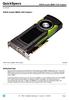 Overview L2K02AA INTRODUCTION Push the frontier of graphics processing with the new NVIDIA Quadro M6000 12GB graphics card. The Quadro M6000 features the top of the line member of the latest NVIDIA Maxwell-based
Recent Advances and Future Trends in Graphics Hardware. Michael Doggett Architect November 23, 2005
 Recent Advances and Future Trends in Graphics Hardware Michael Doggett Architect November 23, 2005 Overview XBOX360 GPU : Xenos Rendering performance GPU architecture Unified shader Memory Export Texture/Vertex