
Introduction to Topology
|
|
|
- Alan McDaniel
- 9 years ago
- Views:
Transcription
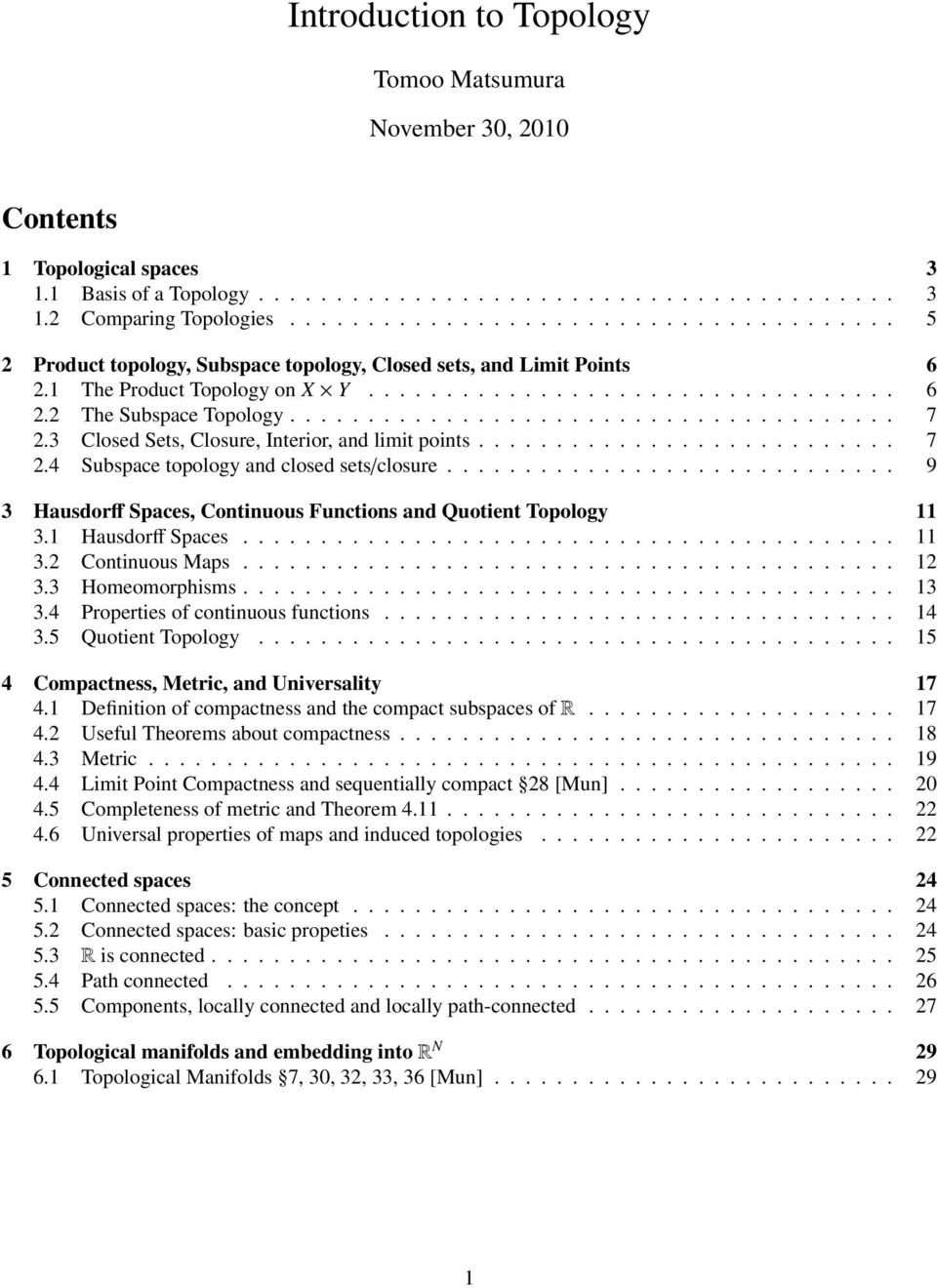
1 Introduction to Topology Tomoo Matsumura November 30, 2010 Contents 1 Topological spaces Basis of a Topology Comparing Topologies Product topology, Subspace topology, Closed sets, and Limit Points The Product Topology on X Y The Subspace Topology Closed Sets, Closure, Interior, and limit points Subspace topology and closed sets/closure Hausdorff Spaces, Continuous Functions and Quotient Topology Hausdorff Spaces Continuous Maps Homeomorphisms Properties of continuous functions Quotient Topology Compactness, Metric, and Universality Definition of compactness and the compact subspaces of R Useful Theorems about compactness Metric Limit Point Compactness and sequentially compact 28 [Mun] Completeness of metric and Theorem Universal properties of maps and induced topologies Connected spaces Connected spaces: the concept Connected spaces: basic propeties R is connected Path connected Components, locally connected and locally path-connected Topological manifolds and embedding into R N Topological Manifolds 7, 30, 32, 33, 36 [Mun]
2 7 Group theory Definition of groups and homomorphisms Examples More definitions Groups given by generators and relations Topological groups Group actions on topological spaces Homotopy of Paths 51 [Mun] Homotopy and Path Homotopy equivalence Definition of a product among paths and the homotopy invariance Fundamental Group and Covering Spaces Non-canonical uniqueness of the fundamental group of a path-connected space Functoriality of fundamental groups Covering spaces and the example Fundamental Groups and Covering Spaces, 54 [Mun] A lifting of a map along another map and liftings of paths along a covering map Lifting Path-Homotopy Surjectivity and bijectivity of φ e π 1 (S 1, b 0 ) Z Retraction and fixed points theorem Deformation retract Application and more computations of π Homotopy invariance of fundamental groups Fundamental group of S n Fundamental theorem of algebra Fundamental group of torus Fundamental groups of surfaces Fundamental groups of a double torus Constructing various surfaces by identifying edges of polytopes Fundamental group of surfaces constructed from polytopes Torus, n-fold torus, RP 2, Klein Bottle Properly discontinuous actions, covering spaces, and fundamental groups Cauchy Integral Formula, Jordan Curve Theorem and Winding Number Theorem Cauchy Integral Formula 66 [Mun] Residue Theorem Jordan Curve Theorem Winding Number Theorem Classification of compact topological surfaces Triangulation Classification of polygon quotients Euler characteristic What happen to the Klein bottle?
![............................... 35 8 Homotopy of Paths 51 [Mun] 37 8.1 Homotopy and Path Homotopy equivalence............................ 37 8.2 Definition of a product among paths and the homotopy invariance.](/docs-images/46/21171392/images/page_2.jpg "............... 38 9 Fundamental Group and Covering Spaces 40 9.1 Non-canonical uniqueness of the fundamental group of a path-connected space.......... 40 9.2 Functoriality of fundamental groups.")
3 1 Topological spaces A topology is a geometric structure defined on a set. Basically it is given by declaring which subsets are open sets. Thus the axioms are the abstraction of the properties that open sets have. Definition 1.1 ( 12 [Mun]). A topology on a set X is a collection T of subsets of X such that (T1) φ and X are in T ; (T2) Any union of subsets in T is in T ; (T3) The finite intersection of subsets in T is in T. A set X with a topology T is called a topological space. An element of T is called an open set. Example 1.2. Example 1, 2, 3 on page 76,77 of [Mun] Example 1.3. Let X be a set. (Discrete topology) The topology defined by T := P(X) is called the discrete topology on X. (Finite complement topology) Define T to be the collection of all subsets U of X such that X U either is finite or is all of X. Then T defines a topology on X, called finite complement topology of X. 1.1 Basis of a Topology Once we define a structure on a set, often we try to understand what the minimum data you need to specify the structure. In many cases, this minimum data is called a basis and we say that the basis generate the structure. The notion of a basis of the structure will help us to describe examples more systematically. Definition 1.4 ( 13 [Mun]). Let X be a set. A basis of a topology on X is a collection B of subsets in X such that (B1) For every x X, there is an element B in B such that x U. (B2) If x B 1 B 2 where B 1, B 2 are in B, then there is B 3 in B such that x B 3 B 1 B 2. Lemma 1.5 (Generating of a topology). Let B be a basis of a topology on X. Define T B to be the collection of subsets U X satisfting (G1) For every x U, there is B B such that x B U. Then T B defines a topology on X. Here we assume that trivially satisfies the condition, so that T B. Proof. We need to check the three axioms: (T1) T B as we assumed. X T B by (B1). (T2) Consider a collection of subsets U α T B, α J. We need to show U := U α T B. α J By the definition of the union, for each x U, there is U α such that x U α. Since U α T B, there is B B such that x B U α. Since U α U, we found B B such that x B U. Thus U T B. (T3) Consider a finite number of subsets U 1,, U n T B. We need to show that U := n U i T B. i=1 3

4 Let s just check for two subsets U 1, U 2 first. For each x U 1 U 2, there are B 1, B 2 B such that x B 1 U 1 and x B 2 U 2. This is because U 1, U 2 T B and x U 1, x U 2. By (B2), there is B 3 B such that x B 3 B 1 B 2. Now we found B 3 B such that x B 3 U. We can generalize the above proof to n subsets, but let s use induction to prove it. This is going to be the induction on the number of subsets. When n = 1, the claim is trivial. Suppose that the claim is true when we have n 1 subsets, i.e. U 1 U n 1 T B. Since U = U 1 U n = (U 1 U n 1 ) U n and regarding U := U 1 U n 1, we have two subsets case U = U U n. By the first arguments, U T B. Definition 1.6. T B is called the topology generated by a basis B. On the other hand, if (X, T ) is a topological space and B is a basis of a topology such that T B = T, then we say B is a basis of T. Note that T itself is a basis of the topology T. So there is always a basis for a given topology. Example 1.7. (Standard Topology of R) Let R be the set of all real numbers. Let B be the collection of all open intervals: (a, b) := {x R a < x < b}. Then B is a basis of a topology and the topology generated by B is called the standard topology of R. Let R 2 be the set of all ordered pairs of real numbers, i.e. R 2 := R R (cartesian product). Let B be the collection of cartesian product of open intervals, (a, b) (c, d). Then B is a basis of a topology and the topology generated by B is called the standard topology of R 2. (Lower limit topology of R) Consider the collection B of subsets in R: { } B := [a, b) := {x R a x < b} a, b R. This is a basis for a topology on R. This topology is called the lower limit topology. The following two lemmata are useful to determine whehter a collection B of open sets in T is a basis for T or not. Remark 1.8. Let T be a topology on X. If B T and B satisfies (B1) and (B2), it is easy to see that T B T. This is just because of (G1). If U T B, (G1) is satisfied for U so that x U, B x B s.t. x B x U. Therefore U = x U B x. By (T2), U T. Lemma 1.9 (13.1 [Mun]). Let (X, T ) be a topological space. Let B T. Then B is a basis and T B = T if and only if T is the set of all unions of subsets in B. Proof. ( ) Let T be the set of all unions of open sets in B. If U T, then U satisfies (G1), i.e. x U, B x B s.t. x B x U. Thus U = x U B x. Therefore U T. We proved T T. It follows from (T2) that T T. ( ) Since X T, X = α B α some union of sets in B. Thus x X, B α s.t. x B α. This proves (B1) for B. If B 1, B 2 B, then B 1 B 2 T by (T2). Thus B 1 B 2 = α B α, B α B. So x B 1 B 2, B α B s.t. x B α. This B α plays the role of B 3 in (B2). Thus B is a basis. Now it makes sense to consider T B and we need to show T B = T. By the remark, we already know that T B T. On the other hand, if U T, then U = α B α, B α B. Hence, x U, B α such that x B α U. Thus (G1) is satisfied for U. Thus U T B. This proves T B T. 4

5 Lemma 1.10 (13.2 [Mun]). Let (X, T ) be a topological space. Let B T. Then B is a basis and T B = T if and if any U T satisfies (G1), i.e. x U, B x B s.t. x B x U. Proof. Trivial by the definition of T B. X satisfies (G1) so B satisfies (B1). Let B 1, B 2 B T. By (T3), B 1 B 2 T. Thus B 1 B 2 satisfies (G1). This means (B2) holds for B. Thus B is a basis. Now the assumption can be rephrased as T T B. By the remark above, we already know T T B. 1.2 Comparing Topologies Definition Let T, T be two topologies for a set X. We say T is finer than T or T is coarser than T if T T. The intuition for this notion is (X, T ) has more open subsets to separate two points in X than (X, T ). Lemma 1.12 (13.3). Let B, B be bases of topologies T, T on X respectively. Then T is finer than T B B and x B, B B s.t. x B B. Proof. Since B T T, all subsets in B satisfies (G1) for T, which is exactly the statement we wanted to prove. The LHS says B T. We need to show that it implies that any U T satisfies (G1) for T too. U T, x U, B B s.t. x B U But Combining those two, B B, x B, B B s.t. x B B. U T, x U, B B s.t. x B B U. 5

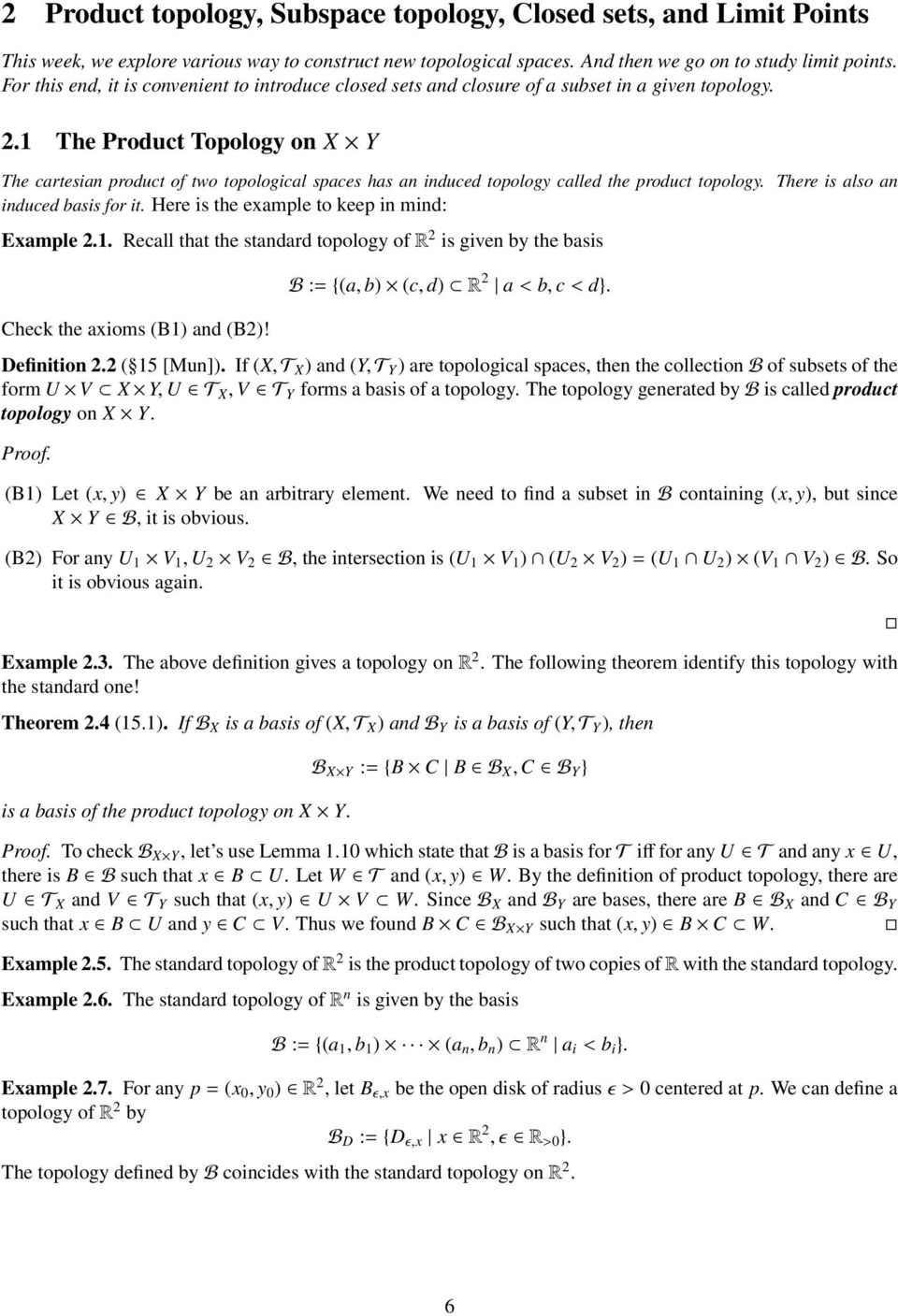
6 2 Product topology, Subspace topology, Closed sets, and Limit Points This week, we explore various way to construct new topological spaces. And then we go on to study limit points. For this end, it is convenient to introduce closed sets and closure of a subset in a given topology. 2.1 The Product Topology on X Y The cartesian product of two topological spaces has an induced topology called the product topology. There is also an induced basis for it. Here is the example to keep in mind: Example 2.1. Recall that the standard topology of R 2 is given by the basis Check the axioms (B1) and (B2)! B := {(a, b) (c, d) R 2 a < b, c < d}. Definition 2.2 ( 15 [Mun]). If (X, T X ) and (Y, T Y ) are topological spaces, then the collection B of subsets of the form U V X Y, U T X, V T Y forms a basis of a topology. The topology generated by B is called product topology on X Y. Proof. (B1) Let (x, y) X Y be an arbitrary element. We need to find a subset in B containing (x, y), but since X Y B, it is obvious. (B2) For any U 1 V 1, U 2 V 2 B, the intersection is (U 1 V 1 ) (U 2 V 2 ) = (U 1 U 2 ) (V 1 V 2 ) B. So it is obvious again. Example 2.3. The above definition gives a topology on R 2. The following theorem identify this topology with the standard one! Theorem 2.4 (15.1). If B X is a basis of (X, T X ) and B Y is a basis of (Y, T Y ), then is a basis of the product topology on X Y. B X Y := {B C B B X, C B Y } Proof. To check B X Y, let s use Lemma 1.10 which state that B is a basis for T iff for any U T and any x U, there is B B such that x B U. Let W T and (x, y) W. By the definition of product topology, there are U T X and V T Y such that (x, y) U V W. Since B X and B Y are bases, there are B B X and C B Y such that x B U and y C V. Thus we found B C B X Y such that (x, y) B C W. Example 2.5. The standard topology of R 2 is the product topology of two copies of R with the standard topology. Example 2.6. The standard topology of R n is given by the basis B := {(a 1, b 1 ) (a n, b n ) R n a i < b i }. Example 2.7. For any p = (x 0, y 0 ) R 2, let B ɛ,x be the open disk of radius ɛ > 0 centered at p. We can define a topology of R 2 by B D := {D ɛ,x x R 2, ɛ R >0 }. The topology defined by B coincides with the standard topology on R 2. 6
7 2.2 The Subspace Topology A subset of a topological space has a naturally induced topology, called the subspace topology. In geometry, the subspace topology is the source of all funky topologies. Definition 2.8. Let (X, T ) be a topological space. Let Y be a subset of X. The collection is a topology on Y, called the subspace topology. Lemma 2.9. If B is a basis for T, then is a basis of the subspace topology T Y for Y. T Y := {Y U U T } B Y := {Y B B B} Proof. Use Lemma 1.9. Let V T Y, i.e. V = Y U for some U T. For every x V, there is B B such that x B U since B is a basis of T (Lemma 1.9). Now we found Y B B Y such that x Y B V. 2.3 Closed Sets, Closure, Interior, and limit points Closed sets are nothing but complement of open sets. On the other hand, we can also say that open sets are nothing but complement of closed sets. Thus we can actually use closed sets to define topology, although mathematicians usually use open sets to define topology. Definition Let A be a subset of a topological space (X, T ). A is a closed set of X if X A is an open set. The closure Ā of A in X is the intersection of all closed sets of X, containing A. Ā = C C A closed The interior Int A of A in X is the union of all open sets of X, contained in A. Int A = O x X is a limit point of A if x A {x}. O A open Remark It is not so difficult to see from the definition that Example Ā = A A : closed, and Int A = A A : open. In the standard topology for R, a set of a single element (we say a point) is a closed set, because R {a} is an open set. Any finite set is also closed, since X {a 1,, a n } = n i=1 (R {a i}) is a finite intersection of open sets. In the discrete topology of a set X, every point is a closed set but also an open set. In the lower limit topology, a point is a closed set. In the finite complement topology of any set X, a point is a closed set. But any infinite set is not closed by definition of finite complement topology, except X itself. For example, Z is a closed set in R in the standard topology but not in the finite complement topoloty. 7

8 Lemma 2.13 (Interior in terms of closure). Int A = X (X A). Proof. We need to show that X Int A = X A. Let U denote open sets and C denote closed sets. By definition Int A = U A U. Therefore we can do the set theoretic computation: X Int A = X U = (X U) = C = X A. U A U A C (X A) Remark 2.14 (Defining topology by closed sets). A topology on a set X is given by defining open sets of X. Since closed sets are just exactly complement of open sets, it is possible to define topology by giving a collection of closed sets. Let K be a collection of subsets of X satisfying (C1), X P. (C2) Any intersection of subsets in K is also in K. (C3) Any finite union of subsets in K is also in K. Then define T by T := {X C C K} is a topology, i.e. it satisfies (T1, 2, 3). On the other hand, if T is a topology, i.e. the collection of open sets, then satisfies (C1, 2, 3). Exercise Prove the above claims. K := {X U U T } Theorem Let A be a subset of the topological space (X, T ). Let B be a basis of T. (a) x Ā if and only if every neighborhood U of x intersects with A non-trivially, i.e. U A. (b) x Ā if and only if every neighborhood B B of x intersects with A non-trivially. Terminology: U is a neighborhood of x if U T and x U. Proof. It is easier to prove the contrapositive statements of the theorem. We will prove a b x Ā a U T, s.t. x U and U A = b B B, s.t. x B and B A =. If x Ā, then C a closed set such that C A and x C. Then x C implies that x is in X C which is an open set. C A implies that (X C) A =. Let U = X C and we are done for the middle statement. For any U T such that x U and U A =, by the definition of a basis, there exists B such that x B U (G1). This B clearly satisfies the last statement. b If there is B B such that x B and B A, then this B also plays the role of U in the middle statement. a If U satisfies the middle statement, then C := X U is closed and x C. Thus by definition of Ā, x A. 8

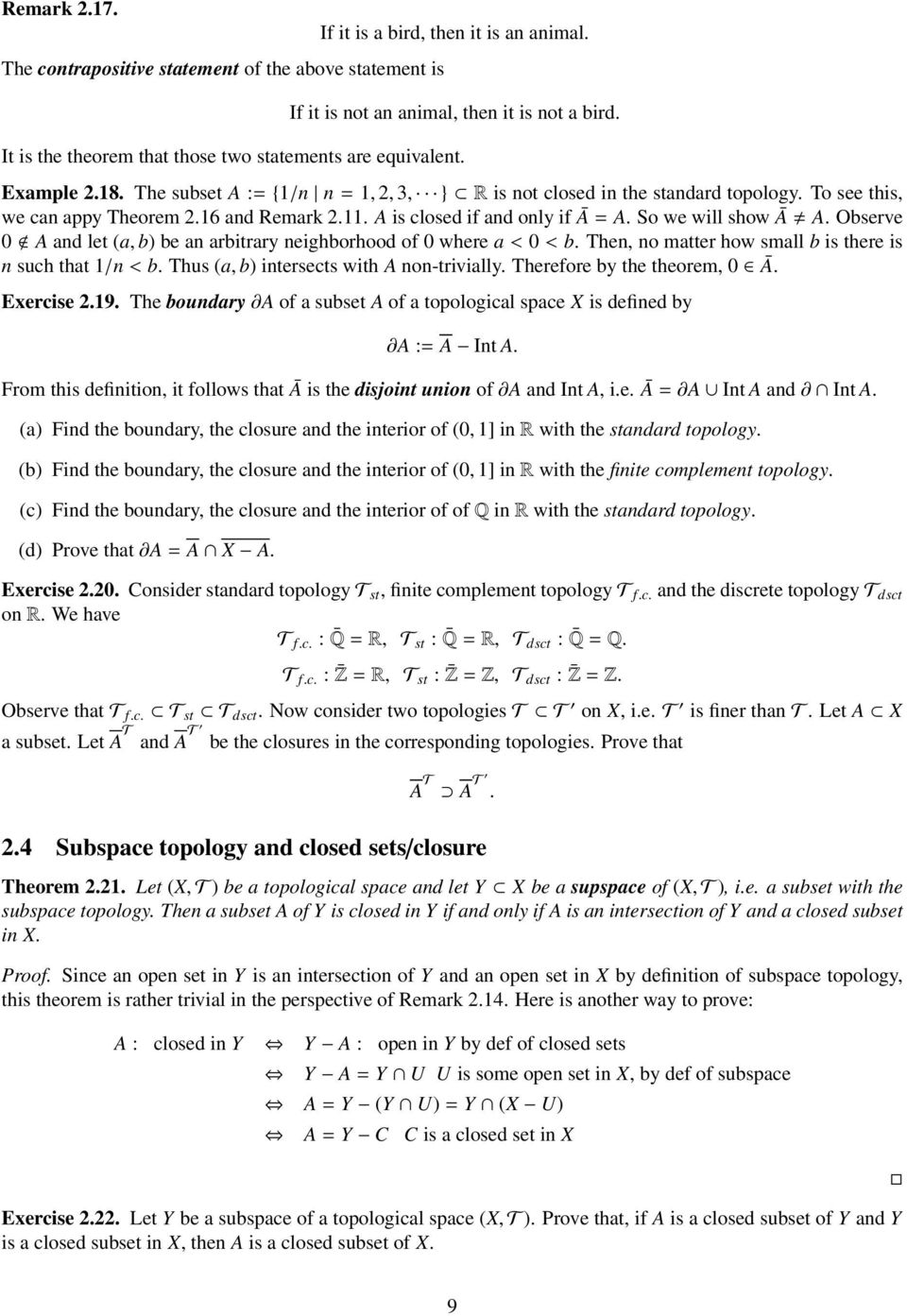
9 Remark The contrapositive statement of the above statement is If it is a bird, then it is an animal. If it is not an animal, then it is not a bird. It is the theorem that those two statements are equivalent. Example The subset A := {1/n n = 1, 2, 3, } R is not closed in the standard topology. To see this, we can appy Theorem 2.16 and Remark A is closed if and only if Ā = A. So we will show Ā A. Observe 0 A and let (a, b) be an arbitrary neighborhood of 0 where a < 0 < b. Then, no matter how small b is there is n such that 1/n < b. Thus (a, b) intersects with A non-trivially. Therefore by the theorem, 0 Ā. Exercise The boundary A of a subset A of a topological space X is defined by A := A Int A. From this definition, it follows that Ā is the disjoint union of A and Int A, i.e. Ā = A Int A and Int A. (a) Find the boundary, the closure and the interior of (0, 1] in R with the standard topology. (b) Find the boundary, the closure and the interior of (0, 1] in R with the finite complement topology. (c) Find the boundary, the closure and the interior of of Q in R with the standard topology. (d) Prove that A = A X A. Exercise Consider standard topology T st, finite complement topology T f.c. and the discrete topology T dsct on R. We have T f.c. : Q = R, T st : Q = R, T dsct : Q = Q. T f.c. : Z = R, T st : Z = Z, T dsct : Z = Z. Observe that T f.c. T st T dsct. Now consider two topologies T T on X, i.e. T is finer than T. Let A X a subset. Let A T and A T be the closures in the corresponding topologies. Prove that A T A T. 2.4 Subspace topology and closed sets/closure Theorem Let (X, T ) be a topological space and let Y X be a supspace of (X, T ), i.e. a subset with the subspace topology. Then a subset A of Y is closed in Y if and only if A is an intersection of Y and a closed subset in X. Proof. Since an open set in Y is an intersection of Y and an open set in X by definition of subspace topology, this theorem is rather trivial in the perspective of Remark Here is another way to prove: A : closed in Y Y A : open in Y by def of closed sets Y A = Y U U is some open set in X, by def of subspace A = Y (Y U) = Y (X U) A = Y C C is a closed set in X Exercise Let Y be a subspace of a topological space (X, T ). Prove that, if A is a closed subset of Y and Y is a closed subset in X, then A is a closed subset of X. 9
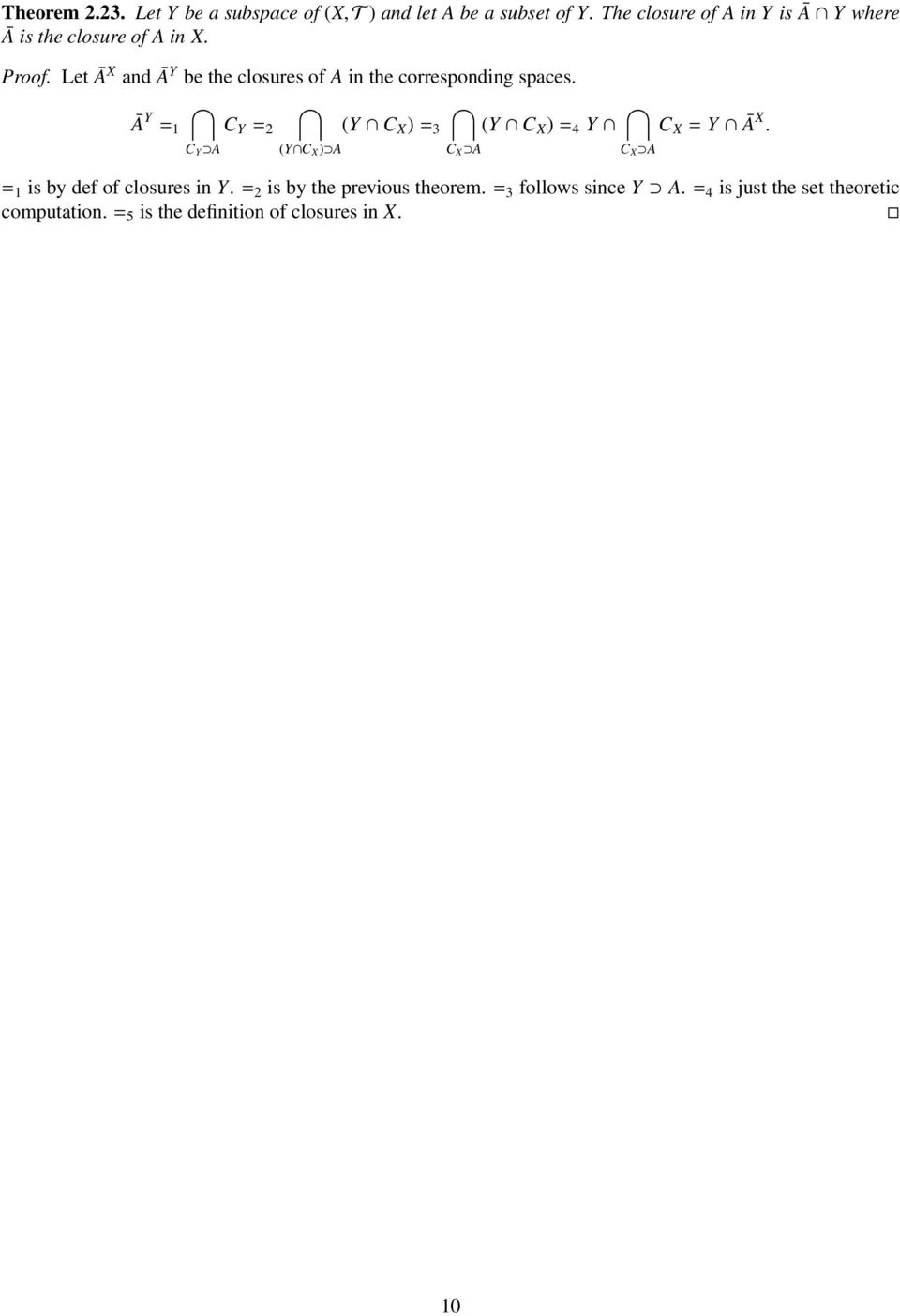
10 Theorem Let Y be a subspace of (X, T ) and let A be a subset of Y. The closure of A in Y is Ā Y where Ā is the closure of A in X. Proof. Let Ā X and Ā Y be the closures of A in the corresponding spaces. Ā Y = 1 C Y = 2 (Y C X ) = 3 (Y C X ) = 4 Y C X = Y Ā X. C Y A (Y C X ) A C X A = 1 is by def of closures in Y. = 2 is by the previous theorem. = 3 follows since Y A. = 4 is just the set theoretic computation. = 5 is the definition of closures in X. C X A 10
11 3 Hausdorff Spaces, Continuous Functions and Quotient Topology 3.1 Hausdorff Spaces Definition 3.1. A topological space (X, T ) is called a Hausdorff space if (H1) x, y X such that x y, U x, U y T such that x U x, y U y, and U x U y = i.e. for every pair of distinct points x, y in X, there are disjoint neighborhoods U x and U y of x and y respectively. Example 3.2. (a) R n with the standard topology is a Hausdorff space. (b) R with the finite complement topology is NOT a Hausdoff space. Suppose that there are disjoint neighborhoods U x and U y of distinct two points x and y. Observe that U x must be an infinite set, since R U x is finite and R is an infinite set (see the definition of finite complement topoloty). It is the same for U y. By the disjointness, U y X U x. Therefore it contradicts with the finiteness of X U x. Thus U x and U y can not be disjoint. This proves that R with the finite complement topology is not Hausdorff. (c) Any infinite set X with the finite complement topology is not a Hausdorff. This is because every non-empty open sets intersect non-trivially. (b) is just a special case of (c). Proof. Let U 1 := X F 1 and U 2 := X F 2 be open sets (F i is finite). Then U 1 U 2 = X (F 1 F 2 ). Since X is infinite and F 1 F 2 is finite, this can not be empty. The following exercise is a nice one to relate the Hausdorff condision and the product topology. Exercise 3.3. Show that X is a Hausdorff space if and only if the diagonal := {(x, x) x X} X X is closed with respect to the product topology. Theorem 3.4. Every finite set in a Hausdorff space X is closed. Proof. A point {x} X is closed set because we can show that X {x} is open: y X {x}, by the Hausdorff condition, there is an open set U y such that y U y but x U y (we are not using the whole condition) so that U y X {x}. Now, since a finite set is a finite union of single points, it is closed. Remark 3.5. The opposite statement of Theorem 3.4 is not true. The counter example is Example 3.2 (b). Definition 3.6. Let {x n n N} be a sequence of points in a topological space. The sequence {x n n N} converges to a point x X if, for every neighborhood U of x, there is a positive integer N N such that x n U for all n N. In other words, U contains all but finitely many points of {x n }. Lemma 3.7. Let B be a basis of a Hausdorff space X. Then {x n } converges to x iff every B B containing x contains all but finitely many points of {x n }. Exercise 3.8. Find all points that the sequence {x n = 1/n Z >0 } converges to with respect to the following topology of R. Justify your answer. (a) Standard Topology (b) Finite Complement Topology (c) Discrete Topology (d) Lower Limit Topology Are (c) and (d) Hausdorff? Theorem 3.9. If X is a Hausdorff space, then every sequence of points in X converges to at most one point of X. 11
12 Proof. We prove by deriving a contradiction. Suppose that {x n } converges to x and y and that x y. Then by (H1), there are U x and U y in T X such that x U x and y U y and U x U y =. Since U x contains all but finitely many points of {x n }, it is not possible that U y contains all but finitely many points of {x n }. Thus {x n } can not converges to y. 3.2 Continuous Maps Definition 3.10 (ε-δ continuity). A function f : R R is ε-δ continuous at x 0 R when f (x) gets closer to f (x 0 ) as x gets closer to x 0.More precisely, (ɛ-δ-cont at x 0 ) ε > 0, δ > 0 such that f (x) ( f (x 0 ) ε, f (x 0 ) + ε), x (x 0 δ, x 0 + δ). In terms of the basis of topology B := {B x,ɛ := (x ɛ, x + ɛ) x R, ɛ R >0 }, (ɛ-δ-cont at x 0 ) B f (x0 ),ɛ, B x0,δ such that f (B x0,δ) B f (x0 ),δ. (Cont at x 0 ) B f (x0 ),ɛ, B x0,δ such that B x0,δ f 1 (B f (x0 ),δ) A map f : R R is an ε-δ continuous function if f is ε-δ continuous at every x R. Using (G1) (Cont) (Cont) B f (x),ɛ, f 1 (B f (x),ɛ ) is open. for all open set U R, f 1 (U) is open. Definition Let (X, T X ) and (Y, T Y ) be topological spaces. Let B Y be a basis of T Y. A map f : X Y is continuous at x 0 X if By using (G1), (Cont at x 0 ) V f (x0 ): a nbhd of f (x 0 ) in Y, U x0 a nbhd of x 0 in X such that U x0 f 1 (V f (x0 )). (Cont at x 0 ) V f (x0 ) B Y : a nbhd of f (x 0 ) in Y, U x0 a nbhd of x 0 in X such that U x0 f 1 (V f (x0 )). A map f : X Y is continuous if f is continuous at every point of X. (Cont) V T Y, f 1 (V) T X, i.e. the preimage of open sets are open. By using (G1), we can just check the condition for open sets in the basis: f : X Y continuous (Cont) V B Y, f 1 (V) T X By the way we get the definition of continuity of a map, we have Theorem A map f : R R is continuous at x 0 R relative to the standard topology if and only if f is ε-δ continuous at x 0 R. Example Here are some trivial example Let f : X Y be a map of topological spaces. Show that f is always continuous, if X has the discrete topology. Let R s and R f be the set of all real numbers with the standard topology and the finite complement topology. If id R : R R be the identity map, i.e. id R (x) = x. Then id : R s R f is continuous but id : R f R s is not continuous. This is because the standard topology is strictly finer than the finite complement topology, i.e. the standard topology has strictly more open sets than the finite complement topology. In general, we have If (X, T ) is finer than (X, T ), then id X : (X, T ) (X, T ) is continuous. 12

13 (Constant functions) If f : X Y maps all points of X to a single point y 0 Y, then f is a continuous function. Exercise We can formulate the continuity by using closed sets: show that a map f : X Y of topological spaces is continuous if and only if for every closed set C Y of Y, the preimage f 1 (C Y ) is closed in X. Exercise Prove that f : X Y is continuous if and only if for every subset A of X, we have f (A) f (A). Exercise Define a map f : R R 2 by x (cos x, sin x). Then f is continuous relative to the standard topologies. Exercise Define a map f : R R by x x x if x is rational if x is irrational. Then f is continuous at x = 0 but not continuous at other points. Lemma Let f : X Y be a continuous map and let {x n n Z >0 } X be a sequence which converges to x X. Then the sequence { f (x n )} Y converges to f (x). Proof. Let V be any neighborhood of f (x). Then f 1 (V) is an open set containing x so it s a neighborhood of x. By the definition of convergence, there is N such that x n f 1 (V) for all n > N. This N satisfies that f (x n ) V for all n > N so that { f (x n )} converges to f (x). 3.3 Homeomorphisms Definition A map f : X Y of topological spaces is a homeomorphism if f is bijective and both f and f 1 are continuous. Remark f is a homeomorphism if f is bijective and for any open set U X, f (U) is open in Y, for any open set V Y, f 1 (V) is open in X. Indeed, if we have bases for topologies for X and Y, we just need to see the conditions above for basis elements. Example The function f : R R defined by f (x) = x 3 is a homeomorphism. The inverse function f 1 (y) = x 1 3 is also continuous. f (x) = x 2 is not a homeomorphism because it is not a bijection. But we restrict f to some subset, it is a homeomorphism relative to the subspace topology. For example, f : [0, ) [0, ), then f is a bijective continuous map and f 1 (x) = x 1 2 is also continuous. Consider he function f : [0, 2π) S 1 given by t (cos t, sin t) where S 1 is the unit circle in R 2 with the subspace topology. It is a bijective continuous map but f 1 is not continuous. This is because, for example, the image of the open set [0, 1) under f is not open in S 1. How to show f ([0, 1)) is not closed in S 1 : Let B ball be the basis of standard topology of R 2 given by open disk. The basis of the subspace topology on S 1 is B := {S 1 B B B ball }. Let B 0 be an arbitrary open disk centered at f (0). Then S 1 B 0 can not be contained in f ([0, 1)), since there is always a small ɛ such that f ( ɛ) f ([0, 1)) and f ( ɛ) S 1 B 0. This shows that f ([0, 1)) is not open in the subspace topology S 1 Exercise Show that the open interval ( π/2, π/2) of R with the subspace topology is homeomorphic to R. Show that any open interval is homeomorphic to R. 13
14 Definition A map f : X Y is a topological embedding if f is injective and f : X f (X) is a homeomorphism where f (X) has the subspace topology inherited from Y. Exercise Let X and Y be topological spaces and A X a subspace. Let f : A Y be a continuous function and assume that Y is Hausdorff. Show that if f can be extend to a continuous function f : Ā Y, i.e. if there is a continuous function f : Ā Y such that f A = f, then it is unique. 3.4 Properties of continuous functions Lemma The composition g f of continuous functions f : X Y and g : Y Z is continuous. Proof. Let U be an open set in Z. Then g 1 (U) is open in Y since g is continuous. Then f 1 (g 1 (U)) = (g f ) 1 (U) is open in X since f is continuous. Exercise Suppose that X, Y, Z are topological spaces. Let f : X Y and g : Y Z be maps of sets. Prove or disprove the following statement: (a) If f : X Y is continuous and the composition map g f : X Z is continuous, then g : Y Z is continuous. (b) If g : Y Z is continuous and the composition map g f : X Z is continuous, then f : X Y is continuous. Lemma Suppose that X is a union of open sets U i, i I. Suppose we have continuous maps f i : U i Y such that f i Ui U j = f j Ui U j, then there is a unique continuous map f : X Y such that f Ui = f i. Proof. There is a map f : X Y such that f Ui = f i by saying for each x X, let f (x) := f i (U i ). This is well-defined since the choice of U i doesn t change the map f. Furthermore, if f, g : X Y are maps such that f Ui = f i. Then for any x X, there is U i such that x U i and f (x) = f i (x) = g(x) by the conditions. Thus f = g. So it s unique. To show that such f is continuous, let V be an open set in Y. Then f 1 (V) = f 1 (V) U i = fi 1 (V). i The first equality follows from the assumption that X is a union of U i s. Thus f 1 (V) is an open set since it is a union of open sets (each f 1 i (V) is an open set in U i and it is an open in X since U i is open in X.) Lemma A map f : Z X Y is continuous if and only if π 1 f : Z X and π 2 f : Z Y are continuous. Proof. Let U 1 U 2 be an open set in X Y. Then f 1 (U 1 U 2 ) is an open set in Z. Let U 2 = Y. Then f 1 (U 1 Y) = (π 1 f ) 1 (U 1 ) (π 2 f ) 1 (Y) = (π 1 f ) 1 (U 1 ) Z = (π 1 f ) 1 (U 1 ) Thus π 1 f is continuous. Similarly for π 2 f. On the other hand, f 1 (U 1 U 2 ) = (π 1 f ) 1 (U 1 ) (π 2 f ) 1 (U 2 ) implies that if U 1 and U 2 are open sets in X and Y respectively, then f 1 (U 1 U 2 ) is an open set since (π 1 f ) 1 (U 1 ) and (π 2 f ) 1 (U 2 ) are open in Z. Since every open set in X Y is of the form U 1 U 2, we can conclude that f is continuous. Theorem If f : X Y is an injective continuous map and Y is Hausdorff, then X must be Hausdorff. Proof. Let x 1, x 2 X are distinct points. Then f (x 1 ) and f (x 2 ) are distinct points in Y since f is injective. Therefore there are neighborhoods V 1 and V 2 of f (x 1 ) and f (x 2 ) respectively such that V 1 V 2 =. Since f is continuous, f 1 (V 1 ) and f 1 (V 2 ) are open sets and in particular neighborhoods of x 1 and x 2. Since f 1 (V 1 ) f 1 (V 2 ) = f 1 (V 1 V 2 ) = f 1 ( ) = (see HW1), we found the disjoint neighborhoods of x 1 and x 2, thus X is Hausdorff. i 14

15 3.5 Quotient Topology Definition Let π : X Y be a surjective map of topological spaces. The map π is a quotient map if a subset U in Y is open if and only if the preimage π 1 (U) is open in X. Note that only if part is the continuity of π, so this condition is stronger than π being continuous. Exercise A map f : X Y of topological spaces is called a open (closed) map if the image of every open (closed) set in X is again open (closed). Show that a continuous surjective map f : X Y is a quotient map if it is either an open or closed map. Example Define a map f : [0, 1] S 1 by x (cos 2πx, sin 2πx) where S 1 is the unit circle in R 2 with the induced topology. It is a continuous surjective map. It is not an open map but it is a closed map. Observe the images of (1/2, 1] and [1/2, 1]. Thus, it is a quotient map. Definition Let X be a topological space and A a set. Let f : X A be a surjective map. There is a unique topology on A which makes f to be a quotient map. It is called the quotient topology and the topological space A is called the quotient space. Proof. The definition of the quotient map actually determines the topology of A: T A must be the set of all subsets U A such that f 1 (U) is open in X. The axiom (T1) is obvious. The axioms (T2,3) follows from the fact that the preimage preserves the unions and the intersections. Remark An equivalence relation on a set X defines a surjective map f : X A where A is the set of all equivalence classes (see [Set]). The typical construction of a quotient space is given by identifying equivalent points. Let be an equivalence relation on X and then denote X/ the set obtained by identifying equivalent points. Then we have the natural surjective map q : X X/, x [x]. Example Let X := [0, 1] and identify 0 and 1, i.e. the equivalence relation is given by a a for all a [0, 1] and 0 1. The map f in Example 3.32 factors through X/ : f [0, 1] S 1 q g [0, 1]/ f x (cos 2πx, sin 2πx) g q [x] Then we can show that g is a homeomorphism, using the following useful lemma: Lemma Consider the following commutative diagram, i.e. g f 1 = f 2 : X Y f 1 g f 2 Z. If f 1 and f 2 are quotient maps and g is a bijection, then g must be a homeomorphism. Proof. It suffices to show that g is continuous, since then g 1 is also continuous (the claim holds if we replace g by g 1 ). Let U be an open set in Z. We want to show that V := g 1 (U) is an open set in Y, but a set V in Y is an open set if and only if f1 1 (V) is an open set in X by the definition of the quotient topology. Since f1 1 1 (V) = f1 (g 1 (U)) = f2 1 (U) is an open set (the quotient topology of Z), V must be an open set. Example 3.37 (2-Sphere ver 1). Let D := {(x, y) R 2 x 2 + y 2 1} be the unit disk in R 2. Identify all points on the boundary of the disk, i.e. p p for all Int X and p q if p, q D. It can be shown to be homeomorphic to the unit 2 sphere which is defined by S 2 := {(x, y, z) R 3 x 2 + y 2 + z 2 = 1} in R 3 with standard topology. 15

16 Exercise 3.38 (2-sphere ver 2). Consider the disjoint union X := D 1 D 2 of two unit disk D 1 and D 2. Identify (x 1, y 1 ) (x 2, y 2 ) if x 1 = x 2 and y 1 = y 2 where (x 1, y 1 ) D 1 and (x 2, y 2 ) D 2. Then show that X/ is homeomorphic to the unit 2-sphere S 2 in R 3. Example 3.39 (Torus). Consider the unit square X := [0, 1] [0, 1] in R 2. Identify (0, y) (1, y) and (x, 0) (x, 1) for all x, y [0, 1]. A torus T is defined by X/. Show that it is homeomorphic to S 1 S 1. Exercise Prove the following: (a) If f : X Y and g : Y Z are quotient maps, then g f : X Z is a quotient map. (b) Let f : X Y and g : Y Z be continuous maps. If f and g f are quotient maps, then g is a quotient map. 16
![Example 3.39 (Torus). Consider the unit square X := [0, 1] [0, 1] in R 2. Identify (0, y) (1, y) and (x, 0) (x, 1) for all x, y [0, 1]. A torus T is defined by X/.](/docs-images/46/21171392/images/page_16.jpg "Show that it is homeomorphic to S 1 S 1. Exercise 3.40. Prove the following: (a) If f : X Y and g : Y Z are quotient maps, then g f : X Z is a quotient map.")
17 4 Compactness, Metric, and Universality 4.1 Definition of compactness and the compact subspaces of R Definition 4.1. Let X be a topological space. A collection of open sets U a, a A is an open covering of X if X = a U a. X is compact if every open covering of X contains a finite subcollection that also covers X. Example R is not compact: Consider the infinite covering (n, n + 2), n Z: 2. X = {0} {1, 1/2, 1/3, } is compact: every neighborhood of 0 contains all but finitely many points of X. Thus for any open covering of X, take one open set U containing 0 and choose other open sets that correspond to each of the finite many points not in U. 3. (0, 1) is not compact since it is homeomorphic to R. Remark 4.3. The set of real numbers satisfy the following properties: (R1) If a non-empty subset A R is bounded above, i.e. there exists b R such that a b for all a A, then there is the least upper bound (or supremum) of A, i.e. there exists the smallest b R such that a b for all a A. The least upper bound of A is denoted by sup A. (R2) If x < y, then there is a number z R such that x < z < y. An order relation on a set satisfying these two properties is called a linear continuum. Theorem 4.4 (27.1 [Mun]). Closed intervals of R are compact. Proof. Let U α, α A be an open covering of [a, b] R. (1) Let x [a, b), then there is y (x, b] such that [x, y] is covered by one open set in A := {U α }. Each U α is a union of open intervals. Let (h 1, h 2 ) be an open interval of U α such that h 1 < x < h 2. By (R2), there is y such that x < y < h 2. Now it is clear that [x, y] is covered by (h 1, h 2 ) and so by U α. (2) Let C be the set of all y (a, b] such that [a, y] is covered by finitely many open sets in A. Then C is not empty because applying (1) for x = a, then there is y such that [a, y] is covered by one of U α. Now C is bounded above since C (, b]. By (R1), the least upper bound c which should satisfy a < c b. (3) c belongs to C, i.e. [a, c] is covered by finitely many open sets in A. Suppose that c C. Let (h 1, h 2 ) be one of open intervals of U α, which contains c. Then there is z C such that z (h 1, c) because c is the smallest that bounds C. By the definition of C, [a, z] is covered by finitely many open sets in A. Since [z, c] U α, [a, z] [z, c] = [a, c] is covered by finitely many open sets. Contradiction. (4) c is actually b. Suppose that c < b. Apply (1) to x := c. Then there is y (c, b] such that [c, y] is covered by one open set U α. Since c C, [a, c] is covered by finitely many open sets as we proved in (3). Thus [a, c] [c, y] = [a, y] is covered by finitely many open sets, i.e. y C. This contradict fact that c bounds C. Thus c = b. Thus [a, b] is covered by finitely open sets in A. 17

18 4.2 Useful Theorems about compactness Theorem 4.5 (26.2 [Mun]). Every closed subspace C of a compact space X is compact. Proof. Let {U α } α A be an open covering of C. By the definition of subspace topology, each U α = C V α for some open set V α in X. Then {V α } {X C} is an open covering of X, therefore there is a finite subcollection {O i, i = 1,, n} that covers X, and so certainly {O i C, i = 1,, n} covers C. If X C is in the subcollection, (X C) C =, so we can assume that {O i C, i = 1,, n} is a finite subcollection of {U α, α A}. Thus we have a finite subcollection that covers C. Theorem 4.6 (26.7 [Mun]). The product of finitely many compact spaces is compact. Proof. If we just prove it for product of two compact spaces, then the claim follows from induction. Let X and Y be compact spaces. Let T X, T Y be topologies of X, Y and let T X Y be the product topology of X Y. (1) x X and N T X Y such that N {x} Y, W T X such that x W and N W Y. An opet set N in X Y containing {x} Y is called a tube about {x} Y. This claim says, although a tube may not be of the form W Y, but for a given tube, we can find a smaller tube that is of the form W Y. To prove this, we need Y to be compact. The given N is of the form α U α V α. Then {(U α V α ) ({x} V α )} is an open covering of {x} Y since N {x} Y. Since {x} Y Y, {x} Y is compact and so there is a finite subcollection {U α1 V α1,, U αn V αn } that covers {x} Y. Then W := n i=1 U α i is an open set in X (since it is a finite intersection) and we can assume that x W since if x U αi, we can get rid of U αi V αi from the list. Now N n i=1 U α i V αi W Y {x} Y. (2) Let {N α } be an arbitrary open covering of X Y. For each x X, we have a subcollection {N α1,x,, N αn,x} that covers {x} Y since {x} Y is compact. Then N x = n i=1 N α i,x {x} Y. By (1), there is W x such that N x W x Y {x} Y. Since X is compact and {W x, x X} is an open covering of X, we have a subcollection {W x j, j = 1,, m}. Now {N αi,x j, 1 i n, 1 j m} gives a finite subcollection of {N α } that covers X Y: i, j N αi,x j = j N xi j W x j Y X Y. Theorem 4.7 (26.5 [Mun]). The image of a compact space under a continuous map is compact. Theorem 4.8 (26.3 [Mun]). Every compact subspace Y of a Hausdorff space X is closed. Proof. We will show that X Y is open, i.e. for every x X Y, there is a neighborhood of x contained in X Y. For every y Y, there are disjoint neighborhoods U x,y of x and U y of y (Hausdorff). By collecting such U y s, we obtain an open covering of Y. Note that U x,y may be different for every y. Nevertheless by the compactness of Y, we can choose the finite subcollection {U y1,, U yn } that covers Y. The finite intersection U x of U x,yi, i = 1,, n is again an open set and it is disjoint from Y. Therefore we found a neighborhood U x contained in X Y. Theorem 4.9 (26.6 [Mun]). Let f : X Y be a continuous bijection. If X is compact and Y is Hausdorff, then f must be a homeomorphism. Proof. It suffices to show that f is a closed map since f is bijective. If A is closed in X, then A is compact by Theorem 4.5. Then by Theorem 4.7, f (A) is compact. Thus by Theorem 4.8, f (A) is closed. Example (1) The cartesian product of closed intervals (a box) in R n is compact. 18
19 (2) Every closed subset of R n contained in a box is compact. (3) The unit n-sphere and the closed n-ball are compact. (4) R with the finite complement topology is not Hausdorff. The subspace Z is compact: for any open covering of Z, take an open set containing 0. With the finite complement topology, this open set misses only finitely many points. By choosing an open set for each missed point, we find the subcollection. Thus Z is compact. However Z is not closed. (5) A closed interval in R with the finite complement topology is compact. Theorem 4.11 (27.3 [Mun]). A subspace A of R n is compact if and only if it is closed and is bounded in the euclidean metric d, i.e. there is M > 0 such that d( x, y) < M for all x, y A. Proof. ( ) This direction is already hinted in the example above. We can show that it is bounded, then we can put it in a box or a closed n-ball. Let s fix a point p in A. Since A is bounded, so there is M > 0 such that d( p, x) < M for all x A. Hence A is a the closed subset of closed n-ball B d ( p, M) which is compact. The claim follows from Theorem 4.5. ( ) This direction is new, but it s easy. Let s cover A by open balls, namely, A x A B d ( x, ɛ x ). Since A is compact, we can find a finite subcovering: A m i=1 B d( x i, ɛ i ). Now take arbitary p 1, p 2 A. There must be some i 1 and i 2 such that p 1 B d ( x i1, ɛ i1 ) and p 2 B d ( x i2, ɛ i2 ). By the triangle inequality of the metric, we have d( p 1, p 2 ) d( p 1, x i1 ) + d( x i1, x i2 ) + d( x i2, p 2 ) d( x i1, x i2 ) + ɛ 1 + ɛ 2 M where M = m i, j=1 d( x i, x j ) + m i=1 ɛ i. Thus A is bounded. It is certainly closed since R n is closed and by Theorem 4.8. Remark We can not generalized the above theorem to arbitrary metric spaces. Here is a counter example. Let R be the metric space with Euclidean metric. It is easy to see that R {a} has induced metric whose topology is the subspace topology of the standard topology. For a closed interval [b, c] containing a, is a compact space, but [b, c] {a} is not compact. [b, c] {a} is closed in R {a} and bounded in the induced metric. Thus the theorem fails for the metric space R {a}. This failure is related to the concept completeness of the metric. R {a} is not a complete metric space but R is. See 45[Mun] to see more. Exercise Prove that every subspace of R with the finite complement topology is compact. 4.3 Metric Definition 4.14 ( 20 [Mun]). A metric on a set X is a function d : X X R satisfing 1. d(x, y) > 0 for all x, y X and the equality holds iff x = y. 2. d(x, y) = d(y, x) for all x, y X. 3. d(x, y) + d(y, z) d(x, z) for all x, y, z X. d(x, y) is often called the distance between x and y. Definition Let (X, d) be a set X with a metric d. For x X and ɛ > 0, the ɛ-ball B d (x, ɛ) centered at x is the subset of X given by B d (x, ɛ) := {y X d(x, y) < ɛ}. The collection B d := {B d (x, ɛ) x X, ɛ R >0 } is a basis of a topology called the metric topology. Check that B d satisfies the axiom (B1) and (B2) in Section 1. Call it the open ball basis. If (X, T ) is a topological space and T can be realized as a metric topology, then (X, T ) is called metrizable. 19

20 Remark A metrizable topological space is certainly a Hausdorff space. If x y, then d := d(x, y) > 0 and so d/2 > 0. Now B d (x, d/2) and B d (y, d/2) separate x and y. Definition 4.17 (The Euclidean metric on R n ). Let x, y R n. The inner product x, y := x 1 y x n y n. The norm x := x, x. The Euclidean metric d( x, y) := x y. Remark The standard topology of R n coincides with the metric topology given by the Euclidean metric. Remark There is another metric on R n called the square metric ρ given by ρ( x, y) := max{ x 1 y 1,, x n y n }. This is also a metric and its metric topology coincides with the standard topology. Lemma Let (X, T ) be a topological space and A X a subset. Let x X. If there is a sequence {x n } A that converges to x, then x Ā. If X is metrizable, the converse holds, i.e. if x Ā, there is {x n } that converges to x. Proof. The first claim is trivial by the definition of convergence. Indeed, {x n } x if and only if U x, {x n } U x is finite. Thus U x {x n } is infinite, therefore U x A. For the second claim, choose a metric d so that T is its metric topology. Let B := B d be the open ball basis. Let B x,ɛ := B d (x, ɛ). First apply Theorem 2.16 (b). We have x Ā B x,ɛ B, B x,ɛ A B x,1/n, n Z >0, B x,1/n A where the second equivalence follows from the fact that ɛ > 0, n such that 1/n < ɛ. Now pick x n B x,1/n A. Then the sequence {x n } A converges to x since B x,1/n B x,1/m if n > m. Theorem Let X, Y be topological spaces and f : X Y a map. The continuity of f implies that (S 1) for every convergent sequence {x n } x in X, the sequence { f (x n )} converges to f (x). On the other hand, if X is metrizable, (S 1) implies the continuity of f. Proof. The first claim is Lemma To prove the second claim, we will use Lemma 4.20 and HW3 (3): f : X Y continuous f (Ā) f (A), A X. Let A be a subset of X and let x Ā. By the second claim of Lemma 4.20, x Ā implies that there is a sequence {x n } x. By the assumption, { f (x n )} f (x). Then by the first claim of Lemma 4.20, f (x) f (A). Therefore f (Ā) f (A). 4.4 Limit Point Compactness and sequentially compact 28 [Mun] Definition Let X be a topological space and A a subset. Recall the following definitions: x X is a limit(accumulation, cluster) point of A if x A {x}. A sequence {x n X n Z >0 } converges to x X if for every neighborhood U x of x, there is N Z >0 such that x n U x for all n > N. Definition Let X be a topological space. X is limit point compact if, for any infinite subset A of X, there is a cluster point of A in X. X is sequentially compact if every sequence {x n } in X contains a subsequence that converges to a point x in X. 20

21 Theorem 4.24 (28.1 [Mun]). Compactness implies limit point compactness. Converse is not true in general. Proof. Let X be a compact space. Suppose that X is not limit point compact. Let A be an infinite subset such that there is no cluster point of A in X, i.e. x X, x A {x}. By Theorem 2.16, there is an open set U x of such that x U x and U x (A {x}) =. This implies that for every x X A, there is U x such that x U x X A so that A is closed. Now consider the following open covering of X: {U a } a A {X A} where U a satifies U a (A {a}) =, i.e the element of A contained in U a is only just a. Since X is compact, there is a finite subcovering {U a1,, U am, X A}. However the union of these can contain only finitely many elements of A which contradict to the assumption that A is an infinite subset. Thus there must be an cluster point of A in X. Theorem 4.25 (28.2 [Mun]). If X is a metrizable topological space, then all three compactness of X are equivalent. Proof. (i) Compact Limit point compact: the previous theorem. (ii) Limit point compact Sequentially compact: Let x n, n Z >0 be a sequence of points in X. If A := {x n } is a finite subset of X, then there are infinitely many x n s that are the same point x X. Then the subsequence {x n x = x n } {x n } trivially converges to x. If A is an infinite subset, there is a cluster point x of A in X, i.e. x A {x}. By Theorem 2.16, every neighborhood of x intersects with A {x}. Now consider the sequence of open balls around x, namely B d (x, 1) B d (x, 1/2) B d (x, 1/3). Each open ball must contain an element of A {x}, say x ni. The subsequence {x ni, i = 1, 2, } {x n } converges to x apparently. (iii) Sequentially compact Compact: (1) Given ɛ > 0, there is a finite covering of X by ɛ-balls. Proof by contradiction: suppose that there is ɛ > 0 such that there is no finite covering by ɛ-balls. We will find a sequence that doesn t have a convergent subsequence. Choose x 1 X. B d (x 1, ɛ) doesn t cover X, so we can find x 2 X B d (x 1, ɛ). Then we can still find x 3 X B d (x 1, ɛ) B d (x 2, ɛ), and in general, we can find x n+1 X ( n i=1 B d(x n, ɛ)), the finite collection {B d (x 1, ɛ),, B d (x n, ɛ)} never covers X. Thus we have a sequence {x n, n Z >0 }. This sequence doesn t have a convergent subsequence because any ɛ/2-ball can contain at most one of x n s. (2) Let A := {U α } be an open covering of X. Then by the Lebesgue number theorem, there is δ > 0 such that each open set of diameter less than δ is contained in one of open sets in A. Let ɛ := δ/3. By (1), we can cover X by finitely many ɛ-balls B 1,, B m. Each open ball B i has diameter 2δ/3 so it is less than δ, therefore there is an open set U i in A. Thus the finite subcollection {U 1,, U m } covers X. Lemma 4.26 ( 27 [Mun] Lebesgue number lemma). Let X is a sequentially compact metric space with metric d. Then for any open covering A := {U α } of X, there is a positive number δ > 0 such that for each subset A of X with d(a) < δ, there is an open set U α A such that A U. The diameter d(a) of a subset A is defined by the least upper bound of the set {d(a 1, a 2 ) a 1, a 2 A} A. Proof. Proof by contradiction. Let {U α } be an open covering of X such that there is no δ > 0 which satisfy. So let C n be a subset of diameter less than 1/n that is not contained in any of {U α }. Let {x n, x n C n } be a sequence. Since X is sequentially compact, there is a subsequence {x ni } which converges to a point a X. Since {U α } is an open cover, there is U α containing a and there is B d (a, ɛ) such that a B d (a, ɛ) U α. Since {x ni } converges to a, we can find a large n i such that x ni C ni B d (x ni, ɛ/2) B d (a, ɛ) U α which contradict the assumption that C ni is not in any of {U α }. 21
22 4.5 Completeness of metric and Theorem 4.11 Definition Let (X, d) be a metric space. A sequence (x n, n Z >0 ) is a Cauchy sequence in (X, d) if (Cauchy) ɛ > 0, N Z >0 such that d(x n, x m ) < ɛ, n, m > N. A metric space (X, d) is complete if every Cauchy sequence in X converges. Note that in a metric space, every convergent sequence must be Cauchy because of the definition of a convergent sequence (Definition 3.6). Definition A metric space (X, d) is totally bounded if ɛ > 0, there is a finite covering of X by ɛ-balls. Theorem 4.29 (45.1, [Mun]). A metric space (X, d) is compact if and only if it is complete and totally bounded. Corollary Let (X, d) be a complete metric space. A subset A is compact if and only if A is closed and A is totally bounded. Proof. If A is compact, then since X is Hausdoff, A is closed. It is bounded by the same argument as in the proof of Theorem On the other hand, if A is closed, then the induced metric is complete by Lemma Thus by Theorem Lemma 4.31 (p.269 [Mun]). Let (X, d) be a complete metric space. The induced metric on a closed set A is complete. Example Let A be a subset of R n which is bounded w.r.t. the Euclidean metrix d. Then (A, d) is a metric space (with the restriction of d) and it is totally bounded. Let M > 0 be the number which bounds A, i.e. d(x, y) < M for all x, y A. Then there is a box [a, b] n where b a = M that contains A. Take arbitrary ɛ > 0. We can divide this box into a finite number of small boxes such that each can be contained in an epsilon ball. Thus A can be covered by finitely many ɛ-balls. The standard metric on R n is complete (Theorem 43.2 [Mun]). 4.6 Universal properties of maps and induced topologies Theorem The induced topologies have universal properties: Let j : A X be an injective map of sets. For every map f : Z X such that Im f Im j, there is the unique map g : Z A such that j g = f :!g Z f A X. If X and Z are topological spaces and f is continuous, then the subspace topology on A makes g continuous. For every pair of maps f 1 : Z X and f 2 : Z Y of sets, there exists the unique map g : Z X Y such that π 1 g = f 1 and π 2 g = f 2 where π 1 and π 2 are the projections to the first and the second factors: Z j f 1!g f 2 X Y X π 1 π 2 Y 22
23 If X, Y, Z are topological spaces and f 1, f 2 continuous, then the product topology on X Y makes g continuous. Let p : X Y be a surjective map of sets. For every map f : X Z that is constant on p 1 (y) for each y Y, there is the unique map g : Y Z such that g p = f : X f p Y!g Z If X, Z are topological spaces and f is continuous, then the quotient topology on Y makes g contituous. 23
24 5 Connected spaces 5.1 Connected spaces: the concept Definition 5.1. A topological space X is connected if X is not a disjoint union of non-empty open sets. Lemma 5.2. The following are equivalent (0) X is not a disjoint union of non-empty open sets (1) X is not a disjoint union of non-empty closed sets (2) The only subsets of X that are both open and closed are and X. Proof. (0) (2) If U 1 is open and closed but not and not X, then U 2 := X U 1 is open and closed and not. Thus we find the disjoint union X = U 1 U 2 by open sets. (0) (2) If X = U 1 U 2 with U 1, U 2, i.e. not connected, then U 1 = X U 2 is closed. Thus U 1 is open and closed which is not and not X since U 2. (0) (1) If X = U 1 U 2 and U 1 and U 2 are non-empty and open, then U 1 are U 2 are nonempty and closed. Similarly X = C 1 C 2 and C 1 and C 2 are nonempty and closed, then C 1 are C 2 are nonempty open. Example A set X with more than one element is not connected if we put the discrete topology. 2. Q R with the subspace topology induced from the standard topology is not connected as follows. Let α R be an irrational number. Then (α, ) and (, α) are open sets of R and so U 1 := Q (α, ) and U 2 := Q (, α) are open sets of Q. Since α Q, Q = U 1 U Z R with the subspace topology induced from the finite complement topology is connected! We can not have that Z = C 1 C 2 where C 1 and C 2 are nonempty closed sets, since then C 1 or C 2 must be an infinite set which can not be so (all closed sets are finite by definition). Likewise, Q R with the subspace topology induced from the finite complement topology is connected! 4. We can generalize 3 to an infinite set with f.c topology. 5.2 Connected spaces: basic propeties Again, it is not so easy to show some space is connected, like compact spaces. We need to find basic facts and theorems with which we can show a space is connected. Theorem 5.4 (23.5 [Mun]). The image of a connected space under a continuous map is connected. In particular, if X Y and X is connected, then Y is also connected. Proof. Let f : X Y be a continuous map and X is connected. Since f : X f (X) is cotinuous, we can assume f is surjective without loss of generality. Suppose Y is not connected, i.e. Y = U 1 U 2 and U 1, U 2. Then X = f 1 (Y) = f 1 (U 1 ) f 1 (U 2 ). Since f is continuous, f 1 (U 1 ) and f 1 (U 2 ) are open and non-empty. Theorem 5.5 (23.2 [Mun]). If X = U 1 U 2 for some non-empty open sets and Y is a connected subspace, then Y U 1 or Y U 2. Proof. If not, Y U 1 and Y U 2 are both non-empty. Thus Y = (Y U 1 ) (Y U 2 ). Each Y U i is open and non-empty, so we have a contradiction to the fact that Y is connected. Theorem 5.6 (23.3 [Mun]). Arbitrary union of connected subspaces that have a common point of a topological space X is connected. 24
25 Proof. Let {A α } is a collection of connected subspaces of X. Let a α A α be a common point. Suppose A := α A α is not connected, i.e. A = U 1 U 2 where U 1, U 2 are non-empty open in A. If a U 1, A α U 1 for all α by Theorem 5.5. Thus A U 1 which contradict the assumption that U 2 is non-empty. The case a U 2 is similar. So A must be connected. Theorem 5.7. A finite cartesian product of connected spaces is connected. Proof. Let X and Y be connected and let (a, b) X Y. We have X {b} X and {a} Y Y, so by Theorem 5.4, they are connected. Now consider, for each x X, C x := (X {b}) ({x} Y). C x is connected because it is a union of connected subspaces that have a common point x b by Theorem 5.6. Then X Y = x C x and (a, b) C x for all x X. So again by Theorem 5.6, X Y is connected. Theorem 5.8. If A is a connected subspace of a topological space X, then the closure Ā is also a connected subspace. Moreover, any subset B such that A B Ā is a connected subsapce. Proof. Suppose B is not connected, i.e. B = U 1 U 2 for some non-empty open sets U 1, U 2. By Theorem 5.5, A U 1 or A U 2. We can assume A U 1 without loss of generality. Since U 2 is non-empty, x U 2 Ā. By Theorem 2.16, x Ā iff U x, U x A =. Since x U 2 and U 2 A =, we have a contradiction. Exercise 5.9. Let p : X Y be a quotient map. Show that, if p 1 (y) is connected for each y Y and Y is connected, then X is connected. 5.3 R is connected Theorem R is connected. Proof. Suppose that R = A B where A and B are non-empty open sets. Let a A and b B. Consider Since A 0 is bounded by b, there is c := sup A 0. [a, b] = ([a, b] A) ([a, b] B) =: A 0 B 0. Case c B 0. Since B 0 is open in [a, b], there is ɛ > 0 such that (c ɛ, c + ɛ) B 0 if c < b or (c ɛ, b] B 0 if c = b. In either case, since c bounds A 0, (c ɛ, b] B 0 which contradict that c is the smallest bounding A 0. Case c A 0. Since A 0 is open in [a, b], there is ɛ > 0 such that (c ɛ, c + ɛ) A 0 if a < c or [a, c + ɛ) A 0 if a = c. This contradicts with c bounding A 0. Example (a, b) R is connected. [a, b], (a, b], [a, b) are all connected. R n is connected. All open/closed boxes are connected. S 1 is connected. A torus S 1 S 1 is connected. Proof. These follows directly from the same arguments in Theorem 5.10, but we can also derive them from the basic properties of connected spaces. (a, b) is connected since it is homeomorphic to R. Then it follows from Theorem 5.8 that (a, b), (a, b], [a, b) are all connected. R n and all open/closed boxes are connected by Theorem 5.7. S 1 is connected since it is the image of a continuous map f : [0, 2π] S 1 (x (cos x, sin x)). By Theorem 5.7, S 1 S 1 is connected. 25
26 5.4 Path connected Definition A topological space X is path-connected if for each x, y X, there is a continuous map f : [0, 1] X such that f (0) = x and f (1) = y. This map f is called a path from x to y. Theorem If a topological space X is path-connected, then it is connected. Proof. Suppose that X is not connected, i.e. X = U 1 U 2 for non-empty open sets U 1, U 2. Since [0, 1] is connected by Example 5.11, if there is a path f : [0, 1] X, then [0, 1] C or [0, 1] D. So if we take x C and y D, then there is no path from x to y, i.e. X is not path-connected. Example 5.14 (disks). The unit n-disk D n in R n by the equation D n := { x := (x 1,, x n ) R n x := Then D n is path-connected and so by Theorem Proof. For given x, y D n, there is a path f : [0, 1] R n defined by We can show that this path stays inside of D n : x x2 n 1}. f (t) := (1 t) x + t y. (5.1) f (t) = (1 t) x + t y (1 t) x + t y = (1 t) x + t y (1 t)1 + t 1 = 1 The inequality follows from the triangle inequality of the standard metric R n. Example 5.15 (open balls). The unit open n-balls B n is given by B n := { x := (x 1,, x n ) R n x := x x2 n < 1} It is path-connected and so it is connected. Since B n = D n, this also implies that D n is connected. Proof. The proof is similar as in the case of n-disks. Define a path from x to y by f (t) := (1 t) x + t y. Then f (t) = (1 t) x + t y (1 t) x + t y = (1 t) x + t y < (1 t)1 + t 1 = 1. Remark The closure of a connected space is connected, but the closure of a path connected space may not be path connected (Example 5.18). So showing open balls are path connected (Example 5.15) is not sufficient to show n-disks are path connected. Lemma 5.17 (Exercise). If f : X Y is a continuous map and X is path-connected, then Im f is pathconnected. Example 5.18 (Topologist s sine curve). We give an example that is connected but not path-connected. Consider the following subset of R n : S := {(s, sin(1/s)) R 2 0 < s 1}. It is connected because it is the image of the connected space (0, 1] under a continuous map. It is not so difficult to show that the closure S is the union of S and I := {0} [ 1, 1]. By Theorem 5.8, S is connected. Below we show that S is not path-connected. 26
27 Assume that there is a path f : [0, 1] S which connects the origin o and some point p S. Since f 1 (I) is a closed set in [0, 1], we find b := sup f 1 (I) f 1 (I) by Lemma 5.19 and the restriction f [b,1] : [b, 1] S is continuous and satisfies f (b) = o and f (t) S for all t (b, 1]. Since [b, 1] [0, 1], we have a path g : [0, 1] S such that g(0) = o and g(t) S for t (0, 1]. Denote g(t) = (x(t), y(t)) where y(t) = sin(1/x(t)). For a given n, we can find u such that 0 < u < x(1/n) and sin(1/u) = ( 1) n : Consider the sequence of points on S ( 1 ( π )) ( ) sin + nπ + 2mπ, 2 + nπ + 2mπ 1 = ( 1)n, n, m Z >0 + n + 2mπ, π 2 1 By taking m large enough, u n := u n,m = π 2 +n+2mπ is less that x(1/n) since 0 < x(1/n) (use the fact that u n,m, m Z >0 converges to 0). By x : [0, 1] R is continuous, the intermediate value theorem implies that there is t n such that 0 < t n < 1/n and x(t n ) = u n. Then t n converges to 0. However ( f (t n ), sin(1/ f (t n ))) = (u n, sin(1/u n )) = (u n, ( 1) n ) does not converge to the origin. This contradicts with the continuity of g by Lemma Lemma Every closed set A of [0, 1] contains b := sup A, i.e. b A such that a b for all a A. Proof. Since A is bounded above by 1, there is b := sup A. If b A, then there is a small open interval I b := [b ɛ, b + ɛ] such that A I b by the fact that A = Ā and Theorem Then b (ɛ/2) also bounds A, so it contradict with that fact that b is the supremum of A. Example 5.20 (unit n-sphere). Define the unit n-sphere S n in R n+1 by π 2 S n := { x R n+1 x = 1} If n 1, it is path-connected. To show the path-connectedness, consider the continuous surjective map g : R n+1 { 0}, g( x) := x x. Observe that R n+1 { 0} is path connected: for every two points x, y R n+1 {0}, there is always a third point z R n+1 {0} such that the straight lines (defined by the equation (5.1)) from x to z and from z to y that don t go through the origin. Concatenating these lines, we have a path from x to y. Now the path-connectedness of S n follows from Components, locally connected and locally path-connected Definition Let X be a topological space. A connected component of X is an equivalence class of the equivalence relation given by x y if there is a connected subspace containing x and y. A path-connected component of X is an equivalence class of the equivalence relation given by x y if there is a path connecting x and y. Example Let S be the topologist s sine curve defined in Example S is connected but not pathconnected. So the connected component is all of S but the path-connected components are {0} [ 1, 1] and S. Definition Let X be a topological space. 27
28 X is locally connected if for every point x X and every neighborhood U of x, there is a connected neighborhood V of x contained in U. X is locally path-connected if for every point x X and every neighborhood U of x, there is a pathconnected neighborhood V of x contained in U. Example Here are examples which show that (path-)connectedness and local (path-)connectedness don t imply each other. (a) R {0} is not connected but locally connected. It is not path-connected but locally path-connected. (b) The topologists sine curve is connected but not locally connected. Take an open ball B of radius less than 1 centered at the origin. Every open set in B that contains the origin is not connected. (c) Consider the subspace X := {(x, 1/n) R 2 x R, n Z >0 } ({0} R) (R {0}) of R 2. Then X is path-connected but not locally path-connected. It is also connected but not locally connected. 28
29 6 Topological manifolds and embedding into R N 6.1 Topological Manifolds 7, 30, 32, 33, 36 [Mun] In this section, we introduce the nice topological spaces which underlies the most of the geometry, called the topological manifolds. The algebraic topology we study has a well-developed theory on the topological manifolds. The main goal of this section is to prove that any topological manifold can be topologically embedded in R N for some large N. In the proof, the partition of unity plays a key role. Definition 6.1 ( 7,30). A topological space X has a countable basis if there is a basis B for the topology that has only countably many open sets, i.e. B = {U n n Z >0 }. Definition 6.2 ( 36). A topological m-manifold is a Hausdorff space X with a countable basis such that each point x X has a neighborhood that is homeomorphic to an open subset of R m. Definition 6.3 ( 36). For a function ϕ : X R, the support of ϕ is defined by the closure of the preimage of R {0}: Supp(ϕ) := ϕ 1 (R {0}). Let {U 1,, U n } be a finite open covering of a topological space X. Then the collection of functions ϕ i : X [0, 1], i = 1,, n is a partition of unity associated to the covering {U i } if (i) Supp(ϕ i ) U i for all i = 1,, n. (ii) n i=1 ϕ i (x) = 1 for each x X. Lemma 6.4 ( 32). A compact Hausdorff space X satisfies the following condition (normality): For every disjoint closed subsets A and B, there are open sets U A A and U B B such that U A U B =. Proof. By Theorem 4.5, A and B are compact. For every a A, there are open sets U a containing a and V a containing B: for each b take disjoint open sets U b containing a and V b containing b, then {V b } covers B so take finite subcollection {V bi } i=1,,n. Then the union V a := n i=1 V b i containing B and the intersection U a := n i=1 U b i are the desired open sets. Now collect U a s to form an open covering of A. We can make it into a finite collection {U ai } i=1,,m. Then m i=1 U a i is an open set containing A which is disjoint from the open set m i=1 V a i which contains B. Lemma 6.5 (Urysohn Lemma 33). Let X be a topological space that satisfies the normality. Let A and B are disjoint closed subsets. Then there is a continuous function f : X [0, 1] such that f (A) = {0} and f (B) = {1}. Theorem 6.6. Let X be a compact Hausdorff space and {U i } i=1,,n a finite open covering. Then there is a partition of unity associated to {U i }. Proof. (1) There is an open covering {V i } i=1,,n of X such that V i U i : first, apply the normality of X to the disjoint closed subsets A := X (U 2 U n ), B := X U 1. Let U A and U B be the open sets separating A and B. Let V 1 := U A. Then {V 1, U 2,, U n } covers X and V 1 U 2. The next, apply the normality again for A := X V 1 (U 3 U n ), B := X U 2. 29
30 Similary let V 2 := U A. We have a cover {V 1, V 2, U 3,, U n } such that V 1 U 1 and V 2 U 2. Similarly for V 3, apply the normality for A := X (V 1 V 2 ) (U 4 U n ), B := X U 3. We can keep doing these steps to replace all U i s by desired V i s. (2) Apply (1) to {V i } again to obtain another open covering {W i } such that W i V i. Using the Urysohn s lemma, we find functions Observe that ψ i : X [0, 1] such that ψ( W i ) = {1} and ψ(x V i ) = {0}. Supp(ψ i ) V i U i. Since {W i } is a covering, Ψ(x) := n i=1 ψ i (x) > 0 for all x X. Define ϕ i (x) := ψ i(x) Ψ(x). Then and n i=1 ϕ i (x) = 1 Ψ(x) n ψ i (x) = 1 i=1 Supp(ϕ i ) = Supp(ψ i ) V i U i. Theorem 6.7. If X is a compact topological m-manifold, then X can be topologically embedded in R N for some positive integer N. Proof. From the definition of manifolds and the compactness, we can find a finite open cover {U i } n i=1 together with imbeddings g i : U i R m (homeomorphism to the image). Since X is compact and Hausdorff, it satisfies the normality condition and hence we find a partition of unity {ϕ i : X [0, 1]} associted to {U i }. Let A i := Supp(ϕ i ). Define functions h i : X R m by ϕ i (x) g i (x) if x U i h i (x) = (0,, 0) if x X A i. It is well-defined continuous functions (See Lemma 3.27). The embedding of X into some R N is given by F : X R } {{ } R R} {{ } m R m n times n times F(x) := (ϕ 1 (x),, ϕ n (x), h 1 (x),, h n (x)). It is continuous by Lemma If F is injective, then F : X Im F is a continuous bijection. Therefore by Theorem 4.9, it must be a homeomorphism. 30
31 Suppose F(x) = F(y) so that ϕ i (x) = ϕ i (y) and h i (x) = h i (y) for all i. Since i ϕ i (x) = 1, ϕ i (x) > 0 for some i which also implies ϕ i (y) > 0. Thus x, y U i. Now dividing h i (x) = h j (y) by the positive number ϕ i (x) = ϕ i (y), we get g i (x) = g i (y). Since g i is injective, we have x = y. Remark 6.8. The claim still holds even if a manifold X is not compact (p.225 [Mun]). If a manifold X is not compact, we can t use Lemma 6.4. But to find the partition of unity, we need to show X is normal. We can show that a manifold X satisfies the regularity, i.e. open sets can separate a point and a closed set. Then together with the second-countability, i.e. there is countably basis, we can prove that X satisfies normality (Theorem 32.1 [Mun]). This explains why we include the second-countability condition in the definition of manifolds. 31
32 7 Group theory Groups are very simple algebraic objects. It is a set with binary operations with very symmetric structures. Well, it is the algebraic structure to keep track of symmetry of some geometric spaces after all. 7.1 Definition of groups and homomorphisms Definition 7.1. A group (G, ) is a set G together with a map G G G, (a, b) a b, called the multiplication, satisfying (Associativity) (a b) c = a (b c) for all a, b, c G. (Identity) There is an element e G such that a e = e a = a for all a G. (Inverses) For each a G, there an element a 1 G such that a a 1 = e = a 1 a. A subgroup H of a group (G, ) is a subset H of G such that the restriction H H H, (a, b) a b makes H a group. we write H G. A group G is called Abelian if the multiplication is commutative, i.e. a b = b a for all a, b G. Definition 7.2. A map φ : G H between groups is a group homomorphism if φ(ab) = φ(a)φ(b). If it is bijective, then the inverse map is automatically a group homomorphism (unlike the continuous maps!). We need to show that φ 1 (x)φ 1 (y) = φ 1 (xy): φ(φ 1 (x)φ 1 (y)) = φ(φ 1 (x))φ(φ 1 (y)) = xy = φ(φ 1 (xy)). Since φ is injective, it follows that φ 1 (x)φ 1 (y) = φ 1 (xy). 7.2 Examples Example 7.3. (R, +) and (R := R {0}, ) are groups. Then Z, Q (R, +) and Q (R, ). However, Z {0} is not a subgroup of R because the only elements of Z {0} that are invertible are ±1. Example 7.4. Let X be a finite set. The set S X of all bijections X X is a finite group where the multiplication is given by the composition of maps. It is called a permutation group. If X := {1,, n}, the permutation group in this case is often denoted by S n. If the cardinality of X is n, then S X S n. Example 7.5. Let X be a topological space. Then the set Aut(X) of all homeomorphisms from X to X itself is a group where the multiplication is given by compositions. Example 7.6. Consider U(1) = {e iθ = cos θ + i sin θ C 0 θ < 2π} C. Then U(1) is a subgroup of (C, ) with respect to the multiplication. Indeed, e iθ1 e iθ 2 = e i(θ 1+θ 2 ). We can actaully see that there is a group homomorphism exp : (R, +) U(1), x e ix. This is surjective but not injective. Moreover, the subset {e 2πi k n k = 0, 1,, n 1} is a finite subgroup of U(1). It is called a cyclic group of order n. Example 7.7. Let Mat(n, R) be the set of all n n matrices. It is not a group with the matrix multiplication. But inside of Mat(n, R), there are a bunch of groups: GL(n, R) = {M det M 0} SL(n, R) = {M det M = 1} O(n, R) = {M M M t = I n } SO(n, R) = {M M M t = I n, det M = 1} 32
33 Similarly Mat(n, C) is not a group but inside there are a bunch: GL(n, C) = {M det M 0} SL(n, C) = {M det M = 1} U(n) = {M M M t = I n } SU(n) = {M M M t = I n, det M = 1} Example 7.8. A vector space V is a group with respect to the sum. So we can say a vector space is a group with more structures. The linear map V W is a group homomorphism in this sense. Again, it has more structures. The general linear group GL(n, R) is exactly the set of all invertible linear maps from R n R n. 7.3 More definitions The most basic concept is the concept of the normal subgroup. It is defined as the subgroups such that the quotient is naturally a group again. It is the important fact that the pre-image of the identity, called the kernel of a homomorphism, is normal. Definition 7.9. Let H be a subgroup of a group G. Let G/H be the quotient of G be the following equivalence relation: x y if y = xh for some h. For every x G, the equivalence class of x is xh := {xh h H} and there is a bijection H xh sending h to xh. Lemma G/H has the induced group structure if xh Hx for every x G. Proof. The natural multiplication on G/H = {xh x G} is xh yh = xyh. However, since x xh implies that x H = xh, we have to make sure that xyh = x y H if x xh and y yh. Since x = xh and y = yk for some h, k H, the right hand side is x y H = xhykh = xhyh since kh = H. Now if xh Hx, x G, then for every h H, xh = h x for some h H. So hy = yh for some h H. Thus xhyh = xyh H = xyh. This proves that the multiplication is well-defined. Now the identity is obviously 1H and the inverse of xh is x 1 H. Thus G/H is naturally a group. Definition A normal subgroup of a group G is a subgroup N such that xn Nx, x G. If N is a normal subgroup, then G/N is a group and the quotient map G G/N is a group homomorphism. Lemma Let φ : G H be a group homomorphism. The subset φ 1 (1 H ) G is a normal subgroup of G. Proof. It is a subgroup since φ(1 G ) = 1 H and φ(g 1 g 2 ) = φ(g 1 )φ(g 2 ) = 1 H 1 H = 1 H for all g 1, g 2 φ 1 (1 H ). To prove it is normal, we compute φ(gφ 1 (1 H )g 1 ) = φ(g)φ(φ 1 (1 H ))φ(g 1 ) = φ(g)φ(g 1 ) = 1 H, g G. This means that gφ 1 (1 H )g 1 φ 1 (1 H ) for all g G, which exactly means that gφ 1 (1 H ) φ 1 (1 H )g for all g G. 33
34 Definition The pre-image of a group homomorphism φ : G H is called the kernel of φ, denoted by ker φ := φ 1 (1 H ). Example If G is an abelian group, then every subgroup is a normal subgroup. Z is a normal subgroup of R with respect to +. The quotient R/Z is isomorphic to U(1). To see that, consider the diagram: exp R U(1) The exponential map in Example 7.6 factors through R/Z and the resulting map f is a bijective homomorphism. So it is an isormophism as discussed in Definition 7.2. For a positive integer p Z >0, pz := {pn n Z} is a normal group of Z. The quotient Z/pZ = {i+ pz i = 0, 1,, p 1} is a well-defined group. It is isomorphic to the cyclic group of order p defined in Example 7.6. Namely there is an isomorphism R/Z Z/pZ {e 2πi k p k = 1,, p 1}, k + pz e 2πi k p. We can check that it is well-defined (i doesn t depend of the choice of representative k) and it is a bijective homomorphism. Example A vector space is an abelian group with respect to the sum. A linear map is then a group homomorphism. Let φ : V W be a linear map. Then ker V is a normal subgroup of V and V/ ker V is an abelian group again. Of course! In the group theory, it is easy to check the injectivity of a homomorphism by the next lemma. Lemma Let φ : G H be a group homomorphism. Then φ is injective if and only if ker φ is trivial, i.e. ker φ = {1 G }. Proof. If φ is injective, it is obvious that ker φ = {1 G }. Suppose that ker φ = {1 G }. Let g 1, g 2 G such that φ(g 1 ) = φ(g 2 ). Then φ(g 1 g 1 2 ) = 1 H, so g 1 g 1 2 = 1 G, which implies g 1 = g 2 by multiplying g 2 from both sides. Corollary If φ : G H is a surjective homomorphism, then G/ ker G is isomorphic to H. Proof. The homomorphism φ : G H naturally factors through G/ ker G H. This induced map has trivial kernel. Thus it is injective. Since φ is surjective, the induced map is a bijective homomorphism. Thus it is an isomorphism. 7.4 Groups given by generators and relations Definition Let {g 1,, g n } be a finite set. The free group g 1,, g n generated by {g 1,, g n } is the collection of reduced finite words in {g 1,, g n, g 1 1,, g 1 n }, including the empty word denoted by 1. reduced means no element in word sits next to it s inverse. Example A free group generated by one element is isomorphic to Z. Definition Let G := g 1,, g n be a free group. The list of relations in the free group is just a list of reduced words W:={w 1,, w k } and we can form a normal subgroup by setting N := the smallest normal subgroup containing W. Then G/N is the group generated by {g 1,, g n } with the relations {w 1,, w k }. We denote this group as g 1,, g n w 1 = w 2 = = w k = 1. 34
35 Example The group is isomorphic to Z 2. a, b aba 1 b 1 = Topological groups Definition A topological group G is a group G together with a Hausdorff topology such that (i) m : G G G, (g, h) gh is continuous. (ii) i : G G, g g 1 is continuous. Remark 7.23 (p.145 p.146 [Mun]). It is actually enough to assume that {1 G } is closed. We can prove from this assumption that G is Hausdorff. See Proposition 5.7, 5.8 [P]. Example Every group can be considered as a topological group with a discrete topology. Example (R, +), (C, +), (R >0, ), (R, ), (C, ) are topological groups with the topology induced from the standard topology. Example GL(n, R) and GL(n, C) are topological groups with respect to the subspace topology induced from the standard topologies of R n2 and C n2. All the groups listed in Example 7.7 are topological groups with respect to the subspace topologies, by the following lemma. Lemma Let G be a topological group. Every subgroup H G is a topological group with the subspace topology. Example (Z, +), (Q, +) are topological groups with respect to the group structure restricted from (R, +) and the subspace topologies. In particular, Z is a discrete group. U(1) is a subgroup of (C, ) and so it is a topological group with respect to the subspace topology (it is homeomorphic to S 1.) 7.6 Group actions on topological spaces Definition 7.29 (Ex.31.8 [Mun]). A (continuous) action of a topological group G on a topological space X is a continuous map ρ : G X X, denoted by ρ(g)x := g x, such that (i) 1 G x = x, x X. (ii) (g 1 g 2 ) x = g 1 (g 2 x), g 1, g 1 G, x X. An orbit of the G-action on X is a subset O := {g x g G} X. The relation defined by x y if g x = y for some g G is an equivalence relation and an equivalence class is nothing but an orbit. The quotient of X by the group G-action is the quotient space X/G of X defined by this relation. Definition Let Homeo(X) be the set of all homeomorphism f : X X. Then f g := f g defines a group structure on Homeo(X). Namely, the composition is a homeomorphism again. The identity is the identify map and the inverse of f in this group is the inverse as a map. If there is an action of a topological group G on X, then ρ(g) : X X, x gx is a homeomorphism and G Homeo(X), g ρ(g) is a group homomorphism. Example If G is a topological group and H a subgroup. There are two actions of H on G defined by (h, g) hg or (h, g) gh 1. The quotient spaces H\G and G/H are called a homogeneous spaces. If N is a closed and normal subgroup, then G/N = N\G and it has an induced group structure which makes G/N a topological group. See also Ex 5 p.146 [Mun]. 35
36 Example Z acts on R by Z R R, (n, x) x + n. The quotient R/Z is homeomorphic to a circle S 1. Z Z acts on R R by ((n, m), (x, y)) (x + n, y + m) and the quotient R R/Z Z is homeomorphic to a torus S 1 S 1. Example C acts on C n+1 { 0} by λ (z 0,, z n ) := (λz 0,, λz n ). The quotient C n+1 { 0}/C is the complex projective space denoted by CP n. Consider S 2n+1 C n+1 { 0} which is the set of unit vectors in C n+1. Then the restriction of the quotient map to S 2n+1 is surjective. There is an induced action of the subgroup U(1) C on S 2n+1 and the quotient S 2n+1 /U(1) is exactly CP n. Example R acts on R n+1 { 0} by λ (x 0,, x n ) := (λx 0,, λx n ). THe quotient R n+1 { 0}/R is the real projective space denoted by RP n. Consider S n R n+1 { 0} which is the set of unit vectors. Then the restriction of the quotient map to S n is surjective. There is an induced action of the subgroup {1, 1} R on S n and its quotient S n /{1, 1} is exactly RP n. Example There is an action of R on R 2 by λ (x 1, x 2 ) := (x 1, x 2 ). The quotient R 2 /R is not Hausdorff. Example Let G be GL(n, C). Let B be the closed subgroup of all upper triangular matrices in G. Consider the action of B on G defined by the left multiplication. The quotient space G/B is called the flag manifolds. 36
37 8 Homotopy of Paths 51 [Mun] From this week, we venture into algebraic topology. Algebraic topology is a branch of mathematics which uses tools from abstract algebra to study topological spaces. The basic goal is to find algebraic invariants that classify topological spaces up to homeomorphism, though usually most classify up to homotopy equivalence Wikipedia. The most fundamental algebraic object we extract from a space is a group of loops. Here is how we should start: Let X be a path-connected space and fix a point x 0 X. Let L(X, x 0 ) be the set of all paths f : [0, 1] X from x 0 to x 0, i.e. loops based at x 0. Define a multiplication in L(X, x 0 ) as follows: for loops f 1, f 2, define f 1 f 2 to be f 1 (2x) x [0, 1/2] ( f 1 f 2 )(x) := f 2 (2x 1) x [1/2, 1] This operation doesn t make L(X, x 0 ) a group. For example, the associativity of the product fails. To produce a reasonable algebraic object out of this operation, we must pass it to the (path-)homotopy class. We actually start by defined this operation in the collection of all paths. 8.1 Homotopy and Path Homotopy equivalence Definition 8.1 (p323 [Mun]). Let f, g : X Y be continuous maps. f is homotopic to g, denoted by f g, if there is a continuous map F : X [0, 1] Y such that This map F is called a homotopy between f and g. F(x, 0) = f (x) and F(x, 1) = g(x). Definition 8.2 (p.323 [Mun]). Let f, g : I X be paths from x to y where I := [0, 1]. f is path-homotopic to g, denoted by f p g, if there is a homotopy F : I [0, 1] X such that F(0, s) = x and F(1, s) = y. Remark 8.3. Let A X be a subset. A homotopy F : X [0, 1] Y between some maps is said to be relative to A if F(a, t) is independent of t [0, 1] for each a A. A path-homotopy between paths f and g is nothing but a homotopy relative to I = {0, 1}. Lemma 8.4 (51.1 [Mun]). and p are equivalence relations. Proof. Let f, g, h : X Y be continuous maps. Let s use a temporary notation: F : f g is a homotopy F : X [0, 1] Y from f to g, i.e. F(x, 0) = f (x) and F(x, 1) = g(x) (Reflexibity) The homotopy F(x, t) := f (x) makes F : f f. (Symmetry) If F : f g, then G(x, t) := F(x, 1 t) makes G : g h. (Transitivity) If F 1 : f g and F 2 : g h, then define F(x, 2t) t [0, 1/2] G(x, t) := F(x, 2t 1) t [1/2, 1] By the pasting lemma, this is a well-defined X [0, 1] Y and such that G(x, 0) = f (x) and G(x, 1) = h(x), so this makes G : f h. These construction of homotopies for the axioms of an equivalence relation works for path homotopies, i.e. the construction preserves the relativeness of the homotopies. Thus p is also an equivalence relation. Lemma 8.5 (Pasting lemma 18.3 [Mun]). Let A and B be closed subsets of X and let f : A Y and g : B Y be continuous maps such that f A B = g A B. Then the map h : A B Y defined by h(x) := f (x) if x A and h(x) := g(x) if x B is a wel-defined continuous map. 37
38 The following are basic facts about homotopy and path homotopy of maps and paths into R n. Lemma 8.6. (1) Any two continuous maps f, g : X R n are homotopic. (2) A subspace A R n is convex if the straight line segment between any a and b in A is contained in A. Any two path f, g in A from x to y are path homotopic. Proof. (1) Define F : X [0, 1] R n by F(x, t) := (1 t) f (x) + tg(x). This is a continuous map because it is a composition of the following maps. X [0, 1] ( f,g,id) R n R n [0, 1] (1 t) x 1 +t x 2 R n. Since F(x, 0) = f (x) and F(x, 1) = g(x), it is a homotopy from f to g. (2) The same homotopy defined in (1) works as a path homotopy. Define F : I [0, 1] R n by F(s, t) := (1 t) f (s) + tg(s). For each s = a, {F(a, t) t [0, 1]} is a line segment from f (a) to g(a) so that F(s, t) A for all s, t I [0, 1]. Thus F : I [0, 1] A is a homotopy from f to g. By definition F(s, 0) = x and F(s, 1) = y, it is indeed a path homotopy from f to g. 8.2 Definition of a product among paths and the homotopy invariance Definition 8.7 (p.326 [Mun]). Let f : I X be a path from x 0 to x 1 and g : I X a path from x 1 to x 2. Define the product f g to be the path from x 0 to x 2 given by f (2s) for s [0, 1/2] ( f g)(s) := g(2s 1) for s [1/2, 1]. By the pasting lemma, f g is a well-defined continuous function from [0, 1] to X such that ( f g)(0) = x 0 and ( f g)(1) = x 2. So it is a path from x 0 to x 2. Theorem 8.8 (51.2 [Mun]). Let f, g, h be paths in X. Let [ f ], [g], [h] be path-homotopy classes. (0) induces a well-defined product on path-homotopy classes of paths. (1) (Associativity) [ f ] ([g] [h]) = ([ f ] [g]) [h]. (2) (Identities) Let e x : [0, 1] X be a constant path. Then for every path f : [0, 1] X from x to y, we have [ f ] [e y ] = [ f ] and [e x ] [ f ] = [ f ]. (3) (Inverse) For every path f : [0, 1] X from x to y, let f be a path given by f (s) := f (1 s). Then Proof. [ f ] [ f ] = [e x ] and [ f ] [ f ] = [e y ]. 38
39 (0) We need to show if f p f and g p g, then f g p f g, i.e. [ f ] [g] = [ f g] = [ f g ] = [ f ] [g ] so that the product doesn t depend of the choice of the representatives. For path-homotopies F : f p f and G : g p g, define F(2s, t) s [0, 1/2] H(s, t) := G(2s 1, t) s [1/2, 1] Then H : I [0, 1] X is a well-defined continuous map by the pasting lemma and H(s, 0) = ( f g)(s) and H(s, 1) = ( f g )(s). Thus H : f g f g. (2) Consider paths in I: e 0 : I I, e 0 (s) = 0 and i : I I, i(s) = s. Then i is path homotopic to e 0 i since I is convex (Lemma 8.6 (2)). By Lemma 8.9 (1), f i and f (e 0 i) are path homotopic. Since, f = f i, and e x f = ( f e 0 ) ( f i) = f (e 0 f ) by Lemma 8.9 (1), We have f f p e x. It follows from the similar argument that f f p e y. we have f p e x f. It follows from the same argument that f p f e y. (3) We use the same paths e 0, i in I. ī(s) = i(s). We have i ī p e 0 because I is convex (Lemma 8.6 (2)). Thus by Lemma 8.9 (1), f (i ī) p f (e 0 ) are path homotopic. Since f (i ī) = ( f i) ( f ī) = f f by by Lemma 8.9 (1), and f e 0 = e x, (1) For every a, b [0, 1] such that 0 < a < b < 1, we define a triple product ( f g h) a,b : I X of paths f, g, h : I X such that f (1) = g(0) and g(1) = h(0) as follows f ( s a ) s [0, a] ( f g h) a,b (s) := g( s a b a ) s [a, b] h( s b ) s [b, 1] This is a well-defined continuous map by the pasting lemma again. We can check ( f g) h = ( f g h) 1 4, 1 2 and f (g h) = ( f g h) 1 2, 3. Thus we are done if we show ( f g h) a,b 4 p ( f g h) c,d for every pairs a < b and c < d. Consider a path p : I I whose graph is given by the three line segments (0, 0) (a, c), (a, c) (b, d), (b, d) (1, 1). Then p is path-homotopic to i : I I, s s since I is convex (Lemma 8.6 (2)). Let F : I [0, 1] I be the path-homotopy from p to i. By Lemma 8.9 (1), ( f g h) c,d F is a path-homotopy from ( f g h) c,d p to ( f g h) c,d i. Since ( f g h) c,d p = ( f g h) a,b and ( f g h) c,d i = ( f g h) c,d, we have ( f g h) a,b ( f g h) c,d. Lemma 8.9. Let f, g : I X be paths and let k : X Y be a continuous map. (1) If F : f p g is a path homotopy, then k F : k f p k g is a path homotopy. (2) If f (1) = g(0), then k ( f g) = (k f ) (k g). 1 b 39
40 9 Fundamental Group and Covering Spaces Definition 9.1 (p.331 [Mun]). A loop bases at x 0 X is a path from x 0 to x 0. Let π 1 (X, x 0 ) be the set of pathhomotopy classes of loops based at x 0. It is a group by Theorem 8.8. It is called the fundamental group of X based at x 0. Since all the path defining a class in π 1 (X, x 0 ) has x 0 as the initial and terminal points, the product is defined for all pairs of classes. The associativity ([ f ] [g]) [h] = [ f ] ([g] [h]) follows from Theorem 8.8 (1). The identity is [e x0 ] and for [ f ] π 1 (X, x 0 ), the inverse [ f ] 1 is [ f ]. Lemma 9.2. If a subspace A R n is convex, then π 1 (A, a 0 ) is trivial for any a 0 A. Proof. By Lemma 8.6 (2), any loop f based at a 0 is path-homotopic to the constant loop e a Non-canonical uniqueness of the fundamental group of a path-connected space. Theorem 9.3 (52.1 [Mun]). Let x 0, x 1 X and α : [0, 1] X a path from x 0 to x 1. Define a map ˆα : π 1 (X, x 0 ) π 1 (X, x 1 ), [ f ] [ᾱ] [ f ] [α]. Then ˆα is a group isomorphism. Proof. 1. ˆα is a group homomrphism: ˆα([ f ]) ˆα([g]) = [ᾱ] [ f ] [α] [ᾱ] [g] [α] = [ᾱ] [ f ] [g] [α] = ˆα([ f ] [g]). The second equality follows from Theorem 8.8 (3). 2. To show that ˆα is an isomorphism, we show that there is an inverse homomorphism. Let β := ᾱ, then ˆβ is ˆα 1 : ˆβ([ f ]) = [ β] [ f ] [β] = [α] [ f ] [ᾱ]. Similarly ˆβ ˆα([ f ]) = [ f ]. ˆα(ˆβ([ f ])) = [ᾱ] [α] [ f ] [ᾱ] [α] = [ f ]. Remark 9.4. If X is path-connected, then fundamental groups based at all points are isomorphic. But there is no natural isomorphism between way. The isomorphism depends on the path-homotopy classes of the chosen path from x 0 to x 1. Definition 9.5. A space X is simply-connected if it is path-connected and π 1 (X, x 0 ) is a trivial group {1}. Example 9.6. Any convex set A R n is path-connected. Also π 1 (A, a 0 ) is trivial by Lemma 8.6 which states that all paths with the same initial and terminal points are path-homotopic (so any loop at a 0 is path-homotopic to the constant look at a 0 ) Lemma 9.7. If X is simply-connected, then for any x, y X, all paths from x to y are path-homotopic. Proof. Let f and g be paths from x to y. Then f ḡ is a loop based at x. Thus by the assumption and by Theorem 9.3, [ f ḡ] π(x, x) = {1}. Thus [e x ] = [ f ḡ] = [ f ] [ḡ]. Multiply [g] from right, we get [g] = [ f ] by Theorem 8.8 (2), (3). 40
41 9.2 Functoriality of fundamental groups Theorem 9.8 (Functor from based spaces to groups). Let h : X Y be a continuous map. Then there is a group homomorphism h : π 1 (X, x 0 ) π 1 (Y, h(x 0 )) defined by h ([ f ]) := [h f ]. Proof. 1. (Well-defined) If f p f, then h f p h f by Lemma 8.9 (1). 2. (Group Homo) h ([ f ]) h ([g]) = [h f ] [h g] = [(h f ) (h g)] = [h ( f g)] = h ([ f ] [g]) where the third equality follows from Lemma 8.9 (2). Remark 9.9. The group homomorphism h induced from h : X Y depends on the choice of base points x 0 X and f (x 0 ) Y. To make this association clear, we should introduce a map beween pairs: for a subspace A X and B Y, a map h : (X, A) (Y, B) is a continuous map h : X Y such that h(a) B. In this way, we have an associate without ambiguity: Theorem 9.10 (Functoriality). h : (X, x 0 ) (Y, y 0 ) h : π 1 (X, x 0 ) π 1 (Y, y 0 ). 1. If h : (X, x 0 ) (Y, y 0 ) and k : (Y, y 0 ) (Z, z 0 ), we have (k h) = k h. 2. If id X : (X, x 0 ) (X, x 0 ) is the identity map, then (id X ) : π 1 (X, x 0 ) π 1 (X, x 0 ) is the identity homomorphism. Proof. (k h) ([ f ]) = [k h f ] = k ([h f ]) = k h ([ f ]) (id X ) ([ f ]) = [id X f ] = [ f ]. Corollary If h : (X, x 0 ) (Y, y 0 ) is a homeomorphism, then h : π 1 (X, x 0 ) π 1 (Y, y 0 ) is an isomorphism. Proof. Let h 1 be the inverse of h. Then h h 1 = id Y and h 1 h = id X imply that h (h 1 ) = id π1 (Y,y 0 ), (h 1 ) h = id π1 (X,x 0 ). Thus (h ) 1 = (h 1 ) and h is an isomorphism. Definition A category C consists of a collection Ob(C) of objects and, for each objects A, B, a collection Mor C (A, B) of morphisms from A to B. The following axioms must be satisfied: 1. (Composition of morphisms) For f Mor C (A, B) and g Mor C (B, C), there is a unique g f Mor C (A, C). 2. (Associativity) k (g f ) = (k g) f. 3. (Identity) For every object A Ob(C), there is the identity morphism id A Mor C (A, A) such that f id A = f and id B f for every g Mor C (A, B). A (covariant) functor F from a category C to D is an association 1. F : Ob(C) Ob(D). 2. F : Mor C (A, B) Mor D (A, B) for all A, B Ob(C). 41
42 satisfying F (g f ) = F (g) F ( f ) and F (id A ) = id F (A). Example Let Top b be the category that consists of a topological space with a based point (X, x 0 ) and continuous maps f : (X.x 0 ) (Y, y 0 ). Let Grp be the category that consists of groups and homomorphisms. Then the association 1. (On Objects) (X, x 0 ) to π 1 (X, x 0 ) 2. (On Morphisms) f : (X, x 0 ) (Y, y 0 ) to f : π 1 (X, x 0 ) π 1 (Y, y 0 ) defines a functor Top b to Grp. 9.3 Covering spaces and the example Definition A surjective continuous map p : E B is a covering map if it satisfies For each b B, there is an open nbd U b such that p 1 (U b ) = α V α where p Vα : V α U b We say, U b is evenly covered by p for the underlined condition. E is called a covering space of B. Lemma 9.15 (p.336 [Mun]). If p : E B is a covering map, then 1. For each b B, p 1 (b) E has the discrete topology. 2. p is an open map. In particular, it is a quotient map. Proof. 1. Let U b be a nbhd of b evenly covered by p, i.e. π 1 (U b ) = α V α and p : V α U. Then each V α contains exactly one element of p 1 (b), thus it defines the discrete topology on p 1 (b). 2. Let O be an open set in E. We need to show that p(o) is open. Let x p(o) and let U x be a nbhd of x evenly covered by p, π 1 (U x ) = V α. Since V α O is open and p : V α U x, p(v α O) is open and x p(v α O) p(o). Theorem 9.16 (53.1 [Mun]). The map p : R S 1 defined by p(x) := (cos 2πx, sin 2πx) is a covering map. Proof. 1. It is a continuous and surjective map. 2. Consider an open covering U 1,, U 4 where U 1, U 3 are right and left circles and U 2, U 4 are upper and lower half circles. We show that each U i is evenly covered by p. Then since U i covered S 1, p is a covering map. We show it for U 1. Other U i s are similarly proved. First p 1 (U 1 ) = (n 1 4, n ). n Z Let V n := (n 1 4, n ). p V n : V n U 1 is obviously injective and surjective. Since V n is compact and U 1 is Hausdorff, p Vn is a homeomorphism by Theorem 4.9. Thus p Vn : V n U 1 is a homeomorphism too. Theorem 9.17 (53.3). If p : E B and p : E B are covering maps, then (p, p ) : E E B B is a covering map. Proof. It is obvious that if U B is evenly covered by p and U B is evenly covered by p, then U U is evenly covered by (p, p ). 42
43 Example Consider the covering map p : R S 1 from Theorem The above theorem says is a covering map. p := (p, p) : R R S 1 S 1 Theorem 9.19 (53.2 [Mun]). Let p : E B be a covering map. Let B 0 B be a subspace, then let E 0 := p 1 (B 0 ). Then p E0 : E 0 B 0 is a covering map. Proof. If U B is evenly covered by p, then U B 0 B 0 is evenly covered by p E0. Remark If you restrict p : E B to a subspace E 0 E and define B 0 := p(e 0 ), then p E0 : E 0 B 0 may fail to be a covering map. For example, consider E 0 := (0, ) R in Theorem p E0 : E 0 S 1 is a surjective continuous map. However, for any open set U around (1, 0) S 1, p 1 (U) = (0, ɛ) (1 ɛ, 1 + ɛ) and p (0,ɛ) : (0, ɛ) U can never be a homeomorphism. Example Consider p : R 2 S 1 S 1 from Example 9.18 and let b 0 := p(0) S 1. Let B 0 := S 1 {b 0 } {b 0 } S 1. This B 0 is called the figure-eight. By Theorem 9.19, if E 0 := p 1 (B 0 ), then p E0 : E 0 B 0 is a covering map. E 0 is the infinite grid given by E 0 = (R Z) (Z R). This is one covering space for the figure-eight and we will see others later. 43
44 10 Fundamental Groups and Covering Spaces, 54 [Mun] In this section, we study the crucial connection between the concepts of fundamental groups and covering spaces. This connection allows us to compute the fundamental group of spaces. The key concept to connect those two is a lifting of a map along another map. As a first application, we compute the fundamental group of S 1. Step 1. Let p : E B be a covering. Let [ f ] π 1 (B, b 0 ). The loop f at b 0 is uniquely lifted to a path f in E once we choose where f starts. Step 2. If [ f ] = [ f ], the unique lifts f, f starting from the same point have the same ending. Thus there is a map [ f ] f (1). Step 3. Apply it to p : R S 1. We have a map π 1 (S 1, b 0 ) π 1 (b 0 ) Z. The simple connectedness R implies that this map is bijective. Moreover, we can show that this map is a group homomorphism A lifting of a map along another map and liftings of paths along a covering map Definition Let p : E B be a continuous map. A lifting of a continuous map f : X B is a continuous map f : X E such that p f = f : E lifting f X Example Consider p : R S 1, x (cos 2πx, sin 2πx). Let f : [0, 1] S 1, s (cos πx, sin πx). Then f : [0, 1] R, s s/2 is a lifting of f. Also f : [0, 1] R, s s/2 + 2π or in general s s/2 + 2πn where n is a fixed integer, is a lifting. Observe that in this case, the lifting is determined by the initial point, i.e by f (0) 2πZ. Lemma 10.3 (Unique Path Lifting for Covering 54.1 [Mun]). If p : E B is a covering map and f : [0, 1] B is a path with the initial point b 0 := f (0), then for each e 0 p 1 (b 0 ), there is a unique lifting f : [0, 1] E such that f (0) = e 0. Remark p 1 (b 0 ) is called the fiber of p at b 0. The above lemma says, each path in B with initial point b 0 can be lifted uniquely to a path in E once we choose a point e 0 in the fiber of b 0 where the lifted path should start from. Proof. 1. Cover the image f (I) of the path by b f (I) U b where U b is evenly covered by p. Since f is continuous, { f 1 (U b )} is an open cover of I. By Lebesgue Measure Lemma (note I is compact), there is δ > 0 such that any subset with max distance less than δ is contained in one of f 1 (U b ). Therefore if we devide I into n i=1 [s i, s i+1 ] in such a way that s i+1 s i < δ, then each [s i, s i+1 ] is contained in one of f 1 (U b ), i.e. f ([s i, s i+1 ]) U b. 2. We construct f by induction on i = 1,, n: f (a) Lifting f [0,s1 ]. Let f ([0, s 1 ]) U b1. Since U b1 is evenly covered, let p 1 (U b1 ) = V α. Let e 0 V α1. Since p Vα1 : V α1 U b1 is a homeomorphism, the inverse (p Vα1 ) 1 is continuous, therefore define B f [0,s1 ](s) := (p Vα1 ) 1 f (s). It is easy to see f [0,s1 ](0) = (p Vα1 ) 1 f (0) = (p Vα1 ) 1 (b 0 ) = e 0 and p f [0,s1 ] = f. p 44
45 (b) Suppose we have a desired lifting f [0,si ] of f [0,si ]. Let f ([s i, s i+1 ]) U bi+1. Let p 1 (U bi+1 ) = V α. Since f (s i ) = p f [0,si ](s i ) U bi+1, there is V αi such that f [0,si ](s i ) V αi. Define f f [0,si ](s) s [0, s i ] [0,si+1 ] := (p Vαi ) 1 ( f (s)) s [s i, s i+1 ] By the argument in (a), the second map is a well-defined continuous map and by the way we chose V α, those two functions agree at s = s i. Thus by the pasting lemma, f [0,si+1 ] is a well-defined continuous map. The conditions for lifting are obviously satisfied. 3. Uniqueness of lifting. Let f be another lifting. Induction on i. (a) f [0,s1 ] = f [0,s 1 ] : Since f (0) = f (0) = e 0, the images of both are in the same V α1 since [0, s 1 ] is connected so that the images must lie entirely in the connected component containing e 0. Thus f [0,s1 ](s) = (p Vα ) 1 f (s) = f [0,s1 ](s). (b) Suppose that f [0,si ] = f [0,s i ] so that f (s i ) = f (s i ). Then the images of [s i, s i+1 ] under f and f are both in V αi+1 because of the connectedness of [s i, s i+1 ] as in (a). Therefore similarly to (a), we have f [si,s i+1 ](s) = f [si,s i+1 ](s). Thus together with the assumption, f [0,si+1 ] = f [0,si+1 ] Lifting Path-Homotopy Theorem 10.5 (Unique Homotopy Lifting, 54.2, 54.3 [Mun]). Proof. If p : E B is a covering map and F : I [0, 1] B be a continuous map with F(0, 0) = b 0. For each e 0 p 1 (b 0 ), there is a unique lifting F : I [0, 1] E such that F(0, 0) = e 0. If F is a path-homotopy from f to g, then F is a path-homotopy from the lifting f of f at e 0 to the lifting g of g at e 0. In particular, f (1) = g(1). The argument to show there is a unique lifting is essentially the same as Theorem We can divide I [0, 1] into small rectangles [s i, s i+1 ] [t j, t j+1 ], 1 i n, 1 j m, so that the image of each under F is contained in an evenly covered open set. 2. Number those rectangles by k = 1,, nm in such a way that consecutively numbered rectangles share some points in the image under F. Then construct F inductively on k. 3. Let F be another lifting such that F(0, 0) = F (0, 0) = e 0. Then show the uniqueness also by induction on k. We have F(s, 0) = f (s), F(s, 1) = g(s), F(0, t) = f (0) = g(0) = b 0 and F(1, t) = f (1) = g(1) = b Regard F(0, t) as a constant path at b 0. Then F(0, t) is a lifting at e 0 which must be a constant path at e 0 by the uniqueness of path lifting. Similarly regarding F(1, t) as a constant path at b 1, F(1, t) is a constant path at some point in p 1 (b 1 ). Thus F must be a path-homotopy. 2. Since F(s, 0) and F(s, 1) are liftings of f and g at e 0, by the uniqueness, F is a path-homotopy from f to g. 45
46 Corollary Let p : E B be a covering. Fix b 0 and e 0 p 1 (e 0 ). Define the following map of sets Φ e0 : { loops f at b 0 in B } π 1 (b 0 ), f f (1). where f is the unique lifting of f at e 0. This map factors through φ e0 : π 1 (B, b 0 ) π 1 (b 0 ), [ f ] f (1) since if f p f, then f (1) = f (1) from the above theorem Surjectivity and bijectivity of φ e0 Theorem Let p : E B be a covering map. Let e 0 p 1 (b 0 ). (1) If E is path-connected, then φ e0 is surjective. (2) If E is simply connected, i.e. path-connected and π 1 is trivial, then φ e0 is bijective. Proof. 1. Let e 1 p 1 (b 0 ). Since E is path-connected, there is a path f from e 0 to e 1. Composing with p, we have a loop f := p f at b We need to show the map is injective if E is simply-connected. Let [ f ], [g] π 1 (B, b 0 ) such that φ e0 [ f ] = φ e0 [g], i.e. if f, g are lifts of f, g beginning at e 0, then f (1) = g(1). By Lemma 9.7, there is a pathhomotopy F : f p g. Then F := p F is clearly a path-homotopy from f to g (check the conditions!) so that [ f ] = [g] π 1 (S 1, b 0 ) Z Theorem π 1 (S 1, b 0 ) is isomorphic to Z. Proof. Since R is simply-connected (Example 9.6), the map φ e0 : π 1 (S 1, b 0 ) p 1 (b 0 ). Let b 0 := (1, 0), then p 1 (b 0 ) = Z R. If we can show that φ e0 is actually a group homomorphism, we are done. Let e 0 := 0 R and φ := φ e0. We need to show φ([ f ] [g]) = φ([ f ]) + φ([g]). Let f, g be the lifts of f, g at e 0. Let f (1) = n and g(1) = m so that φ([ f ]) = n and φ([g]) = m. Define a path g : I R by g (s) := n + g. Then g is the lift of g at n so that f g is well-defined. Since p ( f g ) = (p f ) p g = f g by Lemma 8.9, we see that f g is the lift of f g and ( f g )(1) = n + g(1) = n + m. Thus φ([ f ] [g]) = n + m Retraction and fixed points theorem Definition Let A be a subspace of X. A continuous map r : X A is a retraction of X to A if r(a) = a. Lemma Let i : A X be an inclusion of a subspace A of X. If there is a retraction r : X A, then i : π 1 (A, a 0 ) π 1 (X, a 0 ) is injective. Furthermore r : π 1 (X, a 0 ) π 1 (A, a 0 ) is surjective. Proof. Notice that r i = id (A,a0 ). By Theorem 9.10 (2), r i = id π1 (A,a 0 ). This implies that i is injective and r is surjective. Let f : X Y and g : Y X be maps of sets. If g f = id X, then f is injective and g is surjective. Why? This is because, if f is not injective, then g f = id X can not be injective and if g is not surjective, then g f = id X can not be surjective. Theorem ( 55.2, [Mun]). There is no retraction of B 2 to S 1 where B 2 is the 2-dimensional disk. 46
47 Proof. If there is a retraction, by Lemma, the inclusion j : S 1 B 2 induces an injective map j : π 1 (S 1, x 0 ) π 1 (B 2, x 0 ). Since B 2 is simply-connected (Lemma 9.6) and π 1 (S 1, x 0 ), we have a contraction. Theorem ( 55.6, [Mun]). If f : B 2 B 2 is continuous, then there is x B 2 such that f (x) = x. Proof. Suppose that there is no such fixed point, i.e. f (x) x for all x B 2. Then for each x, consider the half line from f (x) to x. This line intersects with S 1. Let this point be denoted by r(x) So define a map r : B 2 S 1, x r(x). This map is well-defined because there is no fixed point. This map is continuous. It is intuitively obvious. Any rigorous proof is welcome! This map r is a retraction from B 2 to S 1 and it contradict with Theorem Deformation retract 58 Lemma (58.1). Let h, k : X Y be continuous maps and suppose h(x 0 ) = y 0 and k(x 0 ) = y 0. If there is a homotopy F : X [0, 1] Y from h to k such that F(x 0, t) = y 0 for all t [0, 1], then h = k : π 1 (X, x 0 ) π 1 (Y, y 0 ). Definition (p.361). Let A X be a subspace and let j : A X be the inclusion map. A homotopy H : X [0, 1] X is a deformation retraction of X onto A if H(x, 0) = x, H(x, 1) A, x X, and H(a, t) = a, a A. If wefine r : X A by r(x) := H(x, 1) A. Then r is a retraction. Furthermore, H is a homotopy from id X to j r. In this case, A is called a deformation retract of X. Theorem If A is a deformation retract of X, then j : π 1 (A, a) π 1 (X, a) is an isomorphism. Proof. 1. By Lemma 10.5, j is injective. 2. By Lemma and definition of deformation retraction, ( j r) : π 1 (X, a) π 1 (X, a) is the identity map. By ( j r) = j r, j must be surjective. Example S n is a deformation retract of R n+1 0. Thus the inclusion j : S n R n+1 0 induces an isomorphism of the fundamental groups. Let X := R n+1 0. Consider H : X [0, 1] X defined by H(x, t) := (1 t)x + tx/ x. It is a continuous map. Thus it is a homotopy. H(x, 0) = x and H(x, 1) = x/ x. So if we define r : X S n by r(x) := H(x, 1), then H is a homotopy from id X to j r. Since for all a S n, H(a, t) = (1 t)a + ta// a = (1 t)a + ta = a, H is a deformation retraction. 47
48 11 Application and more computations of π Homotopy invariance of fundamental groups Theorem 11.1 (Lemma 58.4). Let f : (X, x 0 ) (Y, y 0 ) and g : (X, x 0 ) (Y, y 1 ) be based continuous maps. If h and k is homotopic, then there is a path α from y 0 to y 1 such that h ˆα = k, i.e. the following diagram commutes: π 1 (X, x) π 1 (Y, y 0 ) h k ˆα π 1 (Y, y 1 ). Proof. We will prove k ([ f ]) = ˆα h ([ f ]), i.e. [k f ] = [ᾱ (h f ) α], which is equivalent to [α (k f )] = [(h f ) α]. Consider I [0, 1] G [0, 1] [0, 1] F X [0, 1] H Y. where G is a path-homotopy between (s, 0) (1, s) (go right and then up β 0 γ 1 ) and (0, s) (s, 1) (go up and then right γ 0 β 1 ). F(s, t) := ( f (s), t). In particular, F(0, t) = F(1, t) = (x 0, t) =: c(t). Then c = F γ 1 = F γ 0. H is a homotopy from h to k. Since H : X [0, 1] Y is a homotopy from h to k, H(x 0, 0) = h(x 0 ) = y 0 and H(x 0, 1) = k(x 0 ) = y 1. Thus α := H {x0 } [0,1] is a path from y 0 to y 1, i.e. α(t) := H(x 0, t) = H c(t). Then we show H F G is a path-homotopy between (h f ) α and α (k f ). G : β 0 γ 1 p γ 0 β 1 implies F G : F (β 0 γ 1 ) p F (γ 0 β 1 ) since F is a continuous map. Thus F G : (F β 0 ) (F γ 1 ) p (F γ 0 ) (F β 1 ). H F G : (H F β 0 ) (H F γ } {{ } 1 ) } {{ } h f α p (H F γ 0 ) } {{ } α (H F β 1 ) } {{ } k f Definition X and Y have the same homotopy type if there are maps f : X Y and g : Y X such that f g id Y and g f id X. In this case, f : X Y is called a homotopy equivalence and g is called a homotopy inverse of f Example If A is a deformation retract of X, then the retraction map r : X A and the inclusion map j : A X are homotopy equivalences and A and X have the same homotopy type. To see this, consider r : X A and j : A X. Since r j = id A, obviously r j is homotopic to id A. The deformation retraction is a homotopy from id X to j r. Example The figure-eight is a deformation retract of R 2 p q. 2. The theta figure S 1 (0 [ 1, 1]) is a deformation retract of R 2 p q. Theorem 11.5 (58.7). If f : X Y is a homotopy equivalence and f (x) = y, then f : π 1 (X, x) π 1 (Y, y) is an isomorphism. 48
49 Proof. Let g : Y X be a homotopy inverse to f, i.e. there are homotopies f g id Y and g f id X. Pick some x 0 X and consider the maps (X, x 0 ) f (Y, y 0 ) g (X, x 1 ) f (Y, y 1 ), where y 0, x 1, y 1 are consecutively picked as y 0 := f (x 0 ), x 1 := g(y 0 ) and y 1 := f (x 1 ). They induces π 1 (X, x 0 ) f π 1 (Y, y 0 ) g π 1 (X, x 1 ) f π 1 (Y, y 1 ). By Theorem 11.1, f g id Y and g f id X implies f g = ˆα (id Y ) = ˆα, g f = ˆβ (id X ) = ˆβ for some paths α and β. Since ˆα is an isomorphism, g is injective and f is surjective. Since ˆβ is an isomorphism, g is surjective and f is injective. Therefore, f and g are isomorphisms. Corollary If X and Y are path-connected and have the same homotopy type, then their fundamental groups are isomorphic Fundamental group of S n Theorem 11.7 (59.1). Let X = U V where U, V are open sets and let i : U X and j : V X be inclusions. Suppose that U V is path-connected. Let x 0 U V. Then images of i : π 1 (U, x 0 ) π 1 (X, x 0 ) and j : π 1 (V, x 0 ) π 1 (X, x 0 ) generate π 1 (X, x 0 ), i.e. any element is a product of elements in Im i Im j. Theorem 11.8 (59.3). If n 2, S n is simply-connected. Proof. Let S n := { x R n+1, x = 1} and p := (0,, 0, 1), q := (0,, 0, 1) S n. Let U := S n { p} and V := S n { q}. 1. The stereographic projection is the map f p : U R n defined by (x 1,, x n, x n+1 ) 1 1 x n+1 (x 1,, x n ). It is a homeomorphism because g : R n U defined by ( ) 2y 1 y = (y 1,, y n ) 1 + y,, 2y n y, y 2 is the inverse of f. Thus U is path-connected and π 1 (U, x 0 ) is trivial. Similar for V. 2. The intersection U V = S n { p, q} is path-connected, since f U V : S n { p, q} R n 0 is a homeomorphism and R n 0 is path-connected from Example. 3. Applying Theorem 11.7, π 1 (S n, x 0 ) is generated by the images of the fundamental groups of U and V. But both of them are trivial, so π 1 (S n, x 0 ) is trivial. Since S n is path-connected by Example, S n is simplyconnected. 49
50 11.3 Fundamental theorem of algebra Lemma Let f : S 1 S 1, z z n where S 1 := U(1) C. Then f : π 1 (S 1, 1) π 1 (S 1, 1) is given by [ f ] [ f ] n = [ f ] [ f ]. Proof. Under the isomorphism in Theorem 10.8, we must prove f (1) = n: Since Z is generated by 1, it is enough to show f (1) = n, i.e. f (m) = f ( ) = f (1) + + f (1) = m f (1) = mn. 1 Z is given by g : I S 1, g(s) = cos 2πs + i sin 2πs = e 2πis since the lift g at 0 R is then given by g : I R, s s. Now f g(s) = e 2πns and the lift of f g is f g(s) = ns. Therefore f ([g]) = [ f g] = f g(1) = n. Lemma (55.3). For a continuous map h : S 1 X, the following conditions are equivalent: 1. h is nullhomotopic, i.e. homotopic to a constant map. 2. h extends to a continuous map k : B 2 X, i.e. if j : S 1 B 2 is the natural inclusion, then h = k j. 3. h is the trivial homomorphism, i.e. h ([ f ]) = 1 for all [ f ] π 1 (S 1, b). Proof. (1 2) Let H : S 1 [0, 1] X be a homotopy from h to a constant map. Define a continuous map π : S 1 [0, 1] B 2 by π(b, t) := (1 t)b. Since π is constant on S 1 {1} and injective elsewhere, H factors through π: S 1 H [0, 1] X k π Since π is a quotient map (*1), k must be a continuous map (*2). Since π S 1 {0} is the natural inclusion of S 1 into B 2, k is an extension of h. *1 Let π : S 1 [0, 1] S 1 / be the quotient map collapsing S 1 {1} to a point. Then π factors through π, inducing a bijection j : S 1 / B 2, which is continuous from 2. Since S 1 / is compact and B 2 is Hausdorff, j is a homeomorphism. Thus π must be a quotient map too. *2 In general, if we have the diagram X Y f g where f is continuous and g is a quotient map. Then h is a continuous map. We need to show that if U Y is open, then h 1 (U) is open. Since f 1 (U) = (h g) 1 (U) = g 1 (h 1 (U)) is open and g is a quotient map h 1 (U) must be open. (2 3) h = k j implies that h factors through h Z B 2 h : π 1 (S 1, b) j π 1 (B 2, b) k π 1 (X, h(b)). Since B 2 is convex, the middle term is trivial, so h must be a trivial homomorphism. (3 1). Let p : R S 1 be the standard covering map used in Theorem Then p I : I S 1 is a loop and represent 1 Z π 1 (S 1, b 0 ). Since h is trivial, h p I is path-homotopic to a constant loop at x 0 := h(b 0 ). Let F : I [0, 1] X be the path-homotopy. F factors through p I id [0,1] : F I [0, 1] 50 p I id X H S 1 I
51 Since p I is a quotient map, the induced map H is continuous (*2). H is a homotopy from h to a constant map: F(s, 0) = h p I (s) = H S 1 {0} p I (s) H S 1 {0}(b, 1) = h(b). x 0 = F(s, 1) = H S 1 {1} p I (s) H S 1 {1}(b, 0) = x 0. Theorem A polynomial of degree n with coefficients in C has n roots (counted with multiplicities). Proof. Let f (z) C[z] be a polynomial. Suppose the theorem below, say a is a root. Divide f (z) by (z a): f (z)/(z a) = g(z) + R/(z a) where g(z) is a polynomial of degree n 1 and R C is the remainder. Multiply (z a): f (z) = g(z)(z a) + R. Since f (a) = 0, R = 0. Thus f (z) = g(z)(z a). Keep this process n-times, we get f (z) = (z a 1 ) (z a n ). Theorem A polynomial of degree n with coefficients in C has at least one root. Proof. 1. Since S 1 is a deformation retract of C 0, by applying Theorem to j, we have j : π 1 (S 1, 1) π 1 (C 0, 1). By Lemma 11.9, f : S 1 S 1, z z n induces f : π 1 (S 1, 1) π 1 (S 1, 1), [g] [g] n which is injective. Therefore k := j f : S 1 C 0, z z n must induces an injective map k : π 1 (S 1, 1) π 1 (C 0, 1) must be injective. Since π 1 (S 1, 1) Z, k must be a non-trivial map. By Lemma 11.10, k is not nullhomotopic. 2. We prove the claim in a special case: let g(z) = z n +a n 1 z n 1 + +a 1 z+a 0 = 0 where a n a 0 < 1. Suppose that there is no root. Then regarding B 2 as a disk in C, G : B 2 C 0, r g(z) is well-defined. Since G S 1 : S 1 B 2 is a map extendable to B 2, by Lemma 11.10, G S 1 is nullhomotopic. 3. Define a homotopy F : S 1 [0, 1] C 0 by F(z, t) := z n + t(a n 1 z n a 0 ). It is well-defined since F(z, t) 0: F(z, t) z n t(a n 1 z n a 0 ) 1 t a n 1 z n a 0 1 t( a n 1 z n a 0 ) 1 t( a n a 0 ) > 0 The first inequality uses Remark and the last strict inequality uses the condition a n a 0 < 1. This F is a homotopy from k to G S 1. Since G S 1 is homotopic to a constant map (nullhomotopic), k must be homotopic to a constant map too. But this contradict to (1). 4. Consider the general equation z n + a n 1 z n a 1 z + a 0 = 0. Let w = cz where c 0. The equation becomes (cw) n + a n 1 (cw) n a 1 (cz) + a 0 = 0 w n + a n 1 c wn a 1 c n 1 w + a 0 c n = 0 z = z 0 is a root iff w = w 0 is a root. By choosing a large c, the w-equation has a root by (3), therefore we have a root for z-equation too. Remark For any complex numbers a, b, we have a+b a b : apply triangle inequality to (a+b)+( b). a = (a + b) + ( b) a + b + b = a + b + b a b a + b. 51
52 11.4 Fundamental group of torus Theorem (60.1). π 1 (X Y, (x, y)) is isomorphism to π 1 (X, x) π 1 (Y, y). Proof. Let p : X Y X and q : X Y Y be projection maps. Define a map Φ is a homomorphism: Φ : π 1 (X Y, (x, y)) π 1 (X, x) π 1 (Y, y), [ f ] ([p f ], [q f ]). Φ([ f ] [g]) = Φ([ f g]) = ([p ( f g)], [q ( f g)]) = ([p f ] [p g], [q f ] [q g]) = ([p f ], [q f ]) ([p g], [q g]) = Φ([ f ]) Φ([g]). Note that for given groups G and H, the natural group multiplication in G H is (g, h) (g, h ) := (gg, hh ). (Φ Surjective) Let ([g], [h]) π 1 (X, x) π 1 (Y, y). Defne [ f ] π 1 (X Y, (x, y)) by f (s) := (g(s), h(s)). Then Φ([ f ]) = ([g], [h]). (Φ Injective) For a group homomorphism, if its kernel is trivial, then it is injective (Lemma 7.16). Let [ f ] ker Φ, i.e. there are path-homotopies G : p f p e x and H : q g p e y. We need to show F : f p e (x,y). Define F : I [0, 1] X Y by F(s, t) := (G(s, t), H(s, t)). Then F is a path homotopy from f to the constant loop e (x,y) : F(s, 0) = (G(s, 0), H(s, 0)) = (g(s), h(s)), F(s, 1) = (G(s, 1), H(s, 1)) = (e x (s), e y (s)) = e (x,y) (s). Corollary (60.2). π 1 (T, b) Z Z where T is the torus S 1 S 1. 52
53 12 Fundamental groups of surfaces 12.1 Fundamental groups of a double torus Theorem The fundamental group of the eight figure is a free group generated by two elements. Proof. The simply connected cover of the eight figure is given by rose. (topology). It is an infinite tree graph, i.e. no loop in the graph. We want to show the rose is simple-connected. Since the image of a path is compact so that it is contained in a finite graph, it is suffice to show that every finite tree graph is contractible. Take a finite tree graph. First contract the edges that has a vertex with no other edges. Then keep this process until there are no edges. By Theorem 10.7, there is a bijection between the fundamental group and the fiber of the covering. Let f and g are loops for each circle. Then if you lift any two distinct words, the ending points of them must be different. Thus there can not be a relation among the words in f and g. In general, the fundamental group of a wedge of circles are known to be a free group Theorem 12.2 (71.1). Let X be a union of circles S 1,, S n where p is the only common point of circles. Then π 1 (X, p) is a free group generated by f 1,, f n where f i is a generator of π 1 (S i, p). Definition Let X 1 and X 2 be a topological surface. A connected sum X 1 X 2 is given by taking an open disc from each X i and pasting the remaining pieces along their edges. Note that here we have essentially two choices of how we glue. Corollary Let T T be a double torus. Then π 1 (T T, b) contains a free group generated by two elements as a subgroup. In particualr, it is non-abelian group. Proof. There is a retraction from T T to the eight figure (Figure 60.2 [Mun]). Thus by Lemma 10.5, the induced map from the inclusion j : π 1 (, b) π 1 (T T, b), is an injective map Constructing various surfaces by identifying edges of polytopes Let be an 2m-gon polytope with edges e 1,, e 2m (numbered counter clockwisely). Create m-pairs among {e i }, each labeled by a 1,, a m. Orient the boundary of counter clockwise. Assign ɛ i := ±1 to each e i. Orient e i compatibly with the orientation on if ɛ = +1. Orient oppositely if ɛ = 1. All these information is written on the right hand side of (e 1,, e 2m ) = (a ɛ 1 i 1,, a ɛ 2m i 2 m ). Now identify paired edges consistently with the orientation and obtain X := /. We have Theorem 12.5 (74.1). X = / is a compact topological surface Fundamental group of surfaces constructed from polytopes Theorem 12.6 (72.1). Let X be a Hausdorff space and A a closed path-connected subspace of X (with inclusion i : A X). If there is a continuous map h : B 2 X such that h Int B 2 is a bijection onto X A and h B 2 : S 1 A is a map into A. Then i : π 1 (A, a) π 1 (X, a) is surjective and the kernel is the least normal subgroup containing (h B 2) (γ) where γ is a generator of π 1 (S 1, b) with h(b) = a. 53
54 Remark 12.7 (Outline of how to compute the fundamental group of surface / ). Apply the theorem to the construction in the previous section. Let X = / and since B 2, regard as B 2 in the theorem. Thus h : X is the quotient map. Now S 1 and let A := h( ). Then A is the wedge of some circles with a common point b. Let α 1,, α n be generators of each circle in A. Thus by Theorem 12.2, π 1 (A, b) is the free group generated by α 1,, α n. Let [γ] be the generator of presented by a counter clockwise loop. If we consider the edges are counter-clockwise paths on the boundary of, then γ = e 1 e 2m. We can regard a ɛ k i k to be h e k. Thus h γ = a ɛ 1 i 1,, a ɛ 2m i 2 m. Then α 1,, α n are presented by compositions of h e k, so [h γ] = 1 gives a relation among α 1,, α n in the free group Torus, n-fold torus, RP 2, Klein Bottle Theorem 12.8 (73.1). A torus T is given by the identification date (α, β, α 1, β 1 ) for a 4-gon. We have π 1 (T, a) α, β αβα 1 β 1 = 1 Theorem 12.9 (74.3). An n-fold torus X = T T is given by (α 1, β 1, α 1 1, β 1 1,, α n, β n, α 1 n, β 1 n ) for 4ngon. We have π 1 (T, a) α 1,, α n, β 1,, β n [α 1, β 1 ] [α n, β n ] = 1 where [α i, β i ] = α i β i α 1 i β 1 i. Theorem (74.4). A n-fold projective space X = RP 2 RP 2 is given by 2n-gon with We have (α 1, α 1,, α n, α n ). π 1 (X, a) = α 1,, α n α 2 1 α2 n = 1. Exercise (EX3, p.454). The klein bottle K is given by 4-gon with (α, β, α 1, β). We have π 1 (K, a) = α, β αβα 1 β = Properly discontinuous actions, covering spaces, and fundamental groups Definition (p.490 [Mun]). Let G be a discrete group continuously acting on X. The action is properly discontinuous if (PdC) x X, U x an open nbhd of x such that g(u) U =, g G with g 1 G. Theorem (81.5 [Mun]). Let X be path-connected, locally path-connected. Let G be a discrete group continuously acting on X. Then the G-action is properly discontinuous if and only if the quotient map π : X X/G is a covering map. Proof. Suppose that the action is p.d. For x X, let U x be the nbhd of x in (PdC). Then π 1 (π(u x )) = {y X, y = gx, x U x, g G} = g G g(u x ) = g G g(u x ). This implies (1) π(u x ) is an open nbhd of π(x) because π is a quotient map and the right hand side is an open set, (2) π 1 (π(u x )) is a disjoint union of open sets. The restriction π g(ux ) : g(u x ) π(u x ) is a homeomorphism: it is continuous. It is bijective since otherwise it contradicts to the disjointness. The inverse is continuous because π is an open map: if U X is open, then π 1 (π(u)) = g G g(u x ) (not necessarily disjoint), is a union open sets, so open. Suppose that q is a covering map....exercise. 54
55 Example (60.3-4). The antipodal quotient map S 2 RP 2 is a covering map and π 1 (RP 2, b) Z/2Z. Proof. RP 2 = S 2 /Z 2 where Z 2 := {1, 1} acts on S 2 by 1 : x x. This action is continuous because R 3 R 3, x x is a homeomorphism. It is also a properly discontinuous action since the distance between x and x is 2 (consider the metric topology induced from R 3 and use the ɛ-ball to separate x and x). Thus the quotient map 2 RP 2 is a covering map. Since S 2 is simply-connected and the cardinality of a fiber is 2, by Theorem 10.7, π 1 (RP 2, b 0 ) has cardinality 2. The group of cardinality 2 must be Z/2Z. Example Let S 3 := {(z, w) C 2, z 2 + w 2 = 1}. Let Z 3 = {e 2πi k 3, k = 0, 1, 2} U(1). Define Z 3 -action on S 3 by ω : (z, w) (ωz, ω 2 w). This action is properly discontinuous. Similarly to the argument in Theorem 12.14, π 1 (S 3 /Z 3 ) Z 3. Example Let S 5 := {(z, w, v) C 2, z 2 + w 2 + v 3 = 1}. Let Z 4 = {e 2πi k 4, k = 0, 1, 2, 3} U(1). Define Z 4 - action on S 5 by ω : (z, w, v) (ωz, ω 2 w, ω 3 v). This action is properly discontinuous. As a set π 1 (S 3 /Z 3 ) Z 4. But there are exactly two groups of cardinality 4. Z 2 Z 2 has also cardinality 4. The following theorem can be proved by studying classifying spaces and the covering transformation. Theorem (7.3, p.151, [Bredon]). If X is simple-connected and locally path-connected and a discrete group G acts on X properly discontinuously, then π 1 (X/G, [x 0 ]) G. Proof. (outline) 1. Define the group of transformation (Deck transformations) of a covering p : E B: the group of homeomorphisms f of E which satisfy p f = p. 2. We show that the group of transformation is isomorphic to the fundamental group of B if E is simplyconnected (Cor 81.4), [Mun]. 3. We show that the group of transformation of X X/G is isomorphic to G. 4. We show that the quotient space of E by the action of the group of transformations is homeomorphic to B. 55
56 13 Cauchy Integral Formula, Jordan Curve Theorem and Winding Number Theorem 13.1 Cauchy Integral Formula 66 [Mun] Definition A complex analytic function is a complex valued function f (z) defined on an open set D in C such that f is infinitely differentiable and the taylor series at z 0 D converges to f (z) for z in the nbhd of z 0. A holomorphic function is a complex valued function f (z) defined on D which is differentiable by z everywhere in D. It is exactly a function f (x + iy) = u(x, y) + v(x, y) such that partial derivatives of u and v are continuous and satisfies the Cauchy-Riemann equations u x v y = 0, v x + u y = 0. A big theorem in complex analysis is that complex analytic functions are exactly holomorphic functions. There is some analogy between Green s theorem and the following theorems (Cauchy-Riemann equations seems saying the the divergence and the circulation density of the vector field v, u is zero.) Theorem 13.2 (Theorem 5, p.92, 1.2 [Ahlfors]). Let D be a simply connected open set in C. (1) (Cauchy s theorem) If h(z) is analytic in D then for any closed curve γ in D, h(z)dz = 0. (2) If h(z) is analytic in D {z 0 } and lim z z0 (z z 0 )h(z) = 0, then for any closed curve γ in D {z 0 }, h(z)dz = 0. γ γ Now we define so-called winding numbers. It is a mathematically rigorous definition of how many times a loop γ in C goes around a point a C. This number is crucial when we compute a line integral of a complex analytic function. Definition Let γ : I R 2 be a loop in R 2 and let a R 2 such that a γ(i). Define a loop g : I S 1 R 2 in S 1 by g(s) := γ(s) a γ(s) a. Consider the standard covering map p : R S 1, t e 2πit. Take any lift g, then g(1) g(0) is always an integer. Moreover it doesn t depend on the choice of lifting, because if g is a lifting, then the uniqueness of liftings implies that other liftings are given by g(s) + m for some m Z. Define the winding number of γ around a R 2 to be n(γ, a) := g(1) g(0). The following lemma is a consequence of an easy computation, although it is quite essential computation we can apply to more general integrals. Theorem 13.4 (Lemma 66.3). Let γ : I C be a piecewise differentiable loop in C. Let a C such that a γ(i). Then n(γ, a) = 1 dz 2πi γ z a. Proof. Let g be a lifting of g, so that, for t I, Let r(t) := γ(t) a, then e 2πi g(t) = g(t) = γ(t) a γ(t) a. γ(t) = r(t) e 2πi g(t) + a, γ (t) = r (t) e 2πi g(t) + r(t) 2πie 2πi g(t) g (s). 56
57 1 2πi γ dz z a = 1 2πi = 1 2πi 1 [ log r(t) + 2πi g(t) 0 γ (t) γ(t) a dt = 1 2πi ] = 1 [ 2πi g(t) 2πi ( r ) (t) r(t) + 2πi g (t) dt ] 1 0 = g(1) g(0). As a corollary of above two theorems, we obtain the Cauchy Integral Formula which seems a bit insufficient because of the appearance of the winding number. Theorem 13.5 (Theorem 6, 2.2, p.95 [Ahlfors]). Let f (z) be a analytic function over an open disk D in C. Let γ : I D C be a piecewise-differentiable loop in D. For a D such that a γ(i), we have 1 f (z) dz = n(γ, a) f (a). 2πi z a Proof. The proof is basically the application of the previous theorem. Let γ Then h(z) is analytic on D {a}. However h(z) := f (z) f (a). z a lim(z a)h(z) = lim f (z) f (a) = 0. z a z a Thus for any closed curve γ in D {a}, which, together with Theorem 13.4, implies the formula. γ f (z) f (a) dz = 0, z a When n(γ, α) = 1, we have the classicall Cauchy Integral Formula, 1 f (z) dz = f (a). 2πi z a γ The really topological problem is when n(γ, a) = 1? To formulate the Cauchy Integral Formula without the winding number, we need the following theorems in topology that seems trivial but is not easy to prove at all. Theorem 13.6 (Jordan Curve Theorem). Let γ : I R 2 be a loop such that γ(t) = γ(t ) iff t = t or t = 0, t = 1 (simple loop). Then R 2 Im γ has two connected component, one is bounded and the other is bounded. Furthermore, the boundary of each component coincides with Im γ. Theorem 13.7 (Winding number theorem). If γ is a simple loop and a is a point in the bounded component of R 2 Im γ, then n(γ, a) = ±1. We say γ orient the loop counter clockwise with respect to a if n(γ, a) = 1. With these theorems, we have Theorem Let f (z) be an analytic function on an open region D. Then f (z) dz = 2πi z a γ for all loops γ in D such that γ is counter clockwise around a and the bounded component of R 2 Im γ is contained in D. 57
58 Residue Theorem Definition 13.9 (Wiki, Residues). The residue of an analytic function f at an isolated singularity a, denoted Res z=a ( f, a) is the unique value R such that f (z) R z a has an analytic antiderivative in a small punctured disk 0 < z a < δ. Alternatively, residues can be calculated by finding Laurent series expansions, and are sometimes defined in terms of them. Theorem (Residue Theorem). Let f (z) be an analytic function on an open region D {a}. Then f (z)dz = 2πi n(γ, a) Res z=a ( f, a) γ for all loops γ in D and the bounded component of R 2 Im γ is contained in D Jordan Curve Theorem Jordan Curve Theorem states something we want to believe without proving it. It s amazing how complicated to prove such a statement. However, on the other hand, there is the following theorem we haven t prove: Theorem (Peano Space Filling Curve, 44). There exists a continuous map f : [0, 1] [0, 1] [0, 1] such that Im f = [0, 1] [0, 1]. The point here is that the intuition is important to guide our investigation but it can not be trusted completely unless it is proved. Definition A loop γ : I X is a simple loop if γ(t) = γ(t ) iff t = t or t = 0, t = 1. γ factors though the standard map p : I S 1, t e 2πit and the induced map h : S 1 X must induces a homeomorphism S 1 Im γ. Theorem (25.5 [Mun]). If X is locally-path connected, then its connected components and its pathconnected components are the same. Lemma If γ is a simple loop, then S 2 Im γ is locally path-connected. Thus its connected components and its path-connected components are the same. Proof. S 2 is locally path connected. Any open set in a locally path connected space is locally path connected. Thus the second clam follows from the theorem above. Lemma (1) (61.1) Let C be a compact subspace of S 2 and b S 2 C. Let h : S 2 {b} R 2 be a homeomorphism, which also induces a homeomorphism h : S 2 {b} C R 2 C. Consider a connected component U S 2 C. Then h(u) is an unbounded connected component of R 2 h(c) iff b U. In particular, the unbounded connected component of R 2 h(c) is unique. (2) (61.2) Let A be a compact space and g : A R 2 { 0} a continuous map. If 0 lies in the unbounded connected component of R 2 g(a), then g is homotopic to a constant map. (3) (Borsuk Lemma 62.2) Let a, b S 2 and A a compact space. If there is a continuous injective map f : A S 2 {a, b} which is homotopic to a constant map, then a, b lie in the same connected component. Proof. (2) Consider a big ball B centered at 0 in R 2 so that g(a) is contained in B (it s possible to take such a ball, since g(a) is compact so the distance from g(a) is bounded). If p R 2 B, then p must lie in the unbounded component of R 2 g(a). Thus p and 0 lie in the same unbounded component. Let α : I R 2 g(a) be a path from 0 to p. Define G : A [0, 1] R 2 { 0}, G(x, t) := g(x) α(t). 58
59 G(x, t) 0 follows from the fact that α is a path in R 2 g(a). G is a homotopy from g to k : A R 2 { 0}, k(x) = g(x) p. Now define H : A [0, 1] R 2 { 0, H(x, t) := tg(x) p. It is a homotopy from a constant map to k. Thus we have a homotopy from g to a constant map. Theorem (Jordan separation theorem). If γ : I S 2 is a simple loop, then S 2 Im γ is not connected. Proof. 1. By Lemma 13.14, it suffices to show that S 2 Im γ is not path-connected. Assume that it is path-connected. 2. Im γ = A B where A and B are image of some paths and A B = {a, b}. Let U := S 2 A and V := S 2 B, then U V = S 2 Im γ. Thus by the assumption, U V is path-connected, so we can apply the first van Kampen Theorem. 3. U V = S 2 {a, b} which is homeomorphic to R 2 { 0}. So its fundamental group is isomorphic to Z. On the other hand, we will prove that the inclusions U U V and V U V induce trivial homomorphisms on fundamental groups so that, by the first van Kampen Theorem, U V has the trivial fundamental group. This leads to a contradiction. 4. Let f : I U = S 2 A be a loop. It factors through the standard quotient map p : I S 1, t e 2πit. Let h : S 1 S 2 A be the map such that h p = f. Let i : S 2 A S 2 {a, b} and j : S 2 A S 2 be the natural inclusions. Then since i h(s 1 ) doesn t not intersect with A, we know that a and b are connected by the path A so that they are in the same path-connected component of S 2 j h(s 1 ). We can now show that i h : S 1 S 2 {a, b} is null-homotopic (*), so that it induces a trivial homomorphism by Lemma Therefore i h ([p]) = i ([h p]) = i ([ f ]) = (*) is basically Lemma (1) and (2). Theorem (A non-separation lemma). If γ : I S 2 is a simple path, then S 2 Im γ has exactly one component. Proof. Since Im γ is contractible (*), id Im γ : Im γ Im γ is homotopic to a constant map. It implies that if a, b S 2 Im γ, then the inclusion g : Im γ S 2 {a, b} is homotopic to a constant map. By Lemma (3), a and b are in the same component. Thus S 2 Im γ has no more than one connected component. γ is simple if it is continuous injective map. Since I is compact and S 2 is Hausdorff, γ is a topological embedding, i.e. I is homeomorphic to Im γ. We can show there is at least one component, i.e. S 2 Im γ. We know that Im γ is not homeomorphic to S 2 by taking one point out, one is connected but the other is not. If Im γ S 2 is a continuous injective and both spaces are compact and Hausdorff, if surjective, then it must be homeomorphism. Constradiction. Theorem (63.1, converse to the first Seifert-van Kampen). Let X = U V where U, V are open sets in X. Suppose U V = A B where A, B are open sets. (1) Let a A and b B. If α is a path in U from a to b and β is a path in V from b to a, then the loop f := α β at a generates an infinite cyclic subgroup of π 1 (X, a). 59
60 (2) Let a, a A. If γ is a path in U from a to a and δ is a path in V from a to a, then the loop g := γ δ generates a subgroup of π 1 (X, a) which intersect the subgroup generated by [ f ] trivially, i.e. [g] [ f ] = {1}. Theorem (Jordan Curve Theorem). Let γ : I S 2 be a simple loop. Then S 2 Im γ has exactly two connected components W 1 and W 2. Furthermore, the boundary of each component coincides with Im γ. Proof. 1. By Separation theorem, there are at least two (path-)connected components. Decompose Im γ into two simple paths C 1 and C 2 with C 1 C 2 = {x, y}. Let U i := S 2 C i. By non-separation theorem, they are connected. Then U 1 U 2 = S 2 Im γ. 2. We assume that S 2 Im γ has more than two connected components and derive a contradiction. Say A 1, A 2 are two distinct components and B is the union of other components. 3. Let a A 1, a A 2 and b B. Let α be a path in U from a to a and γ in U from a to b. Let β be a path in V from a to a and δ in V from b to a. Consider the loops in U V at a, f : α β at a and g = γ δ. 4. By Theorem (1) applied to U V = (A 1 A 2 ) B, g generates an infinite cyclic subgroup of π 1 (S 2 {x, y}, a) and by Theorem (1) applied to U V = A 1 (A 2 B), f generates an infinite cyclic subgroup of π 1 (S 2 {x, y}, a). 5. Since π 1 (S 2 {x, y}, a) π 1 (R 2 {0}, p) Z, if s is its generator, then [g] = s m and [ f ] = s n. Thus [g] n = [ f ] m which contradict with Theorem (2) Winding Number Theorem Lemma (65.2, Winding number theorem). ] Let C be a simple closed curve (the image of a simple loop) in S 2. If p, q S 2 lie in different components of S 2 C, then the inclusion map j : C S 2 {p, q} induces an isomorphism of fundamental groups. In other words, let C be a simple closed curve in R 2. If p lie in the bounded component of R 2 C, then the inclusion map j : S 2 R 2 p induces an isomorphism of fundamental groups. Theorem If γ is a simple loop and a is a point in the bounded component of R 2 Im γ, then n(γ, a) = ±1. We say γ orient the loop counter clockwise with respect to a if n(γ, a) = 1. Proof. Without loss of generality, we can assume a = 0 because n(γ, a) = n(γ a, 0) and a is in the unbounded component of R 2 γ(i) if and only if 0 is in the unbounded component of R 2 (γ a)(i)). γ : I R 2 0 factors through the standard map p : I S 1 and induces a map h : S 1 R 2 0 such that h : S 1 γ(i) is a homeomorphism. Since [p] is a generator of π 1 (S 1, 0), h [p] is a generator of π 1 (R 2 0) if 0 is in the bounded component of R 2 Im γ by Lemma If 0 is in the unbounded component of R 2 Im γ, then h is nullhomotopic by Lemma so that h [p] is trivial by Lemma Consider the deformation retraction r : R 2 0 S 1, x x/ x, then the induced map r : π 1 (R 2 0) π 1 (S 1 ) is an isomorphism by Theorem Then r [γ] = [r γ] is a generator in the bounded case and is trivial in the unbounded case. Since r γ(s) = γ(s)/ γ(s), n(γ, 0) = ±1 in the bounded case and n(γ, 0) = 0 in the unbounded case. 60
61 14 Classification of compact topological surfaces Triangulation Definition Let X be a compact topological surface. A curved triangle in X is a subset A in X together with a homeomophism h : T A where T is a closed triangular region in R 2. A triangulation of X is a collection {A 1,, A n } of curved triangles such that (Tr1) i A i = X (Tr2) For i j, A i A j =, a vertex or an edge of both. (Tr3) If A i A j is an edge, then h 1 j h i on the corresponding edge of T i is linear. Theorem 14.2 (c.f. [DM]). Every compact surface is triangulable. Theorem 14.3 (78.1). If X is a compact triangulable surface, then X is homeomorphic to the quotient space obtained from a collection of disjoint triangular regions in R 2 by identifying their edges in pairs. Proof. Let {A 1,, A n } be a triangulation of X. Then consider the map π : T 1 T n X where each T i maps to X via h i and which is automatically a quotient map (a surjective map from a compact space E to a Hausdorff space X is a closed map and so a quotient map: a closed set A E is compact since E is comact, the image of a compact subspace is compact, a compact subspace in a Hausdorff space is closed.) There are following two things to prove. 1. For each edge e of A i, there is exactly one other A j such that A i A j = e so that h 1 j h i will identify the corresponding edges of T i and T j in pairs. 2. There is no additional vertex identification, i.e. if A i A j = v is a vertex, then there is a sequence A i = A i1,, A ir = A j of triangles having v as a vertex such that A ik A jk+1 is an edge containing v. See the proofs for these claims at page [Mun]. Theorem 14.4 (78.2). If X is a compact connected triangulable surface, then X is homeomorphic to a space obtained from a polygonal region in R 2 by identifying the edges in pairs. Proof. By the preceding theorem, we have a collection of triangular regions T 1,, T n in R 2, together with the oriented labels on the edges. Start with two triangles having the same oriented label on edges. By identifying them, we have n 1 regions. Next take two distinct regions having the same label and identify them. Continuing this process n 1 times, we have a single polygonal region with oriented labels on edges in pairs Classification of polygon quotients Recall how to construct a surface out of a polygonal region in R 2. Let be an 2m-gon polytope with edges e 1,, e 2m (numbered counter clockwisely). Create m- pairs among {e i }, each labeled by a 1,, a m. Orient the boundary of counter clockwise. Assign ɛ i := ±1 to each e i. Orient e i compatibly with the orientation on if ɛ = +1. Orient oppositely if ɛ = 1. All these information is written on the right hand side of (e 1,, e 2m ) = (a ɛ 1 i 1,, a ɛ 2m i 2 m ). Now identify paired edges consistently with the orientation and obtain X := /. 61
62 Definition 14.5 (Cut and Paste). A convex polygonal region can be cut along a line connecting two vertices and decomposed into two pieces, provided the there are at least four vertices. Now the quotient space is obtained by glueing two polygonal regions, that is, by pasting the cutting section as they were before cutting. This new presentation do not change the resulting quotient. We should generalize the above construction to a collection of polygonal regions with labeling, i.e. let P 1,, P r be polygonal regions with 2m edges in total. Call this a labeling scheme for X. (a ɛ 1 i 1,,,,,, a } {{ } }{{} ɛ2m i } {{ } 2m label on P labels on P 2 1 label on P r ) Definition Define the following elementary operation on labeling schemes: 1. (Cut) (a ɛ 1 i 1,, a ɛ 2m i 2m ), m > 1 (a ɛ 1 i 1,, c 1 c,, a ɛ 2m i 2m ) 2. (Paste) (a ɛ 1 i 1,, c 1 c,, a ɛ 2m i 2m ) (a ɛ 1 i 1,, a ɛ 2m i 2m ) 3. (Relabel) (a ɛ 1 i 1,, a ɛ 2m i 2m ) replace a label α i by β i, or by α 1 i ( so that (α 1 i ) 1 = α i ). 4. (Permute) (a ɛ 1 i 1,, a ɛ 2m i 2m ) (a ɛ 2m i 2m, a ɛ 1 i 1,, a ɛ 2m 1 i 2m 1 ) 5. (Flip) (a ɛ 1 i 1,, a ɛ 2m i 2m ) (a ɛ 2m i 2m,, a ɛ 2 i 2, a ɛ 1 i 1 ) 6. (RelabelI) If ab and, ab or b 1 a 1 appear, we can relabel ab by c and b 1 a 1 by c 1 after combining two edges to one. Note that 3,4,5 can be applied to the labeling on each P i. Theorem The elementary operations don t affect the resulting quotient. Proof. It might be just easy to picture them. Theorem If X is obtained from a polygonal region in R 2 by identifying edges in pairs, then X is homeomorphic to one of the folloiwng: S 2, T T, RP 2 RP 2. Furthermore, those spaces in the list are all non-homeomorphic to each other (non-homotopic to each other). Proof. A labeling scheme can be transformed, via elementary operations, to one of the following: (a, a 1, b, b 1 ) (S 2 ) (a, b, a, b) (RP 2 ) (a 1, a 1,, a m, a m ), m > 1 (RP 2 RP 2 ) (a 1, a 1 1, b 1, b 1 1,, a n, a 1 n, b n, b 1 n ) (T T) The fundamental groups are given by the corresponding relations and they are all different (the number of generators are different or the order of the generators are different). 62
63 14.3 Euler characteristic Definition The Euler characteristic of a triangulated surface X is defined by χ(x) := V E + F where V is the number of vertices, E is the number of edges and F is the number of triangles ( faces ). Theorem The Euler characteristic is independent of the choice of the triangulation. Theorem The Euler characteristics of the spaces in the list of the classification are χ(s 2 ) = = 2. χ(rp 2 ) = = 1. χ(rp 2 RP 2 ) = 2 m. } {{ } m χ(t T) = 2 2n. } {{ } n Proof. In general, for two surfaces S 1 and S 2, we have χ(s 1 S 2 ) = χ(s 1 ) + χ(s 2 ) 2 }{{} Thus, once we compute χ(s 2 ) = 2 and χ(rp 2 ) = 1, we have +3 3 } {{ } one triangle glue 3 edges and 3 vertices χ(rp 2 RP 2 ) = m 2(m 1) = 2 m } {{ } m χ(t T) = χ(s 2 T T) = 2 2n. } {{ } } {{ } n n 14.4 What happen to the Klein bottle? The Klein bottle is given by the labeling scheme (a, b, a 1, b). aba 1 b cut abc c 1 a 1 b perm. cab c 1 a 1 b f lip cab b 1 ac paste caac perm aacc Thus the Klein bottle is RP 2 RP 2. Exercise What in the classification list corresponds to RP 2 T? Note that RP 2 T is given by the labeling scheme (a, b, a, b, c, d, c 1, d 1 ). 63
64 References [Mun] [Set] [DK] [P] Muncres, Topology, 2nd edition Basic Set Theory, matsumura/math4530/basic set theory.pdf Lie Groups. Book. Paulsen, AN INTRODUCTION TO THE THEORY OF TOPOLOGICAL GROUPS AND THEIR REP- RESENTATIONS, vern/grouprepn.pdf [GGK] Ginzburg, Guillemin, Karshon, Moment Maps, Cobordisms and Group Actions [Bredon] Bredon, Topology and Geometry, book [Ahlfors] Ahlfors, Complex Analysis, book [DM] Doyle, Moran, A Short Proof that Compact 2-Manifolds Can Be Triangulated, Inventiones math., 5, (1968), 3 pages. 64
Metric Spaces Joseph Muscat 2003 (Last revised May 2009)
 1 Distance J Muscat 1 Metric Spaces Joseph Muscat 2003 (Last revised May 2009) (A revised and expanded version of these notes are now published by Springer.) 1 Distance A metric space can be thought of
1. Prove that the empty set is a subset of every set.
 1. Prove that the empty set is a subset of every set. Basic Topology Written by Men-Gen Tsai email: [email protected] Proof: For any element x of the empty set, x is also an element of every set since
Basic Concepts of Point Set Topology Notes for OU course Math 4853 Spring 2011
 Basic Concepts of Point Set Topology Notes for OU course Math 4853 Spring 2011 A. Miller 1. Introduction. The definitions of metric space and topological space were developed in the early 1900 s, largely
Metric Spaces. Chapter 1
 Chapter 1 Metric Spaces Many of the arguments you have seen in several variable calculus are almost identical to the corresponding arguments in one variable calculus, especially arguments concerning convergence
Metric Spaces. Chapter 7. 7.1. Metrics
 Chapter 7 Metric Spaces A metric space is a set X that has a notion of the distance d(x, y) between every pair of points x, y X. The purpose of this chapter is to introduce metric spaces and give some
Notes on metric spaces
 Notes on metric spaces 1 Introduction The purpose of these notes is to quickly review some of the basic concepts from Real Analysis, Metric Spaces and some related results that will be used in this course.
CHAPTER 1 BASIC TOPOLOGY
 CHAPTER 1 BASIC TOPOLOGY Topology, sometimes referred to as the mathematics of continuity, or rubber sheet geometry, or the theory of abstract topological spaces, is all of these, but, above all, it is
SOLUTIONS TO EXERCISES FOR. MATHEMATICS 205A Part 3. Spaces with special properties
 SOLUTIONS TO EXERCISES FOR MATHEMATICS 205A Part 3 Fall 2008 III. Spaces with special properties III.1 : Compact spaces I Problems from Munkres, 26, pp. 170 172 3. Show that a finite union of compact subspaces
Math 104: Introduction to Analysis
 Math 104: Introduction to Analysis Evan Chen UC Berkeley Notes for the course MATH 104, instructed by Charles Pugh. 1 1 August 29, 2013 Hard: #22 in Chapter 1. Consider a pile of sand principle. You wish
1 if 1 x 0 1 if 0 x 1
 Chapter 3 Continuity In this chapter we begin by defining the fundamental notion of continuity for real valued functions of a single real variable. When trying to decide whether a given function is or
INTRODUCTION TO TOPOLOGY
 INTRODUCTION TO TOPOLOGY ALEX KÜRONYA In preparation January 24, 2010 Contents 1. Basic concepts 1 2. Constructing topologies 13 2.1. Subspace topology 13 2.2. Local properties 18 2.3. Product topology
SOLUTIONS TO ASSIGNMENT 1 MATH 576
 SOLUTIONS TO ASSIGNMENT 1 MATH 576 SOLUTIONS BY OLIVIER MARTIN 13 #5. Let T be the topology generated by A on X. We want to show T = J B J where B is the set of all topologies J on X with A J. This amounts
MA651 Topology. Lecture 6. Separation Axioms.
 MA651 Topology. Lecture 6. Separation Axioms. This text is based on the following books: Fundamental concepts of topology by Peter O Neil Elements of Mathematics: General Topology by Nicolas Bourbaki Counterexamples
Lecture Notes on Topology for MAT3500/4500 following J. R. Munkres textbook. John Rognes
 Lecture Notes on Topology for MAT3500/4500 following J. R. Munkres textbook John Rognes November 29th 2010 Contents Introduction v 1 Set Theory and Logic 1 1.1 ( 1) Fundamental Concepts..............................
Comments on Quotient Spaces and Quotient Maps
 22M:132 Fall 07 J. Simon Comments on Quotient Spaces and Quotient Maps There are many situations in topology where we build a topological space by starting with some (often simpler) space[s] and doing
FUNCTIONAL ANALYSIS LECTURE NOTES: QUOTIENT SPACES
 FUNCTIONAL ANALYSIS LECTURE NOTES: QUOTIENT SPACES CHRISTOPHER HEIL 1. Cosets and the Quotient Space Any vector space is an abelian group under the operation of vector addition. So, if you are have studied
A Topology Primer. Preface. Lecture Notes 2001/2002. Klaus Wirthmüller. http://www.mathematik.uni-kl.de/ wirthm/de/top.html
 A Topology Primer Lecture Notes 2001/2002 Klaus Wirthmüller http://www.mathematik.uni-kl.de/ wirthm/de/top.html Preface These lecture notes were written to accompany my introductory courses of topology
THE BANACH CONTRACTION PRINCIPLE. Contents
 THE BANACH CONTRACTION PRINCIPLE ALEX PONIECKI Abstract. This paper will study contractions of metric spaces. To do this, we will mainly use tools from topology. We will give some examples of contractions,
Point Set Topology. A. Topological Spaces and Continuous Maps
 Point Set Topology A. Topological Spaces and Continuous Maps Definition 1.1 A topology on a set X is a collection T of subsets of X satisfying the following axioms: T 1.,X T. T2. {O α α I} T = α IO α T.
Fixed Point Theorems in Topology and Geometry
 Fixed Point Theorems in Topology and Geometry A Senior Thesis Submitted to the Department of Mathematics In Partial Fulfillment of the Requirements for the Departmental Honors Baccalaureate By Morgan Schreffler
Finite dimensional topological vector spaces
 Chapter 3 Finite dimensional topological vector spaces 3.1 Finite dimensional Hausdorff t.v.s. Let X be a vector space over the field K of real or complex numbers. We know from linear algebra that the
Follow links for Class Use and other Permissions. For more information send email to: [email protected]
 COPYRIGHT NOTICE: Ariel Rubinstein: Lecture Notes in Microeconomic Theory is published by Princeton University Press and copyrighted, c 2006, by Princeton University Press. All rights reserved. No part
No: 10 04. Bilkent University. Monotonic Extension. Farhad Husseinov. Discussion Papers. Department of Economics
 No: 10 04 Bilkent University Monotonic Extension Farhad Husseinov Discussion Papers Department of Economics The Discussion Papers of the Department of Economics are intended to make the initial results
(Basic definitions and properties; Separation theorems; Characterizations) 1.1 Definition, examples, inner description, algebraic properties
 Lecture 1 Convex Sets (Basic definitions and properties; Separation theorems; Characterizations) 1.1 Definition, examples, inner description, algebraic properties 1.1.1 A convex set In the school geometry
Mathematical Methods of Engineering Analysis
 Mathematical Methods of Engineering Analysis Erhan Çinlar Robert J. Vanderbei February 2, 2000 Contents Sets and Functions 1 1 Sets................................... 1 Subsets.............................
Math 4310 Handout - Quotient Vector Spaces
 Math 4310 Handout - Quotient Vector Spaces Dan Collins The textbook defines a subspace of a vector space in Chapter 4, but it avoids ever discussing the notion of a quotient space. This is understandable
6.2 Permutations continued
 6.2 Permutations continued Theorem A permutation on a finite set A is either a cycle or can be expressed as a product (composition of disjoint cycles. Proof is by (strong induction on the number, r, of
Let H and J be as in the above lemma. The result of the lemma shows that the integral
 Let and be as in the above lemma. The result of the lemma shows that the integral ( f(x, y)dy) dx is well defined; we denote it by f(x, y)dydx. By symmetry, also the integral ( f(x, y)dx) dy is well defined;
x a x 2 (1 + x 2 ) n.
 Limits and continuity Suppose that we have a function f : R R. Let a R. We say that f(x) tends to the limit l as x tends to a; lim f(x) = l ; x a if, given any real number ɛ > 0, there exists a real number
MEASURE AND INTEGRATION. Dietmar A. Salamon ETH Zürich
 MEASURE AND INTEGRATION Dietmar A. Salamon ETH Zürich 12 May 2016 ii Preface This book is based on notes for the lecture course Measure and Integration held at ETH Zürich in the spring semester 2014. Prerequisites
THE FUNDAMENTAL THEOREM OF ALGEBRA VIA PROPER MAPS
 THE FUNDAMENTAL THEOREM OF ALGEBRA VIA PROPER MAPS KEITH CONRAD 1. Introduction The Fundamental Theorem of Algebra says every nonconstant polynomial with complex coefficients can be factored into linear
Lemma 5.2. Let S be a set. (1) Let f and g be two permutations of S. Then the composition of f and g is a permutation of S.
 Definition 51 Let S be a set bijection f : S S 5 Permutation groups A permutation of S is simply a Lemma 52 Let S be a set (1) Let f and g be two permutations of S Then the composition of f and g is a
BANACH AND HILBERT SPACE REVIEW
 BANACH AND HILBET SPACE EVIEW CHISTOPHE HEIL These notes will briefly review some basic concepts related to the theory of Banach and Hilbert spaces. We are not trying to give a complete development, but
4. Expanding dynamical systems
 4.1. Metric definition. 4. Expanding dynamical systems Definition 4.1. Let X be a compact metric space. A map f : X X is said to be expanding if there exist ɛ > 0 and L > 1 such that d(f(x), f(y)) Ld(x,
1 Local Brouwer degree
 1 Local Brouwer degree Let D R n be an open set and f : S R n be continuous, D S and c R n. Suppose that the set f 1 (c) D is compact. (1) Then the local Brouwer degree of f at c in the set D is defined.
Vector and Matrix Norms
 Chapter 1 Vector and Matrix Norms 11 Vector Spaces Let F be a field (such as the real numbers, R, or complex numbers, C) with elements called scalars A Vector Space, V, over the field F is a non-empty
I. GROUPS: BASIC DEFINITIONS AND EXAMPLES
 I GROUPS: BASIC DEFINITIONS AND EXAMPLES Definition 1: An operation on a set G is a function : G G G Definition 2: A group is a set G which is equipped with an operation and a special element e G, called
CHAPTER II THE LIMIT OF A SEQUENCE OF NUMBERS DEFINITION OF THE NUMBER e.
 CHAPTER II THE LIMIT OF A SEQUENCE OF NUMBERS DEFINITION OF THE NUMBER e. This chapter contains the beginnings of the most important, and probably the most subtle, notion in mathematical analysis, i.e.,
Solutions to Homework 10
 Solutions to Homework 1 Section 7., exercise # 1 (b,d): (b) Compute the value of R f dv, where f(x, y) = y/x and R = [1, 3] [, 4]. Solution: Since f is continuous over R, f is integrable over R. Let x
Undergraduate Notes in Mathematics. Arkansas Tech University Department of Mathematics
 Undergraduate Notes in Mathematics Arkansas Tech University Department of Mathematics An Introductory Single Variable Real Analysis: A Learning Approach through Problem Solving Marcel B. Finan c All Rights
This asserts two sets are equal iff they have the same elements, that is, a set is determined by its elements.
 3. Axioms of Set theory Before presenting the axioms of set theory, we first make a few basic comments about the relevant first order logic. We will give a somewhat more detailed discussion later, but
16.3 Fredholm Operators
 Lectures 16 and 17 16.3 Fredholm Operators A nice way to think about compact operators is to show that set of compact operators is the closure of the set of finite rank operator in operator norm. In this
TOPOLOGY: THE JOURNEY INTO SEPARATION AXIOMS
 TOPOLOGY: THE JOURNEY INTO SEPARATION AXIOMS VIPUL NAIK Abstract. In this journey, we are going to explore the so called separation axioms in greater detail. We shall try to understand how these axioms
3. Prime and maximal ideals. 3.1. Definitions and Examples.
 COMMUTATIVE ALGEBRA 5 3.1. Definitions and Examples. 3. Prime and maximal ideals Definition. An ideal P in a ring A is called prime if P A and if for every pair x, y of elements in A\P we have xy P. Equivalently,
Geometric Transformations
 Geometric Transformations Definitions Def: f is a mapping (function) of a set A into a set B if for every element a of A there exists a unique element b of B that is paired with a; this pairing is denoted
Inner Product Spaces
 Math 571 Inner Product Spaces 1. Preliminaries An inner product space is a vector space V along with a function, called an inner product which associates each pair of vectors u, v with a scalar u, v, and
Cartesian Products and Relations
 Cartesian Products and Relations Definition (Cartesian product) If A and B are sets, the Cartesian product of A and B is the set A B = {(a, b) :(a A) and (b B)}. The following points are worth special
8.1 Examples, definitions, and basic properties
 8 De Rham cohomology Last updated: May 21, 211. 8.1 Examples, definitions, and basic properties A k-form ω Ω k (M) is closed if dω =. It is exact if there is a (k 1)-form σ Ω k 1 (M) such that dσ = ω.
So let us begin our quest to find the holy grail of real analysis.
 1 Section 5.2 The Complete Ordered Field: Purpose of Section We present an axiomatic description of the real numbers as a complete ordered field. The axioms which describe the arithmetic of the real numbers
FIBRATION SEQUENCES AND PULLBACK SQUARES. Contents. 2. Connectivity and fiber sequences. 3
 FIRTION SEQUENES ND PULLK SQURES RY MLKIEWIH bstract. We lay out some foundational facts about fibration sequences and pullback squares of topological spaces. We pay careful attention to connectivity ranges
MASSACHUSETTS INSTITUTE OF TECHNOLOGY 6.436J/15.085J Fall 2008 Lecture 5 9/17/2008 RANDOM VARIABLES
 MASSACHUSETTS INSTITUTE OF TECHNOLOGY 6.436J/15.085J Fall 2008 Lecture 5 9/17/2008 RANDOM VARIABLES Contents 1. Random variables and measurable functions 2. Cumulative distribution functions 3. Discrete
ZORN S LEMMA AND SOME APPLICATIONS
 ZORN S LEMMA AND SOME APPLICATIONS KEITH CONRAD 1. Introduction Zorn s lemma is a result in set theory that appears in proofs of some non-constructive existence theorems throughout mathematics. We will
FIXED POINT SETS OF FIBER-PRESERVING MAPS
 FIXED POINT SETS OF FIBER-PRESERVING MAPS Robert F. Brown Department of Mathematics University of California Los Angeles, CA 90095 e-mail: [email protected] Christina L. Soderlund Department of Mathematics
INDISTINGUISHABILITY OF ABSOLUTELY CONTINUOUS AND SINGULAR DISTRIBUTIONS
 INDISTINGUISHABILITY OF ABSOLUTELY CONTINUOUS AND SINGULAR DISTRIBUTIONS STEVEN P. LALLEY AND ANDREW NOBEL Abstract. It is shown that there are no consistent decision rules for the hypothesis testing problem
RANDOM INTERVAL HOMEOMORPHISMS. MICHA L MISIUREWICZ Indiana University Purdue University Indianapolis
 RANDOM INTERVAL HOMEOMORPHISMS MICHA L MISIUREWICZ Indiana University Purdue University Indianapolis This is a joint work with Lluís Alsedà Motivation: A talk by Yulij Ilyashenko. Two interval maps, applied
1 Norms and Vector Spaces
 008.10.07.01 1 Norms and Vector Spaces Suppose we have a complex vector space V. A norm is a function f : V R which satisfies (i) f(x) 0 for all x V (ii) f(x + y) f(x) + f(y) for all x,y V (iii) f(λx)
Chapter 3. Cartesian Products and Relations. 3.1 Cartesian Products
 Chapter 3 Cartesian Products and Relations The material in this chapter is the first real encounter with abstraction. Relations are very general thing they are a special type of subset. After introducing
9. Quotient Groups Given a group G and a subgroup H, under what circumstances can we find a homomorphism φ: G G ', such that H is the kernel of φ?
 9. Quotient Groups Given a group G and a subgroup H, under what circumstances can we find a homomorphism φ: G G ', such that H is the kernel of φ? Clearly a necessary condition is that H is normal in G.
CONTINUED FRACTIONS AND PELL S EQUATION. Contents 1. Continued Fractions 1 2. Solution to Pell s Equation 9 References 12
 CONTINUED FRACTIONS AND PELL S EQUATION SEUNG HYUN YANG Abstract. In this REU paper, I will use some important characteristics of continued fractions to give the complete set of solutions to Pell s equation.
n k=1 k=0 1/k! = e. Example 6.4. The series 1/k 2 converges in R. Indeed, if s n = n then k=1 1/k, then s 2n s n = 1 n + 1 +...
 6 Series We call a normed space (X, ) a Banach space provided that every Cauchy sequence (x n ) in X converges. For example, R with the norm = is an example of Banach space. Now let (x n ) be a sequence
ON FIBER DIAMETERS OF CONTINUOUS MAPS
 ON FIBER DIAMETERS OF CONTINUOUS MAPS PETER S. LANDWEBER, EMANUEL A. LAZAR, AND NEEL PATEL Abstract. We present a surprisingly short proof that for any continuous map f : R n R m, if n > m, then there
INTRODUCTORY SET THEORY
 M.Sc. program in mathematics INTRODUCTORY SET THEORY Katalin Károlyi Department of Applied Analysis, Eötvös Loránd University H-1088 Budapest, Múzeum krt. 6-8. CONTENTS 1. SETS Set, equal sets, subset,
Surface bundles over S 1, the Thurston norm, and the Whitehead link
 Surface bundles over S 1, the Thurston norm, and the Whitehead link Michael Landry August 16, 2014 The Thurston norm is a powerful tool for studying the ways a 3-manifold can fiber over the circle. In
God created the integers and the rest is the work of man. (Leopold Kronecker, in an after-dinner speech at a conference, Berlin, 1886)
 Chapter 2 Numbers God created the integers and the rest is the work of man. (Leopold Kronecker, in an after-dinner speech at a conference, Berlin, 1886) God created the integers and the rest is the work
5. Linear algebra I: dimension
 5. Linear algebra I: dimension 5.1 Some simple results 5.2 Bases and dimension 5.3 Homomorphisms and dimension 1. Some simple results Several observations should be made. Once stated explicitly, the proofs
INTRODUCTION TO DESCRIPTIVE SET THEORY
 INTRODUCTION TO DESCRIPTIVE SET THEORY ANUSH TSERUNYAN Mathematicians in the early 20 th century discovered that the Axiom of Choice implied the existence of pathological subsets of the real line lacking
Mathematics Course 111: Algebra I Part IV: Vector Spaces
 Mathematics Course 111: Algebra I Part IV: Vector Spaces D. R. Wilkins Academic Year 1996-7 9 Vector Spaces A vector space over some field K is an algebraic structure consisting of a set V on which are
Fixed Point Theorems
 Fixed Point Theorems Definition: Let X be a set and let T : X X be a function that maps X into itself. (Such a function is often called an operator, a transformation, or a transform on X, and the notation
Duality of linear conic problems
 Duality of linear conic problems Alexander Shapiro and Arkadi Nemirovski Abstract It is well known that the optimal values of a linear programming problem and its dual are equal to each other if at least
Discrete Mathematics and Probability Theory Fall 2009 Satish Rao, David Tse Note 2
 CS 70 Discrete Mathematics and Probability Theory Fall 2009 Satish Rao, David Tse Note 2 Proofs Intuitively, the concept of proof should already be familiar We all like to assert things, and few of us
3. Mathematical Induction
 3. MATHEMATICAL INDUCTION 83 3. Mathematical Induction 3.1. First Principle of Mathematical Induction. Let P (n) be a predicate with domain of discourse (over) the natural numbers N = {0, 1,,...}. If (1)
Practice with Proofs
 Practice with Proofs October 6, 2014 Recall the following Definition 0.1. A function f is increasing if for every x, y in the domain of f, x < y = f(x) < f(y) 1. Prove that h(x) = x 3 is increasing, using
Walrasian Demand. u(x) where B(p, w) = {x R n + : p x w}.
 Walrasian Demand Econ 2100 Fall 2015 Lecture 5, September 16 Outline 1 Walrasian Demand 2 Properties of Walrasian Demand 3 An Optimization Recipe 4 First and Second Order Conditions Definition Walrasian
Continued Fractions and the Euclidean Algorithm
 Continued Fractions and the Euclidean Algorithm Lecture notes prepared for MATH 326, Spring 997 Department of Mathematics and Statistics University at Albany William F Hammond Table of Contents Introduction
Linear Algebra I. Ronald van Luijk, 2012
 Linear Algebra I Ronald van Luijk, 2012 With many parts from Linear Algebra I by Michael Stoll, 2007 Contents 1. Vector spaces 3 1.1. Examples 3 1.2. Fields 4 1.3. The field of complex numbers. 6 1.4.
Separation Properties for Locally Convex Cones
 Journal of Convex Analysis Volume 9 (2002), No. 1, 301 307 Separation Properties for Locally Convex Cones Walter Roth Department of Mathematics, Universiti Brunei Darussalam, Gadong BE1410, Brunei Darussalam
Mathematical Induction
 Mathematical Induction (Handout March 8, 01) The Principle of Mathematical Induction provides a means to prove infinitely many statements all at once The principle is logical rather than strictly mathematical,
9 More on differentiation
 Tel Aviv University, 2013 Measure and category 75 9 More on differentiation 9a Finite Taylor expansion............... 75 9b Continuous and nowhere differentiable..... 78 9c Differentiable and nowhere monotone......
INCIDENCE-BETWEENNESS GEOMETRY
 INCIDENCE-BETWEENNESS GEOMETRY MATH 410, CSUSM. SPRING 2008. PROFESSOR AITKEN This document covers the geometry that can be developed with just the axioms related to incidence and betweenness. The full
ALMOST COMMON PRIORS 1. INTRODUCTION
 ALMOST COMMON PRIORS ZIV HELLMAN ABSTRACT. What happens when priors are not common? We introduce a measure for how far a type space is from having a common prior, which we term prior distance. If a type
MATH 304 Linear Algebra Lecture 20: Inner product spaces. Orthogonal sets.
 MATH 304 Linear Algebra Lecture 20: Inner product spaces. Orthogonal sets. Norm The notion of norm generalizes the notion of length of a vector in R n. Definition. Let V be a vector space. A function α
Quotient Rings and Field Extensions
 Chapter 5 Quotient Rings and Field Extensions In this chapter we describe a method for producing field extension of a given field. If F is a field, then a field extension is a field K that contains F.
Lecture 17 : Equivalence and Order Relations DRAFT
 CS/Math 240: Introduction to Discrete Mathematics 3/31/2011 Lecture 17 : Equivalence and Order Relations Instructor: Dieter van Melkebeek Scribe: Dalibor Zelený DRAFT Last lecture we introduced the notion
The Banach-Tarski Paradox
 University of Oslo MAT2 Project The Banach-Tarski Paradox Author: Fredrik Meyer Supervisor: Nadia S. Larsen Abstract In its weak form, the Banach-Tarski paradox states that for any ball in R, it is possible
FIBER PRODUCTS AND ZARISKI SHEAVES
 FIBER PRODUCTS AND ZARISKI SHEAVES BRIAN OSSERMAN 1. Fiber products and Zariski sheaves We recall the definition of a fiber product: Definition 1.1. Let C be a category, and X, Y, Z objects of C. Fix also
TOPOLOGY OF SINGULAR FIBERS OF GENERIC MAPS
 TOPOLOGY OF SINGULAR FIBERS OF GENERIC MAPS OSAMU SAEKI Dedicated to Professor Yukio Matsumoto on the occasion of his 60th birthday Abstract. We classify singular fibers of C stable maps of orientable
CHAPTER 3. Methods of Proofs. 1. Logical Arguments and Formal Proofs
 CHAPTER 3 Methods of Proofs 1. Logical Arguments and Formal Proofs 1.1. Basic Terminology. An axiom is a statement that is given to be true. A rule of inference is a logical rule that is used to deduce
FIRST YEAR CALCULUS. Chapter 7 CONTINUITY. It is a parabola, and we can draw this parabola without lifting our pencil from the paper.
 FIRST YEAR CALCULUS WWLCHENW L c WWWL W L Chen, 1982, 2008. 2006. This chapter originates from material used by the author at Imperial College, University of London, between 1981 and 1990. It It is is
0 <β 1 let u(x) u(y) kuk u := sup u(x) and [u] β := sup
![0 <β 1 let u(x) u(y) kuk u := sup u(x) and [u] β := sup](/thumbs/40/20844595.jpg "0 <β 1 let u(x) u(y) kuk u := sup u(x) and [u] β := sup") 456 BRUCE K. DRIVER 24. Hölder Spaces Notation 24.1. Let Ω be an open subset of R d,bc(ω) and BC( Ω) be the bounded continuous functions on Ω and Ω respectively. By identifying f BC( Ω) with f Ω BC(Ω),
456 BRUCE K. DRIVER 24. Hölder Spaces Notation 24.1. Let Ω be an open subset of R d,bc(ω) and BC( Ω) be the bounded continuous functions on Ω and Ω respectively. By identifying f BC( Ω) with f Ω BC(Ω),
DEGREES OF ORDERS ON TORSION-FREE ABELIAN GROUPS
 DEGREES OF ORDERS ON TORSION-FREE ABELIAN GROUPS ASHER M. KACH, KAREN LANGE, AND REED SOLOMON Abstract. We construct two computable presentations of computable torsion-free abelian groups, one of isomorphism
Mathematics Review for MS Finance Students
 Mathematics Review for MS Finance Students Anthony M. Marino Department of Finance and Business Economics Marshall School of Business Lecture 1: Introductory Material Sets The Real Number System Functions,
Tree sums and maximal connected I-spaces
 Tree sums and maximal connected I-spaces Adam Bartoš [email protected] Faculty of Mathematics and Physics Charles University in Prague Twelfth Symposium on General Topology Prague, July 2016 Maximal and
A CONSTRUCTION OF THE UNIVERSAL COVER AS A FIBER BUNDLE
 A CONSTRUCTION OF THE UNIVERSAL COVER AS A FIBER BUNDLE DANIEL A. RAMRAS In these notes we present a construction of the universal cover of a path connected, locally path connected, and semi-locally simply
Matrix Representations of Linear Transformations and Changes of Coordinates
 Matrix Representations of Linear Transformations and Changes of Coordinates 01 Subspaces and Bases 011 Definitions A subspace V of R n is a subset of R n that contains the zero element and is closed under
MATH10040 Chapter 2: Prime and relatively prime numbers
 MATH10040 Chapter 2: Prime and relatively prime numbers Recall the basic definition: 1. Prime numbers Definition 1.1. Recall that a positive integer is said to be prime if it has precisely two positive
2. Length and distance in hyperbolic geometry
 2. Length and distance in hyperbolic geometry 2.1 The upper half-plane There are several different ways of constructing hyperbolic geometry. These different constructions are called models. In this lecture
TOPIC 4: DERIVATIVES
 TOPIC 4: DERIVATIVES 1. The derivative of a function. Differentiation rules 1.1. The slope of a curve. The slope of a curve at a point P is a measure of the steepness of the curve. If Q is a point on the
MATH10212 Linear Algebra. Systems of Linear Equations. Definition. An n-dimensional vector is a row or a column of n numbers (or letters): a 1.
 MATH10212 Linear Algebra Textbook: D. Poole, Linear Algebra: A Modern Introduction. Thompson, 2006. ISBN 0-534-40596-7. Systems of Linear Equations Definition. An n-dimensional vector is a row or a column
This chapter is all about cardinality of sets. At first this looks like a
 CHAPTER Cardinality of Sets This chapter is all about cardinality of sets At first this looks like a very simple concept To find the cardinality of a set, just count its elements If A = { a, b, c, d },