
MATH 304 Linear Algebra Lecture 20: Inner product spaces. Orthogonal sets.
|
|
|
- Maud Scott
- 9 years ago
- Views:
Transcription
1 MATH 304 Linear Algebra Lecture 20: Inner product spaces. Orthogonal sets.

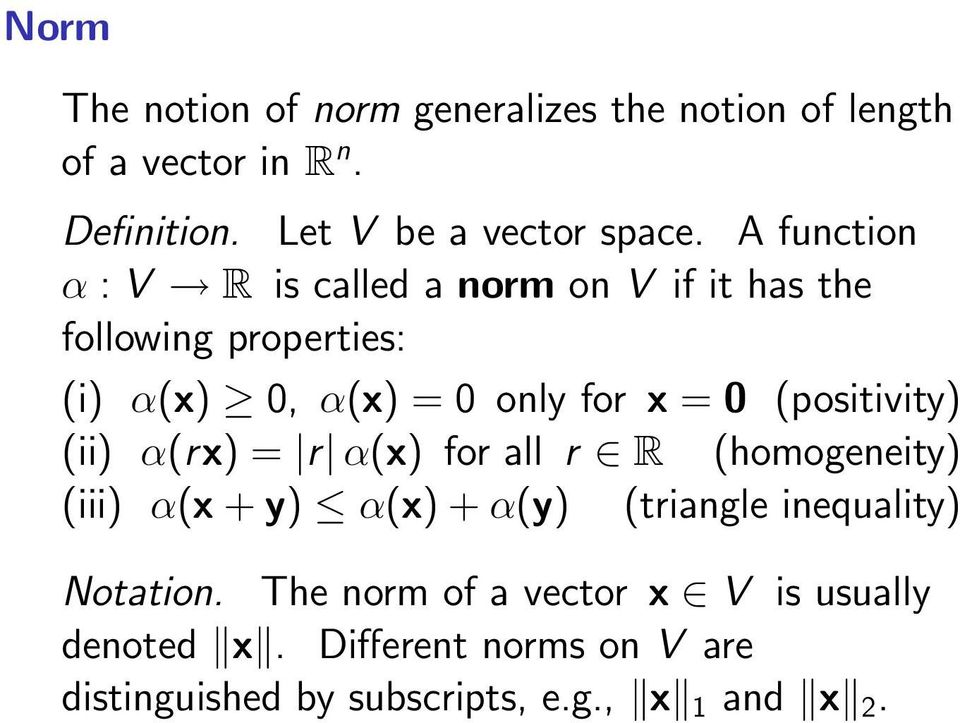
2 Norm The notion of norm generalizes the notion of length of a vector in R n. Definition. Let V be a vector space. A function α : V R is called a norm on V if it has the following properties: (i) α(x) 0, α(x) = 0 only for x = 0 (positivity) (ii) α(rx) = r α(x) for all r R (homogeneity) (iii) α(x + y) α(x) + α(y) (triangle inequality) Notation. The norm of a vector x V is usually denoted x. Different norms on V are distinguished by subscripts, e.g., x 1 and x 2.
3 Examples. V = R n, x = (x 1, x 2,...,x n ) R n. x = max( x 1, x 2,..., x n ). x p = ( x 1 p + x 2 p + + x n p) 1/p, p 1. Examples. V = C[a, b], f : [a, b] R. f = max f (x). a x b ( b 1/p f p = f (x) dx) p, p 1. a

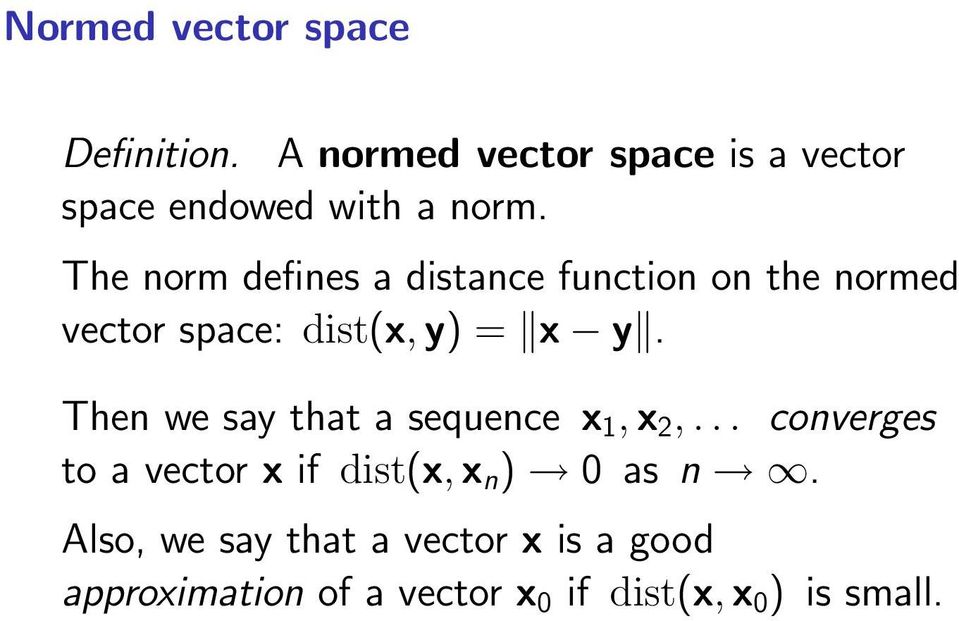
4 Normed vector space Definition. A normed vector space is a vector space endowed with a norm. The norm defines a distance function on the normed vector space: dist(x,y) = x y. Then we say that a sequence x 1,x 2,... converges to a vector x if dist(x,x n ) 0 as n. Also, we say that a vector x is a good approximation of a vector x 0 if dist(x,x 0 ) is small.
5 Inner product The notion of inner product generalizes the notion of dot product of vectors in R n. Definition. Let V be a vector space. A function β : V V R, usually denoted β(x,y) = x,y, is called an inner product on V if it is positive, symmetric, and bilinear. That is, if (i) x,x 0, x,x = 0 only for x = 0 (positivity) (ii) x, y = y, x (symmetry) (iii) r x, y = r x, y (homogeneity) (iv) x + y,z = x,z + y,z (distributive law) An inner product space is a vector space endowed with an inner product.

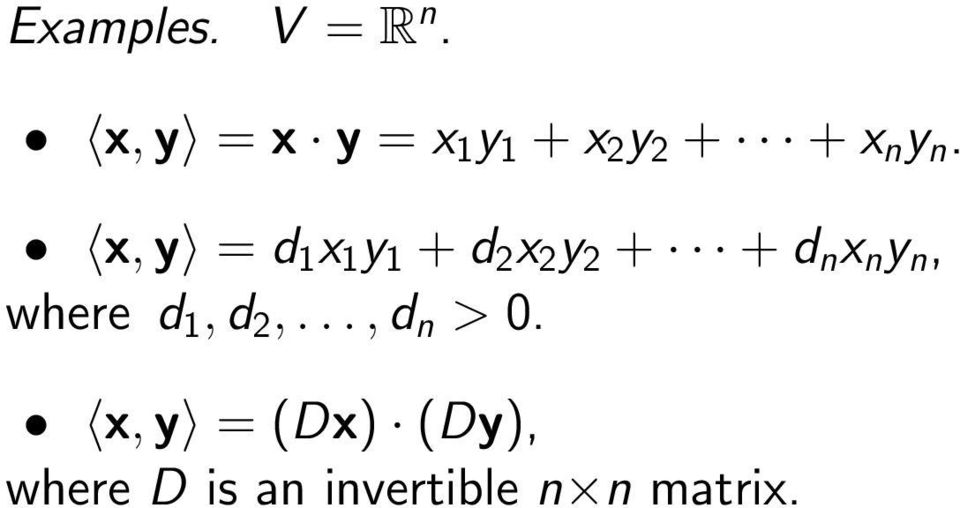
6 Examples. V = R n. x,y = x y = x 1 y 1 + x 2 y x n y n. x,y = d 1 x 1 y 1 + d 2 x 2 y d n x n y n, where d 1, d 2,...,d n > 0. x,y = (Dx) (Dy), where D is an invertible n n matrix.
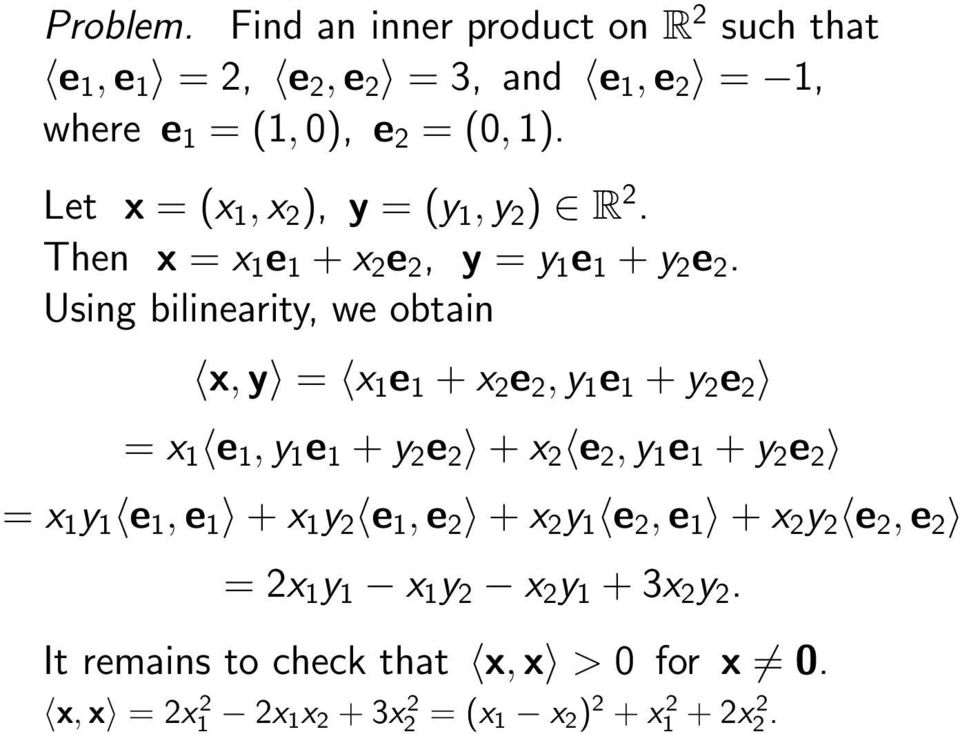
7 Problem. Find an inner product on R 2 such that e 1,e 1 = 2, e 2,e 2 = 3, and e 1,e 2 = 1, where e 1 = (1, 0), e 2 = (0, 1). Let x = (x 1, x 2 ), y = (y 1, y 2 ) R 2. Then x = x 1 e 1 + x 2 e 2, y = y 1 e 1 + y 2 e 2. Using bilinearity, we obtain x,y = x 1 e 1 + x 2 e 2, y 1 e 1 + y 2 e 2 = x 1 e 1, y 1 e 1 + y 2 e 2 + x 2 e 2, y 1 e 1 + y 2 e 2 = x 1 y 1 e 1,e 1 + x 1 y 2 e 1,e 2 + x 2 y 1 e 2,e 1 + x 2 y 2 e 2,e 2 = 2x 1 y 1 x 1 y 2 x 2 y 1 + 3x 2 y 2. It remains to check that x,x > 0 for x 0. x,x = 2x 2 1 2x 1 x 2 + 3x 2 2 = (x 1 x 2 ) 2 + x x 2 2.
8 Example. V = M m,n (R), space of m n matrices. A, B = trace (AB T ). If A = (a ij ) and B = (b ij ), then A, B = m Examples. V = C[a, b]. f, g = f, g = b a b a f (x)g(x) dx. f (x)g(x)w(x) dx, i=1 j=1 where w is bounded, piecewise continuous, and w > 0 everywhere on [a, b]. w is called the weight function. n a ij b ij.

9 Theorem Suppose x,y is an inner product on a vector space V. Then x,y 2 x,x y,y for all x,y V. Proof: For any t R let v t = x + ty. Then v t,v t = x,x + 2t x,y + t 2 y,y. The right-hand side is a quadratic polynomial in t (provided that y 0). Since v t,v t 0 for all t, the discriminant D is nonpositive. But D = 4 x,y 2 4 x,x y,y. Cauchy-Schwarz Inequality: x,y x,x y,y.

10 Cauchy-Schwarz Inequality: x,y x,x y,y. Corollary 1 x y x y for all x,y R n. Equivalently, for all x i, y i R, (x 1 y x n y n ) 2 (x x2 n)(y y2 n). Corollary 2 For any f, g C[a, b], ( b 2 b f (x)g(x) dx) f (x) 2 dx a a b a g(x) 2 dx.

11 Norms induced by inner products Theorem Suppose x,y is an inner product on a vector space V. Then x = x,x is a norm. Proof: Positivity is obvious. Homogeneity: rx = rx, rx = r 2 x,x = r x,x. Triangle inequality (follows from Cauchy-Schwarz s): x + y 2 = x + y,x + y = x,x + x,y + y,x + y,y x,x + x,y + y,x + y,y x x y + y 2 = ( x + y ) 2.
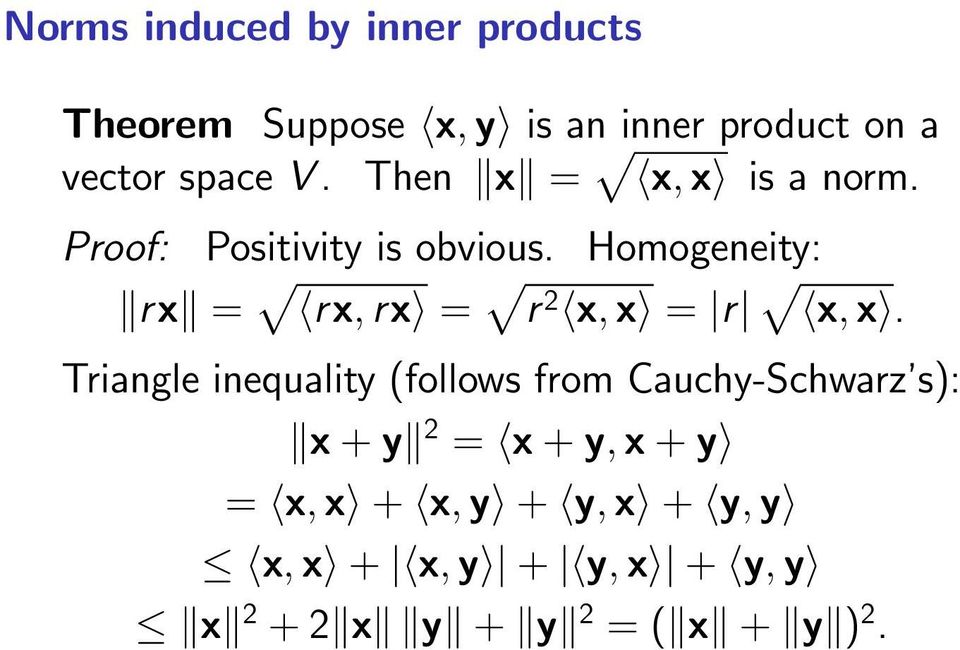
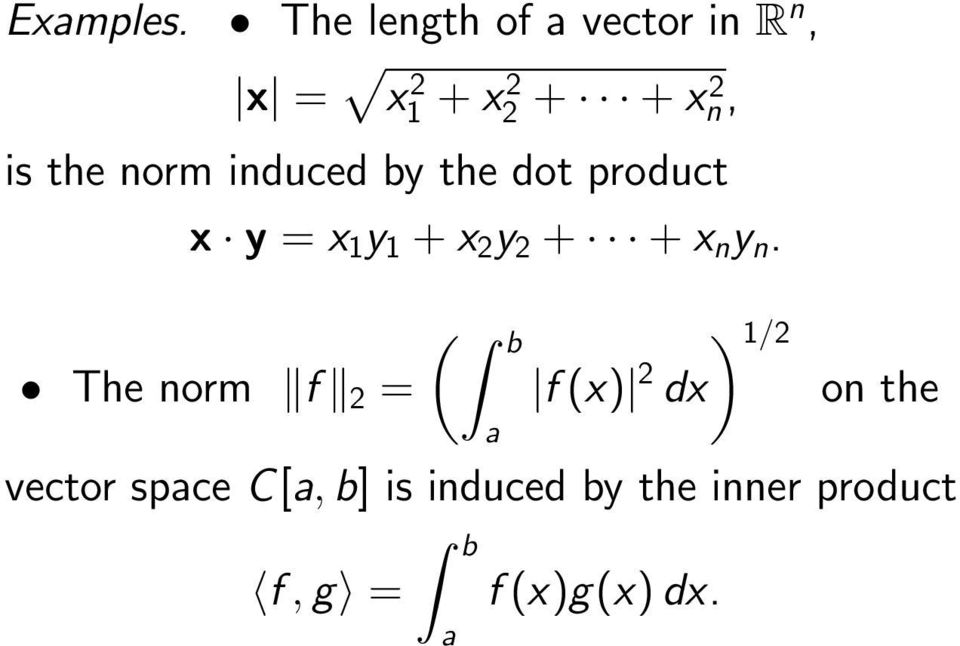
12 Examples. The length of a vector in R n, x = x1 2 + x x2 n, is the norm induced by the dot product x y = x 1 y 1 + x 2 y x n y n. ( b 1/2 The norm f 2 = f (x) dx) 2 on the vector space C[a, b] is induced by the inner product f, g = b a a f (x)g(x) dx.
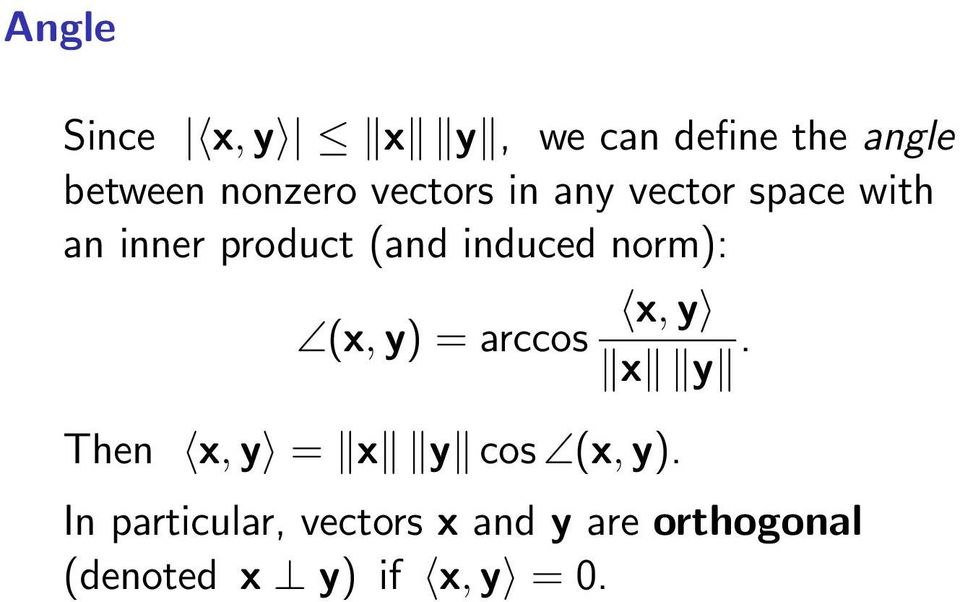
13 Angle Since x,y x y, we can define the angle between nonzero vectors in any vector space with an inner product (and induced norm): (x,y) = arccos x,y x y. Then x,y = x y cos (x,y). In particular, vectors x and y are orthogonal (denoted x y) if x,y = 0.
14 x x + y y Pythagorean Law: x y = x + y 2 = x 2 + y 2 Proof: x + y 2 = x + y,x + y = x,x + x,y + y,x + y,y = x,x + y,y = x 2 + y 2.

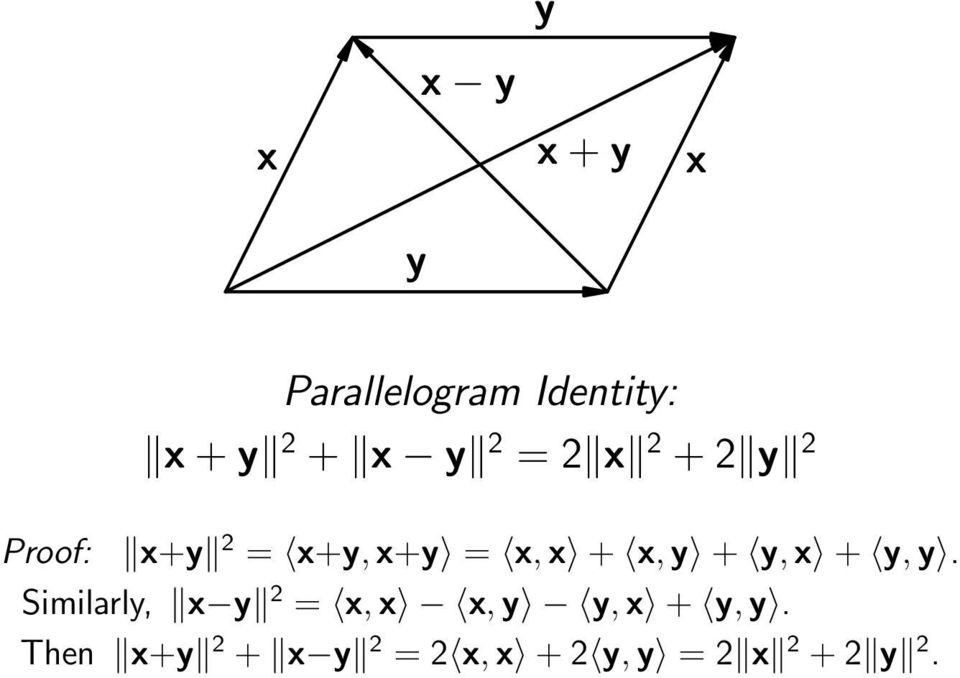
15 y x y x x + y x y Parallelogram Identity: x + y 2 + x y 2 = 2 x y 2 Proof: x+y 2 = x+y,x+y = x,x + x,y + y,x + y,y. Similarly, x y 2 = x,x x,y y,x + y,y. Then x+y 2 + x y 2 = 2 x,x + 2 y,y = 2 x y 2.
16 Orthogonal sets Let V be an inner product space with an inner product, and the induced norm. Definition. A nonempty set S V of nonzero vectors is called an orthogonal set if all vectors in S are mutually orthogonal. That is, 0 / S and x,y = 0 for any x,y S, x y. An orthogonal set S V is called orthonormal if x = 1 for any x S. Remark. Vectors v 1,v 2,...,v k V form an orthonormal set if and only if { 1 if i = j v i,v j = 0 if i j

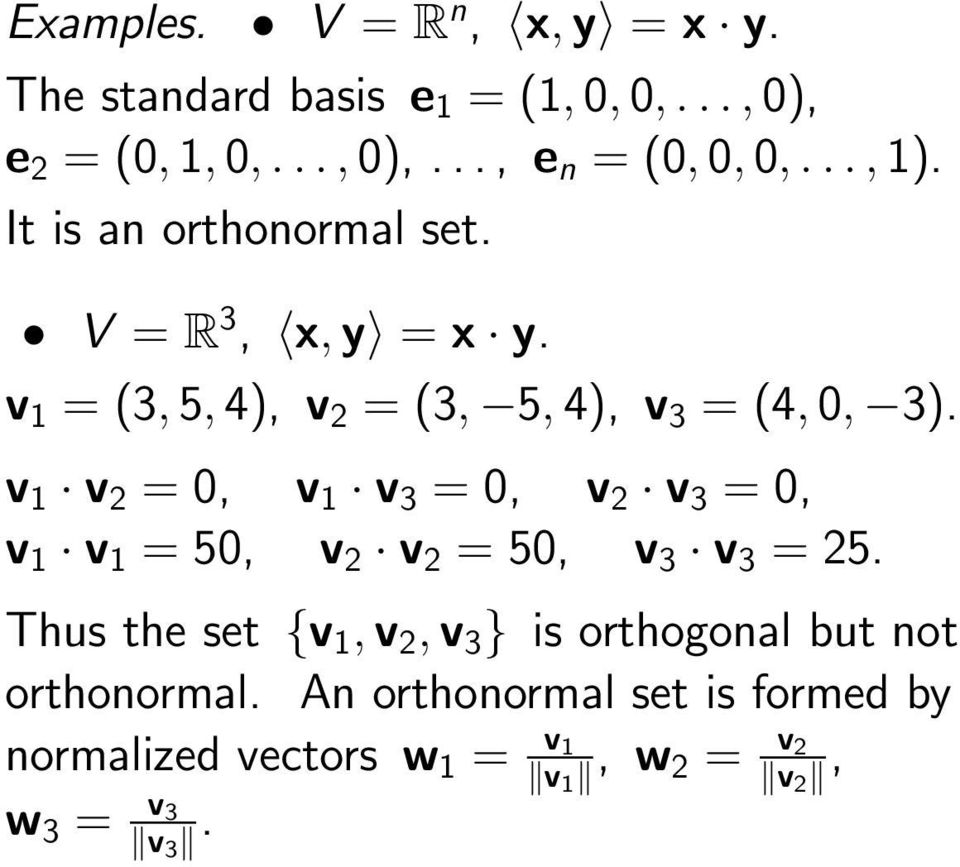
17 Examples. V = R n, x,y = x y. The standard basis e 1 = (1, 0, 0,...,0), e 2 = (0, 1, 0,...,0),..., e n = (0, 0, 0,...,1). It is an orthonormal set. V = R 3, x,y = x y. v 1 = (3, 5, 4), v 2 = (3, 5, 4), v 3 = (4, 0, 3). v 1 v 2 = 0, v 1 v 3 = 0, v 2 v 3 = 0, v 1 v 1 = 50, v 2 v 2 = 50, v 3 v 3 = 25. Thus the set {v 1,v 2,v 3 } is orthogonal but not orthonormal. An orthonormal set is formed by normalized vectors w 1 = v 1 v 1, w 2 = v 2 w 3 = v 3 v 3. v 2,
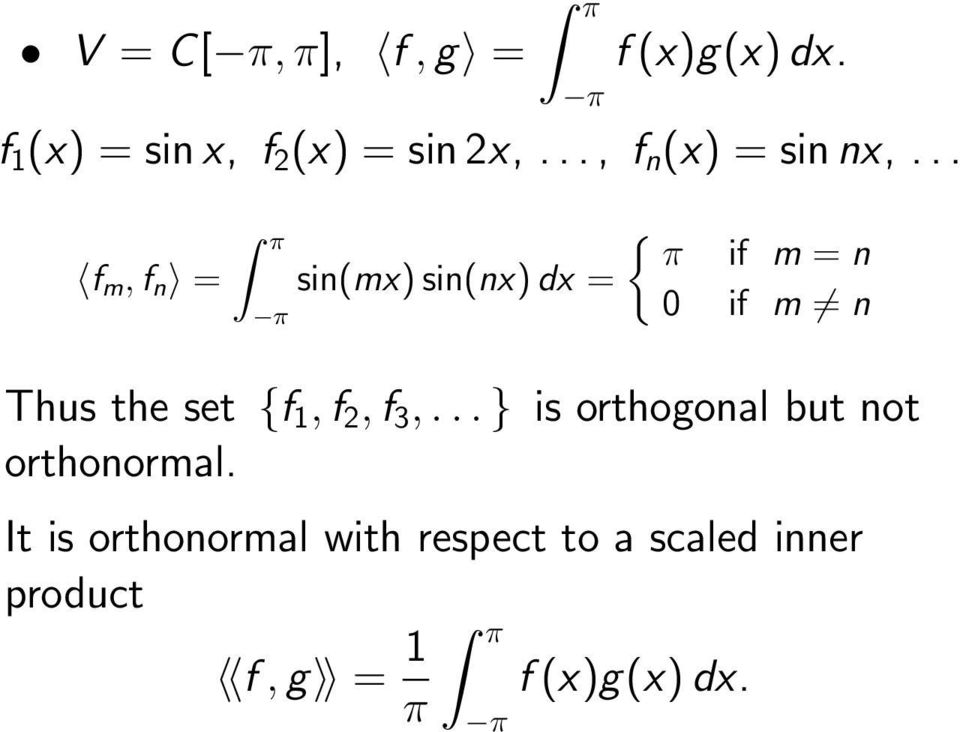
18 π V = C[ π, π], f, g = f (x)g(x) dx. π f 1 (x) = sin x, f 2 (x) = sin 2x,..., f n (x) = sin nx,... f m, f n = π π sin(mx) sin(nx) dx = { π if m = n 0 if m n Thus the set {f 1, f 2, f 3,... } is orthogonal but not orthonormal. It is orthonormal with respect to a scaled inner product f, g = 1 π π π f (x)g(x) dx.
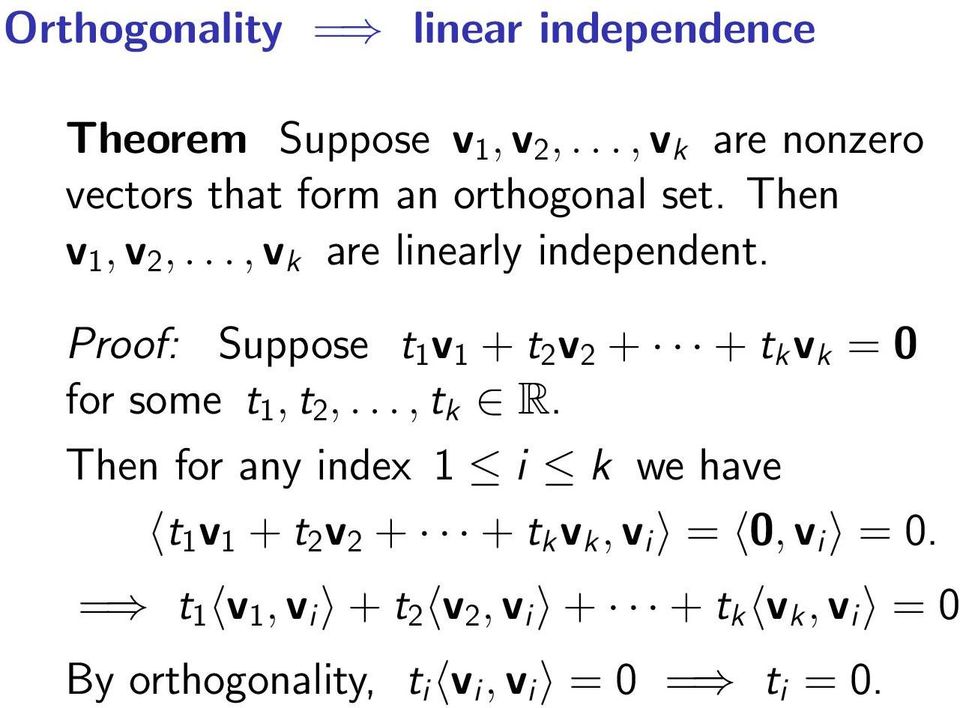
19 Orthogonality = linear independence Theorem Suppose v 1,v 2,...,v k are nonzero vectors that form an orthogonal set. Then v 1,v 2,...,v k are linearly independent. Proof: Suppose t 1 v 1 + t 2 v t k v k = 0 for some t 1, t 2,...,t k R. Then for any index 1 i k we have t 1 v 1 + t 2 v t k v k,v i = 0,v i = 0. = t 1 v 1,v i + t 2 v 2,v i + + t k v k,v i = 0 By orthogonality, t i v i,v i = 0 = t i = 0.
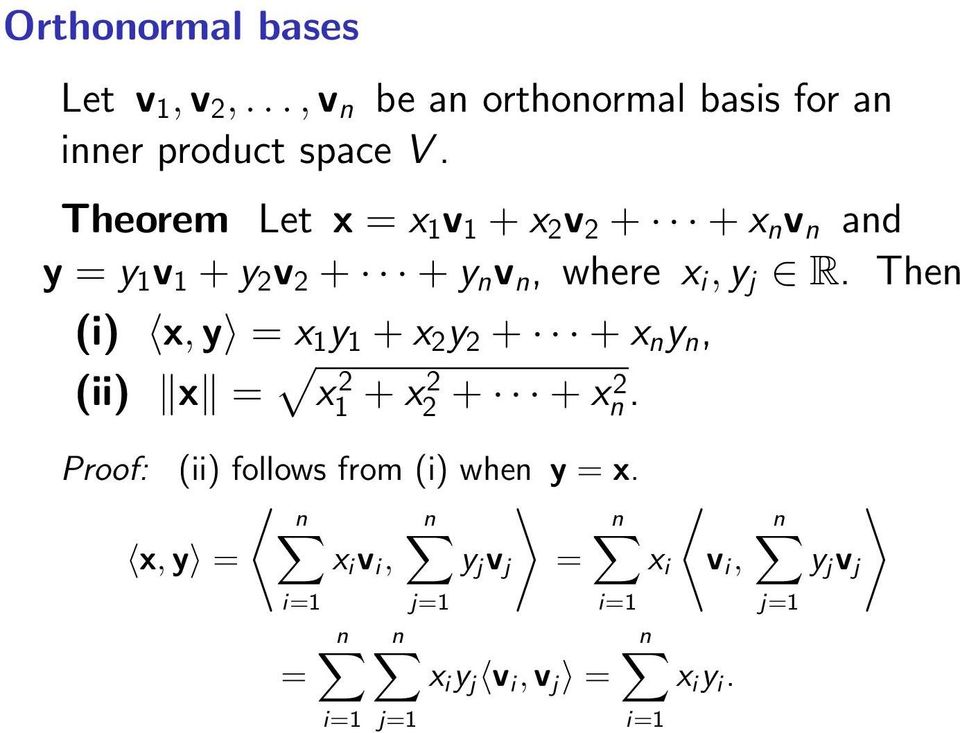
20 Orthonormal bases Let v 1,v 2,...,v n be an orthonormal basis for an inner product space V. Theorem Let x = x 1 v 1 + x 2 v x n v n and y = y 1 v 1 + y 2 v y n v n, where x i, y j R. Then (i) x,y = x 1 y 1 + x 2 y x n y n, (ii) x = x x x2 n. Proof: (ii) follows from (i) when y = x. n n n x,y = x i v i, y j v j = x i v i, i=1 = n j=1 n x i y j v i,v j = i=1 i=1 j=1 i=1 n x i y i. n y j v j j=1
21 Orthogonal projection Theorem Let V be an inner product space and V 0 be a finite-dimensional subspace of V. Then any vector x V is uniquely represented as x = p + o, where p V 0 and o V 0. The component p is the orthogonal projection of the vector x onto the subspace V 0. We have o = x p = min v V 0 x v. That is, the distance from x to the subspace V 0 is o.
22 o x p V 0
23 Let V be an inner product space. Let p be the orthogonal projection of a vector x V onto a finite-dimensional subspace V 0. If V 0 is a one-dimensional subspace spanned by a vector v then p = x,v v,v v. If v 1,v 2,...,v n is an orthogonal basis for V 0 then p = x,v 1 v 1,v 1 v 1 + x,v 2 v 2,v 2 v x,v n v n,v n v n. Indeed, p,v i = n j=1 x,v j v j,v j v j,v i = x,v i v i,v i v i,v i = x,v i = x p,v i = 0 = x p v i = x p V 0.
Inner Product Spaces
 Math 571 Inner Product Spaces 1. Preliminaries An inner product space is a vector space V along with a function, called an inner product which associates each pair of vectors u, v with a scalar u, v, and
α = u v. In other words, Orthogonal Projection
 Orthogonal Projection Given any nonzero vector v, it is possible to decompose an arbitrary vector u into a component that points in the direction of v and one that points in a direction orthogonal to v
MATH 304 Linear Algebra Lecture 18: Rank and nullity of a matrix.
 MATH 304 Linear Algebra Lecture 18: Rank and nullity of a matrix. Nullspace Let A = (a ij ) be an m n matrix. Definition. The nullspace of the matrix A, denoted N(A), is the set of all n-dimensional column
Inner product. Definition of inner product
 Math 20F Linear Algebra Lecture 25 1 Inner product Review: Definition of inner product. Slide 1 Norm and distance. Orthogonal vectors. Orthogonal complement. Orthogonal basis. Definition of inner product
Vector and Matrix Norms
 Chapter 1 Vector and Matrix Norms 11 Vector Spaces Let F be a field (such as the real numbers, R, or complex numbers, C) with elements called scalars A Vector Space, V, over the field F is a non-empty
Inner Product Spaces and Orthogonality
 Inner Product Spaces and Orthogonality week 3-4 Fall 2006 Dot product of R n The inner product or dot product of R n is a function, defined by u, v a b + a 2 b 2 + + a n b n for u a, a 2,, a n T, v b,
Similarity and Diagonalization. Similar Matrices
 MATH022 Linear Algebra Brief lecture notes 48 Similarity and Diagonalization Similar Matrices Let A and B be n n matrices. We say that A is similar to B if there is an invertible n n matrix P such that
Adding vectors We can do arithmetic with vectors. We ll start with vector addition and related operations. Suppose you have two vectors
 1 Chapter 13. VECTORS IN THREE DIMENSIONAL SPACE Let s begin with some names and notation for things: R is the set (collection) of real numbers. We write x R to mean that x is a real number. A real number
Chapter 6. Orthogonality
 6.3 Orthogonal Matrices 1 Chapter 6. Orthogonality 6.3 Orthogonal Matrices Definition 6.4. An n n matrix A is orthogonal if A T A = I. Note. We will see that the columns of an orthogonal matrix must be
Section 6.1 - Inner Products and Norms
 Section 6.1 - Inner Products and Norms Definition. Let V be a vector space over F {R, C}. An inner product on V is a function that assigns, to every ordered pair of vectors x and y in V, a scalar in F,
Bindel, Spring 2012 Intro to Scientific Computing (CS 3220) Week 3: Wednesday, Feb 8
 Spaces and bases Week 3: Wednesday, Feb 8 I have two favorite vector spaces 1 : R n and the space P d of polynomials of degree at most d. For R n, we have a canonical basis: R n = span{e 1, e 2,..., e
17. Inner product spaces Definition 17.1. Let V be a real vector space. An inner product on V is a function
 17. Inner product spaces Definition 17.1. Let V be a real vector space. An inner product on V is a function, : V V R, which is symmetric, that is u, v = v, u. bilinear, that is linear (in both factors):
Orthogonal Diagonalization of Symmetric Matrices
 MATH10212 Linear Algebra Brief lecture notes 57 Gram Schmidt Process enables us to find an orthogonal basis of a subspace. Let u 1,..., u k be a basis of a subspace V of R n. We begin the process of finding
Linear Algebra Notes for Marsden and Tromba Vector Calculus
 Linear Algebra Notes for Marsden and Tromba Vector Calculus n-dimensional Euclidean Space and Matrices Definition of n space As was learned in Math b, a point in Euclidean three space can be thought of
Metric Spaces. Chapter 7. 7.1. Metrics
 Chapter 7 Metric Spaces A metric space is a set X that has a notion of the distance d(x, y) between every pair of points x, y X. The purpose of this chapter is to introduce metric spaces and give some
3. INNER PRODUCT SPACES
 . INNER PRODUCT SPACES.. Definition So far we have studied abstract vector spaces. These are a generalisation of the geometric spaces R and R. But these have more structure than just that of a vector space.
MATH 304 Linear Algebra Lecture 9: Subspaces of vector spaces (continued). Span. Spanning set.
 MATH 304 Linear Algebra Lecture 9: Subspaces of vector spaces (continued). Span. Spanning set. Vector space A vector space is a set V equipped with two operations, addition V V (x,y) x + y V and scalar
1 VECTOR SPACES AND SUBSPACES
 1 VECTOR SPACES AND SUBSPACES What is a vector? Many are familiar with the concept of a vector as: Something which has magnitude and direction. an ordered pair or triple. a description for quantities such
Section 4.4 Inner Product Spaces
 Section 4.4 Inner Product Spaces In our discussion of vector spaces the specific nature of F as a field, other than the fact that it is a field, has played virtually no role. In this section we no longer
October 3rd, 2012. Linear Algebra & Properties of the Covariance Matrix
 Linear Algebra & Properties of the Covariance Matrix October 3rd, 2012 Estimation of r and C Let rn 1, rn, t..., rn T be the historical return rates on the n th asset. rn 1 rṇ 2 r n =. r T n n = 1, 2,...,
Lectures notes on orthogonal matrices (with exercises) 92.222 - Linear Algebra II - Spring 2004 by D. Klain
 Lectures notes on orthogonal matrices (with exercises) 92.222 - Linear Algebra II - Spring 2004 by D. Klain 1. Orthogonal matrices and orthonormal sets An n n real-valued matrix A is said to be an orthogonal
Numerical Analysis Lecture Notes
 Numerical Analysis Lecture Notes Peter J. Olver 5. Inner Products and Norms The norm of a vector is a measure of its size. Besides the familiar Euclidean norm based on the dot product, there are a number
Linear Algebra: Vectors
 A Linear Algebra: Vectors A Appendix A: LINEAR ALGEBRA: VECTORS TABLE OF CONTENTS Page A Motivation A 3 A2 Vectors A 3 A2 Notational Conventions A 4 A22 Visualization A 5 A23 Special Vectors A 5 A3 Vector
28 CHAPTER 1. VECTORS AND THE GEOMETRY OF SPACE. v x. u y v z u z v y u y u z. v y v z
 28 CHAPTER 1. VECTORS AND THE GEOMETRY OF SPACE 1.4 Cross Product 1.4.1 Definitions The cross product is the second multiplication operation between vectors we will study. The goal behind the definition
Høgskolen i Narvik Sivilingeniørutdanningen STE6237 ELEMENTMETODER. Oppgaver
 Høgskolen i Narvik Sivilingeniørutdanningen STE637 ELEMENTMETODER Oppgaver Klasse: 4.ID, 4.IT Ekstern Professor: Gregory A. Chechkin e-mail: [email protected] Narvik 6 PART I Task. Consider two-point
BANACH AND HILBERT SPACE REVIEW
 BANACH AND HILBET SPACE EVIEW CHISTOPHE HEIL These notes will briefly review some basic concepts related to the theory of Banach and Hilbert spaces. We are not trying to give a complete development, but
Linear algebra and the geometry of quadratic equations. Similarity transformations and orthogonal matrices
 MATH 30 Differential Equations Spring 006 Linear algebra and the geometry of quadratic equations Similarity transformations and orthogonal matrices First, some things to recall from linear algebra Two
i=(1,0), j=(0,1) in R 2 i=(1,0,0), j=(0,1,0), k=(0,0,1) in R 3 e 1 =(1,0,..,0), e 2 =(0,1,,0),,e n =(0,0,,1) in R n.
 Length, norm, magnitude of a vector v=(v 1,,v n ) is v = (v 12 +v 22 + +v n2 ) 1/2. Examples v=(1,1,,1) v =n 1/2. Unit vectors u=v/ v corresponds to directions. Standard unit vectors i=(1,0), j=(0,1) in
5. Orthogonal matrices
 L Vandenberghe EE133A (Spring 2016) 5 Orthogonal matrices matrices with orthonormal columns orthogonal matrices tall matrices with orthonormal columns complex matrices with orthonormal columns 5-1 Orthonormal
Linear Algebra I. Ronald van Luijk, 2012
 Linear Algebra I Ronald van Luijk, 2012 With many parts from Linear Algebra I by Michael Stoll, 2007 Contents 1. Vector spaces 3 1.1. Examples 3 1.2. Fields 4 1.3. The field of complex numbers. 6 1.4.
MAT 1341: REVIEW II SANGHOON BAEK
 MAT 1341: REVIEW II SANGHOON BAEK 1. Projections and Cross Product 1.1. Projections. Definition 1.1. Given a vector u, the rectangular (or perpendicular or orthogonal) components are two vectors u 1 and
Recall that two vectors in are perpendicular or orthogonal provided that their dot
 Orthogonal Complements and Projections Recall that two vectors in are perpendicular or orthogonal provided that their dot product vanishes That is, if and only if Example 1 The vectors in are orthogonal
v 1 v 3 u v = (( 1)4 (3)2, [1(4) ( 2)2], 1(3) ( 2)( 1)) = ( 10, 8, 1) (d) u (v w) = (u w)v (u v)w (Relationship between dot and cross product)
![v 1 v 3 u v = (( 1)4 (3)2, [1(4) ( 2)2], 1(3) ( 2)( 1)) = ( 10, 8, 1) (d) u (v w) = (u w)v (u v)w (Relationship between dot and cross product)](/thumbs/40/20880945.jpg "v 1 v 3 u v = (( 1)4 (3)2, [1(4) ( 2)2], 1(3) ( 2)( 1)) = ( 10, 8, 1) (d) u (v w) = (u w)v (u v)w (Relationship between dot and cross product)") 0.1 Cross Product The dot product of two vectors is a scalar, a number in R. Next we will define the cross product of two vectors in 3-space. This time the outcome will be a vector in 3-space. Definition
0.1 Cross Product The dot product of two vectors is a scalar, a number in R. Next we will define the cross product of two vectors in 3-space. This time the outcome will be a vector in 3-space. Definition
4.5 Linear Dependence and Linear Independence
 4.5 Linear Dependence and Linear Independence 267 32. {v 1, v 2 }, where v 1, v 2 are collinear vectors in R 3. 33. Prove that if S and S are subsets of a vector space V such that S is a subset of S, then
MA106 Linear Algebra lecture notes
 MA106 Linear Algebra lecture notes Lecturers: Martin Bright and Daan Krammer Warwick, January 2011 Contents 1 Number systems and fields 3 1.1 Axioms for number systems......................... 3 2 Vector
Let H and J be as in the above lemma. The result of the lemma shows that the integral
 Let and be as in the above lemma. The result of the lemma shows that the integral ( f(x, y)dy) dx is well defined; we denote it by f(x, y)dydx. By symmetry, also the integral ( f(x, y)dx) dy is well defined;
Finite Dimensional Hilbert Spaces and Linear Inverse Problems
 Finite Dimensional Hilbert Spaces and Linear Inverse Problems ECE 174 Lecture Supplement Spring 2009 Ken Kreutz-Delgado Electrical and Computer Engineering Jacobs School of Engineering University of California,
Orthogonal Projections and Orthonormal Bases
 CS 3, HANDOUT -A, 3 November 04 (adjusted on 7 November 04) Orthogonal Projections and Orthonormal Bases (continuation of Handout 07 of 6 September 04) Definition (Orthogonality, length, unit vectors).
Problem Set 5 Due: In class Thursday, Oct. 18 Late papers will be accepted until 1:00 PM Friday.
 Math 312, Fall 2012 Jerry L. Kazdan Problem Set 5 Due: In class Thursday, Oct. 18 Late papers will be accepted until 1:00 PM Friday. In addition to the problems below, you should also know how to solve
Rotation Matrices and Homogeneous Transformations
 Rotation Matrices and Homogeneous Transformations A coordinate frame in an n-dimensional space is defined by n mutually orthogonal unit vectors. In particular, for a two-dimensional (2D) space, i.e., n
Section 1.1. Introduction to R n
 The Calculus of Functions of Several Variables Section. Introduction to R n Calculus is the study of functional relationships and how related quantities change with each other. In your first exposure to
1 Introduction to Matrices
 1 Introduction to Matrices In this section, important definitions and results from matrix algebra that are useful in regression analysis are introduced. While all statements below regarding the columns
MATH PROBLEMS, WITH SOLUTIONS
 MATH PROBLEMS, WITH SOLUTIONS OVIDIU MUNTEANU These are free online notes that I wrote to assist students that wish to test their math skills with some problems that go beyond the usual curriculum. These
Notes on Symmetric Matrices
 CPSC 536N: Randomized Algorithms 2011-12 Term 2 Notes on Symmetric Matrices Prof. Nick Harvey University of British Columbia 1 Symmetric Matrices We review some basic results concerning symmetric matrices.
Cross product and determinants (Sect. 12.4) Two main ways to introduce the cross product
 Cross product and determinants (Sect. 12.4) Two main ways to introduce the cross product Geometrical definition Properties Expression in components. Definition in components Properties Geometrical expression.
Math 241, Exam 1 Information.
 Math 241, Exam 1 Information. 9/24/12, LC 310, 11:15-12:05. Exam 1 will be based on: Sections 12.1-12.5, 14.1-14.3. The corresponding assigned homework problems (see http://www.math.sc.edu/ boylan/sccourses/241fa12/241.html)
Elementary Linear Algebra
 Elementary Linear Algebra Kuttler January, Saylor URL: http://wwwsaylororg/courses/ma/ Saylor URL: http://wwwsaylororg/courses/ma/ Contents Some Prerequisite Topics Sets And Set Notation Functions Graphs
5.3 The Cross Product in R 3
 53 The Cross Product in R 3 Definition 531 Let u = [u 1, u 2, u 3 ] and v = [v 1, v 2, v 3 ] Then the vector given by [u 2 v 3 u 3 v 2, u 3 v 1 u 1 v 3, u 1 v 2 u 2 v 1 ] is called the cross product (or
Au = = = 3u. Aw = = = 2w. so the action of A on u and w is very easy to picture: it simply amounts to a stretching by 3 and 2, respectively.
 Chapter 7 Eigenvalues and Eigenvectors In this last chapter of our exploration of Linear Algebra we will revisit eigenvalues and eigenvectors of matrices, concepts that were already introduced in Geometry
Recall the basic property of the transpose (for any A): v A t Aw = v w, v, w R n.
 ORTHOGONAL MATRICES Informally, an orthogonal n n matrix is the n-dimensional analogue of the rotation matrices R θ in R 2. When does a linear transformation of R 3 (or R n ) deserve to be called a rotation?
FUNCTIONAL ANALYSIS LECTURE NOTES: QUOTIENT SPACES
 FUNCTIONAL ANALYSIS LECTURE NOTES: QUOTIENT SPACES CHRISTOPHER HEIL 1. Cosets and the Quotient Space Any vector space is an abelian group under the operation of vector addition. So, if you are have studied
MATH 551 - APPLIED MATRIX THEORY
 MATH 55 - APPLIED MATRIX THEORY FINAL TEST: SAMPLE with SOLUTIONS (25 points NAME: PROBLEM (3 points A web of 5 pages is described by a directed graph whose matrix is given by A Do the following ( points
Linear Algebra Review. Vectors
 Linear Algebra Review By Tim K. Marks UCSD Borrows heavily from: Jana Kosecka [email protected] http://cs.gmu.edu/~kosecka/cs682.html Virginia de Sa Cogsci 8F Linear Algebra review UCSD Vectors The length
Linear Maps. Isaiah Lankham, Bruno Nachtergaele, Anne Schilling (February 5, 2007)
 MAT067 University of California, Davis Winter 2007 Linear Maps Isaiah Lankham, Bruno Nachtergaele, Anne Schilling (February 5, 2007) As we have discussed in the lecture on What is Linear Algebra? one of
x1 x 2 x 3 y 1 y 2 y 3 x 1 y 2 x 2 y 1 0.
 Cross product 1 Chapter 7 Cross product We are getting ready to study integration in several variables. Until now we have been doing only differential calculus. One outcome of this study will be our ability
MATH10212 Linear Algebra. Systems of Linear Equations. Definition. An n-dimensional vector is a row or a column of n numbers (or letters): a 1.
 MATH10212 Linear Algebra Textbook: D. Poole, Linear Algebra: A Modern Introduction. Thompson, 2006. ISBN 0-534-40596-7. Systems of Linear Equations Definition. An n-dimensional vector is a row or a column
I. GROUPS: BASIC DEFINITIONS AND EXAMPLES
 I GROUPS: BASIC DEFINITIONS AND EXAMPLES Definition 1: An operation on a set G is a function : G G G Definition 2: A group is a set G which is equipped with an operation and a special element e G, called
THE DIMENSION OF A VECTOR SPACE
 THE DIMENSION OF A VECTOR SPACE KEITH CONRAD This handout is a supplementary discussion leading up to the definition of dimension and some of its basic properties. Let V be a vector space over a field
v w is orthogonal to both v and w. the three vectors v, w and v w form a right-handed set of vectors.
 3. Cross product Definition 3.1. Let v and w be two vectors in R 3. The cross product of v and w, denoted v w, is the vector defined as follows: the length of v w is the area of the parallelogram with
3. Let A and B be two n n orthogonal matrices. Then prove that AB and BA are both orthogonal matrices. Prove a similar result for unitary matrices.
 Exercise 1 1. Let A be an n n orthogonal matrix. Then prove that (a) the rows of A form an orthonormal basis of R n. (b) the columns of A form an orthonormal basis of R n. (c) for any two vectors x,y R
T ( a i x i ) = a i T (x i ).
 Chapter 2 Defn 1. (p. 65) Let V and W be vector spaces (over F ). We call a function T : V W a linear transformation form V to W if, for all x, y V and c F, we have (a) T (x + y) = T (x) + T (y) and (b)
1 Inner Products and Norms on Real Vector Spaces
 Math 373: Principles Techniques of Applied Mathematics Spring 29 The 2 Inner Product 1 Inner Products Norms on Real Vector Spaces Recall that an inner product on a real vector space V is a function from
Matrix Representations of Linear Transformations and Changes of Coordinates
 Matrix Representations of Linear Transformations and Changes of Coordinates 01 Subspaces and Bases 011 Definitions A subspace V of R n is a subset of R n that contains the zero element and is closed under
Computing Orthonormal Sets in 2D, 3D, and 4D
 Computing Orthonormal Sets in 2D, 3D, and 4D David Eberly Geometric Tools, LLC http://www.geometrictools.com/ Copyright c 1998-2016. All Rights Reserved. Created: March 22, 2010 Last Modified: August 11,
ISOMETRIES OF R n KEITH CONRAD
 ISOMETRIES OF R n KEITH CONRAD 1. Introduction An isometry of R n is a function h: R n R n that preserves the distance between vectors: h(v) h(w) = v w for all v and w in R n, where (x 1,..., x n ) = x
I. Pointwise convergence
 MATH 40 - NOTES Sequences of functions Pointwise and Uniform Convergence Fall 2005 Previously, we have studied sequences of real numbers. Now we discuss the topic of sequences of real valued functions.
Mathematics Course 111: Algebra I Part IV: Vector Spaces
 Mathematics Course 111: Algebra I Part IV: Vector Spaces D. R. Wilkins Academic Year 1996-7 9 Vector Spaces A vector space over some field K is an algebraic structure consisting of a set V on which are
F Matrix Calculus F 1
 F Matrix Calculus F 1 Appendix F: MATRIX CALCULUS TABLE OF CONTENTS Page F1 Introduction F 3 F2 The Derivatives of Vector Functions F 3 F21 Derivative of Vector with Respect to Vector F 3 F22 Derivative
WHEN DOES A CROSS PRODUCT ON R n EXIST?
 WHEN DOES A CROSS PRODUCT ON R n EXIST? PETER F. MCLOUGHLIN It is probably safe to say that just about everyone reading this article is familiar with the cross product and the dot product. However, what
Notes on Linear Algebra. Peter J. Cameron
 Notes on Linear Algebra Peter J. Cameron ii Preface Linear algebra has two aspects. Abstractly, it is the study of vector spaces over fields, and their linear maps and bilinear forms. Concretely, it is
Math Placement Test Practice Problems
 Math Placement Test Practice Problems The following problems cover material that is used on the math placement test to place students into Math 1111 College Algebra, Math 1113 Precalculus, and Math 2211
160 CHAPTER 4. VECTOR SPACES
 160 CHAPTER 4. VECTOR SPACES 4. Rank and Nullity In this section, we look at relationships between the row space, column space, null space of a matrix and its transpose. We will derive fundamental results
Dot product and vector projections (Sect. 12.3) There are two main ways to introduce the dot product
 Dot product and vector projections (Sect. 12.3) Two definitions for the dot product. Geometric definition of dot product. Orthogonal vectors. Dot product and orthogonal projections. Properties of the dot
Vector Spaces 4.4 Spanning and Independence
 Vector Spaces 4.4 and Independence October 18 Goals Discuss two important basic concepts: Define linear combination of vectors. Define Span(S) of a set S of vectors. Define linear Independence of a set
Figure 1.1 Vector A and Vector F
 CHAPTER I VECTOR QUANTITIES Quantities are anything which can be measured, and stated with number. Quantities in physics are divided into two types; scalar and vector quantities. Scalar quantities have
Vectors Math 122 Calculus III D Joyce, Fall 2012
 Vectors Math 122 Calculus III D Joyce, Fall 2012 Vectors in the plane R 2. A vector v can be interpreted as an arro in the plane R 2 ith a certain length and a certain direction. The same vector can be
Mathematical Methods of Engineering Analysis
 Mathematical Methods of Engineering Analysis Erhan Çinlar Robert J. Vanderbei February 2, 2000 Contents Sets and Functions 1 1 Sets................................... 1 Subsets.............................
Applied Linear Algebra I Review page 1
 Applied Linear Algebra Review 1 I. Determinants A. Definition of a determinant 1. Using sum a. Permutations i. Sign of a permutation ii. Cycle 2. Uniqueness of the determinant function in terms of properties
Lecture 5 Principal Minors and the Hessian
 Lecture 5 Principal Minors and the Hessian Eivind Eriksen BI Norwegian School of Management Department of Economics October 01, 2010 Eivind Eriksen (BI Dept of Economics) Lecture 5 Principal Minors and
Linear Algebra Done Wrong. Sergei Treil. Department of Mathematics, Brown University
 Linear Algebra Done Wrong Sergei Treil Department of Mathematics, Brown University Copyright c Sergei Treil, 2004, 2009, 2011, 2014 Preface The title of the book sounds a bit mysterious. Why should anyone
Chapter 17. Orthogonal Matrices and Symmetries of Space
 Chapter 17. Orthogonal Matrices and Symmetries of Space Take a random matrix, say 1 3 A = 4 5 6, 7 8 9 and compare the lengths of e 1 and Ae 1. The vector e 1 has length 1, while Ae 1 = (1, 4, 7) has length
Math 215 HW #6 Solutions
 Math 5 HW #6 Solutions Problem 34 Show that x y is orthogonal to x + y if and only if x = y Proof First, suppose x y is orthogonal to x + y Then since x, y = y, x In other words, = x y, x + y = (x y) T
CONTINUED FRACTIONS AND PELL S EQUATION. Contents 1. Continued Fractions 1 2. Solution to Pell s Equation 9 References 12
 CONTINUED FRACTIONS AND PELL S EQUATION SEUNG HYUN YANG Abstract. In this REU paper, I will use some important characteristics of continued fractions to give the complete set of solutions to Pell s equation.
1.3. DOT PRODUCT 19. 6. If θ is the angle (between 0 and π) between two non-zero vectors u and v,
 1.3. DOT PRODUCT 19 1.3 Dot Product 1.3.1 Definitions and Properties The dot product is the first way to multiply two vectors. The definition we will give below may appear arbitrary. But it is not. It
SECOND DERIVATIVE TEST FOR CONSTRAINED EXTREMA
 SECOND DERIVATIVE TEST FOR CONSTRAINED EXTREMA This handout presents the second derivative test for a local extrema of a Lagrange multiplier problem. The Section 1 presents a geometric motivation for the
1 Norms and Vector Spaces
 008.10.07.01 1 Norms and Vector Spaces Suppose we have a complex vector space V. A norm is a function f : V R which satisfies (i) f(x) 0 for all x V (ii) f(x + y) f(x) + f(y) for all x,y V (iii) f(λx)
12.5 Equations of Lines and Planes
 Instructor: Longfei Li Math 43 Lecture Notes.5 Equations of Lines and Planes What do we need to determine a line? D: a point on the line: P 0 (x 0, y 0 ) direction (slope): k 3D: a point on the line: P
4: EIGENVALUES, EIGENVECTORS, DIAGONALIZATION
 4: EIGENVALUES, EIGENVECTORS, DIAGONALIZATION STEVEN HEILMAN Contents 1. Review 1 2. Diagonal Matrices 1 3. Eigenvectors and Eigenvalues 2 4. Characteristic Polynomial 4 5. Diagonalizability 6 6. Appendix:
Methods for Finding Bases
 Methods for Finding Bases Bases for the subspaces of a matrix Row-reduction methods can be used to find bases. Let us now look at an example illustrating how to obtain bases for the row space, null space,
Numerical Analysis Lecture Notes
 Numerical Analysis Lecture Notes Peter J. Olver 6. Eigenvalues and Singular Values In this section, we collect together the basic facts about eigenvalues and eigenvectors. From a geometrical viewpoint,
THREE DIMENSIONAL GEOMETRY
 Chapter 8 THREE DIMENSIONAL GEOMETRY 8.1 Introduction In this chapter we present a vector algebra approach to three dimensional geometry. The aim is to present standard properties of lines and planes,
1 Completeness of a Set of Eigenfunctions. Lecturer: Naoki Saito Scribe: Alexander Sheynis/Allen Xue. May 3, 2007. 1.1 The Neumann Boundary Condition
 MAT 280: Laplacian Eigenfunctions: Theory, Applications, and Computations Lecture 11: Laplacian Eigenvalue Problems for General Domains III. Completeness of a Set of Eigenfunctions and the Justification
Associativity condition for some alternative algebras of degree three
 Associativity condition for some alternative algebras of degree three Mirela Stefanescu and Cristina Flaut Abstract In this paper we find an associativity condition for a class of alternative algebras
Inequalities of Analysis. Andrejs Treibergs. Fall 2014
 USAC Colloquium Inequalities of Analysis Andrejs Treibergs University of Utah Fall 2014 2. USAC Lecture: Inequalities of Analysis The URL for these Beamer Slides: Inequalities of Analysis http://www.math.utah.edu/~treiberg/inequalitiesslides.pdf
Math 333 - Practice Exam 2 with Some Solutions
 Math 333 - Practice Exam 2 with Some Solutions (Note that the exam will NOT be this long) Definitions (0 points) Let T : V W be a transformation Let A be a square matrix (a) Define T is linear (b) Define
(Basic definitions and properties; Separation theorems; Characterizations) 1.1 Definition, examples, inner description, algebraic properties
 Lecture 1 Convex Sets (Basic definitions and properties; Separation theorems; Characterizations) 1.1 Definition, examples, inner description, algebraic properties 1.1.1 A convex set In the school geometry
Linearly Independent Sets and Linearly Dependent Sets
 These notes closely follow the presentation of the material given in David C. Lay s textbook Linear Algebra and its Applications (3rd edition). These notes are intended primarily for in-class presentation