
TOPOLOGY OF SINGULAR FIBERS OF GENERIC MAPS
|
|
|
- Giles Spencer
- 10 years ago
- Views:
Transcription
1 TOPOLOGY OF SINGULAR FIBERS OF GENERIC MAPS OSAMU SAEKI Dedicated to Professor Yukio Matsumoto on the occasion of his 60th birthday Abstract. We classify singular fibers of C stable maps of orientable 4- manifolds into 3-manifolds up to right-left equivalence. Furthermore, we obtain some results on the co-existence of singular fibers of such maps, and as a consequence, we show that the Euler characteristic of the source 4-manifold of such a stable map has the same parity as the number of singular fibers of a certain type. We construct some explicit examples which indicate that the study of such singular fibers is essential for a topological study of C stable maps of negative codimension from a global viewpoint. In fact, for a generic map of negative codimension, a similar consideration enables us to obtain a stratification of the target manifold according to the fibers, which leads us naturally to the notion of universal complexes of singular fibers similar to Vassiliev s universal complexes of multi-singularities. In this paper, we develop a rather detailed theory of such universal complexes of singular fibers in a general setting in order to apply it to several explicit situations. We also show that the cohomology groups of such universal complexes of singular fibers give rise to cobordism invariants of smooth maps with a given set of local and global singularities. Contents 1. Introduction 2 2. Preliminaries 5 3. Singular fibers of Morse functions on surfaces 6 4. Classification of singular fibers Stable maps of orientable 4-manifolds into 3-manifolds Stable maps of surfaces and 3-manifolds Relations among the numbers of singular fibers Parity of the Euler characteristic of the source 4-manifold Some explicit examples of stable maps of 4-manifolds Generalities Universal complex of singular fibers Complex of singular fibers for a specific map Universal complex of singular fibers for Thom maps between manifolds of fixed dimensions Universal complex of singular fibers for Thom maps with fixed codimension Another description of the universal complex of singular fibers for Thom maps with fixed codimension Changing the equivalence relation 44 Date: March 17, Mathematics Subject Classification. Primary 57R45; Secondary 57N13. Key words and phrases. Stable map, Thom map, singular fiber, co-existence of singularities, Euler characteristic, universal complex, fold map, τ-map, cobordism. The author has been supported in part by Grant-in-Aid for Scientific Research (No ), Ministry of Education, Science and Culture, Japan. 1

2 9.6. Changing the class of maps Universal complex of singular fibers for stable maps of orientable 4-manifolds into 3-manifolds Universal complex of co-orientable singular fibers Universal complex with respect to the C 0 equivalence Universal complex with respect to an admissible equivalence Universal complex of co-orientable singular fibers for stable maps of orientable 4-manifolds into 3-manifolds Homomorphism induced by a Thom map Cobordism invariance Invariance under cobordism of the homomorphism induced by a specific singular map A characterization of cocycles Cobordism of maps with restricted local singularities Examples of cobordism invariants Cobordism of stable maps Cobordism of fold maps Applications 73 References Introduction Let f : M N be a proper smooth map of an n-dimensional manifold M into a p-dimensional manifold N. When the codimension p n is nonnegative, for any point y in the target N, the inverse image f 1 (y) consists of a finite number of points, provided that f is generic enough. Hence, in order to study the semi-local behavior of a generic map f around (the inverse image of) a point y N, we have only to consider the multi-germ f : (M, f 1 (y)) (N, y). Therefore, we can use the well-developed theory of multi-jet spaces and their sections in order to study such semi-local behaviors of generic maps. However, if the codimension p n is strictly negative, then the inverse image f 1 (y) is no longer a discrete set. In general, f 1 (y) forms a complex of positive dimension n p. Hence, we have to study the map germ f : (M, f 1 (y)) (N, y) along a set f 1 (y) of positive dimension and the theory of multi-jet spaces is not sufficient any more. Surprizingly enough, there has been no systematic study of such map germs in the literature, as long as the author knows, although we can find some studies of the multi-germ of f at the singular points of f contained in f 1 (y). In this paper, we consider the codimension 1 case, i.e. the case with n p = 1, and classify the right-left equivalence classes of generic map germs f : (M, f 1 (y)) (N, y) for n = 2, 3, 4. For the case n = 3, Kushner, Levine and Porto [23, 25] classified the singular fibers of C stable maps of 3-manifolds into surfaces up to diffeomorphism; however, they did not mention a classification up to right-left equivalence (for details, see Definition 2.1 (2) in 2). In this paper, we clarify the difference between the classification up to diffeomorphism and that up to right-left equivalence by completely classifying the singular fibers up to these two equivalences. Given a generic map f : M N of negative codimension, the target manifold N is naturally stratified according to the right-left equivalence classes of f-fibers. By carefully investigating how the strata are incident to each other, we get some information on the homology class represented by a set of the points in the target 2

3 Figure 1. The singular fiber whose number has the same parity as the Euler characteristic of the source 4-manifold M whose associated fibers are of certain types. This leads to some limitations on the co-existence of singular fibers. For example, we show that for a C stable map of a closed orientable 4-manifold into a 3-manifold, the number of singular fibers containing both a cusp point and a fold point is always even. As an interesting and very important consequence of such co-existence results, we show that for a C stable map f : M N of a closed orientable 4-manifold M into a 3-manifold N, the Euler characteristic of the source manifold M has the same parity as the number of singular fibers as depicted in Fig. 1 (Theorem 6.1). Note that this type of result would be impossible if we used the multi-germs of a given map at the singular points contained in a fiber instead of considering the topology of the fibers. In other words, our idea of essentially using the topology of singular fibers leads to new information on the global structure of generic maps. Furthermore, the natural stratification of the target manifold according to the fibers enables us to generalize Vassiliev s universal complex of multi-singularities [50] to our case. In this paper, we define such universal complexes of singular fibers and compute the corresponding cohomology groups in certain cases. It turns out that cohomology classes of such complexes give rise to cobordism invariants for maps with a given set of singularities in the sense of Rimányi and Szűcs [35]. The paper is organized as follows. In 2, we give precise definitions of certain equivalence relations among the fibers of proper smooth maps, which will play essential roles in this paper. In 3, in order to clarify our idea, we classify the fibers of proper Morse functions on surfaces. The result itself should be folklore; however, we give a rather detailed argument, since similar arguments will be used in subsequent sections. In 4, we classify the fibers of proper C stable maps of orientable 4-manifolds into 3-manifolds up to right-left equivalence. Our strategy is to use a combinatorial argument, for obtaining all possible 1-dimensional complexes, together with a classification up to right equivalence of certain multi-germs due to [8, 52]. After the classification, we will see that the equivalence up to diffeomorphism and that up to right-left equivalence are almost equivalent to each other in our case. Furthermore, as another consequence of the classification, we will see that two fibers of such stable maps are C 0 right-left equivalent if and only of they are C right-left equivalent. This is an analogy of Damon s result [7] for C stable map germs in nice dimensions. Furthermore, we give similar results for proper C stable maps of (not necessarily orientable) 3-manifolds into surfaces and for proper C stable 3

4 Morse functions on surfaces. For Morse functions on surfaces, we prove the following very important result: for two proper C stable Morse functions on surfaces, they are C 0 equivalent if and only if they are C equivalent. In 5, we investigate the stratification of the target 3-manifold of a C stable map of a closed orientable 4-manifold as mentioned above and obtain certain relations among the numbers (modulo two) of certain singular fibers. In 6, we combine the result of 5 with the result of Fukuda [11] and the author [39] about the Euler characteristics to obtain a congruence modulo two between the Euler characteristic of the source 4-manifold and the number of singular fibers as depicted in Fig. 1. In 7, we construct explicit examples of C stable maps of closed orientable 4-manifolds into R 3. Since (4, 3) is a nice dimension pair in the sense of Mather [27], given a 4-manifold M and a 3-manifold N, we have a plenty of C stable maps of M into N. However, it is surprizingly difficult to give an explicit example and to give a detailed description of the structure of the fibers. Here, we carry this out, and at the same time we explicitly construct infinitely many closed orientable 4-manifolds with odd Euler characteristics which admit smooth maps into R 3 with only fold singularities. In the subsequent sections, we will see that such explicit examples are essential and very important in the study of singular fibers of generic maps. In 8, we generalize the idea given in 5 and 6 in a more general setting to obtain certain results on the co-existence of singular fibers. In 9, we define the universal complexes of singular fibers for proper Thom maps with coefficients in Z 2, using an idea similar to Vassiliev s [50] (see also [19, 33]). Our universal complexes of singular fibers are very similar to Vassiliev s universal complexes of multi-singularities. In fact, we construct the complexes using the rightleft equivalence classes of fibers instead of multi-singularities, and this corresponds to increasing the generators of each cochain group according to the topological structures of fibers. In order to use such universal complexes in several situations, we will develop a rather detailed theory of universal complexes of singular fibers. Here, given a set of generic maps and a certain equivalence relation among their fibers, we will define the corresponding universal complex of singular fibers. In 10, we apply the general construction introduced in 9 to a more specific situation, namely in the case of proper C stable maps of orientable 4-manifolds into 3-manifolds. For such maps, we determine the structure of the universal complex of singular fibers with respect to a certain equivalence relation among the fibers and compute its cohomology groups explicitly. In 11, we consider co-orientable fibers and construct the corresponding universal complex of co-orientable singular fibers with integer coefficients. We also give some important problems related to the theory of universal complexes of singular fibers. In 12, we define a homomorphism induced by a generic map of the cohomology group of the universal complex of singular fibers to that of the target manifold of the map. This corresponds to associating to a cohomology class α of the universal complex the Poincaré dual to the homology class represented by the set of those points over which lies a fiber appearing in a cocycle representing α. We will see that the homomorphisms induced by explicit generic maps will be very useful in the study of the cohomology groups of the universal complexes. This justifies the study developed in 7. In 13, we define a cobordism of smooth maps with a given set of singular fibers. We will see that the homomorphism defined in 12 restricted to a certain subgroup is an invariant of such a cobordism. Furthermore, we will give a criterion for a certain cochain of the universal complex of singular fibers to be a cocycle in terms of the 4

5 theory of such cobordisms, and apply it to finding a certain nontrivial cohomology class of a universal complex associated to stable maps of 5-dimensional manifolds into 4-dimensional manifolds. In 14, we consider cobordisms of smooth maps with a given set of local singularities in the sense of [35]. We explain how a cohomology class of a universal complex of singular fibers gives rise to a cobordism invariant for such maps. Note that such cobordism relations have been thoroughly studied in [35] in the nonnegative codimension case. Our idea provides a systematic and new method to construct cobordism invariants for negative codimension cases. In 15, we give explicit examples of cobordism invariants constructed by using the method introduced in the previous sections. In particular, we show that this method provides a complete invariant of fold cobordisms of Morse functions on closed oriented surfaces. In 16, we give explicit applications of the general idea given in 8 to the topology of certain generic maps. Throughout this paper, all manifolds and maps are differentiable of class C. The symbol = denotes a diffeomorphism between manifolds or an appropriate isomorphism between algebraic objects. For a space X, the symbol id X denotes the identity map of X. The author would like to express his sincere gratitude to Toru Ohmoto, Kazuhiro Sakuma, Takahiro Yamamoto, Minoru Yamamoto, and Jorge T. Hiratuka for stimulating discussions and their invaluable comments. 2. Preliminaries In this section, we give some fundamental definitions, which will be essential for the classification of singular fibers of generic maps of negative codimensions. Definition 2.1. (1) Let M i be smooth manifolds and A i M i be subsets, i = 0, 1. A continuous map g : A 0 A 1 is said to be smooth if for every point q A 0, there exists a smooth map g : V M 1 defined on a neighborhood V of q in M 0 such that g V A0 = g V A0. Furthermore, a smooth map g : A 0 A 1 is a diffeomorphism if it is a homeomorphism and its inverse is also smooth. (2) Let f i : M i N i be smooth maps, i = 0, 1. For y i N i, we say that the fibers over y 0 and y 1 are diffeomorphic (or homeomorphic) if (f 0 ) 1 (y 0 ) M 0 and (f 1 ) 1 (y 1 ) M 1 are diffeomorphic in the above sense (resp. homeomorphic in the usual sense). Furthermore, we say that the fibers over y 0 and y 1 are C equivalent (or C 0 equivalent), if for some open neighborhoods U i of y i in N i, there exist diffeomorphisms (resp. homeomorphisms) ϕ : (f 0 ) 1 (U 0 ) (f 1 ) 1 (U 1 ) and ϕ : U 0 U 1 with ϕ(y 0 ) = y 1 which make the following diagram commutative: (2.1) ((f 0 ) 1 (U 0 ), (f 0 ) 1 ϕ (y 0 )) ((f 1 ) 1 (U 1 ), (f 1 ) 1 (y 1 )) f 0 f 1 ϕ (U 0, y 0 ) (U 1, y 1 ). When the fibers over y 0 and y 1 are C (or C 0 ) equivalent, we also say that the map germs f 0 : (M 0, (f 0 ) 1 (y 0 )) (N 0, y 0 ) and f 1 : (M 1, (f 1 ) 1 (y 1 )) (N 1, y 1 ) are smoothly (or topologically) right-left equivalent. Note that then (f 0 ) 1 (y 0 ) and (f 1 ) 1 (y 1 ) are diffeomorphic (resp. homeomorphic) to each other in the above sense. In what follows, if we just say equivalent, or right-left equivalent, then we mean C equivalent or smoothly right-left equivalent, respectively. When y N is a regular value of a smooth map f : M N between smooth manifolds, we call f 1 (y) a regular fiber; otherwise, a singular fiber. 5

6 Example 2.2. If f : M N is a proper submersion, then every fiber is regular. Furthermore, by Ehresmann s fibration theorem [10] (see also [4, 8.12]), the fibers over two points y 0 and y 1 N are equivalent, provided that y 0 and y 1 belong to the same connected component of N. Thus each equivalence class corresponds to a union of connected components of N. Example 2.3. Suppose that f : M N is a Thom map, which is a stratified map with respect to Whitney regular stratifications of M and N such that it is a submersion on each stratum and satisfies a certain regularity condition (for more details, refer to [12, Chapter I, 3], [9, 2.5], [6, 2], [46], for example). Let Σ be a stratum of N of codimension κ. Take a point y Σ and let B y be a small κ-dimensional open disk in N centered at y which intersects Σ transversely at the unique point y and is transverse to all the strata of N. Then by Thom s second isotopy lemma (for example, see [12, Chapter II, 5]), we see that the fiber of f over y is C 0 equivalent to the fiber of (f f 1 (B y)) id R p κ over y 0, where p = dimn. Thus, again by Thom s second isotopy lemma, we see that the fibers over any two points belonging to the same stratum Σ of N are C 0 equivalent to each other. Thus, each C 0 equivalence class corresponds to a union of strata of N. 3. Singular fibers of Morse functions on surfaces Let us begin by the simplest case; namely, that of Morse functions on surfaces. Let M be a smooth surface and f : M R a proper Morse function. For its critical points c 1, c 2,... M, we assume that f(c i ) f(c j ) for i j: i.e., we assume that each fiber of f contains at most one critical point. This is equivalent to saying that f is C stable (see, for example, [9, 4.3], [13, Chapter III, 2B]), so we often call such an f a stable Morse function. By the Morse Lemma, at each critical point c i, f is C right equivalent to the function germ of the form (x, y) ±x 2 ± y 2 + f(c i ) at the origin. In particular, each singular fiber contains exactly one of the following two: (1) a component consisting of just one point (corresponding to a local minimum or maximum), (2) a crossing point which has a neighborhood diffeomorphic to X = {(x, y) R 2 : x 2 y 2 = 0, x 2 + y 2 < 1} (corresponding to a saddle point). Since f is proper, each fiber of f is compact. Furthermore, for each regular point q M, the fiber through q is a regular 1-dimensional submanifold near the point. Hence the component of a singular fiber of f containing a critical point should be diffeomorphic to one of the three figures as depicted in Fig. 2 by a combinatorial reason. More precisely, we can show the following. Theorem 3.1. Let f : M R be a proper stable Morse function on a surface M. Then the fiber over each critical value in R is equivalent to one of the three types of fibers as depicted in Fig. 3. Note that the source manifolds depicted in Fig. 3 are all open and have finitely many connected components. In particular, the source manifold of Fig. 3 (3) is diffeomorphic to the union of the once punctured open Möbius band and some copies of S 1 R. 6

7 (1) (2) (3) Figure 2. List of diffeomorphism types of singular fibers for Morse functions on surfaces (1) (2) (3) Figure 3. List of equivalence classes of singular fibers for Morse functions on surfaces Proof of Theorem 3.1. If the corresponding critical point c M is a local minimum or a local maximum, then the singular fiber is equivalent to that of Fig. 3 (1) by the Morse Lemma together with Ehresmann s fibration theorem [10]. Suppose that c is a saddle point. By the Morse Lemma, the function germ of f at c is right equivalent to the function germ of f 1 : (x, y) x 2 y 2 at the origin up to a constant: i.e., there exists a diffeomorphism ϕ 1 : V V 1 such that ϕ 1 (c) = (0, 0) and f 1 ϕ 1 = f f(c) on V, where V is a neighborhood of c in M and V 1 is a neighborhood of the origin in R 2 of the form V 1 = {(x, y) R 2 : x 2 + y 2 ε, f 1 (x, y) < δ} for 1 >> ε >> δ > 0. In particular, there exists a diffeomorphism ϕ 0 : V V 0 such that ϕ 0 (c) = c 0 and f 0 ϕ 0 = f + (f 0 (c 0 ) f(c)) on V, where f 0 is the Morse function as in Fig. 3 (2) or (3), which will be chosen later, c 0 is the critical point of f 0, and V 0 is the corresponding neighborhood of c 0 (see Fig. 4). Note that the 7

8 V 0 c 0 Figure 4. The neighborhood V 0 maps (3.1) f V f 1 ((f(c) δ,f(c)+δ)) : V f 1 ((f(c) δ, f(c) + δ)) and (f(c) δ, f(c) + δ) (3.2) (f 0 ) V0 (f 0) 1 ((f 0(c 0) δ,f 0(c 0)+δ)) : V 0 (f 0 ) 1 ((f 0 (c 0 ) δ, f 0 (c 0 ) + δ)) (f 0 (c 0 ) δ, f 0 (c 0 ) + δ) are proper submersions. Since a Morse function is a submersion outside of the critical points, the closure of f 1 (f(c)) V in M is a compact 1-dimensional smooth manifold whose boundary consists exactly of four points, and hence it is diffeomorphic to the disjoint union of two arcs and some circles. Therefore, f 1 (f(c)) is diffeomorphic to the disjoint union of (2) or (3) of Fig. 2 and some circles by a purely combinatorial reason. At this stage, we choose f 0 to be the Morse function as in Fig. 3 (2) (or (3)) if the component of f 1 (f(c)) containing c is diffeomorphic to (2) (resp. (3)) of Fig. 2. Furthermore, we choose the number of trivial circle bundle components appropriately. When the component of f 1 (f(c)) containing c is diffeomorphic to (3) of Fig. 2, we see easily that the diffeomorphism (3.3) ϕ 0 f 1 (f(c)) V : f 1 (f(c)) V (f 0 ) 1 (f 0 (c 0 )) V 0 between the local fibers extends to a diffeomorphism between the whole fibers f 1 (f(c)) and (f 0 ) 1 (f 0 (c 0 )). In the case of Fig. 2 (2), this is not necessarily true. If such an extension does not exist, then we modify the diffeomorphism ϕ 0 by composing it with a self-diffeomorphism of V corresponding to the diffeomorphism h 1 : V 1 V 1 defined by (x, y) (y, x) such that f 1 h 1 = f 1. Note that then we have f 0 ϕ 0 = r f, where r : R R is the reflection defined by x f 0 (c 0 )+f(c) x. Then we see that the diffeomorphism (3.3) between the local fibers extends to one between the whole fibers. Since the maps (3.1) and (3.2) are proper submersions, we see that f (resp. f 0 ) restricted to f 1 ((f(c) δ, f(c)+δ)) Int V (resp. (f 0 ) 1 ((f 0 (c 0 ) δ, f 0 (c 0 )+δ)) IntV 0 ) is a smooth fibration over an open interval by virtue of the relative version of Ehresmann s fibration theorem (see, for example, [24, 3]). These fibrations are clearly trivial, and hence the diffeomorphism ϕ 0 : V V 0 can be extended to a fiber preserving diffeomorphism between f 1 ((f(c) δ, f(c) + δ)) and (f 0 ) 1 ((f 0 (c 0 ) δ, f 0 (c 0 ) + δ)). Hence we have the desired result. This completes the proof. 8

9 Remark 3.2. Let c M be a critical point of a proper stable Morse function f : M R on a surface M. Then for δ > 0 sufficiently small, the difference b 0 (f 1 (f(c) + δ)) b 0 (f 1 (f(c) δ)) is equal to ±1 if c is of type (1) or (2), and is equal to 0 if c is of type (3), where b 0 denotes the 0-th betti number, or equivalently, the number of connected components. Now let us examine the relationship among the numbers of singular fibers of the above three types. For a stable Morse function f : M R on a closed surface M, let 0 odd denote the closure of the set {y R : y is a regular value and b 0 (f 1 (y)) is odd}. It is easy to see that 0 odd is a finite disjoint union of closed intervals. Furthermore, a point y R is in 0 odd if and only if y is a critical value of type (1) or (2). Since the number of boundary points of a finite disjoint union of closed intervals is always even, we obtain the following. Proposition 3.3. Let f : M R be a stable Morse function on a closed surface M. Then the total number of singular fibers of types (1) and (2) is always even. Since the number of singular fibers is equal to the number of critical points, it has the same parity as the Euler characteristic χ(m) of the source surface M. Thus, we have the following. Corollary 3.4. Let f : M R be a stable Morse function on a closed surface M. Then the Euler characteristic χ(m) of M has the same parity as the number of singular fibers of type (3). Remark 3.5. Let M be a closed connected nonorientable surface of nonorientable genus g: i.e., M is homeomorphic to the connected sum of g copies of the real projective plane RP 2. Then the number of singular fibers of type (3) of a stable Morse function on M is always less than or equal to g, since M can contain at most g disjointly embedded Möbius bands. Since a neighborhood of a singular fiber of type (3) is nonorientable, we immediately obtain the following special case of the Poincaré duality, using the fact that every closed surface admits a stable Morse function. Corollary 3.6. Every orientable closed surface has even Euler characteristic. Remark 3.7. All the results in this section are valid also for maps into circles. 4. Classification of singular fibers In this section, we consider proper C stable maps of orientable 4-manifolds into 3-manifolds, and classify their singular fibers up to the equivalences described in Definition 2.1. We also pursue a similar classification of singular fibers for C stable maps of surfaces and 3-manifolds. We give several important consequences of these classifications as well Stable maps of orientable 4-manifolds into 3-manifolds. Let M be a 4-manifold and N a 3-manifold. The following characterization of C stable maps M N is well-known. Proposition 4.1. A proper smooth map f : M N of a 4-manifold M into a 3-manifold N is C stable if and only if the following conditions are satisfied. 9

10 (1) (2) (3) (4) (5) (6) Figure 5. Multi-singularities of f S(f) (i) For every q M, there exist local coordinates (x, y, z, w) and (X, Y, Z) around q M and f(q) N respectively such that one of the following holds: (X f, Y f, Z f) (x, y, z), q: regular point, (x, y, z 2 + w 2 ), q: definite fold point, (x, y, z = 2 w 2 ), q: indefinite fold point, (x, y, z 3 + xz w 2 ), q: cusp point, (x, y, z 4 + xz 2 + yz + w 2 ), q: definite swallowtail, (x, y, z 4 + xz 2 + yz w 2 ), q: indefinite swallowtail. (ii) Set S(f) = {q M : rankdf q < 3}, which is a regular closed 2-dimensional submanifold of M under the above condition (i). Then, for every y f(s(f)), f 1 (y) S(f) consists of at most three points and the multi-germ (f S(f), f 1 (y) S(f)) is right-left equivalent to one of the six multi-germs as described in Fig. 5: (1) represents a single immersion germ which corresponds to a fold point, (2) and (4) represent normal crossings of two and three immersion germs, respectively, each of which corresponds to a fold point, (3) corresponds to a cusp point, (5) represents a transverse crossing of a cuspidal edge as in (3) and an immersion germ corresponding to a fold point, and (6) corresponds to a swallowtail. Remark 4.2. According to du Plessis and Wall [9, 51], if (n, p) is in the nice range in the sense of Mather [27], a proper smooth map between manifolds of dimensions n and p is C stable if and only if it is C 0 stable. Hence, the above proposition gives a characterization of C 0 stable maps of 4-manifolds into 3-manifolds as well, since (4, 3) is in the nice range. Let q be a singular point of a proper C stable map f : M N of a 4-manifold M into a 3-manifold N. Then, using the above local normal forms, it is easy to describe the diffeomorphism type of a neighborhood of q in f 1 (f(q)). More precisely, we easily get the following local characterizations of singular fibers. 10

11 (1) (2) (3) (4) (5) Figure 6. Neighborhood of a singular point in a singular fiber Lemma 4.3. Every singular point q of a proper C stable map f : M N of a 4-manifold M into a 3-manifold N has one of the following neighborhoods in its corresponding singular fiber (see Fig. 6): (1) isolated point diffeomorphic to {(x, y) R 2 : x 2 +y 2 = 0}, if q is a definite fold point, (2) union of two transverse arcs diffeomorphic to {(x, y) R 2 : x 2 y 2 = 0}, if q is an indefinite fold point, (3) cuspidal arc diffeomorphic to {(x, y) R 2 : x 3 y 2 = 0}, if q is a cusp point, (4) isolated point diffeomorphic to {(x, y) R 2 : x 4 +y 2 = 0}, if q is a definite swallowtail, (5) union of two tangent arcs diffeomorphic to {(x, y) R 2 : x 4 y 2 = 0}, if q is an indefinite swallowtail. Note that in Fig. 6, both the black dot (1) and the black square (4) represent an isolated point; however, we use distinct symbols in order to distinguish them. For the local nearby fibers, we have the following. Lemma 4.4. Let f : M N be a proper C stable map of a 4-manifold M into a 3-manifold N and q S(f) a singular point such that f 1 (f(q)) S(f) = {q}. Then the local fibers near q are as in Fig. 7: (1) q is a definite fold point, (2) q is an indefinite fold point, (3) q is a cusp point, (4) q is a definite swallowtail, (5) q is an indefinite swallowtail, where each 0- or 1-dimensional object represents a portion of the fiber over the corresponding point in the target and each 2-dimensional object represents f(s(f)) N near f(q). In the following, we assume that the 4-manifold M is orientable. Then we get the following classification of singular fibers. Theorem 4.5. Let f : M N be a proper C stable map of an orientable 4- manifold M into a 3-manifold N. Then, every singular fiber of f is equivalent to the disjoint union of one of the fibers as in Fig. 8 and a finite number of copies of a fiber of the trivial circle bundle. In Fig. 8, κ denotes the codimension of the set of points in N whose corresponding fibers are equivalent to the relevant one. For details, see Remark 4.7. Furthermore, 11

12 (1) (2) (3) (4) (5) Figure 7. Local degenerations of fibers 12

13 κ = 1 I 0 I 1 κ = 2 II 00 II 01 II 11 II 2 II 3 II a κ = 3 III 000 III 001 III 011 III 111 III 02 III 03 III 12 III 13 III 4 III 5 III 6 III 7 III 8 III 0a III 1a III b III c III d III e Figure 8. List of singular fibers of proper C stable maps of orientable 4-manifolds into 3-manifolds 13

14 Figure 9. Degeneration of fibers around the fiber of type II 3 I, II and III mean the names of the corresponding singular fibers, and / is used only for separating the figures. Note that we have named the fibers so that each connected fiber has its own digit or letter, and a disconnected fiber has the name consisting of the digits or letters of its connected components. Hence, the number of digits or letters in the superscript coincides with the number of connected components. It is not difficult to describe the behavior of the map on a neighborhood of each singular fiber in Fig. 8. This can also be regarded as a degeneration of fibers around the singular fiber, or a deformation of the singular fiber. In Fig are depicted the nearby fibers for four of the 27 singular fibers (Fig. 7 (1) and (4) can also be regarded as the deformations of the singular fibers of types I 0 and III c respectively). 1 Since we are assuming that the source 4-manifold is orientable, the singular fiber as in Fig. 2 (3) never appears in the degenerations. Remark 4.6. Each singular fiber described in Fig. 8 can be realized as a component of a singular fiber of some C stable map of a closed orientable 4-manifold into R 3. This can be seen as follows. Given a singular fiber, we can first realize it semi-locally; i.e., we can construct a proper C stable map of an open 4-manifold M 0 into R 3 such that its image coincides with the open unit disk in R 3 and that it has the given singular fiber over the center. Such a map can be constructed, for example, by using a 2-parameter deformation of smooth functions on an orientable surface: in this case, the open 4-manifold M 0 is diffeomorphic to the product of an open orientable surface and an open 2-disk. Then we can extend the map to a smooth map of a closed orientable 4-manifold M containing M 0 into R 3. Perturbing the extended map slightly, we obtain a desired stable map. In fact, we can choose an arbitrary closed orientable 4-manifold as the source manifold M of the desired map. 1 The degenerations of fibers around all the singular fibers are described in detail in [17]. 14

15 Figure 10. Degeneration of fibers around the fiber of type III 8 Figure 11. Degeneration of fibers around the fiber of type III b 15

16 Figure 12. Degeneration of fibers around the fiber of type III e Proof of Theorem 4.5. Let us take a point y f(s(f)). We will first show that the union of the components of f 1 (y) containing singular points is diffeomorphic to one of the fibers listed in Fig. 8 in the sense of Definition 2.1 (2). If y corresponds to Fig. 5 (1), then f 1 (y) contains exactly one singular point, which is a fold point. Thus, by an argument similar to that in the proof of Theorem 3.1, we see that the component of f 1 (y) containing the singular point is diffeomorphic to one of the three figures of Fig. 2. If a fiber as in Fig. 2 (3) appears, then the 4-manifold M must contain a punctured Möbius band times D 2, and hence is nonorientable. Since we have assumed that M is orientable, this does not occur. Hence, we see that the singular fiber f 1 (y) is diffeomorphic to the disjoint union of I 0 (or I 1 ) and a finite number of nonsingular circles. If y corresponds to Fig. 5 (2), then f 1 (y) contains exactly two singular points, say q 1 and q 2, which are fold points. Since they have neighborhoods as in Lemma 4.3 (1) or (2) in f 1 (y), and since f is a submersion outside of the singular points, we see that there are only a finite number of possibilities for the diffeomorphism type of the union of the components of f 1 (y) containing q 1 and q 2 : for example, if both q 1 and q 2 are indefinite fold points, then it is obtained from two copies of the figure as in Fig. 6 (2) by connecting their end points by four arcs. Then we can use Lemma 4.4 to obtain the nearby fibers of each possible singular fiber: for example, for the singular fiber of type II 3, see Fig. 9. Excluding the possibilities such that a singular fiber as in Fig. 2 (3) appears as a nearby fiber, we get the fibers II 00, II 01, II 11, II 2 and II 3. By similar combinatorial arguments, we obtain the following singular fibers: (1) if y corresponds to Fig. 5 (3), then we obtain II a, 16

17 (2) if y corresponds to Fig. 5 (4), then we obtain III 000, III 001, III 011, III 111, III 02, III 03, III 12, III 13, III 4, III 5, III 6, III 7 and III 8, (3) if y corresponds to Fig. 5 (5), then we obtain III 0a, III 1a and III b, (4) if y corresponds to Fig. 5 (6), then we obtain III c, III d and III e. Thus we have proved that every singular fiber is diffeomorphic to one of the fibers listed in the theorem. In order to complete the proof, we have only to show that if two singular fibers are diffeomorphic to each other, then they are C equivalent in the sense of Definition 2.1 (2), except for the two types of fibers I 0 and III c. Let f i : M i N i, i = 0, 1, be proper C stable maps of orientable 4-manifolds into 3-manifolds. Let us take y i f i (S(f i )) N i. Suppose that the singular fibers over y 0 and y 1 are diffeomorphic to each other. If the singular fibers over y 0 and y 1 are of type I 0, then let q i S(f i ) (f i ) 1 (y i ) be the unique singular point on the fibers. Since q i are definite fold points, there exist neighborhoods V i of q i in M i, U i of y i in N i and diffeomorphisms ϕ 0 : (V 0, q 0 ) (V 1, q 1 ) and ϕ : (U 0, y 0 ) (U 1, y 1 ) which make the following diagram commutative: ϕ 0 (V 0, q 0 ) (V1, q 1 ) f 0 f 1 ϕ (U 0, y 0 ) (U 1, y 1 ). Furthermore, by taking the neighborhoods sufficiently small, we may assume that (U i, U i f i (S(f i ))) is as described in Fig. 5 (1), that V i is a connected component of (f i ) 1 (U i ), U i = IntD 3, V i = IntD 4, and (f i ) 1 (y i ) V i = {q i }. Then the maps f i (fi) 1 (U i) V i : (f i ) 1 (U i ) V i U i, i = 0, 1 are proper submersions and their fibers are disjoint unions of the same number of copies of the circle. Hence, by Ehresmann s fibration theorem, the diffeomorphism ϕ 0 : (V 0, q 0 ) (V 1, q 1 ) extends to a diffeomorphism ϕ : ((f 0 ) 1 (U 0 ), (f 0 ) 1 (y 0 )) ((f 1 ) 1 (U 1 ), (f 1 ) 1 (y 1 )) so that the diagram (2.1) in 2 commutes. Hence, the fibers over y 0 and y 1 are equivalent. The same argument works when the fibers over y 0 and y 1 are of type III c. When the fibers over y 0 and y 1 are of type I 1, we can imitate the above argument for the case of I 0 ; however, we cannot take V i to be a connected component of (f i ) 1 (U i ), since the relevant singular points are indefinite fold points. So, we first take V i sufficiently small, and then imitate the proof of Theorem 3.1. More precisely, we modify the diffeomorphisms ϕ 0 : V 0 V 1 and ϕ : U 0 U 1, if necessary, by using self-diffeomorphisms of V 0 and U 0 corresponding to those defined by (x, y, z, w) (x, y, w, z) and (X, Y, Z) (X, Y, Z) respectively with respect to the coordinates as in Proposition 4.1 (i) so that the diffeomorphism ϕ 0 : (f 0 ) 1 (y 0 ) V 0 (f 1 ) 1 (y 1 ) V 1 extends to one between the whole fibers (f 0 ) 1 (y 0 ) and (f 1 ) 1 (y 1 ). Then we use the relative version of Ehresmann s fibration theorem to extend the diffeomorphism ϕ 0 : V 0 V 1 to a fiber preserving diffeomorphism between (f 0 ) 1 (U 0 ) and (f 1 ) 1 (U 1 ). Hence, the fibers over y 0 and y 1 are equivalent. The same argument works when the fiber over y i contains exactly one singular point: namely, for the cases of II a, III d and III e. Now suppose that the fibers over y 0 and y 1 are of type II 00. Then there exist neighborhoods U i of y i such that the sets U i f i (S(f i )) are as in Fig. 5 (2). In particular, there exists a diffeomorphism ϕ : (U 0, y 0 ) (U 1, y 1 ) between the neighborhoods U i of y i such that ϕ(u 0 f 0 (S(f 0 ))) = U 1 f 1 (S(f 1 )). Note that 17

18 we can describe the degeneration of the fibers of f i over U i using Lemma 4.4 (for the case of II 3, see Fig. 9). Then we see that the diffeomorphism ϕ can be chosen so that it preserves the diffeomorphism types of the fibers: i.e., we may assume that (f 0 ) 1 (y) is diffeomorphic to (f 1 ) 1 (ϕ(y)) for all y U 0. Put (f i ) 1 (y i ) S(f i ) = {q i, q i }, where q i and q i are definite fold points. Then the multigerms ϕ f 0 : ((f 0 ) 1 (U 0 ), {q 0, q 0}) (U 1, y 1 ) and f 1 : ((f 1 ) 1 (U 1 ), {q 1, q 1}) (U 1, y 1 ) have the same discriminant set germ (f 1 (S(f 1 )), y 1 ) and they satisfy the assumption of [8, (0.6) Theorem]. Hence they are right equivalent; i.e., there exists a diffeomorphism ϕ 0 : (V 0, {q 0, q 0}) (V 1, {q 1, q 1}) between sufficiently small neighborhoods V 0 and V 1 of {q 0, q 0 } and {q 1, q 1 } respectively such that f 1 ϕ 0 = ϕ f 0 : (V 0, {q 0, q 0 }) (U 1, y 1 ) (see also [52]). Then the rest of the proof is the same as that in the case of I 0. When the fibers over y 0 and y 1 are of type II 01, put (f i ) 1 (y i ) S(f i ) = {q i, q i }, where q i is a definite fold point and q i is an indefinite fold point. Then we can imitate the above argument to obtain a diffeomorphism ϕ between neighborhoods U i of y i and a diffeomorphism ϕ 0 between neighborhoods V i of {q i, q i } such that f 1 ϕ 0 = ϕ f 0 on V 0. If we choose the diffeomorphism ϕ so that it preserves the diffeomorphism types of the fibers, then we see easily that the diffeomorphism ϕ 0 between the local fibers (f 0 ) 1 (y 0 ) V 0 and (f 1 ) 1 (y 1 ) V 1 necessarily extends to one between the whole fibers (f 0 ) 1 (y 0 ) and (f 1 ) 1 (y 1 ); in other words, we do not need to modify ϕ 0 or ϕ as in the proof of Theorem 3.1. Then the rest of the proof is the same as that in the case of I 1. A similar argument works also in the cases of II 11, III 000, III 001, III 011, III 111, III 0a and III 1a. When the fibers over y 0 and y 1 are of type II 2, we can use almost the same argument. The only difference is that we have to choose the diffeomorphism ϕ 0 : V 0 V 1 so that the diffeomorphism ϕ 0 : (f 0 ) 1 (y 0 ) V 0 (f 1 ) 1 (y 1 ) V 1 between the local fibers extends to a diffeomorphism between the whole fibers (f 0 ) 1 (y 0 ) and (f 1 ) 1 (y 1 ). For this, we can use the self-diffeomorphisms of each of the neighborhoods of the indefinite fold points corresponding to those defined by (x, y, z, w) (x, y, ±z, ±w) with respect to the coordinates as in Proposition 4.1 (i). More precisely, we modify ϕ 0 using these diffeomorphisms as we did in the case of I 1. Note that here, ϕ is chosen so that it preserves the diffeomorphism types of the fibers, and is fixed. Therefore, we cannot use the self-diffeomorphisms corresponding to those defined by (x, y, z, w) (x, y, ±w, ±z). We can use similar arguments also in the cases of II 3, III 02, III 03, III 12, III 13, III 4, III 5, III 6, III 7, III 8 and III b. In the above argument, we note the following. When the fibers over y 0 and y 1 are of type III 02, III 03, III 12, III 13, III 4 or III 7, put (f i ) 1 (y i ) S(f i ) = {q i, q i, q i }. We name them so that ϕ(f 0 (V 0j S(f 0 ))) = f 1 (V 1j S(f 1 ))), j = 1, 2, 3, where V i is the disjoint union of V i1, V i2 and V i3 which are neighborhoods of q i, q i and q i respectively. Then we see easily that the correspondence q 0 q 1, q 0 q 1, q 0 q 1 coincides with that given by ϕ 0 and extends to a diffeomorphism between the whole fibers (f 0 ) 1 (y 0 ) and (f 1 ) 1 (y 1 ), since ϕ preserves the diffeomorphism types of the fibers. (For the cases of II 2, II 3, III 5, III 6 and III 8, we do not need such an argument by virtue of their symmetries. For the case of III b, we do not need it either because the two singular points contained in a fiber are of different types.) Therefore, we can apply the argument above. This completes the proof of Theorem

19 Remark 4.7. Let f : M N be a proper C stable map of an orientable 4-manifold M into a 3-manifold N and F the type of one of the singular fibers appearing in Fig. 8. We define F(f) to be the set of points y N such that the fiber f 1 (y) over y is equivalent to the disjoint union of F and some copies of a fiber of the trivial circle bundle. As the above proof shows, each F(f) is a submanifold of N, provided that it is nonempty, and its codimension is denoted by κ(f), which is called the codimension of the singular fiber of type F (or the codimension of the disjoint union of F and some copies of a fiber of the trivial circle bundle). See Fig. 8 for the codimension of each singular fiber. Note that the target manifold N is naturally stratified into these submanifolds. Remark 4.8. As the proof of Theorem 4.5 shows, two singular fibers of proper C stable maps of orientable 4-manifolds into 3-manifolds are diffeomorphic if and only if they are C equivalent, except for the singular fibers of types I 0 and III c. Furthermore, we also have the following. Corollary 4.9. Two fibers of proper C stable maps of orientable 4-manifolds into 3-manifolds are C equivalent if and only if they are C 0 equivalent. Proof. We have only to prove the statement for arbitrary two fibers in the list given in Theorem 4.5. Suppose that two fibers are C 0 equivalent. Then the degenerations of the fibers around the singular fibers are also topologically equivalent, and their nearby fibers must be homeomorphic. It is not difficult to check that this implies that the two fibers are of the same C type. Remark Recall that Damon [7] (see also [6]) has shown that for nice dimensions, two C stable map germs are topologically right-left equivalent if and only if they are smoothly right-left equivalent. The above corollary shows that this is also true for C stable map germs along fibers for the dimension pair (4, 3), which is in the nice range, as long as the source manifold is orientable. (In fact, this is also true for the dimension pairs (2, 1) and (3, 2) without the orientability hypothesis. See 3 and Corollary 4.16 below.) Note that even for nice dimensions, this statement for map germs along fibers is not true in general. For example, we can construct two proper Morse functions of 8-dimensional manifolds such that one of them has the standard 7-dimensional sphere as its regular fibers, and that the other has a homotopy 7-sphere not diffeomorphic to the standard 7-sphere [28] as its regular fibers. Then the map germs along (nonsingular) fibers are topologically right-left equivalent, but not smoothly right-left equivalent. Remark Let us denote by 0 the smooth right-left equivalence class of a regular fiber. Furthermore, for a fiber of type F and a positive integer n, we denote by F n the smooth right-left equivalence class of the fiber consisting of a fiber of type F and some copies of a fiber of the trivial circle bundle such that the total number of connected components is equal to n. If we classify the singular fibers of proper C stable maps of orientable 4-manifolds into 3-manifolds up to homeomorphism in the sense of Definition 2.1 (2), then we get a smaller list than that given in Theorem 4.5. In fact, we have the following, where means a homeomorphism: (1) I 0 n IIIc n for n 1, (2) I 0 n IIIc n III0a n for n 2, (3) I 1 n III b n III d n III e n for n 1, (4) I 1 n IIIb n IIId n IIIe n III1a n for n 2, (5) III 6 n III8 n for n 1, (6) II a n 0 n for n 1. 19

20 Furthermore, it is not difficult to see that the above fibers exhaust all the repetitions of the homeomorphism types in the list of smooth right-left equivalence classes of fibers. Remark Suppose that a smooth map f : M N between smooth manifolds is given. For two points q, q M, we define q f q if f(q) = f(q ) and q and q belong to the same connected component of an f-fiber. We define W f = M/ f to be the quotient space and q f : M W f the quotient map. Then it is easy to see that there exists a unique continuous map f : W f N such that the diagram f M N q f ց W f is commutative. The space W f or the above commutative diagram is called the Stein factorization of f (see [25]). It is known that if f is a topologically stable map, then W f is a polyhedron and all the maps appearing in the above diagram are triangulable (for details, see [17]). Kushner, Levine and Porto [23, 25] have determined the local structures of Stein factorizations of proper C stable maps of 3-manifolds into surfaces by using their classification of singular fibers. Similarly, by using our classification of singular fibers, we can determine the local structures of Stein factorizations of proper C stable maps of orientable 4-manifolds into 3-manifolds. For details, see [17]. Remark For proper C stable maps of possibly nonorientable 4-manifolds into 3-manifolds, a similar classification of singular fibers is obtained in [53] Stable maps of surfaces and 3-manifolds. In this subsection, let us mention similar classifications of singular fibers of proper C stable Morse functions on surfaces and those of proper C stable maps of 3-manifolds into surfaces. Let us begin by the following remark. Remark We can obtain a classification of singular fibers of proper C stable maps of orientable 3-manifolds into surfaces similar to Theorem 4.5. The list we get is nothing but the singular fibers with κ = 1 and 2 in Fig. 8. The list itself was already obtained by Kushner, Levine and Porto [23, 25], although they did not describe explicitly the equivalence relation for their classification. In fact, we can easily get the following list of C right-left equivalence classes of singular fibers for proper C stable maps of (not necessarily orientable) 3-manifolds into surfaces. Details are left to the reader. Theorem Let f : M N be a proper C stable map of a 3-manifold M into a surface N. Then, every singular fiber of f is equivalent to the disjoint union of one of the fibers as in Fig. 13 and a finite number of copies of a fiber of the trivial circle bundle. Note that the above list itself is mentioned in the introduction of [25]. As a corollary to Theorems 3.1 and 4.15, we get the following, which we can prove by an argument similar to that in the proof of Corollary 4.9. Details are left to the reader. Corollary Let us consider two fibers of proper C stable Morse functions on surfaces, or two fibers of proper C stable maps of 3-manifolds into surfaces. Then, the following conditions are equivalent to each other. (1) They are diffeomorphic. (2) They are C 0 equivalent. 20 ր f

21 κ = 1 Ĩ 0 Ĩ 1 Ĩ 2 κ = 2 ĨI 00 ĨI 01 ĨI 02 ĨI 11 ĨI 12 ĨI 22 ĨI 3 ĨI 4 ĨI 5 ĨI 6 ĨI 7 ĨI a Figure 13. List of singular fibers of proper C stable maps of 3-manifolds into surfaces (3) They are C equivalent. We warn the reader that the fibers as depicted in Fig. 2 (2) and (3) (or the fibers Ĩ1 and Ĩ2 ) are homeomorphic to each other, although they are not C 0 equivalent nor diffeomorphic to each other. Compare these results with Remark 4.8 and Corollary 4.9. As an important consequence of the above mentioned result, we show the following. Corollary Let f 0 : M 0 N 0 and f 1 : M 1 N 1 be two proper C stable maps of surfaces into 1-dimensional manifolds. Then, the maps f 0 and f 1 are C 0 right-left equivalent if and only if they are C right-left equivalent. Proof. Suppose that f 0 and f 1 are C 0 right-left equivalent so that we have homeomorphisms ϕ : M 0 M 1 and ϕ : N 0 N 1 satisfying f 1 ϕ = ϕ f 0. Since f 0 (S(f 0 )) and f 1 (S(f 1 )) are discrete sets and ϕ sends f 0 (S(f 0 )) homeomorphically onto f 1 (S(f 1 )), we see that there exists a diffeomorphism ψ : N 0 N 1 which approximates ϕ such that ψ f0(s(f 0)) = ϕ f0(s(f 0)). Then by Corollary 4.16 together with the proof of Theorem 3.1, we see that for each point y f 0 (S(f 0 )), there exist a small neighborhood U y of y in N 0 and a diffeomorphism ψ y : (f 0 ) 1 (U y ) (f 1 ) 1 (U y ) such that the diagram ((f 0 ) 1 (U y ), (f 0 ) 1 ψ y (y)) ((f1 ) 1 (U y ), (f 1 ) 1 (y )) f 0 f 1 ψ (U y, y) (U y, y ) 21
22 is commutative, where y = ψ(y) and U y = ψ(u y ) is a neighborhood of y in N 1. Here, we choose the diffeomorphism ψ y so that it approximates ϕ (f0) 1 (U y). Since the collection of homeomorphisms ϕ (f0) 1 (U y), y f 0 (S(f 0 )), extends to a homeomorphism ϕ such that f 1 ϕ = ϕ f 0, the collection of diffeomorphisms ψ y, y f 0 (S(f 0 )), also extends to a homeomorphism ψ such that f 1 ψ = ψ f 0. Now, it is well-known that two C S 1 -bundles are C 0 equivalent if and only if they are C equivalent. This is true also for C bundles with fiber a union of finite copies of S 1. Hence the homeomorphism ψ above can be chosen to be a diffeomorphism. Hence, the C maps f 0 and f 1 are C right-left equivalent to each other. This completes the proof. Problem Let f 0 : M 0 N 0 and f 1 : M 1 N 1 be two proper C stable maps of orientable 4-manifolds into 3-manifolds (or two proper C stable maps of 3-manifolds into surfaces). If f 0 and f 1 are C 0 right-left equivalent, then are they C right-left equivalent? For the above problem and Corollary 4.17, refer to [6, 4], for example. Note that there have been known a lot of examples of 4-manifold pairs which are mutually homeomorphic, but are not diffeomorphic. If the answer to the above problem is affirmative, then such 4-manifolds would not admit C stable maps that are C 0 right-left equivalent. 5. Relations among the numbers of singular fibers Let f : M N be a C stable map of a closed orientable 4-manifold into a 3-manifold. In this section, we consider a natural stratification of N induced by the equivalence classes of fibers of f, and obtain some relations among the numbers of singular fibers of codimension three. Let f : M N be a C stable map of a closed orientable 4-manifold M into a 3-manifold N and F the equivalence class of one of the singular fibers appearing in Fig. 8. We define F(f) to be the set of points y N such that the fiber f 1 (y) over y is equivalent to the union of F and some copies of a fiber of the trivial circle bundle. Furthermore, we define F o (f) (resp. F e (f)) to be the subset of F(f) consisting of the points y N such that b 0 (f 1 (y)) is odd (resp. even), where b 0 denotes the number of connected components. We denote the closures of F(f), F o (f), and F e (f) in N by F(f), F o (f), and F e (f), respectively. It is easy to see that each of F(f), F o (f), or F e (f) is a (3 κ)-dimensional subcomplex of N, where κ is the codimension of F. In particular, if the codimension κ is equal to two, then F o (f) and F e (f) are finite graphs embedded in N. Their vertices correspond to points over which lies a singular fiber with κ = 3. For a singular fiber F of κ = 3, the degree of the vertex corresponding to F o (f) (or F e (f)) in the graph F o(f) is given in Table 1, which can be obtained by using the description of nearby fibers as in Fig Note that the degrees in the graph F e (f) can be obtained by interchanging F o(f) with F e(f) in the table. In the following, for a finite set X, we denote by X the number of its elements. Since the sum of the degrees over all vertices is always an even number for any finite graph, we obtain the following. Proposition 5.1. Let f : M N be a C stable map of a closed orientable 4-manifold into a 3-manifold. Then the following numbers are always even. (1) III 000 (f) + III 001 (f) + III 0a e (f) + III c e(f). (2) III 000 (f) + III 001 (f) + III 0a o (f) + IIIc o (f). (3) III 0a o (f) + III1a e (f) + IIIb e (f). (4) III 0a e (f) + III 1a o (f) + III b o(f). 22
23 II 00 o (f) II 01 o (f) II 11 o (f) II 2 o(f) II 3 o(f) II a o(f) III 000 o (f) III 000 e (f) III 001 o (f) III 001 e (f) III 011 o (f) III 011 e (f) III 111 o (f) III 111 e (f) III 02 o (f) III 02 e (f) III 03 o (f) III 03 e (f) III 12 o (f) III 12 e (f) III 13 o (f) III 13 e (f) III 4 o(f) III 4 e (f) III 5 o (f) III 5 e(f) III 6 o (f) III 6 e(f) III 7 o (f) III 7 e(f) III 8 o (f) III 8 e(f) III 0a o (f) III 0a e (f) III 1a o (f) III 1a e (f) III b o(f) III b e (f) III c o(f) III c e(f) III d o (f) III d e(f) III e o (f) III e e(f) Table 1. Degrees of each vertex in the graphs 23
24 (5) III 011 (f) + III 111 (f) + III 4 e(f) + III 1a o (f). (6) III 011 (f) + III 111 (f) + III 4 o (f) + III1a e (f). (7) III 02 (f) + III 12 (f) + III 4 o (f) + III5 (f) + III 6 o (f) + IIIb o (f) + IIIe o (f). (8) III 02 (f) + III 12 (f) + III 4 e(f) + III 5 (f) + III 6 e(f) + III b e(f) + III e e(f). (9) III 03 (f) + III 13 (f) + III 6 o (f) + III7 (f) + III d o (f). (10) III 03 (f) + III 13 (f) + III 6 e(f) + III 7 (f) + III d e(f). (11) III 0a (f) + III 1a (f) + III b (f). In fact, items (1) (10) of the above proposition correspond to the graphs II 00 o (f), II 00 e (f), II 01 o (f), II 01 e (f), II 11 o (f), II 11 e (f), II 2 o(f), II 2 e(f), II 3 o(f), and II 3 e(f) respectively. Item (11) corresponds to both II a o (f) and IIa e (f). Eliminating the terms of the forms F o (f) and F e (f), we obtain the following. Corollary 5.2. Let f : M N be a C stable map of a closed orientable 4- manifold into a 3-manifold. Then the following numbers are always even. (1) III 0a (f) + III c (f). (2) III 0a (f) + III 1a (f) + III b (f). (3) III 4 (f) + III 1a (f). (4) III 4 (f) + III 6 (f) + III b (f) + III e (f). (5) III 6 (f) + III d (f). Remark 5.3. It is easy to see that the five numbers appearing in Corollary 5.2 are all even if and only if the following five hold. (1) III 0a (f) III c (f) (mod 2). (2) III 1a (f) III 4 (f) (mod 2). (3) III 6 (f) III d (f) (mod 2). (4) III b (f) III 4 (f) + III c (f) (mod 2). (5) III c (f) + III d (f) + III e (f) 0 (mod 2). Note that the left hand side of congruence (5) is nothing but the total number of swallowtails. Note also that item (11) of Proposition 5.1 represents the number of cuspidal intersections as in Fig. 5 (5). Remark 5.4. Adding items (2), (3), (6), (8) and (10) of Proposition 5.1, we obtain III 000 (f) + III 001 (f) + III 011 (f) + III 111 (f) + III 02 (f) + III 03 (f) + III 12 (f) + III 13 (f) + III 4 (f) + III 5 (f) + III 7 (f) + III c o(f) + III d e(f) + III e e(f) 0 (mod 2). This and congruence (1) of Remark 5.3 have also been obtained in [17] by using methods different from ours. Remark 5.5. By using the same method, we can obtain similar co-existence results for singular fibers of proper C stable maps of closed 3-manifolds into surfaces. More precisely, using the notation introduced in Theorem 4.15, we have the following. (1) ĨI01 (f) + ĨIa e (f) 0 (mod 2). (2) ĨI01 (f) + ĨIa o (f) 0 (mod 2). (3) ĨI02 (f) + ĨI12 (f) + ĨI6 (f) 0 (mod 2). Details are left to the reader (compare this with Table 3 of 10). We end this section by posing a problem. Problem 5.6. Let S be the Z 2 -vector space consisting of 38-tuples of elements of Z 2 such that the congruences in Proposition 5.1 hold, where each of the 38 components corresponds to III 000 o (f), III 000 e (f), etc. Then, for an arbitrary element 24
25 y y 0 o (f) 0 e (f) 0 e (f) 0 o (f) Ind f (y) = 0 Ind f (y) = 1 Figure 14. Index of a swallowtail of S, does there exist a C stable map of some closed orientable 4-manifold into some 3-manifold which realizes it as the parities of the numbers of corresponding singular fibers? In other words, do the congruences in Proposition 5.1 exhaust all the possible relations among the parities of the numbers of singular fibers of the form F o (f) or F e (f)? 6. Parity of the Euler characteristic of the source 4-manifold In this section, using the co-existence results for singular fibers obtained in the previous section, we study the relationship between the number of singular fibers of a certain type and the Euler characteristic of the source 4-manifold. In the following, χ will denote the Euler characteristic. Let f : M N be a C stable map of a closed orientable 4-manifold into a 3-manifold. Set 0 o (f) = {y N f(s(f)) : b 0 (f 1 (y)) 1 (mod 2)}, 0 e (f) = {y N f(s(f)) : b 0 (f 1 (y)) 0 (mod 2)}. It is easy to see that they are disjoint open sets of N. Furthermore, since M is compact, the closure 0 o (f) of 0 o (f) is compact. Let y and y be points in N belonging to adjacent regions of N f(s(f)). Since M is orientable, the difference between the numbers of components of the fibers over y and y is always equal to one. Hence, we have 0 o (f) 0 e (f) = 0 o (f) = 0 e (f) = f(s(f)), where for a subset X of a topological space, X denotes X IntX. In other words, (N, f(s(f))) is two colorable in the sense of [31] (see also [30]). Note that the map f S(f) : S(f) N is a topologically stable singular surface in the sense of [31]. Then, for each cross cap y f(s(f)), which corresponds to a swallowtail point of f, we can define the index Ind f (y) {0, 1} by using the coloring (0 o (f),0 e (f)) of (N, f(s(f))). More precisely, it is defined as in Fig. 14 (for details, see [31]). Then by Szűcs formula [47] (see also [31]), we have (6.1) T(f(S(f))) + y Ind f (y) χ(s(f)) (mod 2), where y runs through the cross caps of f(s(f)) corresponding to Fig. 5 (6), and T(f(S(f))) denotes the number of triple points of f(s(f)) corresponding to Fig. 5 (4). On the other hand, by using the degenerations of the fibers around the singular 25
26 fibers corresponding to swallowtails as in Fig. 12, we obtain the following: { 0, if y III c Ind f (y) = o (f) III d o (f) IIIe e (f), 1, if y III c e(f) III d e(f) III e o(f). Hence, applying (6.1), we have III 000 (f) + III 001 (f) + III 011 (f) + III 111 (f) + III 02 (f) + III 03 (f) + III 12 (f) + III 13 (f) + III 4 (f) + III 5 (f) + III 6 (f) + III 7 (f) + III 8 (f) + III c e (f) + IIId e (f) + IIIe o (f) χ(s(f)) (mod 2). On the other hand, adding items (1), (3), (5), (7), (9) and (11) in Proposition 5.1, we obtain III 000 (f) + III 001 (f) + III 011 (f) + III 111 (f) + III 02 (f) + III 03 (f) + III 12 (f) + III 13 (f) + III 4 (f) + III 5 (f) + III 7 (f) + III c e (f) + III d o(f) + III e o(f) 0 (mod 2). Adding the above two congruences, we obtain III 6 (f) + III 8 (f) + III d (f) χ(s(f)) (mod 2). Since III 6 (f) III d (f) (mod 2) by Corollary 5.2 (5), we get Since we always have III 8 (f) χ(s(f)) (mod 2). χ(s(f)) χ(m) (mod 2) by [11, 39], we finally obtain the following theorem, which can be regarded as a 4-dimensional version of Corollary 3.4. Theorem 6.1. Let f : M N be a C stable map of a closed orientable 4- manifold into a 3-manifold. Then we have χ(m) III 8 (f) (mod 2). Remark 6.2. The above theorem holds also for C stable maps of closed (not necessarily orientable) 4-manifolds into 3-manifolds such that every fiber has an orientable neighborhood. Remark 6.3. The results in the previous and the present sections can be generalized to C stable maps of possibly nonorientable closed 4-manifolds into 3-manifolds. For details, see [53] (see also Remark 4.13). Remark 6.4. A result corresponding to Remark 3.5 does not hold for singular fibers of types III for C stable maps of 4-manifolds into 3-manifolds. This is because we can increase the number of fibers of a given type of codimension three as much as we want. For details, see Remark 4.6. We end this section by posing a problem. Problem 6.5. Is it possible to obtain an integral formula giving the signature of the source oriented 4-manifold in terms of the algebraic numbers of some singular fibers? In order to appropriately define algebraic numbers of singular fibers, we should probably determine those singular fibers which are orientable, and define their signs. 26
27 xxxxxxxxxxxxxxxxxxxxxxxxxxxxxx xxxxxxxxxxxxxxxxxxxxxxxxxxxxxx xxxxxxxxxxxxxxxxxxxxxxxxxxxxxx xxxxxxxxxxxxxxxxxxxxxxxxxxxxxx xxxxxxxxxxxxxxxxxxxxxxxxxxxxxx xxxxxxxxxxxxxxxxxxxxxxxxxxxxxx xxxxxxxxxxxxxxxxxxxxxxxxxxxxxx xxxxxxxxxxxxxxxxxxxxxxxxxxxxxx xxxxxxxxxxxxxxxxxxxxxxxxxxxxxx xxxxxxxxxxxxxxxxxxxxxxxxxxxxxx xxxxxxxxxxxxxxxxxxxxxxxxxxxxxx xxxxxxxxxxxxxxxxxxxxxxxxxxxxxx xxxxxxxxxxxxxxxxxxxxxxxxxxxxxx xxxxxxxxxxxxxxxxxxxxxxxxxxxxxx xxxxxxxxxx xxxxxxxxxx xxxxxxxxxx xxxxxxxxxx xxxxxxxxxx xxxxxxxxxx xxxxxxxxxx xxxxxxxxxx xxxxxxxxxx xxxxxxxxxx xxxxxxxxxx xxxxxxxxxx xxxxxxxxxx xxxxxxxxxx xxxxxxxxxx xxxxxxxxxx xxxxxxxxxx xxxxxxxxxx xxxxxxxxxx xxxxxxxxxx xxxxxxxxxxxxx xxxxxxxxxxxxx xxxxxxxxxxxxx xxxxxxxxxxxxx xxxxxxxxxxxxx xxxxxxxxxxxxx xxxxxxxxxxxxx xxxxxxxxxxxxx xxxxxxxxxxxxx xxxxxxxxxxxxx xxxxxxxxxxxxx xxxxxxxxxxxxx xxxxxxxxxxxxx xxxxxxxxxxxxx xxxxxxxxxxxxx xxxxxxxxxxxxx xxxxxxxxxxxxx xxxxxxxxxxxxx xxxxxxxxxxxxx xxxxxxxxxxxxx xxxxxxxxxxxxx xxxxxxxxxxxxx xxxxxxxxxxxxx xxxxxxxxxxxxx xxxxxxxxxxxxx xxxxxxxxxxxxx xxxxxxxxxxxxx xxxxxxxxxxxxx xxxxxxxxxxxxx xxxxxxxxxxxxx xxxxxxxxxxxxx attach Figure 15. Boy surface 7. Some explicit examples of stable maps of 4-manifolds In this section, we give explicit examples of C stable maps of 4-manifolds into R 3. Note that there have already been known some explicit examples of such stable maps that have only definite fold points as their singularities (see [43, 37, 38, 41, 42]). Such maps have singular fibers of types I 0, II 00, and III 000, and have no other singular fibers. Furthermore, the source 4-manifolds of such maps always have even Euler characteristics. Here we construct more complicated maps having a singular fiber of type III 8 such that the source 4-manifold has odd Euler characteristic. Let us first construct a C stable map f : CP 2 2CP 2 R 3 which satisfies the following properties. (1) The map f has only fold points as its singularities. (2) The singular set S(f) is the union of three 2-sphere components consisting of definite fold points and a projective plane component consisting of indefinite fold points. (3) The discriminant set f(s(f)) is a disjoint union of three embedded 2-spheres and the Boy surface in R 3 (see Fig. 15). (4) The fibers of f can be completely described (details will be given in Fig. 16). Recall that the Boy surface P, which is the image of an immersion RP 2 R 3, is constructed by attaching a 2-disk as in the right hand side of Fig. 15 to the image of an immersion of the Möbius band as in the left hand side of Fig. 15, from the front side. Note that R 3 P consists exactly of two regions. Let S 0 be a 2-sphere embedded in the unbounded region of R 3 P such that the bounded region of R 3 S 0 contains P. Furthermore, let S 1 and S 2 be two disjoint concentric 2-spheres embedded in the bounded region of R 3 P such that S 2 is contained in the bounded region of R 3 S 1. Note that R 3 (P S 0 S 1 S 2 ) consists exactly of five regions and that P S 0 S 1 S 2 naturally induces a stratification of R 3 : we have five strata of dimension three, seven strata of dimension two, three strata of dimension one, and one stratum of dimension zero. Let us denote by A i j the strata of dimension i. We enumerate them as follows (see Fig. 16): (1) the closure of A 2 j contains A0 1 A 1 j, j = 1, 2, 3, and the closure of A2 4 contains A 0 1 A1 1 A1 2 A1 3, (2) A 2 5 = S 0, A 2 6 = S 1, A 2 7 = S 2, (3) A 3 1 is the unbounded region of R 3 S 0, 27
28 over A 0 1 over A 1 1 over A 2 2 over A 3 2 over A 2 1 over A 3 1 over A 2 5 S 0 over A 2 3 over A 1 2 P over A 1 3 over A 2 4 over A 2 7 S 2 over A 2 6 S 1 P over A 3 5 over A 3 4 over A 3 3 over A 3 2 Figure 16. Fibers over the points in R 3 (4) A 3 2 is the region between S 0 and the Boy surface, (5) A 3 3 is the region between the Boy surface and S 1, (6) A 3 4 is the region between S 1 and S 2, and (7) A 3 5 is the bounded region of R3 S 2. We shall construct a fold map f : CP 2 2CP 2 R 3 such that f(s 0 (f)) = S 0 S 1 S 2 and f(s 1 (f)) = P, where a fold map is a smooth map with only fold points as its singularities. In particular, S 0 (f) is diffeomorphic to the disjoint union of three 2-spheres and S 1 (f) is diffeomorphic to RP 2. Over the points on each stratum we put fibers as depicted in Fig. 16, where the lower figure depicts a part of the 2-disk (contained in P) as in the right hand side of Fig. 15 together with parts of S 1 and S 2, which sit inside the bounded region of R 3 P. It is easy to see that the regular parts of the fibers can be oriented consistently. Hence, if such a smooth map is constructed, then the source 4-manifold will be orientable. Let N(A 0 1 ) be a small closed disk neighborhood of the zero dimensional stratum A 0 1 such that its boundary two sphere is transverse to the other strata. Let N(A 1 j ) = D 2 [0, 1] denote the closure of Ñ(A1 j ) N(A0 1), where Ñ(A1 j ) is a small tubular neighborhood of the 1-dimensional stratum A 1 j such that its boundary is transverse 28
29 B 1 j Figure 17. Fibers over the points in B 1 j for g1 j to the strata of higher dimensions (j = 1, 2, 3). We may assume that N(A 1 j ) = D 2 [0, 1] is attached to N(A 0 1) along D 2 {0, 1} and that N(A 0 1) N(A 1 1) N(A 1 2 ) N(A1 3 ) is a regular neighborhood of A0 1 A1 1 A1 2 A1 3 in R3. Similarly, we construct N(A 2 j ), j = 1, 2,...,7, and N(A3 j ), j = 1, 2,..., 5, so that the family of closed sets {N(A i j )} 0 i 3 covers R 3 and that distinct members intersect only along their boundaries. Furthermore, we put Âi j = Ai j N(Ai j ). We may assume that the natural projection N(A i j ) Âi j is a smooth (3 i)-disk bundle. Let us now construct a closed orientable 4-manifold M and a C stable map f : M R 3 such that f(s(f)) and the fibers are as depicted in Fig. 16. Our strategy is to first construct compact 4-manifolds Mj i and smooth maps fi j : Mi j N(Ai j ), and then glue them together. As we have noted in Remark 4.6, we can construct a compact orientable 4- manifold M1 0 and a smooth map f1 0 : M1 0 R 3 which has only fold points as its singularities such that f1 0(M0 1 ) = N(A0 1 ) and that the fibers are consistent with Fig. 16 (see also Fig. 10). In our case, M1 0 is diffeomorphic to T (3) 2 D2, where for a surface F, we denote by F (l) the surface obtained from F by taking off l open disks whose closures do not intersect each other, and T 2 denotes the 2-dimensional torus. Let Bj 1 be a 2-disk fiber of the bundle N(A1 j ) Â1 j, j = 1, 2, 3. Then we can construct a compact orientable 3-manifold Nj 1 and a smooth map g1 j : N1 j B1 j which has only fold points as its singularities such that its fibers are as depicted in Fig. 17 (for details, see [23, 25, 36], for example). Then we can construct a smooth map fj 1 : M1 j = N1 j [0, 1] N(A1 j ) by putting f1 j = g1 j id [0,1], where we identify N(A 1 j ) with B1 j [0, 1]. Note that M1 j is diffeomorphic to T (2) 2 [ 1, 1] [0, 1]. Similarly, for each of the four strata A 2 j diffeomorphic to an open disk, j = 1, 2, 3, 4, by using a Morse function S(3) 2 [ 1, 1] as in Fig. 3 (2), we can construct a smooth map fj 2 : M2 j N(A2 j ) = [ 1, 1] D 2 which has only fold points as its singularities such that its fibers are as depicted in Fig. 16. Note that Mj 2 is diffeomorphic to S(3) 2 D2. For the other three strata A 2 j diffeomorphic to a 2- sphere, j = 5, 6, 7, we do not construct fj 2 for the moment. Now let us piece together the smooth maps constructed above. First, we attach f1 0 : M0 1 N(A0 1 ) and f1 j : N1 j [0, 1] N(A1 j ), j = 1, 2, 3, by using appropriate embeddings ϕ 1 j : N1 j {0, 1} M0 1. This is possible by the classification of singular fibers of C stable maps of 3-manifolds into surfaces (see Remark
30 and Theorem 4.15), since f1 0 and fj 1 have the same singular fiber of κ = 2 on the attaching part. Note that then the natural map (7.1) (f 0 1 f1 j ) 1 ((N(A 0 1 ) N(A1 j )) N(A2 j )) Â2 j is the projection of a smooth S(3) 2 -bundle over a circle, j = 1, 2, 3. Note that we have a nontrivial diffeomorphism ϕ : Nj 1 N1 j such that g1 j ϕ = gj 1. (This corresponds to the rotation through the angle π around the center of the square representing T(2) 2 in [36, Fig. 1].) Thus, we may assume that the S2 (3) - bundle (7.1) is trivial by changing the embedding ϕ 1 j by ϕ1 j ϕ if necessary, where ϕ : Nj 1 {0, 1} N1 j {0, 1} is the identity on N1 j {0} and is ϕ on N1 j {1}. Let us denote the resulting map f 0 1 f1 1 f1 2 f1 3 by f 1. Then, we can check that the natural map (7.2) ( f 1 ) 1 ((N(A 0 1 ) N(A1 1 ) N(A1 2 ) N(A1 3 )) N(A2 4 )) Â2 4 is also the projection of a trivial S(3) 2 -bundle over a circle. Since the S(3) 2 -bundles (7.1) and (7.2) are trivial, we can now attach f2 j : M2 j = S 2 (3) D2 N(A 2 j ), j = 1, 2, 3, 4, to f 1. Let us denote the resulting map f 1 f 2 1 f 2 2 f2 3 f2 4 by f 2 : M 2 N(A 0 1) N(A 1 1) N(A 1 2) N(A 1 3) N(A 2 1) N(A 2 2) N(A 2 3) N(A 2 4) R 3. Note that the image X of the above map is nothing but the regular neighborhood of the Boy surface P. Let X = 0 X 1 X be the connected components of X, where 0 X = X N(A 3 2) and 1 X = X N(A 3 3), both of which are diffeomorphic to the 2-sphere. Note that (7.3) f2 ( f 2 ) 1 ( 0X) : ( f 2 ) 1 ( 0 X) 0 X is the projection of a smooth orientable S 1 -bundle over a 2-sphere, and that (7.4) f2 ( f 2 ) 1 ( 1X) : ( f 2 ) 1 ( 1 X) 1 X is the projection of a smooth orientable (S 1 S 1 )-bundle over a 2-sphere. Note also that the latter is a disjoint union of two orientable S 1 -bundles, since 1 X is simply connected. Let M 2 5 be the total space of the D2 -bundle associated with the S 1 -bundle (7.3), and M 2 6,M 2 7 the total spaces of the D 2 -bundles associated with the two S 1 -bundles (7.4). Then, by extending the maps (7.3) and (7.4), we can construct smooth maps (7.5) f5 2 : M2 5 N(A 2 5 ) N(A3 2 ), (7.6) f6 2 6 N(A 2 6 ) N(A3 3 ), (7.7) f7 2 : M7 2 N(A 2 7) N(A 3 4) N(A 2 6) N(A 3 3) with only definite fold points as their singularities such that their singular sets correspond to the zero sections of the D 2 -bundles, f5(s 2 0 (f5)) 2 = A 2 5, f6(s 2 0 (f6)) 2 = A 2 6, and f2 7 (S 0(f7 2)) = A2 7. Then, their fibers are as depicted in Fig. 16. By our construction, we can glue (7.5), (7.6), (7.7) and f 2 to get a smooth map f : M R 3 of a smooth closed 4-manifold M into R 3. Note that f has only fold points as its singularities and that its fibers are exactly as depicted in Fig. 16. Then by Proposition 4.1, f is a C stable map. 30
31 xxxxxxxxxxxxxxxxxxxxxxxxxx xxxxxxxxxxxxxxxxxxxxxxxxxx xxxxxxxxxxxxxxxxxxxxxxxxxx xxxxxxxxxxxxxxxxxxxxxxxxxx xxxxxxxxxxxxxxxxxxxxxxxxxx xxxxxxxxxxxxxxxxxxxxxxxxxx xxxxxxxxxxxxxxxxxxxxxxxxxx xxxxxxxxxxxxxxxxxxxxxxxxxx xxxxxxxxxxxxxxxxxxxxxxxxxx xxxxxxxxxxxxxxxxxxxxxxxxxx xxxxxxxxxxxxxxxxxxxxxxxxxx xxxxxxxxxxxxxxxxxxxxxxxxxx xxxxxxxxxxxxxxxxxxxxxxxxxx xxxxxxxxxxxxxxxxxxxxxxxxxx xxxxxxxxxxxxxxxxxxxxxxxxxx xxxxxxxxxxxxxxxxxxxxxxxxxx xxxxxxxxxxxxxxxxxxxxxxxxxx xxxxxxxxxxxxxxxxxxxxxxxxxx xxxxxxxxxxxxxxxxxxxxxxxxxx xxxxxxxxxxxxxxxxxxxxxxxxxx xxxxxxxxxxxxxxxxxxxxxxxxxx xxxxxxxxxxxxxxxxxxxxxxxxxx xxxxxxxxxxxxxxxxxxxxxxxxxx xxxxxxxxxxxxxxxxxxxxxxxxxx xxxxxxxxxxxxxxxxxxxxxxxxxx xxxxxxxxxxxxxxxxxxxxxxxxxx xxxxxxxxxxxxxxxxxxxxxxxxxx xxxxxxxxxxxxxxxxxxxxxxxxxx xxxxxxxxxxxxxxxxxxxxxxxxxx xxxxxxxxxxxxxxxxxxxxxxxxxx xxxxxxxxxxxxxxxxxxxxxxxxxx xxxxxxxxxxxxxxxxxxxxxxxxxx xxxxxxxxxxxxxxxxxxxxxxxxxx D 2 1 S 1 [0, 1] A 2 5 = S 0 A 2 4 P A 2 6 = S 1 D 2 3 A 2 7 = S 2 D 2 2 Figure 18. Embedded 2-sphere Y = D 2 1 (S 1 [0, 1]) D 2 2 in R 3 D 2 h x [0, 1] Figure 19. Morse function h x : D 2 [0, 1] In order to prove that M is diffeomorphic to CP 2 2CP 2, let us consider a C stable map g : M R 3 constructed as follows. Let Y = D1 2 (S 1 [0, 1]) D2 2 be a 2-sphere embedded in R 3 which intersects A 2 5, A2 4 and A2 6 transversely as shown in Fig. 18, where D1 2 and D2 2 are copies of 2-disks. We take Y so that the 3-disk Ỹ bounded by Y contains A 2 7 = S 2 in its interior. Note that the natural map f f 1 (S 1 [0, 1]) S 1 [0, 1] S 1 is a trivial D 2 -bundle, where π 1 is the projection to the first factor. Note also that the map h x = f f 1 ({x} [0,1]) : D 2 [0, 1] is a Morse function as described in Fig. 19 for all x S 1 and is independent of the choice of x. 31 π 1
32 D 2 1 D 2 2 Figure 20. Fibers of g Y 1 k t t = 1 t = 3/4 t = 1/2 0 Figure 21. Deformation of functions on the 2-disk Let us replace the map f f 1 ( Y ) by the smooth map g Y whose fibers are as described in Fig. 20 (in fact, the real figure is obtained by rotating the rectangle around the vertical line in the center). Let us explain the reason why such a replacement is possible. We identify Ỹ with D 2 [0, 1] so that D 2 {ε} corresponds to D2 ε 2 for ε = 0, 1. Let be a small concentric 2-disk in the interior of D 2. By using a generic deformation of functions k t : D 2 [0, 1], t [1/2, 1], as shown in Fig. 21, we can construct the smooth map g 1 : S 1 [1/2, 1] D 2 Ỹ ( [0, 1]) = S 1 [1/2, 1] [0, 1] by putting g 1 (x, t, q) = (x, t, k t (q)). Note that g 1 has only fold points and cusp points as its singularities and is consistent with f f 1 (R 3 Int Y ) along (S1 {1} D 2 ) (S 1 [1/2, 1] D 2 ). Then, using the Morse function k 1/2, we define the smooth map g 2 : D 2 [0, 1] by g 2 (x, q) = (x, k 1/2 (q)). Obviously, this is consistent with g 1 g 1 1 ( [0,1]) along D 2 = S 1 {1/2} D 2, although we do not know if it is consistent with f f 1 (R 3 Int Y ) along (7.8) g 1 2 ( {0}) = D2 = f 1 ( {0}). However, we have a plenty of diffeomorphisms D 2 D 2 that preserve the Morse function k 1/2. For example, all the diffeomorphisms in the rotation group SO(2) satisfy this property. Hence, changing the identification g 1 2 ( [0, 1]) = D 2 32
33 R π Figure 22. Image of S(g) by g if necessary, we can arrange so that g 2 is consistent with f f 1 (R 3 Int Y ) along (7.8). Therefore, we obtain a C stable map g : M R 3 by gluing f f 1 (R 3 Int Y ), g 1 and g 2, where g Y = g 1 g 2 (see Fig. 20 again). Note that the singular set S(g) is the union of a 2-sphere component consisting of definite fold points and a projective plane component containing the set of cusp points. Lemma 7.1. The smooth closed 4-manifold M is diffeomorphic to CP 2 or CP 2. Proof. Let π : R 3 R be a projection. By locating g(s(g)) as in Fig. 22 by an isotopy of R 3, we may assume that π g : M R is a Morse function with exactly three critical points (for such a construction of Morse functions, refer to [11] for more details). We see easily that their indices are equal to 0, 2 and 4. Thus, M has a handlebody decomposition h 0 h 2 h 4, where h i denotes an i-handle. Let k be the knot in h 0 = S 3 along which the 2-handle h 2 is attached to h 0. Since the resulting handlebody h 0 h 2 has boundary diffeomorphic to S 3, the knot k must be trivial and the framing must be equal to ±1 by [14, 15]. Hence, M is diffeomorphic to CP 2 or CP 2 (for details, see [20]). Remark 7.2. In this way we have completed the construction of a C stable map g : CP 2 R 3 with the following properties. (1) The map g has only fold and cusp points as its singularities. (2) The set C(g) of its cusp points constitutes a circle, and the singular set S(g) is the union of a 2-sphere component consisting of definite fold points and a projective plane component which contains C(g). (3) The discriminant set g(s(g)) is as described in Fig. 22. (4) The fibers of g can be completely described. Presumably, the C stable map g : M = CP 2 R 3 thus constructed coincides with Kobayashi s example presented in [21, 22]. By choosing an appropriate orientation for M, we may assume that it is orientation preservingly diffeomorphic to CP 2. By our construction, it is easy to see that g 1 (Ỹ ) is diffeomorphic to D4. Hence f 1 (R 3 IntỸ ) is diffeomorphic to CP 2 IntD 4. 33
34 Let us determine the diffeomorphism type of f 1 (Ỹ ). Take a properly embedded 2-disk D3 2 in Ỹ as in Fig. 18, and let Ỹ1 and Ỹ2 be the 3-disks such that Ỹ = Ỹ1 Ỹ2, Ỹ 1 Ỹ2 = D3, 2 and Ỹ2 S 2. Then it is easy to see that f 1 (Ỹ1) and f 1 (Ỹ2) are diffeomorphic to D 2 D 2 and to the total space E of a D 2 -bundle over S 2, respectively. More precisely, f 1 (Ỹ ) is obtained from E by attaching a 2-handle along the boundary of a D 2 -fiber of the fibration E S 2. Hence, f 1 (Ỹ ) is diffeomorphic either to CP 2 CP 2 IntD 4 or to S 2 S 2 IntD 4. Therefore, the source 4-manifold M = f 1 (R 3 ) of f is diffeomorphic either to CP 2 (CP 2 CP 2 ) or to CP 2 (S 2 S 2 ). In both cases, M is diffeomorphic to CP 2 2CP 2 (for details, see [20], for example). This completes the construction of the desired C stable map f : CP 2 2CP 2 R 3 as promised at the beginning of this section. It is an easy task to check that all the results obtained in 5 and 6 are valid for the above constructed C stable maps. Remark 7.3. The author has shown that CP 2 does not admit a fold map into R 3 (see [36, 39, 45, 1, 40, 34]). This implies that the normal bundle of the definite fold component of f in M corresponding to S 2 is nontrivial, for if it were trivial, then we could construct a smooth map g : M R 3 with only fold points as its singularities. In fact, we can show that the normal Euler numbers of the definite fold components of f in M corresponding to S 0, S 1 and S 2 are equal to 1, 2 and 2 respectively. Using the example constructed above, we can show the following. Proposition 7.4. For every n 1, there exists a smooth map with only fold points as its singularities. f n : ncp 2 (n + 1)CP 2 R 3 Proof. Recall that there exists a smooth map l : CP 2 CP 2 R 3 with only definite fold points as its singularities (for example, see [37]). Note also that such a map can be constructed explicitly. Then, we can construct the desired map f n from f = f 1 : CP 2 2CP 2 R 3 and n 1 copies of l by the connected sum construction (for details, see [37]). Remark 7.5. Sakuma [44] had conjectured that no closed orientable 4-manifold with odd Euler characteristic can admit a fold map into R 3. The above proposition gives explicit counter-examples to his conjecture. Note that a more precise result has been obtained in [40] about fold maps of 4-manifolds into R Generalities In this and the following sections, we formalize the idea used in 5 and 6 in a more general setting and develop a general theory. First, let us prepare the following notation. For a pair of nonnegative integers (n, p), we denote by T pr (n, p) (or by S pr(n, p)) the set of all proper Thom maps (resp. proper C stable maps) between manifolds of dimensions n and p (for Thom maps, see Example 2.3 of 2). Furthermore, we denote by S 0 pr(n, p) the set of all C 0 stable maps which are elements of T pr (n, p). Note that we have S pr (n, p) T pr(n, p). However, the author does not know if a proper C 0 stable map is a Thom map or not, so that we adopt the above convention. Note also that S 0 pr(n, p) = S pr (n, p) for nice dimension pairs (n, p) in the sense of Mather [27] by [9, 51] (see also Remark 4.2). 34
35 In the following, we call k = p n the codimension of a map in these sets. For a fixed k, we put T pr (k) = T pr (n, p), p n=k S pr (k) = S 0 pr(k) = p n=k p n=k Spr (n, p), S 0 pr(n, p). In the following, for a Thom map f : M N in T pr (n, p), M and N will denote Whitney stratifications of M and N respectively such that f satisfies the Thom regularity condition [12, Chapter I, 3] with respect to them. For a C 0 equivalence class F of fibers, we denote by F(f) the set of points in N over which lies a fiber of type F. Lemma 8.1. The subspace F(f) of N is a union of strata of N and is a C 0 submanifold of N of constant codimension if it is nonempty. Furthermore, this codimension does not depend on a particular choice of f T pr (n, p). Proof. The first assertion has already been shown in Example 2.3. In order to show the second assertion, let us take a top dimensional stratum Σ contained in F(f). Note that for each point y Σ, there exists a neighborhood U y of y in N such that U y F(f) = U y Σ, since Σ is top dimensional. On the other hand, by the definition of C 0 equivalence, for each point y of F(f), there exists a neighborhood U y of y in N such that (U y, U y F(f)) is homeomorphic to (U y, U y F(f)). Hence the assertion about F(f) follows. Using a similar argument, we can prove the final assertion. This completes the proof. Note that by virtue of the above lemma, the codimension of a C 0 type F of fibers makes sense, and we denote it by κ(f). Let us introduce the following notion which will play an important role throughout the rest of the paper. Definition 8.2. Suppose that an equivalence relation ρ = ρ n,p among the fibers of proper Thom maps between smooth manifolds of dimensions n and p is given. We say that the relation ρ is admissible if the following conditions are satisfied. (1) If two fibers are C 0 equivalent, then they are also equivalent with respect to ρ. (2) For any two proper Thom maps f i : M i N i in T pr (n, p) and for any points y i N i, i = 0, 1, such that the fibers over y i are equivalent to each other with respect to ρ, there exist neighborhoods U i of y i in N i, i = 0, 1, and a homeomorphism ϕ : U 0 U 1 such that ϕ(y 0 ) = y 1 and ϕ(u 0 F(f 0 )) = U 1 F(f 1 ) for every equivalence class F of fibers with respect to ρ, where F(f i ) is the set of points in N i over which lies a fiber of f i of type F. For example, the C 0 equivalence is clearly admissible in the above sense. We denote the C 0 equivalence relation among the fibers of elements of T pr (n, p) by ρ 0 n,p. In the following argument, we fix an admissible equivalence relation ρ = ρ n,p as in Definition 8.2. Lemma 8.3. For every equivalence class F with respect to an admissible equivalence relation ρ, and for every proper Thom map f : M N in T pr (n, p), the subspace F(f) of N is a union of strata of N and is a C 0 submanifold of N of constant 35
36 codimension if it is nonempty. Furthermore, this codimension does not depend on a particular choice of f T pr (n, p). Proof. By Definition 8.2 (1) and Lemma 8.1, F(f) is a union of strata. Hence, the rest of the assertion follows from an argument similar to that in the proof of Lemma 8.1 together with Definition 8.2 (2). By virtue of the above lemma, the codimension of F makes sense, and we denote it by κ( F). For an equivalence class F of fibers with respect to ρ with κ = κ( F), let F be the set of equivalence classes G of fibers with respect to ρ of codimension κ+1 such that G(f) F(f) F(f) for every f T pr (n, p). For G F, we take a proper Thom map f T pr (n, p) with G(f). Then we take a top dimensional stratum Σ G(f), and let B Σ be a small disk which intersects Σ transversely exactly at its center and whose dimension coincides with the codimension of Σ. Then B Σ F(f) consists of a finite number of arcs which have B Σ Σ as a common end point. Let n F ( G) Z 2 denote the number of such arcs modulo two, which clearly does not depend on the choice of B Σ, Σ or f by Definition 8.2 (2). Then, by considering the homological boundary of F(f), we have the following. Proposition 8.4. For every equivalence class F of fibers with respect to an admissible equivalence relation ρ, and for every f : M N in T pr (n, p), the Z 2 -chain (8.1) G F n F ( G) G(f) (of closed support) is a cycle in N and represents the zero homology class in the homology H c p κ 1(N;Z 2 ) of closed support, where κ denotes the codimension of F. Proof. By the definition of n F ( G), we see that the Z 2 -chain (8.1) coincides the boundary of the Z 2 -chain F(f) in N. Hence the result follows. Remark 8.5. In the above proposition, if F does not contain the empty fiber and the source manifold M is compact, then the Z 2 -chain (8.1) has compact support and represents the zero homology class in the usual homology H p κ 1 (N;Z 2 ). We warn the reader that the sum appearing in the right hand side of (8.1) may contain infinitely many terms if the source manifold M of f is not compact. Note that all the results obtained in 5 are special cases of the above proposition. Some applications of Proposition 8.4 to other specific situations will be given in Universal complex of singular fibers In this section, based on the idea given in the previous section, we define a complex of singular fibers for a specific map, and then we define its universal versions for various classes of maps. We will see later that this is a generalization of Vassiliev s universal complex of multi-singularities [50]. Here we develop a rather detailed theory of such universal complexes in order to better understand what is the essential point behind our results obtained in 5 and 6, and to obtain further related results. 36
37 9.1. Complex of singular fibers for a specific map. Let f : M N be a proper smooth map of a smooth n-dimensional manifold M into a smooth p- dimensional manifold N such that f is a Thom map in the sense of Example 2.3, as in the previous section: in other words, f T pr (n, p). In the following, we fix an equivalence relation ρ = ρ n,p for the set of fibers of such maps which is admissible in the sense of Definition 8.2. Let us construct a complex of fibers for f with coefficients in Z 2 with respect to the admissible equivalence relation ρ as follows. For κ 0, let C κ (f, ρ) be the Z 2 -vector space consisting of all formal linear combinations, m F F (m F Z 2), κ( F)=κ which may possibly contain infinitely many terms if M is noncompact, of the equivalence classes F of fibers of f with codimension κ with respect to the equivalence relation ρ. If there are no such fibers, then we simply put C κ (f, ρ) = 0. Furthermore, for κ < 0, we also put C κ (f, ρ) = 0. For two equivalence classes of fibers F and G of f with κ( F) = κ( G) 1, we define the incidence coefficient [ F : G] f Z 2 by putting [ F : G]f = n F ( G) Z 2 if G(f) F(f) F(f), and [ F : G]f = 0 otherwise. Define the Z 2 -linear map by δ κ (f) : C κ (f, ρ) C κ+1 (f, ρ) (9.1) δ κ (f)( F) = κ( G)=κ+1 [ F : G] f G, for F with κ( F) = κ. We warn the reader that the sum appearing in the right hand side of (9.1) may possibly contain infinitely many terms if M is noncompact. Nevertheless, for a given equivalence class G of fibers of f with codimension κ + 1, the number of equivalence classes F of fibers of f with codimension κ such that [ F : G]f 0 is finite by virtue of the local finiteness of the Whitney regular stratifications and the definition of an admissible equivalence relation. Hence, the linear map δ κ (f) is well-defined. The following lemma can be proved by an argument similar to that in [50, Lemma] or [33, Lemma 1.5]. The details are left to the reader. Lemma 9.1. δ κ+1 (f) δ κ (f) = 0. Therefore, C(f, ρ) = (C κ (f, ρ), δ κ (f)) κ constitutes a complex and its cohomology groups H κ (f, ρ) are well-defined Universal complex of singular fibers for Thom maps between manifolds of fixed dimensions. The above construction can be generalized to get a universal complex of singular fibers for proper Thom maps between manifolds of dimensions n and p as follows. Let ρ be an admissible equivalence relation as in Definition 8.2 for the fibers of elements of T pr (n, p). For κ Z, let C κ (T pr (n, p), ρ) be the Z 2 -vector space consisting of all formal linear combinations, m F F (m F Z 2), κ( F)=κ which may possibly contain infinitely many terms, of the equivalence classes F of fibers of proper Thom maps between manifolds of dimensions n and p with κ( F) = κ with respect to the equivalence relation ρ = ρ n,p. If there is no such equivalence 37
38 class (for example, if κ > p or κ < 0), then we simply put C κ (T pr (n, p), ρ) = 0. For two equivalence classes F and G of fibers of elements of T pr (n, p) with κ( F) = κ( G) 1, we define the incidence coefficient [ F : G] Z2 by putting [ F : G] = n F ( G) Z 2 if G(f) F(f) F(f) for every f T pr (n, p), and [ F : G] = 0 otherwise. Then the Z 2 -linear map δ κ : C κ (T pr (n, p), ρ) C κ+1 (T pr (n, p), ρ) is defined by (9.2) δ κ ( F) = [ F : G] G, κ( G)=κ+1 for F with κ( F) = κ. (See (9.1) and the subsequent remark). Note that the incidence coefficient, and hence the map δ κ, is well-defined by virtue of Definition 8.2 (2). Furthermore, we can prove that δ κ+1 δ κ = 0 as in Lemma 9.1. We call the resulting complex C(T pr (n, p), ρ) = (C κ (T pr (n, p), ρ), δ κ ) κ the universal complex of singular fibers for proper Thom maps between manifolds of dimensions n and p with respect to the admissible equivalence relation ρ = ρ n,p, and we denote its cohomology group of dimension κ by H κ (T pr (n, p), ρ). For f T pr (n, p), let C κ (f c, ρ) be the linear subspace of C κ (T pr (n, p), ρ) spanned by all the equivalence classes F of fibers of elements of T pr (n, p) of codimension κ with respect to ρ such that no fiber of f belongs to F. Lemma 9.2. For f T pr (n, p), the following holds. (1) We have δ κ (C κ (f c, ρ)) C κ+1 (f c, ρ) for every κ Z. Hence, C(f c, ρ) = (C κ (f c, ρ), δ κ C κ (f c,ρ)) κ constitutes a subcomplex of C(T pr (n, p), ρ). (2) The quotient complex C(T pr (n, p), ρ)/c(f c, ρ) = (C κ (T pr (n, p), ρ)/c κ (f c, ρ), δ κ ) κ is naturally isomorphic to C(f, ρ), where δ κ : C κ (T pr (n, p), ρ)/c κ (f c, ρ) C κ+1 (T pr (n, p), ρ)/c κ+1 (f c, ρ) is the well-defined Z 2 -linear map induced by δ κ. Proof. Let F C κ (f c, ρ) be an equivalence class of fibers of codimension κ which contains no fiber of f. For an equivalence class G C κ+1 (T pr (n, p), ρ) of fibers of codimension κ + 1, if [ F : G] 0, then G(f) F(f) F(f). Since F does not contain any fiber of f, we have F(f) =, and hence G(f) =. Thus, we have G C κ+1 (f c, ρ) and item (1) follows. Let π κ : C κ (T pr (n, p), ρ) C κ (f, ρ) be the natural projection: i.e., π κ is the linear map defined by { F, if F C π κ ( F) = κ (f, ρ), 0, otherwise, for an equivalence class F C κ (T pr (n, p), ρ) of fibers. Then, it is easy to see that the system of Z 2 -linear maps {π κ } κ defines a surjective cochain map and the kernel of π κ coincides with C κ (f c, ρ). Hence, item (2) follows. This completes the proof. In view of the above lemma, the complex C(T pr (n, p), ρ) is universal in the sense that the complex C(f, ρ) for a specific Thom map f is obtained as a quotient complex. Remark 9.3. We will see in 10 that the universal complex of singular fibers with respect to the C 0 equivalence as defined above corresponds to increasing the generators of each cochain group of Vassiliev s universal complex of multi-singularities 38
39 [50] according to the topological structures of the fibers (see Definition 10.9 and Remark 10.10) Universal complex of singular fibers for Thom maps with fixed codimension. As we have noticed in Remark 4.14, a singular fiber of a codimension k map into a p-dimensional manifold can naturally be identified with a singular fiber of a codimension k map into a (p + 1)-dimensional manifold. This is formalized as follows. Definition 9.4. Let f : M N be a proper Thom map between manifolds of dimensions n and p with k = p n. For a positive integer l, we call the map f id R l : M R l N R l the l-th suspension of f. (When l = 1, we sometimes call it the suspension of f and denote it by Σf.) Furthermore, to the fiber of f over a point y N, we can associate the fiber of f id R l over y {0}. We say that the latter fiber is obtained from the original fiber by the l-th suspension. Note that the l-th suspension of a proper Thom map is again a proper Thom map. By considering the suspension as above, we can define a cochain map C(T pr (n + l, p + l), ρ n+l,p+l ) C(T pr (n, p), ρ n,p ) as long as the equivalence relations for the dimension pairs are consistent with each other in a certain sense, which is specified as follows. Definition 9.5. Let us fix an integer k. Suppose that for each dimension pair (n, p) with p n = k and min(n, p) 0, we are given an admissible equivalence relation ρ n,p for the fibers of proper Thom maps between manifolds of dimensions n and p. Such a system of equivalence relations R k = {ρ n,p : p n = k, min(n, p) 0}, which is often written simply as {ρ n,p } p n=k or {ρ p k,p } p, is said to be stable if the following condition is satisfied: if two fibers of proper Thom maps between manifolds of dimensions n and p are equivalent with respect to ρ n,p, then their l-th suspensions are also equivalent with respect to ρ n+l,p+l for all l > 0. Note that the l-th suspensions are fibers of proper Thom maps between manifolds of dimensions n + l and p + l. For example, the set of C 0 equivalence relations {ρ 0 p k,p } p gives a stable system of admissible equivalence relations for the fibers of proper Thom maps of codimension k, and we denote it by R 0 k. Suppose that a stable system of admissible equivalence relations R k as in Definition 9.5 is given for the fibers of proper Thom maps of codimension k. Then, for every pair (n, p) with p n = k and a positive integer l, the suspension induces a natural map (9.3) s κ : C κ (T pr (n + l, p + l), ρ n+l,p+l ) C κ (T pr (n, p), ρ n,p ) for κ Z. More precisely, when 0 κ p, for an equivalence class F C κ (T pr (n + l, p + l), ρ n+l,p+l ) of fibers with respect to ρ n+l,p+l, we define s κ ( F) C κ (T pr (n, p), ρ n,p ) to be the (possibly infinite) sum of all those equivalence classes of fibers of codimension κ with respect to ρ n,p whose l-th suspensions are contained in F. For κ > p or κ < 0, we simply put s κ = 0. Note that s κ is a well-defined Z 2 -linear map by virtue of Definition 9.5. Lemma 9.6. The Z 2 -linear map s κ of (9.3) is a monomorphism for every κ p. 39
40 Proof. For κ < 0, the assertion is clear. Suppose 0 κ p. For an equivalence class F C κ (T pr (n + l, p + l), ρ n+l,p+l ) of fibers, there exists a proper Thom map f : M N between manifolds of dimensions n+l and p+l such that its fiber over a point y N is a representative of F. By the proof of Lemma 8.3, we may assume that the stratum containing y is of codimension κ. Let B be a small open disk of dimension p embedded in N centered at y which is transverse to all the strata. Then f f 1 (B) : f 1 (B) B is a proper Thom map and the l-th suspension of its fiber over y is C 0 equivalent to the fiber of f over y by Thom s second isotopy lemma. Moreover, the codimension of the equivalence class containing the fiber of f f 1 (B) over y is equal to κ. Hence, s κ ( F) never vanishes. Since {ρ p k,p } p is stable, this shows that s κ is a monomorphism. Remark 9.7. We warn the reader that the equivalence class with respect to ρ n+l,p+l of the l-th suspension of a fiber whose equivalence class with respect to ρ n,p is of codimension κ may not be of codimension κ. The codimension can decrease by suspension. Remark 9.8. We see easily that for a κ with 0 κ p, the Z 2 -linear map s κ of (9.3) is an isomorphism if and only if the following two hold. (1) If an equivalence class of fibers with respect to ρ n,p has codimension κ, then the equivalence class of their l-th suspensions with respect to ρ n+l,p+l has also codimension κ. (2) Two fibers whose equivalence classes with respect to ρ n,p have codimension κ are equivalent with respect to ρ n,p if and only if their l-th suspensions are equivalent with respect to ρ n+l,p+l. In particular, the Z 2 -linear maps s κ are isomorphisms for all κ with 0 κ p if and only if the following holds: two fibers are equivalent with respect to ρ n,p if and only if their l-th suspensions are equivalent with respect to ρ n+l,p+l. By virtue of Definition 9.5, we can prove the following. Lemma 9.9. The system of Z 2 -linear maps {s κ } κ defines a cochain map C(T pr (n + l, p + l), ρ n+l,p+l ) C(T pr (n, p), ρ n,p ). In other words, we have δ κ s κ = s κ+1 δ κ for all κ Z. Proof. We may assume that 0 κ p 1. Let F be an equivalence class of fibers in C κ (T pr (n + l, p + l), ρ n+l,p+l ), and G an equivalence class in C κ+1 (T pr (n, p), ρ n,p ). Let us consider the coefficients of G in δ κ s κ ( F) and in s κ+1 δ κ ( F). Case 1. The equivalence class of the l-th suspension of G has codimension strictly smaller than κ + 1. The relevant coefficient in s κ+1 δ κ ( F) is clearly zero by the definition of s κ+1. On the other hand, if the relevant coefficient in δ κ s κ ( F) is not zero, then there is a codimension κ equivalence class H whose coboundary contains G and whose l-th suspension is contained in F. By our assumption, the l-th suspension of G has codimension strictly smaller than κ + 1, and hence either the l-th suspension of H has codimension strictly smaller than κ, or the l-th suspension of G is equivalent to the l-th suspension of H. The first case does not occur, since the l-th suspension of H is contained in F, which is of codimension κ. If the second case occurs, then the equivalence class of the l-th suspension of G has codimension κ. Since by Lemma 8.3, the equivalence class determines a topological submanifold of codimension κ, there must be a unique codimension κ 40
41 equivalence class H ( H) whose coboundary contains G and whose l-th suspension is contained in F. Hence, we see that the coefficient of G in δ κ s κ ( F) is equal to zero. Hence, the relevant coefficients coincide with each other in this case. Case 2. The equivalence class of the l-th suspension of G has codimension κ+1. The coefficient of G in δ κ s κ ( F) is equal to the number of codimension κ equivalence classes whose coboundaries contain G and whose l-th suspensions are contained in F. On the other hand, the coefficient of G in s κ+1 δ κ ( F) is not zero if and only if the l-th suspension of G is contained in the coboundary of F. Hence, the relevant coefficients coincide with each other in this case as well. This completes the proof. It follows easily from the definition of s κ that the composition of s κ : C κ (T pr (n + l + l, p + l + l ), ρ n+l+l,p+l+l ) Cκ (T pr (n + l, p + l), ρ n+l,p+l ) and coincides with s κ : C κ (T pr (n + l, p + l), ρ n+l,p+l ) C κ (T pr (n, p), ρ n,p ) s κ : C κ (T pr (n + l + l, p + l + l ), ρ n+l+l,p+l+l ) Cκ (T pr (n, p), ρ n,p ). By this observation together with Lemma 9.9, for a fixed integer k, the projective limit (9.4) C( T pr (k), R k ) = lim p C(T pr (p k, p), ρ p k,p ) is well-defined as a cochain complex. We call C( T pr (k), R k ) the universal complex of singular fibers for codimension k proper Thom maps with respect to the stable system of admissible equivalence relations R k. We write its cohomology group of dimension κ by H κ ( T pr (k), R k ). Remark Recall that the projective limit C κ ( T pr (k), R k ) = lim p C κ (T pr (p k, p), ρ p k,p ) is identified with the subspace of the product Π p C κ (T pr (p k, p), ρ p k,p ) consisting of all elements (c p ) p with s κ (c p+l ) = c p for all p and l. As a direct consequence of Lemmas 9.6 and 9.9, we have the following. Lemma The natural map (9.5) Φ κ n,p : Cκ ( T pr (k), R k ) C κ (T pr (n, p), ρ n,p ) induced by the projection is a monomorphism if κ p. Furthermore, the system of Z 2 -linear maps {Φ κ n,p} κ defines a cochain map C( T pr (k), R k ) C(T pr (n, p), ρ n,p ). The Z 2 -linear map Φ κ n,p defined above can be identified with the map (9.6) which will be defined in
42 9.4. Another description of the universal complex of singular fibers for Thom maps with fixed codimension. The complex C( T pr (k), R k ) can also be constructed by using another method, as explained below. Definition Let f i : M i N i, i = 0, 1, be proper Thom maps with the same codimension k = dim N i dimm i. We say that the fibers over y i N i, i = 0, 1, are stably C 0 (or C ) equivalent if the fibers of f i id R l i : M i R li N i R li over y i {0} are C 0 (resp. C ) equivalent to each other for some nonnegative integers l i, i = 0, 1, with dimn 0 + l 0 = dimn 1 + l 1. Definition Suppose that an equivalence relation R k among the fibers of proper Thom maps of codimension k is given. We say that the relation R k is stably admissible if the following conditions are satisfied. (1) If two fibers are stably C 0 equivalent, then they are also equivalent with respect to R k. (2) For every positive integer l, two fibers are equivalent with respect to R k if and only if their l-th suspensions are equivalent with respect to R k. (3) For any proper Thom maps f i : M i N i, i = 0, 1, of codimension k and for any points y i N i whose corresponding fibers are equivalent with respect to R k, there exist neighborhoods U i of y i {0} in N i R li for some nonnegative integers l i, i = 0, 1, with dimn 0 + l 0 = dimn 1 + l 1, and a homeomorphism ϕ : U 0 U 1 such that ϕ(y 0 {0}) = y 1 {0} and ϕ(u 0 F(f 0 id R l 0 )) = U 1 F(f 1 id R l 1 ) for every equivalence class F of fibers with respect to R k, where F(f i id R l i ) is the set of points in N i R li over which lies a fiber of f i id R l i of type F. For example, the stable C 0 equivalence is a stably admissible equivalence relation, and we denote it by R 0 k. The following lemma can be proved by an argument similar to that in the proof of Lemma 8.3. Lemma For every equivalence class F with respect to a stably admissible equivalence relation R k, and for every proper Thom map f : M N in T pr (k), the subspace F(f) of N is a union of strata of N. Furthermore, we have the following. (1) For every y F(f), there exists a nonnegative integer l such that F(f) R l is a C 0 submanifold of N R l at y {0}. (2) The codimension of F(f) R l in N R l at y {0} does not depend on the choice of y or f. By virtue of the above lemma, the codimension of F makes sense, and we denote it by κ( F). Let R k be a stably admissible equivalence relation among the fibers of proper Thom maps of codimension k. Then, we can naturally construct the cochain complex C( T pr (k), R k ) = (C κ ( T pr (k), R k ), δ κ ) κ as follows: C κ ( T pr (k), R k ) is the Z 2 - vector space consisting of all formal linear combinations, which may possibly contain infinitely many terms, of the equivalence classes F of fibers of proper Thom maps of codimension k with κ( F) = κ and δ κ : C κ ( T pr (k), R k ) C κ+1 ( T pr (k), R k ) is defined in a way similar to δ κ (f) (see (9.1) and the subsequent remark). (Here, we simply put C κ ( T pr (k), R k ) = 0 for κ < 0.) Note that the incidence coefficient is well-defined by virtue of Definition 9.13 (2) and (3). We write the cohomology group of dimension κ of the cochain complex C( T pr (k), R k ) by H κ ( T pr (k), R k ). 42
43 Let us now discuss the relationship between the complex thus obtained and that of 9.3. Suppose that a stable system R k = {ρ p k,p } p of admissible equivalence relations for the fibers of proper Thom maps of codimension k in the sense of Definition 9.5 is given. Then, we can naturally define a new equivalence relation R k for the fibers of proper Thom maps of codimension k as follows: two such fibers are equivalent if some of their suspensions are equivalent in the original sense. Then we can easily check that this new equivalence relation R k is stably admissible in the sense of Definition For example, if we consider the system of C 0 equivalence relations R 0 k = {ρ0 p k,p } p, then it defines a stable system of admissible equivalence relations, and the new equivalence relation is nothing but the stable C 0 equivalence R 0 k Ṫhen, we get the following. Proposition The complex C( T pr (k), R k ) with respect to the new equivalence relation R k is naturally isomorphic to the universal complex C( T pr (k), R k ), defined by (9.4), of singular fibers for codimension k proper Thom maps with respect to the original stable system of admissible equivalence relations R k = {ρ p k,p } p. Proof. For every pair (n, p) with p n = k and for every κ, we can naturally define the Z 2 -linear map (9.6) Φ κ n,p : Cκ ( T pr (k), R k ) C κ (T pr (n, p), ρ n,p ) by associating to each equivalence class F of codimension κ with respect to R k the sum of all those equivalence classes of codimension κ with respect to ρ n,p which are contained in F. It is not difficult to show that Φ n,p = {Φ κ n,p} κ defines a cochain map C( T pr (k), R k ) C(T pr (n, p), ρ n,p ) (see the proof of Lemma 9.9) and that s κ Φ κ n+l,p+l = Φκ n,p for every positive integer l, where s κ is the Z 2 -linear map (9.3) induced by the suspension. Hence, {Φ p k,p } p induces a cochain map Φ : C( T pr (k), R k ) lim p C(T pr (p k, p), ρ p k,p ) = C( T pr (k), R k ) by the universality of the projective limit. Furthermore, it is not difficult to show that Φ is injective. Finally, Φ is surjective by virtue of the definitions of R k and the projective limit. Hence, we have the desired conclusion. This completes the proof. Conversely, suppose that a stably admissible equivalence relation R k among the fibers of proper Thom maps of codimension k is given. Then, for every pair (n, p) with p n = k, we can define the equivalence relation ρ n,p among the fibers of elements of T pr (n, p) as follows: two such fibers are equivalent with respect to ρ n,p if they are equivalent with respect to R k and in Definition 9.13 (3), l i can be chosen to be zero, i.e., if there exist neighborhoods U i of y i in N i, i = 0, 1, and a homeomorphism ϕ : U 0 U 1 such that ϕ(y 0 ) = y 1 and ϕ(u 0 F(f 0 )) = U 1 F(f 1 ) for every equivalence class F of fibers with respect to R k, where f i : M i N i are elements of T pr (n, p) whose fibers over y i N i are the given ones, and F(f i ) is the set of points in N i over which lies a fiber of f i of type F. Lemma (1) The relation ρ n,p defined as above is an admissible equivalence relation in the sense of Definition 8.2. (2) The system of equivalence relations R k = {ρ p k,p } p is stable in the sense of Definition
44 Proof. (1) We can show that the C 0 equivalence implies the equivalence with respect to ρ n,p, since C 0 equivalence implies the equivalence with respect to R k. Suppose that f i : M i N i, i = 0, 1, are elements of T pr (n, p) whose fibers over y i N i are equivalent to each other with respect to ρ n,p. Then, there exist neighborhoods U i of y i in N i, i = 0, 1, and a homeomorphism ϕ : U 0 U 1 such that ϕ(y 0 ) = y 1 and ϕ(u 0 F(f 0 )) = U 1 F(f 1 ) for every equivalence class F of fibers with respect to R k. Then, the fiber of f 0 over an arbitrary point y U 0 is equivalent, with respect to ρ n,p, to that of f 1 over ϕ(y), by the very definition of the equivalence relation ρ n,p. Hence, we have ϕ(u 0 F(f 0 )) = U 1 F(f 1 ) for every equivalence class F with respect to ρ n,p. Hence, (1) holds. (2) This follows immediately from the definition of the equivalence relation ρ n,p. This completes the proof. We see easily that the stably admissible equivalence relation among the fibers of proper Thom maps of codimension k constructed from R k coincides with the original equivalence relation R k. Therefore, by Proposition 9.15, the complex C( T pr (k), R k ) is naturally isomorphic to the universal complex C( T pr (k), R k ), defined by (9.4), of singular fibers for codimension k proper Thom maps with respect to the stable system of admissible equivalence relations R k = {ρ p k,p } p. For the stable C 0 equivalence, we have the following problem, the answer to which the author does not know. Problem Let f i : M i N i, i = 0, 1, be proper Thom maps such that n = dimm 0 = dimm 1 and p = dimn 0 = dimn 1. For points y i N i, if the fibers of f i over y i are stably C 0 (or C ) equivalent, then are they C 0 (resp. C ) equivalent? In other words, is the natural cochain map C( T pr (k), R 0 k ) C(T pr(n, p), ρ 0 n,p ) of the universal complex with respect to the stable C 0 equivalence to that with respect to the C 0 equivalence an epimorphism? Note that if f i are codimension 1 proper C 0 stable maps of manifolds of dimension less than or equal to 4, then the answer to the above problem is shown to be affirmative by using an argument similar to that in the proof of Corollary 4.9. (In the 4-dimensional case, we should assume the orientability of the source manifold, while for the other dimensions, it is not necessary. See Corollary 4.16 and the subsequent remark.) 9.5. Changing the equivalence relation. Suppose that we are given two admissible equivalence relations ρ = ρ n,p and ρ = ρ n,p for the fibers of elements of T pr (n, p). If every equivalence class with respect to ρ n,p is a union of equivalence classes with respect to ρ n,p, then we say that ρ n,p is weaker than ρ n,p and write ρ n,p ρ n,p. In this case, we can naturally define the Z 2 -linear map (9.7) ε ρ,ρ : C(T pr (n, p), ρ) C(T pr (n, p), ρ) by associating to a class F of codimension κ with respect to ρ the sum of all the equivalence classes with respect to ρ of codimension κ contained in F. This clearly defines a cochain map (for example, see the proof of Lemma 9.9). Note that the associated map C κ (T pr (n, p), ρ) C κ (T pr (n, p), ρ) is a monomorphism for every κ. Suppose that we are given two stable systems of admissible equivalence relations R k = {ρ p k,p } p and R k = {ρ p k,p } p for the fibers of codimension k proper Thom maps. If ρ p k,p ρ p k,p for every p, then we say that R k is weaker than R k and 44
45 write R k R k. In this case, the system of cochain maps {ε ρp k,p,ρ p k,p } p induces the cochain map ε Rk,R k : C( T pr (k), R k ) C( T pr (k), R k ). Note that the associated map C κ ( T pr (k), R k ) C κ ( T pr (k), R k ) is a monomorphism for every κ. In particular, if we consider the C 0 equivalence ρ 0 n,p among the fibers of elements of T pr (n, p), then we have ρ n,p ρ 0 n,p for any admissible equivalence relation ρ n,p. Hence, we have the cochain map ε ρn,p,ρ 0 n,p : C(T pr(n, p), ρ n,p ) C(T pr (n, p), ρ 0 n,p). In other words, since this cochain map is always a monomorphism, we may regard C(T pr (n, p), ρ n,p ) as a subcomplex of C(T pr (n, p), ρ 0 n,p ). Furthermore, if we consider the stable system of admissible equivalence relations R 0 k = {ρ0 p k,p } p induced by the C 0 equivalence, then R k R 0 k for any stable system R k of admissible equivalence relations. Hence, we have the cochain map ε Rk,R 0 k : C( T pr (k), R k ) C( T pr (k), R 0 k). We can show that this is always a monomorphism, and hence C( T pr (k), R k ) can be regarded as a subcomplex of C( T pr (k), R 0 k ) Changing the class of maps. So far, we have worked with the whole set of proper Thom maps of a fixed codimension. By restricting the class of Thom maps that we consider, we can also obtain the universal complex of singular fibers for such a class of maps. First, let us consider maps between manifolds of fixed dimensions. Definition A C 0 equivalence class F of fibers of elements of T pr (n, p) is said to be under another C 0 equivalence class G of fibers if for some (and hence every) representative f : M, f 1 (y) N, y of F, there is a point y arbitrarily close to y over which lies a fiber of type G. In this case, we also say that G is over F. Let Γ = Γ n,p be an ascending set of C 0 equivalence classes of fibers of elements of T pr (n, p), where ascending means that for an arbitrary equivalence class in the set, every class over it also belongs to the set. We say that a proper Thom map f : M N between smooth manifolds of dimensions n and p is a Γ-map if its fibers all lie in Γ. We use the same notation Γ = Γ n,p for the set of all Γ-maps, when there is no confusion. If for an arbitrary equivalence class in the set Γ, every class under it also belongs to the set, then we say that it is an descending set. For example, the set of all C 0 equivalence classes of fibers of a fixed Thom map f T pr (n, p) is ascending, while the set f c of all C 0 equivalence classes of fibers of elements of T pr (n, p) which do not appear for f is a descending set. Note that C(f c, ρ 0 ) is a subcomplex of C(T pr (n, p), ρ 0 ) (see Lemma 9.2), essentially because the set f c is descending. Let Γ = Γ n,p be as above and let ρ Γ = ρ Γ n,p be an equivalence relation among the fibers of Γ-maps which is admissible in the same sense as in Definition 8.2. Then, we can naturally define the universal complex C(Γ n,p, ρ Γ ) of singular fibers for Γ-maps with respect to the admissible equivalence relation ρ Γ. We write the corresponding cohomology group of dimension κ by H κ (Γ n,p, ρ Γ ). Suppose that the equivalence relation ρ Γ is the restriction to Γ of an admissible equivalence relation ρ = ρ n,p among the fibers of elements of T pr (n, p). Let C κ (Γ c, ρ) be the linear subspace of C κ (T pr (n, p), ρ) spanned by all the equivalence classes F of fibers of elements of T pr (n, p) of codimension κ with respect to ρ such that no 45
46 fiber of a Γ-map belongs to F. Then, by an argument similar to that in the proof of Lemma 9.2, we can prove the following. Details are left to the reader. Lemma For an ascending set Γ = Γ n,p of C 0 equivalence classes of fibers of elements of T pr (n, p), the following holds. (1) We have δ κ (C κ (Γ c, ρ)) C κ+1 (Γ c, ρ) for every κ Z. Hence, C(Γ c, ρ) = (C κ (Γ c, ρ), δ κ C κ (Γ c,ρ)) κ constitutes a subcomplex of C(T pr (n, p), ρ). (2) The quotient complex C(T pr (n, p), ρ)/c(γ c, ρ) = (C κ (T pr (n, p), ρ)/c κ (Γ c, ρ), δ κ ) κ is naturally isomorphic to C(Γ, ρ Γ ), where δ κ : C κ (T pr (n, p), ρ)/c κ (Γ c, ρ) C κ+1 (T pr (n, p), ρ)/c κ+1 (Γ c, ρ) is the well-defined Z 2 -linear map induced by δ κ. More generally, if Γ and Γ are two ascending sets of singular fibers of elements of T pr (n, p) such that Γ Γ, and if the admissible equivalence relation ρ Γ for Γ is the restriction to Γ of an admissible equivalence relation ρ Γ for Γ, then we naturally have the cochain map π Γ,Γ : C(Γ, ρ Γ ) C(Γ, ρ Γ ) induced by the projection. Note that the corresponding Z 2 -linear map on every dimension is an epimorphism. Furthermore, if ρ Γ and ρ Γ are two admissible equivalence relations for Γ with ρ Γ ρ Γ in a sense similar to 9.5, then we can naturally define the cochain map ε ρ Γ,ρ Γ : C(Γ, ρ Γ ) C(Γ, ρ Γ ). Note that the corresponding Z 2 -linear map on every dimension is a monomorphism. If ρ Γ and ρ Γ are the restrictions to Γ of ρ Γ and ρ Γ respectively, then we have the commutative diagram of cochain complexes: (9.8) C(Γ ε, ρ Γ ρ Γ ),ρ Γ C(Γ, ρ Γ ) π Γ,Γ π Γ,Γ C(Γ, ρ Γ ε ρ Γ,ρ Γ ) C(Γ, ρ Γ ). Let us denote by C(Γ Γ, ρ Γ ) and C(Γ Γ, ρ Γ ) the kernels of the Z 2 -linear maps and π Γ,Γ : C(Γ, ρ Γ ) C(Γ, ρ Γ ) π Γ,Γ : C(Γ, ρ Γ ) C(Γ, ρ Γ ) respectively. Note that they are subcomplexes of C(Γ, ρ Γ ) and C(Γ, ρ Γ ) respectively spanned by those equivalence classes of fibers in Γ which contain no fiber in Γ. Furthermore, we define C(Γ, ρ Γ /ρ Γ ) and C(Γ, ρ Γ /ρ Γ ) to be the cokernels of ε ργ,ρ Γ and ε ρ Γ,ρ respectively. It is easy to show that ε Γ ρ Γ,ρΓ induces a monomorphism C(Γ Γ, ρ Γ ) C(Γ Γ, ρ Γ ) 46
47 and we denote its cokernel by C(Γ Γ, ρ Γ /ρ Γ ). Then we naturally have the following commutative diagram: (9.9) C(Γ Γ, ρ Γ ) C(Γ Γ, ρ Γ ) C(Γ Γ, ρ Γ /ρ Γ ) 0 0 C(Γ ε, ρ Γ ρ Γ ),ρ Γ C(Γ, ρ Γ ) C(Γ, ρ Γ /ρ Γ ) 0 π Γ,Γ π Γ,Γ 0 C(Γ, ρ Γ ) ε ρ Γ,ρ Γ C(Γ, ρ Γ ) C(Γ, ρ Γ /ρ Γ ) where all the rows and columns are exact. Therefore, we have the corresponding commutative diagram of long exact sequences of cohomologies as well. Now, let us vary the dimension pair (n, p) keeping the codimension p n = k fixed. Let Γ = Γ k = p n=k be a set of C 0 equivalence classes of fibers of proper Thom maps of codimension k such that each Γ n,p is an ascending set of C 0 equivalence classes of fibers of elements of T pr (n, p), and that Γ is closed under suspension in the sense of Definition 9.4. (For example, the set of all C 0 equivalence classes of fibers of elements of S pr 0 (k) is such a set.) We say that a proper Thom map of codimension k is a Γ k -map if its fibers all lie in Γ k. We use the same notation Γ = Γ k for the set of all Γ k -maps, when there is no confusion. Let R Γ k = {ρ Γ p k,p p k,p } p be a system of equivalence relations, where each ρ Γ p k,p p k,p is an admissible equivalence relation among the fibers of Γ p k,p -maps. Furthermore, we assume that the system R Γ k of admissible equivalence relations is stable in the sense of Definition 9.5. Then, we can naturally define the universal complex of singular fibers C( Γ k, R Γ k ) for Γ k -maps with respect to the stable system of admissible equivalence relations R Γ k. As in the case of Thom maps, we have two definitions for the universal complexes, which are equivalent to each other as in Proposition We write its cohomology group of dimension κ by H κ ( Γ k, R Γ k ). Note that if the stable system of admissible equivalence relations R Γ k is the restriction of a stable system of admissible equivalence relations R k among the fibers of proper Thom maps of codimension k, then we see that the complex C( Γ k, R Γ k ) is a quotient complex of the universal complex C( T pr (k), R k ) in view of the construction given in 9.4. More generally, if Γ and Γ are two ascending sets of singular fibers of elements of T pr (k) which are closed under suspension such that Γ Γ, and if the stable system of admissible equivalence relations R Γ k for Γ is the restriction to Γ of a stable system of admissible equivalence relations R Γ k for Γ, then we naturally have the cochain map Γ n,p π Γ, Γ : C( Γ, R Γ k ) C( Γ, R Γ k ) 47
48 induced by the natural projection. Note that the corresponding Z 2 -linear map on every dimension is an epimorphism. Furthermore, if R Γ and R Γ are two stable systems of admissible equivalence relations for Γ with R Γ R Γ in a sense similar to 9.5, then we can naturally define the cochain map ε R Γ,R Γ : C( Γ, R Γ ) C( Γ, R Γ ). Note that the corresponding Z 2 -linear map on every dimension is a monomorphism. If R Γ and R Γ are the restrictions to Γ of R Γ and R Γ respectively, then we have the commutative diagram of cochain maps: C( Γ, R Γ ) π Γ, Γ C( Γ, R Γ ) ε R Γ,R Γ C( Γ, R Γ ) π Γ, Γ ε R Γ,R Γ C( Γ, R Γ ). Note that we can extend the above commutative diagram as in (9.9) so that we obtain exact rows and columns. Remark Let Γ = Γ k = p Γ p k,p be as above and R Γ k = {ρ Γ p k,p p k,p } p be a stable system of admissible equivalence relations for the fibers of Γ-maps. Then we have the natural Z 2 -linear map Φ κ p k,p : Cκ ( Γ, R Γ k ) C κ (Γ p k,p, ρ Γ p k,p p k,p ) induced by the projection for every p, since C κ ( Γ, R Γ k ) is the projective limit and hence is a Z 2 -submodule of the product of all C κ (Γ p k,p, ρ Γ p k,p p k,p ) (see Remark 9.10). (Note that for Γ = T pr (k), this map has already been defined. See (9.5) and (9.6).) Set n = p k. For 0 κ p, Φ κ n,p is a monomorphism if and only if every equivalence class of fibers in Γ with respect to R k of codimension κ contains a suspension of a fiber in Γ p k,p whose equivalence class with respect to ρ Γ p k,p p k,p has codimension κ, where R k is the stably admissible equivalence relation among the fibers in Γ defined just before Proposition 9.15 (compare this assertion with Lemma 9.11). On the other hand, Φ κ n,p is an epimorphism if and only if the following two conditions hold. (1) If an equivalence class of fibers in Γ n,p with respect to ρ Γn,p n,p has codimension κ, then the equivalence class of their l-th suspensions with respect to ρ Γ n+l,p+l n+l,p+l has also codimension κ for all l 1. (2) Two fibers in Γ n,p whose equivalence classes with respect to ρ Γn,p n,p have codimension κ are equivalent with respect to ρ Γn,p n,p if and only if their l-th suspensions are equivalent with respect to ρ Γ n+l,p+l n+l,p+l for some l 0. Compare this with Problem 9.17, Lemma 9.6 and Remark 9.8. When a class of proper Thom maps is given, let us consider the following definitions. Definition (1) Let Γ n,p = Γ be a subset of T pr (n, p). We denote by Γ n,p = Γ the set of all C 0 equivalence classes of fibers of elements of Γ n,p. Then, it is clear that Γ n,p is an ascending set and the set of all Γ n,p-maps contain the original set Γ n,p of maps. For an admissible equivalence relation ρ Γ among the elements of 48
49 Γ n,p, we define the universal complex of singular fibers for Γ n,p with respect to ρ Γ by C(Γ n,p, ρ Γ ) = C(Γ n,p, ρ Γ ). Furthermore, we denote the corresponding cohomology group of dimension κ by H κ (Γ n,p, ρ Γ ). We call the set of Γ n,p -maps the completion of Γ n,p. When the set of Γ n,p-maps coincides with the original set Γ n,p, we say that the set Γ n,p is complete. (2) Let Γ k = Γ be a subset of T pr (k). We denote by Γ k = Γ the set of all C 0 equivalence classes of fibers of elements of Γ k and their suspensions. Then, we have Γ k = Γ n,p, p n=k where Γ n,p is the set of C0 equivalence classes in Γ k of fibers of maps between manifolds of dimensions n and p, and each Γ n,p is an ascending set. Furthermore, Γ k is closed under suspension. Then, it is clear that the set of all Γ k-maps contain the original set Γ k of maps. For a stable system of admissible equivalence relations R Γ k among the elements of Γ k, we define the universal complex of singular fibers for Γ k with respect to R Γ k by C( Γ k, R Γ k ) = C( Γ k, R Γ k ). Furthermore, we denote the corresponding cohomology group of codimension κ by H κ ( Γ k, R Γ k ). We call the set of Γ k -maps the completion of Γ k. When the set of Γ k -maps coincides with the original set Γ k, we say that the set Γ k is complete. Example For example, the set S 0 pr(n, p) is not complete, since there exist nonstable Thom maps whose fibers are all C 0 equivalent to a fiber of a C 0 stable map. On the other hand, T pr (n, p) is clearly complete. In the following, if Γ = Γ n,p Γ n,p = Γ T pr (n, p) and ρ Γ is the restriction of an admissible equivalence relation ρ Γ for the fibers of elements of Γ n,p, we sometimes write C(Γ n,p, ρ Γ ) in place of C(Γ n,p, ρ Γ ) when there is no confusion. For the universal complexes for the fibers of codimension k maps, we sometimes use the same convention as well. Example Let M pr (n, p) be the set of all proper Morin maps in T pr (n, p) which satisfy the normal crossing condition as in [13, Chapter VI, 5], and set M pr (k) = M pr (n, p). p n=k (Here, a smooth map is called a Morin map if its singularities are all of Morin types [29].) Furthermore, we denote by M pr (n, p) ori the subset of M pr (n, p) consisting of those maps whose source manifolds are orientable, and we set M pr (k) ori = M pr (n, p) ori. p n=k (Note that the sets M pr (k) and M pr (k) ori are closed under suspension.) Then, by using Remark 9.20, we can show that for all κ 3, and hence C κ ( M pr ( 1) ori, R 0 1 ) = Cκ (M pr (4, 3) ori, ρ 0 4,3 ) H κ ( M pr ( 1) ori, R 0 1 ) = Hκ (M pr (4, 3) ori, ρ 0 4,3 ) for κ 2 (see also the paragraph just after Problem 9.17). Compare this with Problem
50 10. Universal complex of singular fibers for stable maps of orientable 4-manifolds into 3-manifolds Now, let us consider a more specific situation, i.e., the case of proper C stable maps of orientable 4-manifolds into 3-manifolds. Recall that a proper smooth map of a 4-manifold into a 3-manifold is C stable if and only if it is C 0 stable, as we have noted in Remark 4.2. In the following, we denote by Spr(n, 0 p) ori the subset of Spr 0 (n, p) consisting of the proper C0 stable maps of orientable manifolds of dimension n into manifolds of dimension p. The universal complex of singular fibers C(Spr(4, 0 3) ori, ρ 0 4,3) for proper C 0 stable maps of orientable 4-manifolds into 3-manifolds with respect to the C 0 (or C ) right-left equivalence ρ 0 4,3 can be described as follows. For a positive integer l, let us denote by I 0 l the equivalence class of the singular fiber which is the disjoint union of the corresponding singular fiber I 0 as in Fig. 8 and some fibers of the trivial circle bundle such that its total number of connected components is equal to l. We define I 1 l (l 1), II00 l (l 2), etc. similarly. Furthermore, let 0 l (l 0) denote the equivalence class of the regular fiber consisting of l copies of a fiber of the trivial circle bundle. Then, by the construction in 9, we obtain the complex of Z 2 -coefficients 0 C 0 (Spr 0 (4, 3)ori, ρ 0 4,3 ) δ0 C 1 (Spr 0 (4, 3)ori, ρ 0 4,3 ) δ 1 C 2 (Spr 0 (4, 3)ori, ρ 0 4,3 ) δ2 C 3 (Spr 0 (4, 3)ori, ρ 0 4,3 ) 0, where C 0 (Spr 0 (4, 3)ori, ρ 0 4,3 ) is generated by 0 l, and C i (Spr 0 (4, 3)ori, ρ 0 4,3 ), i = 1, 2, 3, are generated by I l, II l and III l, respectively, for various l. Note that we have not specified any proper C 0 stable map f : M N of an orientable 4-manifold into a 3-manifold. Hence, this complex can be regarded as a universal complex of singular fibers for proper C 0 stable maps of orientable 4-manifolds into 3-manifolds, in the sense that the corresponding complex for a specific C 0 stable map f is realized as a quotient complex of the universal complex (see Lemma 9.2). This complex has the disadvantage that it has too many generators at each dimension and hence that it is a bit difficult to pursue a straightforward calculation of its cohomology groups. Thus, it seems reasonable to consider an equivalence relation weaker than the C 0 equivalence. For this, let us fix a positive integer m. Definition We say that two fibers of proper Thom maps between manifolds of dimensions p + 1 and p, p 0, are C 0 equivalent modulo m circle components if one of them is C 0 equivalent to the disjoint union of the other one and lm copies of a fiber of the trivial circle bundle for some nonnegative integer l. We denote this equivalence relation by ρ 0 p+1,p(m). Given a subset Γ p+1,p of T pr (p + 1, p), we shall use the same notation ρ 0 p+1,p(m) for the equivalence relation for Γ p+1,p induced by the above one, when there is no confusion (for the notation Γ p+1,p, refer to Definition 9.21). Lemma Let p be a nonnegative integer and m a positive integer. The C 0 equivalence modulo m circle components ρ 0 p+1,p (m) is an admissible equivalence relation for the fibers of elements of T pr (p + 1, p) and hence for Γ p+1,p. Proof. By definition, we see easily that condition (1) of Definition 8.2 is satisfied. Suppose that two fibers are C 0 equivalent modulo m circle components. Then by definition, the corresponding nearby fibers are all C 0 equivalent modulo m circle components. Hence condition (2) of Definition 8.2 is also satisfied. This completes the proof. 50
51 Remark Furthermore, we can also show that the system of admissible equivalence relations R 0 1 (m) = {ρ0 p+1,p (m)} p 0 for the fibers of elements of T pr ( 1) is stable in the sense of Definition 9.5. Hence, for any subset Γ 1 of T pr ( 1) which is closed under suspension, the restriction of R 0 1 (m) = {ρ0 p+1,p (m)} p 0 to Γ 1 is also stable. By Lemma 10.2, for a nonnegative integer p and a positive integer m, we can define the universal complex of singular fibers C(T pr (p + 1, p), ρ 0 p+1,p (m)) for proper Thom maps between manifolds of dimensions p+1 and p with respect to the C 0 equivalence modulo m circle components. More generally, for every subset Γ p+1,p of T pr (p + 1, p), we can define the universal complex of singular fibers C(Γ p+1,p, ρ 0 p+1,p(m)) for Γ p+1,p with respect to the C 0 equivalence modulo m circle components (see Definition 9.21). We call the universal complexes thus obtained the universal complexes of singular fibers modulo m circle components. The argument in 5 can be elaborated to prove the following results. Details are left to the reader. Proposition The cohomology groups of the universal complex of singular fibers modulo two circle components C(S 0 pr(4, 3) ori, ρ 0 4,3(2)) for proper C 0 stable maps of orientable 4-manifolds into 3-manifolds are given as follows: H 0 (Spr 0 (4, 3)ori, ρ 0 4,3 (2)) = Z2 (generated by [0 o + 0 e ]), H 1 (Spr(4, 0 3) ori, ρ 0 4,3(2)) = Z2 (generated by [I 0 o + I 1 e] = [I 0 e + I 1 o]), H 2 (S 0 pr(4, 3) ori, ρ 0 4,3(2)) = 0, where F o (or F e ) denotes the C 0 equivalence class modulo two circle components represented by F l with l odd (resp. even), and [ ] denotes the cohomology class represented by the cocycle. Remark We can apply Proposition 8.4 as follows. The Z 2 -homology class (of closed support) in the target 3-manifold represented by a cycle corresponding to a coboundary of the universal complex of singular fibers (modulo m circle components) always vanishes. For m = 2, the coboundary groups are generated by the cochains listed in Table 2. κ generator(s) 1 (I 0 e + I 1 o) (I 0 o + I 1 e) 2 II 01 o + II 01 e + II a e, II 01 o + II 01 e + II a o Table 2. Generators for the coboundary groups of C(S 0 pr (4, 3)ori, ρ 0 4,3 (2)) For κ = 3, we can easily read off the generators from Table 1 given in 5. Note that these lead to the congruences modulo two obtained in Proposition 5.1. Compare this with [50, , , ] and [33]. 51
52 Remark By using the classification theorem of singular fibers for proper C 0 stable maps in S 0 pr (3, 2)ori and in S 0 pr (2, 1)ori (see Remark 4.14 and Theorem 3.1), we see that the Z 2 -linear maps for κ 2 and s κ : C κ (S 0 pr (4, 3)ori, ρ 0 4,3 (2)) Cκ (S 0 pr (3, 2)ori, ρ 0 3,2 (2)) s κ : C κ (S 0 pr (4, 3)ori, ρ 0 4,3 (2)) Cκ (S 0 pr (2, 1)ori, ρ 0 2,1 (2)) for κ 1 induced by the suspension are in fact isomorphisms. Hence, some of the above results are valid also for C(S 0 pr(3, 2) ori, ρ 0 3,2(2)) and C(S 0 pr(2, 1) ori, ρ 0 2,1(2)). For example, we have the following, where for an equivalence class of fibers, we use the same notation as the equivalence class of its suspension. (1) For f S 0 pr(3, 2) ori, we have II 01 o (f) + II 01 e (f) + II a e(f) II 01 o (f) + II 01 e (f) + II a o(f) 0 (mod 2). (2) For f S 0 pr (2, 1)ori, we have I 0 e(f) + I 1 o(f) I 0 o(f) + I 1 e(f) (mod 2). We can also prove the following. For the notation, refer to Theorem 4.15 and Proposition Proposition The cohomology groups of the universal complex of singular fibers modulo two circle components C(S 0 pr(3, 2), ρ 0 3,2(2)) for proper C 0 stable maps of (not necessarily orientable) 3-manifolds into surfaces are given as follows: H 0 (S 0 pr (3, 2), ρ0 3,2 (2)) = Z2 (generated by [0 o + 0 e ]), H 1 (S 0 pr (3, 2), ρ0 3,2 (2)) = Z2 Z 2 (generated by [Ĩ0 o + Ĩ1 e ] = [Ĩ0 e + Ĩ1 o ] and [Ĩ2 o + Ĩ2 e ]). The coboundary groups of the cochain complex C(S 0 pr(3, 2), ρ 0 3,2(2)) are generated by the cochains listed in Table 3 (see also Remark 5.5). κ generator(s) 1 (Ĩ0 e + Ĩ1 o) (Ĩ0 o + Ĩ1 e) 2 ĨI 01 o + ĨI01 e + ĨIa e, ĨI01 o + ĨI01 e + ĨIa o, ĨI02 o + ĨI02 e + ĨI12 o + ĨI12 e + ĨI6 o + ĨI6 e Table 3. Generators for the coboundary groups of C(S 0 pr (3, 2), ρ0 3,2 (2)) By the same reason as in Remark 10.6, some of the above results hold also for C(Spr 0 (2, 1), ρ0 2,1 (2)) as well. Problem Is the natural map H κ ( S 0 pr ( 1), R0 1 ) Hκ (S 0 pr (4, 3), ρ0 4,3 ) an isomorphism for κ 2? More generally, is the natural map H κ ( S 0 pr ( 1), R0 1 ) Hκ (S 0 pr (p + 1, p), ρ0 p+1,p ) an isomorphism for κ p 1? Compare this with Remark 9.20 and Example Now, let us introduce the following equivalence relation among the fibers weaker than the C 0 equivalence. 52
53 Definition Let us consider the class of maps f in T pr (n, p) such that the restriction to its singular set S(f), f S(f), is finite-to-one. We say that two fibers of such maps are C 0 multi-singularity equivalent (or multi-singularity equivalent) if the associated multi-germs at their singular points are C 0 right-left equivalent to each other. It is easy to show that this defines an admissible equivalence relation for the fibers of the above class of maps. Here, we adopt the convention that if the fibers contain no singular points, then they are always multi-singularity equivalent. We denote the multi-singularity equivalence relation by ρ ms n,p. It is easy to see that if n = p + 1, then for every positive integer m. ρ ms p+1,p ρ 0 p+1,p(m) ρ 0 p+1,p Remark Note that the universal complex of singular fibers with respect to the multi-singularity equivalence corresponds to Vassiliev s universal complex of multi-singularities [50] (see also [19, 33]). By using a characterization of C 0 stable maps of orientable 5-dimensional manifolds into 4-dimensional manifolds as in Proposition 4.1, we can easily obtain the following. The details are left to the reader. Proposition The cohomology groups of the universal complex of singular fibers for proper C 0 stable maps of orientable 5-dimensional manifolds into 4-dimensional manifolds with respect to the multi-singularity equivalence are given as follows: C(S 0 pr (5, 4)ori, ρ ms 5,4 ) H 0 (S 0 pr(5, 4) ori, ρ ms 5,4) = Z2 (generated by [0]), H 1 (S 0 pr (5, 4)ori, ρ ms 5,4 ) = Z2 (generated by [I 0 + I 1 ]), H 2 (S 0 pr(5, 4) ori, ρ ms 5,4) = 0, H 3 (S 0 pr(5, 4) ori, ρ ms 5,4) = 0, where 0 denotes the multi-singularity equivalence class of regular fibers, I 0 the multisingularity equivalence class of the definite fold mono-germ, I 1 the multi-singularity equivalence class of the indefinite fold mono-germ, and [ ] denotes the cohomology class represented by the cocycle. The above proposition shows that if we consider Vassiliev s universal complex of multi-singularities, then a result like Theorem 6.1 cannot be obtained. In fact, although we have not included the computation of H 3 (S 0 pr(5, 4) ori, ρ 0 5,4(2)), we will see in Corollary that it contains a nontrivial element which corresponds to the singular fiber of type III 8 as in Fig. 8 (see also Remark 11.12). We will also see that such a nontrivial element is closely related to the formula given in Theorem 6.1. This justifies our study of the universal complexes of singular fibers instead of multi-singularities. 11. Universal complex of co-orientable singular fibers Let us now proceed to the construction of another universal complex corresponding to co-orientable strata. 53
54 11.1. Universal complex with respect to the C 0 equivalence. Let us begin by the following definition. Definition A C 0 equivalence class F of fibers of proper Thom maps is weakly co-orientable if for any homeomorphisms ϕ and ϕ which make the diagram (f 1 (U 0 ), f 1 ϕ (y)) f (U 0, y) (f 1 (U 1 ), f 1 (y)) f ϕ (U 1, y) commutative, ϕ preserves the local orientation of the normal bundle of F(f) at y, where f is a proper Thom map such that the fiber over y belongs to F, and U i are open neighborhoods of y. We also call any fiber belonging to a weakly co-orientable C 0 equivalence class a weakly co-orientable fiber. In particular, if the codimension of F coincides with the dimension of the target of f, then ϕ above should preserve the local orientation of the target at y. Note that if F is weakly co-orientable, then F(f) has orientable normal bundle for every proper Thom map f. The author does not know whether the converse also holds or not. Remark Note that F(f) is merely a C 0 submanifold of the target in general (see Lemma 8.1 and its proof) and we have to be careful when we talk about its normal bundle. However, as we have seen in the proof of Lemma 8.1, it is always locally flat and the orientability of its normal bundle is well-defined. For example, use the fact that U i (U i F(f)) is homotopy equivalent to S κ 1 (U i F(f)) for appropriate U i, where κ is the codimension of F. Note that a weakly co-orientable C 0 equivalence class F of fibers has exactly two co-orientations corresponding to the two orientations of the normal bundle of F(f) at a point y in the target, where f is a Thom map such that the fiber over y belongs to F and that the target itself is a small neighborhood of y. When one of the co-orientations is fixed, we call it a co-oriented C 0 equivalence class of fibers. Using the co-orientations, we can construct the universal complex of weakly coorientable singular fibers with coefficients in Z as follows. Let us first fix a dimension pair (n, p) with p n = k. For κ Z, let CO κ (T pr (n, p), ρ 0 n,p ) be the free Z-module consisting of all formal linear combinations with integer coefficients, which may possibly contain infinitely many terms, of the C 0 equivalence classes F of weakly co-orientable and co-oriented fibers of proper Thom maps between manifolds of dimensions n and p with κ(f) = κ, where ρ 0 n,p stands for the C 0 equivalence among the fibers of elements of T pr (n, p). In particular, CO κ (T pr (n, p), ρ 0 n,p ) = 0 for κ > p and κ < 0. Here, we adopt the convention that 1 times a cooriented C 0 equivalence class coincides with the C 0 equivalence class with reversed co-orientation. For two co-oriented C 0 equivalence classes of fibers F and G with κ(f) = κ(g) 1, we define [F : G] = n F (G) Z, which is called the incidence coefficient, as in 8, where we take the co-orientations into account and the result is an integer. Then we define the homomorphism by δ κ : CO κ (T pr (n, p), ρ 0 n,p ) COκ+1 (T pr (n, p), ρ 0 n,p ) (11.1) δ κ (F) = κ(g)=κ+1 [F : G]G, for F with κ(f) = κ. Note that the homomorphism δ κ is well-defined (for details, see the remarks just after (9.1) in 9). 54
55 Then, we can prove δ κ+1 δ κ = 0 as in 9 or in [50, 8]. Therefore, CO(T pr (n, p), ρ 0 n,p ) = (COκ (T pr (n, p), ρ 0 n,p ), δ κ) κ constitutes a complex and its cohomology groups H (CO(T pr (n, p), ρ 0 n,p )) are well-defined. We call the complex the universal complex of weakly co-orientable singular fibers for proper Thom maps between manifolds of dimensions n and p with respect to the C 0 equivalence. Remark Let F be a weakly co-orientable and co-oriented C 0 equivalence class of fibers and G a C 0 equivalence class of fibers such that κ(f) = κ(g) 1. Then, by using a local co-orientation for G, we can define the incidence coefficient [F : G] as an integer. If this integer is non-zero, then we can show that G is also weakly co-orientable. In other words, if G is not weakly co-orientable, then the incidence coefficient [F : G] vanishes. By restricting the class of Thom maps that we consider, we can also obtain the universal complex of weakly co-orientable singular fibers for such a class of maps (for details, refer to 9.6). Such a complex is a quotient complex of the above constructed universal complex (see Lemma 9.19). Example For proper C 0 stable maps of orientable 4-manifolds into 3-manifolds, we see easily that 0 l, I 0 l, I1 l, II01 l, II a l, III 0a l, III 1a l, and III b l are weakly co-orientable for every l, and that the others are not weakly co-orientable. Using these weakly co-orientable fibers, we can construct the universal complex of weakly co-orientable singular fibers with coefficients in Z as follows: 0 CO 0 (Spr 0 (4, 3)ori, ρ 0 4,3 ) δ0 CO 1 (Spr 0 (4, 3)ori, ρ 0 4,3 ) δ 1 CO 2 (Spr 0 (4, 3)ori, ρ 0 4,3 ) δ2 CO 3 (Spr 0 (4, 3)ori, ρ 0 4,3 ) 0. We call this the universal complex of weakly co-orientable singular fibers for proper C 0 stable maps of orientable 4-manifolds into 3-manifolds. By a method similar to that in 9.3, for an integer k, we can also define the universal complex CO( T pr (k), R 0 k ) of weakly co-orientable singular fibers for proper Thom maps of codimension k with respect to the stable system of C 0 equivalence relations as the projective limit of the complexes CO(T pr (p k, p), ρ 0 p k,p ), where R 0 k = {ρ0 p k,p } p. We write the associated cohomology group of dimension κ by H κ (CO( T pr (k), R 0 k )). As in 9.4, we can also give another description of this universal complex. Furthermore, we can also define a similar universal complex of weakly co-orientable singular fibers for a given class of Thom maps, and show that it is a quotient complex of the above constructed universal complex for Thom maps Universal complex with respect to an admissible equivalence. Now, let us fix an admissible equivalence relation ρ n,p among the fibers of proper Thom maps between smooth manifolds of dimensions n and p. The following definition strongly depends on ρ n,p. Definition An equivalence class F of fibers of proper Thom maps with respect to ρ n,p is co-orientable (or strongly co-orientable) if for any homeomorphism ϕ : (U 0, y) (U 1, y) such that ϕ( G(f) U 0 ) = G(f) U 1 for every equivalence class G, ϕ preserves the local orientation of the normal bundle of F(f) at y, where 55
56 f is a proper Thom map such that the fiber over y belongs to F, and U i are open neighborhoods of y. (Note that by Lemma 8.3, F(f) is a C 0 submanifold of the target.) In particular, if the codimension of F coincides with the dimension of the target, then ϕ should preserve the local orientation of the target at y. Note that if F is co-orientable, then F(f) has orientable normal bundle for every proper Thom map f, while the converse may not hold in general. Remark When the admissible equivalence relation ρ n,p is given by the C 0 equivalence, i.e., when ρ n,p = ρ 0 n,p, we can show that a C 0 equivalence class of fibers is weakly co-orientable if it is strongly co-orientable. The author does not know whether the converse also holds or not. Using Definition 11.5, we can naturally define the universal complex of coorientable singular fibers for proper Thom maps between manifolds of dimensions n and p with respect to the admissible equivalence relation ρ n,p, and we denote it by CO(T pr (n, p), ρ n,p ). Note that its cochain group at each dimension is a free Z-module. We denote the corresponding cohomology group of dimension κ by H κ (CO(T pr (n, p), ρ n,p )). If we are given a stable system of admissible equivalence relations R k = {ρ p k,p } p for the fibers of proper Thom maps of codimension k, then we can also define the corresponding universal complex CO( T pr (k), R k ) as the projective limit of the complexes CO(T pr (p k, p), ρ p k,p ) as in 9.3. We denote the corresponding cohomology group of dimension κ by H κ (CO( T pr (k), R k )). Note that if the equivalence class of the suspension of a fiber whose equivalence class has codimension κ is co-orientable of codimension κ, then the original equivalence class is necessarily co-orientable, and hence the cochain map CO(T pr (n + l, p + l), ρ n+l,p+l ) CO(T pr (n, p), ρ n,p ) is well-defined for every (n, p) with p n = k and l > 0. We can also give another description of the universal complex CO( T pr (k), R k ) as in 9.4. Let us consider two admissible equivalence relations ρ n,p and ρ n,p for the fibers of elements of T pr (n, p). The following lemma is a direct consequence of Definition Lemma Suppose ρ n,p ρ n,p. Furthermore, suppose that F and F are equivalence classes with respect to ρ n,p and ρ n,p respectively such that F F and that they have the same codimension. If F is co-orientable, then so is F. By virtue of the above lemma, the homomorphism ε ρn,p,ρ n,p : CO(T pr (n, p), ρ n,p ) CO(T pr (n, p), ρ n,p ) as in (9.7) is a well-defined cochain map. We can also define a similar cochain map for two stable systems of admissible equivalence relations. Furthermore, as in 9.6, by restricting the class of Thom maps that we consider, we can also obtain the universal complex of co-orientable singular fibers for such a class of maps. Such a complex is a quotient complex of one of the above constructed universal complexes of co-orientable singular fibers for proper Thom maps Universal complex of co-orientable singular fibers for stable maps of orientable 4-manifolds into 3-manifolds. Now, let us consider proper C 0 stable maps of orientable 4-manifolds into 3-manifolds. By considering the C 0 equivalence modulo m circle components introduced in Definition 10.1, we get the corresponding universal complex of co-orientable singular fibers modulo m circle 56
57 components. We denote the resulting complex by CO(Spr(4, 0 3) ori, ρ 0 4,3(m)). For m = 2, we see easily that 0 l, I 0 l, I1 l, II01 l, IIa l, III0a l, III1a l, and IIIb l are co-orientable for l = o, e, and that the others are not co-orientable, using the notation as in Proposition 10.4 (compare this with Example 11.4). Then we easily get the following. Proposition The cohomology groups of the universal complex CO(S 0 pr(4, 3) ori, ρ 0 4,3(m)) of co-orientable singular fibers modulo two circle components for proper C 0 stable maps of orientable 4-manifolds into 3-manifolds are given as follows: H 0 (CO(Spr 0 (4, 3)ori, ρ 0 4,3 (m))) = Z (generated by [0o + 0 e ]), H 1 (CO(Spr(4, 0 3) ori, ρ 0 4,3(m))) = Z (generated by [I 0 o + I 1 e] = [I 0 e + I 1 o]), H 2 (CO(S 0 pr(4, 3) ori, ρ 0 4,3(m))) = 0, where [ ] denotes the cohomology class represented by the cocycle. Remark As in Remark 10.5, if the target 3-manifold is orientable, then we can show that the integral homology class (of closed support) in the target 3-manifold represented by a cycle corresponding to a coboundary of the universal complex of co-orientable singular fibers (modulo m circle components) always vanishes. For m = 2, the coboundary groups are generated by the cochains listed in Table 4. κ generator(s) 1 (I 0 e + I1 o ) (I0 o + I1 e ) 2 II 01 o + I01 e + II a e, II01 o + II01 e + II a o 3 III 0a o + III1a e + III b e, III0a e + III 1a o + IIIb o Table 4. Generators for the coboundary groups of CO(S 0 pr(4, 3) ori, ρ 0 4,3(2)) Thus, by the same reason as in Remark 10.6, we get the following proposition, where for an equivalence class of fibers, we use the same notation as the equivalence class of its suspension. Proposition (1) Let f : M N be a C 0 stable map of a closed orientable surface into a 1-dimensional manifold N. Then we have I 0 e (f) + I1 o (f) = I0 o (f) + I1 e (f), where for a co-oriented equivalence class F of fibers, F(f) denotes the algebraic number of fibers of f of type F. (2) Let f : M N be a C 0 stable map of a closed orientable 3-manifold into an orientable surface N. Then we have II 01 o (f) + II 01 e (f) + II a e(f) = II 01 o (f) + II 01 e (f) + II a o(f) = 0. (3) Let f : M N be a C 0 stable map of a closed orientable 4-manifold into an orientable 3-manifold N. Then we have III 0a o (f) + III 1a e (f) + III b e(f) = III 0a e (f) + III 1a o (f) + III b o(f) = 0. Let us pose the following problem concerning 9, 10 and
58 Problem Let us consider the homology class in the target represented by a cycle corresponding to a cocycle of the universal complex of (co-orientable) singular fibers representing a nontrivial cohomology class of the complex. Can it be written as a polynomial of some characteristic classes as in [50, 19, 33]? Can we find such a polynomial which is universal in a certain sense, like Thom polynomials for singularities? (For Thom polynomials, see [2, 16] for example.) Note that the above problem is closely related to the homomorphism which will be defined in 12. Remark We have not included the calculation of the third cohomology groups of the universal complexes of (co-orientable) singular fibers modulo two circle components for proper C 0 stable maps of orientable 4-manifolds into 3- manifolds, since the corresponding complex terminates essentially at dimension three. In order to calculate the third cohomology groups which make sense, we have to calculate the third cohomology group of the complex C(Spr(5, 0 4) ori, ρ 0 5,4 (2)) (or CO(Spr 0 (5, 4)ori, ρ 0 5,4 (2))). In other words, we have to classify the singular fibers of proper C 0 stable maps of orientable 5-manifolds into 4-manifolds. Nevertheless, Theorem 6.1 indicates that the singular fiber III 8 might represent a generator of the third cohomology group and that the corresponding homology class for proper C 0 stable maps of orientable 4-manifolds into 3-manifolds can be written in terms of a polynomial of Stiefel-Whitney classes. In fact, this will be shown to be correct in 13 by using Theorem 6.1 (see Corollary 13.12). In the case where the dimensions are smaller by two, we can check that the above expectations are affirmative as follows. As we have seen in Proposition 10.7, the singular fiber Ĩ2 (or more precisely, the cocycle Ĩ2 o + Ĩ2 e) represents a generator of the first cohomology group of the universal complex C(Spr(3, 0 2), ρ 0 3,2(2)) of singular fibers for proper C 0 stable maps of (not necessarily orientable) 3-manifolds into surfaces with respect to the C 0 equivalence modulo two circle components. Furthermore, by Corollary 3.4, the corresponding 0-dimensional homology class for Morse functions on surfaces is nothing but the Euler characteristic modulo two of the source surface, which coincides with its top Stiefel-Whitney class (for a more precise argument, see 15). The following problem is closely related to Problem 5.6. See also Problem Problem For each generator of the cohomology groups of the universal complex of (co-orientable) singular fibers for proper C 0 stable maps of orientable 4- manifolds into 3-manifolds, does there exist a C 0 stable map of a closed orientable 4-manifold into a 3-manifold whose corresponding cycle represents a nonzero element in the homology of the target? Compare the above problem with [50, 17]. 12. Homomorphism induced by a Thom map In this section, we show that one can obtain a lot of information on the cohomology groups of the universal complexes of singular fibers by using concrete examples of Thom maps. Let Γ = Γ n,p be a subset of T pr (n, p) and ρ Γ = ρ Γ n,p an admissible equivalence relation among the fibers of elements of Γ n,p. Definition Let c = κ( F)=κ 58 n F F
59 be a κ-dimensional cocycle of the complex C(Γ n,p, ρ Γ n,p), where n F Z 2. For a Thom map f : M N which is an element of Γ = Γ n,p, we define c(f) to be the closure of the set of points y N such that the fiber over y belongs to some F with n F 0. Since c is a cocycle, c(f) is a Z 2-cycle of closed support of codimension κ of the target manifold N. When M is closed and κ > 0, c(f) is a Z 2 -cycle in the usual sense. When c is a cocycle of the complex CO(Γ n,p, ρ Γ n,p ), c(f) is naturally a Z-cycle, provided that the target manifold N is oriented. Lemma If c and c are κ-dimensional cocycles of the complex C(Γ n,p, ρ Γ n,p) which are cohomologous, then c(f) and c (f) are homologous in N for every f Γ n,p. Proof. There exists a (κ 1)-dimensional cochain d of the complex such that c c = δ κ 1 d. Then we see easily that c(f) c (f) = d(f), where d(f) is defined similarly. Hence the result follows. Note that a similar result holds also for cocycles of the universal complex of co-orientable singular fibers. Definition Let α be a κ-dimensional cohomology class of the complex C(Γ n,p, ρ Γ n,p). For a proper Thom map f : M N which is an element of Γ n,p, we define α(f) H c p κ(n;z 2 ) to be the homology class represented by the cycle c(f) of closed support, where c is a cocycle representing α and p = dimn. By Lemma 12.2, this is well-defined. When M is closed and κ > 0, we can also regard α(f) as an element of H p κ (N;Z 2 ). Then we can define the map ϕ f : H κ (Γ n,p, ρ Γ n,p) H κ (N;Z 2 ) by ϕ f (α) = α(f), where α(f) H κ (N;Z 2 ) is the Poincaré dual to α(f) Hp κ c (N;Z 2). This is clearly a homomorphism and we call it the homomorphism induced by the Thom map f. When M is closed and κ > 0, we can also regard ϕ f as a homomorphism into the cohomology group Hc κ (N;Z 2 ) of compact support. When the target manifold N is oriented, we can define similarly. Suppose that ρ Γ = ρ Γn,p n,p ϕ f : H κ (CO(Γ n,p, ρ Γ n,p)) H κ (N;Z) and ρ Γ = ρ Γn,p n,p be two admissible equivalence relations for the fibers of elements of Γ = Γ n,p T pr (n, p) such that ρ Γn,p n,p ρ Γn,p n,p. Then the following diagram is clearly commutative for every element f : M N of Γ : H κ (Γ, ρ Γ ) ε ρ Γ,ρ Γ H κ (Γ, ρ Γ ) ϕ f ց ւϕ f H κ (N;Z 2 ), where ε ρ Γ,ρ Γ : H κ (Γ, ρ Γ ) H κ (Γ, ρ Γ ) is the homomorphism induced by the natural homomorphism ε ργ,ρ Γ : C(Γ, ργ ) C(Γ, ρ Γ ) defined in 9.5 and 9.6. Furthermore, if Γ Γ T pr (n, p), then for every element f : M N of Γ, we have the commutative diagram π Γ,Γ H κ (Γ, ρ Γ ) H κ (Γ, ρ Γ ) ϕ f ց ւϕ f H κ (N;Z 2 ), 59
60 where ρ Γ is an admissible equivalence relation among the fibers of elements of Γ, ρ Γ is its restriction to the fibers of elements of Γ, and π Γ,Γ is the homomorphism induced by the natural homomorphism π Γ,Γ : C(Γ, ρ Γ ) C(Γ, ρ Γ ) defined in 9.6. In particular, we have the commutative diagram H κ (Γ n,p, ρ Γ n,p ) Hκ (Γ n,p, ρ 0 n,p ) ϕ f ց ւϕ f H κ (N;Z 2 ) ϕ f ր տϕ f H κ (f, ρ Γ n,p) H κ (f, ρ 0 n,p) for every element f : M N of Γ n,p, where Γ n,p T pr (n, p), ρ Γ n,p is an admissible equivalence relation for the fibers of elements of Γ n,p, ρ 0 n,p denotes the C0 equivalence, and the vertical and the horizontal homomorphisms are the natural ones defined as above (see also (9.8)). Now, as in 9.6, let Γ = Γ k = p n=k be a set of C 0 equivalence classes of fibers of proper Thom maps of codimension k such that each Γ n,p is an ascending set of C 0 equivalence classes of fibers of elements of T pr (n, p), and that Γ is closed under suspension in the sense of Definition 9.4. Furthermore, let R Γ k = {ρ Γ p k,p p k,p } p be a system of equivalence relations, where each ρ Γ p k,p p k,p Γ n,p is an admissible equivalence relation among the fibers of Γ p k,p-maps. We assume that the system R Γ k of admissible equivalence relations is stable in the sense of Definition 9.5. Then, for every f : M N in Γ n,p with p n = k, we have the natural and well-defined homomorphism ϕ f : H κ ( Γ k, R Γ k ) H κ (N;Z 2 ) which is defined as the composition of the homomorphism Φ κ n,p : H κ ( Γ k, R Γ k ) H κ (Γ n,p, ρ Γn,p n,p ) induced by the cochain map Φ κ n,p : C κ ( Γ k, R Γ k ) C κ (Γ n,p, ρ Γn,p n,p ) as in Remark 9.20 and the homomorphism ϕ f : H κ (Γ n,p, ρ Γn,p n,p ) H κ (N;Z 2 ) defined above. We can also use the other description of the universal complex as in 9.4 and the definition as in Definition 12.3 in order to define ϕ f. Remark In the above situation, it is easy to verify that for every f : M N in Γ n,p and a positive integer l, the following diagram is commutative: H κ (Γ n+l,p+l, ρ Γ n+l,p+l n+l,p+l ) s κ H κ (Γ n,p, ρ Γn,p ϕ f ϕ f H κ (N R l ;Z 2 ) = H κ (N;Z 2 ), n,p ) where s κ is the homomorphism induced by the suspension, f : M R l N R l is the l-th suspension of f, and the last horizontal isomorphism is the natural one. As a direct consequence of the above definitions, we have the following. Proposition In the above situations, we have and rank Z2 ϕ f dim Z2 H κ (Γ n,p, ρ Γn,p n,p ) rank Z2 ϕ f dim Z2 H κ ( Γ k, R Γ k ). 60
61 Remark It is sometimes difficult to directly calculate the cohomology group H (Γ n,p, ρ 0 n,p ) with respect to the C0 equivalence. However, the above argument shows that if we have an element α of the cohomology group H (Γ n,p, ρ Γn,p n,p ) with respect to an admissible equivalence relation ρ Γn,p n,p such that ϕ f (α) 0 for some f Γ n,p, then the image of α in H (Γ n,p, ρ 0 n,p ) does not vanish. In other words, by calculating the cohomology group with respect to an admissible equivalence relation, which is often much easier than that with respect to the C 0 equivalence, and by constructing explicit examples, we can find nontrivial elements of the cohomology group with respect to the C 0 equivalence. This justifies our study developed in 10 and 7. Let us prepare some lemmas, which will be used later. For this, let us introduce the following definitions. Definition Let f : M N be a proper Thom map and g : V N a smooth map which is transverse to f and to all the strata of N. Put Ṽ = {(x, y) M V : f(x) = g(y)} M V and consider the following commutative diagram: Ṽ f V g M f g N, where g and f are the restrictions of the projections to the first and the second factors respectively. Note that Ṽ is a smooth manifold of dimension dimv + dimm dimn and that f is a proper Thom map. We call f the pull-back of f by g and say that f is obtained by pulling back f by g. Definition Suppose that Γ n,p T pr (n, p) and Γ n+l,p+l T pr (n + l, p + l) are given with l > 0 such that the l-th suspension of an element of Γ n,p always belong to Γ n+l,p+l. Let f : M N be an arbitrary element of Γ n+l,p+l and g : IntD p N an arbitrary smooth map which is transverse to f and to all the strata of N. Note that the pull-back f of f by g is then an element of T pr (n, p). If the fibers of g always belong to Γ n,p, then we say that Γ n,p is transversely complete with respect to Γ n+l,p+l. Furthermore, we say that Γ k = Γ n,p T pr (k) p n=k is transversely complete if it is closed under suspension and if Γ n,p is transversely complete with respect to Γ n+l,p+l for all n, p and l. Note that the set T pr (k) is clearly transversely complete. The following lemma can be proved by the same argument as in the proof of Lemma 9.6. Details are left to the reader. Lemma If Γ n,p is transversely complete with respect to Γ n+l,p+l, then the natural Z 2 -linear map s κ : C κ (Γ n+l,p+l, ρ Γ n+l,p+l n+l,p+l ) Cκ (Γ n,p, ρ Γn,p n,p ) induced by the suspension is a monomorphism for every κ p, where ρ Γ n+l,p+l n+l,p+l and ρn,p Γn,p are admissible equivalence relations for the fibers of elements of Γ n+l,p+l and Γ n,p, respectively, which are stable in a sense similar to Definition
62 In the following lemma, we assume that each Γ n,p, p n = k, is a subset of T pr (n, p) and that Γ k = p n=k Γ n,p is closed under suspension. Furthermore, {ρ Γn,p n,p } p n=k is a stable system of admissible equivalence relations for the fibers of elements of Γ k, where each ρ Γn,p n,p is an admissible equivalence relation for Γ n,p. Recall that Γ n,p denotes the set of C 0 equivalence classes of fibers of elements of Γ n,p and, when there is no confusion, it also denotes the set of all Γ n,p-maps (see 9.6). Lemma Let α H p (Γ n+l,p+l, ρ Γ n+l,p+l n+l,p+l ) be a cohomology class such that ϕ f (s p α) = 0 in H p (N;Z 2 ) for every Thom map f : M N in Γ n,p with both M and N being closed, where s p : H p (Γ n+l,p+l, ρ Γ n+l,p+l n+l,p+l ) Hp (Γ n,p, ρ Γn,p n,p ) is the homomorphism induced by the suspension, and ϕ f : H p (Γ n,p, ρ Γn,p n,p ) H p (N;Z 2 ) is the homomorphism induced by f. Furthermore, suppose that Γ n,p is transversely complete with respect to Γ n+l,p+l. Then, for every g : M N in Γ n+l,p+l, we have ϕ g (α) = 0 in H p (N ;Z 2 ). Proof. Let c be a cocycle of C p (Γ n+l,p+l, ρ Γ n+l,p+l n+l,p+l ) which represents α. We have only to show that the homology class [c(g)] Hl c(n ;Z 2 ) represented by c(g) vanishes. For this, it suffices to prove that the intersection number [c(g)] ξ vanishes for all ξ H p (N ;Z 2 ) by Poincaré duality. By [48], there exists a closed p-dimensional manifold V and a smooth map h : V N such that h [V ] 2 = ξ, where [V ] 2 H p (V ;Z 2 ) is the fundamental class of V. We may assume that h is transverse to g and to all the strata of N. Let us consider the pull-back g : Ṽ V of g by h (see Definition 12.7). Since Γ n,p is transversely complete with respect to Γ n+l,p+l by our assumption, we see that g is an element of Γ n,p. Furthermore, both the source and the target manifolds of g are closed. Therefore, by our assumption, ϕ g(s p α) = 0; in other words, (s p c)( g) consists of an even number of points in V. Hence, the intersection number of [c(g)] and ξ vanishes. This completes the proof. In fact, we have the following. Lemma Suppose that Γ n,p is transversely complete with respect to Γ n+l,p+l. Then, for a cohomology class α H p (Γ n+l,p+l, ρ Γ n+l,p+l n+l,p+l ), the following two are equivalent to each other. (1) For every proper Thom map f : M N in Γ n,p, we have ϕ f(s p α) = 0 in H p (N;Z 2 ). (2) For every proper Thom map g : M N in Γ n+l,p+l, we have ϕ g(α) = 0 in H p (N ;Z 2 ). Proof. We have already proved that (1) implies (2). Suppose that (2) holds. For a given proper Thom map f : M N in Γ n,p, consider the commutative diagram given in Remark 12.4 with κ = p. Since the l-th suspension f : M R l N R l is a Γ n+l,p+l-map, we have ϕ f (α) = 0 by our assumption. Hence (1) follows. Remark In fact, we can prove the following, without assuming that Γ n,p is transversely complete with respect to Γ n+l,p+l. For a cohomology class β Im s p, the following two are equivalent to each other, where s p : H p (Γ n+l,p+l, ρ Γ n+l,p+l n+l,p+l ) Hp (Γ n,p, ρ Γn,p n,p ) is the homomorphism induced by the suspension. 62
63 (1) For every proper Thom map f : M N in Γ n,p, we have ϕ f (β) = 0 in H p (N;Z 2 ). (2) For every Thom map f : M N in Γ n,p with both M and N being closed, we have ϕ f (β) = 0 in H p (N;Z 2 ). The proof goes as follows. Suppose (2) holds and take f as in (1). Consider the commutative diagram given in Remark 12.4 with κ = p. Then apply an argument similar to that in the proof of Lemma 12.10, using a smooth map h of a closed p- dimensional manifold into N R l. Since f is the l-th suspension of f, the pull-back of f by h is a Γ n,p-map. Hence, from (2), (1) follows. Note that all the results in this section hold also for the universal complexes of coorientable singular fibers and the cohomology groups with Z-coefficients, provided that the target manifolds are oriented. Problem Are the cohomology groups (12.1) H κ (T pr (n, p), ρ 0 n,p ), (12.2) H κ (Spr 0 n,p ), (12.3) H κ (CO(T pr(n, p), ρ 0 n,p )), (12.4) H κ (CO(Spr(n, 0 p), ρ 0 n,p)), (12.5) (12.6) (12.7) (12.8) finitely generated for all κ? H κ ( T pr (k), R 0 k), H κ ( S 0 pr(k), R 0 k), H κ (CO( T pr (k), R 0 k)), H κ (CO( S 0 pr(k), R 0 k)) The following is a generalization of Problem Problem Let α be an element of one of the cohomology groups (12.1) (12.8). If α 0, then does there exist a smooth map f (in the relevant class) such that ϕ f (α) does not vanish? In other words, if ϕ f (α) = 0 for all f, then does α vanish? As to an interpretation of the above problem, see Remark Cobordism invariance In this section, we define cobordisms of singular maps with a given set of singular fibers and show that the homomorphism ϕ f induced by a Thom map f defined in 12 is a cobordism invariant of f when restricted to a certain subgroup. We also apply this notion of cobordisms to give a necessary and sufficient condition for a certain cochain of the universal complex to be a cocycle Invariance under cobordism of the homomorphism induced by a specific singular map. As in 9.6, let Γ = Γ k = p n=k be a set of C 0 equivalence classes of fibers of proper Thom maps of codimension k such that each Γ n,p is an ascending set of C 0 equivalence classes of fibers of elements of T pr (n, p), and that Γ is closed under suspension in the sense of Definition 9.4. Recall that a proper Thom map f : M N of codimension k is a Γ k -map if its fibers all lie in Γ k. If M is a manifold with boundary, then we also suppose that f( M) N and for collar neighborhoods C = M [0, 1) and C = N [0, 1) of M and N respectively, we have f C = (f M ) id [0,1). 63 Γ n,p
64 Definition For a smooth manifold N, two Γ k -maps f 0 : M 0 N and f 1 : M 1 N of closed manifolds M 0 and M 1 are said to be Γ k -cobordant if there exist a compact manifold W with boundary the disjoint union of M 0 and M 1, and a Γ k -map F : W N [0, 1] such that f i = F Mi : M i N {i}, i = 0, 1. We call F a Γ k -cobordism between f 0 and f 1. When M i are oriented and W can be taken to be oriented so that W = ( M 0 ) M 1, then we say that f 0 and f 1 are oriented Γ k -cobordant. Remark The notion of Γ k -maps and that of Γ k -cobordisms were essentially introduced by Rimányi and Szűcs [35], although they considered only the nonnegative codimension case and they called them τ-maps and τ-cobordisms respectively. Note that if the codimension is nonnegative, then a fiber of a proper generic map is always a finite set of points and that map-germs along the fibers are nothing but multi-germs. In the nonnegative codimension case, Rimányi and Szűcs constructed a universal Γ k -map and this gives rise to a lot of Γ k -cobordism invariants. Our aim in this section is to construct invariants of Γ k -cobordisms even in the negative codimension case. Remark In Definition 13.1, when the dimensions of the source manifolds M 0 and M 1 are equal to n, we have only to give Γ n,p and Γ n+1,p+1 instead of the whole Γ k in order to define the notion of Γ k -cobordisms. For this reason, we will sometimes talk about Γ k -cobordisms even when only Γ n,p and Γ n+1,p+1 are given. Let s κ : H κ (Γ n+1,p+1, ρ Γn+1,p+1 n+1,p+1 ) Hκ (Γ n,p, ρ Γn,p n,p ) be the homomorphism induced by the suspension, where R Γ k = {ρ Γ p k,p p k,p } p is a stable system of admissible equivalence relations for Γ. Lemma Let f i : M i N, i = 0, 1, be Thom maps which are elements of Γ n,p and are Γ k -maps, where we assume that M i are closed. If they are Γ k -cobordant, then for every κ we have ϕ f0 Im sκ = ϕ f1 Im sκ : Im s κ H κ (N;Z 2 ). Proof. Let F : W N [0, 1] be a Γ k -cobordism between f 0 and f 1. Let c be an arbitrary κ-dimensional cocycle of the complex C(Γ n+1,p+1, ρ Γn+1,p+1 n+1,p+1 ) and set c = s κ (c) C κ (Γ n,p, ρ Γn,p n,p ). Then we see easily that c(f) = c(f 1 ) {1} c(f 0 ) {0}, since c is a cocycle (for the notation, refer to Definition 12.1). Then the result follows immediately. Remark In Lemma 13.4, if κ 1, then ϕ fi can be regarded as homomorphisms into H κ c (N;Z 2), since M i are closed. In this case, we can prove that ϕ f0 Im sκ = ϕ f1 Im sκ : Im s κ H κ c (N;Z 2). Definition The pairs {Γ n+1,p+1, ρ Γn+1,p+1 n+1,p+1 } and {Γ n,p, ρ Γn,p n,p } are said to be compatible at dimension κ if the homomorphism is surjective. s κ : H κ (Γ n+1,p+1, ρ Γn+1,p+1 n+1,p+1 ) Hκ (Γ n,p, ρ Γn,p n,p ) Lemma The pairs {Γ n+1,p+1, ρ Γn+1,p+1 n+1,p+1 } and {Γ n,p, ρ Γn,p n,p } are compatible at dimension κ if the following conditions hold. (1) Every fiber in Γ n+1,p+1 of codimension κ + 1 with respect to ρ Γn+1,p+1 n+1,p+1 is a suspension of a fiber in Γ n,p of the same codimension with respect to ρ Γn,p n,p. 64
65 (2) If an equivalence class of fibers in Γ n,p with respect to ρ Γn,p n,p has codimension κ, then the equivalence class of their suspensions with respect to ρ Γn+1,p+1 n+1,p+1 has also codimension κ. (3) Two fibers in Γ n,p whose equivalence classes with respect to ρ Γn,p n,p have codimension κ are equivalent with respect to ρ Γn,p n,p if and only if their suspensions are equivalent with respect to ρ Γn+1,p+1 n+1,p+1. Proof. If κ < 0 or κ > p, then the result is trivial. When 0 κ p, by an argument similar to that in Remark 9.20, we see that if conditions (2) and (3) are satisfied, then s κ : C κ (Γ n+1,p+1, ρ Γn+1,p+1 n+1,p+1 ) Cκ (Γ n,p, ρ Γn,p n,p ) is an epimorphism. Furthermore, condition (1) implies that s κ+1 is a monomorphism (see also Remark 9.20). Thus the homomorphism s κ induced on the κ- dimensional cohomology is an epimorphism, and hence the compatibility follows. Corollary Consider the case where Γ n,p = T pr (n, p) for all (n, p) with p n = k, and put ρ n,p = ρ Γn,p n,p. We suppose that κ + 1 p. Then the pairs {T pr (n +1, p+ 1), ρ n+1,p+1 } and {T pr (n, p), ρ n,p } are compatible at dimension κ if the following two conditions hold. (1) If an equivalence class of fibers of elements of T pr (n, p) with respect to ρ n,p has codimension κ, then the equivalence class of their suspensions with respect to ρ n+1,p+1 has also codimension κ. (2) Two fibers of elements of T pr (n, p) whose equivalence classes with respect to ρ n,p have codimension κ are equivalent with respect to ρ n,p if and only if their suspensions are equivalent with respect to ρ n+1,p+1. Proof. Recall that if κ + 1 p, then by Lemma 9.6, s κ+1 : C κ+1 (T pr (n + 1, p + 1), ρ n+1,p+1 ) C κ+1 (T pr (n, p), ρ n,p ) is always a monomorphism. Then the result follows from Lemma Corollary Suppose that the pairs {Γ n+1,p+1, ρ Γn+1,p+1 n+1,p+1 } and {Γ n,p, ρ Γn,p n,p } are compatible at dimension κ. Let f i : M i N, i = 0, 1, be Thom maps which are elements of Γ n,p and are Γ k -maps, where we assume that M i are closed. If they are Γ k -cobordant, then we have If κ 1, then we also have ϕ f0 = ϕ f1 : H κ (Γ n,p, ρ Γn,p n,p ) Hκ (N;Z 2 ). ϕ f0 = ϕ f1 : H κ (Γ n,p, ρ Γn,p n,p ) Hκ c (N;Z 2). By using a natural generalization of Proposition 9.15 to certain subsets of T pr (k) together with an argument similar to that in the proof of Lemma 13.4, we get the following as well. Corollary Let R Γ k = {ρ Γ p k,p p k,p } p be a stable system of admissible equivalence relations for Γ. Let f i : M i N, i = 0, 1, be Γ-maps with dimm i = n and dimn = p, where we assume that M i are closed. If they are Γ-cobordant, then for every κ we have If κ 1, then we also have ϕ f0 = ϕ f1 : H κ ( Γ, R Γ k ) H κ (N;Z 2 ). ϕ f0 = ϕ f1 : H κ ( Γ, R Γ k ) H κ c (N;Z 2 ). 65
66 When the manifold N is oriented, we get similar results in coefficients in Z by using the universal complex of co-orientable singular fibers. Details are left to the reader A characterization of cocycles. In this subsection, we shall give a necessary and sufficient condition for a certain cochain of the universal complex to be a cocycle in terms of the homomorphism induced by Thom maps. Let Γ = Γ k be as in the previous subsection, and let R Γ k = {ρ Γ p k,p p k,p } p be a stable system of admissible equivalence relations for Γ. Let c be an arbitrary cochain in C κ (Γ n,p, ρ Γn,p n,p ) with 0 < κ < p. Set λ = κ k. Since we always have C κ+1 (Γ λ,κ, ρ Γ λ,κ λ,κ ) = 0, δ κ : C κ (Γ λ,κ, ρ Γ λ,κ λ,κ ) Cκ+1 (Γ λ,κ, ρ Γ λ,κ λ,κ ) is the zero homomorphism, and hence s κ c C κ (Γ λ,κ, ρ Γ λ,κ λ,κ ) is a cocycle of the complex C(Γ λ,κ, ρ Γ λ,κ λ,κ ), where s κ : C κ (Γ n,p, ρ Γn,p n,p ) C κ (Γ λ,κ, ρ Γ λ,κ λ,κ ) is the homomorphism induced by the (p κ)-th suspension. Therefore, for a Γ λ,κ - map f : M N, the homology class [s κ c(f)] H0(N;Z c 2 ) represented by s κ c(f) is well-defined. Note that its Poincaré dual in H κ (N;Z 2 ) coincides with ϕ f ([s κ c]), where [s κ c] H κ (Γ λ,κ, ρ Γ λ,κ λ,κ ) is the cohomology class represented by the cocycle s κ c, and ϕ f : H κ (Γ λ,κ, ρ Γ λ,κ λ,κ ) Hκ (N;Z 2 ) is the homomorphism induced by f. Furthermore, when the source manifold M is closed, [s κ c(f)] is well-defined as an element of H 0 (N;Z 2 ). Proposition Suppose that Γ λ,κ is transversely complete with respect to Γ n,p, where 0 < κ < p and p n = κ λ = k. Then a cochain c in C κ (Γ n,p, ρ Γn,p n,p ) is a cocycle of the complex C(Γ n,p, ρ Γn,p n,p ) if and only if [s κ c(f)] = 0 H 0 (N;Z 2 ) (or equivalently, ϕ f ([s κ c]) = 0 in H κ (N;Z 2 )) for every Γ λ,κ-map f : M N such that both M and N are closed and that f is Γ k -cobordant to a nonsingular map. Proof. If c is a cocycle, then the cohomology class represented by s κ c lies in the image of s κ : H κ (Γ λ+1,κ+1, ρ Γ λ+1,κ+1 λ+1,κ+1 ) Hκ (Γ λ,κ, ρ Γ λ,κ λ,κ ). Therefore, we have (13.1) [s κ c(f)] = [s κ c(f )] H 0 (N;Z 2 ) for every f that is Γ k -cobordant to a nonsingular map f by Lemma 13.4 (see also Remark 13.5). We see easily that (13.1) always vanishes, since κ > 0 and for a nonsingular map f, we have s κ c(f ) =. Conversely, suppose that [s κ c(f)] = 0 H 0 (N;Z 2 ) for every f as in the proposition. Let F be an arbitrary equivalence class of fibers in Γ n,p of codimension κ + 1 with respect to ρ Γn,p n,p, and g : M N be an element of T pr (n, p) such that the fiber of g over a point y N belongs to F. By the proof of Lemma 8.3, we may assume that the stratum Σ containing y is of codimension κ + 1. Let N be the boundary of a sufficiently small (κ + 1)-dimensional disk B in N centered at y and transverse to Σ such that N is transverse to g and to all the strata of N. Note that B corresponds to B Σ in the argument just after Lemma 8.3. Then f = g M : M N with M = g 1 (N) is an element of T pr (λ, κ). Furthermore, 66
67 since Γ λ,κ is transversely complete with respect to Γ n,p by our assumption, we see that f is a Γ λ,κ -map. It is easy to see that B contains a regular value y 0 of g with y 0 B N. Set C = B IntB 0, where B 0 is a closed disk neighborhood of y 0 in B N consisting only of regular values of g and IntB 0 denotes its interior as a subspace of B. Note that C is diffeomorphic to S κ [0, 1]. Then, we see that g C : C C with C = g 1 (C) gives a Γ k -cobordism between f and a nonsingular map. Hence, by our assumption, s κ c(f) consists of an even number of points. This means that the coefficient of F in δ κ (s κ c) is zero (see (9.2)). Since this holds for an arbitrary F of codimension κ + 1, we have δ κ (s κ c) = 0. This completes the proof. Now, let us apply the above proposition to a specific but important situation as follows. Corollary Let us consider the complex (13.2) C(S 0 pr (5, 4)ori, ρ 0 5,4 (2)) of singular fibers for proper C 0 stable maps of orientable 5-dimensional manifolds into 4-dimensional manifolds with respect to the C 0 equivalence modulo two circle components. Let ÎII8 o (or ÎII8 e) be the C 0 equivalence class modulo two circle components of the suspension of III 8 o (resp. III 8 e). Then ÎII8 o+îii8 e is a 3-cocycle of the complex (13.2) and represents a nontrivial cohomology class in H 3 (S 0 pr(5, 4) ori, ρ 0 5,4(2)). For notations, refer to Fig. 8 and Proposition Proof. As in Proposition 4.1, we can obtain a similar characterization of proper C stable maps of 5-dimensional manifolds into 4-dimensional manifolds. Using this and Proposition 4.1 itself, we can show that S 0 pr(4, 3) ori is transversely complete with respect to S 0 pr (5, 4)ori. Furthermore, an argument similar to that of the proof of Corollary 4.9 shows that two elements of S 0 pr (4, 3)ori are C 0 equivalent modulo two circle components if and only if so are their suspensions in S 0 pr(5, 4) ori. Hence, we have s 3 (ÎII8 o + ÎII8 e ) = III8 o + III8 e. Now, suppose that a C 0 stable map f : M N of a closed orientable 4-manifold into a closed 3-manifold is S pr 0 ( 1)-cobordant to a nonsingular map. Since the source manifold of a nonsingular map always has zero Euler characteristic, we see that the Euler characteristic of M should be even. Hence, by Theorem 6.1, the number of elements in the set (III 8 o+iii 8 e)(f) should be even, and hence it represents the trivial homology class in H 0 (N;Z 2 ). Then, by Proposition 13.11, we see that III 8 o + III8 e is a cocycle of the complex (13.2). Note that there does exist a closed orientable 4-manifold whose Euler characteristic is odd. Let g : M N be a C 0 stable map of such a 4-manifold M into a 3-manifold N. Then, again by Theorem 6.1, we see that, for the homomorphism ϕ g : H 3 (S 0 pr (5, 4)ori, ρ 0 5,4 (2)) H3 c (N ;Z 2 ) induced by g, we have ϕ g ([III 8 o + III8 e ]) 0. This shows that the cohomology class [III 8 o + III 8 e] is nontrivial. This completes the proof. The above corollary justifies the prediction given in Remark Let us end this section by the following proposition concerning Problem Proposition Suppose that Γ λ,κ is transversely complete with respect to Γ n,p, where 0 < κ < p and p n = κ λ = k. Then the following two are equivalent. 67
68 (1) A cochain c C κ (Γ n,p, ρ Γn,p n,p ) is a coboundary if and only if [s κ c(f)] = 0 H 0 (N;Z 2 ) (or equivalently, ϕ f ([s κ c]) = 0 in H κ (N;Z 2 )) for every Γ λ,κ-map f : M N such that both M and N are closed. (2) If α H κ (Γ n,p, ρ Γn,p n,p ) is nonzero, then there exists a Γ n,p -map g : M N such that ϕ g (α) 0 in H κ (N ;Z 2 ). Proof. (1) = (2). Suppose that ϕ g (α) = 0 in H κ (N ;Z 2 ) for all Γ n,p-map g : M N. Then, by Lemma 12.11, for every Γ λ,κ-map f : M N, we have ϕ f (s κ α) = 0 in H κ (N;Z 2 ). Now item (1) implies that α = 0. This is a contradiction. (2) = (1). Suppose that c is a coboundary. Then ϕ f ([s κ c]) = 0 in H κ (N;Z 2 ), since [s κ c] = s κ [c] = 0. Conversely, suppose that [s κ c(f)] = 0 H 0 (N;Z 2 ) for every Γ λ,κ-map f : M N such that both M and N are closed. By Proposition 13.11, c is a cocycle. Then, by Lemma 12.10, ϕ g ([c]) = 0 for every Γ n,p -map g. Then item (2) implies that [c] = 0; i.e. c is a coboundary. This completes the proof. Note that all the results in this subsection hold also for the universal complexes of co-orientable singular fibers and the cohomology groups with Z-coefficients, provided that the target manifolds are oriented, except for Corollary Remark Recall that T pr (λ, κ) is always transversely complete with respect to T pr (n, p). Thus, in view of Proposition 13.13, a special case of Problem can be interpreted as follows at least for Thom maps. A cochain c C κ (T pr (n, p), ρ 0 n,p) with 0 < κ < p of the universal complex is a cocycle if and only if s κ c(f) is nullhomologous for all f cobordant to a nonsingular map. Is it true that a cocycle c is a coboundary if and only if s κ c(f) is null-homologous for all f? 14. Cobordism of maps with restricted local singularities In this section, we consider another cobordism relation which is slightly different from the one given in the previous section. Let us consider a (mono-)germ η : (R n, 0) (R n+k, 0) of a C stable codimension k map. We define its suspension Ση : (R n+1, 0) (R n+1+k, 0) by Ση(u, t) = (η(u), t) for u R n and t R. For a fixed k Z, let us consider the set of germs of C stable codimension k maps, and the equivalence relation generated by the C right-left equivalence and the suspension. We call such an equivalence class a singularity type (see [35]). There is a hierarchy of singularity types. A singularity type A is said to be under another singularity type B if for a representative f : (R n, 0) (R n+k, 0) of A, there is a germ of B arbitrary close to f, in the sense that there are points x arbitrary close to the origin of R n such that the germ of f at x belongs to B. In this case, we also say that B is over A. (Compare this with Definition 9.18.) Let τ be an ascending set of singularity types. Definition We say that a smooth map f : M N between smooth manifolds is a τ-map if its singularities (as mono-germs) in the source manifold M all lie in τ. If M is a manifold with boundary, then we also suppose that f( M) N and for collar neighborhoods C and C of M and N respectively, we have f C = Σ(f M ). Definition For a smooth manifold N, two τ-maps f 0 : M 0 N and f 1 : M 1 N of closed manifolds M 0 and M 1 are said to be τ-cobordant if there exist a compact manifold W with boundary the disjoint union M 0 M 1, and a τ-map F : W N [0, 1] such that f i = F Mi : M i N {i}, i = 0, 1. We call F a τ-cobordism between f 0 and f 1. 68
69 When M i are oriented and W can be taken to be oriented so that W = ( M 0 ) M 1, then we say that f 0 and f 1 are oriented τ-cobordant. Lemma Every τ-map of a closed manifold is τ-cobordant to a τ-map which is a Thom map. Proof. Suppose that a τ-map f : M N is given, where M is a closed manifold. Then there exists a τ-map f : M N which is a Thom map and which is sufficiently close to f in the mapping space C (M, N), since the set of Thom maps is dense in C (M, N) and the local singularities of f are all C stable (and hence the set of all τ-maps is open in the mapping space). In particular, we may assume that f and f are homotopic through τ-maps and hence are τ-cobordant. This completes the proof. Remark Suppose that two τ-maps f i : M i N, i = 0, 1, of closed manifolds are Thom maps. If they are τ-cobordant, then a τ-cobordism between them can be chosen as a Thom map. This is proved by first taking any τ-cobordism and then by approximating it by a Thom map. In what follows, we fix the codimension k Z. For an ascending set τ of singularity types of codimension k and for a dimension pair (n, p) with p n = k, let us denote by τ(n, p) the set of all proper Thom maps which are τ-maps. Furthermore, we set τ(k) = τ(p k, p), p and let us consider a stable system of admissible equivalence relations R τ k = {ρ τ p k,p } p for the fibers of elements of τ(k). Note that the set τ(k) is closed under suspension. Definition Let f : M N be an arbitrary τ-map, which may not necessarily be a Thom map, where we assume that M is closed. Then by Lemma 14.3, f is τ-cobordant to a τ-map f : M N which is a Thom map. Then we define by ϕ f = ϕ f Im s κ, where ϕ f : Im s κ H κ (N;Z 2 ) s κ : H κ (τ(n + 1, p + 1), ρ τ n+1,p+1) H κ (τ(n, p), ρ τ n,p) is the homomorphism induced by the suspension, and ϕ f : Hκ (τ(n, p), ρ τ n,p) H κ (N;Z 2 ) is the homomorphism induced by the Thom map f. The homomorphism ϕ f is well-defined by virtue of Lemma 13.4 together with Remark By Lemma 13.4, we see that if f 0 and f 1 are τ-maps of closed manifolds into a p-dimensional manifold N which are τ-cobordant, then ϕ f0 = ϕ f1. In other words, the correspondence f ϕ f defines a τ-cobordism invariant of τ-maps into N. Remark If τ is big enough, or more precisely, if the space of τ-maps is always dense in the corresponding mapping space, then for every smooth map f : M N of a closed manifold, we can define ϕ f to be ϕ f, where f is an approximation of f which is a τ-map. Then, we can show that this is well-defined, and that it defines a bordism invariant of smooth maps into N, where two smooth maps f 0 : M 0 N and f 1 : M 1 N of closed manifolds M 0 and M 1 are said to be bordant if there exist a compact manifold W with boundary the disjoint union M 0 M 1, and a smooth map F : W N [0, 1] such that f i = F Mi : M i N {i}, i = 0, 1 (for details, see [5]). In particular, if N is contractible, it defines a cobordism invariant of the source manifold. 69
70 Remark So far, we have considered Thom maps which are τ-maps. It is easy to see that we could as well consider C 0 stable maps which are Thom maps (or C stable maps for nice dimension pairs (n, p) in the sense of Mather [27]) instead of Thom maps, since the corresponding sets are dense in the mapping spaces. Let us denote by τ 0 (n, p) the set of C 0 stable maps in T pr (n, p) which are τ-maps. Then, for a τ-map f : M N with M being closed, we can define the homomorphism which is a τ-cobordism invariant, where ϕ f : Im s 0 κ H κ (N;Z 2 ), s 0 κ : H κ (τ 0 (n + 1, p + 1), ρ τ n+1,p+1) H κ (τ 0 (n, p), ρ τ n,p) is the homomorphism induced by the suspension. In fact, we can show that the diagram H κ (τ(n + 1, p + 1), ρ τ n+1,p+1) H κ (τ 0 (n + 1, p + 1), ρ τ n+1,p+1) π τ(n+1,p+1),τ 0 (n+1,p+1) is commutative, and that s κ s 0 κ ϕ f : Im s κ H κ (N;Z 2 ) H κ (τ(n, p), ρ τ n,p) π τ(n,p),τ 0 (n,p) H κ (τ 0 (n, p), ρ τ n,p) coincides with the composition of the natural homomorphism induced by the projection π τ(n,p),τ 0 (n,p) Im sκ : Im s κ Im s 0 κ and ϕ f : Im s 0 κ H κ (N;Z 2 ). Let us consider τ-maps into N = N R, where N is a (p 1)-dimensional manifold. Then, the set of all τ-cobordism classes of τ-maps of closed manifolds into N, denoted by Cob τ (N), forms an abelian group with respect to the far away disjoint union. (When we take the orientations into account, we denote the corresponding abelian group by Cob ori τ (N).) More precisely, for two τ-maps f i : M i N of closed manifolds M i, i = 0, 1, there exists a real number r such that f 0 (M 0 ) (T r f 1 (M 1 )) =, where the diffeomorphism T r : N R N R is defined by T r (x, t) = (x, t+r). Then, it is not difficult to show that the τ-cobordism class of the disjoint union of the two maps f 0 and T r f 1 depends only on the τ- cobordism classes of f 0 and f 1. Furthermore, the resulting τ-cobordism class does not change even if we exchange f 0 and f 1. Thus, we define [f 0 ]+[f 1 ] = [f 0 (T r f 1 )], where [ ] denotes the τ-cobordism class of. The neutral element is the map of the empty set, and the inverse element of a τ-map f : M N R is given by f : M N R defined by f = R f, where R : N R N R is the diffeomorphism defined by R(x, t) = (x, t). (When we take the orientations into account, the source manifold of f is understood to be M.) Then, the following is a direct consequence of the above definitions. Proposition In the above situation, the map Φ κ : Cob τ (N) Hom(Im s κ, H κ (N;Z 2 )) defined by Φ κ ([f]) = ϕ f for a τ-maps f of a closed manifold into N is a homomorphism of abelian groups for every κ, where s κ : H κ (τ(n + 1, p + 1), ρ τ n+1,p+1) H κ (τ(n, p), ρ τ n,p) is the homomorphism induced by the suspension. 70
71 Note that a similar map Φ κ : Cob τ (N) Hom(Im s 0 κ, H κ (N;Z 2 )) can also be defined and is a homomorphism of abelian groups for every κ (see Remark 14.7). We do not know if the homomorphism κ Φ κ is injective or not for some ρ τ n,p and ρ τ n+1,p+1. Remark Note that the above proposition holds also for Γ k -maps in the sense of 9.6 or 13. However, we do not know if the group operation defined on the set of cobordism classes is commutative or not. If N = N R 2 for some (p 2)- dimensional manifold N, then we can show that the resulting group is abelian. Note that all the results in this section hold also for the universal complexes of coorientable singular fibers and the cohomology groups with Z-coefficients, provided that the target manifolds are oriented. 15. Examples of cobordism invariants In this section, we shall construct explicit cobordism invariants in specific situations following the procedure introduced in the previous sections. Throughout the section, the codimension will always be equal to 1. Furthermore, we shall work only with nice dimension pairs, and we shall consider C 0 stable maps instead of Thom maps following Remark Cobordism of stable maps. Let τ be the set of singularity types corresponding to a regular point and a Morin singularity [29], i.e., a fold point, a cusp point, a swallowtail, etc. Note that if the dimension of the source manifold is less than or equal to 4, this set is big enough in the sense of Remark Let us consider C 0 stable maps of surfaces and 3-manifolds. By Proposition 10.7, the first cohomology group of the universal complex of singular fibers C(S 0 pr (3, 2), ρ0 3,2 (2)) = C(τ0 (3, 2), ρ 0 3,2 (2)) with respect to the C 0 equivalence modulo two circle components for τ 0 (3, 2)- maps is isomorphic to Z 2 Z 2 and is generated by α 1 = [Ĩ0 o + Ĩ1 e ] = [Ĩ0 e + Ĩ1 o ] and α 2 = [Ĩ2 o + Ĩ2 e ]. In the following, let s 0 1 : H 1 (τ 0 (3, 2), ρ 0 3,2(2)) H 1 (τ 0 (2, 1), ρ 0 2,1(2)) be the homomorphism induced by the suspension. Let us first consider α 2 = [Ĩ2 o + Ĩ2 e ]. For a C stable map f : M N of a closed surface into a connected 1-dimensional manifold N, (s 0 1 α 2)(f) H 0 (N;Z 2 ) = Z 2 is nothing but the number modulo two of the singular fibers as depicted in Fig. 3 (3). By Lemma 13.4 and Remark 14.6, this is a bordism invariant. On the other hand, by Corollary 3.4 and Remark 3.7, the number modulo two coincides with the parity of the Euler characteristic of the source surface M. Thus, (s 0 1 α 2)(f) coincides with the parity of the Euler characteristic of its source surface. When N = R, this is a complete bordism (or τ-cobordism) invariant for (τ-)maps of closed surfaces into N. For α 1 = [Ĩ0 o + Ĩ1 e] = [Ĩ0 e + Ĩ1 o], we have the following. Lemma For every τ 0 (2, 1)-map f : M N of a closed surface M into a 1-dimensional manifold N, (s 0 1 α 1)(f) H 0 (N;Z 2 ) vanishes. Proof. Let 0 o (f) be the set {y N : y is a regular value of f and b 0 (f 1 (y)) is odd}. 71
72 Since every 1-dimensional manifold is orientable, we give an orientation to N. Then each connected component of 0 o (f), which is either an arc or a circle, has an induced orientation. Note that the end points of the arc components of 0 o (f) correspond to (Ĩ0 o + Ĩ1 e + Ĩ0 e + Ĩ1 o)(f). For an arc component, we say that it is of type ++ (or ) if the number of connected components of a regular fiber of f increases (resp. decreases) by one when the target point passes through its starting point and also when it passes through its terminal point. We say that it is of type + (or +) if the number increases (resp. decreases) by one when the target point passes through its starting point and it decreases (resp. increases) by one when it passes through its terminal point. In this way, the arc components of 0 o (f) can be classified into these four types. We denote by n(++), n( ), n(+ ) and n( +) the numbers of arc components of types ++,, + and + respectively. Then, it is easy to show that Ĩ0 o(f) + Ĩ1 e(f) = n(++) + n( ) + 2n(+ ), Ĩ0 e(f) + Ĩ1 o(f) = n(++) + n( ) + 2n( +). Since we should have n(++) = n( ), we obtain Ĩ0 o (f) + Ĩ1 e (f) Ĩ0 e (f) + Ĩ1 o (f) 0 (mod 2). This implies that (s 0 1 α 1)(f) = 0 in H 0 (N;Z 2 ). This completes the proof. Remark Note that s 0 1 α 1 does not vanish as an element of H 1 (τ 0 (2, 1), ρ 0 2,1 (2)). Hence, the above lemma shows that even if we take a nontrivial cohomology class of the universal complex with respect to an admissible equivalence relation, the corresponding homology class in the target manifold can be trivial. Hence, the answer to the problem mentioned in Problem is negative in general, if we replace the C 0 equivalence relation ρ 0 n,p with an arbitrary admissible equivalence relation, at least for the cohomology group (12.2). See also Remark Let us consider the homomorphism ε ρ 0 2,1 (2),ρ 0 2,1 : H 1 (S 0 pr (2, 1), ρ0 2,1 (2)) H1 (S 0 pr (2, 1), ρ0 2,1 ) induced by the cochain map ε ρ 0 2,1 (2),ρ 0 2,1 : C(S0 pr(2, 1), ρ 0 2,1(2)) C(S 0 pr(2, 1), ρ 0 2,1) defined in 9.6. If the image of s 0 1 α 1 H 1 (S 0 pr (2, 1), ρ0 2,1 (2)) by ε ρ 0 2,1 (2),ρ0 2,1 is nontrivial, then the problem mentioned in Problem is negatively solved. The author conjectures that ε ρ 0 2,1 (2),ρ 0 2,1 (s 0 1 α 1) 0. In [53], Yamamoto considers an equivalence relation among the fibers of a given map which takes into account their positions from a global viewpoint. In other words, even if two fibers are C 0 equivalent, if their positions are different from each other in a certain global sense, then one considers them to be nonequivalent. Probably, we can construct universal complexes of singular fibers with respect to such global equivalence relations. Then, the author conjectures that for such a universal complex with respect to a certain global equivalence relation, the answer to the problem mentioned in Problem should be positive. If we consider a C 0 stable map f : M N of a closed 3-manifold into a surface, then α 1 (f) and α 2 (f) are defined as elements of H 1 (N;Z 2 ). We see that α 2 (f) can be nontrivial by the example constructed as follows. Let g : RP 2 R be an arbitrary Morse function. Note that (s 0 1 α 2)(g) is nontrivial by Corollary 3.4. We define f = g id S 1 : RP 2 S 1 R S 1. Then 72
73 we see that α 2 (f) does not vanish in H 1 (R S 1 ;Z 2 ). (This implies, for example, that f : RP 2 S 1 R S 1 is not bordant to a constant map.) On the other hand, α 1 (f) always vanishes. This follows from Lemma 12.10, since (s 0 1 α 1 )(h) always vanishes for a τ 0 (2, 1)-map h of a closed surface into a 1- dimensional manifold as mentioned above. Note that τ 0 (2, 1) is transversely complete with respect to τ 0 (3, 2) Cobordism of fold maps. Let us now consider an example of τ which is not big in the sense of Remark Let τ be the set of singularity types corresponding to a regular point and a fold point. In this case, a τ-map is called a fold map. (Recall that this notion was already introduced in 7). In the following, we denote by τ 0 (n, p) ori the set of all C 0 equivalence classes of fibers for proper C 0 stable τ-maps in T pr (n, p) of orientable n-dimensional manifolds. Then the following proposition can be proved. Details are left to the reader. Proposition The cohomology groups of the universal complex CO(τ 0 (3, 2) ori, ρ 0 3,2(2)) of co-orientable singular fibers for proper C 0 stable fold maps of orientable 3- manifolds into surfaces with respect to the C 0 equivalence modulo two circle components are given as follows: H 0 (CO(τ 0 (3, 2) ori, ρ 0 3,2 (2))) = Z (generated by [0o + 0 e ]), H 1 (CO(τ 0 (3, 2) ori, ρ 0 3,2 (2))) = Z Z (generated by α1 = [Ĩ0 o + Ĩ1 e ] = [Ĩ0 e + Ĩ1 o ], α 2 = [Ĩ0 o + Ĩ0 e ], and α 3 = [Ĩ1 o + Ĩ1 e ] with 2α 1 = α 2 + α 3 ), where for a C 0 equivalence class F of fibers, F o (or F e ) denotes the C 0 equivalence class modulo two circle components represented by F l with l odd (resp. even), and [ ] denotes the cohomology class represented by the cocycle. Let f : M R be a Morse function, which is a fold map, of a closed oriented surface M. Then (s 0 1 α 2)(f) H 0 (R;Z) = Z coincides with max(f) min(f), where max(f) (or min(f)) is the number of local maxima (resp. minima) of the Morse function f. Furthermore, (s 0 1 α 3)(f) coincides with the τ-cobordism invariant introduced in [18]. Since we can show that (s 0 1 α 1 )(f) always vanishes as in Lemma 15.1, we have (s 0 1 α 2)(f) = (s 0 1 α 3)(f). Note that by [18], two Morse functions f 0 and f 1 on closed oriented surfaces are oriented τ-cobordant if and only if (s 0 1 α 2 )(f 0 ) = (s 0 1 α 2 )(f 1 ). In other words, the cohomology class s 0 1 α 2 of the universal complex of co-orientable singular fibers with respect to the C 0 equivalence modulo two circle components gives a complete invariant for τ-cobordisms of τ-maps of oriented surfaces into R. 16. Applications In this section, we give some applications of the ideas developed in 8 to the topology of generic maps. First, we prepare some lemmas. Lemma Let W be a compact m-dimensional manifold such that its boundary is a disjoint union of open and closed subsets V 0 and V 1. If there exists a Morse function g : W R such that g(w) = [a, b] for some a < b, V 0 = g 1 (a), V 1 = g 1 (b), and that g has a unique critical point in the interior of W, then the difference between the Euler characteristics of V 0 and V 1 is equal to ±2, provided that m is odd. 73
74 Proof. Let λ be the index of the critical point. Then by Morse theory, we see that V 1 is diffeomorphic to Then the result follows immediately. (V 0 Int(S λ 1 D m λ )) (D λ S m λ 1 ). Definition Let V 0 and V 1 be closed oriented (4k +1)-dimensional manifolds with k 0. Suppose that there exists an oriented cobordism W between V 0 and V 1. Then, we define d(v 0, V 1 ) to be the Euler characteristic modulo two of W. Since every closed orientable (4k + 2)-dimensional manifold has even Euler characteristic, d(v 0, V 1 ) Z 2 does not depend of the choice of W. In fact, d(v 0, V 1 ) coincides with the difference between the semi-characteristics χ (V 0 ) and χ (V 1 ) with respect to any coefficient field (see [26]). Then the following lemma follows from the very definition. Lemma Let W be a compact (4k + 2)-dimensional oriented manifold such that its boundary is a disjoint union of open and closed subsets V 0 and V 1. If there exists a Morse function g : W R such that g(w) = [a, b] for some a < b, V 0 = g 1 (a), V 1 = g 1 (b), and that g has a unique critical point in the interior of W, then d(v 0, V 1 ) defined above is equal to 1 Z 2. With the help of the above lemmas, we prove the following. Recall that a smooth map between smooth manifolds is a Boardman map if its jet extensions are transverse to all the Thom-Boardman subbundles (see [3] and [13, Chapter VI, 5]). Furthermore, such a map satisfies the normal crossing condition if its restrictions to the Thom-Boardman strata intersect in general position (for more details, see [13, Chapter VI, 5]). Proposition Let f : M N be a Boardman map of a closed n-dimensional manifold M into a p-dimensional manifold with n p. Suppose either that n p is even, or that n p 1 (mod 4) and M is orientable. Then f [S(f)] 2 = 0 H p 1 (N;Z 2 ), where [S(f)] 2 H p 1 (M;Z 2 ) is the Z 2 -homology class represented by the singular set S(f) of f. Proof. We may assume that N is connected. We may also assume that f satisfies the normal crossing condition by perturbing f slightly. When n p 1 (mod 4), we fix an orientation of M. Take a regular value y 0 N of f and fix it, where we take y 0 N f(m) if N is open. Let R be the closure of the set of points y N f(s(f)) such that χ(f 1 (y)) χ(f 1 (y 0 )) 2 is odd for n p 0 (mod 2) and that d(f 1 (y 0 ), f 1 (y 1 )) 1 (mod 2) for n p 1 (mod 4). Note that if A is an embedded arc connecting y and y 0 transverse to f, then f 1 (A) gives a (oriented) cobordism between f 1 (y) and f 1 (y 0 ), and hence χ(f 1 (y)) χ(f 1 (y 0 )) is always an even integer for n p 0 (mod 2) and d(f 1 (y 0 ), f 1 (y 1 )) Z 2 is well-defined for n p 1 (mod 4). Then it is easy to see that R is compact. Since f is a Boardman map, S(f) is naturally stratified into the Thom-Boardman strata, and the top dimensional strata of S(f) consist of fold points. Let J be an arc embedded in N such that J intersects f(s(f)) transversely at a unique interior point z such that f 1 (z) S(f) consists of a fold point. Then by applying Lemmas 16.1 and 16.3 to the (oriented) cobordism f 1 (J) and the Morse function f f 1 (J) : f 1 (J) J, we see that exactly one end point of J belongs to R. 74
75 Therefore, f [S(f)] 2 coincides with the Z 2 -homology class represented by R, since f satisfies the normal crossing condition. Thus the result follows. Remark Proposition 16.4 does not hold for general Thom maps. For example, let f : S 1 S 1 be a C homeomorphism such that f is equivalent to the function x x 3 at a point. Then, f is a Thom map, but S(f) consists exactly of one point. By Thom [49], the Poincaré dual of [S(f)] 2 H p 1 (M;Z 2 ) coincides with the (n p + 1)-st Stiefel-Whitney class w n p+1 (TM f TN) of the difference bundle TM f TN. Since every continuous map between smooth manifolds is homotopic to a Boardman map, we obtain the following. Corollary Let f : M N be a continuous map of a smooth closed n- dimensional manifold M into a smooth p-dimensional manifold with n p. Suppose either that n p is even, or that n p 1 (mod 4) and M is orientable. Then we have f! w n p+1 (TM f TN) = 0 H 1 (N;Z 2 ), where f! : H n p+1 (M;Z 2 ) H 1 (N;Z 2 ) denotes the Gysin homomorphism induced by f. As another corollary to Proposition 16.4, we have the following. Corollary Let f : M N be a C stable map of a closed n-dimensional manifold M into a p-dimensional manifold N with n p such that f has only fold points as its singularities. Suppose either that n and p are odd, or that n p 1 (mod 4), p 1 (mod 2) and M is orientable. Then the Euler characteristic of f(s(f)) is even. The above corollary follows from the fact that in the above situation, S(f) is a (p 1)-dimensional closed submanifold of M and that f S(f) is an immersion with normal crossings (for example, see [13, Chapter III, 4]), together with [32, Corollary 7.3]. Now, let f : M N be a C stable map of a closed n-dimensional manifold M into a p-dimensional manifold N such that f has only fold points as its singularities. For m 0, we put Σ m (f) = {y N : f 1 (y) S(f) consists exactly of m points}, and for m 1, we put Σ m (f) = f 1 (Σ m (f)) S(f). Note that Σ m (f) is a regular submanifold of N of dimension p m, and that Σ m (f) is a regular submanifold of M of dimension p m. Then we have the following. Proposition Let f : M N be a C stable map of a closed n-dimensional manifold M into a p-dimensional manifold N with n p such that f has only fold points as its singularities. Suppose that n p is even. Then, the Z 2 -homology class [Σ m (f)] 2 H p m (Σ m 1 (f);z 2 ) represented by Σ m (f) vanishes for m odd. Furthermore, the Z 2 -homology class [ Σ m (f)] 2 H p m ( Σ m 1 (f);z 2 ) represented by Σ m (f) vanishes for m even. 75
76 Proof. Take a point y 0 Σ m 1 (f). Let R Σ m 1 (f) be the the closure of the set of points y Σ m 1 (f) such that χ(f 1 (y)) χ(f 1 (y 0 )) 2 is odd. Then by an argument similar to that in the proof of Proposition 16.4, we see that [Σ m (f)] 2 coincides with the Z 2 -homology class represented by R, since m is odd. Hence the first half of the proposition follows. The second half follows from a similar argument. The above proposition shows, for example, that the singular value set f(s(f)) of the C stable map f : CP 2 2CP 2 R 3 constructed in 7 cannot be realized as the singular value set of a C stable map of a closed n-dimensional manifold into R 3 for n 3 odd. References [1] P.M. Akhmetiev and R.R. Sadykov, A remark on elimination of singularities for mappings of 4-manifolds into 3-manifolds, to appear in Topology Appl. [2] V.I. Arnol d, V.A. Vasil ev, V.V. Goryunov and O.V. Lyashko, Dynamical systems VI. Singularities Local and global theory, Encyclopaedia of Mathematical Sciences, 6, Springer- Verlag, Berlin, [3] J. Boardman, Singularities of differentiable maps, Publ. Math. I.H.E.S. 33 (1967), [4] Th. Bröcker and K. Jänich, Introduction to differential topology, Translated by C.B. and M.J. Thomas, Cambridge Univ. Press, Cambridge, New York, [5] P.E. Conner and E.E. Floyd, Differentiable periodic maps, Ergebnisse der Math. und ihrer Grenzgebiete, Band 33, Springer-Verlag, Berlin, Göttingen, Heidelberg, [6] J. Damon, The relation between C and topological stability, Bol. Soc. Brasil. Mat. 8 (1977), [7] J. Damon, Topological properties of real simple germs, curves, and the nice dimensions n > p, Math. Proc. Camb. Phil. Soc. 89 (1981), [8] A. du Plessis, T. Gaffney and L.C. Wilson, Map-germs determined by their discriminants, Stratifications, singularities and differential equations, I (Marseille, 1990; Honolulu, HI, 1990), pp. 1 40, Travaux en Cours, 54, Hermann, Paris, [9] A. du Plessis and T. Wall, The geometry of topological stability, London Math. Soc. Monographs, New Series 9, Oxford Science Publ., The Clarendon Press, Oxford Univ. Press, New York, [10] C. Ehresmann, Sur l espaces fibrés différentiables, C. R. Acad. Sci. Paris 224 (1947), [11] T. Fukuda, Topology of folds, cusps and Morin singularities, in A Fete of Topology, eds. Y. Matsumoto, T. Mizutani and S. Morita, Academic Press, 1987, pp [12] C.G. Gibson, K. Wirthmüller, A.A. du Plessis and E.J.N. Looijenga, Topological stability of smooth mappings, Lecture Notes in Math., Vol. 552, Springer-Verlag, Berlin, New York, [13] M. Golubitsky and V. Guillemin, Stable mappings and their singularities, Grad. Texts in Math. 14, Springer-Verlag, New York, Heidelberg, Berlin, [14] C. McA. Gordon and J. Luecke, Knots are determined by their complements, Bull. Amer. Math. Soc. (N.S.) 20 (1989), [15] C. McA. Gordon and J. Luecke, Knots are determined by their complements, J. Amer. Math. Soc. 2 (1989), [16] A. Haefliger et A. Kosinski, Un théorème de Thom sur les singularités des applications différentiables, Séminaire H. Cartan, E. N. S., 1956/57, Exposé no. 8. [17] J.T. Hiratuka, A fatorização de Stein e o número de singularidades de aplicações estáveis (in Portuguese), PhD Thesis, University of São Paulo, [18] K. Ikegami and O. Saeki, Cobordism group of Morse functions on surfaces, to appear in J. Math. Soc. Japan. [19] M.E. Kazaryan, Hidden singularities and Vassiliev s homology complex of singularity classes (Russian), Mat. Sb. 186 (1995), ; English translation in Sb. Math. 186 (1995), [20] R. Kirby, The topology of 4-manifolds, Lecture Notes in Math., Vol. 1374, Springer-Verlag, Berlin,
77 [21] M. Kobayashi, Two stable maps of C 2 P into R 3, Mem. College Ed. Akita Univ. Natur. Sci. 51 (1997), [22] M. Kobayashi, Construction of a stable map of C 2 P into 3-space as a stable lift of the moment map, preprint, [23] L. Kushner, H. Levine and P. Porto, Mapping three-manifolds into the plane I, Bol. Soc. Mat. Mexicana 29 (1984), [24] K. Lamotke, The topology of complex projective varieties after S. Lefschetz, Topology 20 (1981), [25] H. Levine, Classifying immersions into R 4 over stable maps of 3-manifolds into R 2, Lecture Notes in Math., Vol. 1157, Springer-Verlag, Berlin, [26] G. Lusztig, J. Milnor and F.P. Peterson, Semi-characteristics and cobordism, Topology 8 (1969), [27] J.N. Mather, Stability of C mappings: VI, the nice dimensions, Lecture Notes in Math., Vol. 192, Springer-Verlag, Berlin, 1971, pp [28] J.W. Milnor, On manifolds homeomorphic to the 7-sphere, Ann. of Math. 64 (1956), [29] B. Morin, Formes canoniques des singularités d une application différentiable, C. R. Acad. Sci. Paris 260 (1965), , [30] W. Motta and O. Saeki, A two colour theorem and the fundamental class of a polyhedron, in Real and complex singularities, ed. J.W. Bruce and F. Tari, Proc. of the 5th Workshop on Real and Complex Singularities, Brazil, CHAPMAN & HALL/CRC Research notes in Math. 412, 2000, pp [31] J.J. Nuño Ballesteros and O. Saeki, On the number of singularities of a generic surface with boundary in a 3-manifold, Hokkaido Math. J. 27 (1998), [32] J. J. Nuño Ballesteros and O. Saeki, Euler characteristic formulas for simplicial maps, Math. Proc. Camb. Phil. Soc. 130 (2001), [33] T. Ohmoto, Vassiliev complex for contact classes of real smooth map-germs, Rep. Fac. Sci. Kagoshima Univ. Math. Phys. Chem. 27 (1994), [34] T. Ohmoto, O. Saeki and K. Sakuma, Self-intersection class for singularities and its application to fold maps, to appear in Trans. Amer. Math. Soc. [35] R. Rimányi and A. Szűcs, Pontrjagin-Thom-type construction for maps with singularities, Topology 37 (1998), [36] O. Saeki, Notes on the topology of folds, J. Math. Soc. Japan 44 (1992), [37] O. Saeki, Topology of special generic maps of manifolds into Euclidean spaces, Topology Appl. 49 (1993), [38] O. Saeki, Topology of special generic maps into R 3, in Workshop on Real and Complex Singularities, Matemática Contemporânea 5 (1993), [39] O. Saeki, Studying the topology of Morin singularities from a global viewpoint, Math. Proc. Camb. Phil. Soc. 117 (1995), [40] O. Saeki, Fold maps on 4-manifolds, to appear in Comment. Math. Helv. [41] O. Saeki and K. Sakuma, On special generic maps into R 3, Pacific J. Math. 184 (1998), [42] O. Saeki and K. Sakuma, Special generic maps of 4-manifolds and compact complex analytic surfaces, Math. Ann. 313 (1999), [43] K. Sakuma, On special generic maps of simply connected 2n-manifolds into R 3, Topology Appl. 50 (1993), [44] K. Sakuma, On the topology of simple fold maps, Tokyo J. Math. 17 (1994), [45] K. Sakuma, A note on nonremovable cusp singularities, Hiroshima Math. J. 31 (2001), [46] M. Shiota, Thom s conjecture on triangulations of maps, Topology 39 (2000), [47] A. Szűcs, Surfaces in R 3, Bull. London Math. Soc. 18 (1986), [48] R. Thom, Quelques propriétés globales des variétés différentiables, Comment. Math. Helv. 28 (1954), [49] R. Thom, Les singularités des applications différentiables, Ann. Inst. Fourier (Grenoble) 6 ( ), [50] V.A. Vassilyev, Lagrange and Legendre characteristic classes, Translated from the Russian, Advanced Studies in Contemporary Mathematics, Vol. 3, Gordon and Breach Science Publishers, New York, [51] C.T.C. Wall, Classification and stability of singularities of smooth maps, in Singularity theory (Trieste, 1991), World Sci. Publishing, River Edge, NJ, 1995, pp [52] K. Wirthmüller, Singularities determined by their discriminant, Math. Ann. 252 (1980), [53] T. Yamamoto, Classification of singular fibers and its applications (in Japanese), Master Thesis, Hokkaido Univ., March
78 Faculty of Mathematics, Kyushu University, Hakozaki, Fukuoka , Japan address: 78
Singular fibers of stable maps and signatures of 4 manifolds
 359 399 359 arxiv version: fonts, pagination and layout may vary from GT published version Singular fibers of stable maps and signatures of 4 manifolds OSAMU SAEKI TAKAHIRO YAMAMOTO We show that for a
FIXED POINT SETS OF FIBER-PRESERVING MAPS
 FIXED POINT SETS OF FIBER-PRESERVING MAPS Robert F. Brown Department of Mathematics University of California Los Angeles, CA 90095 e-mail: [email protected] Christina L. Soderlund Department of Mathematics
Surface bundles over S 1, the Thurston norm, and the Whitehead link
 Surface bundles over S 1, the Thurston norm, and the Whitehead link Michael Landry August 16, 2014 The Thurston norm is a powerful tool for studying the ways a 3-manifold can fiber over the circle. In
8.1 Examples, definitions, and basic properties
 8 De Rham cohomology Last updated: May 21, 211. 8.1 Examples, definitions, and basic properties A k-form ω Ω k (M) is closed if dω =. It is exact if there is a (k 1)-form σ Ω k 1 (M) such that dσ = ω.
1 Local Brouwer degree
 1 Local Brouwer degree Let D R n be an open set and f : S R n be continuous, D S and c R n. Suppose that the set f 1 (c) D is compact. (1) Then the local Brouwer degree of f at c in the set D is defined.
Finite covers of a hyperbolic 3-manifold and virtual fibers.
 Claire Renard Institut de Mathématiques de Toulouse November 2nd 2011 Some conjectures. Let M be a hyperbolic 3-manifold, connected, closed and oriented. Theorem (Kahn, Markovic) The fundamental group
Math 231b Lecture 35. G. Quick
 Math 231b Lecture 35 G. Quick 35. Lecture 35: Sphere bundles and the Adams conjecture 35.1. Sphere bundles. Let X be a connected finite cell complex. We saw that the J-homomorphism could be defined by
RIGIDITY OF HOLOMORPHIC MAPS BETWEEN FIBER SPACES
 RIGIDITY OF HOLOMORPHIC MAPS BETWEEN FIBER SPACES GAUTAM BHARALI AND INDRANIL BISWAS Abstract. In the study of holomorphic maps, the term rigidity refers to certain types of results that give us very specific
Fiber sums of genus 2 Lefschetz fibrations
 Proceedings of 9 th Gökova Geometry-Topology Conference, pp, 1 10 Fiber sums of genus 2 Lefschetz fibrations Denis Auroux Abstract. Using the recent results of Siebert and Tian about the holomorphicity
Introduction to Topology
 Introduction to Topology Tomoo Matsumura November 30, 2010 Contents 1 Topological spaces 3 1.1 Basis of a Topology......................................... 3 1.2 Comparing Topologies.......................................
FIBRATION SEQUENCES AND PULLBACK SQUARES. Contents. 2. Connectivity and fiber sequences. 3
 FIRTION SEQUENES ND PULLK SQURES RY MLKIEWIH bstract. We lay out some foundational facts about fibration sequences and pullback squares of topological spaces. We pay careful attention to connectivity ranges
Fiber bundles and non-abelian cohomology
 Fiber bundles and non-abelian cohomology Nicolas Addington April 22, 2007 Abstract The transition maps of a fiber bundle are often said to satisfy the cocycle condition. If we take this terminology seriously
MA651 Topology. Lecture 6. Separation Axioms.
 MA651 Topology. Lecture 6. Separation Axioms. This text is based on the following books: Fundamental concepts of topology by Peter O Neil Elements of Mathematics: General Topology by Nicolas Bourbaki Counterexamples
A CONSTRUCTION OF THE UNIVERSAL COVER AS A FIBER BUNDLE
 A CONSTRUCTION OF THE UNIVERSAL COVER AS A FIBER BUNDLE DANIEL A. RAMRAS In these notes we present a construction of the universal cover of a path connected, locally path connected, and semi-locally simply
ON SELF-INTERSECTIONS OF IMMERSED SURFACES
 PROCEEDINGS OF THE AMERICAN MATHEMATICAL SOCIETY Volume 126, Number 12, December 1998, Pages 3721 3726 S 0002-9939(98)04456-6 ON SELF-INTERSECTIONS OF IMMERSED SURFACES GUI-SONG LI (Communicated by Ronald
Sets of Fibre Homotopy Classes and Twisted Order Parameter Spaces
 Communications in Mathematical Physics Manuscript-Nr. (will be inserted by hand later) Sets of Fibre Homotopy Classes and Twisted Order Parameter Spaces Stefan Bechtluft-Sachs, Marco Hien Naturwissenschaftliche
On The Existence Of Flips
 On The Existence Of Flips Hacon and McKernan s paper, arxiv alg-geom/0507597 Brian Lehmann, February 2007 1 Introduction References: Hacon and McKernan s paper, as above. Kollár and Mori, Birational Geometry
A Short Proof that Compact 2-Manifolds Can Be Triangulated
 Inventiones math. 5, 160--162 (1968) A Short Proof that Compact 2-Manifolds Can Be Triangulated P. H. DOYLE and D. A. MORAN* (East Lansing, Michigan) The result mentioned in the title of this paper was
Mathematical Research Letters 1, 249 255 (1994) MAPPING CLASS GROUPS ARE AUTOMATIC. Lee Mosher
 Mathematical Research Letters 1, 249 255 (1994) MAPPING CLASS GROUPS ARE AUTOMATIC Lee Mosher Let S be a compact surface, possibly with the extra structure of an orientation or a finite set of distinguished
The cover SU(2) SO(3) and related topics
 The cover SU(2) SO(3) and related topics Iordan Ganev December 2011 Abstract The subgroup U of unit quaternions is isomorphic to SU(2) and is a double cover of SO(3). This allows a simple computation of
Mathematics Course 111: Algebra I Part IV: Vector Spaces
 Mathematics Course 111: Algebra I Part IV: Vector Spaces D. R. Wilkins Academic Year 1996-7 9 Vector Spaces A vector space over some field K is an algebraic structure consisting of a set V on which are
Survey and remarks on Viro s definition of Khovanov homology
 RIMS Kôkyûroku Bessatsu B39 (203), 009 09 Survey and remarks on Viro s definition of Khovanov homology By Noboru Ito Abstract This paper reviews and offers remarks upon Viro s definition of the Khovanov
CHAPTER 1 BASIC TOPOLOGY
 CHAPTER 1 BASIC TOPOLOGY Topology, sometimes referred to as the mathematics of continuity, or rubber sheet geometry, or the theory of abstract topological spaces, is all of these, but, above all, it is
The Tangent Bundle. Jimmie Lawson Department of Mathematics Louisiana State University. Spring, 2006
 The Tangent Bundle Jimmie Lawson Department of Mathematics Louisiana State University Spring, 2006 1 The Tangent Bundle on R n The tangent bundle gives a manifold structure to the set of tangent vectors
INDISTINGUISHABILITY OF ABSOLUTELY CONTINUOUS AND SINGULAR DISTRIBUTIONS
 INDISTINGUISHABILITY OF ABSOLUTELY CONTINUOUS AND SINGULAR DISTRIBUTIONS STEVEN P. LALLEY AND ANDREW NOBEL Abstract. It is shown that there are no consistent decision rules for the hypothesis testing problem
1 if 1 x 0 1 if 0 x 1
 Chapter 3 Continuity In this chapter we begin by defining the fundamental notion of continuity for real valued functions of a single real variable. When trying to decide whether a given function is or
On the existence of G-equivariant maps
 CADERNOS DE MATEMÁTICA 12, 69 76 May (2011) ARTIGO NÚMERO SMA# 345 On the existence of G-equivariant maps Denise de Mattos * Departamento de Matemática, Instituto de Ciências Matemáticas e de Computação,
Basic Concepts of Point Set Topology Notes for OU course Math 4853 Spring 2011
 Basic Concepts of Point Set Topology Notes for OU course Math 4853 Spring 2011 A. Miller 1. Introduction. The definitions of metric space and topological space were developed in the early 1900 s, largely
SOLUTIONS TO ASSIGNMENT 1 MATH 576
 SOLUTIONS TO ASSIGNMENT 1 MATH 576 SOLUTIONS BY OLIVIER MARTIN 13 #5. Let T be the topology generated by A on X. We want to show T = J B J where B is the set of all topologies J on X with A J. This amounts
Metric Spaces. Chapter 1
 Chapter 1 Metric Spaces Many of the arguments you have seen in several variable calculus are almost identical to the corresponding arguments in one variable calculus, especially arguments concerning convergence
On Integer Additive Set-Indexers of Graphs
 On Integer Additive Set-Indexers of Graphs arxiv:1312.7672v4 [math.co] 2 Mar 2014 N K Sudev and K A Germina Abstract A set-indexer of a graph G is an injective set-valued function f : V (G) 2 X such that
Classification of Cartan matrices
 Chapter 7 Classification of Cartan matrices In this chapter we describe a classification of generalised Cartan matrices This classification can be compared as the rough classification of varieties in terms
SMALL SKEW FIELDS CÉDRIC MILLIET
 SMALL SKEW FIELDS CÉDRIC MILLIET Abstract A division ring of positive characteristic with countably many pure types is a field Wedderburn showed in 1905 that finite fields are commutative As for infinite
INTRODUCTION TO TOPOLOGY OF REAL ALGEBRAIC VARIETIES
 INTRODUCTION TO TOPOLOGY OF REAL ALGEBRAIC VARIETIES OLEG VIRO 1. The Early Topological Study of Real Algebraic Plane Curves 1.1. Basic Definitions and Problems. A curve (at least, an algebraic curve)
INTRODUCTORY SET THEORY
 M.Sc. program in mathematics INTRODUCTORY SET THEORY Katalin Károlyi Department of Applied Analysis, Eötvös Loránd University H-1088 Budapest, Múzeum krt. 6-8. CONTENTS 1. SETS Set, equal sets, subset,
SUBGROUPS OF CYCLIC GROUPS. 1. Introduction In a group G, we denote the (cyclic) group of powers of some g G by
 SUBGROUPS OF CYCLIC GROUPS KEITH CONRAD 1. Introduction In a group G, we denote the (cyclic) group of powers of some g G by g = {g k : k Z}. If G = g, then G itself is cyclic, with g as a generator. Examples
A REMARK ON ALMOST MOORE DIGRAPHS OF DEGREE THREE. 1. Introduction and Preliminaries
 Acta Math. Univ. Comenianae Vol. LXVI, 2(1997), pp. 285 291 285 A REMARK ON ALMOST MOORE DIGRAPHS OF DEGREE THREE E. T. BASKORO, M. MILLER and J. ŠIRÁŇ Abstract. It is well known that Moore digraphs do
Table of Contents. Introduction... 1 Chapter 1. Vector Bundles... 4. Chapter 2. K Theory... 38. Chapter 3. Characteristic Classes...
 Table of Contents Introduction.............................. 1 Chapter 1. Vector Bundles.................... 4 1.1. Basic Definitions and Constructions............ 6 Sections 7. Direct Sums 9. Inner Products
A NEW CONSTRUCTION OF 6-MANIFOLDS
 TRANSACTIONS OF THE AMERICAN MATHEMATICAL SOCIETY Volume 360, Number 8, August 2008, Pages 4409 4424 S 0002-9947(08)04462-0 Article electronically published on March 12, 2008 A NEW CONSTRUCTION OF 6-MANIFOLDS
Samuel Omoloye Ajala
 49 Kragujevac J. Math. 26 (2004) 49 60. SMOOTH STRUCTURES ON π MANIFOLDS Samuel Omoloye Ajala Department of Mathematics, University of Lagos, Akoka - Yaba, Lagos NIGERIA (Received January 19, 2004) Abstract.
Chapter 8. Lagrangian submanifolds in semi-positive symplectic manifolds. 1. 34. Statement of the results in Chapter 8.
 Chapter 8. Lagrangian submanifolds in semi-positive symplectic manifolds. 1 34. Statement of the results in Chapter 8. So far we have been studying Floer cohomology with rational coefficients. If we put
FIBER BUNDLES AND UNIVALENCE
 FIBER BUNDLES AND UNIVALENCE TALK BY IEKE MOERDIJK; NOTES BY CHRIS KAPULKIN This talk presents a proof that a universal Kan fibration is univalent. The talk was given by Ieke Moerdijk during the conference
A NOTE ON TRIVIAL FIBRATIONS
 A NOTE ON TRIVIAL FIBRATIONS Petar Pavešić Fakulteta za Matematiko in Fiziko, Univerza v Ljubljani, Jadranska 19, 1111 Ljubljana, Slovenija [email protected] Abstract We study the conditions
Lecture 17 : Equivalence and Order Relations DRAFT
 CS/Math 240: Introduction to Discrete Mathematics 3/31/2011 Lecture 17 : Equivalence and Order Relations Instructor: Dieter van Melkebeek Scribe: Dalibor Zelený DRAFT Last lecture we introduced the notion
ON COMPUTATIONAL COMPLEXITY OF PLANE CURVE INVARIANTS
 ON COMPUTATIONAL COMPLEXITY OF PLANE CURVE INVARIANTS FEDOR DUZHIN AND TAO BIAOSHUAI ABSTRACT. The theory of generic smooth closed plane curves initiated by Vladimir Arnold is a beautiful fusion of topology,
How To Prove The Dirichlet Unit Theorem
 Chapter 6 The Dirichlet Unit Theorem As usual, we will be working in the ring B of algebraic integers of a number field L. Two factorizations of an element of B are regarded as essentially the same if
Mathematical Physics, Lecture 9
 Mathematical Physics, Lecture 9 Hoshang Heydari Fysikum April 25, 2012 Hoshang Heydari (Fysikum) Mathematical Physics, Lecture 9 April 25, 2012 1 / 42 Table of contents 1 Differentiable manifolds 2 Differential
Comments on Quotient Spaces and Quotient Maps
 22M:132 Fall 07 J. Simon Comments on Quotient Spaces and Quotient Maps There are many situations in topology where we build a topological space by starting with some (often simpler) space[s] and doing
Labeling outerplanar graphs with maximum degree three
 Labeling outerplanar graphs with maximum degree three Xiangwen Li 1 and Sanming Zhou 2 1 Department of Mathematics Huazhong Normal University, Wuhan 430079, China 2 Department of Mathematics and Statistics
Degree Hypergroupoids Associated with Hypergraphs
 Filomat 8:1 (014), 119 19 DOI 10.98/FIL1401119F Published by Faculty of Sciences and Mathematics, University of Niš, Serbia Available at: http://www.pmf.ni.ac.rs/filomat Degree Hypergroupoids Associated
4. Expanding dynamical systems
 4.1. Metric definition. 4. Expanding dynamical systems Definition 4.1. Let X be a compact metric space. A map f : X X is said to be expanding if there exist ɛ > 0 and L > 1 such that d(f(x), f(y)) Ld(x,
Chapter 4, Arithmetic in F [x] Polynomial arithmetic and the division algorithm.
![Chapter 4, Arithmetic in F [x] Polynomial arithmetic and the division algorithm.](/thumbs/26/8276997.jpg "Chapter 4, Arithmetic in F [x] Polynomial arithmetic and the division algorithm.") Chapter 4, Arithmetic in F [x] Polynomial arithmetic and the division algorithm. We begin by defining the ring of polynomials with coefficients in a ring R. After some preliminary results, we specialize
Chapter 4, Arithmetic in F [x] Polynomial arithmetic and the division algorithm. We begin by defining the ring of polynomials with coefficients in a ring R. After some preliminary results, we specialize
Introduction to Characteristic Classes
 UNIVERSITY OF COPENHAGEN Faculty of Science Department of Mathematical Sciences Mauricio Esteban Gómez López Introduction to Characteristic Classes Supervisors: Jesper Michael Møller, Ryszard Nest 1 Abstract
A 2-factor in which each cycle has long length in claw-free graphs
 A -factor in which each cycle has long length in claw-free graphs Roman Čada Shuya Chiba Kiyoshi Yoshimoto 3 Department of Mathematics University of West Bohemia and Institute of Theoretical Computer Science
ON FOCK-GONCHAROV COORDINATES OF THE ONCE-PUNCTURED TORUS GROUP
 ON FOCK-GONCHAROV COORDINATES OF THE ONCE-PUNCTURED TORUS GROUP YUICHI KABAYA Introduction In their seminal paper [3], Fock and Goncharov defined positive representations of the fundamental group of a
Removing Even Crossings
 EuroComb 2005 DMTCS proc. AE, 2005, 105 110 Removing Even Crossings Michael J. Pelsmajer 1, Marcus Schaefer 2 and Daniel Štefankovič 2 1 Department of Applied Mathematics, Illinois Institute of Technology,
Nonzero degree tangential maps between dual symmetric spaces
 ISSN 1472-2739 (on-line) 1472-2747 (printed) 709 Algebraic & Geometric Topology Volume 1 (2001) 709 718 Published: 30 November 2001 ATG Nonzero degree tangential maps between dual symmetric spaces Boris
SOME PROPERTIES OF FIBER PRODUCT PRESERVING BUNDLE FUNCTORS
 SOME PROPERTIES OF FIBER PRODUCT PRESERVING BUNDLE FUNCTORS Ivan Kolář Abstract. Let F be a fiber product preserving bundle functor on the category FM m of the proper base order r. We deduce that the r-th
Tree-representation of set families and applications to combinatorial decompositions
 Tree-representation of set families and applications to combinatorial decompositions Binh-Minh Bui-Xuan a, Michel Habib b Michaël Rao c a Department of Informatics, University of Bergen, Norway. [email protected]
Row Ideals and Fibers of Morphisms
 Michigan Math. J. 57 (2008) Row Ideals and Fibers of Morphisms David Eisenbud & Bernd Ulrich Affectionately dedicated to Mel Hochster, who has been an inspiration to us for many years, on the occasion
ORIENTATIONS. Contents
 ORIENTATIONS Contents 1. Generators for H n R n, R n p 1 1. Generators for H n R n, R n p We ended last time by constructing explicit generators for H n D n, S n 1 by using an explicit n-simplex which
An Introduction to Braid Theory
 An Introduction to Braid Theory Maurice Chiodo November 4, 2005 Abstract In this paper we present an introduction to the theory of braids. We lay down some clear definitions of a braid, and proceed to
GROUPS ACTING ON A SET
 GROUPS ACTING ON A SET MATH 435 SPRING 2012 NOTES FROM FEBRUARY 27TH, 2012 1. Left group actions Definition 1.1. Suppose that G is a group and S is a set. A left (group) action of G on S is a rule for
INVARIANT METRICS WITH NONNEGATIVE CURVATURE ON COMPACT LIE GROUPS
 INVARIANT METRICS WITH NONNEGATIVE CURVATURE ON COMPACT LIE GROUPS NATHAN BROWN, RACHEL FINCK, MATTHEW SPENCER, KRISTOPHER TAPP, AND ZHONGTAO WU Abstract. We classify the left-invariant metrics with nonnegative
THE FUNDAMENTAL THEOREM OF ALGEBRA VIA PROPER MAPS
 THE FUNDAMENTAL THEOREM OF ALGEBRA VIA PROPER MAPS KEITH CONRAD 1. Introduction The Fundamental Theorem of Algebra says every nonconstant polynomial with complex coefficients can be factored into linear
U.C. Berkeley CS276: Cryptography Handout 0.1 Luca Trevisan January, 2009. Notes on Algebra
 U.C. Berkeley CS276: Cryptography Handout 0.1 Luca Trevisan January, 2009 Notes on Algebra These notes contain as little theory as possible, and most results are stated without proof. Any introductory
FOUNDATIONS OF ALGEBRAIC GEOMETRY CLASS 22
 FOUNDATIONS OF ALGEBRAIC GEOMETRY CLASS 22 RAVI VAKIL CONTENTS 1. Discrete valuation rings: Dimension 1 Noetherian regular local rings 1 Last day, we discussed the Zariski tangent space, and saw that it
The Topology of Fiber Bundles Lecture Notes. Ralph L. Cohen Dept. of Mathematics Stanford University
 The Topology of Fiber Bundles Lecture Notes Ralph L. Cohen Dept. of Mathematics Stanford University Contents Introduction v Chapter 1. Locally Trival Fibrations 1 1. Definitions and examples 1 1.1. Vector
PSEUDOARCS, PSEUDOCIRCLES, LAKES OF WADA AND GENERIC MAPS ON S 2
 PSEUDOARCS, PSEUDOCIRCLES, LAKES OF WADA AND GENERIC MAPS ON S 2 Abstract. We prove a Bruckner-Garg type theorem for the fiber structure of a generic map from a continuum X into the unit interval I. We
SHARP BOUNDS FOR THE SUM OF THE SQUARES OF THE DEGREES OF A GRAPH
 31 Kragujevac J. Math. 25 (2003) 31 49. SHARP BOUNDS FOR THE SUM OF THE SQUARES OF THE DEGREES OF A GRAPH Kinkar Ch. Das Department of Mathematics, Indian Institute of Technology, Kharagpur 721302, W.B.,
Classification of Bundles
 CHAPTER 2 Classification of Bundles In this chapter we prove Steenrod s classification theorem of principal G - bundles, and the corresponding classification theorem of vector bundles. This theorem states
Easy reading on topology of real plane algebraic curves
 Easy reading on topology of real plane algebraic curves Viatcheslav Kharlamov and Oleg Viro This is a shortened version of introduction to book Topological Properties of Real Plane Algebraic Curves by
The Open University s repository of research publications and other research outputs
 Open Research Online The Open University s repository of research publications and other research outputs The degree-diameter problem for circulant graphs of degree 8 and 9 Journal Article How to cite:
136 CHAPTER 4. INDUCTION, GRAPHS AND TREES
 136 TER 4. INDUCTION, GRHS ND TREES 4.3 Graphs In this chapter we introduce a fundamental structural idea of discrete mathematics, that of a graph. Many situations in the applications of discrete mathematics
SHINPEI BABA AND SUBHOJOY GUPTA
 HOLONOMY MAP FIBERS OF CP 1 -STRUCTURES IN MODULI SPACE SHINPEI BABA AND SUBHOJOY GUPTA Abstract. Let S be a closed oriented surface of genus g 2. Fix an arbitrary non-elementary representation ρ: π 1
Lecture 4 Cohomological operations on theories of rational type.
 Lecture 4 Cohomological operations on theories of rational type. 4.1 Main Theorem The Main Result which permits to describe operations from a theory of rational type elsewhere is the following: Theorem
F. ABTAHI and M. ZARRIN. (Communicated by J. Goldstein)
 Journal of Algerian Mathematical Society Vol. 1, pp. 1 6 1 CONCERNING THE l p -CONJECTURE FOR DISCRETE SEMIGROUPS F. ABTAHI and M. ZARRIN (Communicated by J. Goldstein) Abstract. For 2 < p
Fixed Point Theorems in Topology and Geometry
 Fixed Point Theorems in Topology and Geometry A Senior Thesis Submitted to the Department of Mathematics In Partial Fulfillment of the Requirements for the Departmental Honors Baccalaureate By Morgan Schreffler
The Ideal Class Group
 Chapter 5 The Ideal Class Group We will use Minkowski theory, which belongs to the general area of geometry of numbers, to gain insight into the ideal class group of a number field. We have already mentioned
How To Understand The Theory Of Differential Geometry
 Chapter 23 Fiber bundles Consider a manifold M with the tangent bundle T M = P M T P M. Let us look at this more closely. T M can be thought of as the original manifold M with a tangent space stuck at
FIBER PRODUCTS AND ZARISKI SHEAVES
 FIBER PRODUCTS AND ZARISKI SHEAVES BRIAN OSSERMAN 1. Fiber products and Zariski sheaves We recall the definition of a fiber product: Definition 1.1. Let C be a category, and X, Y, Z objects of C. Fix also
Introduction to Algebraic Geometry. Bézout s Theorem and Inflection Points
 Introduction to Algebraic Geometry Bézout s Theorem and Inflection Points 1. The resultant. Let K be a field. Then the polynomial ring K[x] is a unique factorisation domain (UFD). Another example of a
On end degrees and infinite cycles in locally finite graphs
 On end degrees and infinite cycles in locally finite graphs Henning Bruhn Maya Stein Abstract We introduce a natural extension of the vertex degree to ends. For the cycle space C(G) as proposed by Diestel
Graphs without proper subgraphs of minimum degree 3 and short cycles
 Graphs without proper subgraphs of minimum degree 3 and short cycles Lothar Narins, Alexey Pokrovskiy, Tibor Szabó Department of Mathematics, Freie Universität, Berlin, Germany. August 22, 2014 Abstract
1. Prove that the empty set is a subset of every set.
 1. Prove that the empty set is a subset of every set. Basic Topology Written by Men-Gen Tsai email: [email protected] Proof: For any element x of the empty set, x is also an element of every set since
ON TORI TRIANGULATIONS ASSOCIATED WITH TWO-DIMENSIONAL CONTINUED FRACTIONS OF CUBIC IRRATIONALITIES.
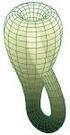 ON TORI TRIANGULATIONS ASSOCIATED WITH TWO-DIMENSIONAL CONTINUED FRACTIONS OF CUBIC IRRATIONALITIES. O. N. KARPENKOV Introduction. A series of properties for ordinary continued fractions possesses multidimensional
Metric Spaces. Chapter 7. 7.1. Metrics
 Chapter 7 Metric Spaces A metric space is a set X that has a notion of the distance d(x, y) between every pair of points x, y X. The purpose of this chapter is to introduce metric spaces and give some
COMBINATORIAL PROPERTIES OF THE HIGMAN-SIMS GRAPH. 1. Introduction
 COMBINATORIAL PROPERTIES OF THE HIGMAN-SIMS GRAPH ZACHARY ABEL 1. Introduction In this survey we discuss properties of the Higman-Sims graph, which has 100 vertices, 1100 edges, and is 22 regular. In fact