
Subject Proficiency Assessment. German Level 1
|
|
|
- Cecily Katherine Wilkins
- 9 years ago
- Views:
Transcription
1 Directorate for Quality and Standards in Education Curriculum Management Department Subject Proficiency Assessment German Level 1 1. Introduction 2. Units Unit 1.01 Begrüßungen und Vorstellungen Greeting the world and introducing oneself Unit 1.02 Die Familie The family Unit 1.03 Zu Hause My home Unit 1.04 In der Schule At school Unit 1.05 Essen und Trinken Food and drinks Unit 1.06 Einkaufen Shopping Unit 1.07 Meine Hobbies My Hobbys *Unit 1.08 Noch einmal Rewind and revise *These lessons may be conducted as a final Unit or spread out as required throughout the programme. 3. Grammar structures 4. Assessment and Certification 5. Self Evaluation sheets

2 1. Introduction 1. The programme consists of 8 units of 9 lessons each and 9 extra lessons which may be utilised at any other time during the programme for further tasks, activities or project work. 2. The aim of the programme is to help learners achieve a level 1 on the Malta Qualifications Framework in the four basic skills in language learning. 3. Learners will develop basic A1 competence to engage in effective and meaningful interaction in various social contexts. The teaching and learning environment is based on an approach to teaching and learning which fosters social interaction and learner autonomy for both in and out of class learning. 4. The aim of the programme is to help learners develop basic skills, language and attitudes required for language learning. 5. The programme develops learners communicative competence in the foreign language. It helps learners to develop the necessary skills to be able to listen to and interact with others and understand the general sense of a variety of basic oral and written messages. 6. One may define level 1 as a basic introduction to the German language and culture. The cultural and intercultural aspects of language learning form an integral part of the programme. These aspects are reflected in the approach to teaching and learning adopted within each lesson throughout the programme and integrated within the material and resources utilised for teaching and learning. 7. The programme focuses on the development of the receptive and productive skills. All four skills (listening, speaking, reading and writing) are introduced in an integrated approach to teaching and learning. This is reflected in the types of tasks, material and resources made available to learners during the course of the programme. 8. The programme is flexible and does not necessarily define the moment when a particular linguistic item is to be included in the teaching programme. The teacher discusses the aims and objectives of the programme with the students and negotiates ways of how to arrive at the desired learning outcomes.

3 9. The teacher is encouraged to work at an approach which encourages the learners to take charge of their learning programme. Teachers are to provide learners with the opportunity to work according to their needs, interests and motivation and to direct them to find their learning paths. 10. Learners are encouraged to work beyond the language lesson and to expose themselves to the target language and culture. Exposure to the language may be achieved in a variety of ways and through both formal and informal learning tasks.

4 2. Units Unit 1.01 Begrüßungen und Vorstellungen Greeting the world Points to note: Learners are introduced to the sound of German and German-speaking countries. Learners knowledge of German words, phrases or elements from the German speaking world are explored. Duration: 9 lessons of 40 minutes (6 hours) Learning Outcomes - express and understand basic greetings according to the time of the day - ask and say the name in German - ask, answer and understand questions on where one comes from and where one lives - identify, say and understand names of countries (limit to the most common ones) - identify, say and understand numbers from 1 to 20 - ask, answer and understand questions about one s age - orally present oneself briefly - recognize and spell correctly simple words in German - understand and use basic classroom instructions

5 Unit 1.02 Die Familie The family Points to note: Reference is made to the use of the indefinite articles and the formation of the negative kein / keine/ keinen. Duration: 9 lessons of 40 minutes (6 hours) Learning Outcomes - identify, use and understand vocabulary related to family members - identify, use and understand the numbers 20 to identify, use and understand basic adjectives to describe a person - identify, use and understand statements about age - ask, answer and understand questions on family members - describe the relation between different members of the family - identify, use and understand vocabulary related to domestic animals - briefly talk about a pet

6 Unit 1.03 Zuhause Points to note: Reference to discourse markers is made. This is emphasised throughout the programme (Naja / Also das Haus ist ganz klein). Duration: 9 lessons of 40 minutes (6 hours) Learning Outcomes - identify, use and understand vocabulary related to different types of homes - identify use and understand adjectives - identify, use and understand vocabulary related to rooms, furniture and areas in a house - Identify, use and understand vocabulary related to location (dort, hier, rechts, links, oben, unten) - briefly describe an area/ a room of a house (Es gibt ; Wir haben ; Oben haben wir ).

7 Unit 1.04 In der Schule At school Points to note: Consolidation of numbers from 20 to 100. Reference to time may be restricted to the 24 hour clock (e.g. Um dreizehn Uhr zwanzig). Learners may be introduced to the similarity between the time in English and in German (Quarter past / Viertel nach). Duration: 9 lessons of 40 minutes (6 hours) Learning Outcomes - identify, use and understand vocabulary related to the classroom / school environment - describe briefly the classroom/school (Es gibt ) - ask, answer and understand questions on school subjects - identify, say and understand the days of the week - ask, answer and understand questions on school subjects - can express one s preferences using short memorised phrases (Deutsch gefällt mir / nicht)

8 Unit 1.05 Essen und Trinken Food and drinks Duration: 9 lessons of 40 minutes (6 hours) Learning Outcomes - identify, use and understand vocabulary related to food and drink - ask, answer and understand questions about favourite food - use short phrases to express likes and dislikes (gern / nicht gern) - identify and understand vocabulary related to the main meals of the day - read single items/ short phrases from a menu at the restaurant - place/take an order at a restaurant (using simple phrases) - ask for the bill

9 Unit 1.06 Einkaufen Shopping Duration: 9 lessons of 40 minutes (6 hours) Learning Outcomes - identify, use and understand numbers from 20 to ask, answer and understand questions about price - identify, use and understand vocabulary related to types of shops - identify, use and understand vocabulary related to colours and adjectives - engage in a simple conversation in order to buy a particular item - identify, say and understand vocabulary related to time and opening and closing hours

10 Unit 1.07 Meine Hobbies My hobbies Duration: 18 lessons of 40 minutes (12 hours) Learning Outcomes - identify, use and understand vocabulary related to free time activities - ask, answer and understand questions about hobbies - identify, use and understand vocabulary related to adverbs of time - ask, answer and understand questions about the weather - can express preferences when talking about hobbies

11 Unit 1.08 Noch einmal Rewind and revise Points to note: Duration: 18 lessons of 40 minutes (12 hours) The following generic outcomes are a summary of what has been covered in the previous units and serve as a framework in preparation for the final assessment. Learning Outcomes - label pictures / describe pictures - select language and copy simple words and phrases / write short phrases in relation to themes - fill in a form / from information in a text (reading / listening) - take part in a short conversation - listen for specific information - open and close a simple conversation/dialogue (Hallo, auf Wiedersehen, bis bald, vielen Dank) - use and understand some of the most common discourse markers (also, naja etc)

12 3. Grammar structures LEVEL 1 Note: language skills which need to be focused upon (listening, reading, speaking, writing) are listed below following the grammatical notions. Phonetics and spelling - Use and recognize the alphabet (Speaking, Reading - Read words which contain letters and syllables that do not have direct phonetic correspondence: e.g. heiße, mein, Deutsch - Gain awareness of international words in the target language and others which contain similarities to the learners mother tongue / other languages learners are familiar with. Reading, Writing - Use of capital letters and use of commas in German (Nouns in German) (Writing) Vocabulary - Recognise and use numbers from Listening, Reading, Speaking - Identify, say and understand vocabulary related to the colours. Listening, Reading, Speaking - Identify, use and understand vocabulary related to the school environment and school subjects. Listening, Reading, Speaking, Writing - Identify, use and understand vocabulary related to the house and furniture. Listening, Reading, Speaking, Writing - Identify, use and understand vocabulary related to food and drink. Listening, Reading, Speaking, Writing - Identify, use and understand vocabulary related to the family. Listening, Reading, Speaking, Writing - Identify, use and understand vocabulary related to domestic animals. Listening, Reading, Speaking, Writing - Say and understand expressions used to present oneself, greet others and say goodbye. Listening, Reading, Speaking - Identify, say and understand vocabulary related to time (24 hour clock ) and opening and closing times. Listening, Reading, Speaking - Identify, say and understand the days of the week, the months and the seasons. Listening, Reading, Speaking - Identify, use and understand vocabulary related to shops. Listening, Reading, Speaking, Writing - Identify, use and understand vocabulary related to free time activities. Listening, Reading, Speaking, Writing

13 Nouns, adjectives and articles - Use most commonly used nouns and adjectives. Listening, Reading, Speaking - Use the singular and plural of nouns. Listening, Reading, Speaking, Writing - Use definite and indefinite articles. Listening, Reading, Speaking, Writing. - Use the possessive adjectives in the singular, masculine and feminine. (mein, dein, sein, ihr etc). Listening, Reading, Speaking, Writing. For writing, emphasis should be on the first, second and third person singular, masculine and feminine. Pronouns - Use the personal pronouns (ich, du, er, sie, es, wir, ihr, sie, Sie ). Listening, Reading, Speaking, Writing. Prepositions - identify and use prepositions (awareness of changes in articles is raised however learners are to learn prepositions in context and as phrases (In der Schule haben wir...; Im Modegeschäft kaufe ich...) Listening, Reading, Speaking, Writing. Verbs - Use and understand the infinitive. Listening, Reading, Speaking, Writing. - Identify, use and understand the present tense of the verbs haben and sein. Listening, Reading, Speaking, Writing. - Identify, use and understand the present tense of the irregular verbs (lesen, fahren...) Listening, Reading, Speaking. - Recognise and use the present tense of the regular verbs. Listening, Reading, Speaking.

14 Adverbs - Use adverbs of time and place (e.g. heute, morgen, jetzt, dann, hier, dort, in der Nähe, weit, rechts, links etc). Listening, Reading, Speaking. - Use affermative and negation adverbs and other adverbs that express doubt and/or possibility (e.g. ja, stimmt, nein, vielleicht etc.) Listening, Reading, Speaking. Interjections and discourse markers - Open and close a dialogue (e.g. Hallo; Wie geht s? Tschüs; bis bald). Listening, Reading, Speaking. - Make a request (e.g. bitte; Entschuldigen Sie ). Listening, Reading, Speaking. - Express gratitude (e.g. Vielen Dank! Bitte ). Listening, Reading, Speaking. - Show appreciation (e.g. sehr gut!; Interessant!). Listening, Reading, Speaking. - Use and understand some basic discourse markers (e.g. ja/nein; stimmt; genau). Listening, Reading, Speaking.

15 4. Content Unit 1.01 Begrüßungen und Vorstellungen Unit 1.02 Die Familie Unit 1.03 Zuhause Begrüßungen Hallo! / Guten Tag! / Grüß Gott Sich vorstellen ich bin / heiße; wie heißt du? Wie geht s? Danke, es geht; Gut, danke. Das ist Frau / Herr. Wie geht es Ihnen? / Freut mich Ist das Maria? Ja / nein, das ist...das ist nicht Maria. Doch, das ist Maria. Wo wohnst du? Woher kommst du? Ich komme aus Malta. Und das ist Paul...aus England. Ist Herr Konig da, bitte? Tut mir leid. Er ist nicht hier. Entschuldigen Sie, wie ist Ihr Name, bitte? Wie schreibt man das? Ich habe ein Haustier / Ich habe einen Hund. Der / die / das Familienmitglieder Das ist mein / meine ; sein /e ; ihr /e Sohn Ich habe eine / einen (Schwester, Bruder, Onkel...) Mein / Meine (Vater heißt Robert) ; Er / Sie... Hast du eine Schwester? Ja/ Nein Wie heißt deine Mutter? Wie alt ist er/ sie? S Mein Bruder ist sportlich/ groß. Er ist 14 Jahre alt. Mein Hund ist klein. Er ist schwarz. Das Haus / Die Wohnung Zimmer im Haus Wie ist das Haus? klein / modern /... dort, hier, rechts, links, oben, unten Kleinanzeigen: Häuser in der Stadt / im Dorf Wie viele Zimmer hat das Haus? Das Haus / Zimmer beschreiben (Adjektive und Farben)

16 Unit 1.04 In der Schule At school Unit 1.05 Essen und trinken Food and drinks Unit 1.06 Einkaufen Shopping Unit 1.07 Meine Hobbies My hobbies Die Schule Schüler und Lehrer Klassenzimmer, Lehrerzimmer... Es gibt 15 Stühle und Schreibtische. Wir haben... Schulfächer und Stundenplan Gefällt dir Deutsch? Mein Lieblingsfach ist... Wann hast du / lernst du Deutsch? Montag bis Freitag / Am Montag habe ich Deutsch. Die Mahlzeiten Frühstück, das Mittagessen, das Abendessen Was trinkst / isst du? Mein Lieblingsessen ist.. Das schmeckt ich esse gern / nicht gern Im Restaurant die Speisekarte / bestellen Was nimmst du? Ich nehme eine Pizza. Einen Tisch reservieren Zahlen Einkaufen gehen in die Stadt gehen Wo ist die Bäckerei? hier links / erste Straße rechts Die Geschäfte hier kauft man... Tage der Woche Öffnungszeiten Montag bis Freitag / ausser Freitag Im Modegeschäft kann ich Ihnen helfen? Kleider Ich möchte einen Pullover - Welche Farbe? Was kostet das? Hobbies: Was machst du gern? Wann spielst du Basketball? Wie oft / mit wem? Wann trainierst du? Was machst du heute / morgen? Am Freitag spiele ich Tennis. Ich schwimme einmal die Woche / zweimal / oft / selten Im Sommer gehe ich schwimmen / Spielst du gern Fussball? / Ich fahre gern rad. Steckbriefe : Name / Alter...

17 5. Assessment & Certification The Subject Proficiency Assessment programme has, as one of its specific aims, to establish the individual student s language ability and describe the learner s language skills. Its main aim is to provide a method of learning, teaching and assessing which applies to all languages. The programme offers a fully comprehensive assessment of the four basic skills or abilities in a language, namely speaking, listening, reading and writing. 1. The SPA has three levels in line with the Malta Qualifications Framework from Level 1 for the most basic user to Level 3 for the independent user. 2. Proficiency tests, unlike achievement tests, are intended to measure a learner s command of a language irrespective of his/her background in that language and therefore do not depend on particular class content or course materials. 3. There will be no traditional half-yearly exams but throughout the year students will be continuously assessed in class. 4. All students following the SPA programme at Form 3 (both at State and Non State schools) can take the SPA exams for Level 1 at the end of the scholastic year. 5. Students who obtain a pass mark in at least 2 of the 4 language skills will be promoted to the next Level of SPA, whereas those students who do not reach the grade at Form 3 will, at Form 4, continue to follow the Level 1 programme of studies. 6. There will be one national examination session per year at the end of the scholastic year and students will be required to register for SPA exams at their respective schools. 7. The productive skills (speaking and writing) and the receptive skills (reading and listening) will be assessed. 8. A certificate will be issued specifying the skills and marks obtained in each test 9. Prospective students are encouraged to consult the SPA Syllabus describing the competences in the individual language skills required for each level. The Syllabus describes the typical communicative situations and topics used in the tests and the knowledge of grammar structures expected. It also describes the criteria of evaluation.

18 Assessment for learning (AFL) - Assessment for learning uses continuous assessment methods to gauge a student's progress over a period of time in various language learning contexts. Evidence of specific skills and other items at one particular time and language performance and progress over time is collected in all four abilities (listening, speaking, reading and writing,) or in all three communication modes (interpersonal, interpretive, and presentational). Using a combination of testing instruments lends validity and reliability to the assessment process. - Assessment for learning promotes positive student involvement. Students are actively involved in and reflecting on their own learning. The student s self-confidence increases as well as the student's ability to assess and revise work. Student motivation to continue studying and succeeding in language learning tends to grow in such an environment. - Assessment for learning is incorporated fully into instruction: there is no time lost on assessment since every learning experience, activity, student s action is considered as evidence and therefore gives the opportunity to both teacher and learner to act upon it. The following can do statements are linked to the learning outcomes at Level 1 in all the 4 language skills: Listening Speaking Reading Writing follow speech which is very slow and produce simple mainly isolated understand very short, simple texts, a carefully articulated with long pauses for him/her to assimilate meaning. phrases about people and places. single phrase at a time, picking up familiar names, words and basic phrases and re-reading as required. understand instructions addressed carefully and slowly to him/her and follow short, simple directions. ask and answer simple questions, initiate and respond to simple statements in areas of immediate need or on very familiar topics. ask and answer questions about themselves and other people, where they live, people they know, things they have. ask and answer simple questions, initiate and respond to simple statements in areas of immediate need or on very familiar topics. manage very short, isolated, mainly pre-packaged utterances, with much pausing to search for expressions, to say less familiar words and to repair communication. get an idea of the content of simpler informational material and short simple descriptions, especially if there is visual support. write simple isolated phrases and sentences. copy out single words and short texts presented in standard printed format. write numbers and dates, own name, nationality, address, age, date of birth, such as on a hotel registration form. ask for or pass on personal details in written form.

19 Testing Each level consists of four tests that assess language competence in the four skills: listening, reading, writing and speaking. Each of the 4 skills will have a total score of 20. Continuous assessment will have a weighting of 5 marks per skill. Skill Continuous Assessment Final Assessment Total Pass mark Duration (minutes) Description of tasks Listening Speaking Reading Writing % 80% 100% 15/ tasks may include pictures and texts 15/ tasks may include short self presentation, describe picture, free conversation 15/ tasks may include 1 text and 1 picture 15/ tasks for a total of about 50 words

20 6. Self evaluation sheets At the end of each unit, the student is asked to fill in a short self-evaluation form. This should also serve as feedback for the teacher. = Yes, I can = I still have difficulties = No, I cannot UNIT 1.01: Begrüßungen und Vorstellungen Greeting the world and introducing oneself NAME: At the end of this unit, I can: CLASS: Student Teacher express and understand basic greetings according to the time of the day ask and say my name in German ask, answer and understand questions on where I live identify, say and understand numbers from 1 to 20 ask, answer and understand questions about my age orally present myself briefly recognize and spell correctly simple words in German understand and use basic classroom instructions

21 = Yes, I can = I still have difficulties = No, I cannot UNIT 1.02: Die Familie The family NAME: At the end of this unit, I can: CLASS: Student Teacher identify and understand vocabulary related to family members ask, answer and understand questions on family members describe the relation between different members of the family identify, use and understand vocabulary related to domestic animals briefly talk about a pet = Yes, I can = I still have difficulties = No, I cannot
22 UNIT 1.03: Zuhause My home NAME: At the end of this unit, I can: CLASS: Student Teacher identify, use and understand vocabulary related to different types of homes identify, use and understand vocabulary related to rooms in a house identify, use and understand vocabulary related to furniture in a house identify, use and understand vocabulary related to areas in a house briefly describe an area/a room of a house = Yes, I can = I still have difficulties = No, I cannot
23 UNIT 1.04: In der Schule At school NAME: At the end of this unit, I can: CLASS: Student Teacher Identify, use and understand vocabulary related to the classroom Identify, use and understand vocabulary related to the school environment Identify, use and understand vocabulary related to days of the week describe briefly the classroom/school ask, answer and understand questions about my subjects at school identify, use and understand vocabulary related to my school timetable = Yes, I can = I still have difficulties = No, I cannot
24 UNIT 1.05: Essen und Trinken Food and drinks NAME: At the end of this unit, I can: CLASS: Student Teacher Identify, use and understand vocabulary related to food and drink ask, answer and understand questions about favourite food use short phrases to express likes and dislikes identify, use and understand vocabulary related to the main meals of the day read single items/ short phrases from a menu at the restaurant place/take an order at a restaurant (using simple phrases) ask for the bill = Yes, I can = I still have difficulties = No, I cannot
25 UNIT 1.06: Einkaufen Shopping NAME: At the end of this unit, I can: CLASS: Student Teacher identify, use and understand cardinal numbers, in multiples of ten, from 20 to 100 ask, answer and understand questions about price identify, use and understand vocabulary related to types of shops engage in a simple conversation in order to buy a particular item identify, say and understand vocabulary related to time and opening and closing hours = Yes, I can = I still have difficulties = No, I cannot
26 UNIT 1.07: Meine Hobbies My hobbys NAME: At the end of this unit, I can: CLASS: Student Teacher identify, say and understand different kinds of hobbies identify, say and understand the months of the year identify, say and understand the four seasons Ask, answer and understand questions on the weather ask, answer and understand questions about my hobbies express my preferences using short memorised phrases = Yes, I can = I still have difficulties = No, I cannot
27 UNIT 1.08: Noch einmal! Rewind and revise NAME: At the end of this unit, I can: CLASS: Student Teacher copy single words or phrases label pictures write short phrases fill in a form take part in a short conversation listen with understanding for specific information describe pictures open and close a simple conversation/dialogue recognize and use punctuation marks recognize and use some of the most common discourse markers = Yes, I can = I still have difficulties = No, I cannot
28 NAME: At the end of level 1, I can: CLASS: Student Teacher LISTENING: Listen to and understand simple, basic statements and questions related to everyday topics. Listen to and understand simple, clearly articulated questions and information. SPEAKING: Answer questions and produce simple information on topics of immediate relevance. Connect simple phrases and sentences to describe pictures and to talk about personal and familiar topics. READING: Read and understand short and simple texts. Read and understand specific printed information. WRITING: Fill in forms by writing personal details as required. Perform simple tasks in writing.
Exemplar for Internal Achievement Standard. German Level 1
 Exemplar for Internal Achievement Standard German Level 1 This exemplar supports assessment against: Achievement Standard 90885 Interact using spoken German to communicate personal information, ideas and
Year 7 outline GERMAN following Echo 1 All beginner groups
 Year 7 outline GERMAN following Echo 1 All beginner groups Autumn Term 1 Topic Hallo Sub topics Wie heißt du? Introduce yourself, Echo 1 p6, 7. Hallo! 3 lessons: greeting people, saying listening booklet
GERMAN DIE SCHULE UND DIE KULTUR HOME LEARNING YEAR 7
 GERMAN DIE SCHULE UND DIE KULTUR HOME LEARNING YEAR 7 Name Tutor Group German Teacher Given out: Monday 4 January Hand in: Monday 11 January Parent/Carer Comment: Staff Comment: Target: This homework booklet
Coffee Break German. Lesson 09. Study Notes. Coffee Break German: Lesson 09 - Notes page 1 of 17
 Coffee Break German Lesson 09 Study Notes Coffee Break German: Lesson 09 - Notes page 1 of 17 LESSON NOTES ICH SPRECHE EIN BISSCHEN DEUTSCH In this lesson you will learn how to deal with language problems
Coffee Break German Lesson 06
 LESSON NOTES WIE VIEL KOSTET DAS? In this episode of Coffee Break German we ll start by learning the numbers from zero to ten and then learn to deal with transactional situations involving paying for things
Blended Learning for institutions
 Hueber German for levels A1 and A2 Schritte international Experience success. Blended Learning for institutions Schritte international + DUO Face-to-face course with the successful Schritte international
AP WORLD LANGUAGE AND CULTURE EXAMS 2012 SCORING GUIDELINES
 AP WORLD LANGUAGE AND CULTURE EXAMS 2012 SCORING GUIDELINES Interpersonal Writing: E-mail Reply 5: STRONG performance in Interpersonal Writing Maintains the exchange with a response that is clearly appropriate
The Tasmanian Curriculum
 The Tasmanian Curriculum Languages (LOTE) curriculum area German K 10 syllabus and support materials Department of Education 1 Department of Education, Tasmania 2008 Contents Overview Supported languages...
FOR TEACHERS ONLY The University of the State of New York
 FOR TEACHERS ONLY The University of the State of New York REGENTS HIGH SCHOOL EXAMINATION G COMPREHENSIVE EXAMINATION IN GERMAN Friday, June 15, 2007 1:15 to 4:15 p.m., only SCORING KEY Updated information
Exemplar for Internal Assessment Resource German Level 1. Resource title: Planning a School Exchange
 Exemplar for internal assessment resource German 1.5A for Achievement Standard 90887! Exemplar for Internal Assessment Resource German Level 1 Resource title: Planning a School Exchange This exemplar supports
Year 7. Home Learning Booklet. French and German Skills
 Year 7 Home Learning Booklet French and German Skills Name: Tutor Group: Teacher: Given out: 1 st July Hand in: 8 th July Parent/Carer Comment: Staff Comment: Target: This homework booklet practises some
German Language Resource Packet
 German has three features of word order than do not exist in English: 1. The main verb must be the second element in the independent clause. This often requires an inversion of subject and verb. For example:
FOR TEACHERS ONLY The University of the State of New York
 FOR TEACHERS ONLY The University of the State of New York REGENTS HIGH SCHOOL EXAMINATION G COMPREHENSIVE EXAMINATION IN GERMAN Friday, June 17, 2005 1:15 to 4:15 p.m., only SCORING KEY Updated information
AP GERMAN LANGUAGE AND CULTURE EXAM 2015 SCORING GUIDELINES
 AP GERMAN LANGUAGE AND CULTURE EXAM 2015 SCORING GUIDELINES Identical to Scoring Guidelines used for French, Italian, and Spanish Language and Culture Exams Interpersonal Writing: E-mail Reply 5: STRONG
Coffee Break German. Lesson 03. Study Notes. Coffee Break German: Lesson 03 - Notes page 1 of 15
 Coffee Break German Lesson 03 Study Notes Coffee Break German: Lesson 03 - Notes page 1 of 15 LESSON NOTES ICH KOMME AUS DEUTSCHLAND. UND SIE? In this lesson of Coffee Break German we will learn to talk
German Beginners. Stage 6 Syllabus. Preliminary and HSC Courses
 German Beginners Stage 6 Syllabus Preliminary and HSC Courses Original published version updated: June 2009 Assessment and Reporting information updated 2009 Copyright Board of Studies NSW for and on behalf
0525 GERMAN (FOREIGN LANGUAGE)
 CAMBRIDGE INTERNATIONAL EXAMINATIONS International General Certificate of Secondary Education MARK SCHEME for the May/June 2014 series 0525 GERMAN (FOREIGN LANGUAGE) 0525/21 Paper 2 (Reading and Directed
GM0101S HEADSTART STUDENT GUIDE PREPARED IY THE DEFENSE LANGUAGE INSTITUTE FOREIGN LANGUAGE CENTER
 GM0101S HEADSTART PREPARED IY THE DEFENSE LANGUAGE INSTITUTE FOREIGN LANGUAGE CENTER GERMAN PROGRAM Prepared by DEFENSE LANGUAGE INSTITUTE FOREIGN LANGUAGE CENTER SEPTEMBER 1977 CONTENTS Course Description
FOR TEACHERS ONLY SECOND LANGUAGE PROFICIENCY EXAMINATION GERMAN. Monday, June 18, 2001 9:15 a.m. SCORING KEY
 FOR TEACHERS ONLY SECOND LANGUAGE PROFICIENCY EXAMINATION GERMAN Monday, June 18, 2001 9:15 a.m. SCORING KEY Mechanics of Rating Use only red ink or red pencil in rating proficiency examination papers.
Student Booklet. Name.. Form..
 Student Booklet Name.. Form.. 2012 Contents Page Introduction 3 Teaching Staff 3 Expectations 3 Speaking German 3 Organisation 3 Self Study 4 Course Details and Contents 5/6 Bridging the gap and quiz 7/8
German Language Support Package
 German Language Support Package August 2014 Dear Parents and Students of Goethe International Charter School, Welcome to a new and exciting school year of great learning experiences and success! The key
German Language Support Package
 German Language Support Package September 2014 Dear Parents and Students of Goethe International Charter School, Welcome to a new and exciting school year of great learning experiences and success! The
ENGLISH FILE Elementary
 Karen Ludlow New ENGLISH FILE Elementary and the Common European Framework of Reference 2 INTRODUCTION What is this booklet for? The aim of this booklet is to give a clear and simple introduction to the
Wie ist das Wetter? (What s the weather like?)
 Prior Knowledge: It is helpful if children already know some dates, weather phrases and items of clothing Objectives Present ideas and information orally to a range of audiences. Describe people, places,
Name: Klasse: Datum: A. Was wissen Sie schon? What do you know already from studying Kapitel 1 in Vorsprung? True or false?
 KAPITEL 1 Jetzt geht s los! Vor dem Anschauen A. Was wissen Sie schon? What do you know already from studying Kapitel 1 in Vorsprung? True or false? 1. Man sagt Hallo in Deutschland. 2. Junge Personen
LEJ Langenscheidt Berlin München Wien Zürich New York
 Langenscheidt Deutsch in 30 Tagen German in 30 days Von Angelika G. Beck LEJ Langenscheidt Berlin München Wien Zürich New York I Contents Introduction Spelling and pronunciation Lesson 1 Im Flugzeug On
Gerlang 1 Spring 2014 Tentativer Kursplan
 Gerlang 1 Spring 2014 Tentativer Kursplan (NK = text: Deutsch: Na Klar) WEEK ONE THEME: Einführung Objectives for Week One meet, great and introduce myself express politeness, gratitude express lack of
French Curriculum Grades 4-8
 French Curriculum Grades 4-8 French Grade Four: 1. Students will be introduced, recognize, and recite the French alphabet. 2. Students will recognize, recite and respond to simple French greetings. 3.
DAYTON CHRISTIAN SCHOOL SYSTEM PROPOSED 4/06 COURSE OUTLINE APPROVED:CURR DIR 8/06 GERMAN 2 AD TEAM 8/31/06 SUPERINTENDENT 8/31/06
 DAYTON CHRISTIAN SCHOOL SYSTEM PROPOSED 4/06 COURSE OUTLINE APPROVED:CURR DIR 8/06 GERMAN 2 AD TEAM 8/31/06 SUPERINTENDENT 8/31/06 COURSE CONTENT TIME FRAME: Unit 1 Review Unit 2 Bayern Bei den Baumanns
Lernen mit dem Power-Sprachkurs
 Introduction Welcome to your German course! This course is designed to motivate you to learn German not only fast, but also in an entertaining way in particular in the areas of everyday German and language
MUSTER. ENGLISH G 21/D3 Test No. 1 Unit 1: My London. 1 LISTENING The London Eye. G - Level: Listen to three texts and tick the correct box.
 Name: Date: 1 LISTENING The London Eye G - Level: Listen to three texts and tick the correct box. Right Wrong 1 can buy tickets for the London Eye at the ticket office. 2 The ticket office opens at 10.00
Johns Hopkins University 210.161.13 - German Elements I Intersession 2015 MTWTHFR: 1:00 3:30, ROOM TBA
 German 210.161, Syllabus Intersession 2014!1 Johns Hopkins University 210.161.13 - German Elements I Intersession 2015 MTWTHFR: 1:00 3:30, ROOM TBA Christiane Ketteler; [email protected] http://blackboard.jhu.edu
GESE Initial steps. Guide for teachers, Grades 1 3. GESE Grade 1 Introduction
 GESE Initial steps Guide for teachers, Grades 1 3 GESE Grade 1 Introduction cover photos: left and right Martin Dalton, middle Speak! Learning Centre Contents Contents What is Trinity College London?...3
Modalverben Theorie. learning target. rules. Aim of this section is to learn how to use modal verbs.
 learning target Aim of this section is to learn how to use modal verbs. German Ich muss nach Hause gehen. Er sollte das Buch lesen. Wir können das Visum bekommen. English I must go home. He should read
F+H GCSE GERMAN 8668/SF+SH. Paper 2 Speaking (Foundation and Higher) Specimen 2018 SPECIMEN MATERIAL
 SPECIMEN MATERIAL GCSE GERMAN Paper 2 Speaking (Foundation and Higher) F+H Specimen 2018 Teacher s Booklet To be conducted by the teacher-examiner Time allowed: 7-9 minutes at Foundation (+12 minutes supervised
The University of Toronto. Fall 2009/German 100 Y
 The University of Toronto Fall 2009/German 100 Y Texts: Deutsch Na Klar!, (5th. edition) Di Donato, Clyde and Vansant. McGraw-Hill College One notebook GER 100 Course Coordinator: Mike Hager, 324 Odette
GRAMMAR STRUCTURES STRATEGIES ACTIVITIES MATERIAL EVALUATION
 AGRUPAMENTO DE ESCOLAS DR. VIEIRA DE CARVALHO ESCOLA BÁSICA E SECUNDÁRIA DR. VIEIRA DE CARVALHO DEPARTAMENTO DE LÍNGUAS PLANIFICAÇÃO ANUAL DE INGLÊS 7º ANO 1º PERÍODO ANO LECTIVO 2015-2016 NO. OF LESSONS:
Materials: Children s literature written in Spanish, videos, games, and pictures comprise the list of materials.
 Pre-Kindergarten The primary focus of the Spanish program in Pre-Kindergarten is the exposure to a foreign language. Since students are introduced to a language and culture that may not be familiar, an
Livingston Public Schools Scope and Sequence K 6 Grammar and Mechanics
 Grade and Unit Timeframe Grammar Mechanics K Unit 1 6 weeks Oral grammar naming words K Unit 2 6 weeks Oral grammar Capitalization of a Name action words K Unit 3 6 weeks Oral grammar sentences Sentence
Scheme of Work: German - Form 3 2015/16
 Scheme of Work: German - Form 3 2015/16 Textbook: Schritte International 2 and 3 Four per week 1 st Term Dates Aims and Objectives No. of Lessons 28 th Sept - 12 th Oct Unit 12: Der Kunde ist König (cont.)
German II. Grades 9-12 CURRICULUM
 German II Grades 9-12 CURRICULUM PITTSGROVE TOWNSHIP SCHOOLS ARTHUR P. SCHALICK HS PITTSGROVE TOWNSHIP PUBLIC SCHOOLS PITTSGROVE, NJ REVISED JUNE 2012 BOARD OF EDUCATION Melissa Conover, President Cheryl
Scheme of Work: German - Form 3
 Scheme of Work: German - Form 3 Textbook: Schritte International 2 and 3 1 st Term Dates Aims and Objectives No. of 26 th Sep 5 th Nov Unit 13: Neue Kleider Vocabulary: Learning vocabulary regarding clothes
Spanish Curriculum Grades 4-8
 Spanish Curriculum Grades 4-8 Spanish Grade Four 1. Students will be introduced, recognize, and recite the Spanish Alphabet. 2. Students will recognize, recite and respond to simple Spanish greetings.
Course Outline and Syllabus Instructor: e-mail address: Phone: Staff Assistant A blue folder Office Hours: Text Materials PF 3640.C64, 1999.
 1 German 2, Section 001 Fall 2010 Penn State Altoona Course Outline and Syllabus 143 Hawthorn, Monday and Wednesday 10:00 AM 10:50 AM 143 Hawthorn, Friday 10:00 AM 11:50 AM Instructor: Dr. Ilse-Rose Warg
Portuguese as Foreign Language Level A.1
 Portuguese as Foreign Language Level A.1 SYLLABUS NON-DEGREE GRANTING 1. CURRICULAR UNIT Portuguese as Foreign Language Level A.1 2. MAIN SCIENTIFIC AREA, according to Portaria nº 256/2005, of March 16
GMAT.cz www.gmat.cz [email protected]. GMAT.cz KET (Key English Test) Preparating Course Syllabus
 Lesson Overview of Lesson Plan Numbers 1&2 Introduction to Cambridge KET Handing Over of GMAT.cz KET General Preparation Package Introduce Methodology for Vocabulary Log Introduce Methodology for Grammar
Phrase Book. English-German
 Phrase Book English-German Contents 1. German alphabet...3 2. Facts about German language... 3 3. Wonderful world of German grammar... 4 3.1. German sentence structures...4 3.2. The four cases in German....
QCF Qualifications in Languages. German. Level 1
 QCF Qualifications in Languages German For teaching from September 2012 SPOKEN GERMAN: Communicating Personal Information Assessment Criteria 1.1 and 1.2 Task: Meeting New People CC- BY-SA 2007 Miraceti
Big Walnut High School: German II
 Big Walnut High School: German II ACTFL/LinguaFolio Proficiency Guidelines for Level II: (Novice High-Intermediate Low) Ohio s New Learning Standards for World Languages Interpretive Communication 1. Derive
Wortschatzliste 5-1. Students will be able to identify typical foods of Germany. Students will be able to explain which foods they like and dislike.
 Wortschatzliste 5-1 Objective: Students will be able to identify typical foods of Germany. Students will be able to explain which foods they like and dislike. das Obst der Apfel die Trauben die Orange
Learn German. WITH Paul Noble. Review booklet
 This booklet provides you with a quick and easy way to review and reinforce what you have learned during your audio course. The booklet should be used after you have begun working through the CDs as it
stress, intonation and pauses and pronounce English sounds correctly. (b) To speak accurately to the listener(s) about one s thoughts and feelings,
 Section 9 Foreign Languages I. OVERALL OBJECTIVE To develop students basic communication abilities such as listening, speaking, reading and writing, deepening their understanding of language and culture
Bexley City School World Language Program Overview
 Bexley City School World Language Program Overview Communication express needs, feelings, and opinions. provide and obtain information. understand spoken and written language. function in authentic situations.
Intensive Language Study: Beginning Modern Standard Arabic ARAB 1000-1500 (6 credits, 90 class hours)
 Intensive Language Study: Beginning Modern Standard Arabic ARAB 1000-1500 (6 credits, 90 class hours) SIT Study Abroad Program: Jordan: Modernization and Social Change PLEASE NOTE: This syllabus represents
GCE EXAMINERS' REPORTS
 GCE EXAMINERS' REPORTS GERMAN AS/Advanced JANUARY 2014 Grade boundary information for this subject is available on the WJEC public website at: https://www.wjecservices.co.uk/marktoums/default.aspx?l=en
Vocabulary Reflection Statement
 Vocabulary Reflection Statement Vocabulary is often neglected in the classroom. We as language teachers assume that our students will learn the vocabulary at home. We have to stress the importance of vocabulary
German/Print version. German. Main Contents. Introduction. A Textbook on Five Levels. The German Language
 1 z 169 2007-02-18 14:16 German/Print version From Wikibooks, the open-content textbooks collection German Main Contents Introduction Lessons Level one lessons (Introductory lessons / einführende Lektionen)
Übung Unit 1 9, You and Me
 You and Me Unit 1 9 1 Übung Unit 1 9, You and Me Write the numbers and plurals strawberry (14) fourteen strawberries class (50) fifty classes toe (10) ten toes boy (12) twelve boys foot ( 11) eleven feet
Resources: Encore Tricolore 1 (set textbook), Linguascope, Boardworks, languagesonline, differentiated resources devised by MFL staff.
 CURRICULUM PLAN MODERN FOREIGN LANGUAGES YEAR 7 FRENCH Resources: Encore Tricolore 1 (set textbook), Linguascope, Boardworks, languagesonline, differentiated resources devised by MFL staff. TERM ONE Introductory
Satzstellung. Satzstellung Theorie. learning target. rules
 Satzstellung learning target Aim of this topic is to explain how to arrange the different parts of a sentence in the correct order. I must admit it took quite a long time to handle this topic and find
Spanish First Grade. S. I. Communication. S. II. Knowledge of Other Cultures. S. I. A. Vocabulary. S. I. B. Grammar
 Spanish First Grade 1. listen to and recite the alphabet 2. listen to and recite the days of the week 3. listen to and recite the months of the year 4. create My Spanish Book (cover) 5. listen to and recite
German for beginners in 7 lessons
 Olena Shypilova German for beginners in 7 lessons Study course 2012 German for beginners in 7 Lessons Thank you for choosing and joining our on-line German course. The course consists of 7 lessons. Due
Get Ready for IELTS Writing. About Get Ready for IELTS Writing. Part 1: Language development. Part 2: Skills development. Part 3: Exam practice
 About Collins Get Ready for IELTS series has been designed to help learners at a pre-intermediate level (equivalent to band 3 or 4) to acquire the skills they need to achieve a higher score. It is easy
Albert Pye and Ravensmere Schools Grammar Curriculum
 Albert Pye and Ravensmere Schools Grammar Curriculum Introduction The aim of our schools own grammar curriculum is to ensure that all relevant grammar content is introduced within the primary years in
All the English here is taken from students work, both written and spoken. Can you spot the errors and correct them?
 Grammar Tasks This is a set of tasks for use in the Basic Grammar Class. Although they only really make sense when used with the other materials from the course, you can use them as a quick test as the
PROFICIENCY TARGET FOR END OF INSTRUCTION, SPANISH I
 PROFICIENCY TARGET FOR END OF INSTRUCTION, SPANISH I NOVICE-MID Writers at the Novice-Mid level are able to copy or transcribe familiar words or phrases, and reproduce from memory a modest number of isolated
For those of you keen to have a written version on the podcast, here is the script below:
 German Language Guide Script For those of you keen to have a written version on the podcast, here is the script below: Anna: Vorsicht! Scott: Oh sorry! Do you speak English it s kinda squashed in here,
ENGLISH FILE Pre-intermediate
 Karen Ludlow New ENGLISH FILE Pre-intermediate and the Common European Framework of Reference 2 INTRODUCTION What is this booklet for? The aim of this booklet is to give a clear and simple introduction
The finite verb and the clause: IP
 Introduction to General Linguistics WS12/13 page 1 Syntax 6 The finite verb and the clause: Course teacher: Sam Featherston Important things you will learn in this section: The head of the clause The positions
Deutsch 1020 Alexander
 Deutsch 1020 Anna Alexander Büro: OLD MAIN 341 Sprechstunden: Dienstag und Donnerstag von 16.00 bis 17.00 Uhr und Termine nach Vereinbarung Email: [email protected] Required Texts: Vorsprung,
Exam Information: Graded Examinations in Spoken English (GESE)
 Exam Information: Graded Examinations in Spoken English (GESE) Specifications Guide for Teachers Regulations These qualifications in English for speakers of other languages are mapped to Levels A1 to C2
Formeller Brief Schreiben
 preliminary note Every letter is something special and unique. It's difficult to give strict rules how to write a letter. Nevertheless, there are guidelines how to start and finish a letter. Like in English
Search Engines Chapter 2 Architecture. 14.4.2011 Felix Naumann
 Search Engines Chapter 2 Architecture 14.4.2011 Felix Naumann Overview 2 Basic Building Blocks Indexing Text Acquisition Text Transformation Index Creation Querying User Interaction Ranking Evaluation
Granite Oaks Middle School
 Granite Oaks Middle School Señorita Moss Foreign Language Department Room: B5 Office Hours: by appointment; before & after school (916) 315-9009 Ext. 3205 [email protected] Welcome to Granite Oaks
CONTENT / ACTIVITY CAN DO PAGE LEVEL GRAMMAR
 Speakout Starter Speakout CEF ALTE UCLES IELTS TOEIC TOEFL ibt PTE Starter - - 0-245 9-18 Elementary /A2 1 KET 3.0 246-500 19-29 1 Pre-intermediate A2/B1 2 PET 4.0 500-650 30-52 2 Intermediate B1+/B2 3
Thai Language Self Assessment
 The following are can do statements in four skills: Listening, Speaking, Reading and Writing. Put a in front of each description that applies to your current Thai proficiency (.i.e. what you can do with
NEW YORK UNIVERSITY IN GHANA ASANTE TWI WEEKLY SYLLABUS FOR STUDENTS 2011/2012 ACADEMIC YEAR ( JANUARY MAY 2012) (A 4 CREDIT- INTENSIVE COURSE)
 NEW YORK UNIVERSITY IN GHANA ASANTE TWI WEEKLY SYLLABUS FOR STUDENTS 2011/2012 ACADEMIC YEAR ( JANUARY MAY 2012) (A 4 CREDIT- INTENSIVE COURSE) TITLE OF COURSE: LANGUAGE PROFICIENCY COURSE (ASANTE TWI)
Linked sounds Listening for spelling of names and phone numbers. Writing a list of names and phone numbers Work book pg 1-6
 TOPICS: Alphabet; greetings, names and titles of address; numbers and phone numbers PG 2-7 introduce themselves friends, say hello goodbye; ask for names and phone numbers Possessive adjectives my, your,
Lernsituation 9. Giving information on the phone. 62 Lernsituation 9 Giving information on the phone
 Fachkunde 1, Lernfeld 2, Useful Office Vocabulary Lernsituation 9 Giving information on the phone Rolf astian, Managing Director of E Partners KG, recently visited the Promo World Fair in Düsseldorf, an
Ohio Early Learning and Development Standards Domain: Language and Literacy Development
 Ohio Early Learning and Development Standards Domain: Language and Literacy Development Strand: Listening and Speaking Topic: Receptive Language and Comprehension Infants Young Toddlers (Birth - 8 months)
Elementary (A1) Group Course
 COURSE DETAILS Elementary (A1) Group Course 45 hours Two 90-minute lessons per week Study Centre/homework 2 hours per week (recommended minimum) A1(Elementary) min 6 max 8 people Price per person 650,00
Curso académico 2015/2016 INFORMACIÓN GENERAL ESTRUCTURA Y CONTENIDOS HABILIDADES: INGLÉS
 Curso académico 2015/2016 INFORMACIÓN GENERAL ESTRUCTURA Y CONTENIDOS HABILIDADES: INGLÉS Objetivos de Habilidades: inglés El objetivo de la prueba es comprobar que el alumno ha adquirido un nivel B1 (dentro
Our Lady of Lourdes Catholic Nursery & Primary School. Modern Foreign Language Policy
 Our Lady of Lourdes Catholic Nursery & Primary School Modern Foreign Language Policy September 2014 Review Date: September 2016 INTRODUCTION This subject policy is one in a series that makes up the Whole
6 th Grade Spanish Curriculum
 6 th Grade Spanish Curriculum Mendham Township Middle School Unit 1 Bienvenidos al Español! Summary: In Unit 1 the students will review greetings and farewells, days of the week, months of the year, weather,
GCE German (2660) Candidate Exemplar Work: Additional Candidate Exemplar Work Unit 1 (Autumn 2008)
 hij Teacher Resource Bank GCE German (2660) Candidate Exemplar Work: Additional Candidate Exemplar Work Unit 1 (Autumn 2008) The Assessment and Qualifications Alliance (AQA) is a company limited by guarantee
COURSE OBJECTIVES SPAN 100/101 ELEMENTARY SPANISH LISTENING. SPEAKING/FUNCTIONAl KNOWLEDGE
 SPAN 100/101 ELEMENTARY SPANISH COURSE OBJECTIVES This Spanish course pays equal attention to developing all four language skills (listening, speaking, reading, and writing), with a special emphasis on
How To Pass A Cesf
 Graded Examinations in Spoken English (GESE) Syllabus from 1 February 2010 These qualifications in English for speakers of other languages are mapped to Levels A1 to C2 in the Common European Framework
Student Achievement in Asian Languages Education. Part 2: Descriptions of Student Achievement
 Student Achievement in Asian Languages Education Part 2: Descriptions of Student Achievement This report is in four volumes: Part 1: Project Report Part 2: Descriptions of Student Achievement Part 3: Appendices
EAST PENNSBORO AREA COURSE: LFS 430 SCHOOL DISTRICT
 Unit: Introduction Days: 5 days Key Learning(s): Classroom commands, colors, numbers, alphabet, cognates TPR Unit Essential Question(s): How do I begin to speak Classroom Commands Colors Numbers How do
Cambridge Primary English as a Second Language Curriculum Framework
 Cambridge Primary English as a Second Language Curriculum Framework Contents Introduction Stage 1...2 Stage 2...5 Stage 3...8 Stage 4... 11 Stage 5...14 Stage 6... 17 Welcome to the Cambridge Primary English
1003 Inhaltsverzeichnis
 1003 Einführung - Freizeit und Hobbys Springen wir ins Thema 2 How do people spend their freetime? What sorts of hobbies and activities do you enjoy? 1 Vokabelkasten 4 Introduction to the Vokabelkasten
A Guide to Cambridge English: Preliminary
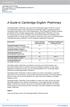 Cambridge English: Preliminary, also known as the Preliminary English Test (PET), is part of a comprehensive range of exams developed by Cambridge English Language Assessment. Cambridge English exams have
Hände weg von Mississippi - Hands off Mississippi
 Hände weg von Mississippi - Hands off Mississippi Germany 2006/7, Director: Detlev Buck, 98 minutes, German with English subtitles WHAT IS THE FILM ABOUT? The film is set in and around Schalsee, a nature
SPANISH Kindergarten
 SPANISH Kindergarten Use Junior SYMTALK workbook Recognize 80+ Vocabulary words Recognize basic greetings and courtesies. Identify colors and numbers 1-10 Develop reading skills using pictures to identify
English Appendix 2: Vocabulary, grammar and punctuation
 English Appendix 2: Vocabulary, grammar and punctuation The grammar of our first language is learnt naturally and implicitly through interactions with other speakers and from reading. Explicit knowledge
Elena Chiocchetti & Natascia Ralli (EURAC) Tanja Wissik & Vesna Lušicky (University of Vienna)
 Elena Chiocchetti & Natascia Ralli (EURAC) Tanja Wissik & Vesna Lušicky (University of Vienna) VII Conference on Legal Translation, Court Interpreting and Comparative Legilinguistics Poznań, 28-30.06.2013
CEFR Level A1 Level A1 Global Listening Reading Spoken Interaction Spoken Production Writing
 CEFR Level A1 Level A1 is the lowest level of generative language use - the point at which the learner can interact in a simple way, ask and answer simple questions about themselves, where they live, people