
German/Print version. German. Main Contents. Introduction. A Textbook on Five Levels. The German Language
|
|
|
- Rosamund Summers
- 10 years ago
- Views:
Transcription
1 1 z :16 German/Print version From Wikibooks, the open-content textbooks collection German Main Contents Introduction Lessons Level one lessons (Introductory lessons / einführende Lektionen) Level two lessons (Grundlegende Lektionen) Level three lessons (Zwischen-Lektionen) Level four lessons (Erweiterte Lektionen) Level five lessons (Review lessons / Überprüfungs-Lektionen) Grammar Appendices (Anhänge) Contributors GFDL Introduction A Textbook on Five Levels The question arose early in the development of this textbook as to precisely who would be the target audience. Although intended to be a "beginning" textbook on German, many felt that the early lessons were too difficult for younger students with very limited or no experience with German and, perhaps more importantly, limited skills in English grammar. For this reason a textbook on three levels was conceived. Beginning German (Level I) puts more emphasis on building vocabulary around subject matter interesting and useful to young students. Basic German (Level II) emphasises grammar, and assumes a greater knowledge of English grammar more typical of an older high school or a college student. If you are just beginning to learn German or attempting to teach yourself, you may wish to try both approaches and see which works better for you, since some people require a strong structural approach to learning a new language while others find this "structure" only impedes progress by adding another layer of complexity. Intermediate German (Level III), which requires even more knowledge of English, is for college students, preferably for sophomores or juniors. With even more complex lessons, grammar and vocabulary comes Advanced German (Level IV), which with the most complex and difficult parts of the German language, is for late college students (Seniors) and college graduates. The last level, which is a review level, but also has cultural facts and the history of the German language, is Reviewed German. (Level V). An existing, separate text, German/Grammar, may eventually be merged into the lesson modules or developed into useful appendices as a grammar reference. At present, however, German Grammar is an expanding, significant contribution to the textbook; it provides an important reference on German language grammar rules useful to the student working through any of the three levels. The German Language

2 2 z :16 German (Deutsch) is a member of the western group of the Germanic languages. It is spoken primarily in Germany, Austria, the major part of Switzerland, Liechtenstein, Luxembourg, the Südtirol (South Tyrol) region of Italy, the Opole Voivodship of Poland, parts of Belgium, parts of Romania, the Alsace (Elsass) region of France and parts of Denmark. Additionally, several former colonial possessions of these countries, such as Namibia in Africa, have sizable German-speaking populations. There are German-speaking minorities in several eastern European countries including Russia, and in the United States as well as countries in South America like Brazil and Argentina. Over 120 million people speak German as their native language. German is the third most popular foreign language taught worldwide, and the second most popular in Europe. Continue reading about the German language. German and English If you are an English speaker unfamiliar with German, you may be surprised to learn that English and German are closely related languages and share many words that are very similar. Such words are called cognates. This is particularly true for everyday words in English that are Anglo-Saxon (that is, Germanic) in origin. Consider the following list of English words followed by their German counterparts: arm ~ der Arm book ~ das Buch cat ~ die Katze father ~ der Vater finger ~ der Finger wagon ~ der Wagen house ~ das Haus hand ~ die Hand June ~ der Juni man ~ der Mann mother ~ die Mutter mouse ~ die Maus name ~ der Name son ~ der Sohn garden ~ der Garten lamp ~ die Lampe bush ~ der Busch baker ~ der Bäcker net ~ das Netz storm ~ der Sturm hat ~ der Hut fire ~ das Feuer grass ~ das Gras fish ~ der Fisch kindergarten ~ der Kindergarten Audio: OGG (308KB) ~ Hear these words Of course, even words whose spelling is no different in English and German may be pronounced quite differently. But in reading German, you will see the connections between these languages, even in many of the "small" words (the above examples are all nouns). For example: This week, my father is with my brother in the city Diese Woche ist mein Vater mit meinem Bruder in der Stadt. Audio: OGG (87KB) ~ Hear these sentences

3 3 z :16 Note also the general similarity of sentence structure with English. The only real difference in the German is that the verb is moved forward in the sentence. However, there are many German sentences in which a verb form is the last word in the sentence. Unfortunately, while German is perhaps the easiest "foreign" language for an English speaker to learn, meanings of words that are spelled similarly are not always identical. These "false friends" can be confusing for the beginner. Further, German is a more structured language than English, with a more complex grammar, and it will become apparent as you learn German that you will also learn more about English language structure than you might ever recall from your high school English classes. For a quick listing of similarities and differences between English and German, read the Introduction to Level I. Vocabulary and Grammar In learning to read or speak any language with which you have minimal acquaintance (that is, are not a native speaker of), the two aspects to be mastered are vocabulary and grammar. Acquiring vocabulary is a "simple" matter of memorization. For the language(s) we learn as children, this process is so transparent that we have trouble conceiving of the importance of having a large vocabulary. By the age of conscious recognition of our communicating with others through speech, we have already learned the meaning of thousands of words. Even words we have trouble defining, we readily understand their use in conversation. This process can be "reactivated," as it were, by immersion in a second language: a method of learning a new language by moving to a place where that language is spoken and having to get around and live without use of one's native tongue. The student of German language, if not residing in a German-speaking environment, must put forth substantial effort to learning words, including their meaning, their pronunciation and their usage in common sentences. Be sure to "learn" commit to memory all of the vocabulary words in each lesson as they are presented. Early lessons have simple sentences because it is assumed that the student's vocabulary is limited. But throughout the text, more complex discourses (often as photo captions) are included to introduce the student to regular German in use. It may be helpful to translate these using a German-English dictionary (access to one is a must; see Appendix 5 for on-line options). Other sources of German, such as newspapers, magazines, web sites, etc., can also be useful in building vocabulary and developing a sense of how German words are put together. The German Wikipedia ( provides an ever expanding source of German language articles that can be used for this purpose. Further, a German version of the Wikibooks project a library of textbooks in German is available at German Wikibooks ( German grammar is more complex than, but sufficiently similar to, English that "reading" German is possible with minimal vocabulary in the sense that the student should generally recognize the parts of a sentence. With a good dictionary or an online translator, an English speaker can usually translate a German sentence close to correctly. However, to accurately speak and understand German, you must learn how each word functions in a sentence. There are eight basic grammatical functions: case, gender, number, tense, person, mood, voice, and comparison. How words "signal" these functions is an important aspect of learning a new language. English speakers should know all of these functions and the signals used in English, but it is often the situation that you know perfectly well how to speak English, without understanding much about word-functions and signals. For this reason, this textbook incorporates considerable detail on grammar, including both English and German grammar. The reference book English at Wikibooks may be consulted for additional help. When we say German is more complex than English, what we really mean is that the signals used in German are different from and more numerous than those used by English. Pronunciation A guide to pronunciation of German is provided as Appendix 1. You should become familiar with this page early on, and refer to it often. Nothing can replace learning a language from a native speaker, but the text is liberally sprinkled with audio files providing the student with valuable input from hearing spoken German. Analyze the spoken words carefully. The pronunciation guide in Appendix 1 can only closely, not exactly, convey how German words should be pronounced. And of course, German (like English) has a number of dialects distinguished by differences in pronunciation.

4 4 z :16 Help in the pronunciation of individual words can be found by accessing the sound files of either of the online dictionaries, links to which are given in the German websites appendix. Layout of Lessons This textbook is intended as a beginning course in the German language for English speakers. Early lessons emphasize conversational subjects and gradually introduce German grammatical concepts and rules. In addition, sound files accompany appropriate parts of each lesson. Although the basic lessons (Grundlegende Lektionen) are presented at about the (US) high school level, beginners (including those attempting to learn German outside of a course structure) are expected to work through several basic lessons up to an indicated point, when review is suggested along with additional study. The basic way lessons go to other lessons is very simple and direct: Lesson 1 > 2 > 3 > 4 > and on to the end of the text. Layout within Lessons The following subheadings or categories are offered within the lessons (Level II and above): 1. One or more conversation (Gespräch) or story (Geschichte) pieces in German alone to illustrate the language in use. 2. Study material (Lernen) in English and German to present lists of conceptually related words. 3. One or more grammar (Grammatik) lessons covering elements of German grammar, with illustrations drawn from the conversation, story, or study materials. 4. A list of words (Vokabeln) and phrases introduced in the lesson, above that point, usually in the conversation, story, or study presentations. Words and phrases are arranged alphabetically within groups, and the groups are presented in the following order: 1) nouns, 2) phrases, 3) verbs, and 4) all other words. A guide to pronunciation of the words presented is consolidated within Appendix 1. However, in each Vokabeln, nouns stressed on other than the first syllable (the general rule in German) are indicated by bolding of the stressed syllable (e.g., Biologie). Note that the English translation of all German words in a Vokabeln is the best equivalent for the lesson example. The lesson Vokabeln is not a dictionary, but a quick reference for translation purposes. For this reason, verbs are not translated into a typical English infinitive form with a preceeding particle, "to". 5. A list of additional, related words or phrases (Andere Wörter; advanced lessons only) that relate to, but are not included in, the vocabulary presented in the basic and advanced lessons. 6. English sentences and other material to be translated by the student into German (Übersetzung). These are numbered and a matching answer sheet is linked to this category. The student should write out the German using material from the lesson (and previous lessons) before checking their work against the answer list. The Student and the Lesson Each level of the text is designed to constitute a course of study in the German language. For any level selected, each lesson should be read thoroughly and mastered before moving on. Substantial text in German is included and the student should read all of it, not once, but multiple times. At Levels II and III, complete translations into English are included only in selected places. Most of this text must be translated by the student using his or her acquired vocabulary and the vocabulary presented at the bottom of each lesson. As the German text is read (preferably out loud), the student must succeed in gaining an understanding of the meaning of each sentence, and of the role each word plays in establishing that meaning. To the beginner, there will seem to be many words in a German sentence that are out of place or even redundant or unnecessary. These add subtleties to the language that will make sense eventually. But it is important to experience these subtleties from the very beginning. Continue to the level one introduction.

5 5 z :16 LEVEL ONE LESSONS Contents #Lesson Introduction #Section 1.01 ~ Starting Point #Lesson Wie heißt du? #Lesson Freizeit #Lesson Essen #Review 1.01 #Section 1.02 ~ Berlin, Germany #Lesson Kleidung #Lesson Volk und Familie #Lesson Schule #Review 1.02 #Section 1.03 ~ Vienna, Austria #Lesson Das Fest #Lesson Privileg und Verantwortung #Lesson Wetter #Review 1.03 #Section 1.04 ~ Berne, Switzerland #Lesson Zu Hause Essen #Lesson Filme #Lesson Das Haus #Review 1.04 Lesson Introduction Welcome to Level I German! Level I is aimed at junior high and high school students. However, it can be used by others just beginning to learn to speak or read German. The goal of Level I German is not to overwhelm or confuse the student, but rather to teach the student in an orderly fashion. Learning German is meant to be fun, not subjective. Thus, the vocabulary is formatted for translating from English (which the students know) into German. German and English German and English are very close to each other. Here are some major similarities: Both languages use the Latin alphabet. Normally, sentences follow Subject-Verb order. Questions have Verb-Subject order or Adverb-Verb-Subject order. Both languages have prepositions, conjunctions, adverbs, nouns, verbs, interjections, pronouns, and adjectives. The indirect object usually comes before the direct object. There are contractions in both German and English. Many words share the same roots, such as word and Wort, or house and Haus. Many words, such as Football and Sandwich are the same in English and German.

6 6 z :16 As you can see, German is very much like English. There are, however, differences: German has genders; every noun is either masculine, feminine, or neuter. German has three different words for "you", while English has only one. German has more verb forms than English. German has more letters than and different pronunciations from English (see Lesson 1). German is the only known written language where every noun is capitalized, whether or not it is a proper noun. Sometimes in German the verb will be the last word of a sentence. Adjectives will have different endings based on the noun they are modifying in German. German is more 'guttural'. In German, you talk in the back of your mouth. "I" (ich) is only capitalized if it is the first word of the sentence. In German, there are four cases; in English, there are three. However, German is one of the easiest languages for English speakers to learn. The differences will be tackled over the course of the lessons. How to use this level of the German textbook The lessons are meant to be taken in order. At the reviews, after every third lesson, you go back to look at the previous lessons. You will need a notebook and a pencil to take notes and solve problems for this course. Layout of Each Lesson When completed, 1. Every lesson will have a title at the top, centered. 2. The lesson will introduce several topics, more and more as the lessons progress. 3. After each section, there will be a link to the problems page (at German:Beginner Lesson #P), where you will write down the problems and the answers on your own sheet of paper.* 4. When done with the problems for that section, you will go to the answers page (at German:Beginner Lesson #A), where you check your answers. Keep track of your scores (put them on the back page of your notebook, with the Lesson # and section title) for later use. 5. The answers page will take you back to the lesson. Continue in the same fashion. 6. At the end of the page there will be a link to the test (at German:Beginner Lesson #T). Before you go to it, review any sections that you are unclear on, or any that you missed problems on. When you are ready, take the test. There will be a link to the test answers page (at German:Beginner Lesson #TA) for when you are done. Note: * The link is the only indication of the end of the section. The title is the indication that these are in place. If it is there, and there is no link to the problems, continue on until you get to a link. Levels of Completion On the contents page, you will see a certain number of filled-in boxes next to each lesson. The number of boxes corresponds to the completeness of the lesson as follows: 1 ( ) - The lesson is started, with a lesson overview at least. 2 ( ) - The first 2-4 sections are complete. 3 ( ) - Most of the lesson is complete. 4 ( ) - The entire lesson itself is complete. 5 ( ) - The problems and answers for approximately half of the lesson are done. 6 ( ) - All of the problems and answers are done. 7 ( ) - The flashcards are done and the test is started. 8 ( ) - The test and its answers are complete, and therefore the entire lesson is done.

7 7 z :16 Note the differences between this system of completeness labeling and that for Wikibooks in general. Level I uses a "more than enough" system for the lesson problems and answers. You don't have to do all of the problems if you think you know the material. However, the test may require knowing certain vocabulary, so you need to make sure you know it. Level I is not intended to precede Level II; rather, it is a completely different course as explained in the first paragraph of the Foreword. Section 1.01 ~ Starting Point Lesson Wie heißt du? Lesson 1 ~Wie heißt du? Dialogue German Dialogue Print version audio: One Two () What's your name? Wie heißt du? Franz Hallo, ich bin Franz. Wie heißt du? Greta Hallo, Franz. Ich heiße Greta. Wie geht's? Franz Mir geht's gut. Kennst du den Lehrer? Greta Ja, er heißt Herr Weiß. Franz Oh, danke, Greta. Bis dann! Greta Wiedersehen! Next Dialogue Franz Guten Morgen. Sind Sie Herr Weiß? Herr Schwarz Nein, ich bin Herr Schwarz. Wie heißt du? Franz Ich heiße Franz. Danke Herr Schwarz. Ich bin spät dran. Herr Schwarz Bitte, Franz. Ich bin auch spät dran. Bis später! Franz Auf Wiedersehen! A scenic picture in Schönbuch, Germany Hellos and Goodbyes in German German Vocabulary Print version audio () Greetings Grüße Hello! Hallo!* Moin Moin! (used in northern Germany) Moin! (used in northern Germany, shorter) Grüß Gott! (used in southern Germany, Austria and South Tyrol) Glück auf! (used from miners) Hi! (pronounced as in English, although colloquial and only used by the younger generation) Good morning! Guten Morgen!*

8 8 z :16 Good day! Guten Tag!* Tag! (used in Germany, shorter) Tagchen! (used in Germany, shorter) Good evening! Guten Abend!* Goodbye! Auf Wiedersehen!* Bye! Tschüss!* Ciao! (pronounced as in Italian) Tschöö! (used around Cologne) Ade! (used in Swabia) Auf Wiedersehen! Leb wohl! See you later! Bis später!*, Bis dann!* Good night! Gute Nacht!* Many different German-speaking regions have their own ways of saying hello and goodbye. You will not be required to know any of those for any problems or tests. You will need to know all of the expression with a "*" after it. The others, of course, would be useful to know if you are traveling to the regions where they are used. Formal and Informal Greetings in German Germans respect higher authority with their choice of certain phrases. The more formal phrases above are Guten Morgen, Guten Tag, and Auf Wiedersehen (as well as Grüß Gott). The less formal ones are Tschüss. The other are neutral in the formal - informal chain. Note: In Germany nowadays, "Tschüss" is also used with people who are not on first name terms. Here are some examples: Claudia: Guten Morgen, Herr Wagner! Herr Wagner: Hallo, Claudia! Brigit: Tschüss, Susi! Susi: Bis später, Brigit! German Vocabulary Print version audio (upload) Mr. & Ms. Herr und Frau Mr. Herr Ms. Frau EXERCISE Translator ( Print version Hellos and Goodbyes in German [ Show ] The German Alphabet German Grammar Print version audio () The Alphabet Das Alphabet Characters Aa Ää Bb Cc Dd Ee Ff Gg Hh Ii Pronunciation ah äh beh tseh deh eh ef geh hah ee Characters Jj Kk Ll Mm Nn Oo Öö Pp Qq Rr

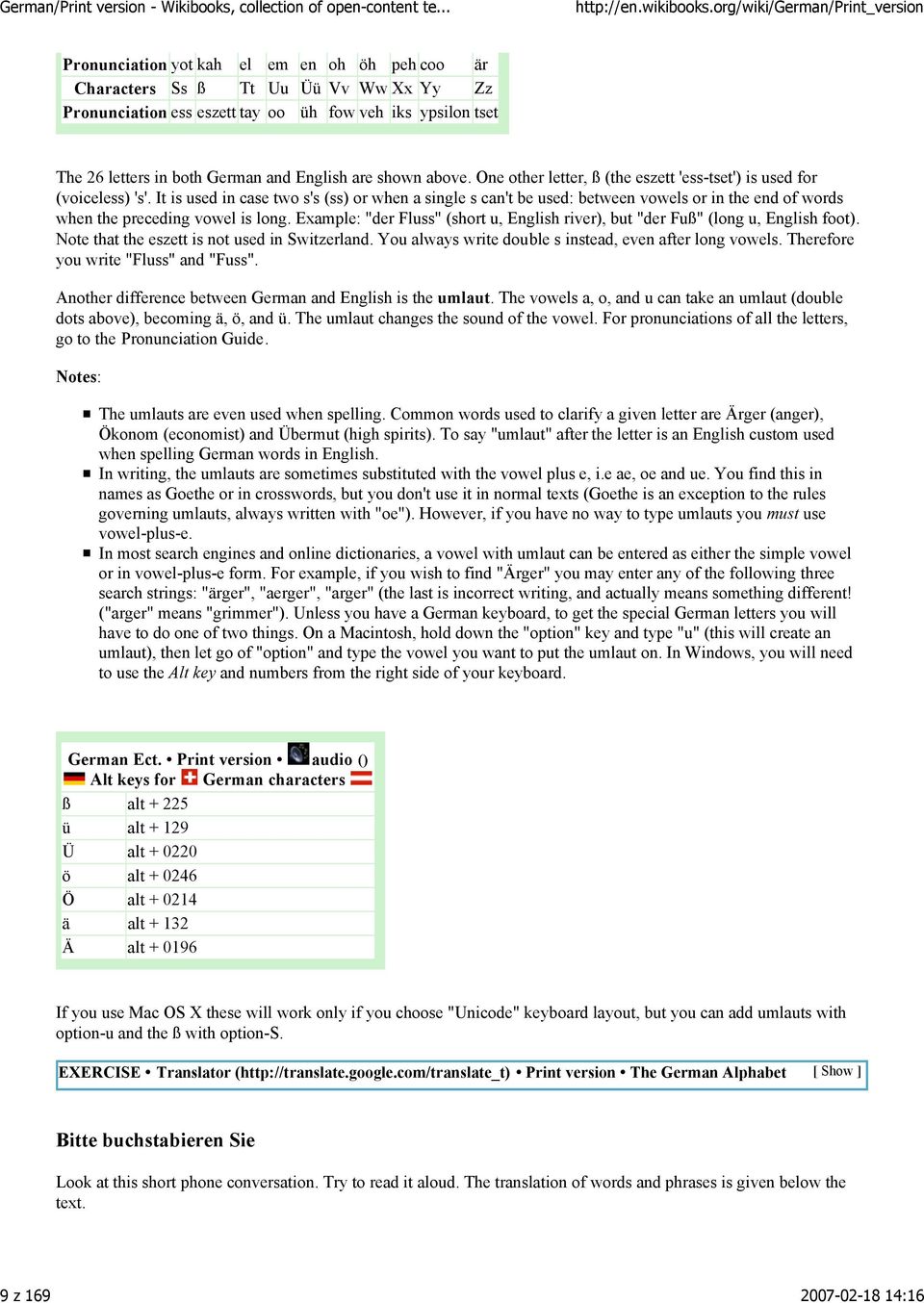
9 9 z :16 Pronunciation yot kah el em en oh öh peh coo är Characters Ss ß Tt Uu ÜüVv WwXxYy Zz Pronunciation ess eszett tay oo üh fow veh iks ypsilon tset The 26 letters in both German and English are shown above. One other letter, ß (the eszett 'ess-tset') is used for (voiceless) 's'. It is used in case two s's (ss) or when a single s can't be used: between vowels or in the end of words when the preceding vowel is long. Example: "der Fluss" (short u, English river), but "der Fuß" (long u, English foot). Note that the eszett is not used in Switzerland. You always write double s instead, even after long vowels. Therefore you write "Fluss" and "Fuss". Another difference between German and English is the umlaut. The vowels a, o, and u can take an umlaut (double dots above), becoming ä, ö, and ü. The umlaut changes the sound of the vowel. For pronunciations of all the letters, go to the Pronunciation Guide. Notes: The umlauts are even used when spelling. Common words used to clarify a given letter are Ärger (anger), Ökonom (economist) and Übermut (high spirits). To say "umlaut" after the letter is an English custom used when spelling German words in English. In writing, the umlauts are sometimes substituted with the vowel plus e, i.e ae, oe and ue. You find this in names as Goethe or in crosswords, but you don't use it in normal texts (Goethe is an exception to the rules governing umlauts, always written with "oe"). However, if you have no way to type umlauts you must use vowel-plus-e. In most search engines and online dictionaries, a vowel with umlaut can be entered as either the simple vowel or in vowel-plus-e form. For example, if you wish to find "Ärger" you may enter any of the following three search strings: "ärger", "aerger", "arger" (the last is incorrect writing, and actually means something different! ("arger" means "grimmer"). Unless you have a German keyboard, to get the special German letters you will have to do one of two things. On a Macintosh, hold down the "option" key and type "u" (this will create an umlaut), then let go of "option" and type the vowel you want to put the umlaut on. In Windows, you will need to use the Alt key and numbers from the right side of your keyboard. German Ect. Print version audio () Alt keys for German characters ß alt ü alt Ü alt ö alt Ö alt ä alt Ä alt If you use Mac OS X these will work only if you choose "Unicode" keyboard layout, but you can add umlauts with option-u and the ß with option-s. EXERCISE Translator ( Print version The German Alphabet [ Show ] Bitte buchstabieren Sie Look at this short phone conversation. Try to read it aloud. The translation of words and phrases is given below the text.
10 10 z :16 German Dialogue Print version audio () Directory Assistance Fernsprechauskunft Man A Auskunft, Guten Tag. Man B Guten Tag. Ich hätte gern die Telefonnummer von Frau Claudia Bolliger aus Bern. Man A Wie schreibt man das? Bitte buchstabieren Sie. Man B Natürlich. Claudia: C wie Cäsar, L wie Ludwig, A wie Anton, U wie Ursula, D wie Dora, I wie Ida, A wie Anton. Bolliger: B wie Berta, O wie Otto, zweimal L wie Ludwig, I wie Ida, G wie Gustav, E wie Emil und R wie Richard. Man A Danke. Die Nummer lautet... Vocabulary and Phrases (from above) German Vocabulary Print version audio () Vocabulary Wortschatz English German Information Desk die Auskunft (no plural) I would like to have Ich hätte gern(e) Phone Number die Telefonnummer from Berne aus Bern How do you spell this? Wie buchstabiert man das? Please bitte Spell buchstabieren Of course natürlich "A" as in Anton A wie Anton Twice zweimal The number is die Nummer lautet Nominative Case Cases describe what a noun or pronoun does in a sentence. When a noun or pronoun is the subject of a sentence, it is considered to be in the nominative case. For example, in the sentence "I ate an apple", I is the subject and the apple is the direct object. You will learn more about cases as the course continues. German Grammar Print version audio () Subject Pronouns Subjekt-Pronomina 1st person singular ich I plural wir we 2nd person singular du, *Sie you plural ihr, *Sie you 3rd person singular er, sie, es he, she, it plural sie they * - Sie is the formal (polite) version of du and ihr. In all conjugations, it acts exactly like sie (plural) EXERCISE Translator ( Print version Nominative Case [ Show ] Names

11 11 z :16 German Grammar Print version audio (upload) Names Namen English German My name is... Ich heiße... His/Her/Its name is... Er/Sie/Es heißt... Their names are... Sie heißen... Our names are... Wir heißen... Your name is... Du heißt... Your names are... Ihr heißt... What is your name? Wie heißt du? What are your names? Wie heißt ihr? The Sound file is wrong, it is a woman voice version of the vocabulairy of the previous subject. To ask someone else's name, ask "Wie heißt..." For more than one person, "Wie heißen..." Note: There are possessive pronouns in German, they just don't apply here. EXERCISE Translator ( Print version Names [ Show ] Verbs You have already learned one verb: heißen, to be called. German Verb Print version audio () heißen to be called Singular Plural first person ich heiße my name is wir heißen our names are second person du heißt your name is ihr heißt your names are er heißt his name is third person sie heißt her name is es heißt its name is sie heißen their names are Two more extremely common verbs are the German translations for 'to be' and 'to have': sein and haben. They are conjugated like this: German Verb Print version audio (upload) sein to be Singular Plural first person ich bin I am wir sind we are second person du bist you are ihr seid you are er ist he is third person sie sind they are

12 12 z :16 sie ist she is es ist it is German Verb Print version audio (upload) haben to have Singular Plural first person ich habe I have wir haben we have second person du hast you have ihr habt you have er hat he has third person sie hat she has sie haben they have es hat it has EXERCISE Translator ( Print version Verbs [ Show ] Wie geht's? German Vocabulary Print version audio () How are you? Wie geht's? English German How are you? Wie geht's? Responses for Good Great Prima Good Gut Very good Sehr gut Responses for Bad Miserable Miserabel Bad Schlecht Not good Nicht gut Responses for Okay Okay Ganz gut Alright Es geht so In Ordnung is also sometimes used for OK or Fine Section Problems>> Articles German, like many other languages, gives each noun a gender: Masculine, Feminine or Neuter. Plural is easy; the definite nominative Article is always die. And as in English there is no indefinite article in plural. Nouns in plural form require different verb forms than nouns in singular. In English, there are two different types of articles: definite (the) and indefinite (a and an). German is the same, except that there are five different articles of each type. The nominitive case articles are as follows: Definite Articles German Grammar Print version audio (upload) The Definite Article in the Nominative Case Der definitive Artikel des Nominativ masculine der der Junge the boy
![com/translate_t) Print version Verbs [ Show ] Wie geht's?](/docs-images/43/13182651/images/page_12.jpg "German Vocabulary Print version audio () How are you? Wie geht's?")
13 13 z :16 feminine die die Frau the woman neuter das das Mädchen the girl die Jungen the boys plural die die Frauen the women die Mädchen the girls Indefinite Articles German Grammar Print version audio (upload) The Indefinite Article in the Nominative Case Der unbestimmte Artikel des Nominativ masculine ein ein Mann a man singular feminine eine eine Frau a woman neuter ein ein Mädchen a girl Section Problems>> Forming Questions The common word order in a German sentence is the same as in English: Subject verb Objects. (SvO) Der Junge spielt Fußball. The boy plays soccer. This sentence is in the indicative mood, the mood that states a fact. The interrogative mood asks a question. To change the English sentence "The boy throws the ball" to the interrogative mood, we insert the helper verb "does" before "boy," ending with,"?". "Does the boy throw the ball?" The process is very similar in German. However, since German verbs express both the simple and progressive aspects, we switch the whole verb with the subject, ending up with, "Spielt der Junge Fußball?" Does the boy play soccer? You have learned two questions so far: "Wie heißt...?" and "Wie geht's?". In German, there are two basic ways of forming a question. The first is the method described above. In addition to this, you can use an interrogative adverb... German Vocabulary Print version audio (upload) Questions Fragen English German Who? Wer? What? Was? Where? Wo? When? Wann? Why? Warum? How? Wie? which Welch?

14 14 z :16 Warum spielt der Junge Fußball? Why does the boy play soccer? You should note at this point that in German, the verb always comes second in the sentence, except in the case of a question as described above. The subject is always next to the verb, if not in front of it then following it. For example: Der Junge spielte am Montag Fußball. The boy played soccer on Monday. Am Montag spielte der Junge Fußball. On Monday, the boy played soccer. At this point, you should know the words for "yes", ja and "no", nein respectively. There is also an exclamatory "Yes!" called Jawohl!, although Jawohl! has military connotations and is often used as an answer to an order. Section Problems>> What's On the Test To go straight to the lesson test, go here. The test consists of four parts: Grammar (18 points), Translation (34 points), Reading Comprehension (20 points) and Vocabulary (28 points). The Grammar section will test your ability to conjugate verbs according to the given infinitive and subject. You will also need to know the articles of certain nouns. The Translation section is worth the most points, and it too has two sections. You must translate the sentences and phrases from English to German and vice versa. The third section, Reading Comprehension, will be all "Fill in the Blanks". You will get two dialogues and be asked to fill in the blanks with respect to them. Some of the hardest parts deal with the greetings, so make sure you remember these. The last section is the Vocabulary section. You will get 28 English words on the left and 28 German words on the right, and be asked to match them accordingly. To study for that, check out the 71 flashcards related to this lesson at FlashcardExchange.com ( That is the whole test. Take it! Lesson Freizeit Lesson 2 ~Freizeit Dialogue German Dialogue Print version audio () Sports and time Sport und Zeit

15 15 z :16 Franz Hallo, Greta! Wie spät ist es? Greta Es ist viertel vor drei. Franz Wirklich? Ich spiele um drei Fußball. Machst du Sport, Greta? Greta Nein, ich bin faul. Ich gehe jetzt nach Hause. Franz Fußball macht aber Spaß! Greta Bis dann. Franz Wiedersehen! Sports and Activities German Vocabulary Print version audio () Sports and activities Sport und Aktivitäten English German sport(s) Sport interests, hobbies, activities Hobbys soccer Fußball American football Football (spoken as in English) volleyball Volleyball basketball Basketball tennis Tennis baseball Baseball (spoken as in English) 9-pin bowling Kegeln chess Schach board game das Brettspiel game das Spiel homework Hausaufgaben (pl.) television der Fernsehen movie der Film Section Problems>> Spielen, Machen and Other Verbs All three verbs that you were introduced to in Lesson 1 are irregular in some way, however most verbs are regular verbs. The following is a table of the endings you add to the stems of regular verbs to conjugate them: German Verb Print version audio () conjugation Konjugation Singular Plural first person ich -e wir -en second person du -st ihr -t third person er -t sie -t es -t sie -en For example, the verbs spielen and machen,

16 16 z :16 German Verb Print version audio () to play spielen Singular Plural first person ich spiele wir spielen second person du spielst ihr spielt third person er spielt sie spielt es spielt sie spielen German Verb Print version audio () to do_make machen Singular Plural first person ich mache wir machen second person du machst ihr macht third person er macht sie macht es macht sie machen Applications Was machst du? What are you doing? Ich spiele Basketball. I play basketball. Spielst du Fußball? Do you play soccer? Ich mache Hausaufgaben. I do homework. Er macht Hausaufgaben. He does homework. Machst du Sport? Do you play sports? Note the last sentence. In English one plays sport, while in German one does sport. You can also use the w-words from Lesson 1 to make some more combinations: Warum spielst du Baseball? Why do you play baseball? Wer hat Hausaufgaben? Who has homework? To say "not", use "nicht". "Nicht" goes after the verb but before the sport.

17 17 z :16 Wer spielt nicht Fußball? Who doesn't play soccer? Wir spielen nicht Tennis. We don't play tennis. Compound Sentences German Vocabulary Print version audio () Conjunctions Verbindungen English German and und but aber or oder Both German and English have compound sentences, the applications of these are enormous. They can be used in lists, but also in compound sentences. For example, Ich spiele Basketball, und er spielt auch Basketball. I play basketball, and he also plays basketball. The new word, "auch", is very important and it means "also". The one grammar rule about "auch" is that it always comes after the verb. Section Problems>> Other Verbs and Their Conjugations German Grammar Print version audio () Verbs Verben German English lesen to read schauen to watch sehen to see arbeiten to work schreiben to write schwimmen to swim Schauen, schreiben and schwimmen are all regular verbs, they follow normal conjugations. To conjugate, you first remove the ' en ', then add the correct ending, here is an example, Verb First Step Finished schauen schau ich schaue Arbeiten is an irregular verb, however it has a simple change. Whenever the ending starts with a consonant, an 'e' is added before it. So it would be du arbeitest, not du arbeitst. As well as er, sie, es, and ihr arbeitet, not er, sie, es, and ihr arbeitt.

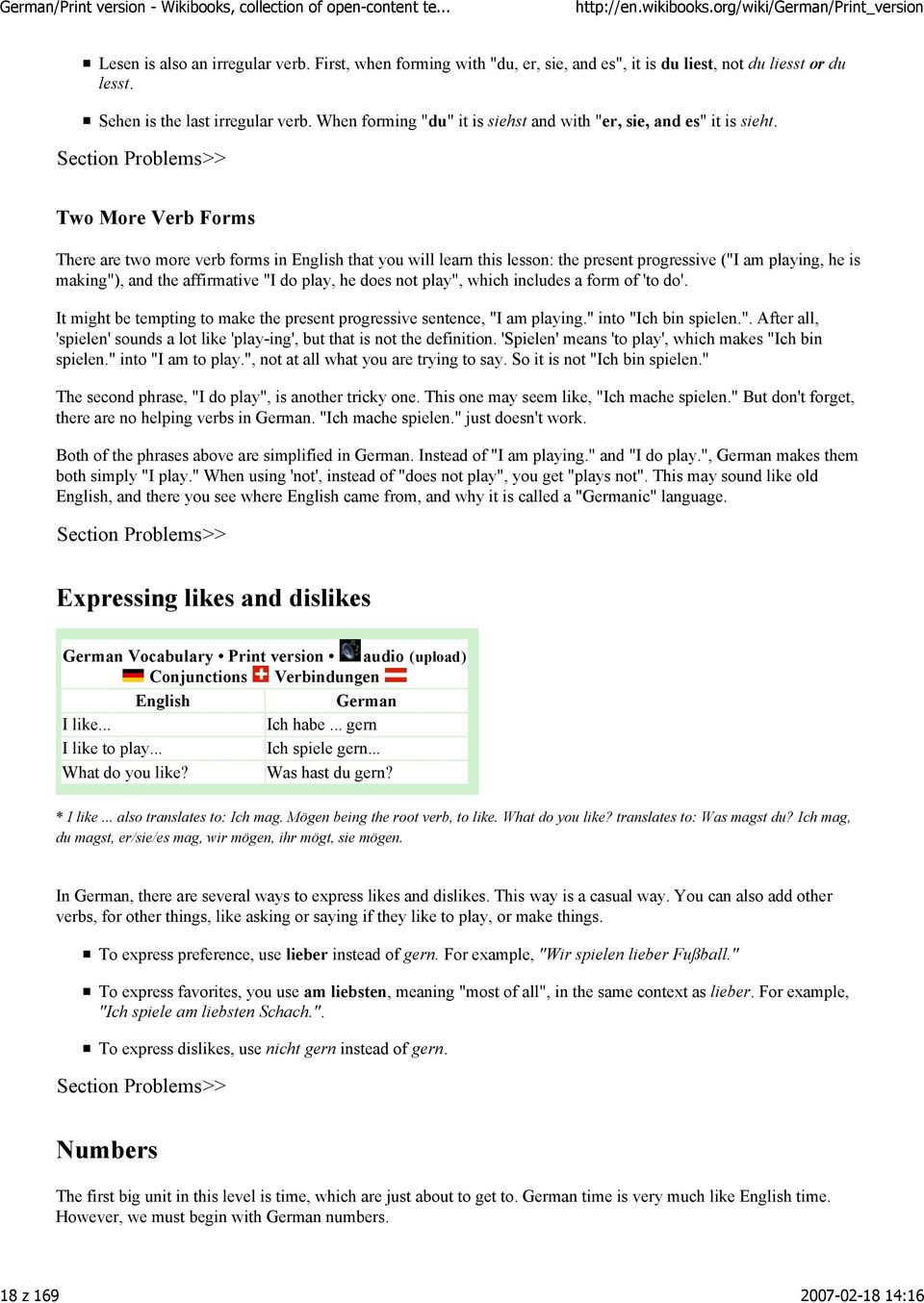
18 18 z :16 Lesen is also an irregular verb. First, when forming with "du, er, sie, and es", it is du liest, not du liesst or du lesst. Sehen is the last irregular verb. When forming "du" it is siehst and with "er, sie, and es" it is sieht. Section Problems>> Two More Verb Forms There are two more verb forms in English that you will learn this lesson: the present progressive ("I am playing, he is making"), and the affirmative "I do play, he does not play", which includes a form of 'to do'. It might be tempting to make the present progressive sentence, "I am playing." into "Ich bin spielen.". After all, 'spielen' sounds a lot like 'play-ing', but that is not the definition. 'Spielen' means 'to play', which makes "Ich bin spielen." into "I am to play.", not at all what you are trying to say. So it is not "Ich bin spielen." The second phrase, "I do play", is another tricky one. This one may seem like, "Ich mache spielen." But don't forget, there are no helping verbs in German. "Ich mache spielen." just doesn't work. Both of the phrases above are simplified in German. Instead of "I am playing." and "I do play.", German makes them both simply "I play." When using 'not', instead of "does not play", you get "plays not". This may sound like old English, and there you see where English came from, and why it is called a "Germanic" language. Section Problems>> Expressing likes and dislikes German Vocabulary Print version audio (upload) Conjunctions Verbindungen English German I like... Ich habe... gern I like to play... Ich spiele gern... What do you like? Was hast du gern? * I like... also translates to: Ich mag. Mögen being the root verb, to like. What do you like? translates to: Was magst du? Ich mag, du magst, er/sie/es mag, wir mögen, ihr mögt, sie mögen. In German, there are several ways to express likes and dislikes. This way is a casual way. You can also add other verbs, for other things, like asking or saying if they like to play, or make things. To express preference, use lieber instead of gern. For example, "Wir spielen lieber Fußball." To express favorites, you use am liebsten, meaning "most of all", in the same context as lieber. For example, "Ich spiele am liebsten Schach.". To express dislikes, use nicht gern instead of gern. Section Problems>> Numbers The first big unit in this level is time, which are just about to get to. German time is very much like English time. However, we must begin with German numbers.
19 19 z :16 German Vocabulary Print version audio () Numbers Zahlen English German zero null one eins two zwei three drei four vier five fünf six sechs seven sieben eight acht nine neun ten zehn eleven elf twelve zwölf thirteen dreizehn fourteen vierzehn fifteen fünfzehn sixteen sechzehn seventeen siebzehn eighteen achtzehn nineteen neunzehn twenty zwanzig thirty dreißig forty vierzig fifty fünfzig sixty sechzig seventy siebzig eighty achtzig ninety neunzig hundred hundert hundred and one hunderteins thousand tausend 1001 tausendeins 1101 tausendeinhunderteins 3000 dreitausend zweihunderttausend Above are some basic numbers in German. If you haven't noticed the pattern, "-zehn" creates "-teen" and "-zig" creates "-ty." The numerals, when written as figures, appear the same in German and English, but when spoken or written in full, the units normally come before the tens. They are connected by und. for example, "einundfünfzig", which is 51, from "eins" and "fünfzig", notice "eins" turned into "ein". In spoken words, "zwo" can be used for "zwei", distinguishing it from "drei". Section Problems>>

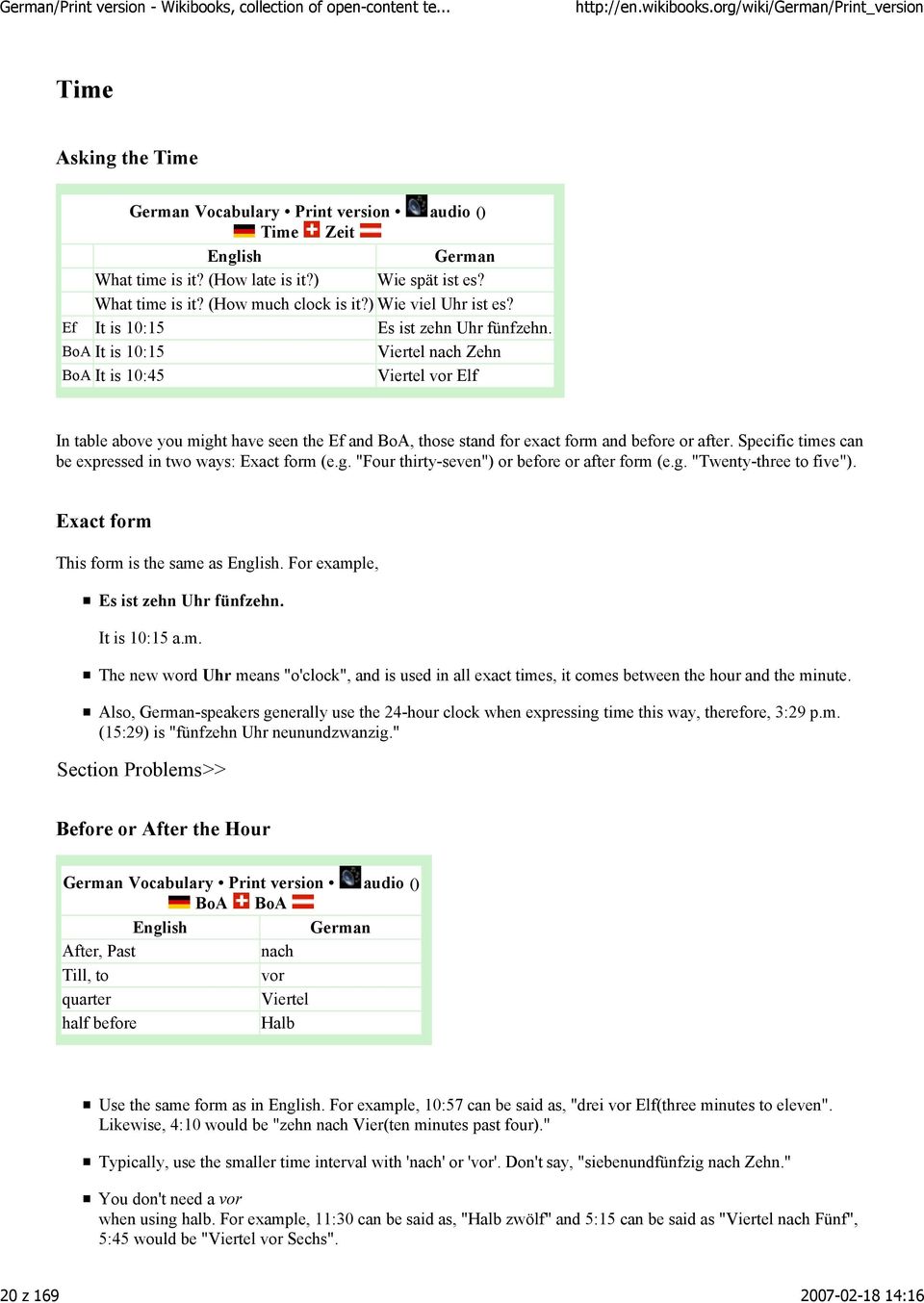
20 20 z :16 Time Asking the Time German Vocabulary Print version audio () Time Zeit English German What time is it? (How late is it?) Wie spät ist es? What time is it? (How much clock is it?) Wie viel Uhr ist es? Ef It is 10:15 Es ist zehn Uhr fünfzehn. BoA It is 10:15 Viertel nach Zehn BoA It is 10:45 Viertel vor Elf In table above you might have seen the Ef and BoA, those stand for exact form and before or after. Specific times can be expressed in two ways: Exact form (e.g. "Four thirty-seven") or before or after form (e.g. "Twenty-three to five"). Exact form This form is the same as English. For example, Es ist zehn Uhr fünfzehn. It is 10:15 a.m. The new word Uhr means "o'clock", and is used in all exact times, it comes between the hour and the minute. Also, German-speakers generally use the 24-hour clock when expressing time this way, therefore, 3:29 p.m. (15:29) is "fünfzehn Uhr neunundzwanzig." Section Problems>> Before or After the Hour German Vocabulary Print version audio () BoA BoA English German After, Past nach Till, to vor quarter Viertel half before Halb Use the same form as in English. For example, 10:57 can be said as, "drei vor Elf(three minutes to eleven". Likewise, 4:10 would be "zehn nach Vier(ten minutes past four)." Typically, use the smaller time interval with 'nach' or 'vor'. Don't say, "siebenundfünfzig nach Zehn." You don't need a vor when using halb. For example, 11:30 can be said as, "Halb zwölf" and 5:15 can be said as "Viertel nach Fünf", 5:45 would be "Viertel vor Sechs".
21 21 z :16 Note: This is only used with informal time telling. You don't use 'Uhr'. Section Problems>> Saying When You Do Something Wann spielst du Football? (Football means American Football. The much more popular soccer would be "Fußball", which lit. means Football) To say you play a sport at a certain time in English, you would answer, "I play football at 3:30." This is all the same in German, with the translation of 'at' being um. That makes the above response "Ich spiele Football um halb Vier." or "Ich spiele Football um fünfzehn Uhr dreißig.". Section Problems>> Other Time Times of Day German Vocabulary Print version audio () Times of Day Tageszeiten English German the day der Tag today heute tomorrow morgen the day after tomorrow übermorgen yesterday gestern the day before yesterday vorgestern (early) morning Morgen* morning Vormittag afternoon Nachmittag evening Abend night Nacht *In German, except the capitalization, the words for "morning" and "tomorrow" are the same: morgen. If you want to say tomorrow morning use morgen früh (meaning: early on the next day) instead of Morgen morgen. The words above can be combined into phrases like "gestern Abend". Section Problems>> Days and Months German Vocabulary Print version audio () Days Tage English German Monday Montag Tuesday Dienstag Wednesday Mittwoch Thursday Donnerstag
22 22 z :16 Friday Freitag Saturday Samstag Sunday Sonntag German Vocabulary Print version audio () Months Monate English German January Januar February Februar March März April April May Mai June Juni July Juli August August September September October Oktober November November December Dezember To say "on Monday", say "am Montag" or whatever applies. To say "in January", say "im Januar" or whatever applies. This is the same for all of the days and months. You can also combine the times of day from earlier with the days of the week. But they're both nouns. To do this, therefore, we must combine the two words into one, as in "Dienstagnacht" (Tuesday night). Culture Note: The German week begins on Monday. Section Problems>> Dates German Vocabulary Print version audio () Dates Daten English German first of (month) erster second of (month) zweiter third of (month) dritter fourth of (month) vierter seventh of (month) siebter eighth of (month) achter -th of [below 20] -ter tenth of zehnter twentieth of zwanzigster thirty-first of einunddreißigster -th of [20 to 31] -ster on (the) am The ordinal numbers from 2 to 19 take the endings t and from 20 upwards take the ending st For example "on the 25th of December",
23 23 z :16 Simply say "am fünfundzwanzigsten Dezember." In other cases you say "fünfundzwanzigster Dezember" or "der fünfundzwanzigste Dezember". In Germany, dates are written out in the logical order Day. Month. Year, instead of the American Month/Day/Year. German uses a dot instead of a slash. Do not use the slash in dates, as it is unusual and confusing because you cannot tell if "4/6" means 4th of June (4.6.) or 6th of April (6.4.) Section Problems>> Birthdays German Vocabulary Print version audio () Birthdays Geburtstage English German Birthday Geburtstag Happy Birthday Alles Gute zum Geburtstag! Best wishes on your birthday! Herzlichen Glückwunsch zum Geburtstag! Here is your present! Hier ist dein Geschenk! Thank you! Dankeschön! That's a nice party! Das ist eine tolle Party! To say, "My birthday is on November 13th", say, "Ich habe am dreizehnten November Geburtstag." Here am dreizehnten November, 13. November and represent the same date. Note the order; it translates back literally as "I have on the 13th of November birthday." Section Problems>> Seasons German Vocabulary Print version audio (upload) Seasons Jahreszeiten English German Spring Frühling Summer Sommer Autumn Herbst Winter Winter in (the) im To say "in Summer", say "im Sommer". For example, Im Sommer spiele ich Baseball. I play baseball in summer. The time always goes before the verb and the subject. (time, verb, and subject) Section Problems>> Periods of Time
24 24 z :16 If you want to express a certain period of time, but it doesn't have a specific name, like Nachmittag, you can do it like this:, German Vocabulary Print version audio (upload) Seasons Jahreszeiten German Time von Starting Time bis Ending Time This is the same as from... till... in English. This can also apply with dates. For example, "Wir haben Schule (school) von Montag bis Freitag". Exceptions Wir haben frei vom fünfundzwanzigsten Dezember bis zum zweiten Januar. Section Problems>> How often? Wie oft?, there are many ways to answer this question. Two are "once, twice, or three times in a..." or "always, often, or never." A Number or Times To say, "once a month", or "four times a week", add "mal" to the end of the number and use the examples below. German Vocabulary Print version audio (upload) Daily Täglich English German Day am Tag Week in der Woche Month im Monat Year im Jahr Weekend am Wochenende Morning morgens Evening abends Afternoon nachmittags Night nachts oder in der Nacht For example Wir kegeln zweimal in der Woche. We bowl twice a week. Section Problems>> Often Adverbs German Vocabulary Print version audio (upload)
25 25 z :16 Sometimes English always most of the time often sometimes seldom never only Manchmal German immer meistens oft manchmal selten nie nur To apply these words, put them in the sentence, after the verb and subject, but before the sport/activity. You can also use 'nur' to say things like, Sie spielt nur manchmal Tennis. Note that if this is translated word-for-word, it becomes, She plays only sometimes tennis. That's just the way German is. Section Problems>> Time-Related Words German Vocabulary Print version audio (upload) Sometimes Manchmal English German Time die Zeit Free time die Freizeit To say you have time, ignore the 'die'. To say when, insert other phrases you have learned this lesson. For example, Ich habe am Samstagabend Zeit. Section Problems>> Note that the word order is the same as that of birthdays. You can use Freizeit in the same way. What's On the Test To go straight to the lesson test, go here. The test will have four parts to it: Grammar (79 points), Translating (95 points), Reading Comprehension (20 points), Vocabulary (20 points), and Previous Topics (10 points) in that order. The Grammar section will test your ability to know the verbs from this lesson and it's various visions, to know articles - the genders of them and the correct usage of them, and correct word order. The Translating section is worth the most points, and it too has three sections. You must know the translations for sentences and phrases going from English to German, and be able to take a German dialogue and translate it back into English. Also you must know the translation from Numbers to German. The third section, Reading Comprehension, is Comprehension Questions you must know how to read the conversion and after reading you will be asked question on the previous conversion. The fourth section is a vocabulary section. You get 20 English words on the left and 20 German words on the right, and be asked to match them. To study for that, check out the 401 flashcards related to this lesson at FlashcardExchange.com ( Part I and FlashcardExchange.com ( Part II.
26 26 z :16 The last section, Previous Topics, is a quick review on Lesson 1 to get ready for this section, just look at some past notes or go to Lesson 1 and study. That is the whole test. Take it! Lesson Essen Lesson 3 ~Essen Dialogue German Dialogue Print version audio (upload) I'm hungry! Ich habe Hunger! Franz Hallo, Greta! Wie geht's? Greta Sehr gut. Ich habe Hunger. Franz Ich auch. Möchtest du etwas essen? Greta Ja! In der Gaststätte Greta Ich möchte Salat, Brot und Wasser. Franz Hast du jetzt keinen Hunger? Greta Nein, ich habe großen Hunger. Was bekommst du? Franz Ich bekomme ein Stück Apfelstrudel und einen Eisbecher. Greta Warum das? Du sollst eine Bratwurst nehmen. Franz Nein, ich bin zufrieden. Ich habe keinen großen Hunger. Greta Ach so, dann ist das genug. Nach zwanzig Minuten Greta Diese Gaststätte ist schrecklich! Ich möchte etwas zu essen! Franz Wir gehen! Food! German Vocabulary Print version audio (upload) Food das Lebensmittel die Früchte (das Obst) - fruits das Gemüse - vegetables die Banane banana die Möhre carrot die Kirsche cherry der Spinat spinach die Zitrone lemon die Zwiebel onion die Erdbeere strawberry die Erbsen peas die Orange orange die Kartoffel potato der Apfel apple die Tomate tomato die Weinbeere grape der Spargel asparagus die Grapefruit grapefruit die Bohnen beans das Fleisch - meat die Meeresfrucht - shellfish, seafood das Lammfleisch lamb die Kammmuschel scallop der Truthahn turkey die Krabbe crab der Schinken ham die Garnele shrimp
27 27 z :16 das Schwein pork der Fisch - fish das Hähnchen chicken die Sardellen anchovies das Rinderfleisch beef der Lachs salmon die Wurst sausage der Aal eel die Molkereiprodukte - dairy products Other Foods die Butter butter die Suppe soup der Käse cheese die Fritten French fries die Milch milk die Pizza pizza der Joghurt yogurt der Hamburger hamburger die Nachspeise - dessert der Senf mustard das Bonbon candy das Brot bread die Schokolade chocolate die Butter butter die Torte cake der Salat salad der Apfelstrudel apple strudel der Pfeffer pepper der (Apfel)Kuchen (apple) pie der Reis rice das Eis ice cream das Salz salt der Eisbecher bowl of ice cream der Zucker sugar die Marmelade jam Accusative Case As you know from the Intro, in German, there are four cases. Three are used often. The first, Nominative Case, you learned in Lesson 1. It covers the subject, and the predicate noun (in "He is (noun).", (noun) is the predicate noun). The second, the Accusative Case, you will learn now. It covers the direct object and the object of several prepositions. The third, the Dative Case will be taught later on. It covers the indirect object and the object of many other prepositions. Note: The Accusative Case and Dative Case are identical in English; that's where the extra case comes from. Articles Masculine Feminine Neuter Plural Definite Article den die das die Indefinite Article einen eine ein -eine* * The indefinite article for plurals is non-existant. However related words, such as possessives and the kein- words that you will learn later this lesson, will end in eine for plurals. In the articles, the memory hook for accusative case is "Der goes to den (pronounced "dain") and the rest stay the same.". The masculine indefinite article goes to einen, and everything else stays the same there. Therefore above, der Hamburger goes to den Hamburger and ein Hamburger goes to einen Hamburger when the hamburger is the direct object, such as in "Er hat einen Hamburger." ("He has a hamburger.") If you are getting confused, it's fine. This topic is one of the hardest for English speakers to grasp. Here are some solutions: To find out the case of something, first find the verb. The verb rules the sentence. Everything revolves around it. Next you find the subject of the sentence. The subject is the thing/person that is doing the verb. The subject is always in the Nominative Case, so it takes on the der, die, das, die, or ein, eine, ein. Now you look back at the verb. If it is a being verb (am, are, is, etc.), the next noun after the verb is the predicate noun. An easy way to figure this out is to write an equation. If the verb can be replaced with an equals sign (=), then
28 28 z :16 the following noun is a predicate noun. If it can't be replaced by an equals sign, refer to the next paragraph. The predicate noun is also always in the Nominative Case, so the same rules apply to it. Ich bin ein Junge. Sie ist eine Frau. If the verb of the sentence is an action verb (playing, throwing, making, eating), find what the subject is doing the verb to. For example, if the verb is "makes" (macht), you look for what is being made. That is the direct object. The direct object is always in the Accusative Case, so it takes on the den, die, das, die, or einen, eine, ein. Sie haben den Cheeseburger. Habt ihr einen Salat? The indefinite articles, when you just look at their endings, select e, -, e for nominative case, and en, e, -, e for accusative. Remember, between nominative and accusative, the only third-person change is in the masculine form. Pronouns The pronouns experience a much bigger change than the articles. This is also true in English, as the articles (a, an, the) do not change ever, but I goes to me, we goes to us, etc. Not everything is the same, though. While me is mich and us is uns, the second and third persons undergo different changes. In third person, as in the articles, the only change is in masculine singular. Following the "der goes to den" rule, er goes to ihn when in the accusative case. The second person in English never changes. In German, du goes to dich and ihr goes to euch. Sie, the formal version of either, stays the same. Remember, Sie (2nd person formal) and sie (3rd person plural) only differ in their meanings and the fact that the former is capitalized and the latter is not. This stays true throughout German grammar. Here is a tabular representation of the above. Person Singular Plural English German English German 1st me mich us uns 2nd you dich you (y'all) euch 3rd him, her, it ihn, sie, es them sie Antecedents Note: This is just a quick lesson in English grammar applied into German. If you already know all about antecedents in English, skip the first paragraph. When using a pronoun, you have to know what it is for it to work. There are some rare exceptions, such as in mysteries or drama, but otherwise this is always true. Sometimes in dialogue this is taken care of by pointing or making some other gesture, but most of the time, the pronoun modifies something already mentioned. The object/person mentioned earlier that turns into a pronoun later is called the antecedent. In German this is very useful. You can't simply say 'it' anymore. Many food words are masculine and feminine, and when you turn them into pronouns, they turn into 'he', 'she', 'him', and 'her', not always 'it'. For example, the sentence
29 29 z :16 "The cheeseburger tastes good. It's very crunchy." turns into "The cheeseburger tastes good. He's very crunchy." Note: You will learn how to say this in German later in this lesson. Why is it "he"? This is where the antecedent comes in. Because there are foods that are masculine and feminine in German, you can't assume the 'es'. You have to look back at the previous sentence, at the antecedent, der Cheeseburger. "Der Cheeseburger" is replaced by er (since it is the subject, and therefore in Nominative Case). Therefore, all you need to know are these connections: der/den-er/ihn, die-sie, das-es, die-sie. Food-Related Verbs essen (I) - to eat, to be eating, to do eat trinken - to drink, to be drinking, to do drink bekommen - to get/receive, to be getting/receiving, to do get/receive möchten (M) - would like wollen (M) - to want, to be wanting, to do want Of these five verbs, only trinken and bekommen are regular. Essen is irregular (that's what the "I" means). Do you remember from the last lesson 'lesen' and 'sehen'? In both of them, the first 'e' changed to 'ie' in the du- and er/sie/es-forms. Well essen experiences the same change, except that it changes to 'i', not 'ie'. Also, it acts the same as 'lesen' in the du-form: You don't have three s's in a row. Therefore, du/er/sie/es isst and everything else is the same. Isst sounds and looks a lot like ist. The minute difference happens to be in the way you pronounce the s. When you mean eats it is sometimes an overstressed hissing (i.e. extremely sharp) sound. In normal life Germans, too, can only tell which verb is meant from knowing the context. Just like in last lesson, where you could say, "Ich spiele gerne Fußball.", you can also extend it to food. "I like to eat cheeseburgers." is translated as "Ich esse gerne Cheeseburger." The last two verbs (marked (M)) are modals. They will be discussed in the next section. Modals In the introduction, you learned that German has no helping verbs. Instead, they have modals, words that basically do the same thing. Modals are conjugated very differently from normal verbs. The ich- and er/sie/es-forms are always the same, while the du-form adds an 'st'. Most modals experience a vowel change from singular to plural, and the rest is the same. Möchten Möchten isn't technically a modal, but it acts exactly the same. There is no vowel change, and the ich- and er/sie/es forms are "möchte". Here is the complete conjugation: Person Singular Plural 1st ich möchte wir möchten 2nd du möchtest ihr möchtet 3rd er/sie/es möchte sie möchten Möchten means "would like" and can be applied to food (i.e. Ich möchte einen Cheeseburger.). Möchten can be
30 30 z :16 translated even more literally as "would like to", and is traditionally used with an infinitive verb at the end of the sentence (i.e. "Ich möchte jetzt gehen"/"i would like to go now"). However, this infinitive is not neccesary if it's completely obvious what you're talking about (If you say "Ich möchte einen Cheeseburger", everyone will assume that you would like a cheeseburger to eat.) (Note: Technically, "möchten" is not a word. The above cited conjugation is actually the "Konjunktiv" of "mögen", which has become so popular as a phrase, that even many Germans today aren't aware of it anymore, so you don't need to worry about it. "Etwas mögen" means "to like sth", and "I would like" is the closest translation of "ich möchte") Wollen Wollen is a true modal; it even changes vowels. Ich/er/sie/es will and du willst. Here is the complete conjugation: Person Singular Plural 1st ich will wir wollen 2nd du willst ihr wollt 3rd er/sie/es will sie wollen Wollen can also be applied to food, but may be considered impolite and demanding ("Ich will einen Cheeseburger!" roughly means "I demand a cheeseburger!" Möchten should be used instead: "Ich möchte einen Cheeseburger!" = "I want a cheeseburger!"). Wollen should not be confused with the future tense, despite the presence of the English word 'will' in the conjugations. However, will can also mean an intent or a document showing what one wants to happen. So it is not so different from 'to want' as possibly originally presumed. Modals with other verbs When you need to use another verb with a modal (Such as expressing you would like or want to preform an action) the sentence's word order is somewhat different than it would be in English. In English you would state the subject pronoun (such as "I"), an English equivalent to the modal verb (such as "want"), the action you want to preform (such as "to eat") and than what the action will be preformed on (such as "hamburger"), making the sentence "I want to eat a hamburger." In German you must put the action at the end of the sentence, making the sentence "I want a hamburger to eat." ("Ich will einen Hamburger essen.") Hunger and Thirst In German, instead of saying, "I'm hungry.", you say "I have hunger." The same applies to thirst. Here are the German translations: Hunger - der Hunger Thirst - der Durst Like in English, these two words do not have a plural form. When using them, you don't need to worry about the 'der'; you can just say, "Ich habe Hunger." to say "I am hungry". Formal Conversations In Lesson 1, you learned how to talk formally, using phrases like "Guten Morgen!" and "Wie heißen Sie?". There are,
31 31 z :16 however, a few words that are 'survival words' in Germany, specifically Danke - Thank you, Thanks Bitte - Please and You're welcome. To make this even more formal, you can tack on the word 'schön' to the end of "Thank you" and "You're welcome" to make 'dankeschön' and 'bitteschön' (both one word) in response. Schön literally means 'pretty' (you'll relearn this next lesson), so it turns those everyday phrases into compliments ("Thanks, pretty."). Some other ways to say "thank you": Dankeschön - Thank you very much Danke sehr - Thanks a lot Herzlichen Dank ("herzlichen" means sincere or from the heart; you may remember it from "Herzlichen Glückwunsch zum Geburtstag!" last lesson) Vielen Dank - Thanks a lot Tausend Dank* - Thanks a million (literally means a thousand, but no one ever says "Thanks a thousand.") Aufrichtigen Dank* - would be "thank you sincerely" (very formal) * - You will not be tested on these phrases. Some other ways to say "You are welcome": Bitteschön! Bitte sehr! Gern geschehen! (Don't mention it) Gerne! Kein Problem! (No problem) Dafür nicht!* - (Do) not (thank me) for this (only used in Northern Germany) * - You will not be tested on this phrase. Kein-words Twice you have been taught that the ending of the indefinite article for plurals would be eine (for Nominative and Accusative cases), if there was an indefinite article for plurals. Now that lesson applies. The kein-words have the same endings as the ein-words, and they mean the opposite: no, not any, none. For example, "kein Cheeseburger" means "no cheeseburger". "Keine Cheeseburger" (in this case Cheeseburger is plural) means "No cheeseburgers". Notice the 'e' at the end of 'keine'. That's the ending for plurals and feminine nouns and can be likened to the "der, die, das -> die" relationship, where the feminine article serves for the plural as well. Ordering at a Restaurant in Germany Restaurant - das Restaur'ant' (French pronunciation) at (the) - beim There are many restaurants you might find in Germany. Much like in English-speaking countries, you would more likely use the name of the restaurant than name what kind of restaurant. If you want to address the wish to eat a certain food, there are two ways: example: "wanting to eat chinese food" 1. "Ich möchte gerne zum Chinesen." - literally: "I want to go to the Chinese (restaurant)." 2. "Ich möchte gerne chinesisch essen (gehen)." - literally: "I want to (go) eat Chinese (style)." Here are some more restaurants you can find in Germany:
32 32 z :16 Chinese food: "zum Chinesen" / "chinesisch essen" Japanese food: "zum Japaner" / "japanisch essen" American food: "zum Amerikaner" / "amerikanisch essen" Mexican food: "zum Mexikaner" / "mexikanisch essen" Arabic food: "zum Araber" / "arabisch essen" Italian food: "zum Italiener" / "italienisch essen" Indian food: "zum Inder" / "indisch essen" French food: "zum Franzosen" / "französisch essen" Greek food: "zum Griechen" / "griechisch essen" Turkish food: "zum Türken" / "türkisch essen" Accusative case prepositions You read at the beginning of this lesson that the Accusative Case covers the direct object and the objects of some prepositions. Here are those prepositions that always fall under Accusative Case Durch - through Für - for Gegen - against Ohne - without Um - at, around These prepositions can be memorized easily using a common tune. "It's a Small World After All" and "Mary Had a Little Lamb" both work well for this. You learned um last lesson, and ohne earlier this lesson. Durch and gegen will be taught in depth later, and für will be taught now. Up until this point, you have only worried about the Accusative Case in third person. Für, meaning 'for', can and should be used in the first and second persons, too. Here's an example: "The cheeseburger is for me." - "Der Cheeseburger ist für mich." As you can see, 'me' is put into accusative case because the preposition is für. Saying How Food Tastes In German (as in English) there are several ways of telling how food tastes. You can do this with 'gut' and 'schlecht' from Lesson 1 to say: Der Cheeseburger schmeckt gut - The meal tastes good Der Cheeseburger schmeckt schlecht - The meal tastes bad But this is vague. Why do you think it tastes good? You can use the following words to more acutely describe how the cheeseburger tastes: delicious - lecker delicious - delikat* (a lot more formal than lecker) tasty - schmackhaft juicy - saftig*
33 33 z :16 crunchy - knackig crispy - knusprig* spicy - würzig, pikant stale, tasteless - fade* (Austria: fad) salty - salzig oversalted - versalzen* sweet - süß bitter - bitter sour - sauer creamy - cremig* hot (in the sense of "very spicy") - scharf hot (in the sense of "very warm") - heiß burnt - angebrannt* cold - kalt disgusting - schrecklich * - You will not be tested on these descriptors. Schmecken is a regular verb. Here is it's conjugation: Person Singular colspan="2" Plural 1st ich schmecke wir schmecken 2nd du schmeckst ihr schmeckt 3rd er/sie/es schmeckt sie schmecken The first and second persons really shouldn't be used. No one is going to say, "You guys taste salty" or "I taste creamy" (at least hopefully). So the only forms you need to know are er/sie/es schmeckt and sie (plural) schmecken. You can use 'schmeckt' and 'schmecken' or 'ist' and 'sind' to state how the food tastes. Just use whichever one you would use in English and it'll be correct. Although the English meaning of schmecken is simply to taste, "Schmeckt der Cheeseburger?" can be taken in a positive way to mean "Do you like the cheeseburger?". In other words, schmecken alone can mean to taste good. Dieser-forms "The cheeseburger tastes good." does not sound that specific as to which cheeseburger you are talking about. You could be talking about some other cheeseburger than the one in front of you. It just isn't clear. Now, if you said, "This cheeseburger tastes good.", it would be obvious that you're talking about the cheeseburger you're eating. 'Dieser' is the German translation for 'this': "Dieser Cheeseburger schmeckt gut."
34 34 z :16 Dieser Dieser is a special adjective. It changes forms in different situations: different genders and different cases. It can also mean 'these' when modifying a plural. Here are its forms: Masculine Feminine Neuter Plural Nominative Case dieser diese dieses diese Accusative Case diesen diese dieses diese As you can see, dieser is only appropriate for modifying masculine nouns in nominative case. But 'Cheeseburger', which is masculine, is the subject of the sentence, "Dieser Cheeseburger schmeckt gut." So it is correct in that circumstance. You may be wondering why 'dieser' is how it is presented as a whole. After all, it only applies to masculine nouns in the nominative case, while 'diese' applies for both feminine and plural nouns, nominative and accusative case. But to be gender-less, you could use 'dieses' instead. It's the fact that you could use any of those in the nominative case to summarize the word. Dieser's location in the upper left hand corner makes it stand out and get chosen. Jeder Jeder means 'every'. It acts exactly like 'dieser' in its endings, so it should be easy to remember. Here are the different forms: Masculine Feminine Neuter Nominative Case jeder jede jedes Accusative Case jeden jede jedes Notice the absence of the plural form. When you think about this, it's the same in English: no one says 'every books'. Welcher 'Welcher' is the third of this threesome of adjectives. 'Welcher' means 'which', the seventh w-word so far (wer, was, wann, wo, warum, wie, and welcher). Its forms have the same endings as 'dieser'. Masculine Feminine Neuter Plural Nominative Case welcher welche welches welche Accusative Case welchen welche welches welche Connection with Time You might want to say 'every day', 'this week', 'every morning', or 'which Tuesday night?'. But to do this, not only do you need to know the jeder-forms, but also the genders of the times and the cases. The second one is easy: Whenever you do something at a certain time, that time is put into Accusative Case. Last lesson, you learned the gender of one time: der Tag. So now you know everything to say 'diesen Tag', 'jeden Tag', and 'welchen Tag?' (this day, every day, and which day?). Here are the cases of all the times in Lesson 2:
35 35 z :16 Masculine Feminine Neuter Tag Monat Morgen Abend Nachmittag Woche Nacht Jahr Wochenende When extending to 'which Tuesday night?', remember that the night stays feminine on Tuesday, so it stays "Welche Dienstagnacht?". Likewise, you can say 'every June' the same as 'every month': 'jeden Juni'. This and That Ich möchte einen Cheeseburger. Der schmeckt sehr gut. Ich esse jeden Tag Cheeseburger. Die habe ich gern. Look at the second sentence of each of these German dialogues. What's missing? That's right, instead of "Der Cheeseburger schmeckt sehr gut." and "Die Cheeseburger habe ich gern.", both of the 'Cheeseburger's, so to speak, are dropped. We're left with just the articles, only in this case, they aren't articles. They're demonstrative pronouns. Demonstrative pronouns aren't scary. They're just the same as the normal pronouns, only they give more oomph to the sentence. They can be translated as either 'this' or 'that' ("I'd like a cheeseburger. That tastes very good."), or 'these' or 'those' for plurals ("I eat cheeseburgers every day. These I like."). Demonstrative pronouns are exactly the same as the definite articles (well, there is one change in dative, but that will be covered in Lesson 7). If you are not sure of the gender (meaning in context, the speaker doesn't know, not that you've forgotten that it's 'der Cheeseburger'), use 'das', like in "Was ist das?" (What is that?). Money and Paying 1 Euro Coin Germany, Austria, Luxemburg, Belgium and Südtirol in other words: all German speaking regions except Switzerland and Liechtenstein have given up their former currencies and adopted the Euro as of One Euro is worth 100 Cents. Because they are not members of the European Union, Switzerland and Liechtenstein have kept the Swiss Francs (Franken = 100 Rappen). 'Euro' normally does not change in the plural in German, so you would still say "Ich habe 500 Euro." Nevertheless, there is an exception: Euro coins. If you say "Ich habe vier Euros.", you actually are saying that you have four 1-Euro coins. Because the backsides of euro coins look different in each country, many people in Europe have started collecting foreign euro coins. In this case you can say "Ich habe irische Euros." (I have Irish euro coins.) for example. There is not yet a rule whether or not the word "Cent" has a different plural form. The majority of Germans are using the word "Cent" as a plural form, but when they don't it is simply "Cents". In German "euro" is pronounced [ oi-ro], not [you-ro]. For "Cent" there are two pronunciations: you can either
36 36 z :16 pronounce it as in English or you say "tzent". The latter version seams to be preferred by older people. When at a restaurant, you will want to pay at the end. You can use this vocabulary to help you. to pay - zahlen the bill - die Rechnung the waiter - der Ober "How much is that?" - "Was macht das?" ("What does that make?") To ask for the bill you can say, "Bitte zahlen!", or make it a complete sentence: "Ich möchte zahlen!", or "Wir möchten/wollen zahlen!". You can also say, "(Herr Ober), die Rechnung bitte!" Test The test for this lesson is not yet completed. When it is finished, the link will be added here. Review 1.01 Vocabulary Section 1 ~ Starting Point Review
37 I ich We wir You du Sie (formal) You All ihr Sie (formal) He er She sie It es They sie Have Has Am Are Is habe (1st Person, Singular, ich) hast (2nd Person, Singular, informal, du) haben (1st & 3rd Person, Plural, wir, sie; 2nd Person, singular & plural, formal, Sie) habt (2nd Person, Plural, informal, ihr) hat (3rd Person, singular, er, sie, es bin (1st person, Singular) bist (2nd Person, Singular, informal) sind (1st & 3rd Person, Plural; 2nd Person, sing. & plur., formal) seid (2nd Person, Plural, informal) ist Hello! Hallo! Servus! (used in Bavaria and Austria) Moin! or Moin Moin! (used in northern Germany) Grüezi! (used in Switzerland) Good morning! Guten Morgen! or Morgen! Good day! Guten Tag! or Tag! Good evening! Guten Abend! or N'Abend! Grüß Gott! (used in southern Germany, Austria and South Tyrol) Goodbye! Auf Wiedersehen! or Wiedersehen Bye! Tschüss! or Tschau! Servus! (used in Bavaria, Austria) Later! Bis später! or Bis dann! Good night! Gute Nacht! Good Super! Great! Very good! Bad Miserable Who What Where When Why How Boy Girl Man Woman Boys Girls Men Women Gut Spitze! Prima! Sehr gut! Schlecht Miserabel Wer Was Wo Wann Warum Wie Der Junge Das Mädchen Der Herr Die Frau Die Jungen Die Mädchen Die Männer Die Frauen Sport(s) Sport Interests Hobbys Soccer Fußball USA Football Football Volleyball Volleyball Basketball Basketball Tennis Tennis Baseball Baseball 9-pin Bowling Kegeln Chess Schach Board Game Das Brettspiel Game Das Spiel Homework Hausaufgaben Television Fernsehen Movie Der Film, Filme And und But aber Or oder To Have haben To Be sein To Be Called heißen To Play spielen To Do/Make machen To Read lesen To Watch schauen To See sehen To Work arbeiten To Write schreiben To Swim schwimmen One Eins 37 z :16
38 38 z :16 Wie heißt Du? Hello and Goodbyes Wir haben Begrüßungen und Verabschiedungen gelernt. Können Sie sich an diese erinnern? Bericht! Nominative Case Wir haben auch den Nominativ gelernt. Können Sie sich an ihn erinnern? Bericht! Names Wir haben das Verb heißen gelernt. Erinnern Sie sich? Bericht! Verbs Wir haben zwei andere Verben konjugiert. Können Sie sich daran erinnern? Bericht! Articles Wir haben die Artikel beim Nominativ gelernt. Können Sie sich an sie erinnern? Bericht! Freizeit Regulars Verbs Wir haben die regelmäßigen Verbende gelernt. Können Sie sich an sie erinnern? Bericht! Likes & Dislikes Wir haben gelernt unser Gefallen auszudrücken. Können Sie sich daran erinnern? Bericht! Numbers
39 39 z :16 Wir haben die Zahlen gelernen. Können Sie sich an sie erinnern? Bericht! Time Wir haben schon Zeit-Wörter gelernt. Können Sie sich an diese erinnern? Bericht! Essen Accusative Case Wir hatten schon den Akkusativ-Fall gelernt. Können Sie sich an ihn erinnern? Bericht! Modal Verbs Wir haben die Modalverben gelernt. Können Sie sich an sie erinnern? Bericht! Kein-Words Wir haben die Kein -Wörter gelernt. Können Sie sich daran erinnern? Bericht! This, Everyone, and Which Wir haben dieser, jeder und welcher gelernt.. Können Sie sich erinnern? Bericht! Section 1.02 ~ Berlin, Germany Lesson Kleidung
40 40 z :16 Lesson 4 ~ Kleidung Hello from Berlin! Gedächtniskirche auf dem Kurfürstendamm, Berlin In every Lesson from 4-12 there is going to be a featured German-Speaking city, which be the theme of the lesson. For 4-6 it is Berlin. There will be famous locations in Berlin, like for this lession it's Kurfürstendamm and KaDeWe, the shopping area of Berlin. Also in each lesson there will be facts, so if you ever travel to a German-Speaking country it'll be like you are a native! Facts It's Time to Change Time Berlin's time is UTC+1. That means that they are 6 hours ahead of E.S.T. If it's 2:00pm in New York City, it's 8:00pm (or 20:00) locally. Please note that Germany changes to and from daylight-saving time a few weeks before the U.S., so time differences still vary in March and October. Tip, Tip, and More Tip Tipping. A service charge is always included on restaurant checks, but it is usual and polite to round up the amount. For a cup of coffee costing about 2.00 EUR, you would round up to 2.50 EUR. At a restaurant, you should give a tip of at least five percent. Giving no tip at all is considered extremely rude. Tip when paying, don't leave money on the table. Tip the hat check or coat check attendant. Add about 2 Euros to taxi fares. Tipping is very important. Shopping Locations There are two major shopping locations. The Kurfürstendamm in the old west is lined with boutiques and department stores. It continues eastwards for about three hundred yards where you can visit KaDeWe, the biggest department store in Europe. On the newly-developed Friedrichstraße in the old east, the famous French store Galleries Lafayette is to be found together with a maze of underground shopping malls. Shops are generally open 9am-8pm Monday through Saturday. In the outskirts most shops close at 4pm on Saturdays.
41 41 z :16 Dialogue German Dialogue Print version audio (upload) Going Shopping Gehendes Einkaufen Helga Guten Morgen, Maria. Maria Morgen. Wie geht's dir? Helga Mir geht's gut. Ich gehe zum Kurfürstendamm, möchtest du mitkommen? Maria Ja, gerne. Ich hole vorher noch Geld. Helga Ich sehe dich dann am Kurfürstendamm. am Kurfürstendamm Helga Hallo Maria! Maria Hallo! Helga Wohin gehen wir als erstes? Maria Lass uns zu dieser Boutique gehen. Helga O.K. in der Boutique Angestellter Thomas Hallo meine Damen! Maria und Hegla Hallo, guten Tag. Angestellter Thomas Benötigen Sie Hilfe? Maria Ja, Können Sie mir helfen, diesen Rock in meiner Größe zu finden? Angestellter Thomas Natürlich. Angestellter Thomas Hier ist der Rock in Ihrer Größe. Maria Danke. Wo ist die Umkleidekabine? Angestellter Thomas Dort. Shopping Shopping There is a lot to say to shopping, places to shop at, money and items to buy. In this lesson we will cover most of it. There are two big shopping locations in Berlin. They are Kurfürstendamm and KaDeWe. German Vocabulary Print version audio (upload) Shopping Einkaufen English German Babywear Die Babyartikel (plural) Children's Wear Die Kinderbekleidung Clearance Sale Der Räumungsverkauf Closed Geschlossen Clothing Die Kleidung Computer Section Die Computerabteilung Cosmetics Die Kosmetik Customer Der Kunde Customer Service Der Kundendienst Electrical Appliance Das Elektrogerät
42 42 z :16 Escalator Die Rolltreppe Fashion Die Mode Furniture Das Möbelstück (singular), Die Möbel (plural) Gift Der Geschenkartikel Good Value (Adj.) Preiswert Groceries Die Lebensmittel (plural) Jewelery Die Damenschuhe (plural) Leather Goods Die Lederwaren (plural) Open Geöffnet Opening Hours Die Öffnungszeiten (plural) Present Das Geschenk Reduced Reduziert Sales Receipt Der Kassenbon Souvenir Das Andenken Special Offer Das Sonderangebot Sporting Goods Die Sportartikel (plural) Stationery Die Schreibwaren (plural) Summer Sale Der Sommerschlussverkauf (abbr. SSV) Video Store Die Videothek Winter Sale Der Winterschlussverkauf (abbr. WSV) Kurfürstendamm Kurfürstendamm Tauentzienstraße Fasanenstraße The Kurfürstendamm has many boutiques, department stores, etc., which are on Tauentzienstraße and Fasanenstraße, two streets in Kurfürstendamm. Tauentzienstraße has a lot of the department stores, including KaDeWe, which we will get into greater detail later. Fasanenstraße has a lot of the boutiques. German Vocabulary Print version audio (upload) Ku'damm Kurfürstendamm English German Department Store Warenhaus Retail Store Einzelhandelsgeschäft The Mall Einkaufszentrum Boutique Boutique Store Geschäft And some of the things you might say or ask while in a Clothing store... Können Sie mir helfen, meine Größe zu finden (für dieses )? Can you help me find my size (for this )? Wo ist die Umkleidekabine? Where is the dressing room?
43 43 z :16 German Vocabulary Print version audio (upload) Ku'damm Kurfürstendamm English German Manager Manager Employee Angestellter Sales Clerk Verkäufer Cashier Kassierer Dressing Room Umkleidekabine Men's Section Männerabteilung Women's Section Frauenabteilung Section Problems>> KaDeWe Another shopping location is das KaDeWe, an upscale department store in Germany. It has six floors, and Is also called "The department store of the west" (Kaufhaus des Westens) because it is the largest and most magnificent department store on continental Europe. German Vocabulary Print version audio (upload) KaDeWe Kaufhaus des Westens English German First Floor Erstes Stockwerk Menswear Männerkleidung Second Floor Zweiter Stock Womenswear Frauenkleidung Third Floor Dritte Stock Kids Section Kinderabteilung Fourth Floor Vierter Stock Electronics Elektronik Kitchenware Küchenbedarf Fifth Floor Fünfter Stock Lighting Beleuchtung Bedding Bettwäsche Toys Spielwaren Sixth Floor Sechster Stock Food Lebensmittel Since we already have most of the general shopping phases and vocaulary down, we are going to get into more detail in the next few sections. Section Problems>> Electronics First is electronics: it might seem a little sparse, but electronics and much other stuff will be featured in Lesson 12.
44 44 z :16 German Vocabulary Print version audio (upload) KaDeWe Kaufhaus des Westens English German Electronics die Elektronik Television das Fernsehen, der Fernseher Digital Camera die Digitalkamera Telephone das Telefon Cell phone das Mobiltelefon, das Handy Computer der Computer, der Rechner Speakers der Lautsprecher DVDs die DVD CDs die CD DVD Player der DVD-Player CD Player der CD-Player Spielt der DVD-Player auch CD? Does the DVD player also play CDs? Hat das Mobiltelefon eine Digitalkamera? Does the cell phone have a digital camera? If you look at the word order of this sentence, you will see that you've already learned everything you need to make these sentences, and you, yourself can customize these sentences if you want. Section Problems>> Bedding The bedding section is also quite bare, but that is because it will be discussed further in Lesson 12. German Vocabulary Print version audio (upload) KaDeWe Kaufhaus des Westens English German Bedding die Bettwäsche Blanket die Decke Pillow das Kopfkissen Pillow Case der Kopfkissenbezug Sheet das Blatt Bed Skirt der Bett-Rock And like always here are some of the things you might say that are related to bedding. Passen die Kopfkissenbezüge auf das Kopfkissen? Does the pillow case fit the pillow? And with that question there are other variations of it you can ask, like... Passt die Decke auf das Bett? Does the blanket fit the bed?
45 45 z :16 Section Problems>> Money Germany, Austria, Luxemburg, Belgium and Südtirol in other words: all German speaking regions except Switzerland and Liechtenstein have given up their former currencies and adopted the Euro as of Because they are not members of the European Union, Switzerland and Liechtenstein have kept the Swiss Francs. Currently 1 EUR is 0.82 USD, so the Euro is stronger. Now if you were at a shopping center in German like Kurfürstendamm, and you were shopping at a boutique here is some vocabulary you might want to know. Was macht das? Was kostet das? How much does it cost? Das Hemd kostet 120 Euro. The shirt costs 120 euros. Das kostet 690 Euro. That costs 690 euros (all together). German Vocabulary Print version audio (upload) Money Geld English German Price Preis Note Der Schein Coin Die Münze 1 Euro coin Das Eurostück, das Ein-Euro-Stück 2 Euro coin Das Zweieurostück 5 Euro note Der Fünfeuroschein 10 Euro note Der Zehneuroschein 100 Euro note Der Hunderteuroschein Note: The word coin (Münze) mostly turns to Stück when a word or number is put together with it. Even though in the vocabulary we list the 1, 2, 5, 10, 100 Euro there are more Euro Notes. The twenty, fifty, and two hundred Euro Notes are the ones we didn't list, also there are cent coins. German Vocabulary Print version audio (upload) Money Geld English German 1 Cent Coin Das Centstück 2 Cent Coin Das Zweicentstück 5 Cent Coin Das Fünfcentstück 10 Cent Coin Das Zehncentstück 20 Cent Coin Das Zwanzigcentstück 50 Cent Coin Das Fünfzigcentstück
46 46 z :16 German Math In written German, a comma is used (e. g. in prices) where we would put a decimal point in English. Thus 5,49 (or 5,49 ) means five euros and fourty-nine cents. When a price ends in a round number of euros, it is most commonly written as 5,- etc. The reverse is also true. Where as English uses a comma to split up large numbers, German uses a dot. So " 6.945" means sechs tausend neunundertfünfundvierzig (six thousand nine hundred and forty-five) euros - not six point nine four five euros. Clothing German Vocabulary Print version audio (upload) Clothes Kleidung English German Skirt Der Rock Pullover Der Pullover Scarf Das Tuch Coat Der Mantel Shirt Das Hemd Sweater Der Pullover Necktie Der Schlips Jacket Die Jacke Pants Die Hose Hat Der Hut Shoe Der Schuh Sock Die Socke Glove Der Handschuh Blouse Die Bluse German Vocabulary Print version audio (upload) Clothes Kleidung English German Size Die Größe Color Die Farbe Cotton Die Baumwolle Leather Das Leder Rayon Die Kunstseide German Vocabulary Print version audio (upload) Sizes Die Größen English German Small Klein Medium Mittel Large Groß Extra-Large Extragroß Section Answers>>
47 47 z :16 Describing Clothes Here are some of the words you can use when you are describing clothes: German Vocabulary Print version audio (upload) Sizes Adjektive für Kleidung English German Cheap Günstig Expensive Teuer Pretty Schön Ugly Hässlich Soft Weich New Neu Broad Breit Wide Weit Tight Eng Comfortable Bequem To say I like something or not, for clothing, it's... I like it! Er/Sie/Es gefällt mir! I don't like it! Er/Sie/Es gefällt mir nicht! Now if you try something on or your're looking for a soft shirt with a tight fit, you find it, feel it, try it on, but it's fairly expensive you might say this... In English: The shirt looks great! The shirt feels soft, fits tight. The shirt is very comfortable. How much does it cost? Oh no! The shirt is expensive! 55 euros is a little too much for me. In German: Das Hemd sieht prima aus! Das Hemd fühlt sich weich an, es sitzt eng. Das Hemd ist sehr bequem. Wieviel kostet es? Oh nein! Das Hemd ist teuer! 55 Euro sind mir ein bisschen zuviel. The phases to describe the shirt were... The shirt looks great. Das Hemd sieht prima aus. The shirt feels soft. Das Hemd fühlt sich weich an. The shirt fits tight. Der Hemd sitzt eng. Now, the bold words are verbs that are one part in describing how the shirt is. The other half of describing it is the adjectives like soft, tight, great, etc. And as you can see the verb "looks" is separable, but we will get into that later. Clothing-Related Verbs
48 48 z :16 And now getting into verbs - here are some of the verbs, and also some of these are Separable-Prefix Verbs, like aussehen, anprobieren, and anhaben. But we will study those in more detail later. Also we will be learning about "tragen". German Vocabulary Print version audio (upload) Sizes Prefix-Verben English German to look aussehen He looks Er sieht aus to try on anprobieren He tries on Er probiert an to put on anziehen He puts on Er zieht an To take nehmen To buy kaufen To have on/wear anhaben, tragen He has on/wears Er hat an Separable Prefix Verbs Many German verbs change their meaning by adding prefixs, which are often preposition such as ab-, an-, auf-, aus-, bei-, ein-, mit-, vor-, or zu-.the verbs anhaben (to wear) and aussehen (to look) are both verbs with separable (trennbar) prefixes. That is, when used next to the subject pronoun, the prefix is separated from the verb and put at the end of the sentence or clause. Or, better put, In the present tense and imperative, the prefix is separated from the infinitive stem. Examples: "Ich habe einen Mantel an." ("I'm wearing a coat." Or, more literally translated, "I have a coat on.") "Was hast du an?" ("What are you wearing?" or "What do you have on?") However, when the separable-prefix verb is put at the end of the sentence, such as when used with a modal verb, the verb in question and its prefix are not separated. Examples: "Du willst einen Mantel anhaben." ("You want to wear a coat.") "Willst du eine Bluse anhaben?" ("Do you want to wear a blouse?") Section Problems>> Tragen Instead of "anhaben" the verb "tragen" is often used. The sentences from above would then be: "Ich trage einen Mantel." ("I'm wearing a coat." ) "Was trägst du?" ("What are you wearing?") "Du willst einen Mantel tragen." ("You want to wear a coat.") "Willst du eine Bluse tragen?" ("Do you want to wear a blouse?") The verb "tragen" has two meanings: "to wear" and "to carry". So if someone says "Ich trage Schuhe" only the context will tell you whether the person is carrying the shoes in his hands or actually wearing them. Tragen is a
49 49 z :16 different kind of verb, an irregular verb, not only does it change in the ending, but it changes in the beginning this also happens in the same way to fahren, graben, schaffen, and waschen. But, heres the thing at the beginning only the a change into ä, and like this only happens to some verbs. Here is the table for tragen: Person Singular Plural 1st ich trage wir tragen 2nd du trägst ihr tragt 3rd er/sie/es trägt sie tragen Colors Color are also another great way to describe clothes like Das rote Hemd passt gut.which means The red shirt fits well. Read the following paragraph, try to find the words described to have a color. Wir fahren in den Schwarzwald. Ich habe ein grünes Hemd getragen. Die Reise war lang. Es begann kälter zu werden und abzukühlen. Ich hörte Musik auf meinem braunen ipod. Ich bin schließlich eingeschlafen. Als ich aufwachte, sah ich den blauen Himmel und den weißen Schnee. If you found 5 words you are right. Schwarz which means black (the Schwarzwald (Black Forest) is a wooded mountain range) Grünes Hemd which is a green shirt. Brauner ipod which is a brown ipod. Blauer Himmel which is blue sky. And weißer Schnee which is white snow. And now for the actual colors... Red Blue Green Orange Violet Yellow Brown Indigo Gray Black White "Rot" "Blau" "Grün" "Orange" "Violett" "Gelb" "Braun" "Indigo" "Grau" "Schwarz" "Weiß" Section Problems>> Lesson Volk und Familie
50 50 z :16 Lesson 5 ~ Volk und Familie Hello from Berlin! Facts Banks and Money Brandenburg Gate in Berlin Germany's main banks are Deutsche Bank, Dresdner Bank and Commerzbank. There are many banks of all kinds throughout the country. Banks are open Mon-Fri 9am-12pm or 2:30-4pm. On Thursdays, they are open until 5:30 or 6pm. Changing money is best done at a bank because their rates will be better than exchange services located at Bureau de Change. Major post office branches and travel agents also offer currency exchange. Germany is one of 12 European countries that have replaced their national currencies with the Euro, which is much stronger to the U.S. Dollar, but weaker than the British Pound. Dialog German Dialogue Print version audio () Visiting Family Besuchende Familie Vater, Mutter und die Geschwister bekommen Besuch von Oma und Opa Vater Karl Hallo Mama, Hallo Papa! Wie geht es euch? Opa Rudolf Na mein Enkel, du bist ja richtig groß geworden! Oma Lisa Mir geht's gut. Ich gehe zum Kurfürstendamm, möchtet ihr mit mir kommen? Sohn Thomas Ja, Opa, ich weiß. Tochter Marie Oma! Hast du uns etwas mitgebracht? Mutter Bettina Nun sei nicht so aufgeregt Marie, lass Oma und Opa erst einmal hereinkommen. kurze Zeit später, die Geschenke wurden schon ausgepackt... Tochter Marie Mutti! Thomas nimmt mir immer meine Puppe weg. Mutter Bettina Thomas! Du sollst deiner Schwester nicht ihre Puppe wegnehmen. Sohn Thomas Nein, das ist meine Puppe. Mutter Bettina Nein. Die Puppe gehört deiner Schwester. Sohn Thomas Gut, hier hast du die Puppe... Mutter Bettina Und bedanke dich bei deinen Großeltern, Marie. People The Family Home is where the heart is, they say. And what is in the home? Family! of course, so this is a very important section of the lesson. It'll give all vocabulary for the family, and later in a different section, you'll learn how to describe your brothers and sisters or any person! And now to get started lets do some vocabulary...
51 51 z :16 German Vocabulary Print version audio () The Family Die Familie English German Son Sohn Daughter Tochter Father Vater Mother Mutter Dad Papa (informal), Vati (informal) Mum Mama (informal), Mutti (informal) Grandfather Großvater Grandmother Großmutter Grandpa Opa Grandma Oma Sister Schwester Brother Bruder Siblings Geschwister Grandson Enkel Granddaughter Enkelin Wife Frau Husband Mann Father-in-law Schwiegervater Mother-in-law Schwiegermutter Brother-in-law Schwager Sister-in-law Schwägerin Son-in-law Schwiegersohn Daughter-in-law Schwiegertochter Uncle Onkel Aunt Tante Now even though many of these are common phrases you and me would say in everyday live, some of these are rather used when you are on a visit to grandmother's, or things your mother would say. Maybe you notice some of these in the dialogue. Now you might be asking "How am I going to speak fluent German, if I just learn phrases?" Like I said, these are basically from the dialogue, and you can study these to look at the word order. Also certain things are just differnt in German, like "Wie heißt du?" which translates literally to "How are you called?" when we use "What is your name?". Okay let get started on these common phrases... Du bist ja richtig groß geworden. You have grown up so much (usual sentence used by Opa und Oma) Hast du uns etwas mitgebracht? Have you brought something for us? Nun sei nicht so aufgeregt. Now don't be so excited. Jemanden hereinkommen lassen. Let somebody come in.
52 52 z :16 (Sie) Wurden schon ausgepackt. (They) Have already been opened. (Sich) Bedanken für etwas. To thank for something. Using Formal and Informal Pronouns in the Family Some very conservative families might still use Sie with grandparents or even parents! This is sometimes practiced in families of nobility or exterritorial cultural islands in which older German customs have survived. However, using "Sie" feels very outdated to the vast majority of people. In practically every family all members use du with each other. Describing People I can't describe in words how important this section of the lesson is. Even though you have already learned to describe to some degree, here we will introduce a new aspect of describing, and we will review. But how could we describe if we didn't have vocabulary? Here it is... German Vocabulary Print version audio () Describing People Beschreibend Leute English German Nice Nett, Sympathisch Mean Unfreundlich, Gemein Nasty Fies, Gemein Pretty Schön Ugly Häßlich or Hässlich Intelligent Intelligent Unintelligent Unintelligent Clever Schlau, Clever Stupid Dumm Interesting Interessant Boring Langweilig Active Rührig, aktiv Lazy Faul Funny Komisch, witzig Serious Ernst(haft) Strong Stark Weak Schwach Odd Eigenartig Talented Begabt, Talentiert Untalented Unbegabt, Untalentiert Bossy Rechthaberisch Passive Untätig Old Alt Young Jung
53 53 z :16 Fat Skinny Tall Short Evil Fett, Dick Dünn Groß Klein Böse The verb used most often for describing is "to be" which we learned in the first lesson. Some examples are: He is wet, She is stupid, I am lazy. But you do use other verbs like feel, looks, ect. This lesson we will be sticking mostly with the verbs we've learned in the past. We will, however, learn one new verb. All sentences we will create will be in the nomitive case. Okay, let's get started! In term of beauty, you can say four basic things. These aren't all, but these are the easiest and simplest ones. She is beautiful. Sie ist schön. He is ugly. Er ist häßlich. These two use the verb to be, and the next one will use the verb to look which would need something else in order to make sense. She looks beautiful, but that shirt is ugly. Sie sieht schön aus, aber dieses Hemd ist häßlich. He looks ugly, but he looked handsome yesterday. Er sieht häßlich aus, aber gestern hat er schön ausgesehen. And in the last sentence it says "ausgesehen." Don't worry about that--it wouldn't be taught until Level 3. So since you get the idea of describing, let's learn a new verb! And the new verb is klingen which is to sound. As in "He sounds weird.", "She sounds boring." Since we know how to describe, we really don't have to cover it. It's works just like other verbs. He sounds nice. Er klingt nett. They sound funny. Sie klingen komisch. Remember that when describing it's S+V+A, or subject, verb, then adjective. Exactly like in English. For right now, that's all for describing things. We are going to have some small describing lessons with some parts of this lesson. Related Verbs Okay we just went over the verb in the previous section. This will basically be a list that will help you memorize them
54 54 z :16 better, and there is not a lot. Other then "klingen" and "fühlen" you should know all of these. The the "Er sieht aus" is to show you it is a separable-prefix verb. German Vocabulary Print version audio () Verbs Verben English German To be Sein To look Aussehen He looks Er sieht aus To feel Fühlen To sound Klingen Nationality This also a large section of this lesson, nationality, it is very important. You can use it as a stereotype, or for your heritage. There are many nationalities, too many to go over in this lesson, you will more nationality as this level, and book goes on. Right now we are just going to have a vague little list, and as this section goes there will be more, like Swede and Swedish or Frenchman, Frenchwoman, and French. And so for the list... Major Nationalities This is the small list, make sure you memorize this list and the next one. German Vocabulary Print version audio () Nationalities Nationalitäten English German German Deutscher American Amerikaner Englishman Engländer Spaniard Spanier Italian Italiener Frenchman Franzose Describing People with Nationality It is no surprise you can describe people with nationality, most times, it's stereotypical, like norwegians are blonde, tall, etc. or germans wear lederhosen, drink beer, and play polka all day long, but that is just not true. However you can just use it for what it is, a nationality. If you do describe people by nationality this will help. Okay, you should already know how to describe, right? This part we will get more in to detail later, but right it is an important part of describing people with nationality, even though in English we most times don't do this, in German they do. The difference between nationality and language, like in English, French and french. But in german it is französisch and Franzose, Französin. This also is how it works for nationality describion by noun or adjective, which we are going to learn right now. Noun or Adjective Nationality
55 55 z :16 There are two ways to describe someone. With a noun-based nationality word or an adjective-based nationality word. But note that in German the noun-based form is used more often. Example: Ich bin Schwede (I am Swedish) and Ich bin schwedisch (I am Swedish) Example: Ich bin Franzose (I am French) and Ich bin französisch (I am French) More Nationalities A longer list of nationalities found in and around Germany: German Vocabulary Print version audio () More Nationalities Mehr Nationalitäten African Afrikaner Albanian Albaner Czech Tscheche Dane Däne Dutchman Holländer Estonian Este Finnish Finne Greek Grieche Hungarian Ungar Irish Ire Latvian Lette Lithuanian Litauer Norwegian Norweger Austrian Österreicher Polish Pole Romanian Rumäne Russian Russe Serbian Serbe Swede Schwede Swiss Schweizer Slovakian Slovake Ukrainian Ukrainer Age Now we are all familiar with the word "alt'", which means old. And in English, to find out somebody's age we ask "How old are you?". In German it is exactly the same. The "alt" kind of belongs to the interrogative adverb, so in both German and English it may be in front of the Verb: Wie alt bist du? How old are you? Now to ask the question with 1st person it is... Wie alt bin ich? How old am I?
56 56 z :16 And as response you might get... Ich bin Jahre alt. I am years old. Du bist Jahre alt. You are years old. And now the plural version of the 1st person... Wie alt sind wir? How old are we? The responses you will get is... Wir sind Jahre alt. We are years old. Ihr seid Jahre alt. You all are years old. To ask this important question in the 2nd person. First, we will learn the biggest question here, "How old are you?" which is... Wie alt bist du? How old are you? And there is only one response to this it is... Ich bin Jahre alt. I am years old. For the equally important plural 2nd person... Wie alt seid ihr? How old are you all? Which the response is... Wir sind Jahre alt. We are years old. And formal question, for both singular and plural is...
57 57 z :16 Wie alt sind Sie? How old are you? How old are you all? You should all ready get the pattern for this, but we are going to keep on doing this list, if you aren't sure of something or you are confused. So for the 3rd person... Wie alt ist er/sie? How old is he/she? The responses to this are... Er ist Jahre alt. He is years old. Sie ist Jahre alt. She is years old. And now the plural 3rd person of question and response... Wie alt sind sie? How old are they? And of course the response... Sie sind Jahre alt. They years old. Now with some people you might be able to guess their age, and you could ask them directly about it. This is usually pretty of rude, but it illustrates nicely how the phrase has to be changed if you ask a yes-no-question, so let's get started, anyway! Bist du Jahre alt? Are you years old? Ist er/sie Jahre alt? Is he/she years old? Sind sie Jahre alt? Are they years old?
58 58 z :16 Note the inversed order between "Wie alt bist du?" und "Bist du Jahre alt?" This is exactly the same as in English! Possessives Person Singular Plural English German English German 1st my mein our unser 2nd your dein, Ihr your euer, Ihr 3rd his, she, its sein, ihr, sein their ihr Note: 'Euer' is irregular. When 'euer' has to have a different ending the e before r is dropped, so it turns into 'eur-'. Gender, Case, and Endings Expressing Favorites Lesson Schule Hello from Berlin! Lesson 6 ~ Schule School in Germany School is not regulated nationwide, but by each Land German "Kindergarten" is optional - it translates rather to "play school", "Vorschule" being roughly the equivalent to "Kindergarten" From the age of six on, all Germans attend a "Grundschule" (elementary school) for four or six years, depending on the Land. After that, they go to either the "Hauptschule" which is industrially oriented, the "Realschule", which is... oriented, the "Gymnasium", which is academically oriented, or the "Gesamtschule", or comprehensive school. Schooling is obligatory until the age of 16, but the Gymnasium diploma "Abitur" can only be obtained after 12 or 13 years, i.e. at age 18 or 19. Latin and sometimes even ancient Greek are regularly taught at the Gymnasium. For the "Abitur", at least two foreign languages as well as some calculus and analysis classes have to be taken. School days often are from 8-13h. In most 'Länder', only the older students have additional classes between about h (thats 8 a.m. - 1 p.m. and 2 p.m p.m. ;-) In most schools, Extracurricular Activities are offered, such as Drama Club or School Choir, but they are less common than in the U.S. Though many students feel some sort of identification with their school, most are just happy when they can go home ;-) Generally speaking, many schools still are more formal than US or Canadian schools. The marking system uses 1 (very good, 87,5% or 96%), 2 (good 75% or 85%), ** 3 (satisfactory, 62,5% or 65%),
59 59 z :16 4 (sufficient 50% or 45%). 5 (faulty) is failed or 25%. 6 (not sufficient) is only used when the student literally hands in a blank sheet or failed. These marks can be modified with a "+" or a "-" to indicate a tendency, so e.g. 2+ is a fairly good mark that corresponds to about 80%. Dialoge Silke: Jetzt haben wir Mathe. Torsten: Oh nein, ich habe überhaupt keine Lust dazu. Silke: Hast du die Aufgaben gemacht? Torsten: Ja, im Bus. Silke: Super! Kann ich abschreiben? Lehrer (Betritt den Raum): Guten Morgen! Klasse: Guten Morgen! Lehrer: Wer möchte die Aufgaben an der Tafel rechnen? Florian? Florian geht zur Tafel, schreibt an und liest vor: "5 plus 8 ist gleich 13" "8 minus 5 ist gleich 3" "3 mal 8 ist gleich 24" "24 geteilt durch 12 ist gleich 2" Lehrer: Sehr gut, Florian! Die Glocke läutet. Es ist Fünfminutenpause. Silke: Schnell, wir müssen zu Musik! Torsten: Au ja, darauf freue ich mich schon. Silke: Was machen wir heute? Torsten: Wir wollen ein Lied von Grönemeyer singen! Silke: Welches denn? Torsten: "Alkohol", glaube ich. Nach dem Musikunterricht: Silke: Jetzt haben wir nur noch Geschichte... Torsten: Komm, wir schwänzen und gehen ins Bistro. Silke: Schon wieder! Und Satz für Satz... Oh nein, ich habe überhaupt keine Lust dazu. "Lust (zu etwas) haben" means "feeling like (it)". "Ich habe keine Lust (dazu)" is "I don't feel like (it)". "Ich habe überhaupt keine Lust" emphasizes it, meaning "I don't feel like it at all." Hast du die Aufgaben gemacht? Have you the tasks done? "Did you do your homework?" Ja, im Bus. Yes, in the bus. This is a common practice of students everywhere in the world, I guess... Notice the contraction of "im", which is derived from "in dem", "in the".
60 60 z :16 Super! Kann ich noch schnell abschreiben? Super! Can I just quickly copy? "Super", "Cool", "Toll", are common exclamations... "Noch schnell" is here meant as "while there is still time" Lehrer (Betritt den Raum): Guten Morgen! Teacher (enters the room): Good Morning! Klasse: Guten Morgen! Class: Good Morning! Wer möchte die Aufgaben an der Tafel rechnen? Florian? Who would like the tasks on the blackboard calculate? "Who would like to do these questions on the blackboard?" Note that "Tafel" is related to "table", meaning a flat surface, and indeed German "Tafel" can also designate a table prepared for a feast. Don't let the weird order of the words disturb you, even if the phrase seems totally incomprehensible at first. I'll try to construct this bit by bit: This is the basic question and answer pair: "Wer rechnet?" - "Ich rechne." "Who calculates?" - "I calculate." To ask, if you want to do something, you use a construction similar to English: "Wer will rechnen" - "Ich will rechnen." "Who wants to calculate" - "I want to calculate." Note that the "to" is already included in the German word "rechnen". "Rechnen" is clearly already an infinitive, and doesn't need a "zu" to prove it. This is one of the main reasons why complicated conjugations can survive, they contain information that doesn't have to be expressed otherwise then... To be a little more polite (or at least seem like it, since our teacher probably wouldn't take a no for an answer) "Wer möchte rechnen?" - "Ich möchte rechnen!" "Who would like to calculate?" - "I would like to calculate" This is another example for brevity by conjugation. The word "möchte" contains the "would", as it is a "Konjunktiv"-form of the word "mögen" which translates to "like". Don't be discouraged, many Germans don't realize this, and many don't use the Konjunktiv correctly, if ever. However, "ich möchte"-phrases are extremely popular, so just use them, even if you didn't understand yet a word of the explanation above ;-) Let's introduce objects in our phrase: "Wer rechnet die Aufgabe?" - "Ich rechne die Aufgabe" "Who calculates the task?" - "I calculate the task", meaning "Who answers the question" This is a direct object, "Aufgabe" is in the accusative case. Because this is a feminine noun, this is not so obvious, but the structure is the same as in: "Wer sieht den Mann?" - "Ich sehe den Mann." "Who sees the man?" - "I see the man." Now, we also have an adverbial expression of the place. This is an expression that defines the verb, thus ad-verbial.
61 61 z :16 "Wer rechnet an der Tafel?" - "Ich rechne an der Tafel" "Who calculates on the blackboard?" - "I calculate on the blackboard" Now let's put all this together: "Wer rechnet die Aufgabe an der Tafel?" - "Ich rechne die Aufgabe an der Tafel." "Who calculates the task on the blackboard?" - "I calculate the task on the blackboard" Note that the order expressions is widely interchangeable. You can emphasize something by putting it closer to the end of the question. And now for the whole phrase in all its glory: "Wer möchte die Aufgabe an der Tafel rechnen?" - "Ich möchte die Aufgabe an der Tafel rechnen "Who would like the task on the blackboard calculate?" - "I would like the task on the blackboa It wasn't THAT bad, was it? Florian geht zur Tafel, schreibt an und liest vor: Florian goes to the blackboard, writes on and reads out: "Florian goes to the blackboard, writes down and reads out aloud" "zur" is another contraction, this time of "zu" and "der". Note that after "zu" follows the dative case, so "der" is not the masculine but the feminine article. "anschreiben" splits to "schreibt an", and means litterally "writing on". It is often used when writing legibly on a large, visible surface such as blackboard or a flipchart. "vorlesen" splits to "liest vor" and translates to "read aloud". "5 plus 8 ist gleich 13" "8 minus 5 ist gleich 3" "3 mal 8 ist 24" "24 geteilt durch 12 gleich 2" So, as you might have guessed, plus and minus are the same as in English - they are just pronounced German. The verbs "addieren" and "subtrahieren" are probably not difficult either... "Ist gleich" or short "gleich" or just "is" corresponds obviously to "is equal to" or "equals". "mal" means "times". This is also used in every day phrases, such as "100mal habe ich dir gesagt..." "I told you a 100 times..." The corresponding verb is "malnehmen" or "multiplizieren" "geteilt durch" is literally "divided by", and the verb is "teilen" or "dividieren". Lehrer: Sehr gut, Florian! Very good, Florian! Now, that was easy! Die Glocke läutet. Es ist Fünfminutenpause. The bell rings. It is five-minute-break
62 62 z :16 Between single classes, there is usually a break of five minutes to allow teachers and students to go from one classroom to another. In most schools, classes such as German, English, History, Philosophy are taught in the classroom. Classes that use special equipment, such as all sciences, music and arts and of course computers and sport are being taught in a specialized lab classes. Roughly every second break is 15 minutes long, and if there are lessons in the afternoon, there's often a break of 45 to 60 minutes for lunch. Schnell, wir müssen zu Musik! Quick, we must to music! This sentence sounds strange. This is, because in everyday German, sometimes the verb gehen can be left out, if it is clear what is meant. In this case, the complete phrase would have to be "Wir müssen zu Musik gehen". But since Torsten will not think Silke is going to fly there, there will be no misunderstanding. Additionnally, the word "class", or "course" is missing, which is the usual way of students to talk about their subjects. Note: In English, the phrase might be "We have to go to the music room" instead of must. The German translation "Wir haben in den Musikraum zu gehen" would be understood, but is quite formal. Additionally, there is a connotation that the speaker distances himself from the order he is being given. Au ja, darauf freue ich mich schon! Oh yes, to this look forward I myself already! Whew, what was that? Let's start at the beginning. "Au ja" ist an exclamation meaning "cool", "that's great". It has nothing to do with the German equivalent of "ouch!", which is "au(a)!" "Sich freuen" means "being happy". It is reflexive such as in "I help myself", because the subject and the object are the same. Some phrases simply are constructed like this, even if there seems to be no real reason to this, and many languages know this phenomenon. The "sich" here is technically the accusative of "he, she, it" and is being changed depending on the person: ich freue mich du freust dich er, sie, es freut sich wir freuen uns ihr freut euch Sie/sie freuen sich I am happy you are happy he, she, it is happy we are happy you are happy they are happy Note that "to be happy" actually would be rather translated by "glücklich sein", but it is the closest English equivalent to "sich freuen". "Sich über etwas freuen" means "to be happy about something". This is kind of self-explanatory. But "sich auf etwas freuen", literally "to be happy on something" means "to look forward to". This is a common phrase that uses the on in the same wide sense as in "on drugs", or "living on something" - there is no spatial relation here... In "darauf" you recognize the "auf". The "da" is a demonstrative prounoun such as in "that place". "Darauf" actually is another contraction which developped a long time ago from "da-herauf". The "darauf" is referencing the word "Musik" from Silke's sentence. So "Au ja, darauf freue ich mich schon" or "to-this look-forward I myself already" just means "Great, I'm already looking forward to that" Maybe it comforts you a little that the English phrase in a word-by-word translation to German would be just as inintelligeable... Was machen wir heute? What make we today? "What we (are going to) do today?" Note again, that "machen" often does not translate to "make", but to "do"!
63 63 z :16 Wir wollen ein Lied von Grönemeyer singen! We want a song of Grönemeyer sing! "We want to sing a song by Grönemeyer!" Welches denn? Which then? "Alkohol", glaube ich... "Alcohol", believe I... Note that adding a "glaube ich" is another common phrase, exacly as "I think" or "I believe" can be added to an English phrase. (Never mind the word order, this is because Alcohol is the object, so the verb is at the second position in the text) Herbert Grönemeyer is a very popular German rock singer from the Ruhr region. His most famous songs include "Männer", "Bochum" (a city in the Ruhr region), "Mensch" and also "Alkohol". Nach dem Musikunterricht: After the music class: "Unterricht" comes from "unterrichten" "to teach", and means simply "class". Better not think about "under" and "right" here, which you might have correctly recognized as the word's components "richten" literally means "to correct". Jetzt haben wir nur noch Geschichte... Now have we only still history... "Now we have only history left" Komm, wir schwänzen und gehen ins Bistro. Come, we skip and go in the bistro. "Come on, let's skip class and go to the bistro instead". As in English, "Komm" can be used to motivate others. There is yet another contraction here "ins" is derived from "in das", meaning "in the". "das" is the neutral article in accusative case here. Schon wieder! Already again! Aufgabe Make a list of all the contractions used in this chapter. Can you determine the full tables? School
64 64 z :16 Vocabulary School-Related Verbs Lesen To Read Schreiben To Write Rechnen To Calculate (doing maths) Studieren To Study Lernen To Study Zeichnen To Draw Malen To Paint School Subjects Deutsch Englisch Russisch Französisch Latein Mathe Mathematik Sport Kunst, Zeichnen Musik Werken Sachkunde, Sachunterricht Geschichte Erdkunde Politik Biologie Geografie Religion Werte und Normen Chemie Physik Informatik Elektronische Datenverarbeitung German English Russian French Latin Maths Mathematics PE or Gym Arts Music Crafts Science Lesson in Elementary School History Geography Politics Biology Geography RE or Religion Ethics Chemistry Physics Computer Science Computer Science School Supplies and Ect. der Radiergummi der Bleistift der Kuli, der Kugelschreiber der Füller, der Füllfederhalter das Fach die Klasse der Lehrer die Lehrerin die Schule der Schüler der Student die Stunde/Schulstunde die Pause die Schultasche Eraser/Rubber Pencil Pen Fountain pen Subject Class Teacher (male) Teacher (female) School Pupil Student (College/University) Lesson Break Backpack Review 1.02 Section 2 ~ Berlin Review
65 65 z :16 Vocabulary
66 Babywear Die Babyartikel (plural) Children's Wear Die Kinderbekleidung Clearance Sale Der Räumungsverkauf Closed Geschlossen Clothing Die Kleidung Computer Section Der Computershop Cosmetics Die Kosmetik Customer Der Kunde Customer Service Der Kundendienst Electrical Appliance Das Elektrogerät Escalator Die Rolltreppe Fashion Die Mode Furniture Das Möbel (no plural) Gift Der Geschenkartikel Good Value (Adj.) Preiswert Groceries Die Lebensmittel (plural) Jewelery Damenschuhe (plural) Leather Goods Die Lederwaren (plural) Open Geöffnet Opening Hours Die Öffnungszeiten (plural) Present Das Geschenk Reduced Reduziert Sales Receipt Der Kassenbon Souvenir Das Andenken Special Offer Das Sonderangebot Sports Goods Sportartikel (plural) Stationery Schreibwaren (plural) Summer Sale Der Sommerschlussverkauf (abbr. SSV) Video Store Die Videothek Winter Sale Der Winterschlussverkauf (abbr. WSV) Department Store Retail Store The Mall Boutique Store Manager Employee Sales Clerk Cashier Dressing Room Men's Section Women's Section First Floor Menswear Second Floor Womenswear Third Floor Kids Section Fourth Floor Electronics Kitchenware Fifth Floor Lighting Bedding Toys Six Floor Food Electronics Television Digital Camera Telephone Cell phone Computer Speakers DVDs CDs DVD Player CD Player Bedding Blankets Pillow Pillow Case Sheets Bed Skirt Warenhaus Einzelhandelsgeschäft Einkaufszentrum Boutique Geschäft Manager Angestellter Verkäufer Kassierer Umkleidekabine Männerabteilung Frauenabteilung Erstes Stockwerk Männerkleidung Zweiter Stock Frauenkleidung Dritte Stock Kinderabteilung Vierter Stock Elektronik Küchenbedarf Fünfter Stock Beleuchtung Bettwäsche Spielwaren Sechster Stock Lebensmittel Elektronik Fernsehen Digitalkamera Telefon Mobiltelefon, Handy Computer, Rechner Lautsprecher DVD CD DVD-Player CD-Player Bettwäsche Decken Kopfkissen Kopfkissenbezug Blätter Bett-Rock Price Preis Note Der Schein Coin Die Münze 1 Euro Coin Das Eurostück 2 Euro Coin Das Zweieurostück 5 Euro Note Der Fünfeuroschein 10 Euro Note Der Zehneuroschein 100 Euro Note Der Hunderteuroschein 1 Cent Coin Das Centstück 2 Cent Coin Das Zweicentstück 5 Cent Coin Das Fünfcentstück 10 Cent Coin Das Zehncentstück 20 Cent Coin Das Zwanzigcentstück 50 Cent Coin Das Fünfzigcentstück 66 z :16
67 67 z :16 Section 1.03 ~ Vienna, Austria Lesson Das Fest Gifts Lesson 7 ~ Das Fest Parties Vocabulary der Spaß Fun die Feier Party* die Party Party die Musik Music die Torte Cake das Fass Keg das Bier Beer der Schnaps Hard Liquor der Wein Wine der Weißwein White Wine der Rotwein Red Wine feiern To party trinken To drink saufen (I) To drink lots, to drink alcohol erbrechen (I), sich übergeben To Throw Up kotzen To Puke (slang) tanzen To Dance * = A Formal Dinner Party Different Celebrations der Geburtstag Weihnachten Ostern das Jubiläum Birthday Christmas Easter Anniversary
68 68 z :16 Snack Foods Vocabulary das Wasser Water Lesson Privileg und Verantwortung Jobs and Tasks Lesson 8 ~ Privileg und Verantwortung Vocabulary Careers Work Doctor Buniness Man Buniness Woman Teacher Police Officer Fireman Actor Artist Author Bank Clerk Car Mechanic Chemist Civil Servant Computer Programmer Engineer Farmer Hairdresser Journalist Lawyer Lecturer Nurse Pensioner Photographer Politician Postman Professor Salesperson Secretary Student Taxi Driver Waiter Arbeit Arzt Geschäftsmann Geschäftsfrau Lehrer Polizeibeamte Feuerwehrmann Schauspieler Künstler Schriftsteller Bankangestellter Automechaniker Chemiker Beamter Programmierer Ingenieur Landwirt Friseur Journalist Rechtsanwalt Dozent Krankenpfleger Rentner Fotograf Politiker Briefträger Professor Verkäufer Sekretär Student Taxifahrer Kellner Tasks Cleaning Cooking Homework Laundry Tasks Reinigung Kochen Hausaufgaben Wäscherei Aufgaben
69 69 z :16 Plans Common Phases Ich habe Pläne... I have plans... Ich habe Pläne mit... I have plans with... Places To Go Vocabulary Germany Humburg Berlin Frankfurt Cologne Munich Deutschland Hamburg Berlin Frankfurt Köln München Common Phases Ich muss gehen... I have to go to... Lesson Wetter Lesson 9 ~ Wetter Dialoge Wolfgang calls his friend Monika after he sees the weather forecast. Weather Vocabulary
70 70 z :16 Weather Wetter Rain Regen Snow Schnee Snow Showers Schneeschauer, Schneefall Showers Schauer Thunder Donner Storm Sturm Thunderstorm Gewitter Cloudy Bewölkt Overcast Bedeckt Hail Hagel Drizzle Nieseln Thaw Tauen Frost Frost Common Phrases Wie wird das Wetter? How's the weather? Können Sie mir sagen wie das Wetter heute wird? Can you tell me how today's weather is going to be? Wird es regnen, oder bleibt es schön? Is it going to rain, or would it still be nice? Es wird heute schlechtes Wetter erwartet. Nimm bitte deinen Regenschirm mit! Bad weather is today expected. Please take your umbrella with you! Transportation Vocabulary Car Train Trainstation Airplane Boat Highway Road Auto Zug Bahnhof Flugzeug Boot Landstraße Straße Important: The text " Machs gut!" in the last line has to be "Mach's gut" because it comes from "Mach es gut". I haven't figured out how to fix it myself so I wrote this comment here. Review 1.03 Section 3 ~ Vienna Review
71 71 z :16 Vocabulary
72 72 z :16 das Spiel Game das Videospiel Video Game der Spaß Fun die Feier Party* die Party Party die Musik Music die Torte Cake das Fass Keg das Bier Beer der Schnaps Hard Liquor der Wein Wine der Weißwein White Wine der Rotwein Red Wine Feiern To Party Trinken Drinking Saufen To Get Drunk Erbrechen / sich Übergeben To Throw Up Kotzen To Puke (slang) Tanzen To Dance der Geburtstag Birthday Weihnachten Christmas Ostern Easter das Jubiläum Anniversary das Wasser Water Work Arbeit Doctor Arzt Buniness Man Geschäftsmann Buniness Woman Geschäftsfrau Teacher Lehrer Police Officer Polizeibeamte Fireman Feuerwehrmann Actor Schauspieler Artist Künstler Author Schriftsteller Bank Clerk Bankangestellter Car Mechanic Automechaniker Chemist Chemiker Civil Servant Beamter Engineer Ingenieur Farmer Landwirt Hairdresser Friseur Journalist Journalist Lawyer Rechtsanwalt Lecturer Dozent Nurse Krankenpfleger Pensioner Rentner Photographer Fotograf Politician Politiker Postman Briefträger Professor Professor Salesperson Verkäufer Secretary Sekretär Student Student Taxi Driver Taxifahrer Waiter Kellner Germany Deutschland Humburg Hamburg Berlin Berlin Frankfurt Frankfurt Colonge Köln Munich München Weather Wetter Rain Regen Snow Schnee Snow Showers Schneesch Showers Schauer Thunder Donner Storm Sturm Thunderstorm Gewitter Cloudy Bewölkt Overcast Bedeckt Hail Hagel Drizzle Nieseln Thaw Tauen Frost Frost Car Auto Train Zug Trainstation Bahnhof Airplane Flugzeug Boat Boot Highway Landstraße Road Straße
73 73 z :16 Section 1.04 ~ Berne, Switzerland Lesson Zu Hause Essen Lesson Filme Lesson Das Haus Review 1.04 German Dialogue Print version audio (upload) The weather Das Wetter Wolfgang Mist! Monika Was ist? Wolfgang Es soll heute regnen. Monika Hattest du was vor? Wolfgang Ja, ich wollte in die Stadt gehen, um ein paar Weihnachtsgeschenke zu kaufen. Monika Es kommt noch schlimmer! Wolfgang Nein! Was gibt es? Monika Es wird zuerst regnen, um dann später in einen starken Schneesturm überzuwechseln. Wolfgang Oh Nein! Die Straße wird Eisglatt werden. Monika Ich weiß. Ich muss jetzt in die Schule gehen. Machs gut Wolfgang. Wolfgang Machs gut! This page is in severe development. It is and will not be a good read or make much sense until that development is done! LEVEL TWO LESSONS Contents #Section 2.01 ~ Salzburg, Austria #Lesson Einfache Gespräche unter Freunden #Lesson Fremde und Freunde #Lesson Die Zahlen #Lesson Eine Geschichte über Zürich #Review 2.01
74 74 z :16 #Section 2.02 ~ Zürich, Switzerland #Lesson Die Wohnung #Lesson Mathematik #Lesson Mein, Dein, und Sein #Lesson Einkaufen gehen #Review 2.02 #Section 2.03 ~ Hannover, Germany #Lesson Verbtempus und Wortstellung #Lesson Undeveloped #Lesson Undeveloped #Lesson Undeveloped #Review 2.03 Section 2.01 ~ Salzburg, Austria Lesson Einfache Gespräche unter Freunden German/Level II/Einfache Gespräche unter Freunden Lesson Fremde und Freunde German/Level II/Fremde und Freunde Lesson Die Zahlen German/Level II/Die Zahlen Lesson Eine Geschichte über Zürich German/Level II/Eine Geschichte über Zürich Review 2.01 Section 2.02 ~ Zürich, Switzerland
75 75 z :16 Lesson Die Wohnung German/Level II/Die Wohnung Lesson Mathematik German/Level II/Mathematik Lesson Mein, Dein, und Sein German/Level II/Mein, Dein, und Sein Lesson Einkaufen gehen German/Level II/Einkaufen gehen Review 2.02 Section 2.03 ~ Hannover, Germany Lesson Verbtempus und Wortstellung German/Level II/Verbtempus und Wortstellung Lesson Undeveloped German/Level II/Undeveloped Lesson Undeveloped German/Level II/Undeveloped
76 76 z :16 Lesson Undeveloped German/Level II/Undeveloped Review 2.03 LEVEL THREE LESSONS Contents #Section 3.01 ~ Bonn, Germany #Lesson Markus #Lesson Gespräche unter Geschäftsmännern #Lesson Mach dir keine Sorgen! #Section 3.02 ~ Innsbruck, Austria #Lesson Die Geschäftsleute #Lesson Der Engländer in Österreich #Lesson Undeveloped #Section 3.03 ~ Bavaria, Germany #Lesson Undeveloped #Lesson Undeveloped #Lesson Undeveloped Section 3.01 ~ Bonn, Germany Lesson Markus German/Level III/Markus studiert Lesson Gespräche unter Geschäftsmännern German/Level III/Gespräche unter Geschäftsmännern
77 77 z :16 Lesson Mach dir keine Sorgen! German/Level III/Mach dir keine Sorgen! Section 3.02 ~ Innsbruck, Austria Lesson Die Geschäftsleute German/Level III/Die Geschäftsleute Lesson Der Engländer in Österreich German/Level III/Der Engländer in Österreich Lesson Undeveloped German/Level III/Undeveloped Section 3.03 ~ Bavaria, Germany Lesson Undeveloped German/Level III/Undeveloped Lesson Undeveloped German/Level III/Undeveloped Lesson Undeveloped German/Level III/Undeveloped LEVEL FOUR LESSONS
78 78 z :16 Contents #Section 01 ~ Kiel, Germany #Section 02 ~ Schaan, Liechtenstein #Section 03 ~ Schaffhausen, Switzerland Section 01 ~ Kiel, Germany Section 02 ~ Schaan, Liechtenstein Section 03 ~ Schaffhausen, Switzerland LEVEL FIVE LESSONS GRAMMAR Contents #Adjectives and Adverbs #Articles #Cases #Nouns #Pronouns #Sentences #Verbs Adjectives and Adverbs Adjectives Adjectives are words that describe nouns. Most adjectives are stand-alone words; however, present and past particles can also be used as adjectives. Numbers are also adjectives, though they do not decline. Adjectives may be either predicate or attributive. Predicate adjectives are adjectives connected to a noun through a verb known as a copula. Those verbs in German are sein (to be), werden (to become), and bleiben (to remain). Other verbs, such as machen and lassen impart a predicate adjective onto an accusative object. Predicate adjectives are
79 79 z :16 never inflected. Ich bin noch ledig. (I am still single.) Trotz des Streites bleiben wir verheiratet. (Despite the argument we remain married.) Ich werde böse. (I am getting angry.) Die alte Milch wird dich krank machen. (The old milk will make you sick.) Attributive adjectives precede the noun that they are describing, and are always declined. Learning the adjective endings is a central part to the study of German. The adjective endings are frequently one of the hardest topics for new students to learn. It is best to commit the declension tables to memory, while attempting to speak independently. Proper use of adjective endings, especially in speaking, will come with repeated use. They are described in the next part of this chapter. Adjective Endings Forms This section will make use of the mnemonic Oklahoma, which denotes the fields of nominative masculine; nominative neuter; accusative neuter; nominative feminine; and accusative feminine, which resemble the state of Oklahoma in the tables used below. The concept is used to describe endings in two declension tables: the weak adjective declension, and the indefinite-article/ein-word declension. The endings of attributive adjectives can be divided into two groups: strong endings and weak endings. Strong Adjective Declension Case Masculine Neuter Feminine Plural Nominative -er -es -e -e Accusative -en -es -e -e Dative -em -em -er -en Genitive -en -en -er -er The strong adjective endings are nearly the same as the der-word endings, with the exceptions of masculine and neuter adjectives in the genitive case (marked in bold). Weak Adjective Declension Case Masculine Neuter Feminine Plural Nominative -e -e -e -en Accusative -en -e -e -en Dative -en -en -en -en Genitive -en -en -en -en Make note of the region, Oklahoma, in the nominative and accusitive cases, for weak endings. The use of a weak or a strong adjective ending depends on what precedes it:
80 80 z :16 Choice of Adjective Ending Preceding Article Choice of Ending Definite Article, der-words Weak Ending Indefinite Article, ein-words Within Oklahoma, Strong Ending Outside Oklahoma, Weak Ending No article Strong Ending The principle guiding adjective endings is that a noun, when possible, should have a primary case ending. Definite articles and der-words always provide a primary case ending. Indefinite articles and ein-words provide primary case endings outside of Oklahoma. Sometimes nouns have no article, in which case adjectives provide the primary case ending. Forms in Context of Articles This terminology - strong and weak endings - is confusing for many students. As the student develops, he or she will develop an ear for case endings, and will recognize when a noun has and has not received a case ending. Nonetheless, it is worth providing the three declension tables that result from this principle. Adjective Declension following a Definite Article or der-word Case Masculne Neuter Feminine Plural the large man the small book the quiet cat the red apples Nominative der große Mann das kleine Buch die ruhige Katze die roten Äpfel Accusative den großen Mann das kleine Buch die ruhige Katze die roten Äpfel Dative dem großen Mann dem kleinen Buch der ruhigen Katze den roten Äpfeln Genitive des großen Mannes des kleinen Buchs der ruhigen Katze der roten Äpfel Adjectives following a definite article or der-word always have a weak ending. Within Oklahoma, that is "-e", and outside of Oklahoma, that is "-en". Oklahoma is in bold to illustrate this. Adjective Declension following an Indefinite Article or ein-word Case Masculne Neuter Feminine Plural a large man a small book a quiet cat no red apples Nominative ein großer Mann ein kleines Buch eine ruhige Katze keine roten Äpfel Accusative einen großen Mann ein kleines Buch eine ruhige Katze keine roten Äpfel Dative einem großen Mann einem kleinen Buch einer ruhigen Katze keinen roten Äpfeln Genitive eines großen Mannes eines kleinen Buchs einer ruhigen Katze keiner roten Äpfel Note how, within Oklahoma (in bold), adjectives take strong endings, and outside Oklahoma, they take weak endings. This is because indefinite articles provide primary endings only ouside of Oklahoma. Adjective Declension with no preceding article Case Masculine Neuter Feminine Plural Nominative großer Mann kleines Buch ruhige Katze rote Äpfel Accusative großen Mann kleines Buch ruhige Katze rote Äpfel Dative großem Mann kleinem Buch ruhiger Katze roten Äpfeln
81 81 z :16 Genitive großen Mannes kleinen Buchs ruhiger Katze roter Äpfel Forms of nouns without articles are rare compared to those with definite and indefinite articles; however, one must still know the strong declension. Note that the strong adjective declension is almost the same as the der-word endings, with the exceptions of masculine and neuter in the genitive case (in bold). Adverbs Adverbs based on adjectives are one of the simplest parts of German grammar. Any adjective can be used as an adverb simply by placing its uninflected form within the sentence, usually towards the end. Das Ehepaar ging gestern fröhlich spazieren. (The married couple went for a walk joyfully yesterday.) Other adverbs have no adjectival equivalent. Many of these express time. Damals (at that time) Ich bin gestern dort gewesen. (I was there yesterday) Morgens bin ich normalerweise im Büro. (I am normally in the office in the morning.) Adverbs can also be based on participles (past and present). These are less common. Er betrachtete mich bedrohlich. (He looked at me threateningly.) Some adverbs are formed by adding -weise to adjectives and nouns in the plural form, and mean "regarding", "with respect to", or "-wise" in English. Construction of new adverbs of this sort is usually frowned upon. Adverbs based on prepositions Much of the material in this section will be explained in greater detail in the chapter on prepositions. German has a complex system of adverbs based on prepositions, which are used to indicate direction of motion, location, time, and other concepts. English also possesses such a system, though it is used less. Consider the following sentences in English: 1) Could you take the garbage out? 2) Come over this evening if you get the chance. 3) You should just give up. 4) I will look you up in the phone book. 5) The contract, and the conditions contained therein, is hereby declared null and void. (Legalese) In both English and German, prepositions and particles derived from prepositions are treated as adverbs. In many cases, these prepositional adverbs are associated with specific verbs. In the first two examples, the italicized prepositions are used as adverbs of motion; in the first example, the word "out" indicates the direction "out of the apartment"; in the second case, "over" not only means means the direction "towards", but also implies visitation of a residence. The third and fourth examples correspond to separable-prefix verbs in German. The word "up" is integral to the verb, which would have a different meaning without the adverb. "To give up", whose infinitive in German would be "to up-give", means "to quit", in sharp contrast to "to give". In the fourth example, it is not even possible to "look someone", whereas it is possible to "look someone up," or "look a candidate's resume over". (English even has
82 82 z :16 inseparable prepositional prefix verbs; compare "to look s.o. over" to "to overlook s.o." Many of these verbs have been replaced by verbs based on Latin and Greek.) The adverbs in the fifth example correspond to da-, wo-, hin- and her- compounds in German. Such compounds are often used in legal texts in English. In such compounds, the object of the preposition is replaced with the words "there" or "here", compounded with the preposition. "Therein" simply means "in it". The German system of adverbs based on prepositions is considerably more rigorous, and forms the basis of a large part of the language's morphology. "To catch on" means "to begin" in English; In German, the primary word for "to begin" is literally "to catch on" (anfangen), from which the equivalent noun, der Anfang (the beginning) is derived. A remnant of this in English can be found when describe a child's upbringing. As in English, prepositional adverbs in German to varying degrees alter the meaning of their associated verb. Separable-prefix verbs. This topic is better explored in the chapter on verbs. Separable prefixes are themselves adverbs. As in English, many of them are integral to the meaning of the verb. Fangen means "to catch," whereas anfangen means "to begin". Most prepositional adverbs are treated as part of the root word in the infinitive, and are used as such in the construction of participles. However, not all possible separable-prefix verbs are lexical; "vorbeikommen" (to come over), "vorbeibringen" (to bring over), and so on, may not all be listed in a dictionary. It is better to learn "vorbei" as an adverb implying visitation. The German prefix in is of note. It has two adverbial forms. As in it describes location; when describing movement, it becomes ein. Thus, for example, darin means "in there", whereas darein means "in(to) there". Another example is the word, einleiten, to introduce. Hin- and her-. Prepositional adverbs of motion are usually based on hin-, implying motion or direction away from the speaker, and her-, implying motion or direction towards the speaker. Hin and her are themselves stand-alone adverbs meaning the same thing, and describe less-specific motion or direction. (One example in which hin is an integral separable prefix is the verb hinrichten, which means "to execute.) Not all verbs formed from hin- and her- compounds are lexical. Some examples of hin- and her- compounds are: herab (down, down from) hinein (in, inside) hinaus (out, out of, onto) darüber hinaus (furthermore, above all) dahin (in the direction/towards of known location) Mastery of hin- and her- requires considerable effort from the student. Dacompounds are also adverbs, corresponding to "there-" compounds in English. They replace specific prepositional objects. Although are used principally in legal texts and therefore sound formal in English, they are often employed in written and spoken German and are convenient replacements for long and complicated prepositional phrases. Their comprehension and active use are essential in German. Da- compounds are formed by adding da- before the preposition, with an "r" inserted before prepositions starting with a vowel. There are exceptions to this, and dacompounds are given a fuller treatment in the chapter on prepositions. Hier- and dortcompounds also exist in German, though they are used less frequently. As in English, they are considered formal, and are used primarily in academic and legal texts. They are best memorized as vocabulary. hierhin und dorthin - hither and thither Articles
83 83 z :16 The Definite Article Forms - Formen Each of these definite articles translate into English as "the". Definite Articles Cases Masculine Neuter Feminine Plural Nominative der das die die Accusative den das die die Dative dem dem der den + n Genitive des + s des + s der der Usage - Gebrauch The German definite article, in short, replaces the word "the" in English, with just a few suggestions. Formally, it is used for something which already has been mentioned or is already known. Readers or listeners know what someone is writing or speaking about. For example, "Ich habe eine Tasse. Mit der Tasse kann ich trinken." something that there is only one of (nouns of rivers, mountains, stars, planets): die Alpen, die Donau the superlative: das ist der höchste Berg der Region) generalizations (X is a kind of...): Die Rose ist eine Blume. certain countries and regions: die Schweiz, die Türkei, die USA (plural), das Elsass, die Steiermark abstract concepts, such as das Glück and das Leben -- this use differs from English. Der-Words Related to the definite article are "der-words", which decline like the definite article. Here is a list of der-words: der-words in German German English jen- that, those solch- such (a) manch- many, some jed- each, every all- all dies- this, these welch- which Usage is very similar to usage in English. One thing to keep in mind is that, unlike in English, jener (that) is mostly used to contrast with another noun, dieser, and rarely by itself. Der-words are declined like the definite article. Here is their declension:
84 84 z :16 Der-word declension Cases Masculine Neuter Feminine Plural Nominative -er -es -e -e Accusative -en -es -e -e Dative -em -em -er -en + n Genitive -es + s -es + s -er -er Indefinite Articles Indefinite Articles translate into English as "a" or "an" and therefore there is no plural. Like in English you use the plural noun without any article. Forms - Formen As there is no indefinite article in the plural, kein is used to illustrate plural declension. Make special note region in bold, Oklahoma, where the indefinite article lacks a primary case ending. This is important when declining adjectives. Indefinite Article Declension Cases Masculine Neuter Feminine Plural Nominative ein ein eine keine Accusative einen ein eine keine Dative einem einem einer keinen +n Genitive eines +s eines +s einer keiner Er schnitt eine Zwiebel. - He chopped an onion. Er schnitt Zwiebeln. - He chopped onions. Er schnitt keine Zwiebeln - He chopped no onions Usage The indefinite Article is used to introduce new persons or objects or to talk about things which are not precisely identified. Ein-words All possessive pronouns, as well as the word, kein, are declined like the indefinite article. These are known as ein-words.
85 85 z :16 Ein-words German English kein- no, none Singular mein- my dein- your (sing, informal) sein- his sein- its ihr- her Plural unser- our euer- your (plural, informal) ihr-, Ihr- their, your (singular and plural, formal) Here is their declension: Ein-word Declension Cases Masculine Neuter Feminine Plural Nominative - - -e -e Accusative -en - -e -e Dative -em -em -er -en +n Genitive -es +s -es +s -er -er Nouns What Is a Noun? A word that can be used to refer to a person, place, thing, quality, or idea; part of speech. It can serve as the subject or object of a verb. For example a table or a computer. Plurals German, unlike English, has more than one way to make nouns plural, and plural form, like gender, must be memorized with every noun. There are twelve different ways to form plurals in German. They are formed by affixes at the end of the word, and the umlaut of the vowel of the stem. They are - (changing nothing); - ; -e; - e; -n; - n; -en; - en; -er; - er; -nen (to feminine suffix -in); -s (mainly with English loan-words); adding "foreign" endings (mainly Latin words); and changing suffixes (mainly Latin words). When German nouns are used in the plural, their gender becomes irrelevant. The plural can almost be thought of as a gender on it's own. In the plural, the definite article is always "die" when using the nominative and accusative cases.
86 86 z :16 When using the dative case, "den" is the definite article of all plurals. All plurals not ending in -n or -s affix an -n. The definite article of the plural in the genitive case is "der". Examples Nominative: Die alten Männer spielen Schach. The old men are playing chess. Accusative: Ich habe die alten Männer beim Schachspielen gesehen. I saw the old men as they played chess. Dative: Ich habe mit den alten Männern Schach gespielt. I played chess with the old men. Genitive: Das Schachspiel der alten Männer war nicht sehr spannend. The old men's chess game was not very exciting. Suffixes Although gender and plural form are often arbitrary, there exist certain suffixes whose gender and plural form are regular. They are mainly feminine. -ung, -heit, -keit, -schaft, -ion, and -tät These are all feminine endings, which are pluralized by -en. -unft Diskussion(en) Discussion(s) Universtät(en) University(ies) This endings is feminine and is pluralized by changing the stem vowel and adding -e -ik Unterkunft Lodging Unterkünfte Lodgings This ending often doesn't have a plural. When it does however, you add '-en Other Technik(en) Technique(s) When verb infinitives transform into nouns, they do not have a plural form. das Sprechen Language
87 87 z :16 Many masculine nouns are formed by verbal stems without a suffix. Many of these receive an umlaut in their plural form. Gender German, like many other languages, gives each noun a gender: Masculine, Feminine, and Neuter. Plural nouns also act differently not only with the verb of the sentence, but the article preceding it. The way any particular word is classified may not be logical. Examples: das Mädchen die Person the girl (neuter) the person (feminine - even when talking about a man) However, not all German Nouns are randomly allocated a gender. The following notes will apply to most nouns but not all. A note on Mädchen: This is derived from the diminutive form of Maid (old, rarely used) - Maidchen. Grammatically it is neuter, but when referenced, nowadays the logical feminine gender takes over: Das Mädchen und ihr Hund. (Das Mädchen und sein Hund would also be correct but is rare.) Masculine There are far more masculine nouns than of either of the other genders. The masculine nominative definite article is der. Semantic Groups Which Are Masculine days z.b. der Montag times of the day z.b. der Morgen months z.b. der August seasons z.b. der Sommer male persons* z.b. der Mann male animals z.b. der Löwe alcohol** z.b. der Wein, der Likör, der Alkohol, der Champagner makes of car: z.b. der Opel, der Mercedes, der BMW * With, of course, the exception of die Person which remains feminine even when talking about a man. ** However, it is das Bier Words with Certain Endings These rules apply always -ismus: der Kommunismus, der Anglizismus, der Terrorismus -ling: der Lehrling (apprentice), der Liebling (darling), der Schmetterling (butterfly) -or: der Motor -ant: der Elefant
88 88 z :16 The following groups of nouns are usually (but not always) masculine Nouns ending in -el: Nouns ending in -er: Nouns ending in -en: der Vogel der Hamster der Kuchen (but not infinitives used as nouns. They are neuter: das Rauchen, das Lac Nouns ending in -aum: Examples: Baum, Traum, Schaum, Raum, Saum, Flaum Nouns ending in -ang: Examples: Drang, Fang, Gang, Hang, Klang, Rang, Anfang, Empfang, Gesang, Tang Nouns ending in -und: Examples: Bund, Grund, Schund, Hund, Fund, Schwund, Schlund, Mund Exceptions: neuter: Pfund Nouns ending in -all: Examples: Ball, Fall, Krawall, Drall, Hall, Wall, Aufprall, Kristall, Knall, Schall, Zufall, Abfall, Vorfall, Schwall Exceptions: neuter: All, Metall, Intervall feminine: Nachtigall Feminine The feminine Gender article is die. It is used in the nominative and accusative singular case. It is also used to indicate nominative and accusative plural for nouns of any gender. e.g. die Katze Feminine or die Katzen feminin plural die Männer - masculin plural die Mädchen - neuter plural Semantic Groups Female persons and animals are usually feminine (very few exceptions). Examples:
89 89 z :16 die Frau (woman) die Schwester (sister) die Mutter (mother) To change a male designation to feminine, you often use the ending -in. der Lehrer - die Lehrerin (teacher) der Kaiser - die Kaiserin (emperor and empress) der König - die Königin (king and queen) der Arzt - die Ärztin (doctor) der Löwe - die Löwin Exceptions das Mädchen (girl) das Kind (child) das Fräulein (old fashioned for Miss) A lot of plants and trees are also feminin Examples: die Buche (beech) die Eiche (oak) die Rose (rose) die Tulpe (tulip) die Nelke (carnation) Exceptions: das Veilchen (violet), der Farn (fern)... Words With Certain Endings The following rules always apply. German" words: -heit: die Gesundheit (health), die Wahrheit (truth) -keit: die Möglichkeit (possibility) -schaft: die Wirtschaft, die Freundschaft -ei: die Türkei, die Mongolei, die Bäckerei* words derived from verbs with the ending -ung: die Beobachtung (observation; v: beobachen), die Verfolgung (persecution; v: verfolgen) words derived from verbs (mostly irregular verbs), ending in -t: die Handschrift (hand writing (n), derived from "schreiben), die Fahrt (journey, trip or ride, derived from fahren) Exceptions * das Ei (egg) has nothing to do with the ending -ei. Das Ei is neuter, including all words derived from: z.b. das Spiegelei, das Rührei, das Vogelei (different types of eggs) Foreign words: Words with the endings given below are always stressed on the last syllable.
90 90 z :16 -enz: die Intelligenz (intelligence), die Konsequenz (consequence) -ie: die Philosophie (philosophy), die Melodie (melody) -ik: die Musik (music), die Politik (politics) -ion: die Nation, die Qualifikation (qualification) -ur: die Kultur (culture) -tät: Examples: Universität, Majestät, Lokalität, Pietät, Integrität, Qualität, Aktivität, Priorität, Nationalität, Kapazität -age: Examples: Garage, Montage, Etage, Spionage, Persiflage, Blamage The following rule applies often. -e: die Lampe (lamp), die Karte (card, map) Exceptions: semantic reasons: der Junge (boy), der Franzose (french man), der Löwe (Lion) others: der Käse (cheese) Neuter The neutral Gender article is das for the nominative and accusative case. Semantic Groups names of colors: das Blau, das Rot, das Gelb, das Hellgrün, das Dunkelbraun Words With Certain Endings This rule applies always: diminutive endings -lein and -chen: das Mädchen (girl), das Häuschen (little house), das Büchlein (little book) This rules apply often: ending -um if the word has Latin origin: : das Zentrum, das Museum ending -ment: das Parlament (parliament), das Fundament (base, basis), das Element (element) Words that end with -em and are stressed on the last syllable: Examples: Problem, Theorem, System, Extrem
91 91 z :16 Foreign words that end with -ett and are stressed on the last syllable: Examples: Tablett, Etikett, Korsett, Parkett, Kabarett, Ballett Words that end with -ma: Examples: Thema, Trauma, Drama, Dilemma, Prisma, Schema, Koma, Klima, Komma, Karma, Lama, Dogma, Paradigma Exceptions: feminine: Firma Words that end with -o: Examples: Auto, Radio, Video, Kino, Kilo, Büro, Sakko, Solo, Storno, Bistro, Manko, Banjo, Tempo, Motto, Fresko, Embargo, Esperanto, Studio, Ghetto, Foto, Echo, Piano, Cello, Kasino Exceptions: masculine: Tango, Fango, Espresso, Embryo Foreign words that end with -om: Examples: Syndrom, Palindrom, Phantom, Polynom, Binom, Monom, Atom, Axiom, Genom, Symptom, Diplom, Kondom, Chromosom Words With Certain Beginnings Nouns that begin with Ge- are often neuter. Examples: Gedicht, Gericht, Gesicht, Gewicht, Geheimnis, Gebirge, Geschirr, Gedächtnis, Gebiet, Gespenst, Gewissen, Gesetz, Getränk, Gewand, Gewitter, Geschenk, Gespräch, Gebäude, Gehäuse, Gemüse, Geschäft, Getreide, Gerücht, Gewerbe Exceptions: masculine: Gedanke, Genuss, Geschmack, Gewinn, Geruch feminine: Gewalt, Gestalt, Geschichte, Gemeinde, Gefahr Nouns Derived From Certain Verbclasses Verbs used as noun (roughly corresponding to the gerund) das Rauchen (Smoking), das Lesen (Reading) Tips For Learning As most German articles can not be attributed to certain rule, it is best to always learn the article when learning the noun. You may think of the article as necessary information belonging to every noun. You avoid a lot of looking-up-time that way.
92 92 z :16 Looking Up Gender in Dictionaries Most dictionaries do not give the article. Instead, you find different sets of abbreviations which tell you to which class the noun in question belongs. The most common sets of abbreviations are: r, e, and s. r: der, masculine; e: die, feminine; s: das, neuter. The abbreviations of this type are usually given before the noun. m, f, and n. m: masculine; f: feminine; n: neuter. The abbreviations of this type are usually given after the noun. m, w, and s. m: männlich, masculine; f: weiblich, feminine; s: sächlich, neuter. The abbreviations of this type are usually given after the noun. Contents Adjectival nouns Weak nouns Mixed nouns Gender German/Grammar/Nouns/Gender Plurals German/Grammar/Nouns/Plurals Adjectival Nouns German/Grammar/Nouns/Adjectival nouns Weak Nouns German/Grammar/Nouns/Weak nouns
93 93 z :16 Mixed Nouns German/Grammar/Nouns/Mixed nouns Pronouns Pronouns German Pronouns Declined Nominative Accusative Dative Possessive Pronoun (equivalent to Genitive, declined as ein-words) Singular I ich mich mir mein- You (informal singular) du dich dir dein- He er ihn ihm sein- It es es ihm sein- She sie sie ihr ihr- Plural We (us) wir uns uns unser- You (informal plural) ihr euch euch euer- (shortened to eur- for "eure") They sie sie ihnen ihr- You (formal - singular or plural) Sie Sie Ihnen Ihr- Note: The possessive is not a case of the personal pronoun, rather it's a pronoun itself. This table shows the possessive pronoun's stem, which is declined as an ein-word (like the indefinite article). The genitive case indicates possession or association, and is equivalent to, and replaces, the English word "of". "Des" and "der" (do not confuse with masculine singular nominative) mean "of the"; "eines" and "einer" mean "of a/an"; and, "der Sohn guten Wein" means "the son of good wine" (no article, M, Gen strong adj). Strict replacement of the genitive case with the word "of" maintains the word-order of the German nominal phrase: possessed - possessor (in genitive). The genitive case also replaces "'s" in English, though reversing the word-order (in English: possessor's possessed). German itself also uses an "s" (though without the apostrophe) to indicate possession, in the same word order as English. It is used mainly with proper nouns, such as "Goethes Heimat", as well as for compounding words. Standard genitive constructions are used with nouns and modifiers of nouns such as articles and adjectives, and the inflection they receive implies possession. The first noun may be in any case and may occur in any part of the sentence; the second noun, which possesses the first noun, immediately follows the first noun, and is in the genitive case. The noun in the genitive case need not have any modifiers - e.g., Heimat Goethes, Heimat Katerina, which mean the homeland of Goethe and Katerina, respectively - though such constructions can be cumbersome and ambiguous. Proper treatment of the genitive case, including all of the declensions, is found in another part of this book. German pronouns do not have a genitive form; instead they have possessive pronouns (mein-, dein-, unser-, etc.). As possessive pronouns directly modify their attribute, they could be thought of like adjectives, though they decline differently. Alternatively, one could think of possessive pronouns, e.g., "mein-", as replacing the phrase, "of me",
94 94 z :16 which would be a purely genitive (if non-existent) structure. Directly translated, "mein-" means "my" in English. Examples: I want the teacher's book. Let's rewrite this as: I want the book of the teacher. -Ich will das Buch des Lehrers (der Lehererin). --The genitive case here is masculine (feminine) singular, inflecting the definite article (des/der) as well as the noun (Lehrer (+s), but not Lehrerin, which doesn't change because it is feminine). Without his friend's car, we cannot go home. -Ohne den Wagen seines Freundes können wir nicht nach Hause gehen. --Here, two possessive relationships are mentioned. The car belongs to the friend, and the friend belongs to "him". For illustrative purposes, one could conceivably re-write the prepositional phrase as "without the car (accusitive case) of the friend of him". German's rendering is far less awkward. The wall of the building is old and brown. -Die Wand des Gebäudes ist alt und braun. --As in the first example, the genitive case here is in the masculine singular, and inflects the definite article and the noun (M,N add +s/+es in the genitive case). Comparison of Pronouns to other Parts of Speech Despite the difficulty many people have in learning German declensions, case-endings in German correspond to each other to a considerable degree. Specifically, the pronouns bear an obvious resemblence to their parent direct articles. Learning the corresponding 3rd-person declensions side-by-side allows some people to comprehend the declension pattern more easily. As discussed above, possessive pronouns replace the genitive case for pronouns. In this table, they will be placed where the genitive case is, so that their similiarities to other parts of speech that actually are in the genitive case can become clear. German is very rigorous in its use of gender, and will use the pronoun corresponding to the gender of the referential noun, regardless of whether the noun being referenced is a person (unlike English, which uses "it" for everything not a person or other entities (animals, ships) in certain contexts). Der Liberalismus will be referred to as "er", or "he", whereas "das Mädchen" would be "es", or "it". Many English speakers have trouble with this, especially in spoken language. Mastery is nonetheless possible with a proper understanding of German declension and a considerable amount of practice.
95 95 z :16 Side-by-side Declension of Definite Articles, der-word Endings, 3rd-Person Pronouns (and possessives), Strong Adjective Endings, and Interrogative Pronouns, to illustrate their similarities Gender and Case Definite Article der-word Endings Pronoun (possessive) Strong Adjective Endings Interrogative Pronouns, sometimes also used as relative pronouns Masculine Nominative der -er er -er wer (who?) Accusitive den -en ihn -en wen (whom?) Dative dem -em ihm -em wem (to/for whom?) Genitive des + s -es (sein-) (corresponding "s") -en (M,N strong adjective endings in genitive case do not fit pattern) Neuter Nominitive das -es es -es was (what?) Accusitive das -es es -es was (what?) Dative dem -em ihm -em Genitive des + s -es (sein-) (corresponding "s") Feminine Nominative die -e sie -e Accusitive die -e sie -e Dative der -er ihr -er Genitive der -er (ihr-) -er Plural Nominative die -e sie -e Accusitive die -e sie -e Dative den + n -en ihnen N.B.(2) -en Genitive der -er (ihr-) -er -en (M,N strong adjective endings in genitive case do not fit pattern) (wessen) (whose? - form similar to masculine, genitive relative pronoun). N.B.(1) N.B.(1) The use of "wessen" is considered old-fashioned, though most Germans would find it endearing to hear a non-native speaker use the word. One is encouraged to use the "gehören + dativ (wem?)" construction, which means "to belong to s.o. (whom?)". N.B.(2) The dative plural. Except for words whose plural form adds an "-s" (mainly loan-words), and words whose plural form already ends in "-n"/"-en", all nouns add an "-n/-en" in the dative plural. Like the s's added to masculine and neuter nouns in the genitive, this is a remnant from when German inflected all of its nouns, which other languages based on declension, such as Russian and Latin, retain. Sometimes one will notice an "-e" after masculine and neuter nouns in the dative case, such as the dedication on the Reichstag building - "Dem deutschen Volke", "for the German People". This nominal declension is reflected in the dative plural pronoun (to/for them), "ihnen", instead of "ihn" (masculine, accusitive). For example,
96 96 z :16 Helga: Können Sie bitte meinen Brüdern helfen? Olga: Natürlich, aber ich kann ihnen nur nach zwei Tagen tiefen Schreckens helfen. Die sind die Regeln. Helga: Und sowieso werden ihre Leben trotzdem wahrscheinlich andauern. Make a point of studying and getting used to the dative plural. Sentences Sentence Structure in Main clauses Here is the ultimate syntax guide for a main clause. German allows a considerable amount of syntactical freedom as parts of speech are indicated through case, rather than syntax. Nonetheless, there are conventions to follow, especially ones that reduce the ambiguity of pronouns. Word-Order in the Main Clause Used for emphasis. Sometimes people will even put a past participle or some other verb in the first position. You First Position Anything shouldn't do that until you know what you are doing. The first position is often used for the subject (Nominative), however. Second Position Conjugated Verb "habe", "muss", "arbeitete" Mittelfeld Nominative Pronoun "ich" Reflexive Pronoun "mich", "uns" Accusative Pronoun A "dich" Dative Pronoun D "dir", "mir" Final Position All Remaining Verbs (Temporal Expressions) Nominative Noun Dative Noun Accusitive Noun Prepositional Phrases Adverbs, Predicate Adjectives Verbal negation using "nicht" Separable Prefixes Expressions of time, especially short temporal adverbs, are often placed here. "die Katze" D "meiner Mutter" A = ADDA "meinen Vater" Time, Manner, Place Time, Manner Place see section on negation for proper treatment of this topic "Ich fange damit an!" Past Participles (conjugated verb "Ich habe heute nicht gearbeitet." should be either "haben" od. "sein) Used with modal verb as conjugated verb. "Du sollst das Infinitives nicht tun." Used with modal-like verbs (sehen, hören, helfen, lassen) "Ich höre dich atmen." Extended verb phrases: three verbs in Build Inwards sentence
97 97 z :16 Nachfeld The stuff you forgot to say, or that you just thought of after saying your verb. This happens to both native-speakers and those learning the language. However, try to avoid it. Translating a hypothetical English sentence with three verbs into German, the first English verb - the conjugated verb - would be in the second position in the German sentence. The second verb will be on the outside of the verb-phrase, at the end of the German sentence. The third verb will be immediately before that. Subj. 1. [Mittelfeld] "Ich habe (1) seit dem Unfall nicht arbeiten (3) können (2)." "I have (1) not been able (2) to work (3) since the accident." This position is also used for comparisons. See below. This is the officially-sanctioned syntax of a main clause. However, German syntax is not written in stone. One has considerable latitude in the way one constructs one's sentence. Before fleshing out the topic, here are some rules, conventions, and words of advice: 1) In terms of being placed in proper syntax, the pronouns are the most important, for they are the ones most liable to ambiguity ("sie" = which person, what part of speech, which case? Put it in its correct position). 2) It is not possible for a sentence to include all of the listed items, but it is still good to be able to reproduce that schema from memory. 3) You must be able to recognize an element of a sentence. For example, you must not split something like, "mit einem Buch", for that is a prepositional phrase, i.e., one and only one sentence element. Many other sentence elements are, however, only one word. You get a lot better at this as time goes on. 4) Two good mnemonics. Number one: pronouns before nouns. always. even if it feels weird to put both your accusitive and dative objects before your subject (a noun), you must get used to it. It doesn't happen very often, though. 5) The second one is "ADDA" (i.e., NOT DAAD, the Deutsche Akademische Austausch Dienst). ADDA describes, first, the pronouns (Accusitive, then Dative), and then the nouns (Dative, then Accusitive). ADDA. think ABBA, but with D's instead of B's. 6) The first position is usually your subject, but can also draw attention to something you want to discuss. 7) As will be explained below, prepositional phrases and adverbs follow the "Time, Manner, Place" format. 8) Beyond reducing/eliminating ambiguity, you actually do have a fair amount of freedom. "Time, Manner, Place" is more a suggestion than a commandment, and most German textbooks tell you to learn the schema laid out above, but then to speak and write your sentences with items in ascending order of importance. Put the important stuff at the end. Then you get to your verb, which gives all of the words in the sentence meaning, resulting in a crecendo of emotion and understanding. Or not. But you see how that might work. 9) If you speak enough, your verbs start going to the right places. It will seem perfectly natural that the verb is in the second position, and that the other verbs are at the end. Getting used to subordinate clauses takes more time, but eventually your words go to the right place. Don't worry about making mistakes, but also try not to forget which verb you have waiting in your head until the sentence ends. 10) Banish the terms, "subject", "direct object", and "indirect object" from your head. Get used to explaining things in terms of "nominative", "accusitive", "dative", and "genitive". Same goes for "linking-" and "helping-verbs". Start talking about modal verbs, and modal-like verbs. In general, you have to learn how to talk about grammar to be able to study German successfully. 11) If you can do the declensions in your head, you can do the syntax in your head. Syntax is easier.
98 98 z :16 Position of the Verb Clauses with one verb part - Sätze mit nur einem Verbteil In a main clause (Hauptsatz), the conjugated verb is in second position. Clauses with one verb part First Position (I) (II) Mittelfeld Punctuation 1. Er geht nach Hause. 2. Heute Abend fahre ich mit dem Auto nach Köln. 3. Im Park machte er einen langen Spaziergang. Second position does not equal second word, as you can see above. However, there is only one group of words allowed before the conjugated verb. Such groups of words are called "phrases". While you can put very long phrases in front of the conjugated verb you mustn't use two. Therefore the sentence "Heute Abend ich fahre mit dem Auto nach Köln" is wrong. This is a big difference between English and German syntax. Clauses with two verb parts - Sätze mit zwei Verbteilen Clauses with two verb parts First Position (I) (II) Mittelfeld Second Verb Punctuation 4. Der Junge zieht den Mantel an. 5. Der Junge hat den Mantel angezogen. 6. Schüler müssen Hausaufgaben machen. 7. Gestern hat sein Vater ein fantastisches Essen gekocht. 8. Ein fantastisches Essen hat sein Vater gestern gekocht. Sometimes you have to use more than one verb part in a clause. This is true for Perfekt forms, separable verbs, modals etc. Only one of these verbs is conjugated. The conjugated verb stays in second position, the other part goes to the end. Clauses with three verb parts - Sätze mit drei Verbteilen Clauses with one verb part First Position II Mittelfeld Third Verb Second Verb Punctuation 9. Ich werde das morgen nicht machen können. 10. Du hast mich nicht besuchen dürfen. 11. Ich kann dir deinen Wagen übermorgen umsetzen helfen. Sometimes there are even three verbs in a sentence. These usually involve modals and perfect tenses. The conjugated verb is in the second position. The remaining two verbs are at the end of the clause, building inwards. What would be the second verb in English is placed at the end, and what would be the third verb is placed before the second verb. Order of phrases - Reihenfolge der Satzglieder
99 99 z :16 In English, you need the position of phrases to determine whether a noun phrase is a subject or an object. In German the cases tell you which role is assigned to a certain noun phrase. Therefore, the word order is less strict. First Position - erste Position In neutral sentences the subject is most likely in the first position (Examples 1, 4, 5, 6). However, you can put everything there you want to stress. This is very common with phrases about time or place (Examples 2, 3, 7). English speakers need to remember that the first position is restricted to exactly one phrase. You can even put objects in first position (Example 8). You do it mostly, if you want to emphasize the object or if you have to repeat the sentence because your partner has not understood this particular part of it. If the subject is not in first position, it goes directly after the conjugated verb (Examples 2, 3, 7, 8), unless preceded by a reflexive pronoun or an accusitive or dative pronoun. Order of Phrases in the Middle of the clause - Reihenfolge der Satzglieder im Mittelfeld Introduction In the middle of the sentence - the part between the two parts of the verb - verb order is quite flexible. Often the word order for a neutral sentence can be described like this: Time Objects Manner Place The mnemonic is "STOMP" where S is for subject. However, when looking at wild german sentences you will find structures that do not follow this principles but are nonetheless correct. This is very frequent in spoken language. Mostly the deviation from the neutral structure is caused by a special focus. While they are not wrong, it would be inappropriate to use them all the time. Therefore it is best to learn the principles described here. If you have mastered them and can use them without thinking about it, you can try some of the deviations. Time Time seems to be a very important concept for German speaking people. It is mostly mentioned very early in the sentence, either at the very beginning in the first position which means that the subject goes directly after the conjugated verb (i.e.: Gestern war ich im Kino) or early in the middle field (i.e: Ich war gestern im Kino). The sentence "Ich war im Kino gestern" is not exactly wrong, but it would sound weird in most situations. It could be used though in a casual conversation when putting special emphasis on "im Kino", but it's not the regular sentence pattern. Order of Objects The order of objects is different for nouns and pronouns. Pronouns always come before nouns, and reflexive pronouns come before everything except nominative pronouns. ADDA, mentioned above, is a good way to remember the prescribed order of cases for pronouns and then nouns. As can contain only two objects, here are the three possible combinations deriving from ADDA: Two pronouns: accusative before dative (AD)
100 100 z :16 I II Acc. Dat. Ich habe sie ihm gegeben. Ich gab sie ihm. One noun, one pronoun: The pronoun goes first, regardless of the case I II Pronoun Noun Ich habe ihm die Kleider gegeben. Ich gab sie dem Jungen. Two nouns: dative before accusative (DA) I II Dat. Acc. Ich habe dem Jungen die Kleider gegeben. Ich gab dem Jungen die Kleider. Manner This includes adverbs and prepositional phrases describing how, why, and by what methods the event of the sentence has taken place. Place This includes adverbs and prepositional phrases describing location and direction Satzglieder im Nachfeld In German grammar the term Nachfeld is used to describe parts of the sentence that come after the second part of the verb. The Nachfeld is neglected in most learner's grammars. It is mostly used in spoken language, when people add something to a sentence as an afterthougt or with special emphasis. In written language it is important for comparisons. You put them almost exclusively in the nachfeld. Consider the example Peter verdient mehr Geld als Paul' (Peter earns more money than Paul). Now try to convert the sentence to the perfect. If you follow the normal sentence structure rules you would have to write: Peter hat mehr Geld als Paul verdient, but this is almost never done. The sentence best accepted by a majority of German speakers is: Peter hat mehr Geld verdient als Paul. The comparison is put after the past participle. Note that the two items being compared must be in the same case. Du verdienst mehr Geld als ich. This is also correct grammar in English, though it is a mistake that is commonly made; "You earn more money than I." Syntax of Interrogatives and Imperatives I am putting this up here for the sake of completion. Interrogatives Interrogatives (questions) change word order in the first two fields or so. There are two kinds. In a question based on a verb, the conjugated verb comes first. Following that is the same string of pronouns first and nouns thereafter (and other sentence elements and finally the remaining verbs) that was detailed above. The main difference between questions and statements is that the freedom of the first position is eliminated; the item you wanted to emphasize must now find
101 101 z :16 a different position in the sentence. The ascending-order-of-importance convention still holds. Example: Q: Hast du schon "Fargo" gesehen? A: "Fargo" habe ich noch nicht gesehen. The second kind of question involves a question word or wo-compound, which always comes at the beginning, and is immediately followed by the conjugated verb. They are then followed by the remaining parts of the sentence in the order outlined above. Be mindful of the case of the question word, and make sure never to use a wo-compound when referring to a person. Q: Warum hast du "Fargo" nie gesehen? (Why have you never seen "Fargo"?) A: Ich hatte keine Lust. (I had no interest.) Q: Wem hast du geholfen? (Wem = "who?" in the dative case.) (Who have you helped?) A: Ich habe meiner Mutter geholfen. (I have helped my mother.) Q: Bei wem hast du dich beworben? (From whom have you applied [for a job]?) A: Beim Geschäft meines Onkels habe ich mich beworben. (I applied at my uncle's business.) Q: Worum hast du dich beworben? (For what did you apply?) A: Um eine Stelle habe ich mich beworben! Bist du verrückt? (I applied for a job! Are you insane?) And so on. Imperatives Imperatives (commands) also slightly alter the aforementioned main-clause sentence structure. Imperatives are formed in several ways: Geh', bitte! (Please go, informal) Gehen Sie, bitte! (Please go, formal) Gehen wir, bitte! (Let's go! Within a group) This sequence - verb in imperative form, perhaps followed by the person to whom it is directed in the nominative case (depending on the kind of imperative used, however) - is then followed by all of the other elements of the sentence, in the aforementioned order. German-speakers, like English-speakers and the speakers of many other languages, consider the use of the imperative mood to be rude, and, as in English, use a conditional or subjunctive construction to convey requests. This will be dealt with in a different section of this book. Both of these syntaxes are very easy to master once you understand main-clause syntax. Coordinating Conjunctions Before moving on to subordinate and relative clauses, we must address coordinating conjunctions and parallel clauses. A coordinating conjunction is a conjunction that connects two clauses that are able to stand alone, i.e., two main clauses. Here are some examples in English:
102 102 z :16 I am here and I am glad to see you. You are grateful for this job, or you are a spoiled brat. Commas are generally optional in English, whereas they used more often in German. Here are the common coordinating conjunctions one would find in German: German English aber but, nevertheless, however denn for, because (rarely used in spoken German; not to be confused with weil) oder or sondern but rather und and As coordinating conjunctions connect two independent clauses, they do not affect word-order in the two clauses. The first clause is often separated from the second with a comma - especially if it is a long or complicated clause - after which follows the coordinating conjunction and the second clause. Here are some examples in German: Ich hasse und ich liebe, und ich weiß nicht warum. (Odi et amo - Catullus) Ich bin nicht jung, aber ich bin froh. There are two more constructions to be aware of: entweder/oder and weder/noch, which correspond to "either/or" and "neither/nor", respectively. Entweder bist du mit uns gemeinsam, oder du bist unser Feind. Entweder/oder and weder/noch can also be employed to contrast two items as well as clauses. Note how "entweder" functions as an adverb. English speakers should take note of the difference between aber and sondern, both of which can be translated directly as "but". Aber means "however". Sondern means "rather". Many other languages make this distinction. Coordinating conjunctions are rather straightforward, and the number of coordinating conjunctions is few. Dependent Clauses: Subordinate and Relative Clauses Introduction Subordinate and relative clauses introduce information regarding the main clause that needs to be expressed as a separate clause. They are collectively called "dependent clauses" because they are unable to stand by themselves as independent clauses. Usually, subordinate and relative clauses occupy a part of the main clause that was not fully explained; subordinate clauses tend to fulfill more abstract missing sentence elements than relative clauses do. Here are a few examples in English: Subordinate Clauses: I know that you are unhappy. We came because it was your birthday. We came because we knew that you were having a rough time.
103 103 z :16 This last example has two subordinate clauses: because we knew and that you were having a rough time. Subordinate clauses are usually set off by a subordinating conjunction, such as that, because, when, if, and so on. In English, it is sometimes possible to omit the subordinating conjunction, specifically that, resulting in sentences such as, "I know you are unhappy," which is perfectly acceptable in English. Such an option does not exist in German. Relative Clauses: I know the person to whom you were talking (who you were talking to). God helps those who help themselves. You are the person that got hit by the fly-ball at the game on Saturday. Relative clauses relate one element of a clause to another clause by way of a relative pronoun. The system of relative pronouns in German is considerably more extensive than that of English. In German, both subordinate clauses and relative clauses affect syntax, in most cases by moving the conjugated verb to the end of the clause. Both subordinate clauses and relative clauses are set off by a comma in German, which can frequently be omitted in English. We should now examine the two types of clauses in greater detail, and then return to their syntax. Subordinate Clauses Subordinate clauses are always set off by a comma, and begin with a subordinating conjunction. Here is a list of all subordinating conjunctions in German. Note how all of them answer a question presumably introduced in the main clause: Subordinating Conjunctions German English als as, when bevor before bis until da as, since (because) damit so that dass that ehe before falls in case indem while; "by [do]ing..." See below. nachdem after ob whether obgleich although obschon although obwohl although seit/seitdem since (time) sobald as soon as sodass / so dass despite the fact that solang(e) as long as trotzdem despite the fact that während while, whereas
104 104 z :16 weil wenn because if, when, whenever Furthermore, all interrogative (question) words, such as wie, wann, wer, and wo, and wo-compounds, may be used as subordinating conjunctions. For example: Ich weiß nicht, wohin er gegangen ist. (I don't know where he went.) Ich weiß nicht, wie das Fest sich entwickelt hat. (I don't know how the party turned out) Ich weiß nicht, warum er dir so böse ist. (I don't know why he is so mad at you.) Subordinate clauses provide information missing in the main clause. Consider the previous two examples. In both cases, the subordinate clause answered the question, "what?", or what would have been the accusitive object. Other subordinate clauses provide information that would otherwise have been provided by one of the several parts of speech. Er hat mich geschlagen, als meine Frau im Klo war. (He hit me when my wife was in the bathroom.) In this example, the subordinate clause, set off by the conjunction, "als", answers the question, "when?", which would otherwise be answered adverbially. The syntax regarding subordinate clauses will be discussed later. At this point, a property of subordinate clauses that is not altogether shared with relative clauses should be pointed out. Subordinate clauses are themselves parts of speech for the main clause, and to a limited extent can be treated as such. Consider the following two sentences, which are equivalent: Ich darf in Kanada bleiben, solange wir noch verheiratet sind. Solange wir noch verheiratet sind, darf ich in Kanada bleiben. Note how, in the second sentence, the subordinate clause occupied the first position, immediately followed by the conjugated verb. In reality, the use of subordinate clauses as parts of speech integrated into the main clause is limited; they are, for aesthetic reasons, restricted to the first position and to following the main clause. At both times they are set off from the main clause by a comma. Indem..., ist x passiert. This subordinating conjunction accomplishes the same functions as the English construction, "by [do]ing something..., x happened." Indem er die Tür offen gelassen hat, hat er auch die Räuber ins Haus eingelassen. By leaving the door open, he let the robbers into the house. By requiring a subject in the clause, the German construction is less susceptible to ambiguity than English is; consider the sentence, "by leaving the door open, the robbers were able to enter the house," which is lacking an agent for the door being left open, even though such a construction is common in spoken English. This section must make note of the differences between the words, als, wenn, and wann, all of which can mean "when" in English. Als refers to a single event or condition in the past, usually expressed using the preterite tense. Als du mich anriefst, war ich noch nicht zu Hause. (When you called me, I was not yet home.) Wann is the interrogative word for "when". It's use as a subordinating conjunction is limited to indirect questions and immediate temporal events.
105 105 z :16 Ich weiß nicht, wann er nach Hause kommen wird. Wenn is the most versatile of the three, and has several other meanings beyond its temporal meaning. In the temporal space wenn describes, events are less recognized, or focuses on a condition, rather than an event. Finally, "wenn" has one other principle function. It also means, "if", and is used in conditional and subjunctive statements. Wenn ich einmal reich wär',... (If i were ever rich...) We will return to syntax later. Relative Clauses In many ways, a relative clause is a lengthy description of an item in the main clause. Minimally, a relative clause takes a part of speech from the main clause, known as the antecedent and uses it in the dependent clause. What connects the two is a relative pronoun. As should already be published in this book, the following declension table is provided: Relative Pronoun - Declension Summary Case Masculine Neuter Feminine Plural Nominative der das die die Accusative den das die die Dative dem dem der denen Genitive dessen dessen deren deren Relative pronouns are similar to the definite article, with the exceptions of the dative plural and the genitive case being marked in bold. Note that the distinctions between "that" and "which"; and "that" and "who" in English do not exist in German, where everything is described with a standard set of relative pronouns with no regard to how integral the qualities described in the relative clause are to the antecedent. As relative clauses take one item from the main clause and use it in some way in a dependent clause, it is important to consider how relative pronouns work to avoid confusion. All words in German possess gender, number (singular or plural), and case. The main clause, as it relates to the antecedent, determines the gender and number of the relative pronoun; the relative clause determines its case. In order to use relative clauses sucessfully, it is critical that this point be understood. Gender and number are "inherent" to the antecedent; no grammatical agent could conceivably change those properties. The relative pronoun's case is determined by its role in the relative clause, i.e., how it relates to the other parts of speech in the clause. Consider the following examples, all based on "the man", who is masculine and singular, and apparently not well-liked. Case of Relative Pronoun Example Nominative Der Mann, der nach Hause allein ging,... The man, who went home alone,... Accusitive Der Mann, den mein Freund während der Hochzeit schlug,... The man, whom my friend punched at the wedding,... Dative Der Mann, dem meine Mutter kein Weihnachtsgeschenk gegeben hat,...
106 106 z :16 The man, to whom my mother didn't give a Christmas present,... Genitive Der Mann, dessen Tochter arbeitslos ist,... The man, whose daughter is unemployed,... In each of these examples, the gender and number of the relative pronoun were determined by the antecedent, while the case of the relative pronoun was determined by its role in the relative clause. Note particularly the genitive example, wherein the relative pronoun, meaning whose, modified a feminine noun, without his gender being affected. Whenever you construct a relative clause, be mindful of this rule. Don't confuse yourself with its complexity, especially regarding the genitive case. As discussed in the chapter on personal pronouns, the word "whose", as well as other possessive pronouns such as "my", "your", and so forth, is a pronoun and not an adjective. The pronoun always expresses the characteristics of its antecedent, viz., gender and number. Relative pronouns offered within prepositional phrases are perfectly acceptable: Der Mann, mit dem meine Mutter wieder gestritten hat,... The man, with whom my mother argued again,... However, if the antecedent is not a person, and the relative pronoun falls within a prepositional phrase, a wo-compound is frequently substituted: Das Flugzeug, worin ich nach Seattle geflogen bin, war fast kaputt. The airplane, in which I flew to Seattle, was almost broken. Relative clauses almost invariably follow the item that they are modifying or the main clause as a whole (with the gender and number of the relative pronoun indicating - to some extent - which potential antecedent it is referring to). Very rarely do they precede the main clause. Exceptions to this come in the form of aphorisms and proverbs: Der (oder Wer) heute abend ruhig einschläft, bekommt morgen Eiskrem und Keks. (He who goes to bed quietly tonight will get ice-cream and cookies tomorrow - something a mother might say to her children.) This usage is relatively unimportant. One final property of relative clauses should be discussed. Relative clauses in some way describe their antecedent. The rules governing attributes in German are considerably more flexible than in English, because the German case system reduces ambiguity. This allows the German speaker to turn a relative clause into an extended attribute, which is essentially a long adjective. Compare the following two sentences, which are equivalent: Der Mann, der jede Woche auf Dienstreise nach Seattle fährt, ist krank. The man, who drives to Seattle every week on business, is sick. Der jede Woche nach Seattle auf Dienstreise fahrende Mann ist krank. The to-seattle-every-week-on-business driving man is sick. Such a construction is ludicrious in English, but not-uncommon in German. The experienced reader of German will, with practice, be able to read through such an item without difficulty. It would be best to review what we have learned about subordinate and relative pronouns before discussing their syntax. Dependent clauses - both subordinating and relative clauses - modify or in some other way describe the antecedent clause upon which they are based. Subordinating clauses provide a variety of ways in which new information can relate to the main clause, many of which are adverbial in nature (e.g., "weil/because", but not "dass/that", which, in the examples above, replaced the accusitive object). Relative clauses modify and describe entities already mentioned in the main clause. Generally speaking, only subordinate clauses have the ability to occupy the first position in a main clause.
107 107 z :16 Format: Main clause, subordinating conjunction + subordinate clause. Subordinating conjunction + subordinate clause, conjugated verb + main clause. Main clause including antecedent, relative pronoun based on antecedent + relative clause. Syntax of Dependent Clauses Subordinate and relative clauses have similar syntax. Indeed, neglecting the verbs, they have a syntax similar to main clauses. Recall the syntax described at the beginning of this chapter. That syntax will form the basis of the Mittelfeld in dependent clauses. Syntax of Dependent Clauses Field Items Examples Comma Conjunction All dependent clauses are set off with a comma unless occupying the first position of a main clause For subordinate clauses, this is the subordinating conjunction. For relative clauses, this is the relative pronoun., "dass", "weil", "obwohl", "denen" Mittelfeld The Mittelfeld of a dependent clause follows the same syntax as the Mittelfeld of the main clause. Nominative Pronoun "ich", "wir" Reflexive Pronoun "mich", "uns" Accusative Pronoun A "dich" Dative Pronoun D "dir", "mir" Nominative Noun "die Katze" Dative Noun D "meiner Mutter" Accusitive Noun A = ADDA "meinen Vater" Prepositional Phrases Time, Manner, Place Adverbs, Predicate Adjectives Time, Manner, Place Verbs Verbs will be dealt with in greater detail below. They are very complicated. Number of Verbs One (conjugated) Two (conjugated - modal/-like or auxilliary; infinitive) Three Modal/-like is conjugated Modal/-like is not conjugated (likely the second verb) Placement of Verbs (always at end of clause} At end of Clause Build inwards. Infinitive, then conjugated verb Build inwards. Conjugated verb (1); infinitive verb (3); modal verb (2) Once again, no dependent clause will contain each of these elements. But understanding the position of pronouns is critical. The same conventions listed under the main clause schema apply.
108 108 z :16 Verbs in Dependent Clauses The way the verbs are arranged depends on the number of verbs in the verb-phrase, and the presence of a modal verb. Dependent Clauses with One Verb This is the simplest case. Such a clause has one verb, conjugated based on the person and number of the subject of the sentence. This conjugated verb is placed at the end of the clause. Subordinate Clause Du weißt, dass ich dich liebe. (You know that I love you.) Relative Clause Er ist ein Mann, der oft Berlin besucht. (He is a man who often visits Berlin.) Dependent Clauses with Two Verbs A clause with two verbs has one conjugated verb and one verb in the infinitive. Such examples are clauses in a perfect tense (wherein the conjugated verb is the auxilliary verb, either "haben" or "sein"), the future tense ("werden"), ones with modal verbs, and ones with modal-like verbs (sehen, hören, helfen, lassen). In a main clause, the conjugated verb will be in the second position, and the infinitive verb will be at the end of the clause. In a dependent clause, both verbs will be at the end of the clause, with the conjugated verb last. This supports the principle of "building inwards". Subordinate Clause Relative Clause Du weißt, dass ich dich nicht lieben kann. (You know that I cannot love you.) Er ist ein Mann, der nach seiner absolvierenden Prüfung Berlin besuchen wird. (He is a man who will often visit Berlin after his graduation exam.) Dependent Clauses with Three Verbs Sentences with three verbs typically involve a modal verb, whose presence complicates matters terribly. Let us think of some examples in English. 1) I am not able to help you move your car. - können - helfen - bewegen 2) I will be able to go to the store with you. - werden - können - gehen 3) I have not been able to afford that. (haben + "sich (dat) etw. leisten können" = to be able to afford sth.) 4) I have not been able to reach you over the phone. - haben - können - erreichen And so on. The problem is, after you've learned how to put your verb at the end of the sentence in a main clause, and after you've learned how to "build inwards" in dependent clauses, and after you've pulled your hair out, night after night, sitting in a cafe in Seattle declining relative pronouns, German grammar throws yet another rule at you, this one so pointless and downright counter-productive, and it seems like German grammar is simply making fun of you at this point, that you leap out of your seat, scream "woo hoo!", and then get back to work. The modal verb (or the modal-like verb) has to be at the end of the verb phrase, regardless of whether it has been conjugated. In cases where it has not, the conjugated verb moves to the beginning of the verb phrase. Let's look at our examples above. Du weißt, dass... 1)...ich dir dein Auto nicht bewegen helfen kann. This one is straightforward, because the modal verb is the conjugated verb, allowing the clause to follow the "build inwards" principle.
109 109 z :16 2)...ich zum Markt mit dir nicht werde gehen können. The modal verb must come last. No semantic or logical reason for this. 3)...ich mir das nicht habe leisten können. The modal verb must come last. Note here that the modal verb does not form a past participle when it has main verb to modify. 4)...ich dich am Telefon habe nicht erreichen können. Note the somewhat sensible placement of "nicht". And so... Verb-order in Dependent Clauses Number of Verbs Placement of Verbs (always at end of clause} One (conjugated) At end of Clause Two (conjugated - modal/-like or auxilliary; infinitive) Build inwards. Infinitive, then conjugated verb Three Modal/-like is conjugated Build inwards. Modal/-like is not conjugated (likely the second verb) Conjugated verb (1); infinitive verb (3); modal verb (2) Infinitive Clauses The reader is already familiar with several types of German verbs that require other verbs; these verbs are modal verbs (können, dürfen, wollen, etc.); modal-like verbs (sehen, hören, helfen, lassen); auxilliary verbs (sein, haben), used for the perfect tenses; and werden, used for future and passive constructions. Another verb that can take another verb without forming an infinitive clause is bleiben (e.g., stehenbleiben, to remain standing). These verbs never form infinitive clauses, and the verbs that are used with them go at the end of the sentence. Infinitive clauses are another kind of clause found in German, and are equivalent to infinitive clauses in English. Consider the following examples in English: I am here (in order) to help you clean your house. The car is ready to be driven. I work to be able to afford my car. Infinitive clauses are formed after verbs that do not regularly take other verbs. They indicate purpose, intent, and meaning of the action in the main clause. As such, infinitive clauses have no subject, or no nouns in the nominative case. Here are the above examples in German: Ich bin hier, um dir dein Haus putzen zu helfen. Das Auto ist bereit, gefahren zu werden. Ich arbeite, um mir ein Auto leisten zu können. Infinitive clauses are usually found after a main clause, though it is possible for them to occupy the first position of a main clause. They are always set off by a comma. Of particular interest is the construction, "um...zu..."", which corresponds to the English construction, "in order to...". Um is placed at the beginning of the clause, after which follows a standard infinitive clause. Whereas "in order" is frequently omitted from English infinitive clauses of this sort, "um" is always included such clauses in German. The Mittelfeld follows the standard syntax of main clauses, though without nominative nouns and pronouns. At any rate, infinitive tend to be rather short. Verbs (in the infinitive form) always come at the end, immediately preceded by the word zu. In the case of
110 110 z :16 separable-prefix verbs, such a verb is written as one word, with the word zu between the prefix and the main verb; e.g. anzuschlagen, auszugehen, abzunehmen, and so forth. The syntax of infinitive clauses can thus be summarized as follows: Syntax of Infinitive Clauses Position Contents Examples Introduction Comma or Capital Letter (beginning of sentence) "," "Um" Mittelfeld Reflexive Pronoun "mich", "uns" Accusative Pronoun A "dich" Dative Pronoun D "dir", "mir" Infinitive Verb Phrase End (Temporal Expressions) Dative Noun Accusitive Noun Prepositional Phrases Adverbs, Predicate Adjectives Verbs with no separable prefix Verbs with separable prefix Either a period to end the sentence, or a comma to introduce the main clause Expressions of time, especially short temporal adverbs, are often placed here. D "meiner Mutter" A = ADDA "meinen Vater" Time, Manner, Place Time, Manner Place zu + Infinitive; e.g., "zu gehen" prefix-zu-infinitive, written as one word; e.g., "anzufangen" ","; "." Verbs Verbs German verbs can be classified as weak or as strong. Weak verbs are very regular in their forms, whereas strong verbs change the stem vowel. Weak: kaufen, kaufte, gekauft Strong: singen, sang, gesungen With its Anglo-Saxon origin, this notion is also present in English. flip, flipped, flipped sing, sang, sung Some German verbs have weak and strong forms. This may depend on meaning:
111 111 z :16 Der Botschafter wurde nach Berlin gesandt. Der Süddeutsche Rundfunk sendete ein Konzert aus dem Gasteig. Or on transitive vs. intransitive use: Das Hemd hing auf der Wäscheleine. Sie hängte das Hemd auf die Wäscheleine. Separable Verbs Sometimes you will run into verbs such as anrufen, aufräumen, mitkommen. These verbs are examples of Separable Prefix Verbs. When you see these kinds of vebs, it will have a preposition prefix followed by a verb. These verbs separate when they are the main verb of a sentence. EXAMPLES: I am calling the butcher. Ich rufe den Metzger an. I am trying on the boots. Ich probiere die Stiefel an. Reflexive Verbs Reflexive Verbs are verbs involving the reflexive pronoun "sich" and its conjugations that reflect, or refer back, to the performer of the action. There are only accusative and dative reflexive pronouns. Accusative reflexive pronouns are used when there is no direct object. Dative reflexive pronouns are used when a direct object is present. However, when using a direct object, the possessive is not used. Examples: Accusative: Ich verletze mich. I injure myself. Dative: Ich verletze mir die Hand. I injure my hand. Accusative: Er hat sich verbrannt. He burned himself. Dative: Er hat sich den Daumen verbrannt. He burned his thumb. Reflexive pronouns in cases Accusative Dative Himself sich sich Herself sich sich Itself sich sich Themselves sich sich Yourself (informal) dich dir Yourself (formal) sich sich Yourself (informal plural) euch euch Myself mich mir Ourselves uns uns
112 112 z :16 Modals Dürfen Dürfen means to be allowed/permitted, may. Present tense: Ich darf - I am allowed to Du darfst - You are allowed to Er/Sie/Es darf - He/She/It is allowed to Wir dürfen - We are allowed to Ihr dürft - You (plural) are allowed to Sie dürfen - They are allowed to/you (formal) are allowed to Darf ich einen Freund zum Fest bringen? May I bring a friend to the party. Man darf hier nicht rauchen. You're not allowed to smoke here. Past tense: Ich durfte Du durftest Er/Sie/Es durfte Wir durften Ihr durftet Sie durften Niemand durfte die Stadt verlassen. No one was allowed to leave the city. Können können means 'to be able, capable'. It is cognate with the English work 'can'/'could'. Present Tense: ich kann - I can du kannst - You can er/sie/es kann - He/She/It can wir können - We can ihr könnt - You can
113 113 z :16 sie können - They can Ich kann das nicht tun. I can't do it. Past Tense: ich konnte du konntest er/sie/es konnte wir konnten ihr konntet sie konnten Wir konnten sie nicht erreichen. We could not reach them. Mögen mögen expresses a pleasure, or desire. In the present tense, it is used transitively with people or food. e.g. 'Ich mag dich' 'I like you' or 'Ich mag Erdbeeren' 'I like strawberries'. The subjunctive (of the past) expresses preference to perform the action of a subordinate clause 'Ich möchte nach Frankreich reisen' I would like to travel to France'. 'mögen' is cognate with the English verb 'may'/'might'. Present Tense: ich möchte/mag I would like to du möchtest/magst You would like to er möchte/mag He/She/It would like to wir möchten/mögen We would like to ihr möchtet/mögt You would like to sie möchten/mögen They would like to Ich möchte nach Deutschland reisen. I would like to travel to Germany. (There is also a present subjunctive möge, which is very formal: Der König sagte: "Er möge eintreten." - The king said: "He may enter.") Past Tense: ich mochte du mochtest er/sie/es mochte wir mochten ihr mochtet sie mochten
114 114 z :16 Müssen müssen expresses something forced on you. It is etymologically related to 'must'. Present tense: ich muss gehen I must (have to) go du musst er/sie/es muss wir müssen ihr müsst sie müssen Past Tense: ich musste I had to du musstest er musste wir mussten ihr musstet sie mussten Note that the negative nicht müssen is not the English must not, but rather need not or don't have/need to. must not translates to nicht dürfen. Ich muss nicht arbeiten. ~ Ich brauche nicht zu arbeiten. I don't have to work. Ich darf nicht arbeiten. I must not work. There are however some northern German uses like: Du musst das nicht tun meaning Du solltest das nicht tun. Sollen Use in Perfect (and Pluperfect) Tense Although all these modals have a normal perfect: gedurft gekonnt gemocht gemusst gesollt in connection with other verbs, the infinitive form is used: Ich habe das tun dürfen - können - mögen - müssen - sollen. Falsch ist: Ich habe das tun gedurft - gekonnt - gemocht - gemusst - gesollt.
115 115 z :16 Das gilt auch für die Verben sehen und hören: Ich habe ihn kommen sehen - hören. Present Tense The Present Tense is used for.. The Present Tense (="das Präsens") is used to describe situations that are happening (there are no progressive tenses in German) and aren't the past. For Ongoing Action, like I'm swimming in the pool now Everyday Truths, like The moon and stars will come at night. Future meaning, if explictly stated, like I will run tomorrow morning I'm editing to add that in German they do use the PRESENT PROGRESSIVE TENSE. Here is one example: Ich bin am Fahren. I'm driving. The person to say this would be driving during the time they say this and they would continue to drive after stating this for some time. Perfect Tense The Perfect Tense or das Perfekt of verbs is used to talk about things in the past which have already happened. It is sometimes referred to as "Present Perfect Tense". This can cause confusion. While the formation is similiar, the meaning and usage differs. Formation As in English, the perfect tense consists of two parts. An auxiliary (Hilfsverb) and a past participle (Partizip Perfekt). Compare the examples given below with their English translations. Er hat gelacht. He has laughed. Sie ist gekommen She has come. Die Kinder haben gegessen. The children have eaten. Past participle for regular verbs
116 116 z :16 The general rule is simple: verb prefix + 3rd-person sing. participle(er/sie/es) lachen (laugh) ge + (er/sie/es) lacht gelacht kaufen (buy) ge + (er/sie/es) kauft gekauft mähen (mow) ge + (er/sie/es) mäht gemäht There are some groups of regular verbs that slightly differ from that pattern. Some verbs drop the prefix ge-. Like the other regular verbs they end in -t. These are: 1. Verbs with unseparable prefixes (be-, ent-, er-, empf-, ge-, ver-, miss-, zer-) Examples: verb past participle besuchen (visit) besucht entfernen (remove) entfernt erreichen (achive) erreicht gehören (belong) gehört verstecken (hide) versteckt missverstehen (misunderstand) missverstanden 2. Verbs ending in -ieren Examples: verb past participle kopieren (copy) kopiert polieren (polish) poliert 3. Another group is formed by verbs with separable prefixes With separable verbs, the prefix ge is placed between the prefix and the rest of the verb. Examples: verb sep. pref.+ ge + 3rd-person sg. = past participle aufmachen (open) auf + ge + macht = aufgemacht abstellen (put down) ab + ge + stellt = abgestellt Separable and inseparable verbs are distinguished by the stressed syllable: verb past participle über'setzen (to translate) über'setzt 'übersetzen (to ferry across) 'übergesetzt Er hat das Buch ins Chinesische übersetzt. Der Fährmann hat den Passagier übergesetzt (über den Fluss gesetzt). Past Participle for Irregular Verbs Irregular verbs always end in -en. The vowel can be different from the one in present tense. Look at some examples: infinitive 3rd-person sg. past participle gehen (go) geht gegangen
117 117 z :16 essen (eat) isst gegessen schreiben (write) schreibt geschrieben trinken (drink) trinkt getrunken schlafen (sleep) schläft geschlafen nehmen (take) nimmt genommen You have to learn these forms by heart. How you can obtain the necessary information and how you should learn them is described in section tips for learning below. Note that irregular verbs can be combined with the same prefixes as described above. The same rules regarding the prefix ge- apply. Therefore the forms for schreiben, verschreiben and aufschreiben are geschrieben, verschrieben and aufgeschrieben respectively. Which verbs are irregular A lot of verbs that are irregular in English are irregular in German, too. Unfortunately, this is not always true. It is most likely when the German and the English verb are related (i.e look similar). Examples: see: irregular sehen: irregular buy: irregular kaufen: regular become: irregular bekommen: irregular ;-) Regular verbs are much more frequent than irregular ones, but a lot of the irregular verbs are used very frequently, for instance haben, sein, gehen, kommen etc. When in doubt whether a verb is irregular or not, it is best to look it up in a dictionary (See below). haben or sein as auxiliaries Whether a verb is irregular or not does not influence the choice of auxiliary. Most verbs take haben as auxiliary. A) Verbs which take an accusative object (transitive verbs) B) Reflexive verbs always take haben as auxiliary. Examples A: trinken: Er hat ein Bier getrunken. lesen: Sie hat ein Buch gelesen kochen Sie haben gestern Spaghetti gekocht. Examples B sich freuen sich kämmen sich ärgern Ich habe mich gefreut Er hat sich gekämmt Wir haben uns schon lange nicht mehr so geärgert. The auxiliary sein is taken by verbs that describe C) the relocation from one place to another or D) the change of a state and with E) sein (be) and bleiben (stay)
118 118 z :16 Note: none of the verbs from groups C-E is combined with an accusative object. Examples C: relocation verbs verb aux. irregular sentence with perfect tense kommen (come) sein yes Ich bin gekommen. reisen (travel) sein no Wir sind schon dreimal nach China gereist. fahren (drive) sein yes Ich bin mit dem Auto nach Kalifornien gefahren. begegnen (meet) sein no Er ist ihm gestern begegnet. gehen (go) sein yes Du bist gegangen. starten (take off) sein yes Das Flugzeug ist gestartet. In southern German (mostly Bavarian) use, also stehen, sitzen und schwimmen are treated like a (non-)movement: Ich bin gestanden - gesessen - geschwommen. High German is: Ich habe gestanden - gesessen - geschowmmen. Aber: Ich habe den See durchschwommen. Examples D: change of state verbs verb aux. irr. sentence with perfect tense aufstehen (get up) sein yes Ich bin heute früh aufgestanden. einschlafen (fall asleep) sein yes Die Kinder sind endlich eingeschlafen. verblühen (whither) sein no Die Blumen sind schon verblüht Examples E: sein and bleiben Er ist nicht lange geblieben. He didn't stay long. Er ist immer nett gewesen. He has always been nice. Exeptions to the rules Some of the verbs from group A can be used with an object in accusative case. In this case, they take haben as auxiliary. Compare: Ich bin nach Kalifornien gefahren. I drove to California. Ich bin mit dem Auto nach Kalifornien gefahren. I drove to California by car (literally: with the car) Ich habe das Auto (Akk.) nach Kalifornien gefahren. I drove the car to California. The same applies to fliegen (fly), starten and reiten (ride a horse). sentence structure The perfect tense consists of two verb forms: an auxiliary and a past participle. Together they form the so called predicate. The predicate consists of all verb parts in one clause. The sentence structure in perfect behaves as with every two parts predicate (modals plus infinitive, separable verbs etc.) Main Clauses In a main clause (Hauptsatz), the conjugated verb (the auxiliary in this case) is in the second position and the past participle stands at the end of the clause.
119 119 z :16 First Position (I) (II) 1) Sein Vater hat gestern ein fantastisches Essen gekocht. 2) Gestern hat sein Vater ein fantastisches Essen gekocht. Both: Yesterday, his father cooked a fantastic meal. 3) Ein fantastisches Essen hat sein Vater gestern gekocht.* It was a fantastic meal that his father cooked yesterday. * The third example is correct, although not very frequent. You might use it if you want to stress what exactly his father has prepared or if you have to repeat the sentence because your partner has not understood this particular part of it. Second position does not equal second word, as you can see above. However, there is only one group of words allowed before the conjugated verb (the auxiliary in this case). Such groups of words are called "phrases". While you can put very long phrases in front of the conjugated verb, you must not use two. Therefore the sentence "Gestern sein Vater hat ein fantastisches Essen gekocht" is wrong. subordinated clauses - Nebensätze Subordinated clauses begin with a subordinating conjunction. Well known conjunctions of this kind are weil dass wenn. *In spoken language weil is often used like und or aber, which means that it is followed by a main clause. However, after weil, speakers often pause for a little while. There is no pause after either und or aber. Weil + main clause is not allowed in written language. Therefore you may say: Ich gehe, weil - (little pause) - ich bin müde. But you wouldn't use it in a letter. At least not yet. The correct conjunction for a main clause is denn, which is rarely used in spoken language. In subordinated clauses the conjugated verb, i.e the auxiliary, stands at the very end of the sentence. The past participle stands directly in front of it. For example: conj. aux. participle aux. Ich weiß, dass du das gemacht hast. Ich glaube dir, weil du bisher noch nie gelogen hast. Ich glaube dir, denn du hast bisher noch nie gelogen. Ich gehe, wenn du gegangen bist. Usage Unlike in English the difference in meaning between Perfekt and Präteritum is rather small. The main difference between those two forms lies in usage. Perfekt is mostly used in spoken language, while Präteritum is mostly reserved for written texts. However, the modals, the verbs haben and sein and the expression es gibt are almost exclusively used in Präteritum - even when speaking. One reason might be the frequency of those verbs, the other reason is most likely the very complex perfect forms for modals. (This is in southern German use; in northern German, you'll hear the preterite also in spoken language.) On the other hand, the perfect tense is used in writing too. The more oral the text is, the more perfect tense you will find (for example in personal letters etc.). If an action has happened very recently, it tends to be in perfect tense too. Look at the following conversation and concentrate on the distribution of Präteritum and Perfekt. (1) Anna: Hallo Peter. Wo warst du denn? Ich habe dich schon lange nicht mehr gesehen. (2) Peter: Hallo Anna. Ich war die letzen zwei Wochen im Urlaub. (3) Anna: So? Wo warst du denn genau? (4) Peter: Auf der Insel Elba, in einem fantastischen Hotel. Es gab jeden Abend ein Büffet und man konnte essen, so viel man wollte! (5) Anna (lacht): Ich glaube dir sofort, dass dir das gefallen hat. Du hast aber nicht nur gegessen, oder? Was hast du
120 120 z :16 denn den ganzen Tag gemacht? (6) Peter (lacht auch): Nein, natürlich nicht. Ich bin viel geschwommen, ich habe mir die Insel angeguckt und am Abend bin ich immer zum Tanzen in eine Disco gegangen. (7) Anna: Aha... Und? Hast du jemanden kennen gelernt? (8) Peter (grinst): Kein Kommentar. Vocablary to help you understand the text: der Urlaub, -e vacation genau exactly, precisely die Insel, -n island das Büffet, -s buffet gefallen like angucken to look at (colloquial) kennen lernen get to know grinsen grin Used forms to talk about past events Präteritum Perfekt du warst (1/3) habe gesehen (1) ich war (2) es hat gefallen (5) es gab (4) du hast gegessen (5) konnte (4) du hast gemacht (5) wollte (4) ich bin geschwommen (6) ich habe angeguckt (6) ich bin gegangen (6) du hast kennen gelernt How to find the forms in a dictionary Unless you have a special dictionary for learners, not all the forms will be spelled out. Regular forms are often omitted. The same goes for the auxiliary haben. If no forms are indicated, you may assume that the verb is regular and has the verb haben as an auxiliary. However, if you find the abbreviation itr or i. (for intransitive) behind the verb, the auxiliary is often sein. Intransitve verbs don't have an accusative object and these are often used with sein, while transitive verbs (tr. or t.) are always conjugated with haben. Sometimes not even the forms of irregular verbs are given in the lexicon entry. Irregular verbs are often indicated by irr. for irregular or a similar abbreviation. In that case, look for a list of irregular verb forms in the index of your dictionary. To find the past participle of separable verbs you often have to cut the prefix and look for the base form of the verb. If you look for aufstehen (get up), you probably find your answer in the entry of stehen. Remember: The prefix ge goes in between the prefix of the separable verb and the verb itself: auf + ge + standen. When working online, you might consider using Canoo ( Enter an arbitrary form of the word you are interested in into the mask. Hit enter. On the results page, choose the link Flexion behind the appropriate entry (or inflection in the english version). You will get a table of all possible verb forms. Tips for learning Irregular forms are just that - irregular. Therefore you have to learn them by heart. By learning four forms, you can construct every verb form for a given verb. The forms you should know are:
121 121 z :16 Infinitiv Präsens Präteritum Hilfsverb + Partizip Perfekt infinitiv 3rd person preterite auxiliary + past participle gehen geht ging ist + gegangen nehmen nimmt nahm hat + genommen fahren fährt fuhr ist + gefahren lesen liest las hat + gelesen essen isst aß hat + gegessen kommen kommt kam ist + gekommen bleiben bleibt blieb ist + geblieben sein ist war ist + gewesen anfangen fängt... an fing... an hat + angefangen... All forms - besides the infinitive of course - should be in 3rd-person singular. A good way to learn those forms is to put them on small cards. On one side you write the infinitive and probably a sentence to illustrate the usage of the verb. On the backside you put the rest of the forms and - if needed - a translation of the verb. When learning, you look at the infinitve and try to remember the forms and the meaning. You can easily verify your hypothesis by flipping the card. If you encounter a verb you want to learn, look it up in a dictionary. If it is irregular, learn the verb together with its defining forms. Like that, you spare yourself a lot of trouble later on. Preterite Forms - Formen Regular Forms Regular (or better, weak) verbs take the ending -te. The person endings are added afterwards. Note that the forms for 1st- and 3rd-person singular are the same. ich lern -te du lern -test er lern -te wir lern -ten ihr lern -tet sie lern -ten Sie lern -ten If the stem of a verb (infinitive minus -en) ends in -t (arbeit-en), -d (end-en) or consonant plus m or n (öffn-en, rechn-en) you add an -e before the preterite endings. ich arbeit -e -te du arbeit -e -test sie arbeit -e -te wir arbeit -e -ten ihr arbeit -e -tet sie arbeit -e -ten Sie arbeit -e -ten Irregular Forms without -te The strong verbs belong to this group. The endings are easy to memorize. It is harder to know which vowel to use.
122 122 z :16 fahren ich fuhr - du fuhr -st sie fuhr - wir fuhr -en ihr fuhr -t sie fuhr -en Sie fuhr -en The rule mentioned above for t/d, double-consonant + n/m applies also for irreglar verbs. stehen ich stand - du stand -(e)st er stand - wir stand -en ihr stand -et sie stand -en Sie stand -en gehen, ging, gegangen stehen, stand, gestanden with -te Few irregular verbs take the -te ending. Examples are: nennen, rennen, kennen, bringen, denken and the irregular modals (können, dürfen and müssen). nennen ich nann -te du nann -test er nann -te wir nann -ten ihr nann -tet sie nann -ten Sie nann -ten Usage Unlike in English the difference in meaning between Perfekt and Präteritum is rather small. The main difference between those two formes lies in usage. Präteritum ist mostly used in written language, while Perfekt is mostly used in spoken language and in texts that have an oral touch like personal letters. However, the modals, the verbs haben and sein and the expression es gibt are almost exclusively used in Präteritum - even when speaking. How to find the forms in a dictionary Unless you have a special dictionary for learners not all the forms will be spelled out. Regular forms are often omitted. Irregular verbs are often marked by irr. for irregular or a similar abbreviation. In that case, look for a list of irregular verb forms in the index of your dictionary. When working online, you might consider using Canoo ( Enter an arbitrary form of the word you are interested in into the mask. Hit enter. On the results page, choose the link Flexion behind the appropriate entry (or inflection in the English version). You will get a table of all possible verb forms. Tips for learning
123 123 z :16 Irregular forms are just that - irregular. Therefore you have to learn them by heart. By learning four forms, you can construct every verbform for a given verb. The forms you should know are: Infinitiv Präsens Präteritum Hilfsverb + Partizip Perfekt infinitiv 3rd person preterite auxiliary + past participle gehen geht ging ist + gegangen nehmen nimmt nahm hat + genommen fahren fährt fuhr ist + gefahren lesen liest las hat + gelesen... All forms - besides the infinitiv of course - should be in 3rd-person singular. A good way to learn those forms is to put them on small cards. On one side you write the infinitive and probably a sentence to illustrate the usage of the verb. On the backside you put the rest of the forms and - if needed - a translation of the verb. When learning, you look at the infinitve and try to remember the forms and the meaning. You can easily verify your hypothesis by flipping the card. If you encounter a verb you want to learn, look it up in a dictionary. If it is irregular, learn the verb together with its defining forms. Like that, you spare yourself a lot of trouble later on. Future Tense Talking about future with the present tense German uses the Present Tense to talk about the future whenever it is clear to both speaker and listener that the future is meant. In the dialogue example: Wenn du zu Hause bleibst, kommen wir dich besuchen. If you stay at home, we shall come and visit you. The whole conversation is about the future, so there is no need to indicate it again in the tense of the verb. Some more examples: Ich schreibe den Brief heute Abend. I will write the letter this evening. Wir fahren nächstes Jahr nach Spanien. We will go to Spain next year. Future Tense Futur I Where the meaning would not otherwise be clear, and in more formal language, e.g. to express an intention, German talks about the future tense by using werden plus the infinitive at the end of the clause. The forms of werden are:
124 124 z :16 ich werde du wirst er/sie/es/man wird wir werden ihr werdet sie/sie werden Examples: Ich werde ein Haus bauen. I shall build a house. (an intention) Wir werden sehen. We will see. The future can also express some inescapable fate: Sie werden alle umkommen. They will all perish. Future II If the sentence is speculative, "sein" or "haben" is added to the verb and Futur II is formed: Sie werden angekommen sein. literally "they will have arrived" - meaning "(I gather) they have arrived (by now)" Sie werden es gemacht haben. "they will have done it" Normally, you use Futur II when speaking about something that should have happened already, but you are not sure or you can't prove it. APPENDICES Contents #A.01 - Das Alphabet #A.02 - Phrase Book #A.03 - Grammar Reference Table I #A.04 - Grammar Reference Table II #A.05 - Webseiten and other resources #A.06 - Übungen zum Satzbau #A.07 - Namen #A.08 - False Friends #A.09 - Level I Vocabulary
125 125 z :16 A.01 - Das Alphabet The Alphabet This page is incomplete; for the corresponding Wikipedia article, see German phonology ( The German alphabet, like English, consists of 26 basic letters. However, there are also combined letters and four umlauted forms (an umlaut is the pair of dots placed over certain vowels). The following table includes a listing of all these letters and a guide to their pronunciation. As in English, letter sounds can differ depending upon where within a word the letter occurs. The first pronunciation given below (second column) is that in English of the letter (or combination) itself. Reading down this column and pronouncing the "English" words will recite the alphabet auf Deutsch ("in German"). Note that letter order is exactly the same as in English, but pronunciation is not for many of the letters. In the list of pronunciation notes, no entry means essentially "pronounced as in English". A (ah) /ɑː/ B (beh) /bɛ/ C (tseh) /tsɛ/ D (deh) /dɛ/ E (eh) /ɛ/ F (ef) /ɛf/ G (geh) /gɛ/ H (hah) /hɑː/ German Dialogue Print version audio (upload) The alphabet Das Alphabet Long 'a' as 'a' in 'father' (ah). Pronounced like 'p' when at the end of a word See combination letter forms; without a following 'h': before 'e', 'i', 'y', 'ä', 'ö' like the german letter 'z' else like 'k' Pronounced like 't' when at the end of a word; slightly more "dental" Long 'e' as 'a' in 'late' (ay); there is no movement in the sound as in the english equivalent. Short 'e' as 'e' in 'pet'. In unstressed syllables like 'a' in 'about' or 'e' in 'garden' Pronounced like 'g' in 'get'; pronounced like 'k' when at the end of a word; pronounced like 'ich'-sound (see below) in the suffix '-ig' at the end of words like 'h' in 'house' only at the beginning of words or a syllable before 'a', 'i', 'o', 'u', 'y', 'ä', 'ö', 'ü' (only if these vowels don't belong to a suffix), else silent I (ee) /iː/ Long 'i' as 'e' in 'seen' (ee); short 'i' as 'i' in 'pit' J (yot) /jɑːt/ Pronounced like 'y' in 'yard' K (kah) /kɑː/ L (el) /ɛl/ Slightly more "dental" M (em) /ɛm/ Slightly more "dental"; N (en) /ɛn/ before 'a', 'i', 'o', 'u', 'y', 'ä', 'ö', 'ü' (only if these vowels don't belong to a suffix) O (oh) /o/ Long 'o' as 'o' in 'open' (oh), there is no movement in the sound as in the english equivalent. Short 'o' as 'o' in 'pot' P (peh) /pɛ/
126 126 z :16 Q (koo) /ku/ Pronounced like 'k'; only occurs in the combination 'qu', which is pronounced like 'kv' not like 'kw' R (air) /ɛʀ/ trilled with the front or back of the tongue, depending on area (see below) In Germany, pronounced like 'z'; pronounced like 's' in 'sound' when at the end of a word, after consonants S (ess) /ɛs/ (except 'l', 'm', 'n', ng') and before consonants; in Austria, pronounced like 'z' only when it appears between two vowels, pronounced like 's' otherwise. Pronounced like 'sh' in the beginning of a word before 'p' or 't' T (teh) /tɛ/ U (oo) /uː/ V (fau) /fɑʊ/ W (veh) /vɛ/ X (iks) /ɪks/ Y (oopsilon) /ʏpsɪlon/ Z (tset) /tsɛt/ Slightly more "dental" Long 'u' as 'oo' in 'moon' (oo); short 'u' as 'u' in 'put' Pronounced like 'f' when at the end of a word and in a few but often used words (in most cases of germanic origin), in general at the beginning of German geographical and family names. In all other cases like 'v' Pronounced like 'v' Pronounced like 'ks' Pronounced like 'ü' (see below), except in words of English origin, where it is pronounced like in English Pronounced like 'ts' Unique German Letters Umlaut Letters Umlauts were originally written as 'ae', 'oe', and 'ue'. German Dialogue Print version audio (upload) The alphabet Das Alphabet Ä (ah-umlaut) // Long ä pronounced similar to long e (ay); very similar to 'ai' in 'air' Äu (ah-umlaut-oo) // Pronounced like 'oi' in 'oil' Ö (oh-umlaut) // No English equivalent sound (see below); somewhat similar to vowel in 'jerk' Ü (oo-umlaut) // No English equivalent sound (see below) The Ligature, ß German Dialogue Print version audio (upload) The alphabet Das Alphabet ß (ess-tset or sharfes ess) // Pronounced like 's' in 'set' or 'c' in 'nice'; see below for uses. Combined Letters
127 127 z :16 German Dialogue Print version audio (upload) The alphabet Das Alphabet ch (tseh-hah) // Pronounced various ways (see Konsonanten sounds below) ck (tseh-kah) // tz (teh-tset) // ie {ee-eh) // ei (eh-ee) // Pronounced like the 'ie' in 'tie' or simply the personal 'I' eu (eh-oo) // Pronounced like the 'oi' in the English word 'oil' au (ah-oo) // Pronounced as a short 'ow' such as when experiencing pain dt (deh-teh) // st (es-teh) // sp (es-peh) // sch (ess-tseh-hah) // tsch, zsch, tzsch Pronounced like English 'ch' // ph pf Difficult pronunciation for non-speakers. Both letters are pronounced. qu (koo-oo) //... Audio: Audio: OGG (305KB) ~ Das Alphabet oder Das ABC OGG (114KB) ~ Die Umlaute Deutsche Aussprache ~ German Pronunciation Guide Vokale ~ Vowels German vowels are either long or short, but never drawled as in some English dialects. A simple method of recognizing whether a vowel is likely to be long or short in a German word is called the Rule of double consonants. If a vowel is followed by a single consonant as in haben (have), dir (you, dat.), Peter (Peter), and schon (already) the vowel sound is usually long. If there are two or more consonants following the vowel as in falsch (false), elf (eleven), immer (always), and noch (still) the vowel sound is usually short. There are some German words that are exceptions to the double consonant rule: bin, bis, das, es, hat, and was all have short vowel sounds. It is also the case that the silent 'h' does not count as a consonant and the preceeding vowel is always long. Ihnen is an example. This "rule" is applied to the use of 'ss' vs. 'ß' (see below), in that 'ß' is treated as 'hs'. Thus, the vowel before 'ß' in der Fuß (foot) is long, while that before 'ss' in das Fass (cask) is short. au 'Ah-oo' is prononced like 'ow' in English 'cow'. German examples are blau (blue) and auch (also see below under ach ~ unique German sounds). äu 'Ah-umlaut-oo' is pronounced like the German eu (ay-oo; see next). In written and printed German, 'ae' can be an acceptable subsitute for 'ä' if the latter is unavailable. eu 'Ay-oo' is pronounced like 'oi' in English word 'oil'. German examples are neun (nine) and heute (today). ie and ei 'Ee-ay' has exactly the same sound as a German long 'i'; that is, like the 'ee' in 'seen'. 'Ay-ee' is pronounced like the 'ei' in 'height'. Note that this appears to be the opposite for these two vowel combinations in English, where the rule is that the first vowel is long and the second is silent. Consider this word: 'die' in German it is pronounced 'dee', in English like 'dye'. The word mein in German is the English 'mine'. In effect, 'ie' follows the same rule as in English, with the first vowel long (ee in German) and the second vowel silent; 'ei' is the equivalent sound in German to the English long 'i' as in 'mine'.
128 128 z :16 Konsonanten ~ Consonants Most German consonants are pronounced similar to the way they are in English, with exceptions noted in column 3 above. Details of certain consonant sounds and uses are discussed further here: ch Pronounced like 'k' in many words of Greek origin like Christ or Charakter, but like 'sh' in words of French origin, and 'tch' in words of English origin. The German sechs (six) is pronounced very much similar to the English 'sex', but with a voiced 's' (so it's more like 'zex'). See also the discussion of "ich-sound" below. The pronunciation of words with an initial 'ch' followed by a vowel, as in China or Chemie varies: in High German the "ich-sound" is the standard pronunciation, but in South German dialect and Austrian German 'k' is preferred. d, t, l, and n These letters are pronounced similarly in English and German. However, in pronouncing these letters, the German extends his tongue up to the back of the base of the teeth, creating a more dental sound. As noted above, 'd' is a 'dental d' except at the end of a word, where it becomes a 'dental t'. sch in German 'Ess-tsay-hah' is pronounced like 'sh', not 'sk' as in English. German word example: Schüler (student). sp and st Where the combinations 'ess-pay' or 'ess-tay' appear at the beginning of a word, the 'ess' sound becomes an 'sh' sound. German examples are spielen (play) and spät (late). An interesting "exception" is a word like Bleistift (pencil), where the inside 'sti' is pronounced 'shti' however, this is a compound word from Blei (lead) and Stift (pen). Some local dialects however pronounce all occurances "sharp" (with an 'ess' sound -- typical for North German dialects, especially near Hamburg) or "soft" (with an 'sh' sound -- typical for the Swabian dialect). ß The former ligature (of 'ss' or 'sz'), 'ess-tset' is widely used in German, but its use is somewhat more restricted in very modern German (always pronounced like 's' in 'sound'). 'ß' is used for the sound 's' in cases where 'ss' or 's' can't be used: this is especially after long vowels and diphthongs (cf. the English usage of 'c' like in 'vice' or 'grocery'). Thus, the vowel before 'ß' in der Fuß (foot) is long, while that before 'ss' in das Fass (cask) is short. 'ß' appears after diphthongs ('au', 'ei', 'eu') because they are long. In written and printed German, 'ss' can be an acceptable subsitute for 'ß' if the letter is unavailable. The greek letter, β, is not to be used as a substitute for 'ß'. Note that in Switzerland, 'ß' is always written as 'ss'. German Sounds not found in English There are sounds in the German language that have no real equivalent in the English language. These are discussed here. r German language has two pronunciations for r: The more common is similiar to the French r, a guttural sound resembling a fractionated g, as found in Arabic or some pronunciations of modern Greek γ, as well as modern Hebrew ר (the modern sound was affected by German). The second pronounciation is a "rolled" r as in Spanish or Scots. Its use is limited to Switzerland and parts of Southern Germany. ö (oh-umlaut) The word "umlaut" means "change in sound" and an umlauted 'o' changes to a sound with no equivalent in English. The 'long ö' is made by first sounding 'oo' as in moon, then pursing the lips as if to whistle, and changing the sound to 'a' as in 'late'. An example word is schön (beautiful). The 'short ö' sound is made by first sounding 'oo', pursing the lips, and changing the sound to 'e' as in 'pet. A 'short ö' sounds actually very similar to the 'i' in 'sir'. An example word is zwölf (twelve). If you have problems pronouncing ö, do not replace it by "o" but by "e" (as in elf) like in many German dialects. In written and printed German, 'oe' can be an acceptable subsitute for 'ö' if the latter is unavailable. ü (oo-umlaut) As with 'ö', 'oo-umlaut' is a rounded vowel sound with no English equivalent. The 'long ü' is made by first sounding 'oo' as in moon, then pursing the lips as if to whistle, and changing the sound to 'ee' as in
129 129 z :16 'seen'. An example word is früh. The 'short ü' sound is made by first sounding 'oo', pursing the lips, and changing the sound to 'i' as in 'pit. An example word is fünf (five). If you have problems pronouncing ü, do not replace it by "u" but by "i" (as in fish) like in many German dialects. In written and printed German, 'ue' can be an acceptable subsitute for 'ü' if the latter is unavailable. ach The letter combination 'ch' as in auch (also) is called the "ach-sound" and resembles a throat-clearing (guttural) sound. It is used after 'a', 'o', 'u', and 'au'. It is pronounced somewhat like "och" in Loch Ness (lock, not loke) in its original form. The Hebrew letter ח and the Arabic letter as well as continental Spanish j are pronounced the same as the "ach-sound". ich The "ich-sound" in German is also somewhat guttural, like a more forceful 'h' in English "hue", "huge". Another approach is to say "sh" while (almost) touching the palpatine not with the tip but with the middle of your tongue. In the word richtig ("correct") both the 'ich' and the final 'ig' have this sound. It is used after 'e', 'i', 'y', 'ä', 'ö', 'ü', 'ei', 'eu', 'äu', after consonant-letters and sometimes at the beginning of words (especially before 'e', 'i', 'y', 'ä', 'ö'). If you have problems pronouncing ich, replace with the sound of 'hue' or by 'sh' but never by a hard 'k' (never "ick")! In some parts of Germany "ich", as well as the final 'ig', is pronounced "ish". In Austria and some local dialects of Germany the final 'ig' (as in "richtig") is simply pronounced as in English "dig". Audio: OGG (37KB) ~ ach, auch, ich, richtig Syllable Stress The general rule in German is that words are stressed on the first syllable. However, there are exceptions. Almost all exceptions are of Latin, French, or Greek origin. Mostly these are words stressed on the last syllable, as shown by the following: Vo=`kal Kon=so=`nant Lek=ti=`on These words (not stressed on the first syllable) appear in the (Level II and III) lesson vocabularies as Vokal, Lektion (in some regions: Lektion), etc. A.02 - Phrase Book German Phrases Greetings
130 130 z :16 Hallo! Hello! Guten Tag! Good day! Tag! Good day! Guten Morgen! Good morning! Guten Abend! Good evening! Gute Nacht! Good night! Wie geht es Ihnen? How are you (formal)? How are you doing? Wie geht's How are you (informal) Es geht mir gut I'm doing fine, I'm well Prima! Great! Spitze! Super! Gut! Good! Sehr gut! Very good! Toll! Terrific! Ganz gut Pretty good So lala OK Es geht so Going ok Nicht gut Not well Schlecht Bad Sehr schlecht Very bad Miserabel Miserable Und Ihnen? And you (formal)? Auf Wiedersehen! Good bye! 1 Wiedersehen! Bye! Tschüss! See you! Tschau! Ciao! (Italian for 'see you') Bis später! Later! (until later) Bis dann! Later! (until whenever) Wiederhören (hear) again (used over the phone) 1 Note: Wiedersehen directly translates as "to see again". Gespräche (conversations) Danke (sehr)! Danke schön! Bitte? Bitte (sehr)! Entschuldigung! Vielen Dank Gern geschehen Thanks, thank you Thanks a lot! Please? You're welcome! (comes after danke) Excuse me! Much thanks You are welcome Verstehen (understanding) Bitte, sprechen Sie etwas langsamer. Please speak somewhat slower Können Sie mich verstehen? Can you understand me? Ich verstehe Sie nicht. I don't understand you. Was haben Sie gesagt? What was that? What have you said? Können Sie das bitte wiederholen? Can you say that again, please! Ich spreche kein Deutsch. I don't speak German (literally: I speak no German) Ich spreche nur ein bisschen Deutsch. I speak only a little German A.03 - Grammar Reference Table I << Beginning German Basic German Intermediate German Der-word Case for German Nouns
131 131 z :16 Gender Case Nominativ Genitiv Dativ Akkusativ masculine der des dem den feminine die der der die neuter das des dem das plural* die der den die * The same regardless of singular noun gender Personal Pronoun Tables: nominative, genitive, dative & accusative cases Nominative case personal pronouns The nominative case is used as the subject of a verb. Singular Plural 1st person ich I wir we 2nd person du (Sie*) you ihr (Sie*) you 3rd person er, sie, es he, she, it sie they *Polite form. Genitive case personal pronouns The genitive case corresponds to the possessive case in English or to the English objective case preceded by 'of' and denoting possession. The use of genitive personal pronouns is very rare in German and many Germans are unable to use them correctly. Singular Plural 1st person meiner my unser our 2nd person deiner (Ihrer*) your eurer (Ihrer*) your 3rd person seiner, ihrer, seiner his, her, its ihrer their *Polite form. Examples: Ich erbarme mich eurer. ~ I take pity on you(rs). meiner unbedeutenden Meinung nach. ~ in my humble opinion (IMHO)
132 132 z :16 Dative case personal pronouns The personal pronouns in the dative case are used as indirect objects of verbs and after the prepositions aus, außer, bei, mit, nach, seit, von, zu. Singular Plural 1st person mir me uns us 2nd person dir (Ihnen*) you euch (Ihnen*) you 3rd person ihm, ihr, ihm him, her, it ihnen them *Polite form. Accusative case personal pronouns The personal pronouns in the accusative case are used as direct objects of transitve verbs and after the prepositions durch, für, gegen, ohne, um. Singular Plural 1st person mich me uns us 2nd person dich (Sie*) you euch (Sie*) you 3rd person ihn, sie, es him, her, it sie them * Polite form. << Level I II III A.04 - Grammar Reference Table II << Beginning German Basic German Intermediate German Conjugating 'to be' Ich bin groß. Du bist sehr groß. Sie ist klein. Sie sind groß. I am tall. You are very tall. She is short. They are tall. In these cases, we use the correct form of sein for each situation. Please notice the final two sentences both use 'Sie', and we must look at the verb to determine the difference between 'she' and 'they'. In German, the English infinitive 'to be' is translated as sein. This is the table of the forms of 'sein', with rough English translations. Note that in English, there are only three forms (am, is, are) while German has five (bin, bist, ist, sind, seid).
133 133 z :16 Also, the verb conjugation of the two you-formals are always the exact same. German sein Person Singular Pronoun Verb Form Plural Pronoun Verb Form 1st ich bin wir sind 2nd du bist ihr seid 3rd er / sie / es ist sie sind Fml. Sie sind Sie sind English to be 1st I am we are 2nd you are y'all are 3rd he / she / it is they are Fml. you (formal) are y'all (formal) are Conjugating Normal Verbs Er spielt Volleyball. Ich mache Hausaufgaben. Wir kommen aus München. Was machst du? He plays volleyball. I do my homework. We come from Munich. What are you doing? In these sentences, different verbs and endings are used. Note that the verb is always in second position. When conjugating normal verbs, use the endings shown below (a memory hook is the "best ten" endings). Note that in normal verbs, such as spielen and machen, ihr-form and er/sie/es-form are the same and the wir-form, sie (pl)-form and the formal are all the same as the infinitive. -en
134 134 z :16 1st ich -e wir -en 2nd du -st ihr -t 3rd er / sie / es -t sie -en Fml. Sie -en Sie -en spielen - to play 1st ich spiele wir spielen 2nd du spielst ihr spielt 3rd er / sie / es spielt sie spielen Fml. Sie spielen Sie spielen machen - to make/do 1st ich mache wir machen 2nd du machst ihr macht 3rd er / sie / es macht sie machen Fml. Sie machen Sie machen Conjugating Irregular Verbs Ich habe keine Zeit. Gib mir das Buch! Sie wandert gern. Er liest einen Roman. I have no time. Give me the book. She likes to hike. He is reading a novel.
135 135 z :16 In each of these sentences, we use an irregular verb. Irregularity occurs in the ich-form or the du-form and er/sie/es-forms. There are three types of irregularity. E in the first syllable One form of irregularity occurs sometimes when the verb contains an 'e' in the first syllable. The change is simple: the du-form and er/sie/es forms both change the 'e' to an 'ie' or an 'i'. Two common examples are shown. Note that the er/sie/es-form and ihr-form are no longer the same. sehen - to see 1st ich sehe wir sehen 2nd du siehst ihr seht 3rd er / sie / es sieht sie sehen Fml. Sie sehen Sie sehen geben - to give 1st ich gebe wir geben 2nd du gibst ihr gebt 3rd er / sie / es gibt sie geben Fml. Sie geben Sie geben Haben A similar, yet different, change occurs in the verb "haben". As in the irregularity above, the du-form and er/sie/es-form change. haben - to have 1st ich habe wir haben
136 136 z :16 2nd du hast ihr habt 3rd er / sie / es hat sie haben Fml. Sie haben Sie haben Verbs ending in Consonant-N Some verbs change the ich-form for obvious reasons. "Wandern" and "basteln" are two examples. Both drop the first e in the ich-form. wandern - to hike 1st ich wandre wir wandern 2nd du wanderst ihr wandert 3rd er / sie / es wandert sie wandern Fml. Sie wanderen Sie wanderen basteln - to build 1st ich bastle wir basteln 2nd du bastelst ihr bastelt 3rd er / sie / es bastelt sie basteln Fml. Sie basteln Sie basteln Conjugating Modals Ich will ins Kino gehen. I want to go to the movies. Dürfen wir hier essen? May we eat here? Was kann ich für dich tun? What can I do for you? Er mag Romane lesen. He likes to read books. Modals are a new kind of verb. They are the equivalent to helping verbs in English. There are seven basic modals: können (can), mögen (like), dürfen (may), wollen (want), sollen (should), müssen (must), and möchten (would like).
137 137 z :16 Möchten isn't technically a modal, but it acts like one in most aspects. Modals are conjugated very differently. The ich-form and er/sie/es-form are always alike and singular has a different verb in the first syllable (except in sollen and möchten). Below are the conjugations of the six basic modals and möchten. können - can 1st ich kann wir können 2nd du kannst ihr könnt 3rd er / sie / es kann sie können Fml. Sie können Sie können mögen - like 1st ich mag wir mögen 2nd du magst ihr mögt 3rd er / sie / es mag sie mögen Fml. Sie mögen Sie mögen dürfen - may 1st ich darf wir dürfen 2nd du darfst ihr dürft 3rd er / sie / es darf sie dürfen Fml. Sie dürfen Sie dürfen wollen - want
138 138 z :16 1st ich will wir wollen 2nd du willst ihr wollt 3rd er / sie / es will sie wollen Fml. Sie wollen Sie wollen sollen - should 1st ich soll wir sollen 2nd du sollst ihr sollt 3rd er / sie / es soll sie sollen Fml. Sie sollen Sie sollen müssen - must 1st ich muss wir müssen 2nd du musst ihr müsst 3rd er / sie / es muss sie müssen Fml. Sie müssen Sie müssen möchten - would like 1st ich möchte wir möchten
139 139 z :16 2nd du möchtest ihr möchtet 3rd er / sie / es möchte sie möchten Fml. Sie möchten Sie möchten Separable Verbs Du siehst schön aus! You look good! Ich muss mein Zimmer aufräumen. I have to clean my room. Komm mit! Come with! Probier diese Jeans an! Try these jeans on. Some verbs in German are seperable: they have a prefix that can be seperated from the base. When the verb is used with a modal, it regains the prefix at the end of the sentence. When it is the main verb of the sentence, the prefix is moved to the end of the sentence. An "example" in English would be the word "intake". When it is used as a verb, it becomes "take... in". When it is used as an adjective or a noun, it becomes "intake" again. Two easy examples of seperable verbs are aussehen and mitkommen. Note that aussehen is also irregular. aussehen - to appear 1st ich sehe aus wir sehen aus 2nd du siehst aus ihr seht aus 3rd er / sie / es sieht aus sie sehen aus Fml. Sie sehen aus Sie sehen aus mitkommen - to come along/with 1st ich komme mit wir kommen mit 2nd du kommst mit ihr kommt mit 3rd er / sie / es kommt mit sie kommen mit
140 140 z :16 Fml. Sie kommen mit Sie kommen mit A.05 - Webseiten and other resources Appendix 3 ~ Online Resources for German Language Students Lists and directories to online resources German Flashcards ( - Flashcards with audiofiles and dictionary ( - E-learning platform for beginning, intermediate and advanced students and teachers of German. Exercises based on authentic texts train reading comprehension, vocabulary, and grammar. Monitor function for teachers. Free of charge, requires free login. Learn German Online ( - Free German lessons online. Deutsch als Fremdsprache ( - Useful links for German language learners. Site in German. German Language and Culture Resources ( - Materials and resources for learning the German language and about German-speaking culture. Free Online German Tutorial ( - at ielanguages.com Free resources for language students ( - Practice speaking German with audio forums. Über die deutsche Sprache - about German Ethnologue report for German ( Verein Deutsche Sprache ( Online Wörterbücher - Dictionary Deutsch-Englisch (German-English) Wiktionary - English ( Wiktionary - German ( dicologos ( really this is a multilanguage dictionary with ofer lemmas in several languages. Babylon ( Babylon Online Dictionary LEO ( - with audiofiles of most of the words and vocabulary trainer. Dict.cc ( Pons ( - Dictionary with vocabulary trainer. Nur Deutsch - German only DWDS- Das digitale Wörterbuch der deutschen Sprache ( - German only dictionary for advanced learners. Deutsche Wörterbücher von Wahrig ( - Orthography and foreign words Redensartenindex ( - German idioms and proverbs with
141 141 z :16 explanations Slideshows with pictures and pronuciations Language courses German ( at the time of insertion there is only one file about fruit - I will try to add new ones every week-end. Deutsche Grammatik und Rechtschreibung- German Grammar and Spelling Canoo ( - extensive database about inflection and word formation German Grammar Resource ( - Free German grammar lessons Free online German course ( - new orthography, grammar, exercises, tests, example sentences, jokes, learning tips Aussprache - Pronunciation A Guide to german Pronunciation ( - Pronunciation course for beginners. Blogs Deutschlernblog ( Tips for learning German. Site entirely in German. DaF-Blog ( On German language and how to learn it. Parts of the Site are in English, but most of it in German. Deutsch-Happen ( small, bite-sized snaps of German language for the advancing learner Podcasts from learners Speaken Sie Deutsch? ( : Podcast from Canadian Hugh Gordon (Rss-Feed ( ). for learners Guter Umgang ( : German language learning blog about colloquial German (RSS-Feed ( ). Let's speak German ( : Jokes, poems, tonguetwisters and more in German (RSS-Feed ( ). Podcasts of Deutsche Welle ( : Nachrichten, Top-Thema, Stichwort, Sprachbar and Alltagsdeutsch are specifically made for language learners. Most of the texts can be found on the pages Deutsch im Fokus ( (Sprachbar, Stichwort and Alltagsdeutsch) and Didaktuelles ( (Nachrichten and Top-Thema). Tandem
142 142 z :16 Tandem by ( The Mixxer ( Tandem via Skype ( A.06 - Übungen zum Satzbau Grammatikalische Regeln: In einfachen Hauptsätzen steht das Verb direkt hinter dem Pronomen (pronoun). (also meist an zweiter Stelle) In Nebensätzen steht das Verb am Ende. Sind die folgenden Sätze richtig oder falsch? 1 a) Ich mag keine Leute, die zu spät kommen. b) Ich mag keine Leute, die kommen zu spät. 2* a) Wir müssen viel arbeiten, und auch wir müssen viel lernen. b) Wir müssen viel arbeiten, und wir müssen auch viel lernen. (* Das sind zwei vollständige Hauptsätze mit einem und verbunden.) Wenn, sobald und weil leiten Nebensätze ein, deshalb, daher und darum leiten Hauptsätze ein. The same in English: Wenn (if; when), sobald (as soon as) and weil (because) introduce subordinate clauses, deshalb, daher and darum (that is why, because of that, therefore) introduce main clauses. 3 a) Wenn wir gestresst sind, machen wir oft Fehler. b) Wenn wir sind gestresst, machen wir oft Fehler. c) Wir machen oft Fehler, wenn wir gestresst sind. 4 a) Wir haben keine Zeit mehr. So wir müssen jetzt gehen. b) Wir müssen jetzt gehen. Wir haben keine Zeit mehr. c) Wir haben keine Zeit mehr. Deshalb müssen wir jetzt gehen. d) Wir haben keine Zeit mehr, weshalb wir jetzt gehen müssen. e) Wir müssen jetzt gehen, weil wir keine Zeit mehr haben. Richtig sind: 1 a, 2 b, 3 a+c und 4 b,c,d+e A.07 - Namen
143 143 z :16 Names This is a list of common, modern German names. Please add to it. First Names German names have undergone a drastic change in the last 60 years. Older, "typical" German names like Hans, Fritz, Heinrich, Karl or Wilhelm are now uncommon in contemporary Germany. Today many parents give their children names like (ten most popular names 2005): Boys Girls Alexander Maximilian Leon Lukas/Lucas Luca Paul Jonas Felix Tim David Marie Sophie/Sofie Maria Anna, Anne Leonie Lena Emily Lea/Leah Julia Laura (Source: Gesellschaft für deutsche Sprache ( ) Boys' Names Maximilian Alexander Leon Paul Lukas/Lucas Felix David Tim Gerhard, Gerd, Gert* Johannes, Jan Philip Ingo* Jonas Peter Michael Patrick Thomas Jens Wolfgang* Andreas Günter / Günther* Claus / Klaus Stefan / Stephan, Steffen Jürgen*
144 144 z :16 Günter / Günther* Werner* Hans* Fritz* Heinrich* Uwe* Rudi* Dieter* Harald* Nils/Niels (Often used in Northgermany and the scandinavian countries; Comes from the older name Nikolaus/Nicolaus) Jakob Josef Christian Niklas Note: The names marked with * are getting rather unusual. Girls' Names Ursula, Ulla* Helga* Karin* Ingrid* Renate* Monica / Monika Giesela / Gisela* Petra* Birgit / Birgitt* Nina Susanne Sabine Charlotte / Lotte Jana, Janine Katharina Silke Marie Sophie Maria Anna, Anne Lea(h) Lara Laura Lena Leonie Lisa Julia Sara(h) Isabel, Isabelle Heidi Inga Nicole Marina Angela Last Names
145 145 z :16 The 50. most popular last names in Germany: 1. Müller 2. Schmidt 3. Schneider 4. Fischer 5. Meyer 6. Weber 7. Wagner 8. Becker 9. Schulz 10. Hoffmann 11. Schäfer 12. Koch 13. Bauer 14. Richter 15. Klein 16. Wolf 17. Schröder 18. Neumann 19. Schwarz 20. Zimmermann 21. Braun 22. Krüger 23. Hofmann 24. Hartmann 25. Lange 26. Schmitt 27. Werner 28. Schmitz 29. Krause 30. Meier 31. Lehmann 32. Schmid 33. Schulze 34. Maier 35. Köhler 36. Herrmann 37. König 38. Walter 39. Mayer 40. Huber 41. Kaiser 42. Fuchs 43. Peters 44. Lang 45. Scholz 46. Möller 47. Weiß 48. Jung 49. Hahn 50. Schubert
146 146 z :16 A.08 - False Friends There are some words which are spelled the same in English and in German, but have completely different meanings. Even though the words are spelled the same, they are usually pronounced completely differently. It can sometimes be dangerous to use these words (for both native English speakers and native German speakers.) Think of that, next time someone wants to give you a " Gift" or opens a door and says " After you!" Note: This list contains some items of etymological ( interest. For example, the transformation of the consonant 't' in German to 'd' in English in word pairs like Bart->Beard, Bett->Bed, Gut->Good, Hart->Hard, Rot->Red, and Not->Need. Word After Angel Apart Arm Art Ass Bad Bagger Bald Bang Bar Bart Bat Beet German meaning (in English) Englische Bedeutung (auf Deutsch) Anus Später, Nachher Fishing Rod Engel Striking Abgesondert, Abseits Poor Arm Kind, sort, species Kunst, Künstlichkeit Ace Esel, Dumpfbacke, Knallkopf Bath Schlecht, Schlimm Excavator Angesteller im Supermarkt der die Einkäufe in Tüten packt Soon Unbehaart, Kahlköpfig Afraid Knall, Krach, Schall in Cash, Pure Stab (see also: Stab) Beard Name eines Mannes asked politely, requested Fledermaus Flower bed Zuckerruebe, rote Ruebe
147 147 z :16 Bitten to ask politely, request gebissen Blank Shiny, Shining Unbeschriftet, Unausgefüllt Blech Sheet metal Ausdruck des Ekels Bog Brand Brilliant Bug Dank Dick Elf Falls Fang Fatal Fast Fasten Fee Fell Fern First to Twist, Form, Bend Sumpf, Torfmoor Fire Markenprodukt Diamond Blendend, Geistvoll Front of a boat or plane Laus, Insekt, Störung Thanks Feucht Thick Schnüffler, Schwanz, der steife Penis Team, Eleven Elfe, Kobold If, in case Wasserfälle Catch Reißzahn Unfortunate Verhängnisvoll, Unheilvoll, Tödlich Almost, Nearly Schnell Fast Befestigen Fairy Preise, Gebühr Coat (animal) fällen Far away, Distant Farnkraut Ridge Zuerst
148 148 z :16 Flog Flew Peitschen, Auspeitschen Fort Away, Off, Gone Festung, Kastell Funk Radio Drückeberger, Musik von 1970's Gang Gift Grab Grad Grub Gut Hack Half Handy Hang Happen Hart Heck Held Hell Herd Walk, Gait, Way Gruppe, Bande, Trupp Poison Gabe, Geschenk Grave Aufgreifen, Ergreifen Degree (temperature) einen akademischen Grad erlangen dug Futter Good Darm (Schnecke und Kette) Heal Heib, Kerbe, Zerhacken Helped Halb Cell Phone Praktisch, Passend, Handlich Slope, Inclination Hängen, Henken Bit, Morsel Zufällig Geschehen, Vorkommen, Passieren Hard Hirsch Back of a boat or plane Was zum Teufel? (What the Heck?) Hero Gehalten Bright Hölle Cooker, Oven, Range Herde
149 149 z :16 Hose Pants Schlauch Hub Throw, Lob, Swing (see also: Lob) Wickelkern, Nabe Hummer Lobster Jemand der summt Hut Kind Hat Hütte child Art, Sorte Labor Lack Lag Last Lied Links List Lob Log Lot Lust Made Maul Laboratory Arbeit Varnish Knappheit, Mangel Lay zurueckbleiben, zoegern Load, Burden, Weight Zuletzt Song Gelogen Left Verknüpfung, Verbindungen Cunning Schlagseite Praise Werf, Hub (see also: Hub) Lied Block, Klotz Plumb (line) Pazille, die Menge, die Masse To feel like doing something Sinnliche Begierde Maggot Hergestellt, Gemacht Mouth (animal) der Schlegel, Beschädigen, Durchprügeln
150 150 z :16 Mist Manure, Trash leichter Nebel Not distress, need Nicht Note Grade (in school) bemerken, aufschreiben, kleiner Brief Nun Pest Rang Rad Rat Regal Rind Rock Roman Rot Sage See Sense Silvester Speck Spore Well? die Schwester (im Kloster), Nonne Plague Nervensäge Rank Geklingelt, Geklungen Wheel Ausdruck der Bewunderung (wie Geil) Advice die Ratte Shelves Majestätisch, Königlich, Hoheitsvoll Beef, Cattle Schwarte, Schale Skirt Stein, Fels Novel der Römer Red Verrotten, Verwesung History, Myth Weise, Klug, Gescheit Lake Siehe Scythe Wahrnehmung, Bedeutung, Verstand, Sinn New Years Eve Name eines Mannes Bacon Fleck Spur (see also: Spur) Spore (Pilze)
151 151 z :16 Spur Trace, Tracks, Lane Schiffsschnabel, Sporn, Ansporn (see also: Spore) Stab Rod, Pole, Baton, Bar (see also: Bar) Erstechen Stare Starlings anstarren Stark Stern Tag Tang Taste Toll Tod Ton Tot Wade Wand War Was Welt Wetter Wider Strong Völlig, Gänzlich Star Ernst, das Heck Day Markierstelle, Kennzeichnung Seaweed Amerikanisches Orangengetränk Key (as in keyboard) Kostprobe, Geschmackssinn Great! Super! Zollabgabe, Straßenbenutzungsgebühr Death, Dead Name eines Mannes Clay, a Sound die Tonne Dead kleines Kind, kleiner Knirps calf (of the leg) waten Wall der Zauberstab Was (see also: Was) Krieg What? wurde/war (see also: War) World Quaddel, Beule Weather Nasser Against, Contrary to Weiter, Breiter
152 152 z :16 Will Wants Wille Although not spelled identically in both languages, beginners are often confused by the similarity of the German "bekommen" and English "to become". bekommen => to receive, to get werden => to become A.09 - Level I Vocabulary << Beginning German Basic German Intermediate German Appendix 9 ~ Vocabulary for Level One Wie heißt du? Subject Pronouns in Nominative Case I We You You All He She It They Ich Wir Du Sie (formal) Ihr Sie (formal) Er Sie Es Sie Verbs To Have Have Has Habe (1st Person, Singular) Hast (2nd Person, Singular) Haben (1st & 3rd Person, Plural) Habt (2nd Person, Plural) Hat To Be
153 153 z :16 Am Are Is Bin Bist (1st Person, Singular) Sind (1st & 3rd Person, Plural) Seid (2nd Person, Plural) Ist Greeting & Goodbyes Hello! Hallo! Servus! (used in Bavaria and Austria) Moin! or Moin Moin! (used in northern Germany) Grüezi! (used in Switzerland) Good morning! Guten Morgen! or Morgen! Good day! Guten Tag! or Tag! Good evening! Guten Abend! or N'Abend! Grüß Gott! (used in southern Germany, Austria and South Tyrol) Goodbye! Auf Wiedersehen! or Wiedersehen Bye! Tschüss! or Tschau! Servus! (used in Bavaria, Austria) Later! Bis später! or Bis dann! Good night! Gute Nacht! How You Are Good Super! Great! Very good! Bad Miserable Gut Spitze! Prima! Sehr gut! Schlecht Miserabel Interrogative Adverbs Who What Where When Why How Wer Was Wo Wann Warum Wie Genders Boy Girl Man Woman Boys Girls Men Women Der Junge Das Mädchen Der Herr Die Frau Die Jungen Die Mädchen Die Männer Die Frauen Freizeit Sports & Activities
154 154 z :16 Sport(s) Sport Interests Hobbys Soccer Fußball USA Football Football Volleyball Volleyball Basketball Basketball Tennis Tennis Baseball Baseball 9-pin Bowling Kegeln Chess Schach Board Game Das Brettspiel Game Das Spiel Homework Hausaufgaben Television Fernsehen Movie Der Film, Filme Conjunctions And Und But Aber Or Oder Verbs To Have Haben To Be Sein To Be Called Heißen To Play Spielen To Do/Make Machen To Read Lesen To Watch Schauen To See Sehen To Work Arbeiten To Write Schreiben To Swim Schwimmen Numbers One Two Three Four Five Six Seven Eight Nine Ten Eleven Twelve Thirteen Fourteen Fifteen Sixteen Seventeen Eighteen Nineteen Twenty Thirty Forty Fifty Sixty Seventy Eighty Ninety Hundred Thousand Eins Zwei Drei Vier Fünf Sechs Sieben Acht Neun Zehn Elf Zwölf Dreizehn Vierzehn Fünfzehn Sechzehn Siebzehn Achtzehn Neunzehn Zwanzig Dreißig Vierzig Fünfzig Sechzig Siebzig Achtzig Neunzig Hundert Tausend
155 155 z :16 How to Read Time After Till Quarter Half Before Nach Vor Viertel Halb Times in the Day Day Tag Today Heute Tomorrow Morgen Yesterday Gestern Early Morning Morgen (use morgen früh for tommorrow morning) Morning Vormittag Afternoon Nachmittag Evening Abend Night Nacht Noon Mittag Midnight Mitternacht Days Monday Tuesday Wednesday Thursday Friday Saturday Sunday Montag Dienstag Mittwoch Donnerstag Freitag Samstag or Sonnabend Sonntag Months January February March April May June July August September October November December Januar Jänner (used in Austria) Februar März April Mai Juni Juno (in spoken word only) Juli Julei (in spoken word only) August September Oktober November Dezember Seasons Spring Summer Autumn Winter Frühling Sommer Herbst Winter Time
156 156 z :16 Time Die Zeit Free Time Die Freizeit Always Immer Often Oft Sometimes Manchmal Seldom Selten Never Nie Only Nur Essen Subject Pronouns in the Accusative Case Me Us You You All Him Her It Them Mich Uns Dich Euch Ihn Sie Es Sie Food
157 157 z :16 Appetizers Vorspeisen Salad Der Salat Bread Das Brot Breadstick Die Scheibe Brot Main Dishes Hauptgerichte Sausage Die Wurst Sausages Die Würste Bratwurst Die Bratwurst Hot Dog Das Hot Dog Pizza Die Pizza Pizzas Die Pizzen Hamburger Der Hamburger Hamburgers Die Hamburger With Mit (ignore article) Without Ohne (ignore article) Tomatoes Tomaten Lettuce Der Salat Cheese Der Käse Pickles Die Gewürzgurken Onions Die Zwiebeln Ketchup Der Ketchup Mustard Der Senf Chicken Das Hähnchen Chickens Die Hähnchen Seafood Die Meeresfrüchte (plural) Fish Der Fisch Sides Die Beilage (singular), die Beilagen (plural) Soup Die Suppe Soups Die Suppen Noodle Soup Die Nudelsuppe French Fries Die Pommes frites (plural) Fries Die Fritten (Informal and plural) Pasta Die Pasta or Die Nudeln Potato Die Kartoffel Potatoes Die Kartoffeln Corn Mais Bean Die Bohne Beans Die Bohnen Desserts Nachspeisen Gâteau Die (Sahne-)Torte Strudel Der Strudel Apple strudel Apfelstrudel Cake Der Kuchen Piece of Cake Das Stück Kuchen Pie Die Pastete Piece of Pie Das Stück Pastete Apple Pie Die Apfelpastete Ice Cream Das Eis Pudding Der Pudding Cookie Der Keks Cookies Die Kekse Fruit Das Obst The Meal Das Essen Lunch Mittagessen Dinner Abendessen Hunger Der Hunger Thirst Der Durst Verbs To Eat Essen To Drink Trinken To Receive Bekommen To Want Wollen Would Like Möchten Polite Conversation Danke Thank you Bitte Please & You're Welcome Dankeschön Thank you very much Danke sehr Thanks a lot Kein Problem! No problem
158 158 z :16 Regional Foods Chinese Food Chinesisch Essen Japanese Food Japanisch Essen American Food Amerikanisch Essen Mexican Food Mexikanisch Essen Arabic Food Arabisch Essen Italian Food Italienisch Essen Indian Food Indisch Essen French Food Französich Essen Greek Food Griechisch Essen Prepositions in the Accusative Case Durch Für Gegen Ohne Um Through For Against Without At, Around Tastes Delicious Tasty Juicy Crunchy Crispy Spicy Stale Salty Sweet Bitter Sour Creamy Hot Burnt Cold Disgusting Lecker Schmackhaft Saftig Knackig Knusprig Würzig Fade Fad (used in Austria) Salzig Süß Bitter Sauer Cremig Heiß Angebrannt Kalt Schrecklich Paying at a Restaurant To Pay The Bill Waiter Zahlen Die Rechnung Der Ober Kleidung Shopping
159 159 z :16 Babywear Die Babyartikel (plural) Children's Wear Die Kinderbekleidung Clearance Sale Der Räumungsverkauf Closed Geschlossen Clothing Die Kleidung Computer Section Der Computershop Cosmetics Die Kosmetik Customer Der Kunde Customer Service Der Kundendienst Electrical Appliance Das Elektrogerät Escalator Die Rolltreppe Fashion Die Mode Furniture Das Möbel (no plural) Gift Der Geschenkartikel Good Value (Adj.) Preiswert Groceries Die Lebensmittel (plural) Jewelery Damenschuhe (plural) Leather Goods Die Lederwaren (plural) Open Geöffnet Opening Hours Die Öffnungszeiten (plural) Present Das Geschenk Reduced Reduziert Sales Receipt Der Kassenbon Souvenir Das Andenken Special Offer Das Sonderangebot Sports Goods Sportartikel (plural) Stationery Schreibwaren (plural) Summer Sale Der Sommerschlussverkauf (abbr. SSV) Video Store Die Videothek Winter Sale Der Winterschlussverkauf (abbr. WSV) Shopping 2 Department Store Warenhaus Retail Store Einzelhandelsgeschäft The Mall Einkaufszentrum Boutique Boutique Store Geschäft Manager Manager Employee Angestellter Sales Clerk Verkäufer Cashier Kassierer Dressing Room Umkleidekabine Men's Section Männerabteilung Women's Section Frauenabteilung First Floor Erstes Stockwerk Menswear Männerkleidung Second Floor Zweiter Stock Womenswear Frauenkleidung Third Floor Dritte Stock Kids Section Kinderabteilung Fourth Floor Vierter Stock Electronics Elektronik Kitchenware Küchenbedarf Fifth Floor Fünfter Stock Lighting Beleuchtung Bedding Bettwäsche Toys Spielwaren Six Floor Sechster Stock Food Lebensmittel Items to Buy
160 160 z :16 Electronics Elektronik Television Fernsehen Digital Camera Digitalkamera Telephone Telefon Cell phone Mobiltelefon, Handy Computer Computer, Rechner Speakers Lautsprecher DVDs DVD CDs CD DVD Player DVD-Player CD Player CD-Player Bedding Bettwäsche Blankets Decken Pillow Kopfkissen Pillow Case Kopfkissenbezug Sheets Blätter Bed Skirt Bett-Rock Money Price Preis Note Der Schein Coin Die Münze 1 Euro Coin Das Eurostück 2 Euro Coin Das Zweieurostück 5 Euro Note Der Fünfeuroschein 10 Euro Note Der Zehneuroschein 100 Euro Note Der Hunderteuroschein 1 Cent Coin Das Centstück 2 Cent Coin Das Zweicentstück 5 Cent Coin Das Fünfcentstück 10 Cent Coin Das Zehncentstück 20 Cent Coin Das Zwanzigcentstück 50 Cent Coin Das Fünfcentstück Clothes Skirt Pullover Scarf Coat Shirt Sweater Necktie Jacket Pants Hat Shoe Sock Glove Blouse Der Rock Der Pullover Das Tuch Der Mantel Das Hemd Der Pullover Der Schlips Die Jacke Die Hose Der Hut Der Schuh Die Socke Der Handschuh Die Bluse Sizes Size Color Cotton Leather Rayon Small Medium Large Extra-Large Die Größe Die Farbe Die Baumwolle Das Leder Die Kuntseide Klein Mittel Groß Extragroß Words That Describe
161 161 z :16 Cheap Billig Expensive Teuer Pretty Schön Ugly Hässlich Soft Weich New Neu Broad Breit Wide Weit Tight Eng Comfortable Bequem Colors Red Rot Blue Blau Green Grün Orange Orange Violet Veilchen Yellow Gelb Brown Braun Indigo Indigo Gray Grau Black Schwarz White Weiß Verbs To Look To Try On To Put On To Take To Buy To Have On/Wear Aussehen Anprobieren Anziehen Nehmen Kaufen Anhaben or Tragen Volk und Familie Family Sohn Tochter Vater Mutter Großvater Großmutter Opa Oma Schwester Bruder Geschwister Enkel Enkelin Frau Mann Schwiegervater Schwiegertochter Schwager Schwägerin Schwiegermutter Schwiegersohn Onkel Tante Geschenk Son Daughter Father Mother Grandfather Grandmother Grandpa Grandma Sister Brother Brothers & Sisters Grandson Granddaughter Wife Husband Father-in-Law Daugther-in-Law Brother-in-Law Sister-in-Law Mother-in-Law Son-in-Law Uncle Aunt Present
162 162 z :16 Schule Verbs Nimmt To Take Away Lesen To Read Schreiben To Write Studieren To Study Lernen To Study Zeichnen To Paint Classes Deutsch Englisch Russisch Französisch Latein Mathematik Sport Kunst or Zeichnen Musik Geschichte Biologie Geografie Religion Chemie Physik Informatik German English Russian French Latin Mathematics PE or Gym Arts Music History Biology Geography RE or Religion Chemistry Physics Computer Science School Supplies and Ect. der Radiergummi der Bleistift der Kuli/Kugelschreiber das Fach die Klasse der Lehrer die Lehrerin die Schule der Schüler der Student die Stunde/Schulstunde die Pause die Schultasche Eraser/Rubber Pencil Pen Subject Class Teacher (male) Teacher (female) School Student (High/Secondary School and Lower) Student (College/University) Lesson Break Backpack Die Fete Gifts das Spiel das Videospiel Game Video Game Parties
163 163 z :16 der Spaß Fun die Feier PartyFormal die Party Party die Musik Music die Torte Cake das Fass Keg das Bier Beer der Schnaps Hard Liquor der Wein Wine der Weißwein White Wine der Rotwein Red Wine Feiern To Party Trinken Drinking Saufen To Get Drunk sich Erbrechen To Throw Up Kotzen To Puke (slang) Tanzen To Dance der Geburtstag Birthday Weihnachten Christmas Ostern Easter das Jubiläum Anniversary Privileg und Verantwortung Careers Work Doctor Buniness Man Buniness Woman Teacher Police Officer Fireman Actor Artist Author Bank Clerk Car Mechanic Chemist Civil Servant Engineer Farmer Hairdresser Journalist Lawyer Lecturer Nurse Pensioner Photographer Politician Postman Professor Salesperson Secretary Student Taxi Driver Waiter Arbeit Arzt Geschäftsmann Geschäftsfrau Lehrer Polizeibeamte Feuerwehrmann Schauspieler Künstler Schriftsteller Bankangestellter Automechaniker Chemiker Beamter Ingenieur Landwirt Friseur Journalist Rechtsanwalt Dozent Krankenpfleger Rentner Fotograf Politiker Briefträger Professor Verkäufer Sekretär Student Taxifahrer Kellner Tasks Cleaning Cooking Homework Tasks Reinigung Kochen Hausaufgaben Aufgaben Locations
164 164 z :16 Germany Deutschland Humburg Humburg Berlin Berlin Frankfurt Frankfurt Colonge Köln Munich München Wetter Weather Weather Rain Snow Snow Showers Showers Thunder Storm Thunderstorm Cloudy Overcast Hail Drizzle Thaw Frost Wetter Regen Schnee Schneesch Schauer Donner Sturm Gewitter Bewölkt Bedeckt Hagel Nieseln Tauen Frost Transportion Car Train Trainstation Airplane Boat Highway Road Auto Zug Bahnhof Flugzeug Boot Landstraße Straße CONTRIBUTORS German/Contributors GNU FREE DOCUMENTATION LICENSE Version 1.2, November 2002 Copyright (C) 2000,2001,2002 Free Software Foundation, Inc. 51 Franklin St, Fifth Floor, Boston, MA USA Everyone is permitted to copy and distribute verbatim copies of this license document, but changing it is not allowed.
165 165 z :16 0. PREAMBLE The purpose of this License is to make a manual, textbook, or other functional and useful document "free" in the sense of freedom: to assure everyone the effective freedom to copy and redistribute it, with or without modifying it, either commercially or noncommercially. Secondarily, this License preserves for the author and publisher a way to get credit for their work, while not being considered responsible for modifications made by others. This License is a kind of "copyleft", which means that derivative works of the document must themselves be free in the same sense. It complements the GNU General Public License, which is a copyleft license designed for free software. We have designed this License in order to use it for manuals for free software, because free software needs free documentation: a free program should come with manuals providing the same freedoms that the software does. But this License is not limited to software manuals; it can be used for any textual work, regardless of subject matter or whether it is published as a printed book. We recommend this License principally for works whose purpose is instruction or reference. 1. APPLICABILITY AND DEFINITIONS This License applies to any manual or other work, in any medium, that contains a notice placed by the copyright holder saying it can be distributed under the terms of this License. Such a notice grants a world-wide, royalty-free license, unlimited in duration, to use that work under the conditions stated herein. The "Document", below, refers to any such manual or work. Any member of the public is a licensee, and is addressed as "you". You accept the license if you copy, modify or distribute the work in a way requiring permission under copyright law. A "Modified Version" of the Document means any work containing the Document or a portion of it, either copied verbatim, or with modifications and/or translated into another language. A "Secondary Section" is a named appendix or a front-matter section of the Document that deals exclusively with the relationship of the publishers or authors of the Document to the Document's overall subject (or to related matters) and contains nothing that could fall directly within that overall subject. (Thus, if the Document is in part a textbook of mathematics, a Secondary Section may not explain any mathematics.) The relationship could be a matter of historical connection with the subject or with related matters, or of legal, commercial, philosophical, ethical or political position regarding them. The "Invariant Sections" are certain Secondary Sections whose titles are designated, as being those of Invariant Sections, in the notice that says that the Document is released under this License. If a section does not fit the above definition of Secondary then it is not allowed to be designated as Invariant. The Document may contain zero Invariant Sections. If the Document does not identify any Invariant Sections then there are none. The "Cover Texts" are certain short passages of text that are listed, as Front-Cover Texts or Back-Cover Texts, in the notice that says that the Document is released under this License. A Front-Cover Text may be at most 5 words, and a Back-Cover Text may be at most 25 words. A "Transparent" copy of the Document means a machine-readable copy, represented in a format whose specification is available to the general public, that is suitable for revising the document straightforwardly with generic text editors or (for images composed of pixels) generic paint programs or (for drawings) some widely available drawing editor, and that is suitable for input to text formatters or for automatic translation to a variety of formats suitable for input to text formatters. A copy made in an otherwise Transparent file format whose markup, or absence of markup, has been arranged to thwart or discourage subsequent modification by readers is not Transparent. An image format is not Transparent if used for any substantial amount of text. A copy that is not "Transparent" is called "Opaque". Examples of suitable formats for Transparent copies include plain ASCII without markup, Texinfo input format, LaTeX input format, SGML or XML using a publicly available DTD, and standard-conforming simple HTML, PostScript or PDF designed for human modification. Examples of transparent image formats include PNG, XCF and JPG. Opaque formats include proprietary formats that can be read and edited only by proprietary word processors, SGML or XML for which the DTD and/or processing tools are not generally available, and the machine-generated
166 166 z :16 HTML, PostScript or PDF produced by some word processors for output purposes only. The "Title Page" means, for a printed book, the title page itself, plus such following pages as are needed to hold, legibly, the material this License requires to appear in the title page. For works in formats which do not have any title page as such, "Title Page" means the text near the most prominent appearance of the work's title, preceding the beginning of the body of the text. A section "Entitled XYZ" means a named subunit of the Document whose title either is precisely XYZ or contains XYZ in parentheses following text that translates XYZ in another language. (Here XYZ stands for a specific section name mentioned below, such as "Acknowledgements", "Dedications", "Endorsements", or "History".) To "Preserve the Title" of such a section when you modify the Document means that it remains a section "Entitled XYZ" according to this definition. The Document may include Warranty Disclaimers next to the notice which states that this License applies to the Document. These Warranty Disclaimers are considered to be included by reference in this License, but only as regards disclaiming warranties: any other implication that these Warranty Disclaimers may have is void and has no effect on the meaning of this License. 2. VERBATIM COPYING You may copy and distribute the Document in any medium, either commercially or noncommercially, provided that this License, the copyright notices, and the license notice saying this License applies to the Document are reproduced in all copies, and that you add no other conditions whatsoever to those of this License. You may not use technical measures to obstruct or control the reading or further copying of the copies you make or distribute. However, you may accept compensation in exchange for copies. If you distribute a large enough number of copies you must also follow the conditions in section 3. You may also lend copies, under the same conditions stated above, and you may publicly display copies. 3. COPYING IN QUANTITY If you publish printed copies (or copies in media that commonly have printed covers) of the Document, numbering more than 100, and the Document's license notice requires Cover Texts, you must enclose the copies in covers that carry, clearly and legibly, all these Cover Texts: Front-Cover Texts on the front cover, and Back-Cover Texts on the back cover. Both covers must also clearly and legibly identify you as the publisher of these copies. The front cover must present the full title with all words of the title equally prominent and visible. You may add other material on the covers in addition. Copying with changes limited to the covers, as long as they preserve the title of the Document and satisfy these conditions, can be treated as verbatim copying in other respects. If the required texts for either cover are too voluminous to fit legibly, you should put the first ones listed (as many as fit reasonably) on the actual cover, and continue the rest onto adjacent pages. If you publish or distribute Opaque copies of the Document numbering more than 100, you must either include a machine-readable Transparent copy along with each Opaque copy, or state in or with each Opaque copy a computer-network location from which the general network-using public has access to download using public-standard network protocols a complete Transparent copy of the Document, free of added material. If you use the latter option, you must take reasonably prudent steps, when you begin distribution of Opaque copies in quantity, to ensure that this Transparent copy will remain thus accessible at the stated location until at least one year after the last time you distribute an Opaque copy (directly or through your agents or retailers) of that edition to the public. It is requested, but not required, that you contact the authors of the Document well before redistributing any large number of copies, to give them a chance to provide you with an updated version of the Document. 4. MODIFICATIONS
167 167 z :16 You may copy and distribute a Modified Version of the Document under the conditions of sections 2 and 3 above, provided that you release the Modified Version under precisely this License, with the Modified Version filling the role of the Document, thus licensing distribution and modification of the Modified Version to whoever possesses a copy of it. In addition, you must do these things in the Modified Version: A. Use in the Title Page (and on the covers, if any) a title distinct from that of the Document, and from those of previous versions (which should, if there were any, be listed in the History section of the Document). You may use the same title as a previous version if the original publisher of that version gives permission. B. List on the Title Page, as authors, one or more persons or entities responsible for authorship of the modifications in the Modified Version, together with at least five of the principal authors of the Document (all of its principal authors, if it has fewer than five), unless they release you from this requirement. C. State on the Title page the name of the publisher of the Modified Version, as the publisher. D. Preserve all the copyright notices of the Document. E. Add an appropriate copyright notice for your modifications adjacent to the other copyright notices. F. Include, immediately after the copyright notices, a license notice giving the public permission to use the Modified Version under the terms of this License, in the form shown in the Addendum below. G. Preserve in that license notice the full lists of Invariant Sections and required Cover Texts given in the Document's license notice. H. Include an unaltered copy of this License. I. Preserve the section Entitled "History", Preserve its Title, and add to it an item stating at least the title, year, new authors, and publisher of the Modified Version as given on the Title Page. If there is no section Entitled "History" in the Document, create one stating the title, year, authors, and publisher of the Document as given on its Title Page, then add an item describing the Modified Version as stated in the previous sentence. J. Preserve the network location, if any, given in the Document for public access to a Transparent copy of the Document, and likewise the network locations given in the Document for previous versions it was based on. These may be placed in the "History" section. You may omit a network location for a work that was published at least four years before the Document itself, or if the original publisher of the version it refers to gives permission. K. For any section Entitled "Acknowledgements" or "Dedications", Preserve the Title of the section, and preserve in the section all the substance and tone of each of the contributor acknowledgements and/or dedications given therein. L. Preserve all the Invariant Sections of the Document, unaltered in their text and in their titles. Section numbers or the equivalent are not considered part of the section titles. M. Delete any section Entitled "Endorsements". Such a section may not be included in the Modified Version. N. Do not retitle any existing section to be Entitled "Endorsements" or to conflict in title with any Invariant Section. O. Preserve any Warranty Disclaimers. If the Modified Version includes new front-matter sections or appendices that qualify as Secondary Sections and contain no material copied from the Document, you may at your option designate some or all of these sections as invariant. To do this, add their titles to the list of Invariant Sections in the Modified Version's license notice. These titles must be distinct from any other section titles. You may add a section Entitled "Endorsements", provided it contains nothing but endorsements of your Modified Version by various parties--for example, statements of peer review or that the text has been approved by an organization as the authoritative definition of a standard. You may add a passage of up to five words as a Front-Cover Text, and a passage of up to 25 words as a Back-Cover Text, to the end of the list of Cover Texts in the Modified Version. Only one passage of Front-Cover Text and one of Back-Cover Text may be added by (or through arrangements made by) any one entity. If the Document already includes a cover text for the same cover, previously added by you or by arrangement made by the same entity you are
168 168 z :16 acting on behalf of, you may not add another; but you may replace the old one, on explicit permission from the previous publisher that added the old one. The author(s) and publisher(s) of the Document do not by this License give permission to use their names for publicity for or to assert or imply endorsement of any Modified Version. 5. COMBINING DOCUMENTS You may combine the Document with other documents released under this License, under the terms defined in section 4 above for modified versions, provided that you include in the combination all of the Invariant Sections of all of the original documents, unmodified, and list them all as Invariant Sections of your combined work in its license notice, and that you preserve all their Warranty Disclaimers. The combined work need only contain one copy of this License, and multiple identical Invariant Sections may be replaced with a single copy. If there are multiple Invariant Sections with the same name but different contents, make the title of each such section unique by adding at the end of it, in parentheses, the name of the original author or publisher of that section if known, or else a unique number. Make the same adjustment to the section titles in the list of Invariant Sections in the license notice of the combined work. In the combination, you must combine any sections Entitled "History" in the various original documents, forming one section Entitled "History"; likewise combine any sections Entitled "Acknowledgements", and any sections Entitled "Dedications". You must delete all sections Entitled "Endorsements." 6. COLLECTIONS OF DOCUMENTS You may make a collection consisting of the Document and other documents released under this License, and replace the individual copies of this License in the various documents with a single copy that is included in the collection, provided that you follow the rules of this License for verbatim copying of each of the documents in all other respects. You may extract a single document from such a collection, and distribute it individually under this License, provided you insert a copy of this License into the extracted document, and follow this License in all other respects regarding verbatim copying of that document. 7. AGGREGATION WITH INDEPENDENT WORKS A compilation of the Document or its derivatives with other separate and independent documents or works, in or on a volume of a storage or distribution medium, is called an "aggregate" if the copyright resulting from the compilation is not used to limit the legal rights of the compilation's users beyond what the individual works permit. When the Document is included in an aggregate, this License does not apply to the other works in the aggregate which are not themselves derivative works of the Document. If the Cover Text requirement of section 3 is applicable to these copies of the Document, then if the Document is less than one half of the entire aggregate, the Document's Cover Texts may be placed on covers that bracket the Document within the aggregate, or the electronic equivalent of covers if the Document is in electronic form. Otherwise they must appear on printed covers that bracket the whole aggregate. 8. TRANSLATION Translation is considered a kind of modification, so you may distribute translations of the Document under the terms of section 4. Replacing Invariant Sections with translations requires special permission from their copyright holders, but you may include translations of some or all Invariant Sections in addition to the original versions of these Invariant Sections. You may include a translation of this License, and all the license notices in the Document, and any Warranty Disclaimers, provided that you also include the original English version of this License and the original
169 169 z :16 versions of those notices and disclaimers. In case of a disagreement between the translation and the original version of this License or a notice or disclaimer, the original version will prevail. If a section in the Document is Entitled "Acknowledgements", "Dedications", or "History", the requirement (section 4) to Preserve its Title (section 1) will typically require changing the actual title. 9. TERMINATION You may not copy, modify, sublicense, or distribute the Document except as expressly provided for under this License. Any other attempt to copy, modify, sublicense or distribute the Document is void, and will automatically terminate your rights under this License. However, parties who have received copies, or rights, from you under this License will not have their licenses terminated so long as such parties remain in full compliance. 10. FUTURE REVISIONS OF THIS LICENSE The Free Software Foundation may publish new, revised versions of the GNU Free Documentation License from time to time. Such new versions will be similar in spirit to the present version, but may differ in detail to address new problems or concerns. See Each version of the License is given a distinguishing version number. If the Document specifies that a particular numbered version of this License "or any later version" applies to it, you have the option of following the terms and conditions either of that specified version or of any later version that has been published (not as a draft) by the Free Software Foundation. If the Document does not specify a version number of this License, you may choose any version ever published (not as a draft) by the Free Software Foundation. Retrieved from "" This page was last modified 07:37, 26 December All text is available under the terms of the GNU Free Documentation License (see Copyrights for details). Wikibooks is a registered trademark of the Wikimedia Foundation, Inc.
Wortschatzliste 5-1. Students will be able to identify typical foods of Germany. Students will be able to explain which foods they like and dislike.
 Wortschatzliste 5-1 Objective: Students will be able to identify typical foods of Germany. Students will be able to explain which foods they like and dislike. das Obst der Apfel die Trauben die Orange
German for beginners in 7 lessons
 Olena Shypilova German for beginners in 7 lessons Study course 2012 German for beginners in 7 Lessons Thank you for choosing and joining our on-line German course. The course consists of 7 lessons. Due
Coffee Break German Lesson 06
 LESSON NOTES WIE VIEL KOSTET DAS? In this episode of Coffee Break German we ll start by learning the numbers from zero to ten and then learn to deal with transactional situations involving paying for things
FOR TEACHERS ONLY The University of the State of New York
 FOR TEACHERS ONLY The University of the State of New York REGENTS HIGH SCHOOL EXAMINATION G COMPREHENSIVE EXAMINATION IN GERMAN Friday, June 15, 2007 1:15 to 4:15 p.m., only SCORING KEY Updated information
German Language Support Package
 German Language Support Package September 2014 Dear Parents and Students of Goethe International Charter School, Welcome to a new and exciting school year of great learning experiences and success! The
German Language Support Package
 German Language Support Package August 2014 Dear Parents and Students of Goethe International Charter School, Welcome to a new and exciting school year of great learning experiences and success! The key
Subject Proficiency Assessment. German Level 1
 Directorate for Quality and Standards in Education Curriculum Management Department Subject Proficiency Assessment German Level 1 1. Introduction 2. Units Unit 1.01 Begrüßungen und Vorstellungen Greeting
German Language Resource Packet
 German has three features of word order than do not exist in English: 1. The main verb must be the second element in the independent clause. This often requires an inversion of subject and verb. For example:
Year 7 outline GERMAN following Echo 1 All beginner groups
 Year 7 outline GERMAN following Echo 1 All beginner groups Autumn Term 1 Topic Hallo Sub topics Wie heißt du? Introduce yourself, Echo 1 p6, 7. Hallo! 3 lessons: greeting people, saying listening booklet
Exemplar for Internal Achievement Standard. German Level 1
 Exemplar for Internal Achievement Standard German Level 1 This exemplar supports assessment against: Achievement Standard 90885 Interact using spoken German to communicate personal information, ideas and
Coffee Break German. Lesson 03. Study Notes. Coffee Break German: Lesson 03 - Notes page 1 of 15
 Coffee Break German Lesson 03 Study Notes Coffee Break German: Lesson 03 - Notes page 1 of 15 LESSON NOTES ICH KOMME AUS DEUTSCHLAND. UND SIE? In this lesson of Coffee Break German we will learn to talk
Language considerations for developing VoiceXML in German
 Language considerations for developing VoiceXML in German This section contains information that is specific to German. If you are developing German voice applications, use the information in this section,
Wie ist das Wetter? (What s the weather like?)
 Prior Knowledge: It is helpful if children already know some dates, weather phrases and items of clothing Objectives Present ideas and information orally to a range of audiences. Describe people, places,
Coffee Break German. Lesson 09. Study Notes. Coffee Break German: Lesson 09 - Notes page 1 of 17
 Coffee Break German Lesson 09 Study Notes Coffee Break German: Lesson 09 - Notes page 1 of 17 LESSON NOTES ICH SPRECHE EIN BISSCHEN DEUTSCH In this lesson you will learn how to deal with language problems
Modalverben Theorie. learning target. rules. Aim of this section is to learn how to use modal verbs.
 learning target Aim of this section is to learn how to use modal verbs. German Ich muss nach Hause gehen. Er sollte das Buch lesen. Wir können das Visum bekommen. English I must go home. He should read
GERMAN DIE SCHULE UND DIE KULTUR HOME LEARNING YEAR 7
 GERMAN DIE SCHULE UND DIE KULTUR HOME LEARNING YEAR 7 Name Tutor Group German Teacher Given out: Monday 4 January Hand in: Monday 11 January Parent/Carer Comment: Staff Comment: Target: This homework booklet
For those of you keen to have a written version on the podcast, here is the script below:
 German Language Guide Script For those of you keen to have a written version on the podcast, here is the script below: Anna: Vorsicht! Scott: Oh sorry! Do you speak English it s kinda squashed in here,
FOR TEACHERS ONLY The University of the State of New York
 FOR TEACHERS ONLY The University of the State of New York REGENTS HIGH SCHOOL EXAMINATION G COMPREHENSIVE EXAMINATION IN GERMAN Friday, June 17, 2005 1:15 to 4:15 p.m., only SCORING KEY Updated information
Deutsch 1020 Alexander
 Deutsch 1020 Anna Alexander Büro: OLD MAIN 341 Sprechstunden: Dienstag und Donnerstag von 16.00 bis 17.00 Uhr und Termine nach Vereinbarung Email: [email protected] Required Texts: Vorsprung,
Just Married. PART 1 - Meet Neil and Julia. PART 2 - A tour around the kitchen
 Just Married Level: 1º E.S.O. Grammar: Demonstratives: this, that, these, those. Use of the definite and indefinite article "a", "the". Some and any, countable uncountable nouns. Irregular plurals Functions:
Johns Hopkins University 210.161.13 - German Elements I Intersession 2015 MTWTHFR: 1:00 3:30, ROOM TBA
 German 210.161, Syllabus Intersession 2014!1 Johns Hopkins University 210.161.13 - German Elements I Intersession 2015 MTWTHFR: 1:00 3:30, ROOM TBA Christiane Ketteler; [email protected] http://blackboard.jhu.edu
AP WORLD LANGUAGE AND CULTURE EXAMS 2012 SCORING GUIDELINES
 AP WORLD LANGUAGE AND CULTURE EXAMS 2012 SCORING GUIDELINES Interpersonal Writing: E-mail Reply 5: STRONG performance in Interpersonal Writing Maintains the exchange with a response that is clearly appropriate
Year 7. Home Learning Booklet. French and German Skills
 Year 7 Home Learning Booklet French and German Skills Name: Tutor Group: Teacher: Given out: 1 st July Hand in: 8 th July Parent/Carer Comment: Staff Comment: Target: This homework booklet practises some
Exemplar for Internal Assessment Resource German Level 1. Resource title: Planning a School Exchange
 Exemplar for internal assessment resource German 1.5A for Achievement Standard 90887! Exemplar for Internal Assessment Resource German Level 1 Resource title: Planning a School Exchange This exemplar supports
Name: Klasse: Datum: A. Was wissen Sie schon? What do you know already from studying Kapitel 1 in Vorsprung? True or false?
 KAPITEL 1 Jetzt geht s los! Vor dem Anschauen A. Was wissen Sie schon? What do you know already from studying Kapitel 1 in Vorsprung? True or false? 1. Man sagt Hallo in Deutschland. 2. Junge Personen
Übung Unit 1 9, You and Me
 You and Me Unit 1 9 1 Übung Unit 1 9, You and Me Write the numbers and plurals strawberry (14) fourteen strawberries class (50) fifty classes toe (10) ten toes boy (12) twelve boys foot ( 11) eleven feet
A Beginner s Guide To English Grammar
 A Beginner s Guide To English Grammar Noncredit ESL Glendale Community College Concept by: Deborah Robiglio Created by: Edwin Fallahi, Rocio Fernandez, Glenda Gartman, Robert Mott, and Deborah Robiglio
Unit 1: Greetings and Introductions. Level 2 ESL
 Unit 1: Greetings and Introductions Level 2 ESL Revision 3.5 Instructor: Robert Ferrier [email protected] 1 Please bring the following to every class: Your binder and all unit packages Pencil or
Gerlang 1 Spring 2014 Tentativer Kursplan
 Gerlang 1 Spring 2014 Tentativer Kursplan (NK = text: Deutsch: Na Klar) WEEK ONE THEME: Einführung Objectives for Week One meet, great and introduce myself express politeness, gratitude express lack of
Blended Learning for institutions
 Hueber German for levels A1 and A2 Schritte international Experience success. Blended Learning for institutions Schritte international + DUO Face-to-face course with the successful Schritte international
Student Booklet. Name.. Form..
 Student Booklet Name.. Form.. 2012 Contents Page Introduction 3 Teaching Staff 3 Expectations 3 Speaking German 3 Organisation 3 Self Study 4 Course Details and Contents 5/6 Bridging the gap and quiz 7/8
GM0101S HEADSTART STUDENT GUIDE PREPARED IY THE DEFENSE LANGUAGE INSTITUTE FOREIGN LANGUAGE CENTER
 GM0101S HEADSTART PREPARED IY THE DEFENSE LANGUAGE INSTITUTE FOREIGN LANGUAGE CENTER GERMAN PROGRAM Prepared by DEFENSE LANGUAGE INSTITUTE FOREIGN LANGUAGE CENTER SEPTEMBER 1977 CONTENTS Course Description
Radio D Teil 1. Deutsch lernen und unterrichten Arbeitsmaterialien. Episode 01 A Visit to the Countryside
 Episode 01 A Visit to the Countryside, a young man, drives to the countryside to visit his mother Hanne. He plans to relax there, but soon finds out that the idyllic country landscape has its downsides
0525 GERMAN (FOREIGN LANGUAGE)
 CAMBRIDGE INTERNATIONAL EXAMINATIONS International General Certificate of Secondary Education MARK SCHEME for the May/June 2014 series 0525 GERMAN (FOREIGN LANGUAGE) 0525/21 Paper 2 (Reading and Directed
LEJ Langenscheidt Berlin München Wien Zürich New York
 Langenscheidt Deutsch in 30 Tagen German in 30 days Von Angelika G. Beck LEJ Langenscheidt Berlin München Wien Zürich New York I Contents Introduction Spelling and pronunciation Lesson 1 Im Flugzeug On
O CONNOR ebook How do I say that in English?
 O CONNOR ebook How do I say that in English? O CONNOR Kommunikation ohne Grenzen Ihr Spezialist für Sprachund Kommunikationstraining O CONNOR ebook How do I say that in English? Dear English Learner, First
The University of Toronto. Fall 2009/German 100 Y
 The University of Toronto Fall 2009/German 100 Y Texts: Deutsch Na Klar!, (5th. edition) Di Donato, Clyde and Vansant. McGraw-Hill College One notebook GER 100 Course Coordinator: Mike Hager, 324 Odette
German Beginners. Stage 6 Syllabus. Preliminary and HSC Courses
 German Beginners Stage 6 Syllabus Preliminary and HSC Courses Original published version updated: June 2009 Assessment and Reporting information updated 2009 Copyright Board of Studies NSW for and on behalf
openmind 1 Practice Online
 Macmillan Practice Online is the easy way to get all the benefits of online learning and with over 100 courses to choose from, covering all competence levels and ranging from business English to exam practice
FOR TEACHERS ONLY SECOND LANGUAGE PROFICIENCY EXAMINATION GERMAN. Monday, June 18, 2001 9:15 a.m. SCORING KEY
 FOR TEACHERS ONLY SECOND LANGUAGE PROFICIENCY EXAMINATION GERMAN Monday, June 18, 2001 9:15 a.m. SCORING KEY Mechanics of Rating Use only red ink or red pencil in rating proficiency examination papers.
Points of Interference in Learning English as a Second Language
 Points of Interference in Learning English as a Second Language Tone Spanish: In both English and Spanish there are four tone levels, but Spanish speaker use only the three lower pitch tones, except when
Scheme of Work: German - Form 3
 Scheme of Work: German - Form 3 Textbook: Schritte International 2 and 3 1 st Term Dates Aims and Objectives No. of 26 th Sep 5 th Nov Unit 13: Neue Kleider Vocabulary: Learning vocabulary regarding clothes
Lernen mit dem Power-Sprachkurs
 Introduction Welcome to your German course! This course is designed to motivate you to learn German not only fast, but also in an entertaining way in particular in the areas of everyday German and language
QCF Qualifications in Languages. German. Level 1
 QCF Qualifications in Languages German For teaching from September 2012 SPOKEN GERMAN: Communicating Personal Information Assessment Criteria 1.1 and 1.2 Task: Meeting New People CC- BY-SA 2007 Miraceti
The Tasmanian Curriculum
 The Tasmanian Curriculum Languages (LOTE) curriculum area German K 10 syllabus and support materials Department of Education 1 Department of Education, Tasmania 2008 Contents Overview Supported languages...
Scheme of Work: German - Form 3 2015/16
 Scheme of Work: German - Form 3 2015/16 Textbook: Schritte International 2 and 3 Four per week 1 st Term Dates Aims and Objectives No. of Lessons 28 th Sept - 12 th Oct Unit 12: Der Kunde ist König (cont.)
AP GERMAN LANGUAGE AND CULTURE EXAM 2015 SCORING GUIDELINES
 AP GERMAN LANGUAGE AND CULTURE EXAM 2015 SCORING GUIDELINES Identical to Scoring Guidelines used for French, Italian, and Spanish Language and Culture Exams Interpersonal Writing: E-mail Reply 5: STRONG
MUSTER. ENGLISH G 21/D3 Test No. 1 Unit 1: My London. 1 LISTENING The London Eye. G - Level: Listen to three texts and tick the correct box.
 Name: Date: 1 LISTENING The London Eye G - Level: Listen to three texts and tick the correct box. Right Wrong 1 can buy tickets for the London Eye at the ticket office. 2 The ticket office opens at 10.00
How to become a successful language learner
 How to become a successful language learner By Alison Fenner English and German Co-ordinator, Institution Wide Language Programme Introduction Your success in learning a language depends on you! You may
Livingston Public Schools Scope and Sequence K 6 Grammar and Mechanics
 Grade and Unit Timeframe Grammar Mechanics K Unit 1 6 weeks Oral grammar naming words K Unit 2 6 weeks Oral grammar Capitalization of a Name action words K Unit 3 6 weeks Oral grammar sentences Sentence
Islands 1 Wordlist. Islands Alphabet booklet. Islands 1 Grammar Booklet. Islands 1 Pupils Book. Islands 1 Activity Book.
 Islands 1 Junior A Components Islands Alphabet let Islands 1 Islands 1 Pupils Book Islands 1 Islands 1 Online World Book Also: Teacher s Book Test Audio material (in the ActiveTeach) Online World ActiveTeach
1003 Inhaltsverzeichnis
 1003 Einführung - Freizeit und Hobbys Springen wir ins Thema 2 How do people spend their freetime? What sorts of hobbies and activities do you enjoy? 1 Vokabelkasten 4 Introduction to the Vokabelkasten
Course Outline and Syllabus Instructor: e-mail address: Phone: Staff Assistant A blue folder Office Hours: Text Materials PF 3640.C64, 1999.
 1 German 2, Section 001 Fall 2010 Penn State Altoona Course Outline and Syllabus 143 Hawthorn, Monday and Wednesday 10:00 AM 10:50 AM 143 Hawthorn, Friday 10:00 AM 11:50 AM Instructor: Dr. Ilse-Rose Warg
DAYTON CHRISTIAN SCHOOL SYSTEM PROPOSED 4/06 COURSE OUTLINE APPROVED:CURR DIR 8/06 GERMAN 2 AD TEAM 8/31/06 SUPERINTENDENT 8/31/06
 DAYTON CHRISTIAN SCHOOL SYSTEM PROPOSED 4/06 COURSE OUTLINE APPROVED:CURR DIR 8/06 GERMAN 2 AD TEAM 8/31/06 SUPERINTENDENT 8/31/06 COURSE CONTENT TIME FRAME: Unit 1 Review Unit 2 Bayern Bei den Baumanns
Vocabulary Reflection Statement
 Vocabulary Reflection Statement Vocabulary is often neglected in the classroom. We as language teachers assume that our students will learn the vocabulary at home. We have to stress the importance of vocabulary
How To Understand Your Job In A Unit 5
 UNIT 5 ON THE JOB IN THIS UNIT YOU learn language to talk about jobs, workplaces and schedules, and to tell the time read an article about different people s jobs learn to get someone s attention, for
Wie ist das Wetter? (What s the weather like?)
 Prior Knowledge: It is helpful if children already know the numbers 1-10; the months of the year; negative numbers; how to read simple scales and thermometers Objectives Explore the patterns and sounds
Young Learners English
 University of Cambridge ESOL Examinations Young Learners English Flyers Information for Candidates Information for candidates YLE Flyers Dear Parent Thank you for encouraging your child to learn English
Satzstellung. Satzstellung Theorie. learning target. rules
 Satzstellung learning target Aim of this topic is to explain how to arrange the different parts of a sentence in the correct order. I must admit it took quite a long time to handle this topic and find
Healthy lunch ideas. Sample ISE I Controlled Written examination tasks Candidate answers, assessments and rationale
 Sample ISE I Controlled Written examination tasks Candidate answers, assessments and rationale ISE I Task 1 Reading into writing task Read the text below about some healthy lunch ideas for children. Then,
- ENGLISH TEST - ELEMENTARY 100 QUESTIONS
 Exercise 1: Tick (P) the suitable answer. - ENGLISH TEST - 1. My brother... a flat in London. A have B has C haves 2.... you live with your boyfriend? A Do B Does C Is 3. Elizabeth is.... A Philip's wife
Lifelong Learning and Review
 U n i t 8 Lifelong Learning and Review Divers examine the remains of a skeleton found in an underwater cave. Unit Out c omes Organize study materials Make purchases Give and follow directions Make goals
The finite verb and the clause: IP
 Introduction to General Linguistics WS12/13 page 1 Syntax 6 The finite verb and the clause: Course teacher: Sam Featherston Important things you will learn in this section: The head of the clause The positions
Young Learners English
 University of Cambridge ESOL Examinations Young Learners English Movers Information for Candidates Information for candidates YLE Movers Dear Parent Thank you for encouraging your child to learn English
Lesson 7. Les Directions (Disc 1 Track 12) The word crayons is similar in English and in French. Oui, mais où sont mes crayons?
 Lesson 7 Les Directions (Disc 1 Track 12) Listen to the audio and follow along. Où sont mes crayons? Where are your crayons? Yes, where are my crayons? The word crayons is similar in English and in French.
ENGLISH GRAMMAR Elementary
 ENGLISH GRAMMAR Elementary A cura di NADIA TOSI Centro IDA ITE Enrico Tosi Busto Arsizio CONTENTS DEFINITE ARTICLES 3 INDEFINITE ARTICLES 3 PERSONAL PRONOUNS SUBJECTS 4 PLURALS. 5 POSSESSIVE ADJECTIVES
Search Engines Chapter 2 Architecture. 14.4.2011 Felix Naumann
 Search Engines Chapter 2 Architecture 14.4.2011 Felix Naumann Overview 2 Basic Building Blocks Indexing Text Acquisition Text Transformation Index Creation Querying User Interaction Ranking Evaluation
Correlation: ELLIS. English language Learning and Instruction System. and the TOEFL. Test Of English as a Foreign Language
 Correlation: English language Learning and Instruction System and the TOEFL Test Of English as a Foreign Language Structure (Grammar) A major aspect of the ability to succeed on the TOEFL examination is
Accuplacer Arithmetic Study Guide
 Accuplacer Arithmetic Study Guide Section One: Terms Numerator: The number on top of a fraction which tells how many parts you have. Denominator: The number on the bottom of a fraction which tells how
118 One hundred Eighteen
 1 2 3 4 5 6 7 8 9 10 ten 11 Eleven 12 Twelve 13 Thirteen 14 Fourteen 15 Fifteen 16 Sixteen 17 Seventeen 18 Eighteen 19 Nineteen 20 Twenty 21 Twenty 22 Twenty 23 Twenty 24 Twenty 25 Twenty 26 Twenty 27
Big Walnut High School: German II
 Big Walnut High School: German II ACTFL/LinguaFolio Proficiency Guidelines for Level II: (Novice High-Intermediate Low) Ohio s New Learning Standards for World Languages Interpretive Communication 1. Derive
Shopping: Week 1 of 2
 The Minnesota Literacy Council created this curriculum with funding from the MN Department of Education. We invite you to adapt it for your own classrooms. Beginning Level (CASAS reading scores of 181-200)
The American University of Paris. Editorial Guide
 The American University of Paris Editorial Guide The following guidelines are intended to ensure consistency in the written communications across all offices of The American University of Paris. If you
Spanish IA Grade Levels 9 12
 Spanish IA Grade Levels 9 12 Spanish IA addresses the following: vocabulary, grammar, pronunciation, reading, and writing in Spanish basic conversational skills alphabet and numbers common greetings and
German II. Grades 9-12 CURRICULUM
 German II Grades 9-12 CURRICULUM PITTSGROVE TOWNSHIP SCHOOLS ARTHUR P. SCHALICK HS PITTSGROVE TOWNSHIP PUBLIC SCHOOLS PITTSGROVE, NJ REVISED JUNE 2012 BOARD OF EDUCATION Melissa Conover, President Cheryl
KEY ENGLISH TEST for Schools
 KEY ENGLISH TEST for Schools PAPER 1 Reading and Writing Sample Paper Time 1 hour 10 minutes INSTRUCTIONS TO CANDIDATES Do not open this question paper until you are told to do so. Write your name, Centre
FRENCH AS A SECOND LANGUAGE TRAINING
 FRENCH AS A SECOND LANGUAGE TRAINING Beginner 1 This course is intended for people who have never studied French or people who have taken French in the past but have either forgotten most of it or have
1 Time. 5 Answer the questions about yourself. Lesson 1: Time in your life. Listening 1
 Time Listening Lesson : Time in your life. Listen to the information about Linda and Huseyin. Are the sentences true or false? True False Linda likes the early morning. She usually checks her emails when
All the English here is taken from students work, both written and spoken. Can you spot the errors and correct them?
 Grammar Tasks This is a set of tasks for use in the Basic Grammar Class. Although they only really make sense when used with the other materials from the course, you can use them as a quick test as the
Reading. Re d on Power up. Skill. Sum up. Spe k up 4 D. You use a digital camera.
 03 We school Reading Re d on Power up 1 music 3 Match the school subjects with the photos. computer studies geography history maths science A B Read the article on page 27 about a school in Northern Ireland.
B. Franklin, Printer. LESSON 3: Learning the Printing Trade
 B. Franklin, Printer Elementary School (Grades K-2) LESSON 3: Learning the Printing Trade OVERVIEW Benjamin Franklin was born January 17, 1706, to Josiah and Abiah Franklin. He was the ninth of eleven
SPANISH Kindergarten
 SPANISH Kindergarten Use Junior SYMTALK workbook Recognize 80+ Vocabulary words Recognize basic greetings and courtesies. Identify colors and numbers 1-10 Develop reading skills using pictures to identify
Hänsel und Gretel Theaterstück
 Hänsel und Gretel Theaterstück Die Figuren der Erzähler - Omar die Eule Amanda Shadow puppets Hänsel -Jeff Gretel - Princess der Vater Ryan die Stiefmutter - Courtney Marionetten Hexe Ryan Hänsel Jeff
Formeller Brief Schreiben
 preliminary note Every letter is something special and unique. It's difficult to give strict rules how to write a letter. Nevertheless, there are guidelines how to start and finish a letter. Like in English
Useful classroom language for Elementary students. (Fluorescent) light
 Useful classroom language for Elementary students Classroom objects it is useful to know the words for Stationery Board pens (= board markers) Rubber (= eraser) Automatic pencil Lever arch file Sellotape
Minnesota K-12 Academic Standards in Language Arts Curriculum and Assessment Alignment Form Rewards Intermediate Grades 4-6
 Minnesota K-12 Academic Standards in Language Arts Curriculum and Assessment Alignment Form Rewards Intermediate Grades 4-6 4 I. READING AND LITERATURE A. Word Recognition, Analysis, and Fluency The student
GCE EXAMINERS' REPORTS
 GCE EXAMINERS' REPORTS GERMAN AS/Advanced JANUARY 2014 Grade boundary information for this subject is available on the WJEC public website at: https://www.wjecservices.co.uk/marktoums/default.aspx?l=en
Back to School: Working with Teachers and Schools
 Back to School: Working with Teachers and Schools Starting school each fall is a challenge for the student and parents. The following article offers some valuable suggestions as your child starts a new
Writing Common Core KEY WORDS
 Writing Common Core KEY WORDS An educator's guide to words frequently used in the Common Core State Standards, organized by grade level in order to show the progression of writing Common Core vocabulary
French Curriculum Grades 4-8
 French Curriculum Grades 4-8 French Grade Four: 1. Students will be introduced, recognize, and recite the French alphabet. 2. Students will recognize, recite and respond to simple French greetings. 3.
I Textarbeit. Text 1. I never leave my horse
 BEJ Musterprüfung Englisch (11020) 1 I Textarbeit Text 1 I never leave my horse 1 5 10 15 20 Police officers in Ireland don t carry guns. But they often ride through Dublin on horses. Julie Folan is a
Learn German. WITH Paul Noble. Review booklet
 This booklet provides you with a quick and easy way to review and reinforce what you have learned during your audio course. The booklet should be used after you have begun working through the CDs as it
flight attendant lawyer journalist programmer sales clerk mechanic secretary / receptionist taxi driver waiter/waitress
 Work Choices UNIT 3 Getting Ready Discuss these questions with a partner. flight attendant lawyer journalist programmer sales clerk mechanic secretary / receptionist taxi driver waiter/waitress 1 Look
GCE EXAMINERS' REPORTS. GERMAN AS/Advanced
 GCE EXAMINERS' REPORTS GERMAN AS/Advanced JANUARY 2012 Statistical Information This booklet contains summary details for each unit: number entered; maximum mark available; mean mark achieved; grade ranges.
Intro Lesson (Ages 8-14)
 Lesson: General: Age: Time: Objectives: Structures: Target Vocab: 8-14 years 40 mins - 1 hour Greetings, Asking & answering personal questions, using modal verbs for rules, Identifying different classroom
Written Language Curriculum Planning Manual 3LIT3390
 Written Language Curriculum Planning Manual 3LIT3390 TABLE OF CONTENTS Language Usage Curriculum... 1 Language Usage I... 2 Language Usage II... 4 Language Usage III... 6 Language Usage IV... 8 Language
Phrase Book. English-German
 Phrase Book English-German Contents 1. German alphabet...3 2. Facts about German language... 3 3. Wonderful world of German grammar... 4 3.1. German sentence structures...4 3.2. The four cases in German....
SwedishPod101.com Learn Swedish with FREE Podcasts
 Absolute Beginner S1 How to Introduce Yourself in Excellent Swedish 1 Swedish 2 English 2 Vocabulary 2 Phrase Usage 3 Grammar Points 3 Cultural Insight 4 Swedish Anders Hej och god morgon. Välkomna till
NIT 5: Food I like. Debbie: Do you want some chocolate, Leo?
 NIT 5: Food I like UNIT L e s s o n 1 1.vv vvlisten and read Debbie: Do you want some chocolate, Leo? Leo: No, thank you. I love chocolate but I can t eat it. I want to be a football player and sport men
LANGUAGE! 4 th Edition, Levels A C, correlated to the South Carolina College and Career Readiness Standards, Grades 3 5
 Page 1 of 57 Grade 3 Reading Literary Text Principles of Reading (P) Standard 1: Demonstrate understanding of the organization and basic features of print. Standard 2: Demonstrate understanding of spoken