
R: Jib 30ft
|
|
|
- Tiffany Logan
- 9 years ago
- Views:
Transcription
1 User Manual The GS550 System Document Part Number GM550, Version 2004, Revision B R: Jib 30ft Engineered weighing solutions for crane and lifting application

2

3 Table of Contents Introduction...5 Overview...5 Version Compatibility...5 Start-Up...5 Operation...7 Display GS Liquid Crystal Display...8 Sensor Status Lights...8 Infrared Port...8 Keypad...8 Menu System...11 Menu Numbers...12 Menu Navigation...12 Password Protection...13 Menu Layout...13 Parts of Line...14 Rated Capacity Indicators...14 Display Programming...15 Crane Rigging...15 Chart Wizard...15 Display Settings...16 Weight Units...16 Language...17 Light Intensity...17 Contrast...17 Backlight Mode...17 System Diagnostic...17 System Sensors Diagnostic...17 Radio Network Diagnostic...18 Lockout Diagnostic...19 Display Diagnostic...19 Digital Input Diagnostic...19 Installation...20 Display GS Mounting Bracket...20 i

4 Antenna Position...21 Power Supply and Lockout Connection...22 Lockout Settings...23 Password Settings...25 Datasheet...27 Load Cell...28 Angle Sensors for the Boom or Jib...29 Mounting Procedure...29 Angle Calibration Procedure 1: Mechanical Set-Up...30 Angle Calibration Procedure 2: Correct with the GS Anti-Two-Block Switch GS Length Sensor Cable Reel...35 Maximum Boom Extension...36 Mounting the Cable Reel...36 Boom Length Calibration Procedure 1: Mechanical Set-Up...38 Boom Length Calibration Procedure 2: Correct with the GS Radius...40 Radius Verification and Adjustment...40 Radius Settings...41 Basic Radius Parameters for a Lattice Crane...42 Basic Radius Parameters for a Telescopic Boom Crane...43 Advanced Radius Parameters...44 Wireless Wind Speed Sensor GS Wireless Load Pins...47 LP011, LP015, and LP Load Pin Transmitter GS Load Pins, Line Riders and Compression Cells: Calibration...48 Four Point Lift...49 Sum Load Indication...49 Imbalance...49 Slack Rope...50 List and Trim Angle Sensor...51 Programming the GS550 for List and Trim Indication...52 Mounting Instructions...52 List and Trim Angle Calibration Procedure...52 Rope Payout...54 Rope Payout Calibration Procedure 1: Mechanical Set-Up...54 Rope Payout Calibration Procedure 2: Correct with the GS Rope Payout Limits...55 Data Logger...56 ii The GS550 System

5 Recording Modes...56 Date and Time...57 The Sensor List...58 How to Add a Sensor to the GS How to Remove a Sensor from the GS Network Options...59 Listen Only Mode...59 Repeater...60 Wireless Sensor Update...61 Portable Download Tool...62 Installing PDA Software...63 Transferring Files...63 Transfer Firmware Files from a Personal Computer to the PDA...63 Transfer Firmware Files from the PDA to a GS Conserve GS550 Configuration When Updating Firmware...64 Transfer Data Logger Files from the GS550 to the PDA...64 Transfer Data Logger Files from the PDA to a Personal Computer...65 Trouble Shooting PDA Communication Issues...66 Data Logger Viewer...67 Installation on a Personal Computer...67 Quick Start...67 Full Report...68 Wind Report...68 Maintenance...70 Replacing Sensor Batteries...70 Replacing Anti-Two-Block Switch Batteries...71 Replacing a Sensor Antenna...72 Load Cells...73 Reading Accuracy...73 Load Testing...74 Care...74 Certification Notes...75 Model Numbers...75 FCC and IC Instructions to the User...76 Notes for CSA Class I, Division 1 and 2 Rated Equipment...77 CE Declaration of Conformity...78 GS550 Menu Outline...79 GS550 Menu Locator...81 Table of Contents iii

6 LSI PRODUCT WARRANTY LSI Contact Information iv The GS550 System

7 Introduction Overview The GS550 system includes the cabin mounted GS550 radio display and compatible crane mounted sensors. The GS550 creates a two-way radio network with the sensors to bring required lift data to the operator. Hoist load, boom and jib angles, boom length, wind speed and pending two-block can be detected and indicated to the operator in real time. Working load radius can be calculated and compared to a rated capacity chart (if programmed). Furthermore the GS550 can be programmed to generate warnings, alarms and lockout commands, all triggered by adjustable thresholds and limits. All these events can be recorded by the data logger with a time and date stamp. The exact operational function of the GS550 system depends on the sensor configuration used and the rated capacity charts programmed (where applicable). The GS550 includes an infrared port to facilitate software and chart updates and data logger downloads using a compatible personal digital assistant (PDA) or cell phone. Compatible sensors include the GS050 anti-twoblock, the GC series load cells and GS001 series line rider and load pin transmitters, the GS010 angle sensors, the GS011 angle sensor and length transmitter and the GS020 wind speed sensor. The GS550 system is designed as an operator aide and is in no way a substitute for safe operating practice Version Compatibility GS series product with version 2 firmware is not compatible with GS series product with version 1 firmware. For information on upgrading GS series product from version 1 to version 2 firmwares please contact LSI. Start-Up The GS550 must be correctly programmed for the system sensors installed. The GS550 powers up with several green lights flashing, this indicates that the display is waking up programmed sensors and creating a radio communication link with each. Once a reliable radio communication network is established, all green lights will remain lit without flashing. This process may take up to one minute. The delay is created by the battery management function and does not affect system security. If an anti-two-block switch detects a pending two-block event, if a load cell detects a change in load, or if an angle sensor detects a change in angle, the appropriate radio link will be established in less than 0.1 seconds. To immediately wake-up a load cell, lift the hook with a load; to immediately wake up an angle sensor, change the boom angle. In special conditions of lockout created by a missing sensor, you may bypass that sensor until the next display power up by pressing bypass for 10 seconds. That sensor green light should stop flashing and then turn off. Introduction 5

8 GS050 Anti-Two- Block Switch GS101 Angle and Length Sensor GS550 Display GC Series Load Cell Figure: Key components in a typical system 6 The GS550 System

9 Operation Display GS550 The GS550 displays detailed information on the backlit, two lines liquid crystal display (LCD). Additional information including warnings, alarms, and radio status is communicated by the display lights and the display buzzer. Liquid Crystal Display (LCD) Sensor status lights R: Jib 30ft Bar graph Keypad Infrared communication port Figure: GS550 front view Parts of line Weight units Hoist indicator No tare indicator Load Figure: GS550 load display Operation 7

10 Liquid Crystal Display Detailed lift data and system information is displayed here. The liquid crystal display (LCD) can be adjusted to facilitate viewing in varied lighting conditions. See the Display Settings section of this manual. Sensor Status Lights Detailed lift data and system information is displayed here. The liquid crystal display (LCD) can be adjusted to facilitate viewing in varied lighting conditions. 2 Block. The red 2 Block alarm light comes on when a programmed anti-two-block switch is in alarm. The green M (main) and A (auxiliary) anti-two-block radio status lights stay on when the GS550 has a reliable radio communication link to all programmed anti-two-block sensors. The radio status lights flash green when communication is intermittent or absent. The M refers to the first anti-two-block sensor programmed in the sensor list. The A refers to all other anti-two-block sensors programmed in the sensor list. Load. The red Load alarm light comes on when a load sensor is in overload. The green M (main) and A (auxiliary) load radio status green lights stay on when the GS550 has a reliable radio communication link to all programmed sensors. The radio status lights flash green when communication is intermittent or absent. The M refers to the first sensor programmed in the sensor list except anti-two-block. The A refers to all other sensors programmed in the sensor list except anti-two-block. Low Battery. The amber light of the battery icon comes on when battery life for a sensor programmed in the sensor list drops below 10%. Normally several weeks of battery life remains from the moment the low battery light first comes on. Bar Graph. The bar graph displays the gross load lifted by a load sensor as a proportion of the maximum load allowed, expressed in 10% increments. Maximum load is the lowest of the operator set maximum load limit and the working load limit (WLL) as calculated from the rated capacity charts*. When there are two or more load sensors programmed in the sensor list the bar graph will indicate the load for the sensor closest to its maximum allowable. Infrared Port The infrared port is used to download data from the data logger or to upload firmware updates and capacity charts using a GT103 portable download tool or other compatible device. Keypad The keypad consists of six buttons used to control, consult, program, and troubleshoot the GS550 display and system. Each button has two functions; a primary function for the operation display, and a secondary function for menu navigation and programming. The secondary functions are described in the Menu Navigation sub-section of this manual. The primary functions are described below. * WLL is indicated by rated capacity indicators only. 8 The GS550 System

11 Bypass. Press Bypass to override lockout for emergency purposes*. The alarm will remain silent until the next alarm; lockout will re-engage as soon as the button is released. Tare. Zero the hook and rigging weight. 1. Press Tare to enter the tare menu. 2. Use Next to select the load sensor. 3. If no tare value, then press Tare to create a tare value equal to the weight on the load sensor. Example: with hook block and rigging only. Load display is net weight (gross weight minus tare value). 4. To remove tare value, press Tare. 5. Press Exit to return to the operation display. Tare and Load Indication LCD Indicator Tare Light LCD Load Value Bar Graph No tare value Off Gross weight Gross weight Tare value On Net weight Gross weight Tare. Zero rope payout (length). Press Tare to enter the tare menu. Use Next to advance to the rope payout sensor. Press Enter to zero rope payout length. The new zero will be saved by the rope payout sensor. Press Exit to return to the operation display. Sensor No 2ropePayou Enter -> set zero Communicating with remote sensor New rope payout zero saved in sensor Sensor No 2ropePayou Enter -> set zero Hoist. Press Hoist to change the operating display page. The exact order and content of operation display pages depends on system sensor and capacity chart configuration. Systems with more than one load sensor typically display main hoist load information on the first page and auxiliary hoist load information on the second page. * This applies only if the GS550 has been correctly installed to control crane lockout function. Operation 9

12 Info. When the orange Info light flashes press Info to see critical system alerts. Press Next to advance from one page to the next. Standard info menu pages include: BIOS (Binary Input Output System) number and version Firmware number and version Chart number and version (if available) SPKG (Software Package) number Table: Information Menu Alerts Alert Description The sensor indicates a value greater than the operator adjusted limit WARNING! Do not operate the crane beyond the limits specified by the manufacturer. Verify operator adjusted limits in the limit menu. The sensor indicates a value less than the operator adjusted limit WARNING! Do not operate the crane beyond the limits specified by the manufacturer. Verify operator adjusted limits in the limit menu. Less than 10% of battery life remains in the sensor. Schedule battery replacement for the next available opportunity. Typically several weeks of operation remain from the moment the sensor low battery warning is first triggered. The display isn t receiving communication from the sensor. Verify that the sensor id number programmed matches the id number of the sensor installed on the crane. Go to menu 5A1. Voltage is detected on the lockout wire when in alarm *. With the standard relay configuration voltage should not be present on a lockout wire in alarm condition. Verify the wire connection. Refer to the Power Supply and Lockout Connection sub section of this manual. Voltage is not detected on the lockout wire when safe. With the standard relay configuration voltage should be present on a lockout wire in safe condition. Verify the wire is not shorted to ground. Verify the wire is not connected directly to the valve coils; a relay should be installed between the wire and the valve coils. Refer to the Power Supply and Lockout Connection sub section of this manual. One or more primary conditions of the chart selected for the hoist is not met (example: telescopic boom length). Verify the conditions of the selected rated capacity chart. The boom or jib angle is above the maximum angle permitted by the selected chart. (For charts determined by radius only this message will occur when the radius is less than the minimum radius permitted by the chart). Verify the boom and jib angles permitted by the rated capacity chart selected. * If the lockout relay is inverted this alert will occur when voltage is detected on the wire when safe. If the lockout relay is inverted this alert will occur when voltage is not detected on the wire in alarm. 10 The GS550 System

13 Alert Description The boom or jib angle is under the minimum angle permitted by the selected chart. (For charts determined by radius only this message will occur when the radius is greater than the maximum radius permitted by the chart). Verify the boom and jib angles permitted by the rated capacity chart selected. Limit. Set hoist limits. Press Limit to access the limit menu. The limit menu displays the limits for each sensor in the sensor list on successive pages. Use Next to scroll from one limit to the next. Use Up and Down to adjust a limit. When using the GS550 as a load indicator without programmed crane specific rated capacity charts the load limit is typically set to the lesser of the rope limit, the hoist limit, and the maximum allowed capacity as determined from the capacity charts. When using the GS550 as a rated capacity indicator with programmed crane specific rated capacity charts the load limit is typically set to the lesser of the rope limit and the hoist limit. Tip: Press Up and Down simultaneously to return a limit to the factory default setting. The factory default maximum limit for load sensors is lb per part of line. Tip: When the weight units are tons the minimum load limit increment is 0.1 ton per part of line. Menu. Press Menu to access the five basic system menus: 1) Parts of Lines 2) Crane Rigging 3) Display Settings 4) Installation 5) System Diagnostic Menu System There are five basic menus (level one) used to program, consult and control the GS550 system. 1) Parts of Lines 2) Crane Rigging 3) Display Settings 4) Installation 5) System Diagnostic The basic menus include nested sub-menus (level two, three and four) designed to address specific tasks including adjusting values, choosing from lists and following wizards through step by step processes. Operation 11

14 Menu Numbers Menus are identified by a number in the upper left corner. The basic menus (level one) are numbered one through five. Level two menus are lettered alphabetically. Level three menus are numbered. Level four menus are alphabetized. Operation Level 4B3 Operation Display Menu Level One 2) 3) 1) 4) 5) Menu Level Two 4D) 4E) 4B) 4C) 4A) Menu Level Three 4B2) 4B3 4B1) Menu Level Four 4B2A) Menu Navigation From the operation display press Menu to see the five basic menus (level one). Press Enter to drill down one level and enter a selected menu. Press Exit to leave a menu and return up one level. Press Next to move to the next page within a menu; press Back to move to the previous page within a menu. Use Up and Down to modify numeric values and to move through a list of choices. Tip: most menus are circular; press Next on the last page of a menu to return to the first page. Tip: most lists are circular; press Down on the last entry of a list to return to the first entry. 12 The GS550 System

15 Menu Level One 4) Move between menu levels with Enter and Exit. Menu Level Two 4D) 4E) 4B) 4C) 4A) Move between pages of a menu with Next and Back. Menu Level Three 4B2) Alpha Bravo Charlie Delta Echo Foxtrot Select from a list or adjust values with Up and Down. Figure: Menu Navigation Password Protection The submenus of menu 4) Installation are protected by a password by default. Password settings can be adjusted in menu 4H) Password Settings. The factory set administrator and user passwords are AZA. If the user password is forgotten, it can be changed as long as the administrator password is known. Forgotten password? Call LSI technical support (Houston, TX) at or contact your local LSI representative. Menu Layout The figure below shows the menus accessible to the operator without password protection under the default factory settings. Operation 13

16 Operation Display 1) Parts of Line 2) Crane Rigging 3) Display Settings 4) Installation 5) System Diagnostic 3A) Select weight units 3B) Select language 3C) Adjust lights 3D) Adjust LCD contrast 3E) Adjust backlight 5A) Sensor Diagnostic 5B) Radio Diagnostic 5C) Lockout Diagnostic 5D) Display Diagnostic 5E) Digital Input Diagnostic 5B1) Background noise 5B2) Last 32 sensors 5B3) Search for sensors 5E4) Blue wire: On 5C1) White wire test 5C2) Green wire test 5C3) Orange wire test 5D1) Time and date 5D2) Clock battery test 5D3) Power supply volt 5D4) Display temperature 5D5) GS550 id number Figure: Open access menus default factory settings Parts of Line The load sensor often shares the weight with multiple parts of line. For accurate load indication the GS550 must be programmed for the number of parts of line. 1. Press Menu Enter to enter menu 1) Parts of Line. 2. Use Next and Back to select the load sensor; typically sensor number one is associated with sheave one (the main hoist) and sensor number two is associated with sheave two (the auxiliary hoist) etc. 3. Use Up and Down to adjust the number of parts of line. 4. Press Enter to save any changes and then press Exit twice to return to the operation display. Rated Capacity Indicators The GS550 can be programmed to assist the operator by indicating the working load limit (WLL) from the crane specific rated capacity charts according to the angle and radius information received from the boom mounted sensors. 14 The GS550 System

17 Display Programming In order to indicate WLL the GS550 must be programmed with a valid rated capacity chart specific to the crane. The capacity chart programmed can be verified on the chart number page of the Information menu: press Info Next Next (press Exit to return to the operation display). If the chart number information screen says Chart not loaded the GS550 has not been programmed to function as a rated capacity indicator. If rated capacity indication is required contact the person responsible for the GS550 system installation and maintenance. If in doubt, contact LSI. Crane Rigging Under no circumstances is the GS550 a substitute for safe operating practices. The operator must fully understand the crane rigging and the crane rated capacity chart to be able to correctly program the GS550 for rated capacity indication. The GS550 will not take into account critical variables such as weather, ground and crane conditions that will reduce the safe working capacity of the crane. Chart Wizard Rated capacity indication is based on interpretation of a selected capacity chart using boom angle and load radius. The chart must be selected by rigging the working hoist in the GS550; this is done by following the chart wizard in menu 2) Crane Rigging. Important! It is possible to leave the chart wizard at any time by pressing Bypass; the GS550 will display the message Rigging ABORTED. Current capacity chart selection may have changed, possibly changing the rated capacity indicated by the GS550. Always complete the chart wizard all the way to the Rigging ok message before operating the crane. 1. Press Menu Next Enter to start the chart wizard. 2. The first page of the chart wizard is generally select hoist. Use Up and Down to select the hoist. If the there is only one load sensor in the system select main. With two or more load sensors in the system the main hoist is associated with the first load sensor in the sensor list; the auxiliary hoist is associated with the second sensor in the sensor list etc. 3. Press Next to advance to the next step of the chart wizard. 4. The steps that follow will depend on the size and complexity of the rated capacity chart itself. Typical steps include chart selection, outrigger / on rubber selection and boom length selection (lattice cranes only). Use Up and Down to select from the list of choices and then press Next to advance to the next step. For accurate rated capacity indication the rigging configuration selected in the chart wizard must reflect the actual rigging of the working sheave. 5. After the last step has been completed the GS550 will display Rigging ok and then it will return to the operation display. If a sensor required by the selected capacity chart is not a part of the system or has not established communication with the GS550, then the GS550 will display sensor invalid. Operation 15

18 1 Operation Screen Menu Rigging ok 1) Parts of line Next 2) Crane Rigging Enter 5 Next Select hoist main 2 aux Up/Down aux 2 3 Next Chart MainBoom Jib30ft 4 Jib40ft Up/Down Jib50ft Figure: The chart wizard follow steps 1 through 5 to select the capacity chart Display Settings Program the display for operator preferences in menu 3) Display Settings. Weight Units Important! The steps of boom length, load radius, and rated capacity may differ on rated capacity charts prepared in different units for the same crane. The weight units for load display may be selected according to operator preference. Length units are associated with weight units by default; see the table below. 1. Press Menu Next Next Enter to go to menu 3A) Weight units. 2. Use Up and Down to select the weight units for load display. 3. Press Next to advance to the language adjustment page or press Exit twice to return to the operation display. Table: Weight Units Unit Notes Equivalent Weight Length Unit Pound (lb) 1 lb kg Foot (ft.) Kilogram (kg) lb 1 kg Metre (m) Short ton (T) United States 2000 lb kg Foot (ft.) Long ton (T) United Kingdom 2240 lb 1016 kg Foot (ft.) Tonne (t) International System (SI) 2205 lb 1000 kg Metre (m) 16 The GS550 System

19 Language Future versions of the GS550 will include different display language options. 1. Press Menu Next Next Enter Next Next to go to menu 3B) Display language. 2. Press Next to advance to the contrast adjustment page or press Exit twice to return to the operation display. Light Intensity Adjust the intensity off the LEDs (light emitting diodes) to facilitate viewing in bright sunlight or in reduced visibility. 1. Press Menu Next Next Enter Next Next to go to menu 3C) Light intensity adjustment. 2. Use Up and Down to adjust the intensity of the lights. 3. Press Next to advance to the contrast adjustment page or press Exit twice to return to the operation display. Contrast Adjust the LCD contrast to optimize visibility. 1. Press Menu Next Next Enter Next Next Next to go to menu 3D) LCD contrast adjustment. 2. Use Up and Down to adjust the display contrast. 3. Press Next to advance to the backlight adjustment page or press Exit twice to return to the operation display. Backlight Mode Adjust the LCD backlight control mode to conform to viewing and power supply conditions. 1. Press Menu Next Next Enter Next Next Next Next to go to menu 3E) Backlight mode. 2. Use Up and Down to select the backlight control mode. The LCD backlight can be always on, always off or on a four second timer. In the four second timer mode the backlight will come on for four seconds when any button is pressed. 3. Press Next to advance to the backlight adjustment page or press Exit twice to return to the operation display. System Diagnostic Diagnose system failures with the sub menus of menu 5) System Diagnostic. System Sensors Diagnostic 1. Press Menu Back Enter Enter to go to menu 5A1). 2. Use Back and Next to select the sensor. 3. Press Enter to see sensor data. Operation 17

20 Sensor value Power emitted Battery level Internal temperature Power received by the display Figure: Sensor diagnostic data 4. Press Enter to get the sensor firmware product and version numbers. Sensor type Product number Version number Figure: Sensor firmware product and version numbers 5. Press Exit five times to return to the operation display. Radio Network Diagnostic 1. Press Menu Back Enter Next Enter to go to menu 5B1) Radio network background noise. WARNING! The list of last 32 sensors received includes all functioning GS series sensors within range. Programming a GS550 display for sensors from a different system will disable that system and render indication by both systems inaccurate. 2. Press Next to go to menu 5B2) List last 32 sensors received. a. Press Enter to access 5B21), the list of the last 32 sensors received. Sensors are shown with their radio id number and the sensor type. b. Use Up and Down to scroll through the list. c. Press Exit to return to menu 5B2) 3. Press Next to go to menu 5B3) Search for sensors. a. Press Enter to launch a sensor search. After searching, the display automatically reverts to 5B21), the list of the last 32 sensors received (see step 2.a). 4. Press Next to go to menu 5B4) Bit error rate communication test. This test should only be conducted by LSI technical service personnel. 5. Press Exit three times to return to the operation display. 18 The GS550 System

21 Lockout Diagnostic 1. Press Menu Back Enter Next Next Enter to go to menu 5C1) White wire The page shows the lockout condition of the output (alarm or safe) and the self-test (pass or fail). To temporarily invert the lockout relay press Up or Down. 2. Press Next to go to menu 5C2) Green wire diagnostic. 3. Press Next to go to menu 5C3) Orange wire diagnostic. 4. Press Exit three times to return to the operation display. Display Diagnostic 1. Press Menu Back Enter Next Next Next Enter to go to menu 5D1) Time and Date. The page shows the current time and date according to the GS550 internal clock. 2. Press Next to go to menu 5D2) Time clock battery. Self-test pass or fail. 3. Press Next to go to menu 5D3) External power voltage. 4. Press Next to go to menu 5D4) Display internal temperature. 5. Press Next to go to menu 5D5) GS550 base station id. The base station id should be the same as the GS550 display serial number printed on the left side of the box 6. GS portable displays only: press Next to go to menu 5D6) Battery level. The battery level of the onboard rechargeable battery pack is indicated. 7. Press Next to go to menu 5D7) Radio. FCC, IC indicates Federal Communications Commission (U.S.A.) and Industry Canada certification, CE indicates European Community certification. The frequency used by the system network is indicated on the second line. 8. Press Exit three times to return to the operation display. Digital Input Diagnostic 1. Press Menu Back Enter Back Enter to go to menu 5E4) Blue Wire. The page shows the blue wire digital input status. 2. Press Exit three times to return to the operation display. Operation 19
22 Installation Display GS550 Important! Do not crack or puncture the membrane fascia. The GS550 display is splash and rain proof. Waterproofing depends in part on the integrity of the membrane. Important! Do not power wash the display. The GS550 display is not designed to withstand high-pressure washing devices that can erode the membrane fascia seal or create fissures in the membrane fascia. Power washing the display voids warranty coverage. Mounting Bracket 1. Determine the mounting location. The display may be installed either inside or outside the cab. It can be mounted on the dash, on a sidewall, or on the ceiling of the cab. To ensure reliable radio communication between sensors and the GS550, the antenna must not be in contact with metal and must have a direct and clear line of sight to the antennas of all sensors. The mounting bracket requires a flat surface of at least 2 inches in diameter on both sides and where the back of the surface is accessible in order to tighten the nuts. Figure: Display mounting bracket footprint 2. Drill ¼ inch boltholes through the mounting surface with a ¼ inch bit following either the three, or the four, hole configuration. 3. Install the display with the supplied bolts. Add the washers and the lock nut behind the mounting surface and tighten sufficiently. 20 The GS550 System
23 Tip: If the nuts are on the outside of the cab, caulk with silicone between the washers and the cab to prevent water entry. 4. Loosen the wing nut of the bracket arm to adjust display orientation to facilitate viewing by the operator and then tighten it back up. Figure: The power cable requires about 4 ½ in. behind the display to protect the connector Antenna Position Figure: Dipole Half Wave Elbow Antenna, part TA008 For optimal performance the antenna should be positioned on its side such that it is parallel to the sensor antennas (but not pointing directly to or directly away from them). Adjust antenna position with the articulating base. The antenna must have 5 inches of clear space all around it. The antenna must have an unobstructed line of sight to all sensor antennas at all boom angles. Installation 21
24 Power Supply and Lockout Connection 1. Connect the black wire (ground) to the negative terminal of the crane battery or the panel connection; alternatively bolt the black wire to the body of the machine with a ¼ inch or 5/16 inch bolt. The ground connection must be strong enough to sustain 3 amperes. 2. Connect the red wire to a fused accessory source, rated at least 3 amperes, that supplies +12 or +24 volts when the crane is on. The GS550 will automatically detect the voltage level and adjust itself. Black wire Crane Power Supply Yellow cable Red wire Battery +12 V or +24 V Figure: Connection without lockout 3. Lockout number 1 (if required): connect the white wire to a Bosch relay coil. Connect the other terminal of the relay to the ground. When operating properly the white wire will energize at the battery positive level. Troubleshooting; if no voltage is present on the white wire remove the load connected to the lockout. Current over 1.5 amperes on the white wire triggers an auto resettable fuse. Current flow will resume several seconds after the short circuit is eliminated. 4. Lockout number 2 (if required): the green wire functions in the same way as the white wire; see above. The green wire lockout signal could be triggered by a different set of alarms than the other lockout wires. See the Lockout Settings sub section of this manual. Yellow cable To valve coil if normally closed is required White wire Bosch relay n.c. Red wire Black wire co n.o. Battery +12 V or +24 V Crane Power Supply To valve coil if normally open is required Figure: Connection with white wire lockout and recommended Bosch relay 22 The GS550 System
25 5. Lockout number 3 (if required): the orange wire functions in the same way as the white and green wires; see above. 6. Optional Lockout number 4: if purchased with the fourth lockout option, the blue wire will function in the same way as the white and green wires, see above. 7. Connect the yellow cable to the GS550. The connector is waterproof and well rated for external environments. Simply connect the cable to the display and gently tighten the nut. Do not put a kink in the yellow cable where it enters the connector; any bend in the cable at the base of the connector must not be so severe as to break the internal connections where the cable meets the connector. Orange wire Green wire Red wire White wire Blue wire Black wire Figure: GS550 power supply connector Figure: Power supply cable, part LB006 Table: Power and Lockout Connection Wire Colour Function Black Negative (ground) Red Positive 12 or 24 volts (crane power supply) White Lockout 1 Green Lockout 2 Orange Lockout 3 Blue Optional 4 th lockout or digital input Lockout Settings Warning, alarm and lockout control is programmed in this menu. The GS550 can be programmed to generate alarms and lockout for almost all programmed limits, and two-block. Furthermore, warnings are generated when approaching programmed load limits and rated capacity (when applicable). Warning level. When gross load (regardless of tare value) approaches the maximum limit for a load sensor the red overload alarm light will flash. The maximum limit for a load sensor is lower of the operator set limit (Limit Menu) or the WLL if rated capacity indication is used. The proportion of a limit that must be reached to trigger the overload warning is the warning level. The default factory setting for the warning level is 90%. 1. Press Menu Next Next Next Enter Next Next Next Next Next Next Enter to access menu 4G1) Warning level. 2. Use Up and Down to adjust the warning level. Installation 23
26 3. Press Next to advance to the alarm level adjustment page or press Exit three times to return to the operation display Alarm level. All programmed and rated capacity limits and two-block will generate an audible alarm when the alarm level is reached. In the event of two-block or overload the appropriate alarm light will light solid. Other alarms will generate an intermittent alarm message on the LCD. The proportion of a limit that must be reached to trigger an alarm is the alarm level. The default factory setting for the alarm level is 100%. 1. Press Menu Next Next Next Enter Next Next Next Next Next Next Enter Next to access menu 4G2) Alarm level. 2. Use Up and Down to adjust the alarm level. 3. Press Next to advance to the lockout level adjustment page or press Exit three times to return to the operation display Lockout level. All programmed and rated capacity limits and two-block can generate a lockout signal when the lockout level is reached. By default the lockout wires carry crane power supply voltage as long as the display is in safe condition (to inverse lockout polarity see menu page 4G8). When a lockout level is reached voltage is be cut on all lockout wires linked to the lockout condition (see menu pages 4G4 through 4G7). The proportion of a limit that must be reached to trigger lockout is the lockout level. The default factory setting for the lockout level is 105%. 1. Press Menu Next Next Next Enter Next Next Next Next Next Next Enter Next Next to access menu 4G3) Lockout level. 2. Use Up and Down to adjust the lockout level. 3. Press Next to advance to the white wire lockout trigger adjustment page or press Exit three times to return to the operation display Lockout triggers. Different events can be programmed to cut voltage on the lockout wires of the yellow cable. Each lockout wire can be linked to a different combination of lockout conditions. 1. Press Menu Next Next Next Enter Next Next Next Next Next Next Enter Next Next Next to access menu 4G4) White wire lockout trigger. 2. Select which alarm conditions will trigger lockout on the white wire. 3. Add the lockout codes for the selected alarms together to find the lockout trigger number. 4. Use Up and Down to adjust the white wire lockout trigger number. 5. Press Next to advance to the next wire trigger menu page and repeat steps 2 through 5, or, press Exit three times to return to the operation display. Table: Default Triggers Lockout Wire Default Trigger White 4301 Green 34 Orange The GS550 System
27 Table: Lockout Codes Condition Code Maximum wind speed 1 Minimum angle 2 Maximum angle 4 Overload 8 Not used 16 Maximum radius 32 Maximum length 64 Two-block 128 Maximum wind gust 256 Maximum rope payout 512 Condition Code Minimum slew 1024 Maximum slew 2048 Maximum tip height 4096 Maximum imbalance factor 8192 Minimum slack rope Minimum list angle Maximum list angle Minimum trim angle Maximum trim rope Examples: Maximum wind speed 1 Maximum angle 4 Overload 8 Maximum length 64 Two-block 128 Maximum tip height Default white wire trigger = 4301 Maximum radius 32 Minimum angle + 2 Default green wire trigger = 34 Lockout relay inversion. By default the lockout wires carry crane power supply voltage as long as the display is in safe condition. When lockout is triggered voltage is cut on the lockout wires linked to the lockout condition. Warning! Inverting lockout relays will allow crane operation in the event the GS550 display fails. Operating a crane without a functioning anti-two-block system and load and angle indication is dangerous and may be against the law. Exceptionally the lockout relay can be inverted so that lockout wires carry no voltage in safe condition and carry crane power supply voltage when in a triggered lockout condition. In this case if the display fails, crane functions will not lockout. 1. Press Menu Next Next Next Enter Next Next Next Next Next Next Enter Back to access menu 4G8) Lockout relay inverted. 2. Use Up and Down to switch between yes and no. 3. Exit three times to return to the operation display. Password Settings Three levels of access are available: administrator, operator and public. The administrator password is required to change the operator password. In the event both the administrator and the operator passwords are lost please call your LSI representative. Menus accessible from the operation display can be individually protected by the operator password. 1. Press Menu Next Next Next Enter Next Next Next Next Next Next Next to access the menu 4H1) Set administrator password. 2. 4H1) Set administrator password: Press Next three times to advance to the set user password page or, to change the administrator password, use Up and Down to adjust the flashing letter and then use Next to advance to the next letter. Press Enter to save any changes. Installation 25
28 3. 4H2) Set user password: Press Next three times to advance to the tare menu protection page or, to change the user password, use Up and Down to adjust the flashing letter and then use Next to advance to the next letter. Press Enter to save any changes. 4. Menu 4H3) Tare protected: use Up and Down to switch between yes and no and press Next to advance to the next menu page. 5. Repeat step 4 to adjust password protection for each menu as required. Press Enter at any time to save changes made. Press Exit at any time to return to menu 4) Installation. If there are any unsaved changes the display will request confirmation: press Enter to save before quitting or press Exit to quit without saving. 26 The GS550 System
29 Datasheet Installation 27
30 Load Cell WARNING! Capacity and safety factor for load cells and adapter plate assemblies are calculated for load along the intended axis of load (vertical with the assembly hanging free); side loading may cause load cell and adapter plate assembly to fail, causing load to drop. Lifts must be rigged such that the load cell and adapter plate assembly hang free and not be subjected to side loading. Important! The load cell antenna must not be in contact with metal. Important! The load cell antenna must have a clear line of sight to the GS550 display. Important! The load cell antenna must point to the left or to the right of the boom; it must not point directly to, or away from, the GS550 display. 1. Install load cell bushings. Assembly of the load cell and adapter plates must be configured to the pin size required by the specific dead end or hook to which it is to be attached. In all cases, the bushings must be used where possible to adapt the holes in the load cell to the pins. Bushings must be secured with the hex screws provided, one on each side of the load cell. 2. Place at least one washer between adapter plate and pin head or nut on each end of the pin that links the adapter plates to the load cell. Additional washers should be added equally to each end of the pin as required to inhibit excessive lateral movement of load cell and adapter plates along the pin. 3. If the dead end or hook to be connected to the adapter plates requires a larger opening, washers may be placed between the load cell and the adapter plates equally on both sides of the load cell. Important! On the smaller of the two pins, the space between the link and the plates should not exceed ¼ inch either side of the centred link regardless of washer placement. 4. In all cases the washers must be placed symmetrically such that the load cell is centred on the pins. 5. Secure the pins with the nuts and cotter pins provided. 6. A qualified person must verify every lift assembly before first use and periodically thereafter, including before any new, difficult or otherwise different lift. Figure: Typical load cell and adapter plate assembly installed 28 The GS550 System
31 Angle Sensors for the Boom or Jib WARNING! Keep the angle sensor away from the boom and any connecting metal structures when welding the metal lugs to the boom. Proximity to welding may cause permanent damage to the angle sensor and prevent accurate angle indication. Mounting Procedure The GS010 series angle sensors can be turned on by starting up the GS550 display to which they are programmed. The angle sensor can then assist in levelling itself with the red and green LED. Cabin Cabin Boom Boom centreline Angle sensor Figure: Angle sensor level with the boom side view Boom Figure: Angle sensor top/bottom axis within 15 of vertical front view Angle sensor Cabin Cabin Boom Angle sensor Figure: Do not mount the angle sensor with its top/bottom axis more than 15 from vertical front view Boom Wedge Angle sensor Figure: A wedge used to mount the angle sensor with its top/bottom axis within 15 of vertical front view 1. Determine the angle sensor position. a. The GS boom angle sensor can be mounted on either side of the boom. b. The GS angle sensor must be mounted on the left side of the jib. c. The angle sensor must be level with the boom centreline. d. The top / bottom axis of the angle sensor must be within 15 degrees of vertical Installation 29
32 e. The angle sensor must have a clear line of sight to the cabin mounted display. f. The angle sensor antenna must not contact a metal object. 2. Install the welding pads; keep the angle sensor well removed from the weld site and any connecting metal objects while welding. 3. Mount the angle sensor to the weld pads with the screws and washers provided. 4. Verify angle indication on the GS550 LCD. Figure: Typical operation page with boom angle indication 5. If the angle displayed by a GS boom angle sensor is a high negative value, then tilt the angle sensor up over 45 degrees, and then tilt back down to horizontal. The GS boom angle sensor will automatically detect on which side of the boom it is installed and correct angle indication accordingly. Tip: To enable crane functions when alarm conditions are present, press Bypass for 10 seconds to enter the Rig Mode. Press Bypass once to exit. Angle Calibration Procedure 1: Mechanical Set-Up 1. Level the boom such that it is perfectly horizontal; use a high quality bubble or digital angle sensor. If the GS550 display indicates 0.0 degrees then angle calibration is complete; if not then continue to step For GS011 angle/length sensors only: Carefully remove the cover of the LS101 cable reel. 3. Loosen the mounting screw in the slotted hole of the angle sensor mounting plate. 4. Pivot the angle sensor slightly until angle indication is correct. Tip: When the angle sensor is moved very slowly, it may take several seconds to see an update at the GS550 display. Instead move the sensor up a couple of degrees, and then bring it back down to where it should be. The small light on the angle sensor flashes when it transmits a new value to the display. Angle Calibration Procedure 2: Correct with the GS550 Calibrate angle indication by adjusting the trim (offset) value in the GS550 display; the GS550 will then communicate the updated trim value to the sensor. 1. Position the boom at a precisely known angle. 2. Press Menu Next Next Next to go to 4) Installation. 3. Press Enter Next to go to 4B) Sensor Calibration. 4. Press Enter to go to the password page. 5. Use Back, Next, Up and Down to enter the user password, and then press Enter Next to go to 4B2) Manual parameter calibration. 6. Press Enter to go to page 4B2A) 7. Use Back and Next to select the angle sensor to be calibrated. 30 The GS550 System
33 8. Press Enter Next to go to the trim adjustment page. 9. Use Up and Down to adjust the trim value. Example: If angle indicated is 0.3 over the actual angle, adjust the trim value to Example: If angle indicated is 0.9 below the actual angle, adjust the trim value to Press Enter to save changes. 11. Press Exit four times to return to the operation display. 12. Verify accurate angle indication at both very high and very low angles. Operation Display 1) 2) Parts Crane of Rigging Line 3) 4) Display Installation Settings 4A) Sensor 4B) Sensor List Calibration Enter user password: aaa 4B1) 4B2) Automatic Manual value parameter calibration calibration wizard 4B2A) No. 4B2A) x id: No. Gxxxxx x id: Gxxxxx Load sensor Angle sensor Heartbeat Trim: Up/Down, Up/Down, Enter->Save Enter->Save Figure: Angle Calibration Procedure 2 Anti-Two-Block Switch GS050 WARNING! Keep the anti-two-block switch away from the boom and any connecting metal structures when welding mounting brackets to the boom. Proximity to welding may cause permanent damage to the anti-two-block switch and render the anti-twoblock system unsafe. Important! To ensure reliable radio communication between the anti-two-block switch and the GS550 display the following conditions must be respected: The antenna of the anti-two-block switch must not be in contact with metal. The anti-two-block switch antenna must point to the left or to the right of the boom; it must not point directly to, or away from, the GS550 display. The anti-two-block switch antenna must have a clear line of sight to the GS550 display; in most cases this means mounting the sensor on the same side of the boom as the operator's cab Installation 31
34 1. Verify the GS050 anti-two-block switch is programmed to the GS550 display. Switches shipped with displays are pre-programmed in the factory. Test: if the switch has been programmed to the display then the display will go in to two-block alarm when the wire rope of the switch is released. Press Bypass to silence the alarm until the next two-block event or simulation. If the switch has not been programmed to the display, this should be done before proceeding to step 2. See the sub-section How to Add a Sensor to the GS550 in this manual. 2. Position the sensor mounting bracket. To ensure that the sensor can pivot securely on the mounting bracket throughout the full range of boom angle, the mounting bracket must be positioned at a 30 from horizontal with the boom parallel to the ground and such that the locking pin of the mounting bracket points up. Bolt or weld securely. Boom Tip Figure: Bracket footprint and orientation. All dimensions are in inches. Up to 8 in. (20 cm) diameter Boom base Mount bracket below and behind sheave centre. Figure: Anti-two-block switch placement on a telescopic boom If the head sheave diameter is between 8 and 16 inches (20-41 centimetres) then two mounting brackets will be required to permit both live and dead end mounting. 32 The GS550 System
35 8-16 in. (20-41 cm) diameter Boom base Mount bracket 4 in. (10 cm) below sheave centre. Figure: Anti-two-block switch placement for live end mounting on a lattice boom, 8-16 in. (20-41 cm) diameter Boom base Mount bracket 4 in. (10 cm) in front of the dead end pin. Dead end pin Figure: Anti-two-block switch placement for dead end mounting on a lattice boom For live end mounting on multiple sheave blocks with sheaves greater than 16 inches (41 centimetres) in diameter consult your service representative. Mount bracket 2-4 in. (5-10 cm) below sheave centre. Boom base Figure: Jib, rooster or other extension, anti-two-block switch placement for single part of line operation only For fast line weight installation place the anti-two-block switch mounting bracket directly below the sheave center as low and as close to the edge of the sheave as possible. Place the fast line weight mounting bracket on the opposite side of the sheave with the chain hole pointing down and lined up opposite the pivot of the anti-two-block switch mounting bracket. Installation 33
36 Fast line mounting bracket Anti-two-block switch mounting bracket Chain hole Boom base Front view Mount bracket directly below sheave centre as low as possible. Fast line weight Figure: Fast line weight installation 3. Chain length adjustment 1 minimum boom angle a. At minimum boom angle, with no additional weight on the hook block and one part of line only, lift the boom just enough to have the hook block suspend and clear the sensor chain and weight. b. Hoist slowly until the red two-block warning lights comes on and the buzzer sounds. Note the hoisting distance remaining; this distance must be great enough to allow the operator and the lockout system, if installed, to prevent a two-block event. If necessary, add lightweight chain between the sensor and weight to increase warning distance. If still insufficient, contact your service representative. A) Anti-two-block switch triggers two-block alarm B) Hook block stops rising, two-block prevented with safety margin Figure: Anti-two-block weight chain length test at minimum boom angle Figure: Anti-two-block weight chain length 34 The GS550 System
37 4. Chain length adjustment 2 maximum boom angle a. Raise the boom to the maximum angle. b. Hoist slowly until the red two-block warning lights comes on and the buzzer sounds. Note the hoisting distance remaining; this distance must be great enough to allow the operator and the lockout system, if installed, to prevent a two-block event. If necessary, add lightweight chain between the sensor and weight to increase warning distance. Verify that the warning distance is equal to or greater than that determined at the minimum boom angle. A) Anti-two-block switch triggers two-block alarm B) Hook block stops rising, two-block prevented with safety margin Figure: Anti-two-block weight chain length test at maximum boom angle Tip: Have a second person stand off to the side of the crane to closely monitor the hoisting distance from the hook block to the head sheave block. 5. Chain length adjustment 3 speed test: Lower the boom until the weight height becomes visually clear to the operator. Repeatedly create two-block, progressively hoisting faster, to ensure that the warning and lockout work within acceptable amount of time and distance. Increase the length of the small chain if needed. Length Sensor Cable Reel WARNING! Arc welding will damage LSI sensors, causing immediate failure or greatly reducing functional life. Arc welding on or near LSI equipment will void warranty. Keep LSI equipment well clear of any arc welding. The GS101 includes the LS101 cable reel and the GS011 angle/length sensor. The GS011 is concealed under the cover of the LS101, though the antenna is visible. Following cable reel installation and boom length indication calibration, boom angle indication will have to be verified and possibly calibrated. Refer to Angle Calibration Procedure 1: Mechanical Set-Up and Angle Calibration Procedure 2: Correct with the GS550 in this manual. Installation 35
38 GS011 angle/length sensor antenna LS011 length sensor cable reel Figure: GS101 angle & length sensor Maximum Boom Extension Confirm the extension of the LS101 cable reel is compatible with the boom. Step 1. Note the cable reel maximum extension: 100 feet (30.5 metres) unless specified otherwise. Step 2. Note the retracted boom length. T = A = Step 3. Note the maximum extended boom length, not including jib. Step 4. Calculate maximum boom extension. B = C = B A = Step 5. Compare cable reel maximum extension (T) to D = T C = maximum boom extension (C). Maximum cable reel extension must be greater than maximum boom extension. Mounting the Cable Reel 1. Determine placement. Find a clear mounting position on the left side of the first (lowest) section of the boom. The mounting position should be close to the base of the boom; at least ten feet (three metres) from the tip of the first section and where the cable reel won t obstruct free boom movement at all boom angles and slew positions. Furthermore, the reel must be placed such that the cable has a clear straight line to the end of the last section at all boom lengths. 36 The GS550 System
39 Boom at 0 degrees from horizontal Boom tip Boom base Welding pads level and in line with the boom at 0 degrees Welding pad holes 2 ¼ in. apart, centre to centre Welding pad Welding pads holes 16 ⅛ in. apart, centre-to-centre Welding pad holes tapped ⅜-16 Figure: Cable reel mounting position 2. Mount the welding tabs. They must be placed parallel to each other, with 16 ⅛ inches between the holes centres. Install the tabs such that they create a level mounting position in line with the boom at 0 degrees. Tip: When factory installed the GS011 angle/length sensor transmitter is integrated to the LS101 cable reel with the angle sensor zeroed. If the cable reel is installed perfectly level on the boom at 0 degrees, the angle sensor of the GS011 will also be zeroed. Minor adjustments to the angle sensor (within plus or minus two degrees) are possible after cable reel installation. 3. Attach the reel to the welding tabs with the bolts provided. The reel should be orientated with the GS011 angle/length sensor antenna coming out the top side of the cable reel cover. 4. Install the first cable guide (PA111) about 10 feet (3 metres) from the cable reel. Correct alignment of the first guide is critical to ensure orderly winding of the cable on the reel. Install the other guides at the end of each of the intermediate sections and the anchor (PA113) at the end of the last section. All guides must be aligned so as to permit unobstructed movement of the cable. 5. Pull out at least 5 feet (1 ½ metres) of cable, but not more than half the excess extension D. Feed through the cable guides and attach to the cable anchor on the tip of the last boom section. If additional cable length is required to reach the cable anchor point remove winds from the reel without putting additional tension on the cable reel spring. There should be minimal tension on the cable reel spring when the boom is fully retracted. 6. Verify the boom length indicated on the GS550 LCD. Boom length is indicated following the length abbreviation L, typically on the first or second operation page. Boom length indicated should equal the actual total boom length. The actual boom length is the distance from the boom base pin to the head sheave centre as measured along the boom centreline. Depending on the exact placement of the cable reel and the cable anchor the displayed length may differ from the actual length. Figure: GS550 LCD typical operation page two with boom length indication Installation 37
40 Cable anchor Cable guide Boom base pin Cable reel Boom length Figure: The actual boom length Boom Length Calibration Procedure 1: Mechanical Set-Up Important! Monitor length sensor cable length remaining as the boom is extended for the first time with the installed cable reel. This generally requires a second person (in addition to the operator. 1. Fully retract the boom 2. Adjust the loose wire rope at the boom tip so that the displayed boom length matches the actual boom length. 3. Fully extend the boom 4. Verify the boom length indicated at full boom extension matches the actual fully extended boom length. If not then follow Boom Length Calibration Procedure 2: Correct with the GS550. Boom Length Calibration Procedure 2: Correct with the GS550 If the displayed boom length does not match the actual length of the boom retracted or extended and if it is not possible to easily correct by following Boom Length Calibration Procedure 1 (previous page), then follow this procedure. This procedure is completed in the operators cab, it requires fully retracting, and then fully extending the boom, as prompted by the on screen instructions. 38 The GS550 System
41 Operation Display 1) 2) Parts Crane of Rigging Line 3) 4) Display Installation Settings 4A) 4B) Sensor Sensor List Calibration Enter user password: aaa 4B1) Automatic value calibration wizard 4B1A) No. x id: Gxxxxx Length sensor Communicating with remote sensor Length calibration wizard. Press Next. 1/8) Confirm current units: (feet, metres) 2/8) Retract boom to min length: xx.x 3/8) Adjust actual boom length: xx.x 4/8) Extend boom to max length: xxx.x 5/8) Adjust actual boom length: xxx.x 1. Press Menu Next Next Next to go to menu 4) Installation. 2. Press Enter Next to go to menu 4B) Sensor Calibration. 3. Press Enter to go to the password page. 4. Use Back, Next, Up, and Down to enter the user password, and then press Enter to go to 4B1) Automatic Value Calibration Wizard. 5. Press Enter to go to 4B1A). 6. Use Back and Next to select the length sensor, and then press Enter to confirm communication with the sensor is possible. 7. Press Next to start the wizard. 8. Note the units that will be used during the calibration wizard, and then press Next. 9. Fully retract the boom, and then press Next. 10. Use Up and Down to adjust the length value displayed to equal the actual fully retracted boom length, and then press Next. 11. Fully extend the boom, and then press Next. 12. Use Up and Down to adjust the length value displayed to equal the actual fully extended boom length, and then press Next. 13. Note the new trim value, and then press Next. 14. Note the new scale value, and then press Next. 15. Press Enter to send the new calibration to the length sensor. 16. Press Exit three times to return to the operation display. 6/8) Calib Result Trim: xx.x 7/8) Calib Result Scale: x.xxxx 8/8) Press Enter to save calib in sensor Figure: The boom length calibration wizard. Installation 39
42 Radius Radius Verification and Adjustment 1. Verify the boom and luffing jib * angles, and the boom length, are indicated correctly. 2. Verify the correct rated capacity chart is selected. 3. Test 1: measure the actual radius and compare to the radius indicated. Repeat with the boom at minimum angle, at 45 degrees, and at maximum angle; repeat at minimum and maximum boom length. If radius indication is not accurate then go to step Measure the basic radius parameters on the crane (see pages 42 and 43). 5. Program the basic radius parameters in the radius settings menu (see page 41). 6. Test 2: measure the actual radius and compare to the radius indicated. Repeat with the boom at minimum angle, at 45 degrees, and at maximum boom angle; repeat at minimum and maximum boom length. If radius indication is not accurate then go to the next step. Tip: If the difference between the displayed radius and actual radius remains constant at all boom lengths and angles, then correct by adjusting the slew offset. For example: if the radius displayed is always 2.3 feet longer than the actual radius, then subtract 2.3 from the slew offset. 7. If the crane is rigged with the main boom only, then go directly to step If the crane is rigged with a rooster, jib, or other extension then the advanced radius parameters must be measured on the crane (see page 44) and then programmed in the radius settings menu of the display (see page 41). 9. Test 3: measure the actual radius and compare to the radius indicated. Repeat with the boom at minimum angle, at 45 degrees, and at maximum boom angle; repeat at minimum and maximum boom length. If radius indication is not accurate then go to the next step. 10. Test for boom deflection: is the radius indicated equal to the actual radius with the boom at 0 degrees and at 90 degrees but greater than the actual radius with the boom at 45 degrees? If yes then adjust the boom deflection value to compensate: a. Raise the boom to 45 degrees with a known load. b. Compare the indicated radius with the actual radius. Change the boom deflection value and again compare the radius displayed with the actual radius. Repeat until the radius displayed equals the actual radius. Tip: with the boom at 45 and the maximum load on the hoist, the boom deflection value should equal the difference between the actual and the displayed radius. With the boom at 45 and half the maximum load on the hoist, the boom deflection value should equal twice the difference between the actual and the displayed radius. 11. Test 4: measure the actual radius and compare to the radius indicated. Repeat with the boom at minimum angle, at 45 degrees, and at maximum boom angle; repeat at minimum and maximum boom length. If radius indication is not accurate then go to the next step. * When the hoist is rigged off a luffing jib only Telescopic boom cranes only Systems with rated capacity charts programmed in the GS550 only 40 The GS550 System
43 Radius Settings 1. Press Menu Next Next Next to go to menu 4) Installation. 2. Press Enter Next Next to go to menu 4C) Radius Settings. 3. Press Enter; use Up and Down, Back and Next to enter the user password; and then press Enter to go to the first radius settings page 4C1) Boom length. 4. Use Back and Next to navigate between the radius settings pages and use Up and Down to adjust the settings. 5. Press Enter to save any changes and press Exit three times to return to the operation display. Important! Radius settings 4C13 to 4C20 are specific to the hoist line (or sheave number) selected on page 4C12. Operation Display 1) Parts 2) Crane of Line 3) Display Rigging 4) Installation Settings Basic radius parameters 4A) Sensor List 4B) Sensor Calibration 4C) Radius Settings Enter user password: aaa 4C1) Boom length C2) Slew offset 0.0 4C3) Height offset 0.0 4C4) Boom deflection 0.0 4C5) Boom top length 0.0 4C6) Boom top offset 0.0 4C7) No load Deflection 0.0 4C8) Jib offset 0.0 4C9) Lattice extension offset 0.0 4C10) Jib mount point perpendicular 0.0 4C11) Jib mounting point parallel 0.0 4C12) Select hoist main 4C13) Jib length 0.0 4C14) Luffing jib length 0.0 4C15) Lattice extension length 0.0 4C16) Manual length 0.0 4C17) Sheave head len. perpendicular 0.0 4C18) Sheave head len. parallel 0.0 4C19) Sheave radius 0.0 4C20) Deduct 0.0 Figure: Radius settings Installation 41
44 Basic Radius Parameters for a Lattice Crane Jib mounting point Jib offset angle Head sheave Sheave radius (menu 4C19) Jib length (Your measurement) Sheave head length perpendicular (menu 4C17) The distance from the head sheave centre to the boom centreline (Your measurement) Crane centre of rotation Boom base pin Boom Length (menu 4C1) The distance from the boom base pin to the head sheave centre (Your measurement) Slew offset (menu 4C2) The distance from the boom base pin to the crane centre of rotation If the boom base pin is behind the centre of rotation this value will be negative. (Your measurement) Figure: Basic radius parameters for a lattice crane 42 The GS550 System
45 Basic Radius Parameters for a Telescopic Boom Crane Sheave head length perpendicular (menu 4C17) The distance from the head sheave centre to the boom centreline (Your measurement) Boom length: the distance from the boom base pin to the head sheave centre Sheave radius (menu 4C19) (Your measurement) Boom base pin Slew offset (menu 4C2) The distance from the boom base pin to the crane centre of rotation If the boom base pin is behind the centre of rotation this value will be negative. Crane centre of rotation (Your measurement) Figure: Basic radius parameters for a telescopic boom crane Installation 43
46 Advanced Radius Parameters Extensions, two possibilities: 1) Manual length: the offset is always zero degrees. 2) Lattice extension length: the offset angle must be adjusted. Lattice extension length Typical sheave heads: Sheave head length perpendicular = D1 Sheave head length parallel = 0 (typical) D1 D2 Special top sheaves (example: rooster): Sheave head length perpendicular = D2 Sheave head length parallel = D3 Lattice extension offset angle D3 Boom top length Luffing jib length (center sheave to center sheave) Boom top offset angle Fixed jib length & offset angle Jib mounting point parallel & perpendicular Lattice extension length & offset angle Luffing jib angle sensor Boom top length & offset angle Main boom Boom angle sensor Boom length includes boom top Boom length includes boom top Boom heel pin Slew offset. Figure: Advanced radius parameters 44 The GS550 System
47 Wireless Wind Speed Sensor GS020 WARNING! Do not weld in proximity to LSI sensor/transmitters. Figure: GS020 wireless wind speed sensor Figure: Do not weld on sensors! 1. Remove the mounting rod from the wind speed sensor. 2. Select the welding point for the mounting rod. a. Install the mounting rod on the same side of the boom as the cabin mounted display, perpendicular to the boom, and at the highest point possible. b. The wind speed sensor must pivot freely on the mounting rod at all boom angles. Figure: Swivel orientation c. The wind cups must be fully exposed to the wind and spin freely at all boom angles. Installation 45
48 Figure: Wind clearance d. There must be a clear and unobstructed line of sight between the wind speed sensor antenna and the cabin mounted display unit Figure: Radio line of sight e. The transmitter antenna must not contact any metal object. Tip: Angle iron can be used to extend the mounting position clear of the boom top. 3. Weld the mounting rod to the boom at the selected point. 4. Re-position the wind speed sensor on the mounting rod, add the washer and secure with the cotter pin. 46 The GS550 System
49 Wireless Load Pins WARNING! Do not pull on a load pin by the pigtail. LP011, LP015, and LP Mount the load pin to the boom tip or block by replacing the pin of the wedge socket. The load pin is directional and must be oriented correctly to indicate load accurately. Install the pin so that the bracket embraces the wedge socket and prevents pin rotation. Tip: When installed at the boom tip the lot number can be read right side up and the line pull arrow points down towards the block. When installed at a single part block the lot number can be read upside down and the line pull arrow points up towards the boom tip. Wedge socket Load pin Single part block 2. Secure the load pin in place with a cotter pin or other suitable keeper device. Figure: Load pin LP011, LP015, or LP026 installation on a single part block Boom tip Load pin AA10K11 LINE PULL Cotter pin Pigtail Wedge socket Figure: Load pin LP011, LP015, or LP026 installation at boom tip Load Pin Transmitter GS Determine the transmitter mounting position. a. The load pin and transmitter pigtails must connect easily without stretching or kinking at all boom angles and working conditions. The jumper cable may be used between the load pin and transmitter to increase transmitter placement options. Installation 47
50 b. There must be direct unobstructed line of sight from the transmitter to the display; this may not be required on cranes with a maximum boom length less than 100 feet (33 metres). c. The transmitter antenna must not be in contact with any metal object. WARNING! Do not weld in proximity to LSI sensor/transmitters. 2. Weld the mounting blocks where required. 3. Mount the load pin transmitter on the mounting blocks. Operation Display 1) 2) Parts Crane of Rigging Line 3) 4) Display Installation Settings 4A) 4B) Sensor Sensor List Calibration Enter user password: aaa 4B1) Automatic value calibration wizard 4B1A) No. x id: Gxxxxx Load sensor Communicating with remote sensor Load calibration wizard. Press Next. 1/9) Enter actual parts of line: 1 2/9) Confirm current unit: (lb, kg, T, t) 3/9) Lift known load No. 1: xxxx 4/9) Adjust actual load No. 1: xxxx 5/9) Lift known load No. 2: xxxx 6/9) Adjust actual load No. 2: xxxx 7/9) Calib Result Trim: xxx 8/9) Calib Result Scale: x.xxxx 9/9) Press Enter to save calib in sensor Figure: The automatic load calibration wizard. Load Pins, Line Riders and Compression Cells: Calibration Load pins, line riders and compression cells must be calibrated at installation and every time thereafter the installation, the load sensor or the load transmitter is changed. Important! Do not recalibrate flat bar load links (part numbers GC005, GC012, GC018, GC035, GC060, GC100, and GC170). This procedure requires two known weights. The first (light) weight should be about 10% of load sensor capacity and not less than 5%. The second (heavy) weight should be over 50% of capacity, and absolutely not less than 25%. 1. Press Menu Next Next Next to go to menu 4) Installation. 2. Press Enter Next to go to menu 4B) Sensor Calibration. 3. Press Enter to go to the password page. 4. Use Back, Next, Up, and Down to enter the user password, and then press Enter to go to 4B1) Automatic Value Calibration Wizard. 5. Press Enter to go to 4B1A). 6. Use Back and Next to select the load sensor, and then press Enter to confirm communication with the sensor is possible. 7. Press Next to start the wizard. 8. Use Up and Down to adjust the actual parts of line on the load sensor, and then press Next. 9. Note the units that will be used during the calibration wizard, and then press Next. 10. Lift the first (lighter) known load, and then press Next. 11. Use Up and Down to adjust the load value displayed to equal the actual known load lifted, and then press Next. 12. Lower the first load, lift the second (heavier) known load, and then press Next. 13. Use Up and Down to adjust the load value displayed to equal the actual known load lifted, and then press Next. 14. Note the new trim value, and then press Next. 48 The GS550 System
51 15. Note the new scale value, and then press Next. 16. Press Enter to send the new calibration to the load sensor. 17. Press Exit three times to return to the operation display. Four Point Lift The following functions are available for applications such as container cranes and gantry cranes that require load indication from four load sensors simultaneously. Sum load indication Imbalance Slack Rope These functions can be used to generate an alarm condition on the lockout wires of the GS550. Sum Load Indication When sum load indication is programmed the sum of the loads on the pre-determined load sensors is indicated by the operation display. To activate sum load indication program a Sum load sensor in the sensor list. The id number is used to identify the load sensors to be summed. Sum maximum limit. The maximum limit for the sum load can be adjusted in the limit menu; the default maximum limit for sum load indication is (lb or kg depending on load display units). Program sum load indication. 1. Press Menu Next Next Next Enter Enter to go to the sensor list, menu page 4A1. 2. Press Next repeatedly to advance to the next available sensor position, usually following the four load sensors. 3. Determine the sum load cell id number. For example: id 1234 to indicate the sum of load sensors 1, 2, 3, and 4, or id 34 to indicate the sum of load sensors 3 and Use Up and Down to adjust the id number. 5. Press Next. 6. The sensor type should flash; use Up and Down to select the sensor type Sum load cell. 7. Press Enter to save any changes. 8. Press Next to program the imbalance sensor or press Exit three times to return to the operation display. 9. Adjust the sum maximum limit in the limit menu Imbalance Systems programmed for four load sensors and four load sum indication can be programmed with an imbalance sensor to warn against uneven load distribution or against unwanted rope payout if one corner of the load touches down before the others. Installation 49
52 Imbalance factor limit. The imbalance factor is the percent difference between the load on one load sensor and the average load on the other three. The imbalance factor is calculated for each of the four load sensors and then compared to an adjustable limit. The default imbalance factor limit is 15%. Imbalance minimum limit. Imbalance is not calculated when the four load sum is below the imbalance minimum limit. Adjust this limit to avoid generating an imbalance alarm under minimum load conditions (for example: with an empty container or with rigging only). The default imbalance minimum limit is 1000 (pounds or kilograms depending on load display units). Program the imbalance sensor. 1. Press Menu Next Next Next Enter Enter to go to the sensor list (4A1). 2. Press Next repeatedly to advance to the next available sensor position, usually following the four load sensors and the sum load sensor. 3. The id can be left at 0, press Next. 4. The sensor type should flash; use Up and Down to select the sensor type Imbalance sensor. Only one imbalance sensor is required to calculate imbalance for all four load sensors. 5. Press Enter to save any changes. 6. Press Exit three times to return to the operation display. 7. Confirm the imbalance factor limit and the imbalance minimum limit in the limit menu. Examples: Imbalance factor calculation for load sensor 1 Load 1 Imbalance Factor = 100 x Average (Load 2, 3, and 4) Load 1 Average (Load 2, 3, and 4) If the imbalance factor limit is 15%, then the system is safe. A 7500 B 8100 C 8000 D 8200 Load 1 (A) Imbalance Factor = 100 X = 7.5 % If the imbalance factor limit is 15%, then an imbalance alarm is generated. A 6800 B 8100 C 8000 D 8200 Load 1 (A) Imbalance Factor = 100 X = 16 % Slack Rope Systems programmed for four load sensors and four load sum indication can be programmed with a slack rope sensor to warn against unwanted rope payout when the load touches down. 50 The GS550 System
53 Slack rope minimum limit. The slack rope sensor compares the sum load to an adjustable slack rope minimum limit. When the sum load goes below the slack rope limit a slack rope alarm is generated. The slack rope limit is usually adjusted to less than the weight of all rigging below the load sensors. The default slack rope minimum limit for is 1000 (pounds or kilograms depending on load display units). Program the slack rope sensor. 1. Press Menu Next Next Next Enter Enter to go to the sensor list, menu page 4A1. 2. Press Next repeatedly to advance to the next available sensor position, usually following the four load sensors, the sum load sensor and the imbalance sensor. 3. The id can be left at 0, press Next. 4. The sensor type should flash; use Up and Down to select the sensor type Slack rope sensor. Only one slack rope sensor is required to calculate slack rope for all four load sensors. 5. Press Enter to save any changes. 6. Press Exit three times to return to the operation display. 7. Adjust the slack rope minimum limit in the limit menu List and Trim Angle Sensor The GS is a two axis angle sensor designed to detect both list and trim angle. Minimum and maximum limits for list and trim angle are adjustable in the display. The display will generate an alarm if the limits are exceeded and can be programmed to generate lockout. Furthermore list and trim angle can be used to control rated capacity chart selection where required (example: barge cranes). List (roll) Trim (pitch) Figure: List and trim axes Installation 51
54 Programming the GS550 for List and Trim Indication For list indication, add the GS id number to the sensor list (menu 4A1) and select the sensor type List sensor. For trim indication, add the GS id number to the sensor list (menu 4A1) and select the sensor type Trim sensor. The maximum and minimum angles for list and trim indication can be adjusted in the limit menu. The default limits are 10.0 maximum and minimum. Mounting Instructions WARNING! Remove the angle sensor from any connecting metal structures or surfaces when welding the metal lugs to the mounting surface. Proximity to welding may cause permanent damage to the angle sensor and prevent accurate angle indication. 1. Determine the angle sensor position. a. The mounting surface must be flat and known to be level (0 ) in both the list and trim axes. b. The angle sensor must have a clear line of sight to the cabin mounted display. c. The angle sensor must be installed horizontally, with the antenna pointing up. d. The list and trim axes are indicated on the angle sensor, follow these indications to orient the sensor correctly for accurate list and trim indication. e. The angle sensor antenna must not contact a metal object. 2. Install the welding pads; keep the angle sensor well removed from the weld site and any connecting metal objects while welding. 3. Mount the angle sensor to the weld pads with the screws and washers provided. 4. Verify list and trim angle indication by the GS550; in operation display, use Next to advance to the list and trim indication page. Figure: Trim and list angle indication List and Trim Angle Calibration Procedure Calibrate angle indication by adjusting the offset values for list and trim in the GS550 display; the GS550 will then communicate the updated offset values to the sensor. 1. Install the sensor at a precisely known list and trim angle. 2. Press Menu Next Next Next to go to 4) Installation. 3. Press Enter Next to go to 4B) Sensor Calibration. 4. Press Enter to go to the password page. 5. Use Back, Next, Up and Down to enter the user password, and then press Enter to go to 4B1) Automatic value calibration wizard. 6. Press Enter to go to page 4B1A) 52 The GS550 System
55 7. Use Back and Next to select the trim (or list) sensor. 8. Press Enter Next to go to the first step of the calibration wizard; note the uncorrected angle indicated. 9. Press Next to go to the second step, angle correction. Use Up and Down to adjust the angle value indicated until it is equal to the known angle. 10. Press Next to go to the third step, note the offset value. 11. Press Enter to communicate changes to the sensor. 12. Repeat steps 6 through 11 for the list angle. 13. Press Exit four times to return to the operation display. 14. Verify accurate list and trim angle indication. Operation Display 1) 2) Parts Crane of Rigging Line 4) Installation 4A) Sensor 4B) Sensor List Calibration Enter user password: aaa 4B1) Automatic value calibration wizard 4B1A) 4B1A) No. x No. id: x Gxxxxx id: Gxxxxx Load sensor Trim Communicating with remote sensor Trim calibration wizard. Press Next. 1/4) Known trim angle: 0.6 2/4) Adjust actual trim angle: 0.1 3/4) Calib Result Trim: /4) Press Enter to save calib in sensor Figure: Trim angle calibration Installation 53
56 Rope Payout Figure: Rope payout display Figure: Rope payout on a line rider Typically the rope payout sensor is factory installed on the line rider load sensor. Alternatively the rope payout sensor may be installed on an appropriate sheave. Power supply must be provided to the rope payout sensor. A GS550 display can then be programmed to communicate with the sensor and to indicate rope payout (length) and rope speed. Rope Payout Calibration Procedure 1: Mechanical Set-Up 1. Hoist up to reel in the wire rope fully. 2. Install the rope payout system. 3. Verify that the rope payout sensor is programmed in the sensor list (menu 4A1). 4. Zero the rope payout length in the Tare menu (see Operation, Display GS550, Keypad, Tare in this manual). 5. Hoist down to pay out a known length of wire rope (for example: 20 feet). 6. Verify the rope payout indicated matches the actual length of wire rope paid out. If not then follow Rope Payout Calibration Procedure 2. Rope Payout Calibration Procedure 2: Correct with the GS550 If rope payout indicated does not match actual rope payout, and if it is not possible to easily correct by following Rope Payout Calibration Procedure 1, then follow this procedure. This procedure requires hoisting up to fully reel in the wire rope, and then hoisting down to pay out a known length of wire rope. For accurate calibration the known length paid out must be accurately measured. 1. Press Menu Next Next Next to go to menu 4) Installation. 54 The GS550 System
57 2. Press Enter Next to go to menu 4B) Sensor Calibration. 3. Press Enter to go to the password page. 4. Use Back, Next, Up, and Down to enter the user password, and then press Enter to go to 4B1) Automatic Value Calibration Wizard. 5. Press Enter to go to 4B1A). 6. Use Back and Next to select the rope payout sensor, and then press Enter to confirm communication with the sensor is possible. 7. Press Next to start the wizard. 8. Note the units that will be used during the calibration wizard, and then press Next. 9. Hoist up (pay in) the wire rope and then press Next. 10. Use Up and Down to adjust the actual wire rope payout length and then press Next. 11. Hoist down (payout) the wire rope and then press Next. 12. Use Up and Down to program the actual wire rope payout length and then press Next. 13. Note the new trim value, and then press Next. 14. Note the new scale value, and then press Next. 15. Press Enter to send the new calibration to the rope payout sensor. 16. Press Exit four times to return to the operation display. Operation Display 1) 2) Parts Crane of Rigging Line 3) 4) Display Installation Settings 4A) 4B) Sensor Sensor List Calibration Enter user password: aaa 4B1) Automatic value calibration wizard 4B1A) No. x id: Gxxxxx Rope payout Communicating with remote sensor RopePay Calibration Wizard. Press Next. 1/8) Confirm current units: (feet/metres) 2/8)HoistUp Pay In rope length: xx.x 3/8) Adjust actual rope length: xx.x Rope Payout Limits The minimum and maximum rope payout (length) limits and the maximum rope speed limit can be adjusted in the display in the limit menu. The maximum rope payout limit can be programmed to trigger lockout when exceeded, see menu 4G Lockout Settings. The minimum rope payout limit and the maximum rope speed limit will trigger an alarm when exceeded. The default limit for maximum rope payout is 300 feet; the default minimum limit is -300 feet. The default limit for maximum rope speed is 15.0 feet per second. 4/8)HoistDown-Payout rope length: xx.x 5/8) Adjust actual rope length: xx.x 6/8) Calib result Trim: xx.x 7/8) Calib result Scale: x.xxxx 8/8) Press Enter to save calib in sensor Figure: Rope payout Calibration. Installation 55
58 Figure: An alternative installation Data Logger The GS550 includes a data logger that records all significant events including actual sensor values and a date and time stamp. The data logger memory can hold over records, this is equivalent to several days or several years of operation depending on the recording mode selected and machine use. The data can be extracted using a portable download tool and then transferred to a personal computer for analysis. Recording Modes Adjust the data logger recording mode as required: 1. Press Menu Next Next Next Enter Next Next Next Next Next Enter to go to menu 4F1) Data logger mode 2. Use Up and Down to select the data logger recording mode. 3. Automatic modes only: press Next to advance to the adjustment page for the interval (automatic recording mode), variation (automatic variation recording mode), or threshold (automatic peak recording mode). 4. Press Enter to save any changes. 5. Press Exit three times to return to the operation display or press Next to adjust the data logger date and time (see below). Tip: all alerts are recorded by the data logger regardless of the mode selected. Alarm only. Record alarms only. All the other data logger modes also record alarms. 56 The GS550 System
59 Automatic recording. A record is added at a specified interval. When the automatic recording data logger mode is selected on menu page 4F1 (see step 3 above) press Next to go to page 4F11) and then use Up and Down to adjust the record interval in minutes. Important! Wind speed: the data logger recording mode must be set to automatic recording to log the data required by the wind speed report feature of the Data Logger Viewer software. Automatic variation. A record is added when load increases by more than the operator adjusted percentage. When the automatic variation data logger mode is selected on menu page 4F1 (see step 3 above) press Next to go to page 4F11) and then use Up and Down to adjust the variation threshold. Automatic peak. In the automatic peak mode the data logger analyzes the measured weight and records the peak value only. One threshold per load cell must be adjusted. When the weight drops by more than the peak threshold the peak weight is recorded. Only one event is recorded for each pick when the threshold is adjusted correctly. When the automatic peak data logger mode is selected on menu page 4F1 (see step 3 above) press Next to go to page 4F11) and then use Up and Down to adjust the peak threshold for the first load cell. Press Next to repeat for the second load cell etc. Up to four load cells can be programmed for automatic peak data logging. User input. Available on request only, the status of all sensors is recorded on demand. A custom hardware modification to the GS550 display is required and a normally open push button must be installed on a digital input to the GS550 through a pre-determined wire of the power supply and lockout cable. All data. All communications between a display and its sensors are recorded. Date and Time Adjust the data logger date and time as required: 1. Press Menu Next Next Next Enter Next Next Next Next Next Enter Next to go to menu 4F2) Adjust date. 2. The last two digits of the year should be flashing: use Up and Down to adjust the year. 3. Press Next to adjust the month. 4. The month should be flashing: use Up and Down to adjust the month. 5. Press Next to adjust the day. 6. The day should be flashing: use Up and Down to adjust the day. 7. Press Next to adjust the time. 8. The hour should be flashing: use Up and Down to adjust the hour from 00 (midnight) to 23 (11 pm). 9. Press Next to adjust the minute. 10. The minute should be flashing: use Up and Down to adjust the minute. 11. Press Next to adjust the second. 12. The second should be flashing: use Up and Down to adjust the second. 13. Press Enter to save any changes. 14. Press Exit three times to return to the operation display. Installation 57
60 The Sensor List All sensors in the GS550 system are programmed in the sensor list. The GS550 uses information from all sensors in the sensor list. Conversely the GS550 will not use or display information from sensors that are not programmed to the sensor list. If a sensor is removed from the crane then it must be removed from the sensor list. If a sensor is replaced the sensor list must be updated with the new id number. WARNING! Information display from load, angle and boom length sensors that are not correctly installed will not be accurate. WARNING! Rated capacity, radius, and tip height based on information from angle and boom length sensors that are not correctly installed will not be accurate. Tip: To ensure communication sensors must be at least six feet from the GS550 display. How to Add a Sensor to the GS Determine the radio identification number (id) of the sensor to be added. This number between and is engraved on the sensor. 2. Press Menu Next Next Next Enter Enter to go to menu page 4A1). 3. Advance to the next empty sensor position in the sensor list. Press Next repeatedly until the LCD shows No sensor on the bottom line. Up to 32 sensors may be added to the sensor list. 4. The id number should flash; this means it is adjustable. Use Up and Down to program the sensor id. Tip: Press Up and Down simultaneously to make the sensor id number jump directly to Press Up and Down simultaneously again to make the sensor id number jump directly to Press Up and Down simultaneously a third time to make the sensor id number jump directly to Press Next. 6. The sensor type ( No sensor ) should flash; this means it is adjustable. Use Up and Down to select the sensor type. 7. Press Enter to save any changes made to the sensor list. 8. Press Exit three times to return to the operation display. Sensor list position Sensor radio id number Sensor type Figure: Menu page 4A1) the sensor list 58 The GS550 System
61 How to Remove a Sensor from the GS Determine the sensor to be removed. If more than one sensor of the same type has been added to the sensor list then determine the radio identification number (id) of the sensor to be removed before proceeding. This number between and is engraved on the sensor. 2. Press Menu Next Next Next Enter Enter to go to menu page 4A1). 3. Press Next repeatedly to advance to the page of the sensor list showing the id of the sensor to be removed. 4. The sensor id should flash, press Next, the sensor type should flash; this means it is adjustable. Use Up and Down to select No sensor. This will remove the sensor from the sensor list but retain the sensor id. Tip: Press Next and Back simultaneously to remove the sensor from the sensor list. The id number will revert to 0, and the sensor type will revert to No Sensor. 5. Press Enter to save any changes made to the sensor list. 6. Press Exit three times to return to the operation display. Sensor list position Sensor radio id number Sensor type Figure: Menu page 4A1) the sensor list Network Options Listen Only Mode When the GS550 is started it normally wakes up the sensors in the sensor list and takes control of them. The last display started that is programmed for a sensor becomes that sensor s network controller. This means that if a second display is programmed for a sensor, it will take control of it; the sensor will no longer acknowledge communication from the first display. Occasionally it may be useful to monitor an installed system from a remote display without disrupting the existing network. The GS550 can be programmed to operate in listening mode. In this mode the GS550 will display information from programmed sensors without becoming the network controller. Important! Sensors can only have one network controller at a time. To receive communication from a sensor without taking control of that sensor a display must first be programmed in listening mode. Installation 59
62 Program the listen only mode. 1. Press Menu Next Next Next Enter Next Next Next Next Next Next Next Next Enter to go to menu 4I1). 2. Use Up and Down to switch between network controller and listen only modes. 3. Press Enter to save any change. 4. Press Exit three times to return to the operation display. When a display is adjusted to listen only mode the following message flashes three times during the start-up routine: The display is in listen only mode. Tip: To regain network control of programmed sensors adjust the GS550 to network controller (menu 4I1, see the procedure above), shut the display off, and then start it again. Repeater Communication between a GS550 and a programmed sensor can be routed through a different programmed sensor (repeater). This can be done either to extend the range of the network or to assist communication around a large radio obstacle. The battery life of the sensor repeated (source) will be reduced by about a year *. The battery life of the sensor repeater will be reduced to 35 days. This function should not be used where it is not required. Program a sensor repeater. 1. Press Menu Next Next Next Enter Next Next Next Next Next Next Next Next Enter Next to go to menu 4I2) Set-up sensor repeater 2. Press Enter to go to menu 4I21) Select repeater. 3. Use Up and Down to program the radio id number of the sensor that will be the repeater. 4. Press Next to go to menu 4I22) Select source 5. Use Up and Down to program the radio id number of the sensor that will be repeated. 6. Press Next to go to menu 4I23) Enter to save The new network path 7. Press Enter to save the new network path. The following messages will be displayed briefly: 8. Parameters saved correctly 9. Communicating with remote sensor 10. Configuration saved successfully 11. Press Exit three times to return to the operation display * Repeated (source) battery life estimated for standard product, using new factory specified batteries correctly installed, operating 32 hours per week. Individual results may vary with intensity of use, environmental conditions and other factors Repeater battery life estimated for standard product, using new factory specified batteries correctly installed. Individual results will not vary with of intensity of use; individual results may vary with environmental conditions and other factors. 60 The GS550 System
63 Clear a sensor repeater 1. Press Menu Next Next Next Enter Next Next Next Next Next Next Next Next Enter Next Next to go to menu 4I3). Menu 4I3 details the last repeater programmed. When no repeater has been programmed the menu 4I3) displays the message No repeater registered 2. To shut down the last repeater programmed press Enter. The following messages will be displayed briefly: 3. Removing network path 4. Initializing network 5. To shut down additional repeaters repeat step 2 6. Press Exit three times to return to the operation display Important! Test all system functions after setting up or removing a repeater. Shut off and then restart the GS550; within one minute the 2 Block and Load, M and A flashing radio status lights () should remain solid. Wireless Sensor Update It is possible to send a firmware update to a sensor using the GS550 (menu 4I4). For more information on installing a sensor update refer to the field service guide How to Update the Firmware of a GS Series System (document part number GM ) provided with the firmware update kit. Installation 61
64 Portable Download Tool The portable download tool consists of a compatible personal digital assistant (PDA) and LSI software kit. Update firmware, install rated capacity charts or export data logger files using the portable download tool without removing the display from the crane. The PDA and the GS550 display connect wirelessly through the IrDA (infrared) ports and the PDA and a personal computer (PC) can be connected with a USB cable. Internet USB Infrared PC PDA GS550 Figure: Transfer firmware updates and rated capacity charts to the GS550 Infrared USB Internet GS550 PDA PC Figure: Transfer data logger files from the GS550 Important! The PDA must be charged to function. The purpose of this section is to explain: How to install PDA software on a PC. How to update a GS550 firmware o Transfer files from a PC to the PDA. o Transfer files from the PDA to a GS550. o Conserve GS550 configuration when updating firmware How to extract a data logger file from the GS550 o Transfer files from a GS550 to the PDA. o Transfer files from the PDA to a PC. Figure: Transferring files from a Palm to a GS The GS550 System
65 Installing PDA Software Insert the CD-ROM identified Desktop Software & manual in the personal computer (PC) CD-ROM drive; installation will begin automatically. This software is also available on the internet at Palm s web site: The software should be installed in the default directory: C:\Program Files\Palm Follow the installation wizard step by step. When asked to create a new account, click Yes, but leave the name field blank. The installation wizard will automatically create a folder with the name of the PDA. When prompted to reboot the PC click Yes. In Windows Explorer go to C:\Program Files\PalmOne and start HotSync.exe A small icon will appear in the Windows tray bar to indicate that HotSync is installed on your PC; this software is used to establish communication and synchronize data between the PDA and the PC. Transferring Files Transfer Firmware Files from a Personal Computer to the PDA Two types of files can be sent to the PDA: LSI files identified by the filename extension.pdb, including firmware, rated capacity charts and system configuration updates for the GS550. LSI files identified by the filename extension.prc, including firmware and data logger software for the PDA. 1. Connect the PDA to a USB port on the personal computer (PC) using the supplied cable. 2. In Windows Explorer: double click (or right click) on required file names with the.pdb or.prc extensions; Windows will automatically start a PalmOne list of files that will be sent to the PDA the next time the PDA is synchronized. 3. On the PDA: press the star icon to start HotSync. Once started HotSync will connect the PDA with the PC and update files from each. Figure: The Palm HotSync page Transfer Firmware Files from the PDA to a GS On the PDA, start the LSI Firmware software: a. Press the house icon to go to the Home menu. b. Select the LSI Firmware icon from the Home menu. Portable Download Tool 63
66 2. On the GS550 display, press and hold Bypass while starting the display. The display will enter a safer mode and allow firmware updates. 3. Align the infrared ports of the PDA and the GS550, about 6 inches (10 centimetres) apart. 4. On the PDA, send the file: a. Select a firmware or chart file to send from the LSI Firmware file list. b. Press Send. The GS550 will display Transferring When the transfer is complete the PDA generates a short musical alarm and the GS550 displays the version identification of the newly installed GS550 firmware. 5. Repeat steps two through four to transfer any additional files. Figure: The Palm LSI firmware list Tip: For advanced users only. To conserve the GS550 configuration during a firmware update read the section that follows Conserve GS550 Configuration When Updating Firmware The LSI Firmware PDA Software can conserve the actual (old) system configuration, including the sensor list and radius parameters, when updating firmware in a GS550 display. When this option is selected the PDA retrieves the configuration from the GS550 and saves it before sending the new firmware. If a problem occurs during the firmware update, then the saved configuration file will be displayed in the LSI Firmware Charts/Config list on the PDA. The configuration can then be returned to the GS550 by following the instructions Transfer Firmware Files from the PDA to a GS On the PDA, start the LSI Firmware software: a. Press the house icon to go to the Home menu. b. Select All from the drop down menu in the upper right hand corner. c. Select LSI Firmware. 2. Correctly align the infrared ports of the PDA and the GS On the PDA, press GetCfg. The GS550 will display Transferring When the transfer is complete the PDA generates a short musical alarm and a file with the name CONFIG# is added to the Charts/Config list. Transfer Data Logger Files from the GS550 to the PDA 1. On the PDA, start the LSI Datalogger software. a. Press the house icon to go to the Home menu b. Select All from the drop down menu in the upper right hand corner c. Select LSI Datalogger. 64 The GS550 System
67 2. Align the infrared ports of the PDA and the GS550 about 6 inches (10 centimetres) apart. 3. On the PDA, receive the file: a. Press Receive. b. Select Complete to transfer the entire data logger memory, or select From Last to transfer only data logged since the last download. The GS550 will display Transferring When the transfer is complete the PDA generates a short musical alarm and displays the uploaded file name in the LSI Datalogger file list. Figure: The Palm LSI Datalogger file list Figure: The Palm LSI Datalogger options Transfer Data Logger Files from the PDA to a Personal Computer 1. Connect the PDA to a personal computer (PC) using the PDA -USB cable. 2. On the PDA, press the star icon to start HotSync. HotSync will connect the PDA with the PC and update files from each. Data logger files will be transferred to the following directory of the personal computer: C:\Program Files\Palm\PALM_NAME\Backup Note: PALM_NAME is the actual name of the PDA device. Portable Download Tool 65
68 Trouble Shooting PDA Communication Issues Copy to a PDA when using several PDAs with the same PC 1. Transfer a firmware to a PDA a. Click on the mouse right-button over the file in an Explorer window. Then select Send To and PDA Quick Install. See the picture below. b. Or double-click on the firmware received in an Usually a window will pop up to confirm the addition of this file to the list of files to be transferred to a PDA. Verify the User in this window. Two or more users may be configured to the PC. Verify PDA memory. 1. Power up the PDA. With the plastic pen, press on the Home icon on the lower left side of the screen to see the time of day on the upper left. 2. Press on the time of day, a menu should pop up, press on <Info > in this menu. A page will show how much free memory is available on the PDA. Example: 1.1M means 1.1 megabytes, equates to 1100 kb (kilobytes). Each GS550 firmware uses more than 140 kb of memory. If there is not enough memory left, verify if some applications or data logger files could be removed. Note: A firmware with crane capacity charts may require more memory. Example of having two usernames on the same PC. One is LSI and the other one is lsi. This can be confusing and must be verified when there is difficulty copying to the Palm. How to free up memory 1) Power up the Palm. With the plastic pen, press on the Home icon on the lower left side of the screen until an icon called LS420 Download is visible. 2) Press on the LS420 Download icon. A list of available files will be displayed. 3) Press on the file to be deleted 4) Press on the delete button The PDA doesn t respond. If the PDA doesn t appear to respond to commands or if problems occur during a transfer operation then the PDA can be reset by pressing the reset button on the back. All applications will then restart; data should not be lost. 66 The GS550 System
69 Data Logger Viewer The Data logger viewer is a software application used to display on a personal computer (PC) a log file generated by the GS550 data logger. To transfer data logger files from a GS550 to a PC see the section Transferring Files. The Data logger viewer opens the log file, converts it from a PDA database file to a text (binary) file, and then displays the contents. Two reports can be produced and transferred to Excel, the full report and the wind speed report *. Figure: Excerpt of a full report in Data Logger Viewer Installation on a Personal Computer Install the CD in a CD-ROM drive. The interactive installation process should start automatically within 30 seconds; if not then: 1. Click Start. 2. Click My Computer. 3. Double-click on the CD-ROM drive. 4. Double-click on setup.exe. 5. Complete the installation as instructed on screen. Quick Start 1. Select the Data logger viewer application from the Start menu of the personal computer. File folder icon Full Report button Wind Report button Figure: Data Logger Viewer tool bar 2. Click on the file folder icon to open a log file (or click on File Open). 3. Enter the file location. Example: A typical PDA file folder C:\Program Files\PDA\PDA_NAME\Backup\ * The wind report is only available when the data logger has recorded in the automatic recording mode. Portable Download Tool 67
70 Note: PDA_NAME is the actual name given to the PDA. 4. Select the log file to open. Only.pdb files generated by the LSI software in the Portable Download Tool are supported. Example: A typical file name for a log file generated by a GS550 data logger LSI_08_13_2004_15_31_48.PDB Full Report To export the full report to Excel, click on the Full Report button in the tool bar. Table: Full report column headings Column Event Date Time System Units Battery Voltage Temperature Firm. Version Sensor # 1 Sensor Status Sensor Battery Value Description Record trigger* Event date stamp. Event time stamp. Length units (metric or US) and weight units at the time of the event Display power supply voltage at the time of the event. Internal temperature of the display Display firmware version at the time of the event Sensor type: the sensor number corresponds to the sensor list programmed in the GS550 Sensor was active or inactive at the time of the event. Sensor battery level Sensor value * Examples: Crane start-up, sensor alarm. The beginning and end of sensor alarms are indicated as in and out : examples: overload in, overload out. Wind Report Important! The wind report is only available when the data has been recorded with the data logger in the automatic recording mode. To create a wind report in Excel, click on the Wind Report button in the tool bar. Figure: Excerpt of a Wind Report 68 The GS550 System
71 Table: Wind report column headings Column Description Date Date of event recorded Time Time of event recorded Sensor ID Wind speed sensor id number Wind (mph) Average wind speed during the period Nb. Gust Number of gusts exceeding the wind speed maximum limit during the period. Max. Gust (mph) Maximum wind speed (gust) during the period. Wind charts. The data from the Wind or Max Gust columns can be easily charted. 1. Press Control and select the time column and either the Wind or the Max Gust column. 2. Click Insert Chart 3. Select X-Y (Scatter) Max.Gust (mph) :16:48 17:19:41 17:22:34 17:25:26 17:28:19 17:31:12 17:34:05 Figure: Max. Gust Chart Portable Download Tool 69
72 Maintenance Replacing Sensor Batteries This procedure does not apply to the GS050 anti-twoblock switch. To change the batteries of the GS050 please refer to the Replacing Anti-Two-Block Switch Batteries section of this manual. The following items are required: A hex key 5/32 in. (approximately 3.97 mm) A flat bladed screwdriver One (1) new high quality D cell battery: 3.6 V lithium, or alkaline RTV non-corrosive silicone 1 Tip: A 3.6 volt lithium D cell battery will provide about two years of battery life for a load cell, while an alkaline D cell battery will provide less than one year of battery life. * Important! Protect the interior of the anti-twoblock switch from dirt and humidity at all times. 1. Unscrew the two hex screws about a quarter of an inch. 2. Insert the flat bladed screwdriver in the battery cover notch to pry the box away from the mounting plate. The silicone seal may cause some resistance. 3. The link wires of a load cell may be disconnected to facilitate battery replacement. 4. Remove the battery by hand 5. Remove the remaining silicone from both the box and the mounting plate. 6. Install the new battery: insert the positive end and then push in the direction of the positive pole. 7. Reconnect the link wires if disconnected. 8. Apply the non-corrosive RTV silicone all around the edge of the mounting plate to create a new seal without bubbles or breaks. 9. Reposition the box over the mounting plate and screw in the hex screws. Do not over-tighten Figures: Removing the battery * Actual battery life will vary greatly depending on the application, the frequency of use, the age and quality of the battery etc. 70 The GS550 System
73 Replacing Anti-Two-Block Switch Batteries This procedure does not apply to the GS005 mechanical anti-two-block transmitter. To change the batteries of the GS005 please refer to the Replacing Sensor Batteries section of this manual. The following items are required: An adjustable wrench Four (4) new high quality C cell batteries: 3.6 V lithium, or alkaline RTV non-corrosive silicone Tip: Four 3.6 volt lithium C cell batteries will provide over four years of battery life, while four alkaline C cell batteries will provide about one year of battery life. * Important! Replace all four batteries of the anti-two-block switch at the same time. Unchanged batteries will reverse polarity severely reducing battery life. Important! Protect the interior of the anti-two-block switch from dirt and humidity at all times. 1. Remove the anti-two-block from the crane and clean off dust and grime. Important! Do not unscrew the white nylon hex bolt of the antenna. Important! Do not unscrew the small screw to the left of the antenna. 2. Place the anti-two-block on the edge of flat surface. Use the adjustable wrench to unscrew the large white nylon hex bolt of the wire rope about one half-inch. 3. Carefully remove the plunger assembly without separating it from the cover, and place it on a clean and dry surface. 4. Slide out the four batteries. 5. Insert the four new batteries following the positive negative schema printed on the back of the sensor. 6. Replace the plunger assembly. Correctly align the bottom cover before screwing in the white nylon hex bolt of the wire rope. Tighten well. 7. Pull and release the wire rope, the light emitting diode (LED) on the bottom of the sensor should flash red. 8. Reinstall the anti-two-block switch. 9. Test the anti-two-block system for alarm and lockout before use Figures: Changing GS050 batteries * Actual battery life will vary greatly depending on the application, the frequency of use, the age and quality of the batteries etc. Maintenance 71
74 Replacing a Sensor Antenna The GS series sensor antenna (part number TA011) is identified by a blue coated tip. The TA011 is replaceable. Figure: TA011 GS series sensor antenna Heavily damaged antennas (ripped out, sheared off, wire exposed and fraying etc.) should be replaced to ensure communication between the sensor and the cabin mounted display unit. The following items are necessary to successfully replace the sensor antenna: one new antenna with white nylon hex bolt one wrench 7/16 inch an electrical insulating compound This procedure may be followed without removing the sensor from the crane if it is safe to do so. If removed, an angle sensor must be re-calibrated during reinstallation for correct angle display (see the angle sensor installation section of the user manual). Important! The interior of the sensor must be protected from dust, grime and water at all times. If it rains during the procedure an umbrella or other suitable means of protection should be used. 1. Place the crane, boom, jib or ball hook such that the sensor is safely accessible. 2. Clean dust, grime and water from the sensor. 3. Identify the short black whip antenna and the white hex bolt securing it. 4. Inspect the antenna for signs of obvious physical damage. 5. Carefully unscrew the white nylon hex bolt completely and slide it up the antenna. Pictures: Removing the antenna 6. Grip the antenna by the base of the black plastic sheathing and pull it straight out of the hole in which it is seated. Place the old antenna aside. 7. Slide the white nylon hex bolt to the middle of the length of the new antenna. 8. Coat the exposed metal foot of the new antenna with an electrical insulating compound by carefully inserting it in the mouth of the compound tube. 72 The GS550 System
75 Picture: Coating the antenna foot 9. Hold the new antenna by the black plastic sheathing and guide it through the hole in the sensor box. Carefully seat the antenna in its mating connector. When the antenna is correctly seated, pulling on it will be met with light resistance. White nylon hex bolt TA011 Antenna Sensor box Antenna receptacle Figure: Seating the antenna 10. Carefully re-thread, screw-in and tighten the white nylon hex bolt to secure the antenna in place. 11. Reinstall the sensor if necessary (if removed from the boom or jib, an angle sensor will require re-calibration during the installation procedure, see the angle sensor installation section of the user manual). 12. Verify that the sensor functions properly. Load Cells WARNING! Heavy shock may affect load indication accuracy. Inspect the load cell regularly for clearly visible dents or scratches. Test the load indication if collision damage is visible. Reading Accuracy LSI flat bar load links are pre-calibrated at the factory. No zeroing or other calibration is required on installation. Each link is heat treated to age the steel and ensure stable readings for many years; the load cells are individually temperature compensated to guarantee accuracy. LSI flat bar load links are calibrated to indicate between 100% and 104% of their Safe Working Load (SWL). LSI load pins, line riders and compression cells must be calibrated at installation and every time thereafter the installation, the load sensor or the transmitter is changed. Maintenance 73
76 SAE J recommends load indicating devices should show not less than 100% of the actual load and not more than 110% of the actual load. Load Testing LSI recommends testing the load cell every year for accuracy. The simplest way of testing a load cell is to lift at least two known weights. A test weight should be known with an accuracy of ±1%. If the load cell is installed at the boom tip dead end, all additional equipment such as blocks, slings, sensors, etc. should also be known to an accuracy of ±1%. Determine the accuracy of the tested system with the following formula: (Reference: SAE-J ) The test loads must be significant relative to the load cell capacity. The minimum test weight is about 20% of the safe working load; a good test weight is greater than 50% of the SWL. For example, a lb load cell on four parts of line has a SWL of lb; the minimum test load in this case would be lb, a good test load would be lb or more. Care Battery. Lithium batteries over than 18 months old (alkaline batteries over 6 months old) should be changed at the first available planned inspection even if there is not yet a low battery warning. This will avoid costly delays in the field. Corrosion. Verify that no corrosion is visible on the battery holder inside the load cell transmitter. If some trace of corrosion is visible, rub it off gently and put a small amount of dielectric grease* on each battery holder post to protect the contact. Mechanical stresses. Verify the load cell sides for dents or heavy scratches. The side of the load cell under the transmitter box is the most sensitive region. Engraving a number in this area will affect load cell accuracy and reliability. If the transmitter box has been hit and the box does not fit perfectly to the underlying link, please call LSI to have it repaired. Engraving on the transmitter box sides will not affect reading. Seal. If the transmitter box has been removed it must be correctly resealed with RTV noncorrosive silicone. Antenna. Small scratches on the antenna will not affect radio communications. A heavy bending of the antenna or bare sections on the wire may reduce the radio efficiency. Hex bolts. The hex head bolts on the transmitter box are there to protect the antenna and to hold the transmitter box on the load cell link. If one or both hex nuts are scratched, it will not affect the load cell readings on operation. If the bolt head is bent or sheared verify the transmitter box fits tightly to the load cell link before contacting LSI for replacement bolts. * Dow Corning dielectric grease #4 74 The GS550 System
77 Certification Notes Model Numbers The model numbers for product certified by the Federal Communications Commission (FCC United States of America), Industry Canada (IC), and the European Community (CE) can be found in the table below. Table: Model Numbers FCC and IC Certified GC005 GC012 GC018 GC035 GC060 GC065 GC100 GC170 GS001 GS002 GS005 GS GS GS GS011 GS020 GS050 GS550 GS GS GS GS GS CE Certified GC005-CE GC012-CE GC018-CE GC035-CE GC060-CE GC065-CE GC100-CE GC170-CE GS001-CE GS002-CE GS005-CE GS CE GS CE GS CE GS011-CE GS020-CE GS050-CE GS550-CE GS CE GS CE GS CE GS CE CSA The designator CSA added to the model numbers in the table above indicates CSA certification. Examples: GC012-CSA, GC012-CSA-CE Certification Notes 75
78 FCC and IC Instructions to the User This equipment has been tested and found to comply with the limits for a class B digital device, pursuant to part 15 of the FCC Rules. These limits are designed to provide reasonable protection against harmful interference in a residential installation. This equipment generates, uses, and can radiate radio frequency energy and if not installed and used in accordance with the instructions, may cause harmful interference to radio communications. However, there is no guarantee that interference will not occur in a particular installation. If this equipment does cause harmful interference to radio or television reception, which can be determined by turning the equipment off and on, the user is encouraged to try to correct the interference by one or more of the following measures: Reorient or relocate the receiving antenna. Increase the separation between the equipment and receiver. Connect the equipment into an outlet on a circuit different from that to which the receiver is connected. Consult the dealer or an experienced radio/tv technician for help. In order to maintain compliance with FCC regulations, shielded cables must be used with this equipment. Operation with non-approved equipment or unshielded cables is likely to result in interference to radio and TV reception. The user is cautioned that changes and modifications made to the equipment without the approval of manufacturer could void the user's authority to operate this equipment. FCC ID: QVBGS550 IC: 7076A-ICGS550 RF Exposure Warning: This product complies with FCC/IC radiation exposure limits set forth for an uncontrolled environment. To comply with RF exposure requirements, the unit must be installed and operated with 20 cm (8 in.) or more between the product and your body. This product may not be collocated or operated in conjunction with any other antenna or transmitter. This device has been designed to operate with the antennas listed below, and having a maximum gain of 2.0 db. Antennas not included in this list or having a gain greater than 2.0 db are strictly prohibited for use with this device. The required antenna impedance is 50 ohms. To reduce potential radio interference to other users, the antenna type and its gain should be so chosen that the equivalent isotropically radiated power (e.i.r.p.) is not more than that permitted for successful communication. Antenna List LSI P/N: TA001 LSI P/N: TA008 Description ¼ wave monopole Description ½ wave dipole MFG Linx Technologies MFG: Nearson P/N ANT-916-CW-QW P/N: S467AH-915S FCC ID: QVBGS000 IC: 7076A-ICGS000 RF Exposure Warning: This product complies with FCC/IC radiation exposure limits set forth for an uncontrolled environment. To comply with RF exposure requirements, the unit must be installed and operated with 20 cm (8 in.) or more between the product and your body. This product may not be collocated or operated in conjunction with any other antenna or transmitter. 76 The GS550 System
79 This device has been designed to operate with the antennas listed below, and having a maximum gain of 3.0 db. Antennas not included in this list or having a gain greater than 3.0 db are strictly prohibited for use with this device. The required antenna impedance is 50 ohms. To reduce potential radio interference to other users, the antenna type and its gain should be so chosen that the equivalent isotropically radiated power (e.i.r.p.) is not more than that permitted for successful communication. Antenna List LSI P/N: TA011 Description ¼ wave monopole MFG Load Systems International FCC ID: QVBGS050 IC: 7076A-ICGS050 RF Exposure Warning: This product complies with FCC/IC radiation exposure limits set forth for an uncontrolled environment. To comply with RF exposure requirements, the unit must be installed and operated with 20 cm (8 inches) or more between the product and your body. This product may not be collocated or operated in conjunction with any other antenna or transmitter. This device has been designed to operate with the antennas listed below, and having a maximum gain of 3.0 db. Antennas not included in this list or having a gain greater than 3.0 db are strictly prohibited for use with this device. The required antenna impedance is 50 ohms. To reduce potential radio interference to other users, the antenna type and its gain should be so chosen that the equivalent isotropically radiated power (e.i.r.p.)is not more than that permitted for successful communication. Antenna List LSI P/N: Description MFG TA011 ¼ wave monopole Load Systems International Notes for CSA Class I, Division 1 and 2 Rated Equipment WARNING: Understand manual before operation. WARNING: Replace batteries only in area known to be non-hazardous. In all sensors except the GS050-CSA, use 3.6V lithium batteries model Tadiran TL-5930 In GS050-CSA anti-two-block switches, use only alkaline C batteries model Duracell 1.5 volts PC1400. WARNING: SUBSTITUTION OF COMPONENTS MAY IMPAIR INTRINSIC SAFETY. WARNING: SUBSTITUTION OF COMPONENTS MAY IMPAIR SUITABILITY FOR CLASS I, DIVISION 2. WARNING: DO NOT remove power cable from display when on. For sensors: use "T4" temperature code. Certification Notes 77
80 CE Declaration of Conformity 78 The GS550 System
81 GS550 Menu Outline 1) Parts of Line 2) Crane Rigging 3) Display Settings 3A) Weight units 3B) Display language 3C) Light intensity 3D) LCD contrast 3E) Backlight mode 4) Installation 4A) Sensor List 4A1) Sensor type and radio identification number 4A2) System selected configuration number 4A3) Configuration number selection mode 4B) Sensor Calibration 4B1) Automatic value calibration wizard 4B2) Manual parameter calibration 4B3) Reset sensor parameters 4C) Radius Settings 4C1) Boom length 4C2) Slew offset 4C3) Height offset 4C4) Boom deflection 4C5) Boom top length 4C6) Boom top offset 4C7) No load deflection 4C8) Jib offset 4C9) Lattice extension offset 4C10) Jib mounting point perpendicular 4C11) Jib mounting point parallel 4C12) Select sheave 4C13) Jib length 4C14) Luffing jib length 4C15) Lattice extension length 4C16) Manual length 4C17) Sheave head length perpendicular 4C18) Sheave head length parallel 4C19) Sheave radius 4C20) Deduct 4D) Chart Settings 4D1) Operation mode 4D2) Crane capacity chart interpolation 4D3) Out of charts default working load limit 4D4) Enable start section 4D5) Enable stop section 4D6) Retracted boom length tolerance 4D7) Intermediate boom length tolerance 4D8) Extended boom length tolerance 4D9) Radius tolerance 4D10) Boom angle tolerance 4E) Memory Banks 4E1) Copy configuration to memory bank A 4E2) Copy configuration to memory bank B 4E3) Copy configuration to memory bank C 4E4) Copy memory bank A to current configuration 4E5) Copy memory bank B to current configuration 4E6) Copy memory bank C to current configuration 4E7) Restore factory configuration 4E8) Clear configuration 4F) Data Logger 4F1) Data logger mode 4F2) Adjust date 4F3) Adjust time 4G) Lockout Settings 4G1) Warning level 4G2) Alarm level 4G3) Lockout level 4G4) White wire lockout trigger 4G5) Green wire lockout trigger 4G6) Orange wire lockout trigger 4G7) Blue wire lockout trigger 4G8) Lockout relay inverted 4H) Password Settings 4H1) Set administrator password 4H2) Set user password 4H3) Tare menu password protection 4H4) Limit menu password protection 4H5) Info menu password protection 4H6) System start-up password protection 4H7) Parts of Line menu password protection 4H8) Chart Rigging password protection 4H9) Display Settings password protection 4H10) Sensor List password protection 4H11) Sensor Calibration password protection 4H12) Radius Settings password protection 4H13) Chart Settings password protection 4H14) Memory Banks password protection 4H15) Data logger password protection 4H16) Lockout Settings password protection 4H17) Network Options password protection GS550 Menu Outline 79
82 4H18) System Diagnostic password protection 4H19) Alarm Bypassed protection 4I) Network Options 4I1) Display mode 4I2) Set-up sensor repeater 4I3) Last repeater programmed 4I4) Install update 5) System Diagnostic 5A) System Sensors Diagnostic 5B) Radio Network Diagnostic 5B1) Radio network background noise 5B2) List last 32 sensors received 5B3) Search for sensors 5C) Lockout Diagnostic 5C1) White wire status and self-test 5C2) Green wire status and self-test 5C3) Orange wire status and self-test 5D) Display Diagnostic 5D1) Time and date 5D2) Time clock battery test 5D3) External power supply voltage 5D4) internal temperature 5D5) GS550 base station identification number 5D6) GS550 (portable) battery level 5D7) Radio (certification and frequency) 5E) Digital Input Diagnostic 5E4) Blue wire status 80 The GS550 System
83 GS550 Menu Locator Adjust date, 4F2 Adjust time, 4F3 Alarm Bypassed protection, 4H19 Alarm level, 4G2 Automatic value calibration wizard, 4B1 A B Backlight mode, 3E Blue wire (digital input status), 5E4 Blue wire lockout trigger, 4G7 Boom angle tolerance, 4D10 Boom deflection, 4C4 Boom length, 4C1 Boom top length, 4C5 Boom top offset, 4C6 Chart Rigging password protection, 4H8 Chart Settings, 4D Chart Settings password protection, 4H13 Clear configuration memory banks, 4E8 Configuration number selection mode, 4A3 Copy configuration to memory bank A, 4E1 Copy configuration to memory bank B, 4E2 Copy configuration to memory bank C, 4E3 Copy memory bank A to current configuration, 4E4 Copy memory bank B to current configuration, 4E5 Copy memory bank C to current configuration, 4E6 Crane capacity chart interpolation, 4D2 Crane Rigging, 2 C D Data Logger, 4F Data logger mode, 4F1 Data logger password protection, 4H15 Deduct, 4C20 Digital Input Diagnostic, 5E Display Diagnostic, 5D Display internal temperature, 5D4 Display language, 3B Display mode, 4I1 Display Settings, 3 Display Settings password protection, 4H9 Enable start section, 4D4 Enable stop section, 4D5 Extended boom length tolerance, 4D8 External power supply voltage, 5D3 Green wire status and self-test, 5C2 Green wire lockout trigger, 4G5 GS550 base station identification, 5D5 GS550 battery level/charging, 5D6 Height offset, 4C3 E G H Info menu password protection, 4H5 Install update, 4I4 Installation, 4 Intermediate boom length tolerance, 4D7 Jib length, 4C13 Jib mounting point parallel, 4C11 Jib mounting point perpendicular, 4C10 Jib offset, 4C8 Lattice extension length, 4C15 Lattice extension offset, 4C9 LCD contrast, 3D Light intensity, 3C Limit menu password protection, 4H4 List last 32 sensors received, 5B2 Lockout Diagnostic, 5C Lockout level, 4G3 Lockout relay inverted, 4G8 Lockout Settings, 4G I J L GS550 Menu Locator 81
84 Lockout Settings password protection, 4H16 Luffing jib length, 4C14 Reset sensor parameters, 4B3 Restore factory configuration, 4E7 Retracted boom length tolerance, 4D6 Manual length, 4C16 Manual parameter calibration, 4B2 Memory Banks, 4E Memory Banks password protection, 4H14 Network Options, 4I Network Options password protection, 4H17 No load deflection, 4C7 Operation mode, 4D1 Orange wire status and self-test, 5C3 Orange wire lockout trigger, 4G6 Out of charts default working load limit, 4D3 Parts of Line, 1 Parts of Line menu password protection, 4H7 Password Settings, 4H Radio (FCC, IC or CE) and frequency, 5D7 Radio network background noise, 5B1 Radio Network Diagnostic, 5B Radius Settings, 4C Radius Settings password protection, 4H12 Radius tolerance, 4D9 N O P R Search for sensors, 5B3 Select sheave, 4C12 Sensor Calibration, 4B Sensor Calibration password protection, 4H11 Sensor List, 4A Sensor List password protection, 4H10 Sensor type and radio identification number, 4A1 Set administrator password, 4H1 Set user password, 4H2 Set-up sensor repeater, 4I2 Sheave head length parallel, 4C18 Sheave head length perpendicular, 4C17 Sheave radius, 4C19 Slew offset, 4C2 System Diagnostic, 5 System Diagnostic password protection, 4H18 System selected configuration number, 4A2 System Sensors Diagnostic, 5A System start-up password protection, 4H6 Tare menu password protection, 4H3 Time and date, 5D1 Time clock battery test, 5D2 S T W Warning level, 4G1 Weight units, 3A White wire status and self-test, 5C1 White wire lockout trigger, 4G4 82 The GS550 System
85 LSI PRODUCT WARRANTY 2006/05/26 LIMITED WARRANTY: LOAD SYSTEMS INTERNATIONAL INC. ( LSI ) warrants that its products (the Products ), for a period of two (2) years after delivery of such Products (the Warranty Period ), when installed and used in accordance with specifications described in user manuals, technical materials and any related writings published by LSI with respect with such Products, will be free from defects in materials and workmanship. During the Warranty Period, LSI or its designated service representative shall repair, or at its option, replace any Product that is confirmed to be defective by LSI in accordance with the warranty services procedures described below. WARRANTY SERVICES PROCEDURES: In order to benefit of the above-mentioned warranty, the purchaser shall notify LSI s customer service or LSI s authorized distributor or representative originally responsible for the sale of the Products within the Warranty Period in order to obtain a Return Authorization Number. A proof of purchase of the Product, such as an invoice or a receipt certifying the validity of this warranty, shall be presented in order to obtain warranty services. In any event, even if a Return Authorization Number is provided to purchaser, LSI reserves the right to inspect the damaged Product or part before the final decision of repairing or replacing the defective Product or part. The defective Product or part shall be returned to LSI or its designated service representative, accompanied by the Return Authorization Number with prepaid shipping charges at the address mentioned below. The purchaser must insure the shipment or accept the risk of loss or damage during the shipment. Purchaser shall also pay any tariff or duty applicable to the return of defective part or Product. LSI will, at its option, repair or replace the Product or part returned to LSI or to its designated service representative. LSI owns all parts removed from a repaired Product. If LSI repairs a Product, its warranty is not extended. If LSI replaces a Product, the replaced Product is warrantied for the remainder of the original term or sixty (60) days, whichever is longer. LSI will pay transportation costs of replacement or repaired parts to the destination in Canada and the continental United States of America. LSI will not pay any transportation costs of replacement or repaired parts to destination outside of Canada and the continental United States of America which costs shall be for the purchaser s account. Parts with a Return Authorization Number can be sent to the following location: From the USA and Mexico: Receiving Department Tel.: (281) Fax: (281) LSI U.S. Warehouse 9223 Solon Rd., Ste. A Houston, TX United States From Canada: Warranty & Repair Tel.: (418) Fax: (418) Load Systems International Inc boul. Wilfrid-Hamel, Bureau 110 Québec, QC G1P-2J7 Canada LSI PRODUCT WARRANTY 83
86 EXCLUSION OF OTHER WARRANTIES The above warranty is the sole warranty applicable and there are no express, legal or implied warranties or conditions in relation to any Products including any implied warranty or condition of merchantability, noninfringement or fitness for a particular purpose and those otherwise arising by statute or otherwise in law or from a course of dealing or usage of trade, which are expressly disclaimed. No oral or written information or advice given by LSI or its employees or representatives shall create a warranty or condition or in any way increase the scope of LSI s obligation. LSI does not warrant that the business results obtained from the use of the Products will be appropriate or adequate for the purchaser. EXCLUSION The above-mentioned warranty does not cover and shall not apply to: any shipping charges to LSI or an designated service representative as well as the technician out-ofpocket expenses including traveling, lodging and meal expenses, if any; the damages caused during the transport or the move of the Products; damages caused by accidents, abuse, misuse, a force majeure or external cause; Products altered, modified or repaired not expressly authorized by LSI; any cost, damage or expenses for field labor or any other expenses related to or arising from the replacement of defective parts. Products used for pile-driving, wire rope activated clamshell or dragline applications. If purchaser uses the Products for pile-driving, wire rope activated clamshell or dragline application, the warranty will automatically become null and void. LIMITATION OF LIABILITY To the maximum extent permitted by applicable law, in no event will LSI be liable to the purchaser or any third party for any indirect, special, consequential, incidental or exemplary damages whatsoever, including but not limited to loss or revenue or profit, lost or damaged data, business interruption or any other pecuniary loss whether based in contract, tort or other causes of action, even if LSI has been advised of the possibility of such damages. In any event, the total liability of LSI arising from any cause of action or claim whatsoever, whether (1) in contract, (2) in tort (including negligence, whether sole, joint, contributory, concurrent or otherwise, but not including intentional, reckless or wanton tort), (3) under strict liability, (4) under any environmental or antipollution law or regulation, (5) connected with any toxic or hazardous substance or constituent, (6) arising out of any representation or instruction, or under any warranty, (7) or otherwise, arising out of, connected with, or resulting from the design, manufacture, sale, resale, delivery, repair, replacement or use of Products or the furnishing of any service shall in no event exceed the price allocable to and paid to LSI for the individual unit of Products or service or part thereof which gives rise to the cause of action or claim. RECOMMENDED PRACTICE LSI recommends careful consideration of the following factors when specifying and installing the Products. Before installing a Product, the Installation, Operation, and Maintenance instructions provided with the unit must be read and understood. 84 The GS550 System
87 LSI Contact Information USA Corporate Office: Dubai Corporate Office: Canadian Corporate Office: Technical Support 9223 Solon, Suite A Houston, TX Toll Free Phone: (888) Direct Phone: (281) Toll Free Fax: (888) Direct Fax: (281) [email protected] Y02 Saif Zone P.O. Box 7976 Sharjah, United Arab Emirates Tel.: Fax: [email protected] 4495 boul. Wilfrid-Hamel, bureau 110 Québec QC G1P 2J7 Direct Phone: (418) Direct Fax: (418) [email protected] 9223 Solon Rd., Suite A Houston TX Toll Free Phone: (888) Direct Phone: (281) Toll Free Fax: (888) Direct Fax: (281) [email protected] LSI Contact Information 85
88
89
BB -508L/509L INSTALLATION MANUAL LATTICE BOOM CRANES. Greer Company Crane Systems. Greer Company
 BB -508L/509L ANTI TWO-BLOCK ALARM SYSTEM LATTICE BOOM CRANES INSTALLATION MANUAL BB TM -508/509 Anti Two-Block System Lattice 1 of 14 PN W250015 01/21/01 BB -508L/509L ANTI TWO-BLOCK ALARM SYSTEM INSTALLATION
OCSM Series. High Resolution Digital Crane Scale. User Guide
 OCSM Series High Resolution Digital Crane Scale Content 1. Safety Guide... 1 2. Features... 1 3. Specifications... 2 4. Capacity... 3 5. Display & Keys... 3 Scale & Remote Keys... 3 Indicators... 4 Message...
OEM Manual MODEL 2350 ELECTRONIC DUAL CYLINDER SCALE
 OEM Manual MODEL 2350 ELECTRONIC DUAL CYLINDER SCALE Scaletron Industries, Ltd. Bedminster Industrial Park 53 Apple Tree Lane P.O. Box 365 Plumsteadville, PA 18949 USA Toll Free: 1-800-257-5911 (USA &
AMS-1000 Multi-Channel Air Management System for Boost Control
 AMS-000 Multi-Channel Air Management System for Boost Control The terminal pin descriptions may also be viewed on screen. See Page 4 of manual for details. Clutch Input Shift Input Scramble Boost Input
G-100/200 Operation & Installation
 G-100/200 Operation & Installation 2 Contents 7 Installation 15 Getting Started 16 GPS Mode Setup 18 Wheel Sensor Mode Setup 20 Fuel Calibration 23 Basic Operation 24 Telemetery Screen 27 Entering a Distance
Bathroom Cabinet. Installation & User Guide. Illuminated Mirrors. www.illuminated-mirrors.uk.com
 Illuminated Mirrors The UK s Largest LED Mirror Supplier to Trade and Retail Installation & User Guide Bathroom Cabinet www.illuminated-mirrors.uk.com Bathroom Cabinet Installation & User Guide Thank you
WPR400 Wireless Portable Reader
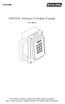 P516-098 WPR400 Wireless Portable Reader User guide Para el idioma español, navegue hacia www.schlage.com/support. Pour la portion française, veuillez consulter le site www.schlage.com/support. Contents
GSM Autodialer Professional GJD700 Speech & Text Autodialer
 Text Edit message GSM Autodialer Professional GJD700 Speech & Text Autodialer Introduction The GSM Autodialer Professional works in conjunction with standard alarm systems and makes use of your preferred
Applied Electronics. Commercial Dimming System UPDATE NOTICE
 REV. A Applied Electronics Commercial Dimming System UPDATE NOTICE This notice is to inform the end user of an additional feature added to this DP12/2400 dimming unit. This unit has been outfitted with
MAGICAR M871A. Car alarm with two-way remote User s guide
 MAGICAR M871A Car alarm with two-way remote User s guide EN MAGICAR M871A Car alarm with two-way remote User s guide TABLE OF CONTENTS Table of contents...2 1. Important notice...4 2. Introduction...4
Product Specification instalert Rapid Messenger Variable Message Sign
 instalert 2 units to cover any application instalert 18 (ia18): 18 x 28 full matrix instalert 24: (ia24): 24 x 60 full matrix Size, Weight without battery ia18: 30 x 20 x 2.74, 29 lbs ia24: Folds to fits
Quick Start Guide. Cisco SPA232D Mobility Enhanced ATA
 Quick Start Guide Cisco SPA232D Mobility Enhanced ATA Package Contents Analog Telephone Adapter Ethernet Cable Phone Cable Power Adapter Quick Start Guide Product CD-ROM Welcome Thank you for choosing
ReachFree ID Installation Instructions For Portal TI, Sentinel and C-Start. Unitec www.startwithunitec.com
 ReachFree ID Installation Instructions For Portal TI, Sentinel and C-Start Unitec www.startwithunitec.com Proprietary Information and Materials of Unitec, Inc. Such proprietary information and materials
OCS-S High Resolution Digital Crane Scale
 OCS-S High Resolution Digital Crane Scale Content 1. Safety Guide... 1 2. Features... 1 3. Specifications... 2 4. Capacity... 2 5. Dimension & Weight... 3 6. Display & Keys... 4 Scale Keys... 4 Indicators...
Manual for Fire Suppression & Methane Detection System
 Manual for Fire Suppression & Methane Detection System Fogmaker North America Post address: 150 Gordon Dr Exton, PA 19341 Delivery address: 150 Gordon Dr Exton, PA 19341 Tel: 610-265-3610 Fax: 610-265-8327
GC2 Panel User Guide
 GC2 Panel User Guide ENGLISH (International) WIRELESS SECURITY SYSTEM WARNING: OWNER S I NSTRUCTION NOTICE Not to be removed by anyone except occupant THIS PAGE INTENTIONALLY LEFT BLANK CONTENTS System
PowerLogic Sub Meter Display (SMD and SMDOPN)
 Instruction Bulletin Z203742-0B PowerLogic Sub Display (SMD and SMDOPN) CONTENTS Introduction... 2 Parts of the Sub Display... 3 Dimensional Drawing... 4 Installation... 5 Mounting the SMD... 5 Mounting
PCS300 Universal IP Reporting Module V1.0
 PCS300 Universal IP Reporting Module V1.0 Reference and Installation Manual Patents: One or more of the following US patents may apply: 7046142, 6215399, 6111256, 6104319, 5920259, 5886632, 5721542, 5287111,
Mini Effect Gizmo. User s Manual. RJM Music Technology, Inc.
 Mini Effect Gizmo User s Manual RJM Music Technology, Inc. Mini Effect Gizmo User s Manual Version 1.3 September 26, 2013 RJM Music Technology, Inc. 2525 Pioneer Ave #1 Vista, CA 92081 E-mail: [email protected]
Owner s Manual Gantry Cranes
 Owner s Manual Gantry Cranes Fixed Height Gantry Crane MODEL NUMBER: SERIAL NUMBER: CAPACITY IN TONS: Telescoping Gantry Crane Bushman AvonTec 262-790-4200, 800338-7810, Fax 262-790-4200 www.bushmanavontec.com
JANUS INTERNATIONAL CORPORATION INSTALLATION INSTRUCTIONS Pantheon Mini Operator
 JANUS INTERNATIONAL CORPORATION INSTALLATION INSTRUCTIONS Pantheon Mini Operator The Janus Pantheon mini operator does not typically require the provision of any additional site requirements other than
RL HW / RL HW+ / RL HGW / RL HV / RL HVPW/RL HVPW-G
 Auto-Levelling Rotary Laser Level RL HW / RL HW+ / RL HGW / RL HV / RL HVPW/RL HVPW-G 77-496 / 77-429 / 77-439 / 77-497 / 77-427/ 77-441 Please read these instructions before operating the product Auto-Levelling
PK-01. Standalone door control module. SATEL sp. z o.o. ul. Schuberta 79 80-172 Gdańsk POLAND tel. + 48 58 320 94 00
 Standalone door control module PK-01 Firmware version 1.00 pk-01_en 06/12 SATEL sp. z o.o. ul. Schuberta 79 80-172 Gdańsk POLAND tel. + 48 58 320 94 00 [email protected] www.satel.eu WARNINGS Read carefully
Drayton Digistat +2RF/+3RF
 /+3RF Programmable Room Thermostat Wireless Model: RF700/22090 Model: RF701/22092 Power Supply: Battery - Thermostat Mains - Digistat SCR Invensys Controls Europe Customer Service Tel: 0845 130 5522 Customer
FPV MONITOR. User Manual
 FPV MONITOR User Manual Important Safety Instructions: Please read User Guide before using this product. Please keep User Guide for future reference. Please read the cautions to prevent possible danger
Operation Manual For NDJ-8S Digital Rotary Viscometer
 Operation Manual For NDJ-8S Digital Rotary Viscometer 1 Contents 1. General... 2 2. Main technical data... 2 3. Working principle... 2 4. Installation... 3 5. Operation procedures... 4 6. Precautions...
PUSH BUTTON START INSTALLATION MANUAL
 PUSH BUTTON START INSTALLATION MANUAL ALTHOUGH THIS PRODUCT HAS BEEN THOROUGHLY TESTED KPIERSON TECHNOLOGIES ASSUMES NO RESPONSIBILITY FOR ANY DAMAGE THAT MAY RESULT BY THE INSTALLATION OF THIS PRODUCT.
Your Simple Guide to Battery. www.firstalertpro.com. Replacement. Customer Care: 1-800-852-0086. www.firstalertpro.
 Previous Menu Your Simple Guide to Battery www.firstalertpro.com Replacement p e t s ts ep -by Customer Care: 1-800-852-0086 FA/1565 9/00 www.firstalertpro.com Table of Contents: page Introduction...............................
New GSM Alarm System. User s Manual. Profile For a better understanding of this product, please read this user manual thoroughly before using it.
 New GSM Alarm System User s Manual Profile For a better understanding of this product, please read this user manual thoroughly before using it. Chapter 1. Features Chapter 2. Alarm Host Introduction Chapter
4.3-inch Back-Up Camera
 TM 4.-inch Back-Up Camera Model No.: PKC0BU4 Owner s Manual and Warranty Information Read these instructions completely before using this product. Retain this Owner s Manual for future reference. INTRODUCTION
Part Name/Description Part Number Quantity. Power Cable 4000950-5 1
 Note: Indented items indicate parts included in an assembly listed above Part Name/Description Part Number Quantity Power Cable 4000950-5 1 Raven Harness Adapter Kit 4100525 1 Installation Instructions
e-4 AWT07MLED 7 Q TFT LCD MONITOR (LED Backlighted) USER MANUAL
 Thank you for purchasing our product. Please read this User s Manual before using the product. Change without Notice AWT07MLED 7 Q TFT LCD MONITOR (LED Backlighted) USER MANUAL e-4 SAFETY PRECAUTIONS Federal
WIND ALARM. Wind Speed Alarm. Wind Speed. Set Point 2. Set Point 1 NEW BEDFORD, MA 02745 USA
 Thank you for purchasing the Maximum wind speed alarm. The Maximum wind speed alarm is a dual set point wind speed indicator with a two digit LED display. It contains a yellow light to display one set
12 Volt 30 Amp Digital Solar Charge Controller
 12 Volt 30 Amp Digital Solar Charge Controller User s Manual WARNING Read carefully and understand all INSTRUCTIONS before operating. Failure to follow the safety rules and other basic safety precautions
Instruction Manual FL
 3. Operation Overview The most common used features (such as displaying force, peak hold, zero and changing of displayed units) can all be done by pressing a single dedicated key identified on the front
Installation and Operation Manual. Digital Remote Meter for Monitoring System Performance. Version: RM-1
 REMOTE METER TM Installation and Operation Manual. Digital Remote Meter for Monitoring System Performance. Version: RM-1 1098 Washington Crossing Road Washington Crossing, PA 18977 USA www.morningstarcorp.com
DAB+ / FM Tuner Model: TU-201
 DAB+ / FM Tuner Model: TU-201 Instruction Manual www.pulse-audio.co.uk 1 Safety Information The lightning bolt within a triangle is intended to alert the user to the presence of dangerous voltage levels
Model 201 Wiegand Touchpad Reader Installation Guide
 Model 201 Wiegand Touchpad Reader Installation Guide P/N 460353001C 15AUG11 2011 UTC Fire & Security. All rights reserved. This document may not be copied in whole or in part or otherwise reproduced without
Wireless Data Logger Monitoring Systems
 Wireless Data Logger Monitoring Systems Table of Contents About MadgeTech, Inc. Wireless Systems & Components Wireless Data Loggers 2000A Wireless Data Logger Models MadgeTech Cloud Services MadgeTech
Awning Instructions. Full Cassette 1.5m to 6m
 Awning Instructions Full Cassette 1.5m to 6m English Full Cassette Manual & Electric Instructions Contents Warning 1.5m - 3.5m Awnings 8 x Expansion bolts ** 2 x brackets 1 x Awning 1 x Winder 4.0m -
Hand Crank Generator (9 May 05) Converting a Portable Cordless Drill to a Hand Crank DC Generator
 Converting a Portable Cordless Drill to a Hand Crank DC Generator The unit is light weight (2.5 lb), portable, low cost ($10-$20) and can be used to recharge single cell batteries at from 1-3.5 amps. It
PRT3 Printer Module: ASCII Protocol Programming Instructions
 PRT3 Printer Module: ASCII Protocol Programming Instructions We hope this product performs to your complete satisfaction. Should you have any questions or comments, please visit www.paradox.com and send
Secure Keypads for access control
 torm Secure Keypads for access control Strike Master Read this manual carefully before attempting to install, program or operate the STORM AXS Strike Master Keypad. After installation the Command Summary
tattletale User Guide Consumer unit version 2.48 1 P a g e
 tattletale User Guide Consumer unit version 2.48 1 P a g e Contents Basic 1... 4 Base Unit Features... 4 Initial Setup... 4 Arming... 5 Disarming... 5 Quiet Button... 5 Settings... 5 Settings 2... 6 Quick
Operation and Installation Manual
 Operation and Installation Manual RCM-10 Remote Control Monitor and RSM-10 Remote Status Monitor for the CNA-100 & CNA-200 Automations Revision 1.1 9/98 WARRANTY INFORMATION The RCM-10 Remote Control
Model SETR-50 and SETR-51 Trim Tab Control
 Model SETR-50 and SETR-51 Trim Tab Control Pictured above is the SETR-50 with black switches on a gray background. The SETR-51 is identical except for the color, wherein it has black switches on a black
ILISC515-A Shift Interlock (Manual Lift Door) 2015 Ford Transit, 3.7L and 3.5L
 An ISO 9001:2008 Registered Company ILISC515-A Shift Interlock (Manual Lift Door) 2015 Ford Transit, 3.7L and 3.5L Introduction The ILISC515-A is a microprocessor driven system for controlling wheelchair
TX GSM SMS Auto-dial Alarm System. Installation and User Manual
 TX GSM SMS Auto-dial Alarm System Installation and User Manual Product Features: 1. 16 wireless zones, 3 wired zones alarm system, suitable for small to medium size offices and homes. 2. The system uses
DirectCommand Installation DirectCommand 3-Channel Spreader Kit
 Note: Indented items indicate parts included in an assembly listed above Part Name/Description Part Number With Switch Box Quantity With Remote Switch Display Cable Kit 4100814 1 1 Power Control Relay
OPL BASIC. Dosing System for Professional Laundry machines. Contents
 OPL BASIC Dosing System for Professional Laundry machines Contents 1 Getting Started. Page 2 2 Installation. Page 4 3 Set Up & Operation. Page 8 4 Maintenance & Accessories. Page 10 5 Troubleshooting Page
MANUAL FOR RX700 LR and NR
 MANUAL FOR RX700 LR and NR 2013, November 11 Revision/ updates Date, updates, and person Revision 1.2 03-12-2013, By Patrick M Affected pages, ETC ALL Content Revision/ updates... 1 Preface... 2 Technical
StructureScan HD Module. Installation Guide ENGLISH. www.bandg.com www.simrad-yachting.com www.lowrance.com
 StructureScan HD Module Installation Guide ENGLISH www.bandg.com www.simrad-yachting.com www.lowrance.com Disclaimer As Navico is continuously improving this product, we retain the right to make changes
NX-591NE-GSM NetworX GSM 3G HSPA+ Module Installation Sheet
 NX-591NE-GSM NetworX GSM 3G HSPA+ Module Installation Sheet The NX-591NE-GSM is a microprocessor-controlled GSM interface module used to connect the NetworX series of control panels to GSM cellular networks
Installation and Operation Back-UPS 1250, 1300, 1500
 Installation and Operation Back-UPS 1250, 1300, 1500 Inventory bu001a Safety and General Information This unit is intended for indoor use only. Do not operate this unit in direct sunlight, in contact with
Table of Contents. Use. Troubleshooting. Setup. Welcome. 11 How to arm/disarm system/camera(s) 19 Sync Module setup issues. 3 Installing the Blink app
 User Guide Table of Contents Welcome Setup Use Troubleshooting 2 What s in the box 2 What you need 3 Installing the Blink app 4 Setting up the Sync Module 5 Connecting the Sync Module to Your Wi-Fi 7 Adding
Wireless Alarm System. Wireless Keypad. User s Manual. Choice ALERT. Control all sensors, accessories and remote transmitters from one location
 Wireless Alarm System Wireless Keypad User s Manual 1 2 3 4 Choice ALERT Control all sensors, accessories and remote transmitters from one location Table of Contents Important Safeguards 4 Introduction
The Parts of the System
 2 The Parts of the System THE RECEIVER THE RECEIVER FRONT PANEL Power Light This green light on the receiver front panel lights up when the receiver is turned ON. This light flashes when the receiver memory
SNMP Web Management. User s Manual For SNMP Web Card/Box
 SNMP Web Management User s Manual For SNMP Web Card/Box Management Software for Off-Grid Inverter Version: 1.2 Table of Contents 1. Overview... 1 1.1 Introduction... 1 1.2 Features... 1 1.3 Overlook...
Multi Function, User Configurable Remote Vehicle Security System with 4 Button Replaceable Membrane Remote Transmitter
 MODEL PRO-9744 INSTALLATION MANUAL Multi Function, User Configurable Remote Vehicle Security System with 4 Button Replaceable Membrane Remote Transmitter This System Allows The Transmitter Buttons To Be
2013 Wireless Video Intercom INSTALLATION GUIDE
 2013 Wireless Video Intercom INSTALLATION GUIDE INDEX System configuration and wiring VL-SWD501 System Component.. 4 VL-SWD501EX wiring schematic diagram VL-SWD501EX wiring type and length... 5.... 6 Door
TraceTek TTDM Series Leak Detection and Location Modules Replacement Parts Installation Instructions
 TraceTek TTDM Series Leak Detection and Location Modules Replacement Parts Installation Instructions TRACETEK TraceTek TTDM Replacement Parts General Information These instructions detail the steps to
Remote Head REMO ONE. Code 5750. Manual
 Remote Head REMO ONE Code 5750 Manual by sachtler. All rights reserved Version: 1.2/09/05 Issue date: September 2005 Order no.: srh20t010a We want you to receive Sachtler products that are always state
Business/Home GSM Alarm System. Installation and User Manual
 Business/Home GSM Alarm System Installation and User Manual Brief Introduction: GSM 900/1800/1900 bands, can be used in most parts of the world Full duplex communication with the host Monitor the scene
INSTALLATION AND OPERATION MANUAL
 ECO-WORTHY INSTALLATION AND OPERATION MANUAL INSTALLATION AND OPERATION MANUAL www.eco-worthy.com ECO-WORTHY Solar tracker ECO-WORTHY 400 Solar Tracker Owner s Manual Manual User Installation instructions
INSTALLATION INSTRUCTIONS
 LIGHTING CONTROL PANELS 4 AND 8 RELAYS INSTALLATION INSTRUCTIONS INSTALLATION OVERVIEW The installation instructions contained in this document are provided as a guide for proper and reliable installation.
Installer Guide smart connect
 Installer Guide smart connect TM 7330 Wireless Remote Humidity Sensor Please read all instructions before proceeding. The wireless remote humidity sensor monitors the humidity passing through the return
INSTALLATION INSTRUCTIONS BOOST CONTROLLER. Pro Control Input (Optional) Tach. Signal. Speed. Gray. Signal. Green Blue. Orange.
 2650-1706-00 INSTALLATION INSTRUCTIONS BOOST CONTROLLER WARNING! The installation of the Auto Meter Boost Controller is recommended only for experienced technicians. This product may damage your engine
GETTING TO KNOW YOUR TELSTRA PRE-PAID 3G USB + WI-FI
 FOR MORE INFORMATION CALL 125 8880 or FROM A NON-TELSTRA PHONE, CALL 13 2200 AND SAY PRE-PAID VISIT telstra.com/ppmbb VISIT A TELSTRA STORE OR PARTNER GETTING TO KNOW YOUR TELSTRA PRE-PAID 3G USB + WI-FI
Operating Guide. Alert 8D Version 8 Zone Controller Arrowhead Alarm Products Ltd
 8 Alert 8D Version 8 Zone Controller Arrowhead Alarm Products Ltd Operating Guide 20 1 Proudly Designed and Manufactured in New Zealand Installer Notes: Please contact your alarm installer if you require
www.sebury.com.cn Digital Keypad Use s Manual
 K3 K4 www.sebury.com.cn Digital Keypad Use s Manual Contents Introduction Introduction Specifications Intramural Interface Circuit 3 Mounting 3 Wiring 5 Power UP 7 Engineer Programming Mode 7 The K3/K4
mysensors mysensors Wireless Sensors and Ethernet Gateway Quick Start Guide Information to Users Inside the Box mysensors Ethernet Gateway Quick Start
 mysensors Information to Users mysensors Wireless Sensors and Ethernet Gateway Quick Start Guide This equipment has been tested and found to comply with the limits for a Class B digital devices, pursuant
Firmware version: 1.10 Issue: 7 AUTODIALER GD30.2. Instruction Manual
 Firmware version: 1.10 Issue: 7 AUTODIALER GD30.2 Instruction Manual Firmware version: 2.0.1 Issue: 0.6 Version of the GPRS transmitters configurator: 1.3.6.3 Date of issue: 07.03.2012 TABLE OF CONTENTS
SYSTEM 4C. C R H Electronics Design
 SYSTEM 4C C R H Electronics Design SYSTEM 4C All in one modular 4 axis CNC drive board By C R Harding Specifications Main PCB & Input PCB Available with up to 4 Axis X, Y, Z, A outputs. Independent 25
Video Baby Monitor System. User Guide
 Video Baby Monitor System User Guide What s inside Welcome!... 2 Getting started... 3 Tour of the system... 7 Everyday use...13 Cameras... 14 Motion/Alerts... 18 Recording... 21 Playing Back Pictures and
Manual. Simrad StructureScan LSS-1 Sonar Module. English
 Manual Simrad StructureScan LSS-1 Sonar Module English www.simrad-yachting.com A brand by Navico - Leader in Marine Electronics Disclaimer As Navico is continuously improving this product, we retain the
VOYAGER 570G. 744A Sprayer Control
 VOYAGER 570G 744A Sprayer Control U S E R M A N U A L U S E R M A N U A L Table of Contents CHAPTER 1 - INTRODUCTION...1 SYSTEM CONFIGURATIONS...1 KIT CONTENTS...3 CONTROL HOUSING ASSEMBLY...5 CHAPTER
User s Information Guide R1A
 HSC505-R Home Security Controller - User Manual Release R1a Pi HSC505 and Pi HSC505R Home Security Controller User s Information Guide R1A Page 1 QD Dynamics (Pty) Ltd reserves the right to make changes
SELF-STEERING AXLE TABLE OF CONTENTS
 SELF-STEERING AXLE TABLE OF CONTENTS Section 1 - Introduction Section 2 - Pre-Installation Check List Section 3 - Ride Height Adjustments Section 4 - Suspension Mount Section 5 - Axle Mount Section 6 -
ASSEMBLY MANUAL SE-4S35
 Automatic drive ASSEBLY ANUAL SE-4S35 AI-4S35 SG-4R35 Battery box otor unit Inter-4 hub CONTENTS WARNING 1 INSTALLATION CONITIONS Battery box Speed sensor Cable lengths and diameters otor unit Recommended
Installing the Broadband Global Area Network (BGAN) Fixed Mount Kit
 Installing the Broadband Global Area Network (BGAN) Fixed Mount Kit Product description BGAN fixed mount kit Although the BGAN satellite modem terminal is designed for portable use, the BGAN Fixed Mount
Rain+Birdt. Simple To Set Timer (SST) Setup & Operation Instructions. English. 1-800- RAIN BIRD (800-724-6247) or visit www.rainbird.
 Rain+Birdt Simple To Set r (SST) Setup & Operation Instructions English Installation...2 Tools and Supplies Needed...2 Step 1. Mount r...2 Step 2. Connect Power...2 Indoor r...2 Outdoor r...2 Step 3. Connect
Troubleshooting and Diagnostics
 Troubleshooting and Diagnostics The troubleshooting and diagnostics guide provides instructions to assist in tracking down the source of many basic controller installation problems. If there is a problem
HP ProDisplay P19A LED Backlit Monitor. User Guide
 HP ProDisplay P19A LED Backlit Monitor User Guide 2013 Hewlett-Packard Development Company, L.P. The only warranties for HP products and services are set forth in the express warranty statements accompanying
RI-215A Operator s Manual. Part Number: 71-0045RK Revision 0 Released: 10/3/05
 RI-215A Operator s Manual Part Number: 71-0045RK Revision 0 Released: 10/3/05 Warranty RKI Instruments, Inc., warrants gas alarm equipment sold by us to be free from defects in materials and workmanship,
Owner s Manual AWM910 JENSEN AWM910 COMPACT DISC PLAYER RADIO CD COMPACT MUSIC SYSTEM MUTE AUX BAND AUX IN PUSH PUSH PWR VOL ALARM T/F AUD SPK A SPK B
 AWM910 Owner s Manual COMPACT DISC PLAYER PUSH 1 2 3 4 5 6 RPT SCAN RDM H M PUSH PWR VOL ALARM SET ON/OFF EQ T/F AUD RADIO CD COMPACT MUSIC SYSTEM MUTE AUX BAND CD AUX IN A B A+B JENSEN AWM910 Thank You!
INTELLIGENT CONTROL MODULE SA-2000-II HARDWARE MANUAL. Access Technologies International, Inc.
 SA-2000-II HARDWARE MANUAL Access Technologies International, Inc. 1 Table of Contents 1. Introduction 3 2. Features 3 3. Specification 4 4. Identifying Supplied Parts 4 5. Panel Description 5 6. Connection
GV- RK1352 Card Reader
 GV- RK1352 Card Reader The GV-RK1352 is a card reader with keypad, designed to recognize PIN codes, identification cards or both. Featured with the Wiegand and RS-485 outputs, the unit can be connected
Model: LCDM40 4.0 LCD Rear Vision Mirror Monitor Installation Manual Features
 Model: LCDM40 4.0 LCD Rear Vision Mirror Monitor Installation Manual Features Mirror with built in 4.0 LCD Monitor Low Profile, Slim Design High Resolution TFT LCD Built in Speaker Two video inputs Fully
telstra.com/mbb 13 2200 visit a telstra store or partner GETTING TO KNOW YOUR TELSTRA WI-FI 4GX ADVANCED III
 telstra.com/mbb 13 2200 visit a telstra store or partner GETTING TO KNOW YOUR TELSTRA WI-FI 4GX ADVANCED III LET S GET THIS SHOW ON THE ROAD WHAT S INSIDE Your Telstra Wi-Fi 4GX Advanced III has been tested
ENGLISH www.bandg.com www.simrad-yachting.com www.lowrance.com
 StructureScan HD Transom mount Installation Guide ENGLISH www.bandg.com www.simrad-yachting.com www.lowrance.com Warning: It is your sole responsibility to install and use the instrument and transducer(s)
Back-UPS Pro 1300/1500 Installation and Operation
 Back-UPS Pro 1300/1500 Installation and Operation Inventory Safety Do not install the Back-UPS in direct sunlight, in excessive heat, humidity, or in contact with fluids. Connect the battery bu059a bu058a
Setting Up the Cisco Unified IP Phone
 CHAPTER 3 This chapter includes the following topics, which help you install the Cisco Unified IP Phone on an IP telephony network: Before You Begin, page 3-1 Understanding the Cisco Unified IP Phone 7962G
E E V R E - R S - O S L O A L R
 Solar Eye User Manual Edition JIANGSU EVER-SOLAR NEW ENERGY CO., LTD. Revision History Date Edition Specification 17/08/2011 1.0 Create File 02/09/2011 1.1 Add Micro SD function description www.ever-solar.com
Schlage Control Smart Locks
 Schlage Control Smart Locks with Engage technology User guide Schlage Control Smart Locks with Engage technology User Guide Contents 3 Warranty 4 Standard Operation 4 Operation from the Inside 4 Operation
Wireless Home Security System Product Manual (Model #80355)
 Wireless Home Security System Product Manual (Model #80355) Installation Instructions During set-up, if no key is pressed for 15 seconds it will come out of the setup mode and you will have to start over.
EBDSPIR-PRM, EBDSPIR-PRM-IP
 Product Guide EBDSPIR-PRM, EBDSPIR-PRM-IP Ceiling PIR presence/absence detector Overview The EBDSPIR-PRM PIR (passive infrared) presence detector provides automatic control of lighting loads with optional
C O B A R 1 8R2 U s e r G u i d e P a g e 1. User Guide COBRA 18R2. Wireless Firing System. www.cobrafiringsystems.com
 C O B A R 1 8R2 U s e r G u i d e P a g e 1 User Guide COBRA 18R2 Wireless Firing System C O B A R 1 8R2 U s e r G u i d e P a g e 2 TABLE OF CONTENTS 1. SYSTEM INTRO... 3 2. POWER ON... 4 3. REMOTE /
PPM Users Manual Signature Software 01-12-00
 PPM Users Manual Signature Software 0-2-00 PPM User Manual /8/02 Software Versions: 0.0.27 Contents. Introduction 2 2. Parameters 3 2. Overload Limit...4 2.2 Relative Upper Limit...4 2.3 Relative Lower
PYRODIGITAL CONSULTANTS PD Firing Module Continuity Reader
 Firmware Version 2.03 Page 1 of 22 1 Features... 5 2 Warning!... 6 3 Intended Purpose for PD Firing Module Reader... 7 4 Primary Controls:... 8 4.1 On/Off... 8 4.2 Measure - INFORMATION... 8 4.3 Find -
Model 5511 Filler Controller User s Manual Version 1.1 October 2011
 Thompson Scale Company WEIGHING SYSTEMS & PACKAGING MACHINERY CONTROLS 2758 Bingle Road Houston, Texas 77055 Phone: 713/932-9071 Fax: 713/932-9379 www.thompsonscale.com Model 5511 Filler Controller User