
Identification System. FC 44 Function for ASM 450 With Supplements for FB 240. Contents. General Features Hardware Description of ASM 450
|
|
|
- Gerard Greer
- 9 years ago
- Views:
Transcription
1 MOBY FC 44 Function for ASM 450 With Supplements for FB 240 Technical Description Identification System Contents General Features Hardware Description of ASM 450 Specifications of the FC 44 BEDB Command Data Block Sample Applications MDS Control, Presence Check and Digital Inputs/Outputs Commissioning the ASM 450 with FC 44 Indicator Elements and Trouble-Shooting Programming the ASM 450 on PROFIBUS-DP Using the ASM 450 in a SIMATIC S5 Warnings A B C 6GT AC30-0DA2 Release

2 Safety Guidelines This manual contains notices which you should observe to ensure your own personal safety, as well as to protect the product and connected equipment. These notices are highlighted in the manual by a warning triangle and are marked as follows according to the level of danger:! Danger indicates that death, severe personal injury or substantial property damage will result if proper precautions are not taken.! Warning indicates that death, severe personal injury or substantial property damage can result if proper precautions are not taken.! Caution indicates that minor personal injury or property damage can result if proper precautions are not taken. Note draws your attention to particularly important information on the product, handling the product, or to a particular part of the documentation. Qualified Personnel The device/system may only be set up and operated in conjunction with this manual. Only qualified personnel should be allowed to install and work on this equipment. Qualified persons are defined as persons who are authorized to commission, to ground, and to tag circuits, equipment, and systems in accordance with established safety practices and standards. Correct Usage Note the following:! Warning This device and its components may only be used for the applications described in the catalog or the technical description, and only in connection with devices or components from other manufacturers which have been approved or recommended by Siemens. This product can only function correctly and safely if it is transported, stored, set up, and installed correctly, and operated and maintained as recommended. Trademarks SIMATIC and MOBY are registered trademarks of SIEMENS AG. Some of the other designations used in these documents are also registered trademarks; the owner s rights may be violated if they are used by third parties for their own purposes. Copyright Siemens AG 1998, 1999, 2000, 2001 All rights reserved The reproduction, transmission or use of this document or its contents is not permitted without express written authority. Offenders will be liable for damages. All rights, including rights created by patent grant or registration of a utility model or design, are reserved. Siemens AG Automation and Drives Systems Engineering P.O. Box 2355, D Fuerth Index-2 Siemens Aktiengesellschaft Disclaimer of Liability We have checked the contents of this manual for agreement with the hardware and software described. Since deviations cannot be precluded entirely, we cannot guarantee full agreement. However, the data in this manual are reviewed regularly and any necessary corrections included in subsequent editions. Suggestions for improvement are welcomed. Siemens AG 1998 Technical data subject to change. Order No. 6GT AC30-0DA2 FC 44 Function for ASM 450

3 Bild: 1 Kapitel: Inhaltsverzeichnis Seite: 1 Tabelle: 1 Seitennummernfolge: i Contents 1 General Features Hardware Description of ASM PROFIBUS Address and Terminal Resistance Wiring the Plug Connectors for the Voltage Supply and PROFIBUS-DP SLG Connection Specifications of the FC Technical Data Communication between ASM 450 and FC Engineering Procedure How Many ASM 450 Slaves Can Be Connected BEDB Command Data Block BEDB-General Description BEDB-Layout BEST Command and Status Word DATDB / DATDW Data Field Pointers ANZ Error Indication Word Table of MOBY Commands Setting the Parameters of the Commands Using the ECC Driver (All MDS Models) Starting the Commands Sample Applications Flowchart: Scanning the FC 44 by the User Processing the Data Memories Initialising the Data Memories Calling FC 44 Cyclically (e.g., in OB 1) Presetting the BEDB Programming New Starts and Restarts i

4 Contents 6 MDS Control, Presence Check and Digital Inputs/Outputs No MDS Control; No Presence Check: ANW = No MDS Control; Presence Control via Field Scanning: ANW = Field Scanning as MDS Control: ANW = MDS Control with 2 DIs: ANW = MDS Control with Field Scanning and 1 DI: ANW = New Starts and Restarts Commissioning the ASM 450 with FC Indicator Elements and Trouble-Shooting PROFIBUS Diagnosis Evaluating the Errors Indicated by ANZ Error Messages of the FC 44: Right Byte of ANZ (DBB 5 in BEDB) Error Messages of the ASM 450: Left Byte of ANZ (DBB 4 in BEDB) Notes on Trouble-Shooting A Programming the ASM 450 on PROFIBUS-DP A-1 A.1 Layout of the Command Byte (Byte 1 of the Telegram) A-3 A.2 System Commands A-4 A.3 MDS Processing Commands without ECC Driver A-7 A.4 MDS Processing Commands with ECC Driver (All Types of MDSs).... A-9 A.5 Handshake Control A-13 A.5.1 General Handshake Procedure A-14 A.5.2 Telegram Communication for a Command A-15 A.5.3 Signal Timing for Command and RESET Command Handshakes A-16 A.5.4 Termination of a Running Command A-17 B Operation of the ASM 450 on a SIMATIC S B-1 B.1 Parameterization of the FB 240 Overview B-2 B.2 BEDB Command Data Block for SIMATIC S B-3 B.3 Example of a Cyclic Call of FB B-4 C Warnings C-1 ii
5 General Features 1 The ASM 450 interface module is a module for operation of MOBY on PROFIBUS-DP. A protection rating of IP67 permits use in almost any environment. Figure 1-1 ASM 450 interface module One or 2 SLGs from the MOBY family can be connected. When 2 SLGs are used, these are addressed in multiplex operation. These SLGs can be MOBY type I, E, F or V. If 2 SLGs are connected, these must be of the same type. The MOBY type is switched with the RESET command. Function FC 44 is available for the SIMATIC S7. Function block FB 240 is available for the SIMATIC S5. FB 240 has the same call interface as FC 44. The S5 user can use both the FB 240 description and this FC 44 description. Cf. appendix B.3. FC 44 and FB 240 have the same user interface. See section 5 for differences in the parameterization. See the appendix A for a description of the programmer interface for non-simatic users. The ASM 450 can be equipped with 2 digital inputs and 2 digital outputs as an option. These can be used for MDS control (see section 6) or as desired by the user. These inputs/outputs are updated via the DI/DQ command. PROFIBUS configuration File SIEM804C.GSD must be used. The file is included together with FC 44 on the MOBY Software product (6GT AA10). The GSD file can also be downloaded from the Internet. 1-1

6 General Features Compatibility When used with MOBY-I, the ASM 450 module is command-compatible with the ASM 440 module. Only the new GSD file (i.e., SIEM804C) must be linked for the ASM 450. Byte and word pointer for FC 44 Two versions of the FC 44 are included in SIMATIC project file ASM450. FC44_Byte The user data are addressed in S5-compatible mode. One byte each is available for addressing DATDB and DATDW. FC44_Word One word each is available for addressing DATDB and DATDW. All data blocks available in S7 can be addressed. Chapter 4 of this manual describes the differences in the layout of BEDB. 1-2

7 Hardware Description of ASM Pin assignments The following figure shows the pin assignment of the ASM 450. LEDs for PROFIBUS-DP (See also section 8.1) X11 X12 X X1 2 1 SLG1 3 RxD X2 5 4 ERR ANW DQ0 DQ1 X3 DI0 DI1 SLG2 RxD X4 SF: BF: ON: DC 24 V: System fault (hardware error on the ASM 450) Bus fault (error on PROFIBUS-DP) On when the logic voltage is present on the ASM 450 (is generated from the 24 V supply voltage) On when the 24 V supply voltage is connected to the ASM 450 LEDs for MOBY RxD: SLG with command active ANW: MDS present or status of DQ1 ERR: Error indication or status of DQ0 SLG1/2: Indicates the selected SLG. Only SLG1 or SLG2 can be selected. DI0/1: Status of the digital inputs DQ0/1: Status of the digital outputs These LEDs are identical to ERR and ANW. They can be changed to the DQ0/1 meaning with the OPT parameter. See chap Socket X11 and X12 (PROFIBUS-DP) Pin Assignment 1 Signal B (red) 2 PE 3* PE 4 Signal A (green) 5* L+ 6* M X13 (supply voltage) * Not circuited 1 PE 2 L+ 3 M 4 PE 5 L+ 6 M Figure 2-1 Pin assignment and LEDs of the ASM

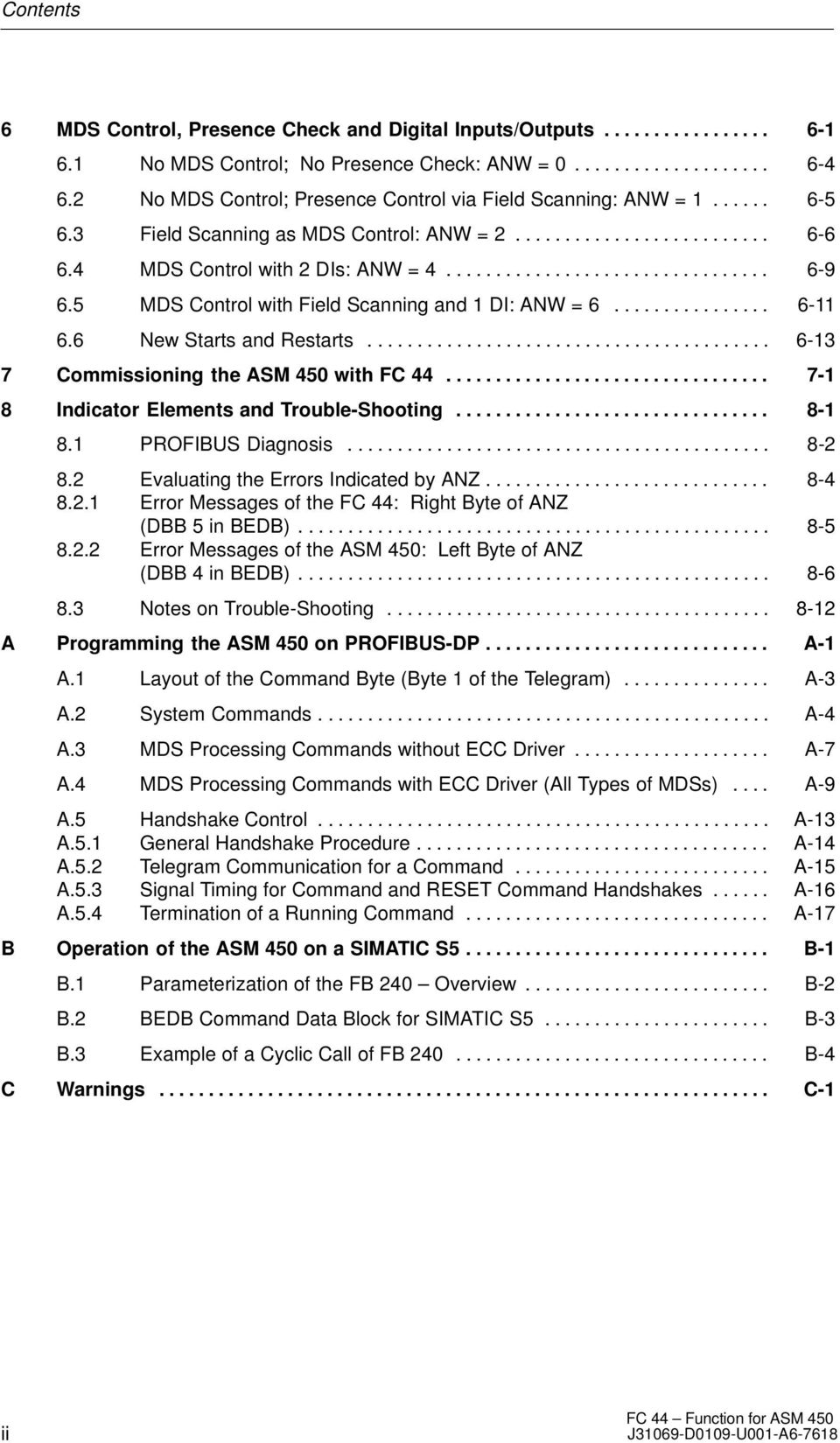
8 Hardware Description of ASM 450 Dimensional drawing of ASM 450 with mounting holes The following figure shows a dimensional drawing of the ASM 450 with bus plug connectors. The length of the PG screw connections and the radius of the cable must be added to the total width and depth specified. 53,5 28, Ø Figure 2-2 Dimensional drawing of the ASM PROFIBUS Address and Terminal Resistance PROFIBUS adress The PROFIBUS address is used to specify the address under which the ASM 450 interface module will be addressed by the DP master of PROFIBUS-DP. The 7 DIP switches on the basic module are used to set a PROFIBUS address from 1 to 125. Purpose of the terminal resistance Both ends of a bus cable must be terminated with its impedance. The terminal resistance is connected in the first and last station of the network. Location of the DIP switches The DIP switches for setting the PROFIBUS address and connecting the terminal resistance are located inside the ASM 450 under the plug connector plate for the connection plugs for PROFIBUS-DP and the supply voltage. 2-2
9 Hardware Description of ASM 450 How to proceed The plug connector plate of the ASM 450 must be removed before the PROFIBUS address can be set and the terminal resistance connected. The plug connector plate covers the DIP switches. The following figure shows the location of the DIP switches on the ASM 450 and gives an example of the setting of each. Example: Terminal resistance connected (status on delivery) on off Example: PROFIBUS address 120 (status on delivery) = = 120 ON In reserve Figure 2-3 Setting the PROFIBUS address and connecting the terminal resistance Note The PROFIBUS address on the ASM 450 must always correspond to the PROFIBUS address specified by the configuration software for this ASM 450. To ensure that the terminal resistance functions correctly, always set both DIP switches of the terminal resistance to on or off. 2-3

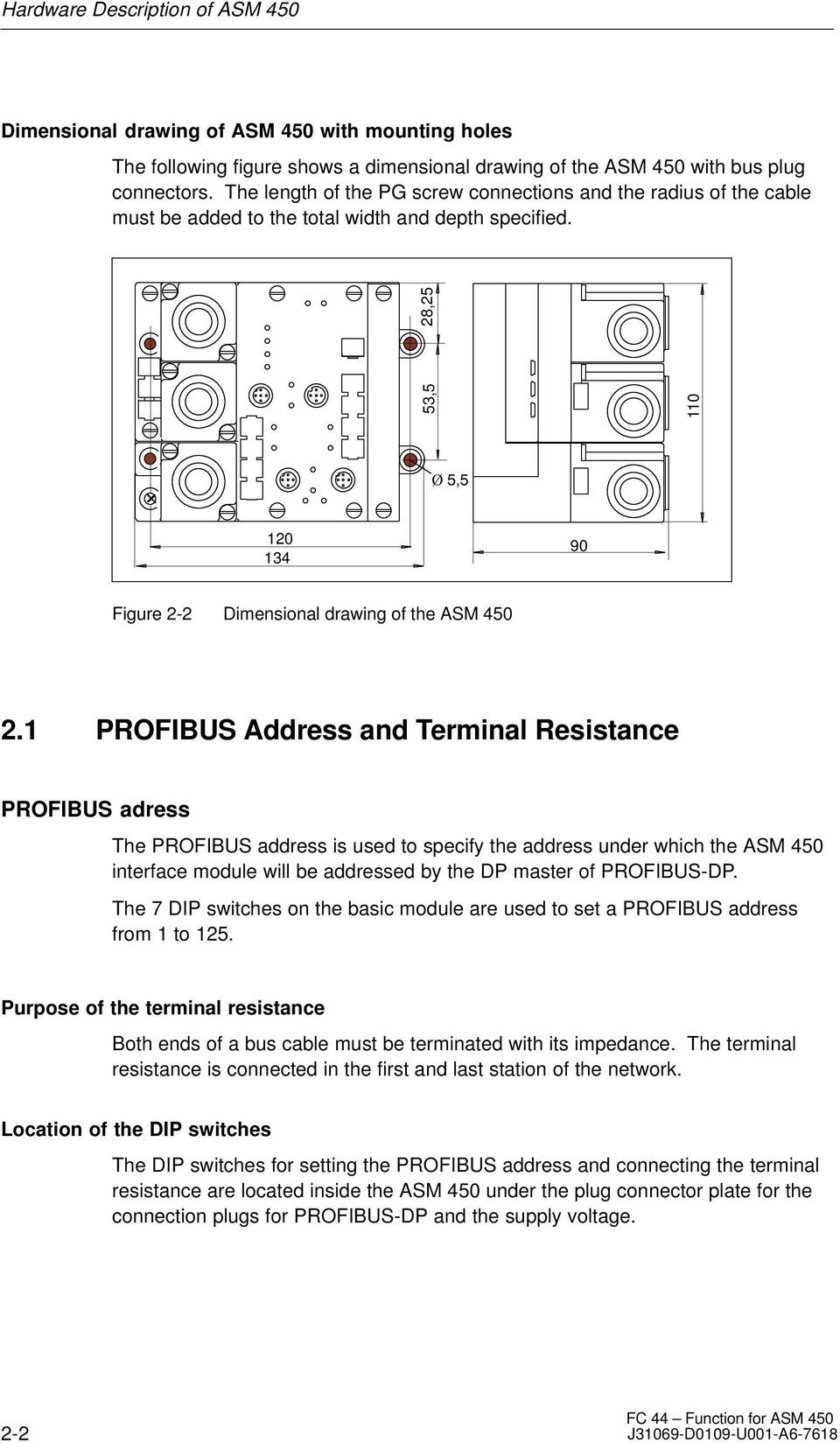
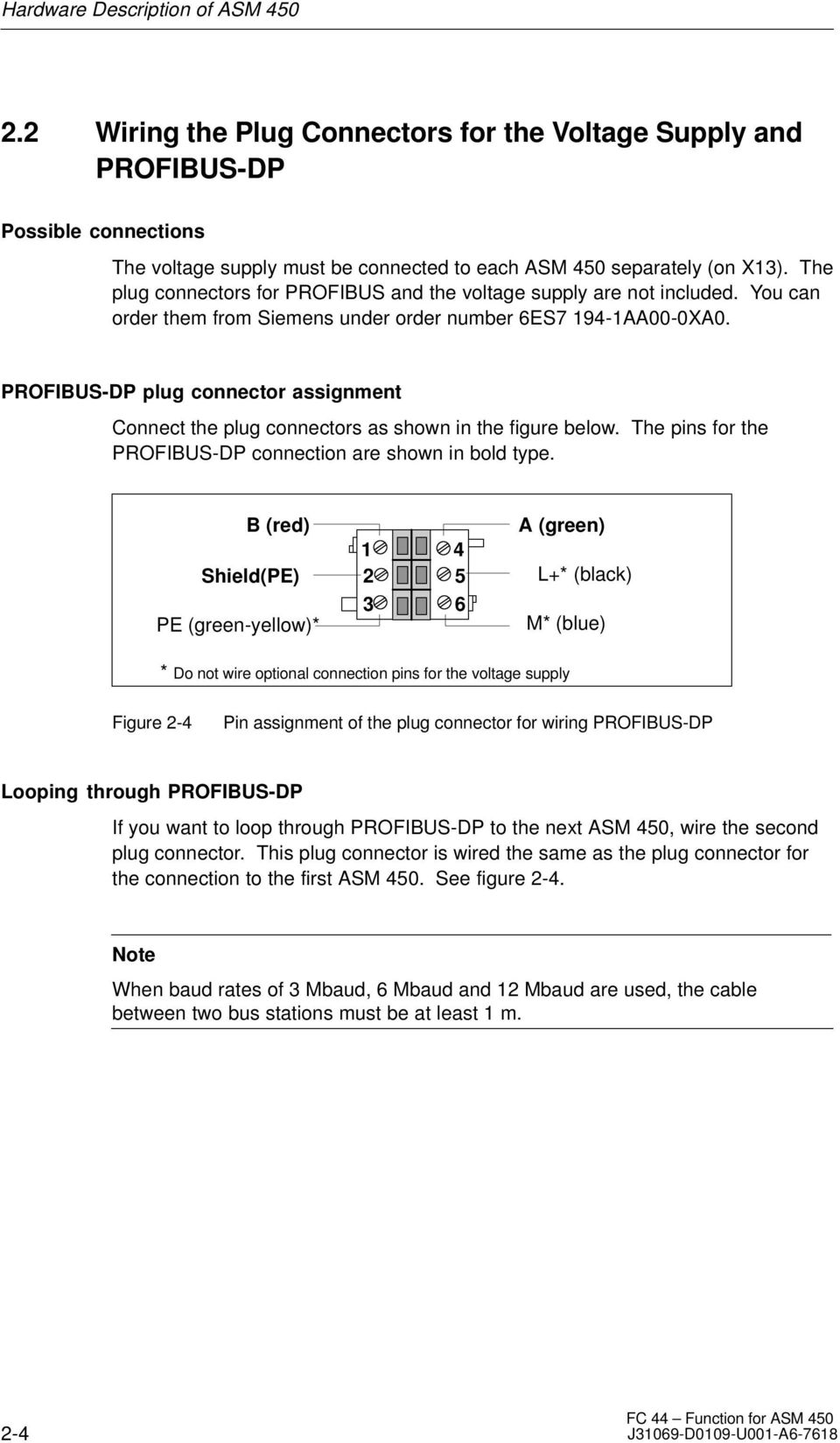
10 Hardware Description of ASM Wiring the Plug Connectors for the Voltage Supply and PROFIBUS-DP Possible connections The voltage supply must be connected to each ASM 450 separately (on X13). The plug connectors for PROFIBUS and the voltage supply are not included. You can order them from Siemens under order number 6ES AA00-0XA0. PROFIBUS-DP plug connector assignment Connect the plug connectors as shown in the figure below. The pins for the PROFIBUS-DP connection are shown in bold type. B (red) Shield(PE) PE (green-yellow)* A (green) L+* (black) M* (blue) * Do not wire optional connection pins for the voltage supply Figure 2-4 Pin assignment of the plug connector for wiring PROFIBUS-DP Looping through PROFIBUS-DP If you want to loop through PROFIBUS-DP to the next ASM 450, wire the second plug connector. This plug connector is wired the same as the plug connector for the connection to the first ASM 450. See figure 2-4. Note When baud rates of 3 Mbaud, 6 Mbaud and 12 Mbaud are used, the cable between two bus stations must be at least 1 m. 2-4
11 Hardware Description of ASM 450 Wiring the voltage supply You will need the following materials when you connect the voltage supply (24 V DC). One plug connector 3-core, flexible copper cable Connect the plug connector to pins 1, 2 and 3 as shown in the next figure. Terminals 1 and 4, 2 and 5, and 3 and 6 are jumpered internally. PE L+ M PE L+ M Figure 2-5 Pin assignment of the plug connector for connection of the voltage supply! Caution Wiring the plug connector incorrectly can destroy all or part of the device. Note To ensure protection rating IP65, IP66 or IP67, all 3 plug connectors must always be connected to the ASM 450 regardless of whether they are wired or not. 2-5

12 Hardware Description of ASM SLG Connection With prefabricated cable All SLGs are connected with a 2-m prefabricated cable. Other cables are available on request. Two 5-pole round plug connectors (M12) Plug Connector Pin 22,5 2m 18,5 X1 X2 X1/2 X1/3 X1/1 X1/4 X2/3 X2/1 White Brown Green Yellow Gray Pink X1/5 X2/5 Figure 2-6 ASM 450 SLG connection cable (6GT2091-1CH20) With cable made by you An SLG plug connector with screw terminals is available for users who want to make their own cables. Cable and SLG plug connector can be ordered from the MOBY catalog. SLG cable: 6GT A Plug connector hood removed 48 PG 11 screw connection; max. cable diameter = 6.5 mm (Do not tighten screws until plug connector is assembled.) S S 18,5 Protection rating IP 67 2 screws for opening the plug connector Coupling plug connector (M12) on ASM 450 Plug Connector Pin S S Core Color Green White Brown Yellow Gray Pink - (not connected) Shield Connection to Pin... of the SLG Plug Connector Figure 2-7 Plug connector ASM 450 SLG (6GT2090-0BC00) 2-6

13 Specifications of the FC 44 3 FC 44 can be used with all S7 CPUs equipped with an integrated PROFIBUS-DP master. 3.1 Technical Data Block number: FC 44 Block name: MOBY 450 Family: S7 MOBY Block length: Approx bytes Blocks called: None Data blocks used: BEDB 17 data words Flags used: None Counters used: None Registers used: AR 1, AR 2 Call: Cyclic Table 3-1 Typical Run Times of FC 44 (PLC cycle load specified in msec) S7-CPU Idle Pass Read Bytes Write Bytes FC DP n * n * DP n * n * n = Amount of user data in bytes to be processed per read or write command Note: See catalogue for the ASM 450 times required for data communication with the data memories. The times are valid for FC 44 read/write commands with and without ECC. Note If the FC 44 is used with a CPU DP, version > 2.1 of the MOBY 450 block must be used. 3-1

14 Specifications of the FC Communication between ASM 450 and FC 44 The ASM 450 is a MOBY slave module for use with PROFIBUS-DP. In terms of hardware, the S7/PROFIBUS and ASM 450 communicate by reading or writing the appropriately parameterised address areas (i.e., input and output areas) of the ASM 450. The start address and size of the input/output areas are specified with parameterisation (see also chapter 5). The software interface communicates with command and acknowledgement telegrams which are transferred back and forth between the ASM 450 and the S7 by the PROFIBUS-DP. The command to the ASM 450 and the acknowledgement from the ASM 450 consist of header and user data. The headers for command and acknowledgement of the read/write commands are each 6 bytes long. Table 3-3 in chapter 3.4 shows the relationship between parameterization and user data. Calculation of MOBY data throughput Calculation of data throughput becomes important when long data sequences are to be exchanged with the MDS (e.g., reading 1000 bytes). Incorrect configuration of PROFIBUS may increase MOBY transmission times significantly. The primary factors which determine data throughput are listed below. Cycle time of the PLC (user program) Cycle time of PROFIBUS (see PROFIBUS configuration; table 3-3) MOBY transmission time (see chap. 3 of MOBY configuration manual) An Excel calculation program is available on request. This can be used to predetermine data throughput during configuration. 3-2

15 Specifications of the FC Engineering Procedure Table 3-2 Engineering procedure (from V2.0 of FC 44) LAD Box Parameter Data type Permissible Values/Characters Description MOBY 450 ADR the ASM 450 ADR INT 256* Start address of the input areas and output areas of BEDB BEDB INT 1 Working data MOBY MOBY INT 0, MOBY oper. mode ANW ANW INT MDS control ABTA ABTA BYTE 00...FF Scanning time for MDS 507 operation OPT OPT BYTE 00...FF Options OPT2 OPT2 WORD W#16#0000 Reserved (Enter 2 or 3 for CPU DP.) * Depends on the CPU. The value must be located outside the process image. ADR: Parameterized start address of the input/output areas of the ASM 450 slave in the I/O area of the SIMATIC S7. This parameterization must match that of the PROFIBUS configuration. Note The start address of the input/output areas must always be an even number. The start address of both the input areas and the output areas is identical. The input and output area is specified with ADR. BEDB: Command data block for internal FC 44 use. (See also chapter 4) The user must set up one BEDB for each ASM 450 slave. A BEDB must have at least 17 words (DBW 0 to DBW 32). Starting at DBW 34, the BEDB can be used as desired (e.g., for DATDB with the user data). 3-3
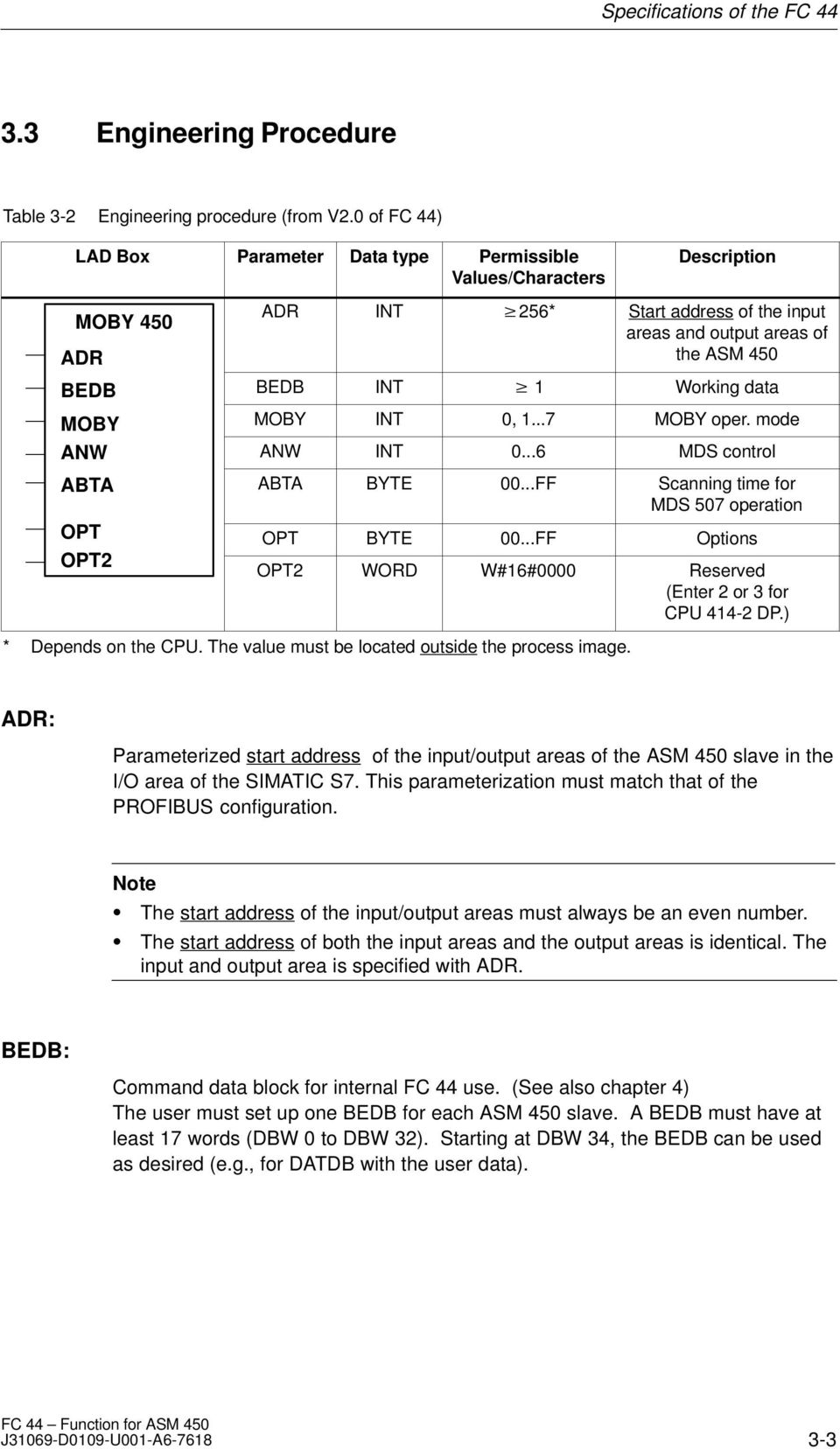
16 Specifications of the FC 44 MOBY: Setting of the MOBY operating mode 0 = MOBY I/E (without MDS 507) 1 = Reserved 2 = MOBY I with MDS = Reserved 4 = MOBY V 5 = MOBY F with MDS F1xx 6 = MOBY F with MDS F4xx 7 = MOBY F with MDS F2xx 8, 9 = Reserved ANW: Setting of MDS control (Cf. chapter 6) 0 = Without MDS control and ANW check via firmware 1 = Without MDS control and with ANW check via firmware 2 = With MDS control and with ANW check via firmware 4 = With MDS control and with ANW check via DI0 and DI1 6 = With MDS control and with ANW check via DI0 Note When setting 2, 4, or 6 is used, only one SLG may be used on the ASM
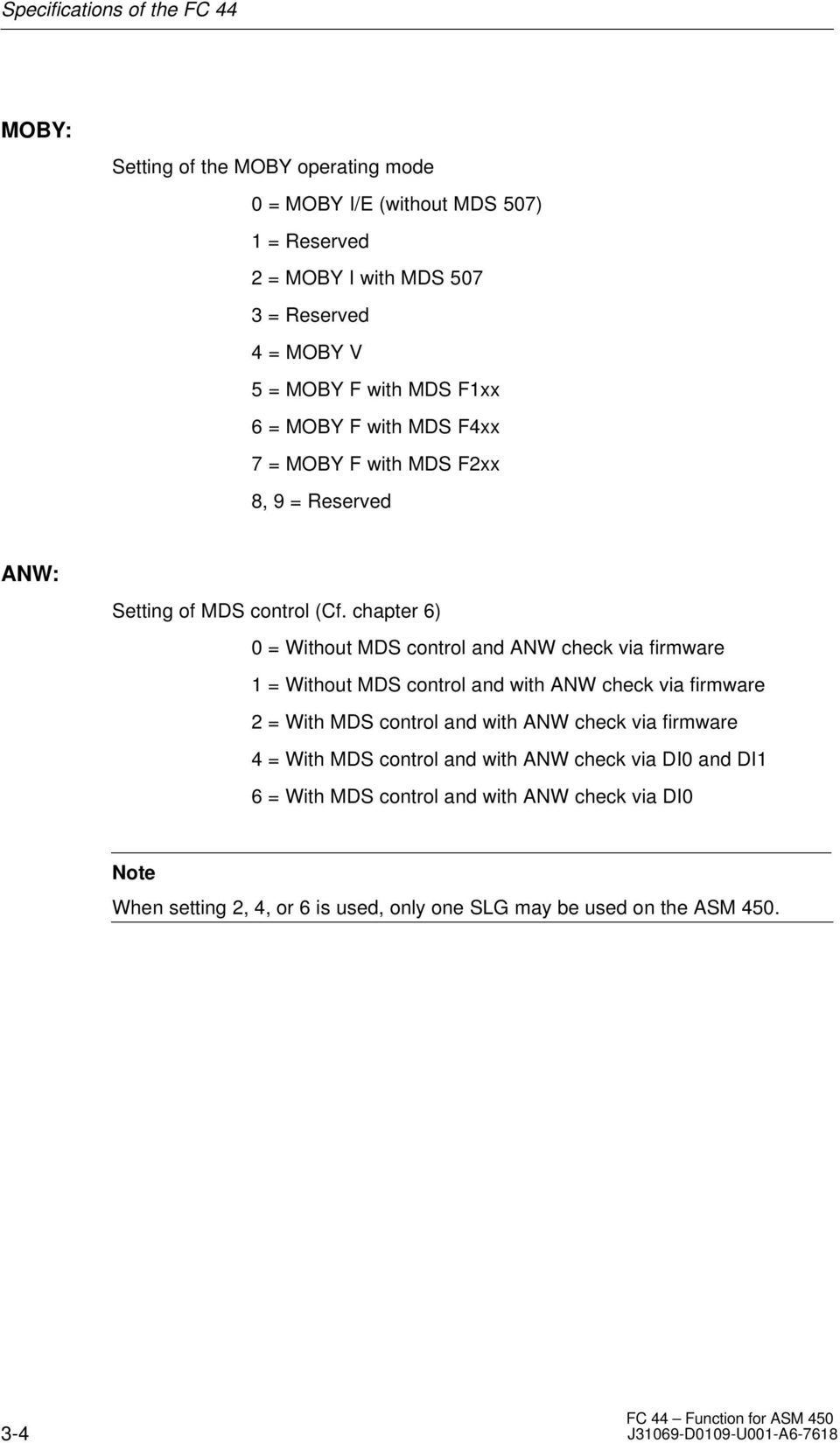
17 Specifications of the FC 44 ABTA: This parameter only applies to MOBY I and MOBY V operation with the MDS 507. All other users must set this parameter to 00. Parameterisation of the scanning time for MDS 507 operating mode. FC 44 does not evaluate this parameter unless MOBY = 2 was specified. The MDS 507 was designed for long-distance read and write accesses. It is equipped with a battery for communication with the SLG 44. This means that, to prevent the battery from being discharged too quickly, the MDS 507 should only be processed when data communication is actually to take place. If no command has been issued for the MDS, its presence in the field of the SLG 44 is scanned at the parameterised scanning interval ABTA (i.e., low load on the MDS battery). If, however, a command has been issued for the MDS, this is always processed immediately regardless of the ABTA. The following table shows the scanning time ABTA. (See also configuring manual for SLG 44/MDS 507/MDS 407E.) Bit Time value: 00 to 3F Time Factor: 00 = 0.01 sec 01 = 0.1 sec 10 = 1 sec 11 = 10 sec Example: A scanning time of 1 second results in ABTA = 0081HEX. OPT: Setting the options on the ASM 450 In normal operating mode, OPT can be set to 00HEX. The options are described in appendix A.2 (OPT). OPT is binary coded, e.g. 01 HEX = A MOBY error generates a system diagnosis (Cf. chap. 8.1). 02 HEX = Clear error LED 10 HEX = The DQs can be used as desired. The OPT parameter is transferred to the ASM after every RESET. 3-5
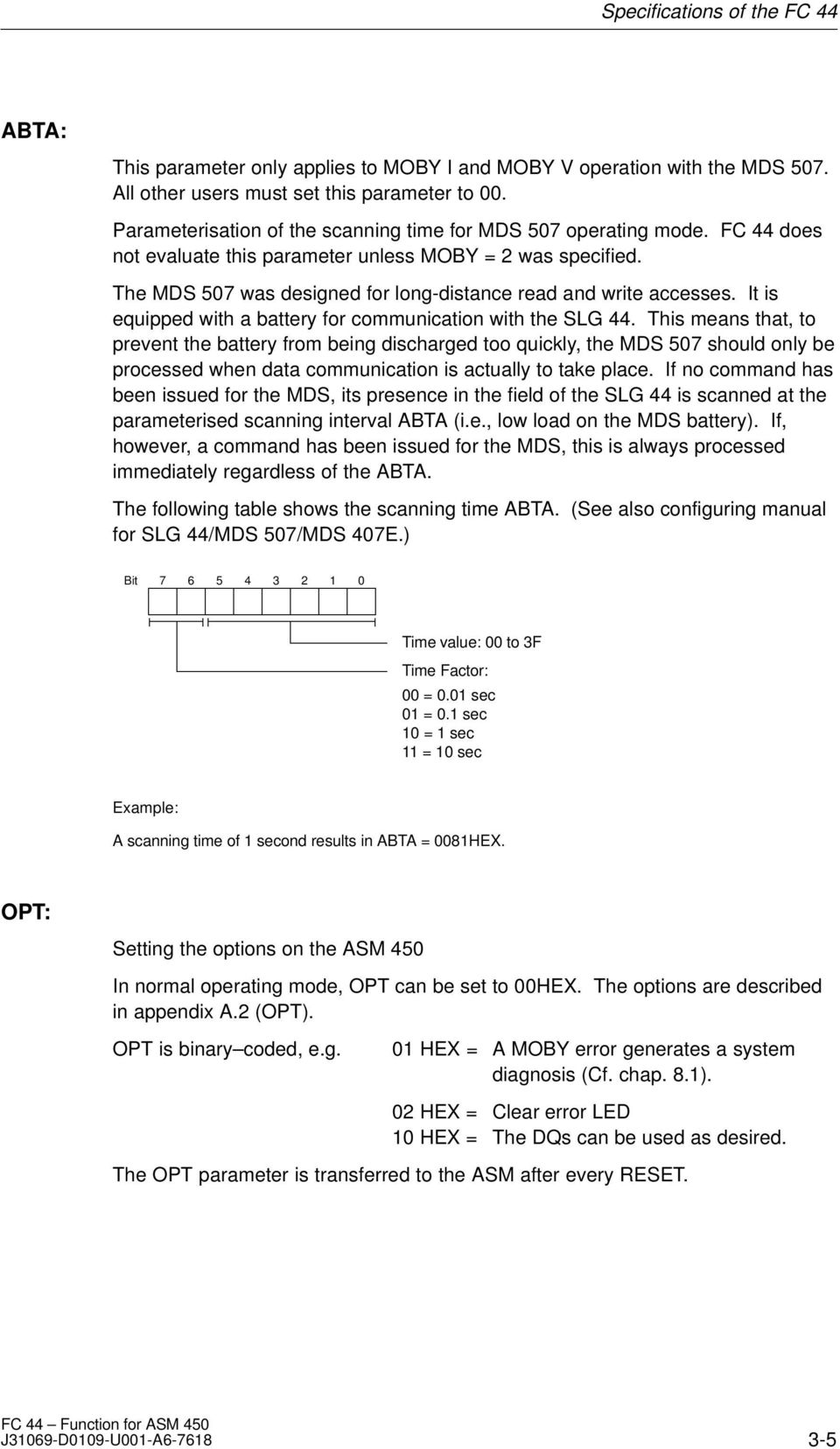
18 Specifications of the FC 44 Note Remember the following when using the DQs as desired. After the ASM 450 is turned on, an error code is indicated on DQ0. Actuators connected to DQ0 may be switched uncontrollably. Do not use DQ0 to control a signal affecting safety. OPT2: Reserved for expansions OPT2 must currently be preset to 0000HEX. Starting with version V2.1 of FC 44 A value of 2 or 3 must be entered here for CPU DP to ensure data consistency. The value specifies the number of wait cycles until the data become valid. 3-6
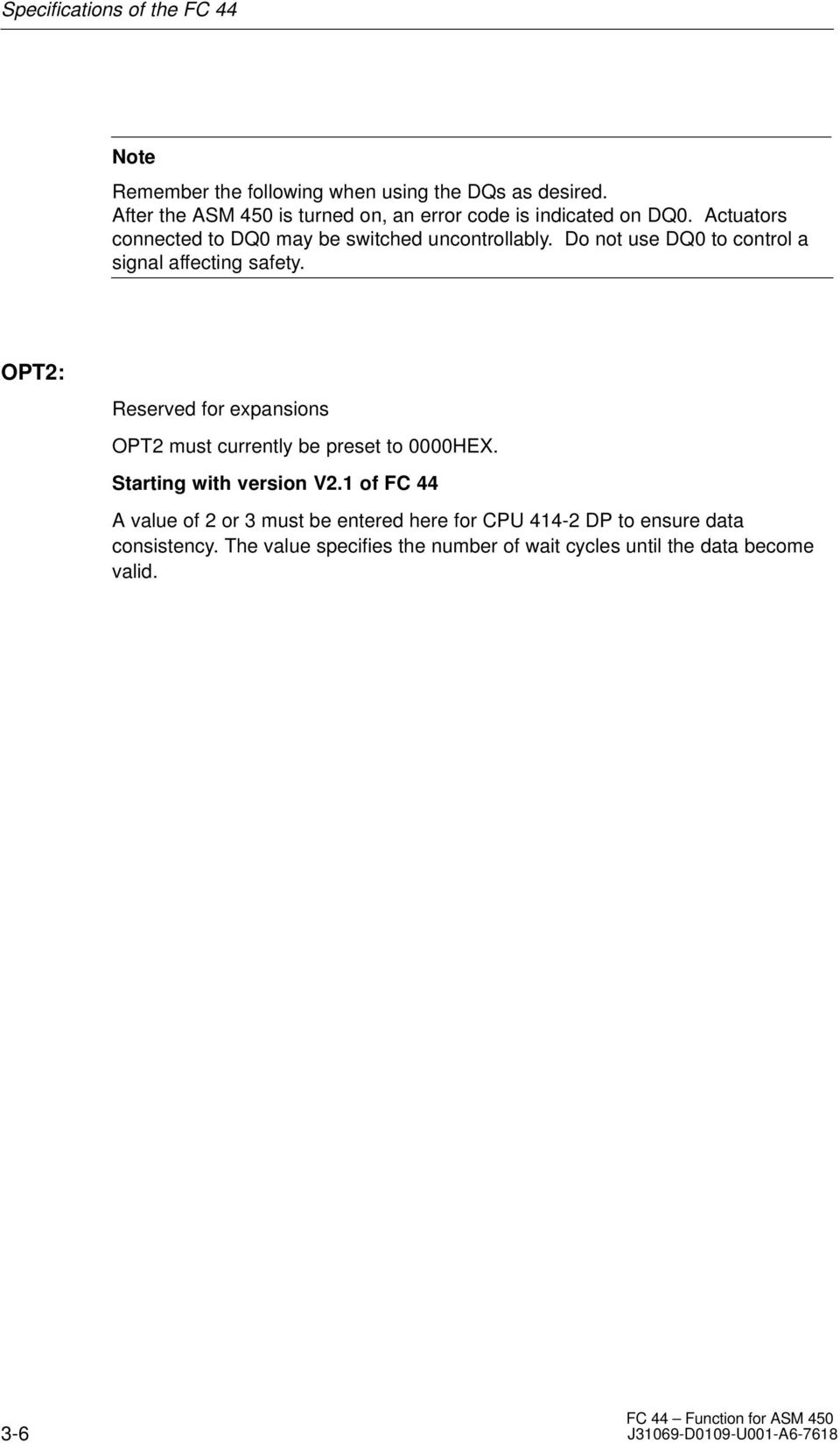
19 Specifications of the FC How Many ASM 450 Slaves Can Be Connected The controller or CPU used determines the maximum number of ASM 450 slave modules. The following table shows the relationship between the size of the input/output areas and the length of the user data. The user data length is the maximum number of bytes which can be read from the MDS or written to the MDS on this ASM 450 station by one FC 44 command. Parameterization of the input/output area applies to the entire module and also to each individual SLG. Since only one SLG can be active at a time, each SLG uses the entire input/output area. Also listed is the maximum number of ASM 450 modules which can be operated on one master (when appropriately parameterised). (See also chapter 3.2). Table 3-3 Size of the input/output areas and lengths of the user data Parameterization of the Input/Output Area Words Bytes Number of User Data Bytes Which Can Be Read/Written by One FC 44 Command on One ASM 450 Station Number of ASM 450 slave Stations SIMATIC S5 with IM 308-C 1) In the Linear P I/O Area In the 16 P Area Page Frames SIMATIC S DP 2) DP 3) * 16= * 16 = * 16 = * 16 = * 16 = * 16 = * 16 = (1) 4) (8) 4) (32) 4) FB 240 must be used for SIMATIC S5 with IM 308 C. Cf. appendix B. 2 CPU DP can address up to 64 slaves. The max. address area for PROFIBUS is 1024 bytes. 3 CPU DP can address up to 96 slaves. The max. address area for PROFIBUS is 4096 bytes. We recommend parameterization in words for the S7-400 for optimum performance. 4 Since, for STEP 7, the maximum PROFIBUS data length is 61 words or 122 bytes, the configuration must be changed manually for the 64-word or 128 byte parameterization. In the menu Object Properties (S7) or Slave Properties Configure (COM PROFIBUS), the data length in the last slot must be changed to 13 words or 10 bytes. 3-7

20 Specifications of the FC 44 Note If the user data length is parameterized for a write command longer than that specified in table 3 3, the PLC will assume STOP status with QVZ or the telegram data will be sent to a wrong address. 3-8

21 4 4.1 To function correctly, the FC 44 requires one BEDB command data block for each ASM 450. All control information (e.g., pointer to the data field (DATDB/DATDW), error messages, and status and state bits) is stored in the BEDB. The BEDB is updated each time the cycle changes. A minimum length of 17 data words (DBW 0 to DBW 32) is required. 4.2 BEDB-Layout FC44_Word FC44_Byte BEDB DBW 0 DBW 2/4 DBW 6 DBW 8 DBW 0 DBW 2 DBW 4 DBW 6 BEST DATDB DATDW ANZ Command Parameter Command/status word (See chapter 4.2.1) Pointer to the start address of the data to be written to or read from the MDS. (See chapter 4.2.2) Error number (See chapter 4.2.3) Command code and command parameter (See chapter 4.2.4) DBW 10 DBW 8 Command parameter Command parameter depending on command (See chapter 4.2.5) DBW 12 DBW 10 Reserved DBW 14 DBW 12 Reserved Reserved for FC 44 (Do not use.) DBW 30 DBW 30 DBW 32 DBW 32 Reserved 4-1
22 Note BEDB must be at least 17 data words or 34 data bytes long (DBW 0 to DBW 32). Data words DBW 0 to DBW 8 in BEDB are available to the user. Single commands can be sent to the ASM 450 or messages for the user indicated by writing, reading or setting the parameters of these data words BEST Command and Status Word DBW 0 = BEST BEST is valid at all times. It can be scanned by the user at all times. DBB 0 DBB ÂÂÂÂ ÂÂÂÂ ÂÂÂÂ ÍÍÍÍÍÍ ÍÍÍÍÍÍ ÍÍÍÍÍÍ Reserved RESET Start command Reserved NEXT New start (RESET) RESET, NEXT, New start active/was last command FC 44 active Presence (ANW bit) ECC correction performed BATT 2 battery monitoring BATT 1 battery monitoring Error (exact error shown in ANZ) READY for next command ÍÍ ÍÍ ÂÂ ÂÂ These bits must be controlled by the user. These bits must be scanned by the user. 4-2
23 Note: The BEST parameter must be preset to W#16#0008 in the applicable OB (see catalogue) for new start and restart. OB 100 for new start OB 101 for manual restart Permitted Modifications to the Control Bits in BEST BIT 0 RESET Reset a read or write command. Perform a reset after initial commissioning and each time the ADR, BEDB, MOBY, ANW, ABTA, OPT and OPT2 parameters are changed. This reset is necessary so that the parameters are checked and the commands in BEDB restructured. BIT 1 Start command Start signal for FC 44. Execution of the parameterised command. The FC resets this bit after starting execution of the commands. BIT 2 NEXT command Start NEXT command. The command following the NEXT command refers to the next MDS. This permits you to start a command immediately even though the old MDS is still in the field. Some operating modes require that the NEXT command be used. (See chapter 6). BIT 3 New start Set by the user after a new start and after return of power. Its functions are the same as those of reset except that the bit is also scanned while the command is being executed. 4-3
24 BITs 4 and 5 Reserved BIT 6 RESET, NEXT, New start active/was last command This bit is set after a RESET, NEXT or new start command was started. It indicates that one of these commands is active or was last executed. BIT 7 FC 44 active The FC is active (i.e., busy with the execution of a command). If BIT 7 is set, then BIT 15 is reset. BIT 8 Presence (ANW bit) This bit is not set unless MDS control was set on the ASM 450. (See also chapter 6) 0 = No MDS in the field of the SLG 1 = MDS is now in the field SLG BITs 9 and 10 Reserved BIT 11 ECC correction This bit is not set unless the ECC driver has performed an EEC correction. The command was concluded correctly. The data are correct. BIT 12 BATT 2 Status of battery 2 on the MDS. If there is no battery 2 on the MDS, this bit can assume any state. 4-4
25 BIT 13 BATT 1 Battery monitoring of the MDS has been triggered (only for MDS models equipped with RAM). Although the remaining capacity of the battery will still allow the MDS to operate at room temperature for a few more months, we recommend replacing the battery of the MDS immediately (or replacing the MDS if it does not have a replaceable battery). BIT 14 Error FC 44 sets this bit when a command is concluded with errors. The exact cause of the error is located in data word ANZ (i.e., DBW 4). Starting a new command resets the error bit. BIT 15 READY The last command is finished. The user may now start a new command. Remember: The start of a RESET command does not require that READY be set The entire command set of the FC 44 can be divided into so-called read and write commands. When a read command is started (e.g., read without ECC), the arriving data to be read must be stored in a data block (DATDB). When a write command is started (e.g., write without ECC), the data to be written to the MDS are also taken from a data block. This means that, when starting a command, the user must specify a DATDB (i.e., generate it in the PLC beforehand) indicating to what locations the user data are to be transferred back and forth. The DATDW specifies the start address of the data stored in the DATDB. 4-5
26 Note DATDB can also be BEDB if DATDW > DBW 34. The start of a read or write command requires that a DATDB/DATDW be specified in DBW 2 of BEDB. The DATDB can have a total length of up to 256 words (DBW 0 to DBW 510). (See position of the DATDW pointer.) We will now give you an example to make things clearer: The data to be written to the MDS are to be taken from data block DB 10 starting at data word DBW 4. The data to be read from the MDS are to be stored in data block DB 12 starting at address DBW 160. These DATDB and DATDW values must always be entered in data field pointer DBW 2 of the BEDB before FC 44 commands are started. Data blocks in the SIMATIC BEDB MDS DBW0 DBW2 10 (12) 4 (160) Data Record 1 Data Record 2... DBW0 DBW2 DBW4 DBW6 DBW8 DBW DBW0. DBW160 DBW162 DBW164 DBW166. DATDB=DB10 ÏÏÏÏÏ ÏÏÏÏÏ ÏÏÏÏÏ ÏÏÏÏÏ ÏÏÏÏÏ ÏÏÏÏÏ DATDB=DB12 ÏÏÏÏÏ ÏÏÏÏÏ ÏÏÏÏÏ 4-6
27 4.2.3 ANZ Error Indication Word DBW 4 = ANZ ANZ is valid when the READY bit is set in BEST or when the READY bit and the error bit are set in BEST. The error is indicated in hexadecimal format. DBB 4 DBB ASM 450 Errors FC 44 Errors 01 Presence error: MDS out of field when command active 02 Presence error: MDS passed by SLG without command 03 Error in connection to the SLG 04 Error in MDS memory (not initialised) 05 Unknown command from ASM Field disturbance on SLG 07 To many send errors 08 CRC send error 09 INIT: CRC error 0A INIT: MDS cannot be initialised 0B INIT: Timeout during initialisation 0C INIT: Write error during initialisation 0D Address error 0E ECC mode: Data on MDS are not correct. 10 NEXT command not permitted 11 Short circuit or DQ overload 12 ASM 450-internal communication error 14 ASM 450-internal error 15 ASM 450 parameters set incorrectly 16 ASM 450 parameters are not suitable for this FC 44 command. 17 Handshake error between ASM 450 and FC Only RESET command permitted. 19 Previous command is active. 1A PROFIBUS-DP error 1E Error while processing function block FC 44 1F Current command was aborted by RESET. 1 FC 44 parameter wrong 2 Command code or parameter wrong 3 Only RESET command permitted 4 Synchronisation error 5 Startup message of the ASM 450 or PROFIBUS-DP error 6 Command code and acknowledgement code not equal 7 Length of acknowledgement illegal 8 User data lengths not equal 9 Read user data length too long 1 Any command permitted as next command 2 Only RESET command permitted as next command For a more detailed error description, see chapter 8.2 Applicable to ANZ Set: Reset: Scan: FB FB User 4-7
28 4.2.4 Table of MOBY Commands Command code (hexadecimal) Description Notes 00 Reserved for RESET Do not use command. Set bit 0 and bit 3 in BEST Write data to MDS without ECC Read data from MDS without ECC Initialise (INIT) MDS without ECC Write data to MDS with ECC Read data from MDS with ECC Initialise (INIT) MDS with ECC Scan status of the ASM 450 MOBY-F: Perform FFT (no MDS may be in the field of the SLG) Directly address 2 digital outputs (DQs) and read in the values of the 2 digital inputs (DIs) of the ASM 450; Switch SLG. 0A Only for MOBY F: The SET-ANT command switches the SLG s antenna on or off. During normal operation, this command is not needed since once an SLG is turned on, the antenna is always on. The antennas must be turned off when two sensitive SLGs are to be positioned very close together. The application software must then ensure that only one antenna is on at a time. RESET. Started by setting bit 0 in BEST. Communication with the data memory. If necessary, evaluate the status bits (battery and ECC correction). No communication with the data memory. Do not evaluate the status bits (battery and ECC correction). NEXT. Started by setting bit 2 in BEST. New start. No command code exists here; is started by setting bit 3 in BEST. 09 Reserved for NEXT Do not use command. Set bit 2 in BEST To be able to start the commands listed here, you must first preset the command parameters (i.e., DBW 6 and DBW 8). The READY bit (i.e., bit 15 in BEST) must be set before parameters can be set and the commands started. 4-8
29 Write without ECC FC44_Word FC44_Byte DBW 2/4 DBW 2 DBW 8 DBW 6 DBW 10 DBW 8 BEDB DATDB DATDW 01 H Length Addr. (High) Addr. (Low) Pointer to the user data to be written to the MDS. The data are located in DATDB starting at address DATDW. Command code = 01HEX. Length in bytes of the data to be written The data are to be written to the MDS starting at this address. As the result of the started command, the user receives the READY bit (bit 15 in BEST) set. The user data area (DATDB) is not changed. Read without ECC FC44_Word FC44_Byte DBW 2/4 DBW 2 DBW 8 DBW 6 DBW 10 DBW 8 BEDB DATDB DATDW 02 H Length Addr. (High) Addr. (Low) Pointer to the user data to be read from the MDS. The data are located in DATDB starting at address DATDW. Command code = 02HEX. Length in bytes of the data to be read The data are to be read from the MDS starting at this address. As the result of the started command, the user receives the READY bit (bit 15 in BEST) set. The read data are located in DATDB starting at address DATDW. Initialise (INIT) without ECC FC44_Word FC44_Byte DBW 2/4 DBW 2 DBW 8 DBW 6 DBW 10 DBW 8 BEDB DATDB DATDW 03 H INIT pattern Addr. (High) Addr. (Low) Pointer to the user data. The initialisation command does not generate user data in the acknowledgement. Command code = 03HEX. The MDS is completely written with the INIT pattern. Memory size of the MDS MDS Model INIT Duration Memory 62- byte RAM 0.1 sec byte EEPROM 6 sec Kbyte RAM 0.4 sec Kbyte EEPROM 18 sec Kbyte RAM 3 sec byte EEPROM (MOBY E) 0.8 sec 02 F0 192-byte EEPROM (MOBY F) 2.2 sec 00 C0 16- byte EEPROM (MOBY F) 0.25sec As the result of the started command, the user receives the READY bit (bit 15 in BEST) set. The user data area (DATDB) is not changed. 4-9
30 ASM Status FC44_Word FC44_Byte DBW 2/4 DBW 2 DBW 8 DBW 6 DBW 10 DBW 8 Status BEDB DATDB DATDW 07 H Status** Version** Version** Pointer to the user data. The ASM status command does not generate user data in the acknowledgment. Command code = 07HEX. Current status of the ASM 450. ASCII-coded version of the firmware of the ASM 450 (e.g., 10 indicates version 1.0) Bit: Selected SLG 0 = SLG 1 1 = SLG 2 ANW bit * 0 = No MDS in field 1 = MDS in field * Since DBW 0 also contains the ANW bit, the status command for the ANW information is not absolutely necessary. ** These bytes do not have to be prespecified for the command start. The started command gives the user the set READY bit (i.e., bit 15 of BEST). The user data area of the user (DATDB) is not changed. The status of the ASM is indicated in DBW 6 and DBW 8. Meaning of ASM Status for MOBY-F With the status command, an FFT command is executed for the SLG. This can improve system performance. With the FFT command, the SLG scans its surroundings for sources of interference. During MDS operations which follow, these sources of interference are masked out (as far as possible). 4-10
31 Digital Input/Output (DI/DQ Command) or Switchover SLG FC44_Word FC44_Byte DBW 2/4 DBW 2 BEDB DATDB DATDW Pointer to the user data. This command does not generate user data in the acknowledgement. DBW 8 DBW 6 08 H Reserved Command code = 08HEX. Reserved = 00HEX. DBW 10 DBW 8 Byte 1 Byte 2 Bit pattern for the individual digital inputs and outputs and the selection of SLG Byte / DI1 DI0 DQ1*)DQ0*) 0/1 Byte SLG Control bits for the corresponding byte Functionally, byte 1 and byte 2 can be handled separately. 0 = SLG 1 1 = SLG 2 0 = Control: Set or reset DQ unconditionally. The binary value entered for DQ0 and DQ1 (byte 1) is output on the ASM 450 after the command is started. 1 = Scan: OR-link DQ (i.e., set outputs on the ASM 450 selectively or leave unchanged). A binary 1 (OR-link of a DQ with 1) would set a DQ. A binary 0 (OR-link of a DQ with 0) would leave a DQ unchanged or read in the current, binary signal status of the DQ on the ASM 450. *) Remember: DQ0 and DQ1 are available to the user for use as desired if both of the following conditions are met. The ANW parameter was parameterized with 0 or 1. Cf. chapter 3.3. The OPT parameter was preset with 10HEX. Cf. chapter 3.3 or appendix A.2. CAUTION for free use of the DQs After the ASM 450 has been switched on, an error code is indicated for DQ0. Actuators connected to DQ0 may be switched uncontrollably. Do not use DQ0 to control a signal affecting safety. DIs are always read. The user may use this information or evaluate it. DIs must be preset with binary 0 before command start. As the result of the started command, the user receives the READY bit (bit 15 in BEST) set. The user data area (DATDB) is not changed. Note The DI/DQ are updated exclusively via this command and not via the process image. 4-11
32 SET-ANT (only MOBY F) FC44_Word FC44_Byte BEDB DATDB DATDW Pointer to user data. The SET-ANT command does DBW 2/4 DBW 2 not generate user data in the acknowledgement. DBW 8 DBW 6 0A H Mode Mode: 01 = Turn on antenna 02 = Turn off antenna DBW 10 DBW 8 Addr. (High) Addr. (Low) Not used RESET Resetting a read or write command A RESET must be performed after initial commissioning, after some error messages (see chapter 4.2.3) or after any change in the ADR, BEDB, MOBY, ANW, ABTA, OPT and OPT2 parameters. This reset is necessary so that the parameters are checked and the commands in BEDB restructured. The connection between FC 44 and ASM 450 is also initialised and synchronised again. The RESET command is started by setting bit 0 in BEST (DBW 0). As the result of the started command, the user receives the READY bit (bit 15 in BEST) set. The user data area (DATDB) is not changed. NEXT The command following the NEXT command refers to the next MDS. This permits the user to start a command immediately even if the old MDS is still in the field of the SLG. Do not use the NEXT command unless MDS control on the ASM 450 has been parameterized. The NEXT command switches over the DQs during MDS control (see chapter 6). The NEXT command is started by setting bit 2 in BEST (DBW 0). As the result of the started command, the user receives the READY bit (bit 15 in BEST) set. The user data area (DATDB) is not changed. New start Set by the user after new start or after return of power Functions same as RESET except that the bit is also scanned while commands are being processed. The NEXT command is started by setting bit 3 in BEST (DBW 0). As the result of the started command, the user receives the READY bit (bit 15 in BEST) set. The user data area (DATDB) is not changed. 4-12
33 4.2.6 Using the ECC Driver (All MDS Models) The ECC (error correction code) driver can be switched on via command code. Use The ECC driver provides additional assurance of data integrity on the MDS. MDS models equipped with EEPROMs are only guaranteed by the manufacturer for 10,000 write accesses. If the ECC driver is used, you can use the MDS until the end of its actual life and still be assured of equal data integrity. The ECC driver can also be used with RAM-MDS models to assure data integrity in situations where extremely intensive interference could affect communication. Write with ECC FC44_Word FC44_Byte DBW 2/4 DBW 2 DBW 8 DBW 6 DBW 10 DBW 8 BEDB DATDB DATDW 04 H Length Addr. (High) Addr. (Low) Pointer to the user data to be written to the MDS. The data are located in DATDB starting at address DATDW. Command code = 04HEX. Length in bytes of the data to be written The data are to be written to the MDS starting at this address. As the result of the started command, the user receives the READY bit (bit 15 in BEST) set. The user data area (DATDB) is not changed. Read with ECC FC44_Word FC44_Byte DBW 2/4 DBW 2 DBW 8 DBW 6 DBW 10 DBW 8 BEDB DATDB DATDW 05 H Length Addr. (High) Addr. (Low) Pointer to the user data to be read from the MDS. The data are located in DATDB starting at address DATDW. Command code = 05HEX. Length in bytes of the data to be read The data are to be read from the MDS starting at this address. As the result of the started command, the user receives the READY bit (bit 15 in BEST) set. The read data are located in DATDB starting at address DATDW. 4-13
34 Initialise (INIT) with ECC FC44_Word FC44_Byte DBW 2/4 DBW 2 DBW 8 DBW 6 DBW 10 DBW 8 BEDB DATDB DATDW 06 H INIT pattern Addr. (High) Addr. (Low) Pointer to the user data. The initialisation command does not generate user data in the acknowledgement. Command code = 06HEX. The MDS is completely written with the INIT pattern. Memory size of the MDS MDS Model INIT Duration Memory 62- byte RAM 0.2 sec byte EEPROM 12 sec Kbyte RAM 5 sec Kbyte EEPROM 54 sec Kbyte RAM 75 sec As the result of the started command, the user receives the READY bit (bit 15 in BEST) set. The user data area (DATDB) is not changed. Correction of data Should an MDS lose one bit of data at some point (e.g., when an EEPROM-MDS has been write-accessed very frequently), the ECC driver is able to reconstruct the data bit that was lost. Data integrity is guaranteed. A status bit (bit 11) in BEST is available to the user for scanning and evaluating the data correction (e.g., to initiate replacement of the worn out MDS as soon as possible). Function The ECC driver divides MDS memory into 16-byte blocks of which 14 bytes are user data and 2 bytes ECC information. Each time the MDS is accessed, at least one block is read or written (even if the user only programmed 1 byte). This increases access time to MDS data (see table in the catalogue). If an ECC-MDS is read without an ECC driver (e.g., with command code 02HEX), the ECC bytes are shown between the user data. If, however, an ECC-MDS is written without an ECC driver, the data structure of the MDS is destroyed. The MDS (or the destroyed block) can no longer be read with the ECC driver. 4-14
35 Example The data structure of a 62-byte MDS is shown below. It does not concern either programmer or user and is shown for clarification purposes only. MDS Address from User s Viewpoint Address on MDS ECC ECC ECC ECC ECC ECC 14 bytes of user data 14 bytes of user data 14 bytes of user data Meaning 1st block 2nd block 3rd block An incomplete block at the end of MDS memory cannot be used for user data. Note Access time to MDS data is increased (i.e., less data can be processed during dynamic operation). Net MDS capacity is reduced (see chapter 5.2) A data correction may be delayed by up to one second. Before being commissioned, a normal MDS must first be initialised with the ECC driver switched on (e.g., with STG). 4-15
36 4.3 Starting the Commands There are two ways to start commands. Start a command directly (only RESET and NEXT) Start RESET command by setting bit 0 in BEST Start NEXT command by setting bit 2 in BEST Start a parameterised command with the start bit (bit 1 in BEST) All other commands are started by setting bit 1 in BEST. (The commands are parameterised as shown in chapters and 4.2.6, and started 4-16
37 Sample Applications Flowchart: Scanning the FC 44 by the User Note: A presence check was not parameterized to the ASM 450. This means that the NEXT command is not used in the program (see also chapter 6). New start: Set bit 2 of BEST OB 100 Cyclic scan: Set bit 1 of BEST Start command (only if READY = 1) Yes READY = 1? No Yes Error = 1? No RESET or NEXT was last command = 1 No? Yes BATT = 1 Yes? No Possible timeout monitoring by the user RESET at timeout Error routines Evaluate ANZ Message on printer Change battery. Command OKAY Process data No communication with the MDS takes place here. Command OKAY Set bit 1 of BEST Start next command if desired 5-1
38 Sample Applications 5.2 Processing the Data Memories Types of data memories The following mobile data memories are available in various types and sizes: 62 (42)* Byte RAM (e.g., MDS 114) 128 (112)* Byte EEPROM (e.g., MDS 213E) 2 (1.7)* Kbyte RAM (e.g., MDS 302) 8 (7)* Kbyte EEPROM (e.g., MDS 413E) 32 (28)* Kbyte RAM (e.g., MDS 506) 752 Byte EEPROM (e.g., MDS E600/MOBY E) 40 Bit Fixed code (MOBY F MDS F1xx) 32 Byte EEPROM (MOBY F MDS F2xx) 256 Byte EEPROM (MOBY F MDS F4xx) * Net capacity in ECC mode Addressing The data memories are addressed linearly from address 0000 to the end address. The ASM 450 automatically recognizes the size of the MDS memory. The user receives an error message if the end address of the MDS is exceeded. 5-2
39 Sample Applications The following table shows the address areas of the individual MDS models: Addressing 16-Bit Hexadecimal Number Normal with ECC 16-Bit Fixed Point Number Normal with ECC 62-byte data memory with RAM Start address End address 003D Start address End address Start address End address Start address End address Start address End address 128-byte data memory with EEPROM F 006F 2-Kbyte data memory with RAM FC 06F1 8-Kbyte data memory with EEPROM FFC 1BF1 32-Kbyte data memory with RAM FFC 6FF byte data memory with EEPROM (MOBY E) Start address 0000 End address 02EF Read serial number for MOBY E* Start address Length 1FF0 4 MOBY F MDS F1xx (5 byte Start address End address 0000 _ 0004 _ MOBY F MDS F2xx (32 byte) + 0 _ + 4 _ Start address 0010 End address 001F ID no. (can only be read completely) Start address Length Start address 0040 End address 00FF ID no. (can only be read completely) Start address Length MOBY F MDS F4xx (256 byte) * Data representation in DATDB: DBB0 = MSB, DBB3 = LSB
40 Sample Applications 5.3 Initialising the Data Memories Function The entire data memory is written with the INIT pattern (see the initialisation command). Required when: A new data memory has just been installed and has never been write-accessed. After battery failure or replacement Data memory is to be operated in ECC mode (read/write with ECC). The error error in RAM of data memory (04HEX) is deleted. Initialisation is started with the initialisation command (with or without ECC). The initialisation command is not needed during normal operation. Example of Setting the Parameters EXAMPLE : Call FC 44 and set parameters for initialisation AUF C DB 100 call BEDB CALL FC 44 ADR : = 256 BEDB : = 100 MOBY : = 0 ANW := 1 ABTA := B#16#00 OPT := B#16#00 OPT2 := W#16#0000 L DBW 0 LOAD BEST T FW 250 AND STORE INTERMEDIATELY AN F READY? BEC CALL FC 44 AGAIN UNCONDITIONALLY. WAIT FOR READY AN F 10.0 IF AUXILIARY FLAG IS NOT YET... S F SET, THEN A RESET MUST... S F BE PERFORMED JC=END L W#16#0A64 DATDB = 10 AND DATDW = 100, SET ANY T DBW 2 VALUE L W#16#0300 SET INITIALISE WITHOUT ECC WITH T DBW 6 PATTERN = 00 HEX L W#16#8000 SET MEMORY SIZE TO 32 KBYTES T DBW 8 S F START COMMAND ENDE: L FW 250 LOAD FLAG WORD 250 T DBW 0 BACK TO BEST BE 5-4
41 Sample Applications Time Required for Initialisation after MDS Is Located in the SLG s Field Without ECC [sec] With ECC [sec] 62 byte MDS (RAM) : Approx byte MDS (EEPROM) : Approx Kbyte MDS (RAM) : Approx Kbyte MDS (EEPROM) : Approx Kbyte MDS (RAM) : Approx byte byte MDS MDS (EEPROM; MOBY E) (F4xx; MOBY F) : : Approx. Approx byte MDS (F2xx; MOBY F) : Approx You will receive an error message if the memory cannot be initialised. 5-5
42 Sample Applications 5.4 Calling FC 44 Cyclically (e.g., in OB 1) OB1 The following program shows an example of calling the FC 44. A command is sarted when flag 0.0 is set. AUF C DB 100 CALL FBDB USED RESET: DBW 0.0 START READ/WRITE DBW 0.1 CALL FC 44 ADR : = 256 BEDB : = 100 MOBY : = 0 ANW : = 1 ABTA : = B#16#00 OPT : = B#16#00 OPT2 : = W#16#0000 L DBW 0 T FW 250 RESPONSE MESSAGE: FINISHED DBW 0.15 ERROR DBW 0.14 DATDB/DATDW DBW 2 TYPE OF ERROR/ANZ DBW 4 LOAD BEST AND STORE INTERMEDIATELY AN F READY? BEC CALL FC 44 AGAIN A F BEC SCAN FOR ERRORS IF ERRORS, THEN NO NEW COMMAND START A F 0.0 START MOBY COMMAND AGAIN? BEC NO L W#16#0A00 DATDB = 10 AND DATDW = 0 T DBW 2 L W#16#0114 COMMAND = 1 WRITE W/O ECC, LENGTH = 20 BYTES T DBW 6 L W#16#4711 SET STARTING WITH ADDRESS 4711HEX T DBW 8 ON THE MDS AN F 0.0 S F R F 0.0 START MOBY COMMAND AGAIN IN BEST MOBY COMMAND STARTED L FW 250 T DBW 0... AND PUT THE START BIT BACK... IN BEDB BE 5-6
43 Sample Applications 5.5 Presetting the BEDB Example 1: DB 100 is BEDB and DATDB DB 100 DBW 0 W#16#0008 PRESET NEW START IN OB 100 DBW 2 W#16#6422 DATDB = 100 AND DATDW = 34 DBW 4 W#16#0000 Careful: DBW 34 is the smallest possible DBW 6 W#16#0000 value for DATDW. Larger values DBW 8 W#16#0000 are possible. DBW 2 can also be DBW 10 W#16#0000 preset in OB 100. DBW 12 W#16#0000 DBW 14 W#16#0000 DBW 16 W#16#0000 DBW 18 W#16#0000 DBW 20 W#16#0000 DBW 22 W#16#0000 DBW 24 W#16#0000 DBW 26 W#16#0000 DBW 28 W#16#0000 DBW 30 W#16#0000 DBW 32 W#16#0000 BEDB IS USED FOR FC 44 UP TO DBW 32 DBW 34 MOBY I SIEMENS HERE ARE THE DATA Example 2: DB 100 is BEDB, and DB 10 is DATDB DB 100 DBW 0 W#16#0008 PRESET NEW START IN OB 100 DBW 2 W#16#0A08 DATDB = 10 AND DATDW = 8 DBW 4 W#16#0000 DBW 6 W#16#0000 DBW 8 W#16#0000 DBW 10 W#16# DBW 30 W#16#0000 DBW 32 W#16#0000 BEDB IS USED FOR FC 44 UP TO DBW 32 DB 10 DBW 0 W#16#0000 DBW 2 W#16#0000 DBW 4 W#16#0000 DBW 6 W#16#0000 DBW 8 MOBY I SIEMENS HERE ARE THE DATA 5-7
44 Sample Applications 5.6 Assumption: DB 100 is BEDB; DB 10 is DATDB, and DBW 0 is DATDW in DATDB. OB 100 C DB 100 open BEDB L W#16#0008 new start bit T DBW 0 to best L W#16#0A00 DATDB=10 and DATDW=0 or preset directly in BEDB T DBW 2 see also Chapters and OB 101 C DB 100 open BEDB L W#16#0008 new start bit T DBW 0 to best L W#16#0A00 DATDB=10 and DATDW=0 or preset directly in BEDB T DBW 2 see also Chapters and
45 MDS Control, Presence Check and Digital Inputs/Outputs 6 Various operating modes of the MDS control can be parameterized (the ANW parameter). This chapter contains a detailed description of how these modes and the components below affect each other. Digital inputs/outputs (DI/DQ) Presence check DI/DQ command NEXT command With the default settings, the ASM works with the presence check but without MDS control. Precence Check The presence check is a logic routine in the firmware of the ASM 450 which recognizes whether a mobile data memory is currently located in the vicinity of the SLG. The presence check can be controlled in three ways. Selection is made via the ANW parameter. a) With 2 DIs (ANW = 4): DI0 gives ASM 450 a pulse when the data memory moves into the vicinity of the SLG. DI1 gives ASM 450 a pulse when the data memory moves out of the field. b) With field scanning (ANW = 1, 2): The firmware of the ASM 450 scans the area around the magnetic field continuously for the presence of a mobile data memory. A hysteresis during field sampling prevents (to the extent possible) presence identification from changing back and forth when a mobile data memory stops on the edge of the field. c) With 1 DI (ANW = 6): DI1 tells the ASM 450 that an MDS has left the field. The ASM 450 is ready for the next MDS. The presence of an MDS is determined by field scanning. 6-1
46 MDS Control, Presence Check and Digital Inputs/Outputs Presence A mobile data memory is currently located in the vicinity of the SLG. The presence bit (ANW bit, bit 8 in BEST) is set. The presence of an MDS can also be recognized by the state of digital outputs DQ0 and DQ1 when ANW = 2,4 or 6. MDS control MDS control is switched on when ANW = 2, 4 or 6 is set. MDS control is an option of the ASM firmware. It permits the MDS to run with the flow of material synchronously with the user program. An error message is output when asynchronization occurs. Use of MDS control forces the NEXT command to be used in the application. Digital Inputs DI0 and DI1 Inputs may be used a) for automatic MDS control (ANW = 4,6) b) as one or two all-purpose, digital inputs which can be scanned by the computer with the DI/DQ command Note Scanning the DIs with the DI/DQ command is also possible if you are working with a). Digital Outputs DQ0 and DQ1 After an ASM 450 is switched on, the DQs have the function of the ANW and ERR LEDs. Not until OPT has been parameterized with the value 40HEX (cf. chapter 4.2.4) can the DQs be used. Outputs may be used a) for transport control when working with MDS control (ANW = 2,4,6): DQ0 controls the motor of a conveyor belt. DQ0 can also be used as an output signal for the presence of a mobile data memory. DQ1 controls a pallet stopper, and indicates the presence of a mobile data memory. DQ0/DQ1 can just as easily be applied to the inputs of a controller. b) as 2, all-purpose, digital outputs when working without MDS control (ANW = 0, 1): The state of the DQs can be scanned and changed by the computer (i.e., set, reset). 6-2
47 MDS Control, Presence Check and Digital Inputs/Outputs NEXT command The NEXT command is used to switch the ASM 450 controller to the next mobile data memory. The NEXT command must always be used if you are working with MDS control (ANW = 2, 4, 6). The NEXT command causes the ASM 450 to switch the digital outputs (cf diagrams on the next few pages). A read/write job for the next MDS can be sent to the SLG as soon as the NEXT command is acknowledged by the ASM 450. This new command remains in the ASM 450 until the old MDS has left the field and a new MDS arrives. This means that an ASM 450 command can be executed as soon as an MDS enters the field of the SLG. SLG switchover (SLG1 SLG2) Use of 2 SLGs on an ASM 450 is only permitted in mode ANW = 0, 1. SLG switchover is performed with the DI/DQ command. If MDS control is on (ANW = 2, 4, 6), only one SLG may be used with the ASM
48 MDS Control, Presence Check and Digital Inputs/Outputs 6.1 No MDS Control; No Presence Check: ANW = 0 The magnetic field of the SLG is only switched on when a valid MDS command (read, write or initialise) is started. The SLG is switched off again after a data memory has been detected and the command executed. This permits projects to be implemented in which the specified distance from SLG to SLG can be shortened as desired. The only requirement is that the SLG stations which are close together must be addressed in multiplex mode. This may also be necessary for applications requiring large amounts of data to be transferred in dynamic operation. Stopping the conveyor belt can be avoided by dividing up the data and distributing it consecutively among several SLGs. DI0, DI1: The digital inputs can be used as desired. The inputs can be scanned with the DI/DQ command. DQ0, DQ1: The digital outputs can be set/reset as desired with the DI/DQ command. Note Do not use the NEXT command when operating the ASM 450 without MDS control (ASM 450 error message: 10HEX). 6-4
49 MDS Control, Presence Check and Digital Inputs/Outputs 6.2 No MDS Control; Presence Control via Field Scanning: ANW = 1 In this operating mode, the field of the selected SLG is always on. As soon as an MDS moves into the field of the SLG, this is indicated to the user with the ANW bit (bit 8 of BEST). Cf. chapter The user can always start a command. If the MDS leaves the field during processing, this does not generate an error message. DI0, DI1: DQ0, DQ1: The digital inputs can be used as desired. The inputs can be scanned with the DI/DQ command. The digital outputs can be set/reset as desired with the DI/DQ command. Note The NEXT command cannot be used with the ASM 450 without MDS control (ASM 450 error message: 10HEX). 6-5
50 MDS Control, Presence Check and Digital Inputs/Outputs 6.3 as MDS Control: ANW = 2 After a new start or restart of the PLC, or after a new start or RESET command of FC 44, the SLG is switched on and remains active until the PLC or the ASM 450 is switched off. The ASM 450 scans the field continuously for the presence of a data memory near the SLG. When the ASM 450 detects a data memory, the user receives presence bit = 1 (bit 8 in BEST) at the next bus cycle or the next FC call. Similarly, BEST bit becomes 0 when the data memory leaves the SLG s field. When the data memory stops directly on the edge of the SLG s magnetic field, a hysteresis function prevents the presence bit from switching back and forth continuously. This hysteresis function is handled by the processor on the ASM 450. Read/write commands can be sent to the FC 44 for totally transparent MDS control. In addition, the presence bit retains its unrestricted validity after the start of a command. W SLG L c b b a h Hysteresis field for MDS control MDS Transmission window: MDS and SLG exchange data. L, W: Dimensions of the transmission window of an SLG at working distance to the MDS (See MOBY I catalogue) L = Field length W = Field width h: Hysteresis: Area in which an ANW bit that has been set once remains set h = mm (depends on MDS model) a: Point at which the mobile data memory is recognized by the SLG. Starting at this point, the queued MOBY command is executed with the MDS. The presence bit remains set. b: Execution of the MOBY command must be completed by this time since the data memory is now leaving the transmission window. The presence bit still remains set. c: Reset of the presence bit in the status byte. The MDS has left the vicinity of the SLG. A command which is not yet finished is aborted, and ASM 450 error 01HEX is output. 6-6
51 MDS Control, Presence Check and Digital Inputs/Outputs DI0, DI1: You can use all four digital inputs as desired. The inputs can be scanned with the DI/DQ command. DQ0, DQ1: These two digital outputs are set by the ASM 450 as shown in the time diagram below. Do not set/reset these outputs with the DI/DQ command. Time Diagram READY DBW0; bit 15 Start DBW0; bit 1 Additional commands optional NEXT DBW0; bit 2 RESET DBW0; bit 0 DQ0 DQ1 ANW bit DBW0; bit sec Apply supply voltage to the ASM 450 RESET command after startup message of ASM 450 (no MDS present) MDS enters SLG s field. SLG executes read/write commands. ASM 450 has received a NEXT command. The DQs are switched accordingly.* MDS leaves SLG s field. Command for a new MDS can now be sent by FC 44. * The DQs switch over even when the MDS leaves the SLG s hysteresis field without a NEXT command. These edges must be controlled by the user. 0.5 sec after the transmission window is exited, DQ1 switches back to ON. 6-7
52 MDS Control, Presence Check and Digital Inputs/Outputs ASM 450 Error Messages Error 01H: Error 02H: The MDS leaves the field of the SLG even though a command is still being executed with the MDS. The command is aborted. The read data are invalid. If a write command is involved, the data on MDS may contain errors. No command is active on the ASM 450. During this time, the MDS moves through the field of the SLG as shown above, or command processing of the MDS was not concluded with NEXT. The error is reported with the next FC 44 command. Note The ASM 450 cannot tell whether an MDS has passed through the entire field, or whether the MDS only entered the field very briefly and then backed out of it again. When working with field scanning, it is essential that the distance between two SLGs be maintained as specified in the planning guidelines. (See manual on configuration, installation and service.) 6-8
53 MDS Control, Presence Check and Digital Inputs/Outputs 6.4 : ANW = 4 Setup a b MDS Direction of movement of the MDS SLG ÏÏ ÏÏ Proximity switch on DI0 PROFIBUS-DP PROFIBUS-DP X1/2 ÏÏ ÏÏ ÏÏ Proximity switch on DI1 X4 ASM 450 a, b: Distance to be configured from the middle of the SLG to the input/output proximity switch: 10 cm < a or b < 50 cm The maximum value of a or b can also be greater. Remember, however, that two MDSs cannot be positioned between the input and output proximity switches at the same time. Also make sure that the minimum distances from MDS to MDS are maintained. DI0: DI1: Receives a pulse when the MDS enters the area of the SLG. This pulse can already occur before the SLG field is reached. The input pulse can also be generated by a controller. Receives a pulse when the MDS leaves the area of the SLG. The ASM 450 is ready to process the next data memory. While a command is active, the MDS can leave and reenter the magnetic field of the SLG any number of times. Execution of the ASM 450 command must be completed before the DI1 switch is reached. DQ0, DQ1: These two digital outputs are set by the ASM 450 as shown in the following time diagram. Do not set/reset these outputs with the DI/DQ command. 6-9
54 MDS Control, Presence Check and Digital Inputs/Outputs Time Diagram DI0 Pulse width of at least 50 msec Several pulses can occur in succession. DI1 DQ0 DQ1 ANW bit Apply supply voltage to ASM 450 RESET command after startup message of ASM 450 (no MDS present) MDS enters SLG s area. The ANW bit is set by a pulse on DI0. ASM 450 executes read/ write commands. ASM 450 has received a NEXT command. DIs are switched accordingly.* MDS leaves the SLG s area. The ANW bit is reset by a pulse on DI1. * The DQs switch over even when the MDS leaves the SLG s area without a NEXT command (pulse on DI1). Command for a new MDS can now be sent by FC 44. ASM 450 Error Messages Error 01: Error 02: A pulse occurs on DI1 while the ASM 450 is processing a command with the MDS. The command is aborted. The read data are invalid. When a write command is involved, the data on MDS may contain errors. The ASM 450 registered a pulse at MDS entry (DI0) and then a pulse at MDS exit (DI1) without having received an MDS command from the user, or command processing of the MDS was not concluded with NEXT. The error is reported with the next FC 44 command. 6-10
55 MDS Control, Presence Check and Digital Inputs/Outputs 6.5 : ANW = 6 Setup a MDS Direction of movement of the MDS SLG ÏÏ ÏÏ PROFIBUS-DP PROFIBUS-DP X1/2 Proximity switch on DI1 X4 ASM 450 Field scanning is used to detect the MDS (see chapter 6.3). The DQs switch over when the SLG detects an MDS. The MDS then remains present (bit 8 in BEST) until a pulse occurs on DI1. a: Distance to be configured from the middle of the SLG to the output proximity switch: 20 cm < a < 50 cm. The maximum value of a can also be greater. Remember, however, that two MDSs cannot be positioned between start of the SLG field and output proximity switch at the same time. Also be sure to maintain the minimum distances from MDS to MDS. DI1: DI0: Receives a pulse when the MDS leaves the area of the SLG. The DI1 switch does not have to correspond to the field boundary of the SLG. If DI1 is behind the field boundary, the MDS can leave and reenter the SLG s field as often as desired while a command is active. Execution of the ASM 450 command must be finished before the DI1 switch is reached. You can use this digital input as desired. The input can be scanned with the DI/DQ command. DQ0, DQ1: These two digital outputs are set by the ASM 450 as shown in the following time diagram. Do not set/reset these outputs with the DI/DQ command. 6-11
56 MDS Control, Presence Check and Digital Inputs/Outputs Time Diagram < 2 sec DI1 Pulse width of at least 50 msec Several pulses can occur in rapid succession. DQ0 DQ1 ANW bit Apply supply voltage to ASM 450 RESET command after startup message of ASM 450 (no MDS present) MDS enters SLG s field ASM 450 executes read/write commands. ASM 450 has received a NEXT command. The DQs are switched accordingly.* MDS leaves the SLG s area. The ANW bit is reset by a pulse on DI1. * The DQs switch over even when the MDS leaves the SLG s area without a NEXT command (pulse on DI1). Command for a new MDS can now be sent by FC 44. Error Messages Error 01: Error 02: A pulse occurs on DI1 while the ASM 450 is processing a command with the MDS. The command is aborted. The read data are invalid. When a write command is involved, the data on MDS may contain errors. A second DI1 pulse is registered by the ASM 450 (after T > 2 sec has expired). During this time, the ASM 450 did not receive a data memory command (including the NEXT command) from FC 44, or command processing was not concluded with NEXT. The error is reported with the next FC 44 command. 6-12
57 MDS Control, Presence Check and Digital Inputs/Outputs 6.6 The new start and restart procedure is always performed by the ASM 450 after a 24 V supply voltage failure. After an extensive self test, the ASM 450 gives the startup message (FC 44 error message 15HEX, see chapter 4.2.3). This message tells you that the ASM 450 is ready for operation (duration of the startup: not more than 3 seconds). It is then mandatory that the user start a RESET command.! Caution When the supply voltage of the ASM 450 is switched on or off, spikes (i.e., short pulses) in the msec range may occur on all DQs. Presence Check after Execution of the RESET Command During the first RESET command after the startup of the ASM 450, recognition of whether an MDS is located in the field of the SLG is always the same. The ASM 450 scans its surroundings for a mobile data memory for approximately 200 msec (i.e., the first RESET command by the user always requires approximately 200 msec to be executed). DQ0/DQ1 are then controlled by MDS control (ANW) (see flowchart below). Voltage on RESET? Yes PROFIBUS-DP bus error (e.g., bus connector on ASM 450 disconnected) during operation with trigger monitoring DQ0, DQ1 = 0 Self test DQ0/DQ1 show no MDS present No Scan surroundings for presence of an MDS (approx. 200 msec) Switch DQ0/DQ1 based on presence of the MDS Caution: The ASM 450 will not recognize a bus error when trigger monitoring is not used. Initialisation approx. 1 sec Send startup message to user ASM 450 in operation The ASM 450 and, with it, the presence check are no longer functional under the following circumstances: the PROFIBUS-DP is in STOP, BUS-FAULT or IM-FAULT status; the PROFIBUS-DP master does not address the station number set on the ASM
58 MDS Control, Presence Check and Digital Inputs/Outputs After the first RESET command, the ASM 450 exhibits the following behavior under the following conditions: a) No MDS is present. The ASM 450 waits for an MDS or a read/write command. b) An MDS is present. The ASM 450 waits for a read/write command before the MDS leaves the field of the SLG. A NEXT command causes the next read/write command to be executed on the next MDS entering the field, and not on the MDS currently in the field. 6-14
59 Commissioning the ASM 450 with FC 44 7 Installing the Module Using the DIP switch, set the desired PROFIBUS address. (cf. section 2.1) Connect the SLG to the ASM 450. Connect the PROFIBUS-DP and the 24 V DC to the module. Note Do not plug in/unplug connections when the power is on. Loading the FC 44 Load the FC 44 in the user program. Presetting the Organization Blocks Preset the BEST parameter in the OB for restart and new start as follows. For restart 0008HEX For new start 0008HEX Note When operating several SLGs in one PLC, BEST must be preset in each BEDB. Setting Up the BEDB and DATDB Data Blocks A separate BEDB must be set up for each ASM 450. Set up data block DATDB, if DATDB is unequal to BEDB. 7-1
60 Commissioning the ASM 450 with FC 44 Calling FC 44 in the User Program Always call FC 44 unconditionally. (CALL FC 44) The ADR, BEDB, MOBY, ANW. ABTA, OPT and OPT2 parameters must be specified. (See chapter 3.3 for setting the parameters.) Running the Program Call user program cyclically in OB1, for example. Monitoring the Functions The functions of the ASM 450 can be monitored with the status/control function on a PG. The BEST parameter (= DBW 0 in BEDB) appears on the monitor screen. Program Running No Command Being Executed BEST : 10XXX XXX or 1: RESET or NEXT was executed last. 0: Command other than RESET or NEXT was the last command. READY (new command possible) Execute a RESET command if the status of the two parameters is different than that shown above. If the contents of the two parameters are still different, proceed as shown in chapter 8 (error description). Command Issued BEST : 10XXX (With status/control on the PG) Then: No RESET or NEXT command active FC active No longer READY The status of the two parameters remains the same until an MDS enters the vicinity of the SLG and the command was executed correctly with the MDS. 7-2
61 Commissioning the ASM 450 with FC 44 Command Executed BEST : 10XXX Command was not a RESET or NEXT. 1: MDS still in the field of the SLG 0: MDS no longer in the field of the SLG No error during execution of the command READY The values of BEST and ANZ have the same states for read and write. After execution of the command, BEST returns to the basic setting. If an error is detected and one of the parameters is different than shown above, proceed as shown in chapter 8 (error description). 7-3
62 Commissioning the ASM 450 with FC
63 Indicator Elements and Trouble-Shooting 8 LEDs for PROFIBUS-DP (See also section 8.1) X11 X X1 SLG1 RxD ERR DQ0 X2 ANW DQ1 SF: BF: ON: DC 24 V: System fault (hardware error on the ASM 450) (RED) Bus fault (error on PROFIBUS-DP) (RED) On when the logic voltage is present on the ASM 450 (is generated from the 24 V supply voltage) On when the 24 V supply voltage is connected to the ASM 450 X X3 DI0 DI1 SLG2 RXD X4 LEDs for MOBY RxD: SLG with command active ANW: MDS present or status of DQ1 ERR: Error indication or status of DQ0 SLG1/2: Indicates the selected SLG. Only SLG1 or SLG2 can be selected. DI0/1: Status of the digital inputs DQ0/1 Status of the digital outputs These LEDs are identical to ERR and ANW. They can be changed to the DQ0/1 meaning with the OPT parameter. See chap Figure 8-1 LEDs of the ASM
64 Indicator Elements and Trouble-Shooting 8.1 PROFIBUS Diagnosis ON LED is not on or is flashing If the ON LED is not on, this means that either no supply voltage or too low voltage is available to the ASM 450. Possible causes include a bad fuse or missing/too low supply voltage. Flashing or absence of this LED may mean that the module is defective. Diagnosis with LEDs The following table lists possible error indications with their meanings and provides remedies. Table 8-1 LED indication BF LED SF LED Cause of Error On * ASM 450 is starting up. The connection to the DP master has failed. ASM 450 does not detect a baud rate. Bus interruption DP master is not in operation. Off On The PROFIBUS address set on the ASM 450 is illegal. Flashing On The configuration data sent by the DP master to the ASM 450 do not correspond to the setup of the ASM 450. Flashing Off ASM 450 has detected the baud rate but is not addressed by the DP master. ASM 450 was not configured. Error correction Check the PROFIBUS-DP connection. Check the DP master. Check all cables in your PROFIBUS-DP network. Check to determine whether the plug connectors for PROFIBUS-DP are securely connected to the ASM 450. Change the PROFIBUS address set on the ASM 450. Check the configuration of the ASM 450 (i.e., input/output and PROFIBUS address). Correct GSD file used? (SIEM804C.GSD) Check the PROFIBUS address set on the ASM 450 or in the configuration software. Check the configuration of the ASM 450 (i.e., station type). On Flashing ASM 450 has a hardware defect. Replace the ASM 450. * Status not relevant 8-2
65 Indicator Elements and Trouble-Shooting System diagnosis The ASM 450 offers device-related diagnostic capability (i.e., external diagnostic data). These data can be evaluated as required. This is indicated by bit 3 of octet 1. The data consist of a total of 3 bytes and are added after the first 6 bytes of the system diagnosis. Their layout is shown below Bit Octet 1* 0 Octet 2* 0 1 Octet 3* Octet 4* Diag. station does not exist. Slave is not ready for data communication. Configuration data are wrong. Slave has external diagnostic data. Slave does not support requested funct. Wrong parameterization (ID number, etc.) Slave parameterized by another master Slave must be parameterized again. Static diagnosis Trigger monitoring active Freeze command received Sync command received Diag. deactivated Ext. diag. overflow Master address in acc. w. parameterization Octet 5* Octet 6* 80 HEX 4C HEX ID number Octet 7 Octet 8 Octet 9 03 Header MOBY error code Counter Only valid when external diagnosis is switched on via OPT (Cf. chap. 3.3 and appendix A.2.) Header: Number of external diagnostic bytes including header Error code: Same as error messages in section The code of the last error always remains stored. The MOBY error code ist deleted with a RESET command. Counter: The counter is incremented by 1 each time an error occurs. This indicator can be used to evaluate repeated errors with the same code. When the counter exceeds 255, it begins again at zero. After the startup, the counter is 0. After the RESET command which immediately follows, the counter is 1. * System diagnosis. Contents correspond to PROFIBUS-DP. EN vol. 2 PROFIBUS. Note The SIMATIC S7 always goes into STOP status when PROFIBUS requests a system diagnosis. If this STOP status is to be bypassed, an OB 86 (i.e., ignore diagnosis) or SFC 13 (i.e., read diagnosis) must be programmed for the S7. Cf. SIMATIC S7 manual. 8-3
66 Indicator Elements and Trouble-Shooting 8.2 Evaluating the Errors Indicated by ANZ Meaning of the LEDs for MOBY ERR: Flashing LED indicates errors. The error state detected last is always indicated. The error indication is overwritten by a new error. The error indicator can only be reset with a hardware reset or by parameterizing the OPT parameter appropriately. Note Flashing of the ERR-LED during normal operation is of secondary importance to the user as long as the system continues running correctly. The programmer can evaluate some of these errors in his/her program and provide a reaction. This error LED is a particular help during commissioning or servicing work. RxD: Rapid irregular flashing indicates that diaglog is taking place with the SLG or the mobile data memory (MDS). This LED is always on when the presence check is selected. ANW:This LED has only one function when the user has parameterized a type of presence check. The LED indicates the presence of an MDS in the field of the SLG. OFF = No data memory is present or MDS control is not on. ON = An MDS is currently located in the field of influence of an SLG. Error indicators Errors are indicated by the ERR-LED. Hardware errors on the ASM 450: The ASM 450 cannot be addressed after a hardware error occurs. The error is not sent via the bus. The ASM 450 must be replaced. Permanently ON (bright) The PROM of the ASM 450 is defective. Permanently ON (dim) The CPU of the ASM 450 is defective. Rapid flashing Approx. 4 Hertz: External RAM of the ASM 450 is defective. Approx. 8 Hertz: Dual port RAM (PLC) of the ASM 450 is defective. Flashing pattern: All other errors are indicated by an easy-to-identify flashing patterns. To identify the pattern, count the pulses between two long pulse pauses. The number of pulses corresponds to the ASM error message last output. 8-4
67 Indicator Elements and Trouble-Shooting Error Messages of the FC 44: Right Byte of ANZ (DBB 5 in BEDB) The ERR-LED does not flash for error messages of the FC 44. DBB 5 is in hexadecimal format (i.e., HEX) and is specified as a fixed point number (i.e., DEC). Table 8-2 Error messages of the FC 44 ANZ (Right Byte) 02HEX/ 02DEC 06HEX/ 06DEC 07HEX/ 07DEC 08HEX/ 08DEC 09HEX/ 09DEC 11HEX/ 17DEC 13HEX/ 19DEC Description Illegal command code or command parameter was entered. Set parameters of the data words in BEDB correctly (see command description). The command code and the acknowledgement code received are not identical. Length of the ASM 450 input and output area is too short. Set parameters of PROFIBUS master correctly. The acknowledgement received is too long. Length of the ASM 450 input and output area is too short. Cf. table 3-3. Read command. The specified length of the data to be read is too long. Set parameters of PROFIBUS master correctly. The parameterized user data length in BEDB of the read/write command and the user data length of the acknowledgment received are not identical. Length of the ASM 450 input and output area is too short. Set parameters of PROFIBUS master correctly. The user data received are too long. Length of the ASM 450 input and output area is too short (not 32 bytes). Cf. table 3-3. Read command. The specified length of the data to be read is too long. Set parameters of PROFIBUS master correctly. The formal operands of FC 44 were set incorrectly, or the parameters of the PROFIBUS master are wrong. Set parameters of FC 44 correctly. Set parameters of PROFIBUS master correctly. Check ADR parameter in particular. Then start RESET command. FC 44 reports that the next command must be a RESET. RESET was not performed after a startup message by the ASM 450. RESET was not performed after an error message requiring a RESET as the next command. Then start RESET command. 8-5
68 Indicator Elements and Trouble-Shooting Table 8-2 Error messages of the FC 44 ANZ (Right Byte) 14HEX/ 20DEC 15HEX/ 21DEC Description Synchronisation error between ASM 450 and FC 44 The handshake between command and acknowledgement telegrams is out of step. There may be a problem with the contacts, or the supply voltage is not steady. Then start RESET command. ASM 450 has performed a startup, or a PROFIBUS-DP error has occurred. Supply voltage of the ASM 450 is not steady. See ASM 450 error message 1AHEX in chapter Then start RESET command Error Messages of the ASM 450: Left Byte of ANZ (DBB 4 in BEDB) The ERR-LED flashes for error messages of the ASM 450. DBB 4 is in hexadecimal format (i.e., HEX) and is specified as a fixed point number (i.e., DEC). If this error message is also to be reported as an external diagnosis via PROFIBUS, the OPT parameter must be assigned with 01. Cf. chap. 3.3 or appendix A.2. Table 8-3 Error messages of the ASM 450 ANZ (Left Byte) Flashing of ERR-LED Description 00HEX/ 00DEC 01HEX/ 01DEC No error Standard value when everything is okay 1x No error ASM 450 has performed a startup and is waiting for a RESET or new start command (see chapter 5.6) 2x Presence error: The MDS has moved out of the SLG s transmission window. The MOBY I command was only partially executed. Read command: No data are supplied to FC 44. Write command: The MDS which has just left the field contains an incomplete data record. Working distance from SLG to MDS not maintained Configuration error: Data record to be processed is too long (during dynamic operation). The next command is automatically executed on the next MDS. This can be a read, write or NEXT command. 8-6
69 Indicator Elements and Trouble-Shooting Table 8-3 Error messages of the ASM 450 ANZ (Left Byte) 02HEX/ 02DEC 03HEX/ 03DEC 04HEX/ 04DEC 05HEX/ 05DEC Flashing of ERR-LED 2x 3x 4x 5x Description Presence error. An MDS has moved past an SLG and was not processed with a MOBY I command. Processing error: Command processing of an MDS (read and/or write) was not concluded with NEXT. This error message is not reported immediately. Instead, the ASM 450 waits for the next command (i.e., read, write or NEXT). This command is immediately answered with this error. This means that a read or write command will not be executed. The ASM 450 does not resume normal execution until the next command. A RESET command from FC 44 will also reset this error state. Error in the connection to the SLG. SLG does not respond. Cable between ASM 450 and SLG is wired incorrectly, or there is a break in the cable. 24 V supply voltage is not connected or has failed briefly. Automatic fuse on the ASM 450 has been triggered. Hardware defect Another SLG is in the vicinity and is active. Interference on DI/DQ, SLG or PROFIBUS line Error in the memory of the MDS The MDS has never been write-accessed before or has lost the contents of its memory because of a battery failure. (This error cannot occur on the MDS model equipped with the 128-byte EEPROM.) Replace MDS (if the battery bit is set). Initialise MDS with the STG. Initialise MDS via SIMATIC with FC 44 (see chapter 5.2). Unknown command FC 44 has sent an unknown command to the ASM 450. BEDB was overwritten by the user. The MDS reported an address error. MOBY F Read/write area has password protection. FFT command is only permitted when ANW check is disabled. Command not permitted since the antenna has just been turned off. Turn on antenna with SET-ANT 8-7
70 Indicator Elements and Trouble-Shooting Table 8-3 Error messages of the ASM 450 ANZ (Left Byte) 06HEX/ 06DEC 07HEX/ 07DEC 08HEX/ 08DEC 09HEX/ 09DEC 0AHEX/ 10DEC 0BHEX/ 11DEC 0CHEX/ 12DEC Flashing of ERR-LED 6x 7x 8x 9x 10x 11x 12x Description Field interference on the SLG The SLG is receiving interference pulses from its surroundings. External interference field. The field can be located with the STG s inductive field indicator. Two SLGs are too close together. Distance of interval does not conform to the configuration guidelines. The connection cable to the SLG is faulty, is too long or does not conform to specifications. Too many sending fields The MDS was not able to receive the command or write data from the ASM 450 correctly even after several attempts. The MDS is standing right on the boundary area of the transmission window. Data transmission to the MDS is being affected by external interference. CRC sending error The monitoring receipt has detected an error during sending. Same cause as for error 06HEX The MDS is reporting very many CRC errors. The MDS is located in the boundary area of the SLG. The MDS and/or the SLG has/have a hardware defect. Only during initialisation. CRC error during acknowledgement receipt from MDS Cause same as for error 06HEX Only during initialisation. MDS is unable to execute the initialisation command. MDS is defective. Only during initialisation. Timeout during initialisation of the MDS The MDS is standing right on the boundary area of the transmission window. The MDS is using too much current (defective). Only for MDS 507: Check FC 44 parameters MOBY and ABTA. Memory of the MDS cannot be write-accessed. MDS memory is defective. EEPROM-MDS was write-accessed too many times and is at the end of its life. 8-8
71 Indicator Elements and Trouble-Shooting Table 8-3 Error messages of the ASM 450 ANZ (Left Byte) 0DHEX/ 13DEC 0EHEX/ 14DEC 0FHEX/ 15DEC 10HEX/ 16DEC 11HEX/ 17DEC 12HEX/ 18DEC 13HEX/ 19DEC Flashing of ERR-LED 13x 14x 15x 16x 17x 18x Description Address error The address area of the MDS has been exceeded. The start address in BEDB is set wrong during the command start. Wrong model of the MDS ECC error The data cannot be read by the MDS. The data of the MDS have been lost (MDS is defective). The MDS was not initialised with the ECC driver. Initialise MDS with ECC driver. EEPROM-MDS has reached the end of its life. Its data have been lost. Replace MDS. MDS moved out of the field during write-accessing. MDS is not positioned correctly. Command to ASM was issued incorrectly by the user Only for MOBY F Internal driver error. Repeat command. FFT command was started with MDS F1xx in the field. NEXT COMMAND not possible or not permitted ASM 450 is operating without presence check (ANW = 0). ASM 450 has already received a NEXT command. 24 V outputs have short-circuited or are overloaded. (DQs, error code, presence). The affected output will be switched off. If all outputs are overloaded, all outputs will be switched off. A reset can only be performed by switching the 24 V supply voltage off and on again. Then start RESET command. Internal ASM 450 communication error. Contact problems in the plug connectors on ASM 450 Hardware of the ASM 450 has a defect. Send ASM 450 in for repairs. Then start RESET command. Reserved 8-9
72 Indicator Elements and Trouble-Shooting Table 8-3 Error messages of the ASM 450 ANZ (Left Byte) Flashing of ERR-LED Description 14HEX/ 20DEC 15HEX/ 21DEC 16EX/ 22DEC 17HEX/ 23DEC 20x 21x 22x Internal ASM 450 error Program execution error on the ASM 450 Switch supply voltage of the ASM 450 off and on again. Then start RESET command. Parameterisation of the ASM 450 has errors. See chapters 3 and 5. The FC 44 command cannot be executed with the ASM 450 parameters. The input/output areas are not long enough for the user data of the FC 44 command. FC 44 command (e.g., read) has wrong length of user data. 23x Communication error between FC 44 and ASM 450. Handshake error BEDB of the ASM 450 station was overwritten by other parts of the program. Check parameterisation of the ASM 450. Check FC 44 command which caused this error. Then start RESET command. 18HEX/ 24DEC 19HEX/ 25DEC 24x 25x An error which must be acknowledged with a RESET has occurred. Temporary short circuit on PROFIBUS The RESET command has an error. Then start RESET command. Previous command is still active. The user has sent a new command to the ASM 450 although the last command was still active. The active command can only be aborted with a RESET. The READY bit must equal 1 before a new command is started. Exception: RESET Two FC 44 calls were set with the same ADR parameters. Two FC 44 calls are working with the same BEDB. Then start RESET command. 8-10
73 Indicator Elements and Trouble-Shooting Table 8-3 Error messages of the ASM 450 ANZ (Left Byte) 1AHEX/ 26DEC 1BHEX/ 27DEC 1EHEX/ 30DEC 1FHEX/ 31DEC Flashing of ERR-LED 26x 27x 30x 31x Description PROFIBUS-DP error has occurred. PROFIBUS-DP bus link is interrupted. Wire break on the bus Bus connector on the ASM 450 or IM 308-C is unplugged. PROFIBUS-DP master no longer addresses the ASM 450. Only for MOBY F CRC check in data telegram is wrong. Checksum error between ASM and SLG. Interface on ASM or SLG is defective. Check wiring in the ASM-SLG cable. Error while processing the function The data in BEDB are incorrect; execute RESET command. Error in setting the parameters ASM 450 hardware is defective. The ASM 450 receives incorrect data during RESET. AB byte does not match user data length. Cf. appendix A. Current command aborted by RESET Communication with the MDS was aborted by RESET. This error can only be reported back with a RESET command. 8-11
74 Indicator Elements and Trouble-Shooting 8.3 Notes on Trouble-Shooting Testing the presence check, DI/DQ If you are using MDS control, it is very easy to determine correct functioning with a lamp or LED on DQ1 or DQ0. See time diagrams in section 6. With LED: DQ1 Or: With lamp: DQ1 20 V to 30 V DC Max. of 500 ma total current for 2 DQs. The indicator circuits shown here can also be installed in an on-site distributor box for permanent indication of this ASM 450 function. This provides the user with a visual means of monitoring ASM 450 functions. Note If the master module is not functioning correctly or the ASM 450 is not parameterized correctly (i.e., wrong station address), MDS control will not function either. 8-12
75 Indicator Elements and Trouble-Shooting What to do if nothing works... a) Using a measuring device under load, check the supply voltage directly on ASM 450 connecting plug or on the connector of the SLG. b) Check parameter assignment. Master parameterization file Station address MDS control (ANW) c) The DQs do not switch. Measure the current from the DQs (max. of 500 ma total current for 2 DQs). When the DQs have short-circuited or the current becomes too high, the excess-current fuse causes the DQs to switch off. The 24 V supply voltage of the ASM 450 must be switched off for approximately 3 seconds before commissioning can be performed again. After the voltage is applied again, the DQs are ready for operation again after approximately 2 seconds. d) Check cabling. Check PROFIBUS-DP cabling. Correct cable to the SLG used? Check cable length (adhere to cable configuration). Cable shield installed correctly? Check ground wiring (see installation guidelines in the manual for configuration, installation and service) e) Check master module, and replace if necessary. f) Installation: Iron-free spaces provided? (See installation guidelines in manual on configuration, installation and service) Working distances maintained? (See technical specifications in manual on configuration, installation and service) Minimum distances maintained?: MDS MDS SLG SLG Is the MDS conveyor located within the specified transmission window? 8-13
76 Indicator Elements and Trouble-Shooting 8-14
77 Programming the ASM 450 on PROFIBUS-DP A Who should read this appendix? SIMATIC users can skip this section. This appendix has been written for programmers of PCs and controllers of other manufacturers. It shows programmers how to create their own function block or driver for the ASM 450. Communication with the ASM 450 Data transmission via the bus is determined by the master which cyclically addresses each slave (ASM 450) in succession. In each cycle, data are both transferred to the slave and fetched from the slave. The length of the data blocks is specified in the bus configuration of the master. This length is the same for every cycle. The length of the input data (sent to the slave) and the length of the output data (fetched from the slave) can be parameterized separately. Communication with the ASM 450 is performed with command telegrams which the user outputs via the bus, and result telegrams which the interface module returns. These telegrams are written in the configured data blocks. The first byte must be located at the very beginning of the block. The amount of valid data (i.e., telegram length) must be specified in every telegram (see telegram layout). Although the bus transfers the entire data block, the ASM 450 (and the user) only evaluates the valid bytes. Length of data block configured by the master Byte 0 Byte 1 Byte 2 ÎÎÎÎÎ ÎÎÎÎÎ ÎÎÎÎÎ ÎÎÎÎÎ ÎÎÎÎÎ ÎÎÎÎÎ ÎÎÎÎÎ Telegram length Invalid data transferred along with the valid data When there is no change in the data from one cycle to the next, the previous data blocks are transferred. The presence bit in the command byte always contains the current status. This is always the case even there is no previous command. A-1
78 Programming the ASM 450 on PROFIBUS-DP To ensure reliable telegram handling, remember to use the handshake procedure described in appendix A.5. The telegrams which will now be described are the same for all types of MDSs for MOBY. Telegram Layout The telegram layout is applicable both to command telegrams to the ASM 450 and for result telegrams from the interface module. Byte: n AB Command + Handshake Status Data related to the command The data related to the command are described in more detail on the next few pages. The minimum length is 00. The maximum length is determined by the input or output length specified in the bus configuration. The status byte is always 00 for command output. The byte has the following meaning for result or error telegrams. Bit: Batt.1 Batt.2 ECC Error code (00 to 1F) See section for detailed error description. Error correction code correction has been performed (the data in the result telegram are correct). Only for MDS 507: Status of the dialog battery on the MDS 1 = Battery below threshold value (This bit can be 0 or 1 for other MDS types.) Battery voltage on the MDS has dropped below the threshold value. This bit is always set for MDS models with EEPROM memory. Number of bytes n = (total number of bytes in the telegram) - 1 (AB byte is not counted.) Minimum: Maximum: The implemented commands are described on the next few pages. These commands are divided into the following categories. - System commands (See appendix A.2) - MDS processing commands (read/write/initialize) (See appendix A.3) - MDS processing commands with ECC driver (See appendix A.4) The handshake is also handled in this byte. AB = 2 AB = (input or output length) 1 = 207 With PROFIBUS, a maximum length of 208 bytes can be set via the GSD file. A-2
79 Programming the ASM 450 on PROFIBUS-DP A.1 Layout of the Command Byte (Byte 1 of the Telegram) The command byte is set up as shown below. Byte 1 of the Command Telegram Byte 1 of the Result Telegram Handshake Command code Handshake Command code Not used RESET Write w/o ECC Read w/o ECC INIT w/o ECC Write w. ECC Read w. ECC INIT w. ECC Status scan DI/DQ command NEXT 0 S1 S0 Q1 Q0 ANW Command handshake S0. Corresponds with Q0. RESET handshake S1. Corresponds with Q1. 0 HEX 1 HEX 2 HEX 3 HEX 4 HEX 5 HEX 6 HEX 7 HEX 8 HEX 9 HEX Acknowledgment signal Q0. Corresponds with S0. Acknowledgment signal Q1. Corresponds with S1. Presence of the MDS (ANW). This bit indicates the presence of the MDS in the SLG field. It is not a handshake signal. 0: No MDS present 1: MDS present The current status of this bit is always transferred during every cycle even when there is no command telegram The result telegram always contains the command code used in the command telegram by the user. Startup indication This bit indicates that the ASM 450 has performed a startup (e.g., after return of power). It is not a handshake signal. This bit arrives completely asynchronously (1 = startup). Handshake lines Q0 and Q1 always assume a defined state. Q0 and Q1 = 1 After a RESET command has been executed, the ASM 450 resets this bit. Other commands or an incorrect RESET command will be rejected with error message 0FHEX. A-3
80 Programming the ASM 450 on PROFIBUS-DP A.2 System Commands System commands are used to control and monitor the processing procedure. Table of Commands Command Code Description 0 RESET The ASM is reset. The active command is terminated. (If an MDS command was interrupted with a RESET command, the reset acknowledgment contains the error 1F.) When the presence check is being used, DQ0 and DQ1 switch to their initial states (i.e., status after a startup reset). The ASM can be switched to different operating modes with the RESET command. 7 Status scan Returns the status byte, the selected SLG and the ANW bit as the result. This command checks to determine whether an SLG is connected to the ASM and is ready for operation. An appropriate error is reported. MOBY F: The status command is used to perform the FFT. No MDS may be located in the field of the SLG. 8 DI/DQ command Two digital output bits can be addressed directly. The result telegram contains the value of the two digital input bits. 9 NEXT The command(s) following should refer to the next MDS. You can use the NEXT command to start a command immediately even when the old MDS is still located in the field. The NEXT command can only be programmed when an ANW check has been parameterized. When the NEXT command is used, the DQs are switched during the presence check. (See section 6.) A NEXT command must always be issued between 2 MDSs to prevent an error message from being generated. Conclusion of the passage of an MDS with a NEXT command remains valid even when the MDS has already left the field or the next MDS is already located in the field. A SET-ANT Only for MOBY F: The SET-ANT command switches the SLG s antenna on or off. During normal operation, this command is not needed since once an SLG is turned on, the antenna is always on. The antennas must be turned off when two sensitive SLGs are to be positioned very close together. The application software must then ensure that only one antenna is on at a time.! Warning Before an MDS 507 can be processed, an extended RESET command with the parameter t ABTAST > 0 must be transferred to the module. A-4
81 Programming the ASM 450 on PROFIBUS-DP Detailed Telegram Layout Command Code (Hex) Command Telegram to the ASM 450 Result Telegram from the ASM (RESET) RESET with parameter transfer 02 x x0 Stat 02 x0 0F 05 x0 00 t 1 ABTAST OPT1 OPT2 02 x0 Stat Reset message after startup. It is output continuously until the first RESET command. Scan (ABTAST) interval (See description of the MDS 507) Bit: = Continuous scan during ANW check with field scan (default) Time value: 01 to 3F (is multiplied with the time basis) Time basis: 00 = Time value times 10 msec 01 = Time value times 100 msec 10 = Time value times 1 sec 11 = Time value times 10 sec Bit: Bit: Enable ext. diagnosis 0 = The slave has diagnostic data bit is not set in the system diagnosis (default). 1 = PROFIBUS system diagnosis = 9 bytes. SIMATIC S7: The SF LED is set for errors. RESET error LED 1 = RESET blinking Timeout 1 = ASM will respond with an error code, if no MDS is present TST_ON (only for MOBY I/V) 1 = ASM will respond with an error, if there are electromagnetic interferences near the SLG Asssign digital pitput: 0: DQ have the function Error and ANW bit 4 1: DQ0 and DQ1 are user available 5 Select SLG (optional): = no alteration of SLG selection ) 0 1 = SLG = SLG = reserved (SLG 1) unused MDS control and presence check (cf. chap. 6) 000 (0) = No ANW check 001 (1) = No MDS control. ANW check via firmware (default) 010 (2) = MDS control and check via firmware 100 (4) = MDS control and check via DI0/1 110 (6) = MDS control and check via DI0 and firmware MOBY mode: 6 0 = Default 2 1 = MOBY I/E 2 = Reserved for MOBY L 4 = MOBY I with MDS = Reserved for MOBY I dialog 9 = MOBY V A = MOBY F: MDS 1xx B = MOBY F: MDS 4xx C = MOBY F: MDS 2xx Only for MDS control = 4: 0 = ANW is set to 0 with RESET. A DI0 signal must occur before a command is started. 1 = ANW is set to 1 with RESET. A command is started immediately without a DI0 signal. A-5
82 Programming the ASM 450 on PROFIBUS-DP Command Code (Hex) Command Telegram to the ASM 450 Result Telegram from the ASM (Status) 02 x x7 Status Version 8 Bit: selected SLG 0 = SLG 1 1 = SLG No MDS in the field MDS in the field 8 (DI/DQ) DI/ 04 x8 00 DQ SLG 04 x8 Stat SLG DQ select Bit: / DI1 DI0 DQ1 DQ0 0 1 Control the DQs Set or reset DQ unconditionally OR-link DQ or leave unchanged (only scan DI/DQ). ERR-LED 7 Read in the DIs SLG selection 00h = SLG 1 01h = SLG 2 80h = SLG selection not changed ANW-LED 7 Note: The DQs can only be controlled with the DI/DQ command, when they were assigned priorly with the RESET command (OPT2 bit 4). 9 (NEXT) 02 x x9 Stat A (SET-ANT) 03 xa 00 Mode 02 xa Stat 01 = Turn on antenna. 02 = Turn off antenna. x Stands for the handshake signals in command code 1 Function of tabtast (important for MDS 507) When no MDS is in the field, the ASM scans its surroundings continuously for an MDS. When an MDS has been detected (i.e., ANW bit = 1, ANW-LED = ON), its surroundings are only scanned at the time interval specified in tabtast (i.e., the ANW signal can only be removed at the time intervals spepcified in tabtast). 2 When MOBY mode 00 is used, all settings in options byte 1+2 and tabtast are ignored. 3 The standard method is SLG switchover via the DI/DQ command. 4 This setting can only be used when MDS control is off (cf. OPT1, bit 7, 6, 5 = 0 or 1). If MDS control is used, the DQs always have a predetermined meaning (cf. chap. 6). 5 CAUTION: After switchon, DQ0 indicates an error code. Any actuators connected to DQ0 may be switched uncontrollably. 6 NOTE: The coding of the MOBY operation parameter differs from the MOBY parameterization described in chap Meaning of these bits depends on the configuration of the RESET command (OPT bit 4). 8 Version number of the ASM firmware is coded in ASCII (e.g., 10 means version 1.0). A-6
83 Programming the ASM 450 on PROFIBUS-DP A.3 MDS Processing Commands without ECC Driver Table of Commands Command Code Description 1 Write data block to MDS 2 Read data block from MDS 3 Initialize MDS. This command is required when a new MDS which has never been write-accessed is used, or after a battery failure has occurred or the battery has been replaced. Initialization is not required during normal operation. MDS Type INIT Duration End Addr Byte RAM 0.1 sec Byte EEPROM 6 sec KByte RAM 0.4 sec KByte EEPROM 18 sec KByte RAM 3 sec Byte EEPROM (MOBY E) 0.8 sec F0 192 Byte MDS 4xx 2.2 sec C0 (MOBY F) 16 Byte MDS 2xx (MOBY F 0.25 sec A-7
84 Programming the ASM 450 on PROFIBUS-DP Detailed Telegram Layout Command Code Command Telegramm to the ASM 450 Result Telegram from the ASM 450 * 1 AB x1 00 Address LNG D1 to Dn MSB LSB 02 x1 00** (40,C0) x2 00 Address LNG MSB LSB 06 x3 00 INIT Endaddr. +1 pattern 00 MSB LSB AB x2 00** Address LNG D1 to Dn (40,C0) MSB LSB 02 x3 00** (40,C0) Meaning of: D1 to Dn User data (maximum length is specified in the bus configuration) LNG Length of the data block (D1 to Dn) Note: Address + LNG must be less than the end address of the MDS Address AB INIT pattern End addr. +1 Start address of the data to be processed on the MDS MSB = Most significant address portion LSB = Least significant address portion Amount of subsequent data in the telegram AB = LNG + 5 Note: AB + 1 may not be larger than the value specified in the bus configuration. During initialization, the MDS is written with the value INIT pattern. Memory size of the MDS * The layout of the result telegram when an error occurs is shown below. The AB byte (02) can also assume a value > 2 during the read command. If this happens, the data are only partially correct and must be rejected. 02 Command Error ** The status byte in the result telegram depends on the type of MDS (battery states). A-8
85 Programming the ASM 450 on PROFIBUS-DP A.4 MDS Processing Commands with ECC Driver (All Types of MDSs) The ECC Driver The ECC driver (Error Correction Code) can be switched on via the command code in the telegram. Data Correction If the MDS memory should lose a bit of data at some time (e.g., when an EEPROM-MDS has been write-accessed very frequently), the ECC driver is able to reconstruct the data bit which was lost. The user is assured of correct data. Using the status byte in the result telegram, you can scan and evaluate the data correction (e.g., to initiate replacement of the MDS at the earliest possible date). Table of Commands Command Code Description 4 Write data block on MDS with ECC 5 Read data block from MDS with ECC 6 Initialize MDS. This command must always be executed during ECC operation before the MDS is used for the first time. The same applies to battery replacement or after an ECC error is reported. MDS Type INIT Duration End Addr Byte RAM 0.2 sec Byte EEPROM 12 sec KByte RAM 5 sec KByte EEPROM 54 sec KByte RAM 75 sec A-9
86 Programming the ASM 450 on PROFIBUS-DP Detailed Telegram Layout Command Code Command Telegram to the ASM 450 Result Telegram from the ASM 450 * 4 5 AB x4 00 Address LNG D1 to Dn MSB LSB 05 x5 00 Address LNG MSB LSB 02 x4 00** (40,C0) AB x5 00** Address LNG D1 to Dn (40,C0) MSB LSB 6 06 x6 00 INIT Endaddr. +1 pattern 00 MSB LSB 02 x6 00** (40,C0) x stands for handshake signals. Meaning of: D1 to Dn LNG Address AB INIT pattern End addr. +1 User data (maximum length is specified in the bus configuration) Length of the data block (D1 to Dn) Note: Address + LNG must be less than the end address of the MDS. Start address of the data to be processed on the MDS MSB = Most significant address portion LSB = Least significant address portion Amount of subsequent data in the telegram AB = LNG + 5 Note: AB + 1 may not be larger than the value specified in the bus configuration. During initialization, the MDS is written with the value INIT pattern. Memory size of the MDS * The layout of the result telegram when an error occurs is shown below. The AB byte (02) can also assume a value > 2 during the read command. If this happens, the data are only partially correct and must be rejected. 02 Command Error ** The status byte in the result telegram depends on the type of MDS (battery states). Function The ECC driver divides the MDS memory into blocks of 16 bytes each. These 16 bytes contain 14 bytes of user data and 2 bytes of ECC information. Each time the MDS is read-accessed, at least one block is read or written even when the user has only programmed 1 byte. This increases access time to MDS data. (See table in the catalog.) When an ECC MDS is read-accessed without ECC driver (e.g., with the STG or with command code 2), the ECC bytes can be seen between the user data. When an ECC MDS is write-accessed without ECC driver, the data structure of the MDS is destroyed. The MDS or the destroyed data block can no longer be read-accessed with the ECC driver. A-10
87 Programming the ASM 450 on PROFIBUS-DP Application The ECC driver increases the reliability of data validity on the MDS. Manufacturers of MDS models with EEPROM only guarantee 10,000 write-accesses. When the ECC driver is used, you can use the MDS until the actual end of its life and still be assured of the same data reliability. The ECC driver can also be used with MDS models with RAM memory to increase data reliability when an extremely high degree of interference might affect the contents of the MDS memory. Example Data format of a 62-byte MDS. The following figure is only shown for explanatory purposes since it is not visible to the programmer or user. MDS Address from Viewpoint of User Address on the MDS Meaning ECC ECC ECC ECC 14 bytes of user data 14 bytes of user data 14 bytes of user data 1st block 2nd block 3rd block ECC ECC An incomplete block at the end of the MDS memory cannot be used for user data. A-11
88 Programming the ASM 450 on PROFIBUS-DP Note Access times to MDS data are increased. During dynamic operation, less data can be processed. The net capacity of the MDS is decreased. When data correction is performed, the result can be delayed by up to 1 second. A normal MDS must be initialized (e.g., with the STG) before commissioning with the ECC driver activated. A-12
89 Programming the ASM 450 on PROFIBUS-DP A.5 Handshake Control The figure below shows the principle of data transmission. MDS SLG User Master PROFIBUS-DP ASM 450 (Slave) User cycle Point of data transfer PROFIBUS cycle Point of data transfer ASM 450 cycle The cycles shown above operate separately from one another, and the cycle time varies from case to case. Since these conditions prevent total coordination of the points of data transfer, a handshake procedure must be used to ensure data consistency. To be able to terminate a command with a RESET command an additional handshake must be provided for the RESET command. The PROFIBUS-DP master addresses the slaves cyclically. The last telegram is always output when the ASM does not have new data because no new command has been started or because execution of a command has not yet been completed. Exception: The current status of the presence bit in the command byte is always transferred. This is performed even when there is no previous command. A-13
90 Programming the ASM 450 on PROFIBUS-DP A.5.1 General Handshake Procedure The following diagram shows the principal flow of the handshake procedure for control of the command and acknowledgment transfer between user and ASM 450. S0/1 Q0/1 a b c d a) The user prepares the command. Bit S01/1 in byte 1 is then set (byte 1 = command byte). The ASM 450 uses the set bit S0/1 to recognize that a command telegram has been transferred completely and is valid. Note: CAUTION: Q0/1 must be set by the ASM 450 prior to the start of the command. The following procedure is important for assurance of data consistency. 1. Start command-related data after the AB byte. 2. Write command type with handshake bits in the transfer buffer last. b) The ASM 450 acknowledges receipt of the command by resetting READY bit Q0/1. At the same time, the ASM 450 starts the command. Note: The acknowledgment telegram is usually transferred during the next bus cycle after the command has been transferred. c) When the user detects that Q0/1 is 0, the user also sets bit S0/1 to 0 to signal the ASM 450 that the user is ready to receive the result telegram. d) The ASM 450 has finished executing the command and transfers the result telegram to the bus. The ASM 450 waits one bus cycle and then sets Q0/1. This ensures complete transmission of the telegram when the user recognizes that Q0/1 has been set. Before processing the result telegram further, the user must then check the status byte (byte 2) of the acknowledgment for errors. Note: The result telegram (set Q0/1) is not returned by the ASM until the bus cycle after next (at the earliest) after S0/1 is cancelled. When an MDS processing command has been started but no MDS is present, processing continues until an MDS arrives in the transmission field and the command can be concluded. A-14
91 Programming the ASM 450 on PROFIBUS-DP A.5.2 Telegram Communication for a Command The following telegrams are required for the handshake procedure. Example: Read command for address 18HEX with length of 1 byte. An MDS is not yet located in the field of the SLG. Sending Telegrams from User to ASM 450 Result Telegrams from ASM 450 Send command The user sends the command telegram with handshake bit S0 set. The user cancels S0 in the command byte. The ASM only evaluates the command byte for this telegram. The data are no longer required. In this example, the previous command was RESET. Q0 and Q1 are set (30). This is required before the user can start a command. The ASM outputs the telegram shown here. Handshake bit Q0 of the command byte is cancelled. This acknowledgment telegram always has a length of 2. The status byte is always 0. The ASM starts command processing immediately. The ANW bit is set. The ASM has processed the command and outputs the result telegram via the bus without setting the handshake bit. During the next bus cycle, the result telegram is sent again. This time handshake bit Q0 or Q1 is set. The result is available to the user until a new command is started. A-15
92 Programming the ASM 450 on PROFIBUS-DP A.5.3 Signal Timing for Command and RESET Command Handshakes The following diagram shows the handshake procedure in detail. Command handshake S1= 0 In our example S1 is always 0 and Q1 is always 1. Q1= 1 S0 Q0 Next command RESET command handshake S1 Q1 S0 0 In our example S0 is always 0 and Q0 is always 1. Q The user issues the command and sets S0 or S1 for the RESET command. The ASM cancels the Q0 or Q1 bit. The user acknowledges status 2 by cancelling bit S0 or S1. The ASM has finished executing the command and sets acknowledgment signal Q0 or Q1. The user evaluates the data. The ASM is ready for the next command. See also appendix A.5.1 A-16
93 Programming the ASM 450 on PROFIBUS-DP A.5.4 Termination of a Running Command A command which has been started can always be terminated with a RESET command. The following diagrams show the procedure and the various states which can occur while a RESET command is being started. Note A running RESET command cannot be terminated by a new RESET command. If this happens anyway, the RESET command is rejected as long as Q1 is still 0 from the viewpoint of the ASM. Command is terminated at the instance the RESET command is started S0 Q0=1 S1 Q1 If the user transfers both S0 and S1 set during the same bus cycle, only the RESET command is considered. S0 has no effect between the setting of S1 and the setting of Q1 (from the viewpoint of the ASM). The time at which S0 is reset must be specified by the user. Further processing is the same as shown in the preceding diagrams. A-17
94 Programming the ASM 450 on PROFIBUS-DP Command termination when S0 has already been transferred to the ASM S0 Q0 S1 Q1 A set S0 has already been transferred to the ASM, and a RESET command is started with S1 one or more bus cycles later. The started command is terminated. Q0 remains 0, and becomes 1 together with Q1 when the RESET command has been concluded. Only the result telegram of the RESET command is returned. S0 can be reset at any time. A-18
95 Operation of the ASM 450 on a SIMATIC S5 B This chapter is for those who are using the ASM 450 in a SIMATIC S5 environment. The FB 240 function block is available for SIMATIC S5 users. The FB 240 has exactly the same layout and functions as the FC 44. The only difference is the syntax of S5 data blocks and sample S5 programs. Appendix B documents these differences with examples. The S5 user can use the FC 44 documentation. B-1
96 Operation of the ASM 450 on a SIMATIC S5 B.1 Parameterization of the FB 240 Overview FB 240 MOBY: 450 ADR BEDB MOBY ANW ABTA OPT OPT2 Table B-1 Explanation of the input and output parameters Parameter Name Designation Class Type Permissible Values/Characters Commentary ADR Start address and output areas of the ASM 450 D KY Linear P I/O address 128 to 246 Or P page frame adress 192 to 246 (of the opened page frame) 1) 1) BEDB Working data D KF DB 1 to DW MOBY MOBY operating mode D KF 0 to 7 see chap. 3.3 ANW Presence D KF 0 to 6 see chap. 3.3 ABTA Scanning time for MDS 507 operation D KH 0000 to 00FF see chap. 3.3 OPT Options D KH 0000 to 00FF see chap. 3.3 OPT2 Options D KH 0000 Reserved 1) Since the start addresses of the input areas and the output areas must always be the same, the same value must be entered twice in KY format in the ADR parameter. Example: Start address in the linear P I/O area is 128. For ADR: KY = 128, 128. B-2
97 Operation of the ASM 450 on a SIMATIC S5 B.2 BEDB Command Data Block for SIMATIC S5 S7 S5 DBW 0 DBW 2 DW 0 DW 1 BEST DATDB DATDW Command/status word (see chap ) Pointer to the start address of the data to be written to the MDS or read from the MDS (see chap ) DBW 4 DW 2 ANZ Error number (see chap /chap. 8) DBW 6 DW 3 Command Parameter Command code and command parameter (see chap ) DBW 8 DBW 10 DW 4 DW 5 Command parameter Reserved Command parameter depending on command (see chap ) DBW 12 DW 6 Reserved Reserved for FB 240 (Do not change.) DBW 30 DW 15 DBW 32 DW 16 Reserved Caution! The minimum length of BEDB is 17 data words (DW 0 to DW 16). B-3
98 Operation of the ASM 450 on a SIMATIC S5 B.3 Example of a Cyclic Call of FB 240 Below is the call of FB 240 in a SIMATIC S5 environment versus the call of FC 44 in a SIMATIC S7 environment. The same example has already been described in chapter 5.4. There you will also find the commentaries for this program. SIMATIC S5 with FB 240 SIMATIC S7 with FC 44 :A DB 100 AUF DB 100 :SPA FB240 NAME :MOBY:450 CALL FC 44 ADR : KY 128,128 ADR : = W#16#8080 BEDB : KF+100 BEDB : = 100 MOBY : KF+0 MOBY : = 0 ANW : KF+1 ANW : = 1 ABTA : KH 0000 ABTA : = B#16#00 OPT : KH 0000 OPT : = B#16#00 OPT2 : KH 0000 OPT2 : = W#16#0000 :L DW 0 L DBW 0 :T MW 250 T MW 250 : :UN M UN M :BEB BEB : :U M U M :BEB BEB : :U M 0.0 U M 0.0 :BEB BEB : :L KY 10,0 L W#16#0A00 :T DW 1 T DBW 2 :L KY 1,20 L W#16#0114 :T DW 3 T DBW 6 :L KH 4711 L W#16#4711 :T DW 4 T DBW 8 : : :UN M 0.0 UN M 0.0 :S M S M :S M 0.0 R M 0.0 : : :L MW 250 L MW 250 :T DW 0 T DBW 0 : :BE BE B-4
99 Warnings C English Hazardous voltages are present in this equipment during operation. To ensure safe operation of the equipment, maintenance shall only be performed by qualified personnel in accordance with the instructions in the MOBY catalog 1 and technical description. Failure to observe these instructions can result in death, severe personal injury or substantial damage to property. The following instructions and those on all product labels must be followed when carrying out any maintenance work.! Warning Always disconnect and earth the equipment before starting any maintenance. Use only spare parts authorized by the manufacturer. The servicing intervals as well as the instructions for repair and replacement shall be duly observed. A lithium battery is contained in mobile data memories with RAM. The following instructions must be observed: To avoid the risk of fire, explosion and severe burns, the battery should not be recharged, dismantled, exposed to heat over 100 degrees Celsius, ignited, or brought into contact with water. The special instructions must be followed when using heatresistant data storage media. 1 Should you not be in possession of the MOBY catalog, it can be obtained through your local Siemens office. Deutsch! Warnung Beim Betrieb elektrischer Geräte stehen zwangsläufig bestimmte Teile dieser Geräte unter gefährlicher Spannung. Sicherer Betrieb der Geräte setzt voraus, daß diese von qualifiziertem Personal sachgemäß unter Beachtung der im MOBY-Katalog 1 und der technischen Beschreibung enthaltenen Hinweise eingesetzt werden. Bei Nichtbeachtung können Tod, schwere Körperverletzung oder erheblicher Sachschaden die Folge sein. Beachten Sie daher auch bei Instandhaltungsmaßnahmen an diesem Gerät alle hier und auf dem Produkt selbst aufgeführten Hinweise. Vor Beginn jeglicher Arbeiten ist das Gerät vom Netz zu trennen und zu erden. Es dürfen nur vom Hersteller zugelassene Ersatzteile verwendet werden. Die vorgeschriebenen Wartungsintervalle sowie die Anweisungen für Reparatur und Austausch sind unbedingt einzuhalten. Bei einem mobilen Datenspeicher mit RAM ist eine Lithiumbatterie integriert, hierzu sind folgende Hinweise zu beachten: Vermeiden Sie das Risiko von Feuer, Explosionen und schweren Verbrennungen. Die Batterie darf nicht nachgeladen, auseinandergebaut, über 100 Celsius erwärmt, entzündet oder ihr Inhalt mit Wasser in Berührung gebracht werden. Beim hitzefesten Datenträger sind die besonderen Hinweise zu berücksichtigen. 1 Sollten Sie nicht im Besitz des MOBY-Katalogs sein, so kann er über jede örtliche SIEMENS-Niederlassung bestellt werden. C-1
100 Warnings Français Attention Le fonctionnement d un équipement électrique implique nécessairement la présence de tensions dangereuses sur certaines de ses parties. L exploitation sûre de cet équipement implique qu il soit mis en oeuvre de façon adéquate par des personnes qualifiées, en respectant les consignes de sécurité figurant au catalogue MOBY 1 et aux descriptions techniques. Le non-respect des consignes de sécurité peut conduire à la mort, à des lésions corporelles graves ou à un dommage matériel important. Ne procéder à l entretien que dans le plus grand respect des règles de sécurité énoncées ici ou figurant sur le produit.!! Avant toute intervention, mettre l appareil hors tension et à la terre. N utiliser que des pièces de rechange autorisées. Respecter la périodicité d entretien et les instructions de réparation et de remplacement. Les mémoires embarquées (RAM) sont équipées d une pile au lithium. Ne pas exposer la pile au feu, danger d explosion et de lésions graves. La pile ne doit pas être rechargée, ouverte exposée à des températures supérieures à 100 C ou exposée au feu. Son contenu ne doit pas entrer en contact avec de l eau. En ce qui concerne les supports de données résistants à la chaleur, respecter les consignes spécifiques. 1 Si vous ne disposez pas ou du catalogue MOBY, ce peuvent être commandés auprès de votre agence SIEMENS. Italiano Pericolo Durante il funzionamento di apparecchi elettrici, determinate parti di tali apparecchi si trovano inevitabilmente sotto tensione pericolosa. Per un funzionamento sicuro di questi apparecchi è necessario che essi vengano adoperati, nel modo opportuno, solo da personale qualificato, che osservi le indicazioni contenute nel catalogo 1 per gli apparecchi MOBY e nella descrizione tecnica. In caso di non osservanza si possono verificare la morte, gravi lesioni alle persone o notevoli vanni alle cose. Per questo motivo è necessario che le avvertenze riportate qui e sul prodotto stesso vengano rispettate anche nel caso di misure di manutenzione degli apparecchi. Prima di iniziare qualsiasi lavoro è necessario staccare l apparecchio dalla rete ed effettuare una messa a terra. Possono essere utilizzati solo pezzi di ricambio prodotti dal costruttore. E assolutamente necessario rispettare i tempi di manutenzione previsti e le indicazioni riguardanti il ricambio e la riparazione. In una memoria dati mobile dotata di RAM è integrata una batteria al litio; in questo caso è necessario osservare le seguenti indicazioni: evitare il pericolo di incendio, di esplosioni e di gravi ustioni. E vietato ricaricare, smontare, riscaldare oltre i 100C o incendiare la batteria, oppure mettere il suo contenuto a contatto con acqua. Nel caso di un supporto dati resistente al calore è necessario osservare le indicazioni speciali al riguardo. 1 Se non doveste essere in possesso del catalogo MOBY, potete ordinarlo presso qualsiasi filiale SIEMENS di zona. Español! Precaución! Durante el funcionamiento de los equipos eléctricos hay partes de los mismos que se encuentran forzosamente bajo tensión peligrosa. Un funcionamiento seguro de los equipos presupone que han sido instalados correctamente por personal calificado observando las indicaciones contenidas en el Catálogo 1 de los equipos MOBY y la Descripción técnica. La no observación de dichas indicaciones puede provocar la muerte, lesiones corporales graves o daños materiales considerables. Por este motivo es preciso observar también durante las operaciones de mantenimiento y reparación en dicho equipo todas las indicaciones que figuran aquí y en el producto. Antes de comenzar cualquier trabajo es preciso seccionar de la red el equipo y ponerlo a tierra. Solo deben utilizarse repuestos homologados por el fabricante. Es imprescindible observar los intervalos de mantenimiento especificados asi como las instrucciones de reparación y reemplazo. Las memorias de datos móviles con RAM tienen integrada una batería de litio; al respecto es preciso observar las indicaciones siguientes: Evite riesgos de fuego, explosiones y quemaduras graves. La batería no debe ser recargada, desmontada, calentada a mas de 100 grados centígrados, inflamada: su contenido no deberá ponerse en contacto con agua. En los soportes de datos con protección térmica es preciso observar las indicaciones particulares respectivas. 1 Si no dispone del catálogo MOBY, estos pueden pedirse a través de cualquier sucursal local de SIEMENS. Svensk Varning Vid drift av elektrisk utrustning ligger det alltid en farlig spänning på vissa delar av utrustningen. Säker drift av utrustningen förutsätter att den utförs av kvalificerad personal med uppmärksamhet på anvisningarna i MOBY-katalogen 1 samt de anvisningarsom ges i den tekniska beskrivningen. Om dessa anvisningar ej beaktas kan följden bli dödsfall, svår kroppskada eller avsevärda materielskador. Uppmärksamma vid underhållsarbete också anvisningar som ges här och på själva produkten. Före allt arbete skall utrustningen skiljas fran nätet och jordas. Bara reservdelar som godkänts av tillverkaren får användas. lakttag alltid föreskrivna underhållsintervall samt de anvisningar som givits rörande reparation och utbyte. Det mobila dataminnet med RAM innehåller et litiumbatteri. För detta gäller följande anvisningar: Undvik risk för öppen låga, explosioner och förbränning. Batteriet får inte efterladdas, tas isär, värmas upp över 100 C eller tändas på., och dess innehåll får ej komma i beröring med vatten. För värmebeständiga datamedier gäller speciella anvisningar, som måste beaktas. 1 Om Ni inte har ett exemplar av MOBY-katalogen så kan den bestållas från närmaste SIEMENS-kontor. C-2
101 TO: Siemens AG A&D SE ES4 PO Box 2355 D Fuerth FROM: Your name: Your title: Your company: Street: City: Telephone: Please tick your branch. Automotive industry Pharmaceutics industry Chemical industry Plastics processing Electrical industry Paper industry Foodstuffs Textiles industry Process control technology Transportation industry Mechanical engineering Other Petrochemistry
102 Remarks/Suggestions Your remarks and suggestions help us to improve the quality of our documentation. Please complete this questionnaire as soon as you have time, and return it to Siemens. Title of your manual: Order number of your manual: Please enter your personal evaluation from 1 (good) to 5 (poor). 1. Do the contents of this manual meet your requirements? 2. Is it easy to find the information you need? 3. Is the information written in an easy-to-understand manner? 4. Does the amount of technical detail meet your requirements? 5. What is your opinion of the figures and tables? If you encountered concrete problems, please use this space to explain.
SIMATIC NET. CP 243-2 AS-Interface Master B C. Preface Contents. Technical Description and Installation Instructions Interface to the User Program
 Preface Contents SIMATIC NET CP 243-2 AS-Interface Master Manual Technical Description and Installation Instructions Interface to the User Program 2 in the S7-200 CPU Access to the Data of the AS-i Slaves
SIMATIC S7-300. Getting Started for First Time Users. Order No.: 6ZB5310-0NC02-0BA0 04/2007 A5E01094750-01
 SIMATIC S7-300 Getting Started for First Time Users Order No.: 6ZB5310-0NC02-0BA0 04/2007 A5E01094750-01 Safety Guidelines This manual contains notices you have to observe in order to ensure your personal
I.S. 1 remote I/O system Redundant coupling via PROFIBUS DP
 I.S. 1 remote I/O system Redundant coupling via PROFIBUS DP 1. Functions An I. S. 1 fieldstation can be equipped with a primary and a redundant central unit (), whereby each has its own independent PROFIBUS
SIMATIC. ET 200S distributed I/O 2AO I ST analog electronic module (6ES7135-4GB01-0AB0) Preface. Properties 1. Parameters 2.
 SIMATIC ET 200S distributed I/O SIMATIC ET 200S distributed I/O 2AO I ST analog electronic module (6ES7135-4GB01-0AB0) Manual Preface Properties 1 Parameters 2 Diagnostics 3 Analog value representation
SIMATIC NET. Functions (FC) and function blocks (FB) for SIMATIC NET S7 CPs. Preface. Overview and general information on working with FCs and FBs
 Preface Overview and general information on working with FCs and FBs 1 SIMATIC NET Functions (FC) and function blocks (FB) for SIMATIC NET S7 CPs Programming Manual FCs / FBs for Industrial Ethernet 2
SIMATIC. C7-621, C7-621 AS-i Control Systems. Volume 2 Working with C7 A B C D E. Contents. User Information. Introduction. Startup.
 Contents User Information Introduction 1 Startup 2 SIMATIC C7-621, C7-621 AS-i Control Systems Volume 2 Working with C7 Manual Controlling Controlling with the C7 CPU 3 Addessing, Parameter Assignment,
Commissioning IDENTControl Compact IC-KP2-2HB17-2V1D Profinet Protocol with a Siemens S7 PLC
 Commissioning IDENTControl Compact IC-KP2-2HB17-2V1D Profinet Protocol with a Siemens S7 PLC Seite 1 von 19 Index of contents 1. Adjustment of communication parameter with web interface...3 2. Installation
CB15/CB155. PROFIBUS Module
 CB15/CB155 PROFIBUS Module Contents Warning and Caution Notes 1. OVERVIEW 1.1 Description and Features 1.2 Application on a PROFIBUS Link 2. INSTALLATION 2.1 Installing the Module 2.1.1 CB15 Installation
DVPPF02-H2. PROFIBUS DP Slave Communication Module Application Manual
 DVPPF02-H2 PROFIBUS DP Slave Communication Module Application Manual Warning Please read this instruction carefully before use and follow this instruction to operate the device in order to prevent damages
CMC-PD01 PROFIBUS DP Slave Communication Card Operation Manual
 CMC-PD01 PROFIBUS DP Slave Communication Card Operation Manual CMC-0205820-01 Table of Content 1 Introduction to CMC-PD01... 2 1.1 Product Introduction... 2 1.2 Features... 2 2 Product Profile and Outline...
Brake module AX5021. Documentation. Please read this document carefully before installing and commissioning the brake module!
 Documentation Brake module AX5021 Please read this document carefully before installing and commissioning the brake module! Version : 1.2 : 2012.03.05 Date Article-no. : TDmlAX-5021-0000-0200 Page 2/8
SIMATIC NET. DP Base Programming Interface for CP 5613/CP 5614. Preface, Contents. Basic Steps in Creating a DP Application 1
 SIMATIC NET DP Base Programming Interface for CP 5613/CP 5614 Manual Preface, Contents Basic Steps in Creating a DP Application 1 Overview of PROFIBUS DP 2 Overview of the DP Base Interface 3 Description
WinCC. Communication Manual. Manual 2. This manual is part of the documentation package with the order number: 6AV6392-1CA05-0AB0 C79000-G8276-C156-01
 WinCC Communication Manual Manual 2 This manual is part of the documentation package with the order number: 6AV6392-1CA05-0AB0 Release: September 1999 WinCC, SIMATIC, SINEC, STEP are trademarks of Siemens.
BK MIKRO9. Tool monitoring system. Getting Started with Profibus Release 1.00 / 21.4.2008
 BK MIKRO9 Tool monitoring system Getting Started with Profibus Release 1.00 / 21.4.2008 MSC Tuttlingen GmbH Rudolf-Diesel-Straße 17 D-78532 Tuttlingen Tel. +49 7461 925 200 Fax +49 7461 925 268 E-Mail
Light scene push button 8gang comfort flush-mounted 751688xx
 751688xx Documentation Product name: Light scene push button 8gang comfort Design: flush-mounting type (Up) ETS search path: Push button / Push button general / Light scene push button 8gang comfort Functional
Training Document for Comprehensive Automation Solutions Totally Integrated Automation (T I A) MODULE A5 Programming the CPU 314C-2DP
 Training Document for Comprehensive Automation Solutions Totally Integrated Automation (T I A) MODULE T I A Training Document Page 1 of 25 Module This document has been written by Siemens AG for training
CPU 317-2 PN/DP: Configuring an ET. 200S as PROFINET IO device SIMATIC. PROFINET CPU 317-2 PN/DP: Configuring an ET 200S as PROFINET IO device
 CPU 317-2 PN/DP: Configuring an ET 200S as PROFINET IO device SIMATIC PROFINET CPU 317-2 PN/DP: Configuring an ET 200S as PROFINET IO device Introduction 1 Preparation 2 Learning units 3 Further Information
How To Write A Profibus Dpl (Profibus) Program
 SIMATIC NET DP Base Programming Interface for CP 5613/CP 5614 Manual Preface, Contents Basic Steps in Creating a DP Application 1 Overview of PROFIBUS DP 2 Overview of the DP Base Interface 3 Description
SIMATIC S7-300, CPU 315-2DP CPU WITH MPI INTERFACE INTEGRATED 24 V DC POWER SUPPLY 128 KBYTE WORKING MEMORY 2
 6ES7315-2AG10-0AB0 Page 1 Product data sheet 6ES7315-2AG10-0AB0 SIMATIC S7-300, CPU 315-2DP CPU WITH MPI INTERFACE INTEGRATED 24 V DC POWER SUPPLY 128 KBYTE WORKING MEMORY 2. INTERFACE DP-MASTER/SLAVE
L5354 ControlNet Communications Interface
 L5354 ControlNet Communications Interface Technical Manual HA470733 Issue 2 Copyright SSD Drives Inc 2005 All rights strictly reserved. No part of this document may be stored in a retrieval system, or
http://support.automation.siemens.com/ww/view/en/4067870&td=1
 6ES7316-2AG00-0AB0 SIMATIC S7-300, CPU 316 Technical / CAx data nmlkji Technical Data nmlkj CAx data As of 2010-01-24 Power supply Input voltage Rated value (DC) permissible range, lower limit (DC) permissible
SIMATIC. ET 200S distributed I/O IM151-1 STANDARD interface module (6ES7151-1AA05-0AB0) Preface. Properties 1. Parameters 2.
 Preface SIMATIC ET 200S distributed I/O SIMATIC ET 200S distributed I/O IM151-1 STANDARD interface module (6ES7151-1AA05-0AB0) Manual Properties 1 Parameters 2 Functions 3 Interrupt, error, and system
Develop a Dallas 1-Wire Master Using the Z8F1680 Series of MCUs
 Develop a Dallas 1-Wire Master Using the Z8F1680 Series of MCUs AN033101-0412 Abstract This describes how to interface the Dallas 1-Wire bus with Zilog s Z8F1680 Series of MCUs as master devices. The Z8F0880,
PROFINET IO Diagnostics 1
 PROFINET IO is a very cost effective and reliable technology. However, extensive installations can have thousands of PROFINET IO devices operating on many networks. The reliable operation of these networks
Creating the program. TIA Portal. SIMATIC Creating the program. Loading the block library. Deleting program block Main [OB1] Copying program blocks
![Creating the program. TIA Portal. SIMATIC Creating the program. Loading the block library. Deleting program block Main [OB1] Copying program blocks](/thumbs/37/17675850.jpg "Creating the program. TIA Portal. SIMATIC Creating the program. Loading the block library. Deleting program block Main [OB1] Copying program blocks") Loading the block library 1 Deleting program block Main [OB1] 2 TIA Portal SIMATIC Getting Started Copying program blocks 3 Cyclic interrupt OB 4 Copying tag tables 5 Compiling a project 6 Load project
Loading the block library 1 Deleting program block Main [OB1] 2 TIA Portal SIMATIC Getting Started Copying program blocks 3 Cyclic interrupt OB 4 Copying tag tables 5 Compiling a project 6 Load project
Modbus Communications for PanelView Terminals
 User Guide Modbus Communications for PanelView Terminals Introduction This document describes how to connect and configure communications for the Modbus versions of the PanelView terminals. This document
Training Document for Integrated Automation Solutions Totally Integrated Automation (TIA) MODULE M1
 Training Document for Integrated Automation Solutions Totally Integrated Automation (TIA) MODULE M1 Startup Programming of the SIMATIC S7-1200 with TIA Portal V10 T I A Ausbildungsunterlage Seite 1 von
Visualization SIMATIC. Visualization. Present sample project. HMI configuration. Insert HMI device from libraries 3. Configuring HMI connection 4
 Present sample project 1 HMI configuration 2 SIMATIC Getting Started Insert HMI device from libraries 3 Configuring HMI connection 4 Configuring system diagnostics 5 Simulating an HMI device 6 05/2014
CPUs - CPU 315-2 PN/DP
 Overview The CPU with a medium program memory and quantity framework High processing performance in binary and floating-point arithmetic Used as a central controller on production lines with central and
Start-up of IVI-KHD2-4HRX, IVI-KHA6-4HRX at S7-300 V1.1. Table of Contents TABLE OF CONTENTS... 1
 Table of Contents TABLE OF CONTENTS... 1 1. DESCRIPTION OF HARDWARE... 2 1.1 Modules and devices... 2 1.2 Set-up and installation... 2 2. SETTING UP PARAMETERS... 2 2.1 Setting up parameters in accordance
GE Power Controls FIELDBUS APPENDIX PROFIBUS DP. Doc. No.: ASTAT Plus PB_Appendix-v0
 GE Power Controls = FIELDBUS APPENDIX PROFIBUS DP = Doc. No.: ASTAT Plus PB_Appendix-v0 Fieldbus Appendix: PROFIBUS DP 1 Fieldbus Introduction...... 2 1.1 Introduction to Profibus-DP... 2 1.2 Network Overview...
Part 1: User information SIMATIC ET 200B Distributed I/O Station Manual Part 2: Reference information Appendices EWA 4NEB 812 6089-02c Edition 04
 Preface, Contents SIMATIC ET 200B Distributed I/O Station Manual Part 1: User information System Overview Technical Description Mechanical and Electrical 3 Installation Configuration and 4 Parameterization
Absolute Encoder GEL 235DP
 Absolute Encoder GEL 235DP PROFIBUS-DP Fieldbus Connection (Slave) PNO ID: 0B3Eh Reference D-02R-235dp (2.1) Right to technical changes and errors reserved. 2013-07 Device manufacturer and publisher: Lenord,
Software User Guide UG-461
 Software User Guide UG-461 One Technology Way P.O. Box 9106 Norwood, MA 02062-9106, U.S.A. Tel: 781.329.4700 Fax: 781.461.3113 www.analog.com ezlinx icoupler Isolated Interface Development Environment
How To Use An American Zw.Com V20-20 (V20) V20 (Veu) V2.20 (Femalese) V1.2.2 (V2.1) V3.
 Cover SINAMICS V: Speed Control of a V20 with S7-1200 via USS Protocol in TIA Portal SINAMICS V20, SIMATIC S7-1200 Short Documentation November 2012 Applications & Tools Answers for industry. Siemens Industry
Getting Started - SINAMICS Startdrive. Startdrive. SINAMICS Getting Started - SINAMICS Startdrive. Introduction 1
 Introduction 1 Connecting the drive unit to the PC 2 Startdrive SINAMICS Getting Started - SINAMICS Startdrive Getting Started Creating a project 3 Going online and incorporating devices 4 Commissioning
Push button 3gang standard flush-mounted 751633xx
 Documentation Product name: Push button 3gang standard Design: device (up) ETS search path: Push button / Push button 3gang / Push button 3gang standard Functional description: The push button 3gang standard
Combi switchbox with integrated 3/2 way pilot valve
 H Combi switchbox with integrated 3/2 way pilot valve Construction The GEMÜ combi switchbox with integrated 3/2 way pilot valve for pneumatically operated quarter turn actuators has a micro-processor controlled
User Manual. AS-Interface Programmer
 AS-Interface Programmer Notice: RESTRICTIONS THE ZMD AS-INTERFACE PROGRAMMER HARDWARE AND ZMD AS-INTERFACE PROGRAMMER SOFTWARE IS DESIGNED FOR IC EVALUATION, LABORATORY SETUP AND MODULE DEVELOPMENT ONLY.
Applications & Tools. Configuration of Messages and Alarms in WinCC (TIA Portal) WinCC (TIA Portal) Application description December 2012
 Cover Configuration of Messages and Alarms in WinCC (TIA Portal) WinCC (TIA Portal) Application description December 2012 Applications & Tools Answers for industry. Siemens Industry Online Support This
MBP_MSTR: Modbus Plus Master 12
 Unity Pro MBP_MSTR 33002527 07/2011 MBP_MSTR: Modbus Plus Master 12 Introduction This chapter describes the MBP_MSTR block. What s in this Chapter? This chapter contains the following topics: Topic Page
How To Use A Power Supply On A Powerline 2.2 (Ai)
 KNX/EIB Product documentation Issue: 05.08.2010 629x1220 Push button sensor 3 comfort 1-gang Push button sensor 3 comfort 2-gang (1+1) Push button sensor 3 comfort 3-gang Push button sensor 3 comfort 4-gang
6ES7313-5BF03-0AB0. Supply voltages Rated value 24 V DC Yes permissible range, upper limit (DC) circuit breaker type B, min. 4 A
 6ES7313-5BF03-0AB0 Page 1 Product data sheet 6ES7313-5BF03-0AB0 SIMATIC S7-300, CPU 313C, COMPACT CPU WITH MPI, 24 DI/16 DO, 4AI, 2AO 1 PT100, 3 FAST COUNTERS (30 KHZ), INTEGRATED 24V DC POWER SUPPLY,
Inwall 4 Input / 4 Output Module
 Inwall 4 Input / 4 Output Module IO44C02KNX Product Handbook Product: Inwall 4 Input / 4 Output Module Order Code: IO44C02KNX 1/27 INDEX 1. General Introduction... 3 2. Technical data... 3 2.1 Wiring Diagram...
What ensures easy and fast wiring?
 What ensures easy and fast wiring? SIMATIC TOP connect: the system cabling for connecting sensors and actuators to SIMATIC S7. Answers for industry. More efficient cabling made easy: SIMATIC TOP connect
FACTORY AUTOMATION. Manual Commissioning IDENTControl IC-KP-B12-V45 and IC-KP-B17-AIDA1 with PROFINET Protocol to Siemens S7 Controller
 FACTORY AUTOMATION Manual Commissioning IDENTControl IC-KP-B12-V45 and IC-KP-B17-AIDA1 with PROFINET Protocol to Siemens S7 Controller With regard to the supply of products, the current issue of the following
Product Information. Gateway For Connecting EnDat Encoders to PROFIBUS-DP
 Product Information Gateway For Connecting EnDat Encoders to PROFIBUS-DP April 2012 PROFIBUS Gateway For Connecting EnDat Encoders Encoders with EnDat interface for connection via gateway All absolute
PLC Master / Slave Example
 PLC Master / Slave Example A 2 PLC The Example This chapter provides an example of a PLC master / slave network and is designed for the experienced user. This chapter does not provide detailed descriptions
DeviceNet Bus Software Help for Programming an Allen Bradley Control System
 FBP FieldBusPlug V7 DeviceNet Bus Software Help for Programming an Allen Bradley Control System DeviceNet Software Help for Programming an Allen Bradley Control System Contents Page General Purpose...
Software redundancy for SIMATIC S7 SIMATIC. S7-300/S7-400 Software redundancy for SIMATIC S7. Contents 1
 Contents 1 How should I use this description? - A tip for 2 readers SIMATIC S7-300/S7-400 Software redundancy for SIMATIC S7 Function Manual Introduction 3 How software redundancy works 4 Blocks for software
1 Application Description... 3. 1.1 Objective... 3 1.2 Goals... 3
 Contents Moxa Technical Support Team [email protected] 1 Application Description... 3 1.1 Objective... 3 1.2 Goals... 3 2 System Topology... 3 3 Hardware and Software Requirements... 4 4 Configuration...
SIMATIC. ET 200S distributed I/O Digital electronic module 8DO DC24V/0.5 A (6ES7132-4BF00-0AA0) Preface. Properties 1. Diagnostics 2.
 SIMATIC ET 200S distributed I/O SIMATIC Preface Properties 1 Diagnostics 2 ET 200S distributed I/O Digital electronic module 8DO DC24V/0.5 A (6ES7132-4BF00-0AA0) Manual 04/2007 A5E01077385-01 Safety Guidelines
RFID systems. Communications modules ASM 450 4/139. Overview
 Overview The low-cost communications module ASM 50 is an autonomous PROFIBUS DP slave for the operation of MOBY components via the PROFIBUS DP: SIMATIC S7 (including FB/FC software) SINUMERIK SICOMP IMC,
ABB i-bus EIB / KNX EIB Monitoring Unit EUB/S 1.1
 Product Manual ABB i-bus EIB / KNX EIB Monitoring Unit EUB/S 1.1 Intelligent Installation Systems This manual describes the function of the EIB monitoring module EUB/S 1.1 with the Application program
PROFINET Diagnostics Software and Tools
 PROFINET Diagnostics Software and Tools Dr. Xiu Ji Static wiring test, diagnostics Live system diagnostics Basics of PROFINET Content PROFINET Diagnostics by Dr. Xiu Ji, Page 2 What is PROFINET? PROFINET
Practical steps for a successful. PROFIBUS Project. Presented by Dr. Xiu Ji Manchester Metropolitan University
 Practical steps for a successful PROFIBUS Project Presented by Dr. Xiu Ji Manchester Metropolitan University Basics of PROFIBUS Content Practical steps in the design and installation stages Segmentation:
Modular I/O System Analog and Digital Interface Modules
 OPERATING INSTRUCTIONS Modular I/O System Analog and Digital Interface Modules Installation Operation Maintenance Document Information Document ID Title: Operating Instructions Modular I/O System Part
PACKAGE OUTLINE DALLAS DS2434 DS2434 GND. PR 35 PACKAGE See Mech. Drawings Section
 PRELIMINARY DS2434 Battery Identification Chip FEATURES Provides unique ID number to battery packs PACKAGE OUTLINE Eliminates thermistors by sensing battery temperature on chip DALLAS DS2434 1 2 3 256
Allen-Bradley/Rockwell
 MANUFACTURER DATA SHEET High Speed Counter Manufacturer: Allen-radley/Rockwell Model Number: 1746-HSCE See www.geomartin.com for additional PDF datasheets Martin Part Number: E-014901-03 VendorPartNumber:
Validity 1. Improvements in STEP 7 2. Improvements in WinCC 3. Simatic. Readme. Readme
 Validity 1 Improvements in STEP 7 2 Simatic Improvements in WinCC 3 2012 Legal information Warning notice system This manual contains notices you have to observe in order to ensure your personal safety,
MicroTech II McQuay Maverick II Rooftop Unit Controller BACnet Communication Module (MS/TP)
 Installation and Maintenance Manual IM 852 Group: Controls Part Number: IM 852 Date: June 2007 Supercedes: New MicroTech II McQuay Maverick II Rooftop Unit Controller BACnet Communication Module (MS/TP)
SIMATIC. WinCC V7.0. Getting started. Getting started. Welcome 2. Icons 3. Creating a project 4. Configure communication 5
 SIMATIC WinCC V7.0 SIMATIC WinCC V7.0 Printout of the Online Help 1 Welcome 2 Icons 3 Creating a project 4 Configure communication 5 Configuring the Process Screens 6 Archiving and displaying values 7
6ES7 313-6BE01-0AB0 6ES7 313-5BE01-0AB0
 4 SIMATIC S7-300 Central processing units CPU 312C to CPU 317F-2 DP CPU 317F-2 DP The failsafe CPU with a large program memory and quantity framework for demanding applications For configuration of a failsaf
SIMATIC. SM 335 High-Speed Analog Input/Output Module for the SIMATIC S7-300
 SIMATIC SM 335 High-Speed Analog Input/Output Module for the SIMATIC S7-300 Manual Preface, Contents Characteristics and Technical Specifications of the SM 335 Connecting the Inputs and Outputs of the
FACTORY AUTOMATION MANUAL IC-KP-B12-V45
 FACTORY AUTOMATION MANUAL IC-KP-B12-V45 Implementation to a SIMATIC S-7 400 PLC With regard to the supply of products, the current issue of the following document is applicable: The General Terms of Delivery
DeviceNet Communication Manual
 DeviceNet Communication Manual Soft-Starter Series: SSW-07/SSW-08 Language: English Document: 10000046963 / 00 03/2008 Summary ABOUT THIS MANUAL... 5 ABBREVIATIONS AND DEFINITIONS... 5 NUMERICAL REPRESENTATION...
SIMATIC. Testing Your S7 Programs with S7-PLCSIM. Preface, Contents. Product Overview. Installing the S7-PLCSIM Software. Getting Started with
 Preface, Contents SIMATIC Testing Your S7 Programs with S7-PLCSIM User Manual Product Overview 1 Installing the S7-PLCSIM Software 2 Getting Started with S7-PLCSIM 3 Running a Program on the Simulated
Switch Actuator, 8-fold, 10 A, MDRC AT/S 8.10.1, GH Q631 0075 R0111
 , GH Q631 0075 R0111 The 8-fold switch actuator is a DIN rail mounted device for insertion in the distribution board. It is connected to the EIB via a bus terminal. In the event of bus voltage failure,
Technical data. General specifications. Indicators/operating means. 30 Hz Multiplex operation 30 Hz / n, n = number of sensors, n 5
 Model Number Single head system Features Parameterization interface for the application-specific adjustment of the sensor setting via the service program ULTRA 000 programmable switch outputs Hysteresis
ETS4 Diagnostics. KNX Association
 ETS4 Diagnostics Table of Contents 1 Diagnostics and fault location... 3 2 Diagnostics: Individual addresses...... 4 2.1 Devices in Programming Mode... 4 2.2 Checking if an address exists and locating
PNSPO! Modbus Solution CP1H / CP1L / CJ1 / CJ2 / CS1. Version 2.05 6/18/2009
 PNSPO!! Modbus Solution CP1H / CP1L / CJ1 / CJ2 / CS1 Version 2.05 6/18/2009 Section 1. Overview The Omron CP1H and CP1L PLCs offer a built in function called Easy Modbus, that performs a Modbus RTU Master
Serial Communications / Protocol in AirTest Products
 Serial Communications / Protocol in AirTest Products General The standard sensor has two different ways of serial communication with sensor s peripherals and the outside world. One is through the UART
Keep it Simple Timing
 Keep it Simple Timing Support... 1 Introduction... 2 Turn On and Go... 3 Start Clock for Orienteering... 3 Pre Start Clock for Orienteering... 3 Real Time / Finish Clock... 3 Timer Clock... 4 Configuring
SIMOTION. Supplement to the FM 350-1, FM 350-2 and FM 352 Modules. Preface. Description 1. Function blocks of the FM 350-1
 Preface SIMOTION Supplement to the FM50-1, FM50-2 and FM 352 Modules SIMOTION Supplement to the FM 350-1, FM 350-2 and FM 352 Modules Function Manual Description 1 Function blocks of the FM 350-1 2 Function
User Manuals. Connection to Siemens S5 PU (AS511) Part Number: 80860.699. Version: 2. Date: 18.10.2006
 User Manual Connection to Siemens S5 PU (AS511) Part Number: 80860.699 Version: 2 Date: 18.10.2006 Valid for: User Manuals Version Date Modifications 1 09.06.2006 First Edition 2 18.10.2006 Optimized data
ABB i-bus EIB / KNX Switch Actuator Modules for the Room Controller SA/M 2.6.1 ES/M 2.230.1, ES/M 2.24.1
 Product Manual ABB i-bus EIB / KNX Switch Actuator Modules for the Room Controller SA/M 2.6.1 ES/M 2.230.1, ES/M 2.24.1 Intelligent Installation Systems This manual describes the function of the Switch
ZC-24DO CANopen I/O Module: 24 Digital Outputs
 Z-PC Line EN ZC-24DO CANopen I/O Module: 24 Digital Outputs Installation Manual Contents: - General Specifications - Technical Specifications - Installation Rules - Electrical connections - DIP-switches
Addendum to the Operating Instructions
 Drive Technology \ Drive Automation \ System Integration \ Services Addendum to the Operating Instructions MOVIMOT with AS-Interface and AC Motor DT/DV Unit Replacement MOVIMOT MM..C -> MM..D with MLK3A
SIMATIC. PLC Simulation for S7-300 and S7-400. Preface, Contents Installing the PLC. Simulation Software Getting Started with
 SIMATIC PLC Simulation for S7-300 and S7-400 Manual Preface, Contents Installing the PLC 1 Simulation Software Getting Started with 2 S7-PLCSIM Running a Program on the 3 Simulated PLC Monitoring and Modifying
Application. Characteristics RTU560. Data Sheet Communication Unit 560CMD11. Communication Unit 560CMD11
 Communication Unit 560CMD11 The SLC works as master for the RTU560 serial peripheral bus (I/O-Interface/ Wired-OR-Bus ). The MPU is responsible for the other tasks. The MPU handles the absolute time and
Automating with STEP7 in LAD and FBD
 bisk Automating with STEP7 in LAD and FBD Programmable Controllers SIMATIC S7-300/400 by Hans Berger Publicis MCD Verlag Contents Indroduction 19 1 SIMATIC S7-300/400 Programmable Controller... 20 1.1
Belimo Gateway MP to Modbus RTU - UK24MOD
 Product information UK24MOD MODBUS RTU Belimo Gateway MP to Modbus RTU - UK24MOD Contents Complete overview 2 Technical data 3 Safety notes 4 Product features 4 Installation and commissioning 4 Electrical
SIMATIC NET. Installation Instructions. INSTALLATION INSTRUCTIONS for the CP 5412 (A2) C79000-Z8974-C39-02. Stand / Dated 04/98
 SIMATIC NET Installation Instructions Stand / Dated 04/98 INSTALLATION INSTRUCTIONS for the CP 5412 (A2) This document contains information in English. SIEMENS AG 1998 Subject to change SIEMENS Aktiengesellschaft
4 non-safe digital I/O channels 2 IO-Link Master V1.1 slots. Figure 1. Figure 2. Type code. TBPN-L1-FDIO1-2IOL Ident no. 6814053.
 PROFINET slave Integrated Ethernet switch 100 Mbps supported 2 x M12, 4-pin, D-coded, Ethernet fieldbus connection Glass-fiber reinforced housing Shock and vibration tested Potted module electronics Protection
ABB Drives. User s Manual HTL Encoder Interface FEN-31
 ABB Drives User s Manual HTL Encoder Interface FEN-31 HTL Encoder Interface FEN-31 User s Manual 3AUA0000031044 Rev B EN EFFECTIVE: 2010-04-06 2010 ABB Oy. All Rights Reserved. 5 Safety instructions
Install the DeviceNet Module using the following procedure:
 Installation INSTALLATION INSTRUCTIONS: MCD DEVICENET MODULE Order Code: 175G9002 1. Installation Install the DeviceNet Module using the following procedure: 1. Remove control power and mains supply from
GW-7552 PRIFIBUS/MODBUS GATEWAY
 GW-7552 PRIFIBUS/MODBUS GATEWAY Quick Start User Guide 1. Introduction This manual introduces the GW-7552's basic setting and operating quickly, the user can refer to the user manual in the ICP DAS companion
How to read this guide
 How to read this guide The following shows the symbols used in this Quick start guide with descriptions and examples. Symbol Description Example P oint Reference Caution [ ] This symbol explains information
Time functions. Functions of the relay. instabus EIB Application program description. September 2001. 12 A1 Binary 510D01
 September 2 2 A Binary 5D Product family: Product type: Manufacturer: Output Binary output, -fold Siemens Name: Load switch UP 5 Order no.: 5WG 5-2AB Functional description Using the application program
Push button 2, 3, 5gang with room thermostat (RTR) and display flush-mounted 756627xx, 756637xx, 756657xx
 756627xx, 756637xx, 756657xx Documentation Product name: Push button 2-, 3-, 5- gang RTR + display Design: UP (flush-mounting type) ETS search path: Push button / Push button xgang / Push button xgang
FAQ Communication over IE
 FAQ Communication over IE S7 communication between S7-200 and S7-300/400 FAQ Table of Contents Table of Contents... 2 Question...2 How do I configure a S7 connection to exchange data between S7-200 and
AN141 SMBUS COMMUNICATION FOR SMALL FORM FACTOR DEVICE FAMILIES. 1. Introduction. 2. Overview of the SMBus Specification. 2.1.
 SMBUS COMMUNICATION FOR SMALL FORM FACTOR DEVICE FAMILIES 1. Introduction C8051F3xx and C8051F41x devices are equipped with an SMBus serial I/O peripheral that is compliant with both the System Management
applicomio Profibus-DP
 BradCommunications Profibus-DP network interface cards allow deterministic I/O data acquisition for PC-based control applications. Features New! Support of Windows 32-bit and 64-bit (WoW64) Support of
Switch board datasheet EB007-00-1
 Switch board datasheet EB007-00-1 Contents 1. About this document... 2 2. General information... 3 3. Board layout... 4 4. Testing this product... 5 5. Circuit description... 6 Appendix 1 Circuit diagram
B.IQ push button 3-5gang with room thermostat and display V2, flush-mounted 7566359x, 7566459x, 7566559x
 B.IQ push button 3-5gang with room Product name: Design: ETS search path: B.IQ push button 3-, 4-, 5gang with room thermostat and display V2 Flush-mounted Push button / B.IQ / B.IQ push button xgang with
User manual. magnetic absolute positioning drive AG03/1
 User manual magnetic absolute positioning drive AG03/1 1 GENERAL REMARKS... 3 1.1 DOCUMENTATION... 3 1.2 BLOCK DIAGRAM... 3 2 FUNCTIONAL DESCRIPTION... 4 2.1 SYSTEM STATUS WORD... 4 2.2 OPERATING MODES...
Multi-Protocol decoder 76 200 with Load regulation
 Multi-Protocol decoder 76 2 with Load regulation For locomotives with universal motors on digital layouts operating in the DCC and Motorola data format. Features 76 2 Load regulated multi-protocol decoder
Production Flash Programming Best Practices for Kinetis K- and L-series MCUs
 Freescale Semiconductor Document Number:AN4835 Application Note Rev 1, 05/2014 Production Flash Programming Best Practices for Kinetis K- and L-series MCUs by: Melissa Hunter 1 Introduction This application
Description ELGO PNO 1 SSI/ Profibus - Converter
 Description ELGO PNO 1 SSI/ Profibus - Converter GSD- file is provided on cd-rom or disk also for not ELGO products applicable Profibus - interface after IEC61158/IEC61784 SSI interface 24Bit binär codiert
How-To-Do. Hardware Configuration SLIO CPU 014
 How-To-Do Hardware Configuration SLIO CPU 014 With the SIMATIC Manager from the SIEMENS AG Content 1 General... 2 1.1 Information... 2 1.2 Reference... 2 2 Step by step Hardware Configuration... 3 2.1