
MBP_MSTR: Modbus Plus Master 12
|
|
|
- Nora Lindsey
- 9 years ago
- Views:
Transcription
1 Unity Pro MBP_MSTR /2011 MBP_MSTR: Modbus Plus Master 12 Introduction This chapter describes the MBP_MSTR block. What s in this Chapter? This chapter contains the following topics: Topic Page Block Description 97 Operational Function Codes 100 Network Control Block Structures 101 Read Data 103 Write Data 105 Get Local Statistics 107 Clear Local Statistics 108 Write Global Data 109 Read Global Data 110 Get Remote Statistics 111 Clear Remote Statistics 113 Peer Cop Health 114 Reset Optional Module 115 Read CTE 116 Write CTE 118 Send 120 Send Modbus Request 122 Close Connection Request 126 Read/Write Data 127 Peer Cop Communications Health Status 128 Modbus Plus Network Statistics /

2 Topic Page TCP/IP Ethernet Network Statistics 135 Modbus Plus, SY/MAX, and Ethernet TCP/IP Error Codes 138 SY/MAX-Specific Error Codes 142 TCP/IP Ethernet Error Codes 144 CTE Error Codes for SY/MAX and TCP/IP Ethernet 148 Mail Service Error Codes /2011

3 Block Description Function Description You can select one of 14 available network communication operations (see page 100) using the MBP_MSTR function block. EN and ENO can be configured as additional parameters. NOTE: You must be familiar with the routing procedures of your network when programming an MBP_MSTR function block. Modbus Plus routing path structures are described in detail in the Modbus Plus Network Planning and Installation Guide. If TCP/IP or SY/MAX Ethernet routing is implemented, standard Ethernet IP router products must be used. A full description of the TCP/IP routing is provided in the Quantum with Unity Pro TCP/IP Configuration User Guide. CREAD_REG, CWRITE_REG, READ_REG, WRITE_REG and MBP_MSTR function blocks use 1 data transaction path and require multiple cycles to complete an operation. Number of transaction path available is dependent on the communication port used: Modbus Plus embedded port or NOM modules support up to 4 blocks at the same time Modbus Plus embedded port or NOM modules support up to 4 blocks at the same time Modbus Plus embedded port or NOM modules support up to 4 blocks at the same time More communication function blocks may be programmed on the same communication port. However communication block exceeding the maximun number on that port will not be serviced until one of the transaction paths is freed up. When the transaction path resources become free the next block on the same port will become active and begin using freed path. NOTE: In FBD and LD sections, this function block can be used on the program level and with derived function blocks (DFBs). When using DFBs, the parameters CONTROL and DATABUF must be directly connected to the I/O pins of the DFB. NOTE: A TCP/IP communication between a Quantum PLC and a Momentum PLC is possible only when only one read or write job is carried out in every cycle. If several jobs are sent per PLC cycle, the communication stops without generating an error message in the status register of the function block /

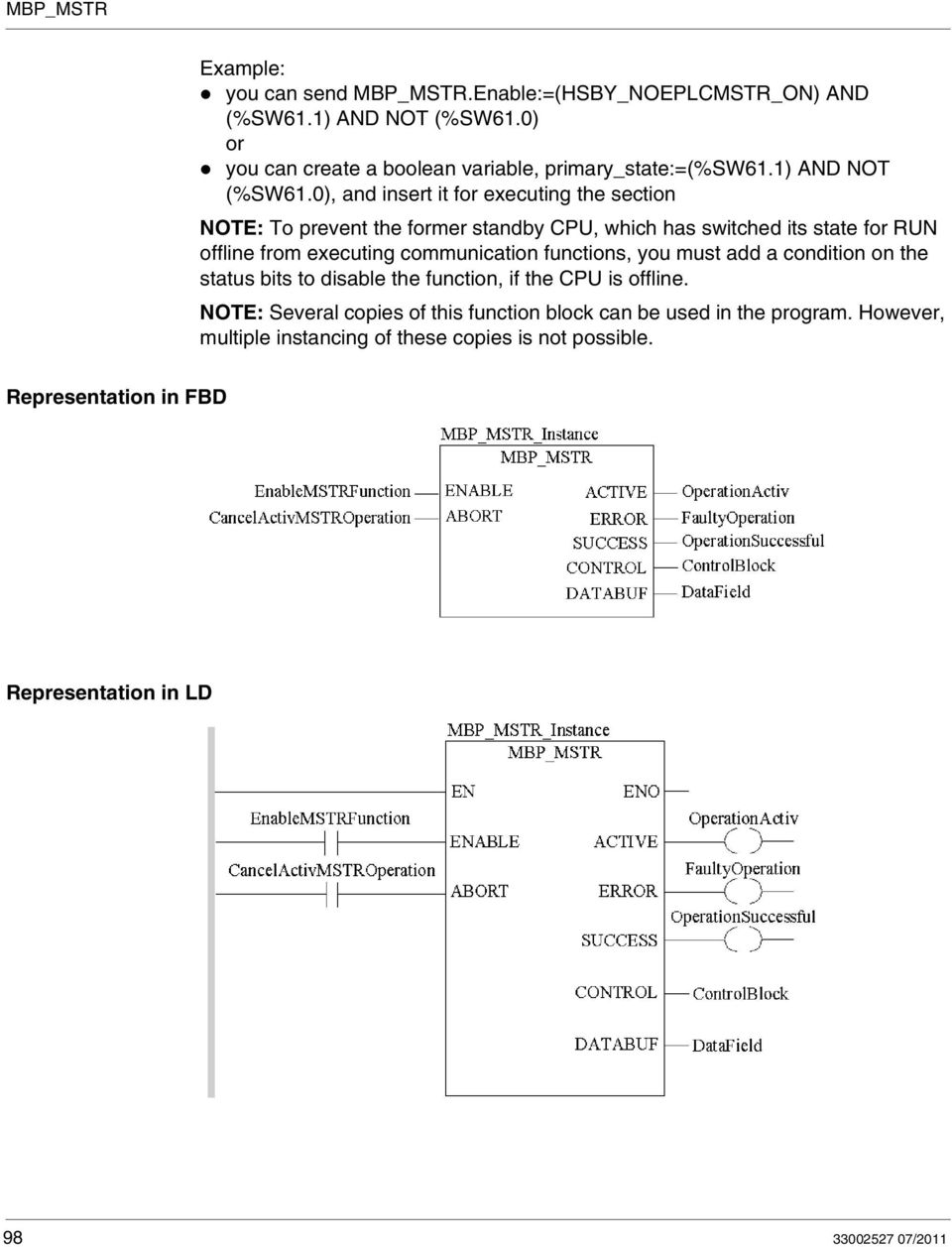
4 Example: you can send MBP_MSTR.Enable:=(HSBY_NOEPLCMSTR_ON) AND (%SW61.1) AND NOT (%SW61.0) or you can create a boolean variable, primary_state:=(%sw61.1) AND NOT (%SW61.0), and insert it for executing the section NOTE: To prevent the former standby CPU, which has switched its state for RUN offline from executing communication functions, you must add a condition on the status bits to disable the function, if the CPU is offline. NOTE: Several copies of this function block can be used in the program. However, multiple instancing of these copies is not possible. Representation in FBD Representation in LD /2011
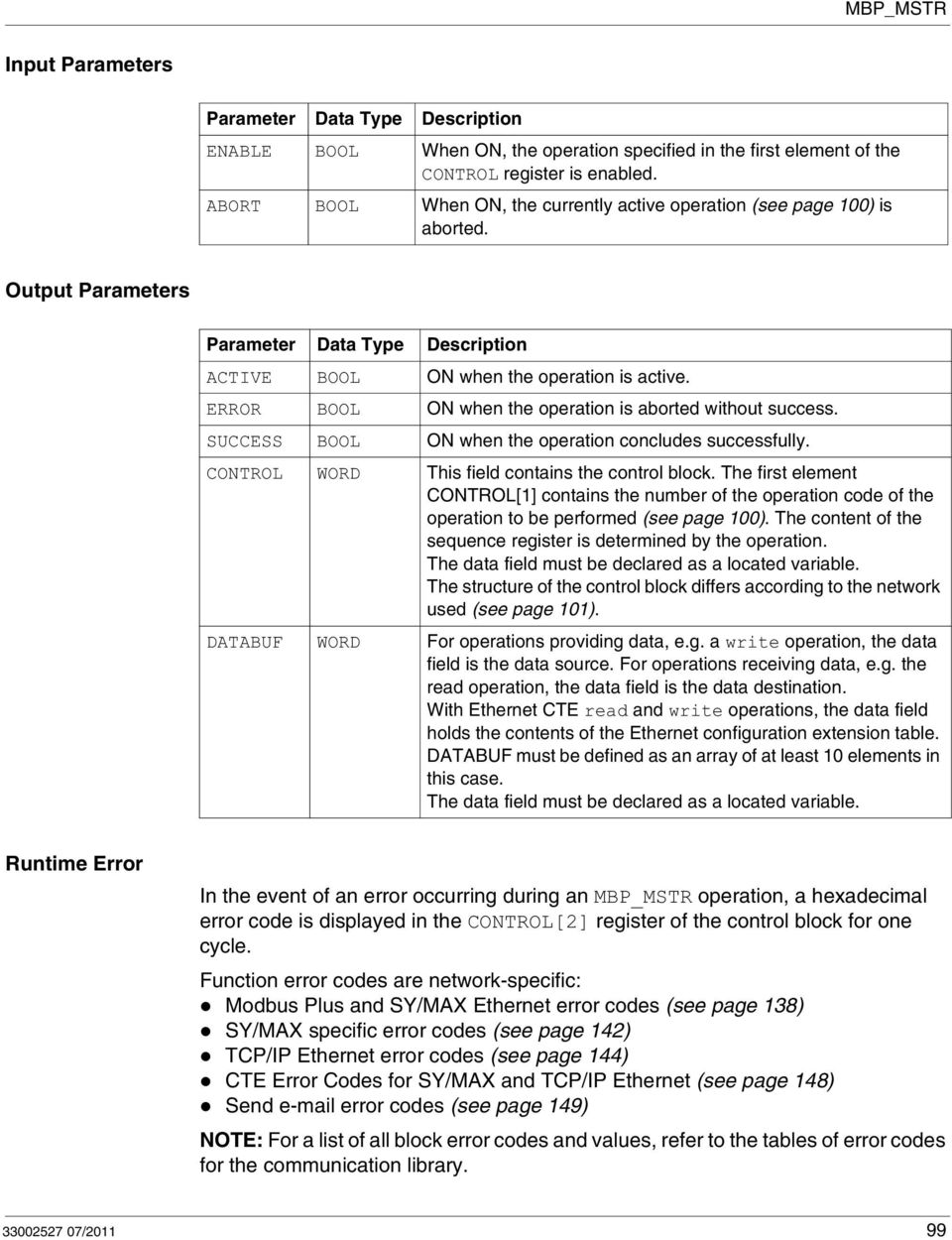
5 Input Parameters Parameter Data Type Description ENABLE BOOL When ON, the operation specified in the first element of the CONTROL register is enabled. ABORT BOOL When ON, the currently active operation (see page 100) is aborted. Output Parameters Parameter Data Type Description ACTIVE BOOL ON when the operation is active. ERROR BOOL ON when the operation is aborted without success. SUCCESS BOOL ON when the operation concludes successfully. CONTROL WORD This field contains the control block. The first element CONTROL[1] contains the number of the operation code of the operation to be performed (see page 100). The content of the sequence register is determined by the operation. The data field must be declared as a located variable. The structure of the control block differs according to the network used (see page 101). DATABUF WORD For operations providing data, e.g. a write operation, the data field is the data source. For operations receiving data, e.g. the read operation, the data field is the data destination. With Ethernet CTE read and write operations, the data field holds the contents of the Ethernet configuration extension table. DATABUF must be defined as an array of at least 10 elements in this case. The data field must be declared as a located variable. Runtime Error In the event of an error occurring during an MBP_MSTR operation, a hexadecimal error code is displayed in the CONTROL[2] register of the control block for one cycle. Function error codes are network-specific: Modbus Plus and SY/MAX Ethernet error codes (see page 138) SY/MAX specific error codes (see page 142) TCP/IP Ethernet error codes (see page 144) CTE Error Codes for SY/MAX and TCP/IP Ethernet (see page 148) Send error codes (see page 149) NOTE: For a list of all block error codes and values, refer to the tables of error codes for the communication library /
6 Operational Function Codes Valid MBP_MSTR Function Codes Function Code Operation Using the MBP_MSTR block, one of 13 available network communication operations can be triggered via the network. Each operation has a function code assigned to it. The availability of specific operations depends on both the type of network, and the type of module you are using. where: X indicates Yes - indicates No Modbus Plus TCP/IP Ethernet SY/MAX Ethernet 1 Write data X X X - 2 Read data X X X - 3 Get local statistics X X Clear local statistics X X Get remote statistics X X Clear remote statistics (see page 113) X X Reset optional module - X X - 11 Read CTE (Config extension) - X X - 12 Write CTE (Config extension) - X X - 13 Send (see page 120) - X CIP Explicit message (see Quantum, 140 NOC EtherNet/IP Communication Module, User Manual) X 15 Send Modbus Request (see page 122) - X Close Connection Request (see page 126) - X Read / write data (see page 127) - X - - CIP Ethernet /2011

7 Network Control Block Structures Summary The structure of the MBP_MSTR control block varies according to the type of network you are using. Structures for Modbus Plus, TCP/IP Ethernet, and SyMax Ethernet are described below. Control Block for Modbus Plus CONTROL[1] CONTROL[2] Contents Indicates an operation that is valid for Modbus Plus Indicates the error status CONTROL[3] Indicates the length, i.e., the number of data units transferred (max. 100) CONTROL[5] Indicates MSTR operation-dependent information Routing register 1: used to specify a destination node during network transfer (routing path addresses one of five) Most significant byte: source node address, i.e., the slot for the Modbus Plus Network Options Module (NOM) When using the Modbus Plus Port on the CPU, this byte must be set to 0 (regardless of the CPU slot). Least significant byte: destination node address, i.e., a value that represents a direct or a bridge address. If there is no bridge, this value contains the destination node address. If there is a bridge, this value contains the address of the bridge. If the NOM is inserted in slot 7 on the module rack, the most significant byte of routing register 1 looks as follows (value 0x0706): CONTROL[6] Most significant byte Slots Least significant byte Destination address (binary value between 1 and 64 (normal) or 65 to 255 (extended)) Routing register 2, the destination node address (further bridge or Modbus Plus modules). If addressing in the previous routing register has finished, the value is set to 0. CONTROL[7] Routing register 3, similar to routing register 2 CONTROL[8] Routing register 4, similar to routing register 2 (see Routing 2) CONTROL[9] Routing register 5, similar to routing register 2 (see Routing 2) /
![Control Block for Modbus Plus CONTROL[1] CONTROL[2] Contents Indicates an operation that is valid for Modbus Plus Indicates the error status CONTROL[3] Indicates the length, i.e., the number of data units transferred (max.](/docs-images/46/21781201/images/page_7.jpg "100) CONTROL[5] Indicates MSTR operation-dependent information Routing register 1: used to specify a destination node during network transfer (routing path addresses one of five) Most significant")
8 Control Block for TCP/IP Ethernet CONTROL[1] CONTROL[2] Contents Indicates an operation that is valid for TCP/IP Indicates the error status CONTROL[3] Indicates the length, i.e., the number of data units transferred (max. 100) CONTROL[5] Indicates MSTR operation-dependent information Routing register: used to specify a destination node during network transfer Most significant byte: source node address, i.e., the NOE slot for the NOE module When using an integrated Ethernet on the CPU, this byte must be set to 254 (FE hex) regardless of the CPU slot. Least significant byte: destination node address, i.e, a value that represents a direct or bridge address. If there is no bridge the value in the least significant byte is set to 0. If there is a bridge, this value contains the MBP for the Ethernet mapping index (MET). If the NOE is inserted in slot 7 on the module rack and the Ethernet mapping index (MET) is 6, the routing register looks as follows (value 0x0706): CONTROL[6] CONTROL[7] CONTROL[8] CONTROL[9] CONTROL[10] CONTROL[11] Most significant byte Slots Least significant byte MBP on Ethernet Transporter (MET) mapping index Byte 4, MSB of the 32-bit destination IP address Byte 3 of the 32-bit destination IP address Byte 2 of the 32-bit destination IP address Byte 1, LSB of the 32-bit destination IP address Indicates MSTR operation-dependent information Indicates MSTR operation-dependent information NOTE: CONTROL[10] and CONTROL[11] are used when configuring the MBP_MSTR block for a Read/Write Data operation (function code 23). Control Block for SY/MAX Ethernet Contents CONTROL[1] Indicates an operation that is valid for SY/MAX CONTROL[2] Indicates the error status CONTROL[3] Indicates the length, i.e., the number of registers transferred (max. 100) /2011

9 CONTROL[5] Contents Indicates MSTR operation-dependent information Routing register: used to specify a destination node during network transfer Most significant byte: source node address, ie.e, the slot for the NOE module Least significant byte: destination node address, i.e, a value that represents a direct or bridge address. If there is no bridge the value in the least significant byte is set to 0. If there is a bridge, this value contains the MBP for the Ethernet mapping index (MET). If NOM is inserted in slot 7 on the module rack and the Ethernet mapping index (MET) is 6, the routing register looks as follows (value 0x0706): CONTROL[6] CONTROL[7] Most significant byte Slots Least significant byte MBP on Ethernet Transporter (MET) mapping index Destination drop number (or set to FF hex) Terminator (set to FF hex) Read Data Description A read operation transfers data from a specified slave source device to a master destination device on the network. It uses a master transaction path and may require several cycles to complete. To program an MBP_MSTR block to perform a write operation, use function code 2 (see page 100). NOTE: Do not attempt to program an MBP_MSTR to read to its own station address. This action causes the function block to generate an error in the CONTROL[2] register of the control block (see page 101). You can perform a read operation on a nonexistent slave register. The slave detects the status and logs it. This can last for several cycles. Network Implementation The read operation can be performed on Modbus Plus, TCP/IP Ethernet, and SY/MAX Ethernet networks. Control Block Usage for Modbus Plus CONTROL[1] CONTROL[2] 2 = Read data Indicates the error status /

10 CONTROL[3] CONTROL[5]... CONTROL[9] Number of registers to be read from the slave Determines the %MW starting register in the slave from which the data is read, e.g., 1 = %MW1, 49 = %MW49). Routing register 1 is used to specify the address (routing path address 1 of 5) of the node during a network transfer. The last byte in the routing path that is not 0 is the destination node. Control Block Usage for TCP/IP Ethernet CONTROL[1] CONTROL[2] CONTROL[3] CONTROL[5] CONTROL[6]... CONTROL[9] 2 = read data Indicates the error status. Number of addresses to be read from the slave Determines the %MW starting register in the slave from which the data is read, e.g., 1 = %MW1, 49 = %MW49) Routing register: Most significant byte: network adapter module slot Least significant byte: MBP on Ethernet Transporter (MET) mapping index Each address contains 1 byte of the 32-bit IP address, where the MSB is in CONTROL[6] and the LSB is in CONTROL[9]. Control Block Usage for SY/MAX Ethernet CONTROL[1] CONTROL[2] CONTROL[3] CONTROL[5] CONTROL[6]... CONTROL[9] 2 = Read data Indicates the error status. Number of addresses to be read from the slave Determines the %MW starting register in the slave to which the data is written, e.g., 1 = %MW1, 49 = %MW49). Routing register Most significant byte: network adapter module slot Least significant byte: destination drop number Terminator: FF hex /2011
![Control Block Usage for TCP/IP Ethernet CONTROL[1] CONTROL[2] CONTROL[3] CONTROL[5] CONTROL[6]... CONTROL[9] 2 = read data Indicates the error status.](/docs-images/46/21781201/images/page_10.jpg "Number of addresses to be read from the slave Determines the %MW starting")
11 Write Data Description A write operation transfers data from a master source device to a specified slave destination device on the network. It uses a master transaction path and may require several cycles to complete. To program an MBP_MSTR block to perform a write operation, use function code 1 (see page 100). NOTE: Do not attempt to program an MBP_MSTR to write to its own drop address. This action causes the function block to generate an error in the CONTROL[2] register of the control block (see page 101). You can perform a write operation to a nonexistent slave register. The slave detects the status and logs it. This can last for several cycles. Network Implementation The write operation can be performed on Modbus Plus, TCP/IP Ethernet, and SY/MAX Ethernet networks. Control Block Usage for Modbus Plus CONTROL[1] CONTROL[2] CONTROL[3] CONTROL[5]... CONTROL[9] 1 = write data Indicates the error status Number of addresses sent to the slave Determines the %MW starting register in the slave to which the data is written, e.g. 1 = %MW1, 49 = %MW49 Routing register 1 is used to specify the address (routing path address 1 of 5) of the node during a network transfer. The last byte in the routing path that is not 0 is the destination node. Control Block Usage for TCP/IP Ethernet CONTROL[1] CONTROL[2] CONTROL[3] CONTROL[5] 1 = write data Indicates the error status Number of addresses sent to the slave Determines the CONTROL[ ] start address of the slave to which the data is written Routing register Most significant byte: network adapter module slot Least significant byte: MBP on Ethernet transporter (MET) mapping index /
![NOTE: Do not attempt to program an MBP_MSTR to write to its own drop address. This action causes the function block to generate an error in the CONTROL[2] register of the control block (see page 101).](/docs-images/46/21781201/images/page_11.jpg "You can perform a write operation to a nonexistent slave register. The slave detects the status and logs it. This can last for several cycles.")
12 CONTROL[6]... CONTROL[9] Each address contains 1 byte of the 32-bit IP address. Control Block Usage for SY/MAX Ethernet CONTROL[1] CONTROL[2] CONTROL[3] CONTROL[5] CONTROL[6]... CONTROL[9] 1 = Write data Indicates the error status Number of addresses sent to the slave Determines the %MW starting register in the slave to which the data is written, e.g., 1 = %MW1, 49 = %MW49) Routing register Most significant byte: network adapter module slot Least significant byte: destination drop number Terminator: FF hex /2011
![.. CONTROL[9] 1 = Write data Indicates the error status Number of addresses sent to the slave Determines the %MW starting register](/docs-images/46/21781201/images/page_12.jpg "in the slave to which the data is written, e.g.")
13 Get Local Statistics Description A Get Local Statistics operation reads the data from the local node in one cycle and does not require a master transaction path.to program an MBP_MSTR block to Get Local Statistics, use function code 3 (see page 100). Network Implementation A Get Local Statistics operation can be performed on Modbus Plus and TCP/IP Ethernet networks (see page 135). Control Block Usage for Modbus Plus CONTROL[1] CONTROL[2] 3 = get local statistics Indicates the error status CONTROL[3] Number of addresses to be read from local statistics (0...37) Note: The size of databuf must be at least the size of this entry. CONTROL[5] First address from which the statistics table must be read (Reg1=0) Routing register 1 is used to specify the address (routing path address 1 of 5) of the node during a network transfer. The last byte in the routing path that is not 0 is the destination mode. Control Block Usage for TCP/IP Ethernet CONTROL[1] CONTROL[2] 3 = get local statistics Indicates the error status CONTROL[3] Number of addresses to be read from local statistics (0...37) Note: The size of databuf must be the size of this entry. CONTROL[5] CONTROL[6]... CONTROL[9] First address from which the statistics table must be read (Reg1=0) Routing register Most significant byte: Network adapter module slot Not used /

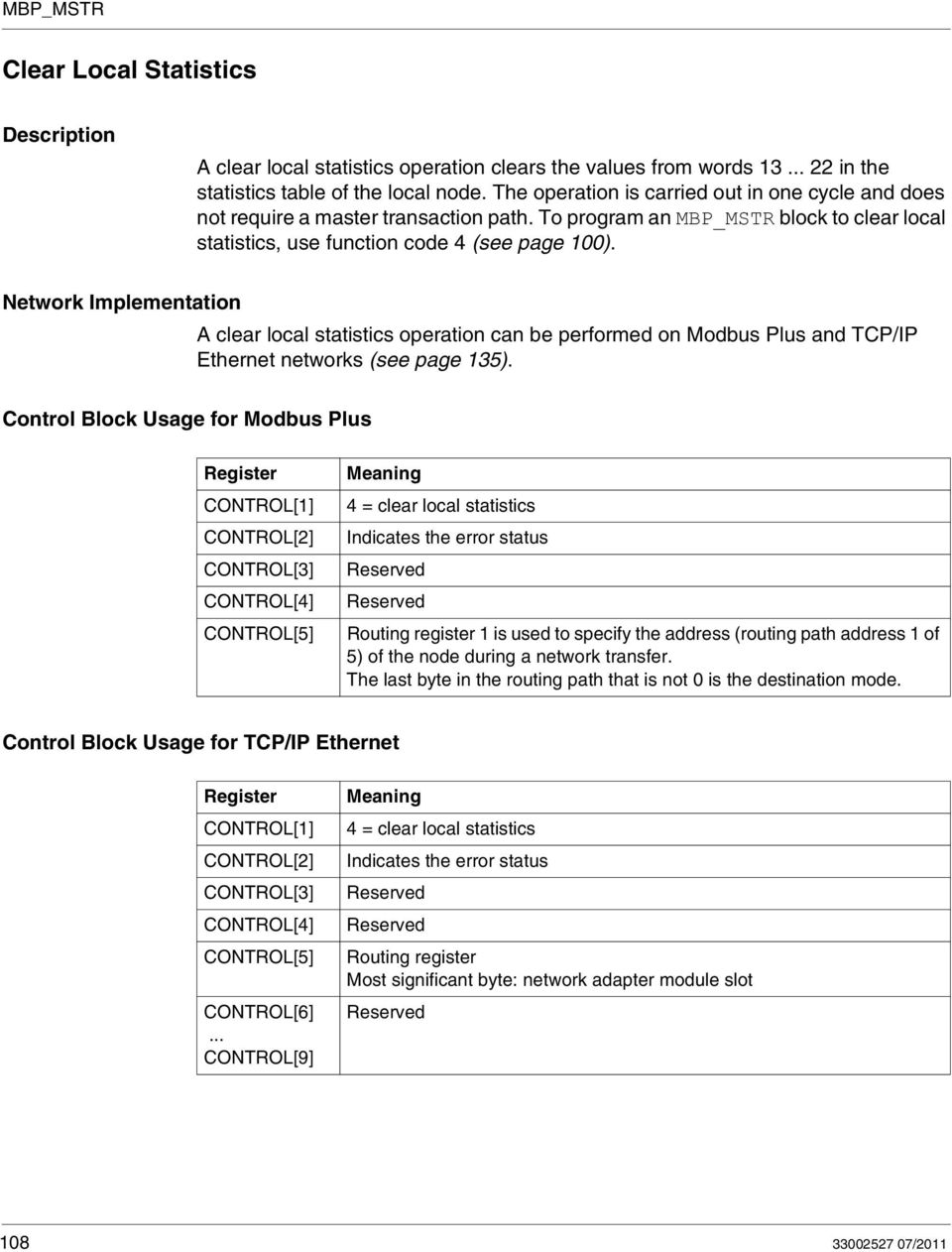
14 Clear Local Statistics Description A clear local statistics operation clears the values from words in the statistics table of the local node. The operation is carried out in one cycle and does not require a master transaction path. To program an MBP_MSTR block to clear local statistics, use function code 4 (see page 100). Network Implementation A clear local statistics operation can be performed on Modbus Plus and TCP/IP Ethernet networks (see page 135). Control Block Usage for Modbus Plus CONTROL[1] CONTROL[2] CONTROL[3] CONTROL[5] 4 = clear local statistics Indicates the error status Reserved Reserved Routing register 1 is used to specify the address (routing path address 1 of 5) of the node during a network transfer. The last byte in the routing path that is not 0 is the destination mode. Control Block Usage for TCP/IP Ethernet CONTROL[1] CONTROL[2] CONTROL[3] CONTROL[5] CONTROL[6]... CONTROL[9] 4 = clear local statistics Indicates the error status Reserved Reserved Routing register Most significant byte: network adapter module slot Reserved /2011
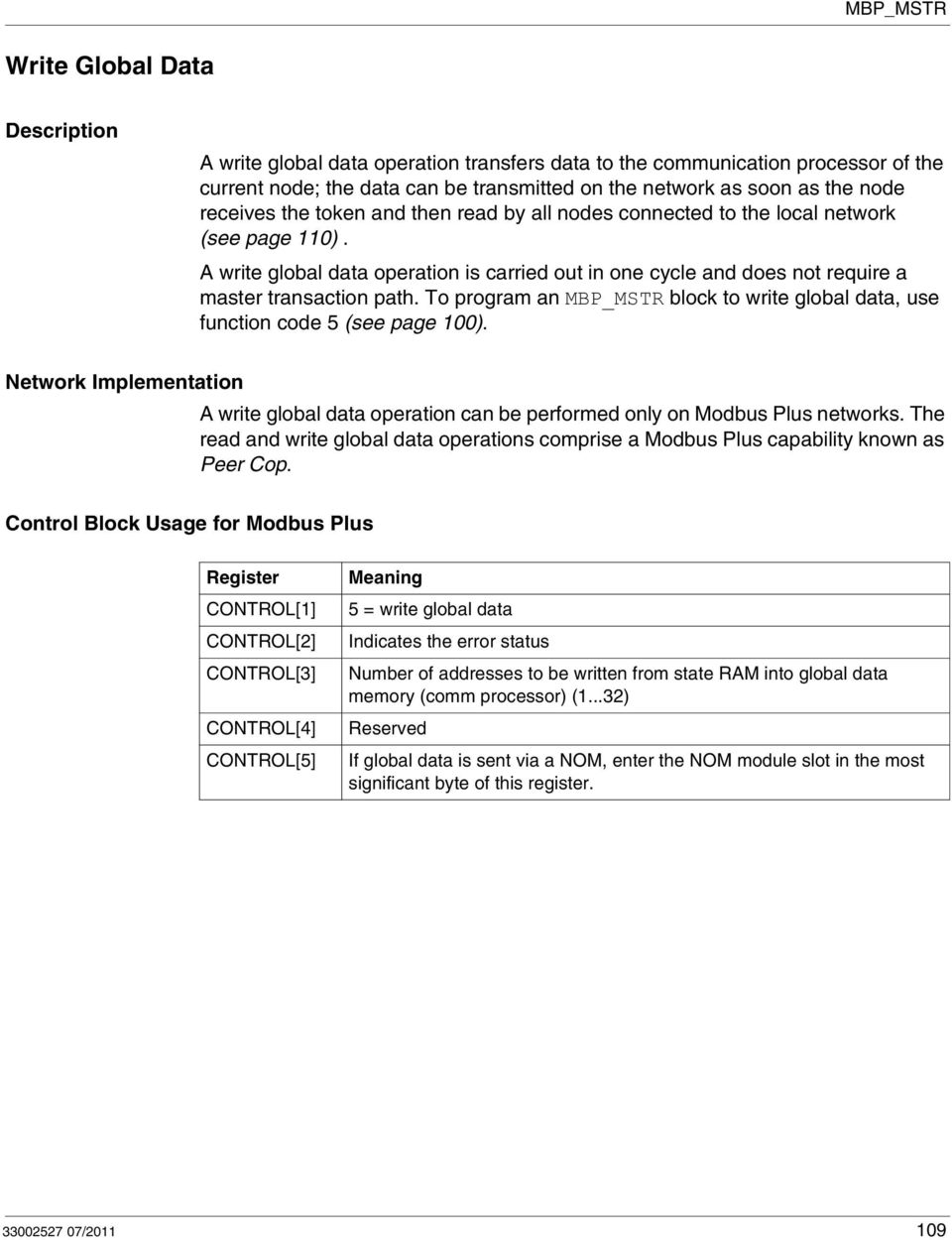
15 Write Global Data Description A write global data operation transfers data to the communication processor of the current node; the data can be transmitted on the network as soon as the node receives the token and then read by all nodes connected to the local network (see page 110). A write global data operation is carried out in one cycle and does not require a master transaction path. To program an MBP_MSTR block to write global data, use function code 5 (see page 100). Network Implementation A write global data operation can be performed only on Modbus Plus networks. The read and write global data operations comprise a Modbus Plus capability known as Peer Cop. Control Block Usage for Modbus Plus CONTROL[1] CONTROL[2] CONTROL[3] CONTROL[5] 5 = write global data Indicates the error status Number of addresses to be written from state RAM into global data memory (comm processor) (1...32) Reserved If global data is sent via a NOM, enter the NOM module slot in the most significant byte of this register /
16 Read Global Data Description A read global data operation reads data from the communications processor of a node on the network that has written global data (see page 109). A master transaction path is not required. A read global data operation can take several cycles if the global data is not currently available with the nodes called. If global data is available, the operation is executed in one cycle. To program an MBP_MSTR block to write global data, use function code 6 (see page 100). Network Implementation A read global data operation can be performed only on Modbus Plus networks. The read and write global data operations comprise a Modbus Plus capability known as Peer Cop. Control Block Usage for Modbus Plus CONTROL[1] CONTROL[2] CONTROL[3] CONTROL[5] 6 = read global data Indicates the error status Number of addresses to be sent from global data memory (comm processor) (1...32) Displays the addresses available in the scanned node. (This register Is automatically updated.) The least significant byte contains the address of the node whose global data is to be read. It can be a value in the range If global data is received via a NOM, enter the NOM module slot in the most significant byte of this address /2011

17 Get Remote Statistics Description A get remote statistics operation can be used to read data from remote nodes on the network. With each query, the remote communications processor supplies a complete table of statistics even if the query does not refer to the entire table. It then copies only the words that you queried into identified $MW addresses. An operation can take several cycles to complete; it does not require a master data transaction path. To program an MBP_MSTR block to get remote statistics, use function code 7 (see page 100). Network Implementation A get remote statistics operation can be performed on Modbus Plus and TCP/IP Ethernet networks. Control Block Usage for Modbus Plus CONTROL[1] CONTROL[2] 7 = get remote statistics Indicates the error status CONTROL[3] Number of addresses to be read from the statistics data field ( ). Note: The size of databuf must be at least the size of this entry. CONTROL[5]... CONTROL[9] First address from which the node statistics must be read. The number of available statistics registers cannot be exceeded. Routing address of the node. The last byte in the routing path that is not 0 is the destination node. Control Block Usage for TCP/IP Ethernet CONTROL[1] CONTROL[2] 7 = get remote statistics Indicates the error status CONTROL[3] Number of addresses to be read from the statistics data field ( ). Note: The size of databuf must be at least the size of this entry. CONTROL[5] First address from which the node statistics must be read. The number of available statistics registers cannot be exceeded. Routing register Most significant byte: network adapter module slot /
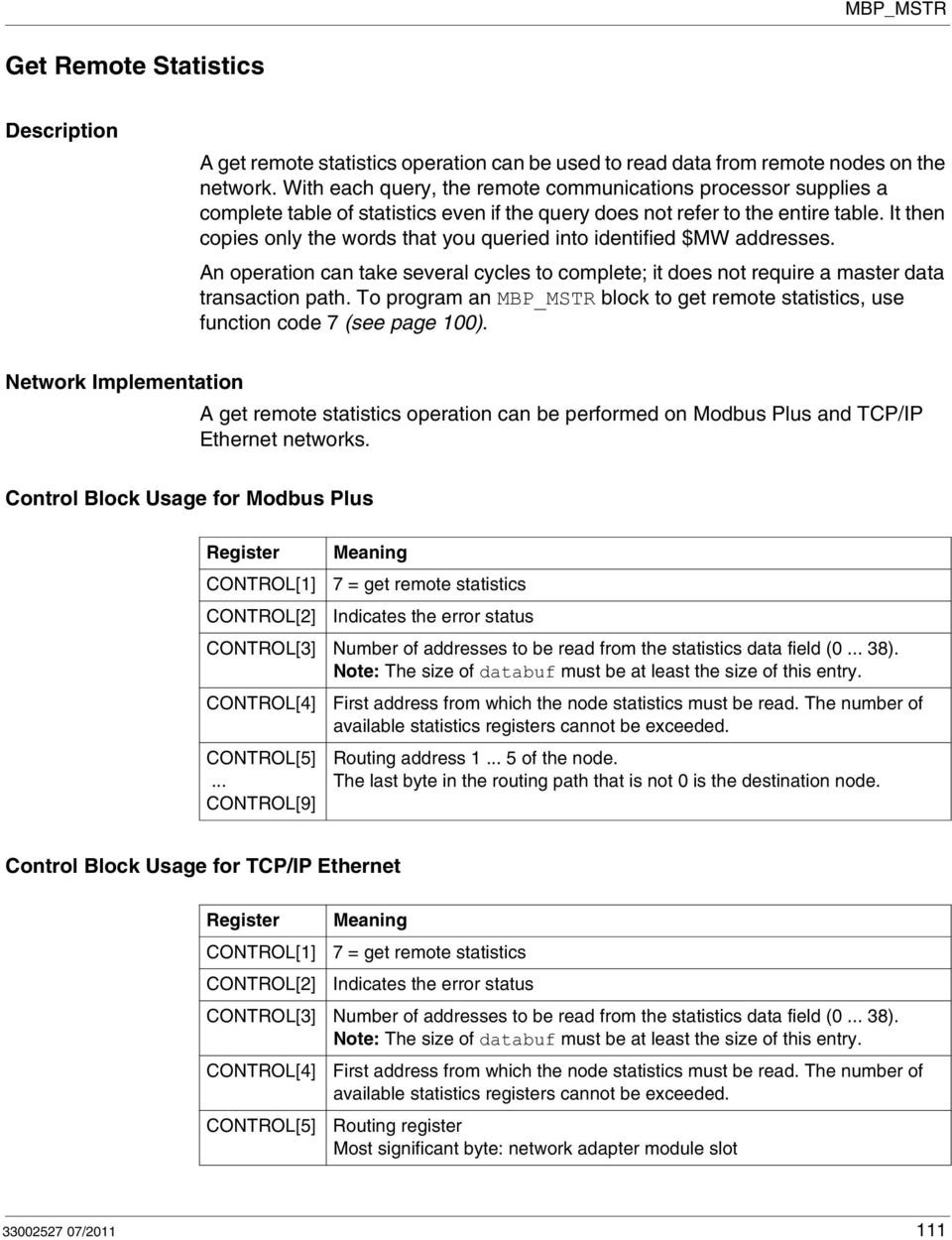
18 CONTROL[6]... CONTROL[9] Each address contains 1 byte of the 32-bit IP address, where the value in CONTROL[6] is the MSB and the value in CONTROL[9] is the LSB /2011

19 Clear Remote Statistics Description A clear remote statistics operation clears remote-node values from words in the statistics table of the local node. It uses a master transaction path and may require several cycles to complete. To program an MBP_MSTR block to perform a clear remote statistics operation, use function code 8 (see page 100). Network Implementation A clear remote statistics operation can be performed on Modbus Plus and TCP/IP Ethernet networks (see page 135). Control Block Usage for Modbus Plus CONTROL[1] CONTROL[2] CONTROL[3] CONTROL[5]... CONTROL[9] 8 = clear remote statistics Indicates the error status Reserved Reserved Routing register 1 is used to specify the address (routing path address 1 of 5) of the destination node during a network transfer. The last byte in the routing path that is not 0 is the destination mode. Control Block Usage for TCP/IP Ethernet CONTROL[1] CONTROL[2] CONTROL[3] CONTROL[5] CONTROL[6]... CONTROL[9] 8 = clear remote statistics Indicates the error status Reserved Reserved Routing Most significant byte: network adapter module slot Each address contains one byte of the 32-bit IP address, where the MSB is in CONTROL[6] and the LSB is in CONTROL[9] /

20 Peer Cop Health Description A peer cop health operation reads selected data from the peer cop communications health table and downloads the data to the specified %MW addresses in state RAM. To program an MBP_MSTR block to perform a clear remote statistics operation, use function code 9 (see page 100). NOTE: Peer cop health is operational only when a peer cop-based I/O scanner has been configured. The peer cop communications health table is 12 words long; MBP_MSTR indexes these words with the numbers Network Implementation A peer cop health operation can be performed only on Modbus Plus networks. Control Block Usage for Modbus Plus CONTROL[1] CONTROL[2] 9 = peer cop health indicates the error status. CONTROL[3] Number of words wanted by the peer cop table (1...12) First word to be read from the peer cop table, where 0 = the first word and 11 = the last word) CONTROL[5] Routing address 1 If this is the second of two local nodes, set the value in the high byte to /2011

21 Reset Optional Module Description A reset optional module operation causes a Quantum NOE Ethernet communications module or the Ethernet port on a 140CPU65150/60 CPU module to enter a cycle that resets its working environment. To program an MBP_MSTR block to perform a reset option module operation, use function code 10 (see page 100). Network Implementation A reset optional module operation can be performed on TCP/IP Ethernet (see page 135) and SY/MAX Ethernet networks. Control Block Usage for TCP/IP Ethernet CONTROL[1] CONTROL[2] CONTROL[3] CONTROL[5] CONTROL[6]... CONTROL[9] 10 = reset optional module Indicates the error status No significance No significance Routing register The value shown in the high byte in area 1 through 16 indicates the slot in the Quantum backplane where the NOE module is located. No significance Control Block Usage for SY/MAX Ethernet (CONTROL) CONTROL[1] CONTROL[2] CONTROL[3] CONTROL[5] CONTROL[6]... CONTROL[9] 10 = reset optional module Indicates the error status No significance No significance Routing register MSB: network adapter module slot No significance /
22 Read CTE Description A read CTE operation reads a specified number of bytes from the Ethernet configuration extension table in the specified buffer of PLC memory. The bytes to be read start with a byte offset at the start of the CTE table. The contents of the CTE table are displayed in the DATABUF output parameter. (see page 99)To program an MBP_MSTR block to perform a clear remote statistics operation, use function code 11 (see page 100). Network Implementation A read CTE operation can be performed on TCP/IP Ethernet and SY/MAX Ethernet networks. Control Block Usage for TCP/IP Ethernet CONTROL[1] CONTROL[2] 11 = read CTE Indicates the error status CONTROL[3] The length setting: a value from 12 to 37 CONTROL[5] CONTROL[6]... CONTROL[9] No significance Routing register Least significant byte = mapping index Either a value displayed in the byte of the register or is not used. or Most significant byte = network adapter module slot No significance Control Block Usage for SY/MAX Ethernet CONTROL[1] CONTROL[2] CONTROL[3] 11 = read CTE Indicates the error status Number of words transferred Byte offset in the PLC register structure, specifying from where the CTE bytes are read /2011
23 CONTROL[5] CONTROL[6]... CONTROL[9] Routing register MSB: slot of the NOE module Terminator: FF hex CTE Indicator Implementation (DATABUF) The values in the CTE table are displayed in the DATABUF output when a CTE read operation is implemented. The registers display the following CTE data: CTE indicator implementation (DATABUF): Parameter Contents Frame type DATABUF[0] 1 = = Ethernet IP address DATABUF[1] First byte of the IP address DATABUF[2] DATABUF[3] DATABUF[4] Second byte of the IP address Third byte of the IP address Fourth byte of the IP address Lower netmask DATABUF[5] Most significant word DATABUF[6] Least significant word Gateway DATABUF[7] First byte of the gateway DATABUF[8] DATABUF[9] DATABUF[10] Second byte of the gateway Third byte of the gateway Fourth byte of the gateway /
24 Write CTE Description A write CTE operation writes the CTE configuration table from the specified data (DATABUF) to a specified Ethernet configuration extension table or to a specific slot. To program an MBP_MSTR block to perform a write CTE operation, use function code 12 (see page 100). Network Implementation A write CTE operation can be performed on TCP/IP Ethernet (see page 135) and SY/MAX Ethernet networks. Control Block Usage for TCP/IP Ethernet CONTROL[1] CONTROL[2] 12 = write CTE Indicates the error status CONTROL[3] The length setting: a value from 12 to 37. CONTROL[5] CONTROL[6]... CONTROL[9] No significance Routing register Least significant byte = mapping index Either a value displayed in the byte of the address or is not used. or Most significant byte = network adapter module slot No significance Control Block Usage for SY/MAX Ethernet CONTROL[1] CONTROL[2] CONTROL[3] CONTROL[5] 12 = Write CTE (Config extension table) Indicates the error status Number of words transferred Byte offset in the PLC address structure specifying where the CTE bytes are written Routing register Most significant byte = NOE module slot Least significant byte = Destination drop number /2011
25 CONTROL[6] CONTROL[7]... CONTROL[9] Terminator: FF hex No significance CTE Indicator Implementation (DATABUF) The values in the Ethernet configuration extension table are displayed in the DATABUF output field when a write CTE operation is implemented. The registers are used to transfer the following CTE data: CTE indicator implementation (DATABUF): Parameter Contents Frame type DATABUF[0] 1 = = Ethernet IP address DATABUF[1] First byte of the IP address DATABUF[2] DATABUF[3] DATABUF[4] Second byte of the IP address Third byte of the IP address Fourth byte of the IP address Lower netmask DATABUF[5] Most significant word DATABUF[6] Least significant word Gateway DATABUF[7] First byte of the gateway DATABUF[8] DATABUF[9] DATABUF[10] Second byte of the gateway Third byte of the gateway Fourth byte of the gateway /
26 Send Description The electronic mail notification service allows controller-based projects to report alarms or events. The controller monitors the system and dynamically creates an electronic mail message, which alerts local or remote users. A user-defined event or condition triggers the MSTR block to create a message. Each message uses one of three user-defined headers. Each message sent from the controller can contain text and variable information (with a maximum of 238 bytes). The project selects the appropriate header. Each header contains: sender name list of recipients subject To program an MBP_MSTR block to send , use function code 13 (see page 100). Network Implementation A send operation can be performed on a TCP/IP Ethernet network. Control Block Usage for TCP/IP Ethernet CONTROL[1] 13 = send CONTROL[2] Indicates the -specific error codes (see page 149) CONTROL[3] Number of words transferred Not used CONTROL[5] High byte: slot address of the NOE module or 0xFE for the 140 CPU CONTROL[6]... CONTROL[9] Low byte: always 0 Not used /2011
27 DATABUF Parameter Description Contents DATABUF 1 The mail header is the least significant byte with a value of 1, 2, or 3. DATABUF 2... DATABUF 119 The most significant byte contains the number (n) of characters in the subject, a value between 0 and 238. The data (in ASCII format) that will be copied into the message. The first n characters are added to the configured subject. The remaining characters (2 * N -2 - n) are part of the message body, where N is the number of words transferred /
28 Send Modbus Request At a Glance Use MSTR operation 15 to send generic Modbus requests on the network. NOTE: This operation is not available on Modbus Plus ports (embedded port on CPU or NOM modules) and the embedded Ethernet port on a CPU. Block Operation The MBP_MSTR block can send requests and receive responses up to 253 bytes long. For the operation, refer to Block Operation (see page 97): When the ENABLE input pin is turned ON, operation 15 begins. If the ABORT input pin is turned ON or if the ENABLE input pin is turned OFF, the operation ends. The ACTIVE output pin is ON during the operation. The ERROR output pin turns ON if the operation aborts without success. The SUCCESS output pin turns ON if the operation completes with success. The CONTROL and DATABUF output pins define the operation (refer to the Control Block (see page 122) and Data Buffer (see page 123)). EN and ENO can be configured as additional parameters. Control Block The format of the Control block is described in the following table: Word CONTROL[1] CONTROL[2] CONTROL[3] CONTROL[5] CONTROL[6] CONTROL[7] CONTROL[8 CONTROL[9] CONTROL[10] Description 15 = Send Modbus Request Indicates detected error status DATABUF length (WORDs) Offset for the beginning of the response in the DATABUF (WORDs). NOTE: To avoid overwriting the request, the Response Offset value multiplied by 2 must be greater than the Request Length (CONTROL[10]). Routing register: High byte = Ethernet communication module slot Low byte = MBP on Ethernet transporter (MET) mapping index (also known as Unit ID) Byte 4 of the IP address (MSB) Byte 3 of the IP address Byte 2 of the IP address Byte 1 of the IP address (LSB) Length of the DATABUF Request data (bytes) /2011
29 Word CONTROL[11] Description Length of the DATABUF Response received (bytes) NOTE: This is read only, it is set by option module after operation completion. Data Buffer The MODBUS protocol defines a simple protocol data unit (PDU) independent of the underlying communication layers. The data buffer (DATABUF) consists of contiguous registers that include both the Modbus Request PDU and the Modbus Response PDU: DATABUF Data Buffer Length is set in the CONTROL[3] word. Modbus Request PDU: Data Request Length is set in the CONTROL[10] word. Modbus Response PDU: Data Response Start (Response offset) is set in the word. NOTE: To avoid overwriting the request, the Response Offset value multiplied by 2 must be greater than the Request Length (CONTROL[10]). Data Response Length is set in the CONTROL[11] word. LOSS OF DATA CAUTION Verify that the Response Offset is greater than the Data Request Length. Failure to follow these instructions can result in injury or equipment damage. NOTE: Both the Request and Response must be structured in little endian order. Each word of 2 bytes of data in little endian format, where the least significant byte is stored in the smallest memory address. Modbus Request The Modbus Request PDU format is: Byte offset Field Data type Description 1 Function code BYTE Modbus function code 2 Request data BYTE area This field is function code dependent and contains information such as variable references, variable counts, data offsets, sub-function codes and so on /
30 Modbus Response The Modbus Response PDU format is: Byte offset Field Data type Description 1 Function code BYTE Modbus function code 2 Response data BYTE area This field is function code dependent and contains information such as variable references, variable counts, data offsets, sub-function codes and so on. Modbus Exception Response The Modbus Exception Response PDU format is: Byte offset Field Data type Description 1 Function code BYTE Modbus function code + 80 (hex) 2 Exception code BYTE This field is defined in the MODBUS Application Protocol Specification. Modbus Specification The standard Modbus function codes are defined in the MODBUS Application Protocol Specification, V1.1b, which can be downloaded from Example of a Send Modbus Request To read 4 contiguous Input registers (Modbus Function code 4) starting at register 100 (64 hex) in a remote device. A Modbus Request has to be sent on the network with the following Modbus Response. Request Field Name Value Function code 04 Starting address, High 00 Starting address, Low 64 Number of registers, High 00 Number of registers, Low 04 Response Field Name Value Function code 04 Byte count value, High value, Low /2011
31 Response Field Name 101 value, High value, Low value, High value, Low value, High value, Low 04 Using the following CONTROL word values: CONTROL[1] (MSTR operation) = 15 CONTROL[2] (Error Code) = refer to CONTROL block description (read-only) CONTROL[3] (DATABUF length) = 11 (Response Offset) = 5 CONTROL[5] (Routing ) = refer to CONTROL block description CONTROL[6] (IP1) = refer to CONTROL block description CONTROL[7] (IP1) = refer to CONTROL block description CONTROL[8] (IP1) = refer to CONTROL block description CONTROL[9] (IP1) = refer to CONTROL block description CONTROL[10] (Request Length) = 5 CONTROL[11] (Response Length) = 10 the data encoding in the Data Buffer is as follows: Field Value (hex) Description Request DATABUF[1] 0400 Function code + Starting address, High DATABUF[2] 6400 Starting address, Low + Number of registers, High DATABUF[3] 0400 Number of registers, Low + NULL DATABUF[4] 0000 Null DATABUF[5] 0000 Null Response DATABUF[6] 0408 Function code + Byte count DATABUF[7] value, High value, Low DATABUF[8] value, High value, Low DATABUF[9] value, High value, Low DATABUF[10] value, High value, Low DATABUF[11] 0000 Null Value /
32 Close Connection Request At a Glance Use MBP_MSTR operation 16 to close a Modbus TCP/IP connection on the network. NOTE: This operation is not available on Modbus Plus ports (embedded port on CPU or NOM modules). Block Operation The MBP_MSTR block can send requests and receive responses up to 253 bytes long. For block operation, refer to the block description (see page 97): When the ENABLE input pin is turned ON, operation 15 begins. If the ABORT input pin is turned ON or if the ENABLE input pin is turned OFF, the operation ends. The ACTIVE output pin is ON during the operation. The ERROR output pin turns ON if the operation aborts without success. The SUCCESS output pin turns ON if the operation completes with success. The CONTROL and DATABUF output pins (see page 99) define the operation. EN and ENO can be configured as additional parameters. Control Block The format of the CONTROL block is described below: Function Description CONTROL[1] Operation 16 = close connection CONTROL[2] Error status CONTROL[3] (not used) (not used) CONTROL[5] CONTROL[6] IP Address CONTROL[7] CONTROL[8] CONTROL[9] Indicates detected error status (see page 144) (read only) Routing High byte = Ethernet communication module slot Low byte = MBP on Ethernet transporter (MET) mapping index (also known as Unit ID) Byte 4 of the IP address (MSB) Byte 3 of the IP address Byte 2 of the IP address Byte 1 of the IP address (LSB) /2011
33 Read/Write Data Introduction In a single transaction, the MSTR read and write operations can transfer data from a master source device to a specified slave destination device, then transfer data from this specified slave source to the master. It uses a master transaction path and may require several cycles to complete. To program an MBP_MSTR block to perform a combined read/write operation, use function code 23 (see page 100). The combined read/write operation can be used only with these two Quantum models: NOE (version 3.0 or later) NOE (version 3.0 or later) Control Block Usage CONTROL[1] CONTROL[2] CONTROL[3] CONTROL[5] CONTROL[6]... CONTROL[9] CONTROL[10] CONTROL[11] Content 23 = read/write data. Indicates the error status. Number of registers to be sent to the slave. Specifies the %MW starting register in the slave to which the data will be written, e.g. 1 = %MW1, 49 = %MW49. Routing register: Most significant byte: network adapter module slot. Least significant byte: MBP on Ethernet Transporter (MET) mapping index. Each address contains 1 byte of the 32-bit IP address, where the MSB is in CONTROL[6] and the LSB is in CONTROL[9]. Number of registers to be read from slave. Specifies the %MW starting register in the slave from which the data is read, e.g. 1 = %MW1, 49 = %MW49. NOTE: When configuring the MBP_MSTR block for a read/write data operation, note that The DATABUF output parameter is used to store, in the following sequence, both: 1 the data to be written 2 the data to be read The size of the DATABUF output parameter must equal the combined size of the data to be written and the data to be read; if the size is smaller, data will be overwritten and may be lost. Both the CONTROL and DATABUF parameters must be stored at located addresses, for example %MW addresses /
34 Peer Cop Communications Health Status Peer Cop Communications Health Status The table containing Peer Cop status information fills 12 contiguous registers indexed with the numbers in an MBP_MSTR operation. Each individual bit in the table words is used to present one aspect of communications health for a specific node on the Modbus Plus network. To program an MBP_MSTR block to get Peer Cop health status, use function code 9 (see page 100). Network Implementation A Peer Cop communications health status operation can be performed only on Modbus Plus networks. Relation Bit Network Node The bits of the words 0 to 3 represent the health at the global communications input of nodes 1 to 64. The bits of words represent the health of the output of a specific node. The bits in words 8 to 11 represent the health of the input of a specific node. Status type Word index Relation bit network node Global receive Send direct /2011
35 Status type Word index Relation bit network node Receive direct Health Bit Status The status of the Peer Cop health bit indicates the current communications status of its assigned node. A health bit is set when the associated node accepts input for its Peer Cop data block or when it receives a signal that another node has accepted specific output data from its Peer Cop output data block. A health bit is deleted if the associated data block does not accept any communication within the configured Peer Cop health timeout period. All health bits are deleted when interface command Put Peer Cop is executed during PLC startup. The table values become valid when the token is completely bypassed, after the Put Peer Cop command has been carried out. The health bit of a specific node is always 0 when the assigned Peer Cop entry is /
36 Modbus Plus Network Statistics Modbus Plus Network Statistics The following table shows the statistics available on Modbus Plus. You can obtain this data by running the corresponding MBP_MSTR operation (Modbus function code 8). NOTE: If you edit the clear local statistics (see page 108) or clear remote statistics (see page 113) operation, only words 13 to 22 in the statistics table are cleared. Word Bits Description 00 Node type ID 0 Unknown node type 1 PLC node 2 Modbus bridge node 3 Host computer node 4 Bridge Plus node 5 Peer I/O node Reserved Software version number as hexadecimal value (to read this, isolate bits from the word) Reserved 15 Defines error counters from word 15. The most significant bit defines the use of error counters in word 15. The lower valued half of the most significant byte together with the least significant byte contain the software version. 02 Network address of this station /2011
37 Word Bits Description 03 MAC status variable: 0 Startup status 1 Offline status indicator signals 2 Duplicated offline status 3 Idle status 4 Token utilization status 5 Work response status 6 Token transfer status 7 Response request status 8 Status check of transfer 9 Token request status 10 Response request status 04 Peer status (LED code); indicates status of this device relative to the network: 0 Monitor connect operation 32 Normal connect operation 64 Never receives token 96 Single station 128 Duplicate station 05 Token transfer counter; increments each time this station receives the token 06 Token cycle time in ms 07 LOW Bit representation data master fail during token ownership HIGH Bit representation (bitmap) program master fail during token ownership 08 LOW Bitmap activity token ownership of the data master HIGH Bitmap activity token ownership of the program master 09 LOW Bitmap activity token ownership of the data slave HIGH Bitmap activity token ownership of the program slave 10 LOW HIGH Bitmap transfer request command data slave/slave poll 11 LOW Bitmap response transfer request program master/master poll HIGH Bitmap transfer request command program slave/slave poll 12 LOW Bitmap connect status of the program master HIGH Bitmap automatic log-off of program slave 13 LOW Pretransfer delay error counter HIGH Receive buffer DMA overrun error counter /
38 Word Bits Description 14 LOW Receive counter repeat command HIGH Error counter data block size 15 If bit 15 of word 1 is not set, word 15 has the following significance: LOW Error counter receiver collision abort HIGH Error counter receiver alignment If bit 15 of word 1 is set, word 15 has the following significance: LOW Data block error on cable A HIGH Data block error on cable B 16 LOW Error counter CRC receiver HIGH Error counter wrong packet length 17 LOW Error counter wrong link address HIGH Error counter DMA underflow transfer buffer storage 18 LOW Error counter wrong internal packet length HIGH Error counter wrong MAC function code 19 LOW Communication retry counter HIGH Error counter communication failed 20 LOW Counter package receipt successful HIGH Error counter no response receipt 21 LOW Error counter unexpected response receipt HIGH Error counter unexpected path 22 LOW Error counter unexpected response HIGH Error counter skipped transaction 23 LOW Bitmap active station table, nodes 1 through 8 HIGH Bitmap active station table, nodes 9 through LOW Bitmap active station table, nodes 17 through 24 HIGH Bitmap active station table, nodes 25 through LOW Bitmap active station table, nodes 33 through 40 HIGH Bitmap active station table, nodes 41 through LOW Bitmap active station table, nodes 49 through 56 HIGH Bitmap active station table, nodes 57 through LOW Bitmap token station table, nodes 1 through 8 HIGH Bitmap token station table, nodes 9 through LOW Bitmap token station table, nodes 17 through 24 HIGH Bitmap token station table, nodes 25 through /2011
39 Word Bits Description 29 LOW Bitmap token station table, nodes 33 through 40 HIGH Bitmap token station table, nodes 41 through LOW Bitmap token station table, nodes 49 through 56 HIGH Bitmap token station table, nodes 57 through LOW Bitmap table regarding existence of global data, nodes 1 through 8 HIGH Bitmap table regarding existence of global data, nodes 9 through LOW Bitmap table regarding existence of global data, nodes 17 through 24 HIGH Bitmap table regarding existence of global data, nodes 25 through LOW Bitmap table regarding existence of global data, nodes 33 through 40 HIGH Bitmap table regarding existence of global data, nodes 41 through LOW Bitmap table regarding existence of global data, nodes 49 through 56 HIGH Bitmap table regarding existence of global data, nodes 57 through LOW Bitmap receive buffer used, buffers 1 through 8 HIGH Bitmap receive buffer used, buffers 9 through LOW Bitmap receive buffer used, buffers 17 through 24 HIGH Bitmap receive buffer used, buffers 25 through LOW Bitmap receive buffer used, buffers 33 through 40 HIGH Counter of activated processed commands for station administration 38 LOW Counter activation command output path 1 of the data master HIGH Counter activation command output path 2 of the data master 39 LOW Counter activation command output path 3 of the data master HIGH Counter activation command output path 4 of the data master 40 LOW Counter activation command output path 5 of the data master HIGH Counter activation command output path 6 of the data master 41 LOW Counter activation command output path 7 of the data master HIGH Counter activation command output path 8 of the data master 42 LOW Counter command processing input path 41 of the data slave HIGH Counter command processing input path 42 of the data slave 43 LOW Counter command processing input path 43 of the data slave HIGH Counter command processing input path 44 of the data slave 44 LOW Counter command processing input path 45 of the data slave HIGH Counter command processing input path 46 of the data slave 45 LOW Counter command processing input path 47 of the data slave HIGH Counter command processing input path 48 of the data slave /
40 Word Bits Description 46 LOW Counter command activation output path 81 of the program master HIGH Counter command activation output path 82 of the program master 47 LOW Counter command activation output path 83 of the program master HIGH Counter command activation output path 84 of the program master 48 LOW Counter command activation output path 85 of the program master HIGH Counter command activation output path 86 of the program master 49 LOW Counter command activation output path 87 of the program master HIGH Counter command activation output path 88 of the program master 50 LOW Counter command processing input path C1 of the program slave HIGH Counter command processing input path C2 of the program slave 51 LOW Counter command processing input path C3 of the program slave HIGH Counter command processing input path C4 of the program slave 52 LOW Counter command processing input path C5 of the program slave HIGH Counter command processing input path C6 of the program slave 53 LOW Counter command processing input path C7 of the program slave HIGH Counter command processing input path C8 of the program slave /2011
41 TCP/IP Ethernet Network Statistics TCP/IP Ethernet Network Statistics A TCP/IP Ethernet module replies to local and remote statistics commands from the MBP_MSTR block with the the contents of the databuf array (see the information in the table below): Word 00 to 02 MAC address e.g. MAC address is displayed as follows: 03 Board status (refer to the following table) 04 and 05 Number of receiver interrupts 06 and 07 Number of transfer interrupts 08 and 09 Transfer timeout error count 10 and 11 Collision detection error count 12 and 13 Omitted packets 14 and 15 Memory error count 16 and 17 Number of restarts performed by the driver 18 and 19 Receive framing error count 20 and 21 Overflow error count receiver 22 and 23 Receive CRC error counter 24 and 25 Receive buffer error counter 26 and 27 Transfer buffer error counter 28 and 29 Transfer bin underflow counter 30 and 31 Late collision counter 32 and 33 Lost carrier counter 34 and 35 Number of retries 36 and 37 IP address e.g. the IP address (or C6 CA 89 71) is represented as follows: Word Word Contents Contents C6 CA /
42 Board Status Word Bit Definition NOTE: It is best to view the board status word in binary format. The following table describes the bit definitions of the board status word: 140 NOE 771 x1, versions 2.0, 3.0, 3.1, 3.3 and 3.6 or higher 140 NOE 771 x0, versions 3.0, 3.3 and 3.4 or higher Bit # Definition 15 0 = Link LED off 1 = Link LED on 14 0 = Appl LED off 1 = Appl LED on 13 0 = twisted pair 1 = fiber 12 0 = 10 Mbit 1 = 100 Mbit (Reserved) Module type (see table, below) 3 (Reserved) 2 0 = half duplex 1 = full duplex 1 0 = not configured 1 = configured 0 0 = not running 1 = running NOTE: Bits are numbered from right to left, starting with bit 0 (low bit). For example, PLC running = and LED connection = The following table describes the word bit definitions for board status for the: 140 NOE 771 x1, version NOE 771 x0, versions 1.02 and CPU 651 x0 Bit # Definition Module type (see table below) 11 (Reserved) 10 0 = half duplex 1 = full duplex 9 0 = not configured 1 = configured 8 0 = PLC not running 1 = PLC/NOE running 7 0 = Link LED off 1 = Link LED on 6 0 = Appl LED off 1 = Appl LED on 5 0 = twisted pair 1 = fiber /2011
43 4 0 = 10 Mbit 1 = 100 Mbit (Reserved) NOTE: Bits are counted from right to left, starting with bit 0 (low bit). For example, PLC running = 0x0100, Application LED = 0x0040, and LED Connection = 0x0080. Board Status Word Bit Definition by Module Type The following table describes the values of the module types: Value of Bits or Note: See the previous tables for the bit range that applies to your module s software version. Module Type 0 NOE 2x1 1 ENT 2 M1E 3 NOE ETY 5 CIP 6 (reserved) CPU 651 x0 8 (reserved) 9 (reserved) 10 NOE NOE NOE (reserved) /
44 Modbus Plus, SY/MAX, and Ethernet TCP/IP Error Codes Form of the Function Error Code Function error codes for Modbus Plus and SY/MAX Ethernet transactions appear as Mmss, where: M is the high code m is the low code ss is a subcode Modbus Plus and SY/MAX Ethernet Network Errors Hexadecimal error codes for Modbus Plus and SY/MAX Ethernet: Hex. Error Code Description 1001 Abort by user 2001 An operation type that is not supported has been specified in the control block 2002 One or more control block parameters were modified while the MSTR element was active (this only applies to operations which require several cycles for completion). Control block parameters my only be modified in inactive MSTR components Invalid value in the length field of the control block 2004 Invalid value in the offset field of the control block 2005 Invalid value in the length and offset fields of the control block 2006 Unauthorized data field on slave 2007 Unauthorized network field on slave 2008 Unauthorized network routing path on slave 2009 Routing path equivalent to their own address 200A 200C 200D 200E Attempt to get more global data words than available Bad pattern for change address request Bad address for change address request The control block is not assigned, or parts of the control block are located outside of the %MW (4x) range. 30ss Exceptional response by Modbus slave (see page 140) 4001 Inconsistent response by Modbus slave 5001 Inconsistent response by the network 6007 Invalid slot ID 6mss Routing path error (see page 141) The subfield m shows where the error occurred (a 0 value means local node, 2 means 2nd device in route, etc) /2011
45 TCP/IP Ethernet Network Errors Hexadecimal error codes for TCP/IP Ethernet: Hex. Error Code 5004 Interrupted system call 5005 I/O error 5006 No such address 5009 Socket descriptor is invalid 500C Not enough memory 500D Permission denied 5011 Entry exists 5016 Argument is invalid 5017 Internal table has run out of space 5020 Connection is broken 5028 Destination address required 5029 Protocol wrong type for socket 502A Protocol not available 502B Protocol not supported 502C Socket type not supported 502D Operation not supported on a socket 502E Protocol family not supported 502F Address family not supported 5030 Address already in use 5031 Cannot assign requested address 5032 Socket operation on a non-socket 5033 Network is unreachable 5034 Network dropped connection on reset 5035 Network caused connection abort 5036 Connection reset by peer 5037 No buffer space available 5038 Socket already connected 5039 Socket not connected 503A Cannot send after socket shutdown 503B Too many references, cannot splice 503C Connection timed out (see note below) 503D Connection refused /
46 Hex. Error Code 503E 503F NOTE: Network down Text file busy 5040 Too many levels of links 5041 No route to host 5042 Block device required 5043 Host is down 5044 Operation now in progress 5045 Operation already in progress 5046 Operation would block 5047 Function not implemented 5048 Hardware length is invalid 5049 Route specified cannot be found 504A 504B Collision in select call: these conditions have already been selected by another task Task ID is invalid 5050 No network resource 5051 Length error 5052 Addressing error 5053 Application error 5054 Client in bad state for request 5055 No remote resource -- may indicate no path to remote device (see note below) 5056 Non-operational TCP connection 5057 Incoherent configuration Error code 5055 can occur before a 503C error. No remote device takes precedence over a timeout. ss Hexadecimal Value in 30ss Error Code ss hexadecimal value in 30ss error code: ss Hex. Value Description 01 Slave does not support requested operation 02 Non-existing slave registers were requested 03 An unauthorized data value was requested /2011
47 ss Hex. Value Description 05 Slave has accepted a lengthy program command 06 Function cannot currently be carried out: lengthy command running 07 Slave has rejected lengthy program command ss Hexadecimal Value in 6mss Error Code NOTE: Subfield m in error code 6mss is an Index in the routing information that shows where an error has been detected (a 0 value indicates the local node, 2 means the second device in the route, etc.). The ss subfield in error code 6mss is as follows: ss Hex. Value Description 01 No response reception 02 Access to program denied 03 Node out of service and unable to communicate 04 Unusual response received 05 Router-node data path busy 06 Slave out of order 07 Wrong destination address 08 Unauthorized node type in routing path 10 Slave has rejected the command 20 Slave has lost an activated transaction 40 Unexpected master output path received 80 Unexpected response received F001 Wrong destination node was specified for the MSTR operation /
48 SY/MAX-Specific Error Codes SY/MAX-Specific Error Codes When utilizing SY/MAX Ethernet, three additional types of errors may appear in the CONTROL[1] register of the control block (). The error codes have the following meaning: 71xx Error: Errors found by the SY/MAX remote device 72xx Error: Errors found by the server 73xx Error: Errors found by the Quantum translator SY/MAX-Specific Hexadecimal Error Codes SY/MAX-specific hexadecimal error codes: Hex. Error Code Description 7101 Invalid opcode found by the SY/MAX remote device 7103 Invalid address found by the SY/MAX remote device 7109 Attempt to write to a write protected register found by the SY/MAX remote device F710 Receiver overflow found by the SY/MAX remote device 7110 Invalid length found by the SY/MAX remote device 7111 Remote device not active, no connection (occurs when retry attempts and time-out have been used up), found by the SY/MAX remote device 7113 Invalid parameter in a read operation found by the SY/MAX remote device 711D Invalid route found by the SY/MAX remote device 7149 Invalid parameter in a write operation found by the SY/MAX remote device 714B Invalid drop number found by the SY/MAX remote device 7101 Invalid opcode found by the SY/MAX server 7203 Invalid address found by the SY/MAX server 7209 Attempt to write to a write protected register found by the SY/MAX server F720 Receiver overflow found by the SY/MAX server 7210 Invalid length found by the SY/MAX server 7211 Remote device not active, no connection (occurs when retry attempts and time-out have been used up), found by the SY/MAX server 7213 Invalid parameter in a read operation found by the SY/MAX server 721D Invalid route found by the SY/MAX server 7249 Invalid parameter in a write operation found by the SY/MAX server 724B Invalid drop number found by the SY/MAX server /2011
49 Hex. Error Code 7301 Invalid opcode in an MSTR block request from the Quantum translator 7303 Read/Write QSE module status (200 route address out of range) 7309 Attempt to write to a write protected register when a status write is carried out (200 route) 731D 734B Description Invalid route found by the Quantum translator. Valid routes: dest_drop, 0xFF 200, dest_drop, 0xFF 100+drop, dest_drop, 0xFF All other routing values produce an error One of the following errors occurred: No CTE (configuration extension table) has been configured No CTE table entry has been made for the QSE model slot number No valid drop has been specified The QSE module has not been reset after the creation of the CTE. Note: After writing and configuring the CTE and downloading to the QSE module, the QSE module must be reset for the modifications to become effective. When using an MSTR instruction no valid slot or drop has been specified /
50 TCP/IP Ethernet Error Codes TCP/IP Ethernet Error Codes An error in an MSTR routine via TCP/IP Ethernet may produce one of the following errors in the MSTR control block: The error code appears as Mmss, where: M is the high code m is the low code ss is a subcode Hexadecimal Error Codes TCP/IP Ethernet Hexadecimal error codes TCP/IP Ethernet: Hex. Error Code 1001 Abort by user 2001 An operation type that is not supported has been specified in the control block 2002 One or more control block parameters were modified while the MSTR element was active (this only applies to operations which require several cycles for completion). Control block parameters my only be modified in inactive MSTR components Invalid value in the length field of the control block 2004 Invalid value in the offset field of the control block 2005 Invalid value in the length and offset fields of the control block 2006 Unauthorized data field on slave 2008 Unauthorized network routing path on slave 200E The control block is not assigned, or parts of the control block are located outside of the %MW (4x) range Generic Modbus failure code 30ss Exceptional response by Modbus slave (see page 144) 4001 Inconsistent response by Modbus slave ss Hexadecimal Value in 30ss Error Code ss hexadecimal value in 30ss error code: ss hex. Value 01 Slave does not support requested operation 02 Non-existing slave registers were requested /2011
51 ss hex. Value 03 An unauthorized data value was requested 05 Slave has accepted a lengthy program command 06 Function cannot currently be carried out: lengthy command running 07 Slave has rejected lengthy program command Hexadecimal Error Codes TCP/IP Ethernet Network An error on the TCP/IP Ethernet network itself may produce one of the following errors in the CONTROL[1] register of the control block. Hexadecimal error codes TCP/IP Ethernet network: Hex. Error Code 5004 Interrupted system invocation 5005 I/O error 5006 No such address 5009 The socket descriptor is not valid 500C 500D Not enough storage space Authorization denied 5011 Entry exists 5016 An argument is not valid 5017 An internal table has no more space 5020 There is interference on the connection 5023 This operation was blocked and the socket is non-blocking 5024 The socket is non-blocking and the connection cannot be closed down 5025 The socket is non-blocking and a previous connection attempt has not been concluded 5026 Socket operation on a non-socket 5027 The destination address is not valid 5028 Message too long 5029 Wrong type of protocol for the socket 502A 502B 502C 502D Protocol not available Protocol not supported Socket type not supported Operation not supported at socket /
52 Hex. Error Code 502E F502 Protocol family not supported Address family not supported 5030 Address is already in use 5031 Address not available 5032 Network is out of order 5033 Network cannot be reached 5034 Network shut down the connection during reset 5035 The connection was terminated by the peer 5036 The connection was reset by the peer 5037 An internal buffer is required, but cannot be assigned 5038 The socket is already connected 5039 The socket is not connected 503A 503B 503C 503D Cannot transmit after the socket has been shut off Too many references; cannot splice Connection timed out The connection attempt was denied 5040 Host is out of order 5041 The destination host could not be reached from this node 5042 Directory not empty 5046 NI_INIT returned The MTU is not valid 5048 The hardware length is not valid 5049 The route specified cannot be found 504A 504B Collision when invoking Select; these conditions have already been selected by another job The job ID is not valid 5050 No Network Resource 5051 Length Error 5052 Addressing Error 5053 Application Error 5054 Client cannot process request 5055 No Network Resource 5056 Non-Operational TCP connection /2011
53 Hex. Error Code 5057 Incoherent configuration 6003 FIN or RST not expected F001 F002 In reset mode Component not fully initialized /
54 CTE Error Codes for SY/MAX and TCP/IP Ethernet CTE Error Codes for SY/MAX and TCP/IP Ethernet The following error codes are displayed in the CONTROL[1] register of the control block, if there is a problem with the Ethernet configuration extension table (CTE) in your program configuration. CTE error codes for SY/MAX and TCP/IP Ethernet: Hex. Error Code Description 7001 There is no Ethernet configuration extension The CTE is not available for access The offset is not valid Offset + length are not valid Bad data field in the CTE /2011
55 Mail Service Error Codes Error Codes The electronic mail notification service supports the following error codes: Hex. Error Code Description 5100 Internal error 5101 SMTP component not operational 5102 Mail Header not configured 5103 Invalid Mail Header value (should be 1, 2 or 3) 5104 Cannot connect to SMTP server 5105 Error in transmitting content of body to SMTP server 5106 Closing SMTP connection with the server returned an error 5107 SMTP HELO request failed 5108 SMTP MAIL request failed. SMTP server may require authentication 5109 SMTP RCPT request failed 510A 510B 510C 510D 510E No recipient has been accepted by the SMTP server SMTP DATA request failed Send request contains an invalid length Authentication failed A Reset component request has been received while the connection was open /
56 /2011
MODBUS APPLICATION PROTOCOL SPECIFICATION V1.1b3 CONTENTS
 MODBUS APPLICATION PROTOCOL SPECIFICATION V1.1b3 CONTENTS 1 Introduction... 2 1.1 Scope of this document... 2 2 Abbreviations... 2 3 Context... 3 4 General description... 3 4.1 Protocol description...
Modicon Modbus Protocol Reference Guide. PI MBUS 300 Rev. J
 Modicon Modbus Protocol Reference Guide PI MBUS 300 Rev. J 1 Modicon Modbus Protocol Reference Guide PI MBUS 300 Rev. J June 1996 MODICON, Inc., Industrial Automation Systems One High Street North Andover,
CONTROL MICROSYSTEMS DNP3. User and Reference Manual
 DNP3 User and Reference Manual CONTROL MICROSYSTEMS SCADA products... for the distance 48 Steacie Drive Telephone: 613-591-1943 Kanata, Ontario Facsimile: 613-591-1022 K2K 2A9 Technical Support: 888-226-6876
Adding a Modbus TCP Device to the Network. Setting Up Your Network
 Page 1 of 17 Adding a Modbus TCP Device to the Network Overview This section extends the sample Unity Pro application, by describing how to: add an STB NIP 2212 Modbus TCP network interface module to your
CCNA R&S: Introduction to Networks. Chapter 5: Ethernet
 CCNA R&S: Introduction to Networks Chapter 5: Ethernet 5.0.1.1 Introduction The OSI physical layer provides the means to transport the bits that make up a data link layer frame across the network media.
Industrial Networks & Databases. Protocols and Networks - Device Bus - - Field Bus -
 Industrial Networks & Databases - Device Bus - - Field Bus - - Data Bus - Recall An Industrial Communication Network (control network) - any group of devices (computers, controllers, meters etc.) working
Ethernet/IP Explicit Messaging Using Unity Software
 Data Bulletin 8000DB1025 07/2010 Raleigh, NC, USA Ethernet/IP Explicit Messaging Using Unity Software Retain for future use. Overview Presumption Requirements This data bulletin illustrates how to setup
TSX ETY 110 Module 8
 Module 8 Introduction Subject of this chapter What s in this Chapter? This chapter describes the implementation of a TSX ETY 110 module. This chapter contains the following sections: Section Topic Page
Industrial Networks & Databases
 Industrial Networks & Databases - Device Bus - - Field Bus - - Data Bus - Recall An Industrial Communication Network (control network) - any group of devices (computers, controllers, meters etc.) working
Modbus and ION Technology
 70072-0104-14 TECHNICAL 06/2009 Modbus and ION Technology Modicon Modbus is a communications protocol widely used in process control industries such as manufacturing. PowerLogic ION meters are compatible
Modbus Protocol. PDF format version of the MODBUS Protocol. http://www.http://www.modicon.com/techpubs/toc7.html. The original was found at:
 Modbus Protocol PDF format version of the MODBUS Protocol The original was found at: http://www.http://www.modicon.com/techpubs/toc7.html (In case of any discrepancies, that version should be considered
Install the DeviceNet Module using the following procedure:
 Installation INSTALLATION INSTRUCTIONS: MCD DEVICENET MODULE Order Code: 175G9002 1. Installation Install the DeviceNet Module using the following procedure: 1. Remove control power and mains supply from
ENTTEC Pixie Driver API Specification
 ENTTEC Pixie Driver API Specification Purpose This document specifies the interface requirements for PC based application programs to use the ENTTEC Pixie Driver board to drive RGB or RGBW type LED strips.
Industrial Communication Whitepaper. Principles of EtherNet/IP Communication
 Industrial Communication Whitepaper Principles of EtherNet/IP Communication 1 Contents Introduction...3 Producer/Consumer Model...4 EtherNet/IP Messaging Types...7 Real Time Data Exchanges...9 Typical
ROC Protocol Specifications Manual
 Part Number D301053X012 June 2015 ROC Protocol Specifications Manual Remote Automation Solutions ROC Protocol Specifications Manual Revision Tracking Sheet June 2015 This manual may be revised periodically
Unity Pro. Unity Loader User Manual 07/2008 eng. 33003805.03
 Unity Pro Unity Loader User Manual 07/2008 eng 33003805.03 www.schneider-electric.com 2 Table of Contents Safety Information.................................... 5 About the Book.......................................7
Using the AnyBus -X Gateway to Communicate between a DVT camera and a Profibus Master
 Using the AnyBus -X Gateway to Communicate between a DVT camera and a Profibus Master Page 1 of 13 Table of Contents 1 OVERVIEW... 3 2 INSTALLING AND CONFIGURING THE ANYBUS -X GENERIC GATEWAY AND ETHERNET
Procedure: You can find the problem sheet on Drive D: of the lab PCs. 1. IP address for this host computer 2. Subnet mask 3. Default gateway address
 Objectives University of Jordan Faculty of Engineering & Technology Computer Engineering Department Computer Networks Laboratory 907528 Lab.4 Basic Network Operation and Troubleshooting 1. To become familiar
MODBUS APPLICATION PROTOCOL SPECIFICATION V1.1b CONTENTS
 MODBUS APPLICATION PROTOCOL SPECIFICATION V1.1b CONTENTS 1 Introduction... 2 1.1 Scope of this document... 2 2 Abbreviations... 2 3 Context... 3 4 General description... 3 4.1 Protocol description... 3
EtherNet/IP Modbus XPort, NET232, and NET485
 EtherNet/IP Modbus XPort, NET232, and NET485 xxx-xxx-xxx Document Version 1.08x May 26, 2010 Grid Connect, Inc. 1630 W Diehl Rd Naperville, IL 60563 (630) 245-1445 2010 Grid Connect All rights reserved.
Modicon M340 Peripheral Remote I/O Adapter BMX PRA 0100 User Manual
 Modicon M340 EIO0000000510 04/2014 Modicon M340 Peripheral Remote I/O Adapter BMX PRA 0100 User Manual 04/2014 EIO0000000510.04 www.schneider-electric.com The information provided in this documentation
Process Control and Automation using Modbus Protocol
 Process Control and Automation using Modbus Protocol Modbus is the fundamental network protocol used in most industrial applications today. It is universal, open and an easy to use protocol. Modbus has
Transport Layer Protocols
 Transport Layer Protocols Version. Transport layer performs two main tasks for the application layer by using the network layer. It provides end to end communication between two applications, and implements
Technical Support Bulletin Nr.18 Modbus Tips
 Technical Support Bulletin Nr.18 Modbus Tips Contents! Definitions! Implemented commands! Examples of commands or frames! Calculating the logical area! Reading a signed variable! Example of commands supported
Modbus and ION Technology
 Modbus and ION Technology Modicon Modbus is a communications protocol widely used in process control industries such as manufacturing. ACCESS meters are compatible with Modbus networks as both slaves and
EZ-View Network Communications Guide www.cszindustrial.com
 Network Communications Guide EzView Network Communications Guide RevB July 2013 (V2.2) Supersedes: RevA (May 2011) Cincinnati Sub-Zero Products, LLC 513-772-8810 12011 Mosteller Road Cincinnati, Ohio 45241
DeviceNet Communication Manual
 DeviceNet Communication Manual Soft-Starter Series: SSW-07/SSW-08 Language: English Document: 10000046963 / 00 03/2008 Summary ABOUT THIS MANUAL... 5 ABBREVIATIONS AND DEFINITIONS... 5 NUMERICAL REPRESENTATION...
2011, The McGraw-Hill Companies, Inc. Chapter 3
 Chapter 3 3.1 Decimal System The radix or base of a number system determines the total number of different symbols or digits used by that system. The decimal system has a base of 10 with the digits 0 through
FINS Gateway For OMRON PLCs
 1 Purpose This Technical Note describes how to set up a remote collaboration. A remote collaboration consists in configuring, programming or monitoring a PLC from a remote location, without the need of
Configuration limits for products of the SIMATIC NET PC Software V12 SIMATIC NET. Configuration limits for products of the SIMATIC NET PC Software V12
 Configuration limits for products of the SIMATIC NET PC Software V12 Communications partners and configuration limits for HARDNET-PB DP-Base 1 software Configuration limits, SOFTNET-PB DP 2 SIMATIC NET
Modicon M340 Firmware
 Modicon M340 Firmware Update procedure 04/2009 eng Edition V2.0 www.schneider-electric.com EIO0000000057.01 Purpose Subject of this Document This document explains how to update Modicon M340 PLC firmware
Protocols and Architecture. Protocol Architecture.
 Protocols and Architecture Protocol Architecture. Layered structure of hardware and software to support exchange of data between systems/distributed applications Set of rules for transmission of data between
11.1. Performance Monitoring
 11.1. Performance Monitoring Windows Reliability and Performance Monitor combines the functionality of the following tools that were previously only available as stand alone: Performance Logs and Alerts
Networking Test 4 Study Guide
 Networking Test 4 Study Guide True/False Indicate whether the statement is true or false. 1. IPX/SPX is considered the protocol suite of the Internet, and it is the most widely used protocol suite in LANs.
AKD EtherNet/IP Communication
 AKD EtherNet/IP Communication Edition August 2012, Revision C Valid for firmware version 1.7 Patents Pending Part Number 903-200008-00 Keep all manuals as a product component during the life span of the
The Answer to the 14 Most Frequently Asked Modbus Questions
 Modbus Frequently Asked Questions WP-34-REV0-0609-1/7 The Answer to the 14 Most Frequently Asked Modbus Questions Exactly what is Modbus? Modbus is an open serial communications protocol widely used in
The following sections describe the Gateway configuration pages in the SBG1000 Setup Program.
 Configuration Gateway > WAN Page Gateway: LAN nat config Page Gateway: LAN dhcp server config Page Gateway LOG Page Preparing the Network Preparing the Computers for TCP/IP Networking Configuring TCP/IP
EZ-ZONE RMA & EtherNet/IP Configuration & Startup Using an Allen-Bradley CompactLogix PLC EtherNet/IP Fundamentals
 EtherNet/IP Fundamentals EtherNet/IP is built on the Common Industrial Protocol (CIP) at a foundational level. When communicating using CIP there are two ways to communicate to/from the Master and Slave
Connecting UniOP to Telemecanique PLC s
 Connecting UniOP to Telemecanique PLC s Contents 1. Introduction... 2 2. Uni-Telway Driver... 2 2.1 Uni-Telway Addresses... 2 2.2 Designer Controller Setup... 4 2.3 Point To Point Connection Addressing...
USER GUIDE EDBG. Description
 USER GUIDE EDBG Description The Atmel Embedded Debugger (EDBG) is an onboard debugger for integration into development kits with Atmel MCUs. In addition to programming and debugging support through Atmel
Modbus Communications for PanelView Terminals
 User Guide Modbus Communications for PanelView Terminals Introduction This document describes how to connect and configure communications for the Modbus versions of the PanelView terminals. This document
ECE 358: Computer Networks. Homework #3. Chapter 5 and 6 Review Questions 1
 ECE 358: Computer Networks Homework #3 Chapter 5 and 6 Review Questions 1 Chapter 5: The Link Layer P26. Let's consider the operation of a learning switch in the context of a network in which 6 nodes labeled
Micro800 Programmable Controllers: Getting Started with CIP Client Messaging
 Quick Start Micro800 Programmable Controllers: Getting Started with CIP Client Messaging Catalog Numbers Bulletin 2080-LC30, 2080-LC50 Important User Information Solid-state equipment has operational characteristics
BIT COMMANDER. Serial RS232 / RS485 to Ethernet Converter
 BIT COMMANDER Serial RS232 / RS485 to Ethernet Converter (Part US2000A) Copyrights U.S. Converters 1 Contents Overview and Features... 3 Functions..5 TCP Server Mode... 5 Httpd Client Mode.5 TCP Auto mode....6
The goal is to program the PLC and HMI to count with the following behaviors:
 PLC and HMI Counting Lab The goal is to program the PLC and HMI to count with the following behaviors: 1. The counting should be started and stopped from buttons on the HMI 2. The direction of the count
Programmable set for Ethernet Modbus/TCP in IP67 TI-BL67-PG-EN-2
 Type code Ident no. 1545065 Number of channels 2 Dimensions (W x L x H) 108 x 145 x 77.5 mm CoDeSys-programmable acc. to IEC 61131-3 Cable max. 50 m between interface and read/write head 10/100 Mbps Male
ATV71 and ATV32 on Ethernet/IP with M340 and NOC0401 configured on Unity V6.0. Assemblies 20 70
 ATV71 and ATV32 on Ethernet/IP with M340 and NOC0401 configured on Unity V6.0 Assemblies 20 70 Unity Hardware catalog update...3 Adding the NOC0401...4 Way properties... 5 TCP/IP parameters... 5 Configuration
ACCESS 9340 and 9360 Meter Ethernet Communications Card 9340-60-ETHER
 User s Guide PMCM-ETHCC-0208 2/2008 ACCESS 9340 and 9360 Meter Ethernet Communications Card 9340-60-ETHER TABLE OF CONTENTS INTRODUCTION... 2 Supported Ethernet Protocols... 2 Hardware... 2 Meter Firmware...
2. What is the maximum value of each octet in an IP address? A. 128 B. 255 C. 256 D. None of the above
 1. How many bits are in an IP address? A. 16 B. 32 C. 64 2. What is the maximum value of each octet in an IP address? A. 128 B. 255 C. 256 3. The network number plays what part in an IP address? A. It
DNP Points List and Implementation
 S&C Electric Company BankGuard Plus DNP Points List and Implementation This appendix describes the DNP points and DNP implementation for the BankGuard PLUS Control, using software UPPD106S. DNP Points
Ethernet. Ethernet Frame Structure. Ethernet Frame Structure (more) Ethernet: uses CSMA/CD
 Ethernet dominant LAN technology: cheap -- $20 for 100Mbs! first widely used LAN technology Simpler, cheaper than token rings and ATM Kept up with speed race: 10, 100, 1000 Mbps Metcalfe s Etheret sketch
Nemo 96HD/HD+ MODBUS
 18/12/12 Pagina 1 di 28 MULTIFUNCTION FIRMWARE 2.30 Nemo 96HD/HD+ MODBUS COMMUNICATION PROTOCOL CONTENTS 1.0 ABSTRACT 2.0 DATA MESSAGE DESCRIPTION 2.1 Parameters description 2.2 Data format 2.3 Description
How To Set Up A Modbus Cda On A Pc Or Maca (Powerline) With A Powerline (Powergen) And A Powergen (Powerbee) (Powernet) (Operating System) (Control Microsci
 Firmware Loader User Manual CONTROL MICROSYSTEMS SCADA products... for the distance 48 Steacie Drive Telephone: 613-591-1943 Kanata, Ontario Facsimile: 613-591-1022 K2K 2A9 Technical Support: 888-226-6876
SIMATIC NET. S7-CPs for PROFIBUS. CP 443-5 Basic. Manual Part B3
 SIMATIC NET S7-CPs for PROFIBUS Manual Part B3 CP 443-5 Basic 6GK7 443-5FX02-0XE0 Version 1 and higher (firmware version V4.0 and higher) for SIMATIC S7-400 / S7-400H Status and fault LEDs Mode selector
How to use KEPServerEX OPC Server (Kepware) with iologik 4000 (Modbus TCP/IP NA-4010 and Modbus Serial NA-4020/NA-4021)
 with iologik 4000 (Modbus TCP/IP NA-4010 and Modbus Serial NA-4020/NA-4021) Alex Chen, Senior Engineer, Moxa Technical Support Dept. In this Technical Note, we cover the following topics: 1. How to export
PLC Master / Slave Example
 PLC Master / Slave Example A 2 PLC The Example This chapter provides an example of a PLC master / slave network and is designed for the experienced user. This chapter does not provide detailed descriptions
Configuring Switch Ports and VLAN Interfaces for the Cisco ASA 5505 Adaptive Security Appliance
 CHAPTER 5 Configuring Switch Ports and VLAN Interfaces for the Cisco ASA 5505 Adaptive Security Appliance This chapter describes how to configure the switch ports and VLAN interfaces of the ASA 5505 adaptive
Appendix B RCS11 Remote Communications
 Appendix B RCS11 Remote Communications B.1 Host Computer Remote Communications Control and status messages are conveyed between the RCS11 and the host computer using packetized message blocks in accordance
7.7 Ethernet Communication (AFPX-COM5)
 7.7 Ethernet Communication (AFPX-COM5) 7.7.1 AFPX-COM5 Overview The communication cassette AFPX-COM5 has an Ethernet interface at the COM1 port and a 3-wire RS232C interface at the COM2 port. The Ethernet
1 Application Description... 3. 1.1 Objective... 3 1.2 Goals... 3
 Contents Moxa Technical Support Team [email protected] 1 Application Description... 3 1.1 Objective... 3 1.2 Goals... 3 2 System Topology... 3 3 Hardware and Software Requirements... 4 4 Configuration...
Software User Guide UG-461
 Software User Guide UG-461 One Technology Way P.O. Box 9106 Norwood, MA 02062-9106, U.S.A. Tel: 781.329.4700 Fax: 781.461.3113 www.analog.com ezlinx icoupler Isolated Interface Development Environment
LonManager PCC-10 and ISA Protocol Analyzers Models 33100-00 and 33100-10
 LonManager and Protocol Analyzers Models 33100-00 and 33100-10 Description The LonManager Protocol Analyzer provides LONWORKS manufacturers, system integrators, and end-users with a rich set of Windows
MODBUS TCP Master Driver
 Schneider Electric Industries MODBUS TCP Master Driver 1 System Configuration... 3 2 Selection of External Device... 5 3 Example of Communication Setting... 6 4 Setup Items...14 5 Supported Device... 20
INTRODUCTION TO MODBUS TCP/IP
 BusWorks 900EN Series 10/100M Industrial Ethernet I/O Modules w/ Modbus Technical Reference Modbus TCP/IP INTRODUCTION TO MODBUS TCP/IP ACROMAG INCORPORATED Tel: (248) 624-1541 30765 South Wixom Road Fax:
MNET. ProLinx Gateway Modbus TCP/IP Interface Module DRIVER MANUAL
 MNET ProLinx Gateway DRIVER MANUAL Your Feedback Please We always want you to feel that you made the right decision to use our products. If you have suggestions, comments, compliments or complaints about
Commissioning IDENTControl Compact IC-KP2-2HB17-2V1D Profinet Protocol with a Siemens S7 PLC
 Commissioning IDENTControl Compact IC-KP2-2HB17-2V1D Profinet Protocol with a Siemens S7 PLC Seite 1 von 19 Index of contents 1. Adjustment of communication parameter with web interface...3 2. Installation
Configuring PROFINET
 CHAPTER 9 This chapter describes how to configure the PROFINET feature on the Cisco IE 3000 switch. Understanding PROFINET, page 9-1, page 9-4 Displaying the PROFINET Configuration, page 9-5 Troubleshooting
52-20-15 RMON, the New SNMP Remote Monitoring Standard Nathan J. Muller
 52-20-15 RMON, the New SNMP Remote Monitoring Standard Nathan J. Muller Payoff The Remote Monitoring (RMON) Management Information Base (MIB) is a set of object definitions that extend the capabilities
Modbus RTU Communications RX/WX and MRX/MWX
 15 Modbus RTU Communications RX/WX and MRX/MWX In This Chapter.... Network Slave Operation Network Master Operation: RX / WX Network Master Operation: DL06 MRX / MWX 5 2 D0 Modbus Network Slave Operation
2012 uptimedevices.com
 2012 uptimedevices.com Contents Product Overview...3 Installation...4 Web Interface Orientation...5 Web Interface (Login Screen)...6 Summary Screen...7 Sensors Screen...8 Sensor Names...9 Graph...10 Alerts
Network Layer: Network Layer and IP Protocol
 1 Network Layer: Network Layer and IP Protocol Required reading: Garcia 7.3.3, 8.1, 8.2.1 CSE 3213, Winter 2010 Instructor: N. Vlajic 2 1. Introduction 2. Router Architecture 3. Network Layer Protocols
User Manuals. Connection to Siemens S5 PU (AS511) Part Number: 80860.699. Version: 2. Date: 18.10.2006
 User Manual Connection to Siemens S5 PU (AS511) Part Number: 80860.699 Version: 2 Date: 18.10.2006 Valid for: User Manuals Version Date Modifications 1 09.06.2006 First Edition 2 18.10.2006 Optimized data
Protocol Data Units and Encapsulation
 Chapter 2: Communicating over the 51 Protocol Units and Encapsulation For application data to travel uncorrupted from one host to another, header (or control data), which contains control and addressing
Pcounter Mobile Guide
 Pcounter Mobile Guide Pcounter Mobile Guide 2012.06.22 Page 1 of 19 1. Overview... 3 2. Pre-requisites and Requirements... 4 2.1 Gateway server requirements... 4 2.2 Mobile device requirements... 4 2.3
eztcp Technical Document Modbus/TCP of eztcp Caution: Specifications of this document may be changed without prior notice for improvement.
 eztcp Technical Document Modbus/TCP of eztcp Version 1.3 Caution: Specifications of this document may be changed without prior notice for improvement. Sollae Systems Co., Ltd. http://www.sollae.co.kr Contents
C-GEP 100 Monitoring application user manual
 C-GEP 100 Monitoring application user manual 1 Introduction: C-GEP is a very versatile platform for network monitoring applications. The ever growing need for network bandwith like HD video streaming and
Application Note 132. Introduction. Voice Video and Data Communications using a 2-Port Switch and Generic Bus Interface KSZ8842-16MQL/MVL
 Application Note 132 Voice Video and Data Communications using a 2-Port Switch and Generic Bus Interface KSZ42-16MQL/MVL Introduction The IP-Telephony market is booming, due to the ease of use of the technology
Computer Networks I Laboratory Exercise 1
 Computer Networks I Laboratory Exercise 1 The lab is divided into two parts where the first part is a basic PC network TCP/IP configuration and connection to the Internet. The second part is building a
Legal Notes. Regarding Trademarks. 2012 KYOCERA Document Solutions Inc.
 Legal Notes Unauthorized reproduction of all or part of this guide is prohibited. The information in this guide is subject to change without notice. We cannot be held liable for any problems arising from
Cisco IOS XR Diagnostics
 Cisco IOS XR online diagnostics allow you to test and verify hardware functionality while connected to a live network. Health-monitoring and scheduled diagnostics help ensure system high availability (HA).
CIA405.lib. Contents. WAGO-I/O-PRO 32 Library
 Appendix A Additional Libraries WAGO-I/O-PRO 32 Library CIA405.lib Contents CIA405_GET_KERNEL_STATUS...3 CIA405_GET_LOCAL_NODE_ID...4 CIA405_RECV_EMY...5 CIA405_RECV_EMY_DEV...6 CIA405_GET_STATE...7 CIA405_SDO_READ21...8
H0/H2/H4 -ECOM100 DHCP & HTML Configuration. H0/H2/H4--ECOM100 DHCP Disabling DHCP and Assigning a Static IP Address Using HTML Configuration
 H0/H2/H4 -ECOM100 DHCP & HTML 6 H0/H2/H4--ECOM100 DHCP Disabling DHCP and Assigning a Static IP Address Using HTML 6-2 H0/H2/H4 -ECOM100 DHCP DHCP Issues The H0/H2/H4--ECOM100 is configured at the factory
APPLICATION NOTE. Ethernet Configuration Guide for D-500 D-700
 Tel: +90-216 466 84 60 Fax: +90-216 364 65 65 [email protected] http://www.datakom.com.tr APPLICATION NOTE Ethernet Configuration Guide for D-500 D-700 PRODUCTS AFFECTED: D-500 / D-700 WRITTEN BY:
Setting up VPN Access for Remote Diagnostics Support
 Setting up VPN Access for Remote Diagnostics Support D. R. Joseph, Inc. supports both dial-up and Internet access for remote support of 3GIBC1 and LF-Sizer control systems. This document describes how
Scalable PLC AC500 Communication AC500 Modbus TCP. ABB Group Version 3.1 (2012-07) Technical Guides
 Scalable PLC AC500 Communication AC500 Modbus TCP Version 3.1 (2012-07) Technical Guides Coming up Modbus TCP with AC500 Configuration and parameterization Program in CoDeSys March 11, 2013 Slide 2 AC500
SCADA System. Application Guide
 SCADA System Application Guide Important User Information Solid state equipment has operational characteristics differing from those of electromechanical equipment. Safety Guidelines for the Application,
Library ModbusRTUlib Modbus RTU master communication. TXV 003 52.02 3 rd Issue February 2010 All rights reserved
 R Library ModbusRTUlib Modbus RTU master communication TXV 003 52.02 3 rd Issue February 2010 All rights reserved History of changes Date Issue Description of changes April 2009 1 First issue of ModbusRTULib_V10
IP - The Internet Protocol
 Orientation IP - The Internet Protocol IP (Internet Protocol) is a Network Layer Protocol. IP s current version is Version 4 (IPv4). It is specified in RFC 891. TCP UDP Transport Layer ICMP IP IGMP Network
ADMINISTRATION GUIDE Cisco Small Business
 ADMINISTRATION GUIDE Cisco Small Business 200 Series Smart Switch Administration Guide Contents Chapter 1: Getting Started 1 Starting the Web-based Switch Configuration Utility 1 Launching the Configuration
ENTBUS PLUS SOFTWARE FOR ENERGY MONITORING AND RECORDING INSTALLATION AND OPERATING MANUAL
 ENTBUS PLUS SOFTWARE FOR ENERGY MONITORING AND RECORDING INSTALLATION AND OPERATING MANUAL Foreword Entbus services manage the collection of information and storing this information in the database. Services
Omron I/O Driver (Series 2) Programmable Serial Interface Card
 Omron I/O Driver (Series 2) Programmable Serial Interface Card USER MANUAL Rev. P1.55 June 8, 2012 DeltaV is a trademark of Emerson Process Management, Inc Emerson Process Management, Inc. 1998, 1999.
RARP: Reverse Address Resolution Protocol
 SFWR 4C03: Computer Networks and Computer Security January 19-22 2004 Lecturer: Kartik Krishnan Lectures 7-9 RARP: Reverse Address Resolution Protocol When a system with a local disk is bootstrapped it
But for compatibility reasons the basic structure of the data area or the addressing mechanism of the protocol retained.
 Introduction The Modbus protocol was originally developed by Modicon (nowadays Schneider Electric) for the data transfer with their controllers. Data transfer was organized in terms of 16-Bit registers
Recommended IP Addressing Methods for EtherNet/IP Devices
 Recommended IP Addressing Methods for EtherNet/IP Devices Version: 1.0 10-June-2003 Published by EtherNet/IP Implementors Workshop Open DeviceNet Vendor Association (ODVA) ControlNet International (CI)
L5354 ControlNet Communications Interface
 L5354 ControlNet Communications Interface Technical Manual HA470733 Issue 2 Copyright SSD Drives Inc 2005 All rights strictly reserved. No part of this document may be stored in a retrieval system, or
APNT#1168 Modbus - Establishing Communications Hints
 Application Note #1168: Modbus - Establishing Communications Hints Introduction This document provides supplemental information about configuring Pro-face Device/PLC drivers to communicate with your device.
IP Address Assignment in Large Industrial Networks
 IP Address Assignment in Large Industrial Networks Andy Swales, Network Vision, Inc. November 2003 Background There has been much recent interest in automating the assignment of IP addresses when Ethernet
ModScan A SCADA MODBUS Network Scanner. Mark Bristow [email protected]
 ModScan A SCADA MODBUS Network Scanner Mark Bristow [email protected] Agenda Brief introduction to SCADA Systems The MODBUS Protocol MODBUS TCP ModScan Demonstration ModScan Project Information Q&A
Guide to TCP/IP, Third Edition. Chapter 3: Data Link and Network Layer TCP/IP Protocols
 Guide to TCP/IP, Third Edition Chapter 3: Data Link and Network Layer TCP/IP Protocols Objectives Understand the role that data link protocols, such as SLIP and PPP, play for TCP/IP Distinguish among various
SFWR 4C03: Computer Networks & Computer Security Jan 3-7, 2005. Lecturer: Kartik Krishnan Lecture 1-3
 SFWR 4C03: Computer Networks & Computer Security Jan 3-7, 2005 Lecturer: Kartik Krishnan Lecture 1-3 Communications and Computer Networks The fundamental purpose of a communication network is the exchange