
Setup and Operator Guide
|
|
|
- Phebe Copeland
- 9 years ago
- Views:
Transcription
1 IBM System Storage TS3310 Tape Library Setup and Operator Guide Machine Type 3576 GA

2

3 IBM System Storage TS3310 Tape Library Setup and Operator Guide Machine Type 3576 GA

4 Note! Before using this information and the product it supports, be sure to read the general information under Notices on page E-1. To ensure that you have the latest publications, visit the web at Second Edition (May 2006) This edition applies to the IBM System Storage TS3310 Tape Library Setup and Operator Guide, GA , and to the subsequent releases and modifications until otherwise indicated in new editions. Copyright International Business Machines Corporation 2005, All rights reserved. US Government Users Restricted Rights Use, duplication or disclosure restricted by GSA ADP Schedule Contract with IBM Corp.
5 Read this First Accessing Online Technical Support Registering for My Support For online Technical Support for your Library, visit: Sending Us Your Comments My Support registration provides notification when new firmware levels have been updated and are available for download and installation. To register for My Support, visit the web at Your feedback is important in helping IBM provide accurate and useful information. If you have comments or suggestions for improving this publication, send your comments by: v ing IBM: Internet or IBMLink from US: [email protected] IBMLink from Canada: STARPUBS at TORIBM Include the following information in your Exact publication title Form number (for example, GA ) or part number (located on the back cover of the publication) Page number to which you are referring v Using the Readers Comments form at the back of this publication v Mailing your comments to: International Business Machines Corporation Information Development Department GZW 9000 South Rita Road Tucson, AZ USA Contacting IBM Technical Support In the USA: Call IBM_SERV ( ). All other Countries/Regions: Visit To open a Service Request online: Under Get Support, click on Open a Service Request. Summary of Changes v Incorporated 23U specifications v Added notifications v Modified Web User Interface menus v Added instructions for updating firmware using the Web User Interface Copyright IBM Corp. 2005, 2006 iii

6 v Re-ordered the installation instructions to better distinguish between desktop and rack-mount installations v Added new Service Action Tickets and Diagnostic Resolutions v Updated the Parts List iv TS3310 Tape Library Setup and Operator Guide

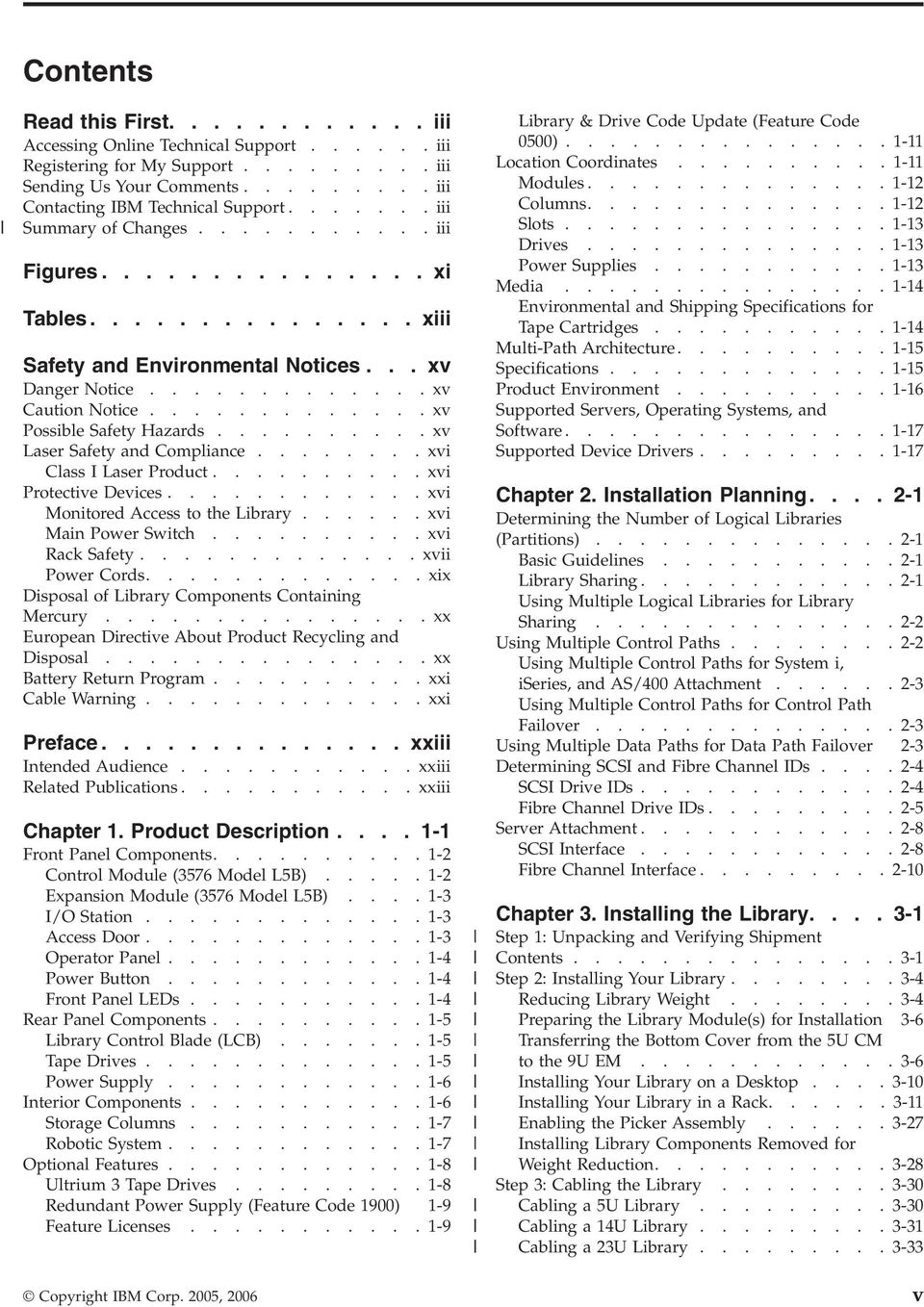
7 Contents Read this First iii Accessing Online Technical Support iii Registering for My Support iii Sending Us Your Comments iii Contacting IBM Technical Support iii Summary of Changes iii Figures xi Tables xiii Safety and Environmental Notices... xv Danger Notice xv Caution Notice xv Possible Safety Hazards xv Laser Safety and Compliance xvi Class I Laser Product xvi Protective Devices xvi Monitored Access to the Library xvi Main Power Switch xvi Rack Safety xvii Power Cords xix Disposal of Library Components Containing Mercury xx European Directive About Product Recycling and Disposal xx Battery Return Program xxi Cable Warning xxi Preface xxiii Intended Audience xxiii Related Publications xxiii Chapter 1. Product Description Front Panel Components Control Module (3576 Model L5B) Expansion Module (3576 Model L5B) I/O Station Access Door Operator Panel Power Button Front Panel LEDs Rear Panel Components Library Control Blade (LCB) Tape Drives Power Supply Interior Components Storage Columns Robotic System Optional Features Ultrium 3 Tape Drives Redundant Power Supply (Feature Code 1900) 1-9 Feature Licenses Library & Drive Code Update (Feature Code 0500) Location Coordinates Modules Columns Slots Drives Power Supplies Media Environmental and Shipping Specifications for Tape Cartridges Multi-Path Architecture Specifications Product Environment Supported Servers, Operating Systems, and Software Supported Device Drivers Chapter 2. Installation Planning Determining the Number of Logical Libraries (Partitions) Basic Guidelines Library Sharing Using Multiple Logical Libraries for Library Sharing Using Multiple Control Paths Using Multiple Control Paths for System i, iseries, and AS/400 Attachment Using Multiple Control Paths for Control Path Failover Using Multiple Data Paths for Data Path Failover 2-3 Determining SCSI and Fibre Channel IDs SCSI Drive IDs Fibre Channel Drive IDs Server Attachment SCSI Interface Fibre Channel Interface Chapter 3. Installing the Library Step 1: Unpacking and Verifying Shipment Contents Step 2: Installing Your Library Reducing Library Weight Preparing the Library Module(s) for Installation 3-6 Transferring the Bottom Cover from the 5U CM to the 9U EM Installing Your Library on a Desktop Installing Your Library in a Rack Enabling the Picker Assembly Installing Library Components Removed for Weight Reduction Step 3: Cabling the Library Cabling a 5U Library Cabling a 14U Library Cabling a 23U Library Copyright IBM Corp. 2005, 2006 v
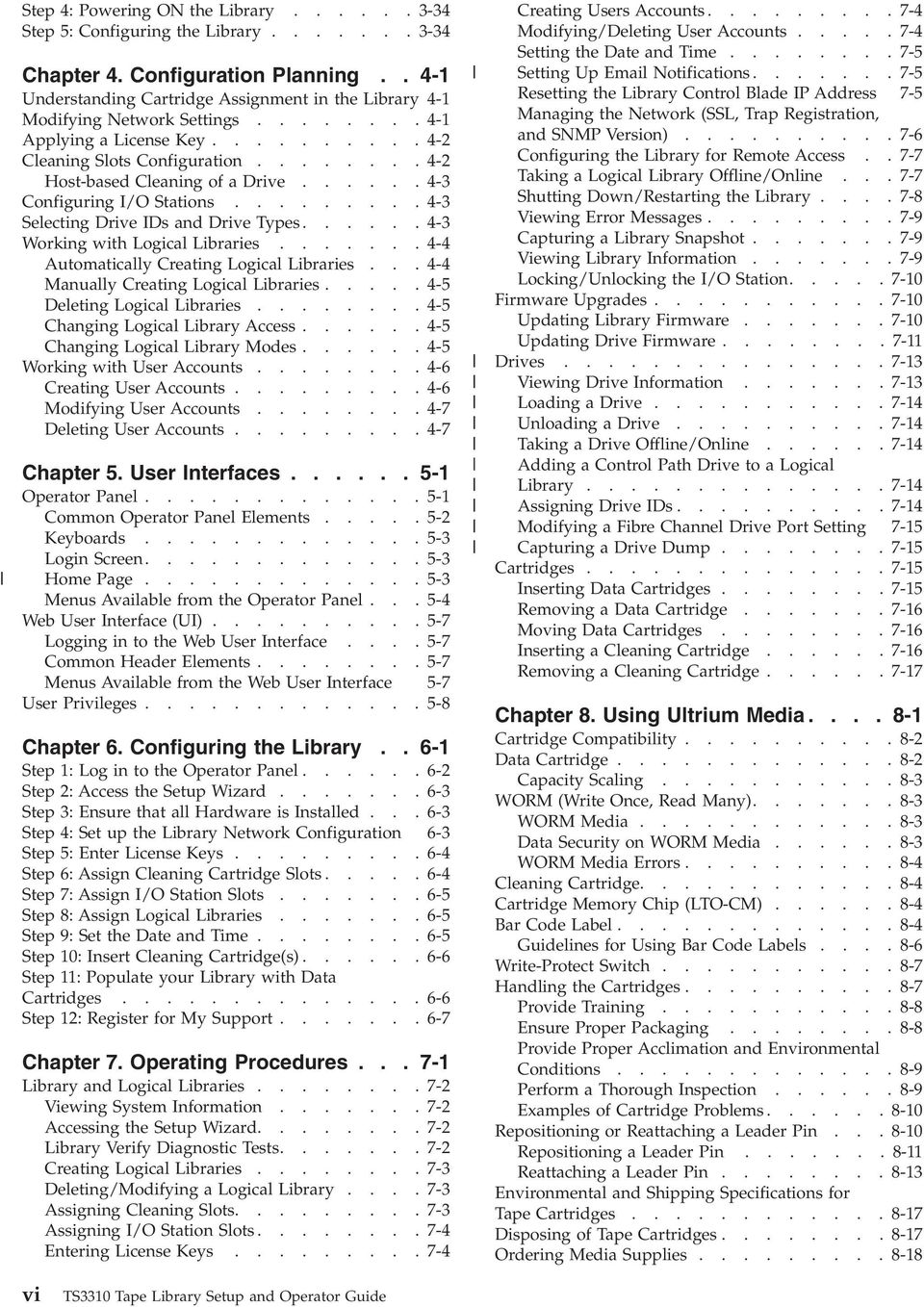
8 Step 4: Powering ON the Library Step 5: Configuring the Library Chapter 4. Configuration Planning Understanding Cartridge Assignment in the Library 4-1 Modifying Network Settings Applying a License Key Cleaning Slots Configuration Host-based Cleaning of a Drive Configuring I/O Stations Selecting Drive IDs and Drive Types Working with Logical Libraries Automatically Creating Logical Libraries Manually Creating Logical Libraries Deleting Logical Libraries Changing Logical Library Access Changing Logical Library Modes Working with User Accounts Creating User Accounts Modifying User Accounts Deleting User Accounts Chapter 5. User Interfaces Operator Panel Common Operator Panel Elements Keyboards Login Screen Home Page Menus Available from the Operator Panel Web User Interface (UI) Logging in to the Web User Interface Common Header Elements Menus Available from the Web User Interface 5-7 User Privileges Chapter 6. Configuring the Library Step 1: Log in to the Operator Panel Step 2: Access the Setup Wizard Step 3: Ensure that all Hardware is Installed Step 4: Set up the Library Network Configuration 6-3 Step 5: Enter License Keys Step 6: Assign Cleaning Cartridge Slots Step 7: Assign I/O Station Slots Step 8: Assign Logical Libraries Step 9: Set the Date and Time Step 10: Insert Cleaning Cartridge(s) Step 11: Populate your Library with Data Cartridges Step 12: Register for My Support Chapter 7. Operating Procedures Library and Logical Libraries Viewing System Information Accessing the Setup Wizard Library Verify Diagnostic Tests Creating Logical Libraries Deleting/Modifying a Logical Library Assigning Cleaning Slots Assigning I/O Station Slots Entering License Keys Creating Users Accounts Modifying/Deleting User Accounts Setting the Date and Time Setting Up Notifications Resetting the Library Control Blade IP Address 7-5 Managing the Network (SSL, Trap Registration, and SNMP Version) Configuring the Library for Remote Access Taking a Logical Library Offline/Online Shutting Down/Restarting the Library Viewing Error Messages Capturing a Library Snapshot Viewing Library Information Locking/Unlocking the I/O Station Firmware Upgrades Updating Library Firmware Updating Drive Firmware Drives Viewing Drive Information Loading a Drive Unloading a Drive Taking a Drive Offline/Online Adding a Control Path Drive to a Logical Library Assigning Drive IDs Modifying a Fibre Channel Drive Port Setting 7-15 Capturing a Drive Dump Cartridges Inserting Data Cartridges Removing a Data Cartridge Moving Data Cartridges Inserting a Cleaning Cartridge Removing a Cleaning Cartridge Chapter 8. Using Ultrium Media Cartridge Compatibility Data Cartridge Capacity Scaling WORM (Write Once, Read Many) WORM Media Data Security on WORM Media WORM Media Errors Cleaning Cartridge Cartridge Memory Chip (LTO-CM) Bar Code Label Guidelines for Using Bar Code Labels Write-Protect Switch Handling the Cartridges Provide Training Ensure Proper Packaging Provide Proper Acclimation and Environmental Conditions Perform a Thorough Inspection Examples of Cartridge Problems Repositioning or Reattaching a Leader Pin Repositioning a Leader Pin Reattaching a Leader Pin Environmental and Shipping Specifications for Tape Cartridges Disposing of Tape Cartridges Ordering Media Supplies vi TS3310 Tape Library Setup and Operator Guide
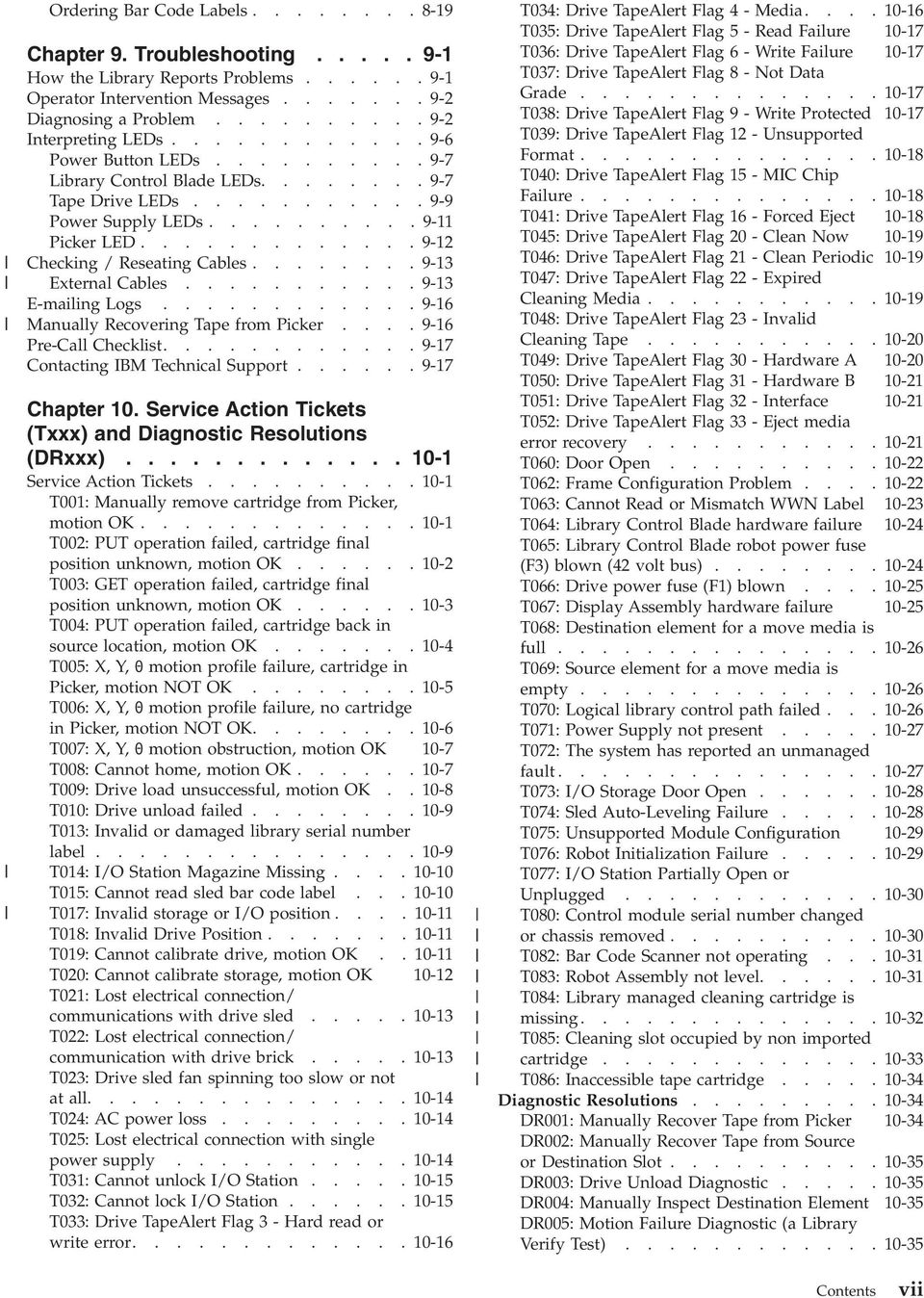
9 Ordering Bar Code Labels Chapter 9. Troubleshooting How the Library Reports Problems Operator Intervention Messages Diagnosing a Problem Interpreting LEDs Power Button LEDs Library Control Blade LEDs Tape Drive LEDs Power Supply LEDs Picker LED Checking / Reseating Cables External Cables ing Logs Manually Recovering Tape from Picker Pre-Call Checklist Contacting IBM Technical Support Chapter 10. Service Action Tickets (Txxx) and Diagnostic Resolutions (DRxxx) Service Action Tickets T001: Manually remove cartridge from Picker, motion OK T002: PUT operation failed, cartridge final position unknown, motion OK T003: GET operation failed, cartridge final position unknown, motion OK T004: PUT operation failed, cartridge back in source location, motion OK T005: X, Y, Θ motion profile failure, cartridge in Picker, motion NOT OK T006: X, Y, Θ motion profile failure, no cartridge in Picker, motion NOT OK T007: X, Y, Θ motion obstruction, motion OK 10-7 T008: Cannot home, motion OK T009: Drive load unsuccessful, motion OK T010: Drive unload failed T013: Invalid or damaged library serial number label T014: I/O Station Magazine Missing T015: Cannot read sled bar code label T017: Invalid storage or I/O position T018: Invalid Drive Position T019: Cannot calibrate drive, motion OK T020: Cannot calibrate storage, motion OK T021: Lost electrical connection/ communications with drive sled T022: Lost electrical connection/ communication with drive brick T023: Drive sled fan spinning too slow or not at all T024: AC power loss T025: Lost electrical connection with single power supply T031: Cannot unlock I/O Station T032: Cannot lock I/O Station T033: Drive TapeAlert Flag 3 - Hard read or write error T034: Drive TapeAlert Flag 4 - Media T035: Drive TapeAlert Flag 5 - Read Failure T036: Drive TapeAlert Flag 6 - Write Failure T037: Drive TapeAlert Flag 8 - Not Data Grade T038: Drive TapeAlert Flag 9 - Write Protected T039: Drive TapeAlert Flag 12 - Unsupported Format T040: Drive TapeAlert Flag 15 - MIC Chip Failure T041: Drive TapeAlert Flag 16 - Forced Eject T045: Drive TapeAlert Flag 20 - Clean Now T046: Drive TapeAlert Flag 21 - Clean Periodic T047: Drive TapeAlert Flag 22 - Expired Cleaning Media T048: Drive TapeAlert Flag 23 - Invalid Cleaning Tape T049: Drive TapeAlert Flag 30 - Hardware A T050: Drive TapeAlert Flag 31 - Hardware B T051: Drive TapeAlert Flag 32 - Interface T052: Drive TapeAlert Flag 33 - Eject media error recovery T060: Door Open T062: Frame Configuration Problem T063: Cannot Read or Mismatch WWN Label T064: Library Control Blade hardware failure T065: Library Control Blade robot power fuse (F3) blown (42 volt bus) T066: Drive power fuse (F1) blown T067: Display Assembly hardware failure T068: Destination element for a move media is full T069: Source element for a move media is empty T070: Logical library control path failed T071: Power Supply not present T072: The system has reported an unmanaged fault T073: I/O Storage Door Open T074: Sled Auto-Leveling Failure T075: Unsupported Module Configuration T076: Robot Initialization Failure T077: I/O Station Partially Open or Unplugged T080: Control module serial number changed or chassis removed T082: Bar Code Scanner not operating T083: Robot Assembly not level T084: Library managed cleaning cartridge is missing T085: Cleaning slot occupied by non imported cartridge T086: Inaccessible tape cartridge Diagnostic Resolutions DR001: Manually Recover Tape from Picker DR002: Manually Recover Tape from Source or Destination Slot DR003: Drive Unload Diagnostic DR004: Manually Inspect Destination Element DR005: Motion Failure Diagnostic (a Library Verify Test) Contents vii
10 DR006: Drive Diagnostic (a Library Verify Test) DR007: Bar Code Scanner Diagnostic (a Library Verify Test) DR009: AC Failure Diagnostic DR010: Expansion Module Connectivity Diagnostic DR011: I/E (I/O Station) Lock Diagnostic (a Library Verify Test) DR012: Host Cabling Diagnostic DR014: Write Protect or WORM Diagnostic DR015: Unsupported Format Diagnostic DR018: Manually Clean Drive DR019: Door Open Diagnostic DR020: Re-inventory the Library DR021: Contact Service DR022: Power Supply Not Present DR023: I/O Station Magazine Missing DR024: Close IO Door DR026: Unsupported Module Configuration DR027: Replace Library SN Label DR028: Motion Obstruction Diagnostic DR029: Drive Communication Loss Resolution DR030: Drive Load Failure Resolution DR031: Robot Initialization Resolution DR032: Control Path Failure Resolution DR033: Drive Sled Auto Level Resolution DR034: IO Storage Door Open Resolution DR035: Robot Fuse Blown Resolution DR036: I/O Station Partially Open or Unplugged DR039: Logical Library Deletion Required DR041: Check Robot Installation DR042: Import a Library Cleaning Cartridge DR043: Invalid Cartridge in Cleaning Slot DR044: Tape Alert 4 Media Error DR045: Tape Alert 5, 6 Read/Write Failure DR046: Tape Alert 8 Suspect Data Grade Tape DR047: Tape Alert 15 Cartridge Memory Failure DR048: Tape Alert 16 Forced Reject DR049 Tape Alert 30, 31 Drive Hardware Error DR050 Remove Cartridge from Invalid Location Chapter 11. Add, Remove, Replace Procedures Required Library State Preparing a Library or Library Module for Repairs 11-2 Returning a Library or Library Module to Normal Operations after Repairs Removing/Replacing a Power Supply (Primary and Redundant) Removing a Primary Power Supply Replacing a Primary Power Supply Adding a Redundant Power Supply Removing a Redundant Power Supply Adding/Removing/Replacing a Drive Sled Adding a New Drive Removing a Drive Sled Replacing a Drive Sled Removing/Replacing the Library Control Blade and Compact Flash Card Removing the Library Control Blade (LCB) Replacing the Library Control Blade (LCB) Removing/Replacing the Compact Flash Card Removing the Compact Flash Card Replacing the Compact Flash Card Upgrading the Compact Flash Card Firmware Library Conversions Desktop to Rack Mounted Library Conversion Rack Mounted to Desktop Library Conversion Removing/Installing Library Foot Pads Removing Library Foot Pads Installing Library Foot Pads Verifying Front and Rear Gear Racks Alignment Chapter 12. Parts List Appendix A. Message Retrieval at the Host A-1 Obtaining Error Information From an RS/6000..A-1 Library Error Log Example A-2 Drive Error Log Example A-3 SCSI Bus Error Example A-4 SCSI Bus Error Example A-5 Summary Report A-5 Retrieving from an AS/400 System with RISC Processor A-6 AS/400 Product Activity Log A-8 Retrieving from a Sun System A-9 Retrieving from an HP-UX System......A-9 Appendix B. TapeAlert Flags..... B-1 TapeAlert Flags Supported by the Drive.... B-1 Appendix C. Sense Data C-1 Library Sense Data C-1 Drive Sense Data C-8 Appendix D. Library Configuration Form D-1 Library Information D-1 Drive Information D-1 SCSI Drives D-1 Fibre Channel Drives D-1 Firmware Information D-2 Users Account Information D-2 My Support D-3 Notices E-1 Trademarks E-2 Electronic Emission Notices E-2 Federal Communications Commission (FCC) Class A Statement E-2 European Union (EU) Electromagnetic Compatibility Directive E-3 viii TS3310 Tape Library Setup and Operator Guide

11 People s Republic of China Class A Electronic Emission Statement E-3 Taiwan Class A Electronic Emission Statement E-3 Japan VCCI Class A ITE Electronic Emission Statement E-3 Industry Canada Class A Emission Compliance Statement E-3 Avis de conformité à la réglementation d Industrie Canada E-4 Germany Electromagnetic Compatibility Directive E-4 Korean Class A Electronic Emission Statement.. E-4 Glossary F-1 Index X-1 Contents ix
12 x TS3310 Tape Library Setup and Operator Guide

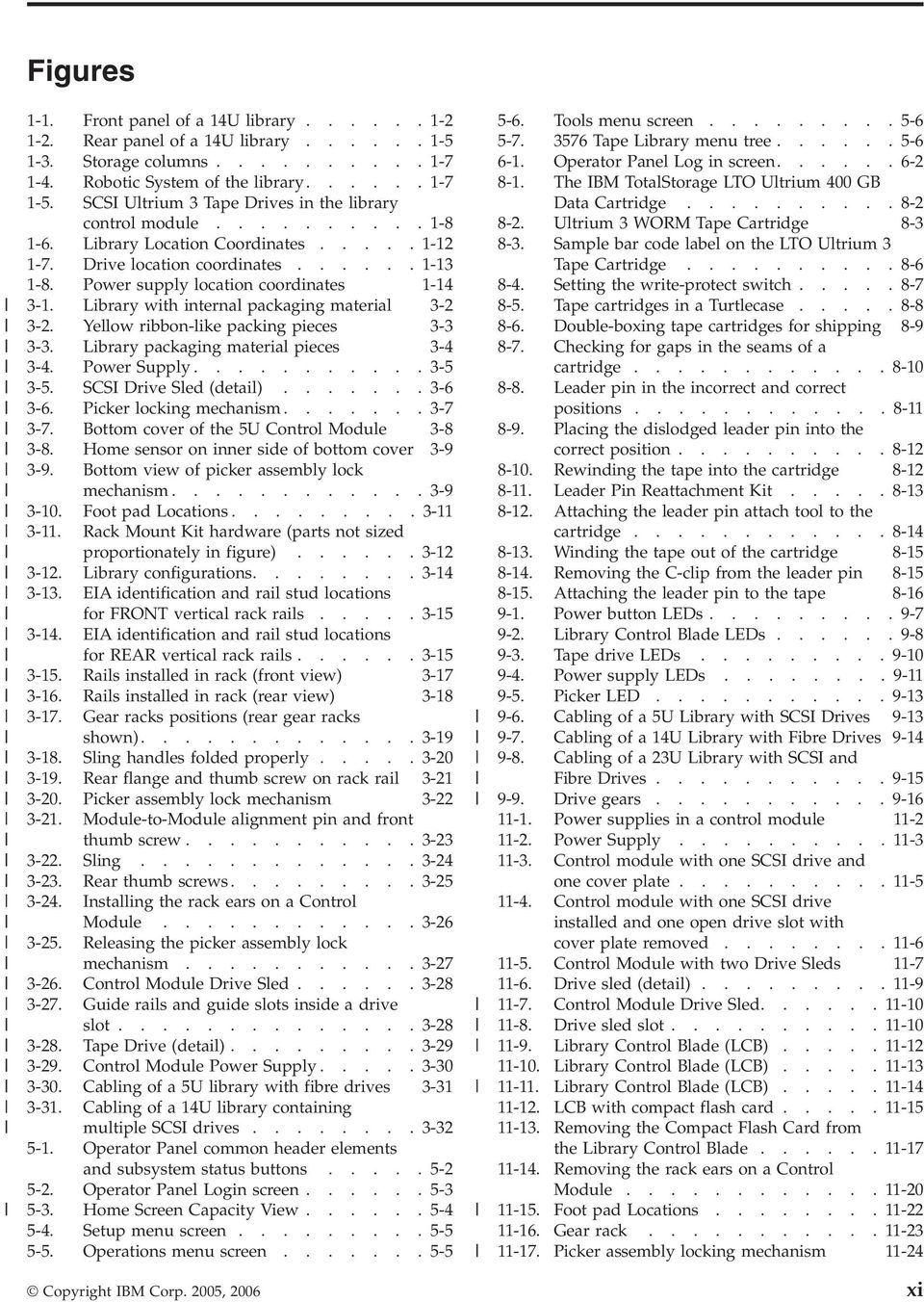
13 Figures 1-1. Front panel of a 14U library Rear panel of a 14U library Storage columns Robotic System of the library SCSI Ultrium 3 Tape Drives in the library control module Library Location Coordinates Drive location coordinates Power supply location coordinates Library with internal packaging material Yellow ribbon-like packing pieces Library packaging material pieces Power Supply SCSI Drive Sled (detail) Picker locking mechanism Bottom cover of the 5U Control Module Home sensor on inner side of bottom cover Bottom view of picker assembly lock mechanism Foot pad Locations Rack Mount Kit hardware (parts not sized proportionately in figure) Library configurations EIA identification and rail stud locations for FRONT vertical rack rails EIA identification and rail stud locations for REAR vertical rack rails Rails installed in rack (front view) Rails installed in rack (rear view) Gear racks positions (rear gear racks shown) Sling handles folded properly Rear flange and thumb screw on rack rail Picker assembly lock mechanism Module-to-Module alignment pin and front thumb screw Sling Rear thumb screws Installing the rack ears on a Control Module Releasing the picker assembly lock mechanism Control Module Drive Sled Guide rails and guide slots inside a drive slot Tape Drive (detail) Control Module Power Supply Cabling of a 5U library with fibre drives Cabling of a 14U library containing multiple SCSI drives Operator Panel common header elements and subsystem status buttons Operator Panel Login screen Home Screen Capacity View Setup menu screen Operations menu screen Tools menu screen Tape Library menu tree Operator Panel Log in screen The IBM TotalStorage LTO Ultrium 400 GB Data Cartridge Ultrium 3 WORM Tape Cartridge Sample bar code label on the LTO Ultrium 3 Tape Cartridge Setting the write-protect switch Tape cartridges in a Turtlecase Double-boxing tape cartridges for shipping Checking for gaps in the seams of a cartridge Leader pin in the incorrect and correct positions Placing the dislodged leader pin into the correct position Rewinding the tape into the cartridge Leader Pin Reattachment Kit Attaching the leader pin attach tool to the cartridge Winding the tape out of the cartridge Removing the C-clip from the leader pin Attaching the leader pin to the tape Power button LEDs Library Control Blade LEDs Tape drive LEDs Power supply LEDs Picker LED Cabling of a 5U Library with SCSI Drives Cabling of a 14U Library with Fibre Drives Cabling of a 23U Library with SCSI and Fibre Drives Drive gears Power supplies in a control module Power Supply Control module with one SCSI drive and one cover plate Control module with one SCSI drive installed and one open drive slot with cover plate removed Control Module with two Drive Sleds Drive sled (detail) Control Module Drive Sled Drive sled slot Library Control Blade (LCB) Library Control Blade (LCB) Library Control Blade (LCB) LCB with compact flash card Removing the Compact Flash Card from the Library Control Blade Removing the rack ears on a Control Module Foot pad Locations Gear rack Picker assembly locking mechanism Copyright IBM Corp. 2005, 2006 xi
14 12-1. Types of Power Cord Receptacles 12-3 A-1. AIX ERRPT Library Error Log Example A-2 A-2. AIX ERRPT Drive Error Log Example A-3 A-3. Example of Error Suggesting SCSI Bus Problem, Which Takes Down Entire Bus..A-4 A-4. SCSI Problem Points to Library Control Path as Possible Cause A-5 A-5. AIX ERRPT Commands Error Log Example A-5 xii TS3310 Tape Library Setup and Operator Guide

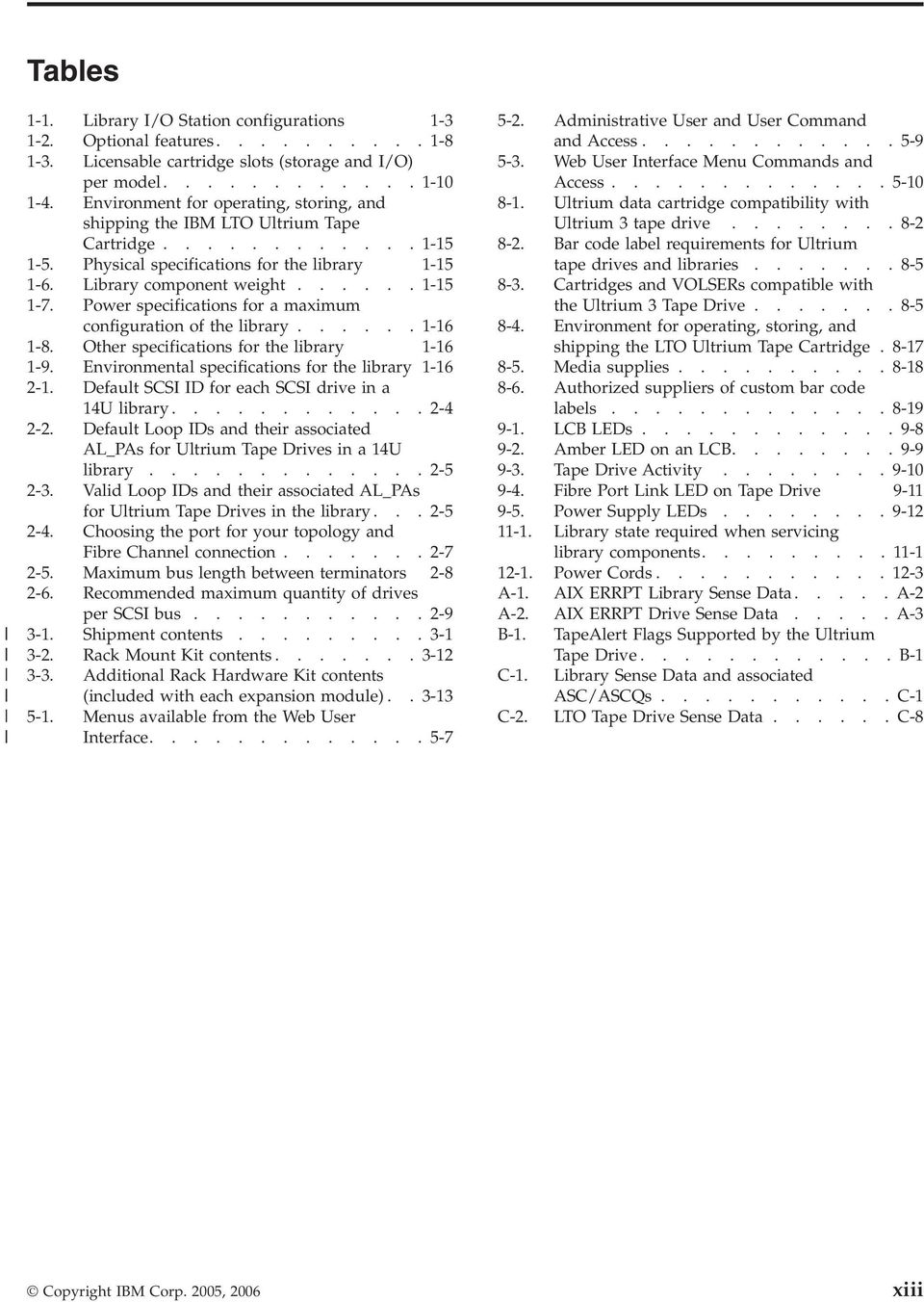
15 Tables 1-1. Library I/O Station configurations Optional features Licensable cartridge slots (storage and I/O) per model Environment for operating, storing, and shipping the IBM LTO Ultrium Tape Cartridge Physical specifications for the library Library component weight Power specifications for a maximum configuration of the library Other specifications for the library Environmental specifications for the library Default SCSI ID for each SCSI drive in a 14U library Default Loop IDs and their associated AL_PAs for Ultrium Tape Drives in a 14U library Valid Loop IDs and their associated AL_PAs for Ultrium Tape Drives in the library Choosing the port for your topology and Fibre Channel connection Maximum bus length between terminators Recommended maximum quantity of drives per SCSI bus Shipment contents Rack Mount Kit contents Additional Rack Hardware Kit contents (included with each expansion module) Menus available from the Web User Interface Administrative User and User Command and Access Web User Interface Menu Commands and Access Ultrium data cartridge compatibility with Ultrium 3 tape drive Bar code label requirements for Ultrium tape drives and libraries Cartridges and VOLSERs compatible with the Ultrium 3 Tape Drive Environment for operating, storing, and shipping the LTO Ultrium Tape Cartridge Media supplies Authorized suppliers of custom bar code labels LCB LEDs Amber LED on an LCB Tape Drive Activity Fibre Port Link LED on Tape Drive Power Supply LEDs Library state required when servicing library components Power Cords A-1. AIX ERRPT Library Sense Data.....A-2 A-2. AIX ERRPT Drive Sense Data.....A-3 B-1. TapeAlert Flags Supported by the Ultrium Tape Drive B-1 C-1. Library Sense Data and associated ASC/ASCQs C-1 C-2. LTO Tape Drive Sense Data C-8 Copyright IBM Corp. 2005, 2006 xiii
16 xiv TS3310 Tape Library Setup and Operator Guide

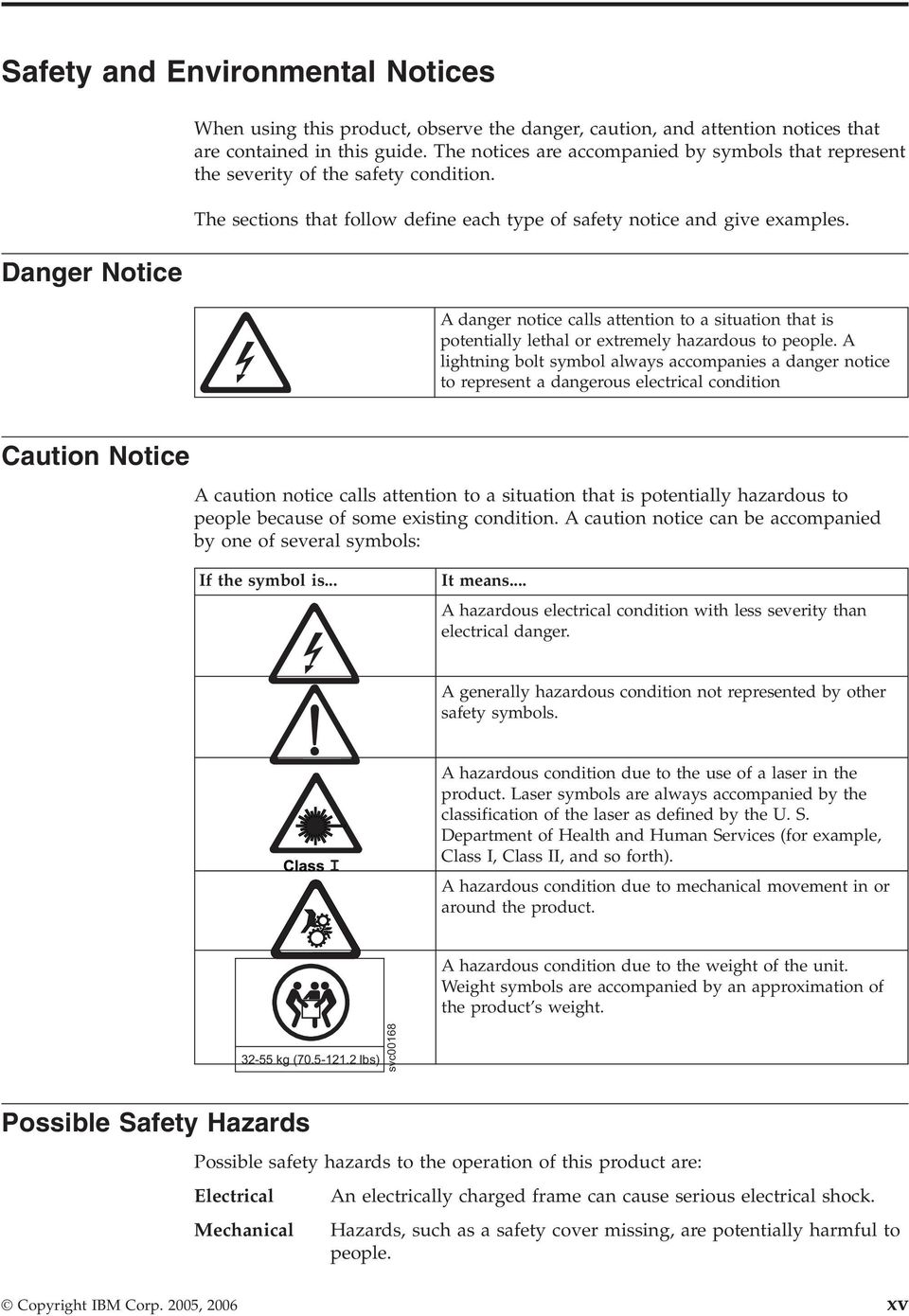
17 Safety and Environmental Notices When using this product, observe the danger, caution, and attention notices that are contained in this guide. The notices are accompanied by symbols that represent the severity of the safety condition. The sections that follow define each type of safety notice and give examples. Danger Notice A danger notice calls attention to a situation that is potentially lethal or extremely hazardous to people. A lightning bolt symbol always accompanies a danger notice to represent a dangerous electrical condition Caution Notice A caution notice calls attention to a situation that is potentially hazardous to people because of some existing condition. A caution notice can be accompanied by one of several symbols: If the symbol is... It means... A hazardous electrical condition with less severity than electrical danger. A generally hazardous condition not represented by other safety symbols. A hazardous condition due to the use of a laser in the product. Laser symbols are always accompanied by the classification of the laser as defined by the U. S. Department of Health and Human Services (for example, Class I, Class II, and so forth). A hazardous condition due to mechanical movement in or around the product. A hazardous condition due to the weight of the unit. Weight symbols are accompanied by an approximation of the product s weight kg ( lbs) svc00168 Possible Safety Hazards Possible safety hazards to the operation of this product are: Electrical An electrically charged frame can cause serious electrical shock. Mechanical Hazards, such as a safety cover missing, are potentially harmful to people. Copyright IBM Corp. 2005, 2006 xv
18 Laser Safety and Compliance Chemical Do not use solvents, cleaners, or other chemicals not approved for use on this product. Repair any of the preceding problems before you use the library. Before using the library, review the following laser safety information. Class I Laser Product The library may contain a laser assembly that complies with the performance standards set by the U.S. Food and Drug Administration for a Class I laser product. Class I laser products do not emit hazardous laser radiation. The library has the necessary protective housing and scanning safeguards to ensure that laser radiation is inaccessible during operation or is within Class I limits. External safety agencies have reviewed the library and have obtained approvals to the latest standards as they apply. Protective Devices The library has the following protective devices: v Monitored access to the library v Main power switch The sections that follow describe each type of protection. Monitored Access to the Library The library is completely surrounded by an enclosure. The library can be accessed only through monitored access areas. The enclosure around the library separates the danger area of the library from the normal working area. The danger area is the area in which personnel can be injured by component movements. CAUTION: Movements of mechanical components in the library can cause serious injury. Access to the library should be restricted to authorized personnel only. Main Power Switch To turn ON the power to the library, press on each power switch installed in the library. To turn OFF the power, press 0 on the switch. In case of danger to personnel or property, immediately turn OFF the main power switch. CAUTION: To completely remove all power, disconnect the line cord from the electrical outlet. xvi TS3310 Tape Library Setup and Operator Guide
19 Attention: Except in emergencies, stop the library with the normal shutdown procedure before you switch OFF the main power switch. IBM is not responsible for damage caused by improper use of the main power switch. Such risk lies entirely with the user. CAUTION: Movements of mechanical components in the tape library can cause serious injury. Before turning the main power switch ON and restarting the tape library, confirm that no danger exists to personnel or property. Rack Safety The following general safety information should be used for all rack mounted devices. DANGER v Always lower the leveling pads on the rack cabinet. v Always install stabilizer brackets on the rack cabinet. v To avoid hazardous conditions due to uneven mechanical loading, always install the heaviest devices in the bottom of the rack cabinet. Always install servers and optional devices starting from the bottom of the rack cabinet. v Rack mounted devices are not to be used as a shelf or work space. Do not place any object on top of rack mounted devices. v Each rack cabinet might have more than one power cord. Be sure to disconnect all power cords in the rack cabinet before servicing any device in the rack cabinet. v Connect all devices installed in a rack cabinet to power devices installed in the same rack cabinet. Do not plug a power cord from a device installed in one rack cabinet into a power device installed in a different rack cabinet. v An electrical outlet that is not correctly wired could place hazardous voltage on the metal parts of the system or the devices that attach to the system. It is the responsibility of the customer to ensure that the outlet is correctly wired and grounded to prevent an electrical shock. Safety and Environmental Notices xvii
20 CAUTION: v Do not install a unit in a rack where the internal rack ambient temperatures will exceed the manufacturer s recommended ambient temperature for all your rack mounted devices. v Do not install a unit in a rack where the air flow is compromised. Ensure that air flow is not blocked or educed on any side, front, or back of a unit used for air flow through the unit. v Consideration should be given to the connection of the equipment to the supply circuit so that overloading of the circuits does not compromise the supply wiring or overcurrent protection. To provide the correct power connection to a rack, refer to the rating labels located on the equipment in the rack to determine the total pwer requirement of the supply circuit. v (For sliding drawers) Do not pull out or install any drawer or feature if the rack stabilizer brackets are not attached to the rack. Do not pull out more than one drawer at a time. The rack may become unstable if you pull out more than one drawer at a time. v (For fixed drawers) This drawer is a fixed drawer and should not be moved for servicing unless specified by the manufacturer. Attempting to move the drawer partially or completely out of the rack may cause the rack to become unstable or cause the drawer to fall out of the rack. (R001) xviii TS3310 Tape Library Setup and Operator Guide
21 CAUTION: Removing components from the upper positions in the rack cabinet improves rack stability during relocation. Follow these general guidelines whenever you relocate a populated rack cabinet within a room or building: v Reduce the weight of the rack cabinet by removing equipment starting at the top of the rack cabinet. When possible, restore the rack cabinet to the configuration of the rack cabinet as you received it. If this configuration is not known, you must do the following: Remove all devices in the 32U position and above. Ensure that the heaviest devices are installed in the bottom of the rack cabinet. Ensure that there are no empty U-levels between devices installed in the rack cabinet below the 32U level. v If the rack cabinet you are relocating is part of a suite of rack cabinets, detach the rack cabinet from the suite. v Inspect the route that you plan to take to eliminate potential hazards. v Verify that the route that you choose can support the weight of the loaded rack cabinet. Refer to the documentation that comes with your rack cabinet for the weight of a loaded rack cabinet. v Verify that all door openings are at least 760 x 230 mm (30 x 80 in.). v Ensure that all devices, shelves, drawers, doors, and cables are secure. v Ensure that the four leveling pads are raised to their highest position. v Ensure that there is no stabilizer bracket installed on the rack cabinet during movement. v Do not use a ramp inclined at more than ten degrees. v Once the rack cabinet is in the new location, do the following: Lower the four leveling pads. Install stabilizer brackets on the rack cabinet. If you removed any devices from the rack cabinet, repopulate the rack cabinet from the lowest position to the highest position. v If a long distance relocation is required, restore the rack cabinet to the configuration of the rack cabinet as you received it. Pack the rack cabinet in the original packaging material, or equivalent. Also lower the leveling pads to raise the casters off of the pallet and bolt the rack cabinet to the pallet. (R002) Power Cords To avoid electrical shock, a power cord with a grounded attachment plug has been provided. Use only properly grounded outlets. All power cords use an appliance coupler that complies with the International Electrotechnical Commission (IEC) Standard 320, Sheet C13. If the power cord that you receive does not match your receptacle, contact your local dealer. Power cords used in the United States and Canada are listed by Underwriter s Laboratories (UL), are certified by the Canadian Standards Association (CSA), and comply with the plug standards of the National Electrical Manufacturers Association (NEMA). Safety and Environmental Notices xix
22 Disposal of Library Components Containing Mercury The fluorescent lamp in the liquid crystal display contains mercury. Dispose of it as required by local ordinances and regulations. European Directive About Product Recycling and Disposal This unit must be recycled or discarded according to applicable local and national regulations. IBM encourages owners of information technology (IT) equipment to responsibly recycle their equipment when it is no longer needed. IBM offers a variety of product return programs and services in several countries to assist equipment owners in recycling their IT products. Information on IBM product recycling offerings can be found on IBM s Internet site at environment/products/prp.shtml. Notice: This mark applies only to countries within the European Union (EU) and Norway. This appliance is labelled in accordance with European Directive 2002/96/EC concerning waste electrical and electronic equipment (WEEE). The Directive determines the framework for the return and recycling of used appliances as applicable throughout the European Union. This label is applied to various products to indicate that the product is not to be thrown away, but rather reclaimed upon end of life per this Directive. In accordance with the European WEEE Directive, electrical and electronic equipment (EEE) is to be collected separately and to be reused, recycled, or recovered at end of life. Users of EEE with the WEEE marking per Annex IV of the WEEE Directive, as shown above, must not dispose of end of life EEE as unsorted municipal waste, but use the collection framework available to customers for the return, recycling and recovery of WEEE. Customer participation is important to minimize any potential effects of EEE on the environment and human health due to the potential presence of hazardous substances in EEE. For proper collection and treatment, contact your local IBM representative. xx TS3310 Tape Library Setup and Operator Guide
23 Battery Return Program This product may contain sealed lead acid, nickel cadmium, nickel metal hydride, lithium, or lithium ion battery. Consult your user manual or service manual for specific battery information. The battery must be recycled or disposed of properly. Recycling facilities may not be available in your area. For information on disposal of batteries outside the United States, go to products/batteryrecycle.shtml or contact your local waste disposal facility. In the United States, IBM has established a return process for reuse, recycling, or proper disposal of used IBM sealed lead acid, nickel cadmium, nickel metal hydride, and other battery packs from IBM Equipment. For information on proper disposal of these batteries, contact IBM at Please have the IBM part number listed on the battery available prior to your call. In Taiwan, the following applies: Please recycle batteries. Cable Warning WARNING: Handling the cord on this product or cords associated with accessories sold with this product, will expose you to lead, a chemical known to the State of California to cause cancer, and birth defects or other reproductive harm. Wash hands after handling. Safety and Environmental Notices xxi
24 xxii TS3310 Tape Library Setup and Operator Guide
25 Preface This manual contains information and instructions necessary for the installation, operation, and service of the IBM System Storage TS3310 Tape Library. Intended Audience The information in this manual is intended for use by end users. Related Publications Refer to the following publications for additional information. To ensure that you have the latest publications, visit the web at v IBM System Storage TS3310 Tape Library SCSI Reference (GA ) provides supported SCSI commands and protocol governing the behavior of SCSI interface. v IBM System Storage TS3310 Tape Library Maintenance Information (GA ) provides information for installation, operation, and maintenance. v IBM Ultrium Device Driver Installation and User s Guide (GA ) provides instructions for attaching IBM-supported hardware to open-systems operating systems. It indicates what devices and levels of operating systems are supported. It also gives requirements for adapter cards, and tells how to configure hosts to use the device driver. All of the above are with the Ultrium family of devices. v IBM Ultrium Device Driver Programming Reference (GC ) supplies information to application owners who want to integrate their open-systems applications with IBM-supported Ultrium hardware. The reference contains information about the application programming interfaces (APIs) for each of the various supported operating-system environments. Copyright IBM Corp. 2005, 2006 xxiii
26 xxiv TS3310 Tape Library Setup and Operator Guide
27 Chapter 1. Product Description Front Panel Components on page 1-2 Rear Panel Components on page 1-5 Interior Components on page 1-6 Optional Features on page 1-8 Location Coordinates on page 1-11 Media on page 1-14 Multi-Path Architecture on page 1-15 Specifications on page 1-15 Product Environment on page 1-16 Supported Servers, Operating Systems, and Software on page 1-17 Supported Device Drivers on page 1-17 The IBM System Storage TS3310 Tape Library offers high performance, capacity, and technology designed for reliability and the heavy demands of tape storage. This library is highly modular with scalability varying from the base library 5U control module to additional expansion units of 9U height each. This automated tape library incorporates high-performance IBM LTO Ultrium 3 Tape Drives for the midrange to enterprise open systems environment. Tape cartridge physical capacity has doubled to 400 GB native capacity (800 GB with 2:1 compression) with the IBM TotalStorage LTO Ultrium 400 GB Data Cartridge (for use only with Ultrium 3 format tape drives), and drive performance has more than doubled to 80 MB/second native data transfer rate with the IBM TotalStorage LTO Ultrium 3 Tape Drives compared to IBM LTO Ultrium 2 Tape Drives. IBM LTO Ultrium 3 tape drives can read and write original LTO Ultrium 2 data cartridges and read LTO Ultrium 1 data cartridges. The TS3310 library contains the library control module, fixed tape cartridge storage of 30 slots, I/O station of 6 slots, a touch screen display, cartridge handling robotics, and up to two LTO Ultrium 3 tape drives. The 14U library contains the 5U library plus a optional expansion modules. Each 9U expansion module can accommodate up to 4 LTO Ultrium 3 Tape Drives and up to 80 tape cartridge slots, and 12 configurable I/O station slots. This library supports LTO Ultrium 3 Tape Drives with either LVD Ultra160 SCSI or native switched fabric Fibre Channel attachment for connection to a wide spectrum of open system servers. Copyright IBM Corp. 2005,
28 Front Panel Components a66ug030 Figure 1-1. Front panel of a 14U library 1 Access doors 5 Operator Panel 2 Power button 6 5U control module 3 Green power ON LED 7 I/O Stations 4 Amber Operator Intervention Alert LED 8 9U expansion module Control Module (3576 Model L5B) All library configurations include the control module ( 6 in Figure 1-1). The control module contains the robotics, library control blade (LCB), and touch screen display. The control module also contains an I/O station, fixed storage slots, tape drives, and at least one power supply. The control module can contain one or two tape drives and one or two power supplies. At least one power supply is always required. 1-2 TS3310 Tape Library Setup and Operator Guide
29 Expansion Module (3576 Model L5B) Each 9U expansion module ( 8 in Figure 1-1 on page 1-2) is a supplementary module that is attached to the 5U Control Module. Like the control module, the expansion modules provide fixed storage slots, tape drive slots, and power supply slots. The I/O station in an expansion module can be configured as storage. If an expansion module contains only cartridges, all power is derived from the control module. I/O Station I/O Stations (7 in Figure 1-1 on page 1-2) are located on the front panel of the library and enable the importing and exporting of cartridges without interrupting normal library operations. A control module I/O Station has a capacity of six cartridges. A 9U expansion module I/O Station has a capacity of 12 cartridges. When an I/O Station slot is assigned to a logical library, only that logical library can access that slot. The I/O Station is shared among all logical libraries, but the I/O Station slots are owned by one logical library at a time. In a 5U library, the six I/O Station slots cannot be configured as storage. In a library that has expansion modules, the I/O Stations can be configured as follows: Table 1-1. Library I/O Station configurations No. of I/O Station Slots Location of I/O Station Slots 6 All six I/O Station slots are in the control module. 12 All twelve I/O Station slots are in the 9U expansion module. 18 Six of the I/O Station slots are in the control module. The remaining twelve I/O Station slots are in the 9U expansion module. 24 All twenty-four I/O Station slots are in the 9U expansion modules. 30 Six of the I/O Station slots are in the control module. The remaining twenty-four I/O Station slots are in the 9U expansion modules. Access Note: I/O slots can be reassigned each time the I/O Station is opened by rearranging the order of the cartridges in the I/O Station. Door Each control module and expansion module has a door on the front panel that allows access to the internal components of the library. This door is locked by the I/O Station. To open the Access Door ( 1 in Figure 1-1 on page 1-2), you must first open the I/O Station. If you want to restrict access to the library, lock the I/O Station door. To do this: From the Operator Panel: Operations I/O Station Lock/Unlock Chapter 1. Product Description 1-3
30 Attention: When any Access Door is opened, all in-progress motion commands stop, the Picker lowers to the bottom of the library, and the library is taken offline (the library must be put back online manually). When the Access Door is closed, the library returns any media in the Picker to its original storage slot. Operator Panel The Operator Panel ( 5 in Figure 1-1 on page 1-2) is the touchscreen display device located on the Access Door of the control module. Library operations and service functions are performed from this screen. The Web User Interface offers some of the same functionality as the Operator Panel via a web browser which enables remote access to the library. For more information on the Operator Panel and the Web User Interface, see Chapter 5, User Interfaces, on page 5-1. Power Button Pressing the Power Button ( 2 in Figure 1-1 on page 1-2) on the front panel of a control module turns the Picker and Operator Panel ON or OFF; however, power is still applied to the power supplies. The Power Button is used during library shutdown and to manually reboot the library. Front Panel LEDs Two LEDs are located on the front of the library to the right of the Power Button. v Green power ON LED ( 3 in Figure 1-1 on page 1-2): When lit, this LED indicates that the library power is ON. v Amber Operator Intervention Alert LED ( 4 in Figure 1-1 on page 1-2): When lit, this LED indicates that there is a Library, Drives, or Media Operator Intervention available. To access the Operator Intervention, select Tools Operator Intervention from the Operator Panel. 1-4 TS3310 Tape Library Setup and Operator Guide
31 Rear Panel Components The following components are located on the rear panel of the library: a66ug031 4 Figure 1-2. Rear panel of a 14U library 1 2 Tape drives (SCSI drives shown) Library Control Blade 3 4 Power supplies (2 in control module; 2 in expansion module) Power supply switches Library Control Blade (LCB) The Library Control Blade ( 2 in Figure 1-2) manages the entire library, including the Operator Panel and Picker, and is responsible for running system tests to ensure that the library is functioning properly. The LCB houses the Compact Flash Card which stores vital product data (VPD) such as library settings, serial number, etc. The LCB indicates status with three light emitting diodes (LEDs). These LEDs, located near the top of the LCB, are green, amber, and blue in color. v Green indicates a good status. v Amber indicates a degraded status. v Blue indicates a potential fault. See Interpreting LEDs on page 9-6. Tape Drives The library supports Ultrium 3 SCSI and Fibre Channel tape drives. Tape drives ( 1 in Figure 1-2) are hot addable (library power remains ON and operations of the installed tape drives are still active). Drives can be removed and installed without tools. Chapter 1. Product Description 1-5
32 SCSI tape drives are attached directly to a host. Fibre Channel tape drives can be directly attached to a host or a Storage Area Network (SAN). Drives mounted in sleds are installed into tape drive slots in the rear of the library. If a tape drive slot is empty, a metal plate covers the empty drive slots to prevent debris from entering the library. Power Supply The library supports single and redundant power configurations. Each module must have at least one power supply.a single power configuration will have a power supply installed in the left slot of each library module. A redundant power configuration will have power supplies installed in both slots of each library module. The single configuration has a single AC line input and a single DC power supply. The optional redundant configuration has dual AC line input and dual DC power supplies. A power supply ( 3 in Figure 1-2 on page 1-5) can be hot swapped if the library has a redundant power supply. A redundant power supply can be hot added. A power switch ( 4 in Figure 1-2 on page 1-5) is located on every power supply on a control module and expansion module. This switch is used to remove all power from the library for emergency and service situations. Except in emergency situations, use the shutdown procedure before switching off the power switch. For more information, see Shutting Down the Library on page 7-8. The power system of the library contains the following components: v Power supply v AC power cord The power supply has three light emitting diodes (LEDs) that provide status information. These LEDs, located to the right of the power switch, are green, amber, and blue in color. v Green indicates a good AC or DC status. v Amber indicates a degraded status. v Blue indicates a potential fault. See Interpreting LEDs on page 9-6 Interior Components The following components are located inside the library: v Storage Columns on page 1-7 v Robotic System on page TS3310 Tape Library Setup and Operator Guide
33 Storage Columns a66ug032 Figure 1-3. Storage columns Storage columns within the library store cartridges while they are not being utilized by a drive. The library contains six storage columns. One of those six columns is the I/O Station. Robotic System a66mi027 Figure 1-4. Robotic System of the library The Robotic System includes the Y-axis Assembly which houses the Y Motor ( 3 in Figure 1-4), the Picker ( 2 in Figure 1-4) which is attached to the Carrier ( 1 in Figure 1-4), and the Bar Code Scanner ( 4 in Figure 1-4). The Climber moves the Robotic System within the library. The Picker (robotic arm) has fingers that enable it to grab tape cartridges and move them to and from the I/O Station, storage slots, and drives. The Bar Code Scanner Chapter 1. Product Description 1-7
34 reads each cartridge bar code label and the fiducial labels that identify the types of cartridge magazines and tape drives installed in the library. Optional Features The table below lists additional features that can be added to the library to enhance performance. Table 1-2. Optional features Type of Feature Description Feature Code Ultrium 3 Tape Drives SCSI Gb Fibre Channel 8042 Power Supply Redundant 1900 Feature Licenses Capacity Expansion 1640 Library and Drive Code Update Path Failover 1682 Library and drive code update by an IBM Service Representative Rack Mount Kit Hardware required to mount your library in a rack Rack PDU Line Cord 9848 For information on ordering additional features or replacement parts for your library, see Chapter 12, Parts List, on page Ultrium 3 Tape Drives This library supports the Ultrium 3 Tape Drive. Each tape drive in the library is packaged in a container called a drive sled. The drive is a customer replaceable unit (CRU), and is designed for quick removal and replacement in the library. The IBM Ultrium 3 Tape Drive supports LVD Ultra160 or Fibre Channel interfaces. It features two HD68 connectors or one LC Fibre Channel connector. 1 a66ug011 Figure 1-5. SCSI Ultrium 3 Tape Drives in the library control module Note: LTO-3 SCSI and Fibre Channel drives are not allowed in the same logical library. 1-8 TS3310 Tape Library Setup and Operator Guide
35 Speed Matching To improve system performance, the Ultrium 3 Tape Drive uses a technique called speed matching to dynamically adjust its native (uncompressed) data rate to the slower data rate of the attached server. Channel Calibration The channel calibration feature of the Ultrium 3 Tape Drive customizes each read/write data channel for optimum performance. The customization enables compensation for variations in the recording channel transfer function, media characteristics, and read/write head characteristics. Power Management The Ultrium 3 Tape Drive s power management function controls the drive s electronics so that part of the electronics completely turn OFF when circuit functions are not needed for the drive s operation. Redundant Power Supply (Feature Code 1900) The optional redundant configuration power supplies may be hot swapped without interrupting library operation. Each supply in a control module and expansion module includes its own input AC line cord. During redundant operation, each supply carries one-half the power load. If a line cord or power supply fails, the second supply sources the complete power load. Optionally, a single power supply and line cord may be installed if redundant power is not required. The second power supply slot is physically covered in this configuration. The library may be upgraded to redundant power at a later time. Feature Licenses A feature license controls the setting of feature-enabled flags that are based on a user input key and the library serial number that is stored in the library vital product data (VPD). A unique key exists for each library based on an encryption of the chassis serial number and a feature code. After a feature is enabled, it cannot be disabled. The library s serial number can only be assigned at the factory. The library uses feature licenses to enable the Capacity Expansion feature and the Path Failover feature. Capacity Expansion (Feature Code 1640) At any time, the Capacity Expansion feature (Feature Code 1640) allows you to enable the unused storage slots within a library via a firmware license key. The TS3310 Tape Library Model L5B control module includes license key enablement for 82 total cartridges, thus enabling all cartridge slots in the L5B and approximately one half the capacity of an added TS3310 Tape Library Model E9U expansion module. Enabling the remaining cartridge storage slots in the E9U expansion module requires the purchase of the Capacity Expansion feature #1640. One Capacity Expansion feature #1640 would be required to totally access and enable all available cartridge slots in a 14U configured library (one L5B and one E9U). Two Capacity Expansion features #1640 would be required to totally access and enable all available cartridge slots in a 23U configured library (one L5B and two E9Us). Chapter 1. Product Description 1-9
36 To see your library s current configuration: v From the Operator Panel: view the Capacity View home screen. v From the Web User Interface: Monitor System System Summary To enter a Capacity Expansion license key: From the Operator Panel: Setup License When the license key is entered, the total number of available slots in the library increases. To verify that the number of slots did increase: v From the Operator Panel, view the Capacity View home screen. v From the Web User Interface: Monitor System System Summary Table 1-3. Licensable cartridge slots (storage and I/O) per model Library Configuration 5U library (control module) 14U library (control module + 9U expansion module) 23U library (control module + 2 9U expansion modules) Number of Available I/O Station Slots* Number of Accessible Storage Slots Total Slots** /12/18 76/70/ /12/18 122/116/ /12/18/ 24/30 6/12/18/ 24/30 168/162/156// 150/ /206/200/ 194/ Capacity Expansion License Keys required for... no license key required no license key required 1 license key required (to enable the full capacity of a 14U library) first license key enables additional 46 slots of second 9U expansion module 2 license keys required to enable the full capacity of a 23U library *The I/O station, in the 9U expansion module, contains 12 slots which can be configured as either I/O or storage slots. If the 9U expansion module I/O slots are configured as I/O, the control module slots can be configured as storage slots. **The number of available I/O and storage slots listed in the table above are adjusted for the unusable slots in each configuration that are not accessible due to space restrictions which limit the movement of the Picker TS3310 Tape Library Setup and Operator Guide
37 Path Failover (Feature Code 1682) The Path Failover feature includes license keys for activating control path failover and data path failover. Control Path Failover A control path is a logical path into the library through which a server sends standard SCSI Medium Changer commands to control thelogical library. Additional control paths reduce the possibility that failure in one control path will cause the entire library to be unavailable. Use of the control path failover feature further reduces that possibility.for more information, see Using Multiple Control Paths on page 2-2). Data Path Failover Data Path Failover is designed to provide a failover mechanism in the IBM device driver, which enables you to configure multiple redundant paths in a SAN environment. In the event of a path or component failure, the failover mechanism is designed to automatically provide error recovery to retry the current operation using an alternate, pre-configured path without aborting the current job in progress. This allows you flexibility in SAN configuration, availability, and management.for more information, see Using Multiple Data Paths for Data Path Failover on page 2-3. Library & Drive Code Update (Feature Code 0500) Order feature code 0500, Library and Drive Code Update, if you would like an IBM Service Representative dispatched to your location to update your library and drive firmware. Location Coordinates A numbering system is used to identify components of the library. The library location coordinates contain the following digits: [Module],[Column],[Slot]. The figure below illustrates how a library with a control module and an expansion module are numbered. Chapter 1. Product Description 1-11
38 Column 2 Column 3 Drives Column 1 Control Module (0) Slot 1 Slot 2 Slot 3 Column 5 Column 6 (I/O Station) Column 4 Expansion Module (-1) a66mi024 Figure 1-6. Library Location Coordinates The module digit uses a zero-based numbering system. The control module is labeled as 0 (zero). The front, left-most column in the module is labeled 1. The top slot in each column is labeled 1. For more information, refer to the sections that follow. Modules Library modules are represented by the first digit of a library coordinate. Modules are identified relative to the control module (CM). The CM is number 0. The module stacked below the CM is numbered with a negative integer depending on its relative position to the CM. The expansion module directly below the CM is number -1. If there is an expansion module installed about the CM, it will be numbered +1. Columns A storage column is a group of slots arranged vertically in the library. Columns are represented by the second digit of a library coordinate. Columns are identified relative to the front left of the library. The column in the front left of the library is number 1. The column numbering continues around the library in a clockwise direction. The I/O Station column is always number TS3310 Tape Library Setup and Operator Guide
39 Slots Fixed storage slots are represented by the third digit of the library location coordinate. Slots are numbered from top to bottom within each column starting with 1 at the top of the column. Drives Drives are addressed by module and drive bay within a module. The drive bays within a module are numbered from top to bottom. A one-based numbering system is used. The top drive bay is drive bay 1. A full address of a drive is of the form [Module, Drive Bay], examples: [0,1], [-1,2]. 0,1 0 0,2-1, 1-1, , 3-1, 4 a66ug045 Figure 1-7. Drive location coordinates Power Supplies Power supplies are addressed as [Module, PS#], where PS# is 1 for the left supply and 2 for the right. Chapter 1. Product Description 1-13
40 1 2 a66ug046 Figure 1-8. Power supply location coordinates 1 0, PS1 (primary power supply in a control module) 2 0, PS2 (redundant power supply in a control module) Media The library uses Ultrium Tape Cartridges that provide up to 400 GB native capacity (up to 800 GB with 2:1 hardware data compression). Supported cartridges include: v IBM TotalStorage LTO Ultrium 400 GB Data Cartridge (Ultrium 3) v IBM TotalStorage Write-Once-Read-Many Data Cartridge (WORM; Ultrium 3 only) v IBM TotalStorage LTO Ultrium 200 GB Data Cartridge (Ultrium 2) v IBM LTO Ultrium 100 GB Data Cartridge (Ultrium 1; read only) v IBM TotalStorage LTO Ultrium Cleaning Cartridge For additional information, see Chapter 8, Using Ultrium Media, on page 8-1. Environmental and Shipping Specifications for Tape Cartridges Before using a tape cartridge, acclimate it to the operating environment for 24 hours or the time necessary to prevent condensation in the drive (the time will vary, depending on the environmental extremes to which the media was exposed). The best storage container for the cartridges (until opened) is the original shipping container. The plastic wrapping prevents dirt from accumulating on the cartridges and partially protects them from humidity changes. When shipping a cartridge, place it in a jewel case or in a sealed, moisture-proof bag to protect it from moisture, contaminants, and physical damage. Ship the cartridge in a container that has enough packing material to cushion the cartridge and prevent it from moving within the container TS3310 Tape Library Setup and Operator Guide
41 Table 1-4 gives the environment for operating, storing, and shipping IBM LTO Ultrium Tape Cartridges. Table 1-4. Environment for operating, storing, and shipping the IBM LTO Ultrium Tape Cartridge Environmental Specifications Environmental Factor Operating Operational Storage Archival Storage Shipping Temperature Relative humidity (noncondensing) 10 C to 45 C 16 C to 32 C 16 C to 25 C -23 C to 49 C (50 F to 113 F) (61 F to 90 F) (61 F to 77 F) (-9 F to 120 F) 10% to 80% 20% to 80% 20% to 50% 5% to 80% Wet bulb temperature 26 C (79 F) 26 C (79 F) 26 C (79 F) 26 C (79 F) Note: 1. Operational storage is considered to be less than 1 year. 2. Archival storage is considered to be 1 to 10 years. Multi-Path Architecture Storage Area Network (SAN)-ready Multi-Path Architecture allows homogeneous or heterogeneous open systems applications to share the library s robotics without middleware or a dedicated server (host) acting as a library manager. The Multi-Path Architecture is compliant with the following attachment interfaces: v SCSI v Fibre Channel The library is certified for SAN solutions (such as LAN-free backup). Multi-Path Architecture allows additional control paths and data paths to be configured for any one logical library. For more information, see Using Multiple Control Paths on page 2-2 and Using Multiple Data Paths for Data Path Failover on page 2-3. Specifications Table 1-5. Physical specifications for the library Physical Measurement Specification 5U control module 9U expansion module Width cm (17.5 in.) cm (17.5 in.) Depth cm (30.25 in.) cm (30.25 in.) Height cm (8.61 in.) 40.0 cm (15.75 in.) Table 1-6. Library component weight Component Weight Drive kg (9.0 lbs.) Power supply kg (4.0 lbs.) Robotics kg (4.5 lbs.) 5U control module chassis (empty) kg (47.5 lbs.) 9U expansion module chassis (empty) kg (65.0 lbs.) Chapter 1. Product Description 1-15
42 Table 1-7. Power specifications for a maximum configuration of the library Power Specification Voltage 100 to 127 Vac. Measurement 5U control module 9U expansion module Vac. 100 to 127 Vac Vac. Frequency 50 to 60 Hz 50 to 60 Hz 50 to 60 Hz 50 to 60 Hz Current 2.0 A 1.0 A 2.0 A 1.0 A Inrush current 50 A 100 A 50 A 100 A Power 200 W 200 W 200 W 200 W kva kbtu/hr Table 1-8. Other specifications for the library Specification Measurement Maximum altitude 2500 m (8202 ft) for operating and storage Table 1-9. Environmental specifications for the library Environmental Factor Drive temperature Operating (see Note) Storage Shipping 10 to 38 C (50 to 100 F) 10 to 43 C (50 to F) -40 to 60 C (-40 to 140 F) Heat output 542 W (483 Cal/Hr) Not applicable Not applicable Relative humidity 20 to 80% 10 to 90% 10 to 90% Maximum wet bulb temperature 26 C (79 F) max. 27 C (80.6 F) max. 29 C (84.2 F) max. Note: The operating environment of the library must not conflict with the media storage requirements (see Environmental and Shipping Specifications for Tape Cartridges on page 1-14 and the section about media storage requirements in the Setup and Operator Guide. The library may be capable of operating at elevated temperatures for an extended period of time, the temperature could shorten the useful life of media that is stored in the library. If media is stored in the library for more than 10 hours, the storage temperature requirements for media should be met. It should be assumed that media stored in the library will be 2 degrees above ambient temperature when the library is powered ON. Product Environment The library is designed to operate in a general business environment. The library meets the acoustical requirements for general business area category 2D. Category 2D states that the library should be installed a minimum of 4 m (13 ft.) from a permanent work station. To allow for service access, install the library a minimum of 0.9 m (3 ft.) from all obstacles. The library is a precision computer peripheral. To ensure maximum longevity of your library, locate the library away from dust, dirt, and airborne particulates: 1-16 TS3310 Tape Library Setup and Operator Guide
43 v Keep the library away from high-traffic areas, especially if the floor is carpeted. Carpeting harbors dust and people walking on the carpet can cause the carpet fibers and the dust to become airborne. v Keep the library out of printer/copier rooms because of toner and paper dust. Additionally, do not store paper supplies next to the library. v Keep the library away from moving air caused by doorways, open windows, fans, and air conditioners. Ensure that the machine covers are always kept closed to minimize any contamination from airborne particles. Supported Servers, Operating Systems, and Software Supported Device Drivers The library is supported by a wide variety of servers (hosts), operating systems, and adapters. These attachments can change throughout the life cycle of the product. To determine the latest supported attachments, visit the web at and look at the Interoperability Matrix. Device drivers are included on a CD-ROM in the ship group for the library. IBM maintains the latest levels of device drivers and driver documentation for the library on the Internet. You can use one of the following procedures to access this material. (Note: If you do not have Internet access and you need information about device drivers, contact your Marketing Representative.) v Using a browser, type one of the following: ftp://ftp.software.ibm.com/storage/devdrvr v Using File Transfer Protocol (FTP), enter the following specifications: FTP site: ftp.software.ibm.com IP Addr: Userid: anonymous Password: (use your current address) Directory: /storage/devdrvr IBM provides Portable Document Format (.pdf) and Postscript (.ps) versions of its device driver documentation in the /storage/devdrvr/doc directory: v IBM_ultrium_tape_IUG.pdf and IBM_ultrium_tape_IUG.ps contain the current version of the IBM Ultrium Device Drivers Installation and User s Guide. v IBM_ultrium_tape_PROGREF.pdf and IBM_ultrium_tape_PROGREF.ps contain the current version of the IBM Ultrium Device Drivers Programming Reference. A list of device drivers for each supported server appears at /storage/devdrvr/ in the following directories: v AIX v v v v HP-UX LINUX Solaris Windows Chapter 1. Product Description 1-17
44 Note: The device driver for the AS/400 server and System i server is included in the OS/400 operating system. For more information about device drivers, refer to any of the preceding directories TS3310 Tape Library Setup and Operator Guide
45 Chapter 2. Installation Planning Determining the Number of Logical Libraries (Partitions) Using Multiple Control Paths on page 2-2 Using Multiple Data Paths for Data Path Failover on page 2-3 Determining SCSI and Fibre Channel IDs on page 2-4 Server Attachment on page 2-8 Installation planning is an important first step in the installation process. By planning the installation, all decisions about system layout will be made prior to actually handling the hardware. This should simplify the installation process. Important: Make a copy of the Appendix D, Library Configuration Form, on page D-1. Using this form, make a record of your library s configuration. Store this form in a safe location and update it any time hardware is added or settings are modified. Determining the Number of Logical Libraries (Partitions) You can partition the library into as many logical libraries as there are drives in the library. LTO-3 SCSI and Fibre Channel drives are allowed in the same library; however, they are not allowed in the same logical library. Basic Guidelines v Each logical library must contain at least one drive. v A library configuration of exactly one partition equals the entire physical library. v The library prevents requests from the server to move media across the boundaries of logical libraries. Library Sharing The library s default configuration allows a single application to operate the library through a single control path. Often, however, it is advantageous to be able to share a single library between heterogeneous (dissimilar) or homogeneous (similar) applications. Some applications (and some servers) do not allow for sharing a library between systems. Configurations can be created that enable the library to process commands from multiple heterogeneous applications (such as an IBM eserver System P application and a Windows application) and multiple homogeneous applications (for example, the same application run by several pseries servers). From the library s Web User Interface or Operator Panel, the following actions can be performed: v Configure the library so that it is partitioned into separate logical libraries that independently communicate with separate applications through separate control paths. This configuration requires no special capabilities from the server or application. (For more information, see Using Multiple Logical Libraries for Library Sharing on page 2-2.) Copyright IBM Corp. 2005,
46 v Configure any single logical library (including the entire physical library) so that it is shared by two or more servers that are running the same application. Depending on the capabilities of the server and application, there are several ways to set up this type of configuration. Three typical ways include: Configuring one server (host) to communicate with the library through a single control path; all other servers send requests to that server through a network. This configuration is used by Tivoli Storage Manager (TSM). Configuring all of the servers to communicate with the library through a single, common control path. This configuration is used in high-availability environments such as IBM s High Availability Clustered Microprocessing (HACMP) and Microsoft s Systems Management Server (SMS) and Clustered Server Environments. Multi-initiator configurations are only supported by certain adapters and independent software vendors (ISVs). Check with your ISV. Configuring a single logical library to communicate with multiple servers through multiple control paths. This configuration requires that control paths be added (see Using Multiple Control Paths ). It is used by Backup Recovery and Media Services (BRMS). Library configuration is not limited to the examples given above. Many configurations are possible, and can be designed according to your business needs. For additional information, refer to your host application documentation. Using Multiple Logical Libraries for Library Sharing Multiple logical libraries are an effective way for the library to simultaneously back up and restore data from heterogeneous applications. For example, the library can be partitionedso that it processes: Using Multiple Control Paths v Commands from Application 1 (about Department X) in Logical Library A v Commands from Application 2 (about Department Y) in Logical Library B v Commands from Application 3 (about Department Z) in Logical Library C In this configuration, the storage slots and drives in each logical library are dedicated to that library and are not shared among other libraries. Commands issued by the applications travel to the library through three unique control paths. Thus, the data processing for: v Department X is confined to the storage slots and drives in Logical Library A v Department Y is confined to the storage slots and drives in Logical Library B v Department Z is confined to the storage slots and drives in Logical Library C In addition to creating multiple logical libraries, any logical library can be configured to have more than one control path. When configuring additional control paths, additional library sharing configurations and availability options are made possible. Access to the logical library is on a first-come, first-served basis and each control path for a logical library can accept commands while the library is in use by another control path. By default, a logical library can communicate with the server only through the first LUN-1-enabled drive that is installed in the partition. Note: Microsoft Windows 2000 and Microsoft Windows 2003 Removable Storage Manager (RSM) does not support multiple control paths within a logical library. IBM recommends that RSM be disabled to use this feature. 2-2 TS3310 Tape Library Setup and Operator Guide
47 To add or remove additional control paths, refer to Adding a Control Path Drive to a Logical Library on page For a particular logical library, you can enable as many control paths as there are drives in that logical library. Using Multiple Control Paths for System i, iseries, and AS/400 Attachment The use of control paths for the System i, iseries, and AS/400 servers is unique. In general, every iseries adapter must recognize the control path that is associated with the drives to which it is connected. For the iseries and AS/400 servers, one to six drives are supported by LVD and Fibre Channel adapters and the OS/ , OS/ , or i5/os 5.3 operating system. Using Multiple Control Paths for Control Path Failover Command failures and timeouts are costly. You want your library to run smoothly and efficiently. To ensure continued processing, the library offers an optional control path failover feature that enables the host device driver to resend the command to an alternate control path for the same logical library. With control path failover installed, the alternate control path can include another HBA, SAN, or library control path drive. The device driver initiates error recovery and continues the operation on the alternate control path without interrupting the application. AIX, Linux, Solaris, HP-UX, and Windows hosts are currently supported for this feature. The Control Path Failover feature can be installed by the customer. For ordering information, see Chapter 12, Parts List, on page Note: The Control Path Failover feature is activated by a license key. For more information about using the control path failover feature, see the IBM Ultrium Device Drivers Installation and User s Guide. Note: LTO-3 SCSI and Fibre Channel drives are not allowed in the same logical library. Using Multiple Data Paths for Data Path Failover Data Path Failover and Load Balancing exclusively supports native Fibre Channel Ultrium 3 Tape Drives in the library using the IBM device driver for AIX and Linux. Data Path Failover is designed to provide a failover mechanism in the IBM device driver, which enable multiple redundant paths to be configured in a SAN environment. In the event of a path or component failure, the failover mechanism is designed to automatically provide error recovery to retry the current operation using an alternate, pre-configured path without aborting the current job in progress. This allows flexibility in SAN configuration, availability, and management. When accessing a tape drive device that has been configured with alternate paths across multiple host ports, the IBM device driver automatically selects a path through the host bus adapter (HBA) that has the fewest open tape devices and assigns that path to the application. This autonomic self-optimizing capability is called Load Balancing. The dynamic load balancing support is designed to optimize resources for devices that have physical connections to multiple HBAs in the same machine. The device driver is designed to dynamically track the usage on each HBA as applications open and close devices, and balance the number of applications using each HBA in the machine. This may help optimize HBA Chapter 2. Installation Planning 2-3
48 resources and improve overall performance. Further, Data Path Failover provides autonomic self-healing capabilities similar to Control Path Failover, with transparent failover to an alternate data path in the event of a failure in the primary host-side path. Data Path Failover and Load Balancing for Ultrium 3 Tape Drives requires an optional feature. Currently Data Path Failover is not available on Windows with Ultrium 3 tape drives. Data Path Failover is also not available on HP-UX at this time. The Data Path Failover feature is activated by a license key. For ordering information, see Chapter 12, Parts List, on page For additional information, refer to your device driver documentation. Determining SCSI and Fibre Channel IDs SCSI IDs are required for SCSI drives. Loop IDs are required for Fibre Channel drives. SCSI Drive IDs Based on its physical position in the library, each SCSI tape drive is assigned a default SCSI ID (from 0 to 15). The table below lists the default SCSI IDs for a 14U library. Table 2-1. Default SCSI ID for each SCSI drive in a 14U library Module Position Drive Location Coordinate Default SCSI IDs Control Module 9U Expansion Module Drive 1 0, 1 2 Drive 2 0, 2 1 Drive 3-1, 1 6 Drive 4-1, 2 5 Drive 5-1, 3 4 Drive 6-1, 4 3 Note: You can change a SCSI ID by using the Web User Interface or the Operator Panel. LUN Assignments for Ultrium Tape Drives The logical unit number (LUN) for the Sequential Access device is always LUN 0 of the drive, and the LUN for the Medium Changer device is always LUN 1 (all other LUNs are invalid addresses). These devices are compatible with the SCSI-3 standard. For information about the SCSI commands for the tape drive and the library, see the IBM TotalStorage LTO Ultrium Tape Drive SCSI Reference and the IBM System Storage TS3310 Tape Library SCSI Reference. Note: The Medium Changer SCSI ID is the same as the SCSI ID for the control path drive. You can enable additional drives to optionally provide Medium Changer (LUN 1) addressing by configuring more than one logical library or by enabling additional control paths (see Determining the Number of Logical Libraries (Partitions) on page TS3310 Tape Library Setup and Operator Guide
49 Fibre Channel Drive IDs Each Fibre Channel Ultrium Tape Drive in the library must have a Loop ID and corresponding Arbitrated Loop Physical Address (AL_PA) to communicate in a Fibre Channel topology. The table below lists the default Loop IDs and AL_PAs for each drive in a 14U library. Table 2-2. Default Loop IDs and their associated AL_PAs for Ultrium Tape Drives in a 14U library Module Control Module 9U Expansion Module Drive Position Drive Location Coordinate Default Loop ID Default AL_PA 1 0, 1 0 X EF 2 0, 2 1 X E8 3-1, 1 2 X E4 4-1, 2 3 X E2 5-1, 3 4 X E1 6-1, 4 5 X E0 Note: Loop IDs are given in decimal format and AL_PA values are given in hexadecimal format. You can change a Loop ID by using the library s operator panel or Web User Interface. Using a method called hard addressing, the drive then automatically selects the corresponding AL_PA, which is the identifier that devices use to communicate. Valid Loop ID values range between 0 and 125. The higher the number of the Loop ID (and AL_PA), the lower the priority of the device in the loop. You can also specify Loop IDs that allow the drive to dynamically arbitrate the AL_PA with other Fibre Channel devices on the loop. This method avoids conflicts over the address and is called soft addressing. To dynamically arbitrate the AL_PA, specify a Loop ID of 126 or 127. For a complete list of Loop IDs and their corresponding AL_PAs, see the table below. Table 2-3. Valid Loop IDs and their associated AL_PAs for Ultrium Tape Drives in the library 7-bit Loop ID (decimal) 8-bit AL_PA (hexadecimal) 7-bit Loop ID (decimal) 8-bit AL_PA (hexadecimal) 7-bit Loop ID (decimal) 8-bit AL_PA (hexadecimal) 0 X EF 43 X A3 86 X 4D 1 X E8 44 X 9F 87 X 4C 2 X E4 45 X 9E 88 X 4B 3 X E2 46 X 9D 89 X 4A 4 X E1 47 X 9B 90 X 49 5 X E0 48 X X 47 6 X DC 49 X X 46 7 X DA 50 X X 45 8 X D9 51 X 8F 94 X 43 9 X D6 52 X X 3C 10 X D5 53 X X 3A Chapter 2. Installation Planning 2-5
50 Table 2-3. Valid Loop IDs and their associated AL_PAs for Ultrium Tape Drives in the library (continued) 7-bit Loop ID (decimal) 8-bit AL_PA (hexadecimal) 7-bit Loop ID (decimal) 8-bit AL_PA (hexadecimal) 7-bit Loop ID (decimal) 8-bit AL_PA (hexadecimal) 11 X D4 54 X X X D3 55 X X X D2 56 X X X D1 57 X 7C 100 X X CE 58 X 7A 101 X X CD 59 X X X CC 60 X X X CB 61 X X 2E 19 X CA 62 X X 2D 20 X C9 63 X X 2C 21 X C7 64 X X 2B 22 X C6 65 X X 2A 23 X C5 66 X 6E 109 X X C3 67 X 6D 110 X X BC 68 X 6C 111 X X BA 69 X 6B 112 X X B9 70 X 6A 113 X X B6 71 X X 1F 29 X B5 72 X X 1E 30 X B4 73 X X 1D 31 X B3 74 X X 1B 32 X B2 75 X X X B1 76 X 5C 119 X X AE 77 X 5A 120 X X AD 78 X X 0F 36 X AC 79 X X X AB 80 X X X AA 81 X X X A9 82 X X X A7 83 X X X A6 84 X X A5 85 X 4E Supported Topologies The Ultrium 3 Tape Drive can be attached in a two-node configuration, either directly to a switch as a public device (switched fabric) or directly to a host bus adapter (HBA) as a private device. It can connect as a public device in a switched fabric topology (through an F_port) or connect using Arbitrated Loop topology (through an L_port or FL_port). 2-6 TS3310 Tape Library Setup and Operator Guide
51 The Ultrium 3 tape drive automatically configures to an L_port or an N_port when it boots. The type of port to which it configures depends on whether the drive recognizes the connection as a loop or a point-to-point connection: v An L_Port supports a Fibre Channel Arbitrated Loop connection to an NL_port or an FL_port. v An N_Port supports a point-to-point connection to an F_port (for example, a director-class switch) in a switched fabric topology. Regardless of the port to which you connect the drive, it automatically configures to a public device (through an F_port or FL_port to a switch) or to a private device (through an L_port by using direct attachment to a server). The table below lists the topologies in which the Ultrium Tape Drive can operate, the Fibre Channel server connections that are available, and the port through which communication must occur. Table 2-4. Choosing the port for your topology and Fibre Channel connection Type of Topology Type of Fibre Channel Connection to Server Direct Connection(Private) Switched Fabric(Public) Fibre Channel Aribitrated L_Port FL_Port Loop(can be Two-Node Arbitrated Loop or Two-Node Switched Fabric Loop; is limited to two nodes) Switched fabric (two nodes) N/A F_Port LUN Assignments The logical unit number (LUN) for the Sequential Access device is always LUN 0 of the drive, and the LUN for the Medium Changer device is always LUN 1 (all other LUNs are invalid addresses). These devices are compatible with the SCSI-3 standard. For information about the SCSI commands for the tape drive and the library, see the IBM TotalStorage LTO Ultrium Tape Drive SCSI Reference and the IBM System Storage TS3310 Tape Library SCSI Reference. Note: The Medium Changer SCSI ID is the same as the SCSI ID for the control path drive. You can enable additional drives to optionally provide Medium Changer (LUN 1) addressing by configuring more than one logical library or by enabling additional control paths (see Determining the Number of Logical Libraries (Partitions) on page 2-1. Using World Wide Names Normally, blocks of World Wide Name (WWN) addresses are assigned to manufacturers by the IEEE Standards Committee, and are built into devices during manufacture. In the case of the library, however, it assigns World Wide Node Names and World Wide Port Names to the drives. This technique is referred to as persistent world wide names. Potential drive slots are each assigned a WWN which does not change when a drive is swapped or replaced. The WWN of the drive is location-dependent and not device-dependent. That is, each time that the drive is reset or powered on, the library reestablishes the WWN so that a drive in Slot x always keeps the same WWN, even if the drive is replaced. The design of a WWN is such that if a drive needs service or Chapter 2. Installation Planning 2-7
52 replacement, host parameters do not need to be changed or reconfigured. The library s configuration can also easily survive a reboot. Server Attachment The library can be attached to servers by using: v SCSI Interface v Fibre Channel Interface on page 2-10 SCSI Interface Note: Although the LVD hardware in the library is capable of operating in single-ended (SE) mode, SE operation is not recommended or supported. The library supports SCSI LVD attachments by using SCSI cables with 68-pin, D-connectors. SCSI adapters must be properly terminated. Before installing the SCSI cables, inspect all cables for damage. Do not install a cable if it is damaged. Report the damage immediately by contacting your place of purchase. The maximum allowable length of your bus cabling depends on the type of SCSI bus that you use (LVD). v For a server with an LVD SCSI bus: Use a maximum system-to-device cable length of 10 m (33 ft) when attaching to the host interface board (SCSI) and one or two daisy-chained drives. Use a maximum system-to-device cable length of 5 m (17 ft) when attaching to the host interface board (SCSI) and three to six daisy-chained drives. Note: For maximum performance, it is recommended to have a maximum of one drive per SCSI bus. Only use the maximum system-to-device cable length of 25 m (82 ft) when attaching directly to one device (a point to point interconnection). Physical Characteristics of the SCSI Interface The library operates as a set of SCSI-3 devices. The Ultrium Tape Drives attach to servers using an LVD Ultra160 SCSI interface. Each SCSI drive sled uses shielded, HD68-pin connectors, and can attach directly to a 2-byte-wide SCSI cable. Any combination of up to two initiators (servers) and up to four targets (devices) is allowed on a single SCSI bus if the following conditions are met: v The SCSI bus is terminated properly at each end v Cable restrictions are followed according to the SCSI-3 specification Under the SCSI-3 protocol, this type of attachment allows cable lengths of up to 25 m (81 ft) with the appropriate cable and terminator. The table below gives the maximum bus length between terminators for the LVD interface. For information about cable connectors, see SCSI Connectors and Adapters on page 2-9. Table 2-5. Maximum bus length between terminators Maximum Bus Length Between Type of Interconnection Terminators (in meters) Point-to-point (1 server and 1 drive) TS3310 Tape Library Setup and Operator Guide
53 Table 2-5. Maximum bus length between terminators (continued) Type of Interconnection Multi-drop/daisy-chain (1 server and multiple drives) Maximum Bus Length Between Terminators (in meters) 12 (LVD) For maximum performance, multiple SCSI buses may be required (see Using Multiple SCSI Buses ), and IBM Ultrium Tape Drives must be the only target devices that are active on the bus. Note: For maximum performance, the quantity of tape drives that you can attach to one SCSI bus is limited, and is based on the type of bus that you have and the amount of data compression achieved. Ultra160 SCSI buses have a bandwidth of 160 MB per second; Ultra320 SCSI buses have a bandwidth of 320 MB per second. The table below lists the types of SCSI buses and gives the recommended maximum quantity of drives that you can attach. Table 2-6. Recommended maximum quantity of drives per SCSI bus Type of Drive Ultra160 Type of SCSI Bus Ultra320 LVD Ultrium 3 2 (1 drive at 2:1 compression) 2 (1 drive at 2:1 compression) Using Multiple SCSI Buses The library has two SCSI connectors for each tape drive in the library. Each drive can be daisy-chained using a SCSI bus jumper that is included with each tape drive. Removal of any jumpers will create a SCSI bus for each drive installed in your library for attachment to multiple servers or to multiple SCSI adapter cards on one server. Multiple SCSI buses may be required for maximum performance, depending on the application and data compression ratio. Note, however, that library (Medium Changer) control is required on at least one SCSI bus. The Medium Changer device is required to be addressed via LUN 1 of the lowest-numbered drive position of each logical library. The Medium Changer device may additionally be addressed via LUN 1 of other drives in any logical library. Any bus containing a Medium Changer device via LUN 1 of a drive is referred to as a control and data path. Any other bus is referred to as a data path. For information about control paths, see Using Multiple Control Paths on page 2-2. Terminating the Bus The SCSI bus and all of the wires in the SCSI cable must be properly terminated according to the SCSI standard. You can plug an external terminator into one of the SCSI connectors. A terminator must be installed on the last device on each end of a string of multiple devices. A terminator is included with each Ultrium Tape Drive. SCSI Connectors and Adapters The library is supported by a wide variety of servers (hosts), operating systems, and adapters. These attachments can change throughout the product s life cycle. To Chapter 2. Installation Planning 2-9
54 determine the latest supported attachments, visit the web at storage/lto. Or, contact your IBM Sales Representative. Fibre Channel Interface Cables and Speeds Ultrium 3 Fibre Channel tape drives use LC duplex fiber optics cables. The maximum distances that the library supports on a Fibre Channel link is determined by the link speed, the type of fiber (50-micron or 62.5-micron), and the device to which the library is attached. If the library attaches to an HBA, refer to the distances that are supported by the HBA. If the library attaches to a switch, the supported distances are: v For a 50-micron cable: 1-Gbit link speed = up to 500 m (1640 ft) 2-Gbit link speed = up to 300 m (984 ft) v For a 62.5-micron cable: 1-Gbit link speed = up to 175 m (574 ft) 2-Gbit link speed = up to 150 m (492 ft) The library uses 50-micron cables internally. Therefore, you must use a 50-micron cable to attach to the library s port. To attach to a 62.5-micron SAN, you must attach the 50-micron cable to an active port, such as a port on a switch. Using Zoning to Isolate Devices and Enhance Security For security reasons, it is important to limit the devices that a server or servers can recognize or access. Also, some performance configurations and SAN configurations can result in a device being seen multiple times from the same server. For example, if you have two HBAs from the same server connected to an Ultrium Tape Drive in the library, the drive will be detected and appear as two logical devices. That is, there will be two special files for one physical device. Zoning can address these issues. Zoning allows you to partition your SAN into logical groupings of devices so that each group is isolated from the other and can only access the devices in its own group. Two types of zoning exist: hardware zoning and software zoning. Hardware zoning is based on physical fabric port number. Software zoning is defined with WWNN or WWPN. While zoning can be reconfigured without causing an outage, some zoning configurations can become complicated. The advantage of the library s WWNN implementation is that you can avoid the exposure of introducing zoning errors because you do not have to change the zoning configuration if a drive needs service or replacement. Attention: It is recommended that tape storage devices be connected on a separate HBA from disk storage devices to avoid potential configuration incompatibilities. Using Persistent Binding to Ensure SCSI ID Assignment When a server is booted, devices are discovered and assigned SCSI target and LUN IDs. It is possible for these SCSI assignments to change between boots. Some operating systems do not guarantee that devices will always be allocated the same 2-10 TS3310 Tape Library Setup and Operator Guide
55 SCSI target ID after rebooting. Also, some software depends on this association, so you do not want it to change. The issue of SCSI ID assignment is addressed by persistent binding. Persistent binding is an HBA function that allows a subset of discovered targets to be bound between a server and device. Implemented by a WWNN or WWPN, persistent binding causes a tape drive s WWN to be bound to a specific SCSI target ID. After a configuration has been set, it survives reboots and any hardware configuration changes because the information is preserved. If a drive needs to be replaced, the new drive assumes the WWNN of the old drive because the WWNN for the drive is location-dependent within the library. Because the WWNN does not change, persistent binding does not need to be changed which would cause an outage. Fibre Channel Connectors and Adapters The library is supported by a wide variety of servers (hosts), operating systems, and adapters. These attachments can change throughout the product s life cycle. To determine the latest supported attachments, visit the web at storage/lto. Sharing on a Storage Area Network With Storage Area Network (SAN) components, the possibilities for connecting multiple systems and multiple drives have increased. Not all software and systems are designed to share drives. Before you install a drive that would allow two systems to share it, check that the systems and their software support sharing. If your software does not support sharing, note that Fibre Channel switches have a zoning capability to form a SAN partition. For systems that do not cooperate, use zoning to prevent the systems from sharing the same drive. You can remove zoned partitions as you upgrade software and system levels. Chapter 2. Installation Planning 2-11
56 2-12 TS3310 Tape Library Setup and Operator Guide
57 Chapter 3. Installing the Library Step 1: Unpacking and Verifying Shipment Contents Installing Your Library in a Rack on page 3-11 Step 3: Cabling the Library on page 3-30 Step 4: Powering ON the Library on page 3-34 Step 5: Configuring the Library on page 3-34 Step 1: Unpacking and Verifying Shipment Contents kg ( lbs) svc00167 Important: Because of the weight of a multi-module library, it is strongly recommended that you install it in the lowest position in a rack. Without drive sleds and power supplies, a 5U library (control module) weighs approximately 50 lbs. Without drive sleds and power supplies, a 14U library (control module + 9U expansion module) weighs approximately 65 lbs. 1. Open and unpack all the boxes in your shipment. 2. Remove all external packaging materials from around the library module. Note: Leave the library module on the lifting sling until it is ready to be installed. 3. Verify the contents of your shipment. Table 3-1. Shipment contents No. of Items Description 1 Library 2 Module communication terminators (2 per library) 1 Module-to-Module communication cable (1 for each expansion module ordered) 1 Power cord for each power supply (If you are installing your library in a rack, you will need Feature Code 9848, Rack Power Distribution Unit (PDU) power cord.) 2 Wrap Plugs (1 for SCSI drives; 1 for Fibre drives) 1 SCSI or Fibre cable for each tape drive (if ordered) 1 SCSI drive-to-drive cable with each SCSI drive ordered 1 SCSI terminator for each SCSI tape drive 1 Data cartridge 1 Cleaning cartridge 1 Ethernet crossover cable (for service use only) 1 Ethernet customer network cable (if ordered) 1 Setup and Operator Guide (this book) 1 Maintenance Information manual Copyright IBM Corp. 2005,
58 Table 3-1. Shipment contents (continued) No. of Items Description 1 Device driver CD-ROM 1 Rack Mount Kit (if ordered) (1 for each library) 1 Additional Rack Hardware Kit (1 for each expansion module ordered) 1 Deskside Kit (library feet and screws) 1 Sling (for lifting and installing library modules) Important: v If any of these items are missing, please call the appropriate number listed on the Hotline Card included in your shipment. 4. Remove all internal packaging materials that are securing the Picker assembly Figure 3-1. Library with internal packaging material a66ug052 Note: Failure to remove all internal packaging material before powering ON the library will result in damage to your library. a. Cut the plastic tie ( 1 in Figure 3-1) across the top of the picker packaging material. DO NOT REMOVE THE TIE, YET. 3-2 TS3310 Tape Library Setup and Operator Guide
59 Note: A hook and loop fastening strap may be used in place of the plastic tie on some libraries. Important: Be careful not to damage the picker assembly when removing the following packing materials. DO NOT USE EXCESSIVE FORCE. b. Remove the cardboard packaging material ( 2 in Figure 3-1 on page 3-2), the foam packaging material ( 3 in Figure 3-1 on page 3-2), and the small cardboard packaging material (not shown in picture). Important: There are library signal cables very near the raised metal loop on the right hand side of the control module floor. Be careful not to cut or damage these cables when removing the plastic tie pieces in the next step. c. Remove the plastic tie pieces. The tie should be threaded under a raised metal loop on each side of the library floor. It may be necessary to cut the tie in more than one place to remove it from the metal loops. 5. Remove the yellow ribbon-like packing pieces ( 1 in Figure 3-2) from around the I/O Station magazines. 1 Figure 3-2. Yellow ribbon-like packing pieces 6. Refer to Figure 3-3 on page 3-4 and ensure that you have removed all of the packaging material. a66ug053 Chapter 3. Installing the Library 3-3
60 Figure 3-3. Library packaging material pieces If any items are missing from your shipment, call the appropriate number listed on the Quality Hotline card included in your shipment. Step 2: Installing Your Library You can install your library in a rack or on a desktop. In either case, you ll need to perform the following: v Reducing Library Weight v Preparing the Library Module(s) for Installation on page 3-6 v Transferring the Bottom Cover from the 5U CM to the 9U EM on page 3-6 If you are installing your library in a rack, continue with the instructions in Installing Your Library in a Rack on page If you are installing your library on a desktop, continue with the instructions in Installing Your Library on a Desktop on page Once you have completed the rack or desktop installation steps, continue installing the library beginning with Installing Library Components Removed for Weight Reduction on page Reducing Library Weight For weight reduction, remove the following components from each unit in the library: v Power supplies v Drives sleds a66ug TS3310 Tape Library Setup and Operator Guide
61 18-32 kg ( lbs) kg ( lbs) svc00167 svc00168 Important: Because of the weight of a multi-module library, it is strongly recommended that you install it in the lowest position in a rack. Without drive sleds and power supplies, a 5U library (control module) weighs approximately 50 lbs. Without drive sleds and power supplies, a 14U library (control module + 9U expansion module) weighs approximately 110 lbs. Removing a Power Supply Figure 3-4. Power Supply 3 For each power supply installed in the library: 1. Loosen the two thumb screws ( 2 in Figure 3-4) on the power supply by turning them counterclockwise. 2. To remove the power supply, grasp the handle ( 1 in Figure 3-4) and slowly pull it toward you, while supporting it from underneath. Removing a Drive Sled a66mi022 Chapter 3. Installing the Library 3-5
62 Figure 3-5. SCSI Drive Sled (detail) For each drive installed in the library: 1. Loosen the two thumb screws ( 2 in Figure 3-5) that hold the drive sled in place by turning them counterclockwise. 2. To remove the drive sled, grasp the handle ( 5 in Figure 3-5) and slowly pull it toward you, while supporting the drive sled from underneath. Preparing the Library Module(s) for Installation 1. Ensure that the drive sleds and power supplies have been removed from the modules to be installed. See Reducing Library Weight on page Refer to Figure 3-12 on page 3-14 and determine which library module will be installed first (on the bottom). 3. If you choose a configuration that has a 9U EM on the bottom it will be necessary to transfer the bottom cover from the 5U control module to the 9U module that will be on the bottom. Refer to Transferring the Bottom Cover from the 5U CM to the 9U EM. If you choose a configuration that has a 5U CM on the bottom, continue to Installing Your Library on a Desktop on page 3-10 or Installing Your Library in a Rack on page Transferring the Bottom Cover from the 5U CM to the 9U EM 1. Engage the picker assembly lock mechanism ( 1 in Figure 3-6 on page 3-7). 4 a66mi TS3310 Tape Library Setup and Operator Guide
63 a66mi053 Figure 3-6. Picker locking mechanism 1 2. Turn the 5U Control Module on it s side and remove the 5 - T10 Torx bottom cover screws (1 in Figure 3-7 on page 3-8). Important: DO NOT loosen or remove the screw holding the home sensor ( 2 in Figure 3-7 on page 3-8). This screw has the same T10 Torx head as the cover screws, but it is longer and has a coarse thread for screwing into the plastic home sensor. Chapter 3. Installing the Library 3-7
64 2 1 a66mi091 Figure 3-7. Bottom cover of the 5U Control Module 3. Remove the bottom cover from the 5U CM. Note: Ensure that the home sensor plastic piece is mounted on the inner side of the bottom cover ( 1 in Figure 3-8 on page 3-9). 3-8 TS3310 Tape Library Setup and Operator Guide
65 1 Figure 3-8. Home sensor on inner side of bottom cover a66mi093 Important: Ensure that the picker lock mechanism ( 1 in Figure 3-9) is engaged as shown. This will prevent the picker mechanism from falling out of the bottom of the 5U CM when it is returned to the upright position without a bottom cover installed. 1 Figure 3-9. Bottom view of picker assembly lock mechanism 4. Return the 5U CM to the upright position. 5. Remove the top cover from the 5U CM (4 - #2 Phillips screws). 6. Ensure that the front and rear gear racks of both the 5U CM and 9U EM are locked in the upper position (see 2 in Figure 3-17 on page 3-19). 7. Turn the 9U EM on it s side and install the bottom cover, using the 5 - T10 Torx screws. 8. Return the 9U EM to the upright position. a66mi089 Chapter 3. Installing the Library 3-9
66 9. If you are installing your library in a rack, continue with the instructions in Installing Your Library in a Rack on page If you are installing your library on a desktop, continue with the instructions in Installing Your Library on a Desktop. Installing Your Library on a Desktop If you are installing your library on a desktop, follow the instructions in the following sections. v Installing Library Foot Pads v Installing Library Components Removed for Weight Reduction on page 3-28 If you are installing a 14U library, you ll also need to follow the instructions in Installing a 5U CM or 9U EM in the Middle (or Top) of Your Library Configuration on page Installing Library Foot Pads To install the library foot pads: 1. Place the sling that was shipped with your library underneath the library halfway between the front and back feet. Ensure that both sling handles are an equal distance from the sides of the library. Use of the sling is strongly recommended for a 9U module. A 5U module is much lighter in weight, and it may not be necessary to use the sling. 2. Being very careful, lay the library on its side. 3. Using a #2 Phillips screwdriver, install the foot pads on the bottom of the library chassis. See Figure 3-10 on page 3-11 for foot pad locations TS3310 Tape Library Setup and Operator Guide
67 a66mi103 Figure Foot pad Locations 4. Carefully return the library to an upright position. 5. Use the lifting sling to place the library module in the desktop location. 6. When you finish these desktop installation steps, store the installation sling in a secure location for possible future use. Then continue the library installation with the instructions on Enabling the Picker Assembly on page Installing Your Library in a Rack The following sections give instructions on installing your library in a rack. v Verifying Rack Mount Kit Contents on page 3-12 v Identifying the Location in the Rack on page 3-13 v Installing the Rails on page 3-16 v Installing Bottom Library Module (5U or 9U) on page 3-19 v Installing a 5U CM or 9U EM in the Middle (or Top) of Your Library Configuration on page 3-21 v Placing the Library in the Rack on page 3-25 v Installing the Rack Ears on page 3-26 When you complete these rack installation steps, continue installing your library by Enabling the Picker Assembly on page Chapter 3. Installing the Library 3-11
68 Verifying Rack Mount Kit Contents The Rack Mount Kit will include rails and hardware to install one library module in a rack. An Additional Rack Hardware Kit with the necessary parts to install an additional module will be included with each additional module ordered Figure Rack Mount Kit hardware (parts not sized proportionately in figure) Table 3-2. Rack Mount Kit contents Quantity* Description Centering nuts: 16 v 8 for racks with round holes ( 1 in Figure 3-11) v 8 for racks with square holes ( 2 in Figure 3-11) 8 Black thumb nuts ( 5 in Figure 3-11) 2 Rack ears ( 6 and 7 in Figure 3-11): 4 Rack ear screws ( 8 in Figure 3-11): a66mi TS3310 Tape Library Setup and Operator Guide
69 Table 3-2. Rack Mount Kit contents (continued) Quantity* Description 2 Rails ( 9 in Figure 3-11 on page 3-12) Important: If any of these items are missing, please call the appropriate number listed on the Quality Hotline Card included in your shipment. * Extra pieces of the small parts may be included. Table 3-3. Additional Rack Hardware Kit contents (included with each expansion module) Quantity 8 Important: Description Clip/Cage nuts: v 4 clip nuts for racks with round holes ( 3 in Figure 3-11 on page 3-12) v 4 cage nuts for racks with square holes ( 4 in Figure 3-11 on page 3-12) 2 Rack ears ( 6 and 7 in Figure 3-11 on page 3-12): 4 Rack ear screws ( 8 in Figure 3-11 on page 3-12): v This additional Rack Hardware Kit will be included with all expansion modules. If you are not rack mounting your library at this time, store this kit for future use. v If any of these items are missing, please call the appropriate number listed on the Hotline Card included in your shipment. Identifying the Location in the Rack Refer to Figure 3-12 on page 3-14 and select one of the possible configurations for your library installation. Chapter 3. Installing the Library 3-13
70 (Recommended) (Recommended) (Recommended) 5U CM 5U CM 5U CM 9U EM 9U EM 9U EM 5U Control Module (Desktop or Rack Mount) 9U EM 5U CM 9U EM 5U CM 5U Control Module above 9U Expansion Module (Desktop or Rack Mount) 5U Control Module below 9U Expansion Module (Desktop or Rack Mount) 9U EM 5U Control Module above 2-9U Expansion Modules 9U EM 5U Control Module between 2-9U Expansion Modules 9U EM 5U CM 5U Control Module below 2-9U Expansion Modules a66mi092 Figure Library configurations (Rack Mount only) (Rack Mount only) (Rack Mount only) When deciding on a location in your rack for the library, remember that the Operator Panel is a touchscreen and should be positioned to allow easy access, and the rear of the library should be free from any obstructions to allow easy access to rear panel components. Also, if you think there is a possibility of adding another expansion module to your library in the future, you may want to allow for this when deciding where to locate the library in your rack. Note: Before beginning the rack installation of your library, read the information on Rack Safety in the Safety and Environmental Notices chapter. Also, verify that no foot pads are installed on the bottom of your library. If foot pads are installed, perform Removing Library Foot Pads on page 11-21, then return here kg ( lbs) svc00167 Important: Because of the weight of a multi-module library, it is strongly recommended that you install it in the lowest position in a rack. Without drive sleds and power supplies, a 5U library (control module) weighs approximately 50 lbs. Without drive sleds and power supplies, a 9U expansion module weighs approximately 65 lbs. The following table gives the amount of rack space required for each library. One unit of vertical rack space is designated as an EIA. One EIA is equal to 4.45 cm (1.75 in.). Library Required Rack Space 5U control module 5 EIAs (5U) 9U expansion module 9 EIAs (9U) 3-14 TS3310 Tape Library Setup and Operator Guide
71 The rails ( 9 in Figure 3-11 on page 3-12) in the Rack Mount Kit require five EIAs of vertical rack space and are installed in the lowest five EIAs of the selected rack location for the library a66ug008 Figure EIA identification and rail stud locations for FRONT vertical rack rails a66ug018 Figure EIA identification and rail stud locations for REAR vertical rack rails 1. Using a pencil, make a mark below the first EIA ( 1 in Figure 3-13 and 1 in Figure 3-14) in the five EIAs selected in each vertical rail in your rack. The bottom of the rail shelf must align with the bottom hole of the first EIA in the front vertical rails in your rack. 2. The rail studs are located on the front and back of each rail included in the Rack Mount Kit. The rail studs will be positioned as indicated by the black filled circles in Figure 3-13 and Figure 3-14: Chapter 3. Installing the Library 3-15
72 a. In the front vertical rack rails, rail studs will be positioned as follows: v Top hole of the third EIA ( 3 in Figure 3-13 on page 3-15). v Bottom hole of the fifth EIA ( 5 in Figure 3-13 on page 3-15). b. In the rear vertical rack rails, rail studs will be positioned as follows: v Bottom hole of the second EIA ( 2 in Figure 3-14 on page 3-15). v Top hole of the fourth EIA ( 4 in Figure 3-14 on page 3-15). 3. For a 14U library, install clip nuts ( 3 in Figure 3-11 on page 3-12) for vertical rack rails with round holes or cage nuts ( 4 in Figure 3-11 on page 3-12) for vertical rack rails with square holes in the front rack rails in thefollowing positions: v Top hole of the tenth EIA v Top hole of the eleventh EIA These clip/cage nuts will be positioned to secure the rack ear screws for the upper unit of a 14U library. Installing the Rails Follow these steps to install the Rack Mount Kit rails kg ( lbs) svc00167 Important: Because of the weight of a multi-module library, it is strongly recommended that you install it in the lowest position in a rack. Without drive sleds and power supplies, a 5U library (control module) weighs approximately 50 lbs. Without drive sleds and power supplies, a 9U expansion module weighs approximately 65 lbs TS3310 Tape Library Setup and Operator Guide
73 Figure Rails installed in rack (front view) a66ug019 Chapter 3. Installing the Library 3-17
74 1 2 Figure Rails installed in rack (rear view) 1. Collapse the rail ( 1 in Figure 3-16). Loosen the nut ( 2 in Figure 3-16), if necessary. The nut should be finger tight. 2. Put a centering nut on each rail stud (two studs on the front edge of each rail; two studs on the back edge of each rail) and finger-tighten (The flat side of the centering nut should be against the flange of the rail when properly installed.). v Use the round hole centering nuts ( 1 in Figure 3-11 on page 3-12) for vertical rack rails with round holes. v Use the square hole centering nuts ( 2 in Figure 3-11 on page 3-12) for vertical rack rails with square holes. 3. From the front of the rack: a. Position the rail to the applicable side (right or left) and insert the rail studs through the marked holes in the vertical rack rail. Note: The small shelf portion of the left rail should be positioned to the right side of the rail. The small shelf portion of the right rail should be positioned to the left side of the rail. Positioning the rails in this way will form the shelf on which the library will be installed. b. Place a thumb nut ( 5 in Figure 3-11 on page 3-12) on each stud and tighten. 4. From the back of the rack: a. Extend the rail and insert the rail studs through the marked holes in the vertical rack rail. b. Place a thumb nut ( 5 in Figure 3-11 on page 3-12) on each stud and tighten. a66ug TS3310 Tape Library Setup and Operator Guide
75 5. From the front of the rack, visually verify that the rail is aligned properly with the rack. You should see thumb screw holes (for mounting the rack ears) in the following locations: v Top hole of the first EIA (see Figure 3-13 on page 3-15) v Top hole of the second EIA in the vertical rack rails (see Figure 3-13 on page 3-15) 6. Repeat this procedure for the other rail. Installing Bottom Library Module (5U or 9U) Note: The bottom module in the library is the only module that has a bottom cover installed. 1. If you are installing a 5U Control Module as the bottom module, remove the top cover. (4 - #2 Phillips screws). 2. For all configurations, ensure that the front and rear gear racks are locked in the upper position. See 2 in Figure Figure Gear racks positions (rear gear racks shown) 1 Gear rack in the down position 2 Gear rack in the up position 3. With a person on each side of the module, lift the module with the sling provided (see Figure 3-18 on page 3-20). a66mi095 Chapter 3. Installing the Library 3-19
76 Figure Sling handles folded properly 4. Slide the module partially onto the rail shelves in the rack. 5. Continue to support the library module from the front while you remove the sling. 6. Push the module into the rack until it contacts the flange on the rear of each rack mount rail. 7. Install and tighten the rear thumb screws ( 1 in Figure 3-19 on page 3-21) located on the flange on the rear of each rack mount rail. a66mi TS3310 Tape Library Setup and Operator Guide
77 a66mi094 Figure Rear flange and thumb screw on rack rail 1 Installing a 5U CM or 9U EM in the Middle (or Top) of Your Library Configuration 1. If you are installing a 5U control module, ensure that the picker assembly lock mechanism ( 1 in Figure 3-20 on page 3-22) is engaged as shown. Chapter 3. Installing the Library 3-21
78 a66mi053 Figure Picker assembly lock mechanism 1 2. IMPORTANT: Ensure that the front and rear gear racks are locked in the upper position. See 2 in Figure 3-17 on page Ensure that the module-to-module alignment pin ( 1 in Figure 3-21 on page 3-23) is in the raised position. If necessary, raise the pin and rotate it half a turn to lock it in the raised position TS3310 Tape Library Setup and Operator Guide
79 1 2 Figure Module-to-Module alignment pin and front thumb screw 4. With a person on each side of the module, lift the module with the sling provided. See Figure 3-22 on page 3-24 to see how the sling handles should be folded. a66ug017 Chapter 3. Installing the Library 3-23
80 Figure Sling 5. Slide the module partially on top of the already installed module(s). 6. Continue to support the library module from the front while you remove the sling. 7. Open the I/O Station door then the Access Door of the upper module to expose the alignment pin behind the Access Door. 8. Push the upper module onto the lower module. 9. Twist the upper module alignment pin ( 1 in Figure 3-21 on page 3-23) to unlock it from the up position. 10. Adjust the upper module s position on top of the lower module until the upper module alignment pin drops into the alignment pin receptacle in the lower module. 11. Tighten the front thumb screw ( 2 in Figure 3-21 on page 3-23) and the thumb screw behind the I/O Station door to secure the front of the upper module to the lower module. 12. Tighten the rear thumb screws ( 1 in Figure 3-23 on page 3-25) that secure the upper module to the lower module. a66mi TS3310 Tape Library Setup and Operator Guide
81 a66mi018 Figure Rear thumb screws 13. IMPORTANT: Lower the gear racks into the down (operating) position. See 1 in Figure 3-17 on page If this is a desktop installation, return to Installing Library Foot Pads on page If this is not the top module in the library, repeat this procedure for the top module. 16. If your library is installed in a rack, install the rack ears on the front of all modules to secure the library to the rack (see Installing the Rack Ears on page 3-26). 17. Store the installation lifting sling and the desktop kit (library feet and screws) in a secure location for possible future use. Placing the Library in the Rack: v To place a 5U library (control module) in a rack: 1 1. With a person on each side, lift the library and slide it onto the rail shelves in the rack until the library is flush with the flange on the rear of each Rack Mount Kit rail. 2. Install and tighten rear thumb screws located on the flange on the rear of each Rack Mount Kit rail. v To place a 14U library (control module + 9U expansion module) in a rack: 1. With a person on each side lifting the library using the sling and one person holding the front of the library, slide it partially onto the rail shelves in the rack. 2. Continuing to support the library from the front, remove the sling and continue pushing the library into the rack until it is flush with the flange on the rear of each Rack Mount Kit rail. 3. Install and tighten rear thumb screws located on the flange on the rear of each Rack Mount Kit rail. Chapter 3. Installing the Library 3-25
82 Installing the Rack Ears: Rack ears are installed on the front of each module of a library to retain the module on the rack shelves. 1. Install the right rack ear ( 2 in Figure 3-24). a66ug Figure Installing the rack ears on a Control Module a. At the bottom right of the I/O Station position on each library module, there is a slot ( 2 in Figure 3-24). Insert the right rack ear ( 1 in Figure 3-24 and 7 in Figure 3-11 on page 3-12) into the slot. b. Position the right rack ear flush with the rack. The slots in the rack ear should be positioned as follows: v In the bottom library module, over the holes in the rack that align with the holes in the rack kit rails. v In the middle or top library module, over the holes in the rack that have clip/cage nuts installed. c. Place the screws ( 8 in Figure 3-11 on page 3-12) in the slots on the right rack ear and tighten. 2. Install the left rack ear ( 3 in Figure 3-24 and 6 in Figure 3-11 on page 3-12). a. Open the left door of the library module slightly. b. Grasp the hinged side of the door and, while pulling on the door, push to the right to expose the slot ( 4 in Figure 3-24) for the left rack ear. c. Insert the left rack ear ( 3 in Figure 3-24) into the slot. d. Position the left rack ear flush with the rack. The slots in the rack ear should be positioned as follows: v In the bottom library module, over the holes in the rack that align with the threaded holes in the rack kit rails v In the middle or top library module, over the holes in the rack that have clip/cage nuts installed e. Place the screws ( 8 in Figure 3-11 on page 3-12) in the slots on the left rack ear and tighten. 3. Close the I/O Station and Access doors. 4. Repeat this procedure for all modules in the library TS3310 Tape Library Setup and Operator Guide
83 Enabling the Picker Assembly Important: Picker assembly damage or library accessor errors can occur if the front or rear gear racks are not engaged properly. 1. IMPORTANT: Ensure that the front and rear gear racks are in the down (operating) position. See 1 in Figure 3-17 on page Feel the junction of the gear racks between each library module, front and rear. Ensure that there are no gaps between the gear racks before you release the picker assembly lock mechanism. 3. Manually raise the picker assembly while you release the lock mechanism ( 1 in Figure 3-25). a66ug055 Figure Releasing the picker assembly lock mechanism 1 4. Release the picker assembly and observe it as it slowly drops to the bottom of the library. It should move smoothly as it travels from one module into the other. Note: If the picker jumps or bumps noticeably as it travels from one module into the other, an error is likely to occur when the library is powered on. Follow the instructions in T083: Robot Assembly not level on page to correct the problem. 5. Reinstall the top cover on the top module of the library (4 - #2 Phillips screws). Chapter 3. Installing the Library 3-27
84 Installing Library Components Removed for Weight Reduction At this point in the installation procedure, you reinstall the drive sleds and power supplies that were removed for weight reduction. Replacing a Drive Sled Attention: NEVER install a drive sled when a cartridge is in the drive in the eject position. Remove the cartridge first. 1 Figure Control Module Drive Sled 1. Align the drive sled with the guide rails and guide slots along the tracks ( 3 in Figure 3-27). 3 2 a66ug011 1 Figure Guide rails and guide slots inside a drive slot 2. Grasp the handle ( 5 in Figure 3-28 on page 3-29) and slowly slide the drive sled into the drive slot, while supporting the drive sled from underneath. a66ug TS3310 Tape Library Setup and Operator Guide
85 Figure Tape Drive (detail) 3. Tighten the two thumb screws ( 2 in Figure 3-28) that hold the drive sled in place by turning them clockwise. 4. Repeat this procedure for all drives to be re-installed in the library. Replacing a Power Supply 4 a66mi023 Chapter 3. Installing the Library 3-29
86 1 2 4 Figure Control Module Power Supply 3 1. Replace the power supply component by sliding it into the power supply slot. First, grasp the handle ( 1 in Figure 3-29) while supporting the power supply component from underneath. Then, line up the power supply component with the guides in the power supply slot, and carefully push it into the library. 2. Tighten the two thumb screws ( 2 in Figure 3-29) on the power supply component by turning them clockwise. 3. Repeat this procedure for each library power supply. a66mi022 Step 3: Cabling the Library At this point in the installation procedure, you install the module-to-module communication cable, the module communication terminators, the customer-supplied Ethernet cable, the drive sled cables, and the power supply cabling. Select and perform one of the following cabling procedures, depending upon your library configuration: v Cabling a 5U Library v Cabling a 14U Library on page 3-31 v Cabling a 23U Library on page 3-33 Cabling a 5U Library To cable a 5U library (control module), complete the following steps: 3-30 TS3310 Tape Library Setup and Operator Guide
87 3 2 4 Figure Cabling of a 5U library with fibre drives 1 Module communication terminator 2 Ethernet cable (customer supplied) 3 Module communication terminator 4 Power cord 5 Fibre drive cable 1. Install the upper module communication terminator ( 3 in Figure 3-30). 2. Install the lower module communication terminator ( 1 in Figure 3-30)). 3. Connect one end of the customer-supplied Ethernet cable ( 2 in Figure 3-30) in the Library Control Blade Ethernet port, then connect the other end of the cable to your network. 4. Connect one end of the drive cable ( 5 in Figure 3-30) to the library, then connect the other end of the cable to your network. Repeat this for every drive in your library. 5. Connect one end of the power cord ( 4 in Figure 3-30) in the receptacle in a power supply in your library, then connect the other end of the cord to your power source. Repeat this for every power supply in your library. 6. Continue with Step 4: Powering ON the Library on page Cabling a 14U Library 1 To cable a 14U library (control module + 9U expansion module), complete the following steps: 5 a66ug023 Chapter 3. Installing the Library 3-31
88 a66ug022 Figure Cabling of a 14U library containing multiple SCSI drives 1 Module communication terminator 2 Module-to-module communication cable 3 Ethernet cable (customer supplied) 4 Module communication terminator 5 SCSI terminators 6 SCSI drive-to-host cable 7 Power cord (upper module) 8 Power cord (lower module) 9 SCSI drive-to-host cable 1. Install a module communication terminator in the upper receptacle of the upper module of your library ( 4 in Figure 3-31). 2. Install one end of the module-to-module communication cable ( 2 in Figure 3-31) in the lower receptacle of the upper module of your library, then install the other end in the upper receptacle of the lower module of your library. 3. Install a module communication terminator in the lower receptacle of the lower module of your library ( 1 in Figure 3-31). 4. Install one end of the customer-supplied Ethernet cable ( 3 in Figure 3-31) in the Library Control Blade Ethernet port, then connect the other end of the cable to your network. 5. Installation of the SCSI cable(s) and terminator(s) depends upon how many drives are in your library. For maximum SCSI drive performance: v For each SCSI drive, install a SCSI terminator ( 5 in Figure 3-31) in the upper receptacle of each SCSI drive in your library TS3310 Tape Library Setup and Operator Guide
89 v For each SCSI drive, connect one end of a SCSI cable to the lower receptacle of each SCSI drive ( 6 in Figure 3-31 on page 3-32), then connect the other end of the cable tothe host. v If you prefer to daisy-chain your SCSI drives: a. Install a SCSI terminator in the upper receptacle of the top SCSI drive in the daisy-chain. b. Connect one end of a shorter drive-to-drive SCSI cable included in your shipment to the lower receptacle of the top SCSI drive in the daisy-chain, then connect the other end of the cable to the upper receptacle of the next drive in the daisy-chain. Repeat this for every SCSI drive in your library. c. On the last drive in the daisy-chain, connect one end of the longer drive-to-host SCSI cable included in your shipment to the lower receptacle of the last drive in the daisy-chain, then connect the other end of the cable to the host. Note: Maximum performance of the SCSI drives in your library will not be achieved if the drives are daisy-chained. 6. Connect one end of the power cord ( 7 and 8 in Figure 3-31 on page 3-32) in the receptacle of a power supply in your library, then connect the other end of the cord to your power source. Repeat this for every power supply in your library. 7. Continue with Step 4: Powering ON the Library on page Cabling a 23U Library To cable a 23U library (control module) with SCSI and Fibre Channel drives, complete the following steps: SCSI and Fibre Channel drives can reside in the same library; however, they can not reside in the same logical library. 1. Install a module communication terminator in the upper receptacle of the upper module of your library. 2. Install one end of one of the module-to-module communication cable in the lower receptacle of the upper module of your library, then install the other end in the upper receptacle of the middle module of your library. 3. Install one end of the other module-to-module communication cable in the lower receptacle of the middle module of your library, then install the other end in the upper receptacle of the bottom module of your library. 4. Install a module communication terminator in the lower receptacle of the bottom module of your library. 5. Install one end of the customer-supplied Ethernet cable in the Library Control Blade Ethernet port, then connect the other end of the cable to your network. 6. For SCSI drives, installation of the SCSI cable(s) and terminator(s) depends upon how many drives are in your library. For maximum drive performance: v Install a SCSI terminator in the upper receptacle of each SCSI drive in your library. v Connect one end of a SCSI cable to the lower receptacle of each SCSI drive, then connect the other end of the cable to the host. v If you prefer to daisy-chain your SCSI drives: a. Install a SCSI terminator in the upper receptacle of the top SCSI drive in the daisy-chain. Chapter 3. Installing the Library 3-33
90 b. Connect one end of a shorter drive-to-drive SCSI cable included in your shipment to the lower receptacle of the top SCSI drive in the daisy-chain, then connect the other end of the cable to the upper receptacle of the next drive in the daisy-chain. Repeat this for every SCSI drive in your library. c. On the last drive in the daisy-chain, connect one end of the longer drive-to-host SCSI cable included in your shipment to the lower receptacle of the last drive in the daisy-chain, then connect the other end of the cable to the host. Note: Maximum performance of the SCSI drives in your library will not be achieved if the drives are daisy-chained. 7. For Fibre drives: v Install one end of the drive fibre cable in a fibre drive in the library, then connect the other end of the cable to your network. Repeat this for every fibre drive in your library. 8. Connect one end of the power cord in the receptacle of a power supply in your library, then connect the other end of the cord to your power source. Repeat this for every power supply in your library. 9. Continue with Step 4: Powering ON the Library. Step 4: Powering ON the Library 1. Turn the switch on each power supply ( 4 in Figure 3-29 on page 3-30) to the ON () position. 2. Push the power button on the front panel of the library. A green LED to the left of the power button indicates that the power is ON. 3. Wait for the library to initialize. This will take approximately 10 minutes. Note: If the operator panel does not initialize, check all cable connections, and ensure that all doors are tightly closed and all power supply switches are in the ON position. Then, repeat steps 1 and When initialization is complete, configure the library. Step 5: Configuring the Library Now it is time to configure the library using the Setup Wizard. Read the information in Chapter 4, Configuration Planning, on page 4-1 and Chapter 5, User Interfaces, on page 5-1 before proceeding to Chapter 6, Configuring the Library, on page TS3310 Tape Library Setup and Operator Guide
91 Chapter 4. Configuration Planning Understanding Cartridge Assignment in the Library Modifying Network Settings Applying a License Key on page 4-2 Cleaning Slots Configuration on page 4-2 Configuring I/O Stations on page 4-3 Selecting Drive IDs and Drive Types on page 4-3 Working with Logical Libraries on page 4-4 Working with User Accounts on page 4-6 Understanding Cartridge Assignment in the Library Modifying Network Settings When a cleaning or data cartridge is placed in the I/O Station, the library scans the I/O Station, then a screen is displayed asking you to assign the cartridge to System or to a logical library. Cleaning cartridges are assigned to System which makes them available to all drives regardless of the logical library to which the drive is assigned. Data cartridges are assigned to a logical library which restricts them from being accessed by another logical library. A drive Firmware (FMR) cartridge placed in the I/O Station for drive firmware update must also be assigned as a SYSTEM cartridge when the assignment screen is presented after the I/O Station door is closed. Selecting CANCEL or allowing the assignment screen to time out will default all newly discovered cartridges in the I/O Station as SYSTEM cartridges. Once a cartridge is assigned to System or to a logical library, the cartridge must be physically exported from the library to the I/O Station, then moved to a different slot in the I/O Station before it can be reassigned to a new destination within the library. If the cartridge is left in the same I/O Station slot, the library will retain the same assignment, even if the I/O Station door is opened and closed. Cartridges that are placed in the I/O Station before the library is powered ON will not have an initial assignment. To force an assignment screen for newly discovered cartridges, the I/O Station must be opened and then closed. Shuffling of the cartridges to different I/O Station slots is not necessary. Previously assigned cartridges prior to power OFF and remaining in the same I/O Station slots will retain their original assignment. The network settings set the connectivity of the library to the network. The connection allows the administrative user to transfer information while managing the library on the network. Administrative users can modify the network settings from the Operator Panel only. Copyright IBM Corp. 2005,
92 Applying a License Key Cleaning Slots Configuration Note: Make sure that the library is connected to the network before modifying network settings. To modify network settings, you need to provide the data for the following fields: v Library Name is the network name you want to assign to the library. The library name can be up to a maximum of twelve characters long. v Dynamic Host Configuration Protocol (DHCP) setting defaults to enabled. Setting the library to enable triggers via DHCP to automatically configure the library network settings. Enable makes the IP Address, Subnet Mask, and Default Gateway text boxes unavailable. Disable makes the IP Address, Subnet Mask, and Default Gateway text boxes available for you to manually set the library network settings. v IP Address is the IP Address of the library. This text box is available only if DHCP is disabled. v Default Gateway is the IP Address of the default gateway for your portion of the Ethernet network. This text box is available only if DHCP is disabled. v Subnet Mask text box is available only if DHCP is disabled. License keys can be purchased for expanding library capacity, control path failover, and data path failover. License keys are absolute values that can only increase a licensed feature. For example, if a license key specified a slot count of 92 slots and later a different license key was installed that specified 46 slots, the total licensed slot count would still be 92 slots. It is possible to license more slots than are physically available in the library at the time. If an Expansion Module (EM) is added, the extra licensed slots become available. A Capacity Expansion license key (Feature Code 1640) can be applied to the library during the initial configuration or at any time in the future. If additional features are purchased (Control Path Failover and/or Data Path Failover), the new license key replaces the current license key. The new license key includes all previously licensed features along with the newly licensed features. A Path Failover license key (Feature Code 1682) supplies one or both licenses for Control Path Failover and/or Data Path Failover. For more information, refer to Using Multiple Control Paths for Control Path Failover on page 2-3 and Using Multiple Data Paths for Data Path Failover on page 2-3. Note: The license key is made up of 5 alphanumeric characters. Zero to four (0 to 4) cleaning slots can be configured in your library. These slots are taken from the unassigned available storage slots. Cleaning cartridges in these slots are used by the library s Auto Clean function when the drives request cleaning. Host-based cleaning will not use these slots. Host-based cleaning will import cleaning cartridges (CLNxxx) as data cartridges and assign them to a particular logical library. 4-2 TS3310 Tape Library Setup and Operator Guide
93 Host-based Cleaning of a Drive Backup applications or archive firmware applications use different techniques to automate the process of cleaning drives. These tools specify cleaning cycles based on cycle counts of the drive, drive requests, or regularly scheduled intervals. Configuring I/O Stations The cleaning process itself requires certain considerations: v Cleaning cartridges must be labeled with a volume serial number. In some cases, specific labels have been established as industry standard. For instance, the prefix CLN might be used to identify a cleaning cartridge. The library does not require a specific content to the label and accepts conventional cartridge labels. v Insert a cleaning cartridge just as you do any other data cartridge. For example, the most common method is by means of the I/O station using host application control. v Cleaning cartridges often have limited lives that can last only as long as 20 cycles. The controlling host application manages the number of uses of a cleaning cartridge. Errors can occur if a cartridge is inserted into a drive when the cartridge has already been used the maximum number of times. v Export a cleaning cartridge just as you would export any other data cartridge. v The concepts of physical libraries and logical libraries must be considered when setting up cleaning procedures and methods. I/O Station slots are used to import and export cartridges into and out of the library without disrupting normal library operations. I/O Stations in Expansion Modules (EMs) can be configured as either I/O Station slots or storage slots. Depending on the configuration, the library contains at least one I/O Station, which can contain one or two magazines. Each magazine contains six slots. v A control module contains six I/O Station slots, and one magazine. v A 9U expansion module contains twelve I/O Station slots, and two magazines. Both magazines in a 9U expansion module must be configured the same way. Note: If the library consists of a control module only, the I/O Station must be configured as I/O Station slots. Storage slots in an I/O Station configured as storage are normally assigned across multiple logical libraries. In order to increase or decrease the number of I/O Station slots in the library. If it is desired to keep all the cartridges in a particular logical library together, v Export the cartridges by logical library and keep them grouped together. v Delete all logical libraries from the I/O station. v Import as a group back to that particular logical library after the I/O Station slots have been reconfigured. Selecting Drive IDs and Drive Types You can change the SCSI ID for a SCSI-attached tape drive or the Loop ID for a Fibre-attached tape drive. This is necessary, for example, when the default ID for a tape drive that you are installing conflicts with the assigned SCSI ID of an existing tape drive. In addition, you might be using a host application that expects to Chapter 4. Configuration Planning 4-3
94 communicate with a tape drive at a specific SCSI ID, but that SCSI ID might already have been configured for use in another logical library. Note: SCSI tape drives use SCSI IDs that are limited to a numerical value between Fibre Channel tape drives use Loop IDs that are limited to a numerical value between For more information on drive IDs, refer to Determining SCSI and Fibre Channel IDs on page 2-4 Working with Logical Libraries Logical libraries are virtual sections within a library that present the appearance of multiple, separate libraries for purposes of file management, access by multiple users, or dedication to one or more host applications. By default, the library has one logical library, which includes all of the library s resources. There are two ways to create logical libraries: v Automatically - where the library divides the available resources equally among the number of logical libraries chosen. v Manually - where an administrative user assigns the number of slots per logical library. (This is only done through the Web User Interface.) Note: When changing the logical library mode from online to offline, all host application commands in progress at the start of the mode change are completed. Administrative users can create, modify, delete, and control access to all logical libraries. Users can be given access to only certain logical libraries and denied access to others. At a minimum, a logical library consists of one tape drive and one slot. The tape drive or slot cannot be shared with another logical library (an exception to the sharing restrictions are cleaning cartridges, which can be shared among all logical libraries). I/O Station slots and cleaning slots are shared between all logical libraries. Each logical library is specific to a tape drive interface (for example, SCSI or Fibre Channel). Mixed media is allowed within logical libraries. For example, a logical library can contain LTO 2 and LTO 3 tape cartridges. Automatically Creating Logical Libraries When the library automatically creates logical libraries, the available resources are divided equally among the number of logical libraries created. Prior to creating logical libraries, it is important to first designate the desired number of cleaning slots and I/O slots (if an expansion module is present). This is necessary because the Automatic Create Logical Library function will divide all available storage slots among the chosen number of logical libraries. From the Operator Panel, all remaining available resources are divided among the number of automatically created logical libraries. Use the Web User Interface (UI) to manually create logical libraries. 4-4 TS3310 Tape Library Setup and Operator Guide
95 Note: On the Web User Interface, all logical libraries must be deleted for the Automatic button to appear. If the Automatic button does not appear, delete all existing logical libraries. Manually Creating Logical Libraries Every logical library must have at least one drive and one storage slot assigned to it.for example, if the library has two tape drives and 12 slots available, the maximum number of logical libraries that can be created is two. Up to 12 slots can be allocated between the two logical libraries in any configuration. If the library has only one logical library with all resources assigned to it, that logical library must be deleted before reallocating resources to a new logical library. You may need to provide information for the following fields: v Emulation Type emulates the logical library. v Logical Library Name can be up to a maximum of 12 alphanumeric characters. v Media Barcode Format defaults to the last 8 characters. v Automatic Drive Cleaning is enabled by default and requires at least one cleaning cartridge and a communication interface to the tape drive with the ability of the tape drive to indicate that cleaning is needed. v Number of Slots is the number of tape cartridge slots that are to be allocated to the new logical library. Deleting Logical Libraries A logical library can be deleted when it is no longer needed. After a logical library is deleted, its resources become unassigned and can be used to create additional logical libraries or added to existing logical libraries. Changing Logical Library Access An administrative user can control what logical libraries a specified user can access. This is done by modifying a user s account. To change logical library access, you must provide the following information: v Password - a unique string of alphanumeric characters that can be viewed and modified by the Administrator. v Privilege level - the library functions a user is assigned access. Refer to User Privileges on page 5-8 for more information on user privilege levels. Changing Logical Library Modes By default, the library has one logical library enabled. The logical library mode must be changed in order to modify the logical library or library. There are two logical library modes: online and offline. v Online - the normal operating condition for a logical library. In this mode, the robotics are enabled and all host application commands are processed. v Offline - the logical library does not process any host application commands. If a logical library is taken offline, the physical library and other logical libraries are not affected. You can take the physical library or any of its logical libraries online or offline. Some operations require that the logical library be offline. Administrative users can take a logical library offline rather than the entire library so as to minimize Chapter 4. Configuration Planning 4-5
96 Working with User Accounts disruption of library operations. Administrative users must manually change the logical library mode to online or offline from the Operator Panel or the Web User Interface (UI). Details on changing logical library modes include: v The default logical library mode is online. v When you access these screens, only logical libraries accessible by the user appear. When you are changing logical library mode, be aware of the following information: v The Online/Offline button toggles between states. v If a logical library is in use, the Online/Office button is grayed out. v Set the button to read Online to take either the physical library or a logical library, depending on the current view, to an online state, which is the normal operating condition. In this mode, the robotics are enabled and all host commands are processed. v Set the button to read Offline to take either the physical library or a logical library, depending on the current view, to an offline state. If only the physical library is taken offline, logical libraries will not process robotics commands, even though they are online. If only a logical library is taken offline, neither the physical library nor the other logical libraries are affected. There are two types of user accounts: user and administrative user. v User - has access to one or more assigned logical libraries and can perform functions within a logical library, such as performing media and drive functions. A user cannot perform actions that affect the physical library, such as creating, modifying, or deleting a logical library. v Administrative user - has access to the entire physical library and all of its logical libraries. One administrative user account, Admin, is configured by default and can be modified at any time, but not deleted. An administrative user can perform all user account functions; a user cannot perform any administrative account functions. Refer to User Privileges on page 5-8 for more information on library permission levels. Creating User Accounts Administrative users can create user accounts any time after the initial configuration. Users cannot create user accounts. A maximum of 300 user accounts can be created in the physical library. 4-6 TS3310 Tape Library Setup and Operator Guide Note: User account user names are limited to 1-12 alphanumeric characters, and passwords are limited to 6-12 alphanumeric characters. To create user accounts, you need to provide information for the following fields: v User Name is the login name of the user account you are creating. v Password is a unique string of alphanumeric characters for the user account you are creating. v Privilege level is set to either User or Admin. Refer to User Privileges on page 5-8 for more information on user privilege levels.
97 Modifying User Accounts After a user account has been initially created, the account settings, such as the password, privilege level, and logical library access, can be modified at any time by an administrative user. Note: User account passwords are limited to 6-12 alphanumeric characters. To modify user accounts, you need to provide information for the following fields: v User Name is the login name of the user account you are creating. v Password is a unique string of alphanumeric characters for the user account you are creating. v Privilege level is set to either User or admin. Refer to User Privileges on page 5-8 for more information on user privilege levels. Deleting User Accounts When a user account is no longer needed, it can be deleted at any time. Chapter 4. Configuration Planning 4-7
98 4-8 TS3310 Tape Library Setup and Operator Guide
99 Chapter 5. User Interfaces Operator Panel Web User Interface (UI) on page 5-7 User Privileges on page 5-8 The library has a local interface, the Operator Panel, and a remote Web User Interface (UI). The Operator Panel is located on the front door of the control module (CM) and allows users to work locally on the library via the user interface. The Web UI allows users to view and perform some library functions from remote sites and is best viewed using Internet Explorer 4.0 or higher. Operator Panel The Operator Panel is physically attached to the front door of the control module (CM). The user interface appears on the touchscreen LCD display of the Operator Panel for executing basic library management functions. Audible feedback, such as key click sounds, are generated when a user touches a button on the touchscreen. Copyright IBM Corp. 2005,
100 Common Operator Panel Elements a66ug051 Figure 5-1. Operator Panel common header elements and subsystem status buttons Common Header Elements All Operator Panel screens (except for the Login screen) contain the following common elements in the header: v Home ( 1 in Figure 5-1) - displays the default Capacity View screen. v Help ( 2 in Figure 5-1) - context-sensitive help for the associated page v Logout ( 3 in Figure 5-1) - ability to log out System Summary and Subsystem Status The health of the library can be gauged by three subsystem status buttons located at the bottom of the home page. These buttons provide easy access to the health of the library for faster recovery if problems occur. You can select the buttons to view detailed information about the library and gain access to library subsystems. The three subsystems are: v Library ( 4 in Figure 5-1)- opens a library menu selection screen and then the operator interventions for the library. v Drives ( 5 in Figure 5-1)- opens the operator intervention screen for drives. v Media ( 6 in Figure 5-1)- opens the operator intervention screen for media. Each button has three states indicated by color. The three states are: v Good - green 5-2 TS3310 Tape Library Setup and Operator Guide v Degraded - yellow (An operator intervention has been created.) v Investigate - red (An operator intervention has been created; however, the library may still be operational.)
101 Keyboards When a user touches a text box requiring data entry, a keyboard screen appears. Either the alphabetic or numeric keyboard appears, depending on the type of input field. All alphabetic character entries are lower case. The text box appears at the top of the screen and the number/characters appear as they are entered. The 123 button opens the numeric keyboard from alphabetic keyboard, The abc button opens the alphabetic keyboard from the numeric keyboard. The back arrow erases one character at a time. Attention: To use the touchscreen effectively, tap lightly to make your selections. Login Screen a66ug028 Figure 5-2. Operator Panel Login screen To fill in the User name, lightly touch the blank field to display the alphabetic and numeric touch pads then, use the touch keys to spell out the user ID and touch OK. Similarly, enter the Password and touch OK. For initial login, the administrator should use the following: v User name: admin v Password: secure Home Page The Home Page screen provides tabular data on the capacity of the various areas of the library. Use this screen to see a quick summary of the capacity of the selected logical library based on a user login. Chapter 5. User Interfaces 5-3
102 Figure 5-3. Home Screen Capacity View If users have access to more than one logical library, they can navigate to other logical libraries using arrows next to the logical library name at the top of the screen. If an administrative user is logged in, a view of the physical library appears. If a user is logged in, the first logical library that they have access to, in alphabetical order, appears. a66ug025 Menus Available from the Operator Panel The following four menus organize commands into logical groups: v The Setup menu consists of commands that you can use to set up and configure various aspects of the library, including logical libraries connectivity, network, physical library, users, date and time, licenses, and SNMP trap registration. 5-4 TS3310 Tape Library Setup and Operator Guide
103 a66mi063 Figure 5-4. Setup menu screen v The Operations menu consists of commands that enable you to change the library s mode of operations, import and export cartridges, load and unload drives, move media, and shutdown/restart the library. a66ug029 Figure 5-5. Operations menu screen v The Tools menu consists of commands that you can use to maintain your library such as viewing operator interventions, capturing the library snapshot, identifying ports, and updating firmware using an FMR (Firmware) cartridge. Chapter 5. User Interfaces 5-5
104 a66mi065 Figure 5-6. Tools menu screen The following figure is a menu tree showing all functions available from the Operator panel interface. Setup Operations Tools Setup Wizard Create Logical Library Delete Logical Library Create Users Modify Users Cleaning Slots I/O Station Slots Drive IDs Licenses Network Config Move Media Insert Media Remove Media Insert Cleaning Media Remove Cleaning Media Logical Library Mode Load Drive Unload Drive Change Drive Mode Lock I/O Station Operator Interventions Drive Mgmt Drive Info About Library Service Internal Network System Settings Security Display Settings Date & Time Network Mgmt Shutdown a66ug009 Control Path Figure Tape Library menu tree 5-6 TS3310 Tape Library Setup and Operator Guide
105 Web User Interface (UI) The Web UI is accessible from a web browser and is best viewed using Internet Explorer 4.0 or higher. To manage the library using the Web UI, you must set up the initial network configuration of the library from the Operator Panel touchscreen. For more information, see Modifying Network Settings on page 4-1 and Step 4: Set up the Library Network Configuration on page 6-3. Logging in to the Web User Interface Initial login information is as follows: v User: admin v Password: secure For more information on user privileges, see User Privileges on page 5-8. Common Header Elements All Operator Panel screens (except for the Login screen) contain the following common elements in the header: v Help - context-sensitive help for the associated page v Logout - ability to log out Menus Available from the Web User Interface Table 5-1. Menus available from the Web User Interface Welcome Page Monitor System System Summary Library Map Logged in Users Network Settings Manage Cartridges Data Cartridges Cleaning Cartridges I/O Station Lock/Unlock I/O Station Doors Manage Drives Load Unload Clean State (Online/Offline) Control Paths Drive IDs Fibre Channel Ports Manage Library Setup Wizard Chapter 5. User Interfaces 5-7
106 Table 5-1. Menus available from the Web User Interface (continued) Logical Libraries Cleaning Slots I/O Station Slots Settings Feature Licenses Date & Time Notifications Outgoing Server (SMTP) Configuration Contact Information Save/Restore Configuration Manage Access Users Set Session Timeout Service Library Operator Interventions Capture Library Log Capture Drive Log Update Library Firmware Update Drive Firmware Drive Firmware Levels Shutdown/Restart Library User Privileges User privilege levels are manually assigned to user accounts created within the library. Controlling access to screens and operations within the library preserves the integrity of the library and the data that is stored within the library. There are two types of user privileges in the library. v Administrative users are allowed access to the entire physical library and all of its logical libraries. One and only one administrator user must be assigned the login name admin. v Users are allowed to operate a logical library, but not perform actions that affect the physical library. User privileges include: 5-8 TS3310 Tape Library Setup and Operator Guide v A screen saver is invoked after 10 minutes of inactivity on the Operator Panel. The Web User Interface (UI) does not use a screen saver. The User, Administrative user, or Service user who is inactive between 10 and 30 minutes returns to the last accessed screen when activating the screen again. v Any logged in User, Administrative user, or Service user who is inactive for more than 30 minutes is logged out. v Up to 10 Users and/or one Administrative user can be logged in at one time on the Web UI. Only one user (Administrative or Service) can be logged in at one time on the Operator Panel. One Administrative user can disconnect another Administrative user.
107 v Any user can be logged in to only one interface at a time. v When a Service user logs in, all other Users and Administrative users are logged out and notified that they cannot perform actions on the library. A message is posted that Service is logged in and no other users can access the library until after Service has logged out. Table 5-2. Administrative User and User Command and Access. ( X if access allowed; if access not allowed) Menu Command Administrative User User Setup Setup Wizard X Logical Libraries->Create X Logical Libraries->Delete X Users->Create X Users->Modify X Cleaning Slots X I/O Station Slots X Drive IDs X Licenses X Network Config X Date and Time X Network Management->SSL, Trap Registration, SNMP Version X Control Path X Operations Media->Move X X Media->Insert X X Media->Remove X X Cleaning Media->Insert X X Cleaning Media->Remove X X Logical Libraries->Change Mode Drive->Load X X Drive->Unload X X Drive->Change Mode X X I/O Station Lock/Unlock X System Shutdown X Tools Operator Interventions X Drive Management X Drive Info X X About Library X X Service X Internal Network X X X Chapter 5. User Interfaces 5-9
108 Table 5-2. Administrative User and User Command and Access (continued). ( X if access allowed; if access not allowed) Menu Command Administrative User User System Settings X Security X Display Settings X Table 5-3. Web User Interface Menu Commands and Access. ( X if access allowed; if access not allowed) Menu Command Administrative User User Monitor System System Summary X X Library Map X Logged In Users X Network Settings X Manage Cartridges Data Cartridges X X Cleaning Cartridges X X I/O Station X X Lock/Unlock I/O Station Doors Manage Drives X Load X X Unload X X Clean X X State (Online/Offline) X X Control Paths X Drive IDs X X Fibre Channel Ports X X Manage Library Setup Wizard X Logical Libraries X X Cleaning Slots X I/O Station Slots X Settings Feature Licenses X Date & Time X X Notifications X X Outgoing Server (SMTP) Configuration X Contact Information X X Save/Restore Configuration X X Manage Access 5-10 TS3310 Tape Library Setup and Operator Guide
109 Table 5-3. Web User Interface Menu Commands and Access (continued). ( X if access allowed; if access not allowed) Menu Command Administrative User User Users X Set Session Timeout X Service Library Operator Interventions X X Capture Library Log X X Capture Drive Log X X Update Library Firmware X Update Drive Firmware X Drive Firmware Levels X X Shutdown/Restart Library X X Chapter 5. User Interfaces 5-11
110 5-12 TS3310 Tape Library Setup and Operator Guide
111 Chapter 6. Configuring the Library Step 1: Log in to the Operator Panel on page 6-2 Step 2: Access the Setup Wizard on page 6-3 Step 3: Ensure that all Hardware is Installed on page 6-3 Step 4: Set up the Library Network Configuration on page 6-3 Step 5: Enter License Keys on page 6-4 Step 6: Assign Cleaning Cartridge Slots on page 6-4 Step 7: Assign I/O Station Slots on page 6-5 Step 8: Assign Logical Libraries on page 6-5 Step 9: Set the Date and Time on page 6-5 Step 10: Insert Cleaning Cartridge(s) on page 6-6 Step 11: Populate your Library with Data Cartridges on page 6-6 Step 12: Register for My Support on page 6-7 Initial configuration customizes the library for your specific needs and environment. Use the Operator Panel Setup Wizard to configure your library. Details on using the Setup Wizard include: v The only time that you do not need to log in to the library is when the Setup Wizard appears on the Operator Panel the first time the library is turned on. v After a timeout period of one hour, the Setup Wizard will close, and you will be logged out of the library. Use the default Admin account to log in on the Operator Panel. v If you timeout of the Setup Wizard or do not complete all the Setup Wizard screens, the library will apply the default configuration settings plus whatever modifications (if any) you made. The default settings are as follows: Network settings: DHCP enabled (IP addresses are dynamically assigned to network devices in your network.) I/O Station slots: 6 (in the control module) Cleaning cartridge slots: 1 Logical libraries: 1 v You can only configure network settings on the Operator Panel, and you cannot log in to the library from the web interface until you have configured network settings. v You can always return to the Setup Wizard whenever you are logged in to the Operator Panel. v Any administrative users you create will also be able to use the Setup Wizard as well as Setup and Operations menu commands to reconfigure the library. v If necessary, you can cancel out of the Setup Wizard on the Operator Panel and begin using the library locally with the default settings in place. If you accept the default network configuration settings, you will not be able to access the Copyright IBM Corp. 2005,
112 library remotely from the Web User Interface. You can, however, return to the Setup Wizard at any time and modify network and other settings. Important: Use the Appendix D, Library Configuration Form, on page D-1 to record all library settings. At this time, there is no way to electronically save and restore library settings. Step 1: Log in to the Operator Panel If necessary, log in to the Operator Panel. If the Setup Wizard: Welcome screen appears, skip this step. On the Operator Panel Log in screen: a66ug028 Figure 6-1. Operator Panel Log in screen 1. Touch the User name text field to access the alphanumeric keyboards. 2. Use the alphabetic keyboard to enter admin, then touch OK. 3. Touch the Password text field to access the alphanumeric keyboards. 4. Use the alphabetic keyboard to enter secure, then touch OK. 5. Touch OK again to access the Home Page screen which displays the default configuration of the library. 6. Delete the library s default logical library setting. a. Select Setup Delete Logical Libraries. and follow the on-screen prompts. Now you are ready to configure your library using the Setup Wizard. 6-2 TS3310 Tape Library Setup and Operator Guide
113 Step 2: Access the Setup Wizard Important: If at any point you touch Cancel while in the Setup Wizard, the Setup Wizard: Cancel screen appears. The screen is dynamically updated to indicate what the current configuration of the library is, including any settings that have been applied thus far in the Wizard. Touching Cancel on the Cancel screen navigates you back to the last accessed screen in the Setup Wizard. Touching OK applies the current settings and returns you to the Home Page screen. 1. If the Setup Wizard: Welcome screen does not display automatically, select Setup Setup Wizard to display the Welcome screen. 2. After reading the information on the screen, touch Begin. Step 3: Ensure that all Hardware is Installed 1. Read the Hardware Installation screen. 2. Ensure that all tape drives and the customer-supplied Ethernet cable are installed. 3. If the drives and Ethernet cable are installed, touch Next to continue. Step 4: Set up the Library Network Configuration Read Modifying Network Settings on page 4-1 before beginning this step. Important: You will not be able to access the library remotely until the network settings are applied. Library firmware can only be updated using the remote Web User Interface. Touch No if you do not know your network settings and to continue configuring your library. To set up the network configuration: 1. Determine your network settings (IP Address, Default Gateway, and Subnet Mask) and record this information on the Appendix D, Library Configuration Form, on page D Touch Yes to begin configuring the library network. 3. Choose a name for your library. 4. Touch the Library Name text box to access the alphanumeric keyboards. 5. Using the alphanumeric keyboards, enter the name into the Library Name field. Note: The library name can be a maximum of 12 alphanumeric characters. Any letters used in the library name must be lowercase. 6. Select Dynamic Host Configuration Protocol (DHCP) to have the library network setting automatically configured. To configure your network manually, enter the following network settings: v IP Address - the Internet protocol (IP) address of the library v Default Gateway - the IP address of the default gateway for your portion of the Ethernet network Chapter 6. Configuring the Library 6-3
114 Note: Each IP address consists of four sets of numbers ( octets ) separated by periods. Do not use 0 in the last octet of the address because it will reset the Gateway to the original address set at the factory. v Subnet Mask - the IP address of the subnetwork 7. Touch Apply to save the network settings. 8. After a successful save, touch Close. 9. Touch Local to complete configuring your library using the Operator Panel. Step 5: Enter License Keys Note: The Setup Wizard is not available from the Web User Interface. Read Applying a License Key on page 4-2 before beginning this step. If you purchased a Control Path Failover License Key (Feature Code 1682 which includes Control Path Failover and Data Path Failover) with your library or a Capacity Expansion License Key (Feature Code 1640) with your 14U or larger library, enter those license keys now. Note: A Data Path Failover license key (Feature Code 1682) is entered at the host. Refer to the device driver documentation shipped with your library and the installation instructions shipped with your license keys for more information. Touch No if you would like to continue configuring your library without entering a license key. To enter a license key: 1. Locate the license key labels. 2. Touch Yes. 3. Touch the License Key text field to access the alphanumeric keyboards. 4. Use the alphanumeric keyboards to enter the key. 5. Touch Apply. 6. Touch Close to continue. 7. Verify that your library has the correct number of licensed slots by selecting the Home icon ( 1 in Figure 5-1 on page 5-2) to view the Home Page screen. 8. Place a license key label on the cover plate located on the rear of the library to the right of the Library Control Blade. 9. Place another license key label on the Appendix D, Library Configuration Form, on page D-1 for safe keeping. 10. Repeat this procedure for each license key. Step 6: Assign Cleaning Cartridge Slots Read Cleaning Slots Configuration on page 4-2 before beginning this step. One cleaning cartridge slot is assigned as a default in the library. A maximum of four cleaning cartridge slots are allowed in the library. If you do not wish to assign additional cleaning cartridge slots, touch No to continue configuring your library. To assign additional cleaning cartridge slots: 6-4 TS3310 Tape Library Setup and Operator Guide
115 1. Touch Yes. 2. Using the up and down arrows, choose the number of cleaning slots you would like to assign in your library. 3. Touch Next to continue. Step 7: Assign I/O Station Slots Read Configuring I/O Stations on page 4-3 before beginning this step. The library has six I/O Station slots assigned as a default. If you purchased a E9U expansion module and a Capacity Expansion license key (Feature Code 1640), you can assign additional I/O Station slots. Up to 12 I/O Station slots can be assigned in each E9U expansion module. If you do not wish to assign additional I/O Station slots, touch No to continue configuring your library. To assign additional I/O Station slots: 1. Touch Yes. 2. Using the up and down arrows, choose the number of I/O Station slots you would like to assign in your library. 3. Touch Next to continue. Step 8: Assign Logical Libraries Read Working with Logical Libraries on page 4-4 before beginning this step. The library has one logical library configured as a default. The maximum number of logical libraries that can be configured is equal to the number of drives installed in the library. If you do not wish to create additional libraries, touch No to continue configuring your library. To create additional logical libraries: 1. Touch Yes to change the number of logical libraries in your library. 2. Using the up and down arrows, choose the number of logical libraries you wish to set up in your library. 3. Touch Next to continue. 4. Modify the library names that appear by touching the text box, and using the alphanumeric keyboards to type in a name. 5. Touch Next to continue. Step 9: Set the Date and Time 6. Verify that the number of cleaning slots, I/O Station slots, and logical libraries created is correct. 7. Touch Apply to save the settings and exit the Setup Wizard. 1. Enter the current date and time by touching each square and entering the current value. Note: The library clock is on a 24-hour cycle. For example, 4:00 pm would be entered as 16 (HH) and 00 (MM). Clock management may require your to reset the time. Chapter 6. Configuring the Library 6-5
116 2. Touch Apply to save the date and time settings and to continue. 3. Touch Close to continue. Step 10: Insert Cleaning Cartridge(s) Read Understanding Cartridge Assignment in the Library on page 4-1 before beginning this step. 1. Place a cleaning cartridge in the I/O Station. 2. Touch System to assign the cleaning cartridge to the entire library system and not to a specific logical library. 3. Select Operations Inserting Cleaning Media. 4. Select the designed destination slot for the cleaning cartridge. 5. Touch OK. 6. Repeat this procedure for each cleaning cartridge. Step 11: Populate your Library with Data Cartridges Read Understanding Cartridge Assignment in the Library on page 4-1 before beginning this step. Two methods are available for populating your library with data cartridges: v Bulk loading v Importing via the I/O Station Only bulk load cartridges into your library if the following criteria is met: v if your logical library is licensed for full capacity v if you are loading blank cartridges v if cleaning slots have been assigned and hold cleaning cartridges Note: Do not bulk load cartridges into the bottom two rows of the library. Also, if your library is 23U or larger, do not bulk load cartridges into the top slot of column 4 or column 5. These storage slots are not accessible by the robot due to mechanical limitations. Storage slots are not assigned consecutively in a logical library. To ensure that your cartridges get placed in the correct logical library, import your data cartridges via the I/O Station following the procedure below. 1. Determine the number of available storage slots in each logical library by referring to the Library Map on the Web User Interface (Monitor System Library Map). 2. Using the right and left arrows near the top of the screen, scroll between logical libraries and make note of the number of storage slots assigned to each logical library. 3. Load the I/O Station with data cartridges. 4. Choose the logical library to which these cartridges are to be assigned. 5. Select Operations Insert Media. 6. Repeat this procedure until all data cartridges have been imported into the library. 6-6 TS3310 Tape Library Setup and Operator Guide
117 Step 12: Register for My Support My Support registration provides notification from IBM when new firmware levels have been updated and are available for download and installation as well as other information about your library. To register for My Support: v Visit the web at v Enter your user name and password on the Appendix D, Library Configuration Form, on page D-1. IBM recommends that you update library and drive firmware when new levels become available. v For instruction on updating library and drive firmware, see Updating Library Firmware on page 7-10 and Updating Drive Firmware on page Now you are ready to use your library. Chapter 6. Configuring the Library 6-7
118 6-8 TS3310 Tape Library Setup and Operator Guide
119 Chapter 7. Operating Procedures Library / Logical Libraries Viewing System Information on page 7-2 Accessing the Setup Wizard on page 7-2 Creating Logical Libraries on page 7-3 Deleting/Modifying a Logical Library on page 7-3 Assigning Cleaning Slots on page 7-3 Assigning I/O Station Slots on page 7-4 Entering License Keys on page 7-4 Creating Users Accounts on page 7-4 Setting the Date and Time on page 7-5 Setting Up Notifications on page 7-5 Managing the Network (SSL, Trap Registration, and SNMP Version) on page 7-6 Resetting the Library Control Blade IP Address on page 7-5 Configuring the Library for Remote Access on page 7-7 Managing the Network (SSL, Trap Registration, and SNMP Version) on page 7-6 Taking a Logical Library Offline/Online on page 7-7 Shutting Down/Restarting the Library on page 7-8 Viewing Error Messages on page 7-9 Capturing a Library Snapshot on page 7-9 Viewing Library Information on page 7-9 Locking/Unlocking the I/O Station on page 7-10 Firmware Upgrades Updating Library Firmware on page 7-10 Updating Drive Firmware on page 7-11 Using the ITDT SCSI Firmware Update, Dump Retrieval and Drive Test Tool on page 7-11 Drives Viewing Drive Information on page 7-13 Loading a Drive on page 7-14 Unloading a Drive on page 7-14 Taking a Drive Offline/Online on page 7-14 Adding a Control Path Drive to a Logical Library on page 7-14 Assigning Drive IDs on page 7-14 Modifying a Fibre Channel Drive Port Setting on page 7-15 Cartridges Inserting Data Cartridges on page 7-15 Removing a Data Cartridge on page 7-16 Moving Data Cartridges on page 7-16 Inserting a Cleaning Cartridge on page 7-16 Removing a Cleaning Cartridge on page 7-17 Copyright IBM Corp. 2005,
120 Library and Logical Libraries The following sections give information on operating procedures related to the library or logical libraries within your library. Viewing System Information From the Web User Interface: Monitor System System Summary This menu item gives information on the overall health of the library, as well as, the current assignment of I/O slots, drives, cleaning cartridge slots, and storage slots. Accessing the Setup Wizard From the Operator Panel: Setup Setup Wizard For information on using the Setup Wizard, refer to Chapter 6, Configuring the Library, on page 6-1. Library Verify Diagnostic Tests From the Operator Panel: Tools Service SystemService System 1. Follow the menu path shown above. 2. Touch Yes to take all logical libraries OFFLINE. 3. Select Library, then choose one of the following diagnostic tests and follow the on-screen instructions: v Robotics - tests the library robotics (see DR005: Motion Failure Diagnostic (a Library Verify Test) on page 10-35) v I/O - tests the open/close and lock/unlock sensors of the I/O Station doors (see DR011: I/E (I/O Station) Lock Diagnostic (a Library Verify Test) on page 10-38) v Bar code - tests the ability of the bar code scanner to read an internal library bar code (see DR007: Bar Code Scanner Diagnostic (a Library Verify Test) on page 10-36) v Drive - tests the read/write function of a selected drive; a scratch (blank) cartridge is required for this test (see DR006: Drive Diagnostic (a Library Verify Test) on page 10-36) v Door - tests the open/close sensors of the Access Doors (Each Access Door in your library must be tested individually. After closing the Access Door just tested, wait until the library inventory is complete before running the next test or resuming normal library operations.) 4. Touch Back to return to the System Diagnostics screen. 5. Touch Back to return to the Library Offline screen. 7-2 TS3310 Tape Library Setup and Operator Guide
121 6. Touch No to exit the Bringing logical libraries OFFLINE screen. 7. Touch Backto return to the Service menu screen. 8. Touch Exit to return to the Tools menu. 9. Touch the Operations tab, then touch Logical Library Mode to bring your logical libraries back ONLINE. Creating Logical Libraries From the Operator Panel: Setup Create Logical Libraries From the Web User Interface: Manage Library Logical Libraries Use this menu to create logical libraries within your library. The maximum number of logical libraries allowed in the library is equal to the number of drives installed in the library. For more information, see Determining the Number of Logical Libraries (Partitions) on page 2-1 and Working with Logical Libraries on page 4-4. Deleting/Modifying a Logical Library From the Operator Panel: Setup Delete Logical Libraries From the Web User Interface: Manage Library Logical Libraries Use this menu to delete or modify logical libraries within your library. The modify function is only available from the Web User Interface. When all library resources are assigned to logical libraries, at least one logical library must be deleted to make library resources available before a new logical library can be created or an existing logical library can be modified. The maximum number of logical libraries allowed in the library is equal to the number of drives installed in the library. For more information, see Working with Logical Libraries on page 4-4. Assigning Cleaning Slots From the Operator Panel: Setup Cleaning Slots From the Web User Interface: Manage Library Cleaning Slots Use this menu item to designate slots for cleaning cartridges in your library and automatically enable the AutoClean function. All cleaning cartridges must have CLNxxx as part of its bar code in order for the library s bar code scanner to recognize it as a cleaning cartridge. For information, see Cleaning Slots Configuration on page 4-2. Chapter 7. Operating Procedures 7-3
122 Assigning I/O Station Slots From the Operator Panel: Setup I/O Station Slots From the Web User Interface: Manage Library I/O Station Slots A 5U library has six I/O Station slots. A14U library can have six (in the control module), twelve (in the expansion module), or all eighteen (six in the control module plus 12 in the expansion module) I/O Station slots. For more information, see Configuring I/O Stations on page 4-3. Entering License Keys From the Operator Panel: Setup License License keys can be purchased for Capacity Expansion (Feature Code 1640) and Path Failover (Feature Code 1682). The Capacity Expansion license key will expand the capacity of your 14U library in increments of 46 slots. The Path Failover feature supplies two license keys: one for Control Path Failover and one for Data Path Failover. For more information, see Feature Licenses on page 1-9. After entering a license key, place one of the extra license key labels on the Appendix D, Library Configuration Form, on page D-1. Creating Users Accounts From the Operator Panel: Setup Create Users From the Web User Interface: Manage Access Users An administrator can create additional administrator and user accounts. User accounts can be restricted to specific areas of the library. For more information, see User Privileges on page 5-8. Enter all user IDs and passwords on the Appendix D, Library Configuration Form, on page D-1. Modifying/Deleting User Accounts From the Operator Panel: Setup Modify Users From the Web User Interface: Manage Access Users An administrative user can use this menu item to modify or delete any user account. 7-4 TS3310 Tape Library Setup and Operator Guide
123 Setting the Date and Time From the Operator Panel: Setup Date and Time The date and time on your library will need to be changed at the initial installation of your library, after a power outage, and when daylight savings time comes and goes. For more information on changing the date and time on your library, see Step 4: Set up the Library Network Configuration on page 6-3. Setting Up Notifications From the Web User Interface: Manage Library Settings Notifications Add When enabled, this feature will automatically send an containing a library log (snapshot) or drive dump, along with the library serial number, the RAS ticket number, and the DR code to an address that you specify whenever an Operator Intervention occurs. 1. Follow the menu path shown above. 2. Type the address to which the library should send notifications. 3. Select the Alert level of the notification filter. It is recommended that you select Low if you need to be notified of all RAS Operator s Interventions. 4. Click OK. 5. Check to make sure that the address you provided is enabled for notification. 6. Select the Outgoing Server (SMTP) from Library Task Settings. 7. Key in the Network Server IP address. 8. Create a name to distinguish between libraries in the sender address box. 9. Select Submit Change. Resetting the Library Control Blade IP Address From the Operator Panel: Tools Internal Network The architecture of the library has two ethernet networks in it. The Library Control Blade (LCB) can be connected to your network for remote management via the web interface. There is also an internal network that the LCB communicates on. The internal network includes the Service Ethernet Port (which happens to be physically located on the outside of the LCB). The LCB has two networks with associated IP addresses. You cannot have two devices with the same IP trying to communicate with the LCB. The internal network is set by default to a X set of IP s. Chapter 7. Operating Procedures 7-5
124 To prevent conflict with the other devices on the network that may have the same IP, the library internal network can be reconfigured to addresses that range from x to x. Managing the Network (SSL, Trap Registration, and SNMP Version) From the Operator Panel: Setup Network Management The network management screens contain these tabs: v SSL (Secure Sockets Layer) Secure Socket Layer (SSL) is a protocol used for transmitting data securely over the Internet. Browsers, such as Netscape and MS Internet Explorer, use a private key that encrypts the data before it is transferred. The recipient of this secured data can then use that key to decode the information. v Trap Registration Registration Traps are alerts or status messages that can be collected, monitored, and used to proactively manage attached libraries using SNMP protocol with the host server(s). v SNMP (Simple Network Management Protocol) Version Version Simple Network Management Protocol (SNMP) is a set of protocols for managing complex networks. SNMP works by sending messages, called protocol data units (PDUs), to different parts of a network. Agents, which are SNMP-compliant devices, store data about themselves in Management Information Bases (MIBs) and return this data to the SNMP requesters, such as the host s monitoring application. Touching Apply on any one of the three tabs applies the settings on all tabs. HTTP Service is restarted as a response to selecting Apply after modifying the SSL, Trap Registration, and/or SNMP Version settings. All logged in users will have to reconnect after HTTP services have been restarted. The administrative user can modify the settings at any time on the Operator Panel. The network management settings can only be modified on the Operator Panel. Enabling SSL Administrative users can enable or disable SSL settings. The default setting is disable. Selecting Apply applies the modified settings to all tabs: SSL, Trap Registration, and SNMP Version. Setting Trap Registration The library ignores all SNMP SET operations, so external management applications cannot register themselves to receive SNMP traps from the library. The Trap Registration tab lets you manually register external applications. The trap registration can only be set by administrative users from the Operator Panel. Note: The screen lists existing IP Addresses and the corresponding port numbers. 7-6 TS3310 Tape Library Setup and Operator Guide
125 Selecting Apply applies the modified settings to all tabs: SSL, Trap Registration, and SNMP Version. The following options are available on the screen: v Create IP address An empty IP Address field appears at the top of the list. Default Port number is 162. If no IP Address is selected, the Modify and Delete buttons are dimmed. v Modify IP address If an IP Address is selected, the Create button is dimmed. v Delete IP address If an IP Address is selected, the Create button is dimmed. Enabling SNMP Version The SNMP versions available on the library can be enabled or disabled at any time. It is recommended that SNMP v3 be enabled. v SNMP v1 and SNMP v2c v SNMP v3 - enabled by default The authentication algorithm is set to MD5 and the encryption is disabled system-wide. Selecting Apply applies the modified settings to all three tabs: SSL, Trap Registration, and SNMP Version. Configuring the Library for Remote Access From the Operator Panel: Setup Network Config You must configure your library s network before you can use the remote Web User Interface. For more information, see Modifying Network Settings on page 4-1 and Step 4: Set up the Library Network Configuration on page 6-3. Taking a Logical Library Offline/Online From the Operator Panel: Operations Logical Library Mode From the Web User Interface: Manage Library Logical Libraries It is sometimes necessary to take a logical library offline before adding or replacing certain parts in the library. After those parts are added or replaced, it is necessary to bring the logical library back online. These menu items allow you to take logical libraries offline and online. Chapter 7. Operating Procedures 7-7
126 Shutting Down/Restarting the Library From the Operator Panel: Operations Shut down/restart When powering down the library under normal circumstances (e.g. the library is in an idle state - no movement, backup operations, accessing of log files, etc), it is acceptable to power down the library via the power switch. However, when there is an operation in process, the library needs to be shutdown using this menu item. Shutdown shuts down the library s operating system and firmware. This prepares the library to physically turn off power. When performing a shutdown, the library finishes all active commands received from the host application and does not process any new commands. It also shuts down all logical libraries. Always perform a shutdown from the Operator Panel before removing power from the library. To completely remove power from the library, including the power supplies, press the front power switch once. To turn the library back on, press the front power switch again and then follow the login procedure. Important: If you do not perform library shutdown before you power off the library, loss of data could occur. Restart shuts down and restarts the library s operating system and firmware. When performing a restart, the library finishes all active commands received from the host application and does not process any new commands. The library shuts down all logical libraries and restarts them during the reboot. In addition, the library performs an inventory of cartridges, tape drives, and slots during a reboot. Shutting Down the Library Servicing some components requires only that you take the library offline, while servicing other components requires that you power OFF the entire library. For details, see Required Library State on page When library power is switched OFF, the Picker assembly slowly falls to rest at the bottom of the library. Important: To completely remove all power before servicing or in an emergency, push the front power button, toggle the power switch on each power supply to the OFF (O) position, and disconnect all power cords from their electrical source. 1. Using the library s Operator Panel, ensure that no applications are accessing the library. If a Progress Screen is open, wait until the operation completes. 2. Take the entire library (including all drives and logical libraries) offline. v To take each logical library offline using the Operator Panel, select Operations Change Logical Library Mode. v To take each drive offline using the Operator Panel, select Operations Change Drive Mode. 3. Shut down the library from the Operator Panel by selecting Operations Shutdown. The System Shutdown window appears. 4. In the System Shutdown window, select Shutdown and click Apply. 5. In the System Shutdown Confirmation window, click Yes. 7-8 TS3310 Tape Library Setup and Operator Guide
127 6. Press the power button located on the front of the control module. 7. Toggle the power switch on each power supply to the OFF (O) position. 8. Disconnect the library s power cords from their electrical source. Restarting the Library 1. Using the library s Operator Panel, ensure that no applications are accessing the library. If a Progress Screen is open, wait until it closes before attempting to restart the library. 2. Take the entire library (including all drives and logical libraries) offline. v To take each logical library offline using the Operator Panel, select Operations Change Logical Library Mode. v To take each drive offline using the Operator Panel, select Operations Change Drive Mode. 3. From the Operations menu, click Restart. The System Shutdown window appears. 4. In the System Shutdown window, select Restart and click Apply. 5. In the System Restart Confirmation window, click Yes. 6. Bring the entire library (including all drives and logical libraries) online. v Bring the desired logical libraries back online using the Operator Panel by selecting Operations Logical Library Mode. v Bring each drive online using the Operator Panel by selecting Operations Change Drive Mode. Viewing Error Messages From the Operator Panel: Tools Operator Interventions This menu item provides a method for managing any logged service action tickets. If no logged service action tickets are on file, the following message is displayed: No operator interventions were found. Capturing a Library Snapshot From the Web User Interface: Service Library Capture Log This menu item allows the capturing of a library log. Wait for the Save window to appear, then click on Save. The log can be saved to the host and ed to a remote site for diagnosis. Viewing Library Information From the Operator Panel: Tools About Library Chapter 7. Operating Procedures 7-9
128 The About Library command gives status information about the host, including the following: v Host name v AIN number (part number) v Serial number v Firmware level v Current date and time Touch the Logical Library Info button to display the information about each logical library, including the following: v Control path v Serial number v v v v Status Slots Media Drives Touch the View Drive Info button to display the information described in Viewing Drive Information on page Locking/Unlocking the I/O Station From the Operator Panel: Operations Lock/Unlock I/O Station This menu item enables you to set the I/O Station Door to either a locked or an unlocked state. This command applies to the I/O Station slots in all modules of the library. Firmware Upgrades The following sections give information on upgrading library and drive firmware. Any time you upgrade library and/or drive firmware, record the firmware level on the Appendix D, Library Configuration Form, on page D-1. Important: When updating firmware: Updating Library Firmware v Ensure all host applications are varied offline. v Do not power-off the drive until the update is complete, or the firmware may be lost. From the Web User Interface: Service Library Update Library Firmware 7-10 TS3310 Tape Library Setup and Operator Guide
129 Administrative users can use the Update Library Firmware command to download firmware to the library. Updating library firmware can be performed only from the Web User Interface. To update library firmware: 1. Download the latest level of library firmware to your host computer by visiting 2. From the Web User Interface, select Service Library Update Library Firmware. 3. Browse to the file on your computer, select the.tgz file that was downloaded from the IBM web site, then click Update Library Firmware. The Web User Interface will indicate that the operation has completed. This means that the firmware file has been successfully moved from the host computer to the library. 4. Wait for the library to reboot before resuming normal library operations. It will be several minutes before the library reboots. Important: After the update process starts, you must wait until the library reboots. Do not attempt to interrupt the process in any way, or the upgrade will not be successful. Updating Drive Firmware Drive firmware is best updated using the drive s application interface, SCSI or fibre. There are tools readily available to facilitate this process. The recommended tool, ITDT, is available on the IBM web site and requires no special device drivers. ITDT is available for multiple platforms. Other tools, such as NTUTIL and TapeUTIL can also be used for drive firmware updates. The library also supports drive firmware update by creating and using an FMR cartridge. However, to create an FMR cartridge with the latest drive firmware, one of the methods described above must be used to first download the firmware to one of the drives. An FMR cartridge can then be created and used to update the remaining drives for that drive type, SCSI or fibre. For more information on FMR cartridges, refer to Updating Drive Firmware Using a Firmware (FMR) Cartridge on page A third option is to update your drive firmware through the Web User Interface. For more details, see Updating Drive Firmware Using the Web User Interface on page The recommended method to update drive firmware: 1. Download the latest drive firmware to your host computer by visiting 2. Update all SCSI and/or fibre drives in the library by using the ITDT tool. Refer to Using the ITDT SCSI Firmware Update, Dump Retrieval and Drive Test Tool. Using the ITDT SCSI Firmware Update, Dump Retrieval and Drive Test Tool A newly designed tool, ITDT, is a tool with multiple functional capability and is a very quick, convenient and efficient method for drive firmware updates. As a note, drive dump retrievals can be performed by the tool as well. Chapter 7. Operating Procedures 7-11
130 Below are some of the capabilities of this tool: v Firmware update capability via SCSI to all IBM LTO Tape Drive products. v The tool does not require any special device drivers. v The tool is available for most major platforms (Windows, AIX, SUN, Linux, NetWare). v The tool is capable of uploading drive dump files. v The tool s primary function is thoroughly testing a drive. However, if the library is online to the server/host where the tool resides, ITDT will communicate with the drive through the library to load and unload a test cartridge thereby exercising some library functions. v The tool scans the SCSI bus and will find and display for selection all IBM LTO devices. The tool will not display and allow for selection any non-ibm device. v Each function has a Help selection which explains the required syntax as well as a brief explanation of the particular function. v A Readme text file will be posted with the.exe for a thorough explanation of initial tool download information from the web as well as explanation of tool capabilities. v The tool is currently a command line tool with a simple entry by keying in the executable name, itdt, from the directory where the tool is located. To download the ITDT tool and instructions for using the tool, visit Updating Drive Firmware Using the Web User Interface From the Web User Interface: Service Library Update Drive Firmware Administrative users can use the Update Drive Firmware command to download firmware to the drive. To update drive firmware: 1. Download the latest level of drive firmware to your host computer by visiting 2. From the Web User Interface, select Service Library Update Drive Firmware. 3. Select a drive media and interface type. 4. Select the drive(s) to be updated. 5. Browse to the file on your computer, select the.tgz file that was downloaded from the IBM web site, then click Yes to begin. Updating Drive Firmware Using a Firmware (FMR) Cartridge A firmware (FMR) cartridge is a blank tape cartridge that is used to transfer updated drive firmware code to the library. The drive code image is copied onto the FMR cartridge, which can then be used to update the drive firmware on all of the specified drives within the library. See Creating a Drive FMR (Firmware) Cartridge on page 7-13 for more information. Important: Before you update drive firmware during this procedure, make sure that tapes are not mounted in any of the drives. If the cartridges are 7-12 TS3310 Tape Library Setup and Operator Guide
131 Drives mounted in drives during the update process, the library loses track of the cartridge home cell in storage, resulting in library and host inventory issues. Creating a Drive FMR (Firmware) Cartridge: You must create an FMR cartridge, if you do not already have one, to update drive firmware with this method. FMR cartridges are created using a blank (scratch) data cartridge. To create an FMR cartridge of a drive firmware version already in use in your library, follow the steps below: 1. Select Tools Update Drive Firmware Create Firmware Cartridge. 2. When the Operator Panel displays the request, place a blank, scratch cartridge into the top slot of the empty I/O station. If other cartridges reside in the I/O Station, remove them before inserting the FMR cartridge. After the I/O Station door is closed, select System on the I/O Assignment screen. The library moves the media from the I/O station to the source drive and instructs the source drive to create an FMR cartridge from its current code version. Other Methods for Updating Drive Firmware through the SCSI or Fibre Channel Attention: SCSI drives and Fibre Channel drives require different firmware images. When updating drive firmware by using the SCSI or Fibre Channel interface, the procedure varies, depending on whether your server uses an IBM tape device driver or a non-ibm tape device driver (such as a driver from Sun, Hewlett-Packard, or Microsoft ). For instructions about updating firmware from a server that uses an IBM tape device driver, refer to the IBM Ultrium Device Drivers Installation and User s Guide. To update firmware from a server that uses a non-ibm tape device driver, refer to the documentation for that device. The following sections contain information on operating the drives installed in your library. Viewing Drive Information From the Operator Panel: Tools Drive Info This menu item provides the following information for each drive: v Drive location v Control path (Yes or No) v Vendor ID v Model number v Type v Serial number Chapter 7. Operating Procedures 7-13
132 v Firmware level Loading a Drive From the Operator Panel: Operations Load Drive From the Web User Interface: Manage Drives Load Drive This menu item takes a cartridge from a cleaning slot or storage slot and loads it into the selected drive. Unloading a Drive From the Operator Panel: Operations Unload Drive From the Web User Interface: Manage Drives Unload Drive This menu item enables you to choose the drive to unload from a list of loaded drives. The cartridge being unloaded from the drive will be returned to its designated storage slot. Taking a Drive Offline/Online From the Operator Panel: Operations Change Drive Mode From the Web User Interface: Manage Drives Change State of Drives Before replacing a drive in the library, the installed drive that is to be replaced must be taken offline. After the new drive is installed, it must be taken online. Use these menu items to take drives offline/online. Adding a Control Path Drive to a Logical Library From the Operator Panel: Setup Control Path The lowest drive physically in a logical library is automatically set as the control path drive for that logical library. Each drive in a logical library can be a control path drive. Use this menu item to assign an additional control path drive in a logical library. For more information, see Using Multiple Control Paths on page 2-2. Assigning Drive IDs From the Operator Panel: Setup Drive IDs From the Web User Interface: Manage Drives Drive IDs 7-14 TS3310 Tape Library Setup and Operator Guide
133 The library automatically sets SCSI and Fibre Channel drive IDs. Use this menu item if your host system requires different IDs than those chosen by the library. For more information, see Determining SCSI and Fibre Channel IDs on page 2-4 and Selecting Drive IDs and Drive Types on page 4-3. Record all drive IDs on the Appendix D, Library Configuration Form, on page D-1. Modifying a Fibre Channel Drive Port Setting From the Web User Interface: Manage Drives Drive Fibre Port Channels Use this menu item to modify the port setting of Fibre Channel drives installed in your library. For more information, see Supported Topologies on page 2-6. Capturing a Drive Dump To capture a drive dump, use the ITDT tool or the Web User Interface. For more information, see Using the ITDT SCSI Firmware Update, Dump Retrieval and Drive Test Tool on page 7-11or Capturing Drive Dumps. Capturing Drive Dumps From the Web User Interface: Service Library Capture Drive Logs Administrative users can use the Capture Drive Logs command to capture information about the status of the drive at the time of an error. Cartridges The following sections contain information on working with cartridges. Inserting Data Cartridges From the Operator Panel: Operations Insert Media From the Web User Interface: Manage Cartridges I/O Station After a data cartridge is loaded in the I/O Station, assign the data cartridge to a logical library. (For more information on cartridge assignment, see Understanding Cartridge Assignment in the Library on page 4-1.) After the cartridge has been assigned to a logical library, choose where in the logical library that the cartridge will reside. Note: Cartridges can be damaged during shipping or from being mishandled. Before inserting a cartridge in your library, check that the leader pin is Chapter 7. Operating Procedures 7-15
134 properly seated by sliding open the cartridge door and visually inspecting the leader pin. For more information, see Repositioning or Reattaching a Leader Pin on page Removing a Data Cartridge From the Operator Panel: Operations Remove Media From the Web User Interface: Manage Cartridges Data Cartridges A data cartridge is removed from a storage slot to the I/O Station. Before the same data cartridge can be inserted into another logical library, it must be moved from one I/O Station slot to another and then assigned to a different logical library. For information on inserting a data cartridge, see Inserting Data Cartridges on page Moving Data Cartridges From the Operator Panel: Operations Move Media From the Web User Interface: Manage Cartridges Data Cartridges This menu item is used to move data cartridges between the I/O Station, storage slots, and drives. You can view information about a specific cartridge if its volume serial number is known. Otherwise, if the volume serial number is unknown, you can filter media by one of the following locations: v I/O station v v Storage Drives Inserting a Cleaning Cartridge From the Operator Panel: Operations Insert Cleaning Media From the Web User Interface: Manage Cartridges Cleaning Cartridges Before a cleaning cartridge can be inserted, a cleaning slot must be designated in the library for the cartridge. For information on assigning a cleaning slot, see Assigning Cleaning Slots on page 7-3. All cleaning cartridges must have CLNxxx as part of its bar code in order for the library s bar code scanner to recognize it as a cleaning cartridge. Note: Cartridges can be damaged during shipping or from being mishandled. Before inserting a cartridge in your library, check that the leader pin is properly seated by sliding open the cartridge door and visually inspecting the leader pin. For more information, see Repositioning or Reattaching a Leader Pin on page TS3310 Tape Library Setup and Operator Guide
135 Removing a Cleaning Cartridge From the Operator Panel: Operations Remove Cleaning Media From the Web User Interface: Manage Cartridges Cleaning Cartridges These menu items will remove a cleaning cartridge from its assigned cleaning slot to the I/O Station for removal from the library. This will be necessary when a cleaning cartridge expires and needs to be replaced. To replace an expired cleaning cartridge, refer to Inserting a Cleaning Cartridge on page All cleaning cartridges must have CLNxxx as part of its bar code in order for the library s bar code scanner to recognize it as a cleaning cartridge. Chapter 7. Operating Procedures 7-17
136 7-18 TS3310 Tape Library Setup and Operator Guide
137 Chapter 8. Using Ultrium Media Cartridge Compatibility on page 8-2 Data Cartridge on page 8-2 WORM (Write Once, Read Many) on page 8-3 Cleaning Cartridge on page 8-4 Cartridge Memory Chip (LTO-CM) on page 8-4 Bar Code Label on page 8-4 Write-Protect Switch on page 8-7 Handling the Cartridges on page 8-7 Repositioning or Reattaching a Leader Pin on page 8-10 Environmental and Shipping Specifications for Tape Cartridges on page 8-17 Disposing of Tape Cartridges on page 8-17 Ordering Media Supplies on page 8-18 To ensure that your IBM Ultrium Tape Drive conforms to IBM s specifications for reliability, use only IBM LTO Ultrium tape cartridges. The IBM TotalStorage LTO Ultrium 400 GB Data Cartridge cannot be interchanged with the media used in other IBM non-lto Ultrium tape products. The different generations of IBM TotalStorageUltrium data cartridges can be identified by color: Data Cartridge Case Color Ultrium 3 WORM Slate blue top; platinum (silvery gray) bottom Ultrium 3 Slate blue Ultrium 2 Purple Ultrium 1 Black All three generations contain 1/2-inch, dual-coat, metal-particle tape. The native data capacity of Ultrium data cartridges is as follows: Data Cartridge Native Data Capacity Ultrium 3 WORM 400 GB (800 GB at 2:1 compression) Ultrium GB (800 GB at 2:1 compression) Ultrium GB (400 GB at 2:1 compression) Ultrium GB (200 GB at 2:1 compression) You can order tape cartridges with the bar code labels included, or you can order custom labels. To obtain tape cartridges and bar code labels, see Ordering Media Supplies on page Copyright IBM Corp. 2005,
138 Cartridge Compatibility Table 8-1. Ultrium data cartridge compatibility with Ultrium 3 tape drive IBM TotalStorage LTO Ultrium Data Cartridges IBM Ultrium 400 GB (Ultrium 3) Tape Drive 200 GB (Ultrium 2) 100 GB (Ultrium 1) 400 GB WORM Ultrium 3 Read/Write Read/Write Read only Data Cartridge When processing tape in the cartridges, Ultrium Tape Drives use a linear, serpentine recording format. The Ultrium 3 drive reads and writes data on 704 tracks, sixteen tracks at a time. The first set of tracks ) is written from near the beginning of the tape to near the end of the tape. The head then repositions to the next set of tracks for the return pass. This process continues until all tracks are written and the cartridge is full, or until all data is written. Figure 8-1. The IBM TotalStorage LTO Ultrium 400 GB Data Cartridge 1 LTO cartridge memory (cut-away 4 Write-protect Switch view) 2 Cartridge door 5 Label area 3 Leader Pin 6 Insertion guide The cartridge door ( 2 in Figure 8-1) protects the tape from contamination when the cartridge is out of the drive. Behind the door, the tape is attached to a leader pin ( 3 in Figure 8-1). When the cartridge is inserted into the drive, a threading mechanism pulls the pin (and tape) out of the cartridge, across the drive head, and onto a non-removable take-up reel. The head can then read or write data from or to the tape. The write-protect switch ( 4 in Figure 8-1) prevents data from being written to the tape cartridge. For more information, see Write-Protect Switch on page TS3310 Tape Library Setup and Operator Guide
139 The label area ( 5 in Figure 8-1 on page 8-2) provides a location to place a label. For more information, see Bar Code Label on page 8-4. Capacity The insertion guide ( 6 in Figure 8-1 on page 8-2) is a large, notched area that prevents the cartridge from being inserted incorrectly. All generations of the LTO Ultrium Data Cartridge have a nominal cartridge life of 5000 load and unload cycles. Scaling To control the capacity of the cartridge (for example, to obtain a faster seek time) issue the SCSI command SET CAPACITY. For information about this command, refer to the IBM TotalStorage Ultrium Tape Drive SCSI Reference. WORM (Write Once, Read Many) WORM Certain records retention and data security applications require a Write Once, Read Many (WORM) method for storing data on tape. To meet this data storage requirement, a new WORM feature has been made available on IBM LTO Ultrium generation 3 drives. The WORM feature can be enabled by upgrading to WORM-capable drive firmware and using a special WORM tape cartridge. No physical hardware changes are required to make Ultrium 3 drives compatible with the WORM feature; however, appropriate WORM-capable drive firmware must be installed. Media Because standard read/write media are incompatible with the WORM feature, a specially formatted WORM tape cartridge is required. Each WORM cartridge has a unique, worldwide cartridge identifier (WWCID), which comprises the unique CM chip serial number and the unique tape media serial number. Ordering Media Supplies on page 8-18 provides information on how to choose and purchase the appropriate WORM tape cartridges for your library. a66ug050 Figure 8-2. Ultrium 3 WORM Tape Cartridge Data Security on WORM Media Certain built-in security measures help ensure that the data written on a WORM cartridge does not become compromised, for example: v The format of an IBM Ultrium GB WORM Tape Cartridge is unlike that of standard read/write media. This unique format prevents a drive that lacks WORM-capable firmware from writing on a WORM tape cartridge. Chapter 8. Using Ultrium Media 8-3
140 v When the drive senses a WORM cartridge, the firmware prohibits the changing or altering of user data already written on the tape. The firmware keeps track of the last appendable point on the tape. WORM Media Errors The following conditions cause WORM media errors to occur: v Information in the servo manufacturer s word (SMW) on the tape must match information from the cartridge memory (CM) module in the cartridge. If it does not match, a media operator intervention will be postederror Code 7 will post on the drive s single-character display (SCD). v Inserting a WORM tape cartridge into a drive that is not compatible with WORM causes the cartridge to be treated as an unsupported medium. The library will report a media operator intervention. Cleaning Cartridge A specially labeled IBM LTO Ultrium Cleaning Cartridge is supplied in your shipment to clean the drives in your library. The drive itself determines when a head needs to be cleaned and communicates this to the library. When the cleaning is finished, the drive ejects the cartridge and the Picker takes the cartridge and places it back in its designated cleaning slot. To remove a cleaning cartridge from its designated cleaning slot, export it from the library. The IBM Cleaning Cartridges are valid for 50 uses. The cartridge s LTO-CM chip tracks the number of times that the cartridge is used. Cartridge Memory Chip (LTO-CM) Bar Code Label All generations of the IBM LTO Ultrium Data Cartridges include a Linear Tape-Open Cartridge Memory (LTO-CM) chip ( 1 in Chapter 8, Using Ultrium Media, on page 8-1), that contains information about the cartridge and the tape (such as the name of the manufacturer that created the tape), as well as statistical information about the cartridge s use. The LTO-CM enhances the efficiency of the cartridge. For example, the LTO-CM stores the end-of-data location which, when the next time this cartridge is inserted and the Write command is issued, enables the drive to quickly locate the next availablerecording area and begin recording. The LTO-CM also aids in determining the reliability of the cartridge by storing data about its age, how many times it has been loaded, and how many errors it has accumulated. Whenever a tape cartridge is unloaded, the tape drive writes any pertinent information to the cartridge memory. The storage capacity of the LTO-CM is 4096 bytes. A bar code label contains: v A volume serial number (VOLSER) that is human-readable v A bar code that the library can read 8-4 TS3310 Tape Library Setup and Operator Guide
141 Table 8-2. Bar code label requirements for Ultrium tape drives and libraries Ultrium Tape Drive/Library Bar Code Label Requirements 3580 Not required 3581 Required with optional Bar Code Reader 3582 Required 3583 Required TS3310 (3576) Required TS3500 (3584) Required TS3100 (3573) Required When read by a library s bar code reader, the bar code identifies the cartridge s VOLSER to the library. The bar code also tells the library whether the cartridge is a data cartridge or cleaning cartridge. In addition, the bar code includes the two-character media-type identifier Lx, where x equals 1, 2, or 3. L identifies the cartridge as an LTO cartridge. 1 indicates that the cartridge is the first generation of its type; 2 indicates that the cartridge is the second generation of its type; 3 indicates that the cartridge is the third generation of its type. Figure 8-3 on page 8-6 shows a sample bar code label for the LTO Ultrium Tape Cartridge. Tape cartridges can be ordered with the labels included or with custom labels. To order tape cartridges and bar code labels, see Ordering Media Supplies on page The bar code for usage in IBM tape libraries must meet predefined specifications. They include (but are not limited to): v Eight uppercase alphanumeric characters, where the last two characters must be L3, L2, or L1 v Label and printing to be non-glossy v Nominal narrow line or space width of mm (0.017 in.) v Wide to narrow ratio of 2.75:1 v Minimum bar length of 11.1 mm (0.44 in.) Table 8-3. Cartridges and VOLSERs compatible with the Ultrium 3 Tape Drive Cartridges VOLSER Ultrium 3 Data Cartridge xxxxxxl3 Ultrium 3 WORM Cartridge* xxxxxxlt Ultrium 2 Data Cartridge xxxxxxl2 Ultrium 1 Data Cartridge (READ ONLY) xxxxxxl1 IBM TotalStorage LTO Ultrium Cleaning Cartridge (universal) CLNUxxL1 *An Ultrium 3 Tape Drive must have a minimum firmware level of 54xx for it to be compatible with the WORM cartridge. The LTO cartridge label uses the bar code symbology of USS-39. A description and definition is available from the Automatic Identification Manufacturers (AIM) specification Uniform Symbol Specification (USS-39) and the ANSI MH10.8M-1993 ANSI Bar code specification. Chapter 8. Using Ultrium Media 8-5
142 To determine the complete specifications of the bar code and the bar code label, visit the web at (search for IBM LTO Ultrium Cartridge Label Specification ), or contact your IBM Sales Representative. When attaching a bar code label to a tape cartridge, place the label only in the recessed label area (see 4 in Chapter 8, Using Ultrium Media, on page 8-1). A label that extends outside of the recessed area can cause loading problems in the drive. Attention: Do not place any type of mark on the white space at either end of the bar code. A mark in this area may prevent the library from reading the label. L T O L3 a69i0082 Figure 8-3. Sample bar code label on the LTO Ultrium 3 Tape Cartridge. The volume serial number (LTO123) and bar code are printed on the label. Guidelines for Using Bar Code Labels Apply the following guidelines whenever using bar code labels: v Use only IBM-approved bar code labels on cartridges to be used in an IBM tape library. v Do not reuse a label or reapply a used label over an existing label. v Before you apply a new label, remove the old label by slowly pulling it at a right angle to the cartridge case. v Use peel-clean labels that do not leave a residue after being removed. If there is glue residue on the cartridge, remove it by gently rubbing it with your finger. Do not use a sharp object, water, or a chemical to clean the label area. v Examine the label before applying it to the cartridge. Do not use the label if it has voids or smears in the printed characters or bar code (a library s inventory operation will take much longer if the bar code label is not readable). v Remove the label from the label sheet carefully. Do not stretch the label or cause the edges to curl. v Position the label within the recessed label area (see 5 in Chapter 8, Using Ultrium Media, on page 8-1). v With light finger pressure, smooth the label so that no wrinkles or bubbles exist on its surface. v Verify that the label is smooth and parallel, and has no roll-up or roll-over. The label must be flat to within 0.5 mm (0.02 in.) over the length of the label and have no folds, missing pieces, or smudges. v Do not place other machine-readable labels on other surfaces of the cartridge. They may interfere with the ability of the drive to load the cartridge. 8-6 TS3310 Tape Library Setup and Operator Guide
143 Write-Protect Switch The position of the write-protect switch on the tape cartridge (see 1 in Figure 8-4) determines whether you can write to the tape. If the switch is set to the: v The locked position (solid red), data cannot be written to the tape. v The unlocked position (black void), data can be written to the tape. If possible, use your server s application software to write-protect your cartridges (rather than manually setting the write-protect switch). This allows the server s software to identify a cartridge that no longer contains current data and is eligible to become a scratch (blank) data cartridge. Do not write-protect scratch (blank) cartridges; the tape drive will not be able to write new data to them. If you must manually set the write-protect switch, slide it left or right to the desired position. 1 A67E0026 Figure 8-4. Setting the write-protect switch Handling the Cartridges Attention: Do not insert a damaged tape cartridge into the drive. A damaged cartridge can interfere with the reliability of a drive and may void the warranties of the drive and the cartridge. Before inserting a tape cartridge, inspect the cartridge case, cartridge door, and write-protect switch for breaks. Incorrect handling or an incorrect environment can damage cartridges or their magnetic tape. To avoid damage to your tape cartridges and to ensure the continued high reliability of your IBM LTO Ultrium Tape Drives, use the following guidelines: v Do not drop the cartridge. If the cartridge drops, slide the cartridge door back and ensure that the leader pin is properly seated in the pin-retaining spring clips ( 2 in Figure 8-8 on page 8-11). If the leader pin has become dislodged, go to Repositioning or Reattaching a Leader Pin on page v Do not handle tape that is outside the cartridge. Handling the tape can damage the tape s surface or edges, which may interfere with read or write reliability. Pulling on tape that is outside the cartridge can damage the tape and the brake mechanism in the cartridge. Chapter 8. Using Ultrium Media 8-7
144 Provide v Do not stack more than six cartridges. v Do not degauss a cartridge that you intend to reuse. Degaussing makes the tape unusable. Training v Post procedures that describe proper media handling in places where people gather. v Ensure that anyone who handles tape has been properly trained in handling and shipping procedures. This includes operators, users, programmers, archival services, and shipping personnel. v Ensure that any service or contract personnel who perform archiving are properly trained in media-handling procedures. v Include media-handling procedures as part of any services contract. v Define and make personnel aware of data recovery procedures. Ensure Proper Packaging v When shipping a cartridge, use the original or better packaging. v Always ship or store a cartridge in a jewel case. v Use only a recommended shipping container that securely holds the cartridge in its jewel case during transportation. Ultrium Turtlecases (by Perm-A-Store) have been tested and found to be satisfactory (see Figure 8-5). They are available at Figure 8-5. Tape cartridges in a Turtlecase v Never ship a cartridge in a commercial shipping envelope. Always place it in a box or package. v If you ship the cartridge in a cardboard box or a box of a sturdy material, ensure the following: Place the cartridge in a polyethylene plastic wrap or bag to protect it from dust, moisture, and other contaminants. Pack the cartridge snugly; do not allow it to move around. 8-8 TS3310 Tape Library Setup and Operator Guide
145 Double-box the cartridge (place it inside a box, then place that box inside the shipping box) and add padding between the two boxes (see Figure 8-6). Figure 8-6. Double-boxing tape cartridges for shipping Provide Proper Acclimation and Environmental Conditions v Before using a cartridge, let it acclimate to the normal operating environment for 1 hour. If condensation is visible on the cartridge, wait an additional hour. v Ensure that all surfaces of a cartridge are dry before making it available for use. v Do not expose the cartridge to moisture or direct sunlight. v Do not expose recorded or blank cartridges to stray magnetic fields of greater than 100 oersteds (for example, terminals, motors, video equipment, X-ray equipment, or fields that exist near high-current cables or power supplies). Such exposure can cause the loss of recorded data or make the blank cartridge unusable. v Maintain the conditions that are described in Environmental and Shipping Specifications for Tape Cartridges on page Perform a Thorough Inspection After purchasing a cartridge and before using it, perform the following steps: v Inspect the cartridge s packaging to determine potential rough handling. v When inspecting a cartridge, open only the cartridge door. Do not open any other part of the cartridge case. The upper and lower parts of the case are held together with screws; separating them destroys the usefulness of the cartridge. v Inspect the cartridge for damage before using or storing it. v Inspect the rear of the cartridge (the part that loads first into the tape load compartment) and ensure that there are no gaps in the seam of the cartridge case ( 1 in Figure 8-7 on page 8-10 and 4 in Figure 8-9 on page 8-12). If there are gaps in the seam (see Figure 8-7 on page 8-10), the leader pin may be dislodged. Go to Repositioning or Reattaching a Leader Pin on page Chapter 8. Using Ultrium Media 8-9
146 Figure 8-7. Checking for gaps in the seams of a cartridge v Check that the leader pin is properly seated (see 2 in Figure 8-8 on page 8-11). v If you suspect that the cartridge has been mishandled but it appears usable, discard the mishandled cartridge. Examples of Cartridge Problems Example: Split Cartridge Case (see Perform a Thorough Inspection on page 8-9) The cartridge s case is damaged. There is a high possibility of media damage and potential loss. Perform the following steps: 1. Look for cartridge mishandling. 2. Use the IBM Leader Pin Reattachment Kit (part number 08L9129) to correctly seat the pin (see Repositioning a Leader Pin on page 8-11). Then, immediately use data recovery procedures to minimize chances of data loss. 3. Review media-handling procedures. Example: Improper Placement of Leader Pin (see Figure 8-8 on page 8-11) The leader pin is misaligned. Perform the following steps: 1. Look for cartridge damage. 2. Use the IBM Leader Pin Reattachment Kit (part number 08L9129) to correctly seat the pin. Then, immediately use data recovery procedures to minimize chances of data loss. Repositioning or Reattaching a Leader Pin Attention: Use a repaired tape cartridge only to recover and move data to another cartridge. Continued use of a repaired cartridge may void the warranties of the drive and the cartridge TS3310 Tape Library Setup and Operator Guide
147 If the leader pin in your cartridge becomes dislodged from its pin-retaining spring clips or detaches from the tape, you must use the IBM Leader Pin Reattachment Kit (part number 08L9129) to reposition or reattach it. (Do not reattach the pin if you must remove more than seven meters (23 feet) of leader tape.) The sections that follow describe each procedure. Attention: Use a repaired tape cartridge only to recover and move data to another cartridge. Continued use of a repaired cartridge may void the warranties of the drive and the cartridge. Repositioning a Leader Pin A leader pin that is improperly seated inside a cartridge can interfere with the operation of the drive. Figure 8-8 shows a leader pin in the incorrect ( 1 ) and correct ( 2 ) positions. To place the leader pin in its proper position, you will need the following tools: v Plastic or blunt-end tweezers v Cartridge manual rewind tool (from Leader Pin Reattachment Kit, part number 08L9129) Figure 8-8. Leader pin in the incorrect and correct positions. The cartridge door is open and the leader pin is visible inside the cartridge. To reposition the leader pin, perform the following steps. 1. Slide open the cartridge door ( 1 in Figure 8-9 on page 8-12) and locate the leader pin ( 2 in Figure 8-9 on page 8-12) You may need to shake the cartridge gently to roll the pin toward the door. Chapter 8. Using Ultrium Media 8-11
148 Figure 8-9. Placing the dislodged leader pin into the correct position. The cartridge door is open to show the leader pin. 2. With plastic or blunt-end tweezers, grasp the leader pin and position it in the pin-retaining spring clips ( 3 in Figure 8-9). Be careful not to touch the tape. 3. Press the leader pin gently into the clips until it snaps into place and is firmly seated. 4. Close the cartridge door. 5. To rewind the tape, insert the cartridge manual rewind tool ( 1 in Figure 8-10) into the cartridge s hub ( 2 in Figure 8-10) and turn it clockwise until the tape becomes taut. Figure Rewinding the tape into the cartridge 6. Remove the rewind tool by pulling it away from the cartridge. 7. If you suspect that the cartridge has been mishandled but it appears useable, copy any data onto a good cartridge immediately for possible data recovery. Discard the mishandled cartridge TS3310 Tape Library Setup and Operator Guide
149 Reattaching a Leader Pin The first meter of tape in a cartridge is leader tape. Once the leader tape has been removed there is a possibility of tape breakage. After reattaching the leader pin, transfer data from the defective tape cartridge. Do not reuse the defective tape cartridge. The Leader Pin Reattachment Kit contains three parts: v Leader pin attach tool ( 1 in Figure 8-11). A plastic brace that holds the cartridge door open. v Cartridge manual rewind tool ( 2 in Figure 8-11). A device that fits into the cartridge s hub and lets you wind the tape into and out of the cartridge. v Pin supplies ( 3 in Figure 8-11). Leader pins and C-clips A67E0042 Figure Leader Pin Reattachment Kit Attention: v Use only the IBM Leader Pin Reattachment Kit to reattach the leader pin to the tape. Other methods of reattaching the pin will damage the tape, the drive, or both. v Use this procedure on your tape cartridge only when the leader pin detaches from the magnetic tape and you must copy the cartridge s data onto another cartridge. Destroy the damaged cartridge after you copy the data. This procedure may affect the performance of the leader pin during threading and unloading operations. v Touch only the end of the tape. Touching the tape in an area other than the end can damage the tape s surface or edges, which may interfere with read reliability. The following procedure describes how to reattach a leader pin. To reattach a leader pin by using the IBM Leader Pin Reattachment Kit: 1. Attach the leader pin attach tool ( 1 in Figure 8-12 on page 8-14) to the cartridge ( 2 in Figure 8-12 on page 8-14) so that the tool s hook ( 3 in Figure 8-12 on page 8-14) latches into the cartridge s door ( 4 ). Pull the tool back to hold the door open, then slide the tool onto the cartridge. Open the tool s pivot arm ( 5 ). Chapter 8. Using Ultrium Media 8-13
150 Figure Attaching the leader pin attach tool to the cartridge. To hold the cartridge door open, hook the tool into the door and pull the tool back. 2. To find the end of the tape inside the cartridge, attach the cartridge manual rewind tool ( 1 in Figure 8-13 on page 8-15) to the cartridge s hub 2 by fitting the tool s teeth between the teeth of the hub. Turn the tool clockwise until you see the end of the tape inside the cartridge. Then, slowly turn the rewind tool counterclockwise to bring the tape edge toward the cartridge door ( 3 in Figure 8-13 on page 8-15). 3. Continue to turn the rewind tool counterclockwise until approximately 13 cm (5 in.) of tape hangs from the cartridge door. If necessary, grasp the tape and pull gently to unwind it from the cartridge. 4. Remove the rewind tool by pulling it away from the cartridge. Set the tool and the cartridge aside TS3310 Tape Library Setup and Operator Guide
151 Figure Winding the tape out of the cartridge. Turn the cartridge manual rewind tool clockwise to see the end of the tape, then turn it counterclockwise to bring the tape to the cartridge door. 5. On the leader pin ( 1 in Figure 8-14), locate the open side of the C-clip ( 2 in Figure 8-14). The C-clip is a small black part that secures the tape ( 3 in Figure 8-14) to the pin. 6. Remove the C-clip from the leader pin by using your fingers to push the clip away from the pin. Set the pin aside and discard the clip A67E0036 Figure Removing the C-clip from the leader pin. Use your fingers to push the C-clip from the leader pin. 7. Position the tape in the alignment groove of the leader pin attach tool ( 1 in Figure 8-15 on page 8-16). 8. Place a new C-clip into the retention groove ( 2 in Figure 8-15 on page 8-16) on the leader pin attachment tool and make sure that the clip s open side faces up. 9. Place the leader pin into the cavity ( 3 in Figure 8-15 on page 8-16) of the leader pin attach tool. Note: To prevent the leader pin from rolling into the cartridge, in the following step use care when folding the tape over the pin. 10. Fold the tape over the leader pin and hold it with your fingers (see Figure 8-15 on page 8-16). Chapter 8. Using Ultrium Media 8-15
152 Note: Use care to ensure that the tape is centered over the leader pin. Failure to properly center the tape on the pin will cause the repaired cartridge to fail. When the tape is properly centered, a 0.25-mm (0.01-in.) gap exists on both sides of the pin A67E0037 Figure Attaching the leader pin to the tape 11. Close the pivot arm ( 4 in Figure 8-15) of the leader pin attach tool by swinging it over the leader pin so that the C-clip snaps onto the pin and the tape. 12. Swing the pivot arm open and trim the excess tape ( 5 in Figure 8-15) so that it is flush with the reattached leader pin ( 6 in Figure 8-15). 13. Use your fingers to remove the leader pin from the cavity ( 3 in Figure 8-15) in the leader pin attach tool. 14. Use the cartridge manual rewind tool to wind the tape back into the cartridge (wind the tape clockwise). Ensure that the leader pin is latched by the pin-retaining spring clips on each end of the leader pin. 15. Remove the rewind tool. 16. Remove the leader pin attach tool by lifting its end up and away from the cartridge TS3310 Tape Library Setup and Operator Guide
153 Environmental and Shipping Specifications for Tape Cartridges Before you use a tape cartridge, acclimate it to the operating environment for a minimum of24 hours or the time necessary to prevent condensation in the drive (the time will vary, depending on the environmental extremes to which the cartridge was exposed). The best storage container for the cartridges (until they are opened) is the original shipping container. The plastic wrapping prevents dirt from accumulating on the cartridges and partially protects them from humidity changes. When you ship a cartridge, place it in its jewel case or in a sealed, moisture-proof bag to protect it from moisture, contaminants, and physical damage. Ship the cartridge in a shipping container that has enough packing material to cushion the cartridge and prevent it from moving within the container. Table 8-4 gives the environment for operating, storing, and shipping LTO Ultrium Tape Cartridges. Table 8-4. Environment for operating, storing, and shipping the LTO Ultrium Tape Cartridge Environmental Factor Operating Operational Storage 1 Temperature Relative humidity (non-condensing) Maximum wet bulb temperature Note: 10 to 45 C(50 to 113 F) 1. Operational storage equals less than one year. 2. Archival storage equals one to ten years. Environmental Specifications Archival Storage 2 16 to 32 C(61 to 90 F) 16 to 25 C(61 to 77 F) Shipping -23 to 49 C(-9 to 120 F) 10 to 80% 20 to 80% 20 to 50% 5 to 80% 26 C(79 F) 26 C(79 F) 26 C(79 F) 26 C(79 F) Disposing of Tape Cartridges Under the current rules of the U.S. Environmental Protection Agency (EPA), regulation 40CFR261, the LTO Ultrium Tape Cartridge is classified as non-hazardous waste. As such, it may be disposed of in the same way as normal office trash. These regulations are amended from time to time, and you should review them at the time of disposal. If your local, state, country (non-u.s.a.), or regional regulations are more restrictive than EPA 40CFR261, you must review them before you dispose of a cartridge. Contact your account representative for information about the materials that are in the cartridge. If a tape cartridge must be disposed of in a secure manner, you can erase the data on the cartridge by using a high-energy ac degausser (use a minimum of 1200 oersted peak field over the entire space that the cartridge occupies). Degaussing makes the cartridge unusable. If you burn the cartridge and tape, ensure that the incineration complies with all applicable regulations. Chapter 8. Using Ultrium Media 8-17
154 Ordering Media Supplies Table 8-5. Media supplies Table 8-5 lists the cartridges and media supplies that you can order for the drive. Supply Item Methods of Ordering IBM TotalStorage LTO Ultrium 400 GB Data Cartridge Bar code labels are pre-applied to cartridges. This media can be used with LTO 3 drives (read/write). IBM TotalStorage LTO Ultrium 400 GB Data Cartridge Order VOLSER labels separately. This media can be used with LTO 3 drives (read/write). IBM Ultrium GB WORM Tape Cartridge (with attached labels) (IBM TotalStorage 3589 Model 028/Feature Code 2820 is a 20-pack of WORM cartridges labeled with starting volume serial information and, optionally, packed in individual jewel cases. Attached labels have been preprinted with a Bar Code that ends with LT, where L stands for LTO, and T identifies the cartridge as a WORM cartridge.) v Order the cartridge from your IBM Sales Representative or any authorized IBM Business Partner by specifying Machine Type 3589 Model 009. Specify the VOLSER characters that you want. v Order as part number 96P1470 (color label) or 96P1471 (black and white label) through an IBM-authorized distributor (for the closest distributor, visit the web at media). Or, call IBM-MEDIA. Specify the VOLSER characters that you want. v Order the cartridge from your IBM Sales Representative or any authorized IBM Business Partner by specifying Machine Type 3589 Model 008. v Order as part number 24R1922 through an IBM-authorized distributor (for the closest distributor, visit the web at Or, call IBM-MEDIA. Specify the VOLSER characters that you want. v Order by Machine Type/Model and Feature Code through an IBM-authorized distributor (for the closest distributor, visit the web at v If you do not have Internet access, order the cartridge from any authorized IBM Business Partner or your IBM Sales Representative. v Call IBM-MEDIA. This media can be used with LTO 3 drives (read/write). IBM Ultrium GB WORM Tape Cartridge (without attached labels) (IBM TotalStorage 3589 Model 029/Feature Code 2920 is a 20-pack of WORM cartridges packed in individual jewel cases with unattached blank labels.) This media can be used with LTO 3 drives (read/write). IBM TotalStorage LTO Ultrium 200 GB Data Cartridge Bar code labels are pre-applied to cartridges. This media can be used with LTO 2 drives (read/write) and LTO 3 drives (read/write). v Order by Machine Type/Model and Feature Code through an IBM-authorized distributor (for the closest distributor, visit the web at v If you do not have Internet access, order the cartridge from any authorized IBM Business Partner or your IBM Sales Representative. v Call IBM-MEDIA. v Order the cartridge from your IBM Sales Representative or any authorized IBM Business Partner by specifying Machine Type 3589 Model 006. Specify VOLSER characters you want. v call IBM-MEDIA TS3310 Tape Library Setup and Operator Guide
155 Table 8-5. Media supplies (continued) Supply Item Methods of Ordering IBM TotalStorage LTO Ultrium 200 GB Data Cartridge Order VOLSER labels separately (see Ordering Bar Code Labels ). This media can be used with LTO 2 drives (read/write) and LTO 3 drives (read/write). IBM LTO Ultrium 100 GB Data Cartridge Order VOLSER labels separately (see Ordering Bar Code Labels ). This media can be used with LTO 1 drives (read/write), LTO 2 drives (read/write), and LTO 3 drives (read only). IBM TotalStorage LTO Ultrium Cleaning Cartridge (universal cleaning cartridge for use with Ultrium 1, Ultrium 2, and Ultrium 3 drives) VOLSER labels are included. v Order the cartridge from your IBM Sales Representative or any authorized IBM Business Partner by specifying Machine Type 3589 Model 007. v call IBM-MEDIA. v Order as part number 08L9120 through an IBM-authorized distributor (for the closest distributor, visit the web at or v if you do not have Internet access, order the cartridge from any authorized IBM Business Partner or your IBM Sales Representative, or v call IBM-MEDIA. v Order as part number 35L2086 through an IBM-authorized distributor (for the closest distributor, visit the web at or v if you do not have Internet access, order the cartridge from any authorized IBM Business Partner or your IBM Sales Representative, or v call IBM-MEDIA. Leader Pin Reattachment Kit Order as part number 08L9129 through an IBM-authorized distributor (for the closest distributor, visit the web at Manual Rewind Tool Order as part number 08L9130 through an IBM-authorized distributor (for the closest distributor, visit the web at Ordering Bar Code Labels The IBM TotalStorage Tape Drive does not require cartridge bar code labels. Ifyou use your data cartridges or cleaning cartridges in an IBM tape library product, you may need cartridge bar code labels if your tape library product requires them. You can order these labels separately from the IBM Data Cartridges and Cleaning Cartridges. You can order bar code labels directly from the authorized label suppliers in Table 8-6. Table 8-6. Authorized suppliers of custom bar code labels EDP/Colorflex 2550 W. Midway Blvd. Broomfield, CO U. S. A. Telephone: In America In Europe and Asia EDP Europe, Ltd. 43 Redhills Road South Woodham Ferrers Chelmsford, Essex CM3 5UL U. K. Telephone: 44 (0) Chapter 8. Using Ultrium Media 8-19
156 Table 8-6. Authorized suppliers of custom bar code labels (continued) Dataware P.O. Box Houston, TX U. S. A. Telephone: NetC P. O. Box 1067 Fairfield, CT U. S. A. Telephone: In America In Europe and Asia Dataware Labels Europe Heubergstrasse 9 D Bruckmuhl-Gotting Germany Telephone: NetC Europe Ltd Town Farm Bungalow The Pavement North Curry TA3 6LX Somerset U. K. Telephone: 44 (0) NetC Asia Pacific Pty Ltd Locked Bag 1 Kenthurst NSW 2156 Australia Telephone: 61 (0) TS3310 Tape Library Setup and Operator Guide
157 Chapter 9. Troubleshooting Diagnosing a Problem on page 9-2 How the Library Reports Problems Operator Intervention Messages on page 9-2 Interpreting LEDs on page 9-6 Checking / Reseating Cables on page ing Logs on page 9-16 Pre-Call Checklist on page 9-17 Contacting IBM Technical Support on page 9-17 Before ordering a CRU replacement part, observe the LEDs on all library components to determine exactly which part is failing. See Interpreting LEDs on page 9-6 for more information. If the LEDs on all components are functioning properly, see Contacting IBM Technical Support on page Important: This library has mandatory CRUs (customer replaceable units). These CRUs are parts of the library that must be added, removed, and replaced by the customer. If a customer chooses to have the CRU added or removed/replaced by an IBM Service Representative, there will be a charge for the service. Before ordering a replacement CRU, ensure that the following criteria is met: v The failure is repeatable. How the Library Reports Problems v A dump is captured for ing to IBM Service. Use the ITDT tool for drive dumps. Use the Web User Interface (Service Library Capture Log) for library dumps. This library uses advanced problem detection, reporting, and notification technology to alert customers of problems as soon as they occur. It performs numerous self-tests to monitor the library s temperature, voltage and currents, and standard library operations. These self-tests are performed each time the library is powered ON, and during normal operation when the library is idle. If the self-test detects a problem, the library generates a service report, or Operator Intervention, that identifies which component is likely causing the problem. The library s LEDs may also turn ON, OFF, or blink to indicate an abnormal state. If the problem is not severe, the library continues to provide full functionality to all unaffected logical libraries. When possible, the library provides instructions for resolving problems. These instructions appear on the library s Operator Panel. Copyright IBM Corp. 2005,
158 Note: If resolution of the problems includes instructions to open an Access Door, an Access Door must be opened and closed to clear the error and to enable the robotics to function properly. Customers can frequently resolve a simple problem themselves by using the information found in Diagnosing a Problem. If the problem involves a field replaceable unit (FRU), the customer must contact IBM Technical Support(see Contacting IBM Technical Support on page 9-17). Only qualified service technicians can service FRUs. Operator Intervention Messages Diagnosing a Problem From the Tools menu on the Operator Panel, you can view all of the library operator interventions. This view lists all of the library operator interventions in the order in which they were created starting with the most recent. Each message contains a Service Action Ticket (SAT) code (see Service Action Tickets on page 10-1) and an explanation of what error the library encountered. You can navigate resolution details from this screen as well (see Diagnostic Resolutions on page 10-34). Before replacing a library component, closing a ticket, or contacting IBM Technical Support, refer to Diagnosing a Problem for additional help on resolving the problem. Before ordering a CRU replacement part, observe the LEDs on all library components to determine exactly which part is failing. See Interpreting LEDs on page 9-6 for more information.if the LEDs on all components are functioning properly, see Contacting IBM Technical Support on page Problem Area If... Then... Error Message Your library issues an Operator Intervention... You will know when an Operator Intervention has been issued when the Library, Drives, or Media button at the bottom of the Operator Panel screen turns yellow or red. Operator Interventions are also indicated by the amber Operator Intervention Alert LED on the front panel of the library to the right of the power button, or by notifications, if this feature is enabled. v Touch the Library, Drives, or Media button at the bottom of the Operator Panel screen, then touch Operator Interventions to view the error message(s). v After reading an error message, touch the Resolve button to display the suggested resolution for the problem. v Refer to Chapter 10, Service Action Tickets (Txxx) and Diagnostic Resolutions (DRxxx), on page 10-1 for more information about the Service Action Ticket number (Txxx). 9-2 TS3310 Tape Library Setup and Operator Guide
159 Problem Area If... Then... The resolution for an Operator Intervention suggests a CRU or FRU replacement... A TapeAlert message was received... You are experiencing a problem with your library and no Operator Intervention was created... The Operator Panel displays, Error - cannot Determine Personality... You get repeated errors, multiple functions surface failure messages, or Txxx codes... HTML error 404 appear on computer screen when trying to launch the Web User Interface... Before calling IBM to order a replacement CRU or to request FRU replacement: v Refer to Chapter 10, Service Action Tickets (Txxx) and Diagnostic Resolutions (DRxxx), on page 10-1 for additional information on resolving the problem. v Observe the LEDs on all components (For more information, see Interpreting LEDs on page 9-6.). If the LEDs on a component indicate that there is a problem, reseat the component. v Visually check, and reseat if necessary, all of the cables that are connected to the failing FRU or CRU. For more information, see Checking / Reseating Cables on page v If possible, power cycle the library. v If the error occurs again: If the suspect component is a CRU, refer to Chapter 11, Add, Remove, Replace Procedures, on page 11-1 for detailed instructions. OR - If the suspect component is a FRU, see Pre-Call Checklist on page 9-17 and Contacting IBM Technical Support on page 9-17 to request FRU replacement service. Refer to Appendix B, TapeAlert Flags, on page B-1. If after trying all diagnostic proceduresyou are unable to resolve the problem,refer to Contacting IBM Technical Support on page Power cycle the library. 2. If the same message appears, replace the Compact Flash Card (see Removing/Replacing the Library Control Blade and Compact Flash Card on page Open and close an Access Door to ensure that all previous error handling is completed and to enable normal library robotic function. 1. Verify that the Ethernet cable is properly connected at both ends. 2. Ping the library address to verify communication. 3. Verify network settings at host and library. 4. If the cable is properly connected, refer to Removing/Replacing the Library Control Blade and Compact Flash Card on page Chapter 9. Troubleshooting 9-3
160 Problem Area If... Then... Operator Panel The Operator Panel display is blank, hung, frozen, or a visual problem occurs (incorrect characters, missing characters, and so forth), dim display, or non-responsive touchscreen... Media A cartridge leader pin has detached from the cartridge... A cartridge is not ejecting from a drive... Tape is broken, stretched, folded over, or wrinkled inside the cartridge Verify that power is being applied to the library. 2. Gather failure information by logging in to the Web User Interface and selecting Service Library Capture Log. 3. Cycle library power. 4. Verify that you are running the latest levels of library and drive firmware, then upgrade if necessary (see Firmware Upgrades on page If the Operator Panel display is still failing, refer to Contacting IBM Technical Support on page Reposition the leader pin (see Repositioning or Reattaching a Leader Pin on page 8-10). 1. Take the logical library to which the drive is assigned offline (refer to Taking a Logical Library Offline/Online on page 7-7). 2. Open the I/O Station door(s), then open the Access Door(s). 3. Locate the drive that will not eject the cartridge, then locate the blue Unload Button on the drive. 4. Press the blue Unload Button once. The Status Light located to the left of the Unload Button will flash green while the drive is rewinding and unload the cartridge. 5. If the cartridge does not eject from the drive, refer to Contacting IBM Technical Support on page Replace the tape cartridge. 2. Ensure that the latest available drive code is installed (refer to Updating Drive Firmware on page 7-11). Firmware A firmware problem is suspected... The Library firmware does not complete the boot-up process and appears hung... Failure of the Working screen to appear on the Operator Panel in 15 minutes indicates that the boot-up process is not completing. Library firmware is being updated... All firmware (library and drive) is not at the latest level... If the problem continues, replace the drive (refer to Adding/Removing/Replacing a Drive Sled on page 11-5). Verify that you are running the latest levels of library and drive firmware, then upgrade if necessary (see Firmware Upgrades on page 7-10). If new firmware does not resolve the problem, refer to Contacting IBM Technical Support on page Power OFF the library and wait at least one minute before powering ON to recover the problem. 2. If a library firmware update was just performed, try to repeat the update procedure. Additional time is required by the library, including a blank screen then a backlit screen, before the Working screen appears. Refer to Firmware Upgrades on page 7-10 for instructions on updating all of the components which are not at the latest level. The procedure will direct you to the IBM web site to check for latest firmware levels. 9-4 TS3310 Tape Library Setup and Operator Guide
161 Problem Area If... Then... Logs You are required to capture a library snapshot or a drive dump... You need to acquire library or drive information at the host... Diagnostics You need to run library diagnostic tests... Configuration Configuring the library resulted in less storage slots than are actually present. Configuration You are reinstalling a feature requiring a License Key code. v For information on capturing a library snapshot, refer to Capturing a Library Snapshot on page 7-9. For information on capturing a drive dump, refer to Using the ITDT SCSI Firmware Update, Dump Retrieval and Drive Test Tool on page Refer to Appendix A, Message Retrieval at the Host, on page A-1. Refer to Library Verify Diagnostic Tests on page 7-2. Verify that the a Capacity Expansion license key has been applied. 1. From the Operator Panel, select Setup License. 2. Re-enter the license key code. Power If the power supply power switch is ON and power indicator is OFF... If the blue LED on the power supply is ON, the power ON/OFF button on the front of the library is ON (button pushed IN), but the power indicator on the front of the library is OFF... If the license key code can not be located, contact your IBM Sales Representative. 1. Verify that the power switch is ON. 2. Verify that the power cable is properly seated on the Power Supply. 3. Analyze the problem by observing the Power Supply LEDs (see Power Supply LEDs on page 9-11). 4. If necessary, replace the failing power supply (refer to Removing/Replacing a Power Supply (Primary and Redundant) on page 11-2). 1. Suspect a failing power ON/OFF push button on the front of the library, or a loose or broken cable. 2. See Contacting IBM Technical Support on page Chapter 9. Troubleshooting 9-5
162 Problem Area If... Then... Picker The Picker is stuck in one position and is making a clicking sound... Web User Interface Library Not Booting The Picker Assembly does not move within five minutes after Power ON... A Web User Interface Help page is not opening... v There is a blank operator panel/display v Picker doesn t move v Display is stuck on IBM or initialization for more than 20 minutes v Lights are not correct on back of library Visually verify that all gear racks (front and rear) are properly aligned. If they are not aligned, refer to Verifying Front and Rear Gear Racks Alignment on page Verify that the Picker assembly is level. If it is not level, see Contacting IBM Technical Support on page Check for broken gear teeth on the Y motor. If there are broken teeth, see Contacting IBM Technical Support on page Check cable connections from the Cable Spool to the Y-axis Assembly and from the Y-axis Assembly to the Picker. 2. With Access Doors closed, note if the green LED on top of the Picker is ON. v For a 5U library, open the I/O Station door to view. v For a 14U library or larger, look through the expansion module window. 3. If the green LED is OFF, suspect the Picker Assembly, the Y-axis Assembly, the module communication terminator, or an open door. 4. If the Picker Assembly is still not working, refer to Contacting IBM Technical Support on page Verify that other help pages are not currently open. If other pages are currently open, close them and try again. Suspect the LCB compact flash or the power supply. Interpreting LEDs Light emitting diodes (LEDs) provide a visual indication about the status of certain library components. LEDs can sometimes communicate that a problem exists when operator interventions cannot. For example, an LED can indicate a firmware problem that prohibits the library from generating operator interventions. The following components of the library have LEDs: v Power Button LEDs on page 9-7 v Library Control Blade LEDs on page 9-7 v Tape Drive LEDs on page 9-9 v Power Supply LEDs on page 9-11 v Picker LED on page 9-12 Some of these components may also include a fibre port link LED. 9-6 TS3310 Tape Library Setup and Operator Guide
163 Power Button LEDs Two LEDs are located to the right of the library s power button ( 1 ) on the front panel of the control module a66mi079 Figure 9-1. Power button LEDs v Green power ON LED ( 2 ) - When lit, this LED indicates that the library power is ON. v Amber Operator Intervention Alert LED ( 3 ) - When lit, this LED indicates that there is a Library, Drives, or Media Operator Intervention available. To view the Operator Intervention, select Tools Operator Intervention from the Operator Panel. Library Control Blade LEDs The library contains a Library Control Blade (LCB). LEDs are used to indicate the status of the LCB. Chapter 9. Troubleshooting 9-7
164 1 a66ug042 Figure 9-2. Library Control Blade LEDs LCB LEDs ( 1 ) indicate status by the rate at which they blink. The color of the LED identifies the area of the component being reported. Use the following table to interpret the current status of LCB LEDs: Table 9-1. LCB LEDs LED Color Represents Blade Status Green Processor status v Solid ON - Processor not operating v Solid ON for 3 seconds, then blinks twice - LCB firmware is downloading v 1 blink per second - Normal: Processor operating v 10 blinks per second - Identify mode v Solid OFF - Processor not operating Amber Health status v 1 blink per second - Main processor not operating Blue Power control status v Solid OFF - Normal: Blade operational v Solid ON - Swap mode: LCB is powered down and can be removed v 1 blink per 10 seconds - Normal: LCB on v Solid OFF - LCB not receiving power Amber LED on Library Control Blade Under normal operating conditions, the amber LED on a Library Control Blade (LCB) is not lit. If you see that the amber LED on an LCB is either blinking continuously or solidly lit for at least 20 minutes, service the LCB as soon as possible. The library may or may not generate an operator intervention, depending on the source of the problem. 9-8 TS3310 Tape Library Setup and Operator Guide
165 Attention: Never remove an LCB when its amber LED is solidly lit, unless it has been solidly lit for at least 20 minutes. The following table indicates the actions you can take, based on the condition of the LED. Table 9-2. Amber LED on an LCB State of Amber LED Suggested Service Action Solid ON for 10+ minutes 1 blink per second Replace the LCB. Check the firmware for the LCB and make sure that you have the most current firmware available (visit Do not replace the LCB. It is unlikely that the LCB hardware is the source of the problem. Observe LEDs on other components before referring to Contacting IBM Technical Support on page Servicing a Library Control Blade Based on LED Status When servicing a blade based on the status of an LED: 1. Observe the blinking patterns of the LEDs for at least 30 seconds, and log your observations in both the operator intervention and the equipment failure report that you must return with the defective part. Accurate reporting of all LED states for the entire green, amber, and blue set of LEDs is critical for diagnosing the cause of the problem. 2. Generate a current log of the library, and send it to technical support for analysis. Tape Drive LEDs Operator interventions typically report all problems related to tape drives, including error codes and tape alerts. By observing the blinking pattern of LEDs on tape drives, however, you can discern which operation the tape drive is currently performing. Chapter 9. Troubleshooting 9-9
166 2 1 a66ug040 Figure 9-3. Tape drive LEDs Use the following table to interpret tape drive activity by observing tape drive LEDs ( 1 in Figure 9-3). Table 9-3. Tape Drive Activity LED Color Represents Drive Status Green Processor activity Amber Health of the drive Blue Power control v Solid ON - Drive s main processor is not operating v Solid ON for 3 seconds, then blinks twice - Drive firmware is downloading v 1 blink per second - Normal: Drive operational v Blinks 3 times in 3 seconds, then pauses (solid OFF), and then repeats - Drive is activating (varying online) v 10 blinks per second - Identify mode v Solid OFF - Drive s main processor is not operating v Solid ON - Drive has failed v Solid OFF - Normal: drive operational v Solid ON - Drive is powered down and ready to be replaced or varied online v 1 blink per 10 seconds - Normal: Drive operational v Solid OFF - Drive is not receiving power Fibre Port Link LED The fibre port link LED ( 2 in Figure 9-3) shows the current state of the fibre channel link and indicates whether or not the link is ready to transmit commands TS3310 Tape Library Setup and Operator Guide
167 Use the following table to interpret fibre channel link activity. Table 9-4. Fibre Port Link LED on Tape Drive LED Color Represents Fibre Port Link Status Green LIP and activity v Solid ON - Loop Initialization Protocol (LIP) has occurred. Amber Online and light detected No color No activity or no light detected v Blinks at regular intervals - Host command/data activity is occurring. v Solid ON - The library has enabled the drive data bus, and it can detect light through a fiber optic cable. v Solid OFF - Either the drive is off or the drive cannot detect light through a fiber optic cable (which is equivalent to a missing fibre cable). If the drive is varied OFF, the blue status LED will be solidly lit. Power Supply LEDs Operator interventions typically report all problems related to power supplies. You can also observe the blinking pattern of LEDs on power supplies to see if they are functioning appropriately. 1a66mi048 Figure 9-4. Power supply LEDs Power supply LEDs indicate status by the rate at which they blink. The color of the LED identifies the area of the component being reported. Chapter 9. Troubleshooting 9-11
168 Table 9-5. Power Supply LEDs LED Color Represents Power Supply Status Green AC OK (top) Green DC OK (middle) Blue Fault (bottom) v Solid ON - The power supply s AC input is above the minimum requirements to operate. v Solid OFF - The power supply s AC input is below the minimum requirements to operate. v Solid ON - The power supply s output voltage is within regulation. v Solid OFF - The power supply s output voltage is not within regulation. v Solid ON - Indicates that one of the following faults has been detected: Power supply is outside of specifications Current limit has been exceeded Temperature limit has been exceeded Fan failed while AC input is present and above the minimum operating voltage AC input is below the minimum operating voltage The power supply is ON, the Power button ON, but the library s indicator panel is OFF v Solid OFF - Normal: No faults detected Picker In the operator intervention associated with the defective power supply, record both the number of the module and the number of the power supply connected to that module. Each module can have up to two power supplies. The power supply on the right is considered to be #1, while the power supply on the left is #2. Modules are numbered according to their position in relation to the control module (CM). LED The Picker has one green LED ( 1 in Figure 9-5 on page 9-13) that must be ON for the Picker to function properly. If the LED is not lit, the Picker assembly should be investigated for problems (module-to-module communication terminator is not in place, an Access Door is open). To observe the status of the Picker LED: 1. Look through the viewing window on the front of an expansion module and determine whether or not the Picker LED is ON. 2. If you cannot see the Picker LED, power OFF the library. The Picker will move to the bottom of the library. 3. Power ON the library. 4. Open the lowest I/O Station door in your library and, looking through the opening to the left of the flap inside the I/O Station, observe the Picker LED. Note: Do not open the Access Door to observe the Picker LED. If the Access Door is opened, the Picker LED is turned OFF TS3310 Tape Library Setup and Operator Guide
169 1 a66ug047 Figure 9-5. Picker LED Checking / Reseating Cables External Cables To check or reseat external library cables and terminators, perform the following steps: 1. Locate the cables and terminators by referring to the example figures below Figure 9-6. Cabling of a 5U Library with SCSI Drives 1 Module communication terminator 2 Ethernet cable (customer supplied) 3 Module communication terminator 5 Power cord 4 SCSI terminator 6 SCSI drive cable 6 5 a66ug024 Chapter 9. Troubleshooting 9-13
170 Figure 9-7. Cabling of a 14U Library with Fibre Drives 1 Module communication terminator 2 Module-tomodule communication cable 3 Ethernet cable (customer supplied) 1 4 Module communication terminator 5 Power cord (upper module) 6 Power cord (lower module) 7 Fibre drive-to-network cables 7 a66ug TS3310 Tape Library Setup and Operator Guide
171 a66ug Figure 9-8. Cabling of a 23U Library with SCSI and Fibre Drives Module SCSI terminators 1 5 communication terminator 2 Module-to6 module communication cable Power cord (Control Module) 3 Ethernet cable (customer supplied) Power cord (Expansion Module) 4 Module communication terminator 7 8 SCSI drive cables 9 Power cord (Expansion Module) 10 Fibre drive-to-network cable Chapter 9. Troubleshooting 9-15
172 2. Check and reseat, if necessary, all of the cables and terminators connected to your library. 3. Verify that there is no damage to any connector pins. ing Logs Logs provide a summary of the current status of the library, and include configuration settings and information provided in Operator Interventions. Capture current logs of the library both before and after you perform service. To current logs: 1. Ensure that no applications are accessing the library. If a Progress Screen is open, wait until it closes before attempting to generate the logs. 2. Capture a current library log. To capture a library log from the Web User Interface, select Service Library Capture Log. 3. When requested by IBM, attach the log to an message and send it to IBM Technical Support for further diagnosis. Manually Recovering Tape from Picker 1. Manually rotate the picker so you can access the 3 drive gears, as shown in Figure Figure 9-9. Drive gears 2. Rotate the large gear ( 1 ) in Figure 9-9 with your thumb or finger, in the direction shown by the arrow. Continue rotating the gear until the cartridge is ejected from the picker. a66mi TS3310 Tape Library Setup and Operator Guide
173 Pre-Call Checklist If you have questions or problems concerning the library, perform the following steps before placing a call to IBM Technical Support. Note: Where instructions refer you to the web, visit support/lto. 1. Verify that you have exhausted all troubleshooting options (refer to Diagnosing a Problem on page Verify that the drive s firmware is at the most recent level (see Viewing Drive Information on page 7-13). To determine the latest release of firmware, visit the web. 3. Verify that your device drivers are at the most recent level (see your server (host) manual for instructions). v For the latest release of IBM device drivers, visit the web. v For the latest release of device drivers by Independent Software Vendors (ISVs), visit the appropriate third-party web site. 4. Verify whether your hardware and software configuration is supported. To determine the latest supported attachments, visit the web. 5. Perform a general checkup of the hardware and connections: v Ensure that you are using the correct SCSI terminator and that you are not mistakenly using a SCSI wrap plug. v Ensure that the SCSI cable connector does not contain bent or recessed pins. v Ensure that all retention screws for the SCSI cable and terminator are securely tightened. 6. If you still have a problem after completing the above steps, see Contacting IBM Technical Support. Contacting IBM Technical Support v Perform the steps in Pre-Call Checklist before placing a call to IBM Technical Support. v Prior to calling IBM Technical Support, the customer is responsible for following IBM s published LTO diagnostic procedures including any needed update to the latest level of firmware. For details, visit lto. v The IBM Support Center will assist with problem determination and initiate shipment of a replacement part, if needed, to the customer s location. Transportation costs, both ways, are paid by IBM. The replacement part becomes the property of the customer in exchange for the failed part, which becomes the property of IBM. The customer is responsible for packing the failed part into the shipping carton that contained the replacement part. Failure to return the failed part to IBM within 30 days will result in the customer being billed for the new list price. The customer is responsible for installing and setting up the CRU replacement part. All FRU replacement parts will be installed by an authorized IBM Service Representative. v Failure to use the carton in which the replacement part was received, or failure to otherwise properly pack the returned part, could result in charges being incurred by the customer for damage to the failed part during shipment. v Before calling support, follow these steps which will help you take full advantage of your call: 1. Be prepared to provide library and drive firmware levels currently installed. Chapter 9. Troubleshooting 9-17
174 2. Review all documentation carefully. (Experience has demonstrated that most questions are answered in your documentation.) 3. Be prepared to explain whether the software or hardware has worked properly at anytime in the past. Have you changed anything recently? 4. Pinpoint the exact location of your problem, if possible. Note the steps that led to the problem. Can you duplicate the problem or is it a one-time occurrence? 5. Note any error messages displayed on your PC monitor or file server. Write down the exact error message. 6. If at all possible, call while at your computer, with the library installed and turned on. 7. If running on a network, have all relevant information available (that is, type, version number, network hardware, and so on). 8. Be prepared to provide: Machine type and Model name(s) Serial number of the library (front of the control module on the label underneath the power button) Software version numbers Device driver information Host application name and version Hardware configuration, including firmware versions, date, and number Type of host, operating system version, clock speed, RAM, network type, network version, and any special boards installed A brief description of the problem, including Service Action Ticket number (Txxx). Having this information available when you call for customer assistance will enable support personnel to resolve your problem in the most efficient manner possible. v To contact IBM Technical Support: In the USA: IBM_SERV ( ) All other Countries/Regions: To open a Service Request online: Under Get Support, click Open a Service Request TS3310 Tape Library Setup and Operator Guide
175 Chapter 10. Service Action Tickets (Txxx) and Diagnostic Resolutions (DRxxx) Service Action Tickets Diagnostic Resolutions on page Service Action Tickets Before ordering a CRU replacement part, observe the LEDs on all library components to determine exactly which part is failing. See Interpreting LEDs on page 9-6 for more information. If the LEDs on all components are functioning properly, see Contacting IBM Technical Support on page When the library detects a problem, it generates an error code and displays it in the Operator Intervention report, along with a full description of the problem and suggestions for resolving it. The sections below offer more information than will be displayed in an Operator Intervention on the Operator Panel. Refer to this information for additional help in resolving problems. Check your host for Sense Data and refer to Appendix C, Sense Data, on page C-1. T001: Manually remove cartridge from Picker, motion OK Description The Picker is logically not expecting to see a cartridge in the Picker but the cartridge present sensor indicates otherwise. The cartridge cannot legitimately be returned to a home slot nor can it be placed in a destination slot. The VOLSER (Volume Serial Number) may be unknown, the library may be full, or changing the host(s) inventory is disruptive. Detection Scenarios 1. The Picker becomes enabled after a door is opened or the library system boots up and discovers that the cartridge present sensor detects a cartridge. 2. The system has tried to recover from a PUT failure and wants to return the cartridge to a home slot; however, the home slot recovery logic completes without recovery (home slot is a drive or the I/O Station is open or the I/O Station is full). 3. The cartridge present sensor and sensing circuit is falsely representing the presence of a cartridge. Copyright IBM Corp. 2005,
176 Root Causes 1. Operator did not recover cartridge. 2. Operator put a cartridge in the Picker. 3. Power loss during a move with media and the library logic cannot legitimately return it to the proper cell. 4. Physical contamination such as dust and debris on the sensor gives a false full state. 5. Various electrical failures. Possible CRU Replacements v Tape Cartridge v Library Control Blade Possible FRU Replacements v Picker Assembly v Y-axis Cable Spool v Internal Cables and Boards Kit Resolution Perform DR001: Manually Recover Tape from Picker on page T002: PUT operation failed, cartridge final position unknown, motion OK Description The library cannot successfully put a cartridge into a drive, storage or I/O location and the final resting place of the cartridge is unknown. There are no additional recovery logic paths to be exercised. Fundamental servo control seems OK. If the operation was initiated by a host MOVE MEDIA, the MOVE MEDIA command has failed with a SK/ASC/ASCQ 4h/15h/01h (hardware mechanical positioning error). Detection Scenarios PUT is not successful, PUT recovery is not successful, and a cartridge is not known to be properly seated in the Picker or a storage slot. Root Causes 1. Magazine is damaged. 2. Magazine is the wrong type for the cartridge. 3. A storage cell is blocked by foreign material or not clipped in and seated correctly. 4. Calibration problem resulted in improper Picker position. 5. Picker offset problem. 6. Cartridge is damaged. Possible CRU Replacements v Tape Cartridge 7. Unlabeled cartridge or intermittently readable cartridge label in destination slot. 8. Drive load mechanism is not working. 9. A variety of Picker problems such as slipping gears, encoder issues, etc. v Library Control Blade Possible FRU Replacements v Picker Assembly v Y-axis Cable Spool v Internal Cables and Boards Kit 10-2 TS3310 Tape Library Setup and Operator Guide
177 Resolution Perform DR002: Manually Recover Tape from Source or Destination Slot on page Before closing the ticket: v If a storage cell is blocked by foreign material, remove the foreign material. v If the Picker is improperly positioned, power cycle the library. v If the suspect cartridge is damaged, copy the data onto a new cartridge then destroy the suspect cartridge. If the data cannot be copied, replace the suspect cartridge. v If the suspect cartridge does not have a bar code label, apply a label. v If the suspect cartridge has a damaged bar code label, remove the damaged label and apply a new label. v If the problem persists, refer to Diagnosing a Problem on page 9-2 for additional diagnostic procedures. T003: GET operation failed, cartridge final position unknown, motion OK Description The library cannot successfully get a cartridge from a drive, storage or I/O location. The final resting place of the cartridge is unknown. There are no additional recovery logic paths. Fundamental servo control appears to be OK. If the operation was initiated by a host MOVE MEDIA, the MOVE MEDIA command has failed with an ASC/ASCQ of 4h/15h/01h (hardware mechanical positioning error). Detection Scenarios GET is not successful, GET recovery is not successful, and the cartridge is not known to be properly seated in the Picker or a storage slot. Root Causes 1. Magazine is damaged. 2. Magazine is the wrong type for the cartridge. 3. A storage cell is blocked by foreign material or not clipped in and seated correctly. 4. Calibration problem resulted in improper Picker position. 5. Picker offset problem. 6. Cartridge is damaged. Possible CRU Replacements v Tape Cartridge 7. Unlabeled cartridge or intermittently readable cartridge label in destination slot. 8. Drive load mechanism is not working. 9. A variety of Picker problems such as slipping gears, encoder issues, etc. v Library Control Blade Possible FRU Replacements v Picker Assembly v Y-axis Cable Spool v Internal Cables and Boards Kit Chapter 10. Service Action Tickets (Txxx) and Diagnostic Resolutions (DRxxx) 10-3
178 Resolution Perform DR002: Manually Recover Tape from Source or Destination Slot on page Before closing the ticket: v If a storage cell is blocked by foreign material, remove the foreign material. v If the Picker is improperly positioned, power cycle the library. v If the suspect cartridge is damaged, copy the data onto a new cartridge then destroy the suspect cartridge. Otherwise, replace the cartridge. v If the suspect cartridge does not have a bar code label, apply a label. v If the suspect cartridge has a damaged bar code label, remove the damaged label and apply a new label. v If the problem persists, refer to Diagnosing a Problem on page 9-2 for additional diagnostic procedures. T004: PUT operation failed, cartridge back in source location, motion OK Description The library cannot successfully put a cartridge into the intended target drive, storage or I/O location. The library has successfully returned the cartridge to the source location. Fundamental servo control appears to be OK. Detection Scenarios PUT is not successful and PUT recovery is not successful at the destination element. Recovery logic has allowed the cartridge to be returned to the initial source location. If the operation was initiated by a host MOVE MEDIA, the MOVE MEDIA command has failed with a Sense Key/ASC/ASCQ of 4h/15h/01h. Root Causes 1. Magazine is damaged, wrong type, cell is blocked by foreign material, or not clipped in and seated correctly. 2. Calibration problem. 3. Picker offset problem. Possible CRU Replacements v Tape Cartridge 4. Destination cell full with labeled cartridge (invalid inventory). 5. Destination cell is full with cartridge that has damaged label or is unlabeled or has an intermittently readable label. 6. A variety of Picker problems such as slipping gears, encoder issues, etc. v Library Control Blade Possible FRU Replacements v Picker Assembly v Y-axis Cable Spool v Internal Cables and Boards Kit 10-4 TS3310 Tape Library Setup and Operator Guide
179 Resolution Perform DR004: Manually Inspect Destination Element on page Before closing the ticket, perform the following: 1. If a magazine cell is blocked by foreign material, remove the foreign material. 2. If a magazine is not clipped in and seated correctly, reseat the magazine. 3. If your library is reporting an invalid inventory, verify that you have purchased and entered your Capacity Expansion key. To determine the number of available slots in your library: v From the Operator Panel, view the Capacity View home screen. v From the Web User Interface, select Monitor System System Summary. If the number of available slots is incorrect, re-enter your Capacity Expansion license key by selecting Setup License from the Operator Panel. 4. If the destination cell contains a cartridge that has a damaged label or is unlabeled, remove the damaged label, if necessary, then apply a new label to the cartridge. 5. Power cycle the library. 6. If the problem persists, refer to Diagnosing a Problem on page 9-2 for additional diagnostic procedures.. T005: X, Y, Θ motion profile failure, cartridge in Picker, motion NOT OK Description An unrecoverable motion failure occurs during a move with a cartridge in the Picker. This problem only occurs during a move and NOT a get or put. Because the cartridge is in the Picker, cartridge recovery must be a part of the resolution strategy. This ticket cause specifically excludes any Z-axis motion failures that are typically associated with GET or PUT actions. Specifically included are motion failures that occur while pivoting, moving on the X-axis, or moving on the Y-axis. Detection Scenarios 1. A specified move in the X-axis cannot complete. 2. A specified move in the Y-axis cannot complete. 3. A specified movement in the Θ-axis cannot complete. Root Causes 1. A large number of electrical hardware failures. Code or hardware detects that motion control is not occurring properly (encoder issues, motor driving circuit issues, motor winding issues, cable connection issues, etc.). 2. A relatively small number of mechanical hardware errors that do not result in the detection of a complete obstruction but where motion control does not appear to be normal (contamination or damage to encoder wheel, high friction, etc). Chapter 10. Service Action Tickets (Txxx) and Diagnostic Resolutions (DRxxx) 10-5
180 Possible CRU Replacements v Tape Cartridge v Library Control Blade Possible FRU Replacements v Picker Assembly v Y Motor v Y-axis Assembly v Y-axis Cable Spool v Internal Cables and Boards Kit Resolution v Perform DR001: Manually Recover Tape from Picker on page v Perform DR005: Motion Failure Diagnostic (a Library Verify Test) on page If the problem persists, refer to Diagnosing a Problem on page 9-2 for additional diagnostic procedures. T006: X, Y, Θ motion profile failure, no cartridge in Picker, motion NOT OK Description An unrecoverable motion failure occurs at an operational point where a cartridge is not in the Picker. Because the cartridge is not in the Picker, cartridge recovery is not necessary as part of the resolution to this issue. This cause specifically excludes any Z-axis motion failures. Specifically included are motion failures that occur while pivoting, moving on the X-axis or moving on the Y-axis. Detection Scenarios 1. A specified move in the X-axis cannot complete. 2. A specified move in the Y-axis cannot complete. 3. A specified movement in the Θ-axis cannot complete. Root Causes 1. A large number of electrical hardware failures. Code or hardware detects that motion control is not occurring properly (encoder issues, motor driving circuit issues, motor winding issues, cable connection issues, etc.). 2. A relatively small number of hardware errors that do not result in complete obstruction but where servo control does not appear to be normal. Possible CRU Replacements v Tape Cartridge v Library Control Blade Possible FRU Replacements v Picker Assembly v Y Motor v Y-axis Assembly v Y-axis Cable Spool v Internal Cables and Boards Kit Resolution Perform DR005: Motion Failure Diagnostic (a Library Verify Test) on page If the problem persists, refer to Diagnosing a Problem on page 9-2 for additional diagnostic procedures TS3310 Tape Library Setup and Operator Guide
181 T007: X, Y, Θ motion obstruction, motion OK Description A complete physical obstruction exists in a motion path that precludes repeated attempts to move beyond a certain point in the range of motion. Servo control appears normal but a move profile cannot be completed. Cartridge may have been returned to a home slot. Detection Scenarios 1. A specified move in the X-axis cannot complete but motion control appears normal. 2. A specified move in the Y-axis cannot complete but motion control appears normal. 3. A specified move in the Θ-axis cannot complete but motion control appears normal. Root Causes 1. Operator Intervention that results in foreign material or an obstructing object in a library motion path. Possible CRU Replacements Tape Cartridge 2. Picker locking mechanism left engaged in the library motion path. 3. Certain damaged hardware conditions that obstruct motion at a particular point along an axis. Possible FRU Replacements v Picker Assembly v Y-axis Assembly v Internal Cables and Boards Kit Resolution v Verify that no obstructions are present in the path of the Picker. v Perform DR028: Motion Obstruction Diagnostic on page v If the problem persists, refer to Diagnosing a Problem on page 9-2 for additional diagnostic procedures. T008: Cannot home, motion OK Description Robot motion and servo control appear normal but home sensors do not transition when the robot is moved through prescribed search distances and times. Detection Scenarios 1. X home sensor does not transition while homing. 2. Y home sensor does not transition while homing. 3. Θ home sensor does not transition while homing. 4. Z home sensor does not transition while homing. Chapter 10. Service Action Tickets (Txxx) and Diagnostic Resolutions (DRxxx) 10-7
182 Root Causes 1. Malfunctioning home sensors. 2. Missing or damaged mechanical flags that trigger home sensors. 3. Hardware failures that result in apparent normal motion according to encoders, but no actual motion (ex. slipping gears). 4. Picker path obstruction. 5. Picker locking mechanism left engaged in the library motion path (see Figure 3-6 on page 3-7). Possible CRU Replacements v Library Control Blade Possible FRU Replacements v Picker Assembly v Y Motor v Y-axis Assembly v Internal Cables and Boards Kit Resolution v Verify that no obstructions are present in the path of the Picker. v Perform DR028: Motion Obstruction Diagnostic on page v If the problem persists, refer to Diagnosing a Problem on page 9-2 for additional diagnostic procedures. T009: Drive load unsuccessful, motion OK Description The robot has successfully completed all motion profiles associated with putting to a drive but the drive reports that the tape cartridge did not load. Detection Scenarios While checking the status of a drive after a PUT motion profile to the drive is completed, the drive does not report back a loaded state. Root Causes 1. Defective drive. 2. Defective tape cartridge. Possible CRU Replacements v Tape Cartridge 3. Motion profile was successful as detected at motor encoders but cartridge did not get placed far enough. 4. Picker dragged cartridge back out of drive but not far enough to trigger Picker cartridge present sensor. v Drive Sled Possible FRU Replacements v Picker Assembly Resolution Perform DR030: Drive Load Failure Resolution on page Before closing the ticket, perform the following: v Inspect the suspect cartridge for damage. Copy data onto a new cartridge if the suspect cartridge is damaged, then destroy the suspect cartridge. If data cannot be copied onto a new cartridge, replace the suspect cartridge. v Before replacing a drive, refer to Diagnosing a Problem on page 9-2 for additional diagnostic procedures TS3310 Tape Library Setup and Operator Guide
183 T010: Drive unload failed Description The library is expecting the drive to achieve an unloaded state, but the drive does not. Detection Scenarios 1. After being issued a move media from a host that requires a GET from a drive, the drive never achieves the unloaded state. 2. When GUI commands are issued that require a drive unload (manual drive unload, move media, etc.) and the drive never achieves the unloaded state. Note: Since the library will always issue an unload command, it will not be possible to determine if a host unload command failed first, followed by a subsequent failure of a library issued unload command. Root Causes Drive fails to unload after the library issues an unload command. Possible CRU Replacements v Tape Cartridge v Drive Sled Resolution Perform DR003: Drive Unload Diagnostic on page Before replacing a drive, refer to Diagnosing a Problem on page 9-2 for additional diagnostic procedures. T013: Invalid or damaged library serial number label Description The library will report a problem when it cannot read a serial number or detects an invalid serial number. Detection Scenarios 1. At first power ON during installation, the library must establish the serial number for the first time. There may be no serial number in system memory at this point. 2. At any power up, system memory already has a serial number established for the Library Control Blade. 3. A Library Control Blade is improperly swapped into a different physical library and the system reads the physical library label. Root Causes 1. Library Control Blades swapped between libraries. 2. Label is damaged. 3. Bar code scanner not working properly. Possible CRU Replacements Library Control Blade Possible FRU Replacements v Picker Assembly 4. Entire communication path to bar code scanner is not working properly. v Y Motor v Y-axis Assembly v Y-axis Cable Spool v Internal Cables and Boards Kit Note: The system serial number label is part of the enclosure FRU. Chapter 10. Service Action Tickets (Txxx) and Diagnostic Resolutions (DRxxx) 10-9
184 Resolution Perform DR007: Bar Code Scanner Diagnostic (a Library Verify Test) on page Before replacing a library component, refer to Diagnosing a Problem on page 9-2 for additional diagnostic procedures. T014: I/O Station Magazine Missing Description There is a fixed bar code label location on the I/O Station structure behind the removable magazines. It decodes as %XXX. The purpose of the label is to allow the library to detect that an I/O Station magazine is not installed. This is important on I/O Station magazines, because they are user removable. While performing an inventory of the I/O Station magazines, the library ends up verifying the presence of the magazine by NOT detecting this special fixed label. Detection Scenarios Any time the library attempts to inventory an I/O Station magazine, it will read the fixed label if a magazine is missing. I/O Station magazines are always expected to be present. Root Causes 1. Missing I/O Station magazine 2. A cartridge in an I/O Station just happens to have a label that decodes as %XXX. Note: The inability to communicate between the Library Control Blade and the bar code scanner should result in a different ticket cause. Resolution Perform DR023: I/O Station Magazine Missing on page T015: Cannot read sled bar code label Description When the library is attempting to determine the type of a drive and verify its physical presence in the library, it cannot do so because it cannot read a label where it expects to find one. Detection Scenarios 1. Installation of a drive into a library drive slot triggers the library to discover it. 2. Boot up causes the library to physically discover any drive that is electrically connected in the system. Root Causes 1. Damaged label or marginal label that cannot be read Possible CRU Replacements Drive sled 2. Drive with invalid label is present (earlier generation of plug compatible drive sled) Resolution Perform DR007: Bar Code Scanner Diagnostic (a Library Verify Test) on page TS3310 Tape Library Setup and Operator Guide
185 T017: Invalid storage or I/O position Description Calibration completes and the coordinates of each storage and I/O element are calculated. The calculated values are determined to be outside travel limits that have been established for the robot. Detection Scenarios Calculated element positions fail validity check against travel limits. Root Causes 1. Calibration targets not in position. Possible FRU Replacements v Fiducial targets 2. Calibration sensor detects edges but is not correctly finding calibration target edges. v Storage Column v Y Motor v Y-axis Assembly v Y-axis Cable Spool v Picker Assembly v Internal Cables and Boards Kit Resolution Before contact IBM Technical Support, refer to Diagnosing a Problem on page 9-2 for additional diagnostic procedures. T018: Invalid Drive Position Description Calibration completes and the coordinates of each drive are calculated. The calculated values are determined to be outside travel limits that have been established for the robot. Detection Scenarios Calculated element positions fail validity check against travel limits. Root Causes 1. Drive calibration target is not in position. Possible CRU Replacements Drive Sled Possible FRU Replacements v Y Motor 2. Calibration sensor detects edges but is not correctly finding calibration target edges. v Y-axis Assembly v Picker Assembly v Y-axis Cable Spool v Internal Cables and Boards Kit Resolution Before replacing a library component or contact IBM Technical Support, refer to Diagnosing a Problem on page 9-2 for additional diagnostic procedures. T019: Cannot calibrate drive, motion OK Description System electrically detects a drive and is able to scan the bar code label but cannot successfully calibrate the position of the drive. The calibration search pattern completes successfully. Chapter 10. Service Action Tickets (Txxx) and Diagnostic Resolutions (DRxxx) 10-11
186 Detection Scenarios Calibration motion completes but edge finding of one or more edges does not occur. Root Causes 1. Calibration sensor not functioning properly. Possible CRU Replacements Drive Sled Possible FRU Replacements v Y Motor 2. Calibration target not functioning properly. 3. Drive or Picker position is so far off nominal that search pattern cannot locate target. v Y-axis Assembly v Y-axis Cable Spool v Picker Assembly v Internal Cables and Boards Kit Resolution Before replacing a library component, refer to Diagnosing a Problem on page 9-2 for additional diagnostic procedures. If the problem can not be resolved using the information in this document, perform DR021: Contact Service on page T020: Cannot calibrate storage, motion OK Description System cannot successfully calibrate the position of a storage magazine but the calibration search pattern completes successfully. Detection Scenarios Calibration motion completes but edge finding of one or more edges does not occur. Root Causes 1. Calibration sensor not functioning properly. 2. Calibration target not functioning properly. 3. Drive or Picker position is so far off nominal that search pattern cannot locate target. This can also generate a T083: Picker Assembly not level. Possible FRU Replacements v Fiducial Targets v Y Motor v Y-axis Assembly v Y-axis Cable Spool v Picker Assembly v Internal Cables and Boards Kit Resolution Before replacing a library component or contacting IBM Technical Support, refer to Diagnosing a Problem on page 9-2 for additional diagnostic procedures. If the problem can not be resolved using the information in this document, perform DR021: Contact Service on page TS3310 Tape Library Setup and Operator Guide
187 T021: Lost electrical connection/communications with drive sled Description The library had been communicating with a drive sled and had considered it to be assigned to a logical library. Two way communications no longer occur. This ticket is specifically NOT caused by physical removal of a drive if the drive is not assigned to a logical library. Detection Scenarios 1. Routine polling of the sled can no longer occur. 2. Specific library to drive sled commands are not responded to. Root Causes 1. Drive is physically remove/unplugged (intentional or never installed correctly). 2. Various hardware failures on the drive sled. 3. Various hardware failures in the library. Possible CRU Replacements v Library Control Blade v Drive Sled Possible FRU Replacements Internal Cables and Boards Kit Resolution Perform DR029: Drive Communication Loss Resolution on page Before closing the ticket, perform the following: 1. If a drive is physically removed from the library, reinstall the drive (refer to Adding/Removing/ Replacing a Drive Sled on page 11-5). 2. If a drive is unplugged, reconnect the drive. 3. Before replacing a library component or contacting IBM Technical Support, refer to Diagnosing a Problem on page 9-2 for additional diagnostic procedures. T022: Lost electrical connection/communication with drive brick Description Internal to the drive, the sled control board can no longer communicate with the drive brick. Detection Scenarios 1. Routine Polling between sled control board and drive brick can no longer occur. 2. Specific commands such as unload, reset, etc. are not responded to. Root Causes 1. Cable broken, unplugged, damaged, etc. Possible CRU Replacements Drive Sled 2. Drive brick failure. Resolution Before performing the following: 1. Removing a Drive Sled on page Replacing a Drive Sled on page 11-9 refer to Diagnosing a Problem on page 9-2 for additional diagnostic procedures. Chapter 10. Service Action Tickets (Txxx) and Diagnostic Resolutions (DRxxx) 10-13
188 T023: Drive sled fan spinning too slow or not at all Description A drive sled fan is spinning too slow or not at all. Detection Scenarios Regular polling/monitoring of the fan indicates a problem. Root Causes 1. Hardware failure of fan. Possible CRU Replacements Drive Sled 2. Wiring or PCBA failure. 3. Blocked air paths. 4. Physical obstruction. Resolution Before performing the following: 1. Removing a Drive Sled on page Replacing a Drive Sled on page 11-9 refer to Diagnosing a Problem on page 9-2 for additional diagnostic procedures. T024: AC power loss Description A power supply has detected loss of AC power. AC power loss to a single power supply control module is unlikely to be able to post this ticket due to the speed at which system shut down occurs after an AC loss. This Ticket is most likely to occur when there is AC loss to a redundant power supply in a control module or any supply in any expansion module. Detection Scenarios AC power status from the supply creates an interrupt that is managed by software. Root Causes 1. AC supply is gone (cord removed, customer side AC failure, etc.). Possible CRU Replacements Power Supply 2. Individual on/off switch for the supply has been set to off. 3. Hardware failure inside supply. Resolution Perform the following: v DR009: AC Failure Diagnostic on page Before performing the following: v Removing a Primary Power Supply on page 11-4 v Replacing a Primary Power Supply on page 11-4 refer to Diagnosing a Problem on page 9-2 for additional diagnostic procedures. T025: Lost electrical connection with single power supply Description Power supplies report four failure conditions that are considered to be a hardware failure within the supply: Fan Fail, Over Temp, DC Fail and Over Current. These failures can occur in both single and redundant power supply control modules and any expansion module with a power supply TS3310 Tape Library Setup and Operator Guide
189 Detection Scenarios Regular polling between Library Control Blade and power supply is not successful. Root Causes 1. Detected fan failure in the supply. Possible CRU Replacements v Power Supply 2. Detected over temp condition in the supply. 3. Detected DC failure in the supply. 4. Detected over current failure in the supply. v Library Control Blade Possible FRU Replacements Internal Cables and Boards Kit Resolution Before performing any remove/replace procedures, refer to Diagnosing a Problem on page 9-2 for additional diagnostic procedures. T031: Cannot unlock I/O Station Description System logic or external command is requiring I/O station lock to unlock but it will not. Detection Scenarios When unlock action is attempted, lock/unlock position sensor does not detect the proper state. Root Causes 1. Lock mechanism not working properly. 2. Lock position sensor not working properly. 3. Mechanical binding or obstruction prevents proper motion and detection. 4. Mechanical failure of sensor flag. Possible CRU Replacements Library Control Blade Possible FRU Replacements v I/O Station Lock Assembly v Operator Panel v Internal Cables and Boards Kit Resolution Perform the following: v DR011: I/E (I/O Station) Lock Diagnostic (a Library Verify Test) on page v Before replacing a library component or contacting IBM Technical Support, refer to Diagnosing a Problem on page 9-2 for additional diagnostic procedures. T032: Cannot lock I/O Station Description System logic or external command is requiring I/O station lock to lock but it will not. Detection Scenarios When a lock action is attempted, the lock/unlock position sensor does not detect the proper state. Root Causes 1. Lock mechanism not working properly. 2. Lock position sensor not working properly. 3. Mechanical binding or obstruction prevents proper motion and detection. 4. Mechanical failure of sensor flag. Possible CRU Replacements Library Control Blade Chapter 10. Service Action Tickets (Txxx) and Diagnostic Resolutions (DRxxx) 10-15
190 Possible FRU Replacements v I/O Station Lock Assembly v Operator Panel v Internal Cables and Boards Kit Resolution Perform the following: v DR011: I/E (I/O Station) Lock Diagnostic (a Library Verify Test) on page v Before replacing a library component or contacting IBM Technical Support, refer to Diagnosing a Problem on page 9-2 for additional diagnostic procedures. T033: Drive TapeAlert Flag 3 - Hard read or write error Description System determines that the drive has issued a TapeAlert 3 indicating an unrecoverable read, write or positioning error. Detection Scenarios Tape drive issues a Tape Alert 3 which is recognized by the library during the continuous 4 second polling cycle of drive status. Root Causes Drive has determined that there is a problem per its internal algorithms. Possible CRU Replacements v Cartridge v Tape Drive Resolution If the cartridge is managed by a host application, export the cartridge via the host application. If the cartridge is managed by the library, perform the following: v Remove the suspect cartridge(see Removing a Data Cartridge on page 7-16 or Removing a Cleaning Cartridge on page 7-17). v Import a new cartridge(see Inserting Data Cartridges on page 7-15 or Inserting a Cleaning Cartridge on page 7-16). T034: Drive TapeAlert Flag 4 - Media Description System determines that the drive has issued a TapeAlert 4 indicating an unrecoverable read, write or positioning error that the drive specifically isolates to a the media. Detection Scenarios Tape drive issues a TapeAlert 4 which is recognized by the library during the continuous four second polling cycle of drive status. Root Causes Drive has determined that there is a problem per its internal algorithms. Possible CRU Replacements Tape Cartridge Resolution Perform DR044: Tape Alert 4 Media Error on page TS3310 Tape Library Setup and Operator Guide
191 T035: Drive TapeAlert Flag 5 - Read Failure Description System determines that the drive has issued a TapeAlert 5 indicating an unrecoverable read error where isolation is uncertain between drive and media. Detection Scenarios Tape drive issues a TapeAlert 5 which is recognized by the library during the continuous 4 second polling cycle of drive status. Root Causes Drive has determined that there is a problem per its internal algorithms. Possible CRU Replacements Tape Cartridge Resolution Perform DR045: Tape Alert 5, 6 Read/Write Failure on page T036: Drive TapeAlert Flag 6 - Write Failure Description System determines that the drive has issued a TapeAlert 6 indicating an unrecoverable write error where isolation is uncertain between drive and media. Detection Scenarios Tape drive issues a TapeAlert 6 which is recognized by the library during the continuous four second polling cycle of drive status. Root Causes Drive has determined that there is a problem per its internal algorithms. Possible CRU Replacements Tape Cartridge Resolution Perform DR045: Tape Alert 5, 6 Read/Write Failure on page T037: Drive TapeAlert Flag 8 - Not Data Grade Description System determines that the drive has issued a TapeAlert 8 indicating that the tape cartridge in the drive is not a data grade tape. Detection Scenarios Tape drive issues a TapeAlert 8 which is recognized by the library during the continuous four second polling cycle of drive status. Root Causes Drive has determined that there is a problem per its internal algorithms. Possible CRU Replacements Tape Cartridge Resolution Perform DR046: Tape Alert 8 Suspect Data Grade Tape on page T038: Drive TapeAlert Flag 9 - Write Protected Description System determines that a write was attempted on a write protected tape. Detection Scenarios Tape drive issues a TapeAlert 9 Root Causes Write protect feature on tape is protecting the tape but the user is trying to write to it. Chapter 10. Service Action Tickets (Txxx) and Diagnostic Resolutions (DRxxx) 10-17
192 Possible CRU Replacements Tape Cartridge Resolution Perform DR014: Write Protect or WORM Diagnostic on page To remove the write protection feature from the cartridge, refer to Write-Protect Switch on page 8-7. T039: Drive TapeAlert Flag 12 - Unsupported Format Description System determines that the drive has issued a TapeAlert 12 indicating that the media loaded is an unsupported format. In the case of the IBM LTO family of drives, full backward read and write compatibility stopped when LTO 3 was introduced. LTO 3 cannot write in LTO 1 format. Therefore an LTO 1 tape is an unsupported format when trying to write to it with an LTO 3 drive. Detection Scenarios Tape drive issues a TapeAlert 12 which is recognized by the library during the continuous four second polling cycle of drive status. Root Causes Drive has determined that there is a problem per its internal algorithms. Possible CRU Replacements Tape Cartridge Resolution Perform DR015: Unsupported Format Diagnostic on page T040: Drive TapeAlert Flag 15 - MIC Chip Failure Description System determines that the drive has issued a TapeAlert 15 indicating that MIC (memory in cassette) of the media loaded is not working properly. The MIC is the memory that is part of the cartridge, also called LTO CM. Detection Scenarios Tape drive issues a TapeAlert 15 which is recognized by the library during the continuous four second polling cycle of drive status. Root Causes Drive has determined that there is a problem per its internal algorithms. Possible CRU Replacements Tape Cartridge Resolution Perform DR047: Tape Alert 15 Cartridge Memory Failure on page T041: Drive TapeAlert Flag 16 - Forced Eject Description System determines that the drive has issued a TapeAlert 16 indicating that an unload of a drive was triggered while the drive was actively reading or writing. The source of the unload can be either an operator initiated manual push button on the drive itself or a GUI initiated command. Detection Scenarios Tape drive issues a TapeAlert 16 which is recognized by the library during the continuous four second polling cycle of drive status TS3310 Tape Library Setup and Operator Guide
193 Root Causes Drive has determined that there is a problem per its internal algorithms. Possible CRU Replacements Tape Cartridge Resolution Perform DR048: Tape Alert 16 Forced Reject on page T045: Drive TapeAlert Flag 20 - Clean Now Description System determines that the drive has issued a TapeAlert 20 indicating that the drive requires cleaning. This should be coincident with a C on the drive seven segment display. Detection Scenarios Tape drive issues a TapeAlert 20 which is recognized by the library during the continuous four second polling cycle of drive status. Root Causes Drive has determined that there is a problem per its internal algorithms. Possible CRU Replacements v Tape Drive v Tape Cartridge Resolution Perform DR018: Manually Clean Drive on page T046: Drive TapeAlert Flag 21 - Clean Periodic Description System determines that the drive has issued a TapeAlert 21 indicating that the drive requires cleaning. This should be coincident with a C on the drive seven segment display. Detection Scenarios Tape drive issues a TapeAlert 21 which is recognized by the library during the continuous four second polling cycle of drive status. Root Causes Drive has determined that there is a problem per its internal algorithms. Possible CRU Replacements v Tape Drive v Tape Cartridge Resolution Perform DR018: Manually Clean Drive on page T047: Drive TapeAlert Flag 22 - Expired Cleaning Media Description System determines that a cleaning media is expired. Detection Scenarios v Tape drive issues a TapeAlert 22 Root Causes Cleaning tape is used up. v Code that manages library based cleaning determines that a cartridge is consumed based on actively managing the use count. Possible CRU Replacements v Tape Cartridge Chapter 10. Service Action Tickets (Txxx) and Diagnostic Resolutions (DRxxx) 10-19
194 Resolution If the cartridge is managed by a host application, export the cartridge via the host application. If the cartridge is managed by the library, perform the following: v Remove the suspect cartridge (see Removing a Cleaning Cartridge on page 7-17). v Import a new cartridge(see Inserting a Cleaning Cartridge on page 7-16). T048: Drive TapeAlert Flag 23 - Invalid Cleaning Tape Description System determines that the drive has issued a TapeAlert 23 indicating that the drive was expecting a cleaning tape but the loaded cartridge is not a cleaning tape. Detection Scenario Tape drive issues a TapeAlert 23 which is recognized by the library during the continuous four second polling cycle of drive status. Root Causes v User or library attempts to mount a cleaning tape but the tape is not actually a cleaning tape. Possible CRU Replacements v Tape Cartridge v User mistakenly loads a data tape as a cleaning tape v Inventory or application issue results in data tape being loaded when drive expects cleaning tape Resolution If the cartridge is managed by a host application, export the cartridge via the host application. If the cartridge is managed by the library, perform the following: v Remove the suspect cartridge(see Removing a Cleaning Cartridge on page 7-17). v Import a new cartridge(see Inserting a Cleaning Cartridge on page 7-16). T049: Drive TapeAlert Flag 30 - Hardware A Description System determines that the drive has issued a TapeAlert 30 indicating a hardware error that requires a drive power cycle before the drive might recover to a usable state. Detection Scenario Tape drive issues a TapeAlert 30 which is recognized by the library during the continuous four second polling cycle of drive status. Root Causes Drive has determined that there is a problem per its internal algorithms. Possible CRU Replacements Drive Sled TS3310 Tape Library Setup and Operator Guide
195 Resolution Before performing the following: v Removing a Drive Sled on page 11-8 v Replacing a Drive Sled on page 11-9 refer to Diagnosing a Problem on page 9-2 for additional diagnostic procedures. v Perform DR049 Tape Alert 30, 31 Drive Hardware Error on page v From the Operator Panel, select Tools Service Drive to run the drive diagnostic. A blank, scratch cartridge is required for this test. T050: Drive TapeAlert Flag 31 - Hardware B Description System determines that the drive has issued a TapeAlert 31 indicating a hardware error that requires a drive power cycle before the drive might recover to a usable state. Detection Scenario Tape drive issues a TapeAlert 31 which is recognized by the library during the continuous four second polling cycle of drive status. Root Causes Drive has determined that there is a problem per its internal algorithms. Possible CRU Replacements Drive Sled Resolution Before performing the following: v Removing a Drive Sled on page 11-8 v Replacing a Drive Sled on page 11-9 refer to Diagnosing a Problem on page 9-2 for additional diagnostic procedures. T051: Drive TapeAlert Flag 32 - Interface Description System determines that the drive has issued a TapeAlert 32 indicating a tape drive has detected a problem with the application client interface. Detection Scenarios Tape drive issues a TapeAlert 32 which is recognized by the library during the continuous four second polling cycle of drive status. Root Causes Drive has determined that there is a problem per its internal algorithms. Possible CRU Replacements Tape Drive Resolution Perform DR012: Host Cabling Diagnostic on page T052: Drive TapeAlert Flag 33 - Eject media error recovery Description System determines that the drive has issued a TapeAlert 33 indicating that the drive requires a cartridge to be ejected in order to resolve a problem. Detection Scenarios Tape drive issues a TapeAlert 33 which is recognized by the library during the continuous four second polling cycle of drive status. Chapter 10. Service Action Tickets (Txxx) and Diagnostic Resolutions (DRxxx) 10-21
196 Root Causes Drive has determined that there is a problem per its internal algorithms. Possible CRU Replacements Tape Drive Resolution From the Operator Panel, select Tools Service Drive to run the drive diagnostic. A blank, scratch cartridge is required for this test.before performing the following: v Removing a Drive Sled on page 11-8 v Replacing a Drive Sled on page 11-9 refer to Diagnosing a Problem on page 9-2 for additional diagnostic procedures. T060: Door Open Description At boot time or run time the library detects that at least one main door is open. The main access door switches are physically wired in series and the system firmware can not distinguish which switch/door is open. In addition, the health of the module-to-module connection and termination affects the series wiring of the switches. Firmware logic will not report this ticket if the module-to-module termination is totally missing or not proper. Detection Scenario Constant monitoring of the switch electrical circuit (hardware interrupt) detects a door open. This is true at run time or boot up. Root Causes 1. Any main access door is actually open. 2. A number of electrical hardware failures in the door switch circuit (this includes intermittent issues). 3. Mechanical issues where door switch is not being made even though door is closed (this includes intermittent issues). Possible CRU Replacements v Module-to-Module communication cable v Module communication terminator v Library Control Blade Possible FRU Replacements Door Interlock Switch Resolution Perform DR019: Door Open Diagnostic on page T062: Frame Configuration Problem Description At boot time or run time the library physical frame configuration is not valid TS3310 Tape Library Setup and Operator Guide
197 Detection Scenarios 1. Code determines that there is greater then one control module based on geographic address bits. 2. Code detects five frames or greater above the control module per the geographic address bits. 3. Code detects five frames or greater below the control module per the geographic address bits. 4. Code detects that one or more geographic address bit patterns do not match a valid configuration. 5. The code detects/communicates with a device (I/O Stations, power supplies, drives, blades, fan blades) that should not exist per the detected frame count and frame configuration. 6. Code determined frame configuration based on frame count and geographic address bit pattern does not match hard stops found by Y motion tests. Root Causes 1. Greater than one control module exists in a stack of frames wired together. 2. Five frames or greater are actually above the control module. 3. Five frames or greater are actually below the control module. 4. Hardware failure results in one or more invalid geo bit patterns. 5. Hardware failure results in one or more valid but incorrect geo bit patterns when compared to frame count (more frames detected than actual or less frames detected than actual). Possible CRU Replacements v Module-to-Module communication cable v Module communication terminator v Library Control Blade Possible FRU Replacements Internal Cables and Boards Kit Resolution Perform DR010: Expansion Module Connectivity Diagnostic on page T063: Cannot Read or Mismatch WWN Label Description The library logic learns the library worldwide name (WWN) of the system by reading an internal WWN bar code label. This is done at first boot up from a cleared to ship condition in order to establish the WWN. It is also done on subsequent boot ups to verify that the persisted information on the library compact flash file system matches the physical library chassis. The library will report a problem when it cannot read the WWN or if it reads a WWN value that does not match the persisted library configuration. A different motion related problem will be reported if motion is preventing the proper reading of the WWN. Chapter 10. Service Action Tickets (Txxx) and Diagnostic Resolutions (DRxxx) 10-23
198 Detection Scenarios 1. At first boot up from clear to ship, the library must establish the WWN for the first time. There may be no WWN in system memory at this point. 2. Any power up. System memory already has a WWN established for the Library Control Blade. 3. The Library Control Blade is improperly swapped into a different physical chassis and the system reads the physical chassis WWN label. Root Causes 1. The Library Control Blade has been swapped between libraries. 2. WWN label is damaged. Possible CRU Replacements Library Control Blade Possible FRU Replacements v Picker 3. Bar code scanner is not working properly. 4. Entire communication path to bar code scanner is not working properly. v Internal Cables and Boards Kit Resolution Perform DR007: Bar Code Scanner Diagnostic (a Library Verify Test) on page Before you replace a library component, refer to Diagnosing a Problem on page 9-2 for additional diagnostic procedures. T064: Library Control Blade hardware failure Description The library encounters an error which appears to be isolated to hardware on the Library Control Blade itself. Detection Scenarios: Code detects a board level voltage problem. Root Causes: Board level voltage problems. Possible CRU Replacements: Library Control Blade Resolution v Observe library component LEDs (refer to Interpreting LEDs on page 9-6. v Refer to instructions to remove and replace the Library Control Blade (see Removing/Replacing the Library Control Blade and Compact Flash Card on page 11-11). T065: Library Control Blade robot power fuse (F3) blown (42 volt bus) Description The library detects that the 42V, F3 picker power fuse located on the LCB has blown. Detection Scenarios Monitoring of voltage divider indicates partial or complete voltage drop Root Causes 1. Board level hardware failures 2. Permanent or temporary short in cables, connectors, Picker 3. Various hardware failures in Picker that cause too much current to be drawn TS3310 Tape Library Setup and Operator Guide
199 Possible CRU Replacements v Library Control Board Possible FRU Replacements Picker Resolution Perform DR035: Robot Fuse Blown Resolution on page T066: Drive power fuse (F1) blown Description The library detects that an F1 drive fuse located on a Drive Sled Interface Board (DSIB) has failed. Each module has a DSIB card to provide an electrical connection point for the drive sleds. Each DSIB has a replaceable fuse for the overall drive power bus. This protects the core library hardware components from some type of short or over current problem in one or more drives. Detection Scenarios v Monitoring of voltage divider indicates partial or complete voltage drop Root Causes: 1. Board level hardware failure Possible CRU Replacements Tape Drive Possible FRU Replacements v DSIB fuse 2. Permanent or temporary short circuit conditions in drives, drive sleds, docking connectors, etc. v Internal Cables and Boards Kit Resolution See Contacting IBM Technical Support on page T067: Display Assembly hardware failure Description The library encounters an error which appears to be isolated to Operator Panel hardware. This includes the Operator Panel board. Detection Scenarios No communication with operator panel board. Root Causes 1. Board level hardware failures 2. Display not plugged in 3. Cable failure or not plugged in Possible FRU Replacements v Operator Panel v Internal Cables and Boards Kit Resolution Remove and replace the Operator Panel (see Contacting IBM Technical Support on page 9-17). Chapter 10. Service Action Tickets (Txxx) and Diagnostic Resolutions (DRxxx) 10-25
200 T068: Destination element for a move media is full Description The robot has attempted to put to a drive, I/O, or storage element and has determined that the element is full. This is distinctly NOT a SCSI illegal request situation. At the beginning of the move media, the library inventory has indicated that the destination element was in an empty state to allow it to be a valid destination. During recovery operations, the library has concluded that the cell is obstructed by a piece of media. Any failure that is not thought to be a piece of media in the destination should not be mapped to this ticket. Detection Scenarios The destination element for a move media is full with a LABELED cartridge. Library inventory does not know that the cell is full. Root Causes Inventory has not occurred since cartridge was placed in element by some manual operator intervention. Possible CRU Replacements Tape Cartridge Resolution Perform DR020: Re-inventory the Library on page T069: Source element for a move media is empty Description The robot has attempted to get from a drive, I/O, or storage element and has determined that the element is empty. This is distinctly NOT a SCSI illegal request situation. At the beginning of the move media, the library inventory has indicated that the source element was not in an empty state and it was a valid source for a move media command. During recovery operations, the library has concluded that the cell is genuinely empty. Empty is defined as NOT containing a cartridge with a readable volume serial number. Detection Scenarios The library fails to successfully get a cartridge during a move media. The cartridge present sensor in the Picker indicates no cartridge at the conclusion of a GET and a subsequent inventory scan of the cell indicates that no cartridge is present. Root Causes Inventory has been manually changed since last robotic inventory. Cartridge was removed from or moved within the system. Possible CRU Replacements Tape Cartridge Resolution Perform DR020: Re-inventory the Library on page T070: Logical library control path failed Description The library media changer control path through a drive has failed. The host that owns and runs the logical library can no longer be expected to be able to control the library. The control path must be fixed or a user could choose to switch the control path to a different drive within the same logical library TS3310 Tape Library Setup and Operator Guide
201 Detection Scenarios 1. The loss of communications between the library and the drive sled 2. The loss of communications between the drive sled controller board and the drive brick. Root Causes 1. Various hardware problems inside the drive sled. Possible CRU Replacements Tape Drive 2. Drive firmware problem 3. Drive sled firmware problem 4. Library communication firmware problem 5. Drive Sled Interface Board (DSIB) hardware problem 6. Loss of power to sled (DSIB 48 V fuse) Resolution v Update drive firmware (see Updating Drive Firmware on page v Update library firmware (see Updating Library Firmware on page v If the problem still exists, replace the drive sled (see Adding/Removing/Replacing a Drive Sled on page 11-5). T071: Power Supply not present Description The library can no longer detect the presence of a power supply that was previously physically installed and logically added to the system. Detection Scenarios Regular polling between LCB and power supply checks for presence of the power supply. Root Causes 1. Power Supply has been physically removed after being added to a powered ON system. Possible CRU Replacements Power Supply 2. Hardware failure inside supply 3. Hardware failure in library side connector of other electronics. Resolution Perform DR022: Power Supply Not Present on page T072: The system has reported an unmanaged fault Description Library firmware has reported a problem that is not associated with a specific ticket and corresponding diagnostic resolution. This problem cannot be resolved without escalation to tech support and engineering. Resolution Perform DR021: Contact Service on page Chapter 10. Service Action Tickets (Txxx) and Diagnostic Resolutions (DRxxx) 10-27
202 T073: I/O Storage Door Open Description Certain IO doors can be designated as storage slots. When one of these doors is open, the system should not become operational because these storage slots would not be available to the robot. The ticket is posted as a means of informing the user that the library cannot become operational and that they should close the door so the system can lock it and start using it. Detection Scenario 1. When the main doors are closed and the robot attempts to initialize, the state of I/O Storage Doors will be checked. 2. When the library powers up and the robot attempts to initialize, the state of the I/O Storage Doors will be checked. Root Causes 1. I/O Storage door is left open by user. Possible FRU Replacements v I/O Lock Assembly 2. Hardware failure in the I/O door open/closed sensing. v I/O mechanism Resolution Perform DR034: IO Storage Door Open Resolution on page T074: Sled Auto-Leveling Failure Description The normal auto level process for a sled did not work. When a drive sled is inserted into a powered ON library or when a library powers ON, the firmware level of the drive sled is checked to be consistent with the level required by the main library firmware. If the level is not correct, the sled will be up-leveled or down-leveled accordingly. Failure in this process to set the correct firmware level in the sled results in this ticket. Root Causes 1. Physical interruption of the firmware down load process. 2. Firmware problems. 3. Hardware failures that result in intermittent or failed communication between library and drive sled. Possible CRU Replacements v Firmware v Drive sled Possible FRU Replacements Internal Cables and Boards Kit Resolution Perform DR033: Drive Sled Auto Level Resolution on page TS3310 Tape Library Setup and Operator Guide
203 T075: Unsupported Module Configuration Description The current level of library firmware does not support the module configuration as detected by scanned module serial number labels. The causes for this ticket will likely change over time as new valid configurations are added to the system. At GA time, the firmware will allow 5U, 14U, and 23U configurations. It will specifically not run with anything greater than 23U or with a 10U configuration. Detection Scenario During initialization, the robot reads serial numbers on the chassis modules that are present that indicate a configuration other than a 5U, 14U, or 23U. Root Causes 1. The system really is an invalid configuration and all modules are labeled correctly. Possible CRU Replacements Firmware 2. A chassis module is not labeled correctly. 3. The firmware level loaded on the library does not support a valid configuration. Possible FRU Replacements Internal Cables and Boards Kit Resolution Perform DR026: Unsupported Module Configuration on page T076: Robot Initialization Failure Description This ticket is designed to notify the user if the robot cannot initialize at all. Detection Scenario 1. Any time the main door(s) closes and the robot goes through an initialization sequence. 2. At power up of the library if the main door(s) is closed. Root Causes 1. Complete loss of connection to robot (i.e. unplugged cable spool or equivalent). 2. Broken connection to y-motor Possible CRU Replacements Library Control Blade Possible FRU Replacements v Picker assembly 3. Numerous hardware failures on the picker assembly v Y-axis Assembly v Y-axis Cable Spool v Internal Cables and Boards Kit Resolution Perform DR031: Robot Initialization Resolution on page Chapter 10. Service Action Tickets (Txxx) and Diagnostic Resolutions (DRxxx) 10-29
204 T077: I/O Station Partially Open or Unplugged Description This ticket is specifically designed to report the problem that would occur if the cable connecting any of the I/O stations is unplugged. Hardware limitations make it such that and unplugged I/O and a partially open I/O cannot be distinguished from one another. The default state of the open and closed door sensors is such that only the partially open state looks like the unplugged state (door not open + door not closed). The detection logic will check for this condition only at boot up to avoid triggering the ticket during any operational door open / close sequence. Detection Scenario Any time the library boots up it checks for the state of the I/O open and close sensors to see if there is a not open and not closed condition. Root Causes 1. I/O station is unplugged at boot up 2. I/O station is left in a not open and not closed state at boot up Possible FRU Replacements v I/O Station Lock assembly v Internal Cables and Boards Kit Resolution Perform DR036: I/O Station Partially Open or Unplugged on page T080: Control module serial number changed or chassis removed Description When the library powers ON and the robot initializes, the bar code serial number (SN) labels in each module are scanned by the robot beginning at the bottom of the library (closest to the y-axis home) and then working up. The library uses the control module (CM) SN and any expansion module SN to establish key operational properties and characteristics of library storage slots and partitions. A change in the CM SN or the removal of an EM (even if it is replaced with another EM) will break any already established partition in such a way that it must be deleted. This ticket was designed to notify the user that a condition exists that requires the deletion of a partition(s) and allow the user to assess whether perhaps human error is involved such as mixing the Library Control Blade s compact flash memory between libraries Detection Scenario At library power ON, the robot attempts to scan all module SN s. When SN s are discovered, they are compared to persistent data on the Library Control Blade s compact flash TS3310 Tape Library Setup and Operator Guide
205 Root Causes 1. A Library Control Blade is improperly swapped into a different physical chassis and the system reads the physical chassis label. 2. A CM chassis FRU is replaced in an already configured system 3. A previously detected and configured EM is removed completely from a vertical stack of modules. 4. A previously detected and configured EM is removed completely from a vertical stack of modules and replaced with another EM of similar OR different size and location. Resolution Perform DR039: Logical Library Deletion Required on page T082: Bar Code Scanner not operating Description The bar code scanner is detected to be in a state where the library control logic cannot use it. Library robot power is known to be applied (door is closed and robot is detected to be functioning enough to confirm power is applied) and yet scanner communication cannot be established at all or appears to be not healthy. Detection Scenario 1. During any library power ON or door close operation, Picker power is applied and bar code scanner communication is established. 2. During run time operations such as inventory where the bar code scanner is used. Root Causes 1. Scanner is physically disconnected Possible CRU Replacements Library Control Blade Possible FRU Replacements v Picker assembly 2. Various electrical hardware failures that prevent proper communication between the Library Control Blade and bar code scanner. v Y-axis assembly v Y-axis Cable Spool Resolution Refer to DR021: Contact Service on page T083: Robot Assembly not level Description The firmware has detected a condition that indicates the Robot Assembly (Y carriage + Picker) is not installed level within the system. The robot assembly has drive gears that mate with rack gears inside the library modules. There are field assembly problems and hardware failure problems that can cause the robot assembly to not be level and therefore not function properly. Chapter 10. Service Action Tickets (Txxx) and Diagnostic Resolutions (DRxxx) 10-31
206 Detection Scenario 1. The robot cannot move to its Y-axis parking position after homing in Y because the front of the Y Carriage hits the floor. Parking position is below homing position. 2. Front and back magazine fiducial positions on the left side are not at the same Y level. This test algorithm can detect non-level conditions in both directions (front high or back high). Note: There are a few known false detection scenarios: Certain specific size obstructions sitting on the floor of the library. Magazines not seated correctly. Damaged fiducials that can be detected but are detected as mispositioned because they are damaged. Root Causes 1. Robot drive gears not installed in Y racks at the same time. This can result in the two ends of the Y Carriage being 1 to 2 teeth out of synchronization. Possible FRU Replacements v Y-axis Assembly 2. Y racks not seated properly/evenly. Both the front and rear Y rack are intended to be released from their shipping latches and lowered such that the racks in the very bottom module rest on the floor of the unit. 3. There are hardware failure and assembly failure modes that can result in the front and rear drive gears on the Y Carriage being excessively out of phase with each other. v Internal Cables and Boards Kit Resolution Perform DR041: Check Robot Installation on page T084: Library managed cleaning cartridge is missing Description When using the library to manage drive cleaning, the cleaning cartridges that are imported into the library are not visible to any host and are not part of any partition. Rather, they are in the system partition. Under all circumstances, the user should use the import and export cleaning cartridge functions to move cleaning cartridges into and out of the cleaning slots in this system partition. If the library becomes aware during inventory that a system cleaning cartridge has been removed manually (through an open door and/or with the power OFF) this ticket will be used to notify the user that this cleaning resource is now missing. Because the cartridge has gone missing, the library cleaning functionality is no longer in tact. It is either degraded (less cleaning cartridges available) or totally absent (no cleaning cartridge in the library). Detection Scenario 1. When library inventory occurs during robot initialization from a power ON. 2. When library inventory occurs during robot initialization from a door close TS3310 Tape Library Setup and Operator Guide
207 Root Causes 1. User removes cartridge manually instead of via export cleaning media GUI functionality. Possible CRU Replacements Cleaning cartridge 2. Bar code label on a system cleaning cartridge is not read during inventory. 3. Any scenario where a properly imported system cleaning cartridge which has not yet been properly exported is detected to be missing based on library inventory operations. Resolution Perform DR042: Import a Library Cleaning Cartridge on page T085: Cleaning slot occupied by non imported cartridge Description When using the library to manage drive cleaning, the cleaning cartridges that are imported into the library are not visible to any host and are not part of any partition. Rather, they are in the system partition. Under all circumstances, the user should use the import and export cleaning cartridge functions to move cleaning cartridge into and out of the cleaning slots in this system partition. If the library becomes aware during inventory that an unexpected (non-imported) cartridge has been inserted into a cleaning slot manually (through an open door and/or with the power OFF) this ticket will be used to notify the user that this slot contains cartridge that cannot be used for cleaning. Because the cartridge was not imported as a cleaning cartridge, the library cleaning functionality is no longer in tact. It is either degraded (less valid cleaning cartridges available) or totally absent (no valid cleaning cartridge in the library). Detection Scenario 1. When library inventory occurs during robot initialization from a power ON. 2. When library inventory occurs during robot initialization from a door close. Root Causes 1. User adds a cartridge manually instead of via the import cleaning media GUI functionality. Possible CRU Replacements Cleaning cartridge 2. Any time a cleaning slot is defined via the GUI functionality and there is a rogue, labeled cartridge in the slot. This can occur under door open conditions or covers off. 3. Any scenario where a bar code labeled cartridge ends up in a cleaning slot by means other than via the proper import GUI functionality. Resolution Perform DR042: Import a Library Cleaning Cartridge on page Chapter 10. Service Action Tickets (Txxx) and Diagnostic Resolutions (DRxxx) 10-33
208 T086: Inaccessible tape cartridge Description In library configurations of 23U or more, the two storage slots in the top row of the right side of the library (columns 4 and 5) become inaccessible to the library robot. When the vertical stack of library modules becomes 23U or higher, the robot is no longer adequately supported by the y-racks to get and put tape cartridges from these two specific storage slots. All other storage slots in the library remain accessible. This ticket is produced when a user manually inserts a cartridge into one of these slots and the library detects the cartridge during inventory. The library itself will not load a tape into one of these slots via host or operator panel commands. The slots themselves will not be presented as usable in library partitions. Although the library can not reliably get and put tapes from these storage locations, the library can still discover bar code labeled cartridges in these slots during normal inventory operations. Detection Scenario In libraries of 23U or greater, the library discovers a bar code labeled cartridge in one of the two top slots in column 4 or 5 during inventory. Root Causes A user manually places a cartridge in one of the top two slots of column 4 or 5 in a library that is at least 23U or greater. Possible CRU Replacements Cartridge Resolution Perform DR050 Remove Cartridge from Invalid Location on page Diagnostic Resolutions Diagnostic Resolutions are accessed via wizard screens on the Operator Panel. When an Operator Intervention occurs, a diagnostic resolution wizard is available to help you resolve the problem. DR001: Manually Recover Tape from Picker Problem: The library has a cartridge in the Picker but cannot recover without user intervention to remove the cartridge. Troubleshooting Steps: 1. Open the library main Access Doors. 2. Rotate the Picker by hand so that the opening faces the drives. 3. Use the gear thumb wheel on the right side of the Picker base closest to you to manually drive the cartridge out of the Picker towards the tape drives. 4. Close the library main Access Doors once the cartridge has been removed. Wait for the library to initialize. 5. Import the cartridge to the appropriate logical library via the host application. 6. Continue operations. If there is no cartridge in the Picker when you investigate, it is likely that the cartridge present sensor in the Picker is malfunctioning. Before contacting IBM Technical Support, refer to Diagnosing a Problem on page 9-2 for additional diagnostic procedures TS3310 Tape Library Setup and Operator Guide
209 DR002: Manually Recover Tape from Source or Destination Slot Problem The library robot (Picker assembly) has failed during a move media. The cartridge must be manually recovered before operations should be continued. Troubleshooting Step: 1. Open the main Access Door(s) and find the cartridge. It may be stranded between the Picker and the source or destination of the move. 2. Recover the cartridge. 3. Close the doors and wait for the system to complete initialization. 4. Use the Tools Service Library Robot test to verify if the robot is operational. v If the test fails, refer to Diagnosing a Problem on page 9-2. v If the test passes, Close the Operator Intervention and continue operations and monitor for reoccurrence. DR003: Drive Unload Diagnostic Problem: A tape drive did not unload a cartridge when it should have. Automatic recovery has failed. User intervention required. Troubleshooting Steps: 1. Retry drive unload from host backup application. 2. Open the library Access Doors. 3. Push the blue unload button on the front of the drive. Remove the cartridge if it is ejected by the drive. 4. Import the drive into the appropriate logical library. Problem: DR004: Manually Inspect Destination Element The library attempted to put a cartridge in a drive, storage, or the I/O Station. The destination location appears to be blocked or partially blocked. The library has successfully returned the cartridge to the source location. Troubleshooting Steps: 1. Identify the coordinate provided in the Details of the ticket. 2. Open the library bulk load doors (Access Doors) and locate the problem location. 3. Inspect it for the presence of unlabeled media, or other contamination or damage that prevented the library robot from placing the cartridge. Problem: DR005: Motion Failure Diagnostic (a Library Verify Test) The Picker has failed to perform a motion. The detected failure is likely to be a genuine hardware failure. Chapter 10. Service Action Tickets (Txxx) and Diagnostic Resolutions (DRxxx) 10-35
210 Troubleshooting Step: 1. Open the I/O Station door then the Access Door and look for any obvious problems such as unplugged cables or damage to the Picker. 2. Remove any tapes from the Picker or from the path of the Picker. 3. Close the doors and wait for the system to complete initialization. 4. Select Tools Service Library Robotics to determine if the failure is permanent. v If the test fails, contact IBM Technical Support (see Contacting IBM Technical Support on page 9-17). v If the test passes, monitor for reoccurrence. Problem: DR006: Drive Diagnostic (a Library Verify Test) A drive is suspected of having a problem. Troubleshooting Steps: This tape drive diagnostic requires a blank, scratch cartridge. 1. From the Operator Panel, select Tools Service System. 2. Touch Yes to take all logical libraries OFFLINE. 3. Select Library. 4. Select Drive. 5. Select the drive to be tested. 6. Place a scratch cartridge in the top slot of the top I/O Station, then close the I/O door. 7. When the Assign I/O screen is displayed, touch System, then Next to continue. 8. Touch Next to begin the test. 9. The scratch cartridge will be returned to the top slot of the top I/O Station and the results of the test will be displayed. 10. Touch Exit to return to the Library Verify screen. 11. Touch Back to return to the System Diagnostics screen. 12. Touch Back to return to the Library Offline screen. 13. Touch No to exit the bring all logical libraries OFFLINE screen. 14. Touch Back to return to the Service Menu screen. 15. Touch Exit to return to the Tools menu. 16. Touch the Operations tab, then touch the Logical Library Mode button to bring the logical libraries back ONLINE. DR007: Bar Code Scanner Diagnostic (a Library Verify Test) Problem: The library has failed to scan one of the following system bar code labels: v system serial number v world wide name v drive identification label v module serial number This problem IS NOT associated with failure to read a tape cartridge bar code label TS3310 Tape Library Setup and Operator Guide
211 Troubleshooting Steps: 1. Select Tools Service Library Barcode to help isolate the problem and determine if it is intermittent. 2. Run the test several times and note the results. v If the test passes, the failure is most likely with a particular bar code label. v If the test fails, the failure is most likely with the Picker Assembly that contains the bar code scanner. Contact IBM Technical Support (see Contacting IBM Technical Support on page 9-17). Problem: DR009: AC Failure Diagnostic The facility AC power appears to be failed on a power supply. This can be the result of the facility power actually being OFF, the power switch on the power supply being turned OFF, or an actual failure in the power supply. Troubleshooting Steps: 1. Check the facility AC power and the power supply power switch. 2. Correct them if necessary and Close the Operator Intervention. 3. If the facility AC power and the power supply power switch are OK, contact IBM Technical Support ( see Contacting IBM Technical Support on page 9-17). Problem: DR010: Expansion Module Connectivity Diagnostic The library requires two connectors to be plugged into two specific ports on the rear of the library in order to automatically detect its configuration. In a multi-module system, these plugs are placed in the expansion modules at the very top and bottom of the vertical stacking. In addition, cables must connect modules together. Troubleshooting Steps: Are the terminators and all module to module cables plugged in properly? v No - You reported that the cables and terminators were not plugged in correctly. Power down the library, plug the cables in and power the library back on. When the library powers up, it should detect the presence of the cables and terminators and properly configure itself. v Yes - Place both terminators on the CM to begin isolating the problem. You may back up or proceed with the Self Test. Self Test Failed - Self Test failed. Contact IBM Service to order replacement terminators. See product documentation to determine how to order parts. Self Test Passed - Self Test passed. Both terminators and the control module are working properly. Continue to isolate the failure by plugging the terminator into the first upper module and installing the module-to-module communication cable. Once the terminator and cables are installed, perform the Self Test again. If there is no upper expansion module, select the Next button. - Self Test Failed - Self Test failed. Contact IBM Service to order replacement cable or upper expansion module. See product documentation to determine how to order parts. - Self Test Passed - Upper expansion module Self Test passed or there was no upper expansion module. Continue to isolate the failure by plugging the terminator into the first lower module and installing the module-to-module communication cable. Once the terminator and cables are installed, perform the Self Test again. If there is no lower module, select the Next button. v Self Test Failed - Self Test failed. Contact IBM Service to order replacement cable or lower expansion module. See product documentation to determine how to order parts. v Self Test Passed - All self testing has passed. Problem is no longer detected. The library must be power cycled for the module configuration to be fully invoked as the intended operating configuration. Chapter 10. Service Action Tickets (Txxx) and Diagnostic Resolutions (DRxxx) 10-37
212 DR011: I/E (I/O Station) Lock Diagnostic (a Library Verify Test) Problem: The library cannot lock or unlock the I/O Station in module n. Troubleshooting Steps: To proceed with troubleshooting the library should be taken out of service. v All host operations should be quiesced by the user. v All logical libraries should be taken offline. It may take several minutes to achieve offline state for all partitions depending on host commands in progress. Do you want to set all logical libraries to offline at this time? v No - You have elected to troubleshoot at a later time. Ticket will remain open. v Yes - Open all I/O Station doors. Select Self Test to trigger the library to verify all doors are open. Self Test Failed - Test failed. Door X is not detected open. Replace I/O Station lock assembly. Self Test Passed - Door open test passed. Problem: Close all I/O Station doors. Select Self Test to trigger the library to verify all I/O Station doors are closed. - Self Test Failed - Test failed. Door X is not detected closed. Replace I/O Station lock assembly. - Self Test Passed - Door closed test passed. Select Self Test to trigger the library to verify that all I/O station locks can be locked and opened. v Self Test Failed - Test failed. Lock X is not opening and closing properly. Replace I/O Station lock assembly. v Self Test Passed - Lock test passed. Attempt to open all I/O Station doors to confirm that doors are locked. Did any of the doors open? Yes - I/O Station door X opened when the lock should have prevented it. Replace I/O Station lock assembly. No - Doors locked shut test passed. The system will now attempt to locate the I/O Station magazines with the robotics. - Self Test Failed - I/O Station magazine X in I/O Station Y cannot be properly calibrated. Replace I/O Station lock assembly and magazine. - Self Test Passed - All self tests have passed. The original problem has been resolved. Ticket has been closed. Monitor for reoccurrence. DR012: Host Cabling Diagnostic A tape drive has detected a hardware type problem on the host interface. This can be caused by bad termination, loose cabling, improper connections, or other FC (Fibre Channel) or SCSI communication issues TS3310 Tape Library Setup and Operator Guide
213 Troubleshooting Step: 1. If the drive is SCSI: v check for proper termination v check cable length meets SCSI limits v check host and drive connectors for bent or broken pins v secure host and drive connectors 2. If the drive is Fibre Channel: v check cable connections are secure v check for broken or pinched cables v check for cable bend radius too sharp v check cable connections are clean 3. Check all hardware components between host and drive are communicating correctly. 4. Check host HBA and components are communicating correctly. 5. If problem remains unresolved, before contacting IBM Technical Support, refer to Diagnosing a Problem on page 9-2 for additional diagnostic procedures. DR014: Write Protect or WORM Diagnostic Problem: A back up application attempted to write data to a write protected or WORM cartridge. Troubleshooting Step: Determine whether the cartridge should be write protected or not. If not, export the cartridge via your back up application and correct the problem by manually changing the write protect switch on the cartridge. If the cartridge is correctly set as a read only tape, investigate your host application to determine why a write was attempted. Problem: DR015: Unsupported Format Diagnostic A cartridge that is not a correct format has been loaded into a drive. There are several common scenarios: 1. FMR update cartridge loaded as a data cartridge 2. Cleaning cartridge loaded as a data cartridge 3. Data cartridge loaded as a FMR cartridge 4. Data cartridge loaded as a cleaning cartridge Troubleshooting Step: If the cartridge was loaded to the drive via the Library GUI, export the cartridge via the library Operations Media Export function. Import the proper type of cartridge for the desired operation and continue. If the cartridge was loaded to the drive via a host application, export the cartridge via the host application. Import the proper type of cartridge for the desired operation and continue. Chapter 10. Service Action Tickets (Txxx) and Diagnostic Resolutions (DRxxx) 10-39
214 DR018: Manually Clean Drive Problem: A drive has reported that it requires cleaning. This problem should be addressed differently based on your system setup. Troubleshooting Steps: There are two cases to consider: 1. Library controlled or host controlled cleaning is enabled. When this problem is reported, the cleaning process should have already been triggered if there was a valid, not expired cleaning cartridge available. Normally you can close this problem and consider it as notification that a cleaning cycle of a cartridge has been consumed. Cleaning cartridges have a limited number of useful cycles. Consult the user information you received with your cleaning cartridge for specific cycle life information. 2. No automatic cleaning is enabled. The drive is in a state where it requires cleaning and can not be used for normal operations again until it is cleaned. The library provides a user prompted cleaning function where a cleaning cartridge can be imported into the library to perform a one-time clean operation. Consult your user documentation for instructions on how to perform a one-time clean operation or how to enable automatic cleaning on the library. DR019: Door Open Diagnostic Problem: One of the library s main Access Doors has been opened. There are two basic scenarios to recover from: 1. Door open DID NOT interrupt a library MOVE MEDIA. 2. Door open DID interrupt a library MOVE MEDIA. Resolutions: 1. Door open DID NOT interrupt a library MOVE MEDIA. If the door opening was planned and performed when the Picker was idle, recovery consists of simply closing the door. The library will re-inventory and trigger back up applications to resynchronize inventory. 2. Door open DID interrupt a library MOVE MEDIA. If the door opening was not planned, MOVE MEDIA operations may have been interrupted. Check back up applications to make sure that no jobs have been interrupted. Follow the Resolve instructions for any other problems. DR020: Re-inventory the Library Problem: The library has encountered a problem that indicates a mismatch between library inventory and host application inventory. A re-inventory of the library is required. Troubleshooting Step: Check for unlabeled media or media with a damaged label. To trigger an inventory of the library, open and close one of the bulk load doors (Access Doors). The library will automatically notify host applications that the inventory status of the library has changed and host applications should synchronize to the new library inventory TS3310 Tape Library Setup and Operator Guide
215 DR021: Contact Service This Operator Intervention requires technical assistance from IBM. Please contact an IBM Service Representative by phone or web to open a Service Request. In the USA: 800-IBM-SERV ( ) All other countries/regions: To open a Service Request online: At the direction of IBM Technical Support, you may be asked to perform the following functions: v Capture Snapshot (From the Web User Interface, select Service Library Capture Library Log v Close Operator Intervention. DR022: Power Supply Not Present Problem: A power supply is detected to be missing in the system. This is most likely caused by an actual removal of a power supply. Troubleshooting Step: If you have recently removed a power supply from the library, replace it and Close this Operator Intervention. If all power supplies appear to be present, see Contacting IBM Technical Support on page 9-17 for possible power supply hardware replacement. DR023: I/O Station Magazine Missing Problem: An I/O Station has been closed with a cartridge magazine missing. The library can still perform most operations; however, any attempt to export a cartridge to this I/O Station location will fail. Troubleshooting Step: 1. If the magazine was intentionally removed, the only action required is to close this operator intervention. 2. If the magazine was removed by mistake, open the I/O Station and reinstall the magazine. Close the operator intervention. 3. If the magazine was installed when this problem was detected, refer to DR021: Contact Service. DR024: Close IO Door Problem: An I/O Station door is open but the library requires it to be closed to continue operation. Troubleshooting Step: Close the I/O Station door and close the Operator Intervention. Chapter 10. Service Action Tickets (Txxx) and Diagnostic Resolutions (DRxxx) 10-41
216 DR026: Unsupported Module Configuration Problem: The library has detected a configuratin of expansion module frames that is not supported by the current firmware. There are two possible scenarios: v The configuration is valid and your system requires newer firmware to support the configuration. v The configuration of EM s is not a valid configuration. Troubleshooting Steps: Contact IBM Technical Support (see Contacting IBM Technical Support on page 9-17) to determine why your module configuration is not supported. DR027: Replace Library SN Label Problem: The library can not read one of the module serial number labels but has already validated that the bar code scanning system is working properly. There are two likely scenarios: 1. Line of sight from the scanner to the module serial number bar code label is blocked by foreign material such as a media bar code label. 2. The module serial number bar code label is damaged and the bar code scanner can not read it reliably. Troubleshooting Steps: 1. Open the main library doors. 2. Look for and remove any obstructions in front of the module serial number bar code labels. 3. If no obvious foreign material is found, the module SN is damaged and the EM or CM will need to be replaced. The library is not operational until it can successfully read the bar code label. Contact Service for possible CM or EM replacement. DR028: Motion Obstruction Diagnostic Problem: The library robot has failed to perform a motion. It appears that the motion has been obstructed by a foreign object or a misplaced cartridge. Troubleshooting Steps: 1. Open the main Access Door(s) and look for any obvious foreign objects or tapes obstructing motion. 2. Look under the robot to make sure that there is no tape or other hidden obstruction on the floor of the library. 3. Close the doors and wait for the System to complete initialization. 4. Use the Tools Service Library Robot Test to exercise the robot and verify that the obstruction is cleared. v If the test fails, contact IBM Technical Support for further troubleshooting. Refer to Contacting IBM Technical Support on page v If the test passes, the obstruction is cleared. Monitor for reoccurrence TS3310 Tape Library Setup and Operator Guide
217 DR029: Drive Communication Loss Resolution Problem: The system can no longer communicate with a drive sled. There are a few scenarios that can create this problem. 1. A user removed a drive sled 2. A hardware failure that results in the drive appearing to be disconnected. Troubleshooting Steps: 1. If the drive was intentionally removed, close this problem. 2. If the problem occurred during operation, make sure the sled was properly installed. Check the thumb screws on the drive to make sure they are tight and the drive is mounted flush to the library chassis. 3. Check for other problems. There are other problems such as T066-Drive Power Fuse Blown, that can cause drive communication loss. 4. If the steps above do not resolve the problem, replace the drive. Refer to Adding/Removing/Replacing a Drive Sled on page DR030: Drive Load Failure Resolution Problem: The robot was unable to load a tape drive. The robot motion completed normally but the drive did not report that it successfully loaded the tape. There are two possible scenarios that can lead to this problem: 1. The drive hardware is not functioning properly. 2. The robot hardware is not functioning properly. Troubleshooting: 1. The problem is most likely isolated to the specific drive referenced under the Details button. However, check for the same problem being reported for other drives in the system. 2. If this same problem is reported on multiple drives, contact IBM Technical Support. 3. If this problem is isolated to an individual drive, replace the drive. Refer to Adding/Removing/Replacing a Drive Sled on page DR031: Robot Initialization Resolution Problem: During a power ON or after closing library main access doors, the robot did not initialize properly. A common cause for this problem is an unplugged cable that leads to the robot. Other permanent hardware failures that result in loss of connection to the robot can also be a root cause. Troubleshooting Steps: 1. Open the library main access doors. This will allow access to the robot and remove power from the robot. Check for any obvious disconnected cables leading to the robot. 2. If any disconnected cables are discovered, plug them in and close all main access doors. The robot automatically attempt to initialize. 3. If no problem is found or the robot still fails, contact IBM Technical Support. Chapter 10. Service Action Tickets (Txxx) and Diagnostic Resolutions (DRxxx) 10-43
218 DR032: Control Path Failure Resolution Problem: A control path to a library has failed. It is likely that a drive sled failure is being reported as a separate problem. In libraries with more than one drive you have the option to use an alternate drive as the control path if your host connection architecture permits it. Changing the control path can be a temporary work around until the original drive problem is corrected OR a permanent change in your setup. Procedure: 1. Use the functions under the Setup> Control Path menu to switch the control path. 2. Whether you change the control path or not, you may Close this problem. 3. Any associated drive problem must be resolved separately. Problem: DR033: Drive Sled Auto Level Resolution The library has attempted to change the firmware level in a drive sled but the process failed. Troubleshooting Steps: 1. Using the drive coordinate from the problem Details, identify the drive sled that failed. 2. After you have located the drive on the rear of the library, unscrew the thumbscrews and pull the drive out of the library completely for at least 30 seconds. Re-insert the drive and tighten the thumbscrews. 3. The library should now attempt to discover and initialize the drive again. 4. If this second attempt to establish the drive firmware level fails, contact IBM Technical Support (see Contacting IBM Technical Support on page Problem: DR034: IO Storage Door Open Resolution This library has an I/O station door that is configured to function as tape storage. This door was detected to be open at a time when the library needed it to be closed. The library cannot access these tape storage locations until this I/O door is closed and locked by the library. Troubleshooting Steps: There are two scenarios: 1. An I/O station door is genuinely open. If any I/O station doors are open, close them. Once the I/O station doors are closed, the library will automatically lock doors that are designated as storage. Close this operator intervention and monitor for reoccurrence. 2. There is a hardware failure that make it appear that an I/O station door is open. If all doors already appear to be closed, use the I/O station test under Tools Service Library to test the function of the I/O station TS3310 Tape Library Setup and Operator Guide
219 DR035: Robot Fuse Blown Resolution Problem: The robot has momentarily pulled too much current. Circuit protection has occurred and a fuse may have blown or an internal power supply may have temporarily shut off. Troubleshooting Steps: 1. In all cases, the picker should be replaced as the likely root cause of the over current condition. See Contacting IBM Technical Support on page In addition, if the fuse is blown on the LCB, the LCB will need to be replaced. See Removing/Replacing the Library Control Blade and Compact Flash Card on page Picker replacement occurs with the library power OFF. Prior to powering down the library, open a main Access Door and then Close this problem. 4. If this problem is reported again with the new picker installed and the library powered back up, then the LCB must be replaced. DR036: I/O Station Partially Open or Unplugged Problem: The I/O station appears to have failed. Possible Causes: 1. The I/O Station door may be partially open. If so, please close it. 2. The control cable to the I/O Station is unplugged. 3. There is a hardware failure that makes it appear that an I/O Station door is partially open. Troubleshooting Steps: 1. If any of the I/O Station doors are partially open, close them. 2. If none of the doors is partially open, open the access door and look for the unplugged cable on the back of the lock assembly. 3. If none of the doors appear partially open and cables are connected, use the I/O Station test under the Tools Service Library menu to test the function of the I/O Station. 4. If problem persists, refer to Contacting IBM Technical Support on page Problem: DR039: Logical Library Deletion Required The system has detected a change in module configuration such as a new control module serial number or a removed expansion module that will invalidate any existing logical library(s). Although a logical library may be visible on the user interface, the assignment of storage slots and drives is broken due to the new module configuration. Troubleshooting Steps: 1. Using the Operator Panel, navigate to Setup Logical Library and delete any existing logical libraries. 2. Refer to Creating Logical Libraries on page 7-3 for more information. Chapter 10. Service Action Tickets (Txxx) and Diagnostic Resolutions (DRxxx) 10-45
220 DR041: Check Robot Installation Problem: The library has detected a condition that indicates the Robot Assembly has been installed incorrectly. The Robot travels on rack gears located at the front and rear of the library. If the Robot is installed into the rack gears with one end higher or lower than the other, the Robot may not function properly. Troubleshooting Steps: 1. The installation of the Robot should be performed again to correct the problem. See the Library Maintenance Guide procedure for removing and replacing the Y-Axis assembly. 2. Prior to powering OFF the library to perform the procedure, close this operator intervention. When powering ON the library, monitor for reoccurrence. v If the operator intervention DOES NOT appear again, the problem has been corrected. v If the operator intervention DOES appear again, contact Service for further troubleshooting. Problem: DR042: Import a Library Cleaning Cartridge While performing inventory, the library determined that a cleaning cartridge is missing. This cleaning cartridge was originally imported via the library operator interface specifically for the library to use for cleaning tape drives. This cartridge is not managed by any host applications. It is likely that this cartridge was manually removed while the library was powered OFF or when the main access door was opened. Troubleshooting Steps: 1. You can determine the bar code label of the missing cleaning cartridge and the coordinate where is used to be stored by selecting the Details button. 2. A valid cleaning cartridge should be imported into the library to allow cleaning operations to function properly. 3. If inspection of the cartridge slot shows the cartridge to be present, the bar code label is not being read reliably by the library. Replace the bar code label or the cartridge. Problem: DR043: Invalid Cartridge in Cleaning Slot While performing inventory, the library determined that an invalid cartridge is occupying a cleaning slot. In order for a cartridge to be a valid cleaning cartridge, it must be imported as a cleaning cartridge via the library operator interface. It is likely that this invalid cartridge was manually inserted while the library was powered OFF or when the main access door was opened. Troubleshooting Steps: 1. You can determine the bar code label of the invalid cleaning cartridge and the coordinate where it is located by selecting the Details button. 2. Open the library main access door(s) and remove this cartridge. 3. A valid cleaning cartridge should be imported into the library to allow cleaning operations to function properly TS3310 Tape Library Setup and Operator Guide
221 DR044: Tape Alert 4 Media Error Problem: The tape cartridge is suspected due to failing tape operations. Data may be at risk based on the condition of the tape. This problem may be caused by: v the specific tape v the specific drive v the interaction of the tape and drive Troubleshooting Steps: 1. You can determine the specific cartridge and drive involved in the problem by selecting the Details button. 2. Retry the operation with the same cartridge in the same drive. 3. If the retry attempt fails, copy data to a new cartridge. 4. Restart the current operation using a different cartridge. 5. If the problem remains unresolved, contact Service. Problem: DR045: Tape Alert 5, 6 Read/Write Failure A drive has detected a problem reading from or writing to a tape. This problem may be caused by: v the specific tape v the specific drive v the interaction of the tape and drive Troubleshooting Steps: 1. You can determine the specific cartridge and drive involved in the problem by selecting the Details button. 2. Retry the operation with the same cartridge in the same drive. 3. If the retry attempt fails, try the operation to the same cartridge in a different drive. 4. If the cartridge fails in more than one drive, retire the cartridge. 5. It the cartridge tests OK, use a known good cartridge to test the drive by performing read/write operations from a host, or by using a drive-specific utility. Contact Service for information on a drive utility for your specific drive type. 6. If the problem persists, gather a drive log afer the next occurrence of a Table Alert 5 or 6. Drive logs are pulled by using the Tools>Drive Operations>Retrieve Drive Log menu selection from the local operator interface. Contact Service and provide the drive log. Problem: DR046: Tape Alert 8 Suspect Data Grade Tape A drive has determined that a tape is not data grade and therefore data should not be written to it. There can be several possible causes of this problem. Not all of the causes are genuine bad tapes, but in some cases a cartridge should be retired. Chapter 10. Service Action Tickets (Txxx) and Diagnostic Resolutions (DRxxx) 10-47
222 Troubleshooting Steps: 1. Attempting invalid operations with a cleaning cartridge may cause this problem. If the cartridge is a cleaning cartridge, remove it from the host application inventory of valid data cartridges. 2. If the cartridge is new, the tape may not have been formatted by the cartridge manufacturer. The drive will automatically attempt to format the tape. If successful, all other operations to the tape will continue without incident and this problem can be closed. 3. On LTO cartridges, the cartridge memory chip may be corrupted. Using host application utilities, force a read of the entire tape. When the tape is unloaded, the drive should repair the memory chip corruption. Monitor this cartridge for reoccurrence of a Tape Alert 8. Retire this cartridge if the problem occurs again. Problem: DR047: Tape Alert 15 Cartridge Memory Failure A drive has determined that a memory in cassette (MIC) has failed. This will reduce performance. The cartridge memory may be repairable. Troubleshooting Steps: 1. Attempt to repair the cartridge memory by using host backup application utilities to read the entire tape. When the tape is unloaded, the cartridge may be able to repair the cartridge memory. 2. To verify that the cartridge memory is repaired, attempt to use the cartridge again for normal read/write operations. If this cartridge fails again, retire the cartridge. Problem: DR048: Tape Alert 16 Forced Reject A cartridge was manually ejected from a drive while it was actively reading or writing. This typically occurs when a user is servicing the drive and has not stopped all host operations to the drive. Troubleshooting Steps: 1. Establish the cartridge back into the library inventory and host backup installation inventory. 2. Restart the operation. Problem: DR049 Tape Alert 30, 31 Drive Hardware Error The tape drive has detected an internal hardware error that requires a power cycle of the drive to recover TS3310 Tape Library Setup and Operator Guide
223 Troubleshooting Steps: 1. Stop all additional host operations to this drive. 2. If a cartridge is still mounted in the drive, unload it using the host application or library operator interface. 3. Using the local library operator interface, take the drive offline with the Operations Drive Change Mode command. 4. Once the drive is offline, the blue LED on the rear of the drive should be turned on solid blue. At this point, remove the drive completely from the library for at least 1 minute. 5. Re-install the drive and wait for the normal drive LED states to be established: v green blink once per second v amber off v blue on solid (drive is offline) 6. Using the local library operator interface, take the drive online with the Operations Drive Change Mode command. 7. Attempt host operations again. If the drive fails immediately or the problem becomes chronic, contact Service. Problem: DR050 Remove Cartridge from Invalid Location While performing inventory, the library determined that a cartridge is located in an invalid location. In any library 23U or taller, the two top slots in storage columns 4 and 5 can not be accessed by the robot and therefore can not be used for cartridge storage. It is likely that this cartridge was placed into the slot manually by a user. The library will not place cartridges into these slots based on host or user commands. Troubleshooting Steps: 1. Select the Details button to determine the barcode label of the cartridge and the coordinate where it is located. 2. Open the main access door(s) and remove this cartridge. Columns 4 and 5 are on the right side of the library as you face it. 3. Close the door(s) and resume operations. Chapter 10. Service Action Tickets (Txxx) and Diagnostic Resolutions (DRxxx) 10-49
224 10-50 TS3310 Tape Library Setup and Operator Guide
225 Chapter 11. Add, Remove, Replace Procedures Required Library State Preparing a Library or Library Module for Repairs on page 11-2 Returning a Library or Library Module to Normal Operations after Repairs on page 11-2 Removing/Replacing a Power Supply (Primary and Redundant) on page 11-2 Adding/Removing/Replacing a Drive Sled on page 11-5 Removing/Replacing the Library Control Blade and Compact Flash Card on page Removing/Replacing the Compact Flash Card on page Library Conversions on page Removing/Installing Library Foot Pads on page Verifying Front and Rear Gear Racks Alignment on page Required Library State Important: This library has mandatory CRUs (customer replaceable units). These CRUs are parts of the library that must be added, removed, and replaced by the customer. If a customer chooses to have the CRU added or removed/replaced by an IBM Service Representative, there will be a charge for the service. Before ordering a replacement CRU, ensure that the following criteria is met: v The failure is repeatable. v A dump is captured for ing to IBM Service. Use the ITDT tool for drive dumps. Use the Web User Interface (Service Library Capture Log) for library dumps. Before beginning a procedure, read and understand all related instructions. Adding, removing, and replacing library components usually requires you to power OFF the entire library. There are a few components, however, that you can service without powering OFF the library. Instead, you may need only to take a certain logical library offline or you may not need to impact the status of the library at all. Use the following table to determine the state that the library must be in before you begin servicing it. Table Library state required when servicing library components Library Component Required Library State Library Control Blade Power OFF Power Supply ON/Normal Copyright IBM Corp. 2005,
226 Table Library state required when servicing library components (continued) Library Component Required Library State Storage Column Power OFF Drive Power ON Preparing a Library or Library Module for Repairs 1. If necessary, vary drives and logical libraries offline. 2. Power OFF the library. v If the library is idle: a. Press the power button on the front panel of the control module. b. Toggle each power supply switch to the OFF (O) position. v If the library is processing: a. From the Operator Panel, select Operations Shutdown to end the current library task and shut down the library s operating system. b. When the library becomes idle, press the power button on the front panel of the control module. c. Toggle each power supply switch to the OFF (O) position. Returning a Library or Library Module to Normal Operations after Repairs 1. Power ON the library. a. Toggle each power supply switch to the ON () position. b. Press the power button on the front of the library. 2. If necessary, replace all tape cartridges in library or library module. 3. If necessary, vary drives and logical libraries online. Removing/Replacing a Power Supply (Primary and Redundant) 1 2 a66ug046 Figure Power supplies in a control module 1 Primary power supply 2 Redundant power supply 11-2 TS3310 Tape Library Setup and Operator Guide
227 Library power is controlled at the individual power supplies and at the front panel of the library. The switch on the rear of each power supply controls power for the library (Note: Power supplies remained powered ON.). The button on the front of the control module controls power for all control module and expansion module power supplies. A second (redundant) power supply helps ensure that your library does not lose power (and become inaccessible) if the primary power supply should happen to fail. The library automatically switches to the redundant power supply if the primary power supply fails for any reason. A redundant power supply should be connected to a different AC circuit from the primary power supply. Even better, the redundant power supply should be connected to a separate power distribution source. In the event that the primary power supply fails or becomes unstable, the redundant power supply will automatically power the library as long as it is turned ON. If your library has a redundant power supply, you can replace the primary power supply without powering OFF the library. If your library does not have a redundant power supply installed, the empty slot will be covered by a metal plate a66mi022 Figure Power Supply 1 Handle 3 Power cord receptacle 2 Thumb screws 4 Power switch Chapter 11. Add, Remove, Replace Procedures 11-3
228 Removing a Primary Power Supply 1. Perform Preparing a Library or Library Module for Repairs on page Unplug each end of the power cord in the proper sequence. Attention: First, disconnect the power cord from the power source. Then, disconnect the power cord from the power supply receptacle ( 3 in Figure 11-2 on page 11-3). 3. Loosen the two thumb screws ( 2 in Figure 11-2 on page 11-3) by turning them counterclockwise. 4. Grasp the handle ( 1 in Figure 11-2 on page 11-3) and slowly pull the power supply toward you, while supporting it from underneath. 5. Install a metal cover plate over the vacant power supply slot if you are not immediately installing a replacement. Replacing a Primary Power Supply 1. Grasp the handle ( 1 in Figure 11-2 on page 11-3) while supporting the power supply from underneath. Then, line up the power supply with the guides in the slot, and carefully push the power supply into the library. 2. Tighten the two thumb screws ( 2 in Figure 11-2 on page 11-3) by turning them clockwise. 3. Connect the power supply by plugging in each end of the power cord in the proper sequence. Attention: First, connect the power cord to the power supply receptacle ( 3 in Figure 11-2 on page 11-3). Then, connect the power cord to the power source. 4. Perform Returning a Library or Library Module to Normal Operations after Repairs on page Adding a Redundant Power Supply 1. Locate the vacant power supply slot and remove the metal plate by loosening the thumb screws. 2. Grasp the handle ( 1 in Figure 11-2 on page 11-3) while supporting the power supply from underneath. Then, line up the power supply with the guides in the slot, and carefully push the power supply into the library. Note: Make sure you insert the redundant power supply in the correct position, with its on/off switch located at the bottom, below the handle. The redundant power supply must be level to slide into the control module smoothly. 3. Tighten the thumb screws ( 2 in Figure 11-2 on page 11-3)by turning them clockwise. 4. Plug in the power cord to the redundant power supply receptacle ( 3 in Figure 11-2 on page 11-3). 5. Toggle the power switch ( 4 in Figure 11-2 on page 11-3) to the (ON) position. 6. Check the status of the redundant power supply s LEDs. The top green LED and the blue LED should remain solidly lit until the library is powered on. 7. Power on the library using the power button on the front of the machine. 8. Check that status of the redundant power supply s LEDs, and verify that the two green LEDs are solidly lit and that the blue LED is not lit TS3310 Tape Library Setup and Operator Guide
229 Removing a Redundant Power Supply 1. Locate the slot for the redundant power supply to be removed on the back of the library. 2. Toggle the redundant power supply power switch ( 4 in Figure 11-2 on page 11-3) to the O (OFF) position. 3. Unplug the power cord from the redundant power supply receptacle ( 3 in Figure 11-2 on page 11-3). 4. Loosen the two thumb screws ( 2 in Figure 11-2 on page 11-3) by turning them counterclockwise. 5. Grasp the handle ( 1 in Figure 11-2 on page 11-3) and pull the power supply toward you. Support the component from underneath with your other hand. 6. Install a metal cover plate over the vacant redundant power supply slot if you are not immediately installing a replacement. Adding/Removing/Replacing a Drive Sled Tape drives mounted in sleds are installed into tape drive slots in the rear of the library. Adding a New Drive You might need to add a drive if you are adding a new logical library or a new host to your library a66ug048 Figure Control module with one SCSI drive and one cover plate 2 1 Drive slot cover plate 3 Power supply power switch 2 Cover plate thumb screws 4 Power supply power cord 1. Perform Preparing a Library or Library Module for Repairs on page Disconnect the power supply by unplugging each end of the power cord in the proper sequence. Chapter 11. Add, Remove, Replace Procedures 11-5
230 Attention: First, disconnect the power cord from the power source. Then, disconnect the power cord from the power supply receptacle ( 4 in Figure 11-3 on page 11-5). 3. Remove the drive slot cover plate. a. Locate the module s vacant drive slot. Detach the cover plate over the drive slot by turning the two thumbscrews ( 2 in Figure 11-3 on page 11-5) counterclockwise to loosen them and then removing the cover plate ( 1 ). Figure 11-4 shows a control module with one SCSI drive sled installed ( 1 ) and the empty drive slot exposed ( 2 ), after the cover plate has been removed. b. Store the cover plate in a secure location. If you later decide to remove this drive, you will need to reinstall the cover plate. 4. Add the drive a66ug049 Figure Control module with one SCSI drive installed and one open drive slot with cover plate removed 1 Installed drive 2 Available drive slot 3 Drive slot guide rails a. Insert the new drive sled into the empty drive slot. Use the guide rails on both the drive sled and in the drive slot ( 3 in Figure 11-4), slowly slide the drive sled into the slot. The drive sled must be level to slide in smoothly. b. When the drive sled is in place ( 1 in Figure 11-5 on page 11-7), tighten the thumb screws ( 2 in Figure 11-5 on page 11-7) by turning them clockwise to secure the drive to the module. 5. Put the library back online TS3310 Tape Library Setup and Operator Guide
231 a66mi023 Figure Control Module with two Drive Sleds 1 Tape drive 4 SCSI receptacle 2 Drive thumb screws 5 Drive handle 3 SCSI terminator Note: The thumb screws must be aligned with the screw holes in the module. If they are not aligned, the drive sled was not inserted correctly. a. Perform Returning a Library or Library Module to Normal Operations after Repairs on page 11-2 b. Check the new drive s LED to ensure that it functions correctly. Note: Moments after you power on the library, when the library and drives are booting up, the green LED blinks once per second. When the drive is downloading library application code to the drive sled, the amber LED is solidly lit and both the blue and green LEDs flash once per second. Firmware begins to download as soon as the library detects a new drive. A firmware download typically take up to 25 minutes. c. Connect the host interface cables to the drive. In the example configuration shown in Figure 11-5, the bottommost SCSI connector ( 4 in Figure 11-5) is being used to link the module to the host and the SCSI bus terminator is plugged in to the topmost connector ( 3 in Figure 11-5). d. Vary the drive online. Chapter 11. Add, Remove, Replace Procedures 11-7
232 v From the Operator Panel, select Operations Change Drive Mode v From the Web User Interface, select Manage Drives Change State of Drives Note: The library can use the drive immediately after the library application code has been downloaded. e. Verify the drive s firmware level by selecting Tools Drive Info from the Operator Panel. If the drive does not have the appropriate firmware level, update it (see Updating Drive Firmware on page Add the new drive to a logical library. See Deleting/Modifying a Logical Library on page 7-3 and Creating Logical Libraries on page 7-3. Note: The modify function is only available from the Web User Interface. If you are using the Operator Panel, you must delete the existing logical libraries and then create new logical libraries to utilize the new drives. Removing a Drive Sled Important: If removing more than one drive sled at a time, record the locations of each drive before they are removed. Ensure that the drives are reinstalled in the correct location. 1. Vary all drives offline from the host. v From the Operator Panel, select Operations Change Drive Mode. v From the Web User Interface, select Manage Drives Change State of Drives TS3310 Tape Library Setup and Operator Guide
233 a66mi023 Figure Drive sled (detail) 2. Disconnect the drive cable and place it on a flat surface in a secure location to avoid damaging the cable. a. For a SCSI drive, loosen the two thumb screws that hold the SCSI cable and terminator in place by turning them counterclockwise. Disconnect the cable and terminator from the drive being removed. b. For a Fibre Channel drive, unplug the fibre cable. 3. Loosen the two thumb screws ( 2 in Figure 11-6) that hold the drive in place by turning them counterclockwise. 4. Slide the drive out of the library module. Grasp the handle ( 5 in Figure 11-6) and slowly pull the drive toward you, while supporting the drive sled from underneath. Replacing a Drive Sled Attention: NEVER install a drive sled when a cartridge is in the drive in the eject position. Remove the cartridge first. Chapter 11. Add, Remove, Replace Procedures 11-9
234 1 Figure Control Module Drive Sled 1. Align the drive sled with the guide rails and guide slots along the tracks ( 3 in Figure 11-8) in the open drive sled slot ( 2 in Figure 11-8). Grasp the handle ( 5 in Figure 11-6 on page 11-9) and slowly slide the drive sled into the CM, while supporting the drive sled from underneath. Note: The thumb screws must be aligned with the screw holes in the module. If they are not aligned, the drive sled was not inserted correctly. 3 2 a66ug011 1 Figure Drive sled slot 2. Tighten the two thumb screws ( 2 in Figure 11-6 on page 11-9) that hold the drive sled in place by turning them clockwise. 3. Reconnect the drive sled cable. a. For a SCSI drive sled, plug the cable and terminator into the drive sled. Tighten the thumb screws that hold the SCSI cable ( 4 in Figure 11-6 on page 11-9 shows the SCSI receptacle) and terminator ( 3 in Figure 11-6 on page 11-9) in place by turning them clockwise. b. For a Fibre Channel drive sled, connect the fibre cable. 4. Repeat this procedure for all drives to be reinstalled in the library. 5. Vary all drives online from the host. a66ug TS3310 Tape Library Setup and Operator Guide
235 Removing/Replacing the Library Control Blade and Compact Flash Card The Library Control Blade (LCB) manages the entire library, including the Operator Panel and picker assembly. It also runs system tests to ensure that the library is functioning properly. The Compact Flash Card is housed on the LCB and contains the library vital product data (VPD) such as configuration settings. For information on removing and replacing this card, see Removing the Compact Flash Card on page and Replacing the Compact Flash Card on page Removing the Library Control Blade (LCB) Important: When handling the LCB, you must wear an ESD anti-static wrist strap, or touch the library frame to discharge any static electricity in your body. Do not handle the LCB without taking appropriate ESD precautions. 1. Perform Preparing a Library or Library Module for Repairs on page On the LCB (Figure 11-9 on page 11-12), disconnect the Ethernet cable ( 2 in Figure 11-9 on page 11-12) by pinching the tab to disengage the cable, and then pull the connector out of the LCB. Note: Six slots reside below the Ethernet cable. The four topmost slots are reserved for future use. The two bottommost slots are designated as Ethernet ( 5 in Figure 11-9 on page 11-12) and serial ( 6 in Figure 11-9 on page 11-12) ports, and are reserved for use by IBM Service Personnel. Chapter 11. Add, Remove, Replace Procedures 11-11
236 a66ug014 Figure Library Control Blade (LCB) 1 Module communication terminator 2 Ethernet cable (customer supplied) 4 Module-to-module communication cable 5 Ethernet port (for IBM service personnel use) 3 Latches 6 Serial port (for IBM service personnel use) 3. Grasp the pair of latches ( 3 in Figure 11-9) near the top and bottom of the LCB. Simultaneously push the latches to the left, and then pull them out and away from the LCB. 4. Simultaneously grasp the same pair of latches again, and slowly pull them toward you. As the LCB begins to slide out of the control module, be sure to support the LCB from underneath, being careful to touch only the metal cover and the ground plane. Important: DO NOT touch any components on the LCB firmware board. Hold it by the metal cover and support it by the metal ground plane along the bottom edge. 5. Once the LCB has been removed from the control module, carefully lay it (Figure on page 11-13) on a clean, flat surface TS3310 Tape Library Setup and Operator Guide
237 a66ug012 Figure Library Control Blade (LCB) Replacing the Library Control Blade (LCB) Important: When handling the LCB, you must wear an ESD anti-static wrist strap, or touch the library frame to discharge any static electricity in your body. Do not handle the LCB without taking appropriate ESD precautions. 1. Unpack the new LCB and carefully lay it on a clean, flat surface. Important: DO NOT touch any components on the LCB firmware board (see Figure 11-10). Hold it by the metal cover and support it by the metal ground plane only. 2. Locate the empty LCB slot on the rear panel of the control module (CM). Then, carefully line up the new LCB board along the guide slots, and gently slide it into the control module until the connector seats. Important: As the LCB begins to slide into the control module, be sure to support the firmware board from underneath, being careful to touch only the metal cover and the ground plane along the bottom edge. 3. Grasp the pair of latches near the top and bottom of the LCB ( 3 in Figure on page 11-14) by pushing them in until they click into place. Chapter 11. Add, Remove, Replace Procedures 11-13
238 a66ug014 Figure Library Control Blade (LCB) 1 Module communication 4 terminator Module-to-module communication cable 2 Ethernet cable (customer 5 supplied) Ethernet port (for IBM service personnel use) 3 Latches 6 Serial port (for IBM service personnel use) 4. Reconnect the Ethernet cable ( 2 in Figure 11-11) by pinching the tab and pushing the connector into the LCB. Note: Six slots reside below the Ethernet cable. The four topmost slots are reserved for future use. The two bottommost slots are designated as Ethernet ( 5 in Figure 11-11) and serial ( 6 in Figure 11-11) ports, and are reserved for use by IBM Service Personnel. 5. Perform Returning a Library or Library Module to Normal Operations after Repairs on page Removing/Replacing the Compact Flash Card The compact flash card stores firmware and other important data that pertains to the drive and the library. The compact flash card is a component of a control module and resides on the Library Control Blade (LCB). In Figure on page 11-15, the area inside the white circle shows the location of compact flash card on the LCB. A close-up of the compact flash card (see 1 in Figure on page 11-15) is shown in the detailed view of the same illustration TS3310 Tape Library Setup and Operator Guide
239 a66ug013 Figure LCB with compact flash card 1 Compact flash card 2 Side-to-side motion required to remove card from Library Control Blade 3 Card connector pins The following information is stored on the compact flash card: v the most current version of the library firmware v the most current version of the drive firmware v Vital Product Data (VPD) v error log data v a machine state snapshot the library saves when an error occurs The drive firmware is retained on an EPROM on the drive. If a new drive with downlevel drive firmware is installed, the library automatically updates the new drive with the latest version of drive firmware, which is stored on the compact Chapter 11. Add, Remove, Replace Procedures 11-15
240 flash card. The library boot code loads the library application firmware from the compact flash card to active RAM memory on power up. In the event that the LCB malfunctions and needs to be replaced, the compact flash card must be removed from the old LCB and mounted on the replacement LCB. Removing the Compact Flash Card Important: When handling the Compact Flash Card, you must wear an ESD anti-static wrist strap, or touch the library frame to discharge any static electricity in your body. Do not handle the Compact Flash Card without taking appropriate ESD precautions. Selections made during library configuration reside on the Compact Flash Card. Using the Appendix D, Library Configuration Form, on page D-1, record all current library settings before removing the card. You will need this information to re-configure your library after replacing the card. Use the Operator Panel to re-configure your library TS3310 Tape Library Setup and Operator Guide
241 a66ug013 Figure Removing the Compact Flash Card from the Library Control Blade 1. Ensure the library power is OFF. See Preparing a Library or Library Module for Repairs on page Remove the Library Control Blade (LCB). See Removing the Library Control Blade (LCB) on page 11-11) for detailed instructions. 3. Locate the compact flash card component on the LCB board ( 1 in Figure 11-13). 4. Without touching any other components on the LCB firmware board, carefully grasp the compact flash card and wiggle it using a gentle, side-to-side motion ( 2 in Figure 11-13) until the pins on the compact flash card become disconnected from the pins on the LCB board ( 3 in Figure 11-13). Then, slowly slide the compact flash card out of the guide slots. 5. Carefully lift the compact flash card out of the LCB board and place it on a clean, flat surface. Chapter 11. Add, Remove, Replace Procedures 11-17
242 Replacing the Compact Flash Card Important: When handling the compact flash card, you must wear an ESD anti-static wrist strap or touch the library frame to discharge any static electricity in your body. Do not handle the compact flash card without taking appropriate ESD precautions. Selections made during library configuration reside on the Compact Flash Card. Using the Configuration Form in the Setup and Operator Guide, record all current library settings before removing the card. You will need this information to re-configure your library after replacing the card. Use the Operator Panel to re-configure your library. 1. Locate the vacant slot for the compact flash card position on the Library Control Blade (LCB). (See the area enclosed in the white circle in Figure on page for location). 2. Transfer the compact flash card to the new LCB board with the label up, and pins aligned. Without touching any other components on the LCB board, carefully grasp the compact flash card, and slowly slide it into the guide slots. Continue to push the compact flash card into the guide slots until the pins start to connect. Then hold the LCB board metal connector shield ( 4 in Figure on page 11-17) with one hand and push the compact flash card into the connector with your other hand. The compact flash card should be firmly seated against the connector ( 3 in Figure on page 11-17). Note: The card is properly connected when no gold pins are visible. 3. Install the LCB board into the Control Module as directed in Replacing the Library Control Blade (LCB) on page Power ON the library and wait for it to initialize. This may take from 2 to 10 minutes, depending on the level of firmware on the Library. If the Compact Flash Card is new and has never been initialized, it contains a minimal level of library firmware which allows the library to boot up and display an Upgrade Notification message. In order to use the library, you must upgrade to the latest level of library firmware. See Upgrading the Compact Flash Card Firmware. Upgrading the Compact Flash Card Firmware If the Compact Flash Card is new and has never been initialized, it contains a minimal level of library firmware which allows the library to boot up and display an Upgrade Notification message. In order to use the library, you must upgrade to the latest level of library firmware. Use the following steps to upgrade firmware the first time you use a new Compact Flash Card. 1. Log on to the local operator panel as ADMIN. The Network Configuration screen will appear. 2. Turn OFF the DHCP selection. 3. Enter the IP Address, Subnet Mask, and Default Gateway selections. 4. Verify the Library Name selection. 5. Select Apply. 6. When the SUCCESS message appears, select CANCEL. This will log OFF from the local operator panel. 7. Log ON to the remote web browser as ADMIN. The Upgrade Notification message should display on the web console TS3310 Tape Library Setup and Operator Guide
243 8. Click on the upgrade firmware link provided, then browse to locate the firmware file. See Updating Library Firmware on page 7-10 for detailed instructions. Library Conversions Refer to the following sections for library conversion instructions: v Desktop to Rack Mounted Library Conversion v Rack Mounted to Desktop Library Conversion Desktop to Rack Mounted Library Conversion Complete the following to convert your library from a desktop unit to a rack mounted unit. 1. Perform Preparing a Library or Library Module for Repairs on page Disconnect library cables. a. Disconnect all power cords from the power source and the library. b. Disconnect all drive cables. c. Disconnect the Ethernet cable from the Library Control Blade. 3. Remove the library foot pads. For instructions, refer to Removing/Installing Library Foot Pads on page Install the library in the rack. For instructions, refer to Installing Your Library in a Rack on page Cable the library. For instructions, refer to Step 3: Cabling the Library on page Perform Returning a Library or Library Module to Normal Operations after Repairs on page Rack Mounted to Desktop Library Conversion Complete the following to convert your library from a rack mounted unit to a desktop unit. 1. Perform Preparing a Library or Library Module for Repairs on page Disconnect library cables. a. Disconnect all power cords from the power source and the library. b. Disconnect all drive cables. c. Disconnect the Ethernet cable from the Library Control Blade. 3. Reduce library weight. For instructions, refer to Reducing Library Weight on page Remove rack ears from all library modules. a. Grasp the I/O Station handle and pull it toward you until it locks in the open position. b. Remove the right rack ear ( 2 in Figure on page 11-20). Chapter 11. Add, Remove, Replace Procedures 11-19
244 a66ug Figure Removing the rack ears on a Control Module 1) Loosen the right rack ear thumb screws. 2) Remove the right rack ear. c. Remove the left rack ear ( 3 in Figure 11-14). 1) Open the left door of the library unit slightly. 2) Grasp the hinged side of the door and, while pulling on the door, push right to expose the left rack ear. 3) Loosen the left rack ear thumb screws. 4) Remove the left rack ear. d. Repeat this process for all modules in the library. 5. Remove the library from the rack. Note: Without drive sleds and power supplies, a 5U library (control module) weighs approximately 50 lbs., and a 14U library (control module + 9U expansion module) weighs approximately 110 lbs. a. With a person on each side of the library, slide it out of the rack. You may prefer to slide each unit of a multi-unit library out of the rack separately. b. Place the unit on a sturdy work surface to repair. 6. Install library foot pads. For instructions, refer to Removing/Installing Library Foot Pads on page Install the library components removed for weight reduction. For instructions, refer to Installing Library Components Removed for Weight Reduction on page Cable the library. For instructions, refer to Step 3: Cabling the Library on page Perform Returning a Library or Library Module to Normal Operations after Repairs on page TS3310 Tape Library Setup and Operator Guide
245 Removing/Installing Library Foot Pads If your library is currently rack mounted, foot pads must be installed on the bottom of the library chassis before the library can be used as a desktop unit. If your library is currently being used as a desktop unit, foot pads will be installed on the bottom of the library. Foot pads must be removed before the library can be installed in a rack. v Removing Library Foot Pads v Installing Library Foot Pads on page 3-10 Removing Library Foot Pads To remove the library foot pads: 1. Place the sling that was shipped with your library underneath the library halfway between the front and back feet. Ensure that both sling handles are an equal distance from the sides of the library. Use of the sling is strongly recommended for a 9U module. A 5U module is much lighter in weight, and it may not be necessary to use the sling. 2. Being very careful, lay the library on its side. 3. Using a #2 Phillips screwdriver, remove the foot pads attached to the bottom of the library. Store these parts for future use. 4. Carefully return the library to an upright position on top of the sling. Installing Library Foot Pads To install the library foot pads: 1. Place the sling that was shipped with your library underneath the library halfway between the front and back feet. Ensure that both sling handles are an equal distance from the sides of the library. Use of the sling is strongly recommended for a 9U module. A 5U module is much lighter in weight, and it may not be necessary to use the sling. 2. Being very careful, lay the library on its side. 3. Using a #2 Phillips screwdriver, install the foot pads on the bottom of the library chassis. See Figure 3-10 on page 3-11 for foot pad locations. Chapter 11. Add, Remove, Replace Procedures 11-21
246 a66mi103 Figure Foot pad Locations 4. Carefully return the library to an upright position. 5. Use the lifting sling to place the library module in the desktop location. 6. When you finish these desktop installation steps, store the installation sling in a secure location for possible future use. Then continue the library installation with the instructions on Enabling the Picker Assembly on page Verifying Front and Rear Gear Racks Alignment In order for the picker to move from one unit to the next in a multi-module library, the front ( 3 in Figure on page 11-23) and rear ( 1 in Figure on page 11-23) gear racks in the control module must be properly aligned with the gear racks in the expansion module TS3310 Tape Library Setup and Operator Guide
247 2 3 1 a66mi007 Figure Gear rack 1 Rear gear rack locking mechanism 2 Magnification of rear gear rack locking mechanism 3 Front gear rack Verify that the front ( 3 in Figure 11-16) and rear ( 1 in Figure 11-16) gear racks are properly aligned and positioned. v In a control module, verify that the gear racks are in the down position. Pinch the gear rack locking mechanism ( 2 in Figure 11-16) and push the gear rack down. Ensure that the lock is not engaged in the hole in the frame. v In an expansion module: Verify that the gear racks are in the down position. Pinch the gear rack locking mechanism ( 2 in Figure 11-16) and push the gear rack down. Ensure that the lock is not engaged in the hole in the frame. Verify that there are no gaps in the gear racks between library units. Chapter 11. Add, Remove, Replace Procedures 11-23
248 To align the gear racks in a multi-module library: 1. Slightly push up and pinch the gear rack locking mechanism ( 1 in Figure on page 11-23) to unlock the gear rack in the control module. 2. While pinching the gear rack locking mechanism ( 2 in Figure on page 11-23), push the gear rack down until it aligns with the gear rack in the expansion module, then release your hold on the locking mechanism. 3. Manually inspect the track to ensure there are no gaps. 4. Repeat Steps 1 through 3 for the other gear rack. 5. Manually raise the picker and disengage the picker locking mechanism ( 1 in Figure 11-17) if necessary. If the gear racks are properly aligned, the picker will slowly move to the bottom of the library. a66mi053 Figure Picker assembly locking mechanism TS3310 Tape Library Setup and Operator Guide
249 Chapter 12. Parts List Customer Replaceable Unit (CRU) parts list To order CRU parts, contact your IBM Sales Representative. For information on ordering media, refer to Ordering Media Supplies on page Important: This library has mandatory CRUs (customer replaceable units). These CRUs are parts of the library that must be added, removed, and replaced by the customer. If a customer chooses to have the CRU added or removed/replaced by an IBM Service Representative, there will be a charge for the service. Before ordering a replacement CRU, ensure that the following criteria is met: v The failure is repeatable. v A dump is captured for ing to IBM Service. Use the ITDT tool for drive dumps. Use the Web User Interface (Service Library Capture Log) for library dumps. CRU Type Description Feature Code CRU Part Number Assemblies LTO Ultrium Gen 3 LVD Ultra160 drive sled R6182 LTO Ultrium Gen 3 2 Gb Fibre drive sled R2601 LTO Ultrium Gen 3 4Gb Fibre drive sled R6450 Power Supply R2582 Library Control Blade 23R6165 Library Control Blade Compact Flash Memory Card 23R7301 Rack Mount Kit 7003 License Keys Capacity Expansion 1640 Path Failover 1682 Terminators & Terminator, LVD multi-mode 19P0874 Wrap Plugs Terminator, Module Communication 23R2603 LVD SCSI Wrap Tool 19P0481 Fibre Wrap Tool 11P3847 Interposers Interposer, LC-SC fibre cable 18P8689 Interposer, VHDCI/HD68 SCSI cable 19P0482 Copyright IBM Corp. 2005,
250 CRU Type Description Feature Code CRU Part Number Miscellaneous Cable, Module-to-Module Communication 23R2602 Cable, RJ45 Ethernet Crossover 23R3663 Cover, top for control module and expansion module 23R2594 Cover, side for 5U control module 23R2595 Covers, side for 9U expansion module 23R2596 Cover plate for fan slot 23R2604 Cover plate for empty Power Supply slot 23R2606 Cover plate for empty drive slot 23R2605 Library and Drive Firmware Update (by an IBM Service Representative) 0500 Rack ears 23R3349 Rack Power Distribution Unit (PDU) power cord M5378 Foot pads 23R2599 SCSI Cables, 0.4 m 23R6408 HD68/HD68 SCSI Cables, 2.5 m 19P3841 VHDCI/HD m 19P m 19P3593 Fibre Cables, 5 m 12R9914 LC-LC 13 m 12R m 12R9915 Power Cords and Receptacles Figure 12-1 on page 12-3 shows the plugs that are used by the power cords in Table 12-1 on page Match the index number that is beside each plug to the index number in the table TS3310 Tape Library Setup and Operator Guide
251 x26416 Figure Types of Power Cord Receptacles Table Power Cords Description, Feature Code (FC), and Part Number (PN) US/Canada v 2.8 m, 125V v FC 9800 v PN 39M5081 v (See Note) Chicago v 1.8 m, 125 V v FC 9986 v PN 39M5080 Plug Standard Reference NEMA 5-15P Aruba, Bahamas, Barbados, Bermuda, Bolivia, Brazil, Canada, Cayman Islands, Colombia, Costa Rica, Curacao, Dominican Republic, Ecuador, El Salvador, Guatemala, Guyana, Haiti, Honduras, Jamaica, Japan, Liberia, Mexico, Country or Region Index Number in Figure 12-1 Netherlands Antilles, Nicaragua, Panama, Peru, Philippines, Saudi Arabia, South Korea, Suriname, Taiwan, Trinidad Tobago, Venezuela, US NEMA 5-15P Chicago, U.S.A. 1 1 Chapter 12. Parts List 12-3
252 Table Power Cords (continued) Description, Feature Code (FC), and Part Number (PN) US/Canada v 2.8 m, 250 V v FC 9833 v PN 39M5095 Australia v 2.8 m, 250V v FC 9831 v PN 39M5102 France, Germany v 2.8 m, 250V v FC 9820 v PN 39M5123 Denmark v 2.8 m, 250V v FC 9821 v PN 39M5130 Plug Standard Reference NEMA 6-15P Aruba, Bahamas, Barbados, Bermuda, Bolivia, Brazil, Canada, Cayman Islands, Costa Rica, Curacao, Dominican Republic, Ecuador, El Salvador, Guatemala, Guyana, Haiti, Honduras, Jamaica, Japan, Liberia, Netherlands Antilles, Nicaragua, Panama, Peru, Philippines, Suriname, Taiwan, Thailand, Trinidad Tobago, Venezuela, US AS 3112 NZS 198 Country or Region Index Number in Figure 12-1 on page 12-3 Argentina, Australia, China, Colombia, New Zealand, Papua New Guinea, Paraguay, Uruguay, Western Samoa CEE 7 - VII Afghanistan, Algeria, Andorra, Angola, Aruba, Austria, Belgium, Benin, Brazil, Bulgaria, Burkina Faso, Burundi, Cameroon, Central African Republic, Chad, Congo-Brazzaville, Curacao, Czech Republic, Democractic Republic of Congo, Denmark, Egypt, Finland, France, French Guiana, Germany, Greece, Guinea, Hungary, Iceland, Indonesia, Iran, Ivory Coast, Jordan, Kenya, Korea, Lebanon, Luxembourg, Macau, Malagasy, Mali, Martinique, Mauritania, Mauritius, Monaco, Morocco, Mozambique, Netherlands, Netherlands Antilles, New Caledonia, Niger, Norway, Poland, Portugal, Romania, Russia, Saudi Arabia, Senegal, Spain, Sweden, Sudan, Syria, Togo, Tunisia, Turkey, Yugoslavia, Zaire, Zimbabwe, Vietnam DK2-5A Denmark TS3310 Tape Library Setup and Operator Guide
253 Table Power Cords (continued) Description, Feature Code (FC), and Part Number (PN) South Africa v 2.8 m, 250V v FC 9829 v PN 39M5144 United Kingdom v 2.8 m, 250V v FC 9825 v PN 39M5151 Switzerland v 2.8 m, 250V v FC 9828 v PN 39M5158 Italy v 2.8 m, 250V v FC 9830 v PN 39M5165 Israel v 2.8 m, 250V v FC 9827 v PN 39M5172 Argentina v 2.8 m, 250V v FC 9834 v PN 39M5068 China v 2.8 m, 250V v FC 9840 v PN 39M5206 Taiwan LV* v 2.8 m, 125V v FC 9835 v PN 39M5247 Taiwan HV** v 2.8 m, 250V v FC 9841 v PN 39M5254 Plug Standard Reference Country or Region Index Number in Figure 12-1 on page 12-3 SABS 164 Bangladesh, Burma, Pakistan, South Africa, Sri Lanka BS 1363 Antigua, Bahrain, Bermuda, Brunei, Channel Islands, China (Hong Kong S.A.R.), Cyprus, Fiji, Ghana, Guyana, India, Iraq, Ireland, Jordan, Kenya, Kuwait, Malaysia, Malawi, Malta, Nepal, Nigeria, Oman, Polynesia, Qatar, Sierra Leone, Singapore, Tanzania, Uganda, UK, United Arab Emirate (Dubai), Yemen, Zambia SEV SN Liechtenstein, Switzerland 8 CEI Chile, Ethiopia, Italy, Libya, Somalia S Israel 10 IEC 83-A5 Argentina, Brazil, Colombia, Paraguay, Trinidad Tobago, Uruguay CCEE People s Republic of China 12 CNS Taiwan 13 CNS Taiwan Chapter 12. Parts List 12-5
254 Table Power Cords (continued) Description, Feature Code (FC), and Part Number (PN) Japan LV* v 2.8 m, 125V v FC 9842 v PN 39M5199 Japan HV** v 2.8 m, 250V v FC 9843 v PN 39M5186 Korea HV** v 2.8 m, 250V v FC 9844 v PN 39M5219 India HV** v 2.8 m, 250V v FC 9845 v PN 39M5226 Brazil LV* v 2.8 m, 125V v FC 9846 v PN 39M5233 Brazil HV** v 2.8 m, 250V v FC 9847 v PN 39M5240 * Low Voltage ** High Voltage Plug Standard Reference Country or Region Index Number in Figure 12-1 on page 12-3 JIS C8303, C8306 Japan 15 JIS C8303, C8306 Japan 16 KS C8305, K Korea 17 IS 6538 India 18 InMetro NBR 6147 Brazil 19 InMetro NBR Brazil TS3310 Tape Library Setup and Operator Guide
255 Appendix A. Message Retrieval at the Host Retrieving message from different hosts are discussed in this appendix. Obtaining Error Information From an RS/6000 Retrieving from an AS/400 System with RISC Processor on page A-6 Retrieving from a Sun System on page A-9 Retrieving from an HP-UX System on page A-9 Obtaining Error Information From an RS/6000 IBM device drivers for the RS/6000 system logs error information when an error occurs on a tape drive or library. The error information includes the following: 1. Device VPD 2. SCSI command parameters 3. SCSI sense data (if available) The AIX Tape and Media Changer Device Driver for the RS/6000 provides logging to the system error log for a variety of errors. You can view the error log by following this procedure. 1. At the AIX command line, type errpt pg to display a summary report, or type errpt -a pg to display a detailed report. Press [Enter]. Note: In most cases you will use the summary report to find the date and time of any errors related to library devices, then use the detail report to obtain the sense data needed to identify the cause of the error. 2. Press [Enter] to scroll through the error log. 3. Type q and press [Enter], to quit the error log at any time. To correct a problem you noticed in the errpt report, determine the type of error by using the examples that follow: v For library errors [Resource Name = smcn (for example, smc0) and Resource Type = 3576]), refer to Library Error Log Example on page A-2 and locate the SCSI sense data. v For drive errors [Resource Name = rmtn (for example, rmt0) and Resource Type = LTO], refer to Drive Error Log Example on page A-3 and locate the SCSI sense data. v For SCSI bus errors (not SCSI adapter errors), refer to SCSI Bus Error Example 1 on page A-4 and SCSI Bus Error Example 2 on page A-5 to determine which host adapter, SCSI bus, and device or devices are affected. v For Fibre Channel errors (not Fibre Channel adapter errors), determine which host adapter and device are affected. v For SCSI adapter errors (not SCSI bus errors), use the maintenance package for the host. Copyright IBM Corp. 2005, 2006 A-1
256 Note: See Appendix C, Sense Data, on page C-1 for further details on sense data. Library Error Log Example LABEL: TAPE_ERR2 IDENTIFIER: 476B351D Date/Time: Wed Oct 11 11:42:17 Sequence Number: Machine ID: 000D090D4C00 Node ID: tsm Error Class: H Error Type: PERM Resource Name: smc0 Resource Class: tape Resource Type: 3576 Location: ,0 VPD: Manufacturer...IBM Machine Type and Model...ULT3576-TL Serial Number...IBM Device Specific. (FW)...x.xx (Firmware Level) Description TAPE DRIVE FAILURE Probable Causes TAPE DRIVE Failure Causes TAPE TAPE DRIVE Recommended Actions PERFORM PROBLEM DETERMINATION PROCEDURES Detail Data SENSE DATA 0C A E Figure A-1. AIX ERRPT Library Error Log Example Table A-1. AIX ERRPT Library Sense Data Hex Description A5 SCSI Command 0001, 1009, 0101 Command Parameters 70 Byte 0 of Library Sense Data 04 Sense Key 4400 ASC/ASCQ (Additional Sense Code/Additional Sense Code Qualifier) 81 Library SAT (Service Action Ticket) Code A-2 TS3310 Tape Library Setup and Operator Guide
257 Drive Error Log Example LABEL: TAPE_ERR1 IDENTIFIER: 4865FA9B Date/Time: Wed Oct 10 11:39:43 Sequence Number: Machine ID: 000D090D4C00 Node ID: tsm Class: H Type: PERM Resource Name: rmt2 Resource Class: tape Resource Type: LTO Location: ,0 VPD: Manufacturer...IBM Machine Type and Model...ULT3576-TD3 Serial Number Device Specific.(FW)...xxxx (Firmware Level) Description TAPE OPERATION ERROR Probable Causes TAPE User Causes MEDIA DEFECTIVE DIRTY READ/WRITE HEAD Recommended Actions FOR REMOVABLE MEDIA, CHANGE MEDIA AND RETRY PERFORM PROBLEM DETERMINATION PROCEDURES Detail Data SENSE DATA C B A Figure A-2. AIX ERRPT Drive Error Log Example Table A-2. AIX ERRPT Drive Sense Data Hex Description 01 SCSI Command 0000, 0200, 0000 Command Parameters 70 Byte 0 of Tape Drive Sense Data 03 Sense key (Hardware error in this example) 5200 ASC/ASCQ (Additional Sense Code/Additional Sense Code Qualifier) 20B0 FSC (Fault Symptom Code) 058A Relative LPOS 02 SCSI ID Appendix A. Message Retrieval at the Host A-3
258 SCSI Bus Error Example 1 LABEL: SCSI_ERR10 IDENTIFIER: 0BA49C99 Date/Time: Wed Oct 17 09:55:32 Sequence Number: Machine Id: 00003ABF4C00 Node Id: ofgtsm Class: H Type: TEMP Resource Name: scsi3 Resource Class: adapter Resource Type: sym896 Location: VPD: Product Specific.( )...DUAL CHANNEL PCI TO ULTRA2 SCSI ADAPTER Part Number...03N3606 EC Level...F71335 Manufacture ID...A16592 Serial Number Description SCSI BUS ERROR Probable Causes CABLE CABLE TERMINATOR DEVICE ADAPTER Failure Causes CABLE LOOSE OR DEFECTIVE DEVICE ADAPTER Recommended Actions PERFORM PROBLEM DETERMINATION PROCEDURES CHECK CABLE AND ITS CONNECTIONS Detail Data SENSE DATA F7FB E1B B C B20 00A2 ED FFFF FFFF 00FF F F000 F3DF F110 Figure A-3. Example of Error Suggesting SCSI Bus Problem, Which Takes Down Entire Bus A-4 TS3310 Tape Library Setup and Operator Guide
259 SCSI Bus Error Example 2 LABEL: TAPE_ERR4 IDENTIFIER: 5537AC5F Date/Time: Wed Oct 17 09:00:41 Sequence Number: Machine Id: 00003ABF4C00 Node Id: ofgtsm Class: H Type: PERM Resource Name: smc0 Resource Class: tape Resource Type: 3576 Location: ,1 VPD: Manufacturer...IBM Machine Type and Model...ULT3576-TL Serial Number...IBM Device Specific.(FW)...x.xx Description TAPE DRIVE FAILURE Probable Causes ADAPTER TAPE DRIVE Failure Causes ADAPTER TAPE DRIVE Recommended Actions PERFORM PROBLEM DETERMINATION PROCEDURES Detail Data SENSE DATA FF Figure A-4. SCSI Problem Points to Library Control Path as Possible Cause Summary Report FFE2F73A U H rmt5 UNDETERMINED ERROR 0BA49C T H scsi8 SCSI BUS ERROR 7 C60BB P S SOFTWARE PROGRAM ABNORM TERMINATED C42F11D U S VSC:DE SOFTWARE ERROR C42F11D U S VSC:DE SOFTWARE ERROR FFFA352B U S MS:CS SOFTWARE ERROR FFFA352B U S MS:CS SOFTWARE ERROR 5537AC5F P H rmt9 TAPE DRIVE FAILURE 5537AC5F P H rmt9 TAPE DRIVE FAILURE 5537AC5F P H rmt9 TAPE DRIVE FAILURE 5537AC5F P H rmt8 TAPE DRIVE FAILURE 5537AC5F P H rmt8 TAPE DRIVE FAILURE 5537AC5F P H rmt8 TAPE DRIVE FAILURE C60BB P S SOFTWARE PROGRAM ABNORM TERMINATED C42F11D U S VSC:DE SOFTWARE ERROR C42F11D U S VSC:DE SOFTWARE ERROR C42F11D U S VSC:DE SOFTWARE ERROR C42F11D U S VSC:DE SOFTWARE ERROR FFFA352B U S MS:CS SOFTWARE ERROR FFFA352B U S MS:CS SOFTWARE ERROR C42F11D U S VSC:DE SOFTWARE ERROR C42F11D U S VSC:DE SOFTWARE ERROR C42F11D U S VSC:DE SOFTWARE ERROR C42F11D U S VSC:DE SOFTWARE ERROR Figure A-5. AIX ERRPT Commands Error Log Example Appendix A. Message Retrieval at the Host A-5
260 Retrieving from an AS/400 System with RISC Processor IBM device drivers for the AS/400 system logs error information when an error occurs on a tape drive or library. The error information includes the following: 1. Device VPD 2. SCSI command parameters 3. SCSI sense data (if available) To gain access to the AS/400 problem logs and error logs, sign on at any available workstation using the QSRV logon and its security password (QSRV). After signing on, the proper access authorizations will be granted and the AS/400 MAIN MENU displays. 1. Type STRSST (Start System Service Tools) command on the command entry line on the AS/400 Main Menu, and press [Enter]. 2. On the System Service Tool (SST) screen, select Start a service tool, and press [Enter]. 3. On the Start a Service Tool screen, select Product activity log, and press [Enter]. 4. On the Product activity log screen, select Analyze log, and press [Enter]. 5. On the Select Subsystem Data screen, select Magnetic media, enter the From and To time period for searching the error log, and press [Enter]. 6. On the Select Analysis Report Options screen, select the following, and press [Enter]. a. Report type b. Optional entries to include A-6 TS3310 Tape Library Setup and Operator Guide
261 1) Informational YES 2) Statistic NO c. Reference code selection 1) Option ) Reference codes *ALL d. Device selection 1) Option ) Device type or resource names.. *ALL 7. On the Log Analysis Report screen, enter a 5 on an error line that has a resource type of 3583 (library) or 3580 (drive), and press [Enter]. 8. On the Display Detail Report for Resource screen, press: v F4=Additional Information. Pressing F4 will display the machine type and serial number of the device. It also will display SCSI sense data, if available. v F6=Hexadecimal report. Pressing F6 will display the device hexadecimal data (for support use). v F9=Address Information. Pressing F9 will display the SCSI address information. Appendix A. Message Retrieval at the Host A-7
262 AS/400 Product Activity Log Product Activity Log Page... : 1 ROMLPAR1 08/26/05 10:28:40 Invocation : Product Activity Log Title : Log ID Report System type : 9406 System model..... : 825 System release.... : V5R3M0 System name : ROMLPAR1 System serial number : 10-F321B Log ID : Include hexadecimal data : Y Y=YES N=NO Product Activity Log Page... : 2 ROMLPAR1 08/26/05 10:28:40 Detail Report for Resource Serial Resource Name Type Model Number Name TAPMLB Log ID : Sequence : Date : 04/21/05 Time : 10:40:11 Reference code..... : 9350 Secondary code... : Table ID : 63A00001 IPL source/state.. : B / 3 Class : Permanent System ref code..... : 63A09350 Tape unit detected a read or write error on tape medium Physical location: Frame ID : Card position..... : Device position.... : Logical address: PCI bus: Library: System bus : 36 I/O adapter : 2 System board..... : 0 I/O bus : 1 System card : 32 Library: 20 Controller : 4 Device : 0 SENSE DATA FOLLOWS.... : DATA OFFSET A B C D E F C C5D3F0F E EBC2 4B9D A36 20E *EL05...h...ic.B...* F3F8F2F8 F4F4F6F3 C1F * A0...* *......* E3C1 *...TA* A0 D7D4D3C2 F1F *PMLB19... * C * * E0 F6F3C1F0 F0F0F0F1 0000E2D3 C9C3C9D6 4040E5F5 D9F3D4F *63A SLICIO V5R3M0...* *...n...p* *...* E3C1D7F2 F *TAP27...* E *...h* F A D80000 *8...l&...Q..* A A *...* Product Activity Log Page... : 3 ROMLPAR1 08/26/05 10:28: C C *......* E *...* D9C5 D D9E2000C E2C3 E2C *...REQ..RS...SCSI...* C5D9 D940C3C8 C3D D9E2 0000E2C3 E2C *...ERR CHCK..e.RS..SCSI...* E2D5 E2C C C5D9 D7C D80000 *...SNSD...ERPA...Q..* D8D9C5 E2D D8D9E D4C5C4C9 C10000C3 *...QRESP...QRS...MEDIA..C* D7D7F1F2 F5C500D4 E3C1D7C3 D3D500C3 D7D7F6F4 F0F000E4 C6C9F0F0 F8F7F1C3 *PP125E.MTAPCLN.CPP6400.UFI00871C* A0 D7D7F1F8 F5C600D *PP185F.N...* C C3D7D7F6 F3F0C3D5 *...CPP630CN* E0 F6F3C1F0 F9F3F5F0 F0F0F0F0 F0F0F0F0 F0F0F0F0 F0F1F9F7 F8F0F0F7 0000E8D5 *63A YN* *... * * * * * * E N D O F C O M P U T E R P R I N T O U T * * * * * A-8 TS3310 Tape Library Setup and Operator Guide
263 Retrieving from a Sun System The Sun System provides information when an error occurs on a tape drive or library in system-errolog /var/adm/messages. When you have located the error information, go to Chapter 9, Troubleshooting, on page 9-1. The two following service aid programs are provided with the IBM SCSI Tape Device Driver for SunOS: v Tape service program A tape service program called tapesrvc.c is provided and contains the following service aids: Query device serial number Format tape cartridge Force device error dump Save device error dump Download device code The tape service program is invoked by using the /opt/stddutil/tapesrvc command. Note: You must have root authority to run the tape service program. The program is menu driven. Use discretion when running this program because it opens the device in diagnostic mode. v Sample program A sample program called tapetest.c is provided, which gives a demonstration of the device driver interface usage. The sample program is invoked by using the /opt/stddutil/tapetest command. The program is useful for verifying that the device driver and the device are functional. The program is menu driven. Retrieving from an HP-UX System The HP-UX system provides information when an error occurs on a tape drive or library in syslog /var/adm/syslog.log. When you have located the error information, go to Chapter 9, Troubleshooting, on page 9-1. Appendix A. Message Retrieval at the Host A-9
264 A-10 TS3310 Tape Library Setup and Operator Guide
265 Appendix B. TapeAlert Flags This appendix is intended to provide additional information to the reader about the tape drive. All error code and diagnostic information contained in this chapter can be accessed from the Operator Panel of the Library. The drive portion of the Operator Panel Display will contain any drive error codes. Therefore there is no need to open the Library to access the buttons on the drive as described in this chapter. See the Setup and Operator Guide for a complete description of the Operator Panel functions and Displays. TapeAlert is a standard that defines status conditions and problems experienced by devices such as tape drives, autoloaders, and libraries. The standard enables a server to read TapeAlert messages (called flags) from a tape drive via the SCSI bus. The server reads the flags from Log Sense Page 0x2E. This library is compatible with TapeAlert technology, which provides error and diagnostic information about the drives and the library to the server. Because library and drive firmware may change periodically, the SNMP interface in the library does not require code changes if devices add additional TapeAlerts that are not supported today. However, should this occur the MIB is written to minimize impact to the SNMP monitoring station. At the time of this writing, the TapeAlert flags in this appendix correctly represent TapeAlerts that will be sent. The MIB file should not be taken to mean that all traps that are defined in the MIB will be sent by the library or that they will be sent in the future. This appendix lists TapeAlert flags that are supported by the Ultrium 3 Tape Drives. TapeAlert Flags Supported by the Drive Table B-1. TapeAlert Flags Supported by the Ultrium Tape Drive Flag Number Flag Description Action Required 3 Hard error Set for any unrecoverable read, write, or positioning error. (This flag is set in conjunction with flags 4, 5, or 6.) 4 Media Set for any unrecoverable read, write, or positioning error that is due to a faulty tape cartridge. 5 Read failure Set for any unrecoverable read error where isolation is uncertain and failure could be due to a faulty tape cartridge or to faulty drive hardware. See the Action Required column for Flag Number 4, 5, or 6 in this table. Replace the tape cartridge. If Flag 4 is also set, the cartridge is defective. Replace the tape cartridge. If Flag Number 4 is not set, see Contacting IBM Technical Support on page Copyright IBM Corp. 2005, 2006 B-1
266 Table B-1. TapeAlert Flags Supported by the Ultrium Tape Drive (continued) Flag Number Flag Description Action Required 6 Write failure Set for any unrecoverable write or positioning error where isolation is uncertain and failure could be due to a faulty tape cartridge or to faulty drive hardware. 8 Not data grade Set when the cartridge is not data-grade. Any data that you write to the tape is at risk. 9 Write protect Set when the tape drive detects that the tape cartridge is write-protected. 10 No removal Set when the tape drive receives an UNLOAD command after the server prevented the tape cartridge from being removed. 11 Cleaning media Set when you load a cleaning cartridge into the drive. 12 Unsupported format Set when you load an unsupported cartridge type into the drive or when the cartridge format has been corrupted. 14 Unrecoverable snapped tape 15 Cartridge memory chip failure Set when the operation failed because the tape in the drive snapped. Set when a cartridge memory (CM) failure is detected on the loaded tape cartridge. 16 Forced eject Set when you manually unload the tape cartridge while the drive was reading or writing. 18 Tape directory corrupted in the cartridge memory Set when the drive detects that the tape directory in the cartridge memory has been corrupted. 20 Clean now Set when the tape drive detects that it needs cleaning. 21 Clean periodic Set when the drive detects that it needs routine cleaning. If Flag Number 9 is also set, make sure that the write-protect switch is set so that data can be written to the tape (see Write-Protect Switch on page 8-7). If Flag Number 4 is also set, the cartridge is defective. Replace the tape cartridge. If Flag Number 4 is not set, see Contacting IBM Technical Support on page Replace the tape with a data-grade tape. Make sure that the cartridge s write-protect switch is set so that the tape drive can write data to the tape (see Write-Protect Switch on page 8-7). Refer to the documentation for your server s operating system. No action required. Use a supported tape cartridge. Do not attempt to extract the old tape cartridge. Call the tape drive supplier s help line. Replace the tape cartridge. If this error occurs on multiple cartridges, see Contacting IBM Technical Support on page No action required. Re-read all data from the tape to rebuild the tape directory. Clean the tape drive the section about cleaning drives in the IBM TotalStorage 3576 Modular Tape Library Setup and Operator Guide). Clean the tape drive as soon as possible. The drive can continue to operate, but you should clean the drive soon. See the section about cleaning drives in the IBM TotalStorage 3576 Modular Tape Library Setup and Operator Guide. B-2 TS3310 Tape Library Setup and Operator Guide
267 Table B-1. TapeAlert Flags Supported by the Ultrium Tape Drive (continued) Flag Number Flag Description Action Required 22 Expired clean Set when the tape drive detects a cleaning cartridge that has expired. 23 Invalid cleaning tape Set when the drive expects a cleaning cartridge and the loaded cartridge is not a cleaning cartridge. 30 Hardware A Set when a hardware failure occurs that requires that you reset the tape drive to recover. 31 Hardware B Set when the tape drive fails its internal Power-On Self Tests. 32 Interface Set when the tape drive detects a problem with the SCSI, Fibre Channel, or RS-422 interface. 33 Eject media Set when a failure occurs that requires you to unload the cartridge from the drive. 34 Download fail Set when an FMR image is unsuccessfully downloaded to the tape drive through the SCSI or Fibre Channel interface. 36 Drive temperature Set when the drive s temperature sensor indicates that the drive s temperature is exceeding the recommended temperature of the library. 37 Drive voltage Set when the drive detects that the externally supplied voltages are either approaching the specified voltage limits or are outside the voltage limits (see Specifications on page 1-15). 39 Diagnostics required Set when the drive detects a failure that requires diagnostics for isolation. 51 Tape directory invalid at unload 52 Tape system area write failure 53 Tape system area read failure Set when the tape directory on the tape cartridge that was previously unloaded is corrupted. The file-search performance is degraded. Set when the tape cartridge that was previously unloaded could not write its system area successfully. Set when the tape system area could not be read successfully at load time. Replace the cleaning cartridge. Use a valid cleaning cartridge. If resetting the drive does not recover the error, note the error code on the single-character display and see Contacting IBM Technical Support on page 9-17 for the appropriate instructions. Note the error code on the single-character display and see Contacting IBM Technical Support on page 9-17 for the appropriate instructions. See Contacting IBM Technical Support on page 9-17 Unload the tape cartridge, then reinsert it and restart the operation. Ensure that it is the correct FMR image. Download the FMR image again. See Contacting IBM Technical Support on page 9-17 See Contacting IBM Technical Support on page 9-17 See Contacting IBM Technical Support on page 9-17 Use your backup software to rebuild the tape directory by reading all the data. Copy the data to another tape cartridge, then discard the old cartridge. Copy the data to another tape cartridge, then discard the old cartridge. Appendix B. TapeAlert Flags B-3
268 B-4 TS3310 Tape Library Setup and Operator Guide
269 Appendix C. Sense Data Library Sense Data Drive Sense Data on page C-8 Library Sense Data When a drive encounters an error, it makes sense data available. You can use IBM device drivers to examine the sense data and determine errors. Instructions for downloading, installing, and properly configuring the IBM device drivers are available in the IBM Ultrium Device Drivers Installation and User s Guide. The IBM device drivers may conflict with some commercial software applications unless properly configured. To avoid conflicts on Windows operating systems, refer to your device driver s procedures for setting the driver to manual startup mode. For applications that use Open Systems device drivers that are provided by IBM (for example, AIX, Linux, Sun Solaris, HP-UX, Windows 2003, and Windows 2000), the IBM Ultrium Device Drivers Installation and User s Guide contains information about how to obtain sense data after an error has occurred. If your application uses other device drivers, see the appropriate documentation for those drivers to obtain the sense data. Raw sense data (as returned from the drive) is documented in the IBM TotalStorage LTO Ultrium Tape Drive SCSI Reference. In addition to device drivers, other methods exist for obtaining sense data and error information. The sections that follow describe alternatives for gathering such information from the IBM AS/400, eserver iseries, RS/6000, and eserver pseries servers. The following table lists the Additional Sense Codes (ASC) and Additional Sense Code Qualifiers (ASCQ) associated with the reported Sense Keys. A sense key of 00h (no sense) has no ASC/ASCQ associated with it. A few ASC/ASCQs can be associated with more than one sense key. The sense keys that can give a particular ASC/ASCQ are indicated within the Sense Key column. ASC/ASCQs that can indicate an abnormal element state as part of element descriptor. Table C-1. Library Sense Data and associated ASC/ASCQs Sense Key ASC ASCQ Description Required Action 2 04h 00h The library is not ready due to an unknown cause. Not Ready - Cause Not Reportable. A cartridge is present in the drive, but it is in the process of unloading. Failure Isolation Procedure No repair action required. Copyright IBM Corp. 2005, 2006 C-1
270 Table C-1. Library Sense Data and associated ASC/ASCQs (continued) Sense Key ASC ASCQ Description Required Action 2 04h 01h The library is becoming ready. Not Ready - Becoming Ready. The drive has not finished the load and thread operation yet. Failure Isolation Procedure 2 04h 03h The library is not ready and a manual intervention is required. No repair action required. **Not Ready - Manual Intervention Required. Failure Isolation Procedure Check the library Operator Panel to ensure that the library is not in offline, setup, or maintenance mode. Check front doors to ensure that they are all closed. Ensure that power is on each of the installed drives. Possible failure of a door switch. FRU/CRU List 2 04h 83h The library is not ready due to aisle power being disabled. See Contacting IBM Technical Support on page **Not Ready - Library Has Not Been Set Up. Library needs configuration and/or calibration. Check the Spooler Cable connection. Failure Isolation Procedure Have your customer run Library Configuration (select Reports->Library Configuration) FRU/CRU List 2 04h 8Dh The library is not ready, because it is offline. B 08h 80h LU Communication - SCSI Failure B 08h 82h LU Communication - SCSI Command Execution or Queuing Failure B 08h 83h LU - SCSI Command Failed B 08h 84h LU Communication - SCSI Time-Out B 08h 85h LU Communication - SCSI Autosense Failed See Contacting IBM Technical Support on page **Library is Offline. Failure Isolation Procedure Check the library Operator Panel to ensure that the library is not in offline, setup, or maintenance mode. C-2 TS3310 Tape Library Setup and Operator Guide
271 Table C-1. Library Sense Data and associated ASC/ASCQs (continued) Sense Key ASC ASCQ Description Required Action B 08h 86h LU Communication - SCSI Aborted B 08h 87h LU Communication - SCSI Abort Failed B 08h 88h LU Communication - SCSI Status Failed B 08h B0h LU Communication - FC Data Underrun B 08h B1h LU Communication - FC DMA Error B 08h B2h LU Communication - FC Reset B 08h B3h LU Communication - FC Data Overrun B 08h B4h LU Communication - FC Queue Full B 08h B5h LU Communication - Port Unavailable B 08h B6h LU Communication - Port Logged Out B 08h B7h LU Communication - Port Configuration Changed 4 15h 01h A mechanical positioning error occurred. **Ask the customer to try the job using a different tape cartridge. If the problem persists, see if updated drive code is available. If newer code is available, install it. Failure Isolation Procedure CRU/FRU List 1. If the problem persists, select Tools Service and run the Robotics Test. 2. If the problem persists, contact your next level of support. 5 1Ah 00h Parameter list length error. Wrong or invalid firmware values. Failure Isolation Procedure See Contacting IBM Technical Support on page B 1Bh 00h Synchronous data transfer error Failure Isolation Procedure Review host error data to determine which control path drive reported the error, then isolate and repair the failing SCSI or Fibre Channel component. 5 20h 00h Illegal opcode in CDB Invalid Command Operation Code in CDB. The Operation Code specified in the Command Descriptor Block was not valid. Failure Isolation Procedure See Contacting IBM Technical Support on page h 01h Invalid element address in CDB Wrong or invalid firmware values. Failure Isolation Procedure See Contacting IBM Technical Support on page Appendix C. Sense Data C-3
272 Table C-1. Library Sense Data and associated ASC/ASCQs (continued) Sense Key ASC ASCQ Description Required Action 5 24h 00h Invalid field in CDB An invalid value was detected in the Command Descriptor Block. Failure Isolation Procedure See Contacting IBM Technical Support on page h 00h Illegal LUN The command was addressed to a non-existent Logical Unit Number. Failure Isolation Procedure See Contacting IBM Technical Support on page h 00h Invalid field in Parameter List An invalid value was detected in the data sent during the data phase. 5 26h 04h Invalid release of persistent reservation Failure Isolation Procedure See Contacting IBM Technical Support on page h 00h Door(s) opened and closed A cartridge has been loaded successfully into the drive and is now ready to be accessed. 6 28h 01h I/O station opened and closed **The I/O Station was opened and closed since the last time the initiator last accessed it. 6 29h 00h Power on or reset occurred Reset. The drive has powered on or received a reset since the initiator last accessed it. Failure Isolation Procedure No action is necessary. these are only status messages. 6 29h 01h Power on occurred Reset. The drive has powered on or received a reset since the initiator last accessed it. Failure Isolation Procedure 6 29h 04h Internal reset occurred Status changed. No action is necessary. these are only status messages. Failure Isolation Procedure No action is necessary. These are only status messages. C-4 TS3310 Tape Library Setup and Operator Guide
273 Table C-1. Library Sense Data and associated ASC/ASCQs (continued) Sense Key ASC ASCQ Description Required Action 6 2Ah 01h Mode parameters have been changed. **The Mode parameters for the drive have been changed by an initiator other than the one issuing the command. Mode Select parameters were changed by another host, or commands were cleared by another host. 6 2Ah 03h Reservations preempted. 6 2Ah 04h Reservations released. 6 2Ah 05h Registrations preempted. Failure Isolation Procedure No action is necessary. These are only status messages. 5 2Ch 00h Command sequence error Command sequence error. Failure Isolation Procedure See Contacting IBM Technical Support on page *30h *00h Incompatible medium installed Incompatible Media. A Write operation was requested on a cartridge which is not writable. Failure Isolation Procedure No action is necessary. This is only a status message. 5 39h 00h Saving parameters not supported Saving Parameters is not supported. Failure Isolation Procedure No action is necessary. These messages indicate that a host application sent an invalid/unsupported command or multiple hosts attempted to use a drive at the same time Bh 0Dh The destination element is full. The host is attempting to move a cartridge, but the attempt was rejected as invalid. Failure Isolation Procedure See Contacting IBM Technical Support on page Bh 0Eh The source element is empty. The host is attempting to move a cartridge, but the attempt was rejected as invalid. Failure Isolation Procedure See Contacting IBM Technical Support on page Appendix C. Sense Data C-5
274 Table C-1. Library Sense Data and associated ASC/ASCQs (continued) Sense Key ASC ASCQ Description Required Action 5 *3Bh *12h Media magazine not installed. **Library detected a missing magazine during inventory. 5 *3Bh *A0h Media type does not match destination media type. Failure Isolation Procedure 6 3Fh 01h New firmware loaded Status changed. 4 3Fh 0Fh Echo buffer overwritten 4 40h 80h Component failure No action is necessary. This is only a status message. Failure Isolation Procedure No action is necessary. These are only status messages. B 43H 00H Message error A message could not be sent or received due to excessive transmission errors. 4-B 44h 00h Firmware detected an internal logic failure. Failure Isolation Procedure If the problem persists, go to Contacting IBM Technical Support on page B 45h 00h Select or reselect failure Select or reselect failure ** Failure Isolation Procedure B 47h 00h SCSI parity error SCSI Parity error. Review host error data to determine which control path drive reported the error, then isolate and repair the failing SCSI or Fibre Channel component (go to Contacting IBM Technical Support on page 9-17). Failure Isolation Procedure Review host error data to determine which control path drive reported the error, then isoalte and repair the failing SCSI or Fibre Channel component (go to Contacting IBM Technical Support on page 9-17). B 48h 00h Initiator detected error message received. Initiator Detected Error message. a command failed because the Initiator Detected Error message was received by the drive. Failure Isolation Procedure If the problem persists, go to Contacting IBM Technical Support on page C-6 TS3310 Tape Library Setup and Operator Guide
275 Table C-1. Library Sense Data and associated ASC/ASCQs (continued) Sense Key ASC ASCQ Description Required Action B 49h 00h Invalid message error A command failed because an invalid message was received by the drive. Failure Isolation Procedure If the problem persists, go to Contacting IBM Technical Support on page B 4Ah 00h Command phase error A command could not be executed because too many parity errors occurred during the Command phase. Failure Isolation Procedure If the problem persists, go to Contacting IBM Technical Support on page B 4Bh 00h Data phase error A command could not be executed because too many parity errors occurred during the Data phase. Failure Isolation Procedure If the problem persists, go to Contacting IBM Technical Support on page B 4Eh 00h Overlapped commands attempted An initiator attempted to send a command to the drive even though it already had another command being processed in the drive. Failure Isolation Procedure If the problem persists, go to Contacting IBM Technical Support on page h 00h A drive did not load or unload a tape. An attempt to load or eject the cartridge failed. Failure Isolation Procedure 4-5 *53h *01h A drive did not unload a cartridge. 5 *53h *02h Medium removal prevented. 5 53h 81h I/O Station door is open. 4 53h 82h Cannot lock the I/O Station. 4 53h 83h Cannot unlock the I/O Station 4 *83h *00h Label too short or too long 5 *83h *02h Barcode label questionable 5 *83h *03h Cell status and barcode label questionable 5 *83h *04h Data transfer element not installed. 5 *83h *05h Data transfer element is varied off and not accessible for library operations. See Contacting IBM Technical Support on page Appendix C. Sense Data C-7
276 Table C-1. Library Sense Data and associated ASC/ASCQs (continued) Sense Key ASC ASCQ Description Required Action 5 *83h *06h Element is contained within an offline tower or I/O Station and is not accessible for library operations. Drive Sense Data Table C-2. LTO Tape Drive Sense Data Byte 0 Address valid Bit Address or Name When set to 1, the info byte field contains a valid logical block address. Error Code 1 Segment Number (0) 2 Filemark EOM (end of medium) ILI (Incorrect length indicator) 3 Information byte (most significant byte) 4 Information byte 5 Information byte 6 Information byte (least significant byte) 7 Additional Sense Length 8 11 Command specific information Reserved Sense Key Description No sense Recovered error Not ready Media error Hardware error Illegal request Unit attention Data protect Blank Check Reserved A --- Reserved B --- Aborted command C --- Reserved D --- Volume overflow E --- Reserved F --- Reserved C-8 TS3310 Tape Library Setup and Operator Guide
277 Table C-2. LTO Tape Drive Sense Data (continued) Byte Bit Address or Name Additional Sense Code (ASC) Additional Sense Code Qualifier (ASCQ) Byte 12 Byte 13 ASC ASCQ No additional sense The flags in the sense data indicate the reason for the command failure Filemark detected A Read or Space command terminated early due to an FM The FM flag is set EOM A Write or Write File Marks command failed because the physical end of tape was encountered, or a Read or Space command encountered EOM The EOM flag is set BOM A space command ended at Beginning of Tape The EOM bit is also set EOD Read or Space command terminated early because End of Data was encountered Operation in progress Cause not reportable A cartridge is present in the drive, but it is in the process of being unloaded Becoming Ready A media access command was received during a front panel initiated load or an immediate reported load command Initializing Command Required A cartridge is present in the drive, but is not logically loaded. A Load command is required Manual Intervention Required A cartridge is present in the drive but could not be loaded or unloaded without manual intervention Logical Unit Not Ready, Offline Logical Unit Communication Failure Track Following Error (Servo) 0C 00 - Write Error A Write operation has failed. This is probably due to bad media, but may be hardware related Unrecovered Read Error A Read operation failed. This is probably due to bad media, but may be hardware related Recorded Entity Not Found A space or Locate command failed because a format violation prevented the target from being found End Of Data not found A Read type operation failed because a format violation related to a missing EOD data set Recovered Data with Retries 1A 00 - Parameter list length error The amount of parameter data sent is incorrect Invalid Command Operation Code The Operation Code in the command was not a valid Operation Code Invalid field in CDB An invalid field has been detected in a Command Descriptor Block LUN not supported The command was addressed to a non-existent logical unit number Invalid Field in Parameter List An invalid field has been detected in the data sent during the data phase Write Protect A Write type operation has been requested on a cartridge which has been write protected Not Ready to Ready Transition A cartridge has been loaded successfully into the drive and is now ready to be accessed Import or Export Element Accessed Reset The drive has powered on, received a reset signal or a bus device reset signal since the initiator last accessed it Device Internal Reset (Continued on next page) Appendix C. Sense Data C-9
278 Table C-2. LTO Tape Drive Sense Data (continued) Byte Bit Address or Name Additional Sense Code (ASC) Additional Sense Code Qualifier (ASCQ) (Continued) Byte 12 Byte 13 ASC ASCQ 2A 01 - Mode Parameters Changed The Mode parameters for the drive have been changed by an initiator other than the one issuing the command 2C 00 - Command Sequence Error 2F 00 - Commands Cleared by Another Initiator Incompatible Media Installed A write type operation could not be executed because it is not supported on the cartridge type that is loaded Unknown Format An operation could not be carried out because the cartridge in the drive is of a format not supported by the drive Incompatible Format An operation could not be completed because the Logical Format is not correct Cleaning Cartridge Installed An operation could not be carried out because the cartridge in the drive is a cleaning cartridge Cannot Write Medium, Incompatible Format Cleaning Failure A cleaning operation was attempted, but could not be completed for some reason Media format corrupted Data could not be read because the format on tape is not valid, but is a known format. A failure occurred attempting to write the FID Rounded parameter A Mode Select command parameter has been rounded because the drive can not store it with the accuracy of the command. 3A 00 - Media Not Present A media access command has been received when there is no cartridge loaded 3B 00 - Sequential Positioning Error A command has failed and left the logical position at an unexpected location 3B 0C - Position Past Beginning of Medium A command that required the medium to be at BOP was attempted when the medium was not at BOP (e.g., Set Capacity) 3D 00 - Invalid bits in identify Message An illegal Identify Message has been received at the drive at the start of a command 3E 00 - Logical Unit has not Self-Configured The drive has just powered on and has not completed its self test sequence and can not process commands 3F 01 - Code Download The firmware in the drive has just been changed by a Write Buffer command 3F 03 - Inquiry Data has Changed 3F 0E - Reported LUNs Data has Changed 3F 0F - Echo Buffer Overwritten 40 xx - Diagnostic failure A diagnostic test has failed. The xx (ASCQ) is a vendor specific code indicating the failing component Data Path Failure Message Error A message could not be sent or received due to excessive transmission errors Internal target failure A hardware failure has been detected in the drive that has caused the command to fail Select/Reset Failure An attempt to reselect an initiator in order to complete the command has failed Initiator Detected Error Message Received Invalid Message Error 4A 00 - Command Phase Error 4B 00 - Data Phase Error A command could not be completed because too many parity errors occurred during the Data phase 4E 00 - Overlapped Commands An initiator selected the drive even though it already had a command outstanding in the drive (Continued on next page) C-10 TS3310 Tape Library Setup and Operator Guide
279 Table C-2. LTO Tape Drive Sense Data (continued) Byte Bit Address or Name Additional Sense Code (ASC) Additional Sense Code Qualifier (ASCQ) (Continued) Byte 12 Byte 13 ASC ASCQ Write Append Error A write type command failed because the point at which to append data was unreadable Erase failure An Erase command failed to erase the required area on the media Cartridge fault A command could not be completed due to a fault in the tape cartridge Media Load/Eject Failed (Sense Key 03) An attempt to load or eject the cartridge failed due to a problem with the cartridge Media Load/Eject Failed (Sense Key 04) An attempt to load or eject the cartridge failed due to a problem with the drive Media Removal Prevented An Unload command has failed to eject the cartridge because media removal has been prevented 5A 01 - Operator Medium Removal Request 5D 00 - Failure Prediction Threshold Failure Prediction thresholds have been exceeded indicating that a failure may occur soon 5D FF - Failure Prediction False A Mode Select command has been used to test for Failure Prediction system Drive requires cleaning The drive has detected that a cleaning operation is required to maintain good operation Bad Code Detected The data transferred to the drive during a firmware upgrade is corrupt or incompatible with drive hardware A OEM Vendor-Specific 14 FRU code 15 SKSV C/D Reserved BPV When set to 1, the bit pointer is valid. Bit pointer SKSV = 0: First Error Fault Symptom Code (FSC). SKSV = 1: Field Pointer First Error Flag Data 20 Reserved (0) 21 CLN Reserved Reserved VolValid Volume Label 29 Current Wrap Relative LPOS 34 SCSI Address 35 Reserved Reserved The descriptions below serve only as an overview of sense reporting in the tape drive. This tape drive conforms to all sense field reporting as specified in the SCSI standards. Note: Appendix C. Sense Data C-11
280 1. The Error Code field (Byte 0) is set to 70h to indicate a current error, that is one associated with the most recently received command. It is set to 71h to indicate a deferred error which is not associated with the current command. 2. The segment number (Byte 1) is zero since the Copy, Compare, and Copy and Verify commands are not supported. 3. The File Mark flag (Byte 2, bit 7) is set if a Space, Read, or Verify command did not complete because a file mark was read. 4. The End of Media (EOM) flag (Byte 2, bit 6) is set if a Write or Write File Marks command completed in the early warning area. Spacing into BOM also causes this flag to be set. It is also set on an attempt to read or space past EOD, or if an attempt is made to space into Beginning of Media. 5. The Illegal Length Indicator (ILI) flag (Byte 2, bit 5) is set if a Read or Verify ended because a block was read from tape that did not have the block length requested in the command. 6. The Information Bytes (Bytes 3 5) are only valid if the Valid flag is set. This occurs only for current errors and not for deferred errors. 7. The Field Replaceable Unit field (Byte 14) is set to either zero or to a non-zero, vendor-specific code indicating which part of the drive is suspected of causing the failure. 8. The Clean (CLN) flag (Byte 21, bit 3) is set if the drive needs cleaning and clear otherwise. 9. The Volume Label Fields Valid (VolValid) bit (Byte 21, bit 0) is set if the Volume Label being reported is valid. 10. The Volume Label field (Bytes 22 28) reports the volume label if a cartridge is loaded in the drive and Volume Label Fields Valid is set. 11. The Current Wrap field (Byte 29) reports the physical wrap of the tape. The least significant bit reflects the current physical direction. A 0 means that the current direction is away from the physical beginning of the tape. A 1 means that the current direction is towards the physical beginning of the tape. 12. Relative LPOS fields (Bytes 30 33) reports the current physical position on the tape. 13. SCSI Address field (Byte 34) reports the SCSI Bus Address for the drive. Values returned range from 00h to 0Fh. C-12 TS3310 Tape Library Setup and Operator Guide
281 Appendix D. Library Configuration Form Make a copy of this form, fill it out as you are installing and configuring your library. Update the form each time changes are made to the library. The information on this form is very important. At this time, there is no way to save and restore your library s configuration except by reentering the information at the Operator Panel. Having the information on this form will be helpful if a call to IBM Service is necessary. Store this form in a secure location. Library Information Machine type 3576 Serial No. for Model L5x Serial No. for Model E9x Serial No. for Model E9x IP Address Subnet Mask Address Gateway Address Control Path Failover License Key Data Path Failover License Key Capacity Expansion License Key Drive Information SCSI Drives SCSI Drives Drive Address Serial No. Drive Type SCSI ID Location Coordinate Control Path Drive Host Fibre Channel Drives Fibre Channel Drives Copyright IBM Corp. 2005, 2006 D-1
282 Drive Address Serial No. Loop ID AL-PA Worldwide Node Name Location Coordinate Control Path Drive Host Firmware Information Type of Firmware Library Drive Drive Drive Drive Drive Drive Drive Drive Drive Drive Users Account Information Current Firmware Level The Administrator password is listed in the table below. Add additional Administrator and User names and passwords that are created. User name Password Administrator secure D-2 TS3310 Tape Library Setup and Operator Guide
283 User name Password My Support Username Password Appendix D. Library Configuration Form D-3
284 D-4 TS3310 Tape Library Setup and Operator Guide
285 Notices This information was developed for products and services offered in the U.S.A. IBM may not offer the products, services, or features discussed in this document in other countries (or regions). Consult your local IBM representative for information on the products and services currently available in your area. Any reference to an IBM product, program, or service is not intended to state or imply that only that IBM product, program, or service may be used. Any functionally equivalent product, program, or service that does not infringe any IBM intellectual property right may be used instead. However, it is the user s responsibility to evaluate and verify the operation of any non-ibm product, program, or service. IBM may have patents or pending patent applications covering subject matter described in this document. The furnishing of this document does not give you any license to these patents. You can send license inquiries, in writing, to: IBM Director of Licensing IBM Corporation North Castle Drive Armonk, NY U.S.A. The following paragraph does not apply to the United Kingdom or any other country (or region) where such provisions are inconsistent with local law: INTERNATIONAL BUSINESS MACHINES CORPORATION PROVIDES THIS PUBLICATION AS IS WITHOUT WARRANTY OF ANY KIND, EITHER EXPRESS OR IMPLIED, INCLUDING, BUT NOT LIMITED TO, THE IMPLIED WARRANTIES OF NON-INFRINGEMENT, MERCHANTABILITY OR FITNESS FOR A PARTICULAR PURPOSE. Some states (or regions) do not allow disclaimer of express or implied warranties in certain transactions, therefore, this statement may not apply to you. This information could include technical inaccuracies or typographical errors. Changes are periodically made to the information herein; these changes will be incorporated in new editions of the publication. IBM may make improvements and/or changes in the product(s) and/or the program(s) described in this publication at any time without notice. Any references in this information to non-ibm web sites are provided for convenience only and do not in any manner serve as an endorsement of those web sites. The materials at those web sites are not part of the materials for this IBM product and use of those web sites is at your own risk. IBM may use or distribute any of the information you supply in any way it believes appropriate without incurring any obligation to you. Information concerning non-ibm products was obtained from the suppliers of those products, their published announcements or other publicly available sources. IBM has not tested those products and cannot confirm the accuracy of performance, compatibility or any other claims related to non-ibm products. Questions on the capabilities of non-ibm products should be addressed to the suppliers of those products. Copyright IBM Corp. 2005, 2006 E-1
286 Trademarks The following are trademarks of International Business Machines Corporation in the United States, or other countries (or regions), or both: AIX RS/6000 AS/400 xseries IBM Tivoli iseries TotalStorage OS/400 xseries pseries System Storage The following are U.S. trademarks of Hewlett-Packard Company, International Business Machines Corporation, and Certance. Linear Tape-Open LTO Ultrium Electronic Emission Notices Intel is a registered trademark of Intel Corporation in the United States, or other countries (or regions), or both. Microsoft, Windows, Windows NT, Windows 2000, and the Windows logo are registered trademarks of Microsoft Corporation in the United States, or other countries (or regions), or both. Solaris and Sun are registered trademarks of Sun Microsystems Incorporated. Unix is a trademark of The Open Group in the United States, or other countries or regions, or both. Other company, product, or service names may be the trademarks or service marks of others. Federal Communications Commission (FCC) Class A Statement Note: This equipment has been tested and found to comply with the limits for a Class A digital device, pursuant to Part 15 of the FCC Rules. These limits are designed to provide reasonable protection against harmful interference when the equipment is operated in a commercial environment. This equipment generates, uses, and can radiate radio frequency energy and, if not installed and used in accordance with the instruction manual, may cause harmful interference to radio communications. Operation of this equipment in a residential area is likely to cause harmful interference, in which case the user will be required to correct the interference at his own expense. IBM is not responsible for any radio or television interference caused by unauthorized changes or modifications to this equipment. Unauthorized changes or modifications could void the user s authority to operate the equipment. E-2 TS3310 Tape Library Setup and Operator Guide
287 This device complies with Part 15 of the FCC Rules. Operation is subject to the following two conditions: (1) this device may not cause harmful interference, and (2) this device must accept any interference received, including interference that may cause undesired operation. European Union (EU) Electromagnetic Compatibility Directive This product is in conformity with the protection requirements of EU Council Directive 89/336/EEC on the approximation of the laws of the Member States relating to electromagnetic compatibility. IBM cannot accept responsibility for any failure to satisfy the protection requirements resulting from a non-recommended modification of the product, including the fitting of non-ibm option cards. This product has been tested and found to comply with the limits for Class A Information Technology Equipment according to European Standard EN The limits for Class A equipment were derived for commercial and industrial environments to provide reasonable protection against interference with licensed communication equipment. Attention: This is a Class A product. In a domestic environment this product may cause radio interference in which case the user may be required to take adequate measures. People s Republic of China Class A Electronic Emission Statement Taiwan Class A Electronic Emission Statement Japan VCCI Class A ITE Electronic Emission Statement Industry Canada Class A Emission Compliance Statement This Class A digital apparatus complies with Canadian ICES-003. Notices E-3
288 Avis de conformité à la réglementation d Industrie Canada Cet appareil numérique de la classe A est conform à la norme NMB-003 du Canada. Germany Electromagnetic Compatibility Directive Zulassungsbescheinigung laut dem Deutschen Gesetz über die elektromagnetische Verträglichkeit von Geräten (EMVG) vom 18. September 1998 (bzw. der EMC EG Richtlinie 89/336) Dieses Gerät ist berechtigt, in Übereinstimmung mit dem Deutschen EMVG das EG-Konformitätszeichen - CE - zu führen. Verantwortlich für die Konformitätserklärung nach Paragraph 5 des EMVG ist die: IBM Deutschland Informationssysteme GmbH Stuttgart. Informationen in Hinsicht EMVG Paragraph 4 Abs. (1) 4: Das Gerät erfüllt die Schutzanforderungen nach EN und EN Klasse A. EN Klasse A Geräte müssen mit folgendem Warnhinweis versehen werden: Warnung: dies ist eine Einrichtung der Klasse A. Diese Einrichtung kann im Wohnbereich Funkstörungen verursachen; in diesem Fall kann vom Betreiber verlangt werden, angemessene Maßnahmen durchzuführen und dafür aufzukommen. Anmerkung: Um die Einhaltung des EMVG sicherzustellen, sind die Geräte wie in den IBM Handbüchern angegeben zu installieren und zu betreiben. Korean Class A Electronic Emission Statement E-4 TS3310 Tape Library Setup and Operator Guide
289 Glossary This glossary defines the special terms, abbreviations, and acronyms that are used in this publication. If you do not find the term you are looking for, refer to the index or to the Dictionary of Computing, Numbers 2:1 compression. The relationship between the quantity of data that can be stored with compression as compared to the quantity of data that can be stored without compression. In 2:1 compression, twice as much data can be stored with compression as can be stored without compression. A A. Ampere. ac. Alternating current. access method. A technique for moving data between main storage and input or output devices. adapter card. A circuit board that adds function to a computer. adj. Adjustment. AIX. Advanced Interactive Executive. IBM s implementation of the UNIX operating system. The RS/6000 system, among others, uses AIX as it s operating system. alphanumeric. Pertaining to a character set that contains letters, numerals, and usually other characters, such as punctuation marks. alter. To change. ambient temperature. The temperature of air or other media in a designated area, particularly the area surrounding equipment. ampere (A). A unit of measure for electric current that is equivalent to a flow of one coulomb per second, or to the current produced by one volt applied across a resistance of one ohm. ANSI. American National Standards Institute. archive. To collect and store files in a designated place. ASCII. American National Standard Code for Information Interchange. A 7 bit coded character set (8 bits including parity check) that consists of control characters and graphic characters. assigning a device. The establishing of the relationship of a device to a running task, process, job, or program. assignment. The naming of a specific device to perform a function. asynchronous. Pertaining to two or more processes that do not depend upon the occurrence of specific events such as common timing signals. attention (notice). A word for calling attention to the possibility of danger to a program, device, or system, or to data. Contrast with caution and danger. ATTN. B Attention. backup. To make additional copies of documents or software for safekeeping. bar code. A code representing characters by sets of parallel bars of varying thickness and separation which are read optically by transverse scanning. bar code label. Paper bearing a bar code and having an adhesive backing. The bar code label must be affixed to a tape cartridge to enable the library to identify the cartridge and its volume serial number. bar code reader. A laser device specialized for scanning and reading bar codes and converting them into either the ASCII or EBCDIC digital character code. bezel. Decorative and safety cover. bicolored. Having two colors. bit. Either of the digits 0 or 1 when used in the binary numbering system. BM or bill of materials. A list of specific types and amounts of direct materials expected to be used to produce a given job or quantity of output. browser. A client program that initiates requests to a Web server and displays the information that the server returns. buffer. A routine or storage used to compensate for a difference in rate of flow of data or time of occurrence of events, when transferring data from one device to another. Copyright IBM Corp. 2005, 2006 F-1
290 bus. A facility for transferring data between several devices located between two end points, only one device being able to transmit at a given moment. byte. A string consisting of a certain number of bits (usually 8) that are treated as a unit and represent a character. A fundamental data unit. C capacity. The amount of data that can be contained on storage media and expressed in bytes of data. cartridge manual rewind tool. A device that can be fitted into the reel of a cartridge and used to rewind tape into or out of the cartridge. cartridge storage slot. Individual slot located within a magazine that is used to house tape cartridges. caution (notice). A word to call attention to possible personal harm to people. Contrast with attention and danger. CE. Customer engineer; field engineer; service representative. centimeter (cm). One one-hundredth of a meter (0.01 m). Approximately 0.39 inch. channel command. An instruction that directs a data channel, control unit, or device to perform an operation or set of operations. char. CHK. Character. Check. cleaning cartridge. A tape cartridge that is used to clean the heads of a tape drive. Contrast with data cartridge. command. A control signal that initiates an action or the start of a sequence of actions. compact disc (CD). A disc, usually 4.75 inches in diameter, from which data is read optically by means of a laser. compression. The process of eliminating gaps, empty fields, redundancies, and unnecessary data to shorten the length of records or blocks. concurrent. Refers to diagnostic procedures that can be run on one control unit while the rest of the subsystem remains available for customer applications. contingent connection. A connection between a channel path and a drive caused when a unit check occurs during an I/O operation. controller. A device that provides the interface between a system and one or more tape drives. CP. Circuit protector. ctrl. Control. CU. Control unit. D danger (notice). A word to call attention to possible lethal harm to people. Contrast with attention and caution. data. Any representations such as characters or analog quantities to which meaning is or might be assigned. data buffer. The storage buffer in the control unit. This buffer is used to increase the data transfer rate between the control unit and the channel. data cartridge. A tape cartridge dedicated to storing data. Contrast with cleaning cartridge. data check. A synchronous or asynchronous indication of a condition caused by invalid data or incorrect positioning of data. dc. Direct current. degauss. To make a magnetic tape nonmagnetic by means of electrical coils carrying currents that neutralize the magnetism of the tape. degausser. A device that makes magnetic tape nonmagnetic. degradation. A decrease in quality of output or throughput or an increase in machine error rate. degraded. Decreased in quality of output or throughput or increased machine error rate. deserialize. To change from serial-by-bit to parallel-by-byte. detented. A part being held in position with a catch or lever. device. Any hardware component or peripheral, such as a tape drive or tape library, that can receive and send data. device driver. A file that contains the code needed to use an attached device. DIAG. Diagnostic section of maintenance information manual. differential. See High Voltage Differential (HVD). direct access storage. A storage device in which the access time is independent of the location of the data. download. (1) To transfer programs or data from a computer to a connected device, typically a personal F-2 TS3310 Tape Library Setup and Operator Guide
291 computer. (2) To transfer data from a computer to a connected device, such as a workstation or microcomputer. DRAM. Dynamic random-access memory. drive, magnetic tape. A mechanism for moving magnetic tape and controlling its movement. DRV. Drive. DSE. Data security erase. DSP. Digital signal processor. E EBCDIC. Extended binary-coded decimal interchange code. EC. Edge connector. Engineering change. ECC. Error correction code. EEPROM. Electrically erasable programmable read-only memory. EIA. Electronics Industries Association. EIA unit. A unit of measure, established by the Electronic Industries Association, equal to millimeters (1.75 inches). eject. To remove or force out from within. electronic mail. Correspondence in the form of messages transmitted between user terminals over a computer network. . See electronic mail. EPO. Emergency power off. EPROM. Erasable programmable read only memory. EQC. Equipment check. equipment check. An asynchronous indication of a malfunction. Error log. A dataset or file in a product or system where error information is stored for later access. ESD. Electrostatic discharge. F fault symptom code (FSC). A hexadecimal code generated by the drive or the control unit microcode in response to a detected subsystem error. FC. Feature code. FCC. Federal communications commission. FE. Field engineer, customer engineer, or service representative. fiducial. A target used for teaching a physical location to a robot. field replaceable unit (FRU). An assembly that is replaced in its entirety when any one of its components fails. file. A named set of records stored or processed as a unit. Also referred to as a dataset. file protection. The processes and procedures established in an information system that are designed to inhibit unauthorized access to, contamination of, or deletion of a file. file transfer protocol (FTP). In the Internet suite of protocols, an application layer protocol that uses TCP and Telnet services to transfer bulk-data files between machines or hosts. firmware. Proprietary code that is usually delivered as microcode as part of an operating system. Firmware is more efficient than software loaded from an alterable medium and more adaptable to change than pure hardware circuitry. An example of firmware is the Basic Input/Output System (BIOS) in read-only memory (ROM) on a PC motherboard. FLASH EEPROM. An electrically erasable programmable read-only memory (EEPROM) that can be updated. FMR. Field microcode replacement. format. The arrangement or layout of data on a data medium. formatter. Part of a magnetic tape subsystem that performs data conversion, speed matching, encoding, first level error recovery, and interfaces to one or more tape drives. FP. File protect. frayed. Damaged as if by an abrasive substance. FRU. Field replaceable unit. FSC. Fault symptom code. FSI. Fault symptom index. functional microcode. Microcode that is resident in the machine during normal customer operation. G g. Gram. GB. gigabyte. Glossary F-3
292 GBIC. Gigabit Interface Converter. INST. Installation. Gbi. gigabit gigabit (Gbit) bits. gigabyte (GB) bytes. Gigabit Interface Converter (GBIC). Converts copper interface to optic interface. gnd. H Ground. hertz (Hz). Unit of frequency. One hertz equals one cycle per second. hex. Hexadecimal. High Voltage Differential (HVD). A logic signaling system that enables data communication between a supported host and the library. HVD signaling uses a paired plus and minus signal level to reduce the effects of noise on the SCSI bus. Any noise injected into the signal is present in both a plus and minus state, and is thereby canceled. Synonymous with differential. HVD. SCSI Bus High Voltage Differential Hz. Hertz (cycles per second). I IBM Ultrium Tape Drive. Located within the library, a data-storage device that controls the movement of the magnetic tape in an IBM LTO Ultrium Tape Cartridge. The drive houses the mechanism (drive head) that reads and writes data to the tape. ID. Identifier. identifier (ID). (1) In programming languages, a lexical unit that names a language object; for example, the names of variables, arrays, records, labels, or procedures. An identifier usually consists of a letter optionally followed by letters, digits, or other characters. (2) One or more characters used to identify or name data element and possibly to indicate certain properties of that data element. (3) A sequence of bits or characters that identifies a program, device, or system to another program, device, or system. IML. Initial microprogram load. initial microprogram load (IML). The action of loading a microprogram from an external storage to writable control storage. initiator. The component that executes a command. The initiator can be the host system or the tape control unit. interface. A shared boundary. An interface might be a hardware component to link two devices or it might be a portion of storage or registers accessed by two or more computer programs. interposer. The part used to convert a 68-pin connector to a 50-pin D-shell connector. intervention required. Manual action is needed. INTRO. I/O. Introduction. Input/output. IOP. Input/output processor. IPL. Initial program load. ITST. Idle-time self-test. K kilogram (kg). One thousand grams (approximately 2.2 pounds). km. kilometer Meters, Approximately 5/8 mile. L LAN. Local area network. A computer network within a limited area. LCD. See liquid crystal display. LED. Light-emitting diode. Linear Tape-Open (LTO). A type of tape storage technology developed by the IBM Corporation, Hewlett-Packard, and Certance. LTO technology is an open format technology, which means that its users will have multiple sources of product and media. The open nature of LTO technology enables compatibility between different vendors offerings by ensuring that vendors comply with verification standards. The LTO technology is implemented in two formats: the Accelis format focuses on fast access; the Ultrium format focuses on high capacity. The Ultrium format is the preferred format when capacity (rather than fast access) is the key storage consideration. An Ultrium cartridge has a compressed data capacity of up to 800 GB (2:1 compression) and a native data capacity of up to 400 GB. liquid crystal display (LCD). A low-power display technology used in computers and other I/O devices. loadable. Having the ability to be loaded. LTO cartridge memory (LTO-CM). Within each LTO Ultrium data cartridge, an embedded electronics and F-4 TS3310 Tape Library Setup and Operator Guide
293 interface module that can store and retrieve a cartridge s historical usage and other information. LVD. SCSI Bus Low Voltage Differential M magnetic tape. A tape with a magnetical surface layer on which data can be stored by magnetic recording. MAP. Maintenance analysis procedure. mask. A pattern of characters that controls the retention or elimination of portions of another pattern of characters. To use a pattern of characters to control the retention or elimination of portions of another pattern of characters. master file. A file used as an authority in a given job and that is relatively permanent, even though its contents may change. Synonymous with main file. MB. Mega Byte (usually expressed as data rate in MB/s or MB/second). media capacity. The amount of data that can be contained on a storage medium, expressed in bytes of data. media-type identifier. Pertaining to the bar code on the bar code label of the IBM Ultrium Tape Cartridge, a 2-character code, L1, that represents information about the cartridge. L identifies the cartridge as one that can be read by devices which incorporate LTO technology; 1 indicates that it is the first generation of its type. mega. One million of. meter. In the Metric System, the basic unit of length; equal to approximately inches. micro. One millionth of. microcode. (1) One or more micro instructions. (2) A code, representing the instructions of an instruction set, implemented in a part of storage that is not program-addressable. (3) To design, write, and test one or more micro instructions. (4) See also microprogram. microdiagnostic routine. A program that runs under the control of a supervisor, usually to identify field replaceable units. microdiagnostic utility. A program that is run by the customer engineer to test the machine. microinstruction. A basic or elementary machine instruction. microprogram. A group of microinstructions that when executed performs a preplanned function. The term microprogram represents a dynamic arrangement or selection of one or more groups of microinstructions for execution to perform a particular function. The term microcode represents microinstructions used in a product as an alternative to hard-wired circuitry to implement certain functions of a processor or other system component. MIM. Media information message. mm. Millimeter. modifier. That which changes the meaning. mount a device. To assign an I/O device with a request to the operator. MP. ms. MSG. Microprocessor. Millisecond. Message. multipath. Pertaining to using more than one path. N N/A. Not applicable. node. In a network, a point at which one or more functional units connect channels or data circuits. NVS. Nonvolatile storage. A storage device whose contents are not lost when power is cut off. O oersted. The unit of magnetic field strength in the unrationalized centimeter-gram-second (cgs) electromagnetic system. The oersted is the magnetic field strength in the interior of an elongated, uniformly wound solenoid that is excited with a linear current density in its winding of one abampere per 4π centimeters of axial length. offline. Pertaining to the operation of a functional unit without the continual control of a computer. Contrast with online. online. Pertaining to the operation of a functional unit that is under the continual control of a computer. Contrast with offline. OPER. Operation. ov. Over voltage. overrun. Loss of data because a receiving device is unable to accept data at the rate it is transmitted. overtightening. To tighten too much. Glossary F-5
294 P parameter. A variable that is given a constant value for a specified application and that may denote the application. p bit. Parity bit. PC. Parity check. PCC. Power control compartment. PDF. Portable Document Format. PE. Parity error. Product engineer. pick. Pertaining to the library, to remove, by means of a robotic device, a tape cartridge from a storage slot or drive. picker. A robotic mechanism located inside the library that moves cartridges between the cartridge storage slots and the drive. PM. Preventive maintenance. POR. Power-on reset. port. A physical connection for communication between the 3590 and the host processor. The 3590 has two SCSI ports. Portable Document Format (PDF). A standard specified by Adobe Systems, Incorporated, for the electronic distribution of documents. PDF files are compact, can be distributed globally (via , the Web, intranets, or CD-ROM), and can be viewed with the Acrobat Reader, which is software from Adobe Systems that can be downloaded at no cost from the Adobe Systems home page. PROM. Programmable read only memory. record. A collection of related data or words, treated as a unit. recording density. The number of bits in a single linear track measured per unit of length of the recording medium. recoverable error. An error condition that allows continued execution of a program. ref. reg. Reference. Register. reinventory. To inventory again. retension. The process or function of tightening the tape onto the cartridge, if it is sensed that the tape has a loose wrap on the cartridge. robot. Picker. robotics. Picker assembly. RPQ. Request for price quotation. R/W. S Read/write. s. Seconds of time. SAC. Service Action Code. Code developed to indicate possible FRU or FRU s to replace to repair the hardware. scratch cartridge. A data cartridge that contains no useful data, but can be written to with new data. SCSI. Small computer system interface. segment. A part. PS. Power supply. sel. Select. PWR. R Power. rack. A unit that houses the components of a storage subsystem, such as the library. rackmount kit. A packaged collection of articles used to install the rack mounted version of the library. RAM. Random access memory. Random access memory. A storage device into which data is entered and from which data is retrieved in a nonsequential manner. RAS. Reliability, availability, and serviceability. serialize. To change from parallel-by-byte to serial-by-bit. serializer. A device that converts a space distribution of simultaneous states representing data into a corresponding time sequence of states. servo, servos. An adjective for use in qualifying some part or aspect of a servomechanism. servomechanism. A feedback control system in which at least one of the system signals represents mechanical motion. Small Computer Systems Interface (SCSI). A standard used by computer manufacturers for attaching peripheral devices (such as tape drives, hard disks, CD-ROM players, printers, and scanners) to computers (servers). Pronounced scuzzy. Variations of the SCSI F-6 TS3310 Tape Library Setup and Operator Guide
295 interface provide for faster data transmission rates than standard serial and parallel ports (up to 160 megabytes per second). The variations include: v Fast/Wide SCSI: Uses a 16-bit bus, and supports data rates of up to 20 MBps. v SCSI-1: Uses an 8-bit bus, and supports data rates of 4 MBps. v SCSI-2: Same as SCSI-1, but uses a 50-pin connector instead of a 25-pin connector, and supports multiple devices. v Ultra SCSI: Uses an 8- or 16-bit bus, and supports data rates of 20 or 40 MBps. v Ultra2 SCSI: Uses an 8- or 16-bit bus and supports data rates of 40 or 80 MBps. v Ultra3 SCSI: Uses a 16-bit bus and supports data rates of 80 or 160 MBps. v Ultra160 SCSI: Uses a 16-bit bus and supports data rates of 80 or 160 MBps. SNS. Sense. special feature. A feature that can be ordered to enhance the capability, storage capacity, or performance of a product, but is not essential for its basic work. SR. Service representative, see also CE. SRAM. Static random access memory. SS. Status store. ST. Store. standard feature. The significant design elements of a product that are included as part of the fundamental product. START. Start maintenance. subsystem. A secondary or subordinate system, usually capable of operating independently of, or asynchronously with, a controlling system. SUPP. Support. sync. Synchronous, synchronize. Occurring with a regular or predictable time relationship. T tachometer, tach. A device that emits pulses that are used to measure/check speed or distance. tape cartridge. A container holding magnetic tape that can be processed without separating it from the container. TCP/IP. Transmission Control Protocol/Internet Protocol. TCU. Tape control unit. TH. Thermal. thread/load operation. A procedure that places tape along the tape path. TM. U Tapemark. UART. Universal asynchronous receiver/transmitter. unload. Prepare the tape cartridge for removal from the drive. utilities. Utility programs. utility programs. A computer program in general support of the processes of a computer; for instance, a diagnostic program. uv. Under voltage. V VOLSER. Volume serial number. volume. A certain portion of data, together with its data carrier, that can be handled conveniently as a unit. VPD. Vital product data. The information contained within the tape drive that requires nonvolatile storage used by functional areas of the drive, and information required for manufacturing, RAS, and engineering. W word. A character string that is convenient for some purpose to consider as an entity. Write. Write command. WT. world trade. X XR. External register. XRA. External register address register. tape void. An area in the tape in which no signal can be detected. Glossary F-7
296 F-8 TS3310 Tape Library Setup and Operator Guide
297 Index A Access Door 1-3 add 11-1, 11-5 B Bar Code Labels 8-4 guidelines for using 8-6 ordering 8-19 Bar Code Scanner diagnostic C Cables host cabling diagnostic reseating 9-13 capacity expansion feature license 1-9 capacity view 5-4 cartridge assignment 4-1 Cartridge 1-14, 8-1 capacity scaling 8-2, 8-3 cleaning 8-4 compatibility 8-2 data 8-2 disposal of 8-17 environmental specifications 1-14 export 1-3 import 1-3 leader pin 8-10 manually inspect destination element manually recover from Picker manually recovering from source or destination slot memory chip 8-4 ordering 8-18 proper handling 8-7 shipping specifications 1-14 specifications 8-17 write-protect switch 8-7 cartridge assignment 4-1 cartridges 7-15 cleaning importing 6-6 data bulk loading 6-6 importing 6-6 exporting 7-16 exporting cleaning 7-17 importing 7-15 importing cleaning 7-16 moving 7-16 channel calibration 1-9 cleaning cartridges exporting 7-17 importing 6-6, 7-16 cleaning slots assign 7-3 cleaning slots (continued) assigning 6-4 code update library and code feature 1-11 column coordinates 1-13 compact flash card remove replace Compact Flash Card remove/replace components 11-1 front panel 1-2 access door 1-3 control module 1-2 expansion module 1-3 I/O Station 1-3 Operator Panel 1-4 power button 1-4 interior 1-6 picker assembly 1-7 robotic system 1-7 Storage column 1-7 rear panel 1-5 drives 1-5 Library Control Blade 1-5 power supply 1-6 configuration 6-1 access the Setup Wizard 6-3 applying a license key 4-2 assigning cleaning slots 6-4 assigning I/O slots 6-5 assigning logical libraries 6-5 cleaning slots 4-2 creating user accounts 4-6 deleting user accounts 5-1 drive IDs 4-4 drive types 4-4 ensure hardware is installed 6-3 entering license keys 6-4 host-based drive cleaning 4-3 I/O stations 4-3 importing cleaning cartridges 6-6 importing data cartridges 6-6 log in 6-2 logical libraries 4-4 changing access 4-5 changing modes 4-5 create automatically 4-4 delete 4-5 modifying network settings 4-1 modifying user accounts 4-7 planning 4-1 registering for My Support 6-7 setting the date and time 6-5 setting up library network 6-3 user accounts 4-6 control module 1-2 control path drive 7-14 control path failover 1-11, 2-3 control path failover feature license 1-9 control paths additional, role in reducing library failure 1-15 multiple 2-2 multiple paths for iseries and as/ using multiple for control path failover 2-3 D data cartridges bulk loading 6-6 exporting 7-16 importing 6-6, 7-15 moving 7-16 data path failover 1-11 data path failover feature license 1-9 Data paths multiple 2-3 date 7-5 setting 6-5 depth of tape library 1-15 description of library 1-1 Device drivers supported 1-17 Diagnostic Resolution DR DR DR DR DR DR DR DR DR DR DR DR DR DR DR DR DR DR DR DR DR DR DR DR DR DR DR DR DR Diagnostic Resolutions 10-1, dimensions of tape library 1-15 Doors Access 1-3 DR DR Copyright IBM Corp. 2005, 2006 X-1
298 DR DR DR DR DR DR DR DR DR DR DR DR DR DR DR DR DR DR DR DR DR DR DR DR DR DR DR drive add new 11-5 Drive 1-5 channel calibration 1-9 control path failure coordinates 1-13 determining SCSI and Fibre Channel IDs 2-4 general diagnostic LEDs 9-10 load failure loss of communication manually clean power management 1-9 remove 11-8 sled not auto leveling speed matching 1-9 unload diagnostic drive dump 7-15 drive sled description 1-8 remove/replace 11-5 drives 7-13 adding control path 7-14 capturing a dump 7-15 dumps 7-15 fibre channel IDs 2-5 IDs 7-14 loading 7-14 modifying fibre settings 7-15 online/offline 7-14 SCSI IDs 2-4 unloading 7-14 viewing information 7-13 E 7-5 environment 1-16 operating 1-16 environment (continued) particulates 1-16 Error codes Service Action Tickets 10-1 error messages viewing 7-9 Error messages operator intervention 9-2 errors obtaining from library and drives A-1 RS/6000 A-1 errpt command, using A-1 expansion module 1-3 connectivity diagnostic F feature licenses capacity expansion 1-9 control path failover 1-9, 1-11 data path failover 1-9, 1-11 path failover 1-9, 1-11 features optional 1-8 capacity expansion 1-9 drives 1-8 firmware update by IBM service personnel 1-11 license keys 1-9 path failover 1-11 redundant power supply 1-9 Fibre Channel drive IDs 2-5 supported topologies 2-6 Fibre Channel drive compatibility with Multi-Path Architecture 1-15 Fibre Channel interface 2-10 cables and speeds 2-10 connectors and adapters 2-11 LUN assignments 2-7 persistent binding 2-10 sharing on a SAN 2-11 World Wide names 2-7 zoning 2-10 firmware upgrades 7-10 Firmware drive 7-11, 7-12 FMR tape 7-12 creating 7-13 library 7-10 updating using Fibre Channel interface 7-13 using ITDT Tool 7-11 using SCSI interface 7-13 foot pads remove replace front panel access door 1-3 control module 1-2 expansion module 1-3 I/O Station 1-3 Operator Panel 1-4 front panel (continued) power button 1-4 G gear rack alignment glossary F-1 H height of tape library 1-15 host sharing library 1-15 hp-ux system error information A-9 I I/O slots assign 7-4 assigning 6-5 I/O Station 1-3 close door lock diagnostic locking/unlocking 7-10 IBM Ultrium Tape Drive 1-8 install planning 2-1 installation 3-1 cabling a 14U library with SCSI drives 3-31 cabling a 5U library 3-30 cabling the library 3-30 configuring the library 3-34 desktop 3-10 identifying location 3-13 installing a drive 3-28 installing a power supply 3-29 installing components removed for weight reduction 3-28 placing the library 3-25 planning 2-1 powering on the library 3-34 rack 3-4, 3-5, 3-11, 3-12, 3-13, 3-16, 3-25, 3-26, 3-28, 3-29 rack ears 3-26 rails 3-16 reducing library weight 3-4 removing drive 3-5 removing power supply 3-5 unpacking shipment 3-1 verifying kit contents 3-12 verifying shipment 3-1 interfaces, supported 1-8 interior components 1-6 picker assembly 1-7 robotic system 1-7 Storage column 1-7 inventory library K Keyboards 5-3 X-2 TS3310 Tape Library Setup and Operator Guide
299 L Labels bar code 8-4 guidelines for using 8-6 ordering 8-19 LEDs drive 9-10 fibre port link 9-10 interpreting 9-6 library control blade 9-8, 9-9 picker 9-12 power supply 9-11 library and drive code update 1-11 library configuration form D-1 library control blade resetting the IP address 7-5 Library Control Blade 1-5 remove/replace library conversions desktop to rack mount rack mount to desktop library information 7-9 library log capturing 7-9 library snapshot capturing 7-9 library state required 11-1 Library Verify Test 7-2, bar code scanner diagnostic general drive diagnostic motion failure diagnostic license keys 7-4 entering 6-4 location coordinates 1-11 columns 1-13 drives 1-13 modules 1-12 power supplies 1-13 slots 1-13 logical libraries assigning 6-5 create manually 4-5 creating 7-3 delete 7-3 determining number 2-1 basic guidelines 2-1 modify 7-3 offline 7-7 online 7-7 sharing 1-15 using multiple for sharing 2-2 logs capturing ing 9-16 low voltage differential (LVD) SCSI interface 1-8 low-power mode 1-9 LVD SCSI interface 1-8 M media 1-14 Media 8-1 cartridge environmental specifications 1-14 shipping specifications 1-14 Media (continued) unsupported format diagnostic Write Protect or WORM Diagnostic Menus Operator Panel 5-4 mixed drive types, protection against non-support 1-15 module coordinates 1-12 motion obstructed Multi-Path Architecture 1-15 Multiple control paths 2-2 My Support registering 6-7 N network managing 7-6 SNMP Version 7-7 SSL 7-6 trap registration 7-6 notifications 7-5 O operating procedures 7-1 library 7-2 logical libraries 7-2 viewing system information 7-2 operating systems supported 1-17 operator interventions 9-2 operator panel login 5-3 Operator Panel 1-4, 5-1, 5-2 capacity view 5-4 common elements 5-2 header elements 5-2 keyboards 5-3 menus 5-4 subsystem status 5-2 system summary 5-2 P partitioning capability of SAN-ready Multi-Path Architecture 1-15 parts list 12-1 path failover 1-11 path failover feature license 1-9 Picker blown fuse LEDs 9-12 manually recover cartridge motion failure not initializing picker assembly 1-7 power AC failure specifications 1-15 power button 1-4 power cords 12-1 power management 1-9 power plugs 12-1 power supply 1-6 adding redundant 11-4 coordinates 1-13 power supply (continued) LEDs 9-11 missing redundant 1-9 remove/replace 11-2 removing primary 11-4 removing redundant 11-5 replacing primary 11-4 powering on the library 3-34 Pre-call checklist 9-17 problem reporting 9-1 problem solving 9-2 R rear panel 1-5 drives 1-5 Library Control Blade 1-5 power supply 1-6 redundant power supply 1-9 remote access 7-7 remove 11-1 repair preparation 11-2 repairs 11-2 replace 11-1 restarting the library 7-8, 7-9 returning library to normal operations 11-2 robotic system 1-7 RS/6000 error information A-1 S SCSI drive IDs 2-4 SCSI IDs 2-4 SCSI interface 2-8 bus termination 2-9 connectors and adapters 2-9 description 1-8 multiple buses 2-9 physical characteristics 2-8 Sense data using C-1 server attachment 2-8 SCSI interface 2-8 servers supported 1-17 Service contact information Service Action Ticket T T T T T T T T T T T T T T T Index X-3
300 Service Action Ticket (continued) T T T T T T T T T T T T T T T T T T T T T T T T T T T T T T T T T T T T T T T T T Service Action Tickets 10-1 Setup Wizard accessing 6-3, 7-2 Sharing the library 2-1 shutting down the library 7-8 sled, description of tape drive 1-8 slot coordinates 1-13 SNMP Version 7-7 software supported 1-17 Specifications cartridges 8-17 library 1-15 speed matching 1-9 SSL 7-6 Storage column 1-7 subsystem status 5-2 system information 7-2 system summary 5-2 T T T T T T T T T T T T T T T T T T T T T T T T T T T T T T T T T T T T T T T T T T T T T T T T T T T T T T T T T tape cartridge 1-14 Tape drive LUN assignments 2-4 Tape drives channel calibration 1-9 power management 1-9 quantity in library 1-8 speed matching 1-9 TapeAlert Flags for drives B-1 technical support 9-17 time 7-5 setting 6-5 trap registration 7-6 troubleshooting 9-1 U Ultrium Tape Drives 1-8 unsupported configuration Updating firmware using Fibre Channel interface 7-13 using ITDT Tool 7-11 using SCSI interface 7-13 user accounts creating 7-4 user interfaces 5-1 Operator Panel 5-2 user privileges 5-8 web user interface 5-7 user privileges 5-8 V voltage 1-15 W Web User Interface 5-1, 5-7 logging in 5-7 menus 5-7 screen elements 5-7 weight of library components 1-15 width of tape library 1-15 write-protect switch setting 8-7 Write Protect Switch Setting B-2 X-4 TS3310 Tape Library Setup and Operator Guide
301 Readers Comments We d Like to Hear from You IBM System Storage TS3310 Tape Library Setup and Operator Guide Machine Type 3576 Publication No. GA Overall, how satisfied are you with the information in this book? Very Satisfied Satisfied Neutral Dissatisfied Very Dissatisfied Overall satisfaction h h h h h How satisfied are you that the information in this book is: Very Satisfied Satisfied Neutral Dissatisfied Very Dissatisfied Accurate h h h h h Complete h h h h h Easy to find h h h h h Easy to understand h h h h h Well organized h h h h h Applicable to your tasks h h h h h Please tell us how we can improve this book: Thank you for your responses. May we contact you? h Yes h No When you send comments to IBM, you grant IBM a nonexclusive right to use or distribute your comments in any way it believes appropriate without incurring any obligation to you. Name Address Company or Organization Phone No.
302 Readers Comments We d Like to Hear from You GA GA Fold and Tape Please do not staple Fold and Tape BUSINESS REPLY MAIL FIRST-CLASS MAIL PERMIT NO. 40 ARMONK, NEW YORK POSTAGE WILL BE PAID BY ADDRESSEE International Business Machines Corporation Information Development Department GZW 9000 South Rita Road Tucson, Arizona U.S.A NO POSTAGE NECESSARY IF MAILED IN THE UNITED STATES Fold and Tape Please do not staple Fold and Tape Cut or Fold Along Line Cut or Fold Along Line
303
304 Part Number: 23R7499 Printed in USA GA (1P) P/N: 23R7499
305 Spine information: IBM System Storage TS3310 Tape Library TS3310 Tape Library Setup and Operator Guide Machine Type 3576
HP UPS R1500 Generation 3
 HP UPS R1500 Generation 3 Installation Instructions Part Number 650952-001 NOTE: The rating label on the device provides the class (A or B) of the equipment. Class B devices have a Federal Communications
actitape LTO-3 and LTO-4 internal SCSI and SAS Quick Start Guide
 actitape LTO-3 and LTO-4 internal SCSI and SAS Quick Start Guide Page 1 of 11 Introduction This poster describes how to install your ActiTape LTO half-height internal tape drives with SCSI and SAS interface.
DE1600 DSA E-Series iscsi Disk Arrays. Installation Manual
 DE1600 DSA E-Series iscsi Disk Arrays en Installation Manual DE1600 DSA E-Series iscsi Disk Arrays Table of Contents en 3 Table of Contents 1 Safety Precautions 4 1.1 Warning Notices 4 1.2 Caution Notices
ATS Overhead Table Shelf System INSTRUCTION MANUAL
 ATS Overhead Table Shelf System INSTRUCTION MANUAL ATS Overhead Table Shelf System Instruction Manual Warranty Newport Corporation warrants this product to be free of defects in material and workmanship
Express5800/120Ed. Rack Mount Kit Installation Procedures PN: 455-01607-001
 Express5800/120Ed Rack Mount Kit Installation Procedures PN: 455-01607-001 Proprietary Notice and Liability Disclaimer The information disclosed in this document, including all designs and related materials,
Ultrium LTO 3 Tape Drive Tandberg Storage Solution 840LTO. Setup, Operator, and Service Guide
 Ultrium LTO 3 Tape Drive Tandberg Storage Solution 840LTO Setup, Operator, and Service Guide Note Before using this guide and the product it supports, read the information in Safety and Environmental Notices
esata External Storage
 esata External Storage Operation Manual DA-ES110 Before reading this manual This operation manual contains basic instruction on installing and using esata External Storage, an IDIS product. Users who are
SuperLoader 3. Quick Start Guide. Installing the Autoloader 0
 SuperLoader 3 Quick Start Guide TABLE OF CONTENTS Installing the Autoloader...1 Accessories...2 Choosing a Location...2 UL Requirements...2 Understanding Autoloader Features...3 Bar Code Reader...3 Product
42U/45U 28" Wide Rack Installation & Service Guide
 42U/45U 28" Wide Rack Installation & Service Guide 96-00171-005 Rev B Important Information Information in this document is subject to change without notice and does not represent a commitment on the part
Taurus Super-S3 LCM. Dual-Bay RAID Storage Enclosure for two 3.5-inch Serial ATA Hard Drives. User Manual March 31, 2014 v1.2 www.akitio.
 Dual-Bay RAID Storage Enclosure for two 3.5-inch Serial ATA Hard Drives User Manual March 31, 2014 v1.2 www.akitio.com EN Table of Contents Table of Contents 1 Introduction... 1 1.1 Technical Specifications...
System i and System p. Customer service, support, and troubleshooting
 System i and System p Customer service, support, and troubleshooting System i and System p Customer service, support, and troubleshooting Note Before using this information and the product it supports,
Infinity C Reference Guide
 1 2! Infinity C Reference Guide Table of Contents Components... 1 Hardware Setup... 5 SmartDrive Configuration... 12 Startup... 15 Login... 16 System Configuration... 19 DICOM Setup... 20 Monitoring Status...
Cascade Profiler Fibre Channel SAN Attached Storage Installation Guide. Version 8.2 March 2009
 Cascade Profiler Fibre Channel SAN Attached Storage Installation Guide Version 8.2 March 2009 Trademarks Riverbed, the Riverbed logo, Riverbed Cascade, and Cascade are trademarks of Riverbed Technology,
Scalar i500. The Intelligent Midrange Library Platform FEATURES AND BENEFITS
 AUTOMATION Scalar i500 The Intelligent Midrange Library Platform 1 TO 18 DRIVES 41 TO 409 CARTRIDGES MODULAR GROWTH, CONTINUOUS ROBOTICS CAPACITY-ON-DEMAND iplatform ARCHITECTURE AND ilayer MANAGEMENT
Rack Installation. Unpacking the System. Choosing a Setup Location. General Server Precautions. Barracuda Appliances
 This set of instructions applies to racking and rail kit installation for 6XX and above. The Rack Mounting Instructions section below provides information on installing the SC825 chassis into a rack unit
SMART Board 8070i-SMP and 8070i
 SMART Board 8070i-SMP and 8070i Interactive flat panel Installation guide Product registration If you register your SMART product, we ll notify you of new features and software upgrades. Register online
Rack Installation Instructions
 Rack Installation Instructions Guidelines This publication provides information about how to install your server into a standard rack cabinet using the rail kit shipped with your server. If you no longer
SMART Board 8055i and 8055i-SMP
 SMART Board 8055i and 8055i-SMP Interactive flat panel Installation guide Product registration If you register your SMART product, we ll notify you of new features and software upgrades. Register online
Tablet Management Rack 16
 Tablet Management Rack 16 User's Guide Table of Contents Hazard Symbols Review... 2 Components... 2 Charging Set-up... 3-4 LED and Syncing... 4-5 Cleaning and Maintenance... 6 Specifications... 6 Service
DATASHEET FUJITSU ETERNUS LT250 TAPE LIBRARY
 DATASHEET FUJITSU ETERNUS LT250 TAPE LIBRARY HIGHLY RELIABLE, LARGE-CAPACITY TAPE LIBRARY FOR CONSOLIDATED BACKUP OF MID-RANGE SYSTEM. ETERNUS LT TAPE LIBRARY SYSTEM ETERNUS LT tape library systems from
5-BAY RAID STATION. Manual
 5-BAY RAID STATION Manual Content 1. Features 3 1.1 Overview 3 1.2 SATA features 3 1.3 USB features 4 2. Specifications 4 3. System requirements 4 4. The device at a glance 4 4.1 Rear panel 5 4.2 The LED
aseries A13B Mini Bullet Camera User Manual
 aseries A13B Mini Bullet Camera User Manual Thank you for purchasing our product. If there are any questions, or requests, please do not hesitate to contact the dealer. This manual applies to the MicroView
Implementing IBM Tape in Linux and Windows
 Front cover Implementing IBM Tape in Linux and Windows How to set up tape drives and libraries New: Ultrium3 and WORM features Integration with popular backup products Charlotte Brooks Alv Jon Hovda Reena
Troubleshooting, Recovery, and Maintenance Guide
 IBM Storwize V7000 Troubleshooting, Recovery, and Maintenance Guide Version 6.1.0 GC27-2291-00 IBM Storwize V7000 Troubleshooting, Recovery, and Maintenance Guide Version 6.1.0 GC27-2291-00 Note Before
Revision 433599-06 2012-07-18
 Revision 433599-06 2012-07-18 2 Copyright 2012 Tandberg Data GmbH The information contained in this document is subject to change without notice. This document contains proprietary information which is
HP R12000 and R18000 DirectFlow UPS User Guide
 HP R12000 and R18000 DirectFlow UPS User Guide Abstract This document includes installation, configuration, and operation information for the HP R12000 and R18000 DirectFlow UPS. This document is for the
ES-CAM3A Outdoor IP Camera
 ES-CAM3A Outdoor IP Camera www.etiger.com EN Specifications - Image sensor: 1/3 CMOS, 3.15 MP - Video resolution: 160x90, 320x180, 640x360, 1280x720 (H.264) - Digital zoom: 2x - Focal: 3.6mm, Aperture:
Datasheet FUJITSU Storage ETERNUS LT250 TAPE LIBRARY
 Datasheet FUJITSU Storage ETERNUS LT250 TAPE LIBRARY ETERNUS LT TAPE LIBRARY SYSTEM ETERNUS LT tape library systems from Fujitsu have impressive scalability, reliability and technical brilliance. They
ES-CAM2AU IP Camera. www.etiger.com
 ES-CAM2AU IP Camera www.etiger.com EN Box content Connect your smartphone to the camera - ES-CAM2AU x1 - Mounting bracket x1 - AC Adaptor x1 - User Manual x1 and apps Before using the ES-CAM2AU, download
Quick Start Guide. RV0xx Series Routers
 Quick Start Guide RV0xx Series Routers RV042 Dual WAN VPN Router RV042G Gigabit Dual WAN VPN Router RV082 Dual WAN VPN Router RV016 Multi-WAN VPN Router Package Contents VPN Router Power Adapter (Cisco
Wireless Router Setup Manual
 Wireless Router Setup Manual NETGEAR, Inc. 4500 Great America Parkway Santa Clara, CA 95054 USA 208-10082-02 2006-04 2006 by NETGEAR, Inc. All rights reserved. Trademarks NETGEAR is a trademark of Netgear,
: HP HP0-771. Version : R6.1
 Exam : HP HP0-771 Title : Designing & Implementing HP Enterprise Backup Solutions Version : R6.1 Prepking - King of Computer Certification Important Information, Please Read Carefully Other Prepking products
ICMP HDD. Installation manual
 ICMP HDD Installation manual R5905769/02 17/04/2015 Barco nv Noordlaan 5, B-8520 Kuurne Phone: +32 56.36.82.11 Fax: +32 56.36.883.86 Support: www.barco.com/en/support Visit us at the web: www.barco.com
Power Supply Guide Version 1.0 for D-Show
 Power Supply Guide Version 1.0 for D-Show Digidesign 2001 Junipero Serra Boulevard Daly City, CA 94014-3886 USA tel: 650 731 6300 fax: 650 731 6399 Technical Support (USA) tel: 650 731 6100 fax: 650 731
How to Set Up Your NSM4000 Appliance
 How to Set Up Your NSM4000 Appliance Juniper Networks NSM4000 is an appliance version of Network and Security Manager (NSM), a software application that centralizes control and management of your Juniper
IBM. IBM Flex System Manager Service and Support Manager (Electronic Service Agent) IBM Systems. Version 1.3.2
 IBM IBM Systems IBM Flex System Manager Service and Support Manager (Electronic Service Agent) Version 1.3.2 IBM IBM Systems IBM Flex System Manager Service and Support Manager (Electronic Service Agent)
Quick Setup Guide. Tandberg Data DPS1000 Series Model: DPS1100 and DPS1200, Release: 1.3
 Quick Setup Guide Tandberg Data DPS1000 Series Model: DPS1100 and DPS1200, Release: 1.3 DPS1000 Series is a data protection solution that enables Internet Small Computer System Interface (iscsi) desktop
Best Practices for Troubleshooting Superloader3
 Best Practices for Troubleshooting Superloader3 This document outlines the best practices to troubleshoot common failures on Superloader 3 units. Start by verifying the following: Cables are properly seated
AU-110 racking guide NBXPN: 023
 AU-110 racking guide NBXPN: 023 1. Overview NIMBOXX AU-110 Rack Installation This guide provides setup instructions for installing your NIMBOXX AU-110 in a rack. Following these steps in the order given
Rack Mount LCD KVM Assembly Installer/User Guide
 Rack Mount LCD KVM Assembly Installer/User Guide Japanese Notification Chinese Notification Taiwanese Notification Rack Mount LCD KVM Assembly Installer/User Guide Avocent, the Avocent logo and The Power
MIC-WKT and MIC-WKT-IR
 MIC-WKT and MIC-WKT-IR Installation Manual Bosch Security Systems EN Installation and Operation Manual MIC-WKTI and MIC-WKT-IR Installation Manual EN 2 MIC-WKT and MIC-WKT-IR Washer Pump Drive Card Kits
How To Install A Power Supply (Uplast) With A Battery Pack
 APC Smart-UPS RT SURTA48XLBP/SURTA48XLBPJ External Battery Pack User Manual Introduction/Before Installation About this Manual The APC Smart-UPS RT external battery pack (SURTA48XLBP or SURTA48XLBPJ) connects
Mercury Helios 2 ASSEMBLY MANUAL & USER GUIDE
 Mercury Helios 2 ASSEMBLY MANUAL & USER GUIDE TABLE OF CONTENTS INTRODUCTION...1 1.1 MINIMUM SYSTEM REQUIREMENTS 1.1.1 Apple Mac Requirements 1.1.2 PC Requirements 1.1.3 Supported PCIe Cards 1.2 PACKAGE
ATTENTION RISQUE D ÉLECTROCUTION! NE PAS OUVRIR!
 Quick Start Guide ATTENTION RISQUE D ÉLECTROCUTION! NE PAS OUVRIR! CAUTION: TO REDUCE THE RISK OF ELECTRIC SHOCK, DO NOT REMOVE COVER (OR BACK). NO USER-SERVICEABLE PARTS INSIDE. REFER SER- VICING TO QUALIFIED
StorTrends 3400 Hardware Guide for Onsite Support
 StorTrends 3400 Hardware Guide for Onsite Support MAN-3400-SS 11/21/2012 Copyright 1985-2012 American Megatrends, Inc. All rights reserved. American Megatrends, Inc. 5555 Oakbrook Parkway, Building 200
MicroTech II McQuay Maverick II Rooftop Unit Controller BACnet Communication Module (MS/TP)
 Installation and Maintenance Manual IM 852 Group: Controls Part Number: IM 852 Date: June 2007 Supercedes: New MicroTech II McQuay Maverick II Rooftop Unit Controller BACnet Communication Module (MS/TP)
Rack installation instructions
 Rack installation instructions Review the documentation that comes with the rack cabinet for safety and cabling information. Before you install the server in a rack cabinet, review the following guidelines:
McAfee Data Loss Prevention
 Hardware Guide Revision B McAfee Data Loss Prevention 1650, 3650, 4400, 5500 This guide describes the features and capabilities of McAfee Data Loss Prevention (McAfee DLP) appliances to help you to manage
IBM System Storage DS4000 Storage Manager Version 9.23
 IBM System Storage DS4000 Storage Manager Version 9.23 Concepts Guide GC26-7734-04 IBM System Storage DS4000 Storage Manager Version 9.23 Concepts Guide GC26-7734-04 Note: Before using this information
Evolution Digital HD Set-Top Box Important Safety Instructions
 Evolution Digital HD Set-Top Box Important Safety Instructions 1. Read these instructions. 2. Keep these instructions. 3. Heed all warnings. 4. Follow all instructions. 5. Do not use this apparatus near
CAUTION RISK OF ELECTRIC SHOCK NO NOT OPEN
 Evolution Digital HD Set-Top Box Important Safety Instructions 1. Read these instructions. 2. Keep these instructions. 3. Heed all warnings. 4. Follow all instructions. 5. Do not use this apparatus near
Getting Started. rp5800, rp5700 and rp3000 Models
 Getting Started rp5800, rp5700 and rp3000 Models Copyright 2011 Hewlett-Packard Development Company, L.P. The information contained herein is subject to change without notice. Microsoft, Windows, and Windows
NETWORK PRINT MONITOR User Guide
 NETWORK PRINT MONITOR User Guide Legal Notes Unauthorized reproduction of all or part of this guide is prohibited. The information in this guide is subject to change without notice. We cannot be held liable
Daker DK 1, 2, 3 kva. Manuel d installation Installation manual. Part. LE05334AC-07/13-01 GF
 Daker DK 1, 2, 3 kva Manuel d installation Installation manual Part. LE05334AC-07/13-01 GF Daker DK 1, 2, 3 kva Index 1 Introduction 24 2 Conditions of use 24 3 LCD Panel 25 4 Installation 28 5 UPS communicator
Business Audio System: Music & Messaging MP3 Player. by Grace Digital Audio. User Guide. Model No. GDI-USBM10
 Business Audio System: Music & Messaging MP3 Player by Grace Digital Audio User Guide Model No. GDI-USBM10 User Guide Contents Introduction 2 Safety & General Use Information 2 Features 3 Set Up & Operation
ES-CAM2A IP Camera. www.etiger.com
 ES-CAM2A IP Camera www.etiger.com EN Box content - ES-CAM2A x1 - Mounting bracket x1 - AC Adaptor x1 - User Manual x1 and apps Before using the ES-CAM2A, download the app isecurity+ on the App Store or
Cisco TelePresence MCU 4500 Series safety and compliance information
 Cisco TelePresence MCU 4500 Series safety and compliance information On this page: Safety information symbols Operating guidelines Safety warnings Technical specifications Compliance information WEEE information
Table of Contents. 1. Introduction...1. 2. PDU Package...2. 3. Function...3. 4. Installation...5. 5. Web Interface...7
 PDU User Manual Table of Contents 1. Introduction...1 2. PDU Package...2 3. Function...3 4. Installation...5 5. Web Interface...7 1. Introduction The PDU is an Internet ready device designed and is equipped
PCI/PXI ETHERNET ADAPTERS
 INSTALLATION GUIDE PCI/PXI ETHERNET ADAPTERS Installing Your PCI Board National Instruments offers several Ethernet adapters based on the Intel 82559-compatible Ethernet controller. This document explains
About the HotWire 7900 10-Slot Standalone Shelf
 TM HotWire Model 7900 10-Slot Standalone Shelf Installation Instructions Document Number 7900-A2-GN10-10 About the HotWire 7900 10-Slot Standalone Shelf The HotWire 7900 10-Slot Standalone Shelf is designed
MCR1900 Media Converter 19-Slot Chassis
 MCR1900 Media Converter 19-Slot Chassis Installation Guide Part #5500304-11 Copyright Statement This document must not be reproduced in any way whatsoever, either printed or electronically, without the
Annex 1: Hardware and Software Details
 Annex : Hardware and Software Details Hardware Equipment: The figure below highlights in more details the relation and connectivity between the Portal different environments. The number adjacent to each
Bullet Camera. Installation Guide. Hangzhou Hikvision Digital Technology Co., Ltd. http://www.hikvision.com
 Bullet Camera Installation Guide Hangzhou Hikvision Digital Technology Co., Ltd. http://www.hikvision.com 1 Thank you for purchasing our product. If there are any questions, or requests, please do not
LifeSize Networker Installation Guide
 LifeSize Networker Installation Guide November 2008 Copyright Notice 2006-2008 LifeSize Communications Inc, and its licensors. All rights reserved. LifeSize Communications has made every effort to ensure
IBM FlashSystem. SNMP Guide
 IBM FlashSystem SNMP Guide IBM FlashSystem SNMP Guide Note Before using this information and the product it supports, read the information in Notices on page 9. This edition applies to IBM FlashSystem
Diamond II v2.3 Service Pack 4 Installation Manual
 Diamond II v2.3 Service Pack 4 Installation Manual P/N 460987001B ISS 26APR11 Copyright Disclaimer Trademarks and patents Intended use Software license agreement FCC compliance Certification and compliance
Spectra T50e Flash (SD) Card Installation Instructions
 Spectra T50e Flash (SD) Card Installation Instructions PN 90970021 Revision A Notices Notices Except as expressly stated herein, Spectra Logic Corporation makes available this Spectra library and associated
HP StorageWorks 8Gb Simple SAN Connection Kit quick start instructions
 HP StorageWorks 8Gb Simple SAN Connection Kit quick start instructions Congratulations on your purchase of the 8Gb Simple SAN Connection Kit. This guide provides procedures for installing the kit components,
MaxAttach NAS 4000 Series OS 2.2 Hard Disk Drive Replacement
 MaxAttach NAS 4000 Series MaxAttach NAS 4000 Series OS 2.2 Hard Disk Drive Replacement DOCUMENT OVERVIEW Who Should Use This Instruction Set This MaxAttach NAS 4000 Series by Maxtor HDD Replacement Instruction
Checking the Package Contents. Installing the Printer Software. Connecting. Unpacking the. the Printer. Printer. Attaching
 Installing the Printer Software Checking the Package Contents Connecting the Printer Unpacking the Printer Installing the Ink Cartridges Plugging in the Printer Attaching the Printer Parts 4032216-00 EUL
Quick Start Guide. Cisco Small Business. 300 Series Managed Switches
 Quick Start Guide Cisco Small Business 300 Series Managed Switches Welcome Thank you for choosing the Cisco 300 Series Managed Switch, a Cisco Small Business network communications device. This device
SNQ-60x0-320 Series Data Center Switch. Quick Installation Guide
 Introduction This guide is to assist the reader with the most basic form of installation and connection to switches in this series. As there is more than one switch in this series, the diagrams might slightly
Acano solution. Acano Solution Installation Guide. Acano. January 2014 76-1002-03-B
 Acano solution Acano Solution Installation Guide Acano January 2014 76-1002-03-B Contents Contents 1 Introduction... 3 1.1 Before You Start... 3 1.1.1 Safety information... 3 1.1.2 You will need the following
MADRIX NEO Quick Start Guide & User Manual
 MADRIX NEO Quick Start Guide & User Manual 4 th Edition, Last Update: March 2011 Thank You for Purchasing MADRIX NEO Please read this manual carefully and thoroughly before using the MADRIX NEO. Make sure
Data Sheet Fujitsu PRIMERGY BX400 S1 Blade Server
 Data Sheet Fujitsu PRIMERGY BX400 S1 Blade Server Blade Made Easy Fujitsu PRIMERGY BX Blade Servers provide a faster, simpler and lower-cost way to build and run an IT infrastructure in your midsize organization,
RIGOL. Quick Guide. DS1000CA Series Oscilloscope. Aug. 2011. RIGOL Technologies, Inc.
 Quick Guide DS1000CA Series Oscilloscope Aug. 2011 Technologies, Inc. Guaranty and Declaration Copyright 2011 Technologies, Inc. All Rights Reserved. Trademark Information is a registered trademark of
2» 10» 18» 26» PD3 34 00 42»
 » STARDOM Safe Capsule Series User Manual... 2» STARDOM Safe Capsule Serie Bedienungsanleitung... 10» Série STARDOM Safe Capsule Manuel de l utilisateur... 18 26 PD3500 34» Manual de usuario de STARDOM
AXIS 291 1U Video Server Rack Installation Guide
 AXIS 291 1U Video Server Rack Installation Guide About This Document This document describes how to install Axis blade video servers in the AXIS 291 1U Video Server Rack. Updated versions of this document
Dealer Tutorial. Uplink Customer Service 1-888-9UPLINK [email protected]. 2010 Uplink Security, LLC. All rights reserved.
 Welcome to the u-traq Dealer Tutorial Uplink Customer Service 1-888-9UPLINK [email protected] 2010 Uplink Security, LLC. All rights reserved. Table of Contents I. Device Overview Introduction to u-traq
SAN Conceptual and Design Basics
 TECHNICAL NOTE VMware Infrastructure 3 SAN Conceptual and Design Basics VMware ESX Server can be used in conjunction with a SAN (storage area network), a specialized high speed network that connects computer
Technical Support. Package Contents. CENTRIA WNDR4700/WNDR4720 Installation Guide
 Technical Support After installing your device, locate the serial number on the label of your product and use it to register your product at https://my.netgear.com. You must register your product before
IMATION SECURE SCAN. ck Start Guide. Imation Secure Scan
 IMATION SECURE SCAN Quick ck Start Guide Imation Corp 2012 Imation Secure Scan page 1 of 6 1 Unpacking your Imation Secure Scan The following items are contained inside the case: 1 2 Imation Secure Scan
Using RAID Admin and Disk Utility
 Using RAID Admin and Disk Utility Xserve RAID Includes instructions for creating RAID arrays and monitoring Xserve RAID systems K Apple Computer, Inc. 2003 Apple Computer, Inc. All rights reserved. Under
SNMP Web card. User s Manual. Management Software for Uninterruptible Power Supply Systems
 SNMP Web card User s Manual Management Software for Uninterruptible Power Supply Systems Table of Contents 1. Overview... 3 1.1 Introduction... 3 1.2 Features... 3 1.3 Overlook... 3 1.4 Installation and
MIC-BP4 Bi-Phase Converter Card For the MIC400 series camera
 MIC-BP4 Bi-Phase Converter Card for the MIC400 PTZ Camera Series Bosch Security Systems EN Installation and Operation Manual BP4 Bi-phase card Installation and Operation Manual AAAEN 2 MIC-BP4 Bi-Phase
Scheduler Job Scheduling Console
 Tivoli IBM Tivoli Workload Scheduler Job Scheduling Console Feature Level 1.3 (Revised December 2004) User s Guide SC32-1257-02 Tivoli IBM Tivoli Workload Scheduler Job Scheduling Console Feature Level
System Release Notes Express5800/320LB System Release Notes
 System Release Notes Express5800/320LB System Release Notes PN: 455-01681-004 2 Proprietary Notice and Liability Disclaimer The information disclosed in this document, including all designs and related
Designjet T2500 emultifunction Series
 Designjet T2500 emultifunction Series What is it? Your printer is a color inkjet multifunction printer designed for printing, scanning, and copying large, high-quality images. This introductory document
DF-7506 1-to-2 SATA II RAID Box
 DF-7506 1-to-2 SATA II RAID Box Version 1.0 Table of Contents Chapter 1 Product Introduction...3 1.1 Features...3 1.1.1 Shipping Package Content...3 1.2 Front View...4 1.3 Rear View...6 1.4 Disk Drive
FCC COMPLIANCE STATEMENT FOR AMERICAN USERS
 FCC COMPLIANCE STATEMENT FOR AMERICAN USERS This equipment has been tested and found to comply with the limits for a CLASS A digital device, pursuant to Part 15 of the FCC Rules. These limits are designed
2013 VTech Printed in China 91-009656-000 US
 Rechargeable Power Pack User s Manual 2013 VTech Printed in China 91-009656-000 US INTRODUCTION The Rechargeable Power Pack makes it easier than ever to keep the InnoTab 3 or InnoTab 3S charged and ready
Amcrest 960H DVR Quick Start Guide
 Amcrest 960H DVR Quick Start Guide Welcome Thank you for purchasing our Amcrest 960H DVR! This quick start guide will help you become familiar with our DVR in a very short time. Before installation and
Internal Modem Installation with Windows 95
 Internal Modem Installation with Windows 95 You will need these items from your U.S. Robotics modem box: modem phone cord Plus: a screwdriver (not included) Determining Available Resources Your U.S. Robotics
Router Setup Manual. NETGEAR, Inc. 4500 Great America Parkway Santa Clara, CA 95054 USA 208-10060-01 2006-03-17
 NETGEAR, Inc. 4500 Great America Parkway Santa Clara, CA 95054 USA 208-10060-01 2006-03-17 2006 by NETGEAR, Inc. All rights reserved. Trademarks NETGEAR is a trademark of Netgear, Inc. Microsoft, Windows,
Unpacking the Product. Rack Installation. Then, use the screws provided with the equipment rack to mount the firewall in the rack.
 About This Guide This guide contains step-by-step instructions for setting up the D-Link DFL-260E/860E Firewall. Please note that the model you have purchased may appear slightly different from those shown
IP DSLAM IDL-2402. Quick Installation Guide
 IP DSLAM IDL-2402 Quick Installation Guide Table of Contents Package Contents... 3 Overview... 4 Setup the IDL series IP DSLAM... 5 Safety Instruction... 5 Hardware Installation... 6 WEB Configuration...
Full_IG.book Page 1 Monday, January 9, 2012 6:11 PM. ProSafe 24 Port Gigabit Switch Installation Guide
 Full_IG.book Page 1 Monday, January 9, 2012 6:11 PM ProSafe 24 Port Gigabit Switch Installation Guide Full_IG.book Page 2 Monday, January 9, 2012 6:11 PM 2011 NETGEAR, Inc. All rights reserved. No part
Network Management Card. Installation and Quick Start Manual
 Network Management Card Installation and Quick Start Manual Radio frequency interference Changes or modifications to this unit not expressly approved by the party responsible for compliance could void
DD670, DD860, and DD890 Hardware Overview
 DD670, DD860, and DD890 Hardware Overview Data Domain, Inc. 2421 Mission College Boulevard, Santa Clara, CA 95054 866-WE-DDUPE; 408-980-4800 775-0186-0001 Revision A July 14, 2010 Copyright 2010 EMC Corporation.