
Unit 6: Polynomials. 1 Polynomial Functions and End Behavior. 2 Polynomials and Linear Factors. 3 Dividing Polynomials
|
|
|
- Moses Shaw
- 9 years ago
- Views:
Transcription
1 Date Period Unit 6: Polynomials DAY TOPIC 1 Polynomial Functions and End Behavior Polynomials and Linear Factors 3 Dividing Polynomials 4 Synthetic Division and the Remainder Theorem 5 Solving Polynomial Equations 6 7 Solving Polynomial Inequalities 8 Roots of Polynomial Equations 9 The Fundamental Theorem of Algebra 10 The Binomial Theorem 11 Review

2 U6 D1: Polynomial Functions & End Behavior 1. An epression that is a real number, a variable, or a product of a real number and a variable with wholenumber eponents is known as. a. A is a monomial or the sum of monomials. Standard form is written in descending order of eponents. b. The eponent of the variable in a term is the of that term. P ( ) 5 5 constant Leading coefficient cubic term quadratic term linear term Facts about polynomials: 1. classify by the number of terms it contains. A polynomial of more than three terms does not usually have a special name 3. Polynomials can also be classified by degree. 4. the degree of a polynomial is: Degree Name using degree Polynomial eample Number of terms 0 constant 1 linear quadratic 3 cubic 4 quartic Name using number of terms 5 quintic Page 1 of 3

3 Eamples: 1. Write each polynomial in standard form. Then classify it by degree and by the number of terms. a b c d Use a graphing calculator to determine whether the data best fits a linear model, a quadratic model, or a cubic model. Predict y when 100. y The table shows world gold production for several years. Find a quartic function that models the data. Use it to estimate production since Year Production (millions of troy ounces) Page of 3

4 End Behavior: describes the far left and far right portions of a graph Behavior Up and Up, Down and Down, Down and Up, Up and Down, Graph As y As y Equation Eamples: Determine the end behavior of the graphs of each function below 1) y 3 ) 3 y 3) gt () t t 6 4) h Closure: Simplify the epression below (in standard form), and then provide all of the information a) Classify by # of terms b) Find the degree c) Find the end behavior Page 3 of 3

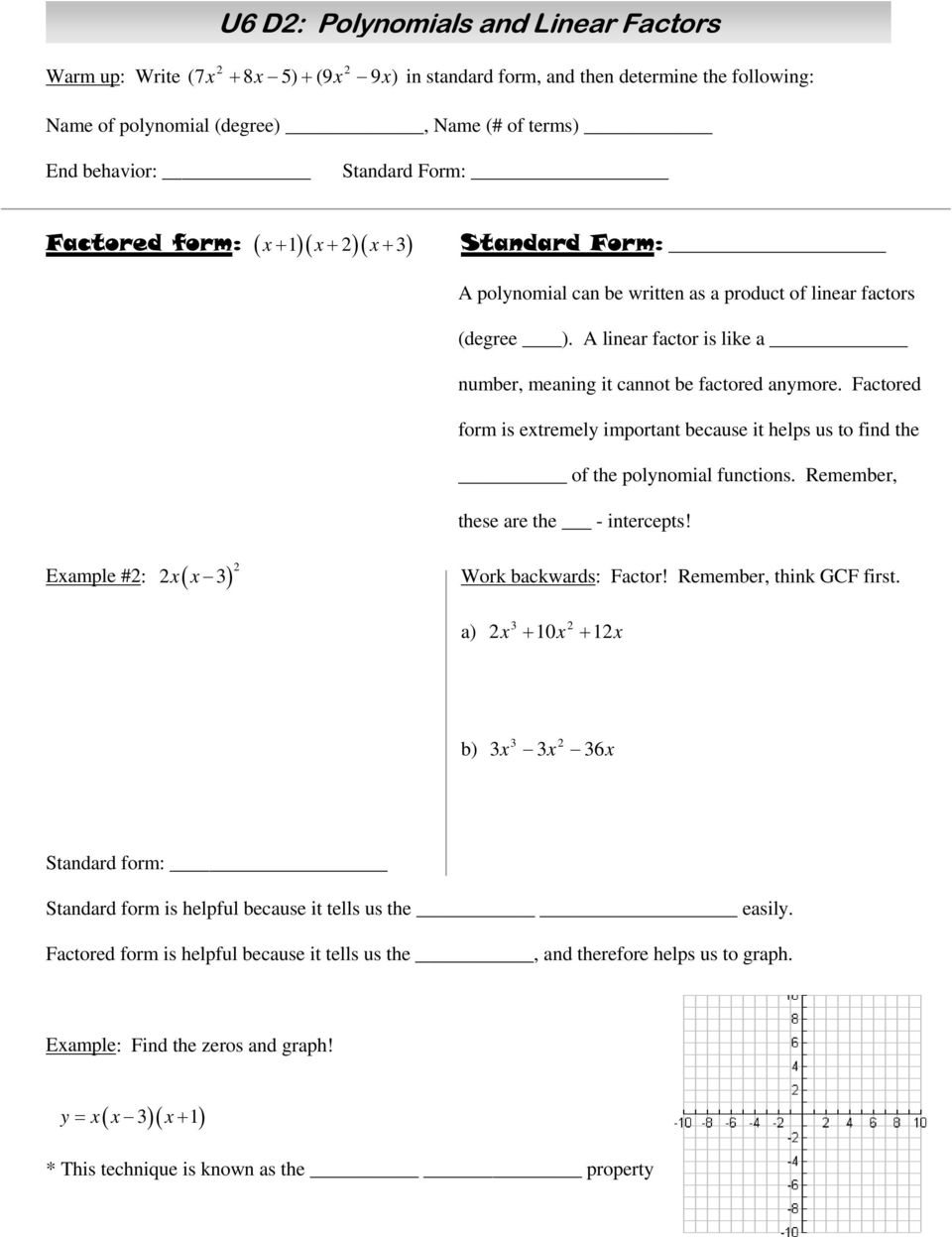
5 U6 D: Polynomials and Linear Factors Warm up: Write (7 8 5) (9 9) in standard form, and then determine the following: Name of polynomial (degree), Name (# of terms) End behavior: Standard Form: Factored form: 1 3 Standard Form: A polynomial can be written as a product of linear factors (degree ). A linear factor is like a number, meaning it cannot be factored anymore. Factored form is etremely important because it helps us to find the of the polynomial functions. Remember, these are the - intercepts! Eample #: 3 Work backwards: Factor! Remember, think GCF first. a) 10 1 b) Standard form: Standard form is helpful because it tells us the easily. Factored form is helpful because it tells us the, and therefore helps us to graph. Eample: Find the zeros and graph! 3 1 y * This technique is known as the property. Page 4 of 3
6 Eample #: Find the zeros and graph. Label zeros on the graph! f When a zero is repeated, it is said to have a. A multiple zero has a equal to the number of times the zero occurs. So for this eample, has a multiplicity of. Directions: Find the zeros of each polynomial and state the multiplicity of any multiple zeros. a) y 3 3 b) f 4 ( ) 6 8 c) f ( ) ( )( 1)( 1) d) 4 4 Sometimes you might know the zeros of a function, but need to find the equation in standard form. (Review: why do we need an equation in standard form sometimes?) a) zeros are -, 3, and 3 b) zeros are -4,, 1 Closure: What are standard form and factored form of a polynomial and why are they useful? Page 5 of 3

7 U6 D3: Dividing Polynomials (Long Division) Question #1: Is 8 a factor of 76? Question #: Is 4 a factor of 3 1 Important fact: To be a factor, division must yield a remainder of! Directions: Determine whether each divisor is a factor of each dividend. (Do this by division!) a) b) Write your final answers in quotient times divisor plus remainder form: a) b) HW Start! After the class activity, you can start on your homework. The first problems are listed below Divide using long division: Check your answers 1) ) ) ) Page 6 of 3

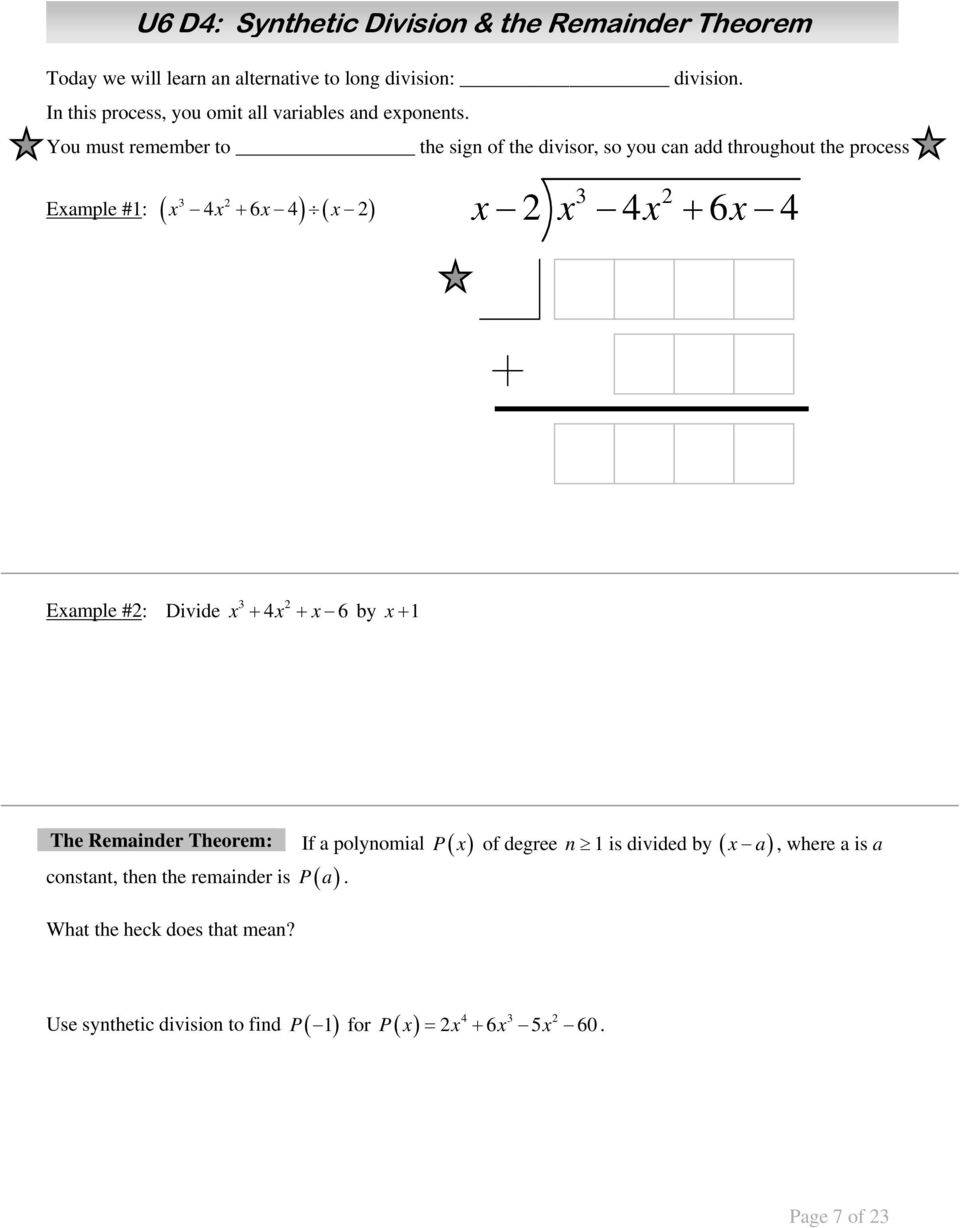
8 U6 D4: Synthetic Division & the Remainder Theorem Today we will learn an alternative to long division: division. In this process, you omit all variables and eponents. You must remember to the sign of the divisor, so you can add throughout the process Eample #1: Eample #: Divide 4 6 by 1 The Remainder Theorem: constant, then the remainder is If a polynomial Pa. P of degree n 1 is divided by a, where a is a What the heck does that mean? 4 Use synthetic division to find P 1 for P Page 7 of 3
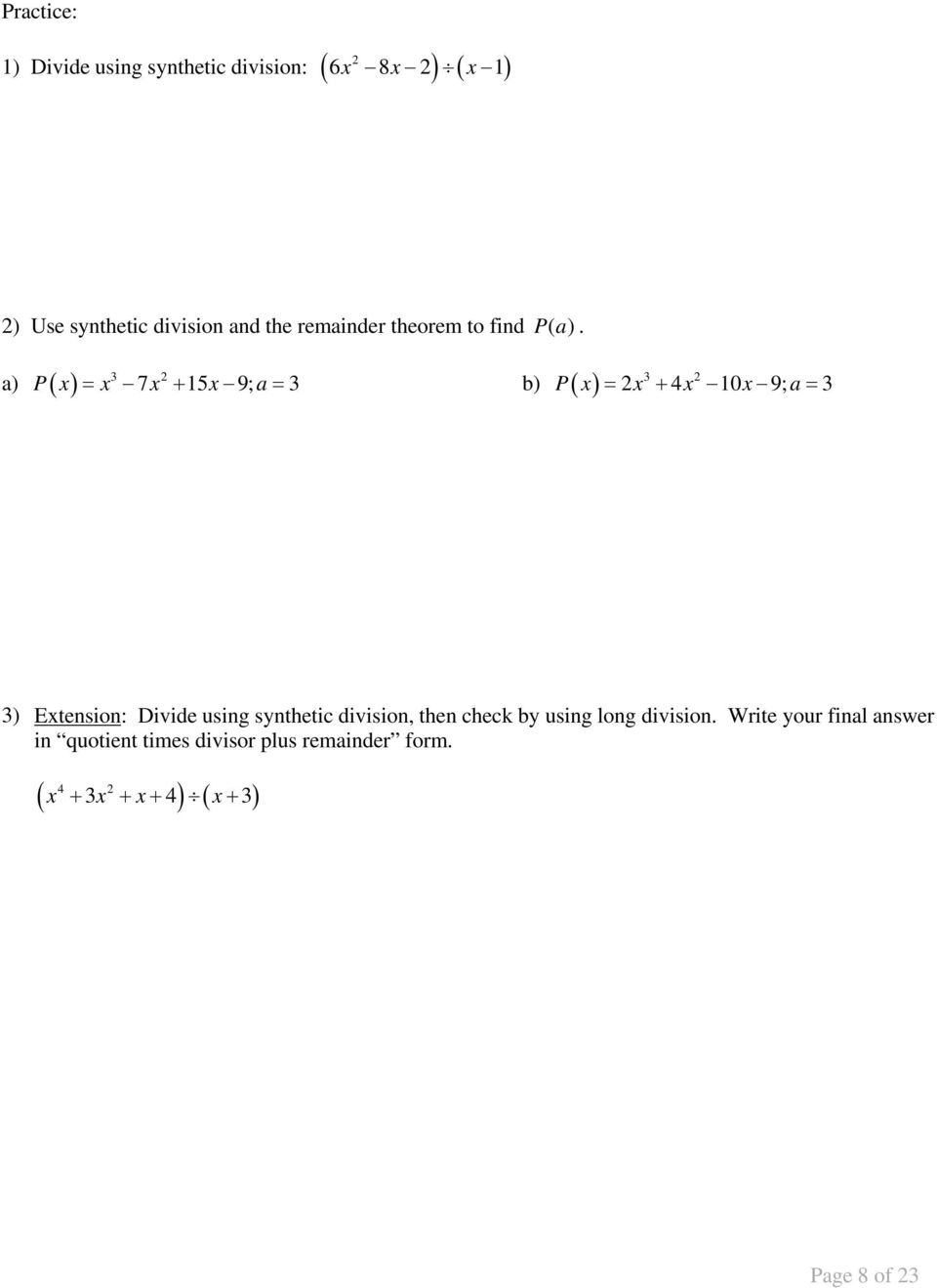
9 Practice: 1) Divide using synthetic division: ) Use synthetic division and the remainder theorem to find Pa ( ). a) P 7 159; a 3 b) P 4 109; a 3 3) Etension: Divide using synthetic division, then check by using long division. Write your final answer in quotient times divisor plus remainder form Page 8 of 3
10 U6 D5: Solving Polynomial Equations Warm up questions: a) Name 4 ways we have learned to solve quadratic equations. b) How does the solution to a quadratic equation relate to the graph of a quadratic function? c) What does it mean for 5 to be a solution to a higher degree polynomial (cubic, quartic, etc.)? Today we are going to practice factoring & solving (or finding zeros) of higher degree polynomials. From Day : 7 18 Today: 3 8 Some of our solving will require that we can factor the sum and difference of two cubes. a b 3 3 a b 3 3 Perfect Cubes Practice: Factor only (for now ) Page 9 of 3

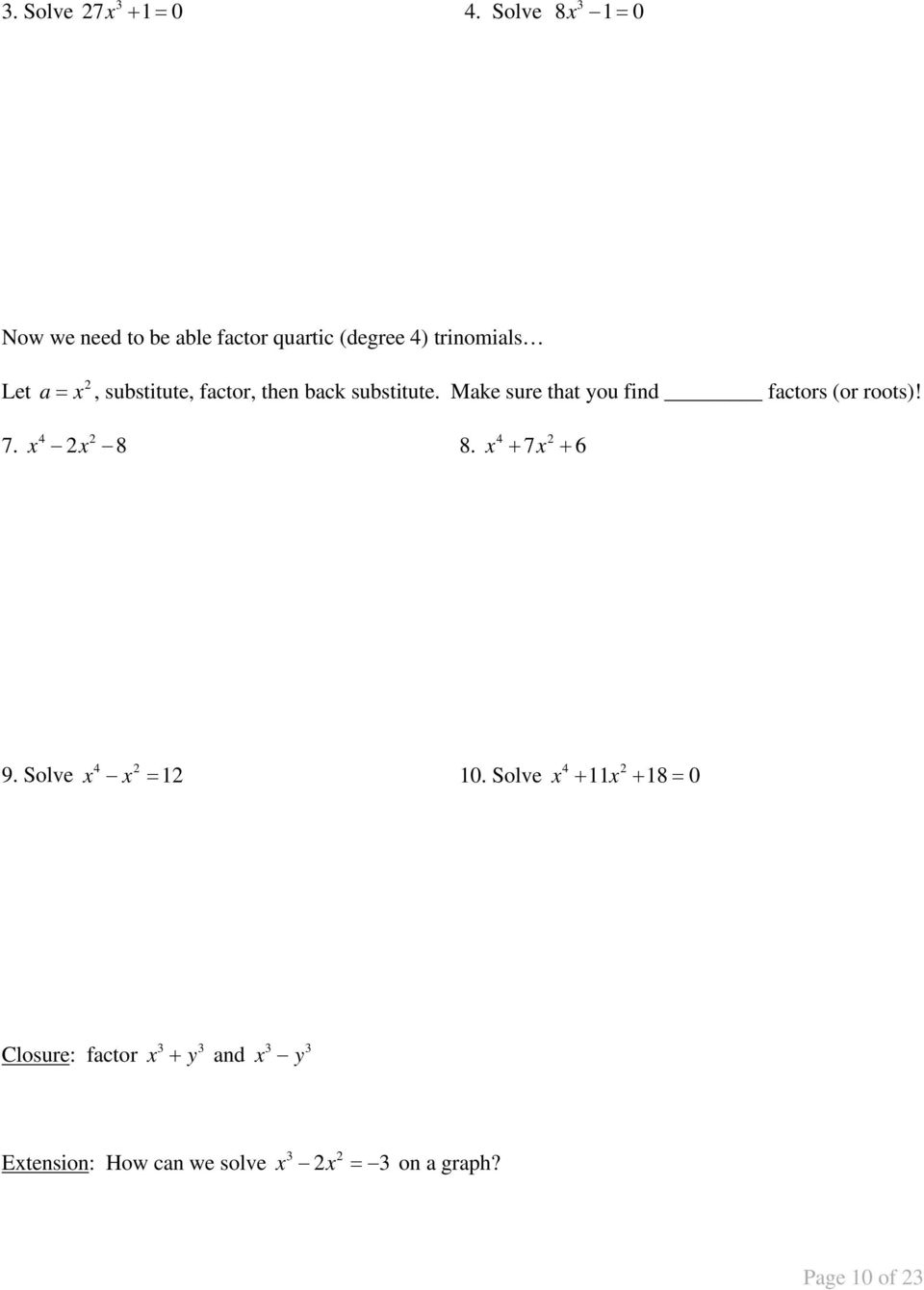
11 3. Solve Solve Now we need to be able factor quartic (degree 4) trinomials Let a, substitute, factor, then back substitute. Make sure that you find factors (or roots)! Solve Solve Closure: factor y and 3 3 y 3 3 Etension: How can we solve 3 on a graph? Page 10 of 3
12 U6 D7: Solving Polynomial Inequalities Page 11 of 3
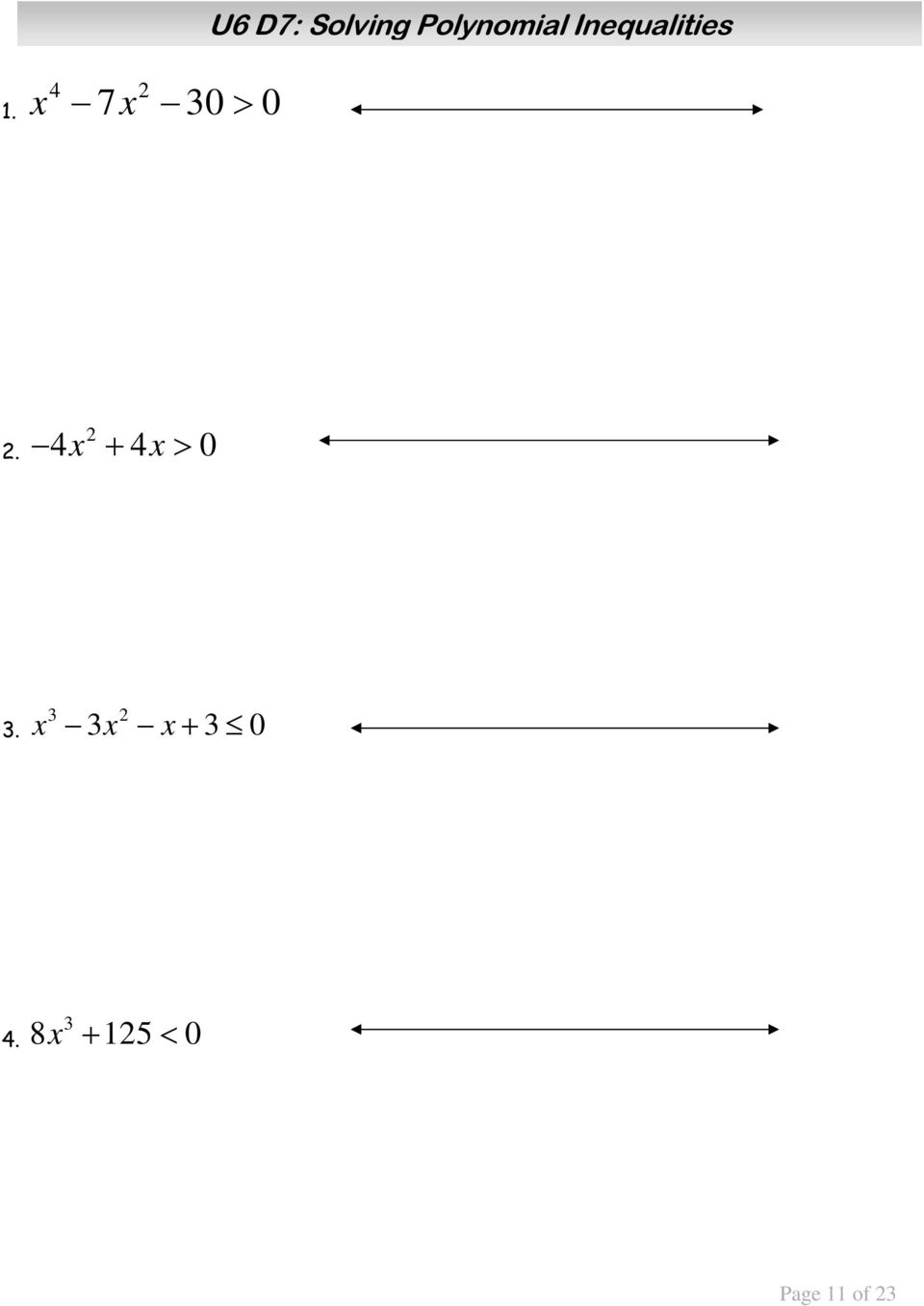
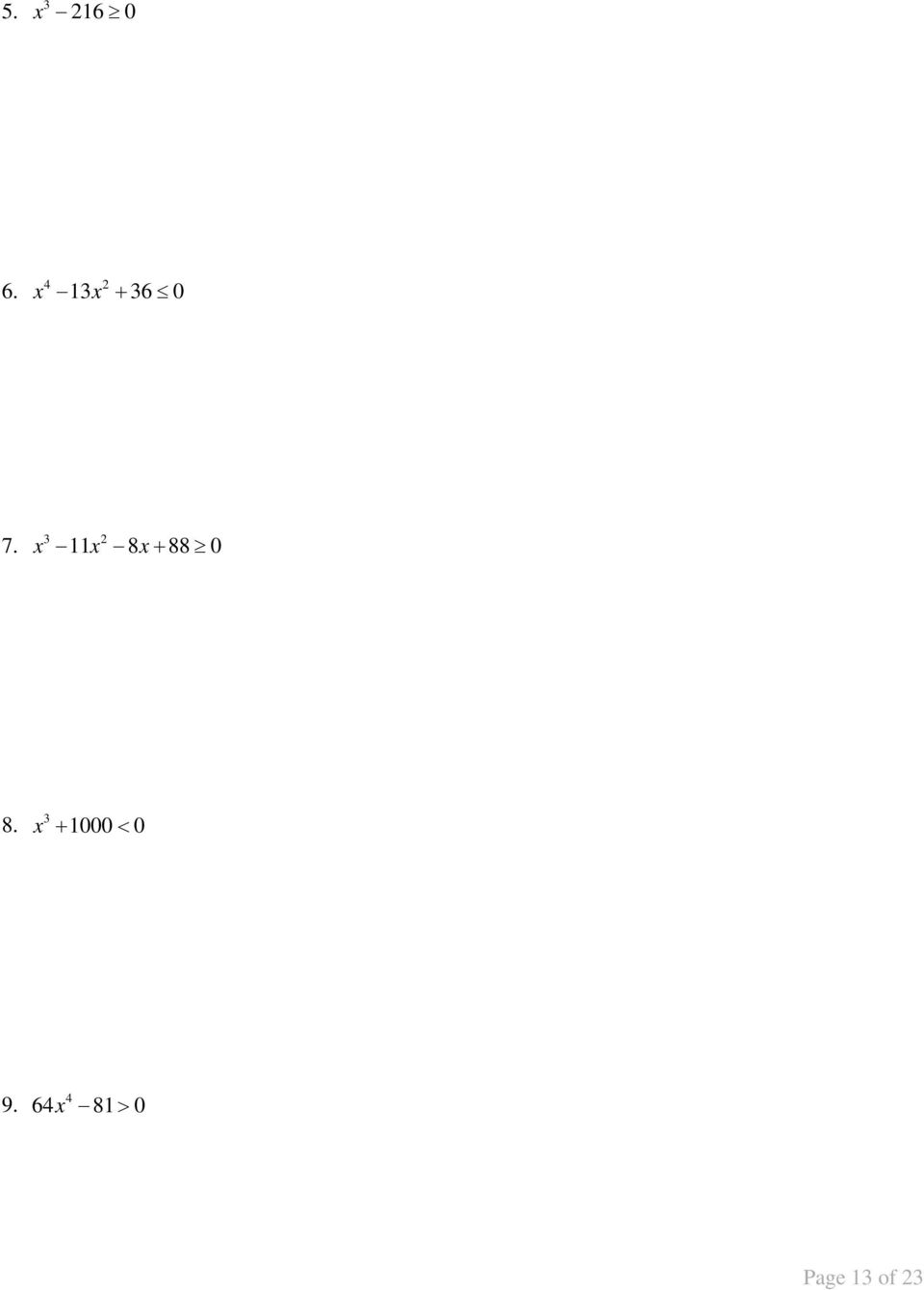
13 U6 D7: Worksheet Directions: Solve each polynomial inequality algebraically on the number line. Check your solution graphically. Remember you do not need to find imaginary roots because they are not on the number line. Real answers only!! Page 1 of 3

14 Page 13 of 3
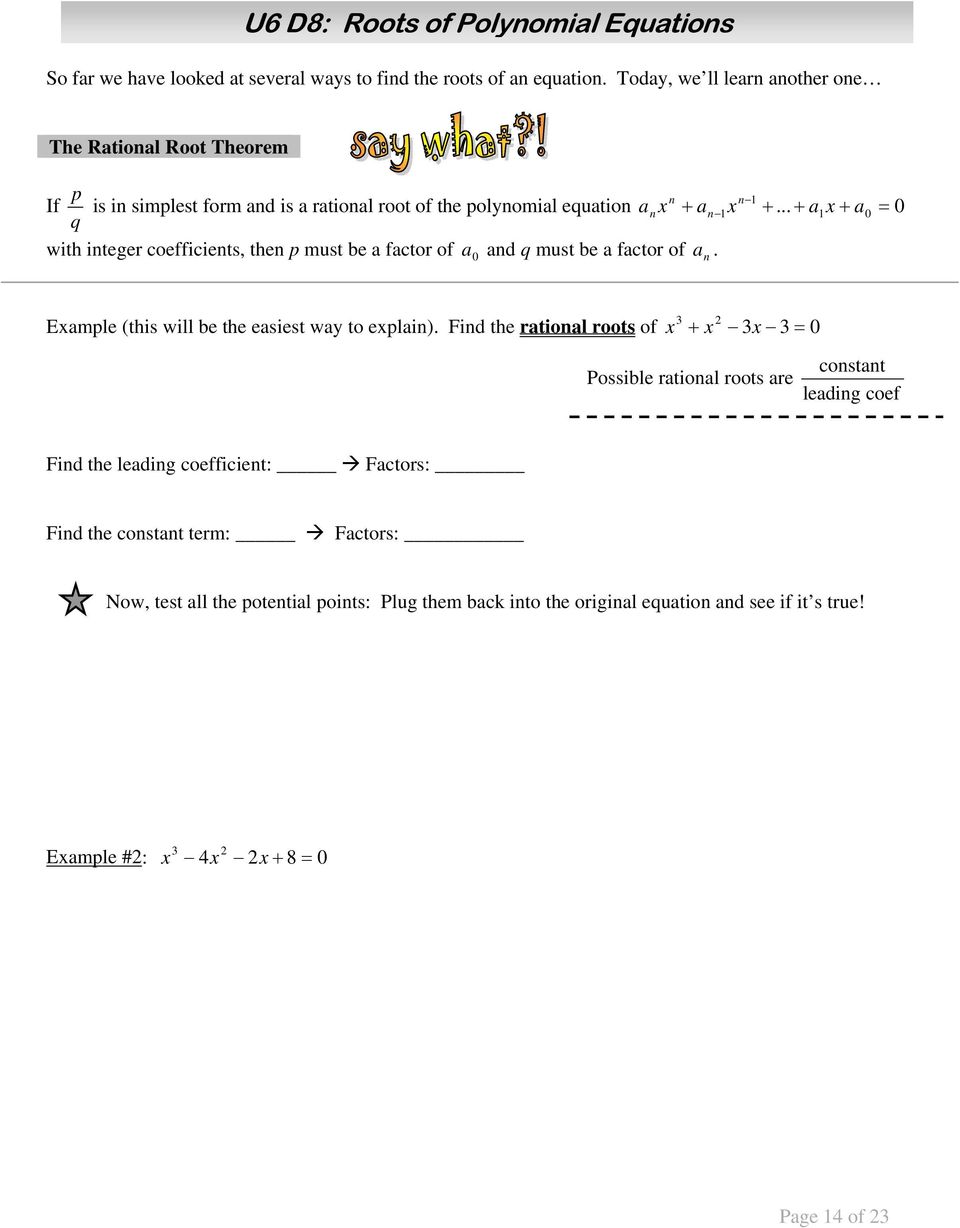
15 U6 D8: Roots of Polynomial Equations So far we have looked at several ways to find the roots of an equation. Today, we ll learn another one The Rational Root Theorem p If is in simplest form and is a rational root of the polynomial equation n n1 an an 1... a1 a0 0 q with integer coefficients, then p must be a factor of a 0 and q must be a factor of a n. Eample (this will be the easiest way to eplain). Find the rational roots of Possible rational roots are constant leading coef Find the leading coefficient: Factors: Find the constant term: Factors: Now, test all the potential points: Plug them back into the original equation and see if it s true! Eample #: Page 14 of 3
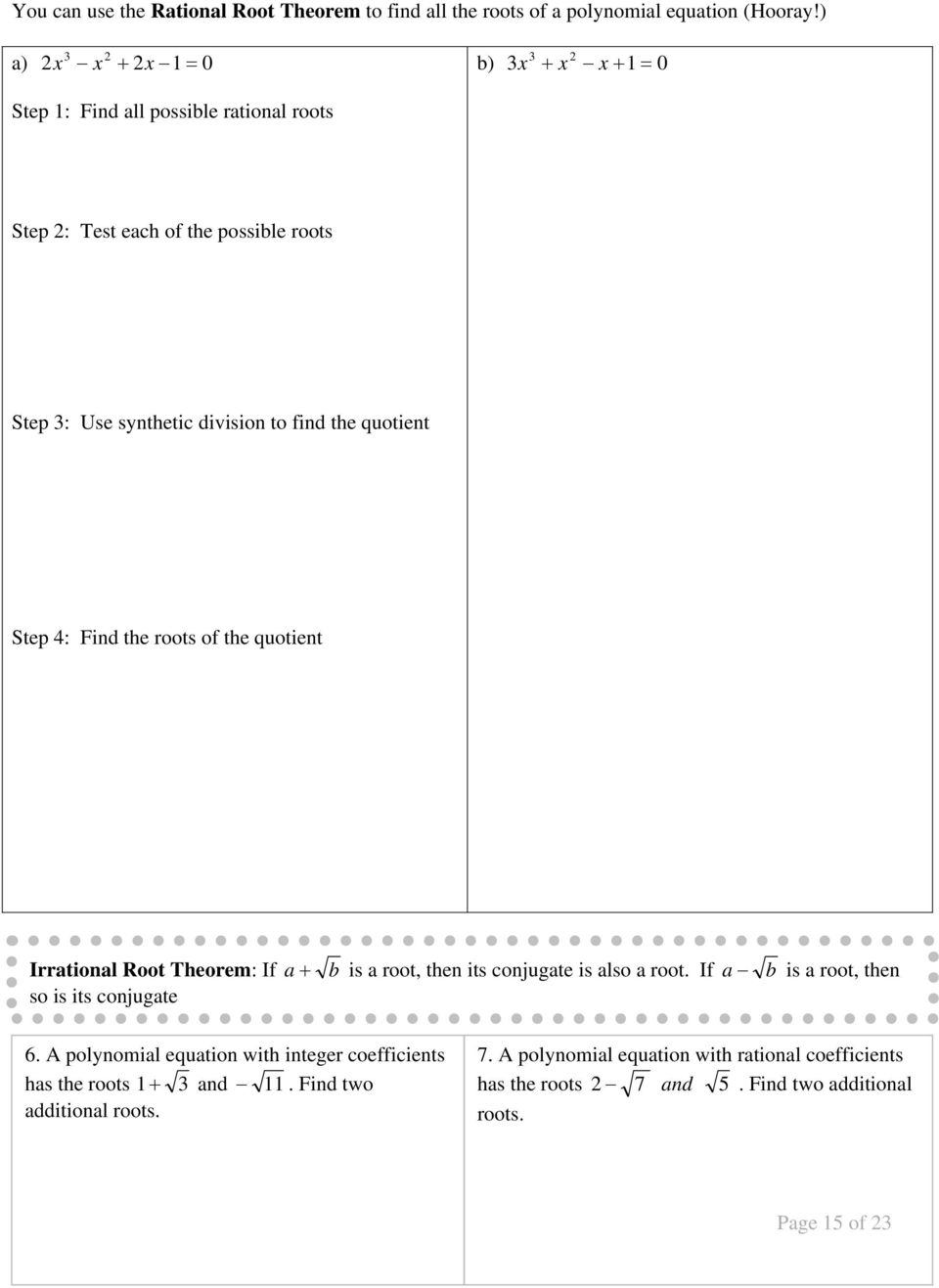
16 You can use the Rational Root Theorem to find all the roots of a polynomial equation (Hooray!) a) 1 0 b) Step 1: Find all possible rational roots Step : Test each of the possible roots Step 3: Use synthetic division to find the quotient Step 4: Find the roots of the quotient Irrational Root Theorem: If so is its conjugate a b is a root, then its conjugate is also a root. If a b is a root, then 6. A polynomial equation with integer coefficients has the roots 1 3 and 11. Find two additional roots. 7. A polynomial equation with rational coefficients has the roots 7 and 5. Find two additional roots. Page 15 of 3
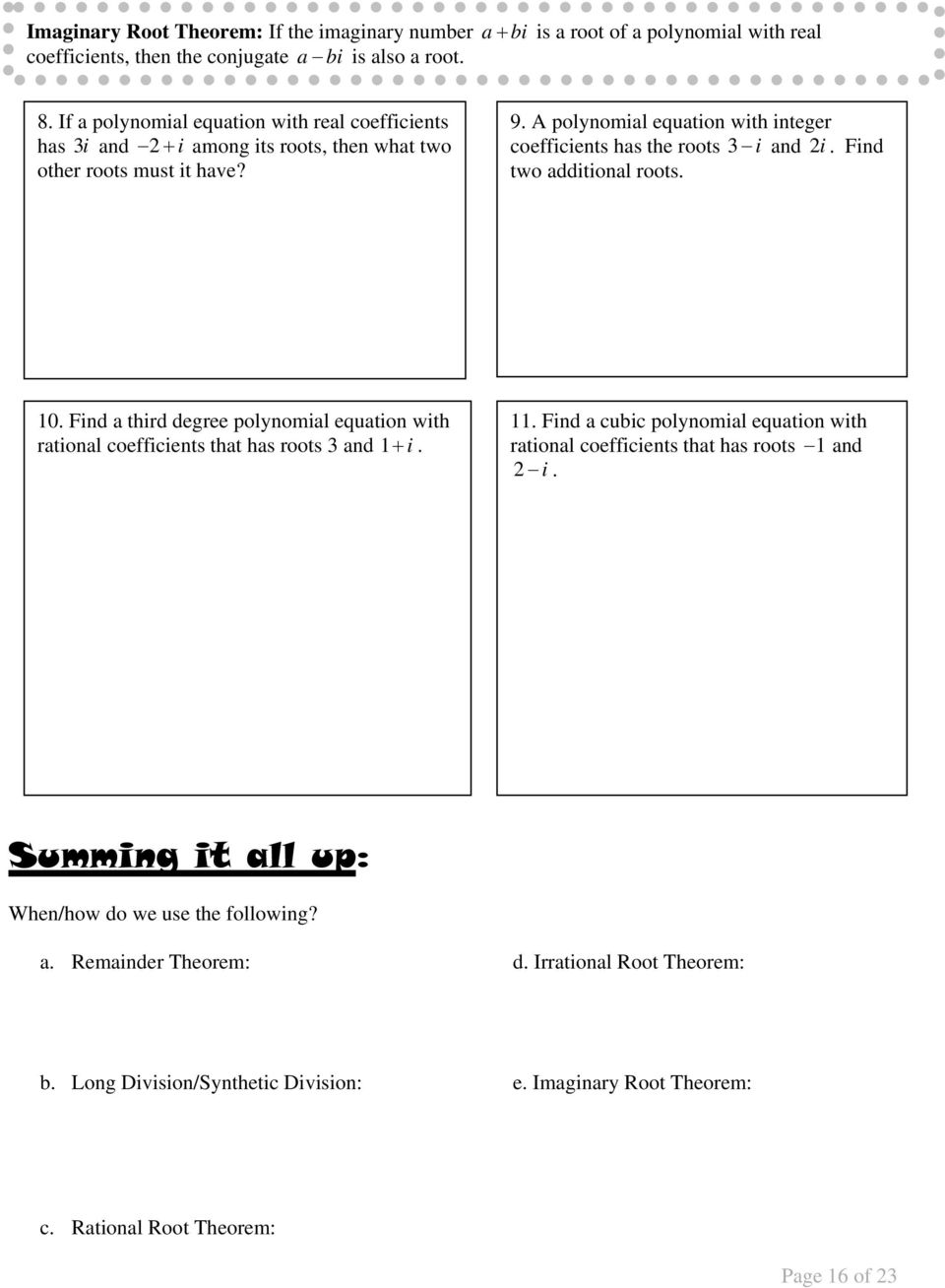
17 Imaginary Root Theorem: If the imaginary number a bi is a root of a polynomial with real coefficients, then the conjugate a bi is also a root. 8. If a polynomial equation with real coefficients has 3i and i among its roots, then what two other roots must it have? 9. A polynomial equation with integer coefficients has the roots 3 i and i. Find two additional roots. 10. Find a third degree polynomial equation with rational coefficients that has roots 3 and 1 i. 11. Find a cubic polynomial equation with rational coefficients that has roots 1 and i. Summing it all up: When/how do we use the following? a. Remainder Theorem: d. Irrational Root Theorem: b. Long Division/Synthetic Division: e. Imaginary Root Theorem: c. Rational Root Theorem: Page 16 of 3
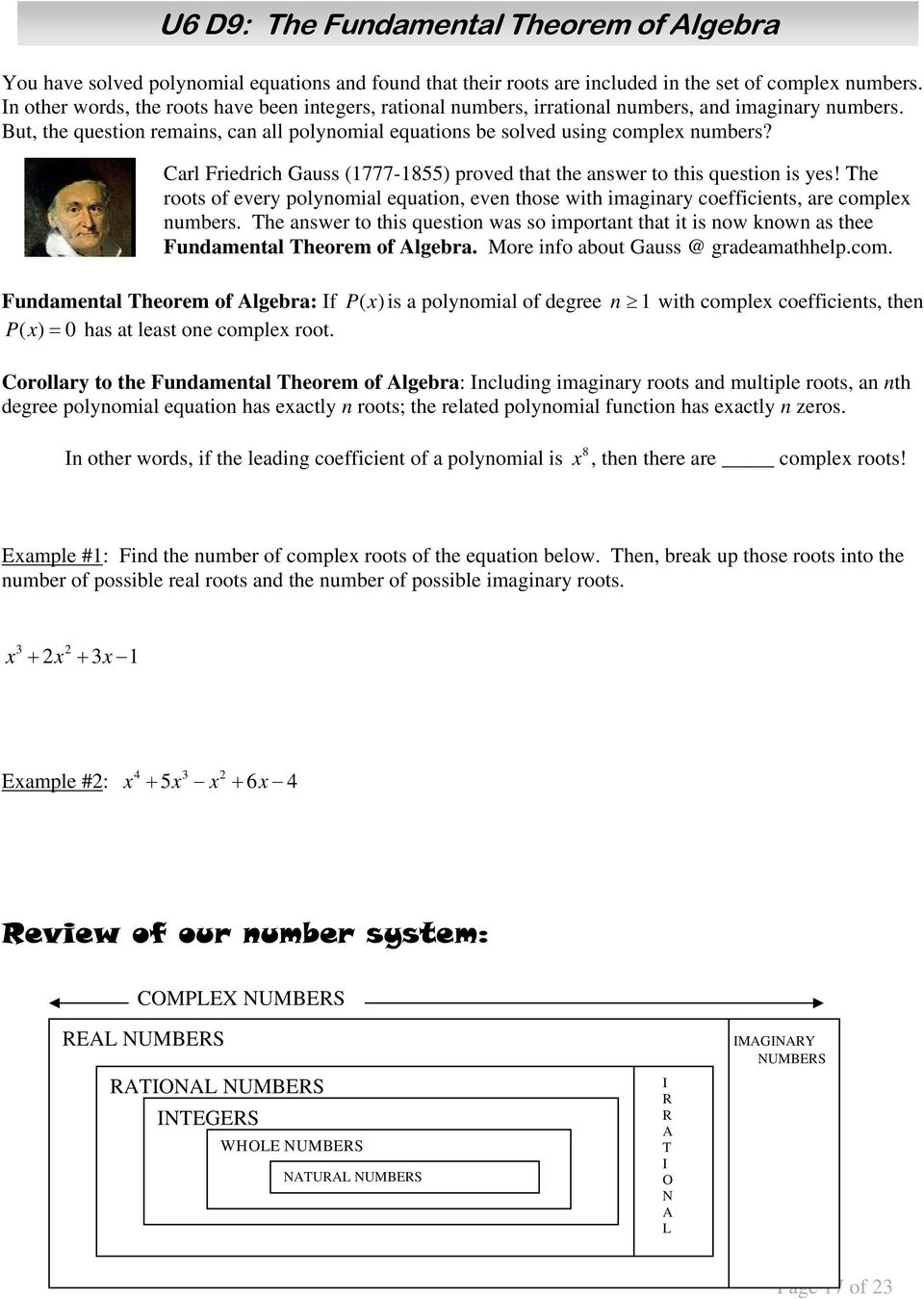
18 U6 D9: The Fundamental Theorem of Algebra You have solved polynomial equations and found that their roots are included in the set of comple numbers. In other words, the roots have been integers, rational numbers, irrational numbers, and imaginary numbers. But, the question remains, can all polynomial equations be solved using comple numbers? Carl Friedrich Gauss ( ) proved that the answer to this question is yes! The roots of every polynomial equation, even those with imaginary coefficients, are comple numbers. The answer to this question was so important that it is now known as thee Fundamental Theorem of Algebra. More info about gradeamathhelp.com. Fundamental Theorem of Algebra: If Pis ( ) a polynomial of degree n 1 with comple coefficients, then P ( ) 0 has at least one comple root. Corollary to the Fundamental Theorem of Algebra: Including imaginary roots and multiple roots, an nth degree polynomial equation has eactly n roots; the related polynomial function has eactly n zeros. In other words, if the leading coefficient of a polynomial is 8, then there are comple roots! Eample #1: Find the number of comple roots of the equation below. Then, break up those roots into the number of possible real roots and the number of possible imaginary roots. 3 1 Eample #: Review of our number system: COMPLEX NUMBERS REAL NUMBERS RATIONAL NUMBERS INTEGERS WHOLE NUMBERS NATURAL NUMBERS I R R A T I O N A L IMAGINARY NUMBERS Page 17 of 3
19 Let s put some of our theorems together: Directions: For each equation, state the number of comple roots, the possible number of real roots, and the possible rational roots. 1) 4 ) ) Find the number of comple zeros of f ( ) 3 3. Find all the zeros. Step #1: use synthetic division to find a rational zero Step #: Solve the remaining quadratic using one of our methods 4) Find the number of comple zeros of y Find all the zeros. Closure: How can you determine the number of comple roots of a polynomial? Number or real roots? Page 18 of 3

20 U6 D10: The Binomial Theorem (Combinations Review) Warm up: Simplify the following. You may use your calculator where possible. 1) 6 ) 5 C 3 3) 8! 3!5! 4) n n! 4! 5) We will need to use combinations for the binomial theorem. If you did not take finite math and need etra help with this, please seek it out. n C r or n n! r r! n r! and n! The binomial theorem is used to epand (reverse or factor) binomials Long way 3 3 Short cut 3 3 Eample #1: Use Pascal s triangle to epand 5 a b Eample #: Use Pascal s triangle to epand 4 3y The eponents of each term add up to. Do not forget parentheses when you have y Page 19 of 3

21 Sometimes you might not want to write out all of the rows of Pascal s triangle, but you still need the coefficients. We can use combinations to skip to any row of Pascal s triangle. Find Look row This is particular useful if we only need to find one term: For eample, find the 5 th term of 6 3 y. Let s find the pattern (it s easier to look at eamples than to give a formula with all variables) a) Third term of 3 1 b) Second term of 3 9 c) Eighth term of 15 y d) Seventh term of 11 y Wrap up: One term of a binomial epression is 7 5 y. What is the term just before that term? Etension: Eample 7 5y Page 0 of 3
22 U6 D11: Review 1. Directions: Give the end behavior of each of the functions below. Write your answer as one of the following:,,,,,,, a) y b) y 4 c) y 14 3 ( 8). Directions: Simplify each of the following a) 7 b) 9 C 5 c) C y 3) Find the zeros of ) Classify with degree and # of terms: a) b) y 4 y 10 5) Which of the following is a rational zero of y = ? a. = 35 b. = -35 c. = -7 d. =7 3 6) State the zeros and the multiplicity for each for the function f 5 3 7) Give the number of possible imaginary roots for each polynomial below a) y b) 5 4 y 7 8) If 5 4i is a root of a polynomial, name another root of that same polynomial Page 1 of 3
23 9) The roots of a cubic polynomial are 1 and 5i. Write the polynomial in standard form. Show all work. 10) Use cubic regression to find the cubic model for the following data y a. Write the equation of the cubic model. Round each number to three decimal places. y = b. Use your model to predict the value of y when 1. y = 11) Epand 6 3y 1) Find the 3 rd term of ) Find allllll zeros algebraicially Page of 3
POLYNOMIAL FUNCTIONS
 POLYNOMIAL FUNCTIONS Polynomial Division.. 314 The Rational Zero Test.....317 Descarte s Rule of Signs... 319 The Remainder Theorem.....31 Finding all Zeros of a Polynomial Function.......33 Writing a
Zeros of Polynomial Functions
 Review: Synthetic Division Find (x 2-5x - 5x 3 + x 4 ) (5 + x). Factor Theorem Solve 2x 3-5x 2 + x + 2 =0 given that 2 is a zero of f(x) = 2x 3-5x 2 + x + 2. Zeros of Polynomial Functions Introduction
Polynomial and Synthetic Division. Long Division of Polynomials. Example 1. 6x 2 7x 2 x 2) 19x 2 16x 4 6x3 12x 2 7x 2 16x 7x 2 14x. 2x 4.
 _.qd /7/5 9: AM Page 5 Section.. Polynomial and Synthetic Division 5 Polynomial and Synthetic Division What you should learn Use long division to divide polynomials by other polynomials. Use synthetic
Section 5.0A Factoring Part 1
 Section 5.0A Factoring Part 1 I. Work Together A. Multiply the following binomials into trinomials. (Write the final result in descending order, i.e., a + b + c ). ( 7)( + 5) ( + 7)( + ) ( + 7)( + 5) (
Pre-Calculus II Factoring and Operations on Polynomials
 Factoring... 1 Polynomials...1 Addition of Polynomials... 1 Subtraction of Polynomials...1 Multiplication of Polynomials... Multiplying a monomial by a monomial... Multiplying a monomial by a polynomial...
Polynomial Degree and Finite Differences
 CONDENSED LESSON 7.1 Polynomial Degree and Finite Differences In this lesson you will learn the terminology associated with polynomials use the finite differences method to determine the degree of a polynomial
Zero: If P is a polynomial and if c is a number such that P (c) = 0 then c is a zero of P.
 MATH 11011 FINDING REAL ZEROS KSU OF A POLYNOMIAL Definitions: Polynomial: is a function of the form P (x) = a n x n + a n 1 x n 1 + + a x + a 1 x + a 0. The numbers a n, a n 1,..., a 1, a 0 are called
ALGEBRA 2 CRA 2 REVIEW - Chapters 1-6 Answer Section
 ALGEBRA 2 CRA 2 REVIEW - Chapters 1-6 Answer Section MULTIPLE CHOICE 1. ANS: C 2. ANS: A 3. ANS: A OBJ: 5-3.1 Using Vertex Form SHORT ANSWER 4. ANS: (x + 6)(x 2 6x + 36) OBJ: 6-4.2 Solving Equations by
SECTION 0.6: POLYNOMIAL, RATIONAL, AND ALGEBRAIC EXPRESSIONS
 (Section 0.6: Polynomial, Rational, and Algebraic Expressions) 0.6.1 SECTION 0.6: POLYNOMIAL, RATIONAL, AND ALGEBRAIC EXPRESSIONS LEARNING OBJECTIVES Be able to identify polynomial, rational, and algebraic
Zeros of a Polynomial Function
 Zeros of a Polynomial Function An important consequence of the Factor Theorem is that finding the zeros of a polynomial is really the same thing as factoring it into linear factors. In this section we
a 1 x + a 0 =0. (3) ax 2 + bx + c =0. (4)
 ROOTS OF POLYNOMIAL EQUATIONS In this unit we discuss polynomial equations. A polynomial in x of degree n, where n 0 is an integer, is an expression of the form P n (x) =a n x n + a n 1 x n 1 + + a 1 x
is the degree of the polynomial and is the leading coefficient.
 Property: T. Hrubik-Vulanovic e-mail: [email protected] Content (in order sections were covered from the book): Chapter 6 Higher-Degree Polynomial Functions... 1 Section 6.1 Higher-Degree Polynomial Functions...
expression is written horizontally. The Last terms ((2)( 4)) because they are the last terms of the two polynomials. This is called the FOIL method.
 A polynomial of degree n (in one variable, with real coefficients) is an expression of the form: a n x n + a n 1 x n 1 + a n 2 x n 2 + + a 2 x 2 + a 1 x + a 0 where a n, a n 1, a n 2, a 2, a 1, a 0 are
Math 0980 Chapter Objectives. Chapter 1: Introduction to Algebra: The Integers.
 Math 0980 Chapter Objectives Chapter 1: Introduction to Algebra: The Integers. 1. Identify the place value of a digit. 2. Write a number in words or digits. 3. Write positive and negative numbers used
Determinants can be used to solve a linear system of equations using Cramer s Rule.
 2.6.2 Cramer s Rule Determinants can be used to solve a linear system of equations using Cramer s Rule. Cramer s Rule for Two Equations in Two Variables Given the system This system has the unique solution
Review of Intermediate Algebra Content
 Review of Intermediate Algebra Content Table of Contents Page Factoring GCF and Trinomials of the Form + b + c... Factoring Trinomials of the Form a + b + c... Factoring Perfect Square Trinomials... 6
Alum Rock Elementary Union School District Algebra I Study Guide for Benchmark III
 Alum Rock Elementary Union School District Algebra I Study Guide for Benchmark III Name Date Adding and Subtracting Polynomials Algebra Standard 10.0 A polynomial is a sum of one ore more monomials. Polynomial
SUNY ECC. ACCUPLACER Preparation Workshop. Algebra Skills
 SUNY ECC ACCUPLACER Preparation Workshop Algebra Skills Gail A. Butler Ph.D. Evaluating Algebraic Epressions Substitute the value (#) in place of the letter (variable). Follow order of operations!!! E)
Name Intro to Algebra 2. Unit 1: Polynomials and Factoring
 Name Intro to Algebra 2 Unit 1: Polynomials and Factoring Date Page Topic Homework 9/3 2 Polynomial Vocabulary No Homework 9/4 x In Class assignment None 9/5 3 Adding and Subtracting Polynomials Pg. 332
Algebra 1 Course Title
 Algebra 1 Course Title Course- wide 1. What patterns and methods are being used? Course- wide 1. Students will be adept at solving and graphing linear and quadratic equations 2. Students will be adept
Copy in your notebook: Add an example of each term with the symbols used in algebra 2 if there are any.
 Algebra 2 - Chapter Prerequisites Vocabulary Copy in your notebook: Add an example of each term with the symbols used in algebra 2 if there are any. P1 p. 1 1. counting(natural) numbers - {1,2,3,4,...}
Answers to Basic Algebra Review
 Answers to Basic Algebra Review 1. -1.1 Follow the sign rules when adding and subtracting: If the numbers have the same sign, add them together and keep the sign. If the numbers have different signs, subtract
Lagrange Interpolation is a method of fitting an equation to a set of points that functions well when there are few points given.
 Polynomials (Ch.1) Study Guide by BS, JL, AZ, CC, SH, HL Lagrange Interpolation is a method of fitting an equation to a set of points that functions well when there are few points given. Sasha s method
Five 5. Rational Expressions and Equations C H A P T E R
 Five C H A P T E R Rational Epressions and Equations. Rational Epressions and Functions. Multiplication and Division of Rational Epressions. Addition and Subtraction of Rational Epressions.4 Comple Fractions.
NSM100 Introduction to Algebra Chapter 5 Notes Factoring
 Section 5.1 Greatest Common Factor (GCF) and Factoring by Grouping Greatest Common Factor for a polynomial is the largest monomial that divides (is a factor of) each term of the polynomial. GCF is the
Lesson 9.1 Solving Quadratic Equations
 Lesson 9.1 Solving Quadratic Equations 1. Sketch the graph of a quadratic equation with a. One -intercept and all nonnegative y-values. b. The verte in the third quadrant and no -intercepts. c. The verte
The majority of college students hold credit cards. According to the Nellie May
 CHAPTER 6 Factoring Polynomials 6.1 The Greatest Common Factor and Factoring by Grouping 6. Factoring Trinomials of the Form b c 6.3 Factoring Trinomials of the Form a b c and Perfect Square Trinomials
Zeros of Polynomial Functions
 Zeros of Polynomial Functions Objectives: 1.Use the Fundamental Theorem of Algebra to determine the number of zeros of polynomial functions 2.Find rational zeros of polynomial functions 3.Find conjugate
2-5 Rational Functions
 -5 Rational Functions Find the domain of each function and the equations of the vertical or horizontal asymptotes, if any 1 f () = The function is undefined at the real zeros of the denominator b() = 4
SOLVING POLYNOMIAL EQUATIONS
 C SOLVING POLYNOMIAL EQUATIONS We will assume in this appendix that you know how to divide polynomials using long division and synthetic division. If you need to review those techniques, refer to an algebra
Zeros of Polynomial Functions
 Zeros of Polynomial Functions The Rational Zero Theorem If f (x) = a n x n + a n-1 x n-1 + + a 1 x + a 0 has integer coefficients and p/q (where p/q is reduced) is a rational zero, then p is a factor of
March 29, 2011. 171S4.4 Theorems about Zeros of Polynomial Functions
 MAT 171 Precalculus Algebra Dr. Claude Moore Cape Fear Community College CHAPTER 4: Polynomial and Rational Functions 4.1 Polynomial Functions and Models 4.2 Graphing Polynomial Functions 4.3 Polynomial
9.3 OPERATIONS WITH RADICALS
 9. Operations with Radicals (9 1) 87 9. OPERATIONS WITH RADICALS In this section Adding and Subtracting Radicals Multiplying Radicals Conjugates In this section we will use the ideas of Section 9.1 in
SECTION P.5 Factoring Polynomials
 BLITMCPB.QXP.0599_48-74 /0/0 0:4 AM Page 48 48 Chapter P Prerequisites: Fundamental Concepts of Algebra Technology Eercises Critical Thinking Eercises 98. The common cold is caused by a rhinovirus. The
Polynomial Expressions and Equations
 Polynomial Expressions and Equations This is a really close-up picture of rain. Really. The picture represents falling water broken down into molecules, each with two hydrogen atoms connected to one oxygen
Florida Math 0028. Correlation of the ALEKS course Florida Math 0028 to the Florida Mathematics Competencies - Upper
 Florida Math 0028 Correlation of the ALEKS course Florida Math 0028 to the Florida Mathematics Competencies - Upper Exponents & Polynomials MDECU1: Applies the order of operations to evaluate algebraic
Mathematics 31 Pre-calculus and Limits
 Mathematics 31 Pre-calculus and Limits Overview After completing this section, students will be epected to have acquired reliability and fluency in the algebraic skills of factoring, operations with radicals
Students Currently in Algebra 2 Maine East Math Placement Exam Review Problems
 Students Currently in Algebra Maine East Math Placement Eam Review Problems The actual placement eam has 100 questions 3 hours. The placement eam is free response students must solve questions and write
A.3. Polynomials and Factoring. Polynomials. What you should learn. Definition of a Polynomial in x. Why you should learn it
 Appendi A.3 Polynomials and Factoring A23 A.3 Polynomials and Factoring What you should learn Write polynomials in standard form. Add,subtract,and multiply polynomials. Use special products to multiply
Polynomials and Factoring
 7.6 Polynomials and Factoring Basic Terminology A term, or monomial, is defined to be a number, a variable, or a product of numbers and variables. A polynomial is a term or a finite sum or difference of
Algebra and Geometry Review (61 topics, no due date)
 Course Name: Math 112 Credit Exam LA Tech University Course Code: ALEKS Course: Trigonometry Instructor: Course Dates: Course Content: 159 topics Algebra and Geometry Review (61 topics, no due date) Properties
Algebra II A Final Exam
 Algebra II A Final Exam Multiple Choice Identify the choice that best completes the statement or answers the question. Evaluate the expression for the given value of the variable(s). 1. ; x = 4 a. 34 b.
This is a square root. The number under the radical is 9. (An asterisk * means multiply.)
 Page of Review of Radical Expressions and Equations Skills involving radicals can be divided into the following groups: Evaluate square roots or higher order roots. Simplify radical expressions. Rationalize
Higher Education Math Placement
 Higher Education Math Placement Placement Assessment Problem Types 1. Whole Numbers, Fractions, and Decimals 1.1 Operations with Whole Numbers Addition with carry Subtraction with borrowing Multiplication
EAP/GWL Rev. 1/2011 Page 1 of 5. Factoring a polynomial is the process of writing it as the product of two or more polynomial factors.
 EAP/GWL Rev. 1/2011 Page 1 of 5 Factoring a polynomial is the process of writing it as the product of two or more polynomial factors. Example: Set the factors of a polynomial equation (as opposed to an
10.1. Solving Quadratic Equations. Investigation: Rocket Science CONDENSED
 CONDENSED L E S S O N 10.1 Solving Quadratic Equations In this lesson you will look at quadratic functions that model projectile motion use tables and graphs to approimate solutions to quadratic equations
A Quick Algebra Review
 1. Simplifying Epressions. Solving Equations 3. Problem Solving 4. Inequalities 5. Absolute Values 6. Linear Equations 7. Systems of Equations 8. Laws of Eponents 9. Quadratics 10. Rationals 11. Radicals
Algebra 1. Curriculum Map
 Algebra 1 Curriculum Map Table of Contents Unit 1: Expressions and Unit 2: Linear Unit 3: Representing Linear Unit 4: Linear Inequalities Unit 5: Systems of Linear Unit 6: Polynomials Unit 7: Factoring
Application. Outline. 3-1 Polynomial Functions 3-2 Finding Rational Zeros of. Polynomial. 3-3 Approximating Real Zeros of.
 Polynomial and Rational Functions Outline 3-1 Polynomial Functions 3-2 Finding Rational Zeros of Polynomials 3-3 Approximating Real Zeros of Polynomials 3-4 Rational Functions Chapter 3 Group Activity:
Factoring Polynomials and Solving Quadratic Equations
 Factoring Polynomials and Solving Quadratic Equations Math Tutorial Lab Special Topic Factoring Factoring Binomials Remember that a binomial is just a polynomial with two terms. Some examples include 2x+3
2.4. Factoring Quadratic Expressions. Goal. Explore 2.4. Launch 2.4
 2.4 Factoring Quadratic Epressions Goal Use the area model and Distributive Property to rewrite an epression that is in epanded form into an equivalent epression in factored form The area of a rectangle
FACTORING POLYNOMIALS
 296 (5-40) Chapter 5 Exponents and Polynomials where a 2 is the area of the square base, b 2 is the area of the square top, and H is the distance from the base to the top. Find the volume of a truncated
Math Common Core Sampler Test
 High School Algebra Core Curriculum Math Test Math Common Core Sampler Test Our High School Algebra sampler covers the twenty most common questions that we see targeted for this level. For complete tests
JUST THE MATHS UNIT NUMBER 1.8. ALGEBRA 8 (Polynomials) A.J.Hobson
 JUST THE MATHS UNIT NUMBER 1.8 ALGEBRA 8 (Polynomials) by A.J.Hobson 1.8.1 The factor theorem 1.8.2 Application to quadratic and cubic expressions 1.8.3 Cubic equations 1.8.4 Long division of polynomials
Polynomial Operations and Factoring
 Algebra 1, Quarter 4, Unit 4.1 Polynomial Operations and Factoring Overview Number of instructional days: 15 (1 day = 45 60 minutes) Content to be learned Identify terms, coefficients, and degree of polynomials.
Algebra 2 Unit 10 Tentative Syllabus Cubics & Factoring
 Name Algebra Unit 10 Tentative Sllabus Cubics & Factoring DATE CLASS ASSIGNMENT Tuesda Da 1: S.1 Eponent s P: -1, -7 Jan Wednesda Da : S.1 More Eponent s P: 9- Jan Thursda Da : Graphing the cubic parent
6 EXTENDING ALGEBRA. 6.0 Introduction. 6.1 The cubic equation. Objectives
 6 EXTENDING ALGEBRA Chapter 6 Extending Algebra Objectives After studying this chapter you should understand techniques whereby equations of cubic degree and higher can be solved; be able to factorise
HIBBING COMMUNITY COLLEGE COURSE OUTLINE
 HIBBING COMMUNITY COLLEGE COURSE OUTLINE COURSE NUMBER & TITLE: - Beginning Algebra CREDITS: 4 (Lec 4 / Lab 0) PREREQUISITES: MATH 0920: Fundamental Mathematics with a grade of C or better, Placement Exam,
1.3 Algebraic Expressions
 1.3 Algebraic Expressions A polynomial is an expression of the form: a n x n + a n 1 x n 1 +... + a 2 x 2 + a 1 x + a 0 The numbers a 1, a 2,..., a n are called coefficients. Each of the separate parts,
0.4 FACTORING POLYNOMIALS
 36_.qxd /3/5 :9 AM Page -9 SECTION. Factoring Polynomials -9. FACTORING POLYNOMIALS Use special products and factorization techniques to factor polynomials. Find the domains of radical expressions. Use
3.2 The Factor Theorem and The Remainder Theorem
 3. The Factor Theorem and The Remainder Theorem 57 3. The Factor Theorem and The Remainder Theorem Suppose we wish to find the zeros of f(x) = x 3 + 4x 5x 4. Setting f(x) = 0 results in the polynomial
Chapter 4. Polynomial and Rational Functions. 4.1 Polynomial Functions and Their Graphs
 Chapter 4. Polynomial and Rational Functions 4.1 Polynomial Functions and Their Graphs A polynomial function of degree n is a function of the form P = a n n + a n 1 n 1 + + a 2 2 + a 1 + a 0 Where a s
Core Maths C2. Revision Notes
 Core Maths C Revision Notes November 0 Core Maths C Algebra... Polnomials: +,,,.... Factorising... Long division... Remainder theorem... Factor theorem... 4 Choosing a suitable factor... 5 Cubic equations...
Indiana State Core Curriculum Standards updated 2009 Algebra I
 Indiana State Core Curriculum Standards updated 2009 Algebra I Strand Description Boardworks High School Algebra presentations Operations With Real Numbers Linear Equations and A1.1 Students simplify and
Solving Quadratic Equations
 9.3 Solving Quadratic Equations by Using the Quadratic Formula 9.3 OBJECTIVES 1. Solve a quadratic equation by using the quadratic formula 2. Determine the nature of the solutions of a quadratic equation
Math 1. Month Essential Questions Concepts/Skills/Standards Content Assessment Areas of Interaction
 Binghamton High School Rev.9/21/05 Math 1 September What is the unknown? Model relationships by using Fundamental skills of 2005 variables as a shorthand way Algebra Why do we use variables? What is a
Lesson 9: Radicals and Conjugates
 Student Outcomes Students understand that the sum of two square roots (or two cube roots) is not equal to the square root (or cube root) of their sum. Students convert expressions to simplest radical form.
CRLS Mathematics Department Algebra I Curriculum Map/Pacing Guide
 Curriculum Map/Pacing Guide page 1 of 14 Quarter I start (CP & HN) 170 96 Unit 1: Number Sense and Operations 24 11 Totals Always Include 2 blocks for Review & Test Operating with Real Numbers: How are
Chapter 3 Section 6 Lesson Polynomials
 Chapter Section 6 Lesson Polynomials Introduction This lesson introduces polynomials and like terms. As we learned earlier, a monomial is a constant, a variable, or the product of constants and variables.
ALGEBRA 2: 4.1 Graph Quadratic Functions in Standard Form
 ALGEBRA 2: 4.1 Graph Quadratic Functions in Standard Form Goal Graph quadratic functions. VOCABULARY Quadratic function A function that can be written in the standard form y = ax 2 + bx+ c where a 0 Parabola
Vocabulary Words and Definitions for Algebra
 Name: Period: Vocabulary Words and s for Algebra Absolute Value Additive Inverse Algebraic Expression Ascending Order Associative Property Axis of Symmetry Base Binomial Coefficient Combine Like Terms
SECTION 2.5: FINDING ZEROS OF POLYNOMIAL FUNCTIONS
 SECTION 2.5: FINDING ZEROS OF POLYNOMIAL FUNCTIONS Assume f ( x) is a nonconstant polynomial with real coefficients written in standard form. PART A: TECHNIQUES WE HAVE ALREADY SEEN Refer to: Notes 1.31
AIP Factoring Practice/Help
 The following pages include many problems to practice factoring skills. There are also several activities with examples to help you with factoring if you feel like you are not proficient with it. There
Core Maths C1. Revision Notes
 Core Maths C Revision Notes November 0 Core Maths C Algebra... Indices... Rules of indices... Surds... 4 Simplifying surds... 4 Rationalising the denominator... 4 Quadratic functions... 4 Completing the
Anchorage School District/Alaska Sr. High Math Performance Standards Algebra
 Anchorage School District/Alaska Sr. High Math Performance Standards Algebra Algebra 1 2008 STANDARDS PERFORMANCE STANDARDS A1:1 Number Sense.1 Classify numbers as Real, Irrational, Rational, Integer,
Algebra Unpacked Content For the new Common Core standards that will be effective in all North Carolina schools in the 2012-13 school year.
 This document is designed to help North Carolina educators teach the Common Core (Standard Course of Study). NCDPI staff are continually updating and improving these tools to better serve teachers. Algebra
2.5 ZEROS OF POLYNOMIAL FUNCTIONS. Copyright Cengage Learning. All rights reserved.
 2.5 ZEROS OF POLYNOMIAL FUNCTIONS Copyright Cengage Learning. All rights reserved. What You Should Learn Use the Fundamental Theorem of Algebra to determine the number of zeros of polynomial functions.
Algebra 1 If you are okay with that placement then you have no further action to take Algebra 1 Portion of the Math Placement Test
 Dear Parents, Based on the results of the High School Placement Test (HSPT), your child should forecast to take Algebra 1 this fall. If you are okay with that placement then you have no further action
Section 3-3 Approximating Real Zeros of Polynomials
 - Approimating Real Zeros of Polynomials 9 Section - Approimating Real Zeros of Polynomials Locating Real Zeros The Bisection Method Approimating Multiple Zeros Application The methods for finding zeros
LINEAR INEQUALITIES. less than, < 2x + 5 x 3 less than or equal to, greater than, > 3x 2 x 6 greater than or equal to,
 LINEAR INEQUALITIES When we use the equal sign in an equation we are stating that both sides of the equation are equal to each other. In an inequality, we are stating that both sides of the equation are
PRE-CALCULUS GRADE 12
 PRE-CALCULUS GRADE 12 [C] Communication Trigonometry General Outcome: Develop trigonometric reasoning. A1. Demonstrate an understanding of angles in standard position, expressed in degrees and radians.
3-17 15-25 5 15-10 25 3-2 5 0. 1b) since the remainder is 0 I need to factor the numerator. Synthetic division tells me this is true
 Section 5.2 solutions #1-10: a) Perform the division using synthetic division. b) if the remainder is 0 use the result to completely factor the dividend (this is the numerator or the polynomial to the
BookTOC.txt. 1. Functions, Graphs, and Models. Algebra Toolbox. Sets. The Real Numbers. Inequalities and Intervals on the Real Number Line
 College Algebra in Context with Applications for the Managerial, Life, and Social Sciences, 3rd Edition Ronald J. Harshbarger, University of South Carolina - Beaufort Lisa S. Yocco, Georgia Southern University
Polynomial. Functions. 6A Operations with Polynomials. 6B Applying Polynomial. Functions. You can use polynomials to predict the shape of containers.
 Polynomial Functions 6A Operations with Polynomials 6-1 Polynomials 6- Multiplying Polynomials 6-3 Dividing Polynomials Lab Explore the Sum and Difference of Two Cubes 6-4 Factoring Polynomials 6B Applying
Factors and Products
 CHAPTER 3 Factors and Products What You ll Learn use different strategies to find factors and multiples of whole numbers identify prime factors and write the prime factorization of a number find square
MATH 095, College Prep Mathematics: Unit Coverage Pre-algebra topics (arithmetic skills) offered through BSE (Basic Skills Education)
 MATH 095, College Prep Mathematics: Unit Coverage Pre-algebra topics (arithmetic skills) offered through BSE (Basic Skills Education) Accurately add, subtract, multiply, and divide whole numbers, integers,
The degree of a polynomial function is equal to the highest exponent found on the independent variables.
 DETAILED SOLUTIONS AND CONCEPTS - POLYNOMIAL FUNCTIONS Prepared by Ingrid Stewart, Ph.D., College of Southern Nevada Please Send Questions and Comments to [email protected]. Thank you! PLEASE NOTE
PERT Computerized Placement Test
 PERT Computerized Placement Test REVIEW BOOKLET FOR MATHEMATICS Valencia College Orlando, Florida Prepared by Valencia College Math Department Revised April 0 of 0 // : AM Contents of this PERT Review
Chapter 4 -- Decimals
 Chapter 4 -- Decimals $34.99 decimal notation ex. The cost of an object. ex. The balance of your bank account ex The amount owed ex. The tax on a purchase. Just like Whole Numbers Place Value - 1.23456789
2.5 Zeros of a Polynomial Functions
 .5 Zeros of a Polynomial Functions Section.5 Notes Page 1 The first rule we will talk about is Descartes Rule of Signs, which can be used to determine the possible times a graph crosses the x-axis and
Algebra 2 Year-at-a-Glance Leander ISD 2007-08. 1st Six Weeks 2nd Six Weeks 3rd Six Weeks 4th Six Weeks 5th Six Weeks 6th Six Weeks
 Algebra 2 Year-at-a-Glance Leander ISD 2007-08 1st Six Weeks 2nd Six Weeks 3rd Six Weeks 4th Six Weeks 5th Six Weeks 6th Six Weeks Essential Unit of Study 6 weeks 3 weeks 3 weeks 6 weeks 3 weeks 3 weeks
Algebra I Vocabulary Cards
 Algebra I Vocabulary Cards Table of Contents Expressions and Operations Natural Numbers Whole Numbers Integers Rational Numbers Irrational Numbers Real Numbers Absolute Value Order of Operations Expression
Math Review. for the Quantitative Reasoning Measure of the GRE revised General Test
 Math Review for the Quantitative Reasoning Measure of the GRE revised General Test www.ets.org Overview This Math Review will familiarize you with the mathematical skills and concepts that are important
Mathematics Placement
 Mathematics Placement The ACT COMPASS math test is a self-adaptive test, which potentially tests students within four different levels of math including pre-algebra, algebra, college algebra, and trigonometry.
Higher. Polynomials and Quadratics 64
 hsn.uk.net Higher Mathematics UNIT OUTCOME 1 Polnomials and Quadratics Contents Polnomials and Quadratics 64 1 Quadratics 64 The Discriminant 66 3 Completing the Square 67 4 Sketching Parabolas 70 5 Determining
1.3 Polynomials and Factoring
 1.3 Polynomials and Factoring Polynomials Constant: a number, such as 5 or 27 Variable: a letter or symbol that represents a value. Term: a constant, variable, or the product or a constant and variable.
Polynomial Functions
 Polynomial Functions Lessons 7-1 and 7-3 Evaluate polynomial functions and solve polynomial equations. Lessons 7- and 7-9 Graph polynomial and square root functions. Lessons 7-4, 7-5, and 7-6 Find factors