
MASTER OF BUSINESS ADMINISTRATION (M.B.A)
|
|
|
- Brianne Dickerson
- 10 years ago
- Views:
Transcription
1 MASTER OF BUSINESS ADMINISTRATION (M.B.A) (Affiliated Colleges) REVISED REGULATIONS (For Regular Students Studying in Affiliated Colleges / Institutes of S.V.University, Tirupati) (To come into effect from the academic year ) 1. GENERAL INFORMATION (i) Program Course The program consists of a number of courses A course is a paper of the program A course may involve, Lectures / tutorials / Lab work / Seminar / Case Studies / Group discussion / Role playing / project / practical training A course length is usually 15 lecture weeks Each course is given a code (ii) Classification of courses: The various courses offered to students are of two types: (a) Core Course: Core courses are those, knowledge of which is essential for students registered. These courses are mandatory. (b) Elective Courses: An elective allows students to gain knowledge in areas where the concerned subject has applications. (iii) Semesters: An academic year is constituted into two semesters. Odd semesters are conducted from August to December, with fifteen lecture weeks. Even semesters are conducted from January to April with fifteen lecture weeks. No preparatory holidays for semester-end examinations. Next semester starts immediately after the end of previous semester end examinations. Semester-end examinations are conducted every working day without gap between two examinations. 2. Eligibility for admission into Two Year Degree of Master of Business Administration (M.B.A) The candidates seeking admission into the MBA Programme should have Passed the Bachelor Degree Examination of a minimum of Three Years duration of this University or an examination recognized by this University as equivalent thereto and besides to have passed in the prescribed entrance examination, and fulfil any other conditions as in vogue for admission into the M.B.A Degree programme.

2 3. For passing the MBA Degree examination, the candidate has to fulfill the conditions Prescribed hereunder: a) The candidate has to undergo a course of study in the affiliated College/ institutes Extending over a period of two academic years, each academic year consisting of two semesters. b) The First Year comprises of two semesters and each semester contains eight common courses. The Second Year also has two semesters and each semester contains five common courses and three electives. Details of course structure and evaluation, are given in Annexure I c) At the end of fourth semester a comprehensive viva- voce examination will be conducted on the courses covered in MBA programme by a panel of examiners. The panel consists of a minimum of one internal examiner from the Department of Management Studies, Sri Venkateswara University and one external examiner. The Viva-Voce examination carries a maximum of 100 marks. In case of failure of the candidate in the Viva-voce examination, he / she has to reappear along with the regular candidates when the Viva- voce examination is held for the concerned semester. d) As a part of second semester-end examinations there shall be Communication and Computer Lab examination covering the courses on communication and computers. The examination shall be conducted by a panel of examiners, consisting of at least two faculty, a faculty drawn from the Dept. of Management Studies of the University and an external faculty. This lab examination carries a maximum of 100 Marks. In case of failure of the candidate in the lab examination, he / she shall appear for the computer lab examination along with the regular candidates when the lab examination is conducted. 4. Industrial Training and Project Work: (i) Each student must undergo internship in any one of the reputed corporate industrial establishments for a period, not less than eight weeks but not more than 10 weeks in between II and III semesters. (ii) Each candidate shall do the project work under the supervision of a facultyguide allotted to him/her. In the corporation where the candidate undertakes project work, he/she must have a supervising guide to look after the progress of his/her work in the company. He/she must maintain a diary during his/her stay in the company which will be submitted to the Head of the Department. 2

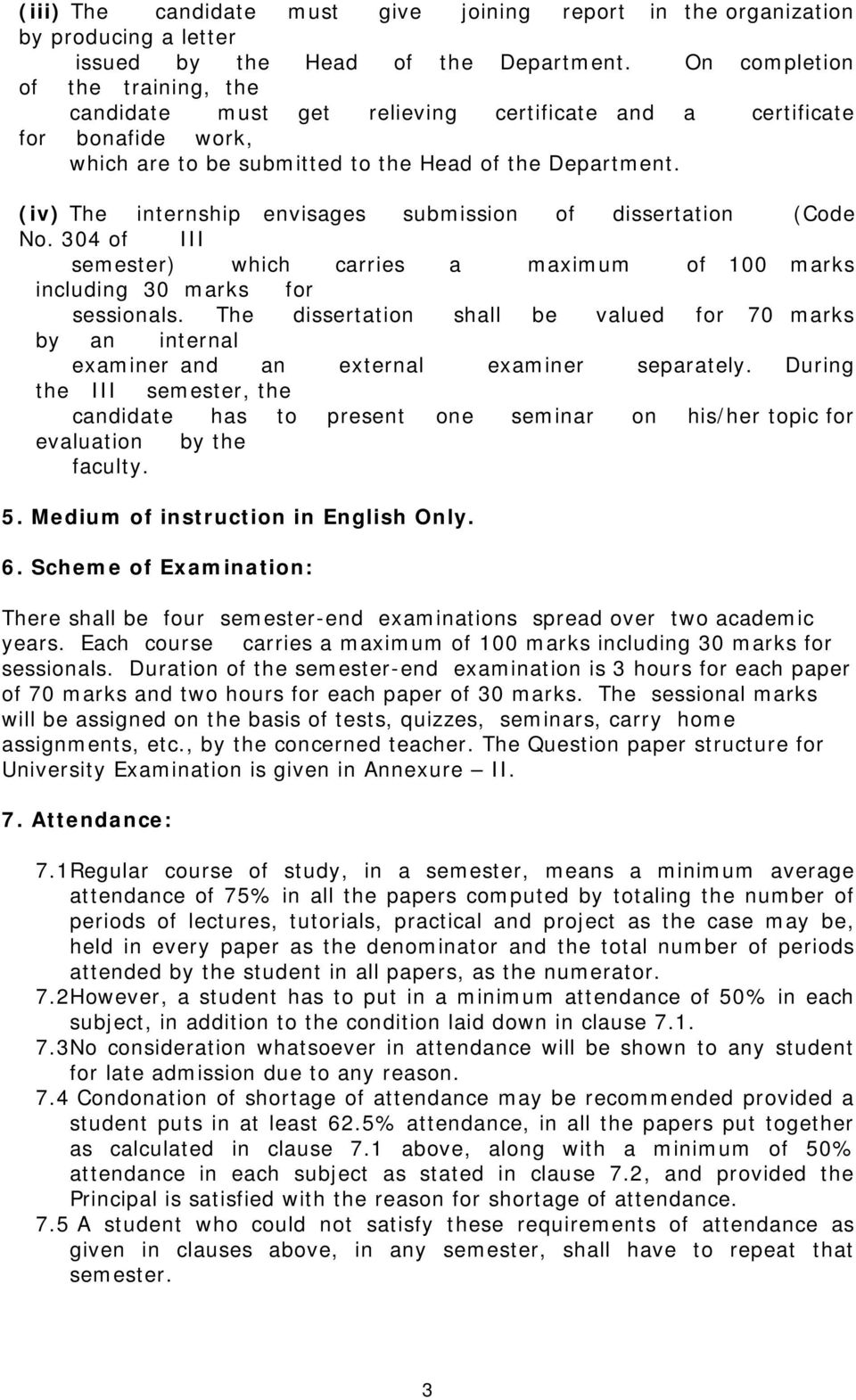
3 (iii) The candidate must give joining report in the organization by producing a letter issued by the Head of the Department. On completion of the training, the candidate must get relieving certificate and a certificate for bonafide work, which are to be submitted to the Head of the Department. (iv) The internship envisages submission of dissertation (Code No. 304 of III semester) which carries a maximum of 100 marks including 30 marks for sessionals. The dissertation shall be valued for 70 marks by an internal examiner and an external examiner separately. During the III semester, the candidate has to present one seminar on his/her topic for evaluation by the faculty. 5. Medium of instruction in English Only. 6. Scheme of Examination: There shall be four semester-end examinations spread over two academic years. Each course carries a maximum of 100 marks including 30 marks for sessionals. Duration of the semester-end examination is 3 hours for each paper of 70 marks and two hours for each paper of 30 marks. The sessional marks will be assigned on the basis of tests, quizzes, seminars, carry home assignments, etc., by the concerned teacher. The Question paper structure for University Examination is given in Annexure II. 7. Attendance: 7.1Regular course of study, in a semester, means a minimum average attendance of 75% in all the papers computed by totaling the number of periods of lectures, tutorials, practical and project as the case may be, held in every paper as the denominator and the total number of periods attended by the student in all papers, as the numerator. 7.2However, a student has to put in a minimum attendance of 50% in each subject, in addition to the condition laid down in clause No consideration whatsoever in attendance will be shown to any student for late admission due to any reason. 7.4 Condonation of shortage of attendance may be recommended provided a student puts in at least 62.5% attendance, in all the papers put together as calculated in clause 7.1 above, along with a minimum of 50% attendance in each subject as stated in clause 7.2, and provided the Principal is satisfied with the reason for shortage of attendance. 7.5 A student who could not satisfy these requirements of attendance as given in clauses above, in any semester, shall have to repeat that semester. 3
4 7.6 A certificate of satisfactory attendance must be submitted by the student from the organization where he/she undertakes Project Work. 7.7Further, a student is required to complete the course of study satisfying the attendance requirements in all the four Semesters, within a period of first Eight Semesters from the time of admission, failing which he/she shall forfeit his /her seat. 7.8 A student, who has satisfied the minimum attendance requirements in any semester, may repeat that semester after obtaining written permission from the Principal and cancelling the previous record of attendance and sessional marks of that semester. However, this facility may be availed by any student not more than twice during the entire course of study and the entire course of study shall be within the first Eight Semesters as stipulated in clause Promotion: A candidate who has put in the required minimum attendance as stipulated in Clause No.7 and has registered for the semester-end University examination by paying the required examination fee is eligible for promotion to next semester. There shall be no detention of failed candidates or candidates who are absent for the semester-end University examination. 9. Evaluation: There shall be both Internal and External evaluation for the semester-end examinations, including Project Report. 10. Qualifying Marks for Pass a) i) A candidate appearing for the first time for the Examinations of any semester, shall register for the examinations of all courses of that Semester. A candidate shall be declared to have passed the whole or a part of the whole examination if he/she secures not less than 40% of marks in each theory paper/practical/project report in Semester-end University Examination and not less than 40% marks in Internal Assessment and Semester-end Examination put together. ii) To pass, the candidate has to obtain a minimum of 40 marks out of 100 marks in VIVA-VOCE examination/ Communication and Computer Lab examination. b) A candidate who fails to get pass marks for the Project report should submit the revised report along with the next batch of students. 11. Classification of successful candidates: The classification will be on the basis of the total marks obtained by the candidate in all the semesters put together and will be classified as follows: i) A candidate who secures 60% and above of total (aggregate) marks will be placed in FIRST CLASS. ii) A candidate who secures 50% and above but less than 60% of total (aggregate) marks will be placed in SECOND CLASS. iii) A candidate who secures 40% of marks or above but less than 50% of total (aggregate) will be placed in THIRD CLASS. 4

5 12. Award of Ranks: Candidates who passed the examinations of all the Four Semesters for the degree at the first appearance in all Four Semesters shall be ranked in order of merit. The candidates who have taken supplementary examinations shall also be eligible for classification but they shall not be considered for the award of rank. Ranks shall be awarded for the top three students or 10% of the total strength of the students appeared for the Four Semester end examinations. 13. Supplementary Examination: There shall be no supplementary examinations. The failed candidate shall appear again for the examinations along with the regular candidates of next batch as per the syllabus and regulations in vague. The candidates shall complete all the examinations within five years after joining MBA programme. No examination shall be conducted for the candidates after five years. 14. Improvement: The candidates are permitted to improve their marks/class by taking Semester-end examinations in one or more papers as per the existing regulations and syllabi. Once a candidate had appeared for examinations for improvement of marks/class, the marks/class in the earlier examinations of the respective course(s) shall automatically get cancelled. Note: The candidates shall be permitted to improve their marks within a period of four years from the date of admission into First Semester. 15. Transitory Provision: a). For candidates who studied the M.B.A. Degree Course under previous regulations and syllabus, and who could not pass some or all the courses (papers) shall be permitted to take examinations under old regulations and syllabus for three more times after the last regular examinations of the concerned subject (s). b) Candidates who satisfied the minimum attendance requirements in any semester under Old Regulations, but who are yet to pass some papers even after three chances as stated in 14.(a), shall appear for the equivalent papers under Revised Regulations, as specified by the Chairman of the Board of Studies. 16. The university shall have the right to amend or modify or revise any of the above regulations whenever necessary. * * * * * 5

6 Code No. Title of the Paper Annexure 1 Semester I Internal Marks Semest er End Marks Exam Duration Maximu m Marks 101 Management and Qrganisational Behaviour Hrs Management Communication Hrs Managerial Economics Hrs Accounting for Managers Hrs Data Analysis Methods Hrs Quantitative Techniques Hrs Information Technology Hrs Personality Development Hrs 50 Code No. Semester II Title of the Paper Internal Marks Semest er End Marks Exam Duratio n Maximu m Marks 201 Management Information System Hrs Human Resources Management Hrs Marketing Management Hrs Financial Management Hrs Production Management Hrs Business Environment Hrs Operations Research Hrs Interpersonal Skills and Team Building Hrs Communication and Computer Lab

7 Code No. Code No. Title of the Paper Semester III Interna l Marks Semester End Marks Exam Duration Maxi mum Marks 301 Management of Technology & Hrs 100 Innovation 302 Entrepreneurship Hrs Computer Applications Hrs Project Seminar & Report Hrs Career Planning and Development Hrs 50 ELECTIVES/ SPECIALISATIONS (Any three Elective courses to be chosen) Marketing Area: Title of the Paper Internal Marks Seme ster End Marks Exam Duration Maximu m Marks 311 Consumer Behaviour & Relationship Hrs 100 Marketing 312 Marketing Research Hrs Promotion Management Hrs Product & Brand Management Hrs Distribution and Supply Chain Hrs 100 Management 316 Sales Management Hrs Marketing of Hospitality Services Hrs Marketing of Health Care Services Hrs 100 7

8 Finance Area: Semester Exam Maxim Code Internal Title of the Paper End Dura um No. Marks Marks tion Marks 321 Indian Financial System Hrs Working Capital Management Hrs Management of Financial Services Hrs Security Evaluation and Investment Hrs 100 Strategy 325 Management Control Systems Hrs Bank Management Hrs 100 Code No. Title of the Paper HRM Area: Internal Marks Semester End Marks Exam Durat ion Maxim um Marks 331 Counselling Hrs Management of Industrial Relations Hrs Performance and Reward Hrs 100 Management 334 Human Resource Planning Hrs Employee Legislation Hrs Training for Development Hrs 100 8

9 Code No. Title of the Paper Systems Area: Intern al Marks Semes ter End Marks Exam Duratio n Maxim um Marks 341 Systems Analysis and Design Hrs Data Base Management Systems Hrs Decision Support Systems Hrs Expert Systems and Artificial Hrs 100 Intelligence 345 Software Testing Hrs Software Engineering Hrs Logistics Management Hrs 100 Semester IV Code No. Title of the Paper Intern al Marks Semes ter End Marks Exam Duratio n Maxim um Marks 401 Strategic Management Hrs International Business Management Hrs Business Laws Hrs Organisation Development Hrs Presentation Skills Hrs VIVA VOCE (Comprehensive Viva covering all the subjects of all Semesters including Project work)

10 Code No. ELECTIVES/ SPECIALISATIONS (Any three Elective courses to be chosen) Marketing Area: Title of the Paper Internal Marks Semester End Marks Exam Duration Maximu m Marks 411 Insurance and Bank Marketing Hrs Rural Marketing Hrs International Marketing Hrs Retail Marketing Hrs Industrial Marketing Hrs Agricultural Marketing Hrs

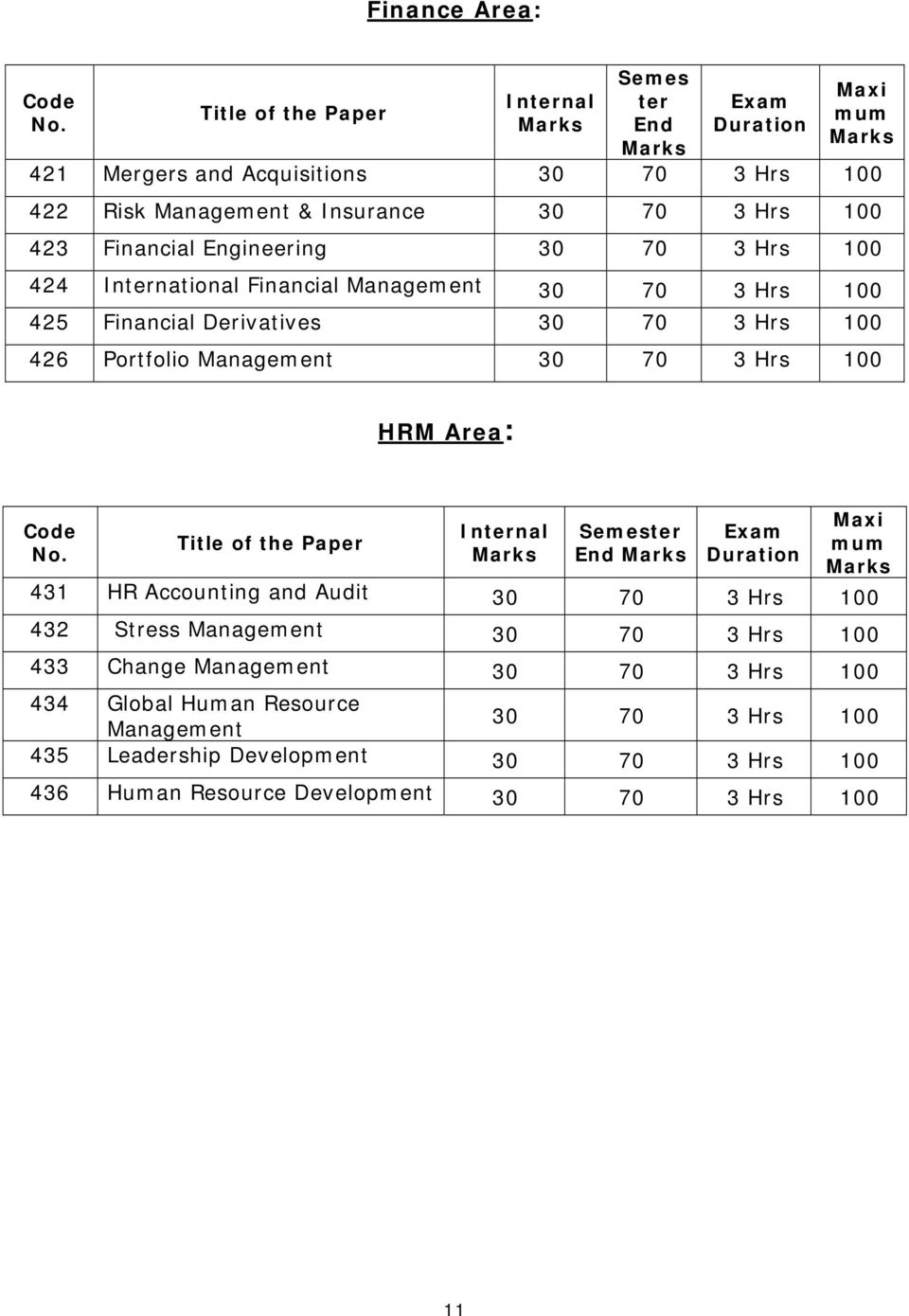
11 Finance Area: Code No. Title of the Paper Internal Marks Semes ter End Marks Exam Duration Maxi mum Marks 421 Mergers and Acquisitions Hrs Risk Management & Insurance Hrs Financial Engineering Hrs International Financial Management Hrs Financial Derivatives Hrs Portfolio Management Hrs 100 HRM Area: Code No. Title of the Paper Internal Marks Semester End Marks Exam Duration Maxi mum Marks 431 HR Accounting and Audit Hrs Stress Management Hrs Change Management Hrs Global Human Resource Hrs 100 Management 435 Leadership Development Hrs Human Resource Development Hrs
12 Systems Area: Code No. Title of the Paper Intern al Marks Semes ter End Marks Exam Duratio n Maxim um Marks 441 Systems Control and Audit Hrs Distributed Intelligence Hrs Data Mining and Data Warehousing Hrs Enterprise Resource Planning Hrs Data Communication and Network Hrs 100 Analysis 446 E- Business Hrs Customer Relationship Management Hrs

13 ANNEXURE II QUESTION PAPER STRUCTURE FOR MBA SEMESTER END EXAMINATIONS Each Course examination (other than courses 108,208,305 and 405) shall have a maximum of 70 Marks and the examination shall be of 3 Hrs duration. The question paper shall have two parts viz. Part- A and Part-B. PART-A (5X10=50 Marks) Descriptive Type questions, each question carries 10 Marks. 1. (a) Or (b) 2. (a) (b) 3. (a) (b) 4. (a) (b) 5. (a) (b) Case Analysis Or Or Or Or PART-B (20 Marks) STRUCTURE OF THE QUESTION PAPER FOR COURSES 108,208,305 and 405 Each course examination (Semester end) shall have 30 marks and the examination shall be 2 Hrs duration. There shall be three descriptive type questions. All questions carry equal marks. 1. (a) or (b) 2. (a) or (b) 3. (a) or (b) 13

14 101 Management and Organisational Behaviour Introduction to Management Principles of Management Functions of management Decision making process/ Social responsibility of management Ethics in management.. Introduction to OB Learning Personality Perception Attribution. I Motivation Communication Leadership Group dynamics Power, Politics, and conflict. V Organisation Culture Organization change and development organization structure and organization design. Managing stress Emergence of international management Interpersonal processes in international context. 1. John L. Pierce : Management and Organisational Behaviour (Cengage) 2. Jit S Chador: Organisation Behaviour (Vikas) 3. Fred Luthans: Organisation Behaviour (McGraw Hill) 4. Stephen P Robbins: Organisation Behaviour (Pearson) 5. Paul Hersey and Ken Blanchard: Management of Organisation Behaviour (Prentice Hall) 6. Hellriegel, Slocum and Woodman: Organisation Behaviour (South Western) 7. Weihrich, Cannice & Koontz: Management (Tata McGraw Hill) 8. Gregory Moorhead and Ricky W. Griffin: Organizational Behavior (Jaico) 9. Robin Finchan and Peter Rhodes: Organizational Behaviour (Oxford) 10. J. Prakash Reddy, Management and: Organizational Behaviour (Himalaya) (ii) In regard to Part - A of the question paper, one question with internal choice from 14

15 102 Management Communication Communication Meaning Communication cycle Process Theories and Models of communication characteristics of successful communication Barriers to communication. Organisational communication Principles for effective organisational communication formal Vs informal communication vertical and lateral channels Interpersonal and intrapersonal communication Communication technology. UNIT III Oral communication Non verbal communication Listening Telephone talks Feedback Presentation skills conducting meeting and conferences. UNIT IV Written communication Reports Effective report writing Memos Circulars Minutes s Employment Correspondence proposals. Leadership communication Transactional Analysis Group communication Johari window Communication audit Communication styles. 1. Shirley Taylor :Communication for Business (Pearson) 2. Piyush Dhar Chaturvedi and Mukesh Chaturvedi : Business Communication (Pearson) 3. Krizan : Effective Business Communication (Cengage) 4. M. Ashraf Rizvi : Effective Technical Communication (McGraw Hill) (ii) In regard to Part A of the question paper, one question with internal choice from 15

16 103 Managerial Economics : INTRODUCTION The concept, nature and scope of Managerial Economics Role and Responsibilities of Managerial Economist The concepts of plant, firm and industry objectives of the firm. : Demand analysis The concept of Demand, Demand Schedule, Demand Curve, Demand Function Demand Determinants Law of Demand Price, Income, Cross and Promotional elasticity of demand and their managerial uses Demand Distinctions Demand Forecasting; Sources of Data and Methods of Forecasting demand for established and new products or services. I: PRODUCTION, COST AND PROFIT ANALYSIS Production Function Returns to scale Cost concepts and classification Cost function Break-Even Analysis profit theories. UNIT - IV: PRICING DECISIONS Objectives of Pricing Basic factors in pricing Pricing under perfect, monopoly, oligopoly and monopolistic competitions Price Discrimination Multiple Product Pricing Price control by Government Pricing of new products Pricing Methods. UNIT - V: MACRO ECONOMIC ENVIRONMENT National Income Population Business cycles inflation New Economic Policy of the Government of India. 1. H.Criag Peterson,W.Cris Lewis :Managerial Economics (Pearson) 2. Paul G.Keat and Philit Y.Yound: Managerial Economics (Pearson) 3. D.M.Mithani: Managerial Economics (Himalaya) 4. Suma Damodaran: Managerial Economics (Oxford) 5. D.N. Dwivedi: Managerial Economics (Vikas) 6. P.L.Mehta: Managerial Economics (Sultan Chand) 7. Samuel C. Wabb: Managerial Economics (Cengage) (ii) In regard to Part A of the question paper, one question with internal choice from 16

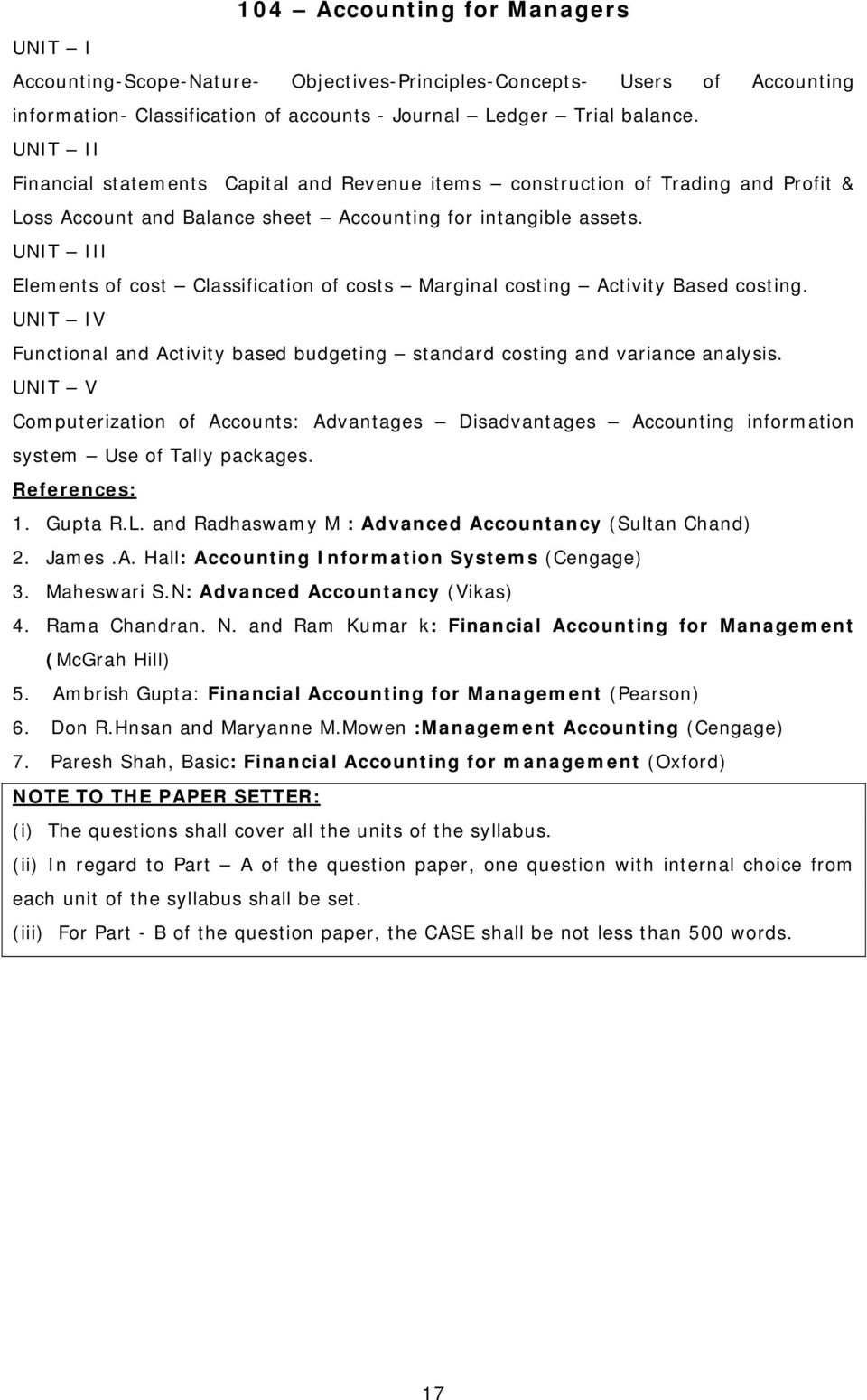
17 104 Accounting for Managers Accounting-Scope-Nature- Objectives-Principles-Concepts- Users of Accounting information- Classification of accounts - Journal Ledger Trial balance. Financial statements Capital and Revenue items construction of Trading and Profit & Loss Account and Balance sheet Accounting for intangible assets. I Elements of cost Classification of costs Marginal costing Activity Based costing. V Functional and Activity based budgeting standard costing and variance analysis. Computerization of Accounts: Advantages Disadvantages Accounting information system Use of Tally packages. 1. Gupta R.L. and Radhaswamy M : Advanced Accountancy (Sultan Chand) 2. James.A. Hall: Accounting Information Systems (Cengage) 3. Maheswari S.N: Advanced Accountancy (Vikas) 4. Rama Chandran. N. and Ram Kumar k: Financial Accounting for Management (McGrah Hill) 5. Ambrish Gupta: Financial Accounting for Management (Pearson) 6. Don R.Hnsan and Maryanne M.Mowen :Management Accounting (Cengage) 7. Paresh Shah, Basic: Financial Accounting for management (Oxford) (ii) In regard to Part A of the question paper, one question with internal choice from 17
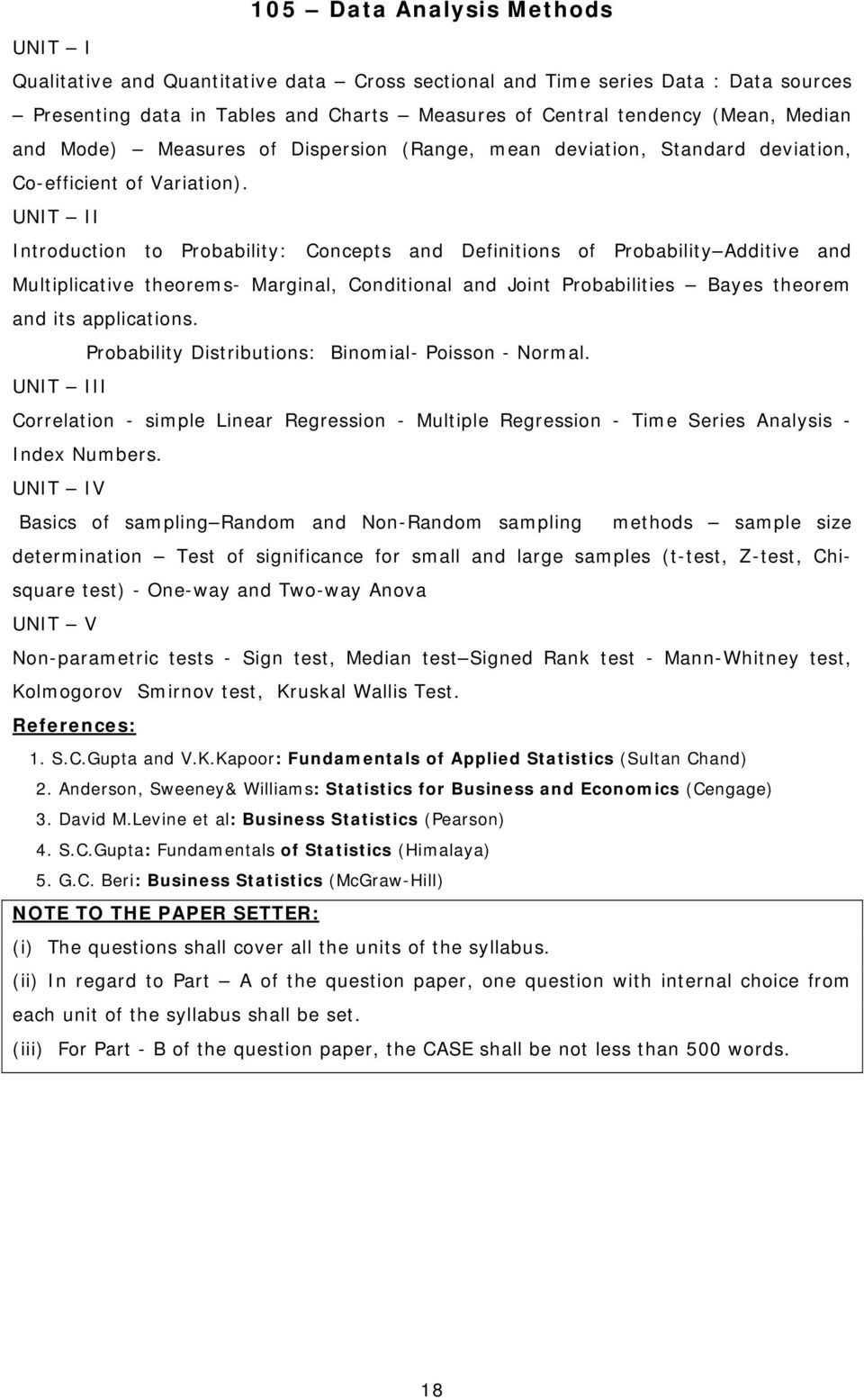
18 105 Data Analysis Methods Qualitative and Quantitative data Cross sectional and Time series Data : Data sources Presenting data in Tables and Charts Measures of Central tendency (Mean, Median and Mode) Measures of Dispersion (Range, mean deviation, Standard deviation, Co-efficient of Variation). Introduction to Probability: Concepts and Definitions of Probability Additive and Multiplicative theorems- Marginal, Conditional and Joint Probabilities Bayes theorem and its applications. Probability Distributions: Binomial- Poisson - Normal. I Correlation - simple Linear Regression - Multiple Regression - Time Series Analysis - Index Numbers. V Basics of sampling Random and Non-Random sampling methods sample size determination Test of significance for small and large samples (t-test, Z-test, Chisquare test) - One-way and Two-way Anova Non-parametric tests - Sign test, Median test Signed Rank test - Mann-Whitney test, Kolmogorov Smirnov test, Kruskal Wallis Test. 1. S.C.Gupta and V.K.Kapoor: Fundamentals of Applied Statistics (Sultan Chand) 2. Anderson, Sweeney& Williams: Statistics for Business and Economics (Cengage) 3. David M.Levine et al: Business Statistics (Pearson) 4. S.C.Gupta: Fundamentals of Statistics (Himalaya) 5. G.C. Beri: Business Statistics (McGraw-Hill) (ii) In regard to Part A of the question paper, one question with internal choice from 18
19 106 Quantitative Techniques Quantitative Methods An overview, Definition of Quantitative Methods Evolution of Quantitative methods classification of quantitative methods Advantages of quantitative methods limitations of quantitative methods. Functions and its applications to business, limits of function and continuity, Differentiation, Maxima and Minima, Integration and its applications in managerial decisions. I Progressions: Arithmetic and Geometric Progressions and their applications, Annuities and Present values. V Vectors and Matrices, Geometrical and Physical interpretation of vectors, Multiplication of Matrices, Inverse of Matrix, Rank of a Matrix and Matrix application in Management. Introduction to Interpolation and Extrapolation Assumptions of Interpolation and Extrapolation Applications of Interpolation and Extrapolation Methods of Interpolation the use of Interpolation in Financial Analysis. 1. BSS Murthy, Venkateswara Rao & V.Krishna Murthy: Intermediate Mathematics (Chand ) 2. N.Raghava Chari: Mathematics of Management (McGraw Hill) 3. B.S. Grewal: Engineering Mathematics (Khanna Publishers) 4. David R. Anderson : Quantitative Methods for Business (Cengage) (ii) In regard to Part A of the question paper, one question with internal choice from 19

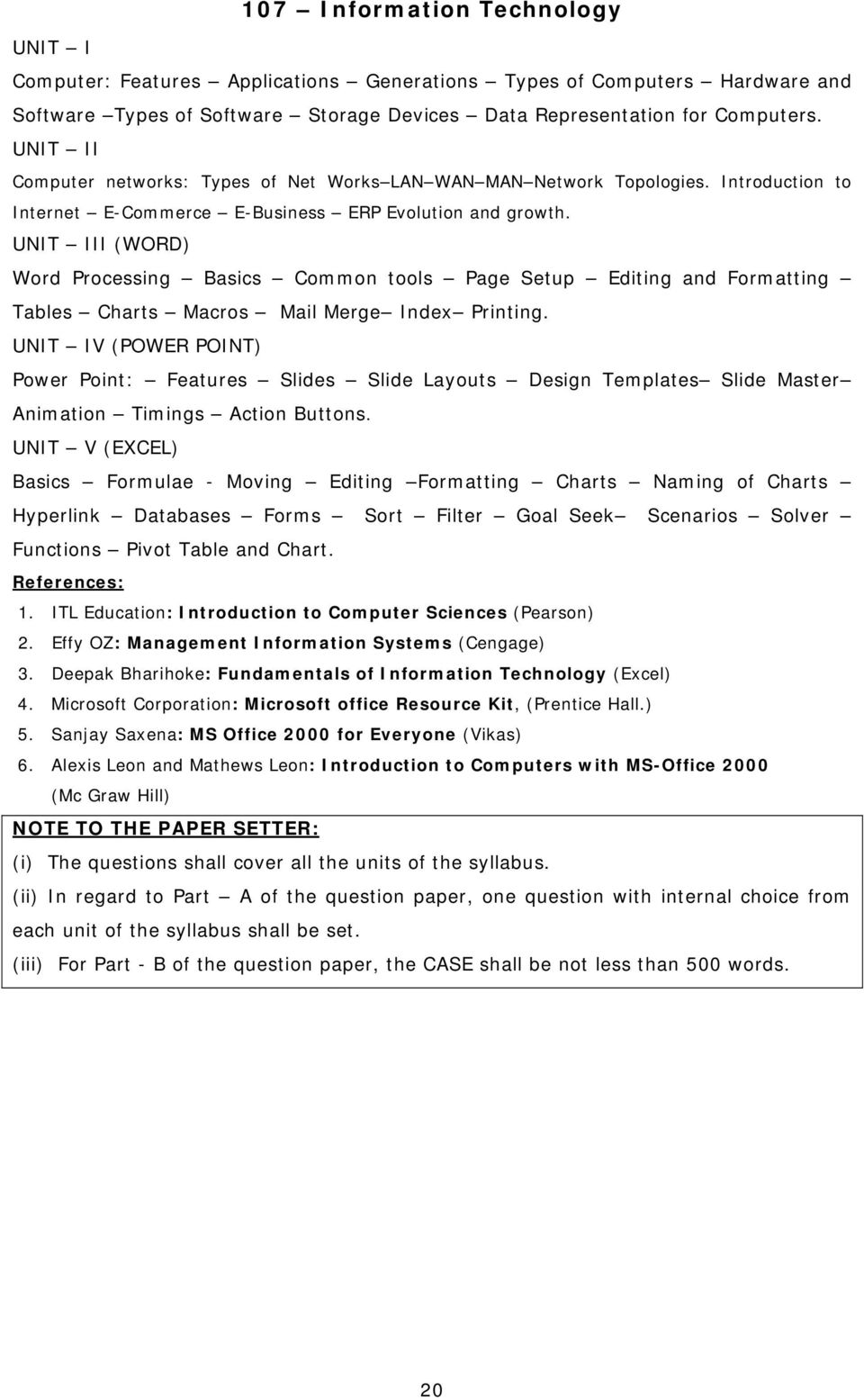
20 107 Information Technology Computer: Features Applications Generations Types of Computers Hardware and Software Types of Software Storage Devices Data Representation for Computers. Computer networks: Types of Net Works LAN WAN MAN Network Topologies. Introduction to Internet E-Commerce E-Business ERP Evolution and growth. I (WORD) Word Processing Basics Common tools Page Setup Editing and Formatting Tables Charts Macros Mail Merge Index Printing. V (POWER POINT) Power Point: Features Slides Slide Layouts Design Templates Slide Master Animation Timings Action Buttons. (EXCEL) Basics Formulae - Moving Editing Formatting Charts Naming of Charts Hyperlink Databases Forms Sort Filter Goal Seek Scenarios Solver Functions Pivot Table and Chart. 1. ITL Education: Introduction to Computer Sciences (Pearson) 2. Effy OZ: Management Information Systems (Cengage) 3. Deepak Bharihoke: Fundamentals of Information Technology (Excel) 4. Microsoft Corporation: Microsoft office Resource Kit, (Prentice Hall.) 5. Sanjay Saxena: MS Office 2000 for Everyone (Vikas) 6. Alexis Leon and Mathews Leon: Introduction to Computers with MS-Office 2000 (Mc Graw Hill) (ii) In regard to Part A of the question paper, one question with internal choice from 20
21 108 Personality Development UNIT-I Personality- Meaning-Sigmund Freud s Psycho-analytical theory-structure-dynamics and development of Personality UNIT-II Self-Esteem Self-Improvement Self-confidence Assertiveness Importance of attitude Winning Attitude-Building a Positive attitude Building a pleasing Personality 25 steps to build a personality. UNIT-III Motivation Self-motivation and motivating others everyday Time Management- Effective utilization of time-do it now-speed reading-managing meetings-not searching for 100% perfection-success Management. References 1. Robert M. Sherfield, Rhonda J. Montgomery and Patricia G.Moody B: Developing Soft Skills ( Pearson) 2. Harold R. Wallace and L. Ann Masters : Personality Development ( Cengage Learning India ) 3. Seema Sanghi : Towards Personal Excellence, Psychometric Tests and Self -improvement Techniques for Managers ( Response ) 4. Shiv Khera: You Can Win (Mac millan) 5. Stephen R. Covey : The 7 Habits of Highly Effective People (Simon & Schuster) 6. Stephen R. Covey : The 8 th Habit (Simon & Schuster) 7. Dale Carnegie : How to Win Friends & Influence People (Pocket Books) 8. Dale Carnegie : How to Stop Worrying and Start Living (Pocket Books) 9. Dharni, P. Sinha : Learning From Life (Excel) 10. Biswajit Das Ipseeta Satpathy : Business Communication & Personality Development (Excel) (ii) One question with internal choice from 21
22 Semester II 201 Management Information Systems UNIT I Concepts of systems and organizations Meaning of MIS Decision making Process Role of MIS in decision making process Strategic uses of Information Technology. UNIT II Levels of Management and their information requirements Determining information requirements of managers - MIS Structure Approaches to MIS design and development. I Transaction Processing System Office Automation System Decision Support System, Expert System. Concepts of Data mining, Data warehousing and OLAP. V An outline of Database Management System Database Models Distributed Processing Computer networks. Functional Information systems: Marketing, Manufacturing, Financial and Human Resource Information systems. 1. Robert Schulthesis and Mary Sumner : Management Information Systems ( McGraw Hill) 2. Kenneth C. Lauadon and Jane. P. Lauadon : Management Information Systems (Pearson) 3. Robest Schulthesis and Mary Sumner : Management Information Systems ( McGraw Hill) 4. James A O Brien : Management Information Systems ( McGraw Hill) 5. Murthy CSV : Management Information Systems ( Himalaya) 6. Mahavev Jaisial and Monika Mital: Management Information Systems (Oxford) (ii) In regard to Part A of the question paper, one question with internal choice from (iii) For Part B of the question paper, the CASE shall be not less than 500 words 22
23 202 Human Resources Management Evolution of HRM HRM functions HR Planning HR information Systems Job analysis and job design Recruitment and selection strategies Retention. Concept of HRD Goals of HRD Training and Development Career development Managing diversity Separation Downsizing out Placement. I Performance Appraisal: Performance dimensions and Measurement tools Reward System Compensation management. V Motivating human resources: Motivation Theories Leadership Participative management Empowerment Quality circles Industrial Relations. Organization Development Knowledge management learning organization International HRM HR Accounting and Audit. 1. R Wayne Mondy : Human Resource Management (Pearson) 2. P. Jyothi and D.N. Venkatesh: Human Resource Management (Oxford) 3. John M Ivancevich : Human Resource Management ( McGraw Hill) 4. Biswajeet Pattanayak : Human Resource Management (Prentice Hall) 5. P. Subba Rao :Personnel and Human Resource Management (Himalaya) 6. Snell / Bohlander : Human Resource Management (Cengage ) 7. Rao VSP : Human Resource Management Text & Cases ( Excel) (ii) In regard to Part A of the question paper, one question with internal choice from 23
24 203 Marketing Management Definition of marketing Marketing concepts concept of customer value Marketing environment Marketing Strategy. Consumer Behavior Factors influencing consumer behavior Market Segmentation Customer Relationship management. I Product Management: Types of products Product mix and Product line Introducing new products - Product life cycle Positioning Packaging Branding. V Distribution Management: Marketing Channels Retailing Distribution logistics and supply chain management Direct and on-line marketing. Pricing methods Marketing Communications - Advertising management Sales promotion and personnel selling Marketing information system. 1. V.S. Ramaswamy and S. Ramakumar : Marketing Management (Macmillan) 2. Philip Kotler :Marketing Management (Prentice-Hall) 3. Rajiv Lal, John A. Emelch and Kasturi Rangan: Marketing Management (McGraw-Hill) 4. M.J. Kavier : Marketing in the new Millennium (Vikas) (ii) In regard to Part A of the question paper, one question with internal choice from 24
25 204 Financial Management Foundation of Finance: Finance functions Role of Financial manager Financial goals Agency problem concepts of value and return. Financial analysis: Importance - Ratio analysis Breakeven analysis Funds flow analysis Financial planning financial forecasting. I Working Capital Management: Principles of working capital Receivables management Inventory management Cash management Trade credit management. V Capital Structure Decisions: Financial and Operating Leverage capital structure theories capital structure planning Dividend theories Dividend policy. Capital Budgeting Decisions: Cost of capital Capital budgeting methods Risk analysis in capital budgeting concept of real options. 1. I.M.Pandey :Financial Management (Vikas) 2. M.Y. Khan and P.K. Jain : Financial Management (McGraw-Hill) 3. Prasanna Chandra: Financial Management (McGraw-Hill) 4. James C. Van Horne :Financial Management Policy (Pearson) 5. Rajiv Srivatsava and Anil Misra: Financial Management (Oxford) 6. Berk Jonathan, Demazo Peter : Financial Management (Pearson) 7. Arnold Glen, Kumas Mohan : Corporate Financial Management (Pearson) (ii) In regard to Part A of the question paper, one question with internal choice from 25
26 205 Production Management Production management: concepts, productivity, scope of production management, production system work study Method study steps in method study - Time study different time study techniques Plant location Different location, merits, demerits - Plant layout Types of layouts Plant Maintenance Preventive and breakdown maintenance. I Production planning and control Scheduling, Job shop, Flow shop - Line balancing. V Materials management Classification codification, Inventory models (Determinative models only). Quality control control charts Acceptance sampling oc curve. 1. Adam E bert : Production of Operations Management (Prentice Hall) 2. S.N. Chary : Production and Operations Management (McGraw Hill) 3. R. Panneer Selvam : Production and Operations Management (Prentice Hall) 4. Chunnawala and Patel : Production and Operations Management (Himalaya) 5. Kanishka Bedi : Production and Operations Management (Oxford) 6. James R Evans : Operations Management (Cengage) 7. B. Mahadevan :Operations Management (Pearson) (i) The questions should cover all the units of the syllabus. (ii) With regard to Part - A of the question paper, one question with internal choice from each Unit of the syllabus shall be set. 26
27 206 Business Environment Business Concept Mission Business Environs and Economic Environment Responsibility of Business Professionalism in India Ethics. Non Economic Environment Political, Legal, Demographic, technological, Natural Environment - Pollution Trade unions I Social change Wave front analysis Third wave practices and implications in organization Cultural dynamics Cultural process and lags Secular outlook Community development Consumerism. V Economic systems the Role of Government in Economic development Indian Economic Planning Five Year plans in brief Current plan Industrial policy Liberalization, Privatization and Globalization Public, Private joint sectors Industrial development & regulation. Monetary and Fiscal Policies Budget Money and Capital markets Stock Exchanges and regulation Industrial financing Industrial sickness Exim policy Multinational Corporations. 1. Francis Cherunilam : Business Environment (Himalaya ) 2. Aswathappa :Essentials of Business Environment (Himalaya ) 3. Sk. Misra and Puri V K : Indian Economy(Himalaya ) 4. Alvin Toffler :Third Wave 5. R.P. Maheswari & A.N.Gupta: Business Government and Society A Study of Business Environment (Vani Educational) 6. Paul Justin : Business Environment (Tata McGraw Hill) 7. SK. Misra and Puri V K : Economic Environment of Business ( Himalaya) 8. B A Prakash: Indian Economy Since 1991 (Pearson) 9. Shakh Saleem : Business Environment (Pearson) (ii) In regard to Part A of the question paper, one question with internal choice from 27
28 207 Operations Research Introduction to Operations Research - Linear Programming: Graphical method and simplex method. Transportation Problem, Transhipment Problem, Assignment Problem. I Goal Programming Business applications Dynamic Programming V Network analysis: PERT/CPM Project crashing, Time-cost trade-off.. Queuing model (M/M/I only): concepts, assumptions, business application Simulation and its applications. 1. R.Panneerselvam: Operations Research (Prentice-Hall) 2. Kanti Swarup, P.K.Gupta & Man Mohan: Operations Research (Sultan Chand) 3. Handy A.Taha: Operations Research (Pearson) 4. Wayne L. Winston: Operations Research (Cengage Learning) (ii) In regard to Part A of the question paper, one question with internal choice from 28
29 208 Interpersonal Skills & Team Building Introduction to Interpersonal Skills. Understanding determinants of Inter personal behaviour Self concept: What am I? Interpersonal needs: What do you want from me? Interpersonal orientation: How do you influence me? Inter personal attraction: Why do you like each other? Developing Interpersonal relationship forming first impression. Developing mutual expectations. Character based Competence based expectations. I Honoring Psychological contracts Developing trust and Influence Developing Interpersonal skills Increasing Interpersonal Awareness: The Johari Window Taking Interpersonal risks. Developing Cooperative relationships Resolving Interpersonal problems. 1. Stephen P. Robbins and Philop L Hunsaker: Training in Interpersonal Skills (Pearson) 2. Luthans: Organisation Behaviour (McGraw Hill) 3. New Strong/Keith Davis: Organisation Behaviour (McGraw Hill) 4. Hellriegel, Slocum and Woodman: Organisation Behaviour (Cengage Learning) (ii) One question with internal choice from 209 COMMUNICATION AND COMPUTER LAB 29
30 301 Management of Technology and Innovation Technology, Management, Classification of technologies Technology Forecasting Technology Transfer and collaboration. Concept of Innovation Need for innovation Ways to innovate Innovation opportunities Corporate Innovation Process-Integrated Strategic Planning for Innovation UNIT-III Creative thinking- Intuition- Logical thinking-heuristics and models-tools that prepare the mind for creative thought Levels of model of innovation Model of innovation - Industrial design. UNIT-IV Idea generating techniques-brainstorming Lateral thinking - Synectics-Nominal groups-quality Circles-Suggestion systems-attribute listing- Redefinition technique- Random-stimulus-Thinking Hats-Idea sensitive area-ishikawa diagram-principles behind techniques. UNIT-V Developing and applying creativity-designing Creative Society and Organization- Creativity Training-Applications: Process redesign-reengineering-creative bench marking. 1. White/Bruton : The Management of Technology and Innovation (Cengage) 2. Paul E Plesk: Creativity Innovation and Quality (Prentice-Hall) 3. Pradip N-Khandawalla: Fourth Eye (A.H.Wheeler) 4. Shlomo Maital and D.V. Scshadri: Innovation Management (Response) 5. C.K Prahalad and MS Krishnan : New Age of Innovation (Tata McGraw Hill) 6. Judy Estrin : Closing the Innovation Gap (Tata McGraw Hill) (ii) In regard to Part A of the question paper, one question with internal choice from 30
31 302 Entrepreneurship Concept of Entrepreneurship Role of Entrepreneurship in economic development Entrepreneurial process Intrapreneurship. Entrepreneur Background and Characteristics Role models Entrepreneur versus Inventors International versus domestic entrepreneurship. I Sources of new ideas Creative problem solving opportunity recognition Product planning and development process. V Business plan Organizational plan- Marketing plan Financial Plan. Sources of capital venture capital Initiatives to develop entrepreneurship in India. 1. Robert D. Hisrich, Michael P. Peters and Dean A, Stepherd: Entrepreneurship (McGraw-Hill) 2. S.S. Khan: Entrepreneurial Development (S. Chand & Co) 3. P. C. Jain: Handbook for New Entrepreneurs (Oxford) 4. Rajeev Roy: Entrepreneurship (Oxford) 5. Poornima Charantimath :Entrepreneurship Development and Small Business Management (Pearson) 6. Eric A. Morse and Ronald K. Mitchell : Cases in Entrepreneurship (Sage) (ii) In regard to Part A of the question paper, one question with internal choice from 31
32 303 Computer Applications Software overview Software development process Introduction to C language Character set Variables Constants Data types Operators Input/Output statements Expression evolution Assignment statements. Decision making and Branching: Simple If If Else Nested If Switch Statement Conditional Operator GOTO Statement Decision Making and Looping: While Do For Statement Programming Exercises. I Arrays Array Initialization One Dimensional Arrays Two Dimensional Arrays Multi Dimensional Arrays Character Arrays and Strings Programming exercises for matrix applications. V Functions: User-defined functions Multi function program Call by value Call by reference Categories of functions Recursion Programming exercises. Pointers: Understanding Pointer Initialization of Pointers Pointers and Arrays Pointer and Functions Programming Exercises. 1. Behraowz A. Forouzan & Richard F.Gilbey : Computer Science A Structured Programming Approach Using C (Cengage) 2. Behraowz A. Forouzan & Richard F.Gilbey : C Programming and Data Structures ( Cengage) 3. Balaguruswamy : Programming with C, (McGraw Hill) 4. Yashavant Kanitkar : Let Us C, (BPB Publications) 5. V.V. Muniswamy : C and Data Structure (I.K.Publishing) (ii) In regard to Part A of the question paper, one question with internal choice from 32
33 304 Project Seminar & Report Each candidate is expected to carry out project work in a particular organisation/industry for a period of 8/10 weeks. Candidate has to carry the project work under the guidance of a faculty member in the department and an executive guide in the concerned organisation. The candidate has to maintain a field dairy and present synopsis and IPC Seminars during the course of third semester. The project report should be submitted to the department before the commencement of the third semester end examinations. 305 Career Planning and Development Career Concept, Planning, Management, Development Life Stages and Career Development. Individual and Organizational approaches Roles in Career management. Self Analysis Skill inventory - Career Anchors Life Scripts Inventory of Career Development Practices Career Discussion Counselling Mentoring. I Resume Objectives Spade work Drafting Physical setting Transmission guide lines for effective writing Job interviews Types Self analysis Pre Interview Preparation Physical Personality Interview Process Issues Interview ending Phase Tips for effective interview. 1. Desimone, Werner & Haris : Human Resource Development (Thomson) 2. Paul Singh: Writing Effective Resume (Excel ) 3. French and Bell : Organization Development (Prentice Hall) (ii) One question with internal choice from 33
34 311- Consumer Behaviour & Relationship Marketing UNIT-I Introduction and overview to study of Consumer Behaviour - Consumer study - Significance - Models of Consumer Behaviour. UNIT-II Individual and group determinants of Consumer Behaviour - Perception - Attitude - Learning - personality - Motivation - Social class - Reference Groups and family influences The influences of culture on Consumer behaviours. UNIT-III Consumer decision making process - Issues in Consumer decision making process - Communication process - Consumer satisfaction Relationship marketing. UNIT-IV Applications Consumerism - The Consumer Protection Act (1986) and Monopolies and Restrictive Trade Practices Act (1969). UNIT V Industrial buyer behaviour Buyer behaviour for services - Diffusion of innovations and the adoption process. 1. Schiffman & Kanuk: Consumer Behaviour (Pearson) 2. Blackwell, Miniard & Engel: Consumer Behaviour (Thomson) 3. Ramesh Kumar: Consumer Behaviour (Pearson) 4. LeonG.Schistman & Leslie Leaserkarmal: Consumer Behaviour (Prentice Hall) 5. Suja R.Nair: Consumer Behaviour in Indian Perspective (Himalaya) 6. Subhash Mehta: Consumer Behaviour (Tata McGraw Hill) 7. Satish K Batar Shhkazmi: Consumer Behaviour (Excel) 8. Rajeev Kumar: Consumer Behaviour (Himalaya) (i) The questions should cover all the units of the syllabus. (ii) With regard to Part - A of the question paper, one question with internal choice from each unit of the syllabus shall be set. 34
35 312 Marketing Research Marketing Research The Nature and Scope Role of Marketing Research- Organizations doing Marketing Research and Organization of Marketing Research Department - Alternative approaches to Marketing Intelligence Periodic Projects and Continual Intelligence Marketing Information Systems Decision Support Systems Data Mining Marketing Research Process Problem Formulation Decision problem to Research problem the Research Proposal. Research Designs: Exploratory Research Objectives and Methods Descriptive Research Objectives and Methods Causal Designs Concept of Causality - Experimentation : Laboratory and Field Experiments Experimental Designs: True Experimental Designs Quasi Experimental Designs Experimentation in Marketing Research - Types of Test Markets Data collection Secondary Data - Primary Data - Design of Data Collection Forms. I Attitude Measurement Scales of Measurement: Nominal, Ordinal, Interval and Ratio Scales Self Report Attitude Scales: Equal Appearing Interval Scales Summated Rating Scales Semantic Differential Scales Stapel Scale: Rating Scales: Graphic, Itemized, Comparative Scales: Sample Design - Types of Sampling Plans: Non Probability Samples Probability Samples Sample Size Determination. V Preliminary steps of Data Analysis: Editing, Coding, Tabulation - Contingency Tables and Chi-square Analysis One - way Tabulation and Cross Tabulation Hypothesis Testing Examination of Differences Kolmogorov Smirnov test Hypothesis about One Mean, Two Means and Two Proportions Investigation of Association: Simple Regression & Correlation and Multiple Regression Analysis Multivariate Data Analysis: Discriminant, Factor, Cluster and Multi Dimensional Scaling: Preparation of the Research Report. 1. Glbert A. Churchill, Jr and Down Iacobucci : Marketing Research Methodological Foundation (Cengage) 2. Donald S Tull and Del I Hawkins : Marketing Research Measurement and Methods (McGraw Hill) 3. David J Luch et al : Marketing Research (Prentice Hall) 4. Malhotra : Marketing Research (Pearson) 5. William G. Likmund : Marketing Research (Cengage) (i) The questions should cover all the units of the syllabus. (ii) With regard to Part - A of the question paper, one question with internal choice from each unit of the syllabus shall be set. 35
36 313 Promotion Management Introduction to advertising Evolution Types of advertising or classification of users Advertising process: Advertising Campaign planning, Decision making and Organisation. Advertising creativity : Planning Creative Strategies The Creative Process Creative Strategy Development Creative Strategy Implementation and Evaluation Media Planning and Strategy Developing, Implementing and Evaluation of Media Strategies Evaluation of Broadcast, Print Media and other Support Media. I Establishing Objectives and Budgeting for Advertising The Advertising Agency functions Agency Compensation Evaluating Agencies Evaluating the Social, Ethical and Economic aspects of Advertising. V Sales promotion Incentives to middlemen Incentives to consumer Design, implementation and evaluation of effectiveness of sales promotion. Consumer promotion tools Samples Coupons Rebates Price offs Premiums (gifts) Prizes Contests Sweepstakes Games Patronage awards Free trials Product warranties Tie In promotion Cross Promotion POP displays Demonstrations. Trade Promotion tools Price offs Allowances Free goods: Business and Sales force promotion tools Trade Shows Conventions. 1. Rajiv Batra, John Myers and David Aaker : Advertising Management (Prentice Hall) 2. Manendra Mohan : Advertising Management Concepts and Cases (Tata McGraw Hill) 3. Robert C.Blattberg and Scott. A.Neslin : Sales Promotion Concepts, Methods and Strategies (Prentice Hall) 4. John.C.Totten and Martin P.Block: Analyzing Sales Promotion Text and Cases 5. Kenneth E Clow & Donald Baack : Integrated Advertising, Promotion and Marketing Communications (Prentice Hall ) 6. Shh kazmi Satish K Batra : Advertising & Sales Promotion (Excel) 7. Tom Duncan : Principles of Advertising & IMC ( McGraw Hill) (i) The questions should cover all the units of the syllabus. (ii) With regard to Part - A of the question paper, one question with internal choice from each unit of the syllabus shall be set. 36
37 314 Product & Brand Management Product concept in Marketing Strategy and New product Planning: Organisational arrangements Managing the development process: Ideas Managing the development process: Development to commercilisation; the consumer Adoption Process; PLC management Special Issues. Understanding Brands Brands in New economy Brand Hierarchy, Brand Personality, Brand Image, Brand Identity, Brand Positioning & Brand Equity Value addition from Branding CRM Brand Loyalty. I Managing Brands: Brand creation, Brand name Decision, Brand Extension, Brand Product relationship; Brand portfolio, Brand revitalization. V Measuring & Interpreting Brand Performance: Brand assessment through research Brand Identity, Brand positioning, Brand image, Brand personality assessment and change, financial aspects of Brand. Branding in different sectors, in customer sector, in Industrial sector, in Retail sector, in service sector. 1. Kenneth B Kahn: New Product Planning ( Sage) 2. Chunawalla. S.A: Compendium of Brand Management ( Himalaya) 3. Harsh V Verma: Brand Management Text & Cases ( Excel ) 4. Murthy YLR : Brand management ( Vikas) 5. Kevin Lane Keller: Strategic Brand Management ( Prentice Hall) 6. Mathur.U.C : Product & Brand Management ( Excel) 7. Kotler : Marketing Management (Pearson) 8. Gupta S.L: Brand Management Text and Cases ( Himalaya) 9. Subratosen Gupta : Brand Positioning ( Macmillan) 10. Ramanuj Majumdar : Product Management in India (Prentice Hall) (ii) In regard to Part A of the question paper, one question with internal choice from 37
38 315 Distribution and Supply Chain Management Role of Distribution in Value discovery Designing a distribution logistics system Outsourcing of distribution logistics Distinction between distribution logistics and supply chain management. Meaning and definition of supply chain management Supply chain management in the global environment Customer focus in supply chain management Supply chain drivers and obstacles. I Planning demand and supply in a supply chain Planning and managing inventories in a supply chain Transportation in a supply chain Net work design decisions Information technologies in a supply decision. V Production in supply chain management Purchasing in a supply chain management financial issues in supply chain management E-business and supply chain. Supply chain integration coordination in a supply chain Inter functional coordination Inter Corporate coordination Measuring Performance in the supply chain Managing the supply chain Supply chain Restructuring. Reference: 1. Janat Shah : Supply Chain Management (Pearson) 2. Suni Chopra and Peter Meindl : Supply Chain Management (Pearson) 3. R.P. Mohanty and S.G. Deshmukh : Supply Chain Management (Jaico) 4. John T. Mertzer: Supply Chain Management (Respones) 5. Anurag Saxena and Kaaushik Sircan : Logistics and Supply Chain Management 6. D.K. Agrawal : Distribution and Logistics Management (Macmillan) (ii) In regard to Part A of the question paper, one question with internal choice from 38
39 316 Sales Management Sales Management Nature and Importance Goals and functions Salesmanship Buyer - Seller dyads Theories of selling. Selling process Stages in the Selling Process Organizing the Sales Effort Sales Forecasting and Budgeting Sales Territories Routing and Setting Sales Quotas Sales Contests. Unit III Recruitment and Selection of Sales force Sales Training Motivating and Leading the Sales Force - Interview Techniques. Unit IV Compensation of Sales Force Straight Salary Straight Commission Combination Plans Non Financial Rewards. Unit V Evaluation and Control of the Sales Program Cost Analysis- Evaluating Sales Person Performance. 1. Krishna K. Havaldar & Vasant M Cavale : Sales & Distribution Management (Text & Cases) (Tata McGraw Hill) 2. Still, Cundiff & Govani : Sales Management - Decisions, Strategies and Cases (Prentice Hall) (ii) In regard to Part A of the question paper, one question with internal choice from 39
40 317 Marketing of Hospitality Services Nature of hospitality services Hospitality marketing environment Characteristics of hospitality services marketing Hospitality marketing system Marketing strategy 8ps of hospitality marketing. Behaviour of individual customers Personal factors Inter-personal factors Buying process of individual customers Behaviour of organizational customers CRM. I Product development and partnership: Major groups of organizations in hospitality industry Product / service mix partnership Role of guests and hosts in the marketing mix TQM Packaging and Programming Market segmentation and positioning. V Pricing of hospitality services cost rate formula Market tolerance Differential pricing Pricing strategies Distribution mix Intermediaries On-line services Channel organization. Promotional mix Factors affecting promotional mix Planning Advertising Sales Promotion and merchandise Personal selling Public relations. 1. Alastair M. Morrison: Hospitality and Travel Marketing (Cengage) 2. Philip Kotler, John T. Bowan and James C. Makens: Marketing for Hospitality and Tourism (Pearson) 3. Angie Michael: Best Impressions in Hospitality (Cengage) 4. Ahmed Ismail: Front Office Operations and Management (Cengage) (ii) In regard to Part - A of the question paper, one question with internal choice from each unit of the syllabus shall be set. 40
41 318 Marketing of Health Care Services Emergence of health care Marketing Contribution of marketing in health care Consumerism, entrepreneurial spirit of hospital Marketing from inside out. The concept of hospital marketing Physician centred marketing Decision processes and relationships Marketing audit as a strategic planning tool; MRIS to match the needs of health seeker Hospital capacity utilization Better upkeep of hospital medical records. I Developing market mix Cost consideration for services Pricing services beyond money: Social price Access to healthcare Retailing of healthcare services. V Extended hours Promotion Role of advertising Public relations Guest relations. Service Development /Elimination: Development of new health services High level fitness for special categories Assessing failure of a service Elimination of a service. 1. Philip Kotler and Roberta.N.Clarke: Marketing for Healthcare Organisations (Prentice Hall) 2. Phlip D. Cooper: Health Care Marketing Issues & Trends (Spen) 3. Roland T Rust, Anthony. J. Zahorik and Timothy. L. Keiningham: Services Marketing (Addison Wesley) 4. Zeithamal, Gremler, Biner & Pandit: Services Marketing (McGraw Hill) 5. Eric N. Berkowitz : Essentials of Health Care Marketing(Aspen) (ii) In regard to Part A of the question paper, one question with internal choice from 41
42 321 Indian Financial System Financial System: Functions and Structure Financial Intermediaries Financial markets Financial instruments. Indian Financial system Structure of Commercial Banks Non-Banking Finance Companies Development Banks Narasimham Committee Recommendations SEBI Regulations. I Financial Markets in India: Functions of New issue market Operations of Stock exchanges SEBI regulations. V Money market: Call market Treasury Bill market Repos Commercial bill market Commercial paper Certificate of Deposits DFHI. Mutual Funds Insurance Companies Privatization of insurance business in India. 1. M.Y. Khan: Indian Financial System (McGraw Hill) 2. Meera Sharma: Management of Financial Institutions (Prentice-Hall) 3. Bharati V. Pathak: Indian Financial System (Pearson) 4. A.M. Srivatsava and Divya Nigam: Management of Indian Financial Institutions (Himalaya) (ii) In regard to Part A of the question paper, one question with internal choice from 42
43 322 Working Capital Management Need for working capital components of working capital types of working capital Determination of working capital Factors influencing working capital requirement liquidity Vs profitability. Approaches to financing current asset Internal sources and external sources of working capital Financing of working capital by commercial banks Trade credit management. I Cash management: Motives of holding cash Cash planning Cash budget Cash management models Cash flows statement analysis. V Inventory management: Types of inventories Inventory control Techniques Methods of pricing of material issues. Management of Receivables: Objectives Credit policy Credit information Control of accounts receivables Factoring. 1. Hampton J.J. Wanger :Working Capital Management (John wiley) 2. Scherr F.C. Modern : Working Capital Management (Prentice Hall) 3. P. Periasamy : Working Capital Management (Himalaya) (ii) In regard to Part A of the question paper, one question with internal choice from 43
44 323 Management of Financial Services An overview of Financial Services Industry- Trends in financial Services Nature and Scope of financial services. Leasing and Hire Purchase: Meaning and definition Tax aspects Evaluation Accounting Structuring Funding Qualitative factors. I Merchant Banking: Nature and Scope of merchant banking services Management of public issues Support services Drafting of Prospectus Disclosure requirements Broking services Market making Securities underwriting SEBI Guidelines relating to merchant banking. V An overview of Venture Capital, Factoring, Depositories and Credit Rating. An overview of Bill Discounting, Housing Finance, Insurance services, Mergers and Acquisition, and Mutual Funds. 1. M.Y. Khan : Financial Services (Tata McGraw-Hill) 2. Verma. J.C : Merchant Banking (Tata McGraw-Hill) 3. K. Sasidharan and Alex K. Mathews : Financial Services (McGraw-Hill) (ii) In regard to Part A of the question paper, one question with internal choice from 44
45 324 Security Evaluation and Investment Strategy Avenues of Investment: Equity shares Debt securities Money market instruments Investment in real assets Investment in commodities (Gold, Silver, Platinum) New avenues for investment Mutual funds. Valuation of debt securities: General valuation Framework - Yield to matuatiry valuation of equity shares Valuation models. I Risk and Return: Nature and types of risk Measurement of risk Risk return relationship Benefits and limitations of diversification. V Fundamental Analysis Technical Analysis EMH and Random Walk Theory Behavioral finance. An overview of stock markets money market and new issue market FIIs and stock markets. 1. D.E. Fischer and R.J.Jordan :Security Analysis and Portfolio Management (Pearson) 2. Sudhindra Bhat : Security Analysis and Portfolio Management (Excel) 3. Dhanesh Kumar Khatri :Investment Management and Security Analysis (Macmillan) 4. Mark Hirschey and John Nofsinger :Investments (McGraw Hill) 5. Stephens H. Penman: Financial Statement Analysis and Security Valuation ( McGraw Hill) 6. Berk Jonathan, Demarzo Peter : Financial Management (Pearson) 7. Arnold Glen, Kumas Mohan :Corporate Financial Management (Pearson) (ii) In regard to Part A of the question paper, one question with internal choice from 45
46 325 Management Control Systems Management control Systems: Nature, Goal congruence, informal controls, Functions of the controller. Responsibility Canters: Revenue centres, Expense centres, administrative and support centres, Research and Development Centres Marketing Centres. Profit Centres: Measuring profitability Investment centres. Measurement of assets. EVA Versus ROI. I Budget preparation: Nature, process Behavioural Aspects. Quantitative techniques, MBO versus budgetary control. Analysing Financial performance reports. Calculating variances, Variations in practice, limitations. Behavioural considerations. V Transfer pricing objective and methods Performance measurement Interactive control for differentiated strategies. Service organisations Non-profit organisations Professional organisations Multinational firms. 1. Anthony R.N., Govindarajan V : Management Contol Systems (Tata McGraw Hill) 2. Merchant : Modern Management Control Systems (Pearson) 3. Maciaiello & Kirby : Management Control Systems : Using Adaptive Systems to attain Control (Prentice Hall) (ii) In regard to Part A of the question paper, one question with internal choice from 46
47 326 Bank Management Importance of banking sector in the economy Different kinds of banks Banking sector reforms in India Role of RBI in banking development. Commercial banking system - Services of commercial banks Sources of Bank funds Branch expansion policy Retail banking Credit management Lending Policy Microfinance. I Liquidity management in commercial banks Theories of liquidity management Management of reserves Statutory Liquidity ratio Cash reserve ratio. V Management of non-performing assets Management of income Operational efficiency Investments of commercial banks. Non-Banking finance companies Functions and operations Acceptance of Public deposits Prudential norms Accounting standards. 1. R.M. Srivastava and Diya Nigam : Management of Indian Financial Institutions (Himalaya) 2. Justin Paul and Padmalatha Suresh: Management of Banking and Financial Services (Pearson) 3. Beatriz Armendariz and Jonathan Morduch : The Economics of Microfinance (Prentice Hall) (ii) In regard to Part A of the question paper, one question with internal choice from 47
48 331 Counseling Counselling: Concept and significance Emergence and growth of Guidance and Counselling Psychology Counselling and Guidance: Expectations and Goals. Various approaches to Counselling Counselling process Counsellors attitude and skills of Counselling. I Counselling Interview Group Counselling Individual and Group Counselling similarities and differences. V Evaluation of Counselling Professional preparation and Training for Counselling Modern trends in Counselling. Changing Behaviour through Counselling Techniques used in Counselling Problems in Counselling. Reference: 1. S. Narayana Rao: Counselling and Guidance (Tata McGraw Hill) 2. Board R: Counselling People at Work (Gomes) 3. Corner L S and Hackny H: The Professional Counselling, Process Guide to Helping (Prentice Hall) 4. Reddy Michel: Counselling at Work (British Psychological Society and Methuen) 5. Munro C A : Counselling Skills Approach (Methuen) 6. Maclennan Nigel: Counselling for Managers (Aldershot) 7. Lewis E. Patterson: The Counselling Process (Thomson) (ii) In regard to Part - A of the question paper, one question with internal choice from each unit of the syllabus shall be set. 48
49 332 Management of Industrial Relations Industrial Relations Concept Significance and the emerging socio economic scenario. Industrial relation department Role of industrial relation officer Government and Machinery for labour administration. Nature of Industrial Conflict Causes, Types, Consequences, Prevention and Settlement methods tripartite and bipartite bodies conciliation, arbitration and adjudication. I Collective bargaining: concept, historical introduction, meaning and purpose, features of collective bargaining, approaches, techniques and strategies of collecting Bargaining. Issues in Collective Bargaining. V Trade Unions: Role Position in India, Trade Union types and Employee Federations Strategies to Develop trade unions. Discipline & Grievance Management Causes, Machinery for Redreesal of grievances Discipline code of conduct, process of domestic enquiry. Participative management: methods and techniques of workers involvement and participation Composition and working of joint management councils, works committees, its ineffective functioning and failures Empowerment- quality management Industrial Relations and technological change. 1. Arun Monappa : Industrial Relations (McGraw Hill ) 2. Subba Rao P : Human Reasource & Management & Industrial Relations ( Himalaya) 3. Venkata Rathnam C.S : Industrial Relations ( Oxford) 4. Varma Pramod : Management of Industrial Relations (Oxford and IBH ) 5. Punekar : Labour Welfare Trade Unionism and Industrial Relations (Himalaya) 6. Niand J,R, etc: The Future of Industrial Relations ( Sage) 7. Cowling & Jones : The Essence of Personnel Management and Industrial Relations (Pentice Hall ) 8. B.D. Singh : Industrial Relations (Excel ) 9. Sarma, A.M : Industrial Relations ( Himalaya) 10. Monal Arora : Industrial Relations ( Excel) 11. Sinha P R N, Indu Bala Sinha & Seema Priyadharsini sekar : Industrial Relations, trade unions & labour legislation ( Pearson ) (ii) In regard to Part A of the question paper, one question with internal choice from 49
50 333 Performance and Reward Management UNIT I Reward, compensation and non compensation systems Concept Compensation issues Economic theories-wage level, differentials. Technical determinants Job analysis, job description, job evaluation, Job pricingmarket survey-pay structure architecture. UNIT III Individual pay determinants Components of pay Fringe benefits. V Performance pay Incentives, individual, group, short term and long term Compensation of special groups, supervisors, Executives, Directors, Sales force, Technical professional, women executives. Statutory provisions Wage boards, pay commission Pay budget management International pay system. 1. Narain, Laxmi :Managerial Compensation and Motivation In Public Enterprises (Oxford) 2. Sibson : Wages and Salaries (American Management Association) 3. Michael Armstrong : Reward Management (Kogan) 4. Milkovich & Newman : Compensation (Tata McGraw Hill) 5. Barry Gerhart & Sara L Rynes : Compensation (Sage) 6. Joe Martocchio: Strtegic compensation: A Human Resource ( Pearson) 7. B D singh : Compensation Reward Mangement (Excel) 8. Dipak kumar Bhatta charya : Compensation Management (Oxford) (ii) In regard to Part A of the question paper, one question with internal choice from 50
51 334 Human Resource Planning Human Resource Planning significance Objectives and Functions HRP Strategies Activities. Strategic Human Resource Planning Models, Process, Analysis, Inventory, Forecast. I Human Resource Planning Recruitment and Selection, Placement, Induction Training, Socialization, HRP Polices Retrenchment, Retention, Redeployment, Transfer, Promotion, Job Rotation, Exit Strategy. V Career planning & development Succession Planning Potential appraisal development. Human Resource Utilization Indices, Testing HR Information System HR Accounting and Audit. Reference: 1. Srivarsava MP : Human Resource Planning (Institute of Royal Resource) 2. Udaiprakesh and T.V. Rao: Human Resource System (Oxford) 3. DK Bhattaacharya : Human Resource Planning (Excel) (ii) In regard to Part A of the question paper, one question with internal choice from 51
52 335 Employee Legislation UNIT I Emergence and objectives of labour laws The Socio Economic environment Industrial relations laws Industrial Dispute Act 1947, Indian Trade Unions act 1926, Employees Standing Orders Act, UNIT II Laws relating to Discharge, Misconduct, Domestic enquiry and disciplinary action. UNIT III Social Security Laws Workers compensation act 1923, Employees State Insurance Act, Employee Provident Fund Act, 1952, Payment of gratuity Act 1972, Maternity Benefit Act, UNIT IV Wage and Bonus Laws The Law of Minimum Wages Act 1948, The Payment of Wages 1936, Payment of Bonus Act UNIT V Laws relating to working conditions Factories Act 1948, AP Shops and Establishment Act, Apprentice Act AP Festival and National Holidays Act. 1. Malik P.L : Hand Book of Industrial Law (Eastern ) 2. Srivastava, S.C : Industrial Relations and Labour Laws (Vikas ) 3. Ghiaya, B.R : Law and Procedure of Departmental Enquiry in Private Sector (Eastern Law) 4. A. Sayed : Labour law ( Himalaya) 5. Sinha P R N, Indu Bala Sinha & Seema Priyadharsini sekar : Industrial Relations, trade unions & labour legislation ( Pearson) (ii) In regard to Part - A of the question paper, one question with internal choice from each unit of the syllabus shall be set. 52
53 336 Training for Development Human resource training Concept, challenges training context, trainees, trainers, employers Phases of training. Need assessment phase Designing the training programme Evaluation training. I Training aids Traditional instructional approach, Classroom methods On the job training, Simulation, Self directed training, Team training. V Emerging methods Computer base learning, Distance learning, Intelligent tutorial system, Virtual reality training, Blended learning, Mobile technologies, Out Board learning, Adventure learning, Embedded learning, Performance support system, Action learning. Developing learning organization Training styles Special issues in training, Post training support Future of training. 1. Gold stein & Ford: Training for Development (Prentice Hall) 2. Udai Pareek & TV Rao: Designing & Managing Human Resource Systems with Spl Emphasis on HRD (Oxford & IBH) 3. Rolf P Lynton & Udai Pareek: Traning for Development (Vistaar) 4. Noe: Employee Traning and Development (Tata McGraw Hill) 5. Blanchard, Nick: Effective Training: System Strategies and Practices (Pearson) 6. Pandu Naik, G: Training and Development, Test Research and Cases (Excel) 7. Sahu R.K: Training for Development ( Excel) 8. T V Rao: Appraising & Development Managerial Research (Excel) (ii) In regard to Part A of the question paper, one question with internal choice from 53
54 341 System Analysis and Design UNIT-I Systems Development Environment: Meaning and Scope of Information Systems analysis and Design Systems Development Approaches to system Analysis and Design, systems analyst - Responsibilities in Systems Development. UNIT-II Determining System Requirements: Process Methods Structuring system Requirements: Dataflow Diagrams Decision Tables Decision Trees Hipochart. UNIT-III Designing Inputs Forms and Reports Designing Interfaces and dialogues Designing databases Designing physical files. UNIT-IV Systems Implementation and Maintenance: Software Application Testing, Conversion Installation Documenting the System, Training. UNIT-V System Maintenance and Quality Assurance Acquisition of hardware and software. An overview of object oriented Analysis and Design. 1. Jeffray A, Hoffer, Joey F.George and Joseph s. Valacich: Modern Systems Analysis and Design (Pearson) 2. M Awad: Systems Analysis and Design (Galgotia) 3. James A. Sen: Analysis and Desigh of Information Systems (McGraw Hill) 4. Doseph S. Valacich :Essentials of Systems Analysis and Design (Pentice Hall) 5. Gary B. Shelly :Systems Analysis and Design Methods (Cengage) (ii) In regard to Part - A of the question paper, one question with internal choice from 54
55 342 Data Base Management Systems Introduction Purpose of Database Systems Data Abstraction Data Models Data Independence Data Definition Language, Data Manipulation Language Database Manager - Database Administration. Entity Relationship Model E.R. Diagram, Reducing E.R.Diagrams to tables Generalisation Aggregation. Relational Model - Structure of Relational Database - The Relational Algebra - The Relational Calculus - Views. Relational Commercial Languages - Structured Query Language (SOL) Query by Example (Quel) Integrity Constraints - Domain Constraints -Referential Integrity, Functional Dependencies -Associations - Relational Database Design-Pitfalls in relational Database Design Nomalization, using Functional dependencies. Multivalued Dependencies, Normal Form. I File and System Structure - System Structure -Physical Storage Media File Organisation - Organisation of Records into Blocks, Mapping Relational Data to files, Data Dictionary Storage, Buffer Management. V Indexing and Hashing - Indexing - B+ -Tree Index Files - B- Tree Index Files - Static and Dynamic Hash Functions - Index Definition in SQI - Multiple key Access. Hierarchical Model - Tree structure Diagrams - Virtual records - Mapping Hierarchies to files. Network Model- Data Structure Diagrams - The DBIG CODASYI - Model - Mapping Networks to files. 1. Henry, R.Korth & Abaham Silberschatz: Data Base System concepts (McGraw Hill) 2. Elmasri : Fundamentals of Database Systems 5/e (Pearson) 3. Date C.J: An Introduction to Database Management Systems (Addison and Wesley) 4. Atre, S: Database Structured Techniques for Design Performance and Management (John Wiley) 5. Nilesh Shah: Data Base Systems Using Oracle (Prentice Hall) 6. Yary W. Hansen: Data Base Management Design (Prentice Hall) (i) The questions should cover all the units of the syllabus. (ii) With regard to Part - A of the question paper, one question with internal choice from 55
56 343 Decision Support Systems Decision Support Systems: Definition Characteristics Performance objectives DSS versus MIS - Technology Levels - Components of DSS. Systems Analysis for DSS: Decision support Requirements ROMC Approach Flexibility in DSS Iterative Design. UNIT-III Development Approaches for DSS: Quick-hit - Staged Development - Complete DSS- Integration of DSS in to the organisation. UNIT-IV Dialog Management - Database Management- Model Base Management. DSS Implementation in Industries and Applications. 1. Ralph H. Sprague, and Eric D, Carlson: Building Effective Decision Support Systems (Prentice Hall) 2. Efraim Turban: Decision Support and Expert Systems (Macmillan) 3. Mohamed Azam. Decision Support Systems & MIS (Vikas) (i) The questions should cover all the units of the syllabus. (ii) With regard to Part - A of the question paper, one question with internal choice from 56
57 344 Expert Systems and Artificial Intelligence Introduction to A-I and Basic problem solving methods: Meaning of AZ, AI problems, AI - Techniques, Criteria for success, production systems, static space search. Control strategies, Heuristic Approach, Forward and Backward Reasoning, Hill climbing techniques, breadth first search, Depth first search, Best search and staged search. I Game playing : Minimax search, Adding alpha beta cut-off - Utility cut-off Natural language processing : Syntax & semantic Analysis, Semantic grammar, core grammar, augmented transition network, Discourse and pragmatic processing. V Machine learning: Rotelearning, learning by advice, Learning in problem solving and from examples, discovery as learning, A.M learning and Analogy. Expert systems: Introduction, Rule based system Architecture, Non-production system Architecture, Knowledge system building tools. 1. Edani Rich & Kevin Knight: Artificial Intelligence (Tata McGraw Hill) (i) The questions should cover all the units of the syllabus. (ii) With regard to Part - A of the question paper, one question with internal choice from 57
58 345 Software Testing Introduction: Purpose of testing, Dichotomies, model for testing, consequences of bugs, taxonomy of bugs. Flow graphs and Path testing: Basics concepts of path testing, predicates, path predicates and achievable paths, path sensitizing, path instrumentation, application of path testing. Transaction Flow Testing: Transaction flows, transaction flow testing techniques. Dataflow testing:-basics of dataflow testing, strategies in dataflow testing, application of dataflow testing. Domain Testing:-domains and paths, Nice & ugly domains, domain testing, domains and interfaces testing, domain and interface testing, domains and testability. I Paths, Path products and Regular expressions: Path products & path expression, reduction procedure, applications, regular expressions & flow anomaly detection. V Logic Based Testing: Overview, decision tables, path expressions, kv charts, specifications. State, State Graphs and Transition testing: State graphs, good & bad state graphs, state testing, Testability tips. Graph Matrices and Application: Motivational overview, matrix of graph, relations, power of a matrix, node reduction algorithm, building tools. Usage of JMeter and Winrunner tools for functional / Regression testing, creation of test script for unattended testing, synchronization of test case, Rapid testing, Performance testing of a data base application and HTTP connection for website access. 1. Baris Beizer, Dreamtech : Software Testing Techniques (Second ) 2. Dr.K.V.K.K.Prasad : Software Testing Tools (Dreamtech) 3. Brian Marick : The Craft of Software Testing (Pearson) 4. SPD : Software Testing Techniques (Oreille) 5. Edward Kit : Software Testing in the Real World (Pearson) 6. Meyers : Art of Software Testing (John Wiley) (i) The questions should cover all the units of the syllabus. (ii) With regard to Part - A of the question paper, one question with internal choice from 58
59 346 Software Engineering Introduction to software Engineering: Size, Quality and productivity factors. Planning a software project, Cost estimation. Software design concepts modularization, Design strategies, Real time distributed systems design, Test plans. I Quality Assurance: Walk through and inspection, Static Analysis, Symbolic execution, unit testing & debugging, system testing and formal verification. V Implementation issues, Structured coding Techniques. Software Maintenance: Maintainability, Managerial aspects, Configuration Management, Source code metrics, other Maintenance tools and techniques. 1. Pressman: Software Engineering (Tata McGraw Hill) 2. Sommervelli : Software Engineering (Pearson) 3. Carlo Ghezzi, Mehdi Jazayuni and Dino Mandnioli: Fundamentals of Software Engineering (Prentice Hall) 4. Rechord Fairley :Software Engineering Concept (Tata McGraw Hill) (i) The questions should cover all the units of the syllabus. (ii) With regard to Part - A of the question paper, one question with internal choice from 59
60 347 Logistics Management Logistics and Competitive Strategy: Mission of Logistics Management. Logistics relation Ships Logistics and supply chain information systems. Customer Service: Marketing and Logistics Interface Service driven logistics Systems. Prising and Revenue Management. I Modeling and Bench marking: Optimization Models Optimization tools survey Total cost Analysis Logistics Costing Bench marking the Process Logistic Process and Supply Chain Process. V Strategic Lead Time Management: Time based Competition Lead time Pipcline Management Globalization Issues Just In Time and Quick Response Logistics Logistics Information Systems. Managing the Supply Chain: The need for Integration Managing Supply Chain as a network Logistics Partnerships. Supply chain restructuring, IT in supply chain. 1. Janat shah : Supply Chain Management Test Prepares (Pearson) 2. M. Christofer :Logistics and Supply Chain Management (Prentice Hall) 3. C. Bozarth, Robert B. Hand filed: Introduction to Operation and Supply Chain Management ( Pearson) 4. Johnj Coley : Management of Business Logistics (Cengage) (i) The questions should cover all the units of the syllabus. (ii) With regard to Part - A of the question paper, one question with internal choice from 60
61 401 Strategic Management Strategic Management The Nature and Value of Strategic Management The Strategic Management Process Components of Strategic Management Model. Strategy Formulation Defining the Company Mission Assessing the External Environment Remote and Industry Environment Industry Analysis How Competitive Forces Shape Strategy The Company profile: Internal Analysis of the firm. I Formulating Long Term Objectives and Grand Strategies: Strategic Analysis and Choice BCG, GE, SWOT Analysis Mc Kinsey s 7s frame work. V Strategy Implementation Operationalising the Strategy through Short Term Objectives, Functional tactics, Reward System and Employee Empowerment Institutionalizing the Strategy: Structure Leadership Culture. UNIT-V Strategic Control: Guiding and Evaluating the Strategy Corporate Governance Corporate Social Responsibility Management of Change. 1. J A Pearce II and R B Robinson Jr: Strategic Management Formulation Implementation and Control (Tata McGraw Hill) 2. Arthur Sharplin: Strategic Management (McGraw Hill) 3. Michael E Porter : Competitive Strategy (Harvard University) 4. Michael E. Porter : Competitive Advantage (Harvard University ) 5. Rao VSP & Harikrishna : Strategic Management Text & Cases ( Excel) 6. Adrain Haberberg : Strategic Management (Oxford) (ii) In regard to Part - A of the question paper, one question with internal choice from each unit of the syllabus shall be set. 61
62 402 International Business Management Globalization Global Institutions Drivers of globalization Changing Demographics of World economy. National differences in political economy Differences in culture Ethics in international business - International Monetary system. I International trade theory Political economy of international trade Foreign direct investment Regional economic integration. V Strategy of international business Organization of international business Entry strategy and strategic alliances. Exporting, Importing and Counter trade Global production and outsourcing Global marketing Global HRM Financial Management in international business. 1. Charles W.L.Hill and Arun K.Jain :International Business (McGraw Hill) 2. K.Aswathappa: International Business (McGraw Hill) 3. Anand K.sundaram and I.Stewart Black : The International Business Environment (Prentice Hall) 4. Michael R.Czinkota, IIkka A,ronkainen and Michael M.Moffett: International Business (Cengage) 5. Don Ball and Wendell McCulloch : International Business (McGraw Hill) 6. Paul R. Krugman and Maurice Obstfeld: International Economics (Pearson) (i) The questions should cover all the units of the syllabus. (ii) With regard to Part - A of the question paper, one question with internal choice from 62
63 403 Business Laws Social responsibility of business Importance of business laws and regulatory practices- Consumer Protection Act. The Indian Contract Act 1872: Nature of a Contract; Essential Elements of a Valid Contract void & unlawful contracs, Performance of a Contract; Breach of Contract and its Remedies; Quasi Contracts. Special Contracts: contigent Contracts, Indemnity and Guarantee; contract of Agency; Bailment and pledge. I Sale of goods Act 1930: General Principles; Conditions and Warranties; Performance of Contract of Sale; Rights of an Unpaid Seller. Negotiable Instruments Act 1881: Negotiation and Assignment; Holder, Holder in Due Course; Dishonour and Discharge of a Negotiable Instrument. V The Companies Act 1956: Nature and Types of Companies; Steps and Procedure for incorporation of the Company; Memorandum of Association, Articles of Association and Prospectus; Shares and Share Capital; Allotment of Shares and debentures. Company Management: Company Meetings, Resolutions; Prevention of Oppression and mismanagement of company; Winding up of a Company. 1. ND Kapoor :Mercantile law (Sultan Chand ) 2. SS Gulshan :Business Law (Excel) 3. Tuleja S.K. :Business Law for Managers (Sultan Chand) 4. Akhileswar Pathak :Legal Aspects of Business (Tata McGraw Hill) 5. Bull chandani R R : Business law ( Himalaya) (i) The questions should cover all the units of the syllabus. (ii) With regard to Part - A of the question paper, one question with internal choice from 63
64 404 Organization Development Organisation Development Definition History-Contributory Stems, Values, Assumptions and Beliefs in OD Ethical Issues In OD. Foundation of OD Managing the OD process Action research. I Interventions classification Team Interventions Intergroup Interventions - Third party peace making intervention. V Structural Interventions Comprehensive Interventions Training experiences. Consultant Issues System Ramifications Power politics in OD Future of OD. 1. French, Bell & Vena Vohra: Organisation Development (Pearson) 2. Pathak :Organisation Development (Pearson) 3. Cummins & Worley: Organisation Development Change ( Thomson) 4. S. Ramnarayan, T.v Rao & kuldeep singh: Organisation Development Interventions & Strategics (Response) 5. Daniel Robey & Steven Actman: Organisation Development (Macmillan) 6. Kavita Singh: Organisation Change and Development (Excel) 7. French, Bell & Zawacki: Organisation Development andtransformation (Tata McGraw Hill) (i) The questions should cover all the units of the syllabus. (ii) With regard to Part - A of the question paper, one question with internal choice from each unit of the syllabus shall be set. 64
65 405 Presentation Skills UNIT-I Presentations-Need for making presentations-benefits-types of Presentations-Planning a presentation-structuring a Presentation-Memory- Memory improvement Techniques. UNIT-II Creating Visual Aids-Delivering a Presentation-Body Language. UNIT-III Informative Presentation: Contemporary issues from the News Papers and Magazines Persuasive Presentation: New Product Presentations. (Each Candidate has to make two presentations in this Course: One Presentation on the Contemporary Issues and another on the Company Products.) References 1. Asha Kaul: The Effective Presentation, Talk Your way to Success (Response) 2. Brian Tracy Speak to Win: How to Present with Power in any Situation (American Management) 3. Dale Carnegie : How to Develop Self-Confidence & Influence People by Public Speaking (Pocket ) 4. Allen Pease : Body Language (Sheldon Press) 5. Hedwig Lewis: Body Language A Guide for Professionals (Response) 6. Robert M. Sherfield, Rhonda J. Montgomery and Patricia G. Moody : Developing Soft Skills (Pearson) (ii) One question with internal choice from 65
66 408 VIVA VOCE (Comprehensive Viva covering all the subjects of III & IV Semesters including Project work) 66
67 411 Insurance and Bank Marketing UNIT-I Insurance Business in India Privatization of Insurance Business Potential for development of - Insurance business Rural Insurance Social insurance Life insurance Non Life insurance Insurance products. UNIT-II Indian Banking System Commercial banking Development banking Cooperative banking Banking products. UNIT-III Characteristics of banking and insurance Services Types of customers Different expectations Building customer relationships Positioning. UNIT-IV Banking and insurance services development and design Managing demand and capacity Competition Pricing of Services. Banking and insurance services delivery Employee behavior in services delivery Delivering services through intermediaries and electronic channels Marketing Communications. 1. Valarie A. Zeithamt, Mary JoBikner, Dwayne D Grenier and Ajay Pandit : Services Marketing (McGraw-Hill) 2. R M Srivatsava and Divya Nigam : Management of Indian Financial Institutions (Himalaya) (i) The questions should cover all the units of the syllabus. (ii) With regard to Part - A of the question paper, one question with internal choice from 67
68 412 Rural Marketing UNIT-I Rural Marketing Definition scope and Significance of rural marketing Growth of urban and rural areas Difference between urban and rural marketing Role of rural marketing in economic development. UNIT-II Consumer profile and behaviour patterns Consumer characteristics and influence Buying Models segmentation positioning marketing research techniques in rural marketing. UNIT-III Product strategy Decisions with rural orientation and branding and packaging decisions Innovation, diffusion and adoption Launching of new product in rural areas. UNIT-IV Pricing Pricing strategies Price changes and modifications Distribution Direct selling- Selling through intermediaters Role of Co-operatives and other institutions. UNIT-V Promotion-Promotional mix with rural orientation Strategies of personal selling, sales promotion and publicity Rural advertising. 1. Sukupal singh: Rural Marketing Management (Vikas) 2. Bide & Badi: Rural Marketing (Himalaya) 3. CSG Krishnamacharyulu and Lalitha :Rural Marketing (Pearson) (i) The questions should cover all the units of the syllabus. (ii) With regard to Part - A of the question paper, one question with internal choice from 68
69 413 International Marketing UNIT-I International Marketing - Definition and scope - Challenges of International Marketin - The International Marketing Environment - Economic, Cultural, Political and Legal Environment From GATT to World Trade Organization UNIT-II International Marketing Research Entering International Markets- Product Strategy for International Markets - Building Brands for International Markets. UNIT-III Pricing Decisions for International Markets - International logistics and Distribution- Communication Decisions for International Markets - International Marketing of Services. UNIT-IV Co-ordinating International Marketing - Planning, Organisation and Control of International Marketing Information Technology: The internet and International Marketing. UNIT-V Framework of Export - Import Policy - International Trade Finance and Risk Management - Export Procedure and Documentation - Institutional Infrastructure for Export Promotion 1. Rakesh Mohan Joshi : International Marketing (Oxford ) 2. Warren J. Keegan: Global Marketing Management (Pearson) 3. Philip R. Cateora and John L. Graham: International Marketing (Tata McGraw Hill) 4. Vern Terpstra and Ravi Sarathy: International Marketing (Cengage) 5. RL Varshney and B. Bhattacharya: International Marketing Management :An Indian Perpective (Sultan Chand) 6. Subhas C.Jain: International Marketing (Thomson) 7. Michael R. Czinkota: International Marketing (Cengage) (ii) In regard to Part - A of the question paper, one question with internal choice from each unit of the syllabus shall be set. 69
70 414 Retail Marketing An overview of Retail Management: Introduction, Concept and Significance Types of Retailers Strategic planning in Retailing. Retail site location Factors influencing the location Financial strategy in Retailing Marketing Management issues in retailing Human Resource Management in Retailing. I Merchandise Management: Forcasting sales, Developing an assortment plan, Merchandise planning systems, Buying Merchandise Retail Pricing. V Retailing and Information Technology Support Systems Supply Chain management- Importance of customer service and quality management Customer Relationship Management. Store Management: Managing the store, Store layout, Design and Visual merchandising Retailing in India; Changes impacting retailing, Common woes in Retailing Research for Retailing. 1. Chetan Bajaj, Rajnish Tuli and Srivatsva : Retail Management (Oxford) 2. Barry Berman & Joel R Evans: Retail Management A Strategic Approach (Pearson) 3. Levy, Weitz: Retailing Management (Tata McGraw Hill) 4. Suja Nair: Retail Management (Himalaya) (ii) In regard to Part - A of the question paper, one question with internal choice from each unit of the syllabus shall be set. 70
71 415 Industrial Marketing UNIT-I Industrial markets - characteristics - Consumer marketing Vs industrial Marketing - Tasks and challenges of industrial marketing - Organising. UNIT-II Buyer behaviour - Buying process - Value and Vendor Analysis - Buying centre - Buying practices Procedures - Product strategy - Product development - Product launching. UNIT-III Pricing strategy - List and net prices - Discounts - Competitive bidding Contracts and price implications UNIT-IV Promotion strategy Managing Personal selling Managing Industrial Advertising- Exhibitions and demonstrations Brochures - Use of internet. UNIT-V Channel management - Channel conflicts Logistics - Marketing control - Design of control system - Control of Industrial Marketing Operations. 1 Krishna K.Havaldar: Industrial Marketing (Tata McGraw Hill) 2. Anderson and Naurus: Business Marketing Management (Pearson) 3. Alexander, Cross & Hill: Industrial Marketing (Taraporevala) 4. Reeder, Brierty and Reeder: Industrial Marketing (Prentice Hall) 5. CSG. Krishnamacharyulu & Lalitha. R: Industrial Marketing (Jain) (ii) In regard to Part - A of the question paper, one question with internal choice from each unit of the syllabus shall be set. 71
72 416 Agricultural Marketing Role of agriculture in Indian economy Agriculture output Growth trends Technological break through Green revolution Constraints of Indian agriculture History and growth of agricultural marketing in India. UNIT - II Types of agricultural products Grading Segmentation and targeting Packaging Branding Pricing of agricultural products Subsidies and Incentives Methods of pricing Market information Competition Pricing problems. UNIT - III Characteristics of customers of agricultural products Behaviour of customers Customer relationship marketing Agricultural marketing research. V Distribution of agricultural products Intermediaries Regulated markets Government regulations with regard to distribution of agricultural products Direct marketing WTO and agricultural marketing. Storage of agricultural products Warehousing Problems in storage of agricultural products Promotion of agricultural products Marketing communication Advertising Sales promotion Personal selling. Reference: 1. V.S. Ramaswamy and S. Namakumari : Marketing Management (Macmillan) 2. S.S.Acharya and N.L. Agarwal : Agricultural Marketing in India (Oxford) (ii) In regard to Part - A of the question paper, one question with internal choice from each unit of the syllabus shall be set. 72
73 421 Mergers and Acquisitions An overview of corporate restructuring Value drivers Due Diligence Process for M & A Ethical issues in M & A. Different forms of mergers Rationale for mergers and acquisitions Value creation through mergers and acquisitions Tax implications Financing mergers and acquisitions Merger Negotiations. I Takeovers Tender offer Defensive tactics Leveraged buyouts Divestment Buyback of shares Employee Stock Ownership Plans Creeping acquisitions. V Regulations for Mergers and Takeovers in India SEBI Guidelines for takeovers SEBI Guidelines for buyback of securities SEBI Guidelines for ESOP. Cross border Mergers and Acquisitions: Motivations - Opportunities and Threats Recent cases. 1. Dr. JC.Verma : Corporate Mergers, Amalgamation and Takeovers (Bharat) 2. S. Ramanujam, et al: Mergers Issues Implications and Case Laws in Corporate Restructuring ( Tata McGraw Hill) 3. Weston, et al : Takeovers Restructuring and Corporate Governance (Pearson) 4. Ravindhar Vadapalli: Merger Acquisitions and Business Valuation ( Excel) 5. Chandrasekhar Krishnamurti and Viswanath: Mergers Acquisitions and Corporate Restructuring (Response) 6. Kevin K. Boeh and Pall W. Beamish: Mergers and Acquisitions ( Sage) (ii) In regard to Part A of the question paper, one question with internal choice from 73
74 422 Risk Management & Insurance Understanding Risk: Types of risk - Risk Management & Control Risk Management Process Methods Cost of Risk Maximizing Value by Minimizing the Cost Measuring the Cost of Risk Risk management by individuals corporate risk management. Risk shifting through limited liability Liability for actions of employees and other parties products liability Environmental liability Directors and Officers liability. I Definition of Insurance Insurable risk Principles of insurance Kinds of insurance Costs and benefits of insurance Pooling in insurance Factors that limit the insurability of risk Reinsurance. V Insurance business in India Framework of insurance business privatization of insurance business Insurance Regulatory and Development Authority (IRDA) Govt. Policy on insurance sector. Functions of insurers Product design and development Pricing strategy Insurance intermediaries Promotion of insurance IT in insurance. 1. Harrington. Niehaus : Risk Management & Insurance (McGraw Hill) 2. George E. Rajda : Principles of Risk Management & Insurance (Pearson) 3. James Triesehmann : Risk Management & Insurance (Thomson) 4. Dr. P.K. Gupta : Insurance & Risk Management ( Himalaya) (ii) In regard to Part A of the question paper, one question with internal choice from 74
75 423 Financial Engineering Meaning and scope of financial engineering Tools of financial engineering factors contributing to the growth of financial engineering. Measuring return and Risk Interest rates and exchange rates. I Product development Futures and forwards-options swaps fixed income securities Equity Hybrid securities. V Financial Engineering processes and strategies: Asset/liability Management Hedging Corporate Restructuring Arbitrage and Synthetic Instruments. Reverse Mortgage. Teaser loans sub prime lending collateralised mortgage obligations. Tax driven deals, syndication process. 1. John E.Marshall & vipul K. Bansal : Financial Engineering (Prantice Hall) 2. Jurgen Topper : Financial Engineering with Finite Elements (John Wiley) (ii) In regard to Part A of the question paper, one question with internal choice from 75
76 424 International Financial Management Multinational Enterprise International monetary system regimes IMF Global financial Markets Foreign exchange market Exchange rates. Determination of exchange Rates spot and forward rates International party conditions: Purchasing Power Parity - Forward Rate Parity (PPP) and Interest Rate Parity Fisher open condition. I Management of Exposure: Economic Exposure Transaction exposure and Translation exposure Currency Options and Futures Currency Swaps. V Working Capital management in multinational corporations: Cash Management - Accounts Receivables Management Short term financing. Capital budgeting in multinational Corporations Cost of Capital and Capital structure of multinational firms Long-term financing. 1. Eiteman, Stonehill and Moffett : Multinational Business Financial (Pearson) 2. Alan C, Shapiro : Multinational Business Financial Management (Wiley India) 3. P.G. Apte : International Financial Management (McGraw Hill) 4. Jeff Madura : International Corporate Finance (Cengage) 5. Thomas J. O brien: International Finance (Oxford) (ii) In regard to Part A of the question paper, one question with internal choice from 76
77 425 Financial Derivatives An overview of Financial Derivatives Types of trades and traders - types of derivatives uses of derivatives Options Basic principles Option strategies option spreads. I Option Pricing: Black-Scholes option pricing model Binominal option pricing model option greeks. V Forwards and Futures Futures Exchanges Market participants Clearing house and margins Futures pricing - Stock Index futures.. Financial Swaps: Interest rate swaps Currency swaps Swap Pricing. 1. David A. Dufofsky and Thomas W. Miller: Derivatives (Oxford) 2. John Hull :Options Futures and other Derivatives ( Pearson) 3. N DVohra and B R Bagri : Futures and Options (McGraw Hill) 4. Robert.A. Strong :Derivatives (Cengage) 5. Don M. Chance and Robert Brooks :Derivatives and Risk Management Basics (Cengage) 6. Jayanth Rama Varma : Derivatives and Risk Management (McGraw Hill) (ii) In regard to Part A of the question paper, one question with internal choice from 77
78 426 Portfolio Management Portfolio Management: Process of portfolio management of Portfolio Analysis - Portfolio Risk and Return Measurement - Diversification of Risk. Portfolio Selection: Feasible set of portfolios - Efficient Frontier - Selection of Optimal Portfolio under Markowitz Model - Sharpe Single Index Model. I Capital Market Theory: Efficient Market Hypothesis - Capital Asset Pricing Model - Arbitrage Pricing Theory. V Performance Evaluation of Portfolio: Need for Evaluation Methods of Performance Evaluation: Sharpe s, Treyner s and Jensen s Measures of Portfolio Performance. Portfolio Revision: Need for Revision Constraints in Revision Revision Strategies Formula Plans Portfolio Management in India. 1. Donald E. Fischer and Ronald J. Jordan :Security Analysis and portfolio Management (Prentice Hall) 2. William F. Sharpe :Investments (Prentice Hall) 3. Prasanna Chandra :Investment Management ( McGraw Hill) 4. Kevin. S :Security Analysis and Portfolio Management (Prentice Hall) 5. Frank K. Reilly and Keith C. Brown :Investment Analysis and portfolio Management (Cengage) 6. Robert A. Strong: Portfolio Management (Jaico) (ii) In regard to Part A of the question paper, one question with internal choice from 78
79 431 HR Accounting and Audit HR as assets - Definition of Human Resource Accounting Introduction to Human Resource Accounting Human Resource accounting concepts, methods and applications Human Resources accounting Vs other accounting systems. Measuring human resource cost Investment in employees Replacement costs Determination of Human Resource value Monetary and non Monetary measurement methods Return on Investment approach. I Developing Human Resource Accounting systems Implementation of Human Resource accounting Integrated of accounting with other accounting systems Recent advancements and future directions in Human Resource Accounting. V Role of Human Resource audit in business environment HR Audit objectives Concepts Components Need Benefits Importance Methodology Instruments HRD scorecard Effectiveness of as an instrument Issues in HR audit Focus of HRD audit. HRD audit report Concept Purpose Role of HR managers and auditors Report Design Preparation of report Use of Human Resource audit report for business improvement Case studies. Pramanik.A.K M.C. Jain :Human Resource Accounting (Jaico) 1. Prakash J, Khanelwal M C, Jain SC :Human Resource Accounting (Jaico) 2. T.V.Rao :HRD Audit (Response) (ii) In regard to Part A of the question paper, one question with internal choice from 79
80 432 Stress Management Stress: Meaning, discovery of stress, General Adaptation Syndrome, inevitability of stress, stress and estruses Classification of stressors, Physical and emotional stressors Mind and body relation Impact in the human being Sources of Stress. Stress in college Students challenges, opportunities, coping Life script formation Myths and realities of stress experience. I Stress severity, rating of stressors, and assessment of individual stress Short term effects of stress, long term effects Behavior disorders: medical disorders, emotional disorders, cognitive disorders Personality and stress, type A, B, C and E personalities Stress in occupation, stress and job performance, Managerial activities and executive stress. V Managing stress Coping responses Relaxation techniques Breathing techniques Mediation Muscular Relaxation Bio feedback system Visualization and imagery Self Talk Positive self control Sleep Management Exercise and body tune up Aerobic exercise Benefit of exercise. Assertive Management Time Management Professional counseling Development of B behavior and hardiness Social Networking Organizational coping strategies Healthy mind and life activity Spiritual outlook and wellness. 1. Walt Schafer: Stress Management for Wellness (Thomson) 2. Chares Worth, A. Edward and Nathan G. Ronald: Stress Management, Comprehensive Guide to Wellness (Balantine) 3. Hans Seyle: Stress of life (McGraw Hill) 4. Lazarus, R.S: Psychological :Stress and Coping Process (McGraw Hill) 5. Daniel Girndano, Dorthy Dusek, Georges S. Every: Controling stress and Tension (Pearson) (ii) In regard to Part A of the question paper, one question with internal choice from 80
81 433 Change Management UNIT I Concept of Change, forms of change, need for change, problems of change Resistance to change, causes for resistance, methods and techniques of overcoming resistance to change UNIT II Elements of planned change, Strategies of planned change, methods and techniques of planned change, environment change process, Role of change agent. UNIT III Consultation process, positioning and functioning of change agent, social and ethical problems in organisational change, UNIT IV Controlling and regulating change, application of behavioural science concepts to organizational change. UNIT V Developing Organization for change Methods and techniques for assessing readiness for change. 1. Mattel L : Mastering Change (New American Library) 2. Gabarrow J.J: Dynamics of Taking Change ( Harvard Business School) 3. Warren Bennis : The Planning of Chance (Rine Hort Winston ) 4. Khandwalla P.N: Fourth EYE Excellence Through Creativity (A.H. Wheeler ) 5. Rosabeth, M.K: Change Masters Corporate Entrepreneurs at Work (Urwin) 6. Clark: The Essence of Change (Prentice Hall ) (ii) In regard to Part A of the question paper, one question with internal choice from 81
82 434 Global Human Resource Management UNIT I International Human Resource Management concept, expanding role Global issues and challenges Cultural determinants, cross cultural implications. Structural dynamics structural evolution Global and product division Strategic frame work. UNIT III International staffing Nature, Sources, Policies Training Expatriation Repatriation. V Training and development Need, cross cultural training, learning Performance management and HR process Competency appraisal Cultural Issues. People Management USA Asia: Japan and China Europe: British, French, Dutch, German, Spanish and Swedish African Indian. 1. Dowling P.J : International Dimension of Human Resource Management ( Thomson) 2. Subba Rao P: International Human Resource Management ( Himalaya) 3. Adler N.J: International Dimensions of Organizational Behaviour (Kent) 4. Rao P.L : Internal Human Resource Management (Excel) 5. Tony Edwards & Chris Rees : International Human Resource Management (Pearson) (ii) In regard to Part A of the question paper, one question with internal choice from 82
83 435 Leadership Development Leadership and management The nature of leadership Trait, Behavioutral and Contigence approaches. Personality and leadership Values, Attitudes, Charisma Leadersmind Emotional Intelligence - Leading with heart and mind, Love and fear Moral leadership Courage - Buliding followers. I Leader Skill Development - From experience, Communication, Conversation, Assertiveness, Communication feedback, Stress management, Building effective relationship with superiors and peers, goal setting, conducting meetings. V Leading effective teams Leader challenges - Managing team conflict - Power, Influence, leadership - Source of leader power - Asserting and increasing power Diagnosis Delegatin Negotiation Problem solving. Leader as social architect Vision, Mission, Strategic formulation Shaping cluture, Leading change and innovation Leadership development programme. 1. Daft, Richard: Leadership (Cengage) 2. Gary Yukul: Leadership (Pearson) 3. Uma Jain, Udai Pareek, Madhukar Shukla: Developing Leadership for the Global Era (Mcmillan) 4. Northouse :Leadership (Sage) 5. Uma jain pareek, Madhukar Shukla(Ed.) :Developing leadership for the Global Era (Macmillan) (ii) In regard to Part A of the question paper, one question with internal choice from 83
84 436 Human Resource Development UNIT I Human resource development concept, evolution, HRM and HRD function, HRD challenges, role of HRD professional. HRD need assessment-designing HRD programme Implementing the programme Evaluation. UNIT III HRD programme Employee orientation Socialization process, realistic job previews, performance management coaching JIT job rotation Experiential methods. V Employee development Formal education, assessment, job experience, interpersonal realationship Career managements Development Leadershipment development Behaviour modeling Mentoring Counseling services. Indian experiences HRD programme for culturally diverse employees 1. Desimone, Werner & harris: Human Resource development (Thomson) 2. Raymond A Noe : Employee Trainee Development ( Tata McGraw Hill) 3. R. Krishnaveni : Human Resource Development ( Excel) 4. Tripathi P.C : Human Resource Development ( Sultan Chand & Sons) 5. Uday Kumar Haldar : Human Resource Development (Oxford) (ii) In regard to Part A of the question paper, one question with internal choice from 84
85 441 Systems Control and Audit Information Systems Auditing: Need - Foundations - Audit Risks-Types of Audit Procedures - Steps in an Audit An overview of: Top Management Controls -Systems Development Management Controls - Programming Management Controls. I An overview of: Data Resource Management Controls - Security Management Controls - Operations Management Controls - Quality Assurance Management Controls-Boundary Controls-Input Controls - Processing Controls - Output Controls. V Evidence collection and Evidence Evaluation: Audit Software- Code Review and Code Comparison- Concurrent Auditing Techniques. Evaluating Asset safeguarding and data integrity-evaluating System effectiveness and efficiency Managing the Information Systems Audit function. 1. Ron Weber: Information Systems Control and Audit (Pearson Education) 2. Warren J.Donald, Lynn W. Edelson, and Xenia ley parker: Handbook of IT Auditing, (Gorham & Lamont) (i) The questions should cover all the units of the syllabus. (ii) With regard to Part - A of the question paper, one question with internal choice from 85
86 442 Distributed Intelligence UNIT-I Introduction - Data communication, Networks protocols and standards, line configuration, Topology, Transmission mode, categories of Networks. UNIT-II OSI preference model - Model, Functions of the layers, Encoding. UNIT-III Transmission - Digital Data Transmission, interface standards, Modems, Transmission media: - Guided media and unguided media. Multiplexing, Error detection and correction. UNIT-IV ISDN - Services & History OSI Layers, TCP/IP UNIT-V Net Working and Inter net working. 1. Behrouz A.Forouzan: Data Communications and Net Working (Tata McGraw Hill) 2. Bertsekas & Gallages : Data Networks (Prentice -Hall) 3. William A. Shay: Understanding Data Communications & Networks (Vikas) (ii) In regard to Part A of the question paper, one question with internal choice from 86
87 443 Data Mining and Data Warehousing Introduction to data warehousing; Needs, Goal & Problems phases of development. Developers, and users perspective, Data warehouse team. Logical Design: Types of data in warehouse, data warehouse databases Vs operational databases, design strategies. I Data warehouse vs data mart, integrity constraints. Physical design: VLDB, NLS, Query parallelism, Query optimization, Table space segregation. Star schema implementation, Dual Schema access approach. V Moving data into the data warehouse, SQL Loader, Imported export. Indexing the data warehouse, Backup, recovery and security. Data mining: Introduction - Data loading, Benefits of Data Mining Data Mining Techniques Data Mining solutions Web mining. 1. Michael J. Corey, Michael Abbey : Data Warehousing Oracle (Tata McGraw Hill) 2. Tan : Introduction to Data Mining (Pearson) 3. Dunham / Sridhar : Data Mining Introduction and Advanced Topics (Pearson) 4. Shawkat Ali :Data Mining (Cengage) (i) The questions should cover all the units of the syllabus. (ii) With regard to Part - A of the question paper, one question with internal choice from each Unit of the syllabus shall be set. 87
88 444 Enterprise Resource Planning Introduction to ERP: - BPR Vs ERP, Evolution, benefits and limitations of ERP, Phases of ERP and other enterprise applications. ERP Related Techniques: Open source and wireless technologies. Supply chain Management ERP II and Gap Analysis, ERP in Small and Medium Enterprises. I Enterprise systems Architecture ERP Modules Finance, Plant maintenance, Quality Management, Materials Management, Marketing and HR. ERP issues in Indian markets and in different counties. V ERP Implementation life cycle Future trends. ERP Products: SAP, Microsoft, people soft and oracle and their impact on enterprise applications. ERP Applications. Success / Failure Factors of ERP Implementation. Implementation Strategies. Reference: 1. Motiwala : Enterprise Systems for Management (Pearson) 2. Alexis Leon: Enterprise Resource Planning (Tata McGraw Hill) 3. Vivod Kumar Garg and NK. Venkaita Krishnan: E.R.P.Concepts & Practices (Prentice Hall) 4. Sai Kumar ML: Enterprise Resourscs Planning (Institute) 5. Rahul V. Altekar: Enterprise Resource Planning (Prentice Hall) 6. Ashimsingla : Enterprise Resource Planning (Cengage) (i) The questions should cover all the units of the syllabus. (ii) With regard to Part - A of the question paper, one question with internal choice from 88
89 445 Data Communication and Network Analysis UNIT-I Introduction - Data communication, Networks protocols and standards, line configuration, Topology, Transmission mode, categories of Networks. UNIT-II OSI Reference model - Model, Functions of the layers, Encoding. UNIT-III Transmission - Digital Data Transmission, interface standards, Modems, Transmission media: - Guided media and unguided media. Multiplexing, Error detection and correction. UNIT-IV ISDN - Services & History, TCP/IP UNIT-V Net Working and Inter net working Derives. 1. Behrouz A.Forouzan: Data Communications and Net Working (Tata McGraw Hill) 2. Bertsekas & Gallages: Data Networks (Prentice Hall) 3. Michael A. Gallo: Computer Communications and Networking Technologies (Cengage) (i) The questions should cover all the units of the syllabus. (ii) With regard to Part - A of the question paper, one question with internal choice from 89
90 446 E- Business From E - Commerce to e-business, Structural Transformation, Flexible Business designs. Trend spotting - Time, Self service, ease of use, outsourcing. UNIT II E-Business design - strategy of design - phases: building, capability evaluation E-Business design. I E- Business Architecture - Customers Relationship Management, Selling-chain Management supply- chain Management- e-procurement. UNIT IV Knowledge tone Applications - Next generation D.S.S Business Model- Suitability, Pitfalls and Consumer preferences. Development E Business design, strategy formulation, E Business Applications. 1. Ravi Ralakota and Maina Robinson: E Business (Pearson) 2. Davechaffey : E Business and Ecommerce Management (Pearson) 3. Napier Jud, Rivers and Wagnerm: Creating a E Business (Cengage) (i) The questions should cover all the units of the syllabus. (ii) With regard to Part - A of the question paper, one question with internal choice from 90
91 447 Customer Relationship Management Unit I Conceptual Foundations of CRM Evolution of CRM Building Customer Relationship Economics of CRM The Relationship selling concept. Unit - II CRM in Consumer Markets Customer Service and Contact Centres for CRM Customer Satisfaction and Loyalty Customer acquisition, Retention and Development Complaint Management Sales Force Automation. Unit III Technological Tools for CRM Components of CRM Solutions Product offerings in the CRM Market Space Comparison of Siebel, Oracle, My SAP, People soft e CRM. Unit IV Managing CRM Project Planning CRM Programme Technological and Operational Issues in implementing CRM Benefits and barriers to CRM. Unit - V Customer Relationship Quality Management Designing an Effective Relationship Management System CRM Road blocks: Privacy and Ethics Future of CRM. 1. Roger J. Baran : Customer Relationship Management (Cengage) 2. G. Shainesh & Jagadish N Sheth: Customer Relationship Management A Strategic Perspective (Macmillan) 3. John W Gosney and Thomas P Boehm: Customer Relationship Management Essentials (Prentice Hall) 4. Peelan : Customer Relationship Management (Pearson) (i) The questions should cover all the units of the syllabus. (ii) With regard to Part - A of the question paper, one question with internal choice from each Unit of the syllabus shall be set. 91
MANAGEMENT STUDIES (MBA) DETAILED SYLLABUS FOR PART A & B PART A GENERAL PAPER ON TEACHING AND RESEARCH APTITUDE
 MANAGEMENT STUDIES (MBA) DETAILED SYLLABUS FOR PART A & B PART A GENERAL PAPER ON TEACHING AND RESEARCH APTITUDE PART-B I - Managerial Economics Nature and scope of Managerial Economics. Importance of
MBA (Master of Business Administration) Syllabus 2011 (Term 2)
 MBA (Master of Business Administration) Syllabus 2011 (Term 2) Course Code: D M G T 4 0 4 Course Title: RESEARCH METHODOLOGY 1. An Introduction to Research: Meaning, Process, Defining, Research Problem:
LIST OF SUBJECTS MBA (EXECUTIVE) SEM.I 2015 1. Fundamental of Management 2. Organizational Behaviour 3. Accounting for Managers 4.
 LIST OF SUBJECTS MBA (EXECUTIVE) SEM.I 2015 1. Fundamental of Management 2. Organizational Behaviour 3. Accounting for Managers 4. Statistics for Management 5. Business Communication 6. Managerial Economics
Detailed Syllabus of POST GRADUATE DIPLOMA IN BUSINESS MANAGEMENT (SEMESTER SYSTEM)
 Detailed Syllabus of POST GRADUATE DIPLOMA IN BUSINESS MANAGEMENT (SEMESTER SYSTEM) 1 COURSE TITLE: POST GRADUATE DIPLOMA IN BUSINESS MANAGEMENT DURATION : 1 YEAR (Semester System) TOTAL DIPLOMA MARKS
BBA 2 nd Year Human Resource Management Paper 2.4
 Human Resource Management Paper 2.4 OBJECTIVES: To understand various facets of HRM and to create an understanding of the various policies and practices of HRM. To comprehend the emerging trends in HRM.
MBA with specialisation in Marketing - LM501
 MBA with specialisation in Marketing - LM501 1. Objectives The objectives of the MBA Programme are as follows: (i) (ii) (iii) (iv) to impart professional education and training in Modern Management Techniques
MBA with specialisation in Human Resource Management - LM503
 MBA with specialisation in Human Resource Management - LM503 1. Objectives The objectives of this MBA Programme are as follows: (i) (ii) (iii) (iv) to impart professional education and training in Modern
LIST OF SUBJECTS MBA (EXECUTIVE) SEM.I 2011-13 1. Fundamental of Management 2. Organizational Behaviour 3. Accounting for Managers 4.
 LIST OF SUBJECTS MBA (EXECUTIVE) SEM.I 2011-13 1. Fundamental of Management 2. Organizational Behaviour 3. Accounting for Managers 4. Statistics for Management 5. Business Communication 6. Managerial Economics
Diploma in Business Management
 Diploma in Business Management 11101 Managerial Economics COURSE CONTENTS: SEM :- 1 Subject matter of Managerial Economics, nature of economic theory assumption and scope, importance of the study for a
SCHEME & SYLLABUS FOR PHD ENTRANCE TEST IN MANAGEMENT
 SCHEME & SYLLABUS FOR PHD ENTRANCE TEST IN MANAGEMENT There will be two papers Paper-I Objective type: 50 Marks This paper will consist of 50 objective type questions of 1 mark each related to basics of
DEPARTMENT OF BUSINESS MANAGEMENT UNIVERSITY OF CALCUTTA
 DEPARTMENT OF BUSINESS MANAGEMENT UNIVERSITY OF CALCUTTA REGULATIONS & SYLLABI - 2006 Regulations Relating to the Two-Year Post Graduate Degree in BUSINESS MANAGEMENT (MBM) 1. General 1.01 The course of
Degree of Master of Philosophy (M.Phil) Regulations Full-Time
 1. Eligibility Degree of Master of Philosophy (M.Phil) Regulations Full-Time Candidates who have qualified for post graduate degree of this University or any other Universities recognized by the Syndicate
Business Subject Matter Requirements. Part I: Content Domains for Subject Matter Understanding and Skill in Business
 Business Subject Matter Requirements Part I: Content Domains for Subject Matter Understanding and Skill in Business Domain 1. Business Management Candidates demonstrate an understanding of the purpose
Master of Business Administration Program in the Faculty of Business Administration and Economics
 Master of Business Administration Program in the Faculty of Business Administration and Economics The Faculty of Business Administration and Economics at Haigazian University offers a degree program leading
Master of Business Administration Program in the Faculty of Business Administration and Economics
 Master of Business Administration Program in the Faculty of Business Administration and Economics The Faculty of Business Administration and Economics at Haigazian University offers a degree program leading
ACADEMIC REGULATIONS PERTAINING TO MBA DEGREE (DAY) OF BANGALORE UNIVERSITY
 ACADEMIC REGULATIONS PERTAINING TO MBA DEGREE (DAY) OF BANGALORE UNIVERSITY (2014 201 ONWARDS) Under Choice Based Credit System (BU-PG-CBCS, 2014) (Framed under section 44 (1), (C) of K.S.U. Act 2000)
MBA Dual Specialization - II Semester
 Faculty of Management Studies Pacific Academy of Higher Education and Research University MBA Dual Specialization - II Semester Code No. Name of Subject External Internal Marks Marks Total MBA -201 Marketing
STUDY AND EVALUATION SCHEME FOR MBA SEMESTER IV w.e.f 2014-15. Marks L T P CT TA Total ESE Self Management 03 01-30 20 50 100 150
 STUDY AND EVALUATION SCHEME FOR MBA SEMESTER IV S.N Subject Code 01 MBA - 401-02 MBA - 402 03 MBA - 403 04 MBA - 404 05 MBA - 405 Subject Periods Evaluation Scheme Subject per week Sessional Exam Total
MADRAS CHRISTIAN COLLEGE SELF FINANCED STREAM Department of Commerce. M.Phil in Commerce
 MADRAS CHRISTIAN COLLEGE SELF FINANCED STREAM Department of Commerce M.Phil in Commerce Department of Commerce (SFS) MADRAS CHRISTIAN COLLEGE (Autonomous) M.Phil (Commerce) Sem Subjects Title of the Paper
DEM PRINCIPLES OF EVENT MANAGEMENT EM 011 Unit I. EVENT PLANNING & TEAM MANAGEMENT Unit I
 EVENT MANAGEMENT COURSES SYLLABUS > DEM > PGDEM > B.EM. > M.EM. Aims To give formal instructions and training to students to be future managers of the Event Industry. So that, they technical proficiency
REGULATIONS FOR MBA DEGREE PROGRAMME * (For the batches of candidates admitted in 2015-16 and subsequently)
 REGULATIONS FOR MBA DEGREE PROGRAMME * (For the batches of candidates admitted in 2015-16 and subsequently) TSM-MBA Program, as indicated, is divided into 6 trimesters over 2 years, with a summer internship
GENERAL MBA/EMBA SYLLABUS - CORE COURSES DESCRIPTIONS PART I
 GENERAL MBA/EMBA SYLLABUS - CORE COURSES DESCRIPTIONS Your LMS is the main source of learning, and will provide more guidance to the content of this syllabus. So you are advised to pay close attention
BANGLADESH INSTITUTE OF MANAGEMENT 4 Sobhanbag, Mirpur Road, Dhaka-1207 POST-GRADUATE DIPLOMA IN HUMAN RESOURCE MANAGEMENT SYLLABUS FOR PART-I
 BANGLADESH INSTITUTE OF MANAGEMENT POST-GRADUATE DIPLOMA IN HUMAN RESOURCE MANAGEMENT SYLLABUS FOR PART-I Evaluation Criteria : Class Attendance : 10% Class Test : 20% Final Examination : 70% Name of Subjects
SRI VIVEKANANDA WOMENS DEGREE COLLEGE Ngo Colony, Opp. Old Sivalayam, Kadapa. (Affiliated to Y.V. University)
 BBM. I YEAR BBM 102: PRINCIPLES OF MANAGEMENT UNIT 1 Management: concepts, Importance, Functions- classical, Neo-classical and Modern-Approaches- Role of Manager, Levels of Management. Planning: Nature,
Syllabus for Entrance Test for Admission to Ph.D. Course (Main Subject Commerce)
 Syllabus for Entrance Test for Admission to Ph.D. Course (Main Subject Commerce) Paper-I Subject related paper (Objective) Note: 50 objective type questions to be attempted. Each question carries two marks.
Management and Marketing Course Descriptions
 Management and Marketing Course Descriptions Management Course Descriptions HRM 301 Human Resources Management (3-0-3) Covers all activities and processes of the human resources function that include recruitment,
SAURASHTRA UNIVERSITY MASTER OF PHILOSOPHY IN ACCONTING & FINANCE (UNDER THE FACULTY OF COMMERCE)
 SAURASHTRA UNIVERSITY MASTER OF PHILOSOPHY IN ACCONTING & FINANCE (UNDER THE FACULTY OF COMMERCE) O.M.PHIL.(COM.A & F) : 1 1. The Master of Philosophy in ACCONTING & FINANCE Degree shall be considered
Post Graduate Diploma in Human Resource and Management
 Post Graduate Diploma in Human Resource and Management Rationale The role of Human Resource has changed greatly since medieval times when the major motivational factions were basic human necessities and
VIVEKANANDA GLOBAL UNIVERSITY
 VIVEKANANDA GLOBAL UNIVERSITY III & IV Semesters Scheme & Syllabus For BACHELOR OF BUSINESS ADMINISTRATION (BBA) 2014-2017 The Bachelor of Business Administration (BBA) is a 6 semester program. The following
Post Graduate Certificate Program in Business Management IMT Ghaziabad
 Post Graduate Certificate Program in Business Management IMT Ghaziabad Ver 1.0 Contents Broad Contours Who Should Attend Unique Features of Program Program Modules Detailed Program Contents 2 Broad Contours
DEPARTMENT OF MANAGEMENT STUDIES MBA Master of Business Administration
 DEPARTMENT OF MANAGEMENT STUDIES MBA Master of Business Administration Course No Course Title L T E P O TH C MS 5003 Basics of Probability and Statistics 2 0 0 0 4 6 3 MS 5004 Basics of Accounting and
MBA Degree Course RULES AND REGULATIONS FOR THE TWO YEAR MBA DEGREE COURSE
 A Degree Course RULES AND REGULATIONS FOR THE TWO YEAR A DEGREE COURSE CHAITANYA BHARATHI INSTITUTE OF TECHNOLOGY (AUTONOMOUS) Gandipet, Hyderabad 500 075, Andhra Pradesh, India (with effect from 2013-14)
credits course Seminar laboratory project SE.MMA.FI.11 5 1 1
 Transilvania University of Braşov, Romania Faculty of Economic Sciences and Business Administration Study program: BUSINESS ADMINISTRATION ( type MBA) Study period: 2 years (master) Year 1 Microeconomics
Detailed Syllabus \\Iconsserver\projects\MaxValue-Phase2\Purchased_images PGPX IN HUMAN RESOURCE MANAGEMENT
 Detailed Syllabus \\Iconsserver\projects\MaxValue-Phase2\Purchased_images PGPX IN HUMAN RESOURCE MANAGEMENT Smart, Fun & Easy Way to Become A Complete Professional! Index Click on the subject for detailed
SRI VIVEKANANDA WOMENS DEGREE COLLEGE Ngo Colony, Opp. Old Sivalayam, Kadapa. (Affiliated to Y.V. University)
 BBM III YEAR 301- International Business Management Anatomy of international business environment: meaning of IB, international business environment and its economic, political, legal, social and cultural-
CERTIFICATE IN EVENT MANAGEMENT (CEM) COURSE CURRICULUM AND REGULATIONS
 GOVERNMENT OF PUDUCHERRY TAGORE ARTS COLLEGE PUDUCHERRY 8 CERTIFICATE IN EVENT MANAGEMENT (CEM) COURSE CURRICULUM AND REGULATIONS CAREER ORIENTED COURSE SPONSORED BY UGC 2010-2011 CONTENT TEACHING HOURS
ONE YEAR PG DIPLOMA COURSE IN THE FACULTY OF COMMERCE
 Appendix -A COURSE AND EXAMINATION SCHEME POST GRADUATE DIPLOMA IN MARKETING MANAGEMENT (PGDMM) ONE YEAR PG DIPLOMA COURSE IN THE FACULTY OF COMMERCE Sr. No. Subject Course Scheme No.of Credits Examination
201 Management Information Systems and Decision Support Systems
 MBA Part I (Semester-II) 1 201 Management Information Systems and Decision Support Systems - The objective of this course is to introduce the students to the managerial issues relating to the information
CHITTAGONG INDEPENDENT UNIVERSITY (CIU) MBA Program COURSE CURRICULUM
 CHITTAGONG INDEPENDENT UNIVERSITY (CIU) MBA Program COURSE CURRICULUM Requirements for the MBA Major in Human Resources Management Program a) In the School of Business graduate courses are grouped into
SCHEME AND SYLLABUSES FOR VARIOUS JOB ORIENTED COURSES AT BA LEVEL. B.A. (MARKETING) Job. Oriented Courses Scheme of. Examinations
 SCHEME AND SYLLABUSES FOR VARIOUS JOB ORIENTED COURSES AT BA LEVEL B.A. (MARKETING) Job Oriented Courses Scheme of Examinations A student opting for B.A. (Marketing) will be required to study four papers
BANGLADESH INSTITUTE OF MANAGEMENT 4 Sobhanbag, Mirpur Road, Dhaka-1207 SYLLABUS FOR PART-I
 BANGLADESH INSTITUTE OF MANAGEMENT SYLLABUS FOR PART-I Evaluation Criteria: Class Attendance : 10% Class Test : 20% Final Examination : 70% Name of Subject : 1. Principles of Marketing 2. Consumer Behaviour
MSc Project Management - E501
 MSc Project Management - E501 1. Aim and Objectives The aim of this Programme is to provide the private and public sectors with effective Project Leaders and Managers. Successful Project Managers will
KONERU LAKSHMAIAH EDUCATION FOUNDATION. K L University
 KONERU LAKSHMAIAH EDUCATION FOUNDATION (A DEEMED TO BE UNIVERSITY U/S 3 OF UGC ACT) ` K L University Vaddeswaram 522 502 (A.P) INDIA ACADEMIC REGULATIONS MASTER OF ARTS (ENGLISH) Page 1 1.0 INTRODUCTION
Certificate Program in Health Care Management
 An Institution of National Importance Established by The BANARAS HINDU UNIVERSITY ACT XVI of 1915 Course Structure of Certificate Program in Health Care Management Under Career Oriented Courses of UNIVERSITY
a. Languages: English will be the primary language of the collection. b. Chronological Guidelines: Current and recent topics are of major interest.
 Georgia State University University Library Collection Development Policy Department of Marketing Purpose: To provide guidance in the selection of library materials to support the curriculum for the program
Transilvania University of Braşov, Romania Faculty of Economic Sciences and Business Administration
 Transilvania University of Braşov, Romania Faculty of Economic Sciences and Business Administration Study program: BUSINESS ADMINISTRATION (type MBA) Study period: 2 years (master) Year 1 Microeconomics
Master of Business Administration COMMON BODY OF KNOWLEDGE OR FOUNDATION REQUIREMENTS: CBK OR FOUNDATION Principles of Accounting, 6 hours or
 473 MASTER OF BUSINESS ADMINISTRATION (M.B.A.) Director: Nick Arena The Master of Business Administration (MBA) is a professional degree program designed to accelerate entrepreneurial career development
REGULATIONS FOR MASTER s DEGREE IN BUSINESS ADMINISTRATION (MBA)
 REGULATIONS FOR MASTER s DEGREE IN BUSINESS ADMINISTRATION (MBA) General The University shall undertake and supervise the instructions and award Master s Degree in Business Administration. 1. Duration
INSTITUTE OF DISTANCE EDUCATION AND LEARNING (IDEAL),NMU, JALGAON
 INSTITUTE OF DISTANCE EDUCATION AND LEARNING (IDEAL),NMU, JALGAON QUESTIONS FOR ASSIGNMENTS PROGRAMME MBA -2 ND YEAR -2014-15 INSTRUCTION: All students of MBA Programme, Paper wise assignments are given
M.C.A Rules & Regulations
 M.C.A Rules & Regulations 1.0 Duration for the Programme The postgraduate programme leading to the degree of Master of Computer Applications will extend over a period of six semesters (3 academic years);
The University of North Carolina at Pembroke 2015-2016 Academic Catalog COMMON BODY OF KNOWLEDGE OR FOUNDATION REQUIREMENTS:
 Graduate Studies and Research 452 The University of North Carolina at Pembroke 2015-2016 Academic Catalog MASTER OF BUSINESS ADMINISTRATION (M.B.A.) Director: Nick Arena The Master of Business Administration
Bachelor's Degree in Business Administration and Master's Degree course description
 Bachelor's Degree in Business Administration and Master's Degree course description Bachelor's Degree in Business Administration Department s Compulsory Requirements Course Description (402102) Principles
Contents. Chapter 1 Introduction to Sales Management 3-16. Chapter 2 The Sales Organization 17-40. Chapter 3 Sales Functions and Policies 41-54
 Contents Part- I: The Sales Perspective Chapter 1 Introduction to Sales Management 3-16 Chapter 2 The Sales Organization 17-40 Chapter 3 Sales Functions and Policies 41-54 Chapter 4 Personal Selling 55-80
Graduate Diploma in. Management. (Grad.Dip.Mgmt)
 cmi-ireland.com T: 01 492 7070 Graduate Diploma in Management (Grad.Dip.Mgmt) CMI Page 1 Graduate Diploma in Management About the Course CMI have teamed up with the ICM Institute of Commercial Management
IMS-D SUBJECT - SYLLABUS SUBJECT TITLE :INTERNATIONAL BUSINESS
 COURSE: BBA COURSE CODE: 301 SEMESTER: III SESSION: 2005-2006 ONWARD SUBJECT TITLE :INTERNATIONAL BUSINESS The objective is to impart knowledge and skill of analysis of operational processes of business
101 Management Practices & Organizational Behavior
 MBA Part I (Semester-I) 1 101 Management Practices & Organizational Behavior The overall objective of this course is to familiarize the students with management concepts and behavioral processes in the
GURU NANAK DEV UNIVERSITY AMRITSAR
 Faculty of Economics & Business Syllabus For Post Graduate Diploma in Marketing Management (P.G.D.M.M.) (SEMESTER I & II) Session: 2013-14 GURU NANAK DEV UNIVERSITY AMRITSAR Note: (i) Copy rights are reserved.
Detailed Syllabus of POST GRADUATE DIPLOMA IN RETAIL MANAGEMENT (SEMESTER SYSTEM)
 Detailed Syllabus of POST GRADUATE DIPLOMA IN RETAIL MANAGEMENT (SEMESTER SYSTEM) 1 COURSE TITLE: POST GRADUATE DIPLOMA IN RETAIL MANAGEMENT DURATION : 1 YEAR (Semester System) TOTAL DIPLOMA MARKS : 900
Course Outline. BUSN 5050/1-3 Marketing Management (3,0,0)
 Course Outline Department of Marketing, International Business, Entrepreneurship School of Business and Economics BUSN 5050/1-3 Marketing Management (3,0,0) Calendar Description Students examine the key
BSSC-3101 Functional English I BSSC-3103 Islamic Studies/Pak Studies BSSC-3103 Pakistan Studies BSSE-3102 Introduction to Psychology
 Course Description BSSC-3101 Functional English I This course provides the students Language skills for effective communication, organizational communication, the writing process, designing business documents,
U. P. TECHNICAL UNIVERSITY
 U. P. TECHNICAL UNIVERSITY Ordinances for Bachelor of Hotel Management & Catering Technology Programme [Approved by Academic Council in its meeting dated 6 th Nov. 2004 and by Executive Council in its
GUIDELINES & COURSE CURRICULUM FOR Pre PhD (Hotel & Tourism Management)/URS 2012 Onwards
 GUIDELINES & COURSE CURRICULUM FOR Pre PhD (Hotel & Tourism Management)/URS 2012 Onwards INSTITUTE OF HOTEL & TOURISM MANAGEMENT MAHARSHI DAYANAND UNIVERSITY ROHTAK HARYANA INDIA 124001 http://www.mdurohtak.ac.in
Admission Procedure. The final selection is based on the performance in the qualifying examination, entrance test and interview.
 Admission Procedure Admissions open for MA(Eng), MCA, MBA, MFA and M.Sc (Organic Chemistry) courses for the academic year 2014-2015 Students fulfilling the eligibility criteria may seek admission through
FDU-Vancouver Bachelor of Science in Business Administration - International Business concentration Course Descriptions
 FDU-Vancouver Bachelor of Science in Business Administration - International Business concentration Course Descriptions ACCT 2021 Intro Financial Accounting An introduction to the concepts underlying an
2.1.2. A candidate must not have a third division or a GPA less than 2.00 in more than one occasion.
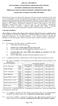 KHULNA UNIVERSITY MANAGEMENT AND BUSINESS ADMINISTRATION SCHOOL BUSINESS ADMINISTRATION DISCIPLINE ORDINANCE FOR MASTER OF BUSINESS ADMINISTRATION (MBA) (Session: 2012-13, Effective from MBA-2012 Batch)
Management. University of New Orleans/268
 Management MANG 2790 Business Communication Prerequisite: ENGL 1158 and BA 2780. This course will introduce students to the interaction of business communications and information technology in the 21st
Marketing (Marketing Principles)
 Marketing (Marketing Principles) Main Aim(s) of the Unit: To provide students with a foundation for the analysis of marketing within organizations including decision making processes, segmentation, the
INFORMATION BROCHURE
 INFORMATION BROCHURE ENTRANCE EXAM -2010 INSTITUTE OF BUSINESS MANAGEMENT ACADEMIC PROGRAMMES B.B.A (BACHELOR OF BUSINESS ADMINISTRATION ) M.B.A (PART TIME) CHHATRAPATI SHAHU JI MAHARAJ UNIVERSITY, KANPUR-208024
Master in Business Administration (Specialisation: Financial Services) LM510
 Master in Business Administration (Specialisation: Financial Services) LM510 1. Objectives The strength of this MBA in Financial Services lies in the unique combination of a general MBA content with a
M.A. PUBLIC ADMINISTRATION
 M.A. PUBLIC ADMINISTRATION FIRST YEAR PAPERS Subject Max. Marks Exam Hrs 1 Organizational Behavior 100 3 2 Administrative Theories 100 3 3 Principles of Organization and Management 100 3 4 Administrative
IFIM Business School. www.ifimbschool.com. Certificate Programme in Business Management for the Officers of Indian Armed Forces.
 IFIM Business School www.ifimbschool.com Certificate Programme in Business Management for the Officers of Indian Armed Forces Duration 24 weeks Scheduled from October 2009 About the Program: The programme
HAMPTON UNIVERSITY ONLINE Hampton University School of Business PhD in Business Administration
 Program Overview The PhD in Business Leadership and Administration is designed for professionals located nation wide who desire an advanced degree in business to excel in their careers. In addition, the
UNIVERSITY OF MUMBAI
 UNIVERSITY OF MUMBAI RULES & REGULATIONS, STRUCTURES & SYLLABUS for Ph.D. COURSE WORK under FACULTY OF TECHNOLOGY FOR ALL ENGINEERING DISCIPLINES RULES & REGULATIONS Revised rules for Ph. D under Faculty
MSc Industrial Engineering & Management - E541
 MSc Industrial Engineering & Management - E541 1. Aims and Objectives This Programme has been specifically designed to equip graduates with problem-solving, technical and managerial skills and knowledge
SYMBIOSIS INSTITUTE OF MANAGEMENT STUDIES MASTER OF BUSINESS ADMINISTRATION PROGRAM STRUCTURE 2015-17
 SYMBIOSIS INSTITUTE OF MANAGEMENT STUDIES MASTER OF BUSINESS ADMINISTRATION PROGRAM STRUCTURE 2015-17 1. OBJECTIVE To provide high quality management education to students through advancement of knowledge
Program structure - PGDM (with specializations in Marketing, Retail, Finance, HR, Systems, Operations)
 Program structure - PGDM (with specializations in Marketing, Retail, Finance, HR, Systems, Operations) Trimester I Perspective Management I Vedanta, the Art of Self Management Grooming for Executive placement
APPENDIX I POST GRADUATE DIPLOMA IN HUMAN RESOURCES DEVELOPMENT LAW ( PGDHRDL )
 APPENDIX I POST GRADUATE DIPLOMA IN HUMAN RESOURCES DEVELOPMENT LAW ( PGDHRDL ) Sr. No. Name of the Paper No. of Credits Max. Marks Min. Marks 1 Human Resources Development. 4 Theory 80 2. Organisational
REGULATIONS FOR THE DEGREE OF BACHELOR OF MANAGEMENT STUDIES (BMS)
 1417 REGULATIONS FOR THE DEGREE OF BACHELOR OF MANAGEMENT STUDIES (BMS) (See also General Regulations and Regulations for First Degree Curricula) Definition BMS 1 For the purpose of these regulations and
Master's Degree Program in Marketing (English Language)
 Master's Degree Program in Marketing (English Language) 1) Name of Curriculum: Master's Degree Program in Marketing (English Language) 2) Name of Degree: Master of Science in Marketing or M.S. (Marketing)
LCCI International Qualifications. Level 3 Certificate in Selling and Sales Management. Extended Syllabus. Effective from 2007
 LCCI International Qualifications Level 3 Certificate in Selling and Sales Management Extended Syllabus Effective from 2007 For further information contact us: Tel. +44 (0) 8707 202909 Email. [email protected]
HUMAN RESOURCE MANAGEMENT
 HUMAN RESOURCE MANAGEMENT 1. a) HRM Strategies b) Difference between Recruitment and Selection 2. a) Techniques of Performance Appraisal b) Methods of Executive Development 3. a) Methods of wage determination
MADRAS CHRISTIAN COLLEGE (AUTONOMOUS) DEPARTMENT OF SOCIAL WORK (SFS) TAMBARAM CHENNAI 59 PHONE : 22396324
 MADRAS CHRISTIAN COLLEGE (AUTONOMOUS) DEPARTMENT OF SOCIAL WORK (SFS) TAMBARAM CHENNAI 59 PHONE : 22396324 DEPARTMENT OF SOCIAL WORK SELF FINANCED STREAM MADRAS CHRISTIAN COLLEGE (AUTONOMOUS) Course Structure
MASTER OF BUSINESS ADMINISTRATION (MBA) 800 Series
 MASTER OF BUSINESS ADMINISTRATION (MBA) 800 Series BBA 820: Managerial Functions Natural and scope of management of organizations operations. Systems approach to organizations. The management process planning,
GURU NANAK DEV ENGINEERING COLLEGE, LUDHIANA Deptt. Of Business Administration
 GURU NANAK DEV ENGINEERING COLLEGE, LUDHIANA Deptt. Of Business Administration No. MBA Date :- To Controller of Examination, MST-II Date Sheet Date Time MBA-I MBA-II 17/03/16 18/03/16 21/03/16 22/03/16
Victoria University Delaware, USA
 FOR INTERNATIONAL STUDENTS STUDENT HANDBOOK FOR SCHOOL OF BUSINESS Victoria University 1102N Market Street Suite 801 Wilmington, Phone: 1 302 421 5737 Fax: 1 302 421 5737 Email: [email protected] Web-site:
CORE COURSE EXEMPTION PROCESS
 CORE COURSE EXEMPTION PROCESS The core curriculum at Fuqua provides a foundation for graduate business education. Faculty members expect each student to gain this basic core of knowledge; however, many
MBA INTERNATIONAL BUSINESS (2 YEARS PART-TIME)
 MBA INTERNATIONAL BUSINESS (2 YEARS PART-TIME) 1. INTRODUCTION The rise of globalisation means that the call for specialised skills and knowledge in this area has never been greater. Multinational businesses
THE MASTER OF TECHNOLOGY COURSE IN ENGINEERING (Full Time / Part Time)
 THE MASTER OF TECHNOLOGY COURSE IN ENGINEERING (Full Time / Part Time) OM 1 OM 1.1 OM 2 OM 2.1 OM 2.2 OM 2.3 OM 2.4 OM. 2.5 TITLE OF THE COURSE The Course shall be called Master of Technology Course, abbreviated
MICHIGAN TEST FOR TEACHER CERTIFICATION (MTTC) TEST OBJECTIVES FIELD 036: MARKETING EDUCATION
 MICHIGAN TEST FOR TEACHER CERTIFICATION (MTTC) TEST OBJECTIVES Subarea Marketing Foundations Marketing Functions Technology, Ethics, and Career Development Approximate Percentage of Questions on Test 40%
FACULTY OF BUSINESS AND ACCOUNTANCY
 FACULTY OF BUSINESS AND ACCOUNTANCY List of Courses Offered for University of Malaya Student Exchange (UMSEP) for the 2016/2017 Academic Session CORE COURSES No. Course Code Topic Pre Requisite Credit
Diploma in Marketing
 INTRODUCTION TO MARKETING PRODUCT Nature, Scope and Importance of Marketing Basic Concepts Marketing Environment Market Segmentation Targeting and Positioning Product Strategy Product Innovation and Diffusion
Master of Arts (Industrial and Organizational Psychology) M.A. (Industrial and Organizational Psychology)
 Master of Arts (Industrial and Organizational Psychology) M.A. (Industrial and Organizational Psychology) Objectives The program aims to enable graduate students to analyze, to carry on the research projects,
E. Program Outcomes Associate of Applied Business Degree in Accounting:
 E. Program Outcomes List program outcomes for each accredited program. Associate of Applied Business Degree in Accounting: G1: Students will demonstrate use of payroll procedures by: O1: Identifying various
Department Of Leadership Studies M.Sc., MBA, MBA (Executive), M.S./M.Phil Leading to Ph.D.
 Department Of Leadership Studies M.Sc., MBA, MBA (Executive), M.S./M.Phil Leading to Ph.D. The postgraduate program in Leadership Studies (LS) is a program preparing its graduates for positions of responsibility
SPECIALIZATION IN MARKETING MANAGEMENT 5.1 SALES MANAGEMENT
 81 SPECIALIZATION IN MARKETING MANAGEMENT 5.1 SALES MANAGEMENT RATIONALE L T P 4 2 - The purpose of this course is to develop understanding and skill about concepts, method and strategies of sales management.
GURU NANAK DEV UNIVERSITY AMRITSAR
 Faculty of Economics & Business Syllabus For Post Graduate Diploma in Business Management (P.G.D.B.M.) Examination: 2013 GURU NANAK DEV UNIVERSITY AMRITSAR Note: (i) Copy rights are reserved. Nobody is
(MBA III YEAR-HUMAN RESOURCE MANAGEMENT/PGDHRM) HOME ASSIGNMENT FOR MANAGEMENT PROGRAMME
 (MBA III YEAR-HUMAN RESOURCE MANAGEMENT/PGDHRM) Course Title Social Processes and Behavioural Issues Course Code : MS-21 First Assignment Code MS-21/2014/1 Coverage : Blocks 1 & 2 Q.1 Write a note on Managerial
FDU-Vancouver Bachelor of Science in Business Administration International Business Concentration Course Descriptions
 FDU-Vancouver Bachelor of Science in Business Administration International Business Concentration Course Descriptions Business Foundational Courses General Education DSCI 1234 Mathematics for Business