
1. Energy sources & / power stations. Electricity. & Waves
|
|
|
- Josephine Henry
- 9 years ago
- Views:
Transcription
1 Energy
2 2. Renewable energy sources. 1. Energy sources & / stations 6. Waves 3. Energy sources & the environment 4. Comparing energy sources 5. Electricity & the National Grid P1 Electricity & Waves 8. Sound waves 9. Origin of the Universe 7. EMS & communication

3 Will all run out All damage environment Provide most of our energy Fossil fuels coal Fossil fuel (Chemical potential energy) oil Natural gas Non- Renewable stations Uranium & Plutonium Nuclear wind Energy sources & stations Wave Tidal Renewable Geothermal hydroelectric solar Biofuel Will never run out. Do not do as much damage to the environment. Unreliable. Provide small amounts of energy. Burn (thermal energy) Boiler Water steam Nuclear reactors Turbine Kinetic energy Same EXCEPT radioactive decay of fuel produces the heat to turn water into steam Generator Electrical energy Nuclear fission
4 7. Biofuel 1. Wind 6. Geothermal 2. Solar Renewable energy sources 3. Hydroelectric 5. Tidal 4. Wave
5 Turbine drives generator (electrical energy) No pollution (except manufacture) No permanent damage to landscape Minimal running costs (no fuel costs) Noisy High start up costs Wind drives a turbine (Kinetic energy) Disadvantages Need a lot of them High visual impact Wind Advantages Unreliable energy source Need a lot of space Renewable energy source - will not run out No chance to increase supply when there is high demand Need to be in a windy place
6 Generates currents directly from sunlight Solar cells are expensive No pollution (except manufacture) Solar Used in remote places No environmental damage (except manufacture) Advantages Almost no running costs Disadvantages Unreliable energy source (unless very sunny country) Renewable energy source - will not run out Does not work at night! Solar cells only generator small amounts of electricity No chance to increase supply when there is high demand
7
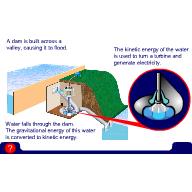
8 Water drives a turbine (Kinetic energy) Hydroelectric Peak demand Renewable energy source - will not run out Reliable energy source (if no drought!) Turbine drives generator (electrical energy) Advantages Good in remote areas No pollution when running High start up costs Disadvantages Huge environmental cost Look unsightly when they dry up! Pumped storage Minimal running costs (no fuel costs) Pump water back up Flooding valley; destroys habitat. rotting vegetation releases methane +CO 2. People can lose homes
9 NOT the same as Tidal! Water drives a turbine (Kinetic energy) Turbine drives generator (electrical energy) Renewable energy source - will not run out Wave Disadvantages Good in remote Island areas Advantages High start up costs No pollution when running Visual impact Unreliable energy source Minimal running costs
10 Quite reliable energy source (twice a day & can predict height) Renewable energy source - will not run out Advantages Good for storing energy for peak demand environmental cost Disadvantages NOT the same as Wave! Minimal running costs Sun & Moon s gravity move water... drives a turbine (Kinetic energy) Turbine drives generator (electrical energy) Tidal Quite high start up costs Remember the source of the energy is the gravitational force of the Moon & Sun Height of tide varies (energy will vary)
11 Geothermal Can only happen where the Earth s crust is thin. Pump water down drill shaft Radioactive decay in rocks produces heat Advantages Minimal running costs Disadvantages Limited number of possible locations Reliable energy source Renewable energy source - will not run out High start up cost compared to the amount of energy out Water Steam which comes up another drill shaft Turbine Kinetic energy Generator Electrical energy
12 Create jobs locally Reliable Made from plants and waste solids Straw / woodchips liquids Sources gas Methane biogas from sludge digesters Biofuel Disadvantages Advantages Quick to obtain Carbon neutral Renewable energy source - will not run out Cost of fuel Ethanol from fermenting crops biodiesel from plant oils Generate electricity in the same way as fossil fuels deforestation Loss of habitat Loss of food crops Burning increases CO 2.
13 Acid rain Fossil Fuels Nonrenewables Extraction damages environment & affects habitats Release CO 2 increases greenhouse effect global warming/climate change Nuclear No greenhouse gases Pump into empty gas & oil fields Energy sources & the environment Disposal of waste & consequence of accidents is dangerous Renewables Depends on the source but they generally have less affect on the environment than fossil fuels Carbon capture & storage Collect CO 2 from station before it goes into atmosphere Reduce amount of CO 2 going into atmosphere New technology so ideas are being developed (algae)
14 Hydroelectric & nuclear have huge engineering costs for safety. non-renewable is more reliable...until runs out! Renewable is often weather dependant weather dependence Renewable need bigger stations for the same output compared to non-renewable...costs more Set up costs reliability Visual impact 4. Comparing energy sources Environmental issues Atmospheric pollution Depends on size of station Planning issues Set-up decommissioning time Using up resources Depends on complexity of engineering Often location near energy source Running / fuel costs Renewables are lowest Danger from accidents (dam burst / nuclear accident/ contamination) Disrupting habitats Noise pollution Gas = quickest Nuclear = longest & costs most to decommision
15 Electricity distribution network for UK. ( station homes / industry) Power can be generated anywhere on grid. Need a high voltage or high current Problem: high I lose lots of energy as heat... So high V + low I. Step Up transformer. Distribution Electricity & the National Grid Use transformers to get high V for grid. ( V) Use transformers to get safe V for Step Down transformer. Or more efficient? home. (230V) More plants? Problem... Supply & demand Less waste? Pylons or underground cables. Cheaper. Lots of maintenance. Easy to repair. Ugly. Just Affected learn by pros weather. & cons Less reliable. for Pylons. Hard For cables to set up. it is Disturb land when laying the opposite... Simples!! Is increasing Consumers energy efficient appliances?
16 Waves v = f m/s Hz m ( ) wavelength vibration (A) Amplitude vibration Wave / energy direction longitudinal waves Transverse waves Light & all other EMS waves, water (f ) frequency - Hz Vibrations = perpendicular (90 ) to direction of energy transfer Vibrations = parallel to direction of energy transfer Compression + rarefaction (slinky) Sound (ultrasound)
17 Reflection Wave Properties Refraction Diffraction Caused by change of speed as wave enters medium with different density. Image is... virtual. upright. laterally inverted. Waves slow down
18 Electromagnetic Spectrum Frequency (f) increases Wavelength ( ) increases Radio Micro Infra-Red Light Ultra-Violet X rays Gamma Gate X Usually Lets In Most Radiation All EMS travels at the same speed 300 x 10 6 m/s in a vacuum. Mobile And TV s! phones Radiation therapy seeing Sunbeds bones To see! Night vision
19 Radio waves & communication Short-wave signals reflect off the ionosphere microwaves long-wave signals can be diffracted, they follow the Earth s curvature
20 Microwaves & communication For satellite For communication remote sensing AND satellites; mobile phones Microwaves pass through Earth s watery atmosphere
21 Infrared (IR) waves & communication Different patterns (commands) are emitted by the remote & received by the TV. The data is carried as pulses of light or IR very quickly + over long distances.
22 Longitudinal waves Sound waves compression rarefaction Reflection = echo! Can also be refracted. 1 wavelength
23 Uniformly spread through the universe CMBR Cosmic microwave background radiation Big bang is only explanation for existence of CMBR Evidence? Expanding Universe Origin of the universe 14 billion years old Big Bang Other theories? Limitations What caused it? Should be slowing down? Red shift (like Doppler effect) of light from other galaxies The further away the galaxy the bigger the red shift. (moving faster)
Kinetic Theory. Energy. Transfers and Efficiency. The National Grid
 AQA P1 Revision Infrared Radiation Heating and Insulating Buildings Kinetic Theory Energy Transfers and Efficiency Energy Transfer by Heating Transferring Electrical Energy Generating Electricity The National
Semester 2. Final Exam Review
 Semester 2 Final Exam Review Motion and Force Vocab Motion object changes position relative to a reference point. Speed distance traveled in a period of time. Velocity speed in a direction. Acceleration
MCQ - ENERGY and CLIMATE
 1 MCQ - ENERGY and CLIMATE 1. The volume of a given mass of water at a temperature of T 1 is V 1. The volume increases to V 2 at temperature T 2. The coefficient of volume expansion of water may be calculated
Generating Current Electricity: Complete the following summary table for each way that electrical energy is generated. Pros:
 P a g e 1 Generating Current Electricity: Complete the following summary table for each way that electrical energy is generated. Generating Electrical Energy Using Moving Water: Hydro-Electric Generation
12.5: Generating Current Electricity pg. 518
 12.5: Generating Current Electricity pg. 518 Key Concepts: 1. Electrical energy is produced by energy transformations. 2. Electrical energy is produced from renewable and non-renewable resources. 4. Electrical
CANADA S RESOURCES: CONVENTIONAL AND ALTERNATIVE ENERGY
 CANADA S RESOURCES: CONVENTIONAL AND ALTERNATIVE ENERGY Introduction Canadians are among the highest energy consumers in the world. Why? (list 3 possible reasons) Northern climate/very cold temperatures
FIELD TRIP TO A POWER PLANT - A Reading Guide
 TITLE: TOPIC: FIELD TRIP TO A POWER PLANT - A Reading Guide Energy and the sources of energy used in power plants GRADE LEVEL: Secondary CONTENT STANDARD: Earth and Space Science CONTENT OBJECTIVE: For
Alternative Energy Resources
 Alternative Energy Resources Energy Resource Advantages Disadvantages What are some renewable energy resources? A nonrenewable resource cannot be replaced in a reasonable amount of time. Fossil fuels such
5-Minute Refresher: RENEWABLE ENERGY
 5-Minute Refresher: RENEWABLE ENERGY Renewable Energy Key Ideas Renewable energy is a source of energy that can be used and replenished naturally in a relatively short period of time. Non renewable energy
Q1. (a) The block diagram shows the important parts of a coal burning power station. Use words from the box to complete the block diagram
 Q. (a) The block diagram shows the important parts of a coal burning power station. Use words from the box to complete the block diagram boiler condenser furnace generator (b) The diagram shows the energy
In science, energy is the ability to do work. Work is done when a force causes an
 What is energy? In science, energy is the ability to do work. Work is done when a force causes an object to move in the direction of the force. Energy is expressed in units of joules (J). A joule is calculated
Module 7 Forms of energy generation
 INTRODUCTION In rich countries like Australia, our standard of living is dependent on easily available energy. Every time you catch a bus, turn on a light or watch television energy is being used up. Over
Physics PH1FP. (Jun15PH1FP01) General Certificate of Secondary Education Foundation Tier June 2015. Unit Physics P1. Unit Physics P1 TOTAL
 Centre Number Surname Candidate Number For Examiner s Use Other Names Candidate Signature Examiner s Initials Question Mark Science A Unit Physics P1 Physics Unit Physics P1 Friday 12 June 2015 General
S1 Topic 9. Energy and Generating Electricity. Level: S1. Topic: Energy (Unit 4) Introduction:
 S1 Topic 9 Energy and Generating Electricity Level: S1 Topic: Energy (Unit 4) Introduction: This set of ELA materials is designed for students whose academic ability is comparatively high. The whole unit,
AZ State Standards. Concept 3: Conservation of Energy and Increase in Disorder Understand ways that energy is conserved, stored, and transferred.
 Forms of Energy AZ State Standards Concept 3: Conservation of Energy and Increase in Disorder Understand ways that energy is conserved, stored, and transferred. PO 1. Describe the following ways in which
Physical Science Study Guide Unit 7 Wave properties and behaviors, electromagnetic spectrum, Doppler Effect
 Objectives: PS-7.1 Physical Science Study Guide Unit 7 Wave properties and behaviors, electromagnetic spectrum, Doppler Effect Illustrate ways that the energy of waves is transferred by interaction with
After a wave passes through a medium, how does the position of that medium compare to its original position?
 Light Waves Test Question Bank Standard/Advanced Name: Question 1 (1 point) The electromagnetic waves with the highest frequencies are called A. radio waves. B. gamma rays. C. X-rays. D. visible light.
Do-Now. 1.) Get out notebook.
 Do-Now 1.) Get out notebook. 2.) Answer the following questions on the first clean sheet in your notebook. 1.) What are renewable resources? 2.) What are nonrenewable resources? Alternative Sources of
Energy Transformations
 Energy Transformations Concept Sheet Energy Transformations PS.6: The student will investigate and understand states and forms of energy and how energy is transferred and transformed. 1. Energy is the
Conventional Energy Sources
 9.2 Conventional Energy Sources Key Question: What benefits and problems come with common sources of energy? Hints The word plant here is not the kind that grows out of the ground. In this section, plants
T E A C H E R S N O T E S
 T E A C H E R S N O T E S Focus: Students explore energy: its sources, forms, and transformations. Students also consider the benefits of energy-efficient technologies and energy conservation. Learning
Station #1 Interpreting Infographs
 Energy Resources Stations Activity Page # 1 Station #1 Interpreting Infographs 1. Identify and explain each of the energy sources (5) illustrated in the infograph. 2. What do the white and black circles
PAMUN XV ENVIRONMENT COMMITTEE PROMOTING THE MOVEMENT TOWARDS RENEWABLE RESOURCES OF ENERGY
 PAMUN XV ENVIRONMENT COMMITTEE PROMOTING THE MOVEMENT TOWARDS RENEWABLE RESOURCES OF ENERGY Introduction of Topic Currently non-renewable resources make up 85% of the world's energy consumption; a major
Section 15.1 Energy and Its Forms (pages 446 452)
 Section 15.1 and Its Forms (pages 446 452) This section describes how energy and work are related. It defines kinetic energy and potential energy, and gives examples for calculating these forms of energy.
Module 2.2. Heat transfer mechanisms
 Module 2.2 Heat transfer mechanisms Learning Outcomes On successful completion of this module learners will be able to - Describe the 1 st and 2 nd laws of thermodynamics. - Describe heat transfer mechanisms.
Solar PV panels fitted to roofs. Solar PV panels produce electricity from energy provided by sunlight. 3.5 MWh per system
 Solar PV panels fitted to roofs Yearly cost of production Cost per kwh 12.5p Solar PV panels produce electricity from energy provided by sunlight. 3.5 MWh per system 430 per system Solar energy can be
NUCLEAR FUEL CYCLE ROYAL COMMISSION. Advantages and disadvantages of different technologies and fuel sources; risks and opportunities
 NUCLEAR FUEL CYCLE ROYAL COMMISSION Submission on Issues Paper 3: Advantages and disadvantages of different technologies and fuel sources; risks and opportunities 3.8 What issues should be considered in
MAKING SENSE OF ENERGY Electromagnetic Waves
 Adapted from State of Delaware TOE Unit MAKING SENSE OF ENERGY Electromagnetic Waves GOALS: In this Part of the unit you will Learn about electromagnetic waves, how they are grouped, and how each group
MARKING SCHEME PHYSICS SCIENCE UNIT P1 ADDITIONAL SCIENCE UNIT P2 MS2 2.00
 MS.00 GENERAL CERTIFICATE OF SECONDARY EDUCATION TYSTYSGRIF GYFFREDINOL ADDYSG UWCRADD MARKING SCEME PYSICS SCIENCE UNIT P ADDITIONAL SCIENCE UNIT P JANUARY 008 INTRODUCTION The marking schemes which follow
Chapter 13 Quiz. Multiple Choice Identify the choice that best completes the statement or answers the question.
 Chapter 13 Quiz Multiple Choice Identify the choice that best completes the statement or answers the question. 1. Which of the following is the correct type of energy utilized to produce tidal power? a.
1. Nuclear - In YOUR OWN WORDS (not your partner s words) explain how this energy source works.
 ENERGY RESOURCES ACTIVITY Integrated Science 4 Name: Date: Period: Directions: In groups, you will be going from station to station answering questions about differing energy resource. Each individual
A/A* Model Answers Physics P1
 A/A* Model Answers Physics P1 Name:... Heat transfer Explain, in terms of particles, how heat is transferred through the glass wall of a boiling tube. (2 marks) particles vibrate with a bigger / stronger
Sustainable Energy Sources By: Sue Peterson
 www.k5learning.com Objective sight words (consumption, terrain, integral, orbit, originated, contemporary, remote); concepts (sustainable, renewable, photovoltaics, gasification) Vocabulary consumption
RENEWABLE RESOURCES. Kinds of renewable resources. 1. Solar energy
 RENEWABLE RESOURCES Natural resources (also called land or raw materials) occur naturally within environments that exist relatively undisturbed by mankind, in a natural form. Natural resources are derived
Course CME 310 Solar Power For Africa
 Course CME 310 Solar Power For Africa ENERGY RESOURCES, ENERGY PRODUCTION AND ENERGY DISTRIBUTION by Prof. Margit Harting NanoSciences Innovation Centre Department of Physics University of Cape Town South
Waves Sound and Light
 Waves Sound and Light r2 c:\files\courses\1710\spr12\wavetrans.doc Ron Robertson The Nature of Waves Waves are a type of energy transmission that results from a periodic disturbance (vibration). They are
Energy and Energy Transformations Test Review
 Energy and Energy Transformations Test Review Completion: 1. Mass 13. Kinetic 2. Four 14. thermal 3. Kinetic 15. Thermal energy (heat) 4. Electromagnetic/Radiant 16. Thermal energy (heat) 5. Thermal 17.
Investigating How Electricity is Generated
 www.waterplanetchallenge.org Lesson Plan Grades 9-12 Investigating How Electricity is Generated Electrically Speaking: How Does it Get From There to Here? Introduction Ask your students, What is the cost
v = fλ PROGRESSIVE WAVES 1 Candidates should be able to :
 PROGRESSIVE WAVES 1 Candidates should be able to : Describe and distinguish between progressive longitudinal and transverse waves. With the exception of electromagnetic waves, which do not need a material
Electricity. Electricity: The Mysterious Force. 32 Intermediate Energy Infobook CARBON ATOM SEVERAL COMMON ELEMENTS
 Electricity: The Mysterious Force What exactly is the mysterious force we call electricity? It is simply moving electrons. And what exactly are electrons? They are tiny particles found in atoms. Everything
10 Nuclear Power Reactors Figure 10.1
 10 Nuclear Power Reactors Figure 10.1 89 10.1 What is a Nuclear Power Station? The purpose of a power station is to generate electricity safely reliably and economically. Figure 10.1 is the schematic of
ADVANTAGES AND DISADVANTAGES OF ENERGY SOURCES. Prepared by Sandra Vasa-Sideris, PhD, Southern Polytechnic State University, for use by students
 ADVANTAGES AND DISADVANTAGES OF ENERGY SOURCES Prepared by Sandra Vasa-Sideris, PhD, Southern Polytechnic State University, for use by students Questions to consider Where are the nonrenewable sources
Structure and Properties of Atoms
 PS-2.1 Compare the subatomic particles (protons, neutrons, electrons) of an atom with regard to mass, location, and charge, and explain how these particles affect the properties of an atom (including identity,
Science Tutorial TEK 6.9C: Energy Forms & Conversions
 Name: Teacher: Pd. Date: Science Tutorial TEK 6.9C: Energy Forms & Conversions TEK 6.9C: Demonstrate energy transformations such as energy in a flashlight battery changes from chemical energy to electrical
ENERGY AND ENERGY TRANSFORMATIONS. The scientific definition of energy is the ability to do work. The four most common forms of energy are:
 ENERGY AND ENERGY TRANSFORMATIONS The scientific definition of energy is the ability to do work. The four most common forms of energy are: chemical - potential or stored energy stored in chemicals, released
The Co-operative s Green Schools Revolution. LESSON PLAN KS3: Brightening Britain better all about sustainable energy.
 Energy The Co-operative s Green Schools Revolution LESSON PLAN KS3: Brightening Britain better all about sustainable energy. SUGGESTED TIME: 60 MINS Age group No. of pupils in cohort Classroom support
ch 15 practice test Multiple Choice Identify the letter of the choice that best completes the statement or answers the question.
 ch 15 practice test Multiple Choice Identify the letter of the choice that best completes the statement or answers the question. 1. Work is a transfer of a. energy. c. mass. b. force. d. motion. 2. What
Y10 Foundation Revision 101 Questions!
 Y0 Foundation Revision 0 Questions! Q. The diagrams show the cross-section of three double glazed windows. The gap between the two sheets of glass can be filled with either air or a mixture of air and
Renewable vs. non-renewable energy sources, forms and technologies prepared by. A.Gritsevskyi, IAEA
 Renewable vs. non-renewable energy sources, forms and technologies prepared by. A.Gritsevskyi, IAEA Objective of this paper is to provide International Recommendations for Energy Statistics (IRES) with
Alternative Energy. Terms and Concepts: Relative quantities of potential energy resources, Solar constant, Economies of scale
 Objectives Key Terms and Concepts Introduction Solar Wind Hydroelectric Power Geothermal Sources Biofuels Summary: Economies of Scale Questions for the video if time permits Alternative Energy Objectives:
Friday 20 January 2012 Morning
 THIS IS A NEW SPECIFICATION H Friday 20 January 2012 Morning GCSE TWENTY FIRST CENTURY SCIENCE PHYSICS A A181/02 Modules P1 P2 P3 (Higher Tier) *A131500112* Candidates answer on the Question Paper. A calculator
ANALYZING ENERGY. Time and Student Grouping Energy Source Analysis and Consequence Wheel: One class period. Grade Levels: 6-12
 ANALYZING ENERGY Lesson Concepts: Students will analyze the advantages and disadvantages of nine different energy sources. They will use their knowledge to predict what would happen if the world did not
Chapter 4 Forms of energy
 Chapter 4 Forms of energy Introduction This chapter compromises a set of activities that focuses on the energy sources and conversion. The activities illustrate The concept and forms of energy; The different
CHAPTER 2 Energy and Earth
 CHAPTER 2 Energy and Earth This chapter is concerned with the nature of energy and how it interacts with Earth. At this stage we are looking at energy in an abstract form though relate it to how it affect
Chapter 2: Forms of Energy
 Chapter 2: Forms of Energy Goals of Period 2 Section 2.1: To describe the forms of energy Section 2.2: To illustrate conversions from one form of energy to another Section 2.3 To describe energy storage
Thursday 23 May 2013 Morning
 THIS IS A NEW SPECIFICATION H Thursday 23 May 2013 Morning GCSE TWENTY FIRST CENTURY SCIENCE PHYSICS A A181/02 Modules P1 P2 P3 (Higher Tier) *A137270613* Candidates answer on the Question Paper. A calculator
From lowest energy to highest energy, which of the following correctly orders the different categories of electromagnetic radiation?
 From lowest energy to highest energy, which of the following correctly orders the different categories of electromagnetic radiation? From lowest energy to highest energy, which of the following correctly
Energy Crisis in India
 Energy Crisis in India Welcome to the annual meeting of the International Association for Energy Economics meeting in New Delhi, India. India is suffering from a severe energy crisis. Three different companies
Sources of energy : a source of energy is that which is capable of providing enough useful energy at a steady rate over a long period of time.
 Energy: - Whenever a body is capable of doing work, the body is said to possess energy. Thus energy is defined as the ability of a body to do work and the amount of energy possessed by a body is equal
Innovadidattica, Leggere e scrivere l'ambiente
 Attenzione: l'allievo ha risposto usando il colore rosso. Allievo: Francesco B. 1. Read 1. Energy basics Energy is in everything. We use energy for everything we do, from making a jump shot to baking cookies
General Physical Science
 General Physical Science Chapter 4 Work and Energy Work The work done by a constant force F acting upon an object is the product of the magnitude of the force (or component of the force) and the parallel
COLLATED QUESTIONS: ELECTROMAGNETIC RADIATION
 COLLATED QUESTIONS: ELECTROMAGNETIC RADIATION 2011(2): WAVES Doppler radar can determine the speed and direction of a moving car. Pulses of extremely high frequency radio waves are sent out in a narrow
Amherst County Public Schools. AP Environmental Science Curriculum Pacing Guide. College Board AP Environmental Science Site
 Amherst County Public Schools AP Environmental Science Curriculum Pacing Guide College Board AP Environmental Science Site REV: 8/12 1 st 9 weeks AP Objectives Energy Resources and Consumption A. Energy
Investigating How Electricity is Generated
 www.waterplanetchallenge.org Lesson Plan Grades 6-8 Investigating How Electricity is Generated Electrically Speaking: How Does it Get From There to Here? Introduction Here are the facts. First, civilization
PHYSICAL WORLD. Heat & Energy GOD S DESIGN. 4th Edition Debbie & Richard Lawrence
 PHYSICAL WORLD Heat & Energy GOD S DESIGN 4th Edition Debbie & Richard Lawrence God s Design for the Physical World is a complete physical science curriculum for grades 3 8. The books in this series are
Introduction to Forms of Energy
 FORMS OF ENERGY LESSON PLAN 2.1 Introduction to Forms of Energy This lesson is designed for 3rd 5th grade students in a variety of school settings (public, private, STEM schools, and home schools) in the
Physics Unit 1 Revision (higher tier)
 Physics Unit Revision (higher tier) Energy There are 9 different forms of energy: Light Heat Chemical Kinetic (movement) Electrical Elastic (Gravitational) potential Nuclear Sound Energy is never created
Indiana's Academic Standards 2010 ICP Indiana's Academic Standards 2016 ICP. map) that describe the relationship acceleration, velocity and distance.
 .1.1 Measure the motion of objects to understand.1.1 Develop graphical, the relationships among distance, velocity and mathematical, and pictorial acceleration. Develop deeper understanding through representations
Waves - Transverse and Longitudinal Waves
 Waves - Transverse and Longitudinal Waves wave may be defined as a periodic disturbance in a medium that carries energy from one point to another. ll waves require a source and a medium of propagation.
AP ENVIRONMENTAL SCIENCE 2012 SCORING GUIDELINES
 AP ENVIRONMENTAL SCIENCE 2012 SCORING GUIDELINES Question 2 The Fremont School District uses oil to heat school buildings. Go Green! is a new project the district will implement. The superintendent has
Scientists cannot avoid affecting the environment. However, they want to affect it as little as possible.
 Q. Antarctica is a huge land mass surrounding the Earth s south pole. It is covered in a very thick layer of ice and is the only remaining large area of the Earth s surface that has not been affected very
Environmental Science 101 Energy. Web-Based Course. Lecture Outline: Terms You Should Know: Learning Objectives: Reading Assignment:
 Environmental Science 101 Energy 1 Web-Based Course Lecture Outline: 5. RENEWABLE ENERGY RESOURCES MODULE 5.1 Improving Energy Efficiency A. Improving Energy Efficiency MODULE 5.2 Geothermal, Hydro and
Unit 2 Lesson 1 Introduction to Energy. Copyright Houghton Mifflin Harcourt Publishing Company
 Get Energized! What are two types of energy? Energy is the ability to cause change. Energy takes many different forms and causes many different effects. There are two general types of energy: kinetic energy
Mark Scheme (Results) March 2012. GCSE Physics 5PH1H/01
 Mark Scheme (Results) March 2012 GCSE Physics 5PH1H/01 Edexcel and BTEC Qualifications Edexcel and BTEC qualifications come from Pearson, the world s leading learning company. We provide a wide range of
Understanding and Measuring School Electronics
 Understanding and Measuring School Electronics MATERIALS NEEDED: 1. 6 energy monitoring devices (note: these can be obtained from a variety of sources, i.e., local hardware stores, internet [average cost
FACTS ABOUT CLIMATE CHANGE
 FACTS ABOUT CLIMATE CHANGE 1. What is climate change? Climate change is a long-term shift in the climate of a specific location, region or planet. The shift is measured by changes in features associated
310 Exam Questions. 1) Discuss the energy efficiency, and why increasing efficiency does not lower the amount of total energy consumed.
 310 Exam Questions 1) Discuss the energy efficiency, and why increasing efficiency does not lower the amount of total energy consumed. 2) What are the three main aspects that make an energy source sustainable?
Consider How can you collect solar energy for use in your school? What are other alternatives?
 5 a 5 Energy Sources a - Energy from the sun Purpose To explore sourcing our energy from the sun Key concepts Solar energy is a natural and renewable resource Heat energy from the sun can be used to heat
What is Energy? What is the relationship between energy and work?
 What is Energy? What is the relationship between energy and work? Compare kinetic and potential energy What are the different types of energy? What is energy? Energy is the ability to do work. Great, but
Review 1. Multiple Choice Identify the choice that best completes the statement or answers the question.
 Review 1 Multiple Choice Identify the choice that best completes the statement or answers the question. 1. When hydrogen nuclei fuse into helium nuclei a. the nuclei die. c. particles collide. b. energy
SPQ Module 3 Solar Power
 SPQ Module 3 Solar Power The sun is the source of all life on earth. Yet we sometimes forget how central it is to our every activity. We stumble through our daily routine worrying about the mundane tribulations
AP ENVIRONMENTAL SCIENCE 2012 SCORING GUIDELINES
 AP ENVIRONMENTAL SCIENCE 2012 SCORING GUIDELINES Question1 Read the following article from the Fremont Gazette and answer the questions that follow. (a) Identify and describe TWO water-related environmental
Energy Sources: The Pros and Cons
 Energy Sources: The Pros and Cons A Reading A Z Level Z Leveled Book Word Count: 1,803 LEVELED BOOK Z Energy Sources: The Pros and Cons Written by David L. Dreier Visit www.readinga-z.com for thousands
Basics. this is a form of solar energy, as the sun drives water evaporation from the ocean and winds carry the moisture overland
 Hydropower Basics this is a form of solar energy, as the sun drives water evaporation from the ocean and winds carry the moisture overland largest form of alternative energy used today (but only 2% of
Issue 3. Should we use more renewable energy as electricity source. in Hong Kong?
 Issue 3 Should we use more renewable energy as electricity source in Hong Kong? Objectives 1. To know the source of electricity in Hong Kong 2. To briefly understand how electricity is generated 3. To
Name of the Island. Use the Three pillars of sustainability to evaluate the options of generating power.
 Name Period Name of the Island A newly populated island off the South American cost needs a new power station. The president, Dési Bouterse has asked the local leaders split themselves up to research options.
Review Vocabulary spectrum: a range of values or properties
 Standards 7.3.19: Explain that human eyes respond to a narrow range of wavelengths of the electromagnetic spectrum. 7.3.20: Describe that something can be seen when light waves emitted or reflected by
Final. Mark Scheme. Science A / Physics (Specification 4405 / 4403) PH1FP. Unit: Physics 1. General Certificate of Secondary Education January 2013
 Version.0 General Certificate of Secondary Education January 203 Science A / Physics (Specification 4405 / 4403) PHFP Unit: Physics Final Mark Scheme Mark schemes are prepared by the Principal Examiner
Science Standard 3 Energy and Its Effects Grade Level Expectations
 Science Standard 3 Energy and Its Effects Grade Level Expectations Science Standard 3 Energy and Its Effects The flow of energy drives processes of change in all biological, chemical, physical, and geological
Geography - Junior Cert
 Geography - Junior Cert Energy forms the core of geography and yet it is often overlooked in the race for points. At the Junior Certificate level all the main areas are covered: the means and sources of
Renewable Choice Energy
 Catawba College Table of Contents About Renewable Choice The Problem: Electricity Production Today The Solutions: Renewable Energy Sources Renewable Energy Credits (RECs) Who can participate in Renewable
Measuring Electricity Class Activity
 Measuring Electricity Class Activity Objective: To understand what energy is, how it impacts our daily lives, and how one can become an energy steward. Learning Outcomes: Students will: 1. Understand where
How to Earn the LEED Green Power Credit
 3D EG REES WH ITE PAPER How to Earn the LEED Green Power Credit Using on-site and off-site renewable energy to mitigate the impact of greenhouse gas emissions associated with a LEED project s energy use
Ch 25 Chapter Review Q & A s
 Ch 25 Chapter Review Q & A s a. a wiggle in time is called? b. a wiggle in space & time is called? a. vibration b. wave What is the period of a pendulum? The period is the time for 1 cycle (back & forth)
P1 4. Waves and their uses
 P 4. Waves and their uses P 8 minutes 8 marks Answer all questions using any and all resources. Page of 38 Q. Diagram shows four of the seven types of wave in the electromagnetic spectrum. Diagram J K
Name: Class: Date: 10. Some substances, when exposed to visible light, absorb more energy as heat than other substances absorb.
 Name: Class: Date: ID: A PS Chapter 13 Review Modified True/False Indicate whether the statement is true or false. If false, change the identified word or phrase to make the statement true. 1. In all cooling
Astronomy 110 Homework #04 Assigned: 02/06/2007 Due: 02/13/2007. Name:
 Astronomy 110 Homework #04 Assigned: 02/06/2007 Due: 02/13/2007 Name: Directions: Listed below are twenty (20) multiple-choice questions based on the material covered by the lectures this past week. Choose
physics 1/12/2016 Chapter 20 Lecture Chapter 20 Traveling Waves
 Chapter 20 Lecture physics FOR SCIENTISTS AND ENGINEERS a strategic approach THIRD EDITION randall d. knight Chapter 20 Traveling Waves Chapter Goal: To learn the basic properties of traveling waves. Slide
STAAR Science Tutorial 30 TEK 8.8C: Electromagnetic Waves
 Name: Teacher: Pd. Date: STAAR Science Tutorial 30 TEK 8.8C: Electromagnetic Waves TEK 8.8C: Explore how different wavelengths of the electromagnetic spectrum such as light and radio waves are used to
Sihwa Tidal Power Plant: a success of environment and energy policy in Korea
 Sihwa Tidal Power Plant: a success of environment and energy policy in Korea May 2007 Prof. Nohyoung Park Korea University Energy Situations in Korea Korea started its industrial development in the 1970s,