
THE CITRIC ACID CYCLE
|
|
|
- Heather Phelps
- 9 years ago
- Views:
Transcription
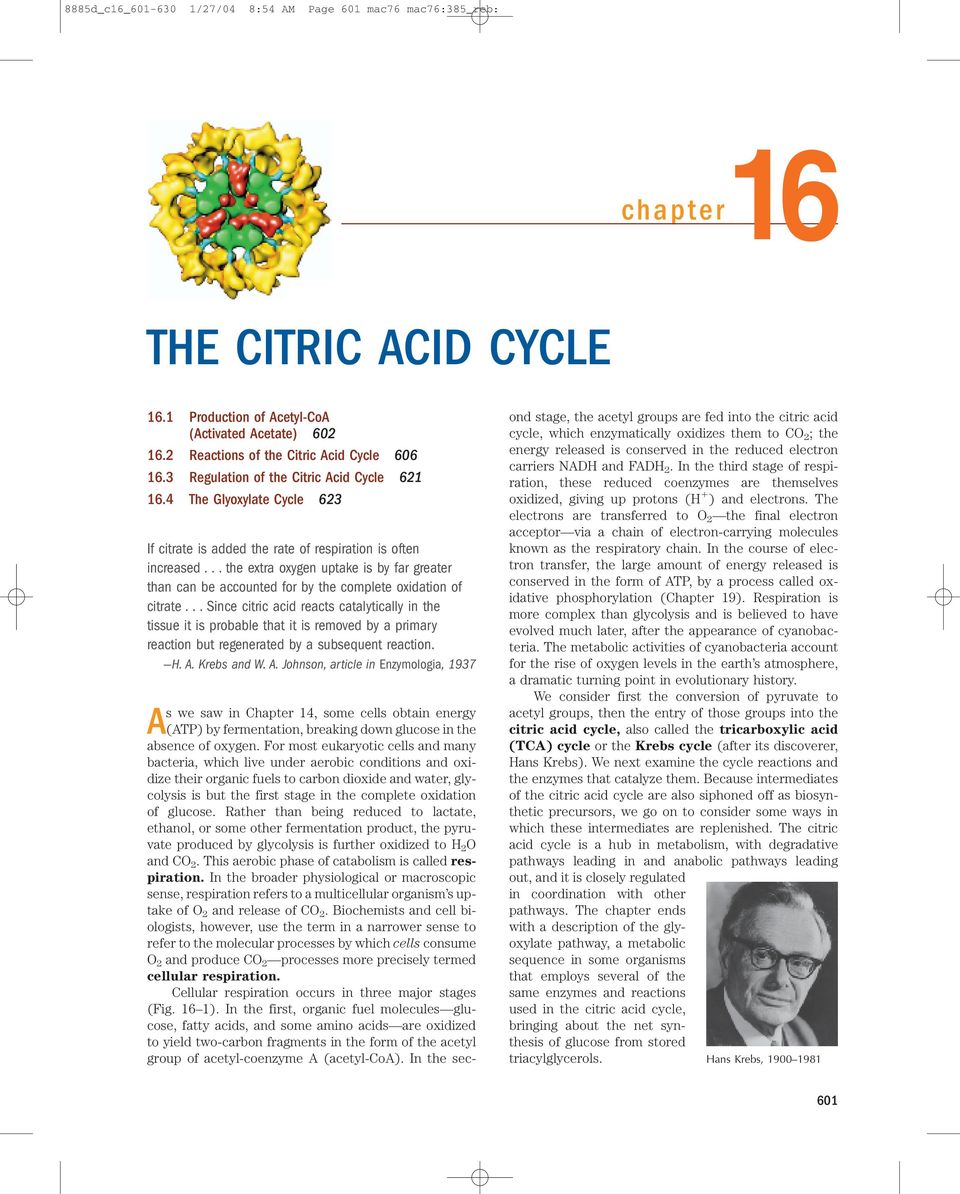
1 8885d_c16_ /27/04 8:54 AM Page 601 mac76 mac76:385_reb: 16 chapter TE ITRI AID YLE 16.1 Production of Acetyl-oA (Activated Acetate) Reactions of the itric Acid ycle Regulation of the itric Acid ycle The Glyoxylate ycle 623 If citrate is added the rate of respiration is often increased... the extra oxygen uptake is by far greater than can be accounted for by the complete oxidation of citrate... ince citric acid reacts catalytically in the tissue it is probable that it is removed by a primary reaction but regenerated by a subsequent reaction.. A. Krebs and W. A. Johnson, article in Enzymologia, 1937 As we saw in hapter 14, some cells obtain energy (ATP) by fermentation, breaking down glucose in the absence of oxygen. For most eukaryotic cells and many bacteria, which live under aerobic conditions and oxidize their organic fuels to carbon dioxide and water, glycolysis is but the first stage in the complete oxidation of glucose. Rather than being reduced to lactate, ethanol, or some other fermentation product, the pyruvate produced by glycolysis is further oxidized to 2 and 2. This aerobic phase of catabolism is called respiration. In the broader physiological or macroscopic sense, respiration refers to a multicellular organism s uptake of 2 and release of 2. Biochemists and cell biologists, however, use the term in a narrower sense to refer to the molecular processes by which cells consume 2 and produce 2 processes more precisely termed cellular respiration. ellular respiration occurs in three major stages (Fig. 16 1). In the first, organic fuel molecules glucose, fatty acids, and some amino acids are oxidized to yield two-carbon fragments in the form of the acetyl group of acetyl-coenzyme A (acetyl-oa). In the second stage, the acetyl groups are fed into the citric acid cycle, which enzymatically oxidizes them to 2 ; the energy released is conserved in the reduced electron carriers AD and FAD 2. In the third stage of respiration, these reduced coenzymes are themselves oxidized, giving up protons ( ) and electrons. The electrons are transferred to 2 the final electron acceptor via a chain of electron-carrying molecules known as the respiratory chain. In the course of electron transfer, the large amount of energy released is conserved in the form of ATP, by a process called oxidative phosphorylation (hapter 19). Respiration is more complex than glycolysis and is believed to have evolved much later, after the appearance of cyanobacteria. The metabolic activities of cyanobacteria account for the rise of oxygen levels in the earth s atmosphere, a dramatic turning point in evolutionary history. We consider first the conversion of pyruvate to acetyl groups, then the entry of those groups into the citric acid cycle, also called the tricarboxylic acid (TA) cycle or the Krebs cycle (after its discoverer, ans Krebs). We next examine the cycle reactions and the enzymes that catalyze them. Because intermediates of the citric acid cycle are also siphoned off as biosynthetic precursors, we go on to consider some ways in which these intermediates are replenished. The citric acid cycle is a hub in metabolism, with degradative pathways leading in and anabolic pathways leading out, and it is closely regulated in coordination with other pathways. The chapter ends with a description of the glyoxylate pathway, a metabolic sequence in some organisms that employs several of the same enzymes and reactions used in the citric acid cycle, bringing about the net synthesis of glucose from stored triacylglycerols. ans Krebs,
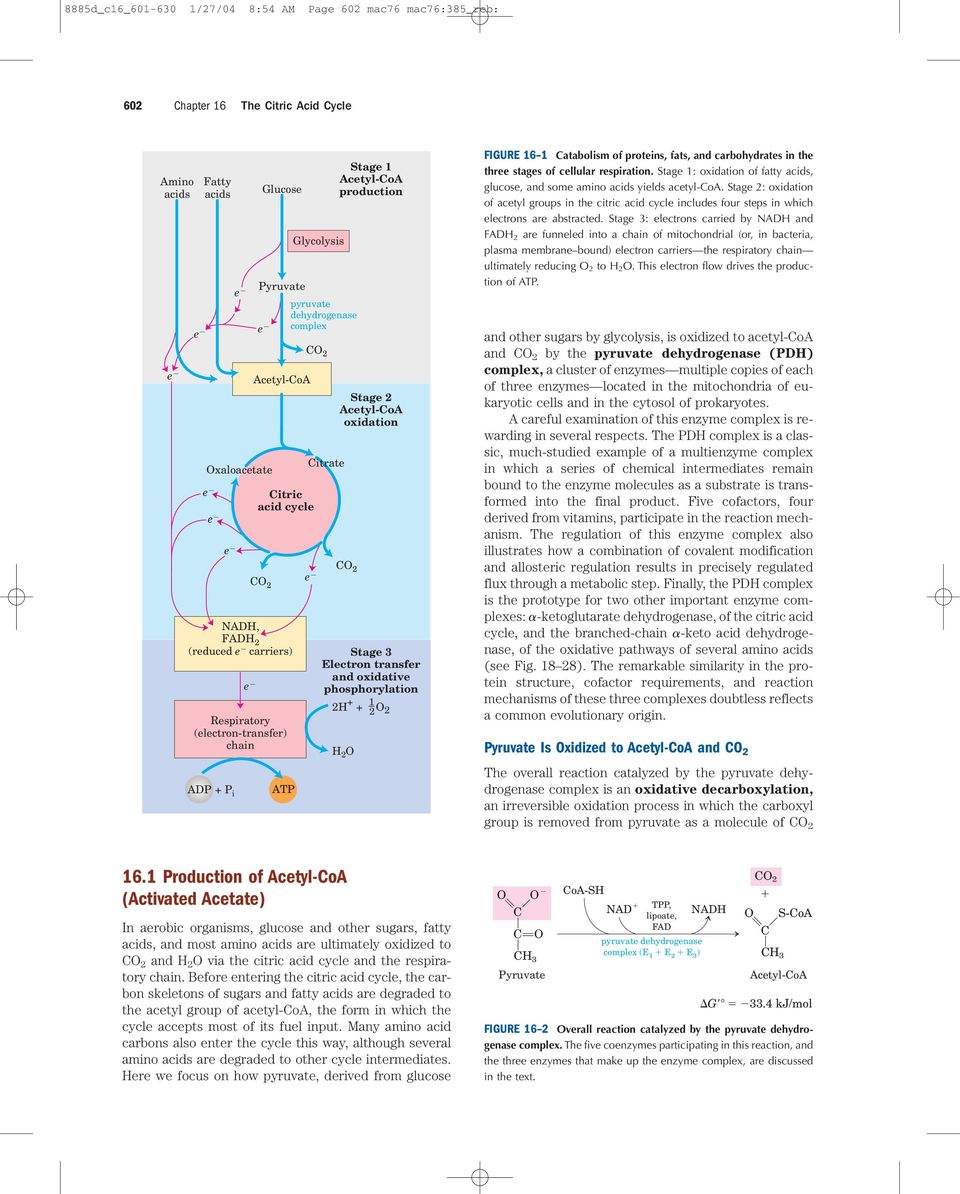
2 8885d_c16_ /27/04 8:54 AM Page 602 mac76 mac76:385_reb: 602 hapter 16 The itric Acid ycle Amino acids e e Fatty acids xaloacetate e e e AD, FAD 2 (reduced e carriers) Respiratory (electron-transfer) chain ADP + P i e Pyruvate e Acetyl-oA itric acid cycle 2 Glucose ATP Glycolysis pyruvate dehydrogenase complex 2 itrate e tage 1 Acetyl-oA production tage 2 Acetyl-oA oxidation 2 tage 3 Electron transfer and oxidative phosphorylation e 1 2 FIGURE 16 1 atabolism of proteins, fats, and carbohydrates in the three stages of cellular respiration. tage 1: oxidation of fatty acids, glucose, and some amino acids yields acetyl-oa. tage 2: oxidation of acetyl groups in the citric acid cycle includes four steps in which electrons are abstracted. tage 3: electrons carried by AD and FAD 2 are funneled into a chain of mitochondrial (or, in bacteria, plasma membrane bound) electron carriers the respiratory chain ultimately reducing 2 to 2. This electron flow drives the production of ATP. and other sugars by glycolysis, is oxidized to acetyl-oa and 2 by the pyruvate dehydrogenase (PD) complex, a cluster of enzymes multiple copies of each of three enzymes located in the mitochondria of eukaryotic cells and in the cytosol of prokaryotes. A careful examination of this enzyme complex is rewarding in several respects. The PD complex is a classic, much-studied example of a multienzyme complex in which a series of chemical intermediates remain bound to the enzyme molecules as a substrate is transformed into the final product. Five cofactors, four derived from vitamins, participate in the reaction mechanism. The regulation of this enzyme complex also illustrates how a combination of covalent modification and allosteric regulation results in precisely regulated flux through a metabolic step. Finally, the PD complex is the prototype for two other important enzyme complexes: -ketoglutarate dehydrogenase, of the citric acid cycle, and the branched-chain -keto acid dehydrogenase, of the oxidative pathways of several amino acids (see Fig ). The remarkable similarity in the protein structure, cofactor requirements, and reaction mechanisms of these three complexes doubtless reflects a common evolutionary origin. Pyruvate Is xidized to Acetyl-oA and 2 The overall reaction catalyzed by the pyruvate dehydrogenase complex is an oxidative decarboxylation, an irreversible oxidation process in which the carboxyl group is removed from pyruvate as a molecule of Production of Acetyl-oA (Activated Acetate) In aerobic organisms, glucose and other sugars, fatty acids, and most amino acids are ultimately oxidized to 2 and 2 via the citric acid cycle and the respiratory chain. Before entering the citric acid cycle, the carbon skeletons of sugars and fatty acids are degraded to the acetyl group of acetyl-oa, the form in which the cycle accepts most of its fuel input. Many amino acid carbons also enter the cycle this way, although several amino acids are degraded to other cycle intermediates. ere we focus on how pyruvate, derived from glucose M D A P A 3 Pyruvate oa- AD TPP, lipoate, FAD pyruvate dehydrogenase complex (E 1 E 2 E 3 ) AD 2 -oa M D A 3 Acetyl-oA G 33.4 kj/mol FIGURE 16 2 verall reaction catalyzed by the pyruvate dehydrogenase complex. The five coenzymes participating in this reaction, and the three enzymes that make up the enzyme complex, are discussed in the text.
3 8885d_c16_ /27/04 8:54 AM Page 603 mac76 mac76:385_reb: 16.1 Production of Acetyl-oA (Activated Acetate) 603 Reactive thiol group P P 2 -Mercaptoethylamine 3 4 Pantothenic acid 3 -oa Acetyl-oA oenzyme A 5 3 P Phosphoadenosine diphosphate Adenine Ribose 3-phosphate FIGURE 16-3 oenzyme A (oa). A hydroxyl group of pantothenic acid is joined to a modified ADP moiety by a phosphate ester bond, and its carboxyl group is attached to -mercaptoethylamine in amide linkage. The hydroxyl group at the 3 position of the ADP moiety has a phosphoryl group not present in free ADP. The group of the mercaptoethylamine moiety forms a thioester with acetate in acetylcoenzyme A (acetyl-oa) (lower left). and the two remaining carbons become the acetyl group of acetyl-oa (Fig. 16 2). The AD formed in this reaction gives up a hydride ion (: ) to the respiratory chain (Fig. 16 1), which carries the two electrons to oxygen or, in anaerobic microorganisms, to an alternative electron acceptor such as nitrate or sulfate. The transfer of electrons from AD to oxygen ultimately generates 2.5 molecules of ATP per pair of electrons. The irreversibility of the PD complex reaction has been demonstrated by isotopic labeling experiments: the complex cannot reattach radioactively labeled 2 to acetyl-oa to yield carboxyl-labeled pyruvate. The Pyruvate Dehydrogenase omplex Requires Five oenzymes The combined dehydrogenation and decarboxylation of pyruvate to the acetyl group of acetyl-oa (Fig. 16 2) requires the sequential action of three different enzymes and five different coenzymes or prosthetic groups thiamine pyrophosphate (TPP), flavin adenine dinucleotide (FAD), coenzyme A (oa, sometimes denoted oa-, to emphasize the role of the group), nicotinamide adenine dinucleotide (AD), and lipoate. Four different vitamins required in human nutrition are vital components of this system: thiamine (in TPP), riboflavin (in FAD), niacin (in AD), and pantothenate (in oa). We have already described the roles of FAD and AD as electron carriers (hapter 13), and we have encountered TPP as the coenzyme of pyruvate decarboxylase (see Fig ). oenzyme A (Fig. 16 3) has a reactive thiol () group that is critical to the role of oa as an acyl carrier in a number of metabolic reactions. Acyl groups are covalently linked to the thiol group, forming thioesters. Because of their relatively high standard free energies of hydrolysis (see Figs 13 6, 13 7), thioesters have a high acyl group transfer potential and can donate their acyl groups to a variety of acceptor molecules. The acyl group attached to coenzyme A may thus be thought of as activated for group transfer. The fifth cofactor of the PD complex, lipoate (Fig. 16 4), has two thiol groups that can undergo reversible oxidation to a disulfide bond (), similar to that between two ys residues in a protein. Because of its capacity to undergo oxidation-reduction reactions, lipoate can serve both as an electron hydrogen carrier and as an acyl carrier, as we shall see. Lipoic acid Lys residue of E 2 xidized form Reduced form Polypeptide chain of E 2 (dihydrolipoyl transacetylase) Acetylated form FIGURE 16 4 Lipoic acid (lipoate) in amide linkage with a Lys residue. The lipoyllysyl moiety is the prosthetic group of dihydrolipoyl transacetylase (E 2 of the PD complex). The lipoyl group occurs in oxidized (disulfide) and reduced (dithiol) forms and acts as a carrier of both hydrogen and an acetyl (or other acyl) group.

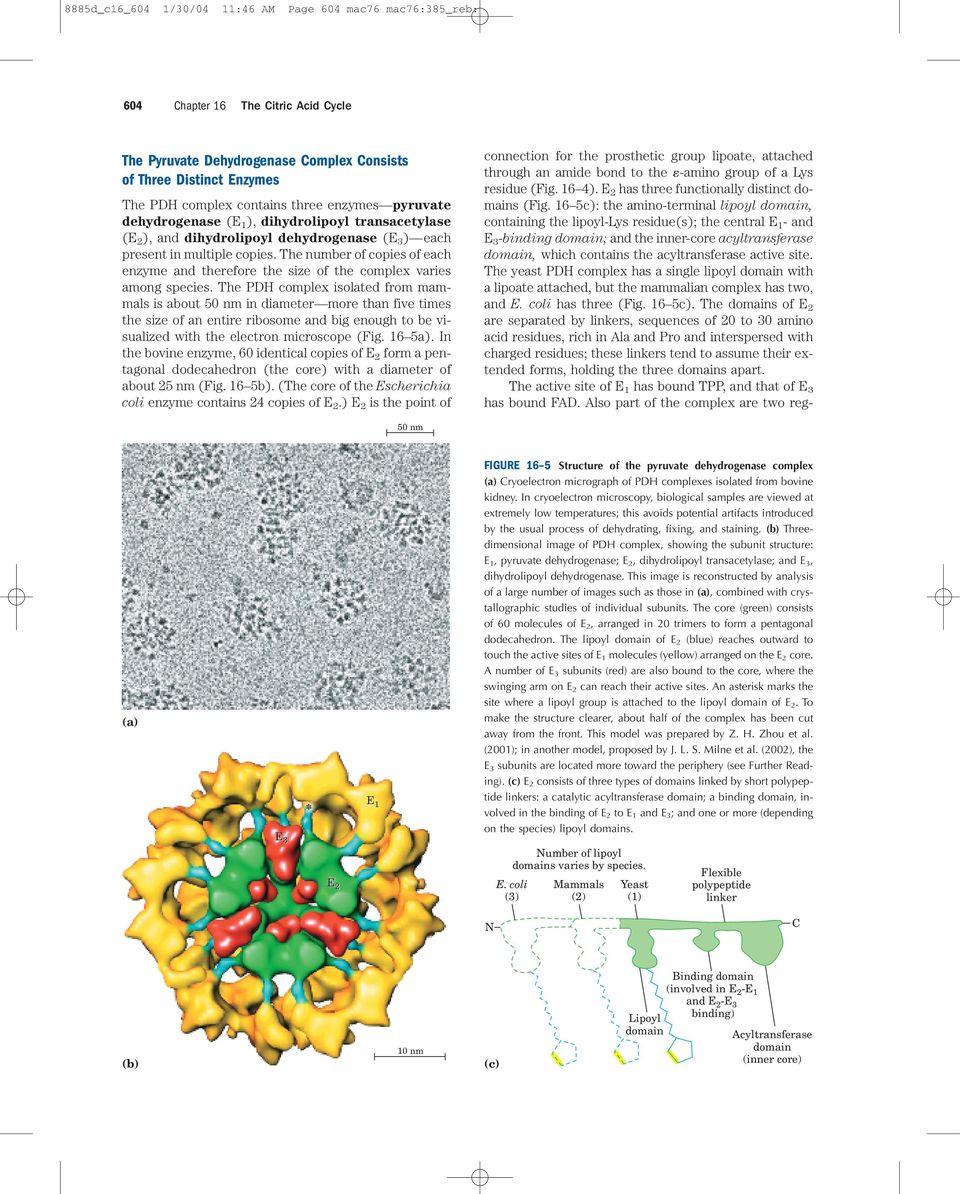
4 8885d_c16_604 1/30/04 11:46 AM Page 604 mac76 mac76:385_reb: 604 hapter 16 The itric Acid ycle The Pyruvate Dehydrogenase omplex onsists of Three Distinct Enzymes The PD complex contains three enzymes pyruvate dehydrogenase (E 1 ), dihydrolipoyl transacetylase (E 2 ), and dihydrolipoyl dehydrogenase (E 3 ) each present in multiple copies. The number of copies of each enzyme and therefore the size of the complex varies among species. The PD complex isolated from mammals is about 50 nm in diameter more than five times the size of an entire ribosome and big enough to be visualized with the electron microscope (Fig. 16 5a). In the bovine enzyme, 60 identical copies of E 2 form a pentagonal dodecahedron (the core) with a diameter of about 25 nm (Fig. 16 5b). (The core of the Escherichia coli enzyme contains 24 copies of E 2.) E 2 is the point of connection for the prosthetic group lipoate, attached through an amide bond to the -amino group of a Lys residue (Fig. 16 4). E 2 has three functionally distinct domains (Fig. 16 5c): the amino-terminal lipoyl domain, containing the lipoyl-lys residue(s); the central E 1 - and E 3 -binding domain; and the inner-core acyltransferase domain, which contains the acyltransferase active site. The yeast PD complex has a single lipoyl domain with a lipoate attached, but the mammalian complex has two, and E. coli has three (Fig. 16 5c). The domains of E 2 are separated by linkers, sequences of 20 to 30 amino acid residues, rich in Ala and Pro and interspersed with charged residues; these linkers tend to assume their extended forms, holding the three domains apart. The active site of E 1 has bound TPP, and that of E 3 has bound FAD. Also part of the complex are two reg- 50 nm (a) E 3 * E 2 E 1 FIGURE 16 5 tructure of the pyruvate dehydrogenase complex (a) ryoelectron micrograph of PD complexes isolated from bovine kidney. In cryoelectron microscopy, biological samples are viewed at extremely low temperatures; this avoids potential artifacts introduced by the usual process of dehydrating, fixing, and staining. (b) Threedimensional image of PD complex, showing the subunit structure: E 1, pyruvate dehydrogenase; E 2, dihydrolipoyl transacetylase; and E 3, dihydrolipoyl dehydrogenase. This image is reconstructed by analysis of a large number of images such as those in (a), combined with crystallographic studies of individual subunits. The core (green) consists of 60 molecules of E 2, arranged in 20 trimers to form a pentagonal dodecahedron. The lipoyl domain of E 2 (blue) reaches outward to touch the active sites of E 1 molecules (yellow) arranged on the E 2 core. A number of E 3 subunits (red) are also bound to the core, where the swinging arm on E 2 can reach their active sites. An asterisk marks the site where a lipoyl group is attached to the lipoyl domain of E 2. To make the structure clearer, about half of the complex has been cut away from the front. This model was prepared by Z.. Zhou et al. (2001); in another model, proposed by J. L.. Milne et al. (2002), the E 3 subunits are located more toward the periphery (see Further Reading). (c) E 2 consists of three types of domains linked by short polypeptide linkers: a catalytic acyltransferase domain; a binding domain, involved in the binding of E 2 to E 1 and E 3 ; and one or more (depending on the species) lipoyl domains. umber of lipoyl domains varies by species. E. coli (3) Mammals (2) Yeast (1) Flexible polypeptide linker (b) 10 nm (c) Lipoyl domain Binding domain (involved in E 2 -E 1 and E 2 -E 3 binding) Acyltransferase domain (inner core)
5 8885d_c16_ /27/04 8:54 AM Page 605 mac76 mac76:385_reb: 16.1 Production of Acetyl-oA (Activated Acetate) 605 ulatory proteins, a protein kinase and a phosphoprotein phosphatase, discussed below. This basic E 1 -E 2 -E 3 structure has been conserved during evolution and used in a number of similar metabolic reactions, including the oxidation of -ketoglutarate in the citric acid cycle (described below) and the oxidation of -keto acids derived from the breakdown of the branched-chain amino acids valine, isoleucine, and leucine (see Fig ). Within a given species, E 3 of PD is identical to E 3 of the other two enzyme complexes. The attachment of lipoate to the end of a Lys side chain in E 2 produces a long, flexible arm that can move from the active site of E 1 to the active sites of E 2 and E 3, a distance of perhaps 5 nm or more. In ubstrate hanneling, Intermediates ever Leave the Enzyme urface Figure 16 6 shows schematically how the pyruvate dehydrogenase complex carries out the five consecutive reactions in the decarboxylation and dehydrogenation of pyruvate. tep 1 is essentially identical to the reaction catalyzed by pyruvate decarboxylase (see Fig c); -1 of pyruvate is released as 2, and -2, which in pyruvate has the oxidation state of an aldehyde, is attached to TPP as a hydroxyethyl group. This first step is the slowest and therefore limits the rate of the overall reaction. It is also the point at which the PD complex exercises its substrate specificity. In step 2 the hydroxyethyl group is oxidized to the level of a carboxylic acid (acetate). The two electrons removed in this reaction reduce the of a lipoyl group on E 2 to two thiol () groups. The acetyl moiety produced in this oxidation-reduction reaction is first esterified to one of the lipoyl groups, then transesterified to oa to form acetyl-oa (step 3 ). Thus the energy of oxidation drives the formation of a highenergy thioester of acetate. The remaining reactions catalyzed by the PD complex (by E 3, in steps 4 and 5 ) are electron transfers necessary to regenerate the oxidized (disulfide) form of the lipoyl group of E 2 to prepare the enzyme complex for another round of oxidation. The electrons removed from the hydroxyethyl group derived from pyruvate pass through FAD to AD. entral to the mechanism of the PD complex are the swinging lipoyllysyl arms of E 2, which accept from E 1 the two electrons and the acetyl group derived from pyruvate, passing them to E 3. All these enzymes and coenzymes are clustered, allowing the intermediates to react quickly without diffusing away from the surface of the enzyme complex. The five-reaction sequence shown in Figure 16 6 is thus an example of substrate channeling. The intermediates of the multistep sequence never leave the complex, and the local concentration of the substrate of E 2 is kept very high. hanneling also prevents theft of the activated acetyl group by other enzymes that use this group as substrate. As we shall see, a similar tethering mechanism for the channeling of substrate between active 3 Pyruvate ydroxyethyl TPP 2 1 TPP 2 TPP 3 3 Acyl lipoyllysine oa- xidized lipoyllysine 3 Lys 3 Reduced lipoyllysine 4 -oa Acetyl-oA FAD FAD 2 5 AD + + AD + Pyruvate dehydrogenase, E 1 Dihydrolipoyl transacetylase, E 2 Dihydrolipoyl dehydrogenase, E 3 FIGURE 16 6 xidative decarboxylation of pyruvate to acetyl-oa by the PD complex. The fate of pyruvate is traced in red. In step 1 pyruvate reacts with the bound thiamine pyrophosphate (TPP) of pyruvate dehydrogenase (E 1 ), undergoing decarboxylation to the hydroxyethyl derivative (see Fig ). Pyruvate dehydrogenase also carries out step 2, the transfer of two electrons and the acetyl group from TPP to the oxidized form of the lipoyllysyl group of the core enzyme, dihydrolipoyl transacetylase (E 2 ), to form the acetyl thioester of the reduced lipoyl group. tep 3 is a transesterification in which the group of oa replaces the group of E 2 to yield acetyl-oa and the fully reduced (dithiol) form of the lipoyl group. In step 4 dihydrolipoyl dehydrogenase (E 3 ) promotes transfer of two hydrogen atoms from the reduced lipoyl groups of E 2 to the FAD prosthetic group of E 3, restoring the oxidized form of the lipoyllysyl group of E 2. In step 5 the reduced FAD 2 of E 3 transfers a hydride ion to AD, forming AD. The enzyme complex is now ready for another catalytic cycle. (ubunit colors correspond to those in Fig. 16 5b.)

6 8885d_c16_ /27/04 8:54 AM Page 606 mac76 mac76:385_reb: 606 hapter 16 The itric Acid ycle sites is used in some other enzymes, with lipoate, biotin, or a oa-like moiety serving as cofactors. As one might predict, mutations in the genes for the subunits of the PD complex, or a dietary thiamine deficiency, can have severe consequences. Thiamine-deficient animals are unable to oxidize pyruvate normally. This is of particular importance to the brain, which usually obtains all its energy from the aerobic oxidation of glucose in a pathway that necessarily includes the oxidation of pyruvate. Beriberi, a disease that results from thiamine deficiency, is characterized by loss of neural function. This disease occurs primarily in populations that rely on a diet consisting mainly of white (polished) rice, which lacks the hulls in which most of the thiamine of rice is found. People who habitually consume large amounts of alcohol can also develop thiamine deficiency, because much of their dietary intake consists of the vitamin-free empty calories of distilled spirits. An elevated level of pyruvate in the blood is often an indicator of defects in pyruvate oxidation due to one of these causes. UMMARY 16.1 Production of Acetyl-oA (Activated Acetate) Pyruvate, the product of glycolysis, is converted to acetyl-oa, the starting material for the citric acid cycle, by the pyruvate dehydrogenase complex. The PD complex is composed of multiple copies of three enzymes: pyruvate dehydrogenase, E 1 (with its bound cofactor TPP); dihydrolipoyl transacetylase, E 2 (with its covalently bound lipoyl group); and dihydrolipoyl dehydrogenase, E 3 (with its cofactors FAD and AD). E 1 catalyzes first the decarboxylation of pyruvate, producing hydroxyethyl-tpp, and then the oxidation of the hydroxyethyl group to an acetyl group. The electrons from this oxidation reduce the disulfide of lipoate bound to E 2, and the acetyl group is transferred into thioester linkage with one group of reduced lipoate. E 2 catalyzes the transfer of the acetyl group to coenzyme A, forming acetyl-oa. E 3 catalyzes the regeneration of the disulfide (oxidized) form of lipoate; electrons pass first to FAD, then to AD. The long lipoyllysine arm swings from the active site of E 1 to E 2 to E 3, tethering the intermediates to the enzyme complex to allow substrate channeling. The organization of the PD complex is very similar to that of the enzyme complexes that catalyze the oxidation of -ketoglutarate and the branched-chain -keto acids Reactions of the itric Acid ycle We are now ready to trace the process by which acetyl- oa undergoes oxidation. This chemical transformation is carried out by the citric acid cycle, the first cyclic pathway we have encountered (Fig. 16 7). To begin a turn of the cycle, acetyl-oa donates its acetyl group to the four-carbon compound oxaloacetate to form the six-carbon citrate. itrate is then transformed into isocitrate, also a six-carbon molecule, which is dehydrogenated with loss of 2 to yield the five-carbon compound -ketoglutarate (also called oxoglutarate). -Ketoglutarate undergoes loss of a second molecule of 2 and ultimately yields the four-carbon compound succinate. uccinate is then enzymatically converted in three steps into the four-carbon oxaloacetate which is then ready to react with another molecule of acetyl-oa. In each turn of the cycle, one acetyl group (two carbons) enters as acetyl-oa and two molecules of 2 leave; one molecule of oxaloacetate is used to form citrate and one molecule of oxaloacetate is regenerated. o net removal of oxaloacetate occurs; one molecule of oxaloacetate can theoretically bring about oxidation of an infinite number of acetyl groups, and, in fact, oxaloacetate is present in cells in very low concentrations. Four of the eight steps in this process are oxidations, in which the energy of oxidation is very efficiently conserved in the form of the reduced coenzymes AD and FAD 2. As noted earlier, although the citric acid cycle is central to energy-yielding metabolism its role is not limited to energy conservation. Four- and five-carbon intermediates of the cycle serve as precursors for a wide variety of products. To replace intermediates removed for this purpose, cells employ anaplerotic (replenishing) reactions, which are described below. Eugene Kennedy and Albert Lehninger showed in 1948 that, in eukaryotes, the entire set of reactions of the citric acid cycle takes place in mitochondria. Isolated mitochondria were found to contain not only all the enzymes and coenzymes required for the citric acid cycle, but also all the enzymes and proteins necessary for the last stage of respiration electron transfer and ATP synthesis by oxidative phosphorylation. As we shall see in later chapters, mitochondria also contain the enzymes for the oxidation of fatty acids and some amino acids to acetyl-oa, and the oxidative degradation of other amino acids to -ketoglutarate, succinyl-oa, or oxaloacetate. Thus, in nonphotosynthetic eukaryotes, the mitochondrion is the site of most energy-yielding

7 8885d_c16_ /27/04 8:54 AM Page 607 mac76 mac76:385_reb: 16.2 Reactions of the itric Acid ycle 607 Acetyl-oA 3 -oa 2 1 ondensation oa- citrate synthase 2 8 Dehydrogenation 2 xaloacetate 2 itrate 2a Dehydration malate dehydrogenase itric acid cycle aconitase 2 2 Malate 2 cis-aconitate 7 ydration 2 fumarase AD aconitase 2 2b ydration Fumarate 6 Dehydrogenation succinate dehydrogenase 2 2 uccinate FAD 2 oa- GTP (ATP) 5 ubstrate-level phosphorylation succinyl-oa synthetase GDP (ADP) P i 2 2 -oa uccinyl-oa -ketoglutarate dehydrogenase complex 2 oa- isocitrate dehydrogenase 2 2 -Ketoglutarate 4 xidative decarboxylation 2 2 Isocitrate 3 xidative decarboxylation FIGURE 16 7 Reactions of the citric acid cycle. The carbon atoms shaded in pink are those derived from the acetate of acetyl-oa in the first turn of the cycle; these are not the carbons released as 2 in the first turn. ote that in succinate and fumarate, the two-carbon group derived from acetate can no longer be specifically denoted; because succinate and fumarate are symmetric molecules, -1 and -2 are indistinguishable from -4 and -3. The number beside each reaction step corresponds to a numbered heading on pages The red arrows show where energy is conserved by electron transfer to FAD or AD, forming FAD 2 or AD. teps 1,3, and 4 are essentially irreversible in the cell; all other steps are reversible. The product of step 5 may be either ATP or GTP, depending on which succinyl-oa synthetase isozyme is the catalyst.

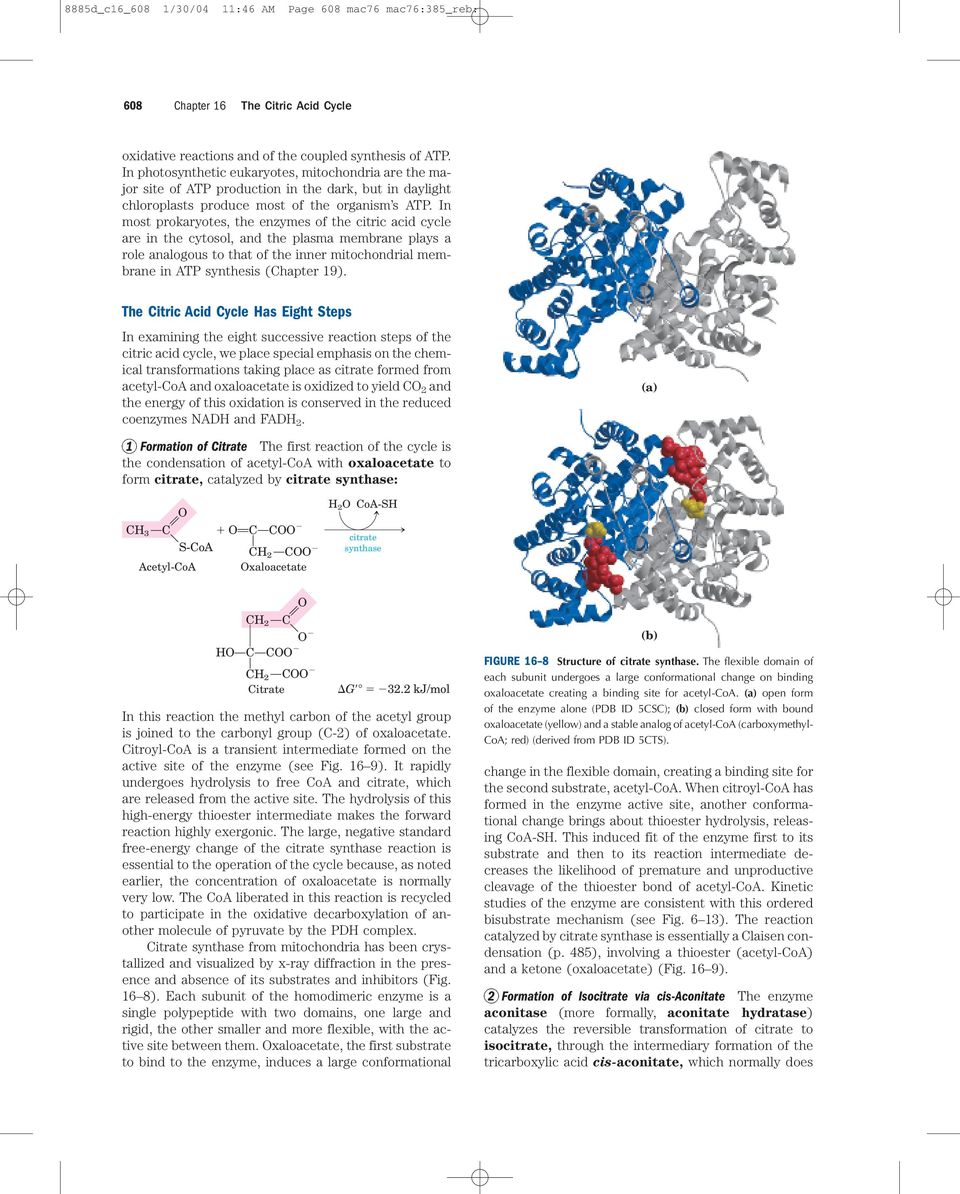
8 8885d_c16_608 1/30/04 11:46 AM Page 608 mac76 mac76:385_reb: 608 hapter 16 The itric Acid ycle oxidative reactions and of the coupled synthesis of ATP. In photosynthetic eukaryotes, mitochondria are the major site of ATP production in the dark, but in daylight chloroplasts produce most of the organism s ATP. In most prokaryotes, the enzymes of the citric acid cycle are in the cytosol, and the plasma membrane plays a role analogous to that of the inner mitochondrial membrane in ATP synthesis (hapter 19). The itric Acid ycle as Eight teps In examining the eight successive reaction steps of the citric acid cycle, we place special emphasis on the chemical transformations taking place as citrate formed from acetyl-oa and oxaloacetate is oxidized to yield 2 and the energy of this oxidation is conserved in the reduced coenzymes AD and FAD 2. (a) 1 Formation of itrate The first reaction of the cycle is the condensation of acetyl-oa with oxaloacetate to form citrate, catalyzed by citrate synthase: 3 -oa 2 Acetyl-oA xaloacetate 2 oa- citrate synthase 2 2 itrate In this reaction the methyl carbon of the acetyl group is joined to the carbonyl group (-2) of oxaloacetate. itroyl-oa is a transient intermediate formed on the active site of the enzyme (see Fig. 16 9). It rapidly undergoes hydrolysis to free oa and citrate, which are released from the active site. The hydrolysis of this high-energy thioester intermediate makes the forward reaction highly exergonic. The large, negative standard free-energy change of the citrate synthase reaction is essential to the operation of the cycle because, as noted earlier, the concentration of oxaloacetate is normally very low. The oa liberated in this reaction is recycled to participate in the oxidative decarboxylation of another molecule of pyruvate by the PD complex. itrate synthase from mitochondria has been crystallized and visualized by x-ray diffraction in the presence and absence of its substrates and inhibitors (Fig. 16 8). Each subunit of the homodimeric enzyme is a single polypeptide with two domains, one large and rigid, the other smaller and more flexible, with the active site between them. xaloacetate, the first substrate to bind to the enzyme, induces a large conformational G 32.2 kj/mol (b) FIGURE 16 8 tructure of citrate synthase. The flexible domain of each subunit undergoes a large conformational change on binding oxaloacetate creating a binding site for acetyl-oa. (a) open form of the enzyme alone (PDB ID 5); (b) closed form with bound oxaloacetate (yellow) and a stable analog of acetyl-oa (carboxymethyl- oa; red) (derived from PDB ID 5T). change in the flexible domain, creating a binding site for the second substrate, acetyl-oa. When citroyl-oa has formed in the enzyme active site, another conformational change brings about thioester hydrolysis, releasing oa-. This induced fit of the enzyme first to its substrate and then to its reaction intermediate decreases the likelihood of premature and unproductive cleavage of the thioester bond of acetyl-oa. Kinetic studies of the enzyme are consistent with this ordered bisubstrate mechanism (see Fig. 6 13). The reaction catalyzed by citrate synthase is essentially a laisen condensation (p. 485), involving a thioester (acetyl-oa) and a ketone (oxaloacetate) (Fig. 16 9). 2 Formation of Isocitrate via cis-aconitate The enzyme aconitase (more formally, aconitate hydratase) catalyzes the reversible transformation of citrate to isocitrate, through the intermediary formation of the tricarboxylic acid cis-aconitate, which normally does
9 8885d_c16_609 1/30/04 11:46 AM Page 609 mac76 mac76:385_reb: 16.2 Reactions of the itric Acid ycle 609 is itrate synthase 2 : : Asp is 274 -oa Acetyl-oA The thioester linkage in acetyl-oa activates the methyl hydrogens, and Asp 375 abstracts a proton from the methyl group, forming an enolate intermediate. The intermediate is stabilized by hydrogen bonding to and/or protonation by is 274 (full protonation is shown). is xaloacetate 1 is 274 -oa 2 Enol intermediate not dissociate from the active site. Aconitase can promote the reversible addition of 2 to the double bond of enzyme-bound cis-aconitate in two different ways, one leading to citrate and the other to isocitrate: 2 itrate 2 aconitase 2 Although the equilibrium mixture at p 7.4 and 25 contains less than 10% isocitrate, in the cell the reaction is pulled to the right because isocitrate is rapidly consumed in the next step of the cycle, lowering its steady-state concentration. Aconitase contains an ironsulfur center (Fig ), which acts both in the binding of the substrate at the active site and in the catalytic addition or removal of 2. cis-aconitate 2 2 Isocitrate aconitase G 13.3 kj/mol Asp 375 The enol(ate) rearranges to attack the carbonyl carbon of oxaloacetate, with is 274 positioned to abstract the proton it had previously donated. is 320 acts as a general acid. The resulting condensation generates citroyl-oa. 2 MEAIM FIGURE 16 9 itrate synthase. In the mammalian citrate synthase reaction, oxaloacetate binds first, in a strictly ordered reaction sequence. This binding triggers a conformation change that opens up the binding site for acetyl-oa. xaloacetetate is specifically oriented in the active site of citrate synthase by interaction of its two carboxylates with two positively charged Arg residues (not shown here). The details of the mechanism are described in the figure. itrate ynthase Mechanism is oa is oa- 3 is 320 itroyl-oa 2 is 274 itrate Asp 375 Asp 375 The thioester is subsequently hydrolyzed, regenerating oa- and producing citrate.
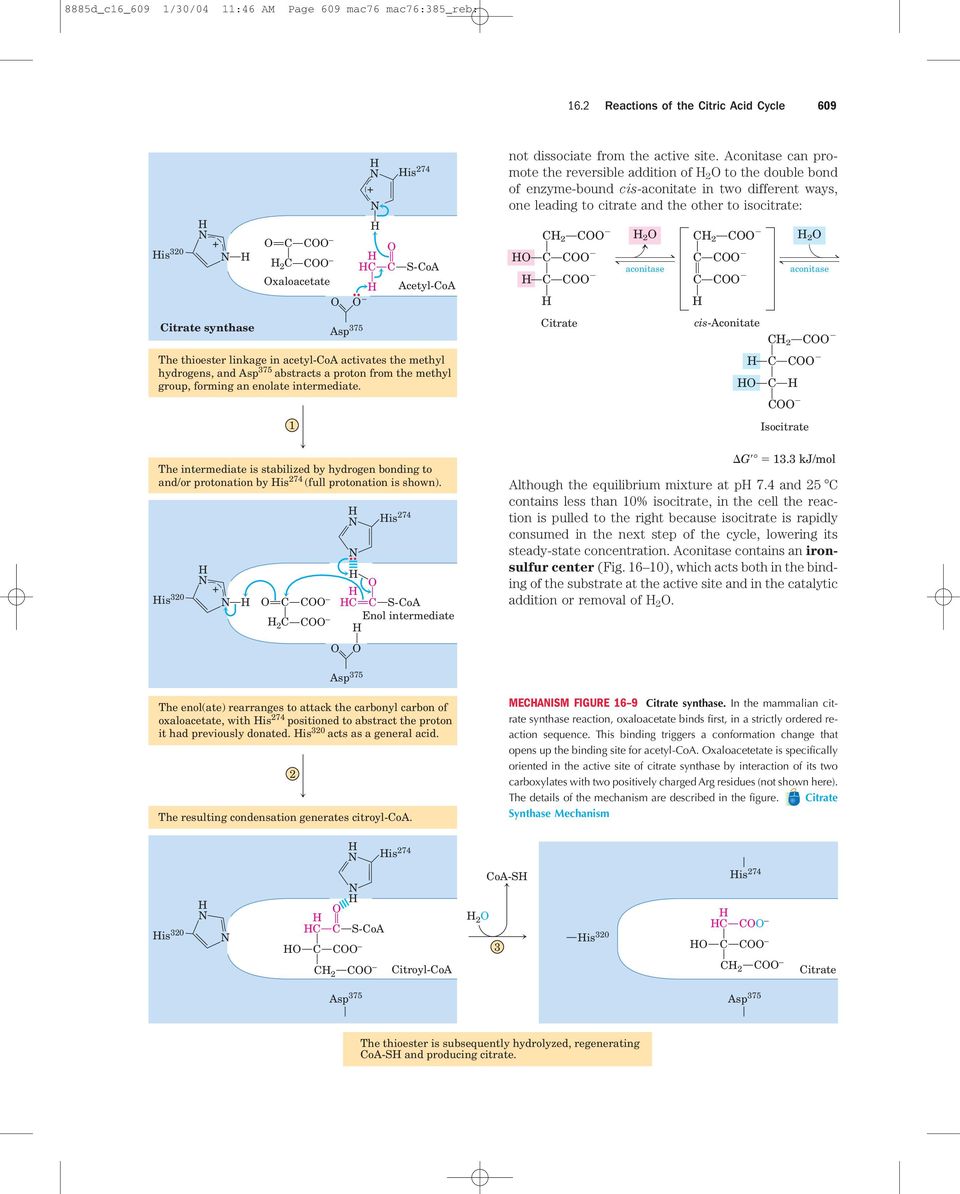
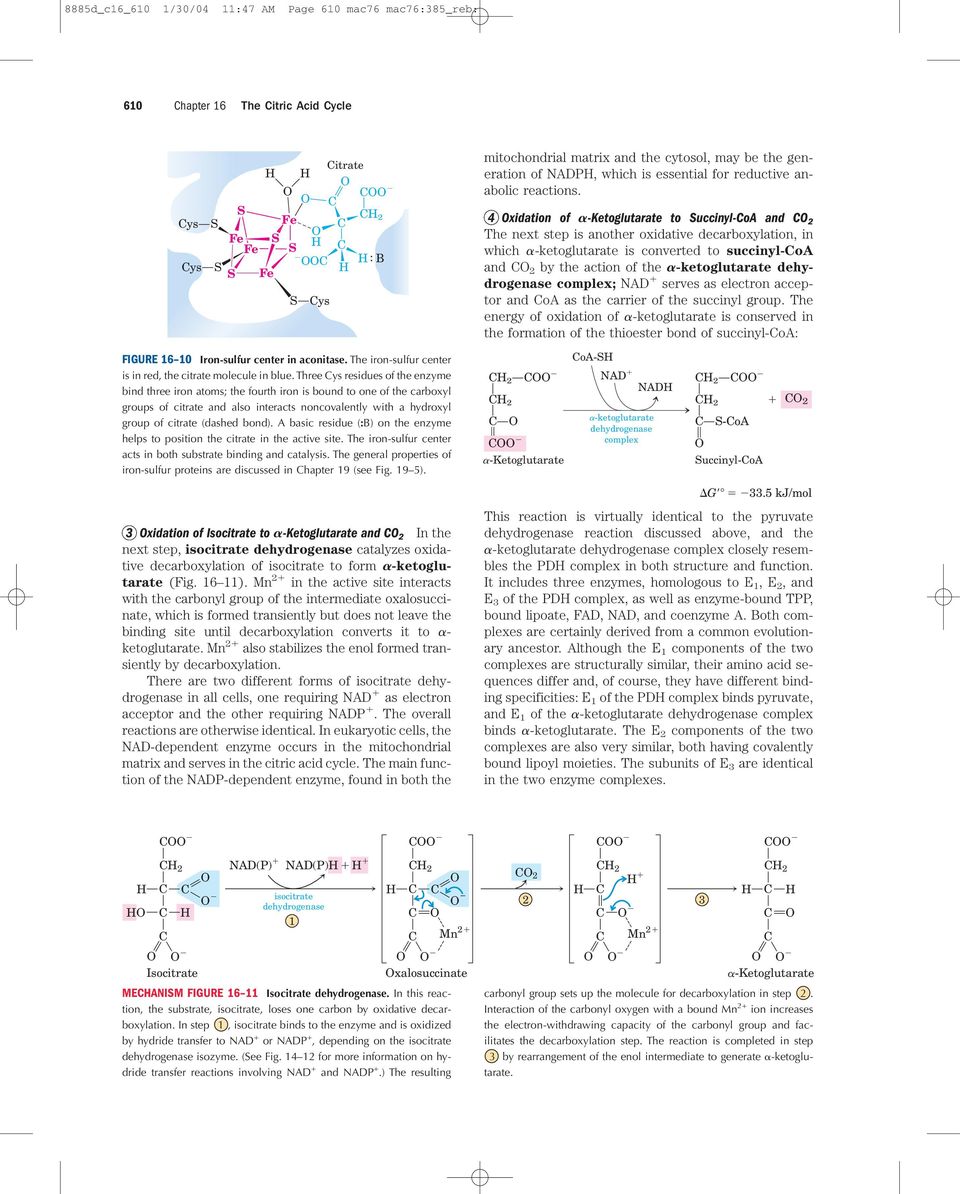
10 8885d_c16_610 1/30/04 11:47 AM Page 610 mac76 mac76:385_reb: 610 hapter 16 The itric Acid ycle ys ys itrate Fe 2 Fe Fe B Fe ys mitochondrial matrix and the cytosol, may be the generation of ADP, which is essential for reductive anabolic reactions. 4 xidation of -Ketoglutarate to uccinyl-oa and 2 The next step is another oxidative decarboxylation, in which -ketoglutarate is converted to succinyl-oa and 2 by the action of the -ketoglutarate dehydrogenase complex; AD serves as electron acceptor and oa as the carrier of the succinyl group. The energy of oxidation of -ketoglutarate is conserved in the formation of the thioester bond of succinyl-oa: FIGURE Iron-sulfur center in aconitase. The iron-sulfur center is in red, the citrate molecule in blue. Three ys residues of the enzyme bind three iron atoms; the fourth iron is bound to one of the carboxyl groups of citrate and also interacts noncovalently with a hydroxyl group of citrate (dashed bond). A basic residue (:B) on the enzyme helps to position the citrate in the active site. The iron-sulfur center acts in both substrate binding and catalysis. The general properties of iron-sulfur proteins are discussed in hapter 19 (see Fig. 19 5) Ketoglutarate oa- AD AD -ketoglutarate dehydrogenase complex 2 2 -oa uccinyl-oa 2 3 xidation of Isocitrate to -Ketoglutarate and 2 In the next step, isocitrate dehydrogenase catalyzes oxidative decarboxylation of isocitrate to form -ketoglutarate (Fig ). Mn 2 in the active site interacts with the carbonyl group of the intermediate oxalosuccinate, which is formed transiently but does not leave the binding site until decarboxylation converts it to - ketoglutarate. Mn 2 also stabilizes the enol formed transiently by decarboxylation. There are two different forms of isocitrate dehydrogenase in all cells, one requiring AD as electron acceptor and the other requiring ADP. The overall reactions are otherwise identical. In eukaryotic cells, the AD-dependent enzyme occurs in the mitochondrial matrix and serves in the citric acid cycle. The main function of the ADP-dependent enzyme, found in both the G 33.5 kj/mol This reaction is virtually identical to the pyruvate dehydrogenase reaction discussed above, and the -ketoglutarate dehydrogenase complex closely resembles the PD complex in both structure and function. It includes three enzymes, homologous to E 1, E 2, and E 3 of the PD complex, as well as enzyme-bound TPP, bound lipoate, FAD, AD, and coenzyme A. Both complexes are certainly derived from a common evolutionary ancestor. Although the E 1 components of the two complexes are structurally similar, their amino acid sequences differ and, of course, they have different binding specificities: E 1 of the PD complex binds pyruvate, and E 1 of the -ketoglutarate dehydrogenase complex binds -ketoglutarate. The E 2 components of the two complexes are also very similar, both having covalently bound lipoyl moieties. The subunits of E 3 are identical in the two enzyme complexes. 2 AD(P) AD(P) isocitrate dehydrogenase Mn 2 Mn 2 Isocitrate xalosuccinate a-ketoglutarate MEAIM FIGURE Isocitrate dehydrogenase. In this reaction, the substrate, isocitrate, loses one carbon by oxidative decarboxylation. In step 1, isocitrate binds to the enzyme and is oxidized by hydride transfer to AD + or ADP +, depending on the isocitrate dehydrogenase isozyme. (ee Fig for more information on hydride transfer reactions involving AD + and ADP +.) The resulting 2 carbonyl group sets up the molecule for decarboxylation in step 2. Interaction of the carbonyl oxygen with a bound Mn 2+ ion increases the electron-withdrawing capacity of the carbonyl group and facilitates the decarboxylation step. The reaction is completed in step 3 by rearrangement of the enol intermediate to generate -ketoglutarate.
11 8885d_c16_ /27/04 8:54 AM Page 611 mac76 mac76:385_reb: 16.2 Reactions of the itric Acid ycle onversion of uccinyl-oa to uccinate uccinyl-oa, like acetyl-oa, has a thioester bond with a strongly negative standard free energy of hydrolysis (G 36 kj/mol). In the next step of the citric acid cycle, energy released in the breakage of this bond is used to drive the synthesis of a phosphoanhydride bond in either GTP or ATP, with a net G of only 2.9 kj/mol. uccinate is formed in the process: (a) is uccinyl-oa synthetase 2 uccinyl-oa 2 -oa 2 GDP P i GTP oa- P i 2 2 -oa succinyl-oa synthetase 2 uccinyl-oa uccinate G 2.9 kj/mol The enzyme that catalyzes this reversible reaction is called succinyl-oa synthetase or succinic thiokinase; both names indicate the participation of a nucleoside triphosphate in the reaction (Box 16 1). This energy-conserving reaction involves an intermediate step in which the enzyme molecule itself becomes phosphorylated at a is residue in the active site (Fig a). This phosphoryl group, which has a high group transfer potential, is transferred to ADP (or GDP) to form ATP (or GTP). Animal cells have two isozymes of succinyl-oa synthetase, one specific for ADP and the other for GDP. The enzyme has two subunits, (M r 32,000), which has the P -is residue (is 246 ) and the binding site for oa, and (M r 42,000), which confers specificity for either ADP or GDP. The active site is at the interface between subunits. The crystal structure of succinyl-oa synthetase reveals two power helices (one from each subunit), oriented so that their electric dipoles situate partial positive charges close to the negatively charged P -is (Fig b), stabilizing the phosphoenzyme intermediate. (Recall the similar role of helix dipoles in stabilizing K ions in the K channel (see Fig ).) is is is oa- P Enzyme-bound succinyl phosphate GDP GTP P 2 2 uccinate Phosphohistidyl enzyme FIGURE The succinyl-oa synthetase reaction. (a) In step 1 a phosphoryl group replaces the oa of succinyl-oa bound to the enzyme, forming a high-energy acyl phosphate. In step 2 the succinyl phosphate donates its phosphoryl group to a is residue on the enzyme, forming a high-energy phosphohistidyl enzyme. In step 3 the phosphoryl group is transferred from the is residue to the terminal phosphate of GDP (or ADP), forming GTP (or ATP). (b) uccinyl- oa synthetase of E. coli (derived from PDB ID 1U). The bacterial and mammalian enzymes have similar amino acid sequences and presumably have very similar three-dimensional structures. The active site includes part of both the (blue) and (brown) subunits. The power helices (bright blue, dark brown) situate the partial positive charges of the helix dipole near the phosphate group (orange) on is 246 of the chain, stabilizing the phosphohistidyl enzyme. oenzyme A is shown here as a red stick structure. (To improve the visibility of the power helices, some nearby secondary structures have been made transparent.) (b)

12 8885d_c16_612 1/30/04 11:47 AM Page 612 mac76 mac76:385_reb: 612 hapter 16 The itric Acid ycle The formation of ATP (or GTP) at the expense of the energy released by the oxidative decarboxylation of -ketoglutarate is a substrate-level phosphorylation, like the synthesis of ATP in the glycolytic reactions catalyzed by glyceraldehyde 3-phosphate dehydrogenase and pyruvate kinase (see Fig. 14 2). The GTP formed by succinyl- oa synthetase can donate its terminal phosphoryl group to ADP to form ATP, in a reversible reaction catalyzed by nucleoside diphosphate kinase (p. 505): (formally, fumarate hydratase). The transition state in this reaction is a carbanion: Fumarate fumarase arbanion transition state GTP ADP n GDP ATP G 0 kj/mol Thus the net result of the activity of either isozyme of succinyl-oa synthetase is the conservation of energy as ATP. There is no change in free energy for the nucleoside diphosphate kinase reaction; ATP and GTP are energetically equivalent. fumarase 6 xidation of uccinate to Fumarate The succinate formed from succinyl-oa is oxidized to fumarate by the flavoprotein succinate dehydrogenase: 2 2 uccinate FAD FAD 2 succinate dehydrogenase Fumarate G 0 kj/mol In eukaryotes, succinate dehydrogenase is tightly bound to the inner mitochondrial membrane; in prokaryotes, to the plasma membrane. The enzyme contains three different iron-sulfur clusters and one molecule of covalently bound FAD (see Fig. 19 xx). Electrons pass from succinate through the FAD and iron-sulfur centers before entering the chain of electron carriers in the mitochondrial inner membrane (or the plasma membrane in bacteria). Electron flow from succinate through these carriers to the final electron acceptor, 2, is coupled to the synthesis of about 1.5 ATP molecules per pair of electrons (respiration-linked phosphorylation). Malonate, an analog of succinate not normally present in cells, is a strong competitive inhibitor of succinate dehydrogenase and its addition to mitochondria blocks the activity of the citric acid cycle. Malate G 3.8 kj/mol This enzyme is highly stereospecific; it catalyzes hydration of the trans double bond of fumarate but not the cis double bond of maleate (the cis isomer of fumarate). In the reverse direction (from L-malate to fumarate), fumarase is equally stereospecific: D-malate is not a substrate. Fumarate L-Malate 2 8 xidation of Malate to xaloacetate In the last reaction of the citric acid cycle, AD-linked L-malate dehydrogenase catalyzes the oxidation of L-malate to oxaloacetate: Maleate 2 D-Malate Malonate uccinate 2 L-Malate AD AD malate dehydrogenase 2 xaloacetate G 29.7 kj/mol 7 ydration of Fumarate to Malate The reversible hydration of fumarate to L-malate is catalyzed by fumarase The equilibrium of this reaction lies far to the left under standard thermodynamic conditions, but in intact cells

13 8885d_c16_ /27/04 8:54 AM Page 613 mac76 mac76:385_reb: 16.2 Reactions of the itric Acid ycle 613 BX 16 1 WRKIG I BIEMITRY ynthases and ynthetases; Ligases and Lyases; Kinases, Phosphatases, and Phosphorylases: Yes, the ames Are onfusing! itrate synthase is one of many enzymes that catalyze condensation reactions, yielding a product more chemically complex than its precursors. ynthases catalyze condensation reactions in which no nucleoside triphosphate (ATP, GTP, and so forth) is required as an energy source. ynthetases catalyze condensations that do use ATP or another nucleoside triphosphate as a source of energy for the synthetic reaction. uccinyl- oa synthetase is such an enzyme. Ligases (from the Latin ligare, to tie together ) are enzymes that catalyze condensation reactions in which two atoms are joined using ATP or another energy source. (Thus synthetases are ligases.) DA ligase, for example, closes breaks in DA molecules, using energy supplied by either ATP or AD ; it is widely used in joining DA pieces for genetic engineering. Ligases are not to be confused with lyases, enzymes that catalyze cleavages (or, in the reverse direction, additions) in which electronic rearrangements occur. The PD complex, which oxidatively cleaves 2 from pyruvate, is a member of the large class of lyases. The name kinase is applied to enzymes that transfer a phosphoryl group from a nucleoside triphosphate such as ATP to an acceptor molecule a sugar (as in hexokinase and glucokinase), a protein (as in glycogen phosphorylase kinase), another nucleotide (as in nucleoside diphosphate kinase), or a metabolic intermediate such as oxaloacetate (as in PEP carboxykinase). The reaction catalyzed by a kinase is a phosphorylation. n the other hand, phosphorolysis is a displacement reaction in which phosphate is the attacking species and becomes covalently attached at the point of bond breakage. uch reactions are catalyzed by phosphorylases. Glycogen phosphorylase, for example, catalyzes the phosphorolysis of glycogen, producing glucose 1-phosphate. Dephosphorylation, the removal of a phosphoryl group from a phosphate ester, is catalyzed by phosphatases, with water as the attacking species. Fructose bisphosphatase-1 converts fructose 1,6-bisphosphate to fructose 6-phosphate in gluconeogenesis, and phosphorylase a phosphatase removes phosphoryl groups from phosphoserine in phosphorylated glycogen phosphorylase. Whew! Unfortunately, these descriptions of enzyme types overlap, and many enzymes are commonly called by two or more names. uccinyl-oa synthetase, for example, is also called succinate thiokinase; the enzyme is both a synthetase in the citric acid cycle and a kinase when acting in the direction of succinyl-oa synthesis. This raises another source of confusion in the naming of enzymes. An enzyme may have been discovered by the use of an assay in which, say, A is converted to B. The enzyme is then named for that reaction. Later work may show, however, that in the cell, the enzyme functions primarily in converting B to A. ommonly, the first name continues to be used, although the metabolic role of the enzyme would be better described by naming it for the reverse reaction. The glycolytic enzyme pyruvate kinase illustrates this situation (p. 532). To a beginner in biochemistry, this duplication in nomenclature can be bewildering. International committees have made heroic efforts to systematize the nomenclature of enzymes (see Table 6 3 for a brief summary of the system), but some systematic names have proved too long and cumbersome and are not frequently used in biochemical conversation. We have tried throughout this book to use the enzyme name most commonly used by working biochemists and to point out cases in which an enzyme has more than one widely used name. For current information on enzyme nomenclature, refer to the recommendations of the omenclature ommittee of the International Union of Biochemistry and Molecular Biology ( oxaloacetate is continually removed by the highly exergonic citrate synthase reaction (step 1 of Fig. 16 7). This keeps the concentration of oxaloacetate in the cell extremely low (10 6 M), pulling the malate dehydrogenase reaction toward the formation of oxaloacetate. Although the individual reactions of the citric acid cycle were initially worked out in vitro, using minced muscle tissue, the pathway and its regulation have also been studied extensively in vivo. By using radioactively labeled precursors such as [ 14 ]pyruvate and [ 14 ]acetate, researchers have traced the fate of individual carbon atoms through the citric acid cycle. ome of the earliest experiments with isotopes produced an unexpected result, however, which aroused considerable controversy about the pathway and mechanism of the citric acid cycle. In fact, these experiments at first seemed to show that citrate was not the first tricarboxylic acid to be formed. Box 16 2 gives some details of this episode in the history of citric acid cycle research. Metabolic flux

14 8885d_c16_ /27/04 8:54 AM Page 614 mac76 mac76:385_reb: 614 hapter 16 The itric Acid ycle through the cycle can now be monitored in living tissue by using 13 -labeled precursors and whole-tissue MR spectroscopy. Because the MR signal is unique to the compound containing the 13, biochemists can trace the movement of precursor carbons into each cycle intermediate and into compounds derived from the intermediates. This technique has great promise for studies of regulation of the citric acid cycle and its interconnections with other metabolic pathways such as glycolysis. The Energy of xidations in the ycle Is Efficiently onserved We have now covered one complete turn of the citric acid cycle (Fig ). A two-carbon acetyl group entered the cycle by combining with oxaloacetate. Two carbon atoms emerged from the cycle as 2 from the oxidation of isocitrate and -ketoglutarate. The energy released by these oxidations was conserved in the reduction of three AD and one FAD and the production of one ATP or GTP. At the end of the cycle a molecule of oxaloacetate was regenerated. ote that the two carbon atoms appearing as 2 are not the same two carbons that entered in the form of the acetyl group; additional turns around the cycle are required to release these carbons as 2 (Fig. 16 7). Although the citric acid cycle directly generates only one ATP per turn (in the conversion of succinyl- oa to succinate), the four oxidation steps in the cycle provide a large flow of electrons into the respiratory chain via AD and FAD 2 and thus lead to formation of a large number of ATP molecules during oxidative phosphorylation. We saw in hapter 14 that the energy yield from the production of two molecules of pyruvate from one molecule of glucose in glycolysis is 2 ATP and 2 AD. In oxidative phosphorylation (hapter 19), passage of two electrons from AD to 2 drives the formation of about 2.5 ATP, and passage of two electrons from FAD 2 to 2 yields about 1.5 ATP. This stoichiometry allows us to calculate the overall yield of ATP from the complete BX 16 2 WRKIG I BIEMITRY itrate: A ymmetrical Molecule That Reacts Asymmetrically When compounds enriched in the heavy-carbon isotope 13 and the radioactive carbon isotopes 11 and 14 became available about 60 years ago, they were soon put to use in tracing the pathway of carbon atoms through the citric acid cycle. ne such experiment initiated the controversy over the role of citrate. Acetate labeled in the carboxyl group (designated [1-14 ] acetate) was incubated aerobically with an animal tissue preparation. Acetate is enzymatically converted to acetyl-oa in animal tissues, and the pathway of the labeled carboxyl carbon of the acetyl group in the cycle reactions could thus be traced. -Ketoglutarate was isolated from the tissue after incubation, then degraded by known chemical reactions to establish the position(s) of the isotopic carbon. ondensation of unlabeled oxaloacetate with carboxyl-labeled acetate would be expected to produce citrate labeled in one of the two primary carboxyl groups. itrate is a symmetric molecule, its two terminal carboxyl groups being chemically indistinguishable. Therefore, half the labeled citrate molecules were expected to yield -ketoglutarate labeled in 14 3 Labeled acetate xaloacetate 2 Labeled citrate FIGURE 1 Incorporation of the isotopic carbon ( 14 ) of the labeled acetyl group into -ketoglutarate by the citric acid cycle. The carbon atoms of the entering acetyl group are shown in red. 2 2 Isocitrate 14 nly this product was formed This second form of labeled -ketoglutarate was also expected, but was not formed.

15 8885d_c16_ /27/04 8:54 AM Page 615 mac76 mac76:385_reb: Acetyl-oA 16.2 Reactions of the itric Acid ycle 615 AD xaloacetate Malate Fumarate FAD 2 itric acid cycle uccinate itrate 2 2 Isocitrate α-ketoglutarate uccinyl-oa GTP (ATP) AD AD FIGURE Products of one turn of the citric acid cycle. At each turn of the cycle, three AD, one FAD 2, one GTP (or ATP), and two 2 are released in oxidative decarboxylation reactions. ere and in several following figures, all cycle reactions are shown as proceeding in one direction only, but keep in mind that most of the reactions are reversible (see Fig. 16 7). oxidation of glucose. When both pyruvate molecules are oxidized to 6 2 via the pyruvate dehydrogenase complex and the citric acid cycle, and the electrons are transferred to 2 via oxidative phosphorylation, as many as 32 ATP are obtained per glucose (Table 16 1). In round numbers, this represents the conservation of kj/mol 976 kj/mol, or 34% of the theoretical maximum of about 2,840 kj/mol available from the complete oxidation of glucose. These calculations employ the standard free-energy changes; when corrected for the actual free energy required to form ATP within cells (see Box 13 1), the calculated efficiency of the process is closer to 65%. Why Is the xidation of Acetate o omplicated? The eight-step cyclic process for oxidation of simple twocarbon acetyl groups to 2 may seem unnecessarily cumbersome and not in keeping with the biological principle of maximum economy. The role of the citric acid cycle is not confined to the oxidation of acetate, however. the -carboxyl group and the other half to yield - keto-glutarate labeled in the -carboxyl group; that is, the -ketoglutarate isolated was expected to be a mixture of the two types of labeled molecules (Fig. 1, pathways 1 and 2 ). ontrary to this expectation, the labeled -ketoglutarate isolated from the tissue suspension contained 14 only in the -carboxyl group (Fig. 1, pathway 1 ). The investigators concluded that citrate (or any other symmetric molecule) could not be an intermediate in the pathway from acetate to - ketoglutarate. Rather, an asymmetric tricarboxylic acid, presumably cis-aconitate or isocitrate, must be the first product formed from condensation of acetate and oxaloacetate. 2 2 (a) usceptible bond X In 1948, however, Alexander gston pointed out that although citrate has no chiral center (see Fig. 1 19), it has the potential to react asymmetrically if an enzyme with which it interacts has an active site that is asymmetric. e suggested that the active site of aconitase may have three points to which the citrate must be bound and that the citrate must undergo a specific three-point attachment to these binding points. As seen in Figure 2, the binding of citrate to three such points could happen in only one way, and this would account for the formation of only one type of labeled -ketoglutarate. rganic molecules such as citrate that have no chiral center but are potentially capable of reacting asymmetrically with an asymmetric active site are now called prochiral molecules. Z Y Z This bond cannot be positioned correctly and is not attacked. Z A E X 0 Z Y This bond can be positioned correctly and is attacked. FIGURE 2 The prochiral nature of citrate. (a) tructure of citrate; (b) schematic representation of citrate: X ; Y ; Z 2. (c) orrect complementary fit of citrate to the binding site of aconitase. There is only one way in which the three specified groups of citrate can fit on the three points of the binding site. Thus only one of the two 2 groups is bound by aconitase. (b) X Y Z (c) Active site has complementary binding points.

16 8885d_c16_616 1/30/04 11:47 AM Page 616 mac76 mac76:385_reb: 616 hapter 16 The itric Acid ycle This pathway is the hub of intermediary metabolism. Four- and five-carbon end products of many catabolic processes feed into the cycle to serve as fuels. xaloacetate and -ketoglutarate, for example, are produced from aspartate and glutamate, respectively, when proteins are degraded. Under some metabolic circumstances, intermediates are drawn out of the cycle to be used as precursors in a variety of biosynthetic pathways. The citric acid cycle, like all other metabolic pathways, is the product of evolution, and much of this evolution occurred before the advent of aerobic organisms. It does not necessarily represent the shortest pathway from acetate to 2, but it is the pathway that has, over time, conferred the greatest selective advantage. Early anaerobes most probably used some of the reactions of the citric acid cycle in linear biosynthetic processes. In fact, some modern anaerobic microorganisms use an incomplete citric acid cycle as a source of, not energy, but biosynthetic precursors (Fig ). These organisms use the first three reactions of the cycle to make - ketoglutarate but, lacking -ketoglutarate dehydrogenase, they cannot carry out the complete set of citric acid cycle reactions. They do have the four enzymes that catalyze the reversible conversion of oxaloacetate to succinyl-oa and can produce malate, fumarate, succinate, and succinyl-oa from oxaloacetate in a reversal of the normal (oxidative) direction of flow through the cycle. This pathway is a fermentation, with the AD produced by isocitrate oxidation recycled to AD by reduction of oxaloacetate to succinate. With the evolution of cyanobacteria that produced 2 from water, the earth s atmosphere became aerobic and organisms were under selective pressure to develop aerobic metabolism, which, as we have seen, is much more efficient than anaerobic fermentation. itric Acid ycle omponents Are Important Biosynthetic Intermediates In aerobic organisms, the citric acid cycle is an amphibolic pathway, one that serves in both catabolic and anabolic processes. Besides its role in the oxidative catabolism of carbohydrates, fatty acids, and amino acids, the cycle provides precursors for many biosynthetic pathways (Fig ), through reactions that served the same purpose in anaerobic ancestors. -Ketoglutarate and oxaloacetate can, for example, serve as precursors of the amino acids aspartate and glutamate by simple transamination (hapter 22). Through aspartate and glutamate, the carbons of oxaloacetate and -ketoglutarate are then used to build other amino acids, as well as purine and pyrimidine nucleotides. xaloacetate is converted to glucose in gluconeogenesis (see Fig ). uccinyl- oa is a central intermediate in the synthesis of the porphyrin ring of heme groups, which serve as oxygen carriers (in hemoglobin and myoglobin) and electron carriers (in cytochromes) (see Fig ). And the citrate produced in some organisms is used commercially for a variety of purposes (Box 16 3). Anaplerotic Reactions Replenish itric Acid ycle Intermediates As intermediates of the citric acid cycle are removed to serve as biosynthetic precursors, they are replenished by anaplerotic reactions (Fig ; Table 16 2). Under normal circumstances, the reactions by which cycle intermediates are siphoned off into other pathways and those by which they are replenished are in dynamic balance, so that the concentrations of the citric acid cycle intermediates remain almost constant. TABLE 16 1 toichiometry of oenzyme Reduction and ATP Formation in the Aerobic xidation of Glucose via Glycolysis, the Pyruvate Dehydrogenase omplex Reaction, the itric Acid ycle, and xidative Phosphorylation umber of ATP or reduced umber of ATP Reaction coenzyme directly formed ultimately formed* Glucose n glucose 6-phosphate 1 ATP 1 Fructose 6-phosphate n fructose 1,6-bisphosphate 1 ATP 1 2 Glyceraldehyde 3-phosphate n 2 1,3-bisphosphoglycerate 2 AD 3 or 5 2 1,3-Bisphosphoglycerate n 2 3-phosphoglycerate 2 ATP 2 2 Phosphoenolpyruvate n 2 pyruvate 2 ATP 2 2 Pyruvate n 2 acetyl-oa 2 AD 5 2 Isocitrate n 2 -ketoglutarate 2 AD 5 2 -Ketoglutarate n 2 succinyl-oa 2 AD 5 2 uccinyl-oa n 2 succinate 2 ATP (or 2 GTP) 2 2 uccinate n 2 fumarate 2 FAD Malate n 2 oxaloacetate 2 AD 5 Total *This is calculated as 2.5 ATP per AD and 1.5 ATP per FAD 2. A negative value indicates consumption. This number is either 3 or 5, depending on the mechanism used to shuttle AD equivalents from the cytosol to the mitochondrial matrix; see Figures and
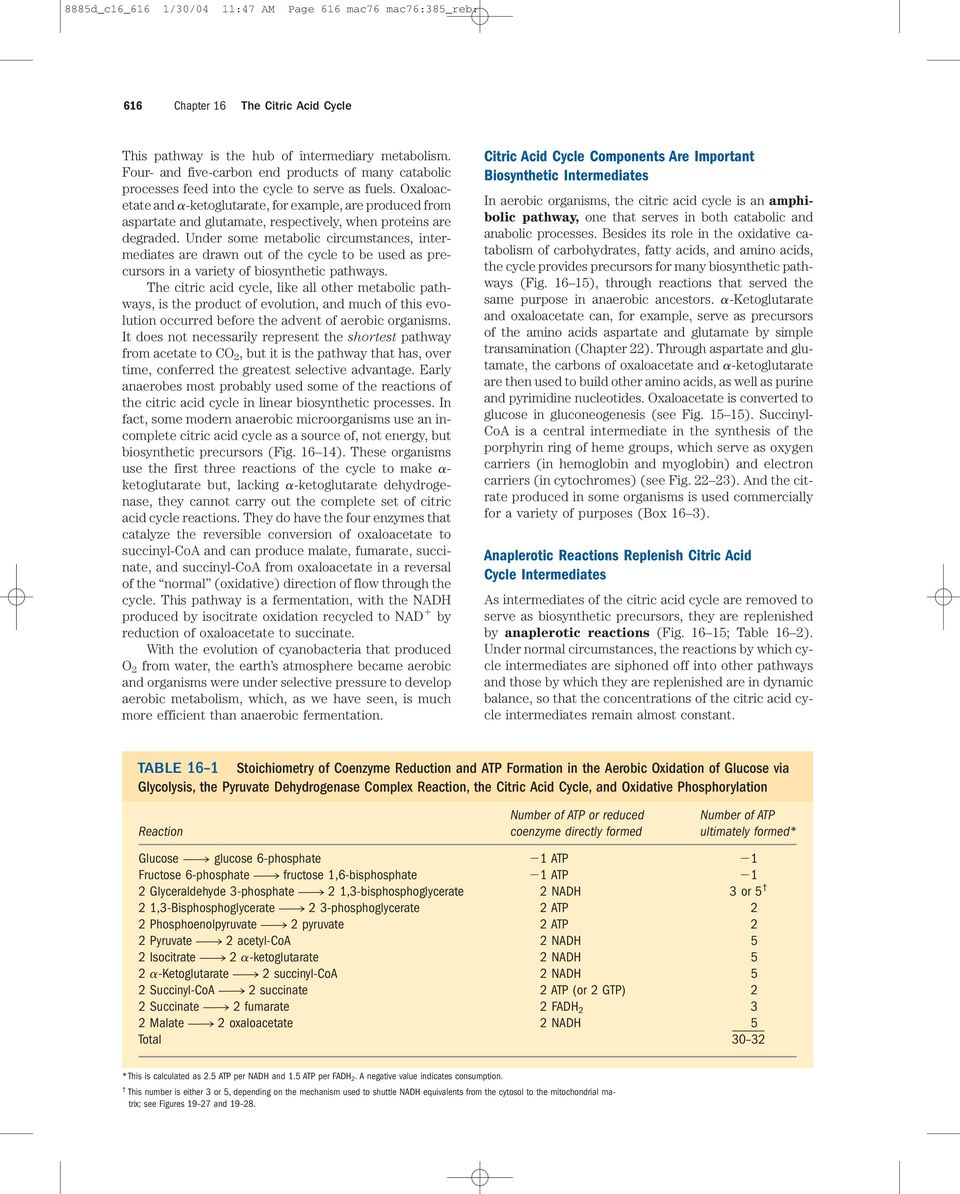
17 8885d_c16_ /27/04 8:54 AM Page 617 mac76 mac76:385_reb: 16.2 Reactions of the itric Acid ycle 617 PEP or pyruvate 2 xaloacetate Malate Fumarate uccinate Acetyl-oA uccinyl-oa itrate Isocitrate α-ketoglutarate Biosynthetic products (amino acids, nucleotides, heme, etc.) FIGURE Biosynthetic precursors produced by an incomplete citric acid cycle in anaerobic bacteria. These anaerobes lack - ketoglutarate dehydrogenase and therefore cannot carry out the complete citric acid cycle. -Ketoglutarate and succinyl-oa serve as precursors in a variety of biosynthetic pathways. (ee Fig for the normal direction of these reactions in the citric acid cycle.) Table 16 2 shows the most common anaplerotic reactions, all of which, in various tissues and organisms, convert either pyruvate or phosphoenolpyruvate to oxaloacetate or malate. The most important anaplerotic reaction in mammalian liver and kidney is the reversible carboxylation of pyruvate by 2 to form oxaloacetate, catalyzed by pyruvate carboxylase. When the citric acid cycle is deficient in oxaloacetate or any other intermediates, pyruvate is carboxylated to produce more oxaloacetate. The enzymatic addition of a carboxyl group to pyruvate requires energy, which is supplied by ATP the free energy required to attach a carboxyl group to pyruvate is about equal to the free energy available from ATP. Pyruvate carboxylase is a regulatory enzyme and is virtually inactive in the absence of acetyl-oa, its positive allosteric modulator. Whenever acetyl-oa, the fuel for the citric acid cycle, is present in excess, it stimulates the pyruvate carboxylase reaction to produce more oxaloacetate, enabling the cycle to use more acetyl-oa in the citrate synthase reaction. The other anaplerotic reactions shown in Table 16 2 are also regulated to keep the level of intermediates high enough to support the activity of the citric acid cycle. Phosphoenolpyruvate (PEP) carboxylase, for example, is activated by the glycolytic intermediate fructose 1,6- bisphosphate, which accumulates when the citric acid cycle operates too slowly to process the pyruvate generated by glycolysis. Pyruvate Glucose pyruvate carboxylase Acetyl-oA Fatty acids, sterols Phosphoenolpyruvate (PEP) erine Glycine ysteine Phenylalanine Tyrosine Tryptophan Aspartate Asparagine PEP carboxykinase Pyrimidines PEP carboxylase malic enzyme xaloacetate Malate Pyruvate itric acid cycle uccinyl-oa itrate α-ketoglutarate Glutamine Proline Arginine Glutamate Purines FIGURE Role of the citric acid cycle in anabolism. Intermediates of the citric acid cycle are drawn off as precursors in many biosynthetic pathways. hown in red are four anaplerotic reactions that replenish depleted cycle intermediates (see Table 16 2). Porphyrins, heme

18 8885d_c16_ /27/04 8:54 AM Page 618 mac76 mac76:385_reb: 618 hapter 16 The itric Acid ycle BX 16 3 TE WRLD F BIEMITRY itrate ynthase, oda Pop, and the World Food upply itrate has a number of important industrial applications. A quick examination of the ingredients in most soft drinks reveals the common use of citric acid to provide a tart or fruity flavor. itric acid is also used as a plasticizer and foam inhibitor in the manufacture of certain resins, as a mordant to brighten colors, and as an antioxidant to preserve the flavors of foods. itric acid is produced industrially by growing the fungus Aspergillus niger in the presence of an inexpensive sugar source, usually beet molasses. ulture conditions are designed to inhibit the reactions of the citric acid cycle such that citrate accumulates. n a grander scale, citric acid may one day play a spectacular role in the alleviation of world hunger. With its three negatively charged carboxyl groups, citrate is a good chelator of metal ions, and some plants exploit this property by releasing citrate into the soil, where it binds metal ions and prevents their absorption by the plant. f particular importance is the aluminum ion (Al 3 ), which is toxic to many plants and causes decreased crop yields on 30% to 40% of the world s arable land. Aluminum is the most abundant metal in the earth s crust, yet it occurs mostly in chemical compounds, such as Al() 3, that are biologically inert. owever, when soil p is less than 5, Al 3 becomes soluble and thus can be absorbed by plant roots. Acidic soil and Al 3 toxicity are most prevalent in the tropics, where maize yields can be depressed by as much as 80%. In Mexico, Al 3 toxicity limits papaya production to 20,000 hectares, instead of the 3 million hectares that could theoretically be cultivated. ne solution would be to raise soil p with lime, but this is economically and environmentally unsound. An alternative would be to breed Al 3 -resistant plants. aturally resistant plants do exist, and these provide the means for a third solution: transferring resistance to crop plants by genetic engineering. A group of researchers in Mexico has genetically engineered tobacco and papaya plants to express elevated levels of bacterial citrate synthase. These plants secrete five to six times their normal amount of Al 3 -chelating citric acid and can grow in soils with Al 3 levels ten times those at which control plants can grow. This degree of resistance would allow Mexico to grow papaya on the 3 million hectares of land currently rendered unsuitable by Al 3. Given projected levels of population growth, world food production must more than triple in the next 50 years to adequately feed 9.6 billion people. A long-term solution may turn on increasing crop productivity on the arable land affected by aluminum toxicity, and citric acid may play an important role in achieving this goal. Biotin in Pyruvate arboxylase arries 2 Groups The pyruvate carboxylase reaction requires the vitamin biotin (Fig ), which is the prosthetic group of the enzyme. Biotin plays a key role in many carboxylation reactions. It is a specialized carrier of one-carbon groups in their most oxidized form: 2. (The transfer of one-carbon groups in more reduced forms is mediated by other cofactors, notably tetrahydrofolate and -adenosylmethionine, as described in hapter 18.) arboxyl groups are activated in a reaction that splits ATP and joins 2 to enzyme-bound biotin. This activated 2 is then passed to an acceptor (pyruvate in this case) in a carboxylation reaction. Pyruvate carboxylase has four identical subunits, each containing a molecule of biotin covalently attached through an amide linkage to the ε-amino group of a specific Lys residue in the enzyme active site. arboxylation of pyruvate proceeds in two steps (Fig ): first, a carboxyl group derived from 3 is attached to biotin, TABLE 16 2 Anaplerotic Reactions Reaction Tissue(s)/organism(s) pyruvate carboxylase Pyruvate 3 ATP z y oxaloacetate ADP P i Liver, kidney PEP carboxykinase Phosphoenolpyruvate 2 GDP z y oxaloacetate GTP eart, skeletal muscle PEP carboxylase Phosphoenolpyruvate z y oxaloacetate P i igher plants, yeast, bacteria Pyruvate malic enzyme 3 AD(P) z y malate AD(P) Widely distributed in eukaryotes and prokaryotes

19 8885d_c16_ /27/04 8:54 AM Page 619 mac76 mac76:385_reb: 16.2 Reactions of the itric Acid ycle 619 Rib Adenine P P P ATP Bicarbonate Biotinyllysine 1 ADP P arboxyphosphate 2 P i : atalytic site 1 Lys atalytic site 2 Pyruvate carboxylase xaloacetate 7 Pyruvate enolate Pyruvate 5 arboxybiotinyl-enzyme 4 Transfer of carboxybiotin (activated 2 ) to second catalytic site MEAIM FIGURE The role of biotin in the reaction catalyzed by pyruvate carboxylase. Biotin is attached to the enzyme through an amide bond with the -amino group of a Lys residue, forming biotinyl-enzyme. Biotin-mediated carboxylation reactions occur in two phases, generally catalyzed by separate active sites on the enzyme as exemplified by the pyruvate carboxylase reaction. In the first phase (steps 1 to 3 ), bicarbonate is converted to the more activated 2, and then used to carboxylate biotin. The bicarbonate is first activated by reaction with ATP to form carboxyphosphate (step 1 ), which breaks down to carbon dioxide (step 2 ). In effect, the bicarbonate is dehydrated by its reaction with ATP, and the 2 can react with biotin to form carboxybiotin (step 3 ). The biotin acts as a carrier to transport the 2 from one active site to another on the same enzyme (step 4 ). In the second phase of the reaction (steps 5 to 7 ), catalyzed in a second active site, the 2 reacts with pyruvate to form oxaloacetate. The 2 is released in the second active site (step 5 ). Pyruvate is converted to its enolate form in step 6, transferring a proton to biotin. The enolate then attacks the 2 to generate oxaloacetate in the final step of the reaction (step 7 ).

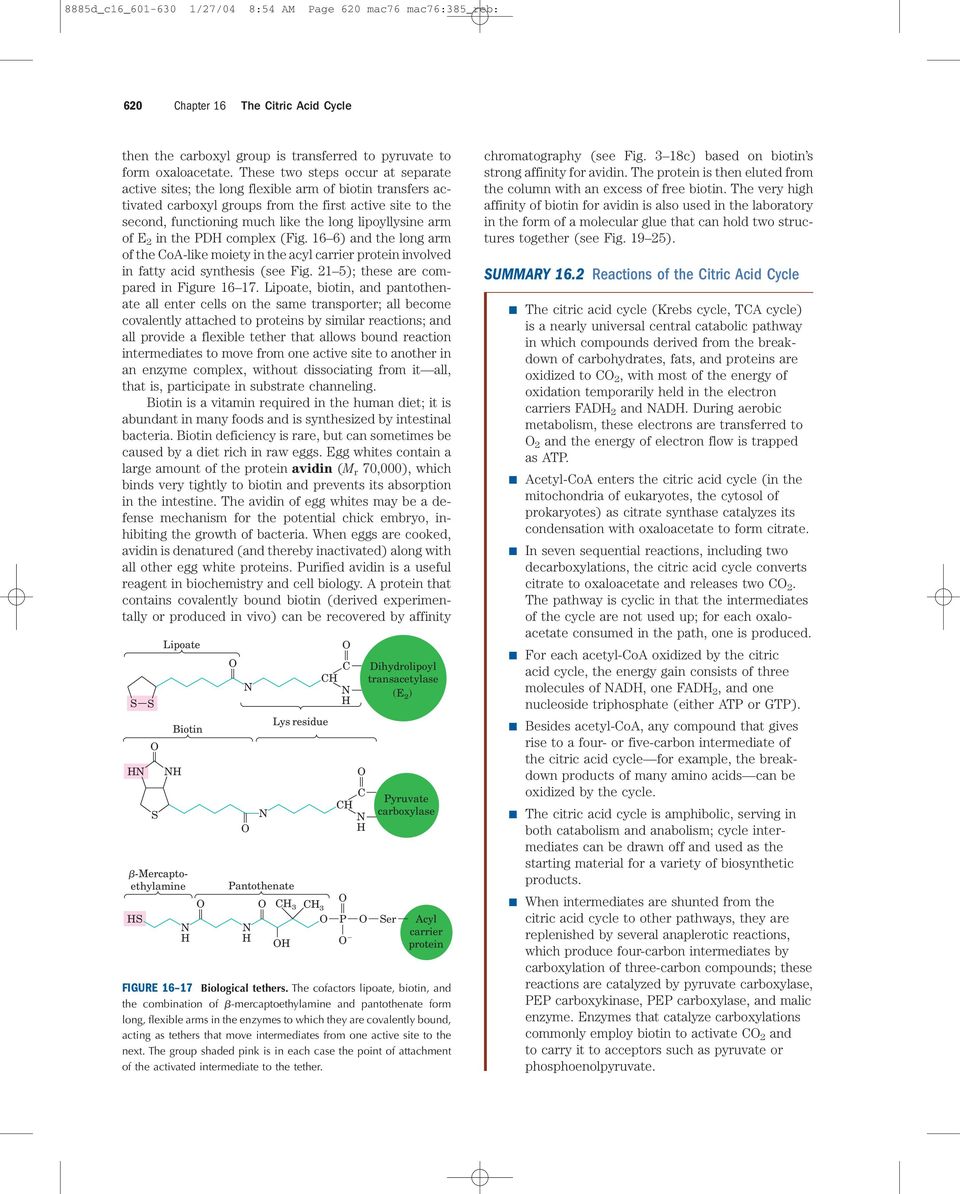
20 8885d_c16_ /27/04 8:54 AM Page 620 mac76 mac76:385_reb: 620 hapter 16 The itric Acid ycle then the carboxyl group is transferred to pyruvate to form oxaloacetate. These two steps occur at separate active sites; the long flexible arm of biotin transfers activated carboxyl groups from the first active site to the second, functioning much like the long lipoyllysine arm of E 2 in the PD complex (Fig. 16 6) and the long arm of the oa-like moiety in the acyl carrier protein involved in fatty acid synthesis (see Fig. 21 5); these are compared in Figure Lipoate, biotin, and pantothenate all enter cells on the same transporter; all become covalently attached to proteins by similar reactions; and all provide a flexible tether that allows bound reaction intermediates to move from one active site to another in an enzyme complex, without dissociating from it all, that is, participate in substrate channeling. Biotin is a vitamin required in the human diet; it is abundant in many foods and is synthesized by intestinal bacteria. Biotin deficiency is rare, but can sometimes be caused by a diet rich in raw eggs. Egg whites contain a large amount of the protein avidin (M r 70,000), which binds very tightly to biotin and prevents its absorption in the intestine. The avidin of egg whites may be a defense mechanism for the potential chick embryo, inhibiting the growth of bacteria. When eggs are cooked, avidin is denatured (and thereby inactivated) along with all other egg white proteins. Purified avidin is a useful reagent in biochemistry and cell biology. A protein that contains covalently bound biotin (derived experimentally or produced in vivo) can be recovered by affinity Lipoate Biotin -Mercaptoethylamine Lys residue Dihydrolipoyl transacetylase (E 2 ) Pantothenate 3 3 P er Acyl carrier protein Pyruvate carboxylase FIGURE Biological tethers. The cofactors lipoate, biotin, and the combination of -mercaptoethylamine and pantothenate form long, flexible arms in the enzymes to which they are covalently bound, acting as tethers that move intermediates from one active site to the next. The group shaded pink is in each case the point of attachment of the activated intermediate to the tether. chromatography (see Fig. 3 18c) based on biotin s strong affinity for avidin. The protein is then eluted from the column with an excess of free biotin. The very high affinity of biotin for avidin is also used in the laboratory in the form of a molecular glue that can hold two structures together (see Fig ). UMMARY 16.2 Reactions of the itric Acid ycle The citric acid cycle (Krebs cycle, TA cycle) is a nearly universal central catabolic pathway in which compounds derived from the breakdown of carbohydrates, fats, and proteins are oxidized to 2, with most of the energy of oxidation temporarily held in the electron carriers FAD 2 and AD. During aerobic metabolism, these electrons are transferred to 2 and the energy of electron flow is trapped as ATP. Acetyl-oA enters the citric acid cycle (in the mitochondria of eukaryotes, the cytosol of prokaryotes) as citrate synthase catalyzes its condensation with oxaloacetate to form citrate. In seven sequential reactions, including two decarboxylations, the citric acid cycle converts citrate to oxaloacetate and releases two 2. The pathway is cyclic in that the intermediates of the cycle are not used up; for each oxaloacetate consumed in the path, one is produced. For each acetyl-oa oxidized by the citric acid cycle, the energy gain consists of three molecules of AD, one FAD 2, and one nucleoside triphosphate (either ATP or GTP). Besides acetyl-oa, any compound that gives rise to a four- or five-carbon intermediate of the citric acid cycle for example, the breakdown products of many amino acids can be oxidized by the cycle. The citric acid cycle is amphibolic, serving in both catabolism and anabolism; cycle intermediates can be drawn off and used as the starting material for a variety of biosynthetic products. When intermediates are shunted from the citric acid cycle to other pathways, they are replenished by several anaplerotic reactions, which produce four-carbon intermediates by carboxylation of three-carbon compounds; these reactions are catalyzed by pyruvate carboxylase, PEP carboxykinase, PEP carboxylase, and malic enzyme. Enzymes that catalyze carboxylations commonly employ biotin to activate 2 and to carry it to acceptors such as pyruvate or phosphoenolpyruvate.
21 8885d_c16_ /27/04 8:54 AM Page 621 mac76 mac76:385_reb: 16.3 Regulation of the itric Acid ycle Regulation of the itric Acid ycle As we have seen in hapter 15, the regulation of key enzymes in metabolic pathways, by allosteric effectors and by covalent modification, ensures the production of intermediates at the rates required to keep the cell in a stable steady state while avoiding wasteful overproduction. The flow of carbon atoms from pyruvate into and through the citric acid cycle is under tight regulation at two levels: the conversion of pyruvate to acetyl-oa, the starting material for the cycle (the pyruvate dehydrogenase complex reaction), and the entry of acetyl-oa into the cycle (the citrate synthase reaction). Acetyl- oa is also produced by pathways other than the PD complex reaction most cells produce acetyl-oa from the oxidation of fatty acids and certain amino acids and the availability of intermediates from these other pathways is important in the regulation of pyruvate oxidation and of the citric acid cycle. The cycle is also regulated at the isocitrate dehydrogenase and -ketoglutarate dehydrogenase reactions. Production of Acetyl-oA by the Pyruvate Dehydrogenase omplex Is Regulated by Allosteric and ovalent Mechanisms The PD complex of mammals is strongly inhibited by ATP and by acetyl-oa and AD, the products of the reaction catalyzed by the complex (Fig ). The allosteric inhibition of pyruvate oxidation is greatly enhanced when long-chain fatty acids are available. AMP, oa, and AD, all of which accumulate when too little acetate flows into the citric acid cycle, allosterically activate the PD complex. Thus, this enzyme activity is turned off when ample fuel is available in the form of fatty acids and acetyl-oa and when the cell s [ATP]/[ADP] and [AD]/[AD ] ratios are high, and it is turned on again when energy demands are high and the cell requires greater flux of acetyl-oa into the citric acid cycle. In mammals, these allosteric regulatory mechanisms are complemented by a second level of regulation: covalent protein modification. The PD complex is inhibited by reversible phosphorylation of a specific er residue on one of the two subunits of E 1. As noted earlier, in addition to the enzymes E 1, E 2, and E 3, the mammalian PD complex contains two regulatory proteins whose sole purpose is to regulate the activity of the complex. A specific protein kinase phosphorylates and thereby inactivates E 1, and a specific phosphoprotein phosphatase removes the phosphoryl group by hydrolysis and thereby activates E 1. The kinase is allosterically activated by ATP: when [ATP] is high (reflecting a sufficient supply of energy), the PD complex is inactivated by phosphorylation of E 1. When [ATP] declines, kinase activity decreases and phosphatase action removes the phosphoryl groups from E 1, activating the complex. The PD complex of plants, located in the mitochondrial matrix and in plastids, is inhibited by its products, AD and acetyl-oa. The plant mitochondrial pyruvate dehydrogenase complex Pyruvate Acetyl-oA ATP, acetyl-oa, AD, fatty acids AMP, oa, AD, a 2 AD, succinyl-oa, citrate, ATP ADP citrate synthase itrate FIGURE Regulation of metabolite flow from the PD complex through the citric acid cycle. The PD complex is allosterically inhibited when [ATP]/[ADP], [AD]/[AD ], and [acetyl-oa]/[oa] ratios are high, indicating an energy-sufficient metabolic state. When these ratios decrease, allosteric activation of pyruvate oxidation results. The rate of flow through the citric acid cycle can be limited by the availability of the citrate synthase substrates, oxaloacetate and acetyl-oa, or of AD, which is depleted by its conversion to AD, slowing the three AD-dependent oxidation steps. Feedback inhibition by succinyl-oa, citrate, and ATP also slows the cycle by inhibiting early steps. In muscle tissue, a 2 signals contraction and, as shown here, stimulates energy-yielding metabolism to replace the ATP consumed by contraction. xaloacetate Malate malate dehydrogenase FAD 2 itric acid cycle AD succinate dehydrogenase GTP (ATP) -ketoglutarate dehydrogenase complex uccinyl-oa Isocitrate isocitrate dehydrogenase α-ketoglutarate ATP a 2, ADP succinyl-oa, AD a 2
22 8885d_c16_622 1/30/04 11:47 AM Page 622 mac76 mac76:385_reb: 622 hapter 16 The itric Acid ycle enzyme is also regulated by reversible phosphorylation; pyruvate inhibits the kinase, thus activating the PD complex, and 4 stimulates the kinase, causing inactivation of the complex. The PD complex of E. coli is under allosteric regulation similar to that of the mammalian enzyme, but it does not seem to be regulated by phosphorylation. The itric Acid ycle Is Regulated at Its Three Exergonic teps The flow of metabolites through the citric acid cycle is under stringent regulation. Three factors govern the rate of flux through the cycle: substrate availability, inhibition by accumulating products, and allosteric feedback inhibition of the enzymes that catalyze early steps in the cycle. Each of the three strongly exergonic steps in the cycle those catalyzed by citrate synthase, isocitrate dehydrogenase, and -ketoglutarate dehydrogenase (Fig ) can become the rate-limiting step under some circumstances. The availability of the substrates for citrate synthase (acetyl-oa and oxaloacetate) varies with the metabolic state of the cell and sometimes limits the rate of citrate formation. AD, a product of isocitrate and -ketoglutarate oxidation, accumulates under some conditions, and at high [AD]/[AD ] both dehydrogenase reactions are severely inhibited by mass action. imilarly, in the cell, the malate dehydrogenase reaction is essentially at equilibrium (that is, it is substrate-limited, and when [AD]/[AD ] is high the concentration of oxaloacetate is low, slowing the first step in the cycle. Product accumulation inhibits all three limiting steps of the cycle: succinyl-oa inhibits - ketoglutarate dehydrogenase (and also citrate synthase); citrate blocks citrate synthase; and the end product, ATP, inhibits both citrate synthase and isocitrate dehydrogenase. The inhibition of citrate synthase by ATP is relieved by ADP, an allosteric activator of this enzyme. In vertebrate muscle, a 2, the signal for contraction and for a concomitant increase in demand for ATP, activates both isocitrate dehydrogenase and -ketoglutarate dehydrogenase, as well as the PD complex. In short, the concentrations of substrates and intermediates in the citric acid cycle set the flux through this pathway at a rate that provides optimal concentrations of ATP and AD. Under normal conditions, the rates of glycolysis and of the citric acid cycle are integrated so that only as much glucose is metabolized to pyruvate as is needed to supply the citric acid cycle with its fuel, the acetyl groups of acetyl-oa. Pyruvate, lactate, and acetyl-oa are normally maintained at steady-state concentrations. The rate of glycolysis is matched to the rate of the citric acid cycle not only through its inhibition by high levels of ATP and AD, which are common to both the glycolytic and respiratory stages of glucose oxidation, but also by the concentration of citrate. itrate, the product of the first step of the citric acid cycle, is an important allosteric inhibitor of phosphofructokinase-1 in the glycolytic pathway (see Fig ). ubstrate hanneling through Multienzyme omplexes May ccur in the itric Acid ycle Although the enzymes of the citric acid cycle are usually described as soluble components of the mitochondrial matrix (except for succinate dehydrogenase, which is membrane-bound), growing evidence suggests that within the mitochondrion these enzymes exist as multienzyme complexes. The classic approach of enzymology purification of individual proteins from extracts of broken cells was applied with great success to the citric acid cycle enzymes. owever, the first casualty of cell breakage is higher-level organization within the cell the noncovalent, reversible interaction of one protein with another, or of an enzyme with some structural component such as a membrane, microtubule, or microfilament. When cells are broken open, their contents, including enzymes, are diluted 100- or 1,000-fold (Fig ). everal types of evidence suggest that, in cells, multienzyme complexes ensure efficient passage of the product of one enzyme reaction to the next enzyme in the pathway. uch complexes are called metabolons. ertain enzymes of the citric acid cycle have been isolated together as supramolecular aggregates, or have been found associated with the inner mitochondrial membrane, or have been shown to diffuse in the mitochondrial matrix more slowly than expected for the individual protein in solution. There is strong evidence for substrate channeling through multienzyme complexes in In the cytosol, high concentrations of enzymes 1, 2, and 3 favor their association. In extract of broken cells, dilution by buffer reduces the concentrations of enzymes 1, 2, and 3, favoring their dissociation. FIGURE Dilution of a solution containing a noncovalent protein complex such as one consisting of three enzymes favors dissociation of the complex into its constituents.
23 8885d_c16_ /27/04 8:54 AM Page 623 mac76 mac76:385_reb: 16.4 The Glyoxylate ycle 623 other metabolic pathways, and many enzymes thought of as soluble probably function in the cell as highly organized complexes that channel intermediates. We will encounter other examples of channeling when we discuss the biosynthesis of amino acids and nucleotides in hapter 22. UMMARY 16.3 Regulation of the itric Acid ycle The overall rate of the citric acid cycle is controlled by the rate of conversion of pyruvate to acetyl-oa and by the flux through citrate synthase, isocitrate dehydrogenase, and -ketoglutarate dehydrogenase. These fluxes are largely determined by the concentrations of substrates and products: the end products ATP and AD are inhibitory, and the substrates AD and ADP are stimulatory. The production of acetyl-oa for the citric acid cycle by the PD complex is inhibited allosterically by metabolites that signal a sufficiency of metabolic energy (ATP, acetyl- oa, AD, and fatty acids) and stimulated by metabolites that indicate a reduced energy supply (AMP, AD, oa) The Glyoxylate ycle Vertebrates cannot convert fatty acids, or the acetate derived from them, to carbohydrates. onversion of phosphoenolpyruvate to pyruvate (p. 532) and of pyruvate to acetyl-oa (Fig. 16 2) are so exergonic as to be essentially irreversible. If a cell cannot convert acetate into phosphoenolpyruvate, acetate cannot serve as the starting material for the gluconeogenic pathway, which leads from phosphoenolpyruvate to glucose (see Fig ). Without this capacity, then, a cell or organism is unable to convert fuels or metabolites that are degraded to acetate (fatty acids and certain amino acids) into carbohydrates. As noted in the discussion of anaplerotic reactions (Table 16 2), phosphoenolpyruvate can be synthesized from oxaloacetate in the reversible reaction catalyzed by PEP carboxykinase: xaloacetate GTP 34 phosphoenolpyruvate 2 GDP Because the carbon atoms of acetate molecules that enter the citric acid cycle appear eight steps later in oxaloacetate, it might seem that this pathway could generate oxaloacetate from acetate and thus generate phosphoenolpyruvate for gluconeogenesis. owever, as an examination of the stoichiometry of the citric acid cycle shows, there is no net conversion of acetate to oxaloacetate; in vertebrates, for every two carbons that enter the cycle as acetyl-oa, two leave as 2. In many organisms other than vertebrates, the glyoxylate cycle serves as a mechanism for converting acetate to carbohydrate. The Glyoxylate ycle Produces Four-arbon ompounds from Acetate In plants, certain invertebrates, and some microorganisms (including E. coli and yeast) acetate can serve both as an energy-rich fuel and as a source of phosphoenolpyruvate for carbohydrate synthesis. In these organisms, enzymes of the glyoxylate cycle catalyze the net conversion of acetate to succinate or other fourcarbon intermediates of the citric acid cycle: 2 Acetyl-oA AD 2 2 n succinate 2oA AD In the glyoxylate cycle, acetyl-oa condenses with oxaloacetate to form citrate, and citrate is converted to isocitrate, exactly as in the citric acid cycle. The next step, however, is not the breakdown of isocitrate by isocitrate dehydrogenase but the cleavage of isocitrate by isocitrate lyase, forming succinate and glyoxylate. The glyoxylate then condenses with a second molecule of acetyl-oa to yield malate, in a reaction catalyzed by malate synthase. The malate is subsequently oxidized to oxaloacetate, which can condense with another molecule of acetyl-oa to start another turn of the cycle (Fig ). Each turn of the glyoxylate cycle consumes two molecules of acetyl-oa and produces one molecule of succinate, which is then available for biosynthetic purposes. The succinate may be converted through fumarate and malate into oxaloacetate, which can then be converted to phosphoenolpyruvate by PEP carboxykinase, and thus to glucose by gluconeogenesis. Vertebrates do not have the enzymes specific to the glyoxylate cycle (isocitrate lyase and malate synthase) and therefore cannot bring about the net synthesis of glucose from lipids. In plants, the enzymes of the glyoxylate cycle are sequestered in membrane-bounded organelles called glyoxysomes, which are specialized peroxisomes (Fig ). Those enzymes common to the citric acid and glyoxylate cycles have two isozymes, one specific to mitochondria, the other to glyoxysomes. Glyoxysomes are not present in all plant tissues at all times. They develop in lipid-rich seeds during germination, before the developing plant acquires the ability to make glucose by photosynthesis. In addition to glyoxylate cycle enzymes, glyoxysomes contain all the enzymes needed for the degradation of the fatty acids stored in seed oils (see Fig ). Acetyl-oA formed from lipid breakdown is converted to succinate via the glyoxylate cycle, and the succinate is exported to mitochondria, where citric
24 8885d_c16_ /27/04 8:54 AM Page 624 mac76 mac76:385_reb: 624 hapter 16 The itric Acid ycle 2 xaloacetate 2 AD AD malate dehydrogenase Malate malate synthase acid cycle enzymes transform it to malate. A cytosolic isozyme of malate dehydrogenase oxidizes malate to oxaloacetate, a precursor for gluconeogenesis. Germinating seeds can therefore convert the carbon of stored lipids into glucose. The itric Acid and Glyoxylate ycles Are oordinately Regulated 3 -oa Acetyl-oA Glyoxylate 3 -oa Acetyl-oA 2 2 uccinate 2 2 itrate 2 Isocitrate In germinating seeds, the enzymatic transformations of dicarboxylic and tricarboxylic acids occur in three intracellular compartments: mitochondria, glyoxysomes, and the cytosol. There is a continuous interchange of metabolites among these compartments (Fig ). The carbon skeleton of oxaloacetate from the citric acid cycle (in the mitochondrion) is carried to the glyoxysome in the form of aspartate. Aspartate is converted Glyoxylate cycle citrate synthase isocitrate lyase aconitase FIGURE Glyoxylate cycle. The citrate synthase, aconitase, and malate dehydrogenase of the glyoxylate cycle are isozymes of the citric acid cycle enzymes; isocitrate lyase and malate synthase are unique to the glyoxylate cycle. otice that two acetyl groups (pink) enter the cycle and four carbons leave as succinate (blue). The glyoxylate cycle was elucidated by ans Kornberg and eil Madsen in the laboratory of ans Krebs. to oxaloacetate, which condenses with acetyl-oa derived from fatty acid breakdown. The citrate thus formed is converted to isocitrate by aconitase, then split into glyoxylate and succinate by isocitrate lyase. The succinate returns to the mitochondrion, where it reenters the citric acid cycle and is transformed into malate, which enters the cytosol and is oxidized (by cytosolic malate dehydrogenase) to oxaloacetate. xaloacetate is converted via gluconeogenesis into hexoses and sucrose, which can be transported to the growing roots and shoot. Four distinct pathways participate in these conversions: fatty acid breakdown to acetyl-oa (in glyoxysomes), the glyoxylate cycle (in glyoxysomes), the citric acid cycle (in mitochondria), and gluconeogenesis (in the cytosol). The sharing of common intermediates requires that these pathways be coordinately regulated. Isocitrate is a crucial intermediate, at the branch point between the glyoxylate and citric acid cycles (Fig ). Isocitrate dehydrogenase is regulated by covalent modification: a specific protein kinase phosphorylates and thereby inactivates the dehydrogenase. This inactivation shunts isocitrate to the glyoxylate cycle, where it begins the synthetic route toward glucose. A phosphoprotein phosphatase removes the phosphoryl group from isocitrate dehydrogenase, reactivating the enzyme and sending more isocitrate through the energy-yielding citric acid cycle. The regulatory protein kinase and phosphoprotein phosphatase are separate enzymatic activities of a single polypeptide. ome bacteria, including E. coli, have the full complement of enzymes for the glyoxylate and citric acid cycles in the cytosol and can therefore grow on acetate as their sole source of carbon and energy. The phosphoprotein phosphatase that activates isocitrate dehydrogenase is stimulated by intermediates of the citric acid cycle and glycolysis and by indicators of reduced cellular energy supply (Fig ). The same metabolites inhibit the protein kinase activity of the bifunctional polypeptide. Thus, the accumulation of intermediates of Lipid body Glyoxysome Mitochondria FIGURE Electron micrograph of a germinating cucumber seed, showing a glyoxysome, mitochondria, and surrounding lipid bodies.
25 8885d_c16_625 1/30/04 11:48 AM Page 625 mac76 mac76:385_reb: Lipid body Triacylglycerols Fatty acids Fatty acids Acetyl-oA 16.4 The Glyoxylate ycle 625 The same intermediates of glycolysis and the citric acid cycle that activate isocitrate dehydrogenase are allosteric inhibitors of isocitrate lyase. When energyyielding metabolism is sufficiently fast to keep the concentrations of glycolytic and citric acid cycle intermediates low, isocitrate dehydrogenase is inactivated, the inhibition of isocitrate lyase is relieved, and isocitrate flows into the glyoxylate pathway, to be used in the biosynthesis of carbohydrates, amino acids, and other cellular components. xaloacetate Malate Glyoxylate cycle Glyoxylate Acetyl-oA Isocitrate uccinate Glyoxysome itrate ucrose exoses gluconeogenesis xaloacetate ytosol Malate intermediates of citric acid cycle and glycolysis, AMP, ADP Acetyl-oA Isocitrate isocitrate lyase isocitrate dehydrogenase intermediates of citric acid cycle and glycolysis, AMP, ADP protein kinase phosphatase uccinate, glyoxylate α -Ketoglutarate Fumarate Malate Glyoxylate cycle itric acid cycle uccinate itric acid cycle xaloacetate itrate Mitochondrion FIGURE Relationship between the glyoxylate and citric acid cycles. The reactions of the glyoxylate cycle (in glyoxysomes) proceed simultaneously with, and mesh with, those of the citric acid cycle (in mitochondria), as intermediates pass between these compartments. The conversion of succinate to oxaloacetate is catalyzed by citric acid cycle enzymes. The oxidation of fatty acids to acetyl-oa is described in hapter 17; the synthesis of hexoses from oxaloacetate is described in hapter 20. the central energy-yielding pathways indicating energy depletion results in the activation of isocitrate dehydrogenase. When the concentration of these regulators falls, signaling a sufficient flux through the energy-yielding citric acid cycle, isocitrate dehydrogenase is inactivated by the protein kinase. gluconeogenesis xaloacetate Glucose Amino acids, nucleotides AD, FAD 2 oxidative phosphorylation ATP FIGURE oordinated regulation of glyoxylate and citric acid cycles. Regulation of isocitrate dehydrogenase activity determines the partitioning of isocitrate between the glyoxylate and citric acid cycles. When the enzyme is inactivated by phosphorylation (by a specific protein kinase), isocitrate is directed into biosynthetic reactions via the glyoxylate cycle. When the enzyme is activated by dephosphorylation (by a specific phosphatase), isocitrate enters the citric acid cycle and ATP is produced.
26 8885d_c16_ /27/04 8:54 AM Page 626 mac76 mac76:385_reb: 626 hapter 16 The itric Acid ycle UMMARY 16.4 The Glyoxylate ycle The glyoxylate cycle is active in the germinating seeds of some plants and in certain microorganisms that can live on acetate as the sole carbon source. In plants, the pathway takes place in glyoxysomes in seedlings. It involves several citric acid cycle enzymes and two additional enzymes: isocitrate lyase and malate synthase. In the glyoxylate cycle, the bypassing of the two decarboxylation steps of the citric acid cycle makes possible the net formation of succinate, oxaloacetate, and other cycle intermediates from acetyl-oa. xaloacetate thus formed can be used to synthesize glucose via gluconeogenesis. The partitioning of isocitrate between the citric acid cycle and the glyoxylate cycle is controlled at the level of isocitrate dehydrogenase, which is regulated by reversible phosphorylation. Vertebrates lack the glyoxylate cycle and cannot synthesize glucose from acetate or the fatty acids that give rise to acetyl-oa. Key Terms Terms in bold are defined in the glossary. respiration 601 substrate channeling 605 cellular respiration 601 iron-sulfur center 609 citric acid cycle 601 -ketoglutarate dehydrogenase tricarboxylic acid (TA) cycle 601 complex 610 Krebs cycle 601 nucleoside diphosphate kinase 612 pyruvate dehydrogenase (PD) synthases 613 complex 602 synthetases 613 oxidative decarboxylation 602 ligases 613 thioester 603 lyases 613 lipoate 603 kinases 613 phosphorylases 613 phosphatases 613 prochiral molecule 615 amphibolic pathway 616 anaplerotic reaction 616 biotin 618 avidin 620 metabolon 622 glyoxylate cycle 623 Further Reading General olmes, F.L. (1990, 1993) ans Krebs, Vol 1: Formation of a cientific Life, ; Vol. 2: Architect of Intermediary Metabolism, , xford University Press, xford. A scientific and personal biography of Krebs by an eminent historian of science, with a thorough description of the work that revealed the urea and citric acid cycles. Kay, J. & Weitzman, P.D.J. (eds) (1987) Krebs itric Acid ycle: alf a entury and till Turning, Biochemical ociety ymposium 54, The Biochemical ociety, London. A multiauthor book on the citric acid cycle, including molecular genetics, regulatory mechanisms, variations on the cycle in microorganisms from unusual ecological niches, and evolution of the pathway. Especially relevant are the chapters by. Gest (Evolutionary Roots of the itric Acid ycle in Prokaryotes), W.. olms (ontrol of Flux through the itric Acid ycle and the Glyoxylate Bypass in Escherichia coli), and R.. Perham et al. (-Keto Acid Dehydrogenase omplexes). Pyruvate Dehydrogenase omplex arris, R.A., Bowker-Kinley, M.M., uang, B., & Wu, P. (2002) Regulation of the activity of the pyruvate dehydrogenase complex. Adv. Enzyme Regul. 42, Milne, J.L.., hi, D., Rosenthal, P.B., unshine, J.., Domingo, G.J., Wu, X., Brooks, B.R., Perham, R.., enderson, R., & ubramaniam,. (2002) Molecular architecture and mechanism of an icosahedral pyruvate dehydrogenase complex: a multifunctional catalytic machine. EMB J. 21, Beautiful illustration of the power of image reconstruction methodology with cryoelectron microscopy, here used to develop a plausible model for the structure of the PD complex. ompare this model with that in the paper by Zhou et al. Perham, R.. (2000) winging arms and swinging domains in multifunctional enzymes: catalytic machines for multistep reactions. Annu. Rev. Biochem. 69, Review of the roles of swinging arms containing lipoate, biotin, and pantothenate in substrate channeling through multienzyme complexes. Zhou, Z.., Mcarthy, D.B., onner,.m., Reed, L.J., & toops, J.K. (2001) The remarkable structural and functional organization of the eukaryotic pyruvate dehydrogenase complexes. Proc. atl. Acad. ci. UA 98, 14,802 14,807. Another striking paper in which image reconstruction with cryoelectron microscopy yields a model of the PD complex. ompare this model with that in the paper by Milne et al. itric Acid ycle Enzymes Fraser, M.D., James, M.., Bridger, W.A., & Wolodko, W.T. (1999) A detailed structural description of Escherichia coli succinyl-oa synthetase. J. Mol. Biol. 285, (ee also the erratum in J. Mol. Biol. 288, 501 (1999).)
27 8885d_c16_ /27/04 8:54 AM Page 627 mac76 mac76:385_reb: hapter 16 Problems 627 Goward,.R. & icholls, D.J. (1994) Malate dehydrogenase: a model for structure, evolution, and catalysis. Protein ci. 3, A good, short review. agerhall,. (1997) uccinate:quinone oxidoreductases: variations on a conserved theme. Biochim. Biophys. Acta 1320, A review of the structure and function of succinate dehydrogenases. Jitrapakdee,. & Wallace, J.. (1999) tructure, function, and regulation of pyruvate carboxylase. Biochem. J. 340, Knowles, J. (1989) The mechanism of biotin-dependent enzymes. Annu. Rev. Biochem. 58, Matte, A., Tari, L.W., Goldie,., & Delbaere, L.T.J. (1997) tructure and mechanism of phosphoenolpyruvate carboxykinase. J. Biol. hem. 272, vadi, J. & rere, P. (2000) Macromolecular compartmentation and channeling. Int. Rev. ytol. 192, Advanced review of the evidence for channeling and metabolons. Remington,.J. (1992) tructure and mechanism of citrate synthase. urr. Top. ell. Regul. 33, A thorough review of this enzyme. inger, T.P. & Johnson, M.K. (1985) The prosthetic groups of succinate dehydrogenase: 30 years from discovery to identification. FEB Lett. 190, A description of the structure and role of the iron-sulfur centers in this enzyme. Weigand, G. & Remington,.J. (1986) itrate synthase: structure, control, and mechanism. Annu. Rev. Biophys. Biophys. hem. 15, Wolodko, W.T., Fraser, M.E., James, M..G., & Bridger, W.A. (1994) The crystal structure of succinyl-oa synthetase from Escherichia coli at 2.5-Å resolution. J. Biol. hem. 269, 10,883 10,890. Regulation of the itric Acid ycle ansford, R.G. (1980) ontrol of mitochondrial substrate oxidation. urr. Top. Bioenerget. 10, A detailed review of the regulation of the citric acid cycle. Kaplan,.. (1985) The role of pyridine nucleotides in regulating cellular metabolism. urr. Top. ell. Regul. 26, An excellent general discussion of the importance of the [AD]/[AD ] ratio in cellular regulation. Reed, L.J., Damuni, Z., & Merryfield, M.L. (1985) Regulation of mammalian pyruvate and branched-chain -keto acid dehydrogenase complexes by phosphorylation-dephosphorylation. urr. Top. ell. Regul. 27, Glyoxylate ycle Eastmond, P.J. & Graham, I.A. (2001) Re-examining the role of the glyoxylate cycle in oilseeds. Trends Plant ci. 6, Intermediate-level review of studies of the glyoxylate cycle in Arabidopsis. olms, W.. (1986) The central metabolic pathways of Escherichia coli: relationship between flux and control at a branch point, efficiency of conversion to biomass, and excretion of acetate. urr. Top. ell. Regul. 28, Problems 1. Balance heet for the itric Acid ycle The citric acid cycle has eight enzymes: citrate synthase, aconitase, isocitrate dehydrogenase, -ketoglutarate dehydrogenase, succinyl-oa synthetase, succinate dehydrogenase, fumarase, and malate dehydrogenase. (a) Write a balanced equation for the reaction catalyzed by each enzyme. (b) ame the cofactor(s) required by each enzyme reaction. (c) For each enzyme determine which of the following describes the type of reaction(s) catalyzed: condensation (carbon carbon bond formation); dehydration (loss of water); hydration (addition of water); decarboxylation (loss of 2 ); oxidation-reduction; substrate-level phosphorylation; isomerization. (d) Write a balanced net equation for the catabolism of acetyl-oa to Recognizing xidation and Reduction Reactions ne biochemical strategy of many living organisms is the stepwise oxidation of organic compounds to 2 and 2 and the conservation of a major part of the energy thus produced in the form of ATP. It is important to be able to recognize oxidation-reduction processes in metabolism. Reduction of an organic molecule results from the hydrogenation of a double bond (Eqn 1, below) or of a single bond with accompanying cleavage (Eqn 2). onversely, oxidation results from dehydrogenation. In biochemical redox reactions, the coenzymes AD and FAD dehydrogenate/hydrogenate organic molecules in the presence of the proper enzymes. B 3 Acetaldehyde reduction oxidation B A 3 G reduction oxidation A 3 (1) A Ethanol B 3 G Acetate reduction oxidation B reduction B D 3 3 G A oxidation G Acetaldehyde (2)
28 8885d_c16_628 1/30/04 11:48 AM Page 628 mac76 mac76:385_reb: 628 hapter 16 The itric Acid ycle For each of the metabolic transformations in (a) through (h), determine whether oxidation or reduction has occurred. Balance each transformation by inserting and, where necessary, 2. B (a) 3 Methanol Formaldehyde (b) (c) B Formaldehyde B G M D 2 2 D M PP arbon dioxide A A J (d) 2 A G Glycerate Glycerol Toluene A A Pyruvate A A A (e) 2 2 A (f) (g) uccinate B (h) 3 G B Formate B G Formate J G B 3 G A A J 2 A G A B A 2 2 Dihydroxyacetone Benzoate Glyceraldehyde Acetate B G D G P D G M 2 Fumarate 3. Relationship between Energy Release and the xidation tate of arbon A eukaryotic cell can use glucose ( ) and hexanoic acid ( ) as fuels for cellular respiration. n the basis of their structural formulas, which substance releases more energy per gram on complete combustion to 2 and 2? 4. icotinamide oenzymes as Reversible Redox arriers The nicotinamide coenzymes (see Fig ) can undergo reversible oxidation-reduction reactions with specific substrates in the presence of the appropriate dehydrogenase. In these reactions, AD serves as the hydrogen source, as described in Problem 2. Whenever the coenzyme is oxidized, a substrate must be simultaneously reduced: For each of the reactions in (a) through (f), determine whether the substrate has been oxidized or reduced or is unchanged in oxidation state (see Problem 2). If a redox change has occurred, balance the reaction with the necessary amount of AD, AD,, and 2. The objective is to recognize when a redox coenzyme is necessary in a metabolic reaction. (a) 3 2 J 3 G Ethanol Acetaldehyde (b) (c) (d) (e) (f ) ubstrate AD 34 product AD xidized Reduced Reduced xidized 2 P 3 A 2 A J A G 2 P 3 1,3-Bisphosphoglycerate B D 3 M Pyruvate B D 3 M Pyruvate B 2 xaloacetate P 3 A A J 2 P 4 A G Glyceraldehyde 3-phosphate J 3 2 G Acetaldehyde Malate 2 A 2 A B J B G Acetoacetate J 3 G Acetate 2 2 Acetone 5. timulation of xygen onsumption by xaloacetate and Malate In the early 1930s, Albert zent Györgyi reported the interesting observation that the addition of small amounts of oxaloacetate or malate to suspensions of minced pigeon-breast muscle stimulated the oxygen consumption of the preparation. urprisingly, the amount of oxygen consumed was about seven times more than the amount necessary for complete oxidation (to 2 and 2 ) of the added oxaloacetate or malate. Why did the addition of oxaloacetate or malate stimulate oxygen consumption? Why was the amount of oxygen consumed so much greater than the amount necessary to completely oxidize the added oxaloacetate or malate?
29 8885d_c16_ /27/04 8:54 AM Page 629 mac76 mac76:385_reb: hapter 16 Problems Formation of xaloacetate in a Mitochondrion In the last reaction of the citric acid cycle, malate is dehydrogenated to regenerate the oxaloacetate necessary for the entry of acetyl-oa into the cycle: L-Malate AD n oxaloacetate AD G 30.0 kj/mol (a) alculate the equilibrium constant for this reaction at 25. (b) Because G assumes a standard p of 7, the equilibrium constant calculated in (a) corresponds to K eq [oxaloacetate][ad] [L-malate][AD ] The measured concentration of L-malate in rat liver mitochondria is about 0.20 mm when [AD ]/[AD] is 10. alculate the concentration of oxaloacetate at p 7 in these mitochondria. (c) To appreciate the magnitude of the mitochondrial oxaloacetate concentration, calculate the number of oxaloacetate molecules in a single rat liver mitochondrion. Assume the mitochondrion is a sphere of diameter 2.0 m. 7. Energy Yield from the itric Acid ycle The reaction catalyzed by succinyl-oa synthetase produces the highenergy compound GTP. ow is the free energy contained in GTP incorporated into the cellular ATP pool? 8. Respiration tudies in Isolated Mitochondria ellular respiration can be studied in isolated mitochondria by measuring oxygen consumption under different conditions. If 0.01 M sodium malonate is added to actively respiring mitochondria that are using pyruvate as fuel source, respiration soon stops and a metabolic intermediate accumulates. (a) What is the structure of this intermediate? (b) Explain why it accumulates. (c) Explain why oxygen consumption stops. (d) Aside from removal of the malonate, how can this inhibition of respiration be overcome? Explain. 9. Labeling tudies in Isolated Mitochondria The metabolic pathways of organic compounds have often been delineated by using a radioactively labeled substrate and following the fate of the label. (a) ow can you determine whether glucose added to a suspension of isolated mitochondria is metabolized to 2 and 2? (b) uppose you add a brief pulse of [3-14 ]pyruvate (labeled in the methyl position) to the mitochondria. After one turn of the citric acid cycle, what is the location of the 14 in the oxaloacetate? Explain by tracing the 14 label through the pathway. ow many turns of the cycle are required to release all the [3-14 ]pyruvate as 2? 10. [1-14 ]Glucose atabolism An actively respiring bacterial culture is briefly incubated with [1-14 ] glucose, and the glycolytic and citric acid cycle intermediates are isolated. Where is the 14 in each of the intermediates listed below? onsider only the initial incorporation of 14, in the first pass of labeled glucose through the pathways. (a) Fructose 1,6-bisphosphate (b) Glyceraldehyde 3-phosphate (c) Phosphoenolpyruvate (d) Acetyl-oA (e) itrate (f ) -Ketoglutarate (g) xaloacetate 11. Role of the Vitamin Thiamine People with beriberi, a disease caused by thiamine deficiency, have elevated levels of blood pyruvate and -ketoglutarate, especially after consuming a meal rich in glucose. ow are these effects related to a deficiency of thiamine? 12. ynthesis of xaloacetate by the itric Acid ycle xaloacetate is formed in the last step of the citric acid cycle by the AD -dependent oxidation of L-malate. an a net synthesis of oxaloacetate from acetyl-oa occur using only the enzymes and cofactors of the citric acid cycle, without depleting the intermediates of the cycle? Explain. ow is oxaloacetate that is lost from the cycle (to biosynthetic reactions) replenished? 13. Mode of Action of the Rodenticide Fluoroacetate Fluoroacetate, prepared commercially for rodent control, is also produced by a outh African plant. After entering a cell, fluoroacetate is converted to fluoroacetyl-oa in a reaction catalyzed by the enzyme acetate thiokinase: F 2 oa- ATP F 2 -oa AMP PP i The toxic effect of fluoroacetate was studied in an experiment using intact isolated rat heart. After the heart was perfused with 0.22 mm fluoroacetate, the measured rate of glucose uptake and glycolysis decreased, and glucose 6-phosphate and fructose 6-phosphate accumulated. Examination of the citric acid cycle intermediates revealed that their concentrations were below normal, except for citrate, with a concentration 10 times higher than normal. (a) Where did the block in the citric acid cycle occur? What caused citrate to accumulate and the other cycle intermediates to be depleted? (b) Fluoroacetyl-oA is enzymatically transformed in the citric acid cycle. What is the structure of the end product of fluoroacetate metabolism? Why does it block the citric acid cycle? ow might the inhibition be overcome? (c) In the heart perfusion experiments, why did glucose uptake and glycolysis decrease? Why did hexose monophosphates accumulate? (d) Why is fluoroacetate poisoning fatal? 14. ynthesis of L-Malate in Wine Making The tartness of some wines is due to high concentrations of L-malate. Write a sequence of reactions showing how yeast cells synthesize L-malate from glucose under anaerobic conditions in the presence of dissolved 2 ( 3 ). ote that the overall reaction for this fermentation cannot involve the consumption of nicotinamide coenzymes or citric acid cycle intermediates. 15. et ynthesis of -Ketoglutarate -Ketoglutarate plays a central role in the biosynthesis of several amino acids. Write a sequence of enzymatic reactions that could result in
30 8885d_c16_630 1/30/04 11:48 AM Page 630 mac76 mac76:385_reb: 630 hapter 16 The itric Acid ycle the net synthesis of -ketoglutarate from pyruvate. Your proposed sequence must not involve the net consumption of other citric acid cycle intermediates. Write an equation for the overall reaction and identify the source of each reactant. 16. Regulation of the Pyruvate Dehydrogenase omplex In animal tissues, the rate of conversion of pyruvate to acetyl-oa is regulated by the ratio of active, phosphorylated to inactive, unphosphorylated PD complex. Determine what happens to the rate of this reaction when a preparation of rabbit muscle mitochondria containing the PD complex is treated with (a) pyruvate dehydrogenase kinase, ATP, and AD; (b) pyruvate dehydrogenase phosphatase and a 2 ; (c) malonate. 17. ommercial ynthesis of itric Acid itric acid is used as a flavoring agent in soft drinks, fruit juices, and many other foods. Worldwide, the market for citric acid is valued at hundreds of millions of dollars per year. ommercial production uses the mold Aspergillus niger, which metabolizes sucrose under carefully controlled conditions. (a) The yield of citric acid is strongly dependent on the concentration of Fel 3 in the culture medium, as indicated in the graph. Why does the yield decrease when the concentration of Fe 3 is above or below the optimal value of 0.5 mg/l? Yield of citric acid (%) [Fel 3 ] (mg/l) (b) Write the sequence of reactions by which A. niger synthesizes citric acid from sucrose. Write an equation for the overall reaction. (c) Does the commercial process require the culture medium to be aerated that is, is this a fermentation or an aerobic process? Explain. 18. Regulation of itrate ynthase In the presence of saturating amounts of oxaloacetate, the activity of citrate synthase from pig heart tissue shows a sigmoid dependence on the concentration of acetyl-oa, as shown in the graph. When succinyl-oa is added, the curve shifts to the right and the sigmoid dependence is more pronounced. Activity (% of V max ) o succinyl-oa uccinyl-oa added [Acetyl-oA] ( M) n the basis of these observations, suggest how succinyl-oa regulates the activity of citrate synthase. (int: ee Fig ) Why is succinyl-oa an appropriate signal for regulation of the citric acid cycle? ow does the regulation of citrate synthase control the rate of cellular respiration in pig heart tissue? 19. Regulation of Pyruvate arboxylase The carboxylation of pyruvate by pyruvate carboxylase occurs at a very low rate unless acetyl-oa, a positive allosteric modulator, is present. If you have just eaten a meal rich in fatty acids (triacylglycerols) but low in carbohydrates (glucose), how does this regulatory property shut down the oxidation of glucose to 2 and 2 but increase the oxidation of acetyl-oa derived from fatty acids? 20. Relationship between Respiration and the itric Acid ycle Although oxygen does not participate directly in the citric acid cycle, the cycle operates only when 2 is present. Why? 21. Thermodynamics of itrate ynthase Reaction in ells itrate is formed by the condensation of acetyl-oa with oxaloacetate, catalyzed by citrate synthase: xaloacetate acetyl-oa 2 n citrate oa In rat heart mitochondria at p 7.0 and 25, the concentrations of reactants and products are: oxaloacetate, 1 M; acetyl-oa, 1 M; citrate, 220 M; and oa, 65 M. The standard free-energy change for the citrate synthase reaction is 32.2 kj/mol. What is the direction of metabolite flow through the citrate synthase reaction in rat heart cells? Explain. 22. Reactions of the Pyruvate Dehydrogenase omplex Two of the steps in the oxidative decarboxylation of pyruvate (steps 4 and 5 in Fig. 16 6) do not involve any of the three carbons of pyruvate yet are essential to the operation of the PD complex. Explain.
The Citric Acid Cycle
 The itric Acid ycle February 14, 2003 Bryant Miles I. itrate Synthase + 3 SoA The first reaction of the citric acid cycle is the condensation of acetyloa and oxaloacetate to form citrate and oas. The enzyme
Chapter 16 The Citric Acid Cycle
 Chapter 16 The Citric Acid Cycle Multiple Choice Questions 1. Production of acetyl-coa (activated acetate) Page: 603 Difficulty: 2 Ans: A Which of the following is not true of the reaction catalyzed by
Chapter 16 The Citric Acid Cycle
 Chapter 16 The Citric Acid Cycle Multiple Choice Questions 1. Which of the following is not true of the reaction catalyzed by the pyruvate dehydrogenase complex? A) Biotin participates in the decarboxylation.
Citric Acid Cycle. Cycle Overview. Metabolic Sources of Acetyl-Coenzyme A. Enzymes of the Citric Acid Cycle. Regulation of the Citric Acid Cycle
 Citric Acid Cycle Cycle Overview Metabolic Sources of Acetyl-Coenzyme A Enzymes of the Citric Acid Cycle Regulation of the Citric Acid Cycle The Amphibolic Nature of the Citric Acid Cycle Cycle Overview
Regulation of the Citric Acid Cycle
 Regulation of the itric Acid ycle I. hanges in Free Energy February 17, 2003 Bryant Miles kj/mol 40 20 0 20 40 60 80 Reaction DGo' DG TA Free Energy hanges 1 2 3 4 5 6 7 8 9 1.) itrate Synthase 2.) Aconitase
Copyright 2000-2003 Mark Brandt, Ph.D. 54
 Pyruvate Oxidation Overview of pyruvate metabolism Pyruvate can be produced in a variety of ways. It is an end product of glycolysis, and can be derived from lactate taken up from the environment (or,
The Aerobic Fate of Pyruvate
 The Aerobic Fate of yruvate February 12, 2003 Bryant Miles I could tell that some of you were not impressed by the mere 2 ATs produced per glucose by glycolysis. The 2 AT s produced are only a small fraction
CELLULAR RESPIRATION. Chapter 19 & 20. Biochemistry by Campbell and Farell (7 th Edition) By Prof M A Mogale
 CELLULAR RESPIRATION Chapter 19 & 20 Biochemistry by Campbell and Farell (7 th Edition) By Prof M A Mogale 1. Cellular respiration (energy capture) The enzymatic breakdown of food stuffs in the presence
CITRIC ACID (KREB S, TCA) CYCLE
 ITRI AID (KREB S, TA) YLE Date: September 2, 2005 * Time: 10:40 am 11:30 am * Room: G202 Biomolecular Building Lecturer: Steve haney 515A Mary Ellen Jones Building [email protected] 9663286 *Please
Cellular Respiration and Fermentation
 LECTURE PRESENTATIONS For CAMPBELL BIOLOGY, NINTH EDITION Jane B. Reece, Lisa A. Urry, Michael L. Cain, Steven A. Wasserman, Peter V. Minorsky, Robert B. Jackson Chapter 9 Cellular Respiration and Fermentation
Energy Production In A Cell (Chapter 25 Metabolism)
 Energy Production In A Cell (Chapter 25 Metabolism) Large food molecules contain a lot of potential energy in the form of chemical bonds but it requires a lot of work to liberate the energy. Cells need
Summary of Metabolism. Mechanism of Enzyme Action
 Summary of Metabolism Mechanism of Enzyme Action 1. The substrate contacts the active site 2. The enzyme-substrate complex is formed. 3. The substrate molecule is altered (atoms are rearranged, or the
Copyright 2000-2003 Mark Brandt, Ph.D. 59
 The Tricarboxylic Acid Cycle Background (why are eight enzymes necessary?) In principle, acetyl-coa could be converted to carbon dioxide very simply. However, doing so has three potential problems: 1)
What affects an enzyme s activity? General environmental factors, such as temperature and ph. Chemicals that specifically influence the enzyme.
 CH s 8-9 Respiration & Metabolism Metabolism A catalyst is a chemical agent that speeds up a reaction without being consumed by the reaction. An enzyme is a catalytic protein. Hydrolysis of sucrose by
AP BIOLOGY CHAPTER 7 Cellular Respiration Outline
 AP BIOLOGY CHAPTER 7 Cellular Respiration Outline I. How cells get energy. A. Cellular Respiration 1. Cellular respiration includes the various metabolic pathways that break down carbohydrates and other
Anabolic and Catabolic Reactions are Linked by ATP in Living Organisms
 Chapter 5: Microbial Metabolism Microbial Metabolism Metabolism refers to all chemical reactions that occur within a living a living organism. These chemical reactions are generally of two types: Catabolic:
The correct answer is d C. Answer c is incorrect. Reliance on the energy produced by others is a characteristic of heterotrophs.
 1. An autotroph is an organism that a. extracts energy from organic sources b. converts energy from sunlight into chemical energy c. relies on the energy produced by other organisms as an energy source
CHAPTER 15: ANSWERS TO SELECTED PROBLEMS
 CHAPTER 15: ANSWERS T SELECTED PRBLEMS SAMPLE PRBLEMS ( Try it yourself ) 15.1 ur bodies can carry out the second reaction, because it requires less energy than we get from breaking down a molecule of
Chapter 7 Active Reading Guide Cellular Respiration and Fermentation
 Name: AP Biology Mr. Croft Chapter 7 Active Reading Guide Cellular Respiration and Fermentation Overview: Before getting involved with the details of cellular respiration and photosynthesis, take a second
AP Bio Photosynthesis & Respiration
 AP Bio Photosynthesis & Respiration Multiple Choice Identify the letter of the choice that best completes the statement or answers the question. 1. What is the term used for the metabolic pathway in which
1. Explain the difference between fermentation and cellular respiration.
 : Harvesting Chemical Energy Name Period Overview: Before getting involved with the details of cellular respiration and photosynthesis, take a second to look at the big picture. Photosynthesis and cellular
Chapter 9 Mitochondrial Structure and Function
 Chapter 9 Mitochondrial Structure and Function 1 2 3 Structure and function Oxidative phosphorylation and ATP Synthesis Peroxisome Overview 2 Mitochondria have characteristic morphologies despite variable
* Is chemical energy potential or kinetic energy? The position of what is storing energy?
 Biology 1406 Exam 2 - Metabolism Chs. 5, 6 and 7 energy - capacity to do work 5.10 kinetic energy - energy of motion : light, electrical, thermal, mechanical potential energy - energy of position or stored
I N V E S T I C E D O R O Z V O J E V Z D Ě L Á V Á N Í ENZYMES
 = substances that... biological reactions 1. Provide an alternative reaction route which has a lower... energy 2. Reactions catalysed by enzymes occur under mild conditions + good yield + fast 3. Enzymes
BCOR 011 Exam 2, 2004
 BCOR 011 Exam 2, 2004 Name: Section: MULTIPLE CHOICE. Choose the one alternative that best completes the statement or answers the question. 1. According to the first law of thermodynamics, A. the universe
Figure 5. Energy of activation with and without an enzyme.
 Biology 20 Laboratory ENZYMES & CELLULAR RESPIRATION OBJECTIVE To be able to list the general characteristics of enzymes. To study the effects of enzymes on the rate of chemical reactions. To demonstrate
SOME Important Points About Cellular Energetics by Dr. Ty C.M. Hoffman
 SOME Important Points About Cellular Energetics by Dr. Ty C.M. Hoffman An Introduction to Metabolism Most biochemical processes occur as biochemical pathways, each individual reaction of which is catalyzed
Chapter 14- RESPIRATION IN PLANTS
 Chapter 14- RESPIRATION IN PLANTS Living cells require a continuous supply of energy for maintaining various life activities. This energy is obtained by oxidizing the organic compounds (carbohydrates,
MULTIPLE CHOICE QUESTIONS
 MULTIPLE CHOICE QUESTIONS 1. Most components of energy conversion systems evolved very early; thus, the most fundamental aspects of energy metabolism tend to be: A. quite different among a diverse group
Microbial Metabolism. Chapter 5. Enzymes. Enzyme Components. Mechanism of Enzymatic Action
 Chapter 5 Microbial Metabolism Metabolism is the sum of all chemical reactions within a living organism, including anabolic (biosynthetic) reactions and catabolic (degradative) reactions. Anabolism is
1. Enzymes. Biochemical Reactions. Chapter 5: Microbial Metabolism. 1. Enzymes. 2. ATP Production. 3. Autotrophic Processes
 Chapter 5: Microbial Metabolism 1. Enzymes 2. ATP Production 3. Autotrophic Processes 1. Enzymes Biochemical Reactions All living cells depend on biochemical reactions to maintain homeostasis. All of the
Electron Transport System. May 16, 2014 Hagop Atamian [email protected]
 Electron Transport System May 16, 2014 Hagop Atamian [email protected] What did We learn so far? Glucose is converted to pyruvate in glycolysis. The process generates two ATPs. Pyruvate is taken into
Photosynthesis takes place in three stages:
 Photosynthesis takes place in three stages: Light-dependent reactions Light-independent reactions The Calvin cycle 1. Capturing energy from sunlight 2. Using energy to make ATP and NADPH 3. Using ATP and
Bioenergetics. Free Energy Change
 Bioenergetics Energy is the capacity or ability to do work All organisms need a constant supply of energy for functions such as motion, transport across membrane barriers, synthesis of biomolecules, information
by a hydration reaction to form isocitrate. The standard free energy change for this reaction is +6.3 kj/mol; At equilibrium, the ratio of
 CHAPTER 14 - TRICARBOXYLIC ACID CYCLE AND PENTOSE PHOSPHATE PATHWAY We have now gotten to the point in glucose metabolism where one glucose molecule has been cleaved into two molecules of pyruvate, with
Cellular Respiration and Fermentation. How cells produce ATP when oxygen is present 9.1. looking closer at. Pyruvate oxidation 9.3
 Unit 2 ell Structure and Function 9 ellular Respiration and Fermentation This hydroelectric dam on the Duero, a river between Spain and Portugal, uses pumps to move water from the lower reservoir to the
Chapter 8: Energy and Metabolism
 Chapter 8: Energy and Metabolism 1. Discuss energy conversions and the 1 st and 2 nd law of thermodynamics. Be sure to use the terms work, potential energy, kinetic energy, and entropy. 2. What are Joules
008 Chapter 8. Student:
 008 Chapter 8 Student: 1. Some bacteria are strict aerobes and others are strict anaerobes. Some bacteria, however, are facultative anaerobes and can live with or without oxygen. If given the choice of
Problem Set 2 (multiple choice) Biochemistry 3300
 1. What classes of reactions do Lyases catalyse? a) Bond formation coupled with ATP hydrolysis b) Isomerizations c) Group elimination to form double bonds d) Transfer of functional groups e) Hydrolysis
Chapter 14 Glycolysis. Glucose. 2 Pyruvate 2 Lactate (sent to liver to be converted back to glucose) TCA Cycle
 Chapter 14 Glycolysis Requires mitochondria and O 2 Glucose glycolysis anaerobic respiration 2 Pyruvate 2 Lactate (sent to liver to be converted back to glucose) pyruvate dehydrogenase acetyl-coa TCA Cycle
Lactic Acid Dehydrogenase
 Lactic Acid Dehydrogenase Pyruvic Acid Dehydrogenase Complex Pyruvate to ACETYL coa CC CoA + CO 2 Mitochondria 3 carbon Pyruvate to 2 carbon ACETYL Coenzyme A Pyruvate Acetyl CoA + CO 2 + NADH + H + CO2
Todays Outline. Metabolism. Why do cells need energy? How do cells acquire energy? Metabolism. Concepts & Processes. The cells capacity to:
 and Work Metabolic Pathways Enzymes Features Factors Affecting Enzyme Activity Membrane Transport Diffusion Osmosis Passive Transport Active Transport Bulk Transport Todays Outline -Releasing Pathways
Chapter 8: An Introduction to Metabolism
 Chapter 8: An Introduction to Metabolism Name Period Concept 8.1 An organism s metabolism transforms matter and energy, subject to the laws of thermodynamics 1. Define metabolism. The totality of an organism
Cellular Respiration & Metabolism. Metabolism. Coupled Reactions: Bioenergetics. Cellular Respiration: ATP is the cell s rechargable battery
 Cellular Respiration & Metabolism Metabolic Pathways: a summary Metabolism Bioenergetics Flow of energy in living systems obeys: 1 st law of thermodynamics: Energy can be transformed, but it cannot be
Metabolism Lecture 7 METABOLIC_REGULATION Restricted for students enrolled in MCB102, UC Berkeley, Spring 2008 ONLY
 Bryan Krantz: University of California, Berkeley MCB 102, Spring 2008, Metabolism Lecture 7 Reading: Ch. 15 of Principles of Biochemistry, Principles of Metabolic Regulation, Illustrated with Glucose and
Harvesting Energy: Glycolysis and Cellular Respiration. Chapter 8
 Harvesting Energy: Glycolysis and Cellular Respiration Chapter 8 Overview of Glucose Breakdown The overall equation for the complete breakdown of glucose is: C 6 H 12 O 6 + 6O 2 6CO 2 + 6H 2 O + ATP The
MULTIPLE CHOICE. Choose the one alternative that best completes the statement or answers the question.
 Ch23_PT MULTIPLE CHOICE. Choose the one alternative that best completes the statement or answers the question. 1) All of the following statements concerning digestion are correct except A) The major physical
How Cells Release Chemical Energy Cellular Respiration
 How Cells Release Chemical Energy Cellular Respiration Overview of Carbohydrate Breakdown Pathways Photoautotrophs make ATP during photosynthesis and use it to synthesize glucose and other carbohydrates
Overview of Glycolysis Under anaerobic conditions, the glycolytic pathway present in most species results in a balanced reaction:
 Glycolysis Glucose is a valuable molecule. It can be used to generate energy (in red blood cells and in brain under normal conditions, glucose is the sole energy source), and it can be used to generate
Chapter 19a Oxidative Phosphorylation and Photophosphorylation. Multiple Choice Questions
 Chapter 19a Oxidative Phosphorylation and Photophosphorylation Multiple Choice Questions 1. Electron-transfer reactions in mitochondria Page: 707 Difficulty: 1 Ans: E Almost all of the oxygen (O 2 ) one
Cellular Respiration An Overview
 Why? Cellular Respiration An Overview What are the phases of cellular respiration? All cells need energy all the time, and their primary source of energy is ATP. The methods cells use to make ATP vary
Chem 306 Chapter 21 Bioenergetics Lecture Outline III
 Chem 306 Chapter 21 Bioenergetics Lecture Outline III I. HOW IS ATP GENERATED IN THE FINAL STAGE CATABOLISM? A. OVERVIEW 1. At the end of the citric acid cycle, all six carbons of glucose have been oxidized
Under aerobic conditions, the cells obtain energy
 CONTENTS Cell Respiration Three Stages of cell Respiration Citric Acid Cycle or Krebs Cycle or Acetyl-CoA Catabolism Enzymes Involved in the Citric Acid Cycle Cycle Acid Cycle Acid Cycle Stereospecificity
Microbial Metabolism. Biochemical diversity
 Microbial Metabolism Biochemical diversity Metabolism Define Requirements Energy Enzymes Rate Limiting step Reaction time Types Anabolic Endergonic Dehydration Catabolic Exergonic Hydrolytic Metabolism
The 3 stages of Glycolysis
 The Glycolytic pathway describes the oxidation of glucose to pyruvate with the generation of ATP and NADH It is also called as the Embden-Meyerhof Pathway is a universal pathway; present in all organisms:
Visualizing Cell Processes
 Visualizing Cell Processes A Series of Five Programs produced by BioMEDIA ASSOCIATES Content Guide for Program 3 Photosynthesis and Cellular Respiration Copyright 2001, BioMEDIA ASSOCIATES www.ebiomedia.com
Unsaturated and Odd-Chain Fatty Acid Catabolism
 Unsaturated and dd-hain Fatty Acid atabolism March 24, 2003 Bryant Miles The complete oxidation of saturated fatty acids containing an even number of carbon atoms is accomplished by the β-oxidation pathway.
1. A covalent bond between two atoms represents what kind of energy? a. Kinetic energy b. Potential energy c. Mechanical energy d.
 1. A covalent bond between two atoms represents what kind of energy? a. Kinetic energy b. Potential energy c. Mechanical energy d. Solar energy A. Answer a is incorrect. Kinetic energy is the energy of
Chapter 7 Cellular Respiration
 Phases of aerobic cellular respiration 1. Glycolysis 2. Transition or Acetyl-CoA reaction 3. Krebs cycle 4. Electron transport system Chapter 7 Cellular Respiration These phases are nothing more than metabolic
The diagram below summarizes the effects of the compounds that cells use to regulate their own metabolism.
 Regulation of carbohydrate metabolism Intracellular metabolic regulators Each of the control point steps in the carbohydrate metabolic pathways in effect regulates itself by responding to molecules that
Life is driven by energy. All the activities organisms
 9 ow ells arvest Energy oncept utline 9.1 ells harvest the energy in chemical bonds. Using hemical Energy to Drive Metabolism. The energy in,, and other chemical bonds can be captured and used to fuel
CELL/ PHOTOSYNTHESIS/ CELLULAR RESPIRATION Test 2011 ANSWER 250 POINTS ANY WAY IN WHICH YOU WANT
 CELL/ PHOTOSYNTHESIS/ CELLULAR RESPIRATION Test 2011 ANSWER 250 POINTS ANY WAY IN WHICH YOU WANT Completion: complete each statement. (1 point each) 1. All cells arise from. 2. The basic unit of structure
Copyright 2010 Pearson Education, Inc. Chapter Twenty Three 1
 23.2 Glucose Metabolism: An Overview When glucose enters a cell from the bloodstream, it is immediately converted to glucose 6- phosphate. Once this phosphate is formed, glucose is trapped within the cell
PHOTOSYNTHESIS AND CELLULAR RESPIRATION
 reflect Wind turbines shown in the photo on the right are large structures with blades that move in response to air movement. When the wind blows, the blades rotate. This motion generates energy that is
1- Fatty acids are activated to acyl-coas and the acyl group is further transferred to carnitine because:
 Section 10 Multiple Choice 1- Fatty acids are activated to acyl-coas and the acyl group is further transferred to carnitine because: A) acyl-carnitines readily cross the mitochondrial inner membrane, but
Energy & Enzymes. Life requires energy for maintenance of order, growth, and reproduction. The energy living things use is chemical energy.
 Energy & Enzymes Life requires energy for maintenance of order, growth, and reproduction. The energy living things use is chemical energy. 1 Energy exists in two forms - potential and kinetic. Potential
Evolution of Metabolism. Introduction. Introduction. Introduction. How Cells Harvest Energy. Chapter 7 & 8
 How ells Harvest Energy hapter 7 & 8 Evolution of Metabolism A hypothetical timeline for the evolution of metabolism - all in prokaryotic cells!: 1. ability to store chemical energy in ATP 2. evolution
Enzymes and Metabolic Pathways
 Enzymes and Metabolic Pathways Enzyme characteristics Made of protein Catalysts: reactions occur 1,000,000 times faster with enzymes Not part of reaction Not changed or affected by reaction Used over and
How To Understand The Chemistry Of An Enzyme
 Chapt. 8 Enzymes as catalysts Ch. 8 Enzymes as catalysts Student Learning Outcomes: Explain general features of enzymes as catalysts: Substrate -> Product Describe nature of catalytic sites general mechanisms
-Loss of energy -Loss of hydrogen from carbons. -Gain of energy -Gain of hydrogen to carbons
 Cellular Respiration- Equation C6H12O6 + 6O2 6CO2 +6H20 and energy -The energy is released from the chemical bonds in the complex organic molecules -The catabolic process of releasing energy from food
The Urea Cycle. April 11, 2003 Bryant Miles
 The Urea ycle April 11, 2003 Bryant Miles I. Ammonia Toxicity Every amino acid contains at least one amino group. Therefore every amino acid degradation pathway has a key step where the amino group is
Cellular Energy. 1. Photosynthesis is carried out by which of the following?
 Cellular Energy 1. Photosynthesis is carried out by which of the following? A. plants, but not animals B. animals, but not plants C. bacteria, but neither animals nor plants D. all living organisms 2.
Chemistry 20 Chapters 15 Enzymes
 Chemistry 20 Chapters 15 Enzymes Enzymes: as a catalyst, an enzyme increases the rate of a reaction by changing the way a reaction takes place, but is itself not changed at the end of the reaction. An
- Oxygen is needed for cellular respiration [OVERHEAD, fig. 6.2, p. 90 / 4th: 6.1] - lungs provide oxygen to blood, blood brings oxygen to the cells.
![- Oxygen is needed for cellular respiration [OVERHEAD, fig. 6.2, p. 90 / 4th: 6.1] - lungs provide oxygen to blood, blood brings oxygen to the cells.](/thumbs/40/21014327.jpg "- Oxygen is needed for cellular respiration [OVERHEAD, fig. 6.2, p. 90 / 4th: 6.1] - lungs provide oxygen to blood, blood brings oxygen to the cells.") Cellular respiration - how cells make energy - Oxygen is needed for cellular respiration [OVERHEAD, fig. 6.2, p. 90 / 4th: 6.1] - ATP - this is provided by the lungs - lungs provide oxygen to blood, blood
Cellular respiration - how cells make energy - Oxygen is needed for cellular respiration [OVERHEAD, fig. 6.2, p. 90 / 4th: 6.1] - ATP - this is provided by the lungs - lungs provide oxygen to blood, blood
AP BIOLOGY 2015 SCORING GUIDELINES
 AP BIOLOGY 2015 SCORING GUIDELINES Question 2 Figure 1. Glycolysis and pyruvate oxidation Figure 2. Krebs cycle Figure 3. Electron transport chain Cellular respiration includes the metabolic pathways of
Photosynthesis (CO 2 + H 2 O C 6 H 12 O 6 + O 2 )
 The vital role of A This is the energy-rich compound that is the source of energy for all living things. It is a nucleotide, comprising a 5C sugar (ribose); an organic base (adenosine); and 3 phosphate
Inhibitors & Uncouplers
 Inhibitors & Uncouplers February 24, 2003 Bryant Miles The electron transport chain was determined by studying the effects of particular inhibitors. 2 3 3 Rotenone 3 Rotenone is a common insecticide that
2. Which type of macromolecule contains high-energy bonds and is used for long-term energy storage?
 Energy Transport Study Island 1. During the process of photosynthesis, plants use energy from the Sun to convert carbon dioxide and water into glucose and oxygen. These products are, in turn, used by the
Introduction to Metabolism
 Introduction to Metabolism If the ΔG' of the reaction A B is 40 kj/mol, under standard conditions the reaction: A) is at equilibrium. B) will never reach equilibrium. C) will not occur spontaneously. D)
Biology 20 Cellular Respiration Review NG Know the process of Cellular Respiration (use this picture if it helps):
 Biology 20 Cellular Respiration Review NG Know the process of Cellular Respiration (use this picture if it helps): 1) How many ATP molecules are produced for each glucose molecule used in fermentation?
The Electron Transport Chain
 The Electron Transport hain February 19, 2003 Bryant Miles The citric acid cycle oxidizes acetate into two molecules of 2 while capturing the electrons in the form of 3 NAD molecules and one molecule of
RESPIRATION AND FERMENTATION: AEROBIC AND ANAEROBIC OXIDATION OF ORGANIC MOLECULES. Bio 171 Week 6
 RESPIRATION AND FERMENTATION: AEROBIC AND ANAEROBIC OXIDATION OF ORGANIC MOLECULES Bio 171 Week 6 Procedure Label test tubes well, including group name 1) Add solutions listed to small test tubes 2) For
Cellular Respiration Worksheet 1. 1. What are the 3 phases of the cellular respiration process? Glycolysis, Krebs Cycle, Electron Transport Chain.
 Cellular Respiration Worksheet 1 1. What are the 3 phases of the cellular respiration process? Glycolysis, Krebs Cycle, Electron Transport Chain. 2. Where in the cell does the glycolysis part of cellular
pathway that involves taking in heat from the environment at each step. C.
 Study Island Cell Energy Keystone Review 1. Cells obtain energy by either capturing light energy through photosynthesis or by breaking down carbohydrates through cellular respiration. In both photosynthesis
PRACTICE SET 6. A. Questions on Lipid Metabolism and Glyoxylate Cycle
 PRATIE SET 6 A. Questions on Lipid Metabolism and Glyoxylate ycle 1. The hydroxy acid given below can be completely oxidized to acetyl-oa by betaoxidation. Write the series of individual reactions that
Integration of Metabolism
 I. Central Themes of Metabolism 1. ATP is the universal energy carrier. Integration of Metabolism Bryant Miles 2. ATP is generated by the oxidation of metabolic fuels Glucose Fatty Acids Amino Acids 3.
Unit 5 Photosynthesis and Cellular Respiration
 Unit 5 Photosynthesis and Cellular Respiration Advanced Concepts What is the abbreviated name of this molecule? What is its purpose? What are the three parts of this molecule? Label each part with the
Electron Transport Generates a Proton Gradient Across the Membrane
 Electron Transport Generates a Proton Gradient Across the Membrane Each of respiratory enzyme complexes couples the energy released by electron transfer across it to an uptake of protons from water in
Regulation of enzyme activity
 1 Regulation of enzyme activity Regulation of enzyme activity is important to coordinate the different metabolic processes. It is also important for homeostasis i.e. to maintain the internal environment
Electron transport chain, oxidative phosphorylation & mitochondrial transport systems. Joško Ivica
 Electron transport chain, oxidative phosphorylation & mitochondrial transport systems Joško Ivica Electron transport chain & oxidative phosphorylation collects e - & -H Oxidation of foodstuffs oxidizes
Multiple Choice Identify the choice that best completes the statement or answers the question.
 AP bio fall 2014 final exam prep Multiple Choice Identify the choice that best completes the statement or answers the question. 1. According to the first law of thermodynamics, a. the energy of a system
CHM333 LECTURE 13 14: 2/13 15/13 SPRING 2013 Professor Christine Hrycyna
 INTRODUCTION TO ENZYMES Enzymes are usually proteins (some RNA) In general, names end with suffix ase Enzymes are catalysts increase the rate of a reaction not consumed by the reaction act repeatedly to
THE ELECTRON TRANSPORT CHAIN. Oxidative phosphorylation
 THE ELECTRON TRANSPORT CHAIN Oxidative phosphorylation Overview of Metabolism Mitochondria Structure -Schematic Mitochondria Structure -Photomicrograph Overview of ETC Impermiable to ions Permiable via
Electron Transport and Oxidative Phosphorylation
 CHM333 LECTURES 37 & 38: 4/27 29/13 SPRING 2013 Professor Christine Hrycyna Electron Transport and Oxidative Phosphorylation Final stages of aerobic oxidation of biomolecules in eukaryotes occur in the
Chapter 9 Review Worksheet Cellular Respiration
 1 of 5 11/9/2011 8:11 PM Name: Hour: Chapter 9 Review Worksheet Cellular Respiration Energy in General 1. Differentiate an autotroph from a hetertroph as it relates to obtaining energy and the processes
Chapter 9 Cellular Respiration
 Chapter 9 Cellular Respiration Electrons carried in NADH Mitochondrion Glucose Glycolysis Pyruvic acid Krebs Cycle Electrons carried in NADH and FADH 2 Electron Transport Chain Cytoplasm Mitochondrion
Enzymes: Introduction
 Enzymes: Introduction Firefly bioluminescence is produced by an oxidation reaction catalyzed by the enzyme firefly luciferase. The oxidized substrate (product of the reaction) is in an electronically excited
Oxidative Phosphorylation
 Oxidative Phosphorylation NADH from Glycolysis must be transported into the mitochondrion to be oxidized by the respiratory electron transport chain. Only the electrons from NADH are transported, these
Preliminary MFM Quiz
 Preliminary MFM Quiz 1. The major carrier of chemical energy in all cells is: A) adenosine monophosphate B) adenosine diphosphate C) adenosine trisphosphate D) guanosine trisphosphate E) carbamoyl phosphate