
GEOMETRY OF SINGLE POINT TURNING TOOLS
|
|
|
- Octavia Ball
- 9 years ago
- Views:
Transcription
1 GEOMETRY OF SINGLE POINT TURNING TOOLS LEARNING OBJECTIVES Introduction to Features of single point cutting tool. Concept of rake and clearance angle and its importance System of description of Tool geometry ASA, ORS and NSA systems Interrelation between different Systems of Nomenclature Tool geometry is basically referred to some specific angles or slope of the salient faces and edges of the tools at their cutting point. Both material and geometry of the cutting tools play very important roles on their performances in achieving effectiveness, efficiency and overall economy of machining. Cutting tools may be classified according to the number of major cutting edges (points) involved as follows: Single point cutting tools : Examples: turning tools, shaping, planning and slotting tools and boring tools Double or Two point cutting tools : Example : drills Multipoint (more than two) cutting tool: Example: Milling cutters, Broaching tools, Hobs, Gear shaping cutters etc. The geometry of a single point cutting tool is determined by the following features: Face or rake surface, which is the surface of cutting tool along which the chips move Flank surface that face the workpiece. There are two flank surfaces, namely principal and auxiliary flank surfaces. Cutting edge that remove material from the workpiece. There are two cutting edges. The principal cutting edge performs the function of major material removal and is formed by the intersection line of rake face with the principal flank surface. The auxiliary cutting edge, often called as end cutting edge, is formed by intersection of rake face with the auxiliary flank surface. Corner or cutting point, which is meeting point of the principal and auxiliary cutting edges. Often a nose radius is provided to avoid a sharp corner The above mentioned features are shown in the figure 2. 1

2 Figure 2: Features of a single point tool. CONCEPT OF RAKE AND CLEARANCE ANGLES OF CUTTING TOOLS. Tool geometry is basically referred to some specific angles or slope of the salient faces and edges of the tools at their cutting point. Rake angle and clearance angle are the most significant for all the cutting tools. The rake angle and clearance angles are illustrated with figures below Rake angle (γ): Angle of inclination of rake surface from reference plane Clearance angle (α): Angle of inclination of clearance or flank surface from the finished surface The rake angle has the following function: It allows the chip to flow in convenient direction It reduces the cutting force required to shear the metal and consequently helps to increase the tool life and reduce the power consumption. It provides keenness to the cutting edge. It improves surface finish Rake angle may be positive, or negative or even zero as shown in Figure 3. Figure 2: Different types of rake angle on tool 2

3 RAKE ANGLE- TYPES AND THEIR SIGNIFICANCE. Positive rake : Positive rake or increased rake angle reduces compression, the forces, and the friction, yielding a thinner,less deformed and cooler chip But increased rake angle reduces the strength of the tool section and heat conduction capacity Some areas of cutting where positive rake may prove more effective are, when cutting tough, alloyed materials that tend to work harden, such as certain stainless steel, when cutting soft or gummy material or when low rigidity of workpiece, tooling, machine tool, or fixture allows chatter to occur. Negative rake: To provide greater strength at the cutting edge and better heat conductivity, zero or negative rake angles employed on carbide, ceramic, polycrystalline diamond, and poly crystalline cubic boron nitride cutting tools. These materials tend to be brittle but their ability to hold their superior hardness at high temperature results in their selection for high speed and continuous machining operation. Negative rakes increases tool forces but it is necessary to provide added support to the cutting edge. This is particularly important in making intermittent cuts and in absorbing the impact during the initial engagement of the tool and work. Negative rakes are recommended on tool which does not possess good toughness ( low transverse rupture strength) Negative rake causes high compression, tool forces and friction, resulting in highly deformed, hot chip. The rake angle for a tool depends on the following factors 1. Type of the material being cut: A harder material like cast iron may be machined by smaller rake angle than that required by soft material like mild steel or aluminum. 2. Type of tool material. Tool material like cemented carbide permits turning at high speed. At high speeds rake angle has little influence on cutting pressure. Under such condition the rake angle can minimum or even negative rake angle is provided to increase the tool strength. 3. Depth of cut: In rough turning, high depth of cut is given to remove the maximum amount of the material. This means that the tool has to withstand severe cutting pressure. So the rake angle should be decreased to increase the lip angle that provides the strength of the cutting edge. 4. Rigidity of tool holder and machine: an importantly supported tool on old or worn out machine cannot take up high cutting pressure. So while machining under above condition, the tool used should have larger rake angle. 3

4 CUTTING TOOL ANGLE AND THEIR SIGNIFICANCE. Side cutting edge angle The following are the advantages of increasing this angle, It increases tool life as, for the same depth of cut; the cutting force is distributed on a wider surface It diminishes the chip thickness for the same amount of feed and permits greater cutting speed. It dissipates heat quickly for having wider cutting edge. The side cutting edge angle of the tool has practically no effect on the value of cutting force or power consumed for a given depth of cut and feed. Large side cutting edge angles are lightly to cause the tool to chatter. End cutting edge angle The function of end cutting edge angle is to prevent the trailing front cutting edge of the tool from rubbing against the work. A large end cutting edge angle unnecessarily weakens the tool. It varies from 8 to 15 degrees. IMPORTNANCE OF NOSE RADIUS. The nose of a tool is slightly rounded in all turning tools The function of nose radius is as follows: Greater nose radius clears up the feed marks caused by the previous shearing action and provides better surface finish. All finish turning tool have greater nose radius than rough turning tools It increases the strength of the cutting edge, tends to minimize the wear taking place in a sharp pointed tool with consequent increase in tool life Accumulation heat is less than that in a pointed tool which permits higher cutting speeds. TOOL POINT REFERENCE SYSTEM To determine the orientation and inclination of the rake face and flank surfaces, a coordinate system is essential, resulting in a set of planes with reference to which the orientation or inclination can be determined. Two planes are of significance Tool reference plane or principal plane, which is perpendicular to the cutting velocity vector Cutting plane, which is tangential to the cutting edge and contains the velocity vector. The cutting plane is also perpendicular to the principal plane or the tool reference plane. There are three different types of coordinate system that are popular, when it comes to tool nomenclature, they are: 4

5 a) Machine Reference System ( MRS) b) Orthogonal tool Reference System (ORS) c) Oblique or Normal tool Reference System (NRS) Machine Reference System MRS This system is also called ASA system; ASA stands for American Standards Association. Geometry of a cutting tool refers mainly to its several angles or slope of its salient working surfaces and cutting edges. Those angles are expressed w.r.t. some planes of reference. In Machine Reference System (ASA), the three planes of reference and the coordinates are chosen based on the configuration and axes of the machine tool concerned. For example in a Lathe, XX is the spindle axis or workpiece axis, YY is the tool axis and ZZ is the vertical axis. Figure 4 depicts the xyz coordinates of machine Figure 4 : Planes and axes of reference in ASA system 5

6 The planes of reference and the coordinates used in ASA system for tool geometry are : π R - π X - π Y and Xm Ym Zm π R = Reference plane; plane perpendicular to the velocity vector π X = Machine longitudinal plane; plane perpendicular to π R and taken in the direction of assumed longitudinal feed π Y = Machine Transverse plane; plane perpendicular to both π R and π X [This plane is taken in the direction of assumed cross feed] The axes Xm, Ym and Zm are in the direction of longitudinal feed, cross feed and cutting velocity (vector) respectively. Figure 5. Tool angles in ASA system 6

7 Rake angles: [Refer to Figure 5] in ASA system The shape of the tool is normally specified in a special sequence, often referred to as tool signature, as shown below: Back rake angle Side rake angle Front or end clearance or relief angle Side clearance angle or relief angle End cutting edge angle Side cutting edge angle Nose radius 7

8 Orthogonal Tool reference system ORS Generally referred to as ORS (orthogonal rake system). This system is also known as ISO (International standard organization) old. The principal or tool reference plane π R, which is the same as for the machine reference plane The cutting plane π C, which contains the cutting edge, normal to π R plane The cutting plane π o, which contains the cutting edge, normal to π R plane Figure 6 shows the orientation of the rake face and flank surfaces with respect to the orthogonal too reference system and tool angles in symbolic form. Figure 6: Planes and axes of reference in ORS The main geometrical angles used to express tool geometry in Orthogonal Rake System (ORS) and their definitions will be clear from Figure 7.0 8

9 Figure 7.0 : Tool angles in ORS system. 9

10 Normal Rake System NRS Figure 8.0 Auxiliary orthogonal clearance angle. This system is also known as oblique tool reference system or ISO new. ASA system has limited advantage and use like convenience of inspection. But ORS is advantageously used for analysis and research in machining and tool performance. But ORS does not reveal the true picture of the tool geometry when the cutting edges are inclined from the reference plane, i.e., λ 0. Besides, sharpening or resharpening, if necessary, of the tool by grinding in ORS requires some additional calculations for correction of angles. These two limitations of ORS are overcome by using NRS for description and use of tool geometry. The basic difference between ORS and NRS is the fact that in ORS, rake and clearance angles are visualized in the orthogonal plane, π o, whereas in NRS those angles are visualized in another plane called Normal plane, π N. The orthogonal plane, π o is simply normal to π R and π C irrespective of the inclination of the cutting edges, i.e., λ, but π N (and π N for auxiliary cutting edge) is always normal to the cutting edge. The differences between ORS and NRS have been depicted in Figure 9.0 The planes of reference and the coordinates used in NRS are: π - π - π and X Y Z RN C N n n n Where, π = normal reference plane RN π N = Normal plane: plane normal to the cutting edge 10

11 X n = X o Y n = cutting edge Z n = normal to X n and Y n It is to be noted that when λ = 0, NRS and ORS become same, i.e. π o π N, Y N Y o and Z n Z o. 11

12 Interrelation ship between different systems of nomenclature Interrelations can be established between MRS or ASA and ORS or between ORS and NRS systems and vice versa. Rake face angles Case 1 Given bake rake angle and Side rake angle in ASA Find inclination angle and Orthogonal rake in ORS system Assume either φ or φ s is known Note Case 2 Given inclination angle and orthogonal rake in ORS Find back rake and side rake angle of ASA system Assume φ s is known Case 3 12

13 Given inclination angle and orthogonal rake in ORS Find normal rake angle in NRS system Case 4 Given, inclination angle and orthogonal clearance in ORS Find normal clearance angle. Clearance angles Given orthogonal clearance and inclination angle of ORS Find front clearance and side clearance angle of ARS system Assume φ is known. Alternatively we can write 13

Cutting Tool Materials
 Training Objectives After watching the video and reviewing this printed material, the viewer will gain knowledge and understanding of cutting tool metallurgy and specific tool applications for various
CUTTING TOOL TECHNOLOGY. 1. Tool life 2. Tool Materials 3. Tool Geometry 4. Cutting fluids
 CUTTING TOOL TECHNOLOGY 1. Tool life 2. Tool Materials 3. Tool Geometry 4. Cutting fluids 1 Introduction Machining is accomplished by cutting tools. Cutting tools undergo high force and temperature and
COATED CARBIDE. TiN. Al 2 O 3
 COATED CARBIDE GENERAL INFORMATION CVD = Chemical Vapour Deposition coated grades GC2015, GC2025, GC2135, GC235, GC3005, GC3015, GC3020, GC3025, GC3115, GC4015, GC4025, GC4035, S05F, and CD1810. PVD =
Manufacturing Tooling Cutting Tool Design. Elements of Machining. Chip Formation. Nageswara Rao Posinasetti
 Manufacturing Tooling Cutting Tool Design Nageswara Rao Posinasetti Elements of Machining Cutting tool Tool holding Guiding device Work piece Machine tool January 29, 2008 Nageswara Rao Posinasetti 2 Chip
High speed machining and conventional die and mould machining
 High speed machining and conventional die and mould machining Reprint from HSM - High Speed Machining There are a lot of questions about HSM today and many different, more or less complicated, definitions
Module 3 Machinability. Version 2 ME, IIT Kharagpur
 Module 3 Machinability Lesson 1 Cutting Tool Materials of common use Instructional Objectives At the end of this lesson, the students will be able to (i) Identify the needs and cite the chronological development
Table of contents BRAZED TURNING TOOLS. Toolholders H 2. Tips H 6. Rods H 8. Technical information H 9 H 1
 Table of contents BRAZED TURNING TOOLS Toolholders 2 Tips 6 Rods 8 9 1 ISO External holders General turning External Ordering Tip According to ISO243-1975 (DIN 4982-198) h b l 1 f 1 f 2 a p r ε γ 1) λ
Chapter 6 Machining Center Carbide Insert Fundamentals
 This sample chapter is for review purposes only. Copyright The Goodheart-Willcox Co., Inc. All rights reserved. N10G20G99G40 N20G96S800M3 N30G50S4000 N40T0100M8 N50G00X3.35Z1.25T0101 N60G01X3.25F.002 N70G04X0.5
Computer-Aided Numerical Control (CNC) Programming and Operation; Lathe Introduction, Advanced Mills
 1 of 6 9/9/2014 3:59 PM I. Catalog Information Credit- Degree applicable Effective Quarter: Fall 2014 MCNC 75B Computer-Aided Numerical Control (CNC) Programming and Operation; Lathe Introduction, Advanced
Introduction to JIGS AND FIXTURES
 Introduction to JIGS AND FIXTURES Introduction The successful running of any mass production depends upon the interchangeability to facilitate easy assembly and reduction of unit cost. Mass production
Milling. COPYRIGHT 2008, Seco Tools AB 1/111
 Milling 1/111 2/111 Milling A simple choice! Experts required? No Just follow some basic rules. 3/111 Face milling 4/111 Square shoulder milling 5/111 Disc milling 6/111 Copy milling 7/111 Plunge milling
Milling & Machining Centers
 Training Objective After watching the program and reviewing this printed material, the viewer will gain knowledge and understanding of basic milling theories and procedures. In addition, the viewer will
U-Max Chamfering endmill SPMT-WL 0.17 (0.08-0.21) -WH 0.35 (0.10-0.42) R215.64. Long edge cutter 215.3 0.17 (0.10-0.20) R215.3 -AAH 0.12 (0.08-0.
 General Turning PROFILING Feed recommendations Feed per tooth, fz (mm/tooth) Insert geometry Insert size Starting value (min.- max.) U-Max Chamfering endmill SPMT-WL 0.17 (0.08-0.21) -WH 0.35 (0.10-0.42)
Cutting Processes. Simulation Techniques in Manufacturing Technology Lecture 7
 Cutting Processes Simulation Techniques in Manufacturing Technology Lecture 7 Laboratory for Machine Tools and Production Engineering Chair of Manufacturing Technology Prof. Dr.-Ing. Dr.-Ing. E.h. Dr.
Saw Tooth Design and Tipping Materials
 Saw Tooth Design and Tipping Materials Bruce Lehmann, P.Eng, Ph.D. Sr. Engineer, Thin Kerf Technologies Inc. British Columbia, Canada Introduction The purposes of a saw tooth are to: 1. Remove a chip from
Grade Selection... Coated Grades / CVD... Coated Grades / PVD... Cermet... PCBN (T-CBN)... PCD (T-DIA)... Ceramics...
 Products Grade Selection... Coated / CVD... Coated / PVD... Cermet... PCBN (T-CBN)... PCD (T-DIA)... Ceramics... Uncoated Cemented Carbides... Ultra fine Grain Cemented Carbides... -2-4 -6-8 -0-2 - -4-5
Stress Strain Relationships
 Stress Strain Relationships Tensile Testing One basic ingredient in the study of the mechanics of deformable bodies is the resistive properties of materials. These properties relate the stresses to the
Think precision, Think HSS REAMING
 Think precision, Think HSS REAMING SUMMARY REAMING TOOLS 2 Zoom on a reamer 3 Which HSS for maximum efficiency? 4 Coatings for the best performance 5 Vocabulary 6 Choose the right design 7 Types of bevel
6.6 GEAR MANUFACTURING. Introduction. Gear forming
 Valery Marinov, Manufacturing Technology Gear Manufacturing 123 6.6 GEAR MANUFACTURING Introduction Because of their capability for transmitting motion and power, gears are among the most important of
CNC Applications Speed and Feed Calculations
 CNC Applications Speed and Feed Calculations Photo courtesy ISCAR Metals. Turning Center Cutters What types of cutters are used on CNC turning Centers? Carbide (and other hard materials) insert turning
LEADER IN CUTTING TECHNOLOGY
 LEADER IN CUTTING TECHNOLOGY FOR OVER 2 YEARS REASONS WHY TRONEX IS THE BEST IN THE WORLD 1 2 SUPERIOR CUTTING PERFORMANCE Cut hundreds of thousands of times before dulling. Cut hundreds of thousands of
The Bonelle Tool and Cutter Grinder
 The Bonelle Tool and Cutter Grinder The grinder was constructed about 1987 and exhibited at the 89th Model Engineering exhibition where it was awarded a bronze medal (see ME Vol164 No 3868 page 273). Subsequently
MACHINING OPERATIONS AND MACHINE TOOLS
 MACHINING OPERATIONS AND MACHINE TOOLS 1. Turning and Related Operations 2. Drilling and Related Operations 3. Milling 4. Machining & Turning Centers 5. Other Machining Operations 6. Shape, Tolerance and
THE INFLUENCE OF STEEL GRADE AND STEEL HARDNESS ON TOOL LIFE WHEN MILLING IN HARDENED TOOL STEEL
 THE INFLUENCE OF STEEL GRADE AND STEEL HARDNESS ON TOOL LIFE WHEN MILLING IN HARDENED TOOL STEEL S. Gunnarsson, B. Högman and L. G. Nordh Uddeholm Tooling AB Research and Development 683 85 Hagfors Sweden
The mechanical properties of metal affected by heat treatment are:
 Training Objective After watching this video and reviewing the printed material, the student/trainee will learn the basic concepts of the heat treating processes as they pertain to carbon and alloy steels.
Three Key Elements of a Cutting Tool
 End Mill Training Three Key Elements of a Cutting Tool Geometry Cutting Tool 3 Elements Needed in a Good Cutting Tool Well Balanced For Best Performance Only Good as the Weakest Link End Mill Terms A -
INTERTECH 2006. EDM Technology To cut PCD Materials. Presented by. Eric Ostini Product Manager +GF+ Agie Charmilles Group
 INTERTECH 2006 EDM Technology To cut PCD Materials Presented by Eric Ostini Product Manager Agie Charmilles Group +GF+ Outline Goal of the presentation What is PCD PCD applications that commonly used Wire
Lapping and Polishing Basics
 Lapping and Polishing Basics Applications Laboratory Report 54 Lapping and Polishing 1.0: Introduction Lapping and polishing is a process by which material is precisely removed from a workpiece (or specimen)
TechCut 4 Precision Low Speed Saw
 Product Brochure TechCut 4 Precision Low Speed Saw 3" - 6" Blade Range Digital Speed Display 1-Micron Sample Indexing Spring-Loaded Dressing Stick Attachment All Aluminum & Stainless Steel Construction
Machining nickel alloys
 NiDl Nickel Development Institute Machining nickel alloys A Nickel Development Institute Reference Book, Series N o 11 008 Table of Contents Acknowledgments... i Abbreviation key... i Introduction... ii
Milling Milling milling cutter milling machines 1
 Milling Milling is a basic machining process by which a surface is generated progressively by the removal of chips from a workpiece as it is fed to a rotating cutter in a direction perpendicular to the
Renishaw 2008. apply innovation TM. Calibrating 5-axis machines to improve part accuracy. 5Align
 Calibrating 5-axis machines to improve part accuracy 5Align Productive Process Pyramid TM Understanding and tracking machine behaviour Process verification Thermal compensation In-cycle process control
HONING LATHE DUPLICATOR CUTTERS
 Lay the flat face of the cutter or bit on the flat top surface of the hone with the rest of the cutter overhanging the edge. Rub the cutter or bit up and down the hone (Figure 24-44). Be sure to hold the
Icon Glossary. Icon Glossary. Technical Information N N. Number of Flutes. Center Cutting. Lengths. Coatings. Helix Angle. Ball Nose.
 Icon Glossary Z3 Number of Flutes aterial Center Cutting Coatings Lengths Iron pecial Icon Glossary ALtima TiAlN TiCN TiN Fordlube Hardened (35-65Rc) 30 Helix Angle Ball Nose Non-Ferrous N N Neck Relief
INTRODUCTION UNDERSTANDING THE PRODUCT ABRASIVE TYPES
 INTRODUCTION From standard aluminum oxide bench wheels to premium ceramic abrasive surface grinding wheels, Norton offers high performance abrasive solutions that can maximise productivity in virtually
CNC Vertical Machining Center V-Mill CNC Large box-way and linear guide way machines
 CNC Vertical Machining Center Large box-way and linear guide way machines Technical Datasheet CNC Vertical Machining Center Large box-way and linear guide way machines Spindle gear drive (50-taper) for
Contents. Turning. A. General turning
 NRL TURNIN ontents Turning. eneral turning Single-point machining... 5 Turning... 5 hip formation... 6 hipbreaking... 6 utting data... 8 Tool geometry... 9 Insert shape and nose radius... 10 Wiper technology...
Home"" """"> ar.cn.de.en.es.fr.id.it.ph.po.ru.sw
 Home"" """"> ar.cn.de.en.es.fr.id.it.ph.po.ru.sw Milling of Grooves, Elongated Slots and Break-throughs - Course: Techniques for machining of material. Trainees' handbook of lessons (Institut fr Berufliche
Tvrdé struženie vs. Broušení - ekonomické aspekty. Hard Turning vs. Grinding - economical aspects
 Tvrdé struženie vs. Broušení - ekonomické aspekty Hard Turning vs. Grinding - economical aspects M.Sc Engg Jakub Siwiec Supervisor: dr hab. inż. Wojciech Zębala, prof. PK Abstract New production technologies
New cutting tools from Sandvik Coromant
 Supplement to Main Catalogue 2006 New cutting tools from Sandvik Coromant TURNING - MILLING - DRILLING - ORING - TOOLHOLDING CoroPak 2006.1 790 new products introduced! No compromise! With the new generation
UNITED STATES CUTTING TOOL INSTITUTE Product Groupings for Standards Activities CUTTING TOOL PRODUCTS
 CUTTING TOOL PRODUCTS 1. BORING ISO 5609 Boring bars for indexable inserts Dimensions ISO 6261 Boring bars (tool holders with cylindrical shank) for indexable inserts Designation JIS B 4128 Boring bars
1001 Business Center Drive Mount Prospect, IL 60056-2181 Toll Free: (800) 950-5202 Phone: (847) 635-0044 Fax: (847) 635-7866
 1001 Business Center Drive Mount Prospect, IL 60056-2181 oll Free: (800) 950-5202 Phone: (847) 635-0044 Fax: (847) 635-7866 http://www.sumicarbide.com Sumitomo offers advanced milling, drilling, and hard
Teachware CNC Technology
 Teachware CNC Technology Contents CNC Basics CNC Turning CNC Milling CAD/CAM Turning & Milling CNC Basics - Excerpt MTS TeachWare Student s Book - MTS GmbH 1999 MTS Mathematisch Technische Software-Entwicklung
BED TYPE MILLING CENTRE
 TR BED TYPE MILLING CENTRE TR BED TYPE MILLING CENTRE BED TYPE MILLING CENTRE HIGH PERFORMANCE IN A COMPACT MACHINE PROVIDING ACCURATE COMPLEX MILLING TR BED TYPE MILLING CENTRE The TR milling centre is
Module 7 Screw threads and gear manufacturing methods
 Module 7 Screw threads and gear manufacturing methods Lesson 32 Manufacturing of Gears. Instructional objectives At the end of this lesson, the students will be able to (i) State the basic purposes of
MACHINE TOOLS LAB MANUAL
 MACHINE TOOLS LAB MANUAL 3 RD YEAR B.TECH I-SEMESTER MECHANICAL ENGINEERING DEPARTMENT OF MECHANICAL ENGINEERING MALLAREDDY COLLEGE OF ENGINEERING & TECHNOLOGY SECUNDERABAD 14. A.P. INDEX 1. Nomenclature
Milling and Machining Center Basics
 Training Objectives After watching the video and reviewing this printed material, the viewer will gain knowledge and understanding of basic milling theories and procedures. In addition, the viewer will
Duplex Stainless Steel Fabrication. Gary M. Carinci TMR Stainless Consultant for International Molybdenum Association
 Duplex Stainless Steel Fabrication Gary M. Carinci TMR Stainless Consultant for International Molybdenum Association 1 Promoting molybdenum - as a material with superior properties and performance in a
SprutCAM is a CAM system for NC program generation for machining using multi-axis milling, turning, turn/mill, Wire EDM numerically controlled
 SprutCAM is a CAM system for NC program generation for machining using multi-axis milling, turning, turn/mill, Wire EDM numerically controlled machines and machining centers. The system enables the creation
Why intelligent machining
 Intelligent Machining What does intelligent machining means? Sensors Process model Dr. J. M. Zhou Avdelningen för mekanisk teknologi och verktygsmaskiner Lund Tekniska Högskola Machining processes - Metal
Weld Cracking. An Excerpt from The Fabricators' and Erectors' Guide to Welded Steel Construction. The James F. Lincoln Arc Welding Foundation
 Weld Cracking An Excerpt from The Fabricators' and Erectors' Guide to Welded Steel Construction The James F. Lincoln Arc Welding Foundation Weld Cracking Several types of discontinuities may occur in welds
Radius Compensation G40, G41, & G42 (cutter radius compensation for machining centers, tool nose radius compensation for turning centers)
 Radius Compensation G40, G41, & G42 (cutter radius compensation for machining centers, tool nose radius compensation for turning centers) These features are commonly well covered in most basic CNC courses.
TA-A BED TYPE MILLING CENTRE
 TA-A BED TYPE MILLING CENTRE TA-A BED TYPE MILLING CENTRE MILLING CENTRE HIGH CAPACITY IN A COMPACT MACHINE High stock removal capacity TA-A BED TYPE MILLING CENTRE 2 TA-A The TA-A milling centre is a
Index. Illustrations CERAMIC PRODUCTIVITY MANUAL. Page. Page
 CERAMIC PRODUCTIVITY MANUAL Index Page What is a Whisker-Reinforced Ceramic...4 WG-300 Fracture Surface...4 Physical Properties...5 How to Use the Properties of Greenleaf Advanced Ceramics...6 Relative
How To Make A Diamond Diamond Wirehead From A Diamond
 ACKNOWLEDGMENTS This work would not have been possible without the advice and support of many people. First, and foremost, I would like to thank my advisor Dr. John Patten for providing me the opportunity
Summary of Insert Grades. Insert Lineup Turning Milling Drilling Insert Selection Table Grade Properties PCD CBN. Ceramic. Cell Fiber. Cermet.
 1~15 Summary of Insert Lineup Milling Drilling Insert Selection Table Grade Properties PCD Ceramic Cell Fiber PVD Coated CVD Coated PVD Coated for PVD Coated for Milling and Drilling 2~7 2~3 4 5 5 6 7
KNOCK OUT NAK80 INTRODUCING PLASTIC MOLDS RUBBER MOLDS JIGS & FIXTURES PRESS DIES. 40 HRC Pre-Hardened High Performance High Precision Mold Steel
 INTRODUCING NAK80 40 HRC Pre-Hardened High Performance High Precision Mold Steel KNOCK OUT THE COMPETITION PLASTIC MOLDS RUBBER MOLDS JIGS & FIXTURES PRESS DIES Features: Machines up to 20 percent faster
. Takım Tezgâhları: Planya, Freze ve İşlem Merkezleri
 1. Takım Tezgâhları: Planya, Freze ve İşlem Merkezleri.1 Examples of Parts Produced Using the Machining Processes in the Chapter Figure 23.1 Typical parts and shapes produced with the machining processes
Fundamentals of Extrusion
 CHAPTER1 Fundamentals of Extrusion The first chapter of this book discusses the fundamentals of extrusion technology, including extrusion principles, processes, mechanics, and variables and their effects
Tolerance Charts. Dr. Pulak M. Pandey. http://paniit.iitd.ac.in/~pmpandey
 Tolerance Charts Dr. Pulak M. Pandey http://paniit.iitd.ac.in/~pmpandey Introduction A tolerance chart is a graphical method for presenting the manufacturing dimensions of a workpiece or assembly at all
Course outline. Know Your Machine From A Programmer s Viewpoint 11 If you ve had experience with conventional (non-cnc) machine tools 11
 Course outline Know Your Machine From A Programmer s Viewpoint 11 If you ve had experience with conventional (non-cnc) machine tools 11 Machine Configurations 13 Vertical machining centers 13 C-frame style
Module 2 GEARS. Lecture 3 - INVOLUTE SPUR GEARS
 Module 2 GEARS Lecture 3 - INVOLUTE SPUR GEARS Contents 3.1 Introduction 3.2 Standard tooth systems for spur gears 3.3 Profile shifted gears 3.4 Involutometry 3.5 Design of gear blanks 3.1 INTRODUCTION
Torsion Tests. Subjects of interest
 Chapter 10 Torsion Tests Subjects of interest Introduction/Objectives Mechanical properties in torsion Torsional stresses for large plastic strains Type of torsion failures Torsion test vs.tension test
It's large enough to handle most welding job shop projects, yet small enough to make it a worth while home-workshop tool
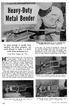 It's large enough to handle most welding job shop projects, yet small enough to make it a worth while home-workshop tool H Craft Print Project No. 272 ERE'S a metal bender that will enable you to bend
FRAUNHOFER INSTITUTE FOR MACHINE TOOLS AND FORMING TECHNOLOGY IWU HYBRID MACHINING PROCESSES IN CUTTING TECHNOLOGY
 FRAUNHOFER INSTITUTE FOR MACHINE TOOLS AND FORMING TECHNOLOGY IWU HYBRID MACHINING PROCESSES IN CUTTING TECHNOLOGY VIBRATION-SUPERIMPOSED MACHINING Hybrid Machining Processes Principle Process Variants
Signature Norman Crepeau Special Condition Subject to prior sale Johnford ST60B. CNC Turning Center
 Mr. Will Rood B & B Precise Products 25 Neck Road Benton, ME 04901 Date June 3, 2008 Quote # 06032008 Valid for 30 Days Quoted by Norman Signature Norman Crepeau Special Condition Subject to prior sale
PROCESS MONITORING AND CONTROL OF MACHINING OPERATIONS
 PROCESS MONITORING AND CONTROL OF MACHINING OPERATIONS Uche R. 1 and Ebieto C. E. 2 1 Department of Mechanical Engineering, Federal University of Technology, Owerri, Nigeria 2 Department of Mechanical
Mechanical Properties of Metals Mechanical Properties refers to the behavior of material when external forces are applied
 Mechanical Properties of Metals Mechanical Properties refers to the behavior of material when external forces are applied Stress and strain fracture or engineering point of view: allows to predict the
Sheet Metal Shearing & Bending
 Training Objective After watching the program and reviewing this printed material, the viewer will gain a knowledge and understanding of the principles and machine methods of shearing and bending sheetmetal
CNC 8055 / CNC 8055i SELF-TEACHING MANUAL ( TC OPTION) (REF 0607) (Ref 0607)
 CNC 8055 / CNC 8055i (REF 0607) SELF-TEACHING MANUAL ( TC OPTION) (Ref 0607) All rights reserved. No part of this documentation may be copied, transcribed, stored in a data backup system or translated
Objective To conduct Charpy V-notch impact test and determine the ductile-brittle transition temperature of steels.
 IMPACT TESTING Objective To conduct Charpy V-notch impact test and determine the ductile-brittle transition temperature of steels. Equipment Coolants Standard Charpy V-Notched Test specimens Impact tester
Lathe Milling Attachment
 Lathe Milling Attachment By L C. MASON BY CLEVERLY stacking cold-rolled flat stock together, T-slots and slide for this lathe milling attachment are made without costly machinery. In fact, only two tools,
Gear Cutting Tools. Hobbing Gear Milling. Leitz Metalworking Technology Group
 Gear Cutting Tools Hobbing Gear Milling Leitz Metalworking Technology Group Important information Important information 4 Services 5 An introduction to FETTE 6 Page Important information Product range
Structural welding is a process by which the parts that are to be connected are heated and
 CHAPTER 6. WELDED CONNECTIONS 6.1 INTRODUCTORY CONCEPTS Structural welding is a process by which the parts that are to be connected are heated and fused, with supplementary molten metal at the joint. A
Optimized NC programming for machinery and heavy equipment. Summary NX CAM software redefines manufacturing productivity with a full range of NC
 Siemens PLM Software NX CAM for machinery Optimized NC programming for machinery and heavy equipment Benefits Effectively program any type of machinery part Program faster Reduce air cutting Automate programming
Unit 6: EXTRUSION. Difficult to form metals like stainless steels, nickel based alloys and high temperature metals can also be extruded.
 1 Unit 6: EXTRUSION Introduction: Extrusion is a metal working process in which cross section of metal is reduced by forcing the metal through a die orifice under high pressure. It is used to produce cylindrical
Common Mechanical Engineering Terms
 Common Mechanical Engineering Terms Ball and Detent (n) A simple mechanical arrangement used to hold a moving part in a temporarily fixed position relative to another part. The ball slides within a bored
SHARPENING LATHE TOOLS
 SHARPENING LATHE TOOLS Version 1.4 By Jim Rodgers (925) 229-5773 www.jlrodgers.com Sharpening Lathe Tools 1. Purpose of sharpening a. Improve cut surface quality b. Speed project completion c. Ease amount
Product Guide SaraDrill
 Product Guide SaraDrill SARADRILL / A QUICK GUIDE Drilling from solid - a proven technology to drill large diameter holes on low horse power machines. Drilling from 49mm to 270mm diameter holes from solid
CHAPTER 7 DISLOCATIONS AND STRENGTHENING MECHANISMS PROBLEM SOLUTIONS
 7-1 CHAPTER 7 DISLOCATIONS AND STRENGTHENING MECHANISMS PROBLEM SOLUTIONS Basic Concepts of Dislocations Characteristics of Dislocations 7.1 The dislocation density is just the total dislocation length
LABORATORY EXPERIMENTS TESTING OF MATERIALS
 LABORATORY EXPERIMENTS TESTING OF MATERIALS 1. TENSION TEST: INTRODUCTION & THEORY The tension test is the most commonly used method to evaluate the mechanical properties of metals. Its main objective
Dental Implants. You are correct, it is a labeling error. Here is your dental prosthesis!!!
 Dental Implants You are correct, it is a labeling error. Here is your dental prosthesis!!! Manufacturing process of bridges, crowns, bone implants, fixtures, abutments. Manufacturing process of bridges,
MACHINE TOOLS. quakerchem.com [email protected]
 MACHINE TOOLS OVERVIEW DEFINITION Metal removal fluids (MRF) are used in machine tools to provide lubrication, cooling of the tooling and parts, and to provide chip removal to the filtration systems. What
AISI O1 Cold work tool steel
 T OOL STEEL FACTS AISI O1 Cold work tool steel Great Tooling Starts Here! This information is based on our present state of knowledge and is intended to provide general notes on our products and their
Journal of Engineering and Natural Sciences Mühendislik ve Fen Bilimleri Dergisi
 Journal of Engineering and Natural Sciences Mühendislik ve Fen Bilimleri Dergisi Araştırma Makalesi / Research Article TURNING OF AISI 304 AUSTENITIC STAINLESS STEEL Sigma 2006/2 Cebeli ÖZEK, Ahmet HASÇALIK,
Advantages and application of PCD and CBn tools
 PCD and CBN tools Advantages and application of PCD and CBn tools Powerful and economical Tools with PCD and CBN cutting edges are the ideal solution for difficult-to machine, highly abrasive materials.
Geometry and dimensional tolerances of engine bearings
 Geometry and dimensional tolerances of engine bearings Dr. Dmitri Kopeliovich (Research & Development Manager.) 1. Hydrodynamic lubrication Engine bearings operate mostly in the hydrodynamic regime of
Flanged and Butt-= Weld Type
 Document : PG00 Year : 09 Product Group 00 Flanged and Butt-= Weld Type (LNG and LPG) Page 09 Document : PG00 Year : 09 Product Group 00 Cryogenic Butterfly valves The Cryogenic Butterfly Valve Design
ME 612 Metal Forming and Theory of Plasticity. 1. Introduction
 Metal Forming and Theory of Plasticity Yrd.Doç. e mail: [email protected] Makine Mühendisliği Bölümü Gebze Yüksek Teknoloji Enstitüsü In general, it is possible to evaluate metal forming operations
Structural Axial, Shear and Bending Moments
 Structural Axial, Shear and Bending Moments Positive Internal Forces Acting Recall from mechanics of materials that the internal forces P (generic axial), V (shear) and M (moment) represent resultants
DRAFTING MANUAL. Gears (Bevel and Hypoid) Drafting Practice
 Page 1 1.0 General This section provides the basis for uniformity in engineering gears drawings and their technical data for gears with intersecting axes (bevel gears), and nonparallel, nonintersecting
Phenomenological aspects of a modified fragmentation of the ground material
 Phenomenological aspects of a modified fragmentation of the ground material Lucjan Dabrowski, Mieczyslaw Marciniak Warsaw University of Technology, Warsaw, Poland Summary: The main point of this paper
%Ï51,75,' 6=(56=È02. 'LDPRQG DQG &%1 WRROV
 82 TÖBB MINT VÁLASZTÉK DIAMOND CUT-OFF WHEELS Diamond cut-off wheels are excellently suitable for application of various stones and building materials. It is very important to choose the correct segmented
Effect of tool geometry variation on finish turning A Review
 Journal of Engineering Science and Technology Review 4 (1) (2011) 1-13 Review Article JOURNAL OF Engineering Science and Technology Review www.jestr.org Effect of tool geometry variation on finish turning
G10 Data Setting Command
 G10 Data Setting Command Though it s barely mentioned in most basic CNC courses, the G10 command is an extremely important basic CNC feature It allows you to input data from within CNC programs This data
Freehand Sketching. Sections
 3 Freehand Sketching Sections 3.1 Why Freehand Sketches? 3.2 Freehand Sketching Fundamentals 3.3 Basic Freehand Sketching 3.4 Advanced Freehand Sketching Key Terms Objectives Explain why freehand sketching
Overview. Milling Machine Fundamentals. Safety. Shop Etiquette. Vehicle Projects Machine Shop
 Overview Milling Machine Fundamentals Wayne Staats, UW-Madison FSAE Safety Shop Etiquette Before Machining Indicating Calculating Feeds and Speeds Machining Maintenance Safety Respect the machines Common
CNC Applications. Introduction to Machining Centers
 CNC Applications Introduction to Machining Centers Machining Centers A machining center is simply a CNC milling machine with an automatic tool changer and an enclosure. There are a number of different
Solution for Homework #1
 Solution for Homework #1 Chapter 2: Multiple Choice Questions (2.5, 2.6, 2.8, 2.11) 2.5 Which of the following bond types are classified as primary bonds (more than one)? (a) covalent bonding, (b) hydrogen