
IWCF United Kingdom Branch
|
|
|
- Ralph Shannon Stephens
- 9 years ago
- Views:
Transcription
1 IWCF United Kingdom Branch Drilling Calculations Distance Learning Programme Part 2 Areas and Volumes

2 IWCF UK Branch Distance Learning Programme - DRILLING CALCULATIONS Contents Introduction Training objectives How to use this training programme How the programme is laid out Section 1 Calculating areas Section 2 Calculating volumes Section 3 Oilfield volumes Section 4 Borehole geometry Surface BOP operations Section 5 Borehole geometry Subsea BOP operations Section 6 Pump output, strokes, time Section 7 Volume and pump strokes - kill sheet calculations Section 8 Trip monitoring calculations Part 2, Introduction 2 of 188

3 IWCF UK Branch Distance Learning Programme - DRILLING CALCULATIONS Introduction Welcome to the IWCF UK-Branch Drilling Calculations Distance Learning Programme. Nowadays, mathematics is used almost everywhere, at home at leisure and at work. More than ever knowledge of mathematics is essential in the oil industry. The aim of this programme is to introduce basic mathematical skills to people working in or around the oilfield. The programme will lead on to some of the more complex calculations required when working in the industry. By the end of the programme, the user should have acquired the knowledge and skills required prior to taking an IWCF Well Control certification programme. Part 2, Introduction 3 of 188

4 IWCF UK Branch Distance Learning Programme - DRILLING CALCULATIONS Training Objectives When you have completed the package you should: - Have a good understanding of basic mathematics including; Rounding and estimating The meaning and use of mathematical symbols The use of the calculator Fractions and decimals Ratios and percentages How to solve equations. Have a knowledge of the most common oilfield units and how they are used Be able to calculate volumes in the appropriate units including Square sided tanks Cylindrical tanks Have an understanding of borehole geometry and be able to carry out calculations regarding the same Be able to carry out calculations for trip monitoring Be able to carry out the more common well control calculations including; Hydrostatic pressures Formation pressures Understand and list the concepts of kick prevention and recognition Understand how the circulating system works and carry out calculations regarding the same. A more detailed set of objectives is stated at the start of each section of the programme. Part 2, Introduction 4 of 188

5 IWCF UK Branch Distance Learning Programme - DRILLING CALCULATIONS How to use this training programme Using the materials This programme is designed as a stand-alone training programme enabling you to work through without external support. No one, however, expects you to work entirely by yourself, there may be times when you need to seek assistance. This might be in the form of a discussion with colleagues or by seeking the help of your supervisor. Should you require guidance, the best person to speak to would normally be your supervisor, failing this contact the Training department within your own company. Planning Whether you plan to use this programme at work or at home, you should organise the time so that it is not wasted. Set yourself targets to reach during a certain time period. Do not try to use the material for 5 minutes here and there, but try to set aside an hour specifically for study. It may even be useful to produce a timetable to study effectively. Week 1 Week 2 Week 3 Week 4 Monday Revise section 3 Revise Section 7 Work through section 8 Tuesday Work through section 1 18:30 19:30 Work through section 5 Wednesday Work through sections 4 Thursday Revise section 5 Work through section 6 Friday Revise section 1 Work through section 2 10:00 11:00 Discuss with colleagues and/or supervisor Saturday Sunday Revise section 2 Work through section 3 Discuss sections 1 to 4 with colleagues and/or supervisor on rig Discuss with colleagues and/or supervisor Revise section 6 Work through section 7 Part 2, Introduction 5 of 188

6 IWCF UK Branch Distance Learning Programme - DRILLING CALCULATIONS Organising your study Once you have prepared a study timetable, think about what you have decided to do in each session. There are a few basic guidelines to help you plan each session Do Find somewhere suitable to work, for example a desk or table with chair, comfortable lighting and temperature etc. Collect all the equipment you may need before you start to study, e.g. scrap paper, pen, calculator, pencil etc. Know what you plan to do in each session, whether it is an entire section or a subsection Work through all the examples, these give you an explanation using figures. Each section contains try some yourself you should do all these. Make notes, either as you work through a section or at the end Make notes of anything you wish to ask your colleagues and/or supervisor. Don t Just read through the material. The only way to check whether you have understood is to do the tests. Try to rush to get through as much as possible. There is no time limit, you re only aim should be to meet the training objectives. Keep going if you don t understand anything. Make a note to ask someone as soon as possible. Spend the entire session thinking about where to start. Part 2, Introduction 6 of 188

7 IWCF UK Branch Distance Learning Programme - DRILLING CALCULATIONS How the programme is laid out The programme is split into three parts. Each part is further divided into sections covering specific topics. At the start of each section there is information and objectives detailing what are to be covered. Also at the start is an exercise called Try these first.... Try these first...exercise...? These are questions covering the material in the section and are designed for you to see just how much you already know. Do just as it says and try these first! You can check your answers by looking at the end of the section. Answers look like this; Answers Throughout each section you will find worked examples. Examples Following these examples you will find exercises to try yourself. Try some yourself - They are shown with a calculator although not questions will require one. Check your answers before carrying on with the sections. If necessary, go back and check the material again. Part 2, Introduction 7 of 188

8 IWCF UK Branch Distance Learning Programme - DRILLING CALCULATIONS Throughout the section there are boxes with other interesting facts. Of interest / Other facts The Of interest boxes are not core material but provide background knowledge. Part 2, Introduction 8 of 188
9 Section 1 Calculating areas In Part One we discussed the concept of area what we mean by area, what we measure using area and the units of measurement we use. In this section we will examine area in more detail and explain how to calculate the area of the more common two-dimensional shapes. We will also look at the different solid shapes and explain how to calculate the surface area of these shapes. On the rig we might need to calculate area to estimate quantities of paint or available deck area. Objectives To define various shapes and their names. To examine different ways of estimating area. To show how to calculate the areas of various shapes. To discuss the importance of units. Part 2 Section 1 9 of 188

10 Try these first... Exercise Calculate the following areas; a. A square 3 inches by 3 inches.? b. A rectangle 5 feet by 4 feet. c. A triangle 11 inches high with a 4 inch base. d. A circle with a diameter of 9 inches. e. A rectangle 4.5 feet by 2.3 feet. 2. Calculate the surface area in square inches of the following cuboid. Height 6 inches Length 10 inches Surface area = square inches Width 3 inches 3. Calculate the surface area of the following closed cylinder. Diameter 4 feet Height 10 feet Surface area = square inches Part 2 Section 1 10 of 188

11 Area Definitions Perimeter is the distance around a flat shape. Area is the amount of flat space inside the perimeter. For example The perimeter of a football pitch The area of the same football pitch Shapes Basic two-dimensional shapes are bound by one or more sides. Some of the more common are shown below. Square Rectangle Circle Ellipse Rhombus Parallelogram Pentagon Hexagon Triangle Part 2 Section 1 11 of 188

12 Shapes with curved sides can be circles or ellipses. Shapes that are bound by straight sides are called polygons. Regular polygons have sides all the same length. Shapes with three straight sides are triangles. A regular triangle is called an equilateral triangle. The sail on the yacht is an example of a triangle. Shapes with four sides are quadrilaterals. These include squares and rectangles. An example of a rectangle is a door. Of interest Shapes with more than 4 sides have special names: - 5-sided polygon = pentagon 6-sided polygon = hexagon 7-sided polygon = heptagon 8-sided polygon = octagon 9-sided polygon = nonagon 10-sided polygon = decagon 12-sided polygon = dodecagon Part 2 Section 1 12 of 188

13 Areas of simple shapes Example Robert is putting a window into his garden shed. He looks at a few different shapes and wonders which would let in most light. 1 2 The square panes of glass are all the same size. 3 Does this depend on the height alone, the length alone or the number of panes? Which one should he buy? Of course the number of glass panes is the most important more panes, more light. Counting the number of panes shows number 1 to have the most at 16 panes. The number of square panes gives a measure of the area of glass in each window. Part 2 Section 1 13 of 188

14 One of the simplest ways to calculate the area of a shape is draw a grid and count the number of squares it covers. The areas of figures with straight sides are much easier to find using this method. Example Count the number of squares in the following shapes. a. Answer : 30 b. Answer : 15 c. Answer : 16 d. Answer : 8 (6 full squares + 4 half squares = 8 squares) Part 2 Section 1 14 of 188

15 Try some yourself... Exercise 2.2 Find the areas of these shapes by counting the squares Part 2 Section 1 15 of 188

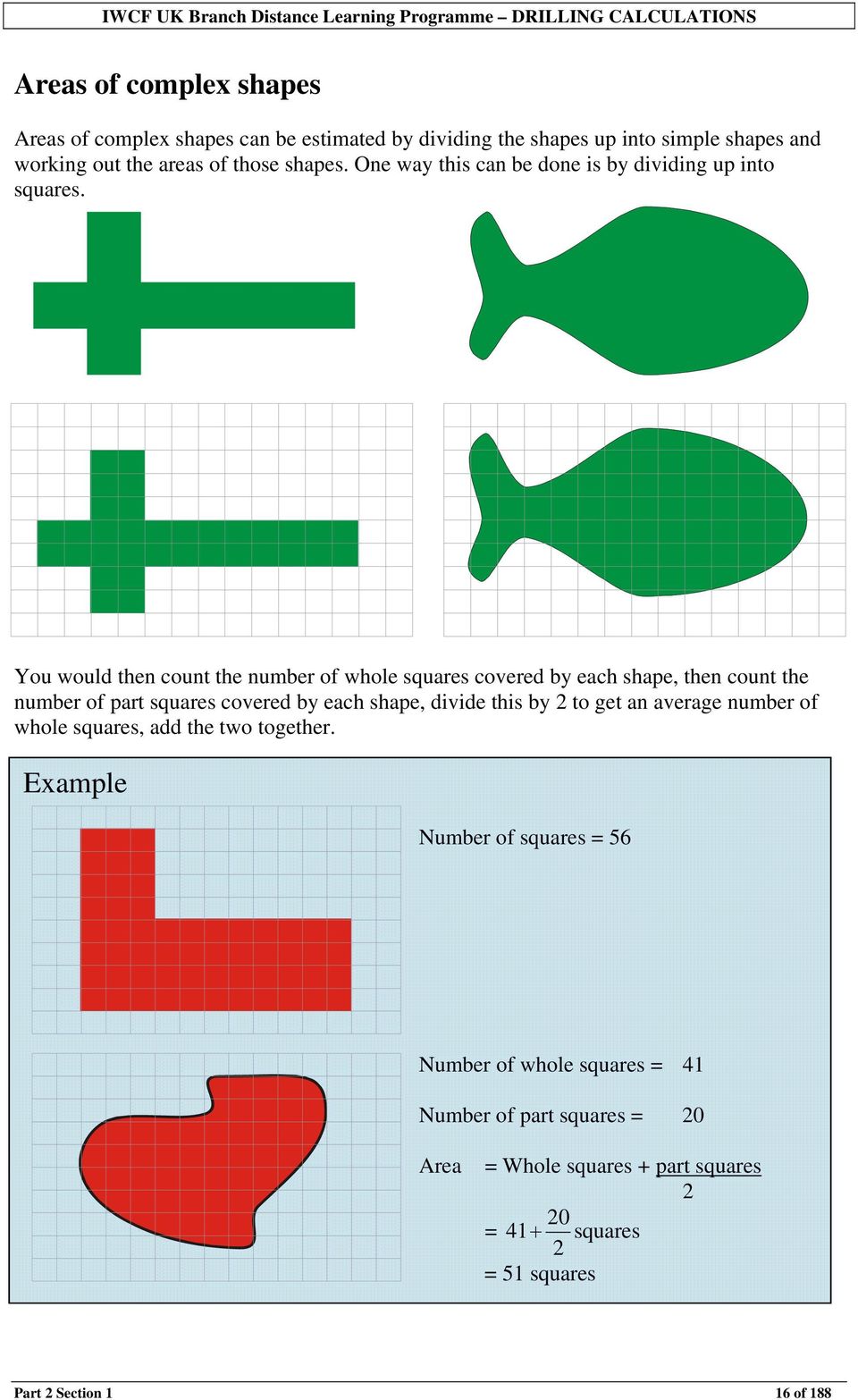
16 Areas of complex shapes Areas of complex shapes can be estimated by dividing the shapes up into simple shapes and working out the areas of those shapes. One way this can be done is by dividing up into squares. You would then count the number of whole squares covered by each shape, then count the number of part squares covered by each shape, divide this by 2 to get an average number of whole squares, add the two together. Example Number of squares = 56 Number of whole squares = 41 Number of part squares = 20 Area = Whole squares + part squares 2 20 = 41+ squares 2 = 51 squares Part 2 Section 1 16 of 188
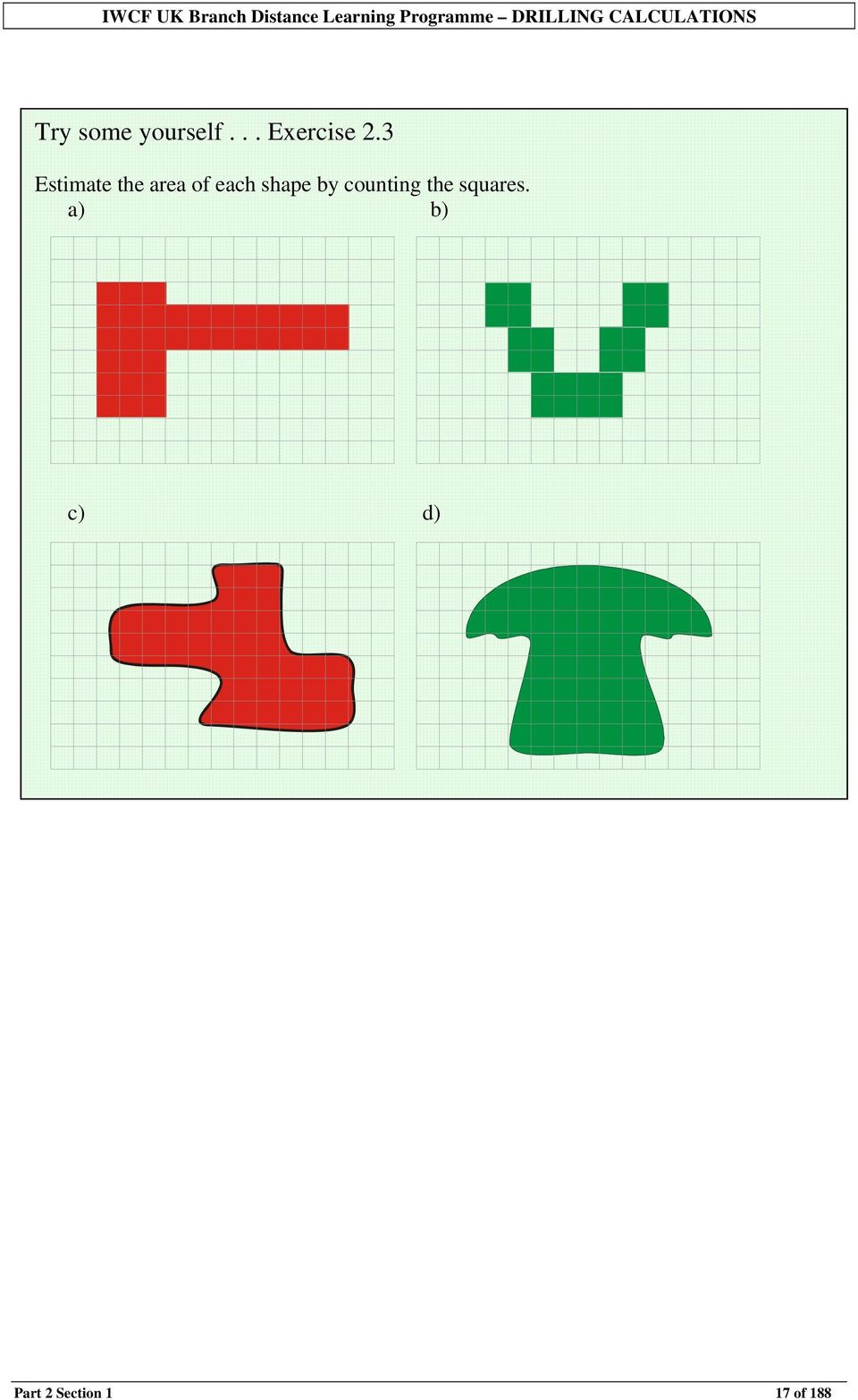
17 Try some yourself... Exercise 2.3 Estimate the area of each shape by counting the squares. a) b) c) d) Part 2 Section 1 17 of 188
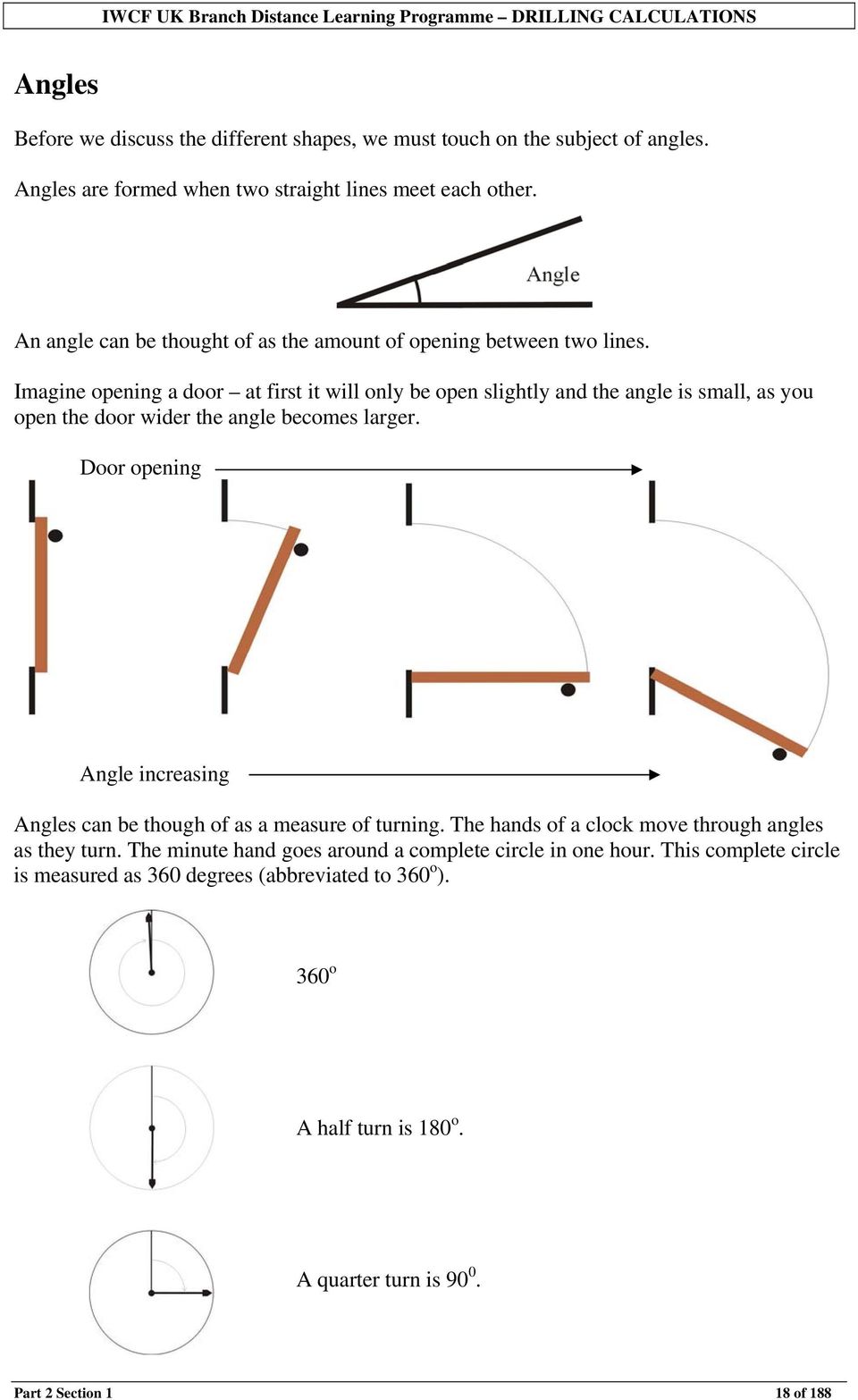
18 Angles Before we discuss the different shapes, we must touch on the subject of angles. Angles are formed when two straight lines meet each other. An angle can be thought of as the amount of opening between two lines. Imagine opening a door at first it will only be open slightly and the angle is small, as you open the door wider the angle becomes larger. Door opening Angle increasing Angles can be though of as a measure of turning. The hands of a clock move through angles as they turn. The minute hand goes around a complete circle in one hour. This complete circle is measured as 360 degrees (abbreviated to 360 o ). 360 o A half turn is 180 o. A quarter turn is Part 2 Section 1 18 of 188
19 This 90 o angle is known as a right angle. Note the in the corner denoting a right angle Angles less than 90 o are called acute e.g. 20 o, 45 o, 65 o. Angles between 90 o and 180 o are called obtuse e.g. 140 o, 110 o, 156 o. Part 2 Section 1 19 of 188

20 Areas of regular shapes Quadrilaterals A quadrilateral has; - 4 straight sides - 4 angles add up to 360 o Some have special names, for example square, rectangle. Rectangle - quadrilateral (shape with 4 straight sides) - all angles are right angles - opposite sides are equal in length to each other - opposite sides are parallel 90 o b l Example Previously to work out the area of the rectangle shown we have counted the squares. (each square represents 1 square inch) The rectangle covers 15 squares, each of area 1 square inch Area of the rectangle = 15 square inches Example How can you find the area of this rectangle without counting all the squares? 3 squares broad (high) 10 squares long This is 3 rows of 10 squares which is 10 x 3 = 30 squares Part 2 Section 1 20 of 188

21 Example It is not necessary to divide the whole area into squares. Find the area of this rectangle. 6 squares 10 squares The rectangle has 10 rows each of 6 squares. Its area is 10 x 6 = 60 squares Try some yourself... Exercise 2.4 Calculate the area of these rectangles in number of squares. a) b) c) Part 2 Section 1 21 of 188
22 Example 9 inches What is the area of this rectangle? 3 inches It is not necessary to draw in the 1inch squares. It can be seen that the number of squares fitting along the length = 9 the number of squares fitting along the breadth = 3 the number of squares required for the area = 9 x 3 = 27 Area of the rectangle = 27 square inches For a rectangle: Area = length x breadth A = l x b = lb Try some yourself... Exercise 2.5 Calculate the area of the following inches 2. 4 inches 2 inches 11 inches 3. 1 mile 2 miles Part 2 Section 1 22 of 188
23 Square A square is really a rectangle with all four sides the same length. - each angle is a right angle (90 o ) - 4 sides all the same length l l Example What is the area of this square? A = 3 x 3 = 3 2 = 9 square inches 3 inches 3 inches The importance of units When calculating areas, the units must be consistent. It is not possible to calculate areas using measurements in different units. Example A rectangle measures 9 inches by 2 feet. To calculate the area, we must first make the units compatible. Either convert 9 inches to feet Or convert 2 feet to inches. The area will then be; Inches Feet 9 x 24 = 216 square inches 0.75 x 2 = 1.5 square feet Tip Convert the units of measurement to give the answer in the units you require. Part 2 Section 1 23 of 188
24 Try some yourself... Exercise 2.6 Calculate the following areas in square feet and also in square inches foot 2. 2 feet 1 foot 3. 1 foot 3 feet 9 inches 4 feet 7 inches Areas of rectangles and squares summary We have worked out the areas of different rectangles and squares (remember, a square is simply a special type of rectangle). We did this by multiplying the length of one side by the length of the other. For a rectangle: length breadth (width) Formula is; Area = length x breadth For a square: length length Formula is; Area = length 2 Remember the units must be consistent. Part 2 Section 1 24 of 188
25 Try some yourself... Exercise What are the areas of the following squares? a) 4 inches b) 5 inches c). 1 foot 2. Find the areas of the following rectangles, remembering to give the answers with units. a) Top of a domino 1inches wide and 2 inches long b) Floppy disc 3 inches square c) Envelope 6 inches by 3 inches d. A table top 3 feet 5 inches by 5 feet. Part 2 Section 1 25 of 188
26 Conservation of area Another way to work out areas of complex shapes is to divide them into regular shapes and add up the areas. Example C C The square has an area of 100 square inches. B A A Part A must be half (or 50 square inches). Parts B + C must be a quarter each (or 25 square inches). We can now calculate the areas of the following shapes. B a. Area = = 50 sq in C B b. Area = = 75 sq in A C c. Area = = 100 sq in A B Part 2 Section 1 26 of 188
27 As we can see from the last example, it does not matter how the three parts are arranged, if they are all used the area will be 100 square inches. This is called Conservation of area. If a shape is cut up and rearranged, the perimeter may change, the area does not, for example; The easiest way to calculate the area of complex shapes is to divide them up and rearrange into a regular shape. Part 2 Section 1 27 of 188
28 Try some yourself... Exercise 2.8 The square has an area of 36 square inches. What are the areas of the following? a) b) c) Part 2 Section 1 28 of 188
29 Areas of more complicated shapes Example This L-shaped corridor is to have a replacement carpet but first you need to work out the area in order to calculate the cost of a new carpet. 2 feet It can be divided into two rectangles to make calculation easier. 8 feet x feet 2 feet 20 feet a) What is the length of x, in feet? b) What is the area of each rectangle? c) What is the total area of the corridor? a) 20-2 = 18 feet b) 2 x 8 = 16 sq ft 18 x 2 = 36 sq ft c) = 52 sq ft Part 2 Section 1 29 of 188
30 Example Find the area of this shape. 2in 6in 2in 2in 4in The shape could be divided into 3 rectangles in two different ways. In this case however, it would be easier to subtract areas. We can look at the shape as a large rectangle (A) with a small square (B) taken out. Area of large rectangle A = 6 x 4 = 24 in 2 Area of small square B = 2 x 2 = 4 in 2 6in A B 2in 2 in Area of shape = Area A Area B = (24 4) in 2 = 22 in 2 4in Example 3 ft 6 ft 1 ft A lawn is 6 ft by 3 ft and has a 1 ft path running all the way round. Find the area of the path. Total area = length x breadth of outer rectangle = 8 x 5 = 40ft 2 Area of grass in central rectangle = 6 x 3 = 18 ft 2 Area of path = = 22ft 2 Part 2 Section 1 30 of 188
31 Try some yourself... Exercise Calculate the area of a rectangle with the following dimensions: a. 12 in x 5 in b. 22 ½ in x 4 in c. 3 ft x 10 ft d. 2ft x 8 ft 2. Calculate the areas of the following shapes a. 2 in 2 in 6 in 2 in 3 in 1 in 1 in 14 in b. 4 in 6 in 6 in c. 4 in 1 ft 8 in 4 in 2 ft 6 in 3. A square has a perimeter of 22 inches. What is its area? 4. How many square inches are there in an area of 6 square feet? 5. 50% Wool per yd 2 80% Wool per yd 2 A room is 15 feet by 12 feet. What would be the cost of the carpet a. for 50% wool? b. for 80% wool? Part 2 Section 1 31 of 188
32 Triangles Triangles have; - three straight sides - three angles add up to180 o Of interest Different types of triangles have different names; Right angled triangle - 1 angle of 90 o - longest side opposite this called hypotenuse 90 o Equilateral triangle - 3 equal angles - 3 equal length sides Isosceles triangle - 2 equal angles - 2 equal sides opposite the equal angles Scalene triangle - 3 different sides - 3 different angles If you think of a triangle as half a rectangle, the area of a triangle is half the area of a rectangle with the same height and base. This can be seen easily with a right-angled triangle. height It works for any triangle; base height base The formula for the area of a triangle 1 Area = base height 2 Part 2 Section 1 32 of 188
33 Example Calculate the area of the triangle A = 1 base height 2 = = 30 square inches 5 in 12 in 13 in Example Find the area of the following; 5 ft 8 ft 1 Area = base height 2 = = 20 square feet 1.7 inches 2 inches 1 Area = base height 2 = = 1.7 square inches Part 2 Section 1 33 of 188
34 Try some yourself... Exercise Calculate the areas of the following triangles. a) 3 inches 4 inches b) 10 inches 12 inches c) 8 inches 6 inches 2. Calculate the area of each sail. Small sail; height 20 feet base 10 feet Larger sail; height 20 feet base 15 feet Part 2 Section 1 34 of 188
35 Try some yourself... Exercise 2.10 continued 3. What area has to be painted below the stairs? 13 feet 17 feet Part 2 Section 1 35 of 188
36 Other quadrilaterals Definition of parallel lines Parallel lines are the same distance apart from each other all the way along their length. They will never meet even if they are made longer. Parallelogram - 2 pairs of parallel sides - opposite sides of equal length The area of a parallelogram is the same as a rectangle. This can be shown using conservation of area where the shape is divided up and moved around until a rectangle has been formed. Another way of finding the area of a parallelogram is to divide it up into 2 triangles. The area of the parallelogram; Example Area = 2 x area of one triangle 1 = 2 base height 2 = base x height Calculate the area of the parallelogram. 10 inches Area = base x height = 10 x 8 = 80 square inches 8 inches Part 2 Section 1 36 of 188
37 Try some yourself... Exercise 2.11 Calculate the areas of the following parallelograms in 6 in 2. 3 ft 4 ft ft 2 ft Part 2 Section 1 37 of 188
38 Trapezium - pair of parallel sides - Area = average length of parallel sides x distance between them A trapezium can be rearranged to form a rectangle. The area of a trapezium Area = 1 sum of parallel sides perpendicular height 2 = a 1 ( a + b) h 2 h Example Find the area of the trapezium shown 1 Area = ( a + b) h 2 Area = 1 ( 2 + 4) 3 2 = 3 x 3 in 2 = 9 in 2 b 2 in 3 in 4 in Try some yourself...exercise 2.12 Calculate the areas of the following trapeziums in 6 ft 1 in 2 ft 3. 6 in 20 ft 9 ft 3 ft 2 ft Part 2 Section 1 38 of 188
39 Circles - complete turn in a circle is measured as 360 o - distinct terminology The perimeter of a circle is called the Circumference. The circumference is given the letter c in formulae. Radius is the distance from the centre of a circle to its circumference. All radii (plural) of the same circle are the same length. The radius is given the letter r in formulae. Diameter (d) is a straight line drawn through the centre of a circle to divide it into 2 halves. The diameter is twice the length of the radius. The diameter is given the letter d in formulae. If you take a piece of cotton and measure the length of the circumference, then take another piece of cotton and measure the diameter, you find that the circumference is always approximately three times the length of the diameter. The accurate measurement is actually to nine decimal places. This is called pi or π which is the Greek letter for p. This relationship between the circumference and the diameter is always the same. The circumference can thus be calculated from the diameter or radius. Circumference = π x diameter c = πd or Circumference = 2 x π x radius c = 2πr π is usually approximated to perform calculations. In this programme we will use Part 2 Section 1 39 of 188
40 Area of a circle The area of a circle can be thought of in many ways. For example, if a circle is cut into equal slices (sectors) and arranged alternately as shown the area is unchanged. If the sectors are small enough then the shape will be; radius (r) half of circumference (c) The height of the rectangle will be r (the radius of the circle), and the length will be half the circumference (c). Area = circumference radius 2 Area = c r 2 Substitute 2 πr for c ( c = 2πr ) = 2πr r 2 Cancel out 2 s = π r r = πr 2 Another way to look at the area of a circle is to imagine a piece of rope wound into a spiral over the circle. If the rope is cut along the radius and the pieces straightened out, they form a rough triangle, The height of a triangle is r (radius) and the base is 2πr. r 2πr Area = 1 2πr r 2 = πr 2 Part 2 Section 1 40 of 188
41 Example Sometimes you are given the diameter instead of the radius. The diameter is twice the radius. 15 in Find the area of a circle with a diameter of 15 in Radius = diameter = 15 = 7.5 in 2 2 Area = πr 2 = x = x = in 2 Formulae for the area of a circle The area of a circle can be calculated using; Area = 2 π r Or because diameter = 2 radius Area = 2 d π 4 Where π = pi = (approximated) r = radius d = diameter In the above formula, two of the numbers are CONSTANTS, that is they do not change. π is always is always 4 So with the formula written like this π 2 Area = 4 d We could divide π by 4 to give a single constant instead of two separate ones. π 4 = So the formula then becomes Area of a circle = x diameter 2 Part 2 Section 1 41 of 188
42 Example Calculate the area of the circle radius 10 inches Area = 2 π r 10 inches = = square inches Example Calculate the area of the circle diameter 3 feet Area = = 2 d π feet = 7.07 square feet Example A hot tub has a diameter of 10 feet. What is the area it covers? Area = x d 2 = x 10 2 = square feet Part 2 Section 1 42 of 188
43 Try some yourself... Exercise Calculate the areas of the following circles a. radius = 9 inches b. radius = 2 inches c. diameter = 8 feet d. diameter = 5 inches e. diameter = 20 inches 2. A dinner plate has a diameter of 10 inches. What is the area? 3. A green on a golf course has a diameter of 30 feet. What is the surface area of the green? Part 2 Section 1 43 of 188
44 Summary of area formulae Rectangle Area = length x breadth Square Area = 2 length Triangle Area = 1 base height 2 Parallelogram Area = base height Trapezium Area = 1 ( sum of short & long sides) height 2 Circle 1. Area = 2. Area = 2 π r 2 d π 4 3. Area = 0.785d 2 r = radius d = diameter π = Reminder: Units must be constant Part 2 Section 1 44 of 188
45 Example Constant units Find the area of a garden whose sides measure 24 ft 9 inches by 48 ft 10 inches. Area of a rectangle = length x breadth To calculate this you need to convert the measurement to inches 24 ft 9 in = 297 inches or ft 10 in = 586 inches or Area = 297 x 586 or x = 174,042 in 2 or ft 2 For a garden the most appropriate would be 1208 ft 2 (to the nearest square foot). Rearranging formulae Rearranging formulae If you are given the area of a shape but need to know the height or length it is useful to be able to rearrange the formula for area. Example Find the breadth (or width) of this rectangle Rearrange the formula for the area of a rectangle; Area = Length Breadth Area = 12 in 2 6 in? in Remember a formula can be rearranged so long as the same is done to both sides. Area Length Breadth = Length Length Cancel out length Area = Breadth Length or Area Breadth = Length 12 = 6 = 2 in Part 2 Section 1 45 of 188
46 Example Find the height of this triangle Area of triangle = 1 base height 2 Height = area 2 base = Area = 56 in 2 7 in = 16 in Try some yourself... Exercise Find the breadth (or height) of the following; a. Square: area = 144 square inches b. Rectangle: area = 160 square inches length =8 inches c. Triangle: area = 100 square inches base = 10 inches Part 2 Section 1 46 of 188
47 Solid shapes Solid figures are shapes that take up space in all directions unlike flat shapes like squares and circles. The following are some solid shapes; Sphere A ball bearing, tennis ball or golf ball are examples of spheres. Cube A lump of sugar is sometimes called a sugar cube. It has six faces, eight corners and twelve edges. All the edges are the same length. All the faces are equal size squares. A cuboid has 3 pairs of unequal sized faces. Prism A prism has the same shape all the way along its length. They are usually named by the shape of the ends. Triangular prism The end is a triangle. Square or rectangular prism The end is a square or rectangle. Another name for this is a cuboid (that is similar to a cube but with unequal size faces). Circular prism The end is a circle. Also known as a cylinder. Most food tins are cylinders. Hexagonal prism The end is a hexagon. A pencil is often a hexagonal prism. Part 2 Section 1 47 of 188
48 Irregular prism An irregular prism has a face which is not a well known shape. Cross section As the shape of a prism is the same all the way along its length, any slice at a right angle through the prism will be the same shape as the end. This shape is known as the cross section. Surface area of a solid Surface areas of solids are calculated by finding the area of each individual face in exactly the same way as the area for a 2-dimensional shape. Surface area of a cuboid Imagine the following shape It has 2 sides 2 ends Part 2 Section 1 48 of 188
49 A top and a bottom The surface area would be the same as all the area of all the faces. Another way to picture surface area is to open out the shape as though it were made of card. It is easy to see that the surface area is the sum of all the faces that make up the shape. END S I D E B O T T O M S I D E T O P END Part 2 Section 1 49 of 188
50 Example What is the surface area of a cuboid of the following dimensions? height = 5 inches length = 12 inches width = 2 inches Surface area = (area top + area bottom) + area two sides + area two ends = (12 x x 2) + 2(12 x 5) + 2(2 x 5) = ( ) = 188 in 2 Example What is the surface area of the walls and ceiling of the following room? (Ignore doors and windows.) 8 feet 15 feet 10 feet Walls Two 10 feet long walls Area of one wall = 10 x 8 = 80 sq ft Area of two walls = 80 x 2 = 160 sq ft Two 15 feet long walls Area of one wall = 15 x 8 = 120 sq ft Area of two walls = 2 x 120 = 240 sq ft Ceiling Area of ceiling = 10 x 15 = 150 sq ft Total area = 550 sq ft If one litre of emulsion paint covers 50 square feet, how many litres are required for one coat? = 11litres Part 2 Section 1 50 of 188
51 Try some yourself... Exercise 2.15 A room has the following dimensions, 8 feet 11 feet 10 feet a) Calculate the surface area of the walls and ceiling (ignore doors and windows). (answer to 1 decimal place) Area = square feet b) If the paint chosen covers 80 square feet per litre, how many litres are required? (answer to 1 decimal place). (i) One coat litres (ii) Two coats litres Part 2 Section 1 51 of 188
52 Surface area of a cylinder How do we calculate the surface area of the cylinder (e.g. a tin of baked beans). Height Diameter = 3 inches Height = 4 inches Imagine the cylinder made of card and opened out until flat. We now have two BEANS circles of 3 diameter and a rectangle. The short sides of the rectangle would be the height of the tin (4 in). The long side of the rectangle would be the same as the circumference of the end circles. This would be; Circumference = π d (d = diameter) = x 3 inches = 9.43 inches Now we have all the dimensions we need to calculate the area. 3 in 9.43 in 4 in 3 in Part 2 Section 1 52 of 188
53 Area of the rectangle = 4 x 9.43 = square inches Area of one circle = = 2 d π or 0.785d = 0.785d 2 4 = 7.07 square inches = 7.07 in 2 Total surface area = square inches Try some yourself... Exercise 2.16 The dimensions of a covered cylindrical tank are; Height = 5 feet Diameter = 10 feet Calculate the surface area of the tank in square feet. Part 2 Section 1 53 of 188
54 Section 2 Calculating Volumes In Section one you learned how to calculate areas both two-dimensional and solid threedimensional shapes. We will now take this a step further and explain how to calculate volumes and capacities of the more common solid shapes. Volume and capacity calculations are essential to the oilfield we need to know the size of a mud tank, or the volume of mud in the hole amongst many others. Objectives To define volume and capacity. To show how to calculate the volumes of various solid shapes. To explain how to calculate the capacity of a tank in cubic feet. To discuss the importance of internal and external dimensions of tanks or pipes. Try these first... Exercise Calculate the following volumes;? a. Cuboid 7 inches long, 4 inches high, 3 inches deep b. Circular prism 2 feet diameter, 7 feet long (To nearest cubic foot) 2. The internal dimensions of your slug pit is 4 feet by 4 feet and 10 feet deep. Calculate the capacity in cubic feet. 3. Your trip tank is 5 ft 6 in inside diameter and 15 ft in height. Calculate its capacity in cubic feet.
55 Volume Volume is the space taken up by a solid object, for example a ball bearing or a brick. Volume is measured in cubic units e.g. cubic feet, cubic inches, cubic metres. Capacity Capacity is the internal volume or amount of volume inside a container, for example a bottle, a box or a mud pit (e.g. trip tank). Capacity can be measured in the same units as volume, or in liquid volumes such as gallons or barrels. Part 2 Section 2 55 of 188
56 Calculating volumes Volume is the amount of space taken up by a solid object. Capacity is the amount of space inside a solid object i.e. how much it will hold. For example you would need to find the volume of your new fridge freezer to find out whether it will fit into the space in your kitchen. You would need to know the capacity to find out how much food you could store inside it. The two are not the same. Example This cube is 1 by 1 by 1. Its volume is 1 cube The large cube is 3 cubes long, 3 cubes wide and 3 cubes high. Each layer would have 3 rows of cubes with 3 cubes in each row. Each layer = 9 cubes. 3 layers = 27 cubes The volume of this cube is 27 cubes Part 2 Section 2 56 of 188
57 Volume of cuboids Remember A cuboid is a rectangular box shape. It has six faces which are all rectangles. Opposite faces are the same. Everyday examples include; A brick A box A mud pit A cube is a particular type of cuboid which has faces which are all square and all the same size. Example This cube is 1 inch long, 1 inch wide and 1 inch high. Its volume is 1 cubic inch or 1 in 3 or 1 cu.in. This cuboid is 4 inches long, 3 inches wide and 3 inches high. It could be built up from 1 inch cubes. Each layer would have 3 rows of cubes with 4 cubes in each row. Each layer = 12 cubes. 3 layers = 36 cubes The volume of this cube is 36 in 3 The volume of any cube or cuboid = length x breadth (width) x height = l x b x h = lbh Part 2 Section 2 57 of 188
58 Tank volumes The formulae for volume of cuboids are used on the rig for square sided tanks. Example The inside measurements of your slug pit are 5 feet long, 4 feet wide and 8 feet deep. What is the internal volume (or capacity) in cubic feet? Volume = length x width x height = 5 x 4 x 8 = 160 cubic feet Try some yourself... Exercise 2.18 Calculate the following tank volumes in cubic feet. 1. Length 10 ft Width 10 ft Depth 8 ft 2. Length 12 ft Width 6 ft Depth 10 ft 3. Fill in the gaps: - length width height Length (ft) Width (ft) Depth (ft) Volume (cu.ft.) a b c Part 2 Section 2 58 of 188
59 Volume of prisms Remember A prism is a solid which has the same shape all the way along its length (i.e. it has a constant cross section). Common prisms include Circular prism or cylinder Rectangular prism Another name for a box shape or cuboid. Triangular prism Hexagonal prism For example a pencil. Part 2 Section 2 59 of 188
60 It can be shown that; Volume of a prism = area of cross section x height The most commonly required calculation is for the volume of a cylinder. Volume of a cylinder = area of circle x height 2 d = π h 4 Or using as a constant Example Volume of a cylinder = x h 2 Your trip tank is 10 feet in height and five feet in diameter. What is the volume in cubic feet? Volume = 2 d π h 4 = = cubic feet Example A food tin is 4 inches high and 3 inches in diameter. What is the volume in cubic inches? Volume = 0.785d 2 x h = x 3 2 x 4 = cubic inches Part 2 Section 2 60 of 188
61 Try some yourself... Exercise Calculate the following tank volumes in cubic feet. a) height = 12 feet internal diameter = 6 feet volume = cubic feet b) height = 15 feet internal diameter = 4 feet volume = cubic feet On the rig we need to be able to calculate volumes or capacities of cylinders when we calculate the capacity of a trip tank, or the volume of mud in the hole and the displacement and capacity of pipe. (These terms will be discussed in later sections). It is important at this stage to clarify the difference between outside diameter and inside diameter. Part 2 Section 2 61 of 188
62 Example The outside measurements of a steel tank are 3 feet across, 4 feet long and two feet deep. What would be the total volume of space that it takes up? Volume = Length x Breadth x Depth = 4 x 3 x 2 = 24 cubic feet It is made of steel which is 0.1 feet thick (1.2 inches). What is the internal capacity? The inside measurements are: Breadth = 2.8 feet Length = 3.8 feet Depth = 1.9 feet Internal volume = Length x Breadth x Depth = 3.8 x 2.8 x 1.9 = 20.2 cubic feet (to 1 decimal place) So the capacity of the tank is only 20.2 cubic feet. The volume was calculated using the outside dimensions, whilst the capacity was calculated using the internal dimensions. Part 2 Section 2 62 of 188
63 Dimensions of a pipe Another example of when the difference between outside and internal dimensions is when we look at pipes (e.g. drill pipe, drill collars or casing). An 8 inch drill collar has an outside diameter of 8 inches. The inside diameter might only be 3 inches. When working out volumes and capacities we need to be careful to use the correct dimensions. This will be dealt with fully in later sections. Part 2 Section 2 63 of 188
64 This page is deliberately blank Part 2 Section 3 64 of 188
65 Section 3 Oilfield volumes When we calculated volumes and capacities in Section two we used cubic units. In this section we will first discuss the units we use to calculate volumes and capacities in the oilfield. We will explain how to calculate volumes and capacities in oilfield volumes. This will include calculating volumes and capacities of tanks, pipes and annulus. Finally we will demonstrate the use of the most common oilfield formulae for calculating volumes and capacities. Objectives To discuss how volume calculations are used in the oil industry. To show how to calculate the volumes of; square sided tanks cylindrical tanks pipe annulus To show how to calculate pipe capacities in bbl/ft To show how to calculate annular capacities in bbl/ft To introduce the standard oilfield formulae used for volume calculations. Part 2 Section 3 65 of 188
66 Try these first... Exercise The internal measurements of a mud pit are 10 feet long, 9 feet wide, 8 feet deep. Calculate; a. Its volume in bbl.? b. Its capacity in bbl/ft 2. A trip tank is 15 feet high and has an internal diameter of 4 feet. Calculate; a. Its volume in barrels. b. Its capacity in bbl/ft 3. Calculate the following pipe capacities in bbl/ft; a. 5 inch OD 4 inch ID b. 9 5 / 8 inch OD 8.68 inch ID c. 9 1 / 2 inch OD 3 inch ID 4. Calculate the following annular capacities in bbl/ft; a. 8 inch drill collar in 12 1 / 4 inch hole b. 5 inch drill pipe in 8 1 / 2 inch hole c. 5 inch drill pipe in 13 3 / 8 inch hole (ID 12.4 inch) Part 2 Section 3 66 of 188
67 Volumes in the oilfield Remember Volume is the total space that something takes up. Capacity is the amount (volume) that something will hold, or its internal volume. Example A mud pit has an internal volume of 400 barrels. Its capacity is 400 bbl. When half full, the volume of mud in the pit is 200 bbl. So although the capacity of the pit is 400 bbl, the volume of mud is only 200 bbl. We usually use cubic feet, gallons or barrels to measure volumes. Capacities are measured in the same units and also in the oilfield in barrels per foot. These will be explained later in this section. Units used on the rig We measure: - dimensions of a square tank in feet - pipe lengths in feet - pipe diameters in inches - hole diameters in inches We require: - volumes in barrels In order to do this we must convert the units. Part 2 Section 3 67 of 188
68 Volume of a square sided tank Measure the dimensions (feet) Length Breadth/Width Height/Depth Calculate the volume (cubic feet) l x b x h = cubic feet h l Convert to barrels Cubic feet x = bbl b Example Internal dimensions of the tank Length = 15 feet Width = 10 feet Depth = 8 feet 1. Calculate the internal volume in cubic feet Volume = 15 x 10 x 8 = 1,200 cubic feet 2. Convert to barrels To convert from cubic feet into barrels, we must multiply by (or divide by ) 1,200 cubic feet x = barrels Capacity of the tank to the nearest barrel = 214 barrels Part 2 Section 3 68 of 188
69 Volume of a cylinder Measure the dimensions Internal diameter Height (feet) d Calculate the volume (cubic feet) 0.785d 2 x h = cubic feet h Convert to barrels cubic feet x = barrels The capacity is the answer in barrels. Example Your trip tank is 15 feet high and 4 feet in diameter. Calculate its capacity in barrels. 1. Volume in cubic feet = x d 2 x h = x 4 2 x 15 = cubic feet 2. Convert to barrels x = barrels Capacity of the tank to the nearest barrel = 34 barrels Part 2 Section 3 69 of 188
70 The above calculation could be used to calculate the volume of mud inside a pipe or the capacity inside a pipe. Example If a pipe has an outside diameter of 2 feet and is made of steel 0.1 feet thick (1.2 inches), its internal diameter will be; 2 (0.1 x 2) = = 1.8 feet What would be the capacity in barrels of 5 feet of pipe? 1. Volume in cubic feet = x d 2 x h = x x 5 = cubic feet 2. Convert to barrels = x = bbl Capacity of the pipe to the nearest 0.1 of a barrel = 2.3 barrels Part 2 Section 3 70 of 188
71 Annular Volume Definition of annulus Annulus If you place a pipe inside another pipe there is a space between them. This is called an annulus. In the oilfield we often have to calculate annular capacities and volumes (e.g. pipe in hole, pipe in casing). Part 2 Section 3 71 of 188
72 Calculation of annular capacity Calculate the volume of the large cylinder and subtract the volume of the small cylinder. Example A circular hole is dug 2 feet in diameter and 3 feet deep. Inside this a post of 1 foot diameter will be concreted in place. How much concrete is required? 1. Work out the volume of the empty hole Volume = x d 2 x h = x 2 2 x 3 = 9.42 cubic feet 2. Take away the volume of 3 feet of the post. Volume = x d 2 x h = x 1 2 x 3 = cubic feet 3. Calculate the volume of the concrete required (as drawing 1) Volume of concrete = = 7.07 cubic feet Convert to barrels = 7.07 x = 1.26 bbl Part 2 Section 3 72 of 188
73 Try some yourself... Exercise 2.21 A hole is 3 feet in diameter and 10 feet deep. Inside the hole is pipe which has an outside diameter of 2 feet. 1. What is the total capacity of the annulus? a. In cubic feet b. In barrels 2. What would be the volume of mud in the annulus if the hole was 200 feet deep and the casing 200 feet long? Annular volume = bbl Part 2 Section 3 73 of 188
74 Mud pits Because pipe lengths and depths of mud in a mud pit change constantly, it is more convenient to calculate pipe capacities or tank capacities for each foot. This lets us easily work out how much mud is in the pit if we know the depth of mud. Example 400 bbl A mud pit has a total capacity of 400 bbl and is 10 feet deep. Calculate the volume of mud in each foot. Volume per foot = Total capacity Depth = = 40 bbl So each foot of mud in the tank is 40 bbl of mud or the capacity is 40 barrels per foot (bbl/ft). Capacity (bbl/ft) = Volume (bbl) Depth(ft) Now if we know the depth of mud in the pit we can easily work out the volume of mud. For example, if there is three feet of mud in the pit; 3 feet of mud = 3 x 40 = 120 bbl Part 2 Section 3 74 of 188
75 Example A mud pit is 10.5 feet long, 8.5 feet wide and 8 feet deep. Calculate the total capacity in barrels and the capacity in bbl/ft. 1. Calculate the volume in cubic feet x 8.5 x 8 = 714 cubic feet 2. Convert to barrels. 714 x = bbl = 127 bbl (to the nearest barrel) 3. Calculate bbl/ft = bbl/ft = 15.9 bbl/ft (to 1 decimal place) How much mud is in the pit given the following depths of mud? a) 3 feet deep 15.9 x 3 = 47.7 bbl b) 7 feet deep 15.9 x 7 = bbl Part 2 Section 3 75 of 188
76 Try some yourself... Exercise Pit number 2 is 10 feet by 10 feet by 20 feet deep. a. What is the total capacity of pit number 2 in barrels? b. What is the capacity in bbl/ft? There is 12 feet of mud in the pit. c. How much mud is in pit number 2 in barrels? Over two hours of drilling, the level of the pit dropped 5 feet. d. What is the new pit volume in the pit? Derek the derrickman puts 178 barrels of new mud into pit 2. e. What is the new mud level in pit 2? 2. Pit number 4 is a slug pit 4 feet x 3 feet x 20 feet deep. A 32 barrel slug is pumped down hole. How much did the mud level drop in pit number 4? 3. Mud pit 3 is 12 feet by 8 feet and is 20 feet deep. While steady drilling Derek the derrickman measured the level of the mud in the pit as 9 feet. The mud pumps are stopped for a connection and all the mud in the surface lines drain into pit 3. Derek measures the new pit level is 11 feet. a. What volume in barrels was initially in pit 3? b. What is the new mud volume in pit 3? c. What volume of mud was in the surface lines? Part 2 Section 3 76 of 188
77 Capacity of cylinder in bbl/ft A trip tank holds 40 bbl and is 16 feet deep. If there is one of mud in the tank, how many barrels is this? foot Calculate the volume in one foot Volume per foot = Total volume Depth = = 2.5 bbl 1 ft So each foot of mud in the tank is 2.5 bbl or the capacity is 2.5 bbl/ft. Again, now we have the capacity in bbl/ft, we can work out the mud volume for any depth. E.g. 3 feet of mud 3 feet x 2.5 bbl/ft = 7.5 bbl Example A trip tank is 15 feet deep and has an internal diameter of 5 feet. Calculate the total capacity in barrels and the capacity in bbl/ft. 1. Calculate the volume in cubic feet. Volume = x d 2 x h = x 5 2 x 15 = cubic feet 2. Convert to barrels x = bbl = 52.4 bbl (to 1 decimal place) 3. Capacity in bbl/ft = 3.5 bbl/ft How many barrels of mud in the tank if the level is; a) 4 feet deep Volume of mud = Capacity (bbl/ft) x Depth (ft) = 3.5 x 4 = 14 bbl b) 9 feet deep Volume of mud = Capacity (bbl/ft) x Depth (ft) = 3.5 x 9 = 31.5 bbl Part 2 Section 3 77 of 188
78 Try some yourself... Exercise 2.23 If a trip tank is 12 feet deep and 4 feet internal diameter, calculate; 1. Total capacity in barrels. 2. Capacity in bbl/ft 3. Volume of mud in the tank for the following depths of mud; a. 2 feet b. 3 feet c. 11 feet Part 2 Section 3 78 of 188
79 Formula for pipe capacity in bbl/ft As we normally measure pipe diameters in inches and lengths in feet, we must first convert the units. Example Pipe with an internal diameter of 4 inches. Let us calculate the capacity of one foot of this pipe. 1. Calculate the cross sectional area x d 2 = x 4 2 = sq in 2. Convert to square feet = sq ft 3. Calculate the volume in cubic feet x 1 ft = cubic feet 4. Convert to barrels x = bbl (to 4 decimal places) If one foot has a capacity of bbl, the capacity of the pipe is bbl/ft Now the volume of any length of this pipe can easily be calculated. What is the volume of 100 feet of pipe? = x 100 = 1.55 bbl What is the volume of 1,000 feet of pipe? = x 1,000 = 15.5 bbl What is the volume of 15,000 feet of pipe? = x 15,000 = bbl Part 2 Section 3 79 of 188
80 Formula for pipe capacity The previous method is cumbersome and requires repetition and conversions. What we require is a simple formula. Lets go through the calculation again (remember, this is for 1 foot of pipe). 1. Calculate the cross sectional area (square inches) 2 π d 4 2. In the oilfield we use x d 2 2. Convert to square feet (square feet) (divide by 144) d Volume of 1 foot (cubic feet) (multiply by 1) d Convert to barrels (barrels) (multiply by ) d We now have a formula with one variable (d = diameter) and 4 constants (the numbers). The answer (bbl) is the volume in 1 foot of pipe which is also the pipe capacity in barrels per foot (bbl/ft). If we rearrange we can get; bbl/ft = d If we calculate out the numbers we get; bbl/ft = d 2 x Now we have a simple formula for working out pipe capacity in bbl/ft. However, is not an easy number to multiply by, it is much easier to divide by which will give the same result. Part 2 Section 3 80 of 188
81 Of interest Reciprocal numbers The reciprocal of a number is one divided by that number. Thus the reciprocal of 5 is 1 as a fraction or = 0.2 as a decimal is the reciprocal of , that is = So we can divide by instead of divide by instead of multiplying by So instead of d 2 x the formula becomes; 2 d bbl/ft = From now on we will use this formula to calculate pipe capacities. Part 2 Section 3 81 of 188
82 Practical use of the pipe capacity formula A drill collar has an outside diameter (OD) of 8 inches and an inside diameter (ID) of 3 inches. To calculate the capacity (bbl/ft) we need to use the inside diameter (ID). Capacity (bbl/ft) = 2 ID To calculate the solid volume of the 8 inch drill collar, we would need to use the outside diameter (OD). Example 5 inch OD drill pipe has an inside diameter of inches. Calculate; 1. The capacity in bbl/ft Capacity (bbl/ft) = 2 ID = = bbl/ft (to 5 decimal places) 2. The volume of mud in the following lengths of pipe. a. 1,000 feet 1000 x = bbl b. 10,000 feet x = bbl Part 2 Section 3 82 of 188
83 Try some yourself... Exercise 2.24 For the following, calculate; a) capacity in bbl/ft b) volume of mud in the given length 1. Pipe internal diameter (ID) = 4 in length = 1,000 ft 2. Pipe ID = in length = 9,000 ft 3. Casing ID = in length = 7,000 ft 4. Hole size = 12 1 / 4 in length = 3,500 ft 5. Hole size = 8 1 / 2 in length = 2,900 ft Part 2 Section 3 83 of 188
84 Annular capacities To calculate the annular capacity we would need to work out; 1. the inside volume of the larger pipe or hole; 2. the solid volume of the smaller pipe; 3. subtract 1 from 2. Example 12 1 / 4 inch hole containing 8 inch drill collars 1. Capacity bbl/ft of 12 1 / 4 inch hole 2 ID bbl/ft = = = bbl/ft 2. Volume in bbl/ft of 8 inch drill collar 2 OD bbl/ft = = = bbl/ft So the annular capacity is; = bbl/ft 8 2 Rather than repeat the same calculation twice lets see if we can find a simpler solution. We did; 2 2 ID OD This can be simplified to; Annular capacity (bbl/ft) = 2 2 D d D = Internal diameter of the hole (or larger pipe) in inches d = Outside diameter of the smaller pipe in inches Part 2 Section 3 84 of 188
85 Example 13 3 / 8 inch casing inside 20 inch casing. * Remember it is the ID of the larger pipe we require. 20 inch refers to the OD. This 20 inch OD casing has an ID of 19 inch. 1. Calculate the annular capacity in bbl/ft 2 2 D d = = = = bbl/ft 2. What is the mud volume when the length is; a. 1,000 feet? 1000 ft x bbl/ft = 177 bbl b. 5,000 feet 5000 ft x bbl/ft = 885 bbl Try some yourself... Exercise 2.25 For the following, calculate the annular capacity in bbl/ft and the volume of mud in the given lengths / 8 inch casing in 12 1 / 4 inch hole Length = 5,000 feet 2. 7 inch casing in 8 1 / 2 inch hole Length = 2,300 feet 3. 5 inch drill pipe in 17 1 / 2 inch hole Length = 9,000 feet 4. 8 inch drill collars in 17 1 / 2 inch hole Length = 550 feet / 8 inch casing in 13 3 / 8 inch casing (ID = in) Length = 5,000 feet Part 2 Section 3 85 of 188
86 A review of the formulae Pipe capacity (bbl/ft) = 2 ID ID = inside diameter of the pipe or hole in inches Annular capacity (bbl/ft) = 2 2 D d D = inside diameter of large pipe or hole in inches d = outside diameter of smaller pipe in inches Volume (bbl) = length x capacity length in feet capacity in bbl/ft (can be used for pipe capacities or annular volumes) Part 2 Section 3 86 of 188
87 Try some yourself... Exercise Calculate the following capacities in bbl/ft a. 5 inch drill pipe ID inch b. 5 inch heavy weight drill pipe ID 3 inch c. 6 5 / 8 inch drill pipe ID inch d / 4 inch hole e. 8 1 / 2 inch hole f / 8 inch casing ID inch g. 18 inch casing ID inch h. 8 inch drill collars ID 3 inch 2. Calculate the following volumes in bbl. a. 15,000 feet of 5 inch drill pipe (ID inch) b. 8,263 feet of 9 5 / 8 inch casing (ID inch) c. 4,500 feet of 17 1 / 2 inch hole d. 950 feet of 8 inch drill collars (ID 2.81 inch) e. 550 feet of 5 inch HWDP (ID 3 inch) 3. Calculate the following annular capacities in bbl/ft. a. 5 inch drill pipe in 17 1 / 2 inch hole b. 8 inch drill collars in 12 1 / 4 inch hole c. 5 inch HWDP in 12 1 / 4 inch hole d. 7 inch casing in 8 1 / 2 inch hole e. 9 5 / 8 inch casing in 12 1 / 4 inch hole f. 5 inch drill pipe in 9 5 / 8 inch casing (ID inch) g. 3 1 / 2 inch drill pipe in 7 inch casing (ID inch) 4. Calculate the following annular volumes in bbl. a. 2,000 feet of 5 inch drill pipe in 12 1 / 4 inch hole b. 11,000 feet of 5 inch drill pipe in 13 3 / 8 inch casing (ID 12.41inch) c. 875 feet of 8 inch drill collar in 17 1 / 2 inch hole d. 480 feet of 9 1 / 2 inch drill collar in 26 inch hole e. 1,530 feet of 5 inch drill pipe in 26 inch hole. Part 2 Section 3 87 of 188
88 Section 4: Borehole Geometry Surface BOP stack Some of the most important calculations performed in the oilfield involve calculating volumes of drilling mud (or other fluid) in a well. In order to do this we must understand the geometry (that is the relationship of the different sections) of a well. In this section we will explain how to divide the well into sections and calculate the length of these sections. We will then go on to calculate the volumes of mud in each section and the total volumes of mud in the well. In order to understand why the wells we drill are made up as they are, we will firstly discuss the process of drilling a well and the component systems a drilling rig must have. Objectives To discuss the process of drilling a well. To give an outline of the components and systems on a drilling rig. To introduce the general geometry of a borehole for a well with a surface BOP stack. To show how to sketch the hole and to calculate the length of each section. To show how to calculate annular volumes and drill string capacity. To provide a step by step guide to enable the reader to perform these calculations. It is assumed at this stage that the reader has a basic knowledge of the process of drilling a well. The next few pages, however, provides a recap on this subject. Try this first Exercise 2.27 Hole data 13 3 / 8 inch casing set at 6,000 feet (ID inch) 12 1 / 4 inch hole drilled to 11,500 feet? Drill string data 8 inch drill collars (ID = 2.8 inch) Length = 900 feet 5 inch HWDP (ID = 3 inch) Length = 810 feet 5 inch drill pipe (ID = inch) Calculate the: 1. Annular volume (bbl). 2. Drill string capacity (bbl). Part 2 Section 4 88 of 188
89 How a well is drilled The information in the example question may have been a little confusing with various measurements and lengths given for different things. In order to clarify this, let us examine how a well is drilled, step by step. First of all, imagine digging a hole in the ground. You can only dig so deep before the hole becomes unstable. And will eventually collapse. To prevent this, the sides of the hole need to be shored up. Part 2 Section 4 89 of 188
90 Digging can then proceed below the shored up section. This process of making a hole, supporting the sides after a certain depth, then continuing deeper is exactly the process we use when drilling a well. Drilling a well Once the rig is on location, we can start to drill (i.e. spud in ). Of interest The term spudding is derived from an old English word spudde which was a tool for digging. In order to drill, we need a bit to break the rock, usually by a combination of rotation and weight (RPM and WOB). To remove the rock and clean the hole we circulate fluid down the drill string and up the annulus (these terms will be discussed in more detail later). This Drilling Fluid is more commonly referred to as Mud. As the well is drilled by a combination of weight on bit and rotation the cuttings are removed by the mud. It is not possible to continue drilling with the same bit and mud until we reach our final depth. Why not? Drill bits - After a certain depth the hole will be in danger of collapsing. - Soft formations at surface must be isolated. Part 2 Section 4 90 of 188
91 So after drilling a certain depth of hole we must stop and run casing. Casing will; - support the hole; - isolate this section from the next; - provide a foundation for subsequent sections. Most casing is cemented into place. Cementing; - supports the casing; - seals off different zones. Thus, the whole well will be drilled in sections, with the bit becoming progressively smaller. Section by section The first section ( Top Hole ) is normally drilled with a large diameter bit. Most common is to use a 26 in. bit with a 36 in. hole opener to drill a 36 in. diameter hole. This will normally be drilled to around feet depending on the area. Note: In any type of well, the depths quoted are always from the rig floor. This is usually indicated by the term Below Rotary Table or BRT. Rigs drilling with a Kelly will use the term from Rotary Kelly Bushings or RKB. The 36 in. hole is then lined (or Cased ) with a 30 in. diameter steel pipe (or Casing ). 30 in. refers to the OUTSIDE DIAMETER or O.D. of the casing. This 30 in casing is then cemented into place. Part 2 Section 4 91 of 188
92 Our well now looks like this. Drilling 36 in. Hole 30 in. Casing run and cemented The next section is now drilled out below the casing. This hole size is usually 26 in. Once this section has been drilled (let us assume to 2000 ft), the next casing string must be run. This would normally be 20 in. casing (remember this refers to the O.D. of the casing). This casing runs from surface to the bottom of the casing (or Shoe ) at 2000 ft. This casing is also cemented in place. Casing and casing shoe Most types of casing comes in lengths of about 40 ft (joints). It is usually run into the well adding one joint at a time. The bottom (deepest) section is a short joint designed to guide the casing into the hole. This is called the casing shoe (or guide shoe). Part 2 Section 4 92 of 188
93 Drilling 26 in. Hole 20 in. Casing run and cemented So if a casing shoe is set at 2000 ft the casing is 2000 ft long. The next section is most commonly; / 2 in. hole to about 5000 ft cased with 13 3 / 8 in. casing. Drilling 17 1 / 2 in. Hole 13 3 / 8 in. Casing run and cemented Then; / 4 in. hole with 9 5 / 8 in. casing / 2 in. hole (possibly with 7 in. casing) Thus the entire well is drilled, section by section. Part 2 Section 4 93 of 188
94 Components of a rig and well In order to drill a well, certain basic systems need to be provided. These are; - Power systems - Hoisting system - Circulating system - Rotating system - Mud system (drilling fluid) - Blowout prevention system (BOP) Power system Engines and generators Hoisting system Consists of the derrick and drawworks Rotating system Top drive or Kelly to rotate the string Circulating system Mud is circulated Mud pits mud pump top drive (Kelly) drill string bit annulus return flowline mud pits Drilling fluid The drilling fluid (or mud ); - balances formation pressure - cools and lubricates bit - removes cuttings Below ground there is the well itself and the drill string. Part 2 Section 4 94 of 188
95 Blow out prevention system The blow out preventer (BOP) stack consists of a series of hydraulically operated valves on the top of the well. They are designed to shut in the well in case of emergency (e.g. flow of formation fluid from the well). This allows us to perform well kill operations to bring the well under control. BOPs are designed to hold back high pressure from the well (up to psi). A typical BOP stack might consist of several types of valves. Annular preventers are circular preventers designed to close around almost anything including empty hole (e.g. drill pipe, drill collars etc.) Ram preventers are gate type valves. They can be fitted with different types of block to allow them to close around drill pipe, open hole or to shear (cut) the drill pipe. Choke and kill lines are used for well kill operations. Part 2 Section 4 95 of 188
96 In this section we will deal with the type of well drilled from land rigs, jack ups and platforms. These installations are fixed or bottom supported. The well head and BOP stack are directly below the rig floor (rotary table). Casing is then suspended from the well head. All measurements are from the rotary table and the depth of the casing shoe is equal to the length of the casing. Part 2 Section 4 96 of 188
97 The Well... At any point after the top hole section, the well will usually consist of a string of casing with an open hole below. Common casing sizes 20 in casing (106.5 lb/ft) ID 19.0 in 18 5 / 8 in casing (87.5 lb/ft) ID in 13 3 / 8 in casing (68 lb/ft) ID in 9 5 / 8 in casing (47 lb/ft) ID in 7 in casing (32 lb/ft) ID in Symbol used to represent casing shoe Common hole / bit sizes 36 in 8 1 / 2 in 26 in 6 in 17 1 / 2 in 4 3 / 4 in 12 1 / 4 in The diameter of the hole is obviously the same as the diameter of the bit Casing sizes Casing is named by its Outside Diameter (OD). For example, 13 3 / 8 in casing has an OD of 13 3 / 8 in and a smaller Internal Diameter (ID). In addition to the OD, next to each casing, a weight in pounds per foot (lb/ft) is given. This is because casing is manufactured with different wall thicknesses, and consequently different weights and strengths. Heavier or thicker wall casing has a smaller ID. For example 9 5 / 8 inch casing OD (inches) Weight (lb/ft) ID (inches) 9 5 / / / This information can usually be obtained from books or tables. Part 2 Section 4 97 of 188
98 Try some yourself... Exercise The 30 in conductor has been run and cemented to 300 ft Below Rotary Table (BRT). a) What would be the most likely bit size for the next section? b) What would be the next casing string to be run? 2. After the second string of casing is run we will now drill 17 1 / 2 in hole, and after that, progressively smaller hole sizes. Fill in the most appropriate casing size for the following hole sections. Hole section Casing a) 17 1 / 2 in in b) 12 1 / 4 in in c) 8 1 / 2 in in Depths in a well Depths in a well are normally given from the rotary table, regardless of whether drilling from a land rig, jack up, platform or floating rig. They are normally quoted as; or sometimes; BRT - Below Rotary Table RKB - Rotary Kelly Bushings (RKB is the term used on rigs drilling with a Kelly rather than a top drive). Part 2 Section 4 98 of 188
99 The drill string. In order to drill we need a drill string usually made up of drill pipe and a bottom hole assembly (BHA). The drill string has several functions including; - allowing us to put weight on the bit (WOB) - allowing us to rotate the bit (RPM) - providing a path to circulate mud down to the bit. Drill collars are heavier than drill pipe to provide weight for WOB and rigidity to control direction. Heavy weight drill pipe is used between drill collars and drill pipe (to provide a transition between drill collars and normal drill pipe) and can be used to provide WOB. Drill collars and heavy weight drill pipe together are known as the Bottom Hole Assembly (BHA). Drill pipe runs from the BHA back to surface. A typical drill string Drill pipe 5 in drill pipe (19.5 lb/ft) ID in HWDP 5 in HWDP (49.3 lb/ft) ID 3.0 in BHA Drill collar 8 in drill collar (147.0 lb/ft) ID 3 in (approx) Part 2 Section 4 99 of 188
100 As with casing, drill string tubulars are named by their OD. Each type of pipe also has a weight (lb/ft). The ID varies with the pipe weight. Example of pipe sizes Drill pipe sizes OD ID 3 1 / 2 in (15.5 lb/ft) in 5 in (19.5 lb/ft) in 6 5 / 8 in (25.2 lb/ft) in HWDP sizes OD ID 3 1 / 2 in (25.3 lb/ft) 2 1 / 16 in 5 in (49.3 lb/ft) 3 in Drill collar sizes OD ID 4 3 / 4 in (46.8 lb/ft) 2 1 / 4 in (approx) 6 3 / 4 in (97.8 lb/ft) 3 in (approx) 8 in (147.0 lb/ft) 3 in (approx) 9 1 / 2 in (217.2 lb/ft) 3 in (approx The internal diameter varies depending on the weight, so drill pipe with the same OD may come in different weights with different IDs. It is important to check this. For example 5 in OD drill pipe OD (in) Wt (lb/ft) ID (in) Tool joints Drill pipe is joined together by means of screwed threads. These are cut into tool joints with male and female threads at opposite ends. The OD of the tool joint is greater than the OD of the pipe to provide strength. Pipe nominal Weight Approx. TJ OD Size (lb/ft) (inches) 3 1 / / / / Part 2 Section of 188
101 Hole geometry - Drill string capacity and annular volumes Typically, a diagram of a hole might look like this. In order to calculate volumes, we need to know the following; - casing OD, ID and depth; - open hole size and depth; - drill collar OD, ID and length; - Drill pipe OD, ID and length. Why calculate volumes? Drilling fluid ( mud ) is important in the process of drilling a well. Its functions include; - balancing formation pressure (by having sufficient mud density) - transporting cuttings (mud viscosity) - cooling and lubricating the bit as it is circulated around the well. In order to monitor and maintain the drilling fluid, we must know the volume. It is also important to make sure the hole remains full of the right quantity of mud. To do this we must be able to calculate the volume of mud inside the various sections of the hole. Part 2 Section of 188
102 Example calculation Lets take an example well Hole data 13 3 / 8 in Casing (ID in) Casing shoe set at 5,000 ft 12 1 / 4 in Open hole drilled to 9,000 ft Drill string data 8 in Drill collars (ID 2.81 in) Length 1,000 ft 5 in HWDP (ID 3 in ) Length 800 ft 5 in drill pipe (ID in) Part 2 Section of 188
103 First of all examine the drill string We need to calculate the capacity of the drill string. Capacity is the space inside the pipe. Hole data 13 3 / 8 in Casing (ID in) Casing shoe set at 5,000 ft 12 1 / 4 in Open hole drilled to 9,000 ft Drill string data 8 in Drill collars (ID 2.81 in) Length 1,000 ft 5 in HWDP (ID 3 in) Length 800 ft 5 in drill pipe (ID in) Firstly, calculate the length of each section. Drill collars Length = 1,000 ft (from information given) HWDP Length = 800 ft (from information given) Drill pipe Length = Total depth Drill collar length HWDP length = 9,000 1, = 7,200 ft It is useful at this stage to check that the sum of the lengths of the sections is the same as the total depth of the well 1,000 ft ft + 7,200 ft = 9,000 ft Part 2 Section of 188
104 Try some yourself... Exercise 2.29 Calculate the missing lengths. 1. Hole depth 10,000 ft Drill collars 700 ft HWDP 400 ft Drill pipe ft 2. Hole depth 12,000 ft Drill collars ft HWDP 600 ft Drill pipe 10,400 ft 3. Hole depth ft Drill collars 850 ft HWDP 650 ft Drill pipe 14,000 ft 4. Hole depth 22,350 ft Drill collars 937 ft HWDP 744 ft Drill pipe ft We already know the diameters for each type of pipe. Drill pipe Length : 7,200 ft OD : 5 in ID : in Drill collars Length : 1,000 ft OD : 8 in ID : 2.81 in HWDP Length : 800 ft OD : 5 in ID : 3 in Part 2 Section of 188
105 Next, calculate the capacity per foot for each drill string component The formula Capacity (bbl/ft) = 2 ID ID = Internal diameter of pipe in inches = Constant to allow diameters in inches to give capacities in bbl/ft Drill pipe (OD 5 in ID in) Capacity (bbl/ft) = = = bbl/ft HWDP (OD 5 in ID 3 in) Capacity (bbl/ft) = = = bbl/ft Drill collars (OD 8 in Capacity (bbl/ft) = = ID 2.81 in) = bbl/ft Accuracy Capacities in bbl/ft are normally quoted to 4 (occasionally 5) decimal places. This accuracy is required because we will be multiplying them by numbers 10,000 plus. Part 2 Section of 188
106 Now, calculate the capacity in barrels for each component The formula Volume (bbl) = length x capacity length = length of section in feet capacity = capacity in bbl/ft Drill pipe Length = 7,200 ft Capacity = bbl/ft Volume (bbl) = 7,200 x HWDP Length = 800 ft Capacity = bbl/ft = bbl (1 decimal place) Volume (bbl) = 800 x Drill collars Length = 1,000 ft Capacity = bbl/ft = 7.0 bbl (1 decimal place) Volume (bbl) = 1,000 x Total drill string capacity Accuracy = 7.7 bbl (1decimal place) = drill pipe volume + HWDP volume + Drill collar volume = = bbl When dealing with volumes of mud in the well it is normal to work to an accuracy for the final answer to 0.1 of a barrel (i.e. accurate to 1 decimal place). Part 2 Section of 188
107 Try some yourself... Exercise 2.30 Calculate the capacity (bbl/ft) and volume (bbl) for each pipe section, then the total volume of the drill string. Part 2 Section of 188
108 Now examine the annular volumes The ANNULUS is the space between the OUTSIDE of the drill string and the INSIDE of the casing or open hole. The annulus can be split into three sections. Because the outside diameters are the same, HWDP can be treated as drill pipe for calculating annular volumes. We know the diameters for each section Section 1 Casing ID : in Drill pipe OD : 5 in Section 2 Hole ID : in Drill pipe OD : 5 in Section 3 Hole ID : in Drill collar OD : 8 in Part 2 Section of 188
109 Next we need the lengths of each section. Let s have a closer look at how to calculate the length of section 2. Part 2 Section of 188
110 Now we have all the information we need to continue. It is again useful at this stage to check that the sum of the lengths of the three sections is the same as the total depth of the well 5,000 ft + 3,000 ft + 1,000 ft = 9,000 ft Section 1: Drill pipe in casing Length : 5,000 ft Casing ID : in Drill pipe OD : 5 in Section 2: Drill pipe in open hole Length : 3,000 ft Open hole ID : in Drill pipe OD : 5 in Section 3: Drill collars in open hole Length : 1,000 ft Open hole ID : in Drill collar OD : 8 in Try some yourself... Exercise 2.31 For the following well, calculate the lengths of each section. Section 1 Drill pipe in casing annulus Section 2 Drill pipe in open hole Section 3 Drill collars in open hole Part 2 Section of 188
111 To calculate the annular volume The formulae Annular capacity (bbl/ft) = 2 2 D d Annular volume = length x annular capacity D = Internal diameter of casing or open hole in inches d = Outside diameter of pipe in inches = Constant Section 1 Annular capacity (bbl/ft) = = = = bbl/ft Annular volume (bbl) = 5,000 x = bbl Part 2 Section of 188
112 Section 2 Annular capacity (bbl/ft) = = = = bbl/ft Annular volume (bbl) = 3,000 x = bbl Section 3 Annular capacity (bbl/ft) = = = = bbl/ft Annular volume (bbl) = 1,000 x = 83.6 bbl Total annular volume = bbls bbls bbls = 1,075.1 bbl The Total Annular Volume is the sum of all the sections. Part 2 Section of 188
113 Now we know how to calculate both annular volumes and drill string capacities. Here are some tips for carrying out more complicated examples: Draw a clear, labelled diagram with all depths on. Keep precise step by step notes of your calculations as you go. This may help later. Estimate your answers to check for accuracy. Part 2 Section of 188
114 Worked Example Now we will try a complete example from start to finish. Hole data 9 5 / 8 in Casing (ID in) set at 13,500 ft 8 1 / 2 in Open hole drilled to 16,000ft Drill string data 6 in Drill collars (ID 2.5 in) Length 800 ft 5 in HWDP (ID 3 in) Length 750 ft 5 in Drill pipe (ID in) Calculate: a. Drill string capacity in barrels b. Annular volume in barrels c. Total volume in barrels Step 1 Draw a diagram Step 2 Calculate drill string lengths Step 3 Calculate annular section lengths Step 4 Calculate drill string capacity Step 5 Calculate annular volume Part 2 Section of 188
115 Step 1 Draw a diagram and label clearly Step 2 Drill collars Length = 800 ft HWDP Length = 750 ft Calculate the lengths of each section of the drill string Drill pipe Length = Total depth Drill collar length HWDP length = 16, = 14,450 ft Part 2 Section of 188
116 Step 3 Calculate the lengths of each section of the annulus. 1. Drill pipe in casing = 13,500 ft 2. Drill pipe/hwdp in open hole = Total depth Casing length Drill collar length = 16,000 13, = 1,700 ft 3. Drill collars in open hole = Length of collars = 800 ft 4. Check the sum of the section lengths against Total Depth 13, , = 16,000 ft Total Depth = 16,000 ft Step 4 Calculate the capacity (bbl/ft) and volume (bbl) of each section of the drill string Remember Capacity (bbl/ft) = 2 ID Volume (bbl) = length x capacity Drill pipe Capacity (bbl/ft) = = bbl/ft Volume (bbl) = 14,450 x = bbl Part 2 Section of 188
117 HWDP Capacity (bbl/ft) = = bbl/ft Volume (bbl) = 750 x = 6.5 bbl Drill collars Capacity (bbl/ft) = = bbl/ft Volume (bbl) = 800 x = 4.9 bbl Total drill string capacity = Drill pipe + HWDP + Drill collars = = 268 bbl Part 2 Section of 188
118 Step 5 Calculate the annular capacity (bbl/ft) and annular volume (bbl) for each section, then the total annular volume (bbl). Remember Annular Capacity (bbl/ft) = 2 2 D d Annular Volume (bbl) = length x annular capacity D = inside diameter of larger pipe or hole. d = outside diameter of smaller pipe Section 1 Drill pipe in casing Annular capacity (bbl/ft) = = = = bbl/ft Annular volume (bbl) = 13,500 x = bbl Section 2 Drill pipe/hwdp in open hole Annular capacity (bbl/ft) = = = bbl/ft Annular volume (bbl) = 1,700 x = 78.0 bbl Part 2 Section of 188
119 Section 3 Drill collars in open hole Annular capacity (bbl/ft) = = = bbl/ft Annular volume (bbl) = 800 x = 28.2 bbl Total Annular Volume = = bbl Answers a. Drill string capacity = bbl b. Annular volume = bbl c. Total volume = = 1,034.4 bbl Part 2 Section of 188
120 Try some yourself... Exercise 2.32 Draw your own diagrams or a volume worksheet is included at the end of this section to use if you wish. 1. Hole data 13 3 / 8 inch Casing (ID inch) set at 4,734 feet 12 1 / 4 inch Open hole drilled to 8,762 feet 8 inch Drill collars (ID 2.81 inch) Length 750 feet 5 inch HWDP (ID 3.0 inch) Length 450 feet 5 inch Drill pipe (ID inch) Calculate: a. Drill string capacity (bbl) b. Annular volume (bbl) a Hole data 18 5 / 8 in Casing (ID in) set at 2,800 feet 17 ½ in Open hole drilled to 5,350 feet 9 ½ inch Drill collars (ID 3.0 inch) Length 350 feet 8 inch Drill collars (ID 2.81 inch) Length 300 feet 5 inch HWDP (ID 3.0 inch) Length 375 feet 5 inch Drill pipe (ID inch) Calculate: a. Drill string capacity (bbl) b. Annular volume (bbl) c. Total volume (bbl) Continued over the page Part 2 Section of 188
121 Exercise 2.32 continued 3. A challenge! Hole data 9 5 / 8 inch Casing (ID inch) set at 11,500 feet 7 inch Liner (ID inch) set at 13,000 feet (Liner top set 500 feet inside 9 5 / 8 inch casing) 6 inch Open hole drilled to 15,500 feet Drill string data 4 1 / 2 inch Drill collars (ID 2 inch) Length 500 feet 3 1 / 2 inch Drill pipe (ID inch) Length 7,000 feet 5 inch Drill pipe (ID inch) Calculate a. Drill string capacity (bbl) b. Annular volume (bbl) c. Total volume (bbl) Part 2 Section of 188
122 Part 2 Section of 188
123 Section 5: Borehole Geometry Subsea BOP stack In section four we looked at volume calculations in wells drilled with a surface BOP stack. In this section we will examine the differences between this type of well and those drilled from floating rigs with a subsea BOP stack. We will then explain how to calculate volumes and capacities for wells with a subsea BOP stack. Objectives To discuss the differences in borehole geometry between surface and subsea BOP stacks. To calculate pipe capacities and hole volumes for wells with a subsea BOP stack. NOTE: THIS SECTION SHOULD BE USED IN CONJUNCTION WITH SECTION 4 WHICH EXPLAINS THE BASIC VOLUME CALCULATIONS. Try this first Exercise 2.33 Well data 13 3 / 8 in casing (ID in) Depth 5,908 ft 12 1 / 4 in open hole Depth 9,923 ft 20 in marine riser (ID 19 in) Length 550 ft Choke line (ID 3 in) Length 550 ft? Drill string 5 in drill pipe (ID in) 5 in HWDP (ID 3 in) Length 810 ft 8 in drill collars (ID 2.8 in) Length 558 ft Calculate the: 1. Drill string capacity (bbl) 2. Annular volume (bbl) Part 2 Section of 188
124 Differences between operations with surface BOP stack and subsea BOP stack So far we have dealt with the type of well drilled from a land rig, platform or jack up type rig. These types of installation are fixed relative to land or the seabed. In this case the wellhead and BOP stack is directly below the rig floor. The casing is suspended from the wellhead. Thus the length of the casing is the same as the shoe depth. This is termed a surface BOP stack. Part 2 Section of 188
125 Wells drilled from floating installations such as semi-submersibles and drillships must be designed differently to allow for movement of the rig. On floating rigs, generally, the wellhead and BOP stack are on the sea floor. Casing is then hung from the wellhead. In this case the length of casing is not the same as the shoe depth. Remember depths are quoted from the rotary table. When drilling, mud returns are brought to surface via the Marine Riser. The marine riser is a large diameter pipe running from the top of the BOP stack to the rig. It will have a flexible joint and a slip joint to allow for rig movement. The marine riser is not designed to hold pressure in the same way that casing is, it is simply a conduit. In a well control situation therefore, once the BOPs are closed, returns cannot be brought up the riser. In this case returns are brought up one of the two lines on the outside of the riser (the choke and kill lines). Choke and kill lines are designed to hold the same pressure as the BOPs. Part 2 Section of 188
126 Normal operations (e.g. Drilling) Mud returns to surface via the marine riser Well kill operations (BOP closed) Mud returns to surface via the choke line Part 2 Section of 188
127 Calculations Essentially we now have an additional section included in the annulus volume calculation. The dimensions of the drill string are treated exactly the same as a surface BOP well so the calculations for drill string capacity are the same in both cases. Example Well data 13 3 / 8 in casing (ID in) Depth 5,000 ft 12 1 / 4 in open hole Depth 9,000 ft 20 in marine riser (ID 19 in) Length 1,000 ft Choke line (ID 3 in) Drill string data 8 in drill collars (ID 2.81 in) Length 1,000 ft 5 in HWDP (ID 3 in ) Length 800 ft 5 in drill pipe (ID in) Hole depth 9,000 ft Part 2 Section of 188
128 Drill string capacity Remember Capacity (bbl/ft) = 2 ID Volume (bbl) = length x capacity Drill collars Length = 1,000 ft (given) Capacity (bbl/ft) = = bbl/ft Volume (bbl) = 1,000 x = 7.7 bbl HWDP Length = 800 ft (given) Capacity (bbl/ft) = = bbl/ft Volume (bbl) = 800 x = 7.0 bbl Drill pipe Length = 9,000 ft 1,000 ft 800 ft = 7,200 ft Capacity (bbl/ft) = = bbl/ft Volume (bbl) = 7,200 x = bbl Part 2 Section of 188
129 Total drill string capacity = Drill collars + HWDP + Drill pipe = = bbl Part 2 Section of 188
130 Annular volumes (well shut in) The annulus is now split into 4 sections. The volume of mud in the marine riser will be dealt with later. The first thing to do is to calculate the length of each section. Section Lengths Section 1 Choke line Length = 1,000 ft (Same length as the riser) Section 2 Drill pipe in casing Casing shoe set at 5,000 ft BRT. Casing runs from sea bed (1,000 ft BRT). Length of casing = 5,000 1,000 = 4,000 ft Section 3 Drill pipe/hwdp in open hole Length = hole depth shoe depth drill collar length = 9,000 5,000 1,000 = 3,000 ft Section 4 Drill collars in open hole Length = length of collars = 1,000 ft Part 2 Section of 188
131 Volumes Now we have the lengths, we can calculate the annular capacities (bbl/ft) then the annular volumes (bbl). Remember Capacity (bbl/ft) = Annular Capacity (bbl/ft) = 2 ID D d Where D = Inside diameter of large pipe or hole d = outside diameter of smaller pipe Annular Volume (bbl) = length x annular capacity Part 2 Section of 188
132 Section 1 Choke line Length = 1,000 ft Capacity (bbl/ft) = = 2 ID = bbl/ft Volume (bbl) = 1,000 x = 8.7 bbl Section 2 Drill pipe in casing Length = 4,000 ft Annular capacity (bbl/ft) = = bbl/ft Annular volume (bbl) = 4,000 x = bbl Section 3 Drill pipe/hwdp in open hole Length = 3,000 ft Annular capacity (bbl/ft) = = bbl/ft Annular volume (bbl) = 3,000 x = bbl Part 2 Section of 188
133 Section 4 Drill collars in open hole Length = 1,000 ft Annular capacity (bbl/ft) = = bbl/ft Annular volume (bbl) = 1,000 x = 83.6 bbl Total Annular Volume (via choke line) Total annular volume (bbl) = choke line volume + drill pipe in casing annular volume + drill pipe/hwdp in open hole annular volume + drill collar in open hole annular volume Marine riser = = bbl We also need to know the volume of mud in the marine riser. Length of marine riser = 1,000 ft Annular capacity = (with drill pipe in riser) = 2 2 D d = bbl/ft Annular volume = length x annular capacity = 1,000 x = bbl Part 2 Section of 188
134 Try some yourself... Exercise 2.34 Draw your own diagrams or use the worksheet at the end of this section to help you. 1. Well data Well depth 13,245 ft 9 5 / 8 in casing (ID 8.68 in) Depth 9,042 ft Hole size 8 1 / 2 in 20 in marine riser (ID 19 in) Length 2,500 ft Choke line (ID 3 in) Length 2,500 ft Drill string data 6 1 / 4 in drill collars (ID 2.5 in) Length 930 ft 5 in HWDP (ID 3.0 in) Length 560 ft 5 in drill pipe (ID in) Calculate: a. Drill string capacity (bbl) b. Annular volume (through choke line) (bbl) c. Total volume of mud in the well (bbl) d. Marine riser volume (with 5 in drill pipe in riser) 2. Well data Well depth 8,500 ft 13 3 / 8 in casing (ID in) Depth 6,950 ft Hole size 12 1 /4 in 21 in marine riser (ID 20 in) Length 350 ft Choke line (ID 3 in) Length 350 ft Drill string data 8 in drill collars (ID 2.75 in) Length 680 ft 5 in HWDP (ID 3.0 in) Length 470 ft 5 in drill pipe (ID in) Calculate: a. Drill string capacity (bbl) b. Annular volume (through choke line) (bbl) c. Total volume of mud in the well (bbl) d. Marine riser annular volume (with 5 in drill pipe in riser) Part 2 Section of 188
135 Part 2 Section of 188
136 This page is deliberately blank Part 2 Section of 188
137 Section 6: Pump Output, Pump Strokes, Time In Sections 4 and 5 we calculated the volumes of mud in a well. In addition to this, it is important that we understand what happens when we circulate mud around the well, as we do most of the time when drilling, or indeed circulating out a kick. In this section we will look at how a mud pump works and how much mud it actually pumps. We will then show how to calculate the pump strokes required to circulate mud around a well. Objectives To discuss why we need to calculate pump output and strokes. To be able to calculate pump outputs. To be able to calculate the number of pump strokes required to circulate mud around the well. Try this first Exercise 2.35 Given the following well information Drill string capacity : bbl Annular volume : bbl Pump output : bbl/stroke? Calculate; 1. The pump strokes required to circulate mud down the drill string (i.e. surface to the bit). 2. The pump strokes required to circulate mud up the annulus (i.e. bit to surface). 3. The pump strokes required for a complete circulation. 4. The time required for a complete circulation at 30 strokes per minute. Part 2 Section of 188
138 Review of circulating system A typical circulating system of a drilling rig consists of; Mud pits Mud pumps Surface lines Drill string Annulus Return flow line Mud cleaning equipment So, while drilling, mud is circulated using the mud pumps, from the mud pits, to the drill string, down the drill string, through the bit and then up the annulus. The mud then returns to the pits via the return flow line and a series of mud cleaning equipment to remove cuttings. We should therefore have a closed system where the volume of mud does not change (apart from a small amount as the hole is drilled deeper). Mud pumps and pump output Most mud pumps on rigs nowadays are single acting triplex pumps. That means they have three cylinders, each forcing mud out as the piston moves in one direction only. The output capability of a mud pump is normally given in barrels per stroke, that is how much mud is displaced during one cycle of the pump. That is for all 3 cylinders of the pump. The terms used for this are displacement (bbl/stroke) or output (bbl/stroke) Part 2 Section of 188
139 The output per stroke for a triplex pump depends on two dimensions; - the diameter of the piston or cylinder (known as a liner) - the length of the stroke. Liners The cylinders on a mud pump are changeable in the field and come in different diameters to give different outputs. They are known as liners. Pump output per stroke (or displacement) can be calculated if the liner size and stroke length are known. This calculation is usually not necessary as liners come in standard sizes and therefore have standard displacements (outputs). Of interest calculating pump output For a pump with a 12 in stroke. 1. Calculate the bbl/ft of the liner bbl/ft = 2 liner ID So one cylinder with a 12 in (1 ft) stroke will put out; 2 liner ID bbl = 1foot Calculate the output for all 3 cylinders 2 liner ID bbl/stroke = Multiply out the constants bbl/stroke = liner ID So for 7 in liners the output would be; bbl/stroke = = bbl/stroke (to 4 decimal places) Part 2 Section of 188
140 Pump outputs can easily be found from manufacturers tables. Example Pump outputs for triplex pump with 12 in stroke. e.g. National 12-P-160 or Oilwell A1700PT Liner diameter (in) Output (bbl/stroke) / / / Note that these pump outputs are based on the pump volumetric being perfectly volumetric efficient (100%). As no pump can be expected to run at perfect volumetric efficiency, these outputs must be adjusted using the actual efficiency. Most rig pumps run at 95 to 98% volumetric efficiency. (Mechanical efficiency might be 85%.) Example Pump output (100% efficiency) = bbl/stroke What is the output at 97% efficiency? = x 97% = 0.12 bbl/stroke Try some yourself... Exercise The mud pump on your rig has a 12 in stroke and 7 in liners. What is the pump output in barrels per stroke at; a. 100% efficiency (from table) b. 98% efficiency c. 96% efficiency 2. The mud pump on your rig has a 14 inch stroke and 6 inch liners. What is the pump output in barrels per stroke at; a. 100% efficiency? b. 97% efficiency? Part 2 Section of 188
141 Why do we need to calculate pump output and pump strokes? We already know why and how we calculate the volumes of mud in the well. In addition to this, we need to know what is happening to the mud as it is circulated. For example; - how long to circulate a higher density mud down to the bit; - how long to circulate drilled cuttings from the bottom of the well to the surface for examination (i.e. bottoms up ). The most accurate way for us to monitor this is to count the number of pump strokes to move this volume of mud. Part 2 Section of 188
142 Example Annular volume = 1,000 bbl Pump output = 0.1 bbl/stroke How many pump strokes are needed to circulate the cuttings from the bottom of the well to surface? If the pump output is 0.1 bbl/stroke, the number of strokes to pump 1,000 bbl will be; To calculate the number of strokes to pump a volume of mud we must divide the volume in barrels by the pump output in barrels per stroke. The formula = 1, = 10,000 strokes Strokes = volume to pump (bbl) pump output (bbl/stroke) Try some yourself... Exercise 2.37 Calculate the number of strokes for the following (answer to the nearest stroke); 1. Volume to pump = bbl Pump output = bbl/stroke 2. Volume to pump = bbl Pump output = bbl/stroke 3. Volume to pump = bbl Pump output = bbl/stroke 4. Volume to pump = 83.5 bbl Pump output = 0.12 bbl/stroke 5. Volume to pump = bbl Pump output = bbl/stroke Part 2 Section of 188
143 Time Whilst monitoring the number of pump strokes required to pump a volume of mud is the most accurate, it may also be useful to know how long this operation might take. The time will depend on how fast the pump is running. This is known as the pump rate and is measured in strokes per minute (spm). Time calculations will only work for a constant pump rate. Example How long will it take to pump 10,000 strokes at 50 spm? Time = = number of strokes pump rate 10, = 200 minutes (3 hours 20 minutes) The formula Time (mins) = strokes to pump pump rate (spm) Try some yourself... Exercise 2.38 Calculate the time for (answer to nearest minute); 1. 12,000 strokes at 200 spm strokes at 30 spm 3. 1,192 strokes at 40 spm 4. 1,548 strokes at 20 spm 5. 1,190 strokes at 150 spm Part 2 Section of 188
144 Now putting both together... Drill string capacity = bbl Annular volume = bbl Pump output = bbl/stroke Pump rate = 30 spm Calculate the following; a) Strokes to displace the drill string (i.e. pump mud from surface to the bit). Strokes = = volume to pump (bbl) pump output (bbl/stroke) = 1,800 strokes b) Time to displace the drill string (surface to bit) Time (mins) = = strokes to pump pump rate (spm) 1, = 60 minutes Part 2 Section of 188
145 c) Strokes to circulate the annular volume (i.e. to pump mud from the bottom of the well to surface or bottoms up ). Strokes = = volume to pump (bbl) pump output (bbl/stroke) = 7,272 strokes d) Time to circulate bottoms up. Time = = strokes to pump pump rate (spm) 7, = 242 minutes e) Strokes for a complete (Total) circulation of the well. Total circulation = drill string strokes + annular strokes = 1, ,272 = 9,072 strokes Try some yourself... Exercise 2.39 Drill string capacity = bbl Annular volume = bbl Pump output = bbl/stroke Pump rate = 40 spm Calculate: 1. The strokes to pump from surface to bit. 2. The time to pump from surface to bit. 3. The strokes to pump from bit to surface ( bottoms up ). 4. The time to pump from bit to surface ( bottoms up ). 5. The strokes for a complete circulation of the well. Part 2 Section of 188
146 Summary of volume and pump stroke formulae Pipe capacity (bbl/ft) = 2 ID where; ID = inside diameter of pipe (in) Annular capacity (bbl/ft) = 2 2 D d where; D = internal diameter of larger pipe or hole (in) d = outside diameter of smaller pipe (in) Volume (bbl) = length of section (ft) x capacity (bbl/ft) Pump strokes = volume (bbl) pump output (bbl/stroke) Time (min) = pump rate (spm) to pump strokes (at constant pump rate) Part 2 Section of 188
147 Try some yourself... Exercise 2.40 Putting together the calculations in sections 4, 5 and 6 try the following exercise. Using the following information; Well data Hole dimensions Depth 9,875 ft 9 5 / 8 in casing shoe 7,990 ft Hole size 8 1 / 2 in Internal capacities 6 1 / 2 in drill collars (length 600 ft) bbl/ft 5 in HWDP (length 500 ft) bbl/ft 5 in drill pipe bbl/ft Annular capacities Drill collars in open hole Drill pipe/hwdp in open hole Drill pipe in 9 5 / 8 in casing Pump details Pump output bbl/ft bbl/ft bbl/ft bbl/stroke Calculate: 1. Drill string capacity (bbl) 2. Annular volume (bbl) 3. Total well volume (bbl) 4. Strokes to circulate from surface to bit. 5. Strokes to circulate from bit to surface 6. Strokes for a complete circulation of the well 7. Time for a complete circulation of the well at 30 spm Part 2 Section of 188
148 This page is deliberately blank Part 2 Section of 188
149 Section 7: Volume and Pump Stroke Calculations using a Kill Sheet So far when calculating volumes and pump strokes for a well we have drawn a picture of the well ourselves and recorded the information on a blank sheet of paper. Usually rigs or companies have special forms for helping us to calculate and record this information when we are in a well control situation. These forms are called kill sheets. In this section we will introduce the IWCF kill sheet and show how to fill in some parts of it. Objectives To introduce part of the IWCF kill sheet. To use the kill sheet to calculate volumes and pump strokes. Try this first Exercise 2.41 Given the following well information: Well data Hole dimensions Depth 9,800 ft 9 5 / 8 in casing shoe 7,950 ft Hole size 8 1 / 2 in? Internal capacities 6 1 / 2 in drill collars (length 600 ft) bbl/ft 5 in HWDP (length 500 ft) bbl/ft 5 in drill pipe bbl/ft Annular capacities Open hole/drill collar Open hole/drill pipe Casing/drill pipe Pump details Pump output Slow pump rate bbl/ft bbl/ft bbl/ft bbl/stroke 40 spm Calculate: 1. The pump strokes required to circulate mud down the drill string (i.e. surface to the bit). 2. The pump strokes required to circulate mud up the annulus (i.e. bit to surface). 3. The pump strokes required for a complete circulation. 4. The time required for a complete circulation at 30 strokes per minute. Part 2 Section of 188
150 During well control operations (discussed in Part 3) it is vitally important that we monitor the well closely. This includes: - Mud density - Pressures - Volumes and pump strokes To assist us we fill out a kill sheet. Density and pressure calculations will be discussed in Part 3, but volume and strokes we can already calculate. Lets look at the first page of an IWCF kill sheet. Part 2 Section of 188
151 At this stage we are only concerned with part of the first page. We can use this sheet as an aid when calculating volumes and strokes. Part 2 Section of 188
152 Example Well data Hole dimensions Depth (MD/TVD) 9,800 ft 9 5 / 8 in casing shoe (MD/TVD) 7,950 ft Hole size 8 1 / 2 in Internal capacities 6 1 / 2 in drill collars (length 600 ft) bbl/ft 5 in HWDP (length 500 ft) bbl/ft 5 in drill pipe bbl/ft Annular capacities Open hole/drill collar Open hole/drill pipe Casing/drill pipe Pump details Pump output Slow pump rate bbl/ft bbl/ft bbl/ft bbl/stroke 40 spm Filling out the sheet 1. Fill in the information we already have; - well depth - casing shoe depths - pump output - pump rate to be used Part 2 Section of 188
153 Fill in the drill string lengths, and capacities; Calculate the volumes. From the volume we calculate the pump strokes, and then the time. Part 2 Section of 188
154 2. Fill in the lengths for the different sections of annulus. Calculate the volumes, strokes and time. Note: On a kill sheet the annulus volume is usually calculated in two parts; - open hole volume - total annular volume The reason for this will be discussed in Part 3. Firstly the lengths of the open hole section; Then the annular capacities; Calculate the volumes, then the strokes and time. Next the casing annular volume, then the strokes and time. Finally add the open hole annular volume and the casing annular volume to get the total annulus volume. Complete the Total Well System Volume (i.e. the total amount of mud in the well). This is the sum of Part 2 Section of 188
155 Part 2 Section of 188
156 The finished data sheet: This is as far as we need to go at this stage. Completing the rest of the sheet will be done in Part 3. Part 2 Section of 188
157 A word about depths You may have noticed that on the kill sheet there are two boxes for casing shoe depth and for hole depth. They are for: Measured depth (MD) True vertical depth (TVD) Why two depths? If a well is vertical, the measured depth is the same as the vertical depth. That is, the measured length of the pipe or hole is the same as the vertical depth of the well. If a well is not vertical (we use the term deviated), the measured length of the pipe or hole is greater than the depth of the well. vertical Imagine a barrel of rig wash. The volume of the barrel is exactly the same whether it stands on end or is lying on its side. Its vertical height changes, but its volume does not. Part 2 Section of 188
158 When calculating volumes it is important to use the measured depths it is the actual length of pipe that is important. True vertical depths are used when calculating pressures and related calculations this will be dealt with further in Part 3. Remember For volume calculations use MEASURED DEPTHS. When only one depth is given, such as the examples we have done so far, the well is vertical and MD and TVD are the same. Part 2 Section of 188
159 Try one yourself... Exercise 2.42 Using the following well data, complete the relevant parts of a kill sheet and answer the questions. (A blank sheet is included at the end of this section). Well data Hole dimensions Depth 8,980 ft 13 3 / 8 in casing shoe 6,015 ft Hole size 12 1 / 2 in Internal capacities 8 in drill collars (length 750 ft) bbl/ft 5 in HWDP (length 650 ft) bbl/ft 5 in drill pipe bbl/ft Annular capacities Drill collars in open hole Drill pipe/hwdp in open hole Drill pipe in casing Pump details Pump output Pump rate bbl/ft bbl/ft bbl/ft 0.12 bbl/stroke 30 spm Calculate; 1. Strokes to displace the drill string. 2. Time to displace the drill string at 30 spm. 3. Total annulus volume (bbl). 4. Total well system volume (bbl). 5. Time to circulate the total well system volume at 30 spm. Part 2 Section of 188
160 Part 2 Section of 188
161 Section 8: Trip Monitoring Calculations In previous sections we have calculated mud volumes in a well and looked at the use of a kill sheet for well control operations. A very critical part of drilling operations takes place when we trip. In this section we will discuss tripping and why mud monitoring is critical. We will also show how to perform the various calculations required to allow us to monitor trips. To make monitoring of trips easier and more accurate, we use a trip sheet, this will be discussed in this section, as will be what happens when we pump a slug. Objectives To discuss why trips should be monitored. To discuss what should be monitored. To describe the calculations required to allow us to monitor trips. To describe the use of trip sheets. To describe the procedure and calculations for pumping a slug. Try this first Exercise 2.43 Well data 12¼ in hole to 10,550 ft Drill string 5 in drill pipe (ID in, wt lb/ft) 8 in drill collars (ID 2 13 / 16 in, wt. 150 lb/ft) Length 850 ft? Drill pipe metal displacement Drill collar metal displacement bbl/ft bbl/ft Calculate the volume of mud required to fill the hole if the entire string is tripped out dry. Part 2 Section of 188
162 Firstly, what is a trip? In previous sections we discussed the drilling of a well section by section. A particular section, say the 12 1 / 4 in hole section (drilled with a 12 1 / 4 in bit), will not always be drilled with one bit. Several bits may be required. The reasons for this may be; - the bit wears out before the section is complete; - a different bit is required to drill a different formation. In either case, and at the end of the section, the whole drill string must be pulled out to bring the bit to surface and either put on a new bit or carry out some other operation such as running casing. This operation of pulling pipe out of the well or running pipe into the well is known as tripping. A complete trip from bit on bottom, to surface and back to bottom is a round trip. Part 2 Section of 188
163 Why monitor trips? Imagine a bath half full of water What happens to the level of the water when you get into the bath? It rises (it may even overflow). What happens to the water as you get out of the bath? The level returns back to its initial level (assuming no overflow). The same thing will happen when the drill string is removed from the hole if no action is taken the mud level in the well bore will fall. Bit on bottom, hole full of mud. Bit out of the hole, mud level has fallen So why is this drop in mud level when the string is pulled out important? Part 2 Section of 188
164 One of the functions of drilling fluid (or mud) is to exert a pressure to balance that in the formation. This hydrostatic pressure depends on the mud density (weight) and the height of the fluid column. (Hydrostatic pressure will be discussed fully in Part 3). If the level of the mud in the hole is allowed to fall, there will be a corresponding drop in the hydrostatic pressure. This drop in hydrostatic pressure may cause the well to become out of control and may result in a blowout (although this is rare). It is important then that as the string is tripped out the hole is kept full of drilling fluid. It is not however quite as simple as just keeping the hole full. We must make sure we replace the volume of pipe removed with the correct volume of drilling mud. Imagine a measuring cylinder with a pencil inside. The volume of the pencil is 1 in 3. What will happen to the level of the water if the pencil is removed? The level will drop. How much water will need to be added to top up the cylinder? A volume of water equal to that of the pencil (1 in 3 ) must be added. If more needs to be added then perhaps some water has spilt. If less needs to be added then there is a mistake in the calculation. The same thing applies when tripping pipe. Part 2 Section of 188
165 Example Tripping into the hole If we run in 1stand of pipe with a volume of 2 barrels, we should get 2 barrels of mud out of the hole. If we get back too much we have gained some fluid (possibly from the formation). If we get too little mud back then we have lost fluid (this could be a leak or a loss into the formation). Part 2 Section of 188
166 Example Tripping out of the hole If we pull one stand of pipe with a volume of 2 barrels out of the hole, to keep the hole full, we should put in 2 barrels of mud. If we have to put in more than 2 barrels of mud then we must be losing mud somewhere on surface or downhole. If we have to put in less than 2 barrels of mud then we must be gaining fluid from somewhere, possibly from the formation. To maintain the balance between drilling fluid hydrostatic and formation pressure, it is vitally important that the hole is kept full with the correct amount of drilling fluid. Any discrepancy must be investigated. The correct procedures for this will be discussed fully in Part 3. Part 2 Section of 188
167 Try some yourself... Exercise When tripping out you pull 5 stands of pipe from the hole. Each stand has a volume of 2.2 barrels. It takes only 5 barrels to fill the hole. Are you: a. gaining fluid from somewhere; or b. losing fluid from somewhere? 2. When tripping into the hole you run in 5 stands. Each stand has a volume of 5 barrels. Only 20 barrels of mud are returned from the well. Are you: a. gaining; or b. losing? Part 2 Section of 188
168 How do we monitor trips? It is important that we carefully monitor mud volumes on any trip into or out of the hole. To do this accurately we use a Trip Tank. The trip tank is a tall, narrow tank, which allows more accurate monitoring of volumes than normal mud pits. All the details of a trip and the calculations required are recorded on a trip sheet. Completing the trip sheet will be discussed later in this section. For now, lets look at how we calculate the volumes. Part 2 Section of 188
169 Calculating trip volumes What do we need to calculate? The volume of the pipe removed from or run into the hole. This is best done on a per foot basis, i.e. how many barrels in each foot of pipe. First we will take the example of tripping dry pipe. Dry pipe When pipe is pulled dry we are only removing the metal of the pipe from the well, i.e. the mud inside the pipe drains through the pipe back into the well. Dry pipe = metal displacement (steel) Wet pipe When pipe is pulled wet we are removing both the metal of the pipe and the mud inside (e.g. when the string or bit is plugged). Wet pipe = metal displacement + capacity Part 2 Section of 188
170 Calculating metal displacements What is the volume of metal in 1 foot of pipe? We can calculate this using the same formula used to calculate annular volumes with a minor change. Metal displacement Metal displacement (bbl/ft) = 2 2 D d D = outside diameter of the pipe (inches) d = inside diameter of the pipe (inches) Note that D and d refer to different dimensions in this case compared to when we calculate annular volumes refer back to Part 2 Section 3. Example OD of pipe = 5 in ID of pipe = in Volume of metal = = 2 2 D d = bbl/ft (to 4 decimal places) Part 2 Section of 188
171 Try some yourself... Exercise 2.45 Calculate (using the above method) the metal displacement or volume of metal in bbl/ft for the following; (answers to 4 decimal places) OD (in) ID (in) 3 1 / / / Metal displacement (bbl/ft) We should now be able to calculate the total metal displacement for any length of pipe. Example 5 inch drill pipe (ID inches) has a metal displacement of barrels per foot. What would be the metal displacement of 1,000 feet of pipe? Total metal displacement (bbl) = Metal displacement (bbl/ft) x Length (ft) = x 1,000 = 0.65 bbl Part 2 Section of 188
172 Try some yourself. Exercise 2.46 Calculate the following metal displacements in barrels; Metal displacement bbl/ft Length of pipe feet , , ,450 Total metal displacement bbl Part 2 Section of 188
173 By adding the lengths of pipe, we can now calculate the metal displacement of the whole string. Example The drill string consists of; 9,000 ft if 5 in drill pipe (ID in) 1,000 ft of 8 in drill collars (ID 3 in) Calculate the volume of drilling fluid required to fill the hole if the entire string is tripped out dry. Drill pipe Metal displacement (bbl/ft) = = 2 2 D d = bbl/ft Volume (bbl) = length x metal displacement = 9,000 x = 58.5 bbl Drill collars Metal displacement (bbl/ft) = 2 2 D d = = bbl/ft Volume (bbl) = length x metal displacement = 1,000 x = 53.0 bbl Total volume of metal removed = drill pipe + drill collars = = bbl Drilling fluid required to fill the hole = bbl The drilling fluid required to fill the hole should be the same as the volume of metal removed. Part 2 Section of 188
174 Try some yourself... Exercise 2.47 Calculate the volume of mud (bbl) required to fill the hole when the following strings of pipe are pulled out of the hole. 1. Drill string of 5 in drill pipe (ID in) 8,250 ft 6 in drill collars (ID 2.5 in) 930 ft 2. Drill string of 5 in drill pipe (ID in) 6,275 ft 5 in HWDP (ID 3 in) 560 ft 8 in drill collars (ID 2.75 in) 651 ft Something to consider This method can be used for straight-sided pipes such as drill collars and casing, but does not take into account the tool joints on drill pipe. An easy way to deal with this is to use tables provided by various companies which give metal displacements taking the tool joints into account. Example Calculated metal displacement of 5 in drill pipe (ID in) = bbl/ft Metal displacement from tables (including tool joints) = bbl/ft What difference will this make over 10 stands (each of 93 feet)? Calculated volume = 10 x 93 x = bbl Volume using tables = 10 x 93 x = bbl That is a difference of over 0.5 barrels for 10 stands. Wherever possible, use accurate metal displacements which take into account the tool joints. Part 2 Section of 188
175 Pipe displacements for wet pipe (Closed end displacements) Remember Dry pipe = removing (or adding) metal displacement only Wet pipe = removing (or adding) metal displacement plus capacity (the mud inside the pipe) When pulling wet pipe we must also take into account that we are removing both the metal and the volume of mud inside. This can happen when flow through the pipe is restricted because of tools in the string (Measurement While Drilling tools, motors etc.) or if the string is blocked (plugged). This is known as the closed end displacement. Closed end displacement (bbl/ft) = metal displacement (bbl/ft) + capacity (bbl/ft) There are several methods to calculate closed end displacement. Part 2 Section of 188
176 Closed end displacements In this method we will simply calculate the volume of the solid (closed end) pipe. To do this we will use only the OD of the pipe. Closed end displacements Closed end displacement = 2 OD OD = outside diameter of the pipe in inches Note that this method does not take into account tool joints. This method will allow us to calculate accurate closed end displacements for straight-sided pipes (e.g. drill collars or casing) but does not allow for tool joints on drill pipe. Example Closed end displacements 1. Calculate the closed end displacement (bbl/ft) of 8 in (147 lb/ft) drill collars (ID 3 in). Closed end displacement = = 2 OD = bbl/ft Example Closed end displacements 2. Calculate the closed end displacement (bbl/ft) of 5 in (19.5 lb/ft) drill pipe (ID in) (grade S). Closed end displacement = = 2 OD = bbl/ft Part 2 Section of 188
177 This method will allow us to calculate accurate closed end displacements for straight-sided pipes (e.g. drill collars or casing) but does not allow for tool joints on drill pipe. Try some yourself... Exercise 2.48 Calculate the following using the above method; OD (in) / / / / 8 Closed end displacement (bbl/ft) Part 2 Section of 188
178 Using a trip sheet Most companies have a standard, pre-printed form for monitoring trips. On the top of the sheet are usually details of pipe displacements and capacities. Abbreviations: DC1 = Drill collar size 1 DC2 = Drill collar size 2 HWDP = Heavyweight drill pipe DP1 = Drill pipe size 1 DP2 = Drill pipe size 2 As the pipe is pulled or run in stands it is normal to calculate displacements firstly per foot and then per stand based on an average stand length. Also included is the total volume for each section. As we pull or run pipe we will measure the actual hole fill or displacement and record the Measured Hole Fill column. These figures come from monitoring the trip tank. Part 2 Section of 188
179 Example pulling out of the hole In this example we have assumed an average stand length of 93 feet. With this information we can now fill in the top of the sheet. Column 1 shows the stand numbers as they are pulled starting with zero. Part 2 Section of 188
180 We normally monitor every 5 stands for drill pipe and every stand for the BHA (drill collars and HWDP) because of their large displacements). Column 2 shows the initial volume of mud in the trip tank. (40 bbl) Column 3 shows the calculated hole fill in this case 3.5 bbl per 5 stands for drill pipe. (Displacement per stand = 0.7 bbl) After each 5 stands we will complete the next line. For example, after stand 5 the trip tank has dropped to 36.5 bbl. After stand 5 The measured hole fill is the drop in the trip tank ( = 3.5 bbl). This is put in column 4. The total hole fill is in column 5. As this is the same as the calculated there is no discrepancy all is as it should be. Part 2 Section of 188
181 After 10 stands The trip tank is 33 bbl. Note column 5 is showing the accumulated hole fill which is now 7 bbl, again matching the calculated hole fill in column 2. Part 2 Section of 188
182 Lets complete up to stand 20 assuming everything has gone well (i.e. there is no discrepancy between calculated and actual hole fill). Part 2 Section of 188
183 After stand 25 Trip tank is 24 bbl. Completing the line shows we have a discrepancy of 1.5 bbl, it has taken less mud to fill the hole than calculated. This gain must be investigated as it could indicate fluid coming into the well from the formation. A word about the BHA If we examine the displacements for 5 stands for the different pipe in the well we see; 5 in drill pipe 3.5 bbl/5 stands 5 in HWDP 8.5 bbl/5 stands 8 in drill collars 25.0 bbl/5 stands Because of the larger volumes concerned in the BHA it is normal to monitor the hole for each stand. Hole fill when pulling the BHA is critical. Part 2 Section of 188
184 Interpretation of trip sheets It is easy to say investigate every deviation from calculated figures, and of course this is exactly what should happen. What exactly do we mean by a discrepancy 0.1 bbl, 0.5 bbl, 1.0 bbl? Sometimes our calculations may not be entirely accurate (e.g. not allowing for tool joints). However in the field, this level of accuracy is acceptable. So whilst we must investigate any discrepancies, we must be aware of the general trend. For example, your calculations may give a hole fill of 3.5 bbl/stand. If on every trip out and trip in on the well we record a displacement of 3.25 bbl/stand with no further happening then obviously this is the norm. On subsequent trips we would regard 3.25 bbl/stand as the norm and investigate any discrepancy from this. It is important to be aware of the normal trend and investigate any deviation from this. If at any time there is a doubt CHECK FOR FLOW FROM THE WELL. Filling the trip tank Trip tanks do not have the capacity to fill the hole for a whole trip out (or to take the returns for a whole trip in). They will need to be filled (or emptied) several times during a trip. When the level becomes low, the trip tank is filled from another pit using the fill pump, during this time it is not possible to monitor the hole fill. Because of this, tripping should be halted while the trip tank is filled (or emptied). Pumping a slug Prior to some trips, a heavy slug of mud is pumped into the pipe. This drops the level of the mud in the pipe, allowing us to pull dry pipe. Part 2 Section of 188
185 As the slug settles in the drill pipe, a volume of mud will be returned from the annulus (the volume will be equal to that of the empty pipe). These extra mud returns can make it very difficult, if not impossible, to monitor hole fill correctly. Because of this, tripping should not commence until the well is stable after the slug has settled. These extra returns can be calculated using the following formula (amongst many); Extra returns from the well = slug density slug volume 1 mud density as the slug drops (bbl) slug volume = volume of slug pumped (bbl) slug density = ppg mud density = mud density in the well (ppg) Firstly let us run through the details of pumping a slug Well details Depth = 12,000 ft Mud density = 15 ppg Slug density = 17 ppg Slug volume = 30 bbl Drill pipe capacity = bbl/ft 1. First, the mud pump is lined up to the slug pit. Part 2 Section of 188
186 2. The 30 bbl slug is pumped from the slug pit into the system. Returns are to the active pit. Active pit will increase by the volume of the slug (30 bbl). 3. The slug is then displaced (chased) completely into the pipe, pumping from the active returning to the active. No change in volumes. 4. The well is now lined up to be monitored on the trip tank. When the top drive (or kelly) is broken off, the level will drop inside the pipe. The trip tank should rise by a corresponding amount. Time should be allowed for this to happen prior to starting the trip and any discrepancy investigated. Part 2 Section of 188
187 Calculating the trip tank increase; Volume increase (bbl) = slug density (ppg) slug volume (bbl) 1 mud density (ppg) 17 = = 4 bbl If all is correct, the trip tank should increase by 4 bbl as the slug drops. We could now calculate the height of the empty pipe. Height of empty pipe = volume of empty pipe pipe capacity Height of empty pipe = height (or length in non-vertical hole) in bbl Volume of empty pipe = bbl Pipe capacity = bbl/ft In our example; Height of empty pipe = There should be 225 feet of dry pipe. = ft Part 2 Section of 188
188 Try some yourself... Exercise 2.49 Well details Depth = 18,500 ft Mud density = 14 ppg Drill pipe capacity = bbl/ft A 35 bbl slug (density = 16 ppg) is pumped from the slug pit then chased with 15 bbl of mud from the active pit. The well is then lined up on the trip tanks and the top drive removed. Calculate; 1. The increase in level in the trip tank as the slug drops. 2. The volume of the empty pipe. 3. The height of the empty pipe. Part 2 Section of 188
Shape Dictionary YR to Y6
 Shape Dictionary YR to Y6 Guidance Notes The terms in this dictionary are taken from the booklet Mathematical Vocabulary produced by the National Numeracy Strategy. Children need to understand and use
9 Area, Perimeter and Volume
 9 Area, Perimeter and Volume 9.1 2-D Shapes The following table gives the names of some 2-D shapes. In this section we will consider the properties of some of these shapes. Rectangle All angles are right
Geometry Unit 6 Areas and Perimeters
 Geometry Unit 6 Areas and Perimeters Name Lesson 8.1: Areas of Rectangle (and Square) and Parallelograms How do we measure areas? Area is measured in square units. The type of the square unit you choose
Geometry Notes PERIMETER AND AREA
 Perimeter and Area Page 1 of 57 PERIMETER AND AREA Objectives: After completing this section, you should be able to do the following: Calculate the area of given geometric figures. Calculate the perimeter
PERIMETER AND AREA. In this unit, we will develop and apply the formulas for the perimeter and area of various two-dimensional figures.
 PERIMETER AND AREA In this unit, we will develop and apply the formulas for the perimeter and area of various two-dimensional figures. Perimeter Perimeter The perimeter of a polygon, denoted by P, is the
Geometry Notes VOLUME AND SURFACE AREA
 Volume and Surface Area Page 1 of 19 VOLUME AND SURFACE AREA Objectives: After completing this section, you should be able to do the following: Calculate the volume of given geometric figures. Calculate
Algebra Geometry Glossary. 90 angle
 lgebra Geometry Glossary 1) acute angle an angle less than 90 acute angle 90 angle 2) acute triangle a triangle where all angles are less than 90 3) adjacent angles angles that share a common leg Example:
Area of Parallelograms (pages 546 549)
 A Area of Parallelograms (pages 546 549) A parallelogram is a quadrilateral with two pairs of parallel sides. The base is any one of the sides and the height is the shortest distance (the length of a perpendicular
B = 1 14 12 = 84 in2. Since h = 20 in then the total volume is. V = 84 20 = 1680 in 3
 45 Volume Surface area measures the area of the two-dimensional boundary of a threedimensional figure; it is the area of the outside surface of a solid. Volume, on the other hand, is a measure of the space
The formulae for calculating the areas of quadrilaterals, circles and triangles should already be known :- Area = 1 2 D x d CIRCLE.
 Revision - Areas Chapter 8 Volumes The formulae for calculating the areas of quadrilaterals, circles and triangles should already be known :- SQUARE RECTANGE RHOMBUS KITE B dd d D D Area = 2 Area = x B
Area of Parallelograms, Triangles, and Trapezoids (pages 314 318)
 Area of Parallelograms, Triangles, and Trapezoids (pages 34 38) Any side of a parallelogram or triangle can be used as a base. The altitude of a parallelogram is a line segment perpendicular to the base
Perimeter, Area, and Volume
 Perimeter, Area, and Volume Perimeter of Common Geometric Figures The perimeter of a geometric figure is defined as the distance around the outside of the figure. Perimeter is calculated by adding all
Area is a measure of how much space is occupied by a figure. 1cm 1cm
 Area Area is a measure of how much space is occupied by a figure. Area is measured in square units. For example, one square centimeter (cm ) is 1cm wide and 1cm tall. 1cm 1cm A figure s area is the number
Angles that are between parallel lines, but on opposite sides of a transversal.
 GLOSSARY Appendix A Appendix A: Glossary Acute Angle An angle that measures less than 90. Acute Triangle Alternate Angles A triangle that has three acute angles. Angles that are between parallel lines,
VOLUME AND SURFACE AREAS OF SOLIDS
 VOLUME AND SURFACE AREAS OF SOLIDS Q.1. Find the total surface area and volume of a rectangular solid (cuboid) measuring 1 m by 50 cm by 0.5 m. 50 1 Ans. Length of cuboid l = 1 m, Breadth of cuboid, b
MENSURATION. Definition
 MENSURATION Definition 1. Mensuration : It is a branch of mathematics which deals with the lengths of lines, areas of surfaces and volumes of solids. 2. Plane Mensuration : It deals with the sides, perimeters
Geometry and Measurement
 The student will be able to: Geometry and Measurement 1. Demonstrate an understanding of the principles of geometry and measurement and operations using measurements Use the US system of measurement for
Calculating Area, Perimeter and Volume
 Calculating Area, Perimeter and Volume You will be given a formula table to complete your math assessment; however, we strongly recommend that you memorize the following formulae which will be used regularly
Chapter 8 Geometry We will discuss following concepts in this chapter.
 Mat College Mathematics Updated on Nov 5, 009 Chapter 8 Geometry We will discuss following concepts in this chapter. Two Dimensional Geometry: Straight lines (parallel and perpendicular), Rays, Angles
MATH STUDENT BOOK. 6th Grade Unit 8
 MATH STUDENT BOOK 6th Grade Unit 8 Unit 8 Geometry and Measurement MATH 608 Geometry and Measurement INTRODUCTION 3 1. PLANE FIGURES 5 PERIMETER 5 AREA OF PARALLELOGRAMS 11 AREA OF TRIANGLES 17 AREA OF
Quick Reference ebook
 This file is distributed FREE OF CHARGE by the publisher Quick Reference Handbooks and the author. Quick Reference ebook Click on Contents or Index in the left panel to locate a topic. The math facts listed
Area of a triangle: The area of a triangle can be found with the following formula: 1. 2. 3. 12in
 Area Review Area of a triangle: The area of a triangle can be found with the following formula: 1 A 2 bh or A bh 2 Solve: Find the area of each triangle. 1. 2. 3. 5in4in 11in 12in 9in 21in 14in 19in 13in
EDEXCEL FUNCTIONAL SKILLS PILOT TEACHER S NOTES. Maths Level 2. Chapter 5. Shape and space
 Shape and space 5 EDEXCEL FUNCTIONAL SKILLS PILOT TEACHER S NOTES Maths Level 2 Chapter 5 Shape and space SECTION H 1 Perimeter 2 Area 3 Volume 4 2-D Representations of 3-D Objects 5 Remember what you
Student Outcomes. Lesson Notes. Classwork. Exercises 1 3 (4 minutes)
 Student Outcomes Students give an informal derivation of the relationship between the circumference and area of a circle. Students know the formula for the area of a circle and use it to solve problems.
SURFACE AREA AND VOLUME
 SURFACE AREA AND VOLUME In this unit, we will learn to find the surface area and volume of the following threedimensional solids:. Prisms. Pyramids 3. Cylinders 4. Cones It is assumed that the reader has
Area of a triangle: The area of a triangle can be found with the following formula: You can see why this works with the following diagrams:
 Area Review Area of a triangle: The area of a triangle can be found with the following formula: 1 A 2 bh or A bh 2 You can see why this works with the following diagrams: h h b b Solve: Find the area of
Grade 8 Mathematics Geometry: Lesson 2
 Grade 8 Mathematics Geometry: Lesson 2 Read aloud to the students the material that is printed in boldface type inside the boxes. Information in regular type inside the boxes and all information outside
CHAPTER 29 VOLUMES AND SURFACE AREAS OF COMMON SOLIDS
 CHAPTER 9 VOLUMES AND SURFACE AREAS OF COMMON EXERCISE 14 Page 9 SOLIDS 1. Change a volume of 1 00 000 cm to cubic metres. 1m = 10 cm or 1cm = 10 6m 6 Hence, 1 00 000 cm = 1 00 000 10 6m = 1. m. Change
Revision Notes Adult Numeracy Level 2
 Revision Notes Adult Numeracy Level 2 Place Value The use of place value from earlier levels applies but is extended to all sizes of numbers. The values of columns are: Millions Hundred thousands Ten thousands
Exercise 11.1. Q.1. A square and a rectangular field with measurements as given in the figure have the same perimeter. Which field has a larger area?
 11 MENSURATION Exercise 11.1 Q.1. A square and a rectangular field with measurements as given in the figure have the same perimeter. Which field has a larger area? (a) Side = 60 m (Given) Perimeter of
GAP CLOSING. 2D Measurement. Intermediate / Senior Student Book
 GAP CLOSING 2D Measurement Intermediate / Senior Student Book 2-D Measurement Diagnostic...3 Areas of Parallelograms, Triangles, and Trapezoids...6 Areas of Composite Shapes...14 Circumferences and Areas
GAP CLOSING. 2D Measurement GAP CLOSING. Intermeditate / Senior Facilitator s Guide. 2D Measurement
 GAP CLOSING 2D Measurement GAP CLOSING 2D Measurement Intermeditate / Senior Facilitator s Guide 2-D Measurement Diagnostic...4 Administer the diagnostic...4 Using diagnostic results to personalize interventions...4
MULTIPLE CHOICE. Choose the one alternative that best completes the statement or answers the question.
 Santa Monica College COMPASS Geometry Sample Test MULTIPLE CHOICE. Choose the one alternative that best completes the statement or answers the question. Find the area of the shaded region. 1) 5 yd 6 yd
GAP CLOSING. Volume and Surface Area. Intermediate / Senior Student Book
 GAP CLOSING Volume and Surface Area Intermediate / Senior Student Book Volume and Surface Area Diagnostic...3 Volumes of Prisms...6 Volumes of Cylinders...13 Surface Areas of Prisms and Cylinders...18
Applications for Triangles
 Not drawn to scale Applications for Triangles 1. 36 in. 40 in. 33 in. 1188 in. 2 69 in. 2 138 in. 2 1440 in. 2 2. 188 in. 2 278 in. 2 322 in. 2 none of these Find the area of a parallelogram with the given
SGS4.3 Stage 4 Space & Geometry Part A Activity 2-4
 SGS4.3 Stage 4 Space & Geometry Part A Activity 2-4 Exploring triangles Resources required: Each pair students will need: 1 container (eg. a rectangular plastic takeaway container) 5 long pipe cleaners
MEASUREMENTS. U.S. CUSTOMARY SYSTEM OF MEASUREMENT LENGTH The standard U.S. Customary System units of length are inch, foot, yard, and mile.
 MEASUREMENTS A measurement includes a number and a unit. 3 feet 7 minutes 12 gallons Standard units of measurement have been established to simplify trade and commerce. TIME Equivalences between units
Circumference Pi Regular polygon. Dates, assignments, and quizzes subject to change without advance notice.
 Name: Period GPreAP UNIT 14: PERIMETER AND AREA I can define, identify and illustrate the following terms: Perimeter Area Base Height Diameter Radius Circumference Pi Regular polygon Apothem Composite
16 Circles and Cylinders
 16 Circles and Cylinders 16.1 Introduction to Circles In this section we consider the circle, looking at drawing circles and at the lines that split circles into different parts. A chord joins any two
Angle - a figure formed by two rays or two line segments with a common endpoint called the vertex of the angle; angles are measured in degrees
 Angle - a figure formed by two rays or two line segments with a common endpoint called the vertex of the angle; angles are measured in degrees Apex in a pyramid or cone, the vertex opposite the base; in
SURFACE AREAS AND VOLUMES
 CHAPTER 1 SURFACE AREAS AND VOLUMES (A) Main Concepts and Results Cuboid whose length l, breadth b and height h (a) Volume of cuboid lbh (b) Total surface area of cuboid 2 ( lb + bh + hl ) (c) Lateral
12-1 Representations of Three-Dimensional Figures
 Connect the dots on the isometric dot paper to represent the edges of the solid. Shade the tops of 12-1 Representations of Three-Dimensional Figures Use isometric dot paper to sketch each prism. 1. triangular
Lesson 21. Circles. Objectives
 Student Name: Date: Contact Person Name: Phone Number: Lesson 1 Circles Objectives Understand the concepts of radius and diameter Determine the circumference of a circle, given the diameter or radius Determine
Unit 8 Angles, 2D and 3D shapes, perimeter and area
 Unit 8 Angles, 2D and 3D shapes, perimeter and area Five daily lessons Year 6 Spring term Recognise and estimate angles. Use a protractor to measure and draw acute and obtuse angles to Page 111 the nearest
Pizza! Pizza! Assessment
 Pizza! Pizza! Assessment 1. A local pizza restaurant sends pizzas to the high school twelve to a carton. If the pizzas are one inch thick, what is the volume of the cylindrical shipping carton for the
TEKS TAKS 2010 STAAR RELEASED ITEM STAAR MODIFIED RELEASED ITEM
 7 th Grade Math TAKS-STAAR-STAAR-M Comparison Spacing has been deleted and graphics minimized to fit table. (1) Number, operation, and quantitative reasoning. The student represents and uses numbers in
Cylinder Volume Lesson Plan
 Cylinder Volume Lesson Plan Concept/principle to be demonstrated: This lesson will demonstrate the relationship between the diameter of a circle and its circumference, and impact on area. The simplest
of surface, 569-571, 576-577, 578-581 of triangle, 548 Associative Property of addition, 12, 331 of multiplication, 18, 433
 Absolute Value and arithmetic, 730-733 defined, 730 Acute angle, 477 Acute triangle, 497 Addend, 12 Addition associative property of, (see Commutative Property) carrying in, 11, 92 commutative property
Target To know the properties of a rectangle
 Target To know the properties of a rectangle (1) A rectangle is a 3-D shape. (2) A rectangle is the same as an oblong. (3) A rectangle is a quadrilateral. (4) Rectangles have four equal sides. (5) Rectangles
Teacher Page Key. Geometry / Day # 13 Composite Figures 45 Min.
 Teacher Page Key Geometry / Day # 13 Composite Figures 45 Min. 9-1.G.1. Find the area and perimeter of a geometric figure composed of a combination of two or more rectangles, triangles, and/or semicircles
The GED math test gives you a page of math formulas that
 Math Smart 643 The GED Math Formulas The GED math test gives you a page of math formulas that you can use on the test, but just seeing the formulas doesn t do you any good. The important thing is understanding
Grade 7 & 8 Math Circles Circles, Circles, Circles March 19/20, 2013
 Faculty of Mathematics Waterloo, Ontario N2L 3G Introduction Grade 7 & 8 Math Circles Circles, Circles, Circles March 9/20, 203 The circle is a very important shape. In fact of all shapes, the circle is
Geometry Progress Ladder
 Geometry Progress Ladder Maths Makes Sense Foundation End-of-year objectives page 2 Maths Makes Sense 1 2 End-of-block objectives page 3 Maths Makes Sense 3 4 End-of-block objectives page 4 Maths Makes
1. Kyle stacks 30 sheets of paper as shown to the right. Each sheet weighs about 5 g. How can you find the weight of the whole stack?
 Prisms and Cylinders Answer Key Vocabulary: cylinder, height (of a cylinder or prism), prism, volume Prior Knowledge Questions (Do these BEFORE using the Gizmo.) [Note: The purpose of these questions is
YOU MUST BE ABLE TO DO THE FOLLOWING PROBLEMS WITHOUT A CALCULATOR!
 DETAILED SOLUTIONS AND CONCEPTS - SIMPLE GEOMETRIC FIGURES Prepared by Ingrid Stewart, Ph.D., College of Southern Nevada Please Send Questions and Comments to [email protected]. Thank you! YOU MUST
Characteristics of the Four Main Geometrical Figures
 Math 40 9.7 & 9.8: The Big Four Square, Rectangle, Triangle, Circle Pre Algebra We will be focusing our attention on the formulas for the area and perimeter of a square, rectangle, triangle, and a circle.
Chapter 19. Mensuration of Sphere
 8 Chapter 19 19.1 Sphere: A sphere is a solid bounded by a closed surface every point of which is equidistant from a fixed point called the centre. Most familiar examples of a sphere are baseball, tennis
WEIGHTS AND MEASURES. Linear Measure. 1 Foot12 inches. 1 Yard 3 feet - 36 inches. 1 Rod 5 1/2 yards - 16 1/2 feet
 WEIGHTS AND MEASURES Linear Measure 1 Foot12 inches 1 Yard 3 feet - 36 inches 1 Rod 5 1/2 yards - 16 1/2 feet 1 Furlong 40 rods - 220 yards - 660 feet 1 Mile 8 furlongs - 320 rods - 1,760 yards 5,280 feet
Area and Circumference
 4.4 Area and Circumference 4.4 OBJECTIVES 1. Use p to find the circumference of a circle 2. Use p to find the area of a circle 3. Find the area of a parallelogram 4. Find the area of a triangle 5. Convert
CHAPTER 8, GEOMETRY. 4. A circular cylinder has a circumference of 33 in. Use 22 as the approximate value of π and find the radius of this cylinder.
 TEST A CHAPTER 8, GEOMETRY 1. A rectangular plot of ground is to be enclosed with 180 yd of fencing. If the plot is twice as long as it is wide, what are its dimensions? 2. A 4 cm by 6 cm rectangle has
MATHEMATICS FOR ENGINEERING BASIC ALGEBRA
 MATHEMATICS FOR ENGINEERING BASIC ALGEBRA TUTORIAL 4 AREAS AND VOLUMES This is the one of a series of basic tutorials in mathematics aimed at beginners or anyone wanting to refresh themselves on fundamentals.
43 Perimeter and Area
 43 Perimeter and Area Perimeters of figures are encountered in real life situations. For example, one might want to know what length of fence will enclose a rectangular field. In this section we will study
Chapter 7 Quiz. (1.) Which type of unit can be used to measure the area of a region centimeter, square centimeter, or cubic centimeter?
 Chapter Quiz Section.1 Area and Initial Postulates (1.) Which type of unit can be used to measure the area of a region centimeter, square centimeter, or cubic centimeter? (.) TRUE or FALSE: If two plane
Postulate 17 The area of a square is the square of the length of a. Postulate 18 If two figures are congruent, then they have the same.
 Chapter 11: Areas of Plane Figures (page 422) 11-1: Areas of Rectangles (page 423) Rectangle Rectangular Region Area is measured in units. Postulate 17 The area of a square is the square of the length
GCSE Revision Notes Mathematics. Volume and Cylinders
 GCSE Revision Notes Mathematics Volume and Cylinders irevise.com 2014. All revision notes have been produced by mockness ltd for irevise.com. Email: [email protected] Copyrighted material. All rights reserved;
Numeracy Targets. I can count at least 20 objects
 Targets 1c I can read numbers up to 10 I can count up to 10 objects I can say the number names in order up to 20 I can write at least 4 numbers up to 10. When someone gives me a small number of objects
Perimeter. 14ft. 5ft. 11ft.
 Perimeter The perimeter of a geometric figure is the distance around the figure. The perimeter could be thought of as walking around the figure while keeping track of the distance traveled. To determine
Dŵr y Felin Comprehensive School. Perimeter, Area and Volume Methodology Booklet
 Dŵr y Felin Comprehensive School Perimeter, Area and Volume Methodology Booklet Perimeter, Area & Volume Perimeters, Area & Volume are key concepts within the Shape & Space aspect of Mathematics. Pupils
2006 Geometry Form A Page 1
 2006 Geometry Form Page 1 1. he hypotenuse of a right triangle is 12" long, and one of the acute angles measures 30 degrees. he length of the shorter leg must be: () 4 3 inches () 6 3 inches () 5 inches
Scope and Sequence KA KB 1A 1B 2A 2B 3A 3B 4A 4B 5A 5B 6A 6B
 Scope and Sequence Earlybird Kindergarten, Standards Edition Primary Mathematics, Standards Edition Copyright 2008 [SingaporeMath.com Inc.] The check mark indicates where the topic is first introduced
Illinois State Standards Alignments Grades Three through Eleven
 Illinois State Standards Alignments Grades Three through Eleven Trademark of Renaissance Learning, Inc., and its subsidiaries, registered, common law, or pending registration in the United States and other
PIZZA! PIZZA! TEACHER S GUIDE and ANSWER KEY
 PIZZA! PIZZA! TEACHER S GUIDE and ANSWER KEY The Student Handout is page 11. Give this page to students as a separate sheet. Area of Circles and Squares Circumference and Perimeters Volume of Cylinders
Show that when a circle is inscribed inside a square the diameter of the circle is the same length as the side of the square.
 Week & Day Week 6 Day 1 Concept/Skill Perimeter of a square when given the radius of an inscribed circle Standard 7.MG:2.1 Use formulas routinely for finding the perimeter and area of basic twodimensional
Basic Math for the Small Public Water Systems Operator
 Basic Math for the Small Public Water Systems Operator Small Public Water Systems Technology Assistance Center Penn State Harrisburg Introduction Area In this module we will learn how to calculate the
12 Surface Area and Volume
 12 Surface Area and Volume 12.1 Three-Dimensional Figures 12.2 Surface Areas of Prisms and Cylinders 12.3 Surface Areas of Pyramids and Cones 12.4 Volumes of Prisms and Cylinders 12.5 Volumes of Pyramids
Geometry of 2D Shapes
 Name: Geometry of 2D Shapes Answer these questions in your class workbook: 1. Give the definitions of each of the following shapes and draw an example of each one: a) equilateral triangle b) isosceles
Finding Volume of Rectangular Prisms
 MA.FL.7.G.2.1 Justify and apply formulas for surface area and volume of pyramids, prisms, cylinders, and cones. MA.7.G.2.2 Use formulas to find surface areas and volume of three-dimensional composite shapes.
Grade 3 Core Standard III Assessment
 Grade 3 Core Standard III Assessment Geometry and Measurement Name: Date: 3.3.1 Identify right angles in two-dimensional shapes and determine if angles are greater than or less than a right angle (obtuse
By the end of this set of exercises, you should be able to:
 BASIC GEOMETRIC PROPERTIES By the end of this set of exercises, you should be able to: find the area of a simple composite shape find the volume of a cube or a cuboid find the area and circumference of
VOLUME of Rectangular Prisms Volume is the measure of occupied by a solid region.
 Math 6 NOTES 7.5 Name VOLUME of Rectangular Prisms Volume is the measure of occupied by a solid region. **The formula for the volume of a rectangular prism is:** l = length w = width h = height Study Tip:
Shapes & Designs Notes
 Problem 1.1 Definitions: regular polygons - polygons in which all the side lengths and angles have the same measure edge - also referred to as the side of a figure tiling - covering a flat surface with
UNIT H1 Angles and Symmetry Activities
 UNIT H1 Angles and Symmetry Activities Activities H1.1 Lines of Symmetry H1.2 Rotational and Line Symmetry H1.3 Symmetry of Regular Polygons H1.4 Interior Angles in Polygons Notes and Solutions (1 page)
Biggar High School Mathematics Department. National 5 Learning Intentions & Success Criteria: Assessing My Progress
 Biggar High School Mathematics Department National 5 Learning Intentions & Success Criteria: Assessing My Progress Expressions & Formulae Topic Learning Intention Success Criteria I understand this Approximation
How does one make and support a reasonable conclusion regarding a problem? How does what I measure influence how I measure?
 Middletown Public Schools Mathematics Unit Planning Organizer Subject Mathematics Grade/Course Grade 7 Unit 3 Two and Three Dimensional Geometry Duration 23 instructional days (+4 days reteaching/enrichment)
Solids. Objective A: Volume of a Solids
 Solids Math00 Objective A: Volume of a Solids Geometric solids are figures in space. Five common geometric solids are the rectangular solid, the sphere, the cylinder, the cone and the pyramid. A rectangular
Charlesworth School Year Group Maths Targets
 Charlesworth School Year Group Maths Targets Year One Maths Target Sheet Key Statement KS1 Maths Targets (Expected) These skills must be secure to move beyond expected. I can compare, describe and solve
Volume of Right Prisms Objective To provide experiences with using a formula for the volume of right prisms.
 Volume of Right Prisms Objective To provide experiences with using a formula for the volume of right prisms. www.everydaymathonline.com epresentations etoolkit Algorithms Practice EM Facts Workshop Game
2nd Semester Geometry Final Exam Review
 Class: Date: 2nd Semester Geometry Final Exam Review Multiple Choice Identify the choice that best completes the statement or answers the question. 1. The owner of an amusement park created a circular
Solving Geometric Applications
 1.8 Solving Geometric Applications 1.8 OBJECTIVES 1. Find a perimeter 2. Solve applications that involve perimeter 3. Find the area of a rectangular figure 4. Apply area formulas 5. Apply volume formulas
Area & Volume. 1. Surface Area to Volume Ratio
 1 1. Surface Area to Volume Ratio Area & Volume For most cells, passage of all materials gases, food molecules, water, waste products, etc. in and out of the cell must occur through the plasma membrane.
MATH 110 Landscape Horticulture Worksheet #4
 MATH 110 Landscape Horticulture Worksheet #4 Ratios The math name for a fraction is ratio. It is just a comparison of one quantity with another quantity that is similar. As a Landscape Horticulturist,
Filling and Wrapping: Homework Examples from ACE
 Filling and Wrapping: Homework Examples from ACE Investigation 1: Building Smart Boxes: Rectangular Prisms, ACE #3 Investigation 2: Polygonal Prisms, ACE #12 Investigation 3: Area and Circumference of
Number Sense and Operations
 Number Sense and Operations representing as they: 6.N.1 6.N.2 6.N.3 6.N.4 6.N.5 6.N.6 6.N.7 6.N.8 6.N.9 6.N.10 6.N.11 6.N.12 6.N.13. 6.N.14 6.N.15 Demonstrate an understanding of positive integer exponents
MATHS LEVEL DESCRIPTORS
 MATHS LEVEL DESCRIPTORS Number Level 3 Understand the place value of numbers up to thousands. Order numbers up to 9999. Round numbers to the nearest 10 or 100. Understand the number line below zero, and
What You ll Learn. Why It s Important
 These students are setting up a tent. How do the students know how to set up the tent? How is the shape of the tent created? How could students find the amount of material needed to make the tent? Why
numerical place value additional topics rounding off numbers power of numbers negative numbers addition with materials fundamentals
 Math Scope & Sequence fundamentals number sense and numeration of the decimal system Count to 10 by units Associate number to numeral (1-10) KN 1 KN 1 KN 2 KN 2 Identify odd and even numbers/numerals and
CSU Fresno Problem Solving Session. Geometry, 17 March 2012
 CSU Fresno Problem Solving Session Problem Solving Sessions website: http://zimmer.csufresno.edu/ mnogin/mfd-prep.html Math Field Day date: Saturday, April 21, 2012 Math Field Day website: http://www.csufresno.edu/math/news
NEW MEXICO Grade 6 MATHEMATICS STANDARDS
 PROCESS STANDARDS To help New Mexico students achieve the Content Standards enumerated below, teachers are encouraged to base instruction on the following Process Standards: Problem Solving Build new mathematical
2. A painted 2 x 2 x 2 cube is cut into 8 unit cubes. What fraction of the total surface area of the 8 small cubes is painted?
 Black Surface Area and Volume (Note: when converting between length, volume, and mass, 1 cm 3 equals 1 ml 3, and 1 ml 3 equals 1 gram) 1. A rectangular container, 25 cm long, 18 cm wide, and 10 cm high,
Area, Perimeter, Volume and Pythagorean Theorem Assessment
 Area, Perimeter, Volume and Pythagorean Theorem Assessment Name: 1. Find the perimeter of a right triangle with legs measuring 10 inches and 24 inches a. 34 inches b. 60 inches c. 120 inches d. 240 inches